A quantity $f$ is given by $f = \sqrt{\frac{hc^5}{G}}$ where $c$ is speed of light, $G$ univasal (sic) gravitational constant and $h$ is the Planck's constant. Dimension of $f$ is that of:
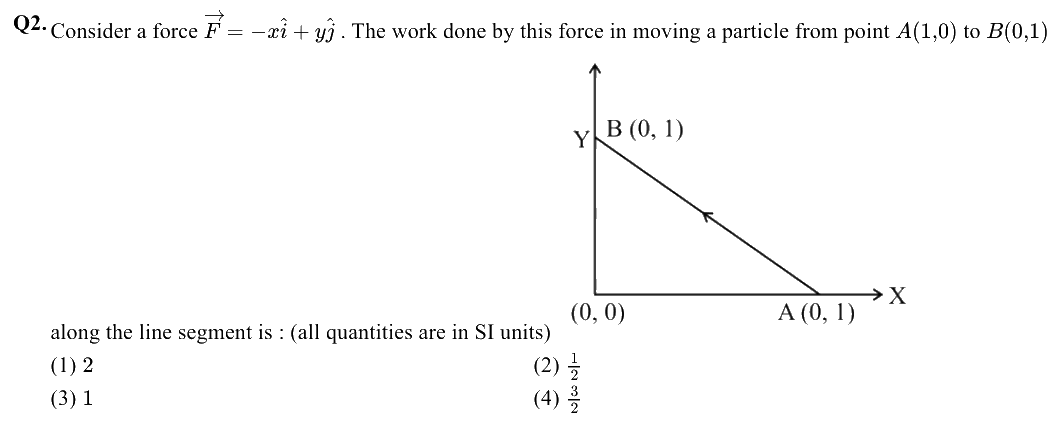
Consider a force $\overrightarrow{F} = -x\hat{i} + y\hat{j}$ . The work done by this force in moving a particle from point $A(1,0)$ to $B(0,1)$ along the line segment is : (all quantities are in SI units) (see the figure above)
Two particles of equal mass $m$ have respective initial velocities $u\hat{i}$ and $u\left(\frac{\hat{i}+\hat{j}}{2}\right)$ . They collide completely inelastically. The energy lost in the process is:
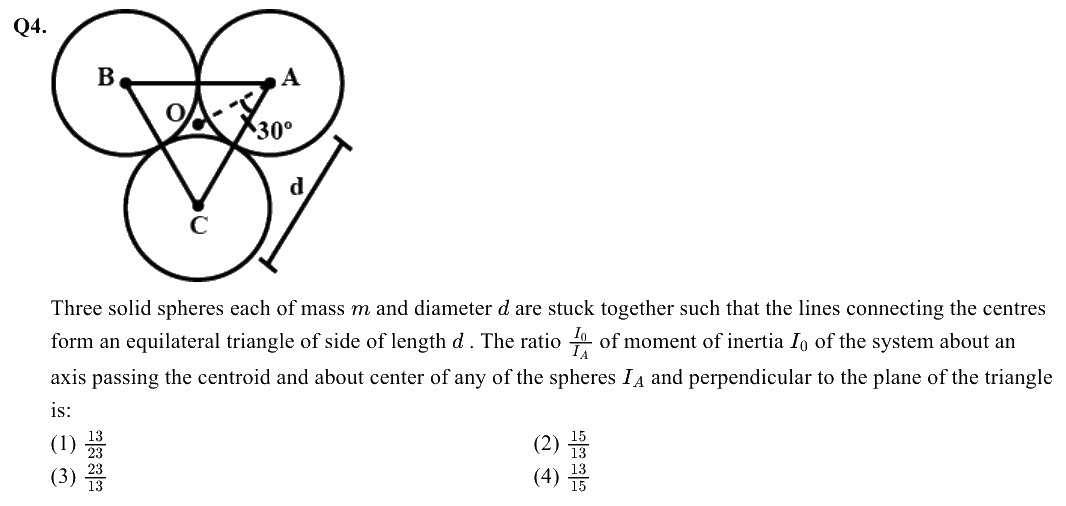
see figure Three solid spheres each of mass $m$ and diameter $d$ are stuck together such that the lines connecting the centres form an equilateral triangle of side of length $d$ . The ratio $\frac{I_0}{I_A}$ of moment of inertia $I_0$ of the system about an axis passing the centroid and about center of any of the spheres $I_A$ and perpendicular to the plane of the triangle is:
A body A of mass $m$ is moving in a circular orbit of radius $R$ about a planet. Another body B of mass $\frac{m}{2}$ collides with A with a velocity which is half $\left(\frac{\overrightarrow{v}}{2}\right)$ the instantaneous velocity $\overrightarrow{v}$ of A. The collision is completely inelastic. Then, the combined body:
A
continues to move in a circular orbit
B
Escapes from the Planet's Gravitational field
C
Falls vertically downwards towards the planet
D
starts moving in an elliptical orbit around the planet
Answer: (D) starts moving in an elliptical orbit around the planet· Key from source paper
Sit the whole paper timed in EdLoop
You have seen the first 5 questions with answers. Questions 6–75 are listed below; their answers and step-by-step solutions are in the EdLoop app, free.