A physical quantity $Q$ is found to depend on quantities $a$, $b$, $c$ by the relation $Q = \frac{a^4 b^3}{c^2}$. The percentage error in $a$, $b$ and c are 3%, 4% and 5% respectively. Then, the percentage error in $Q$ is:
- A
66%
- B
43%
- C
34%
- D
14%
A physical quantity $Q$ is found to depend on quantities $a$, $b$, $c$ by the relation $Q = \frac{a^4 b^3}{c^2}$. The percentage error in $a$, $b$ and c are 3%, 4% and 5% respectively. Then, the percentage error in $Q$ is:
66%
43%
34%
14%
A particle is moving in a straight line. The variation of position $x$ as a function of time $t$ is given as $x = (t^3 - 6t^2 + 20t + 15)$ m. The velocity of the body when its acceleration becomes zero is:
4 m s$^{-1}$
8 m s$^{-1}$
10 m s$^{-1}$
6 m s$^{-1}$
A stone of mass 900 g is tied to a string and moved in a vertical circle of radius 1 m making 10 rpm. The tension in the string, when the stone is at the lowest point is (if $\pi^2 = 9.8$ and $g = 9.8$ m s$^{-2}$)
97 N
9.8 N
8.82 N
17.8 N
The bob of a pendulum was released from a horizontal position. The length of the pendulum is 10 m. If it dissipates 10% of its initial energy against air resistance, the speed with which the bob arrives at the lowest point is: [Use, $g = 10$ m s$^{-2}$ ]
$6\sqrt{5}$ m s$^{-1}$
$5\sqrt{6}$ m s$^{-1}$
$5\sqrt{5}$ m s$^{-1}$
$2\sqrt{5}$ m s$^{-1}$
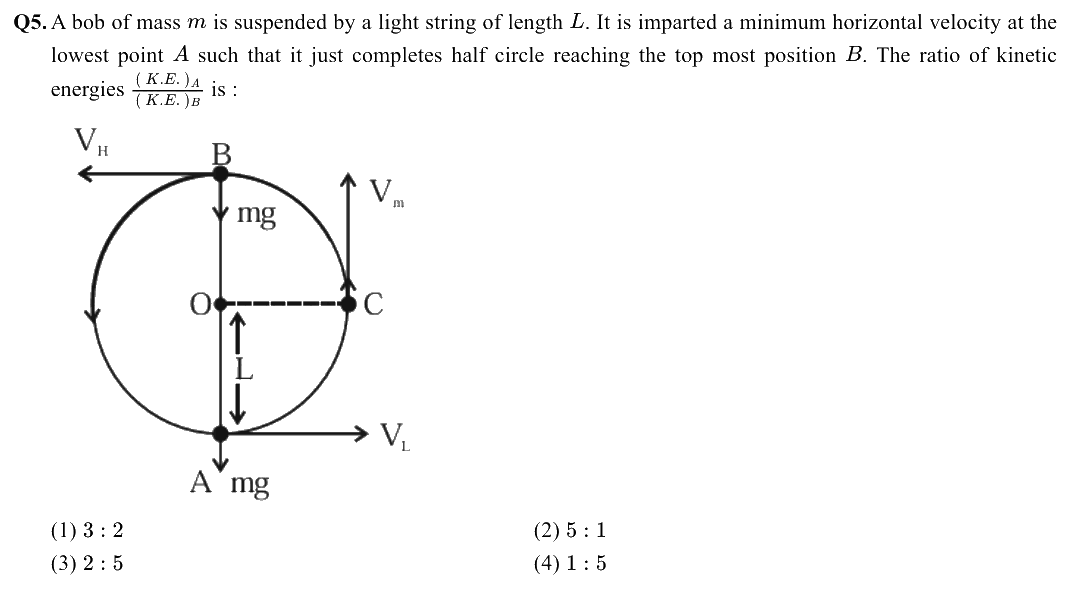
A bob of mass $m$ is suspended by a light string of length $L$. It is imparted a minimum horizontal velocity at the lowest point $A$ such that it just completes half circle reaching the top most position $B$. The ratio of kinetic energies $\frac{(K.E.)_A}{(K.E.)_B}$ is :
(see the figure above)

3 : 2
5 : 1
2 : 5
1 : 5
You have seen the first 5 questions with answers. Questions 6–90 are listed below; their answers and step-by-step solutions are in the EdLoop app, free.