Two resistance are given as $R_1 = (10 \pm 0.5)\ \Omega$ and $R_2 = (15 \pm 0.5)\ \Omega$. The percentage error in the measurement of equivalent resistance when they are connected in parallel is
- A
$6.33$
- B
$2.33$
- C
$5.33$
- D
$4.33$
Two resistance are given as $R_1 = (10 \pm 0.5)\ \Omega$ and $R_2 = (15 \pm 0.5)\ \Omega$. The percentage error in the measurement of equivalent resistance when they are connected in parallel is
$6.33$
$2.33$
$5.33$
$4.33$
A particle is moving with constant speed in a circular path. When the particle turns by an angle $90^\circ$, the ratio of instantaneous velocity to its average velocity is $\pi : x\sqrt{2}$. The value of $x$ will be
2
5
1
7
Given below are two statements: one is labelled as Assertion $A$ and the other is labelled as Reason $R$.
Assertion A: When a body is projected at an angle $45^\circ$, its range is maximum.
Reason R: For maximum range, the value of $\sin 2\theta$ should be equal to one.
In the light of the above statements, choose the correct answer from the options given below:
$A$ is false but $R$ is true
$A$ is true but $R$ is false
Both $A$ and $R$ are correct and $R$ is the correct explanation of $A$
Both $A$ and $R$ are correct but $R$ is NOT the correct explanation of $A$
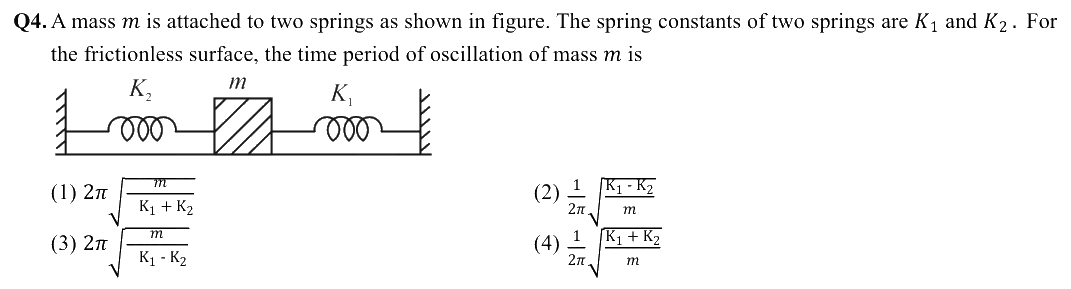
A mass $m$ is attached to two springs as shown in figure. The spring constants of two springs are $K_1$ and $K_2$. For the frictionless surface, the time period of oscillation of mass $m$ is
(see the figure above)

$2\pi\sqrt{\frac{m}{K_1 + K_2}}$
$\frac{1}{2\pi}\sqrt{\frac{K_1 - K_2}{m}}$
$2\pi\sqrt{\frac{m}{K_1 - K_2}}$
$\frac{1}{2\pi}\sqrt{\frac{K_1 + K_2}{m}}$
A small block of mass $100\ \mathrm{g}$ is tied to a spring of spring constant $7.5\ \mathrm{N\ m^{-1}}$ and length $20\ \mathrm{cm}$. The other end of spring is fixed at a particular point $A$. If the block moves in a circular path on a smooth horizontal surface with constant angular velocity $5\ \mathrm{rad\ s^{-1}}$ about point $A$, then tension in the spring is
$0.75\ \mathrm{N}$
$0.25\ \mathrm{N}$
$0.50\ \mathrm{N}$
$1.5\ \mathrm{N}$
You have seen the first 5 questions with answers. Questions 6–90 are listed below; their answers and step-by-step solutions are in the EdLoop app, free.