EdLoop PYQs · free, no ads · questions and answers here, step-by-step solutions in the EdLoop app
PYQs · free, no adsOpen on the web (app.edloop.in)Get EdLoop – free on Google Play

JEE Main 2022 Question Paper with Answers (26 Jun, Shift 2)

JEE Main26 Jun 2022Shift 2Memory based
90questions
30 / 30 / 30Physics / Chemistry / Maths
180 minduration
5 of 90answers shown here

Physics

30 questions · Questions 1–30

The dimension of mutual inductance is

  • A

    $\mathrm{ML}^2\mathrm{T}^{-2}\mathrm{A}^{-1}$

  • B

    $\mathrm{ML}^2\mathrm{T}^{-2}\mathrm{A}^{-2}$

  • C

    $\mathrm{ML}^2\mathrm{T}^{-3}\mathrm{A}^{-1}$

  • D

    $\mathrm{ML}^2\mathrm{T}^{-3}\mathrm{A}^{-2}$

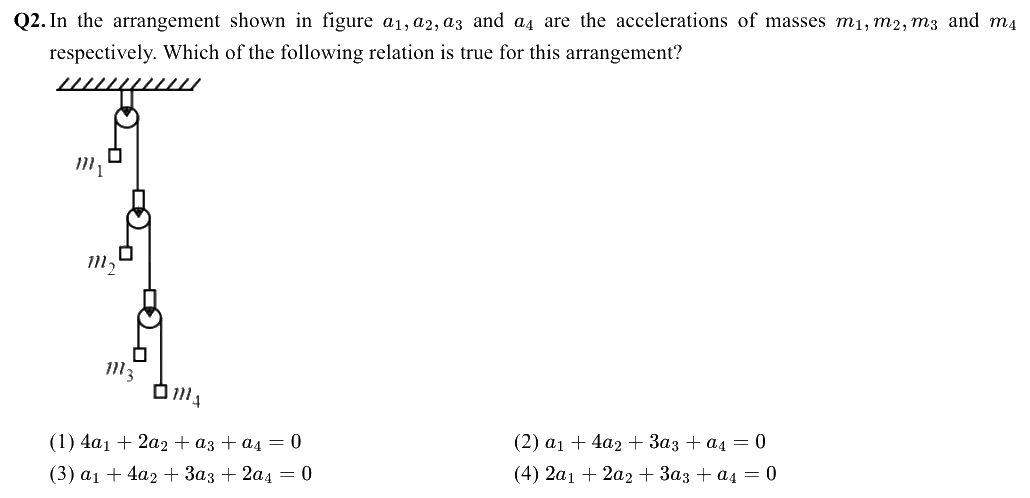
In the arrangement shown in figure $a_1, a_2, a_3$ and $a_4$ are the accelerations of masses $m_1, m_2, m_3$ and $m_4$ respectively. Which of the following relation is true for this arrangement?
(see the figure above)

The question and its figure as printed in JEE Main 2022 26 Jun Shift 2.
The question as printed in the paper.
  • A

    $4a_1 + 2a_2 + a_3 + a_4 = 0$

  • B

    $a_1 + 4a_2 + 3a_3 + a_4 = 0$

  • C

    $a_1 + 4a_2 + 3a_3 + 2a_4 = 0$

  • D

    $2a_1 + 2a_2 + 3a_3 + a_4 = 0$

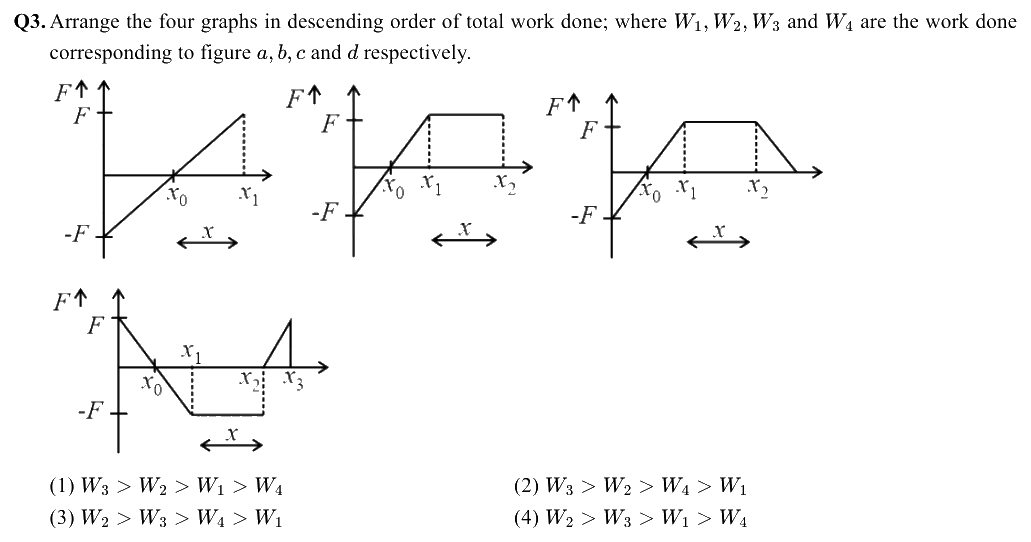
Arrange the four graphs in descending order of total work done; where $W_1, W_2, W_3$ and $W_4$ are the work done corresponding to figure $a, b, c$ and $d$ respectively.
(see the figure above)

The question and its figure as printed in JEE Main 2022 26 Jun Shift 2.
The question as printed in the paper.
  • A

    $W_3 > W_2 > W_1 > W_4$

  • B

    $W_3 > W_2 > W_4 > W_1$

  • C

    $W_2 > W_3 > W_4 > W_1$

  • D

    $W_2 > W_3 > W_1 > W_4$

A solid spherical ball is rolling on a frictionless horizontal plane surface about its axis of symmetry. The ratio of rotational kinetic energy of the ball to its total kinetic energy is

  • A

    $\frac{1}{5}$

  • B

    $\frac{2}{5}$

  • C

    $\frac{2}{7}$

  • D

    $\frac{7}{10}$

Given below are two statements: One is labelled as Assertion A and the other is labelled as Reason R.
Assertion A: If we move from poles to equator, the direction of acceleration due to gravity always points towards the center of earth without any variation in its magnitude.
Reason R: At equator, the direction of acceleration due to the gravity is towards the center of earth.
In the light of above statements, choose the correct answer from the options given below

  • A

    Assertion and reason both are correct and reason is correct explanation of assertion.

  • B

    Assertion and reason both are correct but reason is not correct explanation of assertion.

  • C

    Assertion is true but reason is false

  • D

    Assertion is false but reason is true

Sit the whole paper timed in EdLoop

You have seen the first 5 questions with answers. Questions 6–90 are listed below; their answers and step-by-step solutions are in the EdLoop app, free.

  1. 6Fluid MechanicsFormula for the Reynolds number of pipe flow
  2. 7Kinetic Theory of GasesAverage kinetic energy per molecule of argon and oxygen in one flask
  3. 8WavesSpeed of a receding galaxy from the red shift of a 670 nm line
  4. 9Electrostatics64 charged drops merge: ratio of surface charge densities
  5. 10CapacitorsCharge on the middle capacitor of three in series across 13 V
  6. 11CapacitorsDielectric slab filling half the gap of a 4 μF capacitor
  7. 12Current ElectricityHexagon of resistors with chords from A: equivalent resistance between A and B
  8. 13Magnetism & MatterWork to turn a bar magnet through 60° from the field direction
  9. 14Dual Nature of Matter &…Work function from the circular path of photoelectrons in a 2 mT field
  10. 15Electromagnetic InductionEquivalent inductance of two coupled coils in series opposition
  11. 16Electromagnetic InductionEMF across a 1 m rod rotating in an east-west vertical plane
  12. 17Electromagnetic WavesAscending order of wavelengths: gamma, X-ray, visible, microwave
  13. 18NucleiEffective half-life for decay by two processes of 3.0 h and 4.5 h
  14. 19Semiconductor ElectronicsMeaning of positive feedback in a transistor oscillator
  15. 20Communication SystemsAmplitude of the lower sideband of an AM wave
  16. 21KinematicsTwo balls thrown up at 50 m/s two seconds apart: time of meeting
  17. 22Laws of MotionString of 10 balls sliding off a smooth table: tension between 7th and 8th
  18. 23Laws of MotionImpulse on a 0.4 kg ball hit straight back at 15 m/s
  19. 24Thermal Properties of MatterFuel burnt per minute by a geyser heating 2 kg/min of water by 40 °C
  20. 25ThermodynamicsMinimum hot-reservoir temperature for an engine taking 300 J and rejecting 180 J
  21. 26Waves20 tuning forks each 4 Hz above the last, last fork twice the first
  22. 27Magnetic Effects of CurrentSeparation of two 10 cm wires carrying 5 A with force 10⁻⁵ N
  23. 28Ray OpticsBulb at the bottom of √7 m of water: area through which light escapes
  24. 29Dual Nature of Matter &…Threshold frequency from 6630 Å light and 0.42 V stopping potential
  25. 30Units, Dimensions & ErrorsLeast count of a travelling microscope: 40 MSD per cm, 50 VSD = 49 MSD

Chemistry

30 questions · Questions 31–60
  1. 31Atomic StructureRadial and angular nodes in a 4d orbital
  2. 32Periodic Table & PeriodicityIdentifying the metalloid among Sc, Pb, Bi and Te
  3. 33p-Block ElementsOxide of nitrogen with an odd electron on nitrogen
  4. 34Redox ReactionsWhich manganese reaction is a disproportionation
  5. 35HydrogenProducts of boiling water with temporary hardness
  6. 36s-Block Elementss-block element that gives no flame colour
  7. 37General Organic ChemistryCorrect order of nucleophilicity among simple pairs
  8. 38HydrocarbonsOxymercuration-demercuration of 3,3-dimethylbut-1-ene
  9. 39HydrocarbonsDisubstituted toluene whose halogenation goes meta to the methyl group
  10. 40Environmental ChemistryHighly polluted water samples from BOD values
  11. 41General Principles of…Role of a depressant in froth flotation
  12. 42d- and f-Block ElementsLanthanoid that readily leaves the +3 state
  13. 43Aldehydes, Ketones &…Reagent that converts toluene into benzaldehyde
  14. 44Aldehydes, Ketones &…Butan-2-one cyanohydrin heated with 95% sulphuric acid
  15. 45Aldehydes, Ketones &…One-step reagent for benzoic acid to benzaldehyde
  16. 46Amines & Nitrogen CompoundsIncorrect statement about p-toluenesulphonyl chloride
  17. 47Amines & Nitrogen CompoundsNitrobenzene to aniline to diazonium salt, coupled with β-naphthol
  18. 48Surface ChemistryMatch invertase, zymase, diastase and maltase with their conversions
  19. 49Chemistry in Everyday LifeWhich structure is not a synthetic detergent
  20. 50BiomoleculesWater-soluble vitamin that is not readily excreted
  21. 51Mole Concept & StoichiometryCO₂ from 100 g methane burnt with 208 g oxygen
  22. 52Mole Concept & StoichiometryMoles of methane burnt to give 81 g of water
  23. 53Chemical Bonding &…Species with two lone pairs on the central atom: SF₄, XeF₄, CF₄, H₂O
  24. 54Chemical ThermodynamicsInternal energy of vaporisation of water at 100 °C from ΔvapH = 41.1 kJ/mol
  25. 55Chemical EquilibriumStandard Gibbs energy for decomposition of HI that is 40% dissociated at 300 K
  26. 56States of Matterccp A with B in all octahedral voids: formula after removing two face atoms
  27. 57SolutionsOsmotic pressure in Pa of 2 g of a 60 kg/mol protein in 200 mL
  28. 58ElectrochemistryGibbs energy of Cu + Sn²⁺ → Cu²⁺ + Sn at given concentrations
  29. 59Chemical KineticsCatalyst lowering Ea by 10 kJ/mol at 300 K: exponent in the rate-constant ratio
  30. 60Coordination CompoundsElectrons in t₂g of the diamagnetic product of [Co(H₂O)₆]²⁺ with NH₃ and O₂

Maths

30 questions · Questions 61–90
  1. 61Sequences & SeriesRatio of two series with denominators (3 + (−1)ⁿ)ⁿ
  2. 62TrigonometryValue of 16 sin 20° sin 40° sin 80°
  3. 63EllipseSlope of a common tangent to x²/16 + y²/9 = 1 and x² + y² = 12
  4. 64EllipseLocus of midpoints of segments from (4, 3) to the ellipse x² + 2y² = 4
  5. 65HyperbolaNormal to x²/a² − y²/9 = 1 at (8, 3√3): which point does it pass through
  6. 66Limits, Continuity &…Limit of (cos(sin x) − cos x)/x⁴ as x → 0
  7. 67Mathematical ReasoningChoice of r making r ∨ (∼p) ⇒ (p ∧ q) ∨ r a tautology
  8. 68StatisticsCorrected variance of 50 observations after fixing one wrong value
  9. 69Matricesα and β for infinitely many solutions of a 3×3 linear system
  10. 70Inverse Trigonometric…cos⁻¹ of (3/10)cos θ + (2/5)sin θ with θ = tan⁻¹(4/3)
  11. 71Sets, Relations & FunctionsIs f∘g one-one or onto for f(x) = x − 1 and g(x) = x²/(x² − 1)?
  12. 72Limits, Continuity &…Non-differentiable and discontinuous points of min1, 1 + x sin x on [0, 2π]
  13. 73Applications of DerivativesCuboid 2x × 4x × 5x and closed hemisphere: x : r for maximum total volume
  14. 74Indefinite Integrationg(1/2) for g(x) = ∫ (1/x)√((1 − x)/(1 + x)) dx with g(1) = 0
  15. 75Area Under CurvesArea between y² = 8x and y² = 16(3 − x)
  16. 76Differential EquationsLocal maximum of x²y − eˣ where x y′ + 2y = x eˣ, y(1) = 0
  17. 77Differential Equationsy(2) for y′ + eˣ(x² − 2)y = (x² − 2x)(x² − 2)e²ˣ, y(0) = 0
  18. 78Vector AlgebraVector in the plane of a and b with given projection on c and v·ĵ = 7
  19. 79Three Dimensional GeometryPlane 2x + y − 5z = 0 rotated by π/2 about its line of intersection with another
  20. 80Three Dimensional GeometryCoplanar lines with parameter α: distance of their plane from (α, 0, 0)
  21. 81Quadratic Equationsp + q = 3, p⁴ + q⁴ = 369 for real p, q: value of (1/p + 1/q)⁻²
  22. 82Complex NumbersModulus of Σ (zⁿ + (−1)ⁿ/zⁿ)² for n = 1 to 15 when z² + z + 1 = 0
  23. 83Permutations & CombinationsThree-digit numbers whose gcd with 36 is 2
  24. 84Sequences & SeriesGP with a₂ + a₄ = 2a₃ + 1 and 3a₂ + a₃ = 2a₄: value of a₂ + a₄ + 2a₅
  25. 85Binomial Theorem⁴⁰C₀ + ⁴¹C₁ + … + ⁶⁰C₂₀ as (m/n) × ⁶⁰C₂₀
  26. 86HyperbolaFoot of perpendicular from the origin to tangents of x²/16 − y²/4 = 1: locus
  27. 87MatricesY = αI + βX + γX² with nilpotent X and given Y⁻¹: value of (α − β + γ)²
  28. 88Sets, Relations & Functionsf(x + y) = 2ˣf(y) + 4ʸf(x), f(2) = 3: value of 14 f′(4)/f′(2)
  29. 89Definite Integration(24/π) ∫₀^√2 (2 − x²)/((2 + x²)√(4 + x⁴)) dx
  30. 90ProbabilityProbability a 6-digit number made of 1s and 8s is a multiple of 21

Chapters in this paper

Get EdLoop – freeOpen on the web