An expression for a dimensionless quantity $P$ is given by $P = \frac{\alpha}{\beta}\log_e\left(\frac{kT}{\beta x}\right)$; where $\alpha$ and $\beta$ are constants, $x$ is distance; $k$ is Boltzmann constant and $T$ is the temperature. Then the dimensions of $\alpha$ will be
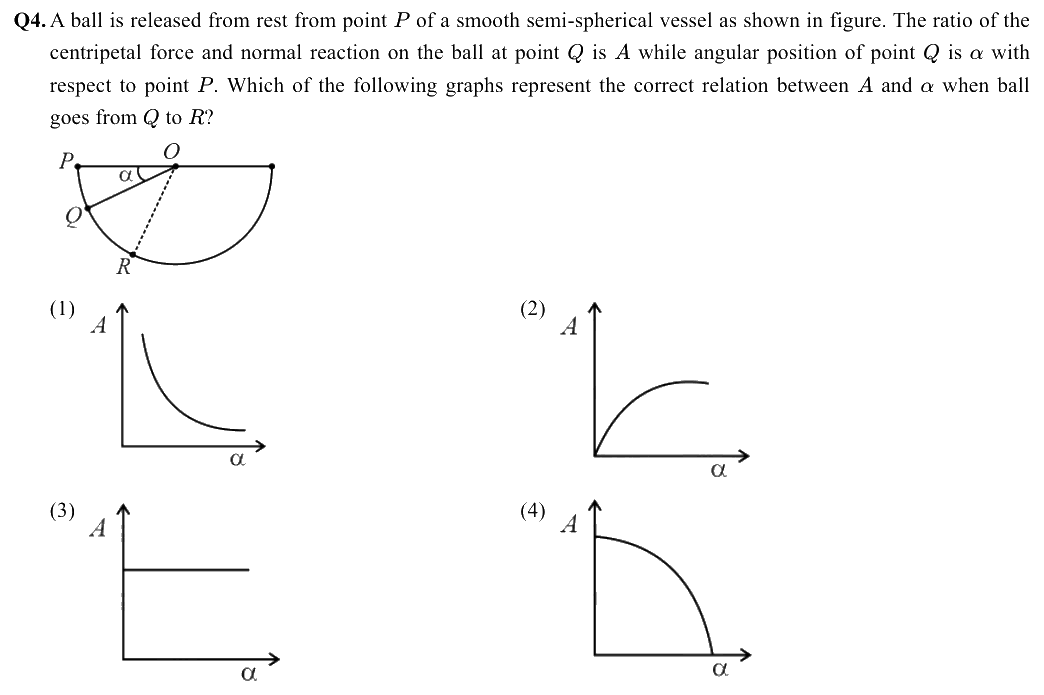
A ball is released from rest from point $P$ of a smooth semi-spherical vessel as shown in figure. The ratio of the centripetal force and normal reaction on the ball at point $Q$ is $A$ while angular position of point $Q$ is $\alpha$ with respect to point $P$. Which of the following graphs represent the correct relation between $A$ and $\alpha$ when ball goes from $Q$ to $R$? (see the figure above)
The question as printed in the paper.
A
see figure graph of A against alpha: a decreasing convex curve starting high on the A axis and flattening toward the alpha axis
B
see figure graph of A against alpha: a rising concave curve starting at the origin and levelling off
C
see figure graph of A against alpha: a horizontal line at constant A
D
see figure graph of A against alpha: a curve starting at a maximum on the A axis and falling in a concave-down arc to zero at a finite alpha
A thin circular ring of mass $M$ and radius $R$ is rotating with a constant angular velocity $2 \mathrm{~rad} \mathrm{~s}^{-1}$ in a horizontal plane about an axis vertical to its plane and passing through the center of the ring. If two objects each of mass $m$ be attached gently to the opposite ends of a diameter of ring, the ring will then rotate with an angular velocity (in $\mathrm{rad} \mathrm{~s}^{-1}$).
Answer: (C) $\frac{2M}{(M + 2m)}$· Key from source paper
Sit the whole paper timed in EdLoop
You have seen the first 5 questions with answers. Questions 6–90 are listed below; their answers and step-by-step solutions are in the EdLoop app, free.