In the density measurement of a cube, the mass and edge length are measured as $(10.00 \pm 0.10)$ kg and $(0.10 \pm 0.01)$ m, respectively. The error in the measurement of density is:
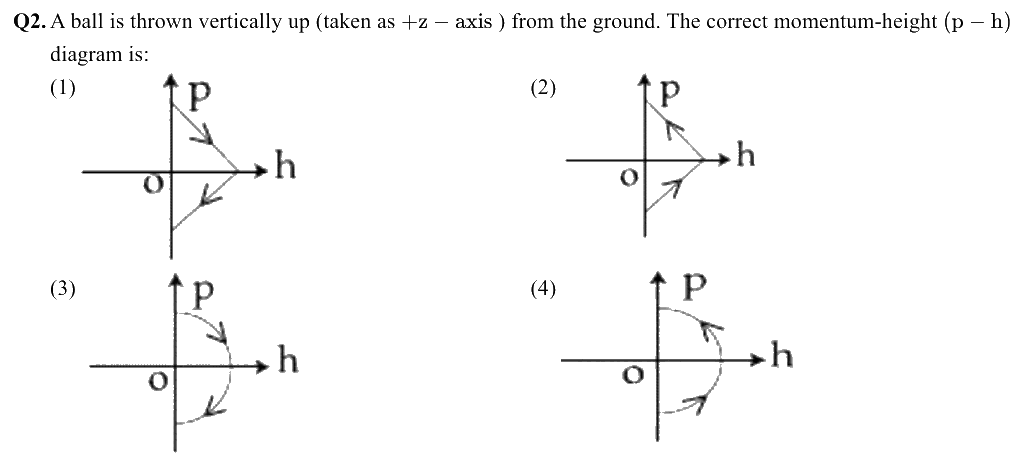
A ball is thrown vertically up (taken as $+z - $axis ) from the ground. The correct momentum-height ($\mathrm{p - h}$) diagram is:
The question as printed in the paper.
A
see figure p (vertical) against h (horizontal), origin O: two straight lines forming a "<"-shaped (V on its side) figure with the vertex on the positive h axis; the upper line runs from the top of the p axis down to the vertex with its arrow pointing down towards the vertex, the lower line runs from the vertex down-left to the negative p axis with its arrow pointing away from the vertex.
B
see figure p against h: the same two-line shape as option 1 but with the arrows reversed (the lower line's arrow points up-right towards the vertex, the upper line's arrow points up-left away from the vertex).
C
see figure p against h: two curved arcs (a "D" shape lying on the right of the p axis) with the vertex on the positive h axis; the upper arc has its arrow pointing down towards the h axis and the lower arc has its arrow pointing down-left away from the h axis.
D
see figure p against h: the same two arcs as option 3 with the arrows reversed (the upper arc's arrow points up-left away from the h axis, the lower arc's arrow points up-right towards it).
The stream of a river is flowing with a speed of 2 $\mathrm{km\ h^{-1}}$. A swimmer can swim at a speed of 4 $\mathrm{km\ h^{-1}}$. The direction of the swimmer with respect to the flow of the river, to cross the river straight, is
A uniform cable of mass $M$ and length $L$ is placed on a horizontal surface such that its $\left(\dfrac{1}{n}\right)^{\mathrm{th}}$ part is hanging below the edge of the surface. To lift the hanging part of the cable upto the surface, the work done should be:
A body of mass 2 kg makes an elastic collision with a second body at rest and continues to move in the original direction but with one fourth of its original speed. What is the mass of the second body?
You have seen the first 5 questions with answers. Questions 6–90 are listed below; their answers and step-by-step solutions are in the EdLoop app, free.