EdLoop PYQs · free, no ads · questions and answers here, step-by-step solutions in the EdLoop app
PYQs · free, no adsOpen on the web (app.edloop.in)Get EdLoop – free on Google Play

JEE Main 2025 Question Paper with Answers (3 Apr, Shift 1)

JEE Main3 Apr 2025Shift 1Memory based
75questions
25 / 25 / 25Physics / Chemistry / Maths
180 minduration
5 of 75answers shown here

Physics

25 questions · Questions 1–25

Two blocks of masses m and $M, (M > m)$, are placed on a frictionless table as shown in figure. A massless spring with spring constant k is attached with the lower block. If the system is slightly displaced and released, then ($\mu$ = coefficient of friction between the two blocks)

(see the figure above)

A. The time period of small oscillation of the two blocks is $T = 2\pi\sqrt{\frac{(m + M)}{k}}$

B. The acceleration of the blocks is $a = -\frac{kx}{M + m}$ (x = displacement of the blocks from the mean position)

C. The magnitude of the frictional force on the upper block is $\frac{m\mu|x|}{M + m}$

D. The maximum amplitude of the upper block, if it does not slip, is $\frac{\mu(M + m)g}{k}$

E. Maximum frictional force can be $\mu(M + m)g$.

Choose the correct answer from the options given below:
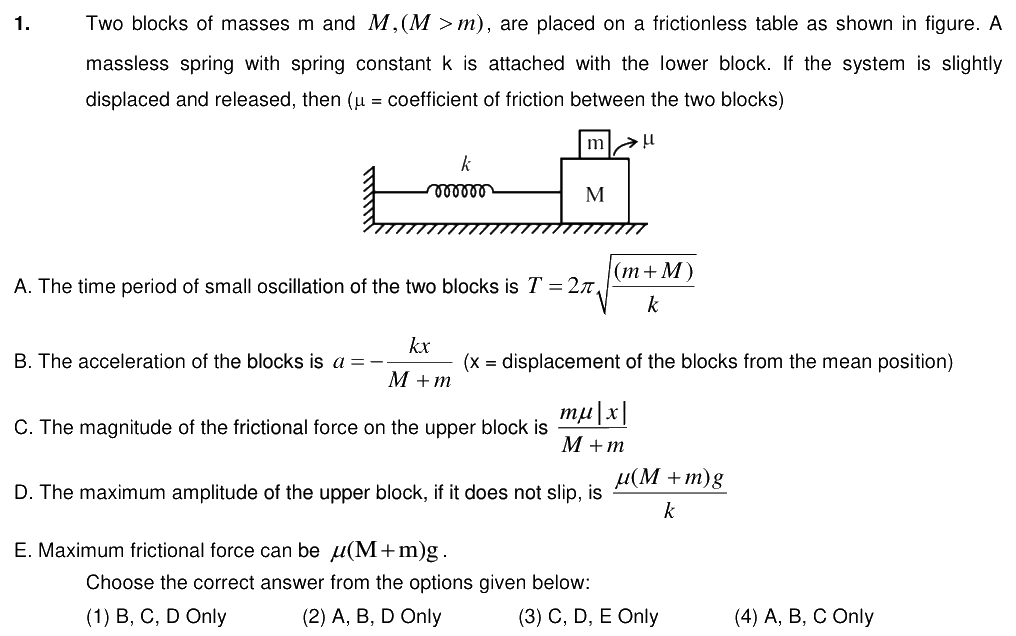
The question and its figure as printed in JEE Main 2025 03 Apr Shift 1.
The question as printed in the paper.
  • A

    B, C, D Only

  • B

    A, B, D Only

  • C

    C, D, E Only

  • D

    A, B, C Only

During the melting of a slab of ice at 273 K at atmospheric pressure:

  • A

    Internal energy of ice-water system remains unchanged.

  • B

    Internal energy of the ice-water system decreases.

  • C

    Positive work is done by the ice-water system on the atmosphere.

  • D

    Positive work is done on the ice-water system by the atmosphere.

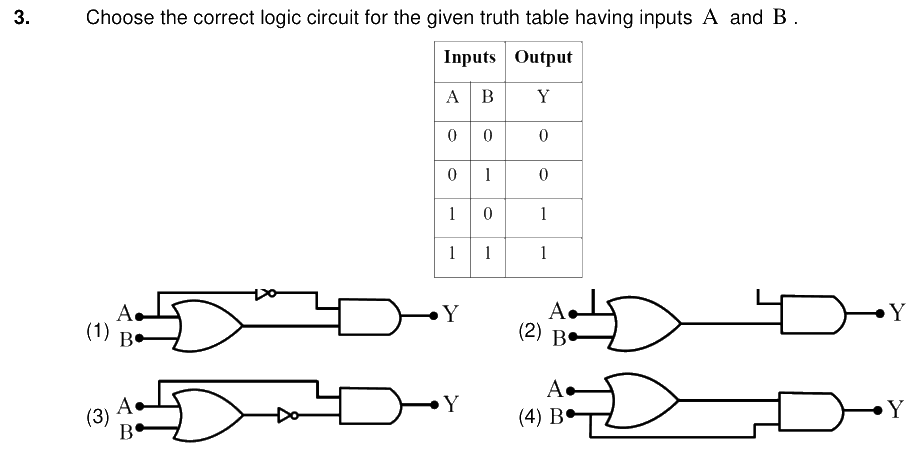
Choose the correct logic circuit for the given truth table having inputs A and B .

InputsOutput
ABY
000
010
101
111

(see the figure above)

The question and its figure as printed in JEE Main 2025 03 Apr Shift 1. Option 1: inputs A (upper) and B (lower) go into a gate with a curved back, a pointed front and no circle. A branch from A's wire rises, runs along the top to the right through a small triangle-with-circle symbol, then steps down into the upper input of a second gate (flat back, curved front, no circle). The first gate's output goes straight right into the lower input of the second gate; its output is 'Y'. Option 2: inputs A and B go into a gate with a curved back, a pointed front and no circle. A short vertical line rises from A's wire and stops (not joined to anything). The first gate's output goes straight right…
The question as printed in the paper.
  • A

    see figure inputs A (upper) and B (lower) go into a gate with a curved back, a pointed front and no circle. A branch from A's wire rises, runs along the top to the right through a small triangle-with-circle symbol, then steps down into the upper input of a second gate (flat back, curved front, no circle). The first gate's output goes straight right into the lower input of the second gate; its output is 'Y'.

  • B

    see figure inputs A and B go into a gate with a curved back, a pointed front and no circle. A short vertical line rises from A's wire and stops (not joined to anything). The first gate's output goes straight right into the lower input of the second gate (flat back, curved front, no circle); a short separate line comes down to the second gate's upper input from above and stops; its output is 'Y'.

  • C

    see figure inputs A and B go into a gate with a curved back, a pointed front and no circle. A branch from A's wire rises, runs along the top to the right and steps down into the upper input of a second gate (flat back, curved front, no circle). The first gate's output goes right through a small triangle-with-circle symbol into the lower input of the second gate; its output is 'Y'.

  • D

    see figure inputs A and B go into a gate with a curved back, a pointed front and no circle (A into its upper input only). The first gate's output goes straight right into the upper input of a second gate (flat back, curved front, no circle). A branch from B's wire drops down, runs right along the bottom and goes up a little into the lower input of the second gate; its output is 'Y'.

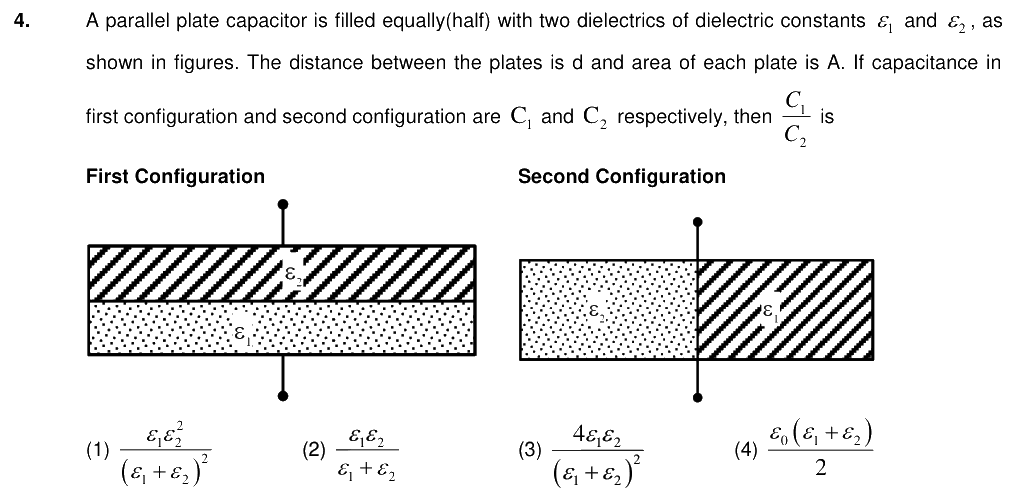
A parallel plate capacitor is filled equally(half) with two dielectrics of dielectric constants $\epsilon_1$ and $\epsilon_2$, as shown in figures. The distance between the plates is d and area of each plate is A. If capacitance in first configuration and second configuration are $C_1$ and $C_2$ respectively, then $\frac{C_1}{C_2}$ is

(see the figure above)

The question and its figure as printed in JEE Main 2025 03 Apr Shift 1.
The question as printed in the paper.
  • A

    $\frac{\epsilon_1\epsilon_2^2}{(\epsilon_1 + \epsilon_2)^2}$

  • B

    $\frac{\epsilon_1\epsilon_2}{\epsilon_1 + \epsilon_2}$

  • C

    $\frac{4\epsilon_1\epsilon_2}{(\epsilon_1 + \epsilon_2)^2}$

  • D

    $\frac{\epsilon_0(\epsilon_1 + \epsilon_2)}{2}$

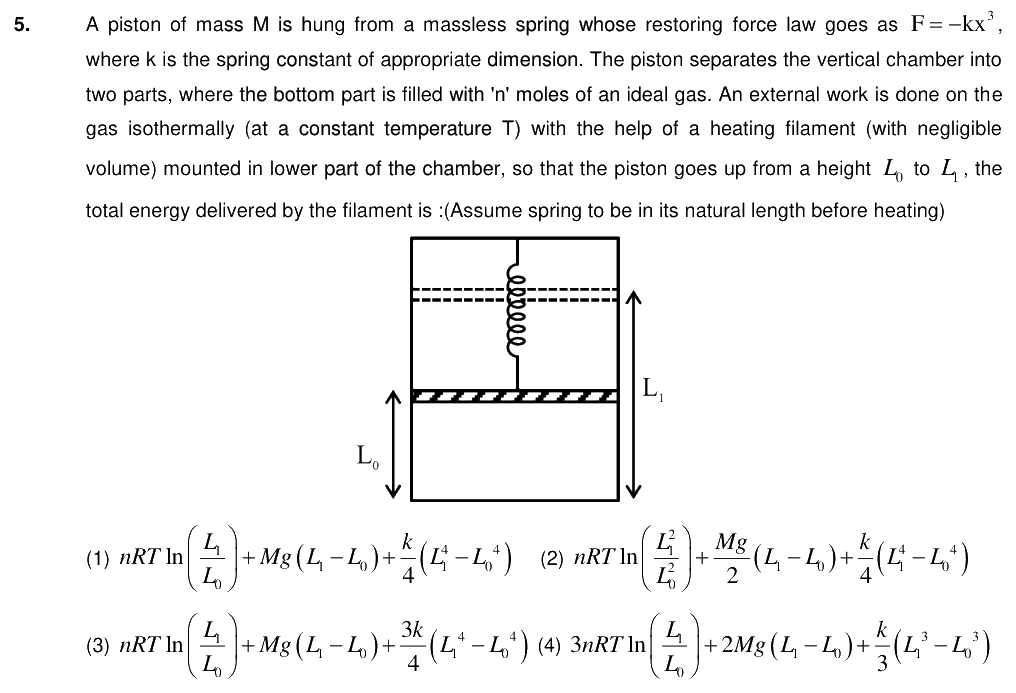
A piston of mass M is hung from a massless spring whose restoring force law goes as $F = -kx^3$, where k is the spring constant of appropriate dimension. The piston separates the vertical chamber into two parts, where the bottom part is filled with 'n' moles of an ideal gas. An external work is done on the gas isothermally (at a constant temperature T) with the help of a heating filament (with negligible volume) mounted in lower part of the chamber, so that the piston goes up from a height $L_0$ to $L_1$, the total energy delivered by the filament is :(Assume spring to be in its natural length before heating)

(see the figure above)

The question and its figure as printed in JEE Main 2025 03 Apr Shift 1.
The question as printed in the paper.
  • A

    $nRT\ln\left(\frac{L_1}{L_0}\right) + Mg(L_1 - L_0) + \frac{k}{4}\left(L_1^4 - L_0^4\right)$

  • B

    $nRT\ln\left(\frac{L_1^2}{L_0^2}\right) + \frac{Mg}{2}(L_1 - L_0) + \frac{k}{4}\left(L_1^4 - L_0^4\right)$

  • C

    $nRT\ln\left(\frac{L_1}{L_0}\right) + Mg(L_1 - L_0) + \frac{3k}{4}\left(L_1^4 - L_0^4\right)$

  • D

    $3nRT\ln\left(\frac{L_1}{L_0}\right) + 2Mg(L_1 - L_0) + \frac{k}{3}\left(L_1^3 - L_0^3\right)$

Sit the whole paper timed in EdLoop

You have seen the first 5 questions with answers. Questions 6–75 are listed below; their answers and step-by-step solutions are in the EdLoop app, free.

  1. 6Fluid MechanicsEfflux speed from a hole 0.7 m below the surface with a 50 kg load on top
  2. 7Current ElectricityResistance across a diameter of a 25 m wire bent into a circle (dropped by NTA)
  3. 8NucleiClassify four reactions as fission, chemical, or fusion with +ve/−ve Q
  4. 9KinematicsGraph of maximum height against the angle of projection from the vertical
  5. 10Ray OpticsTrue statements about a prism at minimum deviation
  6. 11Units, Dimensions & ErrorsSum of 435.42 g, 226.3 g and 0.125 g with significant-figure rules
  7. 12Work, Energy & PowerHeight and speed where kinetic energy is three times potential energy
  8. 13Electromagnetic WavesRadiation pressure of a 450 W source on a reflecting surface 2 m away
  9. 14Ray OpticsRefractive index of a convex lens with R = 10 cm, 15 cm and f = 12 cm
  10. 15Dual Nature of Matter &…Colour of visible light able to eject electrons from a 3 eV metal
  11. 16Units, Dimensions & ErrorsDimensions of G, gravitational PE, gravitational potential and g
  12. 17ThermodynamicsTemperature change when a gas (γ = 1.5) is compressed adiabatically from 800…
  13. 18ElectrostaticsPotential inside and outside a charged shell with 120 V on its surface
  14. 19Rotational MotionAcceleration of a solid sphere pulled at its top point, rolling without slipping
  15. 20KinematicsWhich phase, velocity and distance graphs can describe 1D motion
  16. 21GravitationCollision time of three gravitating spheres when side and masses double
  17. 22Current ElectricityReading of a 240 Ω ammeter shunted by 10 Ω in a 20 V circuit with 150.4 Ω
  18. 23Magnetic Effects of CurrentField at the centre of a loop of two concentric semicircles carrying 12 A
  19. 24Magnetic Effects of CurrentForce on a 4 cm wire carrying 8 A perpendicular to a 0.15 T field
  20. 25Wave OpticsImax − Imin for coherent beams of intensities 4I and 9I

Chemistry

25 questions · Questions 26–50
  1. 26Periodic Table & PeriodicityCorrect statements on electron gain, ionisation, electronegativity and…
  2. 27SolutionsBoiling point of 2 mol glycol + 2 mol glucose in 500 g water
  3. 28Atomic StructureBohr postulate that conflicts with the quantum mechanical model
  4. 29Mole Concept & StoichiometryWhich of Pb, Po, Pr, Pt has the most atoms in 10⁻⁹ g
  5. 30Coordination CompoundsOrder of wavelength absorbed by four Co(III) complexes
  6. 31Chemical KineticsWhen [A] = [B] if [A]₀ = 8[B]₀ and half-lives are 10 and 40 min
  7. 32Chemical ThermodynamicsWhich property changes from solution 1 to solution 2: intensive vs extensive
  8. 33p-Block ElementsN–N vs P–P single bonds, and disproportionation of group-15 +3 compounds
  9. 34General Organic ChemistryMetamers, functional, position isomers and homologues among four pairs
  10. 35Chemical Bonding &…Hybridisation of PF₅, SF₆, Ni(CO)₄ and [PtCl₄]²⁻
  11. 36ElectrochemistryOrder of limiting molar conductivities of H⁺, Ca²⁺, Mg²⁺, K⁺, Na⁺
  12. 37BiomoleculesFischer projection of L-fructose
  13. 38General Organic ChemistryLeast acidic among a phenol, a sulphonic acid, a carboxylic acid and a…
  14. 39d- and f-Block ElementsIons with spin-only magnetic moment 4.9 BM
  15. 40Amines & Nitrogen CompoundsIncorrect product among four reactions of benzenediazonium chloride
  16. 41Aldehydes, Ketones &…Number of compounds in a list of ten that do not give iodoform
  17. 42Chemical EquilibriumConcentrations in PCl₅ ⇌ PCl₃ + Cl₂ after adding xenon at constant T and p
  18. 43Chemical EquilibriumEffect of a catalyst on Kc and on the equilibrium composition
  19. 44Amines & Nitrogen CompoundsAniline → diazonium → iodobenzene → biphenyl (Fittig)
  20. 45HydrocarbonsCycloalkene that gives 3-methyl-6-oxoheptanal on ozonolysis
  21. 46Purification &…Percentage of carbon from 1.46 g CO₂ per 0.5 g of compound
  22. 47Chemical ThermodynamicsΔfH° of ethene from sublimation and bond enthalpies
  23. 48Purification &…Volume of N₂ at STP from 0.42 g of piperazine in a Dumas estimation
  24. 49Coordination CompoundsOptical isomers of the complex from FeCl₃, KOH and oxalic acid
  25. 50d- and f-Block ElementsTerminal oxygens in the dichromate formed via chromyl chloride and chromate

Maths

25 questions · Questions 51–75
  1. 51Quadratic EquationsRatios of power sums of roots of x² + √3x − 16 = 0 and x² + 3x − 1 = 0
  2. 52ParabolaSmallest circle touching y = x² + 2 and x = y² + 2
  3. 53Sequences & Series24(a₁ + a₂ + a₃) for a GP with a₃a₅ = 729 and a₂ + a₄ = 111/4
  4. 54Binomial TheoremΣ (r + 3)·⁹Cᵣ/2ʳ written as α(3/2)⁹ − β
  5. 55Three Dimensional GeometryTransversal through (4, 1, 0) meeting two lines; a determinant of the meeting…
  6. 56Sets, Relations & FunctionsPairs with 0 ≤ x² + 2y ≤ 4 on −3, …, 3 and pairs needed for reflexivity
  7. 57EllipseChord of x²/36 + y²/25 = 1 through (√5, √5) maximising PA·PB
  8. 58Three Dimensional Geometryλ from a skew-line distance of 3, then a point's distance from a line parallel…
  9. 59Differential Equationsy(π/3) for y′ − y tan x = 2(x + 1) sec x g(x), with g from an integral equation
  10. 60Sets, Relations & FunctionsDomain of ln((2x − 3)/(5 + 4x)) + sin⁻¹((4 + 3x)/(2 − x))
  11. 61Matrices|2 adj(3A adj(2A))| as 2^α 3^β 5^γ with |A| = 5
  12. 62Determinantsy″ + y for a determinant with sin x, cos x in the first row
  13. 63Complex NumbersSum of z² over the roots of (z² + 3i)/(z − 2 + i) = 2 + 3i
  14. 64TrigonometrySolutions of 2x + 3 tan x = π in [−2π, 2π]
  15. 65Indefinite Integrationf(1) for f(x) = ∫x³√(3 − x²) dx with 5f(√2) = −4
  16. 66Binomial TheoremSum of rational terms of (2 + √3)⁸
  17. 67Definite IntegrationDomain of log₂log₄log₆(3 + 4x − x²), then ∫₀^b−a[x²]dx
  18. 68Sequences & SeriesSum of 20 terms of 1 + 3 + 11 + 25 + 45 + 71 + …
  19. 69Straight LinesAM/BM for y = x meeting 2x + y + 6 = 0 and 4x + 2y = p with AB = 9/√2
  20. 70Limits, Continuity &…eᵃbc for a piecewise function continuous at 0
  21. 71Permutations & CombinationsProbability of the word CDBEA when probabilities double along dictionary order
  22. 72Hyperbolap² + q² for a hyperbola through (4, 2√3) with focal-distance product 32
  23. 73Permutations & CombinationsSeven-digit numbers with an even digit sum written as m·n·10ⁿ
  24. 74Vector Algebra|3λd̂ + μc|² when a × d̂ = b × d̂, c·d̂ = 1 and c ⟂ a
  25. 75Area Under CurvesArea under y = max|x|, x|x − 2| from x = −2 to x = 4

Chapters in this paper

Get EdLoop – freeOpen on the web