
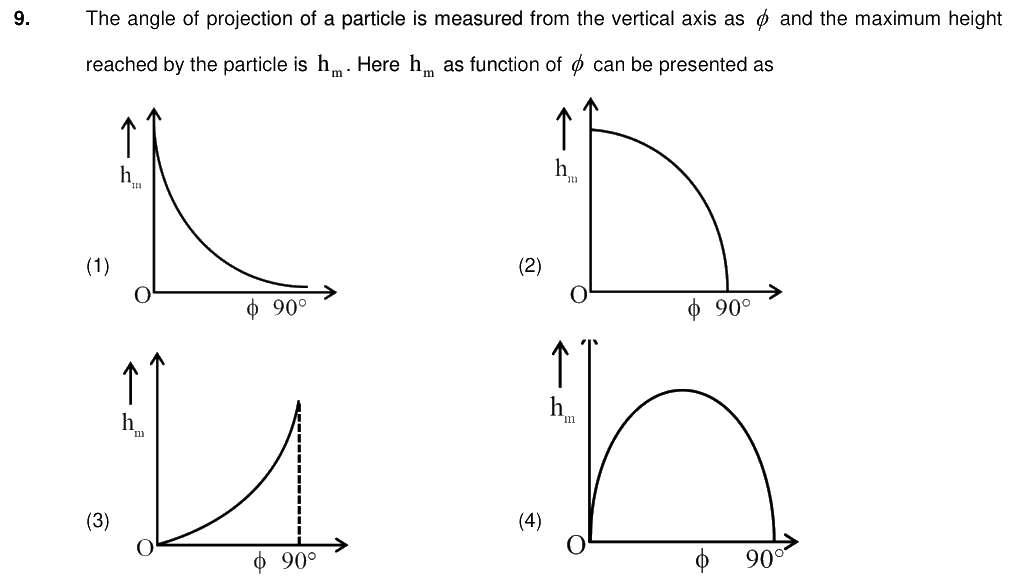
The angle of projection of a particle is measured from the vertical axis as $\phi$ and the maximum height reached by the particle is $h_m$. Here $h_m$ as function of $\phi$ can be presented as
- (1)
see figure axes 'hm' (vertical) and 'φ' (horizontal, marked 90°) from the origin O; a curve starting high on the vertical axis and falling steeply at first, then flattening out towards the horizontal axis near 90° (a falling convex curve ending close to the axis).
- (2)
see figure same axes; a curve starting at a point on the vertical axis, nearly flat at first and then bending down to reach the horizontal axis at 90° (a quarter-circle-like arc, concave down, ending on the axis at 90°).
- (3)
see figure same axes; a curve starting at the origin, rising slowly at first and then steeper, ending high at 90° where a dashed vertical line drops from its end to the axis (concave up).
- (4)
see figure same axes; a curve starting at the origin, rising to a rounded maximum between O and 90° and falling back to the horizontal axis at 90° (a hump).
Show answer
Option (2) is correct.
Key from source paper