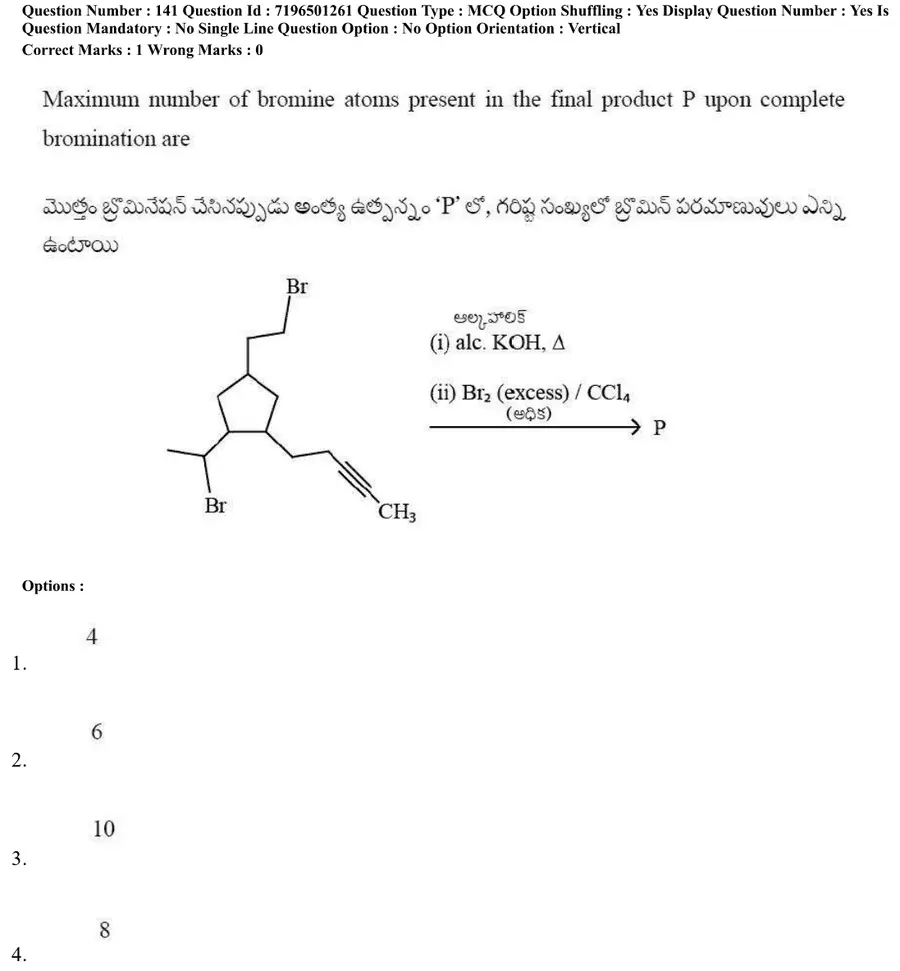
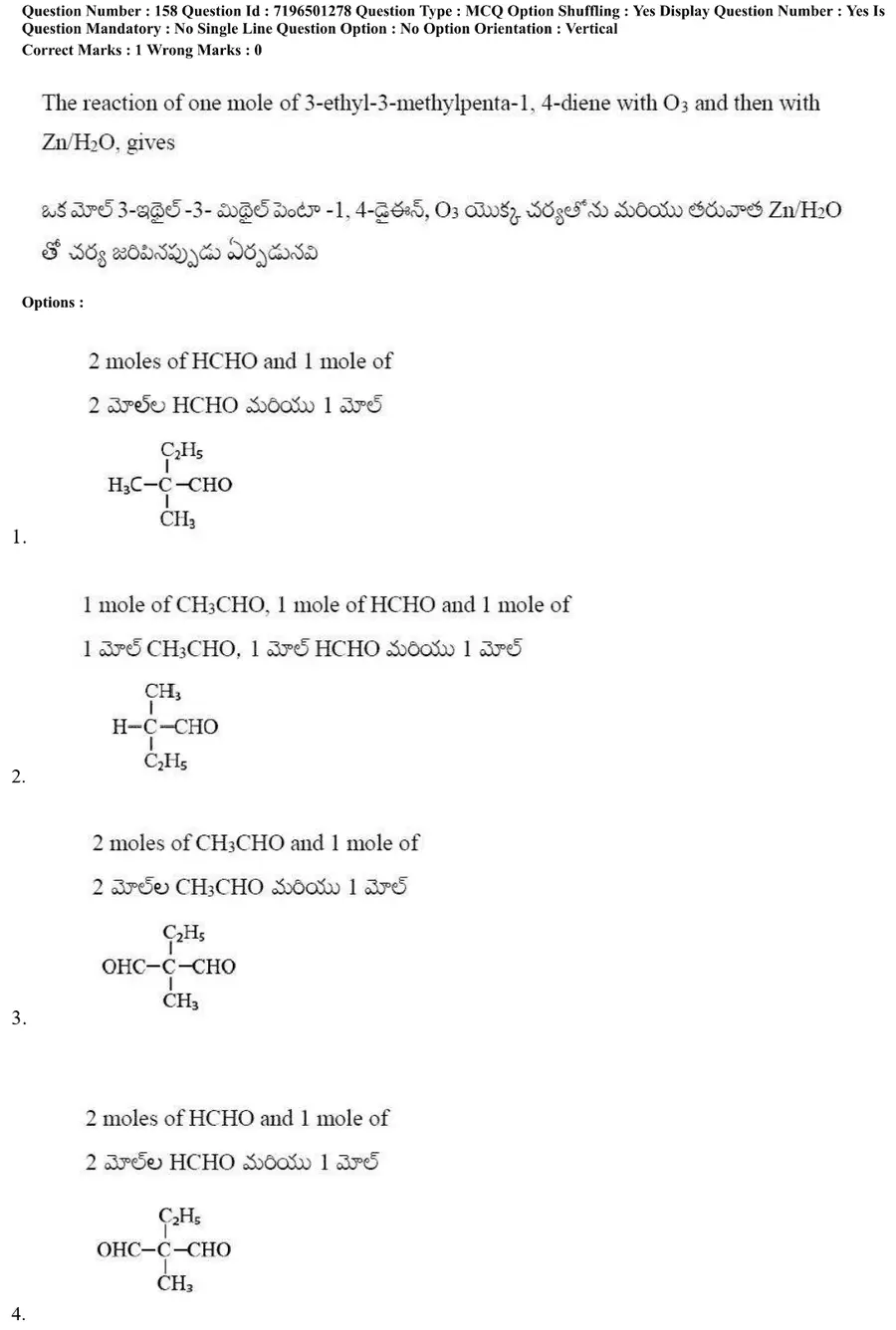
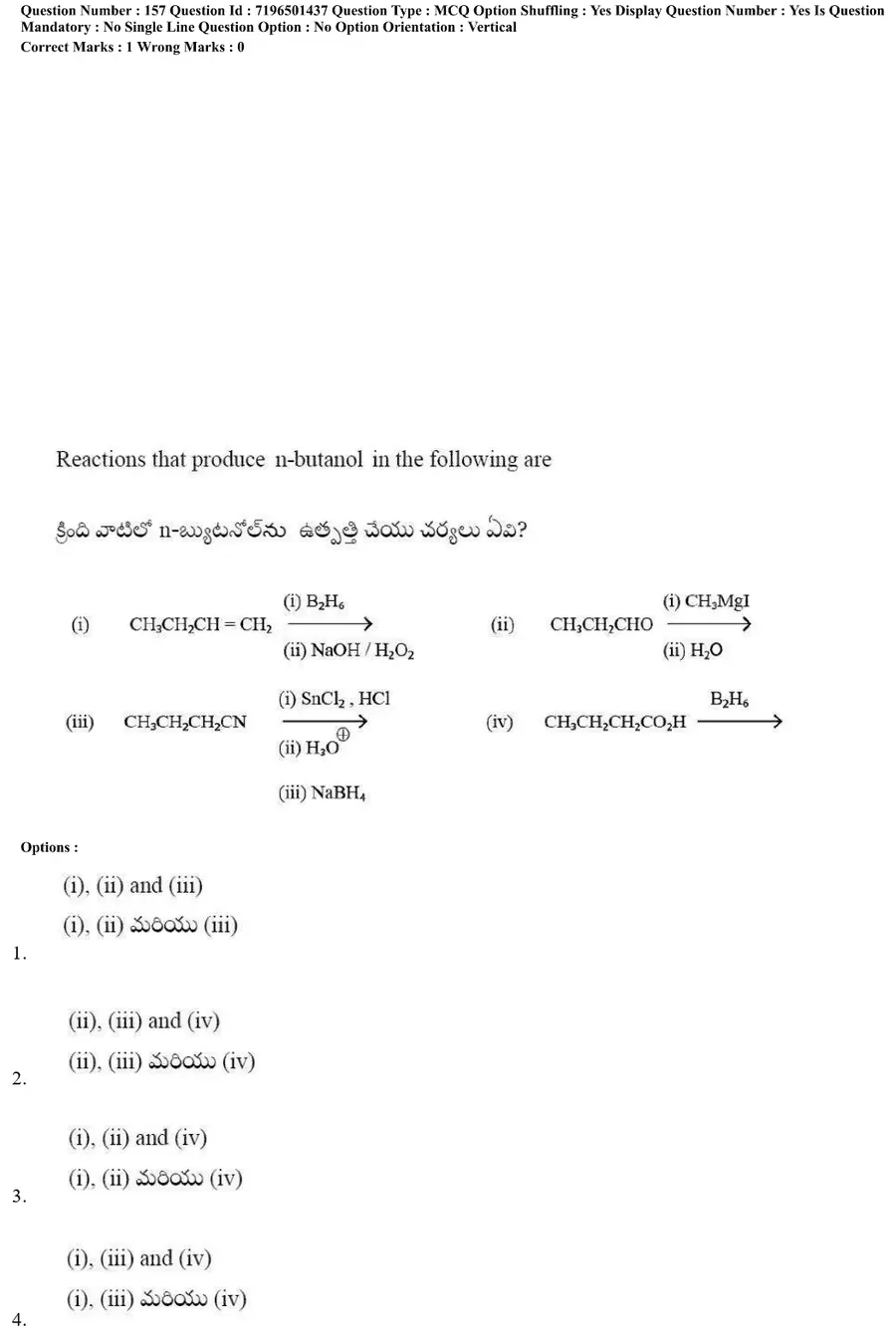
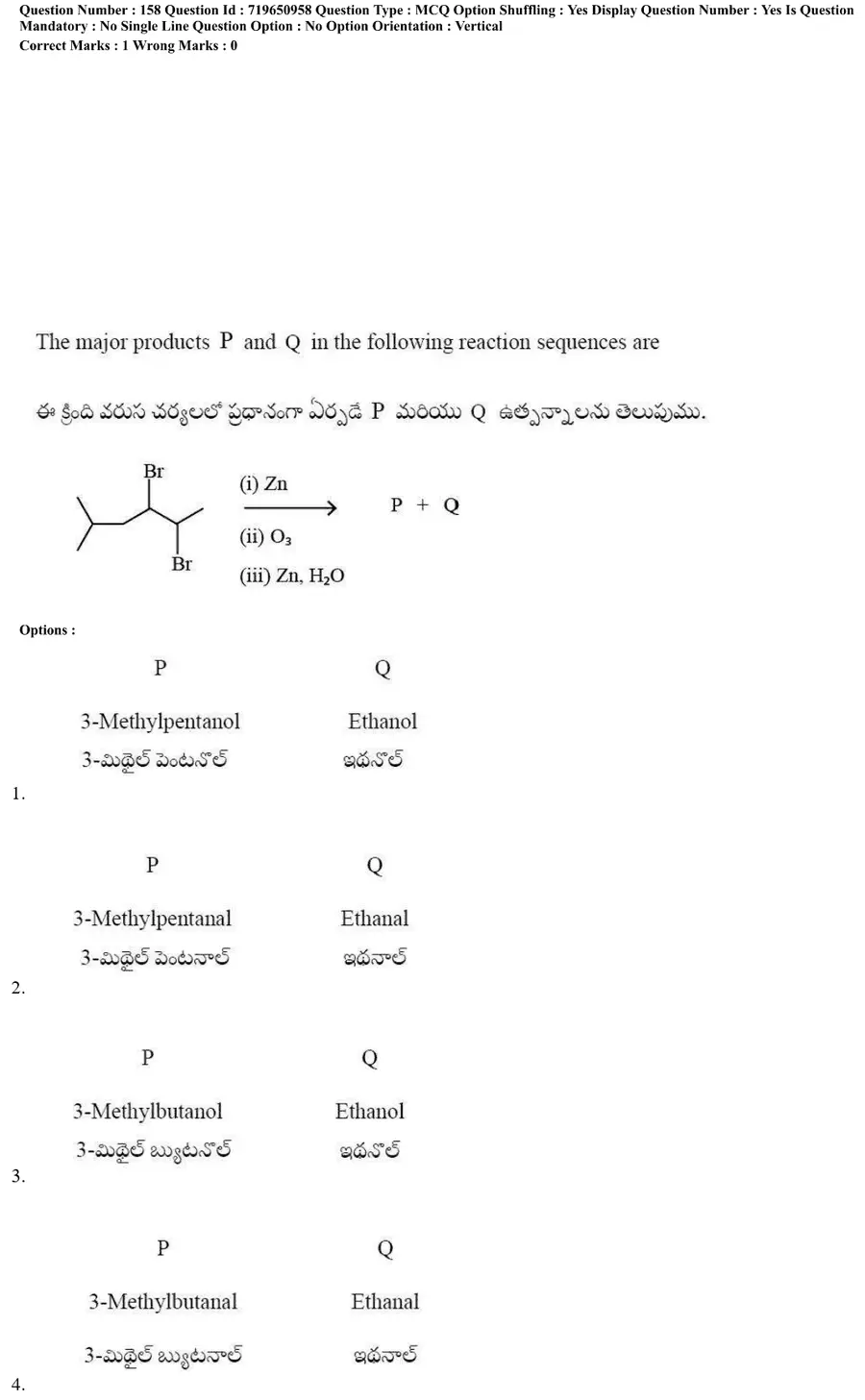
EdLoop PYQs · free, no ads · questions and answers here, step-by-step solutions in the EdLoop app
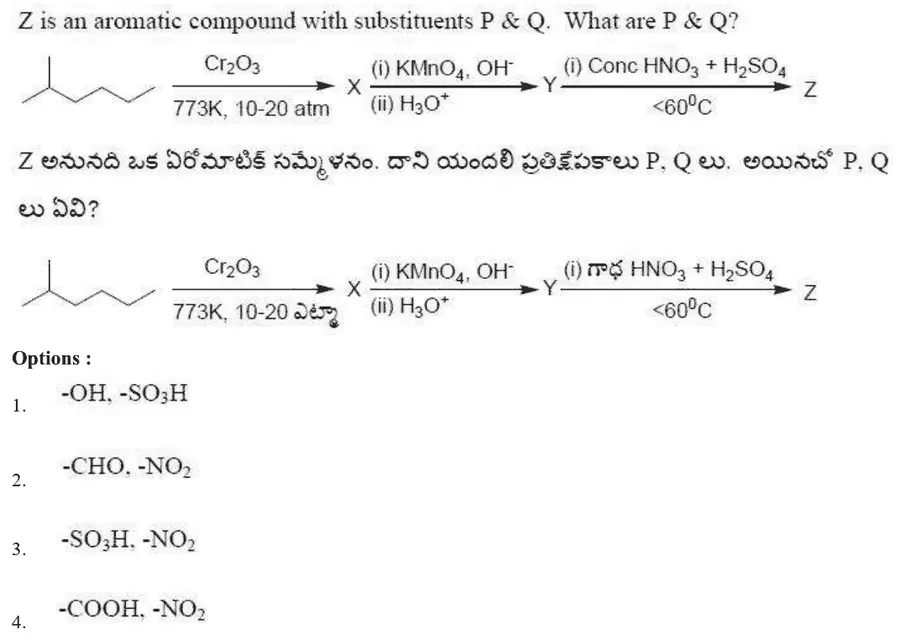
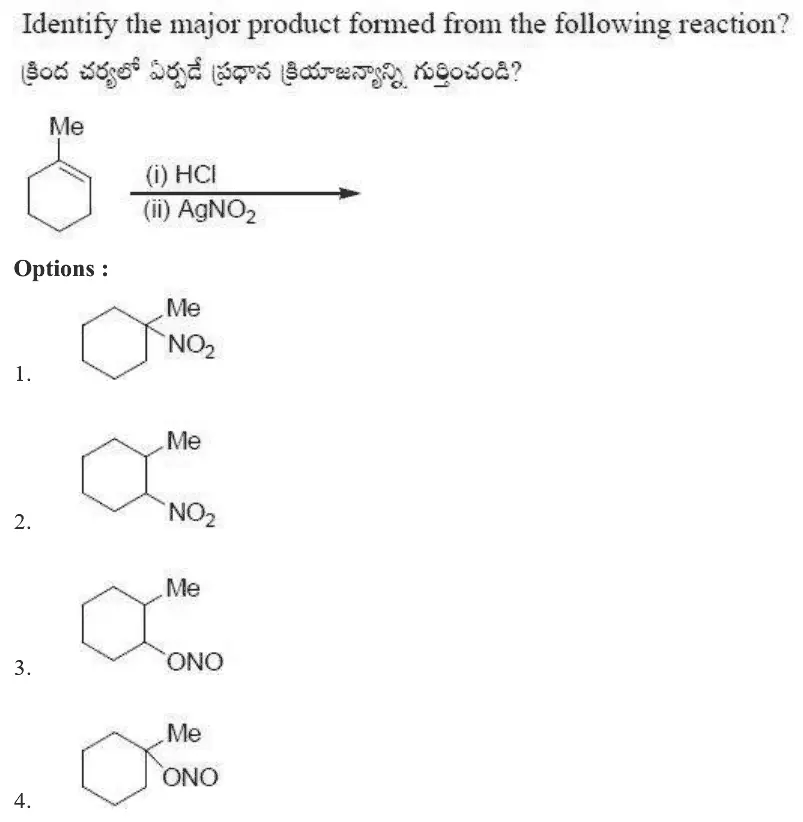
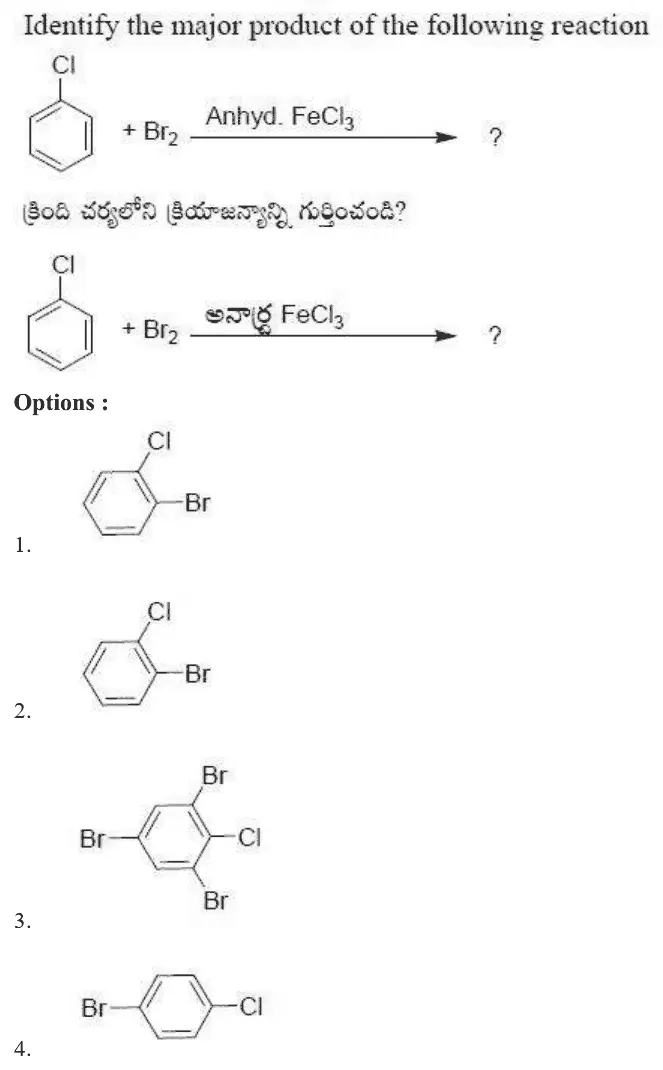
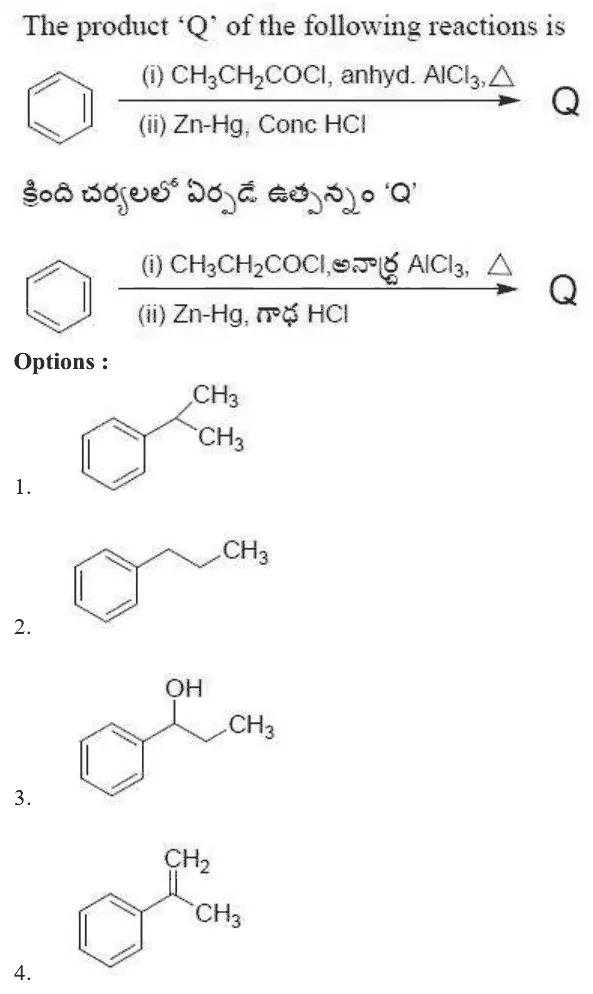
PYQs · free, no adsOpen on the web (app.edloop.in)Get EdLoop – free on Google Play
ChemistryHydrocarbons

Hydrocarbons: AP & TS EAPCET PYQs 2010–2026

Every Hydrocarbons question from past AP EAPCET and TS EAPCET papers, with options and answers. Newest first.

293questions
142papers covered
5.4%of Chemistry questions, 2022–2026
2010–2026years

Guide at a glance

Hydrocarbons is a major heavyweight in the organic chemistry curriculum, commanding rank 4 among all 31 chemistry chapters during the 2022 to 2026 examination span.

Most asked sub-topics

Alkenes98
Aromatic Hydrocarbons92
Alkanes55
Alkynes48

Practise these in EdLoop

Attempt every Hydrocarbons question timed, see the step-by-step solution and track what you get wrong. Free.

Start practice

All questions

293 questions
1AP EAPCET 2026 · 18 May · Shift 1MCQOpen question page ↗

An alkyne $X$ ($\mathrm{C_4H_6}$) does not form sodium alkynide. Reaction of $X$ with $\mathrm{HBr}$ gave $Y$. Another reaction of $X$ with $\mathrm{Na/liq. NH_3}$ gave $Z$. Identify $Y$ and $Z$

  • A

    $Y$ = geminal dibromide ; $Z$ = non-polar compound

  • B

    $Y$ = geminal dibromide ; $Z$ = polar compound

  • C

    $Y$ = vicinal dibromide ; $Z$ = polar compound

  • D

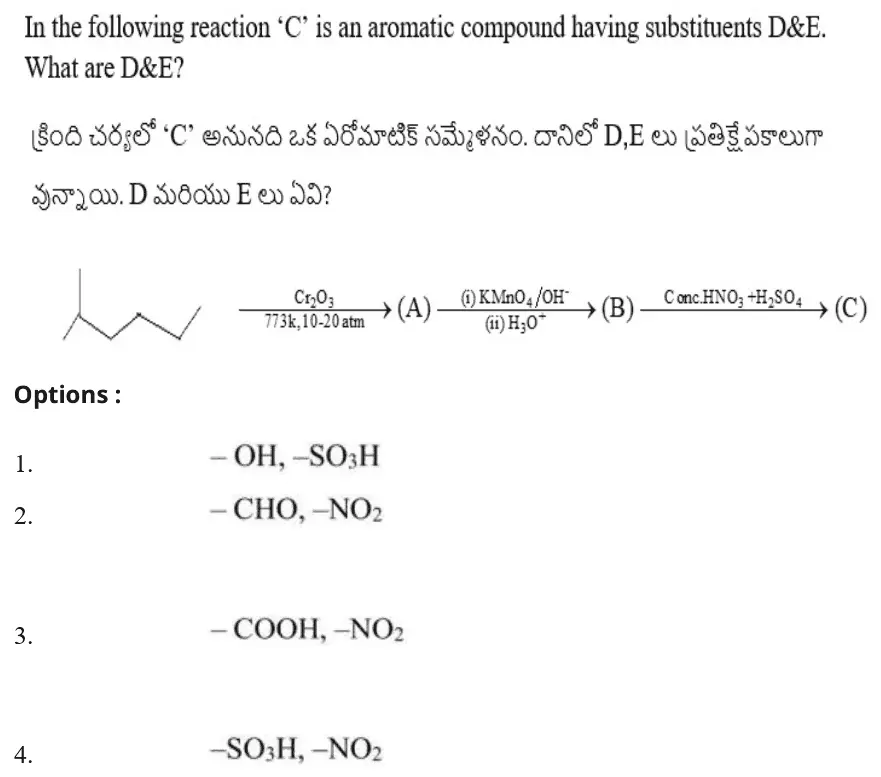
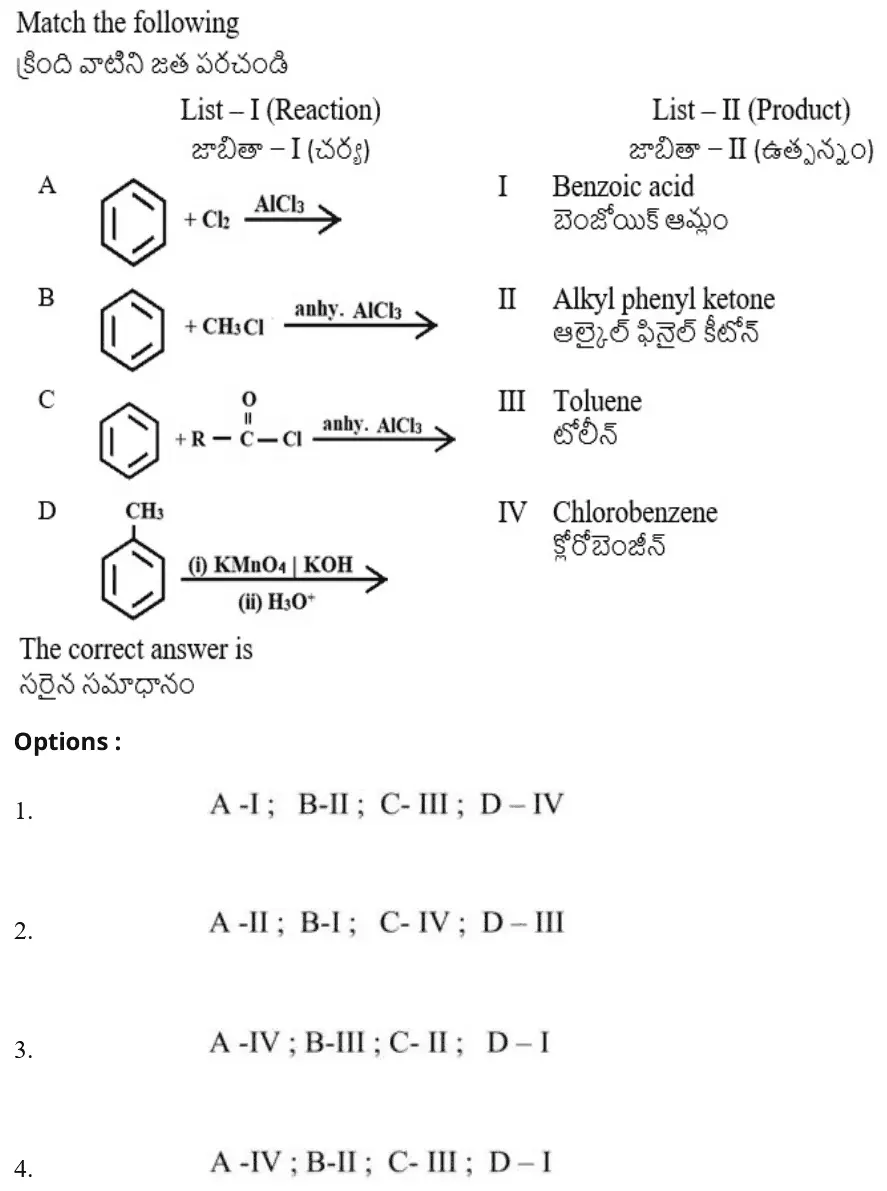
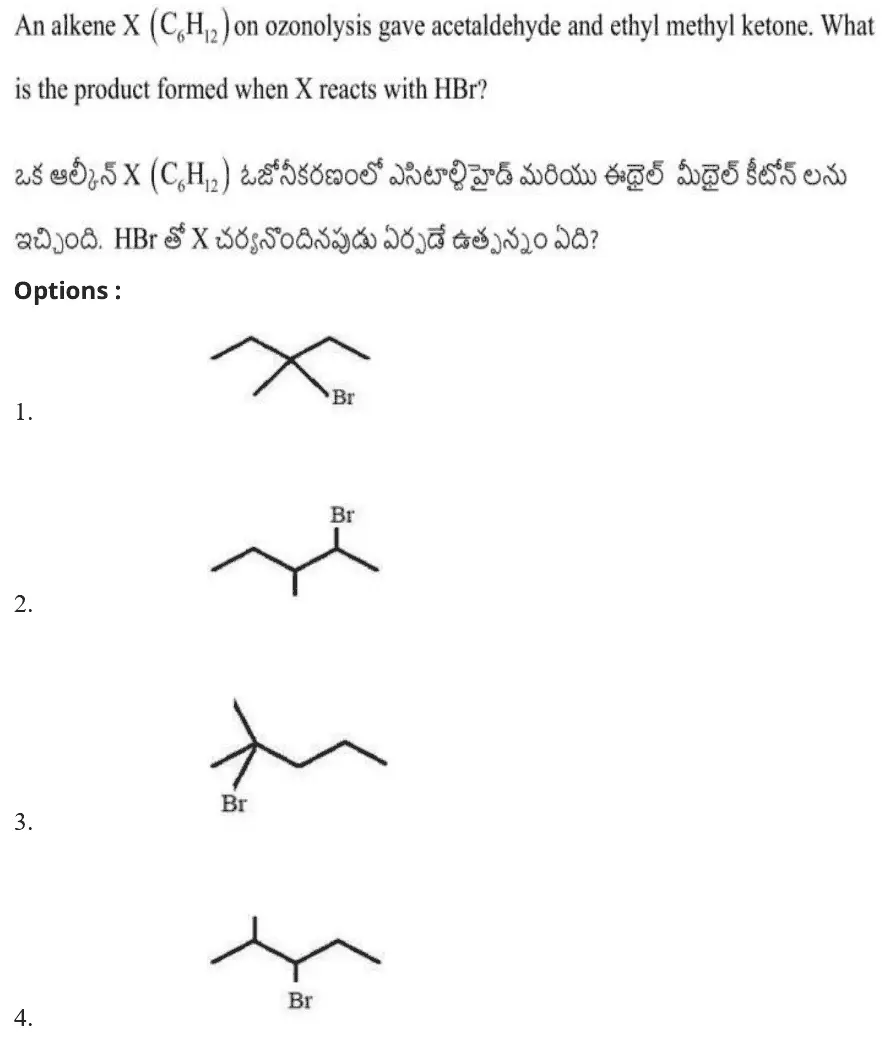
    $Y$ = vicinal dibromide ; $Z$ = non-polar compound

2AP EAPCET 2026 · 18 May · Shift 1MCQOpen question page ↗

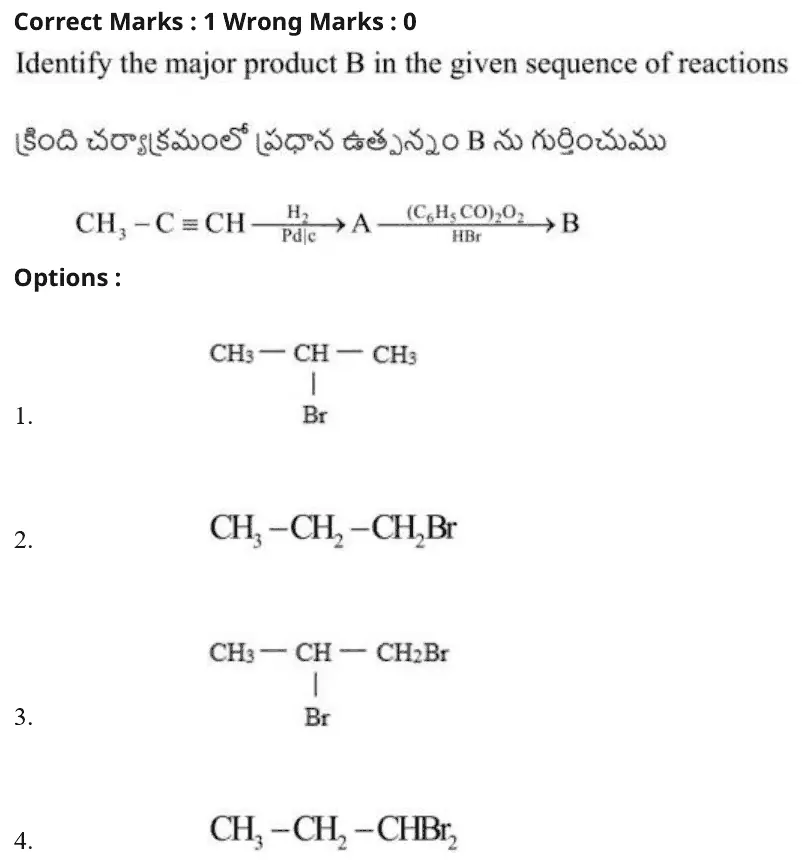
Identify the end product Z in the given sequence of reactions

(Anhy = anhydrous)

$$\mathrm{C_3H_6} \xrightarrow[\mathrm{(C_6H_5CO)_2O_2}]{\mathrm{HBr}} X \xrightarrow[\mathrm{Anhy.\ AlCl_3}]{\mathrm{C_6H_6}} Y \xrightarrow[\mathrm{(iii)\ NaOH/CaO,\Delta}]{\mathrm{(i)\ KMnO_4/OH^-,\ (ii)\ H_3O^+}} Z$$

  • A

    Toluene

  • B

    Cumene

  • C

    Benzene

  • D

    Xylene

3AP EAPCET 2026 · 18 May · Shift 2MCQOpen question page ↗

The ratio of number of $sp^3$ hybrid orbitals to number of $sp^2$ hybrid orbitals in the major product (Z) of the given reaction sequence is

(see the figure above)

The question and its figure as printed in AP EAPCET 2026 18th May 2026 Shift 2.
The question as printed in the paper.
  • A

    $3:5$

  • B

    $3:2$

  • C

    $2:3$

  • D

    $3:4$

4AP EAPCET 2026 · 15 May · Shift 1MCQOpen question page ↗

An alkene (X) with formula $\mathrm{C_5H_{10}}$ on ozonolysis gives butanone and methanal. X with HBr in the presence of organic peroxide gives Y as major product. When Y is subjected to Wurtz reaction gives Z. The number of $1^\circ$, $2^\circ$ and $3^\circ$ carbons in Z respectively are

  • A

    4, 4, 2

  • B

    4, 2, 4

  • C

    3, 3, 4

  • D

    5, 3, 2

5AP EAPCET 2026 · 15 May · Shift 1MCQOpen question page ↗

What are $A$ and $C$ in the following sequence of reactions?

(Peroxide; catalyst; quinoline)

$$\mathrm{C_2H_2} \xrightarrow{A} B \xrightarrow[350-370\ K,\ 1000-2000\ atm]{Peroxide\ (catalyst)} C$$

  • A

    $Pd/H_2$ ; $LDP$

  • B

    $Pd/H_2$ ; $HDP$

  • C

    $H_2$, $Pd/C$ – quinoline ; $LDP$

  • D

    $H_2$, $Pd/C$ – quinoline ; $HDP$

6AP EAPCET 2026 · 15 May · Shift 1MCQOpen question page ↗

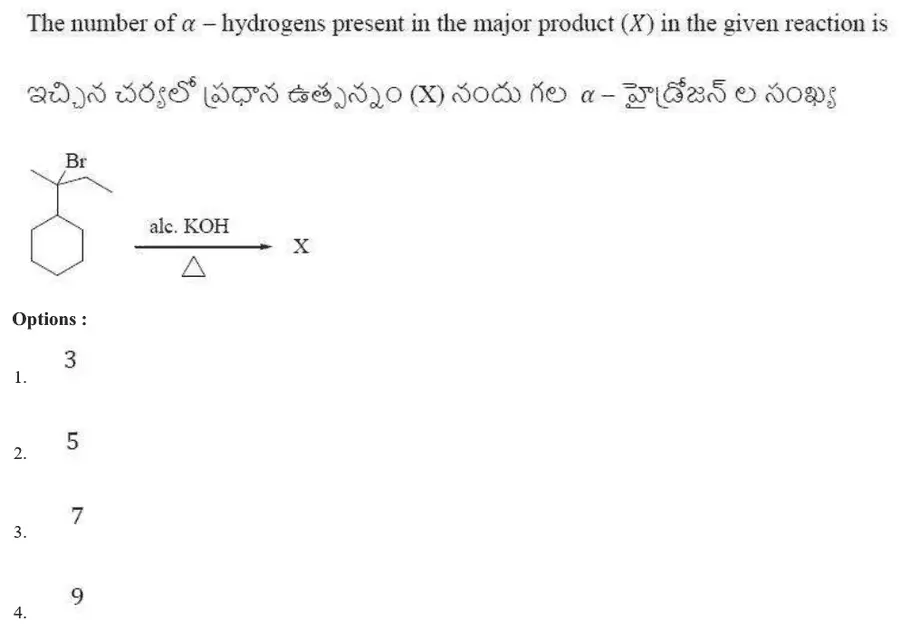
The number of $\alpha$ – hydrogens present in the major product ($X$) in the given reaction is

(see the figure above)

The question and its figure as printed in AP EAPCET 2026 15th May 2026 Shift 1.
The question as printed in the paper.
  • A

    3

  • B

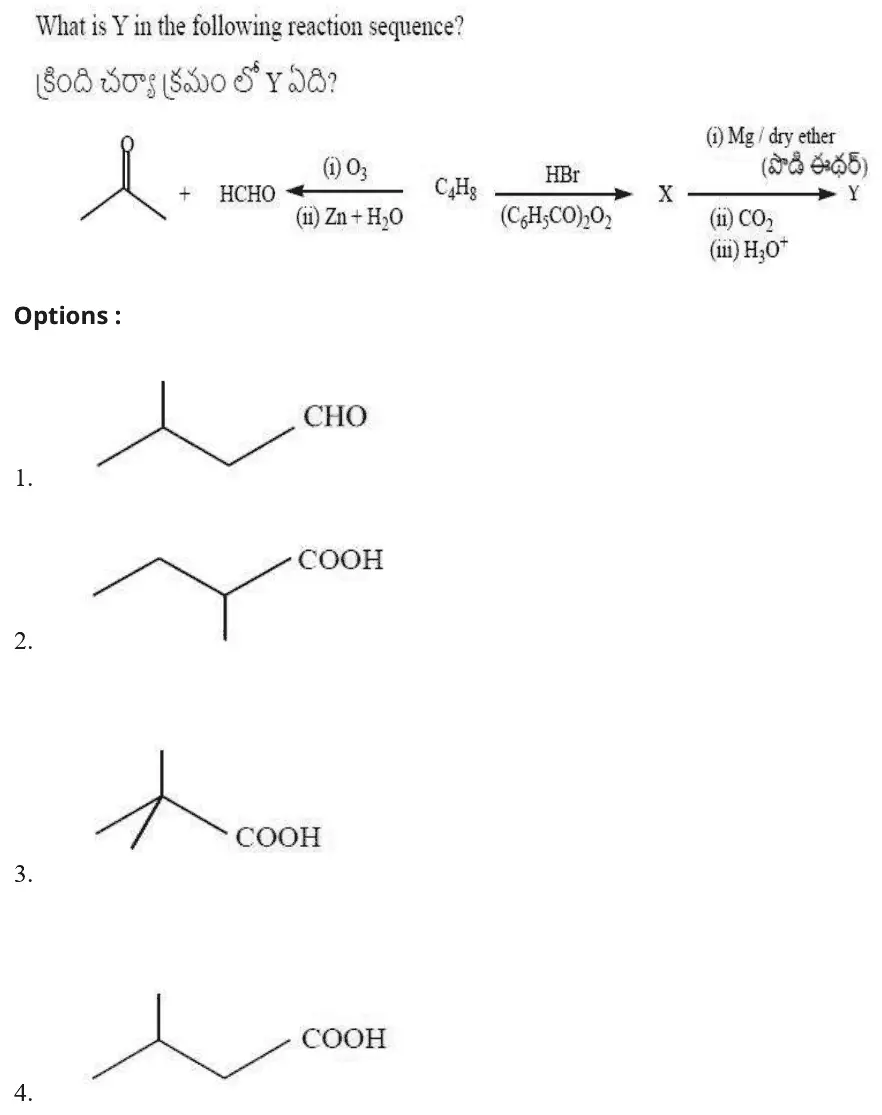
    5

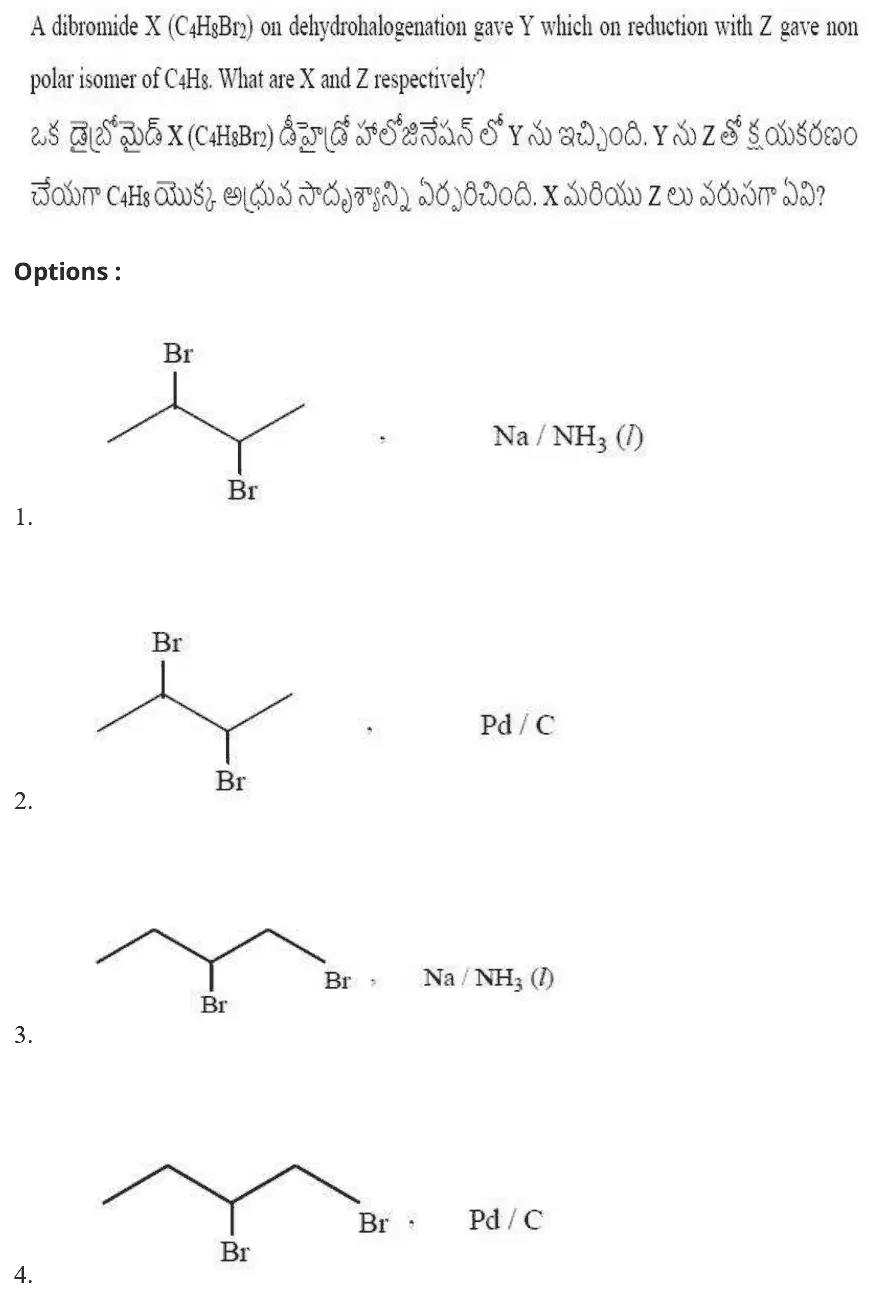
  • C

    7

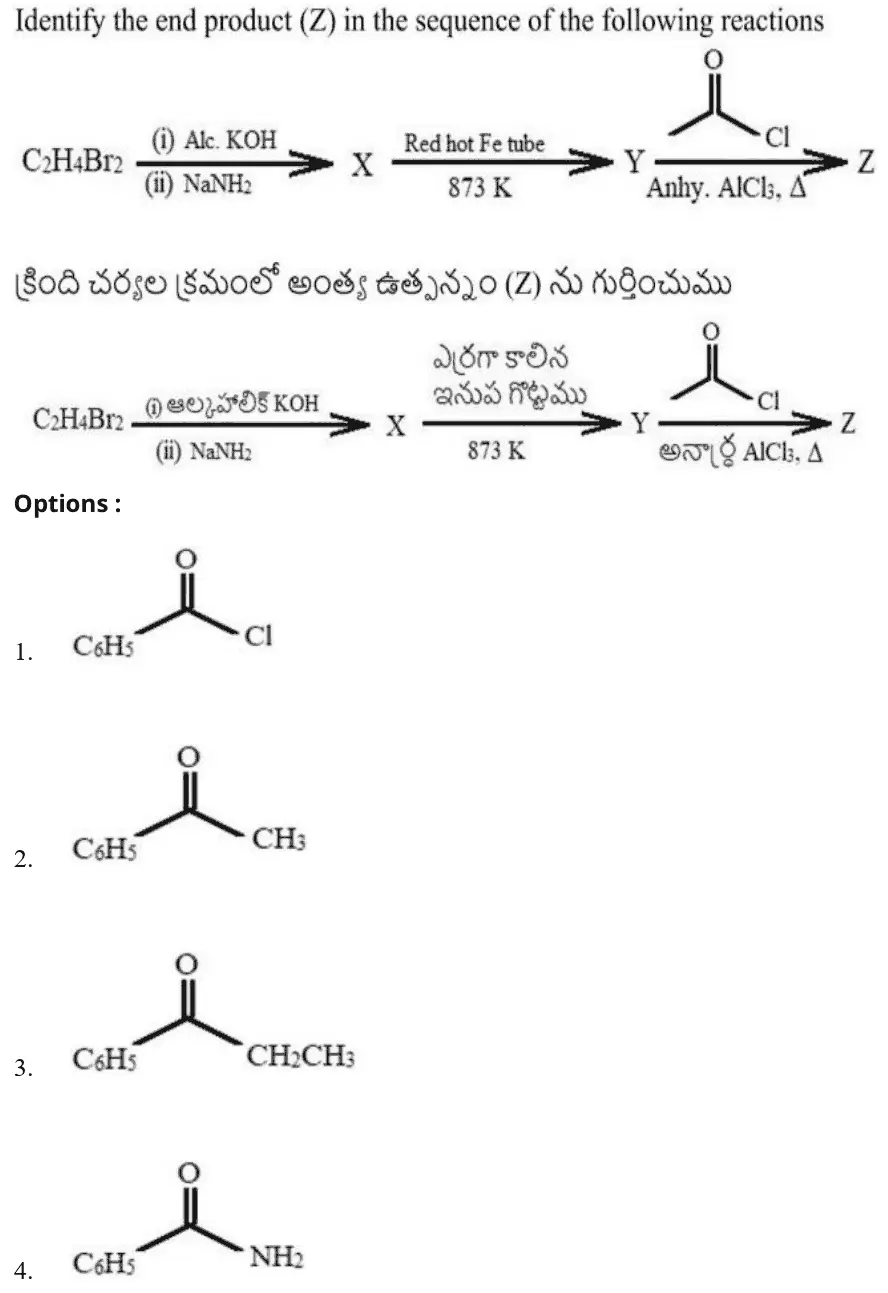
  • D

    9

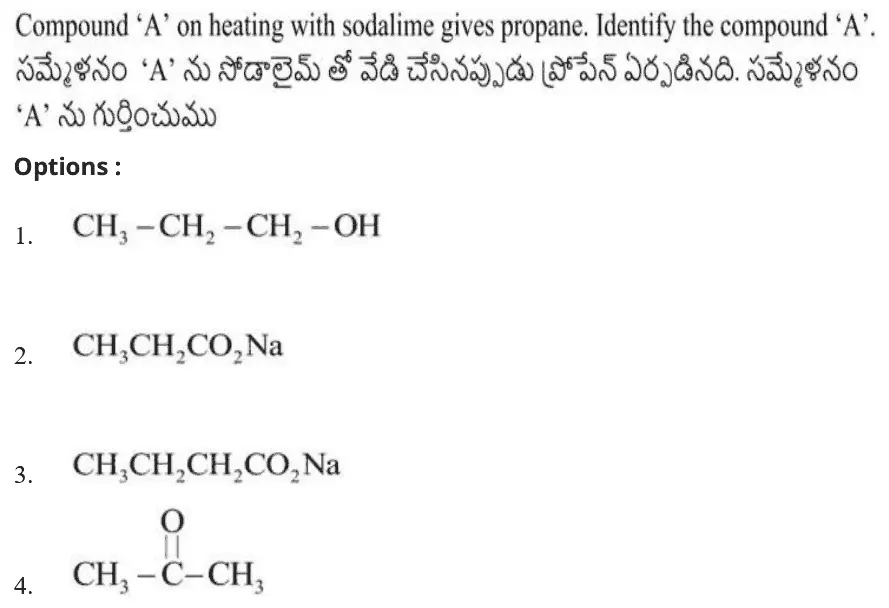
7AP EAPCET 2026 · 15 May · Shift 1MCQOpen question page ↗

Which of the following does not form benzoic acid on oxidation with alkaline $KMnO_4$ followed by acidification?

  • A

    1-phenylpropane

  • B

    2-phenylpropane

  • C

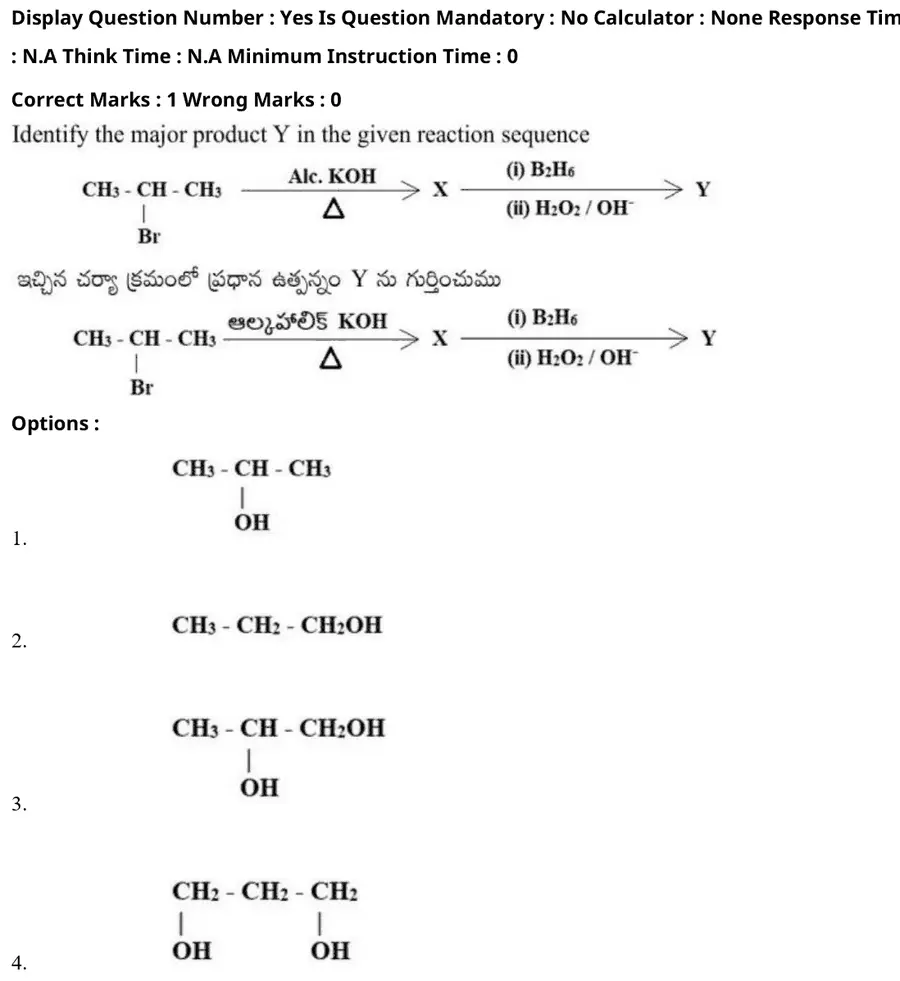
    Acetophenone

  • D

    2-methyl-2-phenylpropane

8AP EAPCET 2026 · 14 May · Shift 1MCQOpen question page ↗

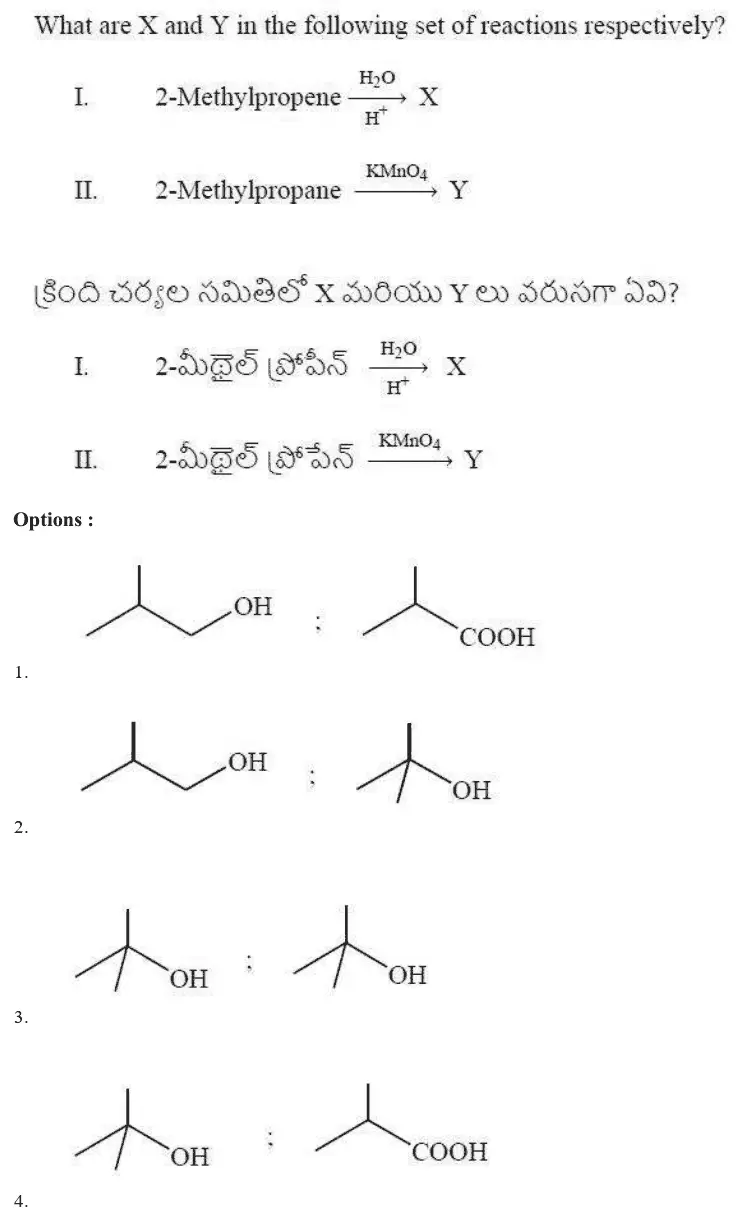
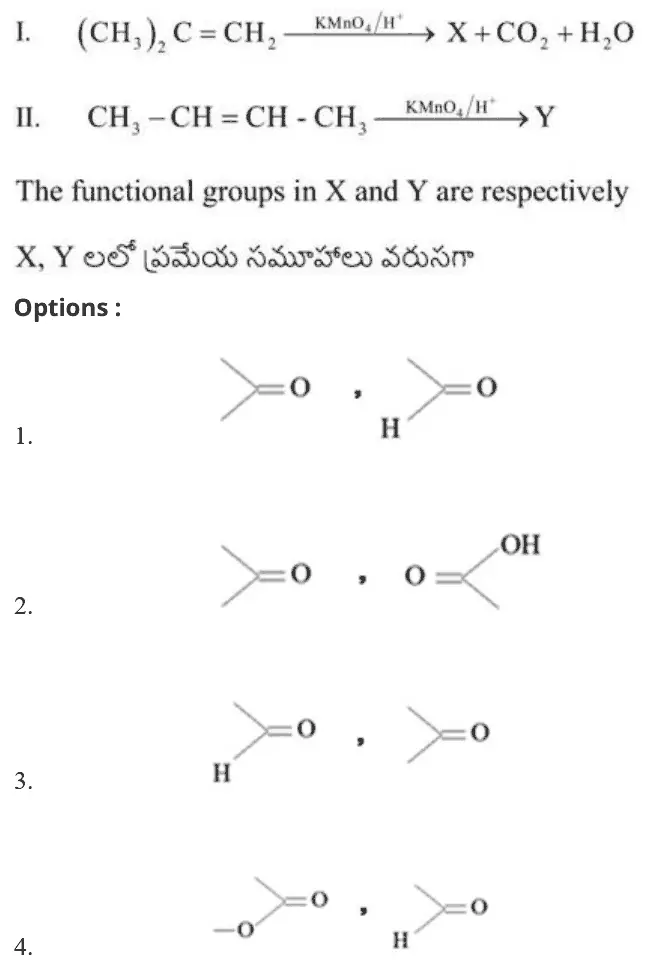
What are X and Y in the following set of reactions respectively?

I. 2-Methylpropene $\xrightarrow[\mathrm{H^+}]{\mathrm{H_2O}}$ X

II. 2-Methylpropane $\xrightarrow{\mathrm{KMnO_4}}$ Y

The question and its figure as printed in AP EAPCET 2026 14th May 2026 Shift 1. Option 1: X: skeletal structure of 2-methylpropan-1-ol (isobutyl alcohol, (CH3)2CH-CH2-OH); Y: skeletal structure of isobutyric acid (2-methylpropanoic acid, (CH3)2CH-COOH) Option 2: X: skeletal structure of 2-methylpropan-1-ol (isobutyl alcohol, (CH3)2CH-CH2-OH); Y: skeletal structure of 2-methylpropan-2-ol (tert-butyl alcohol, (CH3)3C-OH) Option 3: X: skeletal structure of tert-butyl alcohol ((CH3)3C-OH); Y: skeletal structure of tert-butyl alcohol ((CH3)3C-OH) Option 4: X: skeletal structure of tert-butyl alcohol ((CH3)3C-OH); Y: skeletal structure of isobutyric acid ((CH3)2CH-COOH)
The question as printed in the paper.
  • A

    see figure X: skeletal structure of 2-methylpropan-1-ol (isobutyl alcohol, (CH3)2CH-CH2-OH); Y: skeletal structure of isobutyric acid (2-methylpropanoic acid, (CH3)2CH-COOH)

  • B

    see figure X: skeletal structure of 2-methylpropan-1-ol (isobutyl alcohol, (CH3)2CH-CH2-OH); Y: skeletal structure of 2-methylpropan-2-ol (tert-butyl alcohol, (CH3)3C-OH)

  • C

    see figure X: skeletal structure of tert-butyl alcohol ((CH3)3C-OH); Y: skeletal structure of tert-butyl alcohol ((CH3)3C-OH)

  • D

    see figure X: skeletal structure of tert-butyl alcohol ((CH3)3C-OH); Y: skeletal structure of isobutyric acid ((CH3)2CH-COOH)

9AP EAPCET 2026 · 14 May · Shift 1MCQOpen question page ↗

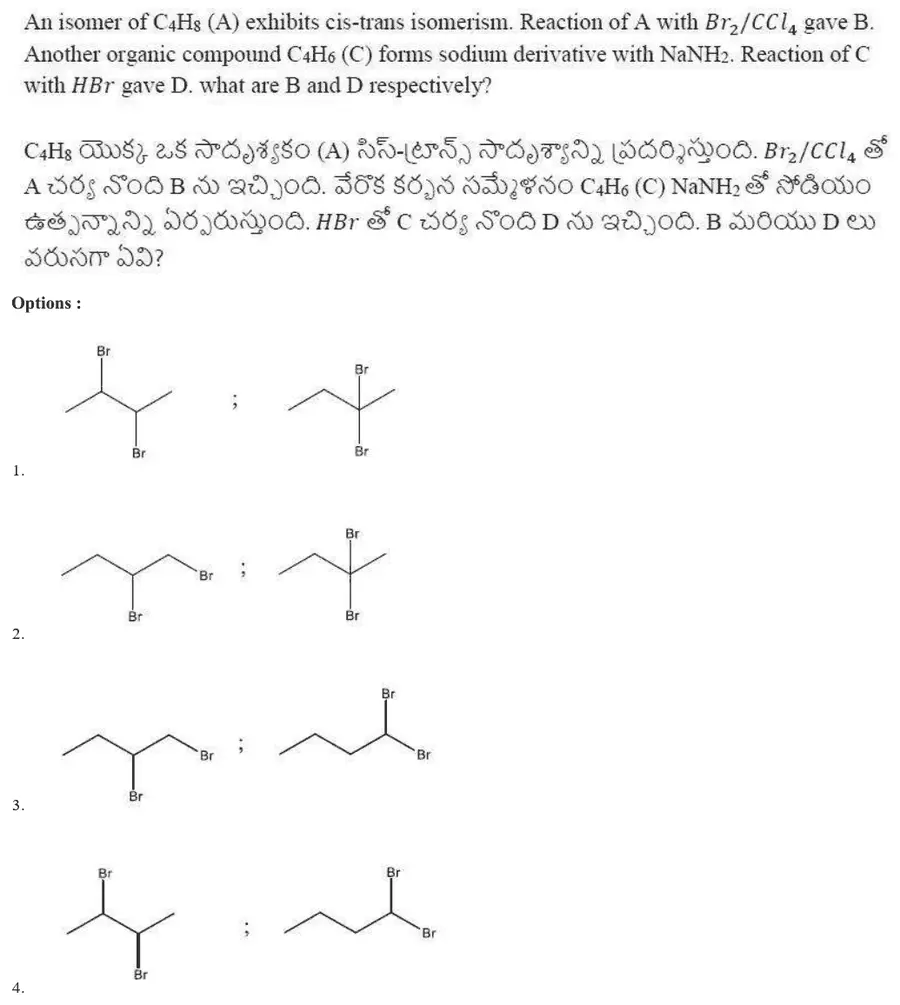
An isomer of $\mathrm{C_4H_8}$ (A) exhibits cis-trans isomerism. Reaction of A with $Br_2/CCl_4$ gave B. Another organic compound $\mathrm{C_4H_6}$ (C) forms sodium derivative with $\mathrm{NaNH_2}$. Reaction of C with $HBr$ gave D. what are B and D respectively?

The question and its figure as printed in AP EAPCET 2026 14th May 2026 Shift 1. Option 1: B: a skeletal four-carbon chain (zig-zag) with Br on C2 and C3 (2,3-dibromobutane, drawn with Br up on the second carbon and Br down on the third); D: a four-carbon skeletal structure with two Br atoms on the same internal carbon, one up and one down (2,2-dibromobutane) Option 2: B: a skeletal four-carbon chain with Br on C3 pointing down and a Br on the right side near C3 (1,2-type placement, drawn as a chain with Br down at the middle carbon and Br to the lower right); D: a four-carbon skeletal structure with two Br atoms on the same internal carbon, one up and one down (2,2-dibromobutane) Option 3…
The question as printed in the paper.
  • A

    see figure B: a skeletal four-carbon chain (zig-zag) with Br on C2 and C3 (2,3-dibromobutane, drawn with Br up on the second carbon and Br down on the third); D: a four-carbon skeletal structure with two Br atoms on the same internal carbon, one up and one down (2,2-dibromobutane)

  • B

    see figure B: a skeletal four-carbon chain with Br on C3 pointing down and a Br on the right side near C3 (1,2-type placement, drawn as a chain with Br down at the middle carbon and Br to the lower right); D: a four-carbon skeletal structure with two Br atoms on the same internal carbon, one up and one down (2,2-dibromobutane)

  • C

    see figure B: a skeletal four-carbon chain with Br on C3 pointing down and a Br at the lower right near C3; D: a four-carbon chain with two Br atoms on the terminal-side carbon (C2 of the right side), one up and one to the lower right (gem-dibromo, 2,2-dibromobutane type)

  • D

    see figure B: a skeletal four-carbon chain (zig-zag) with Br on C2 (up) and Br on C3 (down) (2,3-dibromobutane); D: a four-carbon chain with two Br atoms on the same carbon, one up and one to the lower right (gem-dibromide at C2 from the right end)

10AP EAPCET 2026 · 14 May · Shift 2MCQOpen question page ↗

Observe the following set of reactions

$$\mathrm{Y} \xleftarrow{\mathrm{Na/NH_3}\,(l)} \mathrm{C_2H_2} \xrightarrow{\mathrm{H_2/Pt}} \mathrm{X}$$

Hybridization of carbon in X and Y respectively is

  • A

    $sp^2, sp^2$

  • B

    $sp^3, sp^3$

  • C

    $sp^2, sp^3$

  • D

    $sp^3, sp^2$

11AP EAPCET 2026 · 14 May · Shift 2MCQOpen question page ↗

An isomer of $\mathrm{C_4H_8}$ is X, which exhibits cis-trans isomerism. Y is the chain isomer of X. Products obtained from ozonolysis of Y are

  • A

    $\mathrm{CH_3CHO + CH_3CHO}$

  • B

    $\mathrm{CH_3CH_2CHO + HCOOH}$

  • C

    $\mathrm{CH_3COCH_3 + HCHO}$

  • D

    $\mathrm{CH_3CH_2COOH + CO_2}$

12AP EAPCET 2026 · 14 May · Shift 2MCQOpen question page ↗

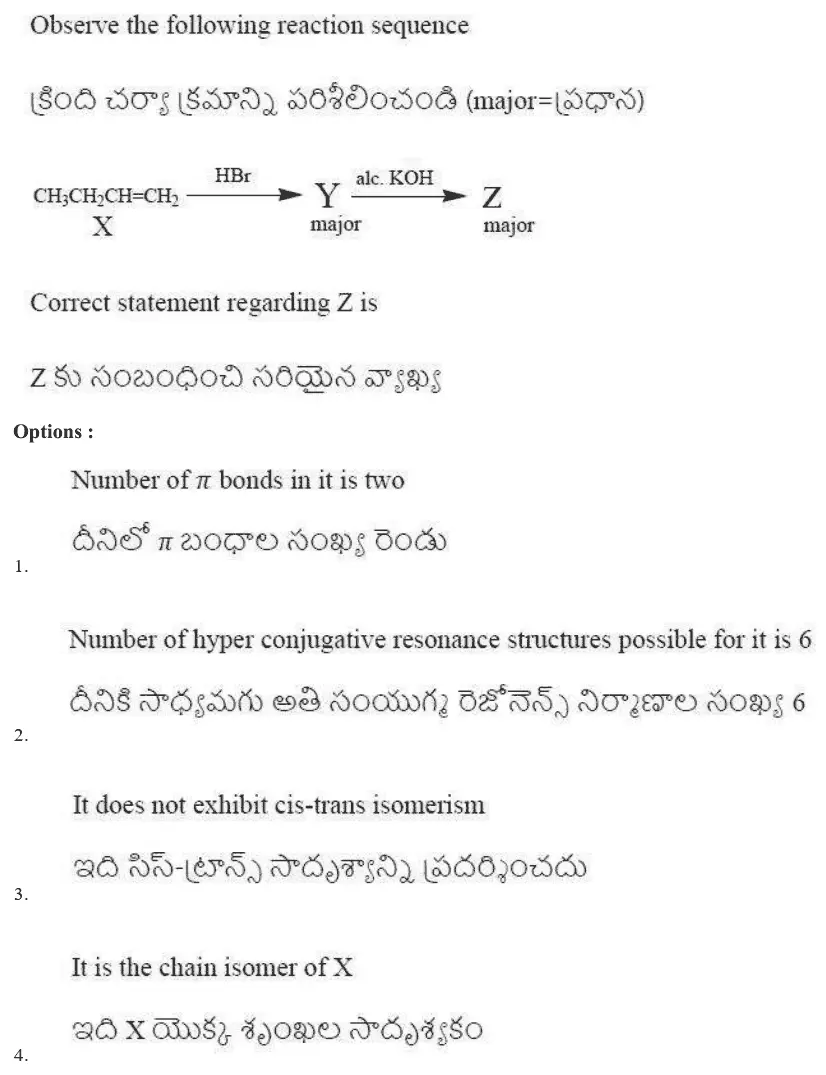
Observe the following reaction sequence (major = major product)

(see the figure above)

Correct statement regarding Z is

The question and its figure as printed in AP EAPCET 2026 14th May 2026 Shift 2.
The question as printed in the paper.
  • A

    Number of $\pi$ bonds in it is two

  • B

    Number of hyper conjugative resonance structures possible for it is 6

  • C

    It does not exhibit cis-trans isomerism

  • D

    It is the chain isomer of X

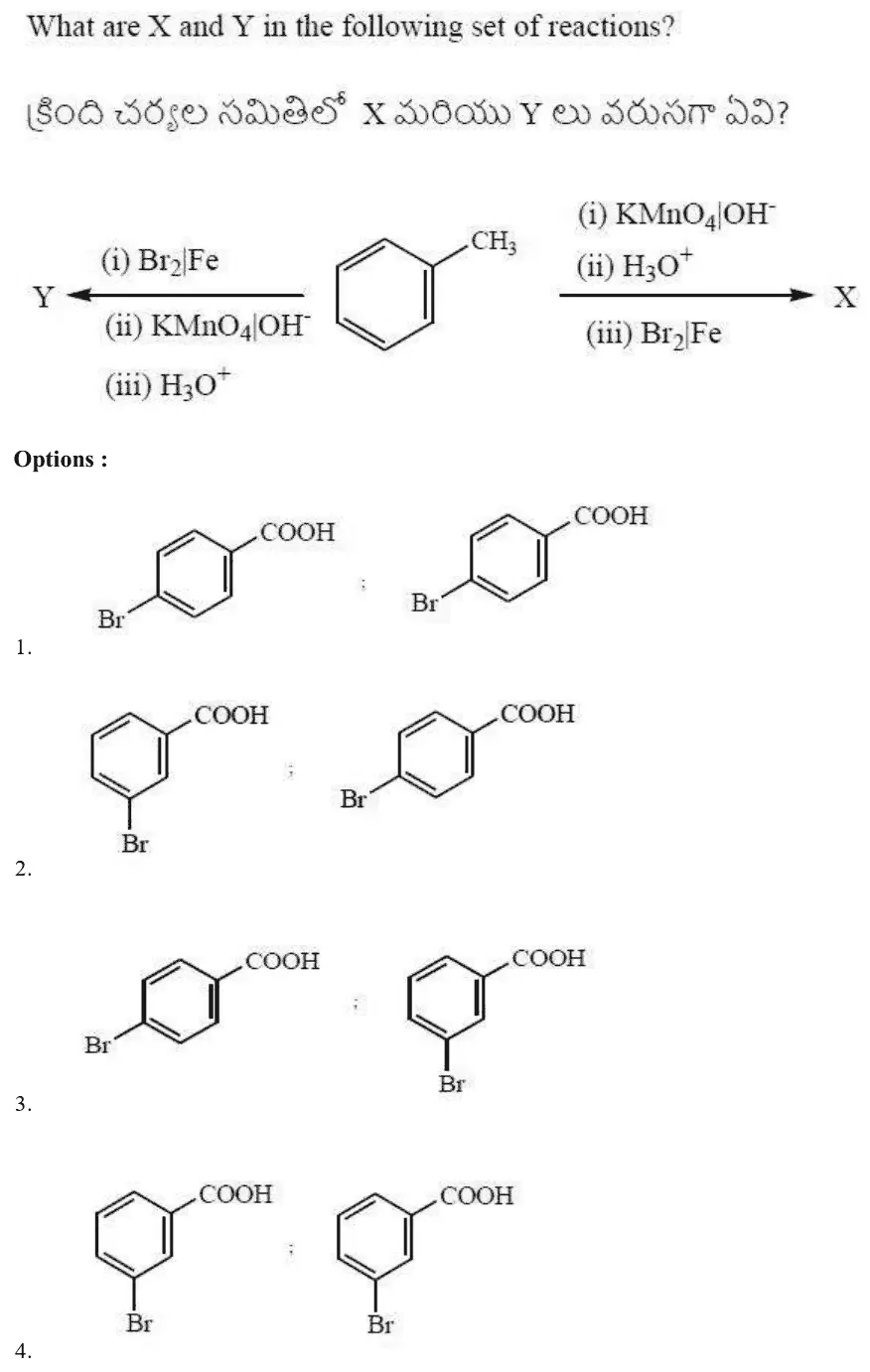
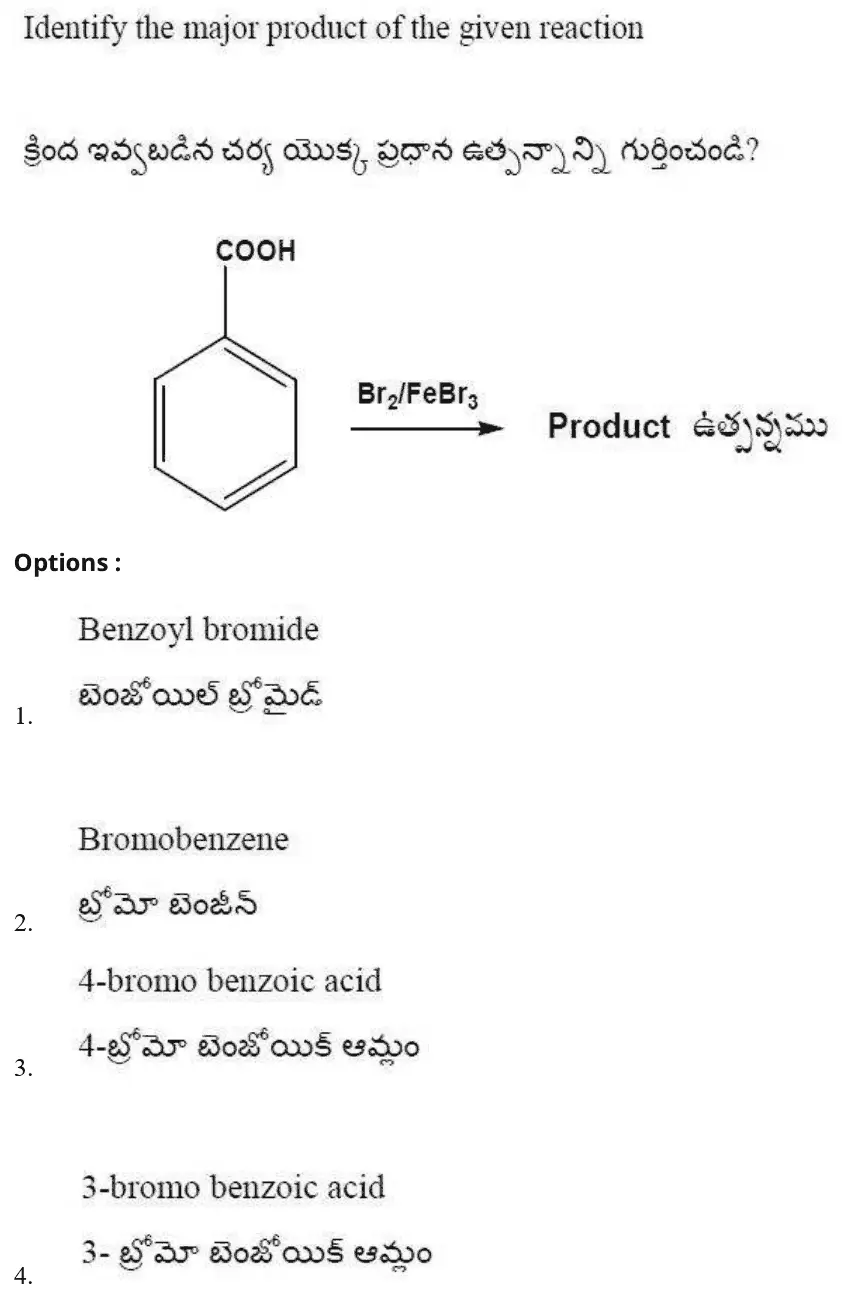
13AP EAPCET 2026 · 13 May · Shift 1MCQOpen question page ↗

What are X and Y in the following set of reactions?

(see the figure above)

The question and its figure as printed in AP EAPCET 2026 13th May 2026 Shift 1. Option 1: Para-bromobenzoic acid (benzene ring with COOH at the top right and Br at the bottom left, para); (figure) para-bromobenzoic acid (same structure) Option 2: Meta-bromobenzoic acid (COOH at the top right, Br at the bottom, meta); (figure) para-bromobenzoic acid (COOH at the top right, Br at the bottom left) Option 3: Para-bromobenzoic acid (COOH at the top right, Br at the bottom left); (figure) meta-bromobenzoic acid (COOH at the top right, Br at the bottom) Option 4: Meta-bromobenzoic acid (COOH at the top right, Br at the bottom); (figure) meta-bromobenzoic acid (same structure)
The question as printed in the paper.
  • A

    see figure Para-bromobenzoic acid (benzene ring with COOH at the top right and Br at the bottom left, para); (see the figure above) para-bromobenzoic acid (same structure)

  • B

    see figure Meta-bromobenzoic acid (COOH at the top right, Br at the bottom, meta); (see the figure above) para-bromobenzoic acid (COOH at the top right, Br at the bottom left)

  • C

    see figure Para-bromobenzoic acid (COOH at the top right, Br at the bottom left); (see the figure above) meta-bromobenzoic acid (COOH at the top right, Br at the bottom)

  • D

    see figure Meta-bromobenzoic acid (COOH at the top right, Br at the bottom); (see the figure above) meta-bromobenzoic acid (same structure)

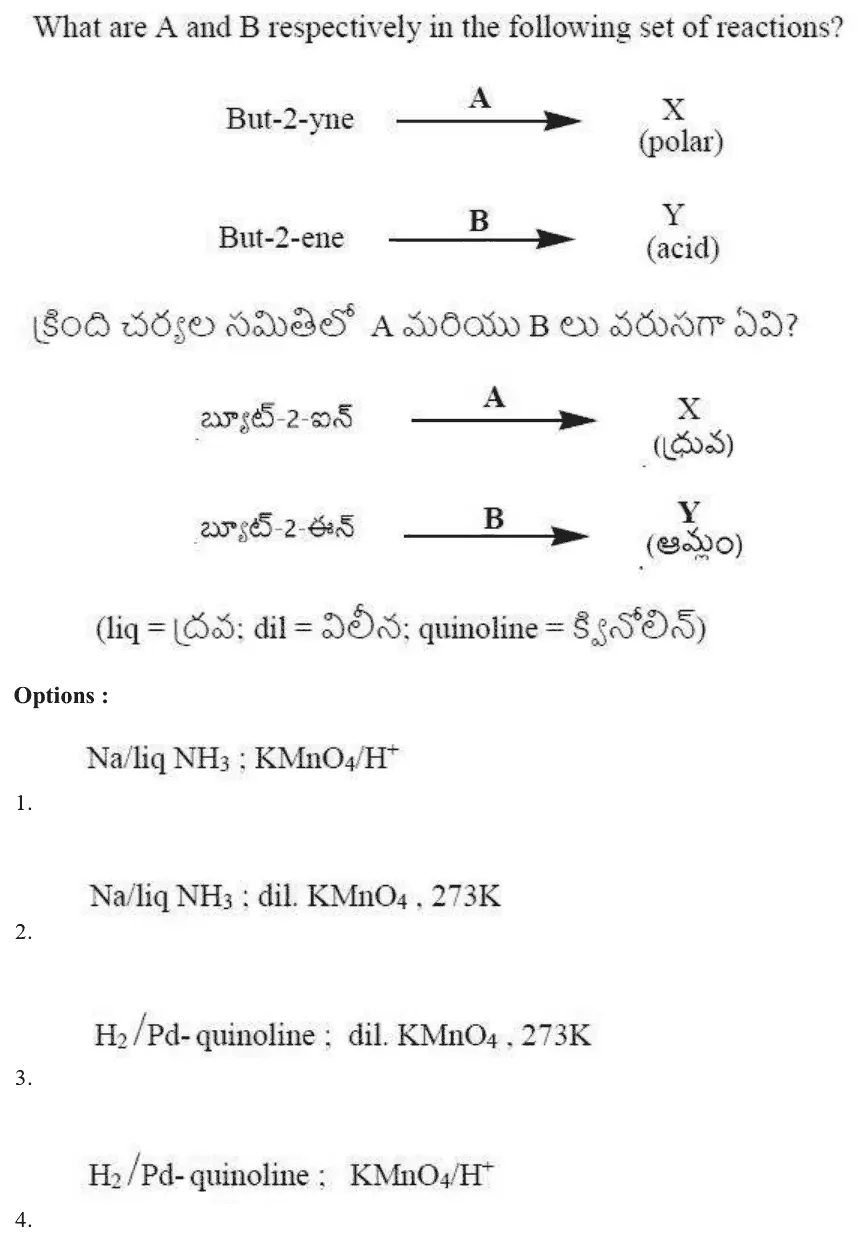
14AP EAPCET 2026 · 13 May · Shift 2MCQOpen question page ↗

What are A and B respectively in the following set of reactions?

(see the figure above)

(liq = liquid; dil = dilute; quinoline = quinoline)

The question and its figure as printed in AP EAPCET 2026 13th May 2026 Shift 2.
The question as printed in the paper.
  • A

    $\mathrm{Na/liq\ NH_3}$ ; $\mathrm{KMnO_4/H^+}$

  • B

    $\mathrm{Na/liq\ NH_3}$ ; dil. $\mathrm{KMnO_4}$, 273K

  • C

    $\mathrm{H_2}$/Pd-quinoline ; dil. $\mathrm{KMnO_4}$, 273K

  • D

    $\mathrm{H_2}$/Pd-quinoline ; $\mathrm{KMnO_4/H^+}$

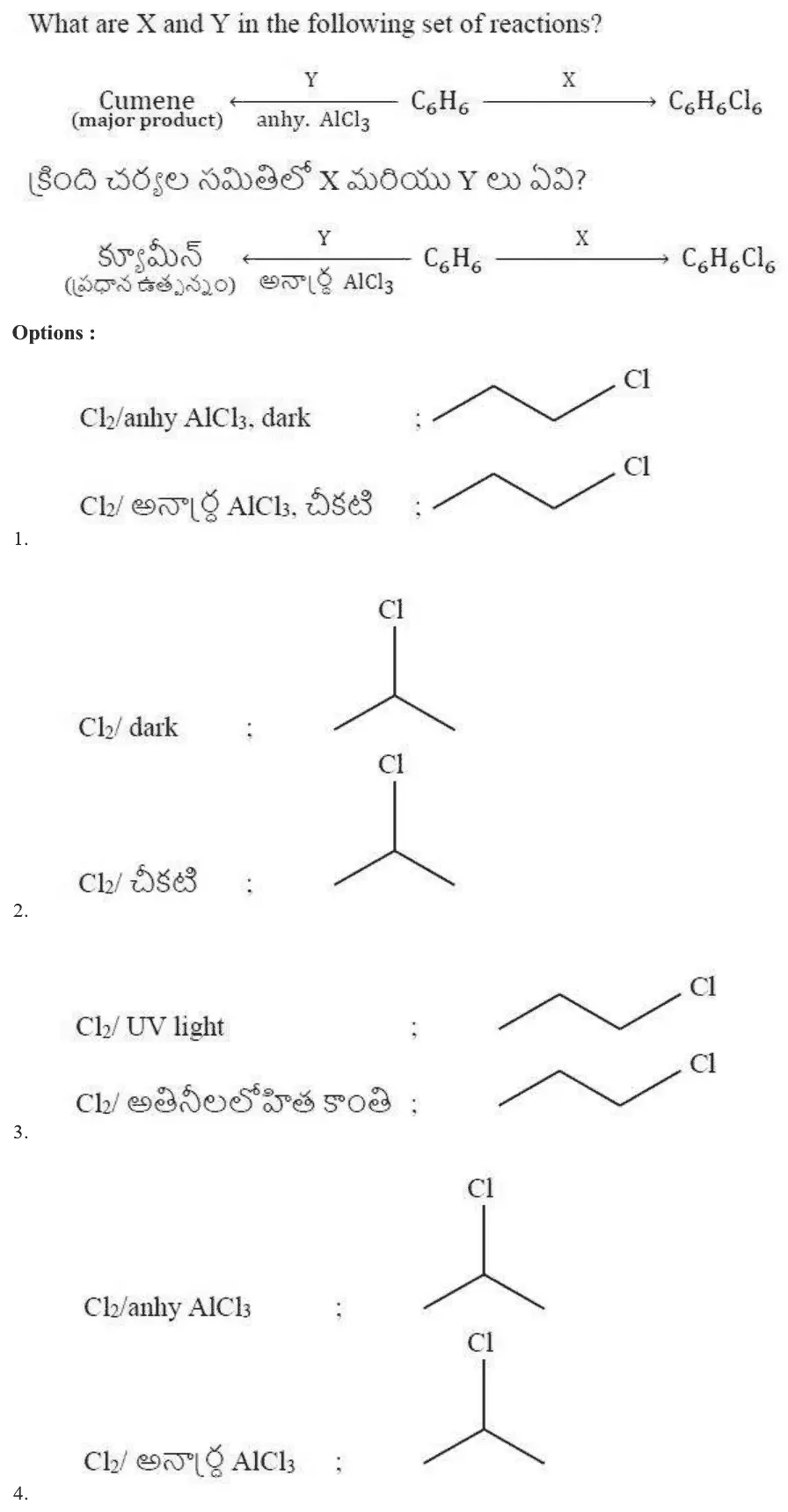
15AP EAPCET 2026 · 13 May · Shift 2MCQOpen question page ↗

What are X and Y in the following set of reactions?

(see the figure above)

The question and its figure as printed in AP EAPCET 2026 13th May 2026 Shift 2.
The question as printed in the paper.
  • A

    X: $\mathrm{Cl_2}$/anhy $\mathrm{AlCl_3}$, dark ; (see the figure above) zig-zag structure of 1-chloropropane (n-propyl chloride) as Y

  • B

    X: $\mathrm{Cl_2}$/ dark ; (see the figure above) 2-chloropropane (isopropyl chloride) skeleton as Y

  • C

    X: $\mathrm{Cl_2}$/ UV light ; (see the figure above) zig-zag structure of 1-chloropropane (n-propyl chloride) as Y

  • D

    X: $\mathrm{Cl_2}$/anhy $\mathrm{AlCl_3}$ ; (see the figure above) 2-chloropropane (isopropyl chloride) skeleton as Y

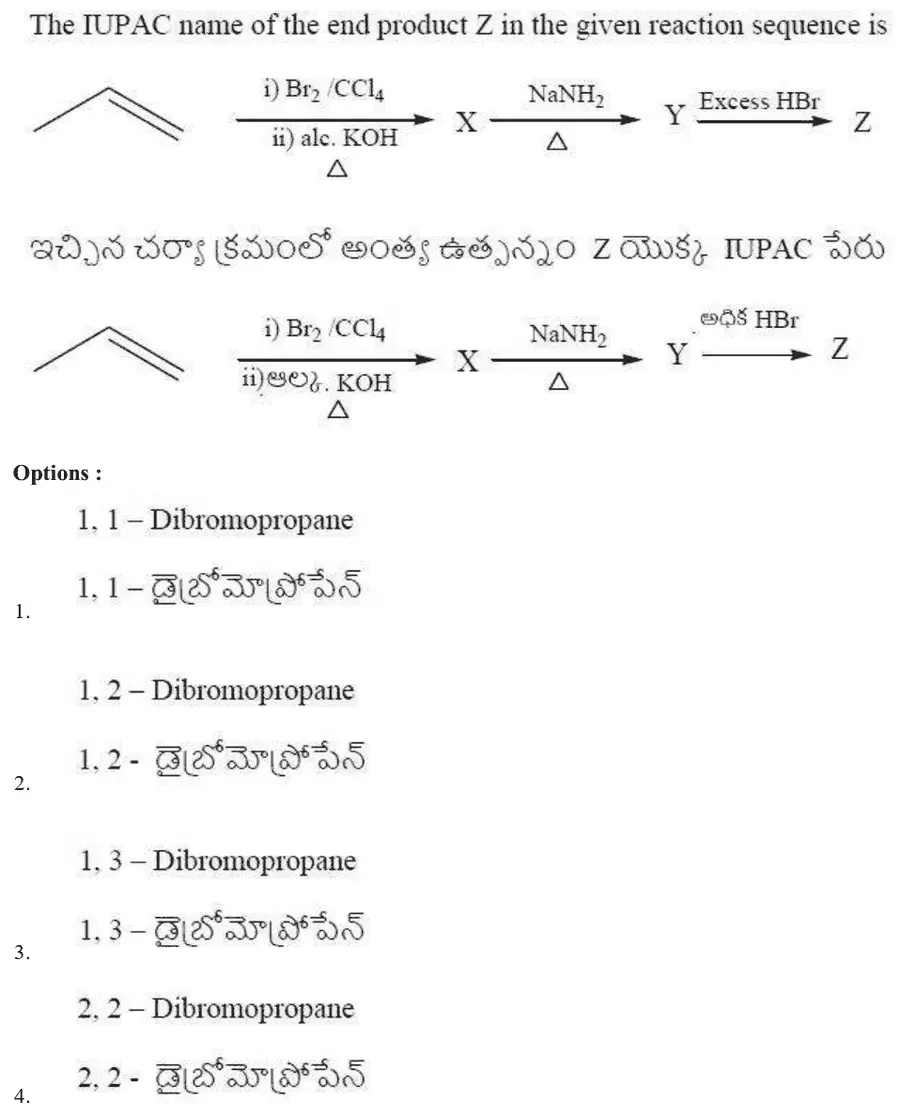
16AP EAPCET 2026 · 12 May · Shift 1MCQOpen question page ↗

The IUPAC name of the end product Z in the given reaction sequence is

(see the figure above)

The question and its figure as printed in AP EAPCET 2026 12th May 2026 Shift 1.
The question as printed in the paper.
  • A

    1, 1 – Dibromopropane

  • B

    1, 2 – Dibromopropane

  • C

    1, 3 – Dibromopropane

  • D

    2, 2 – Dibromopropane

17AP EAPCET 2026 · 12 May · Shift 1MCQOpen question page ↗

Reaction of toluene with reagent ‘A’ gave X which reacts with $\mathrm{NaHCO_3}$ and liberates $\mathrm{CO_2}$. In another reaction with reagent ‘B’ toluene gave Y which gives 2,4 – DNP test. What are A and B respectively?

  • A

    $\mathrm{KMnO_4/OH^-}$ , $\mathrm{H_3O^+}$ ; $\mathrm{CrO_3/(CH_3CO)_2O}$, $\mathrm{H_3O^+}$

  • B

    $\mathrm{Cl_2/h\nu}$, $\mathrm{H_2O}$; $\mathrm{CrO_3/H^+}$

  • C

    $\mathrm{CrO_2Cl_2}$, $\mathrm{H_3O^+}$ ; $\mathrm{KMnO_4/OH^-}$ , $\mathrm{H_3O^+}$

  • D

    $\mathrm{KMnO_4/OH^-}$ , $\mathrm{H_3O^+}$ ; PCC

18AP EAPCET 2026 · 12 May · Shift 1MCQOpen question page ↗

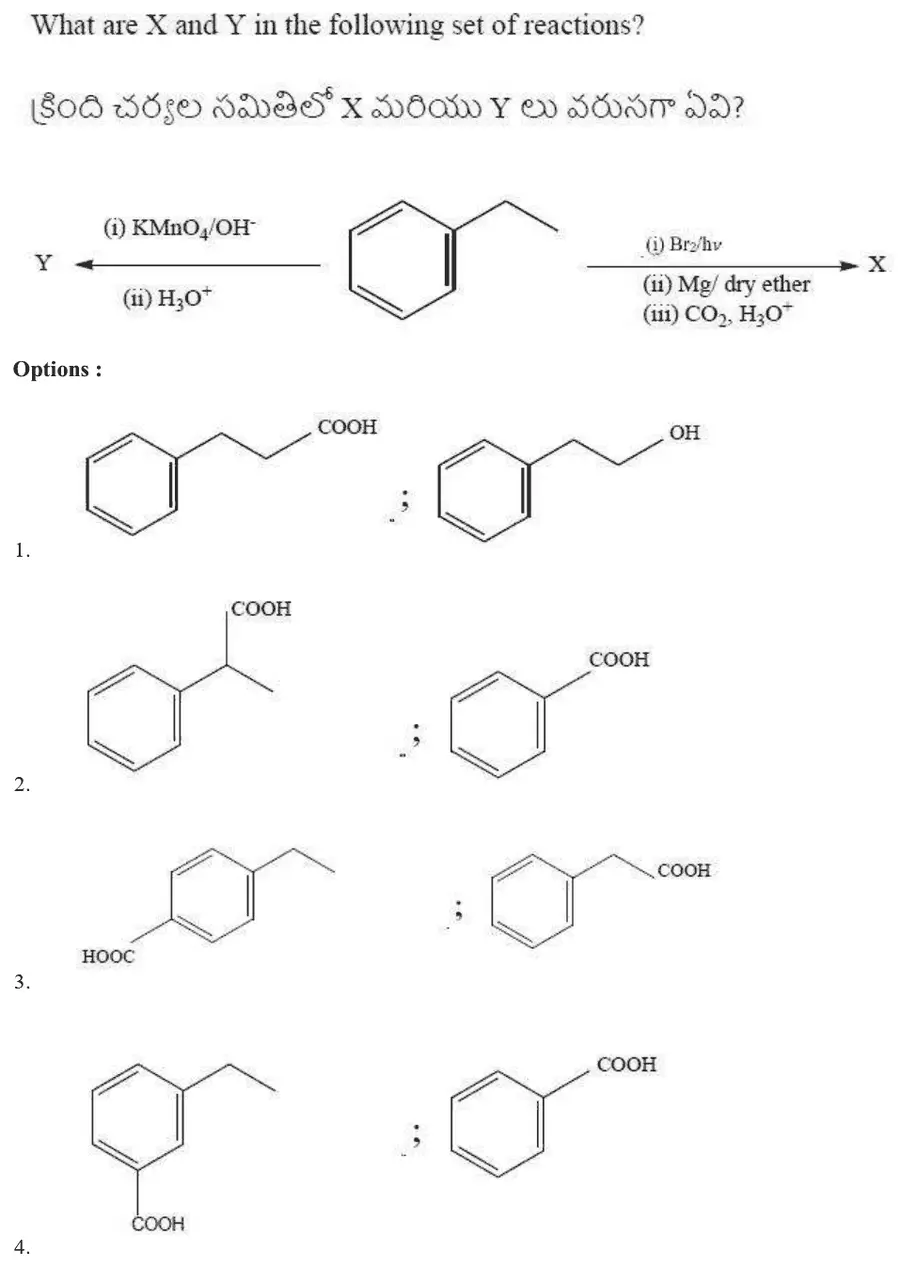
What are X and Y in the following set of reactions?

(see the figure above)

The question and its figure as printed in AP EAPCET 2026 12th May 2026 Shift 1. Option 1: X: 3-phenylpropanoic acid, i.e. a benzene ring attached to CH2-CH2-COOH; Y: 2-phenylethanol, i.e. a benzene ring attached to CH2-CH2-OH (the pair is printed as X ; Y) Option 2: X: 2-phenylpropanoic acid, i.e. a benzene ring attached to CH(COOH)-CH3; Y: benzoic acid, i.e. a benzene ring attached to COOH (the pair is printed as X ; Y) Option 3: X: 4-ethylbenzoic acid, i.e. a benzene ring with an ethyl group and a HOOC group para to each other; Y: phenylacetic acid, i.e. a benzene ring attached to CH2-COOH (the pair is printed as X ; Y) Option 4: X: 3-ethylbenzoic acid, i.e. a benzene ring with an ethyl…
The question as printed in the paper.
  • A

    see figure X: 3-phenylpropanoic acid, i.e. a benzene ring attached to CH2-CH2-COOH; Y: 2-phenylethanol, i.e. a benzene ring attached to CH2-CH2-OH (the pair is printed as X ; Y)

  • B

    see figure X: 2-phenylpropanoic acid, i.e. a benzene ring attached to CH(COOH)-CH3; Y: benzoic acid, i.e. a benzene ring attached to COOH (the pair is printed as X ; Y)

  • C

    see figure X: 4-ethylbenzoic acid, i.e. a benzene ring with an ethyl group and a HOOC group para to each other; Y: phenylacetic acid, i.e. a benzene ring attached to CH2-COOH (the pair is printed as X ; Y)

  • D

    see figure X: 3-ethylbenzoic acid, i.e. a benzene ring with an ethyl group and a COOH group meta to each other; Y: benzoic acid, i.e. a benzene ring attached to COOH (the pair is printed as X ; Y)

19AP EAPCET 2026 · 12 May · Shift 2MCQOpen question page ↗

Consider the given sequence of reactions

$$\mathrm{CH_3 - C \equiv CH} \xrightarrow{HBr} X \xrightarrow{HBr} Y$$

Total number of isomers possible for the product $Y$ is

  • A

    1

  • B

    2

  • C

    4

  • D

    3

20AP EAPCET 2026 · 12 May · Shift 2MCQOpen question page ↗

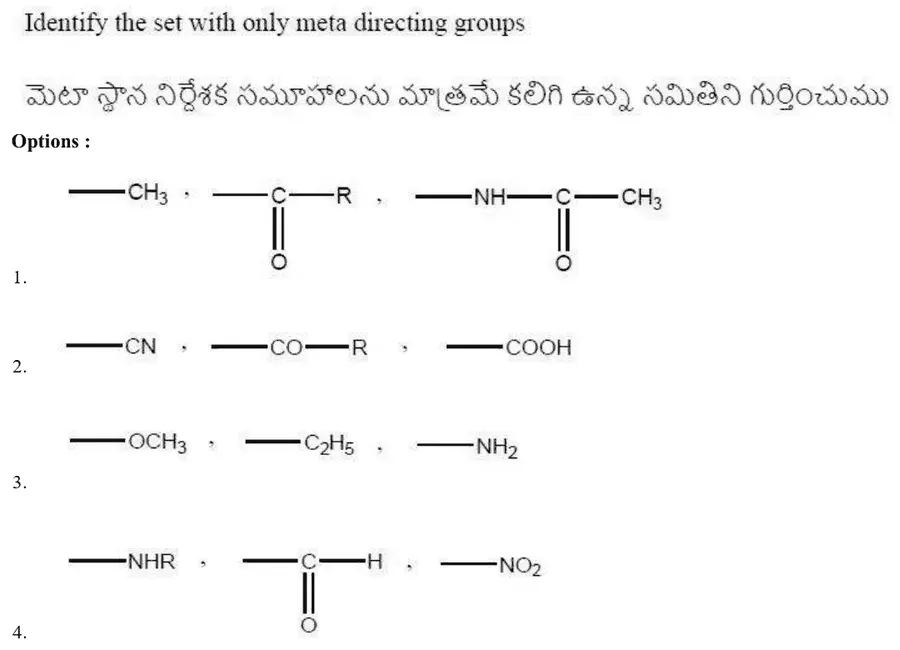
Identify the set with only meta directing groups

The question and its figure as printed in AP EAPCET 2026 12th May 2026 Shift 2. Option 1: Three substituent groups, each drawn as a bond line: -CH3 ; -C(=O)-R (carbonyl carbon with C=O below, R to the right) ; -NH-C(=O)-CH3 (NH, then carbonyl carbon with C=O below, then CH3) Option 2: Three substituent groups, each drawn as a bond line: -CN ; -CO-R ; -COOH Option 3: Three substituent groups, each drawn as a bond line: -OCH3 ; -C2H5 ; -NH2 Option 4: Three substituent groups, each drawn as a bond line: -NHR ; -C(=O)-H (carbonyl carbon with C=O below, H to the right) ; -NO2
The question as printed in the paper.
  • A

    see figure Three substituent groups, each drawn as a bond line: $-\mathrm{CH_3}$ ; $-\mathrm{C(=O)-R}$ (carbonyl carbon with C=O below, R to the right) ; $-\mathrm{NH-C(=O)-CH_3}$ (NH, then carbonyl carbon with C=O below, then CH3)

  • B

    see figure Three substituent groups, each drawn as a bond line: $-\mathrm{CN}$ ; $-\mathrm{CO-R}$ ; $-\mathrm{COOH}$

  • C

    see figure Three substituent groups, each drawn as a bond line: $-\mathrm{OCH_3}$ ; $-\mathrm{C_2H_5}$ ; $-\mathrm{NH_2}$

  • D

    see figure Three substituent groups, each drawn as a bond line: $-\mathrm{NHR}$ ; $-\mathrm{C(=O)-H}$ (carbonyl carbon with C=O below, H to the right) ; $-\mathrm{NO_2}$

21AP EAPCET 2026 · 12 May · Shift 2MCQOpen question page ↗

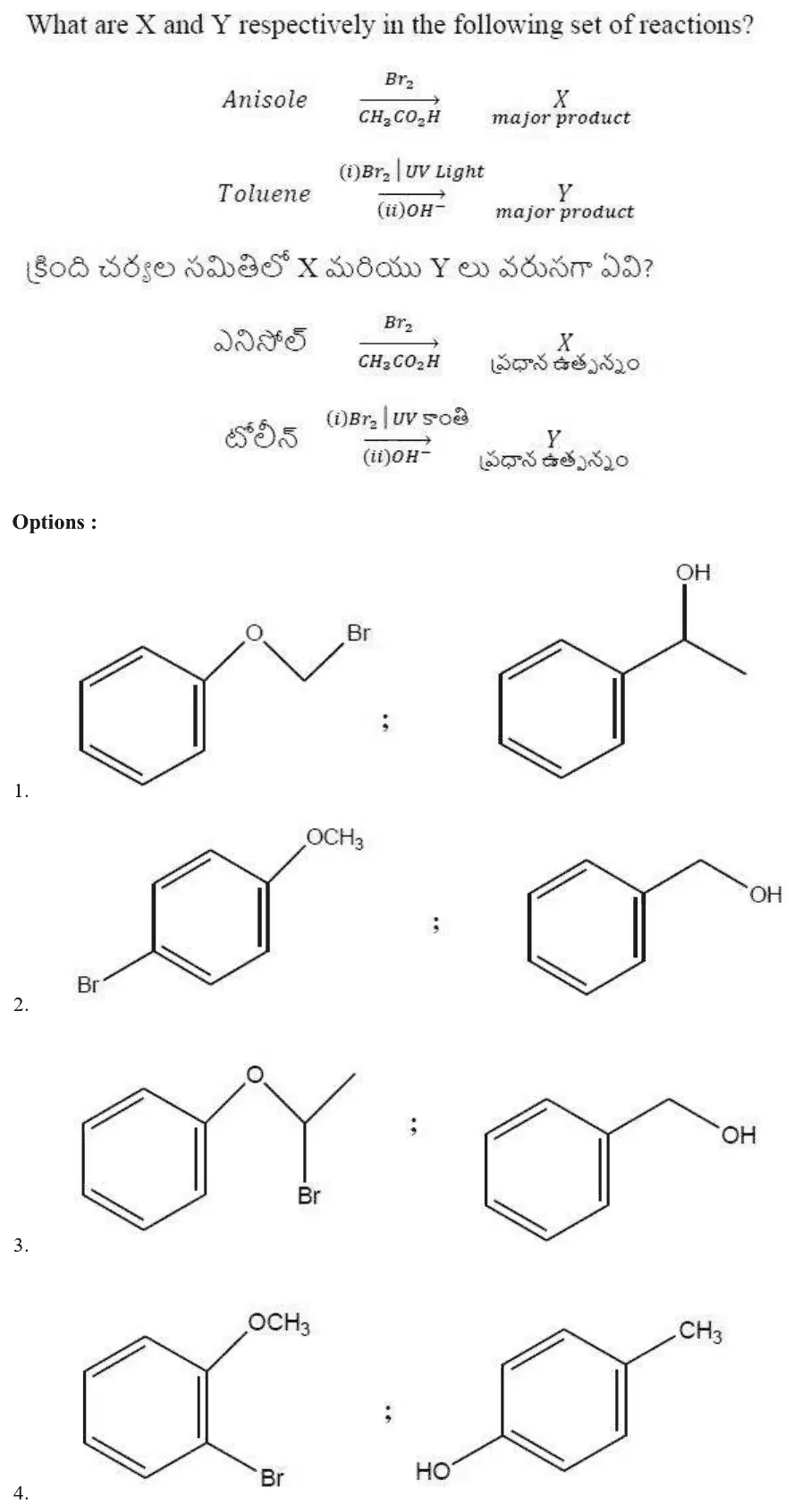
What are X and Y respectively in the following set of reactions?

$$\text{Anisole} \xrightarrow[\mathrm{CH_3CO_2H}]{\mathrm{Br_2}} \underset{\text{major product}}{X}$$

$$\text{Toluene} \xrightarrow[\text{(ii)}\ \mathrm{OH^-}]{\text{(i)}\ \mathrm{Br_2}\,|\,\text{UV Light}} \underset{\text{major product}}{Y}$$

The question and its figure as printed in AP EAPCET 2026 12th May 2026 Shift 2.
The question as printed in the paper.
  • A

    X: (see the figure above) phenyl ether C6H5-O-CH2-Br (bromomethyl phenyl ether); Y: (see the figure above) 1-phenylethanol (benzene ring attached to CH(OH)CH3)

  • B

    X: (see the figure above) 4-bromoanisole (benzene ring with OCH3 and Br para); Y: (see the figure above) benzyl alcohol (benzene ring attached to CH2OH)

  • C

    X: (see the figure above) phenyl ether C6H5-O-CH(Br)CH3 (1-bromoethyl phenyl ether); Y: (see the figure above) benzyl alcohol (benzene ring attached to CH2OH)

  • D

    X: (see the figure above) 2-bromoanisole (benzene ring with OCH3 and Br ortho); Y: (see the figure above) 4-methylphenol (p-cresol; benzene ring with CH3 and HO para)

22TS EAPCET 2026 · 11 May · Shift 1MCQOpen question page ↗

1 mole of a hydrocarbon A($\mathrm{C_5H_{10}}$) on ozonolysis gives two compounds X and Y. Both X and Y respond to iodoform test. X gives test with ammonical $\mathrm{AgNO_3}$ solution but not with Y. What are X and Y respectively?

  • A

    $\mathrm{CH_2O}$ ; $\mathrm{CH_3COC_2H_5}$

  • B

    $\mathrm{CH_3CHO}$; $\mathrm{(CH_3)_2CO}$

  • C

    $\mathrm{(CH_3)_2C=O}$; $\mathrm{CH_3CH=O}$

  • D

    $\mathrm{CH_3COOH}$ ; $\mathrm{(CH_3)_2C=O}$

23TS EAPCET 2026 · 11 May · Shift 1MCQOpen question page ↗

Identify the pair of alkanes which undergo aromatization from the following

I. n-Hexane

II. Isopentane

III. n-Heptane

IV. Neohexane

(only)

  • A

    I & II only

  • B

    I & III only

  • C

    II & III only

  • D

    III & IV only

24TS EAPCET 2026 · 11 May · Shift 2MCQOpen question page ↗

An alkene, X ($\mathrm{C_5H_{10}}$) exhibits cis/trans isomerism. Bromination of ‘X’ followed by reaction with reagent/s (Y) gave the product ‘Z’. What are ‘Y’ and ‘Z’?

  • A

    $\mathrm{NaNH_2}$ ; $\mathrm{(CH_3)_2CHC\equiv CH}$

  • B

    $\mathrm{KOH}$ (aq) ; $\mathrm{CH_3CH_2CH_2C\equiv CH}$

  • C

    alc.$\mathrm{KOH}$, $\mathrm{NaNH_2}$ ; $\mathrm{CH_3CH_2C\equiv CCH_3}$

  • D

    alc.$\mathrm{KOH}$, $\mathrm{NaNH_2}$ ; $\mathrm{CH_3CH_2CH_2C\equiv CH}$

25TS EAPCET 2026 · 11 May · Shift 2MCQOpen question page ↗

An alkene, $\mathrm{C_4H_8}$ (X) on reaction with HBr gives a compound Y. Hydrolysis of Y follows $\mathrm{S_N1}$ mechanism. The ozonolysis products of X are

  • A

    $\mathrm{CH_3CH_2CHO, CH_2O}$

  • B

    $\mathrm{CH_3CHO, CH_3CHO}$

  • C

    $\mathrm{CH_3CH_2OH, CH_3CHO}$

  • D

    $\mathrm{CH_3COCH_3, CH_2O}$

26TS EAPCET 2026 · 11 May · Shift 2MCQOpen question page ↗

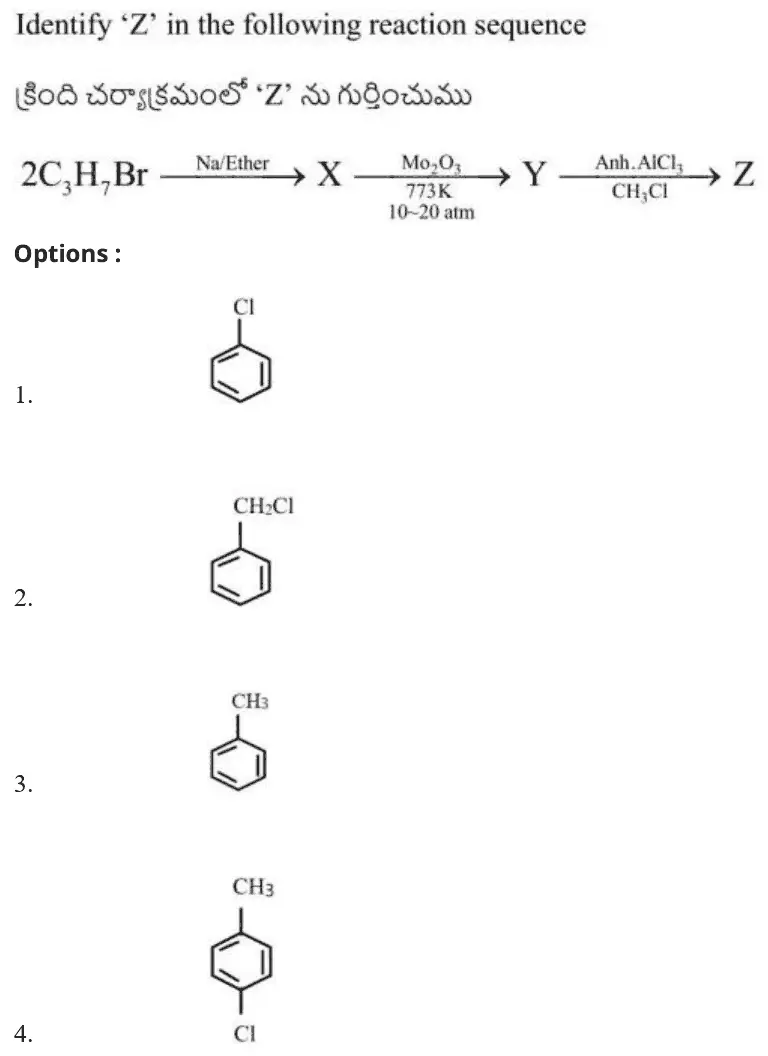
Observe the following reaction sequence and the statements given about the product Y (dry ether, anhy)

$$\mathrm{C_3H_6} \xrightarrow[(ii)\ \mathrm{Na\ /\ dry\ ether}]{(i)\ \mathrm{HBr\ /\ (C_6H_5CO)_2O_2,\ O_2}} \mathrm{X} \xrightarrow[(ii)\ \mathrm{CH_3Cl\ /\ anhy.\ AlCl_3}]{(i)\ \mathrm{V_2O_5},\ 773\ \mathrm{K},\ 10\text{-}20\ \mathrm{atm}} \mathrm{Y}$$

I. Reaction of 'Y' with $\mathrm{Br_2}$ / UV light forms aryl bromide

II. Reaction of 'Y' with $\mathrm{CrO_3}$ / $\mathrm{(CH_3CO)_2O}$ followed by hydrolysis gives a compound which is acidic in nature

The correct answer is

  • A

    Both statements I and II are correct

  • B

    Both statements I and II are not correct

  • C

    Statement I is correct, but statement II is not correct

  • D

    Statement I is not correct, but statement II is correct

27TS EAPCET 2026 · 11 May · Shift 2MCQOpen question page ↗

Bromination of toluene in the presence of anhydrous $\mathrm{AlCl_3}$ gave X and bromination of cyclohexene in the presence of light yielded Y. X and Y respectively are

  • A

    Aryl bromide, Allyl bromide

  • B

    Benzyl bromide, Allyl bromide

  • C

    Aryl bromide, Vinyl bromide

  • D

    Benzyl bromide, Vinyl bromide

28TS EAPCET 2026 · 11 May · Shift 2MCQOpen question page ↗

Identify the sets in which A, B and C of the following reaction sequence are in correct order

$$\mathrm{(CH_3)_3COH} \xrightarrow{A} \mathrm{X} \xrightarrow[(ii)\ C]{(i)\ B} \mathrm{(CH_3)_2CHCH_2OH}\ \text{(Major product)}$$

I. $\mathrm{H_2SO_4}$; HBr; $\mathrm{OH^-}$

II. $\mathrm{Cu/573\,K}$; $\mathrm{HBr/(C_6H_5CO)_2O_2}$; $\mathrm{OH^-}$

III. $\mathrm{20\%\,H_3PO_4/358\,K}$; $\mathrm{(BH_3)_2}$; $\mathrm{H_2O_2/OH^-}$

IV. $\mathrm{20\%\,H_3PO_4/358\,K}$; HBr; $\mathrm{OH^-}$

Correct answer is

  • A

    III, IV only

  • B

    II, III, IV only

  • C

    I, II, III only

  • D

    II, III only

29TS EAPCET 2026 · 11 May · Shift 2MCQOpen question page ↗

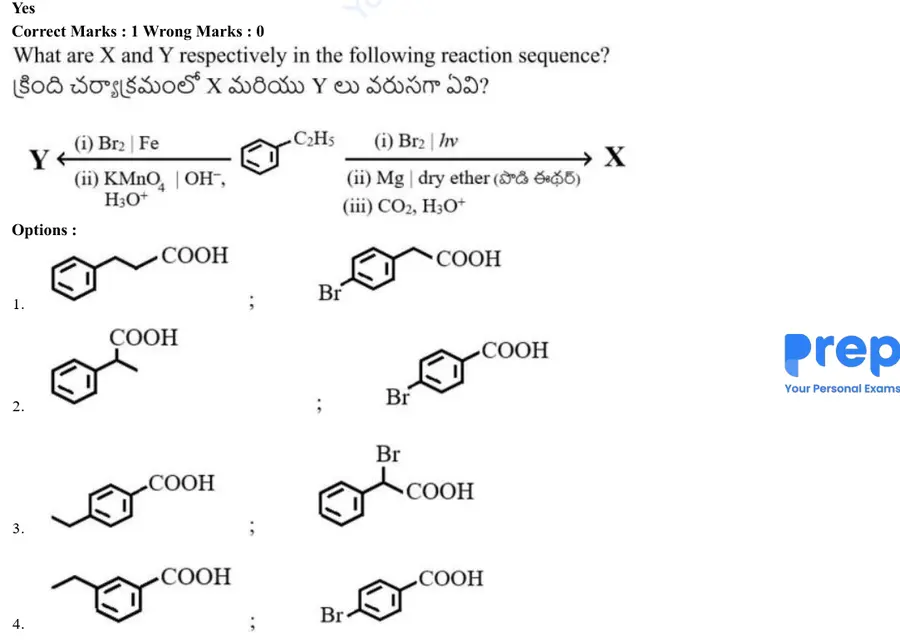
What are X and Y respectively in the following reaction sequence?

(see the figure above)

The question and its figure as printed in TS EAPCET 2026 11th May 2026 Shift 2. Option 1: X: 3-phenylpropanoic acid (benzene ring–CH2–CH2–COOH); Y: 4-bromophenylacetic acid (Br-C6H4-CH2-COOH, para) Option 2: X: 2-phenylpropanoic acid (benzene ring–CH(COOH)–CH3); Y: 4-bromobenzoic acid (para) Option 3: X: 4-ethylbenzoic acid (para-ethyl, COOH on ring); Y: 2-bromo-2-phenylacetic acid (benzene ring–CH(Br)–COOH) Option 4: X: 3-ethylbenzoic acid (meta-ethyl, COOH on ring); Y: 4-bromobenzoic acid (para)
The question as printed in the paper.
  • A

    see figure X: 3-phenylpropanoic acid (benzene ring–CH2–CH2–COOH); Y: 4-bromophenylacetic acid (Br-C6H4-CH2-COOH, para)

  • B

    see figure X: 2-phenylpropanoic acid (benzene ring–CH(COOH)–CH3); Y: 4-bromobenzoic acid (para)

  • C

    see figure X: 4-ethylbenzoic acid (para-ethyl, COOH on ring); Y: 2-bromo-2-phenylacetic acid (benzene ring–CH(Br)–COOH)

  • D

    see figure X: 3-ethylbenzoic acid (meta-ethyl, COOH on ring); Y: 4-bromobenzoic acid (para)

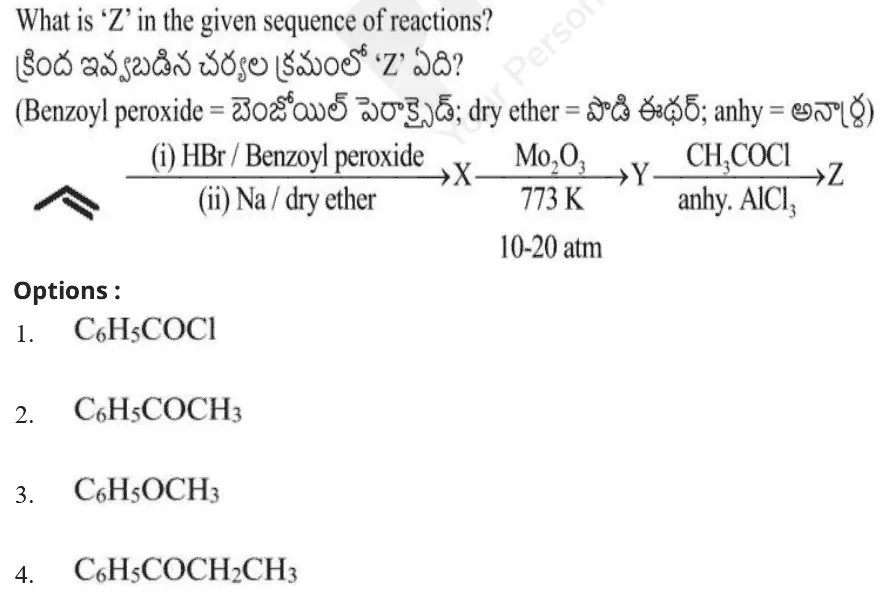
30TS EAPCET 2026 · 10 May · Shift 1MCQOpen question page ↗

What is ‘Z’ in the given sequence of reactions?

(Benzoyl peroxide = benzoyl peroxide; dry ether = dry ether; anhy = anhydrous)

(see the figure above)

The question and its figure as printed in TS EAPCET 2026 10th May 2026 Shift 1.
The question as printed in the paper.
  • A

    $\mathrm{C_6H_5COCl}$

  • B

    $\mathrm{C_6H_5COCH_3}$

  • C

    $\mathrm{C_6H_5OCH_3}$

  • D

    $\mathrm{C_6H_5COCH_2CH_3}$

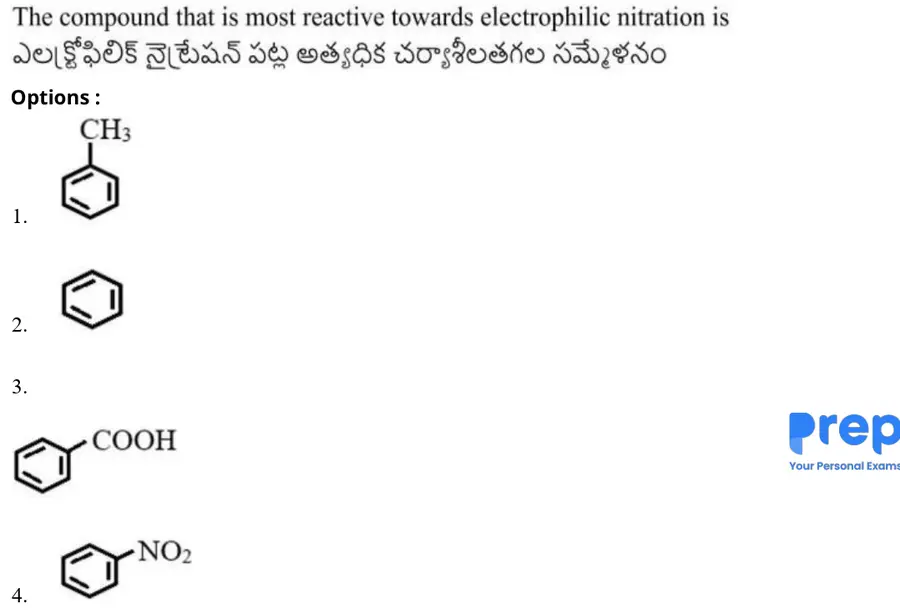
31TS EAPCET 2026 · 10 May · Shift 2MCQOpen question page ↗

The compound that is most reactive towards electrophilic nitration is

The question and its figure as printed in TS EAPCET 2026 10th May 2026 Shift 2. Option 1: Toluene: a benzene ring with a CH3 substituent Option 2: Benzene: an unsubstituted benzene ring Option 3: Benzoic acid: a benzene ring with a COOH substituent Option 4: Nitrobenzene: a benzene ring with an NO2 substituent
The question as printed in the paper.
  • A

    see figure Toluene: a benzene ring with a CH3 substituent

  • B

    see figure Benzene: an unsubstituted benzene ring

  • C

    see figure Benzoic acid: a benzene ring with a COOH substituent

  • D

    see figure Nitrobenzene: a benzene ring with an NO2 substituent

32TS EAPCET 2026 · 10 May · Shift 2MCQOpen question page ↗

What is Z in the given sequence of reactions? (conc = conc, Quinoline = Quinoline)

$$\text{Propyne} \xrightarrow[\text{Pd-C, Quinoline}]{\mathrm{H_2}/} X \xrightarrow{\mathrm{H_2O|H^+}} Y \xrightarrow[443\ \mathrm{K}]{\text{Conc. }\mathrm{H_2SO_4}} Z$$

  • A

    Ether

  • B

    Aldehyde

  • C

    Carboxylic Acid

  • D

    Alkene

33TS EAPCET 2026 · 9 May · Shift 1MCQOpen question page ↗

Which of the following reagent(s) will convert n-propylbromide to alkane with same number of carbon atoms?

I. $\mathrm{Zn\,|\,H^+}$

II. $\mathrm{Na\,|\,dry\ ether}$

III. (*i*) alc.KOH (*ii*) $\mathrm{H_2\,|\,Pt}$

The correct answer is

  • A

    I only

  • B

    II, III only

  • C

    I, III only

  • D

    II only

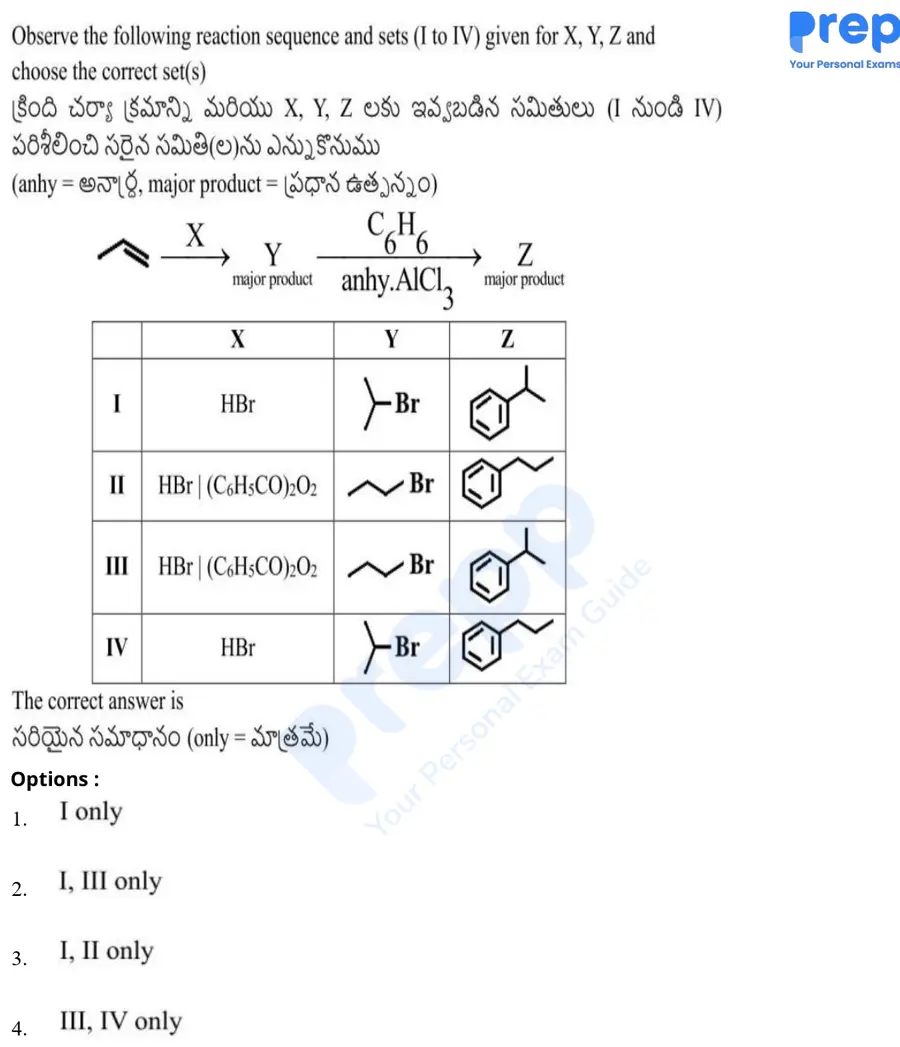
34TS EAPCET 2026 · 9 May · Shift 1MCQOpen question page ↗

Observe the following reaction sequence and sets (I to IV) given for X, Y, Z and choose the correct set(s)

(anhy = anhydrous, major product = major product)

(see the figure above)

The correct answer is (only = only)

The question and its figure as printed in TS EAPCET 2026 09th May 2026 Shift 1.
The question as printed in the paper.
  • A

    I only

  • B

    I, III only

  • C

    I, II only

  • D

    III, IV only

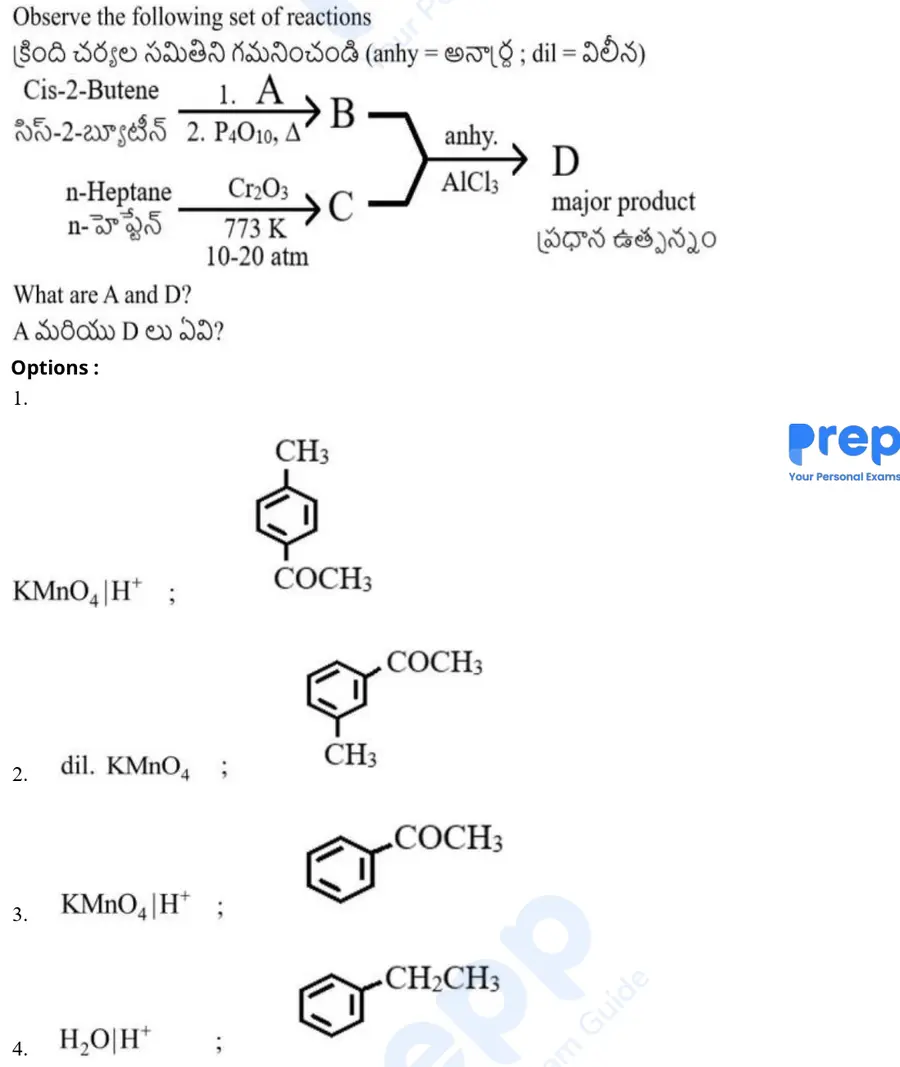
35TS EAPCET 2026 · 9 May · Shift 2MCQOpen question page ↗

Observe the following set of reactions

(see the figure above)

What are A and D?

The question and its figure as printed in TS EAPCET 2026 09th May 2026 Shift 2.
The question as printed in the paper.
  • A

    $\mathrm{KMnO_4|H^+}$ ; (see the figure above) para-substituted benzene ring with $\mathrm{CH_3}$ at the top and $\mathrm{COCH_3}$ at the bottom

  • B

    dil. $\mathrm{KMnO_4}$ ; (see the figure above) meta-substituted benzene ring with $\mathrm{COCH_3}$ and $\mathrm{CH_3}$

  • C

    $\mathrm{KMnO_4|H^+}$ ; (see the figure above) benzene ring with a $\mathrm{COCH_3}$ substituent

  • D

    $\mathrm{H_2O|H^+}$ ; (see the figure above) benzene ring with a $\mathrm{CH_2CH_3}$ substituent

36TS EAPCET 2026 · 9 May · Shift 2MCQOpen question page ↗

Observe the following reaction sequence

$$\underset{(A)}{\mathrm{C_4H_6}} \xrightarrow{\;B\;} \mathrm{C} \xrightarrow[(ii)\,\mathrm{Zn+H_2O}]{(i)\,\mathrm{O_3}} \mathrm{D}$$

Compound (A) forms sodium derivative with $\mathrm{NaNH_2}$. What are B and D respectively?

  • A

    $\mathrm{H_2\,|\,Ni}$ ; $\mathrm{CH_3CH_2CHO + HCHO}$

  • B

    $\mathrm{H_2\,|\,Ni}$ ; $\mathrm{CH_3CHO + CH_3CHO}$

  • C

    $\mathrm{H_2\,|\,Pd-C,\ quinoline}$ ; $\mathrm{CH_3CH_2CHO + HCHO}$

  • D

    $\mathrm{H_2\,|\,Pd-C,\ quinoline}$ ; $\mathrm{CH_3CHO + CH_3CHO}$

37AP EAPCET 2025 · 27 May · Shift 1MCQOpen question page ↗

Consider the sets I, II and III. Identify the set(s) which is (are) correctly matched. (only)

I. Staggered ethane > eclipsed ethane ......... torsional strain.

II. 2, 2-Dimethylbutane > 2-methylpentane ......... boiling point

III. cis-But-2-ene > trans-But-2-ene ......... dipole moment

  • A

    I, II only

  • B

    II, III only

  • C

    III only

  • D

    I, II, III

38AP EAPCET 2025 · 27 May · Shift 1MCQOpen question page ↗

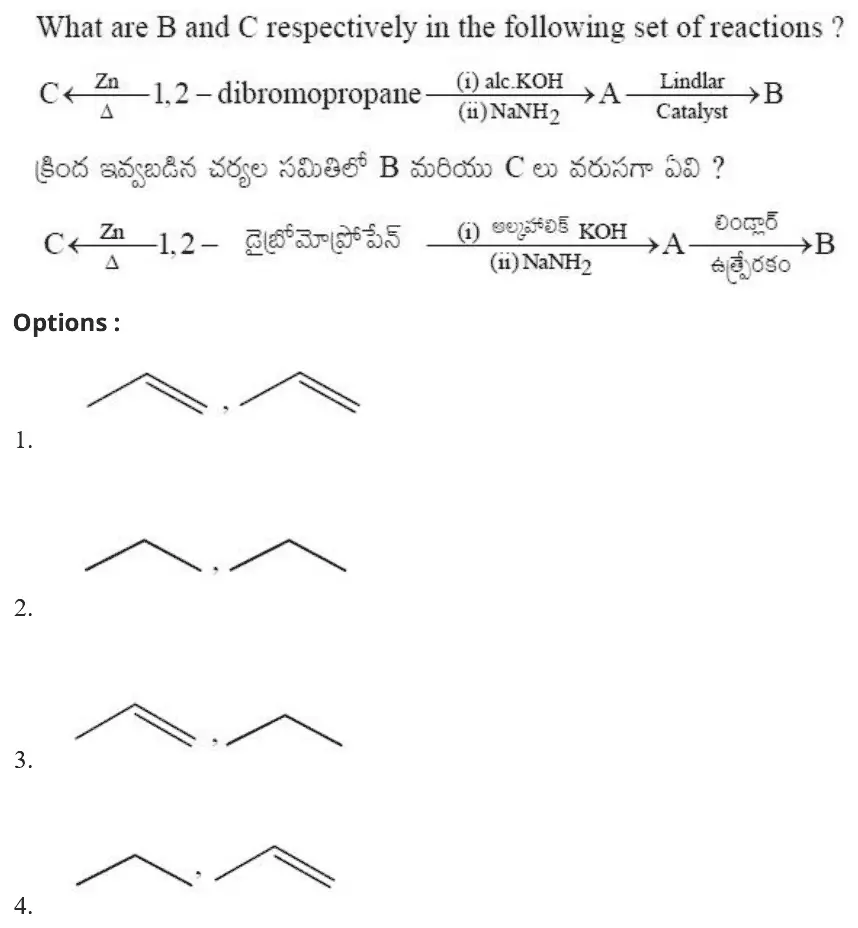
What are B and C respectively in the following set of reactions ?

$$\mathrm{C} \xleftarrow[\Delta]{\mathrm{Zn}} \text{1,2-dibromopropane} \xrightarrow[\text{(ii) } \mathrm{NaNH_2}]{\text{(i) alc.KOH}} \mathrm{A} \xrightarrow[\text{Catalyst}]{\text{Lindlar}} \mathrm{B}$$

The question and its figure as printed in AP EAPCET 2025 27th May 2025 Shift 1. Option 1: Two propene skeletal structures (CH2=CH-CH3 drawn as a zigzag with terminal double bond), separated by a comma Option 2: Two propane skeletal structures (zigzag of two single bonds), separated by a comma Option 3: First propene (double bond between C1 and C2, drawn on the left bond of the zigzag), then propane, separated by a comma Option 4: First propane (two single bonds), then propene (double bond on the right bond), separated by a comma
The question as printed in the paper.
  • A

    see figure Two propene skeletal structures (CH2=CH-CH3 drawn as a zigzag with terminal double bond), separated by a comma

  • B

    see figure Two propane skeletal structures (zigzag of two single bonds), separated by a comma

  • C

    see figure First propene (double bond between C1 and C2, drawn on the left bond of the zigzag), then propane, separated by a comma

  • D

    see figure First propane (two single bonds), then propene (double bond on the right bond), separated by a comma

39AP EAPCET 2025 · 27 May · Shift 1MCQOpen question page ↗

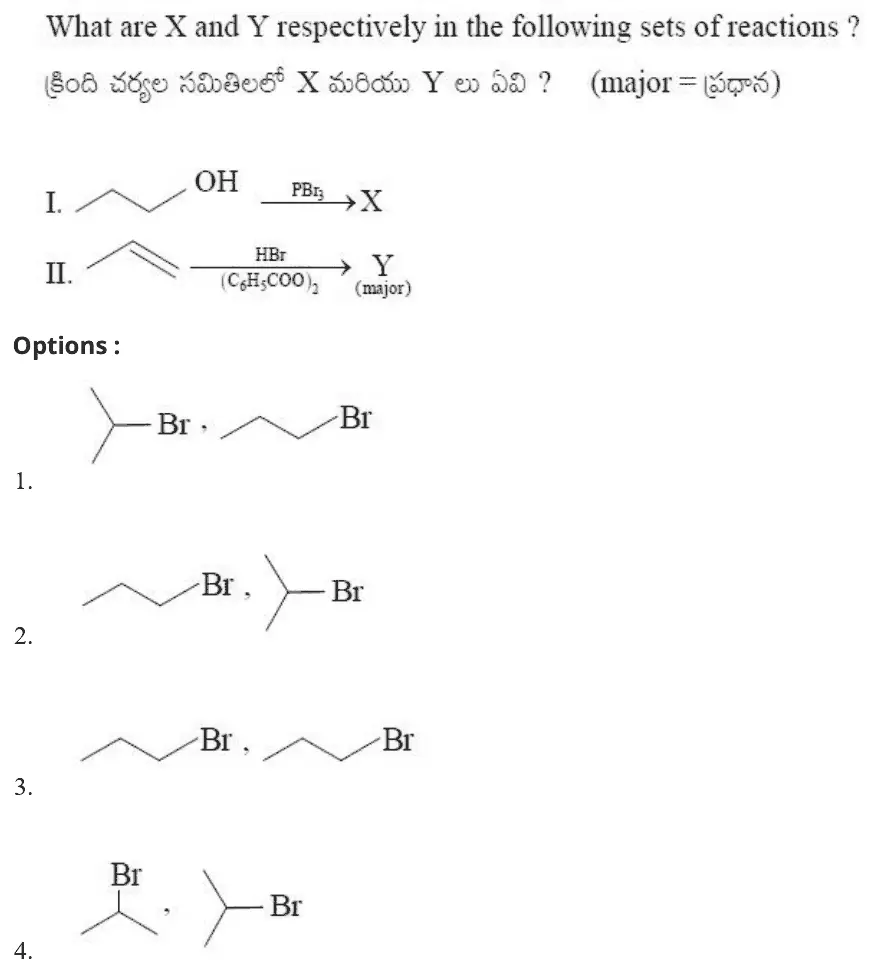
What are X and Y respectively in the following sets of reactions ? (major = major product)

I. (see the figure above) $\xrightarrow{\mathrm{PBr_3}}$ X

II. (see the figure above) $\xrightarrow[\mathrm{(C_6H_5COO)_2}]{\mathrm{HBr}}$ Y (major)

The question and its figure as printed in AP EAPCET 2025 27th May 2025 Shift 1. Option 1: Two skeletal structures separated by a comma: isopropyl bromide (2-bromopropane, Br on the middle carbon of a three-carbon chain), and 1-bromopropane (Br on terminal carbon). Option 2: Two skeletal structures separated by a comma: 1-bromopropane (Br on terminal carbon), and 2-bromopropane (Br on the middle carbon). Option 3: Two skeletal structures separated by a comma: 1-bromopropane, and 1-bromopropane. Option 4: Two skeletal structures separated by a comma: 2-bromopropane (Br drawn up on the central carbon), and 2-bromopropane (Br drawn to the right on the central carbon).
The question as printed in the paper.
  • A

    see figure Two skeletal structures separated by a comma: isopropyl bromide (2-bromopropane, Br on the middle carbon of a three-carbon chain), and 1-bromopropane (Br on terminal carbon).

  • B

    see figure Two skeletal structures separated by a comma: 1-bromopropane (Br on terminal carbon), and 2-bromopropane (Br on the middle carbon).

  • C

    see figure Two skeletal structures separated by a comma: 1-bromopropane, and 1-bromopropane.

  • D

    see figure Two skeletal structures separated by a comma: 2-bromopropane (Br drawn up on the central carbon), and 2-bromopropane (Br drawn to the right on the central carbon).

40AP EAPCET 2025 · 26 May · Shift 1MCQOpen question page ↗

Match the following

List-I (Use)List-II (Substance)
A) Electrodes in batteriesI) Polypropylene
B) Welding of metalsII) Polyacetylene
C) ToysIII) Oxyacetylene

The correct answer is

  • A

    A-III, B-II, C-I

  • B

    A-II, B-III, C-I

  • C

    A-II, B-I, C-III

  • D

    A-I, B-II, C-III

41AP EAPCET 2025 · 26 May · Shift 1MCQOpen question page ↗

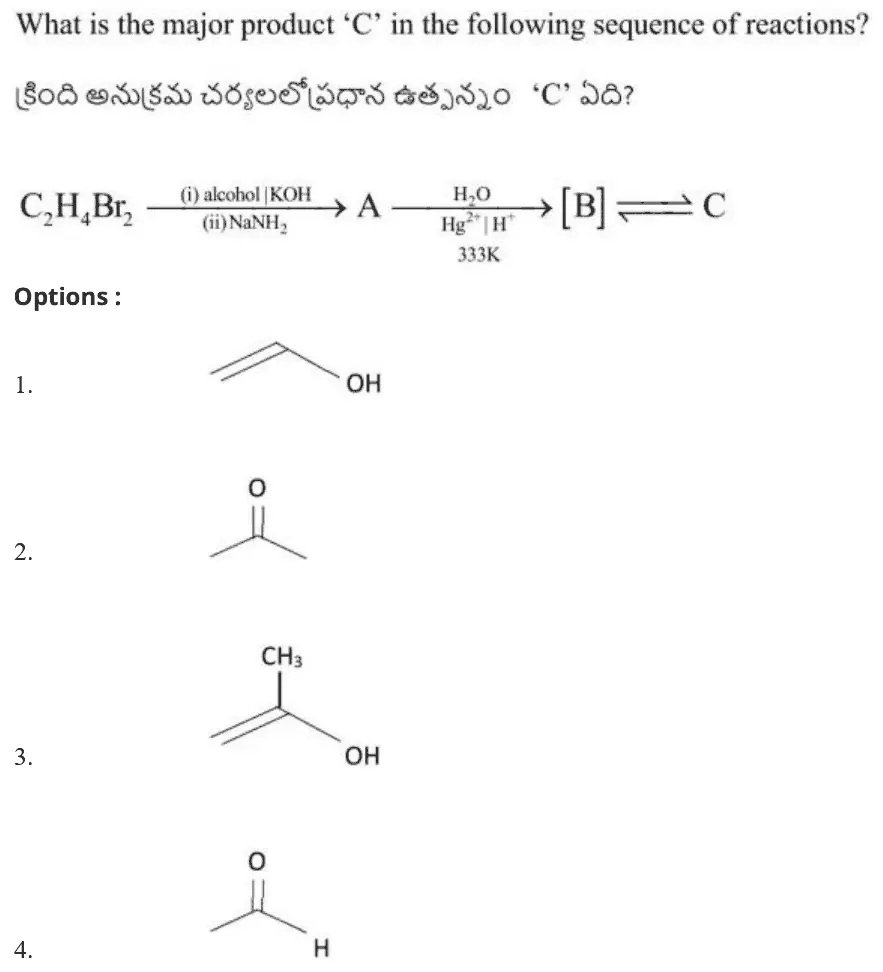
What is 'Z' in the following reaction sequence ? (alcohol; colourless)

$$\mathrm{C_3H_6} \xrightarrow[\mathrm{CCl_4}]{\mathrm{Br_2}} \underset{\text{(colourless)}}{X} \xrightarrow[\text{(ii) } \mathrm{NaNH_2},\ \Delta]{\text{(i) KOH/alcohol}} Y \xrightarrow[\mathrm{Hg^{2+}, H^+}]{\mathrm{H_2O}\ (333\ \mathrm{K})} Z$$

  • A

    Acetone

  • B

    Propanal

  • C

    Propanol-2

  • D

    Methoxy ethane

42AP EAPCET 2025 · 26 May · Shift 1MCQOpen question page ↗

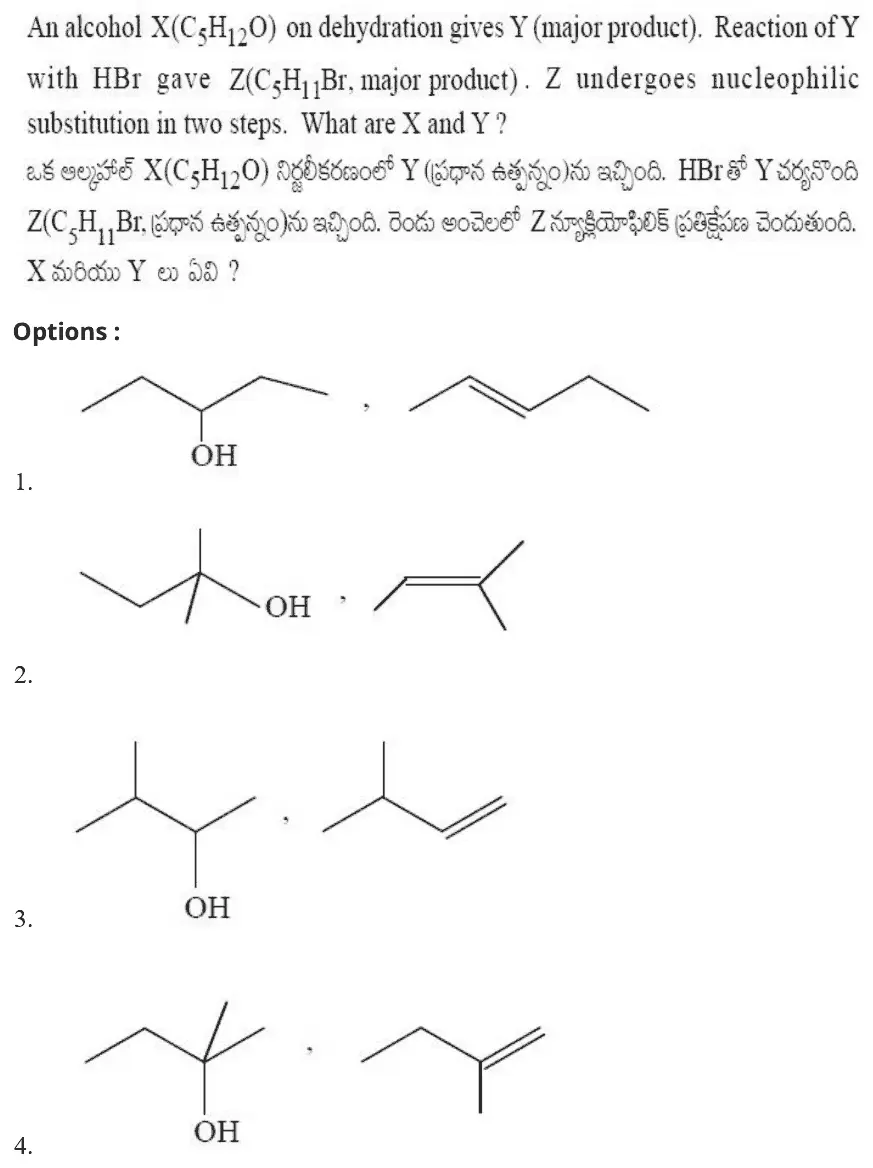
An alcohol $\mathrm{X(C_5H_{12}O)}$ on dehydration gives Y (major product). Reaction of Y with HBr gave $\mathrm{Z(C_5H_{11}Br}$, major product). Z undergoes nucleophilic substitution in two steps. What are X and Y ?

The question and its figure as printed in AP EAPCET 2025 26thMay 2025 Shift 1. Option 1: X: skeletal structure of pentan-3-ol (zigzag chain of five carbons with OH on the middle carbon, pointing down); Y: pent-2-ene (zigzag chain of five carbons with a double bond between C2 and C3, at the left) Option 2: X: skeletal structure of 3-methylbutan-... tertiary alcohol, 2-methylbutan-2-ol (a quaternary carbon bearing OH with a methyl up, an ethyl on the left and a methyl to the right with OH label); Y: 2-methylbut-2-ene (trisubstituted alkene with double bond and a methyl branch) Option 3: X: 3-methylbutan-2-ol drawn as skeletal structure (branched chain with a methyl branch up at the left…
The question as printed in the paper.
  • A

    see figure X: skeletal structure of pentan-3-ol (zigzag chain of five carbons with OH on the middle carbon, pointing down); Y: pent-2-ene (zigzag chain of five carbons with a double bond between C2 and C3, at the left)

  • B

    see figure X: skeletal structure of 3-methylbutan-... tertiary alcohol, 2-methylbutan-2-ol (a quaternary carbon bearing OH with a methyl up, an ethyl on the left and a methyl to the right with OH label); Y: 2-methylbut-2-ene (trisubstituted alkene with double bond and a methyl branch)

  • C

    see figure X: 3-methylbutan-2-ol drawn as skeletal structure (branched chain with a methyl branch up at the left carbon and OH pointing down on the adjacent carbon); Y: 3-methylbut-1-ene (branched chain with a methyl branch up and a terminal double bond to the right)

  • D

    see figure X: 2-methylbutan-2-ol drawn as skeletal structure (ethyl chain at the left, quaternary carbon with OH pointing down and a methyl pointing up); Y: 2-methylbut-1-ene (ethyl chain at the left, carbon with terminal double bond to the upper right and a methyl branch pointing down)

43AP EAPCET 2025 · 26 May · Shift 2MCQOpen question page ↗

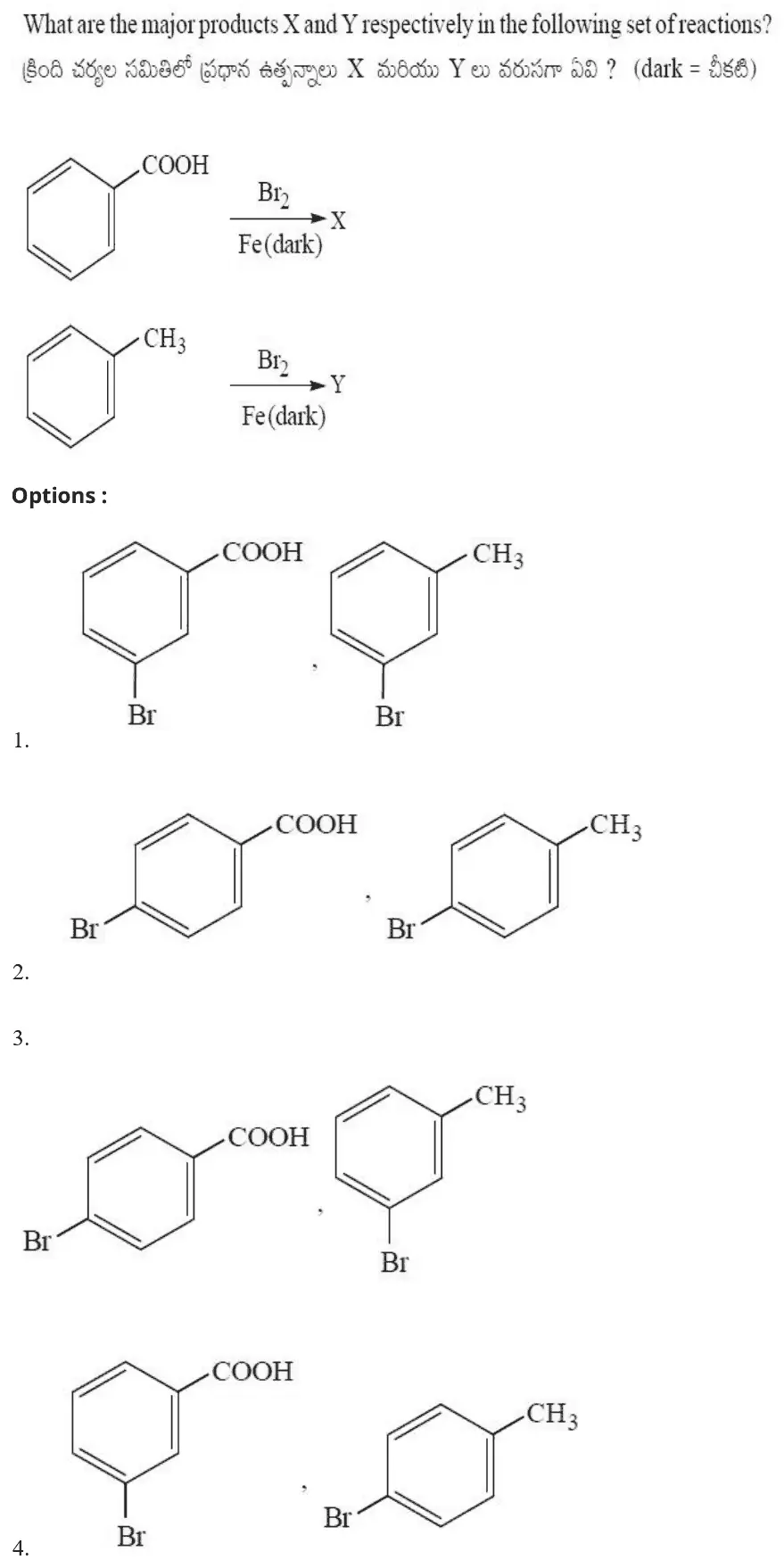
What are the major products X and Y respectively in the following set of reactions?

(see the figure above)

The question and its figure as printed in AP EAPCET 2025 26thMay 2025 Shift 2. Option 1: Pair of structures: meta-bromobenzoic acid (benzene ring with COOH at the top right and Br at the bottom, i.e. meta), and meta-bromotoluene (benzene ring with CH3 at the top right and Br at the bottom, i.e. meta). Option 2: Pair of structures: para-bromobenzoic acid (COOH at the top right, Br at the lower left, i.e. para), and para-bromotoluene (CH3 at the top right, Br at the lower left, i.e. para). Option 3: Pair of structures: para-bromobenzoic acid (COOH at the top right, Br at the lower left, i.e. para), and meta-bromotoluene (CH3 at the top right, Br at the bottom, i.e. meta). Option 4: Pair of…
The question as printed in the paper.
  • A

    see figure Pair of structures: meta-bromobenzoic acid (benzene ring with COOH at the top right and Br at the bottom, i.e. meta), and meta-bromotoluene (benzene ring with CH3 at the top right and Br at the bottom, i.e. meta).

  • B

    see figure Pair of structures: para-bromobenzoic acid (COOH at the top right, Br at the lower left, i.e. para), and para-bromotoluene (CH3 at the top right, Br at the lower left, i.e. para).

  • C

    see figure Pair of structures: para-bromobenzoic acid (COOH at the top right, Br at the lower left, i.e. para), and meta-bromotoluene (CH3 at the top right, Br at the bottom, i.e. meta).

  • D

    see figure Pair of structures: meta-bromobenzoic acid (COOH at the top right, Br at the bottom, i.e. meta), and para-bromotoluene (CH3 at the top right, Br at the lower left, i.e. para).

44AP EAPCET 2025 · 26 May · Shift 2MCQOpen question page ↗

Which of the following will undergo methylation with $\mathrm{CH_3Cl}$ / anhy. $\mathrm{AlCl_3}$ ?

a) Aniline b) Chlorobenzene c) Benzoic acid d) Anisole

  • A

    a, d

  • B

    b, c

  • C

    b, d

  • D

    a, c

45AP EAPCET 2025 · 24 May · Shift 1MCQOpen question page ↗

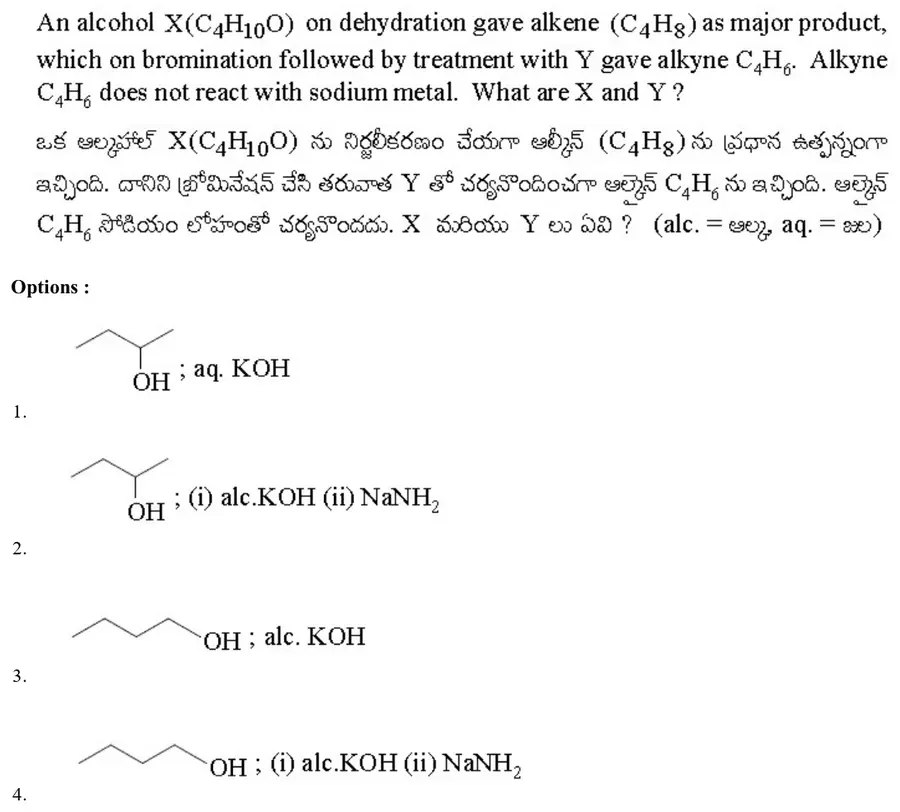
An alcohol $\mathrm{X(C_4H_{10}O)}$ on dehydration gave alkene $\mathrm{(C_4H_8)}$ as major product, which on bromination followed by treatment with Y gave alkyne $\mathrm{C_4H_6}$. Alkyne $\mathrm{C_4H_6}$ does not react with sodium metal. What are X and Y ?

The question and its figure as printed in AP EAPCET 2025 24th May 2025 Shift 1. Option 1: Skeletal structure of butan-2-ol (OH on the second carbon of a four-carbon chain); aq. KOH Option 2: Skeletal structure of butan-2-ol (OH on the second carbon of a four-carbon chain); (i) alc.KOH (ii) NaNH2 Option 3: Skeletal structure of butan-1-ol (OH on the terminal carbon of a four-carbon chain); alc. KOH Option 4: Skeletal structure of butan-1-ol (OH on the terminal carbon of a four-carbon chain); (i) alc.KOH (ii) NaNH2
The question as printed in the paper.
  • A

    see figure Skeletal structure of butan-2-ol (OH on the second carbon of a four-carbon chain); aq. KOH

  • B

    see figure Skeletal structure of butan-2-ol (OH on the second carbon of a four-carbon chain); (i) alc.KOH (ii) $\mathrm{NaNH_2}$

  • C

    see figure Skeletal structure of butan-1-ol (OH on the terminal carbon of a four-carbon chain); alc. KOH

  • D

    see figure Skeletal structure of butan-1-ol (OH on the terminal carbon of a four-carbon chain); (i) alc.KOH (ii) $\mathrm{NaNH_2}$

46AP EAPCET 2025 · 24 May · Shift 1MCQOpen question page ↗

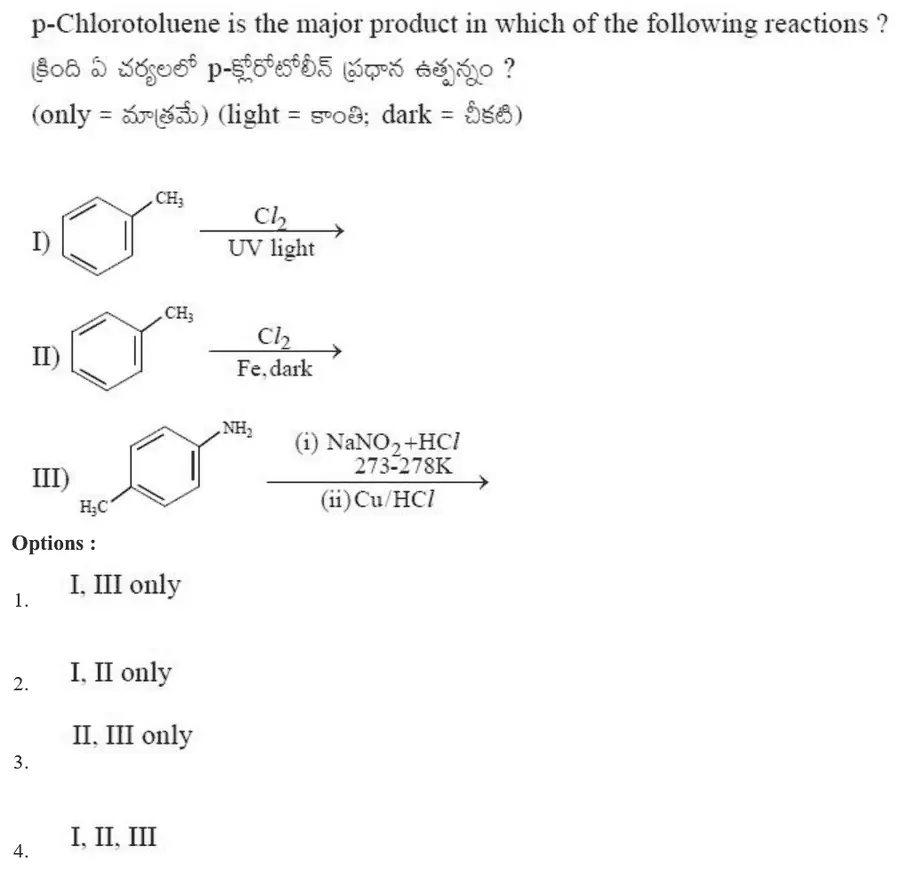
p-Chlorotoluene is the major product in which of the following reactions ?

(only = only) (light = light; dark = dark)

I) (see the figure above)

II) (see the figure above)

III) (see the figure above)

The question and its figure as printed in AP EAPCET 2025 24th May 2025 Shift 1.
The question as printed in the paper.
  • A

    I, III only

  • B

    I, II only

  • C

    II, III only

  • D

    I, II, III

47AP EAPCET 2025 · 24 May · Shift 1MCQOpen question page ↗

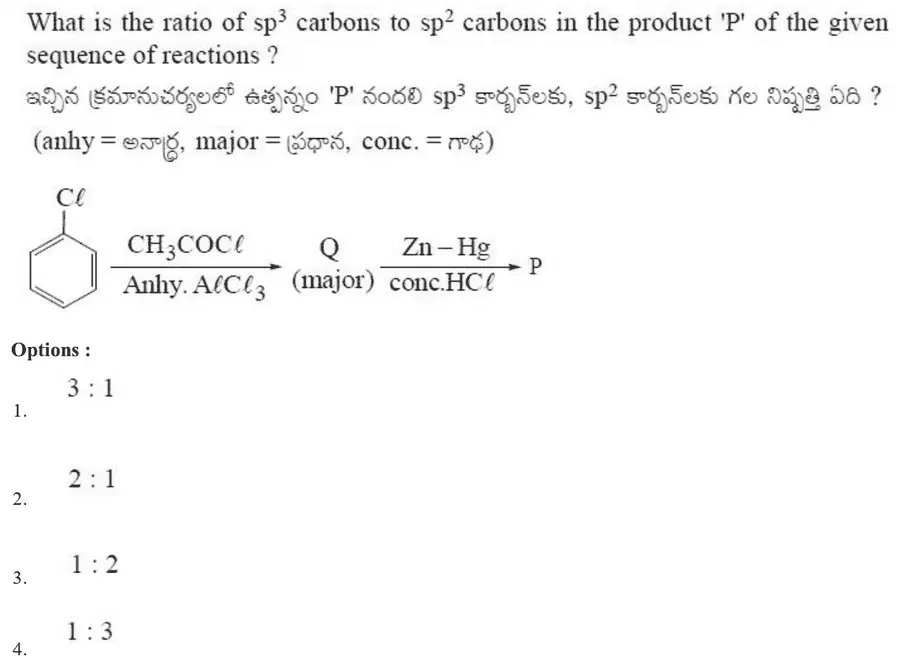
What is the ratio of $\mathrm{sp^3}$ carbons to $\mathrm{sp^2}$ carbons in the product 'P' of the given sequence of reactions ?

(anhy = anhydrous, major, conc. = concentrated)

(see the figure above)

The question and its figure as printed in AP EAPCET 2025 24th May 2025 Shift 1.
The question as printed in the paper.
  • A

    $3 : 1$

  • B

    $2 : 1$

  • C

    $1 : 2$

  • D

    $1 : 3$

48AP EAPCET 2025 · 23 May · Shift 1MCQOpen question page ↗

Which one of the following compounds does not give benzoic acid when treated with alkaline $\mathrm{KMnO_4}$ ?

  • A

    Acetophenone

  • B

    n-Propyl benzene

  • C

    Styrene

  • D

    t-Butyl benzene

49AP EAPCET 2025 · 23 May · Shift 2MCQOpen question page ↗

The empirical formula weight of 'Z' in the given reaction sequence is

$$\text{n-propyl bromide} \xrightarrow[\text{Dry ether}]{\text{Na}} \mathrm{X} \xrightarrow[\substack{773\ \mathrm{K}\\ 20\ \mathrm{atm}}]{\mathrm{V_2O_5}} \mathrm{Y} \xrightarrow[500\ \mathrm{K}]{\substack{\mathrm{Cl_2}\\ \mathrm{UV}}} \mathrm{Z}$$

  • A

    47.5

  • B

    54.5

  • C

    84.5

  • D

    48.5

50AP EAPCET 2025 · 22 May · Shift 1MCQOpen question page ↗

Consider the following

Statement-I : Kolbe's electrolysis of sodium propionate gives n-hexane as product

Statement-II : In Kolbe's process $\mathrm{CO_2}$ is liberated at anode and $\mathrm{H_2}$ is liberated at cathode

Correct answer is

  • A

    Both statement-I and statement-II are correct

  • B

    Both statement-I and statement-II are not correct

  • C

    Statement-I is correct, but statement-II is not correct

  • D

    Statement-I is not correct, but statement-II is correct

51AP EAPCET 2025 · 22 May · Shift 2MCQOpen question page ↗

What are X, Y, Z in the following reaction sequence ?

But-2-ene $\xrightarrow{X}$ Ethanoic acid $\xrightarrow{Y}$ Ethanoyl chloride $\xrightarrow[\text{Anhy. } \mathrm{AlCl_3}]{\text{Benzene}}$ Z

  • A

    $\mathrm{KMnO_4 / H^+}$; $\mathrm{SOCl_2}$; Acetophenone

  • B

    $\mathrm{KMnO_4 / H^+}$; $\mathrm{Cl_2}$; Propiophenone

  • C

    Cold $\mathrm{KMnO_4}$; $\mathrm{SOCl_2}$; Propiophenone

  • D

    Cold $\mathrm{KMnO_4}$; $\mathrm{Cl_2}$; Acetophenone

52AP EAPCET 2025 · 22 May · Shift 2MCQOpen question page ↗

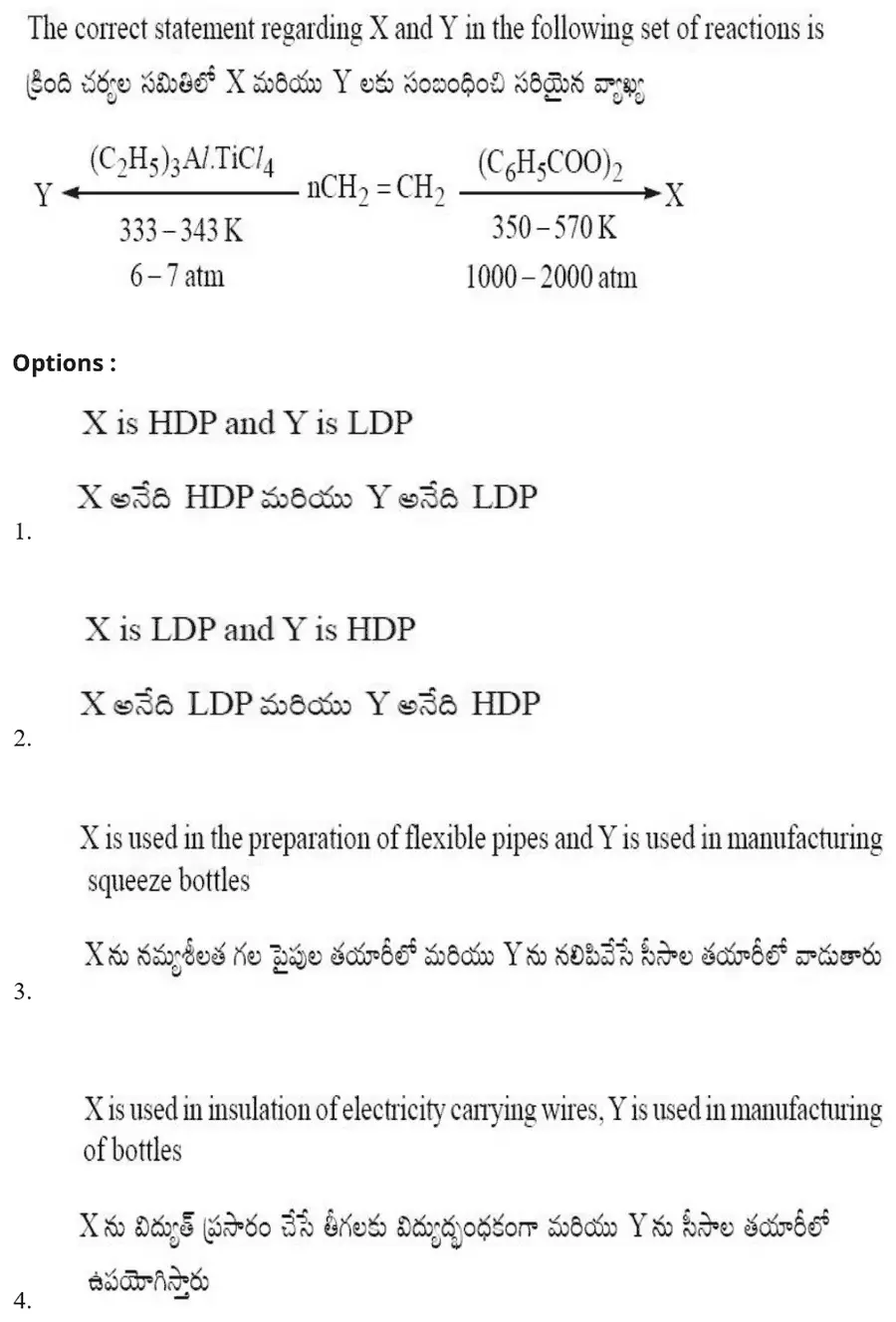
The correct statement regarding X and Y in the following set of reactions is

(see the figure above)

The question and its figure as printed in AP EAPCET 2025 22nd May 2025 Shift 2.
The question as printed in the paper.
  • A

    X is HDP and Y is LDP

  • B

    X is LDP and Y is HDP

  • C

    X is used in the preparation of flexible pipes and Y is used in manufacturing squeeze bottles

  • D

    X is used in insulation of electricity carrying wires, Y is used in manufacturing of bottles

53AP EAPCET 2025 · 21 May · Shift 1MCQOpen question page ↗

Consider the following reaction sequence

$$\text{Vinylbenzene} \xrightarrow[\Delta]{\mathrm{KMnO_4+KOH}} \mathrm{X} \xrightarrow[\Delta]{\mathrm{NaOH+CaO}} \mathrm{Y}$$

'Y' can also be formed from

  • A

    Polymerisation of ethylene

  • B

    Polymerisation of propyne

  • C

    Aromatisation of n-hexane

  • D

    Aromatisation of n-heptane

54AP EAPCET 2025 · 21 May · Shift 2MCQOpen question page ↗

The catalyst used for the isomerisation of n-alkanes to branched chain alkanes is

(Anhy : anhydrous)

  • A

    Anhy.$\mathrm{AlCl_3}$ / HCl

  • B

    $\mathrm{Mo_2O_3}$

  • C

    $\mathrm{FeCl_3}$

  • D

    $\mathrm{TiCl_4}$ + $\mathrm{R_3Al}$

55AP EAPCET 2025 · 21 May · Shift 2MCQOpen question page ↗

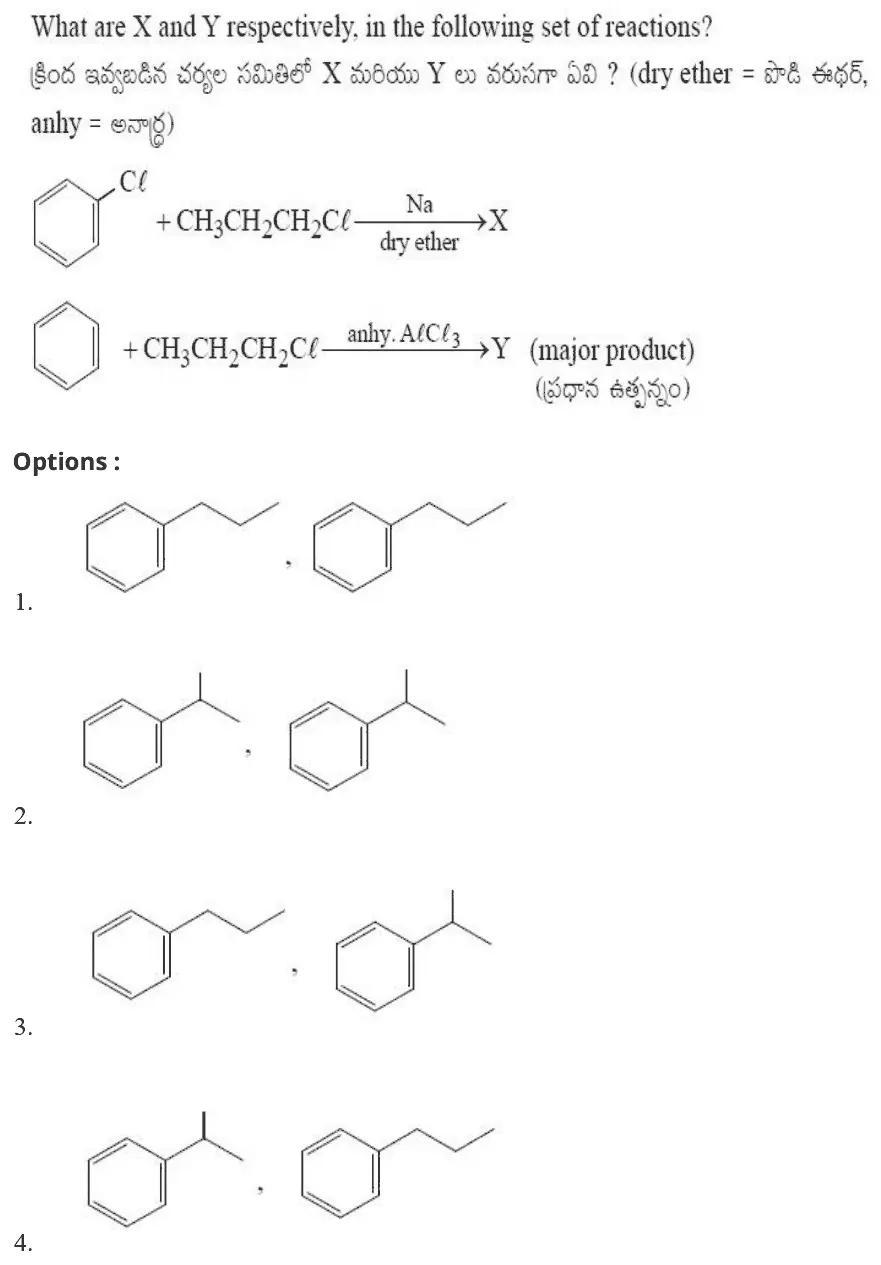
What are X and Y respectively, in the following set of reactions? (dry ether, anhy = anhydrous)

(see the figure above)

The question and its figure as printed in AP EAPCET 2025 21st May 2025 Shift 2. Option 1: Two skeletal structures separated by a comma: both are benzene rings bearing an n-propyl chain (CH2CH2CH3, zigzag, unbranched). Option 2: Two skeletal structures separated by a comma: both are benzene rings bearing an isopropyl group (CH(CH3)2, branched). Option 3: Two skeletal structures separated by a comma: first is benzene with an n-propyl chain, second is benzene with an isopropyl group. Option 4: Two skeletal structures separated by a comma: first is benzene with an isopropyl group, second is benzene with an n-propyl chain.
The question as printed in the paper.
  • A

    see figure Two skeletal structures separated by a comma: both are benzene rings bearing an n-propyl chain (CH2CH2CH3, zigzag, unbranched).

  • B

    see figure Two skeletal structures separated by a comma: both are benzene rings bearing an isopropyl group (CH(CH3)2, branched).

  • C

    see figure Two skeletal structures separated by a comma: first is benzene with an n-propyl chain, second is benzene with an isopropyl group.

  • D

    see figure Two skeletal structures separated by a comma: first is benzene with an isopropyl group, second is benzene with an n-propyl chain.

56AP EAPCET 2025 · 21 May · Shift 2MCQOpen question page ↗

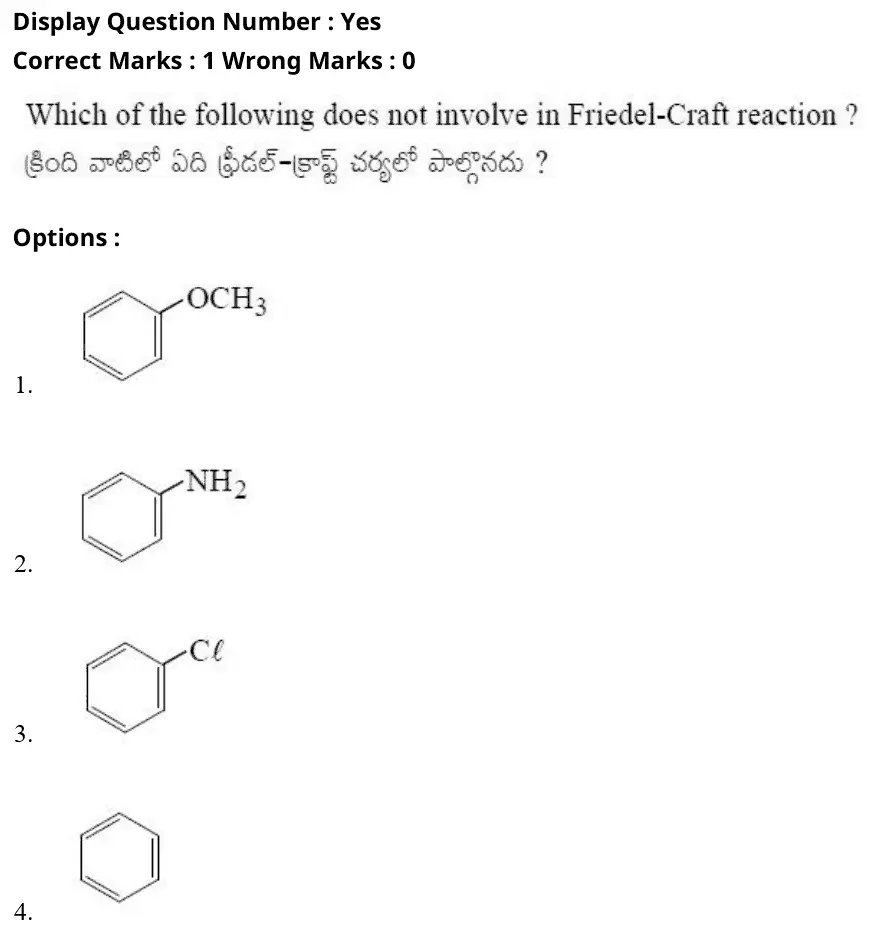
Which of the following does not involve in Friedel-Craft reaction ?

The question and its figure as printed in AP EAPCET 2025 21st May 2025 Shift 2. Option 1: Anisole: benzene ring with an OCH3 substituent Option 2: Aniline: benzene ring with an NH2 substituent Option 3: Chlorobenzene: benzene ring with a Cl substituent Option 4: Benzene: plain benzene ring with no substituent
The question as printed in the paper.
  • A

    see figure Anisole: benzene ring with an $\mathrm{OCH_3}$ substituent

  • B

    see figure Aniline: benzene ring with an $\mathrm{NH_2}$ substituent

  • C

    see figure Chlorobenzene: benzene ring with a $\mathrm{Cl}$ substituent

  • D

    see figure Benzene: plain benzene ring with no substituent

57TS EAPCET 2025 · 4 May · Shift 1MCQOpen question page ↗

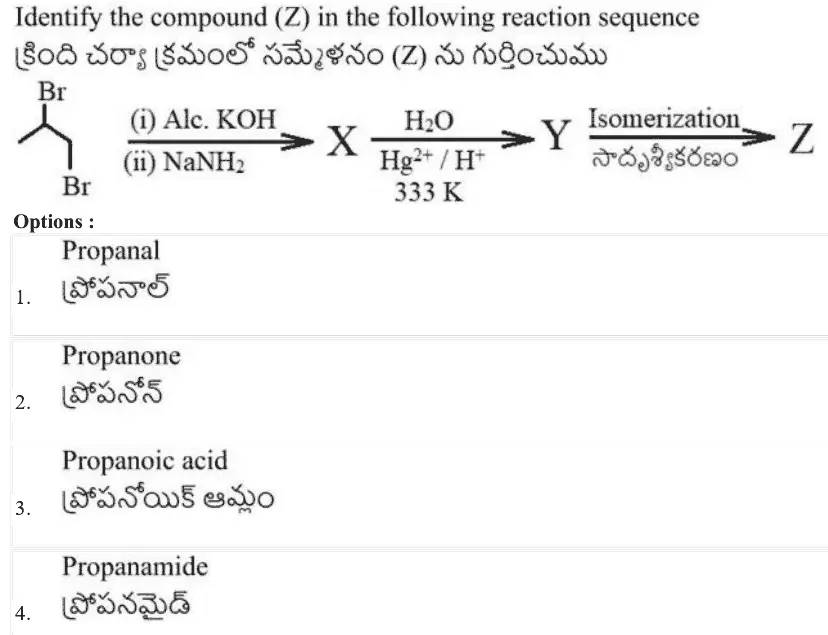
Identify the compound (Z) in the following reaction sequence

(see the figure above)

The question and its figure as printed in TG EAPCET 2025 04 May FN.
The question as printed in the paper.
  • A

    Propanal

  • B

    Propanone

  • C

    Propanoic acid

  • D

    Propanamide

58TS EAPCET 2025 · 4 May · Shift 1MCQOpen question page ↗

Match the following

List – 1 (Reaction)List – 2 (Major product)
A$\mathrm{CH_3-C\equiv CH}\xrightarrow[\mathrm{Hg^{2+}/H^+,\ 333K}]{\mathrm{H_2O}}$I$\mathrm{CH_3-CH-CH_3}$ with OH on the middle carbon
B$\mathrm{CH_3COONa}\xrightarrow[\text{electrolysis}]{\mathrm{H_2O,Pt}}$II$\mathrm{CH_3-C-CH_3}$ with =O on the middle carbon
C$\mathrm{CH_3-CH=CH_2}\xrightarrow{\mathrm{H_2O/H^+}}$III$\mathrm{CH_3-CH-CH_2}$ with OH on the middle carbon and OH on the terminal carbon
D$\mathrm{CH_3-CH=CH_2}\xrightarrow[\mathrm{273K}]{\mathrm{H_2O,\ dil.KMnO_4}}$IV$\mathrm{CH_3-CH_3}$
V$\mathrm{CH_4}$

The correct answer is

  • A

    A-II, B-IV, C-I, D-III

  • B

    A-II, B-V, C-I, D-III

  • C

    A-III, B-IV, C-II, D-I

  • D

    A-II, B-III, C-IV, D-I

59TS EAPCET 2025 · 4 May · Shift 2MCQOpen question page ↗

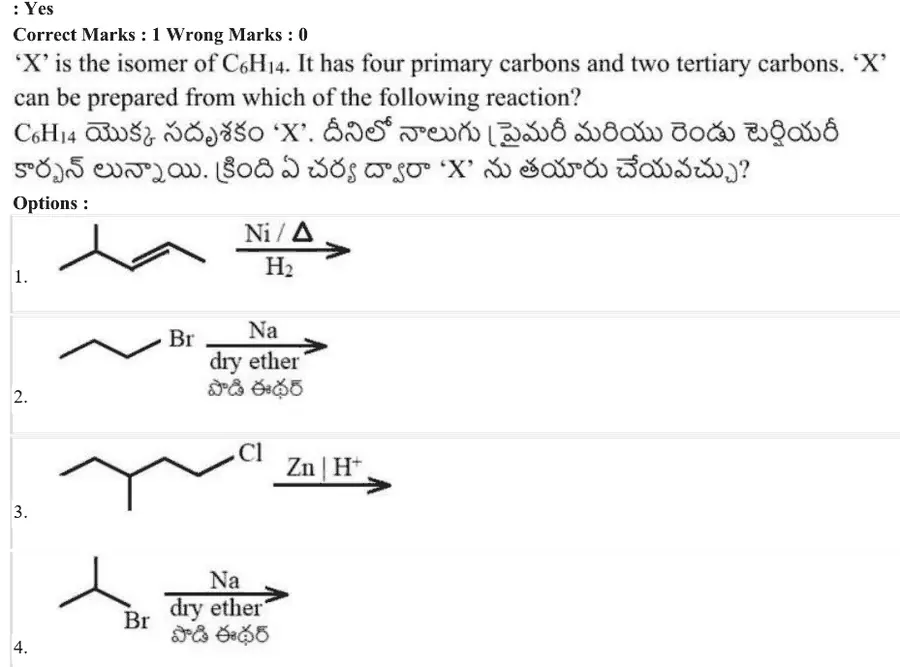
‘X’ is the isomer of $\mathrm{C_6H_{14}}$. It has four primary carbons and two tertiary carbons. ‘X’ can be prepared from which of the following reaction?

The question and its figure as printed in TG EAPCET 2025 04 May AN. Option 1: Skeletal structure of an alkene, 4-methylpent-2-ene (isopropyl group attached to a CH=CH–CH3 unit), reacting with H2 over Ni / Δ Option 2: Skeletal structure of 1-bromopropane (n-propyl bromide, Br on the terminal carbon), reacting with Na in dry ether Option 3: Skeletal structure of a chloroalkane, a 6-carbon chain with a methyl branch (3-methylpentane skeleton) bearing Cl at the terminal carbon, reacting with Zn | H^+ Option 4: Skeletal structure of 2-bromopropane (isopropyl bromide, Br on the central carbon), reacting with Na in dry ether
The question as printed in the paper.
  • A

    see figure Skeletal structure of an alkene, 4-methylpent-2-ene (isopropyl group attached to a CH=CH–CH3 unit), reacting with $\mathrm{H_2}$ over Ni / Δ

  • B

    see figure Skeletal structure of 1-bromopropane (n-propyl bromide, Br on the terminal carbon), reacting with Na in dry ether

  • C

    see figure Skeletal structure of a chloroalkane, a 6-carbon chain with a methyl branch (3-methylpentane skeleton) bearing Cl at the terminal carbon, reacting with $\mathrm{Zn | H^+}$

  • D

    see figure Skeletal structure of 2-bromopropane (isopropyl bromide, Br on the central carbon), reacting with Na in dry ether

60TS EAPCET 2025 · 4 May · Shift 2MCQOpen question page ↗

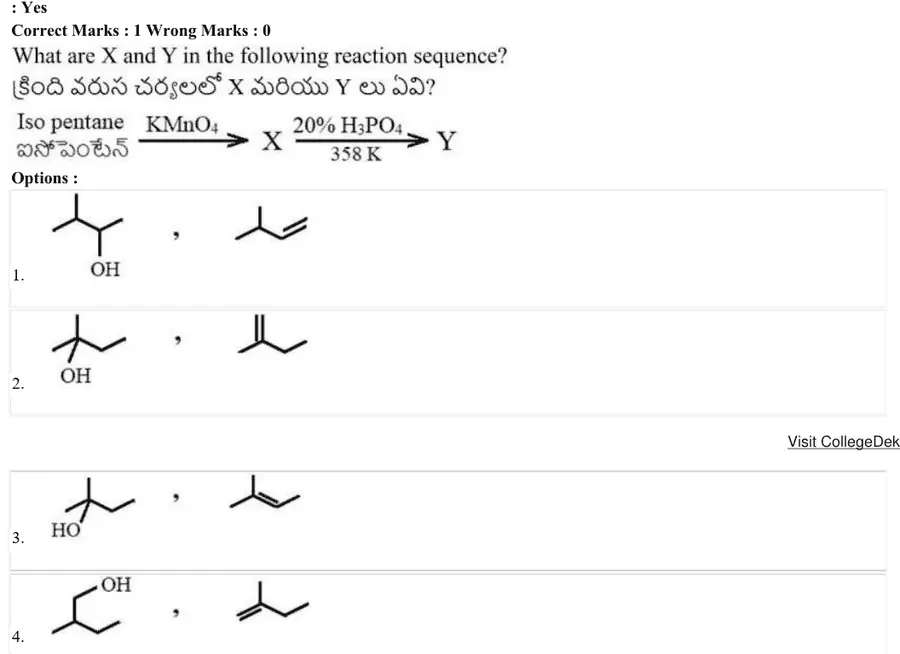
What are X and Y in the following reaction sequence?

Iso pentane $\xrightarrow{\mathrm{KMnO_4}}$ X $\xrightarrow[358\ \mathrm{K}]{20\%\ \mathrm{H_3PO_4}}$ Y

The question and its figure as printed in TG EAPCET 2025 04 May AN. Option 1: Skeletal structures separated by a comma: X is a branched alcohol with the OH on the carbon at the junction of an isopropyl-type group (a secondary alcohol, 3-methylbutan-2-ol); Y is 3-methylbut-1-ene (isopropyl group attached to a terminal vinyl group). Option 2: Skeletal structures separated by a comma: X is a tertiary alcohol with the OH on the quaternary carbon (2-methylbutan-2-ol), drawn with OH at the bottom left; Y is 2-methylbut-1-ene drawn with a terminal double bond on the carbon bearing methyl and ethyl groups. Option 3: Skeletal structures separated by a comma: X is a tertiary alcohol with HO on the…
The question as printed in the paper.
  • A

    see figure Skeletal structures separated by a comma: X is a branched alcohol with the OH on the carbon at the junction of an isopropyl-type group (a secondary alcohol, 3-methylbutan-2-ol); Y is 3-methylbut-1-ene (isopropyl group attached to a terminal vinyl group).

  • B

    see figure Skeletal structures separated by a comma: X is a tertiary alcohol with the OH on the quaternary carbon (2-methylbutan-2-ol), drawn with OH at the bottom left; Y is 2-methylbut-1-ene drawn with a terminal double bond on the carbon bearing methyl and ethyl groups.

  • C

    see figure Skeletal structures separated by a comma: X is a tertiary alcohol with HO on the quaternary carbon (2-methylbutan-2-ol), drawn with HO at the lower left; Y is 2-methylbut-2-ene (double bond within the chain, with two methyl groups on one alkene carbon).

  • D

    see figure Skeletal structures separated by a comma: X is a primary alcohol with OH at the top right (2-methylbutan-1-ol, a branched chain with CH2OH); Y is 2-methylbut-1-ene (terminal double bond on the carbon bearing methyl and ethyl groups).

61TS EAPCET 2025 · 4 May · Shift 2MCQOpen question page ↗

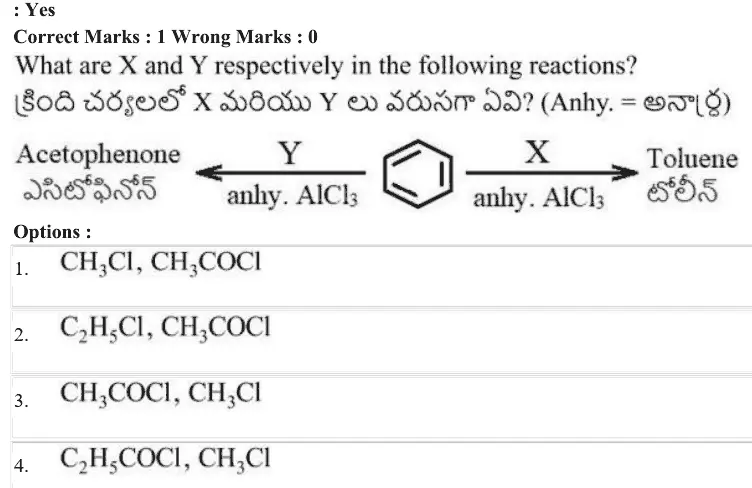
What are X and Y respectively in the following reactions? (Anhy. = anhydrous)

(see the figure above)

The question and its figure as printed in TG EAPCET 2025 04 May AN.
The question as printed in the paper.
  • A

    $\mathrm{CH_3Cl, CH_3COCl}$

  • B

    $\mathrm{C_2H_5Cl, CH_3COCl}$

  • C

    $\mathrm{CH_3COCl, CH_3Cl}$

  • D

    $\mathrm{C_2H_5COCl, CH_3Cl}$

62TS EAPCET 2025 · 4 May · Shift 2MCQOpen question page ↗

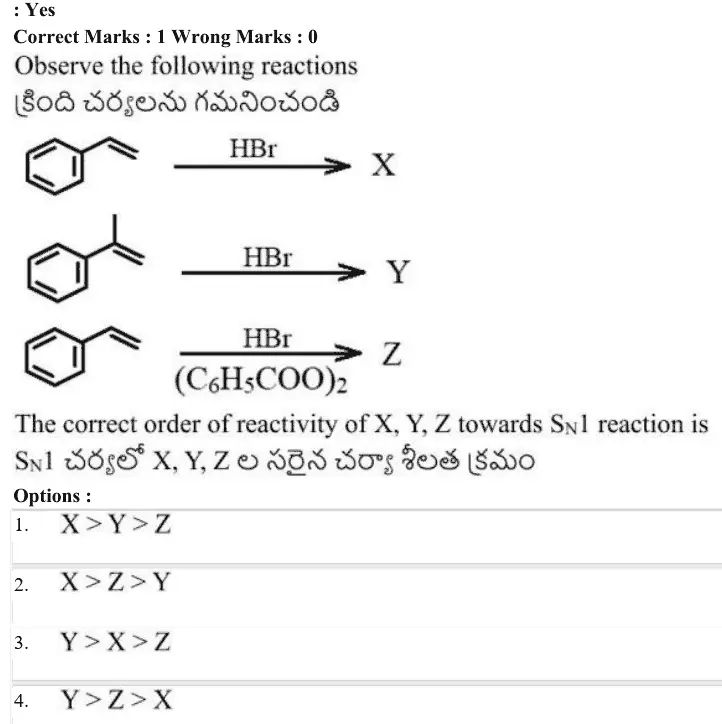
Observe the following reactions

(see the figure above)

The correct order of reactivity of X, Y, Z towards $\mathrm{S_N1}$ reaction is

The question and its figure as printed in TG EAPCET 2025 04 May AN.
The question as printed in the paper.
  • A

    $\mathrm{X > Y > Z}$

  • B

    $\mathrm{X > Z > Y}$

  • C

    $\mathrm{Y > X > Z}$

  • D

    $\mathrm{Y > Z > X}$

63TS EAPCET 2025 · 4 May · Shift 2MCQOpen question page ↗

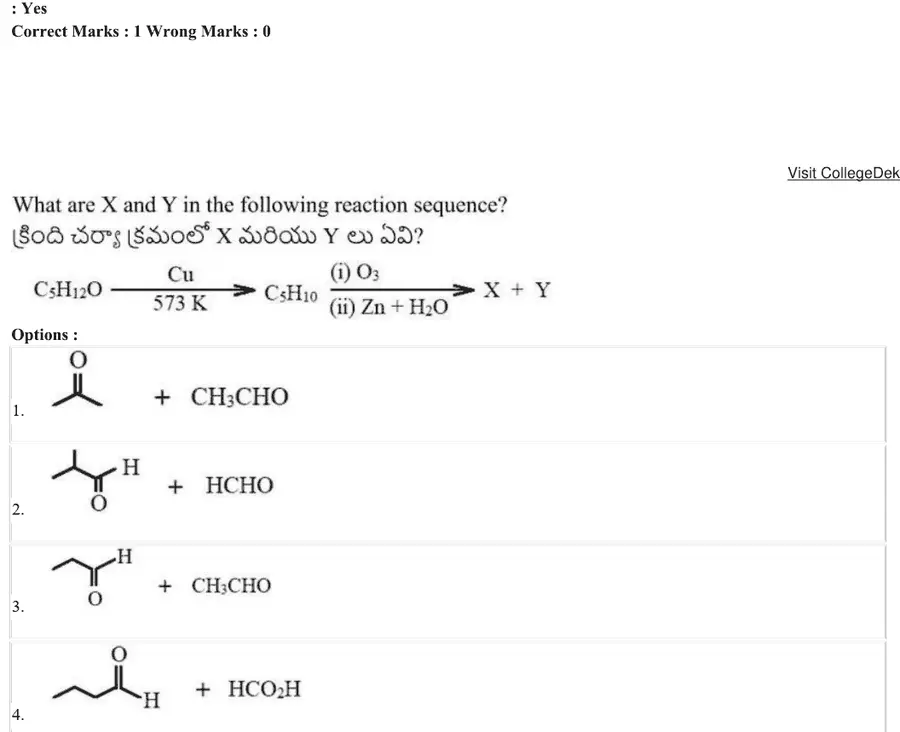
What are X and Y in the following reaction sequence?

$\mathrm{C_5H_{12}O} \xrightarrow[573\ K]{Cu} \mathrm{C_5H_{10}} \xrightarrow[\text{(ii) } Zn + H_2O]{\text{(i) } O_3} X + Y$

The question and its figure as printed in TG EAPCET 2025 04 May AN. Option 1: skeletal structure of acetone (propan-2-one, C=O with O on top, two methyl groups) + CH3CHO Option 2: skeletal structure of isobutyraldehyde (2-methylpropanal, CHO with H and O at bottom, branched with methyl) + HCHO Option 3: skeletal structure of propanal (CH3CH2CHO, with H and O at bottom) + CH3CHO Option 4: skeletal structure of butanal (CH3CH2CH2CHO, with O on top and H) + HCO2H
The question as printed in the paper.
  • A

    see figure skeletal structure of acetone (propan-2-one, C=O with O on top, two methyl groups) $+ \mathrm{CH_3CHO}$

  • B

    see figure skeletal structure of isobutyraldehyde (2-methylpropanal, CHO with H and O at bottom, branched with methyl) $+ \mathrm{HCHO}$

  • C

    see figure skeletal structure of propanal (CH3CH2CHO, with H and O at bottom) $+ \mathrm{CH_3CHO}$

  • D

    see figure skeletal structure of butanal (CH3CH2CH2CHO, with O on top and H) $+ \mathrm{HCO_2H}$

64TS EAPCET 2025 · 3 May · Shift 1MCQOpen question page ↗

The empirical formula of the compound 'D' formed in the given reaction sequence is

$$\mathrm{C_2H_4} \xrightarrow{\mathrm{Br_2 | CCl_4}} \mathrm{A} \xrightarrow[\text{(ii) NaNH}_2]{\text{(i) alc. KOH}} \mathrm{B} \xrightarrow[\text{polymerization}]{\text{cylclic}} \mathrm{C} \xrightarrow[\text{dry AlCl}_3\text{, dark, cold}]{\mathrm{Cl_2}\text{ (excess)}} \mathrm{D}$$

  • A

    $\mathrm{CHCl}$

  • B

    $\mathrm{CCl}$

  • C

    $\mathrm{CH_2Cl}$

  • D

    $\mathrm{CHCl_2}$

65TS EAPCET 2025 · 3 May · Shift 1MCQOpen question page ↗

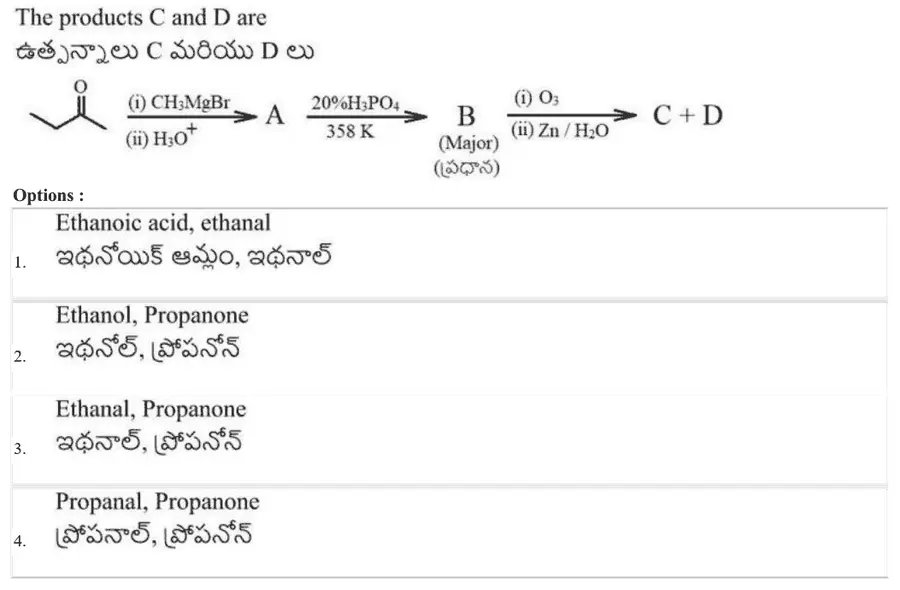
The products C and D are

(see the figure above)

The question and its figure as printed in TG EAPCET 2025 03 May FN.
The question as printed in the paper.
  • A

    Ethanoic acid, ethanal

  • B

    Ethanol, Propanone

  • C

    Ethanal, Propanone

  • D

    Propanal, Propanone

66TS EAPCET 2025 · 3 May · Shift 2MCQOpen question page ↗

Arrange the following in decreasing order of their boiling points

(A) 2 – Methylbutane

(B) 2,2 – Dimethylpropane

(C) Pentane

(D) Hexane

  • A

    $D > C > A > B$

  • B

    $B > A > C > D$

  • C

    $D > A > C > B$

  • D

    $B > C > A > D$

67TS EAPCET 2025 · 2 May · Shift 1MCQOpen question page ↗

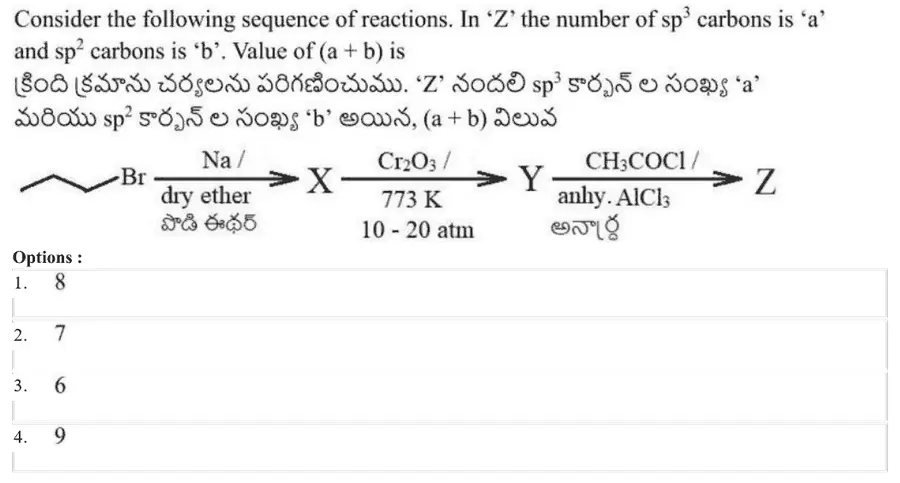
Consider the following sequence of reactions. In ‘Z’ the number of $\mathrm{sp^3}$ carbons is ‘a’ and $\mathrm{sp^2}$ carbons is ‘b’. Value of (a + b) is

(see the figure above)

The question and its figure as printed in TG EAPCET 2025 02 May FN.
The question as printed in the paper.
  • A

    8

  • B

    7

  • C

    6

  • D

    9

68TS EAPCET 2025 · 2 May · Shift 1MCQOpen question page ↗

Consider the following reaction sequence. (A) and (C) are

$$\mathrm{CH_3CHO} \xrightarrow[\text{(ii) } \mathrm{H_2O\,|\,H^+}]{\text{(i) } \mathrm{CH_3MgBr}} (\mathrm{A}) \xrightarrow{\mathrm{H_2SO_4},\ \Delta} (\mathrm{B}) \xrightarrow[\text{(ii) } \mathrm{H_2O, H_2O_2\,|\,OH^-}]{\text{(i) } \mathrm{B_2H_6}} (\mathrm{C})$$

  • A

    Functional isomers

  • B

    Metamers

  • C

    Optical isomers

  • D

    Position isomers

69TS EAPCET 2025 · 2 May · Shift 2MCQOpen question page ↗

An alkene X on ozonolysis gives a mixture of simplest ketone (Y) and 3-Pentanone. The IUPAC name of the alkene X is

  • A

    2,3-Dimethylbut-2-ene

  • B

    3-Ethyl-4-methylpent-3-ene

  • C

    3-Ethyl-2- methylpent-2-ene

  • D

    2-Methyl-3-ethylpent-2-ene

70AP EAPCET 2024 · 23 May · Shift 1MCQOpen question page ↗

Which of the following sequence of reagents convert 3-hexene to propane?

  • A

    $\mathrm{KMnO_4 | H^+}$; NaOH, CaO

  • B

    (i) $\mathrm{O_3}$ (ii) Zn, $\mathrm{H_2O}$; $\mathrm{NaBH_4}$

  • C

    (i) $\mathrm{O_3}$, (ii) Zn,$\mathrm{H_2O}$ ; Zn-Hg, HCl

  • D

    $\mathrm{KMnO_4 | H^+}$; $\mathrm{LiAlH_4}$, $\mathrm{H_2O}$

71AP EAPCET 2024 · 23 May · Shift 1MCQOpen question page ↗

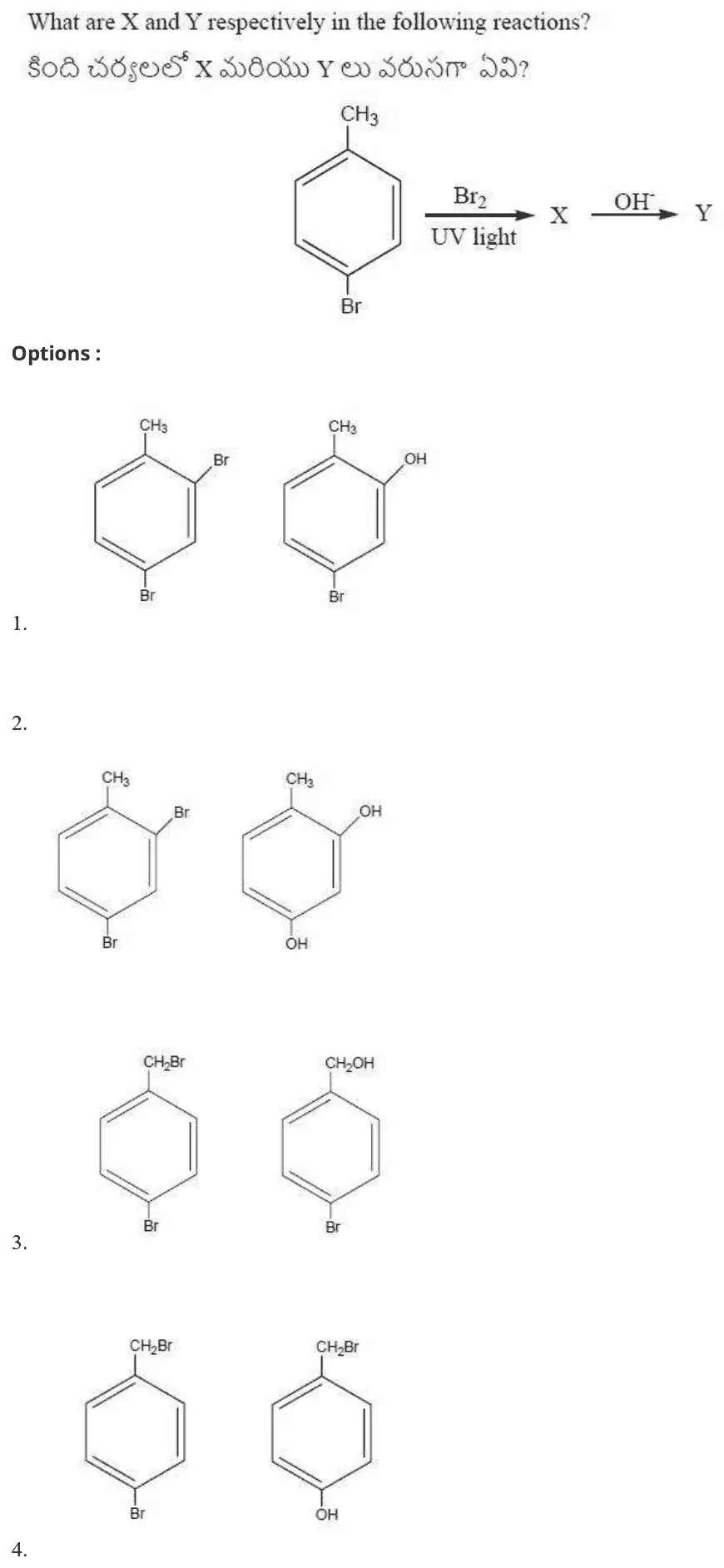
What are X and Y respectively in the following reactions?

(see the figure above)

The question and its figure as printed in AP EAPCET 2024 23rd May 2024 Shift 1. Option 1: X: benzene ring with CH3 at top and Br at bottom (para) and an additional Br on the upper-right ring carbon (ortho to CH3's neighbour, i.e. Br at position 2 relative to CH3... drawn at upper right); Y: benzene ring with CH3 at top, Br at bottom, and OH at the upper-right ring carbon Option 2: X: benzene ring with CH3 at top, Br at bottom-left position... Br at the lower position and an additional Br at upper-right ring carbon; Y: benzene ring with CH3 at top, OH at bottom and OH at the upper-right ring carbon Option 3: X: benzene ring with CH2Br at top and Br at bottom (para); Y: benzene ring with…
The question as printed in the paper.
  • A

    see figure X: benzene ring with CH3 at top and Br at bottom (para) and an additional Br on the upper-right ring carbon (ortho to CH3's neighbour, i.e. Br at position 2 relative to CH3... drawn at upper right); Y: benzene ring with CH3 at top, Br at bottom, and OH at the upper-right ring carbon

  • B

    see figure X: benzene ring with CH3 at top, Br at bottom-left position... Br at the lower position and an additional Br at upper-right ring carbon; Y: benzene ring with CH3 at top, OH at bottom and OH at the upper-right ring carbon

  • C

    see figure X: benzene ring with CH2Br at top and Br at bottom (para); Y: benzene ring with CH2OH at top and Br at bottom (para)

  • D

    see figure X: benzene ring with CH2Br at top and Br at bottom (para); Y: benzene ring with CH2Br at top and OH at bottom (para)

72AP EAPCET 2024 · 23 May · Shift 1MCQOpen question page ↗

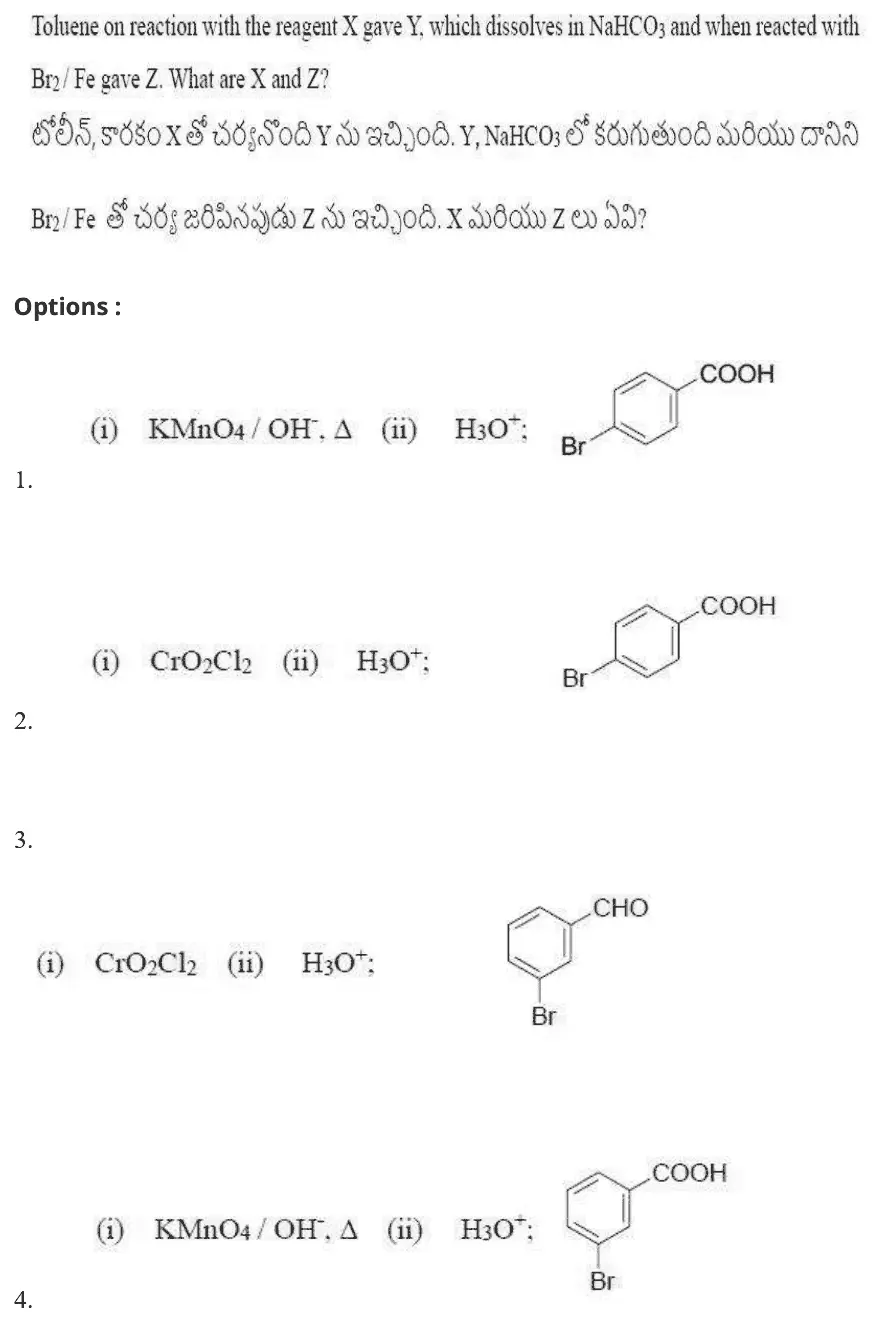
Toluene on reaction with the reagent X gave Y, which dissolves in $\mathrm{NaHCO_3}$ and when reacted with $\mathrm{Br_2}$/Fe gave Z. What are X and Z?

The question and its figure as printed in AP EAPCET 2024 23rd May 2024 Shift 1.
The question as printed in the paper.
  • A

    X: (i) $\mathrm{KMnO_4}$/$\mathrm{OH^-}$, $\Delta$ (ii) $\mathrm{H_3O^+}$; Z: (see the figure above) benzene ring with COOH and Br in para (1,4) positions (p-bromobenzoic acid)

  • B

    X: (i) $\mathrm{CrO_2Cl_2}$ (ii) $\mathrm{H_3O^+}$; Z: (see the figure above) benzene ring with COOH and Br in para (1,4) positions (p-bromobenzoic acid)

  • C

    X: (i) $\mathrm{CrO_2Cl_2}$ (ii) $\mathrm{H_3O^+}$; Z: (see the figure above) benzene ring with CHO and Br in meta (1,3) positions (m-bromobenzaldehyde)

  • D

    X: (i) $\mathrm{KMnO_4}$/$\mathrm{OH^-}$, $\Delta$ (ii) $\mathrm{H_3O^+}$; Z: (see the figure above) benzene ring with COOH and Br in meta (1,3) positions (m-bromobenzoic acid)

73AP EAPCET 2024 · 22 May · Shift 1MCQOpen question page ↗

In Kolbe's electrolysis of sodium propanoate, products formed at anode and cathode are respectively

  • A

    $\mathrm{C_2H_6}$, $\mathrm{H_2}$

  • B

    $\mathrm{C_3H_8}$, $\mathrm{H_2}$

  • C

    $\mathrm{C_4H_{10}}$, $\mathrm{H_2}$

  • D

    $\mathrm{H_2}$, $\mathrm{C_4H_{10}}$

74AP EAPCET 2024 · 22 May · Shift 1MCQOpen question page ↗

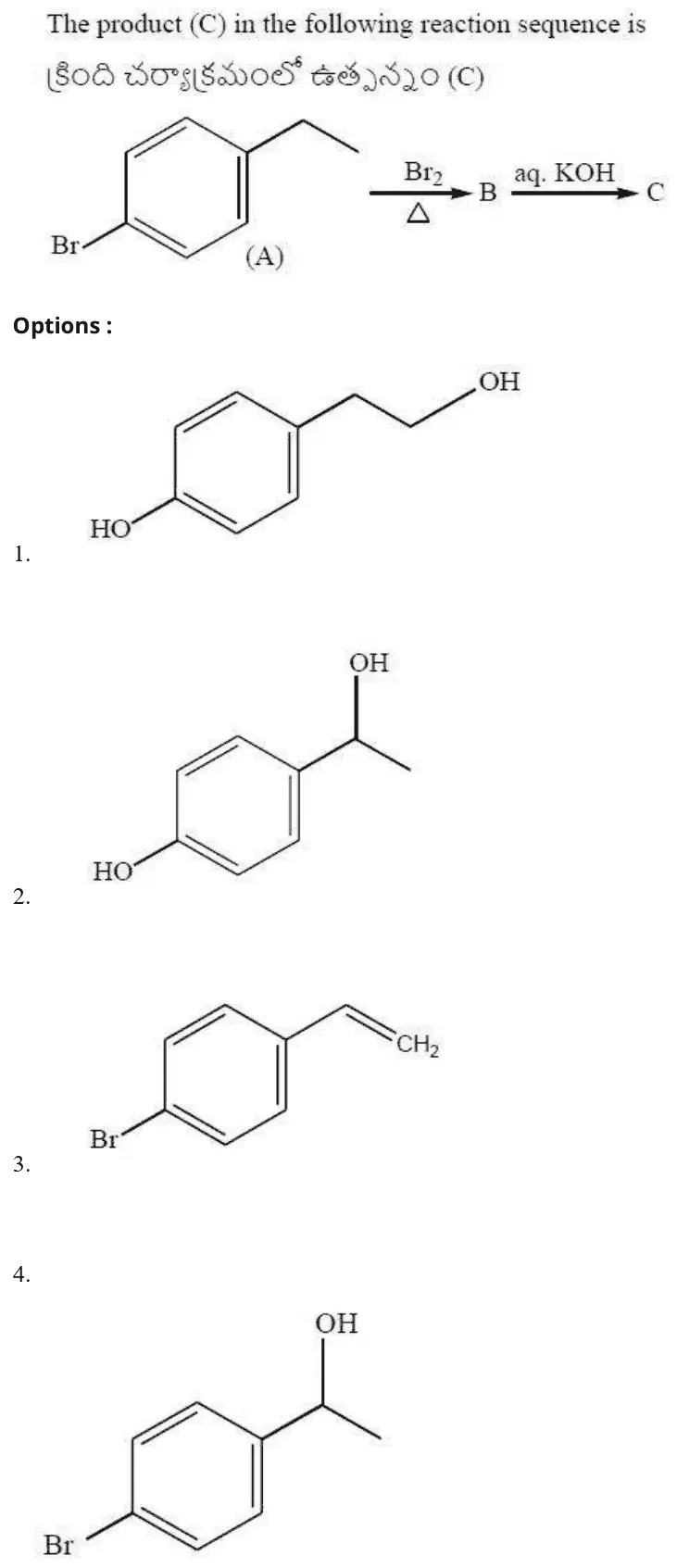
The product (C) in the following reaction sequence is

(see the figure above)

The question and its figure as printed in AP EAPCET 2024 22nd May 2024 Shift 1. Option 1: 4-(2-hydroxyethyl)phenol: a benzene ring with HO at the para position and a -CH2CH2OH side chain Option 2: 4-(1-hydroxyethyl)phenol: a benzene ring with HO at the para position and a -CH(OH)CH3 side chain Option 3: 4-bromostyrene: a benzene ring with Br at the para position and a -CH=CH2 side chain Option 4: 1-(4-bromophenyl)ethanol: a benzene ring with Br at the para position and a -CH(OH)CH3 side chain
The question as printed in the paper.
  • A

    see figure 4-(2-hydroxyethyl)phenol: a benzene ring with HO at the para position and a -CH2CH2OH side chain

  • B

    see figure 4-(1-hydroxyethyl)phenol: a benzene ring with HO at the para position and a -CH(OH)CH3 side chain

  • C

    see figure 4-bromostyrene: a benzene ring with Br at the para position and a -CH=CH2 side chain

  • D

    see figure 1-(4-bromophenyl)ethanol: a benzene ring with Br at the para position and a -CH(OH)CH3 side chain

75AP EAPCET 2024 · 22 May · Shift 2MCQOpen question page ↗

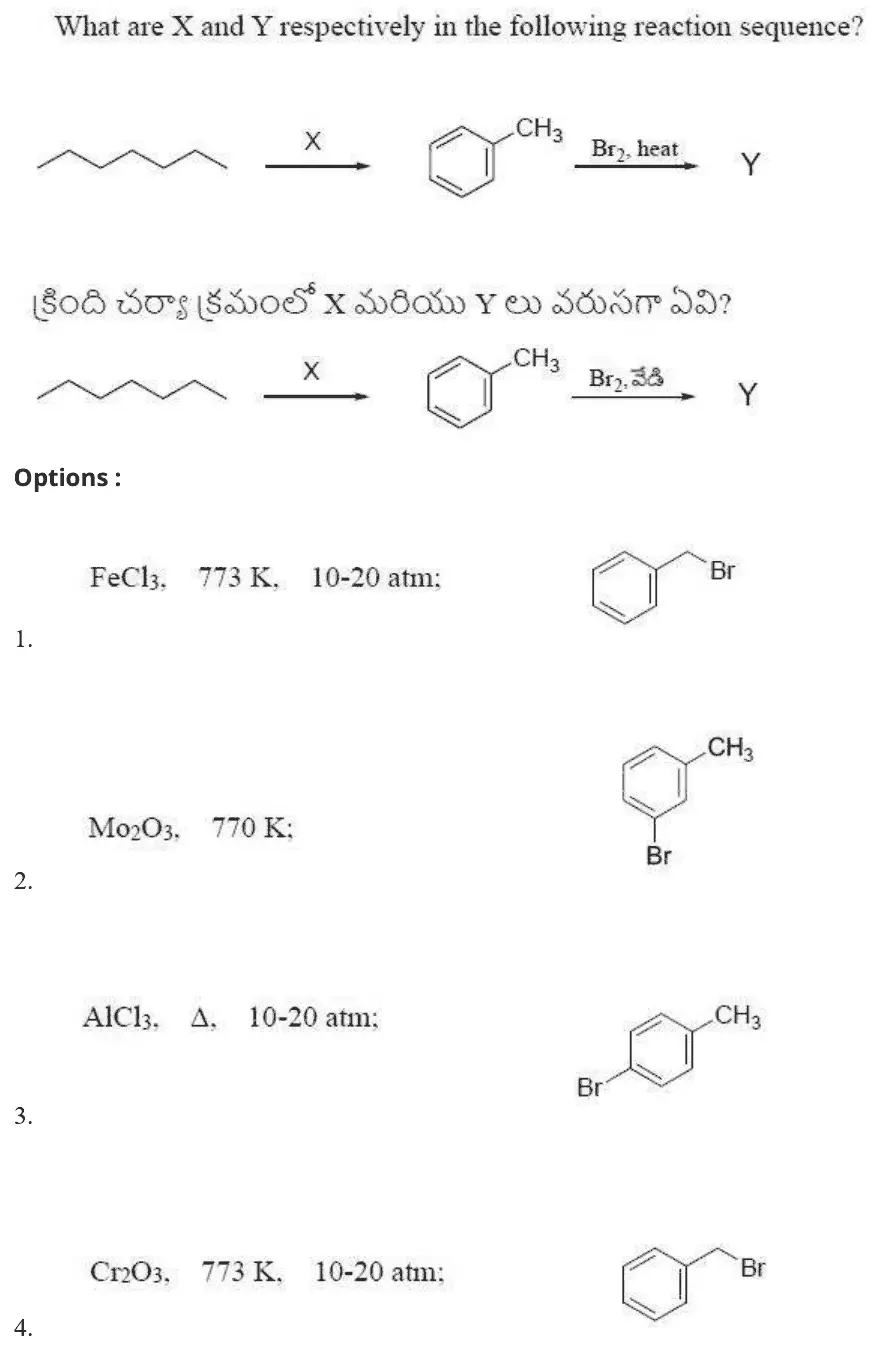
What are X and Y respectively in the following reaction sequence?

(see the figure above)

The question and its figure as printed in AP EAPCET 2024 22nd May 2024 Shift 2.
The question as printed in the paper.
  • A

    $\mathrm{FeCl_3}$, 773 K, 10-20 atm; (see the figure above) benzyl bromide (benzene ring with a CH2Br group attached)

  • B

    $\mathrm{Mo_2O_3}$, 770 K; (see the figure above) 3-bromotoluene (benzene ring with CH3 and Br in meta positions)

  • C

    $\mathrm{AlCl_3}$, $\Delta$, 10-20 atm; (see the figure above) 4-bromotoluene (benzene ring with CH3 and Br in para positions)

  • D

    $\mathrm{Cr_2O_3}$, 773 K, 10-20 atm; (see the figure above) benzyl bromide (benzene ring with a CH2Br group attached)

76AP EAPCET 2024 · 21 May · Shift 1MCQOpen question page ↗

A mixture of ethyl iodide and n-propyl iodide is subjected to Wurtz reaction. The hydrocarbon which will not be formed is

  • A

    Butane

  • B

    Propane

  • C

    Pentane

  • D

    Hexane

77AP EAPCET 2024 · 21 May · Shift 1MCQOpen question page ↗

Which of the following alkenes does not undergo anti Markownikov addition of HBr?

  • A

    Propene

  • B

    1-Butene

  • C

    2-Butene

  • D

    3-Methyl-2-Pentene

78AP EAPCET 2024 · 21 May · Shift 2MCQOpen question page ↗

Number of deactivating groups of the following is

$\mathrm{-Cl,\ -SO_3H,\ -OH,\ -NHC_2H_5,\ -COOCH_3,\ -CH_3}$

  • A

    4

  • B

    3

  • C

    2

  • D

    1

79AP EAPCET 2024 · 21 May · Shift 2MCQOpen question page ↗

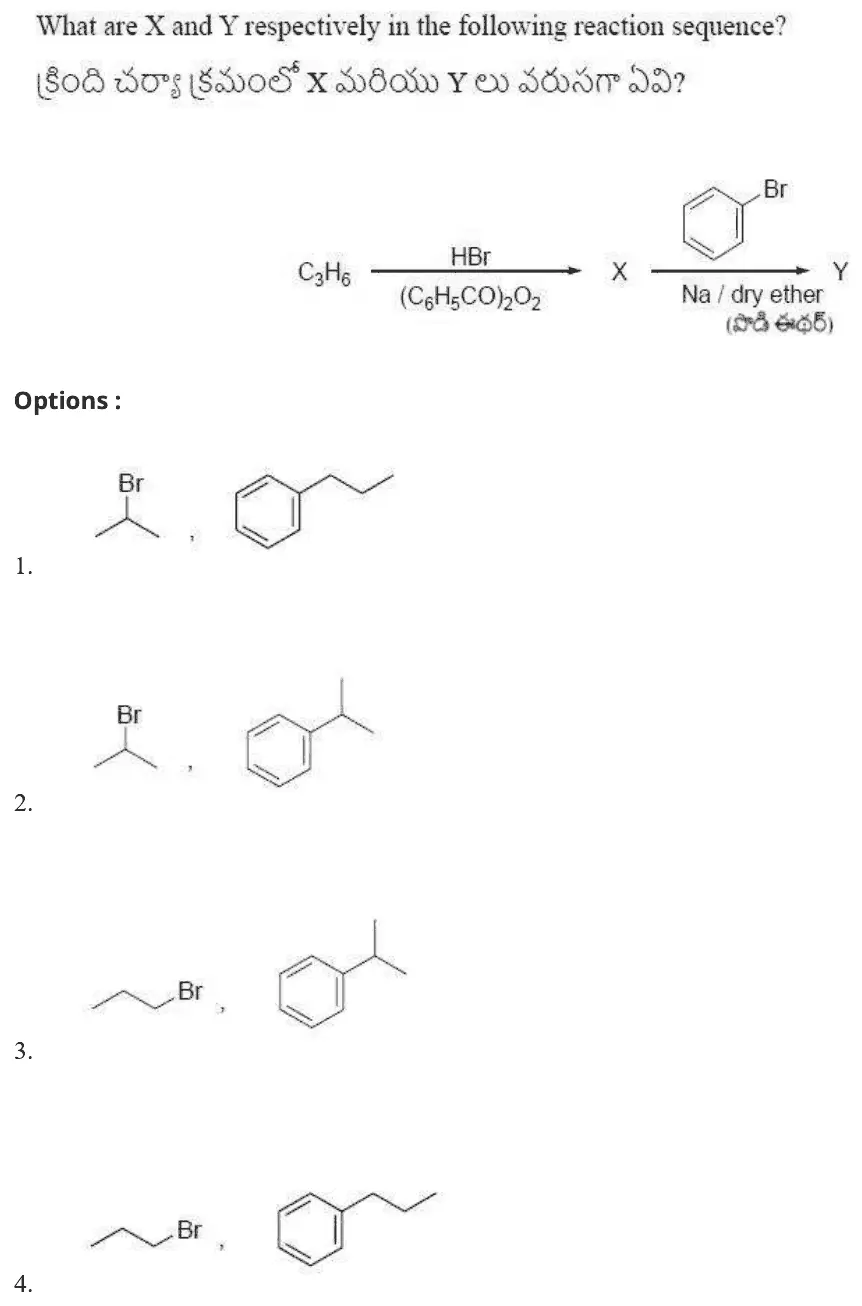
What are X and Y respectively in the following reaction sequence?

(see the figure above)

The question and its figure as printed in AP EAPCET 2024 21st May 2024 Shift 2. Option 1: X: isopropyl bromide (2-bromopropane, Br on the middle carbon of a three-carbon skeleton); Y: n-propylbenzene (benzene ring attached to a linear three-carbon chain) Option 2: X: isopropyl bromide (2-bromopropane); Y: isopropylbenzene (cumene, benzene ring attached to the middle carbon of a three-carbon skeleton) Option 3: X: n-propyl bromide (1-bromopropane, Br on the terminal carbon); Y: isopropylbenzene (cumene) Option 4: X: n-propyl bromide (1-bromopropane); Y: n-propylbenzene (benzene ring attached to a linear three-carbon chain)
The question as printed in the paper.
  • A

    see figure X: isopropyl bromide (2-bromopropane, Br on the middle carbon of a three-carbon skeleton); Y: n-propylbenzene (benzene ring attached to a linear three-carbon chain)

  • B

    see figure X: isopropyl bromide (2-bromopropane); Y: isopropylbenzene (cumene, benzene ring attached to the middle carbon of a three-carbon skeleton)

  • C

    see figure X: n-propyl bromide (1-bromopropane, Br on the terminal carbon); Y: isopropylbenzene (cumene)

  • D

    see figure X: n-propyl bromide (1-bromopropane); Y: n-propylbenzene (benzene ring attached to a linear three-carbon chain)

80AP EAPCET 2024 · 20 May · Shift 1MCQOpen question page ↗

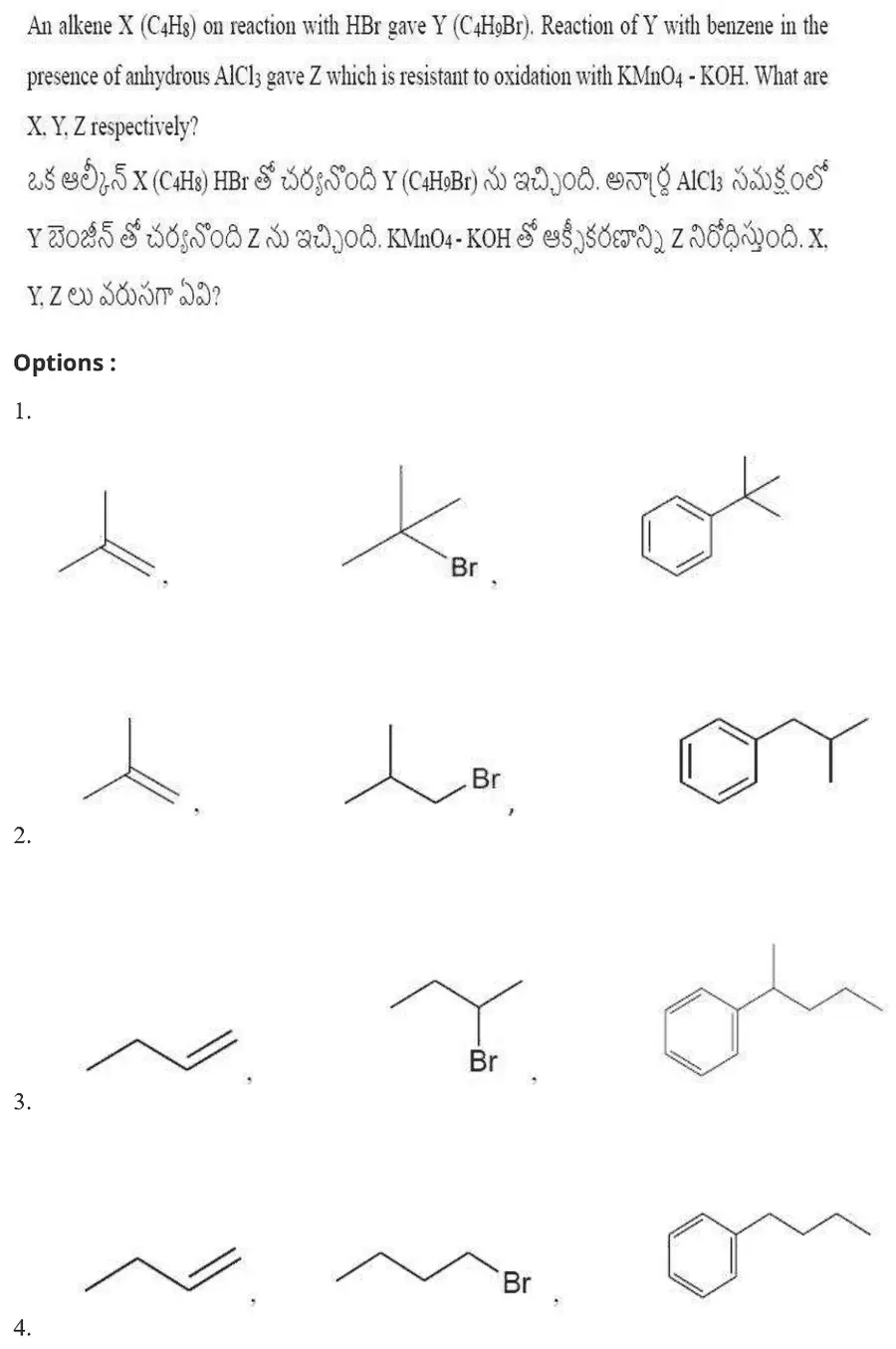
An alkene X ($\mathrm{C_4H_8}$) on reaction with HBr gave Y ($\mathrm{C_4H_9Br}$). Reaction of Y with benzene in the presence of anhydrous $\mathrm{AlCl_3}$ gave Z which is resistant to oxidation with $\mathrm{KMnO_4}$ - KOH. What are X, Y, Z respectively?

The question and its figure as printed in AP EAPCET 2024 20th May 2024 Shift 1. Option 1: X: isobutylene (2-methylprop-1-ene) skeletal structure; Y: tert-butyl bromide (2-bromo-2-methylpropane); Z: tert-butylbenzene Option 2: X: isobutylene (2-methylprop-1-ene) skeletal structure; Y: isobutyl bromide (1-bromo-2-methylpropane); Z: isobutylbenzene Option 3: X: but-1-ene; Y: 2-bromobutane (sec-butyl bromide); Z: sec-butylbenzene Option 4: X: but-1-ene; Y: 1-bromobutane (n-butyl bromide); Z: n-butylbenzene
The question as printed in the paper.
  • A

    see figure X: isobutylene (2-methylprop-1-ene) skeletal structure; Y: tert-butyl bromide (2-bromo-2-methylpropane); Z: tert-butylbenzene

  • B

    see figure X: isobutylene (2-methylprop-1-ene) skeletal structure; Y: isobutyl bromide (1-bromo-2-methylpropane); Z: isobutylbenzene

  • C

    see figure X: but-1-ene; Y: 2-bromobutane (sec-butyl bromide); Z: sec-butylbenzene

  • D

    see figure X: but-1-ene; Y: 1-bromobutane (n-butyl bromide); Z: n-butylbenzene

81AP EAPCET 2024 · 20 May · Shift 1MCQOpen question page ↗

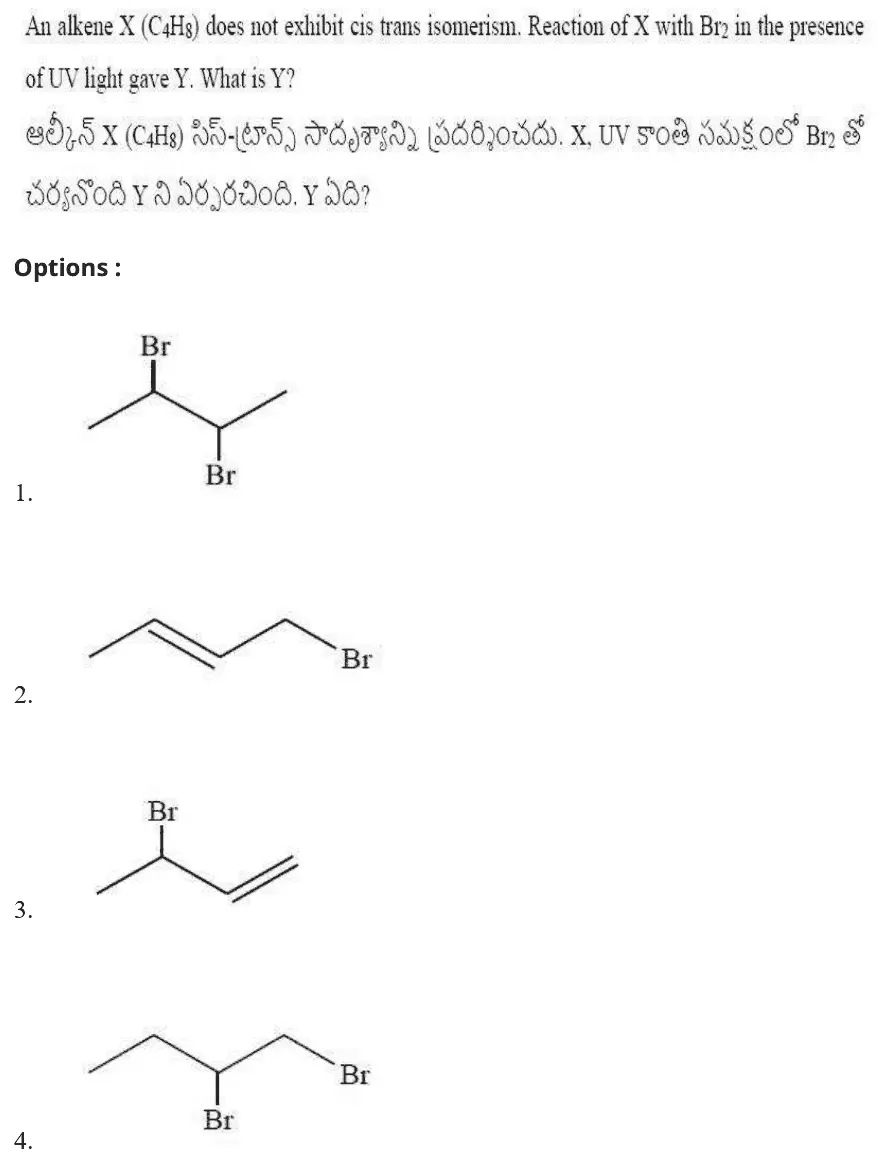
An alkene X ($\mathrm{C_4H_8}$) does not exhibit cis trans isomerism. Reaction of X with $\mathrm{Br_2}$ in the presence of UV light gave Y. What is Y?

The question and its figure as printed in AP EAPCET 2024 20th May 2024 Shift 1. Option 1: Skeletal structure: a zigzag chain of four carbons (butane skeleton) with Br on C2 and Br on C3, both drawn pointing in the vertical direction (2,3-dibromobutane). Option 2: Skeletal structure: but-2-ene chain (double bond between C2 and C3 near the left) with Br on the terminal carbon at the right (1-bromobut-2-ene). Option 3: Skeletal structure: 3-bromobut-1-ene, a chain with terminal double bond at the right, and Br on the carbon at the upper left bend (CH3-CHBr-CH=CH2). Option 4: Skeletal structure: a zigzag chain of four carbons with Br on C1 (the terminal carbon at the right) and Br on C2…
The question as printed in the paper.
  • A

    see figure Skeletal structure: a zigzag chain of four carbons (butane skeleton) with Br on C2 and Br on C3, both drawn pointing in the vertical direction (2,3-dibromobutane).

  • B

    see figure Skeletal structure: but-2-ene chain (double bond between C2 and C3 near the left) with Br on the terminal carbon at the right (1-bromobut-2-ene).

  • C

    see figure Skeletal structure: 3-bromobut-1-ene, a chain with terminal double bond at the right, and Br on the carbon at the upper left bend (CH3-CHBr-CH=CH2).

  • D

    see figure Skeletal structure: a zigzag chain of four carbons with Br on C1 (the terminal carbon at the right) and Br on C2 (pointing down): 1,2-dibromobutane (CH3-CH2-CHBr-CH2Br).

82AP EAPCET 2024 · 20 May · Shift 2MCQOpen question page ↗

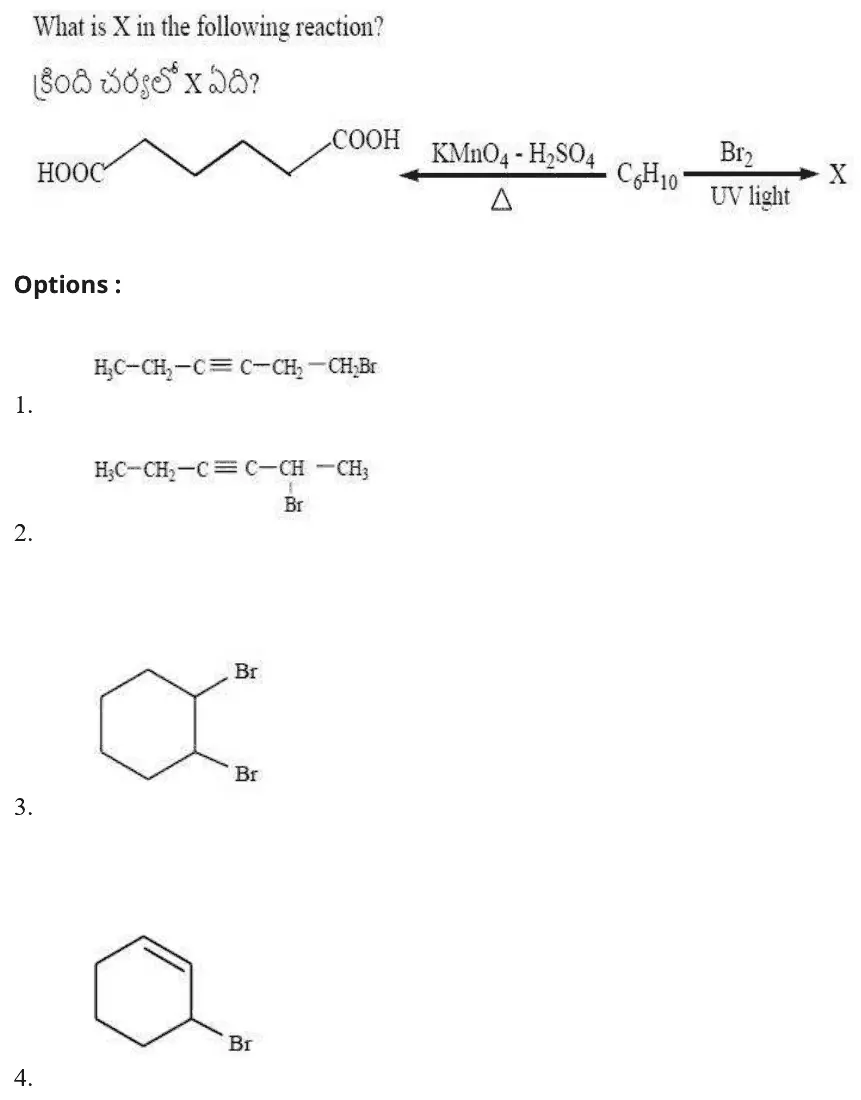
What is X in the following reaction?

(see the figure above)

The question and its figure as printed in AP EAPCET 2024 20th May 2024 Shift 2. Option 3: Cyclohexane ring with two adjacent carbons each bearing a Br (1,2-dibromocyclohexane) Option 4: Cyclohexene ring with a Br on the carbon adjacent to the double bond (3-bromocyclohexene)
The question as printed in the paper.
  • A

    $\mathrm{H_3C-CH_2-C\equiv C-CH_2-CH_2Br}$

  • B

    $\mathrm{H_3C-CH_2-C\equiv C-CH(Br)-CH_3}$ (Br on the CH carbon, drawn below it)

  • C

    see figure Cyclohexane ring with two adjacent carbons each bearing a Br (1,2-dibromocyclohexane)

  • D

    see figure Cyclohexene ring with a Br on the carbon adjacent to the double bond (3-bromocyclohexene)

83AP EAPCET 2024 · 20 May · Shift 2MCQOpen question page ↗

Styrene on reaction with reagent X gave Y which on hydrolysis followed by oxidation gave Z. Z gives positive 2,4 – DNP test but does not give iodoform test. What are X and Z respectively?

  • A

    $\mathrm{HBr}$ ; $\mathrm{C_6H_5COCH_3}$

  • B

    $\mathrm{HBr}$ ; $\mathrm{C_6H_5CH_2CHO}$

  • C

    $\mathrm{HBr / (C_6H_5CO)_2O_2}$ ; $\mathrm{C_6H_5CH_2CHO}$

  • D

    $\mathrm{HBr / (C_6H_5CO)_2O_2}$ ; $\mathrm{C_6H_5COCH_3}$

84AP EAPCET 2024 · 19 May · Shift 2MCQOpen question page ↗

What are X and Y respectively in the following reaction sequence?

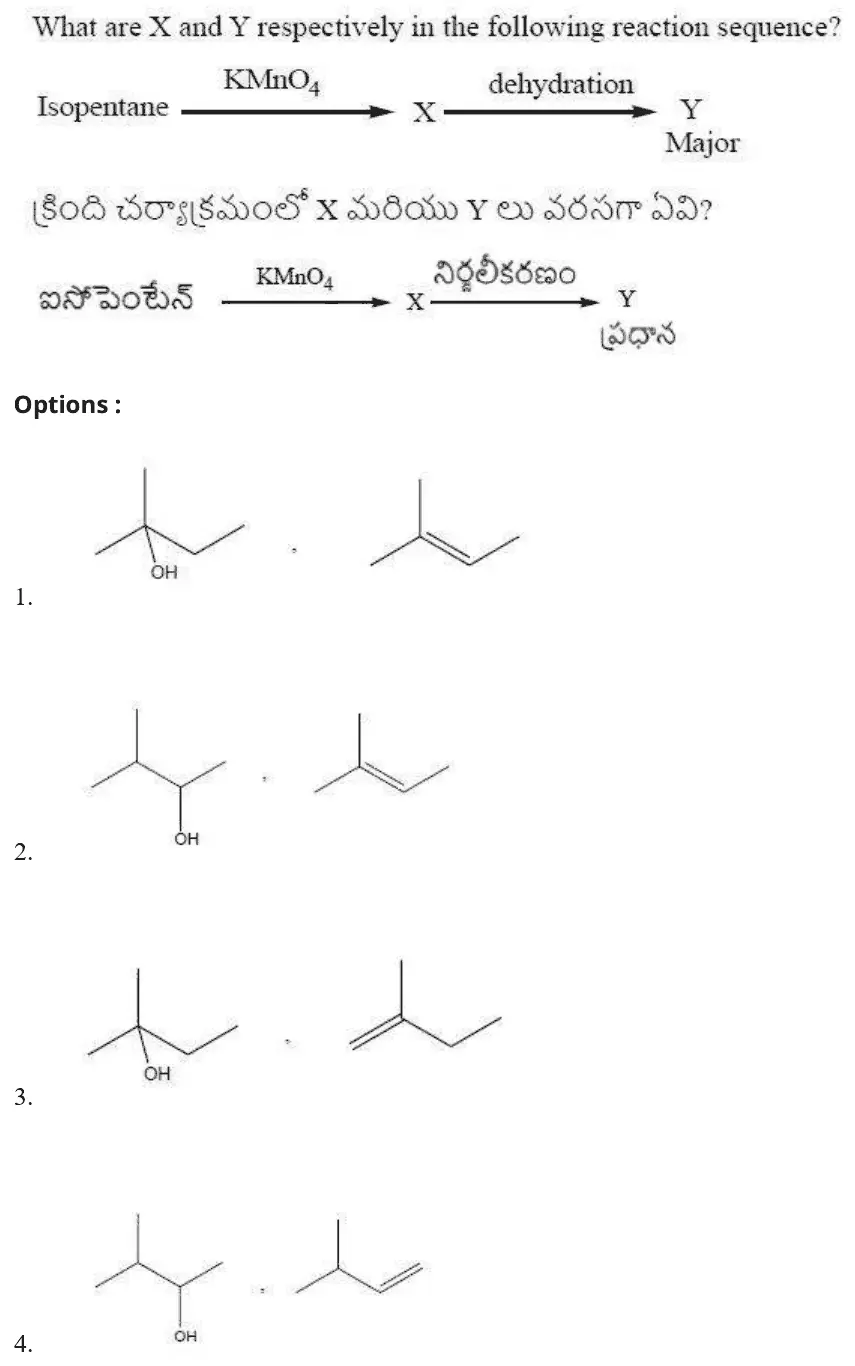
Isopentane $\xrightarrow{\mathrm{KMnO_4}}$ X $\xrightarrow{\text{dehydration}}$ Y (Major)

The question and its figure as printed in AP EAPCET 2024 19th May 2024 Shift 2. Option 1: X: skeletal structure of 2-methylbutan-2-ol (tertiary alcohol, OH on the quaternary carbon bearing two methyl groups and an ethyl group); Y: 2-methylbut-2-ene (trisubstituted alkene) Option 2: X: skeletal structure of 3-methylbutan-2-ol (secondary alcohol, OH on the carbon adjacent to the isopropyl CH and a methyl group); Y: 2-methylbut-2-ene (trisubstituted alkene) Option 3: X: skeletal structure of 2-methylbutan-2-ol (tertiary alcohol, OH on the quaternary carbon bearing two methyl groups and an ethyl group); Y: 2-methylbut-1-ene (terminal alkene, C=C at the end with a methyl branch and an ethyl…
The question as printed in the paper.
  • A

    see figure X: skeletal structure of 2-methylbutan-2-ol (tertiary alcohol, OH on the quaternary carbon bearing two methyl groups and an ethyl group); Y: 2-methylbut-2-ene (trisubstituted alkene)

  • B

    see figure X: skeletal structure of 3-methylbutan-2-ol (secondary alcohol, OH on the carbon adjacent to the isopropyl CH and a methyl group); Y: 2-methylbut-2-ene (trisubstituted alkene)

  • C

    see figure X: skeletal structure of 2-methylbutan-2-ol (tertiary alcohol, OH on the quaternary carbon bearing two methyl groups and an ethyl group); Y: 2-methylbut-1-ene (terminal alkene, C=C at the end with a methyl branch and an ethyl group)

  • D

    see figure X: skeletal structure of 3-methylbutan-2-ol (secondary alcohol); Y: 3-methylbut-1-ene (terminal vinyl alkene with an isopropyl group)

85AP EAPCET 2024 · 19 May · Shift 2MCQOpen question page ↗

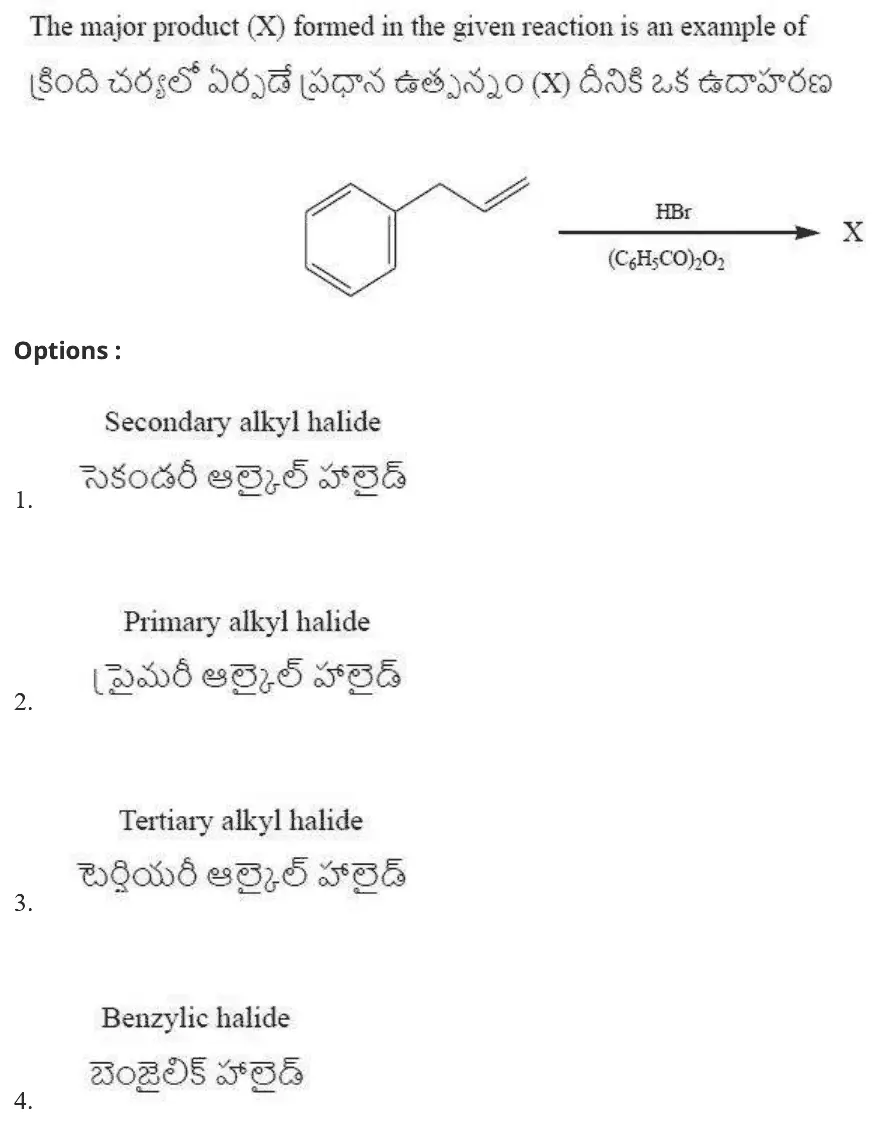
The major product (X) formed in the given reaction is an example of

(see the figure above)

The question and its figure as printed in AP EAPCET 2024 19th May 2024 Shift 2.
The question as printed in the paper.
  • A

    Secondary alkyl halide

  • B

    Primary alkyl halide

  • C

    Tertiary alkyl halide

  • D

    Benzylic halide

86AP EAPCET 2024 · 19 May · Shift 2MCQOpen question page ↗

What is Y in the following reaction sequence?

(see the figure above)

The question and its figure as printed in AP EAPCET 2024 19th May 2024 Shift 2. Option 1: Skeletal structure of 3-methylbutanal: a branched chain with a methyl branch pointing up on the second carbon from the left, and a CHO group at the right end. Option 2: Skeletal structure with a COOH group at the right end, a chain going up-left to an ethyl-type fragment and a vertical methyl branch pointing down on the carbon bearing COOH-bearing chain (2-methylbutanoic acid type). Option 3: Skeletal structure of a tert-butyl-type carbon: a quaternary carbon with a vertical methyl up, a methyl down-left, and a chain to the right ending in COOH (3,3-dimethylbutanoic acid type). Option 4: Skeletal…
The question as printed in the paper.
  • A

    see figure Skeletal structure of 3-methylbutanal: a branched chain with a methyl branch pointing up on the second carbon from the left, and a CHO group at the right end.

  • B

    see figure Skeletal structure with a COOH group at the right end, a chain going up-left to an ethyl-type fragment and a vertical methyl branch pointing down on the carbon bearing COOH-bearing chain (2-methylbutanoic acid type).

  • C

    see figure Skeletal structure of a tert-butyl-type carbon: a quaternary carbon with a vertical methyl up, a methyl down-left, and a chain to the right ending in COOH (3,3-dimethylbutanoic acid type).

  • D

    see figure Skeletal structure of 3-methylbutanoic acid: a branched chain with a methyl branch pointing up on the second carbon from the left, and a COOH group at the right end.

87AP EAPCET 2024 · 18 May · Shift 1MCQOpen question page ↗

A dibromide X ($\mathrm{C_4H_8Br_2}$) on dehydrohalogenation gave Y which on reduction with Z gave non polar isomer of $\mathrm{C_4H_8}$. What are X and Z respectively?

The question and its figure as printed in AP EAPCET 2024 18th May 2024 Shift 1. Option 1: Skeletal structure of 2,3-dibromobutane, with Br on C2 and C3, followed by a comma and Na / NH3 (l) Option 2: Skeletal structure of 2,3-dibromobutane, with Br on C2 and C3, followed by a comma and Pd / C Option 3: Skeletal structure of 2,4-dibromopentane-like zigzag chain, with Br on the middle carbon and Br at the right terminal, followed by a comma and Na / NH3 (l) Option 4: Skeletal structure of the same zigzag chain, with Br on the middle carbon and Br at the right terminal, followed by a comma and Pd / C
The question as printed in the paper.
  • A

    see figure Skeletal structure of 2,3-dibromobutane, with Br on C2 and C3, followed by a comma and $\mathrm{Na / NH_3}$ (l)

  • B

    see figure Skeletal structure of 2,3-dibromobutane, with Br on C2 and C3, followed by a comma and $\mathrm{Pd / C}$

  • C

    see figure Skeletal structure of 2,4-dibromopentane-like zigzag chain, with Br on the middle carbon and Br at the right terminal, followed by a comma and $\mathrm{Na / NH_3}$ (l)

  • D

    see figure Skeletal structure of the same zigzag chain, with Br on the middle carbon and Br at the right terminal, followed by a comma and $\mathrm{Pd / C}$

88TS EAPCET 2024 · 11 May · Shift 1MCQOpen question page ↗

Consider the following reaction sequence

$$\text{2-Methylpropane} \xrightarrow{\mathrm{KMnO_4}} \mathrm{X} \xrightarrow[358\ \mathrm{K}]{20\%\ \mathrm{H_3PO_4}} \mathrm{Y} \xrightarrow[\mathrm{(ii)\ Zn/H_2O}]{\mathrm{(i)O_3}} \mathrm{A+B}$$

What are A and B?

  • A

    $\mathrm{CH_3CH{=}O,\ CH_3CH{=}O}$

  • B

    $\mathrm{(CH_3)_2C{=}O,\ CH_2{=}O}$

  • C

    $\mathrm{(CH_3)_2C{=}O,\ CH_3CH{=}O}$

  • D

    $\mathrm{CH_3CH{=}O,\ CH_2{=}O}$

89TS EAPCET 2024 · 11 May · Shift 1MCQOpen question page ↗

Identify the end product (Z) in the sequence of the following reactions

(see the figure above)

The question and its figure as printed in TS EAPCET 2024 11th May 2024 Shift 1. Option 1: Benzoyl chloride: C6H5–C(=O)–Cl Option 2: Acetophenone: C6H5–C(=O)–CH3 Option 3: Propiophenone: C6H5–C(=O)–CH2CH3 Option 4: Benzamide: C6H5–C(=O)–NH2
The question as printed in the paper.
  • A

    see figure Benzoyl chloride: C6H5–C(=O)–Cl

  • B

    see figure Acetophenone: C6H5–C(=O)–CH3

  • C

    see figure Propiophenone: C6H5–C(=O)–CH2CH3

  • D

    see figure Benzamide: C6H5–C(=O)–NH2

90TS EAPCET 2024 · 10 May · Shift 1MCQOpen question page ↗

The major product ‘Y’ in the given sequence of reactions is

$$\mathrm{C_3H_7OH} \xrightarrow[443\ K]{\text{Conc. } H_2SO_4} X \xrightarrow[(C_6H_5CO)_2O_2]{HBr} Y$$

  • A

    $\mathrm{CH_3CH_2CH_2Br}$

  • B

    $\mathrm{CH_3CH(Br)CH_3}$

  • C

    $\mathrm{CH_3COC_6H_5}$

  • D

    $\mathrm{C_6H_5COBr}$

91TS EAPCET 2024 · 10 May · Shift 1MCQOpen question page ↗

Compound ‘A’ on heating with sodalime gives propane. Identify the compound ‘A’.

The question and its figure as printed in TS EAPCET 2024 10th May 2024 Shift 1.
The question as printed in the paper.
  • A

    $\mathrm{CH_3-CH_2-CH_2-OH}$

  • B

    $\mathrm{CH_3CH_2CO_2Na}$

  • C

    $\mathrm{CH_3CH_2CH_2CO_2Na}$

  • D

    $\mathrm{CH_3-C-CH_3}$ with a C=O double bond to O drawn above the central carbon (acetone) (see the figure above)

92TS EAPCET 2024 · 10 May · Shift 2MCQOpen question page ↗

The alkane which is next to methane in homologous series can be prepared from which of the following reactions?

I. $2\mathrm{CH_3Br} \xrightarrow[\text{dry ether}]{\text{Na}}$

II. $\mathrm{CH_3COOH} \xrightarrow[\text{CaO, }\Delta]{\text{NaOH}}$

III. $\mathrm{CH_3CH=CH_2} \xrightarrow{\mathrm{H_2/Pt}}$

IV. $\mathrm{CH_3CH_2Br} \xrightarrow[\mathrm{H^+}]{\text{Zn}}$

Correct answer is

  • A

    I, IV only

  • B

    II, III only

  • C

    I, III only

  • D

    II, IV only

93TS EAPCET 2024 · 10 May · Shift 2MCQOpen question page ↗

At high pressure and regulated supply of air, methane is heated with catalyst ‘X’ to give methanol and with catalyst ‘Y’ to give methanal. X and Y respectively are

  • A

    $\mathrm{Mo_2O_3}$, $\mathrm{Cu}$

  • B

    $\mathrm{Cu}$, $\mathrm{Mo_2O_3}$

  • C

    $\mathrm{V_2O_5}$, $\mathrm{KMnO_4}$

  • D

    $\mathrm{KMnO_4}$, $\mathrm{Cr_2O_3}$

94TS EAPCET 2024 · 10 May · Shift 2MCQOpen question page ↗

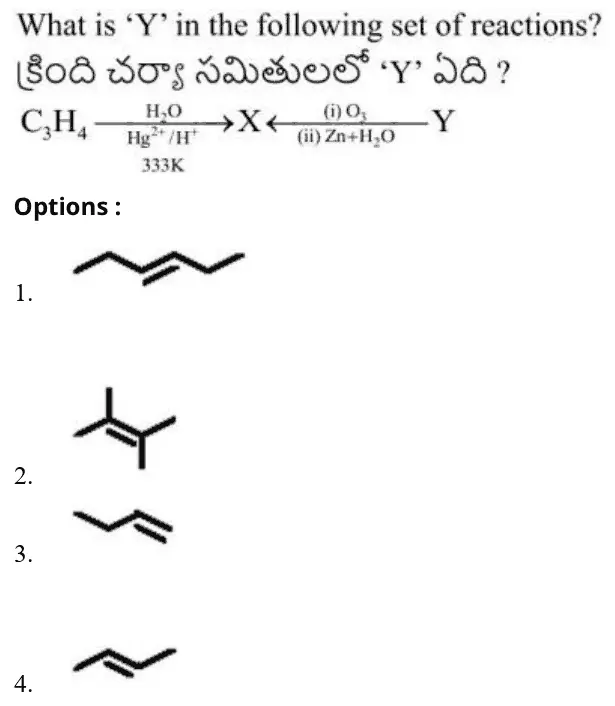
What is ‘Y’ in the following set of reactions?

$$\mathrm{C_3H_4} \xrightarrow[\mathrm{Hg^{2+}/H^+}]{\mathrm{H_2O}\ ,\ 333K} \mathrm{X} \xleftarrow[\mathrm{(ii)\ Zn+H_2O}]{\mathrm{(i)\ O_3}} \mathrm{Y}$$

The question and its figure as printed in TS EAPCET 2024 10th May 2024 Shift 2. Option 1: Skeletal structure of an alkene, a zigzag chain with an internal double bond in the middle (pent-2-ene type: 5 carbons) Option 2: Skeletal structure of a tetra-substituted alkene: a central C=C with two methyl groups on one carbon and two methyl groups on the other (2,3-dimethylbut-2-ene) Option 3: Skeletal structure of a short chain alkene with a terminal double bond (but-1-ene type) Option 4: Skeletal structure of a short chain alkene with an internal double bond (but-2-ene type)
The question as printed in the paper.
  • A

    see figure Skeletal structure of an alkene, a zigzag chain with an internal double bond in the middle (pent-2-ene type: 5 carbons)

  • B

    see figure Skeletal structure of a tetra-substituted alkene: a central C=C with two methyl groups on one carbon and two methyl groups on the other (2,3-dimethylbut-2-ene)

  • C

    see figure Skeletal structure of a short chain alkene with a terminal double bond (but-1-ene type)

  • D

    see figure Skeletal structure of a short chain alkene with an internal double bond (but-2-ene type)

95TS EAPCET 2024 · 9 May · Shift 1MCQOpen question page ↗

An alkene X ($\mathrm{C_4H_8}$) exhibits geometrical isomerism. Oxidation of A with $\mathrm{KMnO_4 | H^+}$ gave Y. On heating sodium salt of Y with a mixture of NaOH and CaO gave Z. What is Z?

  • A

    $\mathrm{CH_3CH_3}$

  • B

    $\mathrm{CH_3CH_2CH_3}$

  • C

    $\mathrm{CH_3CH_2CH_2CH_3}$

  • D

    $\mathrm{CH_4}$

96TS EAPCET 2024 · 9 May · Shift 1MCQOpen question page ↗

The number of activating and deactivating groups of the following are respectively

$-\mathrm{OCH_2CH_3}$, $-\mathrm{COCH_3}$, $-\mathrm{NHCOCH_3}$, $-\mathrm{COOCH_3}$, $-\mathrm{SO_3H}$

  • A

    2, 3

  • B

    3, 2

  • C

    1, 4

  • D

    4, 1

97TS EAPCET 2024 · 9 May · Shift 1MCQOpen question page ↗

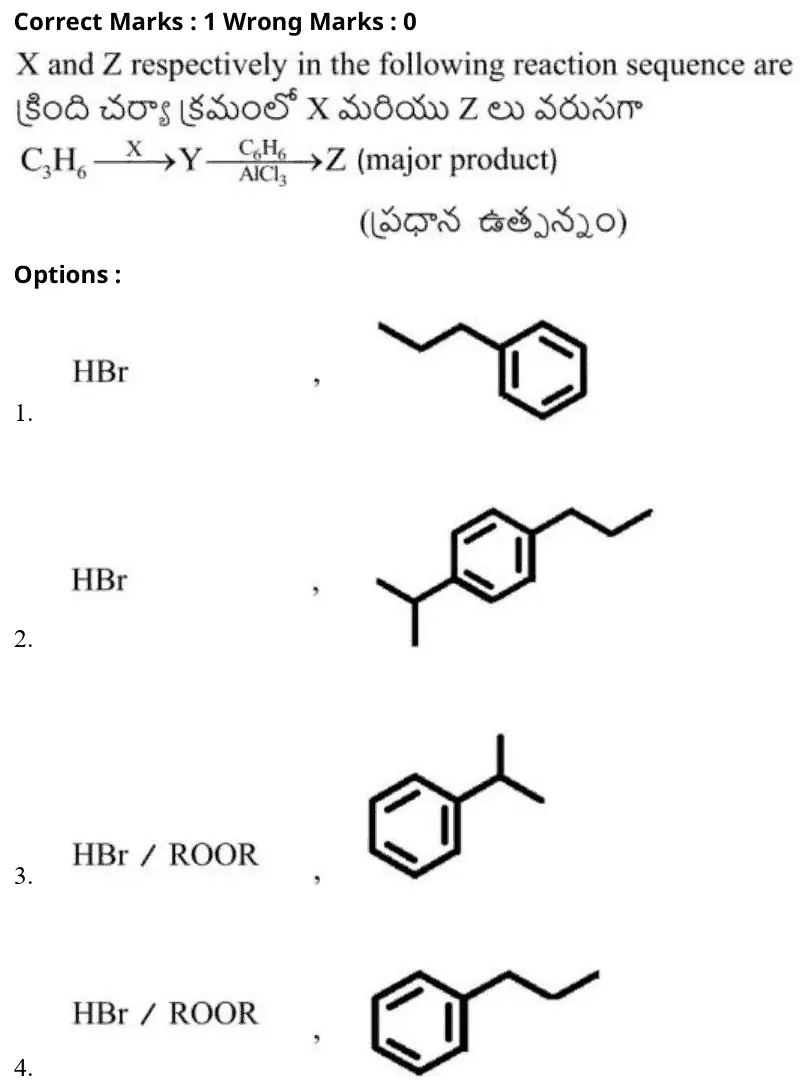
X and Z respectively in the following reaction sequence are

$\mathrm{C_3H_6} \xrightarrow{X} \mathrm{Y} \xrightarrow[\mathrm{AlCl_3}]{\mathrm{C_6H_6}} \mathrm{Z}$ (major product)

The question and its figure as printed in TS EAPCET 2024 09th May 2024 Shift 1.
The question as printed in the paper.
  • A

    HBr, (see the figure above) n-propylbenzene drawn as a benzene ring with a linear three-carbon chain (propyl) attached

  • B

    HBr, (see the figure above) para-disubstituted benzene ring with an n-propyl group on one side and an isopropyl group on the opposite (para) position

  • C

    HBr / ROOR, (see the figure above) isopropylbenzene (cumene): benzene ring with an isopropyl group attached

  • D

    HBr / ROOR, (see the figure above) n-propylbenzene: benzene ring with a linear three-carbon chain (propyl) attached

98TS EAPCET 2024 · 9 May · Shift 2MCQOpen question page ↗

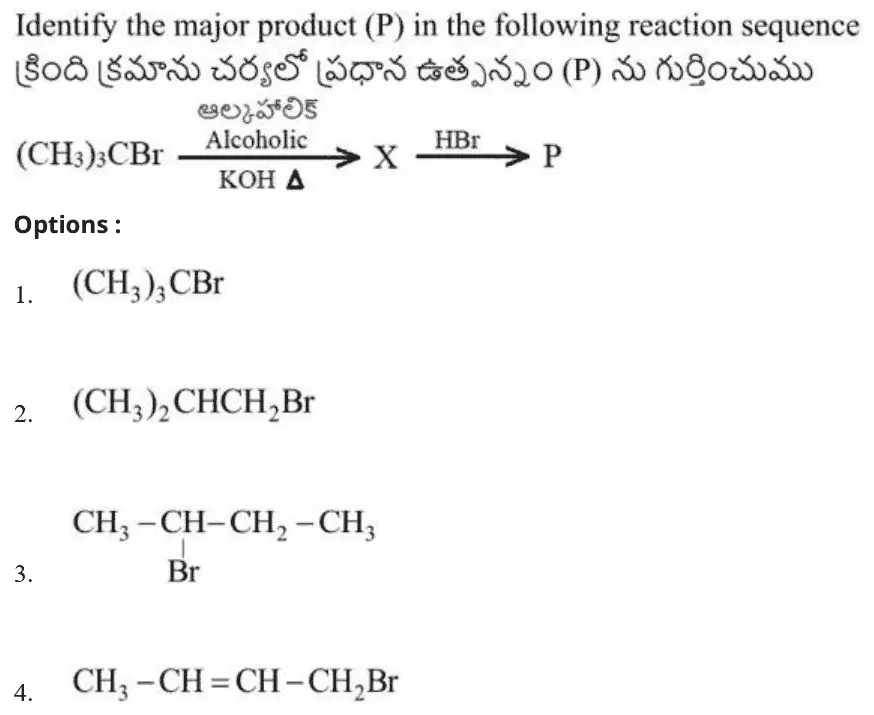
Identify the major product (P) in the following reaction sequence

$$\mathrm{(CH_3)_3CBr} \xrightarrow[\mathrm{KOH}\ \Delta]{\text{Alcoholic}} \mathrm{X} \xrightarrow{\mathrm{HBr}} \mathrm{P}$$

The question and its figure as printed in TS EAPCET 2024 09th May 2024 Shift 2.
The question as printed in the paper.
  • A

    $\mathrm{(CH_3)_3CBr}$

  • B

    $\mathrm{(CH_3)_2CHCH_2Br}$

  • C

    $\mathrm{CH_3-CH-CH_2-CH_3}$ with Br attached below the CH (second carbon) (see the figure above)

  • D

    $\mathrm{CH_3-CH=CH-CH_2Br}$

99TS EAPCET 2024 · 9 May · Shift 2MCQOpen question page ↗

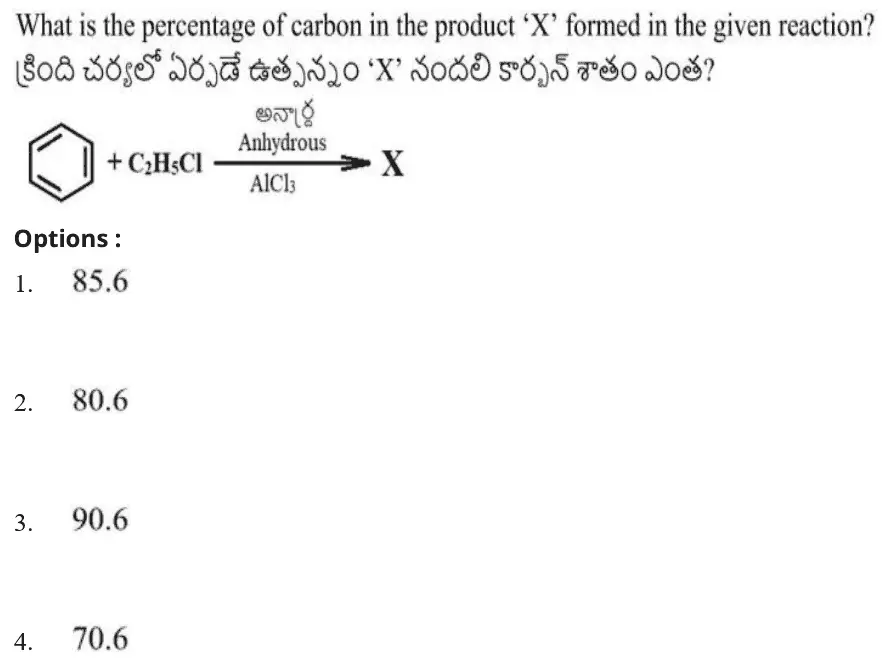
What is the percentage of carbon in the product ‘X’ formed in the given reaction?

(see the figure above)

The question and its figure as printed in TS EAPCET 2024 09th May 2024 Shift 2.
The question as printed in the paper.
  • A

    85.6

  • B

    80.6

  • C

    90.6

  • D

    70.6

100TS EAPCET 2024 · 9 May · Shift 2MCQOpen question page ↗

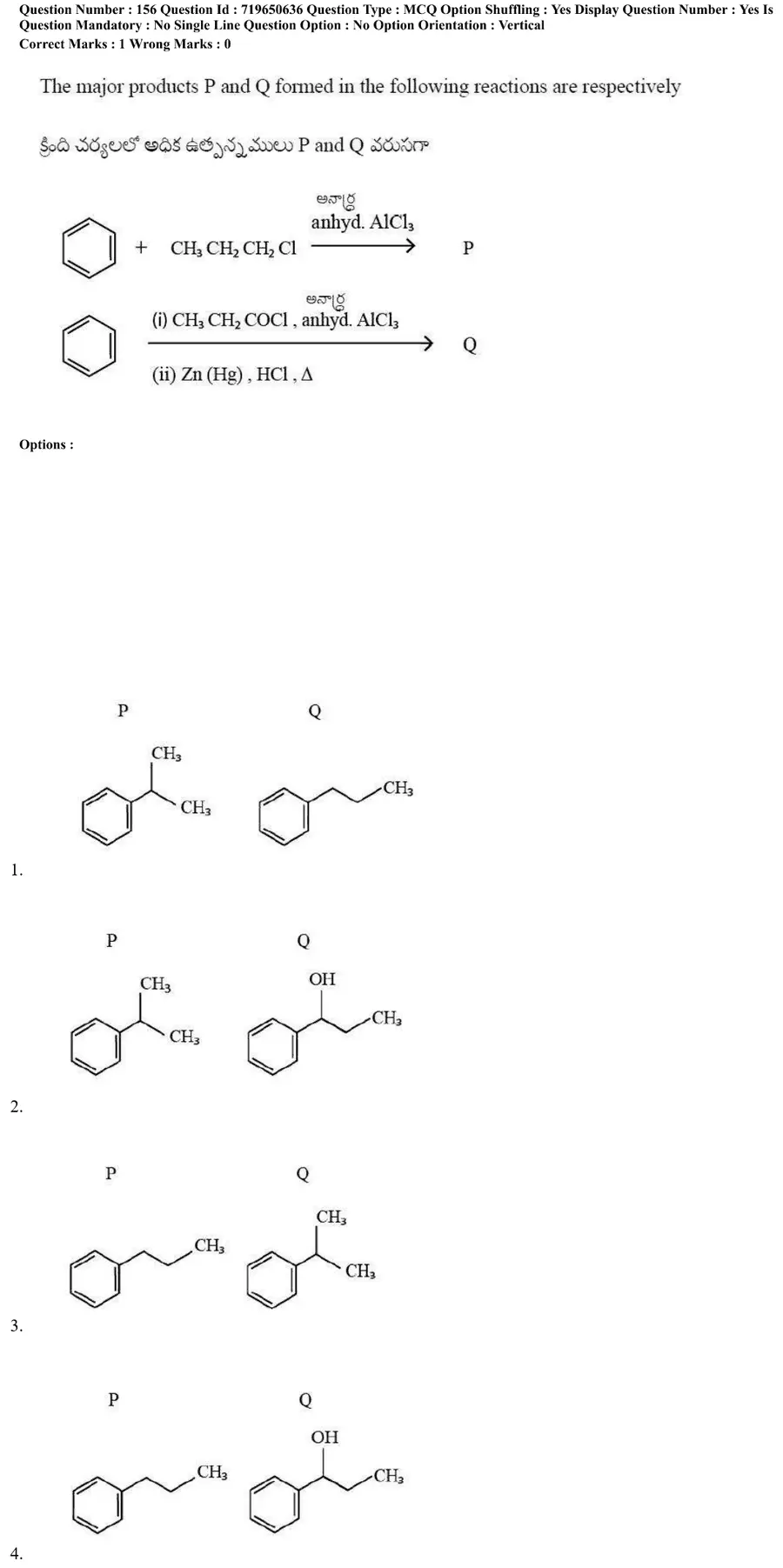
What is the major product Z in the given reaction sequence?

$$(\mathrm{CH_3})_2\mathrm{C=O} \xrightarrow[(2)\ \mathrm{H_3O^+}]{(1)\ \mathrm{C_2H_5MgBr}} \mathrm{X} \xrightarrow[\Delta]{\text{i) }\mathrm{SOCl_2}\ \text{ii) }\mathrm{CH_3ONa}} \mathrm{Y} \xrightarrow[\text{Peroxide}]{\mathrm{HBr}} \mathrm{Z}$$

  • A

    1-Bromo-2-methylpropene

  • B

    2-Methoxy-2-methylbutane

  • C

    2-Bromo-3- methylbutane

  • D

    1-Bromo-2- methylbutane

101AP EAPCET 2023 · 19 May · Shift 1MCQOpen question page ↗

Ethane on heating with a regulated supply of air at high pressure in presence of manganese acetate forms ‘Q’. ‘Q’ is

  • A

    $\mathrm{CH_3CH_2OH}$

  • B

    $\mathrm{CH_3CHO}$

  • C

    $\mathrm{HCOOH}$

  • D

    $\mathrm{CH_3COOH}$

102AP EAPCET 2023 · 19 May · Shift 1MCQOpen question page ↗

In which of the following chain termination step is absent?

The question and its figure as printed in AP EAPCET 2023 19th May 2023 Shift 1.
The question as printed in the paper.
  • A

    Polymeristaion of $\mathrm{C_6H_5CH=CH_2}$ by RLi

  • B

    Polymerisation of $\mathrm{C_6H_5CH=CH_2}$ by $\mathrm{BF_3}$ and $\mathrm{H_2O}$

  • C

    Polymerisation of (see the figure above) and (see the figure above) by $\mathrm{(C_6H_5COO)_2}$

  • D

    Polymerisation of $\mathrm{C_6H_5CH=CH_2}$ by $\mathrm{(C_6H_5COO)_2}$

103AP EAPCET 2023 · 18 May · Shift 1MCQOpen question page ↗

What are X, Y in the following reaction sequence?

$\mathrm{CH_3(CH_2)_5CH_3}$ --X--> $\mathrm{C_7H_8}$ --($\mathrm{Br_2}$, $\Delta$)--> Y

(see the figure above)

The question and its figure as printed in AP EAPCET 2023 18th May 2023 Shift 1.
The question as printed in the paper.
  • A

    X= $\mathrm{Cr_2O_3}$, 773 K, 10-20 atm; Y= (see the figure above) benzene ring with $\mathrm{CH_2Br}$ and Br at para positions

  • B

    X= $\mathrm{V_2O_5}$, 773 K, 10-20 atm; Y= (see the figure above) benzene ring with $\mathrm{CH_2Br}$ substituent only

  • C

    X= $\mathrm{KMnO_4}$; Y= (see the figure above) benzene ring with $\mathrm{CH_3}$ and Br at para positions

  • D

    X= Anhydrous $\mathrm{AlCl_3}$; Y= (see the figure above) benzene ring with $\mathrm{CH_3}$ and Br at para positions

104AP EAPCET 2023 · 18 May · Shift 1MCQOpen question page ↗

Which of the following reactions are not feasible?

I. $\mathrm{CH_3CH=CH_2}$ $\xrightarrow[\mathrm{(C_6H_5CO)_2O_2}]{\mathrm{HCl}}$ $\mathrm{CH_3CH_2CH_2Cl}$

II. $\mathrm{C_6H_6}$ + $\mathrm{CH_3CH_2CH_2Cl}$ $\xrightarrow{\mathrm{AlCl_3}}$ $\mathrm{C_6H_5CH(CH_3)_2}$

III. $\mathrm{CH_3CHClCH_2Cl}$ $\xrightarrow[\Delta]{\mathrm{KOH}}$ $\mathrm{CH_3C\equiv CH}$

IV. $\mathrm{CH_3CH=CHCH_3}$ $\xrightarrow{\mathrm{KMnO_4/H^+}}$ $\mathrm{CH_3COOH}$

  • A

    I & IV only

  • B

    II & III only

  • C

    II & IV only

  • D

    I & III only

105AP EAPCET 2023 · 18 May · Shift 2MCQOpen question page ↗

Which of the following reactions is not correct?

The question and its figure as printed in AP EAPCET 2023 18th May 2023 Shift 2. Option 2: CH3-C C-CH3 with reagents Liq. NH3 / Na gives the alkene drawn with H3C and H on the left carbon and H and CH3 on the right carbon (trans-2-butene)
The question as printed in the paper.
  • A

    $\mathrm{CH_2Br-CH_2Br}\xrightarrow{\mathrm{Zn}}\mathrm{CH_2=CH_2}$

  • B

    see figure $\mathrm{CH_3-C\equiv C-CH_3}$ with reagents Liq. $\mathrm{NH_3}$ / Na gives the alkene drawn with $\mathrm{H_3C}$ and $\mathrm{H}$ on the left carbon and $\mathrm{H}$ and $\mathrm{CH_3}$ on the right carbon (trans-2-butene)

  • C

    $\mathrm{CH_3-C\equiv C-H}\xrightarrow[\mathrm{Hg^{+2},\,H^+}]{\mathrm{H_2O}}\mathrm{CH_3-CH_2-CHO}$

  • D

    $\mathrm{Ph-CH_2-Br}\xrightarrow[\text{Dry ether}]{\mathrm{Na}}\mathrm{Ph-(CH_2)_2-Ph}$

106AP EAPCET 2023 · 18 May · Shift 2MCQOpen question page ↗

The correct order of boiling points of following molecules is

(i) n – Hexane (ii) 2-methylpentane (iii) 2,3 – dimethylbutane

  • A

    i > ii > iii

  • B

    iii > ii > i

  • C

    iii > i > ii

  • D

    i > iii > ii

107AP EAPCET 2023 · 18 May · Shift 2MCQOpen question page ↗

What is ‘X’ in the following reaction?

(see the figure above)

The question and its figure as printed in AP EAPCET 2023 18th May 2023 Shift 2. Option 1: Para-disubstituted benzene ring with HOOC on one side and CH2COOH on the other Option 2: Para-disubstituted benzene ring with HOOC on one side and COOH on the other Option 3: Para-disubstituted benzene ring with HOOC on one side and CH2CH3 on the other Option 4: Para-disubstituted benzene ring with HOOC on one side and COCH3 on the other
The question as printed in the paper.
  • A

    see figure Para-disubstituted benzene ring with HOOC on one side and CH2COOH on the other

  • B

    see figure Para-disubstituted benzene ring with HOOC on one side and COOH on the other

  • C

    see figure Para-disubstituted benzene ring with HOOC on one side and CH2CH3 on the other

  • D

    see figure Para-disubstituted benzene ring with HOOC on one side and COCH3 on the other

108AP EAPCET 2023 · 17 May · Shift 1MCQOpen question page ↗

In the reaction, if X is the reagent and Y is the product, which of the following is not feasible?

(see the figure above)

The question and its figure as printed in AP EAPCET 2023 17th May 2023 Shift 1.
The question as printed in the paper.
  • A

    X = Conc. $\mathrm{HNO_3}$+ Con. $\mathrm{H_2SO_4}$ ; Y = 3 – Nitrobenzoic acid

  • B

    X = $\mathrm{Br_2}$ / Fe Y = 3 – Bromobenzoic acid

  • C

    X = NaOH, CaO Y = Benzene

  • D

    X = $\mathrm{CH_3Cl}$ / $\mathrm{AlCl_3}$ Y = 3 – Methylebenzoic acid

109AP EAPCET 2023 · 17 May · Shift 2MCQOpen question page ↗

What are ‘X’ and ‘Y’ respectively in the following reaction sequence?

Styrene $\xrightarrow[\text{(ii) } \mathrm{H_3O^+}]{\text{(i) } \mathrm{KMnO_4 / KOH}}$ X $\xrightarrow{\mathrm{Br_2 / FeBr_3}}$ Y

The question and its figure as printed in AP EAPCET 2023 17th May 2023 Shift 2. Option 1: X: benzene ring with a CH2COOH substituent; Y: benzene ring with a CH2COBr substituent Option 2: X: benzene ring with a CH2COOH substituent; Y: benzene ring with a CH2COOH substituent and Br at the para position Option 3: X: benzene ring with a COOH substituent; Y: benzene ring with a COOH substituent and Br at the meta position Option 4: X: benzene ring with a COOH substituent; Y: benzene ring with a COBr substituent
The question as printed in the paper.
  • A

    see figure X: benzene ring with a $\mathrm{CH_2COOH}$ substituent; Y: benzene ring with a $\mathrm{CH_2COBr}$ substituent

  • B

    see figure X: benzene ring with a $\mathrm{CH_2COOH}$ substituent; Y: benzene ring with a $\mathrm{CH_2COOH}$ substituent and Br at the para position

  • C

    see figure X: benzene ring with a $\mathrm{COOH}$ substituent; Y: benzene ring with a $\mathrm{COOH}$ substituent and Br at the meta position

  • D

    see figure X: benzene ring with a $\mathrm{COOH}$ substituent; Y: benzene ring with a $\mathrm{COBr}$ substituent

110AP EAPCET 2023 · 16 May · Shift 1MCQOpen question page ↗

see figure In the above reaction electrophile is substituted at meta position only, due to I. Electron density is more at ortho & para position II. Electron density is relatively less at ortho & para position III. Electron density is less at meta position IV. Electron density is relatively more at meta position correct answer is

The question and its figure as printed in AP EAPCET 2023 16th May 2023 Shift 1. Question: In the above reaction electrophile is substituted at meta position only, due to I. Electron density is more at ortho & para position II. Electron density is relatively less at ortho & para position III. Electron density is less at meta position IV. Electron density is relatively more at meta position correct answer is
The question as printed in the paper.
  • A

    I, III only

  • B

    II, IV only

  • C

    I only

  • D

    III only

111AP EAPCET 2023 · 16 May · Shift 2MCQOpen question page ↗

The major product of the following reaction is

(see the figure above)

The question and its figure as printed in AP EAPCET 2023 16th May 2023 Shift 2. Option 1: Benzene ring with a CH2CH3 group and Br at the ortho position (adjacent carbon), and another Br at the para position relative to the CH2CH3 group (2,4-dibromo-substituted ethylbenzene as drawn) Option 2: Benzene ring with a CH2CH3 group and a Br at the para position Option 3: Benzene ring attached to CH(Br)-CH3 (Br on the carbon attached to the ring) Option 4: Benzene ring attached to CH2-CH2Br
The question as printed in the paper.
  • A

    see figure Benzene ring with a CH2CH3 group and Br at the ortho position (adjacent carbon), and another Br at the para position relative to the CH2CH3 group (2,4-dibromo-substituted ethylbenzene as drawn)

  • B

    see figure Benzene ring with a CH2CH3 group and a Br at the para position

  • C

    see figure Benzene ring attached to CH(Br)-CH3 (Br on the carbon attached to the ring)

  • D

    see figure Benzene ring attached to CH2-CH2Br

112AP EAPCET 2023 · 16 May · Shift 2MCQOpen question page ↗

Identify the major product of the given reaction

(see the figure above)

The question and its figure as printed in AP EAPCET 2023 16th May 2023 Shift 2.
The question as printed in the paper.
  • A

    Benzoyl bromide

  • B

    Bromobenzene

  • C

    4-bromo benzoic acid

  • D

    3-bromo benzoic acid

113AP EAPCET 2023 · 15 May · Shift 1MCQOpen question page ↗

In the Kolbe electrolysis of sodium propanoate, the products X and Y are formed at respected electrodes. What are X and Y?

  • A

    X = $\mathrm{CH_3\text{-}CH_2\text{-}CH_2\text{-}CH_3}$ at Cathode; Y = $\mathrm{H_2}$ at Anode

  • B

    X = $\mathrm{CH_3\text{-}CH_2\text{-}CH_3}$ at Cathode; Y = $\mathrm{H_2}$ at Anode

  • C

    X = $\mathrm{CH_3\text{-}CH_2\text{-}CH_2\text{-}CH_3}$ at Anode; Y = $\mathrm{H_2}$ at Cathode

  • D

    X = $\mathrm{CH_3\text{-}CH_3}$ at Anode; Y = $\mathrm{H_2}$ at Cathode

114AP EAPCET 2023 · 15 May · Shift 2MCQOpen question page ↗

Match the following

List - IList - II
A. $\mathrm{HC\equiv CH}$ $\xrightarrow[\mathrm{H_2O}]{\mathrm{Hg^{+}, H^{+}}}$I. $\mathrm{H_3C-COOH}$
B. $\mathrm{CH_4}$ $\xrightarrow[\mathrm{Mo_2O_3, \Delta}]{\mathrm{O_2}}$II. $\mathrm{CH_3-CO-CH_3}$
C. (see the figure above) $\xrightarrow[\mathrm{Zn, H_2O}]{\mathrm{O_3}}$III. $\mathrm{H_3C-CHO}$
D. $\mathrm{CH_3-CH=CH-CH_3}$ $\xrightarrow[\mathrm{H^{+}}]{\mathrm{KMnO_4}}$IV. $\mathrm{HCHO}$
The question and its figure as printed in AP EAPCET 2023 15th May 2023 Shift 2.
The question as printed in the paper.
  • A

    A – I, B – II, C – III, D – IV

  • B

    A – III, B – IV, C – II, D – I

  • C

    A – I, B – IV, C – III, D – II

  • D

    A – III, B – II, C – IV, D – I

115AP EAPCET 2023 · 15 May · Shift 2MCQOpen question page ↗

Two statements are given below

Statement I: Chlorobenzene on nitration gives 1-chloro-4-nitrobenzene as major product

Statement II: Chlorobenzene undergoes nitration slowly than benzene

Identify the correct answer

  • A

    Statements I, II are correct

  • B

    Statements I, II are incorrect

  • C

    Statement I correct but statement II is incorrect

  • D

    Statement II correct but statement I is incorrect

116TS EAPCET 2023 · 14 May · Shift 1MCQOpen question page ↗

In the conversion of A to B, the electrophile involved is

$\mathrm{C_2H_2} \xrightarrow[\text{Irontube, 873 K}]{\text{Redhot}} \mathrm{A} \xrightarrow[\text{Anhy. AlCl_3}]{\mathrm{CH_3-C(=O)-Cl}} \mathrm{B}$

The question and its figure as printed in TS EAPCET 2023 14th May 2023 Shift 1. Option 2: Cl–C(=O)⊕ : acyl cation with Cl attached to carbonyl carbon bearing positive charge, i.e. Cl-O|C^ Option 4: H3C–C(=O)⊕ : acyl cation, i.e. H3C-O|C^
The question as printed in the paper.
  • A

    $\mathrm{{}^{\oplus}CH_3}$

  • B

    see figure Cl–C(=O)⊕ : acyl cation with Cl attached to carbonyl carbon bearing positive charge, i.e. $\mathrm{Cl-\overset{O}{\overset{\|}{C}}^{\oplus}}$

  • C

    $\mathrm{Cl^{\oplus}}$

  • D

    see figure H$_3$C–C(=O)⊕ : acyl cation, i.e. $\mathrm{H_3C-\overset{O}{\overset{\|}{C}}^{\oplus}}$

117TS EAPCET 2023 · 14 May · Shift 1MCQOpen question page ↗

An alkene X on ozonolysis gives a mixture of Propan-2-one and methanal. What is X?

  • A

    Propene

  • B

    2-Methylpropene

  • C

    2-Methylbut-1-ene

  • D

    2-Methylbut-2-ene

118TS EAPCET 2023 · 14 May · Shift 2MCQOpen question page ↗

Arrange the following in the correct order of their acidic strength

$\mathrm{H_2C=CH_2}$ (I) $\mathrm{CH\equiv CH}$ (II) $\mathrm{CH_3\text{-}C\equiv CH}$ (III) $\mathrm{CH_3\text{-}CH_3}$ (IV)

  • A

    $\mathrm{I} < \mathrm{II} < \mathrm{III} < \mathrm{IV}$

  • B

    $\mathrm{IV} < \mathrm{I} < \mathrm{III} < \mathrm{II}$

  • C

    $\mathrm{IV} < \mathrm{III} < \mathrm{II} < \mathrm{I}$

  • D

    $\mathrm{II} < \mathrm{III} < \mathrm{IV} < \mathrm{I}$

119TS EAPCET 2023 · 14 May · Shift 2MCQOpen question page ↗

$\mathrm{C_3H_4 + H_2O} \xrightarrow[333K]{Hg^{2+}/H^{+}} [\mathrm{X}] \overset{\text{Tautomerisation}}{\rightleftharpoons} Y$

X and Y are respectively

  • A

    unsaturated alcohol, aldehyde

  • B

    saturated alcohol, ketone

  • C

    unsaturated alcohol, ketone

  • D

    saturated alcohol, aldehyde

120TS EAPCET 2023 · 14 May · Shift 2MCQOpen question page ↗

Addition of $\mathrm{HBr}$ to propene in presence of a peroxide takes place contrary to Markovnikov rule. This can be explained by the mechanism involving

  • A

    electrophile

  • B

    free radical

  • C

    nucleophile

  • D

    carbene

121TS EAPCET 2023 · 14 May · Shift 2MCQOpen question page ↗

The rate of attack of an electrophile is least when X in the given compound is

(see the figure above)

The question and its figure as printed in TS EAPCET 2023 14th May 2023 Shift 2.
The question as printed in the paper.
  • A

    $\mathrm{-NO_2}$

  • B

    $\mathrm{-CH_3}$

  • C

    $\mathrm{-OH}$

  • D

    $\mathrm{-NH_2}$

122TS EAPCET 2023 · 14 May · Shift 2MCQOpen question page ↗

Identify the major product Y in the given reaction sequence

(see the figure above)

The question and its figure as printed in TS EAPCET 2023 14th May 2023 Shift 2.
The question as printed in the paper.
  • A

    $\mathrm{CH_3-CH-CH_3}$ with an OH group on the middle carbon (propan-2-ol)

  • B

    $\mathrm{CH_3-CH_2-CH_2OH}$

  • C

    $\mathrm{CH_3-CH-CH_2OH}$ with an OH group on the middle (CH) carbon

  • D

    $\mathrm{CH_2-CH_2-CH_2}$ with an OH group on each terminal CH2 carbon

123TS EAPCET 2023 · 13 May · Shift 1MCQOpen question page ↗

In the following reaction ‘C’ is an aromatic compound having substituents D&E. What are D&E?

(see the figure above)

The question and its figure as printed in TS EAPCET 2023 13th May 2023 Shift 1.
The question as printed in the paper.
  • A

    $-\mathrm{OH}$, $-\mathrm{SO_3H}$

  • B

    $-\mathrm{CHO}$, $-\mathrm{NO_2}$

  • C

    $-\mathrm{COOH}$, $-\mathrm{NO_2}$

  • D

    $-\mathrm{SO_3H}$, $-\mathrm{NO_2}$

124TS EAPCET 2023 · 13 May · Shift 1MCQOpen question page ↗

An alkene (X) on ozonolysis gives propanal and ethanal. What is X?

  • A

    Pent-2-ene

  • B

    Pent-1-ene

  • C

    But-1-ene

  • D

    But-2-ene

125TS EAPCET 2023 · 13 May · Shift 1MCQOpen question page ↗

Match the following

List – I (Reaction)List – II (Product)
A(see the figure above) benzene $+ \mathrm{Cl_2}$ $\xrightarrow{\mathrm{AlCl_3}}$IBenzoic acid
B(see the figure above) benzene $+ \mathrm{CH_3Cl}$ $\xrightarrow{\text{anhy. }\mathrm{AlCl_3}}$IIAlkyl phenyl ketone
C(see the figure above) benzene $+ \mathrm{R-C(=O)-Cl}$ $\xrightarrow{\text{anhy. }\mathrm{AlCl_3}}$IIIToluene
D(see the figure above) toluene (benzene ring with $\mathrm{CH_3}$) $\xrightarrow[\text{(ii) }\mathrm{H_3O^+}]{\text{(i) }\mathrm{KMnO_4 \mid KOH}}$IVChlorobenzene

The correct answer is

The question and its figure as printed in TS EAPCET 2023 13th May 2023 Shift 1.
The question as printed in the paper.
  • A

    A -I; B-II; C- III; D – IV

  • B

    A -II; B-I; C- IV; D – III

  • C

    A -IV; B-III; C- II; D – I

  • D

    A -IV; B-II; C- III; D – I

126TS EAPCET 2023 · 13 May · Shift 2MCQOpen question page ↗

An alkene X $(\mathrm{C_6H_{12}})$ on ozonolysis gave acetaldehyde and ethyl methyl ketone. What is the product formed when X reacts with HBr?

The question and its figure as printed in TS EAPCET 2023 13th May 2023 Shift 2. Option 1: Skeletal structure: a quaternary carbon bearing Br, with two methyl-type branches going up-left and up-right and a chain going down-left, Br labelled at lower right of the carbon. Option 2: Skeletal structure: zigzag chain with a carbon bearing Br on top (Br drawn above, at right carbon), and a vertical branch (methyl) pointing down from the middle-left carbon. Option 3: Skeletal structure: a carbon bearing Br (Br drawn at lower left) and a methyl branch going up, attached to an ethyl-type zigzag chain extending to the right. Option 4: Skeletal structure: zigzag chain with a branch going up from the…
The question as printed in the paper.
  • A

    see figure Skeletal structure: a quaternary carbon bearing Br, with two methyl-type branches going up-left and up-right and a chain going down-left, Br labelled at lower right of the carbon.

  • B

    see figure Skeletal structure: zigzag chain with a carbon bearing Br on top (Br drawn above, at right carbon), and a vertical branch (methyl) pointing down from the middle-left carbon.

  • C

    see figure Skeletal structure: a carbon bearing Br (Br drawn at lower left) and a methyl branch going up, attached to an ethyl-type zigzag chain extending to the right.

  • D

    see figure Skeletal structure: zigzag chain with a branch going up from the left carbon and Br attached downward on the middle carbon (Br drawn below).

127TS EAPCET 2023 · 12 May · Shift 1MCQOpen question page ↗

I. $\mathrm{(CH_3)_2C=CH_2}\xrightarrow{\mathrm{KMnO_4/H^+}} \mathrm{X + CO_2 + H_2O}$

II. $\mathrm{CH_3-CH=CH-CH_3}\xrightarrow{\mathrm{KMnO_4/H^+}} \mathrm{Y}$

The functional groups in X and Y are respectively

The question and its figure as printed in TS EAPCET 2023 12th May 2023 Shift 1. Option 1: Skeletal structure of a ketone (propanone: C=O with two methyl groups), followed by a comma and the skeletal structure of an aldehyde (C=O with an H, ethanal) Option 2: Skeletal structure of a ketone (propanone), followed by a comma and the skeletal structure of a carboxylic acid (C=O with OH, ethanoic acid) Option 3: Skeletal structure of an aldehyde (C=O with an H), followed by a comma and the skeletal structure of a ketone (C=O with two methyl groups) Option 4: Skeletal structure of an ester-like group (C=O with an O- single-bonded substituent, drawn as -O attached to the carbonyl carbon), followed…
The question as printed in the paper.
  • A

    see figure Skeletal structure of a ketone (propanone: C=O with two methyl groups), followed by a comma and the skeletal structure of an aldehyde (C=O with an H, ethanal)

  • B

    see figure Skeletal structure of a ketone (propanone), followed by a comma and the skeletal structure of a carboxylic acid (C=O with OH, ethanoic acid)

  • C

    see figure Skeletal structure of an aldehyde (C=O with an H), followed by a comma and the skeletal structure of a ketone (C=O with two methyl groups)

  • D

    see figure Skeletal structure of an ester-like group (C=O with an O- single-bonded substituent, drawn as -O attached to the carbonyl carbon), followed by a comma and the skeletal structure of an aldehyde (C=O with an H)

128TS EAPCET 2023 · 12 May · Shift 1MCQOpen question page ↗

Identify the major product B in the given sequence of reactions

$\mathrm{CH_3-C\equiv CH} \xrightarrow[\mathrm{Pd|c}]{\mathrm{H_2}} \mathrm{A} \xrightarrow[\mathrm{HBr}]{\mathrm{(C_6H_5CO)_2O_2}} \mathrm{B}$

The question and its figure as printed in TS EAPCET 2023 12th May 2023 Shift 1. Option 1: Structure: CH3-CH(Br)-CH3, with Br drawn below the central CH Option 3: Structure: CH3-CH(Br)-CH2Br, with Br drawn below the central CH
The question as printed in the paper.
  • A

    see figure Structure: $\mathrm{CH_3-CH(Br)-CH_3}$, with Br drawn below the central CH

  • B

    $\mathrm{CH_3-CH_2-CH_2Br}$

  • C

    see figure Structure: $\mathrm{CH_3-CH(Br)-CH_2Br}$, with Br drawn below the central CH

  • D

    $\mathrm{CH_3-CH_2-CHBr_2}$

129TS EAPCET 2023 · 12 May · Shift 2MCQOpen question page ↗

Identify ‘Z’ in the following reaction sequence

$$2\mathrm{C_3H_7Br} \xrightarrow{\mathrm{Na/Ether}} \mathrm{X} \xrightarrow[\mathrm{773K,\ 10\text{-}20\ atm}]{\mathrm{Mo_2O_3}} \mathrm{Y} \xrightarrow[\mathrm{CH_3Cl}]{\mathrm{Anh.AlCl_3}} \mathrm{Z}$$

The question and its figure as printed in TS EAPCET 2023 12th May 2023 Shift 2. Option 1: Benzene ring with a Cl substituent (chlorobenzene) Option 2: Benzene ring with a CH2Cl substituent (benzyl chloride) Option 3: Benzene ring with a CH3 substituent (toluene) Option 4: Benzene ring with CH3 at the top and Cl at the bottom (para-chlorotoluene)
The question as printed in the paper.
  • A

    see figure Benzene ring with a Cl substituent (chlorobenzene)

  • B

    see figure Benzene ring with a CH2Cl substituent (benzyl chloride)

  • C

    see figure Benzene ring with a CH3 substituent (toluene)

  • D

    see figure Benzene ring with CH3 at the top and Cl at the bottom (para-chlorotoluene)

130TS EAPCET 2023 · 12 May · Shift 2MCQOpen question page ↗

What is the major product ‘C’ in the following sequence of reactions?

$\mathrm{C_2H_4Br_2}\ \xrightarrow[\text{(ii) NaNH}_2]{\text{(i) alcohol | KOH}}\ \mathrm{A}\ \xrightarrow[333\,K]{\mathrm{H_2O}\ /\ \mathrm{Hg^{2+}\,|\,H^+}}\ [\mathrm{B}] \rightleftharpoons \mathrm{C}$

The question and its figure as printed in TS EAPCET 2023 12th May 2023 Shift 2. Option 1: Skeletal structure of a vinyl alcohol: a C=C double bond with an OH group on the terminal carbon (CH2=CH-OH). Option 2: Skeletal structure of acetone: a carbonyl C=O (O on top) with a methyl group on each side. Option 3: Skeletal structure of an enol: a C=C double bond with a CH3 group on top of the carbon and an OH group on the other carbon. Option 4: Skeletal structure of acetaldehyde: a carbonyl C=O (O on top) with an H on the carbonyl carbon and a methyl side.
The question as printed in the paper.
  • A

    see figure Skeletal structure of a vinyl alcohol: a C=C double bond with an OH group on the terminal carbon (CH2=CH-OH).

  • B

    see figure Skeletal structure of acetone: a carbonyl C=O (O on top) with a methyl group on each side.

  • C

    see figure Skeletal structure of an enol: a C=C double bond with a CH3 group on top of the carbon and an OH group on the other carbon.

  • D

    see figure Skeletal structure of acetaldehyde: a carbonyl C=O (O on top) with an H on the carbonyl carbon and a methyl side.

131TS EAPCET 2022 · 20 Jul · Shift 1MCQOpen question page ↗

The organic compound 5-allylcyclohex-3-ene-1-ol is reacted with cold, dilute, aqueous solution of $\mathrm{KMnO_4}$. The total number of hydroxyl group(s) (-OH) present in the product is

  • A

    1

  • B

    2

  • C

    3

  • D

    5

132TS EAPCET 2022 · 20 Jul · Shift 1MCQOpen question page ↗

The molecular formula of the product formed when benzene is reacted with excess of chlorine molecules under ultra-violet light is

  • A

    $\mathrm{C_6Cl_6}$

  • B

    $\mathrm{C_6H_3Cl_3}$

  • C

    $\mathrm{C_6H_2Cl_4}$

  • D

    $\mathrm{C_6H_6Cl_6}$

133TS EAPCET 2022 · 20 Jul · Shift 1MCQOpen question page ↗

The major product in the following reaction is
(see the figure above)

The question and its figure as printed in TS EAPCET 2022 20th Jul 2022 Shift 1. Option 1: cyclohexane ring with adjacent substituents CO2H and CH3 on neighbouring ring carbons Option 2: cyclohexane ring with CO2H and CH3 both on the same ring carbon Option 3: cyclohexane ring bearing a short chain ending in CO2H (one bend before CO2H) Option 4: cyclohexane ring bearing a longer chain ending in CO2H (two bends before CO2H)
The question as printed in the paper.
  • A

    see figure cyclohexane ring with adjacent substituents $\mathrm{CO_2H}$ and $\mathrm{CH_3}$ on neighbouring ring carbons

  • B

    see figure cyclohexane ring with $\mathrm{CO_2H}$ and $\mathrm{CH_3}$ both on the same ring carbon

  • C

    see figure cyclohexane ring bearing a short chain ending in $\mathrm{CO_2H}$ (one bend before $\mathrm{CO_2H}$)

  • D

    see figure cyclohexane ring bearing a longer chain ending in $\mathrm{CO_2H}$ (two bends before $\mathrm{CO_2H}$)

134TS EAPCET 2022 · 20 Jul · Shift 2MCQOpen question page ↗

1 – Chloro – 3 – methylbutane on reaction with zinc and dilute hydrochloric acid gives ________ as the major product.

  • A

    2– Methylbutane

  • B

    2 – Methylbutene

  • C

    n – pentane

  • D

    n – pentene

135TS EAPCET 2022 · 20 Jul · Shift 2MCQOpen question page ↗

The major products Y and Z in the following reactions are
(see the figure above)

The question and its figure as printed in TS EAPCET 2022 20th Jul 2022 Shift 2. Option 1: Y: ring with OH (top), H3C (upper left), Br (lower left), CH2OH (lower right) + Z: same ring with COOH in place of CH2OH Option 2: Y: ring with OH (top), H3C (upper left), Br (bottom), CH2OH (lower right) + Z: same ring with COOH in place of CH2OH Option 3: Y: ring with OH (top), H3C (upper left), Br (upper right), CH2OH (lower right) + Z: same ring with COOH in place of CH2OH Option 4: Y: ring with OH (top), H3C (upper left), Br (lower left), CH2OH (lower right) + Z: ring with OH (top), H3C (upper left), Br (lower left), Br (lower right)
The question as printed in the paper.
  • A

    see figure Y: ring with OH (top), $\mathrm{H_3C}$ (upper left), Br (lower left), $\mathrm{CH_2OH}$ (lower right) + Z: same ring with COOH in place of $\mathrm{CH_2OH}$

  • B

    see figure Y: ring with OH (top), $\mathrm{H_3C}$ (upper left), Br (bottom), $\mathrm{CH_2OH}$ (lower right) + Z: same ring with COOH in place of $\mathrm{CH_2OH}$

  • C

    see figure Y: ring with OH (top), $\mathrm{H_3C}$ (upper left), Br (upper right), $\mathrm{CH_2OH}$ (lower right) + Z: same ring with COOH in place of $\mathrm{CH_2OH}$

  • D

    see figure Y: ring with OH (top), $\mathrm{H_3C}$ (upper left), Br (lower left), $\mathrm{CH_2OH}$ (lower right) + Z: ring with OH (top), $\mathrm{H_3C}$ (upper left), Br (lower left), Br (lower right)

136TS EAPCET 2022 · 19 Jul · Shift 1MCQOpen question page ↗

The major products P and Q in the following reactions, respectively, are
(see the figure above)

The question and its figure as printed in TS EAPCET 2022 19th Jul 2022 Shift 1.
The question as printed in the paper.
  • A

    P: Alkene (cis); Q: Alkene (cis)

  • B

    P: Alkane; Q: Alkene (trans)

  • C

    P: Alkene (cis); Q: Alkene (trans)

  • D

    P: Alkene (trans); Q: Alkene (trans)

137TS EAPCET 2022 · 19 Jul · Shift 1MCQOpen question page ↗

The major product formed in the following reaction sequence is
(see the figure above)

The question and its figure as printed in TS EAPCET 2022 19th Jul 2022 Shift 1. Option 1: benzene ring with two Ph groups on adjacent carbons (ortho) Option 2: benzene ring with three Ph groups (Ph on carbon 1, on adjacent carbon 2, and on the carbon para to the first, carbon 4) Option 3: benzene ring with three Ph groups at the 1,3,5 positions Option 4: benzene ring with three Ph groups on three adjacent carbons (1,2,3)
The question as printed in the paper.
  • A

    see figure benzene ring with two Ph groups on adjacent carbons (ortho)

  • B

    see figure benzene ring with three Ph groups (Ph on carbon 1, on adjacent carbon 2, and on the carbon para to the first, carbon 4)

  • C

    see figure benzene ring with three Ph groups at the 1,3,5 positions

  • D

    see figure benzene ring with three Ph groups on three adjacent carbons (1,2,3)

138TS EAPCET 2022 · 19 Jul · Shift 1MCQOpen question page ↗

The major product of the following reactions is
(see the figure above)

The question and its figure as printed in TS EAPCET 2022 19th Jul 2022 Shift 1. Option 1: para-substituted benzene: H3C on the ring and a C(CH3)(CH3)OH group, i.e. 2-(4-methylphenyl)propan-2-ol Option 2: para-substituted benzene: H3C on the ring and a CH(OH)CH3 group, i.e. 1-(4-methylphenyl)ethanol Option 3: ortho-substituted benzene: CH3 on the ring and a C(OH)(CH3)(CH3) group on adjacent carbons Option 4: ortho-substituted benzene: CH3 on the ring and a CH(OH)CH3 group on adjacent carbons
The question as printed in the paper.
  • A

    see figure para-substituted benzene: H3C on the ring and a C(CH3)(CH3)OH group, i.e. 2-(4-methylphenyl)propan-2-ol

  • B

    see figure para-substituted benzene: H3C on the ring and a CH(OH)CH3 group, i.e. 1-(4-methylphenyl)ethanol

  • C

    see figure ortho-substituted benzene: CH3 on the ring and a C(OH)(CH3)(CH3) group on adjacent carbons

  • D

    see figure ortho-substituted benzene: CH3 on the ring and a CH(OH)CH3 group on adjacent carbons

139TS EAPCET 2022 · 19 Jul · Shift 2MCQOpen question page ↗

The order of decreasing reactivity towards an electrophilic reagent, for the following compounds, is
(i) Benzene
(ii) Toluene
(iii) Chlorobenzene
(iv) Phenol

  • A

    (i) > (ii) > (iii) > (iv)

  • B

    (ii) > (iv) > (i) > (iii)

  • C

    (iv) > (iii) > (ii) > (i)

  • D

    (iv) > (ii) > (i) > (iii)

140TS EAPCET 2022 · 19 Jul · Shift 2MCQOpen question page ↗

The major product in the following reactions is
(see the figure above)

The question and its figure as printed in TS EAPCET 2022 19th Jul 2022 Shift 2. Option 1: 1-bromoethyl-benzene: benzene ring with a CH(Br)CH3 group Option 2: ortho-substituted benzene ring with CH3 and CH2Br on adjacent carbons Option 3: benzene ring with CH2CH2Br Option 4: para-substituted benzene ring with CH3 and CH2Br at opposite positions
The question as printed in the paper.
  • A

    see figure 1-bromoethyl-benzene: benzene ring with a CH(Br)CH3 group

  • B

    see figure ortho-substituted benzene ring with CH3 and CH2Br on adjacent carbons

  • C

    see figure benzene ring with CH2CH2Br

  • D

    see figure para-substituted benzene ring with CH3 and CH2Br at opposite positions

141TS EAPCET 2022 · 18 Jul · Shift 1MCQOpen question page ↗

The correct order of rates of addition of $\mathrm{Br_{2}}$/water to the following alkenes is
[A] $\mathrm{CH_{2}=CH_{2}}$
[B] $\mathrm{CH_{2}=CH-NO_{2}}$
[C] $\mathrm{CH_{3}-CH_{2}-CH=CH_{2}}$
[D] $\mathrm{CH_{3}-CH(CH_{3})=CH_{2}}$

  • A

    [D] > [C] > [A] > [B]

  • B

    [D] > [C] > [B] > [A]

  • C

    [A] > [B] > [C] > [D]

  • D

    [A] > [B] > [D] > [C]

142TS EAPCET 2022 · 18 Jul · Shift 1MCQOpen question page ↗

The major products P and Q formed in the following reactions schemes are
(A) benzene $+\ \mathrm{CH_{3}CH_{2}CH_{2}Cl}\xrightarrow{\mathrm{AlCl_{3}\ (anhyd.)}}$ P
(B) benzene $\xrightarrow[\substack{\text{ii) }\mathrm{Br_{2},\,h\upsilon}\\\text{iii) aq. KOH}}]{\text{i) }\mathrm{CH_{3}Cl/AlCl_{3}\ (anhyd.)}}$ Q
(see the figure above)

The question and its figure as printed in TS EAPCET 2022 18th Jul 2022 Shift 1.
The question as printed in the paper.
  • A

    P: isopropylbenzene (benzene ring bearing a CH(CH3)2 group); Q: benzyl alcohol (benzene ring bearing CH2-OH)

  • B

    P: n-propylbenzene (benzene ring bearing CH2CH2CH3); Q: benzophenone (two benzene rings joined through C=O)

  • C

    P: 1,2-di-n-propylbenzene (benzene ring bearing two adjacent CH2CH2CH3 groups); Q: diphenylmethanol (two benzene rings on a CH-OH carbon)

  • D

    P: 1-chloro-2-n-propylbenzene (ring bearing CH2CH2CH3 and an adjacent Cl); Q: benzoic acid (benzene ring bearing CO2H)

143TS EAPCET 2022 · 18 Jul · Shift 2MCQOpen question page ↗

The most suitable solvent for Wurtz reaction is

  • A

    Dry acetonitrile

  • B

    Dry dichloromethane

  • C

    Dry ethanol

  • D

    Dry ether

144TS EAPCET 2022 · 18 Jul · Shift 2MCQOpen question page ↗

Propyne was subjected to a reaction with $\mathrm{HgSO_{4}}$ / dil. $\mathrm{H_{2}SO_{4}}$, which resulted in a product P. The product P was heated with $\mathrm{Ba(OH)_{2}}$ to give the product Q. The molecular formula of the product Q is

  • A

    $\mathrm{C_{3}H_{6}O}$

  • B

    $\mathrm{C_{3}H_{8}OH}$

  • C

    $\mathrm{C_{6}H_{12}O_{2}}$

  • D

    $\mathrm{C_{6}H_{10}O}$

145AP EAPCET 2022 · 8 Jul · Shift 1MCQOpen question page ↗

Identify the starting compound 'P' in the following reaction.
$\mathrm{P} \xrightarrow{\text{Na / dry ether}} \mathrm{(H_3C)_2CHCH_2CH_2CH(CH_3)_2}$

  • A

    1-Bromo-2-methylpropane

  • B

    1-Bromobutane

  • C

    2-Brom propene

  • D

    2-Bromobutane

146AP EAPCET 2022 · 8 Jul · Shift 1MCQOpen question page ↗

The product(s) formed when toluene is reacted with $\mathrm{Cl_2}$ in presence of Fe in dark is/are

The question and its figure as printed in AP EAPCET 2022 08th July 2022 Shift1. Option 1: two benzene-ring structures: o-chlorotoluene (CH3 and Cl on adjacent ring carbons) and p-chlorotoluene (CH3 and Cl on opposite carbons) Option 2: benzyl chloride (benzene ring with CH2Cl side chain) Option 3: two structures: p-chloro-(chloromethyl)benzene (Cl on the ring para to a CH2Cl group) and o-chloro-(chloromethyl)benzene (Cl on the ring ortho to a CH2Cl group) Option 4: two structures: m-chloro-(chloromethyl)benzene (Cl on the ring meta to a CH2Cl group) and m-chlorotoluene (Cl and CH3 meta)
The question as printed in the paper.
  • A

    see figure two benzene-ring structures: o-chlorotoluene (CH3 and Cl on adjacent ring carbons) and p-chlorotoluene (CH3 and Cl on opposite carbons)

  • B

    see figure benzyl chloride (benzene ring with CH2Cl side chain)

  • C

    see figure two structures: p-chloro-(chloromethyl)benzene (Cl on the ring para to a CH2Cl group) and o-chloro-(chloromethyl)benzene (Cl on the ring ortho to a CH2Cl group)

  • D

    see figure two structures: m-chloro-(chloromethyl)benzene (Cl on the ring meta to a CH2Cl group) and m-chlorotoluene (Cl and CH3 meta)

147AP EAPCET 2022 · 8 Jul · Shift 2MCQOpen question page ↗

One mol of 2-Methylbuta-1, 3-diene on ozonolysis gives

  • A

    2 moles of methanal and 1 mole of propanone

  • B

    2 moles of methanal and 1 mole of 2-ketopropanal

  • C

    1 mole of methanal 1 mole of ethanol, and 1mole of propanone

  • D

    2 moles of ethanal and 1 mole of 2-ketopropanal

148AP EAPCET 2022 · 8 Jul · Shift 2MCQOpen question page ↗

An organic compound (A) on ozonolysis followed by treatment with Zinc dust and water give product P, which can be used to preserve biological specimens. Identify A
(see the figure above)

The question and its figure as printed in AP EAPCET 2022 08th July 2022 Shift2. Option 1: 2,3-dimethylbut-2-ene: C=C with two CH3 groups on each carbon Option 2: but-2-ene: C=C with one CH3 on each carbon Option 4: cyclohexene (six-membered ring with one double bond)
The question as printed in the paper.
  • A

    see figure 2,3-dimethylbut-2-ene: C=C with two CH3 groups on each carbon

  • B

    see figure but-2-ene: C=C with one CH3 on each carbon

  • C

    $\mathrm{CH_2{=}CH_2}$

  • D

    see figure cyclohexene (six-membered ring with one double bond)

149AP EAPCET 2022 · 7 Jul · Shift 1MCQOpen question page ↗

The major product 'B' of the following reaction sequence is
(see the figure above)

The question and its figure as printed in AP EAPCET 2022 07th July2022 Shift1. Option 1: 1-phenylethanol: a benzene ring bearing a CH(OH)CH3 group Option 2: acetophenone: a benzene ring bearing a C(=O)CH3 group Option 3: phenylacetaldehyde: a benzene ring bearing a CH2CHO group Option 4: 2-phenylethanol: a benzene ring bearing a CH2CH2OH group
The question as printed in the paper.
  • A

    see figure 1-phenylethanol: a benzene ring bearing a CH(OH)CH3 group

  • B

    see figure acetophenone: a benzene ring bearing a C(=O)CH3 group

  • C

    see figure phenylacetaldehyde: a benzene ring bearing a CH2CHO group

  • D

    see figure 2-phenylethanol: a benzene ring bearing a CH2CH2OH group

150AP EAPCET 2022 · 7 Jul · Shift 1MCQOpen question page ↗

Identify the major product from the following reaction sequence
(see the figure above)

The question and its figure as printed in AP EAPCET 2022 07th July2022 Shift1. Option 1: 4-bromotoluene: benzene ring with CH3 at the top and Br at the bottom Option 2: tribromotoluene: benzene ring with CH3 at the top, Br on the two upper side vertices and Br at the bottom vertex Option 3: benzene ring with CH3 at the top, Br on the two upper side vertices and NH2 at the bottom vertex Option 4: benzene ring with CH3 at the top, Br on the two lower side vertices and NH2 at the bottom vertex
The question as printed in the paper.
  • A

    see figure 4-bromotoluene: benzene ring with CH3 at the top and Br at the bottom

  • B

    see figure tribromotoluene: benzene ring with CH3 at the top, Br on the two upper side vertices and Br at the bottom vertex

  • C

    see figure benzene ring with CH3 at the top, Br on the two upper side vertices and NH2 at the bottom vertex

  • D

    see figure benzene ring with CH3 at the top, Br on the two lower side vertices and NH2 at the bottom vertex

151AP EAPCET 2022 · 7 Jul · Shift 2MCQOpen question page ↗

Identify the major product from the following reaction sequence.
(see the figure above)

The question and its figure as printed in AP EAPCET 2022 07th July2022 Shift2. Option 1: benzoic acid with Br meta to COOH (COOH at the top carbon, Br at the lower right carbon) Option 2: benzoic acid with Br on both carbons meta to COOH and on the carbon para to COOH (three Br: 3,5 and 4 positions; COOH at the top carbon, Br at upper left, upper right and bottom) Option 3: benzoic acid with Br ortho to COOH (right neighbour) and Br para to it at the bottom left carbon as drawn (COOH top left, Br at upper right and at the bottom) Option 4: benzoic acid with Br para to COOH (COOH at the top carbon, Br at the bottom carbon)
The question as printed in the paper.
  • A

    see figure benzoic acid with Br meta to COOH (COOH at the top carbon, Br at the lower right carbon)

  • B

    see figure benzoic acid with Br on both carbons meta to COOH and on the carbon para to COOH (three Br: 3,5 and 4 positions; COOH at the top carbon, Br at upper left, upper right and bottom)

  • C

    see figure benzoic acid with Br ortho to COOH (right neighbour) and Br para to it at the bottom left carbon as drawn (COOH top left, Br at upper right and at the bottom)

  • D

    see figure benzoic acid with Br para to COOH (COOH at the top carbon, Br at the bottom carbon)

152AP EAPCET 2022 · 6 Jul · Shift 1MCQOpen question page ↗

An unsaturated organic compound, X on reaction with hot, acidified $\mathrm{KMnO_4}$ gives succinic acid. What is X?

  • A

    Cyclopentene

  • B

    Cyclopropene

  • C

    Cyclobutene

  • D

    2-Butene

153AP EAPCET 2022 · 6 Jul · Shift 2MCQOpen question page ↗

The major products P and Q of the following reactions respectively are
I. n $-$ Pentyl bromide $\xrightarrow{\mathrm{Zn/H^+}}$ P
II. n $-$ Pentyl bromide $\xrightarrow[\text{Dry Ether}]{\mathrm{Na}}$ Q

  • A

    Pentane ; Decane

  • B

    Pent-1-en ; Decane

  • C

    Pentane ; Pentane

  • D

    Pentane ; 1-Decene

154AP EAPCET 2022 · 6 Jul · Shift 2MCQOpen question page ↗

Z is an aromatic compound with substituents P & Q. What are P & Q?
(see the figure above)

The question and its figure as printed in AP EAPCET 2022 06th July 2022 Shift2.
The question as printed in the paper.
  • A

    -OH, -$\mathrm{SO_3H}$

  • B

    -CHO, -$\mathrm{NO_2}$

  • C

    -$\mathrm{SO_3H}$, -$\mathrm{NO_2}$

  • D

    -COOH, -$\mathrm{NO_2}$

155AP EAPCET 2022 · 5 Jul · Shift 1MCQOpen question page ↗

Calcium carbide + $\mathrm{D_2O} \rightarrow \underline{X} + \mathrm{Ca(OD)_2}$. The hybridization of carbon atom/s in X

  • A

    $\mathrm{sp^2}$

  • B

    sp

  • C

    $\mathrm{sp^3}$

  • D

    $\mathrm{dsp^2}$

156AP EAPCET 2022 · 5 Jul · Shift 1MCQOpen question page ↗

The gaseous mixture used for welding of metals is

  • A

    $\mathrm{C_2H_4, O_2}$

  • B

    $\mathrm{C_4H_{10}, O_2}$

  • C

    $\mathrm{C_2H_2, N_2}$

  • D

    $\mathrm{C_2H_2, O_2}$

157AP EAPCET 2022 · 5 Jul · Shift 1MCQOpen question page ↗

Identify the major product formed from the following reaction?
(see the figure above)

The question and its figure as printed in AP EAPCET 2022 05th July 2022 Shift1. Option 1: cyclohexane ring with Me and NO2 on the same carbon (1-methyl-1-nitrocyclohexane) Option 2: cyclohexane ring with Me and NO2 on adjacent carbons (1-methyl-2-nitrocyclohexane) Option 3: cyclohexane ring with Me and ONO on adjacent carbons (2-methylcyclohexyl nitrite) Option 4: cyclohexane ring with Me and ONO on the same carbon (1-methylcyclohexyl nitrite)
The question as printed in the paper.
  • A

    see figure cyclohexane ring with Me and $\mathrm{NO_2}$ on the same carbon (1-methyl-1-nitrocyclohexane)

  • B

    see figure cyclohexane ring with Me and $\mathrm{NO_2}$ on adjacent carbons (1-methyl-2-nitrocyclohexane)

  • C

    see figure cyclohexane ring with Me and ONO on adjacent carbons (2-methylcyclohexyl nitrite)

  • D

    see figure cyclohexane ring with Me and ONO on the same carbon (1-methylcyclohexyl nitrite)

158AP EAPCET 2022 · 5 Jul · Shift 1MCQOpen question page ↗

Identify the major product of the following reaction
(see the figure above)

The question and its figure as printed in AP EAPCET 2022 05th July 2022 Shift1. Option 1: chlorobenzene ring with Br on the carbon next to the Cl-bearing carbon (ortho), drawn on the right Option 2: chlorobenzene ring with Br on the carbon next to the Cl-bearing carbon (ortho), drawn on the right Option 3: benzene ring with Cl at the right and three Br: one on each of the two ring carbons next to the Cl carbon (upper right and lower right) and one at the left, para to Cl (2,4,6-tribromochlorobenzene pattern) Option 4: benzene ring with Br on the left and Cl on the right (para)
The question as printed in the paper.
  • A

    see figure chlorobenzene ring with Br on the carbon next to the Cl-bearing carbon (ortho), drawn on the right

  • B

    see figure chlorobenzene ring with Br on the carbon next to the Cl-bearing carbon (ortho), drawn on the right

  • C

    see figure benzene ring with Cl at the right and three Br: one on each of the two ring carbons next to the Cl carbon (upper right and lower right) and one at the left, para to Cl (2,4,6-tribromochlorobenzene pattern)

  • D

    see figure benzene ring with Br on the left and Cl on the right (para)

159AP EAPCET 2022 · 5 Jul · Shift 2MCQOpen question page ↗

The correct order of acidic nature of the following alkynes is

I. $\mathrm{C_2H_2}$ II. $\mathrm{(CH_3)_2\,C_2}$ III. $\mathrm{(CH_3)\,C_2H}$

  • A

    I < III < II

  • B

    II < III < I

  • C

    III < II < I

  • D

    II < I < III

160AP EAPCET 2022 · 5 Jul · Shift 2MCQOpen question page ↗

The product 'Q' of the following reactions is

(see the figure above)

The question and its figure as printed in AP EAPCET 2022 05th July 2022 Shift2. Option 1: Benzene ring bonded to a carbon bearing two CH3 groups (isopropylbenzene, cumene) Option 2: Benzene ring bonded to a straight chain CH2-CH2-CH3 (n-propylbenzene) Option 3: Benzene ring bonded to CH(OH)-CH2-CH3 (1-phenylpropan-1-ol) Option 4: Benzene ring bonded to C(=CH2)-CH3 (alpha-methylstyrene)
The question as printed in the paper.
  • A

    see figure Benzene ring bonded to a carbon bearing two CH3 groups (isopropylbenzene, cumene)

  • B

    see figure Benzene ring bonded to a straight chain CH2-CH2-CH3 (n-propylbenzene)

  • C

    see figure Benzene ring bonded to CH(OH)-CH2-CH3 (1-phenylpropan-1-ol)

  • D

    see figure Benzene ring bonded to C(=CH2)-CH3 (alpha-methylstyrene)

161AP EAPCET 2022 · 5 Jul · Shift 2MCQOpen question page ↗

On electrolysis of aqueous solution of sodium butanoate gives a hydrocarbon. The number of carbon atoms present in hydrocarbon are

  • A

    $6$

  • B

    $4$

  • C

    $8$

  • D

    $3$

162AP EAPCET 2022 · 4 Jul · Shift 1MCQOpen question page ↗

What are X and Y respectively in the following reactions
$\underline{X}$ + $\mathrm{D_2O}$ $\rightarrow$ $\mathrm{C_2D_2}$ +P
$\underline{Y}$ + $\mathrm{D_2O}$ $\rightarrow$ $\mathrm{CD_4}$ + Q

  • A

    $\mathrm{AlCl_3}$, $\mathrm{CaCl_2}$

  • B

    $\mathrm{Be_2C}$, $\mathrm{Al_4C_3}$

  • C

    $\mathrm{Al_4C_3}$, $\mathrm{CaC_2}$

  • D

    $\mathrm{CaC_2}$, $\mathrm{Al_4C_3}$

163AP EAPCET 2022 · 4 Jul · Shift 1MCQOpen question page ↗

The catalyst used in the manufacture of polyethylene is a mixture of

  • A

    Ti, $\mathrm{Al(CH_3)_3}$

  • B

    Ti, $\mathrm{CH_3MgBr}$

  • C

    $\mathrm{TiCl_3}$, $\mathrm{Si(CH_3)_4}$

  • D

    $\mathrm{TiCl_4}$, $\mathrm{Al(CH_3)_3}$

164AP EAPCET 2022 · 4 Jul · Shift 1MCQOpen question page ↗

Identify the major product formed in the following reaction sequence
(see the figure above)

The question and its figure as printed in AP EAPCET 2022 04th July 2022 Shift1. Option 1: benzene ring with two adjacent COOH groups (phthalic acid) Option 2: benzene ring with CH3 at one position and COOH at the para position Option 3: benzene ring with one COOH group (benzoic acid) Option 4: benzene ring with COOH at para positions on both sides (HOOC and COOH; terephthalic acid)
The question as printed in the paper.
  • A

    see figure benzene ring with two adjacent COOH groups (phthalic acid)

  • B

    see figure benzene ring with CH3 at one position and COOH at the para position

  • C

    see figure benzene ring with one COOH group (benzoic acid)

  • D

    see figure benzene ring with COOH at para positions on both sides (HOOC and COOH; terephthalic acid)

165AP EAPCET 2022 · 4 Jul · Shift 2MCQOpen question page ↗

Identify the ortho and para directing groups towards aromatic electrophilic substitution reactions from the following list
-OH (I) -CN (II) -CO$_2$H (III) -OCH$_3$ (IV) -NHCOCH$_3$ (V) -CHO (VI)

  • A

    I, IV, V

  • B

    II, III, VI

  • C

    I, II, IV

  • D

    IV, V, VI

166AP EAMCET 2021 · 5 Oct · Shift 1MCQOpen question page ↗

When an unsaturated hydrocarbon $X$ is passed through a red-hot iron tube, it forms the compound shown in the figure. Identify $X$.
(see the figure above)

The question and its figure as printed in AP EAPCET 2021 5th Oct 2021 Shift 1.
The question as printed in the paper.
  • A

    2 - Methyl prop - 1 - ene

  • B

    Prop - 1 - yne

  • C

    3 - Methyl cyclo prop - 1 - ene

  • D

    Methyl cyclo propyne

167AP EAMCET 2021 · 5 Oct · Shift 1MCQOpen question page ↗

The relatively more electron rich sites of the following aromatic compounds are ______
(see the figure above)

The question and its figure as printed in AP EAPCET 2021 5th Oct 2021 Shift 1.
The question as printed in the paper.
  • A

    (i) 2, 5 & (ii) 2, 3

  • B

    (i) 4, 5 & (ii) 3, 5

  • C

    (i) 2, 4, 6 & (ii) 2, 6

  • D

    (i) 2, 5, 6 & (ii) 2, 6

168AP EAMCET 2021 · 25 Aug · Shift 1MCQOpen question page ↗

Identify the most suitable reagents $(I)$ and $(II)$ for the following sequence of reactions:
$\mathrm{H_3C{-}CH_2{-}CH_2Br} \xrightarrow{(I)} (X)\ \text{Unsaturated} \xrightarrow{(II)} \mathrm{H_3C{-}CH(Br){-}CH_3}$

  • A

    $(I) \to$ conc. $\mathrm{H_2SO_4}$, $(II) \to \mathrm{HBr}$

  • B

    $(I) \to$ aq. KOH, $(II) \to$ HBr / peroxide

  • C

    $(I) \to$ alc. KOH, $(II) \to$ HBr / peroxide

  • D

    $(I) \to$ alc. KOH, $(II) \to$ HBr

169AP EAMCET 2021 · 25 Aug · Shift 1MCQOpen question page ↗

The major product(s) formed in the following reaction sequence is(are):
2,3-Dibromobutane $\xrightarrow[\text{iii) Zn/H}_2\mathrm{O}]{\text{i) Zn/Cu, }\Delta;\ \text{ii) O}_3}$ ?

  • A

    $2\ \mathrm{CH_3COOH}$

  • B

    $\mathrm{CH_3COCOCH_3}$

  • C

    $2\ \mathrm{CH_3CHO}$

  • D

    $2\ \mathrm{HCHO} + \begin{matrix}\mathrm{CHO}\\ \mathrm{CHO}\end{matrix}$ (OHC-CHO)

170AP EAMCET 2021 · 24 Aug · Shift 2MCQOpen question page ↗

Identify the products (P), (Q) and (R) formed from the following reactions:
(see the figure above)

The question and its figure as printed in AP EAPCET 2021 24th Aug 2021 Shift 2.
The question as printed in the paper.
  • A

    (P): Benzene hexachloride (Q): Hexachlorobenzene (R): Cyclohexanol

  • B

    (P): Hexachlorobenzene (Q): Benzene hexachloride (R): Cyclohexenol

  • C

    (P): Benzene hexachloride (Q): Hexachlorobenzene (R): Cyclohexane

  • D

    (P): Hexachlorobenzene (Q): Benzene hexachloride (R): Cyclohexane

171AP EAMCET 2021 · 24 Aug · Shift 2MCQOpen question page ↗

Match the following?
Reaction | Nature of reaction
A) $\mathrm{RBr \xrightarrow{Na}}$
B) $\mathrm{RCOO^-Na^+ \xrightarrow[CaO,\ \Delta]{NaOH}}$
C) $\mathrm{R-C\equiv C-R' \xrightarrow[Catalyst\ (H_2)]{Lindlar's}}$
D) $\mathrm{H_2C=CH_2 \xrightarrow{Br_2/CCl_4}}$
I) Partial reduction
II) Electrophilic addition
III) Wurtz reaction
IV) Decarboxylation
V) Decarboxylative dimerization

  • A

    A-III, B-V, C-I, D-II

  • B

    A-III, B-IV, C-I, D-II

  • C

    A-II, B-III, C-I, D-II

  • D

    A-V, B-I, C-III, D-II

172AP EAMCET 2021 · 23 Aug · Shift 1MCQOpen question page ↗

The suitable reagents for the conversion of methane into methyl iodide are ______

  • A

    $\mathrm{I_2}$, $\mathrm{HNO_2}$

  • B

    $\mathrm{I_2}$, $\mathrm{H_2O_2}$

  • C

    $\mathrm{I_2}$, $\mathrm{H_2O}$

  • D

    $\mathrm{I_2}$, $\mathrm{HNO_3}$

173AP EAMCET 2021 · 23 Aug · Shift 1MCQOpen question page ↗

A compound 'A' contains $C$ and $H$ only, and has molecular mass 72. Its photochlorination gives a mixture containing only one monochloro and two dichloro hydrocarbons. Deduce the structure of 'A'

  • A

    2, 2- dimethylpropane

  • B

    $n$- pentane

  • C

    2- methyl butane

  • D

    Cyclopentane

174AP EAMCET 2021 · 23 Aug · Shift 1MCQOpen question page ↗

The major product of the following reaction sequence is ______
(see the figure above)

The question and its figure as printed in AP EAPCET 2021 23rd Aug 2021 Shift 1. Option 1: benzene ring with CO2H and Br in meta (1,3) positions Option 2: benzene ring with CO2H and Br in ortho (1,2) positions Option 3: benzene ring with CO2H and Br in para (1,4) positions Option 4: benzene ring with CO2H at C1, Br at C2 (ortho) and Br at C4 (para)
The question as printed in the paper.
  • A

    see figure benzene ring with $\mathrm{CO_2H}$ and $\mathrm{Br}$ in meta (1,3) positions

  • B

    see figure benzene ring with $\mathrm{CO_2H}$ and $\mathrm{Br}$ in ortho (1,2) positions

  • C

    see figure benzene ring with $\mathrm{CO_2H}$ and $\mathrm{Br}$ in para (1,4) positions

  • D

    see figure benzene ring with $\mathrm{CO_2H}$ at C1, $\mathrm{Br}$ at C2 (ortho) and $\mathrm{Br}$ at C4 (para)

175AP EAMCET 2021 · 20 Aug · Shift 1MCQOpen question page ↗

Which compound among the following is most reactive towards electrophilic reagents?

The question and its figure as printed in AP EAPCET 2021 20th Aug 2021 Shift 1. Option 1: benzene ring with CH3 and CH3 on adjacent carbons Option 2: benzene ring with OCH3 and CH2OH on adjacent carbons Option 3: benzene ring with CH3 and OH on adjacent carbons Option 4: benzene ring with NHCOCH3 and CH3 on adjacent carbons
The question as printed in the paper.
  • A

    see figure benzene ring with $CH_3$ and $CH_3$ on adjacent carbons

  • B

    see figure benzene ring with $OCH_3$ and $CH_2OH$ on adjacent carbons

  • C

    see figure benzene ring with $CH_3$ and $OH$ on adjacent carbons

  • D

    see figure benzene ring with $NHCOCH_3$ and $CH_3$ on adjacent carbons

176AP EAMCET 2021 · 20 Aug · Shift 1MCQOpen question page ↗

Identify the product of the following reaction.
(see the figure above)

The question and its figure as printed in AP EAPCET 2021 20th Aug 2021 Shift 1.
The question as printed in the paper.
  • A

    $\mathrm{C_6H_5-CH_2-CH(Br)-CH_3}$ (Br on the middle CH, drawn below it)

  • B

    $\mathrm{C_6H_5-CH(Br)-CH_2-CH_3}$ (Br on the CH next to the ring, drawn below it)

  • C

    $\mathrm{C_6H_5-CH_2-CH_2-CH_3-Br}$ (sic)

  • D

    $\mathrm{C_6H_4-CH_2-CH_2-CH_3}$ with Br drawn below $\mathrm{C_6H_4}$ (sic)

177AP EAMCET 2021 · 20 Aug · Shift 2MCQOpen question page ↗

Identify the best suitable reagent for the following reaction.
(see the figure above)

The question and its figure as printed in AP EAPCET 2021 20th Aug 2021 Shift 2.
The question as printed in the paper.
  • A

    Concentrated Sulphuric acid

  • B

    Dilute Sulphuric acid (10 %)

  • C

    Concentrated Sulphuric acid & Concentrated Nitric acid

  • D

    Concentrated Acetic acid (fuming)

178AP EAMCET 2021 · 19 Aug · Shift 1MCQOpen question page ↗

Assertion (A): Sodium acetate on Kolbe's electrolysis gives ethane.
Reason (B): Methyl free radical is formed at cathode.

  • A

    Both A and R are true and R is a correct explanation for A

  • B

    Both A and R are true but R is not a correct explanation for A

  • C

    A is true, R is false

  • D

    A is false, R is true

179AP EAMCET 2021 · 19 Aug · Shift 2MCQOpen question page ↗

The product formed when a hydrocarbon 'X' of molecular formula $\mathrm{C_6H_{10}}$ is reacted with sodamide is subjected to ozonolysis, followed by hydrolysis with $\mathrm{Zn/H_2O_2}$, and upon further oxidation gave two carboxylic acids, of which one is optically active. The hydrocarbon 'X' is ______

  • A

    Hex-1-yne

  • B

    Hex-3-yne

  • C

    3-Methyl pent-1-yne

  • D

    3,3-Dimethyl but-1-yne

180TS EAMCET 2021 · 6 Aug · Shift 1MCQOpen question page ↗

In which of the following reactions, t-butyl benzene is formed
(I) Benzene + t- Butyl Chloride $\xrightarrow{\mathrm{AlCl_3}}$
(II) Benzene + $\mathrm{(CH_3)_2\,C{=}CH_2}$ $\xrightarrow{\mathrm{BF_3\cdot HF}}$
(III) Benzene + t- Butyl alcohol $\xrightarrow{\mathrm{H_2SO_4}}$
(IV) Benzene + Butanoyl chloride $\xrightarrow[\mathrm{Zn/HCl}]{\mathrm{AlCl_3}}$

  • A

    (I), (II) and (III)

  • B

    (II), (III) and (IV)

  • C

    (I), (II) and (IV)

  • D

    (I), (III) and (IV)

181TS EAMCET 2021 · 6 Aug · Shift 2MCQOpen question page ↗

The number of $\pi$-bonds and lone pair(s) present in the major benzenoid product, which formed when benzene is reacted with acetyl chloride in the presence of anhydrous aluminium chloride; respectively are

  • A

    5; 2

  • B

    4; 2

  • C

    5; 4

  • D

    6; 4

182TS EAMCET 2021 · 6 Aug · Shift 2MCQOpen question page ↗

Match the following

List-I Reaction
A) $\mathrm{CH_3CH{=}CH_2}\xrightarrow{\mathrm{HI}}$
B) (see the figure above) $\mathrm{C_6H_5{-}CH_2CH_3}\xrightarrow[\Delta]{\mathrm{Br_2}}$
C) (see the figure above) $\mathrm{C_6H_5{-}CH{=}CH_2}\xrightarrow{\mathrm{HBr}}$

List-II Major product
I) 1-Bromo-2-phenylethane
II) 1-Iodopropane
III) 2-Iodopropane
IV) 1-Bromo-1-phenylethane

The correct match is

The question and its figure as printed in TS EAPCET 2021 English 6th Aug 2021 Shift 2.
The question as printed in the paper.
  • A

    A-II, B-I, C-IV

  • B

    A-III, B-IV, C-IV

  • C

    A-III, B-I, C-I

  • D

    A-II, B-IV, C-I

183TS EAMCET 2021 · 5 Aug · Shift 1MCQOpen question page ↗

The reaction $\mathrm{CH_2=CH_2+H_2}$ $\xrightarrow[300\,^\circ\mathrm{C}]{\mathrm{Ni}}$ $\mathrm{CH_3-CH_3}$

  • A

    Wurtz reaction

  • B

    Kolbe reaction

  • C

    Sabatier - Senderen's reaction

  • D

    Dow's reaction

184TS EAMCET 2021 · 5 Aug · Shift 1MCQOpen question page ↗

Benzene reacts with n-propyl chloride in the presence of anhydrous $\mathrm{AlCl_3}$ to give predominantly

  • A

    n-Propyl benzene

  • B

    Isopropyl benzene

  • C

    3-Propyl-1-chloro benzene

  • D

    1-Chloro-3-n-propyl benzene

185TS EAMCET 2021 · 5 Aug · Shift 1MCQOpen question page ↗

The major product of the following reaction sequence is
(see the figure above)

The question and its figure as printed in TS EAPCET 2021 English 5th Aug 2021 Shift 1. Option 1: ring with OCH3 at one carbon and, para to it, a carbon bearing CH(Br)-CO2H Option 2: ring with OCH3 at bottom, CH2-CO2H on upper-left carbon, and Br on the carbon adjacent to the CH2CO2H carbon (upper right) Option 3: ring with CO2H attached directly at top carbon, Br at lower right, OCH3 at bottom Option 4: ring with OCH3 at bottom, CH2-CO2H on upper-left carbon, Br at lower right
The question as printed in the paper.
  • A

    see figure ring with OCH3 at one carbon and, para to it, a carbon bearing CH(Br)-CO2H

  • B

    see figure ring with OCH3 at bottom, CH2-CO2H on upper-left carbon, and Br on the carbon adjacent to the CH2CO2H carbon (upper right)

  • C

    see figure ring with CO2H attached directly at top carbon, Br at lower right, OCH3 at bottom

  • D

    see figure ring with OCH3 at bottom, CH2-CO2H on upper-left carbon, Br at lower right

186TS EAMCET 2021 · 5 Aug · Shift 2MCQOpen question page ↗

Among the following reactions, the reaction that "does not" give alkane product is

  • A

    $\mathrm{CH_3C\equiv CCH_3} \xrightarrow{\mathrm{Pt, H_2}}$

  • B

    $\mathrm{CH_3CH_2CH_2CH_2CO_2Na} \xrightarrow{\text{Electrolysis}}$

  • C

    $\mathrm{CH_3CH_2Br} \xrightarrow{\text{Na, dry ether}}$

  • D

    $\mathrm{CH_3CH_2CH_2CH_2F} \xrightarrow{\mathrm{Zn, H^\oplus}}$

187TS EAMCET 2021 · 5 Aug · Shift 2MCQOpen question page ↗

Hex-1-yne on reaction with $\mathrm{Br_2}$ (excess)/ $\mathrm{CCl_4}$, gives

  • A

    1, 1, 3, 3 - Tetrabromohexane

  • B

    2, 2, 3, 3 - Tetrabromohexane

  • C

    1, 1, 1, 2 - Tetrabromohexane

  • D

    1, 1, 2, 2 - Tetrabromohexane

188TS EAMCET 2021 · 4 Aug · Shift 1MCQOpen question page ↗

When propyne is passed through a red hot iron tube at 873 K, the reaction gives product having molecular formula of

  • A

    $\mathrm{C_7H_8}$

  • B

    $\mathrm{C_9H_{12}}$

  • C

    $\mathrm{C_8H_{10}}$

  • D

    $\mathrm{C_6H_6}$

189TS EAMCET 2021 · 4 Aug · Shift 1MCQOpen question page ↗

Identity (sic) Z in the following reaction
$\mathrm{CH_3CH_2OH} \xrightarrow{\mathrm{PBr_3}} X \xrightarrow{\text{alc. KOH}} Y \xrightarrow[\text{(ii) } \mathrm{H_2O},\ \text{heat}]{\text{(i) } \mathrm{H_2SO_4},\ \mathrm{RT}} Z$

  • A

    $\mathrm{CH_2=CH_2}$

  • B

    $\mathrm{CH_3CH_2OH}$

  • C

    $\mathrm{CH_3CH_2-O-CH_2CH_3}$

  • D

    $\mathrm{CH_3CH_2-SO_3H}$

190TS EAMCET 2021 · 4 Aug · Shift 1MCQOpen question page ↗

The major product of the following reactions is
(see the figure above)

The question and its figure as printed in TS EAPCET 2021 English 4th Aug 2021 Shift 1. Option 1: cyclopentane carrying a phenyl and a CH2OH on the same carbon Option 2: cyclopentyl phenyl ketone Option 3: cyclopentyl(phenyl)methanol Option 4: benzylcyclopentane
The question as printed in the paper.
  • A

    see figure cyclopentane carrying a phenyl and a CH2OH on the same carbon

  • B

    see figure cyclopentyl phenyl ketone

  • C

    see figure cyclopentyl(phenyl)methanol

  • D

    see figure benzylcyclopentane

191TS EAMCET 2021 · 4 Aug · Shift 2MCQOpen question page ↗

The energy difference between the staggered and eclipsed conformations of ethane is

  • A

    $6.5\ \mathrm{kJ/mol}$

  • B

    $8.5\ \mathrm{kJ/mol}$

  • C

    $10.5\ \mathrm{kJ/mol}$

  • D

    $12.5\ \mathrm{kJ/mol}$

192TS EAMCET 2021 · 4 Aug · Shift 2MCQOpen question page ↗

The correct order of acidity of the following compounds is
I) $\mathrm{CH_3-C\equiv CH}$
II) $\mathrm{F_3C-C\equiv CH}$
III) $\mathrm{CH_3C\equiv CCH_3}$
IV) $\mathrm{CH_3CH=CHCH_3}$

  • A

    (I) > (II) > (III) > (IV)

  • B

    (I) > (III) > (II) > (IV)

  • C

    (II) > (III) > (I) > (IV)

  • D

    (II) > (I) > (III) > (IV)

193AP EAMCET 2020 · 7 Oct · Shift 1MCQOpen question page ↗

Which reaction among the following will yield 2,2-dibromopropane?

  • A

    $\mathrm{CH_3 - C \equiv CH + 2\,HBr} \longrightarrow$

  • B

    $\mathrm{CH_3 - CH = CHBr + HBr} \longrightarrow$

  • C

    $\mathrm{CH \equiv CH + 2\,HBr} \longrightarrow$

  • D

    $\mathrm{CH_3 - CH = CH_2 + HBr} \longrightarrow$

194AP EAMCET 2020 · 7 Oct · Shift 1MCQOpen question page ↗

Identify the product Y in the given reaction
benzene $\xrightarrow[\text{Conc. } \mathrm{H_2SO_4}]{\text{Conc. } \mathrm{HNO_3}}$ X $\xrightarrow[\mathrm{FeCl_3}]{\mathrm{Cl_2}}$ Y

  • A

    1-chloro-3-nitro benzene

  • B

    3-chloro-1-nitro benzene

  • C

    2-chloro-1-nitro benzene

  • D

    1-chloro-4-nitro benzene

195AP EAMCET 2020 · 23 Sep · Shift 1MCQOpen question page ↗

The product Q and R in the following reactions respectively are
$H_2 + CH_3C \equiv CH \xrightarrow{\text{lindlar's catalyst}} P \xrightarrow[Zn + H_2O]{O_3} Q + R$

  • A

    Ethanol, Methanoic Acid

  • B

    Ethanoic acid, Methanol

  • C

    Ethanal, Methanal

  • D

    Ethanoic acid, Methanoic acid

196AP EAMCET 2020 · 22 Sep · Shift 1MCQOpen question page ↗

Ozonolysis of an organic compound 'A' produces acetone and propanal in equimolar mixture. Identify 'A' from the following compound.

  • A

    1- pentene

  • B

    2- methyl -1- pentene

  • C

    2- methyl -2- pentene

  • D

    2- pentene

197AP EAMCET 2020 · 22 Sep · Shift 2MCQOpen question page ↗

For the reaction given below, which of the following is not a possible product?
$H_2C = CH_2 + aq.\,Br_2 \xrightarrow{NaCl}$ Products

  • A

    $CH_2-Br$ / $CH_2-Br$ (i.e. $BrCH_2-CH_2Br$)

  • B

    $CH_2-Br$ / $CH_2-Cl$ (i.e. $BrCH_2-CH_2Cl$)

  • C

    $CH_2-Br$ / $CH_2-OH$ (i.e. $BrCH_2-CH_2OH$)

  • D

    $CH_2-Cl$ / $CH_2-Cl$ (i.e. $ClCH_2-CH_2Cl$)

198AP EAMCET 2020 · 21 Sep · Shift 2MCQOpen question page ↗

Which of the following alkenes will yield 2-methyl propanal on reductive ozonolysis. (addition with ozone followed by the reaction with $\mathrm{Zn/H_2O}$)

The question and its figure as printed in AP EAPCET 2020 21st Sep 2020 Shift2. Option 1: skeletal alkene (see fig) Option 2: skeletal alkene (see fig) Option 3: skeletal alkene (see fig) Option 4: skeletal alkene (see fig)
The question as printed in the paper.
  • A

    see figure skeletal alkene (see fig)

  • B

    see figure skeletal alkene (see fig)

  • C

    see figure skeletal alkene (see fig)

  • D

    see figure skeletal alkene (see fig)

199AP EAMCET 2020 · 18 Sep · Shift 1MCQOpen question page ↗

What will be the product A in the reaction given below?
(see the figure above)

The question and its figure as printed in AP EAPCET 2020 18th Sep 2020 Shift1. Option 1: benzene ring: CH3 at top, NO2 at lower right vertex, NO2 at bottom vertex Option 2: benzene ring: CH3 at top, NO2 at upper right vertex, NO2 at bottom vertex Option 3: benzene ring: CH3 at top, O2N at lower left vertex, NO2 at lower right vertex Option 4: benzene ring: CH3 at bottom, one NO2 at upper right vertex and one NO2 at right, adjacent to it (the two nitro groups are next to each other)
The question as printed in the paper.
  • A

    see figure benzene ring: $CH_3$ at top, $NO_2$ at lower right vertex, $NO_2$ at bottom vertex

  • B

    see figure benzene ring: $CH_3$ at top, $NO_2$ at upper right vertex, $NO_2$ at bottom vertex

  • C

    see figure benzene ring: $CH_3$ at top, $O_2N$ at lower left vertex, $NO_2$ at lower right vertex

  • D

    see figure benzene ring: $CH_3$ at bottom, one $NO_2$ at upper right vertex and one $NO_2$ at right, adjacent to it (the two nitro groups are next to each other)

200AP EAMCET 2020 · 17 Sep · Shift 1MCQOpen question page ↗

Decreasing order of acidity of the following terminal acetylenes is
(see the figure above)

The question and its figure as printed in AP EAPCET 2020 17th Sep 2020 Shift1.
The question as printed in the paper.
  • A

    (i) > (iii) > (ii) > (iv)

  • B

    (i) > (ii) > (iv) > (iii)

  • C

    (i) > (iv) > (ii) > (iii)

  • D

    (i) > (iii) > (iv) > (ii)

201AP EAMCET 2020 · 17 Sep · Shift 2MCQOpen question page ↗

What is $A$ in the following reaction?
(see the figure above)

The question and its figure as printed in AP EAPCET 2020 17th Sep 2020 Shift2. Option 1: 1-(chloromethyl)-3-chlorobenzene: benzene ring with CH2Cl and Cl in meta positions Option 2: 1-(chloromethyl)-2-chlorobenzene: benzene ring with CH2Cl and Cl in ortho positions Option 3: toluene: benzene ring with CH3 Option 4: benzene ring with CHCl2
The question as printed in the paper.
  • A

    see figure 1-(chloromethyl)-3-chlorobenzene: benzene ring with $\mathrm{CH_2Cl}$ and Cl in meta positions

  • B

    see figure 1-(chloromethyl)-2-chlorobenzene: benzene ring with $\mathrm{CH_2Cl}$ and Cl in ortho positions

  • C

    see figure toluene: benzene ring with $\mathrm{CH_3}$

  • D

    see figure benzene ring with $\mathrm{CHCl_2}$

202AP EAMCET 2020 · 17 Sep · Shift 2MCQOpen question page ↗

Identify 'X' in the following reaction
(see the figure above)

The question and its figure as printed in AP EAPCET 2020 17th Sep 2020 Shift2. Option 1: cyclohexane ring with exocyclic =CH2 Option 2: cyclohexane ring with -OH Option 3: cyclohexyl-CH=CH-cyclohexyl Option 4: two cyclohexane rings joined by a C=C double bond (bicyclohexylidene)
The question as printed in the paper.
  • A

    see figure cyclohexane ring with exocyclic $=\mathrm{CH_2}$

  • B

    see figure cyclohexane ring with $-\mathrm{OH}$

  • C

    see figure cyclohexyl-CH=CH-cyclohexyl

  • D

    see figure two cyclohexane rings joined by a C=C double bond (bicyclohexylidene)

203AP EAMCET 2020 · 17 Sep · Shift 2MCQOpen question page ↗

Suitable conditions to prepare hexachlorobenzene from benzene is /are

  • A

    $\mathrm{Cl_2}$ (Excess), Anhyd. $\mathrm{AlCl_3}$, dark, cold

  • B

    $\mathrm{Cl_2}$ (Excess), Anhyd. $\mathrm{AlCl_3}$, $\Delta$

  • C

    $\mathrm{Cl_2}$ (Excess), Anhyd. $\mathrm{ZnCl_2}$, $\Delta$

  • D

    $\mathrm{Cl_2}$ (Excess), UV, 500 K

204TS EAMCET 2020 · 14 Sep · Shift 1MCQOpen question page ↗

When calcium carbide is reacted with heavy water, which of the following product(s) will be formed?
(i) $\mathrm{CD_4}$ (ii) $\mathrm{C_2D_2}$ (iii) $\mathrm{Ca(OD)_2}$ (iv) $\mathrm{Ca_2{\cdot}D_2O}$

  • A

    (i) and (iv) only

  • B

    (ii) and (iii) only

  • C

    (i), (ii) and (iii) only

  • D

    (i), (ii), (iii) and (iv)

205TS EAMCET 2020 · 14 Sep · Shift 1MCQOpen question page ↗

When $\mathrm{CH_3Br}$ and $\mathrm{C_2H_5Br}$ are subjected to Wurtz reaction, the maximum number of possible alkane product(s) formed is/are

  • A

    1

  • B

    2

  • C

    3

  • D

    4

206TS EAMCET 2020 · 14 Sep · Shift 1MCQOpen question page ↗

Maximum number of bromine atoms present in the final product P upon complete bromination are
(see the figure above) (i) alc. KOH, $\Delta$ (ii) $\mathrm{Br_2}$ (excess) / $\mathrm{CCl_4}$ $\rightarrow$ P

The question and its figure as printed in TS EAMCET 2020 14 Sep FN.
The question as printed in the paper.
  • A

    4

  • B

    6

  • C

    10

  • D

    8

207TS EAMCET 2020 · 14 Sep · Shift 1MCQOpen question page ↗

The reaction of one mole of 3-ethyl-3-methylpenta-1, 4-diene with $\mathrm{O_3}$ and then with $\mathrm{Zn/H_2O}$, gives
(see the figure above)

The question and its figure as printed in TS EAMCET 2020 14 Sep FN.
The question as printed in the paper.
  • A

    2 moles of HCHO and 1 mole of $\mathrm{H_3C-C(C_2H_5)(CH_3)-CHO}$ (see the figure above)

  • B

    1 mole of $\mathrm{CH_3CHO}$, 1 mole of HCHO and 1 mole of $\mathrm{H-C(CH_3)(C_2H_5)-CHO}$ (see the figure above)

  • C

    2 moles of $\mathrm{CH_3CHO}$ and 1 mole of $\mathrm{OHC-C(C_2H_5)(CH_3)-CHO}$ (see the figure above)

  • D

    2 moles of HCHO and 1 mole of $\mathrm{OHC-C(C_2H_5)(CH_3)-CHO}$ (see the figure above)

208TS EAMCET 2020 · 14 Sep · Shift 2MCQOpen question page ↗

Reactions that produce n-butanol in the following are
(see the figure above)
(i) $\mathrm{CH_3CH_2CH=CH_2}$ with (i) $\mathrm{B_2H_6}$, (ii) $\mathrm{NaOH/H_2O_2}$
(ii) $\mathrm{CH_3CH_2CHO}$ with (i) $\mathrm{CH_3MgI}$, (ii) $\mathrm{H_2O}$
(iii) $\mathrm{CH_3CH_2CH_2CN}$ with (i) $\mathrm{SnCl_2, HCl}$, (ii) $\mathrm{H_3O^\oplus}$, (iii) $\mathrm{NaBH_4}$
(iv) $\mathrm{CH_3CH_2CH_2CO_2H}$ with $\mathrm{B_2H_6}$

The question and its figure as printed in TS EAMCET 2020 14 Sep AN.
The question as printed in the paper.
  • A

    (i), (ii) and (iii)

  • B

    (ii), (iii) and (iv)

  • C

    (i), (ii) and (iv)

  • D

    (i), (iii) and (iv)

209TS EAMCET 2020 · 11 Sep · Shift 1MCQOpen question page ↗

What will be the organic compound formed when, aluminium carbide react with deuterated water?

  • A

    $\mathrm{CD_3OD}$

  • B

    $\mathrm{DCOOD}$

  • C

    $\mathrm{CD_4}$

  • D

    $\mathrm{D_3C-O-CD_3}$

210TS EAMCET 2020 · 11 Sep · Shift 1MCQOpen question page ↗

Which of the following sets of functional groups is meta-directing group?

  • A

    $-\mathrm{NO_2}, -\mathrm{NH_2}, -\mathrm{COOH}, -\mathrm{COOR}$

  • B

    $-\mathrm{NO_2}, -\mathrm{CHO}, -\mathrm{SO_3H}, -\mathrm{COR}$

  • C

    $-\mathrm{CN}, -\mathrm{CHO}, -\mathrm{NHCOCH_3}, -\mathrm{COOR}$

  • D

    $-\mathrm{CN}, -\mathrm{NH_2}, -\mathrm{NHR}, -\mathrm{OCH_3}$

211TS EAMCET 2020 · 11 Sep · Shift 1MCQOpen question page ↗

The correct order of reactivity of hydrogen halides with propene is

  • A

    HCl > HBr > HI

  • B

    HBr > HI > HCl

  • C

    HI > HBr > HCl

  • D

    HCl > HI > HBr

212TS EAMCET 2020 · 11 Sep · Shift 1MCQOpen question page ↗

The major products P and Q in the following reaction sequences are
(see the figure above)

The question and its figure as printed in TS EAMCET 2020 11 Sep FN.
The question as printed in the paper.
  • A

    P = 3-Methylpentanol, Q = Ethanol

  • B

    P = 3-Methylpentanal, Q = Ethanal

  • C

    P = 3-Methylbutanol, Q = Ethanol

  • D

    P = 3-Methylbutanal, Q = Ethanal

213TS EAMCET 2020 · 11 Sep · Shift 2MCQOpen question page ↗

Product 6–oxoheptanal is formed by reductive ozonolysis of
(see the figure above)

The question and its figure as printed in TS EAMCET 2020 11 Sep AN. Option 1: six-membered ring with a CH3 substituent; ring double bond at the substituted carbon Option 2: six-membered ring with a CH3 substituent; double bond on the lower-right ring bond Option 3: six-membered ring with a CH3 substituent; double bond on the lower-left ring bond Option 4: six-membered ring with a CH2CH3 substituent; ring double bond at the substituted carbon
The question as printed in the paper.
  • A

    see figure six-membered ring with a $\mathrm{CH_3}$ substituent; ring double bond at the substituted carbon

  • B

    see figure six-membered ring with a $\mathrm{CH_3}$ substituent; double bond on the lower-right ring bond

  • C

    see figure six-membered ring with a $\mathrm{CH_3}$ substituent; double bond on the lower-left ring bond

  • D

    see figure six-membered ring with a $\mathrm{CH_2CH_3}$ substituent; ring double bond at the substituted carbon

214TS EAMCET 2020 · 11 Sep · Shift 2MCQOpen question page ↗

The major products P and Q from the below reactions are
$\mathrm{CH_3CH{=}CH_2} \xrightarrow{\mathrm{HBr}} \mathrm{P}$
$\mathrm{CH_3CH{=}CH_2} \xrightarrow[\mathrm{H_2O, H_2O_2/OH^-}]{(\mathrm{BH_3})_2} \mathrm{Q}$

  • A

    P: $\mathrm{CH_3CH(Br)CH_3}$; Q: $\mathrm{CH_3CH(OH)CH_3}$

  • B

    P: $\mathrm{CH_3CH(Br)CH_3}$; Q: $\mathrm{CH_3CH_2CH_2OH}$

  • C

    P: $\mathrm{CH_3CH_2CH_2Br}$; Q: $\mathrm{CH_3CH_2CH_2OH}$

  • D

    P: $\mathrm{CH_3CH_2CH_2Br}$; Q: $\mathrm{CH_3CH_2COOH}$

215TS EAMCET 2020 · 11 Sep · Shift 2MCQOpen question page ↗

An alkene A ($\mathrm{C_4H_8}$) exhibits cis/trans isomerism. A on ozonolysis gives B, which when reacted with NaOH followed by hydroxylamine gave C. What are B and C?

  • A

    B: $\mathrm{CH_3CH_2CHO}$; C: $\mathrm{CH_3CH_2CH=NOH}$

  • B

    B: $\mathrm{CH_3CH_2CHO}$; C: $\mathrm{CH_3CH_2CH=CHCH_2CH=NOH}$

  • C

    B: $\mathrm{CH_3CHO}$; C: $\mathrm{CH_3CH=CHCH=NNH_2}$

  • D

    B: $\mathrm{CH_3CHO}$; C: $\mathrm{CH_3CH=CHCH=NOH}$

216TS EAMCET 2020 · 11 Sep · Shift 2MCQOpen question page ↗

The major product formed in the following reactions is
(see the figure above) (i) $\mathrm{KMnO_4}$, KOH, $\Delta$; (ii) $\mathrm{H_3O^+}$; (iii) $\mathrm{Br_2}$ / $\mathrm{FeBr_3}$

The question and its figure as printed in TS EAMCET 2020 11 Sep AN. Option 1: benzene ring with CH2CO2H and Br para to each other Option 2: benzene ring with CO2H and Br ortho Option 3: benzene ring with C(=O)CH3 (O= and CH3 at top) and Br meta Option 4: benzene ring with CO2H and Br meta
The question as printed in the paper.
  • A

    see figure benzene ring with $\mathrm{CH_2CO_2H}$ and Br para to each other

  • B

    see figure benzene ring with $\mathrm{CO_2H}$ and Br ortho

  • C

    see figure benzene ring with $\mathrm{C(=O)CH_3}$ (O= and $\mathrm{CH_3}$ at top) and Br meta

  • D

    see figure benzene ring with $\mathrm{CO_2H}$ and Br meta

217TS EAMCET 2020 · 10 Sep · Shift 1MCQOpen question page ↗

Ethyl phenyl acetylene (1-phenyl-1-butyne) on reduction with partially deactivated palladised charcoal (Lindlar's catalyst) gives
(see the figure above)

The question and its figure as printed in TS EAMCET 2020 10 Sep FN. Option 1: benzene ring bonded to a saturated four-carbon zigzag chain (butylbenzene) Option 2: benzene ring bonded to a C=C at the first carbon, drawn with the chain continuing on opposite sides of the double bond (trans, Ph-CH=CH-CH2CH3) Option 3: benzene ring bonded to a C=C at the first carbon, drawn with the chain on the same side (cis, Ph-CH=CH-CH2CH3) Option 4: benzene ring bonded to a CH2 then a C=C at the second carbon (Ph-CH2-CH=CH-CH3)
The question as printed in the paper.
  • A

    see figure benzene ring bonded to a saturated four-carbon zigzag chain (butylbenzene)

  • B

    see figure benzene ring bonded to a C=C at the first carbon, drawn with the chain continuing on opposite sides of the double bond (trans, Ph-CH=CH-CH2CH3)

  • C

    see figure benzene ring bonded to a C=C at the first carbon, drawn with the chain on the same side (cis, Ph-CH=CH-CH2CH3)

  • D

    see figure benzene ring bonded to a CH2 then a C=C at the second carbon (Ph-CH2-CH=CH-CH3)

218TS EAMCET 2020 · 10 Sep · Shift 1MCQOpen question page ↗

Which one of the following methods is suitable to generate aromatic compound(s) from linear aliphatic saturated hydrocarbons with at least six carbon atoms?

  • A

    Heating at 773 K

  • B

    $\mathrm{Mo_2O_3}$, 773 K, 10-20 atm

  • C

    Anhyd. $\mathrm{AlCl_3}$, conc. HCl, $\Delta$

  • D

    Cu, 523 K, 100 atm

219TS EAMCET 2020 · 10 Sep · Shift 1MCQOpen question page ↗

The major product in the following reaction sequence is
(see the figure above)

The question and its figure as printed in TS EAMCET 2020 10 Sep FN. Option 1: cyclohexane ring bearing a CH(Br)CH3 side chain (Br on the carbon next to the ring, methyl at end) Option 2: cyclohexane ring with an ethyl group on one carbon and Br on the adjacent ring carbon Option 3: cyclohexane ring with Br and ethyl both on the same ring carbon (1-bromo-1-ethylcyclohexane) Option 4: cyclohexane ring with ethyl on one carbon and Br on the ring carbon at the opposite/meta position (drawn Br at the bottom)
The question as printed in the paper.
  • A

    see figure cyclohexane ring bearing a CH(Br)CH3 side chain (Br on the carbon next to the ring, methyl at end)

  • B

    see figure cyclohexane ring with an ethyl group on one carbon and Br on the adjacent ring carbon

  • C

    see figure cyclohexane ring with Br and ethyl both on the same ring carbon (1-bromo-1-ethylcyclohexane)

  • D

    see figure cyclohexane ring with ethyl on one carbon and Br on the ring carbon at the opposite/meta position (drawn Br at the bottom)

220TS EAMCET 2020 · 10 Sep · Shift 2MCQOpen question page ↗

A benzene derivative did not produce white precipitate with the ammonical silver nitrate solution but decolorized the cold dilute alkaline $\mathrm{KMnO_4}$ solution. The compound is

  • A

    $\mathrm{C_8H_6}$

  • B

    $\mathrm{C_8H_{10}}$

  • C

    $\mathrm{C_8H_8}$

  • D

    $\mathrm{C_7H_8}$

221TS EAMCET 2020 · 10 Sep · Shift 2MCQOpen question page ↗

Which of the following can be used as the test for unsaturation with regard to color change of reaction?

  • A

    Addition of hydrogen

  • B

    Addition of hydrogen bromide

  • C

    Addition of hypobromous acid

  • D

    Addition of bromine

222TS EAMCET 2020 · 10 Sep · Shift 2MCQOpen question page ↗

The major products P and Q formed in the following reactions are respectively
(see the figure above)

The question and its figure as printed in TS EAMCET 2020 10 Sep AN. Option 1: P: isopropylbenzene (cumene); Q: n-propylbenzene Option 2: P: isopropylbenzene (cumene); Q: 1-phenylpropan-1-ol (Ph-CH(OH)-CH2CH3) Option 3: P: n-propylbenzene; Q: isopropylbenzene (cumene) Option 4: P: n-propylbenzene; Q: 1-phenylpropan-1-ol (Ph-CH(OH)-CH2CH3)
The question as printed in the paper.
  • A

    see figure P: isopropylbenzene (cumene); Q: n-propylbenzene

  • B

    see figure P: isopropylbenzene (cumene); Q: 1-phenylpropan-1-ol (Ph-CH(OH)-CH2CH3)

  • C

    see figure P: n-propylbenzene; Q: isopropylbenzene (cumene)

  • D

    see figure P: n-propylbenzene; Q: 1-phenylpropan-1-ol (Ph-CH(OH)-CH2CH3)

223TS EAMCET 2020 · 9 Sep · Shift 1MCQOpen question page ↗

The major product formed in the following reaction is
$\mathrm{H_3C-C{\equiv}C-CH_3 + Na \xrightarrow{liquid\ NH_3}}$

The question and its figure as printed in TS EAMCET 2020 09 Sep FN. Option 3: alkene with H3C and H on the left carbon and CH3 and H on the right carbon, drawn with both CH3 groups on the upper side (cis) Option 4: alkene with H3C upper left, H lower left on the left carbon; H upper right and CH3 lower right on the right carbon (trans)
The question as printed in the paper.
  • A

    $\mathrm{H_3C-CH_2-C{\equiv}C^-Na^+}$

  • B

    $\mathrm{H_3C-C{\equiv}C-CH_2^-\ Na^+}$ (see the figure above)

  • C

    see figure alkene with $\mathrm{H_3C}$ and H on the left carbon and $\mathrm{CH_3}$ and H on the right carbon, drawn with both $\mathrm{CH_3}$ groups on the upper side (cis)

  • D

    see figure alkene with $\mathrm{H_3C}$ upper left, H lower left on the left carbon; H upper right and $\mathrm{CH_3}$ lower right on the right carbon (trans)

224TS EAMCET 2020 · 9 Sep · Shift 1MCQOpen question page ↗

The major products P and Q in the following reaction sequence are
(see the figure above)

The question and its figure as printed in TS EAMCET 2020 09 Sep FN. Option 1: P = benzene-1,4-dicarboxylic acid (HO2C and CO2H para); Q = 1,4-bis(hydroxymethyl)benzene (HOH2C and CH2OH para) Option 2: P = 4-methylbenzoic acid (H3C and CO2H para); Q = 4-methylbenzyl alcohol (H3C and CH2OH para) Option 3: P = benzene-1,4-dicarboxylic acid; Q = benzene-1,4-dicarbaldehyde (OHC and CHO para) Option 4: P = benzene-1,4-dicarboxylic acid; Q = p-xylene (H3C and CH3 para)
The question as printed in the paper.
  • A

    see figure P = benzene-1,4-dicarboxylic acid ($\mathrm{HO_2C}$ and $\mathrm{CO_2H}$ para); Q = 1,4-bis(hydroxymethyl)benzene ($\mathrm{HOH_2C}$ and $\mathrm{CH_2OH}$ para)

  • B

    see figure P = 4-methylbenzoic acid ($\mathrm{H_3C}$ and $\mathrm{CO_2H}$ para); Q = 4-methylbenzyl alcohol ($\mathrm{H_3C}$ and $\mathrm{CH_2OH}$ para)

  • C

    see figure P = benzene-1,4-dicarboxylic acid; Q = benzene-1,4-dicarbaldehyde ($\mathrm{OHC}$ and $\mathrm{CHO}$ para)

  • D

    see figure P = benzene-1,4-dicarboxylic acid; Q = p-xylene ($\mathrm{H_3C}$ and $\mathrm{CH_3}$ para)

225TS EAMCET 2020 · 9 Sep · Shift 2MCQOpen question page ↗

Reaction of 2-methylbuta-1, 3-diene with $\mathrm{O_3}$ and $\mathrm{Zn-H_2O}$, gives

  • A

    $\mathrm{CH_3COCH_3 + 2CO_2\uparrow}$

  • B

    $\mathrm{CH_3COCHO + 2HCHO}$

  • C

    $\mathrm{CH_3COCHO + 2HCO_2H}$

  • D

    $\mathrm{CH_3CO_2H + 3HCO_2H}$

226TS EAMCET 2020 · 9 Sep · Shift 2MCQOpen question page ↗

Major product in the following reaction sequence is (see the figure above)

The question and its figure as printed in TS EAMCET 2020 09 Sep AN. Option 1: benzene ring with OCH3 at the para position and a side chain CH(OH)-CH2-CH3 (OH on the benzylic carbon) Option 2: benzene ring with OCH3 at the ortho position and a CH(OH)-CH2-CH3 side chain (H3CO and OH labelled at the top) Option 3: benzene ring with OCH3 at the para position and a side chain CH2-CH(OH)-CH3 Option 4: benzene ring with OCH3 at the ortho position and a side chain CH2-CH(OH)-CH3
The question as printed in the paper.
  • A

    see figure benzene ring with OCH3 at the para position and a side chain CH(OH)-CH2-CH3 (OH on the benzylic carbon)

  • B

    see figure benzene ring with OCH3 at the ortho position and a CH(OH)-CH2-CH3 side chain (H3CO and OH labelled at the top)

  • C

    see figure benzene ring with OCH3 at the para position and a side chain CH2-CH(OH)-CH3

  • D

    see figure benzene ring with OCH3 at the ortho position and a side chain CH2-CH(OH)-CH3

227TS EAMCET 2020 · 9 Sep · Shift 2MCQOpen question page ↗

The correct set of reagents which convert acetylene to but-2-enal are

  • A

    $\mathrm{H_2SO_4}$, NaOH

  • B

    $\mathrm{H_2O/Hg^{2+}/H^+}$, dil. NaOH

  • C

    $\mathrm{H_2O/H^+}$, conc. NaOH

  • D

    $\mathrm{H_2O}$, $\mathrm{KMnO_4/OH^-}$

228TS EAMCET 2019 · 6 May · Shift 1MCQOpen question page ↗

Which of the following statements is correct in the Kolbe's electrolysis?

  • A

    Hydrocarbons containing even number of carbon atoms produced at anode

  • B

    Hydrocarbons containing odd number of carbon atoms produced at anode

  • C

    Hydrocarbons containing even number of carbon atoms produced at cathode

  • D

    Hydrocarbons containing odd number of carbon atoms produced at cathode

229TS EAMCET 2019 · 6 May · Shift 1MCQOpen question page ↗

The major product (P) formed in the below reaction is
(see the figure above)

The question and its figure as printed in TS EAPCET 2019 6th May 2019 Shift 1. Option 1: methylcyclohexane Option 2: cyclohexylmethanol (cyclohexane-CH2OH) Option 3: 1-methylcyclohexan-1-ol (OH and CH3 on the same ring carbon) Option 4: cyclohexylmethyl acetate (cyclohexane-CH2OAc)
The question as printed in the paper.
  • A

    see figure methylcyclohexane

  • B

    see figure cyclohexylmethanol (cyclohexane-$\mathrm{CH_2OH}$)

  • C

    see figure 1-methylcyclohexan-1-ol (OH and $\mathrm{CH_3}$ on the same ring carbon)

  • D

    see figure cyclohexylmethyl acetate (cyclohexane-$\mathrm{CH_2OAc}$)

230TS EAMCET 2019 · 4 May · Shift 1MCQOpen question page ↗

A hydrocarbon with molecular formula $\mathrm{C_4H_6}$ undergoes the following reactions:
A. Decolourized molecular bromine.
B. Reacted with HBr.
C. Addition of ozone and then cleavage of the ozonide by $\mathrm{Zn/H_2O}$ gave the product $\mathrm{C_4H_6O_2}$.
Then, the structure of the hydrocarbon is

The question and its figure as printed in TS EAPCET 2019 4th May 2019 Shift 1. Option 1: skeletal structure of buta-1,3-diene Option 3: cyclobutene (square with one double bond) Option 4: methylenecyclopropane
The question as printed in the paper.
  • A

    see figure skeletal structure of buta-1,3-diene

  • B

    $\mathrm{CH_3CH_2C{\equiv}CH}$

  • C

    see figure cyclobutene (square with one double bond)

  • D

    see figure methylenecyclopropane

231TS EAMCET 2019 · 4 May · Shift 2MCQOpen question page ↗

The order of stability of aromatic hydrocarbons given below is
(see the figure above)

The question and its figure as printed in TS EAPCET 2019 4th May 2019 Shift 2.
The question as printed in the paper.
  • A

    $\mathrm{A} < \mathrm{D} < \mathrm{B} < \mathrm{C}$

  • B

    $\mathrm{D} < \mathrm{A} < \mathrm{B} < \mathrm{C}$

  • C

    $\mathrm{B} > \mathrm{C} > \mathrm{D} > \mathrm{A}$

  • D

    $\mathrm{A} > \mathrm{D} > \mathrm{B} > \mathrm{C}$

232TS EAMCET 2019 · 4 May · Shift 2MCQOpen question page ↗

The final product "B" of the below reaction sequence is
(see the figure above)

The question and its figure as printed in TS EAPCET 2019 4th May 2019 Shift 2.
The question as printed in the paper.
  • A

    $\mathrm{CH_3CH_2CH_2OH}$

  • B

    $\mathrm{CH_3CH{=}CH_2}$

  • C

    $\mathrm{CH_3CH_2CH_2Br}$

  • D

    $\mathrm{(CH_3CH_2CH_2)_2O}$

233TS EAMCET 2019 · 4 May · Shift 2MCQOpen question page ↗

What are the suitable conditions for the following transformation?
(see the figure above)

The question and its figure as printed in TS EAPCET 2019 4th May 2019 Shift 2.
The question as printed in the paper.
  • A

    $\mathrm{KMnO_4 - H_2SO_4}/\Delta$

  • B

    $\mathrm{O_3/O_2}$, Zn + $\mathrm{H_2O}$

  • C

    $\mathrm{OsO_4}$

  • D

    $\mathrm{Pb(OAc)_4}$

234TS EAMCET 2019 · 3 May · Shift 1MCQOpen question page ↗

Which of the following reactions produce alkane as the product?
(see the figure above)

The question and its figure as printed in TS EAPCET 2019 3rd May 2019 Shift 1.
The question as printed in the paper.
  • A

    I, II, III

  • B

    I, III, IV

  • C

    I, II, IV

  • D

    II, III, IV

235TS EAMCET 2019 · 3 May · Shift 2MCQOpen question page ↗

Which one of the following is used to obtain the maximum percentage of terminal alkene by dehydrohalogenation of $\mathrm{CH_3CH_2C(CH_3)_2Br}$ ?

  • A

    Sodium ethoxide in ethanol

  • B

    Potassium ethoxide in ethanol

  • C

    Potassium tert-butoxide in tert-butyl alcohol

  • D

    Potassium alkoxide derived from 3-ethyl-3-pentanol in $\mathrm{HO-C(C_2H_5)_3}$

236AP EAMCET 2019 · 23 Apr · Shift 1MCQOpen question page ↗

What are X and Y in the following reaction?
$\mathrm{Hex-2-ene \xrightarrow{O_3} Ozonide \xrightarrow{Zn+H_2O} X + Y}$

  • A

    X = $\mathrm{CH_3CH_2CHO}$, Y = $\mathrm{(H_3C)_2CO}$

  • B

    X = $\mathrm{CH_3CH(CH_3)COOH}$, Y = $\mathrm{CH_3COOH}$

  • C

    X = $\mathrm{CH_3CH_2CH_2CHO}$, Y = $\mathrm{CH_3CHO}$

  • D

    X = $\mathrm{CH_3CH(CH_3)CHO}$, Y = $\mathrm{CH_3CHO}$

237AP EAMCET 2019 · 23 Apr · Shift 1MCQOpen question page ↗

What are X and Y in the following reactions?
(see the figure above)

The question and its figure as printed in AP EAPCET 2019 23rd April 2019 Shift1.
The question as printed in the paper.
  • A

    X = Conc.$\mathrm{HNO_3}$, Y = $\mathrm{H_2SO_4(SO_3)}$

  • B

    X = Conc.$\mathrm{HNO_3}$ + Conc.$\mathrm{H_2SO_4}$/333K, Y = $\mathrm{H_2SO_4(SO_3)}$

  • C

    X = $\mathrm{NaNO_2}$/HCl, Y = $\mathrm{H_2SO_4}$

  • D

    X = Dilute $\mathrm{HNO_3}$, Y = $\mathrm{SO_3}$

238AP EAMCET 2019 · 22 Apr · Shift 1MCQOpen question page ↗

Wurtz reaction of bromoethane gives n-butane. Sodium salt of X on heating with sodalime also results in n-butane. Compound X is

  • A

    $\mathrm{CH_3CH_2CH_2COOH}$

  • B

    $\mathrm{CH_3(CH_2)_3COOH}$

  • C

    $\mathrm{CH_3(CH_2)_4COOH}$

  • D

    $\mathrm{CH_3CH_2COOH}$

239AP EAMCET 2019 · 22 Apr · Shift 1MCQOpen question page ↗

Identify ortho and para directing groups from the following
I) $\mathrm{-CHO}$
II) $\mathrm{-NHCOCH_3}$
III) $\mathrm{-OCH_3}$
IV) $\mathrm{-SO_3H}$

  • A

    III, IV

  • B

    II, III

  • C

    II, IV

  • D

    I, IV

240AP EAMCET 2019 · 22 Apr · Shift 2MCQOpen question page ↗

In which of the following reactions alkane is not formed?

  • A

    $\mathrm{CH_3Br} \xrightarrow{\mathrm{Na/\ dry\ ether}}$

  • B

    $\mathrm{CH_3COONa} \xrightarrow[\Delta]{\mathrm{NaOH/CaO}}$

  • C

    $\mathrm{CH_3COONa} \xrightarrow[\mathrm{Electrolysis}]{\mathrm{H_2O}}$

  • D

    $\mathrm{BrCH_2-CH_2Br} \xrightarrow{\mathrm{alc.KOH/\Delta}}$

241AP EAMCET 2019 · 22 Apr · Shift 2MCQOpen question page ↗

The number of monochloroderivatives possible, when 2, 2-Dimethylpropane reacts with Chlorine in the presence of UV-light is

  • A

    4

  • B

    3

  • C

    2

  • D

    1

242AP EAMCET 2019 · 21 Apr · Shift 1MCQOpen question page ↗

Which of the following statements are correct?
I) In nitrating mixture nitric acid participates as an acid
II) $\sigma$ complex is the intermediate substance in electrophilic substitution of benzene
III) Benzene on Friedel-Crafts alkylation with n-propyl chloride gives isopropyl benzene

  • A

    II, III only

  • B

    I, II only

  • C

    I, III only

  • D

    I, II, III

243AP EAMCET 2019 · 21 Apr · Shift 1MCQOpen question page ↗

Which one of the following functional groups is not meta directing?

  • A

    $-\mathrm{COOH}$

  • B

    $-\mathrm{NO_2}$

  • C

    $-\mathrm{CHO}$

  • D

    $-\mathrm{OCH_3}$

244AP EAMCET 2019 · 21 Apr · Shift 2MCQOpen question page ↗

Identify Z in the following sequence of reactions.
$\mathrm{C_2H_4Br_2 \xrightarrow[(ii)\ NaNH_2]{(i)\ alc.\ KOH} X \xrightarrow[873K]{Red\ hot\ Fe\ tube} Y \xrightarrow[Anhyd.\ AlCl_3]{(CH_3CO)_2O/\Delta} Z}$

  • A

    Acetophenone

  • B

    Anisole

  • C

    Toluene

  • D

    Chlorobenzene

245AP EAMCET 2019 · 21 Apr · Shift 2MCQOpen question page ↗

Which one of the following is not present in the nitration mixture?

  • A

    $\mathrm{\overset{+}{N}O_2}$

  • B

    $\mathrm{HSO_4^-}$

  • C

    $\mathrm{SO_4^{2-}}$

  • D

    $\mathrm{H_2O}$

246AP EAMCET 2019 · 20 Apr · Shift 1MCQOpen question page ↗

Sodium acetate was electrolysed by Kolbe's method to form two gases A and B at anode. C and D are formed when B is heated with regulated supply of $\mathrm{O_2}$ or air in the presence of $\mathrm{(CH_3COO)_2Mn}$. C reacts with NaOH to form a salt. A and D are respectively.

  • A

    $\mathrm{CO_2,\ CH_3COOH}$

  • B

    $\mathrm{CO_2,\ H_2O}$

  • C

    $\mathrm{C_2H_6,\ H_2O}$

  • D

    $\mathrm{CO_2,\ H_2O_2}$

247AP EAMCET 2019 · 20 Apr · Shift 1MCQOpen question page ↗

What are Y and Z in the following reaction sequence?
(see the figure above)

The question and its figure as printed in AP EAPCET 2019 20th April 2019 Shift1.
The question as printed in the paper.
  • A

    Y = NaOH / CaO; Z = $\mathrm{CH_3(CH_2)_2CH_3}$

  • B

    Y = NaOH / electrolysis; Z = $\mathrm{H_3C-CH_3}$

  • C

    Y = NaOH / CaO; Z = $\mathrm{H_3C-CH_3}$

  • D

    Y = NaOH / electrolysis; Z = $\mathrm{CH_3(CH_2)_2CH_3}$

248AP EAMCET 2019 · 20 Apr · Shift 2MCQOpen question page ↗

see figure $\xrightarrow[\text{liquid }\mathrm{NH_3}]{\mathrm{Na}}$
The product formed in the above reaction is

The question and its figure as printed in AP EAPCET 2019 20th April 2019 Shift2. Question: [liquid NH3]Na The product formed in the above reaction is Option 1: cyclohexane ring bearing -CC-CH3 Option 2: ring with one C=C bearing -CH=CH-CH3; ring-side alkene carbon has H (lower left), far carbon has CH3 (upper right) and H (lower right) Option 3: ring with one C=C bearing -CH=CH-CH3; ring-side alkene carbon has H (lower left), far carbon has H (upper right) and CH3 (lower right) Option 4: ring without a C=C (saturated) bearing -CH=CH-CH3; same arrangement as option 3 (H upper right, CH3 lower right)
The question as printed in the paper.
  • A

    see figure cyclohexane ring bearing $-\mathrm{C{\equiv}C-CH_3}$

  • B

    see figure ring with one C=C bearing $-\mathrm{CH{=}CH-CH_3}$; ring-side alkene carbon has H (lower left), far carbon has CH3 (upper right) and H (lower right)

  • C

    see figure ring with one C=C bearing $-\mathrm{CH{=}CH-CH_3}$; ring-side alkene carbon has H (lower left), far carbon has H (upper right) and CH3 (lower right)

  • D

    see figure ring without a C=C (saturated) bearing $-\mathrm{CH{=}CH-CH_3}$; same arrangement as option 3 (H upper right, CH3 lower right)

249AP EAMCET 2019 · 20 Apr · Shift 2MCQOpen question page ↗

The correct order of reactivity of the following compounds, towards electrophilic substitution reactions is
(a) (see the figure above) benzene (b) (see the figure above) toluene ($\mathrm{CH_3}$ on ring) (c) (see the figure above) phenol (OH on ring) (d) (see the figure above) nitrobenzene ($\mathrm{NO_2}$ on ring)

The question and its figure as printed in AP EAPCET 2019 20th April 2019 Shift2.
The question as printed in the paper.
  • A

    (a) > (b) > (c) > (d)

  • B

    (d) > (c) > (b) > (a)

  • C

    (c) > (b) > (a) > (d)

  • D

    (b) > (c) > (a) > (d)

250TS EAMCET 2018 · 7 May · Shift 1MCQOpen question page ↗

Which of the following statements are correct with respect to benzene?
a) It forms triozonide with $\mathrm{O_3}$
b) It is non-planar
c) It forms only one monosubstituted product with $\mathrm{CH_3COCl}$ in the presence of anhyd. $\mathrm{AlCl_3}$
d) If forms hexachlorobenzene on heating with $\mathrm{Cl_2}$ under photochemical condition (sic)

  • A

    a, b

  • B

    b, c

  • C

    a, c

  • D

    c, d

Older questions

43 more, each opens its own page

2018

TS EAMCET 2018 · 7 May · Shift 1

TS EAMCET 2018 · 5 May · Shift 1

TS EAMCET 2018 · 5 May · Shift 2

TS EAMCET 2018 · 4 May · Shift 1

TS EAMCET 2018 · 4 May · Shift 2

AP EAMCET 2018 · 24 Apr · Shift 1

AP EAMCET 2018 · 24 Apr · Shift 2

AP EAMCET 2018 · 23 Apr · Shift 1

AP EAMCET 2018 · 23 Apr · Shift 2

AP EAMCET 2018 · 22 Apr · Shift 1

AP EAMCET 2018 · 22 Apr · Shift 2

How to prepare Hydrocarbons for EAPCET

How often it comes up

Hydrocarbons is a major heavyweight in the organic chemistry curriculum, commanding rank 4 among all 31 chemistry chapters during the 2022 to 2026 examination span. Across our complete repository of entrance papers spanning 2010 through 2026, the chapter contributed 293 questions across 149 papers, appearing in 142 of those tests to capture 4.9 percent of all chemistry questions with an average of 2.0 questions per paper. In the modern five-year timeframe from 2022 to 2026, it provided 165 questions across 77 sittings, featuring in 76 papers to post 2.1 questions per paper and a 5.4 percent subject share.

The chapter has appeared in every exam year since 2022, though it was absent from a single sitting across that five-year period. Across the state breakdown between 2022 and 2026, AP examinations yielded 95 questions across 48 papers (appearing in 47 papers, 2.0 questions per paper, 4.9 percent share), while TS examinations generated 70 questions across 29 papers (appearing in all 29 papers, 2.4 questions per paper, 6.0 percent share).

Earlier testing from 2010 through 2021 featured 128 questions across 72 sittings (appearing in 66 tests), which represented 1.8 questions per paper and a 4.4 percent subject share. Over the last three testing cycles from 2024 to 2026, question writers set 100 questions across 46 sittings (with 45 papers containing questions), yielding 2.2 questions per test and 5.4 percent share. Long-term trend analysis indicates that the share early versus the last three years is up, while the share recent versus the last three years is about the same. Every sitting presents two to three hydrocarbon problems.

Most-asked topics

Questions in this branch distribute across all four fundamental hydrocarbon classes:

  • Aromatic Hydrocarbons leads recent testing with 92 questions overall and 54 in the modern window through 2026. Frequent problem formats focus on electrophilic aromatic substitution of benzene and toluene (halogenation, nitration, sulphonation, Friedel-Crafts alkylation and acylation), activating ortho-para directing versus deactivating meta-directing substituent influences, aromatic side-chain oxidation using hot alkaline potassium permanganate, and benzylic halogenation.
  • Alkenes is the second major pillar with 98 questions overall and 53 during the recent timeframe through 2026. Core themes explore Markovnikov addition of hydrogen halides, anti-Markovnikov peroxide Kharasch effect with hydrogen bromide, ozonolysis followed by reductive zinc cleavage to deduce precursor structures, catalytic hydrogenation, and Baeyers cold dilute alkaline permanganate test for unsaturation.
  • Alkanes contributed 55 questions across the archive, with 29 occurring between 2022 and 2026. Topics include free radical chlorination mechanisms and reactivity-selectivity ratios, Wurtz coupling, Kolbe electrolytic decarboxylation, decarboxylation of carboxylic acid salts with sodalime, and conformations of ethane (staggered versus eclipsed).
  • Alkynes accounts for 48 questions in total, with 29 appearing from 2022 to 2026. Items center on acidity of terminal acetylenic protons, formation of heavy metal acetylides with ammoniacal cuprous chloride or silver nitrate, mercury-catalysed hydration of alkynes yielding carbonyl compounds, and cyclic polymerization of ethyne to benzene in red-hot iron tubes.

What the questions look like

Reaction cascades are the signature pattern in hydrocarbons. A representative question traces propene reacting with hydrogen bromide in the presence of benzoyl peroxide to form 1-bromopropane, which then reacts with benzene in the presence of anhydrous aluminium chloride to yield an alkylbenzene, requiring candidates to recognize that primary propyl carbocations rearrange to isopropyl carbocations.

Another frequent question format gives the ozonolysis cleavage products of an unknown alkene and asks you to reconstruct the original alkene structure. For alkynes, questions often test Markovnikov additions where propyne reacts with excess hydrogen bromide to yield 2,2-dibromopropane as the sole geminal dihalide product, or test terminal alkyne salt formation with sodium amide.

Questions to try first

Solve these representative state entrance questions to test your command of organic reaction pathways:

How to practise it

Practice determining electrophilic aromatic substitution products by categorizing substituents into activating ortho-para directors (amino, hydroxy, alkoxy, alkyl) and deactivating meta directors (nitro, cyano, formyl, acyl, carboxyl, sulphonic acid). Remember the halogen anomaly: halogens are deactivating due to strong inductive electron withdrawal, but ortho-para directing due to lone pair resonance donation.

For alkene reactions, distinguish clearly between ionic Markovnikov addition and free radical anti-Markovnikov addition. The peroxide effect applies exclusively to hydrogen bromide: it fails for hydrogen chloride because the chlorine radical propagation step is endothermic, and fails for hydrogen iodide because iodine radicals couple to form molecular iodine rather than adding across double bonds.

Frequently asked questions

Why does the peroxide effect work solely with hydrogen bromide?

In the free radical chain addition mechanism, both propagation steps (addition of bromine radical to the alkene and abstraction of hydrogen from hydrogen bromide by the carbon radical) are exothermic. For hydrogen chloride, the hydrogen-chlorine bond is too strong for homolytic cleavage. For hydrogen iodide, iodine radicals prefer recombining into molecular iodine due to low bond energy, making the overall chain endothermic.

How do you identify terminal alkynes using chemical tests?

Terminal alkynes have an acetylenic hydrogen attached to an sp-hybridized carbon atom, giving them weak acidic character. They react with sodium amide to liberate dihydrogen gas, form a red precipitate of cuprous acetylide with ammoniacal cuprous chloride, and form a white precipitate of silver acetylide with Tollens reagent. Non-terminal internal alkynes give negative results for all these tests.

What is the major product when propene is hydrated in acidic medium?

Acid-catalysed hydration of propene follows Markovnikov rule via the more stable secondary carbocation intermediate. Electrophilic addition of a proton yields the secondary propyl carbocation, which is subsequently trapped by water and deprotonated to yield propan-2-ol as the major product. Step-by-step solutions for each one are in the EdLoop EAPCET app.

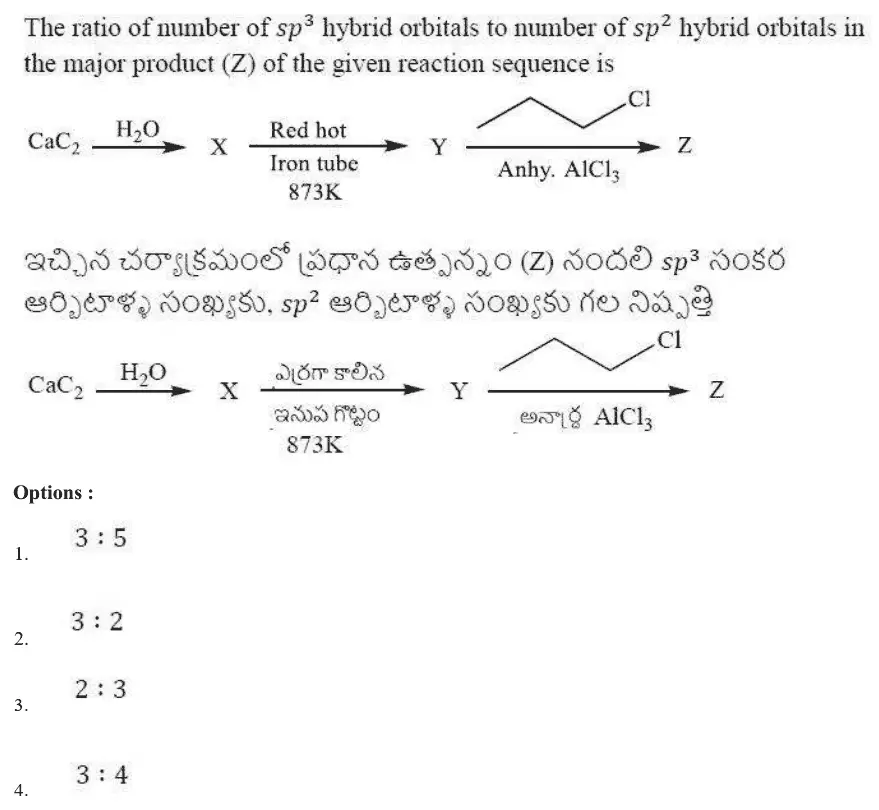
Get EdLoop – freeOpen on the web