From the following list, identify the number of substituents which exert $+R$ effect when present on benzene ring
$-\mathrm{Cl}$, $-\mathrm{COCH_3}$, $-\mathrm{NHC_2H_5}$, $-\mathrm{OCH_3}$, $-\mathrm{NHCOCH_3}$, $-\mathrm{COOCH_3}$
- A
5
- B
6
- C
3
- D
4
Every General Organic Chemistry question from past AP EAPCET and TS EAPCET papers, with options and answers. Newest first.
General Organic Chemistry occupies position 15 among the 31 chemistry chapters during the modern 2022 to 2026 testing cycle.
Attempt every General Organic Chemistry question timed, see the step-by-step solution and track what you get wrong. Free.
From the following list, identify the number of substituents which exert $+R$ effect when present on benzene ring
$-\mathrm{Cl}$, $-\mathrm{COCH_3}$, $-\mathrm{NHC_2H_5}$, $-\mathrm{OCH_3}$, $-\mathrm{NHCOCH_3}$, $-\mathrm{COOCH_3}$
5
6
3
4
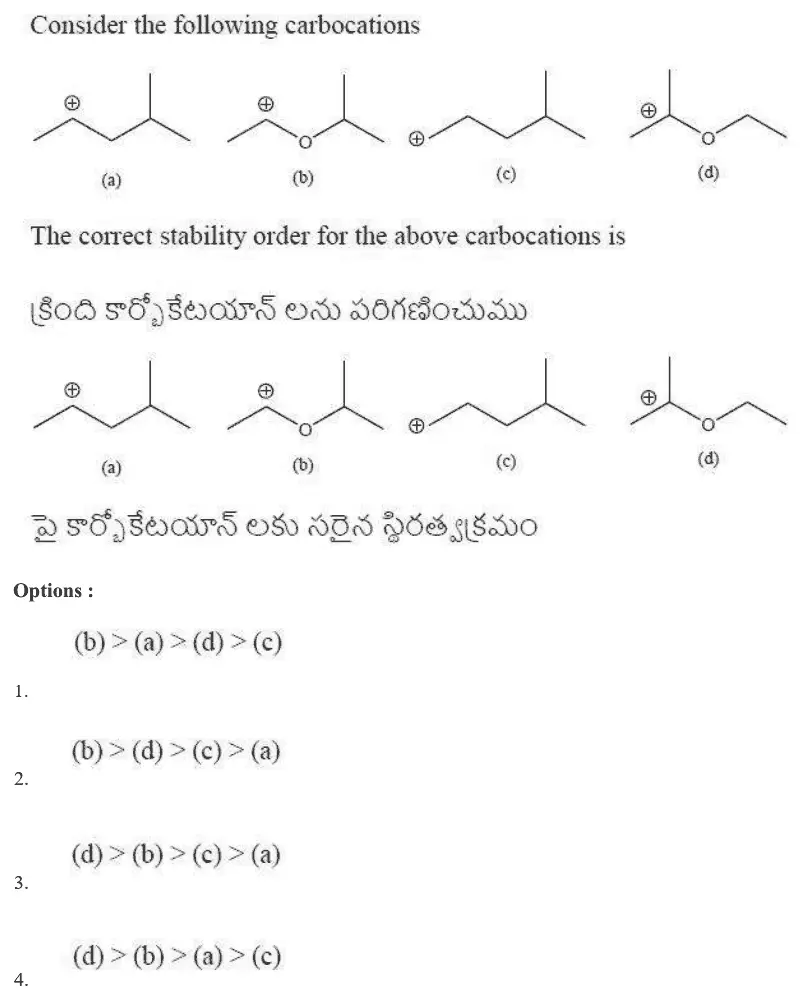
Consider the following carbocations
(see the figure above)
The correct stability order for the above carbocations is

$(b) > (a) > (d) > (c)$
$(b) > (d) > (c) > (a)$
$(d) > (b) > (c) > (a)$
$(d) > (b) > (a) > (c)$
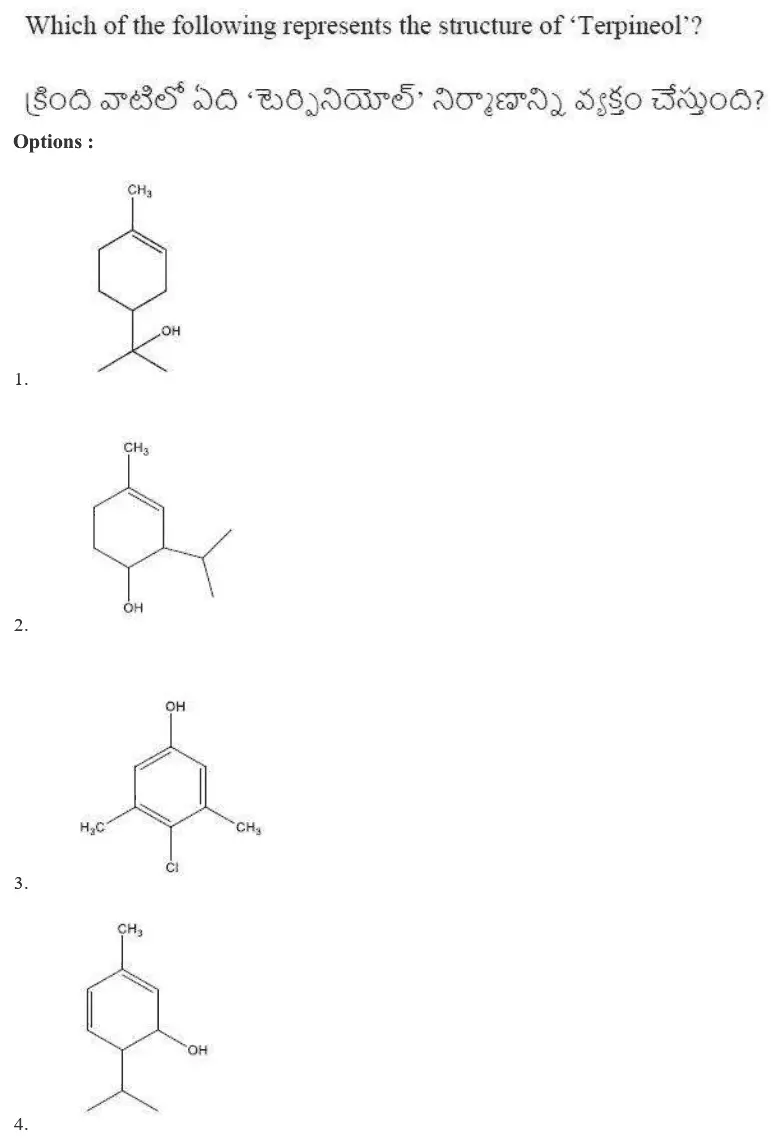
Which of the following represents the structure of ‘Terpineol’?

see figure Skeletal structure: cyclohexene ring with a CH3 at the top carbon, which has a double bond to the adjacent upper-right ring carbon. The carbon opposite (bottom) carries a C(OH)(CH3)2 group (a carbon bearing OH and two methyl groups).
see figure Skeletal structure: cyclohexene ring with a CH3 at the top carbon, which has a double bond to the adjacent upper-right ring carbon. The lower-right ring carbon carries an isopropyl group, and the bottom ring carbon carries OH.
see figure Skeletal structure: benzene ring with OH at the top, CH3 at the right (lower right), H3C at the left (lower left) and Cl at the bottom.
see figure Skeletal structure: cyclohexadiene ring with CH3 at the top carbon (double bond to the upper-right carbon) and a second double bond on the left side of the ring. The lower-right carbon carries OH and the bottom carbon carries an isopropyl group.
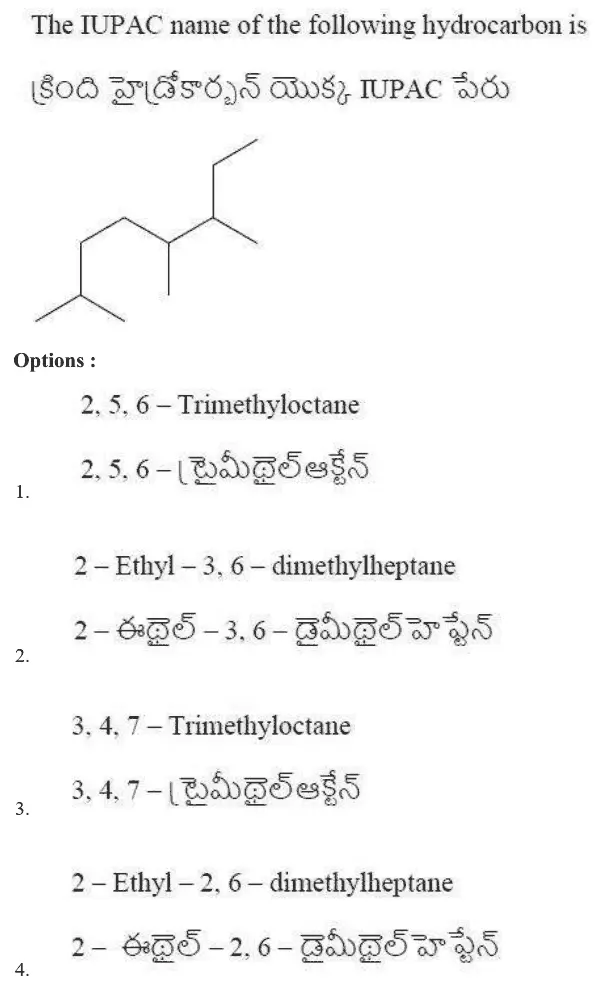
The IUPAC name of the following hydrocarbon is
(see the figure above)

2, 5, 6 – Trimethyloctane
2 – Ethyl – 3, 6 – dimethylheptane
3, 4, 7 – Trimethyloctane
2 – Ethyl – 2, 6 – dimethylheptane
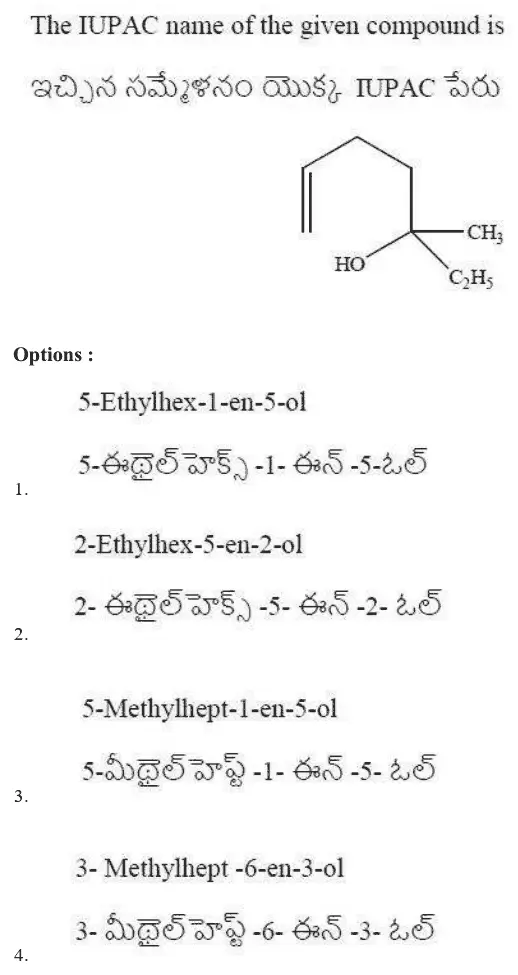
The IUPAC name of the given compound is
(see the figure above)

5-Ethylhex-1-en-5-ol
2-Ethylhex-5-en-2-ol
5-Methylhept-1-en-5-ol
3- Methylhept -6-en-3-ol
The number of monochloro derivatives possible for (i) Isopentane (ii) neopentane and (iii) 2, 3 – dimethylbutane are $x$, $y$ and $z$ respectively. The sum of $x$, $y$ and $z$ is
6
7
8
5
Which of the following exhibit cis-trans isomerism?
(I) 2 - Methylpent - 2 - ene
(II) Styrene
(III) 2 - Chlorobut - 2 - ene
(IV) 1 - Phenylprop - 1 - ene
The correct answer is
I & II only
III & IV only
I & III only
II & IV only
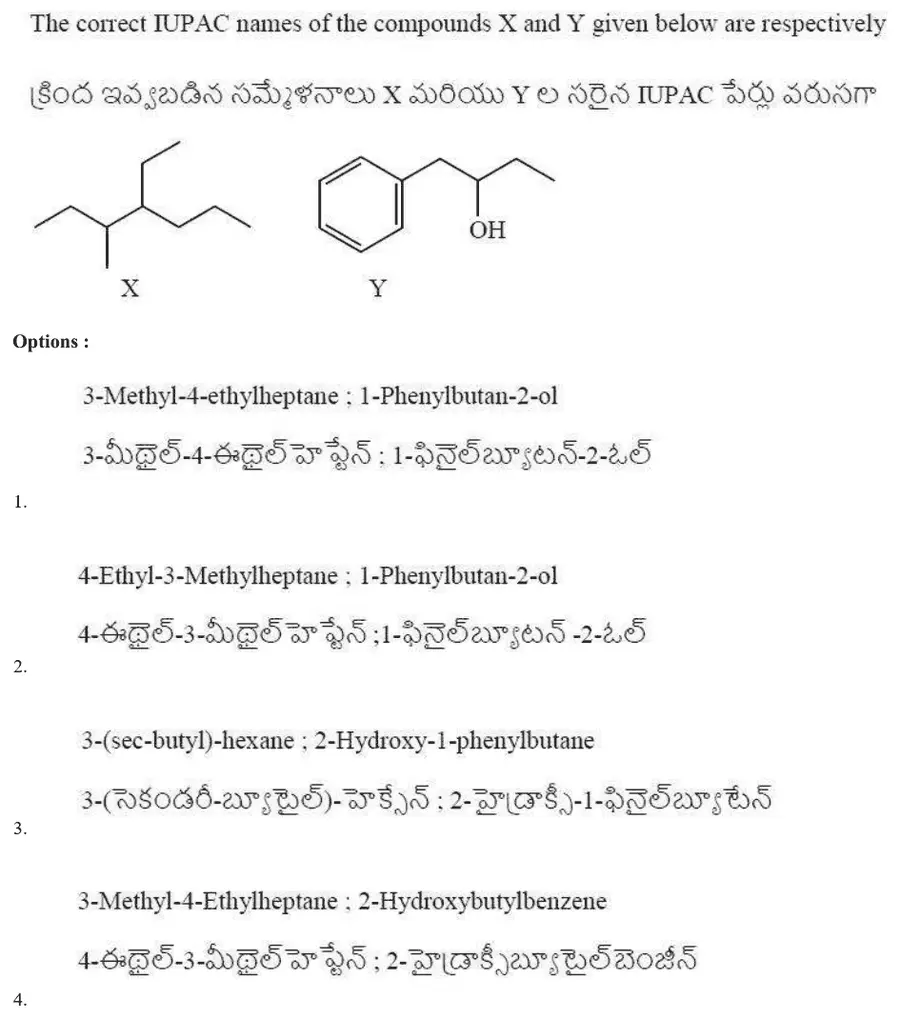
The correct IUPAC names of the compounds X and Y given below are respectively
(see the figure above)

3-Methyl-4-ethylheptane ; 1-Phenylbutan-2-ol
4-Ethyl-3-Methylheptane ; 1-Phenylbutan-2-ol
3-(sec-butyl)-hexane ; 2-Hydroxy-1-phenylbutane
3-Methyl-4-Ethylheptane ; 2-Hydroxybutylbenzene
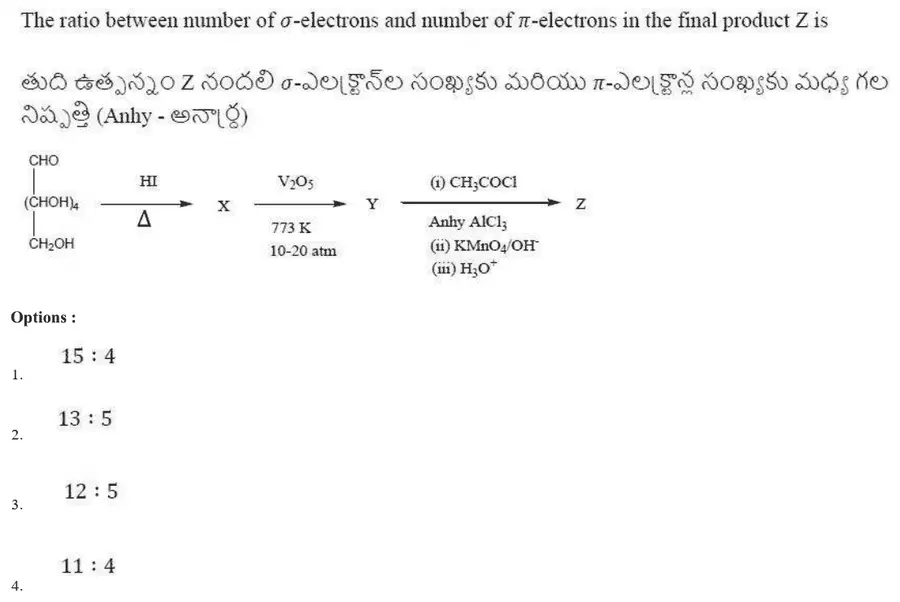
The ratio between number of $\sigma$-electrons and number of $\pi$-electrons in the final product Z is
(see the figure above)

$15 : 4$
$13 : 5$
$12 : 5$
$11 : 4$
The number of hyperconjugative hydrogens present in the product $Y$ is
$$\mathrm{CH_2=CH_2} \xrightarrow{HBr} X \xrightarrow[\text{Anhy.AlCl_3}]{\mathrm{C_6H_6}} Y$$
2
3
5
1
Which of the following compounds will show geometrical isomerism?
I. $(\mathrm{CH_3})_2\mathrm{C} = \mathrm{CH\,C_2H_5}$
II. $\mathrm{C_6H_5\,CH} = \mathrm{CH\,C_2H_5}$
III. $\mathrm{C_6H_5\,CH} = \mathrm{CH_2}$
IV. $\mathrm{CH_3CH} = \mathrm{C(Cl)CH_3}$
The correct answer is
I & II only
II & III only
I & III only
II & IV only
In the four species (I, II, III and IV) given below, $\sigma$ and $\pi$-electrons are delocalized in two species (X). Only $\pi$-electrons are delocalized in other two species (Y). What are X and Y respectively?
| But-2-ene | Tropylium Cation | Nitrobenzene | Toluene |
|---|---|---|---|
| I | II | III | IV |
X = II, IV ; Y = I, III
X = II, III ; Y = I, IV
X = I, III ; Y = II, IV
X = I, IV ; Y = II, III
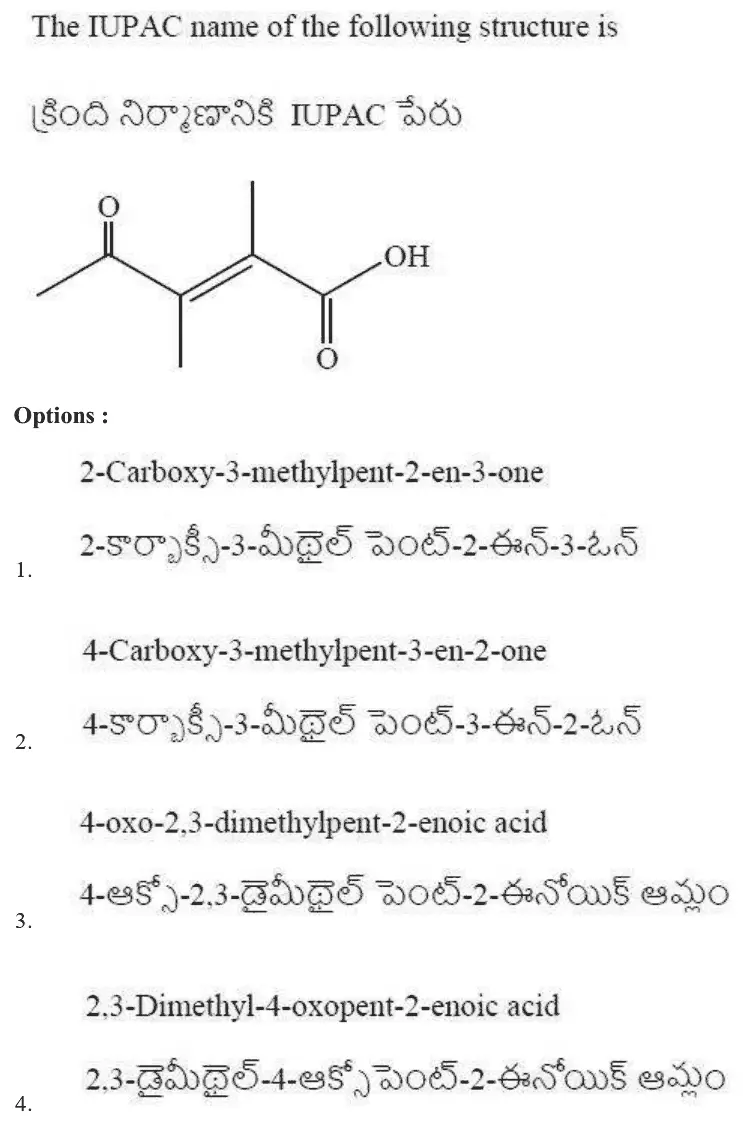
The IUPAC name of the following structure is
(see the figure above)

2-Carboxy-3-methylpent-2-en-3-one
4-Carboxy-3-methylpent-3-en-2-one
4-oxo-2,3-dimethylpent-2-enoic acid
2,3-Dimethyl-4-oxopent-2-enoic acid
The compound which is not isomeric with ethoxyethane?
Propylmethylether
Butan-2-ol
Butanone
2-Methylpropan-1-ol
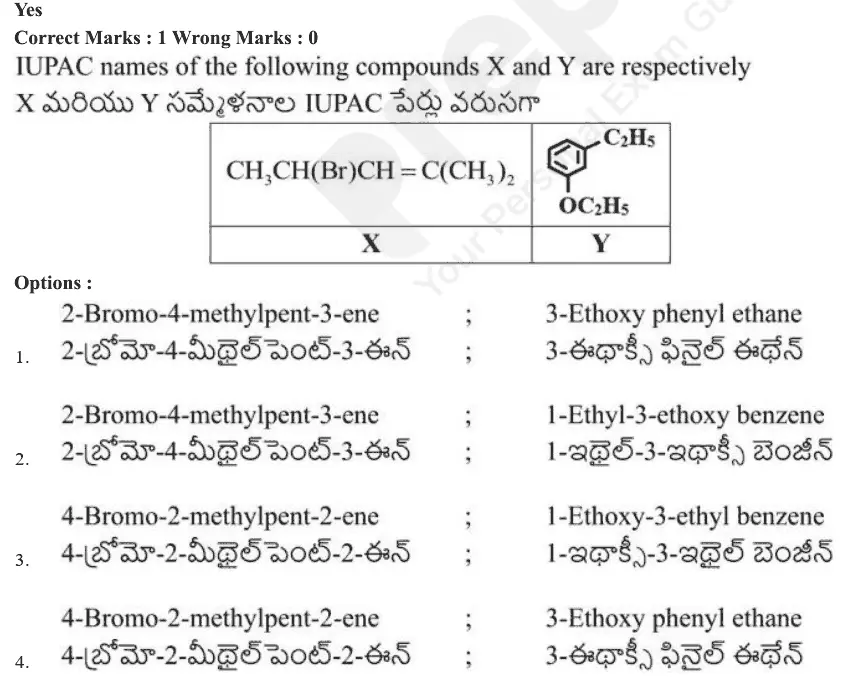
IUPAC names of the following compounds X and Y are respectively
| $\mathrm{CH_3CH(Br)CH=C(CH_3)_2}$ | (see the figure above) |
|---|---|
| X | Y |

2-Bromo-4-methylpent-3-ene ; 3-Ethoxy phenyl ethane
2-Bromo-4-methylpent-3-ene ; 1-Ethyl-3-ethoxy benzene
4-Bromo-2-methylpent-2-ene ; 1-Ethoxy-3-ethyl benzene
4-Bromo-2-methylpent-2-ene ; 3-Ethoxy phenyl ethane
In Dettol, chloroxylenol is one component. The IUPAC name of it is
4-Chloro – 3,5-dimethylphenol
3-Chloro – 4,5-dimethylphenol
4-Chloro – 2,5-dimethylphenol
5-Chloro – 2,3-dimethylphenol
Identify the compound which has $1^\circ, 2^\circ, 3^\circ$ and $4^\circ$ carbons
2, 2, 3, 3-Tetramethylpentane
2, 2-Dimethylpentane
2, 2, 3-Trimethylpentane
2-Methylpentane
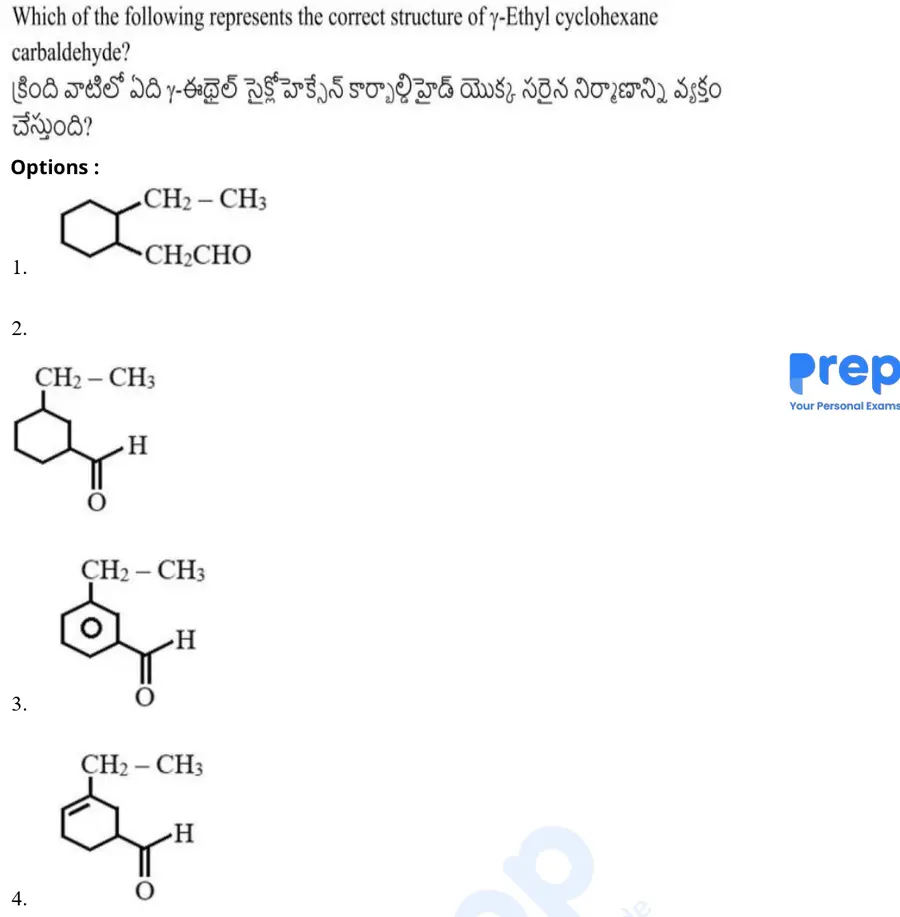
Which of the following represents the correct structure of $\gamma$-Ethyl cyclohexane carbaldehyde?

see figure Cyclohexane ring with two substituents on the same ring carbon: $\mathrm{CH_2-CH_3}$ (upper) and $\mathrm{CH_2CHO}$ (lower).
see figure Cyclohexane ring with $\mathrm{CH_2-CH_3}$ on the top ring carbon (a ring carbon next to the one bearing the CHO group, meta position), and a CHO group (C(=O)H, with O drawn below and H to the right) attached at the lower right ring carbon.
see figure Benzene ring (drawn with a circle inside) with $\mathrm{CH_2-CH_3}$ on the top ring carbon and a CHO group (C(=O)H, O below, H to the right) on the lower right ring carbon.
see figure Cyclohexene ring (one double bond at the upper left, adjacent to the top carbon) with $\mathrm{CH_2-CH_3}$ on the top ring carbon and a CHO group (C(=O)H, O below, H to the right) on the lower right ring carbon.
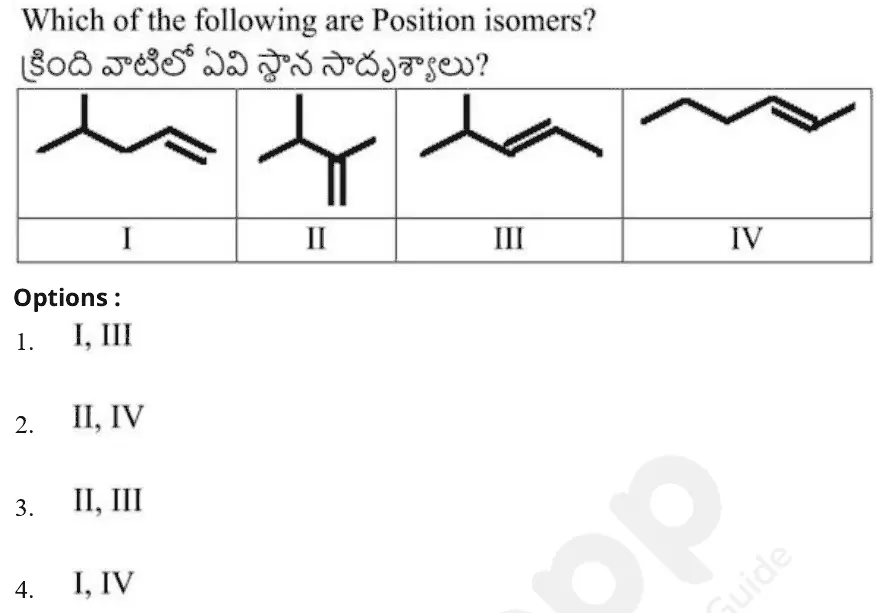
Which of the following are Position isomers?
(see the figure above)

I, III
II, IV
II, III
I, IV
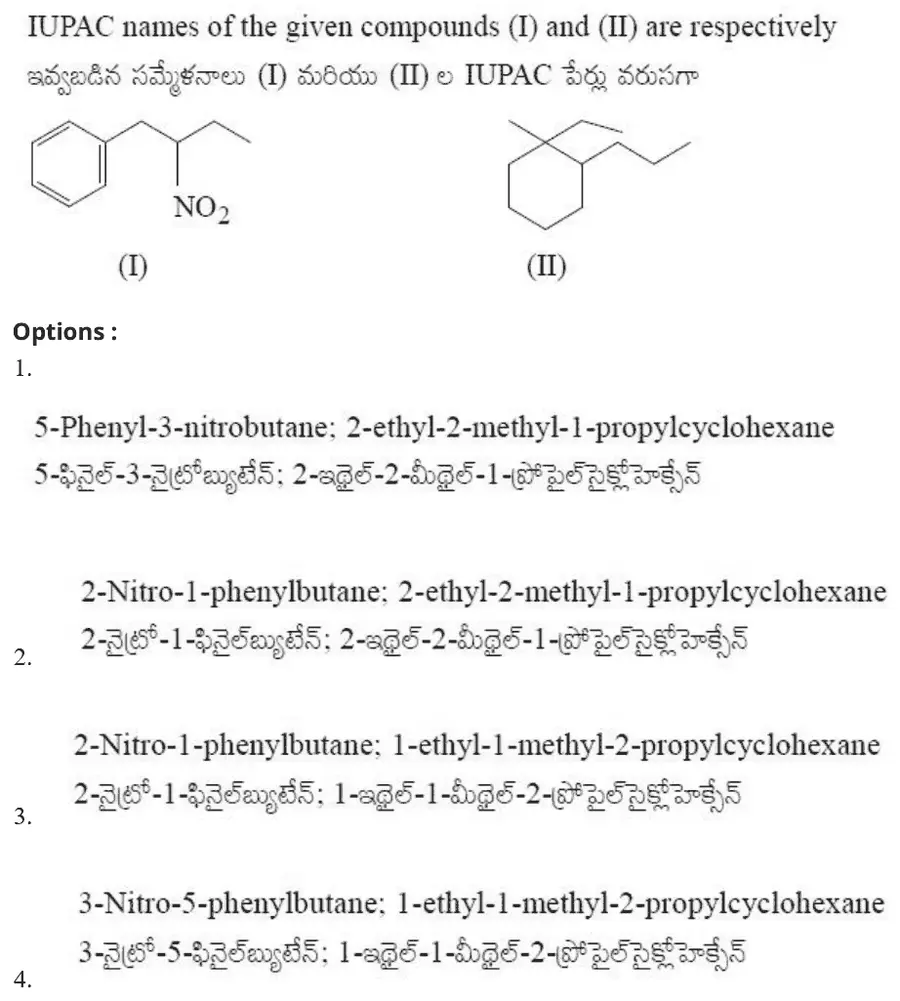
IUPAC names of the given compounds (I) and (II) are respectively
(see the figure above)

5-Phenyl-3-nitrobutane; 2-ethyl-2-methyl-1-propylcyclohexane
2-Nitro-1-phenylbutane; 2-ethyl-2-methyl-1-propylcyclohexane
2-Nitro-1-phenylbutane; 1-ethyl-1-methyl-2-propylcyclohexane
3-Nitro-5-phenylbutane; 1-ethyl-1-methyl-2-propylcyclohexane
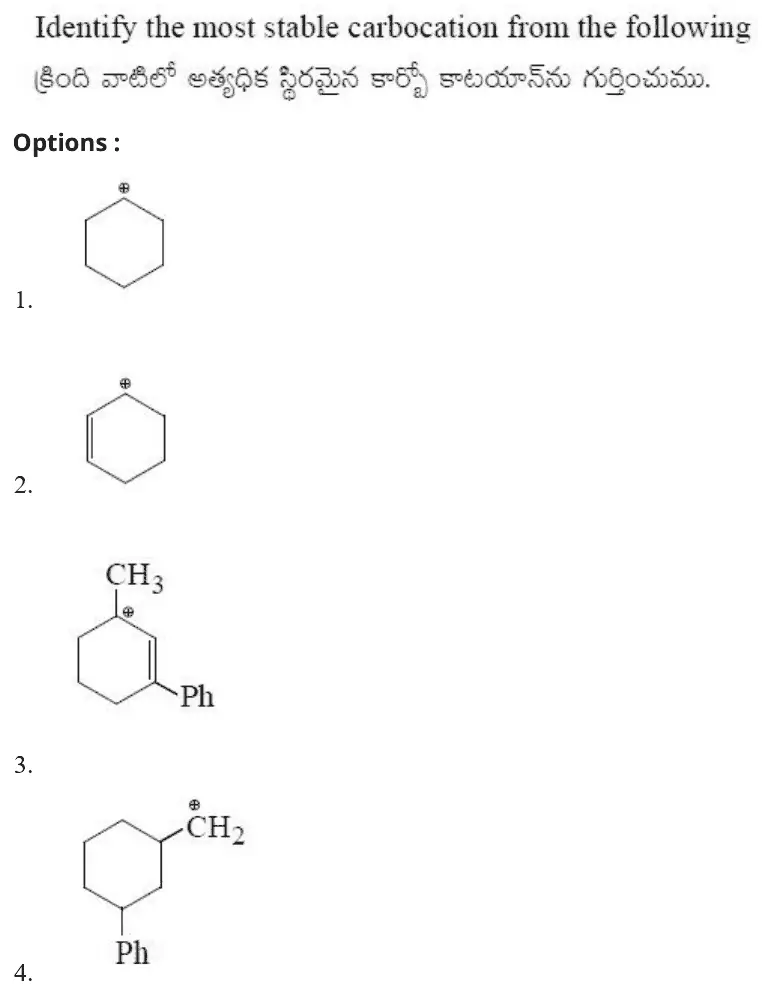
Identify the most stable carbocation from the following

see figure Cyclohexyl carbocation: a cyclohexane ring with a + charge on the top carbon.
see figure Cyclohexenyl (allyl-type) carbocation: a cyclohexene ring with a + charge on the top carbon, which is adjacent to the C=C double bond drawn on the left side of the ring.
see figure Cyclohexenyl carbocation with substituents: the top-left carbon carries the + charge and a CH3 group. The C=C double bond is on the right side of the ring, between the top-right carbon and the lower-right carbon. The lower-right carbon carries a Ph group.
see figure A cyclohexane ring with a CH2+ group (primary carbocation) attached at the upper right carbon and a Ph group at the bottom carbon (1,3-disubstituted).
In compound (X), hyperconjugation is present and in (Y), resonance effect is present. What are X and Y, respectively ?
Toluene, prop-2-en-1-ol
Aniline, 2-propenal
Toluene, nitrobenzene
1-Bromopropane, phenol
IUPAC names of mesityl oxide and oxalic acid are respectively
4 - Methylpent - 3 - en - 2 - one; Ethanedioic acid
4 - Methylpent - 3 - en - 2 - one; Propanedioic acid
3 - Methylpent - 3 - en - 2 - one; Propanedioic acid
3 - Methylpent - 3 - en - 2 - one; Ethanedioic acid
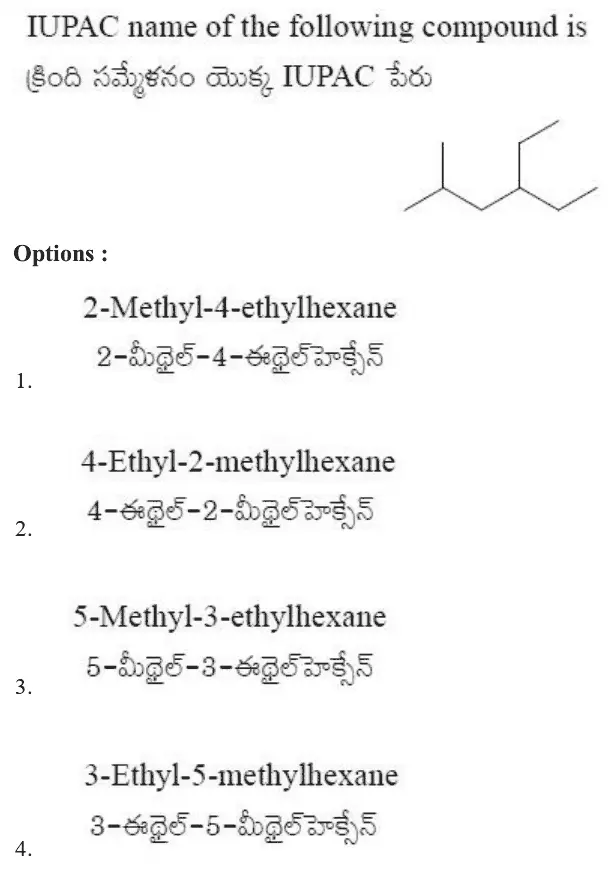
IUPAC name of the following compound is
(see the figure above)

2-Methyl-4-ethylhexane
4-Ethyl-2-methylhexane
5-Methyl-3-ethylhexane
3-Ethyl-5-methylhexane
The correct decreasing order of priority for the functional group of organic compounds in the IUPAC method of nomenclature is
$-\mathrm{CHO} > -\mathrm{OH} > -\mathrm{CONH_2} > -\mathrm{COCl}$
$-\mathrm{CONH_2} > -\mathrm{CHO} > -\mathrm{COCl} > -\mathrm{OH}$
$-\mathrm{COCl} > -\mathrm{CONH_2} > -\mathrm{CHO} > -\mathrm{OH}$
$-\mathrm{CHO} > -\mathrm{CONH_2} > -\mathrm{COCl} > -\mathrm{OH}$
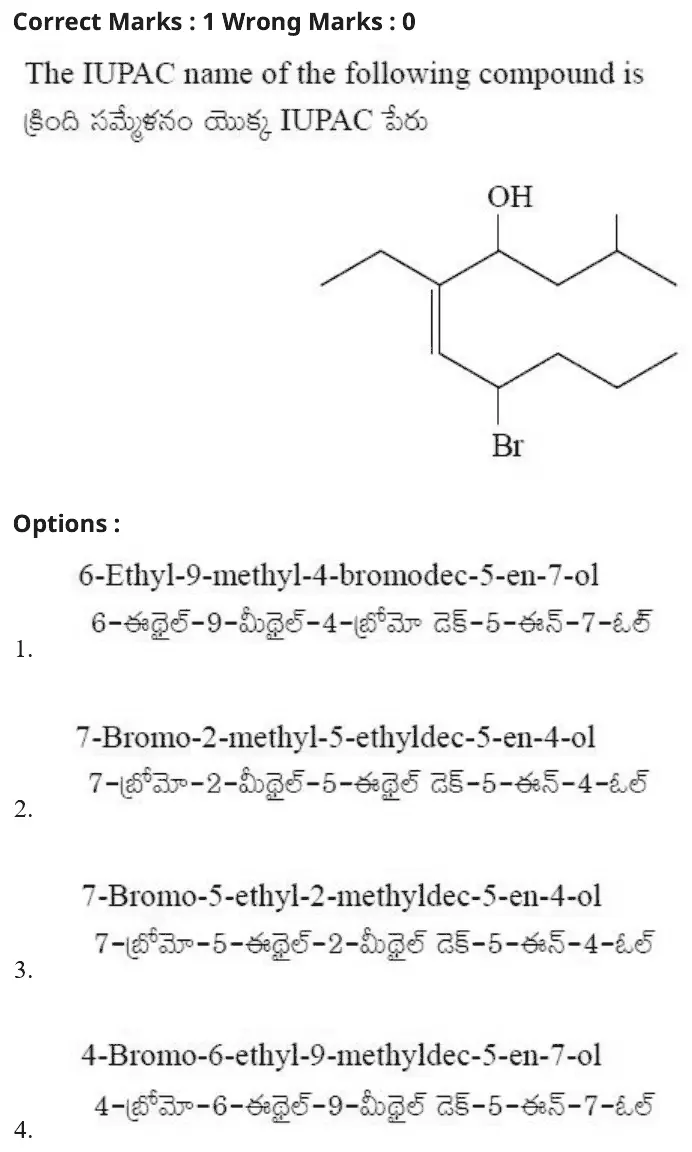
The IUPAC name of the following compound is
(see the figure above)

6-Ethyl-9-methyl-4-bromodec-5-en-7-ol
7-Bromo-2-methyl-5-ethyldec-5-en-4-ol
7-Bromo-5-ethyl-2-methyldec-5-en-4-ol
4-Bromo-6-ethyl-9-methyldec-5-en-7-ol
The number of primary ($1^\circ$), secondary ($2^\circ$) and tertiary ($3^\circ$) alcohols possible for the formula $\mathrm{C_5H_{12}O}$ respectively are
3, 3, 2
4, 2, 2
4, 3, 1
3, 4, 1
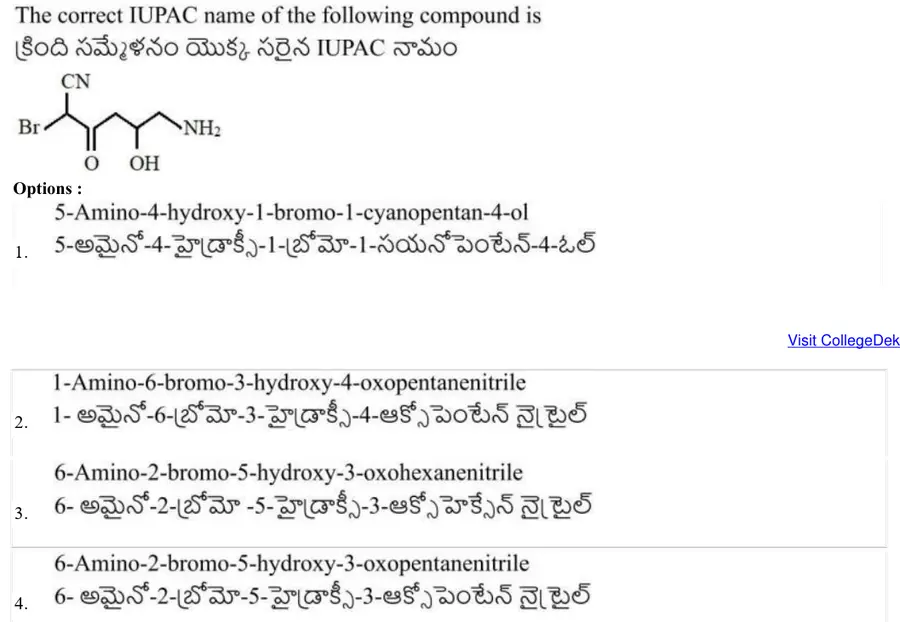
The correct IUPAC name of the following compound is
(see the figure above)

5-Amino-4-hydroxy-1-bromo-1-cyanopentan-4-ol
1-Amino-6-bromo-3-hydroxy-4-oxopentanenitrile
6-Amino-2-bromo-5-hydroxy-3-oxohexanenitrile
6-Amino-2-bromo-5-hydroxy-3-oxopentanenitrile
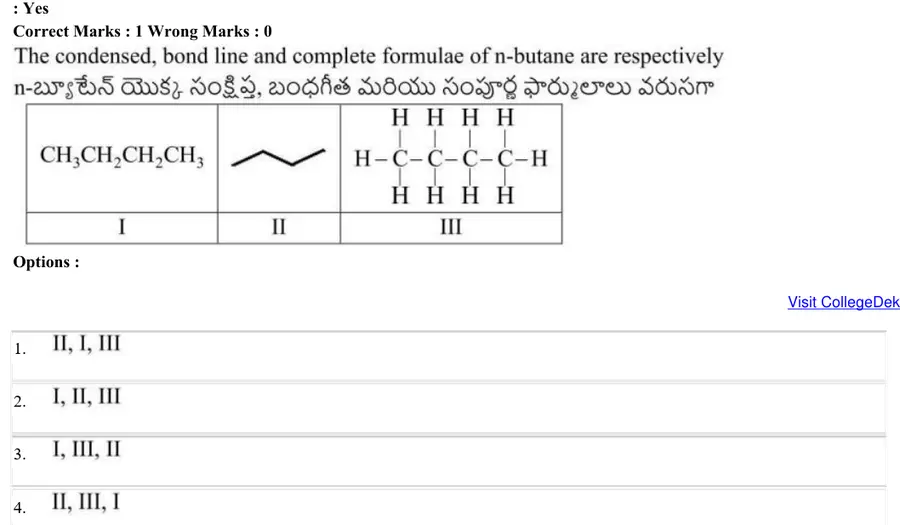
The condensed, bond line and complete formulae of n-butane are respectively
| $\mathrm{CH_3CH_2CH_2CH_3}$ | (see the figure above) | (see the figure above) |
| I | II | III |

II, I, III
I, II, III
I, III, II
II, III, I
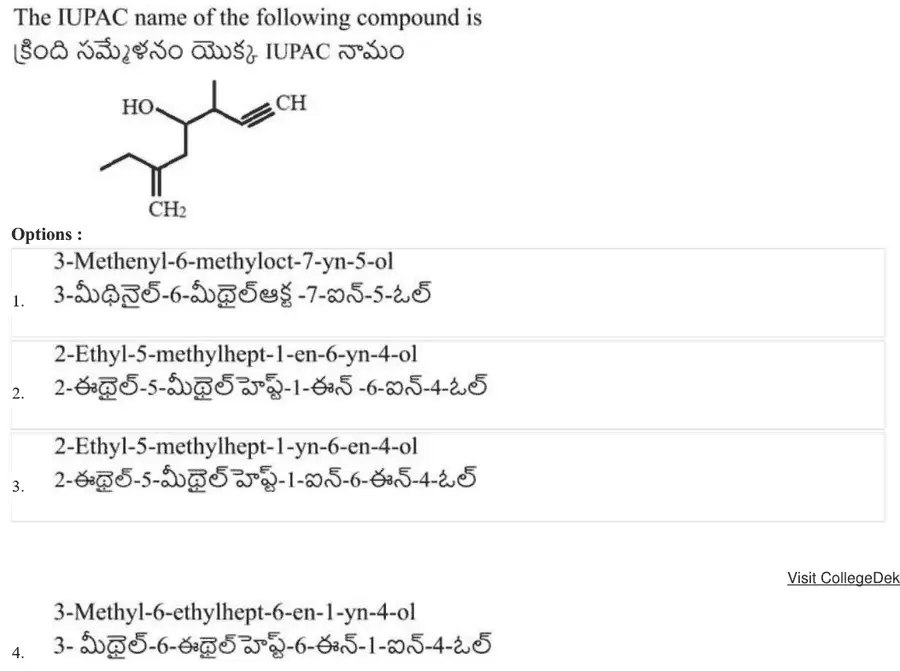
The IUPAC name of the following compound is
(see the figure above)

3-Methenyl-6-methyloct-7-yn-5-ol
2-Ethyl-5-methylhept-1-en-6-yn-4-ol
2-Ethyl-5-methylhept-1-yn-6-en-4-ol
3-Methyl-6-ethylhept-6-en-1-yn-4-ol
An alkyne has the molecular formula $\mathrm{C_6H_{10}}$. The number of 1-alkyne isomers (excluding stereoisomers) possible for it is
2
5
3
4
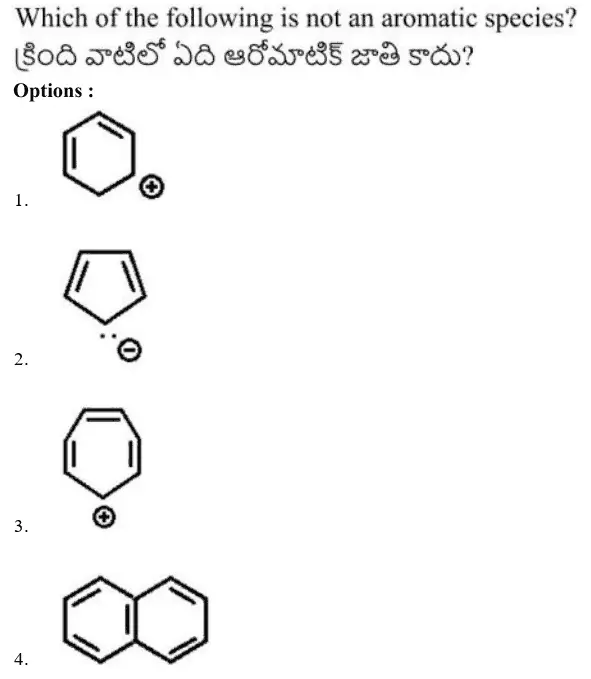
Which of the following is not an aromatic species?

see figure Six-membered ring (cyclohexenyl cation) with two double bonds drawn in the ring (one at top right, one at left side), one sp3 carbon at bottom right bearing a positive charge (circled +).
see figure Cyclopentadienyl anion: five-membered ring with two double bonds (left and right sides) and the bottom carbon bearing a lone pair (two dots) and a negative charge (circled −).
see figure Cycloheptatrienyl (tropylium) cation drawn as a seven-membered ring with three double bonds (top, left, right) and the bottom carbon bearing a positive charge (circled +).
see figure Naphthalene: two fused six-membered rings with alternating double bonds.
Which of the following is a least stable carbocation?
$\mathrm{CH_3 - \overset{\oplus}{C}H_2}$
$\mathrm{CH_2 = \overset{\oplus}{C}H}$
$\mathrm{CH_2 = CH - \overset{\oplus}{C}H_2}$
$\mathrm{C_6H_5 - \overset{\oplus}{C}H_2}$
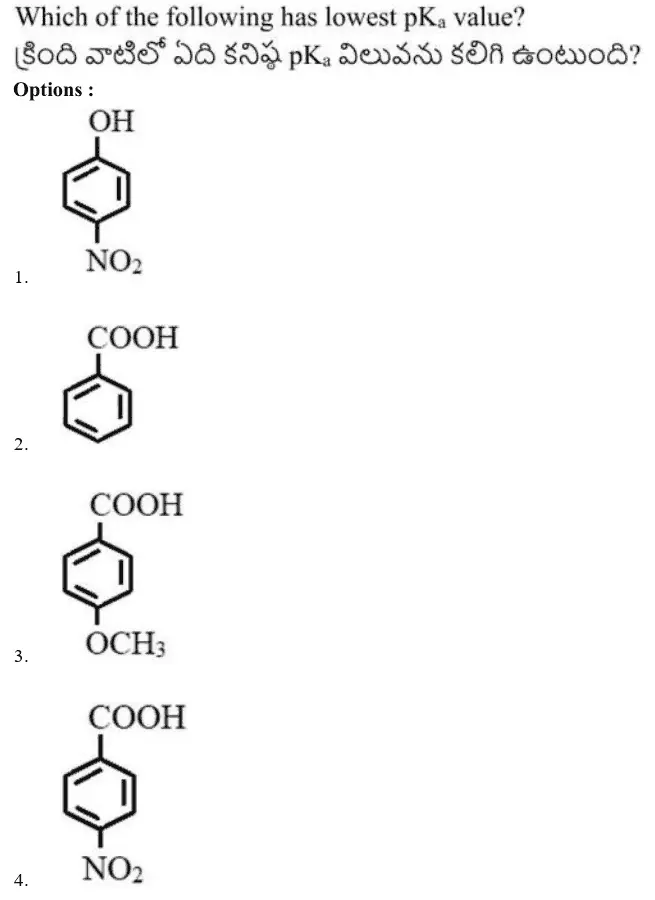
Which of the following has lowest $\mathrm{pK_a}$ value?

see figure 4-nitrophenol: benzene ring with OH at the top and NO2 at the bottom (para)
see figure benzoic acid: benzene ring with COOH
see figure 4-methoxybenzoic acid: benzene ring with COOH at the top and OCH3 at the bottom (para)
see figure 4-nitrobenzoic acid: benzene ring with COOH at the top and NO2 at the bottom (para)
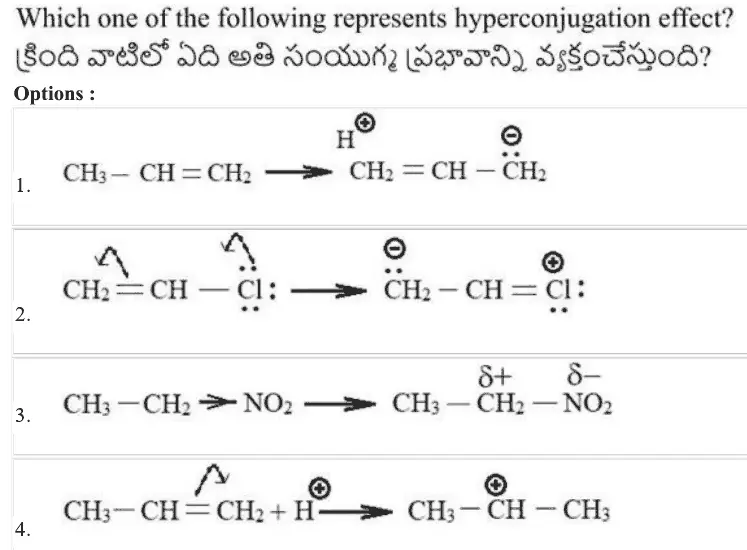
Which one of the following represents hyperconjugation effect?

see figure $\mathrm{CH_3-CH=CH_2}$ → (over the arrow: $\mathrm{H^{\oplus}}$) $\mathrm{CH_2=CH-\ddot{C}H_2}$ with a negative charge ($\ominus$) on the last carbon
see figure $\mathrm{CH_2=CH-\ddot{Cl}:}$ with curved arrows (one from the C=C double bond, one from the Cl lone pair) → $\mathrm{\ddot{C}H_2-CH=\ddot{Cl}:}$ with $\ominus$ on the terminal CH2 and $\oplus$ on Cl
see figure $\mathrm{CH_3-CH_2\rightarrow NO_2}$ (arrow pointing toward $\mathrm{NO_2}$) → $\mathrm{CH_3-CH_2-NO_2}$ with $\delta+$ over $\mathrm{CH_2}$ and $\delta-$ over $\mathrm{NO_2}$
see figure $\mathrm{CH_3-CH=CH_2 + H^{\oplus}}$ with a curved arrow from the double bond toward $\mathrm{H^{\oplus}}$ → $\mathrm{CH_3-\overset{\oplus}{C}H-CH_3}$
For the alkyne with formula $\mathrm{C_6H_{10}}$, the number of alkynes with acidic hydrogens is $x$ and number of alkynes with no acidic hydrogens is $y$. $x$ and $y$ are respectively
2, 5
3, 4
4, 3
5, 2
Which of the following is an example of electrophilic substitution reaction?
$\mathrm{CH_3CHO + HCN \rightarrow CH_3CH(OH)CN}$
$\mathrm{(CH_3)_3CX + H_2O \rightarrow (CH_3)_3C-OH + HX}$
$\mathrm{C_6H_6 + CH_3COCl \xrightarrow{AlCl_3} C_6H_5(COCH_3) + HCl}$
$\mathrm{Br\,CH_2CH_2Br + Zn \xrightarrow[\Delta]{alcohol} CH_2=CH_2 + ZnBr_2}$
The number of alicyclic compounds from the following is
Cyclohexene, Anisole, Pyridine, Tetrahydrofuran, Biphenyl
2
3
1
4
The number of isomers possible for a dibromo derivate (Molecular weight = 186 u) of an alkene is (Br = 80 u)
2
3
4
6
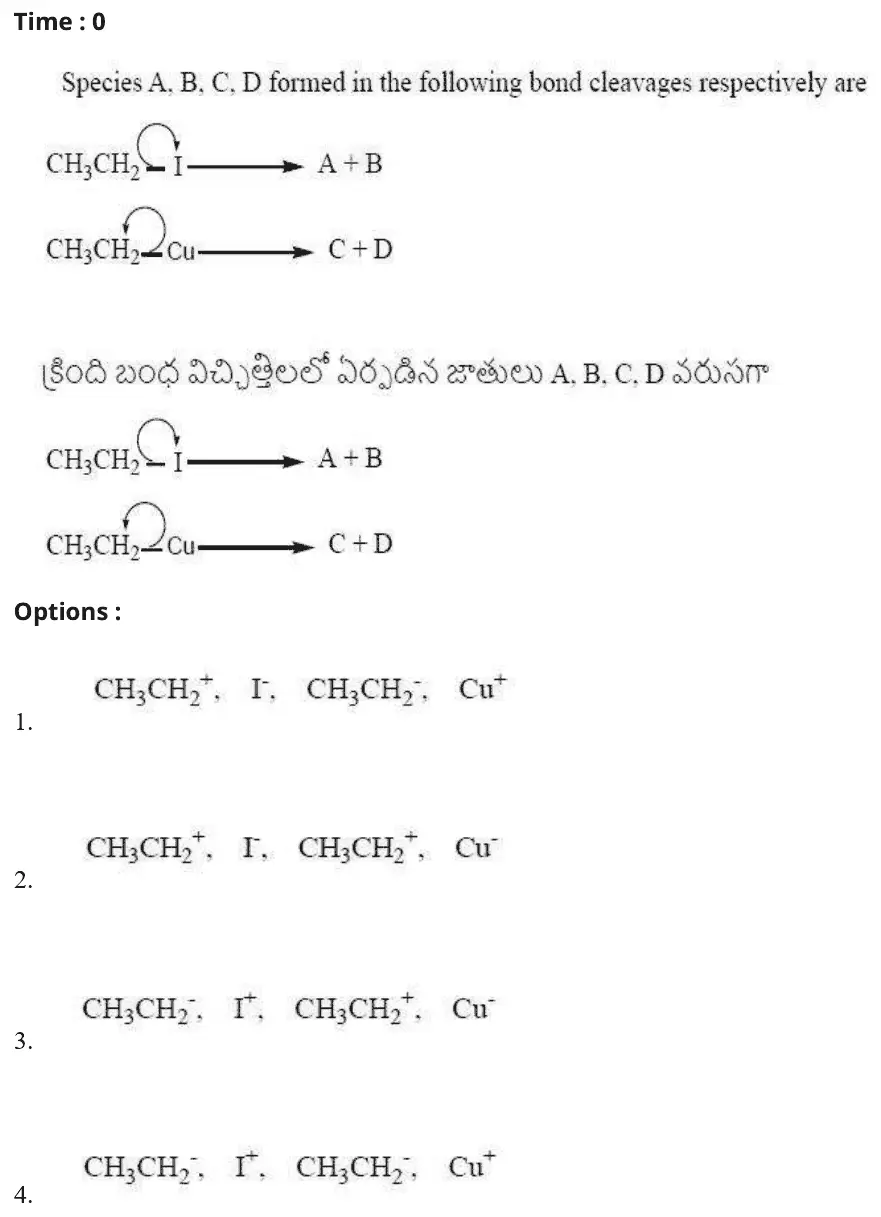
Species A, B, C, D formed in the following bond cleavages respectively are
(see the figure above)

$\mathrm{CH_3CH_2^+}$, $\mathrm{I^-}$, $\mathrm{CH_3CH_2^-}$, $\mathrm{Cu^+}$
$\mathrm{CH_3CH_2^+}$, $\mathrm{I^-}$, $\mathrm{CH_3CH_2^+}$, $\mathrm{Cu^-}$
$\mathrm{CH_3CH_2^-}$, $\mathrm{I^+}$, $\mathrm{CH_3CH_2^+}$, $\mathrm{Cu^-}$
$\mathrm{CH_3CH_2^-}$, $\mathrm{I^+}$, $\mathrm{CH_3CH_2^-}$, $\mathrm{Cu^+}$
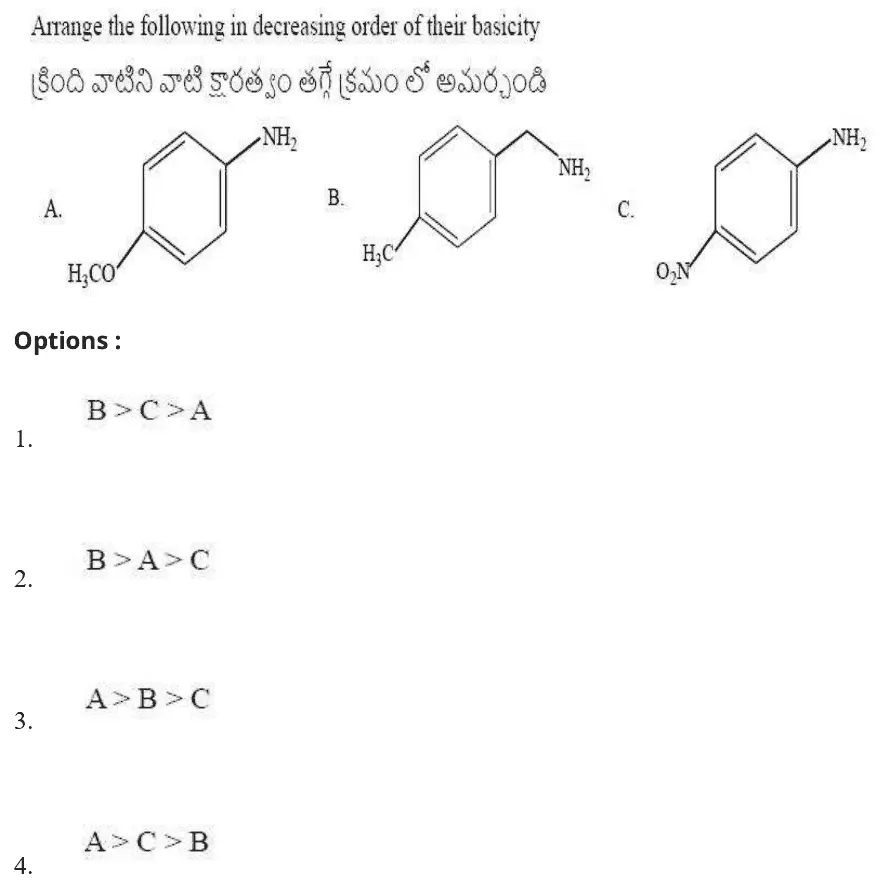
Arrange the following in decreasing order of their basicity
(see the figure above)

$B > C > A$
$B > A > C$
$A > B > C$
$A > C > B$
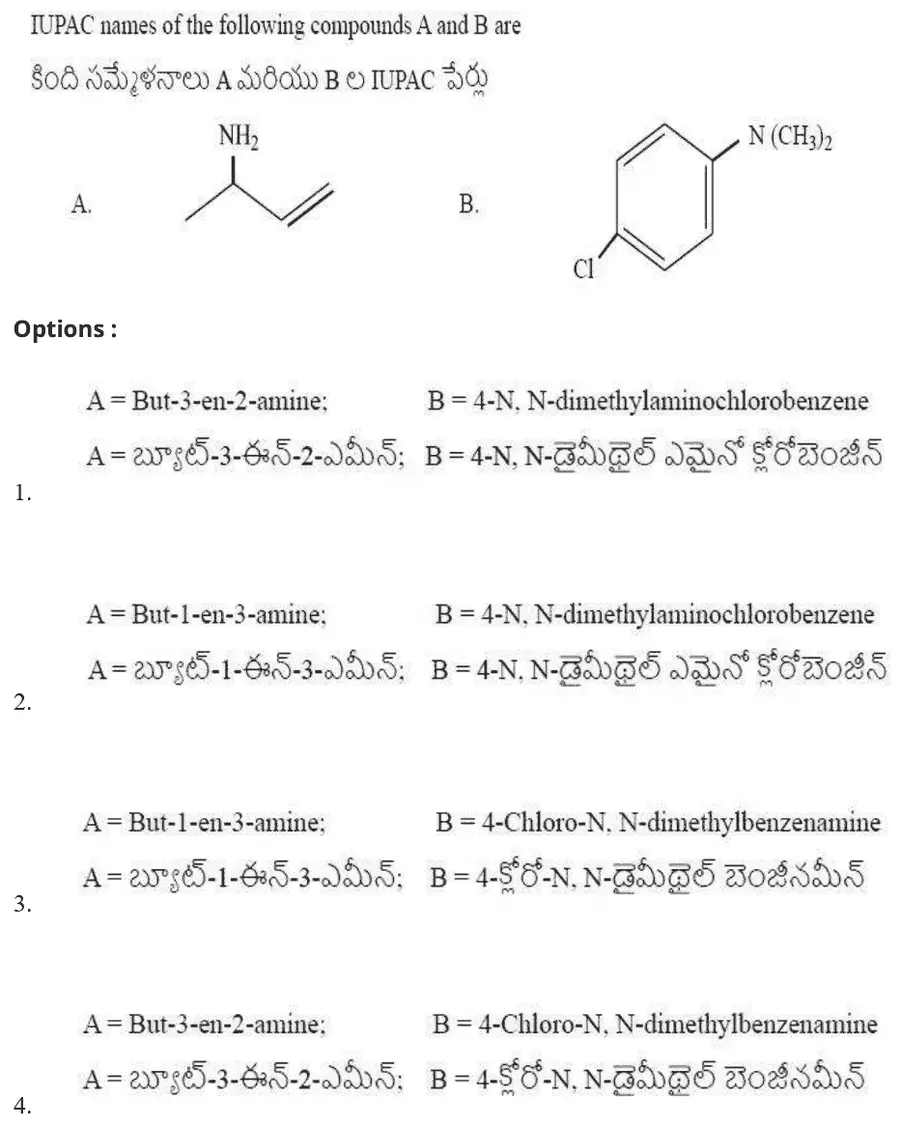
IUPAC names of the following compounds A and B are
(see the figure above)

A = But-3-en-2-amine; B = 4-N, N-dimethylaminochlorobenzene
A = But-1-en-3-amine; B = 4-N, N-dimethylaminochlorobenzene
A = But-1-en-3-amine; B = 4-Chloro-N, N-dimethylbenzenamine
A = But-3-en-2-amine; B = 4-Chloro-N, N-dimethylbenzenamine
The number of nucleophiles in the following list is
$\mathrm{CH_3NH_2}$, $\mathrm{CH_3CHO}$, $\mathrm{C_2H_4}$, $\mathrm{CH_3SH}$
3
2
4
1
Tropolone is an example for which of the following class of compounds?
Benzenoid aromatic compound
Non-Benzenoid aromatic compound
Alicylic compound
Heterocyclic aromatic compound
From the following identify the groups that exhibit negative resonance (−R) effect when attached to conjugated system
| formyl | amino | alkoxy | cyano | nitro |
|---|---|---|---|---|
| A | B | C | D | E |
A, C, E only
B, C, D only
A, D, E only
B, D, E only
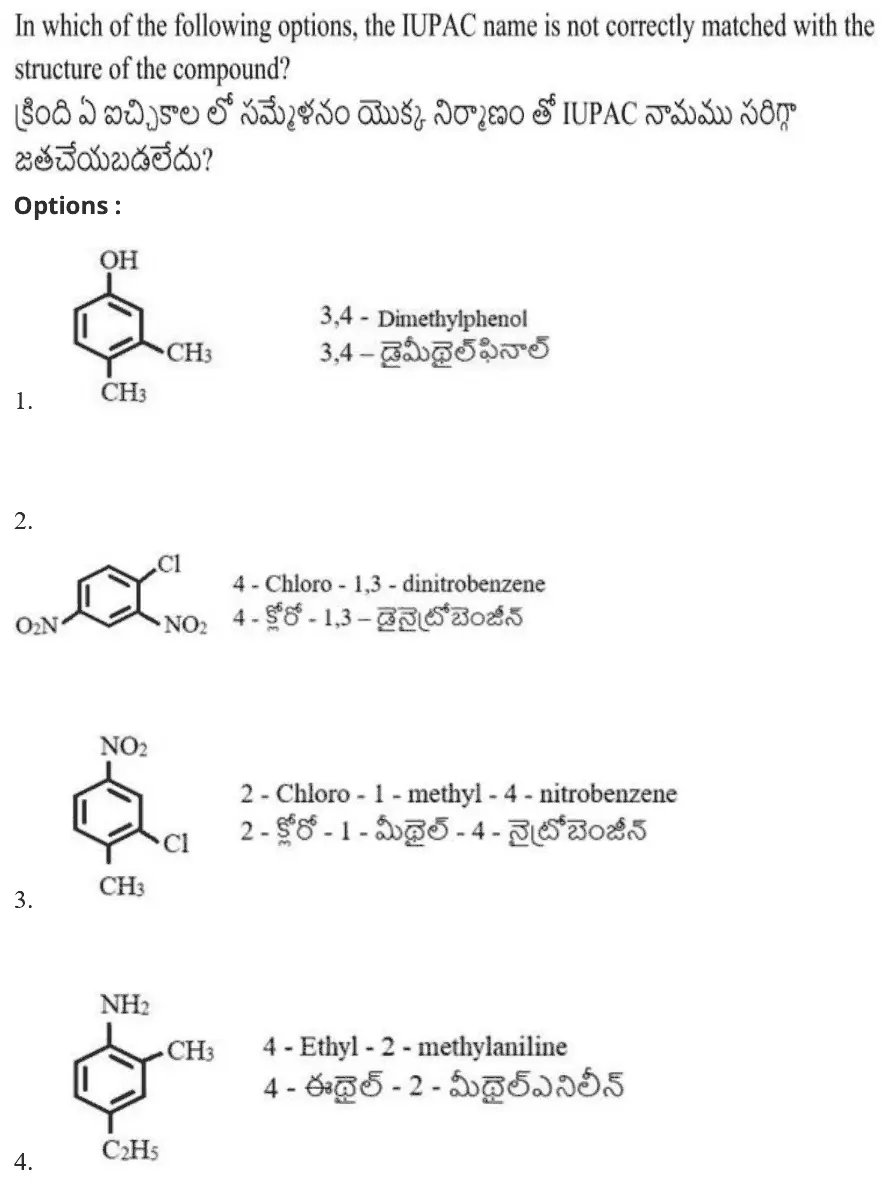
In which of the following options, the IUPAC name is not correctly matched with the structure of the compound?

see figure Benzene ring with OH at top (position 1), CH$_3$ at the lower-right carbon and CH$_3$ at the bottom carbon; name: 3,4 - Dimethylphenol
see figure Benzene ring with Cl at the top-right carbon, NO$_2$ at the lower-right carbon and O$_2$N at the left carbon; name: 4 - Chloro - 1,3 - dinitrobenzene
see figure Benzene ring with NO$_2$ at top, Cl at the lower-right carbon and CH$_3$ at the bottom carbon; name: 2 - Chloro - 1 - methyl - 4 - nitrobenzene
see figure Benzene ring with NH$_2$ at top, CH$_3$ at the upper-right carbon and C$_2$H$_5$ at the bottom carbon; name: 4 - Ethyl - 2 - methylaniline
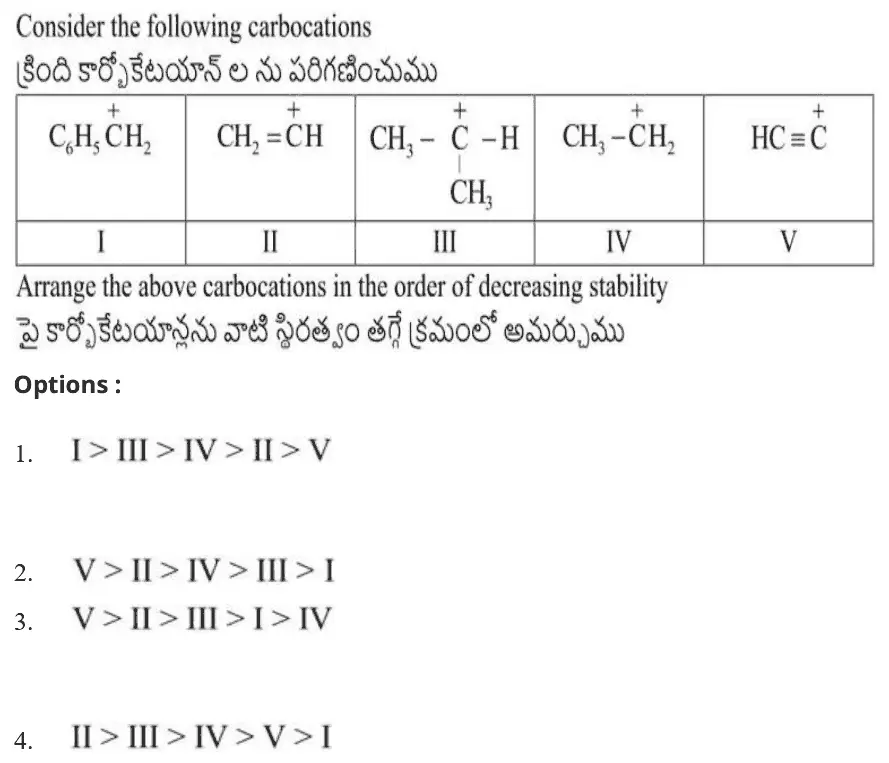
Consider the following carbocations
| I | II | III | IV | V |
|---|---|---|---|---|
| $\mathrm{C_6H_5\overset{+}{C}H_2}$ | $\mathrm{CH_2=\overset{+}{C}H}$ | (see the figure above) | $\mathrm{CH_3-\overset{+}{C}H_2}$ | $\mathrm{H C\equiv \overset{+}{C}}$ |
Arrange the above carbocations in the order of decreasing stability

I > III > IV > II > V
V > II > IV > III > I
V > II > III > I > IV
II > III > IV > V > I
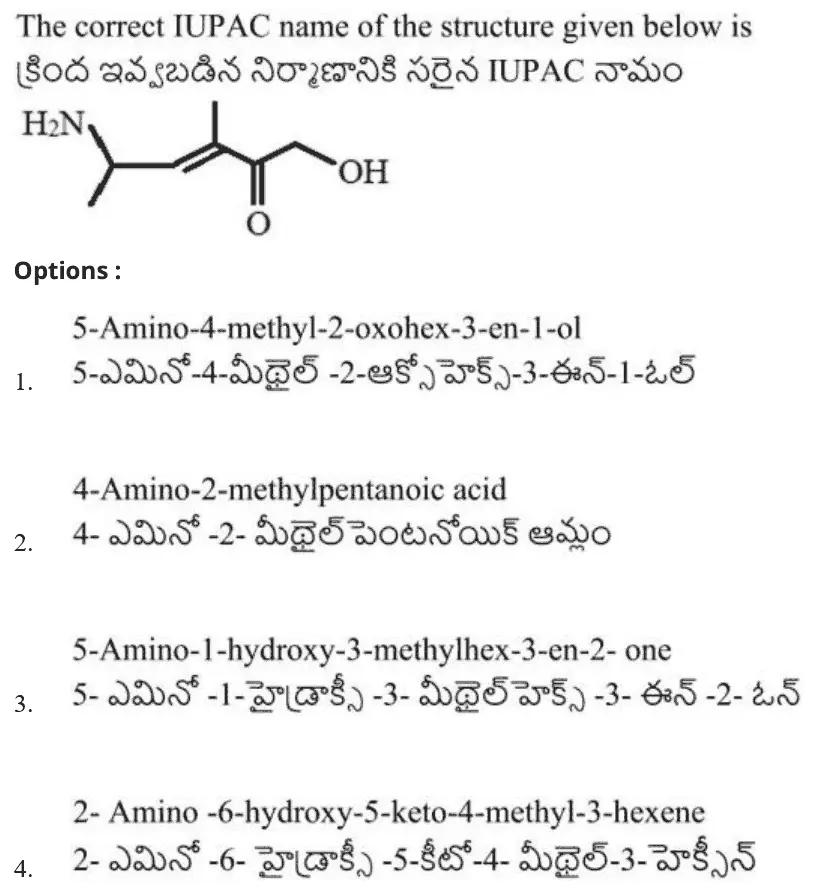
The correct IUPAC name of the structure given below is
(see the figure above)

5-Amino-4-methyl-2-oxohex-3-en-1-ol
4-Amino-2-methylpentanoic acid
5-Amino-1-hydroxy-3-methylhex-3-en-2- one
2- Amino -6-hydroxy-5-keto-4-methyl-3-hexene
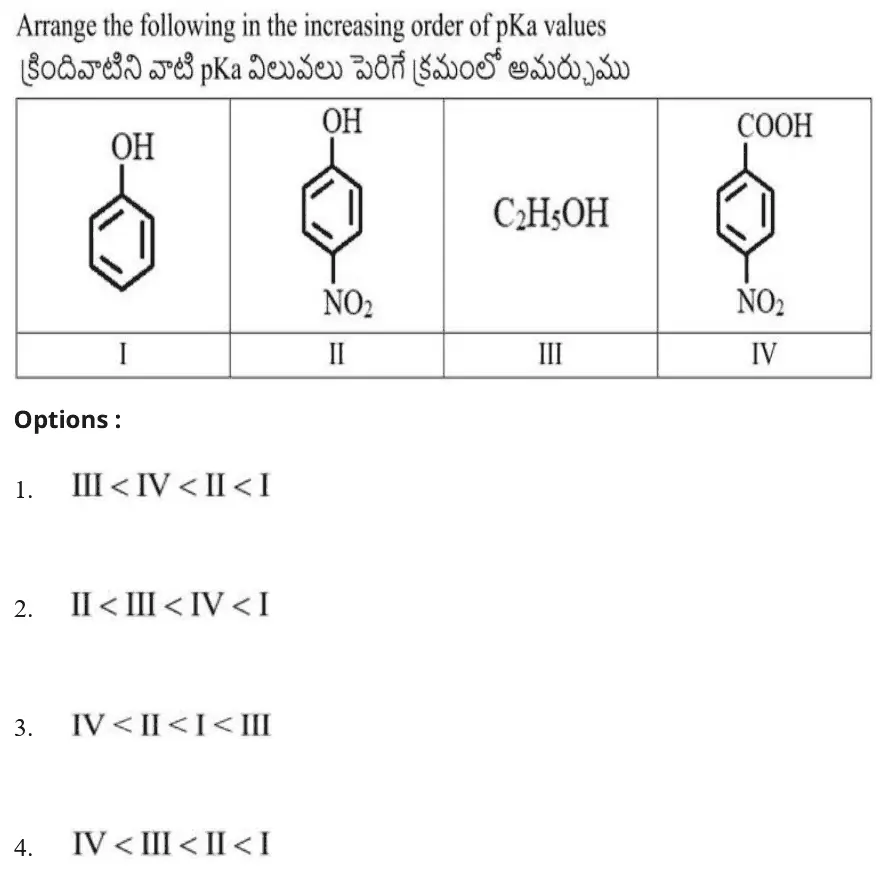
Arrange the following in the increasing order of pKa values
| (see the figure above) | (see the figure above) | $\mathrm{C_2H_5OH}$ | (see the figure above) |
| I | II | III | IV |

III < IV < II < I
II < III < IV < I
IV < II < I < III
IV < III < II < I
Possible number of isomers including stereoisomers for an organic compound with the molecular formula $\mathrm{C_4H_9Br}$ is
3
4
5
2
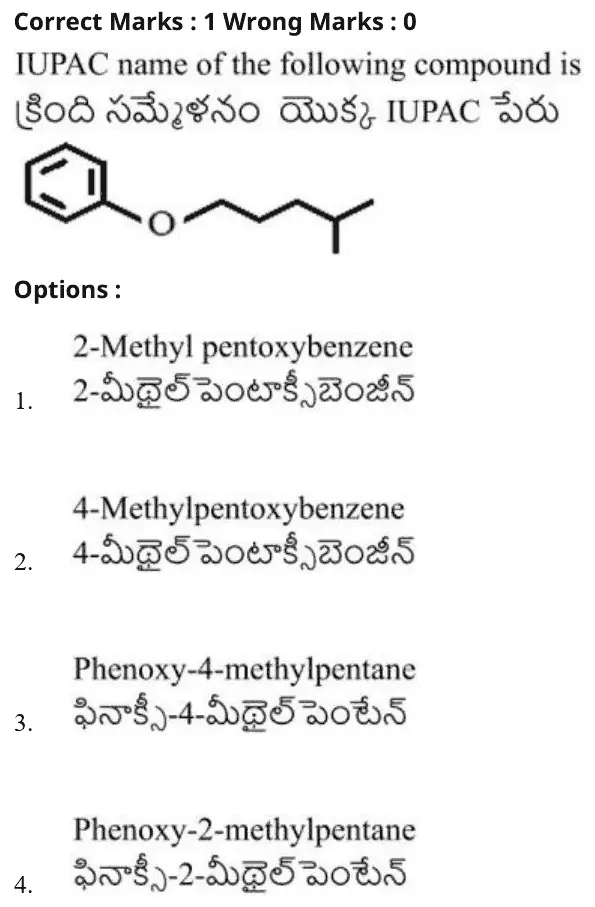
IUPAC name of the following compound is
(see the figure above)

2-Methyl pentoxybenzene
4-Methylpentoxybenzene
Phenoxy-4-methylpentane
Phenoxy-2-methylpentane
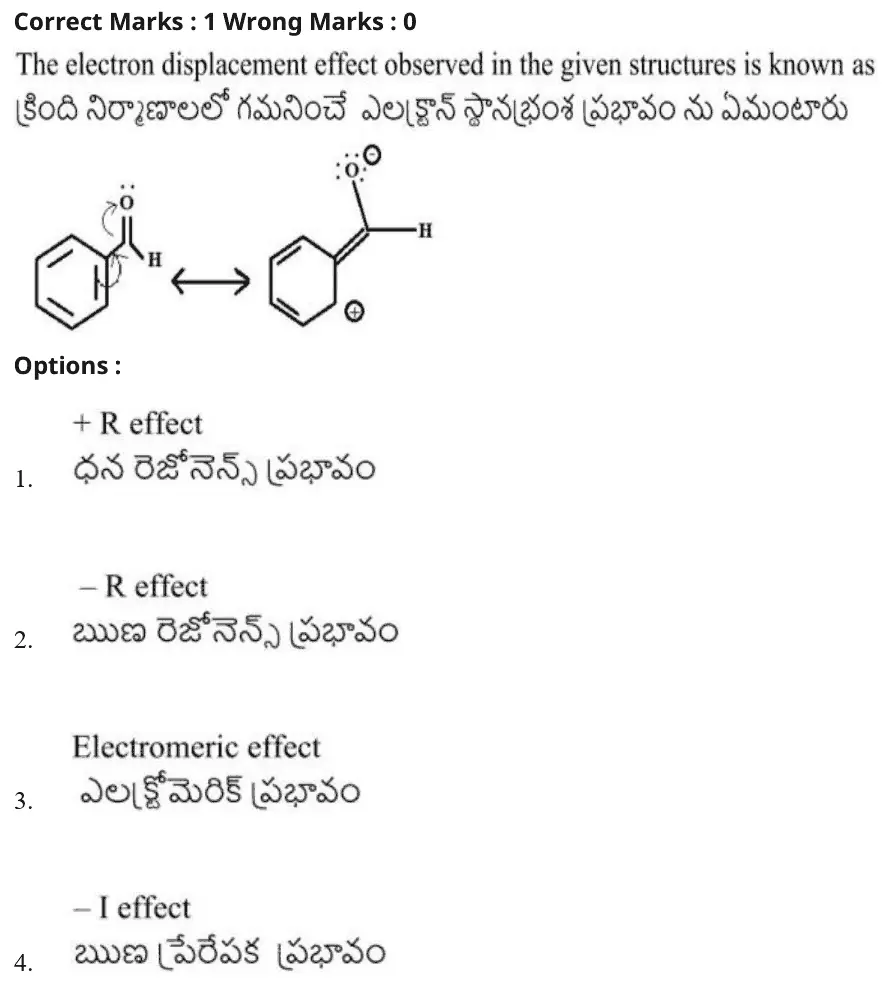
The electron displacement effect observed in the given structures is known as
(see the figure above)

+R effect
–R effect
Electromeric effect
–I effect
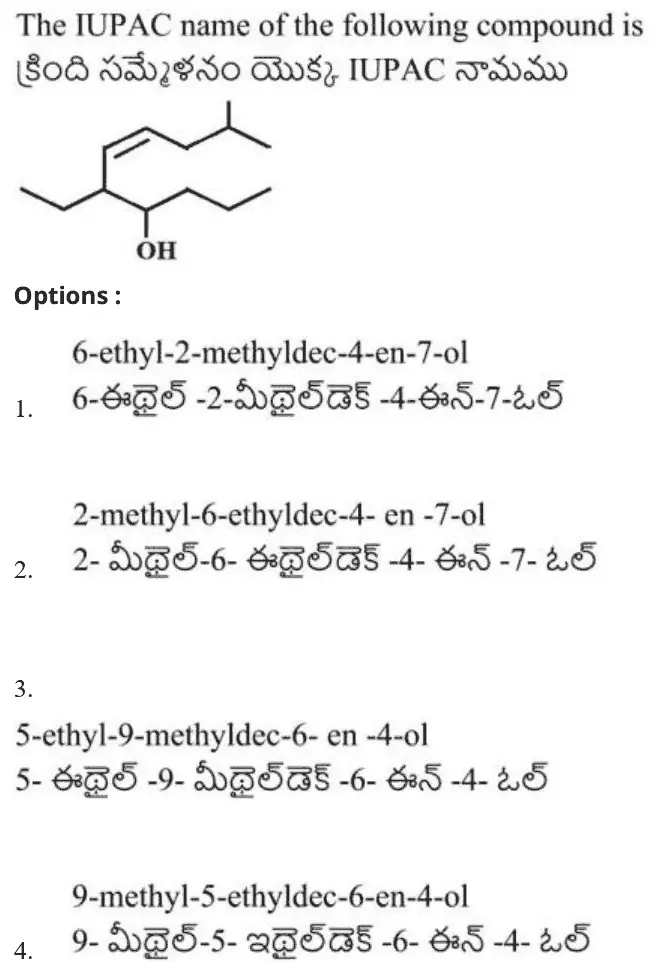
The IUPAC name of the following compound is
(see the figure above)

6-ethyl-2-methyldec-4-en-7-ol
2-methyl-6-ethyldec-4- en -7-ol
5-ethyl-9-methyldec-6- en -4-ol
9-methyl-5-ethyldec-6-en-4-ol
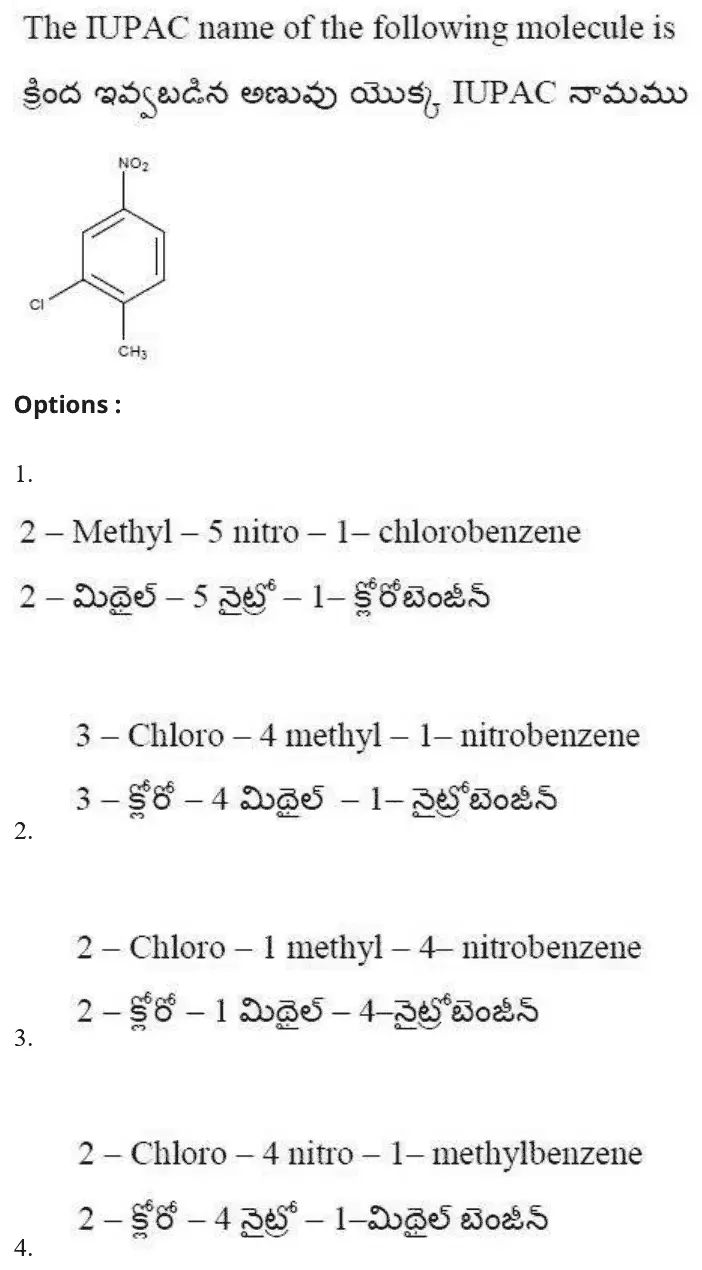
The IUPAC name of the following molecule is
(see the figure above)

2 – Methyl – 5 nitro – 1– chlorobenzene
3 – Chloro – 4 methyl – 1– nitrobenzene
2 – Chloro – 1 methyl – 4– nitrobenzene
2 – Chloro – 4 nitro – 1– methylbenzene
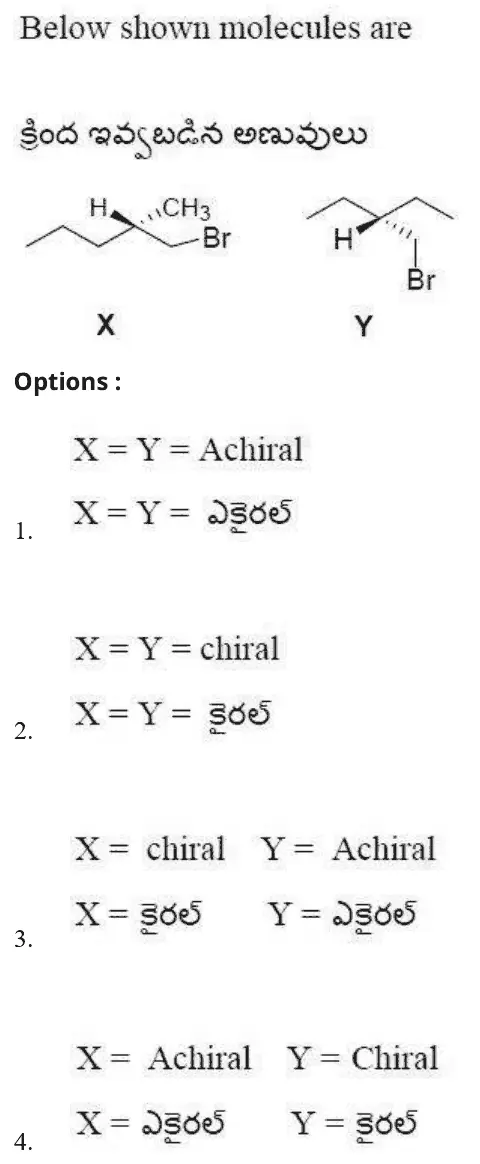
Below shown molecules are
(see the figure above)

X = Y = Achiral
X = Y = chiral
X = chiral Y = Achiral
X = Achiral Y = Chiral
How many asymmetric carbons are present in the following molecule?
$\mathrm{HOH_2CCH(Br)CH(Br)CH_2OH}$
3
1
4
2
The decreasing order of priority for the following functional groups in the IUPAC Nomenclature is
$-\mathrm{SO_3H}, -\mathrm{CN}, -\mathrm{COOH}, -\mathrm{OH}, -\mathrm{CHO}$
$-\mathrm{COOH} > -\mathrm{SO_3H} > -\mathrm{CN} > -\mathrm{CHO} > -\mathrm{OH}$
$-\mathrm{SO_3H} > -\mathrm{COOH} > -\mathrm{CN} > -\mathrm{CHO} > -\mathrm{OH}$
$-\mathrm{COOH} > -\mathrm{SO_3H} > -\mathrm{CHO} > -\mathrm{CN} > -\mathrm{OH}$
$-\mathrm{SO_3H} > -\mathrm{COOH} > -\mathrm{CHO} > -\mathrm{CN} > -\mathrm{OH}$
Arrange the following free radicals in the correct order of their stability
(i) $\mathrm{CH_2=CH\cdot}$ (ii) $\mathrm{CH_3\cdot}$ (iii) $\mathrm{CH_3-\dot{C}H-CH_3}$ (iv) $\mathrm{(CH_3)_3C\cdot}$
i > ii > iii > iv
iv > iii > ii > i
i < ii < iii < iv
iv > iii > i > ii
Which of the following compound does not exhibit geometrical Isomerism?
2 – Butene
3 – Hexene
But – 2 – enal
Styrene
Identify the correct statements with respect to cis/ trans-2-butene from the following
I. cis – 2 – Butene is more polar than trans – 2 Butene
II. melting point of cis – 2- Butene is greater than that of trans – 2- Butene
III. boiling point of cis – 2- Butene is greater than that of trans – 2- Butene
correct answer is
I, II only
II, III only
I, III only
I, II, III
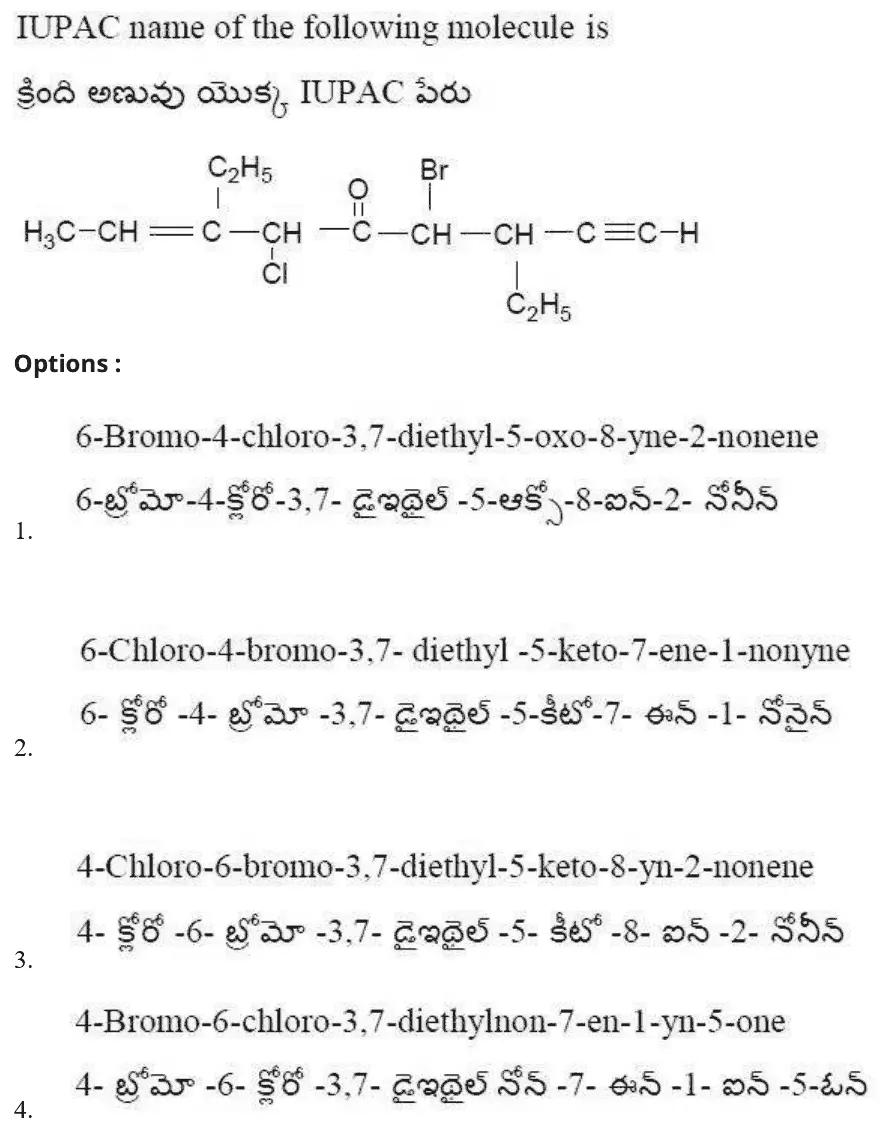
IUPAC name of the following molecule is
(see the figure above)

6-Bromo-4-chloro-3,7-diethyl-5-oxo-8-yne-2-nonene
6-Chloro-4-bromo-3,7- diethyl -5-keto-7-ene-1-nonyne
4-Chloro-6-bromo-3,7-diethyl-5-keto-8-yn-2-nonene
4-Bromo-6-chloro-3,7-diethylnon-7-en-1-yn-5-one
Which of the following is the geminal dichloride?
1,1-Dichloropropane
1,2-Dichloropropane
1,3-Dichloropropane
2,3-Dichloropropane
Catechol and m-cresol respectively are
Benzene – 1, 4 – diol; 3 – Methoxy phenol
Benzene – 1, 2 – diol; 3 – Methoxy phenol
Benzene – 1, 3 – diol; 3 – Methyl phenol
Benzene – 1, 2 – diol; 3 – Methyl phenol
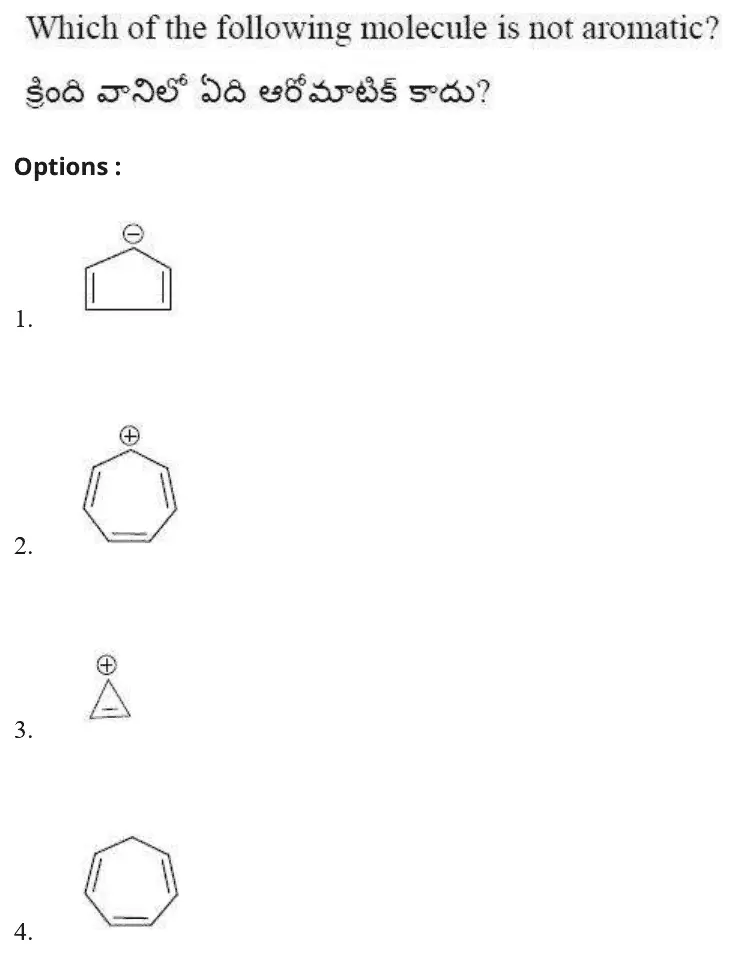
Which of the following molecule is not aromatic?

see figure Cyclopentadienyl anion: five-membered ring with two C=C double bonds and a negative charge (circled minus) on the top carbon.
see figure Cycloheptatrienyl cation (tropylium): seven-membered ring with three C=C double bonds and a positive charge (circled plus) on the top carbon.
see figure Cyclopropenyl cation: three-membered ring with one C=C double bond and a positive charge (circled plus) on the top-left carbon.
see figure Cycloheptatriene: seven-membered ring with three C=C double bonds and one sp3 carbon at the top, no charge.
The optically inactive compound from the following is
2-Bromopropanal
3-Bromopropanal
3-Bromo 2-iodopropanal
2-Bromo 3-iodopropanal
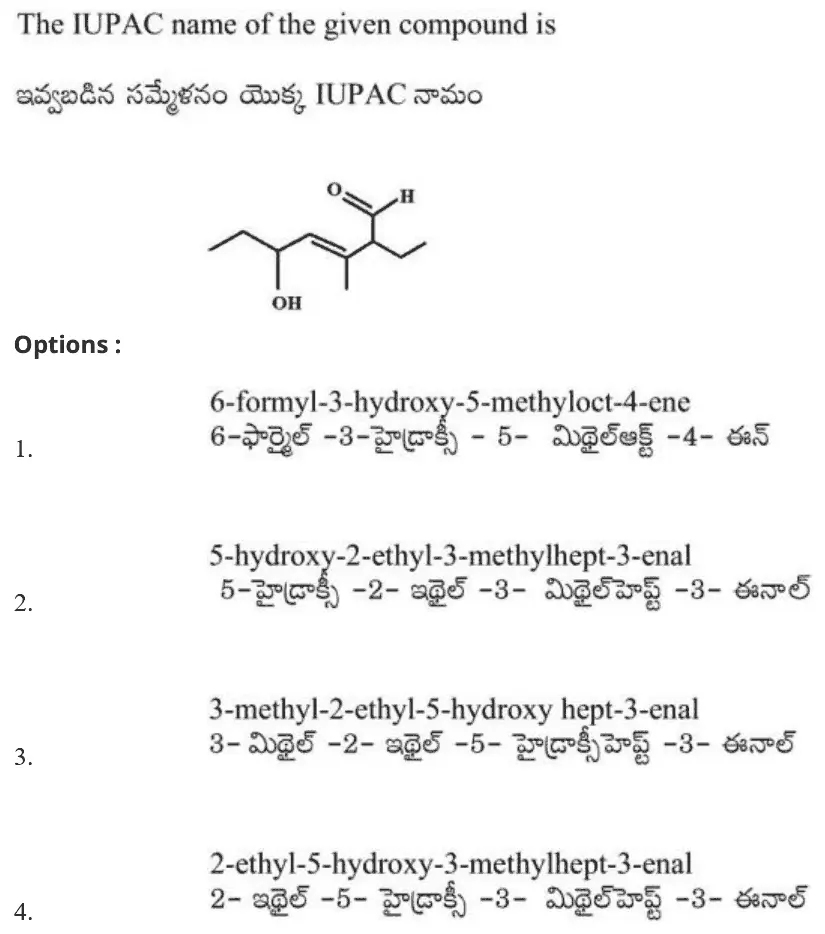
The IUPAC name of the given compound is
(see the figure above)

6-formyl-3-hydroxy-5-methyloct-4-ene
5-hydroxy-2-ethyl-3-methylhept-3-enal
3-methyl-2-ethyl-5-hydroxy hept-3-enal
2-ethyl-5-hydroxy-3-methylhept-3-enal
The aromatic compound / species with maximum number of $\pi$ - electrons is
Phenanthrene
Naphthalene
Cyclopentadienyl anion
Cycloheptatrienyl cation
The common name of benzene -1, 3- diol is
Resorcinol
Hydroquinol
Catechol
Cresol
Arrange the following in the order of decreasing basicity
$\mathrm{RN{=}CHR^{1}}$ (I) $\mathrm{RC{\equiv}N}$ (II) $\mathrm{RNH_2}$ (III)
$\mathrm{I > III > II}$
$\mathrm{III > I > II}$
$\mathrm{II > III > I}$
$\mathrm{II > I > III}$
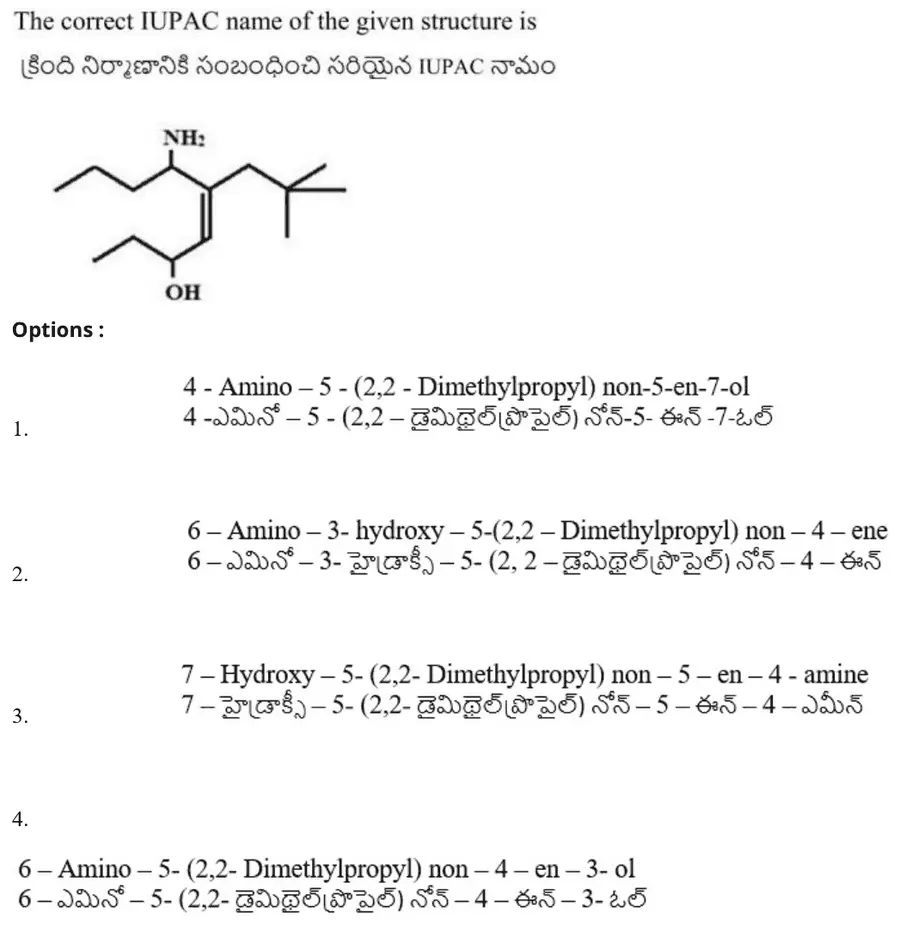
The correct IUPAC name of the given structure is
(see the figure above)

4 - Amino – 5 - (2,2 - Dimethylpropyl) non-5-en-7-ol
6 – Amino – 3- hydroxy – 5-(2,2 – Dimethylpropyl) non – 4 – ene
7 – Hydroxy – 5- (2,2- Dimethylpropyl) non – 5 – en – 4 - amine
6 – Amino – 5- (2,2- Dimethylpropyl) non – 4 – en – 3- ol
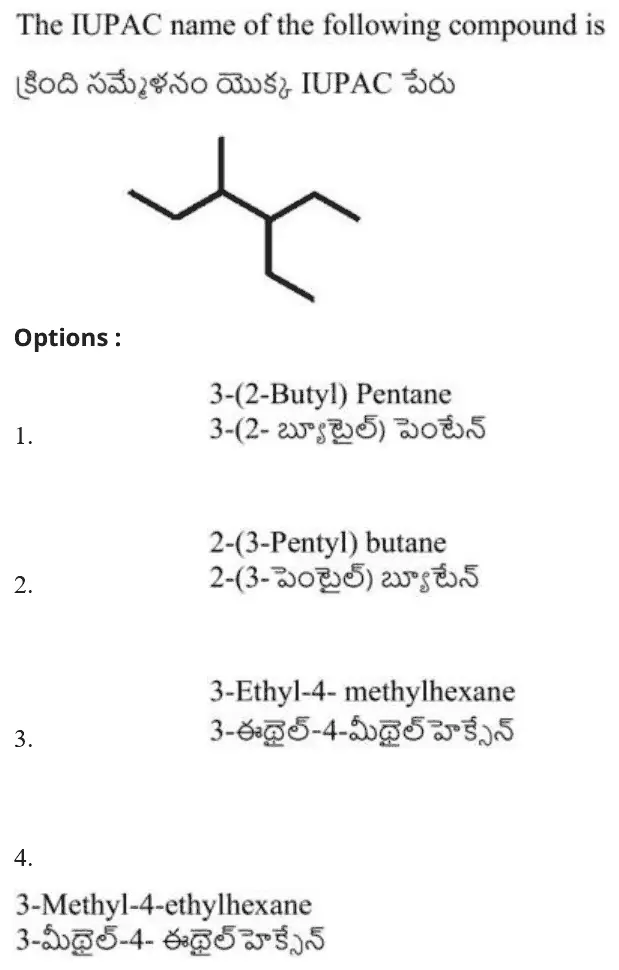
The IUPAC name of the following compound is
(see the figure above)

3-(2-Butyl) Pentane
2-(3-Pentyl) butane
3-Ethyl-4- methylhexane
3-Methyl-4-ethylhexane
The delocalization of $\sigma$ electrons of C-H bond of an alkyl group with the $\pi$ electrons of benzene is observed in
Inductive effect
Hyperconjugation effect
Resonance effect
Electromeric effect
Assertion (A) : pKa of phenol is 4.19 and that of benzoic acid is 10
Reason (R) : Phenoxide ion is stabilised by non-equivalent resonance structures whereas benzoate ion by two equivalent resonance structures
The correct option among the following is
A and R are true. R is the correct explanation of A
A and R are true, but R is not the correct explanation for A
A is true but R is false
A is false but R is true
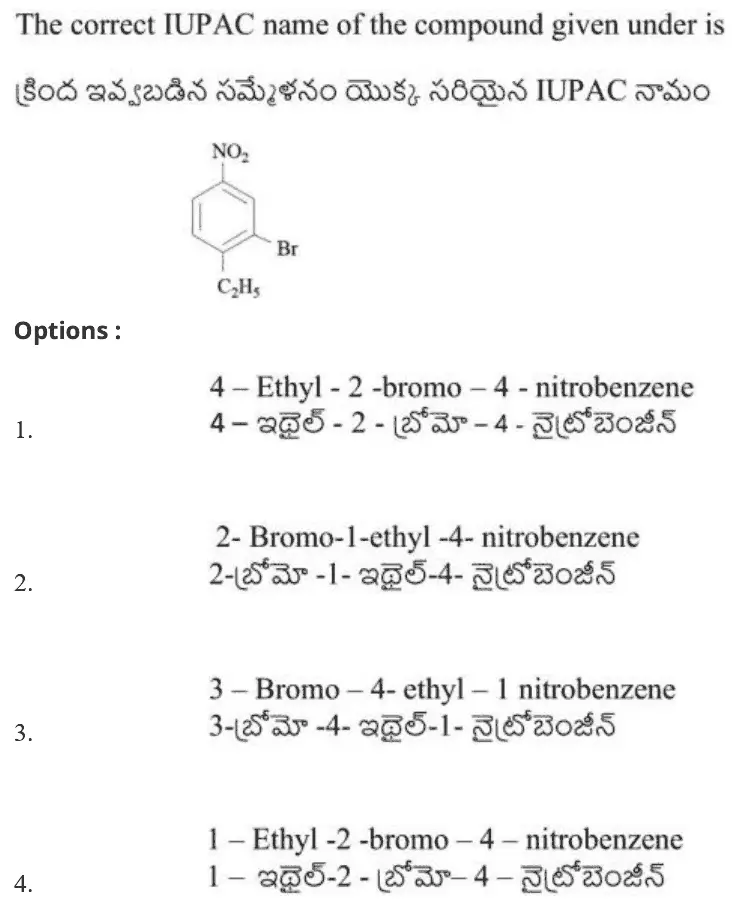
The correct IUPAC name of the compound given under is
(see the figure above)

4 – Ethyl - 2 -bromo – 4 - nitrobenzene
2- Bromo-1-ethyl -4- nitrobenzene
3 – Bromo – 4- ethyl – 1 nitrobenzene
1 – Ethyl -2 -bromo – 4 – nitrobenzene
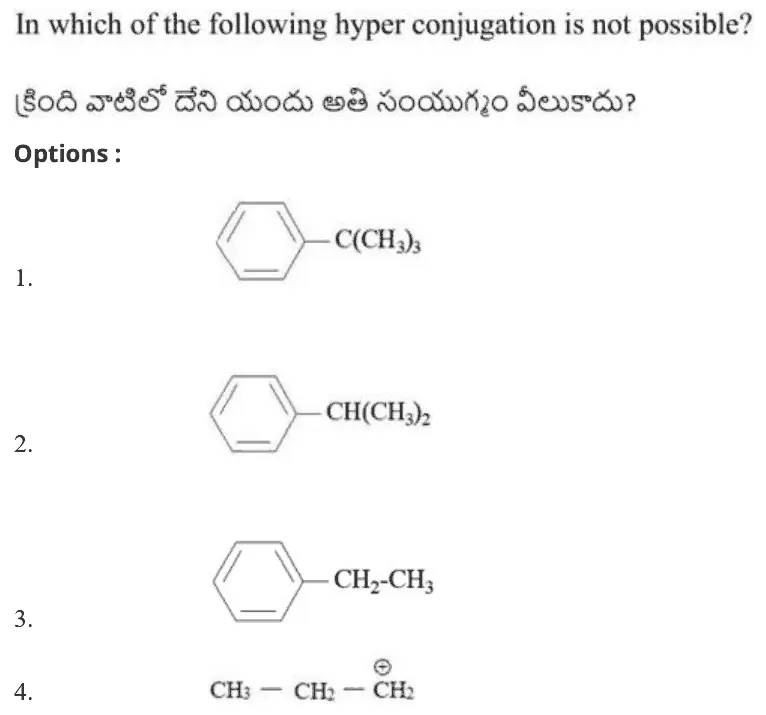
In which of the following hyper conjugation is not possible?

see figure Benzene ring with a $\mathrm{C(CH_3)_3}$ substituent
see figure Benzene ring with a $\mathrm{CH(CH_3)_2}$ substituent
see figure Benzene ring with a $\mathrm{CH_2\text{-}CH_3}$ substituent
see figure $\mathrm{CH_3-CH_2-\overset{\ominus}{C}H_2}$ (carbanion with a negative charge on the terminal carbon)
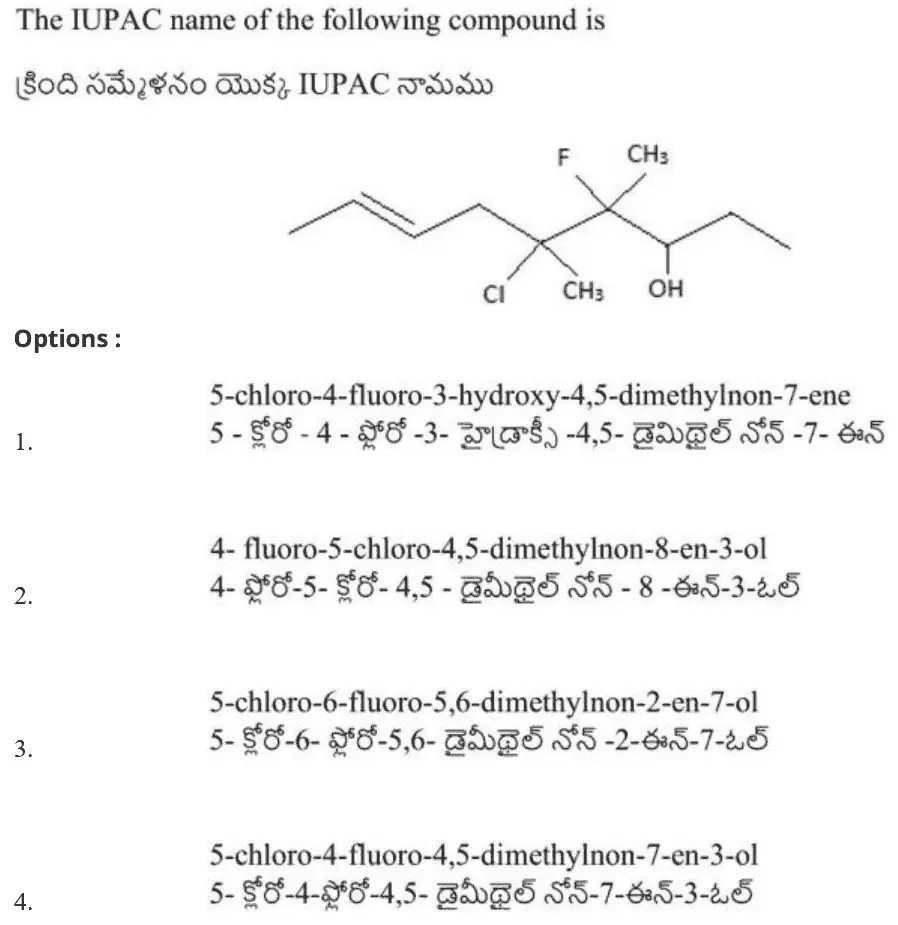
The IUPAC name of the following compound is
(see the figure above)

5-chloro-4-fluoro-3-hydroxy-4,5-dimethylnon-7-ene
4- fluoro-5-chloro-4,5-dimethylnon-8-en-3-ol
5-chloro-6-fluoro-5,6-dimethylnon-2-en-7-ol
5-chloro-4-fluoro-4,5-dimethylnon-7-en-3-ol
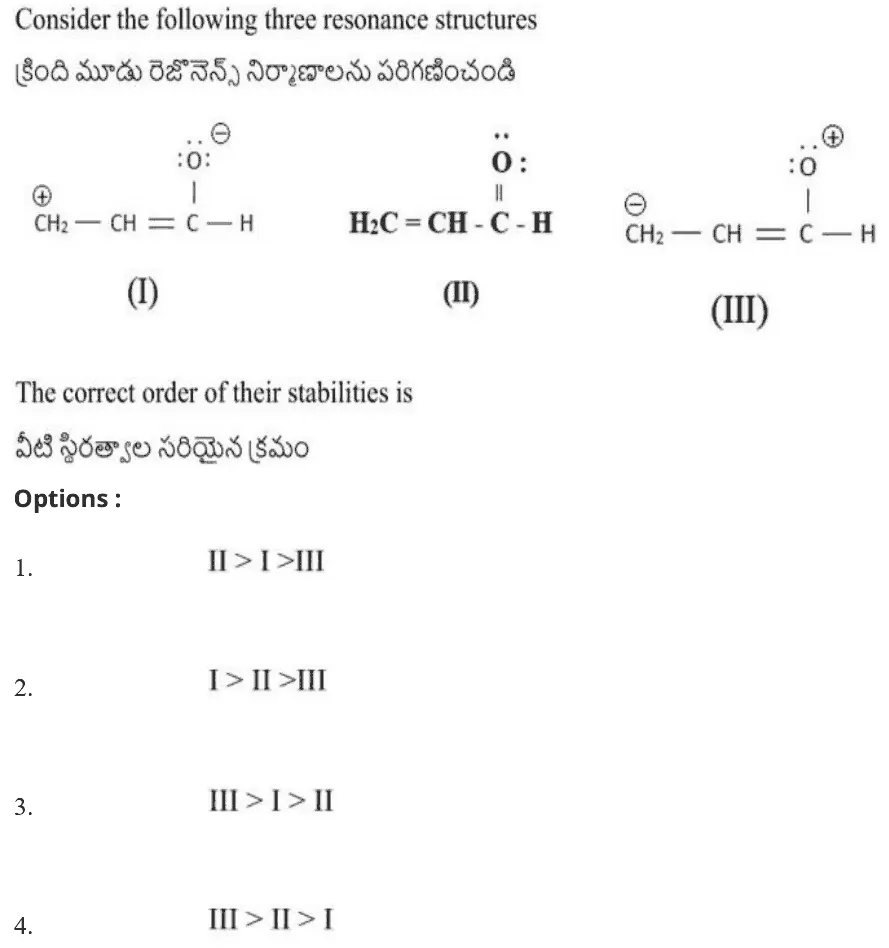
Consider the following three resonance structures
(see the figure above)
The correct order of their stabilities is

$\mathrm{II > I > III}$
$\mathrm{I > II > III}$
$\mathrm{III > I > II}$
$\mathrm{III > II > I}$
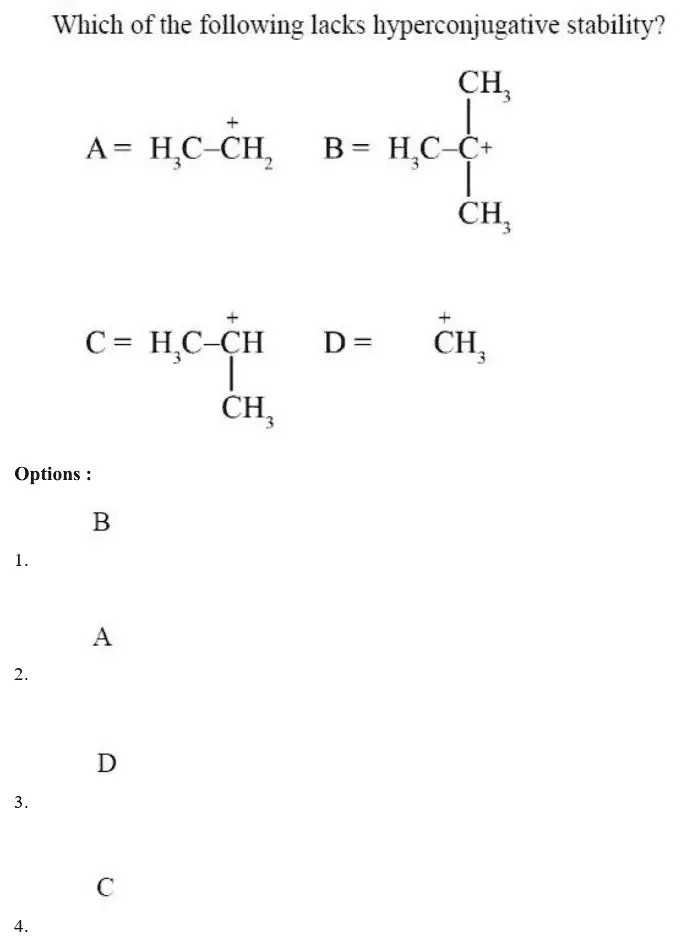
Which of the following lacks hyperconjugative stability?
(see the figure above)

B
A
D
C
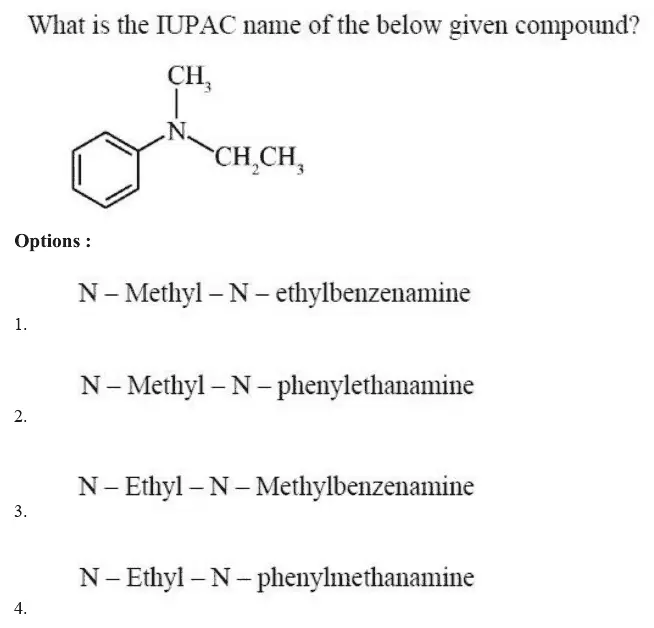
What is the IUPAC name of the below given compound?
(see the figure above)

N – Methyl – N – ethylbenzenamine
N – Methyl – N – phenylethanamine
N – Ethyl – N – Methylbenzenamine
N – Ethyl – N – phenylmethanamine
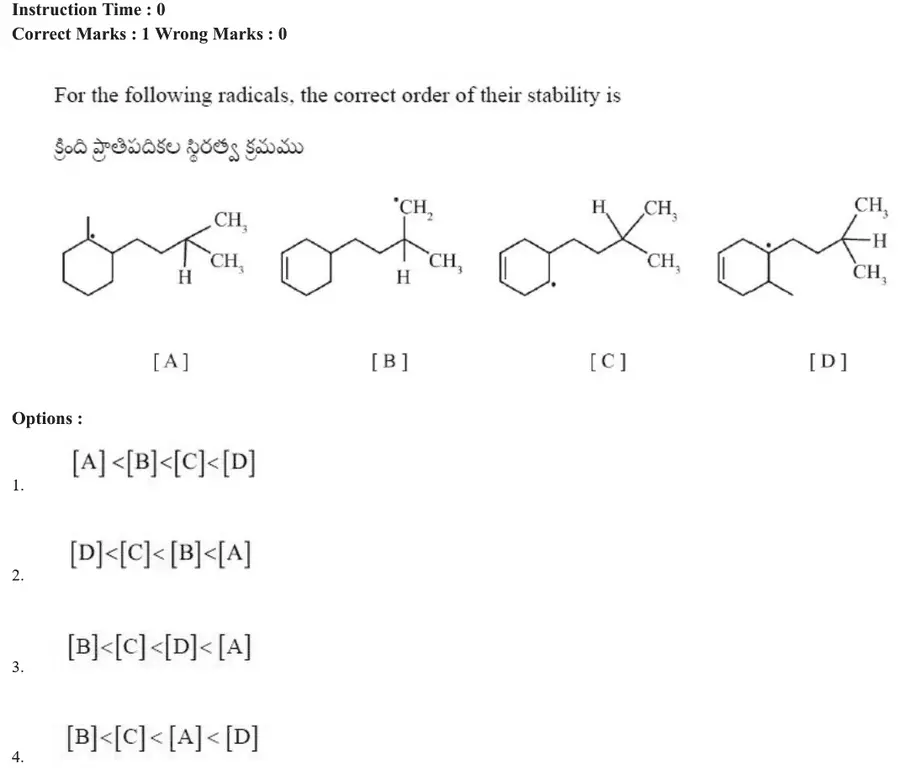
For the following radicals, the correct order of their stability is
(see the figure above)

[A]<[B]<[C]<[D]
[D]<[C]<[B]<[A]
[B]<[C]<[D]<[A]
[B]<[C]<[A]<[D]
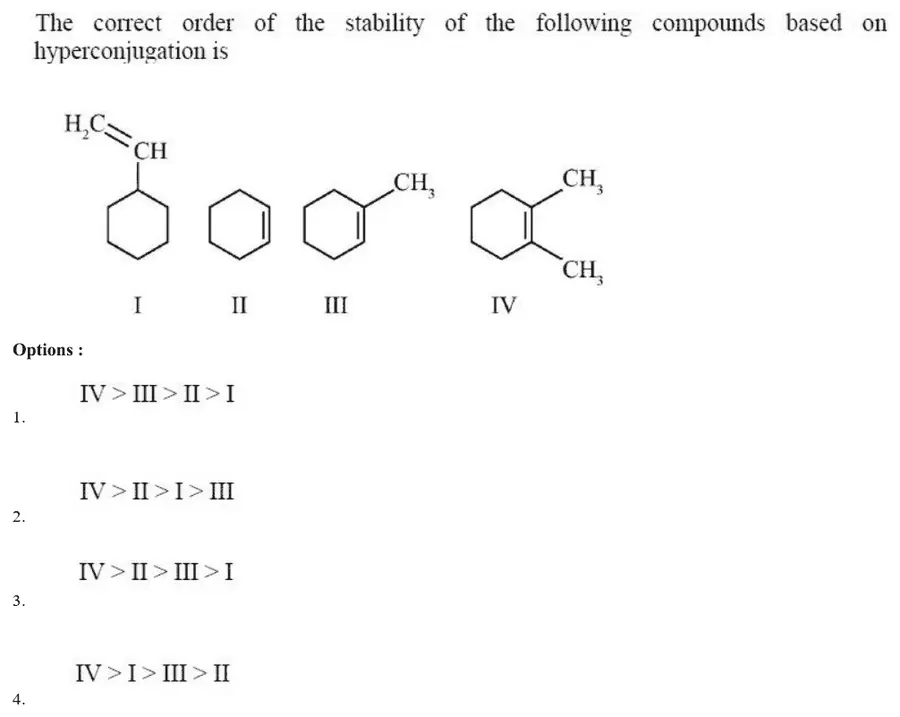
The correct order of the stability of the following compounds based on hyperconjugation is
(see the figure above)

IV > III > II > I
IV > II > I > III
IV > II > III > I
IV > I > III > II
Identify the chiral molecule among the following.
Isopropyl alcohol
2–Pentanol
1–Bromo–3–butene
Isobutyl alcohol
The number of possible aromatic benzenoid isomers for $\mathrm{C_6H_4Cl_2}$ are
$2$
$3$
$4$
$5$
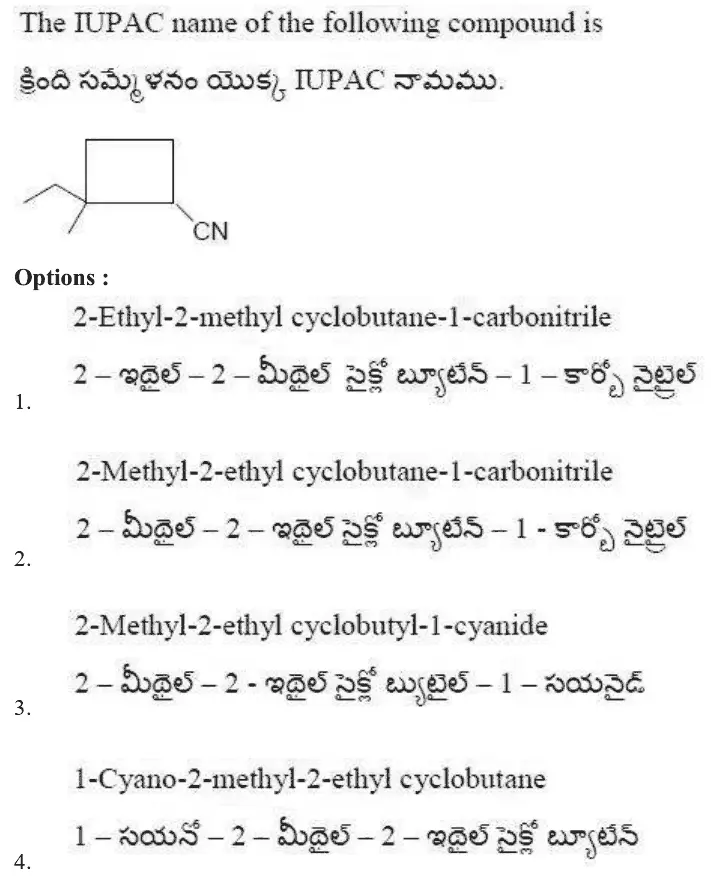
The IUPAC name of the following compound is
(see the figure above)

2-Ethyl-2-methyl cyclobutane-1-carbonitrile
2-Methyl-2-ethyl cyclobutane-1-carbonitrile
2-Methyl-2-ethyl cyclobutyl-1-cyanide
1-Cyano-2-methyl-2-ethyl cyclobutane
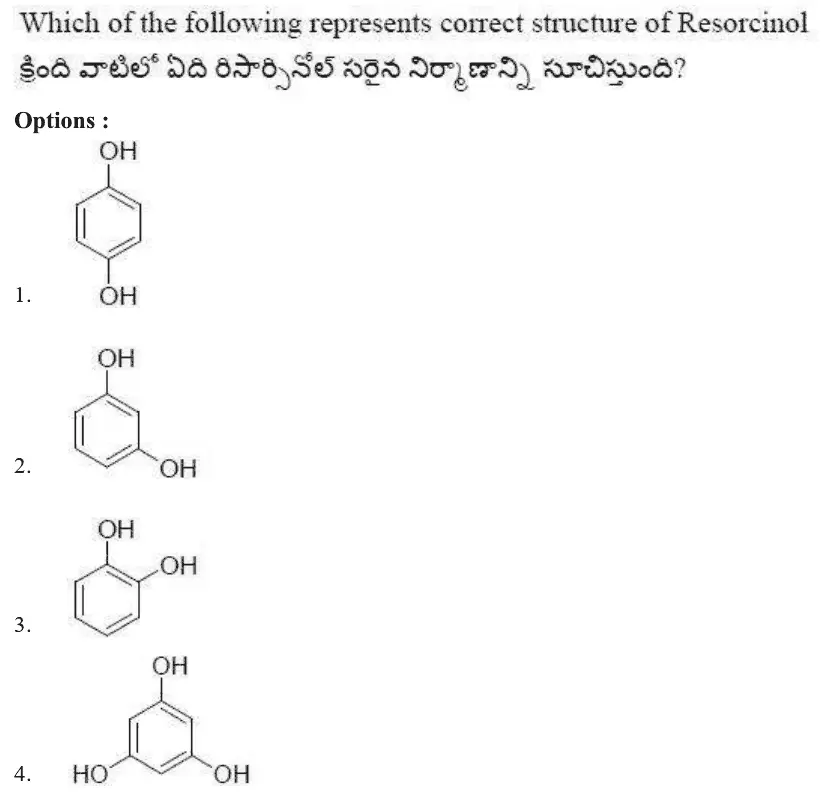
Which of the following represents correct structure of Resorcinol
(see the figure above)

see figure benzene ring with two OH groups at the top and bottom (para, 1,4)
see figure benzene ring with OH at the top and OH at the lower right (meta, 1,3)
see figure benzene ring with OH at the top and OH at the upper right (adjacent, ortho, 1,2)
see figure benzene ring with three OH groups, at the top, lower left and lower right (1,3,5)
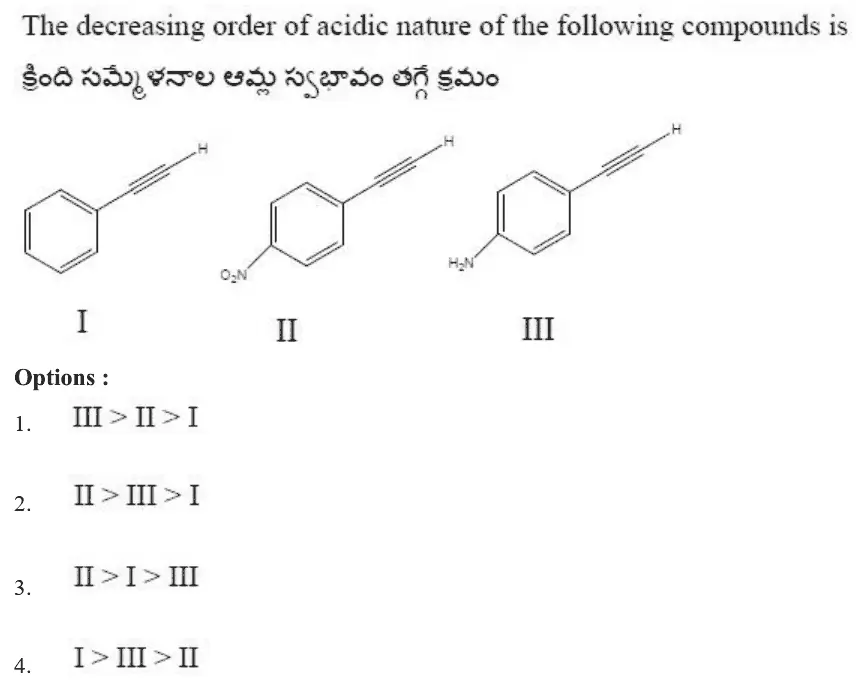
The decreasing order of acidic nature of the following compounds is
(see the figure above)

III > II > I
II > III > I
II > I > III
I > III > II
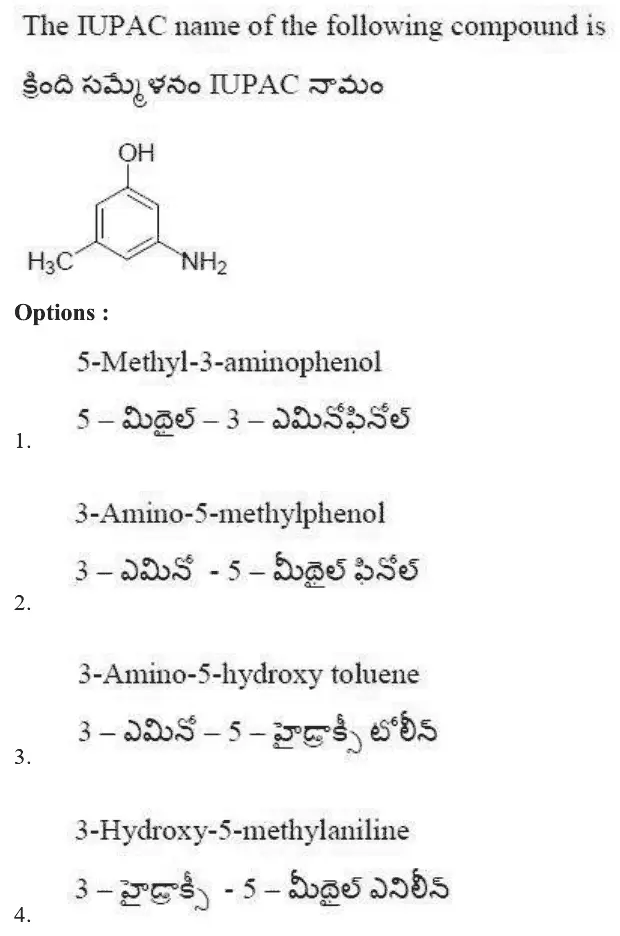
The IUPAC name of the following compound is
(see the figure above)

5-Methyl-3-aminophenol
3-Amino-5-methylphenol
3-Amino-5-hydroxy toluene
3-Hydroxy-5-methylaniline
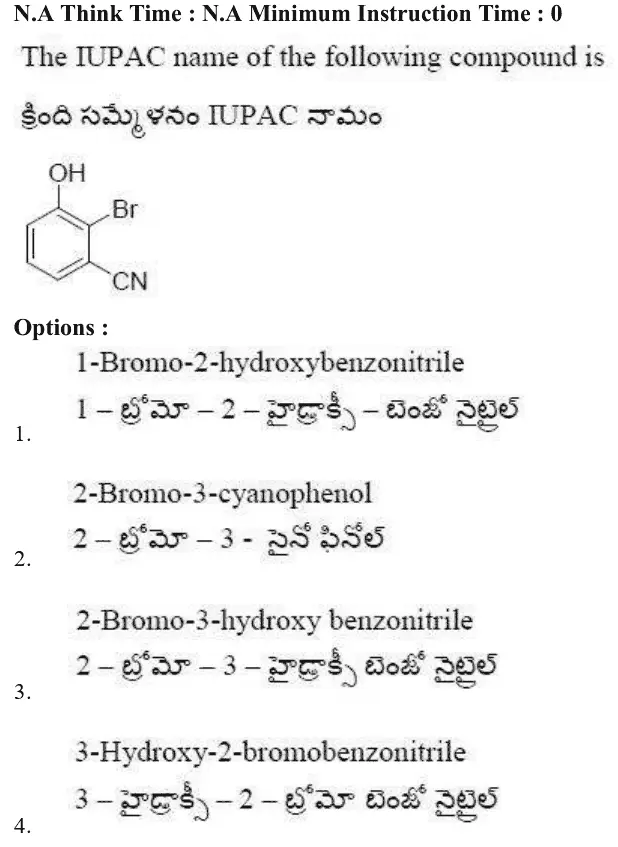
The IUPAC name of the following compound is
(see the figure above)

1-Bromo-2-hydroxybenzonitrile
2-Bromo-3-cyanophenol
2-Bromo-3-hydroxy benzonitrile
3-Hydroxy-2-bromobenzonitrile
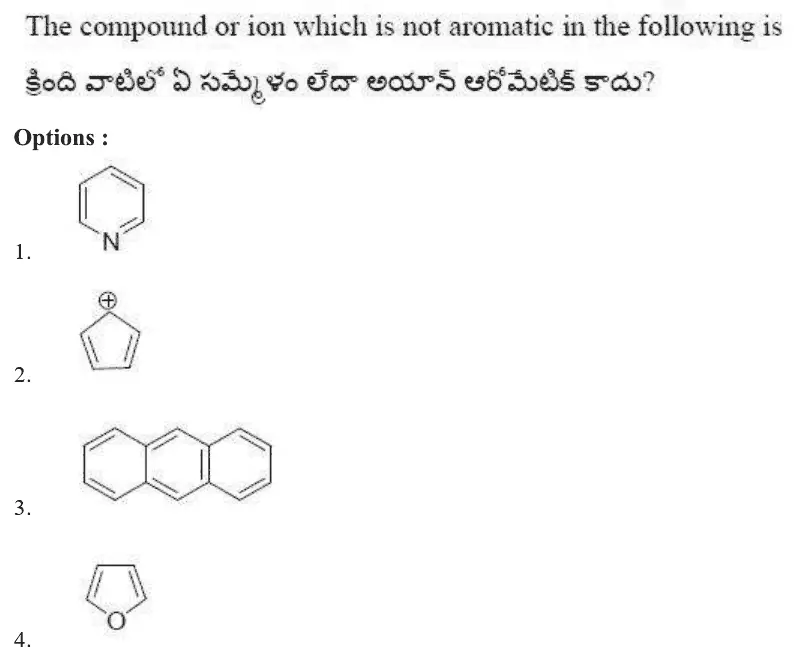
The compound or ion which is not aromatic in the following is

see figure pyridine: six-membered ring with alternating double bonds and one ring N atom
see figure cyclopentadienyl cation: five-membered ring with two C=C double bonds and a positive charge (circled plus) on the carbon at the top
see figure anthracene: three linearly fused benzene rings
see figure furan: five-membered ring with two C=C double bonds and an O atom at the bottom
Identify the decreasing order of nucleophilicity for the following species.
$OH^{-} > NH_2^{-} > CH_3O^{-} > RNH_2$
$NH_2^{-} > OH^{-} > CH_3O^{-} > RNH_2$
$NH_2^{-} > CH_3O^{-} > OH^{-} > RNH_2$
$CH_3O^{-} > NH_2^{-} > OH^{-} > RNH_2$
Identify the correct statement among the following:
$CH_3OCH_3$ & $C_2H_5OH$ are chain isomers
$CH_3COOH$ & $CH_3COOCH_3$ are position isomers
$CH_3CH_2CH_2CH_3$ & $CH(CH_3)_3$ are functional isomers
$CH_3CH_2CH_2CH_2OH$ & $CH_3-CH(OH)-CH_2CH_3$ are position isomers
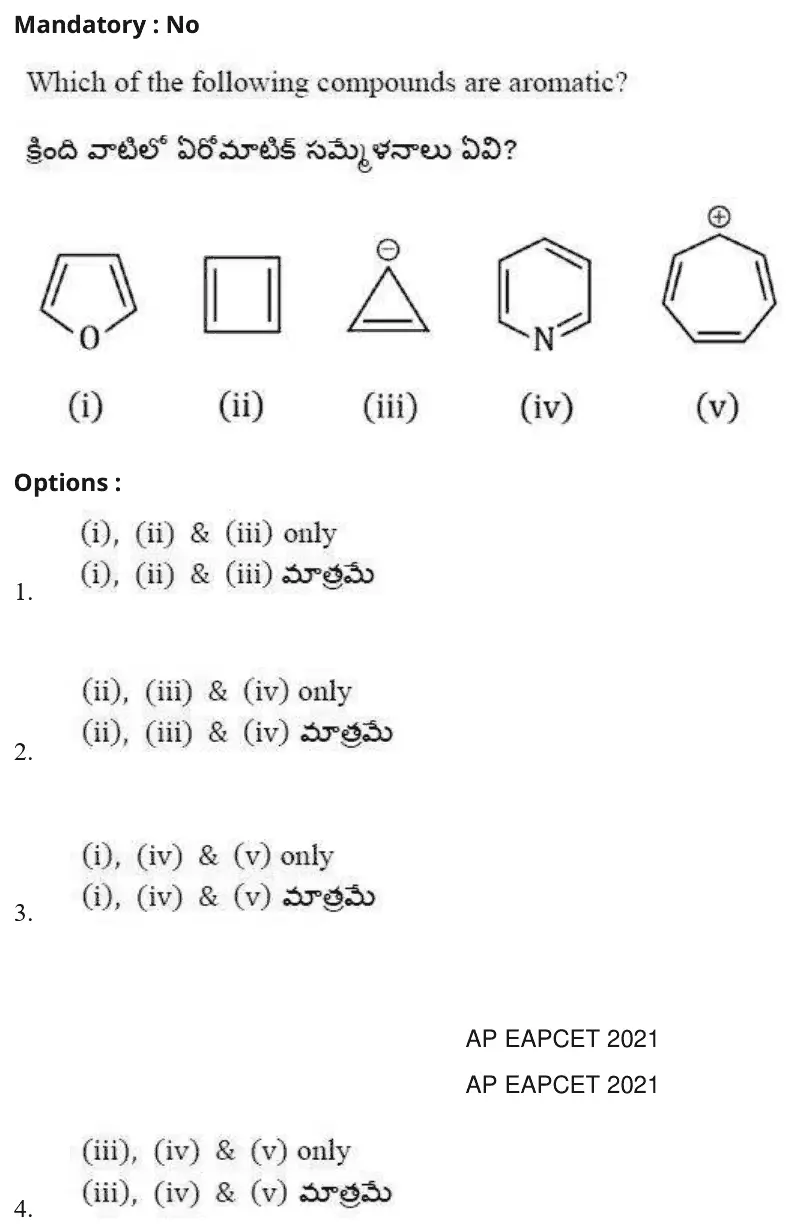
Which of the following compounds are aromatic?
(see the figure above)

(i), (ii) & (iii) only
(ii), (iii) & (iv) only
(i), (iv) & (v) only
(iii), (iv) & (v) only
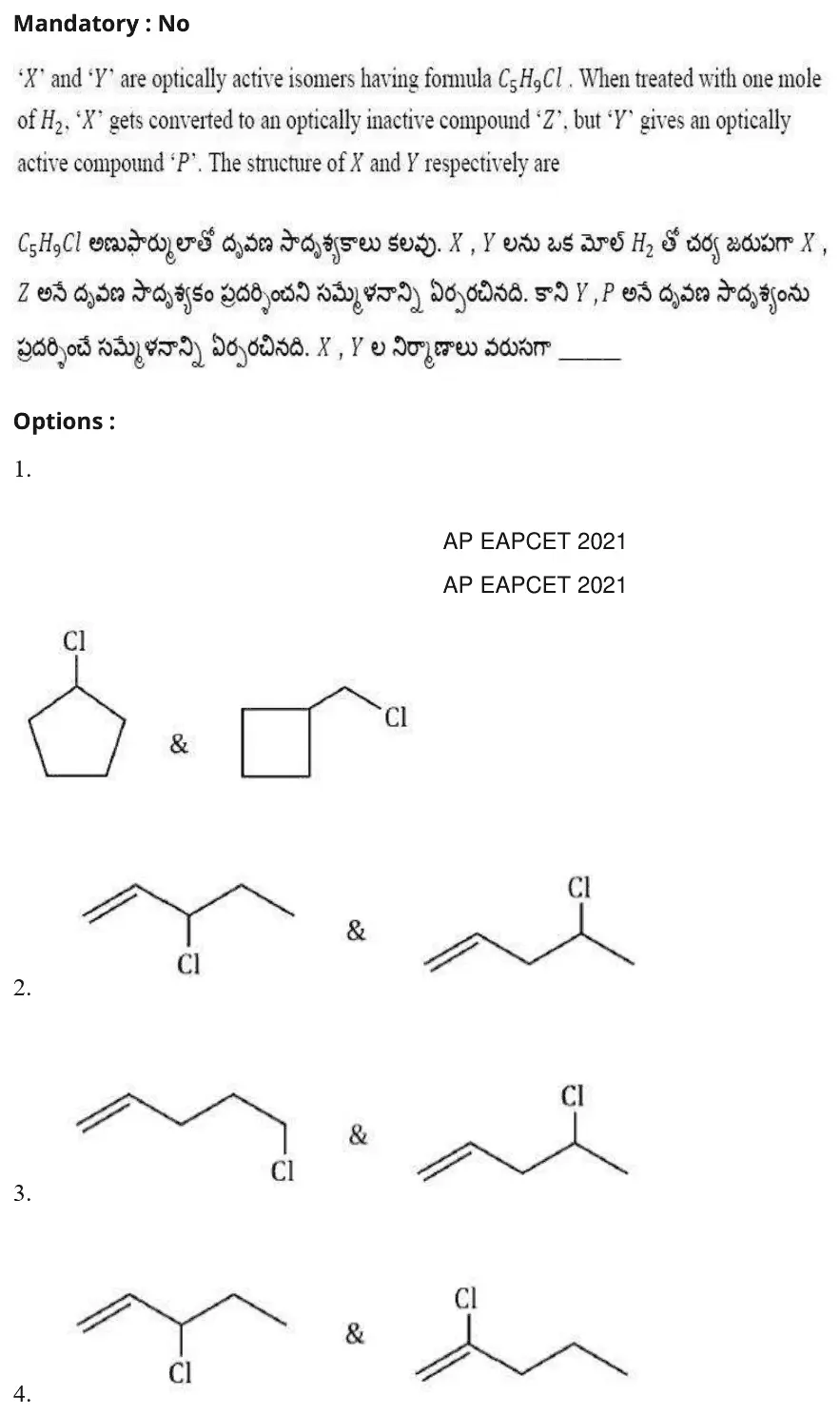
'X' and 'Y' are optically active isomers having formula $\mathrm{C_5H_9Cl}$. When treated with one mole of $\mathrm{H_2}$, 'X' gets converted to an optically inactive compound 'Z', but 'Y' gives an optically active compound 'P'. The structure of $X$ and $Y$ respectively are
(see the figure above)

see figure chlorocyclopentane & (chloromethyl)cyclobutane
see figure CH2=CH-CH(Cl)-CH2-CH3 & CH2=CH-CH2-CH(Cl)-CH3
see figure CH2=CH-CH2-CH2-CH2Cl & CH2=CH-CH2-CH(Cl)-CH3
see figure CH2=CH-CH(Cl)-CH2-CH3 & CH2=C(Cl)-CH2-CH2-CH3
The correct order of increasing stabilities of the following carbocations.
(i) Allyl carbocation
(ii) Ethyl carbocation
(iii) Benzyl carbocation
(iv) Isobutyl carbocation
(iv) < (iii) < (ii) < (i)
(iv) < (ii) < (i) < (iii)
(ii) < (iv) < (i) < (iii)
(ii) < (iv) < (iii) < (i)
Which of the following is not an electrophile?
$\mathrm{CN^-}$
$\mathrm{BF_3}$
$\mathrm{NO_2^+}$
$\mathrm{AlCl_3}$
Based on the IUPAC system, tertiary butyl group is named as ______
2 - methylpropyl
1,1 - dimethylethyl
2 - methylbutyl
1,3 - dimethylbutyl
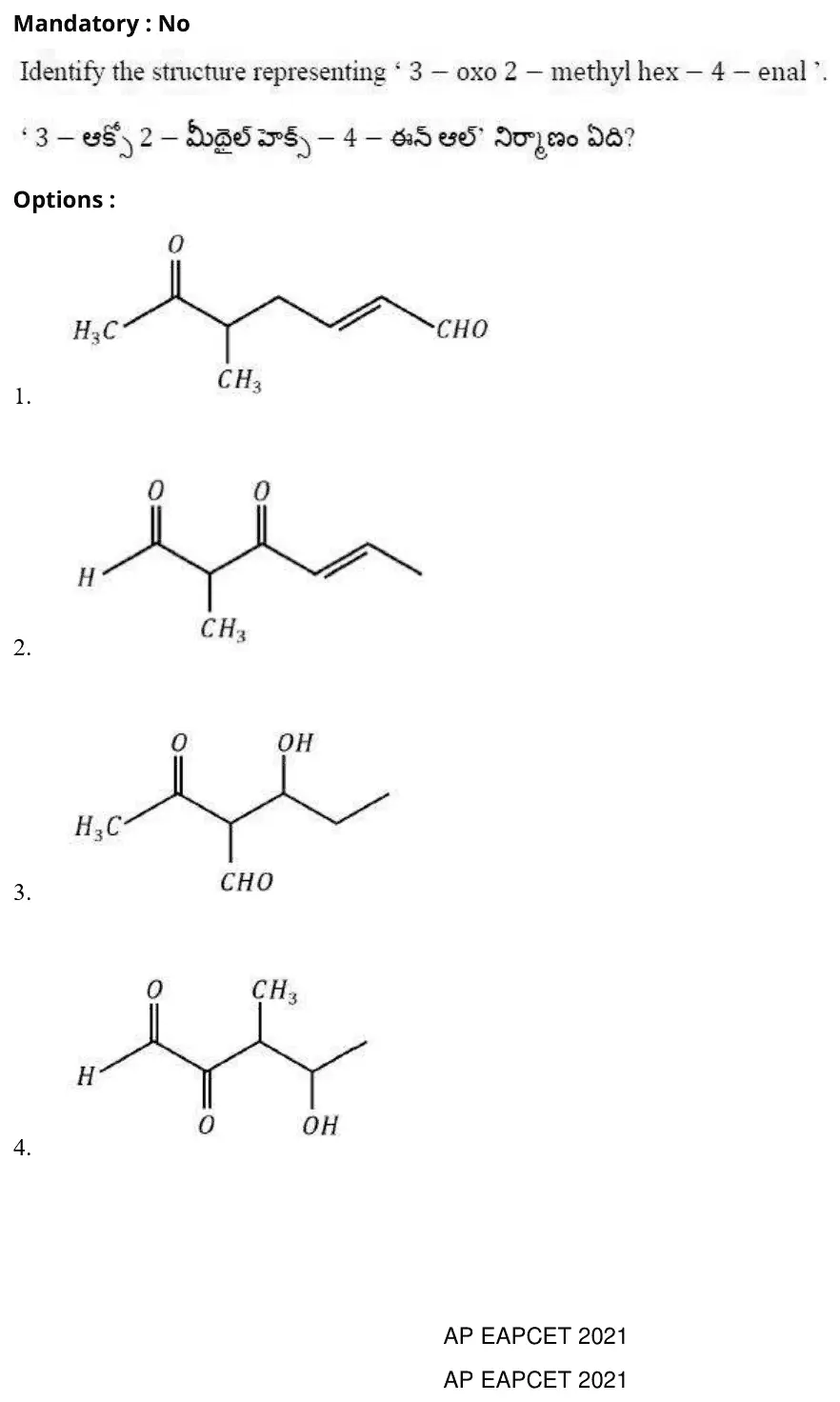
Identify the structure representing '3 - oxo 2 - methyl hex - 4 - enal'.

see figure skeletal chain: H3C-C(=O)-CH(CH3)-CH2-CH=CH-CHO
see figure skeletal chain: OHC (H-C(=O))-CH(CH3)-C(=O)-CH=CH-CH3
see figure skeletal chain: H3C-C(=O)-CH(CHO)-CH(OH)-CH2-CH3
see figure skeletal chain: OHC (H-C(=O))-C(=O)-CH(CH3)-CH(OH)-CH3
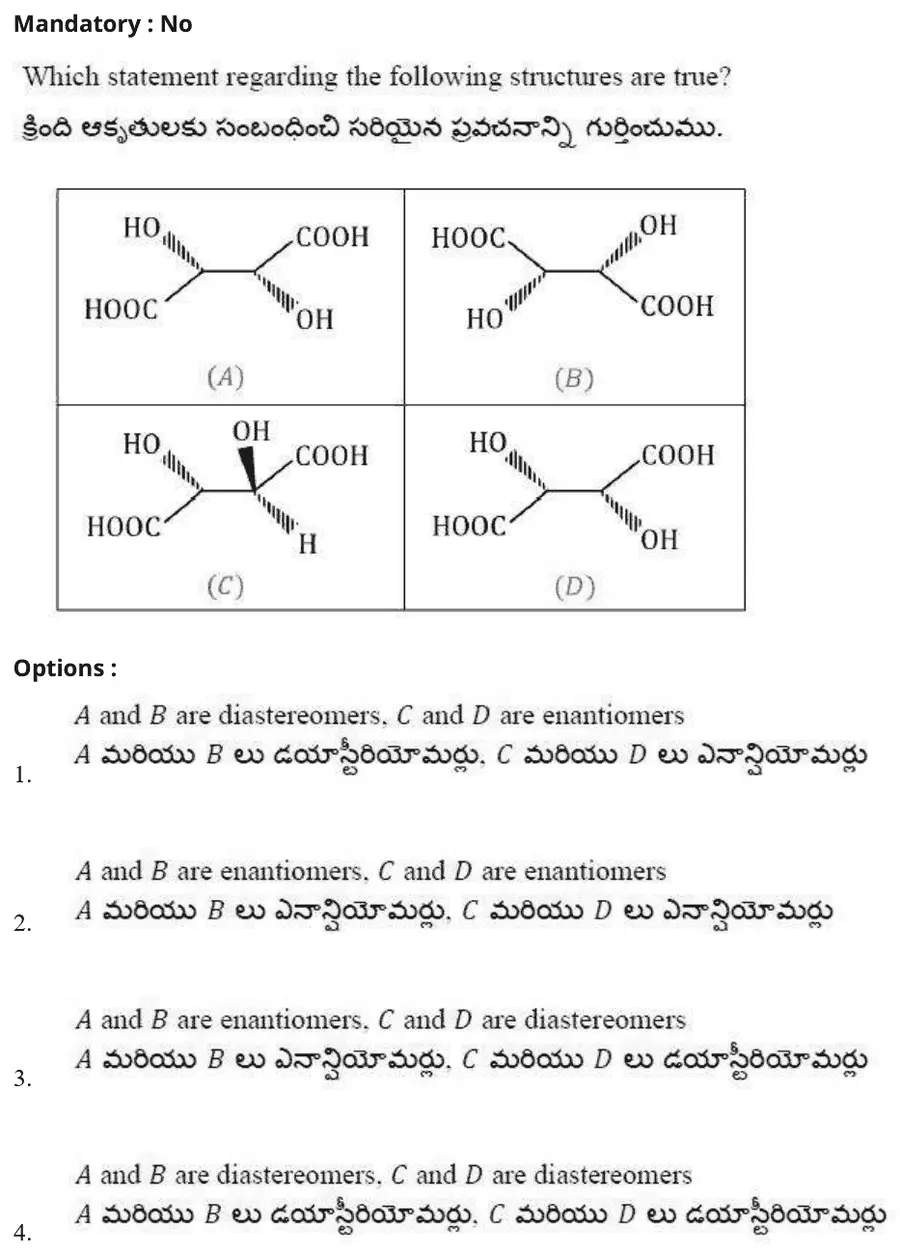
Which statement regarding the following structures are true?
(see the figure above)

A and B are diastereomers, C and D are enantiomers
A and B are enantiomers, C and D are enantiomers
A and B are enantiomers, C and D are diastereomers
A and B are diastereomers, C and D are diastereomers
Which of the following statements are Correct?
(i) Inductive effect & resonance effect is possible in chlorobenzene
(ii) Resonance effect dominates over inductive effect in Anisole
(iii) P-nitrobenzoic acid is less acidic than m-nitrobenzoic acid
(iv) Diphenylamine is more basic than aniline
(i), (ii), (iii) & (iv)
(i) & (ii) only
(iii) & (iv) only
(i) & (iii) only
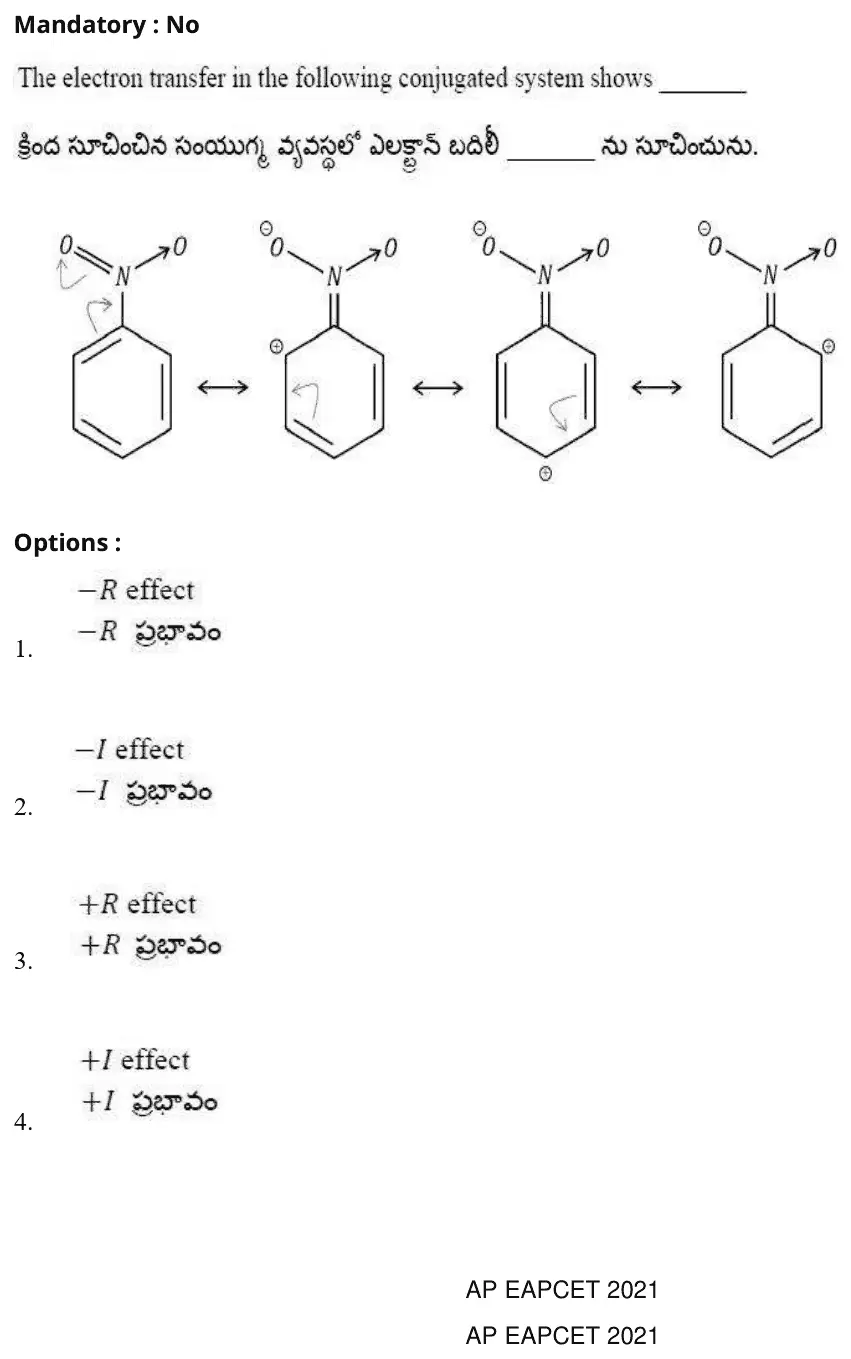
The electron transfer in the following conjugated system shows ______
(see the figure above)

$-R$ effect
$-I$ effect
$+R$ effect
$+I$ effect
How many isomers (cyclic and acyclic) are possible for a compound with molecular formula $C_3H_6O$ ?
4
5
9
7
An organic compound of molecular formula $C_6H_6Br_2$ has six carbon atoms in a ring system, two non-conjugate double bonds and two bromo groups at 1, 4 positions. Then the compound is ____
aromatic but non-homo-cyclic
aromatic and hetero-cyclic
homo-cyclic but not aromatic
neither homo-cyclic nor hetero-cyclic
Which of the following is not explained by hyperconjugation?
stability order of carbanions
stability order of free radicals
stability order of carbocations
stability of alkenes
Alcohols with molecular formula $C_nH_{2n+2}O$ are isomeric with _______
Acids
Ethers
Esters
Aldehydes
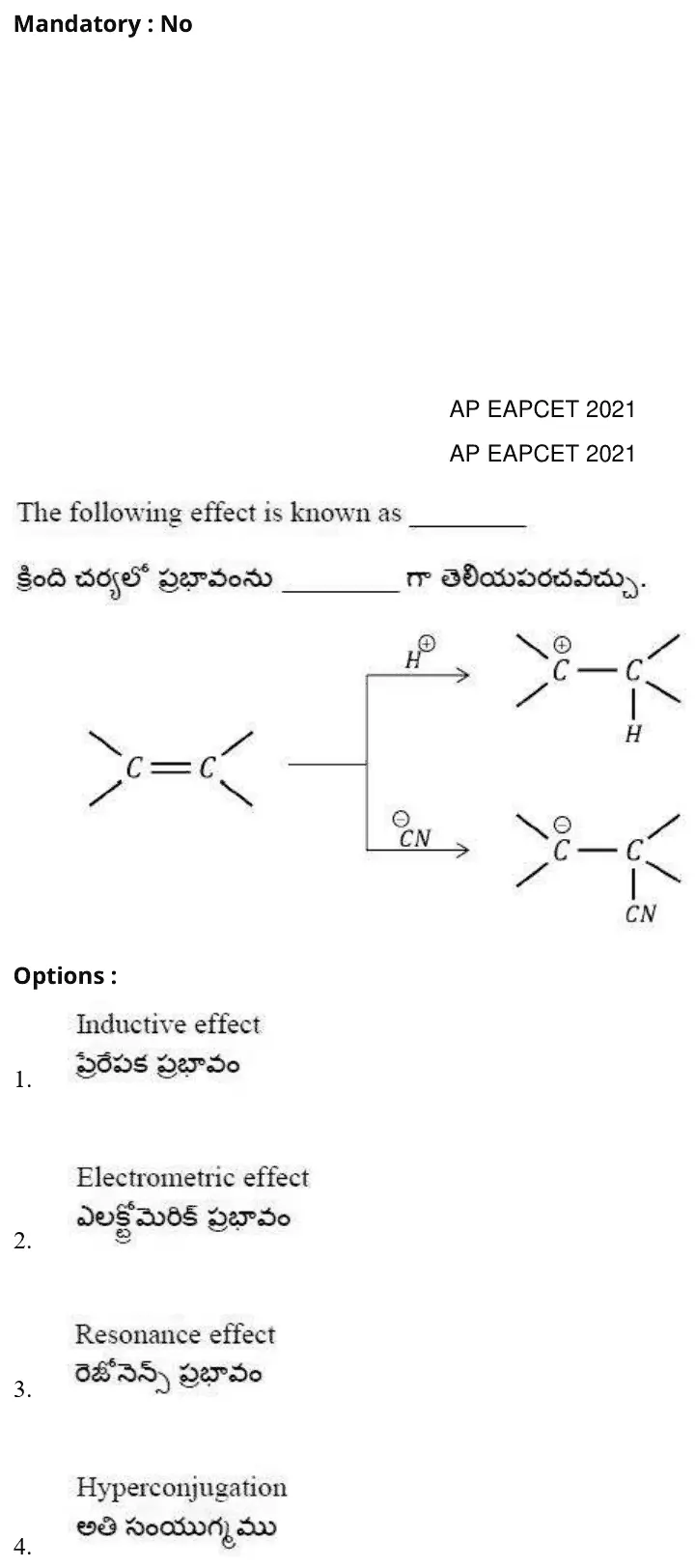
The following effect is known as ________
(see the figure above)

Inductive effect
Electrometric effect
Resonance effect
Hyperconjugation
The number of optical isomers possible for 2 - Bromo 3 - Chloro butane are ______
8
10
4
2
What is the IUPAC of $\mathrm{CH_3CH(CH_2CH_3)CHO}$ ?
Butan-2-al
2-methyl butanal
3-methylisobutyraldehyde
2-ethylpropanal
The IUPAC name of Diacetone alcohol is ______
4 $-$ Hydroxy pentane $-$ 2,4 $-$ dione
3 $-$ Hydroxy pentane $-$ 2,4 $-$ dione
4 $-$ Hydroxy $-$ 4 $-$ methyl pentan $-$ 2 $-$ one
4 $-$ Hydroxy $-$ 3 $-$ methyl pentan $-$ 2 $-$ one
Metamerism can be exhibited by the compounds containing
monovalent functional group
bivalent functional group
double bond
triple bond
The total number of overlapping p- orbitals present in cycloheptatrienyl cation is
4
5
6
7
Which one of the carbanions is the least stable?
$\overset{\ominus}{\mathrm{C}}\mathrm{H_2-NO_2}$
$\overset{\ominus}{\mathrm{C}}\mathrm{H_2-CHO}$
$\overset{\ominus}{\mathrm{C}}\mathrm{H_2-CH_3}$
$\overset{\ominus}{\mathrm{C}}\mathrm{H_3}$
For a molecular formula of $\mathrm{C_6H_{10}}$ of an alkyne series, the number of possible branched isomers is
2
3
4
5
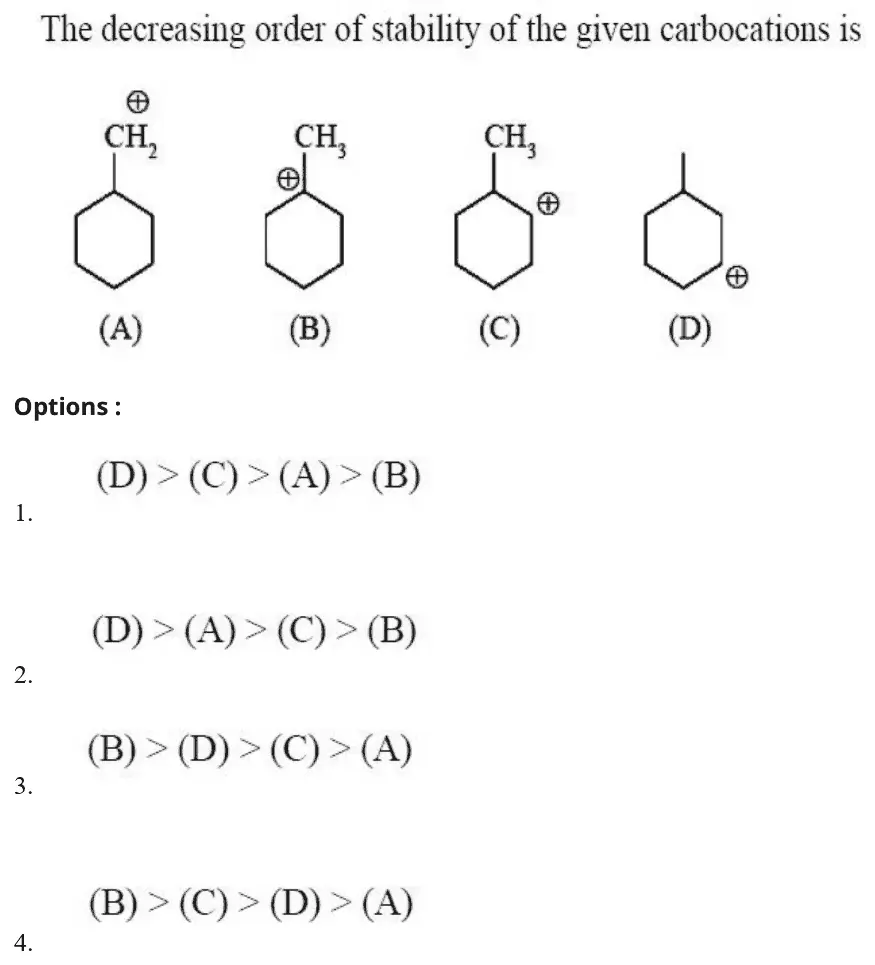
The decreasing order of stability of the given carbocations is
(see the figure above)

(D) > (C) > (A) > (B)
(D) > (A) > (C) > (B)
(B) > (D) > (C) > (A)
(B) > (C) > (D) > (A)
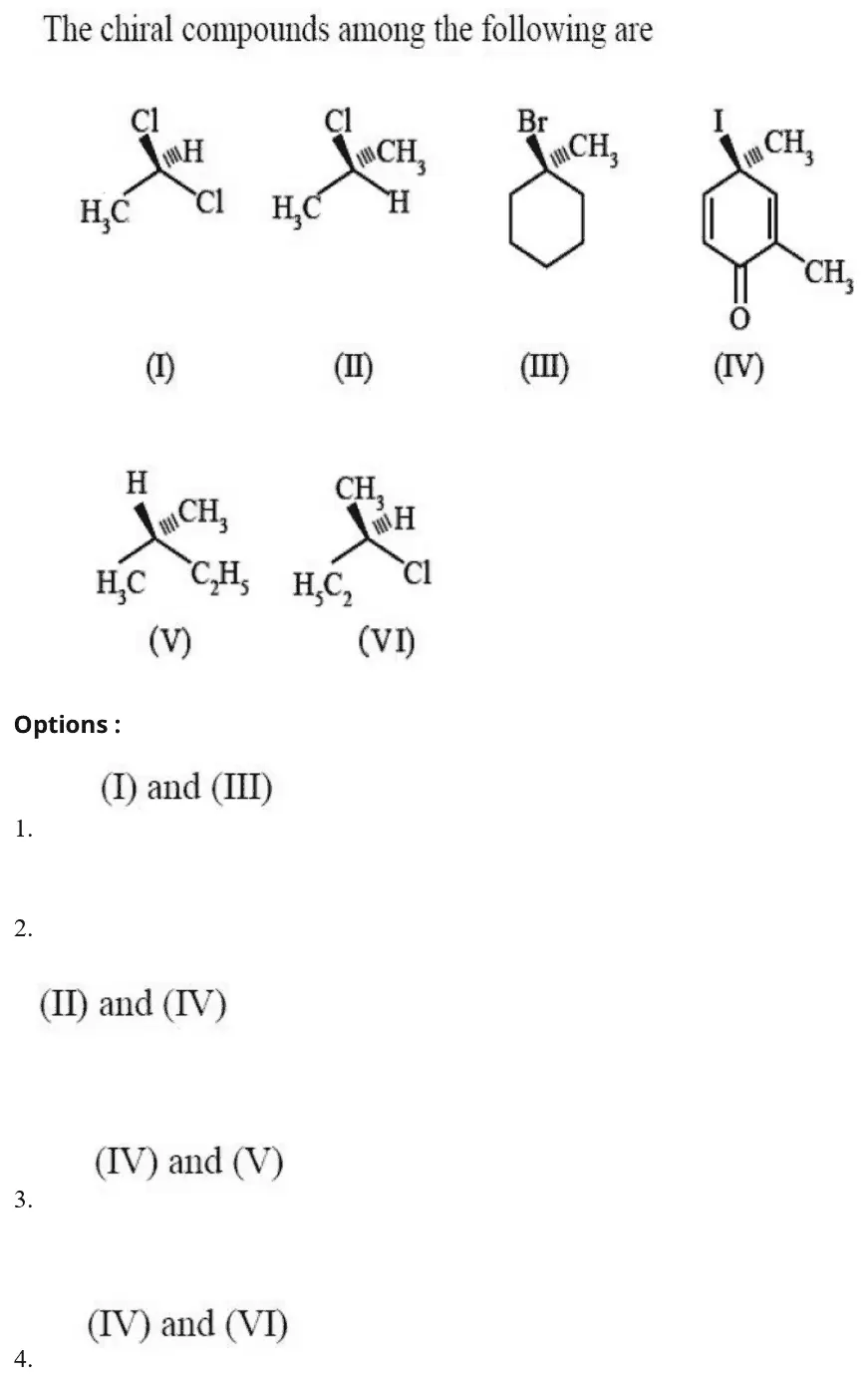
The chiral compounds among the following are
(see the figure above)

(I) and (III)
(II) and (IV)
(IV) and (V)
(IV) and (VI)
The correct decreasing order of the basic strength is
$\mathrm{HS^-} > \mathrm{CH_3^-} > \mathrm{NH_2^-} > \mathrm{CN^-}$
$\mathrm{HS^-} > \mathrm{CN^-} > \mathrm{NH_2^-} > \mathrm{CH_3^-}$
$\mathrm{CH_3^-} > \mathrm{NH_2^-} > \mathrm{CN^-} > \mathrm{HS^-}$
$\mathrm{NH_2^-} > \mathrm{CN^-} > \mathrm{CH_3^-} > \mathrm{HS^-}$
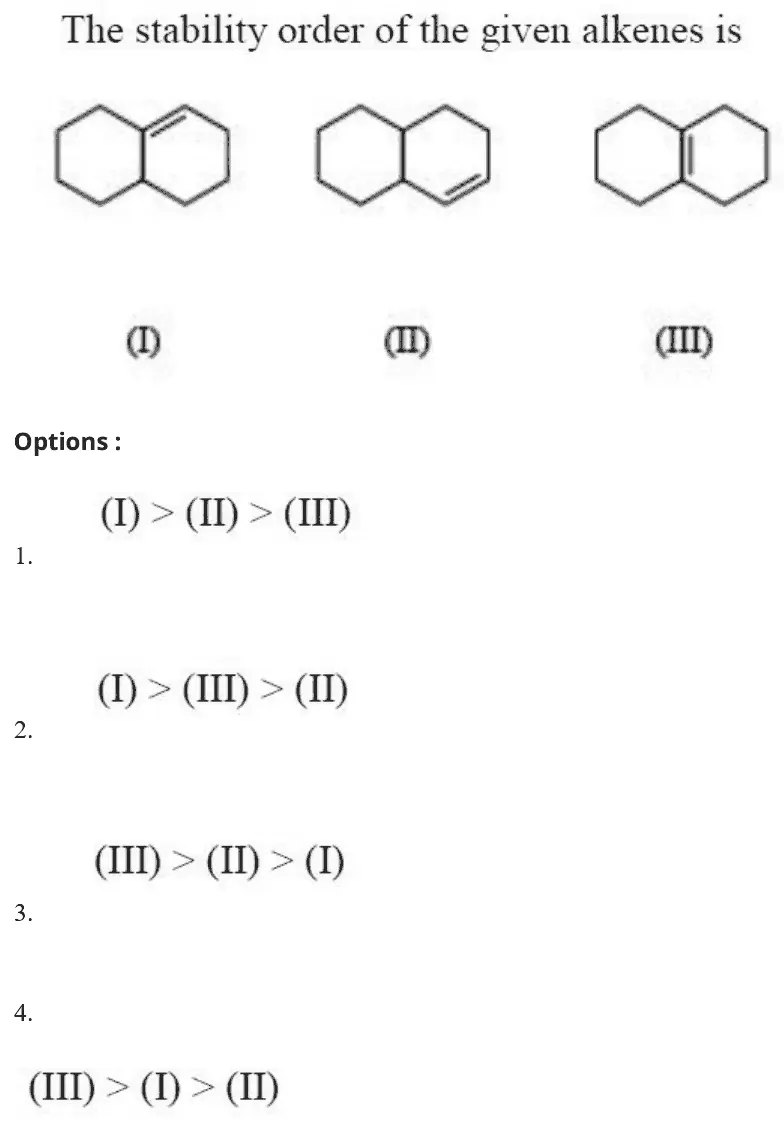
The stability order of the given alkenes is
(see the figure above)

(I) > (II) > (III)
(I) > (III) > (II)
(III) > (II) > (I)
(III) > (I) > (II)
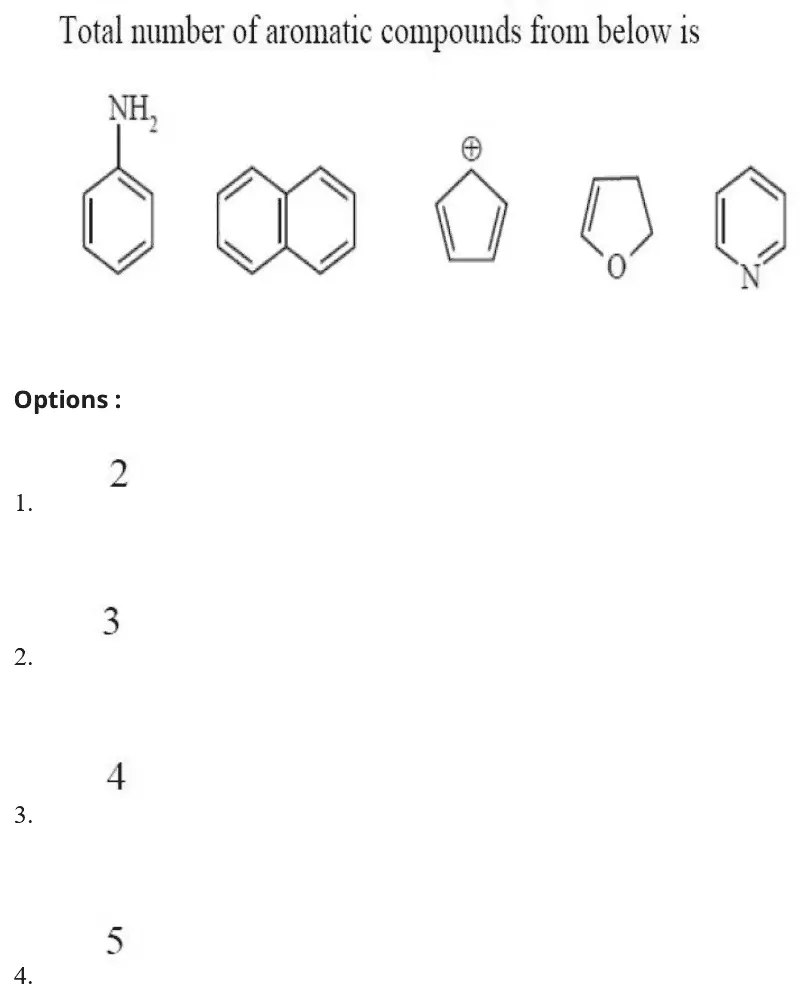
Total number of aromatic compounds from below is
(see the figure above)

2
3
4
5
The general formula of a cycloalkane is
$\mathrm{C_nH_{2n+2}}$
$\mathrm{C_nH_{2n-2}}$
$\mathrm{C_nH_{2n}}$
$\mathrm{C_nH_n}$
The number of isomers of $C_5H_{12}$ is:
3
4
5
2
The IUPAC name for the following compound is
$\mathrm{BrCH_2CH_2CH=CHCH_2COCH_3}$
1-Bromohept-3-en-6-one
2-oxo-Bromohept-4-ene
7-Bromo-2-oxo hept-4-one
7-Bromohept-4-en-2-one
For a compound with empirical formula $\mathrm{C_7H_8O}$, how many aromatic structures are possible?
9
5
7
4
Which of the following can show geometrical isomerism?
$\mathrm{CHCl=CHCl}$
$\mathrm{CH_2=CCl_2}$
$\mathrm{CCl_2=CHCl}$
$\mathrm{CH_2=CH_2}$
The common name of isopropyl benzene is
Styrene
Quinol
Cumene
Cresol
The correct order of increasing acidic strength among the following is
Phenol < Ethanol < Chloroacetic acid < Acetic acid
Ethanol < Phenol < Chloroacetic acid < Acetic acid
Ethanol < Phenol < Acetic acid < Chloroacetic acid
Chloroacetic acid < Acetic acid < Phenol < Ethanol
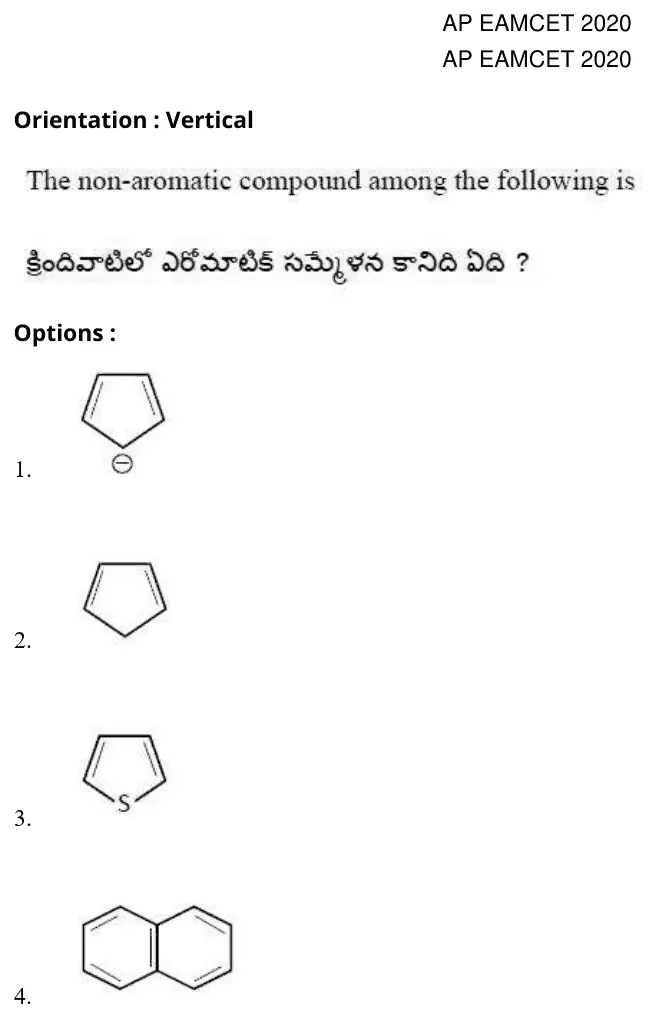
The non-aromatic compound among the following is

see figure cyclopentadienyl anion: five-membered ring with two double bonds and a negative charge (circled minus) on the bottom carbon
see figure cyclopentadiene: five-membered ring with two double bonds and one CH2 (no charge)
see figure thiophene: five-membered ring with two double bonds and S at the bottom left
see figure naphthalene: two fused six-membered rings
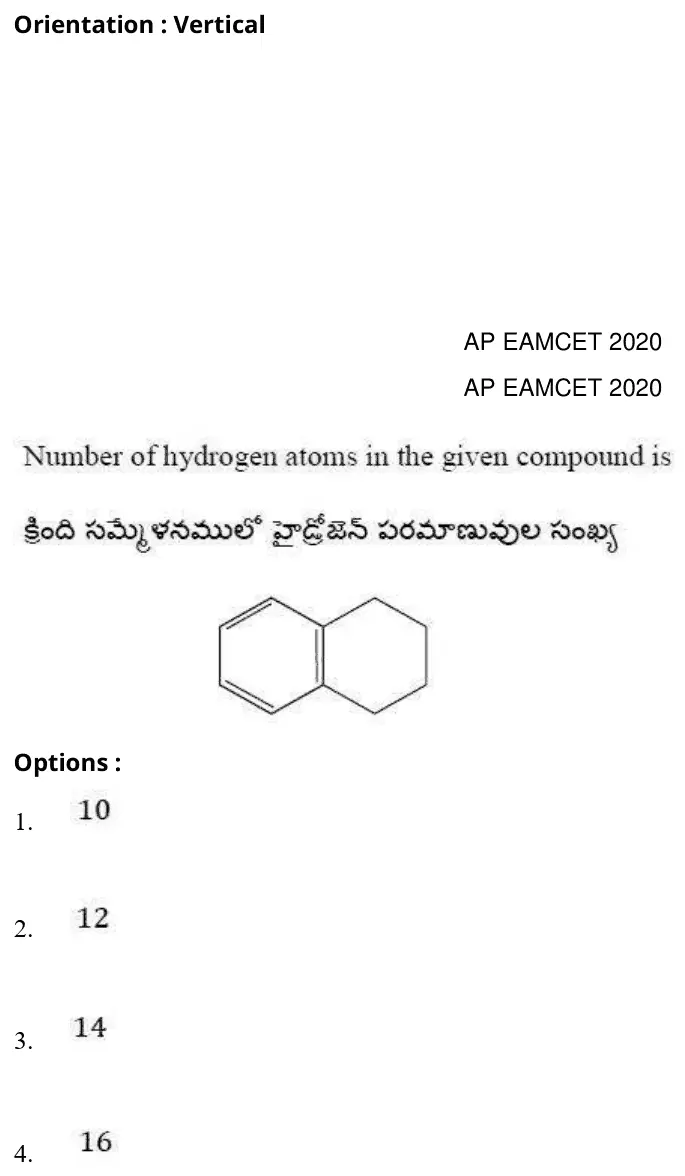
Number of hydrogen atoms in the given compound is
(see the figure above)

10
12
14
16
Arrange the following carbocations in the increasing order of stability with respect to their labels:
Label 1: $(CH_3)_2CH^+$
Label 2: $CH_3^+$
Label 3: $(CH_3)_3C^+$
Label 4: $CH_3-CH_2^+$
$2<4<1<3$
$1<2<3<4$
$4<3<2<1$
$2<4<3<1$
Which of the following compounds will exhibit cis-trans isomerism?
2-butene
2-butyne
2-butanol
butanal
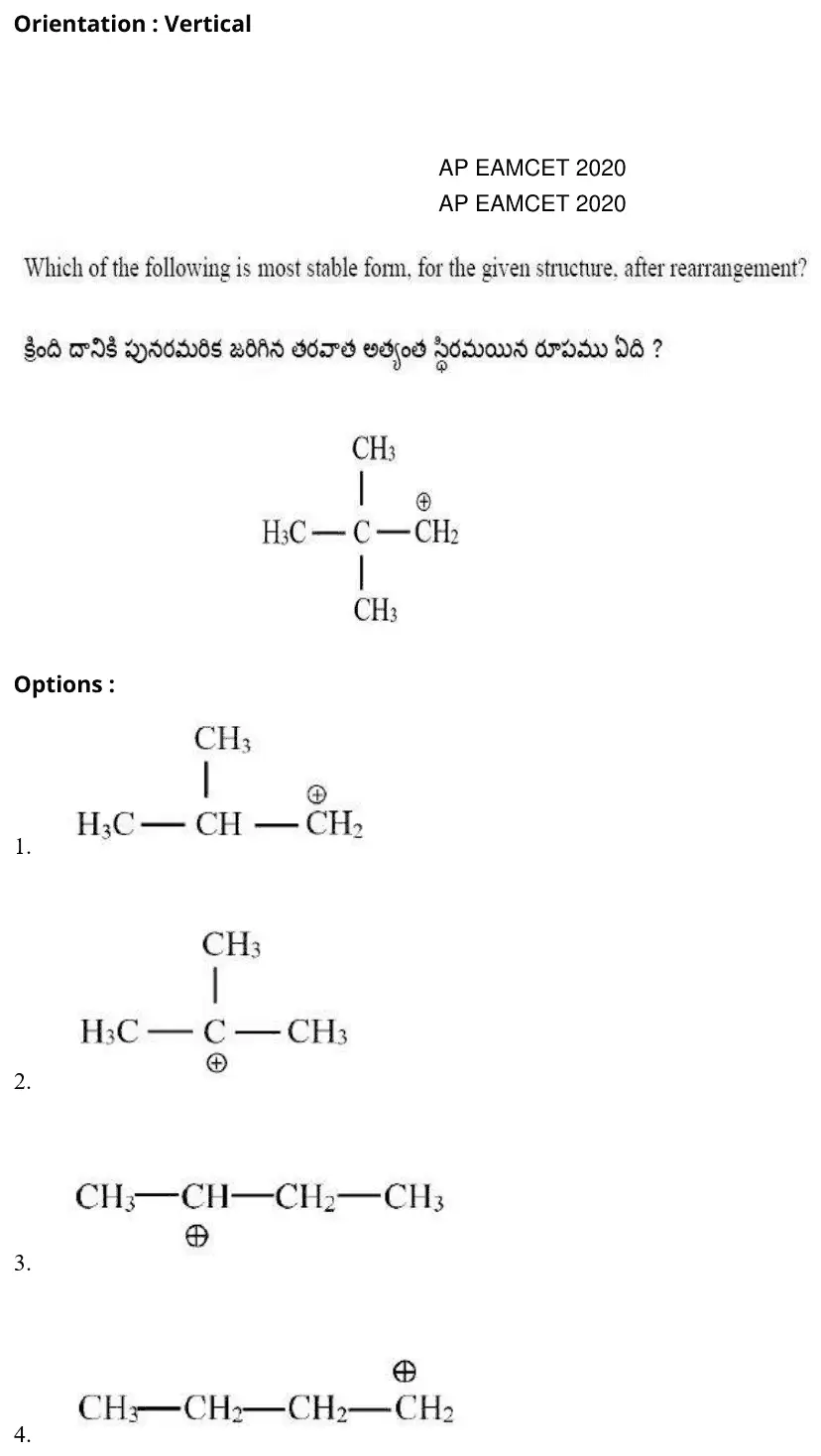
Which of the following is most stable form, for the given structure, after rearrangement?
(see the figure above)

see figure $\mathrm{H_3C-CH(CH_3)-\overset{\oplus}{C}H_2}$ (isobutyl cation)
see figure $\mathrm{H_3C-\overset{\oplus}{C}(CH_3)-CH_3}$ (tert-butyl cation, charge on the central carbon)
see figure $\mathrm{CH_3-\overset{\oplus}{C}H-CH_2-CH_3}$ (sec-butyl cation)
see figure $\mathrm{CH_3-CH_2-CH_2-\overset{\oplus}{C}H_2}$ (n-butyl cation)
Geometrical isomerism can be found in which of the following?
Butyric acid
Aspartic acid
Palmitic acid
Cinnamic acid
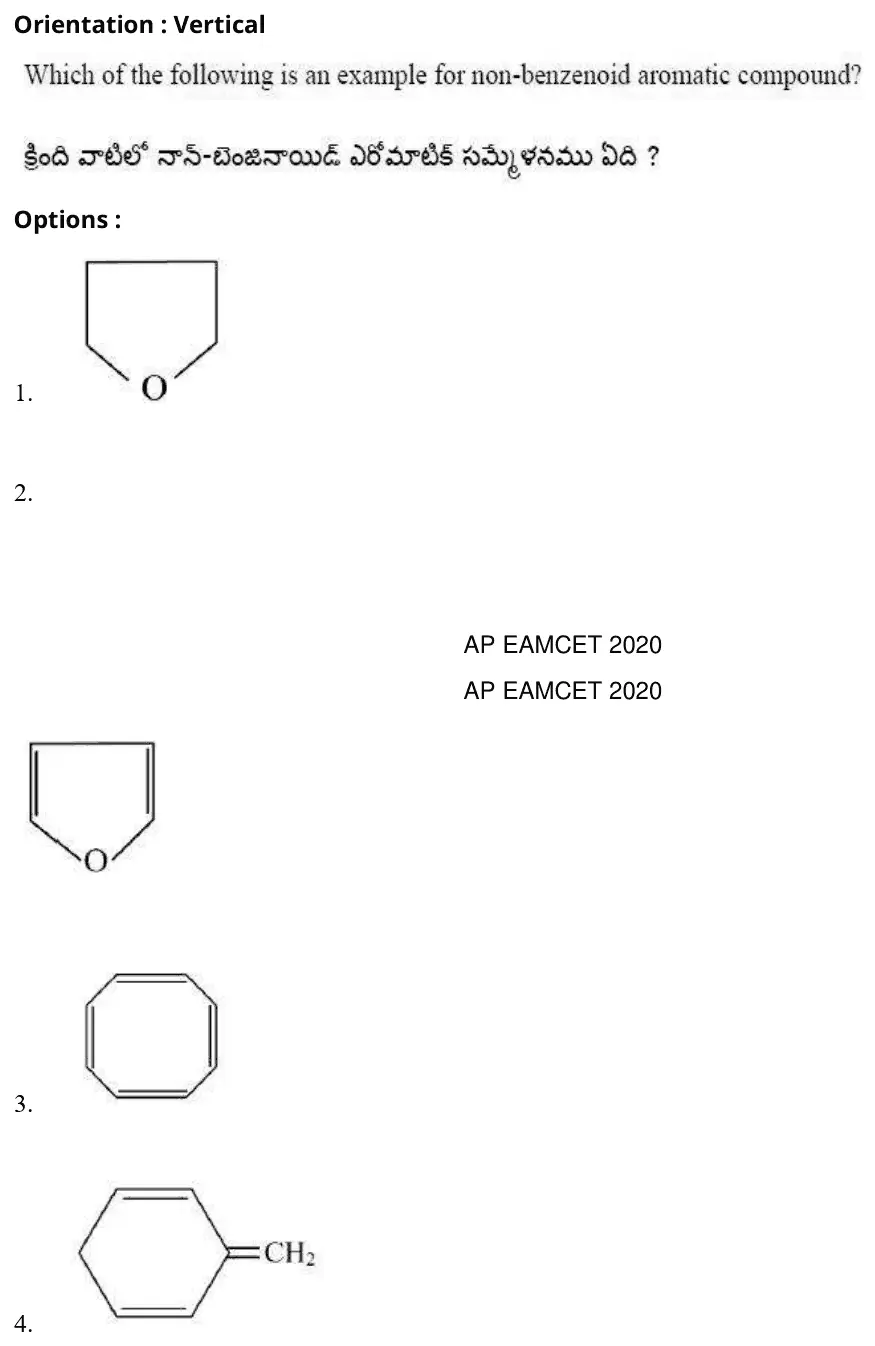
Which of the following is an example for non-benzenoid aromatic compound?

see figure five-membered saturated ring with O (tetrahydrofuran)
see figure five-membered ring with O and two C=C double bonds (furan)
see figure eight-membered ring with four C=C double bonds (cyclooctatetraene)
see figure six-membered ring with two ring C=C double bonds and an exocyclic $=\mathrm{CH_2}$
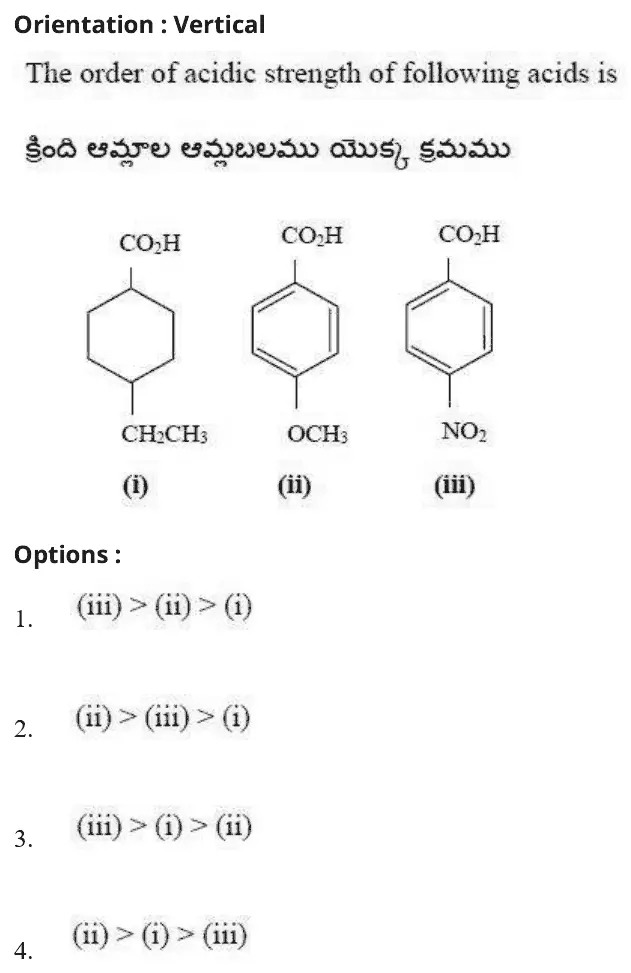
The order of acidic strength of following acids is
(see the figure above)

(iii) > (ii) > (i)
(ii) > (iii) > (i)
(iii) > (i) > (ii)
(ii) > (i) > (iii)
$C - Cl$ bond in chlorobenzene in comparison to $C - Cl$ bond in in methyl chloride is
Longer and weaker
Shorter and weaker
Shorter and stronger
Longer and stronger
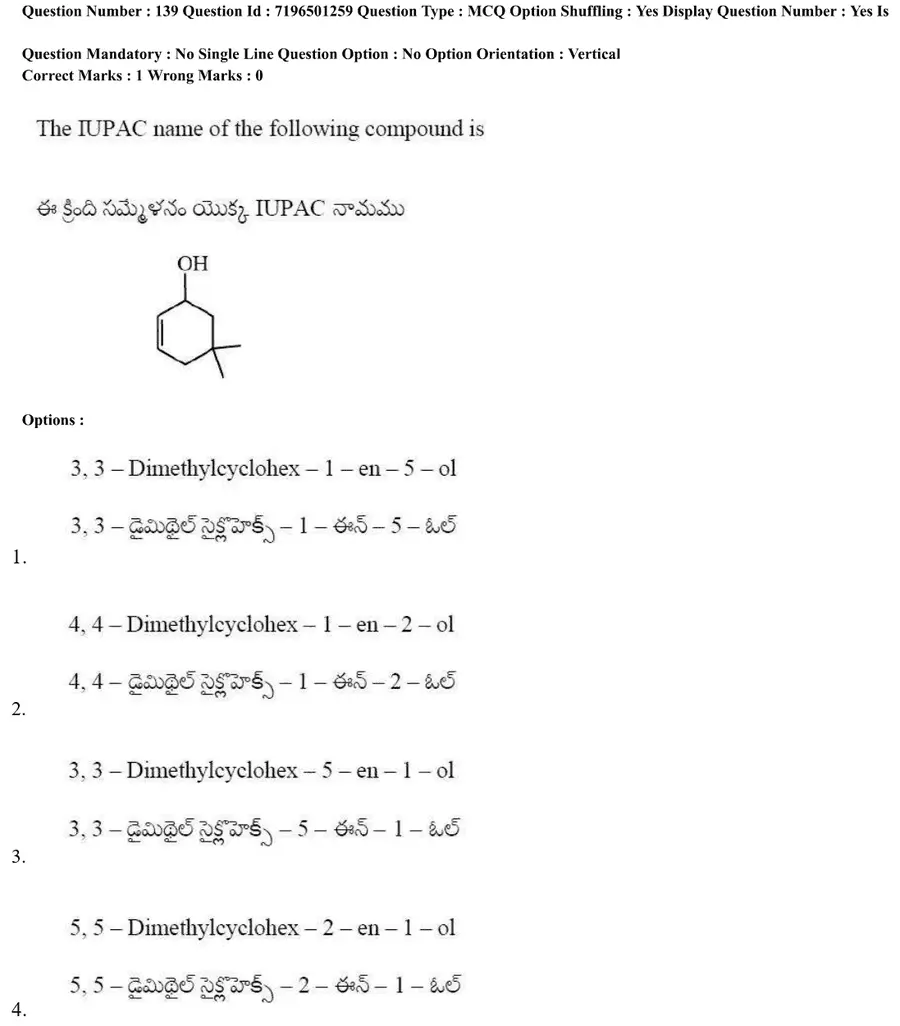
The IUPAC name of the following compound is
(see the figure above)

3, 3 – Dimethylcyclohex – 1 – en – 5 – ol
4, 4 – Dimethylcyclohex – 1 – en – 2 – ol
3, 3 – Dimethylcyclohex – 5 – en – 1 – ol
5, 5 – Dimethylcyclohex – 2 – en – 1 – ol
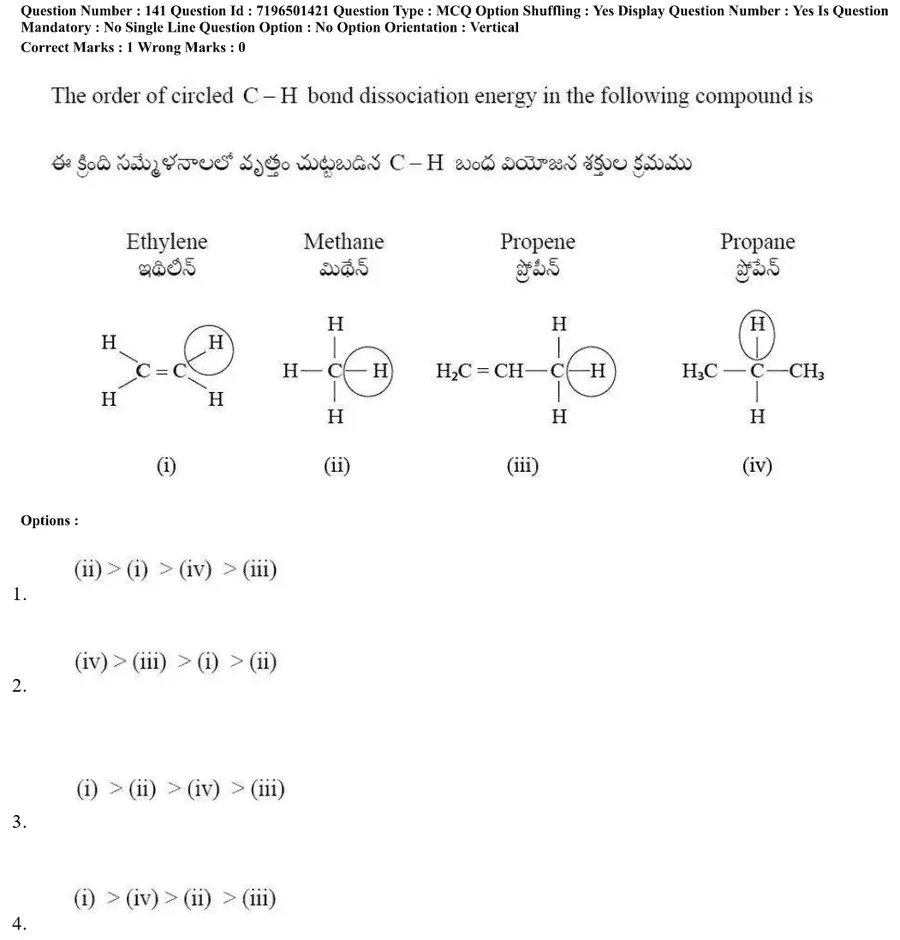
The order of circled C-H bond dissociation energy in the following compound is
(see the figure above)

(ii) > (i) > (iv) > (iii)
(iv) > (iii) > (i) > (ii)
(i) > (ii) > (iv) > (iii)
(i) > (iv) > (ii) > (iii)
The correct order of the relative stability of the following carbanions is
(i) $\mathrm{HC \equiv C^-}$ (ii) $\mathrm{CH_2 = CH-CH_2^-}$ (iii) $\mathrm{H_2C = CH^-}$ (iv) $\mathrm{(C_6H_5)_2CH^-}$
(i) > (iv) > (ii) > (iii)
(iii) > (iv) > (i) > (ii)
(iv) > (ii) > (i) > (iii)
(iv) > (i) > (ii) > (iii)
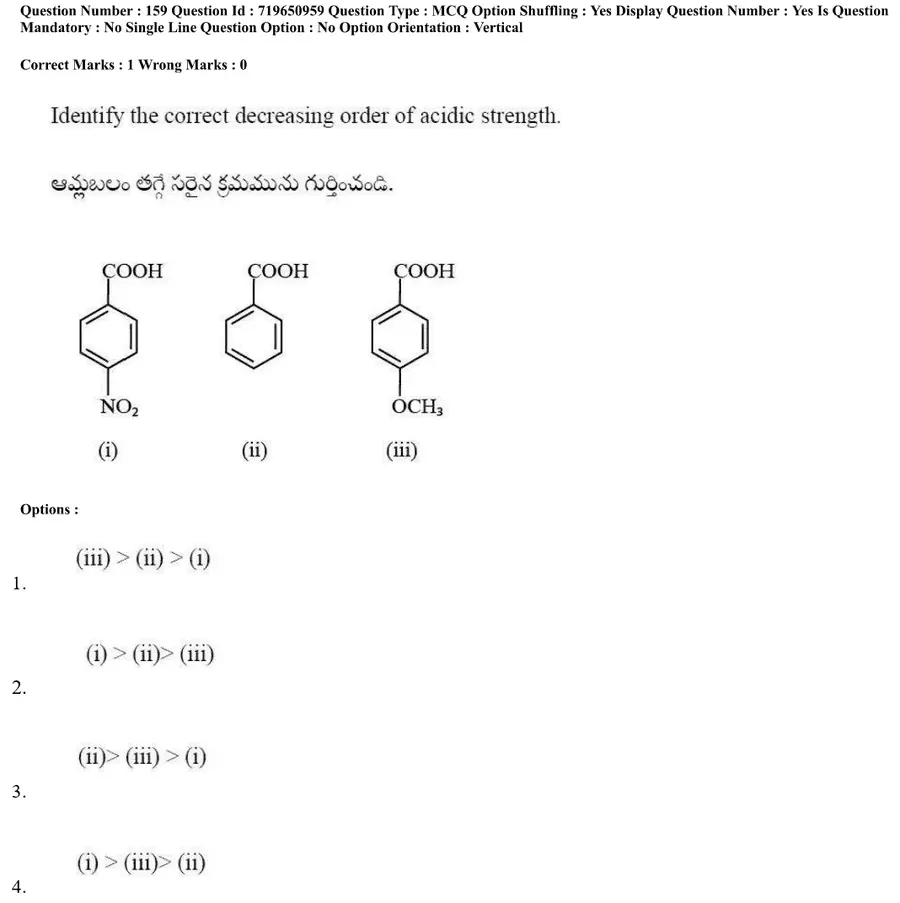
Identify the correct decreasing order of acidic strength.
(see the figure above)

(iii) > (ii) > (i)
(i) > (ii)> (iii)
(ii)> (iii) > (i)
(i) > (iii)> (ii)
How many geometrical isomers are possible for the compound with molecular formula $\mathrm{C_2FClBrI}$?
Four
Five
Six
Eight
Identify the atoms or groups from the following that exhibit $-R$ effect and $+R$ effect when present on benzene ring:
$-\mathrm{OR}, -\mathrm{NHCOR}, -\mathrm{CN}, -\mathrm{X}, -\mathrm{NO_2}, -\mathrm{NH_2}, >\mathrm{C{=}O}$
$-R$ effect: $-\mathrm{NHCOR}, -\mathrm{NO_2}, >\mathrm{C{=}O}$; $+R$ effect: $-\mathrm{CN}, -\mathrm{OR}, -\mathrm{X}, -\mathrm{NH_2}$
$-R$ effect: $-\mathrm{OR}, -\mathrm{CN}, -\mathrm{NO_2}, >\mathrm{C{=}O}$; $+R$ effect: $-\mathrm{NHCOR}, -\mathrm{X}, -\mathrm{NH_2}$
$-R$ effect: $-\mathrm{CN}, -\mathrm{NO_2}, -\mathrm{NH_2}$; $+R$ effect: $-\mathrm{OR}, -\mathrm{NHCOR}, -\mathrm{X}, >\mathrm{C{=}O}$
$-R$ effect: $-\mathrm{CN}, -\mathrm{NO_2}, >\mathrm{C{=}O}$; $+R$ effect: $-\mathrm{OR}, -\mathrm{NHCOR}, -\mathrm{X}, -\mathrm{NH_2}$
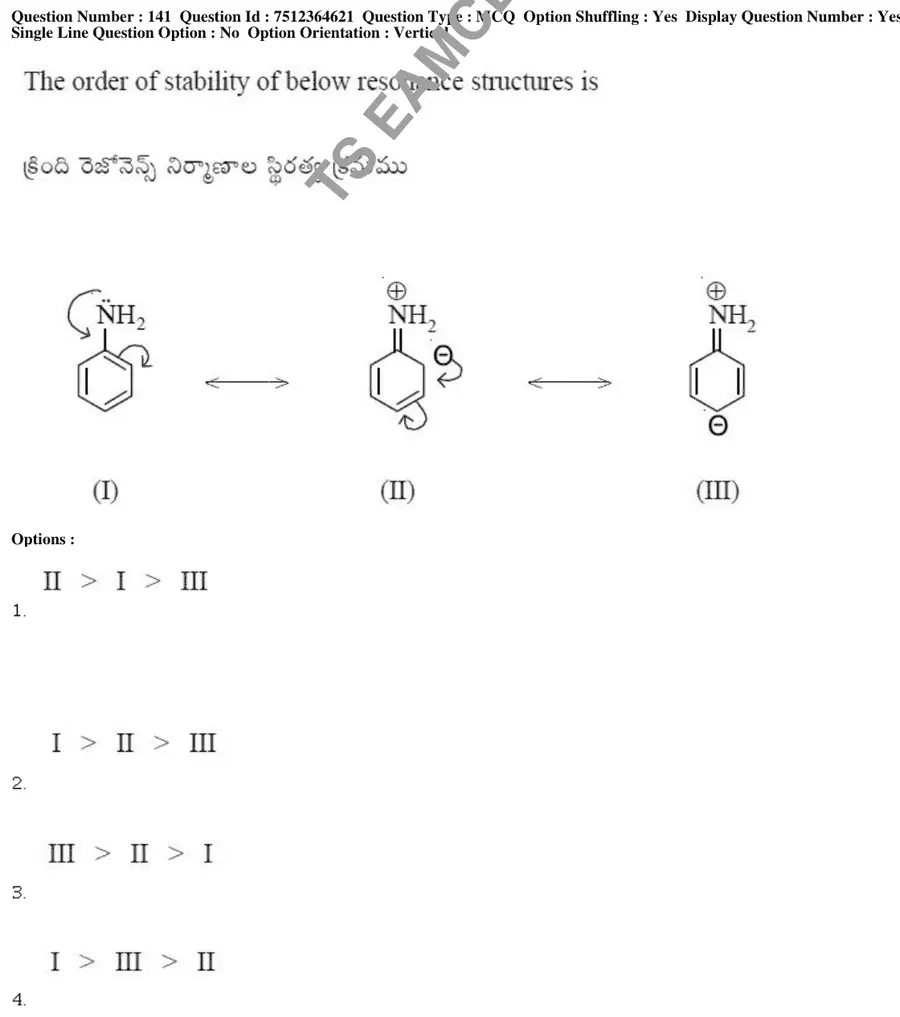
The order of stability of below resonance structures is
(see the figure above)

$\mathrm{II} > \mathrm{I} > \mathrm{III}$
$\mathrm{I} > \mathrm{II} > \mathrm{III}$
$\mathrm{III} > \mathrm{II} > \mathrm{I}$
$\mathrm{I} > \mathrm{III} > \mathrm{II}$
The number of no bond resonance structures possible for but-1-ene and a $3^\circ$ carbocation having methyl, ethyl and isobutyl groups on cationic carbon respectively are
3, 7
4, 6
2, 7
5, 6
Total number of acyclic and cyclic isomers possible for molecular formula $\mathrm{C_4H_6}$ is
5
7
9
8
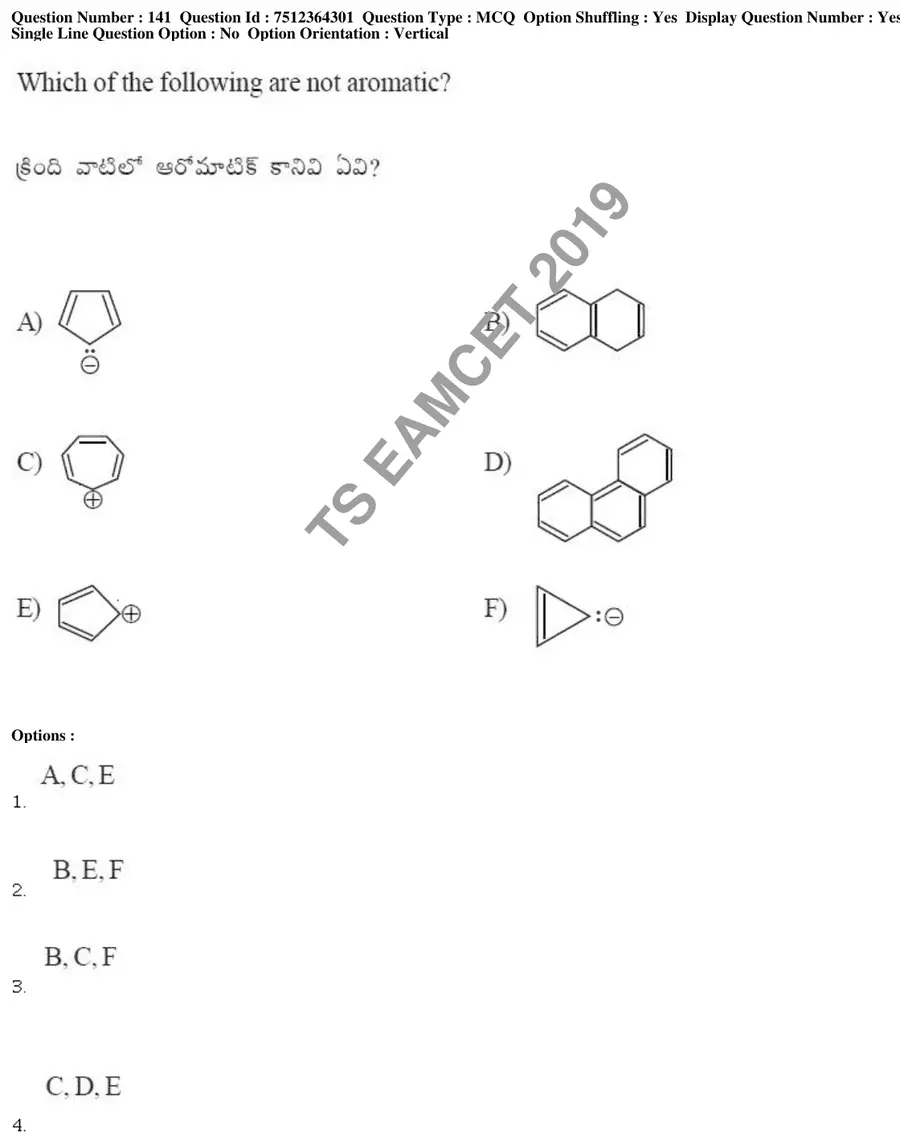
Which of the following are not aromatic?
(see the figure above)

A, C, E
B, E, F
B, C, F
C, D, E
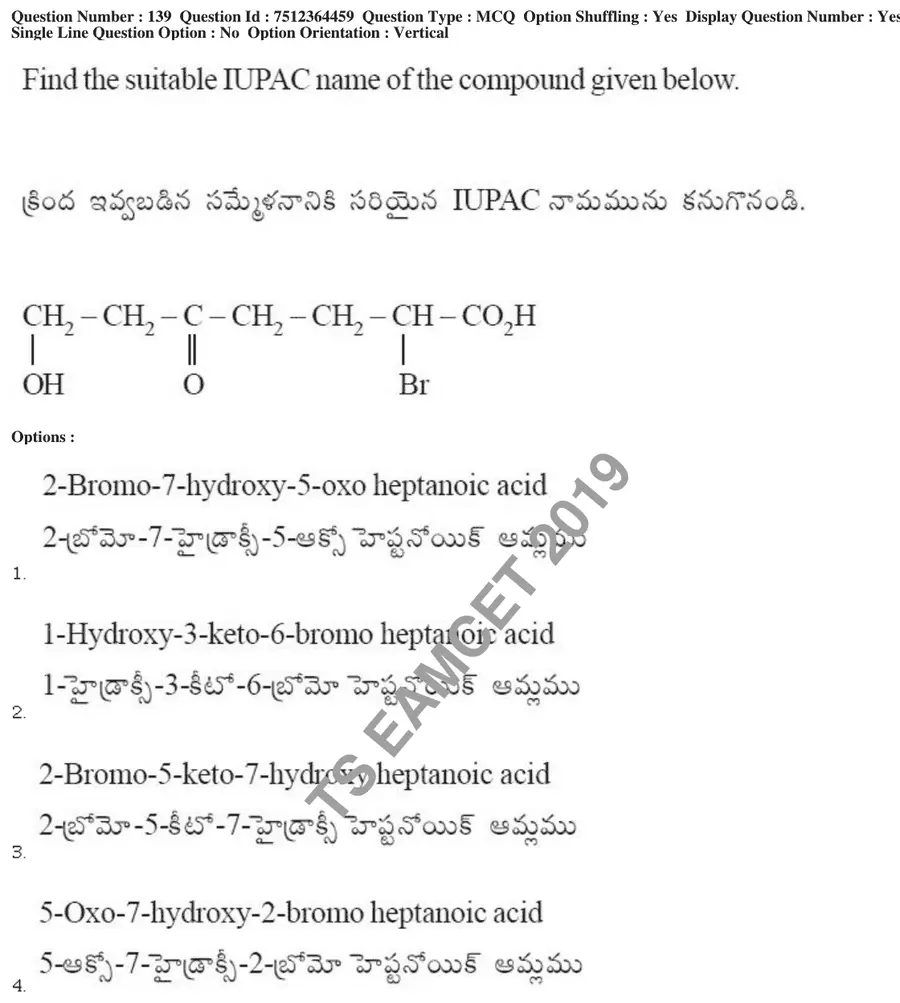
Find the suitable IUPAC name of the compound given below. (see the figure above)

2-Bromo-7-hydroxy-5-oxo heptanoic acid
1-Hydroxy-3-keto-6-bromo heptanoic acid
2-Bromo-5-keto-7-hydroxy heptanoic acid
5-Oxo-7-hydroxy-2-bromo heptanoic acid
The boiling point (in K) of $cis$ but-2-ene and dipole moment (in D) of $trans$ but-2-ene are respectively
274, 0.00
277, 0.00
277, 0.33
274, 0.33
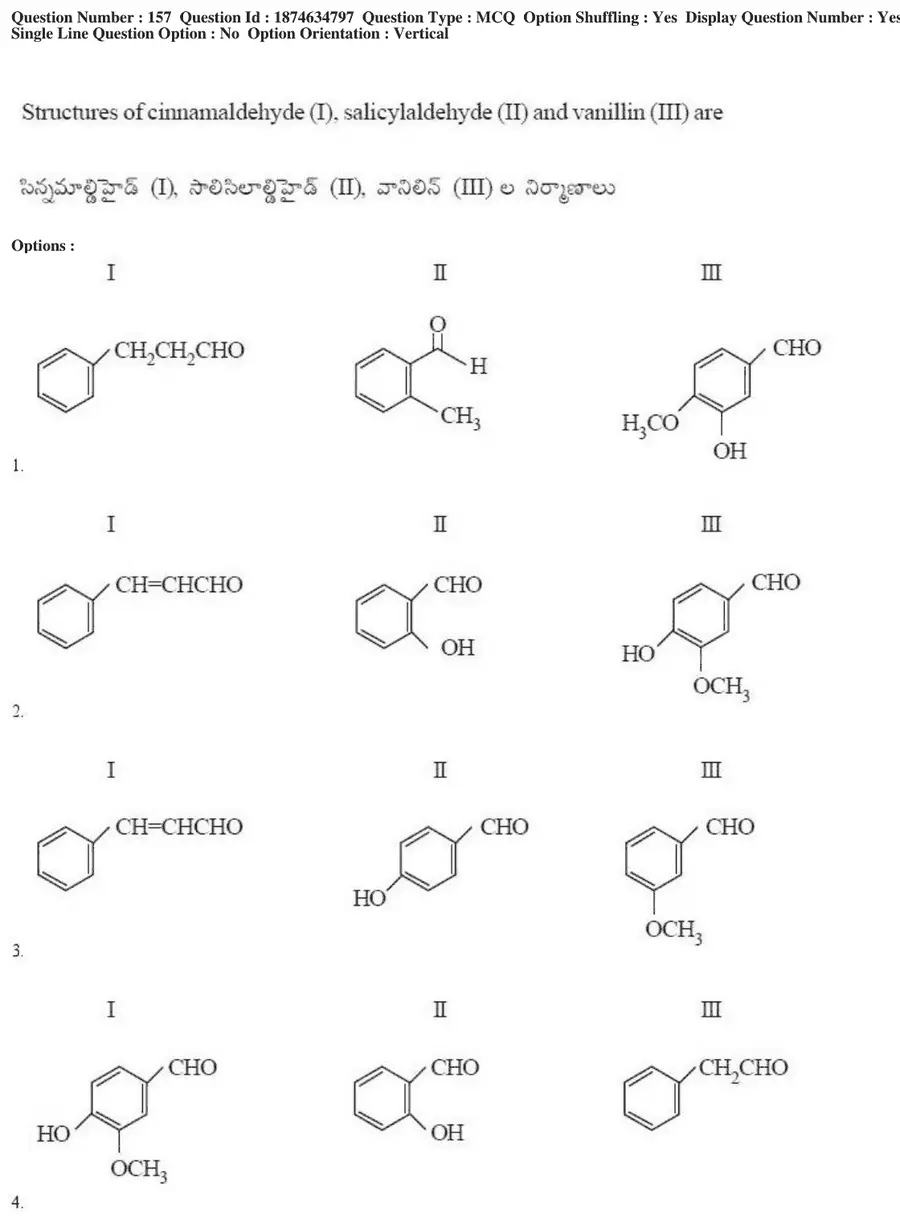
Structures of cinnamaldehyde (I), salicylaldehyde (II) and vanillin (III) are

see figure I: benzene ring with $\mathrm{CH_2CH_2CHO}$; II: benzene ring with a C(=O)H group and, on the adjacent ring carbon, $\mathrm{CH_3}$; III: benzene ring with $\mathrm{CHO}$ at one carbon, $\mathrm{H_3CO}$ at the carbon para to CHO and $\mathrm{OH}$ on the carbon next to it (meta to CHO)
see figure I: benzene ring with $\mathrm{CH=CHCHO}$; II: benzene ring with $\mathrm{CHO}$ and, on the adjacent ring carbon, $\mathrm{OH}$; III: benzene ring with $\mathrm{CHO}$ at one carbon, $\mathrm{HO}$ at the carbon para to CHO and $\mathrm{OCH_3}$ on the carbon next to it (meta to CHO)
see figure I: benzene ring with $\mathrm{CH=CHCHO}$; II: benzene ring with $\mathrm{CHO}$ and $\mathrm{HO}$ para to each other; III: benzene ring with $\mathrm{CHO}$ and $\mathrm{OCH_3}$ meta to each other
see figure I: benzene ring with $\mathrm{CHO}$, $\mathrm{HO}$ para to it and $\mathrm{OCH_3}$ adjacent to HO (vanillin-type ring); II: benzene ring with $\mathrm{CHO}$ and adjacent $\mathrm{OH}$; III: benzene ring with $\mathrm{CH_2CHO}$
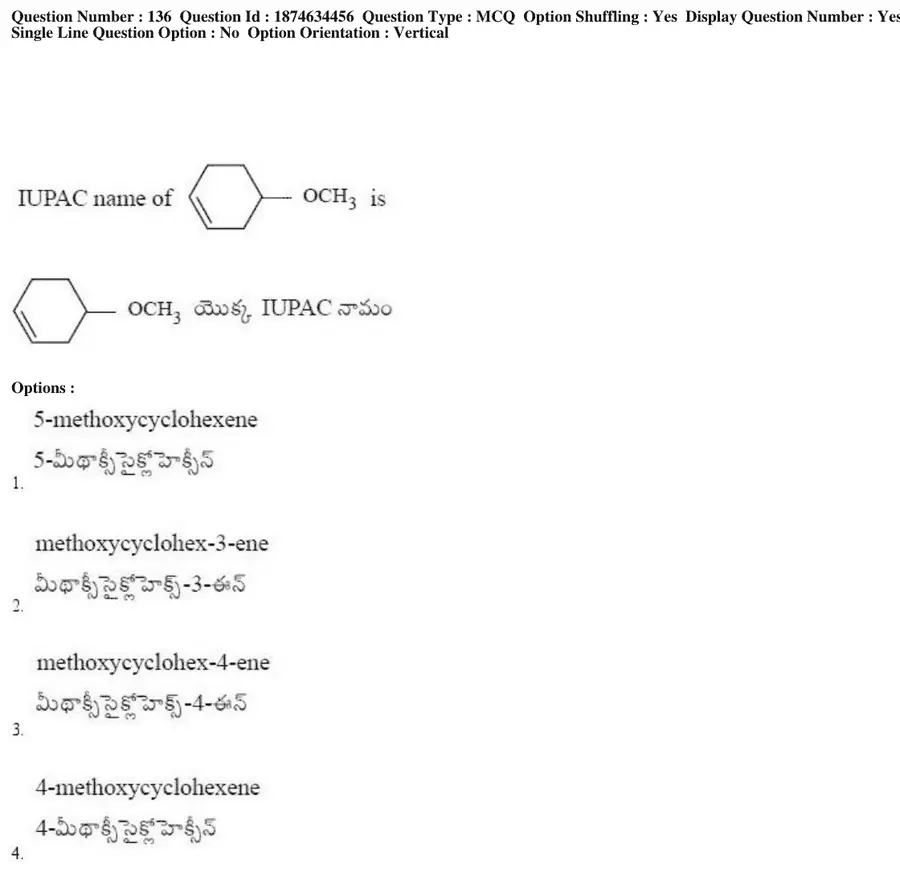
IUPAC name of (see the figure above) is

5-methoxycyclohexene
methoxycyclohex-3-ene
methoxycyclohex-4-ene
4-methoxycyclohexene
Alkenes (X) and carbonyl compounds (Y) participate in which of the following addition reactions?
X: Electrophilic; Y: Electrophilic
X: Nucleophilic; Y: Electrophilic
X: Electrophilic; Y: Nucleophilic
X: Nucleophilic; Y: Nucleophilic
The number of electrophiles and nucleophiles present in the species given below are respectively.
$\mathrm{BF_3}, \mathrm{CO_2}, \mathrm{Me_3N}, \mathrm{SO_3}, \mathrm{CH_3\overset{+}{C}O}, \mathrm{HS^-}, \mathrm{NO_2^+}, \mathrm{FeCl_3}, \mathrm{H_2O}$
6, 3
3, 6
4, 5
5, 4
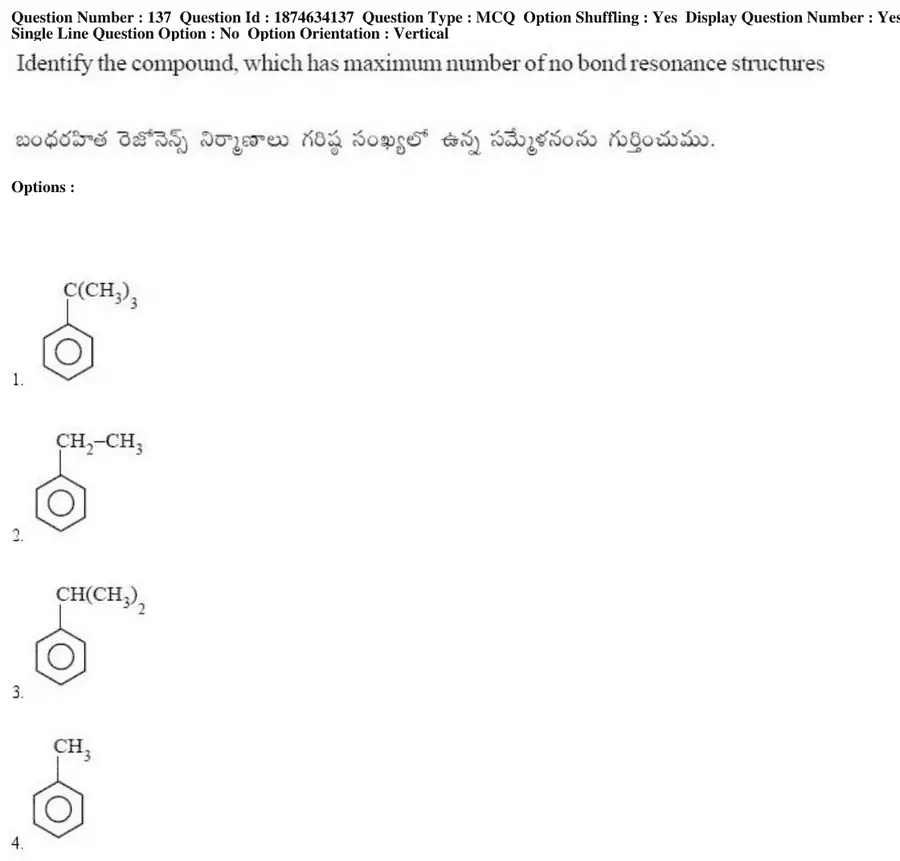
Identify the compound, which has maximum number of no bond resonance structures

see figure benzene ring bearing a $\mathrm{C(CH_3)_3}$ group
see figure benzene ring bearing a $\mathrm{CH_2{-}CH_3}$ group
see figure benzene ring bearing a $\mathrm{CH(CH_3)_2}$ group
see figure benzene ring bearing a $\mathrm{CH_3}$ group
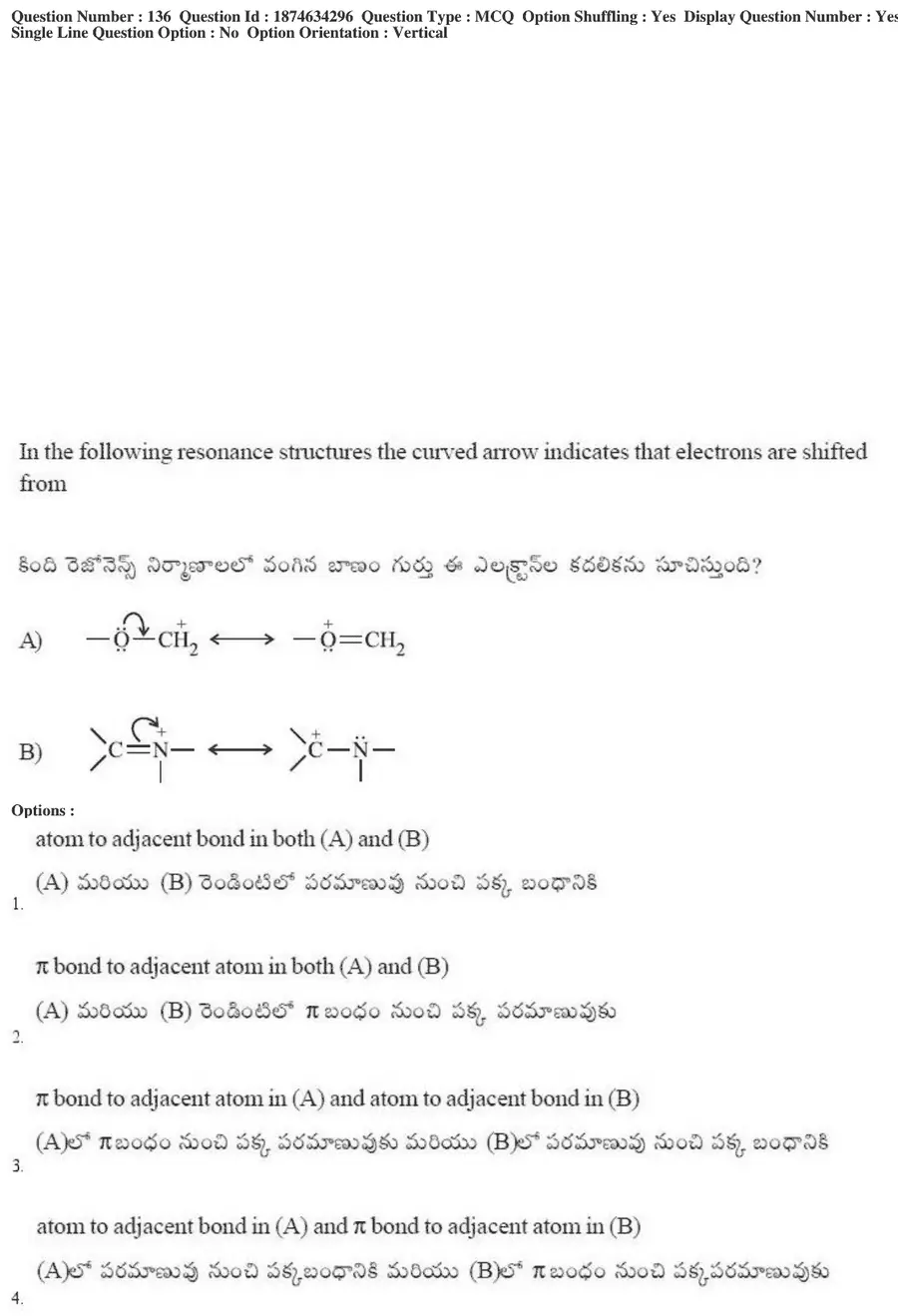
In the following resonance structures the curved arrow indicates that electrons are shifted from
(see the figure above)

atom to adjacent bond in both (A) and (B)
$\pi$ bond to adjacent atom in both (A) and (B)
$\pi$ bond to adjacent atom in (A) and atom to adjacent bond in (B)
atom to adjacent bond in (A) and $\pi$ bond to adjacent atom in (B)
IUPAC name of isoprene is
1, 3-butadiene
2, 3-dimethylbutadiene
2-methyl -1, 3-butadiene
1, 3-dimethylbutadiene
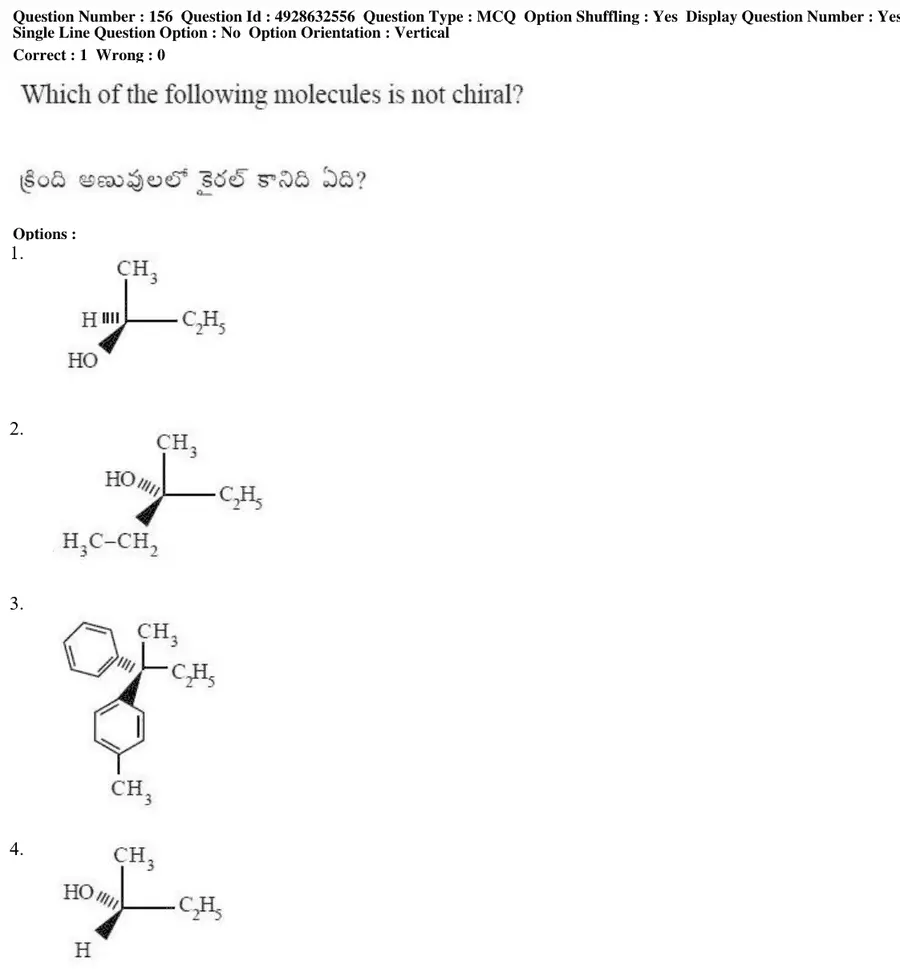
Which of the following molecules is not chiral?

see figure Fischer-style stereo drawing: central carbon with CH3 at top, C2H5 at right, H on a hashed bond at left, HO on a wedge at lower left
see figure central carbon with CH3 at top, C2H5 at right, HO on a hashed bond at left, and H3C-CH2 on a wedge at lower left
see figure central carbon with CH3 at top, C2H5 at right, a phenyl ring (drawn as a cyclohexadiene-like ring) on a hashed bond at left, and a 4-methylphenyl (p-tolyl) ring on a wedge below
see figure central carbon with CH3 at top, C2H5 at right, HO on a hashed bond at left, H on a wedge at lower left
Tropolone is
benzenoid and aromatic
non-benzenoid and not aromatic
non-benzenoid and aromatic
non-benzenoid and anti-aromatic
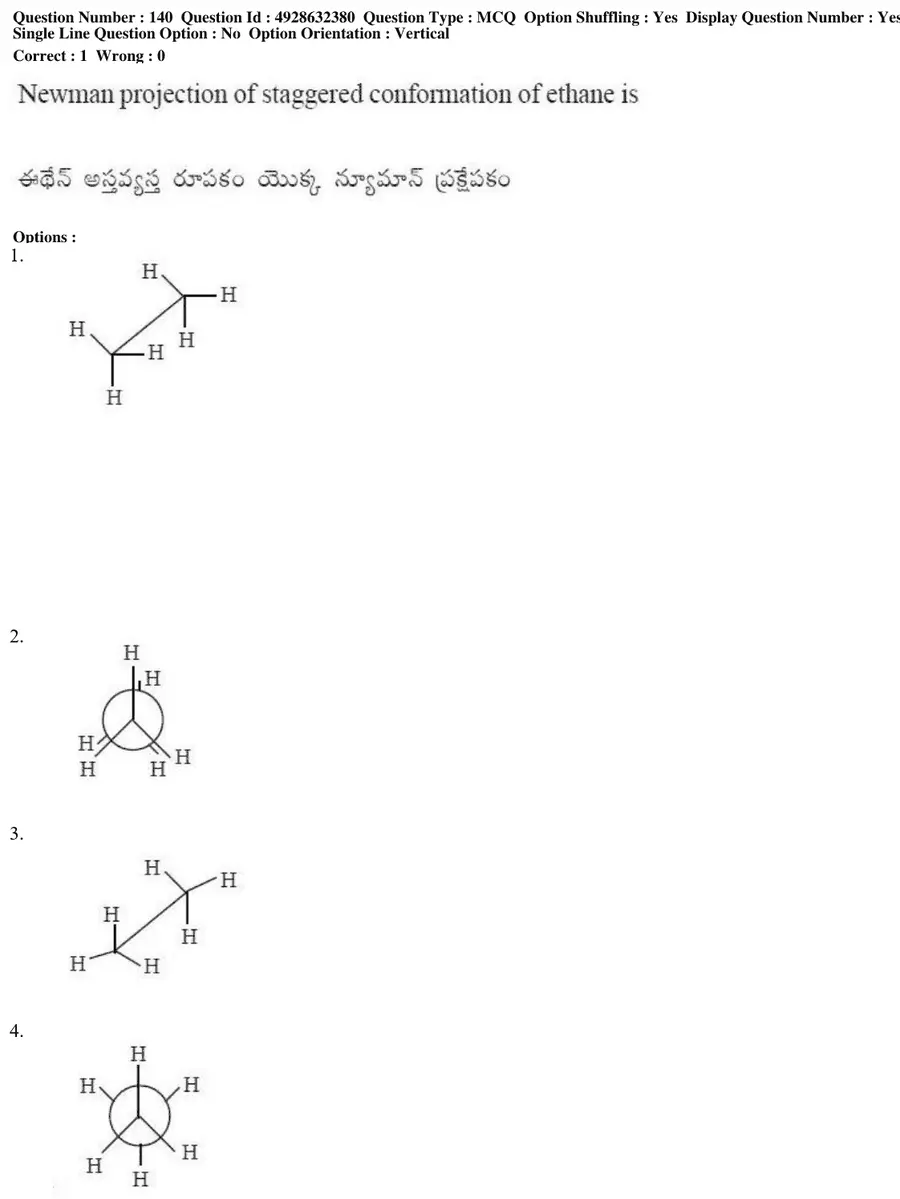
Newman projection of staggered conformation of ethane is
(see the figure above)

see figure sawhorse-type drawing of two carbons joined by a slanted bond; each carbon carries three H (front carbon lower-left: H upper-left, H right, H down; back carbon upper-right: H upper-left, H right, H down)
see figure Newman-type circle drawing: H at top and a second H just right of it, two H at lower-left, one H at bottom, one H at lower-right
see figure sawhorse-type drawing of two carbons joined by a slanted bond (front carbon lower-left: H up, H left, H lower-right; back carbon upper-right: H upper-left, H right, H down)
see figure Newman circle drawing: H at top, H at upper-left, H at upper-right, H at lower-left, H at bottom, H at lower-right
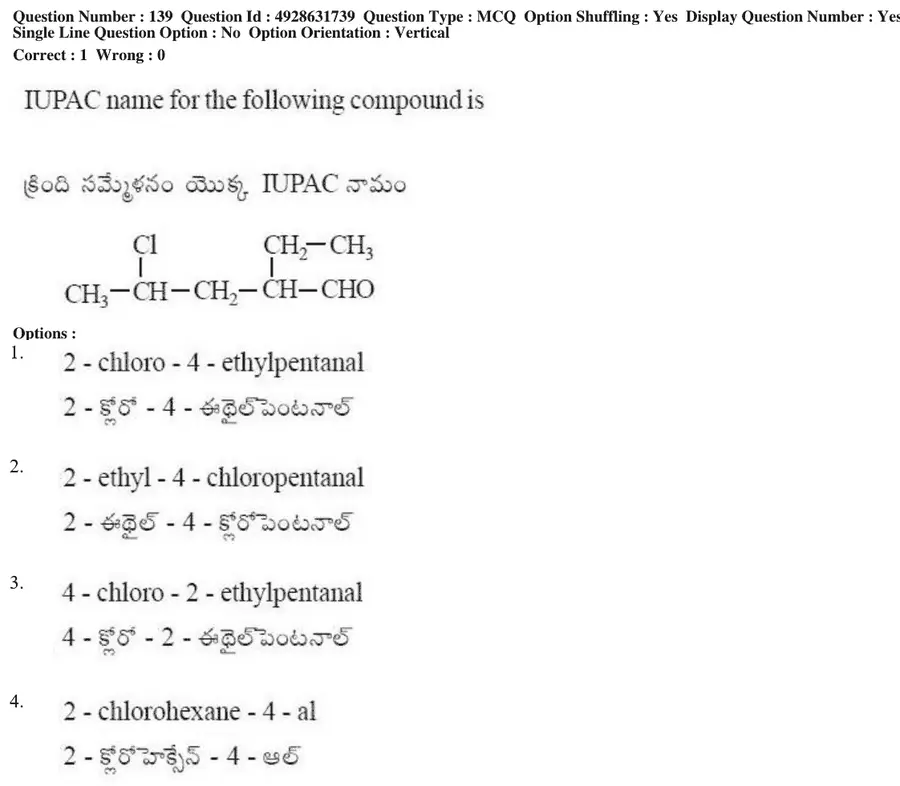
IUPAC name for the following compound is
(see the figure above)

2 - chloro - 4 - ethylpentanal
2 - ethyl - 4 - chloropentanal
4 - chloro - 2 - ethylpentanal
2 - chlorohexane - 4 - al
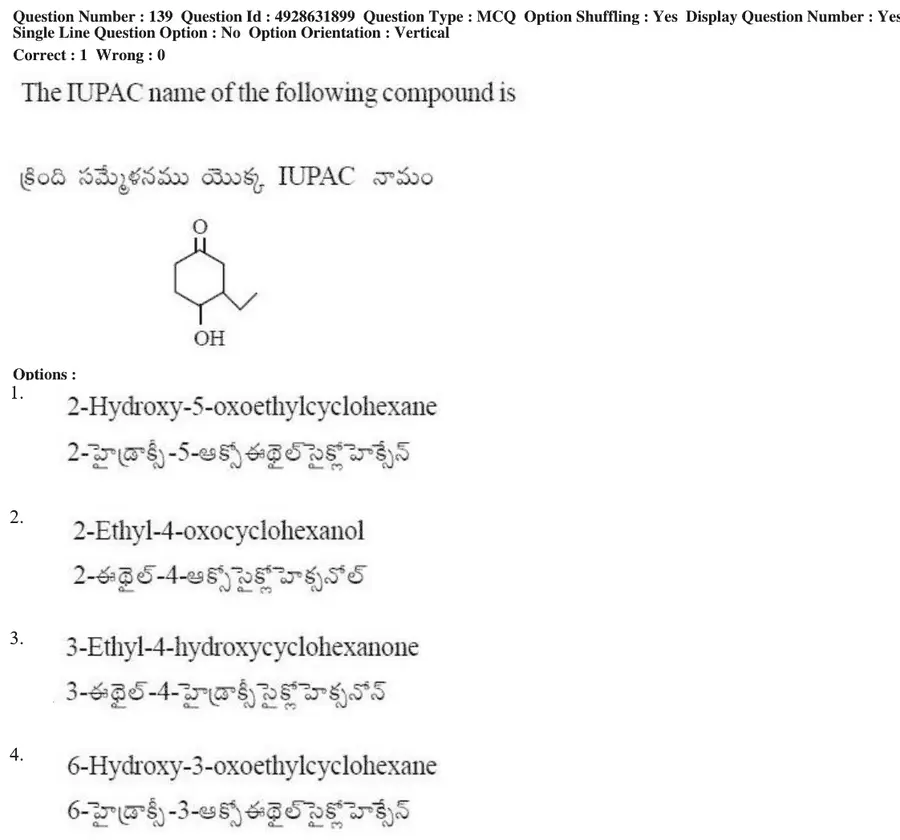
The IUPAC name of the following compound is
(see the figure above)

2-Hydroxy-5-oxoethylcyclohexane
2-Ethyl-4-oxocyclohexanol
3-Ethyl-4-hydroxycyclohexanone
6-Hydroxy-3-oxoethylcyclohexane
Number of possible constitutional isomers of alkane with formula $\mathrm{C_6H_{14}}$ is
3
5
2
10
Which one of the following is not aromatic ?
Cyclopentadienyl anion
Benzene
Cyclopentadienyl cation
Cycloheptatrienyl cation
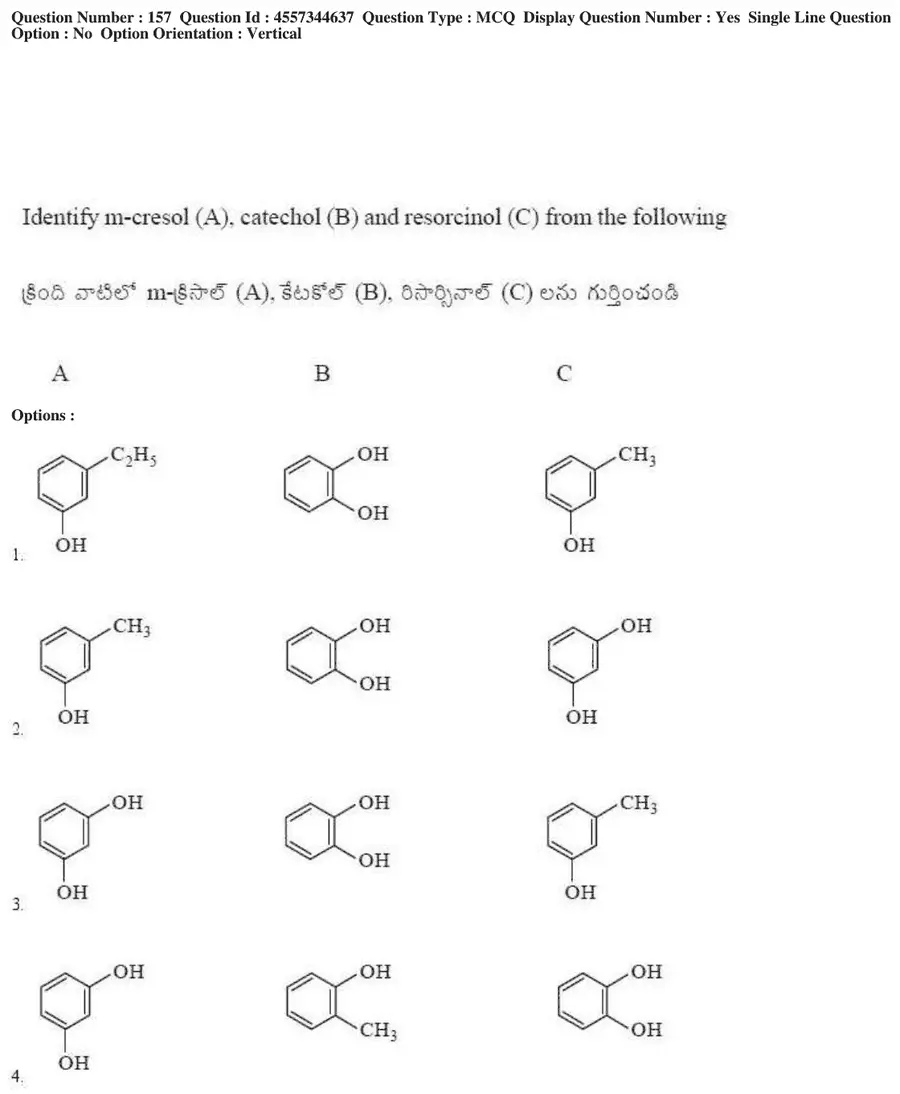
Identify m-cresol (A), catechol (B) and resorcinol (C) from the following
(see the figure above)

A: m-ethylphenol ($\mathrm{C_2H_5}$ and OH meta); B: catechol (1,2-dihydroxybenzene); C: m-cresol ($\mathrm{CH_3}$ and OH meta)
A: m-cresol ($\mathrm{CH_3}$ and OH meta); B: catechol (1,2-dihydroxybenzene); C: resorcinol (1,3-dihydroxybenzene)
A: resorcinol (1,3-dihydroxybenzene); B: catechol (1,2-dihydroxybenzene); C: m-cresol ($\mathrm{CH_3}$ and OH meta)
A: resorcinol (1,3-dihydroxybenzene); B: o-cresol ($\mathrm{OH}$ and $\mathrm{CH_3}$ ortho); C: catechol (1,2-dihydroxybenzene)
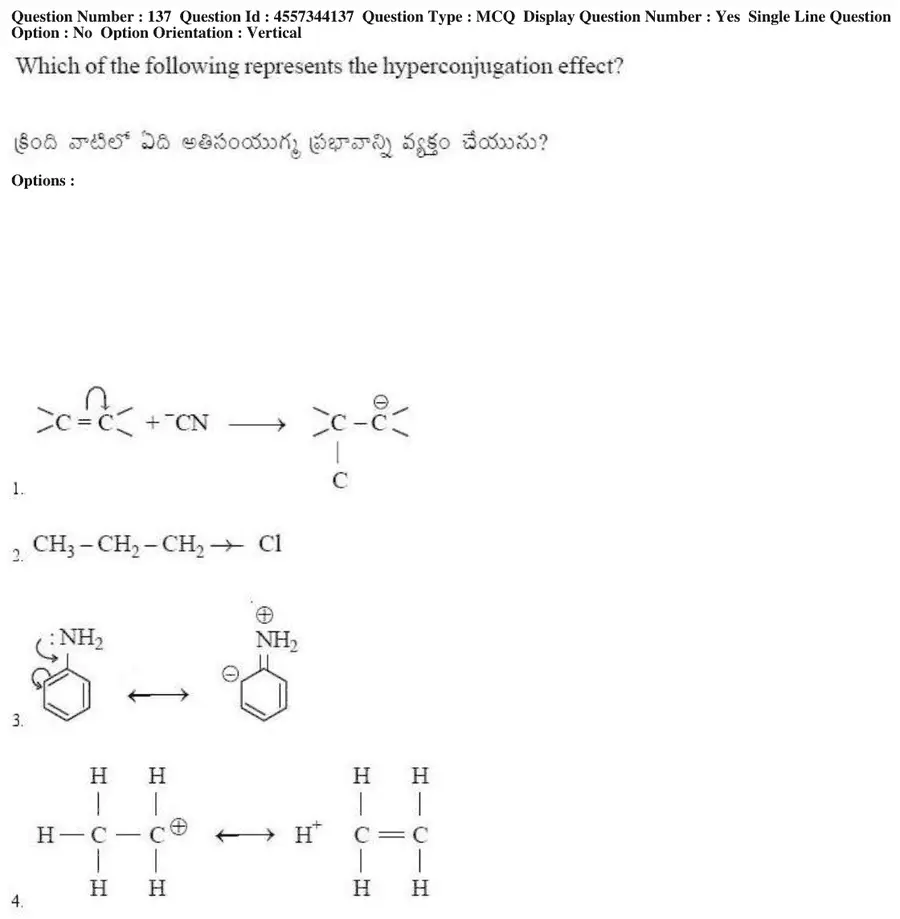
Which of the following represents the hyperconjugation effect?
(see the figure above)

see figure curved arrow from the C=C double bond: $>C=C< + {}^{-}CN \rightarrow >C(CN)-C^{-}<$ (nucleophile addition to alkene giving a carbanion)
see figure $\mathrm{CH_3-CH_2-CH_2 \rightarrow Cl}$ (arrow towards Cl)
see figure aniline resonance: $\mathrm{{:}NH_2}$ on benzene with curved arrows $\longleftrightarrow$ $\mathrm{{}^{+}NH_2}$ (double bond to ring) with negative charge on the ring
see figure $\mathrm{CH_3-CH_2^{+}}$ (H-C(H)(H)-C(H)(H) with + on the second carbon) $\longleftrightarrow$ $\mathrm{H^{+}}$ + $\mathrm{CH_2=CH_2}$
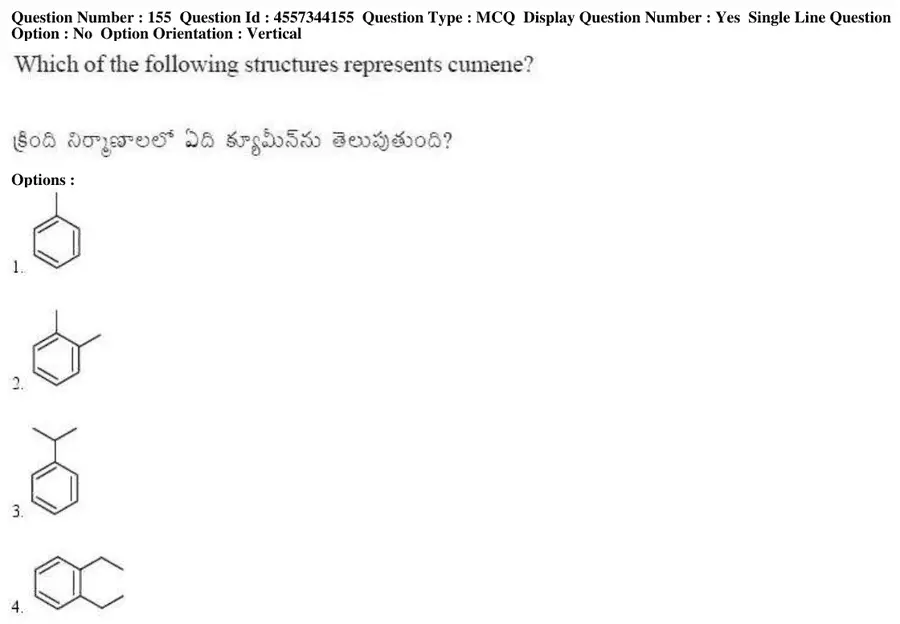
Which of the following structures represents cumene?
(see the figure above)

see figure benzene ring with one vertical line (methyl) at top
see figure benzene ring with two adjacent substituent lines at top and upper right (two methyl groups, ortho)
see figure benzene ring with a branched (isopropyl, Y-shaped) substituent at top
see figure benzene ring with two adjacent zig-zag lines (two ethyl groups, ortho)
Match the following.
List - I
A) Resonance
B) Inductive effect
C) Electromeric effect
D) Hyperconjugation
List - II
I) $>C=C< + H^{\oplus} \longrightarrow >C(H)-C^{\oplus}<$
II) $H-CH_2-\overset{\oplus}{C}H_2 \longleftrightarrow \overset{\oplus}{H}\ CH_2=CH_2$
III) $\mathrm{C_6H_6}$
IV) $\mathrm{CH_3}$ curved arrow towards $\mathrm{CH_3-Z} \longrightarrow \overset{\ominus}{\mathrm{C}}\mathrm{H_3} + \overset{\oplus}{\mathrm{Z}}$
V) $\mathrm{CH_3-CH_2-CH_2Cl}$
The correct answer is
A-II, B-I, C-IV, D-III
A-III, B-V, C-I, D-II
A-I, B-III, C-II, D-V
A-III, B-II, C-I, D-IV
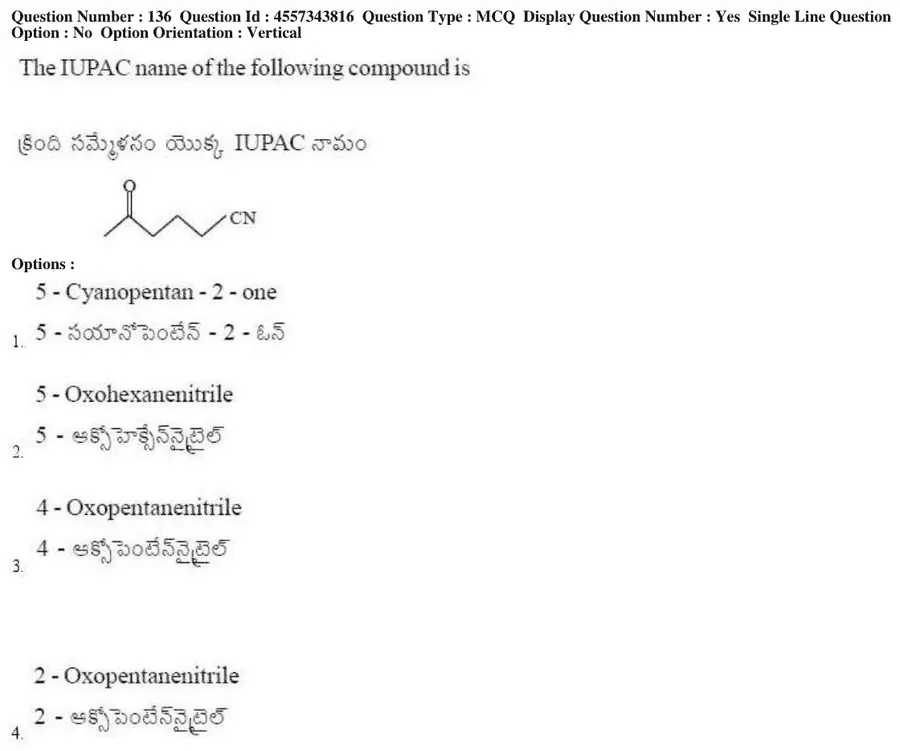
The IUPAC name of the following compound is
(see the figure above)

5 - Cyanopentan - 2 - one
5 - Oxohexanenitrile
4 - Oxopentanenitrile
2 - Oxopentanenitrile
The order of priority of the following functional groups in IUPAC method of naming organic compounds is
(a) $>\mathrm{C=O}$ (b) $-\mathrm{NH_2}$ (c) $-\mathrm{CN}$ (d) $-\mathrm{COOR}$
b, a, d, c
c, d, b, a
d, c, a, b
a, c, d, b
Which one of the following compounds will not show geometrical isomerism?
prop-2-enoic acid
2-butene
2-methyl-2-butenoic acid
3-methyl-2-pentenoic acid
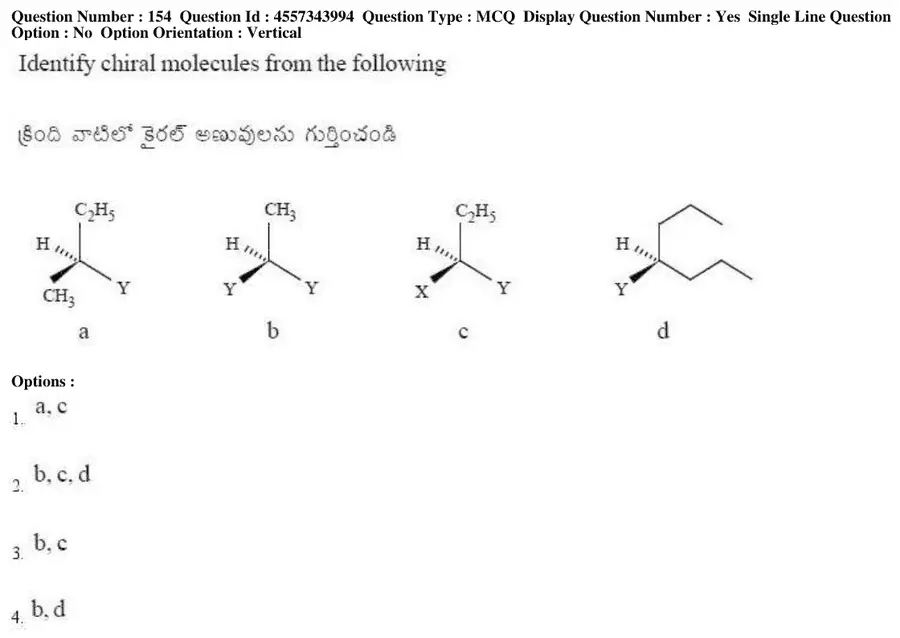
Identify chiral molecules from the following
(see the figure above)

a, c
b, c, d
b, c
b, d
Cyclopentadienyl anion is
benzenoid and aromatic
non-benzenoid and aromatic
non-benzenoid and non-aromatic
non-benzenoid and anti-aromatic
Identify the correct statements from the following
a) Electromeric effect is a permanent effect
b) Hyper conjugation is a temporary effect
c) Fractional distillation is used to separate two liquids from a mixture if the difference in their boiling points is less
d) Different compounds are adsorbed on an adsorbent to different extents
The correct answer is
c, d
a, b, c
b, d
b, c, d
Identify the correct statements for a ring system to exhibit aromaticity
a) It must not be planar
b) It must possess $(4n+2)\ \pi$ electrons
c) It must be planar
d) It must possess $4n\ \pi$ electrons
The correct answer is
a, b
b, c
a, d
b, d
Which of the following statements are not correct ?
a. The energy of resonance hybrid structure is higher than that of the possible canonical structures of the molecule
b. When inductive effect and electromeric effect operate in opposite direction, electromeric effect predominates
c. When the $\pi$ electrons of the multiple bond are transferred to that atom to which the attacking reagent does not get attached, it is knows as +E effect
d. The resonance structures with separation of opposite charges are more stable.
a, c, d
c, d
b, c, d
a, b, c
The compound which exhibits both geometrical and optical isomerism is
4 – Bromopent – 2– ene
3 – Bromo – 2 – methylbut – 1 – ene
1 – Bromobut – 2– ene
3 – Bromo – 2 – methylpropene
The number of resonance structures, aniline and anilinium ion can have are respectively
2, 5
4, 5
3, 4
5, 2
The alkenes which exhibit cis, trans isomerism from the following are
a) $\mathrm{YXC=CXZ}$
b) $\mathrm{X_2C=CX_2}$
c) $\mathrm{YXC=CXY}$
d) $\mathrm{YXC=CWZ}$
e) $\mathrm{X_2C=CXY}$
b, d, e
a, b
a, c, d
c, d, e
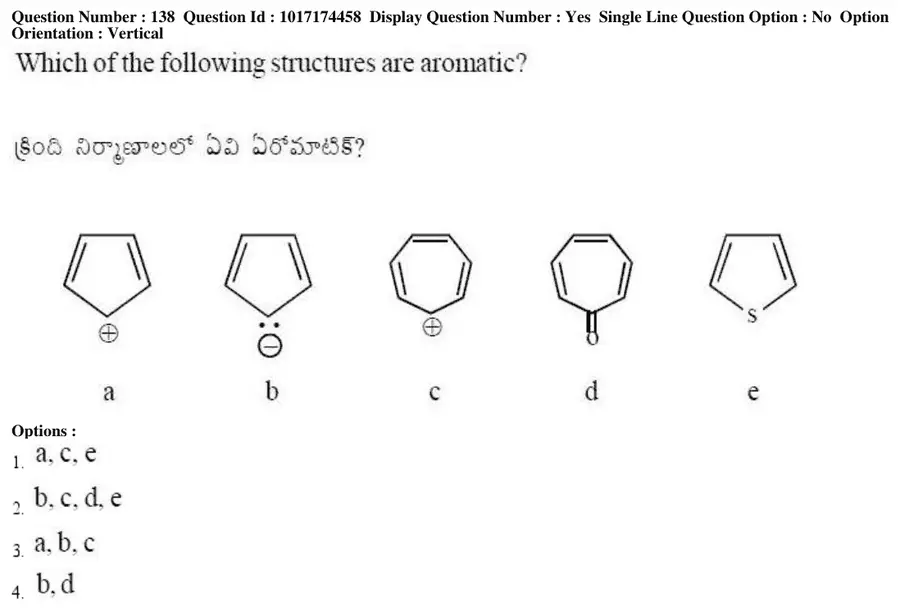
Which of the following structures are aromatic?
(see the figure above)

a, c, e
b, c, d, e
a, b, c
b, d
Identify the correct statements from the following :
a) Change in hybridisation affects the electronegativity of carbon
b) The p orbitals in ethene are mutually parallel
c) The number of $\sigma$ bonds in propyne is 6
d) Electromeric effect is a permanent effect
a, c
a, c, d
a, b, c
b, d
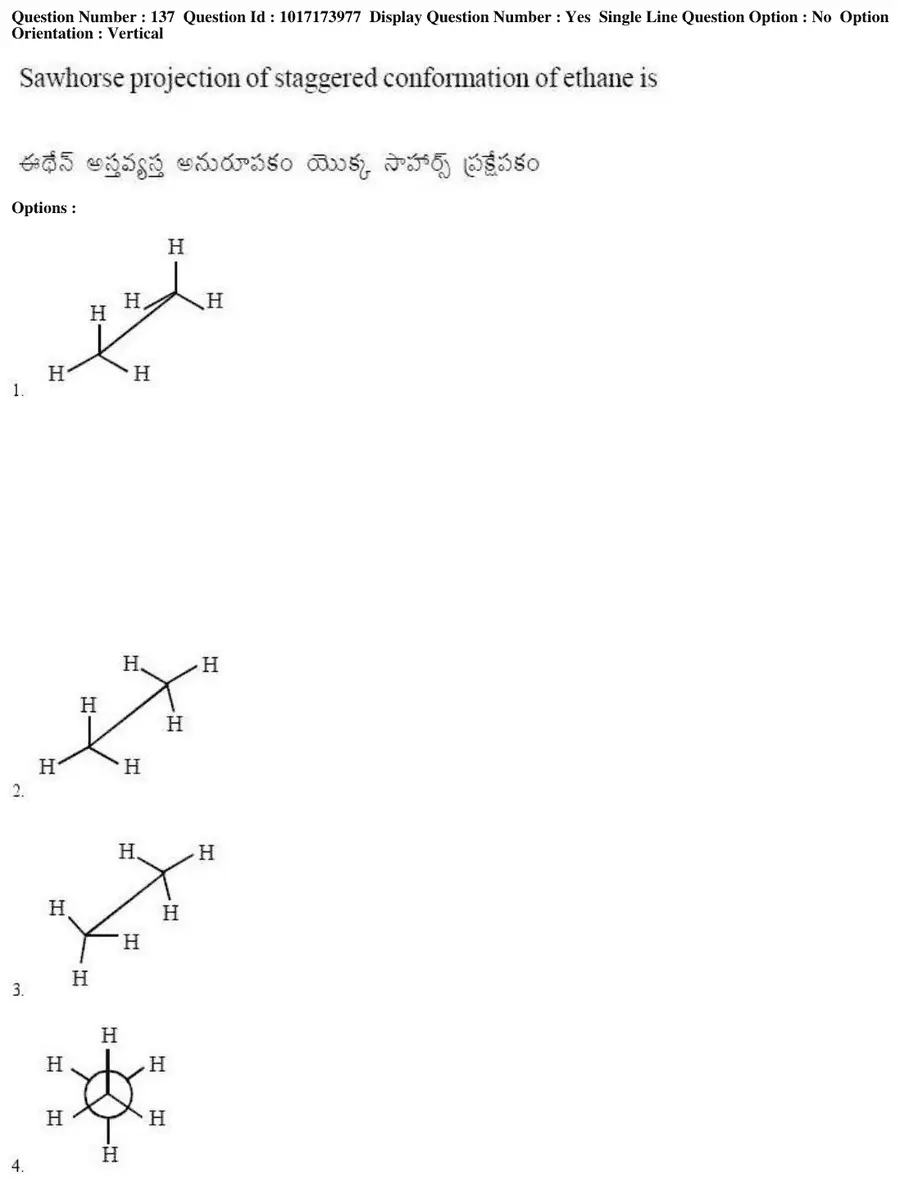
Sawhorse projection of staggered conformation of ethane is
(see the figure above)

see figure sawhorse: front carbon at lower left with H up, H lower-left, H lower-right; back carbon at upper right with H up, H left, H right (back H up is above the front H up)
see figure sawhorse: front carbon at lower left with H up, H lower-left, H lower-right; back carbon at upper right with H upper-left, H right, H down
see figure sawhorse: front carbon at lower left with H upper-left, H down, H right-lower; back carbon at upper right with H upper-left, H right, H down (back H down is above the front H down)
see figure Newman projection: circle with a vertical line; H at top, H upper-left, H upper-right, H lower-left, H lower-right, H at bottom
Which of the following belongs to the homologous series of $\mathrm{C_5H_8O_2N}$?
$\mathrm{C_6H_{10}O_3N}$
$\mathrm{C_6H_8O_2N_2}$
$\mathrm{C_6H_{10}O_2N_2}$
$\mathrm{C_6H_{10}O_2N}$
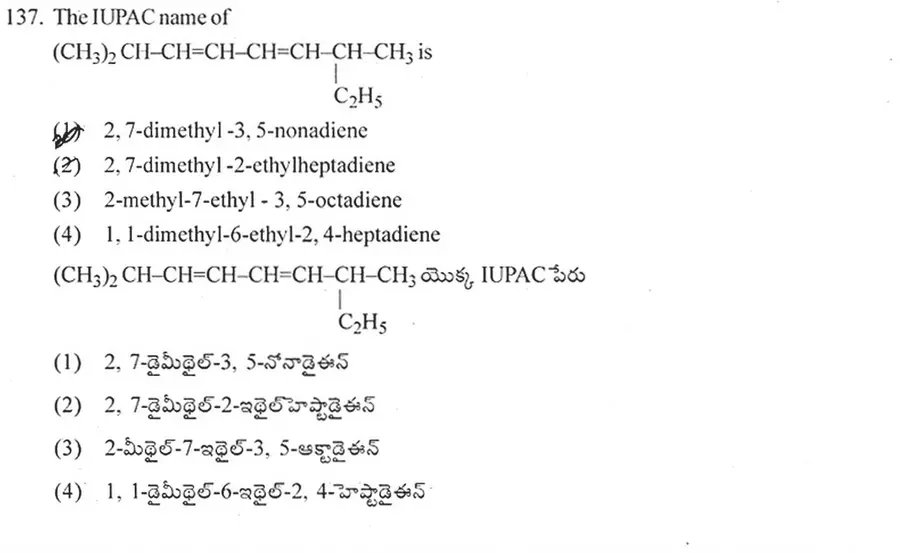
The IUPAC name of
$\mathrm{(CH_3)_2CH{-}CH{=}CH{-}CH{=}CH{-}CH{-}CH_3}$ (see the figure above) is

2, 7-dimethyl -3, 5-nonadiene
2, 7-dimethyl -2-ethylheptadiene
2-methyl-7-ethyl - 3, 5-octadiene
1, 1-dimethyl-6-ethyl-2, 4-heptadiene
In which of the following properties, the two enantiomers of lactic acid differ from each other ?
Sign of specific rotation
Density
Melting point
Refractive index
Different conformations of the same molecule are called
Isomers
Epimers
Enantiomers
Rotamers
Match the following
List-I
A) Acetaldehyde, Vinylalcohol
B) Eclipsed and staggered ethane
C) (+) 2-Butanol, (-) 2-Butanol
D) Methyl-n-propylamine and Diethylamine
List-II
I) Enantiomers
II) Tautomers
III) Chain isomers
IV) Conformational isomers
V) Metamers
The correct answer is :
A-II, B-IV, C-III, D-V
A-II, B-IV, C-I, D-V
A-V, B-I, C-IV, D-II
A-V, B-I, C-III, D-II
The number of stereoisomers possible for $\mathrm{H_3C-CH(OH)-CH(OH)-CH_3}$ is :
1
2
3
4
Which one of the following pairs of 2, 3-butane diol is enantiomeric ?
2R, 3R and 2S, 3S
2S, 3S and 2S, 3R
2R, 3R and 2R, 3S
2S, 3S and 2R, 3S
The two enantiomers of secondary butyl chloride differ from each other in which one of the following properties ?
Boiling point
Specific rotation
Density
C—Cl bond length
General Organic Chemistry occupies position 15 among the 31 chemistry chapters during the modern 2022 to 2026 testing cycle. Across our full question archive spanning 2010 through 2026, the chapter delivered 185 questions across 149 papers, appearing in 117 of those tests to command 3.1 percent of the subject with an average of 1.2 questions per paper. In the recent five-year timeframe from 2022 to 2026, it provided 89 questions across 77 sittings, appearing in 62 papers to sustain 1.2 questions per paper and a 2.9 percent subject share.
The chapter has featured in every exam year since 2022, though it was absent from fifteen papers across that five-year interval. Comparing regional state streams between 2022 and 2026, AP examinations yielded 48 questions across 48 papers (appearing in 35 papers, 1.0 question per paper, 2.5 percent share), while TS examinations generated 41 questions across 29 papers (appearing in 27 papers, 1.4 questions per paper, 3.5 percent share).
In the previous testing era spanning 2010 through 2021, the chapter accounted for 96 questions over 72 sittings (featuring in 55 tests), supplying 1.3 questions per paper and a 3.3 percent subject share. Across the most recent three exam cycles from 2024 to 2026, question writers set 53 questions across 46 sittings (with 39 papers containing questions), yielding 1.2 questions per test and 2.9 percent share. Evaluating trend patterns shows that the share early versus the last three years is about the same, and the share recent versus the last three years is about the same.
Questions in this foundational organic chapter organize across four structural and mechanical themes:
IUPAC nomenclature problems test multi-functional priority hierarchies. A typical problem presents a complex branched structure containing both a carboxylic acid and a ketone along with double bonds and methyl substituents, asking you to name the principal chain and arrange substituents alphabetically. Other classification questions ask you to count the number of primary, secondary, tertiary, and quaternary carbon atoms in a branched hydrocarbon.
Electronic effect questions focus on stability rankings and relative acid strengths. You will rank substituted carbocations by counting alpha-hydrogens available for hyperconjugation alongside resonance contributors, or rank benzoic acid derivatives based on electron-withdrawing nitro or electron-donating methoxy groups. Isomerism questions frequently test whether designated pairs of alkenes represent positional isomers, geometrical isomers, or identical structures.
Solve these representative state entrance questions to test your grasp on nomenclature, electron displacement, and isomerism:
Memorise the official IUPAC seniority order for principal functional groups: carboxylic acid, sulphonic acid, ester, acid halide, amide, nitrile, aldehyde, ketone, alcohol, thiol, amine, followed by double and triple bonds. When numbering parent chains, prioritize giving the lowest locant to the principal functional group before double bonds, triple bonds, and substituent prefixes.
To evaluate carbocation and radical stabilities, count hyperconjugative alpha-hydrogens systematically. In carbocations, tertiary cations exceed secondary, which exceed primary due to inductive electron donation and sigma C-H electron delocalisation into the empty p orbital. For aromaticity, apply Hückels rule strictly: the molecule must be cyclic, planar, fully conjugated, and contain four n plus two pi electrons (such as two, six, ten, or fourteen pi electrons).
Resonance involves the delocalisation of pi electrons or unshared non-bonding electron pairs across conjugated p orbitals without moving atomic nuclei. Hyperconjugation involves the delocalisation of sigma electrons from adjacent carbon-hydrogen bonds into an adjacent empty or partially filled p orbital or pi antibonding orbital, which is why it is termed no-bond resonance.
Metamers are structural isomers that possess the same molecular formula and identical polyvalent functional groups (such as ethers, thioethers, secondary amines, or esters) but differ in the distribution of alkyl groups attached to the polyvalent heteroatom on either side.
Geometrical cis-trans isomerism requires restricted rotation about a double bond, and each of the two doubly bonded carbon atoms must carry two distinctly different substituent groups. If either carbon atom carries two identical atoms or groups, the molecule cannot exhibit geometrical isomerism. Step-by-step solutions for each one are in the EdLoop EAPCET app.