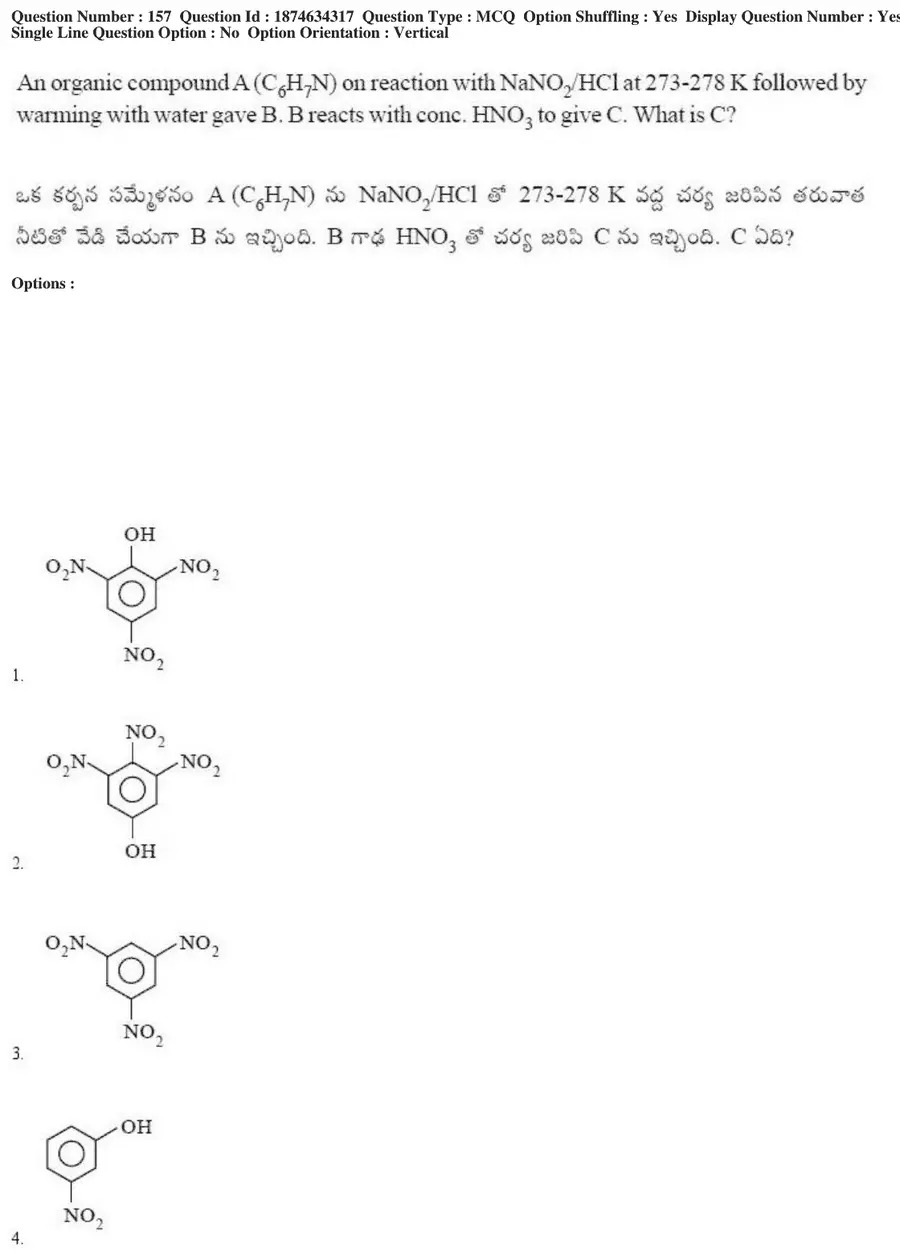
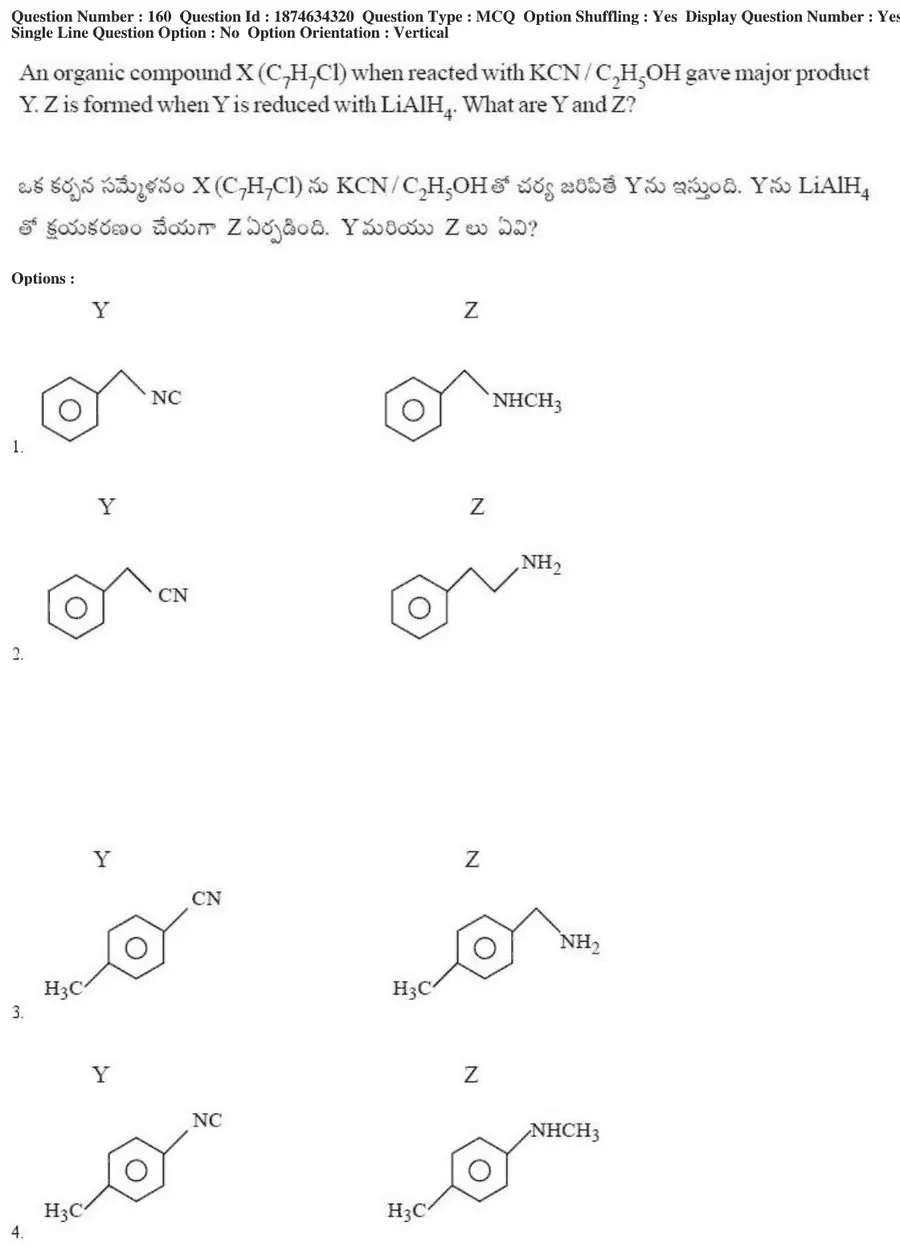
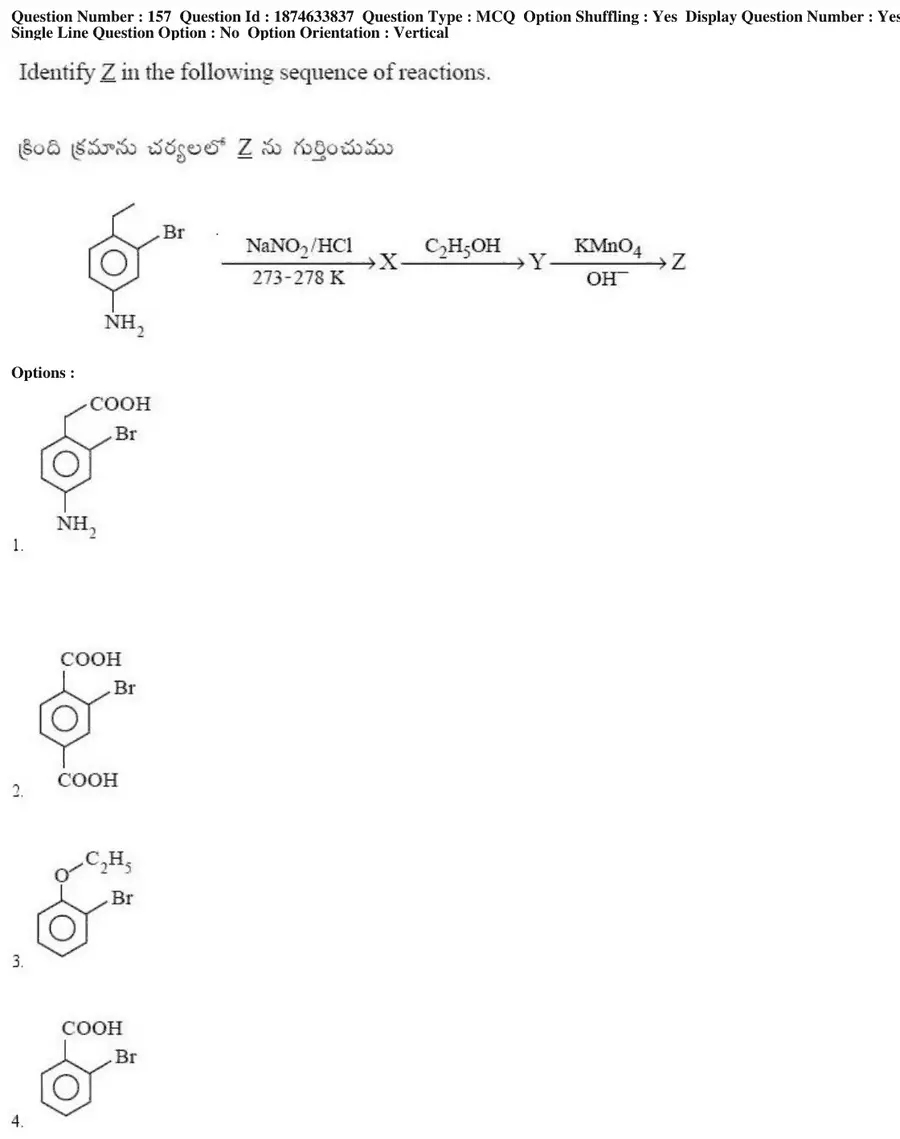
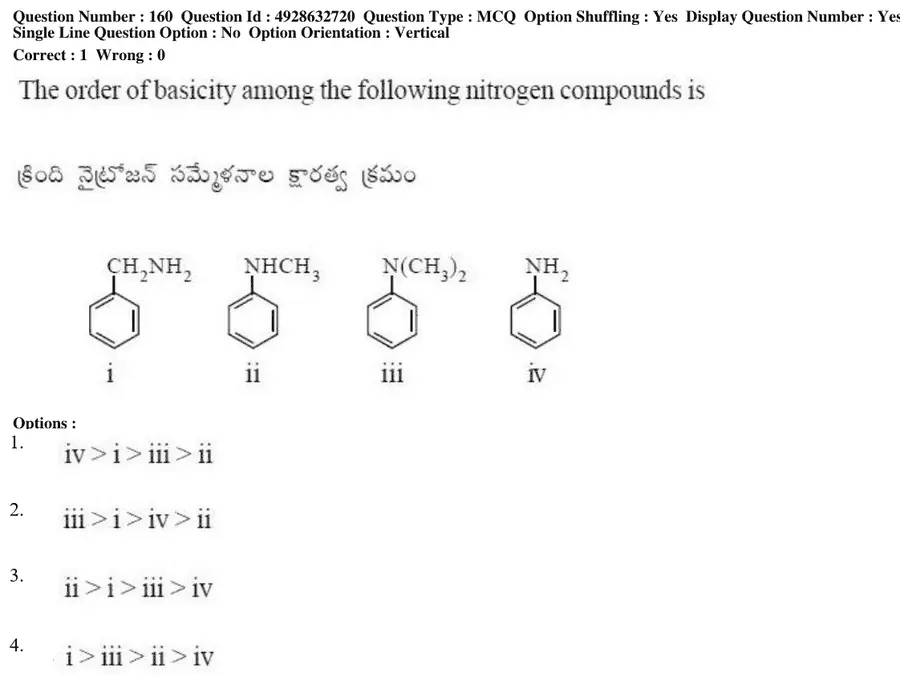
EdLoop PYQs · free, no ads · questions and answers here, step-by-step solutions in the EdLoop app
PYQs · free, no adsOpen on the web (app.edloop.in)Get EdLoop – free on Google Play
ChemistryAmines & Nitrogen Compounds

Amines & Nitrogen Compounds: AP & TS EAPCET PYQs 2010–2026

Every Amines & Nitrogen Compounds question from past AP EAPCET and TS EAPCET papers, with options and answers. Newest first.

164questions
121papers covered
2.9%of Chemistry questions, 2022–2026
2010–2026years

Guide at a glance

In the EAPCET chemistry syllabus, organic nitrogen derivatives occupy a dependable middle tier.

Most asked sub-topics

Amines78
Diazonium Salts52
Nitro & Cyano Compounds34

Practise these in EdLoop

Attempt every Amines & Nitrogen Compounds question timed, see the step-by-step solution and track what you get wrong. Free.

Start practice

All questions

164 questions
1AP EAPCET 2026 · 18 May · Shift 1MCQOpen question page ↗

Identify the product Y in the following reaction sequence
(catalyst; major product)

$\mathrm{C_2H_4}$ $\xrightarrow[\text{ii) AgCN}]{\text{(i) HBr}}$ X (major product) $\xrightarrow{\mathrm{H_2}\,/\,\text{Catalyst}}$ Y

  • A

    n-propyl amine

  • B

    Isopropyl amine

  • C

    Ethyl amine

  • D

    Ethyl methyl amine

2AP EAPCET 2026 · 18 May · Shift 1MCQOpen question page ↗

Identify the product 'Z' formed in the given sequence of reactions

(Anhy = anhydrous)

(see the figure above)

The question and its figure as printed in AP EAPCET 2026 18th May 2026 Shift 1. Option 1: Chlorobenzene: benzene ring with Cl substituent Option 2: Benzaldehyde: benzene ring with CHO substituent Option 3: Benzoyl chloride: benzene ring attached to C(=O)Cl Option 4: Benzyl chloride: benzene ring with CH2Cl substituent
The question as printed in the paper.
  • A

    see figure Chlorobenzene: benzene ring with Cl substituent

  • B

    see figure Benzaldehyde: benzene ring with CHO substituent

  • C

    see figure Benzoyl chloride: benzene ring attached to C(=O)Cl

  • D

    see figure Benzyl chloride: benzene ring with CH2Cl substituent

3AP EAPCET 2026 · 18 May · Shift 1MCQOpen question page ↗

The number $\sigma$, $\pi$ − bonds and lone pairs of electrons present in the product $\underline{C}$ respectively are

$$\mathrm{C_2H_5NO_2} \xrightarrow{Sn+HCl} A \xrightarrow[Heat]{CHCl_3+KOH} B \xrightarrow{HgO} C$$

  • A

    $10, 1, 3$

  • B

    $8, 3, 2$

  • C

    $9, 2, 3$

  • D

    $9, 1, 3$

4AP EAPCET 2026 · 18 May · Shift 2MCQOpen question page ↗

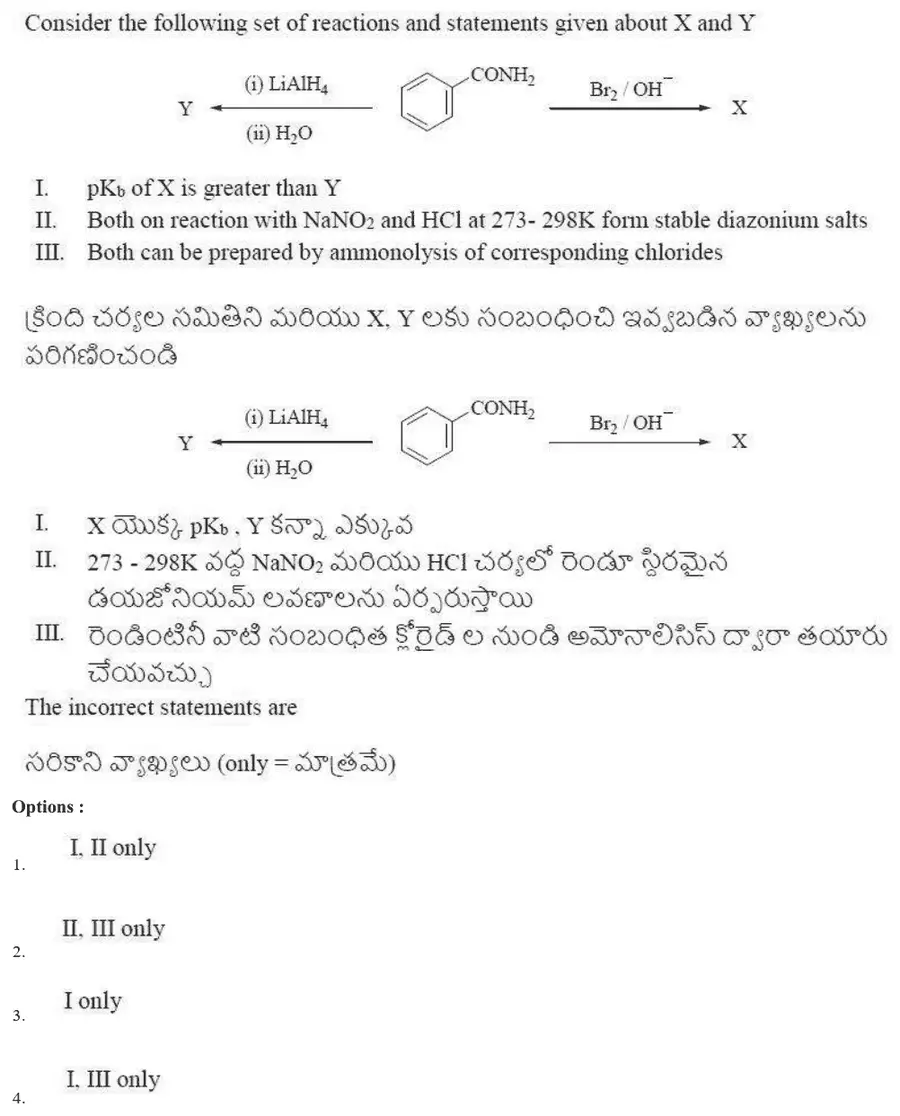
Consider the following set of reactions and statements given about X and Y

(see the figure above)

I. pK$_b$ of X is greater than Y

II. Both on reaction with $\mathrm{NaNO_2}$ and HCl at 273- 298K form stable diazonium salts

III. Both can be prepared by ammonolysis of corresponding chlorides

The incorrect statements are

The question and its figure as printed in AP EAPCET 2026 18th May 2026 Shift 2.
The question as printed in the paper.
  • A

    I, II only

  • B

    II, III only

  • C

    I only

  • D

    I, III only

5AP EAPCET 2026 · 15 May · Shift 1MCQOpen question page ↗

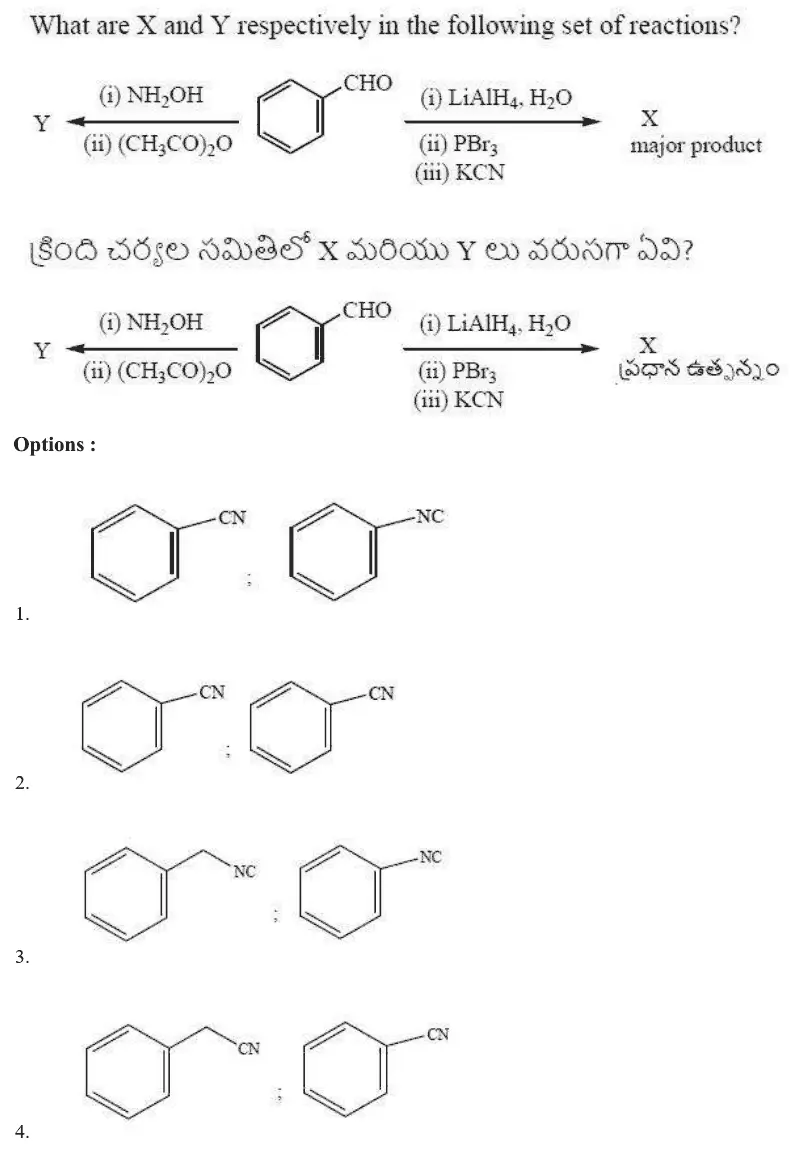
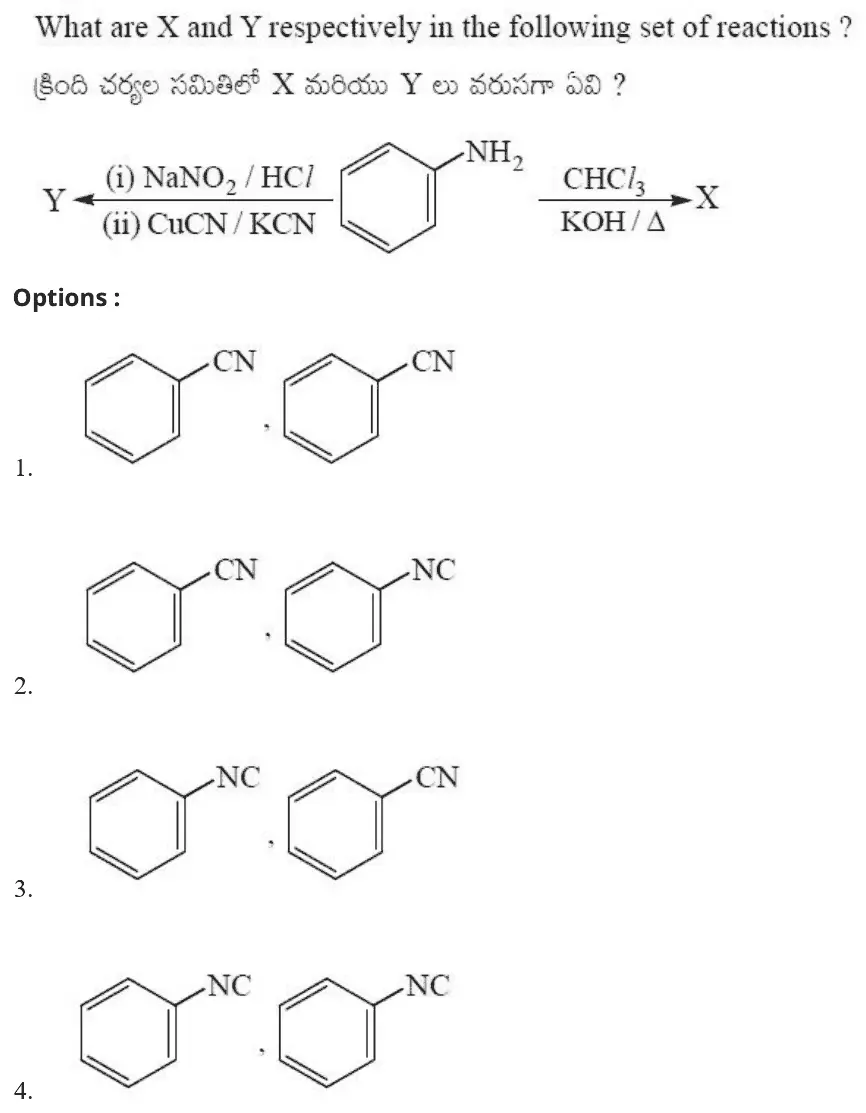
What are X and Y respectively in the following set of reactions?

(see the figure above)

The question and its figure as printed in AP EAPCET 2026 15th May 2026 Shift 1. Option 1: Two structures separated by a semicolon: first, benzene ring with a -CN group directly attached (benzonitrile); second, benzene ring with an -NC group directly attached (phenyl isocyanide). Option 2: Two structures separated by a semicolon: first, benzene ring with a -CN group directly attached (benzonitrile); second, benzene ring with a -CN group directly attached (benzonitrile). Option 3: Two structures separated by a semicolon: first, benzyl isocyanide (benzene ring-CH2-NC); second, benzene ring with an -NC group directly attached (phenyl isocyanide). Option 4: Two structures separated by a…
The question as printed in the paper.
  • A

    see figure Two structures separated by a semicolon: first, benzene ring with a -CN group directly attached (benzonitrile); second, benzene ring with an -NC group directly attached (phenyl isocyanide).

  • B

    see figure Two structures separated by a semicolon: first, benzene ring with a -CN group directly attached (benzonitrile); second, benzene ring with a -CN group directly attached (benzonitrile).

  • C

    see figure Two structures separated by a semicolon: first, benzyl isocyanide (benzene ring-CH2-NC); second, benzene ring with an -NC group directly attached (phenyl isocyanide).

  • D

    see figure Two structures separated by a semicolon: first, benzyl cyanide (benzene ring-CH2-CN); second, benzene ring with a -CN group directly attached (benzonitrile).

6AP EAPCET 2026 · 15 May · Shift 2MCQOpen question page ↗

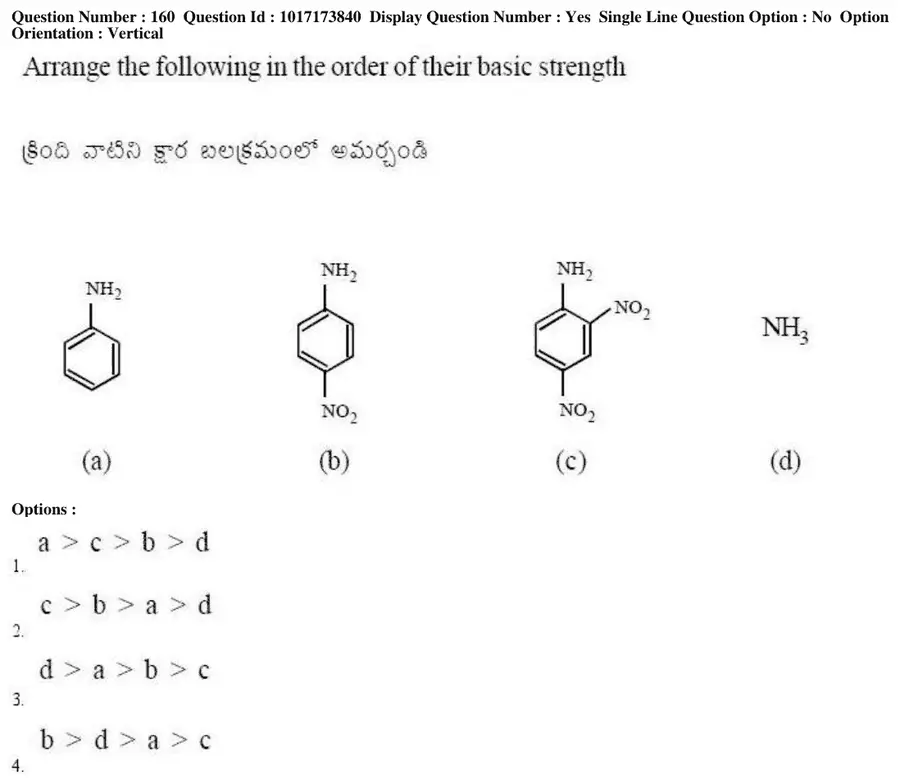
Consider the following

$\mathrm{C_6H_5NH_2}$ (I) $\mathrm{C_2H_5NH_2}$ (II) $\mathrm{NH_3}$ (III) $\mathrm{(C_2H_5)_2NH}$ (IV)

The correct pair with lowest $pK_b$ and highest $pK_b$ values respectively is

  • A

    IV, I

  • B

    III, II

  • C

    II, IV

  • D

    I, IV

7AP EAPCET 2026 · 14 May · Shift 1MCQOpen question page ↗

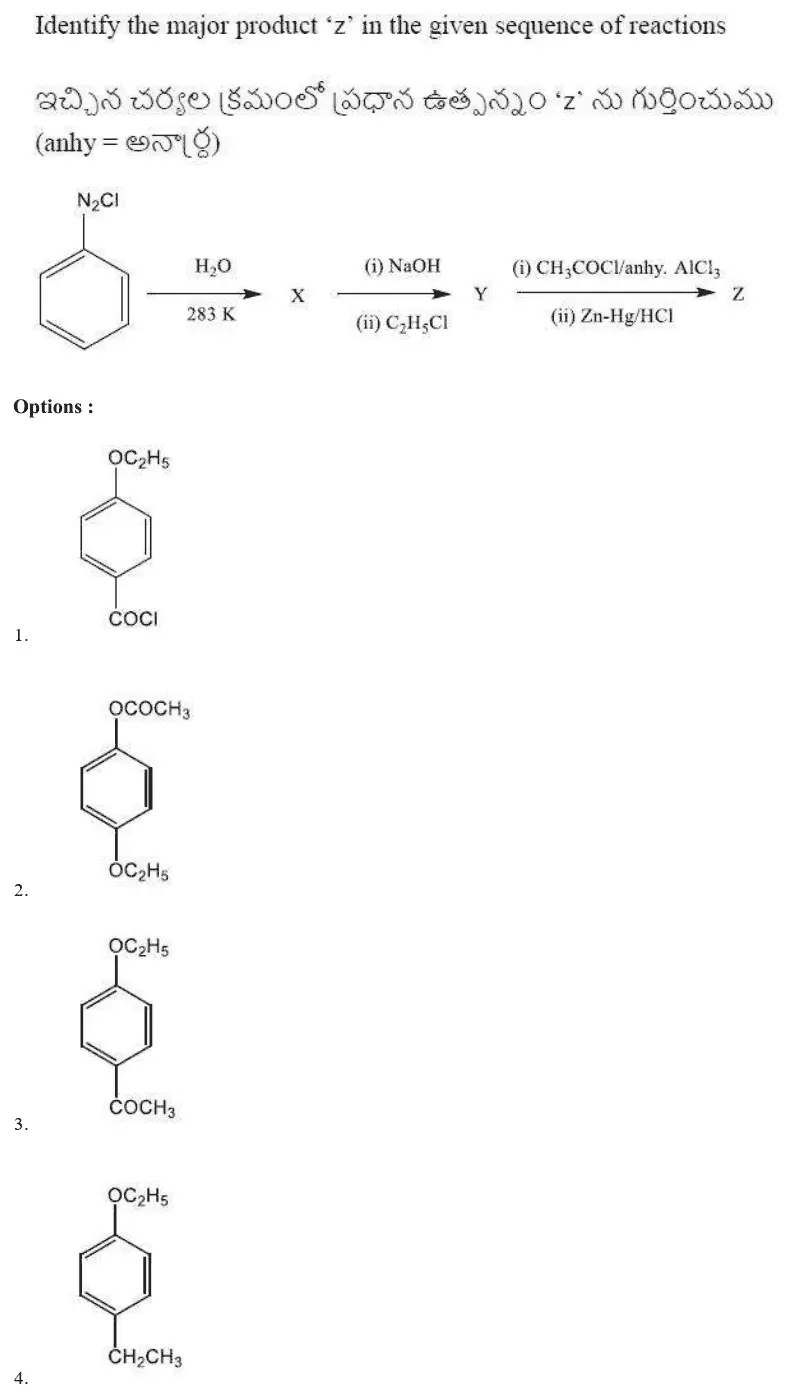
Identify the major product ‘z’ in the given sequence of reactions

(anhy = anhydrous)

(see the figure above)

The question and its figure as printed in AP EAPCET 2026 14th May 2026 Shift 1. Option 1: Benzene ring with OC2H5 at the top (position 1) and COCl at the bottom (para position) Option 2: Benzene ring with OCOCH3 at the top (position 1) and OC2H5 at the bottom (para position) Option 3: Benzene ring with OC2H5 at the top (position 1) and COCH3 at the bottom (para position) Option 4: Benzene ring with OC2H5 at the top (position 1) and CH2CH3 at the bottom (para position)
The question as printed in the paper.
  • A

    see figure Benzene ring with OC2H5 at the top (position 1) and COCl at the bottom (para position)

  • B

    see figure Benzene ring with OCOCH3 at the top (position 1) and OC2H5 at the bottom (para position)

  • C

    see figure Benzene ring with OC2H5 at the top (position 1) and COCH3 at the bottom (para position)

  • D

    see figure Benzene ring with OC2H5 at the top (position 1) and CH2CH3 at the bottom (para position)

8AP EAPCET 2026 · 14 May · Shift 1MCQOpen question page ↗

Choose the correct statement(s) given below, with regard to $N$ – Ethyl benzene sulphonamide

I. It is soluble in alkali

II. It is formed by reaction between $1^\circ$ amine and Hinsberg reagent

III. It is formed by reaction between $2^\circ$ amine and Hinsberg reagent

The correct answer is

  • A

    II only

  • B

    I & II only

  • C

    I & III only

  • D

    III only

9AP EAPCET 2026 · 14 May · Shift 2MCQOpen question page ↗

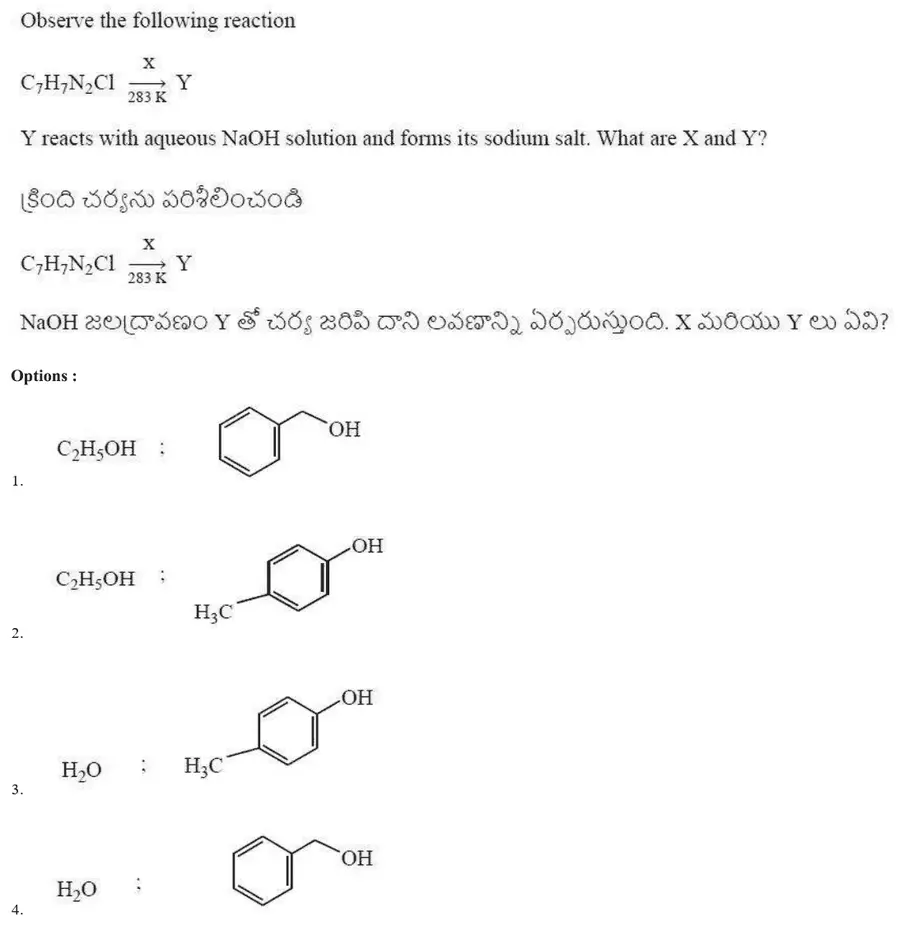
Observe the following reaction

$\mathrm{C_7H_7N_2Cl} \xrightarrow[283\ K]{X} \mathrm{Y}$

Y reacts with aqueous NaOH solution and forms its sodium salt. What are X and Y?

The question and its figure as printed in AP EAPCET 2026 14th May 2026 Shift 2.
The question as printed in the paper.
  • A

    $\mathrm{X = C_2H_5OH}$ ; $\mathrm{Y}$ = (see the figure above) benzyl alcohol (benzene ring with a $\mathrm{CH_2OH}$ substituent)

  • B

    $\mathrm{X = C_2H_5OH}$ ; $\mathrm{Y}$ = (see the figure above) p-cresol (benzene ring with OH and para $\mathrm{H_3C}$ substituents)

  • C

    $\mathrm{X = H_2O}$ ; $\mathrm{Y}$ = (see the figure above) p-cresol (benzene ring with OH and para $\mathrm{H_3C}$ substituents)

  • D

    $\mathrm{X = H_2O}$ ; $\mathrm{Y}$ = (see the figure above) benzyl alcohol (benzene ring with a $\mathrm{CH_2OH}$ substituent)

10AP EAPCET 2026 · 13 May · Shift 1MCQOpen question page ↗

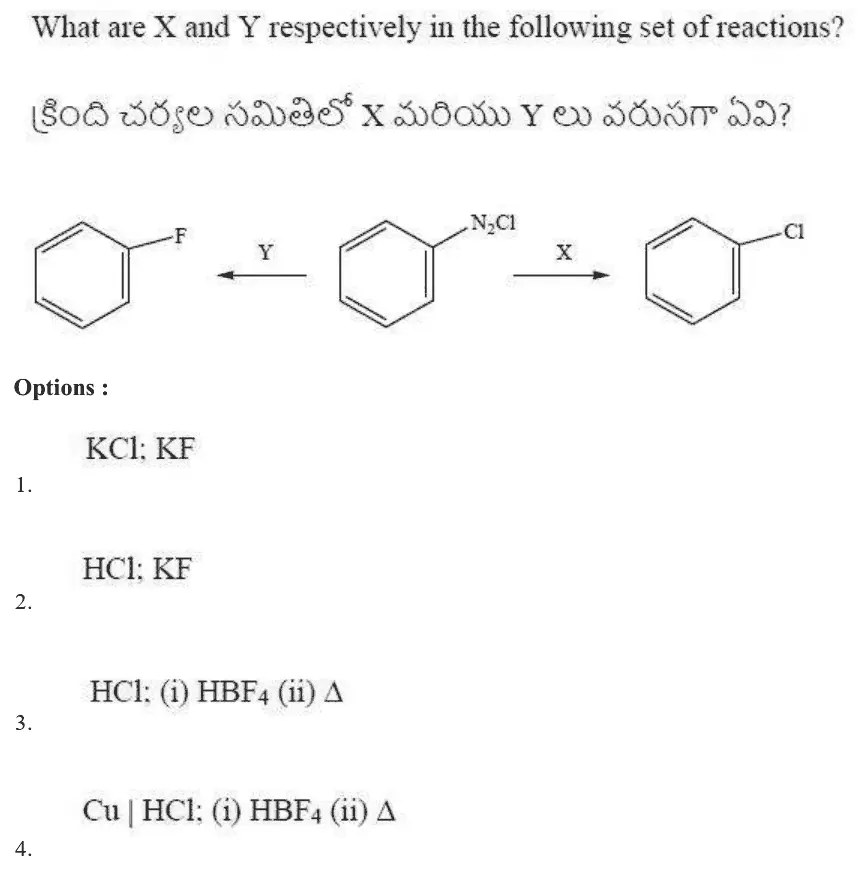
What are X and Y respectively in the following set of reactions?

(see the figure above)

The question and its figure as printed in AP EAPCET 2026 13th May 2026 Shift 1.
The question as printed in the paper.
  • A

    KCl; KF

  • B

    HCl; KF

  • C

    HCl; (i) $\mathrm{HBF_4}$ (ii) $\Delta$

  • D

    Cu | HCl; (i) $\mathrm{HBF_4}$ (ii) $\Delta$

11AP EAPCET 2026 · 13 May · Shift 1MCQOpen question page ↗

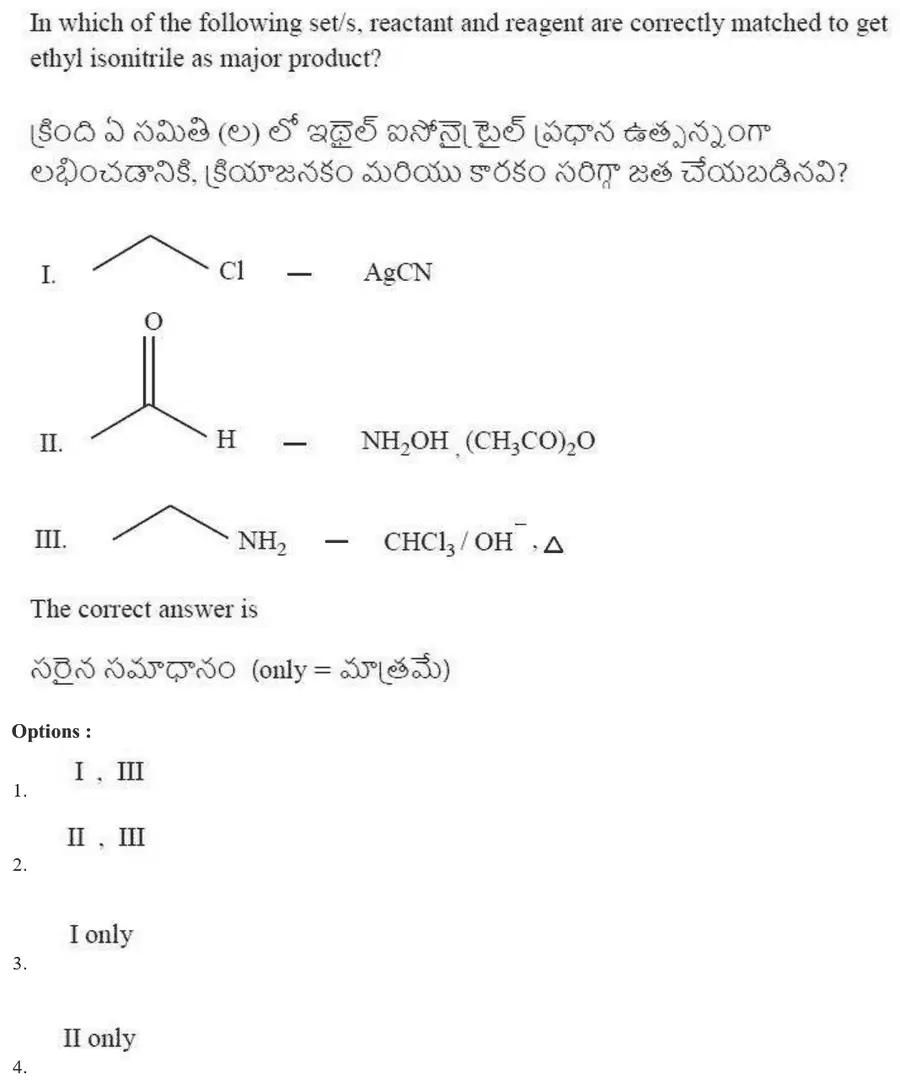
In which of the following set/s, reactant and reagent are correctly matched to get ethyl isonitrile as major product?

I. (see the figure above) — $\mathrm{AgCN}$

II. (see the figure above) — $\mathrm{NH_2OH}$ , $\mathrm{(CH_3CO)_2O}$

III. (see the figure above) — $\mathrm{CHCl_3 / OH^-}$ , $\Delta$

The correct answer is

The question and its figure as printed in AP EAPCET 2026 13th May 2026 Shift 1.
The question as printed in the paper.
  • A

    I , III

  • B

    II , III

  • C

    I only

  • D

    II only

12AP EAPCET 2026 · 13 May · Shift 2MCQOpen question page ↗

Which of the following is not an example of Sandmeyer reaction?

  • A

    $\mathrm{C_6H_5N_2^+Cl^-} \xrightarrow{\mathrm{CuCl\,|\,HCl}} \mathrm{C_6H_5Cl}$

  • B

    $\mathrm{C_6H_5N_2^+Cl^-} \xrightarrow{\mathrm{KI\,|\,Warm}} \mathrm{C_6H_5I}$

  • C

    $\mathrm{C_6H_5N_2^+Cl^-} \xrightarrow{\mathrm{CuBr\,|\,HBr}} \mathrm{C_6H_5Br}$

  • D

    $\mathrm{C_6H_5N_2^+Cl^-} \xrightarrow{\mathrm{CuCN\,|\,KCN}} \mathrm{C_6H_5CN}$

13AP EAPCET 2026 · 13 May · Shift 2MCQOpen question page ↗

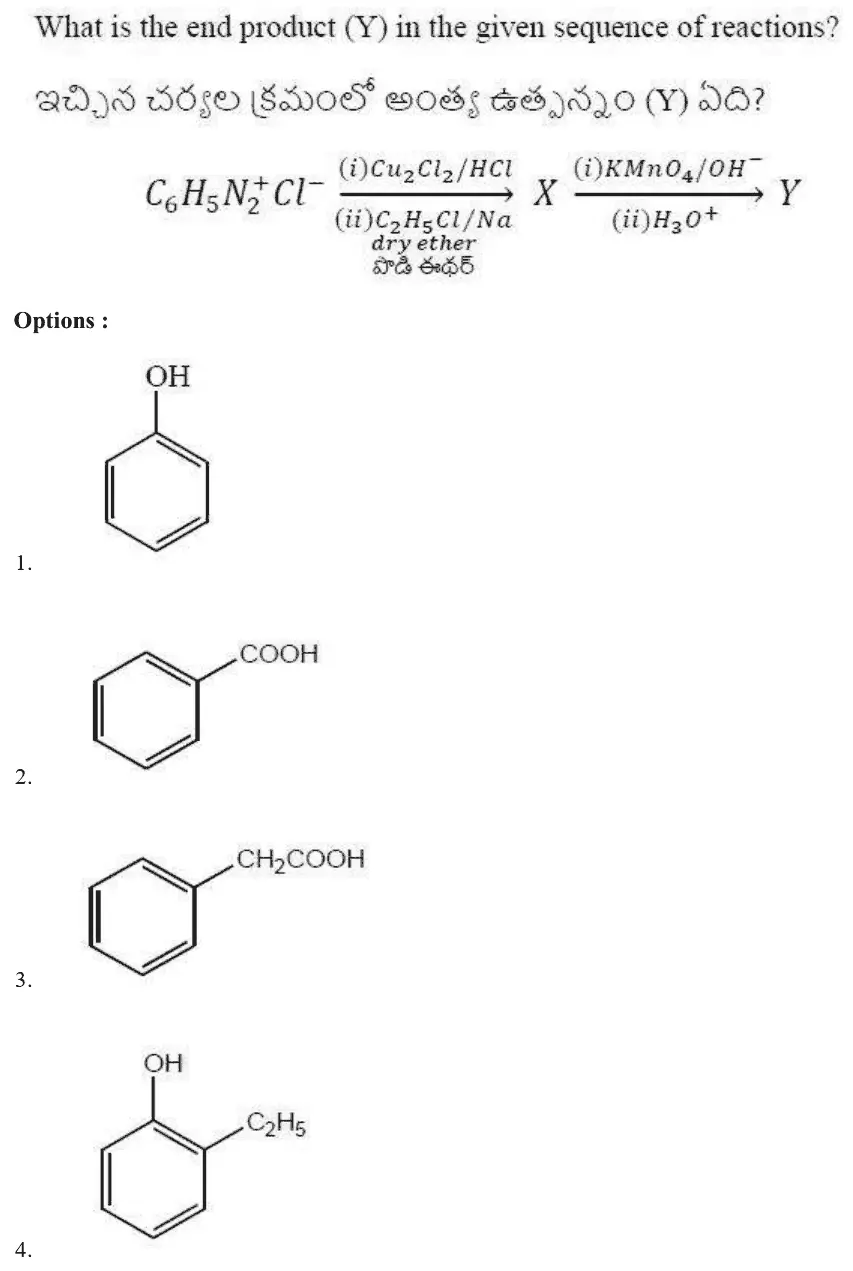
What is the end product (Y) in the given sequence of reactions?

$$\mathrm{C_6H_5N_2^+Cl^-} \xrightarrow[\text{(ii)}\ \mathrm{C_2H_5Cl/Na},\ \text{dry ether}]{\text{(i)}\ \mathrm{Cu_2Cl_2/HCl}} X \xrightarrow[\text{(ii)}\ \mathrm{H_3O^+}]{\text{(i)}\ \mathrm{KMnO_4/OH^-}} Y$$

The question and its figure as printed in AP EAPCET 2026 13th May 2026 Shift 2. Option 1: Phenol: benzene ring with an OH substituent. Option 2: Benzoic acid: benzene ring with a COOH substituent. Option 3: Phenylacetic acid: benzene ring with a CH2COOH substituent. Option 4: 2-Ethylphenol: benzene ring with OH and, on the adjacent carbon, a C2H5 substituent.
The question as printed in the paper.
  • A

    see figure Phenol: benzene ring with an OH substituent.

  • B

    see figure Benzoic acid: benzene ring with a COOH substituent.

  • C

    see figure Phenylacetic acid: benzene ring with a CH2COOH substituent.

  • D

    see figure 2-Ethylphenol: benzene ring with OH and, on the adjacent carbon, a C2H5 substituent.

14AP EAPCET 2026 · 13 May · Shift 2MCQOpen question page ↗

Match the following

List – I (Compound)List – II (b.p / K)
A$n-\mathrm{C_4H_9OH}$I310.5
B$\mathrm{(C_2H_5)_2NH}$II350.8
C$n-\mathrm{C_4H_9NH_2}$III390.3
D$\mathrm{C_2H_5N(CH_3)_2}$IV329.3

The correct answer is

  • A

    A-IV, B-II, C-I, D-III

  • B

    A-III, B-IV, C-I, D-II

  • C

    A-III, B-IV, C-II, D-I

  • D

    A-II, B-III, C-IV, D-I

15AP EAPCET 2026 · 12 May · Shift 1MCQOpen question page ↗

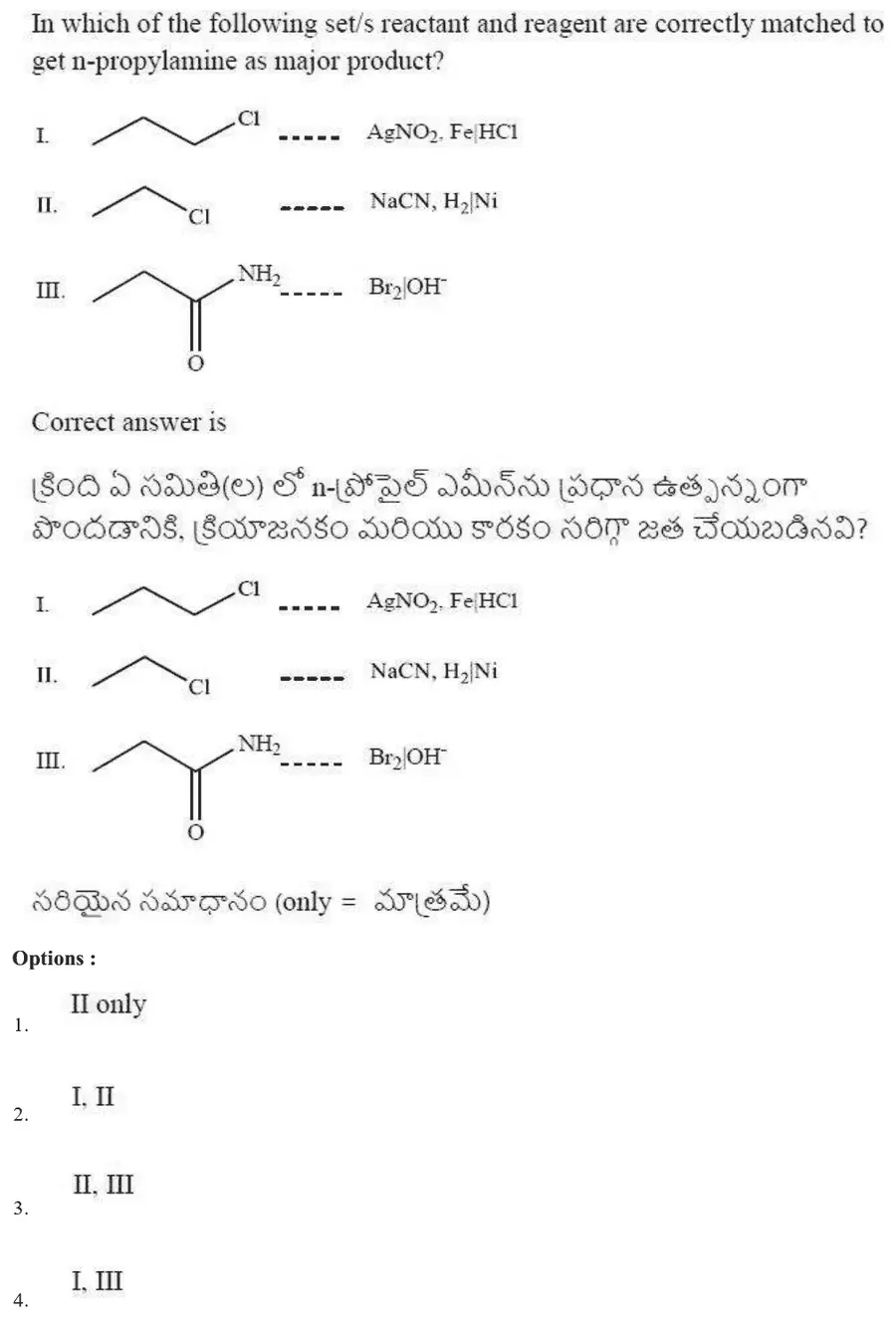
In which of the following set/s reactant and reagent are correctly matched to get n-propylamine as major product?

(see the figure above)

Correct answer is

The question and its figure as printed in AP EAPCET 2026 12th May 2026 Shift 1.
The question as printed in the paper.
  • A

    II only

  • B

    I, II

  • C

    II, III

  • D

    I, III

16AP EAPCET 2026 · 12 May · Shift 2MCQOpen question page ↗

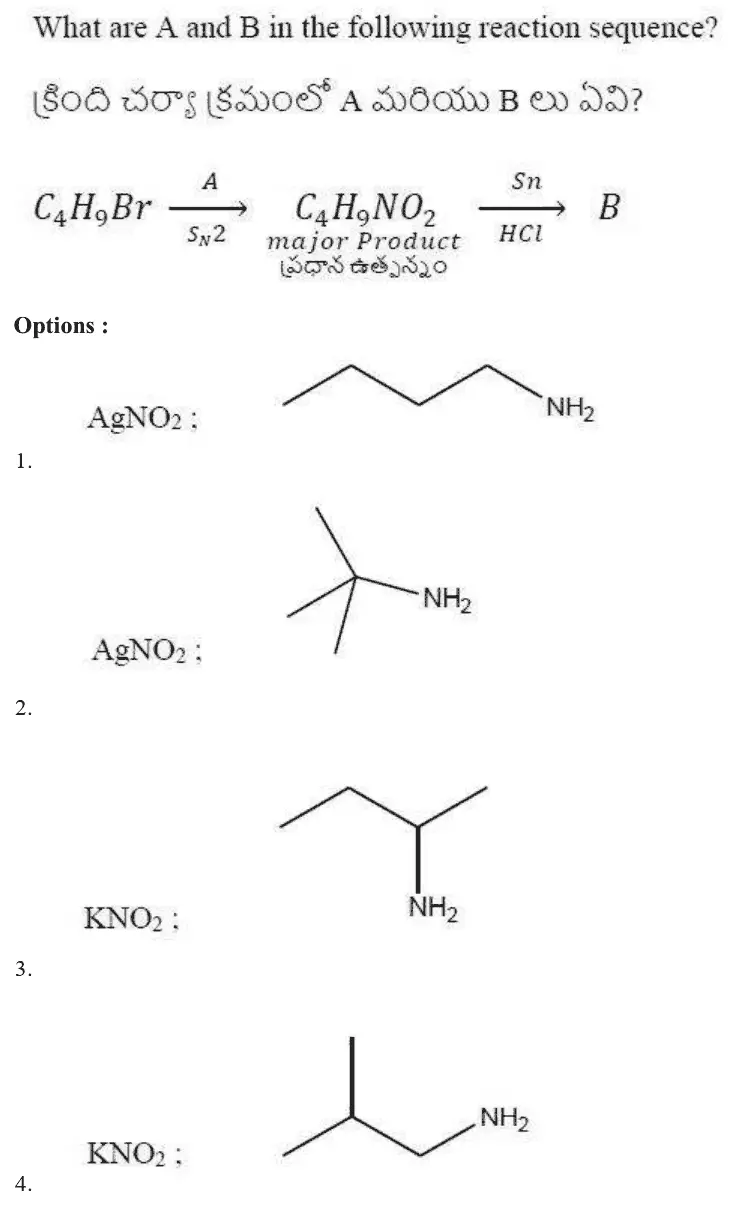
What are A and B in the following reaction sequence?

$$\mathrm{C_4H_9Br} \xrightarrow[S_N2]{A} \underset{\text{major Product}}{\mathrm{C_4H_9NO_2}} \xrightarrow[HCl]{Sn} B$$

The question and its figure as printed in AP EAPCET 2026 12th May 2026 Shift 2.
The question as printed in the paper.
  • A

    $\mathrm{AgNO_2}$ ; (see the figure above) skeletal structure of a straight-chain four-carbon amine, n-butylamine (CH3CH2CH2CH2NH2), with NH2 at the terminal carbon

  • B

    $\mathrm{AgNO_2}$ ; (see the figure above) skeletal structure of tert-butylamine (NH2 on a quaternary carbon bearing three methyl groups)

  • C

    $\mathrm{KNO_2}$ ; (see the figure above) skeletal structure of sec-butylamine (butan-2-amine), with NH2 on the second carbon of a four-carbon chain

  • D

    $\mathrm{KNO_2}$ ; (see the figure above) skeletal structure of isobutylamine (2-methylpropan-1-amine), a branched chain with CH2NH2 end

17TS EAPCET 2026 · 11 May · Shift 1MCQOpen question page ↗

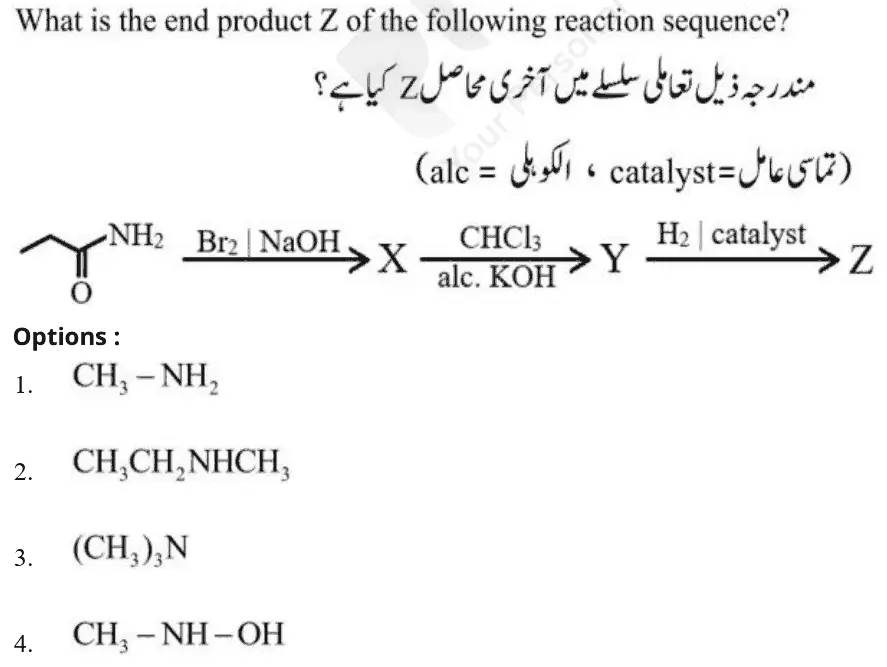
What is the end product Z of the following reaction sequence?

(alc = alcoholic, catalyst = catalyst)

(see the figure above)

The question and its figure as printed in TS EAPCET 2026 Urdu 11th May 2026 Shift 1.
The question as printed in the paper.
  • A

    $\mathrm{CH_3-NH_2}$

  • B

    $\mathrm{CH_3CH_2NHCH_3}$

  • C

    $\mathrm{(CH_3)_3N}$

  • D

    $\mathrm{CH_3-NH-OH}$

18TS EAPCET 2026 · 11 May · Shift 2MCQOpen question page ↗

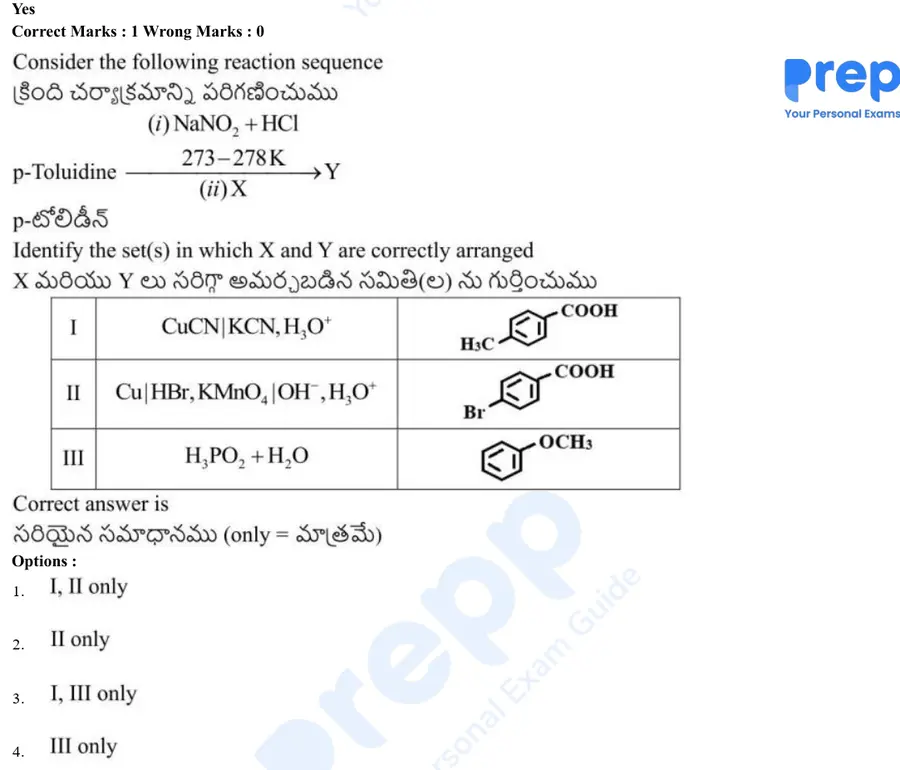
Consider the following reaction sequence

$$\text{p-Toluidine} \xrightarrow[(ii)\, \mathrm{X}]{(i)\, \mathrm{NaNO_2 + HCl},\ 273-278\,\mathrm{K}} \mathrm{Y}$$

Identify the set(s) in which X and Y are correctly arranged

XY
I$\mathrm{CuCN|KCN, H_3O^+}$(see the figure above)
II$\mathrm{Cu|HBr, KMnO_4|OH^-, H_3O^+}$(see the figure above)
III$\mathrm{H_3PO_2 + H_2O}$(see the figure above)

Correct answer is (only = only)

The question and its figure as printed in TS EAPCET 2026 11th May 2026 Shift 2.
The question as printed in the paper.
  • A

    I, II only

  • B

    II only

  • C

    I, III only

  • D

    III only

19TS EAPCET 2026 · 11 May · Shift 2MCQOpen question page ↗

Which of the following set/s of reagents convert benzoic acid (X) to primary amine (Y) with one carbon atom more than in X?

I. $\mathrm{NH_3/\Delta; Br_2 | OH^-}$

II. $\mathrm{NH_3/\Delta; LiAlH_4, H_2O}$

III. $\mathrm{LiAlH_4, H_2O; NaBr/H_2SO_4; KCN; H_2 | Ni}$

Correct answer is

  • A

    I, II only

  • B

    II, III only

  • C

    III only

  • D

    II only

20TS EAPCET 2026 · 10 May · Shift 1MCQOpen question page ↗

The reagent which is used to distinguish $\mathrm{C_6H_5N(CH_3)_2}$ and $\mathrm{(C_2H_5)_2NH}$ is

(anhy = anhydrous, conc = concentrated, alc = alcoholic)

  • A

    $\mathrm{C_6H_5SO_2Cl}$

  • B

    Anhy. $\mathrm{ZnCl_2}$ | conc. HCl

  • C

    $\mathrm{CrO_3}$ | $\mathrm{H_2SO_4}$

  • D

    $\mathrm{CHCl_3}$ | alc. KOH

21TS EAPCET 2026 · 10 May · Shift 2MCQOpen question page ↗

$$\mathrm{C_6H_5N_2Cl} \xrightarrow{\mathrm{Cu|HCl}} \mathrm{X} \xrightarrow[\mathrm{673\,K,\,300\,atm}]{(i)\,\mathrm{NaOH}} \mathrm{Y}$$

$$(ii)\,\mathrm{H_3O^+}$$

The incorrect statement about X and Y is

  • A

    X undergoes Fittig reaction

  • B

    Y gives o-hydroxybenzaldehyde with $\mathrm{CHCl_3}$ and NaOH

  • C

    Y forms salt with $\mathrm{NaHCO_3}$ solution

  • D

    X is chemically inert at room temperature

22TS EAPCET 2026 · 10 May · Shift 2MCQOpen question page ↗

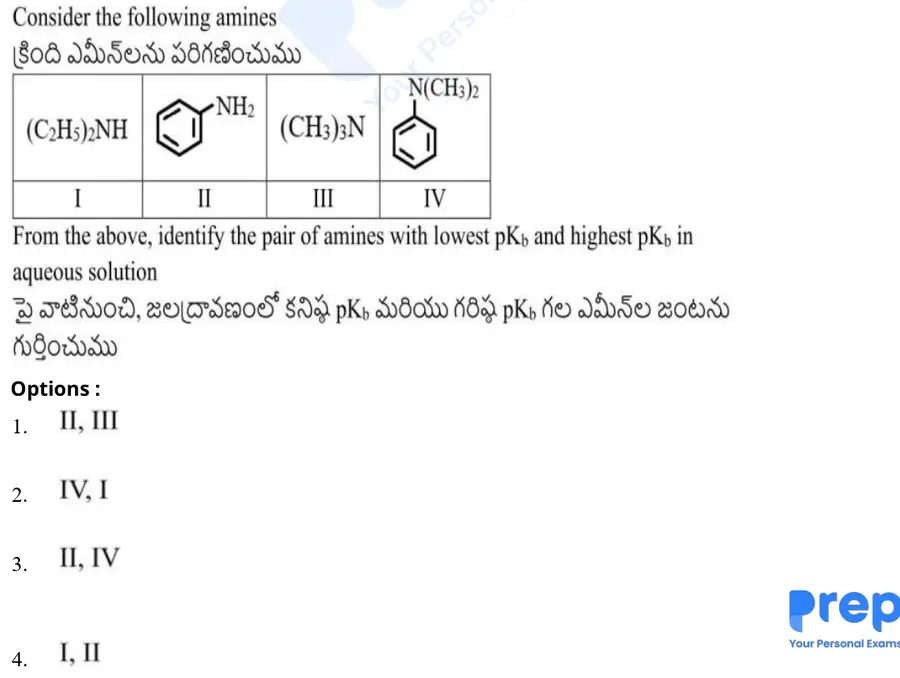
Consider the following amines

IIIIIIIV
$\mathrm{(C_2H_5)_2NH}$(see the figure above)$\mathrm{(CH_3)_3N}$(see the figure above)

From the above, identify the pair of amines with lowest $\mathrm{pK_b}$ and highest $\mathrm{pK_b}$ in aqueous solution

The question and its figure as printed in TS EAPCET 2026 10th May 2026 Shift 2.
The question as printed in the paper.
  • A

    II, III

  • B

    IV, I

  • C

    II, IV

  • D

    I, II

23TS EAPCET 2026 · 9 May · Shift 2MCQOpen question page ↗

Consider the following rection sequence

$$\text{Styrene} \xrightarrow[\text{(ii) X (iii) Y}]{(i)\ \mathrm{HBr|(C_6H_5CO)_2O_2}} \mathrm{Z}$$

Identify the correct set(s) with respect to X, Y and Z respectively
(dry ether = dry ether)

I. $\mathrm{KCN;\ H_3O^+;\ C_6H_5CH_2CH_2CO_2H}$

II. $\mathrm{Zn|H^+;\ KMnO_4|OH^-,H_3O^+;\ C_6H_5CH_2CH_2CO_2H}$

III. $\mathrm{Mg|dry\ ether;\ CO_2,H_3O^+;\ C_6H_5CH_2CH_2CO_2H}$

IV. $\mathrm{KCN;\ H_3O^+;\ C_6H_5CH_2CH_2CH_2CO_2H}$

The correct answer is (only =)

  • A

    I, II, III

  • B

    IV only

  • C

    II, III only

  • D

    I, III only

24TS EAPCET 2026 · 9 May · Shift 2MCQOpen question page ↗

Observe the statements given about $\mathrm{C_6H_5N_2BF_4}$ (X)

I. Reaction of X with NaF gave $\mathrm{C_6H_5F}$

II. Heating X with $\mathrm{NaNO_2}$ | Cu yielded $\mathrm{C_6H_5NO_2}$

III. Heating X gave $\mathrm{C_6H_5F}$

IV. Reaction of X with $\mathrm{HNO_3}$ gave $\mathrm{C_6H_5NO_2}$

Correct statements are (only)

  • A

    I, II only

  • B

    II, III only

  • C

    I, IV only

  • D

    III, IV only

25AP EAPCET 2025 · 27 May · Shift 1MCQOpen question page ↗

What are X and Y respectively in the following set of reactions ?

(see the figure above)

The question and its figure as printed in AP EAPCET 2025 27th May 2025 Shift 1. Option 1: Two structures: benzene ring with CN substituent (X), and benzene ring with CN substituent (Y) Option 2: Two structures: benzene ring with CN substituent (X), and benzene ring with NC substituent (Y) Option 3: Two structures: benzene ring with NC substituent (X), and benzene ring with CN substituent (Y) Option 4: Two structures: benzene ring with NC substituent (X), and benzene ring with NC substituent (Y)
The question as printed in the paper.
  • A

    see figure Two structures: benzene ring with CN substituent (X), and benzene ring with CN substituent (Y)

  • B

    see figure Two structures: benzene ring with CN substituent (X), and benzene ring with NC substituent (Y)

  • C

    see figure Two structures: benzene ring with NC substituent (X), and benzene ring with CN substituent (Y)

  • D

    see figure Two structures: benzene ring with NC substituent (X), and benzene ring with NC substituent (Y)

26AP EAPCET 2025 · 26 May · Shift 1MCQOpen question page ↗

Which of the following sets of reagents convert aniline to chlorobenzene ?

  • A

    $\mathrm{NaNO_2}$ / $\mathrm{HCl}$, 273 – 278 K; $\mathrm{Cu_2Cl_2}$ / $\mathrm{HCl}$

  • B

    $\mathrm{NaNO_2}$ / $\mathrm{HCl}$, 293 – 298 K; $\mathrm{Cu_2Cl_2}$ / $\mathrm{HCl}$

  • C

    $\mathrm{NaNO_2}$ / $\mathrm{HCl}$, 273 – 278 K; $\mathrm{SOCl_2}$

  • D

    $\mathrm{NaNO_2}$ / $\mathrm{HCl}$, 273 – 278 K; $\mathrm{Cl_2}$

27AP EAPCET 2025 · 26 May · Shift 1MCQOpen question page ↗

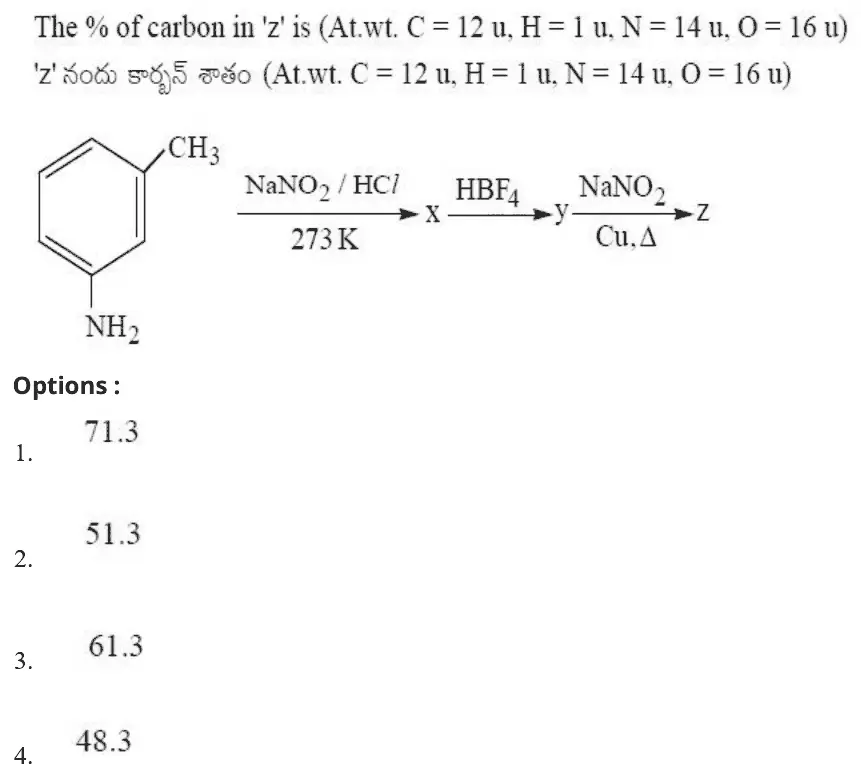
The % of carbon in 'z' is (At.wt. C = 12 u, H = 1 u, N = 14 u, O = 16 u)

(see the figure above)

The question and its figure as printed in AP EAPCET 2025 26thMay 2025 Shift 1.
The question as printed in the paper.
  • A

    71.3

  • B

    51.3

  • C

    61.3

  • D

    48.3

28AP EAPCET 2025 · 26 May · Shift 2MCQOpen question page ↗

Benzyl amine can be prepared from which of the following reactions ?

  • A

    $\mathrm{C_6H_5Cl \xrightarrow{CH_3NH_2}}$

  • B

    $\mathrm{C_6H_5CH_2Cl \xrightarrow[(ii)\ H_2/Ni]{(i)\ AgCN}}$

  • C

    $\mathrm{C_6H_5CONH_2 \xrightarrow{NaOH/Br_2}}$

  • D

    $\mathrm{C_6H_5CONH_2 \xrightarrow[(ii)\ H_2O]{(i)\ LiAlH_4}}$

29AP EAPCET 2025 · 24 May · Shift 1MCQOpen question page ↗

What are X and Y in the following reaction sequence ?

$$\mathrm{C_6H_5N_2^+Cl^-} \xrightarrow{\mathrm{X}} \mathrm{C_6H_5CN} \xrightarrow[\mathrm{(ii)\ H_2O}]{\mathrm{(i)\ CH_3MgBr}} \mathrm{Y}$$

  • A

    $\mathrm{KCN;\ C_6H_5COCH_3}$

  • B

    $\mathrm{KCN;\ C_6H_5C(OH)(CH_3)_2}$

  • C

    $\mathrm{CuCN\,|\,KCN;\ C_6H_5\,CH(OH)CH_3}$

  • D

    $\mathrm{CuCN\,|\,KCN;\ C_6H_5COCH_3}$

30AP EAPCET 2025 · 23 May · Shift 1MCQOpen question page ↗

The reaction of benzene diazonium chloride with $\mathrm{Cu}$ and $\mathrm{HCl}$ is known as

  • A

    Sandmeyer reaction

  • B

    Etard reaction

  • C

    Finkelstein reaction

  • D

    Gattermann reaction

31AP EAPCET 2025 · 23 May · Shift 1MCQOpen question page ↗

The sequence of reagents required to convert aniline to benzoic acid is

  • A

    $\mathrm{CHCl_3 / OH^-}, \Delta;\ \mathrm{H_3O^+}$

  • B

    $\mathrm{NaNO_2 / HCl}, 273-278\ \mathrm{K};\ \mathrm{KCN, H_3O^+}$

  • C

    $\mathrm{NaNO_2 / HCl}, 273-278\ \mathrm{K};\ \mathrm{CuCN / KCN};\ \mathrm{H_3O^+}$

  • D

    $\mathrm{NaNO_2 / HCl}, 273\ \mathrm{K};\ \mathrm{H_3PO_2};\ \mathrm{CO, HCl, AlCl_3}$

32AP EAPCET 2025 · 23 May · Shift 2MCQOpen question page ↗

Consider the following

Statement-I : In the nitration of aniline, more amount of m-nitroaniline is formed than expected.

Statement-II : In the presence of a strongly acidic medium, aniline is protonated to form anilinium ion, which is meta directing.

The correct answer is

  • A

    Both statement-I and statement-II are correct

  • B

    Both statement-I and statement-II are not correct

  • C

    Statement-I is correct, but statement-II is not correct

  • D

    Statement-I is not correct, but statement-II is correct

34AP EAPCET 2025 · 22 May · Shift 2MCQOpen question page ↗

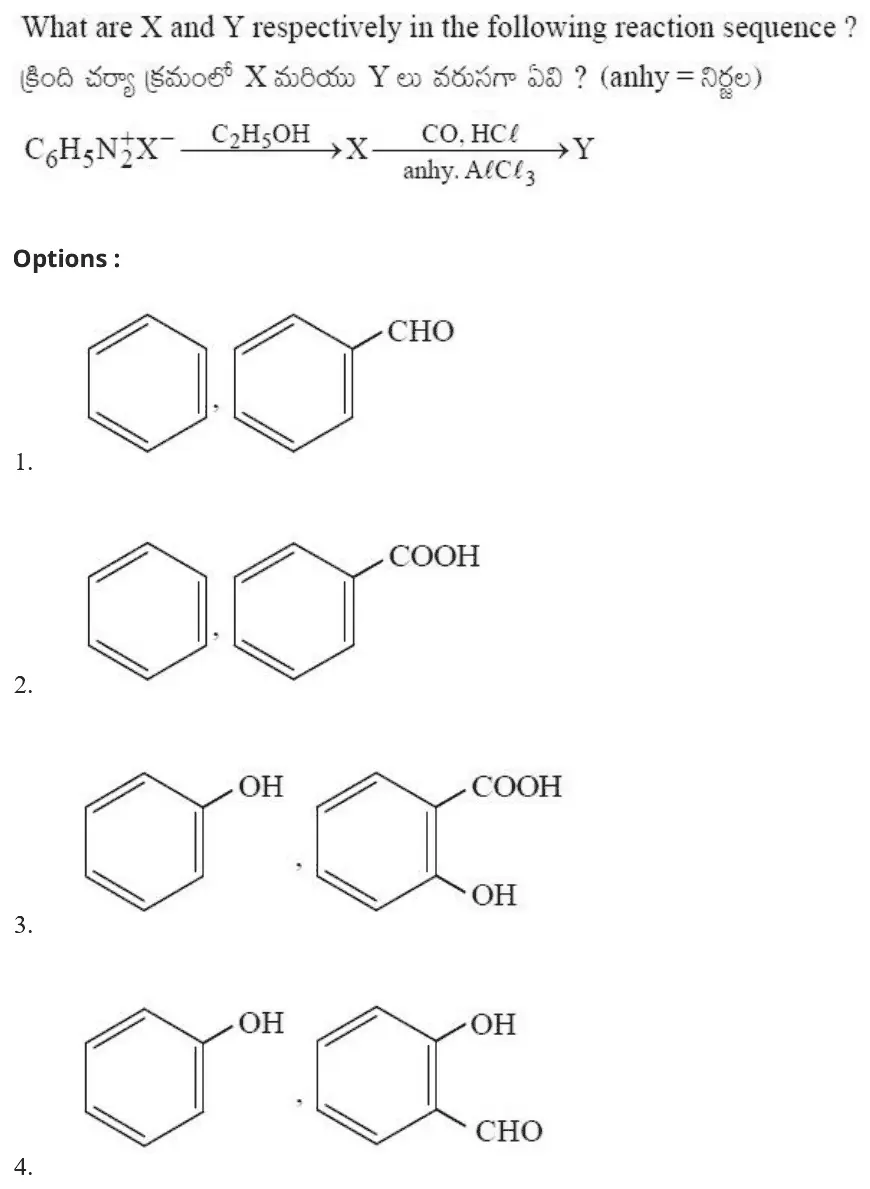
What are X and Y respectively in the following reaction sequence ?

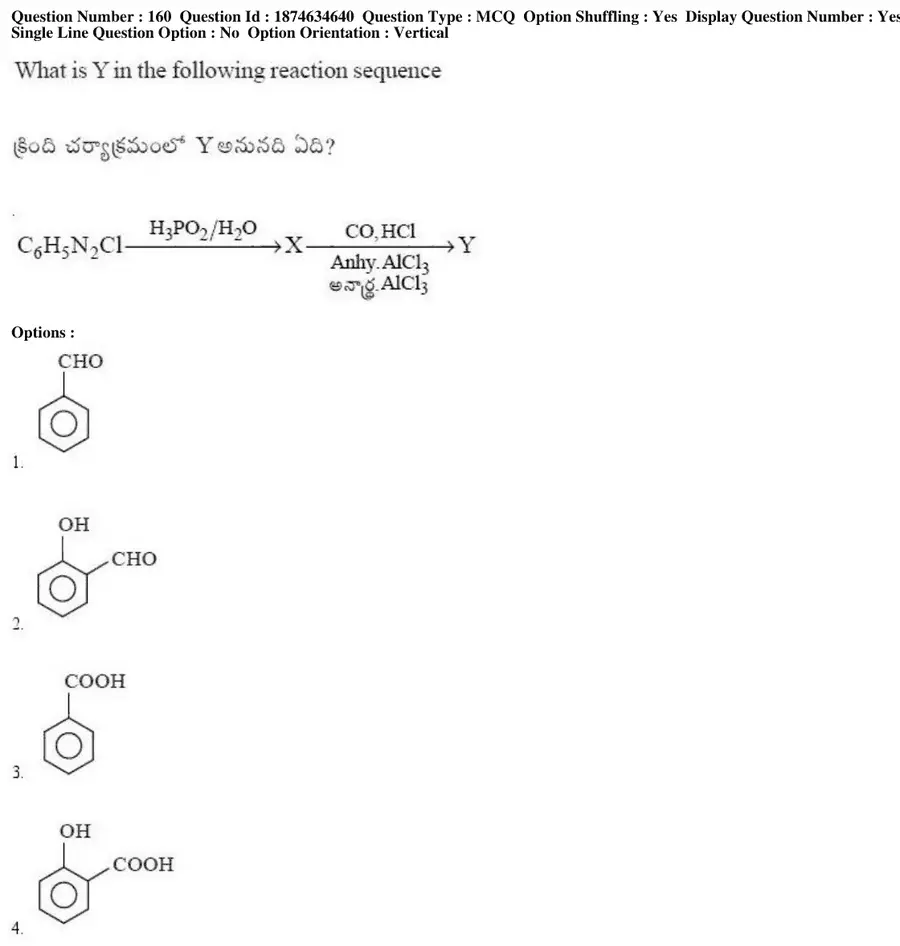
$$\mathrm{C_6H_5N_2^+X^-} \xrightarrow{\mathrm{C_2H_5OH}} \mathrm{X} \xrightarrow[\text{anhy. } \mathrm{AlCl_3}]{\mathrm{CO,\ HCl}} \mathrm{Y}$$

The question and its figure as printed in AP EAPCET 2025 22nd May 2025 Shift 2. Option 1: Benzene, and benzaldehyde (benzene ring with CHO substituent) Option 2: Benzene, and benzoic acid (benzene ring with COOH substituent) Option 3: Phenol (benzene ring with OH), and salicylic acid (benzene ring with COOH and OH on adjacent carbons) Option 4: Phenol (benzene ring with OH), and salicylaldehyde (benzene ring with OH and CHO on adjacent carbons)
The question as printed in the paper.
  • A

    see figure Benzene, and benzaldehyde (benzene ring with CHO substituent)

  • B

    see figure Benzene, and benzoic acid (benzene ring with COOH substituent)

  • C

    see figure Phenol (benzene ring with OH), and salicylic acid (benzene ring with COOH and OH on adjacent carbons)

  • D

    see figure Phenol (benzene ring with OH), and salicylaldehyde (benzene ring with OH and CHO on adjacent carbons)

35AP EAPCET 2025 · 21 May · Shift 1MCQOpen question page ↗

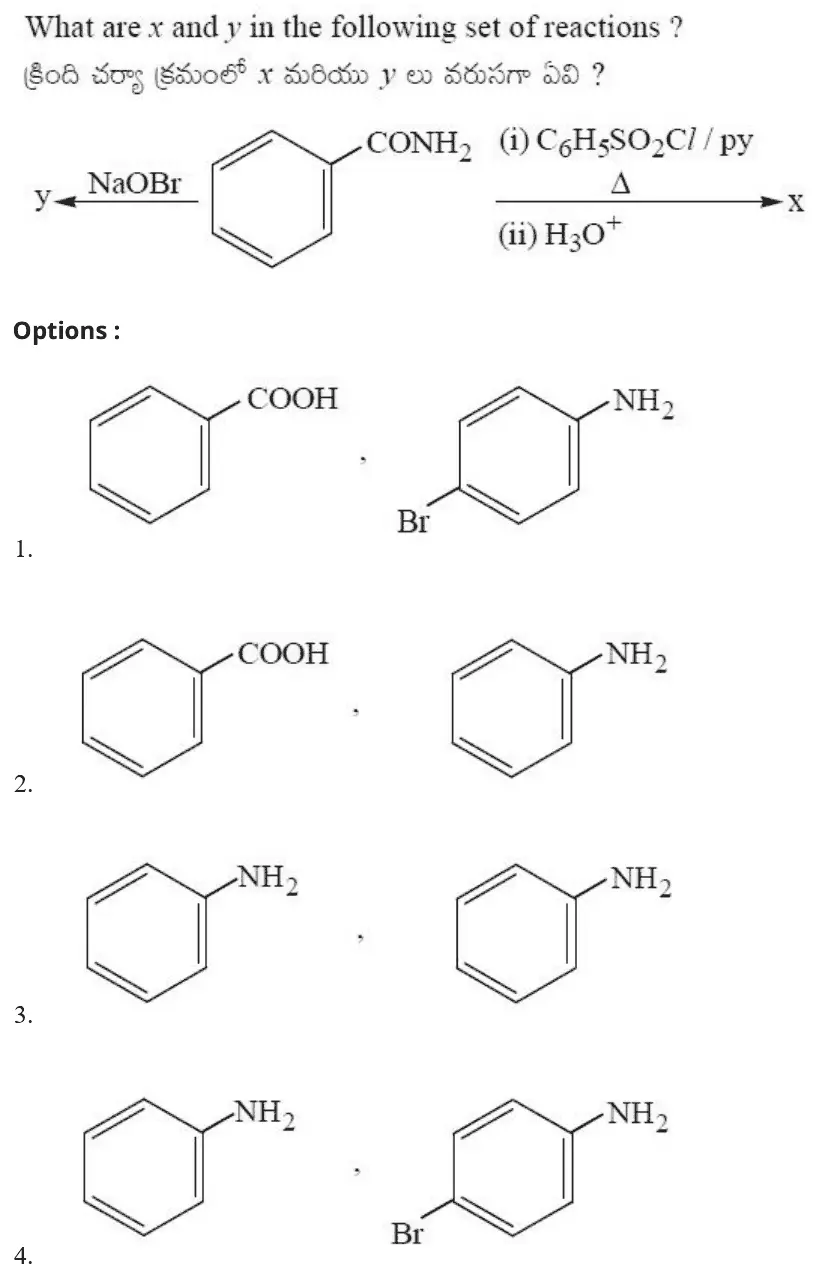
What are $x$ and $y$ in the following set of reactions ?

(see the figure above)

The question and its figure as printed in AP EAPCET 2025 21st May 2025 Shift 1. Option 1: Benzoic acid (benzene ring with COOH), p-bromoaniline (benzene ring with NH2 at the top and Br at the bottom, para), separated by a comma Option 2: Benzoic acid (benzene ring with COOH), aniline (benzene ring with NH2), separated by a comma Option 3: Aniline (benzene ring with NH2), aniline (benzene ring with NH2), separated by a comma Option 4: Aniline (benzene ring with NH2), p-bromoaniline (benzene ring with NH2 at the top and Br at the bottom, para), separated by a comma
The question as printed in the paper.
  • A

    see figure Benzoic acid (benzene ring with COOH), p-bromoaniline (benzene ring with NH2 at the top and Br at the bottom, para), separated by a comma

  • B

    see figure Benzoic acid (benzene ring with COOH), aniline (benzene ring with NH2), separated by a comma

  • C

    see figure Aniline (benzene ring with NH2), aniline (benzene ring with NH2), separated by a comma

  • D

    see figure Aniline (benzene ring with NH2), p-bromoaniline (benzene ring with NH2 at the top and Br at the bottom, para), separated by a comma

36AP EAPCET 2025 · 21 May · Shift 2MCQOpen question page ↗

In the following sequence of reactions, what is the end product (D) ?

$$\mathrm{C_2H_5Br} \xrightarrow{\mathrm{KCN}} \mathrm{A} \xrightarrow{\mathrm{H_3O^+}} \mathrm{B} \xrightarrow{\mathrm{LiAlH_4}} \mathrm{C} \xrightarrow[573\ \mathrm{K}]{\mathrm{Cu}} \mathrm{D}$$

  • A

    Acetaldehyde

  • B

    Acetone

  • C

    Propionaldehyde

  • D

    Propanol-1

37AP EAPCET 2025 · 21 May · Shift 2MCQOpen question page ↗

Consider the following

Statement-I : $\mathrm{CH_3NH_2}$ is more basic than $\mathrm{NH_3}$ but $\mathrm{C_6H_5NH_2}$ is less basic than $\mathrm{NH_3}$.

Statement-II : The order of basic strength of amines in aqueous phase follows the order $\mathrm{(C_2H_5)_3N > (C_2H_5)_2NH > C_2H_5NH_2}$

The correct answer is

  • A

    Both statement-I and statement-II are correct

  • B

    Both statement-I and statement-II are not correct

  • C

    Statement-I is correct, but statement-II is not correct

  • D

    Statement-I is not correct, but statement-II is correct

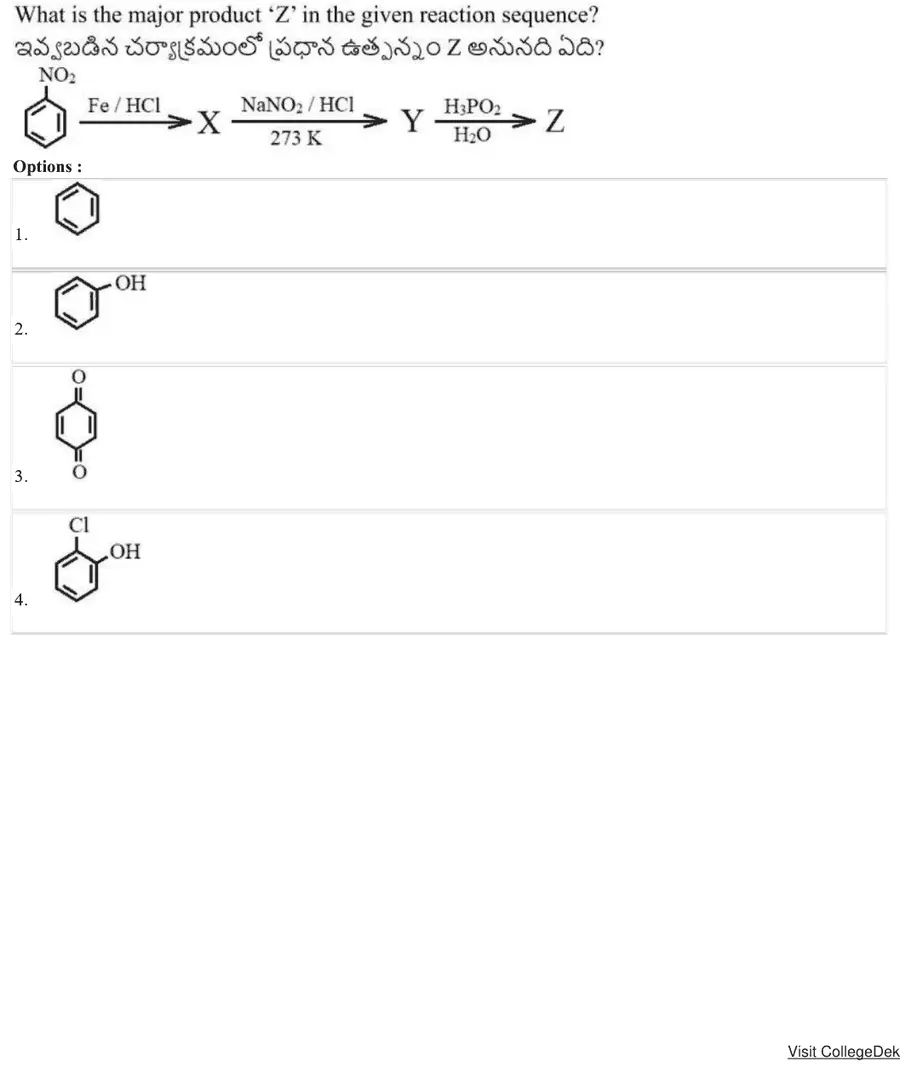
38TS EAPCET 2025 · 4 May · Shift 1MCQOpen question page ↗

What is the major product 'Z' in the given reaction sequence?

(see the figure above)

The question and its figure as printed in TG EAPCET 2025 04 May FN. Option 1: Benzene ring (unsubstituted) Option 2: Phenol (benzene ring with OH) Option 3: p-Benzoquinone (six-membered ring with two C=O groups at opposite positions, two C=C double bonds) Option 4: 2-Chlorophenol (benzene ring with OH and Cl on adjacent carbons)
The question as printed in the paper.
  • A

    see figure Benzene ring (unsubstituted)

  • B

    see figure Phenol (benzene ring with OH)

  • C

    see figure p-Benzoquinone (six-membered ring with two C=O groups at opposite positions, two C=C double bonds)

  • D

    see figure 2-Chlorophenol (benzene ring with OH and Cl on adjacent carbons)

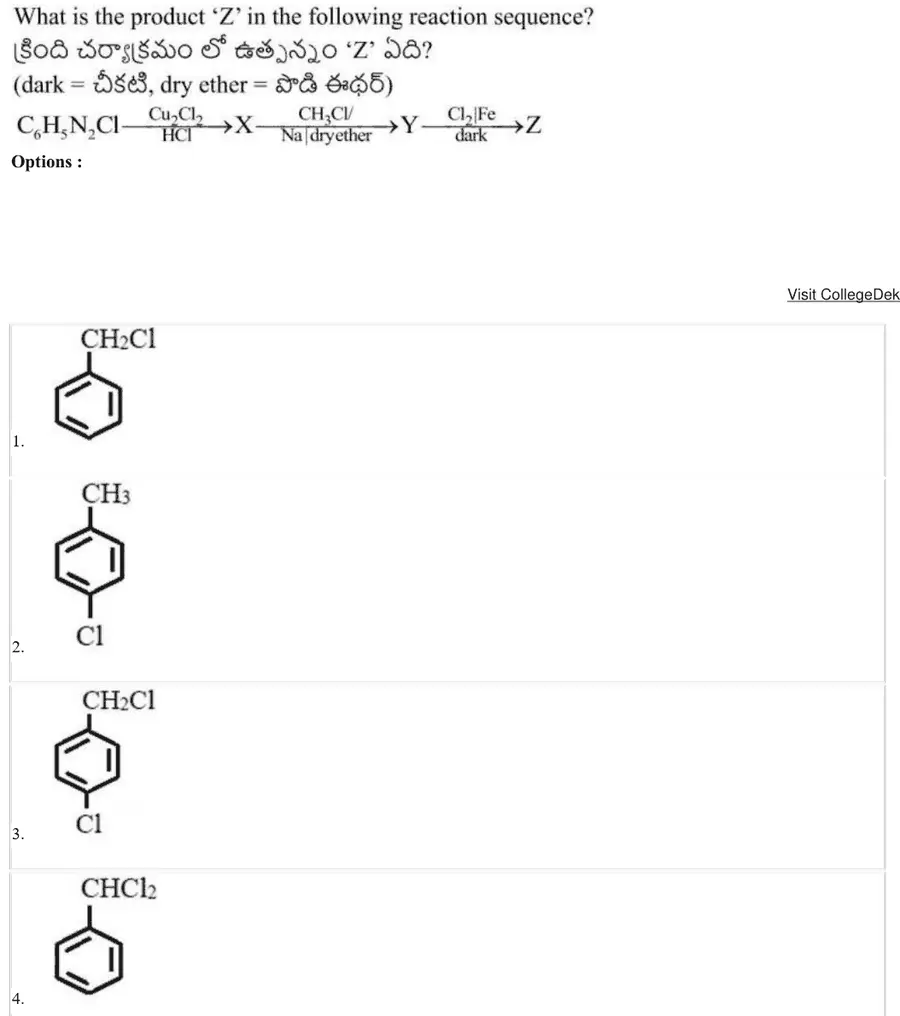
39TS EAPCET 2025 · 3 May · Shift 1MCQOpen question page ↗

What is the product 'Z' in the following reaction sequence?

(dark = dark, dry ether = dry ether)

$\mathrm{C_6H_5N_2Cl} \xrightarrow[\mathrm{HCl}]{\mathrm{Cu_2Cl_2}} \mathrm{X} \xrightarrow[\mathrm{Na|dry\ ether}]{\mathrm{CH_3Cl}} \mathrm{Y} \xrightarrow[\mathrm{dark}]{\mathrm{Cl_2|Fe}} \mathrm{Z}$

The question and its figure as printed in TG EAPCET 2025 03 May FN. Option 1: Benzene ring with a CH2Cl substituent Option 2: Benzene ring with CH3 and Cl at para positions (1,4) Option 3: Benzene ring with CH2Cl and Cl at para positions (1,4) Option 4: Benzene ring with a CHCl2 substituent
The question as printed in the paper.
  • A

    see figure Benzene ring with a $\mathrm{CH_2Cl}$ substituent

  • B

    see figure Benzene ring with $\mathrm{CH_3}$ and $\mathrm{Cl}$ at para positions (1,4)

  • C

    see figure Benzene ring with $\mathrm{CH_2Cl}$ and $\mathrm{Cl}$ at para positions (1,4)

  • D

    see figure Benzene ring with a $\mathrm{CHCl_2}$ substituent

40TS EAPCET 2025 · 3 May · Shift 1MCQOpen question page ↗

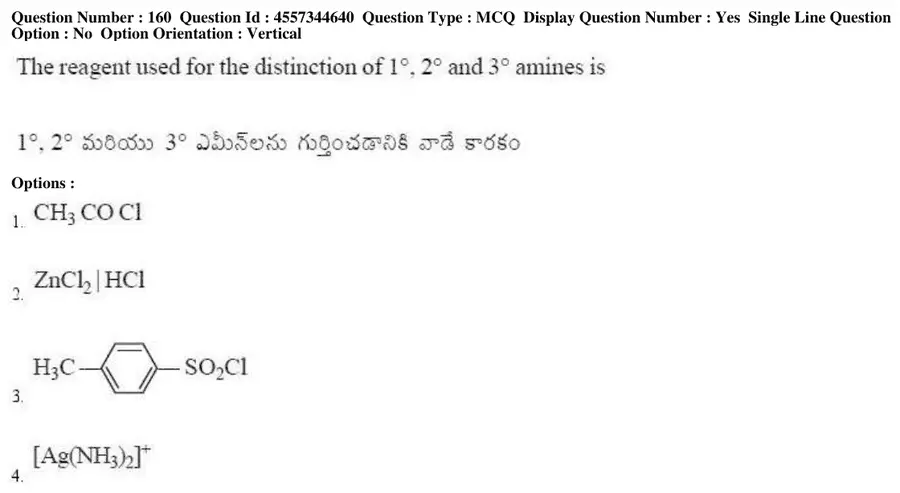
The reagent which is used to distinguish primary, secondary and tertiary amines from the mixture is

  • A

    Fehling's reagent

  • B

    Tollens reagent

  • C

    Lucas reagent

  • D

    Hinsberg's reagent

41TS EAPCET 2025 · 3 May · Shift 2MCQOpen question page ↗

The correct statements about the products B and C in the given reactions are
(Anhy = anhydrous, ethanolic = ethanolic)

$$\mathrm{CH_3CH_2OH} \xrightarrow[\text{Anhy ZnCl}_2]{\text{HCl /}} \mathrm{A} \xrightarrow[\text{AgCN}]{\text{ethanolic}} \underset{\text{Minor}}{\mathrm{B}} + \underset{\text{Major}}{\mathrm{C}}$$

I. B and C are functional isomers

II. With $\mathrm{H_2}$ | Catalyst B gives $1^\circ$ amine and C gives $2^\circ$ amine

III. B on acid hydrolysis gives formic acid and C gives $\mathrm{C_3H_6O_2}$

IV. C forms isocyanate with HgO

  • A

    I & III

  • B

    II & III

  • C

    I, II & IV

  • D

    II, III & IV

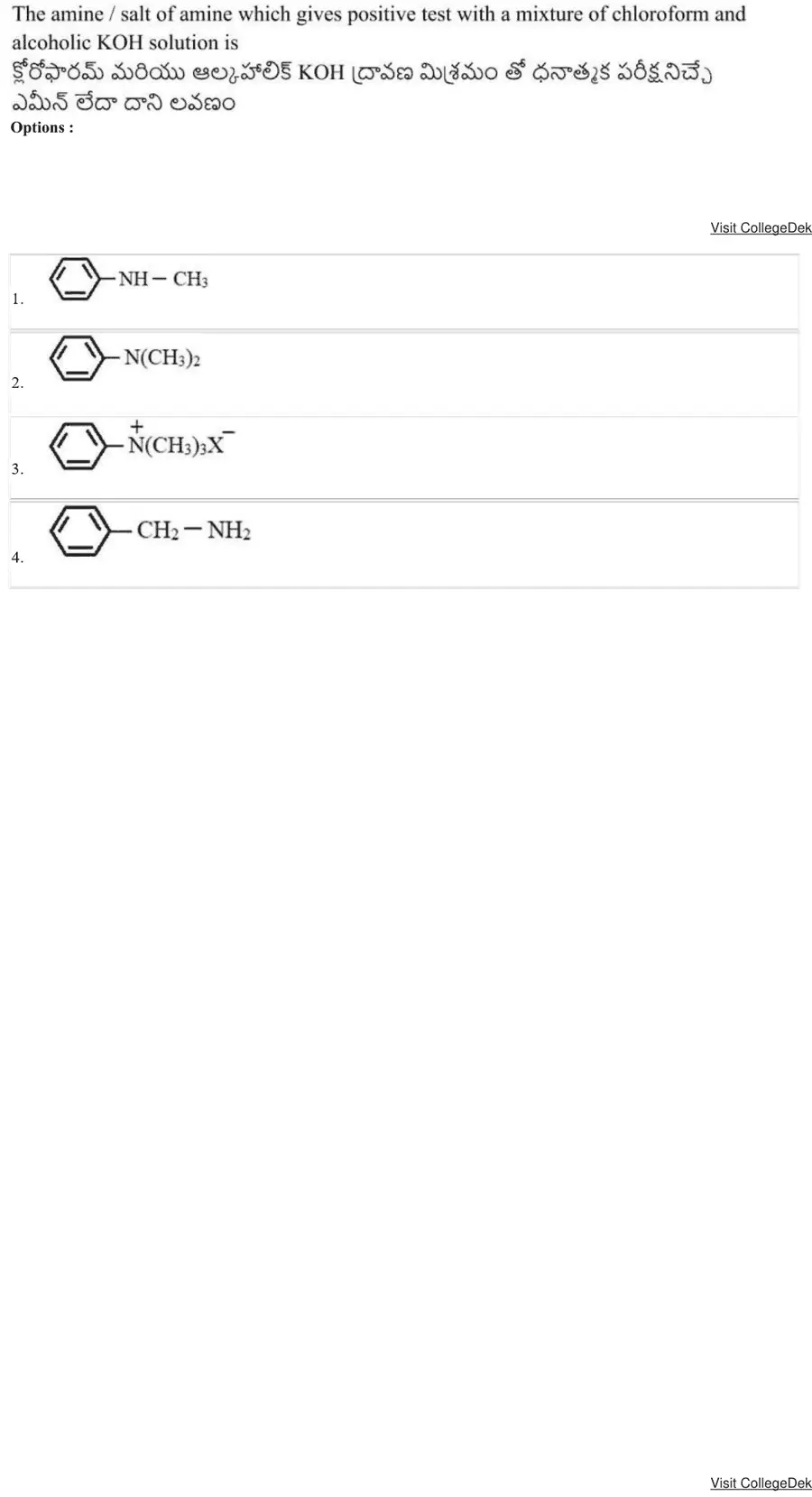
42TS EAPCET 2025 · 2 May · Shift 2MCQOpen question page ↗

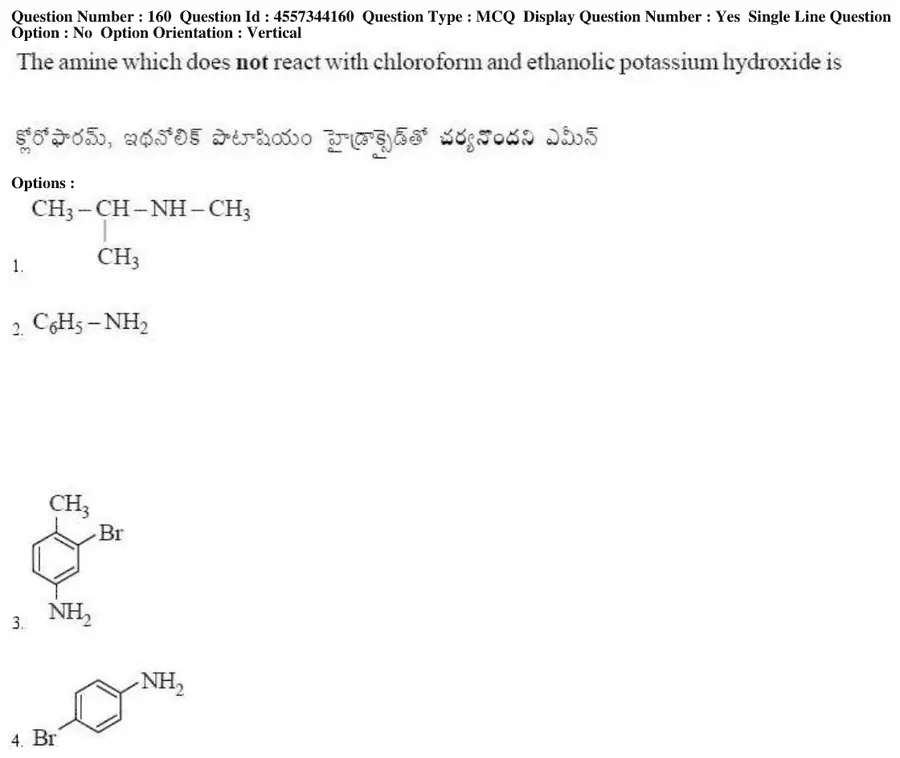
The amine / salt of amine which gives positive test with a mixture of chloroform and alcoholic KOH solution is

The question and its figure as printed in TG EAPCET 2025 02 May AN. Option 1: Benzene ring bonded to NH-CH3 (printed as CH3) Option 2: Benzene ring bonded to N(CH3)2 Option 3: Benzene ring bonded to +N(CH3)3X^- Option 4: Benzene ring bonded to CH2-NH2
The question as printed in the paper.
  • A

    see figure Benzene ring bonded to $\mathrm{NH-CH_3}$ (printed as $\mathrm{CH_3}$)

  • B

    see figure Benzene ring bonded to $\mathrm{N(CH_3)_2}$

  • C

    see figure Benzene ring bonded to $\mathrm{\overset{+}{N}(CH_3)_3X^-}$

  • D

    see figure Benzene ring bonded to $\mathrm{CH_2-NH_2}$

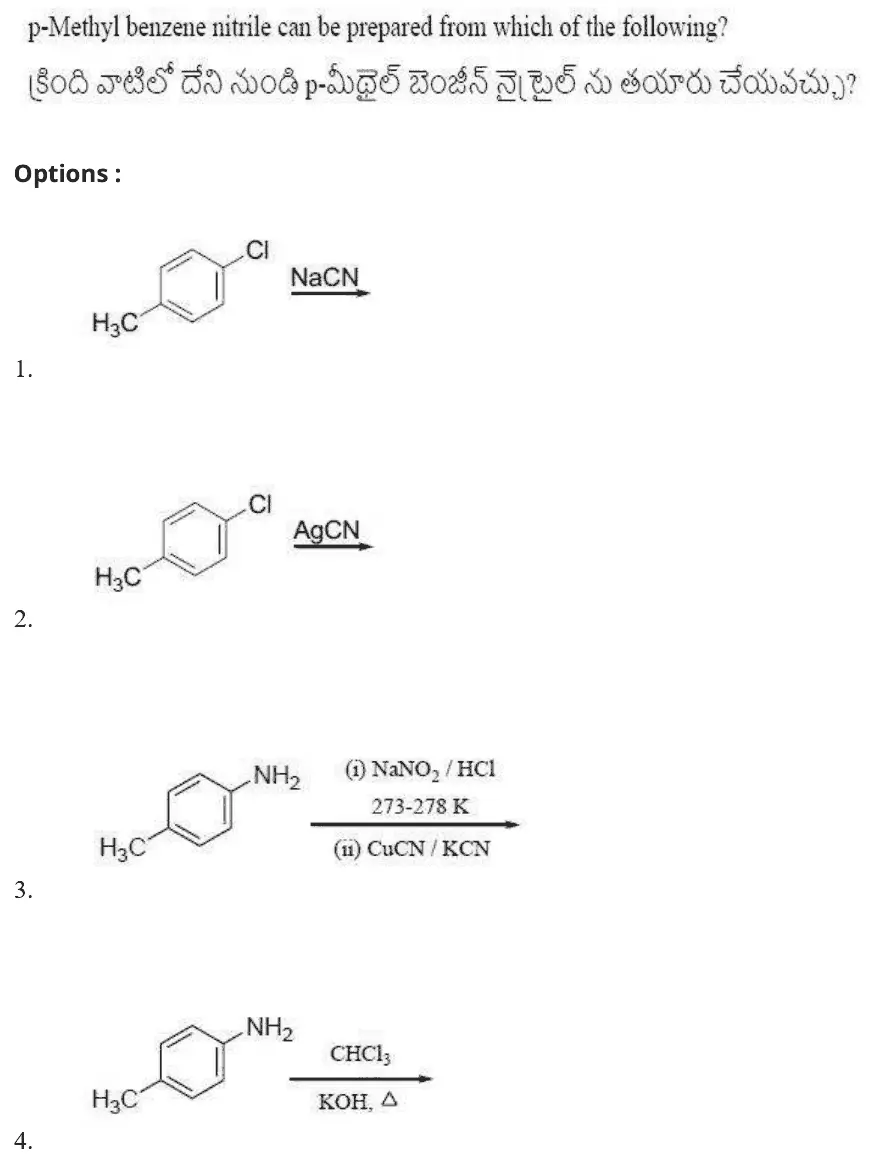
43AP EAPCET 2024 · 23 May · Shift 1MCQOpen question page ↗

p-Methyl benzene nitrile can be prepared from which of the following?

The question and its figure as printed in AP EAPCET 2024 23rd May 2024 Shift 1. Option 1: Reaction scheme: p-chlorotoluene (benzene ring with H3C at one para position and Cl at the other) reacted with NaCN (arrow labelled NaCN). Option 2: Reaction scheme: p-chlorotoluene (benzene ring with H3C and Cl para) reacted with AgCN (arrow labelled AgCN). Option 3: Reaction scheme: p-methylaniline (benzene ring with H3C and NH2 para) with arrow labelled (i) NaNO2 / HCl, 273-278 K, (ii) CuCN / KCN. Option 4: Reaction scheme: p-methylaniline (benzene ring with H3C and NH2 para) with arrow labelled CHCl3 over KOH, Δ.
The question as printed in the paper.
  • A

    see figure Reaction scheme: p-chlorotoluene (benzene ring with $\mathrm{H_3C}$ at one para position and Cl at the other) reacted with NaCN (arrow labelled NaCN).

  • B

    see figure Reaction scheme: p-chlorotoluene (benzene ring with $\mathrm{H_3C}$ and Cl para) reacted with AgCN (arrow labelled AgCN).

  • C

    see figure Reaction scheme: p-methylaniline (benzene ring with $\mathrm{H_3C}$ and $\mathrm{NH_2}$ para) with arrow labelled (i) $\mathrm{NaNO_2}$ / HCl, 273-278 K, (ii) CuCN / KCN.

  • D

    see figure Reaction scheme: p-methylaniline (benzene ring with $\mathrm{H_3C}$ and $\mathrm{NH_2}$ para) with arrow labelled $\mathrm{CHCl_3}$ over KOH, Δ.

44AP EAPCET 2024 · 20 May · Shift 1MCQOpen question page ↗

The two reactions involved in the conversion of benzene diazonium chloride to diphenyl are respectively

  • A

    Swarts, Fittig

  • B

    Gatterman, Swarts

  • C

    Sandmeyer, Wurtz

  • D

    Sandmeyer, Fittig

45AP EAPCET 2024 · 20 May · Shift 1MCQOpen question page ↗

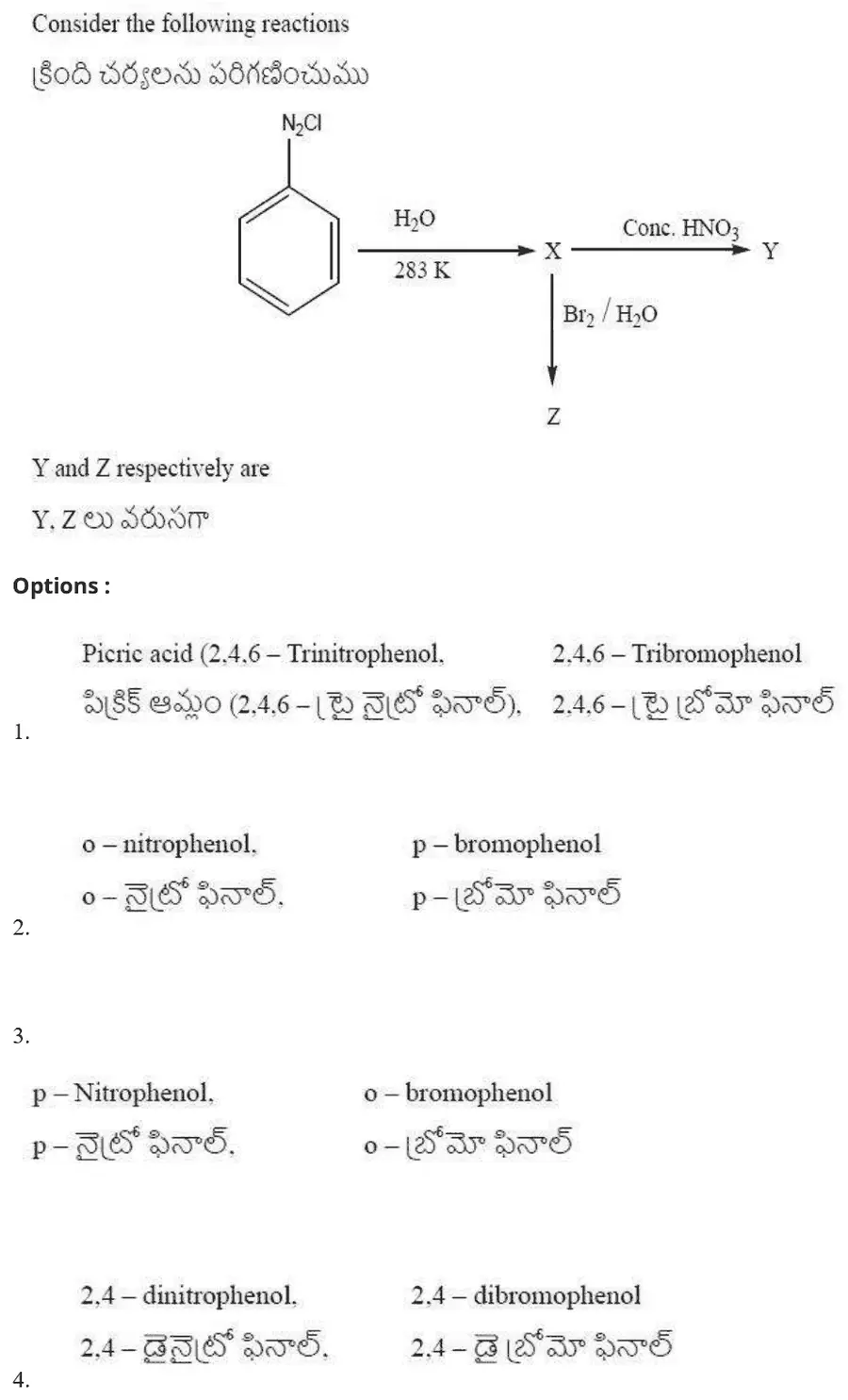
Consider the following reactions

(see the figure above)

Y and Z respectively are

The question and its figure as printed in AP EAPCET 2024 20th May 2024 Shift 1.
The question as printed in the paper.
  • A

    Picric acid (2,4,6 – Trinitrophenol), 2,4,6 – Tribromophenol

  • B

    o – nitrophenol, p – bromophenol

  • C

    p – Nitrophenol, o – bromophenol

  • D

    2,4 – dinitrophenol, 2,4 – dibromophenol

46AP EAPCET 2024 · 20 May · Shift 1MCQOpen question page ↗

$$\text{Benzamide} \xrightarrow{\mathrm{Br_2}/\mathrm{NaOH}} \mathrm{X} \xrightarrow[\text{alc. KOH}]{\mathrm{CHCl_3}} \mathrm{Y}$$

The conversion of X to Y is

  • A

    Hoffmann reaction

  • B

    Etard reaction

  • C

    Stephen reaction

  • D

    Carbyl amine reaction

47AP EAPCET 2024 · 20 May · Shift 2MCQOpen question page ↗

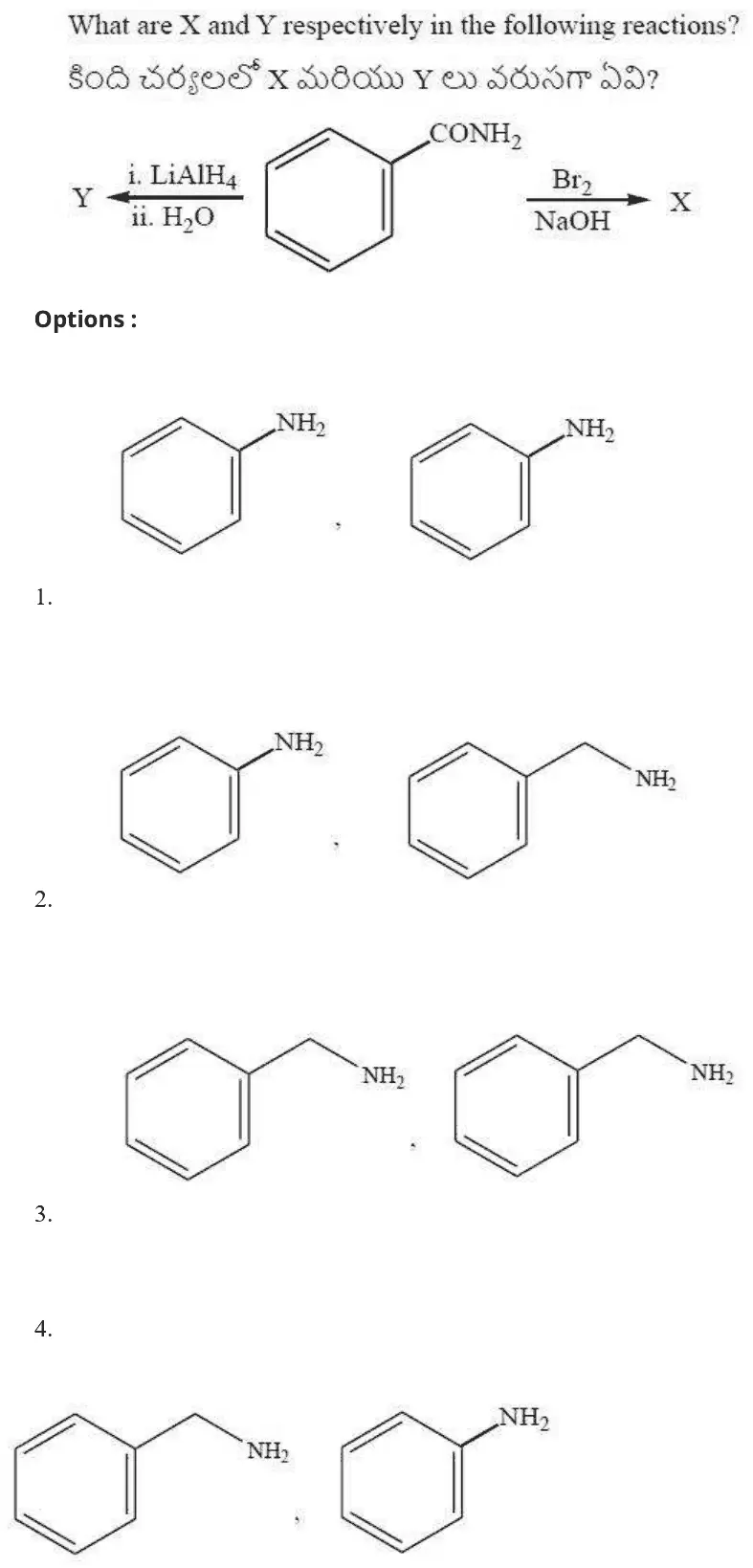
What are X and Y respectively in the following reactions?

(see the figure above)

The question and its figure as printed in AP EAPCET 2024 20th May 2024 Shift 2. Option 1: Two structures: aniline (benzene ring with NH2 attached directly), and aniline again (benzene ring with NH2 attached directly). Option 2: Two structures: aniline (benzene ring with NH2 attached directly), and benzylamine (benzene ring with CH2NH2). Option 3: Two structures: benzylamine (benzene ring with CH2NH2), and benzylamine (benzene ring with CH2NH2). Option 4: Two structures: benzylamine (benzene ring with CH2NH2), and aniline (benzene ring with NH2 attached directly).
The question as printed in the paper.
  • A

    see figure Two structures: aniline (benzene ring with NH2 attached directly), and aniline again (benzene ring with NH2 attached directly).

  • B

    see figure Two structures: aniline (benzene ring with NH2 attached directly), and benzylamine (benzene ring with CH2NH2).

  • C

    see figure Two structures: benzylamine (benzene ring with CH2NH2), and benzylamine (benzene ring with CH2NH2).

  • D

    see figure Two structures: benzylamine (benzene ring with CH2NH2), and aniline (benzene ring with NH2 attached directly).

48AP EAPCET 2024 · 19 May · Shift 2MCQOpen question page ↗

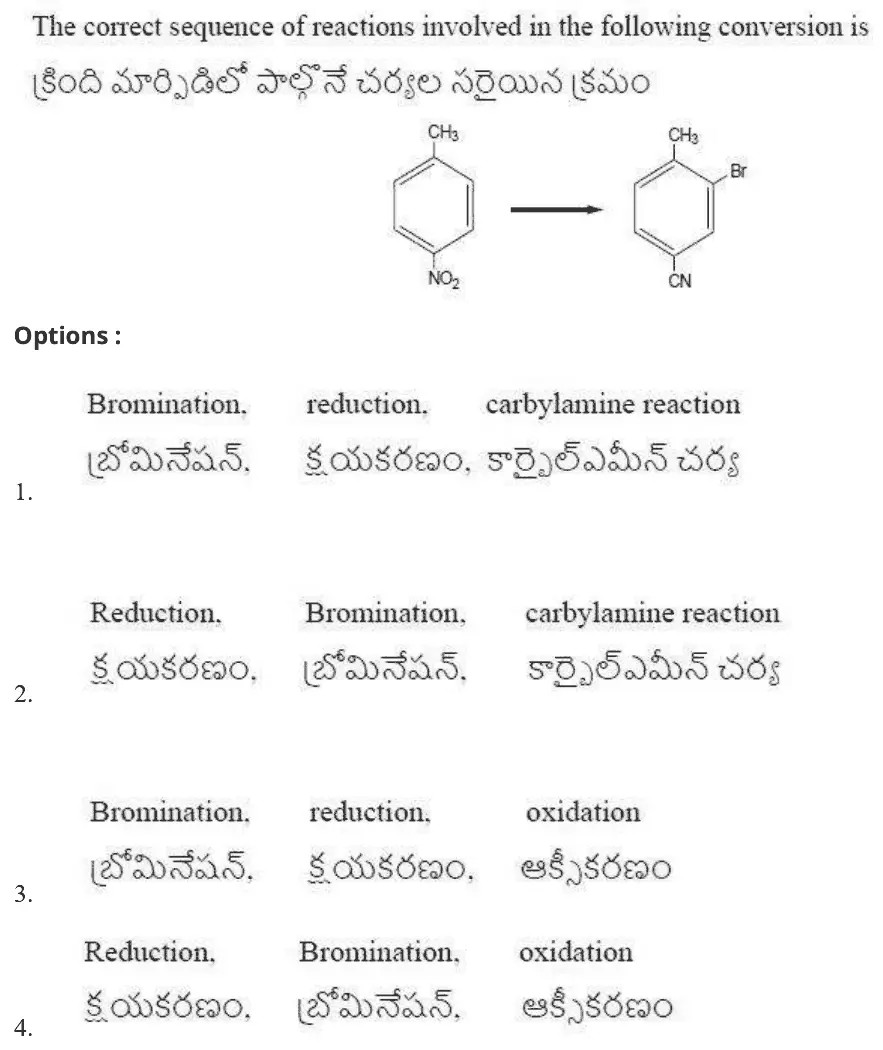
The correct sequence of reactions involved in the following conversion is

(see the figure above)

The question and its figure as printed in AP EAPCET 2024 19th May 2024 Shift 2.
The question as printed in the paper.
  • A

    Bromination, reduction, carbylamine reaction

  • B

    Reduction, Bromination, carbylamine reaction

  • C

    Bromination, reduction, oxidation

  • D

    Reduction, Bromination, oxidation

49AP EAPCET 2024 · 18 May · Shift 1MCQOpen question page ↗

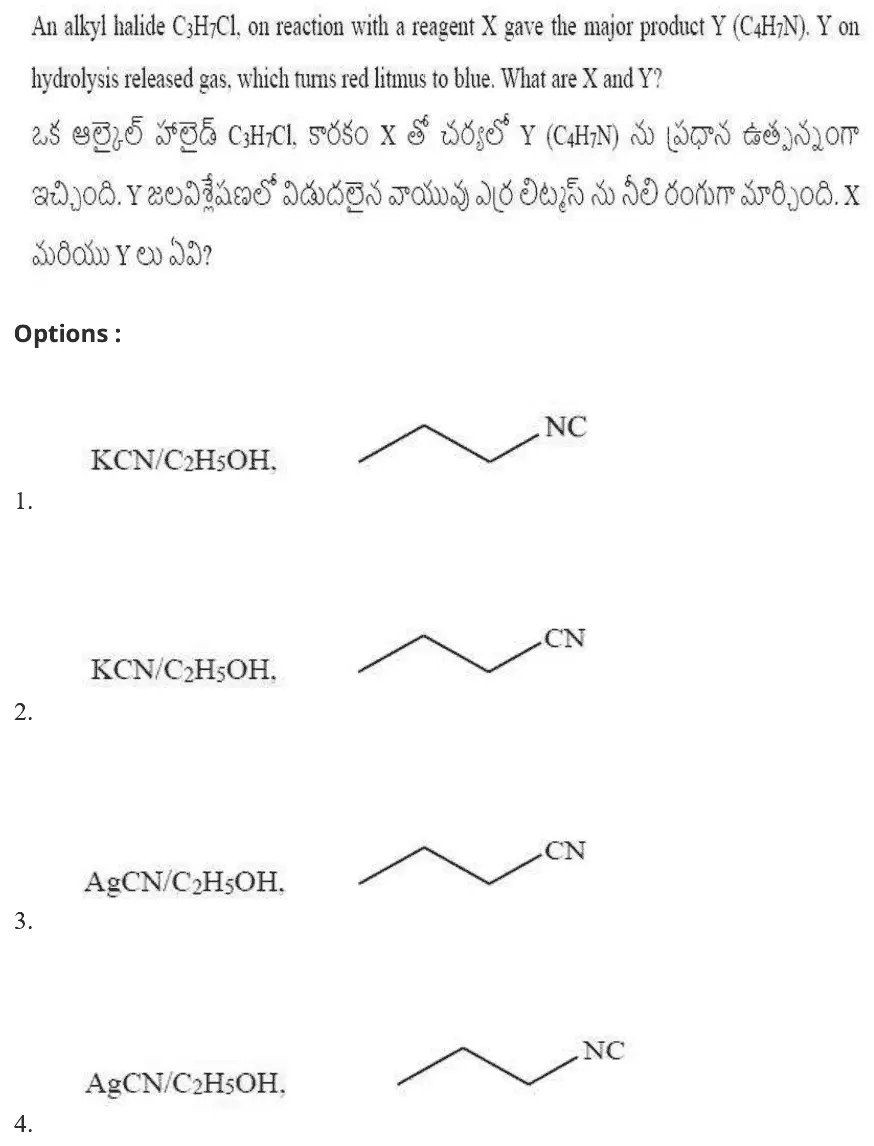
An alkyl halide $\mathrm{C_3H_7Cl}$, on reaction with a reagent X gave the major product Y ($\mathrm{C_4H_7N}$). Y on hydrolysis released gas, which turns red litmus to blue. What are X and Y?

The question and its figure as printed in AP EAPCET 2024 18th May 2024 Shift 1.
The question as printed in the paper.
  • A

    $\mathrm{KCN/C_2H_5OH}$, (see the figure above) skeletal structure of a zigzag chain of three carbons (butyl chain) ending in an isocyanide group, drawn as –NC

  • B

    $\mathrm{KCN/C_2H_5OH}$, (see the figure above) skeletal structure of a zigzag chain of three carbons (butyl chain) ending in a cyanide group, drawn as –CN

  • C

    $\mathrm{AgCN/C_2H_5OH}$, (see the figure above) skeletal structure of a zigzag chain of three carbons (butyl chain) ending in a cyanide group, drawn as –CN

  • D

    $\mathrm{AgCN/C_2H_5OH}$, (see the figure above) skeletal structure of a zigzag chain of three carbons (butyl chain) ending in an isocyanide group, drawn as –NC

50TS EAPCET 2024 · 11 May · Shift 1MCQOpen question page ↗

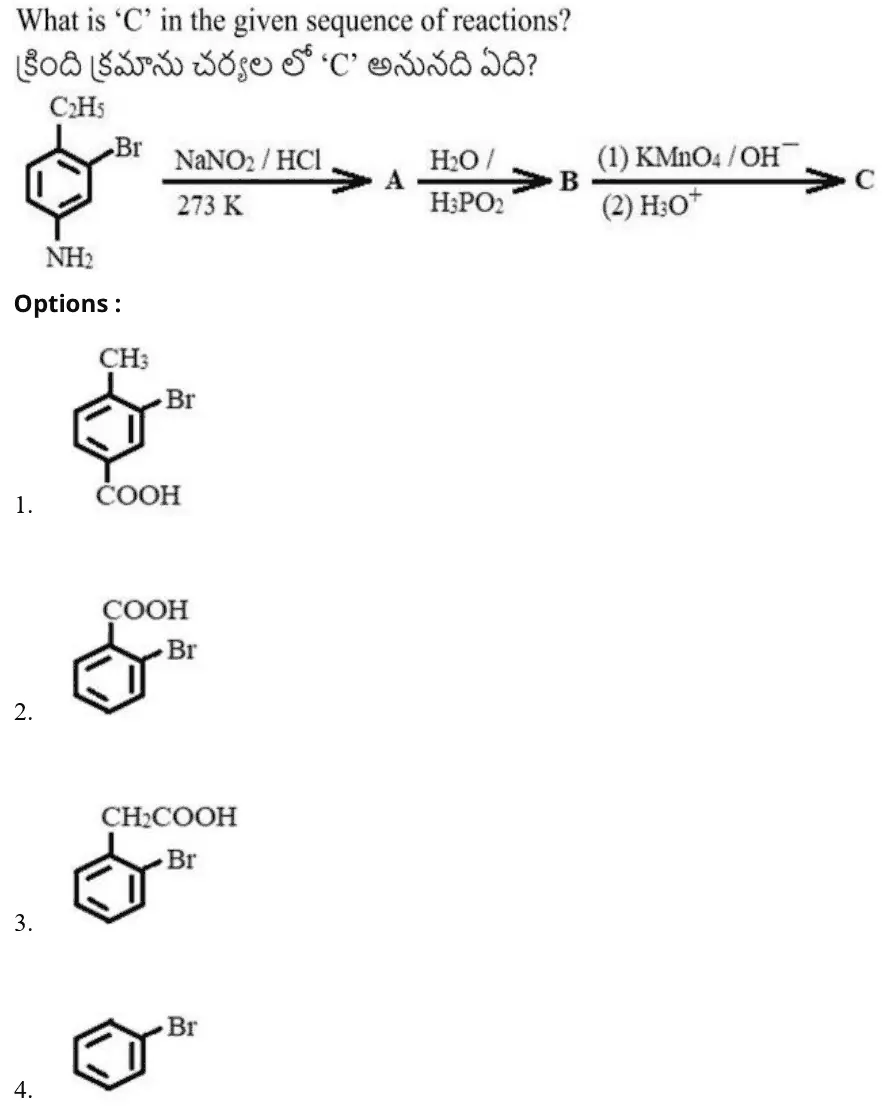
What is ‘C’ in the given sequence of reactions?

(see the figure above)

The question and its figure as printed in TS EAPCET 2024 11th May 2024 Shift 1. Option 1: Benzene ring with CH3 at the top, Br at the upper right, and COOH at the bottom (para to CH3) Option 2: Benzene ring with COOH at the top and Br at the adjacent upper-right position (ortho) Option 3: Benzene ring with CH2COOH at the top and Br at the adjacent upper-right position (ortho) Option 4: Benzene ring with only a Br substituent
The question as printed in the paper.
  • A

    see figure Benzene ring with CH3 at the top, Br at the upper right, and COOH at the bottom (para to CH3)

  • B

    see figure Benzene ring with COOH at the top and Br at the adjacent upper-right position (ortho)

  • C

    see figure Benzene ring with CH2COOH at the top and Br at the adjacent upper-right position (ortho)

  • D

    see figure Benzene ring with only a Br substituent

51TS EAPCET 2024 · 9 May · Shift 1MCQOpen question page ↗

The correct statements of the following are

A) Aniline forms a stable benzene diazonium chloride at 285K

B) N – Phenylethanamide is less reactive towards nitration than aniline

C) p – $\mathrm{CH_3C_6H_4COCl}$ is Hinsberg reagent

  • A

    A & B only

  • B

    A & C only

  • C

    B only

  • D

    C only

52TS EAPCET 2024 · 9 May · Shift 2MCQOpen question page ↗

Identify the correct statements about Z

$$\mathrm{C_2H_5NH_2} \xrightarrow[0^\circ C]{\mathrm{NaNO_2\,/\,HCl}} \mathrm{X} \xrightarrow{\mathrm{H_2O}} \mathrm{Y} \xrightarrow{\mathrm{Cu\,/\,573K}} \mathrm{Z}$$

I. Z is an aldehyde

II. Z undergoes Cannizaro reaction

III. Z gives iodoform test

IV. Z does not give test with Tollens' reagent

  • A

    I & III

  • B

    II & IV

  • C

    I & IV

  • D

    II & III

53TS EAPCET 2024 · 9 May · Shift 2MCQOpen question page ↗

Match the following

List – I<br>AmineList – II<br>$\mathrm{pK_b}$ value
AN,N-Dimethyl anilineI9.30
BAnilineII8.92
CN-EthylethanamineIII9.38
DN-MethylanilineIV3.00

The correct answer is

  • A

    A-II, B-III, C-IV, D-I

  • B

    A-II, B-IV, C-III, D-I

  • C

    A-III, B-IV, C-I, D-II

  • D

    A-IV, B-III, C-II, D-I

54AP EAPCET 2023 · 19 May · Shift 1MCQOpen question page ↗

Which of the following amine cannot be prepared by the Gabriel phthalimide synthesis method?

  • A

    Ethylamine

  • B

    Benzylamine

  • C

    Phenylamine

  • D

    Propylamine

55AP EAPCET 2023 · 18 May · Shift 1MCQOpen question page ↗

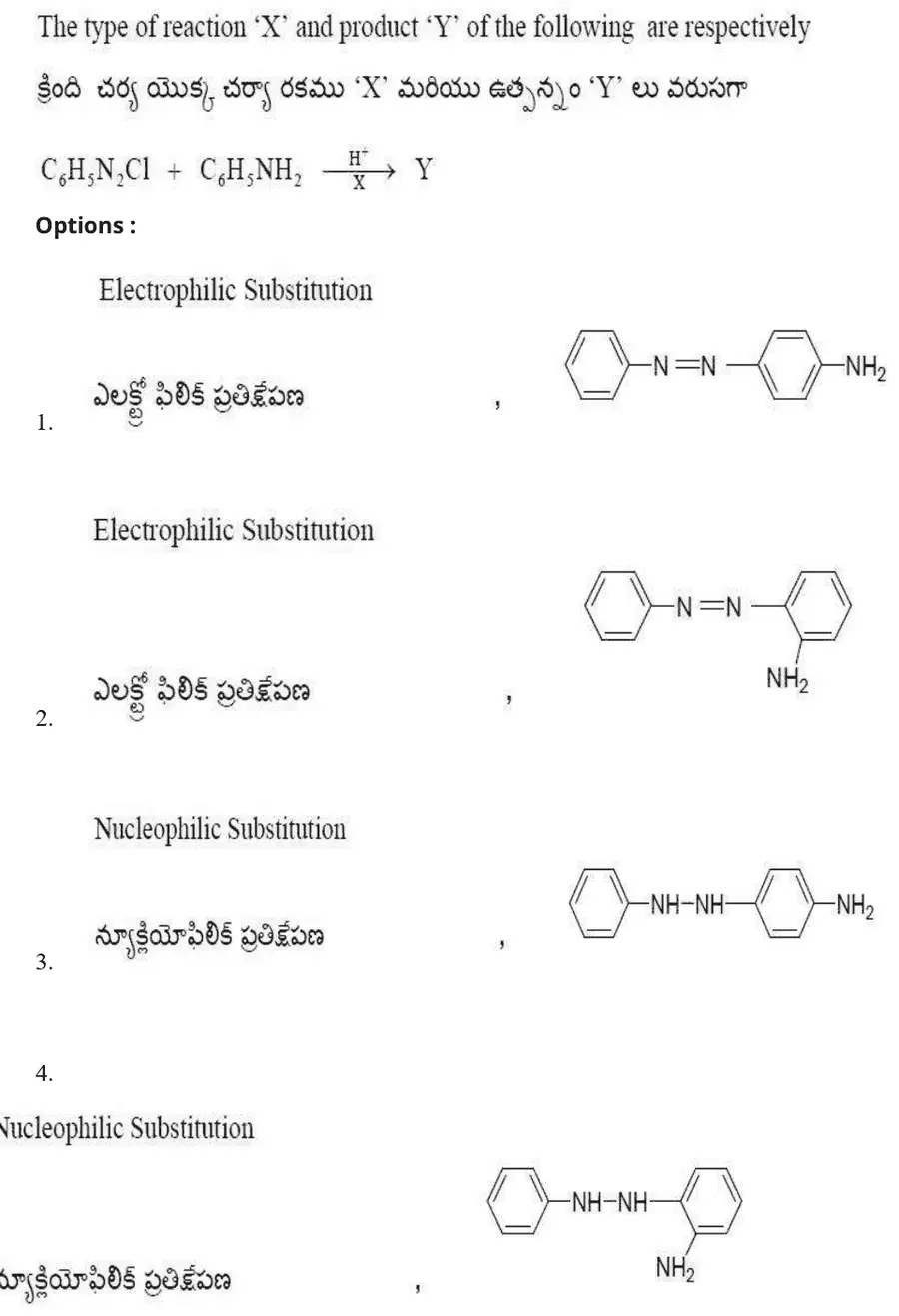
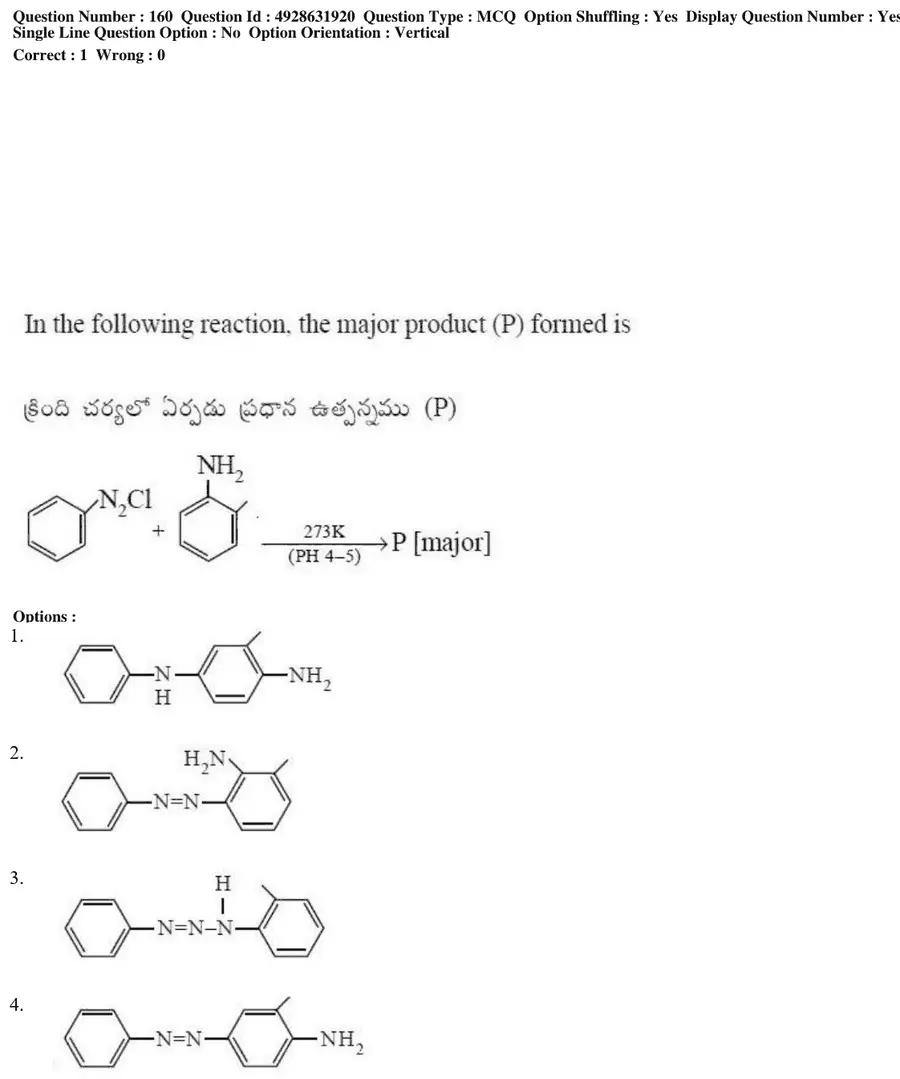
The type of reaction 'X' and product 'Y' of the following are respectively

$$\mathrm{C_6H_5N_2Cl + C_6H_5NH_2 \xrightarrow[X]{H^+} Y}$$

The question and its figure as printed in AP EAPCET 2023 18th May 2023 Shift 1.
The question as printed in the paper.
  • A

    Electrophilic Substitution, (see the figure above) 4-aminoazobenzene: a benzene ring linked through N=N to the para position of a second benzene ring bearing NH$_2$

  • B

    Electrophilic Substitution, (see the figure above) 2-aminoazobenzene: a benzene ring linked through N=N to a second benzene ring bearing NH$_2$ at the ortho position

  • C

    Nucleophilic Substitution, (see the figure above) a benzene ring linked through NH-NH to the para position of a second benzene ring bearing NH$_2$

  • D

    Nucleophilic Substitution, (see the figure above) a benzene ring linked through NH-NH to a second benzene ring bearing NH$_2$ at the ortho position

56AP EAPCET 2023 · 18 May · Shift 2MCQOpen question page ↗

The product of an amine 'X' with benzene sulphonyl chloride produces the product which is insoluble in alkali. The product of 'X' with ethanoyl chloride is

  • A

    $\mathrm{C_6H_5NHCOCH_3}$

  • B

    $\mathrm{C_6H_5N(CH_3)COCH_3}$

  • C

    $\mathrm{C_6H_5N(CH_3)CH_2CH_3}$

  • D

    $\mathrm{C_6H_5NHCH_2CH_3}$

57AP EAPCET 2023 · 17 May · Shift 1MCQOpen question page ↗

In which of the following, reagent and product are correctly matched with respect to benzene diazonium chloride as reactant?

  • A

    $\mathrm{Cu_2O}$ ; $\mathrm{C_6H_5Br}$

  • B

    $\mathrm{HI}$ ; $\mathrm{C_6H_5I}$

  • C

    $\mathrm{NaNO_2}$ ; $\mathrm{C_6H_5NO}$

  • D

    $\mathrm{CH_3CH_2OH}$ ; $\mathrm{C_6H_6}$

58AP EAPCET 2023 · 17 May · Shift 2MCQOpen question page ↗

The sequence of reagents required to convert aniline to benzene nitrile are

  • A

    $\mathrm{NaNO_2}$ + HCl, 293 – 298 K ; CuCN / KCN

  • B

    $\mathrm{NaNO_2}$ + HCl, 273 – 278 K ; CuCN / KCN

  • C

    $\mathrm{NaNO_2}$ + HCl, 273 – 298 K ; Cu / HCN

  • D

    $\mathrm{Cl_2}$ / Fe; KCN

59AP EAPCET 2023 · 16 May · Shift 1MCQOpen question page ↗

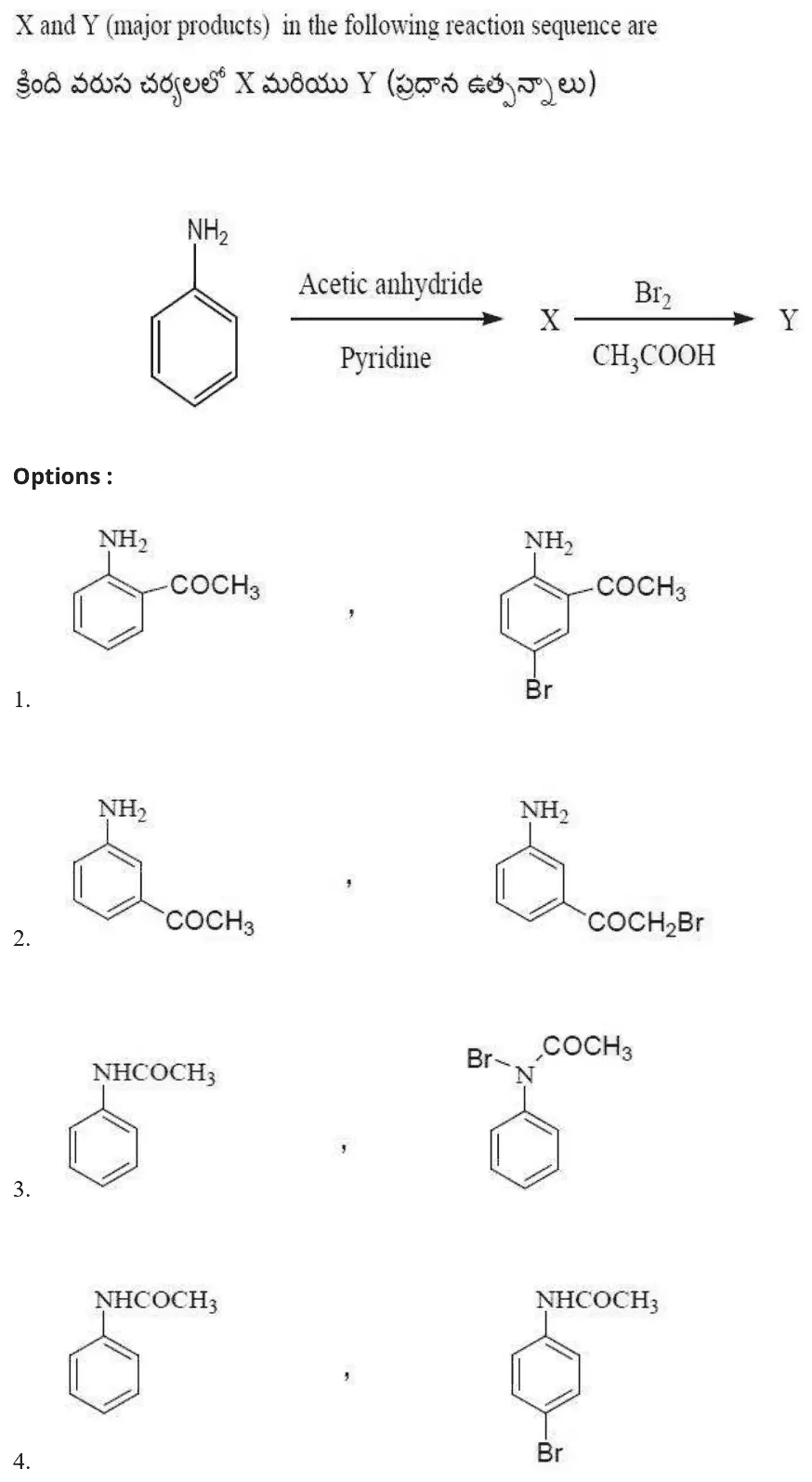
X and Y (major products) in the following reaction sequence are

(see the figure above)

The question and its figure as printed in AP EAPCET 2023 16th May 2023 Shift 1. Option 1: X: benzene ring with NH2 and COCH3 on adjacent (ortho) carbons, i.e. 2-aminoacetophenone; Y: benzene ring with NH2 and COCH3 ortho to each other and Br para to NH2 (4-bromo-2-acetyl aniline) Option 2: X: benzene ring with NH2 and COCH3 on meta carbons (3-aminoacetophenone); Y: benzene ring with NH2 and COCH2Br meta to each other Option 3: X: acetanilide (benzene ring with NHCOCH3); Y: N-bromo-N-phenylacetamide (benzene ring bonded to N which bears Br and COCH3) Option 4: X: acetanilide (benzene ring with NHCOCH3); Y: para-bromoacetanilide (benzene ring with NHCOCH3 and Br at the para position)
The question as printed in the paper.
  • A

    see figure X: benzene ring with NH$_2$ and COCH$_3$ on adjacent (ortho) carbons, i.e. 2-aminoacetophenone; Y: benzene ring with NH$_2$ and COCH$_3$ ortho to each other and Br para to NH$_2$ (4-bromo-2-acetyl aniline)

  • B

    see figure X: benzene ring with NH$_2$ and COCH$_3$ on meta carbons (3-aminoacetophenone); Y: benzene ring with NH$_2$ and COCH$_2$Br meta to each other

  • C

    see figure X: acetanilide (benzene ring with NHCOCH$_3$); Y: N-bromo-N-phenylacetamide (benzene ring bonded to N which bears Br and COCH$_3$)

  • D

    see figure X: acetanilide (benzene ring with NHCOCH$_3$); Y: para-bromoacetanilide (benzene ring with NHCOCH$_3$ and Br at the para position)

60AP EAPCET 2023 · 15 May · Shift 1MCQOpen question page ↗

Arrange the following in increasing order of their boiling points

N – Ethylethanamine (I) Butanamine (II) N, N – dimethyl ethanamine (III)

  • A

    III > II > I

  • B

    III > I > II

  • C

    II > III > I

  • D

    II > I > III

61AP EAPCET 2023 · 15 May · Shift 2MCQOpen question page ↗

Which of the following produces nitrogen gas after the reaction with nitrous acid?

  • A

    $\mathrm{(CH_3)_3N}$

  • B

    $\mathrm{C_2H_5NHC_2H_5}$

  • C

    $\mathrm{(C_2H_5)_3N}$

  • D

    $\mathrm{C_2H_5NH_2}$

62TS EAPCET 2023 · 14 May · Shift 1MCQOpen question page ↗

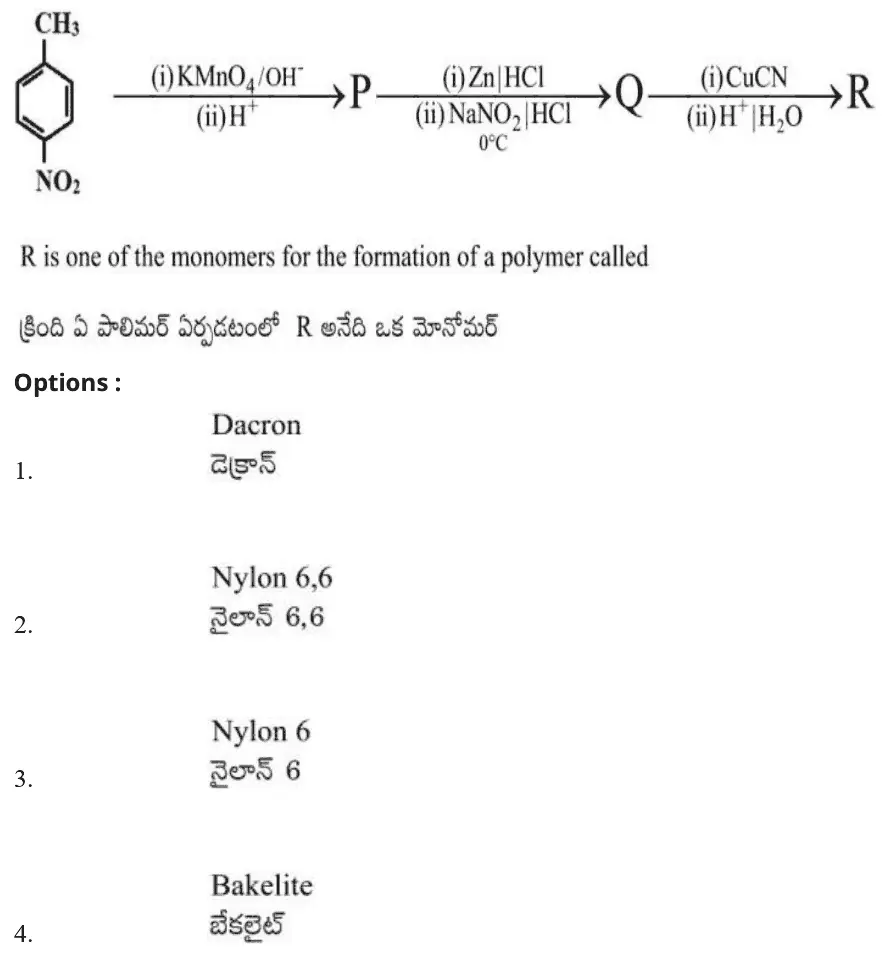
see figure R is one of the monomers for the formation of a polymer called

The question and its figure as printed in TS EAPCET 2023 14th May 2023 Shift 1. Question: R is one of the monomers for the formation of a polymer called
The question as printed in the paper.
  • A

    Dacron

  • B

    Nylon 6,6

  • C

    Nylon 6

  • D

    Bakelite

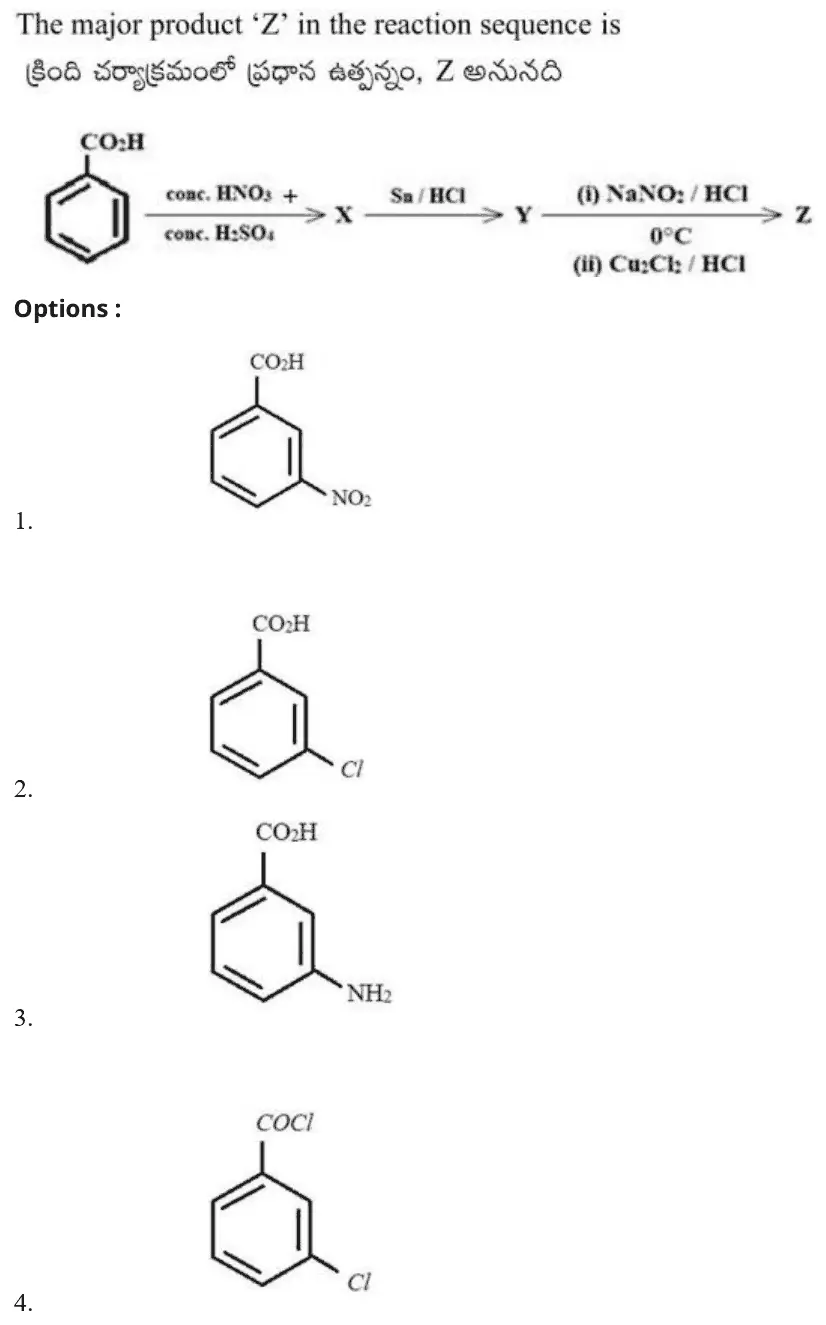
63TS EAPCET 2023 · 14 May · Shift 2MCQOpen question page ↗

The major product 'Z' in the reaction sequence is

(see the figure above)

The question and its figure as printed in TS EAPCET 2023 14th May 2023 Shift 2. Option 1: Benzene ring with CO2H at the top and NO2 at the lower right (meta position) Option 2: Benzene ring with CO2H at the top and Cl at the lower right (meta position) Option 3: Benzene ring with CO2H at the top and NH2 at the lower right (meta position) Option 4: Benzene ring with COCl at the top and Cl at the lower right (meta position)
The question as printed in the paper.
  • A

    see figure Benzene ring with $\mathrm{CO_2H}$ at the top and $\mathrm{NO_2}$ at the lower right (meta position)

  • B

    see figure Benzene ring with $\mathrm{CO_2H}$ at the top and $\mathrm{Cl}$ at the lower right (meta position)

  • C

    see figure Benzene ring with $\mathrm{CO_2H}$ at the top and $\mathrm{NH_2}$ at the lower right (meta position)

  • D

    see figure Benzene ring with $\mathrm{COCl}$ at the top and $\mathrm{Cl}$ at the lower right (meta position)

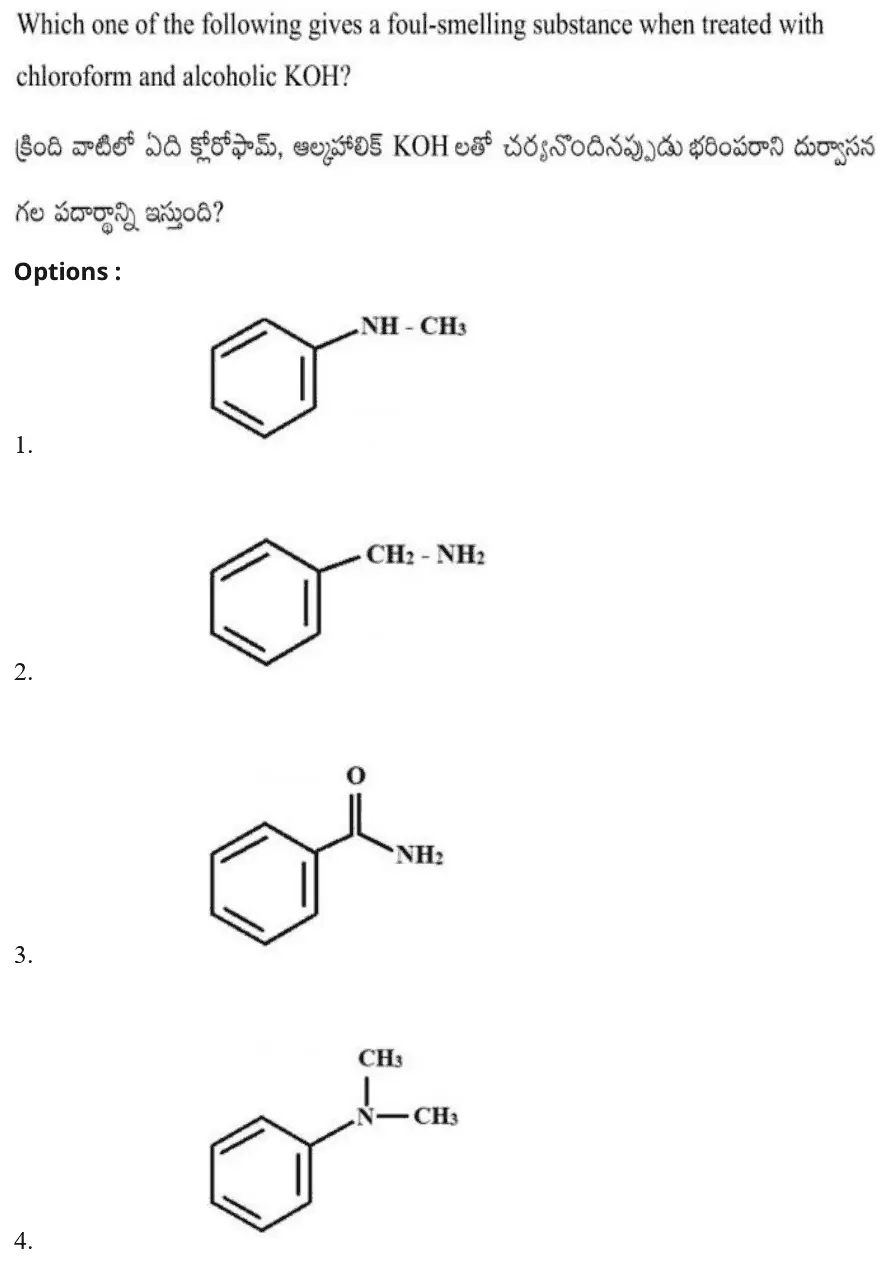
64TS EAPCET 2023 · 14 May · Shift 2MCQOpen question page ↗

Which one of the following gives a foul-smelling substance when treated with chloroform and alcoholic KOH?

The question and its figure as printed in TS EAPCET 2023 14th May 2023 Shift 2. Option 1: Benzene ring with an NH-CH3 substituent (N-methylaniline) Option 2: Benzene ring with a CH2-NH2 substituent (benzylamine) Option 3: Benzene ring attached to a C(=O) group bearing NH2 (benzamide) Option 4: Benzene ring with an N attached to two CH3 groups (N,N-dimethylaniline)
The question as printed in the paper.
  • A

    see figure Benzene ring with an $\mathrm{NH-CH_3}$ substituent (N-methylaniline)

  • B

    see figure Benzene ring with a $\mathrm{CH_2-NH_2}$ substituent (benzylamine)

  • C

    see figure Benzene ring attached to a C(=O) group bearing $\mathrm{NH_2}$ (benzamide)

  • D

    see figure Benzene ring with an N attached to two $\mathrm{CH_3}$ groups (N,N-dimethylaniline)

65TS EAPCET 2023 · 13 May · Shift 1MCQOpen question page ↗

In the given reaction what is X?

$$\mathrm{R-\overset{O}{\overset{\|}{C}}-OH} \xleftarrow{\mathrm{H_3O^+}} \mathrm{X} \xrightarrow[\mathrm{(ii)\ H_2O}]{\mathrm{(i)\ LiAlH_4}} \mathrm{RCH_2NH_2}$$

  • A

    Isonitrile

  • B

    Nitrile

  • C

    Nitrite

  • D

    Oxime

66TS EAPCET 2023 · 13 May · Shift 1MCQOpen question page ↗

Which of the following reactions are used in the preparation of aliphatic primary amines?

I. Gabriel-phthalimide reaction

II. Hoffmann Bromamide reaction

III. Carbylamine reaction

IV. Sandmayer reaction

  • A

    II & III only

  • B

    I & II only

  • C

    III & IV only

  • D

    I & IV only

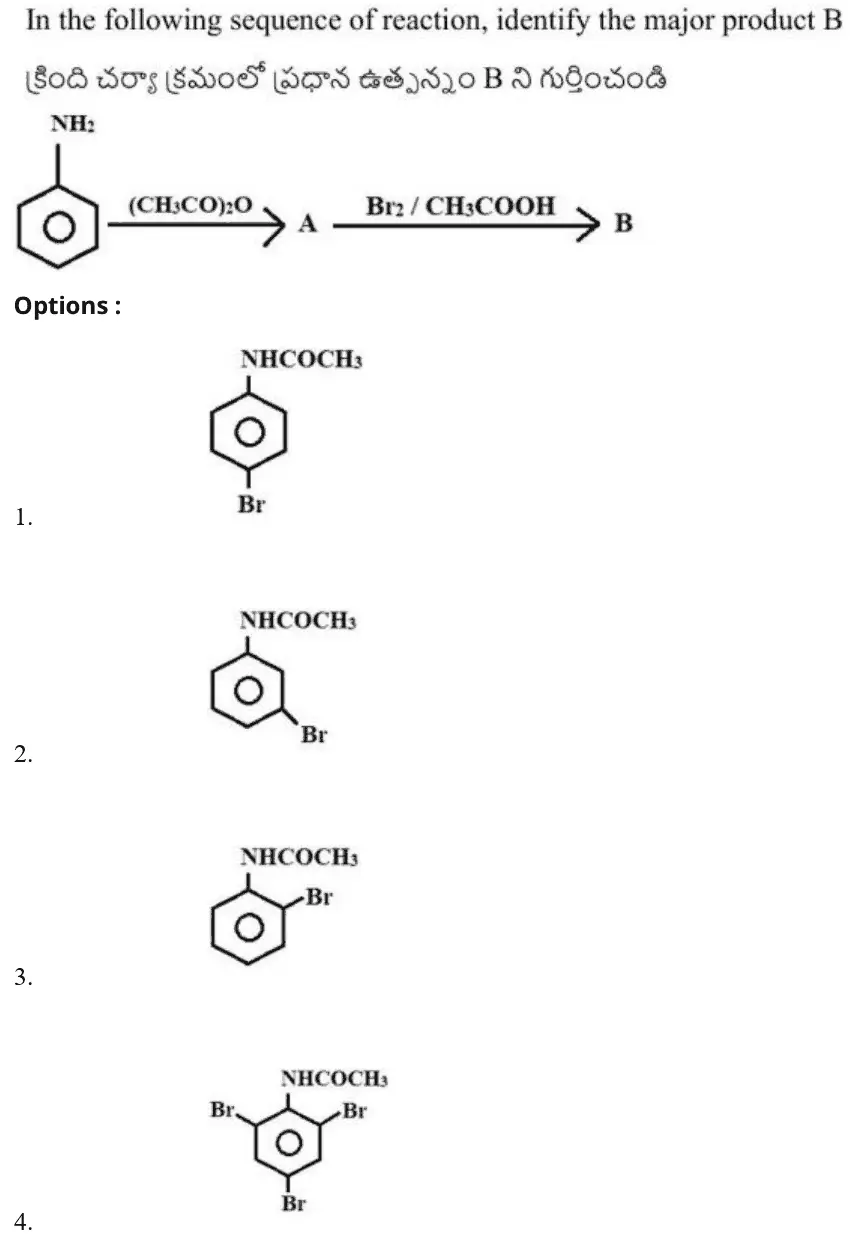
67TS EAPCET 2023 · 13 May · Shift 1MCQOpen question page ↗

In the following sequence of reaction, identify the major product B

(see the figure above)

The question and its figure as printed in TS EAPCET 2023 13th May 2023 Shift 1. Option 1: Benzene ring with NHCOCH3 at the top and Br at the bottom (para-bromoacetanilide) Option 2: Benzene ring with NHCOCH3 at the top and Br at the lower right (meta-bromoacetanilide) Option 3: Benzene ring with NHCOCH3 at the top and Br at the upper right, adjacent (ortho-bromoacetanilide) Option 4: Benzene ring with NHCOCH3 at the top, Br at the upper left, Br at the upper right and Br at the bottom (2,4,6-tribromoacetanilide)
The question as printed in the paper.
  • A

    see figure Benzene ring with NHCOCH$_3$ at the top and Br at the bottom (para-bromoacetanilide)

  • B

    see figure Benzene ring with NHCOCH$_3$ at the top and Br at the lower right (meta-bromoacetanilide)

  • C

    see figure Benzene ring with NHCOCH$_3$ at the top and Br at the upper right, adjacent (ortho-bromoacetanilide)

  • D

    see figure Benzene ring with NHCOCH$_3$ at the top, Br at the upper left, Br at the upper right and Br at the bottom (2,4,6-tribromoacetanilide)

68TS EAPCET 2023 · 13 May · Shift 2MCQOpen question page ↗

The sequence of reagents which convert p-methyl aniline to p-methyl benzoic acid are

  • A

    $\mathrm{KMnO_4/H^+}$; $\mathrm{NaNO_2}$ + HCl; Cu/HCl

  • B

    $\mathrm{NaNO_2}$+HCl/273K; Cu/HCl; $\mathrm{KMnO_4/H^+}$

  • C

    $\mathrm{NaNO_2}$+HCl/273K; CuCN/KCN ; $\mathrm{H_3O^+}$

  • D

    $\mathrm{NaNO_2}$+HCl/285K; KCN; $\mathrm{H_3O^+}$

69TS EAPCET 2023 · 13 May · Shift 2MCQOpen question page ↗

An amine (X) reacts with p-toluene sulphonyl chloride to give the product Y, which is insoluble in alkali. The product of X with benzoyl chloride is

  • A

    $\mathrm{CH_3CH_2CHNH_2}$ with $\mathrm{COC_6H_5}$ attached by a vertical bond below the CH carbon, i.e. $\mathrm{CH_3CH_2CH(NH_2)COC_6H_5}$

  • B

    $\mathrm{CH_3CH_2CH_2NCOCH_2C_6H_5}$ with $\mathrm{CH_3}$ attached by a vertical bond below the N, i.e. $\mathrm{CH_3CH_2CH_2N(CH_3)COCH_2C_6H_5}$

  • C

    $\mathrm{CH_3CH_2NHCOC_6H_5}$

  • D

    $\mathrm{CH_3CH_2NCOC_6H_5}$ with $\mathrm{CH_3}$ attached by a vertical bond below the N, i.e. $\mathrm{CH_3CH_2N(CH_3)COC_6H_5}$

70TS EAPCET 2023 · 12 May · Shift 1MCQOpen question page ↗

$$\text{Propanenitrile} \xrightarrow{\mathrm{LiAlH_4}} \mathrm{A} \xrightarrow[\Delta]{\mathrm{CHCl_3}/\text{alcoholic KOH}} \mathrm{B}$$

Conversion of A to B is an example of the reaction

  • A

    Reimer -Tiemann reaction

  • B

    Carbyl amine reaction

  • C

    Stephen reaction

  • D

    Sandmeyer reaction

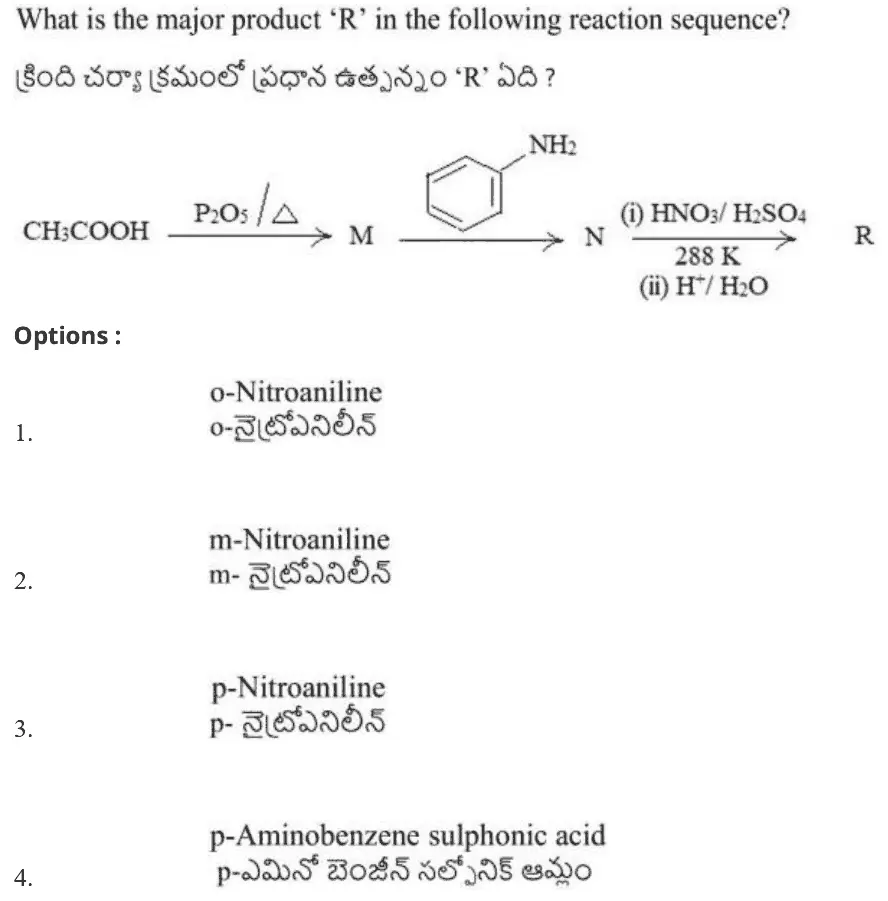
71TS EAPCET 2023 · 12 May · Shift 2MCQOpen question page ↗

What is the major product ‘R’ in the following reaction sequence?

(see the figure above)

The question and its figure as printed in TS EAPCET 2023 12th May 2023 Shift 2.
The question as printed in the paper.
  • A

    o-Nitroaniline

  • B

    m-Nitroaniline

  • C

    p-Nitroaniline

  • D

    p-Aminobenzene sulphonic acid

72TS EAPCET 2022 · 20 Jul · Shift 1MCQOpen question page ↗

Match the following.
List $-$ I: A) Amide B) Nitrile C) $\mathrm{C_6H_5SO_2Cl}$ D) 1$^\circ$-Amine
List $-$ II: I) Carbylamine reaction II) Hinsberg's reagent III) Hofmann's bromamide reaction IV) $\mathrm{LiAlH_4}$
The correct match is

  • A

    A-I, B-II, C-III, D-IV

  • B

    A-III, B-IV, C-II, D-I

  • C

    A-III, B-II, C-IV, D-I

  • D

    A-I, B-III, C-II, D-IV

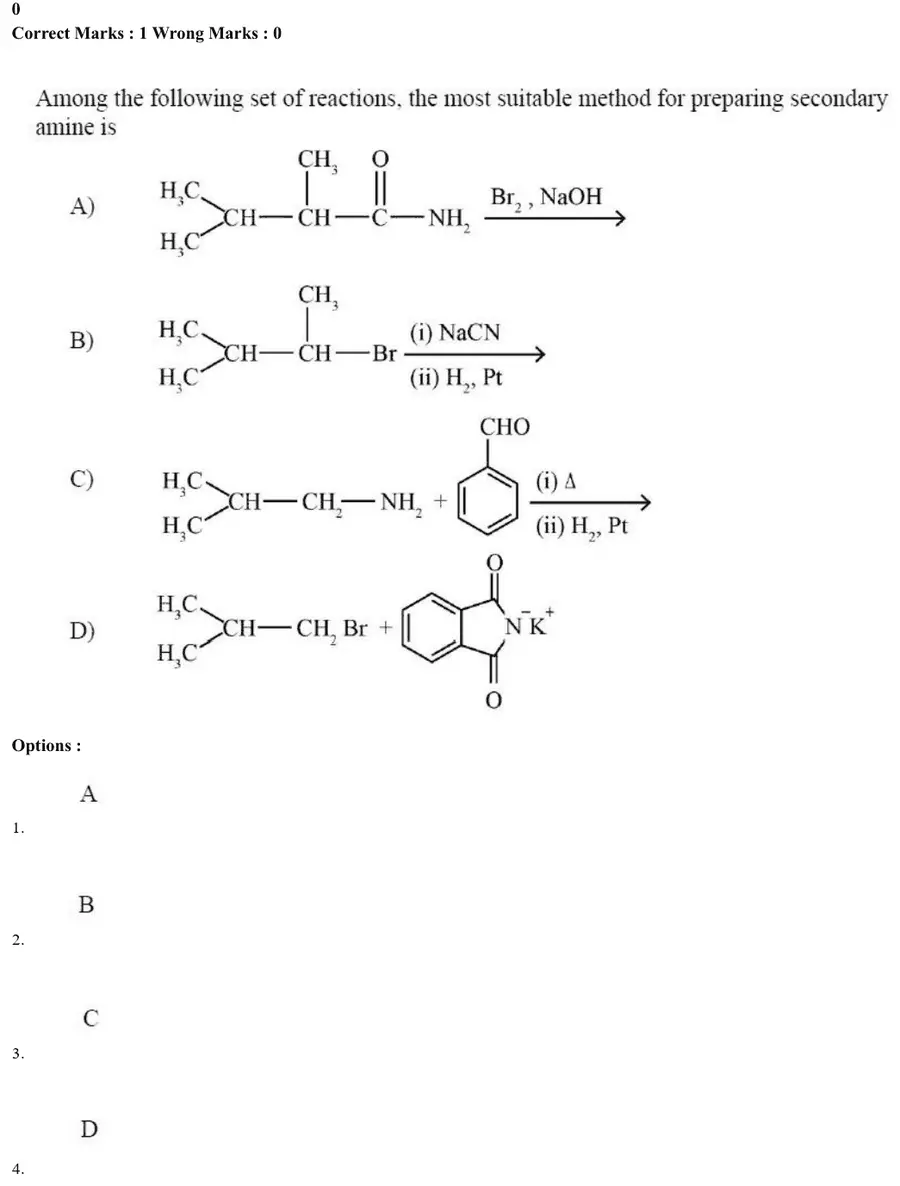
73TS EAPCET 2022 · 19 Jul · Shift 1MCQOpen question page ↗

Among the following set of reactions, the most suitable method for preparing secondary amine is
(see the figure above)

The question and its figure as printed in TS EAPCET 2022 19th Jul 2022 Shift 1.
The question as printed in the paper.
  • A

    A

  • B

    B

  • C

    C

  • D

    D

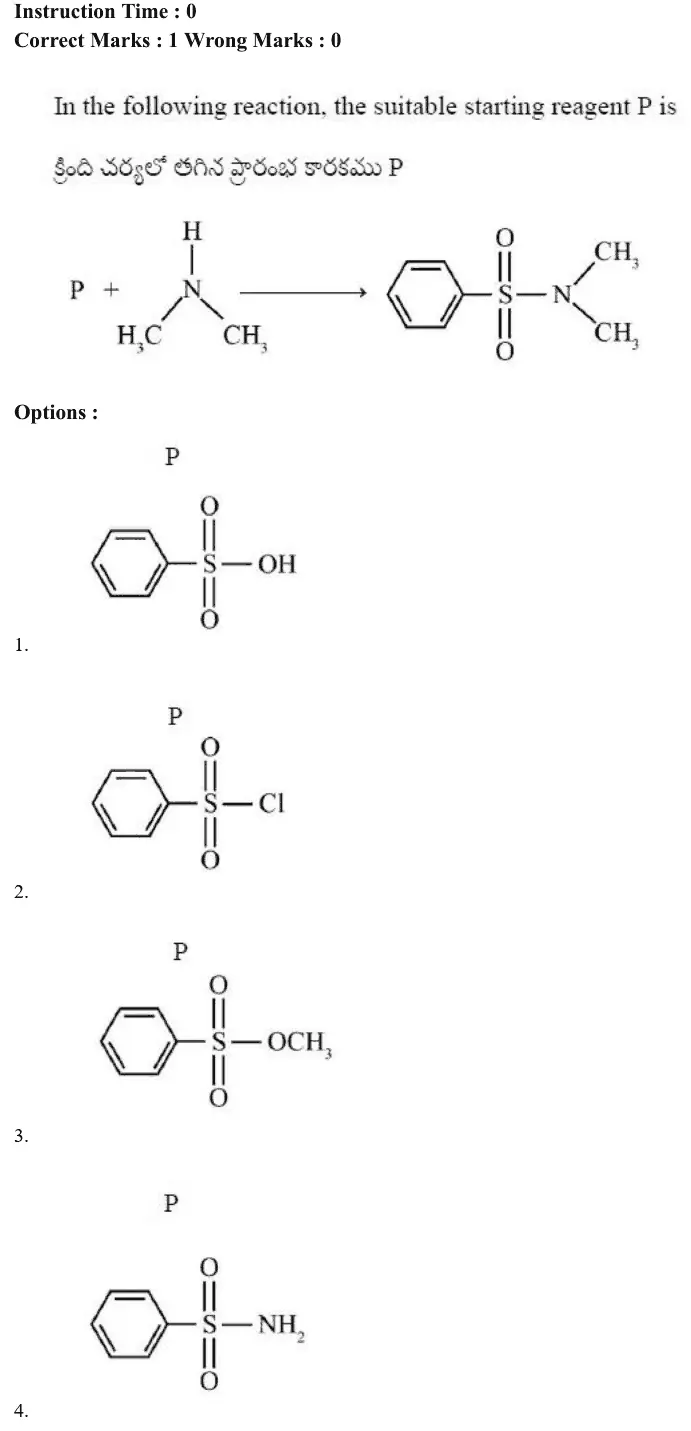
74TS EAPCET 2022 · 19 Jul · Shift 2MCQOpen question page ↗

In the following reaction, the suitable starting reagent P is
(see the figure above)

The question and its figure as printed in TS EAPCET 2022 19th Jul 2022 Shift 2. Option 1: benzenesulfonic acid: benzene ring attached to S(=O)(=O)-OH Option 2: benzenesulfonyl chloride: benzene ring attached to S(=O)(=O)-Cl Option 3: methyl benzenesulfonate: benzene ring attached to S(=O)(=O)-OCH3 Option 4: benzenesulfonamide: benzene ring attached to S(=O)(=O)-NH2
The question as printed in the paper.
  • A

    see figure benzenesulfonic acid: benzene ring attached to S(=O)(=O)-OH

  • B

    see figure benzenesulfonyl chloride: benzene ring attached to S(=O)(=O)-Cl

  • C

    see figure methyl benzenesulfonate: benzene ring attached to S(=O)(=O)-OCH3

  • D

    see figure benzenesulfonamide: benzene ring attached to S(=O)(=O)-NH2

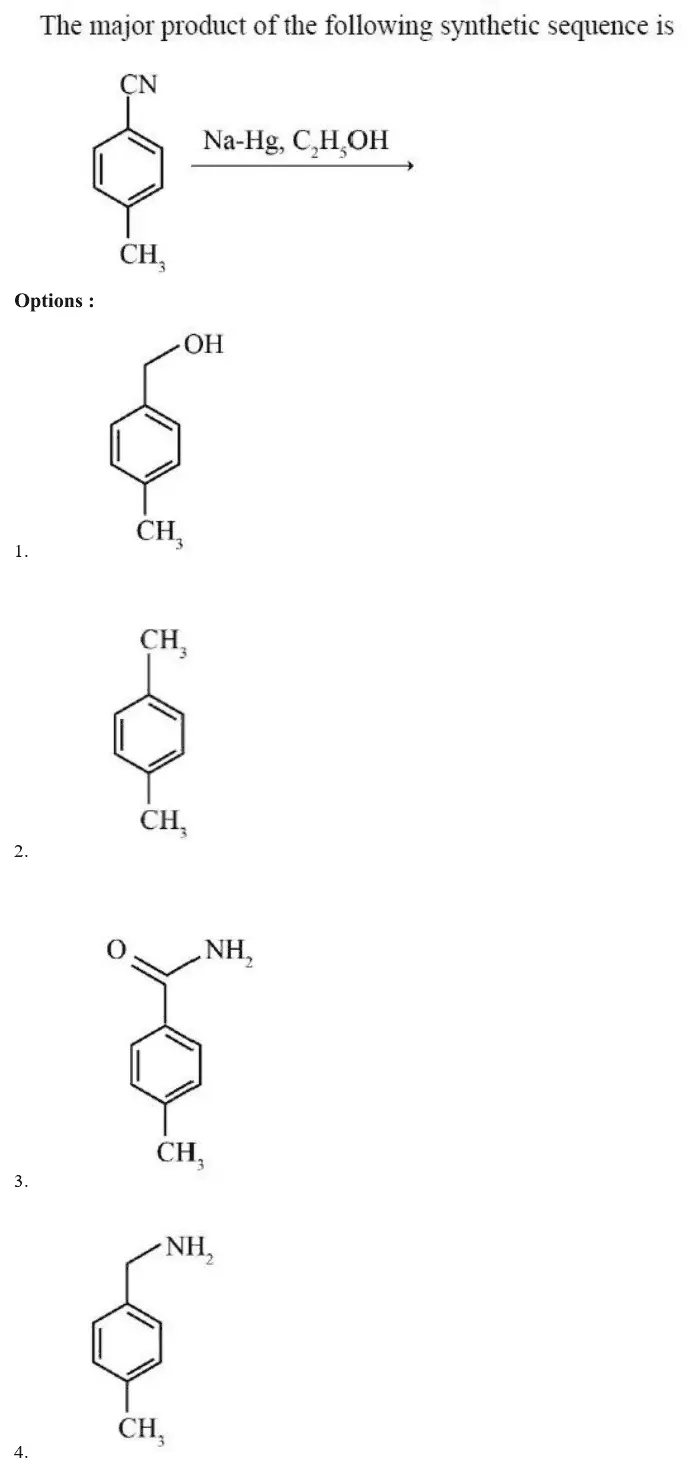
75TS EAPCET 2022 · 18 Jul · Shift 2MCQOpen question page ↗

The major product of the following synthetic sequence is
(see the figure above)

The question and its figure as printed in TS EAPCET 2022 18th Jul 2022 Shift 2. Option 1: 4-methylbenzyl alcohol (ring with CH2OH and CH3 para) Option 2: p-xylene (ring with two CH3 groups para) Option 3: 4-methylbenzamide (ring with C(=O)NH2 and CH3 para) Option 4: 4-methylbenzylamine (ring with CH2NH2 and CH3 para)
The question as printed in the paper.
  • A

    see figure 4-methylbenzyl alcohol (ring with CH2OH and CH3 para)

  • B

    see figure p-xylene (ring with two CH3 groups para)

  • C

    see figure 4-methylbenzamide (ring with C(=O)NH2 and CH3 para)

  • D

    see figure 4-methylbenzylamine (ring with CH2NH2 and CH3 para)

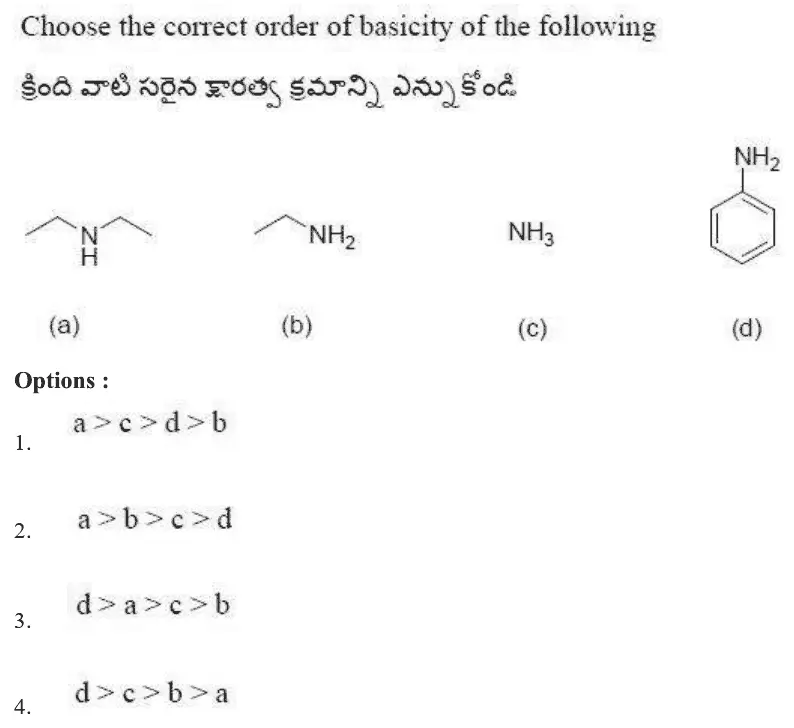
76AP EAPCET 2022 · 8 Jul · Shift 1MCQOpen question page ↗

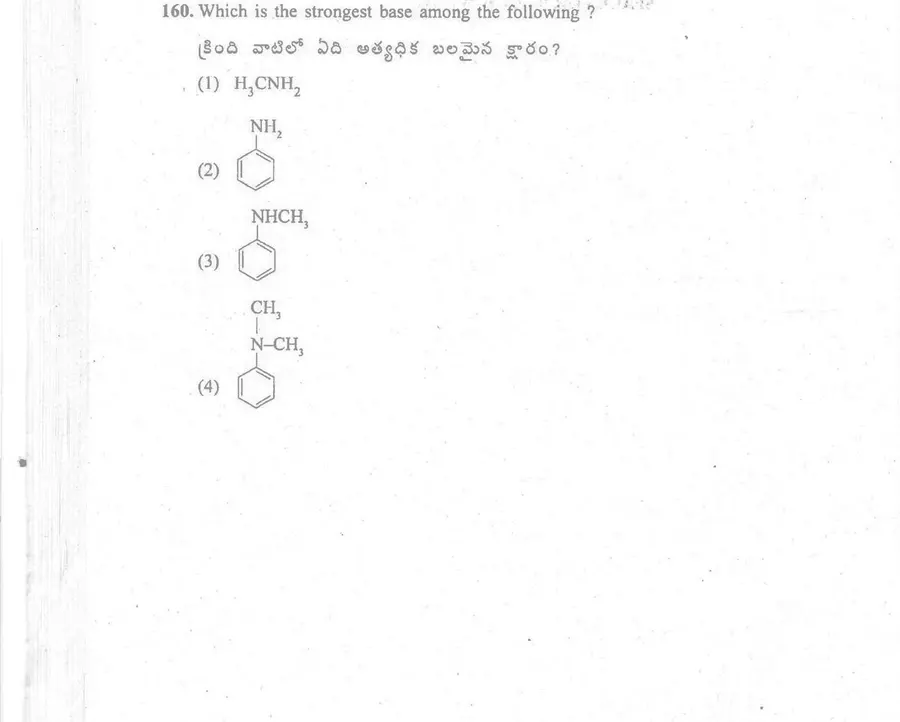
Choose the correct order of basicity of the following
(a) (see the figure above) diethylamine (skeletal: two ethyl lines on an N bearing H) (b) (see the figure above) ethylamine (ethyl line with NH2) (c) $\mathrm{NH_3}$ (d) (see the figure above) aniline (benzene ring with NH2)

The question and its figure as printed in AP EAPCET 2022 08th July 2022 Shift1.
The question as printed in the paper.
  • A

    $a > c > d > b$

  • B

    $a > b > c > d$

  • C

    $d > a > c > b$

  • D

    $d > c > b > a$

77AP EAPCET 2022 · 8 Jul · Shift 2MCQOpen question page ↗

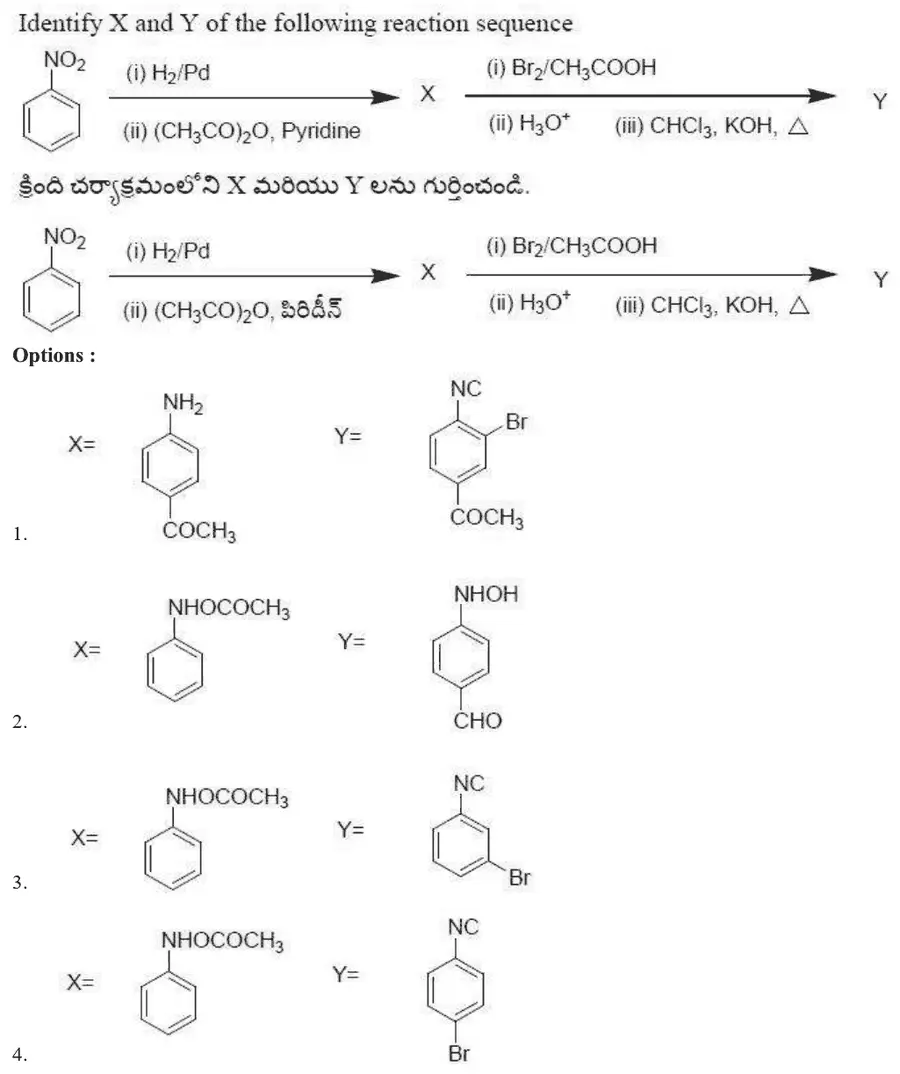
Identify X and Y of the following reaction sequence
(see the figure above)

The question and its figure as printed in AP EAPCET 2022 08th July 2022 Shift2.
The question as printed in the paper.
  • A

    X = (see the figure above) 4-aminoacetophenone (benzene ring with NH2 on top and COCH3 at the bottom); Y = (see the figure above) benzene ring with NC at the top, Br at the upper right, COCH3 at the bottom

  • B

    X = (see the figure above) benzene ring with NHOCOCH3 at the top; Y = (see the figure above) benzene ring with NHOH at the top and CHO at the bottom

  • C

    X = (see the figure above) benzene ring with NHOCOCH3 at the top; Y = (see the figure above) benzene ring with NC at the top and Br at the lower right (meta)

  • D

    X = (see the figure above) benzene ring with NHOCOCH3 at the top; Y = (see the figure above) benzene ring with NC at the top and Br at the bottom (para)

78AP EAPCET 2022 · 7 Jul · Shift 1MCQOpen question page ↗

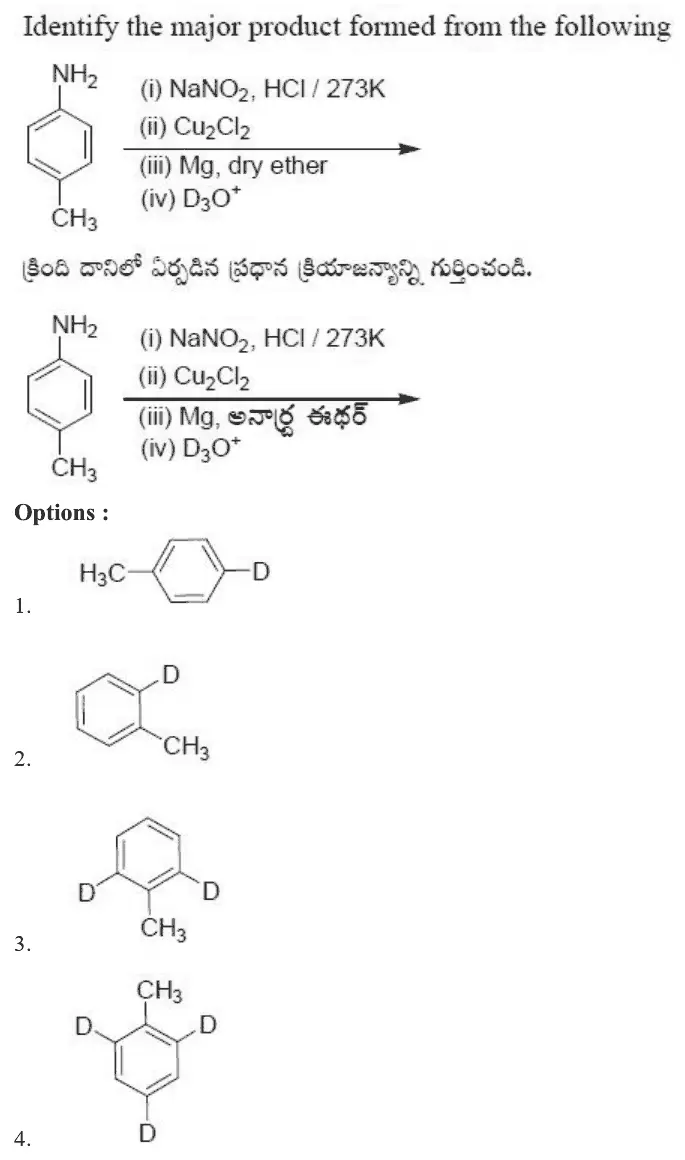
Identify the major product formed from the following
(see the figure above)

The question and its figure as printed in AP EAPCET 2022 07th July2022 Shift1. Option 1: 4-deuterotoluene: a benzene ring with H3C on the left and D on the right (para) Option 2: 2-deuterotoluene: a benzene ring with CH3 and D on adjacent carbons (ortho) Option 3: 2,6-dideuterotoluene: a benzene ring with CH3 at the bottom and a D on each of the two carbons next to it (both ortho) Option 4: 2,4,6-trideuterotoluene: a benzene ring with CH3 at the top, D on the two ortho positions and D at the bottom (the third D at the vertex opposite CH3)
The question as printed in the paper.
  • A

    see figure 4-deuterotoluene: a benzene ring with H3C on the left and D on the right (para)

  • B

    see figure 2-deuterotoluene: a benzene ring with CH3 and D on adjacent carbons (ortho)

  • C

    see figure 2,6-dideuterotoluene: a benzene ring with CH3 at the bottom and a D on each of the two carbons next to it (both ortho)

  • D

    see figure 2,4,6-trideuterotoluene: a benzene ring with CH3 at the top, D on the two ortho positions and D at the bottom (the third D at the vertex opposite CH3)

79AP EAPCET 2022 · 7 Jul · Shift 2MCQOpen question page ↗

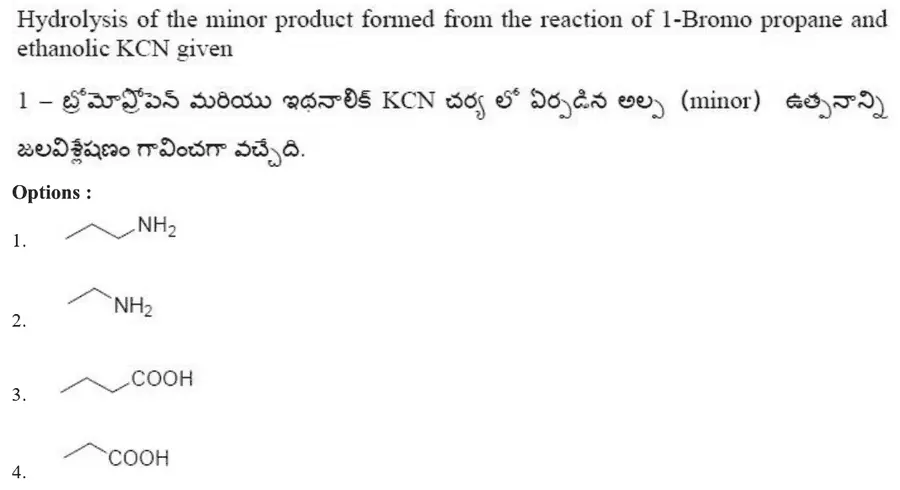
Hydrolysis of the minor product formed from the reaction of 1-Bromo propane and ethanolic KCN given
(see the figure above)

The question and its figure as printed in AP EAPCET 2022 07th July2022 Shift2. Option 1: skeletal chain of three carbons (propane chain, zig-zag) ending in NH2 Option 2: skeletal chain of two carbons ending in NH2 Option 3: skeletal chain of three carbons ending in COOH Option 4: skeletal chain of two carbons ending in COOH
The question as printed in the paper.
  • A

    see figure skeletal chain of three carbons (propane chain, zig-zag) ending in $\mathrm{NH_2}$

  • B

    see figure skeletal chain of two carbons ending in $\mathrm{NH_2}$

  • C

    see figure skeletal chain of three carbons ending in COOH

  • D

    see figure skeletal chain of two carbons ending in COOH

80AP EAPCET 2022 · 6 Jul · Shift 1MCQOpen question page ↗

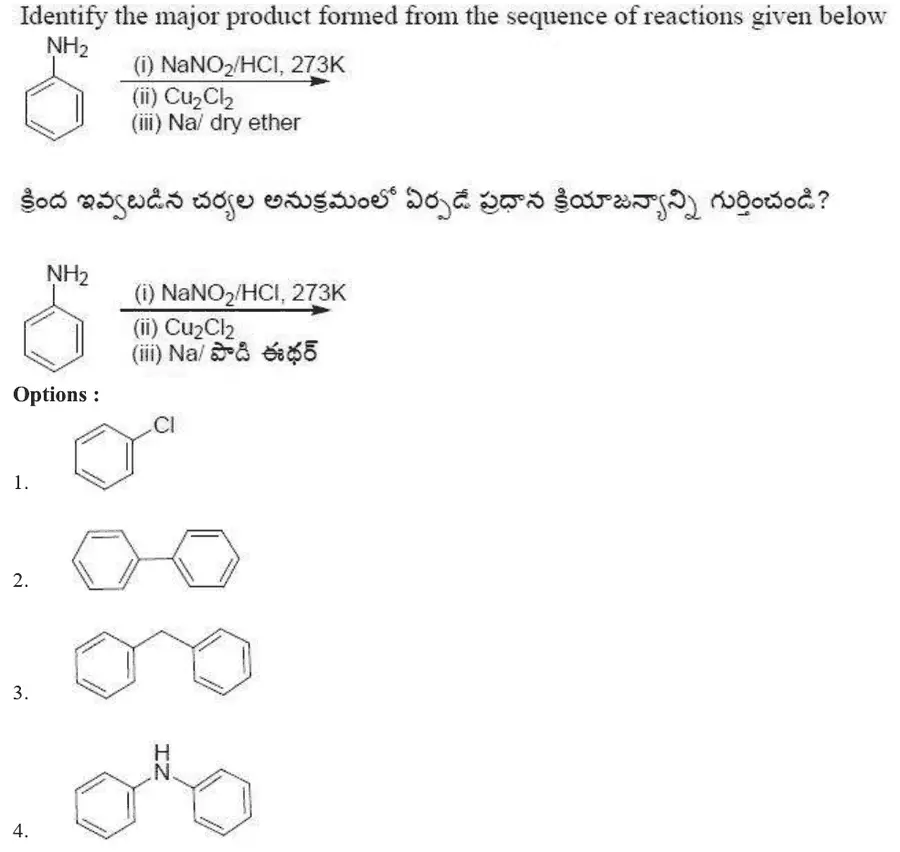
Identify the major product formed from the sequence of reactions given below
(see the figure above)

The question and its figure as printed in AP EAPCET 2022 06th July 2022 Shift1. Option 1: chlorobenzene (benzene ring with Cl) Option 2: biphenyl (two benzene rings joined directly by a single bond) Option 3: diphenylmethane (two benzene rings joined through a CH2) Option 4: diphenylamine (two benzene rings joined through an NH)
The question as printed in the paper.
  • A

    see figure chlorobenzene (benzene ring with Cl)

  • B

    see figure biphenyl (two benzene rings joined directly by a single bond)

  • C

    see figure diphenylmethane (two benzene rings joined through a CH2)

  • D

    see figure diphenylamine (two benzene rings joined through an NH)

81AP EAPCET 2022 · 6 Jul · Shift 1MCQOpen question page ↗

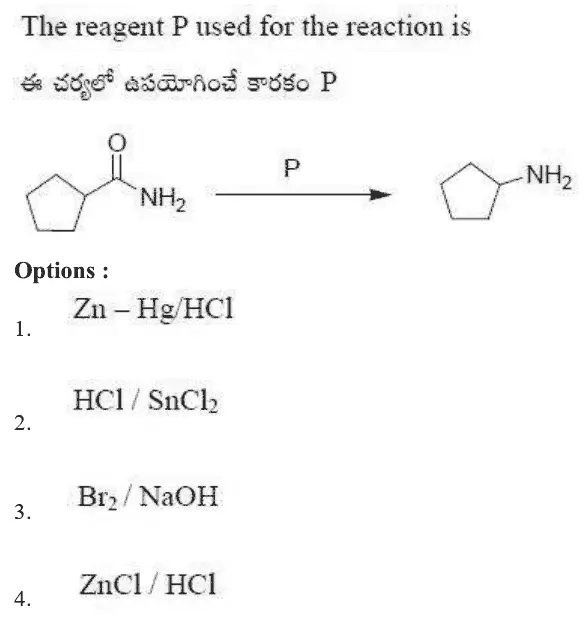
The reagent P used for the reaction is
(see the figure above)

The question and its figure as printed in AP EAPCET 2022 06th July 2022 Shift1.
The question as printed in the paper.
  • A

    $\mathrm{Zn - Hg/HCl}$

  • B

    $\mathrm{HCl\ /\ SnCl_2}$

  • C

    $\mathrm{Br_2\ /\ NaOH}$

  • D

    $\mathrm{ZnCl\ /\ HCl}$

82AP EAPCET 2022 · 6 Jul · Shift 2MCQOpen question page ↗

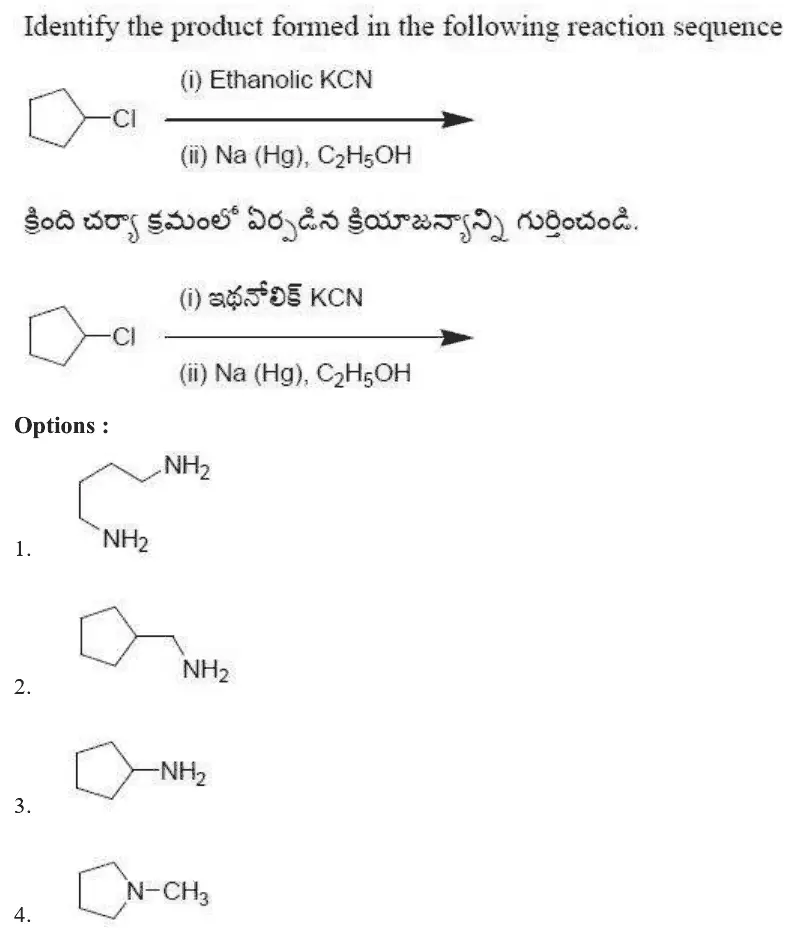
Identify the product formed in the following reaction sequence
(see the figure above)

The question and its figure as printed in AP EAPCET 2022 06th July 2022 Shift2. Option 1: open chain H2N-CH2-CH2-CH2-CH2-NH2 drawn as skeletal zigzag with NH2 at both ends Option 2: cyclopentylmethanamine: cyclopentane ring with CH2-NH2 Option 3: cyclopentylamine: cyclopentane ring with NH2 Option 4: N-methylpyrrolidine: five-membered ring containing N with a CH3 on N
The question as printed in the paper.
  • A

    see figure open chain H2N-CH2-CH2-CH2-CH2-NH2 drawn as skeletal zigzag with NH2 at both ends

  • B

    see figure cyclopentylmethanamine: cyclopentane ring with CH2-NH2

  • C

    see figure cyclopentylamine: cyclopentane ring with NH2

  • D

    see figure N-methylpyrrolidine: five-membered ring containing N with a CH3 on N

83AP EAPCET 2022 · 5 Jul · Shift 1MCQOpen question page ↗

The relative basic strength of the compounds is correctly shown in the option

  • A

    $NH_2OH > NH_3 > N_2H_4$

  • B

    $N_2H_4 > NH_2OH > NH_3$

  • C

    $NH_3 > N_2H_4 > NH_2OH$

  • D

    $N_2H_4 > NH_3 > NH_2OH$

84AP EAPCET 2022 · 5 Jul · Shift 1MCQOpen question page ↗

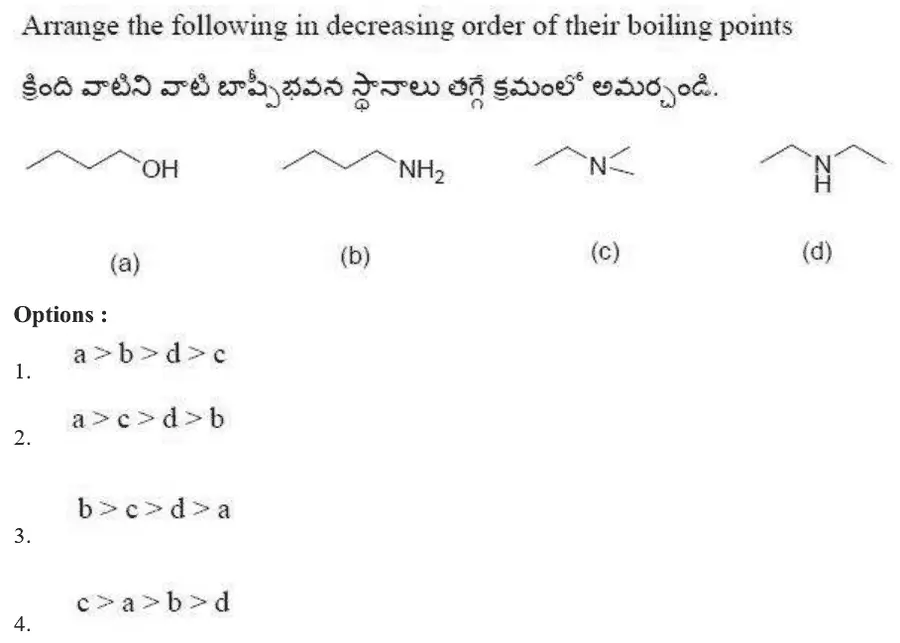
Arrange the following in decreasing order of their boiling points
(see the figure above)

The question and its figure as printed in AP EAPCET 2022 05th July 2022 Shift1.
The question as printed in the paper.
  • A

    a > b > d > c

  • B

    a > c > d > b

  • C

    b > c > d > a

  • D

    c > a > b > d

85AP EAPCET 2022 · 5 Jul · Shift 2MCQOpen question page ↗

Assertion (A) : I- Bromopentane reacts with AgCN to give pentylisocyanide

Reason (R) : AgCN is mainly ionic in nature

  • A

    A is true R is true and R is correct explanation of A

  • B

    A is true, R is true but R is not correct explanation of A

  • C

    A is true, R is false

  • D

    A is false, R is true

86AP EAPCET 2022 · 5 Jul · Shift 2MCQOpen question page ↗

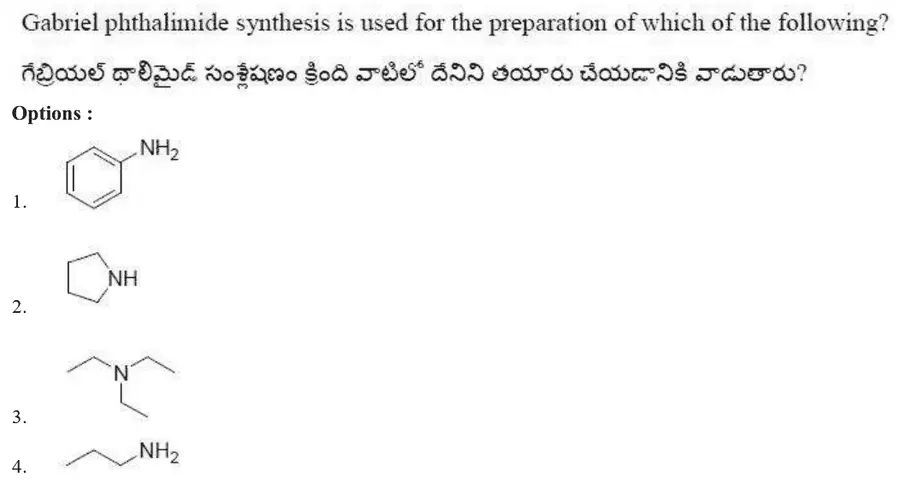
Gabriel phthalimide synthesis is used for the preparation of which of the following?

The question and its figure as printed in AP EAPCET 2022 05th July 2022 Shift2. Option 1: aniline (benzene ring with NH2) Option 2: pyrrolidine (five-membered saturated ring with NH) Option 3: triethylamine, a nitrogen bonded to three ethyl groups (skeletal) Option 4: propylamine, a straight chain of three carbons ending in NH2 (skeletal)
The question as printed in the paper.
  • A

    see figure aniline (benzene ring with NH2)

  • B

    see figure pyrrolidine (five-membered saturated ring with NH)

  • C

    see figure triethylamine, a nitrogen bonded to three ethyl groups (skeletal)

  • D

    see figure propylamine, a straight chain of three carbons ending in NH2 (skeletal)

87AP EAPCET 2022 · 4 Jul · Shift 1MCQOpen question page ↗

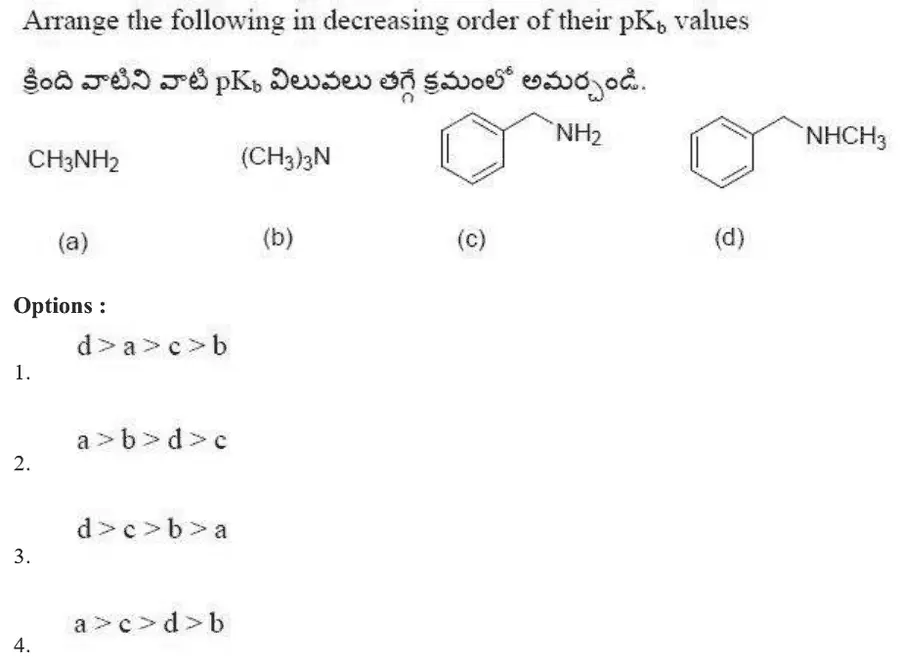
Arrange the following in decreasing order of their $\mathrm{pK_b}$ values
(see the figure above)

The question and its figure as printed in AP EAPCET 2022 04th July 2022 Shift1.
The question as printed in the paper.
  • A

    d > a > c > b

  • B

    a > b > d > c

  • C

    d > c > b > a

  • D

    a > c > d > b

88AP EAPCET 2022 · 4 Jul · Shift 2MCQOpen question page ↗

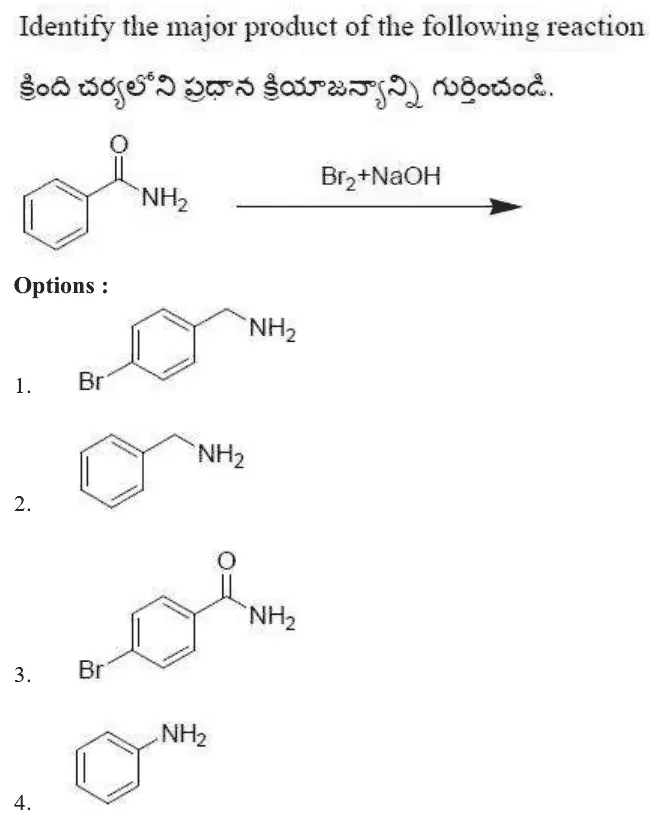
Identify the major product of the following reaction
(see the figure above)

The question and its figure as printed in AP EAPCET 2022 04th July 2022 Shift2. Option 1: 4-bromobenzyl-amine (para Br, CH2NH2) Option 2: benzylamine (phenyl-CH2-NH2) Option 3: 4-bromobenzamide (para Br, C(=O)NH2) Option 4: aniline (phenyl-NH2)
The question as printed in the paper.
  • A

    see figure 4-bromobenzyl-amine (para Br, CH2NH2)

  • B

    see figure benzylamine (phenyl-CH2-NH2)

  • C

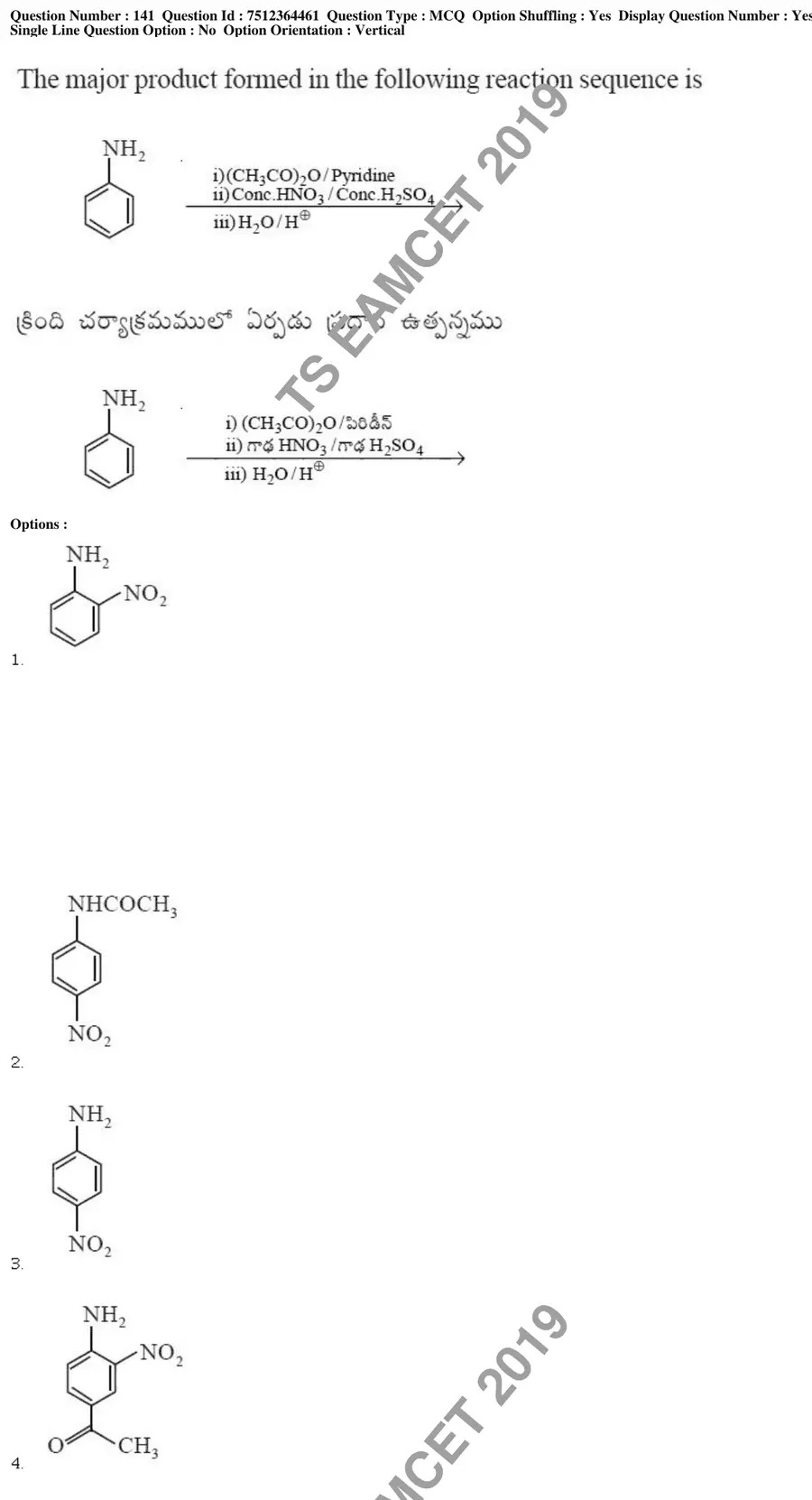
    see figure 4-bromobenzamide (para Br, C(=O)NH2)

  • D

    see figure aniline (phenyl-NH2)

89AP EAMCET 2021 · 25 Aug · Shift 2MCQOpen question page ↗

Identify the compound (B) in given reaction.
$\mathrm{CH_3Cl \xrightarrow{KCN} (A) \xrightarrow{H^+/H_2O} (B)}$

  • A

    $\mathrm{CH_3NH_2}$

  • B

    $\mathrm{HCOOH}$

  • C

    $\mathrm{CH_3COOH}$

  • D

    $\mathrm{CH_3COCH_3}$

90AP EAMCET 2021 · 23 Aug · Shift 1MCQOpen question page ↗

Identify the structure of the compound responsible for Bhopal disaster:

  • A

    $\mathrm{H_3C - C \equiv N}$

  • B

    $\mathrm{H_3C - N = C = O}$

  • C

    $\mathrm{N \equiv C - O - CH_3}$

  • D

    $\mathrm{H_3C - N^+ \equiv C^-}$

91AP EAMCET 2021 · 20 Aug · Shift 2MCQOpen question page ↗

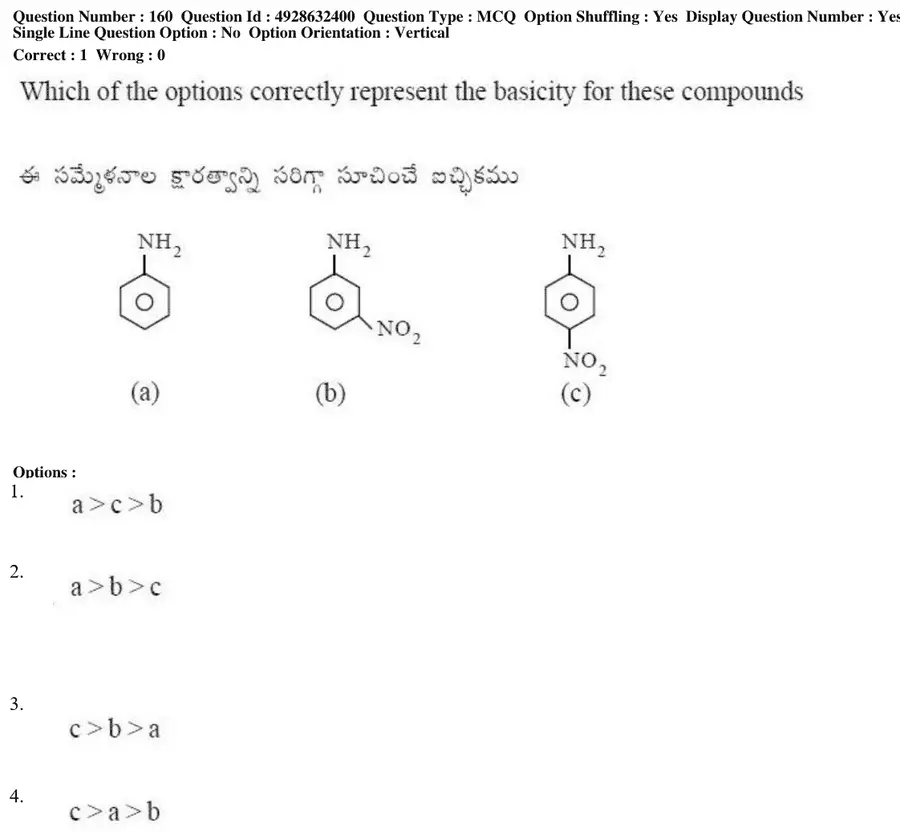
Arrange the following bases in decreasing order of basicity is
(i) Aniline
(ii) $O$ - nitroaniline
(iii) $m$ - nitroaniline
(iv) $p$ - nitroaniline

  • A

    (i) > (ii) > (iv) > (iii)

  • B

    (i) > (iii) > (iv) > (ii)

  • C

    (iv) > (iii) > (ii) > (i)

  • D

    (iii) > (ii) > (i) > (iv)

92TS EAMCET 2021 · 6 Aug · Shift 1MCQOpen question page ↗

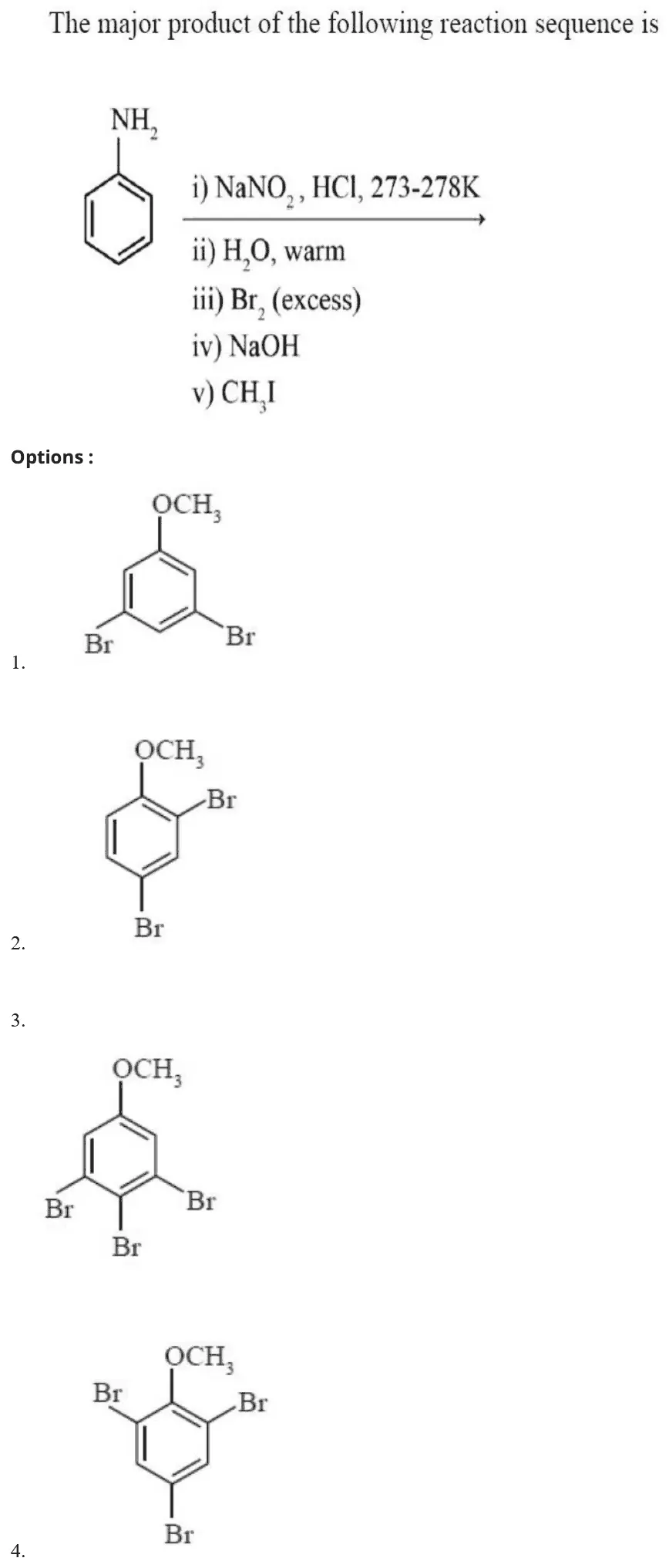
The major product of the following reaction sequence is
(see the figure above)

The question and its figure as printed in TS EAPCET 2021 English 6th Aug 2021 Shift 1. Option 1: anisole ring with OCH3 at the top and Br at the lower-left and lower-right vertices (3,5-dibromo) Option 2: anisole ring with OCH3 at the top-left vertex, Br at the next vertex clockwise (ortho) and Br at the bottom vertex (para) (2,4-dibromo) Option 3: anisole ring with OCH3 at the top vertex and three Br: lower-left, bottom and lower-right vertices (3,4,5-tribromo) Option 4: anisole ring with OCH3 at the top vertex and three Br: upper-left, upper-right (both ortho) and bottom (para) (2,4,6-tribromo)
The question as printed in the paper.
  • A

    see figure anisole ring with $\mathrm{OCH_3}$ at the top and Br at the lower-left and lower-right vertices (3,5-dibromo)

  • B

    see figure anisole ring with $\mathrm{OCH_3}$ at the top-left vertex, Br at the next vertex clockwise (ortho) and Br at the bottom vertex (para) (2,4-dibromo)

  • C

    see figure anisole ring with $\mathrm{OCH_3}$ at the top vertex and three Br: lower-left, bottom and lower-right vertices (3,4,5-tribromo)

  • D

    see figure anisole ring with $\mathrm{OCH_3}$ at the top vertex and three Br: upper-left, upper-right (both ortho) and bottom (para) (2,4,6-tribromo)

93TS EAMCET 2021 · 6 Aug · Shift 1MCQOpen question page ↗

The molecular formula of the final product of the following synthetic scheme is
Benzyl Iodide $\xrightarrow[\text{iii) } \mathrm{H_3O^+}]{\text{i) KCN; ii) } \mathrm{CH_3MgBr}}$

  • A

    $\mathrm{C_9H_{12}O}$

  • B

    $\mathrm{C_{10}H_{14}O}$

  • C

    $\mathrm{C_{10}H_{15}N}$

  • D

    $\mathrm{C_9H_{10}O}$

94TS EAMCET 2021 · 6 Aug · Shift 1MCQOpen question page ↗

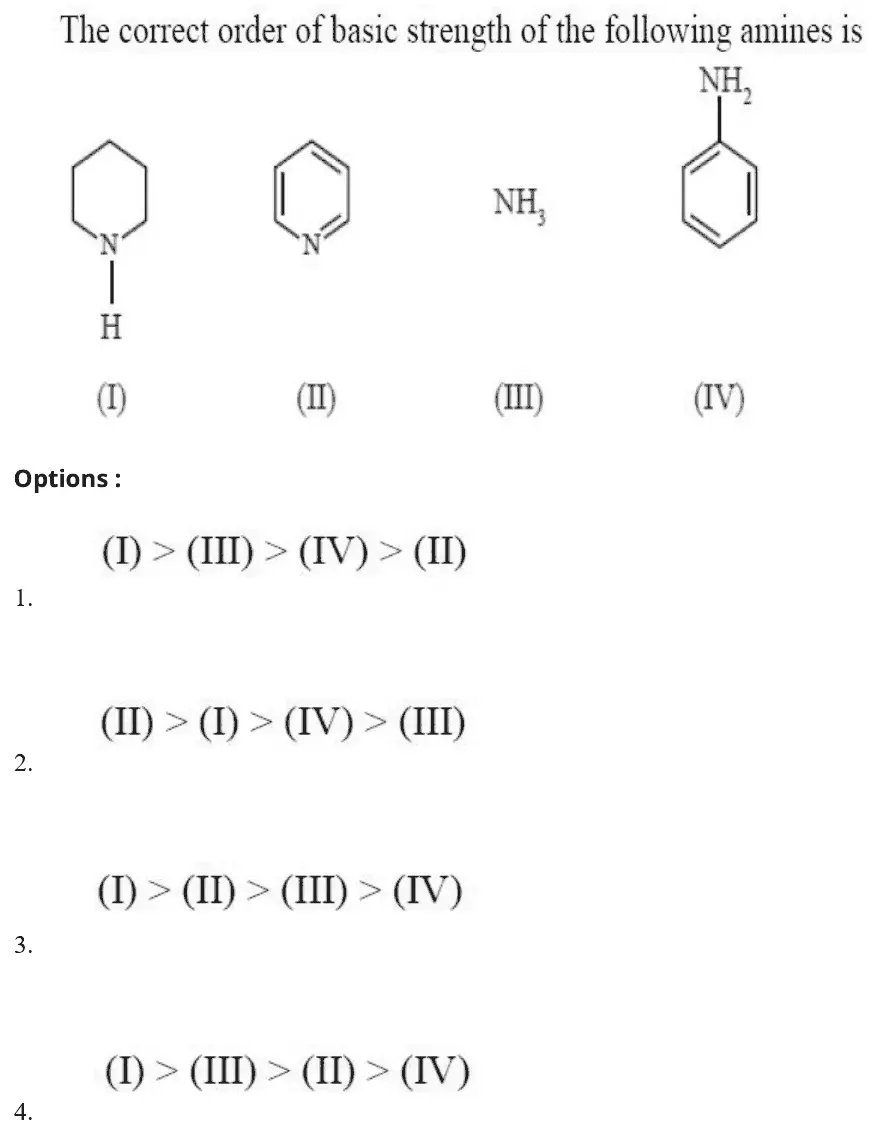
The correct order of basic strength of the following amines is
(see the figure above)

The question and its figure as printed in TS EAPCET 2021 English 6th Aug 2021 Shift 1.
The question as printed in the paper.
  • A

    (I) > (III) > (IV) > (II)

  • B

    (II) > (I) > (IV) > (III)

  • C

    (I) > (II) > (III) > (IV)

  • D

    (I) > (III) > (II) > (IV)

95TS EAMCET 2021 · 5 Aug · Shift 1MCQOpen question page ↗

The test that distinguishes primary amines from other amines is

  • A

    Iodoform test

  • B

    Victor Meyer test

  • C

    Lucas test

  • D

    Carbylamine test

96TS EAMCET 2021 · 5 Aug · Shift 2MCQOpen question page ↗

A 90 g of ethyl amine on reaction with methyl chloride produced a tertiary amine as an exclusive product. The amount of methyl chloride required is
[Given mass in amu : H = 1, C = 12, N = 14, Cl = 35.5]

  • A

    50.5 g

  • B

    101 g

  • C

    202 g

  • D

    303 g

97TS EAMCET 2021 · 4 Aug · Shift 2MCQOpen question page ↗

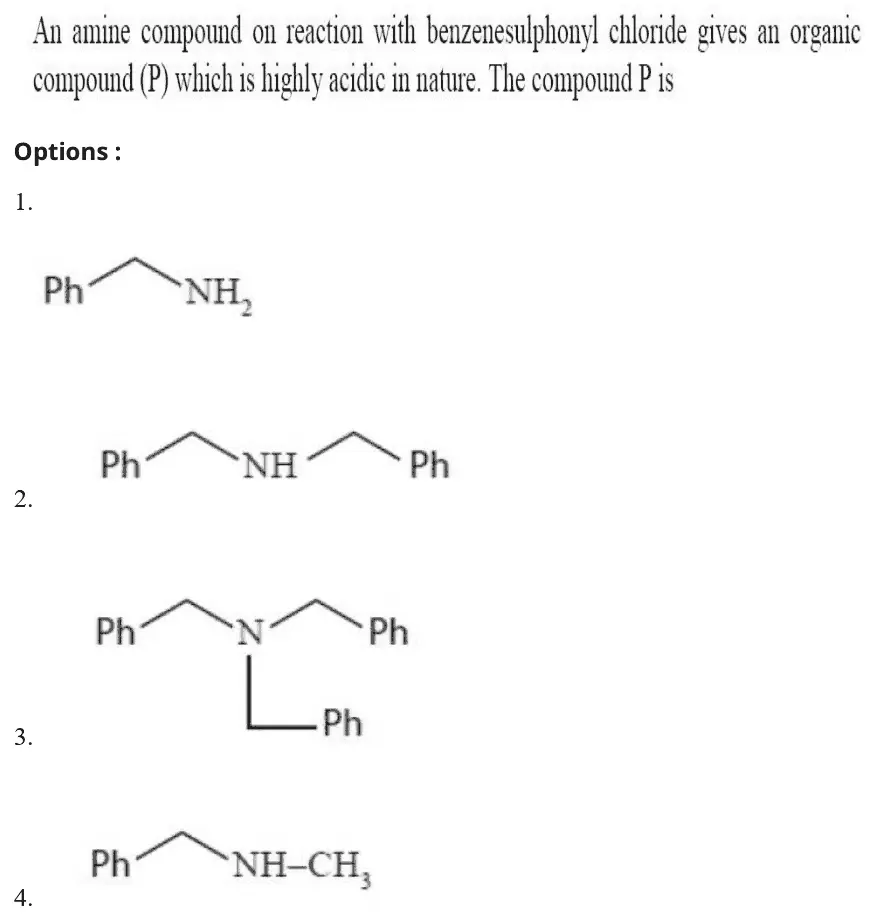
An amine compound on reaction with benzenesulphonyl chloride gives an organic compound (P) which is highly acidic in nature. The compound P is
(see the figure above)

The question and its figure as printed in TS EAPCET 2021 English 4th Aug 2021 Shift 2. Option 1: Ph-CH2-NH2 (benzylamine) Option 2: Ph-CH2-NH-CH2-Ph (dibenzylamine) Option 3: (Ph-CH2)3N (tribenzylamine) Option 4: Ph-CH2-NH-CH3
The question as printed in the paper.
  • A

    see figure $\mathrm{Ph-CH_2-NH_2}$ (benzylamine)

  • B

    see figure $\mathrm{Ph-CH_2-NH-CH_2-Ph}$ (dibenzylamine)

  • C

    see figure $\mathrm{(Ph-CH_2)_3N}$ (tribenzylamine)

  • D

    see figure $\mathrm{Ph-CH_2-NH-CH_3}$

98AP EAMCET 2020 · 7 Oct · Shift 1MCQOpen question page ↗

An aromatic compound "A" on treatment with $\mathrm{Zn/NH_4Cl}$ and subsequent heating with ammonical silver nitrate solution gives a black precipitate. Which functional groups does "A" contain?

  • A

    $-\mathrm{CHO}$

  • B

    $-\mathrm{NO_2}$

  • C

    $-\mathrm{OH}$

  • D

    $-\mathrm{COOH}$

99AP EAMCET 2020 · 23 Sep · Shift 1MCQOpen question page ↗

Which of the following statements is true?
1) Tertiary amines react with acid chlorides
2) N-Ethyl benzene sulphonamide is soluble in alkali
3) N, N-Diethyl benzene sulphonamide is soluble in alkali
4) Tertiary amines react with Hindberg's reagent

  • A

    1

  • B

    2

  • C

    3

  • D

    4

100AP EAMCET 2020 · 22 Sep · Shift 2MCQOpen question page ↗

In the preparation of a $1^\circ$-amine from an alkyl halide, with simultaneous addition of one $CH_2$ group to the carbon chain, the reagent used as source of nitrogen is

  • A

    Sodium amide, $NaNH_2$

  • B

    Sodium azide, $NaN_3$

  • C

    Potassium cyanide, $KCN$

  • D

    Potassium phthalimide, $C_6H_4(CO)_2N^-K^+$

101AP EAMCET 2020 · 21 Sep · Shift 2MCQOpen question page ↗

Which of the following statement about aniline is false?
A) Aniline is a strong base than ammonia
B) Aniline is a less basic than methylamine
C) $\mathrm{p}K_b$ of aniline is more than that of ammonia
D) Aniline reacts with bromine water to form a white precipitate

  • A

    A

  • B

    B

  • C

    C

  • D

    D

102AP EAMCET 2020 · 18 Sep · Shift 1MCQOpen question page ↗

The order of boiling points of the following compounds is:
(i) $(CH_3)_3N$ (ii) $CH_3CH_2CH_2NH_2$ (iii) $CH_3CH_2NHCH_3$

  • A

    (i) > (iii) > (ii)

  • B

    (iii) > (i) > (ii)

  • C

    (ii) > (i) > (iii)

  • D

    (ii) > (iii) > (i)

103AP EAMCET 2020 · 18 Sep · Shift 2MCQOpen question page ↗

Presence of which of the following is suitable for the synthesis of bromobenzene from benzene diazonium salts?

  • A

    $HBr$

  • B

    $MgBr, HBr$

  • C

    $Cu_2Br_2, HBr$

  • D

    $KBr$

104AP EAMCET 2020 · 18 Sep · Shift 2MCQOpen question page ↗

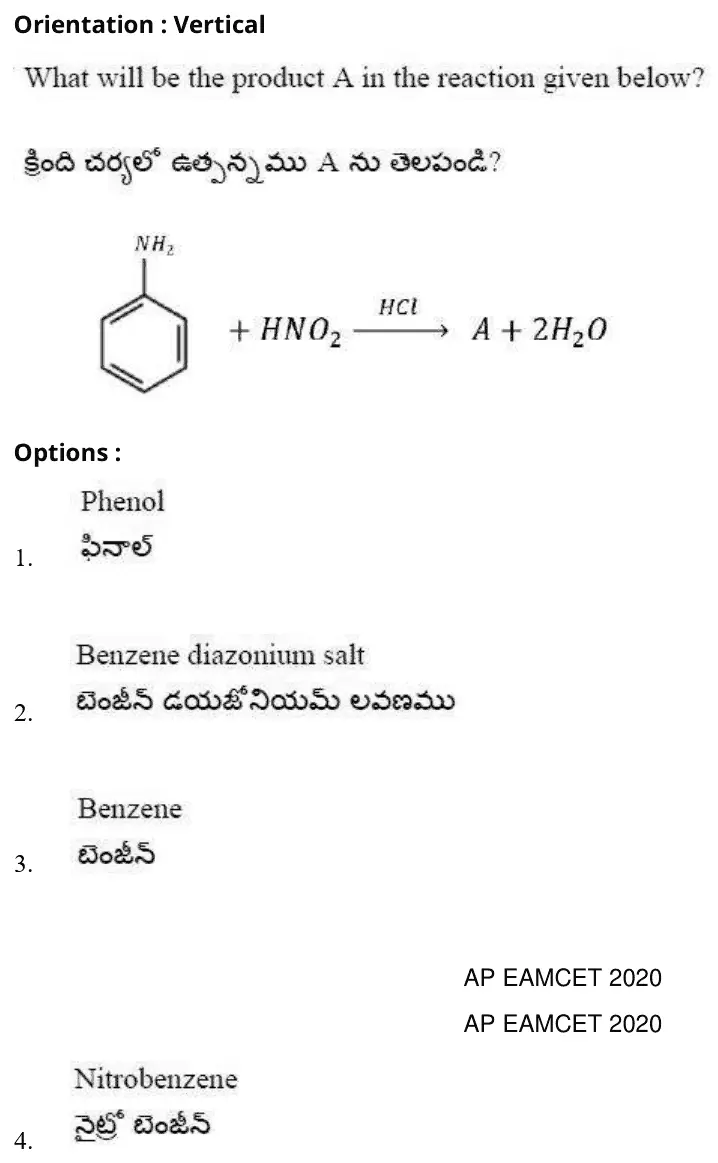
What will be the product A in the reaction given below?
(see the figure above)

The question and its figure as printed in AP EAPCET 2020 18th Sep 2020 Shift2.
The question as printed in the paper.
  • A

    Phenol

  • B

    Benzene diazonium salt

  • C

    Benzene

  • D

    Nitrobenzene

105AP EAMCET 2020 · 17 Sep · Shift 2MCQOpen question page ↗

Which of the following reactions produce ethyl cyanide as a major product?
1) $\mathrm{CH_3CH_2CH=NOH}$ --($\mathrm{(CH_3O)_2O}$)-->
2) $\mathrm{CH_3CH_2Cl}$ --(ethanolic KCN)-->
3) $\mathrm{CH_3CH_2Cl}$ --(ethanolic AgCN)-->
4) $\mathrm{CH_3CH_2CON(CH_3)_2}$ --($\mathrm{C_6H_5SO_2Cl}$, Pyridine, 70 °C)-->

  • A

    1, 3

  • B

    2, 3

  • C

    3, 4

  • D

    1, 2

106TS EAMCET 2020 · 14 Sep · Shift 1MCQOpen question page ↗

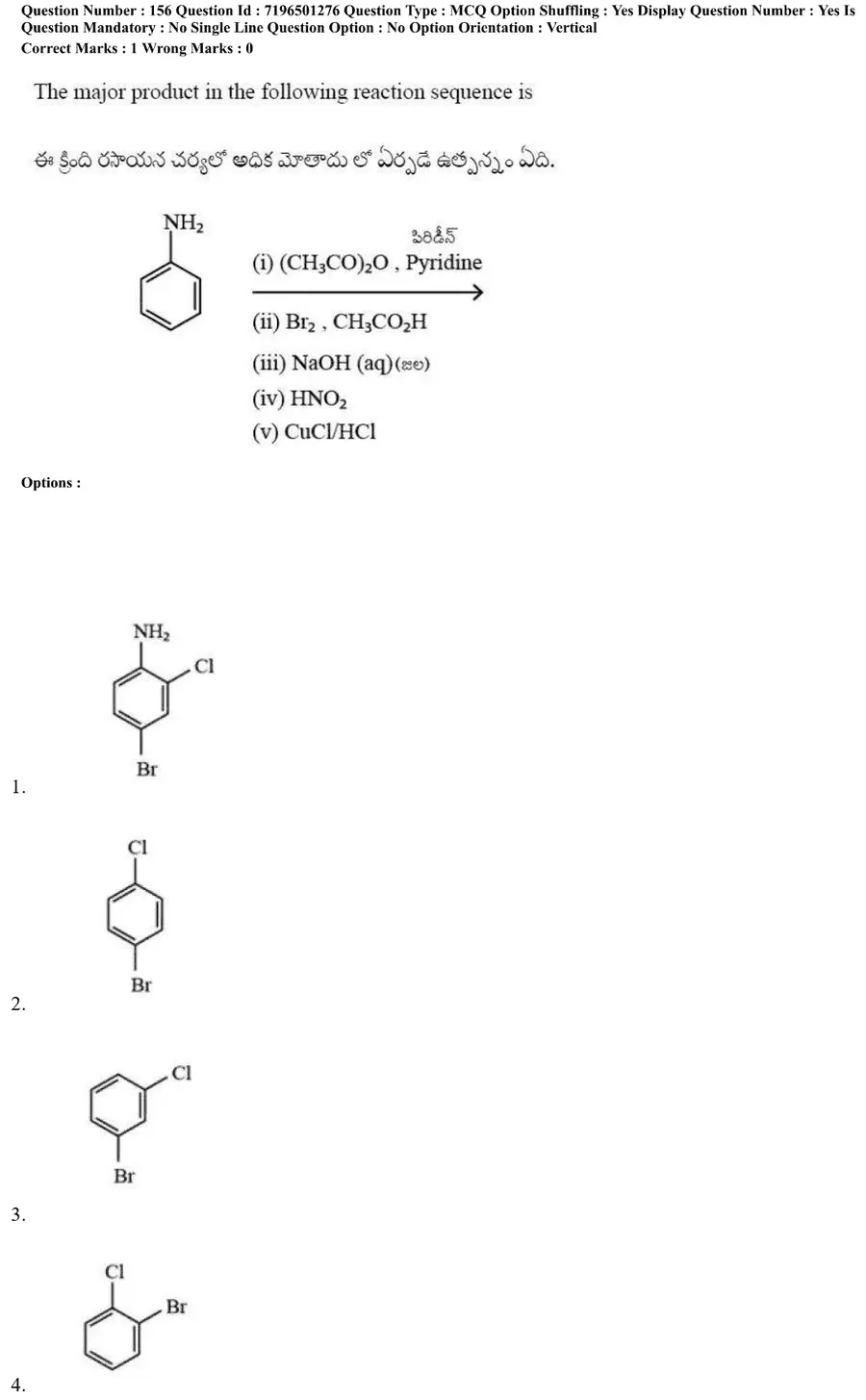
The major product in the following reaction sequence is
(see the figure above)

The question and its figure as printed in TS EAMCET 2020 14 Sep FN. Option 1: benzene ring with NH2 at top, Cl at the adjacent (ortho) position on the upper right, Br at the para position (bottom). Option 2: benzene ring with Cl at top and Br at bottom (para-chlorobromobenzene). Option 3: benzene ring with Cl at upper right and Br at lower left (meta-chlorobromobenzene). Option 4: benzene ring with Cl at top-left and Br at upper right adjacent (ortho-chlorobromobenzene).
The question as printed in the paper.
  • A

    see figure benzene ring with NH2 at top, Cl at the adjacent (ortho) position on the upper right, Br at the para position (bottom).

  • B

    see figure benzene ring with Cl at top and Br at bottom (para-chlorobromobenzene).

  • C

    see figure benzene ring with Cl at upper right and Br at lower left (meta-chlorobromobenzene).

  • D

    see figure benzene ring with Cl at top-left and Br at upper right adjacent (ortho-chlorobromobenzene).

107TS EAMCET 2020 · 14 Sep · Shift 1MCQOpen question page ↗

The product formed when aniline is treated with chloroform in the presence of KOH (alcoholic) is

  • A

    Phenol

  • B

    Phenyl isothiocyanate

  • C

    Phenyl isocyanide

  • D

    Cyanobenzene

108TS EAMCET 2020 · 14 Sep · Shift 2MCQOpen question page ↗

The major product formed by the reaction of benzylamine with nitrous acid is

  • A

    Phenol

  • B

    Benzaldehyde

  • C

    Chlorobenzene

  • D

    Benzyl alcohol

109TS EAMCET 2020 · 11 Sep · Shift 1MCQOpen question page ↗

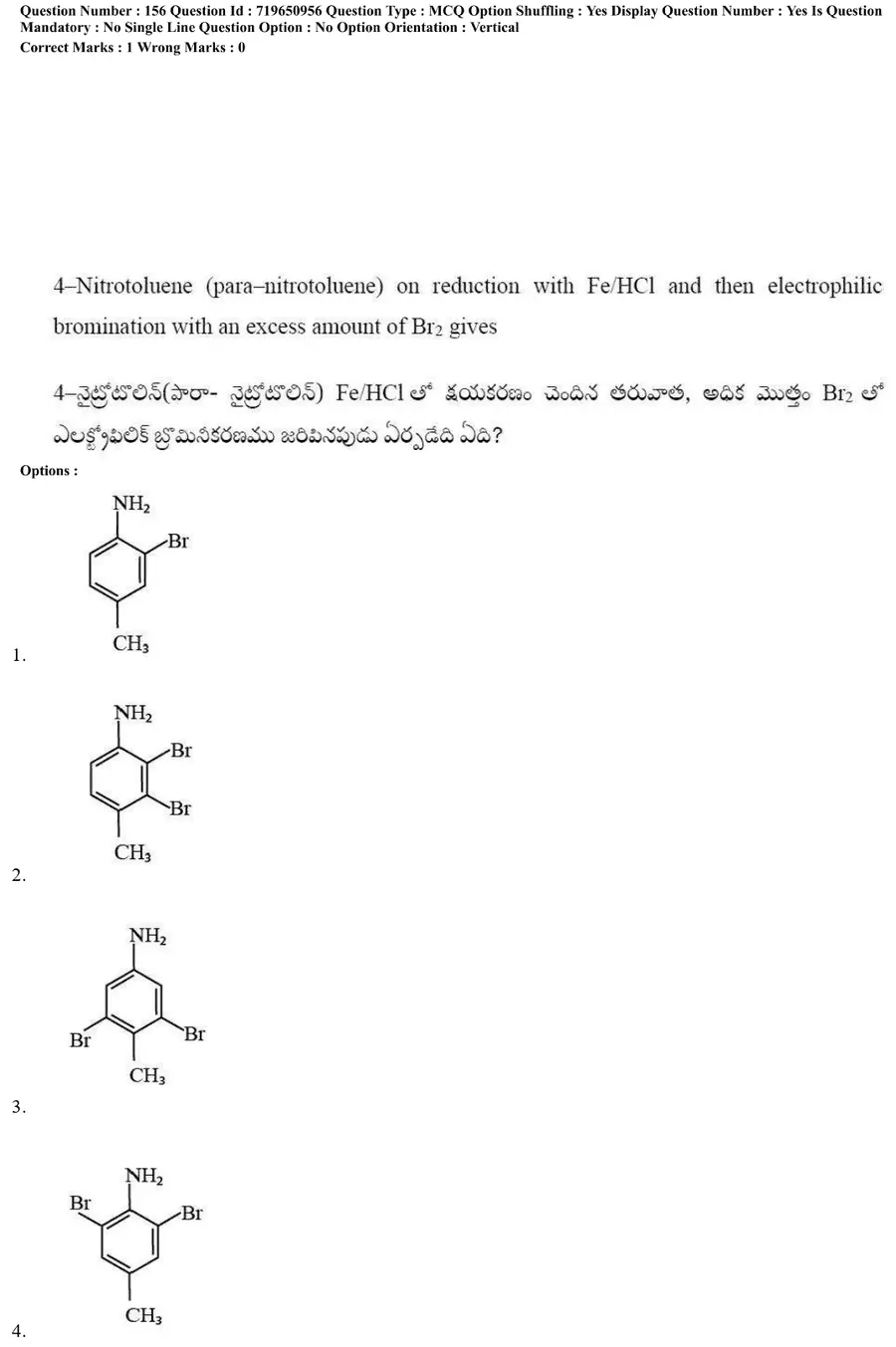
4-Nitrotoluene (para-nitrotoluene) on reduction with Fe/HCl and then electrophilic bromination with an excess amount of $\mathrm{Br_2}$ gives

The question and its figure as printed in TS EAMCET 2020 11 Sep FN. Option 1: benzene ring with NH2 at top, one Br at the upper-right vertex, CH3 at bottom Option 2: benzene ring with NH2 at top, two Br at the upper-right and lower-right vertices, CH3 at bottom Option 3: benzene ring with NH2 at top, Br at lower-left and Br at lower-right vertices, CH3 at bottom Option 4: benzene ring with NH2 at top, Br at upper-left and Br at upper-right vertices, CH3 at bottom
The question as printed in the paper.
  • A

    see figure benzene ring with NH2 at top, one Br at the upper-right vertex, CH3 at bottom

  • B

    see figure benzene ring with NH2 at top, two Br at the upper-right and lower-right vertices, CH3 at bottom

  • C

    see figure benzene ring with NH2 at top, Br at lower-left and Br at lower-right vertices, CH3 at bottom

  • D

    see figure benzene ring with NH2 at top, Br at upper-left and Br at upper-right vertices, CH3 at bottom

110TS EAMCET 2020 · 11 Sep · Shift 1MCQOpen question page ↗

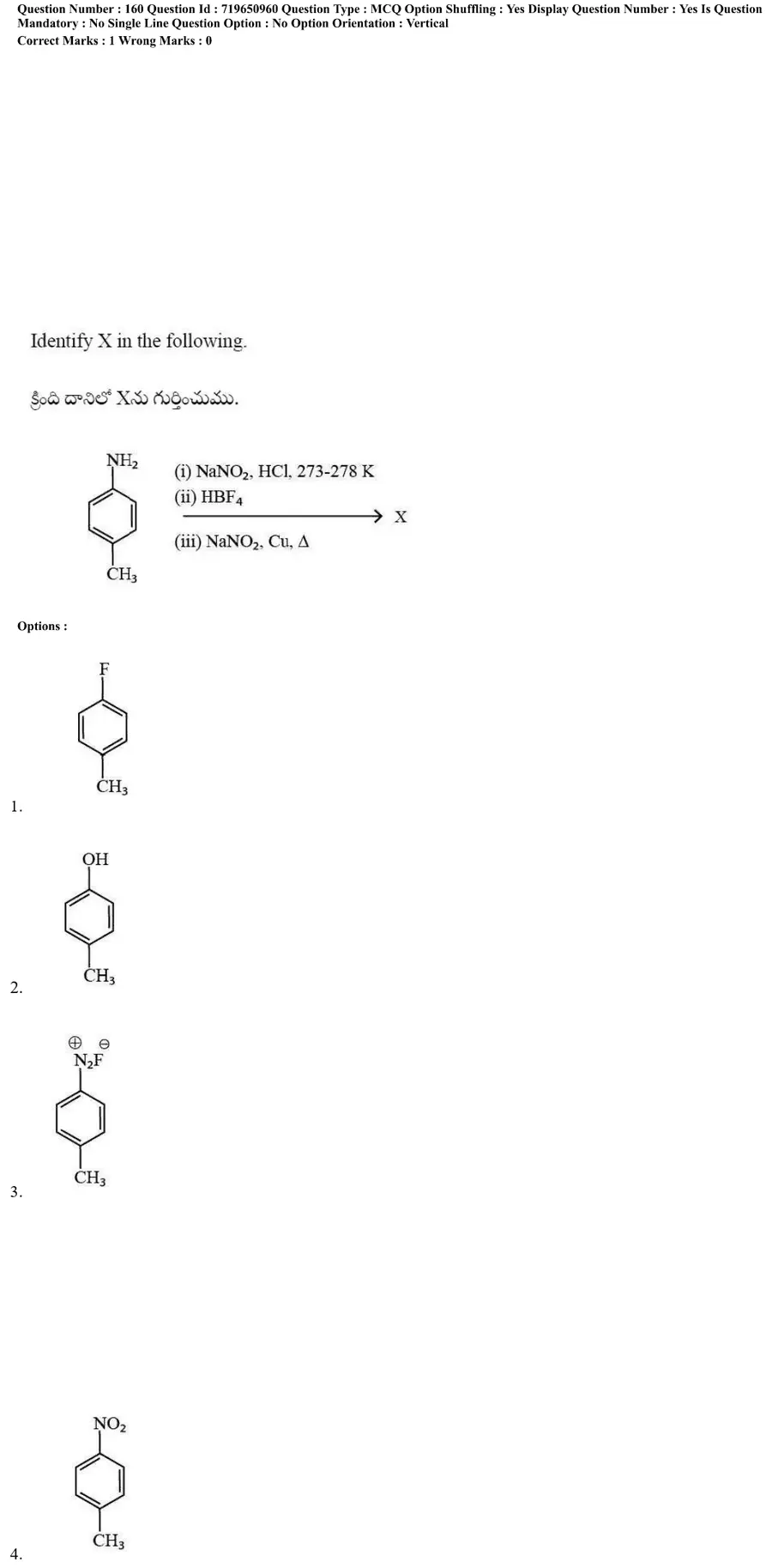
Identify X in the following.
(see the figure above)

The question and its figure as printed in TS EAMCET 2020 11 Sep FN. Option 1: 4-fluorotoluene (F and CH3 para) Option 2: 4-methylphenol (OH and CH3 para) Option 3: 4-methylbenzenediazonium fluoride (N2+ F- with charges drawn, CH3 para) Option 4: 4-nitrotoluene (NO2 and CH3 para)
The question as printed in the paper.
  • A

    see figure 4-fluorotoluene (F and CH3 para)

  • B

    see figure 4-methylphenol (OH and CH3 para)

  • C

    see figure 4-methylbenzenediazonium fluoride (N2+ F- with charges drawn, CH3 para)

  • D

    see figure 4-nitrotoluene (NO2 and CH3 para)

111TS EAMCET 2020 · 11 Sep · Shift 2MCQOpen question page ↗

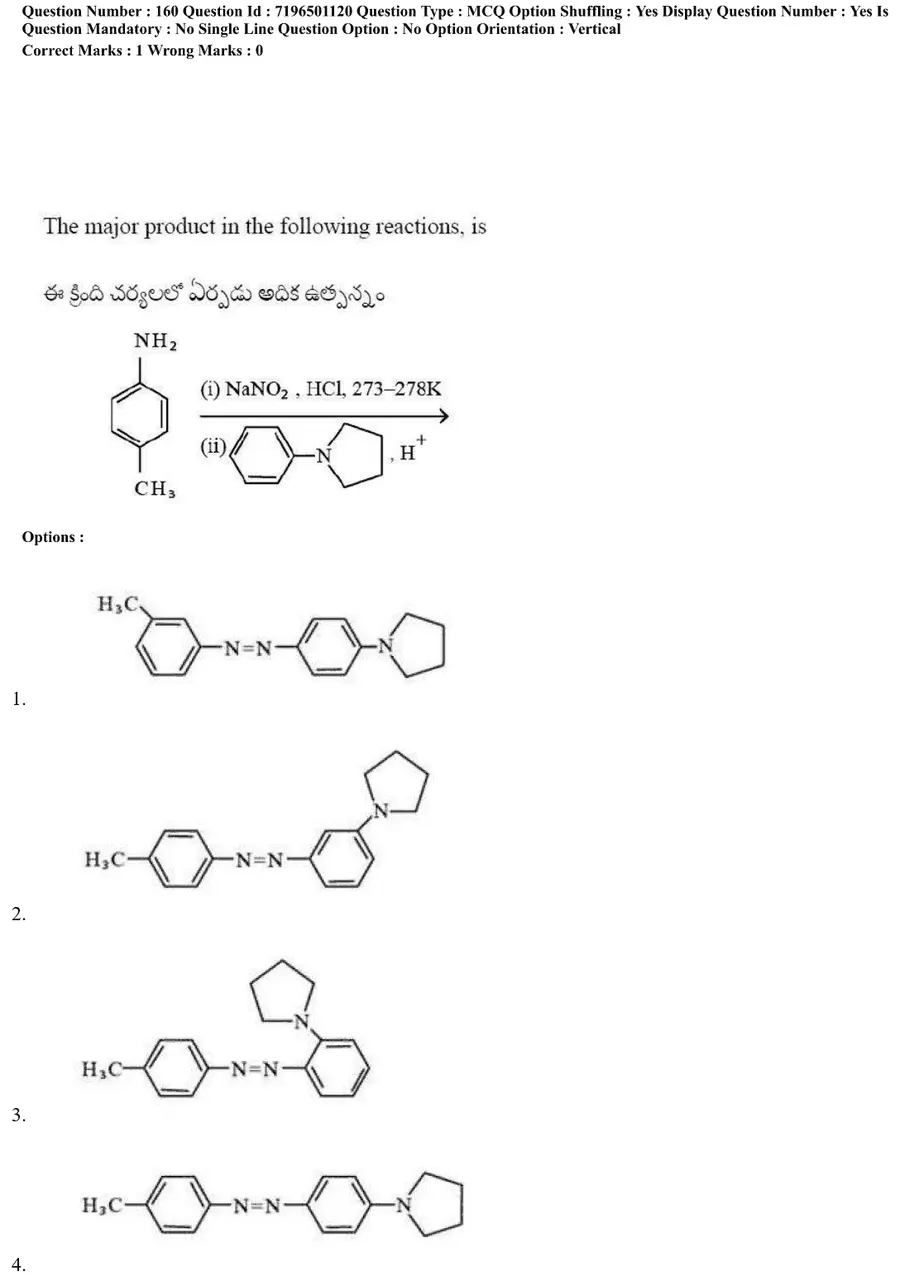
The major product in the following reactions, is
(see the figure above) (i) $\mathrm{NaNO_2}$, HCl, 273-278K; (ii) (see the figure above), $\mathrm{H^+}$

The question and its figure as printed in TS EAMCET 2020 11 Sep AN. Option 1: p-azo compound: H3C at the meta/upper-left position of the first ring; -N=N-; second ring bearing a pyrrolidine N para Option 2: H3C-phenyl (para) -N=N- phenyl bearing a pyrrolidine N at the meta position Option 3: H3C-phenyl (para) -N=N- phenyl bearing a pyrrolidine N at the ortho position Option 4: H3C-phenyl (para) -N=N- phenyl bearing a pyrrolidine N at the para position
The question as printed in the paper.
  • A

    see figure p-azo compound: $\mathrm{H_3C}$ at the meta/upper-left position of the first ring; $-\mathrm{N=N}-$; second ring bearing a pyrrolidine N para

  • B

    see figure $\mathrm{H_3C}$-phenyl (para) $-\mathrm{N=N}-$ phenyl bearing a pyrrolidine N at the meta position

  • C

    see figure $\mathrm{H_3C}$-phenyl (para) $-\mathrm{N=N}-$ phenyl bearing a pyrrolidine N at the ortho position

  • D

    see figure $\mathrm{H_3C}$-phenyl (para) $-\mathrm{N=N}-$ phenyl bearing a pyrrolidine N at the para position

112TS EAMCET 2020 · 10 Sep · Shift 1MCQOpen question page ↗

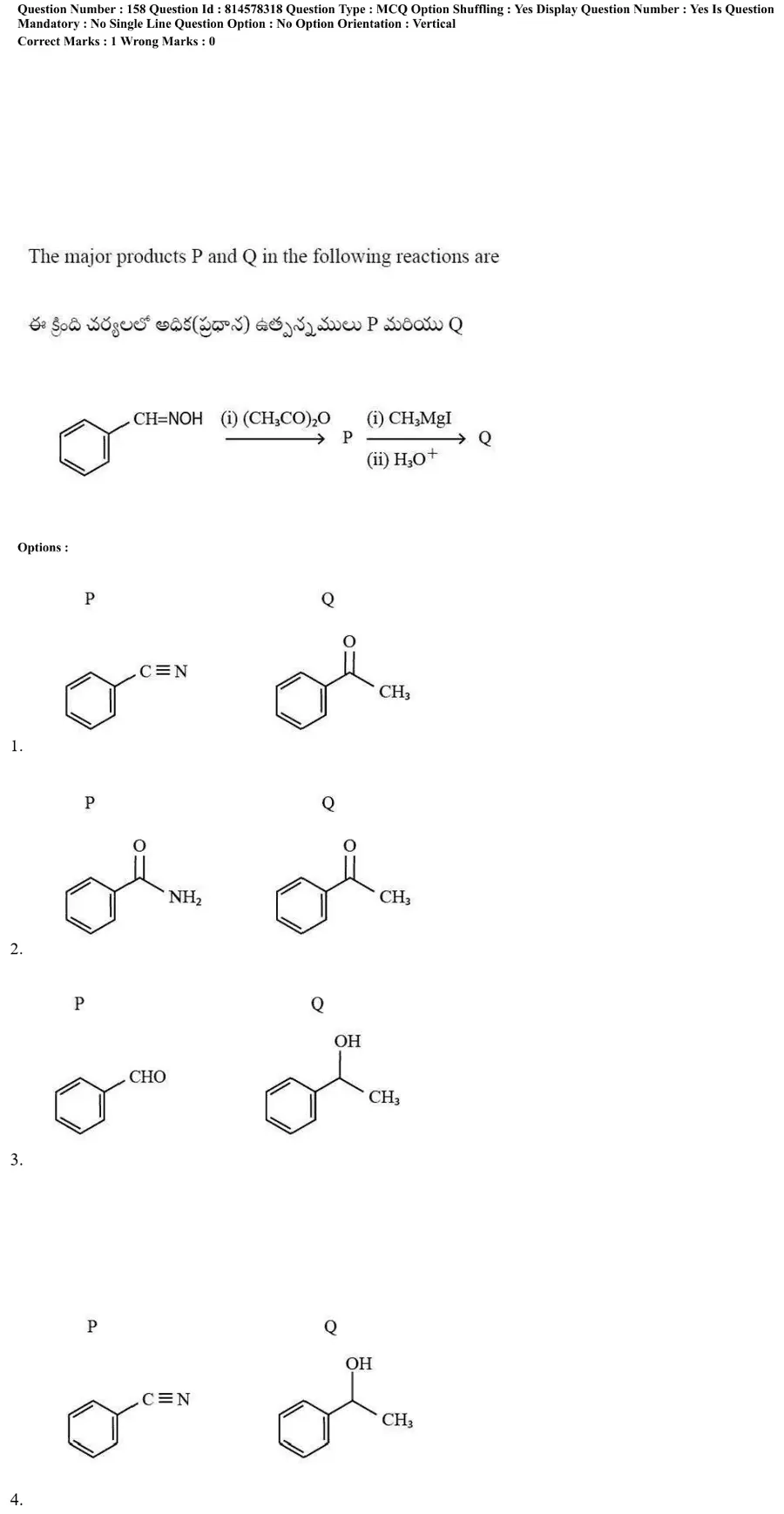
The major products P and Q in the following reactions are
(see the figure above)

The question and its figure as printed in TS EAMCET 2020 10 Sep FN.
The question as printed in the paper.
  • A

    P = benzonitrile (Ph-C$\equiv$N); Q = acetophenone (Ph-CO-CH$_3$)

  • B

    P = benzamide (Ph-CONH$_2$); Q = acetophenone (Ph-CO-CH$_3$)

  • C

    P = benzaldehyde (Ph-CHO); Q = 1-phenylethanol (Ph-CH(OH)-CH$_3$)

  • D

    P = benzonitrile (Ph-C$\equiv$N); Q = 1-phenylethanol (Ph-CH(OH)-CH$_3$)

113TS EAMCET 2020 · 10 Sep · Shift 2MCQOpen question page ↗

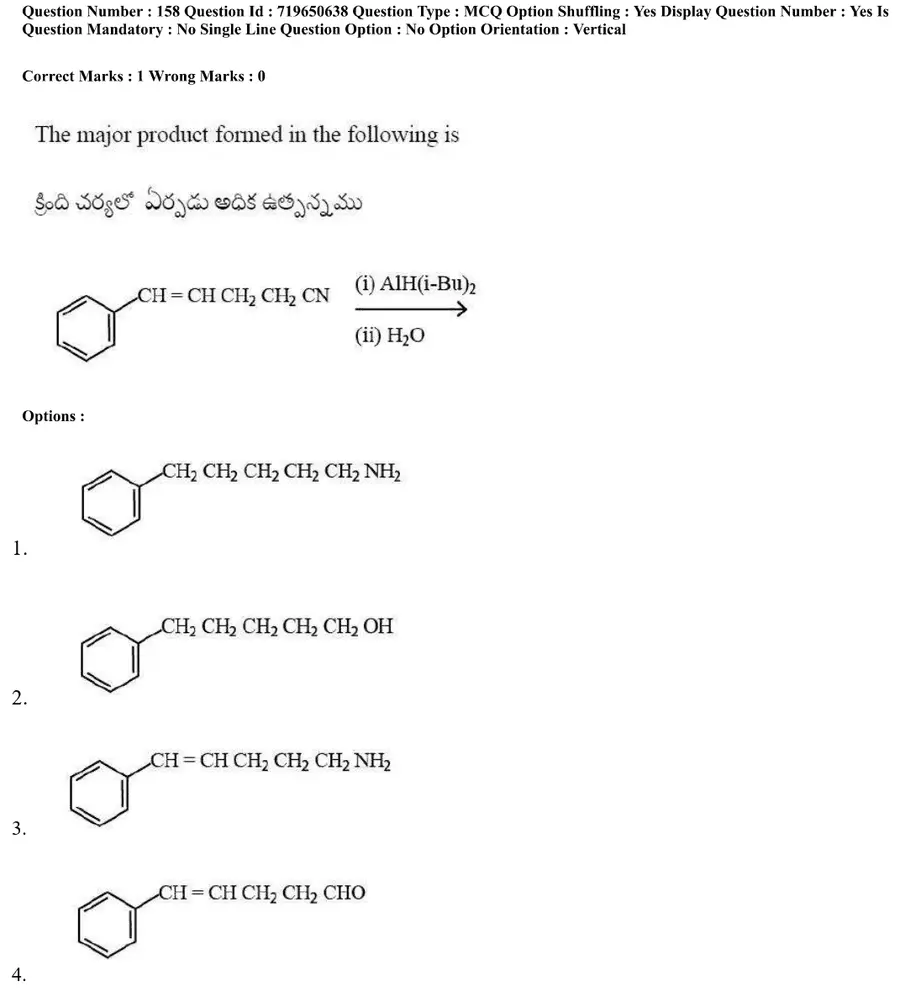
The major product formed in the following is
(see the figure above)

The question and its figure as printed in TS EAMCET 2020 10 Sep AN. Option 1: Ph–CH2CH2CH2CH2CH2NH2 Option 2: Ph–CH2CH2CH2CH2CH2OH Option 3: Ph–CH=CH CH2CH2CH2NH2 Option 4: Ph–CH=CH CH2CH2CHO
The question as printed in the paper.
  • A

    see figure Ph–$\mathrm{CH_2CH_2CH_2CH_2CH_2NH_2}$

  • B

    see figure Ph–$\mathrm{CH_2CH_2CH_2CH_2CH_2OH}$

  • C

    see figure Ph–$\mathrm{CH{=}CH\,CH_2CH_2CH_2NH_2}$

  • D

    see figure Ph–$\mathrm{CH{=}CH\,CH_2CH_2CHO}$

114TS EAMCET 2020 · 10 Sep · Shift 2MCQOpen question page ↗

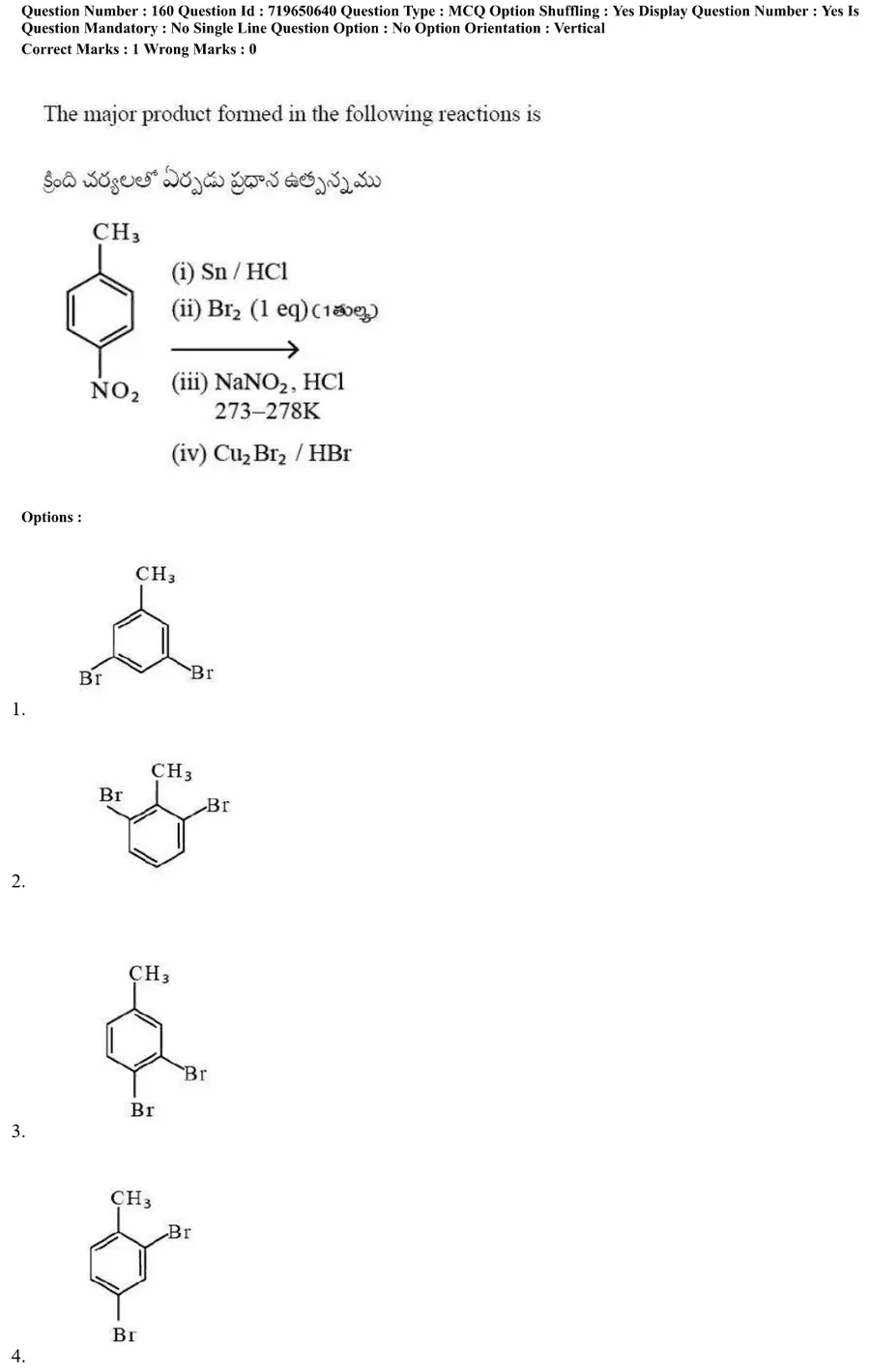
The major product formed in the following reactions is
(see the figure above)

The question and its figure as printed in TS EAMCET 2020 10 Sep AN. Option 1: toluene with Br at both meta positions (3,5-dibromotoluene) Option 2: toluene with Br at both ortho positions (2,6-dibromotoluene) Option 3: ring with CH3 at top, Br at the bottom (para) and a second Br at the lower right Option 4: ring with CH3 at top, Br at the upper right adjacent position (ortho) and a second Br at the bottom
The question as printed in the paper.
  • A

    see figure toluene with Br at both meta positions (3,5-dibromotoluene)

  • B

    see figure toluene with Br at both ortho positions (2,6-dibromotoluene)

  • C

    see figure ring with $\mathrm{CH_3}$ at top, Br at the bottom (para) and a second Br at the lower right

  • D

    see figure ring with $\mathrm{CH_3}$ at top, Br at the upper right adjacent position (ortho) and a second Br at the bottom

115TS EAMCET 2020 · 9 Sep · Shift 2MCQOpen question page ↗

Which one among the following statements is true?

  • A

    Aliphatic diazonium salts are stable.

  • B

    Aniline cannot be converted into phenol via its diazonium salt.

  • C

    Aliphatic diazonium salts liberate nitrogen gas quantitatively.

  • D

    Aniline cannot be converted into fluorobenzene via its diazonium salt.

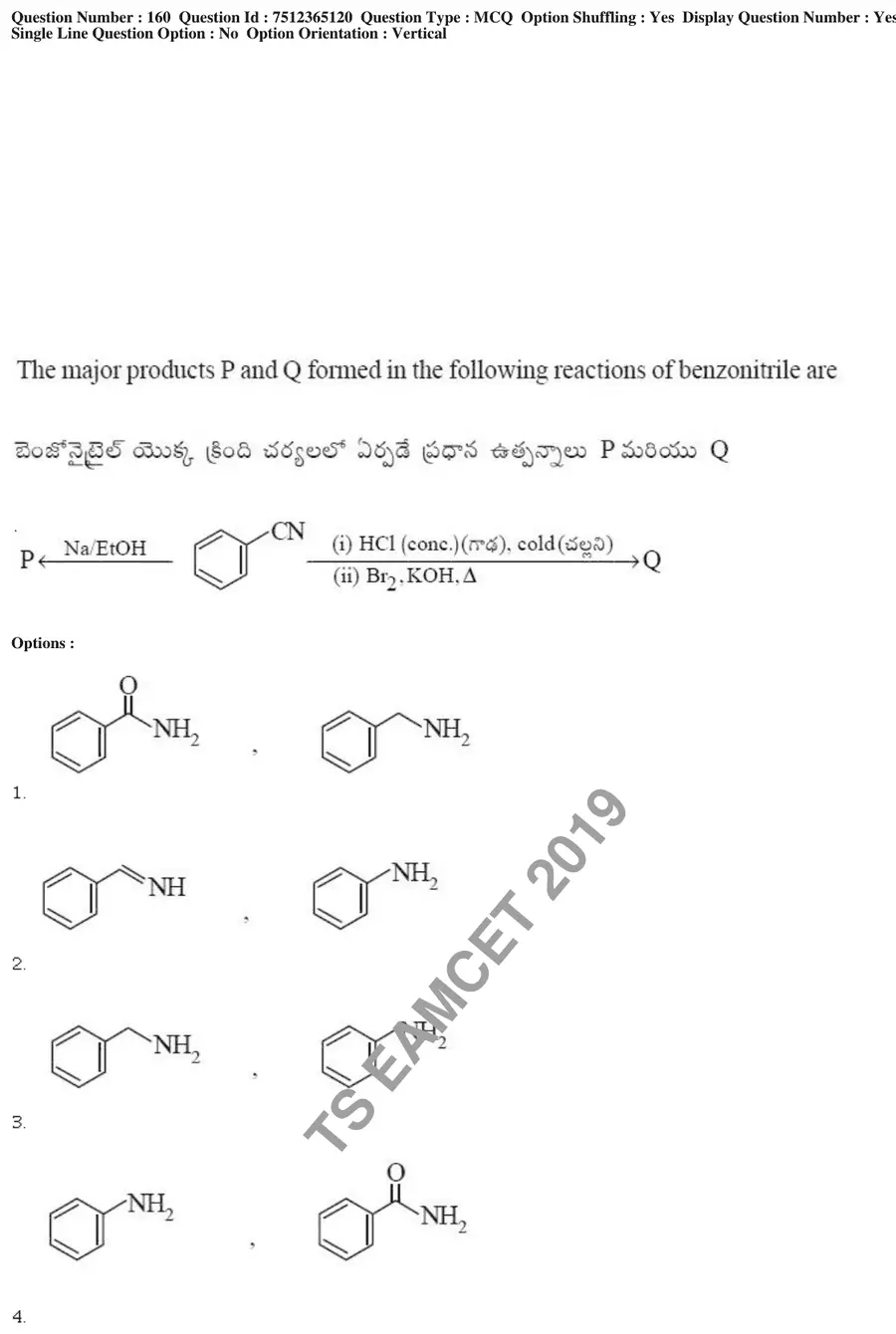
116TS EAMCET 2019 · 6 May · Shift 1MCQOpen question page ↗

The major products P and Q formed in the following reactions of benzonitrile are
(see the figure above)

The question and its figure as printed in TS EAPCET 2019 6th May 2019 Shift 1. Option 1: benzamide (C6H5CONH2) ; benzylamine (C6H5CH2NH2) Option 2: benzaldimine (C6H5CH=NH) ; aniline Option 3: benzylamine ; aniline (second structure partly under the watermark) Option 4: aniline ; benzamide
The question as printed in the paper.
  • A

    see figure benzamide ($\mathrm{C_6H_5CONH_2}$) ; benzylamine ($\mathrm{C_6H_5CH_2NH_2}$)

  • B

    see figure benzaldimine ($\mathrm{C_6H_5CH{=}NH}$) ; aniline

  • C

    see figure benzylamine ; aniline (second structure partly under the watermark)

  • D

    see figure aniline ; benzamide

117TS EAMCET 2019 · 4 May · Shift 1MCQOpen question page ↗

Statement (A) : Carboxylic acid can be obtained by the reaction of $\mathrm{R-C\equiv N}$ with $\mathrm{H_3O^+}$ under mild reaction conditions.
Statement (B) : Hydrolysis of $\mathrm{R-C\equiv N}$ in alkaline aqueous medium gives $\mathrm{R-COO^-Na^+}$ and $\mathrm{\ddot{N}H_3}$ as products.
The correct answer is

  • A

    Both (A) and (B) are correct.

  • B

    Both (A) and (B) are not correct.

  • C

    (A) is correct, but (B) is not correct.

  • D

    (A) is not correct but (B) is correct.

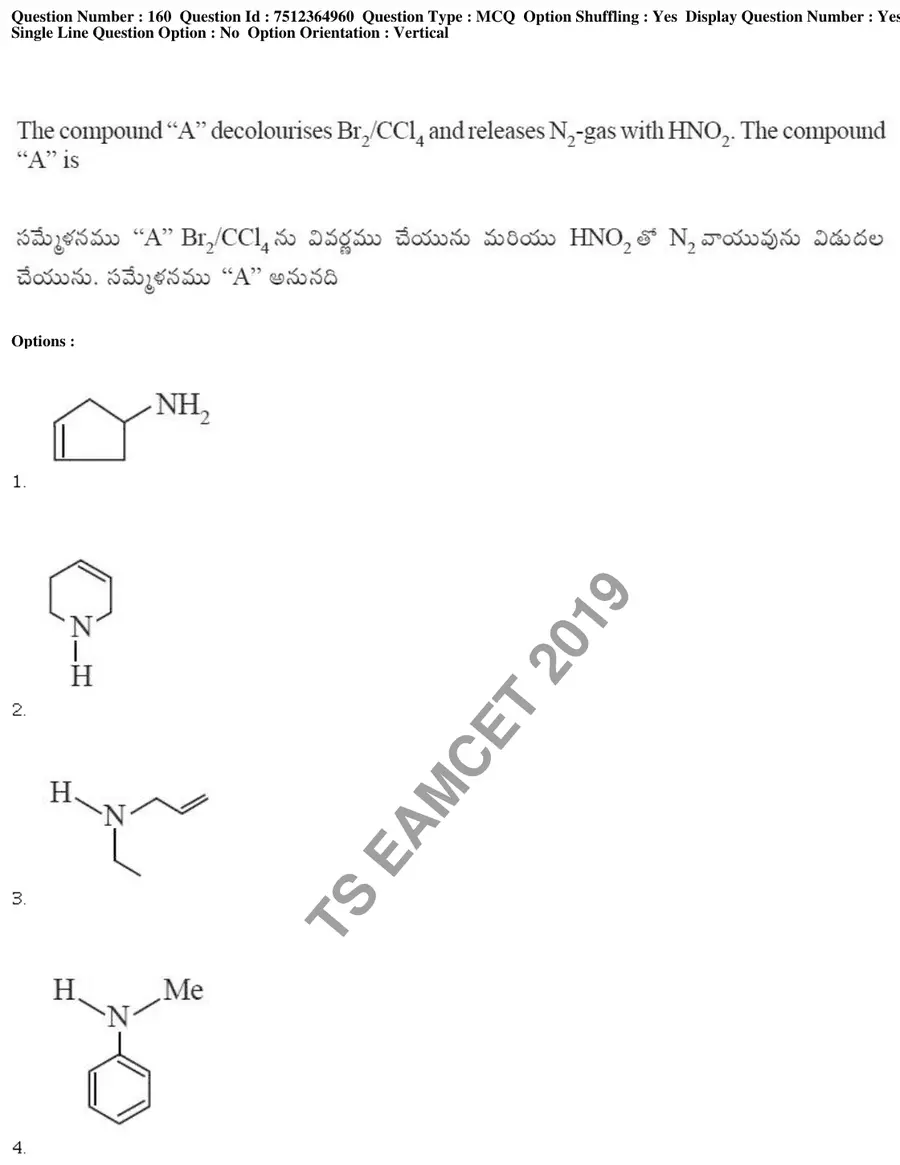
118TS EAMCET 2019 · 4 May · Shift 2MCQOpen question page ↗

The compound "A" decolourises $\mathrm{Br_2/CCl_4}$ and releases $\mathrm{N_2}$-gas with $\mathrm{HNO_2}$. The compound "A" is

The question and its figure as printed in TS EAPCET 2019 4th May 2019 Shift 2. Option 1: cyclopentene ring bearing an NH2 substituent on the carbon next to the double bond Option 2: six-membered ring (tetrahydropyridine) containing N-H with one C=C in the ring Option 3: secondary amine N-H with an allyl group on one side and an ethyl group on the other Option 4: N-methylaniline (benzene ring on N, with H and Me on N)
The question as printed in the paper.
  • A

    see figure cyclopentene ring bearing an $\mathrm{NH_2}$ substituent on the carbon next to the double bond

  • B

    see figure six-membered ring (tetrahydropyridine) containing N-H with one C=C in the ring

  • C

    see figure secondary amine N-H with an allyl group on one side and an ethyl group on the other

  • D

    see figure N-methylaniline (benzene ring on N, with H and Me on N)

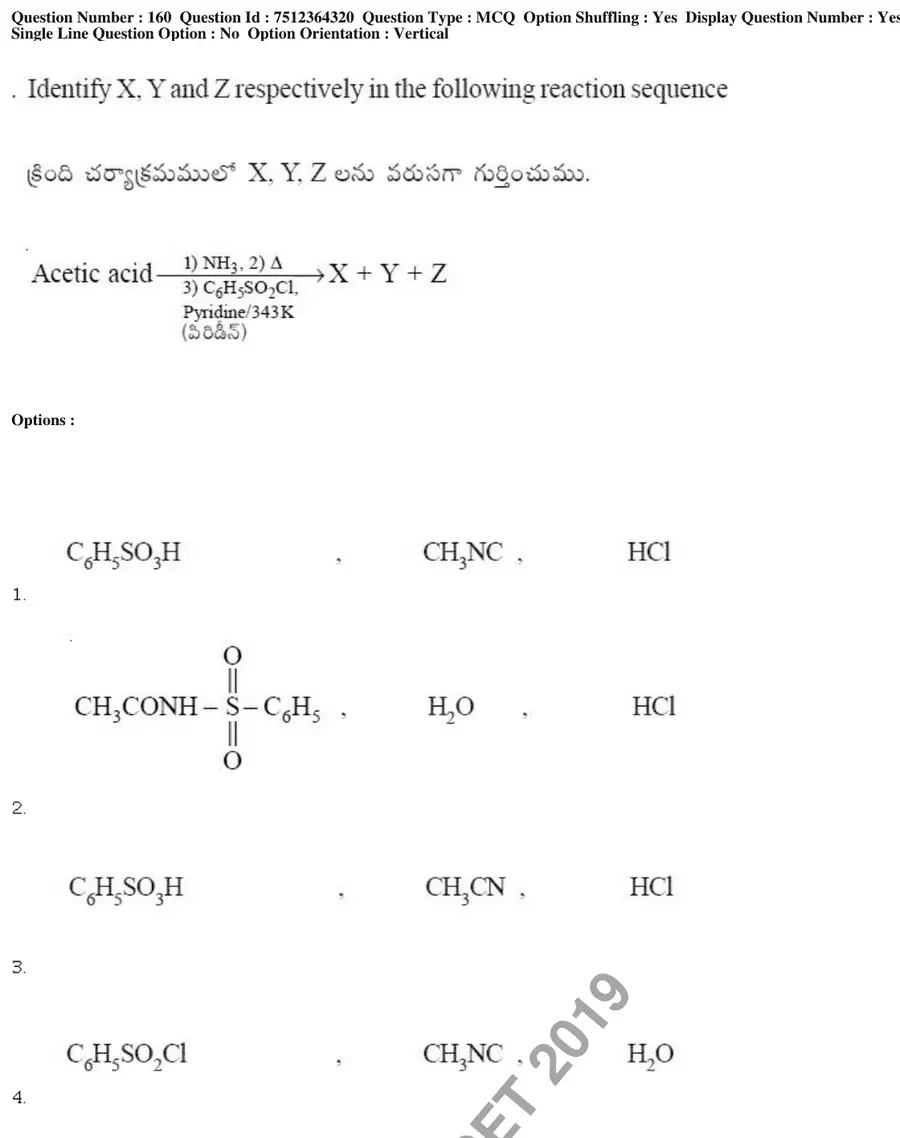
119TS EAMCET 2019 · 3 May · Shift 1MCQOpen question page ↗

Identify X, Y and Z respectively in the following reaction sequence
Acetic acid $\xrightarrow[\text{3) }\mathrm{C_6H_5SO_2Cl},\ \text{Pyridine/343 K}]{\text{1) }\mathrm{NH_3}\text{, 2) }\Delta}$ X + Y + Z
(see the figure above)

The question and its figure as printed in TS EAPCET 2019 3rd May 2019 Shift 1. Option 2: CH3CONH-S(=O)2-C6H5 , H2O , HCl
The question as printed in the paper.
  • A

    $\mathrm{C_6H_5SO_3H}$ , $\mathrm{CH_3NC}$ , HCl

  • B

    see figure $\mathrm{CH_3CONH{-}S(=O)_2{-}C_6H_5}$ , $\mathrm{H_2O}$ , HCl

  • C

    $\mathrm{C_6H_5SO_3H}$ , $\mathrm{CH_3CN}$ , HCl

  • D

    $\mathrm{C_6H_5SO_2Cl}$ , $\mathrm{CH_3NC}$ , $\mathrm{H_2O}$

120TS EAMCET 2019 · 3 May · Shift 2MCQOpen question page ↗

The major product formed in the following reaction sequence is
(see the figure above)

The question and its figure as printed in TS EAPCET 2019 3rd May 2019 Shift 2. Option 1: 2-nitroaniline (NH2 and NO2 on adjacent ring carbons) Option 2: 4-nitroacetanilide (NHCOCH3 and NO2 para) Option 3: 4-nitroaniline (NH2 and NO2 para) Option 4: benzene ring with NH2, an adjacent NO2, and a para-positioned C(=O)CH3 (acetyl) group
The question as printed in the paper.
  • A

    see figure 2-nitroaniline (NH2 and NO2 on adjacent ring carbons)

  • B

    see figure 4-nitroacetanilide (NHCOCH3 and NO2 para)

  • C

    see figure 4-nitroaniline (NH2 and NO2 para)

  • D

    see figure benzene ring with NH2, an adjacent NO2, and a para-positioned C(=O)CH3 (acetyl) group

121TS EAMCET 2019 · 3 May · Shift 2MCQOpen question page ↗

Find the suitable method from the following to prepare primary amines without the loss of carbons.

  • A

    Gabriel method

  • B

    Alkylation method

  • C

    Hoffmann bromamide method

  • D

    Stephen method

122AP EAMCET 2019 · 23 Apr · Shift 1MCQOpen question page ↗

The reaction
$\mathrm{ArN_2^{\oplus}Cl^{\ominus} + Cu + HCl \longrightarrow ArCl + N_2 + CuCl}$ is known as

  • A

    Swarts reaction

  • B

    Gatterman reaction

  • C

    Sandmeyer reaction

  • D

    Stephen reaction

123AP EAMCET 2019 · 22 Apr · Shift 1MCQOpen question page ↗

What are X and Y in the following reactions?
$\mathrm{Ar\overset{\oplus}{N_2}\overset{\ominus}{Cl}} \longrightarrow$ (see the figure above) $\rightarrow \mathrm{ArH}$

The question and its figure as printed in AP EAPCET 2019 22nd April 2019 Shift1.
The question as printed in the paper.
  • A

    X: $\mathrm{CH_3CH_2OH}$; Y: $\mathrm{H_3PO_2, H_2O}$

  • B

    X: $\mathrm{CH_3MgX}$; Y: $\mathrm{H_3PO_3}$

  • C

    X: $\mathrm{CH_3CHO}$; Y: $\mathrm{H_2O}$

  • D

    X: $\mathrm{CH_2{=}CH_2}$; Y: $\mathrm{NaNO_2/HCl}$

124AP EAMCET 2019 · 22 Apr · Shift 2MCQOpen question page ↗

In the following sequence of reactions identify the functional groups present in the resulting compound $\underline{\mathrm{Y}}$.
$\mathrm{C_6H_5N_2Cl} \xrightarrow[283\,\mathrm{K}]{\mathrm{H_2O}} \mathrm{X} \xrightarrow[\mathrm{ii)\ H_3O^+}]{\mathrm{i)\ CHCl_3/aq.NaOH}} \mathrm{Y}$

  • A

    $-\mathrm{Cl}$, $-\mathrm{C(=O)-CH_3}$

  • B

    $-\mathrm{OH}$, $-\mathrm{C(=O)H}$ (i.e. $-\mathrm{CHO}$, drawn as C=O with H below)

  • C

    $-\mathrm{OH}$, $-\mathrm{C(=O)OH}$ (drawn as C=O with OH below)

  • D

    $-\mathrm{Cl}$, $-\mathrm{O-C(=O)-CH_3}$

125AP EAMCET 2019 · 22 Apr · Shift 2MCQOpen question page ↗

What is Y in the following reaction sequence
$\mathrm{C_6H_5N_2Cl} \xrightarrow{\mathrm{H_3PO_2/H_2O}} \mathrm{X} \xrightarrow[\mathrm{Anhy.\ AlCl_3}]{\mathrm{CO, HCl}} \mathrm{Y}$

The question and its figure as printed in AP EAPCET 2019 22nd April 2019 Shift2. Option 1: benzaldehyde (benzene ring with CHO) Option 2: 2-hydroxybenzaldehyde (benzene ring with ortho OH and CHO) Option 3: benzoic acid (benzene ring with COOH) Option 4: 2-hydroxybenzoic acid (benzene ring with ortho OH and COOH)
The question as printed in the paper.
  • A

    see figure benzaldehyde (benzene ring with CHO)

  • B

    see figure 2-hydroxybenzaldehyde (benzene ring with ortho OH and CHO)

  • C

    see figure benzoic acid (benzene ring with COOH)

  • D

    see figure 2-hydroxybenzoic acid (benzene ring with ortho OH and COOH)

126AP EAMCET 2019 · 21 Apr · Shift 1MCQOpen question page ↗

Identify the reagents (X, Y, Z) used in the conversion of 3-methylaniline to 3-nitrotoluene
Each option lists X | Y | Z

  • A

    $\mathrm{NaNO_2}$, HCl, 273 K | $\mathrm{HBF_4}$ | $\mathrm{NaNO_2}$, Cu, $\Delta$

  • B

    $\mathrm{NaNO_3}$, HCl, 273 K | HF | $\mathrm{NaNO_3}$, Cu, $\Delta$

  • C

    $\mathrm{NaNO_2}$, HCl | $\mathrm{C_2H_5OH}$ | $\mathrm{NaNO_3}$, $\Delta$

  • D

    $\mathrm{NaNO_3}$, HCl | NaOH | $\mathrm{C_6H_5NO_2}$

127AP EAMCET 2019 · 21 Apr · Shift 2MCQOpen question page ↗

What is Z in the following sequence of reactions?
$\mathrm{p-chloronitrobenzene \xrightarrow[(2)\ H_3O^+]{(1)\ NaOH,\ 443K} X \xrightarrow[0-5^\circ C]{(i)\ Sn+HCl\ (ii)\ NaNO_2/HCl} Y \xrightarrow[10^\circ C]{H_2O} Z}$

The question and its figure as printed in AP EAPCET 2019 21th April 2019 Shift2. Option 1: benzene ring with OH at top and NO2 at bottom (para) Option 2: benzene ring with OH at top and NH2 at bottom (para) Option 3: benzene ring with OH at top and OH at bottom (para) Option 4: benzene ring with three OH groups at 1,3,5 positions
The question as printed in the paper.
  • A

    see figure benzene ring with OH at top and NO2 at bottom (para)

  • B

    see figure benzene ring with OH at top and NH2 at bottom (para)

  • C

    see figure benzene ring with OH at top and OH at bottom (para)

  • D

    see figure benzene ring with three OH groups at 1,3,5 positions

128AP EAMCET 2019 · 21 Apr · Shift 2MCQOpen question page ↗

An organic compound A ($\mathrm{C_6H_7N}$) on reaction with $\mathrm{NaNO_2/HCl}$ at 273-278 K followed by warming with water gave B. B reacts with conc. $\mathrm{HNO_3}$ to give C. What is C?

The question and its figure as printed in AP EAPCET 2019 21th April 2019 Shift2. Option 1: benzene ring with OH at top, O2N at upper-left, NO2 at upper-right, NO2 at bottom Option 2: benzene ring with NO2 at top, O2N at upper-left, NO2 at upper-right, OH at bottom Option 3: benzene ring with O2N at upper-left, NO2 at upper-right, NO2 at bottom Option 4: benzene ring with OH at upper-right, NO2 at bottom (meta to each other)
The question as printed in the paper.
  • A

    see figure benzene ring with OH at top, $\mathrm{O_2N}$ at upper-left, $\mathrm{NO_2}$ at upper-right, $\mathrm{NO_2}$ at bottom

  • B

    see figure benzene ring with $\mathrm{NO_2}$ at top, $\mathrm{O_2N}$ at upper-left, $\mathrm{NO_2}$ at upper-right, OH at bottom

  • C

    see figure benzene ring with $\mathrm{O_2N}$ at upper-left, $\mathrm{NO_2}$ at upper-right, $\mathrm{NO_2}$ at bottom

  • D

    see figure benzene ring with OH at upper-right, $\mathrm{NO_2}$ at bottom (meta to each other)

129AP EAMCET 2019 · 21 Apr · Shift 2MCQOpen question page ↗

An organic compound X ($\mathrm{C_7H_7Cl}$) when reacted with $\mathrm{KCN/C_2H_5OH}$ gave major product Y. Z is formed when Y is reduced with $\mathrm{LiAlH_4}$. What are Y and Z?

The question and its figure as printed in AP EAPCET 2019 21th April 2019 Shift2. Option 1: Y: benzyl isocyanide, ring–CH2–NC; Z: ring–CH2–NHCH3 Option 2: Y: benzyl cyanide, ring–CH2–CN; Z: ring–CH2–CH2–NH2 Option 3: Y: p-tolyl cyanide, H3C–ring–CN (para); Z: H3C–ring–CH2–NH2 (para) Option 4: Y: p-tolyl isocyanide, H3C–ring–NC (para); Z: H3C–ring–NHCH3 (para)
The question as printed in the paper.
  • A

    see figure Y: benzyl isocyanide, ring–CH2–NC; Z: ring–CH2–NHCH3

  • B

    see figure Y: benzyl cyanide, ring–CH2–CN; Z: ring–CH2–CH2–NH2

  • C

    see figure Y: p-tolyl cyanide, $\mathrm{H_3C}$–ring–CN (para); Z: $\mathrm{H_3C}$–ring–CH2–NH2 (para)

  • D

    see figure Y: p-tolyl isocyanide, $\mathrm{H_3C}$–ring–NC (para); Z: $\mathrm{H_3C}$–ring–NHCH3 (para)

130AP EAMCET 2019 · 20 Apr · Shift 1MCQOpen question page ↗

Identify Z in the following sequence of reactions.
(see the figure above)

The question and its figure as printed in AP EAPCET 2019 20th April 2019 Shift1. Option 1: benzene ring with CH2-COOH (a bond line then COOH) at top, Br ortho to it, NH2 para Option 2: benzene ring with COOH at top, Br ortho to it, COOH para (at bottom) Option 3: benzene ring with O-C2H5 at top, Br ortho to it, nothing else Option 4: benzene ring with COOH at top, Br ortho to it, nothing else
The question as printed in the paper.
  • A

    see figure benzene ring with CH2-COOH (a bond line then COOH) at top, Br ortho to it, NH2 para

  • B

    see figure benzene ring with COOH at top, Br ortho to it, COOH para (at bottom)

  • C

    see figure benzene ring with O-C2H5 at top, Br ortho to it, nothing else

  • D

    see figure benzene ring with COOH at top, Br ortho to it, nothing else

131AP EAMCET 2019 · 20 Apr · Shift 1MCQOpen question page ↗

Acetic acid on heating with $\mathrm{NH_3}$ forms A. When A reacts with $\mathrm{LiAlH_4}$ followed by hydrolysis gives B. When B is heated with chloroform in KOH medium gives C. What are B and C respectively?

  • A

    $\mathrm{CH_3CONH_2,\ CH_3CH_2NC}$

  • B

    $\mathrm{CH_3CH_2NH_2,\ CH_3CH_2NC}$

  • C

    $\mathrm{CH_3CH_2NH_2,\ CH_3COOH}$

  • D

    $\mathrm{CH_3CH_2CH_2NH_2,\ CH_3CH_2NC}$

132AP EAMCET 2019 · 20 Apr · Shift 2MCQOpen question page ↗

Identify X and Y in the following reactions
$\mathrm{X \xrightarrow{H_2|Ni} CH_3CH_2CH_2NH_2 \xleftarrow{Br_2|NaOH} Y}$

  • A

    X: $\mathrm{CH_3CH_2CH_2CN}$; Y: $\mathrm{CH_3CH_2CH_2CONH_2}$

  • B

    X: $\mathrm{CH_3CH_2CN}$; Y: $\mathrm{CH_3CH_2CH_2CONH_2}$

  • C

    X: $\mathrm{CH_3CH_2CH_2NC}$; Y: $\mathrm{CH_3CH_2CONHCH_3}$

  • D

    X: $\mathrm{CH_3CH_2CN}$; Y: $\mathrm{CH_3CH_2CONH_2}$

133TS EAMCET 2018 · 7 May · Shift 1MCQOpen question page ↗

Which one of the following reactions gives phenol as a major product?

  • A

    Reaction of benzene with conc. $\mathrm{HNO_3}$ and conc. $\mathrm{H_2SO_4}$

  • B

    Reaction of Aniline with $\mathrm{NaNO_2}$/HCl in warm water

  • C

    Reaction of benzene with Hot water

  • D

    Sodium salt of benzoic acid with soda lime Reaction

134TS EAMCET 2018 · 7 May · Shift 1MCQOpen question page ↗

The order of basicity among the following nitrogen compounds is (see the figure above)

The question and its figure as printed in TS EAPCET 2018 7th May Shift 1.
The question as printed in the paper.
  • A

    iv > i > iii > ii

  • B

    iii > i > iv > ii

  • C

    ii > i > iii > iv

  • D

    i > iii > ii > iv

135TS EAMCET 2018 · 5 May · Shift 1MCQOpen question page ↗

see figure aniline (benzene ring with NH2) $\xrightarrow[\mathrm{Pyridine}]{(CH_3CO)_2O} X \xrightarrow[CH_3CO_2H]{Br_2} Y \xrightarrow{\ominus OH} Z$
What are structures of X, Y and Z in the above given reaction sequence?

The question and its figure as printed in TS EAPCET 2018 5th May Shift 1. Question: aniline (benzene ring with NH2) [Pyridine](CH3CO)2O X [CH3CO2H]Br2 Y OH Z What are structures of X, Y and Z in the above given reaction sequence?
The question as printed in the paper.
  • A

    X: $\mathrm{C_6H_5NHCOCH_3}$; Y: 4-bromo-$\mathrm{C_6H_4NHCOCH_3}$ (Br para to NHCOCH3); Z: 4-bromoaniline

  • B

    X: $\mathrm{C_6H_5NHCOCH_3}$; Y: 2,4-dibromo-$\mathrm{C_6H_3NHCOCH_3}$ (Br at one ortho and the para position); Z: 2,4-dibromoaniline

  • C

    X: $\mathrm{C_6H_5NHCO_2H}$ (written NHCO2H); Y: 4-bromo-$\mathrm{C_6H_4NHCO_2H}$; Z: 4-bromoaniline

  • D

    X: $\mathrm{C_6H_5NH{-}COO{-}COCH_3}$ (as printed); Y: 4-bromo-phenyl-NH attached to a drawn $\mathrm{{-}C(=O)-O-C(=O)-CH_3}$ chain (anhydride-like); Z: 4-bromoaniline

136TS EAMCET 2018 · 5 May · Shift 2MCQOpen question page ↗

Which of the options correctly represent the basicity for these compounds
(see the figure above)

The question and its figure as printed in TS EAPCET 2018 5th May Shift 2.
The question as printed in the paper.
  • A

    a > c > b

  • B

    a > b > c

  • C

    c > b > a

  • D

    c > a > b

137TS EAMCET 2018 · 4 May · Shift 1MCQOpen question page ↗

Which product of the following reactions fails to give carbyl amine test?

  • A

    Hoffmann bromide degradation

  • B

    Gabriel phthalimide synthesis

  • C

    Reduction of nitrites with $\mathrm{LiAlH_4}$

  • D

    Reduction of tertiary amides with $\mathrm{LiAlH_4}$

138TS EAMCET 2018 · 4 May · Shift 2MCQOpen question page ↗

Which of the following reaction leads to the formation of benzonitrile?

  • A

    Reaction of bromobenzene with KCN

  • B

    Reaction of aniline with $\mathrm{NaNO_2}$ and HCl at 273 K followed by the reaction with CuCN

  • C

    Reaction of bromobenzene with $\mathrm{NaNO_2}$ and HCl at 273 K followed by the reaction with CuCN

  • D

    Reaction of aniline with KCN

139TS EAMCET 2018 · 4 May · Shift 2MCQOpen question page ↗

In the following reaction, the major product (P) formed is
(see the figure above)

The question and its figure as printed in TS EAPCET 2018 4th May Shift 2. Option 1: ring-NH-ring, second ring with NH2 para to the NH and a methyl at its top Option 2: ring-N=N-ring, second ring with H2N ortho to the azo and a methyl next to it Option 3: ring-N=N-NH-ring, second ring with a methyl on top Option 4: ring-N=N-ring, second ring with NH2 para to the azo and a methyl at its top
The question as printed in the paper.
  • A

    see figure ring-NH-ring, second ring with NH2 para to the NH and a methyl at its top

  • B

    see figure ring-N=N-ring, second ring with H2N ortho to the azo and a methyl next to it

  • C

    see figure ring-N=N-NH-ring, second ring with a methyl on top

  • D

    see figure ring-N=N-ring, second ring with NH2 para to the azo and a methyl at its top

140AP EAMCET 2018 · 24 Apr · Shift 1MCQOpen question page ↗

What are X and Y in the following reactions?
$X \xrightarrow[\text{ii) } H_2O]{\text{i) } LiAlH_4} RCH_2NH_2 \xleftarrow{H_2/Ni} Y$

  • A

    X = $\mathrm{RCOO^{\ominus}NH_4^{\oplus}}$, Y = $\mathrm{RCH_2CN}$

  • B

    X = RCN, Y = $\mathrm{RCONH_2}$

  • C

    X = $\mathrm{RNHCH_3}$, Y = $\mathrm{RCH_2NC}$

  • D

    X = $\mathrm{RCONH_2}$, Y = RCN

141AP EAMCET 2018 · 24 Apr · Shift 1MCQOpen question page ↗

The order of basic strength of methyl substituted amines and $\mathrm{NH_3}$ in aqueous solution is

  • A

    $\mathrm{(CH_3)_2NH > CH_3NH_2 > (CH_3)_3N > NH_3}$

  • B

    $\mathrm{(CH_3)_3N > (CH_3)_2NH > CH_3NH_2 > NH_3}$

  • C

    $\mathrm{(CH_3)_2NH > CH_3NH_2 > NH_3 > (CH_3)_3N}$

  • D

    $\mathrm{NH_3 > CH_3NH_2 > (CH_3)_2NH > (CH_3)_3N}$

142AP EAMCET 2018 · 24 Apr · Shift 2MCQOpen question page ↗

The reagent used for the distinction of $1^\circ$, $2^\circ$ and $3^\circ$ amines is

The question and its figure as printed in AP EAPCET 2018 24th April Shift 2.
The question as printed in the paper.
  • A

    $\mathrm{CH_3COCl}$

  • B

    $\mathrm{ZnCl_2}|\mathrm{HCl}$ (sic)

  • C

    p-toluenesulfonyl chloride ($\mathrm{H_3C}$-$\mathrm{C_6H_4}$-$\mathrm{SO_2Cl}$) (see the figure above)

  • D

    $[\mathrm{Ag(NH_3)_2}]^+$

143AP EAMCET 2018 · 23 Apr · Shift 1MCQOpen question page ↗

The amine which does not react with chloroform and ethanolic potassium hydroxide is

The question and its figure as printed in AP EAPCET 2018 23rd April Shift 1. Option 1: CH3-CH(CH3)-NH-CH3 (secondary amine) Option 3: benzene ring with CH3 at top, Br at upper right (adjacent to the CH3 carbon) and NH2 at bottom (substituted aniline) Option 4: 4-bromoaniline: benzene ring with NH2 at upper right and Br at lower left (para)
The question as printed in the paper.
  • A

    see figure $\mathrm{CH_3-CH(CH_3)-NH-CH_3}$ (secondary amine)

  • B

    $\mathrm{C_6H_5-NH_2}$

  • C

    see figure benzene ring with $\mathrm{CH_3}$ at top, Br at upper right (adjacent to the CH3 carbon) and $\mathrm{NH_2}$ at bottom (substituted aniline)

  • D

    see figure 4-bromoaniline: benzene ring with $\mathrm{NH_2}$ at upper right and Br at lower left (para)

144AP EAMCET 2018 · 23 Apr · Shift 2MCQOpen question page ↗

What are the structures of X, Y and Z in the following reaction sequence?
$\mathrm{C_6H_5NH_2 \xrightarrow[Pyridine]{(CH_3CO)_2O} X \xrightarrow[288K]{HNO_3/H_2SO_4} Y \xrightarrow{\ominus OH} Z}$
(see the figure above)

The question and its figure as printed in AP EAPCET 2018 23rd April Shift 2.
The question as printed in the paper.
  • A

    X: $\mathrm{C_6H_5NHCOCH_3}$; Y: m-nitro-acetanilide (NHCOCH3 with NO2 at the meta position); Z: m-nitroaniline

  • B

    X: $\mathrm{C_6H_5N(COCH_3)_2}$; Y: $\mathrm{N(COCH_3)_2}$ with $\mathrm{NO_2}$ para; Z: p-nitroaniline

  • C

    X: $\mathrm{C_6H_5N(COCH_3)_2}$; Y: 3,5-dinitro derivative of $\mathrm{N(COCH_3)_2}$; Z: 3,5-dinitro derivative with $\mathrm{NO_2}$ in place of $\mathrm{NH_2}$ (sic, printed $\mathrm{NO_2}$ on the ring-attached group)

  • D

    X: $\mathrm{C_6H_5NHCOCH_3}$; Y: p-nitro-acetanilide ($\mathrm{NO_2}$ para to NHCOCH3); Z: p-nitroaniline

145AP EAMCET 2018 · 22 Apr · Shift 1MCQOpen question page ↗

$\mathrm{C_2H_5Cl} \xrightarrow{\mathrm{KCN}} \mathrm{X} \xrightarrow{\mathrm{H_2/Catalyst}} \mathrm{Y} \xrightarrow[\text{alc. KOH}]{\mathrm{CHCl_3}} \mathrm{Z}$
What is 'Z' in the above sequence of reactions?

The question and its figure as printed in AP EAPCET 2018 22nd April Shift 1. Option 1: zigzag chain of three carbons ending in NC (propyl isocyanide, three bonds drawn) Option 2: zigzag chain ending in CN (as printed; chain drawn with two bonds before CN, i.e. propyl cyanide) Option 3: short chain of two carbons ending in NC (ethyl isocyanide) Option 4: 2-chlorobutane (Cl on the second carbon of a four-carbon zigzag)
The question as printed in the paper.
  • A

    see figure zigzag chain of three carbons ending in NC (propyl isocyanide, three bonds drawn)

  • B

    see figure zigzag chain ending in CN (as printed; chain drawn with two bonds before CN, i.e. propyl cyanide)

  • C

    see figure short chain of two carbons ending in NC (ethyl isocyanide)

  • D

    see figure 2-chlorobutane (Cl on the second carbon of a four-carbon zigzag)

146AP EAMCET 2018 · 22 Apr · Shift 2MCQOpen question page ↗

What are A, B and C in the following reaction?
$\text{Arene diazonium fluoroborate}\xrightarrow[\Delta]{\mathrm{NaNO_2/Cu}}\mathrm{A+B+C}$
Options give A, B, C in order:

  • A

    A = $\mathrm{ArN{=}NAr}$, B = $\mathrm{N_2}$, C = $\mathrm{NaBF_4}$

  • B

    A = $\mathrm{ArNO_2}$, B = $\mathrm{N_2}$, C = $\mathrm{NaBF_4}$

  • C

    A = $\mathrm{ArNO}$, B = $\mathrm{N_2}$, C = $\mathrm{NaBF_4}$

  • D

    A = $\mathrm{ArF}$, B = $\mathrm{NaN_3}$, C = $\mathrm{BF_3}$

147TS EAMCET 2017 · 12 May · OfflineMCQOpen question page ↗

Cylohexylamine (sic) and aniline can be distinguished by

  • A

    Hinsberg test

  • B

    Carbylamine test

  • C

    Lassaigne test

  • D

    Azo dye test

148AP EAMCET 2017 · 26 Apr · Shift 1MCQOpen question page ↗

What are X and Y in the following reactions?
(see the figure above)

The question and its figure as printed in AP EAPCET 2017 26th April 2017 Shift1.
The question as printed in the paper.
  • A

    X: (see the figure above) m-bromoaniline ; Y: (see the figure above) m-bromo-acetanilide

  • B

    X: (see the figure above) 2,4,6-tribromoaniline ; Y: (see the figure above) 2,4,6-tribromo-acetanilide (NHCOCH3 with Br at both ortho positions and para)

  • C

    X: (see the figure above) 2,6-dibromoaniline (NH2 with Br at both ortho positions) ; Y: (see the figure above) m-bromo-acetanilide

  • D

    X: (see the figure above) 2,4,6-tribromoaniline ; Y: (see the figure above) p-bromo-acetanilide

149AP EAMCET 2017 · 25 Apr · Shift 1MCQOpen question page ↗

What are A, B and C in the following reaction sequence?
Ethene $\xrightarrow{\mathrm{HBr}}$ A $\xrightarrow{\mathrm{KCN}}$ B $\xrightarrow{\mathrm{H^{\oplus}/H_2O}}$ C

  • A

    A: $\mathrm{CH_3CH_2Br}$; B: $\mathrm{CH_3CH_2CN}$; C: $\mathrm{CH_3CH_2CO_2H}$

  • B

    A: $\mathrm{CH_2{=}CHBr}$; B: $\mathrm{CH_3CH_2CN}$; C: $\mathrm{CH_3CO_2H}$

  • C

    A: $\mathrm{CH_3CH_2Br}$; B: $\mathrm{CH_3CH_2NC}$; C: $\mathrm{CH_3CH_2NHCH_3}$

  • D

    A: $\mathrm{CH_2{=}CHBr}$; B: $\mathrm{CH_2{=}CHCN}$; C: $\mathrm{CH_2{=}CHCOOH}$

150AP EAMCET 2017 · 25 Apr · Shift 1MCQOpen question page ↗

What are A and B in the following reactions?
A $\xrightarrow{\mathrm{H_2/Ni}}$ $\mathrm{RCH_2NH_2}$ $\xleftarrow[\mathrm{ii)\ H_2O}]{\mathrm{i)\ LiAlH_4}}$ B

  • A

    A: $\mathrm{RCH_2NC}$; B: $\mathrm{RCH{=}NOH}$

  • B

    A: $\mathrm{RCH{=}NOH}$; B: $\mathrm{RCN}$

  • C

    A: $\mathrm{RCONH_2}$; B: $\mathrm{RCH_2NC}$

  • D

    A: $\mathrm{RCN}$; B: $\mathrm{RCONH_2}$

151AP EAMCET 2017 · 25 Apr · Shift 2MCQOpen question page ↗

Identify Z in the above sequence of reactions
(see the figure above)

The question and its figure as printed in AP EAPCET 2017 25th April 2017 Shift2.
The question as printed in the paper.
  • A

    2,4,6-tribromophenol (benzene ring with OH at top and Br at the two ortho and the para position)

  • B

    2,4,6-trinitrophenol (picric acid: OH at top, $\mathrm{NO_2}$ at the two ortho and the para position)

  • C

    1,3,5-tribromobenzene

  • D

    4-ethoxyaniline ($\mathrm{NH_2}$ at top, $\mathrm{OC_2H_5}$ at the para position)

152AP EAMCET 2017 · 24 Apr · Shift 1MCQOpen question page ↗

Arrange the following in the order of their basic strength
(a) aniline ($\mathrm{C_6H_5NH_2}$) (b) 4-nitroaniline (c) 2,4-dinitroaniline (d) $\mathrm{NH_3}$
(see the figure above)

The question and its figure as printed in AP EAPCET 2017 24th April 2017 Shift1.
The question as printed in the paper.
  • A

    $a>c>b>d$

  • B

    $c>b>a>d$

  • C

    $d>a>b>c$

  • D

    $b>d>a>c$

153AP EAMCET 2017 · 24 Apr · Shift 2MCQOpen question page ↗

$\mathrm{C_6H_5NH_2} \xrightarrow[\mathrm{HCl},\ 0\text{-}5^\circ\mathrm{C}]{\mathrm{NaNO_2}} \mathrm{X} \xrightarrow[\mathrm{HCl}]{\mathrm{CuCl}} \mathrm{Y} \xrightarrow[\mathrm{dry\ ether}]{\mathrm{CH_3Cl\,|\,Na}} \mathrm{Z}$
What is Z in the sequence of reactions ?

  • A

    Biphenyl

  • B

    Toluene

  • C

    Ethylbenzene

  • D

    4 - Chlorotoluene

154AP EAMCET 2017 · 24 Apr · Shift 2MCQOpen question page ↗

Which of the following would produce an alcohol on treatment with $\mathrm{NaNO_2}$ and HCl in presence of water?

  • A

    $\mathrm{CH_3-CH_2-CH_2-NH_2}$

  • B

    $\mathrm{CH_3-CH_2-NH-CH_3}$

  • C

    $\mathrm{CH_3-N(CH_3)-CH_3}$ (N with CH3 drawn below)

  • D

    $\mathrm{C_6H_5-NH_2}$

155TS EAMCET 2016 · 15 May · OfflineMCQOpen question page ↗

Which is the strongest base among the following ?

The question and its figure as printed in TS EAMCET 2016 15 May Offline. Option 2: aniline (C6H5NH2) Option 3: N-methylaniline (C6H5NHCH3) Option 4: N,N-dimethylaniline (C6H5N(CH3)2)
The question as printed in the paper.
  • A

    $\mathrm{H_3CNH_2}$

  • B

    see figure aniline ($\mathrm{C_6H_5NH_2}$)

  • C

    see figure N-methylaniline ($\mathrm{C_6H_5NHCH_3}$)

  • D

    see figure N,N-dimethylaniline ($\mathrm{C_6H_5N(CH_3)_2}$)

156AP EAMCET 2016 · 29 Apr · OfflineMCQOpen question page ↗

What is C in the following sequence of reactions?
$\mathrm{CH_3OH} \xrightarrow{\mathrm{PCl_3}} A \xrightarrow{\mathrm{KCN}} B \xrightarrow{\text{hydrolysis}} C$

  • A

    $\mathrm{CH_3CH_2OH}$

  • B

    $\mathrm{CH_3CHO}$

  • C

    $\mathrm{CH_3COOH}$

  • D

    $\mathrm{HOCH_2{-}CH_2OH}$

157AP EAMCET 2016 · 29 Apr · OfflineMCQOpen question page ↗

The order of basic strength of the following in aqueous solution is
$\mathrm{C_6H_5NH_2}$ (1), $\mathrm{(CH_3)_3N}$ (2), $\mathrm{NH_3}$ (3), $\mathrm{CH_3NH_2}$ (4), $\mathrm{(CH_3)_2NH}$ (5)

  • A

    $4 > 1 > 5 > 3 > 2$

  • B

    $2 > 5 > 4 > 3 > 1$

  • C

    $5 > 4 > 2 > 3 > 1$

  • D

    $4 > 3 > 5 > 2 > 1$

158AP EAMCET 2016 · 29 Apr · OfflineMCQOpen question page ↗

Yellow dye can be prepared by a coupling reaction of benzene diazonium chloride in acid medium with X. Identify X from the following

  • A

    Aniline

  • B

    Phenol

  • C

    Cumene

  • D

    Benzene

159AP EAMCET 2013 · 10 May · OfflineMCQOpen question page ↗

Assertion (A) : $-\mathrm{NH_2}$ group of aniline is ortho, para directing in electrophilic substitutions.
Reason (R) : $-\mathrm{NH_2}$ group stabilises the arenium ion formed by the ortho, para attack of the electrophile.
The correct answer is

  • A

    Both (A) and (R) are correct, (R) is the correct explanation of (A)

  • B

    Both (A) and (R) are correct, (R) is not the correct explanation of (A)

  • C

    (A) is correct, but (R) is not correct

  • D

    (A) is not correct, but (R) is correct

160AP EAMCET 2013 · 10 May · OfflineMCQOpen question page ↗

Identify X and Y in the following reactions :
(see the figure above)

The question and its figure as printed in AP EAMCET 2013 10 May Offline.
The question as printed in the paper.
  • A

    X = (see the figure above) nitrosobenzene ($\mathrm{C_6H_5{-}NO}$); Y = (see the figure above) hydrazobenzene ($\mathrm{C_6H_5{-}NH{-}NH{-}C_6H_5}$)

  • B

    X = (see the figure above) aniline ($\mathrm{C_6H_5{-}NH_2}$); Y = (see the figure above) hydrazobenzene ($\mathrm{C_6H_5{-}NH{-}NH{-}C_6H_5}$)

  • C

    X = (see the figure above) phenylhydroxylamine ($\mathrm{C_6H_5{-}NHOH}$); Y = (see the figure above) hydrazobenzene ($\mathrm{C_6H_5{-}NH{-}NH{-}C_6H_5}$)

  • D

    X = (see the figure above) hydrazobenzene ($\mathrm{C_6H_5{-}NH{-}NH{-}C_6H_5}$); Y = (see the figure above) phenylhydroxylamine ($\mathrm{C_6H_5{-}NHOH}$)

161AP EAMCET 2012 · 12 May · OfflineMCQOpen question page ↗

Identify A and B in the following reactions
(see the figure above)

The question and its figure as printed in AP EAMCET 2012 12 May Offline.
The question as printed in the paper.
  • A

    A = 2-chloronitrobenzene (ortho); B = $\mathrm{C_6H_5-NH-NH-C_6H_5}$

  • B

    A = 4-chloronitrobenzene (para); B = $\mathrm{C_6H_5-N=N-C_6H_5}$

  • C

    A = 3-chloronitrobenzene (meta); B = $\mathrm{C_6H_5-N=N-C_6H_5}$

  • D

    A = 3-chloronitrobenzene (meta); B = $\mathrm{C_6H_5-NH_2}$

162AP EAMCET 2011 · 8 May · OfflineMCQOpen question page ↗

Carbylamine test is used to detect which one of the following ?

  • A

    $\mathrm{C_6H_5CHO}$

  • B

    $\mathrm{C_6H_5CO_2H}$

  • C

    $\mathrm{C_6H_5NH_2}$

  • D

    $\mathrm{C_6H_5OH}$

163AP EAMCET 2010 · 30 May · OfflineMCQOpen question page ↗

Identify A, B and C in the following reactions :
$\mathrm{CH_3Cl \xrightarrow{KCN} A \xrightarrow[H_3O^{\oplus}]{Hydrolysis} B \xrightarrow[\Delta]{C_2H_5OH/H^+} C}$
A | B | C

  • A

    $\mathrm{CH_3NC}$ | $\mathrm{CH_3NHCH_3}$ | $\mathrm{CH_3{-}N(CH_3){-}C_2H_5}$ (N with CH3 and C2H5 on the left/right and a CH3 hanging below)

  • B

    $\mathrm{CH_3CN}$ | $\mathrm{CH_3CONH_2}$ | $\mathrm{CH_3CO_2H}$

  • C

    $\mathrm{CH_3CN}$ | $\mathrm{CH_3CO_2H}$ | $\mathrm{CH_3CO_2C_2H_5}$

  • D

    $\mathrm{CH_3CN}$ | $\mathrm{CH_3CO_2H}$ | $(\mathrm{CH_3CO})_2\mathrm{O}$

164AP EAMCET 2010 · 30 May · OfflineMCQOpen question page ↗

Reduction of nitrobenzene with Zn and alcoholic KOH solution results in the formation of the following compound :

  • A

    Hydrazobenzene

  • B

    Azobenzene

  • C

    Aniline

  • D

    Phenyl hydroxyl amine

How to prepare Amines & Nitrogen Compounds for EAPCET

How often it comes up

In the EAPCET chemistry syllabus, organic nitrogen derivatives occupy a dependable middle tier. Across the combined historical archive from 2010 to 2026, Amines & Nitrogen Compounds supplied 164 questions across 149 evaluated exam sittings, appearing in 121 of those tests for an average of 1.1 questions per paper and a 2.8 percent subject share. Modern testing patterns show sustained weight: between 2022 and 2026, examiners set 88 questions across 77 sittings, appearing in 65 papers to yield 1.1 questions per test and a 2.9 percent share. That puts the chapter at rank 16 of 31 chemistry chapters for the recent timeframe.

The topic has appeared in every single calendar cycle between 2022 and 2026, though it is not present in every test session, missing twelve papers out of 77. In the three most recent testing years from 2024 to 2026, the chapter contributed 53 questions across 46 papers (represented in 37 sittings, averaging 1.2 questions per session and a 2.9 percent share). Assessing shifting weights, early testing from 2010 to 2021 recorded 76 questions across 72 sittings (56 papers with questions, 1.1 per test, 2.6 percent share); comparing early testing with the last three years shows the share is about the same, and comparing recent testing with the last three years also shows the share is about the same. Across the two regional boards from 2022 to 2026, Andhra Pradesh sittings generated 57 questions across 48 papers (43 papers with questions, 1.2 per test, 3.0 percent share), while Telangana sittings delivered 31 questions across 29 papers (22 papers with questions, 1.1 per test, 2.7 percent share).

Most-asked topics

Organic nitrogen questions divide into three major structural sectors:

  • Amines (78 questions overall, 44 recent, last asked in 2026): Base strengths in gas phase versus aqueous media, primary aliphatic amine synthesis via Gabriel phthalimide or Hoffmann bromamide degradation, Hinsberg reagent identification, and carbylamine tests.
  • Diazonium Salts (52 questions overall, 29 recent, last asked in 2026): Aromatic diazonium preparation at zero to five degrees Celsius, replacement reactions (Sandmeyer, Gattermann, Balz-Schiemann, and reduction with hypophosphorous acid or ethanol), and azo dye coupling with phenol or beta-naphthol under alkaline conditions.
  • Nitro & Cyano Compounds (34 questions overall, 15 recent, last asked in 2026): Nitration of aromatic rings, reduction of nitro compounds with tin and hydrochloric acid or iron scrap, catalytic hydrogenation of nitriles, and partial versus complete nitrile hydrolysis.

What the questions look like

EAPCET nitrogen compound items place heavy emphasis on practical reagent outcomes, comparative basicity ordering, and multi-step synthesis flowcharts.

A standard problem tests amine basicity orders in water, demanding that students evaluate the competing influences of inductive electron donation, steric hindrance of alkyl groups, and hydration stabilization of the conjugate ammonium cation. Other typical questions present diazonium coupling conditions, requiring identification of the exact pH range and coupling orientation for aniline versus phenol. Multi-step reaction chains regularly link alkyl halides to nitriles or nitro compounds, followed by selective metal-acid reduction to yield primary amines, which are then tested with nitrous acid.

Questions to try first

Work through these recent official questions to test your grasp of amine reactions and diazonium pathways:

How to practise it

Begin by committing the precise distinctions between basicity in non-polar solvents versus aqueous solution to memory. For methyl substituted amines in water, the order is secondary followed by primary followed by tertiary, whereas for ethyl substituted amines, steric crowding makes secondary greater than tertiary greater than primary.

Next, draft a comprehensive transformation map radiating from benzenediazonium chloride. Trace every replacement route: copper halide pathways, copper powder variants, potassium iodide treatment, fluoroboric acid heating, alkaline phenol coupling, and reduction back to benzene. Master the distinguishing qualitative tests: Hinsberg reagent behavior across primary, secondary, and tertiary structures, along with the foul odor test of carbylamine formation exclusive to primary amines.

Frequently asked questions

Which reaction reliably produces pure primary aliphatic amines without secondary contamination?

Gabriel phthalimide synthesis specifically produces pure primary aliphatic amines because phthalimide cannot undergo over-alkylation. However, aromatic primary amines like aniline cannot be prepared by this method because aryl halides do not undergo nucleophilic substitution with the phthalimide anion under normal conditions.

What distinguishes a Sandmeyer reaction from a Gattermann reaction?

Both transformations replace a diazonium group with chlorine or bromine. The Sandmeyer reaction uses cuprous chloride or cuprous bromide dissolved in the corresponding halogen acid, whereas the Gattermann reaction employs freshly divided copper metal powder alongside the halogen acid.

How do examiners test the Hinsberg test?

Examiners ask whether the sulfonamide product dissolves in aqueous alkali. A primary amine reacts with benzenesulfonyl chloride to yield an N-alkylbenzenesulfonamide whose acidic hydrogen dissolves in potassium hydroxide; a secondary amine forms an alkali-insoluble sulfonamide without acidic hydrogen; a tertiary amine does not react at all. Step-by-step solutions for each one are in the EdLoop EAPCET app.

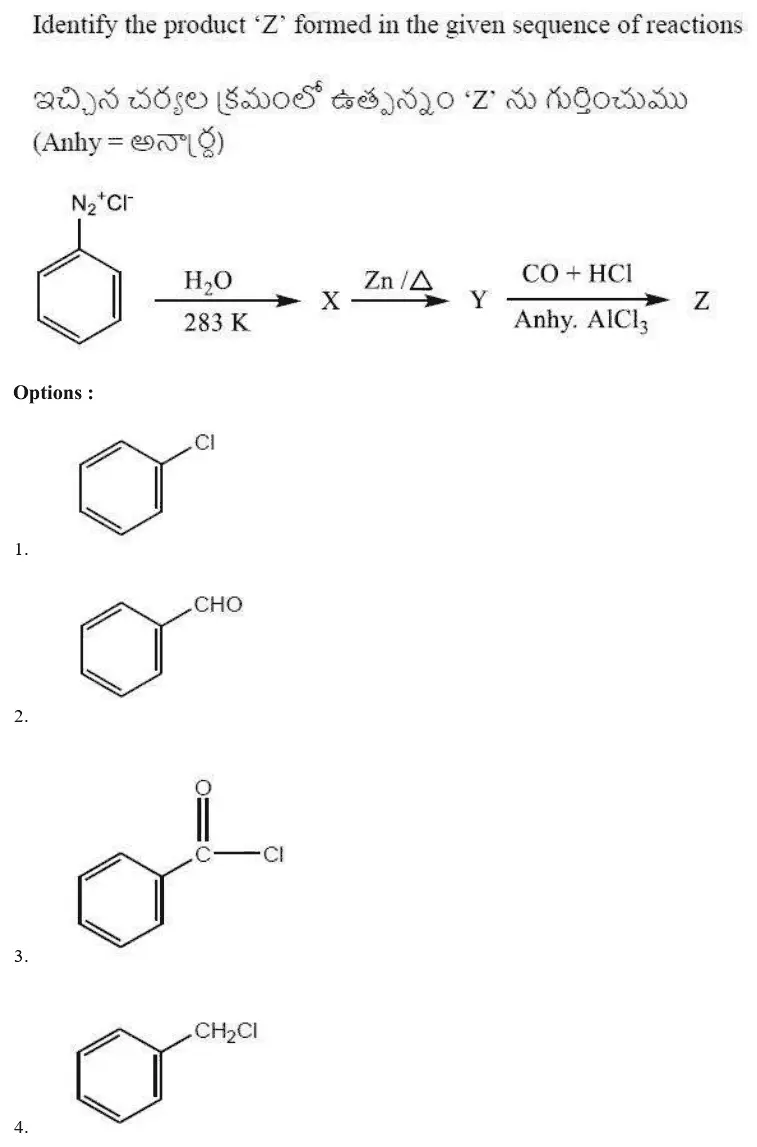
Get EdLoop – freeOpen on the web