EdLoop PYQs · free, no ads · questions and answers here, step-by-step solutions in the EdLoop app
PYQs · free, no adsOpen on the web (app.edloop.in)Get EdLoop – free on Google Play
ChemistryAtomic Structure

Atomic Structure: AP & TS EAPCET PYQs 2010–2026

Every Atomic Structure question from past AP EAPCET and TS EAPCET papers, with options and answers. Newest first.

325questions
148papers covered
5.2%of Chemistry questions, 2022–2026
2010–2026years

Guide at a glance

Atomic Structure is one of the heaviest chapters in Class 11 physical chemistry for both Telugu states. Within the papers we hold for AP and TS EAPCET between 2022 and 2026, this unit brought 161 questions across 77 papers.

Most asked sub-topics

Quantum Mechanical Model113
Bohr Model & Hydrogen Spectrum94
Electromagnetic Radiation & Quantum Theory52
Electronic Configuration41
Early Models & Subatomic Particles25

Practise these in EdLoop

Attempt every Atomic Structure question timed, see the step-by-step solution and track what you get wrong. Free.

Start practice

All questions

325 questions
1AP EAPCET 2026 · 18 May · Shift 1MCQOpen question page ↗

Threshold frequencies of the metals $A$, $B$ respectively are $4 \times 10^{14}$ $Hz$ and $6 \times 10^{14}$ $Hz$. If both are irradiated with light of frequency $10^{15}$ $Hz$, what is the ratio of the kinetic energy of electrons emitted from $A$ and $B$?

  • A

    $2:3$

  • B

    $3:2$

  • C

    $4:9$

  • D

    $9:4$

2AP EAPCET 2026 · 18 May · Shift 1MCQOpen question page ↗

The number of radial nodes possible for $3p$ orbital is $x$ and number of angular nodes possible for $4d$-orbital is $y$. What is $x : y$?

  • A

    $3:2$

  • B

    $2:1$

  • C

    $1:2$

  • D

    $1:1$

3AP EAPCET 2026 · 18 May · Shift 2MCQOpen question page ↗

Wavelength of a particular line in Balmer series of atomic spectrum of hydrogen is 656.4 $nm$. What is the wavelength (in $nm$) of corresponding line in the spectrum of $He^+$?

  • A

    328.2

  • B

    164.1

  • C

    492.3

  • D

    246.1

4AP EAPCET 2026 · 18 May · Shift 2MCQOpen question page ↗

In an atom, electron is moving with a speed of $x\ ms^{-1}$. If its speed is measured within an accuracy of 0.001%, what is its uncertainty in position (in $m$)?

($m_e = 9 \times 10^{-31}\ kg,\ h = 6.6 \times 10^{-34}\ Js$)

  • A

    $\frac{3\pi x}{55}$

  • B

    $\frac{55\pi}{3x}$

  • C

    $\frac{55}{3\pi x}$

  • D

    $\frac{55x}{3\pi}$

5AP EAPCET 2026 · 15 May · Shift 1MCQOpen question page ↗

The threshold frequency of a metal is $1.15 \times 10^{15}$ Hz. If electrons with kinetic energy of 0.20 eV are ejected when this metal surface is irradiated with photons of frequency '$\nu$', the value of $\nu$ is
($h = 6.60 \times 10^{-34}$ Js, 1 eV $= 1.6 \times 10^{-19}$ J)

  • A

    $1.20 \times 10^{14}$ Hz

  • B

    $1.20 \times 10^{15}$ Hz

  • C

    $1.98 \times 10^{14}$ Hz

  • D

    $1.98 \times 10^{15}$ Hz

6AP EAPCET 2026 · 15 May · Shift 1MCQOpen question page ↗

If the energy required to remove an electron from the ground state of $\mathrm{He^+}$ is $x$ J, the energy (in J) required to remove an electron from the ground state of $\mathrm{Li^{2+}}$ is

  • A

    $\frac{3}{2}x$

  • B

    $\frac{2}{3}x$

  • C

    $\frac{9}{4}x$

  • D

    $\frac{4}{9}x$

7AP EAPCET 2026 · 15 May · Shift 2MCQOpen question page ↗

The wavelength of spectral line ($X$) of hydrogen spectrum is same as that of spectral line of $He^+$ spectrum corresponding to $n = 4 \rightarrow n = 2$ electron transition. The correct electron transition corresponding to $X$ is

  • A

    $n = 2 \rightarrow n = 1$

  • B

    $n = 3 \rightarrow n = 2$

  • C

    $n = 4 \rightarrow n = 2$

  • D

    $n = 3 \rightarrow n = 1$

8AP EAPCET 2026 · 15 May · Shift 2MCQOpen question page ↗

The radius of first Bohr orbit of hydrogen is $a_0$ $nm$. What is the de Broglie wavelength (in $nm$) associated with electron present in fourth orbit of hydrogen?

  • A

    $2\pi a_0$

  • B

    $\frac{2\pi a_0}{3}$

  • C

    $8\pi a_0$

  • D

    $4\pi a_0$

9AP EAPCET 2026 · 14 May · Shift 1MCQOpen question page ↗

A ball has a mass of 50g and a speed of 50 m/s. If the speed is measured within an accuracy of 2%, the uncertainty in its position (in m) is
($\mathrm{h} = 6.626 \times 10^{-34}$ J s, $\pi$=3.14)

  • A

    $2.12 \times 10^{-34}$

  • B

    $1.06 \times 10^{-33}$

  • C

    $2.12 \times 10^{-33}$

  • D

    $1.06 \times 10^{-34}$

10AP EAPCET 2026 · 14 May · Shift 1MCQOpen question page ↗

The work function of Mg, Cu, Ag, Li are 3.7, 4.8, 4.3, 2.5 eV respectively. A wavelength of 300 nm light is shined on them. The metals which undergo photoelectric effect are

  • A

    Mg, Cu

  • B

    Cu, Ag

  • C

    Ag, Li

  • D

    Mg, Li

11AP EAPCET 2026 · 14 May · Shift 2MCQOpen question page ↗

In a photoelectric effect, the kinetic energy of electrons is $1.3 \times 10^{-19}$ J. If work function of the metal is 2.27 eV, then the frequency (in Hz) of the incident radiation is
($h = 6.6 \times 10^{-34}$ Js, $1\,\mathrm{eV} = 1.6 \times 10^{-19}$ J)

  • A

    $7.47 \times 10^{15}$

  • B

    $7.47 \times 10^{14}$

  • C

    $6.47 \times 10^{15}$

  • D

    $3.47 \times 10^{14}$

12AP EAPCET 2026 · 14 May · Shift 2MCQOpen question page ↗

Consider the following two statements

Statement – I: The order of energies of 2s – orbitals of $H, Li$ and $Na$ is

$$E_{2s}(H) < E_{2s}(Li) < E_{2s}(Na)$$

Statement – II: The photoelectric effect explains the wave nature of light

The correct answer is

  • A

    Both statements – I and II are correct

  • B

    Statement – I is correct but Statement – II is not correct

  • C

    Statement – I is not correct but Statement – II is correct

  • D

    Both statements – I and II are not correct

13AP EAPCET 2026 · 13 May · Shift 1MCQOpen question page ↗

The energy of spectral line of lowest frequency in Lyman series of $\mathrm{Li^{2+}}$ spectrum is $x$ J. The energy of second spectral line in Balmer series of $\mathrm{He^+}$ spectrum is $y$ J. The ratio of $x$ and $y$ is

  • A

    $3:1$

  • B

    $1:3$

  • C

    $1:9$

  • D

    $9:1$

14AP EAPCET 2026 · 13 May · Shift 1MCQOpen question page ↗

Quantum number sets of four electrons I, II, III, IV are given below. The correct order of the energy of these electrons is

I. $n = 3, l = 1, m_l = -1, m_s = +\frac{1}{2}$

II. $n = 4, l = 1, m_l = 0, m_s = +\frac{1}{2}$

III. $n = 4, l = 2, m_l = -2, m_s = +\frac{1}{2}$

IV. $n = 3, l = 2, m_l = -1, m_s = -\frac{1}{2}$

The correct answer is

  • A

    $\mathrm{I} > \mathrm{IV} > \mathrm{II} > \mathrm{III}$

  • B

    $\mathrm{III} > \mathrm{II} > \mathrm{I} > \mathrm{IV}$

  • C

    $\mathrm{III} > \mathrm{IV} > \mathrm{II} > \mathrm{I}$

  • D

    $\mathrm{III} > \mathrm{II} > \mathrm{IV} > \mathrm{I}$

15AP EAPCET 2026 · 13 May · Shift 1MCQOpen question page ↗

In which of the following, elements are correctly arranged in the increasing order of unpaired electrons?

  • A

    $\mathrm{Fe} < \mathrm{Co} < \mathrm{Ni} < \mathrm{Mn}$

  • B

    $\mathrm{Ni} < \mathrm{Co} < \mathrm{Mn} < \mathrm{Fe}$

  • C

    $\mathrm{Mn} < \mathrm{Fe} < \mathrm{Co} < \mathrm{Ni}$

  • D

    $\mathrm{Ni} < \mathrm{Co} < \mathrm{Fe} < \mathrm{Mn}$

16AP EAPCET 2026 · 13 May · Shift 2MCQOpen question page ↗

If the radius of the first Bohr orbit of $He^{+}$ is $26.45\ pm$, then the de Broglie wavelength (in $m$) associated with the electron present in its fourth orbit is ($\pi = 3.14$)

  • A

    $3.13 \times 10^{-11}$

  • B

    $1.33 \times 10^{-11}$

  • C

    $2.33 \times 10^{-10}$

  • D

    $3.32 \times 10^{-10}$

17AP EAPCET 2026 · 13 May · Shift 2MCQOpen question page ↗

Consider the elements with atomic number ($Z$) from 11 to 18. The ratio of number of $s$-electrons to $p$-electrons in element $X$ is $2:3$ and in element $Y$ is $3:5$. What are $X$ and $Y$?

  • A

    $\mathrm{Mg, Al}$

  • B

    $\mathrm{Si, P}$

  • C

    $\mathrm{P, S}$

  • D

    $\mathrm{S, Cl}$

18AP EAPCET 2026 · 12 May · Shift 1MCQOpen question page ↗

In an atomic spectrum of hydrogen, a series of lines with wavelengths at 656.46, 486.27, $x$ and 410.29 nm was obtained. What is the value of $x$ (in nm)?

($\mathrm{R_H}$ = $1.097 \times 10^7 \mathrm{m^{-1}}$)

  • A

    453.15

  • B

    449.32

  • C

    434.17

  • D

    428.37

19AP EAPCET 2026 · 12 May · Shift 1MCQOpen question page ↗

If two particles have same kinetic energy, then the ratio of their de Broglie wavelengths ($\lambda_A : \lambda_B$) is
(Given: $m_A = 4m_B$)

  • A

    $1 : 2$

  • B

    $2 : 1$

  • C

    $1 : 4$

  • D

    $4 : 1$

20AP EAPCET 2026 · 12 May · Shift 2MCQOpen question page ↗

Wavelength of a photon emitted during electron transition from $n = 4$ state to $n = 2$ state in the hydrogen atom is $x$ nm. Wavelength of a photon emitted during electron transition from $n = 4$ state to $n = 1$ state in the same atom is $y$ nm. $\frac{y}{x}$ is equal to

  • A

    0.4

  • B

    0.2

  • C

    0.5

  • D

    0.3

21AP EAPCET 2026 · 12 May · Shift 2MCQOpen question page ↗

The de Broglie wavelength associated with a pebble of mass $6.63\ g$ travelling with velocity $\underline{x}\ ms^{-1}$ is $10^{-24}$ nm. What is the value of $x$?

($h = 6.63 \times 10^{-34}\ Js$)

  • A

    $1.0 \times 10^{-1}$

  • B

    $1.0 \times 10^{2}$

  • C

    $1.0 \times 10^{3}$

  • D

    $1.0 \times 10^{-2}$

22TS EAPCET 2026 · 11 May · Shift 1MCQOpen question page ↗

The energy of orbit X of $\mathrm{Li^{2+}}$ ($Z=3$) is $-2.18\times10^{-18}$ J. What is the radius of the same orbit (in Å)?

  • A

    2.116

  • B

    2.105

  • C

    1.587

  • D

    2.645

23TS EAPCET 2026 · 11 May · Shift 1MCQOpen question page ↗

If $\nu_0$ and $\nu$ represent the threshold frequency and frequency of incident light respectively, then the correct equation for the velocity of photoelectrons emitted from the metal surface will be

  • A

    $v=\sqrt{\dfrac{2h}{m}(\nu-\nu_0)}$

  • B

    $v=\sqrt{\dfrac{2h}{m}(\nu_0-\nu)}$

  • C

    $v=\sqrt{\dfrac{m}{2h}(\nu-\nu_0)}$

  • D

    $v=\sqrt{\dfrac{m}{2hc}(\nu_0-\nu)}$

24TS EAPCET 2026 · 11 May · Shift 2MCQOpen question page ↗

The work function of three metals A, B and C is respectively 2.25, 2.42 and 3.6 eV. All the three metals were irradiated with light of wavelength 330 nm. The kinetic energy of photoelectrons emitted from A, B and C is respectively $\mathrm{E_A, E_B}$ and $\mathrm{E_C}$. The correct relationship of $\mathrm{E_A, E_B}$ and $\mathrm{E_C}$ is

($h = 6.6\times10^{-34}$ Js; $c = 3\times10^{8}$ ms$^{-1}$)

  • A

    $\mathrm{E_A > E_B > E_C}$

  • B

    $\mathrm{E_A = E_B = E_C}$

  • C

    $\mathrm{E_A < E_B < E_C}$

  • D

    $\mathrm{E_C > E_A > E_B}$

25TS EAPCET 2026 · 11 May · Shift 2MCQOpen question page ↗

Observe the given two statements about $\alpha$-particle experiment and Rutherford assumptions.

Statement-I: The ratio of atomic radius to its nuclear radius is $10^5$

Statement-II: In atom, majority of the space is vacant

The correct answer is

  • A

    Both statements I and II are correct

  • B

    Statement I is correct, but statement II is not correct

  • C

    Statement I is not correct, but statement II is correct

  • D

    Both statements I and II are not correct

26TS EAPCET 2026 · 10 May · Shift 1MCQOpen question page ↗

The kinetic energy of photo electron emitted from the surface of a metal is $7.2\times10^{-20}$ J , when the metal is made to strike with light having wavelength $x$ nm. What is the value of $x$?

(Work function of metal = 4.5 eV; h = $6.6\times10^{-34}$ Js; c = $3\times10^{8}$ ms$^{-1}$; 1 eV = $1.6\times10^{-19}$ J )

  • A

    125

  • B

    250

  • C

    175

  • D

    150

27TS EAPCET 2026 · 10 May · Shift 1MCQOpen question page ↗

The wavelength of electron in the third orbit of hydrogen atom is $6\pi a_0$. The kinetic energy of electron (in J) is equal to

(Where, $K = \frac{h^2}{\pi^2 a_0^2 m_e}$; $a_0$ = radius of first orbit of hydrogen, $m_e$ = mass of electron, h = Planck's constant)

  • A

    $\frac{K}{36}$

  • B

    $\frac{K}{108}$

  • C

    $\frac{K}{72}$

  • D

    $\frac{K}{18}$

28TS EAPCET 2026 · 10 May · Shift 2MCQOpen question page ↗

The radius of first Bohr orbit of hydrogen atom is $r_o$ Å. The wavelength (in Å) of electron associated with sixth orbit of same atom is

  • A

    $6\pi r_o$

  • B

    $3\pi r_o$

  • C

    $8\pi r_o$

  • D

    $12\pi r_o$

29TS EAPCET 2026 · 10 May · Shift 2MCQOpen question page ↗

The velocity of the photoelectron (in $\mathrm{ms^{-1}}$) emitted when a smooth surface of a metal is made to strike with a photon of wavelength $4\times10^{-7}\,\mathrm{m}$ is
(W$_0$ of metal = 2.13 eV ; 1 eV = $1.6\times10^{-19}$ J ; h = $6.6\times10^{-34}$ Js ; $\mathrm{m_e}$ = $9.1\times10^{-31}$ kg)

  • A

    $\frac{1}{\sqrt{5}}\times10^{6}$

  • B

    $\frac{1}{\sqrt{3}}\times10^{5}$

  • C

    $\frac{1}{\sqrt{3}}\times10^{6}$

  • D

    $\frac{1}{\sqrt{7}}\times10^{5}$

30TS EAPCET 2026 · 9 May · Shift 1MCQOpen question page ↗

The ratio of wavenumber of first line of Balmer series and wavenumber of second line of Lyman series of hydrogen atom is

  • A

    $5:32$

  • B

    $32:5$

  • C

    $22:7$

  • D

    $7:22$

31TS EAPCET 2026 · 9 May · Shift 1MCQOpen question page ↗

The wavelength of electron in the orbit X of hydrogen atom is $6\pi a_0$, What is the value of X?

($a_0$=Radius of first orbit of hydrogen atom)

  • A

    2

  • B

    3

  • C

    4

  • D

    1

32TS EAPCET 2026 · 9 May · Shift 2MCQOpen question page ↗

In hydrogen atom, electron is present in $\mathrm{n_x}$ state. The energy of Lyman spectral line of hydrogen spectrum originated from $\mathrm{n_x}$ state is $1.635\times10^{-18}$ J. What is the approximate energy (in J) required to excite this electron from $\mathrm{n_x}$ state to $(\mathrm{n_x}+1)$ state?

  • A

    $3\times10^{-19}$

  • B

    $3\times10^{-18}$

  • C

    $1.6\times10^{-18}$

  • D

    $3\times10^{-20}$

33TS EAPCET 2026 · 9 May · Shift 2MCQOpen question page ↗

In H atom, electron is present in $\mathrm{n_x}$ state. The angular momentum of this electron is $1.051\times10^{-34}$ Js. What is the energy (in J) required to excite this electron from $\mathrm{n_x}$ state to $(\mathrm{n_x}+1)$ state?
($h=6.6\times10^{-34}$ Js; $\pi=3.14$)

  • A

    $2.18\times10^{-18}$

  • B

    $0.545\times10^{-18}$

  • C

    $1.93\times10^{-19}$

  • D

    $1.635\times10^{-18}$

34AP EAPCET 2025 · 27 May · Shift 1MCQOpen question page ↗

The wavelength of a particular electron transition for $\mathrm{He^+}$ is 100 nm. The wavelength (in Å) of H atom for the same transition is

  • A

    1000

  • B

    100

  • C

    4000

  • D

    2000

35AP EAPCET 2025 · 27 May · Shift 1MCQOpen question page ↗

The energy of second Bohr orbit of hydrogen atom is $-3.4$ eV. The energy of the fourth Bohr orbit of the $\mathrm{He^+}$ ion will be

  • A

    $-3.4$ eV

  • B

    $-13.6$ eV

  • C

    $-6.8$ eV

  • D

    $-0.85$ eV

36AP EAPCET 2025 · 26 May · Shift 1MCQOpen question page ↗

The work function of Cu is $7.68\times10^{-19}$ J. If photons of wavelength 221 nm are made to strike the surface of the metal, the kinetic energy (in J) of the ejected electrons will be (h = $6.63 \times 10^{-34}$ Js)

  • A

    $2.64 \times 10^{-18}$

  • B

    $1.32 \times 10^{-19}$

  • C

    $2.64 \times 10^{-19}$

  • D

    $6.60 \times 10^{-19}$

37AP EAPCET 2025 · 26 May · Shift 1MCQOpen question page ↗

In an element with atomic number (Z) 25, the number of electrons with $(n + l)$ value equal to 3 and 4 are $x$ and $y$ respectively. The value of $(x + y)$ is

  • A

    21

  • B

    12

  • C

    14

  • D

    16

38AP EAPCET 2025 · 26 May · Shift 2MCQOpen question page ↗

a, b, c, d are electromagnetic radiations. Frequencies of a, b are $3\times10^{15}$ Hz, $2\times10^{14}$ Hz, respectively, whereas wavelength of c, d are 400 nm, 750 nm, respectively. The increasing order of their energies is

  • A

    b, d, c, a

  • B

    a, d, c, b

  • C

    a, b, c, d

  • D

    b, c, d, a

39AP EAPCET 2025 · 26 May · Shift 2MCQOpen question page ↗

The number of electrons with magnetic quantum number, $\mathrm{m}_l = 0$ in the elements with atomic numbers $Z = 24$ and $Z = 29$ are respectively

  • A

    12, 13

  • B

    12, 12

  • C

    13, 12

  • D

    14, 15

40AP EAPCET 2025 · 24 May · Shift 1MCQOpen question page ↗

Which of the following represents the wavelength of spectral line of Balmer series of $\mathrm{He^+}$ ion?

(R = Rydberg constant, n > 2)

  • A

    $\frac{n^2}{R(n-2)(n+2)}$

  • B

    $\frac{R(n-2)(n+2)}{n^2}$

  • C

    $\frac{n^2}{4R(n-2)(n+2)}$

  • D

    $\frac{4R(n-2)(n+2)}{n^2}$

41AP EAPCET 2025 · 24 May · Shift 1MCQOpen question page ↗

The work functions (in eV) of Mg, Cu, Ag, Na respectively are 3.7, 4.8, 4.3, 2.3. From how many metals, the electrons will be ejected if their surfaces are irradiated with an electromagnetic radiation of wavelength 300 nm ?

($\mathrm{h} = 6.6\times10^{-34}$ Js, $1\,\mathrm{eV} = 1.6\times10^{-19}$ J)

  • A

    1

  • B

    4

  • C

    2

  • D

    3

42AP EAPCET 2025 · 23 May · Shift 1MCQOpen question page ↗

The radius of fourth orbit in $\mathrm{He^+}$ ion is '$\mathrm{R_1}$' pm and radius of third orbit in $\mathrm{Li^{2+}}$ ion is '$\mathrm{R_2}$' pm. The value of $(\mathrm{R_1 - R_2})$ in pm is

  • A

    132.25

  • B

    529.00

  • C

    264.50

  • D

    793.50

43AP EAPCET 2025 · 23 May · Shift 1MCQOpen question page ↗

The deBroglie wavelengths of two fast moving particles X, Y are 1 nm, 3 nm respectively. Mass of X is nine times the mass of Y. The ratio of kinetic energies of X, Y is

  • A

    $1 : 3$

  • B

    $1 : 1$

  • C

    $9 : 1$

  • D

    $1 : 9$

44AP EAPCET 2025 · 23 May · Shift 2MCQOpen question page ↗

The uncertainty in the velocities of two particles A and B are 0.03 and 0.01 $\mathrm{m\,s^{-1}}$ respectively. The mass of B is four times to the mass of A. The ratio of uncertainties in their positions is

  • A

    $\frac{4}{3}$

  • B

    $\frac{3}{4}$

  • C

    $\frac{16}{9}$

  • D

    $\frac{9}{16}$

45AP EAPCET 2025 · 23 May · Shift 2MCQOpen question page ↗

The total maximum number of electrons possible in 3d, 6d, 5s and 4f orbitals with $\mathrm{m}_l$ (magnetic quantum number) value $-2$ is

  • A

    6

  • B

    8

  • C

    10

  • D

    12

46AP EAPCET 2025 · 23 May · Shift 2MCQOpen question page ↗

Identify the set containing isoelectronic species.

  • A

    $\mathrm{N_2, O_2^{2-}, NO^+}$

  • B

    $\mathrm{N_2, CO, NO^+}$

  • C

    $\mathrm{F_2, O_2^{2-}, N_2}$

  • D

    $\mathrm{N_2, O_2^{2+}, C_2}$

47AP EAPCET 2025 · 22 May · Shift 1MCQOpen question page ↗

The wavenumber of the first line ($\mathrm{n_2} = 3$) in the Balmer series of hydrogen is $\overline{\mathrm{v}}_1\ \mathrm{cm^{-1}}$. What is the wavenumber (in $\mathrm{cm^{-1}}$) of the second line ($\mathrm{n_2} = 4$) in the Balmer series of $\mathrm{He^+}$ ?

  • A

    $\dfrac{5\overline{\mathrm{v}}_1}{27}$

  • B

    $\dfrac{27\overline{\mathrm{v}}_1}{5}$

  • C

    $\dfrac{27\overline{\mathrm{v}}_1}{20}$

  • D

    $\dfrac{20\overline{\mathrm{v}}_1}{27}$

48AP EAPCET 2025 · 22 May · Shift 1MCQOpen question page ↗

Which of the following sets of quantum numbers is not possible for the electron?

  • A

    $n=3,\ l=1,\ m=0\ s=+\frac{1}{2}$

  • B

    $n=4,\ l=0,\ m=0\ s=-\frac{1}{2}$

  • C

    $n=3,\ l=3,\ m=-3\ s=+\frac{1}{2}$

  • D

    $n=1,\ l=0,\ m=0\ s=-\frac{1}{2}$

49AP EAPCET 2025 · 22 May · Shift 2MCQOpen question page ↗

The difference between the radii of $3^{\mathrm{rd}}$ and $2^{\mathrm{nd}}$ orbit of H-atom is $x$ pm. The difference between the radii of $4^{\mathrm{th}}$ and $3^{\mathrm{rd}}$ orbit of $\mathrm{Li^{2+}}$ ion is $y$ pm. $y : x$ is equal to

  • A

    $15 : 7$

  • B

    $7 : 15$

  • C

    $3 : 1$

  • D

    $1 : 3$

50AP EAPCET 2025 · 22 May · Shift 2MCQOpen question page ↗

The de Broglie wavelength of an electron in the third Bohr orbit of H-atom is

  • A

    $3\pi \times 5.29$ pm

  • B

    $4\pi \times 52.9$ pm

  • C

    $6\pi \times 52.9$ pm

  • D

    $2\pi \times 5.29$ pm

51AP EAPCET 2025 · 21 May · Shift 1MCQOpen question page ↗

When a metal surface is irradiated with light of frequency $x$ Hz, the kinetic energy of emitted photoelectrons is $z$ J. When the same metal is irradiated with light of frequency $y$ Hz, the kinetic energy of emitted electrons is $\frac{z}{3}$ J. What is the threshold frequency (in Hz) of metal ?

  • A

    $\frac{3}{2}(y-x)$

  • B

    $\left(\frac{3y-x}{2}\right)$

  • C

    $\left(\frac{2y-x}{3}\right)$

  • D

    $\frac{2}{3}(y-x)$

52AP EAPCET 2025 · 21 May · Shift 1MCQOpen question page ↗

Identify the correct statements from the following

I) Isotopes of an element show different chemical behaviour

II) Lyman series of lines of hydrogen spectrum appear in UV region

III) The oscillating electric and magnetic field components of electromagnetic radiation are perpendicular to each other and both are perpendicular to the direction of propagation of radiation

  • A

    II & III only

  • B

    I & II only

  • C

    I & III only

  • D

    I, II, III

53AP EAPCET 2025 · 21 May · Shift 2MCQOpen question page ↗

The uncertainty in the position of electron ($\Delta x$) is approximately 100 pm. The uncertainty in momentum (in $\mathrm{kg\ m\ s^{-1}}$) of an electron is [h = $6.626\times10^{-34}$ Js]

  • A

    $1.104\times10^{-22}$

  • B

    $0.527\times10^{-27}$

  • C

    $0.527\times10^{-24}$

  • D

    $1.055\times10^{-24}$

54AP EAPCET 2025 · 21 May · Shift 2MCQOpen question page ↗

Which of the following statements are correct ? (only)

I) The energy of hydrogen atom in its ground state is $-13.6$ eV

II) On the basis of Bohr's model, the radius of the $3^{\mathrm{rd}}$ orbit of hydrogen atom is 158.7 pm

III) The order of radius of the first orbit of H, $\mathrm{He^+}$, $\mathrm{Li^{2+}}$ and $\mathrm{Be^{3+}}$ is $\mathrm{H} > \mathrm{He^+} > \mathrm{Li^{2+}} > \mathrm{Be^{3+}}$

  • A

    II & III only

  • B

    I & III only

  • C

    I & II only

  • D

    I, II, III

55TS EAPCET 2025 · 4 May · Shift 1MCQOpen question page ↗

The radius of second orbit of hydrogen atom is same as that of orbit (n) of an ion (x).

n and x are respectively

  • A

    4, $\mathrm{Be^{2+}}$

  • B

    3, $\mathrm{Li^{2+}}$

  • C

    4, $\mathrm{Be^{3+}}$

  • D

    2, $\mathrm{He^{+}}$

56TS EAPCET 2025 · 4 May · Shift 1MCQOpen question page ↗

An electromagnetic radiation of wavelength 331.5 nm is made to strike the surface of a metal. Electrons are emitted with a kinetic energy of $1.2\times10^{5}\,\mathrm{J\,mol^{-1}}$. The work function (in eV) of the metal is
$(\mathrm{h}=6.63\times10^{-34}\,\mathrm{Js},\ \mathrm{N_A}=6\times10^{23}\,\mathrm{mol^{-1}})$

  • A

    1.5

  • B

    3.0

  • C

    3.5

  • D

    2.5

57TS EAPCET 2025 · 4 May · Shift 2MCQOpen question page ↗

Observe the following statements

Statement-I : Rutherford model of an atom cannot explain the stability of an atom

Statement-II : The wavelength of X-rays is higher than the wavelength of microwaves

The correct answer is

  • A

    Both statements I and II are correct

  • B

    Both statements I and II are not correct

  • C

    Statement I is correct, but statement II is not correct

  • D

    Statement I is not correct, but statement II is correct

58TS EAPCET 2025 · 4 May · Shift 2MCQOpen question page ↗

In hydrogen atom, an electron is transferred from an orbit of radius 1.3225 nm to another orbit of radius 0.2116 nm. What is the energy (in J) of emitted radiation?

  • A

    $1.635\times10^{-18}$

  • B

    $3.027\times10^{-19}$

  • C

    $4.087\times10^{-19}$

  • D

    $0.4578\times10^{-18}$

59TS EAPCET 2025 · 3 May · Shift 1MCQOpen question page ↗

The energy associated with electron in first orbit of hydrogen atom is $-2.18\times10^{-18}\,\mathrm{J}$. The frequency of the light required (in Hz) to excite the electron to fifth orbit is

($\mathrm{h}=6.6\times10^{-34}\,\mathrm{Js}$)

  • A

    $2.17\times10^{16}$

  • B

    $3.17\times10^{14}$

  • C

    $2.17\times10^{15}$

  • D

    $3.17\times10^{15}$

60TS EAPCET 2025 · 3 May · Shift 1MCQOpen question page ↗

In $\mathrm{Sr}$ ($Z=38$), the number of electrons with $l=0$ is $x$, number of electrons with $l=2$ is $y$. $(x-y)$ is equal to

($l$ = Azimuthal quantum number)

  • A

    $0$

  • B

    $8$

  • C

    $-2$

  • D

    $2$

61TS EAPCET 2025 · 3 May · Shift 2MCQOpen question page ↗

In the atomic spectrum of hydrogen, the wavelengths of the spectral lines corresponding to electronic transitions (i) n = 4 to n = 2 and (ii) n = 3 to n = 1 are $\lambda_1$ and $\lambda_2$ Å respectively. The value of $(\lambda_1 - \lambda_2)$ (in cm) is

($\mathrm{R_H}$ = Rydberg constant)

  • A

    $\frac{1}{\mathrm{R_H}}\left[\frac{24}{101}\right]$

  • B

    $\mathrm{R_H}\left[\frac{24}{101}\right]$

  • C

    $\frac{1}{\mathrm{R_H}}\left[\frac{101}{24}\right]$

  • D

    $\mathrm{R_H}\left[\frac{101}{24}\right]$

62TS EAPCET 2025 · 3 May · Shift 2MCQOpen question page ↗

Work functions of four metals $\mathrm{M_1}$, $\mathrm{M_2}$, $\mathrm{M_3}$ and $\mathrm{M_4}$ are 4.8, 4.3, 4.75 and 3.75 eV respectively. The metals which do not show photoelectric effect when light of wavelength 310 nm falls on the metals are

  • A

    $\mathrm{M_1}$, $\mathrm{M_2}$ only

  • B

    $\mathrm{M_1}$, $\mathrm{M_3}$ only

  • C

    $\mathrm{M_1}$, $\mathrm{M_2}$, $\mathrm{M_3}$ only

  • D

    $\mathrm{M_1}$, $\mathrm{M_2}$, $\mathrm{M_4}$ only

63TS EAPCET 2025 · 2 May · Shift 1MCQOpen question page ↗

The radius of stationary state $(n = 2)$ of hydrogen atom is $x$ pm. The radius of stationary state $(n = 3)$ of $\mathrm{He^+}$ ion (in pm) is

  • A

    $\frac{9}{8x}$

  • B

    $\frac{9x}{8}$

  • C

    $\frac{16x}{9}$

  • D

    $\frac{9}{16x}$

64TS EAPCET 2025 · 2 May · Shift 1MCQOpen question page ↗

When electromagnetic radiation of wavelength 310 nm falls on the surface of a metal having work function 3.55 eV, the velocity of photoelectrons emitted is $x \times 10^5\,\mathrm{ms^{-1}}$. The value of $x$ is (Nearest integer)

($\mathrm{m_e} = 9\times10^{-31}\,\mathrm{kg}$)

  • A

    2

  • B

    4

  • C

    5

  • D

    6

65TS EAPCET 2025 · 2 May · Shift 2MCQOpen question page ↗

The electron in hydrogen atom undergoes transition from higher orbits to an orbit of radius 476.1 pm. This transition corresponds to which of the following series?

  • A

    Lyman

  • B

    Paschen

  • C

    Balmer

  • D

    Pfund

66TS EAPCET 2025 · 2 May · Shift 2MCQOpen question page ↗

Identify the incorrect statement from the following?

  • A

    $\mathrm{m_l}$ designates the orientation of the orbital

  • B

    The probability density of electron is expressed by $|\psi|^3$

  • C

    The total information about electron in atom is stored in its $\psi$

  • D

    Total number of orbitals in a sub level is equal to $(2l+1)$

68AP EAPCET 2024 · 23 May · Shift 1MCQOpen question page ↗

If the position of the electron was measured with an accuracy of $\pm 0.002$ nm, the uncertainty in the momentum of it would be (in $\mathrm{kg\,ms^{-1}}$) ($h = 6.626 \times 10^{-34}$ J s)

  • A

    $2.637 \times 10^{-23}$

  • B

    $2.637 \times 10^{-24}$

  • C

    $8.283 \times 10^{-23}$

  • D

    $8.283 \times 10^{-24}$

69AP EAPCET 2024 · 22 May · Shift 1MCQOpen question page ↗

If the longest wavelength of spectral line of Paschen series of $\mathrm{Li^{2+}}$ ion spectrum is $x$ Å, then the longest wavelength (in Å) of Lyman series of hydrogen spectrum is

  • A

    $\frac{12}{7x}$

  • B

    $\frac{7x}{12}$

  • C

    $\frac{20x}{27}$

  • D

    $\frac{27x}{20}$

70AP EAPCET 2024 · 22 May · Shift 1MCQOpen question page ↗

If $v_0$ is the threshold frequency of a metal X, the correct relation between de Broglie wavelength ($\lambda$) associated with photoelectron and frequency ($v$) of the incident radiation is

  • A

    $\lambda \propto \dfrac{1}{\sqrt{v - v_0}}$

  • B

    $\lambda \propto \dfrac{1}{(v - v_0)^{1/4}}$

  • C

    $\lambda \propto \dfrac{1}{(v - v_0)^{3/4}}$

  • D

    $\lambda \propto \sqrt{v - v_0}$

71AP EAPCET 2024 · 22 May · Shift 2MCQOpen question page ↗

The de Broglie wavelength of an electron with kinetic energy of 2.5 eV is (in m)

($1\ \mathrm{eV} = 1.6 \times 10^{-19}\ \mathrm{J}$, $m_e = 9 \times 10^{-31}\ \mathrm{kg}$)

  • A

    $\dfrac{h \times 10^{-25}}{\sqrt{72}}$

  • B

    $\dfrac{h \times 10^{25}}{\sqrt{72}}$

  • C

    $\dfrac{\sqrt{72}}{h \times 10^{-25}}$

  • D

    $\dfrac{\sqrt{72}}{h \times 10^{25}}$

72AP EAPCET 2024 · 22 May · Shift 2MCQOpen question page ↗

The ratio of ground state energy of $\mathrm{Li^{2+}}$, $\mathrm{He^{+}}$, $\mathrm{H}$ is

  • A

    $3:2:1$

  • B

    $1:2:3$

  • C

    $9:4:1$

  • D

    $1:4:9$

73AP EAPCET 2024 · 21 May · Shift 1MCQOpen question page ↗

The energy of third orbit of $\mathrm{Li^{2+}}$ ion (in J) is

  • A

    $-2.18 \times 10^{-18}$

  • B

    $-6.54 \times 10^{-18}$

  • C

    $-7.3 \times 10^{-19}$

  • D

    $+2.18 \times 10^{-18}$

74AP EAPCET 2024 · 21 May · Shift 1MCQOpen question page ↗

The number of d electrons in Fe is equal to which of the following?

i. Total number of 's' electrons of Mg

ii. Total number of 'p' electrons of Cl

iii. Total number of 'p' electrons of Ne

The correct option is

  • A

    i, ii only

  • B

    ii, iii only

  • C

    i, iii only

  • D

    i, ii, iii

75AP EAPCET 2024 · 21 May · Shift 2MCQOpen question page ↗

The difference in radii between fourth and third Bohr orbits of $\mathrm{He^+}$ (in m) is

  • A

    $2.64 \times 10^{-10}$

  • B

    $1.85 \times 10^{-12}$

  • C

    $1.85 \times 10^{-10}$

  • D

    $1.85 \times 10^{-9}$

76AP EAPCET 2024 · 21 May · Shift 2MCQOpen question page ↗

If $\lambda_0$ and $\lambda$ are respectively the threshold wavelength and wavelength of incident light, the velocity of photo electrons ejected from the metal surface is

  • A

    $\sqrt{\dfrac{2h}{m}(\lambda_0-\lambda)}$

  • B

    $\sqrt{\dfrac{2hc}{m}\left(\dfrac{\lambda_0-\lambda}{\lambda\lambda_0}\right)}$

  • C

    $\sqrt{\dfrac{2hc}{m}(\lambda_0-\lambda)}$

  • D

    $\sqrt{\dfrac{2h}{m}\left(\dfrac{1}{\lambda_0}-\dfrac{1}{\lambda}\right)}$

77AP EAPCET 2024 · 20 May · Shift 1MCQOpen question page ↗

The angular momentum of an electron in a stationary state of $\mathrm{Li^{2+}}$ ($Z = 3$) is $3h/\pi$. The radius and energy of that stationary state are respectively

  • A

    $3.174\ \mathrm{\AA},\ -5.45\times 10^{-19}\ \mathrm{J}$

  • B

    $6.348\ \mathrm{\AA},\ -5.45\times 10^{-19}\ \mathrm{J}$

  • C

    $6.348\ \mathrm{\AA},\ +5.45\times 10^{-18}\ \mathrm{J}$

  • D

    $2.116\ \mathrm{\AA},\ -5.45\times 10^{-19}\ \mathrm{J}$

78AP EAPCET 2024 · 20 May · Shift 1MCQOpen question page ↗

Identify the pair of elements in which number of electrons in $(n-1)$ shell is same

  • A

    Fe, Mn

  • B

    Zn, Fe

  • C

    K, Sc

  • D

    Mn, Cr

79AP EAPCET 2024 · 20 May · Shift 2MCQOpen question page ↗

If uncertainty in position and momentum of an electron are equal, then uncertainty in its velocity is

  • A

    $\frac{1}{2m}\sqrt{\frac{h}{\pi}}$

  • B

    $\frac{1}{m}\sqrt{\frac{h}{\pi}}$

  • C

    $\sqrt{\frac{h}{\pi}}$

  • D

    $m\sqrt{\frac{h}{\pi}}$

80AP EAPCET 2024 · 20 May · Shift 2MCQOpen question page ↗

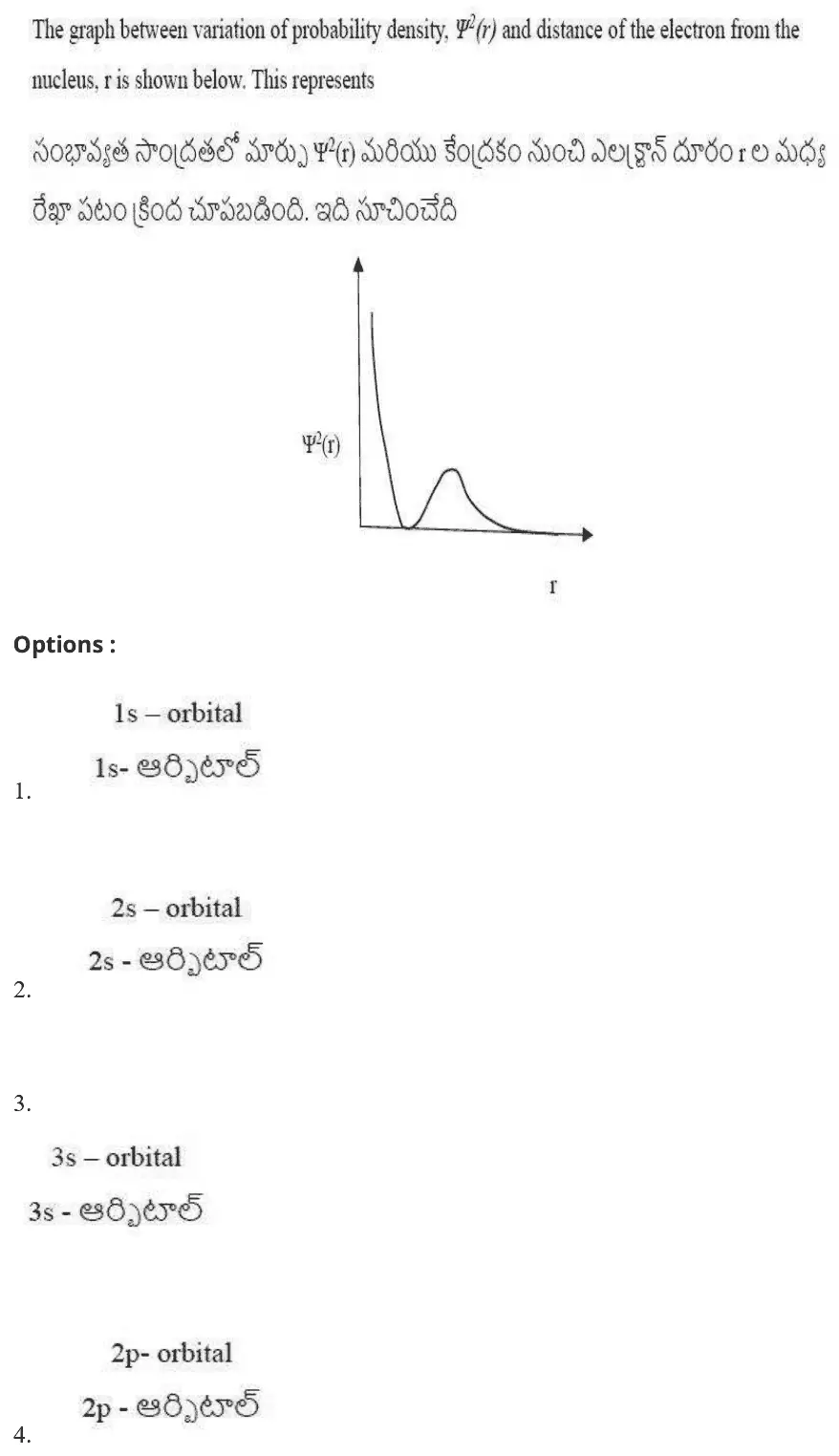
The graph between variation of probability density, $\Psi^2(r)$ and distance of the electron from the nucleus, r is shown below. This represents

(see the figure above)

The question and its figure as printed in AP EAPCET 2024 20th May 2024 Shift 2.
The question as printed in the paper.
  • A

    1s – orbital

  • B

    2s – orbital

  • C

    3s – orbital

  • D

    2p- orbital

81AP EAPCET 2024 · 19 May · Shift 2MCQOpen question page ↗

In the ground state of hydrogen atom, electron absorbs 1.5 times energy than the minimum energy $(2.18 \times 10^{-18}\ \mathrm{J})$ to escape from the atom. The wavelength of the emitted electron (in m) is $(m_e = 9 \times 10^{-31}\ \mathrm{kg})$

  • A

    $\dfrac{h \times 10^{24}}{\sqrt{1.962}}$

  • B

    $\dfrac{h}{\sqrt{1.962}} \times 10^{23}$

  • C

    $\dfrac{h}{\sqrt{1.962}} \times 10^{25}$

  • D

    $\dfrac{h}{\sqrt{1.962}} \times 10^{22}$

82AP EAPCET 2024 · 19 May · Shift 2MCQOpen question page ↗

A golf ball of mass ‘m’ g has a speed of 50 m s$^{-1}$. If the speed can be measured within accuracy of 2%, the uncertainty in the position is

  • A

    $\frac{h}{4\pi m}$

  • B

    $\frac{h}{16\pi m}$

  • C

    $\frac{h}{4\pi m} \times 10^{3}$

  • D

    $\frac{h}{16\pi m} \times 10^{3}$

83AP EAPCET 2024 · 18 May · Shift 1MCQOpen question page ↗

The de Broglie wavelength of a particle of mass 1 mg moving with a velocity of $10\ \mathrm{ms^{-1}}$ is ($h = 6.63 \times 10^{-34}\ \mathrm{J\,s}$)

  • A

    $6.63 \times 10^{-29}\ \mathrm{m}$

  • B

    $6.63 \times 10^{-31}\ \mathrm{m}$

  • C

    $6.63 \times 10^{-34}\ \mathrm{m}$

  • D

    $6.63 \times 10^{-22}\ \mathrm{m}$

84AP EAPCET 2024 · 18 May · Shift 1MCQOpen question page ↗

Correct set of four quantum numbers for the valence electron of strontium ($Z = 38$) is

  • A

    $5, 0, 0, +\frac{1}{2}$

  • B

    $5, 1, 0, +\frac{1}{2}$

  • C

    $5, 1, 1, +\frac{1}{2}$

  • D

    $6, 0, 0, +\frac{1}{2}$

85TS EAPCET 2024 · 11 May · Shift 1MCQOpen question page ↗

If $n, l$ represent the principal and azimuthal quantum numbers respectively, the formula used to know the number of radial nodes possible for a given orbital is

  • A

    $(n-l)$

  • B

    $(n-l+1)$

  • C

    $(n-l-1)$

  • D

    $(n-2)$

86TS EAPCET 2024 · 11 May · Shift 1MCQOpen question page ↗

If the radius of first orbit of hydrogen like ion is $1.763\times10^{-2}$ nm, the energy associated with that orbit (in J) is

  • A

    $+1.962\times10^{-17}$

  • B

    $-1.962\times10^{-17}$

  • C

    $-0.872\times10^{-17}$

  • D

    $-2.18\times10^{-18}$

87TS EAPCET 2024 · 10 May · Shift 1MCQOpen question page ↗

The wavenumber of first spectral line of Lyman series of $\mathrm{He^+}$ ion is $x\ \mathrm{m^{-1}}$. What is the wavenumber (in $\mathrm{m^{-1}}$) of second spectral line of Balmer series of $\mathrm{Li^{2+}}$ ion?

  • A

    $\frac{9x}{16}$

  • B

    $\frac{16x}{9}$

  • C

    $\frac{8x}{27}$

  • D

    $\frac{27x}{8}$

88TS EAPCET 2024 · 10 May · Shift 1MCQOpen question page ↗

The uncertainty in determination of position of a small ball of mass 10 g is $10^{-33}$ m. With what % of accuracy its speed can be measured, if it has a speed of 52.5 $\mathrm{ms^{-1}}$?

(h $=6.6\times10^{-34}$ Js)

  • A

    1.0 %

  • B

    20 %

  • C

    10 %

  • D

    2.0 %

89TS EAPCET 2024 · 10 May · Shift 2MCQOpen question page ↗

The wavelength of an electron is $10^3$ nm. What is its momentum in $\mathrm{kg\ m\ s^{-1}}$?

($h = 6.625\times10^{-34}\ J\,s$)

  • A

    $6.625\times10^{-31}$

  • B

    $6.625\times10^{-37}$

  • C

    $6.625\times10^{-28}$

  • D

    $6.625\times10^{-34}$

90TS EAPCET 2024 · 10 May · Shift 2MCQOpen question page ↗

Two statements are given below

Statement I: In H atom, the energy of 2s and 2p orbitals is same

Statement II: In He atom, the energy of 2s and 2p orbitals is same

The correct answer is

  • A

    Both statements I and II are correct

  • B

    Both statements I and II are not correct

  • C

    Statement I is correct but statement II is not correct

  • D

    Statement I is not correct but statement II is correct

91TS EAPCET 2024 · 9 May · Shift 1MCQOpen question page ↗

Identify the pair of species having same energy from the following (The number given in the bracket corresponds to principal quantum number (n) in which the electron is present)

  • A

    $\mathrm{H}(\mathrm{n}=1)$, $\mathrm{Li^{2+}}(\mathrm{n}=1)$

  • B

    $\mathrm{Li^{2+}}(\mathrm{n}=3)$, $\mathrm{Be^{3+}}(\mathrm{n}=4)$

  • C

    $\mathrm{He^{+}}(\mathrm{n}=1)$, $\mathrm{Li^{2+}}(\mathrm{n}=3)$

  • D

    $\mathrm{H}(\mathrm{n}=3)$, $\mathrm{Li^{2+}}(\mathrm{n}=2)$

92TS EAPCET 2024 · 9 May · Shift 1MCQOpen question page ↗

Which one of the following corresponds to the wavelength of line spectrum of H atom in its Balmer series? ($\mathrm{R}$ = Rydberg constant)

  • A

    $\frac{9}{8\mathrm{R}}$

  • B

    $\frac{100}{21\mathrm{R}}$

  • C

    $\frac{25}{24\mathrm{R}}$

  • D

    $\frac{16}{15\mathrm{R}}$

93TS EAPCET 2024 · 9 May · Shift 1MCQOpen question page ↗

Identify the pair of elements in which the number of s-electrons to p-electrons ratio is 2:3

  • A

    $\mathrm{P, Mg}$

  • B

    $\mathrm{P, Ca}$

  • C

    $\mathrm{O, Mg}$

  • D

    $\mathrm{O, S}$

94TS EAPCET 2024 · 9 May · Shift 2MCQOpen question page ↗

The kinetic energy of electrons emitted, when radiation of frequency $1.0 \times 10^{15}$ Hz hits a metal, is $2 \times 10^{-19}$ J. What is the threshold frequency of the metal (in Hz)?

($h = 6.6 \times 10^{-34}$ Js)

  • A

    $3.5 \times 10^{15}$

  • B

    $3.3 \times 10^{14}$

  • C

    $6.97 \times 10^{15}$

  • D

    $6.97 \times 10^{14}$

95TS EAPCET 2024 · 9 May · Shift 2MCQOpen question page ↗

In which of the following species, the ratio of s – electrons to p – electrons is same?

  • A

    $\mathrm{K^+, Cr^{3+}}$

  • B

    $\mathrm{Zn, Fe^{2+}}$

  • C

    $\mathrm{Zn, Cr^{3+}}$

  • D

    $\mathrm{Na^+, K^+}$

96AP EAPCET 2023 · 19 May · Shift 1MCQOpen question page ↗

Which of the following sets of quantum numbers is correct for an electron in 4f orbital?

  • A

    $n = 3,\ \ell = 2,\ m_\ell = -2,\ m_s = +\frac{1}{2}$

  • B

    $n = 4,\ \ell = 3,\ m_\ell = +1,\ m_s = +\frac{1}{2}$

  • C

    $n = 4,\ \ell = 3,\ m_\ell = +4,\ m_s = +\frac{1}{2}$

  • D

    $n = 4,\ \ell = 4,\ m_\ell = -4,\ m_s = -\frac{1}{2}$

98AP EAPCET 2023 · 18 May · Shift 1MCQOpen question page ↗

The de Broglie wavelength of a particle is 1000 nm. What is its momentum?

($\mathrm{h}=6.6\times10^{-34}$ J s)

  • A

    $6.6\times10^{-25}\ \mathrm{J\,s\,m^{-1}}$

  • B

    $6.6\times10^{-25}\ \mathrm{J\,s\,m}$

  • C

    $6.6\times10^{-28}\ \mathrm{J\,s\,m^{-1}}$

  • D

    $6.6\times10^{-26}\ \mathrm{J\,s\,m}$

99AP EAPCET 2023 · 18 May · Shift 1MCQOpen question page ↗

If the uncertainty in velocity of electron $(\Delta v)$ is 0.1 m/s, the uncertainty in its position $(\Delta x)$ is

(given: $m_e = 9.1\times10^{-31}$ kg)

  • A

    $2.02 \times 10^{-4}$ m

  • B

    $4.04 \times 10^{-4}$ m

  • C

    $5.79 \times 10^{-4}$ m

  • D

    $8.42 \times 10^{-4}$ m

100AP EAPCET 2023 · 18 May · Shift 2MCQOpen question page ↗

In which of the following, orbitals are correctly arranged in the increasing order of their energies?

  • A

    $4f < 5p < 5d < 6s$

  • B

    $5p < 4f < 6s < 5d$

  • C

    $5p < 6s < 4f < 5d$

  • D

    $5p < 5d < 4f < 6s$

101AP EAPCET 2023 · 18 May · Shift 2MCQOpen question page ↗

The energy (in J) released when an excited electron of $5^{\text{th}}$ orbit of hydrogen atom returns to its ground state is

  • A

    $2.091 \times 10^{-18}$

  • B

    $4.182 \times 10^{-18}$

  • C

    $6.273 \times 10^{-18}$

  • D

    $8.364 \times 10^{-18}$

102AP EAPCET 2023 · 17 May · Shift 1MCQOpen question page ↗

Identify the region of spectral lines of electromagnetic spectrum, when electron transition takes place from higher energy levels to $n = 3, 4, 5$ in atomic spectrum of hydrogen is

  • A

    Ultraviolet

  • B

    Visible

  • C

    Infrared

  • D

    Microwave

103AP EAPCET 2023 · 17 May · Shift 1MCQOpen question page ↗

Maximum number of electrons theoretically possible for an orbit with principal quantum number $n = 6$ in an atom is

  • A

    27

  • B

    98

  • C

    72

  • D

    50

104AP EAPCET 2023 · 17 May · Shift 2MCQOpen question page ↗

The angular momentum of electron in H atom in a particular n state is $\frac{h}{\pi}$. What is the energy in J required to excite the electron from this particular n state to (n+1) state?

$(x = +2.18\times10^{-18}\ \mathrm{J})$

  • A

    $x$

  • B

    $\frac{5x}{36}$

  • C

    $\frac{36x}{5}$

  • D

    $\frac{3x}{4}$

105AP EAPCET 2023 · 17 May · Shift 2MCQOpen question page ↗

A photon of wavelength $3000\ \mathring{\mathrm{A}}$ strikes a metal surface. The work function of the metal is 2.13 eV. What is the kinetic energy of the emitted photoelectron?

$(h = 6.626 \times 10^{-34}\ \mathrm{Js})$

  • A

    4.0 eV

  • B

    3.0 eV

  • C

    2.0 eV

  • D

    1.0 eV

106AP EAPCET 2023 · 16 May · Shift 1MCQOpen question page ↗

Which of the following electronic transitions in hydrogen atom will require the highest energy?

  • A

    $n = 4$ to $n = 5$

  • B

    $n = 1$ to $n = 2$

  • C

    $n = 3$ to $n = 5$

  • D

    $n = 2$ to $n = 3$

108AP EAPCET 2023 · 16 May · Shift 2MCQOpen question page ↗

The laser in an audio compact disc uses light of wavelength $7.8 \times 10^{2}$ nm. What is the frequency of light emitted by laser?

  • A

    $1.8 \times 10^{14}\ \mathrm{s^{-1}}$

  • B

    $2.6 \times 10^{14}\ \mathrm{s^{-1}}$

  • C

    $5.4 \times 10^{14}\ \mathrm{s^{-1}}$

  • D

    $3.8 \times 10^{14}\ \mathrm{s^{-1}}$

109AP EAPCET 2023 · 15 May · Shift 1MCQOpen question page ↗

Vijayawada FM radio station broadcasts at frequency of 103.4 MHz. The wavelength of the corresponding radio waves (in m) is

  • A

    2.90

  • B

    29.0

  • C

    9.20

  • D

    92.0

111AP EAPCET 2023 · 15 May · Shift 2MCQOpen question page ↗

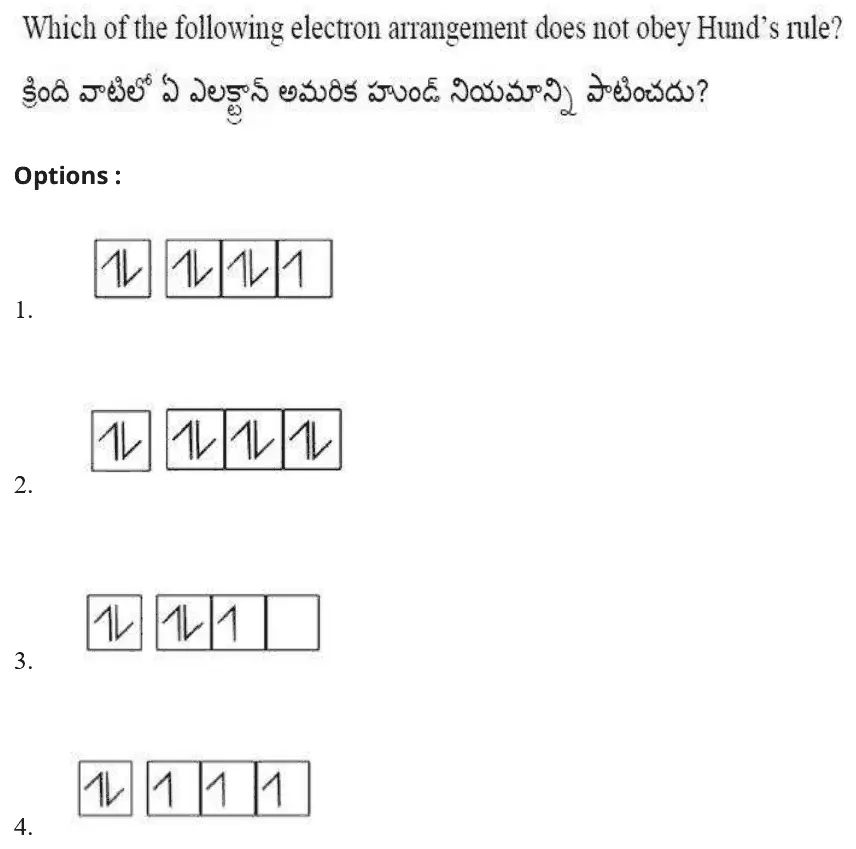
Which of the following electron arrangement does not obey Hund’s rule?

The question and its figure as printed in AP EAPCET 2023 15th May 2023 Shift 2. Option 1: Orbital diagram: one box with paired arrows (up and down), then three adjacent boxes: paired, paired, single up arrow. Option 2: Orbital diagram: one box with paired arrows, then three adjacent boxes, each with paired arrows. Option 3: Orbital diagram: one box with paired arrows, then three adjacent boxes: paired, single up arrow, empty. Option 4: Orbital diagram: one box with paired arrows, then three separate boxes each with a single up arrow.
The question as printed in the paper.
  • A

    see figure Orbital diagram: one box with paired arrows (up and down), then three adjacent boxes: paired, paired, single up arrow.

  • B

    see figure Orbital diagram: one box with paired arrows, then three adjacent boxes, each with paired arrows.

  • C

    see figure Orbital diagram: one box with paired arrows, then three adjacent boxes: paired, single up arrow, empty.

  • D

    see figure Orbital diagram: one box with paired arrows, then three separate boxes each with a single up arrow.

112AP EAPCET 2023 · 15 May · Shift 2MCQOpen question page ↗

The de Broglie wavelength of an electron travelling with 20% of velocity of light is

($h = 6.626 \times 10^{-34}\,\mathrm{J\,s}$; $m_e = 9.1\times10^{-31}\,\mathrm{kg}$)

  • A

    $2.4 \times 10^{-11}\,\mathrm{m}$

  • B

    $1.2 \times 10^{-11}\,\mathrm{m}$

  • C

    $3.6 \times 10^{-11}\,\mathrm{m}$

  • D

    $4.8 \times 10^{-11}\,\mathrm{m}$

113TS EAPCET 2023 · 14 May · Shift 1MCQOpen question page ↗

The energy of second orbit of hydrogen atom is $-5.45\times10^{-19}$ J. What is the energy of first orbit of $\mathrm{Li^{2+}}$ ion (in J)?

  • A

    $-1.962\times10^{-18}$

  • B

    $-1.962\times10^{-17}$

  • C

    $-3.924\times10^{-17}$

  • D

    $-3.924\times10^{-18}$

114TS EAPCET 2023 · 14 May · Shift 1MCQOpen question page ↗

The number of electrons with $(n+l)$ values equal to 3, 4 and 5 in an element with atomic number (z) 24 are respectively

($n$ = principal quantum number and $l$ = azimuthal quantum number)

  • A

    7, 8, 5

  • B

    6, 8, 6

  • C

    8, 7, 5

  • D

    8, 8, 5

115TS EAPCET 2023 · 14 May · Shift 2MCQOpen question page ↗

A 100 watt bulb emits light of wavelength 'x'Å. What is the value of $x$, if the number of photons emitted is $2.0\times10^{20}\,\mathrm{s^{-1}}$? (h$=6.63\times10^{-34}$ Js, 1 watt $=1\ \mathrm{Js^{-1}}$)

  • A

    3578

  • B

    4978

  • C

    3978

  • D

    4578

116TS EAPCET 2023 · 14 May · Shift 2MCQOpen question page ↗

The ratio of the difference in energy between the first and second Bohr orbits to that between the second and third orbits is

  • A

    $\frac{5}{27}$

  • B

    $\frac{27}{5}$

  • C

    $\frac{4}{9}$

  • D

    $\frac{9}{4}$

117TS EAPCET 2023 · 13 May · Shift 1MCQOpen question page ↗

The radius of first Bohr orbit of hydrogen atom is same as that of orbit (n) of hydrogen like species X. (n) and X respectively are

  • A

    (2) , $\mathrm{Li^{2+}}$

  • B

    (3) , $\mathrm{Li^{2+}}$

  • C

    (2) , $\mathrm{Be^{3+}}$

  • D

    (2) , $\mathrm{He^{+}}$

118TS EAPCET 2023 · 13 May · Shift 1MCQOpen question page ↗

Identify the impossible quantum number set for the electron from the following

  • A

    $n=2, l=0, m=0, s=-\dfrac{1}{2}$

  • B

    $n=2, l=1, m=0, s=\dfrac{1}{2}$

  • C

    $n=3, l=3, m=1, s=\dfrac{1}{2}$

  • D

    $n=4, l=2, m=1, s=\dfrac{1}{2}$

119TS EAPCET 2023 · 13 May · Shift 2MCQOpen question page ↗

What is the approximate angular momentum (in J s) of electron in hydrogen atom in its ground state? (h = $6.625\times10^{-34}$ J s)

  • A

    $2110\times10^{-37}$

  • B

    $2110\times10^{-36}$

  • C

    $1055\times10^{-37}\ \mathrm{J\,s}$

  • D

    $1055\times10^{-36}$

120TS EAPCET 2023 · 13 May · Shift 2MCQOpen question page ↗

The energy of electron in hydrogen atom when present in n=1, n=2 and n=3 will be in the ratio of

  • A

    $25 : 16 : 9$

  • B

    $16 : 9 : 4$

  • C

    $36 : 9 : 4$

  • D

    $3 : 2 : 1$

121TS EAPCET 2023 · 12 May · Shift 1MCQOpen question page ↗

The radius of third orbit of hydrogen atom is R pm. The radius of second orbit of $\mathrm{He^+}$ ion (in pm is)

  • A

    $\frac{4}{3}R$

  • B

    $\frac{3}{4}R$

  • C

    $\frac{9}{2}R$

  • D

    $\frac{2}{9}R$

122TS EAPCET 2023 · 12 May · Shift 1MCQOpen question page ↗

The threshold frequency of a metal is $10^{15}\,s^{-1}$. The ratio of maximum kinetic energies of the photoelectrons, when the metal is made to strike with radiations of frequencies $1.5\times10^{15}\,s^{-1}$ and $2.0\times10^{15}\,s^{-1}$ respectively is

  • A

    $2:1$

  • B

    $1:2$

  • C

    $4:3$

  • D

    $3:4$

123TS EAPCET 2023 · 12 May · Shift 2MCQOpen question page ↗

The wavelength of second line of Balmer series of hydrogen atom is $\lambda$ nm. What is the wavelength of first line of Lyman series of $\mathrm{He^+}$ ion (in nm)?

  • A

    $\frac{\lambda}{16}$

  • B

    $\frac{16}{\lambda}$

  • C

    $\frac{16}{3\lambda}$

  • D

    $\frac{3\lambda}{16}$

124TS EAPCET 2023 · 12 May · Shift 2MCQOpen question page ↗

Consider the following

I. The electron spin quantum number describes the orientation of the spin of the nucleus with respect to the magnetic field

II. The orbitals represented by the quantum numbers $n = 3, l = 2, m = +2$ and $n = 3, l = 2, m = -2$ have the same energy

III. The energy of a photon is directly proportional to wavelength but inversely proportional to wave number

IV. Lyman series of lines appear in ultra-violet region

The correct statements are

  • A

    II & IV only

  • B

    I & II only

  • C

    II, III & IV only

  • D

    I, III & IV only

125TS EAPCET 2022 · 20 Jul · Shift 1MCQOpen question page ↗

The maximum number of orbitals present in n = 4 energy level of an atom and the maximum number of electrons with spin value $+\dfrac{1}{2}$ in the same orbitals are ______, respectively.

  • A

    16, 5

  • B

    16, 7

  • C

    16, 9

  • D

    16, 16

126TS EAPCET 2022 · 20 Jul · Shift 1MCQOpen question page ↗

The approximate ratio of the speed of light in vacuum to that of an electron in the first Bohr orbit of hydrogen atom is

  • A

    100 : 1

  • B

    137 : 1

  • C

    157 : 1

  • D

    191 : 1

127TS EAPCET 2022 · 20 Jul · Shift 1MCQOpen question page ↗

Which of the following species are isoelectronic species?
a) $\mathrm{O^{2-}}$ b) $\mathrm{F^{-}}$ c) $\mathrm{Na^{+}}$ d) $\mathrm{Mg^{2+}}$

  • A

    a, b, and c only

  • B

    a, c and d only

  • C

    c and d only

  • D

    a, b, c and d

128TS EAPCET 2022 · 20 Jul · Shift 2MCQOpen question page ↗

Choose the correct statements in reference to the photoelectric effect.
a) There is no time lag between the striking of light and ejection of electrons from the metal surface.
b) The number of electrons ejected is independent of the intensity of light.
c) The elements K, Rb and Cs can show photoelectric effect when exposed to the beam of light.

  • A

    a and b only

  • B

    a and c only

  • C

    a, b, c

  • D

    b and c only

129TS EAPCET 2022 · 20 Jul · Shift 2MCQOpen question page ↗

Assertion (A) : Mo has the ground state electronic configuration $4d^5\ 5s^1$.
Reason (R) : Mo has the highest exchange energy among the second row transition elements.
The correct option among the following is

  • A

    (A) is true, (R) is true and (R) is the correct explanation for (A)

  • B

    (A) is true, (R) is true but (R) is not the correct explanation for (A)

  • C

    (A) is true but (R) is false

  • D

    (A) is false but (R) is true

130TS EAPCET 2022 · 19 Jul · Shift 1MCQOpen question page ↗

If the uncertainty in velocity is $\dfrac{1}{2m}\sqrt{\dfrac{h}{\pi}}$, then the ratio of uncertainty in position and momentum is

  • A

    $10:1$

  • B

    $100:1$

  • C

    $1:1$

  • D

    $0.5:1$

131TS EAPCET 2022 · 19 Jul · Shift 1MCQOpen question page ↗

The valency shell electronic configuration of Cr and Cu atoms, respectively, are

  • A

    $3d^4 4s^2;\ 3d^{10}4s^1$

  • B

    $3d^5 4s^1;\ 3d^{10}4s^1$

  • C

    $3d^5 4s^1;\ 3d^9 4s^2$

  • D

    $3d^4 4s^2;\ 3d^9 4s^2$

132TS EAPCET 2022 · 19 Jul · Shift 2MCQOpen question page ↗

If the radius and energy of the second Bohr orbit of hydrogen atom is $r_{2}$ and $E_{2}$, respectively. The radius and energy of the third Bohr orbit will be ______, ______ respectively.

  • A

    $\frac{4}{9}r_{2},\frac{9}{4}E_{2}$

  • B

    $\frac{4}{9}r_{2},\frac{4}{9}E_{2}$

  • C

    $\frac{9}{4}r_{2},\frac{4}{9}E_{2}$

  • D

    $\frac{9}{4}r_{2},\frac{9}{4}E_{2}$

133TS EAPCET 2022 · 19 Jul · Shift 2MCQOpen question page ↗

When a radiation of 300 nm is shined on five metals, namely, Li, Mg, Ag, Cu and K, the number of metals that show photoelectric effect are

  • A

    2

  • B

    4

  • C

    5

  • D

    3

134TS EAPCET 2022 · 18 Jul · Shift 1MCQOpen question page ↗

In hydrogen atom, the minimum energy required to excite an electron from $2^{\mathrm{nd}}$ orbit to the $3^{\mathrm{rd}}$ orbit is

  • A

    $2.2\ \mathrm{eV}$

  • B

    $2.7\ \mathrm{eV}$

  • C

    $1.9\ \mathrm{eV}$

  • D

    $7\ \mathrm{eV}$

135TS EAPCET 2022 · 18 Jul · Shift 1MCQOpen question page ↗

The velocity (V) of de Broglie wave is given by
[$\upsilon$ = Frequency, m = mass, C = Velocity of light]

  • A

    $\mathrm{mC^{2}}$

  • B

    $\upsilon\lambda$

  • C

    $\dfrac{h\upsilon}{\mathrm{mC}}$

  • D

    $\dfrac{\mathrm{C^{2}}}{\upsilon}$

136TS EAPCET 2022 · 18 Jul · Shift 2MCQOpen question page ↗

The total number of spectral lines observed when electron returns from the $6^{th}$ shell until the $2^{nd}$ shell in hydrogen atom is

  • A

    15

  • B

    10

  • C

    8

  • D

    2

137TS EAPCET 2022 · 18 Jul · Shift 2MCQOpen question page ↗

The orbital angular momentum of an electron in d orbital is equal to

  • A

    0

  • B

    $2\sqrt{3}\ \hbar$

  • C

    $6\ \hbar$

  • D

    $\sqrt{6}\ \hbar$

138AP EAPCET 2022 · 8 Jul · Shift 1MCQOpen question page ↗

The sum of electrons present in all sub shells of an atom with $m_s$ value of $+\frac{1}{2}$ for n=4 and $m_s$ value of $-\frac{1}{2}$ for n=3 is

  • A

    $25$

  • B

    $16$

  • C

    $09$

  • D

    $32$

139AP EAPCET 2022 · 8 Jul · Shift 1MCQOpen question page ↗

The radius of the first orbit of $\mathrm{Li^{2+}}$ is X $\mathring{A}$. The radius of the third orbit of $\mathrm{He^{+}}$ (in $\mathring{A}$) is

  • A

    $\frac{18}{2}x$

  • B

    $\frac{18}{3}x$

  • C

    $\frac{27}{4}x$

  • D

    $\frac{27}{2}x$

140AP EAPCET 2022 · 8 Jul · Shift 1MCQOpen question page ↗

Which of the following element has two electrons in Q shell in its ground state?

  • A

    $\mathrm{Ba}$

  • B

    $\mathrm{Ra}$

  • C

    $\mathrm{La}$

  • D

    $\mathrm{Pb}$

141AP EAPCET 2022 · 8 Jul · Shift 2MCQOpen question page ↗

While passing through the applied magnetic field, which of the following undergoes the maximum deflection?

  • A

    Stream of $\alpha$- particles

  • B

    Stream of $\beta$- particles

  • C

    $\gamma$ - rays

  • D

    Stream of neutrons

142AP EAPCET 2022 · 8 Jul · Shift 2MCQOpen question page ↗

An element has $\mathrm{d}^5$ configuration. The total number of electron exchanges possible for it is

  • A

    $18$

  • B

    $10$

  • C

    $12$

  • D

    $15$

143AP EAPCET 2022 · 7 Jul · Shift 1MCQOpen question page ↗

The ratio of radii of second orbit of hydrogen atom to fourth orbit of $\mathrm{He^+}$ ion is

  • A

    $1:4$

  • B

    $2:1$

  • C

    $1:2$

  • D

    $2:3$

144AP EAPCET 2022 · 7 Jul · Shift 1MCQOpen question page ↗

The velocity of the electron in Bohr's first orbit is $x \times 10^6\ \mathrm{m\,s^{-1}}$. The deBroglie wave length associated with it (in nm) is ($m_e = 9 \times 10^{-31}$ kg, $h = 6.6 \times 10^{-34}$ J s)

  • A

    $\dfrac{x}{1.43}$

  • B

    $\dfrac{x}{0.73}$

  • C

    $\dfrac{0.73}{x}$

  • D

    $\dfrac{0.073}{x}$

145AP EAPCET 2022 · 7 Jul · Shift 1MCQOpen question page ↗

The element with the electronic configuration $[\mathrm{Kr}]4d^{10}5s^0$ is

  • A

    $\mathrm{Ag}$

  • B

    $\mathrm{Pd}$

  • C

    $\mathrm{Rh}$

  • D

    $\mathrm{Tc}$

146AP EAPCET 2022 · 7 Jul · Shift 1MCQOpen question page ↗

The two stable isotopes of carbon present in the naturally occurring carbon are

  • A

    $\mathrm{{}^{12}C}$ and $\mathrm{{}^{14}C}$

  • B

    $\mathrm{{}^{12}C}$ and $\mathrm{{}^{13}C}$

  • C

    $\mathrm{{}^{12}C}$ and $\mathrm{{}^{15}C}$

  • D

    $\mathrm{{}^{11}C}$ and $\mathrm{{}^{12}C}$

147AP EAPCET 2022 · 7 Jul · Shift 1MCQOpen question page ↗

The outer electronic configuration of "Pd" is

  • A

    $4d^8 5s^2$

  • B

    $4d^9 5s^1$

  • C

    $4d^{10} 5s^0$

  • D

    $4d^{10} 5s^1$

148AP EAPCET 2022 · 7 Jul · Shift 2MCQOpen question page ↗

Work function ($W_o$) values of six metals (in eV) are given below:
Li 2.42, Mg 3.7, Cu 4.8, Ag 4.3, K 2.25, Na 2.3
How many of the above metals do not eject the electrons when they are made to strike with radiation of wavelength 400 nm?
($h = 6.62\times10^{-34}$ Js)

  • A

    4

  • B

    2

  • C

    3

  • D

    5

149AP EAPCET 2022 · 7 Jul · Shift 2MCQOpen question page ↗

The work function of a metal M is 6.3 eV. The wave length of the incident radiation required to just eject the electrons from its surface (in nm) is

  • A

    102

  • B

    330

  • C

    197

  • D

    310

150AP EAPCET 2022 · 6 Jul · Shift 1MCQOpen question page ↗

The value of work function of a metal X is 3.1 eV. The threshold frequency of it (in Hz ) (h = $6.62\times10^{-34}$ J s)

  • A

    $6.49\times10^{13}$

  • B

    $5.49\times10^{13}$

  • C

    $6.49\times10^{14}$

  • D

    $7.49\times10^{14}$

151AP EAPCET 2022 · 6 Jul · Shift 1MCQOpen question page ↗

The wavelength of the electron in the ground state of hydrogen atom is y $\mathrm{\mathring{A}}$. What is the wavelength of the electron in the fourth orbit of $\mathrm{He^{+}}$ ion (in $\mathrm{\mathring{A}}$ ) is

  • A

    2y

  • B

    3y

  • C

    y

  • D

    $\frac{3y}{2}$

152AP EAPCET 2022 · 6 Jul · Shift 2MCQOpen question page ↗

The spectral series formed when electrons of excited hydrogen atoms return to the third orbit from higher energy orbits is

  • A

    Lyman series

  • B

    Paschen series

  • C

    Brackett series

  • D

    Pfund series

153AP EAPCET 2022 · 6 Jul · Shift 2MCQOpen question page ↗

The incorrect set of quantum numbers (n, l, m, s) for an electron in 3p orbital is

  • A

    $3, 1, -1, 1/2$

  • B

    $3, 1, -2, -1/2$

  • C

    $3, 1, 1, 1/2$

  • D

    $3, 1, +1, -1/2$

154AP EAPCET 2022 · 5 Jul · Shift 1MCQOpen question page ↗

The wavelength associated with the electron moving in the first orbit of hydrogen atom with velocity $2.2\times10^6\ \mathrm{m\,s^{-1}}$ (in nm) is ($m_e = 9.0\times10^{-31}$ kg, $h = 6.6\times10^{-34}$ Js)

  • A

    0.66

  • B

    0.33

  • C

    0.22

  • D

    0.44

155AP EAPCET 2022 · 5 Jul · Shift 1MCQOpen question page ↗

The energy required (in eV) to excite an electron of H-atom from the ground state to the third state is

  • A

    +0.85

  • B

    -3.4

  • C

    12.1

  • D

    -12.1

156AP EAPCET 2022 · 5 Jul · Shift 2MCQOpen question page ↗

The wavelength of electron in the first orbit of hydrogen atom is $3.3\times10^{-10}\,\mathrm{m}$. The kinetic energy of electron (in J) is

($h = 6.6\times10^{-34}\ \mathrm{Js}$, $m_e = 9.0\times10^{-31}\ \mathrm{kg}$)

  • A

    $3.33\times10^{-17}$

  • B

    $1.11\times10^{-18}$

  • C

    $2.22\times10^{-18}$

  • D

    $2.22\times10^{-17}$

157AP EAPCET 2022 · 5 Jul · Shift 2MCQOpen question page ↗

Maximum number of electrons possible with spin quantum number $+\frac{1}{2}$ with principal quantum number n=4 in an atom is

  • A

    $16$

  • B

    $9$

  • C

    $4$

  • D

    $25$

158AP EAPCET 2022 · 4 Jul · Shift 1MCQOpen question page ↗

If $\Delta x$ is the uncertainty in position and $\Delta\vartheta$ is the uncertainty in velocity of a particle are equal, the correct expression for uncertainty in momentum for the same particle is

  • A

    $\dfrac{1}{4}\sqrt{\dfrac{mh}{\pi}}$

  • B

    $\dfrac{1}{3}\sqrt{\dfrac{mh}{2\pi}}$

  • C

    $\dfrac{1}{2}\sqrt{\dfrac{mh}{\pi}}$

  • D

    $\dfrac{1}{2}\sqrt{\dfrac{h}{m\pi}}$

161AP EAPCET 2022 · 4 Jul · Shift 2MCQOpen question page ↗

Which quantum number provides information about the shape of an orbital?

  • A

    Spin quantum number

  • B

    Azimuthal quantum number

  • C

    Magnetic quantum number

  • D

    Principal quantum number

162AP EAMCET 2021 · 5 Oct · Shift 1MCQOpen question page ↗

Identify the possible set of quantum numbers 'n', 'l', 'm' and 's' respectively for the outer most electron of copper, in its ground state.

  • A

    $4, 1, 1, \frac{+1}{2}$

  • B

    $3, 2, 2, \frac{+1}{2}$

  • C

    $4, 0, 0, \frac{+1}{2}$

  • D

    $4, 2, 2, \frac{+1}{2}$

163AP EAMCET 2021 · 5 Oct · Shift 1MCQOpen question page ↗

The approximate ratio of the energy of a photon to that of an electron when both have the same wavelength of 0.2 $nm$ is ______

  • A

    $1.6\times10^{2}$

  • B

    $1.0\times10^{-2}$

  • C

    $1.0\times10^{2}$

  • D

    $1.6\times10^{-2}$

164AP EAMCET 2021 · 5 Oct · Shift 1MCQOpen question page ↗

The ratio of area of the second orbit to that of the third orbit in an atom is ________

  • A

    $4:9$

  • B

    $8:27$

  • C

    $16:81$

  • D

    $9:4$

165AP EAMCET 2021 · 25 Aug · Shift 1MCQOpen question page ↗

The shortest wavelength in hydrogen spectrum is approximately ______

  • A

    $121\ \mathrm{nm}$

  • B

    $91.2\ \mathrm{nm}$

  • C

    $182\ \mathrm{nm}$

  • D

    $89.2\ \mathrm{nm}$

166AP EAMCET 2021 · 25 Aug · Shift 1MCQOpen question page ↗

The ratio of de-Broglie wavelength of two particles $A$ and $B$ is $2:1$. If the velocities of $A$ and $B$ are $0.05\ \mathrm{m.s^{-1}}$ and $0.02\ \mathrm{m.s^{-1}}$, respectively, then the ratio of their masses $m_A : m_B$ must be ______

  • A

    $5:1$

  • B

    $10:1$

  • C

    $1:5$

  • D

    $1:8$

167AP EAMCET 2021 · 25 Aug · Shift 1MCQOpen question page ↗

If the maximum kinetic energy of photoelectrons ejected from a metal surface when it is irradiated with a radiation of frequency $4 \times 10^{14}\ \mathrm{s^{-1}}$ is $6.63 \times 10^{-20}\ \mathrm{J}$, then the threshold frequency of the metal is ______

  • A

    $2 \times 10^{14}\ \mathrm{s^{-1}}$

  • B

    $1 \times 10^{14}\ \mathrm{s^{-1}}$

  • C

    $3 \times 10^{14}\ \mathrm{s^{-1}}$

  • D

    $1 \times 10^{-14}\ \mathrm{s^{-1}}$

168AP EAMCET 2021 · 25 Aug · Shift 1MCQOpen question page ↗

Which of the following element, has the highest number of unpaired electrons in its ground state?

  • A

    Mn

  • B

    Cr

  • C

    Ni

  • D

    Fe

169AP EAMCET 2021 · 25 Aug · Shift 2MCQOpen question page ↗

Which energy level transition among the following will have the least wavelength?

  • A

    $n_4 \rightarrow n_3$

  • B

    $n_4 \rightarrow n_2$

  • C

    $n_4 \rightarrow n_1$

  • D

    $n_2 \rightarrow n_1$

170AP EAMCET 2021 · 25 Aug · Shift 2MCQOpen question page ↗

Calculate the de Broglie's wavelength of an electron residing in the 2$^{\mathrm{nd}}$ Bohr's orbit of a Hydrogen atom. (Bohr's radius, $a_o = 0.529\ \mathrm{\AA}$)

  • A

    $0.2116\ \mathrm{nm}$

  • B

    $2.116\,\pi\ \mathrm{\AA}$

  • C

    $21.16\ \mathrm{m}$

  • D

    $2.116\ \mu\mathrm{m}$

171AP EAMCET 2021 · 25 Aug · Shift 2MCQOpen question page ↗

If the wavelength of the first line in Balmer series is $656\ \mathrm{nm}$, then the wavelengths of its second line and limiting line respectively are ______

  • A

    $485.9\ \mathrm{nm}$ & $434\ \mathrm{nm}$

  • B

    $485.9\ \mathrm{nm}$ & $364.4\ \mathrm{nm}$

  • C

    $715\ \mathrm{nm}$ & $434\ \mathrm{nm}$

  • D

    $608\ \mathrm{nm}$ & $415.2\ \mathrm{nm}$

172AP EAMCET 2021 · 24 Aug · Shift 1MCQOpen question page ↗

If a proton is accelerated to a velocity of $3 \times 10^7\ \mathrm{m.s^{-1}}$ which is accurate up to $\pm 0.5\ \%$, then the uncertainty in its position will be ______ [mass of proton $= 1.66 \times 10^{-27}\ \mathrm{kg}$, $h = 6.6 \times 10^{-34}\ \mathrm{J.s}$]

  • A

    $1.55 \times 10^{-12}\ \mathrm{m}$

  • B

    $3.24 \times 10^{-13}\ \mathrm{m}$

  • C

    $1.58 \times 10^{-13}\ \mathrm{m}$

  • D

    $2.11 \times 10^{-13}\ \mathrm{m}$

173AP EAMCET 2021 · 24 Aug · Shift 1MCQOpen question page ↗

Find the uncertainty in the position of an electron which is moving with a velocity of $2.99 \times 10^4\ \mathrm{cm.s^{-1}}$, accurate up to $0.0016\ \%$. (Given, $m_e = 9.1 \times 10^{-28}\ \mathrm{g}$, $h = 6.626 \times 10^{-27}\ \mathrm{erg.s}$)

  • A

    $1.211\ \mathrm{mm}$

  • B

    $2.99 \times 10^{-10}\ \mathrm{mm}$

  • C

    $0.121\ \mathrm{mm}$

  • D

    $12.11\ \mathrm{mm}$

174AP EAMCET 2021 · 24 Aug · Shift 1MCQOpen question page ↗

If the uncertainty in momentum and uncertainty in the position of a particle are equal, then the uncertainty in its velocity would be given by ______

  • A

    $\Delta v \geq \sqrt{\frac{h}{2\pi}}$

  • B

    $\Delta v \geq \frac{1}{2m}\sqrt{\frac{h}{\pi}}$

  • C

    $\Delta v \geq \sqrt{\frac{h}{\pi}}$

  • D

    $\Delta v \geq \frac{1}{m}\sqrt{\frac{h}{\pi}}$

175AP EAMCET 2021 · 24 Aug · Shift 2MCQOpen question page ↗

In the electronic configuration of which of the given elements, ‘Aufbau principle’ or $(n + l)$ rule is violated?

  • A

    $Mn$

  • B

    $Ga$

  • C

    $La$

  • D

    $Pu$

176AP EAMCET 2021 · 24 Aug · Shift 2MCQOpen question page ↗

To which orbital among the following may an electron having zero angular momentum belong?

  • A

    $3s$

  • B

    $3p$

  • C

    $3d$

  • D

    $4f$

178AP EAMCET 2021 · 24 Aug · Shift 2MCQOpen question page ↗

Assertion (A): Helium & Beryllium have similar outer electronic configuration $ns^2$
Reason (R): Both are chemically inert

  • A

    Both (A) & (R) are correct & (R) is the correct explanation of (A)

  • B

    Both (A) & (R) are correct but (R) is not the correct explanation of (A)

  • C

    (A) is correct but (R) is incorrect

  • D

    Both (A) & (R) are incorrect

179AP EAMCET 2021 · 23 Aug · Shift 1MCQOpen question page ↗

With what velocity must an electron travel so that its momentum is equal to that of a photon of wavelength $663\ nm$ ?

  • A

    $1098\ m/s$

  • B

    $109.8\ m/s$

  • C

    $10.98\ m/s$

  • D

    $1.098\ m/s$

181AP EAMCET 2021 · 23 Aug · Shift 1MCQOpen question page ↗

Two particles of masses $m$ & $2m$ have equal Kinetic energies. The de-Broglie wavelength are in the ratio of ______

  • A

    $1:1$

  • B

    $1:2$

  • C

    $1:\sqrt{2}$

  • D

    $\sqrt{2}:1$

182AP EAMCET 2021 · 23 Aug · Shift 2MCQOpen question page ↗

Which of the following atoms, in its ground state, has the highest number of unpaired electrons?

  • A

    Chromium [$Z$ = 24]

  • B

    Iron [$Z$ = 26]

  • C

    Manganese [$Z$ = 25]

  • D

    Vanadium [$Z$ = 23]

183AP EAMCET 2021 · 23 Aug · Shift 2MCQOpen question page ↗

Calculate the mass of an elementary particle, which is accelerated to twice the velocity of light with the precision $\pm$ 1% and has $1.05 \times 10^{-13}$ $m$ uncertainty in position. ($h = 6.6 \times 10^{-34}\ kg\ m^2\ s^{-1}$)

  • A

    $8.34 \times 10^{-27}$ $kg$

  • B

    0.0083 $kg$

  • C

    $0.83 \times 10^{-27}$ $kg$

  • D

    $0.834 \times 10^{-28}$ $kg$

184AP EAMCET 2021 · 23 Aug · Shift 2MCQOpen question page ↗

Among the following, which transition in the Hydrogen spectrum would have the same wavelength as Balmer transition, $n = 4$ to $n = 2$ in $He^+$ spectrum?

  • A

    $n = 3 \longrightarrow n = 1$

  • B

    $n = 3 \longrightarrow n = 2$

  • C

    $n = 4 \longrightarrow n = 1$

  • D

    $n = 2 \longrightarrow n = 1$

185AP EAMCET 2021 · 20 Aug · Shift 1MCQOpen question page ↗

The number of protons, neutrons and electrons in $^{13}_{6}\mathrm{C}$ respectively are ______

  • A

    6, 7, 6

  • B

    13, 6, 6

  • C

    6, 7, 13

  • D

    6, 6, 13

186AP EAMCET 2021 · 20 Aug · Shift 1MCQOpen question page ↗

The masses of an electron, a proton and a neutron respectively will be in the ratio ______

  • A

    1 : 1836.15 : 1838.68

  • B

    1 : 1856.15 : 1858.68

  • C

    1 : 1834.15 : 1836.68

  • D

    1 : 1846.15 : 1848.68

187AP EAMCET 2021 · 20 Aug · Shift 1MCQOpen question page ↗

Match the following species with the correct number of electrons present in them:
Species: (i) $\mathrm{Be^{2+}}$ (ii) $\mathrm{H^{+}}$ (iii) $\mathrm{Na^{+}}$ (iv) $\mathrm{Mg^{+}}$
Number of Electrons: (a) 0 (b) 10 (c) 2 (d) 11 (e) 4

  • A

    (i-d), (ii-c), (iii-b), (iv-a)

  • B

    (i-a), (ii-b), (iii-c), (iv-d)

  • C

    (i-e), (ii-d), (iii-a), (iv-c)

  • D

    (i-c), (ii-a), (iii-b), (iv-d)

188AP EAMCET 2021 · 20 Aug · Shift 2MCQOpen question page ↗

A subshell $n = 3,\ l = 2$ can accommodate maximum of ______

  • A

    10 electrons

  • B

    6 electrons

  • C

    18 electrons

  • D

    16 electrons

189AP EAMCET 2021 · 20 Aug · Shift 2MCQOpen question page ↗

If the work function for the photoelectron emission of a metal is $3.75\ eV$, then the threshold wave length of the radiation needed for the ejection of the electron is approximately ______

  • A

    $315\ nm$

  • B

    $280\ nm$

  • C

    $330\ nm$

  • D

    $290\ nm$

190AP EAMCET 2021 · 20 Aug · Shift 2MCQOpen question page ↗

With increasing Principal Quantum number, the energy difference between adjacent energy levels in H-atom ______

  • A

    Decreases

  • B

    Increases

  • C

    remain constant

  • D

    decreases at low level of 'n' & increases for higher value of 'n'

191AP EAMCET 2021 · 19 Aug · Shift 1MCQOpen question page ↗

If two particles $A$ and $B$ are moving with the same velocity, but wavelength of $A$ is found to be double than that of $B$. Which of the following statements are correct?

  • A

    Both $A$ and $B$ have same mass

  • B

    Mass of $A$ is half that of $B$

  • C

    Mass of $B$ is half that of $A$

  • D

    Mass of $B$ is one-fourth that of $A$

192AP EAMCET 2021 · 19 Aug · Shift 1MCQOpen question page ↗

The spectrum of Helium is expected to be similar to that of ______

  • A

    $\mathrm{Li^+}$

  • B

    $\mathrm{H}$

  • C

    $\mathrm{Na}$

  • D

    $\mathrm{He^+}$

193AP EAMCET 2021 · 19 Aug · Shift 1MCQOpen question page ↗

On the basis of Bohr's model, the radius of the $3^{rd}$ orbit is ______

  • A

    Equal to the radius of $1^{st}$ orbit

  • B

    3 times the radius of $1^{st}$ orbit

  • C

    5 times the radius of $1^{st}$ orbit

  • D

    9 times the radius of $1^{st}$ orbit

194AP EAMCET 2021 · 19 Aug · Shift 2MCQOpen question page ↗

Assuming that the incident radiation is capable of ejecting photo electrons from all the given metals, the lowest kinetic energy of the ejected photoelectron is observed with which of the given metals?

  • A

    $\mathrm{Na}$

  • B

    $\mathrm{Li}$

  • C

    $\mathrm{Ag}$

  • D

    $\mathrm{Cu}$

195AP EAMCET 2021 · 19 Aug · Shift 2MCQOpen question page ↗

If the energies of two light radiations $E_1$ and $E_2$ are $25\ \mathrm{eV}$ and $100\ \mathrm{eV}$ respectively, then their respective wavelengths $\lambda_1$ and $\lambda_2$ would be in the ratio $\lambda_1 : \lambda_2 =$ ______

  • A

    $2 : 1$

  • B

    $4 : 1$

  • C

    $1 : 4$

  • D

    $1 : 2$

196AP EAMCET 2021 · 19 Aug · Shift 2MCQOpen question page ↗

The electron configuration of $\mathrm{Fe^{3+}}$ is ______ (atomic number of $\mathrm{Fe} = 26$)

  • A

    $[\mathrm{Ar}]\,3d^5\,4s^1$

  • B

    $[\mathrm{Ar}]\,3d^6\,4s^0$

  • C

    $[\mathrm{Ar}]\,3d^5\,4s^0$

  • D

    $[\mathrm{Ar}]\,3d^6\,4s^2$

197TS EAMCET 2021 · 6 Aug · Shift 1MCQOpen question page ↗

Match the following
List I
A) Chadwick
B) Rutherford
C) Mosley
D) J. J. Thomson
List II
I) Cathode rays
II) X-rays spectra
III) Discovery of neutrons
IV) Nuclear atom model
The correct match is

  • A

    A-IV, B-I, C-II, D-III

  • B

    A-III, B-II, C-IV, D-I

  • C

    A-III, B-II, C-I, D-IV

  • D

    A-III, B-IV, C-II, D-I

199TS EAMCET 2021 · 6 Aug · Shift 2MCQOpen question page ↗

Based on the Bohr's theory of hydrogen atom, the speed of the electron, energy of the electron, and the radius of its orbit varies with the principal quantum number, respectively as

  • A

    $n;\ n^2;\ n^2$

  • B

    $\dfrac{1}{n^2};\ \dfrac{1}{n};\ n$

  • C

    $\dfrac{1}{n};\ \dfrac{1}{n};\ n^2$

  • D

    $\dfrac{1}{n};\ \dfrac{1}{n^2};\ n^2$

200TS EAMCET 2021 · 6 Aug · Shift 2MCQOpen question page ↗

The energy (in eV) associated with the electron in the $1^{\mathrm{st}}$ orbit of $\mathrm{Li^{2+}}$ is

  • A

    $-122.4$

  • B

    $-61.15$

  • C

    $-30.5$

  • D

    $-244.6$

202TS EAMCET 2021 · 5 Aug · Shift 1MCQOpen question page ↗

A microscope using appropriate photons is engaged to track an electron in an atom within distance of 0.001 nm. What will be the uncertainty involved in measuring its velocity?

  • A

    $5.79\times10^{7}$ m/s

  • B

    $5.79\times10^{6}$ m/s

  • C

    $4.79\times10^{7}$ m/s

  • D

    $3.7\times10^{6}$ m/s

203TS EAMCET 2021 · 5 Aug · Shift 1MCQOpen question page ↗

An orbital with one angular node shows three maxima in its radial probability distribution curve, the orbital is?

  • A

    3s

  • B

    4p

  • C

    5d

  • D

    3p

204TS EAMCET 2021 · 5 Aug · Shift 1MCQOpen question page ↗

The orbital with 4 radial and 1 angular nodes is

  • A

    $5\mathrm{P_y}$

  • B

    $6\mathrm{P_z}$

  • C

    $4\mathrm{d_{xy}}$

  • D

    $5\mathrm{d_{yz}}$

206TS EAMCET 2021 · 5 Aug · Shift 2MCQOpen question page ↗

The relation between the stopping potential ($V_0$) and frequency ($\nu$) is correctly represented in [ $\phi$ = Work function]

  • A

    $V_0 = \frac{\phi}{e} - \frac{h\nu^2}{e}$

  • B

    $V_0 = \frac{he}{\nu} + \frac{\phi}{e}$

  • C

    $V_0 = \frac{h\nu}{e} - \frac{\phi}{e}$

  • D

    $V_0 = \frac{h\nu}{e^2}$

207TS EAMCET 2021 · 4 Aug · Shift 1MCQOpen question page ↗

Heisenberg's uncertainty principle is ingeneral (sic) significant to

  • A

    planets

  • B

    cricket ball of 500 g

  • C

    cars

  • D

    micro particles having a very high speed

208TS EAMCET 2021 · 4 Aug · Shift 1MCQOpen question page ↗

Which of the following relations is correct, if the wavelength ($\lambda$) is equal to the distance travelled by the electron in one second?
h is the planck's constant and m is the mass of electron

  • A

    $\lambda = h/p$

  • B

    $\lambda = h/m$

  • C

    $\lambda = \sqrt{h/p}$

  • D

    $\lambda = \sqrt{h/m}$

209TS EAMCET 2021 · 4 Aug · Shift 2MCQOpen question page ↗

Which of the following elements has the highest work function value?

  • A

    $\mathrm{Na}$

  • B

    $\mathrm{K}$

  • C

    $\mathrm{Cu}$

  • D

    $\mathrm{Ag}$

210TS EAMCET 2021 · 4 Aug · Shift 2MCQOpen question page ↗

For an electron in the d-orbital, the orbital angular momentum is

  • A

    $\dfrac{h}{2\pi}$

  • B

    $\dfrac{\sqrt{2}h}{2\pi}$

  • C

    $\dfrac{\sqrt{6}h}{2\pi}$

  • D

    $\dfrac{\sqrt{6}h}{2\pi}$

211AP EAMCET 2020 · 7 Oct · Shift 1MCQOpen question page ↗

Isobars are atoms with ______

  • A

    Same mass number and same atomic number

  • B

    Same atomic number and different mass number

  • C

    Same mass number and different atomic number

  • D

    Different atomic number and different mass number

212AP EAMCET 2020 · 23 Sep · Shift 1MCQOpen question page ↗

Which of the following conclusions could not be derived from Rutherford's $\alpha$ -particle scattering experiment?

  • A

    Most of the space in the atom is empty.

  • B

    radius of the atom is about $10^{-10}$ $m$ while that of nucleus is $10^{-15}$ $m$.

  • C

    Electrons move in circular paths of fixed energy, called orbits.

  • D

    Electrons and the nucleus are held together by electrostatic forces of attraction.

213AP EAMCET 2020 · 23 Sep · Shift 1MCQOpen question page ↗

Which among the following is a correct statement based on Heisenberg's uncertainty principle?
1) It is impossible to determine exact position and exact momentum of an electron simultaneously
2) It is applicable to even macroscopic objects
3) It is possible to determine the exact position and momentum of an electron simultaneously
4) It is impossible to determine the exact position and momentum of macroscopic object simultaneously

  • A

    1

  • B

    2

  • C

    3

  • D

    4

214AP EAMCET 2020 · 22 Sep · Shift 1MCQOpen question page ↗

Calculate the mass of a photon if its wave length is given as $0.35\ \mathrm{nm}$.

  • A

    $2.20 \times 10^{-42}\ \mathrm{kg}$

  • B

    $6.30 \times 10^{-33}\ \mathrm{g}$

  • C

    $6.30 \times 10^{-33}\ \mathrm{kg}$

  • D

    $18.92 \times 10^{-25}\ \mathrm{kg}$

215AP EAMCET 2020 · 22 Sep · Shift 1MCQOpen question page ↗

Which of the following models states that "In an atom, the positive charge is uniformly distributed and electrons are embedded into it"?

  • A

    Bohr's atomic model

  • B

    Thomson's atomic model

  • C

    Rutherford's atomic model

  • D

    Sommerfeld's atomic model

216AP EAMCET 2020 · 22 Sep · Shift 2MCQOpen question page ↗

Which of the following are isoelectronic species?

  • A

    $O^{2-}$, $F$, $Na^+$, $Mg^+$

  • B

    $O$, $F^-$, $Na$, $Mg$

  • C

    $O^{2-}$, $F^-$, $Na^+$, $Mg^{2+}$

  • D

    $O^{2-}$, $Cl^-$, $Na$, $Mg^{2+}$

217AP EAMCET 2020 · 22 Sep · Shift 2MCQOpen question page ↗

The number of electrons that can be present in subshells having $m_s$ value of $\frac{-1}{2}$, for $n$ up to 3

  • A

    18

  • B

    9

  • C

    14

  • D

    12

218AP EAMCET 2020 · 22 Sep · Shift 2MCQOpen question page ↗

Calculate the energy associated with the second orbit of $Li^+$ and find it's radius?

  • A

    $4.905 \times 10^{-19}$ J, 0.0705 nm

  • B

    $4.905 \times 10^{-20}$ J, 0.0705 Å

  • C

    $4.905 \times 10^{-17}$ J, 0.0705 Å

  • D

    $4.905 \times 10^{-18}$ J, 0.0705 nm

219AP EAMCET 2020 · 21 Sep · Shift 1MCQOpen question page ↗

If the binding energy of electrons in a metal is 250 $\mathrm{kJ/mol}$, what should be the threshold frequency of the striking photons in order to free an electron from the metal surface?

  • A

    $6.26 \times 10^{14}\ \mathrm{s^{-1}}$

  • B

    $12.4 \times 10^{14}\ \mathrm{s^{-1}}$

  • C

    $6.26 \times 10^{12}\ \mathrm{s^{-1}}$

  • D

    $12.4 \times 10^{12}\ \mathrm{s^{-1}}$

220AP EAMCET 2020 · 21 Sep · Shift 1MCQOpen question page ↗

Which of the following statements is correct about the cathode rays?
1) These rays start from anode and move towards cathode
2) They are visible with human eye
3) In presence of electric and magnetic fields, they behave like positively charged particles
4) Their characteristic does not depend on the nature of material at electrode

  • A

    1

  • B

    2

  • C

    3

  • D

    4

221AP EAMCET 2020 · 21 Sep · Shift 1MCQOpen question page ↗

Choose the correct option regarding:
Assertion: Energy of the orbital decreases with increase of 'n'
Reason: Energy is required in shifting away the negatively charged electron from positively charged nucleus

  • A

    Assertion and reasoning are correct statements and reason is the correct explanation for assertion

  • B

    Assertion and reasoning are correct statements and reason is not the explanation for assertion

  • C

    Assertion is correct, reason is wrong

  • D

    Assertion is wrong, reason is correct

222AP EAMCET 2020 · 21 Sep · Shift 2MCQOpen question page ↗

Calculate energy of half mole of photons of a radiation with frequency $3\times10^{12}$ Hz.

  • A

    $598.2\ \mathrm{kJ.mol^{-1}}$

  • B

    $0.598\ \mathrm{kJ.mol^{-1}}$

  • C

    $1.196\ \mathrm{kJ.mol^{-1}}$

  • D

    $119.6\ \mathrm{kJ.mol^{-1}}$

223AP EAMCET 2020 · 21 Sep · Shift 2MCQOpen question page ↗

The electronic configuration of Cs is

  • A

    $[\mathrm{Kr}]\,5s^{1}$

  • B

    $[\mathrm{Xe}]\,6s^{1}$

  • C

    $[\mathrm{Rn}]\,7s^{1}$

  • D

    $[\mathrm{Ar}]\,4s^{1}$

224AP EAMCET 2020 · 21 Sep · Shift 2MCQOpen question page ↗

Calculate the number of protons, neutrons and electrons in ${}^{32}_{16}\mathrm{S}^{2-}$

  • A

    14, 18, 16

  • B

    16, 16, 14

  • C

    18, 16, 14

  • D

    16, 16, 18

225AP EAMCET 2020 · 18 Sep · Shift 1MCQOpen question page ↗

Which of the following statements is correct about photoelectric effect?
A) The number of electrons ejected from metal surface is inversely proportional to intensity of light
B) Below threshold frequency, photoelectric effect can be observed
C) At higher frequency than threshold frequency, the ejected electrons have certain kinetic energy
D) At higher frequency than threshold frequency, the electron is still on the metal surface

  • A

    A

  • B

    B

  • C

    C

  • D

    D

226AP EAMCET 2020 · 18 Sep · Shift 1MCQOpen question page ↗

"No two electrons in an atom can have the same set of all four quantum numbers". This principle is called

  • A

    Zeeman Effect

  • B

    Pauli's Exclusion Principle

  • C

    Stark Effect

  • D

    Heisenberg Principle

227AP EAMCET 2020 · 18 Sep · Shift 1MCQOpen question page ↗

The uncertainty in the position of an electron moving with velocity of $3 \times 10^4$ cm/s is (given mass of electron $= 9.1 \times 10^{-28}$, uncertainty in velocity $= 0.2\%$ )

  • A

    $1.8 \times 10^{-3}$ cm

  • B

    $9 \times 10^{-3}$ cm

  • C

    $3.8 \times 10^{-2}$ cm

  • D

    $1.8 \times 10^{-4}$ cm

228AP EAMCET 2020 · 18 Sep · Shift 2MCQOpen question page ↗

Which among the following represents Schrodinger wave equation?

  • A

    $\frac{d^2\psi}{dx^2}+\frac{d^2\psi}{dy^2}+\frac{d^2\psi}{dz^2}+\frac{4\pi m}{h}(E-v)\psi=0$

  • B

    $\hat{H}=\frac{h}{4\pi^2 m}\left(\frac{d^2}{dx^2}+\frac{d^2}{dy^2}+\frac{d^2}{dz^2}\right)+V$

  • C

    $\hat{H}=\frac{-h^2}{8\pi^2 m}\left(\frac{d^2}{dx^2}+\frac{d^2}{dy^2}+\frac{d^2}{dz^2}\right)+P$

  • D

    $\frac{d^2\psi}{dx^2}+\frac{d^2\psi}{dy^2}+\frac{d^2\psi}{dz^2}+\frac{8\pi^2 m}{h^2}(E-V)\psi=0$

229AP EAMCET 2020 · 18 Sep · Shift 2MCQOpen question page ↗

How many unpaired electrons will be present in the ground state of an atom which has valence electronic configuration $3d^6$ in its +3 oxidation state?

  • A

    1

  • B

    3

  • C

    4

  • D

    7

230AP EAMCET 2020 · 18 Sep · Shift 2MCQOpen question page ↗

The de Broglie wavelength of a tennis ball of mass 60 g moving with a velocity of 10 $m.s^{-1}$ is approximately ______ (Planck's constant $h=6.63\times10^{-34}$ J.s)

  • A

    $1.1\times10^{-31}\ m$

  • B

    $1.1\times10^{-33}\ m$

  • C

    $1.1\times10^{-34}\ m$

  • D

    $1.1\times10^{-32}\ m$

231AP EAMCET 2020 · 17 Sep · Shift 1MCQOpen question page ↗

Calculate the wave number and frequency of orange radiation having wavelength 6300 Å.

  • A

    $1.587 \times 10^{8}\ \mathrm{m^{-1}}$ , $4.761 \times 10^{16}\ \mathrm{s^{-1}}$

  • B

    $1.587 \times 10^{4}\ \mathrm{m^{-1}}$ , $4.761 \times 10^{14}\ \mathrm{s^{-1}}$

  • C

    $1.587 \times 10^{6}\ \mathrm{m^{-1}}$ , $4.761 \times 10^{14}\ \mathrm{s^{-1}}$

  • D

    $1.587 \times 10^{6}\ \mathrm{m^{-1}}$ , $4.761 \times 10^{16}\ \mathrm{s^{-1}}$

233AP EAMCET 2020 · 17 Sep · Shift 2MCQOpen question page ↗

The number of protons, electrons and neutrons in a species are equal to 17, 18 and 18 respectively. Which of the following will be the proper symbol of this species?

  • A

    $^{35}_{17}\mathrm{Cl}$

  • B

    $^{35}_{17}\mathrm{Cl^-}$

  • C

    $^{36}_{17}\mathrm{Cl}$

  • D

    $^{36}_{17}\mathrm{Cl^-}$

235TS EAMCET 2020 · 14 Sep · Shift 1MCQOpen question page ↗

From the following sets of quantum numbers, which set is possible?

  • A

    n = 1, $\ell$ = 0, $m_\ell$ = +1, $m_s$ = $-\dfrac{1}{2}$

  • B

    n = 1, $\ell$ = 1, $m_\ell$ = 0 $m_s$ = $+\dfrac{1}{2}$

  • C

    n = 3, $\ell$ = 1, $m_\ell$ = 0, $m_s$ = $+\dfrac{1}{2}$

  • D

    n = 3, $\ell$ = 3, $m_\ell$ = $-3$, $m_s$ = $+\dfrac{1}{2}$

236TS EAMCET 2020 · 14 Sep · Shift 2MCQOpen question page ↗

Given the ratio of kinetic energy of electron in two orbitals is 16:9. Calculate the ratio of wavelength of electron waves?

  • A

    4 : 3

  • B

    9 : 16

  • C

    3 : 4

  • D

    16 : 9

237TS EAMCET 2020 · 14 Sep · Shift 2MCQOpen question page ↗

Which of the following results is not true about photoelectric effect?

  • A

    The electrons are ejected from the metal surface as soon as the beam of light strikes to the surface.

  • B

    The number of electrons ejected is proportional to the intensity or brightness of light.

  • C

    There is a time lag between the striking of light beam and the ejection of electrons from the metal surface.

  • D

    For each metal, there is a characteristic minimum frequency below which photoelectric effect is not observed.

238TS EAMCET 2020 · 11 Sep · Shift 1MCQOpen question page ↗

In the two elements ${}_{Z_1}A^{M_1}$ and ${}_{Z_2}B^{M_2}$, the following relations are true.
$M_1 \neq M_2$ and $Z_1 \neq Z_2$ but $M_1 - Z_1 = M_2 - Z_2$. These elements are
(M is atomic weight, Z is atomic number)

  • A

    Isotonic

  • B

    Isobaric

  • C

    Isotopic

  • D

    Isoelectronic

239TS EAMCET 2020 · 11 Sep · Shift 1MCQOpen question page ↗

The correct order of decreasing energy for the electrons whose quantum numbers, n and $\ell$ are given below, is
A) $n = 5$ and $\ell = 2$
B) $n = 5$ and $\ell = 0$
C) $n = 4$ and $\ell = 3$
D) $n = 4$ and $\ell = 1$

  • A

    $A > C > B > D$

  • B

    $A > B > C > D$

  • C

    $C > A > D > B$

  • D

    $A > B > D > C$

240TS EAMCET 2020 · 11 Sep · Shift 1MCQOpen question page ↗

Find the correct set with iso electronic species?

  • A

    $\mathrm{N^{3-}}, \mathrm{F^-}, \mathrm{O_2}, \mathrm{Ca^{2+}}$

  • B

    $\mathrm{Ca^{2+}}, \mathrm{Cl^-}, \mathrm{Al^{3+}}, \mathrm{O_2^-}$

  • C

    $\mathrm{N^{3-}}, \mathrm{Mg^{2+}}, \mathrm{F^-}, \mathrm{O^{2-}}$

  • D

    $\mathrm{Mg^{2+}}, \mathrm{O_2^-}, \mathrm{Cl^-}, \mathrm{N_3^-}$

242TS EAMCET 2020 · 11 Sep · Shift 2MCQOpen question page ↗

The uncertainty in position and velocity of a particle in motion are $1 \times 10^{-8}$ m and $6.627 \times 10^{-20}$ m/s, respectively. The mass of the particle is
($h = 6.627 \times 10^{-34}$ Js)

  • A

    $\dfrac{10^{-4}}{2\pi}$ kg

  • B

    $\dfrac{10^{-4}}{4\pi}$ kg

  • C

    $\dfrac{10^{-6}}{2\pi}$ kg

  • D

    $\dfrac{10^{-6}}{4\pi}$ kg

243TS EAMCET 2020 · 10 Sep · Shift 1MCQOpen question page ↗

The degeneracy of the level of hydrogen atoms that contain the energy of $\left(\frac{-R_H}{16}\right)$ is

  • A

    4

  • B

    16

  • C

    9

  • D

    12

244TS EAMCET 2020 · 10 Sep · Shift 1MCQOpen question page ↗

Wavelength of $\mathrm{H^+}$ ion with kinetic energy 1.68 eV is (Mass of proton $=1.6726\times10^{-27}$ kg)

  • A

    1.22 nm

  • B

    0.22 nm

  • C

    0.022 nm

  • D

    0.122 nm

245TS EAMCET 2020 · 10 Sep · Shift 2MCQOpen question page ↗

Which of the following statements is not true about Thomson’s model of atom?

  • A

    This model can be visualized as a pudding or watermelon of positive charge with plum or seeds as electrons embedded into it.

  • B

    The mass of the atom is assumed to be uniformly distributed over the atom.

  • C

    An atom possesses a spherical shape in which the positive charge is uniformly distributed.

  • D

    This model could not explain the overall neutrality of the atom.

246TS EAMCET 2020 · 10 Sep · Shift 2MCQOpen question page ↗

Which of the following statements is not the result of cathode ray discharge tube experiment with perforated anode?

  • A

    In the absence of electric or magnetic field, the cathode rays travel in straight line.

  • B

    In the presence of electric or magnetic field, the behaviour of cathode rays is similar to that expected from negatively charged particles.

  • C

    In the presence of electric and magnetic field, the cathode rays travel in straight line.

  • D

    The cathode rays start from the cathode and move toward the anode.

247TS EAMCET 2020 · 9 Sep · Shift 1MCQOpen question page ↗

Two series of spectral lines of atomic hydrogen which do not belong to infrared spectral region are

  • A

    Lyman and Paschen

  • B

    Balmer and Brackett

  • C

    Pfund and Lyman

  • D

    Lyman and Balmer

248TS EAMCET 2020 · 9 Sep · Shift 1MCQOpen question page ↗

Which of the activities can be compared to the concept of quantisation?

  • A

    A car is travelling on the road

  • B

    An apple is falling from the tree

  • C

    A person can stand on any step of a stair case

  • D

    Throwing a playing disc

249TS EAMCET 2019 · 6 May · Shift 1MCQOpen question page ↗

The speed of the electron (in ms$^{-1}$) in the third orbit of hydrogen atom is approximately
(Mass of electron = $9.1 \times 10^{-31}$ kg)

  • A

    $3.6 \times 10^{5}$

  • B

    $2.18 \times 10^{6}$

  • C

    $7.26 \times 10^{5}$

  • D

    $2.18 \times 10^{5}$

250TS EAMCET 2019 · 6 May · Shift 1MCQOpen question page ↗

The ratio of the radius of second orbit of $\mathrm{Li^{2+}}$ to that of third orbit of $\mathrm{Be^{3+}}$ is

  • A

    $\frac{9}{8}$

  • B

    $\frac{8}{9}$

  • C

    $\frac{27}{16}$

  • D

    $\frac{16}{27}$

Older questions

75 more, each opens its own page

2019

TS EAMCET 2019 · 4 May · Shift 1

TS EAMCET 2019 · 4 May · Shift 2

TS EAMCET 2019 · 3 May · Shift 1

TS EAMCET 2019 · 3 May · Shift 2

AP EAMCET 2019 · 23 Apr · Shift 1

AP EAMCET 2019 · 22 Apr · Shift 1

AP EAMCET 2019 · 22 Apr · Shift 2

AP EAMCET 2019 · 21 Apr · Shift 1

AP EAMCET 2019 · 21 Apr · Shift 2

AP EAMCET 2019 · 20 Apr · Shift 1

AP EAMCET 2019 · 20 Apr · Shift 2

2018

TS EAMCET 2018 · 7 May · Shift 1

TS EAMCET 2018 · 5 May · Shift 1

TS EAMCET 2018 · 5 May · Shift 2

TS EAMCET 2018 · 4 May · Shift 1

TS EAMCET 2018 · 4 May · Shift 2

AP EAMCET 2018 · 24 Apr · Shift 1

AP EAMCET 2018 · 24 Apr · Shift 2

AP EAMCET 2018 · 23 Apr · Shift 1

AP EAMCET 2018 · 23 Apr · Shift 2

AP EAMCET 2018 · 22 Apr · Shift 1

AP EAMCET 2018 · 22 Apr · Shift 2

How to prepare Atomic Structure for EAPCET

How often it comes up

Atomic Structure is one of the heaviest chapters in Class 11 physical chemistry for both Telugu states. Within the papers we hold for AP and TS EAPCET between 2022 and 2026, this unit brought 161 questions across 77 papers. That yields an average rate of 2.1 questions per paper, claiming 5.2% of all chemistry questions in that recent window. Taking into account the complete historical archive from 2010 to 2026, Atomic Structure generated 325 questions across 149 papers, maintaining an average of 2.2 questions per paper and a 5.5% subject share. For early years between 2010 and 2021, our records capture 164 questions across 72 papers (5.7% share). Across the recent three-year window from 2024 to 2026, it brought 95 questions across 46 sittings, representing a 5.2% share. Comparing the last three years to early papers, the chapter's share of the subject is down, while compared to the recent five-year window it is about the same.

State-level distributions indicate identical frequency across regional examinations. AP EAPCET papers between 2022 and 2026 contributed 101 questions across 48 papers in our set (2.1 per paper, 5.3% share). Over the same window, TS EAPCET provided 60 questions across 29 papers in our set (2.1 per paper, 5.2% share). With 77 out of 77 recent papers containing questions, this topic appeared without omission in every sitting since 2022 across both states. The chapter ranks 5th of 31 chemistry chapters by question share between 2022 and 2026. Sittings in 2021 were the busiest in our archive, delivering 49 questions across 17 papers.

Most-asked topics

Questions distribute across five syllabus areas:

  • Bohr Model & Hydrogen Spectrum: This primary topic brought 54 questions between 2022 and 2026, contributing to 94 questions across all years in our archive. It tests the Rydberg formula, line series limits, orbital radii, ionization potentials, and orbital velocity ratios.
  • Quantum Mechanical Model: Close behind, this section produced 52 questions in the recent five-year span and 113 questions overall. Key concepts cover quantum numbers (n, l, m, s), orbital shapes, radial and angular nodes, de Broglie's hypothesis, and Heisenberg's uncertainty principle.
  • Electromagnetic Radiation & Quantum Theory: This section contributed 29 questions over the recent five years, out of 52 questions across our entire archive. Topics evaluate Planck's quantum theory E = h ν, the photoelectric equation, and wave-particle duality.
  • Electronic Configuration: A block of 21 questions appeared in the recent five-year window, out of 41 questions across the entire archive. Questions examine Aufbau principle, Pauli exclusion principle, Hund's rule of maximum multiplicity, and anomalous configurations of chromium and copper.
  • Early Models & Subatomic Particles: A smaller pool of 5 questions appeared recently, out of 25 questions in the complete record. It covers cathode rays, discovery of fundamental subatomic particles, and Rutherford's nuclear model.

What the questions look like

Rydberg equation calculations and hydrogen emission line ratios are constantly asked. A standard problem compares the wavelength of a transition from the fourth energy level down to the ground state with a transition from the fourth level to the second level, requiring students to compute ratios of inverse square differences. Other questions ask for the maximum number of spectral lines emitted when an excited hydrogen sample cascades from principal quantum number n down to the ground state.

Quantum numbers and nodal geometry form the other major question block. Examiners ask students to calculate the number of radial nodes (n - l - 1) and angular nodes (l) for specific subshells, or to identify valid sets of the four quantum numbers for a specific valence electron. Electronic configuration questions frequently ask for the ratio of s-electrons to p-electrons in elements from sodium to argon, or the number of unpaired electrons in divalent and trivalent transition metal cations.

Questions to try first

How to practise it

Start by mastering Bohr's model of one-electron species: radius is r_n = zero point five two nine n² / Z angstroms, velocity is v_n = two point one eight × ten to the sixth power Z / n metres per second, and energy is E_n = - thirteen point six Z² / n² eV. Wave number of emitted radiation during transition from initial orbit n_two to final orbit n_one is 1/λ = R_H Z² [1/n_one² - 1/n_two²], where Rydberg constant R_H is approximately one point zero nine seven × ten to the seventh power per metre.

Next, study quantum mechanics and nodal formulas. Total number of nodes in any atomic orbital is n - 1. This splits into radial nodes = n - l - 1 and planar or angular nodes = l. Orbital angular momentum of an electron depends solely on azimuthal quantum number l: L = √[l (l + 1)] h / (two π). Magnetic spin angular momentum is S = √[s (s + 1)] h / (two π), and spin-only magnetic moment for n unpaired electrons is μ = √[n (n + two)] Bohr magnetons.

Finally, review Heisenberg's uncertainty principle Δx × Δp ≥ h / (four π) and de Broglie's equation λ = h / (m v). Remember that macroscopic bodies exhibit negligibly small de Broglie wavelengths due to their large masses, while subatomic particles like electrons exhibit pronounced wave characteristics.

Frequently asked questions

Does Atomic Structure appear in every shift?

Yes. In the papers we hold from 2022 to 2026, Atomic Structure was asked in every single paper across both AP and TS EAPCET, averaging more than two questions per shift.

How do you find the total number of nodes in an orbital?

The total number of nodes in any orbital equals the principal quantum number minus one, n - 1, which equals the sum of radial nodes (n - l - 1) and angular nodes (l).

What is the electronic configuration of chromium?

Chromium with atomic number twenty-four has the anomalous ground-state configuration with a half-filled d-subshell of five electrons and one valence s-electron, which provides extra exchange energy and symmetric charge distribution.

Where can I find worked solutions for EAPCET Atomic Structure questions?

Step-by-step solutions for each one are in the EdLoop EAPCET app.

Get EdLoop – freeOpen on the web