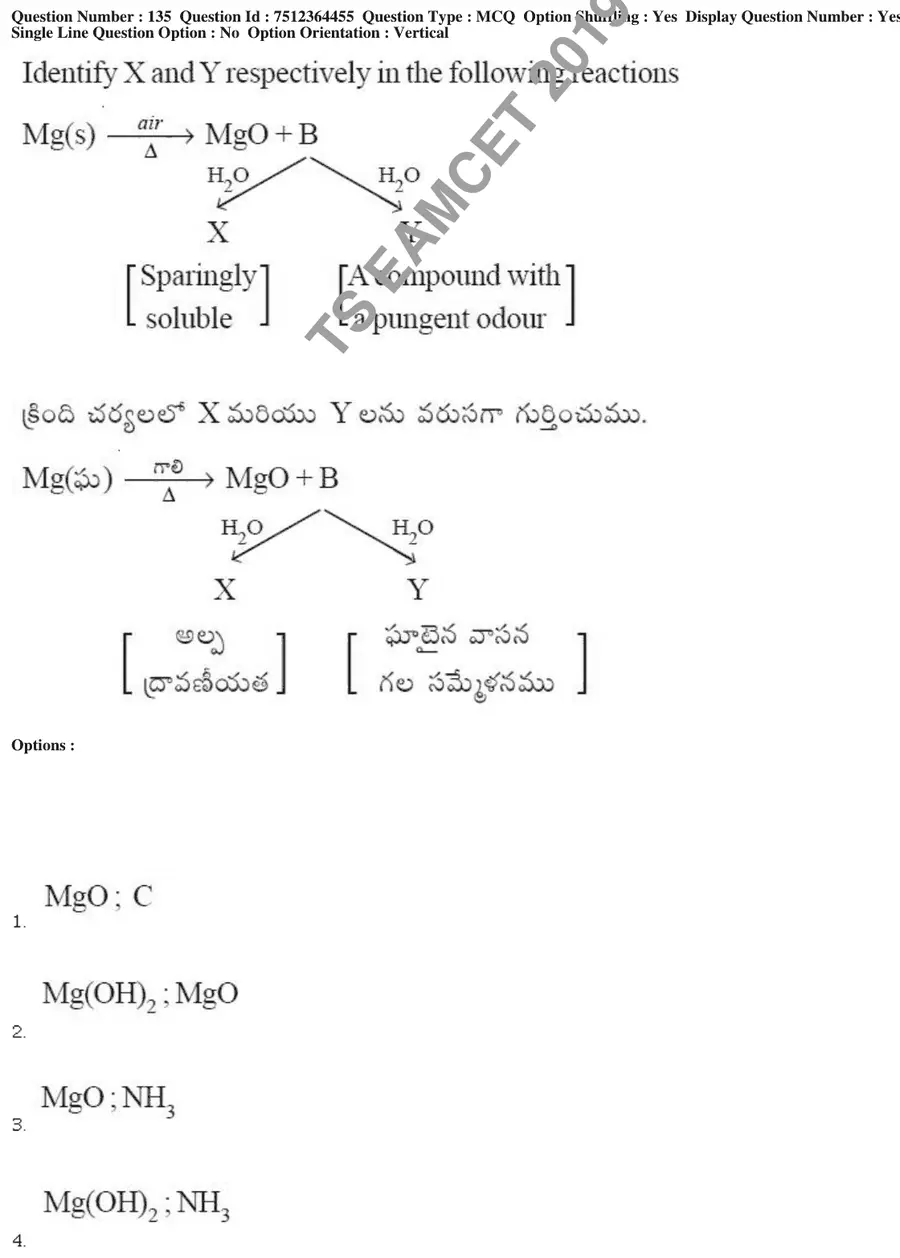
An element X reacts with air to form monoxide and nitride. This oxide is amphoteric. It can be converted to its chloride by heating with carbon and chlorine. Which of the following is correct for X?
$X, Y, Z$ are calcium compounds. $X$ is a primary raw material for manufacturing cement. $Y$ is used to recover ammonia in Solvay process and $Z$ is employed for making casts of statues. Identify the incorrect statement from the following
A
$Y$ is prepared by adding water to $X$
B
$Y$ is also used as a starting material to manufacture bleaching powder
C
$Z$ is formed by heating gypsum at 373 $K$
D
$X$ with $\mathrm{P_4O_{10}}$ forms calcium phosphate
Statement-I : Both $\mathrm{BeSO_4}$ and $\mathrm{MgSO_4}$ are readily soluble in water.
Statement-II : Among the nitrates of alkaline earth metals, only $\mathrm{Be(NO_3)_2}$ on strong heating gives its oxide, $\mathrm{NO_2}$ and $\mathrm{O_2}$.
The correct answer is
A
Both Statement-I and statement-II are correct
B
Statement-I is correct, but statement-II is not correct
C
Statement-I is not correct, but statement-II is correct
Statement – I: Both $\mathrm{LiF}$ and $\mathrm{CsI}$ have low solubility in water
Statement – II: Low solubility of $\mathrm{LiF}$ in water is due to smaller hydration enthalpy of ions and that of $\mathrm{CsI}$ is due to its high lattice enthalpy
The correct answer is
A
Both statements I and II are correct
B
Statement I is correct, but statement II is not correct
C
Statement I is not correct, but statement II is correct
Ba, Ca, Sr form halide hydrates. Their formulae are $\mathrm{BaCl_2.xH_2O}$, $\mathrm{CaCl_2.yH_2O}$, $\mathrm{SrCl_2.zH_2O}$. The values of x, y, z respectively are
Assertion (A): $\mathrm{MgO}$, $\mathrm{CaO}$, $\mathrm{SrO}$ and $\mathrm{BaO}$ are insoluble in water
Reason (R): In aqueous medium the basic strength of $\mathrm{MgO}$, $\mathrm{CaO}$, $\mathrm{SrO}$ and $\mathrm{BaO}$ increases with increase in the atomic number of metal
The correct option among the following is
A
(A) and (R) are correct. (R) is the correct explanation of (A)
B
(A) and (R) are correct, but (R) is not the correct explanation of (A)
The alkali metal with lowest $\mathrm{E^o_{M^+/M}}$(V) is X and the alkali metal with highest $\mathrm{E^o_{M^+/M}}$(V) is Y. Then X and Y are respectively
Unknown inorganic compound 'A' is used for water softening. 'A' reacts with $\mathrm{Na_2CO_3}$ to generate an alkaline compound 'B' whose pH = 14. 'A' on reaction with $\mathrm{CO_2}$ gives cloudy ppt. 'B' + CaO reacts with unknown organic compound 'C' to give $\mathrm{C_6H_6}$. A, B and C, respectively, are
Assertion (A) : The ionic radii of the alkaline earth metals are smaller than those of alkali metals in the same period. Reason (R) : Alkali metals have higher nuclear charge than that of the alkaline earth metals. The correct option among the following is
A
(A) is true, (R) is true and (R) is the correct explanation for (A)
B
(A) is true, (R) is true but (R) is not the correct explanation for (A)
Observe the following reactions $\mathrm{Dimer} \xleftarrow{\text{Vapour phase}} \mathrm{MCl_2} \xrightarrow{1200\,K} \text{linear monomer}$. What is M?
Match the following List - I: I) $\mathrm{CaSO_4.\ 2H_2O}$ ; II) $\mathrm{CaSO_4.\ 0.5H_2O}$ ; III) $\mathrm{CaSO_4}$ List - II: A) Knee cement ; B) Gypsum ; C) Plaster of Paris ; D) Dead burnt plaster
Identify the correct statements from the following: (a) Alkali metals are strong reducing agents. (b) $\mathrm{KO_2}$ is a diamagnetic oxide. (c) Lithium chloride exists as $\mathrm{LiCl.\,2H_2O}$
Identify the correct statements from the following (a) $\mathrm{BeSO_4}$ is soluble in water (b) BeO is an amphoteric oxide (c) CO can be obtained by heating $\mathrm{CaCO_3}$ at 1070 - 1270 K.
Assertion (A):- $\mathrm{MgSO_4}$ is readily soluble in water Reason (R):- The greater hydration enthalpy of $\mathrm{Mg^{2+}}$ ions overcome its lattice enthalpy.
A
A and R both are correct and R is the correct explanation of A.
B
A and R both are correct but R is not the correct explanation of A.
Answer: (B) a) $\mathrm{Ca} \xrightarrow{\mathrm{H_2O}}$ products; b) $\mathrm{CaH_2} \xrightarrow{\mathrm{H_2O}}$ products· The council's preliminary key
Assertion (A): $K$, $Rb$ and $Cs$ form superoxides Reason (R): The stability of superoxides increases form $K$ to $Cs$ due to decrease in lattice energy.
A
Both A and R are true and R is a correct explanation for A
B
Both A and R are true but R is not a correct explanation for A
Assertion (A): LiCl and $\mathrm{MgCl_2}$ are soluble in ethanol Reason (R) : Lithium and magnesium are harder than their respective group elements The correct option among the following is
A
(A) is true, (R) is true and (R) is the correct explanation for (A)
B
(A) is true, (R) is true but (R) is not the correct explanation for (A)
The correct statements are (I) The low solubility of LiF is due to its high lattice enthalpy (II) LiBr is not soluble in acetone (III) LiCl is soluble in pyridine (IV) The order of melting points of alkali metal halides is MF > MCl > MBr > MI
A metal 'M' readily gives $\mathrm{MSO_4}$, which is soluble in water. It forms its oxide MO which is amphoteric. It forms an insoluble hydroxide $\mathrm{M(OH)_2}$, which is soluble in NaOH solution. The M is
The correct order of electrical conductivity of alkali metals ions in their aqueous solution for $\mathrm{Cs^+}$, $\mathrm{K^+}$, $\mathrm{Na^+}$ and $\mathrm{Li^+}$ is
Which one of the following options is correct pertaining to the below transformations? $\mathrm{Na + NH_3(\mathit{l}) \longrightarrow Coloured\ solution \xrightarrow{on\ standing} X + Y}$
A
Colour of the solution: Yellow; X: $\mathrm{NaNH_2}$; Y: $\tfrac{1}{2}\mathrm{H_2}$
B
Colour of the solution: Orange; X: $\mathrm{NaN_3}$; Y: $\tfrac{9}{2}\mathrm{H_2}$
C
Colour of the solution: Blue; X: $\mathrm{NaNH_2}$; Y: $\tfrac{1}{2}\mathrm{H_2}$
D
Colour of the solution: Red; X: $\mathrm{NaN_3}$; Y: $\tfrac{9}{2}\mathrm{H_2}$
A chemical A is used for the preparation of washing soda to recover ammonia. When $\mathrm{CO_2}$ is bubbled through an aqueous solution of A, the solution turns milky. It is used in white washing due to disinfectant nature. What is the chemical formula of A?
Two metals A & B having similar ionic radii, react with oxygen to give only monoxides, and react with nitrogen to give nitrides. Then, A & B respectively are
Which of the following statement(s) are correct, when alkali metals burn in the presence of oxygen? I) Lithium forms monoxide II) Sodium forms peroxide III) Potassium, rubidium and cesium forms superoxide
Predict the feasibility of the given reactions in aqueous solution (i) $\mathrm{Be(OH)_2 + 2OH^- \longrightarrow [Be(OH)_4]^{2-}}$ (ii) $\mathrm{Be(OH)_2 + 2H^+ \longrightarrow [Be(OH)_4]^{2+}}$
Identify correct statements from the following: i. Beryllium oxide is an amphoteric oxide. ii. Group II elements dissolve in liquid ammonia to form deep blue-black solutions. iii. The hydration enthalpy of group II ions decreases from $\mathrm{Be^{2+}}$ to $\mathrm{Ba^{2+}}$.
A compound ($\mathrm{MO_2}$) of group I element (M) hydrolyses to form $\mathrm{M^{+}}$, $\mathrm{OH^{-}}$, X and Y. When X reacts with $\mathrm{I_2}$ in basic medium, the products formed are $\mathrm{I^{-}}$, water and Y. Then X and Y are respectively
Identify the correct statements from the following. I) Tendency to form halide hydrates gradually increases from Be to Ba down the group. II) Tendency to form stable super oxides increases from Li to Cs down the group. III) Low solubility of LiF is due to its high lattice energy. IV) Solubility of carbonates of group-2 elements increases down the group.
Compound A is prepared by the electrolysis of aqueous solution of B using Castner-Kellner cell with mercury as cathode and carbon as anode. A and B respectively are
Observe the following compounds. $\mathrm{CaCO_3}$ (i), $\mathrm{MgSO_4}$ (ii), $\mathrm{BaCl_2}$ (iii), $\mathrm{Sr(NO_3)_2}$ (iv), $\mathrm{MgBr_2}$ (v), $\mathrm{MgCl_2}$ (vi) The oxoacid salts of group II elements from the above list are
Identify the answer in which, the trends corresponding to hydroxides of group 2 elements (from $\mathrm{Mg(OH)_2}$ to $\mathrm{Ba(OH)_2}$) are correctly shown Columns: basic character; chemical stability; solubility
A
basic character increases; chemical stability increases; solubility decreases
B
basic character decreases; chemical stability decreases; solubility decreases
C
basic character decreases; chemical stability increases; solubility increases
D
basic character increases; chemical stability increases; solubility increases
A compound $(\mathrm{M_2O_2})$ of group I element (M) hydrolyses to form $\mathrm{M^+}$, $\mathrm{OH^-}$ and X. Another compound $(\mathrm{M'O_2})$ of group I element (M') hydrolyses to form $(\mathrm{M'})^+$, $\mathrm{OH^-}$, X and Y. What are X and Y respectively?
What are X, Y and Z in the following reactions? $\mathrm{CaCO_3}\overset{\Delta}{\rightleftharpoons}\mathrm{CO_2}+\mathrm{X}$ $\mathrm{X}+\mathrm{H_2O}\longrightarrow\mathrm{Y}$ $\mathrm{Y}+\mathrm{Cl_2}\longrightarrow\mathrm{Z}$ Options give X, Y, Z in order:
A
X = $\mathrm{CaO}$, Y = $\mathrm{Ca(OH)_2}$, Z = $\mathrm{CaOCl_2\cdot H_2O}$
B
X = $\mathrm{CaO}$, Y = $\mathrm{Ca(OCl)_2}$, Z = $\mathrm{Ca(OH)_2}$
C
X = $\mathrm{Ca(OCl)_2}$, Y = $\mathrm{Ca(OH)_2}$, Z = $\mathrm{CaO}$
D
X = $\mathrm{Ca(OH)_2}$, Y = $\mathrm{CaO}$, Z = $\mathrm{Ca(OCl)_2}$
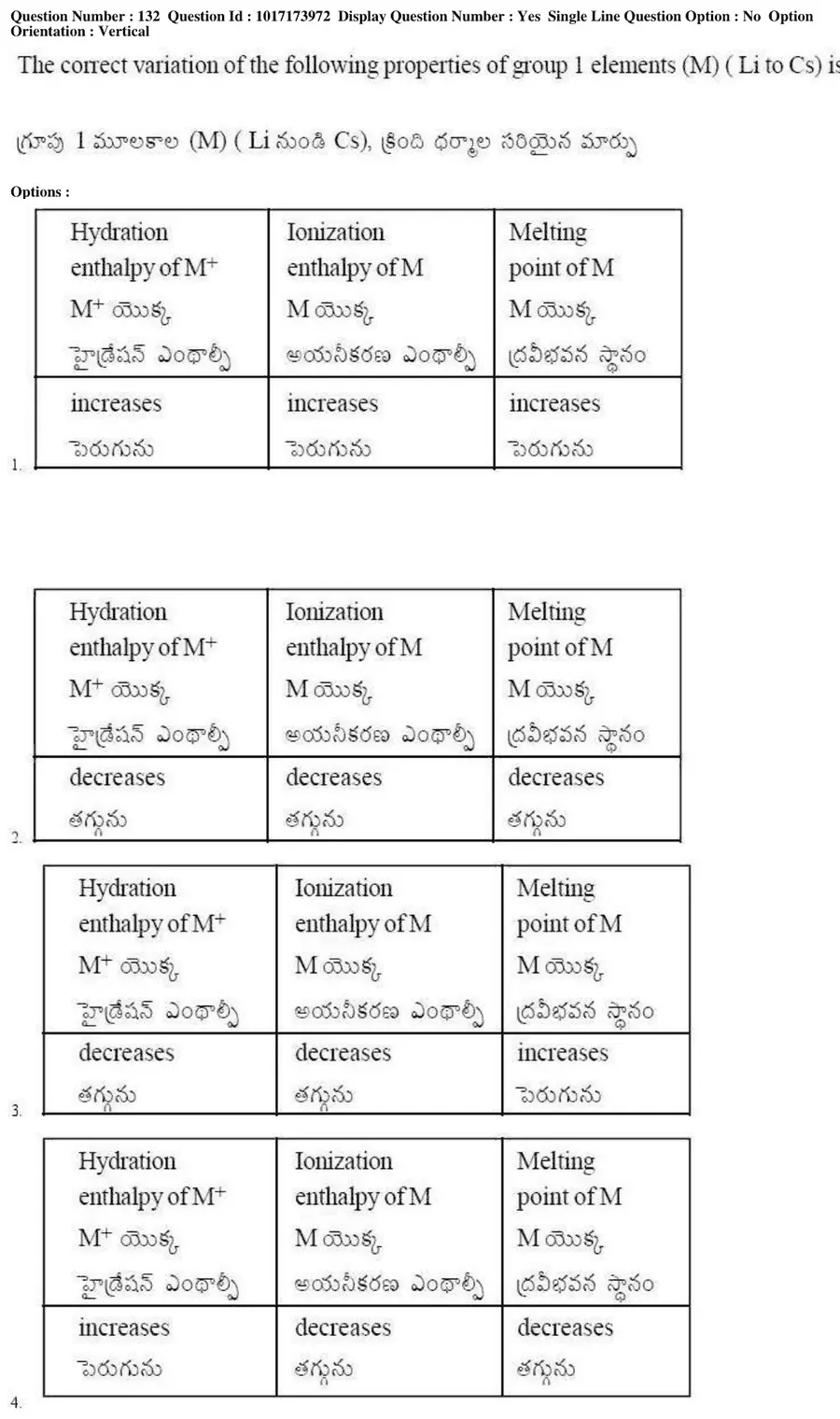
Answer: (B) Hydration enthalpy of $\mathrm{M^+}$: decreases; Ionization enthalpy of M: decreases; Melting point of M: decreases· The council's preliminary key
Consider the following statements. I) $\mathrm{Cs^+}$ ion is more highly hydrated than other alkali metal ions II) Among the alkali metals, only lithium forms a stable nitride by direct combination with nitrogen III) Among alkali metals Li, Na, K, Rb, the metal, Rb has the highest melting point IV) Among alkali metals Li, Na, K, Rb only Li forms peroxide when heated with oxygen The correct statement is
In photoelectric effect, if the energy required to overcome the attractive forces on the electron, (work functions) of Li, Na and Rb are 2.41 eV, 2.30 eV and 2.09 eV respectively, the work function of 'K' could approximately be in eV
Answer: (C) $\mathrm{Na_2CO_3}$· Official APSCHE final key
How to prepare s-Block Elements for EAPCET
How often it comes up
The s-Block Elements stands at rank 12 among the 31 chemistry chapters during the modern 2022 to 2026 period. Across our complete historical exam dataset from 2010 through 2026, the chapter delivered 163 questions across 149 papers, appearing in 132 of those tests to capture 2.7 percent of the subject with an average of 1.1 questions per paper. In the recent five-year timeframe from 2022 to 2026, it contributed 99 questions across 77 sittings, appearing in 72 papers to post 1.3 questions per paper and a 3.2 percent subject share.
The chapter has featured in every exam year since 2022, though it was absent from five papers across that five-year span. Looking at the two regional state streams between 2022 and 2026, AP examinations yielded 50 questions across 48 papers (appearing in 44 papers, 1.0 question per paper, 2.6 percent share), while TS examinations generated 49 questions across 29 papers (appearing in 28 papers, 1.7 questions per paper, 4.2 percent share).
During earlier testing between 2010 and 2021, papers included 64 questions across 72 sittings (appearing in 60 tests), delivering 0.9 questions per paper and a 2.2 percent subject share. Over the latest three exam years from 2024 to 2026, question banks carried 61 questions across 46 sittings (with 45 papers containing questions), yielding 1.3 questions per test and 3.3 percent share. Comparing early testing with the last three years shows the share is up, while comparing the recent five-year window with the last three years shows the share is about the same.
Most-asked topics
Questions in this chapter divide between the two constituent groups of electropositive metals:
Alkaline Earth Metals leads the chapter with 86 questions overall and 53 during the recent window through 2026. Frequent problem formats focus on group two solubility trends (hydroxide solubility increasing down the group while sulphate and carbonate solubilities decrease), thermal stability of carbonates and nitrates, anomalous behavior of beryllium, diagonal relationship between beryllium and aluminium, and industrial compounds of calcium including quicklime, slaked lime, plaster of Paris, and cement.
Alkali Metals accounts for 77 questions across the archive, with 46 appearing between 2022 and 2026. Key themes include group one flame colours, reaction with air to yield normal oxides, peroxides, and superoxides, liquid ammonia solutions exhibiting blue colour and paramagnetism, anomalous behavior of lithium, diagonal relationship between lithium and magnesium, and industrial manufacture of sodium carbonate by the Solvay process.
What the questions look like
Examiners test exact chemical observations and periodic inversions. A classic question presents group two compounds and asks you to rank the thermal stabilities of their carbonates or the aqueous solubilities of their sulphates and hydroxides. Beryllium frequently appears because both its oxide and hydroxide are amphoteric, unlike the purely basic oxides of heavier alkaline earth metals.
Reaction sequences are equally prevalent. You will encounter questions detailing a series of transformations starting with calcium metal or limestone, asking you to identify intermediate products and evaluate statements regarding their chemical behaviour. Questions on alkali metals frequently test the Solvay ammonia-soda process, asking which substance is not consumed as an ultimate raw material or why potassium carbonate cannot be prepared by this method due to high potassium bicarbonate solubility.
Questions to try first
Solve these representative state entrance questions to test your command of s-block chemical properties:
Pay close attention to diagonal relationships. Lithium resembles magnesium rather than heavier alkali metals: both form normal oxides on heating in oxygen, both form nitrides by direct combination with dinitrogen, and their carbonates decompose thermally to release carbon dioxide. Similarly, beryllium resembles aluminium: both form covalent, hydrolysable chlorides, their oxides and hydroxides are amphoteric, and both form fluoro-complex anions.
Memorise the flame colours: lithium gives crimson red, sodium gives yellow, potassium gives pale violet, rubidium gives red violet, and caesium gives blue. For group two, calcium gives brick red, strontium gives crimson, and barium gives apple green, while beryllium and magnesium do not impart colour to the flame because their excitation energies are too high for visible excitation.
Frequently asked questions
Why does the solubility of alkaline earth sulphates decrease down group two?
Solubility is determined by the balance between lattice enthalpy and hydration enthalpy. The sulphate anion is large, so the lattice enthalpy remains relatively constant down the group. However, the hydration enthalpy of the divalent metal cation decreases rapidly as ionic size increases from beryllium to barium, causing sulphate solubility to fall sharply.
What causes the deep blue colour of alkali metals dissolved in liquid ammonia?
Alkali metals dissolve in liquid ammonia without chemical reaction to form ammoniated cations and ammoniated electrons. The ammoniated electrons absorb energy in the red region of the visible light spectrum, imparting a characteristic deep blue colour to dilute solutions.
Why cannot potassium carbonate be prepared by the Solvay process?
The Solvay process relies on the precipitation of sodium bicarbonate due to its low solubility in brine saturated with ammonia and carbon dioxide. Potassium bicarbonate is too soluble in water to precipitate under similar reaction conditions, making the Solvay method unfeasible for potassium carbonate. Step-by-step solutions for each one are in the EdLoop EAPCET app.