EdLoop PYQs · free, no ads · questions and answers here, step-by-step solutions in the EdLoop app
PYQs · free, no adsOpen on the web (app.edloop.in)Get EdLoop – free on Google Play
ChemistrySolutions

Solutions: AP & TS EAPCET PYQs 2010–2026

Every Solutions question from past AP EAPCET and TS EAPCET papers, with options and answers. Newest first.

214questions
139papers covered
3.2%of Chemistry questions, 2022–2026
2010–2026years

Guide at a glance

Solutions holds position 11 among the 31 chemistry chapters in the modern five-year testing period from 2022 to 2026.

Most asked sub-topics

Colligative Properties111
Vapour Pressure & Raoult's Law69
van't Hoff Factor34

Practise these in EdLoop

Attempt every Solutions question timed, see the step-by-step solution and track what you get wrong. Free.

Start practice

All questions

214 questions
1AP EAPCET 2026 · 18 May · Shift 1MCQOpen question page ↗

At 300 K , $x$ moles of $\mathrm{CaCl_2}$ ($i$ = 2.5 ; molar mass = 111 g mol$^{-1}$) is dissolved in 2.5 L of water.

The osmotic pressure of resultant solution is 0.75 atm. What is $\Delta \mathrm{T_b}$ of solution ?

(density of water = 1g mL$^{-1}$ ; $\mathrm{K_b}$ = 0.52 K kg mol$^{-1}$ ; R = 0.08 L atm mol$^{-1}$K$^{-1}$)

  • A

    0.016 K

  • B

    0.032 K

  • C

    0.048 K

  • D

    0.064 K

2AP EAPCET 2026 · 18 May · Shift 2MCQOpen question page ↗

What mass (in g) of glycerol is required to produce the same anti-freezing effect in 1.0 L of water as that of 20 g of NaCl in 1.0 L of water?
(molar mass of glycerol = $92\ \mathrm{g\ mol^{-1}}$ , assume $\mathrm{NaCl}$ is 97% dissociated)

  • A

    52.96

  • B

    61.96

  • C

    41.91

  • D

    72.96

3AP EAPCET 2026 · 15 May · Shift 1MCQOpen question page ↗

At $27^\circ\mathrm{C}$, $x$ g of $\mathrm{C_6H_{12}O_6}$ (molar mass = 180 g mol$^{-1}$) and $y$ g of a non-volatile, non-electrolyte (molar mass = 92 g mol$^{-1}$) were present separately in 1.0 L solutions. The osmotic pressure of two solutions is equal. What is $x/y$?

  • A

    $45/23$

  • B

    $23/45$

  • C

    $32/54$

  • D

    $54/32$

4AP EAPCET 2026 · 15 May · Shift 2MCQOpen question page ↗

The boiling point of 1M aqueous solution of $KCl$ (85% dissociation) having density 1.04 g mL$^{-1}$ is
(Given: $\mathrm{K_b}$ ($\mathrm{H_2O}$) = 0.52 K kg mol$^{-1}$, molar mass of $KCl$ = 74.5 g mol$^{-1}$)

  • A

    $100.096^\circ\mathrm{C}$

  • B

    $100.996^\circ\mathrm{C}$

  • C

    $100.896^\circ\mathrm{C}$

  • D

    $100.796^\circ\mathrm{C}$

5AP EAPCET 2026 · 14 May · Shift 1MCQOpen question page ↗

1.0 g of a non-electrolytic and non-volatile solute (X) was dissolved in 20.4 g of water. At 760 mm Hg the freezing point of solution was found to be $-1.05^\circ\mathrm{C}$. The molar mass (in $\mathrm{g\ mol^{-1}}$) of the solute is

($\mathrm{K_f}$ ($\mathrm{H_2O}$) = 1.86 K kg $\mathrm{mol^{-1}}$)

  • A

    96.8

  • B

    43.4

  • C

    86.8

  • D

    48.4

6AP EAPCET 2026 · 14 May · Shift 2MCQOpen question page ↗

At 300 K, a decimolar solution of potassium ferrocyanide is 50% dissociated. The osmotic pressure (in $atm$) of the solution is
$(R = 0.082\ L\ atm\ K^{-1}mol^{-1})$

  • A

    6.83

  • B

    3.87

  • C

    7.38

  • D

    7.83

7AP EAPCET 2026 · 13 May · Shift 1MCQOpen question page ↗

An aqueous solution of a non-volatile and non-electrolytic solute boils at $100.5^\circ\mathrm{C}$. What will be the freezing point of the same solution?
(Given $K_b = 0.512\ K\ kg\ mol^{-1}$ and $K_f = 1.86\ K\ kg\ mol^{-1}$)

  • A

    $-2.816\ ^\circ\mathrm{C}$

  • B

    $-1.816\ ^\circ\mathrm{C}$

  • C

    $-0.908\ ^\circ\mathrm{C}$

  • D

    $-3.632\ ^\circ\mathrm{C}$

8AP EAPCET 2026 · 12 May · Shift 2MCQOpen question page ↗

The value of $K_f$ (in $K\ kg\ mol^{-1}$) of a solvent (X) is four times the value of its $K_b$. $2g$ of a non-volatile, non-electrolytic solute $A$ is dissolved in 200 g of solvent X. The $\Delta T_b$ of resultant solution in $YK$. $4g$ of $A$ is dissolved in 200 g of X and the $\Delta T_f$ of solution is Z K. What is the ratio of Y and Z?
(Molar mass of A=100 $g\ mol^{-1}$)

  • A

    $1:2$

  • B

    $1:4$

  • C

    $1:8$

  • D

    $1:16$

9TS EAPCET 2026 · 11 May · Shift 1MCQOpen question page ↗

Henry's law constant for argon at 298 K is 40 k bar. The mass of argon (in g) dissolved in 2.0 L water, when the pressure applied is 3.0 bar at the same temperature is

(Molar mass of argon = $40\,\mathrm{g\,mol^{-1}}$)

  • A

    0.66

  • B

    3.33

  • C

    4.33

  • D

    0.33

10TS EAPCET 2026 · 11 May · Shift 2MCQOpen question page ↗

If two liquids A and B have $\mathrm{P_A^\circ : P_B^\circ} = 1:2$ and have mole fraction in solution as $1:2$, then mole fraction of B in vapour phase is

  • A

    0.2

  • B

    0.8

  • C

    0.4

  • D

    0.6

11TS EAPCET 2026 · 10 May · Shift 1MCQOpen question page ↗

The following graph is obtained by taking partial pressure of $\mathrm{HCl}$ (g) on y-axis and mole fraction of $\mathrm{HCl}$ (g) in cyclohexane on x-axis. The slope (m) of the graph is

(see the figure above)

The question and its figure as printed in TS EAPCET 2026 10th May 2026 Shift 1.
The question as printed in the paper.
  • A

    Henry constant ($\mathrm{K_H}$) of cyclohexane

  • B

    $\mathrm{K_H}$ of $\mathrm{HCl}$ (g)

  • C

    Square root of $\mathrm{K_H}$ of $\mathrm{HCl}$ (g)

  • D

    $\dfrac{1}{\mathrm{K_H(HCl)}}$

12TS EAPCET 2026 · 10 May · Shift 2MCQOpen question page ↗

Which of the following aqueous solution has highest freezing point?

  • A

    0.1 m $\mathrm{Al_2(SO_4)_3}$

  • B

    0.1 m $\mathrm{BaCl_2}$

  • C

    0.1 m $\mathrm{NH_4Cl}$

  • D

    0.1 m $\mathrm{AlCl_3}$

13TS EAPCET 2026 · 9 May · Shift 1MCQOpen question page ↗

The relative lowering of vapour pressure of an aqueous solution containing a non-volatile solute is 0.0125. The molality of the solution is

  • A

    0.65 m

  • B

    0.35 m

  • C

    0.70 m

  • D

    0.30 m

14AP EAPCET 2025 · 27 May · Shift 1MCQOpen question page ↗

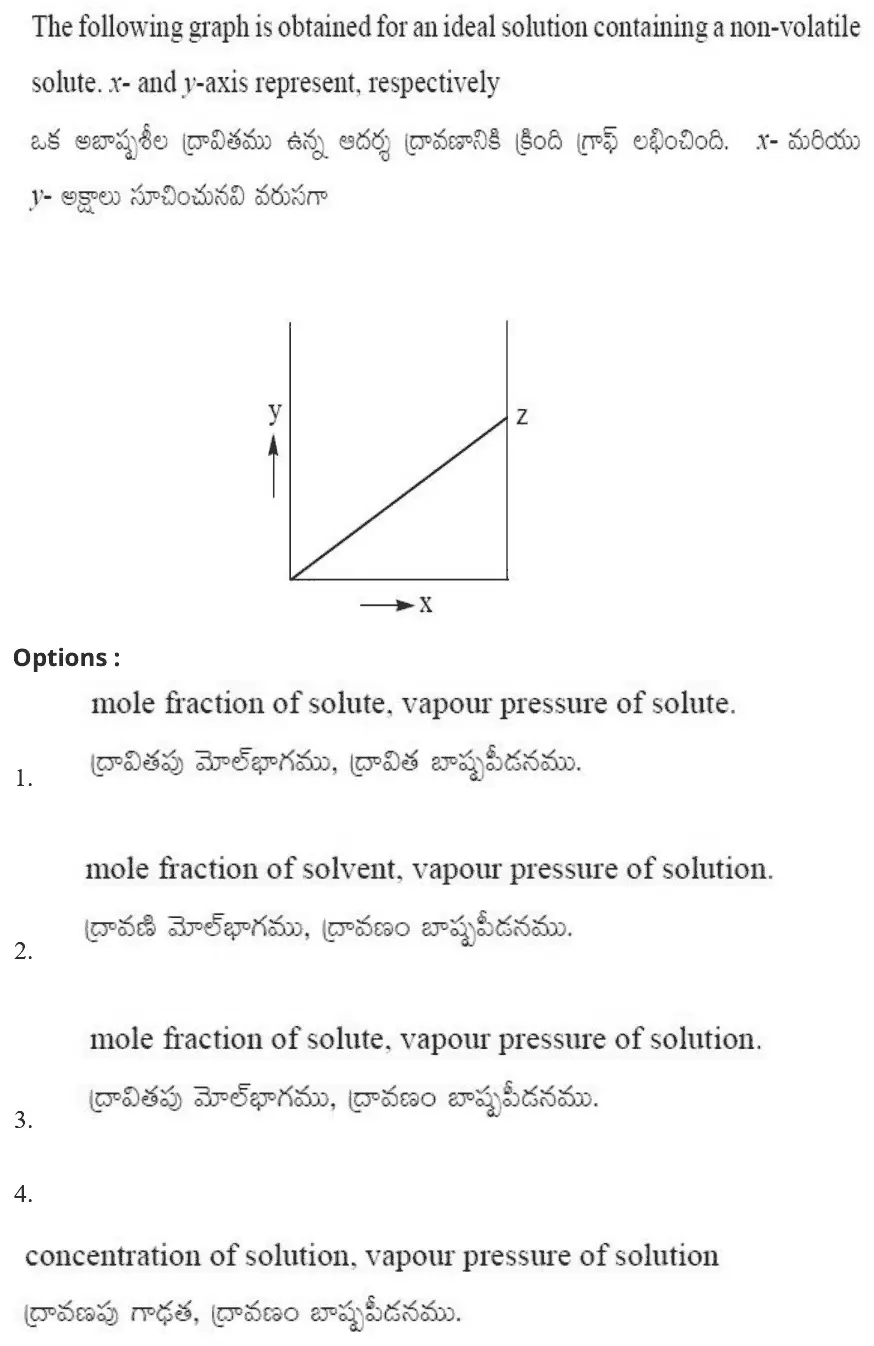
The following graph is obtained for an ideal solution containing a non-volatile solute. $x$- and $y$-axis represent, respectively

(see the figure above)

The question and its figure as printed in AP EAPCET 2025 27th May 2025 Shift 1.
The question as printed in the paper.
  • A

    mole fraction of solute, vapour pressure of solute.

  • B

    mole fraction of solvent, vapour pressure of solution.

  • C

    mole fraction of solute, vapour pressure of solution.

  • D

    concentration of solution, vapour pressure of solution

15AP EAPCET 2025 · 26 May · Shift 1MCQOpen question page ↗

At T(K), the vapour pressure of water is $x$ kPa. What is the vapour pressure (in kPa) of 1 molal solution containing non-volatile solute ?

  • A

    $1.018\,x$

  • B

    $0.8\,x$

  • C

    $0.972\,x$

  • D

    $0.982\,x$

16AP EAPCET 2025 · 26 May · Shift 1MCQOpen question page ↗

Elements X and Y form two non-volatile compounds ($\mathrm{XY}$ and $\mathrm{XY_3}$). When 10 g of $\mathrm{XY}$ is dissolved in 50 g of ethanol, the depression in freezing point ($\Delta \mathrm{T_f}$) was 5.333 K. When 10 g of $\mathrm{XY_3}$ is dissolved in 50 g of ethanol, the was ($\Delta \mathrm{T_f}$) 2.2857 K. What are the atomic weights of X and Y respectively ? ($\mathrm{K_f}$ = 2 K kg $\mathrm{mol^{-1}}$)

  • A

    50 u, 50 u

  • B

    25 u, 25 u

  • C

    75 u, 100 u

  • D

    25 u, 50 u

17AP EAPCET 2025 · 26 May · Shift 2MCQOpen question page ↗

The van't Hoff factor for 0.5 m aqueous $\mathrm{CH_2FCOOH}$ solution is 1.075. What is the experimentally observed $\Delta T_f$ (in K) for this solution ?

($K_f = 1.86\ \mathrm{K\ kg\ mol^{-1}}$)

  • A

    1.156

  • B

    1.075

  • C

    1.0

  • D

    0.95

18AP EAPCET 2025 · 24 May · Shift 1MCQOpen question page ↗

An aqueous solution containing 0.2 g of a non volatile solute 'A' in 21.5 g of water freezes at 272.814 K. If the freezing point of water is 273.16 K, the molar mass (in $\mathrm{g\ mol^{-1}}$) of solute A is $[\mathrm{K_f(H_2O)} = 1.86\ \mathrm{K\ kg\ mol^{-1}}]$

  • A

    80

  • B

    75

  • C

    100

  • D

    50

19AP EAPCET 2025 · 24 May · Shift 1MCQOpen question page ↗

At T(K), the vapour pressure of $x$ molal aqueous solution containing a non-volatile solute is 12.078 kPa. The vapour pressure of pure water at T(K) is 12.3 kPa. What is the value of $x$ ?

  • A

    10

  • B

    1.018

  • C

    0.1018

  • D

    0.018

20AP EAPCET 2025 · 23 May · Shift 1MCQOpen question page ↗

A solution of urea in water has a boiling point of $100.18^\circ\mathrm{C}$. What is the freezing point of the same solution, if $\mathrm{K_f}$ and $\mathrm{K_b}$ of water are 1.86 and 0.52 $\mathrm{K\ kg\ mol^{-1}}$, respectively ? (Boiling point of water = 100 °C)

  • A

    $-0.34\ ^\circ\mathrm{C}$

  • B

    $-0.22\ ^\circ\mathrm{C}$

  • C

    $-0.64\ ^\circ\mathrm{C}$

  • D

    $-0.32\ ^\circ\mathrm{C}$

21AP EAPCET 2025 · 23 May · Shift 1MCQOpen question page ↗

At T(K), the vapour pressure of pure benzene and toluene are 75 and 22 mm Hg respectively. 23.4 g of benzene and 64.4 g of toluene are mixed to form an ideal solution. If the vapours are in equilibrium with the liquid mixture, the mole fraction of toluene in vapour phase is (At.wt of C = 12; H = 1)

  • A

    0.406

  • B

    0.594

  • C

    0.539

  • D

    0.461

22AP EAPCET 2025 · 23 May · Shift 2MCQOpen question page ↗

Benzoic acid molecules undergo dimerisation in benzene. 2.44 g of benzoic acid when dissolved in 30 g of benzene caused depression in freezing point of 2 K. What is the percentage of association of it ?

(Given $\mathrm{K_f(C_6H_6)} = 5\ \mathrm{K\ kg\ mol^{-1}}$; molar mass of benzoic acid = $122\ \mathrm{g\ mol^{-1}}$)

  • A

    80

  • B

    70

  • C

    60

  • D

    90

23AP EAPCET 2025 · 22 May · Shift 1MCQOpen question page ↗

At T(K), the vapour pressure of an aqueous solution of a non-volatile solute, whose mole fraction is 0.02 is found to be 34.65 mm Hg. What is the vapour pressure (in mm Hg) of pure water at the same temperature ?

  • A

    35.70

  • B

    35.36

  • C

    35.00

  • D

    34.30

24AP EAPCET 2025 · 22 May · Shift 2MCQOpen question page ↗

1.95 g of non-volatile and non-electrolyte solute dissolved in 100 g of benzene lowered the freezing point of it by 0.64 K. The molar mass of the solute (in g $\mathrm{mol^{-1}}$) ($\mathrm{K_f(C_6H_6)}$ = 5.12 K kg $\mathrm{mol^{-1}}$)

  • A

    240

  • B

    156

  • C

    165

  • D

    265

25AP EAPCET 2025 · 22 May · Shift 2MCQOpen question page ↗

At 298 K, 0.714 moles of liquid A is dissolved in 5.555 moles of liquid B. The vapour pressure of the resultant solution is 475 torr. The vapour pressure of pure liquid A at the same temperature is 280.7 torr. What is the vapour pressure of pure liquid B in torr ?

  • A

    486

  • B

    550

  • C

    514

  • D

    500

26AP EAPCET 2025 · 21 May · Shift 1MCQOpen question page ↗

A solution containing 7.5 g of urea (molar mass = 60 g mol$^{-1}$) in 1 kg of water freezes at the same temperature as another solution containing 15 g of solute X, in the same amount of water. The molar mass of X (g mol$^{-1}$) is

  • A

    60

  • B

    180

  • C

    120

  • D

    240

27AP EAPCET 2025 · 21 May · Shift 2MCQOpen question page ↗

A centi molar solution of acetic acid is 50% dissociated at $27\ ^\circ\mathrm{C}$. The osmotic pressure of the solution (in atm) is ($\mathrm{R} = 0.083\ \mathrm{L\ atm\ K^{-1}\ mol^{-1}}$)

  • A

    0.37

  • B

    3.7

  • C

    0.037

  • D

    0.73

28AP EAPCET 2025 · 21 May · Shift 2MCQOpen question page ↗

At 300 K vapour pressure of a pure liquid, 'A' is 70 mm Hg. It forms an ideal solution with another liquid 'B'. The mole fraction of B in the solution is 0.2 and total vapour pressure of solution is 84 mm Hg at same temperature. What is the vapour pressure (in mm) of pure liquid B at 300 K ?

  • A

    140

  • B

    70

  • C

    280

  • D

    560

29TS EAPCET 2025 · 4 May · Shift 1MCQOpen question page ↗

In a mixture of liquids A and B, if the mole fractions of component A in vapour phase and liquid mixture are $x_1$ and $x_2$ respectively, then the total vapour pressure of liquid mixture is
(where $\mathrm{P_A^\circ}$ and $\mathrm{P_B^\circ}$ are the vapour pressures of pure A and B)

  • A

    $\frac{\mathrm{P_B^\circ}\, x_1}{x_2}$

  • B

    $\frac{\mathrm{P_B^\circ}\, x_2}{x_1}$

  • C

    $\frac{\mathrm{P_A^\circ}\, x_2}{x_1}$

  • D

    $\frac{\mathrm{P_A^\circ}\, x_1}{x_2}$

30TS EAPCET 2025 · 3 May · Shift 1MCQOpen question page ↗

Observe the following data given in the table.

($\mathrm{K_H}$ = Henry's law constant)

Gas$\mathrm{CO_2}$ArHCHO$\mathrm{CH_4}$
$\mathrm{K_H}$ (k bar at 298 K)1.6740.3$1.83\times10^{-5}$0.413

The correct order of their solubility in water is

  • A

    $\mathrm{CO_2} > \mathrm{CH_4} > \mathrm{HCHO} > \mathrm{Ar}$

  • B

    $\mathrm{Ar} > \mathrm{HCHO} > \mathrm{CH_4} > \mathrm{CO_2}$

  • C

    $\mathrm{HCHO} > \mathrm{CH_4} > \mathrm{CO_2} > \mathrm{Ar}$

  • D

    $\mathrm{CO_2} > \mathrm{HCHO} > \mathrm{CH_4} > \mathrm{Ar}$

31TS EAPCET 2025 · 3 May · Shift 2MCQOpen question page ↗

Two liquids ‘A’ and ‘B’ form an ideal solution. At 300 K, the vapour pressure of a solution containing 1 mole of ‘A’ and 3 moles of ‘B’ is 550 mm Hg. At the same temperature, if one more mole of ‘B’ is added to the solution, the vapour pressure of solution increases to 560 mm Hg. Then the ratio of vapour pressures of A and B in their pure state is

  • A

    $1:3$

  • B

    $3:1$

  • C

    $2:3$

  • D

    $3:2$

32TS EAPCET 2025 · 2 May · Shift 1MCQOpen question page ↗

Observe the following statements

Statement – I: The boiling point of 0.1 M urea solution is less than that of 0.1 M KCl solution

Statement – II: Elevation of boiling point is inversely proportional to molar mass of solute

The correct answer is

  • A

    Both statements I and II are correct

  • B

    Statement I is correct, but statement II is not correct

  • C

    Statement I is not correct, but statement II is correct

  • D

    Both statements I and II are not correct

33TS EAPCET 2025 · 2 May · Shift 2MCQOpen question page ↗

The osmotic pressure (in atm) of an aqueous solution containing 0.01 mol of $\mathrm{NaCl}$ (degree of dissociation 0.94) and 0.03 mol of glucose in 500 mL at $27\,^\circ\mathrm{C}$ is
($R = 0.082\,\mathrm{L\ atm\ K^{-1}mol^{-1}}$)

  • A

    2.43

  • B

    4.23

  • C

    3.24

  • D

    3.42

34AP EAPCET 2024 · 23 May · Shift 1MCQOpen question page ↗

At 300 K, the vapour pressures of A and B liquids are 500 and 400 mm Hg respectively. Equal moles of A and B are mixed to form an ideal solution. The mole fraction of A and B in vapor state is respectively

  • A

    0.5, 0.5

  • B

    0.666, 0.333

  • C

    0.444, 0.555

  • D

    0.555, 0.444

35AP EAPCET 2024 · 23 May · Shift 1MCQOpen question page ↗

Two statements are given below

Statement – I: Liquids A and B form a non-ideal solution with positive deviation. The interactions between A and B are weaker than A-A and B-B interactions

Statement – II: For an ideal solution, $\Delta_{mix}H = 0$; $\Delta_{mix}V = 0$

The correct answer is

  • A

    Both Statements -I and Statement -II are correct

  • B

    Both Statements -I and Statement -II are not correct

  • C

    Statement-I is correct but Statement-II is not correct

  • D

    Statement-I is not correct but Statement-II is correct

36AP EAPCET 2024 · 22 May · Shift 1MCQOpen question page ↗

Benzoic acid undergoes dimerization in benzene. $x$ g of benzoic acid (molar mass $122\ \mathrm{g\ mol^{-1}}$) is dissolved in 49 g of benzene. The depression in freezing point is 1.12 K. If degree of association of acid is 88 %, what is the value of $x$? ($\mathrm{K_f}$ for benzene = $4.9\ \mathrm{K\ kg\ mol^{-1}}$)

  • A

    2.44

  • B

    1.22

  • C

    3.66

  • D

    4.88

37AP EAPCET 2024 · 22 May · Shift 1MCQOpen question page ↗

At T(K) two liquids A and B form an ideal solution. The vapour pressures of pure liquids A and B at that temperature are 400 and 600 mm Hg respectively. If the mole fraction of liquid B is 0.3 in the mixture, the mole fractions of A and B in vapour phase respectively are

  • A

    0.391, 0.609

  • B

    0.509, 0.491

  • C

    0.609, 0.391

  • D

    0.491, 0.509

38AP EAPCET 2024 · 22 May · Shift 2MCQOpen question page ↗

At 290 K, a vessel (I) contains equal moles of three liquids (A, B, C). The boiling points of A, B and C are 350, 373 and 308 K respectively. Vessel (I) is heated to 300 K and vapours were collected into vessel (II). Identify the correct statements. (Assume vessel (I) contains liquids and vapours and vessel (II) contains only vapours)

I. Vessel – I is rich in liquid B

II. Vessel – II is rich in vapour of C

III. The vapour pressures of A, B, C in Vessel (I) at 290 K follows the order C > A > B

  • A

    I, II, III

  • B

    I, II only

  • C

    I, III only

  • D

    II, III only

39AP EAPCET 2024 · 22 May · Shift 2MCQOpen question page ↗

At 300 K, 6 g of urea was dissolved in 500 mL of water. What is the osmotic pressure (in atm) of resultant solution? ($\mathrm{R = 0.082\ L\ atm\ K^{-1}\ mol^{-1}}$)

(C = 12; N = 14; O = 16; H = 1)

  • A

    0.492

  • B

    2.46

  • C

    4.92

  • D

    49.2

40AP EAPCET 2024 · 22 May · Shift 2MCQOpen question page ↗

In water, which of the following gases has the highest Henry’s law constant at 293 K?

  • A

    $\mathrm{N_2}$

  • B

    $\mathrm{O_2}$

  • C

    $\mathrm{He}$

  • D

    $\mathrm{H_2}$

41AP EAPCET 2024 · 21 May · Shift 1MCQOpen question page ↗

A solution was prepared by dissolving 0.1 mole of a non-volatile solute in 0.9 moles of water. What is the relative lowering of vapour pressure of solution?

  • A

    0.9

  • B

    0.5

  • C

    0.1

  • D

    0.05

42AP EAPCET 2024 · 21 May · Shift 2MCQOpen question page ↗

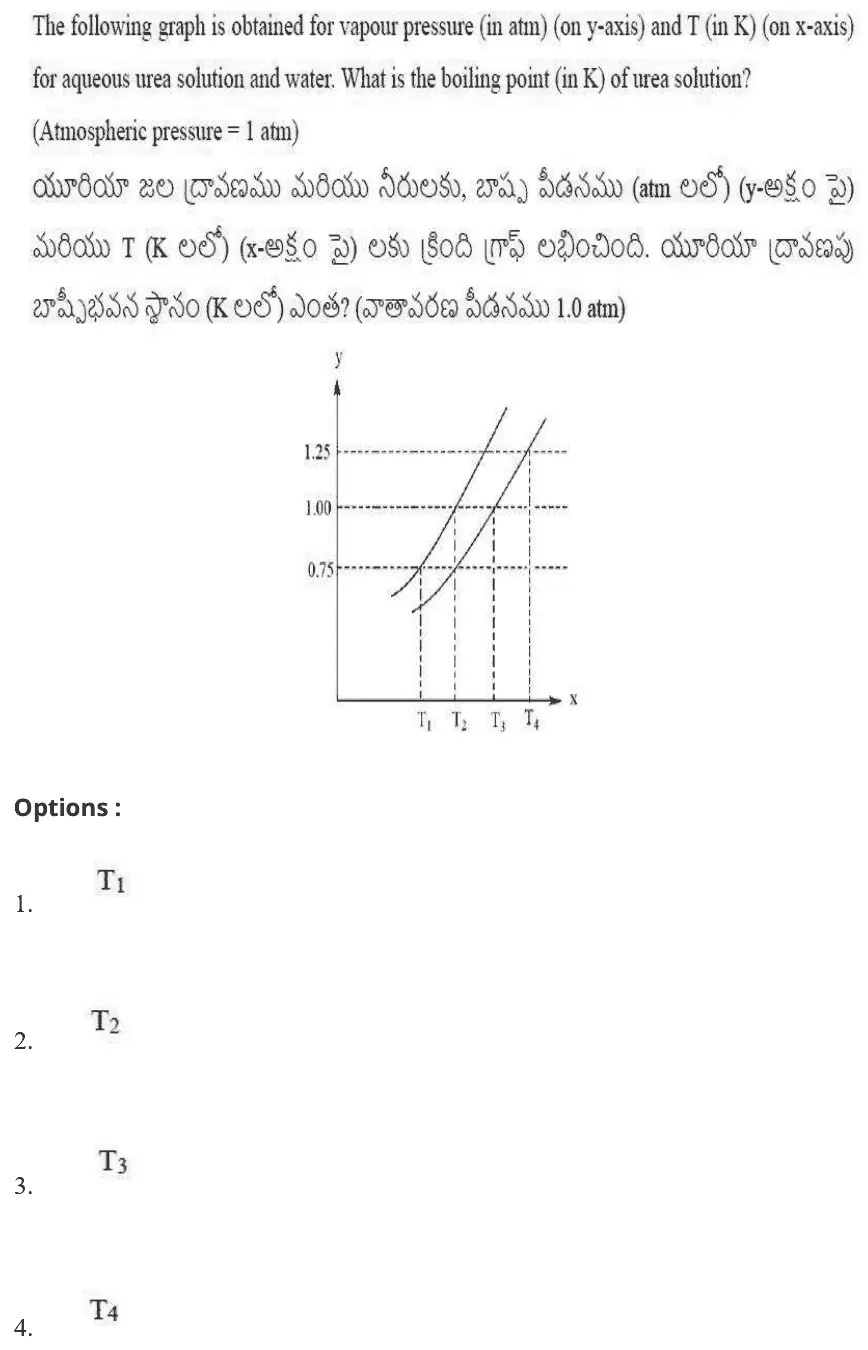
The following graph is obtained for vapour pressure (in atm) (on y-axis) and T (in K) (on x-axis) for aqueous urea solution and water. What is the boiling point (in K) of urea solution?

(Atmospheric pressure = 1 atm)

(see the figure above)

The question and its figure as printed in AP EAPCET 2024 21st May 2024 Shift 2.
The question as printed in the paper.
  • A

    $T_1$

  • B

    $T_2$

  • C

    $T_3$

  • D

    $T_4$

43AP EAPCET 2024 · 21 May · Shift 2MCQOpen question page ↗

Given below are two statements

Statement I: Liquids A & B form a non-ideal solution with negative deviation. The interactions between A and B are weaker than A-A & B-B interactions

Statement II: In reverse osmosis, the applied pressure must be higher than the osmotic pressure of solution

The correct answer is

  • A

    Both Statement-I and Statement-II are correct

  • B

    Both Statement-I and Statement-II are not correct

  • C

    Statement-I is correct but Statement-II is not correct

  • D

    Statement-I is not correct but Statement-II is correct

44AP EAPCET 2024 · 20 May · Shift 1MCQOpen question page ↗

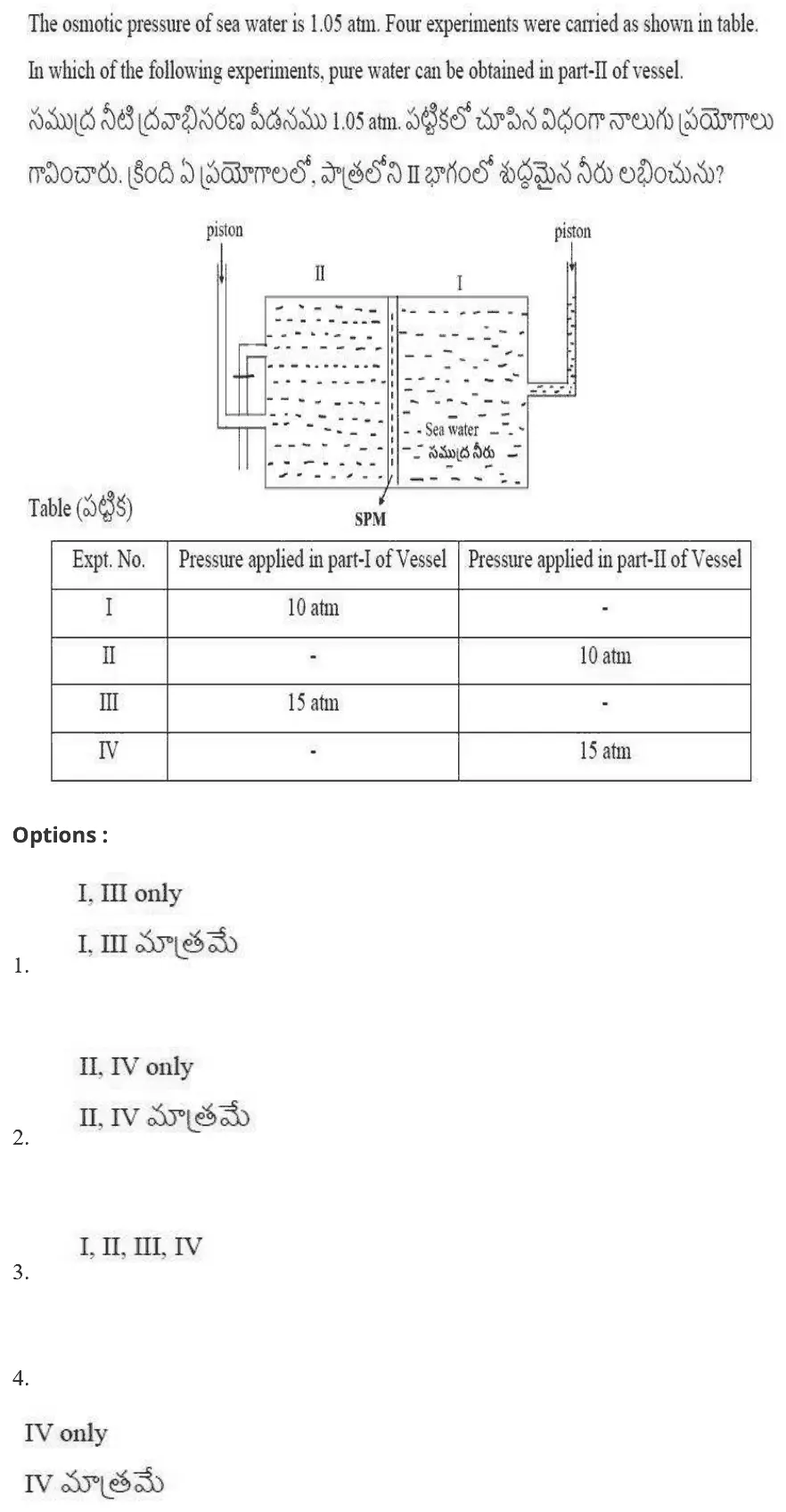
The osmotic pressure of sea water is 1.05 atm. Four experiments were carried as shown in table.

In which of the following experiments, pure water can be obtained in part-II of vessel.

(see the figure above)

Table

Expt. No.Pressure applied in part-I of VesselPressure applied in part-II of Vessel
I10 atm-
II-10 atm
III15 atm-
IV-15 atm
The question and its figure as printed in AP EAPCET 2024 20th May 2024 Shift 1.
The question as printed in the paper.
  • A

    I, III only

  • B

    II, IV only

  • C

    I, II, III, IV

  • D

    IV only

45AP EAPCET 2024 · 20 May · Shift 2MCQOpen question page ↗

A non – volatile solute is dissolved in water. The $\Delta T_b$ of resultant solution is 0.052 K. What is the freezing point of the solution (in K)?

($K_b$ of water = 0.52 K kg $\mathrm{mol^{-1}}$; $K_f$ of water = 1.86 K kg $\mathrm{mol^{-1}}$; Freezing point of water = 273 K)

  • A

    272.628

  • B

    273.186

  • C

    273.000

  • D

    272.814

46AP EAPCET 2024 · 19 May · Shift 2MCQOpen question page ↗

The $\Delta T_b$ value for 0.01 m $\mathrm{KCl}$ solution is 0.01 K. What is the Van't Hoff factor?

($K_b$ for water = 0.52 K kg $\mathrm{mol^{-1}}$)

  • A

    1.92

  • B

    1.72

  • C

    0.96

  • D

    0.86

47AP EAPCET 2024 · 18 May · Shift 1MCQOpen question page ↗

At 293 K, methane gas was passed into 1 L of water. The partial pressure of methane is 1 bar. The number of moles of methane dissolved in 1 L water is

($K_H$ of methane = 0.4 kbar)

  • A

    $1.38$

  • B

    $1.38 \times 10^{-2}$

  • C

    $1.38 \times 10^{-3}$

  • D

    $1.38 \times 10^{-1}$

48TS EAPCET 2024 · 11 May · Shift 1MCQOpen question page ↗

At 300 K, the vapour pressure of toluene and benzene are 3.63 kPa and 9.7 kPa respectively. What is the composition of vapour in equilibrium with the solution containing 0.4 mole fraction of toluene?
(Assume the solution is ideal)

  • A

    0.40

  • B

    0.60

  • C

    0.80

  • D

    0.20

49TS EAPCET 2024 · 10 May · Shift 1MCQOpen question page ↗

At 300 K, 0.06 kg of an organic solute is dissolved in 1 kg water. The vapour pressure of solution at 300 K is 3.768 kPa. If vapour pressure of water at that temperature is 3.78 kPa, what is the molar mass of the organic solute (in $\mathrm{g\ mol^{-1}}$)?

(Assume the solution is dilute)

  • A

    180

  • B

    120

  • C

    340

  • D

    260

50TS EAPCET 2024 · 10 May · Shift 2MCQOpen question page ↗

At T(K), 0.1 moles of a non –volatile solute was dissolved in 0.9 moles of a volatile solvent. The vapour pressure of pure solvent is 0.9 bar. What is the vapour pressure (in bar) of solution?

  • A

    0.89

  • B

    0.81

  • C

    0.79

  • D

    0.71

51TS EAPCET 2024 · 9 May · Shift 1MCQOpen question page ↗

Distilled water boils at 373.15 K and freezes at 273.15 K. A solution of glucose in distilled water boils at 373.202 K. What is the freezing point (in K) of the same solution?
(For water, $\mathrm{K_b} = 0.52\,\mathrm{K\,kg\,mol^{-1}}$, $\mathrm{K_f} = 1.86\,\mathrm{K\,kg\,mol^{-1}}$)

  • A

    273.15

  • B

    273.0

  • C

    272.964

  • D

    273.336

52TS EAPCET 2024 · 9 May · Shift 2MCQOpen question page ↗

Dry air contains 79% $\mathrm{N_2}$ and 21% $\mathrm{O_2}$. At T(K), if Henry's law constants for $\mathrm{N_2}$ and $\mathrm{O_2}$ in water are $8.57\times10^4$ atm and $4.56\times10^4$ atm, the ratio of mole fractions of $\mathrm{N_2}$ and $\mathrm{O_2}$ dissolved in water at 1 atm is

  • A

    $4:1$

  • B

    $1:4$

  • C

    $2:1$

  • D

    $1:2$

53AP EAPCET 2023 · 19 May · Shift 1MCQOpen question page ↗

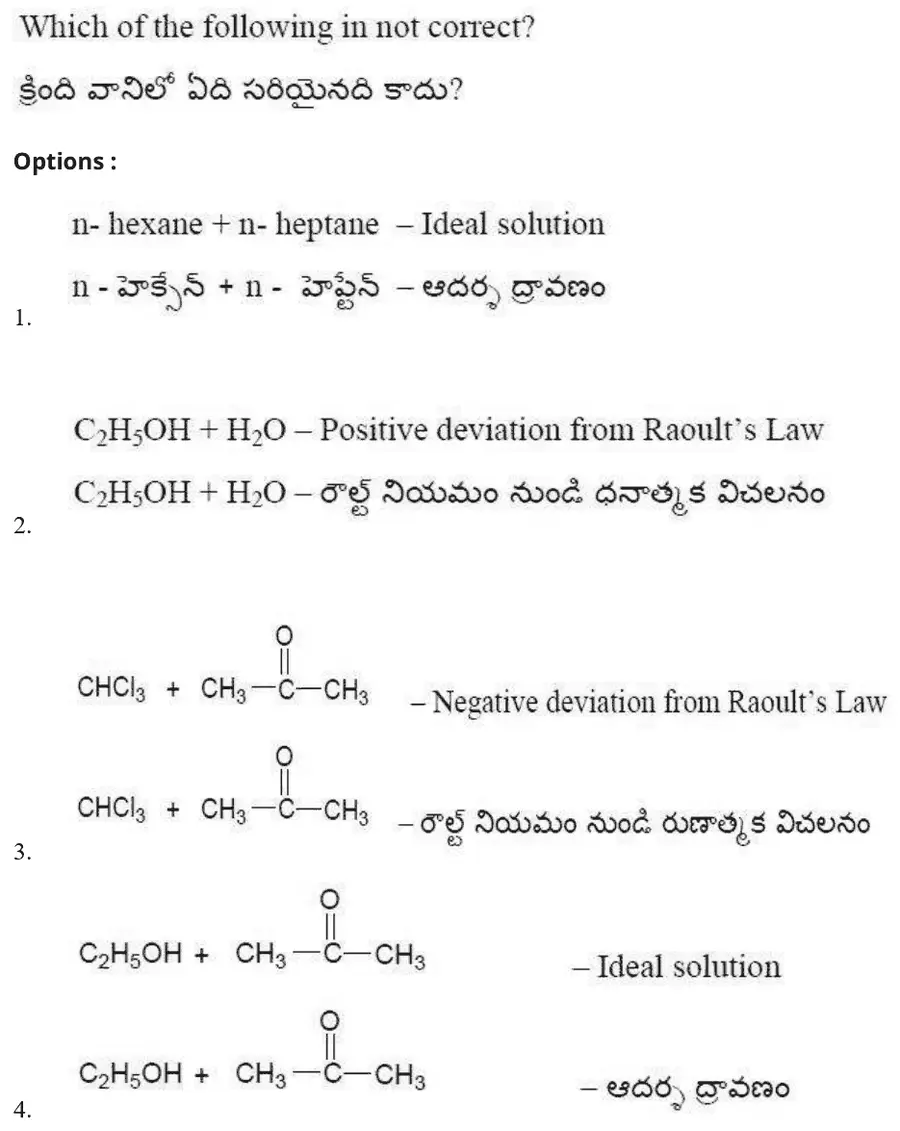
Which of the following in not correct?

The question and its figure as printed in AP EAPCET 2023 19th May 2023 Shift 1.
The question as printed in the paper.
  • A

    n- hexane + n- heptane – Ideal solution

  • B

    $\mathrm{C_2H_5OH + H_2O}$ – Positive deviation from Raoult’s Law

  • C

    $\mathrm{CHCl_3}$ + (see the figure above) – Negative deviation from Raoult’s Law

  • D

    $\mathrm{C_2H_5OH}$ + (see the figure above) – Ideal solution

54AP EAPCET 2023 · 19 May · Shift 1MCQOpen question page ↗

What is the depression of freezing point, when mole fraction of non-electrolyte solute in aqueous solution is $0.01$ ? ($\mathrm{K_f}$ of $\mathrm{H_2O}$ = $1.86\ \mathrm{K\,kg\,mol^{-1}}$)

  • A

    $1.246\ \mathrm{K}$

  • B

    $1.380\ \mathrm{K}$

  • C

    $1.528\ \mathrm{K}$

  • D

    $1.043\ \mathrm{K}$

55AP EAPCET 2023 · 18 May · Shift 1MCQOpen question page ↗

What is the boiling point of solution of 0.1m KCl?

$K_b$ of water is $0.52\ \mathrm{K\ kg\ mol^{-1}}$. ($\alpha = 100\%$) (water boil at 373 K)

  • A

    100.104 K

  • B

    373.104 K

  • C

    273.104 K

  • D

    373.052 K

56AP EAPCET 2023 · 18 May · Shift 2MCQOpen question page ↗

At 293 K, the Henry law constant in water for $\mathrm{N_2}$ and $\mathrm{O_2}$ are 76.48 k bar and 34.86 k bar respectively. What is the ratio of mole fractions of $\mathrm{N_2}$ and $\mathrm{O_2}$ in water? (Assume partial pressures of $\mathrm{N_2}$ and $\mathrm{O_2}$ same at 293 K)

  • A

    2.19

  • B

    0.95

  • C

    0.60

  • D

    0.45

57AP EAPCET 2023 · 18 May · Shift 2MCQOpen question page ↗

At 298 K, if the vapour pressure of pure liquids toluene, benzene, chloroform and dichloromethane are 60, 160, 200 and 415 torr respectively. Then which liquid is having high boiling point?

  • A

    Toluene

  • B

    Benzene

  • C

    Chloroform

  • D

    Dichloromethane

58AP EAPCET 2023 · 17 May · Shift 1MCQOpen question page ↗

6 g of a non-volatile solute (x) is dissolved in 100 g of water. The relative lowering of vapour pressure of resultant solution is 0.006. What is the molar mass (in $\mathrm{g\ mol^{-1}}$) of x?

  • A

    60

  • B

    360

  • C

    100

  • D

    180

59AP EAPCET 2023 · 17 May · Shift 2MCQOpen question page ↗

If the osmotic pressure of cane sugar solution is 2.46 atm at $27\ ^\circ\mathrm{C}$, then what is the concentration (in $\mathrm{mol\ L^{-1}}$) of the solution ($R = 0.0821\ \mathrm{L\ atm\ mol^{-1}\ K^{-1}}$)

  • A

    0.1

  • B

    0.2

  • C

    0.01

  • D

    0.02

60AP EAPCET 2023 · 17 May · Shift 2MCQOpen question page ↗

A solution is formed by the combination of two liquids such as dichloromethane and chloroform. The partial pressures of dichloromethane and chloroform in solution are 285.5 and 62.4 mm Hg respectively. What is the total pressure of the solution?

  • A

    223.1 mm Hg

  • B

    347.9 mm Hg

  • C

    357.9 mm Hg

  • D

    337.9 mm Hg

61AP EAPCET 2023 · 16 May · Shift 1MCQOpen question page ↗

What is the osmotic pressure (in atm) of 0.02M aqueous glucose solution at 300 K?

($\mathrm{R}=0.082\ \mathrm{L\ atm\ mol^{-1}K^{-1}}$)

  • A

    $\frac{1}{0.492}$

  • B

    $0.492$

  • C

    $0.988$

  • D

    $\frac{1}{0.988}$

62AP EAPCET 2023 · 16 May · Shift 1MCQOpen question page ↗

The elevation in the boiling point of aqueous urea solution is 0.104 K. What is its $\Delta T_f$ (in K) value? (for Water $K_b = 0.52\ \mathrm{K\ kg\ mol^{-1}}$, $K_f = 1.86\ \mathrm{K\ kg\ mol^{-1}}$)

  • A

    0.0186

  • B

    0.186

  • C

    0.372

  • D

    0.0372

63AP EAPCET 2023 · 16 May · Shift 2MCQOpen question page ↗

When $10^{-3}$ M solution of glucose in water, freezes at -0.0186 °C, then at what temperature $10^{-3}$ M solution of $\mathrm{NaCl}$ will freeze?

  • A

    0 °C

  • B

    0.186 °C

  • C

    -0.186 °C

  • D

    -0.0372 °C

64AP EAPCET 2023 · 16 May · Shift 2MCQOpen question page ↗

Molal depression constant ($\mathrm{K_f}$) is dependent on

  • A

    Nature of solvent

  • B

    Nature of solute

  • C

    Number of moles of solvent

  • D

    Number of moles of solute

66AP EAPCET 2023 · 15 May · Shift 2MCQOpen question page ↗

Which of the following does not belong to an ideal solution?

  • A

    $\Delta \mathrm{H_{mix}} = 0$

  • B

    $\Delta \mathrm{V_{mix}} = 0$

  • C

    Obeys Raoult’s law over the entire range of concentration

  • D

    Does not obey Raoult’s law

67TS EAPCET 2023 · 14 May · Shift 1MCQOpen question page ↗

At 50 °C, the vapour pressure of pure benzene is 268 torr. The number of moles of non-volatile solute per mole of benzene required to prepare a solution having a vapour pressure of 167 torr at the same temperature is
(molar mass of benzene=78 g mol$^{-1}$)

  • A

    0.505

  • B

    0.705

  • C

    0.605

  • D

    0.405

68TS EAPCET 2023 · 14 May · Shift 2MCQOpen question page ↗

An aqueous solution of a non-volatile solute boils at $100.17\ ^\circ\mathrm{C}$. The temperature at which this solution will freeze (in $^\circ\mathrm{C}$) is

($K_b(\mathrm{H_2O}) = 0.512\ ^\circ\mathrm{C\ kg\ mol^{-1}}$, $K_f(\mathrm{H_2O}) = 1.86\ ^\circ\mathrm{C\ kg\ mol^{-1}}$)

  • A

    -0.62

  • B

    -0.512

  • C

    -1.24

  • D

    -1.86

69TS EAPCET 2023 · 13 May · Shift 1MCQOpen question page ↗

'$x$' g of urea (molar mass $60\ \mathrm{g\,mol^{-1}}$) is completely dissolved in 'y' g of pure water and the solution boiled at 373.202 K. If the boiling point of pure water at 1.013 bar is 373.15 K, then $x:y$ is $(\mathrm{K_b(H_2O)} = 0.52\ \mathrm{K\,kg\,mol^{-1}})$

  • A

    $6.0\times10^{-3}$

  • B

    $3.0\times10^{-3}$

  • C

    $9.0\times10^{-3}$

  • D

    $4.5\times10^{-3}$

70TS EAPCET 2023 · 13 May · Shift 2MCQOpen question page ↗

Liquids A and B form an ideal solution. The vapour pressures of A and B are 50 and 32mm Hg respectively at 300K. One mole of liquid A is mixed with 1 mole of liquid B. What is the approximate mole fraction of A in vapour phase?

  • A

    0.39

  • B

    0.50

  • C

    0.25

  • D

    0.61

71TS EAPCET 2023 · 12 May · Shift 1MCQOpen question page ↗

The vapour pressure of a pure liquid A is 70 torr at 300 K. It forms an ideal solution with another liquid B. The mole fraction of B is 0.2 and total vapour pressure of the solution is 84 torr at the same temperature. The vapour pressure of pure liquid B (in torr) is

  • A

    140

  • B

    90

  • C

    120

  • D

    80

72TS EAPCET 2023 · 12 May · Shift 2MCQOpen question page ↗

At 300 K, the osmotic pressure of a decinormal solution of sodium chloride is 4.82 atm. The degree of dissociation of sodium chloride is $x \times 10^{-2}$. The value of $x$ is

(R = 0.082 L atm $\mathrm{K^{-1}mol^{-1}}$)

  • A

    90

  • B

    96

  • C

    93

  • D

    88

73TS EAPCET 2022 · 20 Jul · Shift 1MCQOpen question page ↗

A liquid mixture is an ideal solution, if
a) It obeys ideal gas equation
b) It obeys Raoult's law at all concentrations
c) Solute $-$ solute, solute $-$ solvent and solvent $-$ solvent interactions are similar

  • A

    a only

  • B

    a, b only

  • C

    b, c only

  • D

    c only

74TS EAPCET 2022 · 20 Jul · Shift 1MCQOpen question page ↗

The freezing point of equimolal aqueous solution will be highest for

  • A

    $\mathrm{C_6H_5-NH\overset{+}{N}H_3\,\overset{-}{Cl}}$

  • B

    $\mathrm{Ba(NO_3)_2}$

  • C

    $\mathrm{LaCl_3}$

  • D

    $\mathrm{C_6H_{12}O_6}$

75TS EAPCET 2022 · 20 Jul · Shift 2MCQOpen question page ↗

A solvent freezes at $17\ ^\circ$C and it has latent heat of fusion $180\ \mathrm{J\,g^{-1}}$. The molal depression constant of the solvent is [units of $K_f=\mathrm{K\,kg\,mol^{-1}}$]

  • A

    3.88

  • B

    3.55

  • C

    3.70

  • D

    4.77

76TS EAPCET 2022 · 19 Jul · Shift 1MCQOpen question page ↗

The Henry's law constant for the solubility of $\mathrm{N_2}$ gas in water at 298 K is $1\times10^{+5}$ atm. The mole fraction of air is 0.8. The number of moles of $\mathrm{N_2}$ from air dissolved in 10 moles of water at 298 K and 5 atm pressure is

  • A

    $4\times10^{-5}$

  • B

    $4\times10^{-4}$

  • C

    $5\times10^{-4}$

  • D

    $4\times10^{-6}$

77TS EAPCET 2022 · 19 Jul · Shift 1MCQOpen question page ↗

What is the effect of external pressure on the osmotic pressure (OP) of a solution?

  • A

    OP decreases with increase of pressure

  • B

    OP decreases initially, then increases

  • C

    OP remained nearly same with increase / decrease of external pressure

  • D

    OP increases with increase of pressure

78TS EAPCET 2022 · 19 Jul · Shift 2MCQOpen question page ↗

Calculate the quantity of $\mathrm{CO_{2}}$ required to prepare 1 L of soda water when the soda water was packed under 2 atm of $\mathrm{CO_{2}}$.
[Henry's law constant for $\mathrm{CO_{2}}$ is $1.67\times10^{8}$ Pa]

  • A

    5.98 g

  • B

    1.21 g

  • C

    2.9 g

  • D

    67.1 g

79TS EAPCET 2022 · 19 Jul · Shift 2MCQOpen question page ↗

Which of the following substances show the highest colligative properties?

  • A

    0.1 M $\mathrm{BaCl_{2}}$

  • B

    0.1 M $\mathrm{AgNO_{3}}$

  • C

    0.1 M urea

  • D

    0.1 M $\mathrm{(NH_{4})_{3}PO_{4}}$

80TS EAPCET 2022 · 18 Jul · Shift 1MCQOpen question page ↗

Which of the following are correct for an ideal solution?
a) $\Delta\mathrm{V_{mix}}=0$
b) $\mathrm{V_{solvent}}+\mathrm{V_{solute}}=\mathrm{V_{solution}}$
c) $\Delta\mathrm{H_{mix}}=0$
d) $\mathrm{H_{2}O+CO_{2}\to H_{2}CO_{3}}$ is an example of ideal solution.

  • A

    a, b only

  • B

    b, c only

  • C

    a, b, c only

  • D

    a, b, c, d

81TS EAPCET 2022 · 18 Jul · Shift 1MCQOpen question page ↗

At $0\ ^{\circ}\mathrm{C}$, urea solution has an osmotic pressure of 400 mm. On dilution by $x$ times, its osmotic pressure decreased to 100 mm at $20\ ^{\circ}\mathrm{C}$. The dilution factor $x$ is approximately

  • A

    $4.3$

  • B

    $2$

  • C

    $5$

  • D

    $6.8$

82TS EAPCET 2022 · 18 Jul · Shift 2MCQOpen question page ↗

Which of the following is/are “not correct” for $\mathrm{CH_{3}OH+CH_{3}COOH}$ mixture solution?
a) $\Delta H_{mix}<0$
b) Does not obey Raoult’s law
c) $\Delta H_{mix}>0$
d) An example of ideal solution

  • A

    d only

  • B

    a, c only

  • C

    a, b, c only

  • D

    c, d only

83TS EAPCET 2022 · 18 Jul · Shift 2MCQOpen question page ↗

Henry’s law is valid for
A) Ammonia gas dissolution in water
B) $\mathrm{O_{2}}$ gas dissolution in unsaturated blood
C) $\mathrm{O_{2}}$ dissolution in water
D) $\mathrm{CO_{2}}$ dissolution in water

  • A

    A and B

  • B

    B and C

  • C

    C and D

  • D

    B and D

84AP EAPCET 2022 · 8 Jul · Shift 1MCQOpen question page ↗

At T (K), the partial pressure of dissolved oxygen in 1 L water is 1 bar. The concentration of oxygen is ppm is ($K_H$ of $\mathrm{O_2}$ at T(K) is 50 kbar)

  • A

    $71.0$

  • B

    $35.50$

  • C

    $17.75$

  • D

    $81.10$

85AP EAPCET 2022 · 8 Jul · Shift 2MCQOpen question page ↗

At T(K) the molarity of $\mathrm{CO_2}$(in $\mathrm{mol\ L^{-1}}$) in 200 mL of soda water packed under a pressure of 3.4 bar is ($\mathrm{K_H}$ of $\mathrm{CO_2}$ in water is $1.7\mathrm{X}10^{3}$ bar at T(K))

  • A

    $2.0\mathrm{X}10^{-2}$

  • B

    $1.11\mathrm{X}10^{-1}$

  • C

    $2.22\mathrm{X}10^{-1}$

  • D

    $5.1\mathrm{X}10^{-2}$

86AP EAPCET 2022 · 8 Jul · Shift 2MCQOpen question page ↗

The depression in freezing point of solution of molality $0.01\ \mathrm{mol\ kg^{-1}}$ is highest with respect to which of the solvent? (Whose $\mathrm{K_f}$ is given is brackets)

  • A

    Water (1.86)

  • B

    Benzene (5.12)

  • C

    Carbon tetrachloride (31.8)

  • D

    Cyclohexane (20.0)

87AP EAPCET 2022 · 7 Jul · Shift 1MCQOpen question page ↗

1.8 g of glucose (molar mass $180\ \mathrm{g\,mol^{-1}}$) is dissolved in 0.1 kg of water. The freezing point of the solution (in $^\circ$C) is (K$_f$ for water = $1.86\ \mathrm{K\,kg\,mol^{-1}}$)

  • A

    $+0.186$

  • B

    $-0.372$

  • C

    $-0.186$

  • D

    $+0.372$

88AP EAPCET 2022 · 7 Jul · Shift 2MCQOpen question page ↗

For which of the following liquid mixtures $\Delta_{mix}H = 0$ and $\Delta_{mix}V = 0$ ?

  • A

    ethyl chloride, ethyl bromide

  • B

    ethanol, acetone

  • C

    phenol, aniline

  • D

    chloroform, acetone

89AP EAPCET 2022 · 6 Jul · Shift 1MCQOpen question page ↗

At 298K, the vapour pressure of pure water is 25 torr. The vapour pressure of water, when 12 g of urea (molar mass, $60\ \mathrm{g\,mol^{-1}}$) and 36 g of glucose (molar mass, $180\ \mathrm{g\,mol^{-1}}$) is dissolved in 100g of water at the same temperature (in torr) is

  • A

    25.02

  • B

    24.12

  • C

    23.92

  • D

    23.32

90AP EAPCET 2022 · 6 Jul · Shift 1MCQOpen question page ↗

Which of the following solution has the highest freezing point?

  • A

    0.1 mol KCl in 1 kg water

  • B

    0.1 mol $\mathrm{K_2SO_4}$ in 1 kg water

  • C

    0.1 mol Urea in 1 kg water

  • D

    30 g of glucose in1 kg water

91AP EAPCET 2022 · 6 Jul · Shift 2MCQOpen question page ↗

At 298 K, vapour pressures of two pure liquids A and B are 200 and 400 mm Hg respectively. If mole fractions of A and B in solution are 0.7 and 0.3 respectively. What is the mole fraction of B in vapour phase?

  • A

    $0.279$

  • B

    $0.721$

  • C

    $0.538$

  • D

    $0.462$

92AP EAPCET 2022 · 6 Jul · Shift 2MCQOpen question page ↗

The freezing point depression of a solution containing 0.6 g of urea (molar mass=60 g $\mathrm{mol^{-1}}$) in 100g of benzene (in K) is ($\mathrm{K_f}$ of $\mathrm{CH_3COOH}$ = 4.0 K Kg $\mathrm{mol^{-1}}$)

  • A

    $0.30$

  • B

    $0.58$

  • C

    $0.40$

  • D

    $0.24$

93AP EAPCET 2022 · 5 Jul · Shift 1MCQOpen question page ↗

0.05 mole of a non-volatile solute is dissolved in 500 g of water. What is the depression in freezing point of resultant solution? ($K_f(\mathrm{H_2O})$ = 1.86 K kg $\mathrm{mol^{-1}}$)

  • A

    0.047 K

  • B

    0.372 K

  • C

    0.093 K

  • D

    0.186 K

94AP EAPCET 2022 · 5 Jul · Shift 1MCQOpen question page ↗

Which of the following form an ideal solution?
(I) Chloroethane and bromoethane
(II) Benzene and toluene
(III) n - Hexane and n - heptane
(IV) Phenol and aniline

  • A

    I & II only

  • B

    I, II & III only

  • C

    II, III & IV only

  • D

    I & IV only

95AP EAPCET 2022 · 5 Jul · Shift 2MCQOpen question page ↗

Which of the following condition is correct for reverse osmosis?

[C = Concentration of solution in $\mathrm{mol\,L^{-1}}$; T = Temperature in Kelvin scale; n = no of moles of solute]

  • A

    $\mathrm{P_{ext} = CRT}$

  • B

    $\mathrm{P_{ext} > CRT}$

  • C

    $\mathrm{P_{ext} < CRT}$

  • D

    $\mathrm{P_{ext} > nRT}$

96AP EAPCET 2022 · 5 Jul · Shift 2MCQOpen question page ↗

Which of the following pair of solutions is isotonic?

A. 18 g/L of glucose of solution and 6 g/L of Urea solution

B. 10 g/L of glucose solution and 10 g/L of Urea solution

C. 0.01 M NaOH solution and 0.02 M glucose solution

D. 0.01M NaCl solution and 0.01 M glucose solution

(Assume that NaCl undergoes complete dissociation)

  • A

    A and B

  • B

    A and C

  • C

    B and D

  • D

    B and C

97AP EAPCET 2022 · 4 Jul · Shift 1MCQOpen question page ↗

At T (K) x g of a non-volatile solid (molar mass 78 $\mathrm{g\,mol^{-1}}$) when added to 0.5 kg water, lowered its freezing point by 1.0°C. What is x (in g)? ($K_f$ of water at T(K)= 1.86 $\mathrm{K\,Kg\,mol^{-1}}$)

  • A

    10.48

  • B

    20.96

  • C

    41.92

  • D

    5.24

98AP EAPCET 2022 · 4 Jul · Shift 1MCQOpen question page ↗

Assertion (A) : Blood cells collapse when suspended in saline water
Reason (R): Cell membrane dissolves in saline water

  • A

    Both (A) and (R) are correct and R is the correct explanation of A

  • B

    Both (A) and (R) are correct, but R is not the correct explanation of A

  • C

    (A) is correct but (R) is not correct

  • D

    (A) is incorrect but (R) is correct

99AP EAPCET 2022 · 4 Jul · Shift 2MCQOpen question page ↗

A solution containing 6.0 g of urea is isotonic with a solution containing 10g of a non-electrolytic solute X. The molar mass of X (in $\mathrm{g\,mol^{-1}}$) is

  • A

    $50.0$

  • B

    $100$

  • C

    $75.0$

  • D

    $68.0$

100AP EAPCET 2022 · 4 Jul · Shift 2MCQOpen question page ↗

x % (w/v) solution of urea is isotonic with 4% (w/v) solution of a non-volatile solute of molar mass $120\ \mathrm{g\,mol^{-1}}$. The value of x is

  • A

    $2$

  • B

    $4$

  • C

    $3$

  • D

    $5$

101AP EAMCET 2021 · 5 Oct · Shift 1MCQOpen question page ↗

For a solution made up of $n$-hexane and $n$-heptane, which of the following conditions hold?

  • A

    $\Delta_{mix}H = 0\ ;\ \Delta_{mix}V < 0$

  • B

    $\Delta_{mix}H = 0\ ;\ \Delta_{mix}V = 0$

  • C

    $\Delta_{mix}H > 0\ ;\ \Delta_{mix}V = 0$

  • D

    $\Delta_{mix}H < 0\ ;\ \Delta_{mix}V < 0$

102AP EAMCET 2021 · 25 Aug · Shift 1MCQOpen question page ↗

A 25% solution of cane-sugar (mol mass= $342\ \mathrm{g\ mol^{-1}}$) is isotonic with 5% solution of a substance A. Then find the molecular weight of A?

  • A

    $6.84\ \mathrm{g\ mol^{-1}}$

  • B

    $68.4\ \mathrm{g\ mol^{-1}}$

  • C

    $25\ \mathrm{g\ mol^{-1}}$

  • D

    $684\ \mathrm{g\ mol^{-1}}$

103AP EAMCET 2021 · 25 Aug · Shift 1MCQOpen question page ↗

Henrys law constant for $\mathrm{CO_2}$ in water is $1.67 \times 10^8\ \mathrm{Pa}$. Calculate the approximate quantity of $\mathrm{CO_2}$ in $500\ \mathrm{ml}$ of soda water when packed under $5\ \mathrm{atm}\ \mathrm{CO_2}$ at $298\ \mathrm{K}$.

  • A

    $3.7\ \mathrm{g}$

  • B

    $1.84\ \mathrm{g}$

  • C

    $2.2\ \mathrm{g}$

  • D

    $4.4\ \mathrm{g}$

104AP EAMCET 2021 · 25 Aug · Shift 2MCQOpen question page ↗

Which of the following is not an ideal solution?

  • A

    Benzene and Toluene

  • B

    Chloro-benzene and 1,2-dichloro benzene

  • C

    Methyl iodide and Isopropanol

  • D

    Ethyl bromide and Methyl bromide

105AP EAMCET 2021 · 24 Aug · Shift 1MCQOpen question page ↗

The elevation in boiling point of a solution of $10\ \mathrm{g}$ of a binary electrolyte (of molecular mass 100) in $100\ \mathrm{g}$ of water is $\Delta T_b$. Then the value of $K_b$ for water is ______

  • A

    $\frac{\Delta T_b}{2}$

  • B

    $10$

  • C

    $10\ \Delta T_b$

  • D

    $\frac{\Delta T_b}{10}$

106AP EAMCET 2021 · 24 Aug · Shift 1MCQOpen question page ↗

A gas $X$ is dissolved in water at 2 bar pressure. Its mole fraction in the solution is 0.02. Find the mole fraction of water in the solution when the pressure of the gas is doubled at the same temperature.

  • A

    0.04

  • B

    0.98

  • C

    0.96

  • D

    0.02

107AP EAMCET 2021 · 24 Aug · Shift 2MCQOpen question page ↗

Which among the following is a colligative property?

  • A

    Surface tension

  • B

    Osmotic pressure

  • C

    Optical rotation

  • D

    Viscosity

108AP EAMCET 2021 · 24 Aug · Shift 2MCQOpen question page ↗

$2\ g$ of a non-electrolyte solute (molar mass is $500\ g\ mol^{-1}$) was dissolved in $57.3\ g$ of xylene. If the freezing point depression constant $K_f$ of Xylene is $4.3\ K\ kg\ mol^{-1}$. Then the depression in freezing point of Xylene is ______

  • A

    $57.3\ K$

  • B

    $0.3\ K$

  • C

    $4.3\ K$

  • D

    $0.002\ K$

109AP EAMCET 2021 · 23 Aug · Shift 2MCQOpen question page ↗

A 0.6 % solution of urea (molecular mass= 60) would be isotonic with ______

  • A

    0.1 $M$ glucose solution

  • B

    0.6 % solution of glucose

  • C

    0.1 $M$ $KCl$ solution

  • D

    0.6 % $KCl$ solution

110AP EAMCET 2021 · 20 Aug · Shift 1MCQOpen question page ↗

If the $K_H$ values for $Ar_{(g)}$, $CO_{2(g)}$, $HCHO_{(g)}$ and $CH_{4(g)}$ respectively are 40.39, 1.67, $1.83 \times 10^{-5}$ and 0.413, then identify the correct increasing order of their solubilities.

  • A

    $HCHO < CH_4 < CO_2 < Ar$

  • B

    $HCHO < CO_2 < CH_4 < Ar$

  • C

    $Ar < CO_2 < HCHO < CH_4$

  • D

    $Ar < CO_2 < CH_4 < HCHO$

111AP EAMCET 2021 · 20 Aug · Shift 2MCQOpen question page ↗

If two liquids $A$ and $B$ form a minimum boiling azeotrope at some specific composition, then which statement among the following is correct?

  • A

    $A-B$ molecular interactions are stronger than $A-A$ and $B-B$ interactions.

  • B

    The total vapour pressure of the mixture is greater than that corresponding to an ideal solution.

  • C

    There is a slight decrease in volume when the two components are mixed.

  • D

    $\Delta H_{mix}$ will have a negative value.

112AP EAMCET 2021 · 20 Aug · Shift 2MCQOpen question page ↗

The vapour pressure of a solvent decreased by 20 $mm$ of $Hg$ when a non-volatile solute was added to the solvent. The mole-fraction of the solute in the solution is 0.5. What should be the mole-fraction of the solvent for the decrease in the vapour pressure needs to be 10 $mm$ of $Hg$?

  • A

    $\frac{3}{4}$

  • B

    $\frac{2}{3}$

  • C

    $\frac{1}{4}$

  • D

    $\frac{3}{2}$

113AP EAMCET 2021 · 19 Aug · Shift 1MCQOpen question page ↗

Which of the following will form an ideal solution?

  • A

    $C_2H_5OH$ & $H_2O$

  • B

    $HNO_3$ & $H_2O$

  • C

    $CHCl_3$ & $CH_3COCH_3$

  • D

    $C_6H_6$ & $C_6H_5CH_3$

114AP EAMCET 2021 · 19 Aug · Shift 1MCQOpen question page ↗

The molal elevation constant is the ratio of Elevation in boiling point to _______

  • A

    Molarity

  • B

    Molality

  • C

    Mole fraction of solute

  • D

    Mole fraction of solvent

115AP EAMCET 2021 · 19 Aug · Shift 2MCQOpen question page ↗

Which condition is not satisfied by an ideal solution?

  • A

    Both $\Delta_{mix}H = 0$ and $\Delta_{mix}S = 0$

  • B

    Obeyance on Raoult's law

  • C

    Both $\Delta_{mix}H = 0$ and $\Delta_{mix}V = 0$

  • D

    $\Delta_{mix}H = 0$

116AP EAMCET 2021 · 19 Aug · Shift 2MCQOpen question page ↗

A solution of urea (molar mass $60\ \mathrm{g\ mol^{-1}}$) boils at $100.20^\circ\mathrm{C}$ at the atmospheric pressure. if $K_f$ and $K_b$ for water are $1.86$ and $0.512\ \mathrm{K\ Kg\ mol^{-1}}$ respectively. The freezing point of the solution will be ______

  • A

    $-0.654^\circ\mathrm{C}$

  • B

    $+0.654^\circ\mathrm{C}$

  • C

    $-0.726^\circ\mathrm{C}$

  • D

    $+0.726^\circ\mathrm{C}$

117TS EAMCET 2021 · 6 Aug · Shift 1MCQOpen question page ↗

Which of the following mixture form an ideal solution?

  • A

    $\mathrm{CCl_4+C_7H_8}$

  • B

    $\mathrm{CHCl_3+C_6H_6}$

  • C

    $\mathrm{H_2O+CH_3OH}$

  • D

    $\mathrm{n-C_6H_{14}+n-C_7H_{16}}$

118TS EAMCET 2021 · 6 Aug · Shift 1MCQOpen question page ↗

The freezing point of an aqueous solution containing 25g of ethanol in 1000g of $\mathrm{H_2O}$ is [$K_f$=1.86 K kg $\mathrm{mol^{-1}}$]

  • A

    0.25 $^\circ$C

  • B

    0.5 $^\circ$C

  • C

    $-1.5$ $^\circ$C

  • D

    $-1$ $^\circ$C

119TS EAMCET 2021 · 6 Aug · Shift 2MCQOpen question page ↗

Calculate the molal depression constant of a solution, which freezes at $15^\circ\mathrm{C}$. The latent heat of fusion is $180.7\ \mathrm{J\,g^{-1}}$

  • A

    $3.81\ \mathrm{K\,molal^{-1}}$

  • B

    $0.381\ \mathrm{K\,molal^{-1}}$

  • C

    $1.90\ \mathrm{K\,molal^{-1}}$

  • D

    $0.19\ \mathrm{K\,molal^{-1}}$

120TS EAMCET 2021 · 6 Aug · Shift 2MCQOpen question page ↗

pH of a $0.1\mathrm{M}$ monobasic acid is 2. Its osmotic pressure at a given temperature T (K) is (Given that the effective concentration for osmotic pressure is $(1+\alpha)\times$ concentration of acid; $\alpha$ is the dissociation factor)

  • A

    $RT$

  • B

    $0.11\ RT$

  • C

    $0.01\ RT$

  • D

    $0.001\ RT$

121TS EAMCET 2021 · 5 Aug · Shift 1MCQOpen question page ↗

Match the following.
A) Ebullioscopic constant I) Depression of freezing point
B) Cryoscopic constant II) Total pressure is the sum of partial pressures of the components
C) Henry's law III) Elevation of boiling point
D) Dalton's law IV) Solubility of a gas in liquid
The correct match is

  • A

    A-III, B-I, C-II, D-IV

  • B

    A-I, B-III, C-II, D-IV

  • C

    A-III, B-I, C-IV, D-II

  • D

    A-I, B-III, C-IV, D-II

122TS EAMCET 2021 · 5 Aug · Shift 1MCQOpen question page ↗

On mixing urea, the boiling point of $\mathrm{H_2O}$ changed to $100.5\ ^\circ\mathrm{C}$. Calculate the freezing point of the solution, if $K_f$ of water is $1.87\ \mathrm{K.kg.mol^{-1}}$ and $K_b$ of water is $0.52\ \mathrm{K.kg.mol^{-1}}$

  • A

    $-1\ ^\circ\mathrm{C}$

  • B

    $-0.5\ ^\circ\mathrm{C}$

  • C

    $-1.8\ ^\circ\mathrm{C}$

  • D

    $0\ ^\circ\mathrm{C}$

123TS EAMCET 2021 · 5 Aug · Shift 2MCQOpen question page ↗

A 3 ml of solution was made by dissolving 20 mg of protein at 0 °C. The osmotic pressure of the resulting solution is 3.8 torr. The molecular weight of the protein is approximately (in g / mol)

  • A

    300

  • B

    $3 \times 10^5$

  • C

    $3 \times 10^4$

  • D

    $3 \times 10^3$

124TS EAMCET 2021 · 5 Aug · Shift 2MCQOpen question page ↗

When salt is added to water, which of the following statement is true?

  • A

    Boiling point decreases

  • B

    Boiling point increases

  • C

    Boiling point remain constant

  • D

    Freezing point increases

125TS EAMCET 2021 · 4 Aug · Shift 1MCQOpen question page ↗

Given
Sol A: Phenol and aniline
Sol B : Chloroform and acetone
Which of following is correct as per Raoult's law?

  • A

    Sol A shows –ve and B shows +ve deviation

  • B

    Both solutions A and B show –ve deviation

  • C

    Sol A shows +ve and B shows –ve deviation

  • D

    Both solutions show +ve deviation

126TS EAMCET 2021 · 4 Aug · Shift 2MCQOpen question page ↗

The trend in the colligative properties for the same concentration of $\mathrm{BaCl_2}$, $\mathrm{MgCl_2}$ and $\mathrm{NaCl}$, respectively, is

  • A

    $\mathrm{NaCl > MgCl_2 > BaCl_2}$

  • B

    $\mathrm{NaCl > BaCl_2 > MgCl_2}$

  • C

    $\mathrm{MgCl_2 = BaCl_2 < NaCl}$

  • D

    $\mathrm{MgCl_2 = BaCl_2 > NaCl}$

127AP EAMCET 2020 · 7 Oct · Shift 1MCQOpen question page ↗

$K_H$ values for $\mathrm{H_2}$, $\mathrm{CO_2}$, $\mathrm{CH_4}$ and $\mathrm{O_2}$ at $298\ K$ are 71.18, 1.67, 41.85 and 34.86 $Kbar$. respectively. Arrange these gases in the increasing order of their solubility.

  • A

    $\mathrm{H_2} < \mathrm{CH_4} < \mathrm{O_2} < \mathrm{CO_2}$

  • B

    $\mathrm{H_2} < \mathrm{CH_4} < \mathrm{CO_2} < \mathrm{O_2}$

  • C

    $\mathrm{CO_2} < \mathrm{O_2} < \mathrm{CH_4} < \mathrm{H_2}$

  • D

    $\mathrm{CO_2} < \mathrm{CH_4} < \mathrm{O_2} < \mathrm{H_2}$

128AP EAMCET 2020 · 22 Sep · Shift 2MCQOpen question page ↗

Which of the following solutions has the lowest freezing point?

  • A

    1 M Urea

  • B

    1 M $\mathrm{Na_2SO_4}$

  • C

    1 M NaCl

  • D

    1 M $\mathrm{Al_2(SO_4)_3}$

129AP EAMCET 2020 · 21 Sep · Shift 1MCQOpen question page ↗

Which of the following units is useful in relating concentration of solution with its vapour pressure?

  • A

    Mole fraction

  • B

    Parts per million

  • C

    Mass percentage

  • D

    Molality

130AP EAMCET 2020 · 21 Sep · Shift 2MCQOpen question page ↗

In comparison to a 0.01 M solution of glucose, the depression in freezing point of a 0.01 M $\mathrm{MgCl_2}$ solution is ______ (M.W. of $\mathrm{MgCl_2}$ = 95, M.W. of glucose= 180)

  • A

    The same

  • B

    About twice

  • C

    About three times

  • D

    About six times

131AP EAMCET 2020 · 18 Sep · Shift 2MCQOpen question page ↗

Match the item given in Column-I (method used for determining colligative property) and Column-II (for the corresponding colligative property) and find the correct order.
Column-I: a. Beckmann method; b. Ostwald-Walker method; c. Berkeley-Hartley method; d. Landsberger method
Column-II: i. Osmotic pressure; ii. Elevation in B.P.; iii. Depression in F.P.; iv. Relative lowering of Vapour pressure

  • A

    (a - ii), (b - iv), (c - iii), (d - i)

  • B

    (a - i), (b - iv), (c - ii), (d - iii)

  • C

    (a - ii), (b - iii), (c - iv), (d - i)

  • D

    (a - iii), (b - iv), (c - i), (d - ii)

132AP EAMCET 2020 · 17 Sep · Shift 1MCQOpen question page ↗

160 g of non-volatile solute 'A' is dissolved in 54 $ml$ of water at 373 $K$. What is the vapor pressure of aqueous solution of A. (given molecular weight of A= 160 g.$mol^{-1}$)

  • A

    760 Torr

  • B

    720 Torr

  • C

    570 Torr

  • D

    450 Torr

133AP EAMCET 2020 · 17 Sep · Shift 2MCQOpen question page ↗

Which of the following pairs of solutions is expected to be isotonic at same temperature?

  • A

    0.1 M Urea and 0.1 M $\mathrm{NaCl}$

  • B

    0.1 M Glucose and 0.2 M $\mathrm{NaCl}$

  • C

    0.1 M $\mathrm{NaCl}$ and 0.1 M $\mathrm{CH_3COOH}$

  • D

    0.1 M $\mathrm{NaCl}$ and 0.1 M $\mathrm{KNO_3}$

134AP EAMCET 2020 · 17 Sep · Shift 2MCQOpen question page ↗

Which of the following changes decrease the vapor pressure of water kept in a sealed vessel?

  • A

    Decreasing the quantity of water

  • B

    Adding salt to water

  • C

    Decreasing the volume of the vessel to one-half

  • D

    Keeping the temperature of water constant

135AP EAMCET 2020 · 17 Sep · Shift 2MCQOpen question page ↗

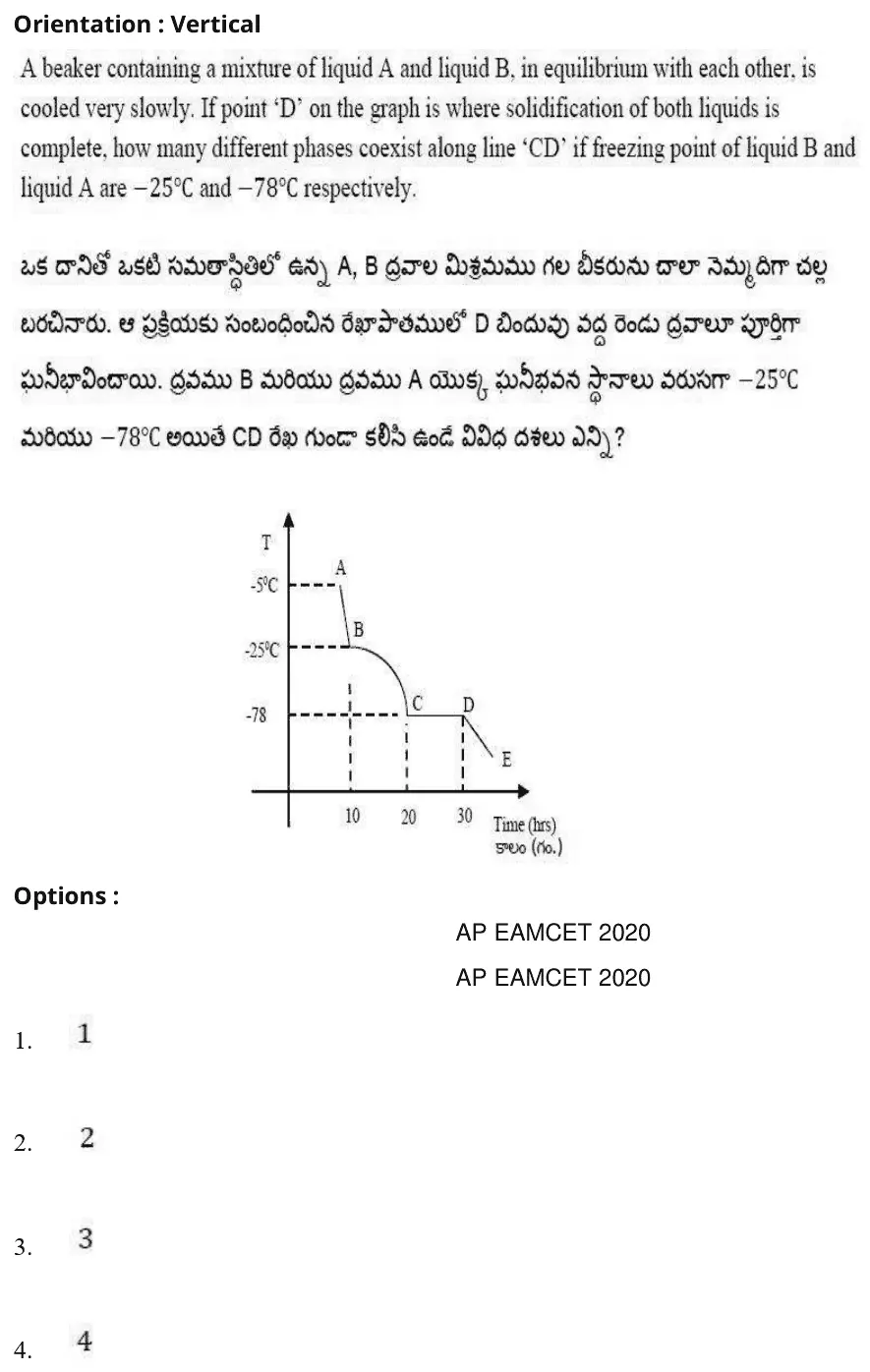
A beaker containing a mixture of liquid A and liquid B, in equilibrium with each other, is cooled very slowly. If point 'D' on the graph is where solidification of both liquids is complete, how many different phases coexist along line 'CD' if freezing point of liquid B and liquid A are $-25^\circ$C and $-78^\circ$C respectively.
(see the figure above)

The question and its figure as printed in AP EAPCET 2020 17th Sep 2020 Shift2.
The question as printed in the paper.
  • A

    1

  • B

    2

  • C

    3

  • D

    4

136TS EAMCET 2020 · 14 Sep · Shift 1MCQOpen question page ↗

The observed molar mass determined for $\mathrm{Na_2SO_4}$ by freezing point depression method is 50.0 g/mol. The molecular weight of $\mathrm{Na_2SO_4}$ is 142. What will be the degree of dissociation $\alpha$ for $\mathrm{Na_2SO_4}$ in water?

  • A

    0.23

  • B

    0.18

  • C

    0.78

  • D

    0.92

137TS EAMCET 2020 · 14 Sep · Shift 2MCQOpen question page ↗

Relative lowering of vapor pressure of a dilute solution is 0.5. What is the mole fraction of the non-volatile solute?

  • A

    0.5

  • B

    0.25

  • C

    1

  • D

    2

138TS EAMCET 2020 · 14 Sep · Shift 2MCQOpen question page ↗

The solubility product of a sparingly soluble $\mathrm{AB_2}$ salt is $2.56\times10^{-4}\ \mathrm{M^3}$ at $25^\circ\mathrm{C}$. The $\mathrm{K_f}$ of water is $1.8\ \mathrm{K\,kg\,mol^{-1}}$. The depression in freezing point of a standard solution of $\mathrm{AB_2}$ is

  • A

    $0.432\ \mathrm{K}$

  • B

    $0.216\ \mathrm{K}$

  • C

    $0.108\ \mathrm{K}$

  • D

    $13.824\ \mathrm{K}$

139TS EAMCET 2020 · 11 Sep · Shift 1MCQOpen question page ↗

15% aqueous solution of glucose (molecular weight = 180 g/mol) is isotonic with 8% aqueous solution containing an unknown non-dissociable solute. What is the molecular weight of the unknown solute?

  • A

    108

  • B

    96

  • C

    84

  • D

    9.6

140TS EAMCET 2020 · 11 Sep · Shift 1MCQOpen question page ↗

The vapour pressure of pure water is 23 mmHg. The vapour pressure of an aqueous solution which contains 10 mass percent of solute 'A' having molecular weight 50 is

  • A

    0.003 atm

  • B

    34.5 atm

  • C

    22 atm

  • D

    0.028 atm

141TS EAMCET 2020 · 11 Sep · Shift 2MCQOpen question page ↗

A 1.17% solution of solute A is isotonic with 7.2% solution of glucose. If the molecular weight of solute A is 58.5, the value of van't Hoff factor, 'i' is

  • A

    2

  • B

    3

  • C

    4

  • D

    5

142TS EAMCET 2020 · 11 Sep · Shift 2MCQOpen question page ↗

A mixture of 3.0 mol of $\mathrm{Na_2O}$ and 1.5 mol of $\mathrm{KO_2}$ is dissolved in 1000 mL of water. The vapour pressure of the solution in Torr, at 100 °C is

  • A

    740

  • B

    760

  • C

    580

  • D

    608

143TS EAMCET 2020 · 10 Sep · Shift 1MCQOpen question page ↗

$\mathrm{A^{2+}}$, $\mathrm{B^{2+}}$ and $\mathrm{C^{-}}$ form an ionic complex like $\mathrm{A_{x-2}[B(C)_x]_2}$. If the complex is 75% dissociated in a solvent with i = 4, the coordination number of B is

  • A

    3

  • B

    4

  • C

    5

  • D

    6

144TS EAMCET 2020 · 10 Sep · Shift 1MCQOpen question page ↗

The freezing point of equimolal aqueous solution will be highest for

  • A

    $\mathrm{BaCl_2}$

  • B

    $\mathrm{Ca(NO_3)_2}$

  • C

    Urea

  • D

    $\mathrm{Na_2SO_4}$

145TS EAMCET 2020 · 9 Sep · Shift 1MCQOpen question page ↗

The freezing point depression of 0.001 M of $\mathrm{A_xB_y[Fe(CN)_6]}$ is $5.58 \times 10^{-3}$ K. If the oxidation state of Fe is +2 and $K_f = 1.86\ \mathrm{K\,kg\,mol^{-1}}$, then the total number of possibilities for different types of A and B cations are

  • A

    1

  • B

    2

  • C

    3

  • D

    4

146TS EAMCET 2020 · 9 Sep · Shift 1MCQOpen question page ↗

When 2.44 grams of benzoic acid ($\mathrm{C_6H_5COOH}$) dissolved in 25 grams of benzene, it shows depression of freezing point equal to 2.2 K. Molal depression constant of benzene is $5.0\ \mathrm{K\,kg\,mol^{-1}}$. What is the percentage association of acid, if it forms dimer in solution?

  • A

    50%

  • B

    77%

  • C

    95%

  • D

    90%

147TS EAMCET 2020 · 9 Sep · Shift 2MCQOpen question page ↗

Correct order of osmotic pressure of the following solutions is
(i) 30 gm $\mathrm{L^{-1}}$ of glucose
(ii) 60 gm $\mathrm{L^{-1}}$ of $\mathrm{NH_2CONH_2}$
(iii) 80 gm $\mathrm{L^{-1}}$ of glucose
(iv) 58.5 gm $\mathrm{L^{-1}}$ of NaCl

  • A

    (ii) < (i) < (iii) < (iv)

  • B

    (i) < (iii) < (ii) < (iv)

  • C

    (i) < (iv) < (ii) < (iii)

  • D

    (iii) < (i) < (iv) < (ii)

149TS EAMCET 2019 · 6 May · Shift 1MCQOpen question page ↗

The vapour pressure of pure $\mathrm{CCl_4}$ (Molar mass = 154 g mol$^{-1}$) and $\mathrm{SnCl_4}$ (Molar mass = 170 g mol$^{-1}$) at 25 °C are 115.0 and 238.0 Torr respectively. Assuming ideal behavior, calculate the total approximate vapour pressure in Torr of a solution containing 10 g of $\mathrm{CCl_4}$ and 15 g of $\mathrm{SnCl_4}$.

  • A

    185.85

  • B

    190.0

  • C

    180.7

  • D

    182.1

150TS EAMCET 2019 · 6 May · Shift 1MCQOpen question page ↗

A camphor sample melts at 176 °C. $K_f$ for camphor is 40 K kg mol$^{-1}$. A solution of 0.02 g of a hydrocarbon in 0.8 g of camphor melts at 156.77 °C. The hydrocarbon is made up of 92.3% of carbon. What is the molecular formula of the hydrocarbon?

  • A

    $\mathrm{C_6H_6}$

  • B

    $\mathrm{C_{12}H_{12}}$

  • C

    $\mathrm{C_4H_4}$

  • D

    $\mathrm{C_8H_8}$

151TS EAMCET 2019 · 4 May · Shift 1MCQOpen question page ↗

Calculate the depression in the freezing point of a solution containing 0.1 g of $\mathrm{K_3[Fe(CN)_6]}$ in 100 g of $\mathrm{H_2O}$? (molecular weight of $\mathrm{K_3[Fe(CN)_6]}$ = 329, $K_f = 1.86\ \mathrm{K\ kg\ mol^{-1}}$)

  • A

    0

  • B

    1.223

  • C

    0.0226

  • D

    0.226

152TS EAMCET 2019 · 4 May · Shift 1MCQOpen question page ↗

A solution of 17.1 w% of sucrose (molar mass = 342 $\mathrm{g\ mol^{-1}}$) is isotonic with a $x$ w% solution of oxalic acid (molar mass = 90 $\mathrm{g\ mol^{-1}}$). Assume the degree of dissociation of oxalic acid as 0.01. What is $x$?

  • A

    9

  • B

    0.45

  • C

    4.41

  • D

    0.90

153TS EAMCET 2019 · 4 May · Shift 2MCQOpen question page ↗

If a solute associates in a solvent, its experimentally calculated molar mass using boiling point elevation method will be

  • A

    Half of the actual value

  • B

    Will remain same as actual value

  • C

    One fourth of the actual value

  • D

    Higher than the actual value

154TS EAMCET 2019 · 3 May · Shift 1MCQOpen question page ↗

The freezing point of solution containing 10 mL of non-volatile and non-electrolyte liquid "A" in 500 g of water is $-0.413\ ^\circ$C. If $K_f$ of water is 1.86 K kg mol$^{-1}$ and the molecular weight of A = 60 g mol$^{-1}$, what is the density of the solution in g mL$^{-1}$?
(Assume $\Delta_{\mathrm{mix}}V = 0$)

  • A

    1.13

  • B

    1.3

  • C

    0.90

  • D

    0.993

155TS EAMCET 2019 · 3 May · Shift 2MCQOpen question page ↗

How many grams of glucose are required to prepare an aqueous solution of glucose having a vapor pressure of 23.324 mm Hg at 25°C in 100 g of water? The vapor pressure of pure water at 25°C is 23.8 mm Hg. (Molar mass of glucose = 180 g $\mathrm{mol^{-1}}$)

  • A

    20.4

  • B

    10.3

  • C

    5.4

  • D

    7.4

156TS EAMCET 2019 · 3 May · Shift 2MCQOpen question page ↗

If 0.1 M solution of NaCl is isotonic with 1.1 w% urea solution, the degree of ionisation of NaCl is (Molar masses of urea and NaCl are 60 and 58.5 g $\mathrm{mol^{-1}}$ respectively)

  • A

    2

  • B

    0.83

  • C

    1

  • D

    1.83

157AP EAMCET 2019 · 23 Apr · Shift 1MCQOpen question page ↗

At 298 K, the vapour pressure of a solution of 7.5 g of non-volatile solute in 90 g of water is 2.8 kPa. If 18 g of water is added to this solution the vapour pressure becomes 2.81 kPa at same temperature, the molar mass of solute in $\mathrm{g\,mol^{-1}}$ is

  • A

    17.5

  • B

    68.2

  • C

    71.5

  • D

    51.8

158AP EAMCET 2019 · 23 Apr · Shift 1MCQOpen question page ↗

At T(K), the vapour pressures of pure liquids A and B are 100 mm and 160 mm respectively. An ideal solution is formed by mixing 2 moles of A and 3 moles of B at the same temperature. The mole fraction of A and B in the vapour state respectively are

  • A

    0.706, 0.294

  • B

    0.294, 0.706

  • C

    0.40, 0.60

  • D

    0.60, 0.40

159AP EAMCET 2019 · 22 Apr · Shift 1MCQOpen question page ↗

At $300\ \mathrm{K}$ an ideal solution is formed by mixing $460\ \mathrm{g}$ of toluene with $390\ \mathrm{g}$ benzene. If the vapour pressure of pure toluene and benzene at $300\ \mathrm{K}$ are $32$ and $40\ \mathrm{mm}$ respectively, the mole fraction of toluene in vapour phase is

  • A

    0.196

  • B

    0.588

  • C

    0.294

  • D

    0.444

160AP EAMCET 2019 · 22 Apr · Shift 1MCQOpen question page ↗

If aqueous solution contains 9% and 1% (W/W) of two non-volatile, non-electrolytes X(molecular weight 180) and Y(molecular weight 50) respectively, the boiling point of solution in $^\circ\mathrm{C}$ approximately is ($\mathrm{K_b} = 0.52\ \mathrm{K\,kg\,mol^{-1}}$)

  • A

    101.4

  • B

    100.4

  • C

    102.4

  • D

    100.8

161AP EAMCET 2019 · 22 Apr · Shift 2MCQOpen question page ↗

An ideal solution of hexane and heptane at 30 $^\circ$C has a vapour pressure of 95 bar with hexane mole fraction 0.305. In vapour phase hexane mole fraction is 0.555. The vapour pressures of pure hexane and heptane at 30 $^\circ$C respectively in bar are

  • A

    172.9, 60.9

  • B

    60.8, 172.9

  • C

    30.4, 86.5

  • D

    86.5, 30.4

162AP EAMCET 2019 · 22 Apr · Shift 2MCQOpen question page ↗

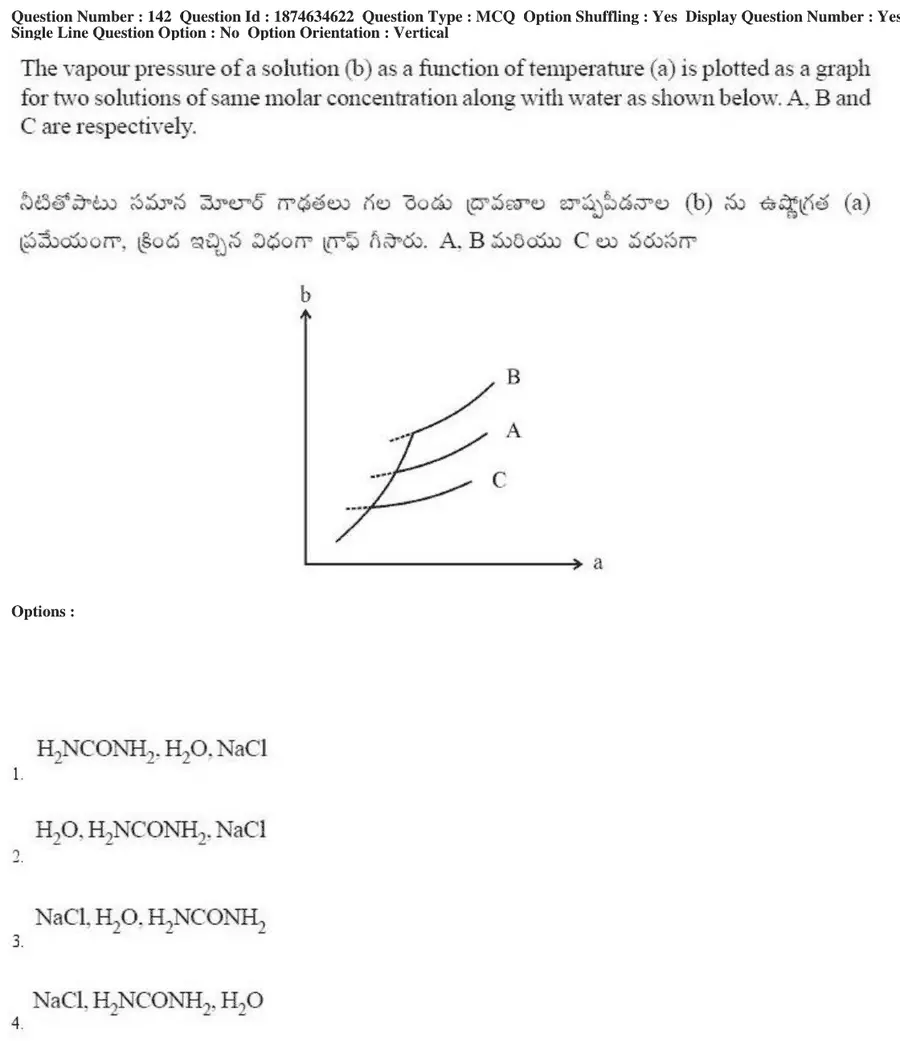
The vapour pressure of a solution (b) as a function of temperature (a) is plotted as a graph for two solutions of same molar concentration along with water as shown below. A, B and C are respectively.
(see the figure above)

The question and its figure as printed in AP EAPCET 2019 22nd April 2019 Shift2.
The question as printed in the paper.
  • A

    $\mathrm{H_2NCONH_2}, \mathrm{H_2O}, \mathrm{NaCl}$

  • B

    $\mathrm{H_2O}, \mathrm{H_2NCONH_2}, \mathrm{NaCl}$

  • C

    $\mathrm{NaCl}, \mathrm{H_2O}, \mathrm{H_2NCONH_2}$

  • D

    $\mathrm{NaCl}, \mathrm{H_2NCONH_2}, \mathrm{H_2O}$

163AP EAMCET 2019 · 21 Apr · Shift 1MCQOpen question page ↗

A solution is prepared by dissolving 10 g of a non-volatile solute (molar mass, 'M' $\mathrm{g\,mol^{-1}}$) in 360 g of water. What is the molar mass in $\mathrm{g\,mol^{-1}}$ of solute if the relative lowering of vapour pressure of solution is $5\times10^{-3}$?

  • A

    199

  • B

    99.5

  • C

    299

  • D

    149.5

164AP EAMCET 2019 · 21 Apr · Shift 1MCQOpen question page ↗

$x$ g of $\mathrm{MgSO_4}$ ($i=1.8$) is in 2.5 L of solution has an osmotic pressure of 2.463 atm. at $27\,^\circ\mathrm{C}$. What is the value of $x$ in g?

  • A

    33.2

  • B

    6.6

  • C

    3.3

  • D

    16.6

165AP EAMCET 2019 · 21 Apr · Shift 2MCQOpen question page ↗

The vapour pressures of chloroform ($\mathrm{CHCl_3}$), dichloromethane ($\mathrm{CH_2Cl_2}$) at 298 K are 200 mm Hg and 415 mm Hg respectively. An ideal solution is prepared by mixing 59.75 g of $\mathrm{CHCl_3}$ and 21.25 g of $\mathrm{CH_2Cl_2}$, the mole fractions of chloroform and dichloromethane in vapour phase respectively are

  • A

    0.509, 0.491

  • B

    0.491, 0.509

  • C

    0.201, 0.799

  • D

    0.799, 0.201

166AP EAMCET 2019 · 21 Apr · Shift 2MCQOpen question page ↗

The elevation in boiling point of an aqueous solution of NaCl is $0.01\ ^\circ\mathrm{C}$. If its van't Hoff factor is 1.92, the molality of NaCl solution is
($\mathrm{K_b}$ for water $= 0.52\ \mathrm{K\ kg\ mol^{-1}}$)

  • A

    0.01 m

  • B

    0.001 m

  • C

    0.005 m

  • D

    0.02 m

167AP EAMCET 2019 · 20 Apr · Shift 1MCQOpen question page ↗

6 g of a mixture of naphthalene ($\mathrm{C_{10}H_8}$) and anthracene ($\mathrm{C_{14}H_{10}}$) is dissolved in 300 g of benzene. If the depression in freezing point is 0.70 K, the composition of naphthalene and anthracene in the mixture respectively in g are
(molal depression constant of benzene is 5.1 K kg $\mathrm{mol^{-1}}$)

  • A

    2.60, 3.40

  • B

    3.40, 2.60

  • C

    2.90, 3.10

  • D

    3.10, 2.90

168AP EAMCET 2019 · 20 Apr · Shift 2MCQOpen question page ↗

1.2 mL of acetic acid having density $1.06\ \mathrm{gcm^{-3}}$ is dissolved in 1 litre of water. The depression in freezing point observed for this concentration of acid was $0.041^\circ\mathrm{C}$. The van't Hoff factor of the acid is ($\mathrm{K_f}$ of water = $1.86\ \mathrm{K\,kgmol^{-1}}$)

  • A

    0.41

  • B

    1.04

  • C

    0.96

  • D

    1.54

169AP EAMCET 2019 · 20 Apr · Shift 2MCQOpen question page ↗

100 mL of 1.5% (w/v) solution of urea is found to have an osmotic pressure of 6.0 atm and 100 mL of 3.42% (w/v) solution of cane sugar is found to have an osmotic pressure of 2.4 atm. If the two solutions are mixed, the osmotic pressure of the resulting solution in atm is
(Assume that there is no reaction between urea and cane sugar)

  • A

    8.4

  • B

    16.8

  • C

    4.2

  • D

    2.1

170TS EAMCET 2018 · 7 May · Shift 1MCQOpen question page ↗

If the degree of association is 70% for the reaction $\mathrm{2A \rightleftharpoons (A)_2}$, the van't Hoff factor for the solute 'A' is

  • A

    0.30

  • B

    0.70

  • C

    0.35

  • D

    0.65

171TS EAMCET 2018 · 5 May · Shift 1MCQOpen question page ↗

How many grams of glucose must be added to 0.5 liter of a solution so that its osmotic pressure is same as that of a solution of 9.2 g of glucose dissolved in a liter?

  • A

    1.15

  • B

    9.22

  • C

    2.31

  • D

    4.60

172TS EAMCET 2018 · 5 May · Shift 2MCQOpen question page ↗

In an experiment to estimate the molecular weight of benzoic acid by elevation in boiling point method, the experimental value of molecular weight was double the actual value. Calculate the degree of association of dimer if the elevation in B.P. is $2\,^\circ\mathrm{C}$.

  • A

    $1.0$

  • B

    $0.5$

  • C

    $0.9$

  • D

    $2.0$

173TS EAMCET 2018 · 5 May · Shift 2MCQOpen question page ↗

$2.0\ \mathrm{g}$ of a non-electrolyte dissolved in $100\ \mathrm{g}$ of benzene lowers the freezing point of benzene by $1.2\ \mathrm{K}$. The freezing point depression constant of benzene is $5.12\ \mathrm{K\,kg\,mol^{-1}}$. The molar mass of the solute is

  • A

    $55\ \mathrm{g\,mol^{-1}}$

  • B

    $85\ \mathrm{g\,mol^{-1}}$

  • C

    $120\ \mathrm{g\,mol^{-1}}$

  • D

    $155\ \mathrm{g\,mol^{-1}}$

174TS EAMCET 2018 · 4 May · Shift 1MCQOpen question page ↗

At 300 K, a one litre solution of sucrose (molecular weight : 342) was prepared by dissolving 40 g of sucrose. What is the approximate osmotic pressure (in kPa) of solution at the same temperature?
($R = 8.314\times10^{6}\ \mathrm{cm^{3}\,Pa\,K^{-1}\,mol^{-1}}$)

  • A

    292

  • B

    500

  • C

    292000

  • D

    600

175TS EAMCET 2018 · 4 May · Shift 2MCQOpen question page ↗

Calculate the approximate $\Delta T_b$ (in K) for 0.001 molal KCl solution if its van't Hoff factor is 1.98.
[$K_b$ of water is 0.52 K kg mol$^{-1}$]

  • A

    1.03

  • B

    $1.03\times10^{-3}$

  • C

    $1.03\times10^{-5}$

  • D

    $1.03\times10^{-1}$

176TS EAMCET 2018 · 4 May · Shift 2MCQOpen question page ↗

Henry's law constant for $\mathrm{CO_2}$ in water is 1.67 kbar at 25 °C. The quantity of $\mathrm{CO_2}$ in 1000 mL of soda water when packed under 5 bar $\mathrm{CO_2}$ pressure at 25 °C is

  • A

    0.084 mol

  • B

    0.167 mol

  • C

    0.252 mol

  • D

    0.336 mol

177AP EAMCET 2018 · 24 Apr · Shift 1MCQOpen question page ↗

If $\mathrm{CO_2}$ gas having a partial pressure of 1.67 bar is bubbled through 1 L water at 298 K, the amount of $\mathrm{CO_2}$ dissolved in water in $\mathrm{g\,L^{-1}}$ is approximately
(Henry's law constant of $\mathrm{CO_2}$ is 1.67 k bar at 298 K).

  • A

    24.42

  • B

    12.21

  • C

    2.44

  • D

    1.22

178AP EAMCET 2018 · 24 Apr · Shift 1MCQOpen question page ↗

12.25 g of $\mathrm{CH_3CH_2CHClCOOH}$ is added to 250 g of water to make a solution. If the dissociation constant of above acid is $1.44\times10^{-3}$, the depression in freezing point of water in $^\circ$C is
($\mathrm{K_f}$ for water is 1.86 K kg $\mathrm{mol^{-1}}$)

  • A

    0.789

  • B

    0.394

  • C

    1.183

  • D

    0.592

179AP EAMCET 2018 · 24 Apr · Shift 2MCQOpen question page ↗

Match the following.
List - I
A) Azeotrope
B) Henry's law
C) Cryoscopic constant
D) Van't Hoff factor
List - II
I) $\Delta T_b = i K_b m$
II) $p = K_H x$
III) $\Delta T_f / m$
IV) Deviation from Raoult's law
V) $\pi = CRT$
The correct answer is

  • A

    A-II, B-III, C-V, D-IV

  • B

    A-IV, B-II, C-III, D-I

  • C

    A-IV, B-II, C-I, D-III

  • D

    A-I, B-III, C-II, D-IV

180AP EAMCET 2018 · 24 Apr · Shift 2MCQOpen question page ↗

The mass of ascorbic acid ($\mathrm{C_6H_8O_6}$) to be dissolved in 100 g of acetic acid to lower its freezing point by $1.5\ ^\circ\mathrm{C}$ in g is :
($K_f$ for acetic acid is $4.0\ \mathrm{K\,kg\,mol^{-1}}$)

  • A

    17.6

  • B

    8.8

  • C

    6.6

  • D

    13.2

181AP EAMCET 2018 · 23 Apr · Shift 1MCQOpen question page ↗

When 36 g of a non-volatile, non-electrolytic solute having the empirical formula $\mathrm{CH_2O}$ is dissolved in 1.2 kg of water, the solution freezes at $-0.93\ ^\circ\mathrm{C}$. The molecular formula of the solute is ($\mathrm{K_f}$ of water = 1.86 K kg mol$^{-1}$)

  • A

    $\mathrm{CH_2O}$

  • B

    $\mathrm{C_2H_4O_2}$

  • C

    $\mathrm{C_3H_6O_3}$

  • D

    $\mathrm{C_4H_8O_4}$

182AP EAMCET 2018 · 23 Apr · Shift 1MCQOpen question page ↗

Benzene and toluene form an ideal solution over the entire range of composition. The vapour pressure of pure benzene and toluene at T (K) are 50 mm Hg and 40 mm Hg respectively. What is the mole fraction of toluene in vapour phase when 117 g of benzene is mixed with 46 g of toluene ? (molar mass of benzene and toluene are 78 and 92 g mol$^{-1}$ respectively)

  • A

    0.78

  • B

    0.21

  • C

    0.64

  • D

    0.35

183AP EAMCET 2018 · 23 Apr · Shift 2MCQOpen question page ↗

The quantity of $\mathrm{CO_2}$ in 500 mL of soda water when packed under 3.34 bar $\mathrm{CO_2}$ pressure at 298 K in g is (Henry's law constant for $\mathrm{CO_2}$ in water at 298 K is $1.67 \times 10^{8}$ Pa).

  • A

    2.442

  • B

    1.221

  • C

    4.884

  • D

    3.663

184AP EAMCET 2018 · 23 Apr · Shift 2MCQOpen question page ↗

300 mL of an aqueous solution of a protein contains 2.52 g of the protein. If osmotic pressure of such a solution at 300 K is $5.04 \times 10^{-3}$ bar, the molar mass of the protein in $\mathrm{g\ mol^{-1}}$ is

  • A

    $83.0 \times 10^{3}$

  • B

    $20.8 \times 10^{3}$

  • C

    $41.5 \times 10^{3}$

  • D

    $41.5 \times 10^{4}$

185AP EAMCET 2018 · 22 Apr · Shift 1MCQOpen question page ↗

The measured osmotic pressure of a solution prepared by dissolving $17.4\ \mathrm{mg}$ of $\mathrm{K_2SO_4}$ in 2L of water at $27\ ^\circ\mathrm{C}$ is $3.735\times10^{-3}$ bar. The Van't Hoff factor is
($R = 0.083\ \mathrm{L\,bar\,K^{-1}\,mol^{-1}}$ ; atomic weights K = 39 ; S = 32 ; O = 16)

  • A

    $2.84$

  • B

    $3.0$

  • C

    $2.0$

  • D

    $2.32$

186AP EAMCET 2018 · 22 Apr · Shift 2MCQOpen question page ↗

At T(K), the vapour pressure of pure benzene is 0.85 bar. A non-volatile, non-electrolyte substance weighing 0.5 g when added to 39 g of benzene, the vapour pressure of the solution is 0.845 bar. The molar mass (in $\mathrm{g\,mol^{-1}}$) of the substance is

  • A

    $180$

  • B

    $270$

  • C

    $160$

  • D

    $169$

187AP EAMCET 2018 · 22 Apr · Shift 2MCQOpen question page ↗

0.1 m solution each of sodium sulphate, urea and sodium chloride are taken. The correct ratio of elevation of boiling point of these solutions is

  • A

    $1:1:1$

  • B

    $3:1:2$

  • C

    $1:2:3$

  • D

    $2:3:1$

188TS EAMCET 2017 · 12 May · OfflineMCQOpen question page ↗

Which of the following conditions are correct for real solutions showing negative deviation from Raoult's law?

  • A

    $\Delta H_{\mathrm{Mix}} < 0$ ; $\Delta V_{\mathrm{Mix}} > 0$

  • B

    $\Delta H_{\mathrm{Mix}} > 0$ ; $\Delta V_{\mathrm{Mix}} > 0$

  • C

    $\Delta H_{\mathrm{Mix}} > 0$ ; $\Delta V_{\mathrm{Mix}} < 0$

  • D

    $\Delta H_{\mathrm{Mix}} < 0$ ; $\Delta V_{\mathrm{Mix}} < 0$

189TS EAMCET 2017 · 12 May · OfflineMCQOpen question page ↗

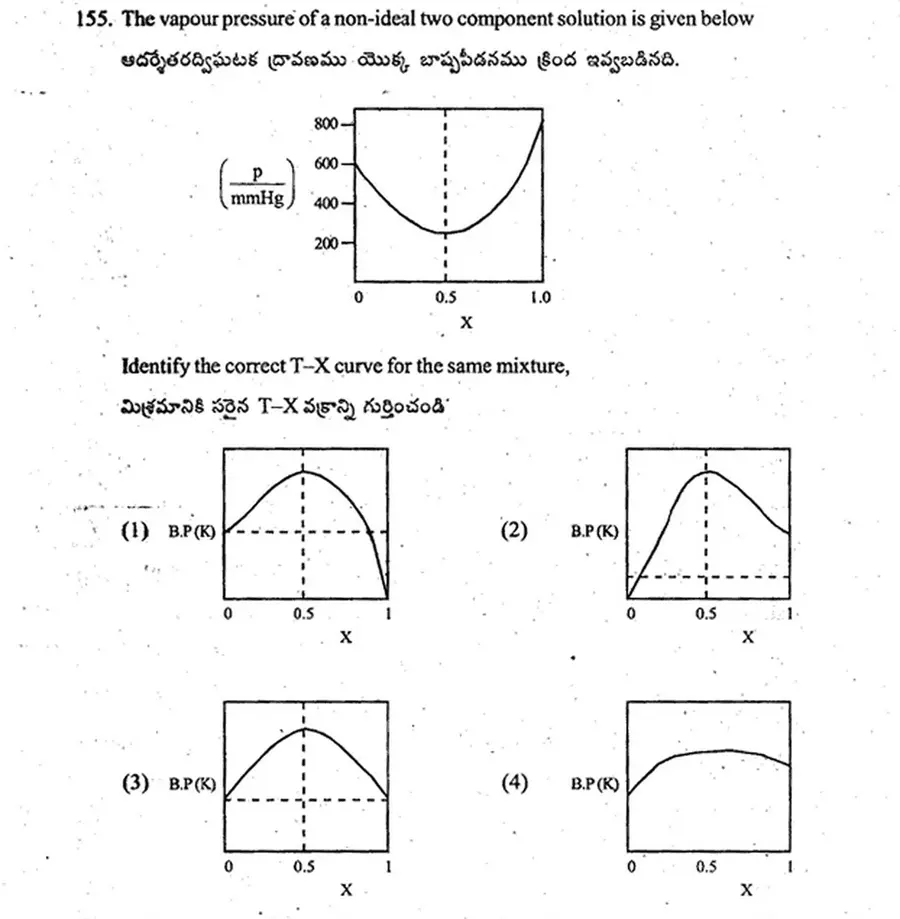
The vapour pressure of a non-ideal two component solution is given below
(see the figure above)
Identify the correct T-X curve for the same mixture,

The question and its figure as printed in TS EAMCET 2017 12 May Offline. Option 1: B.P(K) vs X (0 to 1): curve rising to a maximum at X = 0.5 and falling back; horizontal dashed line at the left end value; right end drops steeply to the bottom at X = 1 Option 2: B.P(K) vs X: starts at bottom left at X = 0, rises steeply to a maximum near X = 0.5, then falls gently to the right end; horizontal dashed line near the bottom Option 3: B.P(K) vs X: symmetric hump, maximum at X = 0.5, both ends at the same level marked by a horizontal dashed line Option 4: B.P(K) vs X: gentle hump, flat maximum near X = 0.6, no dashed lines, right end slightly lower than left
The question as printed in the paper.
  • A

    see figure B.P(K) vs X (0 to 1): curve rising to a maximum at X = 0.5 and falling back; horizontal dashed line at the left end value; right end drops steeply to the bottom at X = 1

  • B

    see figure B.P(K) vs X: starts at bottom left at X = 0, rises steeply to a maximum near X = 0.5, then falls gently to the right end; horizontal dashed line near the bottom

  • C

    see figure B.P(K) vs X: symmetric hump, maximum at X = 0.5, both ends at the same level marked by a horizontal dashed line

  • D

    see figure B.P(K) vs X: gentle hump, flat maximum near X = 0.6, no dashed lines, right end slightly lower than left

190AP EAMCET 2017 · 26 Apr · Shift 1MCQOpen question page ↗

31 g of ethylene glycol ($\mathrm{C_2H_6O_2}$) is dissolved in 600 g of water. The freezing point depression of the solution is ($K_f$ for water is $1.86\ \mathrm{K\,kg\,mol^{-1}}$)

  • A

    $3.10\ \mathrm{K}$

  • B

    $4.65\ \mathrm{K}$

  • C

    $0.77\ \mathrm{K}$

  • D

    $1.55\ \mathrm{K}$

191AP EAMCET 2017 · 26 Apr · Shift 1MCQOpen question page ↗

Which one of the following solutions of compounds show highest osmotic pressure? (AB, $\mathrm{AB_2}$ and $\mathrm{A_2B_3}$ are ionic compounds)

  • A

    3.0 M AB type i = 1.6 and temperature is $27^\circ\mathrm{C}$

  • B

    2.5 M $\mathrm{AB_2}$ type i = 2.5 and temperature is $57^\circ\mathrm{C}$

  • C

    1.5 M $\mathrm{A_2B_3}$ type i = 4.1 and temperature is $27^\circ\mathrm{C}$

  • D

    5.0 M urea i = 1.0 and temperature is $67^\circ\mathrm{C}$

192AP EAMCET 2017 · 26 Apr · Shift 2MCQOpen question page ↗

At T(K), the vapour pressures of two liquids, heptane and octane are 106 kPa and 47 kPa respectively. If 25g of heptane and 57g of octane form an ideal solution, at T(K) the vapour pressure of solution in kPa is :

  • A

    66.66

  • B

    76.5

  • C

    50.0

  • D

    60.0

193AP EAMCET 2017 · 26 Apr · Shift 2MCQOpen question page ↗

At 27 °C, the osmotic pressure of a solution containing 4g of a non-electrolyte solute in 1.0 L of solution is 0.4 bar. The molar mass of the solute in $\mathrm{g\,mol^{-1}}$ is :
($R = 0.083\ \mathrm{L\,bar\,K^{-1}mol^{-1}}$)

  • A

    24.6

  • B

    49.2

  • C

    249

  • D

    180

194AP EAMCET 2017 · 25 Apr · Shift 1MCQOpen question page ↗

The ideal solutions formed by mixing two liquids A and B at 300 K in the molar ratio 1 : 1 and 1 : 2 have vapour pressures of 400 mm and 350 mm respectively. At the same temperature, the vapour pressures of pure liquids A and B in mm respectively are:

  • A

    250, 550

  • B

    500, 500

  • C

    550, 250

  • D

    350, 450

195AP EAMCET 2017 · 25 Apr · Shift 1MCQOpen question page ↗

0.8 mL of acetic acid of density 1.06 g $\mathrm{mL^{-1}}$ when dissolved in 1 kg of water causes depression in freezing point by 0.0325 $^\circ$C. The Van't Hoff factor is: ($K_f$ of $\mathrm{H_2O}$ = 1.86 K kg $\mathrm{mol^{-1}}$)

  • A

    1.24

  • B

    1.04

  • C

    0.09

  • D

    2.05

196AP EAMCET 2017 · 25 Apr · Shift 2MCQOpen question page ↗

At T(K), the vapour pressure of pure benzene (molar mass $= 78\ \mathrm{g\ mol^{-1}}$) is 0.85 bar. When 2.0 g of non-volatile, non-electrolyte solute is added to 39 g of benzene, the vapour pressure of solution at T(K) is 0.83 bar. The elevation in boiling point (in K) of the same solution [is] ($\mathrm{K_b}$ of benzene is $2.6\ \mathrm{K\ kg\ mol^{-1}}$)

  • A

    0.0784

  • B

    0.196

  • C

    1.568

  • D

    0.784

197AP EAMCET 2017 · 25 Apr · Shift 2MCQOpen question page ↗

At 27°C, two liquids A and B form an ideal solution with mole fractions 0.67 and 0.33 respectively. If the vapour pressure of pure A and B at 27°C are 300 mm and 450 mm respectively, the total vapour pressure of the solution in mm is:

  • A

    349.5

  • B

    700

  • C

    249.5

  • D

    148.5

198AP EAMCET 2017 · 24 Apr · Shift 1MCQOpen question page ↗

What is the molar mass (in $\mathrm{g\,mol^{-1}}$) of a substance, which forms a 7% by mass solution in water, which freezes at $-0.93^\circ\mathrm{C}$? ($K_f$ of $\mathrm{H_2O}=1.86\ \mathrm{K\,kg\,mol^{-1}}$)

  • A

    $140.4$

  • B

    $150.5$

  • C

    $160.6$

  • D

    $155.5$

199AP EAMCET 2017 · 24 Apr · Shift 1MCQOpen question page ↗

Assertion (A): The vapour pressure of 0.1M sugar solution is less than that of 0.1M KCl solution
Reason (R): Lowering of vapour pressure is directly proportional to the number of particles of non-volatile solute present in the solution
The correct answer is

  • A

    Both (A) and (R) are correct and (R) is the correct explanation of (A)

  • B

    Both (A) and (R) are correct and (R) is not the correct explanation of (A)

  • C

    (A) is correct but (R) is not correct

  • D

    (A) is not correct but (R) is correct

200AP EAMCET 2017 · 24 Apr · Shift 2MCQOpen question page ↗

At 350 K, the vapour pressure of pure liquids A and B are 450 mm and 700 mm respectively. If the total vapour pressure of liquid mixture is 600 mm of Hg, the mole fractions of A and B in vapour phase respectively are :

  • A

    0.4, 0.6

  • B

    0.6, 0.4

  • C

    0.3, 0.7

  • D

    0.7, 0.3

201AP EAMCET 2017 · 24 Apr · Shift 2MCQOpen question page ↗

At 298 K, Henry's law constant for $\mathrm{CO_2}$ in water is $1.67\times10^{8}$ Pa. At 298 K, the quantity of $\mathrm{CO_2}$ in 1000 mL of soda water when packed at $1.67\times10^{2}$ kPa $\mathrm{CO_2}$ pressure in $\mathrm{mol\ L^{-1}}$ is : (water density = $1.0\ \mathrm{g\ cm^{-3}}$)

  • A

    $5.55\times10^{-3}$

  • B

    0.555

  • C

    $5.55\times10^{3}$

  • D

    $5.55\times10^{-2}$

202TS EAMCET 2016 · 15 May · OfflineMCQOpen question page ↗

The experimental depression in freezing point of a dilute solution is 0.025 K. If the van't Hoff factor (i) is 2.0, the calculated depression in freezing point (in K) is

  • A

    0.00125

  • B

    0.025

  • C

    0.0125

  • D

    0.05

203TS EAMCET 2016 · 15 May · OfflineMCQOpen question page ↗

The molality of an aqueous dilute solution containing non-volatile solute is 0.1 m. What is the boiling temperature (in $^\circ$C) of solution ? (Boiling point elevation constant, $K_b = 0.52\ \mathrm{kg\ mol^{-1}\ K}$; boiling temperature of water = $100^\circ$C).

  • A

    100.0052

  • B

    100.052

  • C

    100.0

  • D

    100.52

204AP EAMCET 2016 · 29 Apr · OfflineMCQOpen question page ↗

The vapour pressures of pure benzene and toluene are 160 and 60 mm Hg respectively. The mole fraction of benzene in vapour phase in contact with equimolar solution of benzene and toluene is

  • A

    0.073

  • B

    0.027

  • C

    0.27

  • D

    0.73

205AP EAMCET 2016 · 29 Apr · OfflineMCQOpen question page ↗

6 g of a non volatile, non electrolyte X dissolved in 100 g of water freezes at $-0.93^\circ\mathrm{C}$. The molar mass of X in $\mathrm{g\,mol^{-1}}$ is ($K_f$ of $\mathrm{H_2O}$ = 1.86 $\mathrm{K\,kg\,mol^{-1}}$)

  • A

    60

  • B

    140

  • C

    180

  • D

    120

206AP EAMCET 2014 · 22 May · OfflineMCQOpen question page ↗

The molar mass of a solute X in g $\mathrm{mol^{-1}}$, if its 1% solution is isotonic with a 5% solution of cane sugar (molar mass = 342 g $\mathrm{mol^{-1}}$), is

  • A

    68.4

  • B

    34.2

  • C

    136.2

  • D

    171.2

207AP EAMCET 2014 · 22 May · OfflineMCQOpen question page ↗

Vapour pressure in mm Hg of 0.1 mole of urea in 180 g of water at $25^\circ$C is
(The vapour pressure of water at $25^\circ$C is 24 mm Hg)

  • A

    2.376

  • B

    20.76

  • C

    23.76

  • D

    24.76

208AP EAMCET 2013 · 10 May · OfflineMCQOpen question page ↗

Which one of the following is an isotonic pair of solutions ?

  • A

    0.15 M NaCl and 0.1 M $\mathrm{Na_2SO_4}$

  • B

    0.2 M Urea and 0.1 M Sugar

  • C

    0.1 M $\mathrm{BaCl_2}$ and 0.2 M Urea

  • D

    0.2 M $\mathrm{MgSO_4}$ and 0.1 M $\mathrm{NH_4Cl}$

209AP EAMCET 2013 · 10 May · OfflineMCQOpen question page ↗

The vapour pressure in mm of Hg, of an aqueous solution obtained by adding 18 g of glucose ($\mathrm{C_6H_{12}O_6}$) to 180 g of water at $100^\circ$C is :

  • A

    7.60

  • B

    76.0

  • C

    759

  • D

    752.4

210AP EAMCET 2012 · 12 May · OfflineMCQOpen question page ↗

The weight in grams of a non-volatile solute (M. wt : 60) to be dissolved in 90 g of water to produce a relative lowering of vapour pressure of 0.02 is

  • A

    4

  • B

    8

  • C

    6

  • D

    10

211AP EAMCET 2012 · 12 May · OfflineMCQOpen question page ↗

The experimentally determined molar mass of a non-volatile solute, $\mathrm{BaCl_2}$ in water by Cottrell's method, is

  • A

    equal to the calculated molar mass

  • B

    more than the calculated molar mass

  • C

    less than the calculated molar mass

  • D

    double of the calculated molar mass

212AP EAMCET 2011 · 8 May · OfflineMCQOpen question page ↗

A solution of 10 g of a non-volatile binary electrolyte (mol. wt. = 100) in 500 g of water freezes at $-0.74^\circ$C. What is the degree of ionisation ?
($k_f$ of water = 1.85 K molality$^{-1}$)

  • A

    50%

  • B

    75%

  • C

    100%

  • D

    0%

213AP EAMCET 2010 · 30 May · OfflineMCQOpen question page ↗

If $\mathrm{BaCl_2}$ ionizes to an extent of 80% in aqueous solution, the value of Van't Hoff factor is :

  • A

    $2.6$

  • B

    $0.4$

  • C

    $0.8$

  • D

    $2.4$

214AP EAMCET 2010 · 30 May · OfflineMCQOpen question page ↗

X is a non-volatile solute and Y is a volatile solvent. The following vapour pressures are observed by dissolving X in Y :

X/mol lit$^{-1}$Y/mm of Hg
0.10$P_1$
0.25$P_2$
0.01$P_3$

The correct order of vapour pressures is :

  • A

    $P_1 < P_2 < P_3$

  • B

    $P_3 < P_2 < P_1$

  • C

    $P_3 < P_1 < P_2$

  • D

    $P_2 < P_1 < P_3$

How to prepare Solutions for EAPCET

How often it comes up

Solutions holds position 11 among the 31 chemistry chapters in the modern five-year testing period from 2022 to 2026. Looking back across our entire examination archive from 2010 through 2026, the chapter delivered 214 questions across 149 papers, appearing in 139 of those tests and claiming 3.6 percent of all chemistry questions with an average of 1.4 questions per paper. In the recent five-year timeframe from 2022 to 2026, it contributed 100 questions across 77 sittings, being present in 72 papers to maintain 1.3 questions per paper and a 3.2 percent subject share.

The chapter has featured in every exam year since 2022, though it was absent from five sittings during this period. When broken down by state board between 2022 and 2026, AP tests carried 68 questions across 48 papers (appearing in 45 papers, 1.4 questions per paper, 3.5 percent share), while TS papers assembled 32 questions across 29 papers (appearing in 27 papers, 1.1 questions per paper, 2.8 percent share).

During the older testing block between 2010 and 2021, papers featured 114 questions across 72 sittings (appearing in 67 tests), corresponding to 1.6 questions per paper and a 4.0 percent subject share. Across the most recent three exam years from 2024 to 2026, question banks included 52 questions across 46 sittings (with 42 papers containing questions), averaging 1.1 questions per test and 2.8 percent share. Comparing the early era with the last three years indicates a share trend that is down, while comparing the five-year recent window with the last three years shows the share is about the same.

Most-asked topics

Questions in Solutions distribute across three central physical chemistry domains:

  • Colligative Properties forms the primary testing core with 111 questions overall and 51 during the recent period through 2026. Key problem formats evaluate relative lowering of vapour pressure, elevation in boiling point, depression in freezing point, and osmotic pressure of macromolecular or non-volatile solutes.
  • Vapour Pressure & Raoult's Law supplied 69 questions across all years, with 37 occurring between 2022 and 2026. Questions explore ideal versus non-ideal liquid mixtures, positive and negative deviations from Raoult law, Henrys law constants for gaseous solubility, and vapour phase mole fraction calculations.
  • van't Hoff Factor rounds out the syllabus with 34 questions across the archive and 12 in the recent period up to 2026. This area tests the degree of dissociation of strong and weak electrolytes, association of carboxylic acids in non-polar solvents, and anomalous molar masses.

What the questions look like

Examiners love numerical couplings between two distinct colligative phenomena. For example, a question might state the boiling point elevation of an aqueous solution and ask you to find its freezing point depression, requiring you to eliminate molality using the cryoscopic and ebullioscopic constants.

Another popular question type asks candidates to identify which equimolal solution among sodium chloride, calcium chloride, glucose, and aluminium sulphate has the highest freezing point or lowest boiling point. In these questions, calculating the effective particle concentration via the vant Hoff factor provides the swift route to the answer. You will also encounter Henrys law graphs plotting partial pressure against dissolved mole fraction where the slope directly equals the Henry constant.

Questions to try first

Test your command of standard solution calculations with these recent official questions:

How to practise it

Ensure you are comfortable converting between different concentration scales, specifically molality, molarity, and mole fraction. Because colligative properties rely on molality, practice computing solvent mass in kilograms quickly from solution density and solute molarity.

For electrolyte solutions, write down the dissociation equation cleanly. Relate the vant Hoff factor i to the degree of dissociation alpha using the formula i equals one plus open parenthesis n minus one close parenthesis alpha, where n represents the total number of ions produced per formula unit. For association into dimers, replace n with one half. Remember that osmotic pressure is the preferred experimental method for determining the molar masses of polymers and proteins because measurements occur near room temperature with measurable liquid heights.

Frequently asked questions

Why is molality preferred over molarity for boiling and freezing calculations?

Molality expresses the amount of solute per kilogram of pure solvent, which remains strictly independent of temperature. Molarity depends on total solution volume, which expands or contracts as temperature changes during boiling or freezing measurements.

What distinguishes a minimum boiling azeotrope from a maximum boiling azeotrope?

Solutions that exhibit large positive deviations from Raoult law, such as ethanol and water, form minimum boiling azeotropes at a specific intermediate composition. Mixtures showing large negative deviations from Raoult law, such as nitric acid and water, form maximum boiling azeotropes.

How does the vant Hoff factor affect colligative properties?

All four colligative properties are proportional to the total number of dissolved solute particles. Introducing the vant Hoff factor scales each formula directly, multiplying relative vapour pressure lowering, boiling elevation, freezing depression, and osmotic pressure by i. Step-by-step solutions for each one are in the EdLoop EAPCET app.

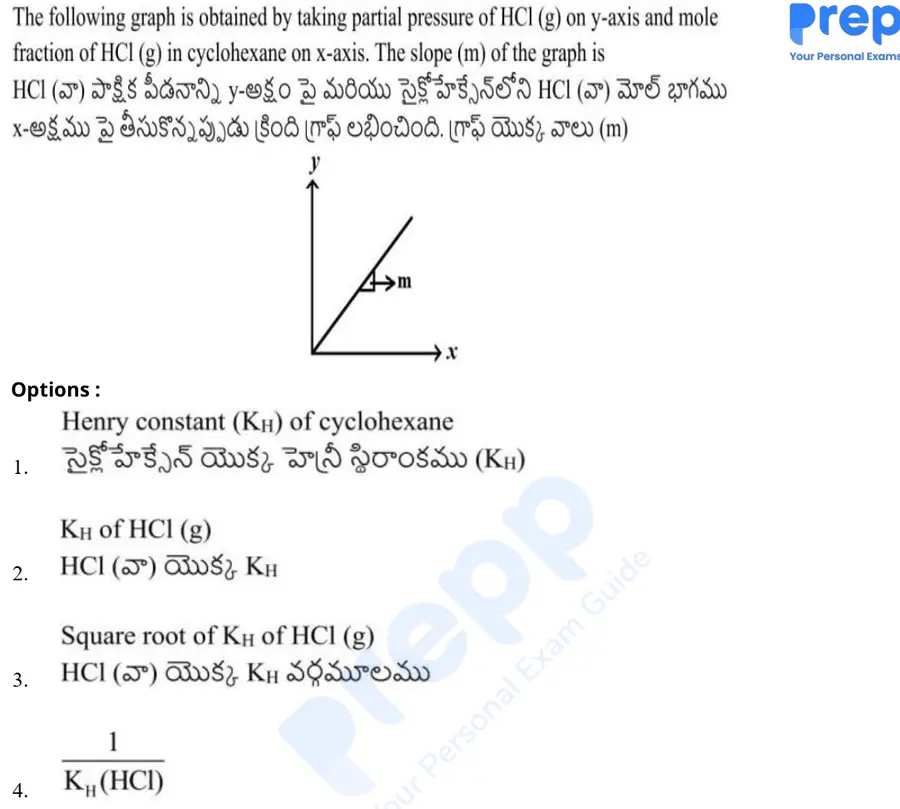
Get EdLoop – freeOpen on the web