Wrought iron is prepared from cast iron in a reverberatory furnace. The substance commonly used to line the furnace and the chemical process involved in it are respectively
In the metallurgy of silver, silver is leached with a dilute solution of $\mathrm{KCN}$ in the presence of air to form a complex ion X. This in the presence of zinc converts into another complex ion Y. The ratio of $\mathrm{CN^-}$ ligands in X and Y is
Statement-I : In the extraction of $\mathrm{Al}$ by Hall-Heroult process, pure $\mathrm{Al_2O_3}$ mixed with $\mathrm{Na_3AlF_6}$ lowers its melting point and increases conductivity.
Statement-II : Zirconium metal is purified by zone refining method.
The correct answer is
A
Both statement-I and statement-II are correct
B
Both statement-I and statement-II are not correct
C
Statement-I is correct, but statement-II is not correct
D
Statement-I is not correct, but statement-II is correct
Statement – I: The choice of reducing agent for the reduction of an oxide ore can be predicted by using Ellingham diagram, a plot of $\Delta G^{\ominus}$ Vs T.
Statement – II: According to Ellingham diagram, metal oxide with higher $\Delta G^{\ominus}$ is more stable than the oxide with lower $\Delta G^{\ominus}$.
The correct answer is
A
Both statements I and II are correct
B
Statement I is correct, but statement II is not correct
C
Statement I is not correct, but statement II is correct
A compound $A$ is used in paints instead of salts of lead. Compound $A$ is obtained when a white compound $B$ is strongly heated. Compound $B$ is insoluble in water but dissolves in $\mathrm{NaOH}$ solution forming a solution of compound $C$. The compound $A$ on heating with coke gives a volatile metal $D$ and a gas $E$ which burns with a blue flame. Identify the possible species $D$ and $C$ can be respectively?
Match the following items of List-I with those of List-II A) Nickel B) Titanium C) Germanium D) Copper I) Electrolytic refining II) Zone refining III) Van Arkel method IV) Mond process (printed as a) b) c) d) and i. ii. iii. iv.)
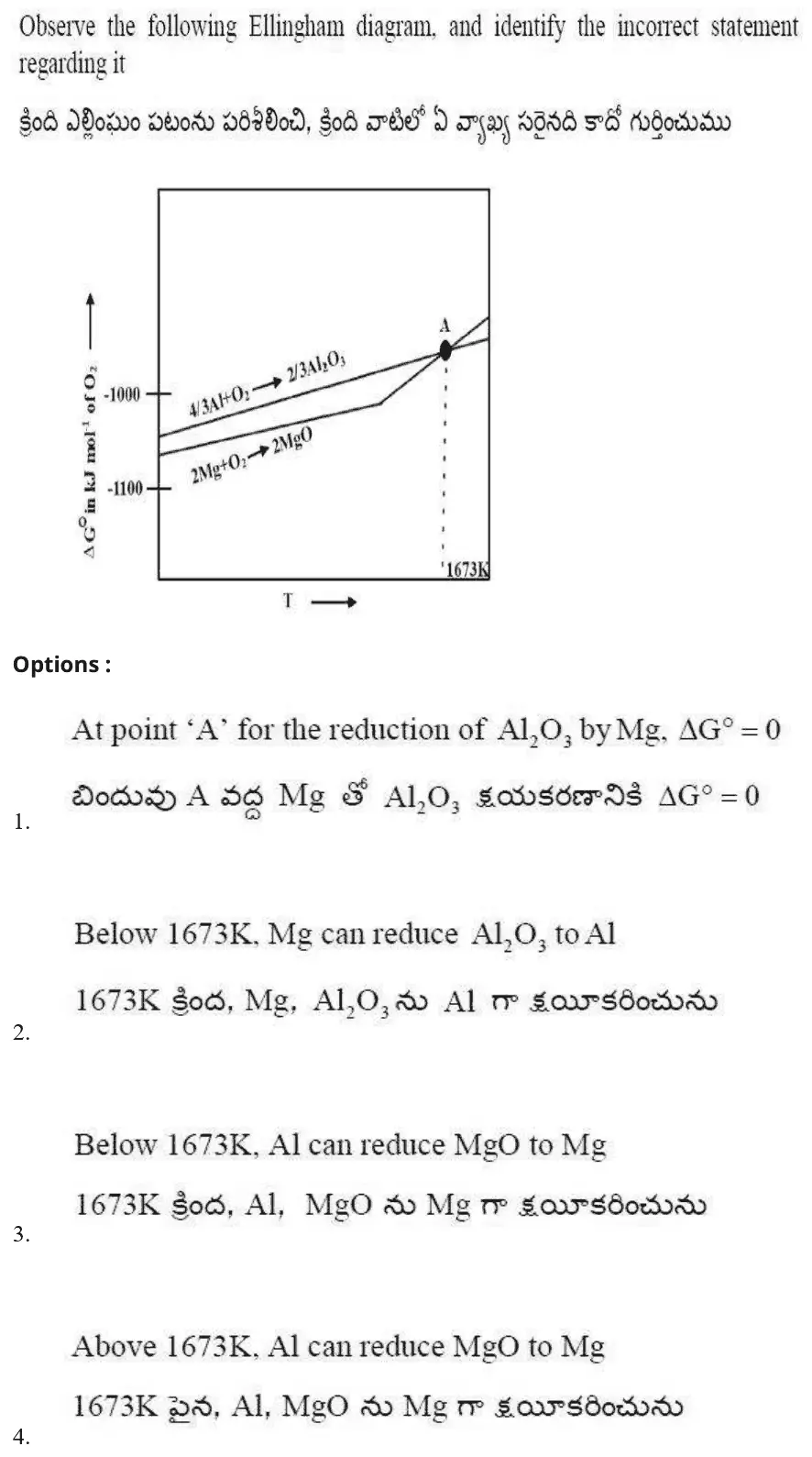
Which of the following statements is not correct? A) Reduction of alumina to give aluminum by magnesium is thermodynamically feasible B) The point of intersection of $AlO_3$ (sic) and $MgO$ curves in Ellingham diagram is below 1665 K C) Use of magnesium as reducing agent in metallurgy of aluminum is economical D) Ellingham diagram represents the graphical plot of Gibbs energy vs temp. for the formation of the oxides of common metals and reducing agents
Match the items of List-I with those of List-II and choose the correct option given below. List-I a) Calcination b) Roasting c) Magnetic separation d) Carbon reduction of metal oxide List-II i. Galena ii. Magnetite iii. Pyrometallurgy iv. Malachite
A
a) $\to$ (iv), b) $\to$ (i), c) $\to$ (iii), d) $\to$ (ii),
B
a) $\to$ (iv), b) $\to$ (i), c) $\to$ (ii), d) $\to$ (iii)
C
a) $\to$ (ii), b) $\to$ (iv), c) $\to$ (iii), d) $\to$ (ii)
D
a) $\to$ (iii), b) $\to$ (ii), c) $\to$ (i), d) $\to$ (iv)
Which statement is incorrect regarding Hall-Heroult process for metallurgy of aluminum? 1) Use of $Na_3AlF_6$ lowers the melting point of $Al_2O_3$ 2) Steel vessel with lining of carbon acts as cathode 3) Graphite is used as anode 4) Carbon dioxide gas is generated at cathode
The solubilities of the impurities in the melt and solid states is not same. This principle is applied during the extraction of boron. This method is known as
Match the following Ores | Composition A) Calamine | I) $\mathrm{CuFeS_2}$ B) Chalcopyrites | II) $\mathrm{ZnCO_3}$ C) Bauxite | III) $\mathrm{Fe_2O_3}$ D) Haematite | IV) $\mathrm{Al_2O_3\cdot 2H_2O}$ The correct match is
Which of the following statements are correct related to metallurgy? A) In electrolytic refining of copper, pure Cu is used as anode. B) Zone refining is based on the principle that impurities are more soluble in the melt than in the solid state of the metal. C) $\mathrm{TiI_4}$ upon heating will give pure Ti. D) Very pure Zr may be obtained by Galvanisation. E) In copper smelting hot air is used to convert $\mathrm{Cu_2S}$ to $\mathrm{CuSO_4}$. The correct answer is
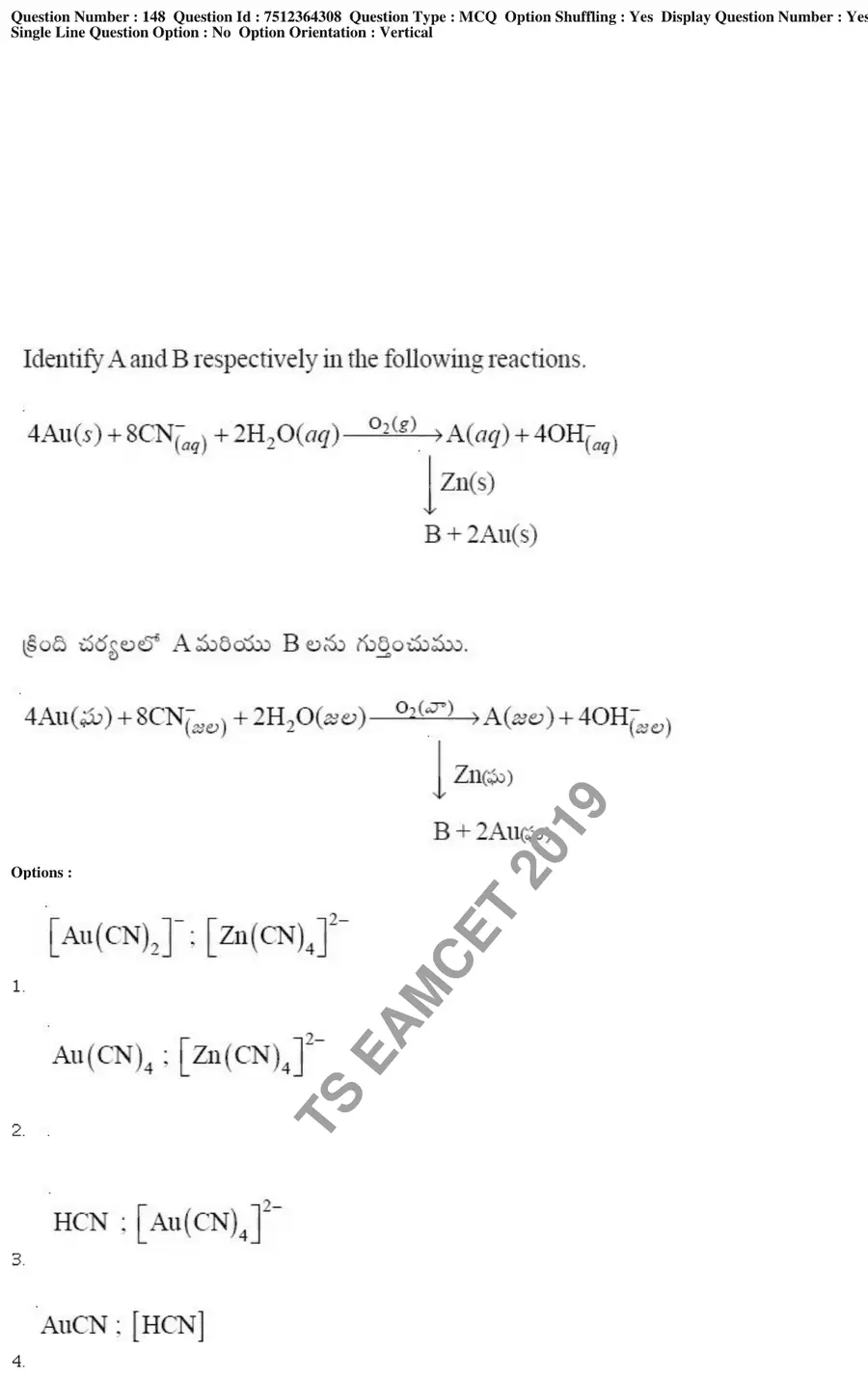
Identify A and B respectively in the following reactions. $4\mathrm{Au(s)} + 8\mathrm{CN^-_{(aq)}} + 2\mathrm{H_2O(aq)} \xrightarrow{\mathrm{O_2(g)}} \mathrm{A(aq)} + 4\mathrm{OH^-_{(aq)}}$ $\mathrm{A} \xrightarrow{\mathrm{Zn(s)}} \mathrm{B} + 2\mathrm{Au(s)}$ (see the figure above)
Identify the correct statements from the following: i. In the extraction of Ag and Au, zinc is used as reducing agent. ii. Impure zinc can be refined by distillation method. iii. Malachite is an ore of nickel.
The pair of oxides, which can be leached out, when powdered bauxite containing certain impurities is digested with concentrated solution of NaOH at 473 - 523 K temperature and 35 - 36 bar pressure are
In vapour phase refining, metal $\underline{A}$ is purified by Van Arkel method and metal $\underline{B}$ is purified by Mond's process. $\underline{A}$ and $\underline{B}$ are respectively.
Identify the statements which are not correct. a) Copper is refined by Van-Arkel method b) Zinc is refined by electrolysis method c) Zirconium is refined by distillation method
Match the following: List - I A) $\mathrm{Al_2O_3}+2\mathrm{NaOH}+3\mathrm{H_2O}\rightarrow2\mathrm{Na}[\mathrm{Al(OH)_4}]$ B) $\mathrm{Ni(CO)_4}\xrightarrow{230^\circ\mathrm{C}}\mathrm{Ni}+4\,\mathrm{CO}$ C) $\mathrm{Fe_2O_3\cdot3H_2O}\xrightarrow{\Delta}\mathrm{Fe_2O_3}+3\mathrm{H_2O}$ D) $2\mathrm{PbS}+3\mathrm{O_2}\rightarrow2\mathrm{PbO}+2\mathrm{SO_2}$ List - II I) Roasting II) Calcination III) Vapour phase refining IV) Electrolysis V) Leaching The correct answer is
Answer: (C) $\mathrm{2ZnS + 3O_2 \rightarrow 2ZnO + 2SO_2}$· Official APSCHE final key
How to prepare General Principles of Metallurgy for EAPCET
How often it comes up
General Principles of Metallurgy holds position 25 among the 31 chemistry chapters in the modern 2022 to 2026 examination span. Across our complete archive of engineering entrance papers from 2010 through 2026, the chapter contributed 117 questions across 149 papers, appearing in 107 of those tests to record a 2.0 percent subject share with an average of 0.8 questions per paper. In the recent five-year timeframe from 2022 to 2026, it gathered 60 questions across 77 sittings, being present in 56 papers to post 0.8 questions per paper and a 1.9 percent subject share.
The chapter did not appear in 2022, but was tested across the remaining years in this window, being absent from twenty-one papers overall during the five-year span. Looking at the two regional state streams between 2022 and 2026, AP examinations yielded 36 questions across 48 papers (appearing in 34 papers, 0.8 questions per paper, 1.9 percent share), while TS examinations generated 24 questions across 29 papers (appearing in 22 papers, 0.8 questions per paper, 2.1 percent share).
During earlier testing between 2010 and 2021, papers included 57 questions across 72 sittings (appearing in 51 tests), delivering 0.8 questions per paper and a 2.0 percent subject share. Across the latest three exam years from 2024 to 2026, question writers set 46 questions across 46 sittings (with 42 papers containing questions), yielding 1.0 question per test and 2.5 percent share. Evaluating trend patterns shows that the share early versus the last three years is up, and the share recent versus the last three years is up.
Most-asked topics
The metallurgy curriculum organizes under one comprehensive testing area:
Extraction of Metals encompasses all 117 questions across the historical archive, including 60 during the recent timeframe through 2026. Frequent problem formats cover ore identification and mineral formulas (bauxite, haematite, magnetite, copper pyrites, malachite, zinc blende, calamine, galena, and cassiterite), concentration techniques (froth flotation, collectors, frothers, and depressants like sodium cyanide), leaching of alumina by the Baeyer process and gold or silver by the MacArthur-Forrest cyanide method, pyrometallurgy and Ellingham diagram thermodynamic interpretation, roasting versus calcination, blast furnace zones for iron smelting, auto-reduction of copper and lead, and refining methods (distillation, liquation, electrolytic refining, zone refining for semiconductors, Mond process for nickel, Van Arkel de Boer process for zirconium and titanium, and chromatographic methods).
What the questions look like
Exam questions focus on memory recall of specific reagents, ore names, and refining techniques. A classic question asks candidates to identify which metals are purified by the Mond process and the Van Arkel method, requiring recognition of nickel carbonyl formation and volatile iodide decomposition respectively. Another frequent question style tests froth flotation, asking which depressant enables the selective separation of zinc sulphide from lead sulphide by forming a soluble coordination complex with zinc.
Thermodynamic questions based on Ellingham diagrams test whether you can identify the temperature threshold where a carbon or carbon monoxide oxidation line falls below a metal oxide line, making reduction feasible. Questions on copper extraction often test the self-reduction step where copper(I) oxide reacts with copper(I) sulphide in a Bessemer converter to produce blister copper with escaping sulphur dioxide gas.
Questions to try first
Solve these representative state entrance questions to test your recall of metallurgical operations:
Construct a master summary table of principal ores for aluminium, iron, copper, and zinc. For each ore, note whether concentration requires gravity separation, magnetic separation, chemical leaching, or froth flotation. Memorise the chemical role of each flotation additive: pine oil or eucalyptus oil acts as a frother; sodium ethyl xanthate acts as a collector; sodium cyanide acts as a depressant.
Review the blast furnace zones for iron extraction: reduction occurs in the upper lower-temperature zone where carbon monoxide reduces iron oxides to spongy iron; limestone decomposes in the central zone to quicklime, which fluxes silica gangue into calcium silicate slag; combustion of coke occurs in the lowest high-temperature hearth. For refining, know that zone refining produces ultra-pure semiconductors like silicon and germanium based on fractional crystallisation principles.
Frequently asked questions
How does sodium cyanide act as a depressant in the separation of galena and sphalerite?
Sodium cyanide reacts selectively with zinc sulphide to form a water-soluble coordination complex, sodium tetracyanozincate(II), preventing zinc sulphide particles from attaching to oil froths. In contrast, lead sulphide does not react with cyanide, allowing galena to float cleanly with the froth.
What is the distinction between calcination and roasting?
Calcination involves heating concentrated ore below its melting point in the absence of air or in a limited air supply, used primarily to expel moisture, volatile organic matter, or carbon dioxide from carbonate and hydrated oxide ores. Roasting heats ore strongly in excess air below its melting point, converting sulphide ores into metal oxides while releasing sulphur dioxide gas.
Why does blister copper have a blistered appearance?
During the conversion of molten copper matte into metallic copper via auto-reduction, dissolved sulphur dioxide gas is generated. As the molten metal solidifies, escaping bubbles of sulphur dioxide burst through the cooling surface, leaving characteristic surface blisters. Step-by-step solutions for each one are in the EdLoop EAPCET app.