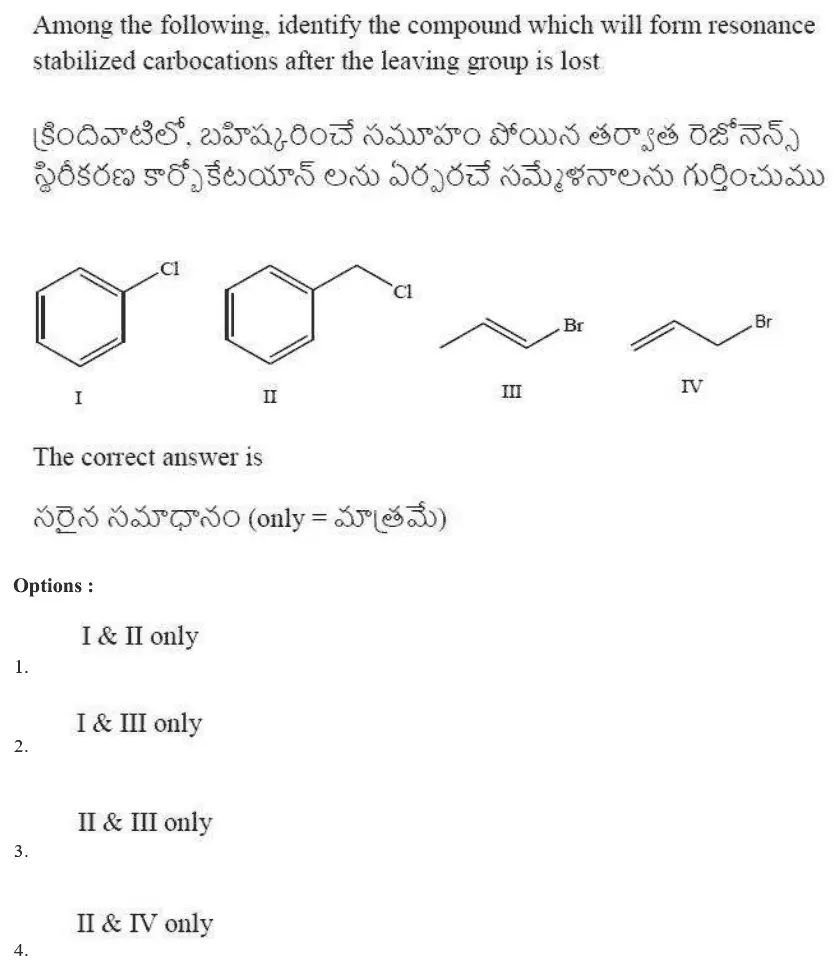
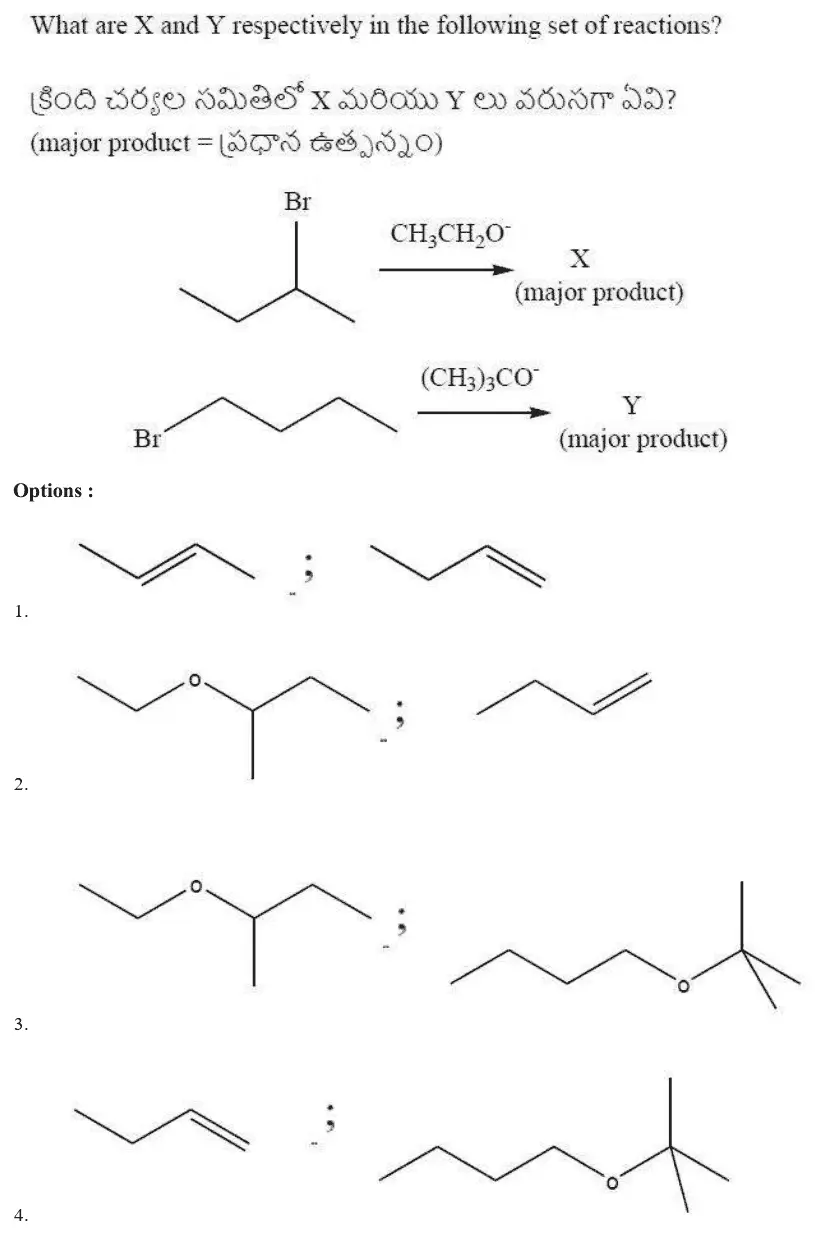
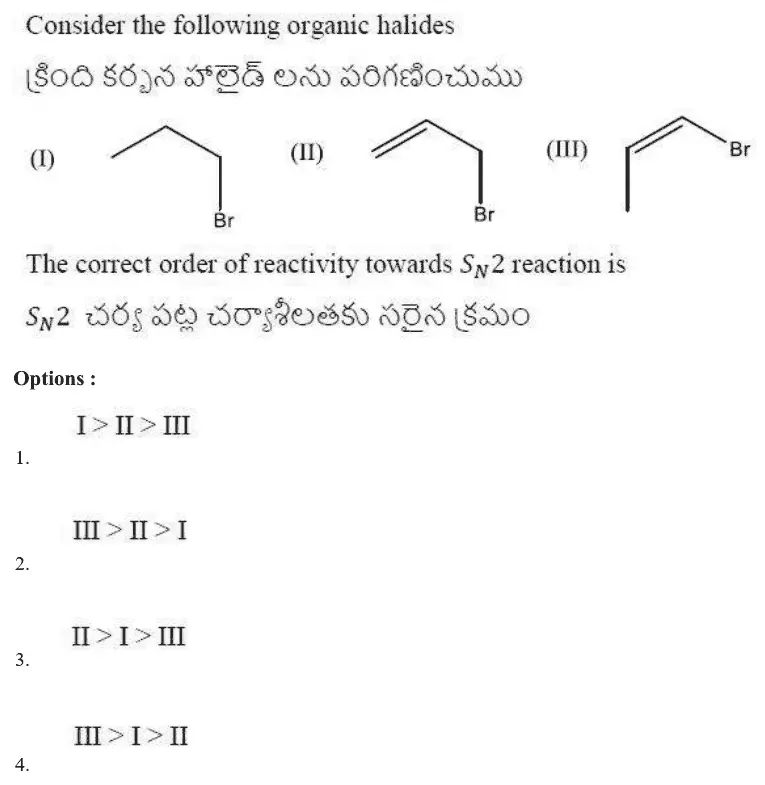
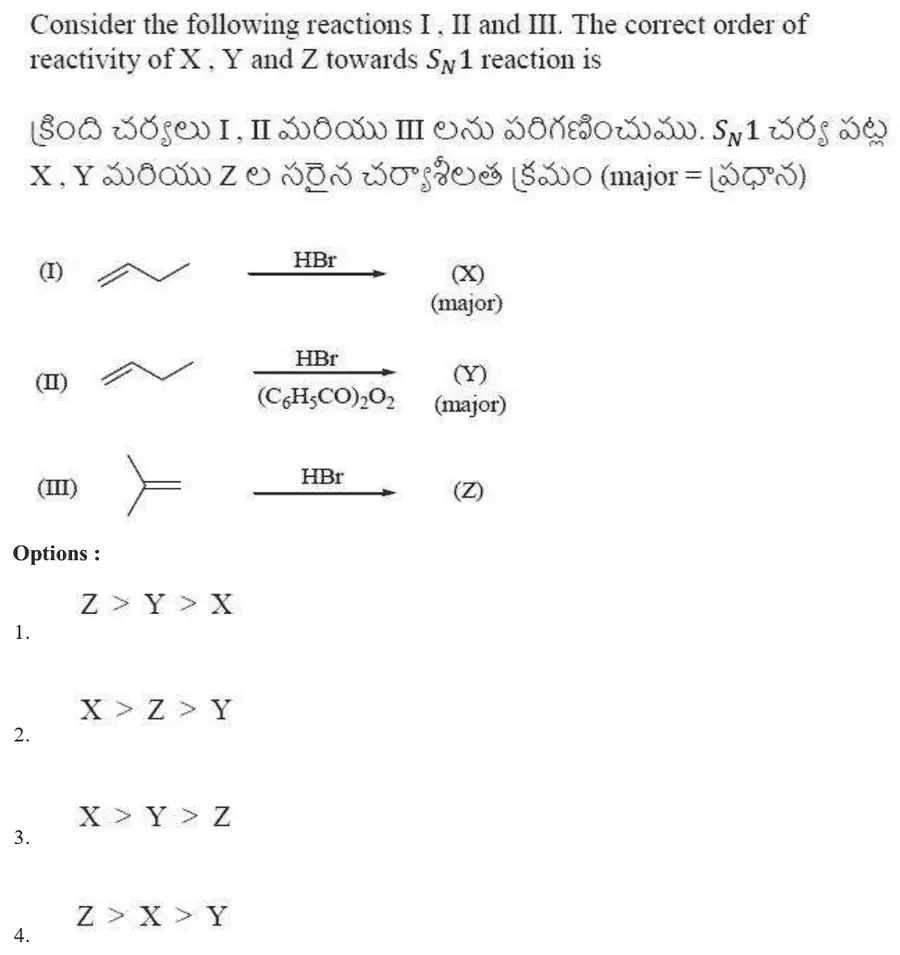
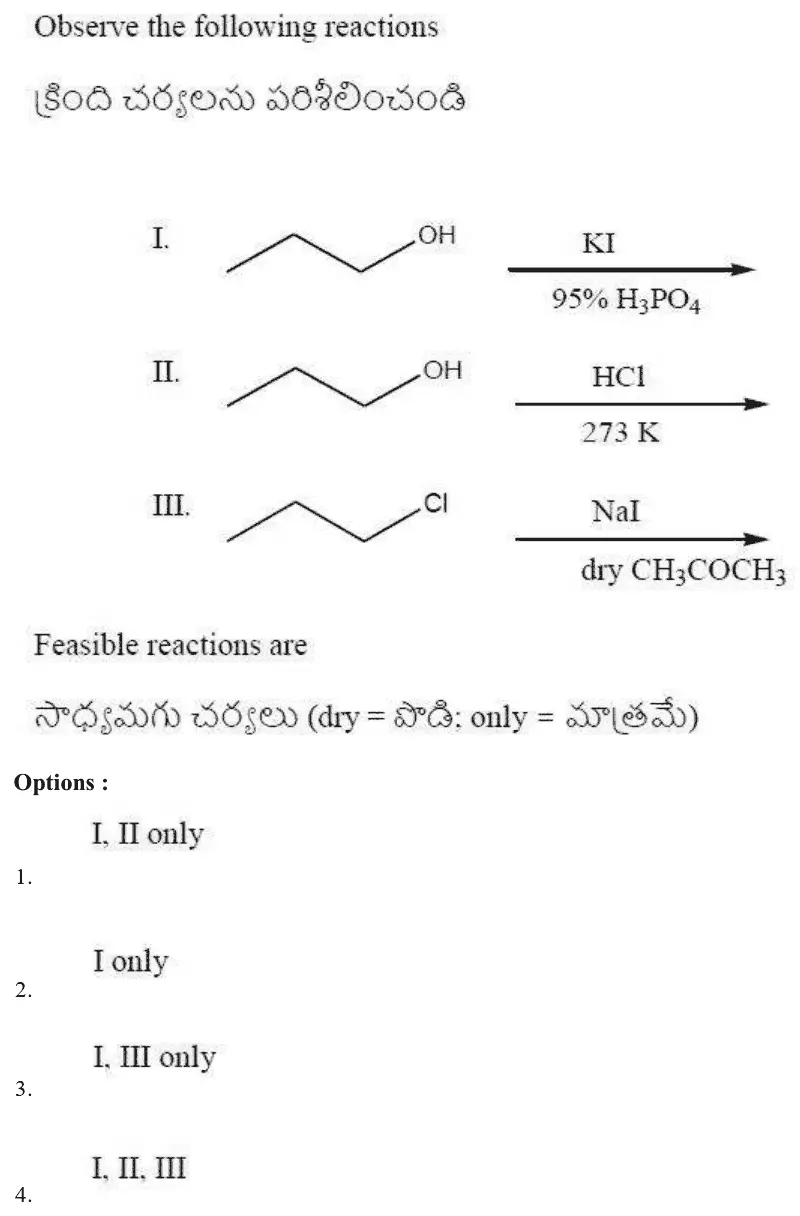
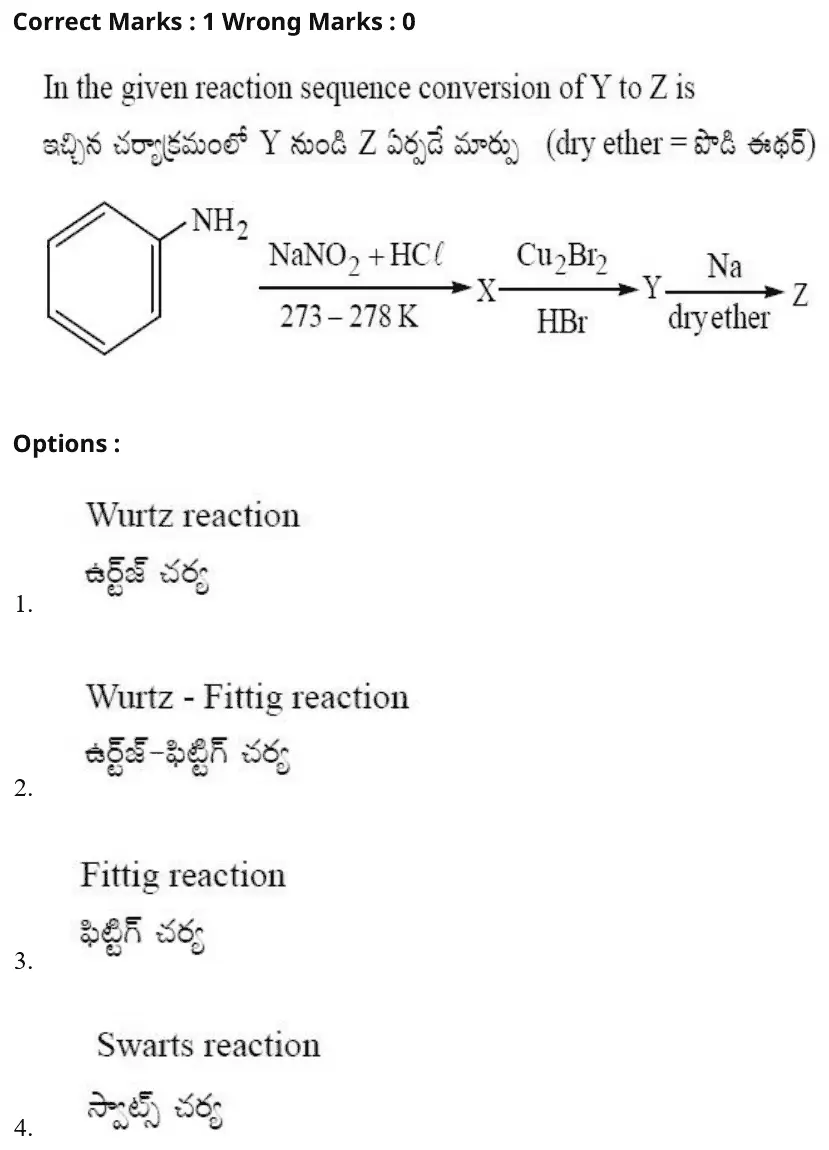
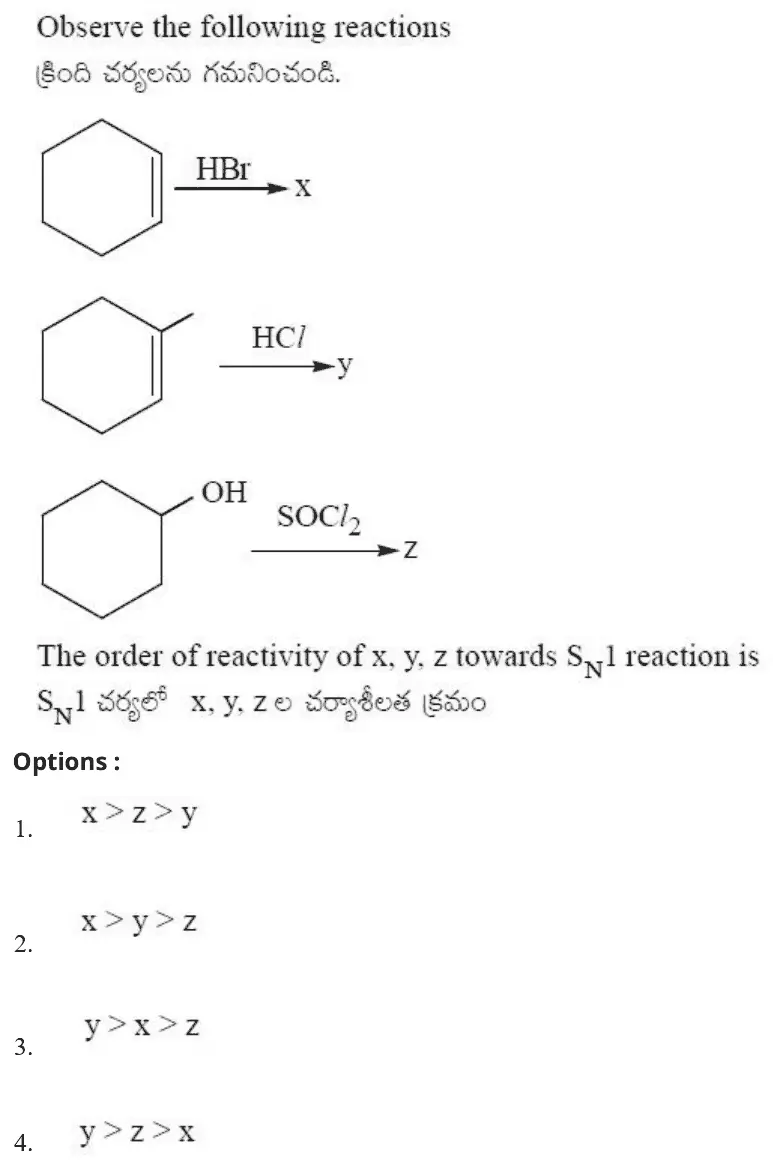
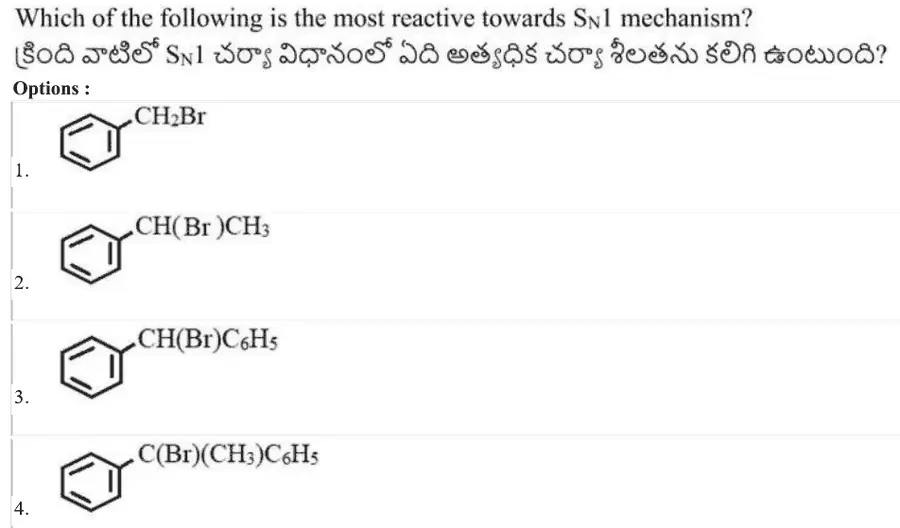
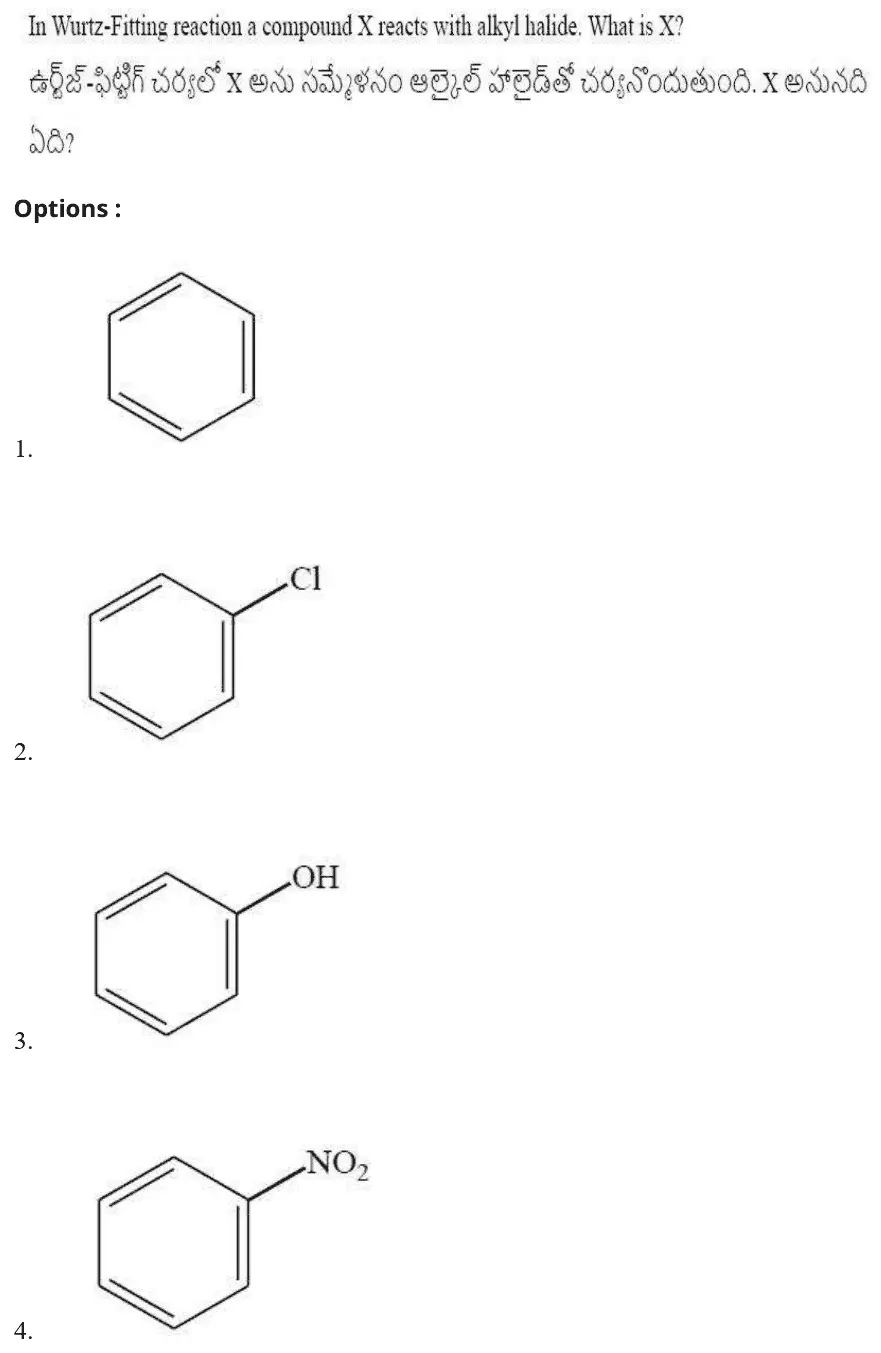
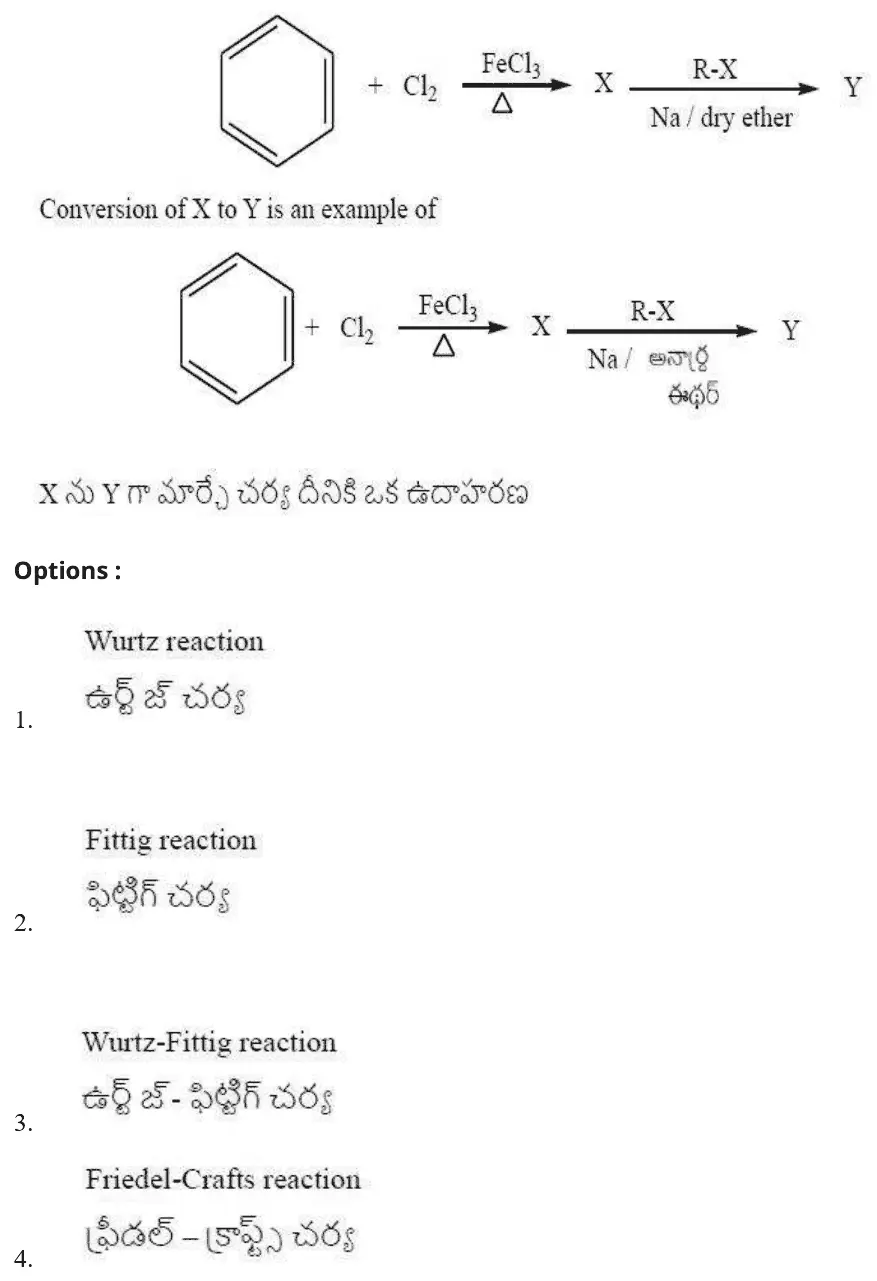
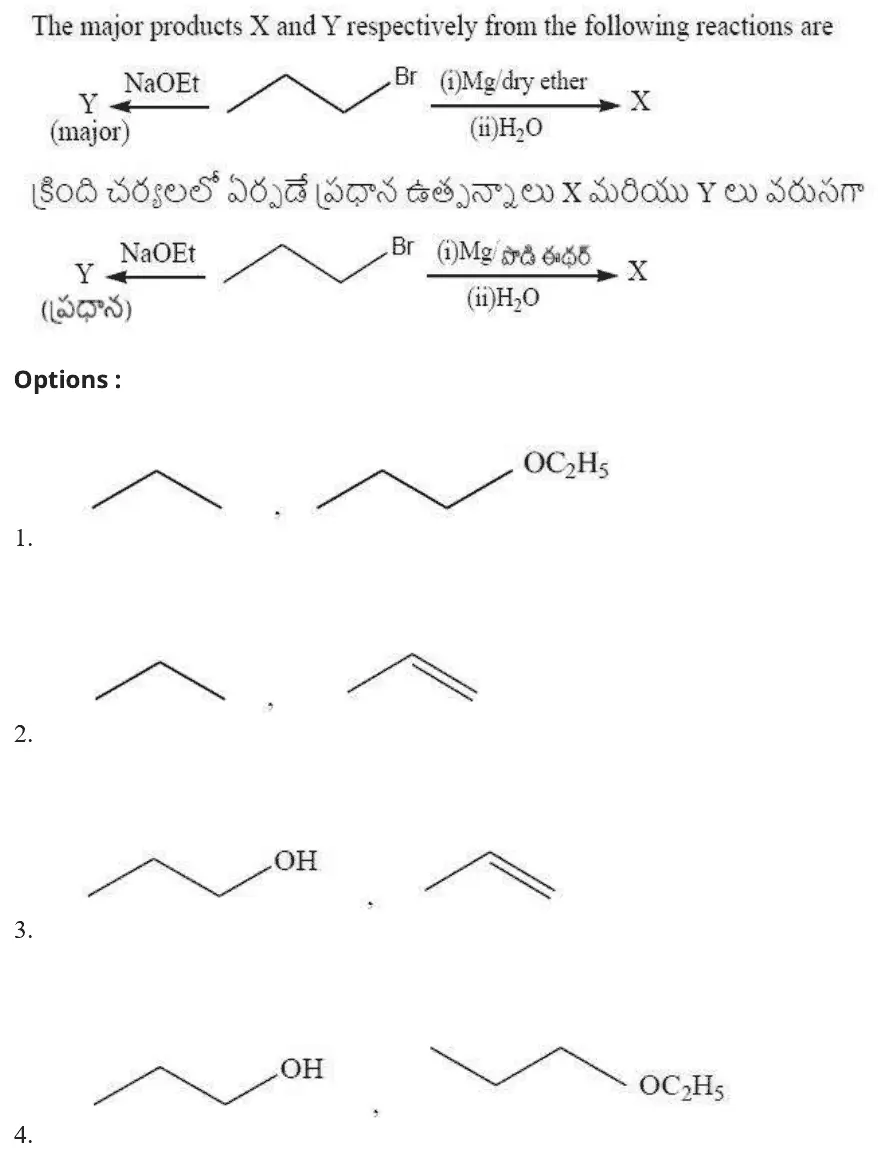
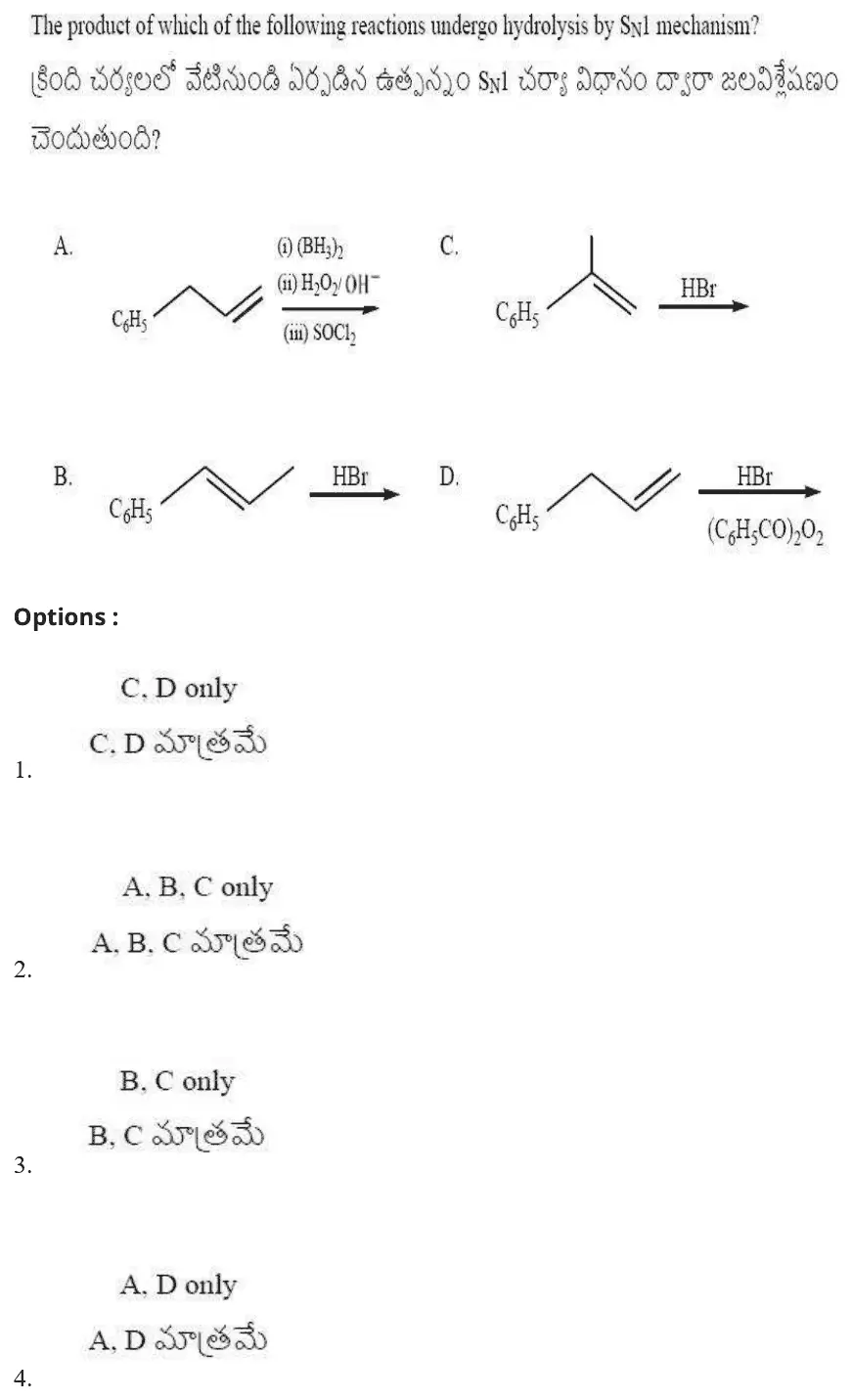
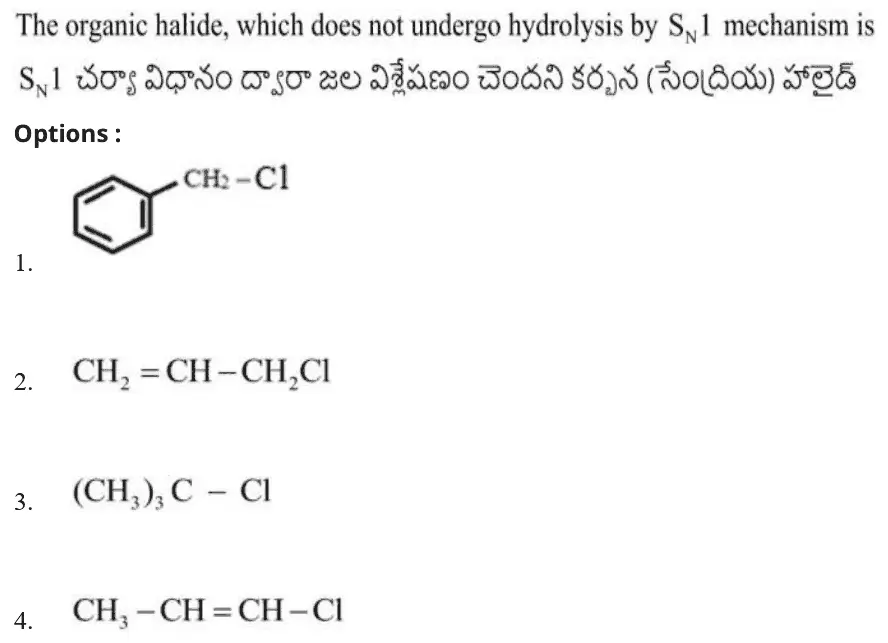
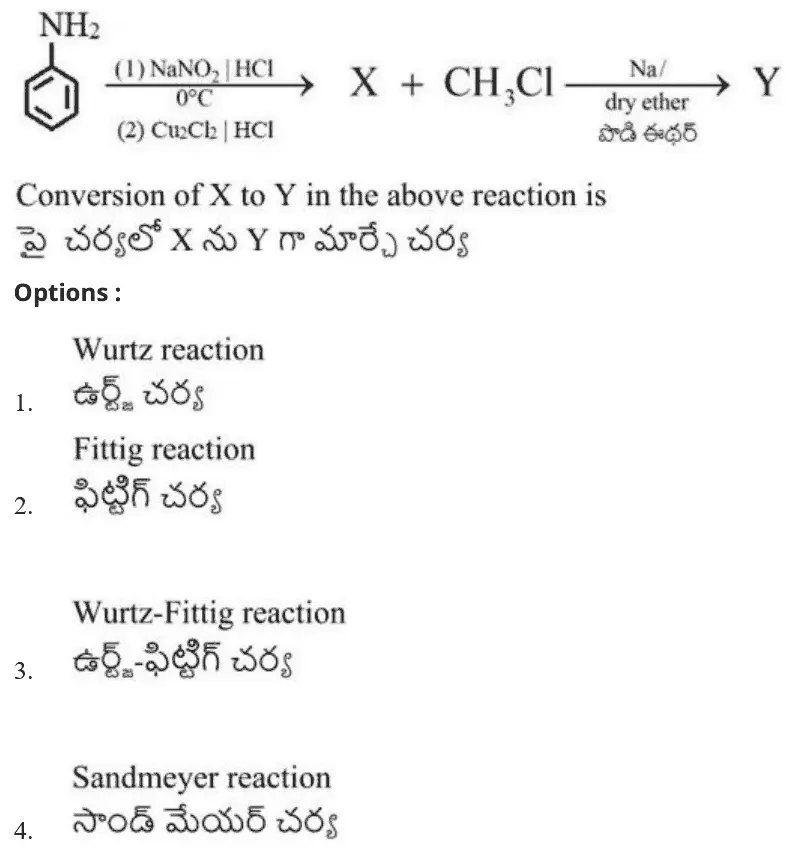
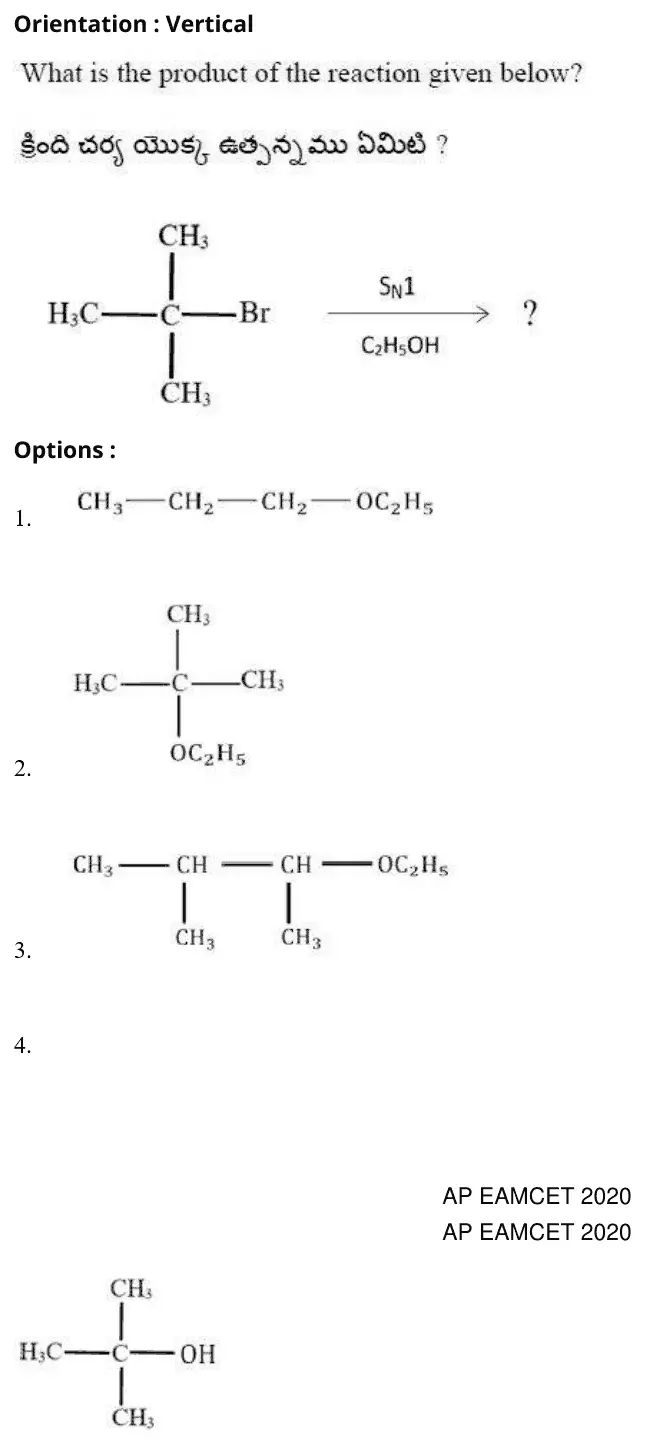
What are X and Y respectively in the following set of reactions? (major product)
(see the figure above)
The question as printed in the paper.
A
see figure Left: skeletal structure of but-2-ene (CH3-CH=CH-CH3, internal double bond); right: but-1-ene (terminal double bond), separated by a semicolon.
B
see figure Left: skeletal structure of sec-butyl ethyl ether (ethyl-O-CH(CH3)CH2CH3); right: but-1-ene (terminal double bond), separated by a semicolon.
C
see figure Left: skeletal structure of sec-butyl ethyl ether (ethyl-O-CH(CH3)CH2CH3); right: n-butyl tert-butyl ether (CH3CH2CH2CH2-O-C(CH3)3), separated by a semicolon.
D
see figure Left: skeletal structure of but-1-ene (terminal double bond); right: n-butyl tert-butyl ether (CH3CH2CH2CH2-O-C(CH3)3), separated by a semicolon.
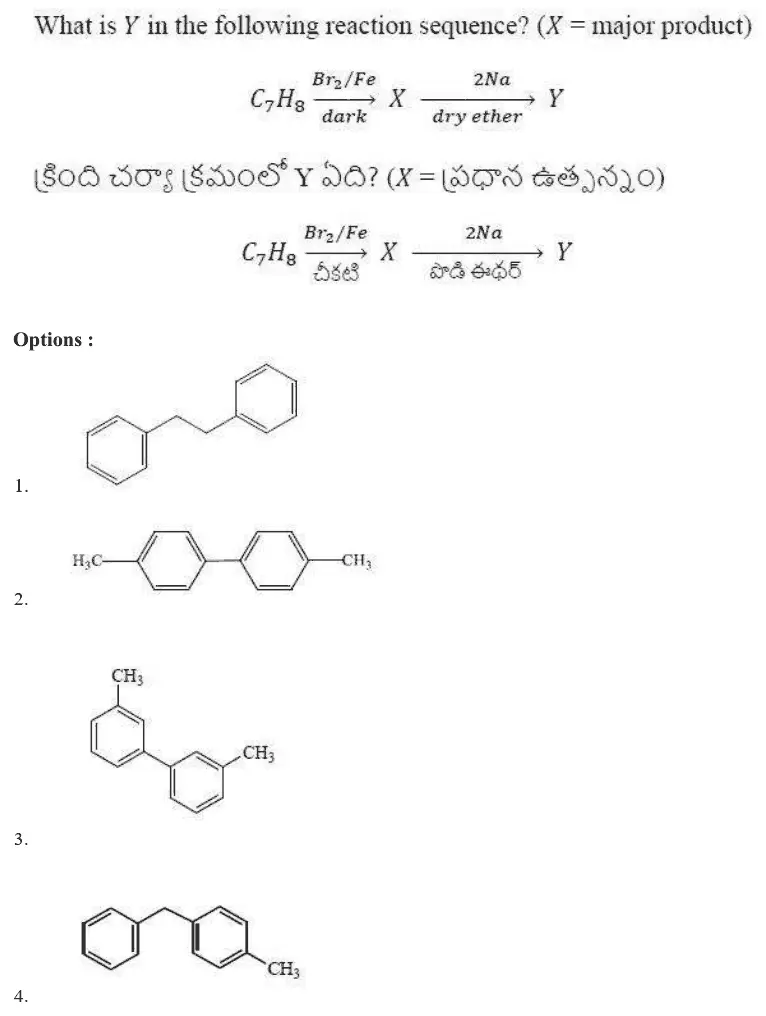
What is $Y$ in the following reaction sequence? ($X$ = major product)
$$\mathrm{C_7H_8} \xrightarrow[\text{dark}]{\mathrm{Br_2/Fe}} X \xrightarrow[\text{dry ether}]{2\mathrm{Na}} Y$$
The question as printed in the paper.
A
see figure Two benzene rings connected by a two-carbon chain (1,2-diphenylethane, PhCH2CH2Ph)
B
see figure Biphenyl with a CH3 group at the para position of each ring (4,4'-dimethylbiphenyl, H3C-C6H4-C6H4-CH3)
C
see figure Biphenyl with a CH3 group at the meta position of each ring (3,3'-dimethylbiphenyl)
D
see figure Diphenylmethane type: a benzene ring connected through a CH2 to a second benzene ring bearing CH3 at the para position (4-methyldiphenylmethane)
An organic compound $\mathrm{C_4H_9Br}(A)$ on reaction with Na/dry ether gave B. Photochemical chlorination of B gave two monochlorides. Correct statement regarding A is
A
It is a chiral molecule
B
It undergoes nucleophilic substitution by $S_N1$ mechanism
C
Reaction of it with $\mathrm{NaOC_2H_5}$ gave predominantly substitution product
D
It can be obtained by the addition of HBr to but-2-ene
The number of chlorine atoms attached to $\mathrm{sp^2}$ carbon in the structure of DDT is X. The number of chlorine atoms attached to $\mathrm{sp^3}$ carbon in chloramphenicol is Y. What are X and Y respectively?
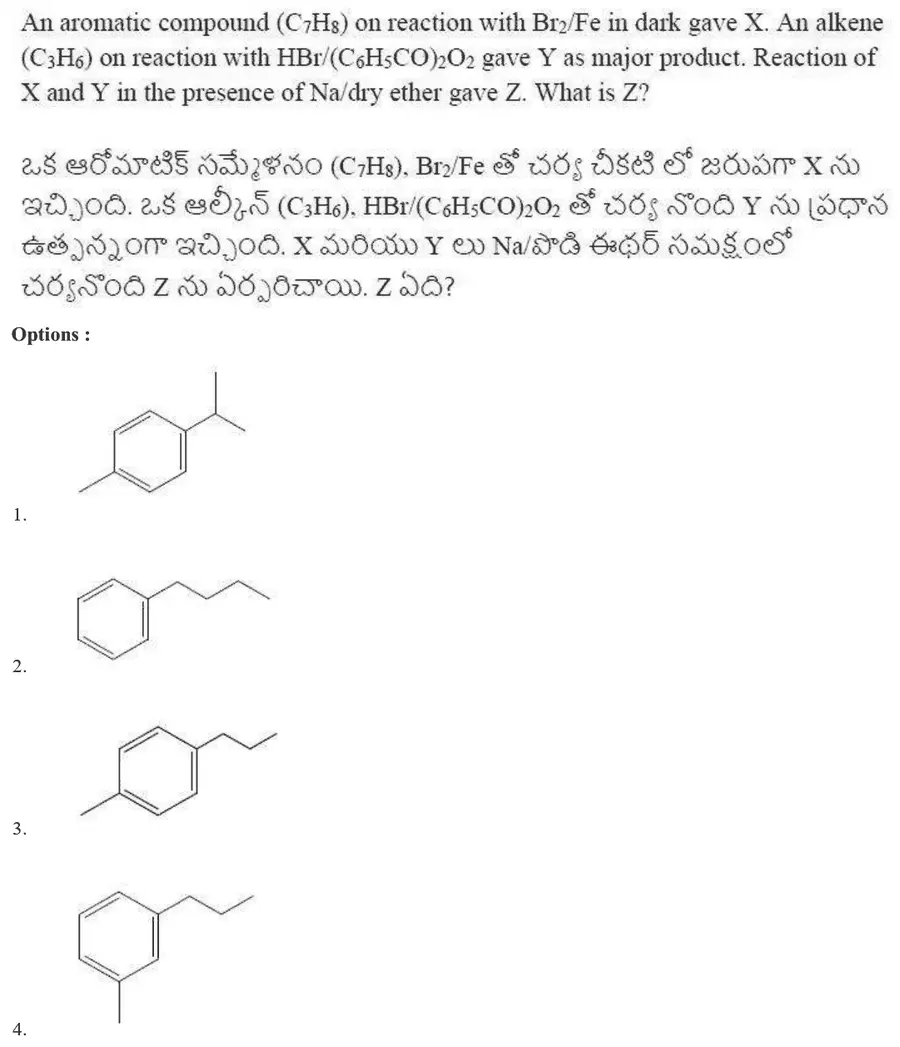
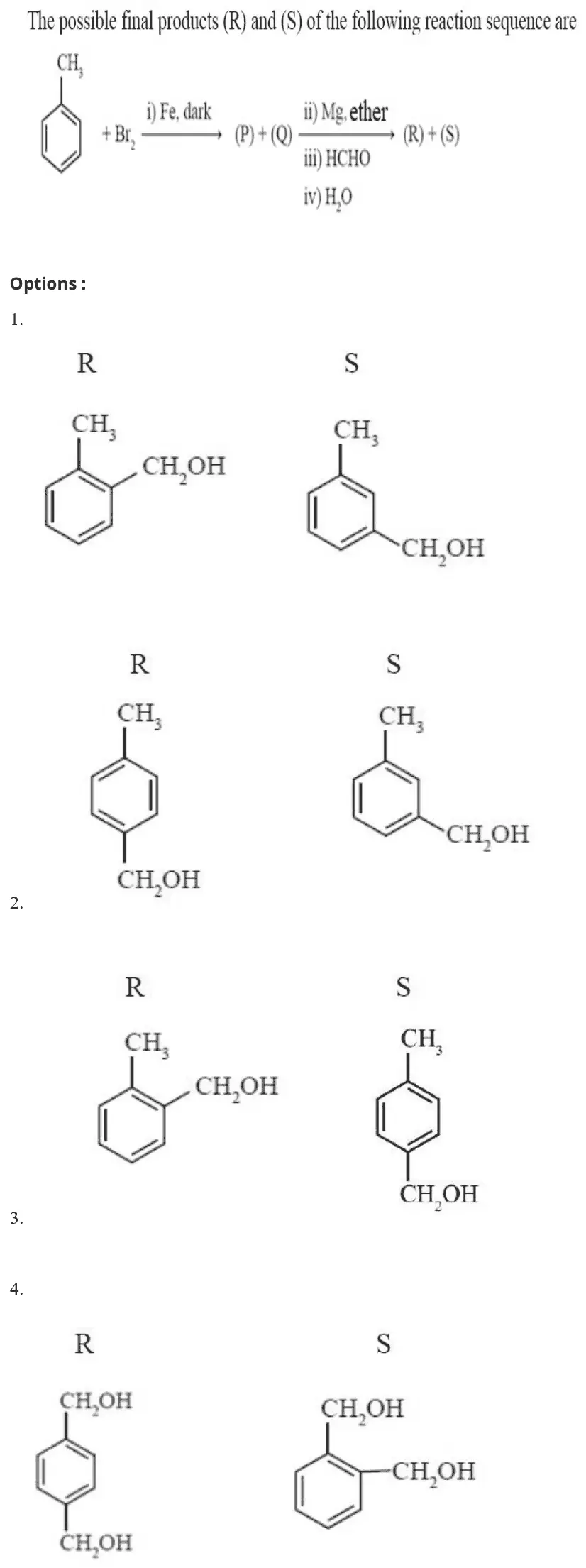
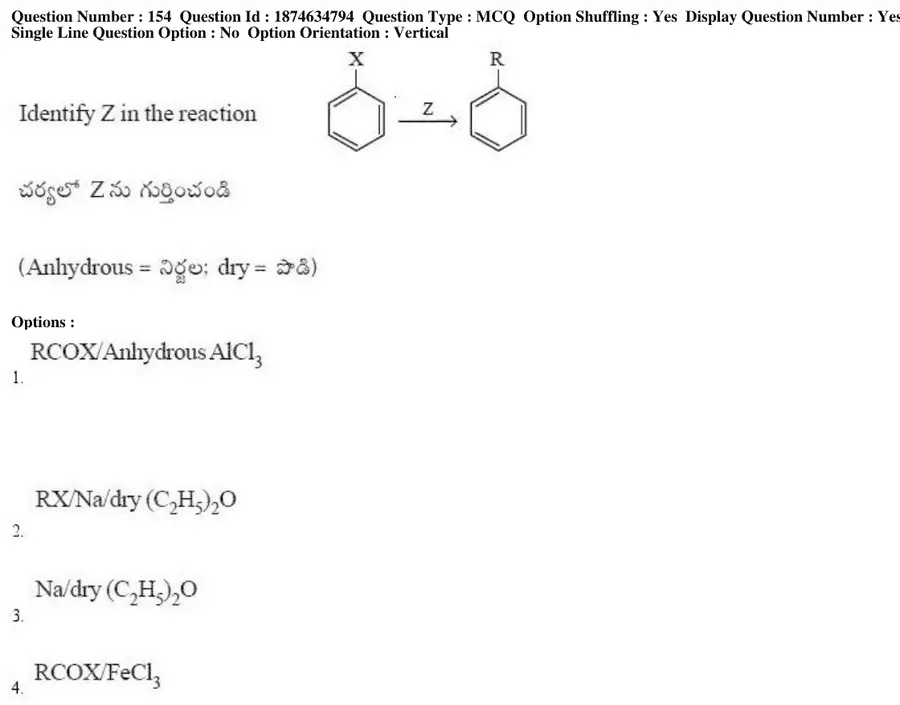
An aromatic compound ($\mathrm{C_7H_8}$) on reaction with $\mathrm{Br_2/Fe}$ in dark gave X. An alkene ($\mathrm{C_3H_6}$) on reaction with $\mathrm{HBr/(C_6H_5CO)_2O_2}$ gave Y as major product. Reaction of X and Y in the presence of Na/dry ether gave Z. What is Z?
The question as printed in the paper.
A
see figure Benzene ring with an isopropyl group (CH(CH3)2) at one position and a methyl group at the para position (1-isopropyl-4-methylbenzene).
B
see figure Benzene ring with a straight n-butyl chain (four carbons) attached, no other substituent (n-butylbenzene).
C
see figure Benzene ring with an n-propyl group at one position and a methyl group at the para position (1-methyl-4-propylbenzene).
D
see figure Benzene ring with an n-propyl group at one position and a methyl group at the meta position (1-methyl-3-propylbenzene).
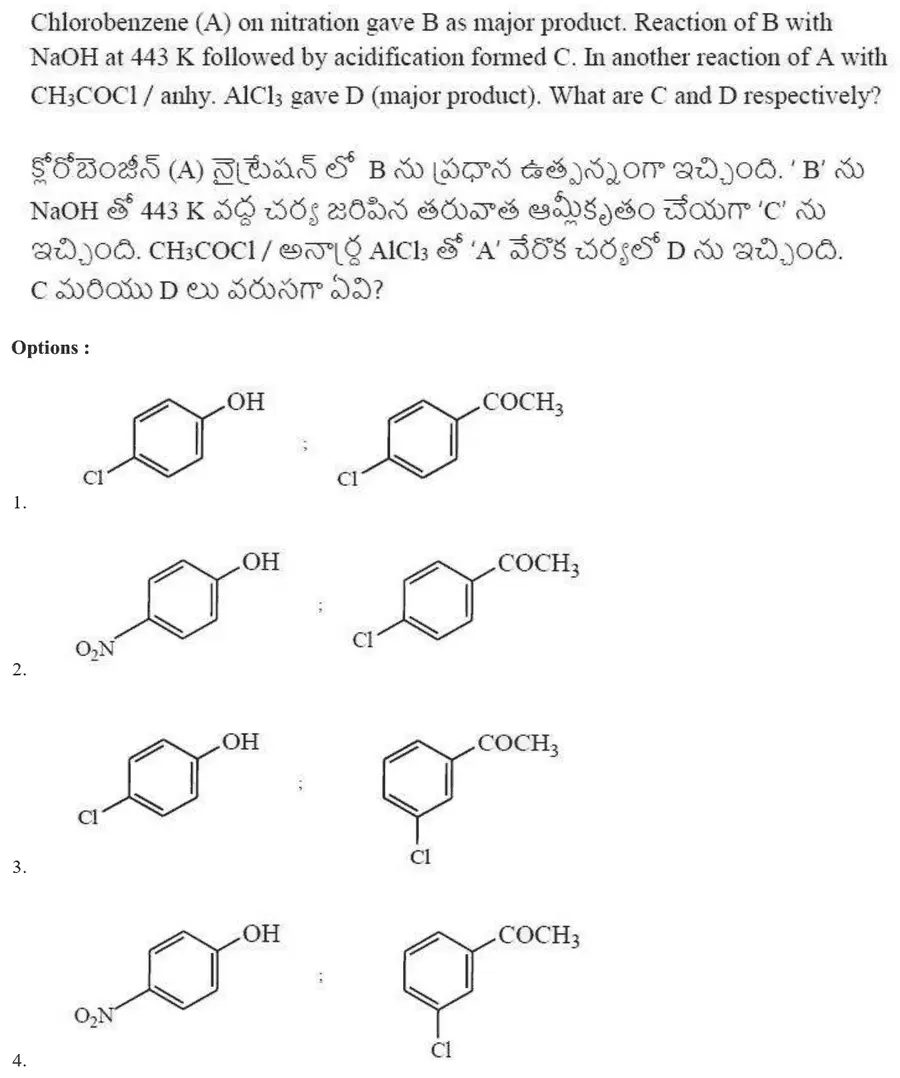
Chlorobenzene (A) on nitration gave B as major product. Reaction of B with NaOH at 443 K followed by acidification formed C. In another reaction of A with $\mathrm{CH_3COCl}$ / anhy. $\mathrm{AlCl_3}$ gave D (major product). What are C and D respectively?
The question as printed in the paper.
A
see figure C: benzene ring with OH and Cl at para positions (4-chlorophenol); D: benzene ring with COCH3 and Cl at para positions (4-chloroacetophenone)
B
see figure C: benzene ring with OH and NO2 at para positions (4-nitrophenol); D: benzene ring with COCH3 and Cl at para positions (4-chloroacetophenone)
C
see figure C: benzene ring with OH and Cl at para positions (4-chlorophenol); D: benzene ring with COCH3 and Cl at meta positions (3-chloroacetophenone)
D
see figure C: benzene ring with OH and NO2 at para positions (4-nitrophenol); D: benzene ring with COCH3 and Cl at meta positions (3-chloroacetophenone)
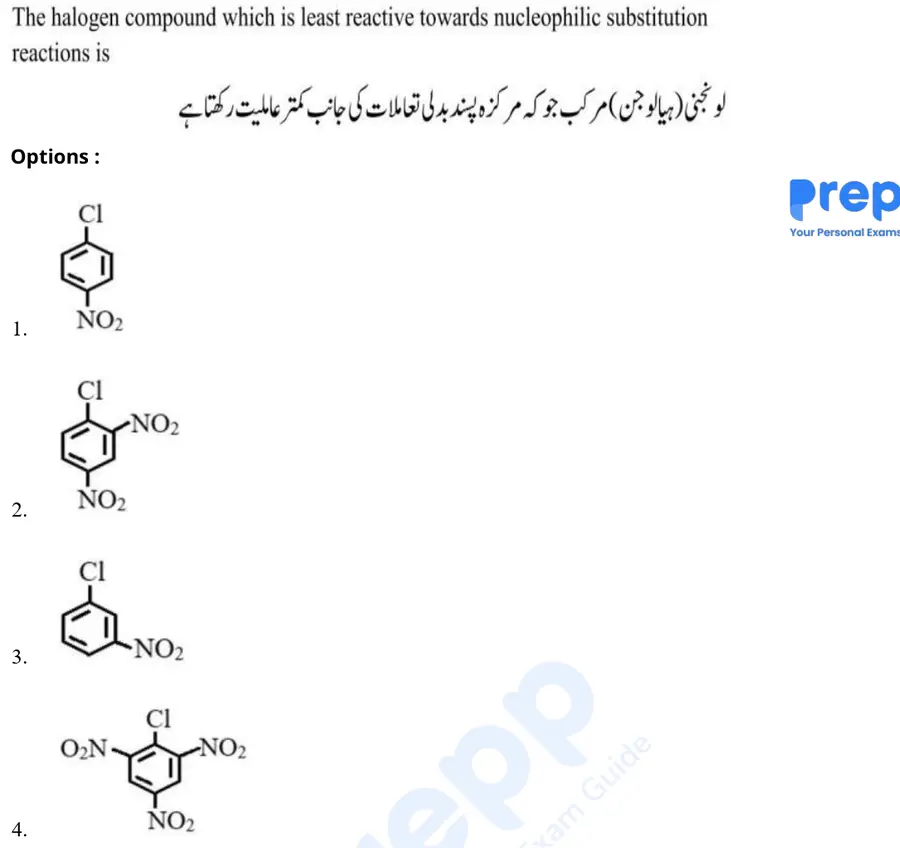
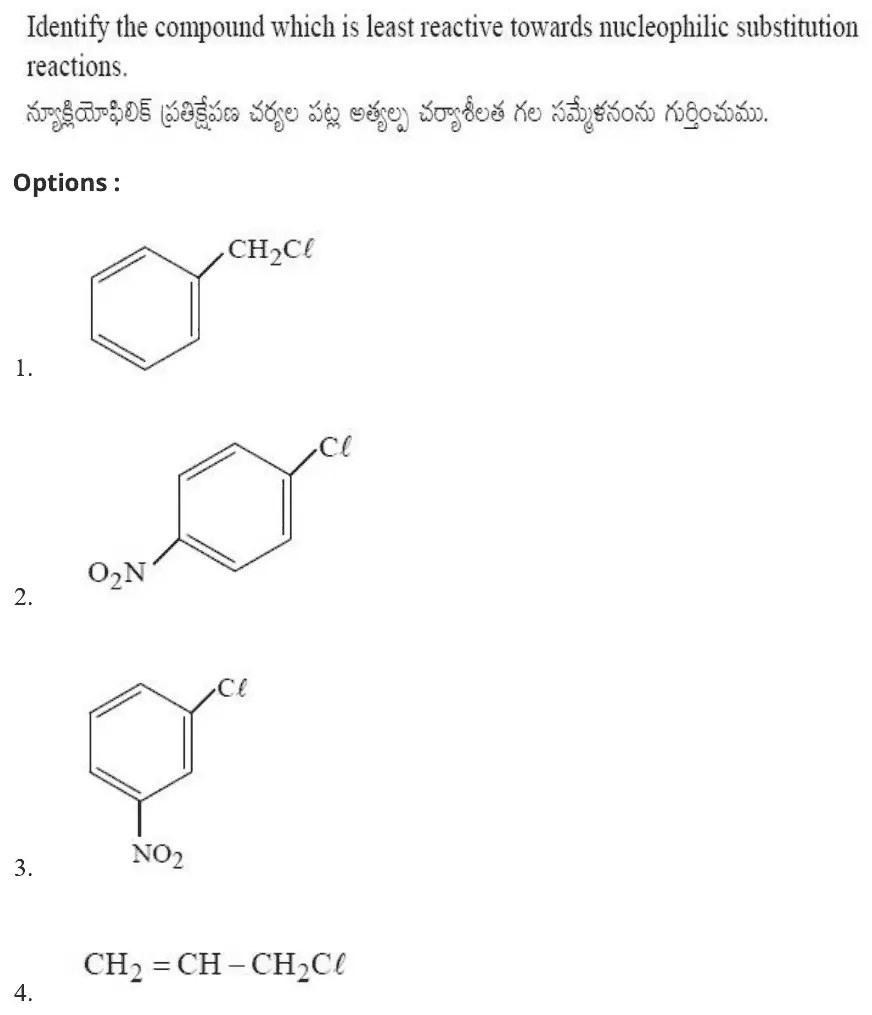
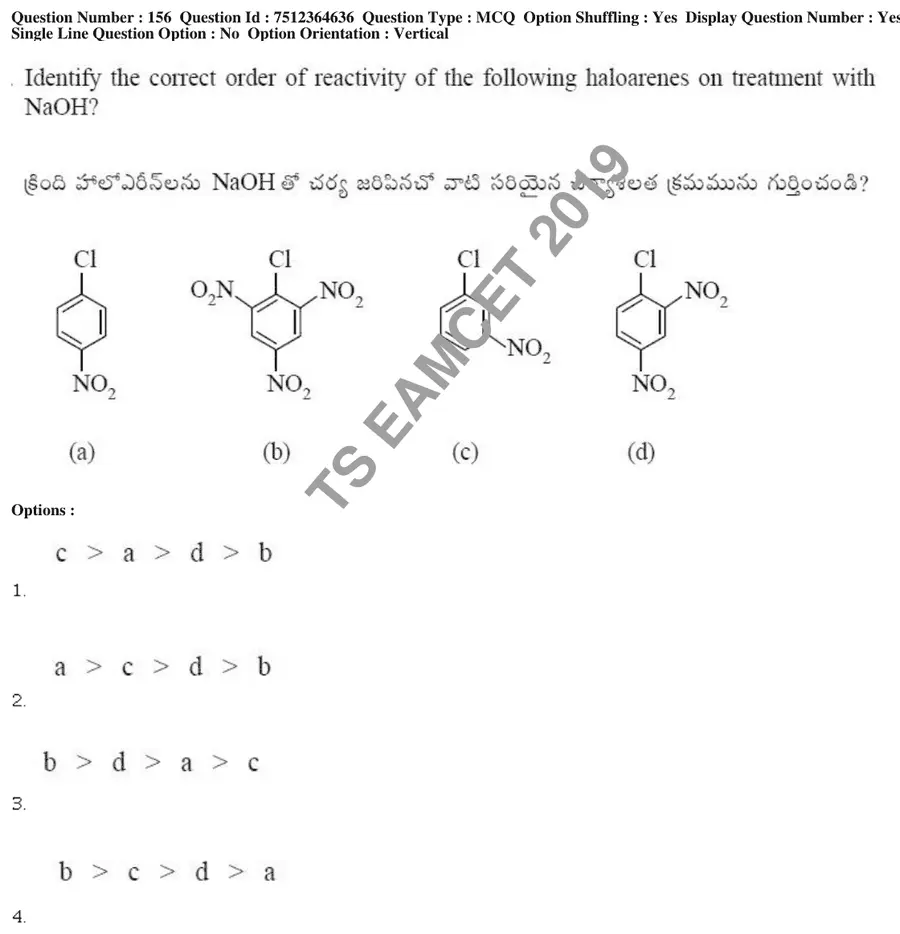
The halogen compound which is least reactive towards nucleophilic substitution reactions is
The question as printed in the paper.
A
see figure Benzene ring with Cl at the top and $\mathrm{NO_2}$ at the bottom (para, 1,4-positions): 1-chloro-4-nitrobenzene
B
see figure Benzene ring with Cl at the top, $\mathrm{NO_2}$ at the upper right (ortho) and $\mathrm{NO_2}$ at the bottom (para): 1-chloro-2,4-dinitrobenzene
C
see figure Benzene ring with Cl at the top and $\mathrm{NO_2}$ at the lower right (meta): 1-chloro-3-nitrobenzene
D
see figure Benzene ring with Cl at the top, $\mathrm{O_2N}$ at the upper left (ortho), $\mathrm{NO_2}$ at the upper right (ortho) and $\mathrm{NO_2}$ at the bottom (para): 2-chloro-1,3,5-trinitrobenzene (picryl chloride)
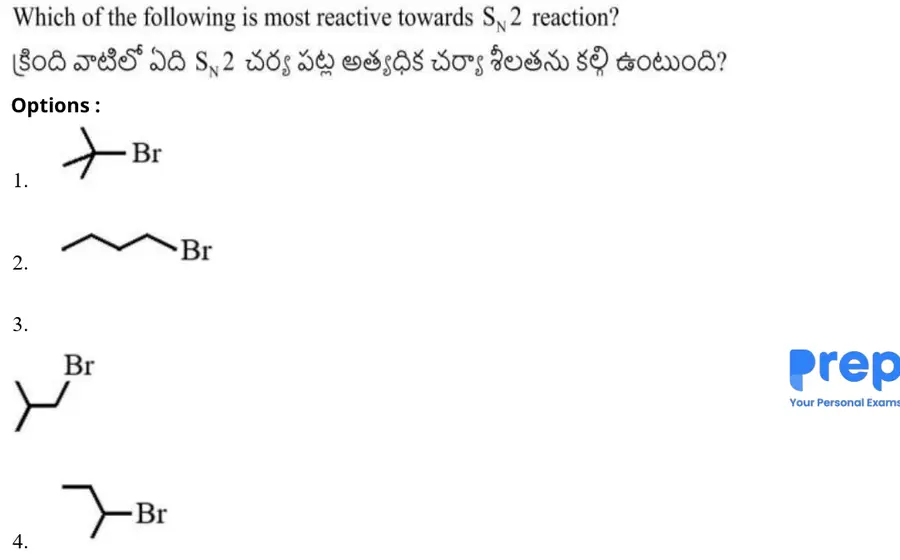
Which of the following is most reactive towards $\mathrm{S_N2}$ reaction?
The question as printed in the paper.
A
see figure Skeletal structure of tert-butyl bromide: a central carbon bonded to three methyl groups and to Br.
B
see figure Skeletal zig-zag structure of a straight-chain primary alkyl bromide (n-butyl bromide), with Br at the end of the chain.
C
see figure Skeletal structure of a primary alkyl bromide with branching at the adjacent carbon (isobutyl-type): CH2Br attached to a CH carrying two methyl groups.
D
see figure Skeletal structure of a secondary alkyl bromide (sec-butyl bromide): Br on a carbon bearing a methyl group and an ethyl group.
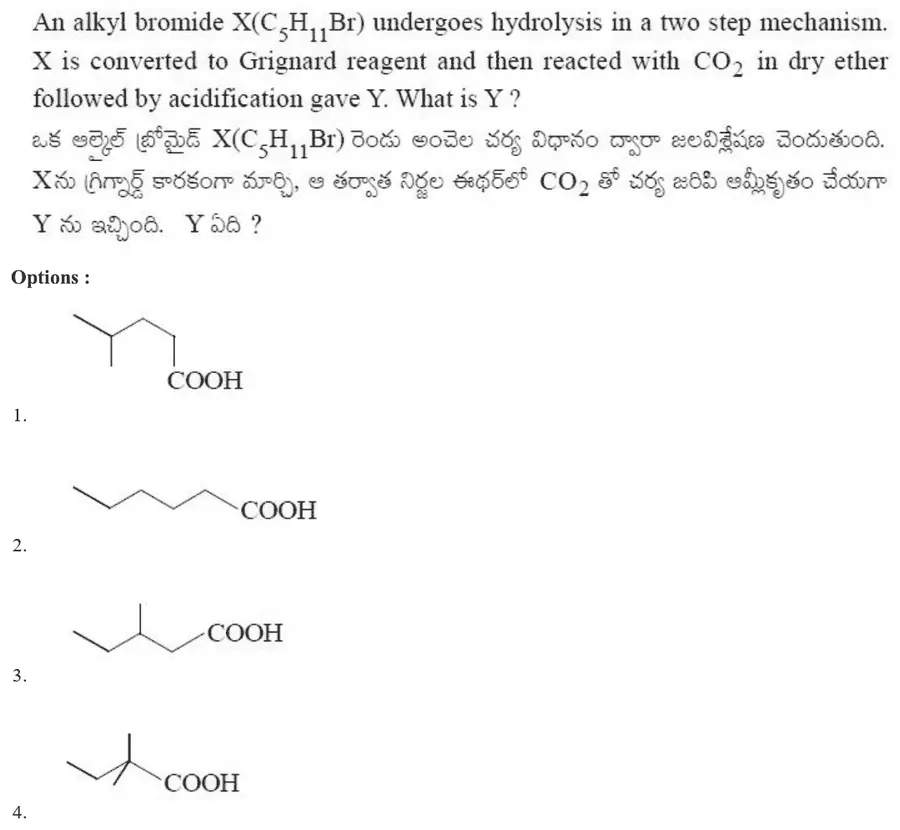
An alkyl bromide $\mathrm{X(C_5H_{11}Br)}$ undergoes hydrolysis in a two step mechanism. X is converted to Grignard reagent and then reacted with $\mathrm{CO_2}$ in dry ether followed by acidification gave Y. What is Y ?
The question as printed in the paper.
A
see figure Skeletal structure: a branched chain with a methyl branch on the carbon third from the COOH carbon (4-methylpentanoic acid), ending in COOH.
B
see figure Skeletal structure: an unbranched zig-zag chain ending in COOH (hexanoic acid).
C
see figure Skeletal structure: a zig-zag chain with a methyl branch pointing up on the carbon two carbons from the COOH carbon, ending in COOH (3-methylpentanoic acid).
D
see figure Skeletal structure: a quaternary carbon bearing a methyl group (vertical line up), an ethyl group, and COOH (2,2-dimethylbutanoic acid).
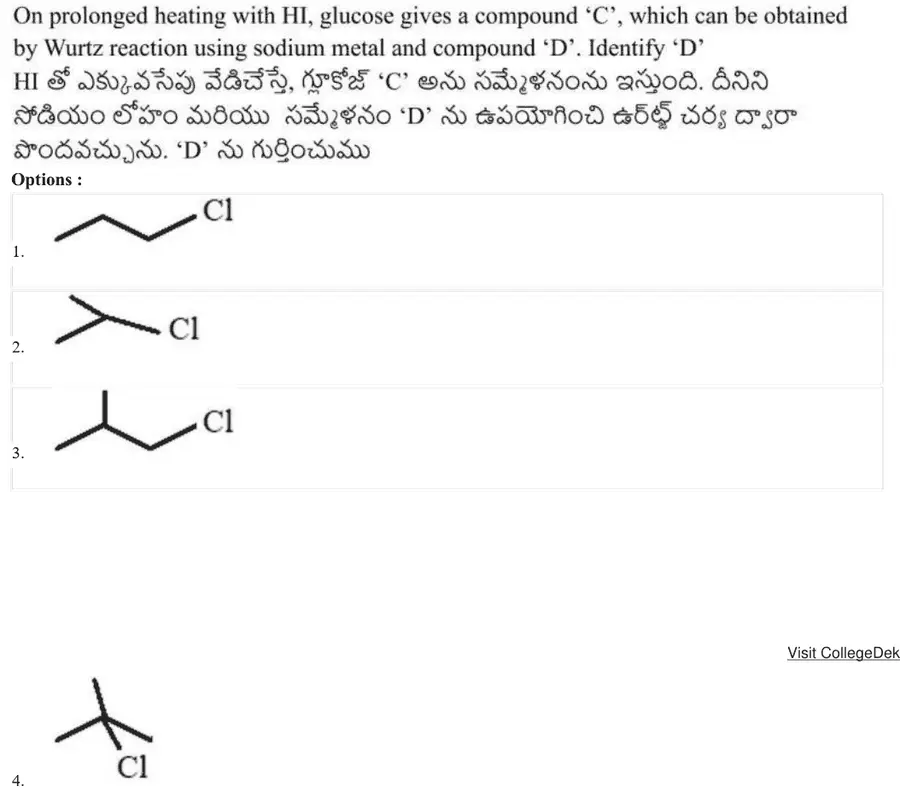
On prolonged heating with HI, glucose gives a compound ‘C’, which can be obtained by Wurtz reaction using sodium metal and compound ‘D’. Identify ‘D’
The question as printed in the paper.
A
see figure Skeletal structure of 1-chloropropane: a zigzag three-carbon chain with Cl on the terminal carbon (CH3-CH2-CH2-Cl)
B
see figure Skeletal structure of 2-chloropropane: a three-carbon skeleton with Cl on the middle carbon (isopropyl chloride)
C
see figure Skeletal structure of 1-chloro-2-methylpropane: a zigzag chain with a methyl branch on the second carbon and Cl on the terminal carbon (isobutyl chloride)
D
see figure Skeletal structure of 2-chloro-2-methylpropane: a central carbon bonded to three methyl groups and Cl (tert-butyl chloride)
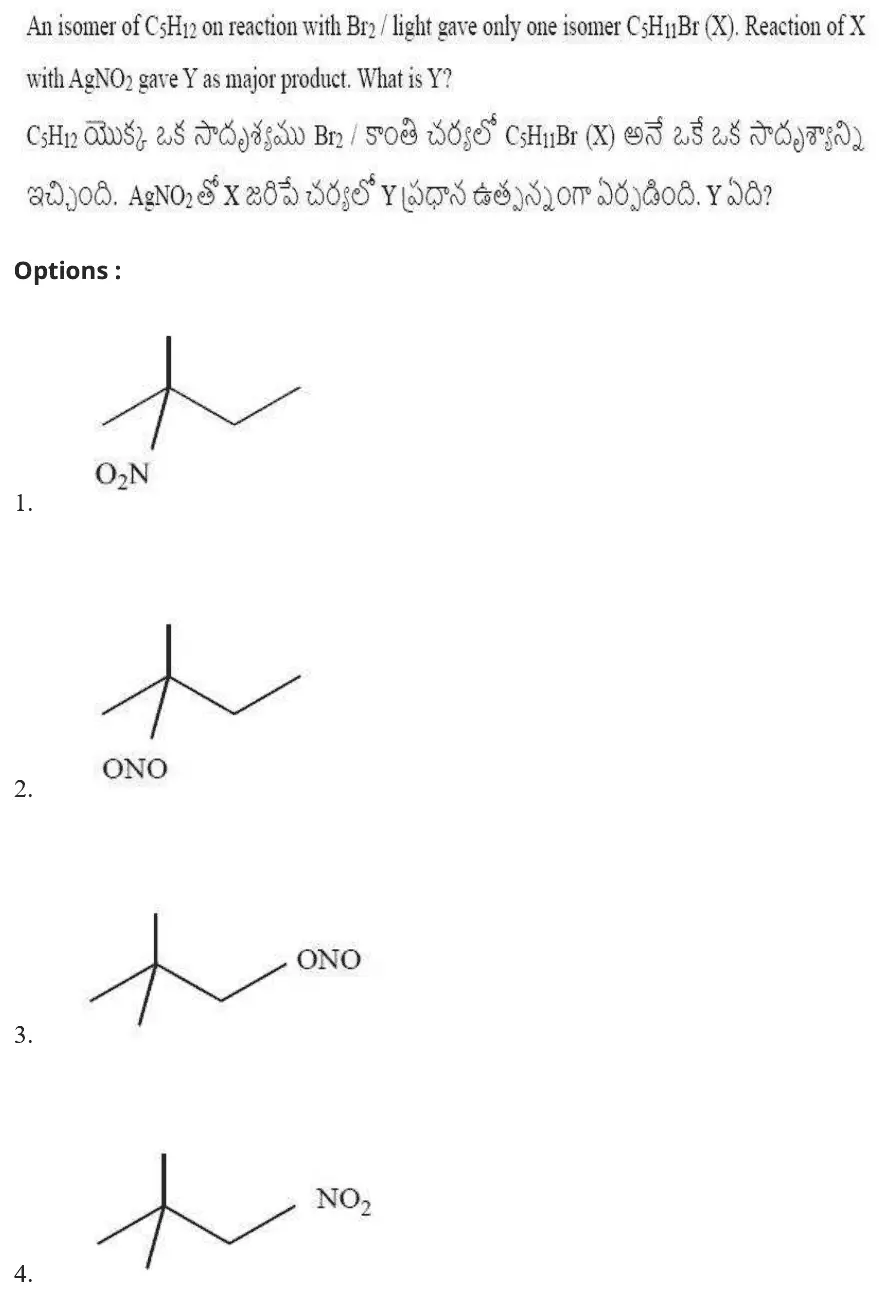
An isomer of $\mathrm{C_5H_{12}}$ on reaction with $\mathrm{Br_2}$ / light gave only one isomer $\mathrm{C_5H_{11}Br}$ (X). Reaction of X with $\mathrm{AgNO_2}$ gave Y as major product. What is Y?
The question as printed in the paper.
A
see figure Skeletal structure: a quaternary carbon bearing a methyl (vertical line up), an ethyl group (zigzag to the right), another methyl (line to the left), and a downward bond to $\mathrm{O_2N}$ (i.e. 2-methyl-2-nitrobutane, tertiary nitro compound)
B
see figure Skeletal structure: a quaternary carbon bearing a methyl (up), an ethyl group (zigzag to the right), another methyl (left), and a downward bond to $\mathrm{ONO}$ (tertiary nitrite)
C
see figure Skeletal structure of neopentyl type: quaternary carbon with methyl up, methyl left, methyl down, and a CH2 going right to $\mathrm{ONO}$ (neopentyl nitrite)
D
see figure Skeletal structure of neopentyl type: quaternary carbon with methyl up, methyl left, methyl down, and a CH2 going right to $\mathrm{NO_2}$ (neopentyl nitro compound)
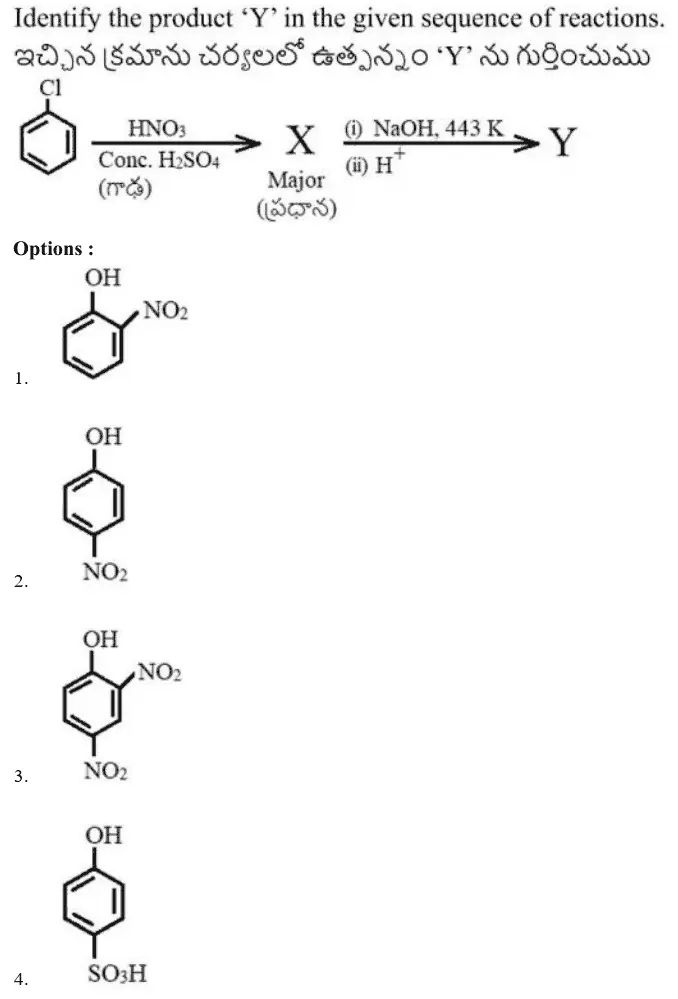
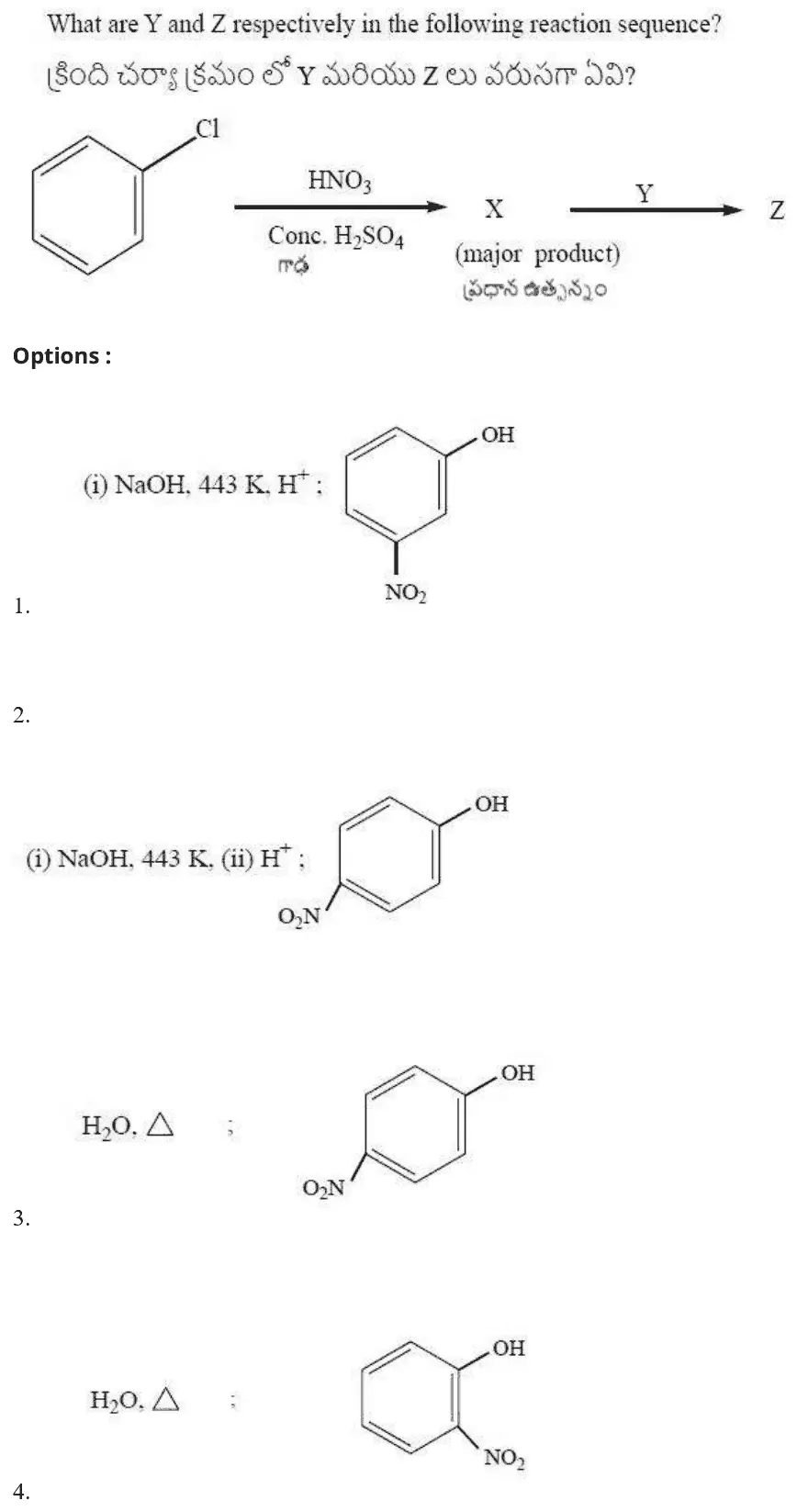
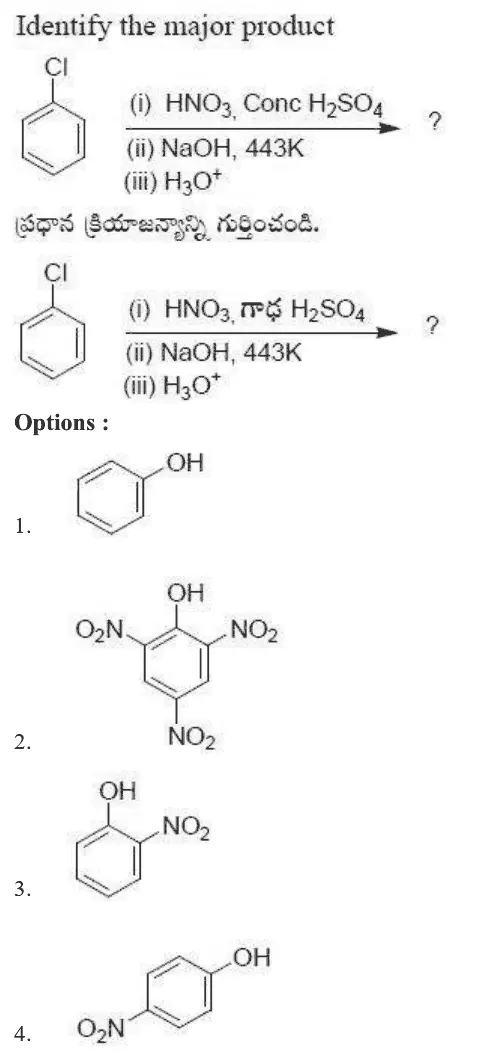
Answer: (B) (i) NaOH, 443 K, (ii) H$^+$ ; (see the figure above) 4-nitrophenol (benzene ring with OH and O$_2$N in para positions)· The council's preliminary key
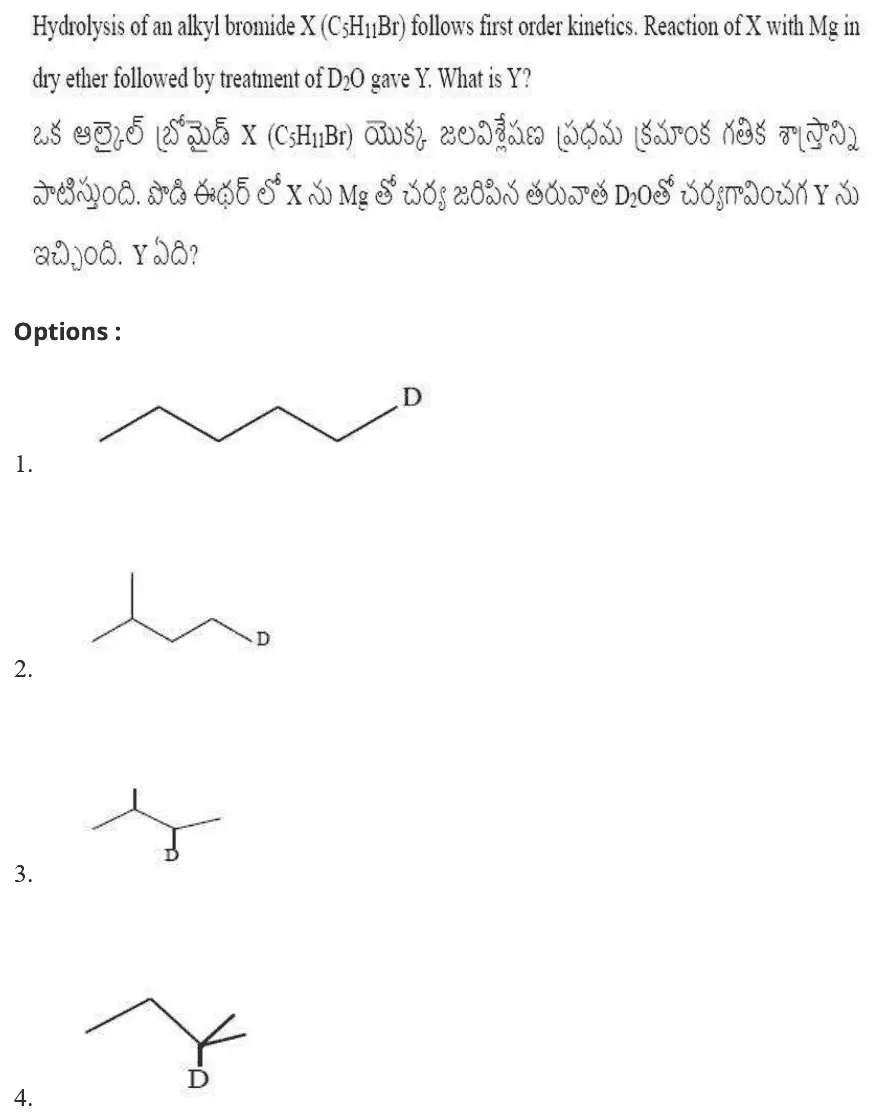
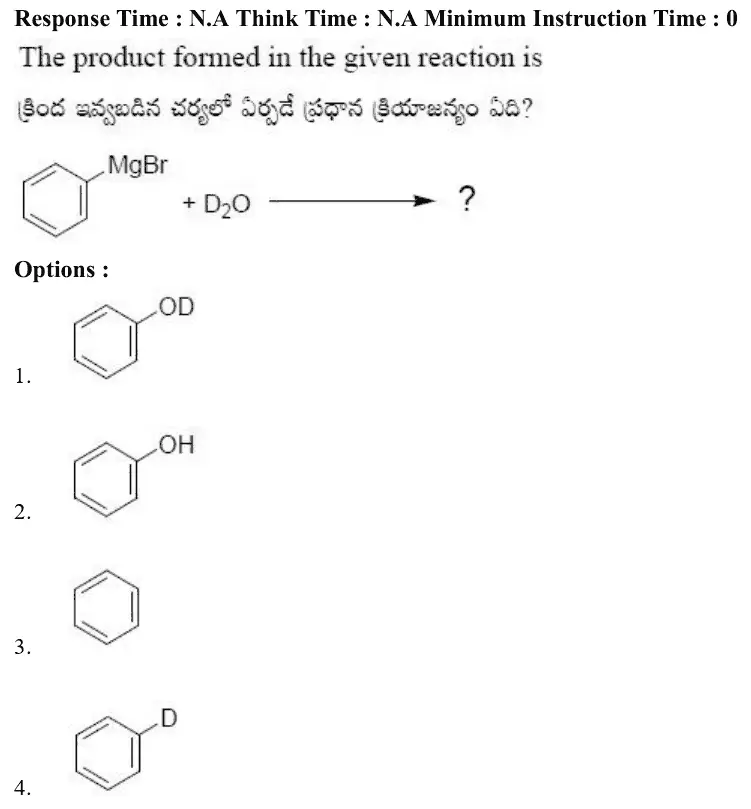
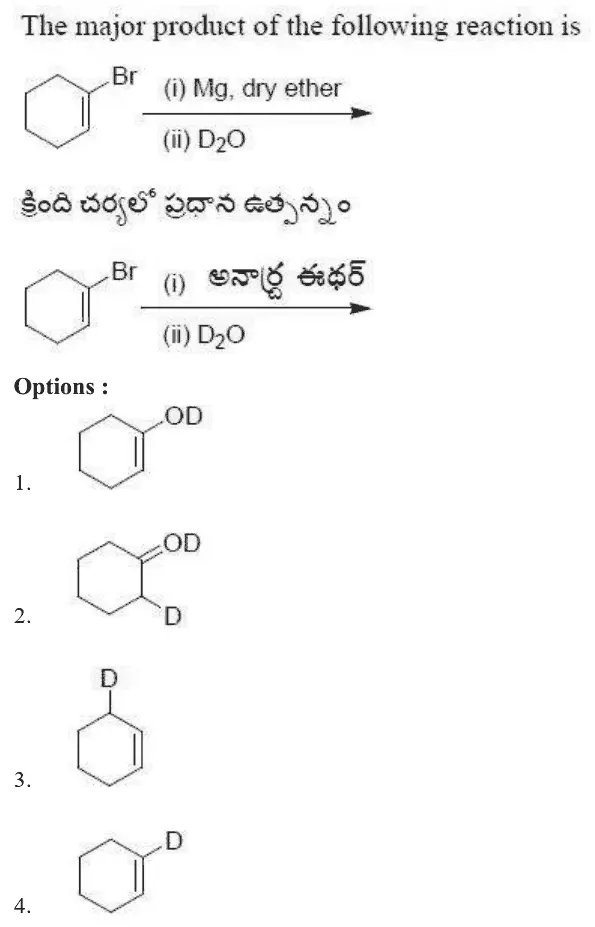
Hydrolysis of an alkyl bromide X ($\mathrm{C_5H_{11}Br}$) follows first order kinetics. Reaction of X with Mg in dry ether followed by treatment of $\mathrm{D_2O}$ gave Y. What is Y?
The question as printed in the paper.
A
see figure Skeletal structure of an unbranched five-carbon chain (zigzag) with D attached to the terminal carbon at the right end (1-deuteriopentane).
B
see figure Skeletal structure of a branched chain: a methyl branch at the second carbon from the left end, with D on the terminal carbon at the right end (1-deuterio-2-methylbutane).
C
see figure Skeletal structure of a branched chain with a vertical methyl branch at the second carbon and D on the carbon at position 3 (drawn pointing downward), with a methyl continuing to the right (2-deuterio-3-methylbutane type structure).
D
see figure Skeletal structure of a chain of two carbons going up to a quaternary-like carbon bearing two methyl branches (up-right and right) and D pointing downward (2-deuterio-2-methylbutane).
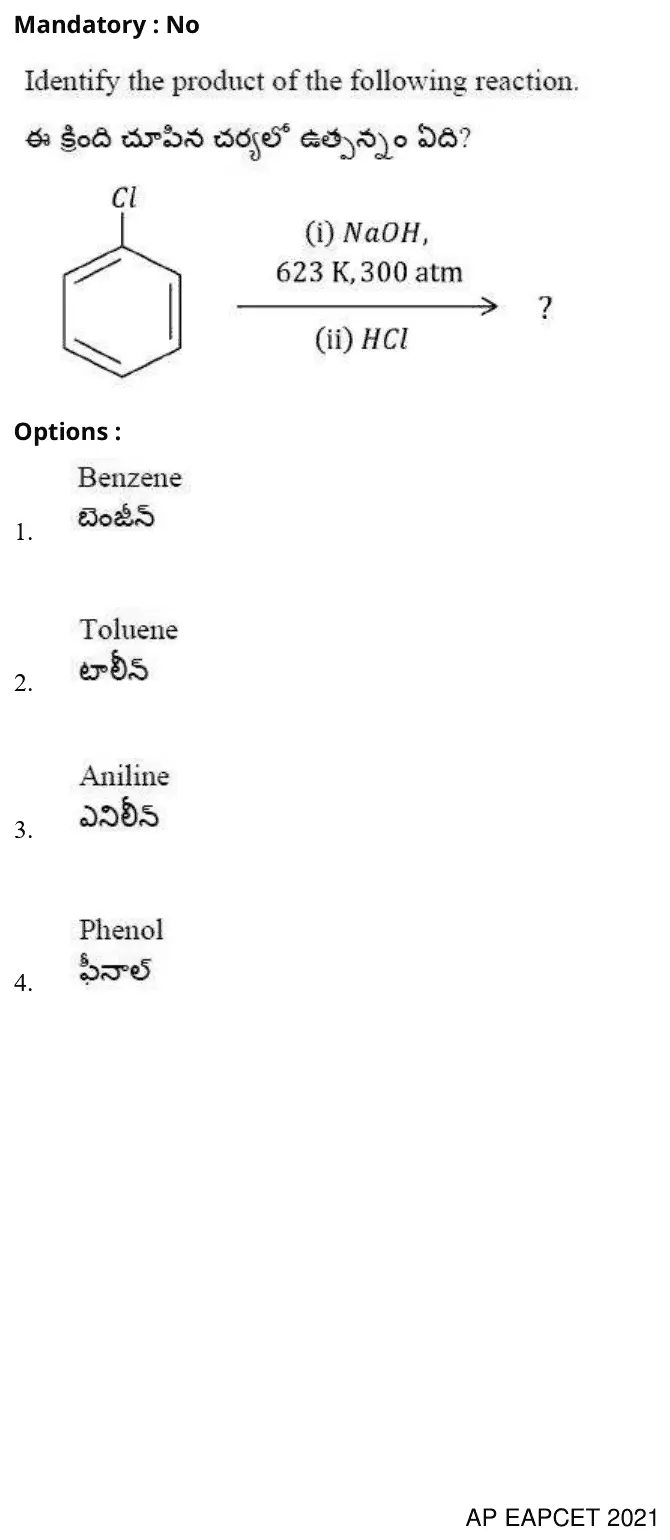
Chlorobenzene (X) when reacted with reagent ‘A’ gets converted to phenol (Y). The major product obtained from nitration of X gets converted to p-nitrophenol (Z) by reaction with reagent B. What are A and B respectively?
A
A = (i) NaOH, 623 K, 300 atm (ii) $\mathrm{H^+}$; B = (i) NaOH, 443 K (ii) $\mathrm{H^+}$
B
A = (i) NaOH, 443 K (ii) $\mathrm{H^+}$; B = $\mathrm{H_2O}$, Δ
C
A = (i) NaOH, 323 K (ii) $\mathrm{H^+}$; B = (i) NaOH, 443 K (ii) $\mathrm{H^+}$
D
A = (i) NaOH, 623 K, 300 atm (ii) $\mathrm{H^+}$; B = $\mathrm{H_2O}$, Δ
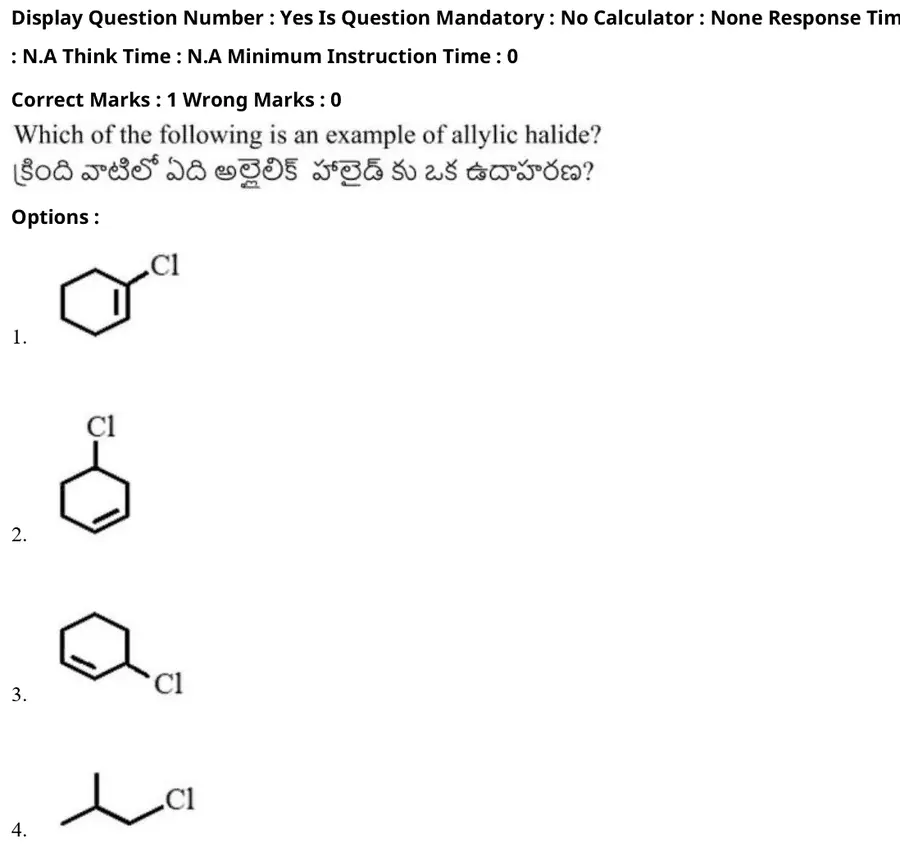
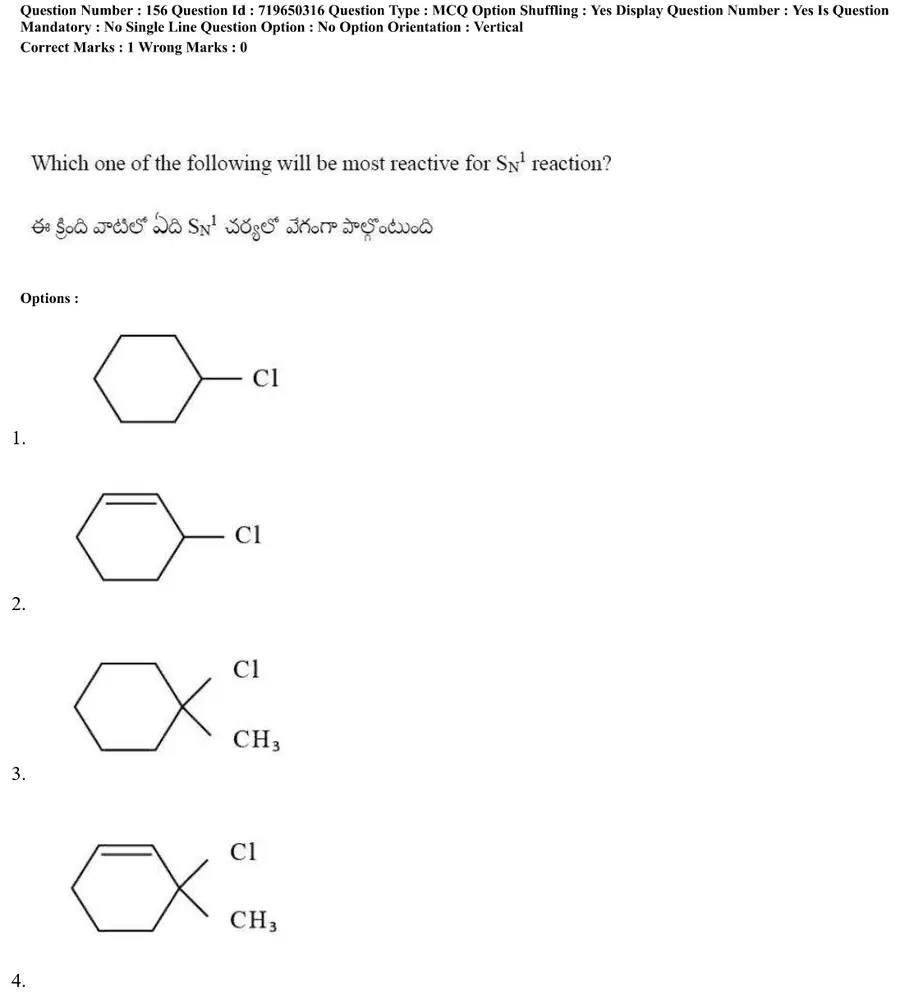
Which of the following is an example of allylic halide?
The question as printed in the paper.
A
see figure Cyclohexene ring with Cl attached to a vinylic carbon (the C=C double bond is drawn on the bond at the ring carbon bearing Cl, with the double bond on its lower-right side), i.e. vinylic halide (1-chlorocyclohexene).
B
see figure Cyclohexene ring with Cl on the top carbon (sp3); the double bond is at the bottom-right of the ring, one carbon away from the carbon bearing Cl... (Cl-bearing carbon is at the top, the double bond is between the lower-right carbons).
C
see figure Cyclohexene ring with the double bond on the lower-left bond and Cl attached to the lower-right carbon via a short bond (drawn at the right-bottom of the ring).
D
see figure Acyclic skeletal structure: a branched chain (isobutyl-type, 2-methylpropyl) with Cl at the end of the chain, i.e. 1-chloro-2-methylpropane.
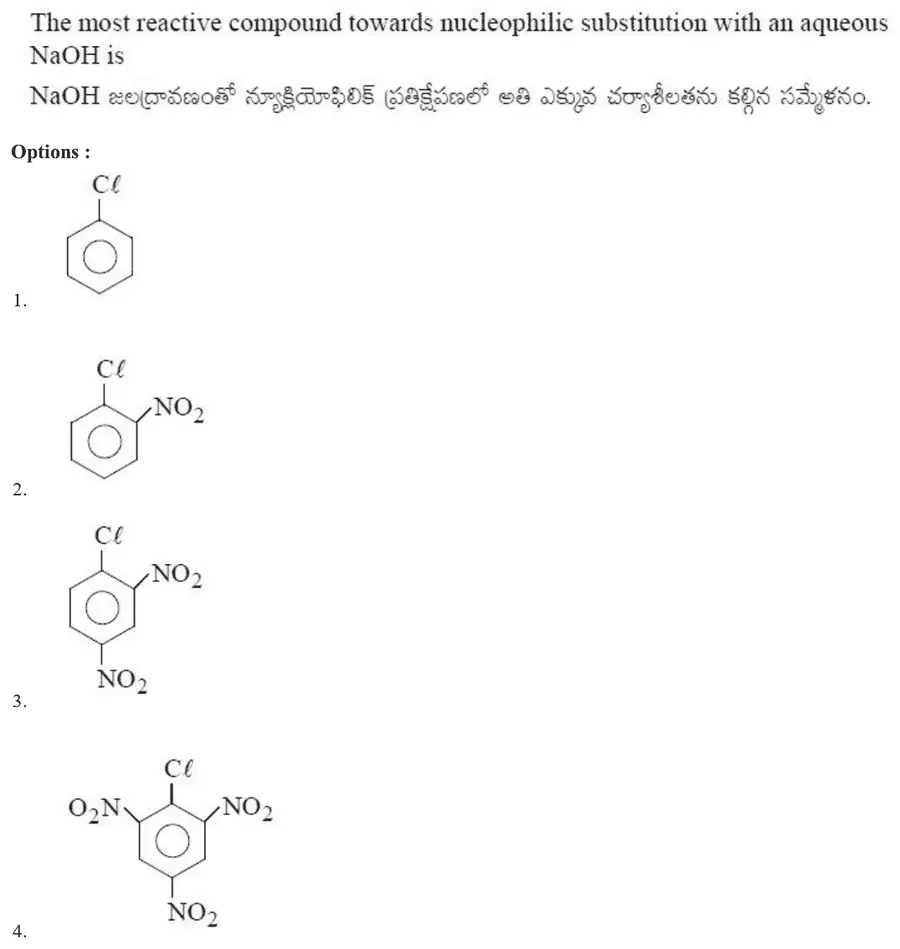
1- Chloro - 4 - nitrobenzene, 1- Chloro - 2, 4 - dinitrobenzene and 1 - Chloro -2, 4, 6 - trinitrobenzene are transformed to corresponding phenols with the reagents X, Y, Z respectively. What are X, Y, Z?
Answer: (B) X = (i) $\mathrm{NaOH}$, 443K, (ii) $\mathrm{H^+}$; Y = (i) $\mathrm{NaOH}$, 368K, (ii) $\mathrm{H^+}$; Z = Warm $\mathrm{H_2O}$· The council's preliminary key
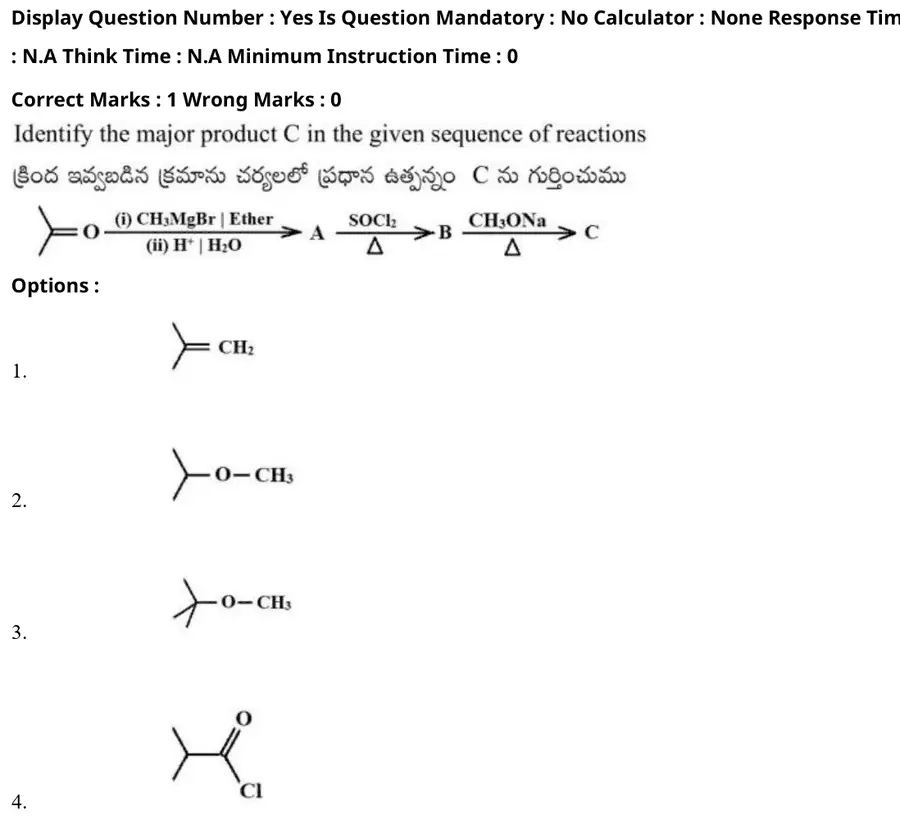
Identify the major product C in the given sequence of reactions
(see the figure above)
The question as printed in the paper.
A
see figure Skeletal structure of 2-methylpropene: a carbon bearing two methyl groups, double bonded to CH2 (drawn as (CH3)2C=CH2)
B
see figure Skeletal structure of isopropyl methyl ether: an isopropyl group (CH) with two methyl branches, attached to O-CH3
C
see figure Skeletal structure of tert-butyl methyl ether: a quaternary carbon bearing three methyl groups, attached to O-CH3
D
see figure Skeletal structure of isopropyl acyl chloride type: a carbon chain with branched CH(CH3) joined to C(=O)Cl, drawn as 2-methylpropanoyl chloride with O above and Cl below the carbonyl carbon
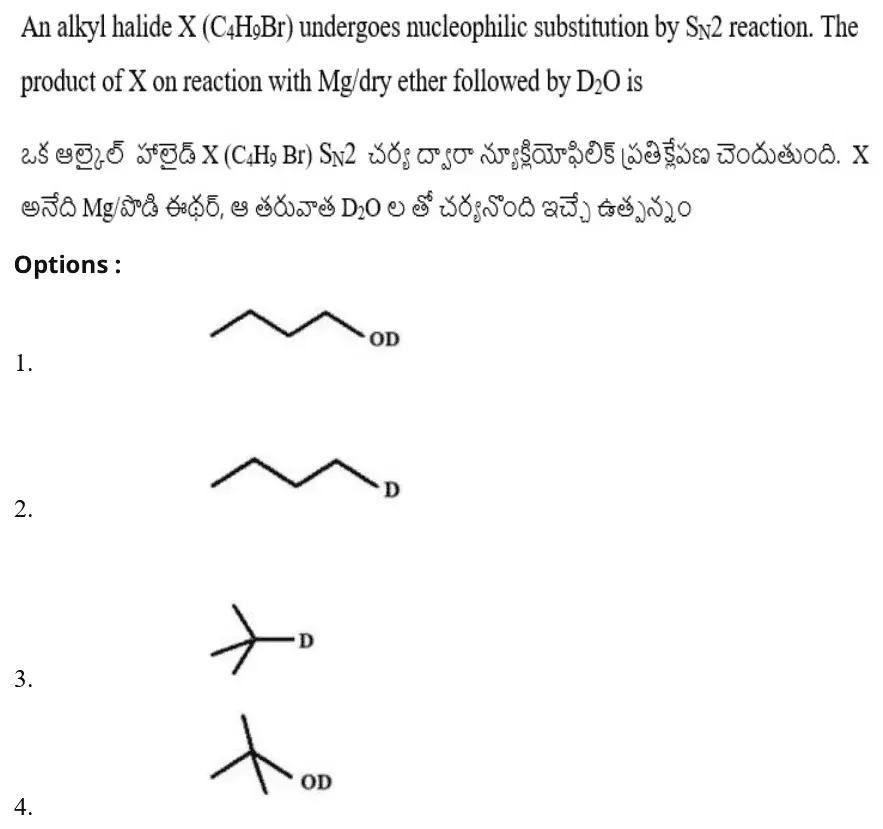
An alkyl halide X ($\mathrm{C_4H_9Br}$) undergoes nucleophilic substitution by $\mathrm{S_N2}$ reaction. The product of X on reaction with Mg/dry ether followed by $\mathrm{D_2O}$ is
The question as printed in the paper.
A
see figure Skeletal structure of a straight-chain four-carbon chain (n-butyl) with an OD group at the terminal carbon (butan-1-ol-OD)
B
see figure Skeletal structure of a straight-chain four-carbon chain (n-butane) with a D atom at the terminal carbon (1-deuterobutane)
C
see figure Skeletal structure of isobutane (2-methylpropane) with D on the central (tertiary) carbon
D
see figure Skeletal structure of tert-butyl group (central carbon with three methyl groups) bearing an OD group
Answer: (D) $\mathrm{(CH_3)_3C-Br}$ (drawn structure: central C bearing CH$_3$ above, CH$_3$ below, CH$_3$ on the left and Br on the right)· The council's preliminary key
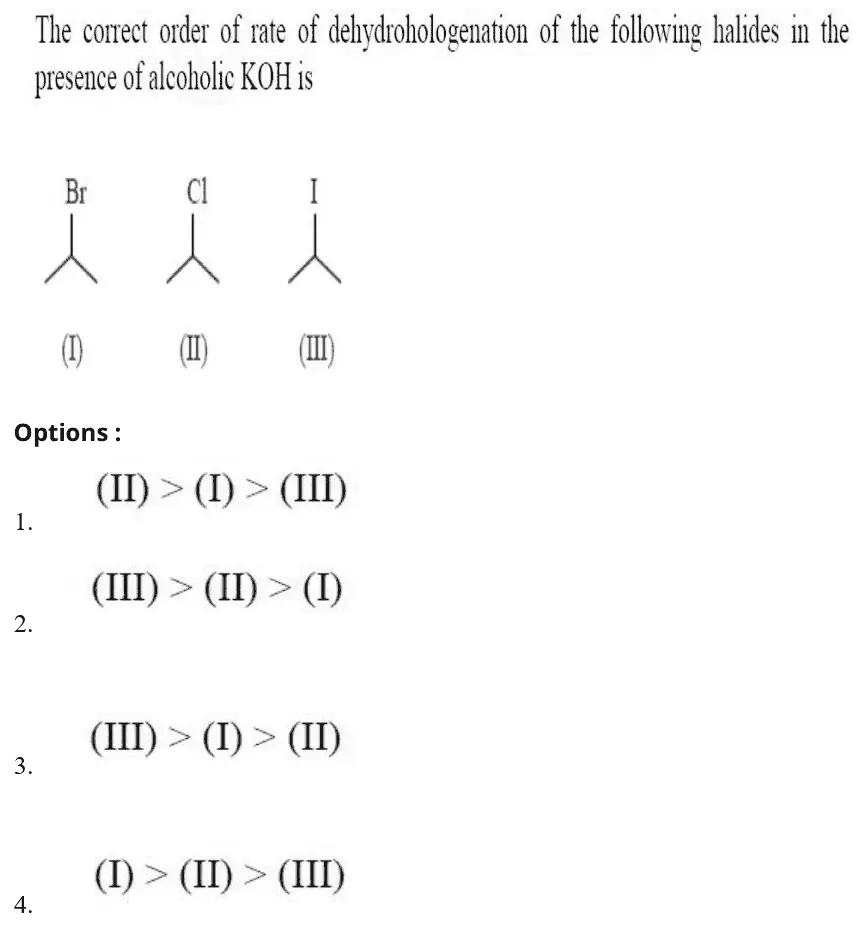
A) $\mathrm{CH_3CH_2CH_2I}\xrightarrow{\text{aq. KOH}}$ B) $\mathrm{(CH_3)_3CI}\xrightarrow{\mathrm{H_2O}}$ C) $\mathrm{CH_3CH_2CH_2I}\xrightarrow{\text{alc. KOH}}$ D) $\mathrm{(CH_3)_3COH}\xrightarrow{\mathrm{H^\oplus}}$
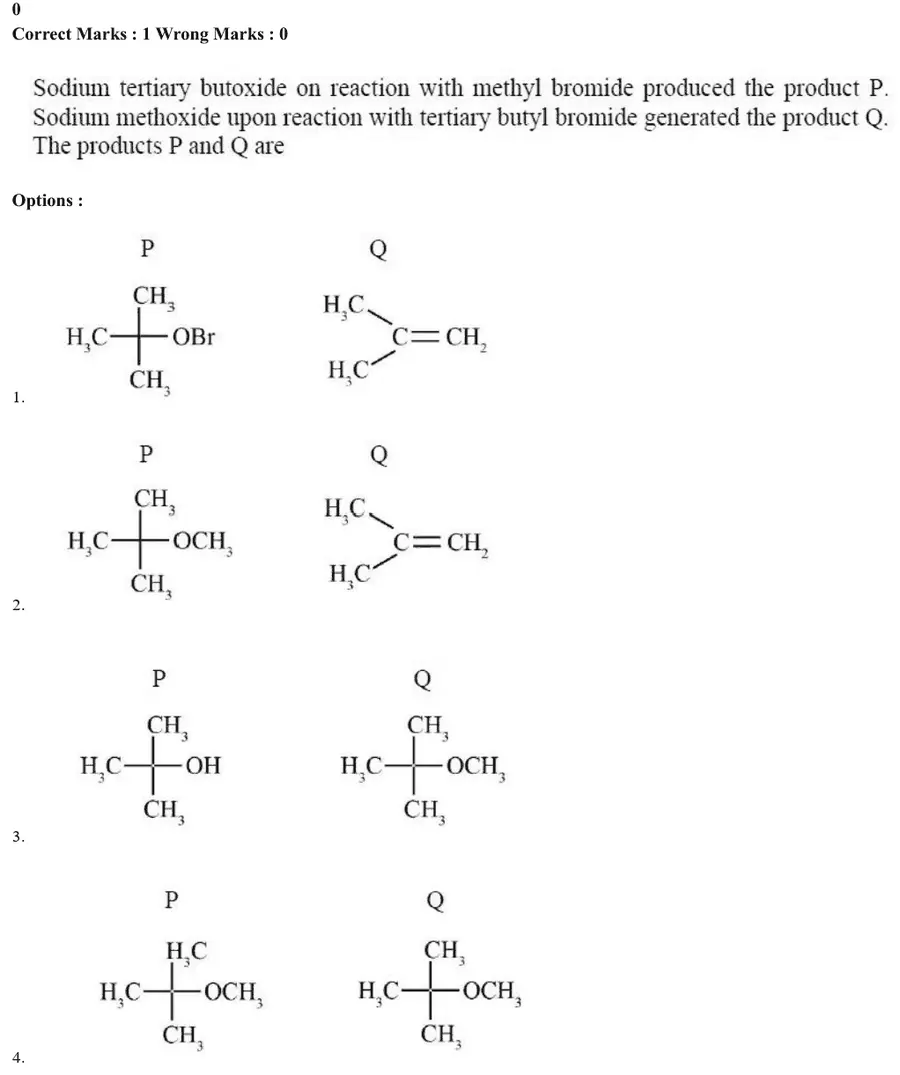
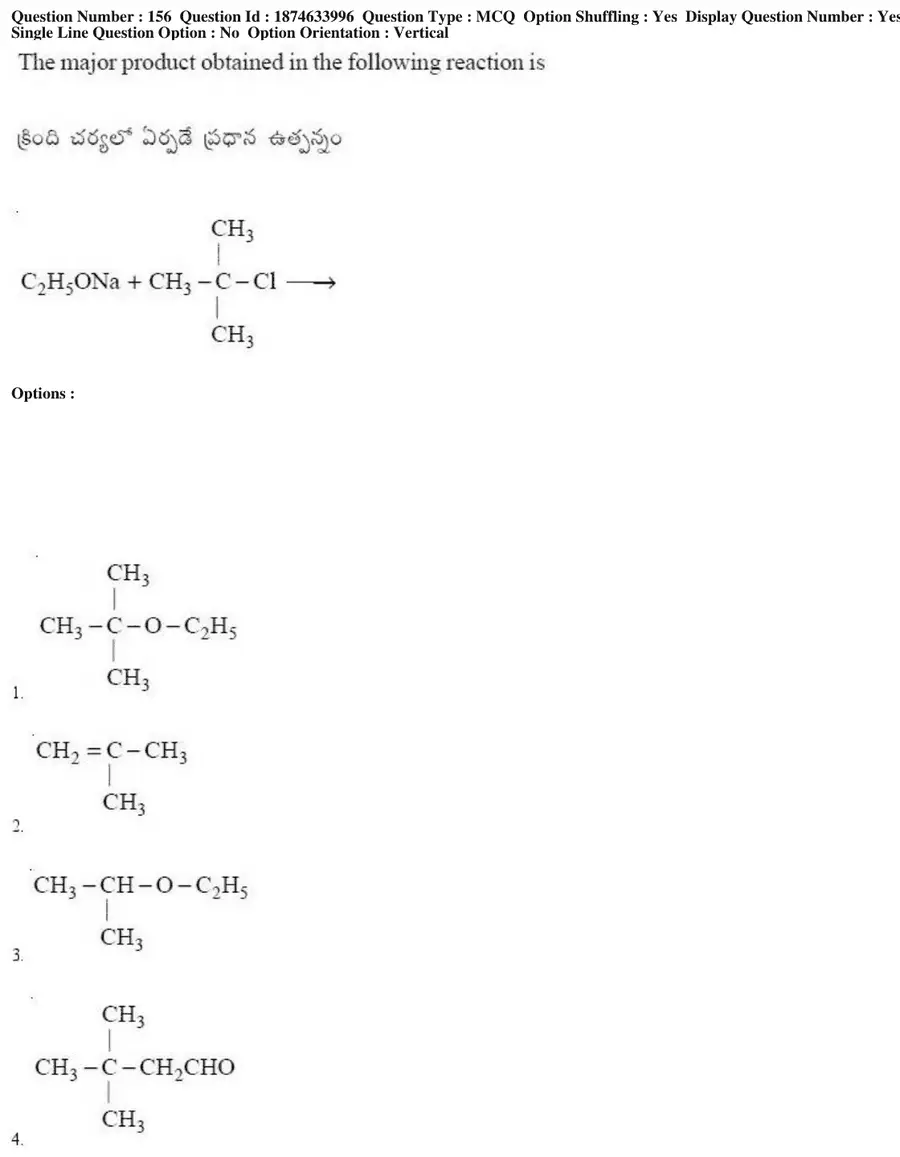
Sodium tertiary butoxide on reaction with methyl bromide produced the product P. Sodium methoxide upon reaction with tertiary butyl bromide generated the product Q. The products P and Q are (see the figure above)
The question as printed in the paper.
A
see figure P: (CH3)3C-OBr drawn as a carbon with three CH3 and OBr; Q: (CH3)2C=CH2
B
see figure P: (CH3)3C-OCH3 (tert-butyl methyl ether); Q: (CH3)2C=CH2
C
see figure P: (CH3)3C-OH (tert-butyl alcohol); Q: (CH3)3C-OCH3
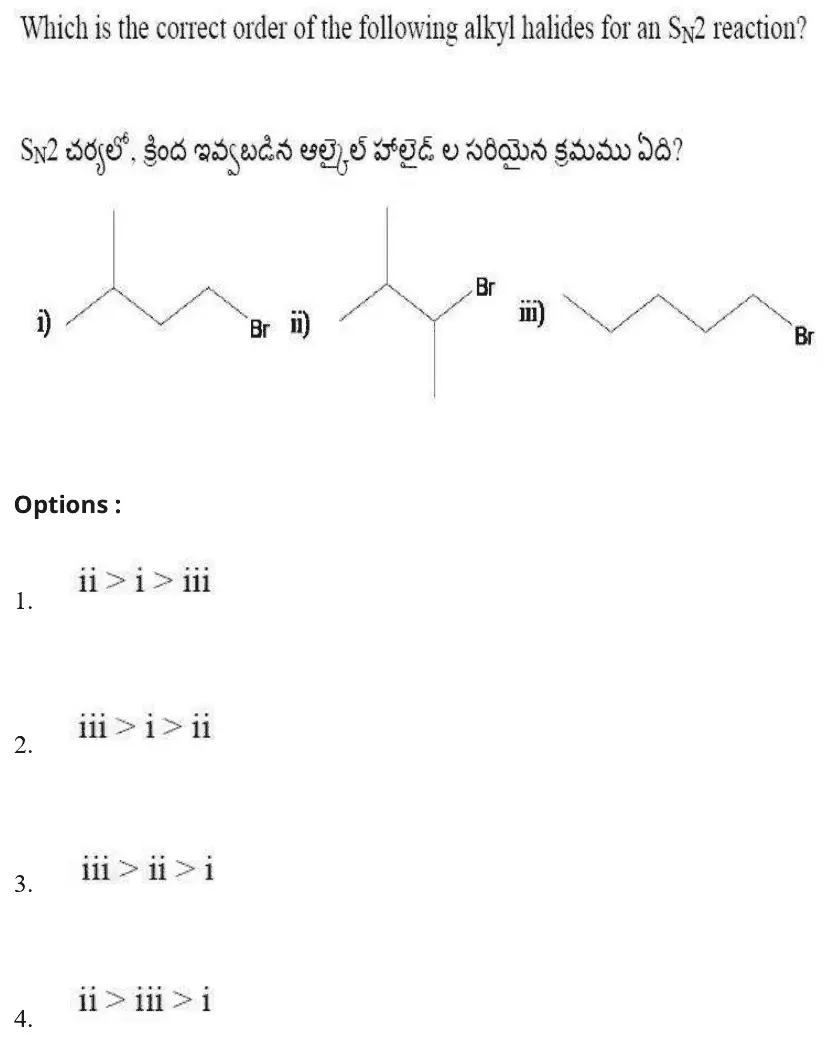
The order of reactivity of the following compounds towards dilute aqueous KOH in $S_{N}^{1}$ reaction is I) $\mathrm{CH_{3}CH_{2}CH_{2}CH_{2}Br}$ II) $\mathrm{H_{3}CCH_{2}CHBrCH_{3}}$ III) $\mathrm{(CH_{3})_{2}CHCH_{2}Br}$ IV) $\mathrm{(CH_{3})_{3}CBr}$
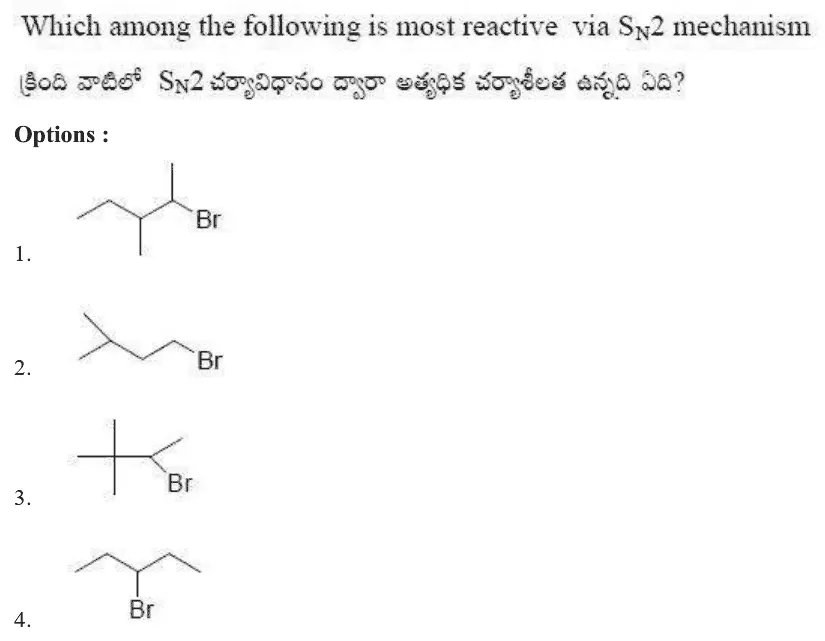
Which among the following is most reactive via $\mathrm{S_N2}$ mechanism
The question as printed in the paper.
A
see figure skeletal structure: a secondary bromide, a pentane-type chain with a methyl branch on the carbon next to the C–Br carbon, and the C–Br carbon itself carrying a methyl (reads as 2-bromo-3-methylpentane)
B
see figure skeletal structure: primary bromide, Br on the end CH2 of a chain whose far end is an isopropyl group (reads as 1-bromo-3-methylbutane)
C
see figure skeletal structure: Br on a CH carbon (with a methyl) next to a quaternary carbon carrying three methyl-type branches (reads as 2-bromo-3,3-dimethylbutane)
D
see figure skeletal structure: Br on the middle carbon of a five-carbon zigzag chain (reads as 3-bromopentane)
see figure 2,4,6-trinitrophenol (picric acid): benzene ring with OH at the top and NO2 groups at the two positions flanking it on the sides, and one at the bottom (para to OH)
C
see figure 2-nitrophenol: benzene ring with OH and an adjacent NO2
D
see figure 4-nitrophenol: benzene ring with OH at one end and NO2 at the para position
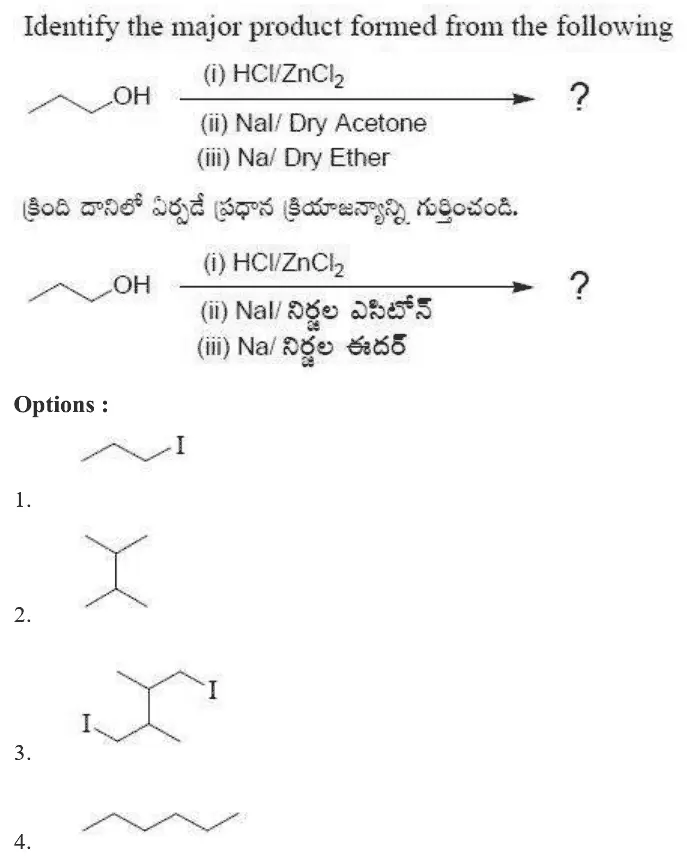
Identify the major product formed from the following (see the figure above)
The question as printed in the paper.
A
see figure zig-zag three-carbon chain ending in I (1-iodopropane)
B
see figure skeletal structure with two carbons bonded to each other, each carrying two methyl branches (2,3-dimethylbutane)
C
see figure skeletal structure: four-carbon main chain with I on each end CH2 and a methyl branch on each of the two middle carbons (1,4-diiodo-2,3-dimethylbutane)
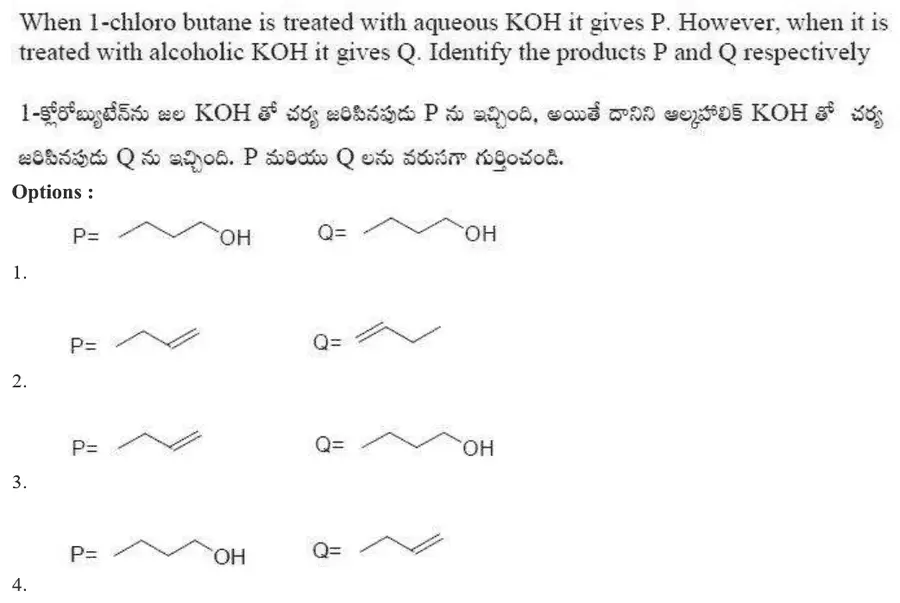
When 1-chloro butane is treated with aqueous KOH it gives P. However, when it is treated with alcoholic KOH it gives Q. Identify the products P and Q respectively (see the figure above)
The question as printed in the paper.
A
see figure P = butan-1-ol (four-carbon zig-zag chain ending in OH); Q = butan-1-ol (same drawing)
B
see figure P = alkene drawn with the double bond at the right end (terminal alkene, but-1-ene); Q = alkene drawn with the double bond at the left end (but-1-ene drawn reversed)
C
see figure P = terminal alkene (but-1-ene, double bond at the right end); Q = butan-1-ol (four-carbon chain ending in OH)
D
see figure P = butan-1-ol (four-carbon chain ending in OH); Q = terminal alkene (but-1-ene, double bond at the right end)
The correct order for increasing reactivity towards $S_N1$ substitution for the following compounds is (i) $CH_3CH_2Br$ (ii) $CH_2=CH-CH(Br)CH_3$ (iii) $CH_2=CHBr$ (iv) $CH_3-CH(Br)CH_3$
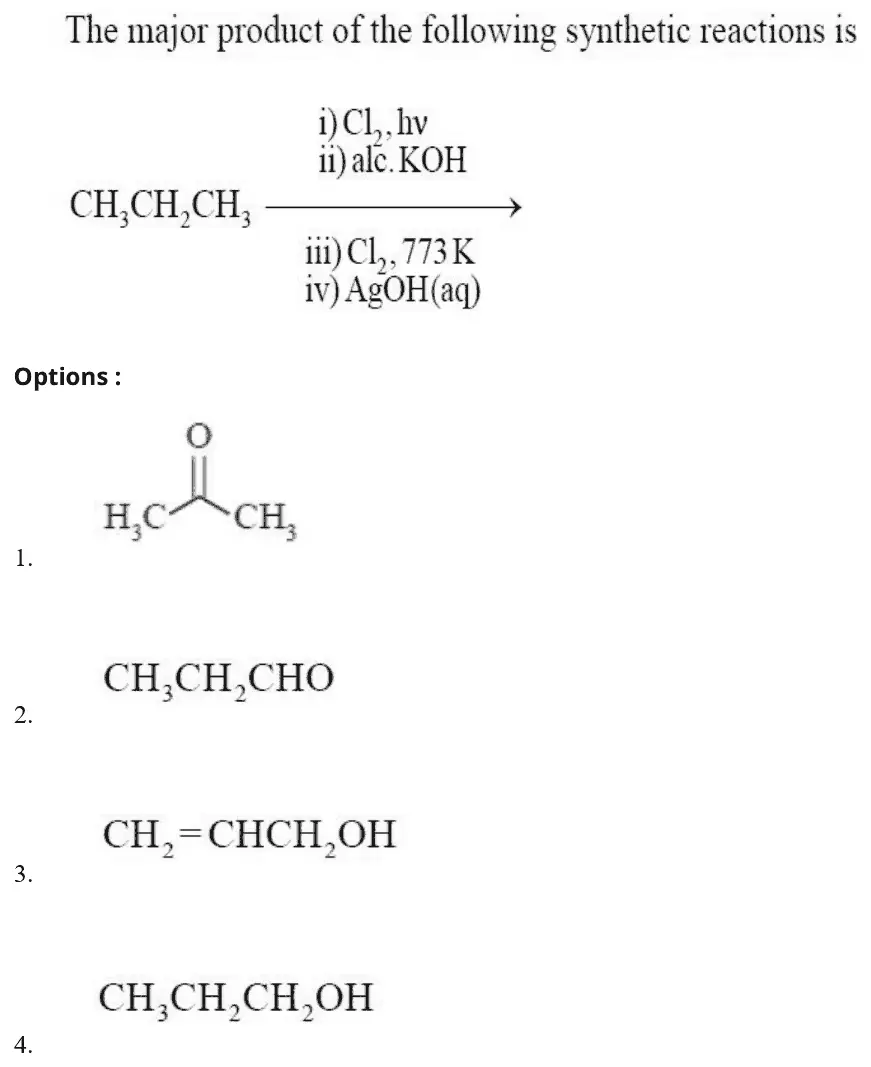
The major product of the following synthetic reactions is $\mathrm{CH_3CH_2CH_3}$ $\xrightarrow[\text{iii) } \mathrm{Cl_2},\ 773\,K;\ \text{iv) AgOH(aq)}]{\text{i) } \mathrm{Cl_2},\ h\nu;\ \text{ii) alc. KOH}}$
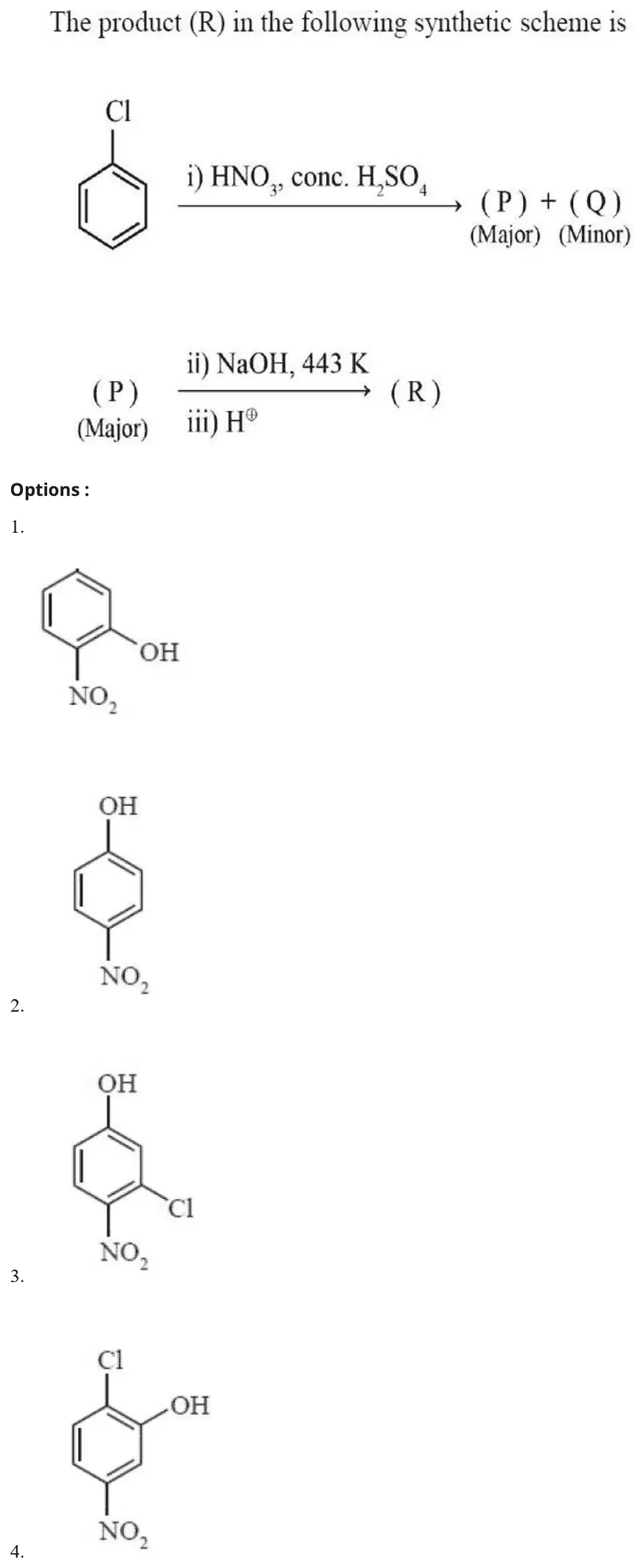
The product (R) in the following synthetic scheme is (see the figure above)
The question as printed in the paper.
A
see figure benzene ring with OH and $\mathrm{NO_2}$ on adjacent (ortho) carbons (2-nitrophenol)
B
see figure benzene ring with OH at top and $\mathrm{NO_2}$ at bottom (para; 4-nitrophenol)
C
see figure benzene ring with OH at top, $\mathrm{NO_2}$ at bottom (para to OH) and Cl on the lower-right carbon (adjacent to the $\mathrm{NO_2}$ carbon)
D
see figure benzene ring with Cl at top, OH on the upper-right carbon (ortho to Cl) and $\mathrm{NO_2}$ at bottom (para to Cl)
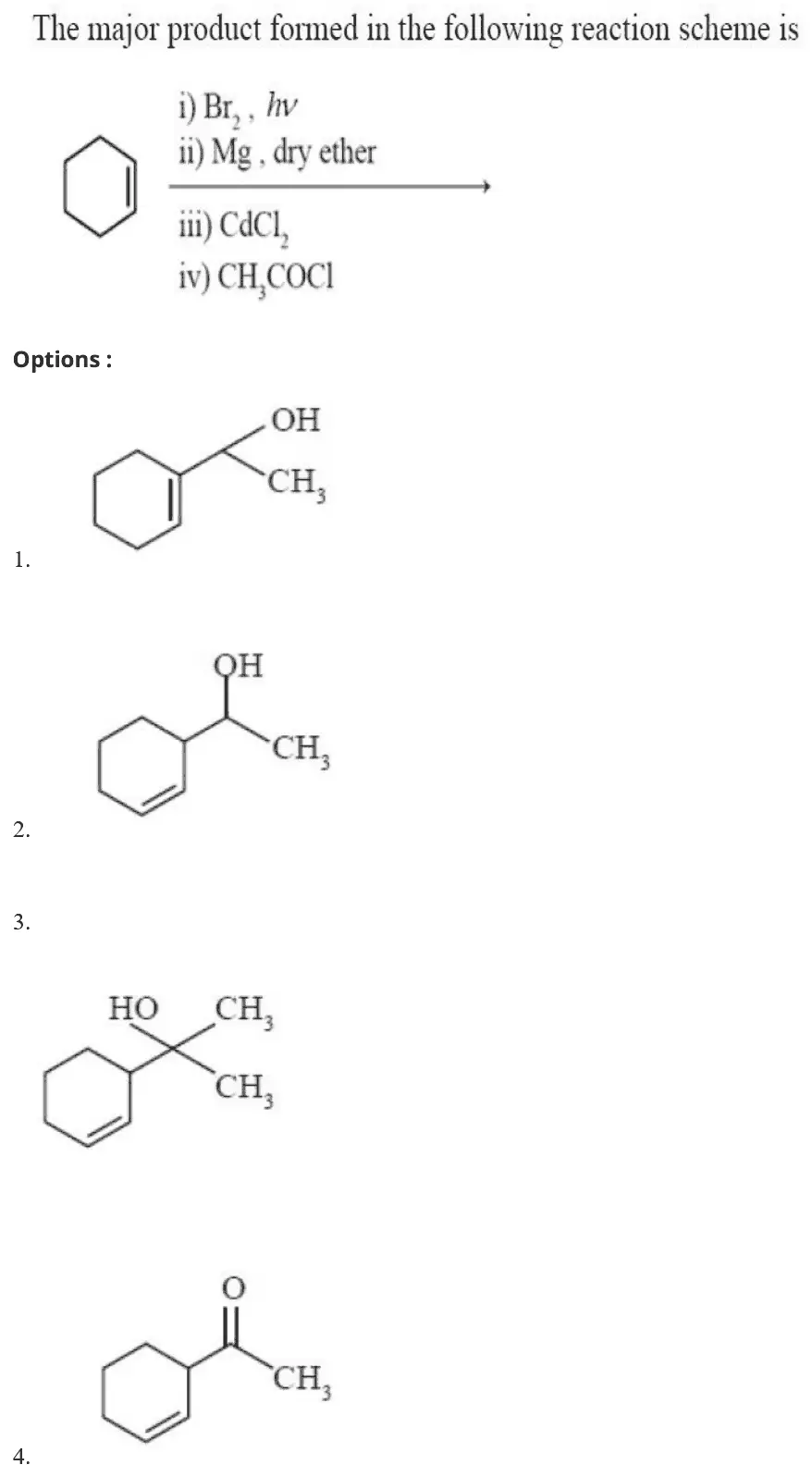
The major product formed in the following reaction scheme is (see the figure above)
The question as printed in the paper.
A
see figure cyclohexene ring with the substituent C(OH)(CH3) attached on the double-bond carbon (vinylic position, drawn with substituent at the carbon bearing the double bond)
B
see figure cyclohexene ring with CH(OH)CH3 substituent, double bond at the lower part of the ring away from the substituent carbon
C
see figure cyclohexene ring with C(OH)(CH3)2 substituent (HO, CH3, CH3 on one carbon), double bond at the lower part of the ring
D
see figure cyclohexene ring with C(=O)CH3 substituent, double bond at the lower part of the ring
$\mathrm{CH_3-CH_2-Br + Nu^{\ominus} \rightarrow CH_3-CH_2-Nu + Br^{\ominus}}$ The decreasing order of the reaction rate with nucleophile ($\mathrm{Nu^{\ominus}}$) is $\mathrm{Nu^{\ominus}}$ = (I) $\mathrm{PhO^{\ominus}}$ ; (II) $\mathrm{CH_3COO^{\ominus}}$ ; (III) $\mathrm{OH^{\ominus}}$ (IV) $\mathrm{CH_3O^{\ominus}}$
The increasing order of densities of the following alkyl halides is i) $n\text{-}\mathrm{C_3H_7Br}$ ii) $n\text{-}\mathrm{C_3H_7Cl}$ iii) $n\text{-}\mathrm{C_3H_7I}$
Which among the following statements is true about reactivity of haloarenes towards nucleophilic substitution reactions? 1) Haloarenes are very reactive towards nucleophilic substitution reaction 2) In haloarenes, the $C-X$ bond acquires partial double bond character 3) The $C-X$ bond in haloarenes is longer than the $C-X$ bond in haloalkanes 4) In haloarenes, the phenyl cation formed as a result of self-ionization is stable
Arrange the following in the correct order of reactivity towards nucleophilic substitution reaction. (i) 1-chloro-2-nitrobenzene (ii) Chlorobenzene (iii) 1-chloro-3-nitrobenzene
Find the reactants which on heating with alcoholic KOH produces the compound $\mathrm{CH_3-CH_2-CH_2-CH=CH_2}$. i) $\mathrm{CH_3-CH(Br)-CH_2-CH_2-CH_3}$ (Br on the second carbon) ii) $\mathrm{CH_3-CH_2-CH(Br)-CH_2-CH_3}$ (Br on the third carbon) iii) $\mathrm{CH_3-CH_2-CH_2-CH(Br)-CH_2Br}$ (Br on the fourth carbon, CH2Br at the end) iv) $\mathrm{CH_3-CH_2-CH_2-CH_2-CH_2Br}$ (Br on the terminal carbon)
Match the following. List - I A) $\mathrm{CH_3{-}CHBr{-}CH_2Br} \xrightarrow{\mathrm{KOH/C_2H_5OH}}$ B) $\mathrm{CH_3{-}CH_2{-}CH{=}CH_2} \xrightarrow[(\mathrm{C_6H_5CO})_2\mathrm{O_2},\Delta]{\mathrm{HBr}}$ C) $\mathrm{CH_3CH_2CH_3} \xrightarrow{\mathrm{Br_2},\,h\nu}$ D) $\mathrm{CH_3{-}CH{=}CH_2} \xrightarrow[\Delta]{\mathrm{NBS}}$ List - II (Major product) I) $1^\circ$-Alkyl bromide II) $2^\circ$-Alkyl bromide III) Allyl bromide IV) Alkenyl bromide The correct answer is
Assertion (A): $\mathrm{S_N1}$ hydrolysis of optically active 2-bromooctane results in the formation of $(\pm)$-octan-2-ol Reason (R): The reaction proceeds through a planar carbocation which can be attacked by the nucleophile from either side The correct answer is
A
(A) and (R) are correct, (R) is the correct explanation of (A)
B
(A) and (R) are correct but (R) is not the correct explanation of (A)
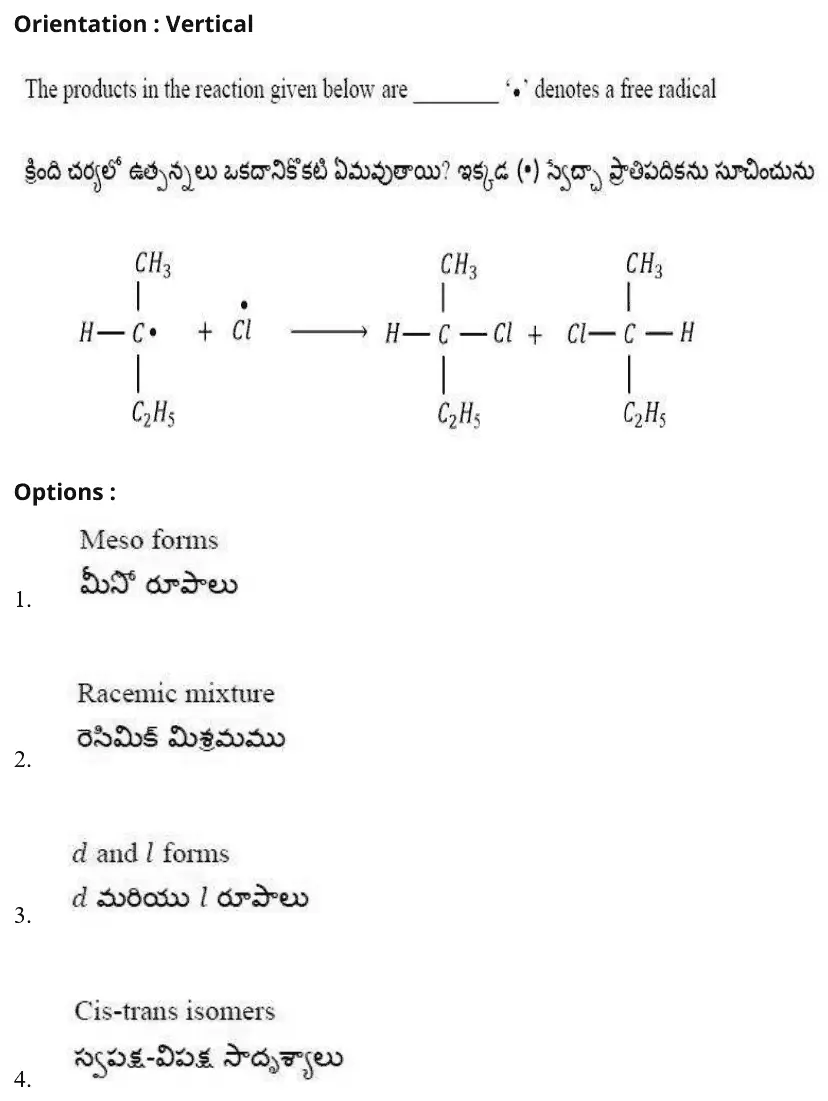
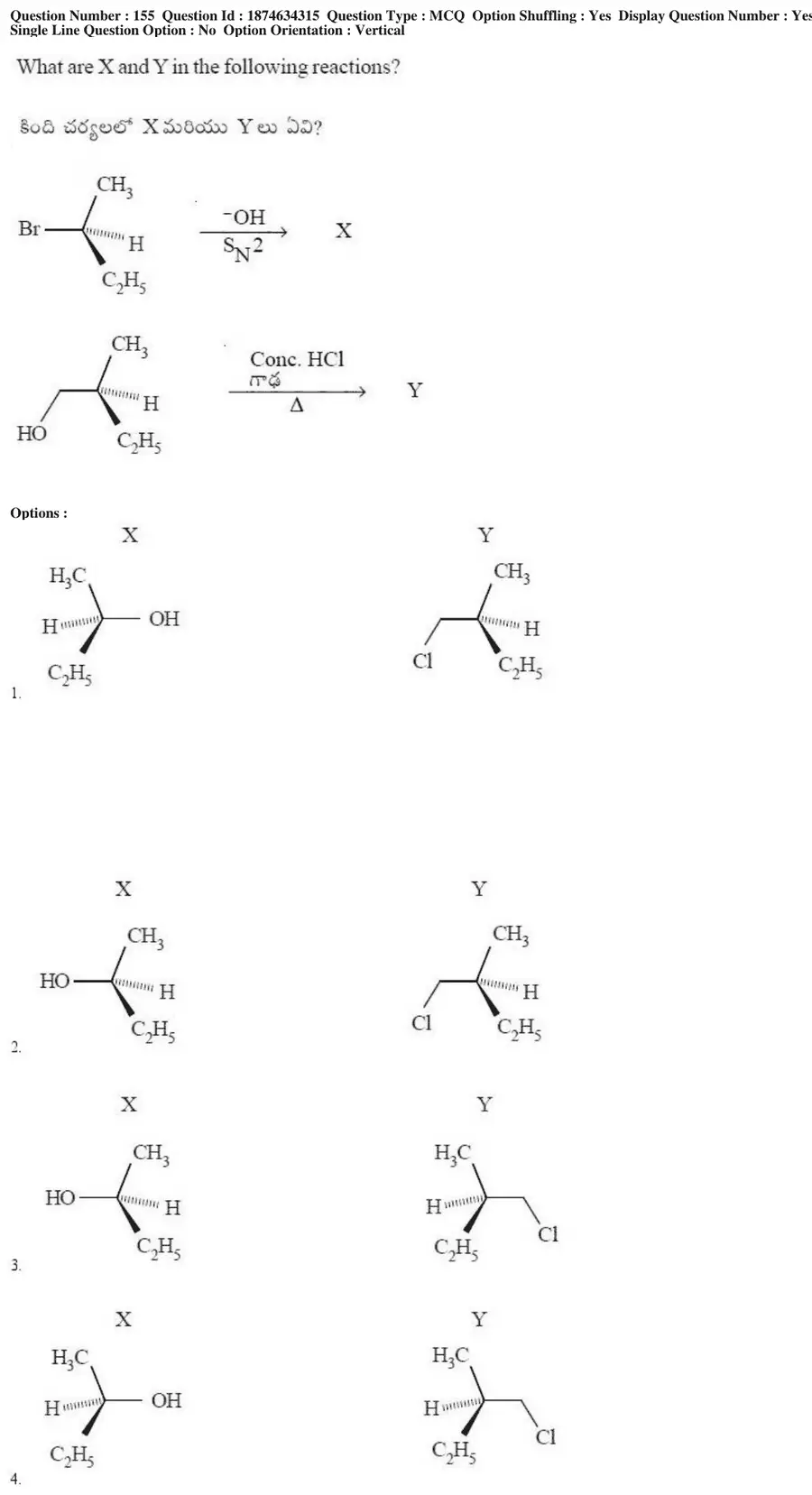
What are X and Y in the following reactions? (see the figure above) (see the figure above)
The question as printed in the paper.
A
see figure X: H3C top-left, H hashed on left, C2H5 bold wedge bottom-left, OH on right. Y: Cl on left-bottom (Cl–CH2 arm going left), CH3 top, H hashed right, C2H5 bold wedge bottom-right
B
see figure X: HO on left, CH3 top, H hashed right, C2H5 bold wedge bottom. Y: Cl on left-bottom, CH3 top, H hashed right, C2H5 bold wedge bottom-right
C
see figure X: HO on left, CH3 top, H hashed right, C2H5 bold wedge bottom. Y: H3C top-left, H hashed left, C2H5 bold wedge bottom-left, CH2–Cl arm going right
D
see figure X: H3C top-left, H hashed on left, C2H5 bold wedge bottom-left, OH on right. Y: H3C top-left, H hashed left, C2H5 bold wedge bottom-left, CH2–Cl arm going right
Arrange the following organic halides in correct order of reactivity towards $\mathrm{S_N2}$ displacement. (P) $\mathrm{(CH_3)_2C(Br)CH_2CH_3}$ , (Q) $\mathrm{BrCH_2(CH_2)_3CH_3}$ , (R) $\mathrm{CH_3CH(Br)(CH_2)_2CH_3}$
Which of the following statements are correct? a) The C-Cl bond in chlorobenzene is shorter than in chloromethane b) It is difficult to replace chlorine from chlorobenzene than from benzyl chloride c) The C-Cl bond in chlorobenzene has some double bond character d) Chlorobenzene on chlorination gives m-dichlorobenzene
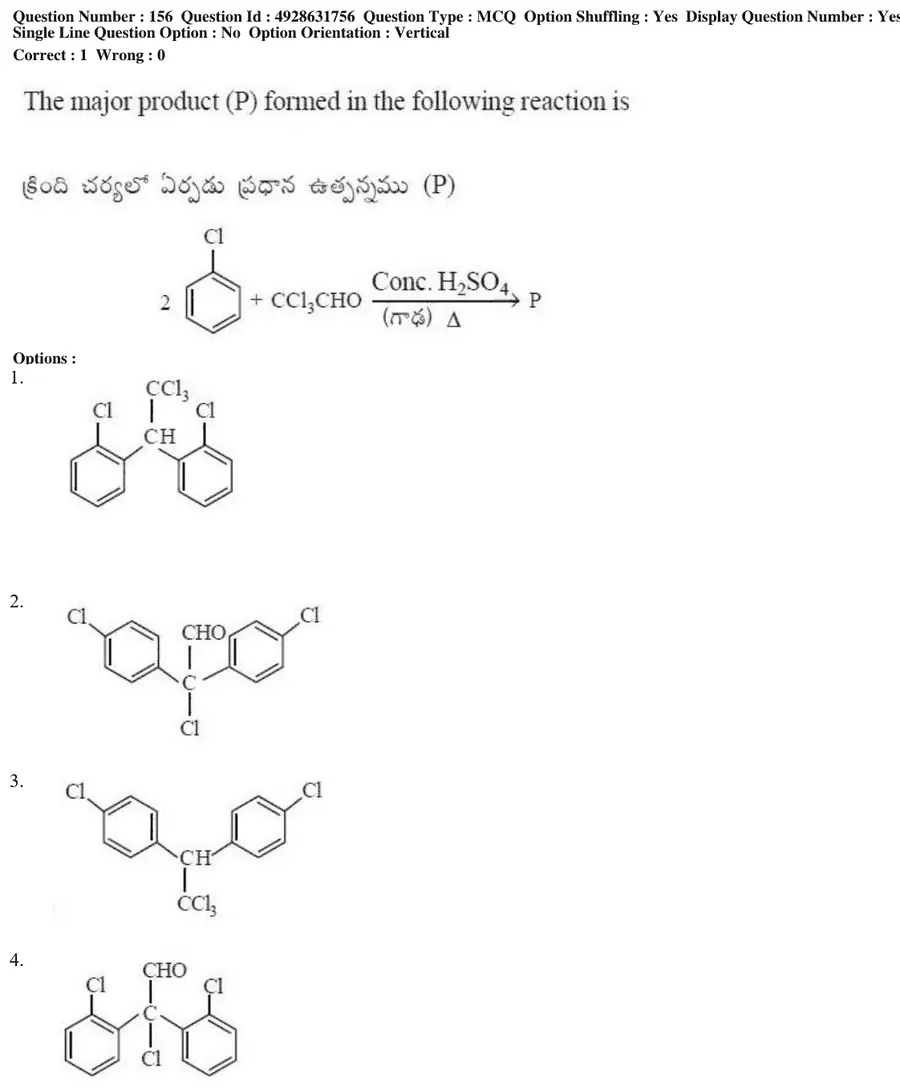
The major product (P) formed in the following reaction is $2\ \text{(chlorobenzene)} + \mathrm{CCl_3CHO} \xrightarrow[\Delta]{\text{Conc. } \mathrm{H_2SO_4}} \mathrm{P}$ (see the figure above)
The question as printed in the paper.
A
see figure CH carrying CCl3 and two aryl rings, each bearing Cl ortho to the attachment (2-chlorophenyl x2)
B
see figure C(Cl)(CHO) carrying two aryl rings, each bearing Cl para to the attachment (4-chlorophenyl x2)
C
see figure CH(CCl3) carrying two aryl rings, each bearing Cl para to the attachment (4-chlorophenyl x2), i.e. DDT
D
see figure C(Cl)(CHO) carrying two aryl rings, each bearing Cl ortho to the attachment (2-chlorophenyl x2)
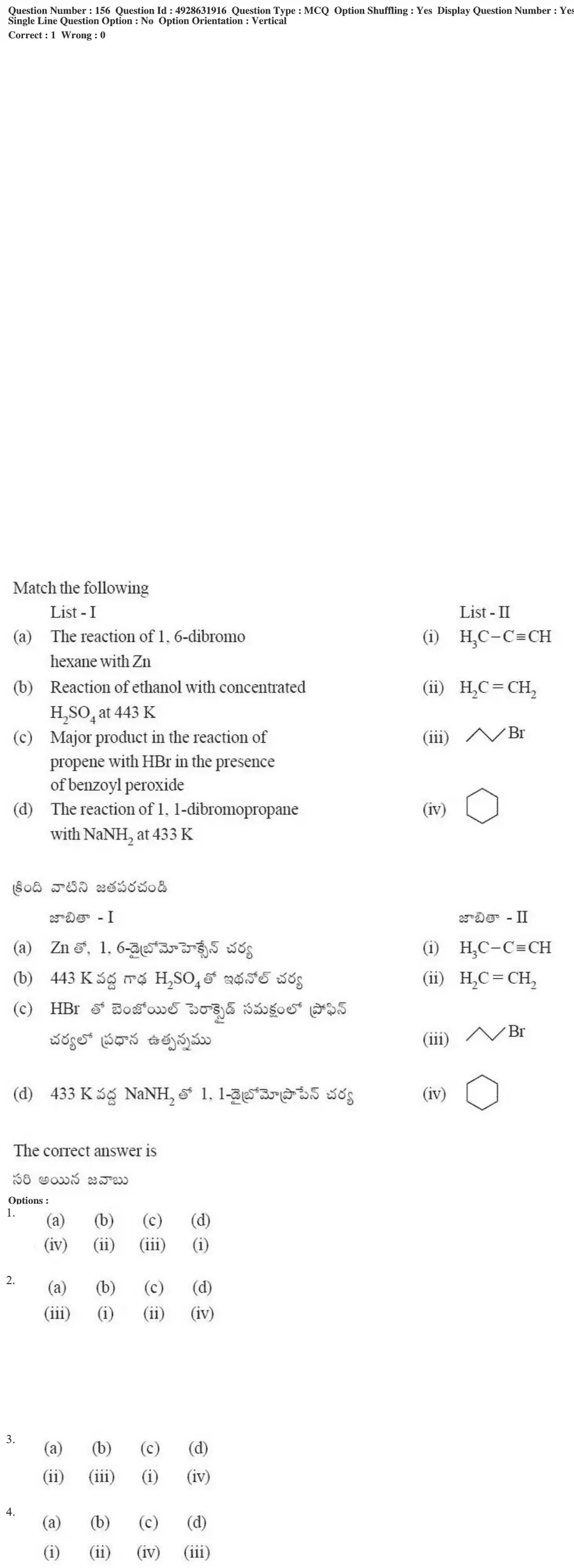
Match the following List - I a) The reaction of 1, 6-dibromo hexane with Zn b) Reaction of ethanol with concentrated $\mathrm{H_2SO_4}$ at 443 K c) Major product in the reaction of propene with HBr in the presence of benzoyl peroxide d) The reaction of 1, 1-dibromopropane with $\mathrm{NaNH_2}$ at 433 K List - II i) $\mathrm{H_3C-C\equiv CH}$ ii) $\mathrm{H_2C=CH_2}$ iii) (see the figure above) 1-bromopropane iv) (see the figure above) cyclohexane The correct answer is
The reactivity of alkyl bromides. A) $\mathrm{CH_3CH_2Br}$ B) $\mathrm{CH_3-CH(CH_3)-Br}$ (isopropyl bromide: Br and CH3 on the central CH) C) $\mathrm{CH_3-C(CH_3)_2-Br}$ (tert-butyl bromide) D) $\mathrm{CH_3Br}$ towards iodide ion in dry acetone decrease in the order
Which of the following reasons support that arylhalides are less reactive than alkyl halides towards nucleophilic substitution reactions ? a) The formation of more stable arenium ion b) Partial double bond character of C-X bond c) Longer C-X bond d) $\mathrm{sp^2}$ carbon bonded to X, is more electronegative
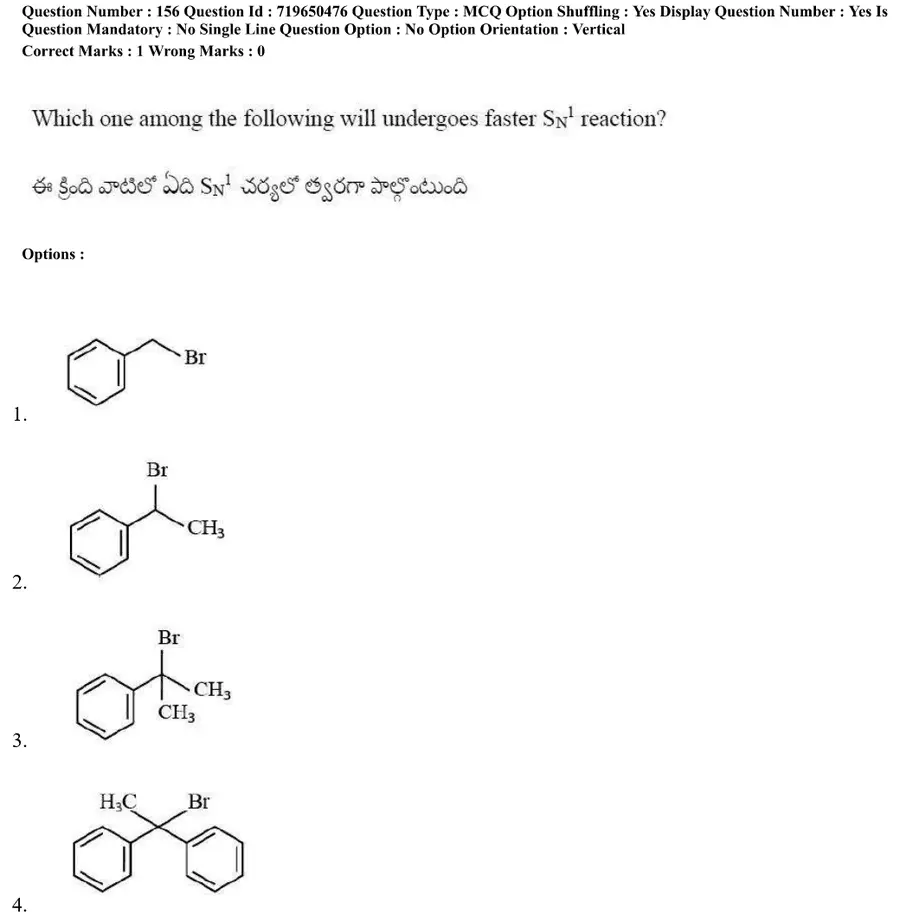
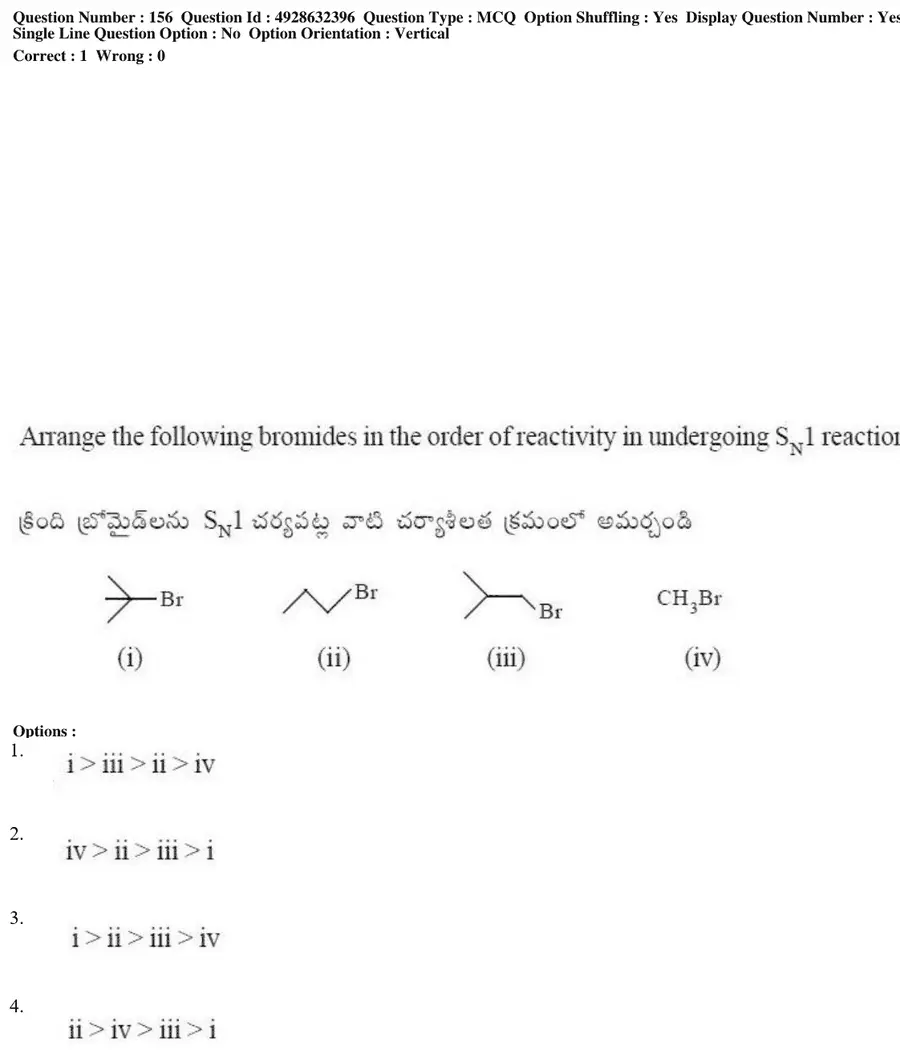
The order of reactivity of the following alkyl bromides towards $\mathrm{S_N^1}$ reactions is a) $\mathrm{(CH_3)_2CHBr}$ b) $\mathrm{CH_3CH_2Br}$ c) $\mathrm{(CH_3)_3C-Br}$
What is Z in the following sequence of reactions? 2-methyl-2-bromo propane $\xrightarrow[\text{dry ether}]{\mathrm{Mg}} X \xrightarrow{\mathrm{H_2O}} Z$
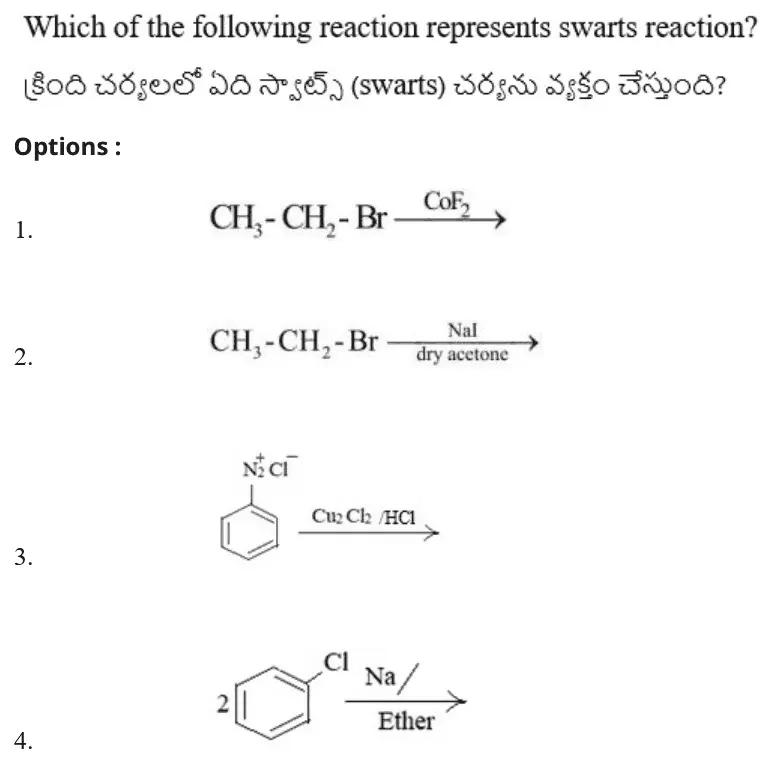
Answer: (C) $\mathrm{C_2H_5-Cl,\ C_2H_5-ONO}$· The council's preliminary key
How to prepare Haloalkanes & Haloarenes for EAPCET
How often it comes up
Haloalkanes & Haloarenes sits at rank 14 among the 31 chemistry chapters in the modern 2022 to 2026 examination timeframe. Across our complete collection of entrance papers from 2010 through 2026, the chapter contributed 154 questions across 149 papers, appearing in 110 of those tests to record a 2.6 percent subject share with an average of 1.0 question per paper. In the recent five-year period from 2022 to 2026, it gathered 92 questions across 77 sittings, being present in 63 papers to maintain 1.2 questions per paper and a 3.0 percent subject share.
The chapter has featured in every exam year since 2022, though it was absent from fourteen papers across that five-year span. Looking at the two regional state streams between 2022 and 2026, AP tests delivered 70 questions across 48 papers (appearing in 42 papers, 1.5 questions per paper, 3.6 percent share), while TS tests generated 22 questions across 29 papers (appearing in 21 papers, 0.8 questions per paper, 1.9 percent share).
During the older testing block between 2010 and 2021, papers featured 62 questions across 72 sittings (appearing in 47 tests), representing 0.9 questions per paper and a 2.2 percent subject share. Across the most recent three exam cycles from 2024 to 2026, question writers set 52 questions across 46 sittings (with 36 papers containing questions), yielding 1.1 questions per test and 2.8 percent share. In terms of long-term trajectory, comparing early testing with the last three years shows the share is up, while comparing the recent five-year window with the last three years shows the share is about the same.
Most-asked topics
Questions in this branch distribute across three core reaction domains:
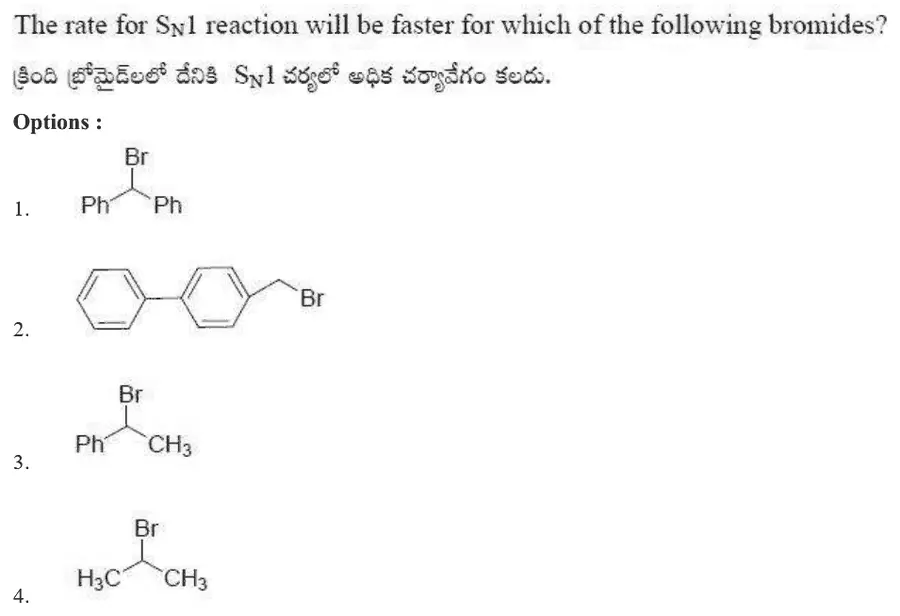
Nucleophilic Substitution represents the largest testing area with 69 questions overall and 41 during the recent timeframe through 2026. Frequent problem formats focus on SN1 versus SN2 mechanisms (kinetics, stereochemical inversion versus racemisation, solvent effects, substrate order from methyl to tertiary, and leaving group ability), nucleophilic aromatic substitution of chlorobenzene activated by ortho and para nitro groups, and ambident nucleophiles (cyanide versus isocyanide, nitrite versus nitroalkane formation).
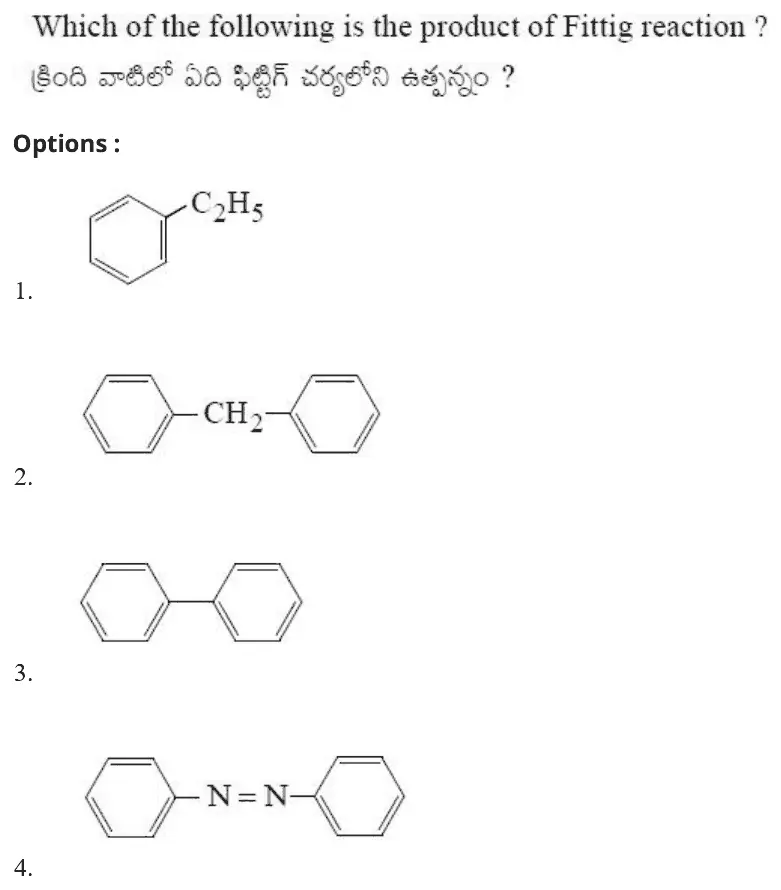
Elimination & Other Reactions accounts for 55 questions across the archive, with 32 occurring between 2022 and 2026. Themes include Saytzeff dehydrohalogenation using alcoholic potassium hydroxide, competition between elimination and substitution, organometallic reactions including Grignard reagent preparation and reactions, Wurtz, Fittig, and Wurtz-Fittig cross-couplings, and environmental polyhalogen compounds like chloroform, iodoform, carbon tetrachloride, and DDT.
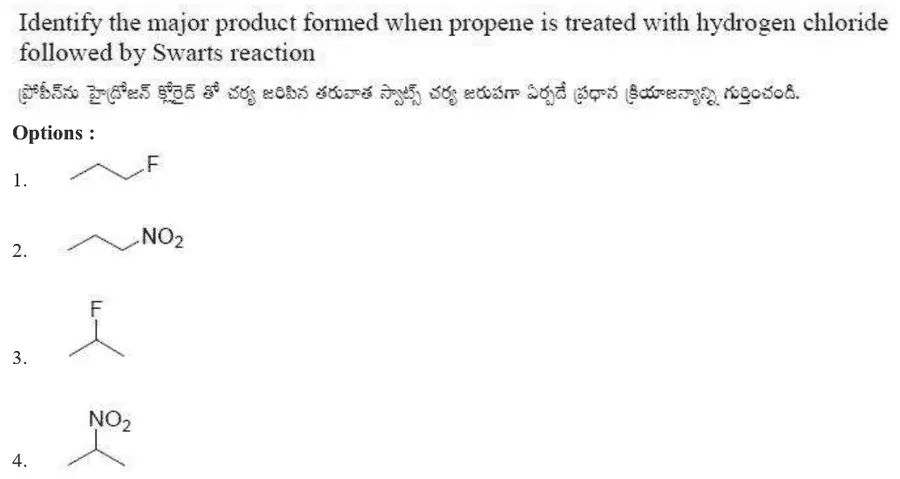
Preparation & Properties provided 30 questions in total, with 19 appearing from 2022 to 2026. Topics include halogen exchange reactions (Finkelstein reaction with sodium iodide in dry acetone, and Swarts reaction using metallic fluorides like silver fluoride or antimony trifluoride), Darzens thionyl chloride method for alkyl chlorides, allylic and benzylic bromination with N-bromosuccinimide, and dipole moment variations.
What the questions look like
Mechanism and reactivity rankings form the core problem style. Examiners frequently present four isomeric butyl halides and ask you to rank them in order of increasing SN2 reactivity (where primary unhindered halides react fastest) or SN1 reactivity (where tertiary halides react fastest via stable carbocations).
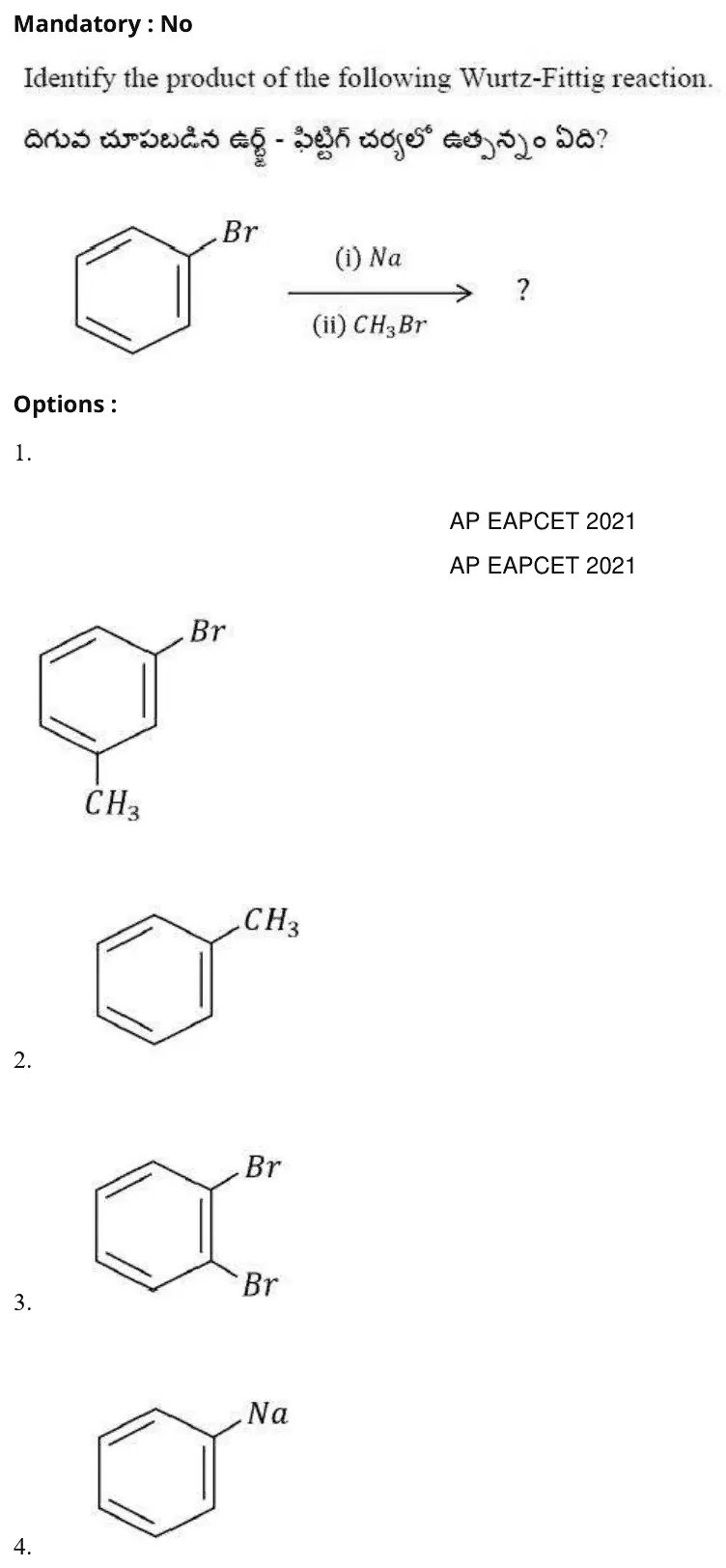
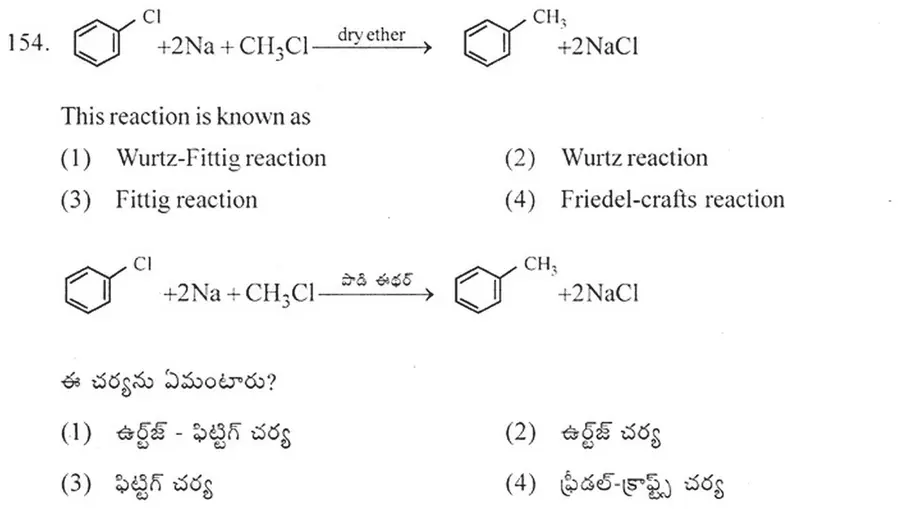
Another common format tests nucleophilic aromatic substitution. Questions ask candidates to identify the effect of nitro substituents on chlorobenzene hydrolysis, requiring recognition that nitro groups positioned ortho and para stabilize the Meisenheimer carbanionic resonance complex, whereas meta nitro groups provide little activation. In coupling reactions, problems ask for the mixed alkylarene product formed when an aryl halide and an alkyl halide react with sodium in dry ether via the Wurtz-Fittig reaction.
Questions to try first
Solve these representative state entrance questions to test your grasp on substitution and coupling mechanisms:
Master the stereochemical outcomes of substitution reactions. Pure SN2 reactions occur via backside attack through a pentacoordinate transition state, resulting in complete Walden inversion of configuration at a chiral carbon center. SN1 reactions proceed via a planar trigonal carbocation intermediate that can be attacked from either face with equal probability, producing a racemic mixture with partial retention or inversion depending on ion-pair shielding.
For ambident nucleophiles, remember the bonding preferences dictated by bond ionicities: potassium cyanide is predominantly ionic, so the more electronegative carbon atom attacks to yield alkyl cyanides as major products. Silver cyanide is predominantly covalent, forcing the nitrogen lone pair to attack, which yields alkyl isocyanides. Similarly, potassium nitrite yields alkyl nitrites via oxygen coordination, while silver nitrite yields nitroalkanes via nitrogen coordination.
Frequently asked questions
Why are aryl halides extremely unreactive toward nucleophilic substitution compared to alkyl halides?
In aryl halides, the halogen lone pair delocalises into the aromatic pi system, conferring partial double-bond character to the carbon-halogen bond. Additionally, the phenyl carbon is sp2-hybridized with greater s-character, holding the halogen tighter than an sp3 carbon. Finally, nucleophilic approach is repelled by the electron-rich aromatic cloud, and the phenyl cation intermediate would be highly unstable.
What is the Finkelstein reaction and why is dry acetone used as the solvent?
The Finkelstein reaction prepares alkyl iodides by reacting alkyl chlorides or bromides with sodium iodide. Dry acetone is used because sodium iodide dissolves well in it, whereas sodium chloride and sodium bromide precipitate out due to lower solubility, driving the equilibrium forward according to Le Chateliers principle.
How does the Saytzeff rule govern dehydrohalogenation?
When an alkyl halide undergoes beta-elimination with a strong base like alcoholic potassium hydroxide, base abstracts a proton from the beta-carbon that carries fewer hydrogen atoms. This selectively yields the more substituted, more stable alkene possessing the maximum number of hyperconjugative alkyl groups as the major product. Step-by-step solutions for each one are in the EdLoop EAPCET app.