Formal change on sulphur atom in the following three Lewis structures I, II, III respectively is
(see the figure above)
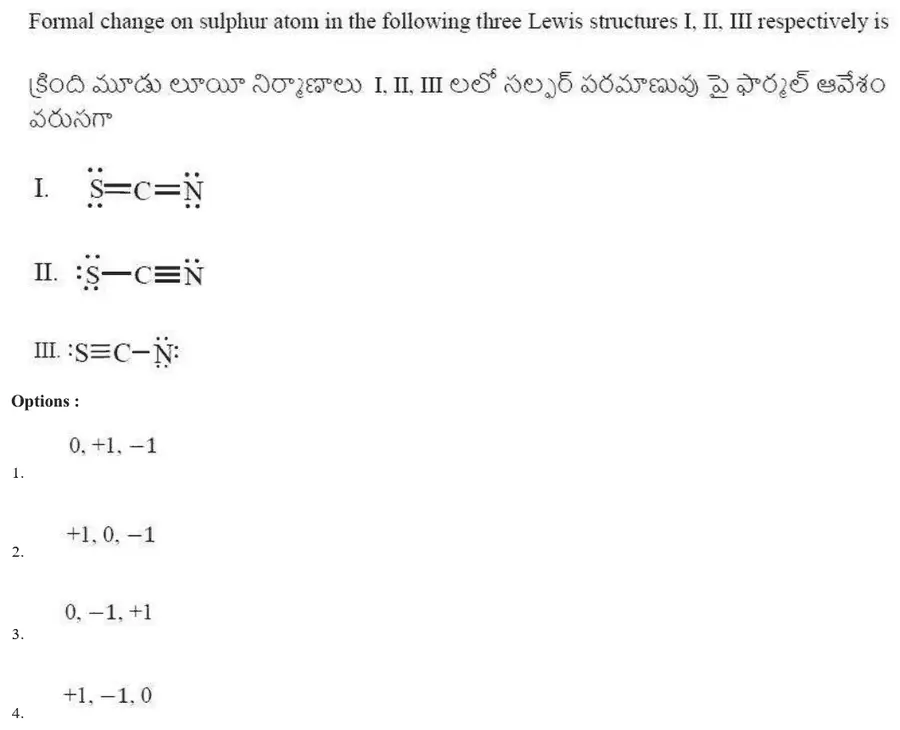
- A
$0, +1, -1$
- B
$+1, 0, -1$
- C
$0, -1, +1$
- D
$+1, -1, 0$
Answer: (C) $0, -1, +1$ · The council's preliminary key
 PYQs · free, no adsOpen on the web (app.edloop.in)Get EdLoop – free on Google Play
Every Chemical Bonding & Molecular Structure question from past AP EAPCET and TS EAPCET papers, with options and answers. Newest first.
Chemical Bonding & Molecular Structure is one of the heaviest pillars in the state engineering entrance exam, sitting at rank 3 among all 31 chemistry chapters between 2022 and 2026.
Attempt every Chemical Bonding & Molecular Structure question timed, see the step-by-step solution and track what you get wrong. Free.
Formal change on sulphur atom in the following three Lewis structures I, II, III respectively is
(see the figure above)
$0, +1, -1$
$+1, 0, -1$
$0, -1, +1$
$+1, -1, 0$
Which of the following sets contain isostructural molecules?
I. $\mathrm{H_2O,\ OF_2,\ SCl_2}$
II. $\mathrm{CO_2,\ BeCl_2,\ HgCl_2}$
III. $\mathrm{SiCl_4,\ SF_4,\ XeF_4}$
Correct answer is
I, II, III
I, III only
II, III only
I, II only
In which of the following sets, molecules are correctly arranged in the decreasing order of covalent character?
I. $\mathrm{AlCl_3}$ > $\mathrm{MgCl_2}$ > $\mathrm{NaCl}$
II. $\mathrm{BeCl_2}$ > $\mathrm{MgCl_2}$ > $\mathrm{CaCl_2}$
III. $\mathrm{CaI_2}$ > $\mathrm{CaBr_2}$ > $\mathrm{CaCl_2}$
Correct answer is
I, II only
I, II, III
II, III only
I, III only
Observe the following statements
Statement – I: The correct order of $\mathrm{O-O}$ bond length in $\mathrm{O_2, H_2O_2}$ and $\mathrm{O_3}$ is $\mathrm{H_2O_2 > O_3 > O_2}$
Statement – II: Hybridisation of carbon in graphite and pyridine is same
The correct answer is
Both statements I and II are correct
Statement I is correct, but statement II is not correct
Statement I is not correct, but statement II is correct
Both statements I and II are not correct
Which of the following sets of molecules / ions represent isoelectronic species?
I. $NO^+, CN^-, CO, O_2^{2+}$
II. $NH_3, Al^{3+}, Ne, F^-$
III. $O_2^+, NO, N_2^-, H_2O$
The correct answer is
I, II only
I, II, III
II, III only
I, III only
Given below are two statements
Statement – I: London forces between two particles are proportional to $r^{-6}$, where ‘$r$’ is the distance between two particles
Statement – II: The dipole-dipole interaction energy in a solid is proportional to $r^{-3}$, where $r$ is the distance between two polar molecules
Correct answer is
Both statement I and statement II are correct
Both statement I and statement II are not correct
Statement I is correct, but statement II is not correct
Statement I is not correct, but statement II is correct
Identify the correct set of molecules / ions in which hybridization of central atom is not same
$\mathrm{H_2O, NH_3, CH_4}$
$\mathrm{H_3O^+, NH_4^+, ClO_4^-}$
$\mathrm{CH_3^+, BF_3, SO_2}$
$\mathrm{SF_4, XeF_4, SO_3}$
Match the following
| List – I (molecule / Ion) | List – II (Bond order and magnetic property) | ||
|---|---|---|---|
| A | $O_2^-$ | I | 1.5 – Paramagnetic |
| B | $O_2$ | II | 2.0 – Paramagnetic |
| C | $C_2^{2-}$ | III | 3.0 – Diamagnetic |
| D | $B_2$ | IV | 1.0 – Paramagnetic |
The correct answer is
A-I, B-III, C-II, D-IV
A-I, B-II, C-III, D-IV
A-IV, B-II, C-I, D-III
A-IV, B-I, C-II, D-III
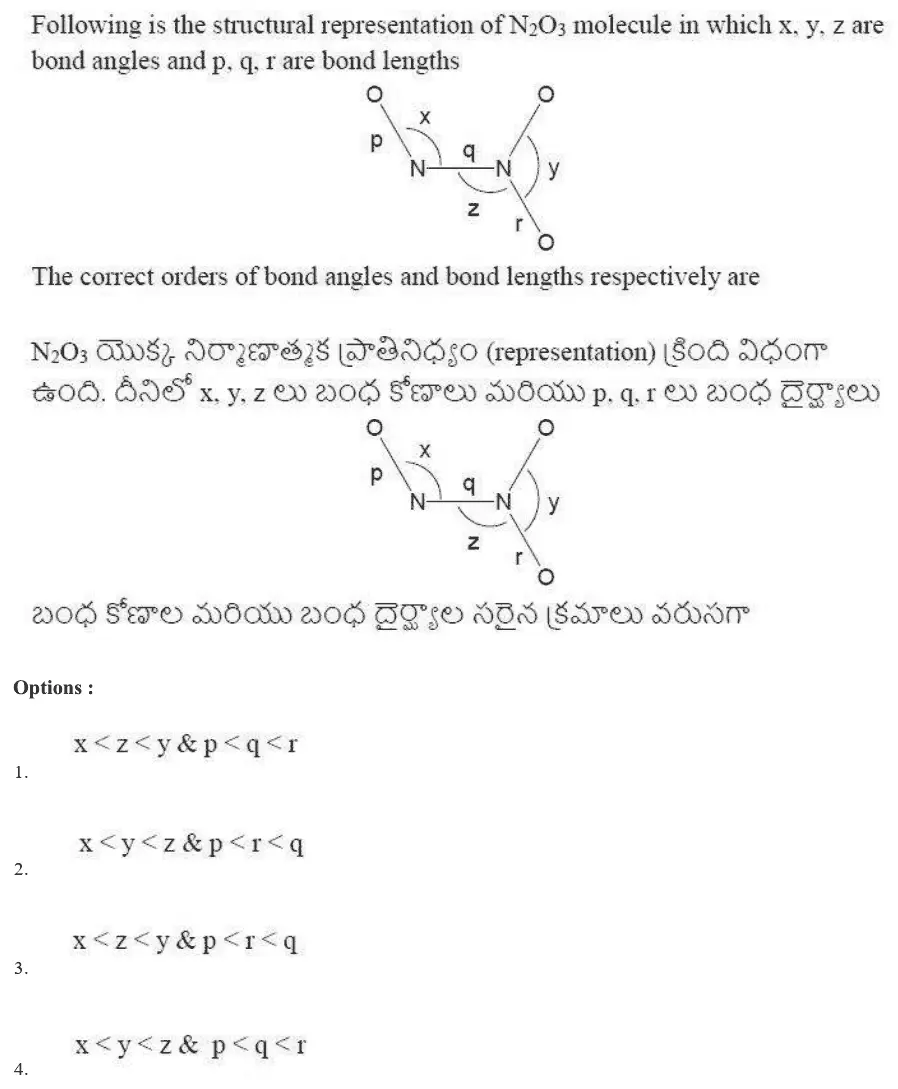
Following is the structural representation of $\mathrm{N_2O_3}$ molecule in which x, y, z are bond angles and p, q, r are bond lengths
(see the figure above)
The correct orders of bond angles and bond lengths respectively are
$x<z<y$ & $p<q<r$
$x<y<z$ & $p<r<q$
$x<z<y$ & $p<r<q$
$x<y<z$ & $p<q<r$
How many of the following molecules are linear with no lone pairs of electrons on the central atom?
$\mathrm{BeCl_2}$, $\mathrm{O_3}$, $\mathrm{SCl_2}$, $\mathrm{XeF_2}$, $\mathrm{SnCl_2}$, $\mathrm{PbCl_2}$, $\mathrm{HgCl_2}$
2
3
4
1
Which of the following statements are correct about $\mathrm{CO_3^{2-}}$ ion?
I. The hybridisation of central atom is $sp^3$
II. The average formal charge on each oxygen atom is 0.67
III. The resonance hybrid structure has one C−O single bond and two C=O double bonds
IV. All C−O bond lengths are equal
(only)
II & IV only
I & II only
II & III only
I & III only
In which of the following, the number of valence electrons is maximum?
$\mathrm{PO_4^{3-}}$
$\mathrm{SO_3^{2-}}$
$\mathrm{CO_3^{2-}}$
$\mathrm{CNO^-}$
Identify the correct pair of species having same number of valency electrons
$\mathrm{SF_4}$, $\mathrm{ClO_3^-}$
$\mathrm{PO_4^{3-}}$, $\mathrm{SF_4}$
$\mathrm{ClF_3}$, $\mathrm{SO_4^{2-}}$
$\mathrm{CCl_4}$, $\mathrm{PO_4^{3-}}$
Which of the following orders is not correct for the property mentioned against them?
$H_2O > HF > NH_3 > H_2S$ — boiling point
$H_2O > NH_3 > NF_3 > CF_4$ — dipole moment
$C - C > N - O > C - O > C - H$ — bond length
$O_2^+ > O_2 > O_2^- > O_2^{2-}$ — bond order
Which one of the following orders is not correctly matched with the property mentioned against it?
$HCl < O_2 < N_2$ – Bond dissociation energy
$H_2O < O_3 < SO_2$ – Bond angle
$CHCl_3 < NF_3 < NH_3$ – Dipole moment
$KF < NaF < LiF$ – Covalent character
Which of the following statements is not correct?
$\mathrm{CO}$, $\mathrm{N_2}$, $\mathrm{O_2^{2+}}$ have same bond order
The bond between third element of $1^{st}$ group and second element of $17^{th}$ group is ionic in nature
The total number of $sp^2$ hybrid orbitals in benzene is 12
$o$-Nitro phenol has intramolecular $H$-bonding
The conjugate base of hydrogen carbonate ion is $\underline{\mathrm{X}}$. The hybridization of central atom in X is
$sp$
$sp^2$
$sp^3$
$sp^3d$
Observe the following sets of molecules and identify the set in which all molecules have dipole moment
$\mathrm{H_2S}$, $\mathrm{C_6H_6}$, $\mathrm{CO_2}$
$\mathrm{H_2O}$, $\mathrm{NH_3}$, $\mathrm{HCl}$
$\mathrm{BeCl_2}$, $\mathrm{CS_2}$, $\mathrm{BBr_3}$
$\mathrm{PbCl_2}$, $\mathrm{SnCl_2}$, $\mathrm{HgCl_2}$
The number of species having bond order $\geq 2$ from the following is
$\mathrm{N_2, O_2^{2-}, NO^-, O_2^+, NO^+, NO}$
4
6
5
3
The pair of molecules with same type of hybridisation is
$\mathrm{H_3BO_3}$, $\mathrm{H_3PO_3}$
$\mathrm{NO_2}$, $\mathrm{SO_3}$
$\mathrm{XeO_3}$, $\mathrm{BF_3}$
$\mathrm{PCl_3}$, $\mathrm{ClF_3}$
Identify the correct orders of covalent character of given molecules
I. $\mathrm{KI > KBr > KCl > KF}$
II. $\mathrm{LiCl > NaCl > KCl > RbCl}$
III. $\mathrm{CsCl > CaCl_2 > MgCl_2 > AlCl_3}$
The correct answer is
I, II, III
I, II only
II, III only
I, III only
Match the following
| List-1 (Molecule) | List-2 (Geometry) | ||
|---|---|---|---|
| A | $\mathrm{BrF_5}$ | I | T-Shape |
| B | $\mathrm{XeF_4}$ | II | See-Saw |
| C | $\mathrm{ClF_3}$ | III | Square planar |
| D | $\mathrm{SF_4}$ | IV | Square pyramid |
The correct answer is
A – IV, B – III, C – II, D – I
A – III, B – IV, C – II, D – I
A – IV, B – I, C – III, D – II
A – IV, B – III, C – I, D – II
Consider the following
$\mathrm{HF, H_2O, BeCl_2, CO_2, BF_3, NF_3, CCl_4, CHCl_3}$
The number of polar molecules is
2
3
4
5
How many of the following molecules / ions are paramagnetic in nature?
$\mathrm{N_2}$, $\mathrm{O_2}$, $\mathrm{F_2}$, NO, CO, $\mathrm{O_2^+}$, $\mathrm{O_2^-}$, $\mathrm{O_2^{2-}}$, $\mathrm{N_2^+}$, $\mathrm{NO^+}$, $\mathrm{NO^-}$, $\mathrm{H_2}$
7
6
5
4
Which of the following sets are correctly matched?
| Sl. No. | Molecules | Number of lone pairs of electrons on central atom |
|---|---|---|
| I | $\mathrm{SO_2}$, $\mathrm{PbCl_2}$, $\mathrm{SF_4}$ | 1 |
| II | $\mathrm{XeF_4}$, $\mathrm{H_2O}$, $\mathrm{BrF_3}$ | 2 |
| III | $\mathrm{CCl_4}$, $\mathrm{XeF_6}$, $\mathrm{IF_7}$ | 0 |
The correct answer is
I, II only
I, II, III
I, III only
II, III only
In which of the following hydrogen bond does not exist?
Salicylaldehyde
Catechol
Salicylic acid
Acetophenone
In which of the following, carbon uses $sp^3$ hybrid orbital for bond formation with oxygen?
Formic acid
Urea
t-Butylalcohol
Acetaldehyde
The set of molecules with different geometry and same type of hybridization is
$\mathrm{CH_4, PCl_5, SF_6}$
$\mathrm{H_2O, BeF_2, PCl_3}$
$\mathrm{CH_4, NH_3, H_2O}$
$\mathrm{CO_2, SO_2, SO_3}$
Given below are two statements
Statement-I: In the conversion of $\mathrm{O_2^+}$ to $\mathrm{O_2^{2+}}$ bond length increases
Statement-II: In the conversion of $\mathrm{O_2^+}$ to $\mathrm{O_2^{2+}}$ magnetic property changes
The correct answer is
Both statements I and II are correct
Statement I is correct, but statement II is not correct
Statement I is not correct, but statement II is correct
Both statements I and II are not correct
Consider the reactions (not balanced)
$$\mathrm{BF_3 + NaH \xrightarrow{450\ K} A + NaF}$$
$$\mathrm{LiH + A \longrightarrow Li^+[X]^-}$$
The hybridisation involved in $\mathrm{[X]^-}$ is
$\mathrm{sp^2}$
$\mathrm{sp^3}$
$\mathrm{sp}$
$\mathrm{dsp^2}$
Identify the correct orders for the given property
I. $\mathrm{C-H < N-O < C-O < C-C}$ - bond length
II. $\mathrm{H_2S < O_3 < NO_2 < CO_2}$ - bond angle
III. $\mathrm{He_2^{+} < B_2 < C_2 < N_2}$ - bond order
The correct answer is
(only)
I, II only
I, III only
II, III only
I, II, III
Consider the following
$\mathrm{Li_2, B_2, Be_2, C_2, O_2, O_2^-, O_2^{2-}, F_2}$
The number of species with bond order value 1 is
2
4
3
5
The difference in bond angles between $\mathrm{SO_2}$ and $\mathrm{H_2O}$ is
$12.5^\circ$
$17.5^\circ$
$15.0^\circ$
$13.0^\circ$
$\mathrm{BF_3}$ reacts with $\mathrm{NH_3}$ in 1:1 ratio and gives ‘X’. The hybridization and geometry around B and N atoms in ‘X’ respectively are
(tetrahedral, trigonal planar, pyramidal)
$\mathrm{sp^3}$, tetrahedral ; $\mathrm{sp^3}$, tetrahedral
$\mathrm{sp^2}$, trigonal planar ; $\mathrm{sp^3}$, tetrahedral
$\mathrm{sp^2}$, trigonal planar ; $\mathrm{sp^3}$, pyramidal
$\mathrm{sp^3}$, tetrahedral ; $\mathrm{sp^2}$, trigonal planar
Which of the following sets are correctly matched ?
| Molecule | Hybridization | Geometry | |
|---|---|---|---|
| I. | $\mathrm{BrF_5}$ | $sp^3d^2$ | square pyramidal |
| II. | $\mathrm{XeF_6}$ | $sp^3d^3$ | Distorted octahedral |
| III. | $\mathrm{SF_4}$ | $dsp^2$ | square planar |
| IV. | $\mathrm{PbCl_2}$ | $sp$ | linear |
I & IV
II & III
III & IV
I & II
The order of dipole moments of $\mathrm{H_2O}$ (A), $\mathrm{CHCl_3}$ (B) and $\mathrm{NH_3}$ (C) is
$\mathrm{B<A<C}$
$\mathrm{B<C<A}$
$\mathrm{C<B<A}$
$\mathrm{C<A<B}$
The correct order of increasing bond lengths of $\mathrm{C-H}$, $\mathrm{O-H}$, $\mathrm{C-C}$ and $\mathrm{H-H}$ is
$\mathrm{O-H} < \mathrm{H-H} < \mathrm{C-C} < \mathrm{C-H}$
$\mathrm{C-C} < \mathrm{C-H} < \mathrm{H-H} < \mathrm{O-H}$
$\mathrm{C-C} < \mathrm{O-H} < \mathrm{H-H} < \mathrm{C-H}$
$\mathrm{H-H} < \mathrm{O-H} < \mathrm{C-H} < \mathrm{C-C}$
The sum of the bond orders of $\mathrm{O_2^{2+}}, \mathrm{O_2^{2-}}, \mathrm{O_2^{+}}, \mathrm{O_2^{-}}, \mathrm{O_2}$ and sum of the unpaired electrons present in them respectively are
10, 4
10, 6
8, 4
8, 6
Match the following
| List-I (Molecule) | List-II (Dipole moment in D) |
|---|---|
| A) $\mathrm{HC\ell}$ | I) 1.85 |
| B) $\mathrm{NH_3}$ | II) 1.07 |
| C) $\mathrm{H_2O}$ | III) 0.23 |
| D) $\mathrm{NF_3}$ | IV) 1.47 |
The correct answer is
A-II, B-IV, C-I, D-III
A-IV, B-III, C-I, D-II
A-II, B-I, C-IV, D-III
A-III, B-II, C-IV, D-I
Which of the following sets are correctly matched ?
| Molecule | Number of lone pairs of electrons on central atom | Hybridization |
|---|---|---|
| I) $\mathrm{PCl_3}$ | 1 | $\mathrm{sp^3}$ |
| II) $\mathrm{SO_2}$ | 2 | $\mathrm{sp^3}$ |
| III) $\mathrm{SF_4}$ | 2 | $\mathrm{sp^3d^2}$ |
| IV) $\mathrm{ClF_3}$ | 2 | $\mathrm{sp^3d}$ |
I & II
II & III
II & IV
I & IV
Observe the following (Products)
$\mathrm{P_4 + SOCl_2 \longrightarrow Products}$
$\mathrm{P_4 + SO_2Cl_2 \longrightarrow Products}$
In both the reactions, a common product '$x$' is obtained. The number of lone pair of elecrons on the central atom of $x$ is
1
2
3
zero
The number of molecules having lone pair of electrons on central atom in the following is
$\mathrm{BF_3, SF_4, SiCl_4, XeF_4, NCl_3, XeF_6, PCl_5, HgCl_2, SnCl_2}$
6
3
4
5
Observe the following substances.
Ethanol, acetic acid, ethylamine, trimethylamine, salicylic acid, ethanal.
In the above list, the number of substances with H-bonding is
4
3
5
2
A molecule has T-shape. The total number of electron pairs in the valence shell of central atom of it is
4
5
6
3
The sum of bond order values of $\mathrm{C_2}$ and $\mathrm{O_2^{2+}}$ is $x$, which is equal to sum of bond order values of a, b and c. What are a,b and c ?
$\mathrm{O_2^-, O_2^+, O_2}$
$\mathrm{B_2, N_2, F_2}$
$\mathrm{He_2^+, F_2, N_2}$
$\mathrm{O_2^{2-}, N_2, Be_2}$
Identify the pair of molecules which have same hybridisation as the hybridisation in Xenon (II) fluoride.
$\mathrm{XeO_3, SF_4}$
$\mathrm{BrF_5, PF_5}$
$\mathrm{ClF_3, SF_4}$
$\mathrm{PCl_3, NH_3}$
How many of the following molecules / ions have trigonal planar structure ?
$\mathrm{BO_3^{3-}}$, $\mathrm{NH_3}$, $\mathrm{PCl_3}$, $\mathrm{BCl_3}$, $\mathrm{ClF_3}$, $\mathrm{XeO_3}$
5
2
4
3
Consider the following
Assertion (A) : Dipole moment of $\mathrm{NF_3}$ is lesser than $\mathrm{NH_3}$
Reason (R) : In $\mathrm{NF_3}$, the orbital dipole due to lone pair of electrons is in the opposite direction to the resultant dipole moment of the three N-F bonds
The correct answer is
Both (A) and (R) are correct and (R) is the correct explanation of (A)
Both (A) and (R) are correct but (R) is not the correct explanation of (A)
(A) is correct, but (R) is not correct
(A) is not correct, but (R) is correct
How many of the following molecules have two lone pairs of electrons on central atom ?
$\mathrm{SF_6}$, $\mathrm{BF_3}$, $\mathrm{ClF_3}$, $\mathrm{PCl_5}$, $\mathrm{BrF_5}$, $\mathrm{XeF_4}$, $\mathrm{H_2O}$, $\mathrm{SF_4}$
5
4
3
2
The pair of molecules / ions with the same bond order value is
$\mathrm{B_2}$, $\mathrm{C_2}$
$\mathrm{O_2}$, $\mathrm{C_2}$
$\mathrm{O_2^+}$, $\mathrm{O_2^-}$
$\mathrm{H_2^+}$, $\mathrm{Li_2}$
In which of the following intramolecular H-bonding is absent ?
Salicylic acid
Salicylaldehyde
Quinol
Catechol
Identify the correct set of molecules with zero dipole moment.
$\mathrm{CO_2, NH_3, H_2O}$
$\mathrm{NH_3, NF_3, BF_3}$
$\mathrm{PF_3, NH_3, CH_4}$
$\mathrm{CH_4, BF_3, CO_2}$
Consider the following changes I and II
$$\mathrm{O_2^-} \xleftarrow{\;\text{II}\;} \mathrm{O_2} \xrightarrow{\;\text{I}\;} \mathrm{O_2^+}$$
The correct statements about these changes (I) and (II) in accordance with MO theory are
(only = మాత్రమే)
A) In (I) bond order increases by 0.5 from the existing value
B) In (II) bond order decreases by 1.0 from the existing value
C) In both (I) and (II) magnetic property is not changed
D) In both (I) and (II) magnetic property is changed
A, B & C only
A & C only
A & D only
B & C only
The increasing order of number of lone pair of electrons on the central atom of the following molecules is
I) $\mathrm{ClF_3}$ II) $\mathrm{XeF_2}$ III) $\mathrm{SF_4}$ IV) $\mathrm{SiH_4}$
IV $<$ III $<$ II $<$ I
I $<$ II $<$ III $<$ IV
II $<$ I $<$ III $<$ IV
IV $<$ III $<$ I $<$ II
In which of the following options, the molecules are correctly arranged in the increasing order of their bond angles?
$\mathrm{NH_3 < O_3 < H_2O < SO_2}$
$\mathrm{H_2O < O_3 < NH_3 < SO_2}$
$\mathrm{H_2O < NH_3 < SO_2 < O_3}$
$\mathrm{H_2O < NH_3 < O_3 < SO_2}$
In which of the following, the compounds are correctly arranged in the decreasing order of boiling points?
$\mathrm{HF > H_2O > NH_3 > PH_3}$
$\mathrm{H_2O > HF > NH_3 > PH_3}$
$\mathrm{H_2O > HF > PH_3 > NH_3}$
$\mathrm{HF > NH_3 > H_2O > PH_3}$
Arrange the following molecules in the correct order of their bond angles
| $\mathrm{S_8}$ | $\mathrm{P_4}$ | $\mathrm{S_6}$ | $\mathrm{O_3}$ |
|---|---|---|---|
| A | B | C | D |
A < C < D < B
B < A < C < D
C < B < A < D
B < C < A < D
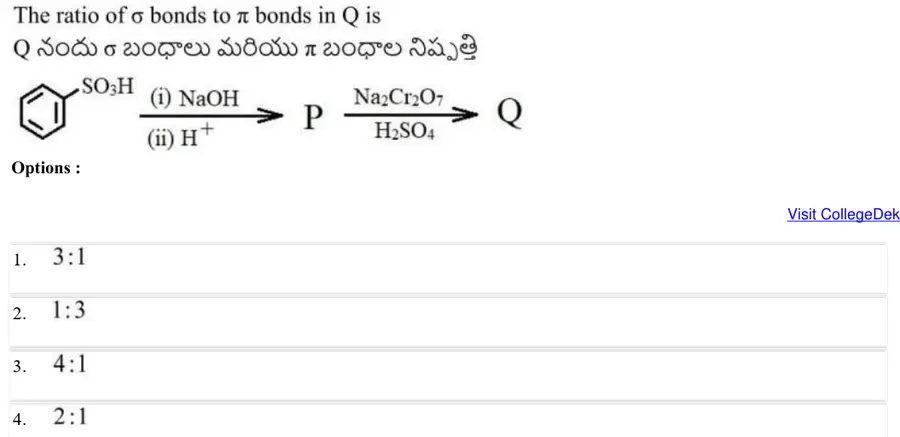
The ratio of $\sigma$ bonds to $\pi$ bonds in Q is
(see the figure above)
$3:1$
$1:3$
$4:1$
$2:1$
The atomic numbers of the elements X, Y, Z are a, a + 1, a + 2 respectively. Z is an alkali metal. The nature of bonding in the compound formed by X and Z is
Covalent
Metallic
Ionic
Coordinate covalent
The sets of molecules in which central atom has no lone pair of electrons are:
i. $\mathrm{SnCl_2}$, $\mathrm{NH_3}$, $\mathrm{SF_4}$
ii. $\mathrm{HgCl_2}$, $\mathrm{SO_3}$, $\mathrm{SF_6}$
iii. $\mathrm{BeCl_2}$, $\mathrm{BF_3}$, $\mathrm{PCl_5}$
iv. $\mathrm{ClF_3}$, $\mathrm{BrF_5}$, $\mathrm{XeF_6}$
i, iv only
ii, iii only
ii, iii, iv only
i, ii, iii only
The number of lone pairs of electrons on the central atom of $\mathrm{XeO_3}$, $\mathrm{XeOF_4}$ and $\mathrm{XeF_6}$ respectively is
1, 1, 1
3, 2, 1
2, 1, 0
1, 2, 1
The sum of bond order of $\mathrm{O_2^+}$, $\mathrm{O_2^-}$, $\mathrm{O_2}$ and $\mathrm{O_2^{2+}}$ is equal to
5
4
6
9
Observe the following statements
Statement – I: Hybridisation is not same in both $\mathrm{SF_6}$ and $\mathrm{BrF_5}$.
Statement – II: $\mathrm{BrF_5}$ is Square pyramidal while $\mathrm{SF_6}$ is octahedral in shape
The correct answer is
Both statements I and II are correct
Statement I is correct, but statement II is not correct
Statement I is not correct, but statement II is correct
Both statements I and II are not correct
In which of the following, intramolecular hydrogen bonding is present?
Resorcinol
Catechol
Quinol
o-Cresol
If the sum of bond orders of $\mathrm{O_2^-}$ and $\mathrm{O_2^{2-}}$ is $x$, then bond order of $\mathrm{O_2^{2+}}$ will be
$1.20x$
$1.33x$
$1.50x$
$2.50x$
Identify the molecule / ion in which the ratio of $\sigma$ to $\pi$ bonds is 3:2
$\mathrm{HCO_3^-}$
$\mathrm{CH_2(CN)_2}$
$\mathrm{HClO_4}$
$\mathrm{XeO_3}$
Identify the pair of molecules in which the hybridization of the central atom is $\mathrm{sp^2}$ with bent geometry
$\mathrm{H_2O, SO_2}$
$\mathrm{SO_2, O_3}$
$\mathrm{H_2O, O_3}$
$\mathrm{N_2O, H_2O}$
Consider the following statements.
I. In the conversion of $\mathrm{O_2}$ to $\mathrm{O_2^{2+}}$ bond order decreases.
II. In the conversion of $\mathrm{O_2}$ to $\mathrm{O_2^{2+}}$ magnetic property is not changed.
III. In the conversion of $\mathrm{O_2}$ to $\mathrm{O_2^{2+}}$ bond length decreases.
IV. $\mathrm{O_2^{2-}}$ and $\mathrm{B_2}$ have same bond order.
Identify the correct statements
I & III only
II & III only
III & IV only
I & IV only
The increasing order of boiling points of the following is
| $\mathrm{CH_3-O-CH_3}$ | $\mathrm{CH_3CHO}$ | $\mathrm{CH_3CH_2CH_3}$ | $\mathrm{CH_3CH_2OH}$ |
|---|---|---|---|
| I | II | III | IV |
$\mathrm{I} < \mathrm{III} < \mathrm{II} < \mathrm{IV}$
$\mathrm{III} < \mathrm{I} < \mathrm{II} < \mathrm{IV}$
$\mathrm{I} < \mathrm{IV} < \mathrm{III} < \mathrm{II}$
$\mathrm{III} < \mathrm{I} < \mathrm{IV} < \mathrm{II}$
Observe the following list of molecules. Number of polar and non polar molecules are respectively
$$\mathrm{NH_3, BF_3, NF_3, H_2S, CO_2, CH_4, CHCl_3, H_2O}$$
4, 4
3, 5
5, 3
2, 6
The molecule ‘X’ has see-saw shape with central atom in $\mathrm{sp^3d}$ hybridization. What is ‘X’?
$\mathrm{ClF_3}$
$\mathrm{XeF_4}$
$\mathrm{SF_4}$
$\mathrm{BrF_5}$
Identify the set of molecules in which the central atom has only one lone pair of electrons in their valence shells
$\mathrm{BrF_5, SF_4, SnCl_2}$
$\mathrm{BrF_5, XeF_4, SnCl_2}$
$\mathrm{XeF_4, NH_3, ClF_3}$
$\mathrm{XeF_6, ClF_3, SF_4}$
The bond order of which of the following two species is same?
$\mathrm{O_2, N_2}$
$\mathrm{C_2, O_2}$
$\mathrm{B_2, C_2}$
$\mathrm{F_2, C_2}$
In which of the following, there is no change in hybridisation of the central atom?
$\mathrm{NH_3 + H^+ \rightarrow NH_4^+}$
$\mathrm{BF_3 + F^- \rightarrow BF_4^-}$
$\mathrm{PCl_3 + Cl_2 \rightarrow PCl_5}$
$\mathrm{ClF_3 + F_2 \rightarrow ClF_5}$
In which of the following sets the sum of bond orders of three species is maximum?
$\mathrm{B_2, CN^-, O_2^{2-}}$
$\mathrm{O_2, F_2, O_2^{2+}}$
$\mathrm{O_2^-, N_2, O_2^+}$
$\mathrm{C_2, O_2, He_2^{2+}}$
The number of lone pairs of electrons on the central atom of $\mathrm{BrF_5}$, $\mathrm{XeO_3}$, $\mathrm{SO_2}$ respectively are
1, 1, 2
1, 2, 2
2, 2, 1
1, 1, 1
Which of the following orders are correct regarding their covalent character?
i. $\mathrm{KF < KI}$
ii. $\mathrm{LiF < KF}$
iii. $\mathrm{SnCl_2 < SnCl_4}$
iv. $\mathrm{NaCl < CuCl}$
The correct option is
i, ii, iii only
ii, iii, iv only
i, iii, iv only
i, ii, iv only
Observe the following sets
| Order | Property | |
|---|---|---|
| i. | $\mathrm{NH_3 > H_2O > SO_2}$ | Bond angle |
| ii. | $\mathrm{H_2O > NH_3 > H_2S}$ | Dipole moment |
| iii. | $\mathrm{N_2 > O_2 > H_2}$ | Bond enthalpy |
| iv. | $\mathrm{NO^+ > O_2 > O_2^{2-}}$ | Bond order |
Which of the above sets are correctly matched?
i, ii, iv only
ii, iii only
ii, iii, iv only
i, iii, iv only
The correct order of covalent bond character of $\mathrm{BCl_3}$, $\mathrm{CCl_4}$, $\mathrm{BeCl_2}$, $\mathrm{LiCl}$ is
$\mathrm{LiCl} < \mathrm{BeCl_2} < \mathrm{BCl_3} < \mathrm{CCl_4}$
$\mathrm{CCl_4} < \mathrm{BeCl_2} < \mathrm{BCl_3} < \mathrm{LiCl}$
$\mathrm{CCl_4} < \mathrm{BCl_3} < \mathrm{BeCl_2} < \mathrm{LiCl}$
$\mathrm{LiCl} < \mathrm{BCl_3} < \mathrm{BeCl_2} < \mathrm{CCl_4}$
In which of the following pairs, both molecules possess dipole moment?
$\mathrm{CO_2}$, $\mathrm{BCl_3}$
$\mathrm{BCl_3}$, $\mathrm{NF_3}$
$\mathrm{CO_2}$, $\mathrm{SO_2}$
$\mathrm{SO_2}$, $\mathrm{NF_3}$
The correct order of bond angles of the molecules $\mathrm{SiCl_4}$, $\mathrm{SO_3}$, $\mathrm{NH_3}$, $\mathrm{HgCl_2}$ is
$\mathrm{SO_3} > \mathrm{SiCl_4} > \mathrm{NH_3} > \mathrm{HgCl_2}$
$\mathrm{SiCl_4} > \mathrm{NH_3} > \mathrm{HgCl_2} > \mathrm{SO_3}$
$\mathrm{HgCl_2} > \mathrm{SO_3} > \mathrm{NH_3} > \mathrm{SiCl_4}$
$\mathrm{HgCl_2} > \mathrm{SO_3} > \mathrm{SiCl_4} > \mathrm{NH_3}$
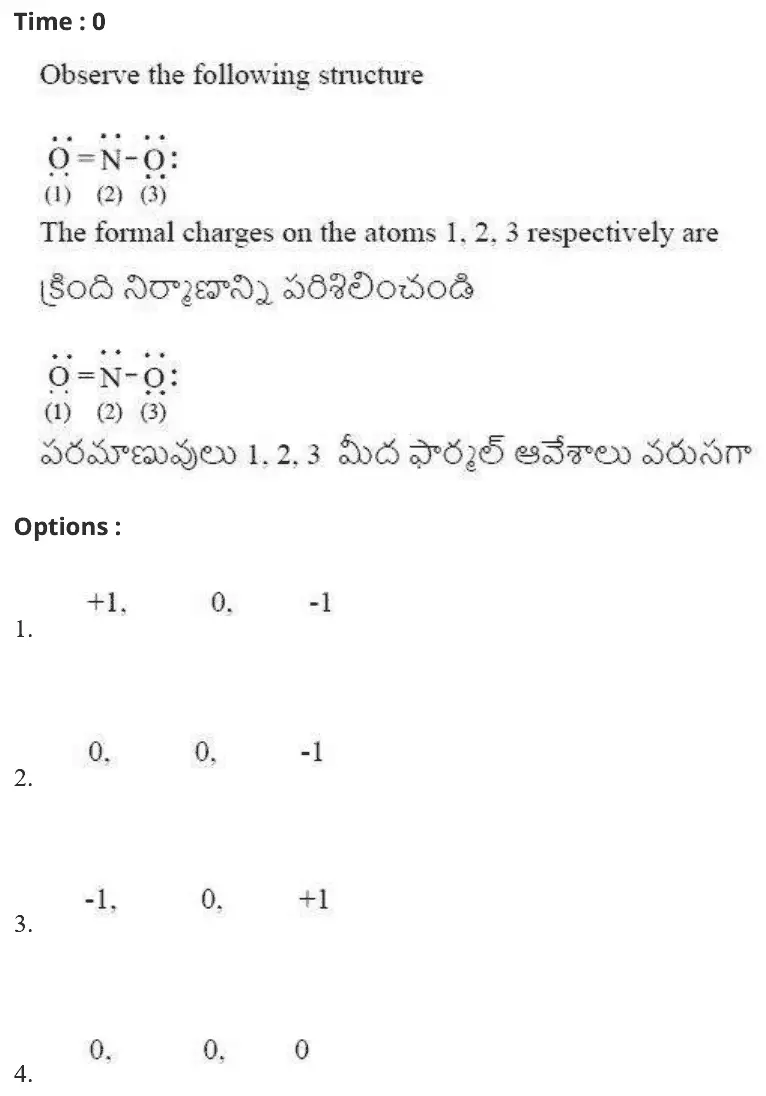
Observe the following structure
(see the figure above)
The formal charges on the atoms 1, 2, 3 respectively are
+1, 0, -1
0, 0, -1
-1, 0, +1
0, 0, 0
Observe the following reactions. Identify the reaction in which the hybridisation of underlined atom is changed
$\underline{\mathrm{N}}\mathrm{H_3} + \mathrm{H^+} \longrightarrow \underline{\mathrm{N}}\mathrm{H_4^+}$
$\underline{\mathrm{P}}\mathrm{Cl_3} + 3\,\mathrm{H_2O} \longrightarrow \mathrm{H_3}\underline{\mathrm{P}}\mathrm{O_3} + 3\,\mathrm{HCl}$
$\mathrm{NaNO_3} + \mathrm{H_2}\underline{\mathrm{S}}\mathrm{O_4} \longrightarrow \mathrm{NaH}\underline{\mathrm{S}}\mathrm{O_4} + \mathrm{HNO_3}$
$\underline{\mathrm{Xe}}\mathrm{F_6} + \mathrm{H_2O} \longrightarrow \underline{\mathrm{Xe}}\mathrm{OF_4} + 2\,\mathrm{HF}$
Among the following species, correct set of isostructural pairs are
$\mathrm{XeO_3, CO_3^{2-}, SO_3, H_3O^+, ClF_3}$
$(\mathrm{XeO_3, CO_3^{2-}})$ & $(\mathrm{SO_3, H_3O^+})$
$(\mathrm{XeO_3, SO_3})$ & $(\mathrm{CO_3^{2-}, H_3O^+})$
$(\mathrm{XeO_3, H_3O^+})$ & $(\mathrm{SO_3, CO_3^{2-}})$
$(\mathrm{SO_3, ClF_3})$ & $(\mathrm{XeO_3, CO_3^{2-}})$
In which of the following sets of molecules, the central atoms of molecules have same hybridisation?
$\mathrm{NH_3}$, $\mathrm{ClF_3}$
$\mathrm{H_2O}$, $\mathrm{SO_3}$
$\mathrm{SF_4}$, $\mathrm{CH_4}$
$\mathrm{XeF_6}$, $\mathrm{IF_7}$
The correct increasing order of number of lone pair of electrons on the central atom of $\mathrm{SnCl_2}$, $\mathrm{XeF_2}$, $\mathrm{ClF_3}$ and $\mathrm{SO_3}$ is
$\mathrm{SO_3 < ClF_3 < SnCl_2 < XeF_2}$
$\mathrm{SO_3 < SnCl_2 < ClF_3 < XeF_2}$
$\mathrm{XeF_2 < SnCl_2 < ClF_3 < SO_3}$
$\mathrm{XeF_2 < ClF_3 < SnCl_2 < SO_3}$
The bond lengths of diatomic molecules of elements X, Y and Z respectively are 143, 110 and 121 pm. The atomic numbers of X, Y and Z respectively are:
9, 7, 8
7, 8, 9
9, 8, 7
7, 9, 8
The correct formula used to determine the formal charge ($Q_f$) on an atom in the given Lewis structure of a molecule or ion is
(V = number of valence electrons in free atom, U = number of unshared electrons on the atom, B = number of bonds around the atom)
$Q_f = V - \left(\frac{U}{B}\right)$
$Q_f = V + (U - B)$
$Q_f = V - (U + B)$
$Q_f = V - \left(\frac{B}{U}\right)$
According to molecular orbital theory, which of the following statement is not correct?
$\mathrm{C_2}$ molecule is diamagnetic in nature
Bond order of $\mathrm{C_2}$ molecule is 2
$\mathrm{C_2^-}$ ion is paramagnetic in nature
$\mathrm{C_2}$ consists of $1\sigma$ and $1\pi$ bond
The melting point of o-hydroxybenzaldehyde (A) is lower than that of p-hydroxybenzaldehyde (B). This is because
(A) has intermolecular H-bonding and (B) has intramolecular H-bonding
Both (A) and (B) have intermolecular H-bonding
Both (A) and (B) have intramolecular H-bonding
(A) has intramolecular H-bonding and (B) has intermolecular H-bonding
Formic acid on heating with concentrated $\mathrm{H_2SO_4}$ at 373 K gives X, a colourless substance and Y, a good reducing agent. The number of $\sigma$ and $\pi$ bonds in X, Y are respectively
X = 2, 0; Y = 1, 2
X = 1, 2; Y = 2, 2
X = 2, 1; Y = 1, 1
X = 1, 2; Y = 3, 3
Identify the set of molecules which are not in the correct order of their dipole moments
$\mathrm{HF > HCl > HBr}$
$\mathrm{H_2O > H_2S > CO_2}$
$\mathrm{H_2S > HCl > HF}$
$\mathrm{NH_3 > NF_3 > BF_3}$
Match the following
| List – I (Molecule) | List – II (Shape) | ||
|---|---|---|---|
| A | $\mathrm{SF_4}$ | I | T – shaped |
| B | $\mathrm{ClF_3}$ | II | Square planar |
| C | $\mathrm{BrF_5}$ | III | See-saw |
| D | $\mathrm{XeF_4}$ | IV | Square pyramidal |
The correct answer is
A – II; B – III; C – I; D – IV
A – II; B – I; C – IV; D – III
A – III; B – II; C – IV; D – I
A – III; B – I; C – IV; D – II
$\mathrm{NH_2CONH_2 + 2H_2O \rightarrow [X] \rightleftharpoons 2NH_3 + H_2O + [Y]}$
The hybridization of carbon in X and Y respectively are
$\mathrm{sp^2, sp}$
$\mathrm{sp, sp^2}$
$\mathrm{sp^3, sp^2}$
$\mathrm{sp^2, sp^3}$
The number of lone pairs of electrons on central atom of $\mathrm{ClF_3}$, $\mathrm{NF_3}$, $\mathrm{SF_4}$, $\mathrm{XeF_4}$ respectively are
0,1,0,2
2,1,0,0
2,1,1,2
2,1,1,0
The hybridisation of central atom of $\mathrm{BF_3}$, $\mathrm{SnCl_2}$, $\mathrm{HgCl_2}$ respectively is
$sp^2, sp^2, sp$
$sp^2, sp^2, sp^2$
$sp^3, sp^2, sp^2$
$sp^3, sp, sp^2$
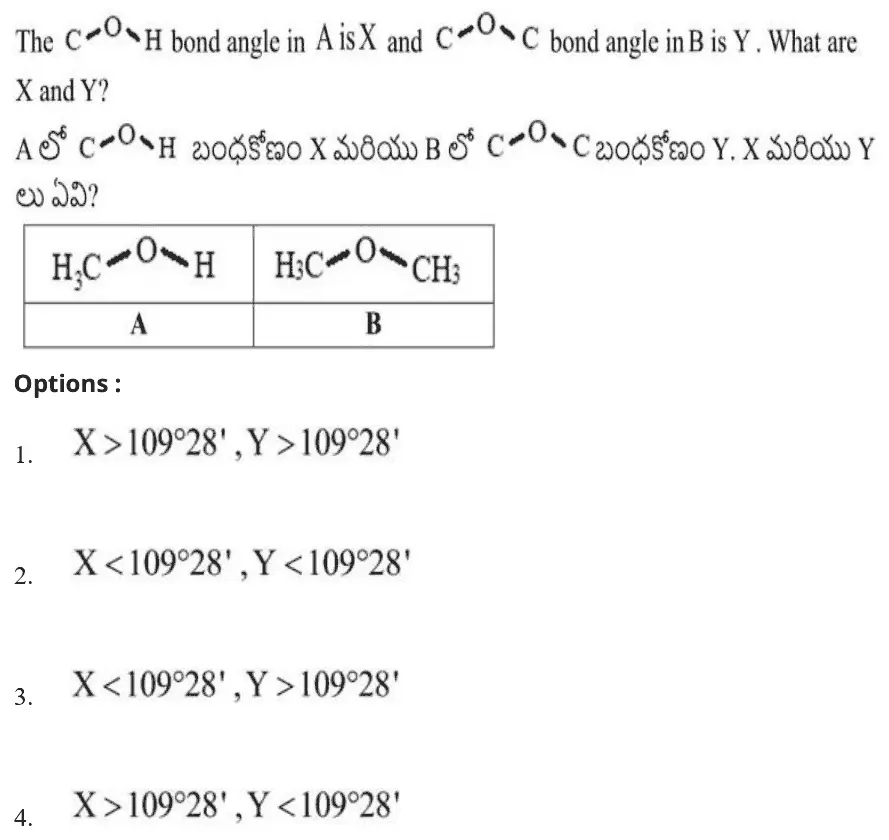
The C–O–H bond angle in A is X and C–O–C bond angle in B is Y. What are X and Y?
(see the figure above)
$X > 109^\circ 28'$, $Y > 109^\circ 28'$
$X < 109^\circ 28'$, $Y < 109^\circ 28'$
$X < 109^\circ 28'$, $Y > 109^\circ 28'$
$X > 109^\circ 28'$, $Y < 109^\circ 28'$
According to Fajan’s rules, which of the following is not correct about covalent character?
$\mathrm{KF < KI}$
$\mathrm{LiF < KF}$
$\mathrm{SnCl_2 < SnCl_4}$
$\mathrm{NaCl < CuCl}$
Consider the following pairs
| Order | Property | |
|---|---|---|
| A) | $\mathrm{NO_2 > O_3 > H_2O}$ | Bond angle |
| B) | $\mathrm{HF > H_2O > NH_3}$ | Dipole moment |
| C) | $\mathrm{I_2 > F_2 > N_2}$ | Bond length |
Which of the above pairs are correctly matched?
A, B & C
B & C only
A & C only
A & B only
Identify the pair in which difference in bond order value is maximum
$\mathrm{O_2^-, O_2^+}$
$\mathrm{O_2^{2-}, O_2^{2+}}$
$\mathrm{O_2, O_2^{2+}}$
$\mathrm{O_2^+, O_2^{2+}}$
The pair of molecules/ions with same geometry but central atoms in them are in different states of hybridization is
$\mathrm{SnCl_2, H_2O}$
$\mathrm{SF_4, XeF_4}$
$\mathrm{NH_4^+, CO_3^{2-}}$
$\mathrm{PF_5, BrF_5}$
Consider the following reactions
$\mathrm{X + O_2 \rightarrow Cu_2O + SO_2}$
$\mathrm{Cu_2O + X \rightarrow Cu + Y\uparrow}$
The shape of the molecule Y is
Linear
Tetrahedral
Pyramidal
Angular
Arrange the following in the correct order of their boiling points
| $\mathrm{(C_2H_5)_2O}$ | $\mathrm{CH_3(CH_2)_3OH}$ | $\mathrm{CH_3CH-CH_2OH}$ with $\mathrm{CH_3}$ attached below the CH (i.e. $\mathrm{(CH_3)_2CHCH_2OH}$) | $\mathrm{CH_3-(CH_2)_3-CH_3}$ |
| I | II | III | IV |
I > III > II > IV
II > I > III > IV
III > II > I > IV
II > III > IV > I
Which of the following pairs of molecules is isostuctural?
$\mathrm{HgCl_2}$, $\mathrm{SO_2}$
$\mathrm{SnCl_2}$, $\mathrm{PbCl_2}$
$\mathrm{SF_4}$, $\mathrm{XeF_4}$
$\mathrm{NH_3}$, $\mathrm{SO_3}$
What are the formal charges on terminal oxygens of ozone molecule?
$+1, -1$
$+1, +1$
$-1, -1$
$0, -1$
Match the following
| List – I (Molecules) | List – II (Dipolemoment $\mu$, D) |
|---|---|
| A. $\mathrm{H_2O}$ | I. 0 |
| B. $\mathrm{BF_3}$ | II. 0.23 |
| C. $\mathrm{NH_3}$ | III. 1.47 |
| D. $\mathrm{NF_3}$ | IV. 1.85 |
The correct answer is
A – IV, B – I, C – II, D – III
A – IV, B – I, C – III, D – II
A – IV, B – III, C – I, D – II
A – III, B – IV, C – II, D – I
Which of the following is the correct order of increasing number of lone pair of electrons on the central atom?
$\mathrm{IF_5 < XeF_2 < IF_7 < ClF_3}$
$\mathrm{IF_7 < ClF_3 < XeF_2 < IF_5}$
$\mathrm{IF_7 < XeF_2 < ClF_2 < IF_5}$
$\mathrm{IF_7 < IF_5 < ClF_3 < XeF_2}$
Match the following
| List – I (Hybridisation) | List – II (Shape) |
|---|---|
| A. $\mathrm{dsp^2}$ | I. Square planar |
| B. $\mathrm{sp^3}$ | II. Tetrahedral |
| C. $\mathrm{d^2sp^3}$ | III. Octahedral |
| D. $\mathrm{sp^3d}$ | IV. Trigonal bipyramidal |
The correct answer is
A – II, B – I, C – III, D - IV
A – I, B – II, C – III, D – IV
A – III, B – IV, C – II, D – I
A – IV, B – III, C – II, D – I
The hybridization of central atom of $\mathrm{ClF_3}$, $\mathrm{NH_3}$, $\mathrm{SO_3}$ are respectively
$\mathrm{sp^2}$, $\mathrm{sp^2}$, $\mathrm{sp^2}$
$\mathrm{sp^3d}$, $\mathrm{sp^3}$, $\mathrm{sp^2}$
$\mathrm{sp^2}$, $\mathrm{sp^3}$, $\mathrm{sp^3d}$
$\mathrm{sp^3d}$, $\mathrm{sp^3}$, $\mathrm{sp^3}$
Arrange the hydrides $\mathrm{NH_3}$, $\mathrm{HF}$, $\mathrm{H_2O}$, $\mathrm{HCl}$ in the increasing order of their boiling points
$\mathrm{HF} < \mathrm{NH_3} < \mathrm{HCl} < \mathrm{H_2O}$
$\mathrm{H_2O} < \mathrm{HF} < \mathrm{HCl} < \mathrm{NH_3}$
$\mathrm{NH_3} < \mathrm{HCl} < \mathrm{H_2O} < \mathrm{HF}$
$\mathrm{HCl} < \mathrm{NH_3} < \mathrm{HF} < \mathrm{H_2O}$
The correct order of bond enthalpy of given molecules is
$\mathrm{O_2 < N_2 < H_2}$
$\mathrm{N_2 < O_2 < H_2}$
$\mathrm{H_2 < N_2 < O_2}$
$\mathrm{H_2 < O_2 < N_2}$
The number of bond pairs of electrons and total number of lone pairs of electrons in $\mathrm{XeOF_4}$ are respectively
6, 10
5, 15
5, 10
6, 15
In which of the following, the molecules are arranged in the increasing order of their bond angles?
$\mathrm{P_4 < S_6 < O_3 < S_8}$
$\mathrm{S_6 < O_3 < S_8 < P_4}$
$\mathrm{O_3 < S_8 < P_4 < S_6}$
$\mathrm{P_4 < S_6 < S_8 < O_3}$
Match the following
| List – I (Molecule / Ion) | List – II (Shape) |
|---|---|
| A. $\mathrm{I_3^-}$ | 1. T-shaped |
| B. $\mathrm{ClF_3}$ | 2. See-Saw |
| C. $\mathrm{H_2O}$ | 3. Angular |
| D. $\mathrm{SF_4}$ | 4. Linear |
A - 4, B – 1, C – 3, D - 2
A - 4, B – 1, C – 2, D – 3
A - 2, B – 3, C – 4, D – 1
A - 3, B – 2, C – 4, D – 1
Given below are two statements
Assertion (A): Ionic compounds are formed by non-directional bonds
Reasoning (R): They are soluble in nonpolar solvents
The correct answer is
Both (A) and (R) are correct and (R) is the correct explanation of (A)
Both (A) and (R) are correct and (R) is not the correct explanation of (A)
(A) is correct but (R) is not correct
(A) is not correct but (R) is correct
Match the following
| List-I (Molecule / ion) | List II (Number of lone pairs of electrons on the central atom) |
|---|---|
| A) $\mathrm{XeF_2}$ | I) 2 |
| B) $\mathrm{XeO_3}$ | II) 0 |
| C) $\mathrm{XeF_4}$ | III) 3 |
| D) $\mathrm{PF_6^-}$ | IV) 1 |
The correct answer is
A-III, B-IV, C-I, D-II
A-I, B-II, C-IV, D-III
A-II, B-I, C-III, D-IV
A-III, B-IV, C-II, D-I
The correct order of bond angles of the following is
$\mathrm{H_2O}$ (I) $\mathrm{NH_3}$ (II) $\mathrm{CH_4}$ (III) $\mathrm{SO_2}$ (IV)
IV > III > II > I
IV > III > I > II
I > II > III > IV
I > II > IV > III
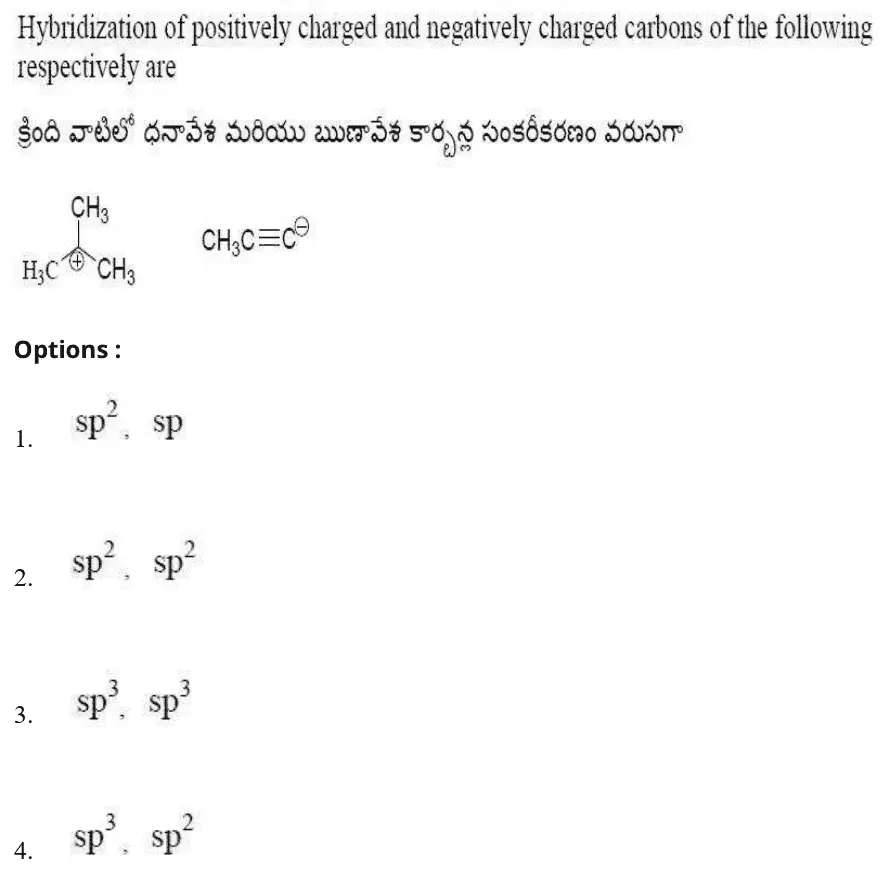
Hybridization of positively charged and negatively charged carbons of the following respectively are
(see the figure above)
$\mathrm{sp^2}$, $\mathrm{sp}$
$\mathrm{sp^2}$, $\mathrm{sp^2}$
$\mathrm{sp^3}$, $\mathrm{sp^3}$
$\mathrm{sp^3}$, $\mathrm{sp^2}$
The correct order of C – O bond length in $\mathrm{CO}$, $\mathrm{CO_3^{2-}}$, $\mathrm{CO_2}$ is
$\mathrm{CO} < \mathrm{CO_3^{2-}} < \mathrm{CO_2}$
$\mathrm{CO_3^{2-}} < \mathrm{CO_2} < \mathrm{CO}$
$\mathrm{CO} < \mathrm{CO_2} < \mathrm{CO_3^{2-}}$
$\mathrm{CO_2} < \mathrm{CO_3^{2-}} < \mathrm{CO}$
The $\mathrm{P-P-P}$ bond angle in $\mathrm{P_4}$ and $\mathrm{S-S-S}$ bond angle in cyclo $\mathrm{S_8}$ molecule are respectively
$107^0,\ 60^0$
$60^0,\ 40^0$
$60^0,\ 107^0$
$40^0,\ 60^0$
If the bond order in $\mathrm{C_2}$ is 'x' then the bond order in $\mathrm{B_2}$ and $\mathrm{O_2}$, respectively are
$\frac{1}{2}x, 2x$
$x, x$
$\frac{1}{2}x, x$
$x, 2x$
Identify incorrectly matched set from the following
Molecules with incomplete octet-$\mathrm{BeH_2}$, $\mathrm{BCl_3}$
Polar molecules- $\mathrm{BF_3}$, $\mathrm{CCl_4}$
Molecules with expanded octet- $\mathrm{PCl_5}$, $\mathrm{SF_6}$
Odd electron molecules-$\mathrm{NO}$, $\mathrm{NO_2}$
The O-H bond length in $\mathrm{H_2O}$ in gas phase is
$95.7\,\mathrm{pm}$
$90.2\,\mathrm{pm}$
$104.5\,\mathrm{pm}$
$115.5\,\mathrm{pm}$
Which of the following sets is correct?
| Molecule | Hybridization | Geometry | Number of lone pairs of electrons on central atom | |
|---|---|---|---|---|
| I | $\mathrm{SiH_4}$ | $sp^3$ | tetrahedral | 0 |
| II | $\mathrm{BeCl_2}$ | $sp^2$ | linear | 1 |
| III | $\mathrm{SF_4}$ | $dsp^3$ | square planar | 1 |
| IV | $\mathrm{SnCl_2}$ | $sp$ | linear | 0 |
I
II
III
IV
Which of the following is not the property of covalent substances?
have definite shape
have low melting points
good conductors of electricity
soluble in non – polar solvents
According to MO theory, the molecule which contains only $\pi$- bonds between the atoms is
$\mathrm{C_2}$
$\mathrm{N_2}$
$\mathrm{O_2}$
$\mathrm{B_2}$
In which of the following changes there is no change in hybridisation of the central atom?
$\mathrm{C_2H_4 \xrightarrow{H_2/Ni} C_2H_6}$
$\mathrm{PCl_5 + Cl^- \longrightarrow PCl_6^-}$
$\mathrm{BF_3 + F^- \longrightarrow BF_4^-}$
$\mathrm{NH_3 + H^+ \longrightarrow NH_4^+}$
The ratio of lone pair of electrons to bond pair of electrons in ozone molecule is
2:1
3:2
2:3
1:2
In which of the following, molecules are arranged in the increasing order of their bond angles?
$\mathrm{NH_3 < SO_2 < H_2O}$
$\mathrm{H_2O < NH_3 < SO_2}$
$\mathrm{SO_2 < NH_3 < H_2O}$
$\mathrm{SO_2 < H_2O < NH_3}$
Arrange the molecules $\mathrm{B_2}$, $\mathrm{He_2}$, $\mathrm{N_2}$ and $\mathrm{C_2}$ in the increasing order of their bond order values
$\mathrm{C_2 < He_2 < B_2 < N_2}$
$\mathrm{N_2 < B_2 < C_2 < He_2}$
$\mathrm{He_2 < B_2 < C_2 < N_2}$
$\mathrm{He_2 < C_2 < N_2 < B_2}$
From the following, identify the ions with same bond order
I. $\mathrm{CN^-}$
II. $\mathrm{N_2^+}$
III. $\mathrm{O_2^{2-}}$
IV. $\mathrm{NO^+}$
I & II only
II &III only
I &IV only
I & III only
The hybridizations of the central atom in the molecules $\mathrm{BF_3}$, $\mathrm{BeF_2}$, $\mathrm{BrF_3}$ are respectively
$\mathrm{sp^2}$, $\mathrm{sp}$, $\mathrm{sp^3d}$
$\mathrm{sp}$, $\mathrm{sp^2}$, $\mathrm{sp^3}$
$\mathrm{sp^3}$, $\mathrm{sp}$, $\mathrm{sp^3d}$
$\mathrm{sp^2}$, $\mathrm{sp^3}$, $\mathrm{dsp^2}$
Which one of the following compounds is having maximum ‘lone pair-lone pair’ electron repulsions?
$\mathrm{ClF_3}$
$\mathrm{IF_5}$
$\mathrm{SF_4}$
$\mathrm{XeF_2}$
Identify the number of molecules in which the central atom has one lone pair of electrons from the following list
$\mathrm{PbCl_2}$, $\mathrm{PH_3}$, $\mathrm{ClF_3}$, $\mathrm{SF_4}$, $\mathrm{BF_3}$, $\mathrm{SnCl_2}$
3
4
1
2
In which of the following molecules, the number of lone pairs of electrons on central atom and the number d-orbitals involved in the hybridisation of central atom, is same?
$\mathrm{ClF_3}$
$\mathrm{PCl_5}$
$\mathrm{BrF_5}$
$\mathrm{SF_4}$
Match the following
| List –I (Molecule /ion) | List-II (Shape) | ||
|---|---|---|---|
| A) | $\mathrm{SnCl_2}$ | I. | Trigonal planar |
| B) | $\mathrm{NH_3}$ | II. | Linear |
| C) | $\mathrm{I_3^-}$ | III. | Angular |
| D) | $\mathrm{SO_3}$ | IV. | Trigonal pyramidal |
The correct answer is
A – III, B - I, C - II, D – IV
A – IV, B - III, C - I, D – II
A – III, B - I, C - IV, D – II
A – III, B - IV, C - II, D – I
In which of the following set of molecules the hybridisation of central atoms is different?
$\mathrm{H_2O}$, $\mathrm{NH_3}$, $\mathrm{CH_4}$
$\mathrm{ClF_3}$, $\mathrm{XeF_2}$, $\mathrm{PCl_5}$
$\mathrm{CO_2}$, $\mathrm{CO}$, $\mathrm{BeF_2}$
$\mathrm{SF_4}$, $\mathrm{XeF_4}$, $\mathrm{CH_4}$
Identify the option in which the molecules are arranged in the correct order of their dipole moments
$\mathrm{CO_2 < H_2O < H_2S}$
$\mathrm{HF < HCl < HBr}$
$\mathrm{BF_3 < NF_3 < NH_3}$
$\mathrm{CH_4 < CHCl_3 < CCl_4}$
The bond order of $\mathrm{O_2^+}$ is $x$. The bond orders of $\mathrm{O_2^-}$ and $\mathrm{O_2^{2+}}$ are respectively
$\frac{5}{3}x, \frac{5}{6}x$
$\frac{3}{5}x, \frac{6}{5}x$
$\frac{2}{5}x, \frac{3}{5}x$
$\frac{5}{2}x, \frac{5}{3}x$
In which of the following options, molecules are correctly arranged with respect to their bond angles.
$\mathrm{S_6 < O_3 < S_8 < P_4}$
$\mathrm{P_4 < O_3 < S_6 < S_8}$
$\mathrm{P_4 < S_6 < S_8 < O_3}$
$\mathrm{S_6 < P_4 < S_8 < O_3}$
The set of molecules among the following with zero dipole moment is $\mathrm{CCl_4}$, $\mathrm{BF_3}$, $\mathrm{CHCl_3}$, $\mathrm{CS_2}$, $\mathrm{NH_3}$, 1, 4-dichlorobenzene, $\mathrm{CO_2}$
$\mathrm{CO_2}$, $\mathrm{CS_2}$, $\mathrm{BF_3}$, $\mathrm{NH_3}$, $\mathrm{CHCl_3}$ only
$\mathrm{CCl_4}$, $\mathrm{BF_3}$, $\mathrm{CO_2}$, $\mathrm{CS_2}$, 1, 4-dichlorobenzene only
$\mathrm{CO_2}$, $\mathrm{CS_2}$, 1, 4-dichlorobenzene only
$\mathrm{CO_2}$, $\mathrm{CS_2}$ only
The correct pair of species which are not isostructural is
$\mathrm{PF_6^{-}}$ and $\mathrm{SF_6}$
$\mathrm{IO_3^{-}}$ and $\mathrm{XeO_3}$
$\mathrm{BH_4^{-}}$ and $\mathrm{NH_4^{+}}$
$\mathrm{BrF_5}$ and $\mathrm{XeF_4}$
Assertion (A) : Hydrogen fluoride has higher boiling point than other hydrogen halides.
Reason (R) : Hydrogen fluoride exhibits strong hydrogen bonding.
The correct option among the following is
(A) is true, (R) is true and (R) is the correct explanation for (A)
(A) is true, (R) is true but (R) is not the correct explanation for (A)
(A) is true but (R) is false
(A) is false but (R) is true
The intramolecular hydrogen bonding is present in
phenol
Benzoic acid
para-Nitrophenol
2-Hydroxybenzoic Acid
The compounds with $sp^2$ hybridized central atom among the following are
A) $\mathrm{H_2CO_3}$ B) $\mathrm{SiF_4}$
C) $\mathrm{BF_3}$ D) $\mathrm{HClO_2}$
A and C only
A and B only
C and D only
A, B, C and D
The hybridisation and shape of $\mathrm{I_3^-}$ ion, respectively, are
$sp^3d^2$; distorted octahedral
$sp^3d$; linear
$sp^3d$; Trigonal bipyramid
$dsp^3$; Square pyramidal
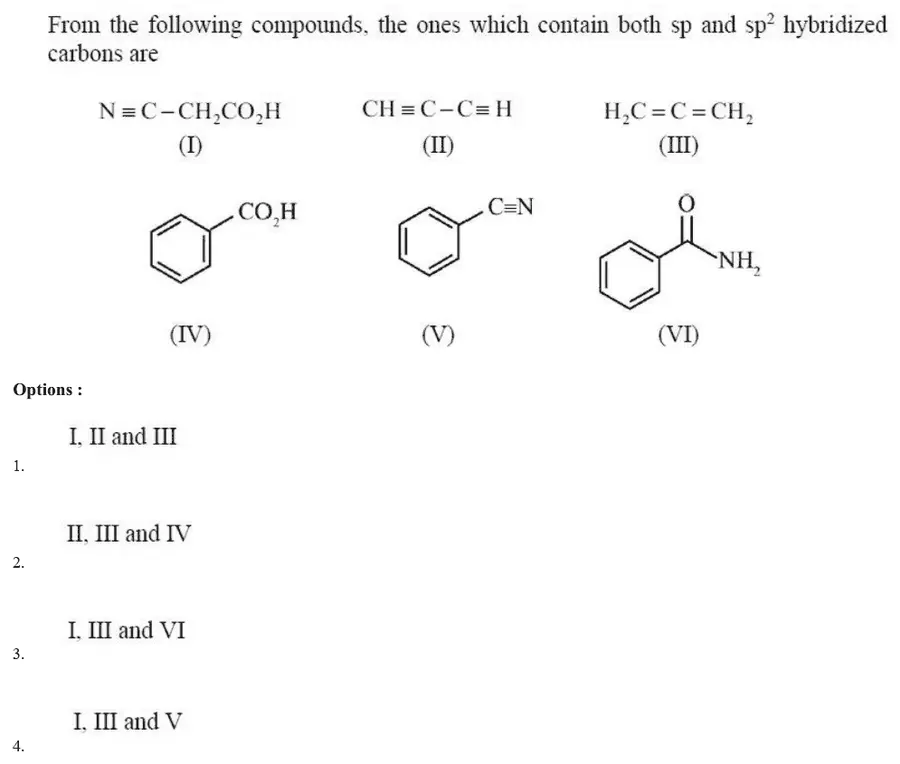
From the following compounds, the ones which contain both sp and $sp^2$ hybridized carbons are
(see the figure above)
I, II and III
II, III and IV
I, III and VI
I, III and V
The correct pair of species with (A) the highest bond order and (B) diamagnetic character is
A: $\mathrm{O_2}$; B: $\mathrm{O_2^+}$
A: $\mathrm{O_2^+}$; B: $\mathrm{O_2^{2-}}$
A: $\mathrm{O_2^-}$; B: $\mathrm{O_2}$
A: $\mathrm{O_2^{2-}}$; B: $\mathrm{O_2^+}$
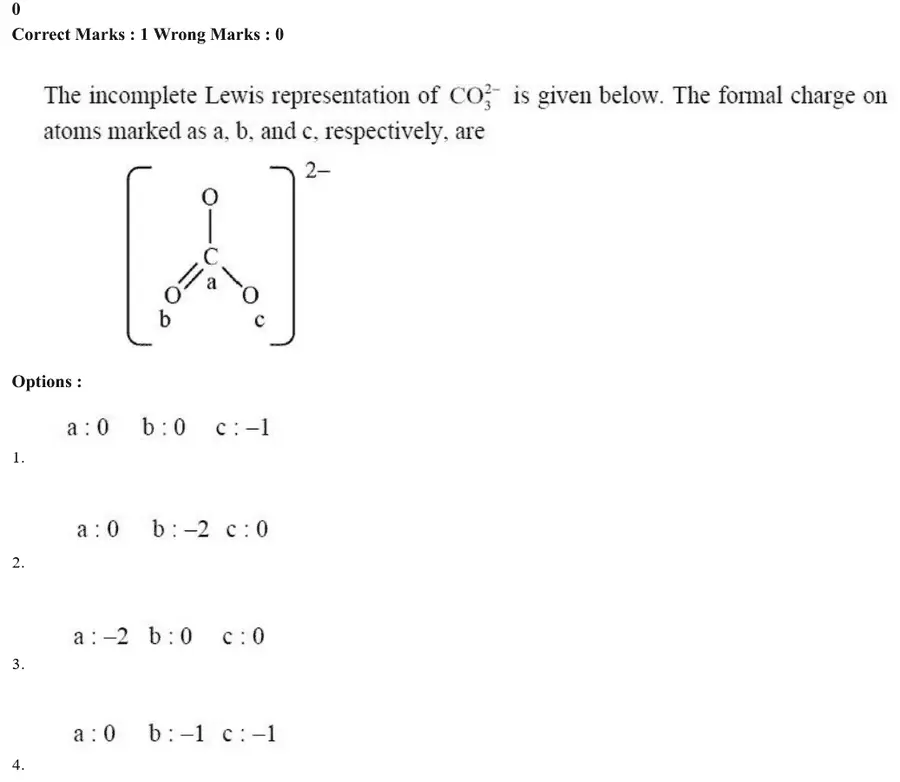
The incomplete Lewis representation of $\mathrm{CO_3^{2-}}$ is given below. The formal charge on atoms marked as a, b, and c, respectively, are
(see the figure above)
a : 0 b : 0 c : $-1$
a : 0 b : $-2$ c : 0
a : $-2$ b : 0 c : 0
a : 0 b : $-1$ c : $-1$
The correct order of the bond angles of the compounds $\mathrm{SiCl_{4},BF_{3},BeCl_{2}}$ and $\mathrm{SF_{6}}$ is
$\mathrm{BF_{3}>BeCl_{2}>SF_{6}>SiCl_{4}}$
$\mathrm{BeCl_{2}>SF_{6}>SiCl_{4}>BF_{3}}$
$\mathrm{BeCl_{2}>SiCl_{4}>BF_{3}>SF_{6}}$
$\mathrm{BeCl_{2}>BF_{3}>SiCl_{4}>SF_{6}}$
Identify all the species that do not exist
$\mathrm{H_{2}^{+},He_{2}^{2+},Li_{2}^{2-},Ne_{2},Be_{2}^{-},He_{2}}$
$\mathrm{He_{2},Ne_{2}}$ only
$\mathrm{Li_{2}^{2-},Ne_{2},He_{2}}$ only
$\mathrm{Be_{2}^{-},He_{2},Ne_{2}}$ only
$\mathrm{H_{2}^{+},Li_{2}^{2-}}$ only
The correct order of melting points of the following salts is
LiCl LiF LiI
I II III
$\mathrm{I>II>III}$
$\mathrm{II>I>III}$
$\mathrm{III>II>I}$
$\mathrm{II>III>I}$
The correct order of C-O bond length is
$\mathrm{CO_{3}^{2-}}<\mathrm{CO_{2}}<\mathrm{CO}$
$\mathrm{CO_{2}}<\mathrm{CO_{3}^{2-}}<\mathrm{CO}$
$\mathrm{CO}<\mathrm{CO_{3}^{2-}}<\mathrm{CO_{2}}$
$\mathrm{CO}<\mathrm{CO_{2}}<\mathrm{CO_{3}^{2-}}$
How many of the following species have the bond order 2 ?
$\mathrm{C_{2},B_{2}^{2-},N_{2}^{2+},CN^{+},NO^{-},O_{2},C_{2}^{+}}$
$3$
$4$
$6$
$5$
The compound with more covalent character in the following is
$\mathrm{FeF_{3}}$
$\mathrm{VF_{5}}$
$\mathrm{VF_{2}}$
$\mathrm{TiF_{2}}$
The change in enthalpy [$\Delta$H] in kJ mol$^{-1}$ for the reaction is
Mg + 2F $\rightarrow$ Mg F$_{2}$
Given: EA of F = 328 kJ mol$^{-1}$, IE$_{1}$ of Mg = 737 kJ mol$^{-1}$, IE$_{2}$ of Mg = 1451 kJ mol$^{-1}$
3064
876
1860
1532
Dipole – induced dipole interactions are present between which of the following pairs?
$\mathrm{H_{2}O}$ and $\mathrm{C_{2}H_{5}OH}$
$\mathrm{Cl_{2}}$ and $\mathrm{CCl_{4}}$
$\mathrm{NH_{3}}$ and $\mathrm{H_{2}}$
$\mathrm{SiF_{4}}$ and $\mathrm{BF_{3}}$
According to the Lewis formula of $\mathrm{O_{3}}$, the correct option is
σ bonds: 2; π bonds: 1; lone pairs of electrons: 3
σ bonds: 2; π bonds: 1; lone pairs of electrons: 4
σ bonds: 1; π bonds: 2; lone pairs of electrons: 4
σ bonds: 2; π bonds: 1; lone pairs of electrons: 6
The linear molecule among the following is
$\mathrm{SnCl_{2}}$
$\mathrm{PbCl_{2}}$
$\mathrm{SO_{2}}$
$\mathrm{XeF_{2}}$
If the bond order of CO is x, the bond order of $\mathrm{O_2^{2-}}$ ion is
$x$
$x/2$
$x/3$
$2x$
As per molecular orbital theory the pair of molecules which do not exist is
$\mathrm{Li_2,\ B_2}$
$\mathrm{He_2,\ C_2}$
$\mathrm{Be_2,\ C_2}$
$\mathrm{Be_2,\ Ne_2}$
The bond order of dioxygen is 'm'. The bond order values of $\mathrm{N_2^{+}}$ and $\mathrm{C_2^{2-}}$ are respectively
$\dfrac{5m}{4},\ \dfrac{3m}{2}$
$\dfrac{3m}{2},\ \dfrac{5m}{4}$
$\dfrac{m}{2},\ \dfrac{m}{3}$
$\dfrac{2m}{3},\ \dfrac{m}{2}$
Identify the correct statements from the following
(I) $\mathrm{SnCl_2}$ is ionic, but $\mathrm{SnCl_4}$ is covalent in nature
(II) All linear diatomic molecules have zero dipole moment
(III) Both NO and $\mathrm{O_2}$ are paramagnetic
(I) and (II) only
(I) and (III) only
(II) and (III) only
(I), (II) and (III)
The molecule which has more number of lone pair of electrons than the bond pair of electrons in its central atom is
$\mathrm{XeF_2}$
$\mathrm{ClF_3}$
$\mathrm{XeF_4}$
$\mathrm{SF_4}$
Arrange the following in the correct order of their bond orders.
$\mathrm{N_2}$ (I), $\mathrm{O_2}$ (II), $\mathrm{O_2^+}$ (III), $\mathrm{O_2^-}$ (IV)
II > III > I > IV
III > II > IV > I
I > III > II > IV
I > II > III > IV
The bond order values of anions of sodium peroxide and potassium super oxide are respectively.
$1, 1.5$
$1, 0.5$
$0.5, 1$
$2, 0.5$
Which of the following compounds do not have $\mathrm{sp^3}$ carbon atom(s)?
I. Acetone II. Acetic acid III. Buta-1, 3-diene IV. Propyne V. Naphthalene
I, II only
II, III only
IV, V only
III, V only
Arrange the following species in the decreasing order of their bond orders.
$\mathrm{NO}$ (I) $\mathrm{NO^+}$ (II) $\mathrm{NO^-}$ (III)
(I) > (II) > (III)
(II) > (I) > (III)
(II) > (III) > (I)
(III) > (II) > (I)
The standard molar enthalpy of vaporisation ($\Delta_{vap}H^\circ$) of A, B and C liquids is 23.3, 41 and 29 $\mathrm{kJ\,mol^{-1}}$ respectively. The correct order of dipole-dipole attractive forces in these liquids is:
B > C > A
B > A > C
A > C > B
A > B > C
Aluminium chloride in acidified aqueous (printed "aqueons") solution gives a complex ion 'X'. The hybridization of central atom in X is
$\mathrm{sp^3}$
$\mathrm{sp^2d}$
$\mathrm{d^2sp^3}$
$\mathrm{sp^3d^2}$
Identify the molecules which have sp- hybridized carbon(s) from the list given under.
I. Ethane nitrile, II. Buta-1, 3 - diene, III. Propa-1, 2-diene, IV. Ethyne V. Benzene
I, II, III only
II, III, IV only
III, IV, V only
I, III, IV only
Match the following
List - I (Molecule / ion): A) $ICl_4^-$ B) $NO_3^-$ C) $PCl_4^+$ D) $SiF_6^{2-}$
List - II (Hybridisation): a) $sp^3$ b) $sp^3d$ c) $sp^3d^2$ d) $sp^2$ e) $sp$
(A) $-$ a, (B) $-$ d, (C) $-$ b, (D) $-$ e
(A) $-$ b, (B) $-$ e, (C) $-$ a, (D) $-$ d
(A) $-$ c, (B) $-$ d, (C) $-$ a, (D) $-$ c
(A) - d, (B) $-$ b, (C) $-$ c, (D) - a
Identify the pair of species with same geometries
$\mathrm{XeF_4,\ PCl_4^+}$
$\mathrm{NH_3,\ ClF_3}$
$\mathrm{SF_4,\ NH_4^+}$
$\mathrm{XeF_2,\ I_3^-}$
The correct order of dipole moment of the molecules $\mathrm{NH_3}$ (I), $\mathrm{BF_3}$ (II), $\mathrm{H_2O}$(III), $\mathrm{NF_3}$(IV) is
III > I > IV > II
IV > I > III > II
I > IV > II > III
III > II > I > IV
The number of $\mathrm{sp^2}$, $\mathrm{sp^3}$ hybridised carbons in cumene, respectively are:
$6,2$
$3,6$
$6,3$
$4,4$
In the Lewis dot structure of carbonate ion shown under the formal charges on the oxygen atoms 1,2 & 3 are respectively:
(see the figure above)
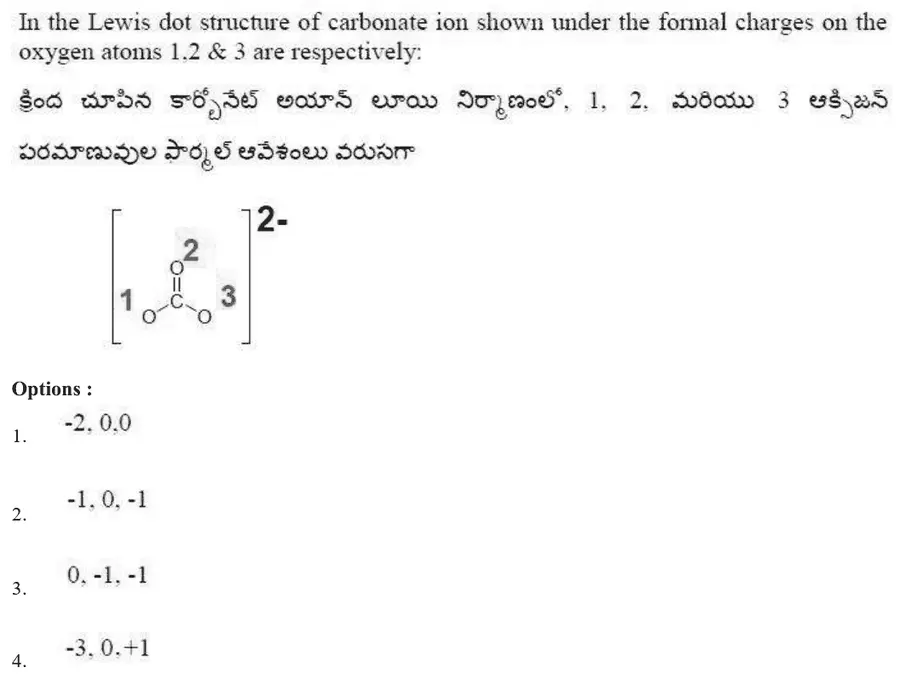
-2, 0,0
-1, 0, -1
0, -1, -1
-3, 0,+1
The set of species having only fractional bond order values is
$C_2^{2-}, N_2, O_2^{2-}$
$O_2^{+}, O_2^{-}, N_2^{+}$
$O_2^{2+}, O_2, C_2^{2-}$
$Li_2, H_2^{+}, C_2$
The combination of which of the following gives an ionic compound with maximum covalent character.
$\mathrm{Mg^{2+}}$ and $\mathrm{Cl^{-}}$
$\mathrm{Mg^{2+}}$ and $\mathrm{O^{2-}}$
$\mathrm{Na^{+}}$ and $\mathrm{Br^{-1}}$
$\mathrm{Na^{+}}$ and $\mathrm{O^{2-}}$
The tetra atomic molecules/ions with different shapes are
$\mathrm{TeCl_4, SeF_4}$
$\mathrm{CH_4, PCl_4^{+}}$
$\mathrm{SF_4, NH_4^{+}}$
$\mathrm{SiH_4, CCl_4}$
Choose the correct option from the following
KF is more covalent than KI
$\mathrm{SnCl_4}$ is less covalent than $\mathrm{SnCl_2}$
LiF is more covalent than KF
$\mathrm{ZnCl_2}$ is less covalent than NaCl
The bond lengths of $\mathrm{C_2}$, $\mathrm{N_2}$ and $\mathrm{B_2}$ molecules are $X_1$, $X_2$ and $X_3$ pm respectively. The correct order of their bond lengths is
$X_3 > X_1 > X_2$
$X_2 > X_3 > X_1$
$X_1 > X_2 > X_3$
$X_1 > X_3 > X_2$
The set of molecules in which the central atom is not obeying the octet rule is
$\mathrm{CO_2, SiH_4, BeCl_2}$
$\mathrm{H_2O, Cl_2O, CO_2}$
$\mathrm{CH_4, NH_3, OF_2}$
$\mathrm{SF_6, PCl_5, XeF_2}$
The formal charges of atoms (1), (2) and (3) in the ion $\left[\underset{(1)}{O}=\underset{(2)}{N}=\underset{(3)}{O}\right]^{+}$ is
$0, +2, -1$
$0, +1, 0$
$+2, 0, -1$
$+1, 0, 0$
Identify the correct arrangement of the given molecules, based on their dipole moments.
$NH_3 > BF_3 > NF_3$
$NH_3 = NF_3 > BF_3$
$NF_3 > BF_3 > NH_3$
$NH_3 > NF_3 > BF_3$
When some ether is added to an aqueous solution of a mixture of $LiCl$, $NaCl$ and $AlCl_3$, which of these will be extracted into ether?
$LiCl, NaCl, AlCl_3$
$LiCl, AlCl_3$ only
$LiCl, NaCl$ only
$NaCl, AlCl_3$ only
How many $\sigma$ and $\pi$ bonds are present in the given compound?
(see the figure above)
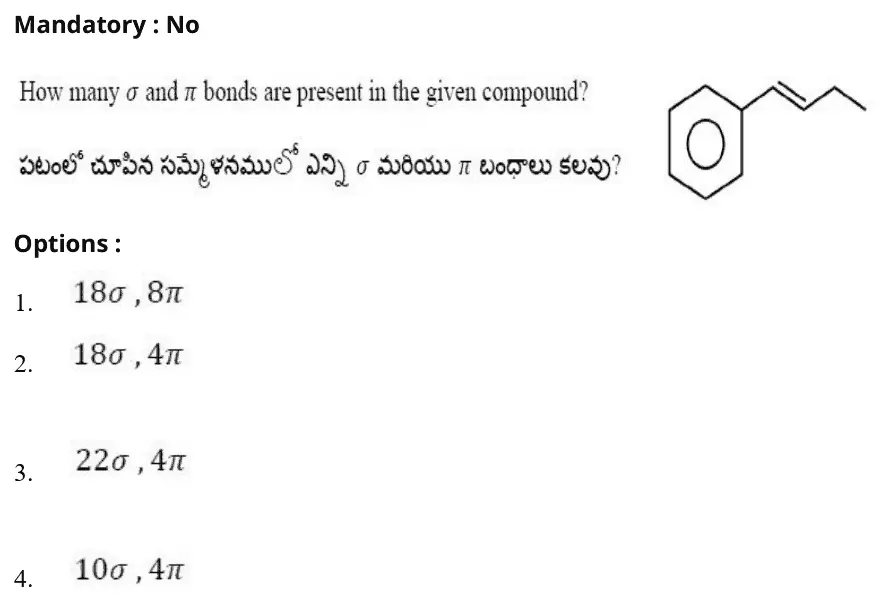
$18\sigma, 8\pi$
$18\sigma, 4\pi$
$22\sigma, 4\pi$
$10\sigma, 4\pi$
Find the number of $\sigma$ and $\pi$ bonds in the following enol form.
(see the figure above)
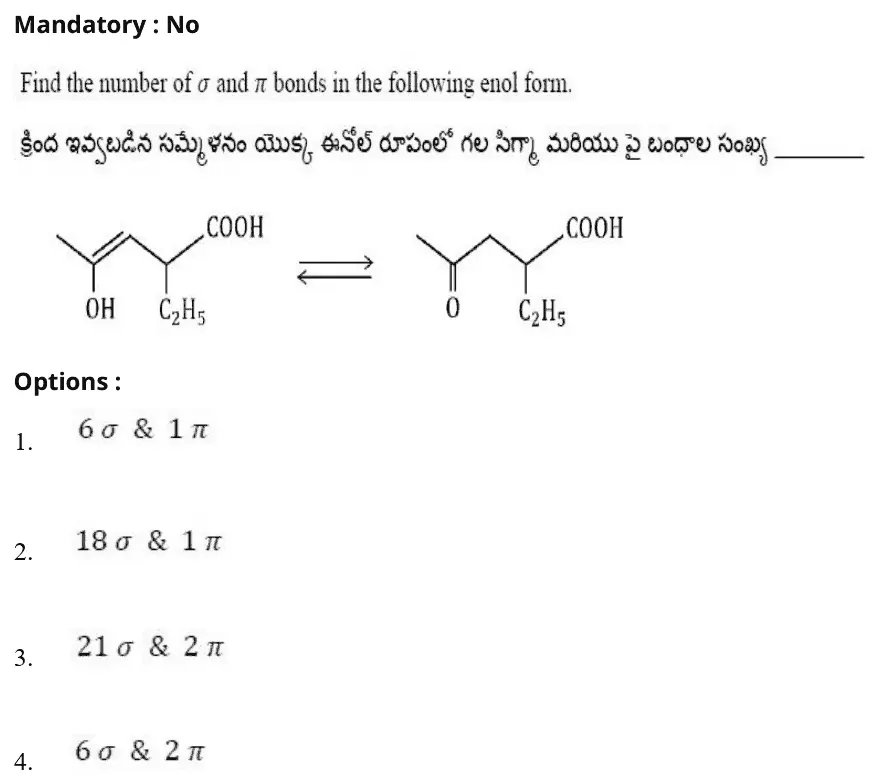
$6\sigma\ \&\ 1\pi$
$18\sigma\ \&\ 1\pi$
$21\sigma\ \&\ 2\pi$
$6\sigma\ \&\ 2\pi$
The number of electron pairs shared by each nitrogen atom in the formation of $N_2$ molecule is ______
6
2
1
3
The dominant intermolecular force that must be overcome to convert liquid methanol to its vapour is ______
Covalent Bonds
Dipole-Dipole Interactions
Hydrogen Bonds
Coordinate Bonds
Match the following ions with the corresponding hybridization of their central atoms?
Ions
i) $\mathrm{NO_3^-}$
ii) $\mathrm{NH_2^-}$
iii) $\mathrm{SCN^-}$
iv) $\mathrm{ICl_2^-}$
Hybridization
a) $sp^3$
b) $sp$
c) $sp^3d$
d) $sp^2$
i-d, ii-a, iii-b, iv-c
i-c, ii-b, iii-a, iv-d
i-a, ii-d, iii-c, iv-b
i-b, ii-c, iii-d, iv-a
If an element in group 2 formed a compound with an element in group 17 of the periodic table, the compound formed is likely to ______
conduct electricity in the solid state
have a low boiling point
dissolve in non-polar solvents
be a crystalline solid
Arrange the following species in the correct order of their stabilities.
$\mathrm{N_2^-,\ C_2,\ Ne_2,\ O_2^{2-}}$
$\mathrm{Ne_2 < O_2^{2-} < C_2 < N_2^-}$
$\mathrm{Ne_2 < C_2 < O_2^{2-} < N_2^-}$
$\mathrm{Ne_2 < N_2^- < O_2^{2-} < C_2}$
$\mathrm{Ne_2 < O_2^{2-} < N_2^- < C_2}$
Which is the most covalent?
$\mathrm{AlCl_3}$
$\mathrm{AlI_3}$
$\mathrm{MgI_2}$
$\mathrm{NaI}$
Addition an electron to an Antibonding molecular orbital ______
increases bond - order
decreases bond - order
stabilizes the system
decreases the inter-nuclear distance
In which of the following ionization processes the bond energy increases and the magnetic behavior changes from paramagnetic to diamagnetic?
$\mathrm{O_2 \longrightarrow O_2^{+}}$
$\mathrm{C_2 \longrightarrow C_2^{+}}$
$\mathrm{NO \longrightarrow NO^{+}}$
$\mathrm{N_2 \longrightarrow N_2^{+}}$
Which among the following represents zero overlap?
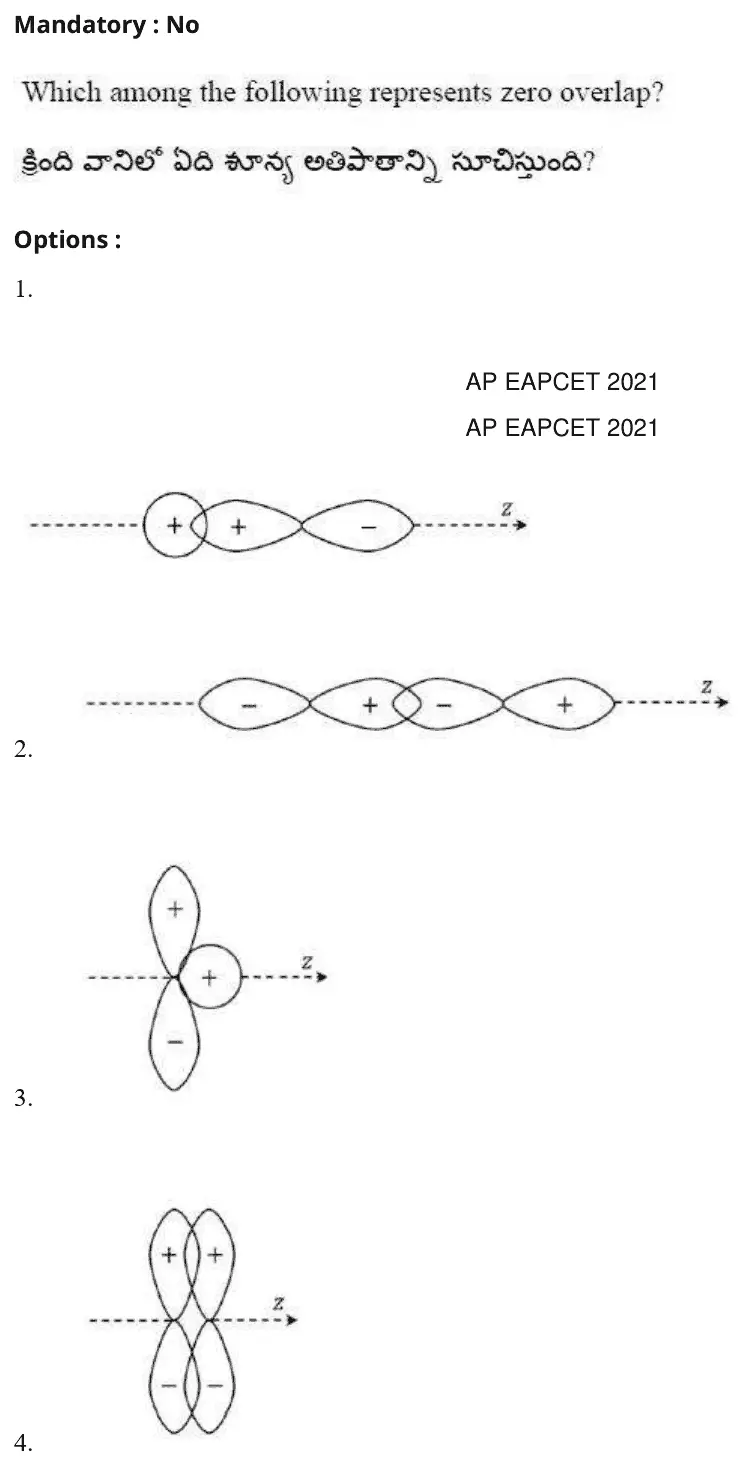
see figure
see figure
see figure
see figure
According to “Molecular orbital theory”, which among the following diatomic molecules only has $\pi$-bonds?
$N_2$
$H_2$
$C_2$
$Be_2$
Which among the following possesses a $sp$ carbon in its structure?
$\mathrm{CH_2=CCl-CH=CHBr}$
$\mathrm{CBr_4}$
$\mathrm{CH_2=C=CH_2}$
$\mathrm{C_6H_5-CCl_3}$
Which among the following compound shows the highest lattice energy?
$\mathrm{LiF}$
$\mathrm{CsF}$
$\mathrm{NaF}$
$\mathrm{KF}$
The hybridizations of $N$-orbitals in $\mathrm{NO_3^-}$, $\mathrm{NO_2^-}$ and $\mathrm{NH_4^+}$ respectively are ______
$sp^2, sp^2, sp^3$
$sp, sp^3, sp^2$
$sp, sp^2, sp^3$
$sp^2, sp, sp^3$
Identify the correct sequence with respect to the strength of hydrogen bonding among the following.
$\mathrm{H_2O_2} > \mathrm{H_2O} > \mathrm{HF} > \mathrm{H_2S}$
$\mathrm{H_2O} > \mathrm{HF} > \mathrm{H_2O_2} > \mathrm{H_2S}$
$\mathrm{H_2O} > \mathrm{HF} > \mathrm{H_2S} > \mathrm{H_2O_2}$
$\mathrm{H_2O} > \mathrm{HF} > \mathrm{H_2O_2} > \mathrm{H_2S}$
Which among the following is least covalent in nature?
$\mathrm{NF_3}$
$\mathrm{BiF_3}$
$\mathrm{PF_3}$
$\mathrm{SbF_3}$
Which pair among the following does not have the same bond order?
$CN^-$ & $NO^+$
$CN^-$ & $CO$
$O_2^{2-}$ & $B_2$
$O_2^+$ & $NO^+$
Arrange the following molecules according to decreasing order of their O $-$ O bond lengths.
$O_3 > H_2O_2 > O_2$
$H_2O_2 > O_3 > O_2$
$O_2 > H_2O_2 > O_3$
$O_2 > O_3 > H_2O_2$
Which of the following molecules has T-shaped geometry?
$PF_3$
$BCl_3$
$IF_3$
$NH_3$
Assertion (A): Covalent character follows: $NaCl < MgCl_2 < BeCl_2 < LiCl$.
Reason (R): According to Fajan's rules, covalent character of ionic compounds increases with decrease in size of cation.
Both A and R are true and R is a correct explanation for A
Both A and R are true but R is not a correct explanation for A
A is true, R is false
A is false, R is true
The geometry and dipole moment of $H_2S$ respectively are ______
Angular and Non-zero
Angular and Zero
Linear and Zero
Linear and Non-zero
Bond order is an inverse measure of ______
bond- length
bond - angle
bond dissociation energy
Stability
Which of the following molecule has the maximum dipole moment?
$NH_3$
$CS_2$
$C_2H_6$
$NCl_3$
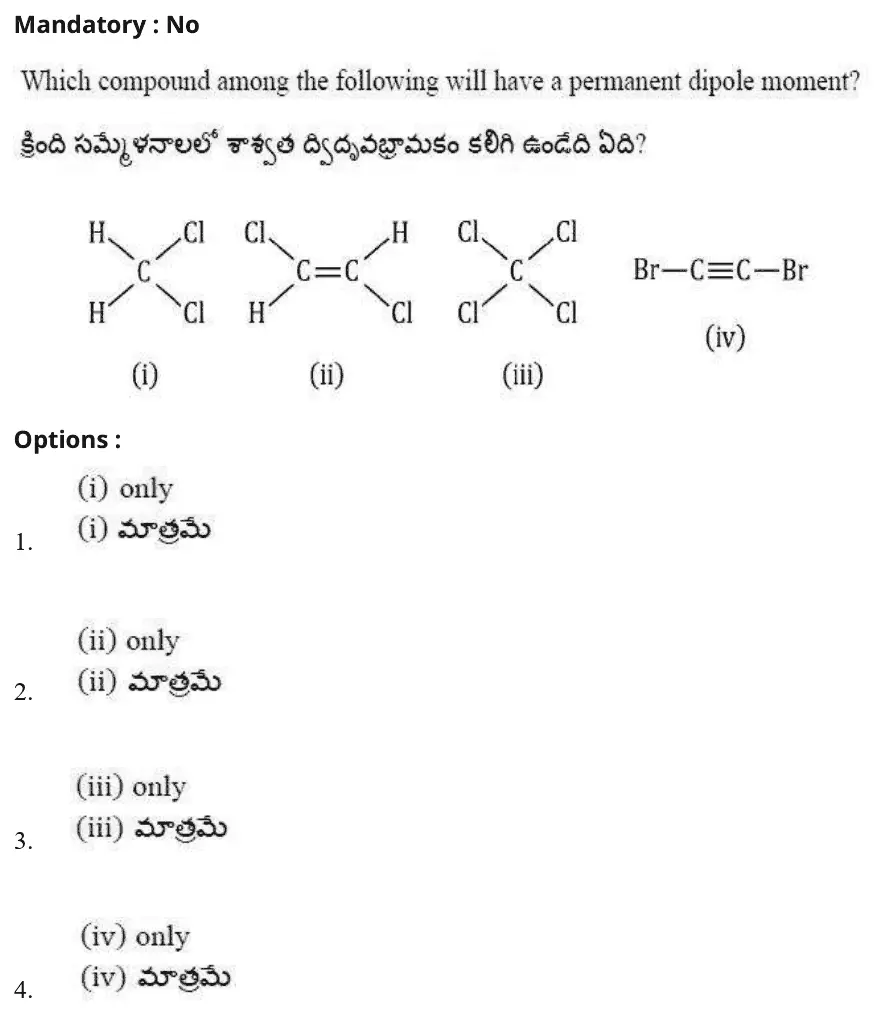
Which compound among the following will have a permanent dipole moment?
(i) (see the figure above) CH2Cl2 drawn as C with H, H, Cl, Cl
(ii) (see the figure above) Cl and H on one C, C=C, Cl and H on other (as drawn: Cl top-left and H top-right on the left/right carbons; H bottom-left, Cl bottom-right)
(iii) (see the figure above) CCl4
(iv) $Br-C\equiv C-Br$
(i) only
(ii) only
(iii) only
(iv) only
The correct order of Sulphur oxygen bond order in $SO_3$, $S_2O_3^{2-}$ and $SO_4^{2-}$ are
$SO_4^{2-} < S_2O_3^{2-} < SO_3$
$SO_4^{2-} < SO_3 < S_2O_3^{2-}$
$S_2O_3^{2-} < SO_4^{2-} < SO_3$
$S_2O_3^{2-} < SO_3 < SO_4^{2-}$
A covalent molecule $X - Y$ is found to have a dipole moment of $1.5 \times 10^{-29}\ C.m$ and a bond length of $150\ pm$. The percent ionic character of the bond will be ______
$50\ \%$
$62.5\ \%$
$75\ \%$
$80\ \%$
The hybridization of $Se$ in $SeF_4$ and its geometry respectively are ______
$sp^3d$, see-saw shaped
$sp^3d^2$, octahedral
$sp^3d^3$, trigonal planar
$sp^3d^2$, square planar
Incorrect matching amongst the following is ______ (according to geometry of molecules)
$H_2O,\ NH_3$
$BeCl_2,\ CO_2$
$SF_4,\ TeCl_4$
$ClF_3,\ ICl_3$
Which of the following will have maximum dipole moment?
$\mathrm{NF_3}$
$\mathrm{NCl_3}$
$\mathrm{NBr_3}$
$\mathrm{NH_3}$
In which of the following molecules/ions, the central atom is $sp^2$ hybridized?
$\mathrm{BF_3}$, $\mathrm{NO_2^-}$, $\mathrm{NH_2^-}$, & $\mathrm{H_2O}$
$\mathrm{NH_2^-}$, & $\mathrm{H_2O}$
$\mathrm{NO_2^-}$ & $\mathrm{H_2O}$
$\mathrm{BF_3}$ & $\mathrm{NO_2^-}$
$\mathrm{NO_2^-}$, $\mathrm{NH_2^-}$
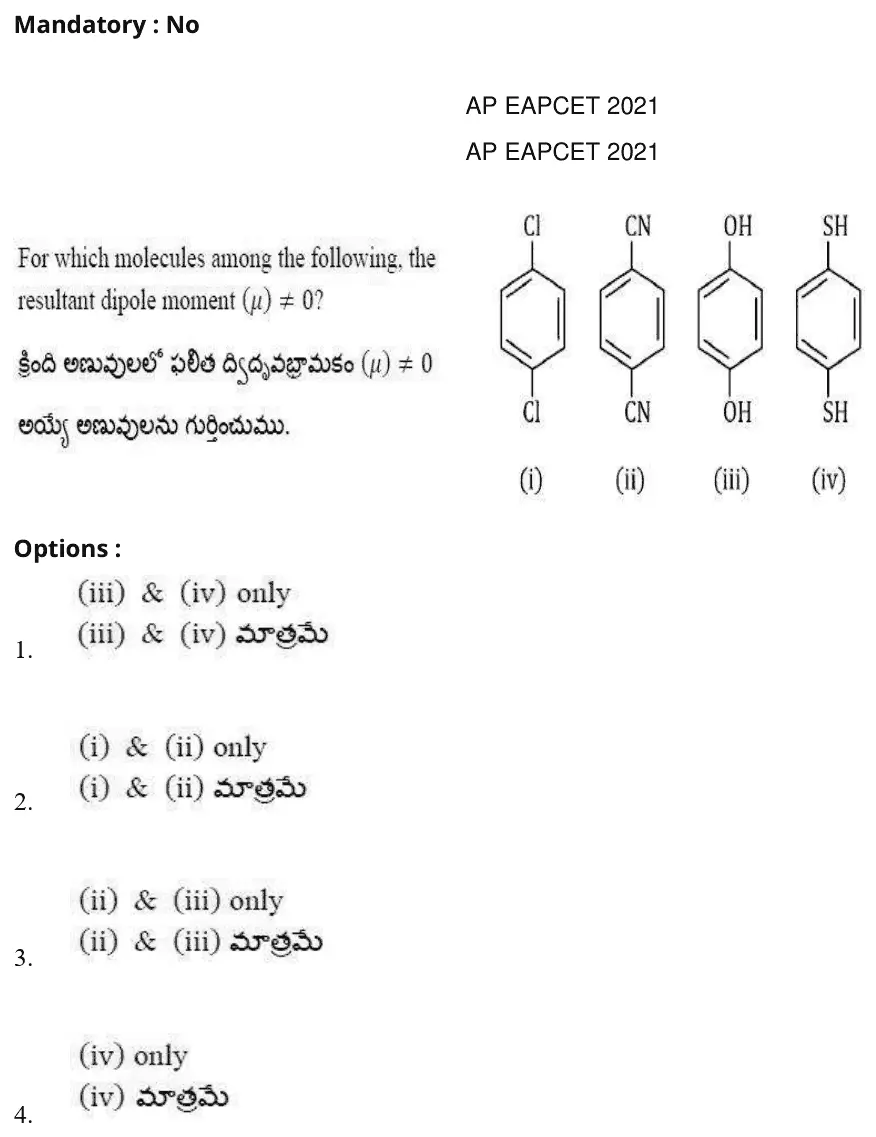
For which molecules among the following, the resultant dipole moment ($\mu$) $\neq$ 0?
(see the figure above)
(iii) & (iv) only
(i) & (ii) only
(ii) & (iii) only
(iv) only
Which compound among the following has the highest dipole moment?
$\mathrm{NH_3}$
$\mathrm{SO_2}$
$\mathrm{N_2O}$
$\mathrm{CO_2}$
How many among the given species have a bond order of $0.5$?
$\mathrm{H_2^+},\ \mathrm{He_2^+},\ \mathrm{He_2^-},\ \mathrm{B_2^+},\ \mathrm{F_2^-},\ \mathrm{Be_2^{2-}}$
$2$
$3$
$1$
$4$
Match the following?
Molecule
a) $\mathrm{SnCl_2}$
b) $\mathrm{XeF_4}$
c) $\mathrm{ClF_3}$
d) $\mathrm{IF_5}$
Geometry
i) Angular (or) Bent
ii) See-saw
iii) Square pyramidal
iv) T-shape
v) Square planar
(a-i), (b-iii), (c-v), (d-v)
(a-iv), (b-v), (c-i), (d-iii)
(a-i), (b-v), (c-iv), (d-iii)
(a-iv), (b-iii), (c-ii), (d-v)
Identify the incorrect statements among the following?
(i) $\mathrm{SF_6}$ does not react with water
(ii) $\mathrm{SF_6}$ is $sp^3d$ hybridized
(iii) $\mathrm{S_2O_3^{2-}}$ is a linear ion
(iv) There is no $\pi$-bonding in $\mathrm{SO_4^{2-}}$ ion
(ii), (iii) & (iv) only
(i), (ii) & (iii) only
(i) & (ii) only
(iii) & (iv) only
The order of the average bond length of the given bonds is
$\mathrm{C=O<C=N<C\equiv C<N-O}$
$\mathrm{C\equiv C<C=O<C=N<N-O}$
$\mathrm{C\equiv C<C=O<N-O<C=N}$
$\mathrm{C=N<C=O<N-O<C\equiv C}$
The shapes of $\mathrm{BrF_5}$ and $\mathrm{XeF_4}$, respectively are
square pyramid, square pyramid
square planar, square planar
square planar, square pyramid
square pyramid, square planar
Match the following
List-I Molecule
A) $\mathrm{HBr}$
B) $\mathrm{H_2S}$
C) $\mathrm{NH_3}$
D) $\mathrm{CHCl_3}$
List-II Dipole moment (D)
I) 1.04
II) 0
III) 0.79
IV) 0.95
V) 1.47
The correct match is
A-I, B-V, C-IV, D-III
A-III, B-IV, C-V, D-I
A-I, B-V, C-II, D-IV
A-IV, B-V, C-I, D-III
Match the following
List-I Species
A) $\mathrm{CH_3COCH_3}$
B) $\mathrm{CH_3C\overset{\oplus}{O}}$
C) $\mathrm{\overset{\oplus}{C}H_2CH_3}$
List-II No. of lone pairs
I) 2
II) 0
III) 1
IV) 3
The correct match is
A-I, B-I, C-III
A-I, B-III, C-II
A-I, B-IV, C-III
A-II, B-II, C-IV
One Debye is equal to how many coulomb meter?
$3.33\times10^{-30}$
$2.22\times10^{-20}$
$1.11\times10^{-10}$
$4.44\times10^{-24}$
The dipole-dipole interaction energy between stationary polar molecules and rotating polar molecules, respectively is proportional to [r is the distance between the polar molecules]
$r^{3}; \frac{1}{r^{2}}$
$\frac{1}{r^{3}}; \frac{1}{r^{6}}$
$\frac{1}{r^{2}}; r^{2}$
$\frac{1}{r^{2}}; \frac{1}{r^{4}}$
A pair of molecules with see-saw shape and linear shape, respectively, is
$\mathrm{CH_4}$ and $\mathrm{SO_3}$
$\mathrm{XeF_4}$ and $\mathrm{CS_2}$
$\mathrm{SF_4}$ and $\mathrm{C_2H_2}$
$\mathrm{CCl_4}$ and $\mathrm{CO_2}$
Which of the following species is a radical?
$\mathrm{CO_2}$
$\mathrm{NO}$
$\mathrm{NO_2^-}$
$\mathrm{CN^-}$
Highest covalent character is found in which of the following?
$\mathrm{CaF_2}$
$\mathrm{CaCl_2}$
$\mathrm{CaBr_2}$
$\mathrm{CaI_2}$
The correct sequence of bond order is
$\mathrm{O_2^+} > \mathrm{O_2^-} > \mathrm{O_2} > \mathrm{O_2^{2-}}$
$\mathrm{O_2^+} > \mathrm{O_2} > \mathrm{O_2^-} > \mathrm{O_2^{2-}}$
$\mathrm{O_2^+} > \mathrm{O_2} > \mathrm{O_2^{2-}} > \mathrm{O_2^-}$
$\mathrm{O_2^+} > \mathrm{O_2^{2-}} > \mathrm{O_2^-} > \mathrm{O_2}$
The number of sp and $\mathrm{sp^2}$ carbon in Hepta–1, 3–dien–5–yne, respectively, are
2, 4
4, 3
2, 2
2, 5
The total number of dative bonds present in all the following $\mathrm{CO}$, $\mathrm{NH_4Cl}$, $\mathrm{Al_2Cl_6}$, $\mathrm{Al(H_2O)_6}$, $\mathrm{HNO_3}$ and $\mathrm{CO_2}$ is
$11$
$10$
$9$
$12$
Among the following compounds, the one with the highest lactice (sic) energy is
$\mathrm{LiF}$
$\mathrm{NaCl}$
$\mathrm{MgO}$
$\mathrm{LiCl}$
The hybridisation of central atom I of $\mathrm{IF_7}$ is
$sp^{2}d^{4}$
$sp^{3}d^{2}$
$sp^{3}d^{1}$
$sp^{3}d^{3}$
Hybridizations of $C_2, C_3$ of $\mathrm{H_3C - CH = C = CH - CH_3}$ respectively are
$sp, sp^3$
$sp^2, sp$
$sp^2, sp^2$
$sp, sp$
The geometry of $SF_6$ molecule is ______
Tetrahedral
Planar
Octahedral
Trigonal bipyramidal
Increasing order of boiling points in the following compounds is:
(i) $CH_3COOH$ (ii) $CH_3CH_2CHO$ (iii) $CH_3CH_2CH_2OH$ (iv) $CH_3\,COCH_3$
(ii) < (iv) < (iii) < (i)
(ii) < (iv) > (iii) < (i)
(iv) < (ii) > (i) < (iii)
(iv) < (iii) > (ii) < (i)
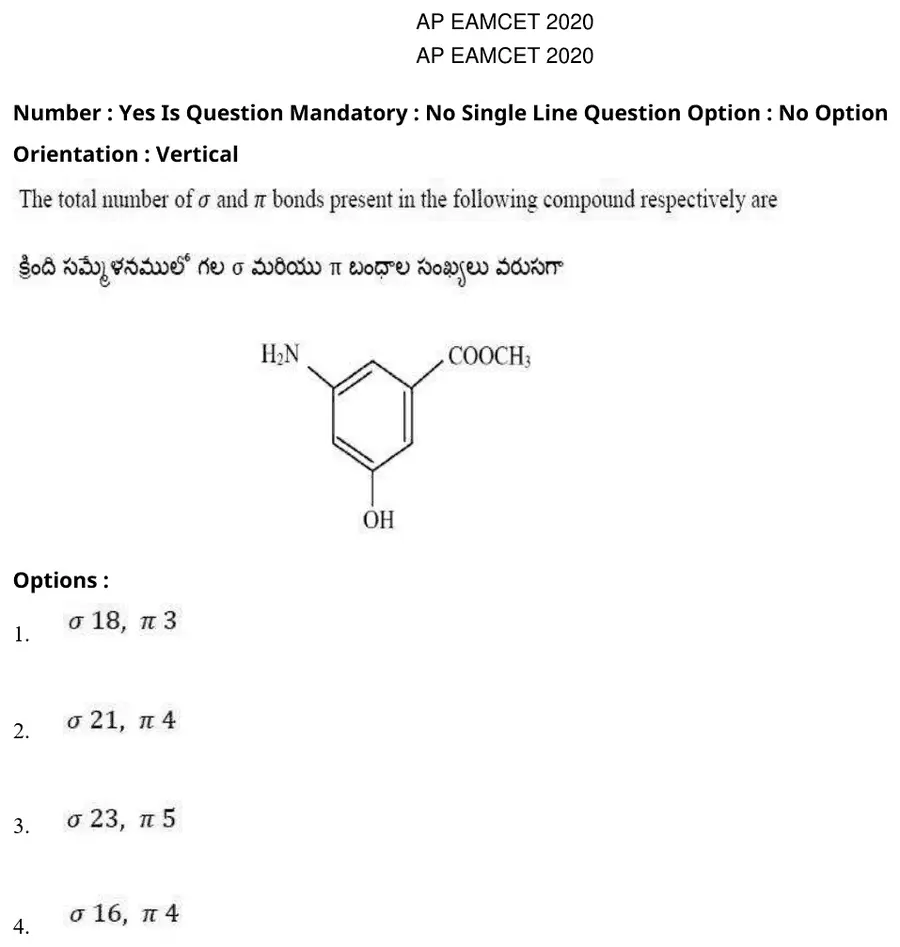
The total number of $\sigma$ and $\pi$ bonds present in the following compound respectively are
(see the figure above)
$\sigma$ 18, $\pi$ 3
$\sigma$ 21, $\pi$ 4
$\sigma$ 23, $\pi$ 5
$\sigma$ 16, $\pi$ 4
The formation of molecular orbitals can be described by the linear combination of atomic orbitals. Which one of the following correctly represents the formation of bonding molecular orbital from the atomic orbitals having wave functions $\psi_A$ and $\psi_B$?
$\psi_A \times \psi_B$
$\psi_A / \psi_B$
$\psi_A + \psi_B$
$\psi_A - \psi_B$
Arrange $\mathrm{O_2, O_2[AsF_6], KO_2}$ in the increasing order of bond length of $\mathrm{O-O}$ bond.
$\mathrm{O_2 < KO_2 < O_2[AsF_6]}$
$\mathrm{KO_2 < O_2 < O_2[AsF_6]}$
$\mathrm{O_2[AsF_6] < KO_2 < O_2}$
$\mathrm{O_2[AsF_6] < O_2 < KO_2}$
The molecular geometry of $\mathrm{PF_3}$ is ______
Tetrahedral
Pyramidal
Trigonal planar
Square planar
Which of the following can form intermolecular H-bond?
Ethyl acetate
Methyl formate
Acetamide
Acetic anhydride
The iso structural molecules among $CO_2$, $SiO_2$, $SO_2$, $TeO_2$, $[NO_2]^+$ are
$CO_2$, $SO_2$, $TeO_2$
$CO_2$, $SiO_2$, $[NO_2]^+$
$CO_2$, $[NO_2]^+$
$SO_2$, $TeO_2$
The dipole-dipole interaction energy between polar molecules in the solid state will be proportional to ________ [if $r$ denotes the distance between polar molecules]
$\frac{1}{r^6}$
$\frac{1}{r^3}$
$\frac{1}{r^2}$
$\frac{1}{r}$
What is the molecular geometry of $H_3O^+$ ?
Trigonal pyramid
Square planar
Trigonal bipyramidal
Trigonal planar
Which of the following species has tetrahedral geometry?
$BH_4^-$
$NH_2^-$
$CO_3^{2-}$
$H_3O^+$
The linear shape of $\mathrm{CO_2}$ is due to ______
$sp^3$ hybridization of carbon
$sp$ hybridization of carbon
$p\pi - d\pi$ bonding between carbon and oxygen
$sp^2$ hybridization of carbon
The number of hydrogen bonds formed by a water molecule at normal conditions is
1
2
3
4
The bond stability of $\mathrm{N_2}$, $\mathrm{N_2^{-}}$ and $\mathrm{N_2^{2-}}$ varies as
$\mathrm{N_2} < \mathrm{N_2^{-}} < \mathrm{N_2^{2-}}$
$\mathrm{N_2^{-}} < \mathrm{N_2} < \mathrm{N_2^{2-}}$
$\mathrm{N_2^{2-}} < \mathrm{N_2^{-}} < \mathrm{N_2}$
$\mathrm{N_2^{-}} < \mathrm{N_2^{2-}} < \mathrm{N_2}$
Chemical Bonding & Molecular Structure is one of the heaviest pillars in the state engineering entrance exam, sitting at rank 3 among all 31 chemistry chapters between 2022 and 2026. Across our entire archive spanning 2010 through 2026, the chapter contributed 370 questions across 149 papers, representing 6.2 percent of the chemistry section with an overall rate of 2.5 questions per paper. In the modern window from 2022 to 2026, it provided 183 questions over 77 sittings, sustaining 2.4 questions per paper and 5.9 percent subject share.
Every candidate sitting for an engineering shift encounters this chapter. It holds a perfect record, appearing in every paper between 2022 and 2026. Looking at individual state streams during this period, AP papers carried 103 questions across 48 sittings (2.1 questions per paper, 5.4 percent share), while TS papers gathered 80 questions over 29 sittings (2.8 questions per paper, 6.9 percent share).
Earlier examinations from 2010 through 2021 featured 187 questions across 72 papers, which worked out to 2.6 per sitting and 6.5 percent of the subject. In the recent three-year stretch between 2024 and 2026, examiners set 103 questions across 46 papers, averaging 2.2 questions per test and 5.6 percent share. Comparing the early era with the last three years shows a share trend that is down, whereas comparing the five-year recent window with the last three years shows the share is about the same. With two or three questions appearing in every shift, mastering this chapter is mandatory for building early momentum.
Every core model in chemical bonding is systematically tested across the state question banks:
Exam questions are conceptual and rapid to solve once structural rules are clear. A major family of problems presents four to six chemical formulas and asks you to count how many species share a specific property, such as having a nonzero dipole moment, having identical hybridisation, or having an integer bond order.
Another standard pattern tests comparative trends: sorting molecules in ascending bond angles (such as comparing water and sulphur dioxide where lone pair repulsions differ), ranking halides by covalent character using cationic charge density, or selecting the incorrect statement among listed physical properties. Molecular orbital theory items frequently ask you to evaluate paramagnetic species or determine whether a molecule or ion has a bond order of one, two, or fractional values.
Work through these recent official questions to test your grasp on the most frequent question formats:
Begin by building clean structural drafting habits. Draw the correct Lewis dot structures for common central atoms from groups 14, 15, 16, 17, and 18. Count sigma bonds and lone pairs to quickly deduce steric numbers without hesitation. Memorise the standard shapes and deviations caused by lone pair lone pair repulsions.
Next, master molecular orbital diagrams for diatomics. Know the inversion of pi and sigma levels between species with fourteen or fewer electrons and those with more than fourteen electrons. Practise rapid counting of bonding and antibonding electrons so that bond orders and unpaired electron counts take under forty seconds. Finally, review Fajans principles regarding polarisability and the influence of intramolecular hydrogen bonding on physical constants like volatility and melting points.
While not appearing on every individual page, molecular orbital theory is one of the four main rotation pillars in the chapter. Because two or more questions appear from chemical bonding in every sitting, molecular orbital questions appear in a large majority of shifts across both states.
Calculate the steric number by adding the number of surrounding sigma-bonded atoms to the number of lone pairs on the central atom. This immediately establishes the electron pair arrangement, from which the observed molecular shape follows by considering lone pair positions.
Official questions rarely ask you to reproduce arbitrary decimal angles. Instead, questions require relative comparisons, such as explaining why water has a smaller angle than ammonia, or recognising standard ideal values like linear, trigonal planar, and tetrahedral arrangements. Step-by-step solutions for each one are in the EdLoop EAPCET app.