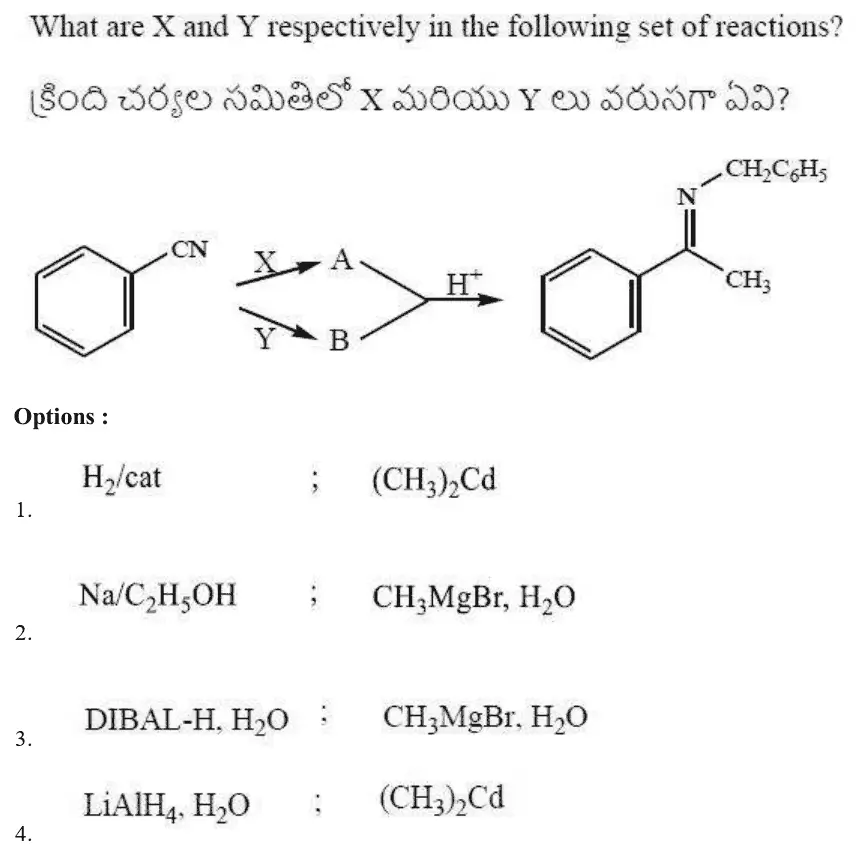
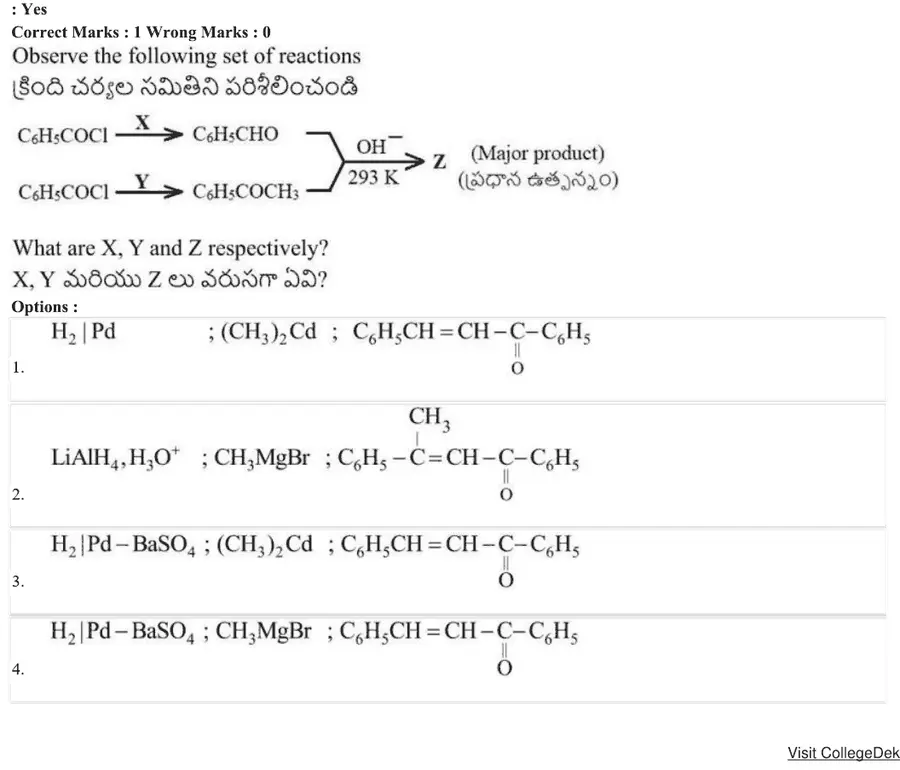
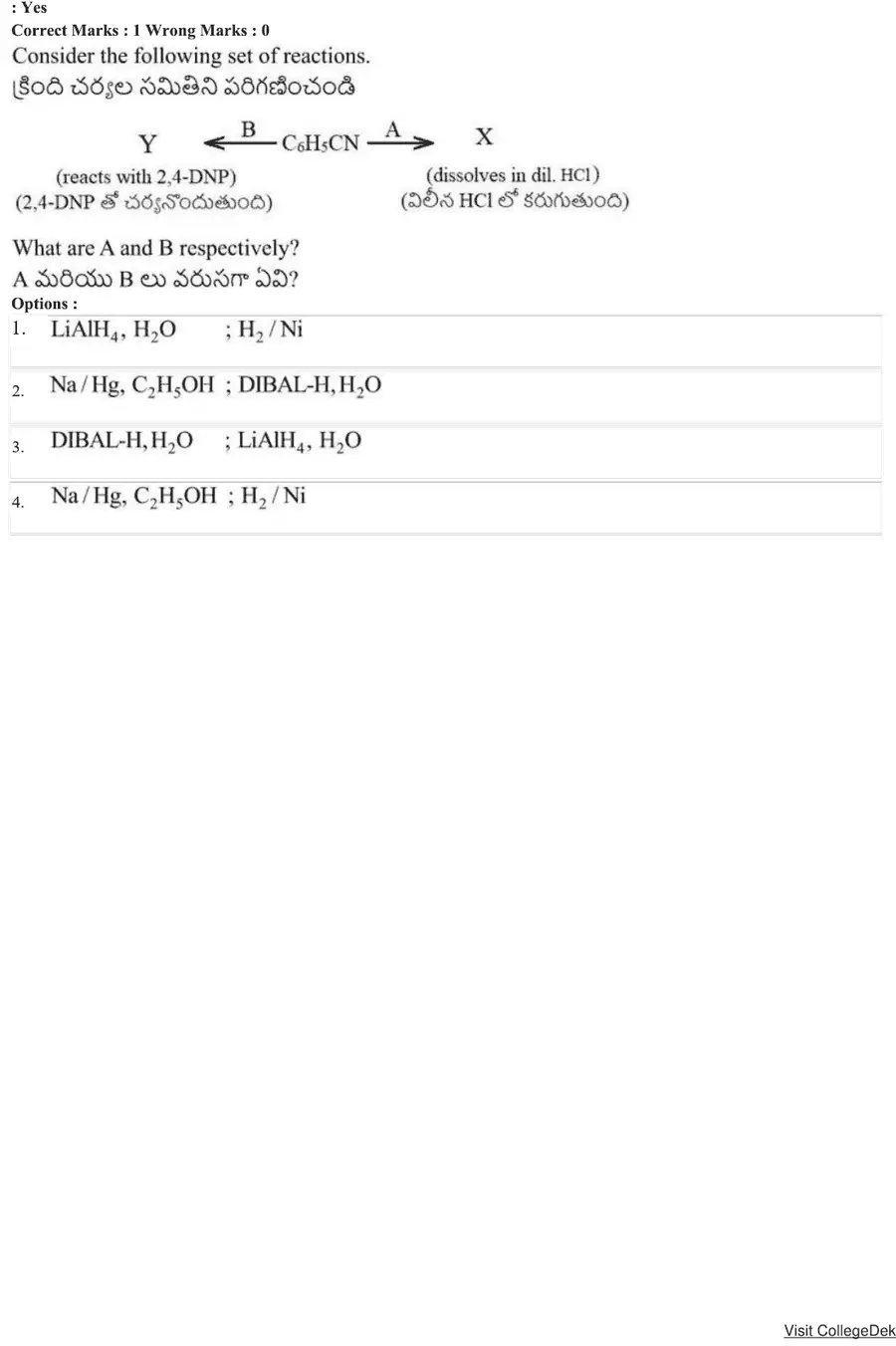
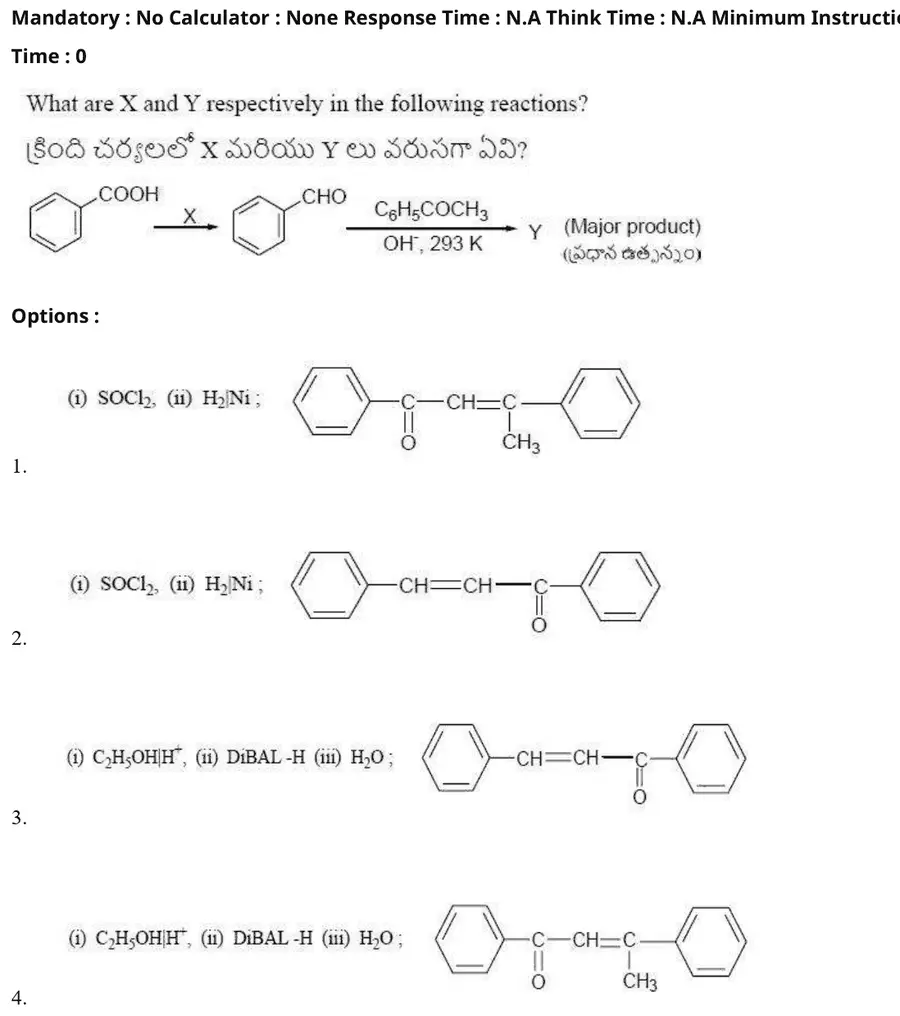
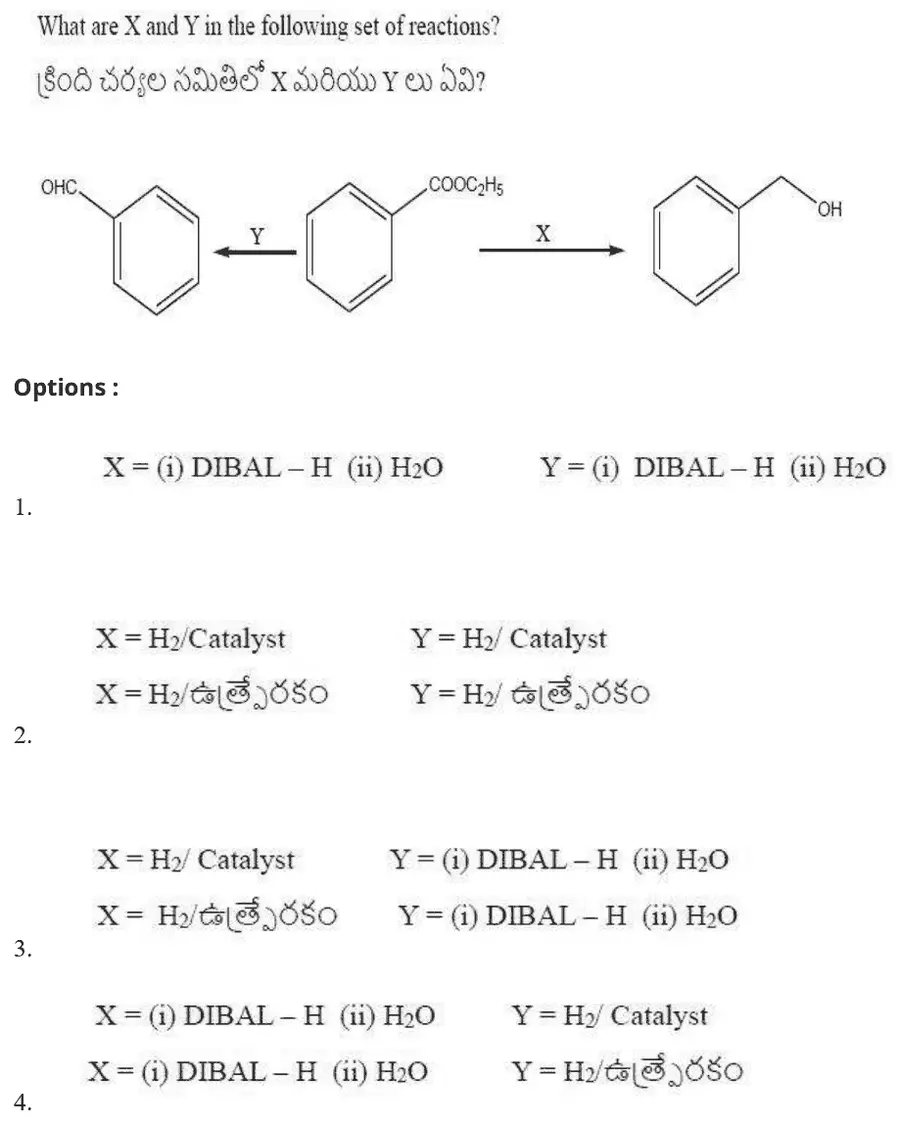
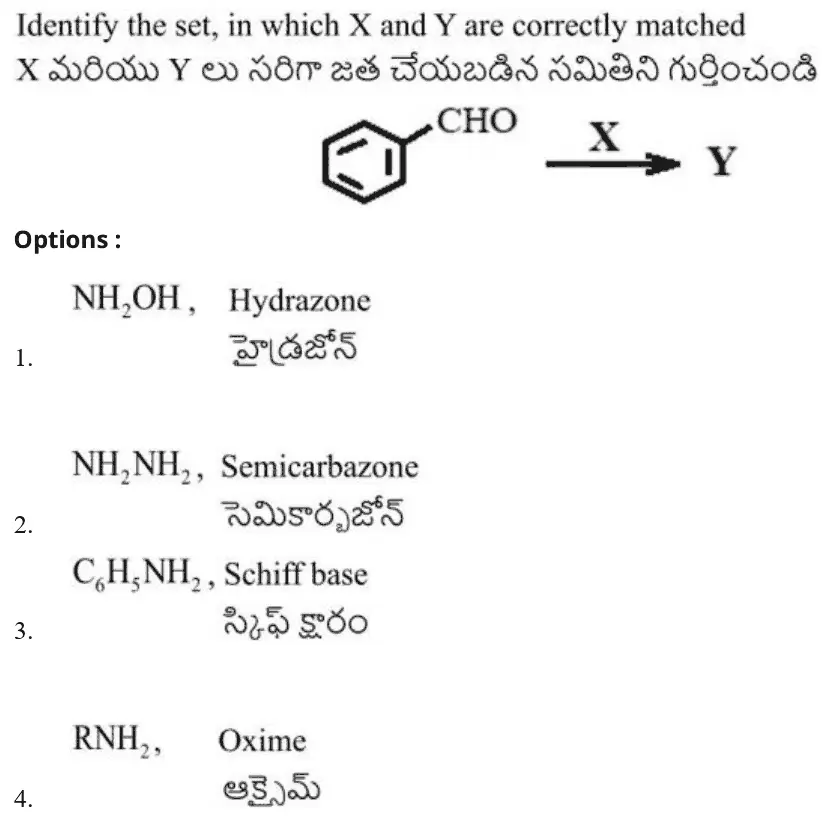
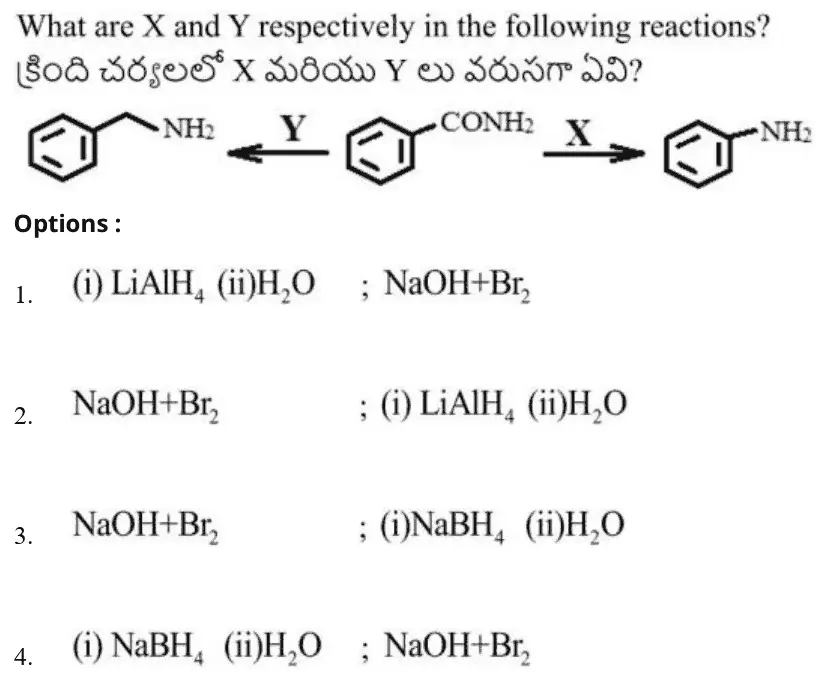
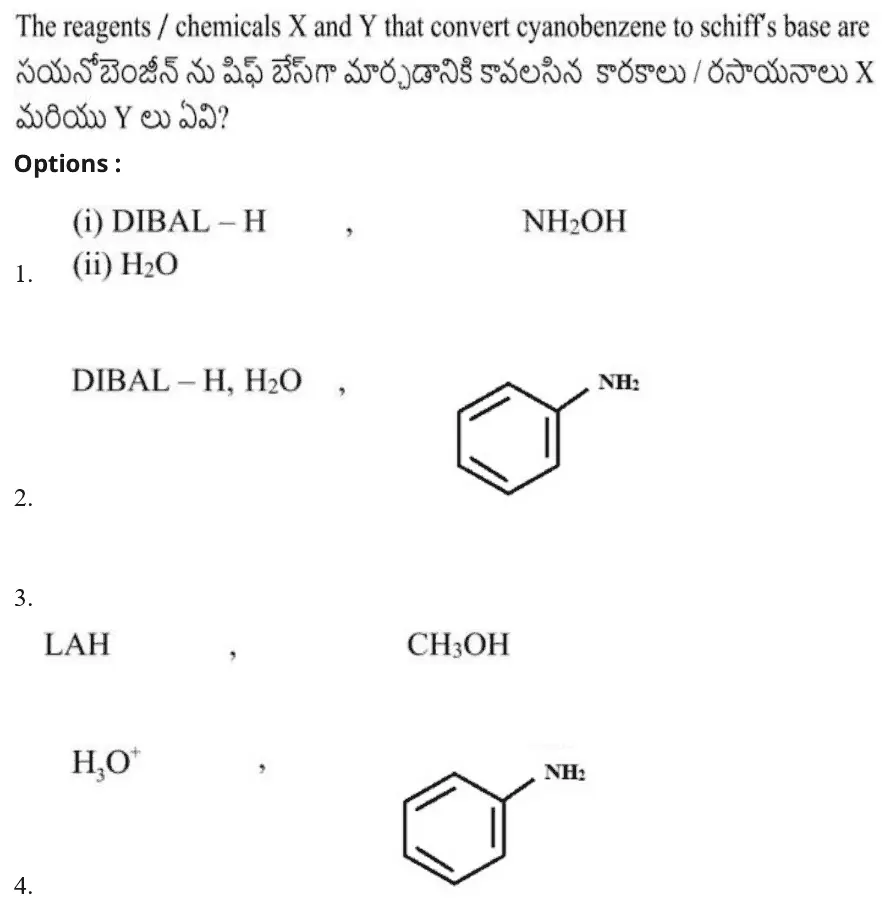
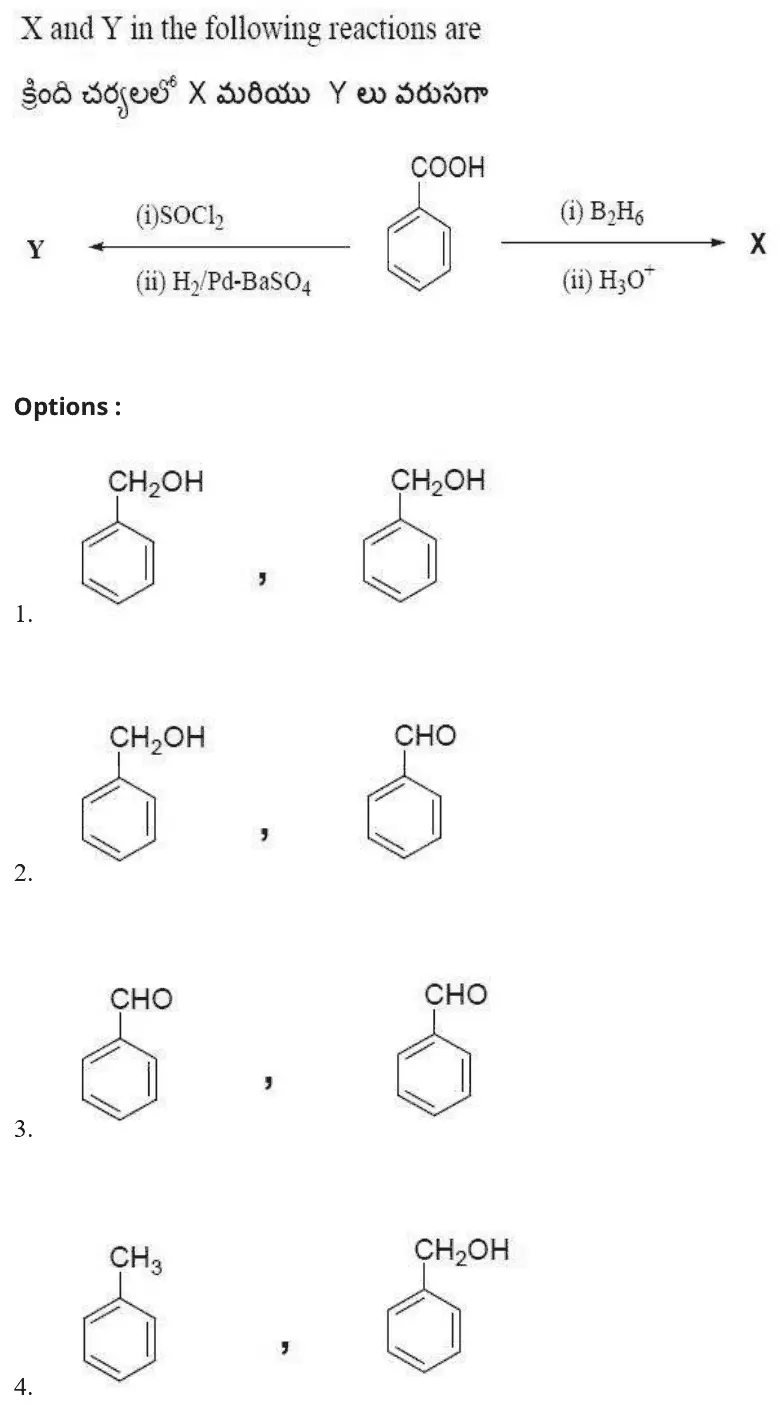
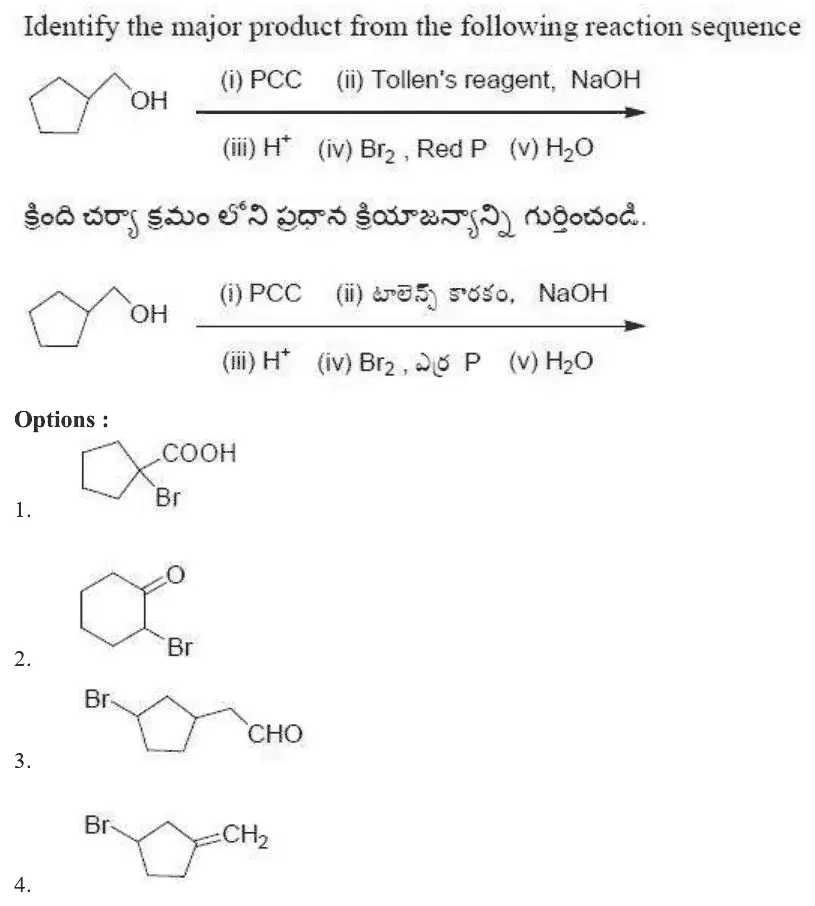
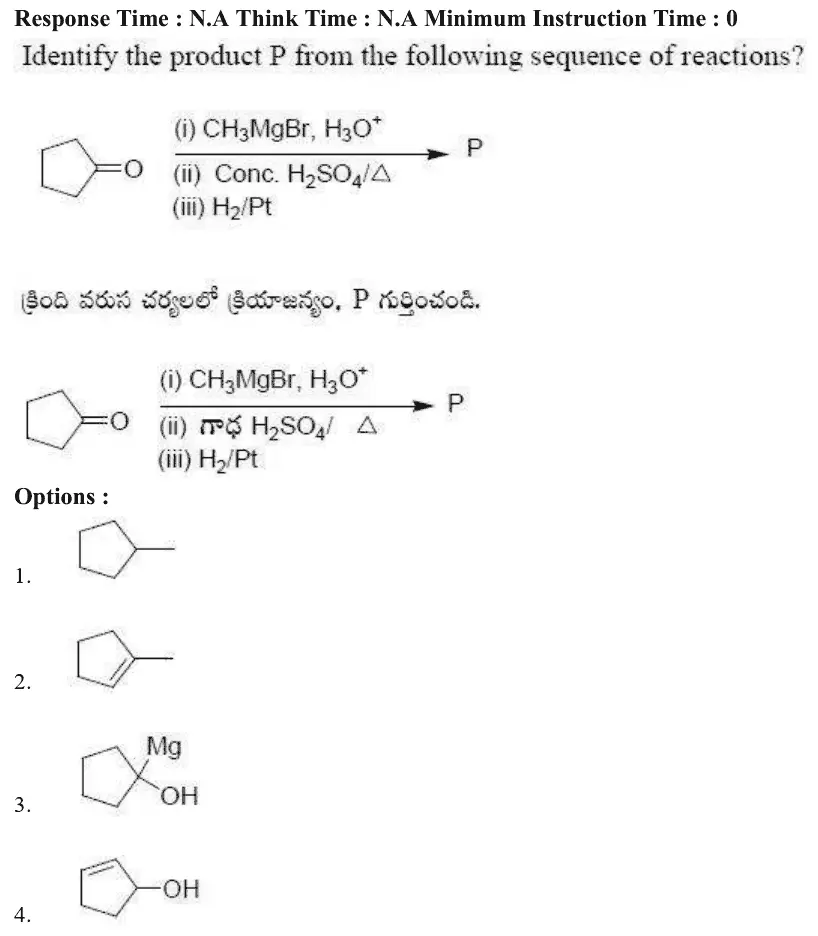
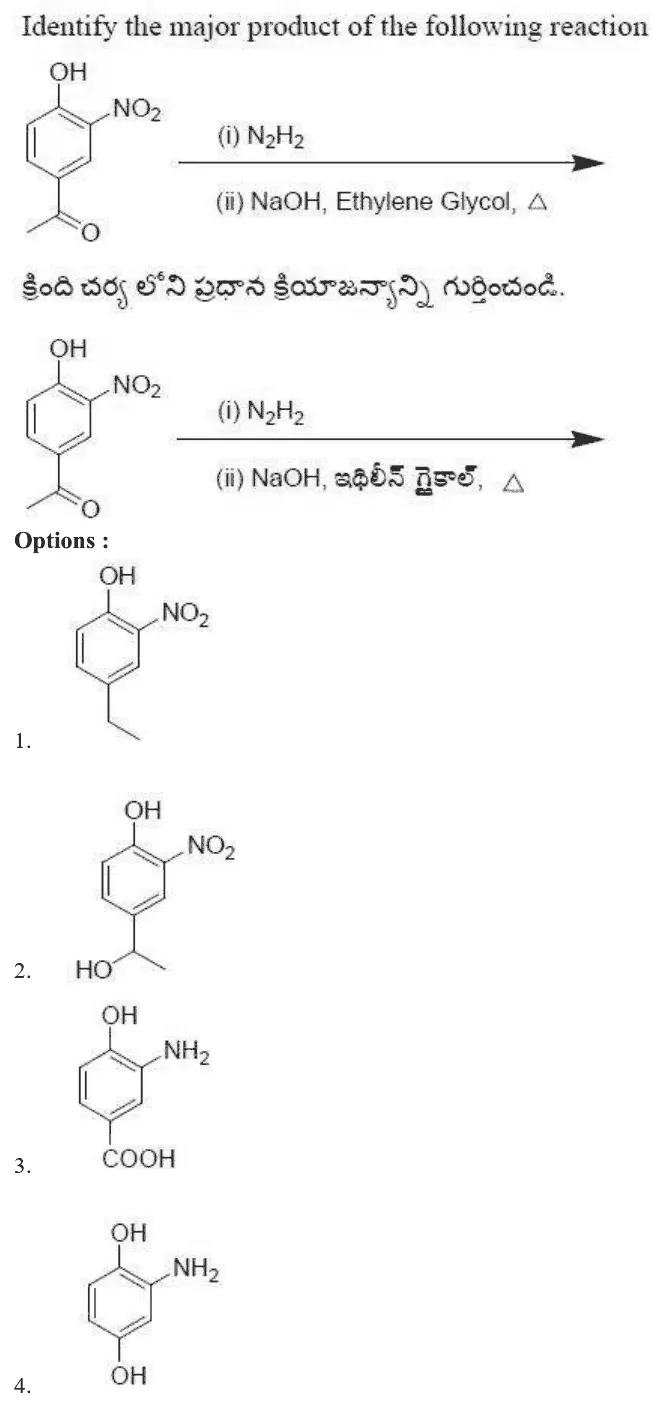
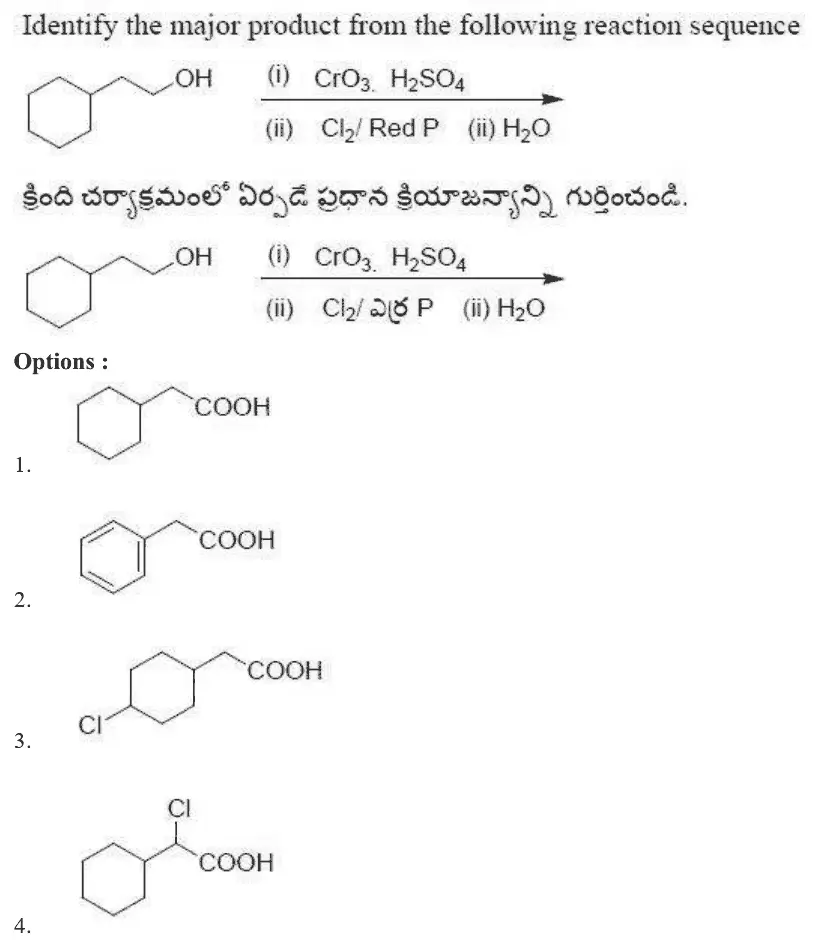
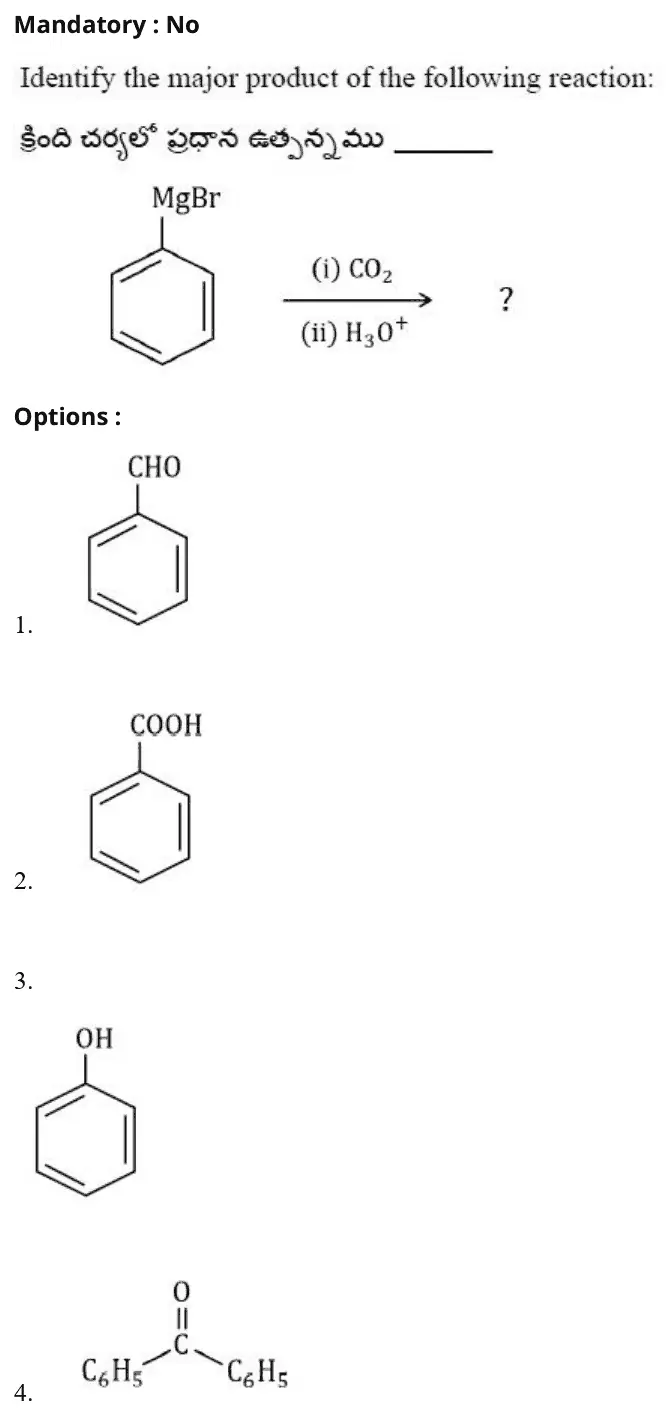
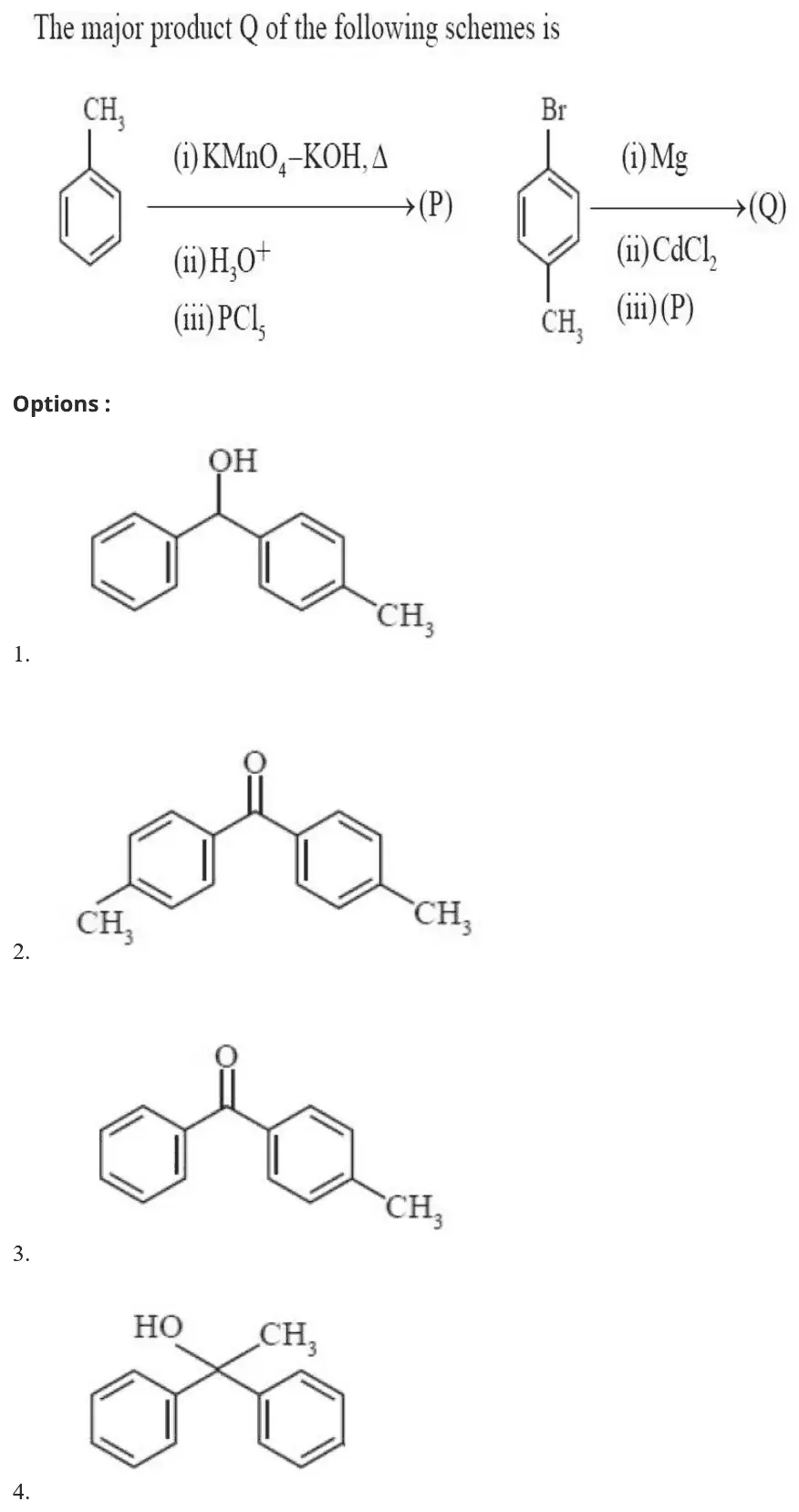
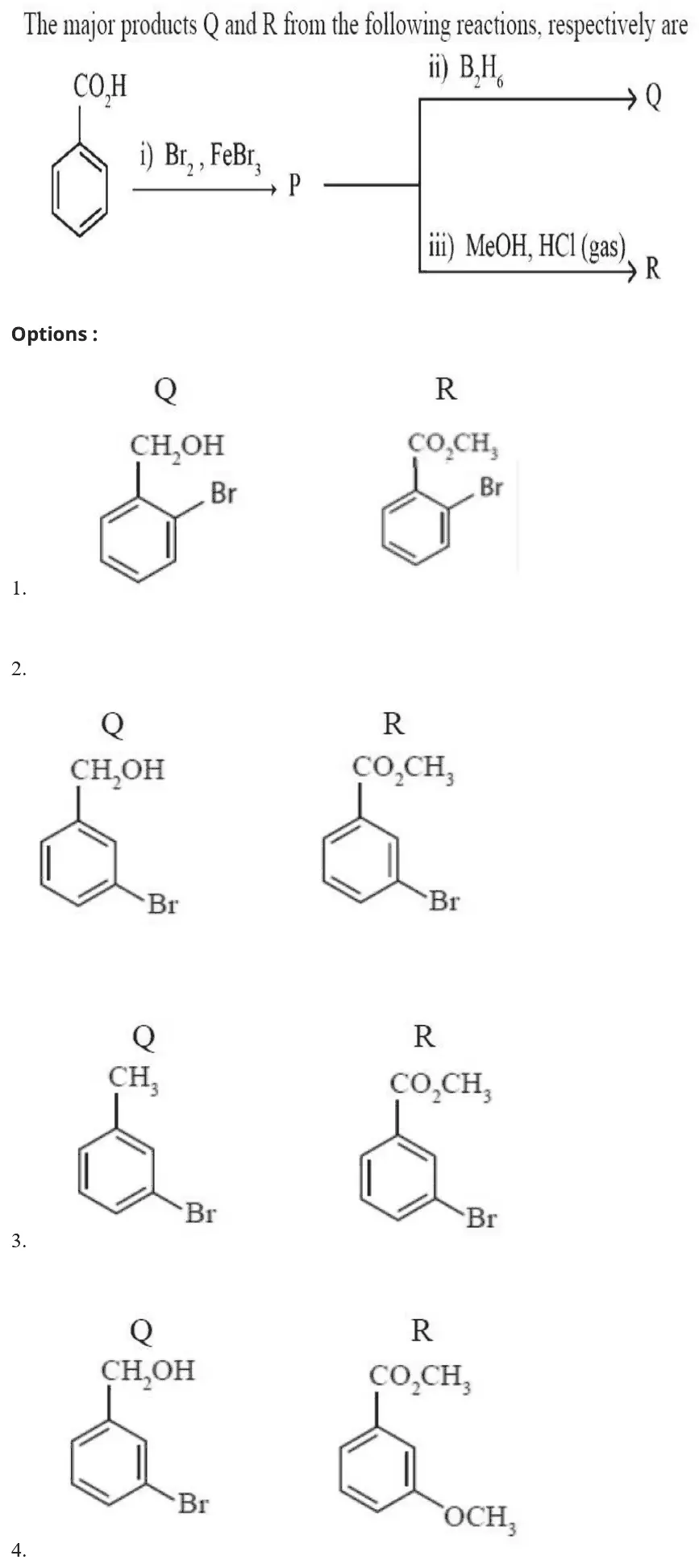
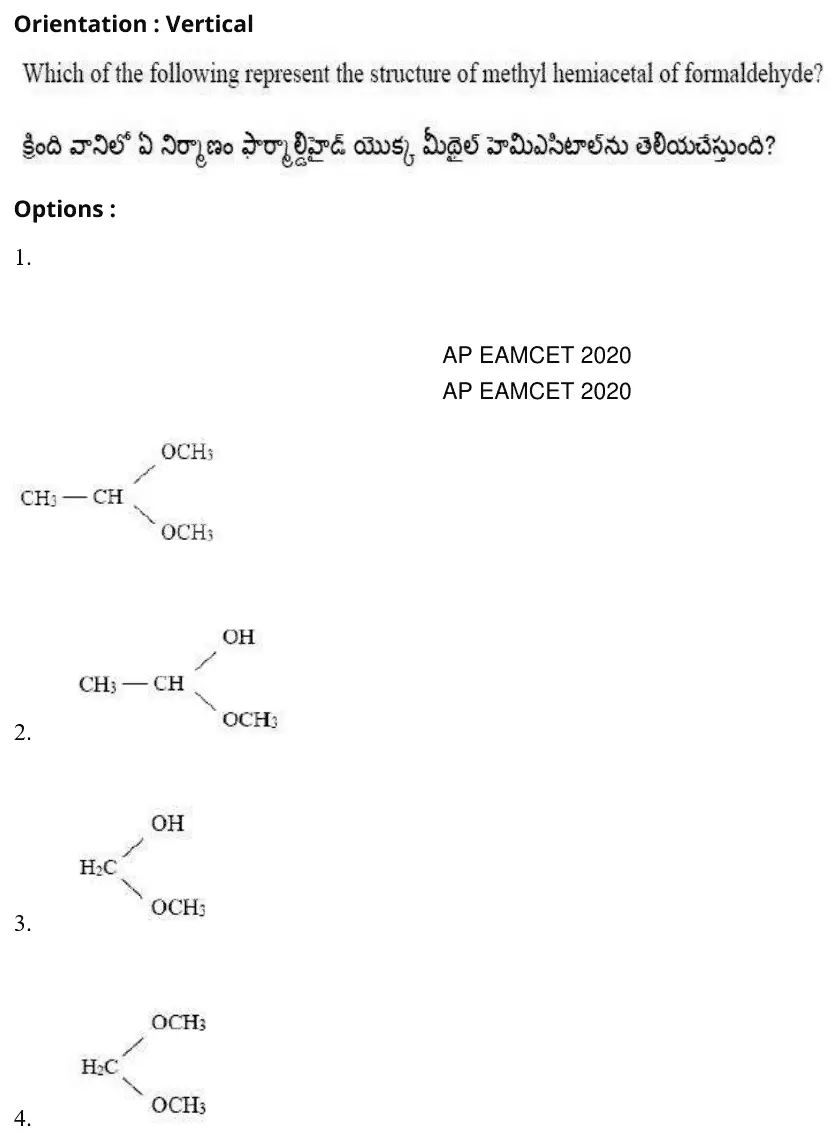
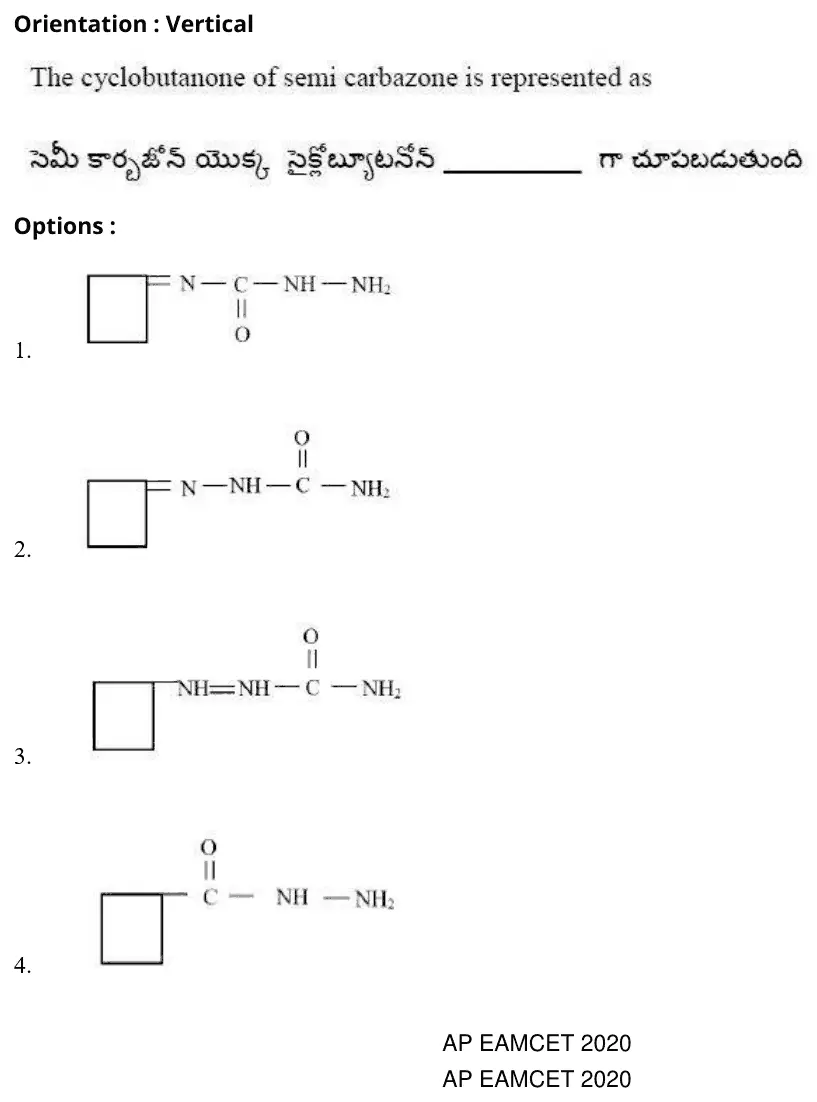
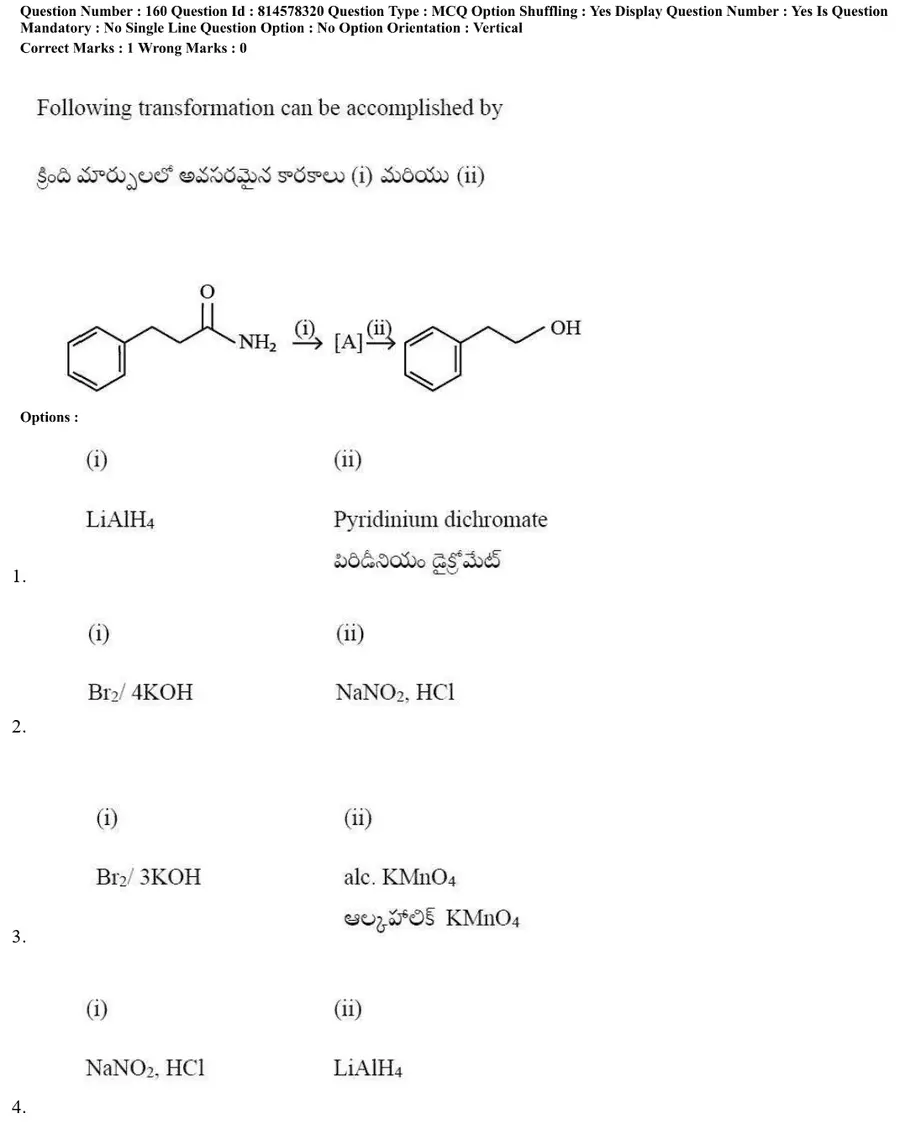
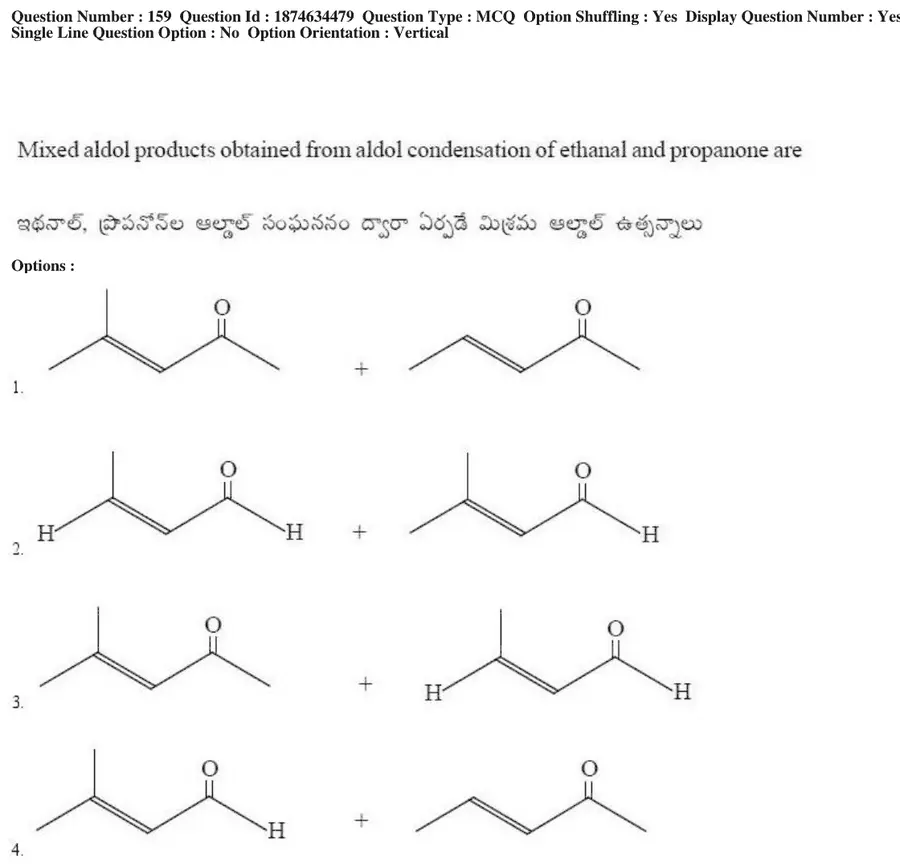
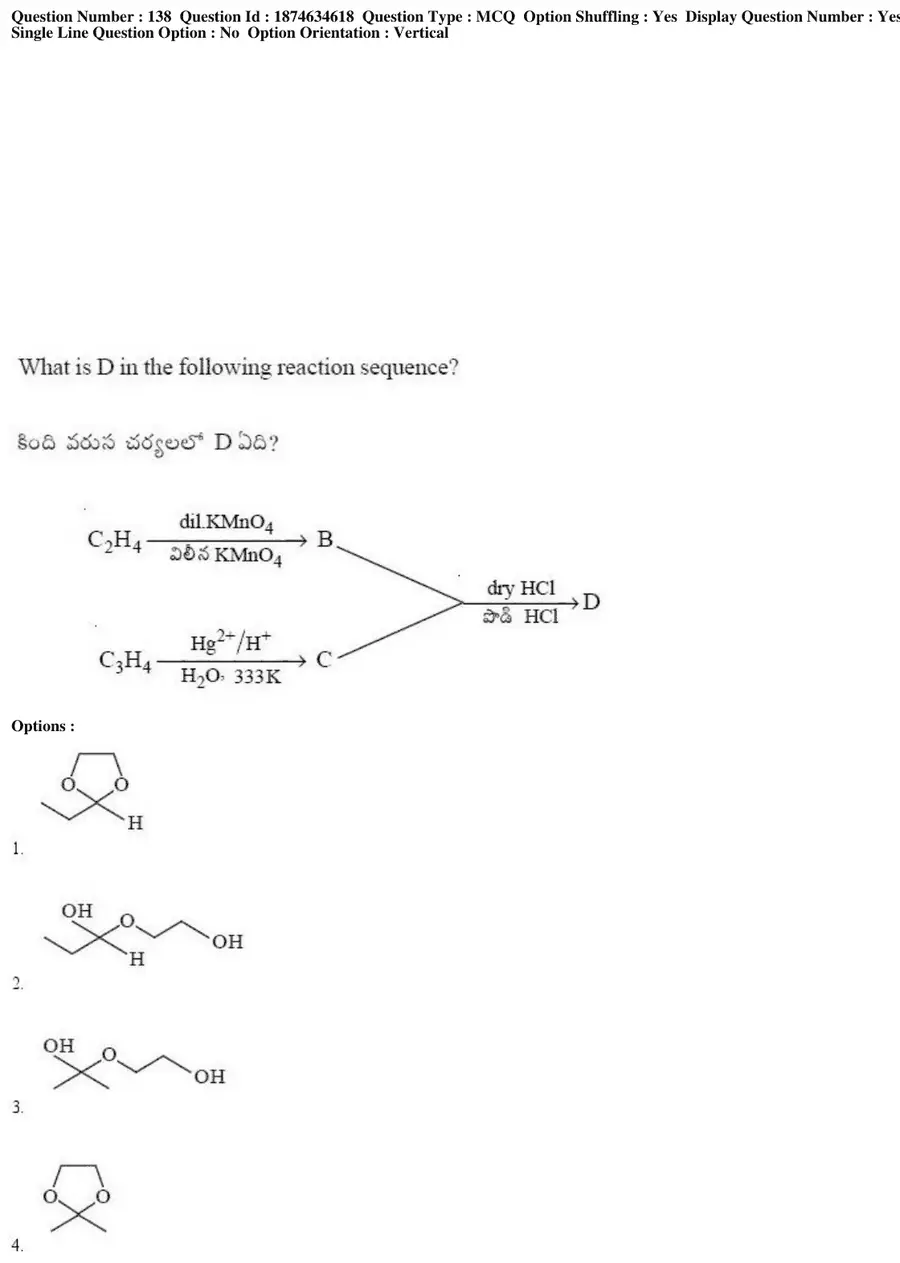
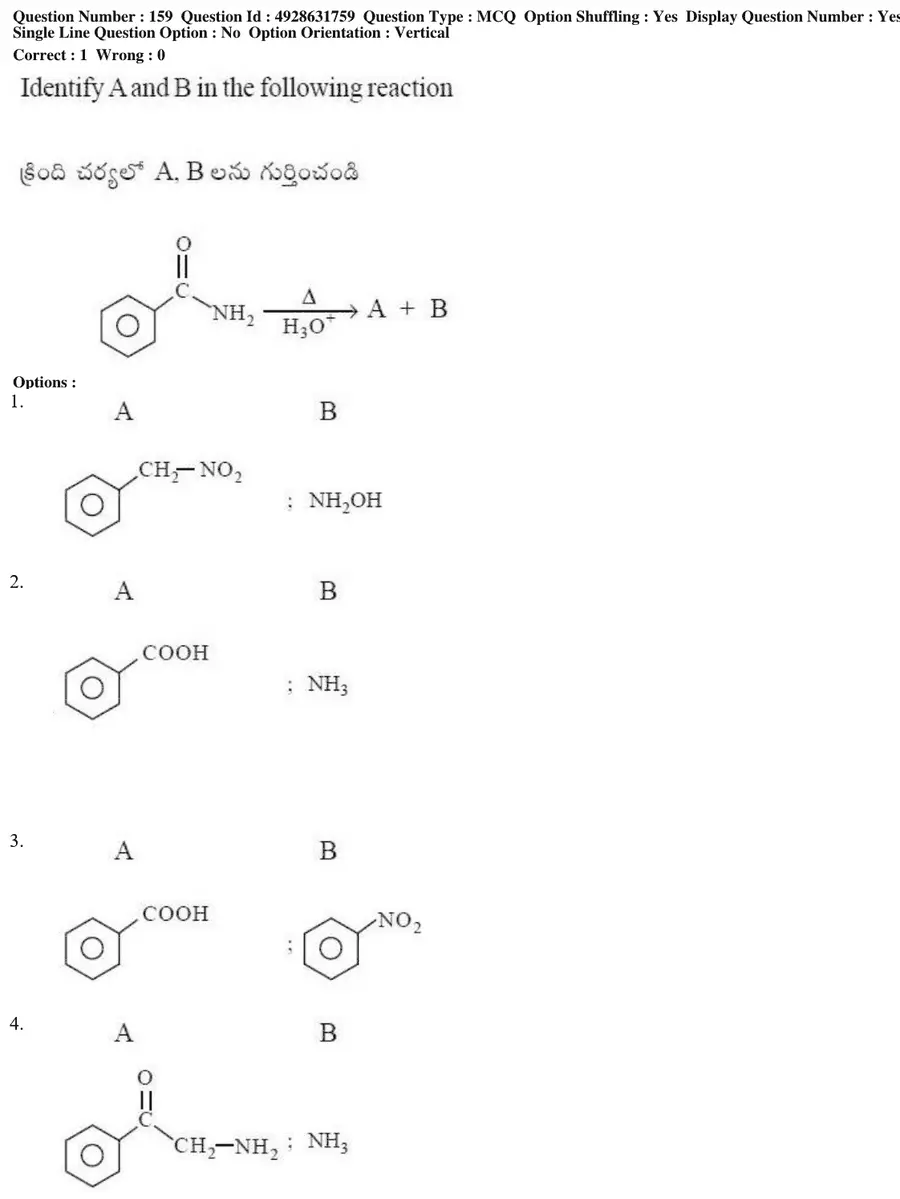
Reaction of benzonitrile (A) with the reagent X gave B. In another reaction of A with the reagent Y gave C. Reaction of B and C in the presence of dil. NaOH at 293 K gave an α, β-unsaturated carbonyl compound. What are X and Y respectively?
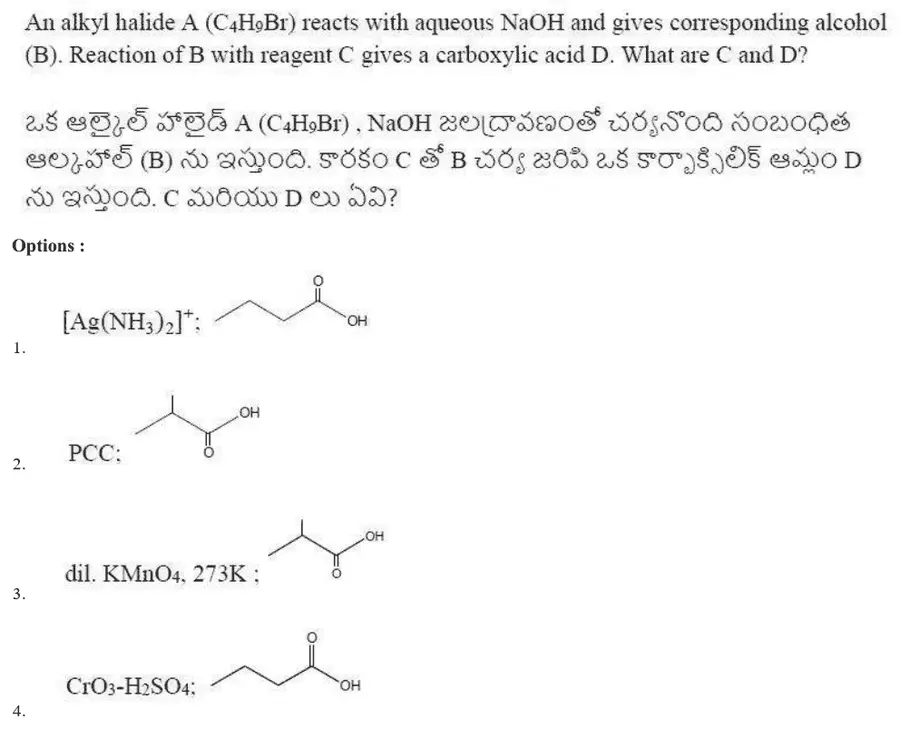
An alkyl halide A ($\mathrm{C_4H_9Br}$) reacts with aqueous NaOH and gives corresponding alcohol (B). Reaction of B with reagent C gives a carboxylic acid D. What are C and D?
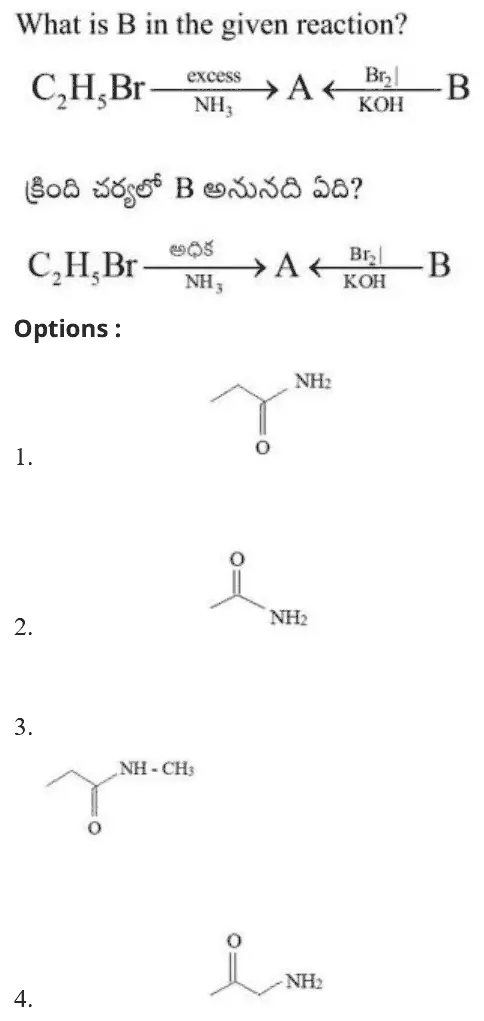
The question as printed in the paper.
A
$\mathrm{[Ag(NH_3)_2]^+}$; (see the figure above) skeletal structure of butanoic acid (straight chain CH3CH2CH2COOH)
B
PCC; (see the figure above) skeletal structure of 3-methylpropanoic... i.e. isobutyric-type acid: branched chain with a methyl branch on the carbon next to the COOH-bearing chain, ending in C(=O)OH
C
dil. $\mathrm{KMnO_4}$, 273K ; (see the figure above) skeletal structure of a branched carboxylic acid with a methyl branch (same as option 2), ending in C(=O)OH
D
$\mathrm{CrO_3}$-$\mathrm{H_2SO_4}$; (see the figure above) skeletal structure of butanoic acid (straight chain, ending in C(=O)OH)
Answer: (D) $\mathrm{CrO_3}$-$\mathrm{H_2SO_4}$; (see the figure above) skeletal structure of butanoic acid (straight chain, ending in C(=O)OH)· The council's preliminary key
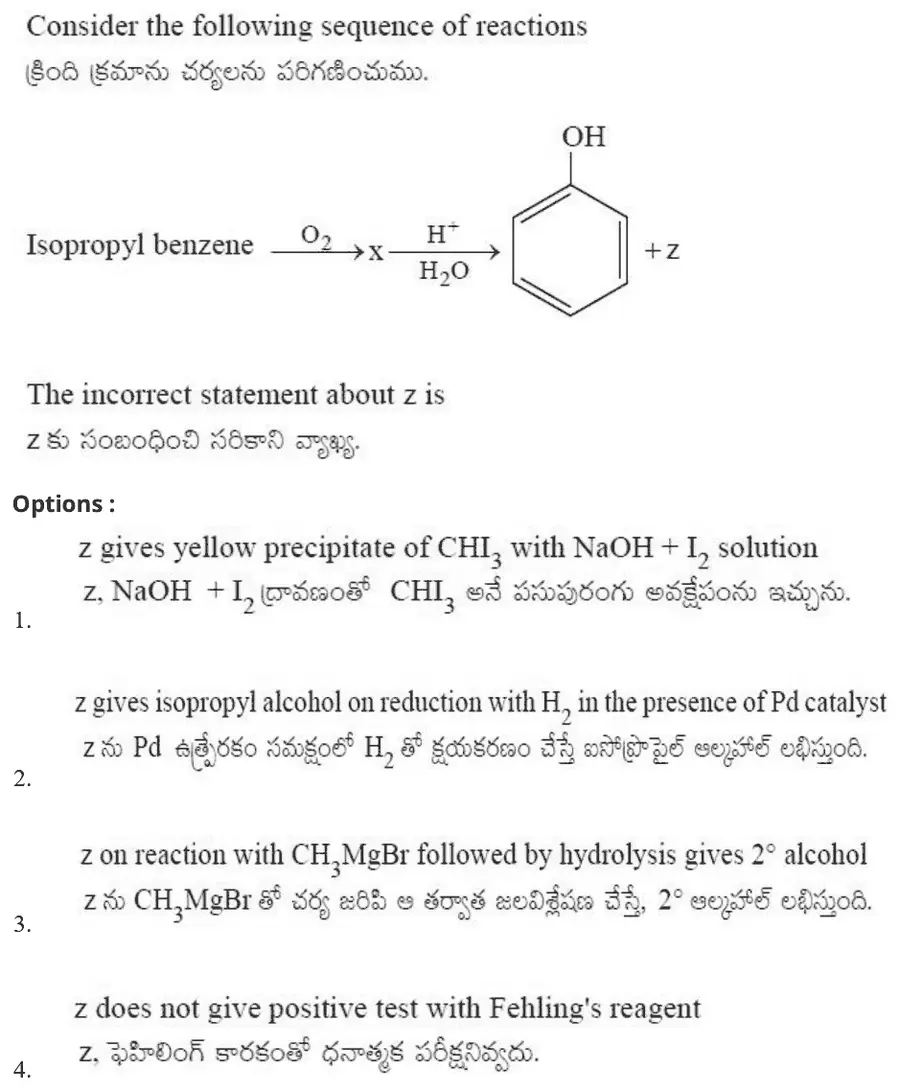
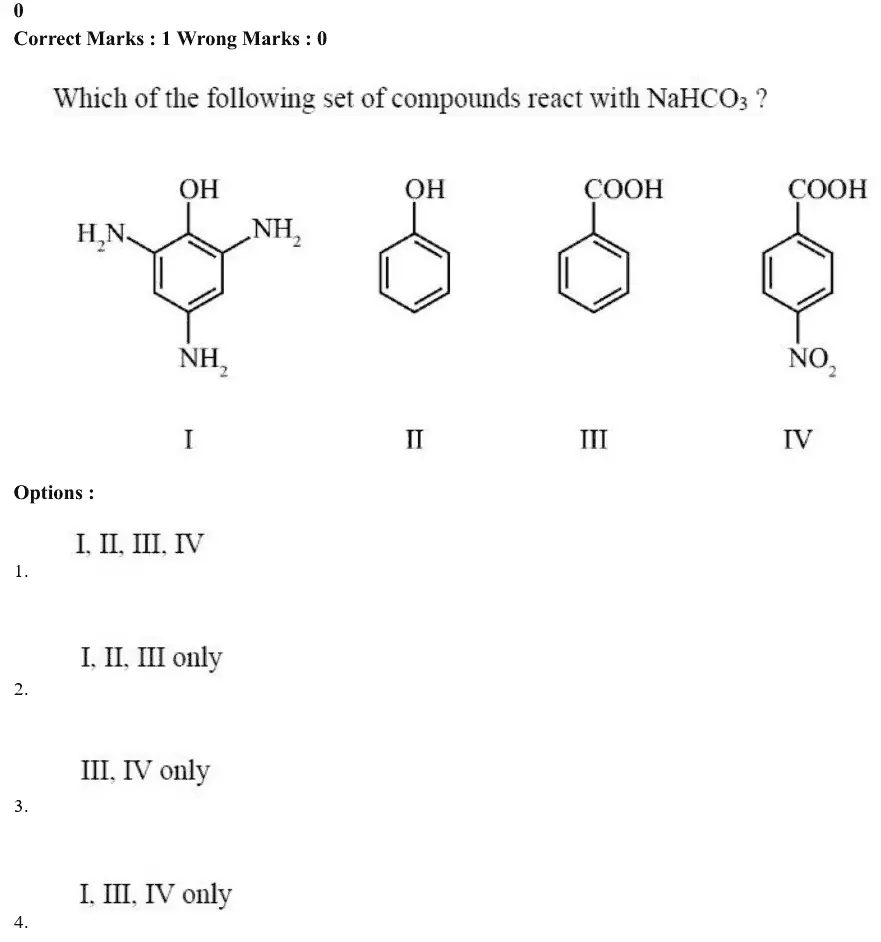
Aromatic compound X gives both iodoform and 2,4-DNP tests. Product Z liberates $\mathrm{CO_2}$ with $\mathrm{NaHCO_3}$ solution. Identify the set(s) in which Y is correctly represented from the following
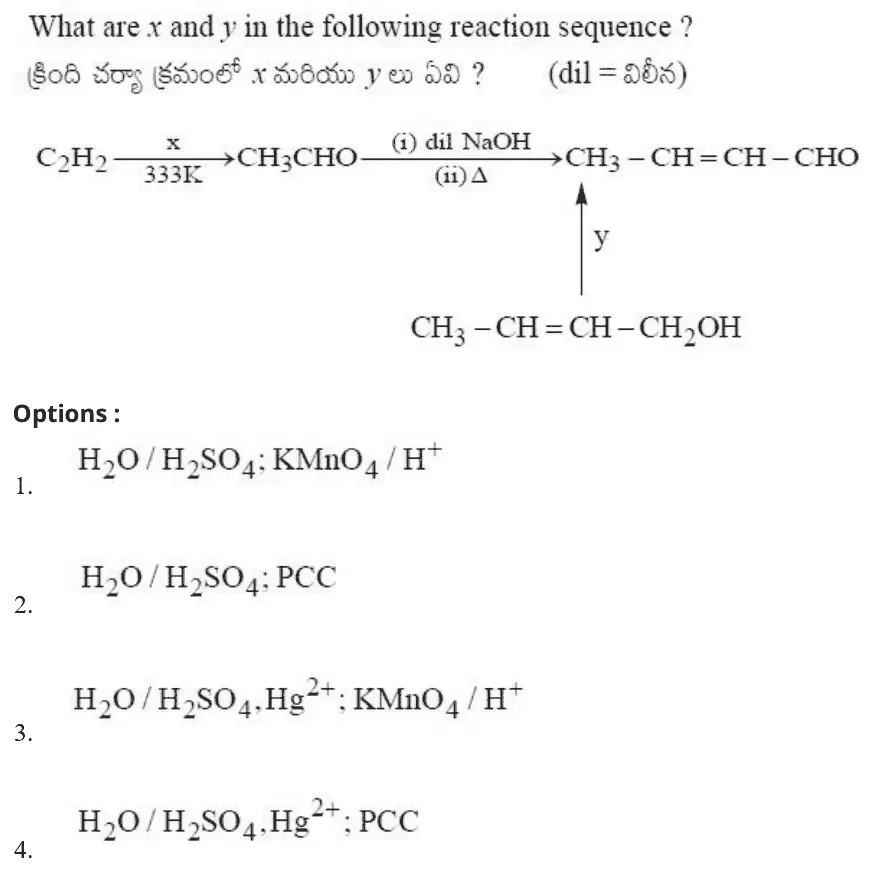
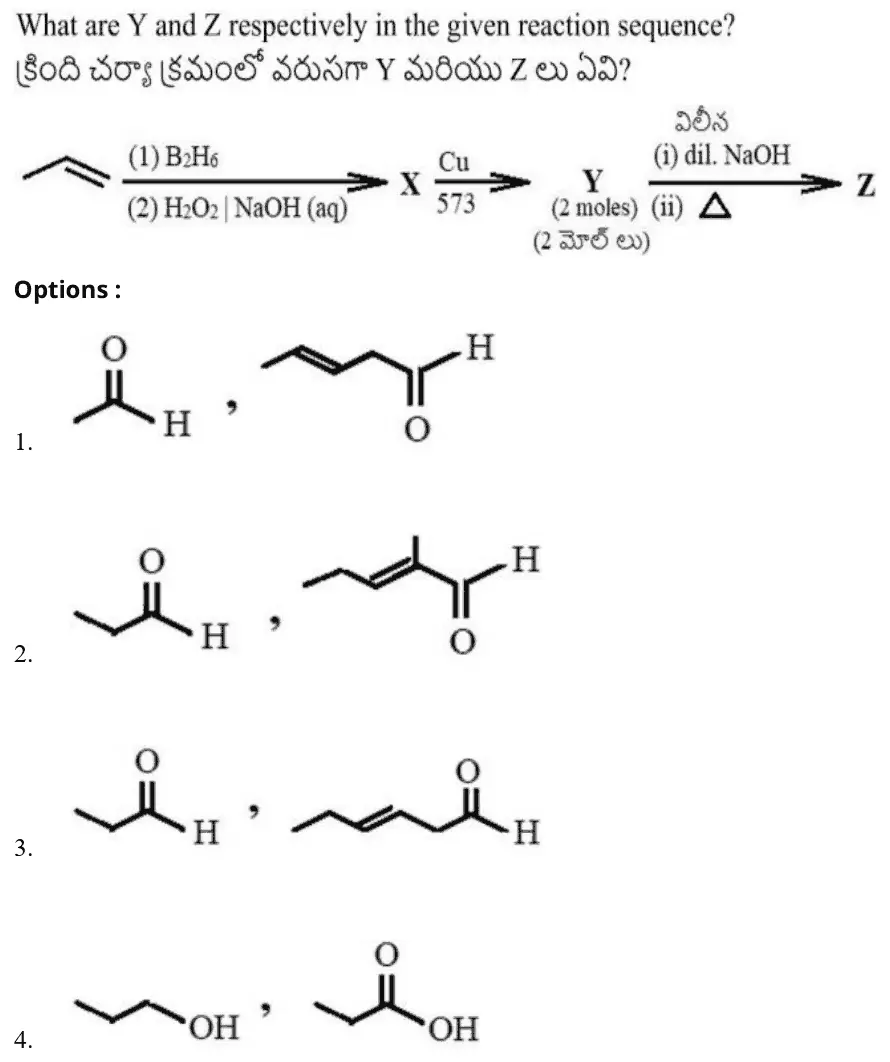
$\mathrm{C_2H_2} \xrightarrow[\mathrm{Hg^{2+}/H^+}]{\mathrm{H_2O}}$ A $\xrightarrow[\mathrm{H_3O^+}]{\mathrm{CH_3MgBr}}$ B $\xrightarrow[573\,\mathrm{K}]{\mathrm{Cu}}$ C
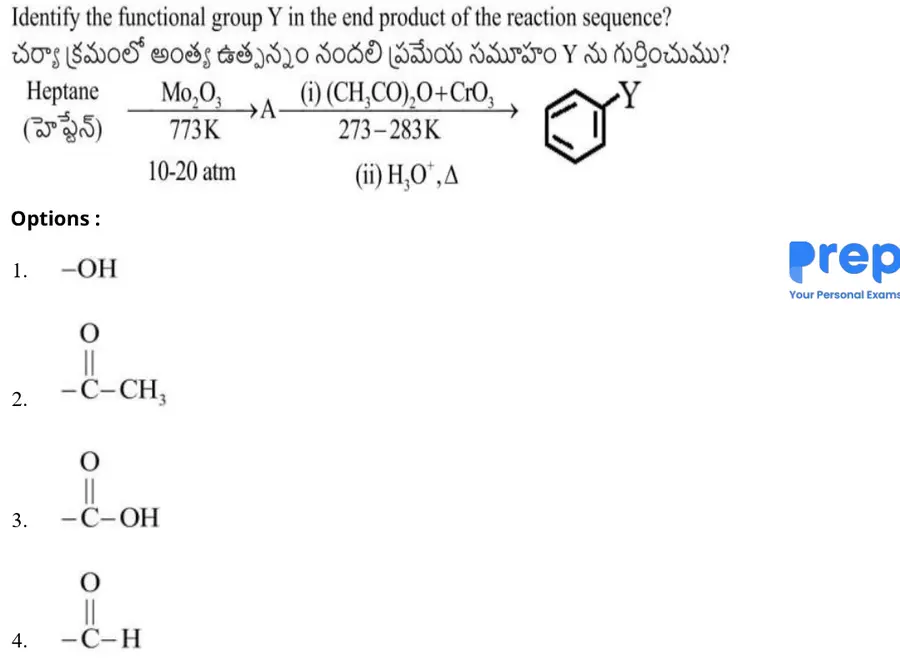
Identify the functional group Y in the end product of the reaction sequence?
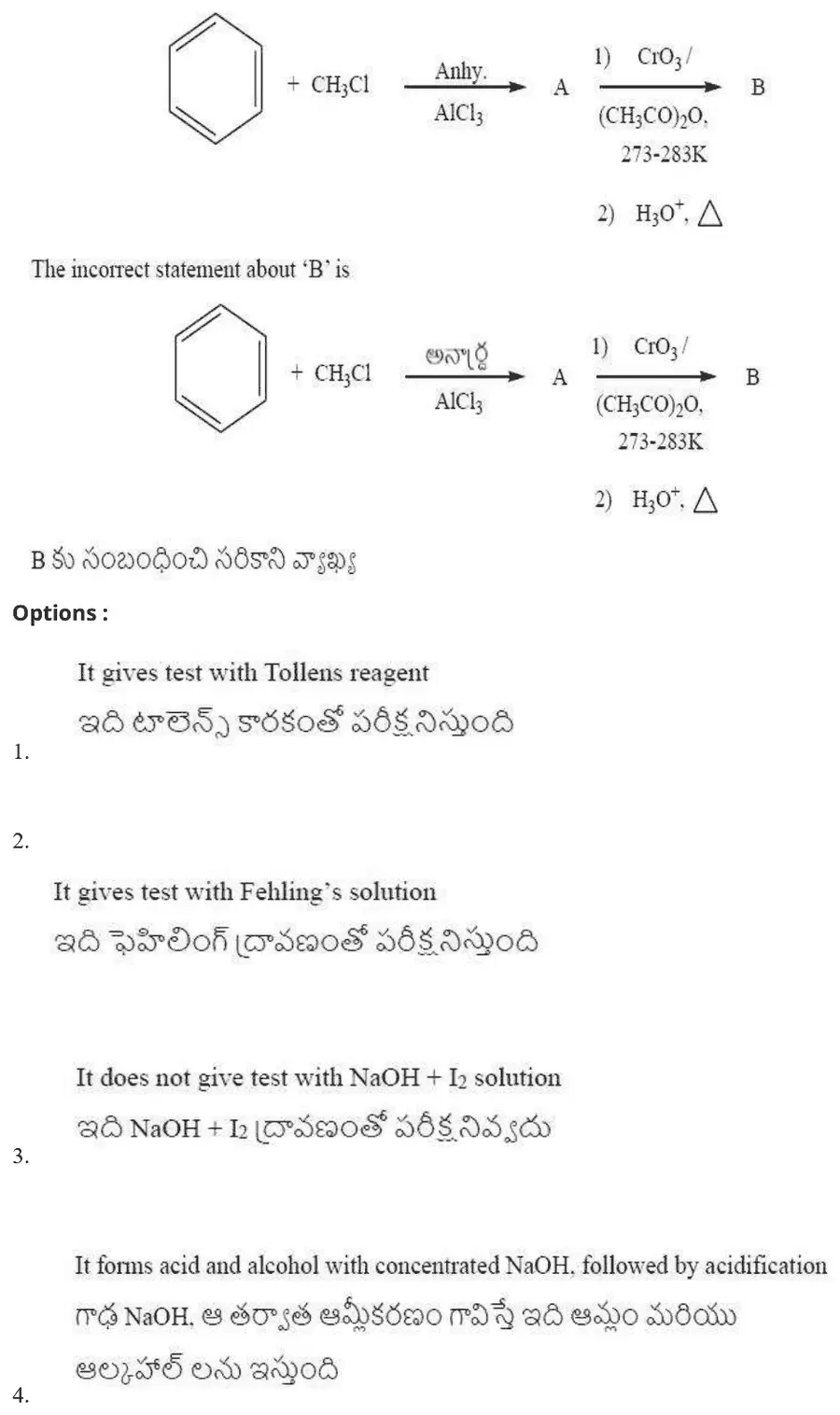
Heptane $\xrightarrow[\text{773 K, 10-20 atm}]{\mathrm{Mo_2O_3}}$ A $\xrightarrow[\text{273–283 K}]{\text{(i) }\mathrm{(CH_3CO)_2O+CrO_3}\text{; (ii) }\mathrm{H_3O^+},\Delta}$ (see the figure above)
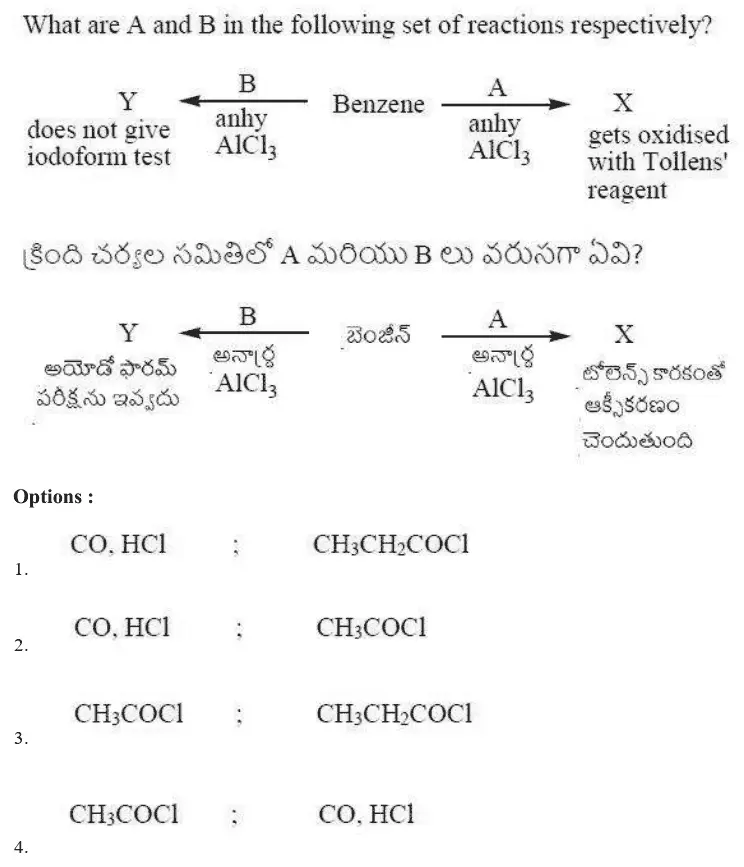
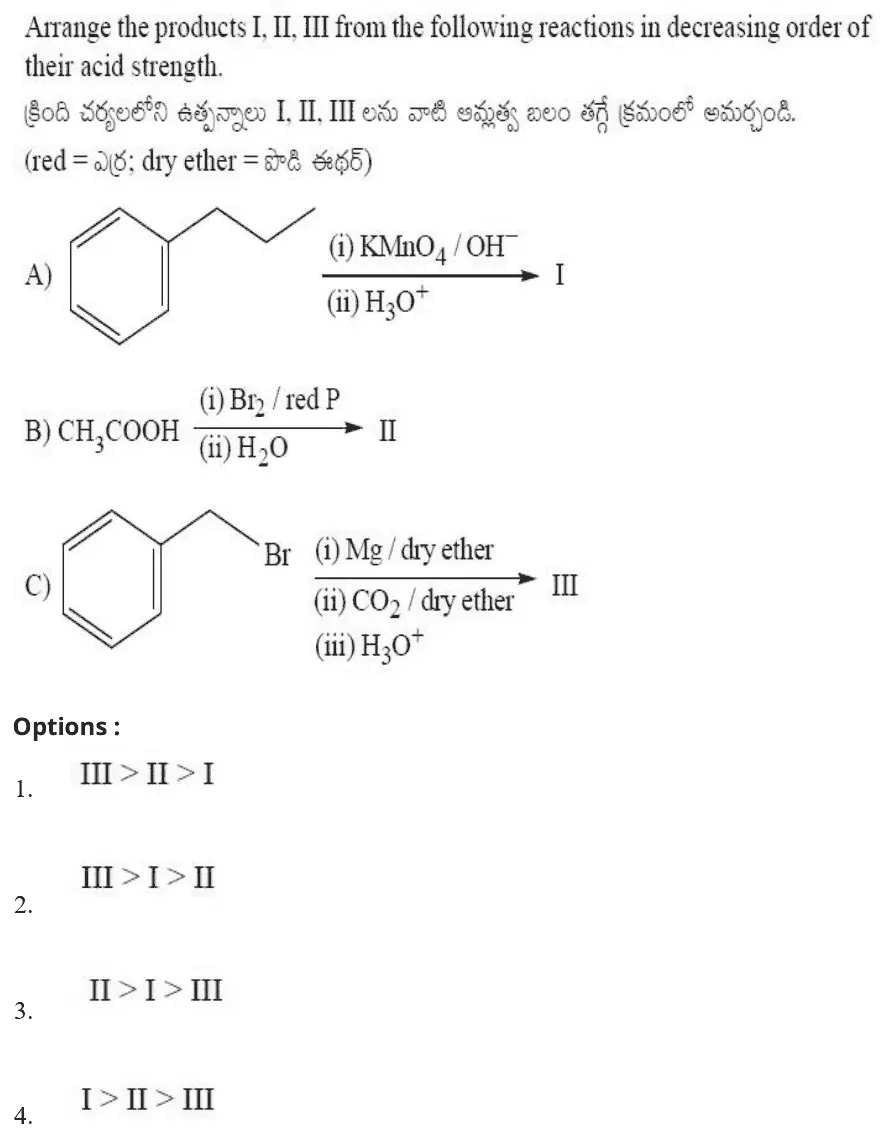
Benzene gets converted to ‘X’ in a reaction (A) and to ‘Y’ in another reaction (B). X gets oxidized by ammonical silver nitrate solution but not Y. Reactions A and B respectively are
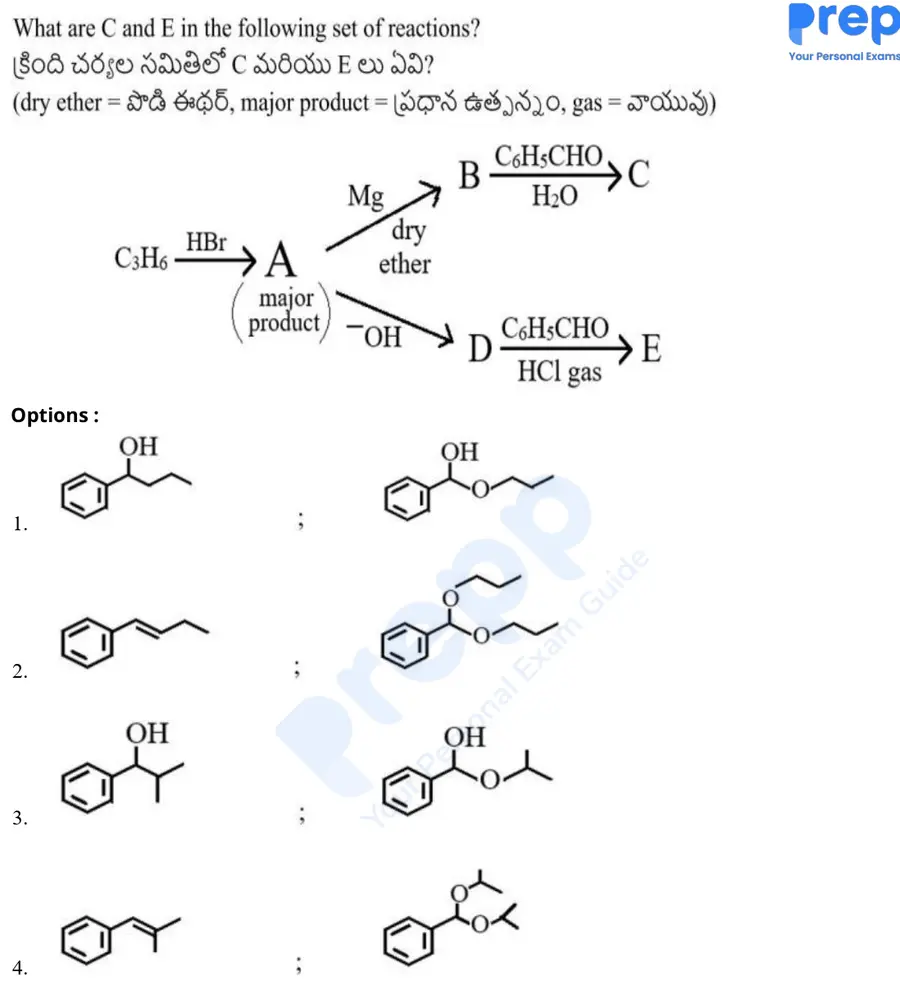
What are C and E in the following set of reactions?
(dry ether, major product, gas)
(see the figure above)
The question as printed in the paper.
A
see figure Left: 1-phenylbutan-1-ol (benzene ring attached to CH(OH) with a propyl chain); right: benzene ring attached to CH(OH)–O–CH2CH2CH3 (hemiacetal with n-propyl); separated by a semicolon
B
see figure Left: 1-phenylbut-1-ene (benzene ring attached to CH=CH–CH2CH3); right: benzaldehyde dipropyl acetal (benzene ring attached to CH(O–CH2CH2CH3)2); separated by a semicolon
C
see figure Left: 2-methyl-1-phenylpropan-1-ol (benzene ring attached to CH(OH)–CH(CH3)2); right: benzene ring attached to CH(OH)–O–CH(CH3)2 (hemiacetal with isopropyl); separated by a semicolon
D
see figure Left: 2-methyl-1-phenylprop-1-ene (benzene ring attached to CH=C(CH3)2); right: benzaldehyde diisopropyl acetal (benzene ring attached to CH(O–CH(CH3)2)2); separated by a semicolon
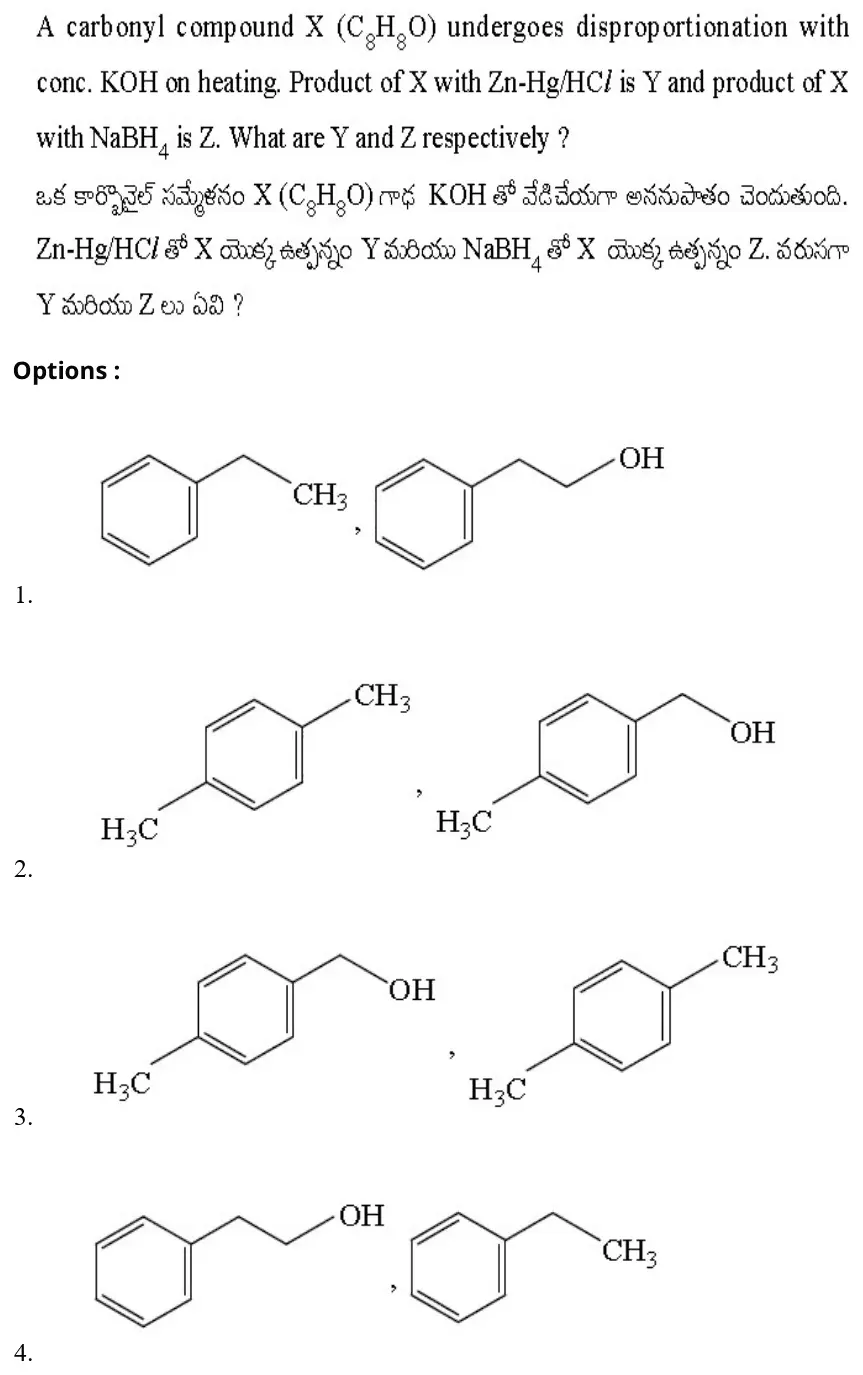
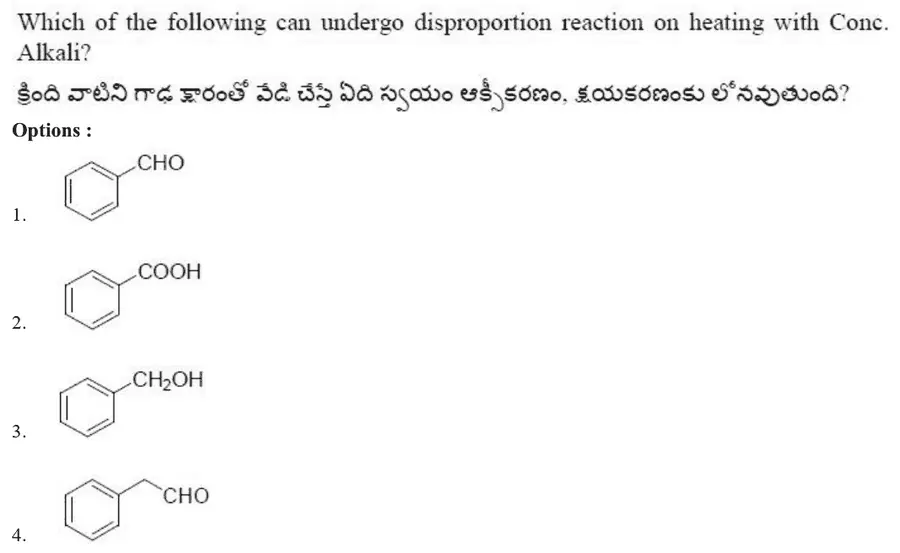
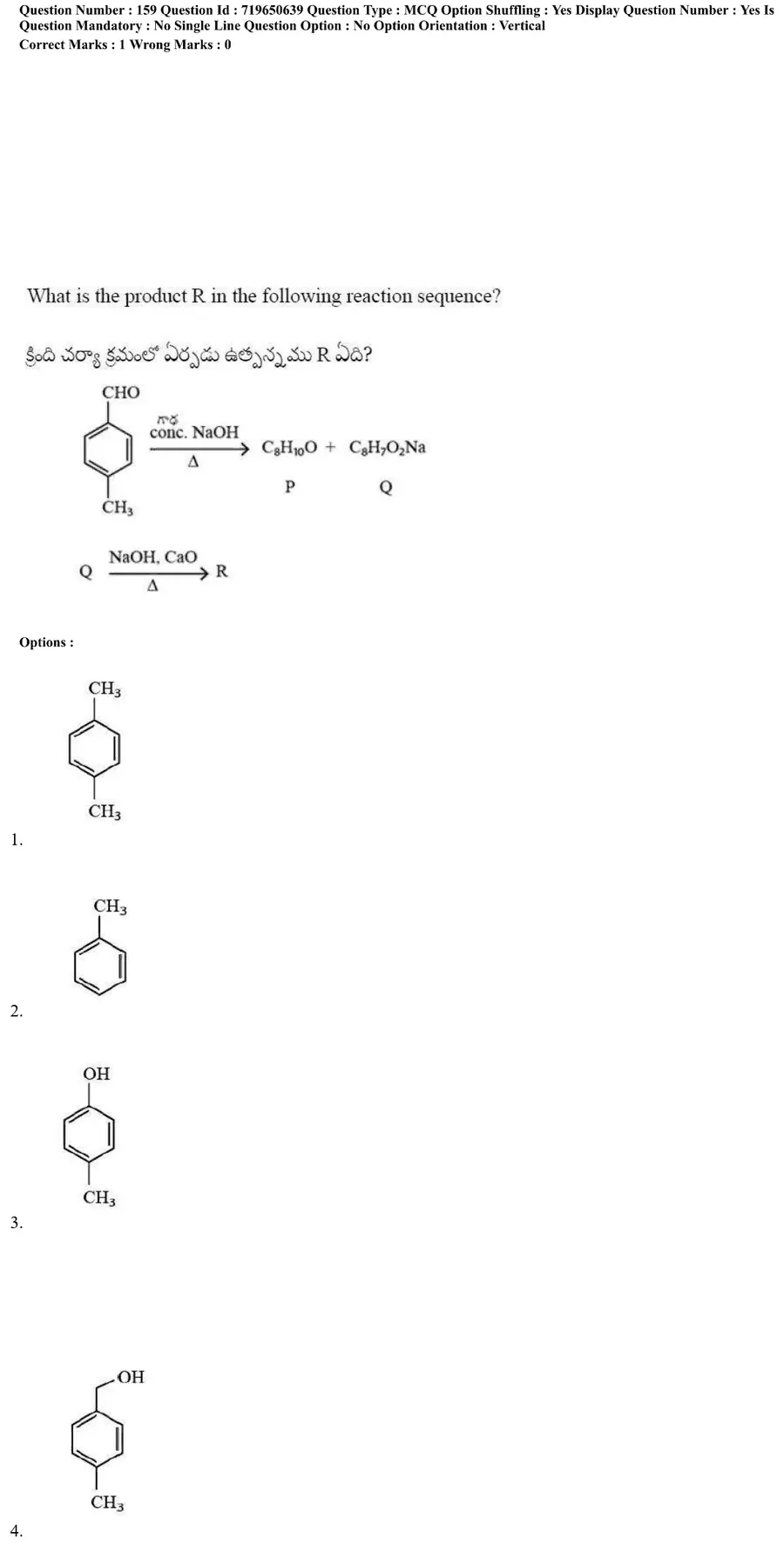
A carbonyl compound X ($\mathrm{C_8H_8O}$) undergoes disproportionation with conc. KOH on heating. Product of X with Zn-Hg/HCl is Y and product of X with $\mathrm{NaBH_4}$ is Z. What are Y and Z respectively ?
The question as printed in the paper.
A
see figure Two structures separated by a comma: benzene ring with a $\mathrm{CH_2CH_3}$ (ethyl) substituent, and benzene ring with a $\mathrm{CH_2CH_2OH}$ substituent.
B
see figure Two structures separated by a comma: 1,4-disubstituted benzene ring bearing $\mathrm{CH_3}$ and $\mathrm{H_3C}$ (p-xylene), and 1,4-disubstituted benzene ring bearing $\mathrm{CH_2OH}$ and $\mathrm{H_3C}$ (4-methylbenzyl alcohol).
C
see figure Two structures separated by a comma: 4-methylbenzyl alcohol (benzene ring with $\mathrm{CH_2OH}$ and $\mathrm{H_3C}$ para), and p-xylene (benzene ring with $\mathrm{CH_3}$ and $\mathrm{H_3C}$ para).
D
see figure Two structures separated by a comma: benzene ring with a $\mathrm{CH_2CH_2OH}$ substituent, and benzene ring with a $\mathrm{CH_2CH_3}$ (ethyl) substituent.
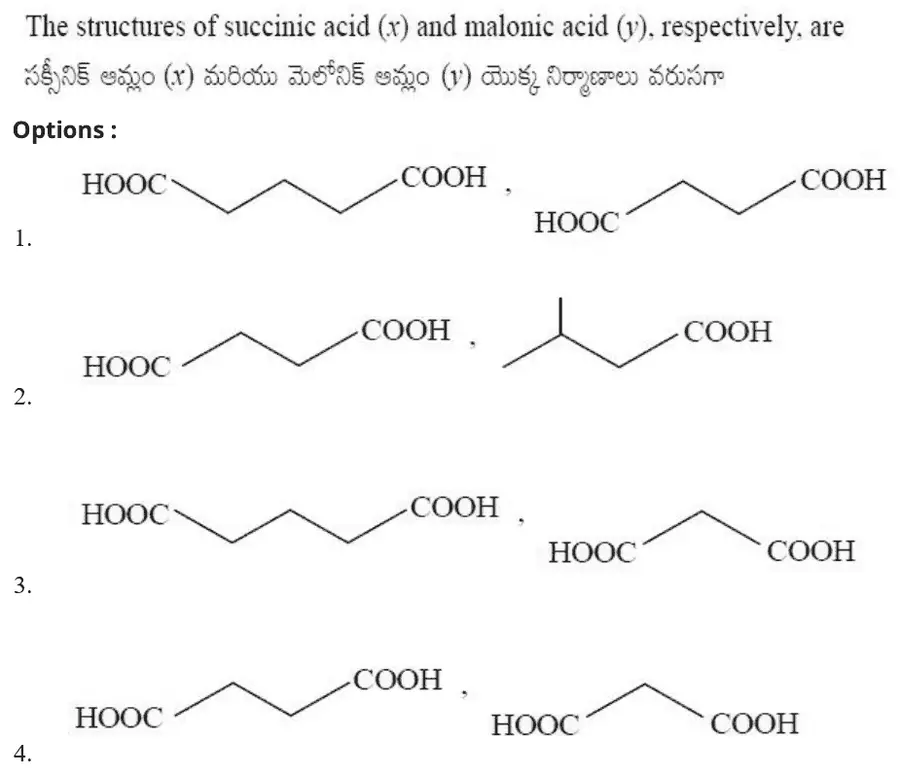
The structures of succinic acid ($x$) and malonic acid ($y$), respectively, are
The question as printed in the paper.
A
see figure Skeletal structure pair: first, HOOC–zigzag chain with 5 bonds (4 carbons in the chain between the carboxyl groups, i.e. HOOC-CH2-CH2-CH2-COOH, glutaric-type) ending in COOH; second, HOOC–zigzag chain of 3 bonds ending in COOH (HOOC-CH2-CH2-COOH).
B
see figure Skeletal structure pair: first, HOOC–zigzag chain of 3 bonds ending in COOH (HOOC-CH2-CH2-COOH); second, a branched chain with a vertical methyl branch on the carbon bearing a zigzag toward COOH (methyl-substituted, no HOOC label at left end).
C
see figure Skeletal structure pair: first, HOOC–zigzag chain with 5 bonds ending in COOH (HOOC-CH2-CH2-CH2-COOH); second, HOOC–CH2–COOH drawn as a 2-bond zigzag (malonic acid).
D
see figure Skeletal structure pair: first, HOOC–zigzag chain of 3 bonds ending in COOH (HOOC-CH2-CH2-COOH, succinic acid); second, HOOC–CH2–COOH drawn as a 2-bond zigzag (malonic acid).
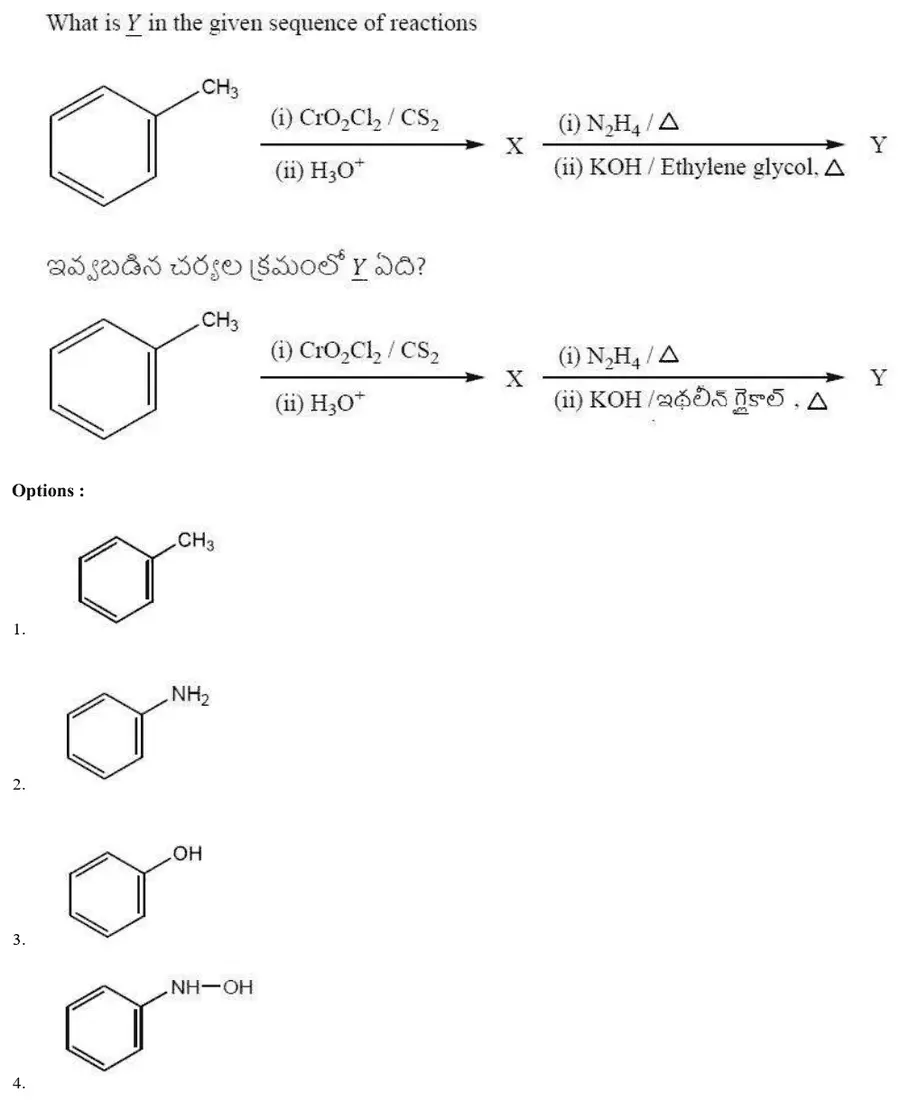
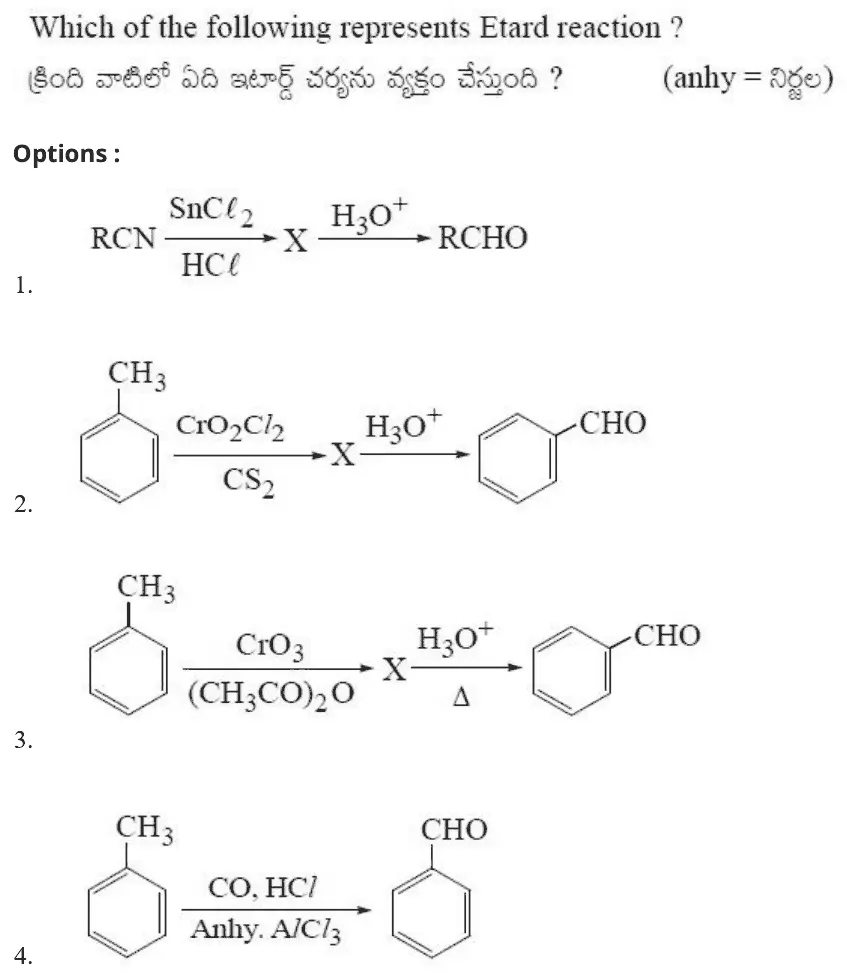
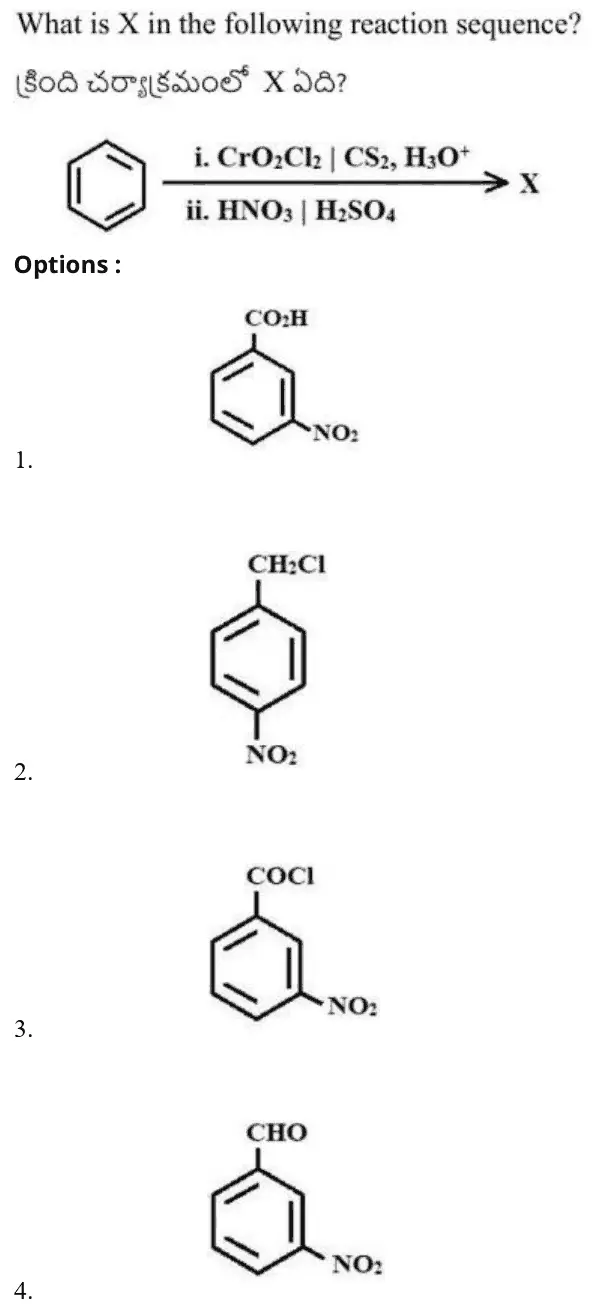
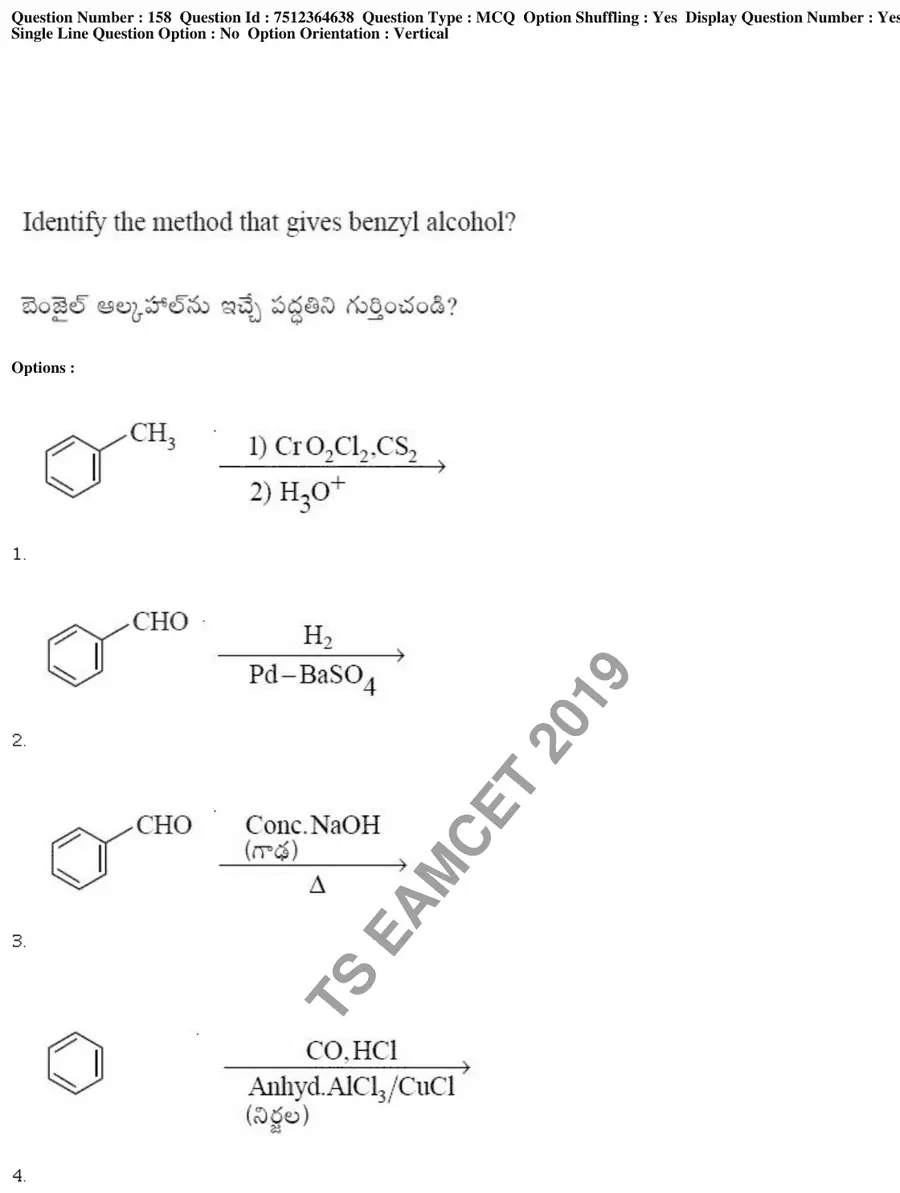
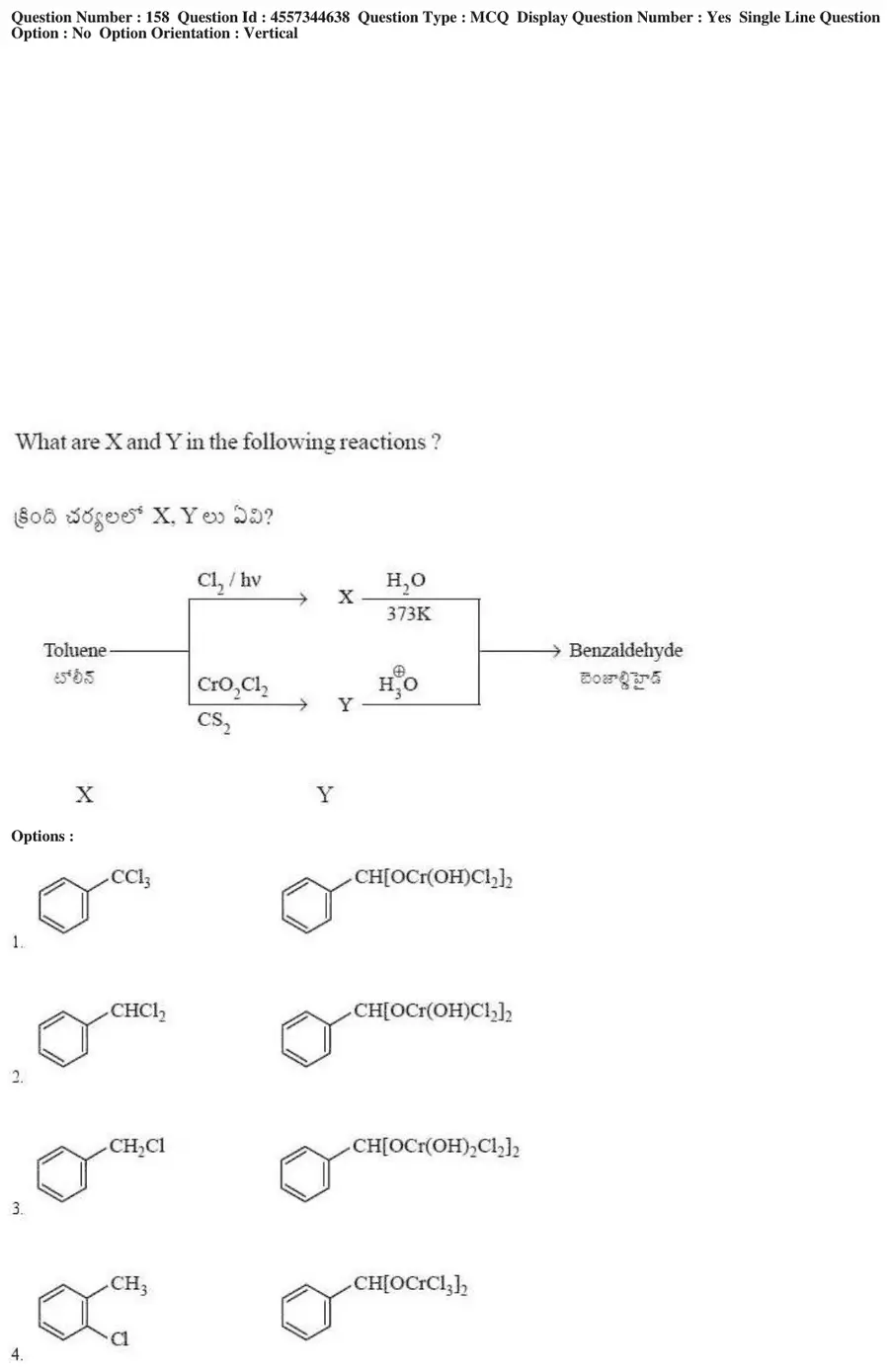
see figure Toluene (benzene ring bearing CH3) $\xrightarrow[\mathrm{CS_2}]{\mathrm{CrO_2Cl_2}}$ X $\xrightarrow{\mathrm{H_3O^+}}$ benzaldehyde (benzene ring bearing CHO)
C
see figure Toluene (benzene ring bearing CH3) $\xrightarrow[\mathrm{(CH_3CO)_2O}]{\mathrm{CrO_3}}$ X $\xrightarrow[\Delta]{\mathrm{H_3O^+}}$ benzaldehyde (benzene ring bearing CHO)
D
see figure Toluene (benzene ring bearing CH3) $\xrightarrow[\text{Anhy. } \mathrm{AlCl_3}]{\mathrm{CO,\ HCl}}$ benzaldehyde (benzene ring bearing CHO)
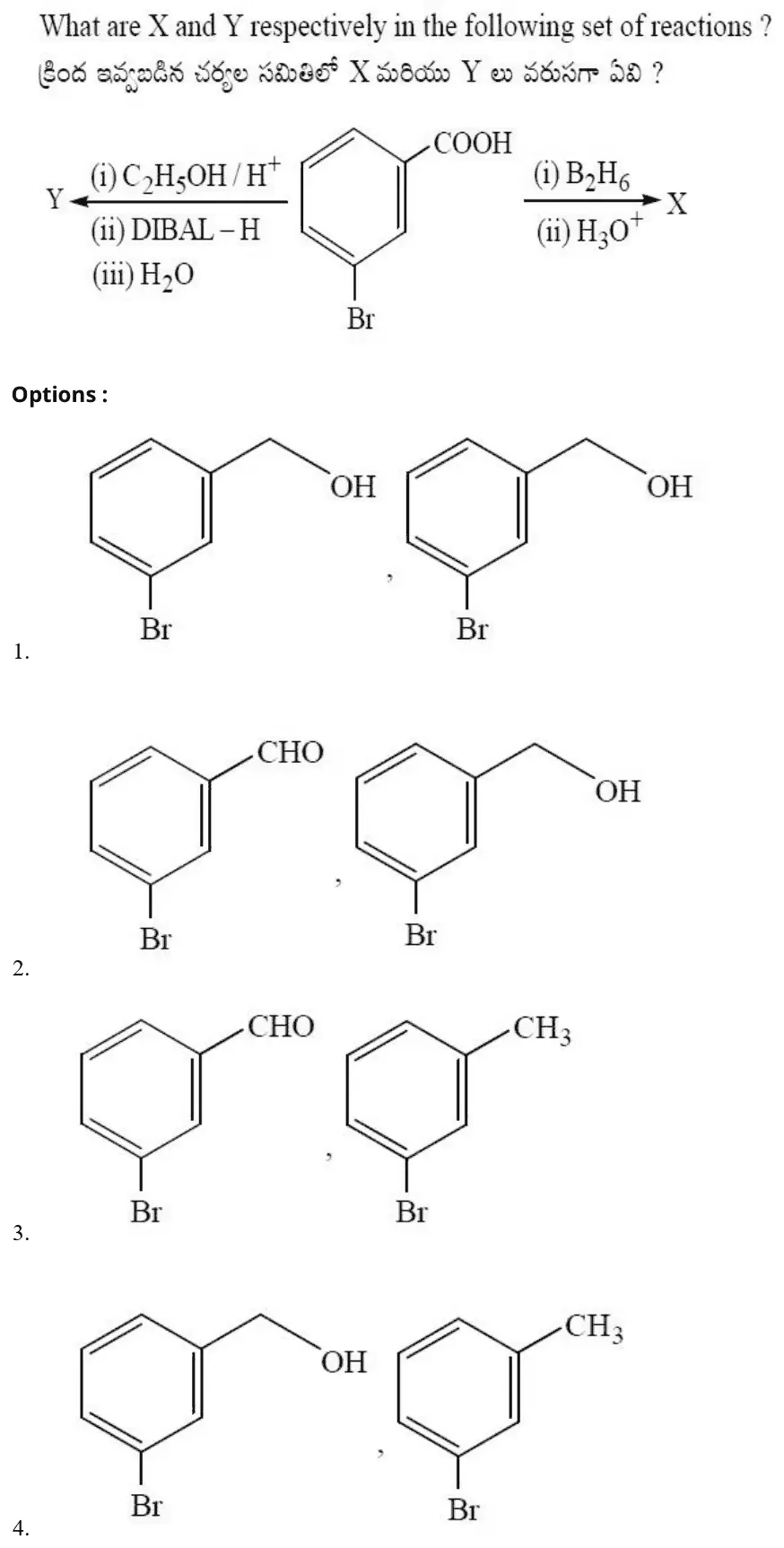
What are X and Y respectively in the following set of reactions ?
(see the figure above)
The question as printed in the paper.
A
see figure Two structures: X = 3-bromobenzyl alcohol (benzene ring with CH2OH and Br meta), Y = 3-bromobenzyl alcohol (same structure)
B
see figure Two structures: first = 3-bromobenzaldehyde (benzene ring with CHO and Br meta), second = 3-bromobenzyl alcohol (benzene ring with CH2OH and Br meta)
C
see figure Two structures: first = 3-bromobenzaldehyde (benzene ring with CHO and Br meta), second = 3-bromotoluene (benzene ring with CH3 and Br meta)
D
see figure Two structures: first = 3-bromobenzyl alcohol (benzene ring with CH2OH and Br meta), second = 3-bromotoluene (benzene ring with CH3 and Br meta)
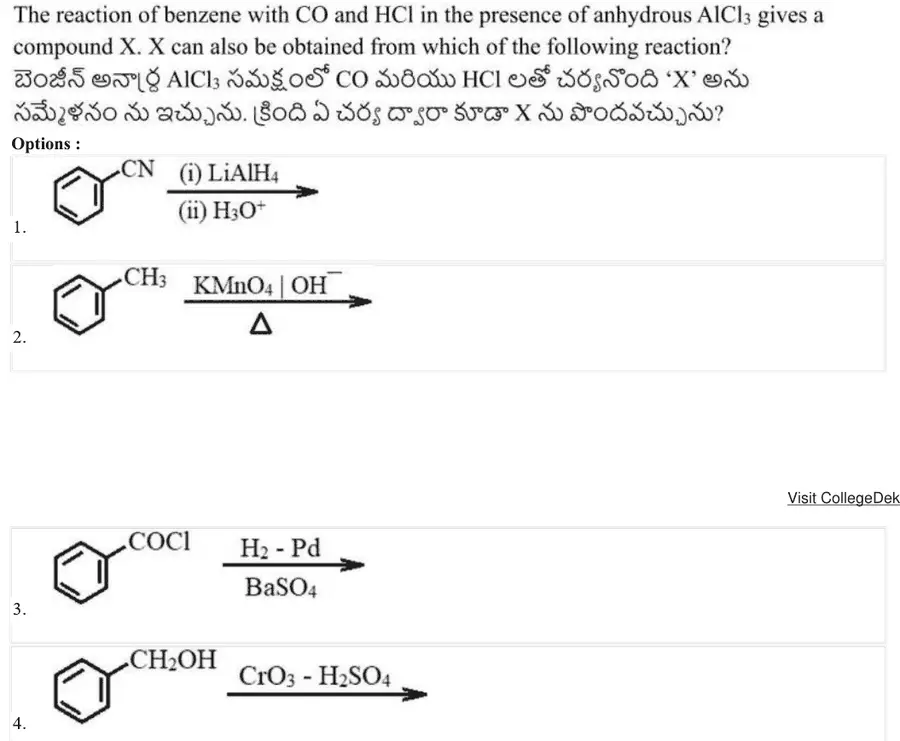
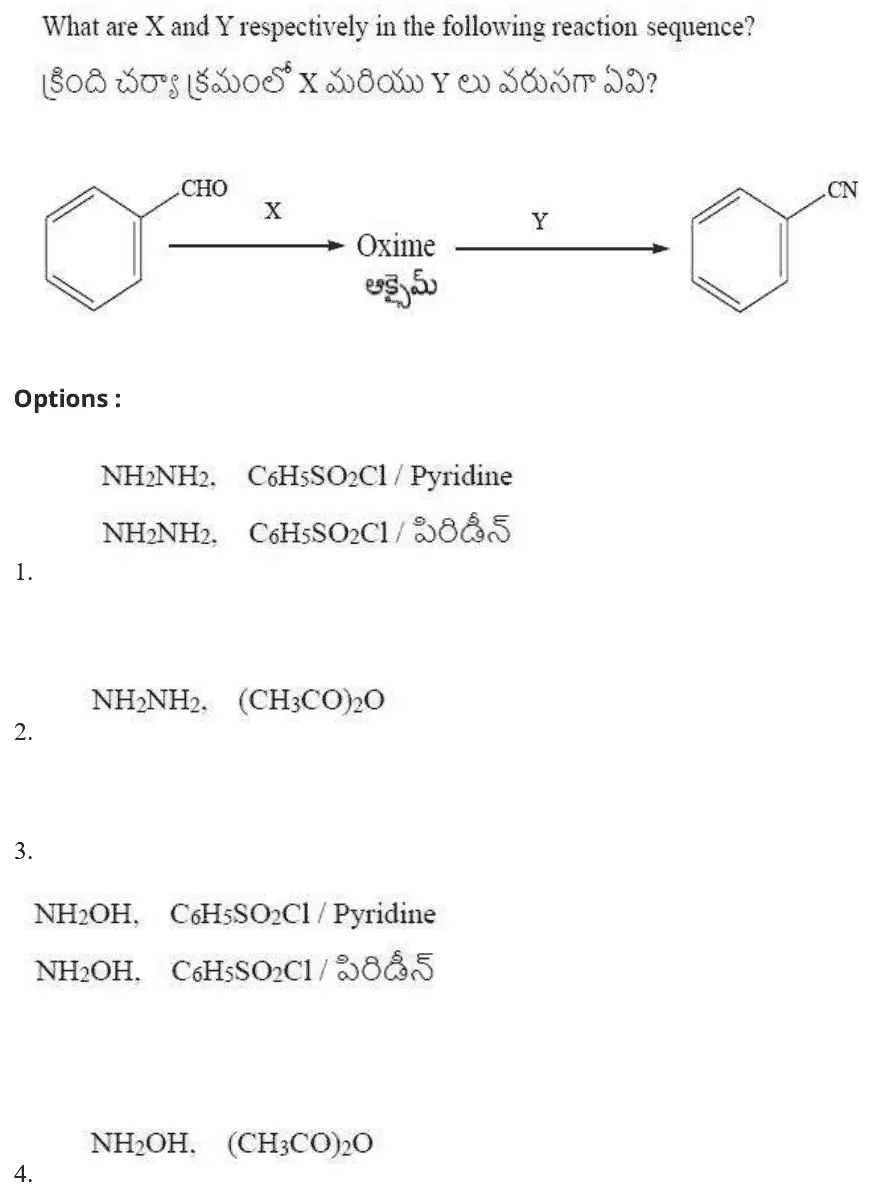
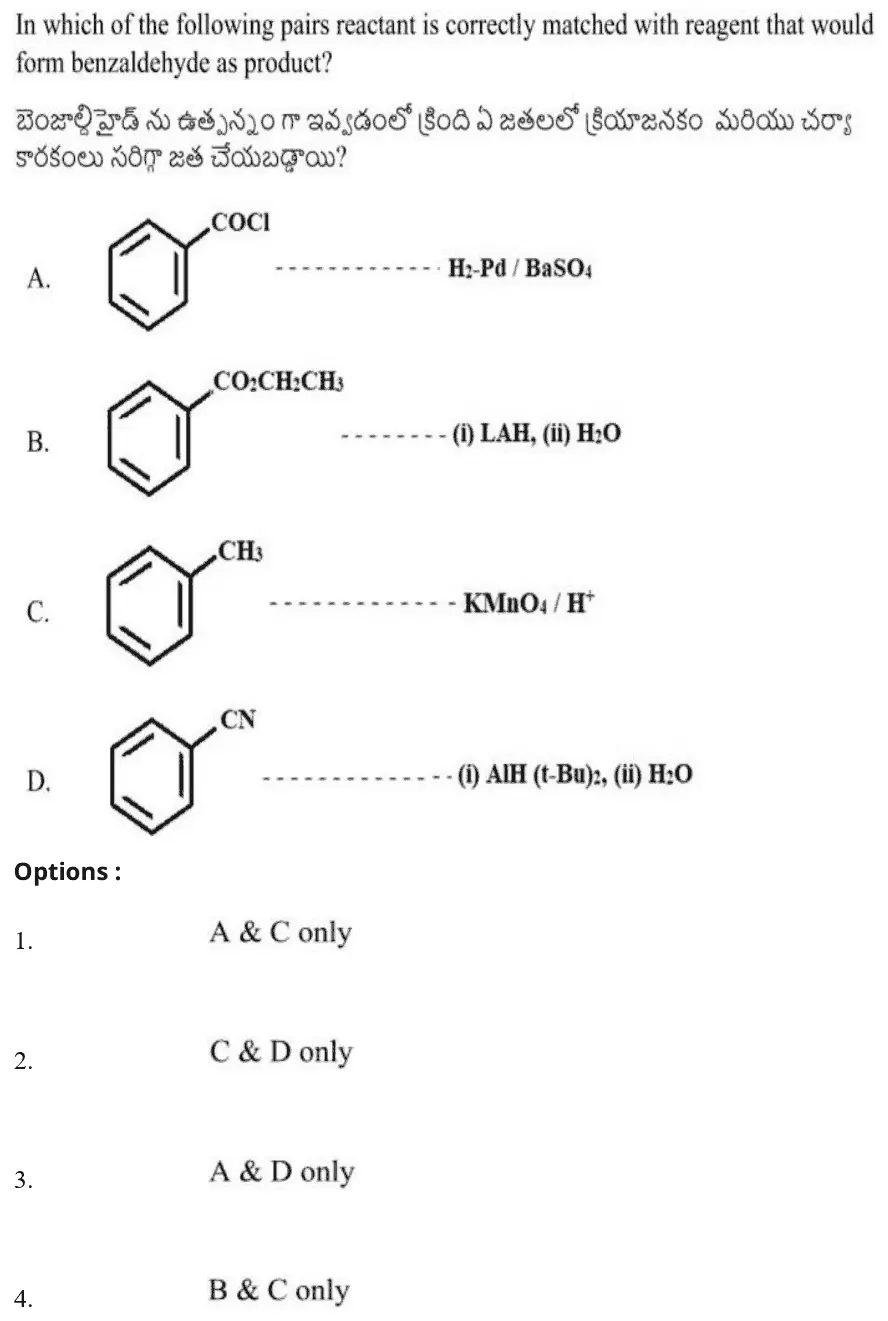
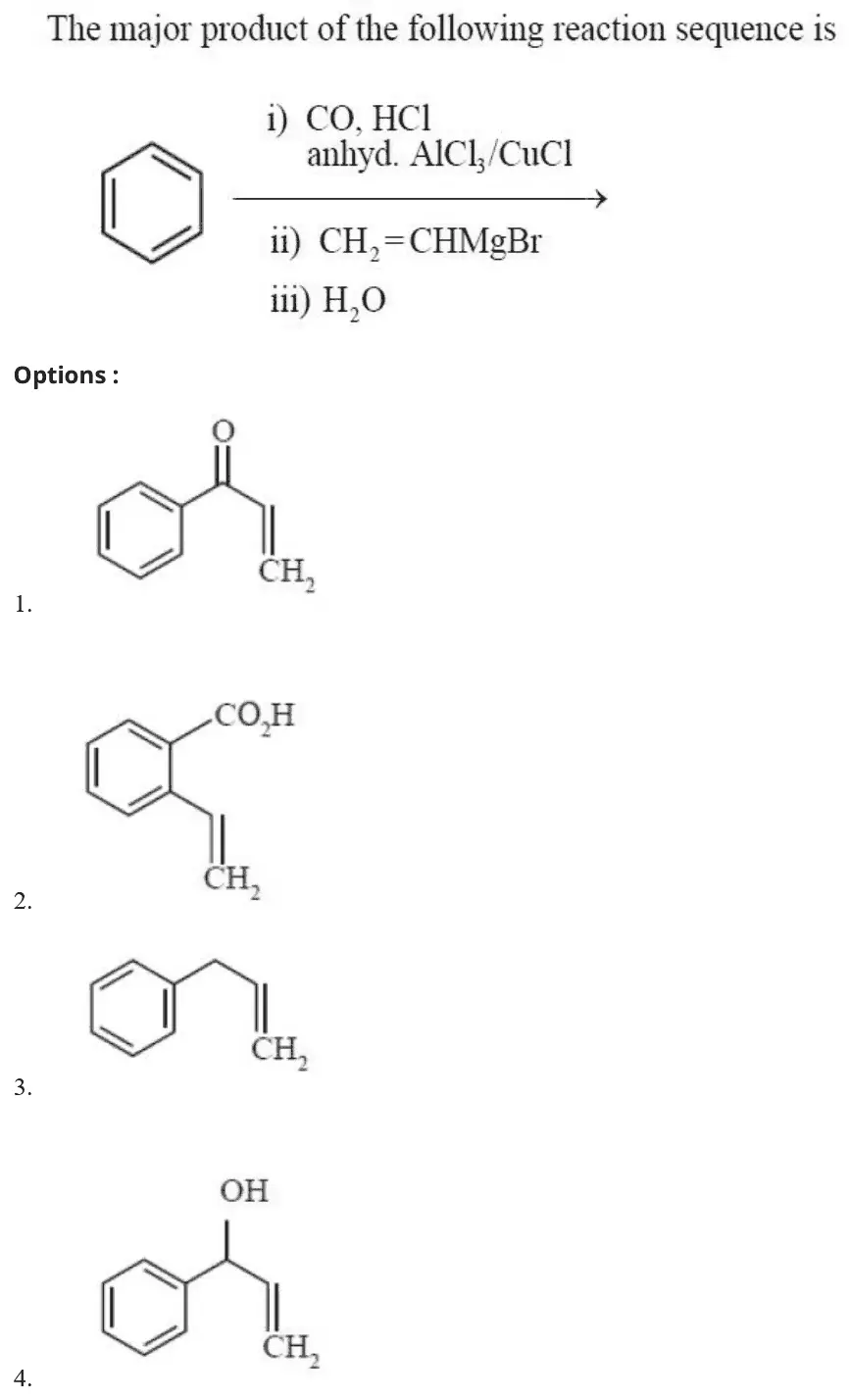
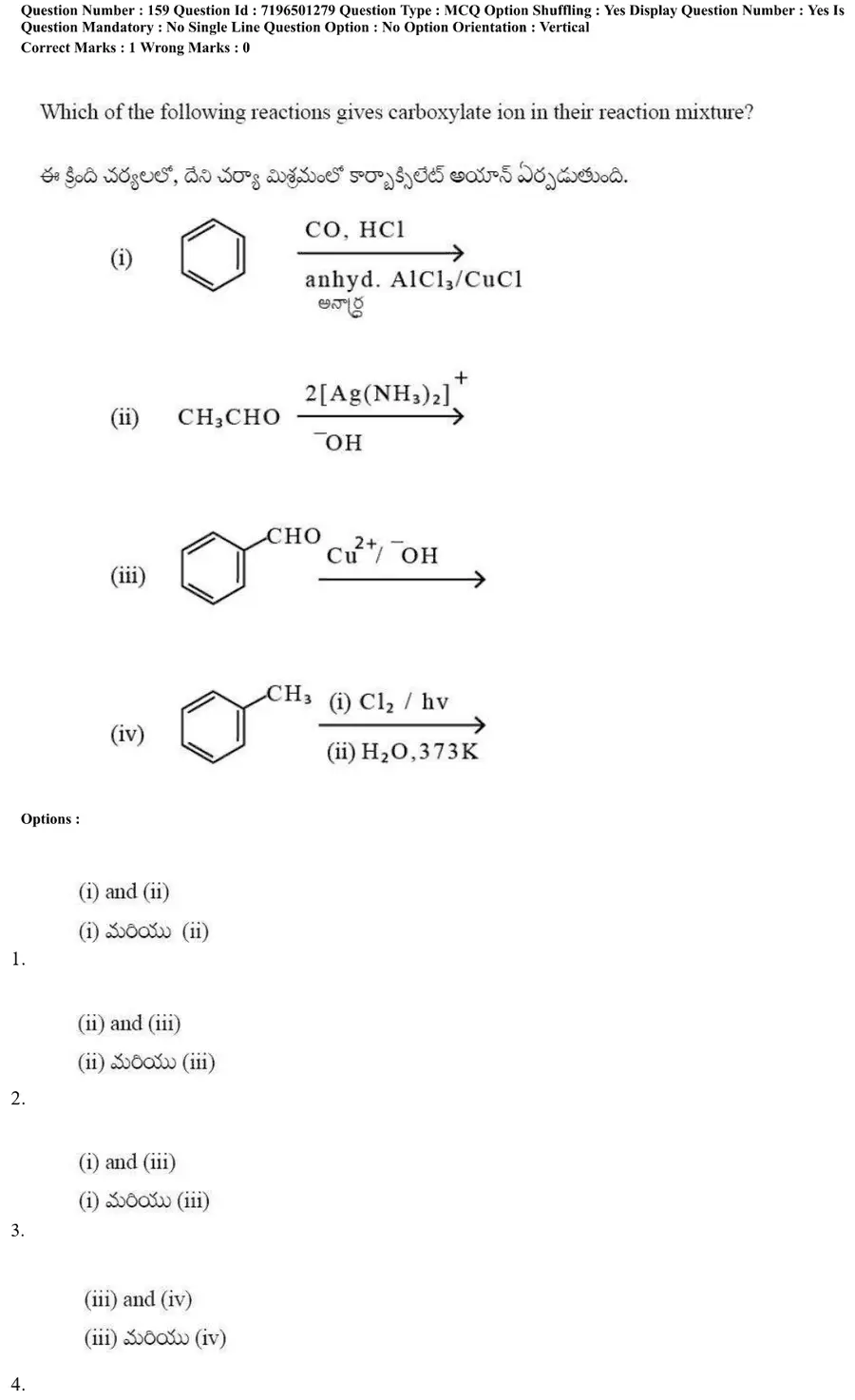
The reaction of benzene with CO and HCl in the presence of anhydrous $\mathrm{AlCl_3}$ gives a compound X. X can also be obtained from which of the following reaction?
The question as printed in the paper.
A
see figure Benzonitrile (benzene ring with CN) with reagents (i) $\mathrm{LiAlH_4}$, (ii) $\mathrm{H_3O^+}$ over the arrow
B
see figure Toluene (benzene ring with $\mathrm{CH_3}$) with $\mathrm{KMnO_4 | OH^-}$ and heat ($\Delta$) over/under the arrow
C
see figure Benzoyl chloride (benzene ring with COCl) with $\mathrm{H_2}$-Pd/$\mathrm{BaSO_4}$ over/under the arrow
D
see figure Benzyl alcohol (benzene ring with $\mathrm{CH_2OH}$) with $\mathrm{CrO_3}$-$\mathrm{H_2SO_4}$ over the arrow
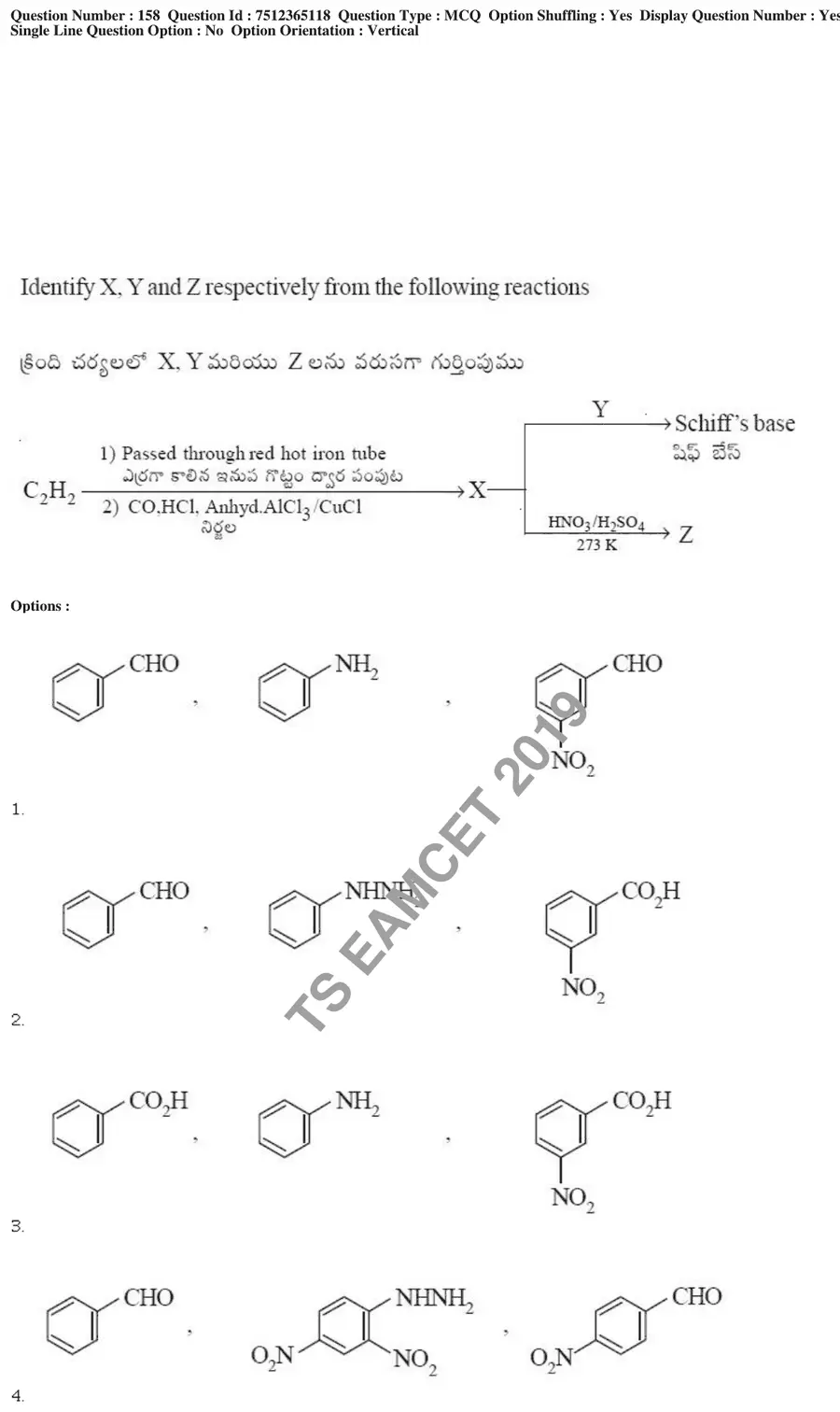
Toluene on reaction with reagent A gives X. This (X) forms 2,4-dinitrophenylhydrazone and reduces ammonical silver nitrate solution. Reaction of toluene with another reagent B forms Y, which dissolves in $\mathrm{NaHCO_3}$ with evolution of $\mathrm{CO_2}$. What are A and B respectively?
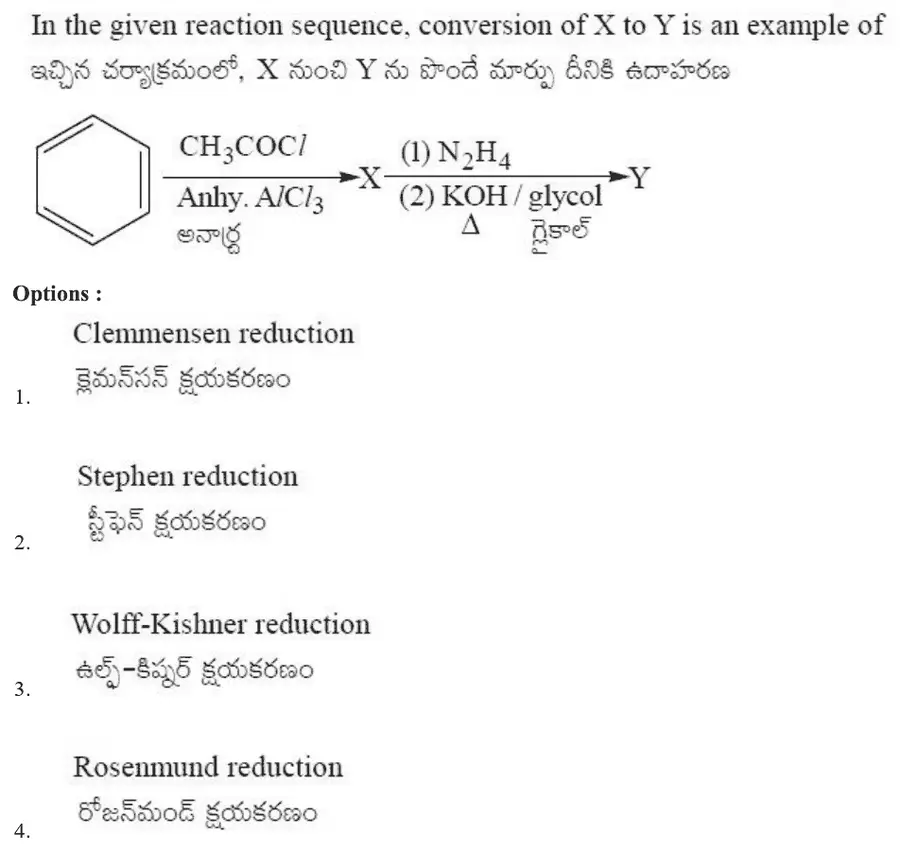
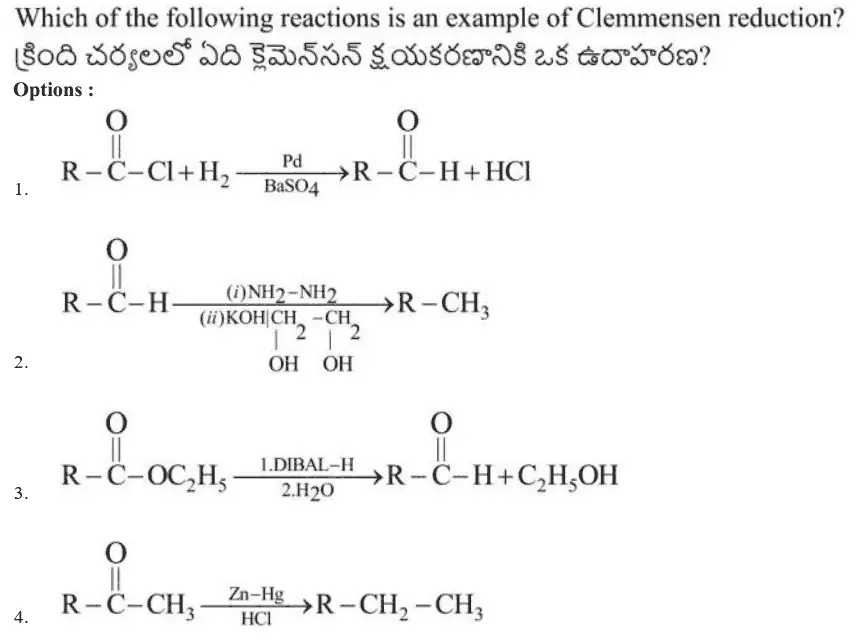
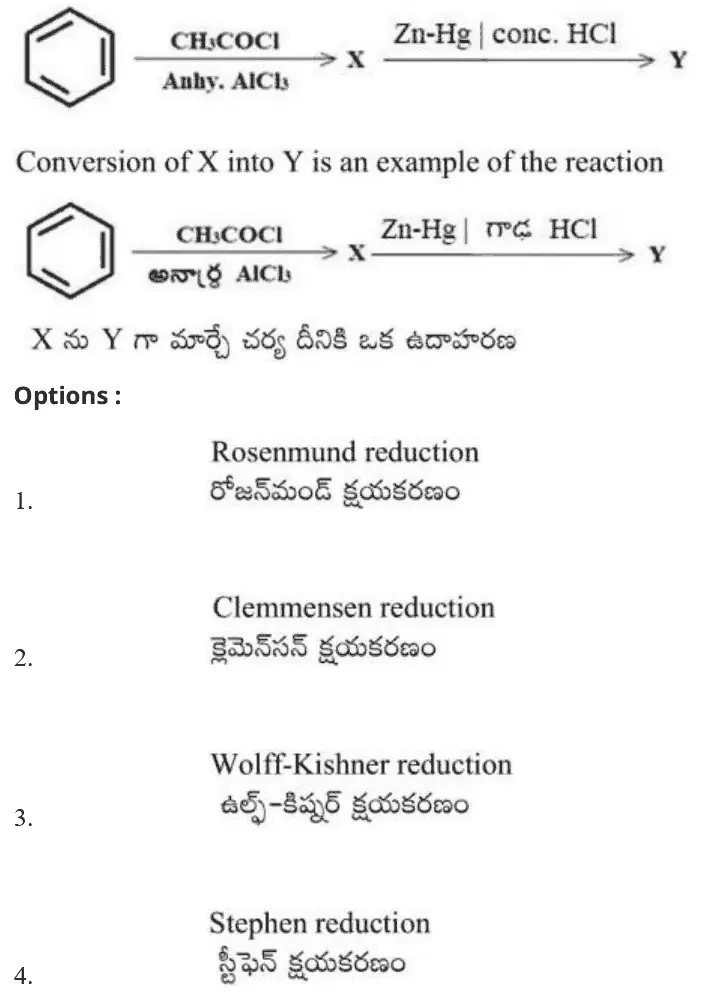
Which of the following reactions is an example of Clemmensen reduction?
The question as printed in the paper.
A
see figure Reaction: $\mathrm{R-C(=O)-Cl + H_2}$ with Pd/$\mathrm{BaSO_4}$ over the arrow gives $\mathrm{R-C(=O)-H + HCl}$ (Rosenmund reduction)
B
see figure Reaction: $\mathrm{R-C(=O)-H}$ with (i) $\mathrm{NH_2-NH_2}$, (ii) KOH / $\mathrm{CH_2-CH_2}$ (with OH on each CH2, i.e. ethylene glycol) over the arrow gives $\mathrm{R-CH_3}$
C
see figure Reaction: $\mathrm{R-C(=O)-OC_2H_5}$ with 1. DIBAL-H, 2. $\mathrm{H_2O}$ over the arrow gives $\mathrm{R-C(=O)-H + C_2H_5OH}$
D
see figure Reaction: $\mathrm{R-C(=O)-CH_3}$ with Zn-Hg / HCl over the arrow gives $\mathrm{R-CH_2-CH_3}$
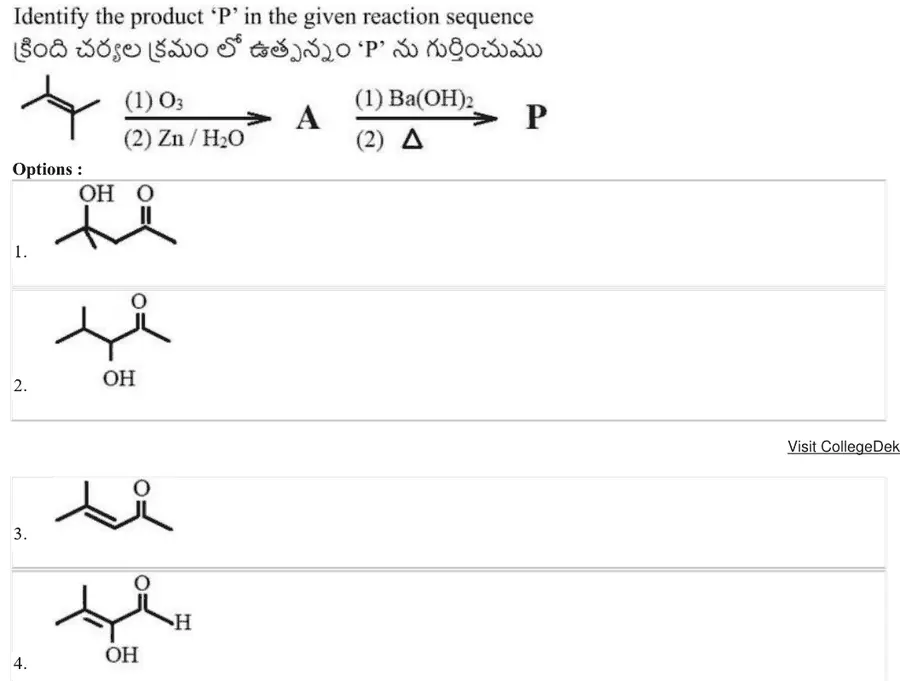
Identify the product 'P' in the given reaction sequence
(see the figure above)
The question as printed in the paper.
A
see figure Skeletal structure: a carbon bearing OH and two methyl groups (tertiary alcohol, (CH3)2C(OH)-) attached to CH2, then C(=O) and CH3, i.e. 4-hydroxy-4-methylpentan-2-one (OH and O labelled at top).
B
see figure Skeletal structure: isopropyl group attached to a CH(OH) carbon, which is bonded to C(=O)CH3, i.e. 2-hydroxy-3-methylbutyl methyl ketone type: (CH3)2CH-CH(OH)-C(=O)-CH3 (OH on the carbon below the chain, O on top of the carbonyl).
C
see figure Skeletal structure: (CH3)2C=CH-C(=O)-CH3, i.e. 4-methylpent-3-en-2-one (O on top of carbonyl).
D
see figure Skeletal structure: (CH3)2C=C(OH)-CHO, an enol aldehyde with OH on the alkene carbon below the chain, and C(=O)H aldehyde at the right with O on top.
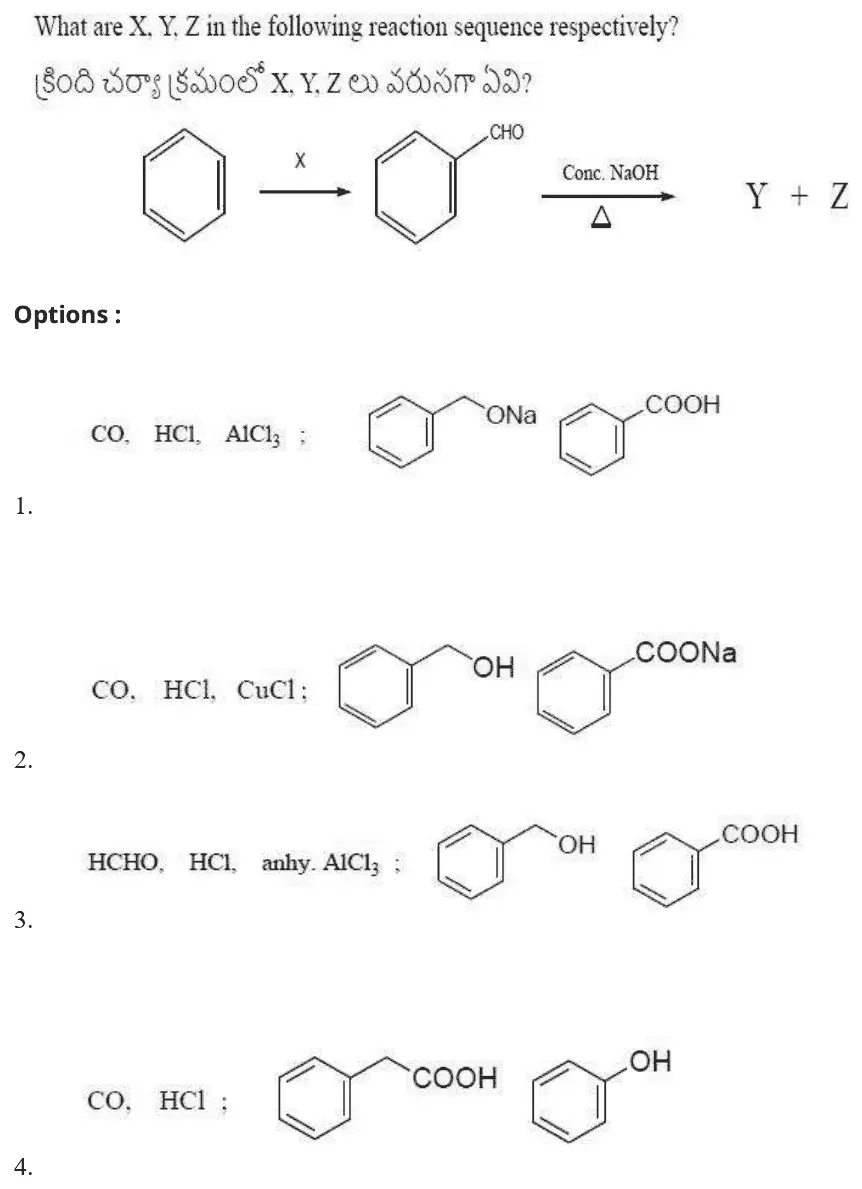
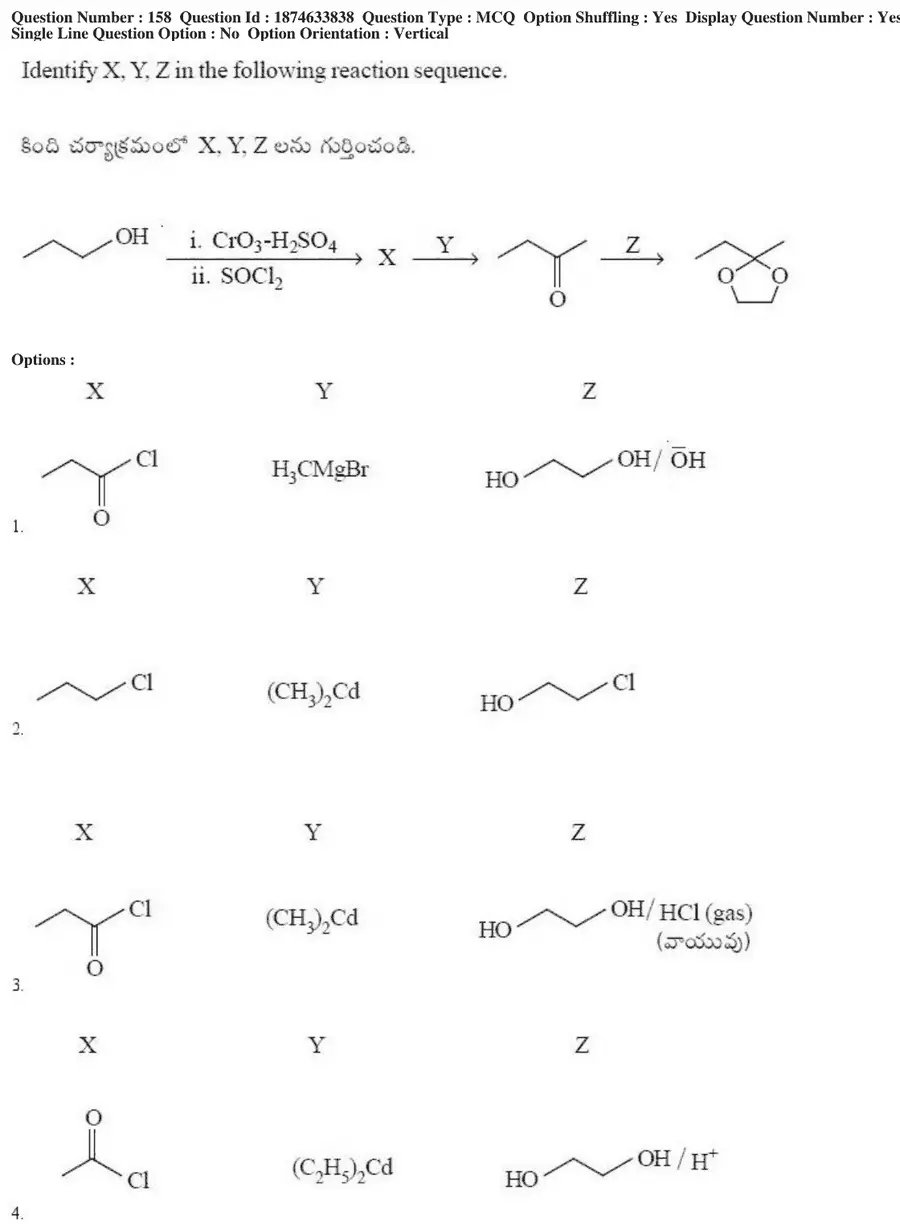
What are X, Y, Z in the following reaction sequence respectively?
(see the figure above)
The question as printed in the paper.
A
$\mathrm{CO, HCl, AlCl_3}$ ; (see the figure above) benzyl-type structure: benzene ring bearing $\mathrm{CH_2ONa}$ (drawn as ring with a bond to ONa); (see the figure above) benzene ring bearing $\mathrm{COOH}$
B
$\mathrm{CO, HCl, CuCl}$ ; (see the figure above) benzene ring bearing $\mathrm{CH_2OH}$ (ring with a bond to OH); (see the figure above) benzene ring bearing $\mathrm{COONa}$
C
$\mathrm{HCHO, HCl}$, anhy. $\mathrm{AlCl_3}$ ; (see the figure above) benzene ring bearing $\mathrm{CH_2OH}$ (ring with a bond to OH); (see the figure above) benzene ring bearing $\mathrm{COOH}$
D
$\mathrm{CO, HCl}$ ; (see the figure above) benzene ring bearing $\mathrm{CH_2COOH}$ (ring with a bond to CH2 then COOH); (see the figure above) phenol (benzene ring bearing OH)
Answer: (B) $\mathrm{CO, HCl, CuCl}$ ; (see the figure above) benzene ring bearing $\mathrm{CH_2OH}$ (ring with a bond to OH); (see the figure above) benzene ring bearing $\mathrm{COONa}$· The council's preliminary key
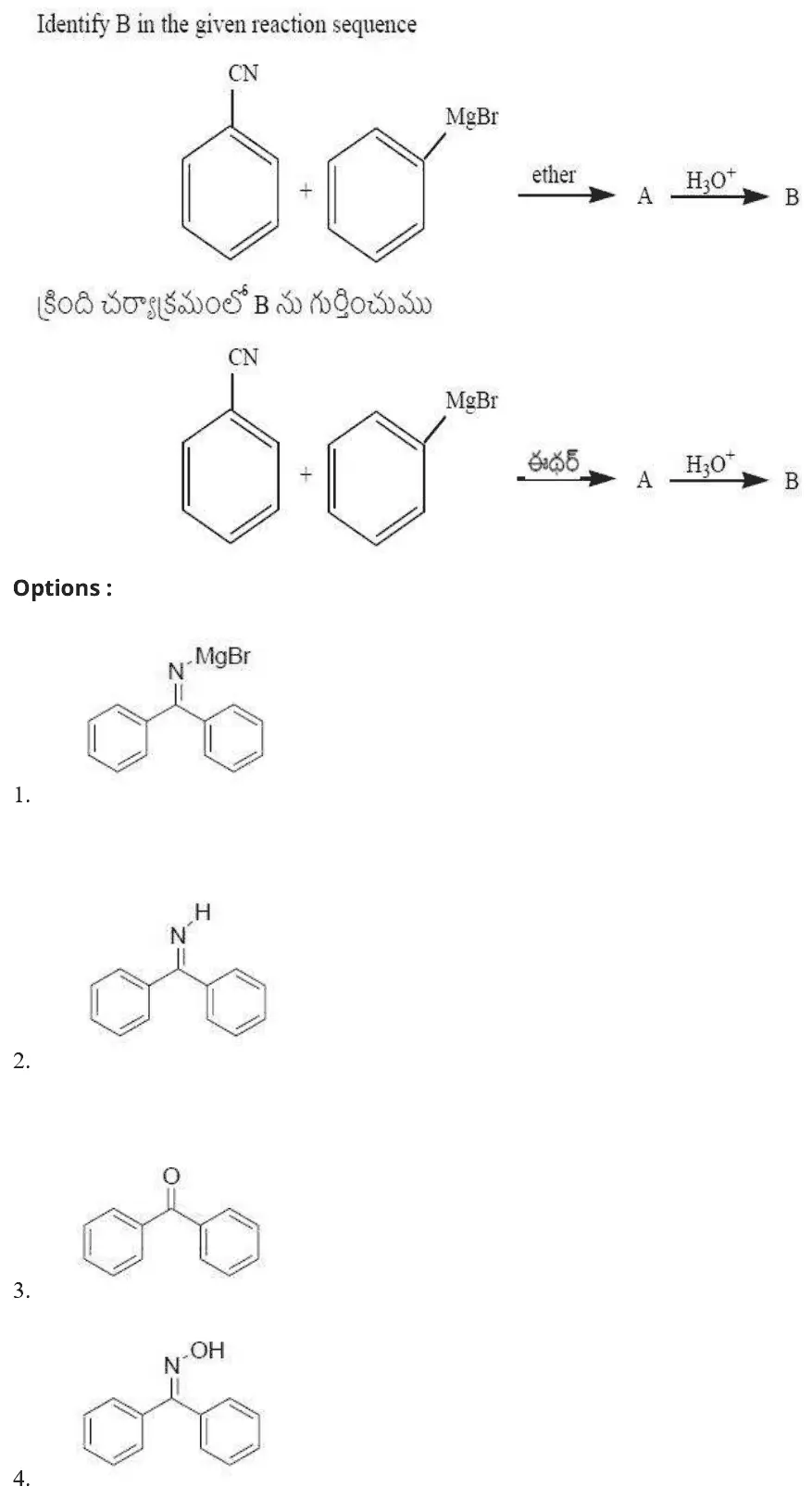
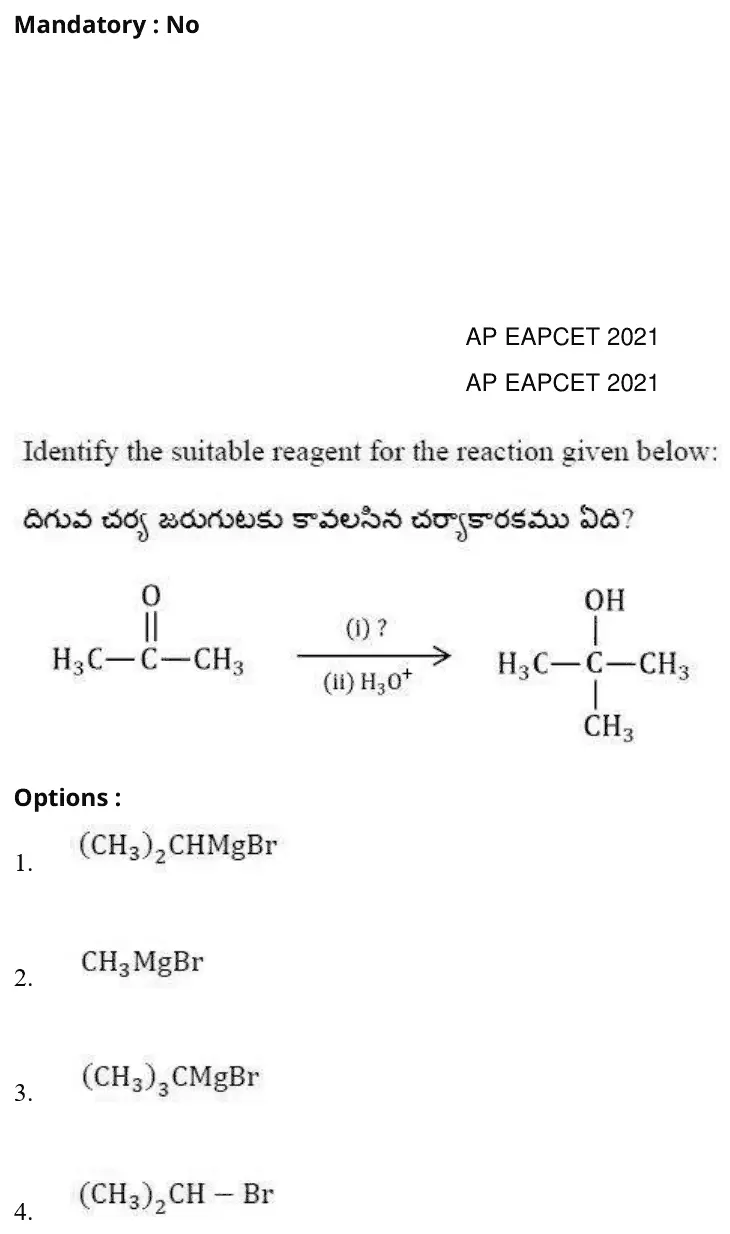
A Grignard reagent (X) on reaction with carbonyl compound (Y) followed by hydrolysis gave Z. Z reacts with conc. HCl at room temperature. X and Y respectively are
see figure Benzophenone imine N-magnesium bromide: a diphenylmethylidene group (C bonded to two phenyl rings) with C=N double bond, and N bearing MgBr.
B
see figure Benzophenone imine: a diphenylmethylidene group (C bonded to two phenyl rings) with C=N double bond, and N bearing H.
C
see figure Benzophenone: two phenyl rings bonded to a C=O carbon.
D
see figure Benzophenone oxime: a diphenylmethylidene group (C bonded to two phenyl rings) with C=N double bond, and N bearing OH.
Answer: (C) (i) $\mathrm{C_2H_5OH|H^+}$, (ii) DiBAL-H (iii) $\mathrm{H_2O}$ ; (see the figure above) structure: phenyl–CH=CH–C(=O)–phenyl· The council's preliminary key
What are Y and Z respectively in the given reaction sequence?
(see the figure above)
The question as printed in the paper.
A
see figure Ethanal (CH3-CHO, skeletal structure with C=O and H), followed by a comma and an α,β-unsaturated aldehyde drawn in skeletal form: CH2=CH-CH2-CH(...)... i.e. a chain with a C=C near the left end and a CHO group at the right end (see figure description)
B
see figure Propanal (skeletal CH3CH2-CHO with C=O and H), followed by a comma and an α,β-unsaturated aldehyde with a C=C in the chain and a CHO group (2-methylpent-2-enal type skeletal structure)
C
see figure Propanal (skeletal CH3CH2-CHO with C=O and H), followed by a comma and a straight-chain unsaturated aldehyde with a C=C in the chain and terminal CHO (skeletal structure)
D
see figure Propan-1-ol (skeletal CH3CH2CH2-OH), followed by a comma and propanoic acid (skeletal CH3CH2-COOH with C=O and OH)
Answer: (B) X: DIBAL – H, $\mathrm{H_2O}$ ; Y: (see the figure above) aniline (benzene ring with $\mathrm{NH_2}$ substituent)· The council's preliminary key
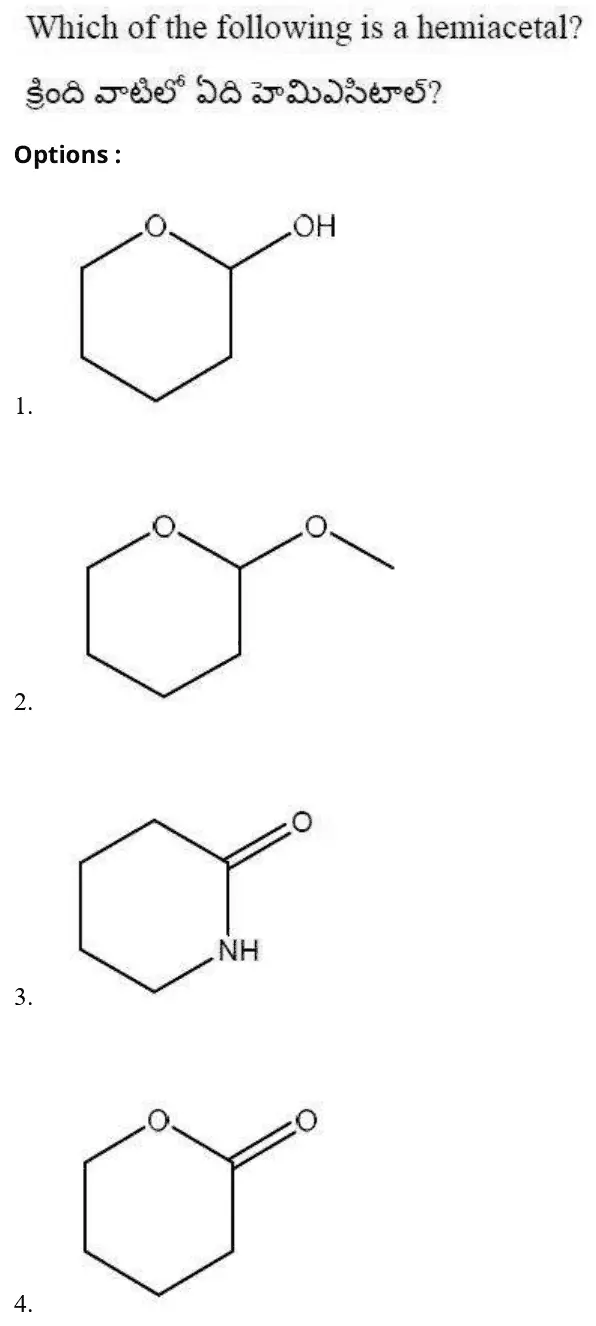
see figure Tetrahydropyran ring (six-membered ring containing one ring oxygen) with an OH group on the carbon adjacent to the ring O (2-hydroxytetrahydropyran).
B
see figure Tetrahydropyran ring (six-membered ring containing one ring oxygen) with an OCH3 (methoxy) group on the carbon adjacent to the ring O (2-methoxytetrahydropyran).
C
see figure Six-membered lactam ring (piperidin-2-one): ring containing NH adjacent to a C=O carbon.
D
see figure Six-membered lactone ring (tetrahydropyran-2-one): ring containing ring O adjacent to a C=O carbon.
Answer: (C) X = (i) $\mathrm{KMnO_4}$ / $\mathrm{OH^-}$, $\Delta$; (ii) $\mathrm{H_3O^+}$ ; Y = (i) $\mathrm{B_2H_6}$ (ii) $\mathrm{H_3O^+}$· The council's preliminary key
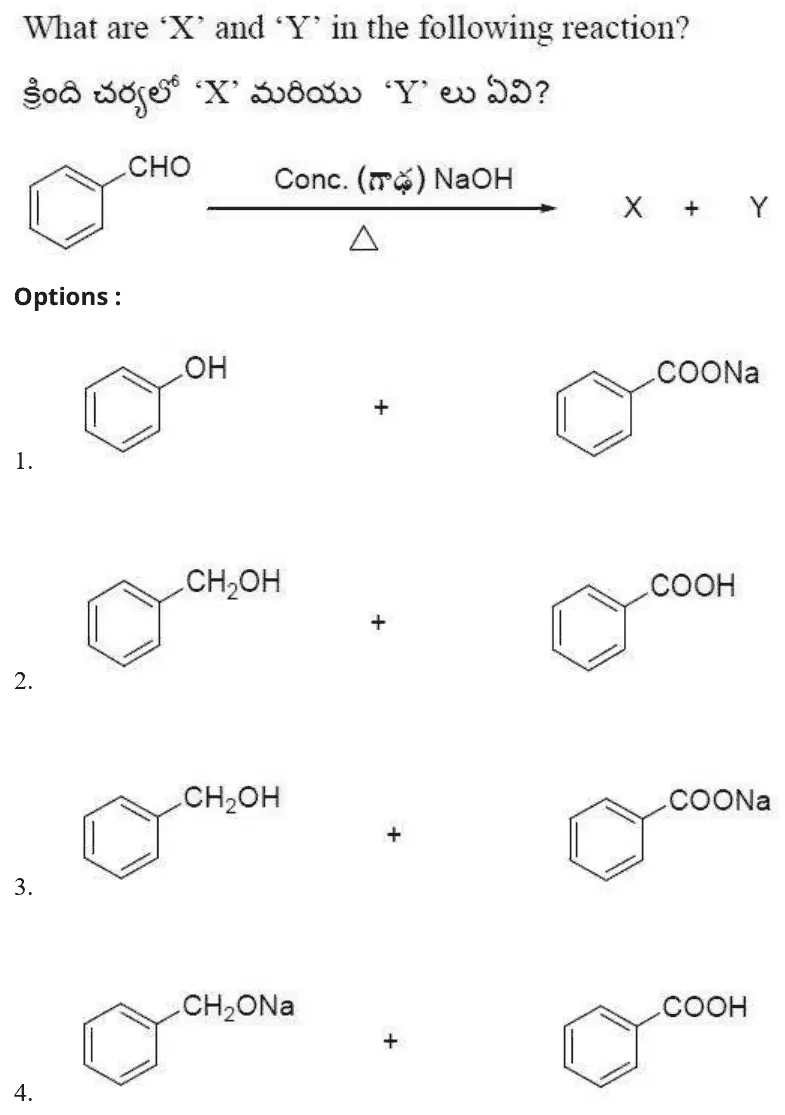
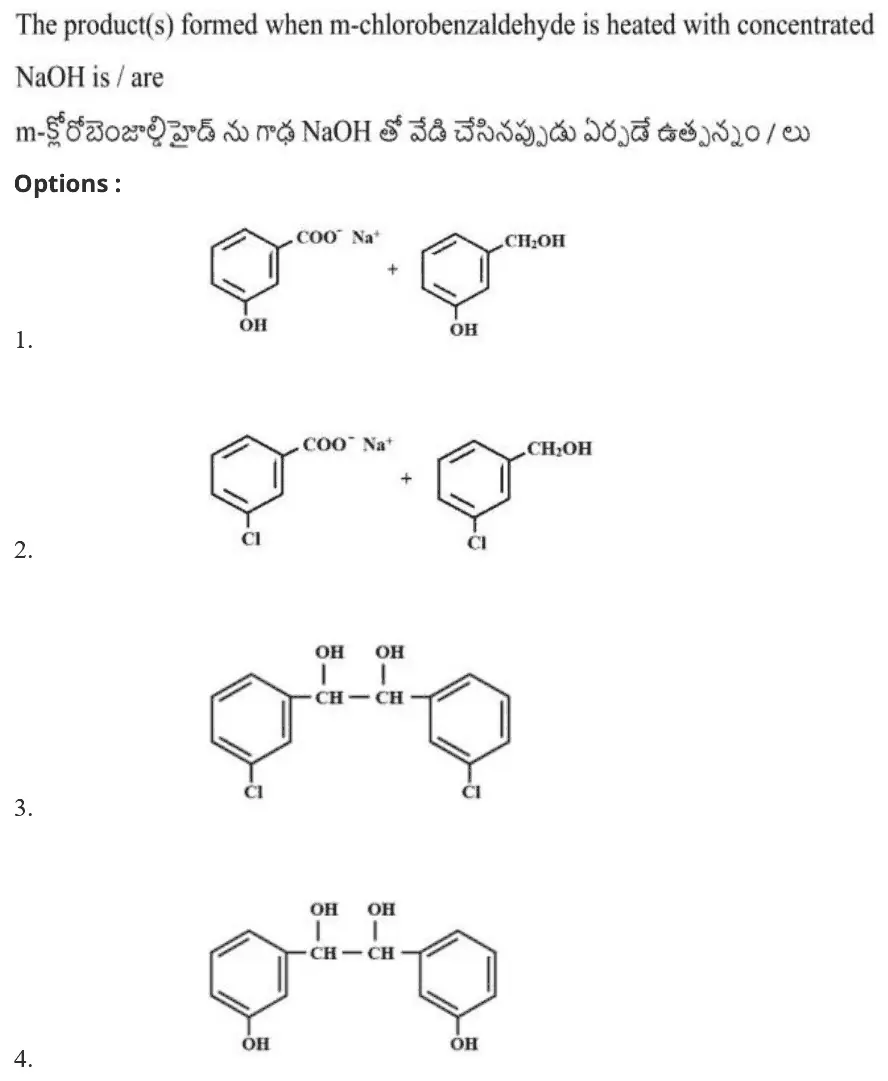
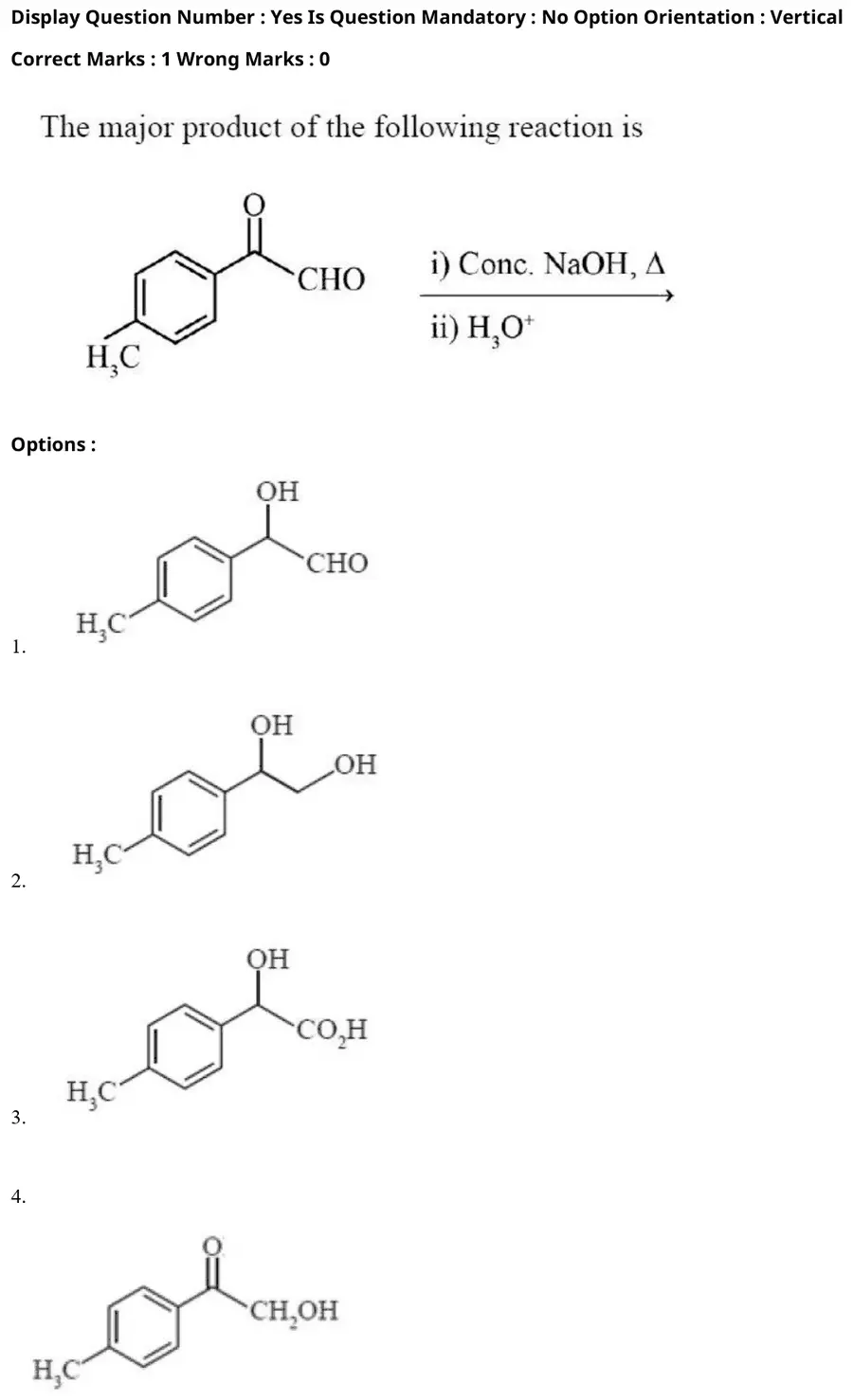
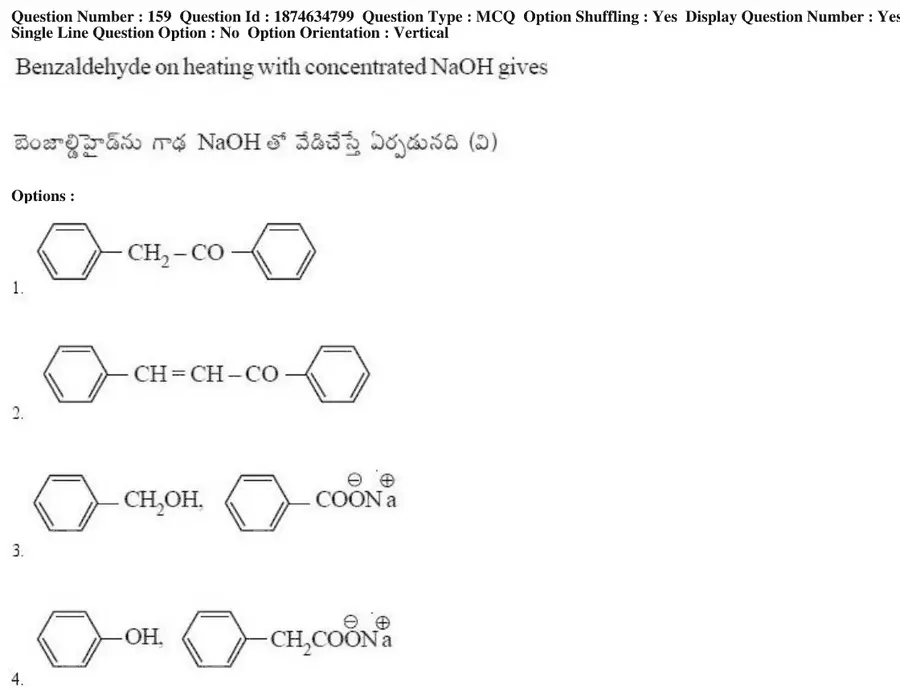
The product(s) formed when m-chlorobenzaldehyde is heated with concentrated NaOH is / are
The question as printed in the paper.
A
see figure Two products: a benzene ring with $\mathrm{COO^-Na^+}$ and an OH substituent meta to it, plus a benzene ring with $\mathrm{CH_2OH}$ and an OH substituent meta to it.
B
see figure Two products: a benzene ring with $\mathrm{COO^-Na^+}$ and a Cl substituent meta to it, plus a benzene ring with $\mathrm{CH_2OH}$ and a Cl substituent meta to it.
C
see figure Two benzene rings, each with a meta Cl, joined by a $\mathrm{CH(OH)-CH(OH)}$ bridge (each ring attached to one CH).
D
see figure Two benzene rings, each with a meta OH, joined by a $\mathrm{CH(OH)-CH(OH)}$ bridge (each ring attached to one CH).
Answer: (B) $\mathrm{CH_3CHO}$ + (see the figure above) glyoxal drawn as CHO–CHO (CHO over CHO joined by a vertical bond)· The council's preliminary key
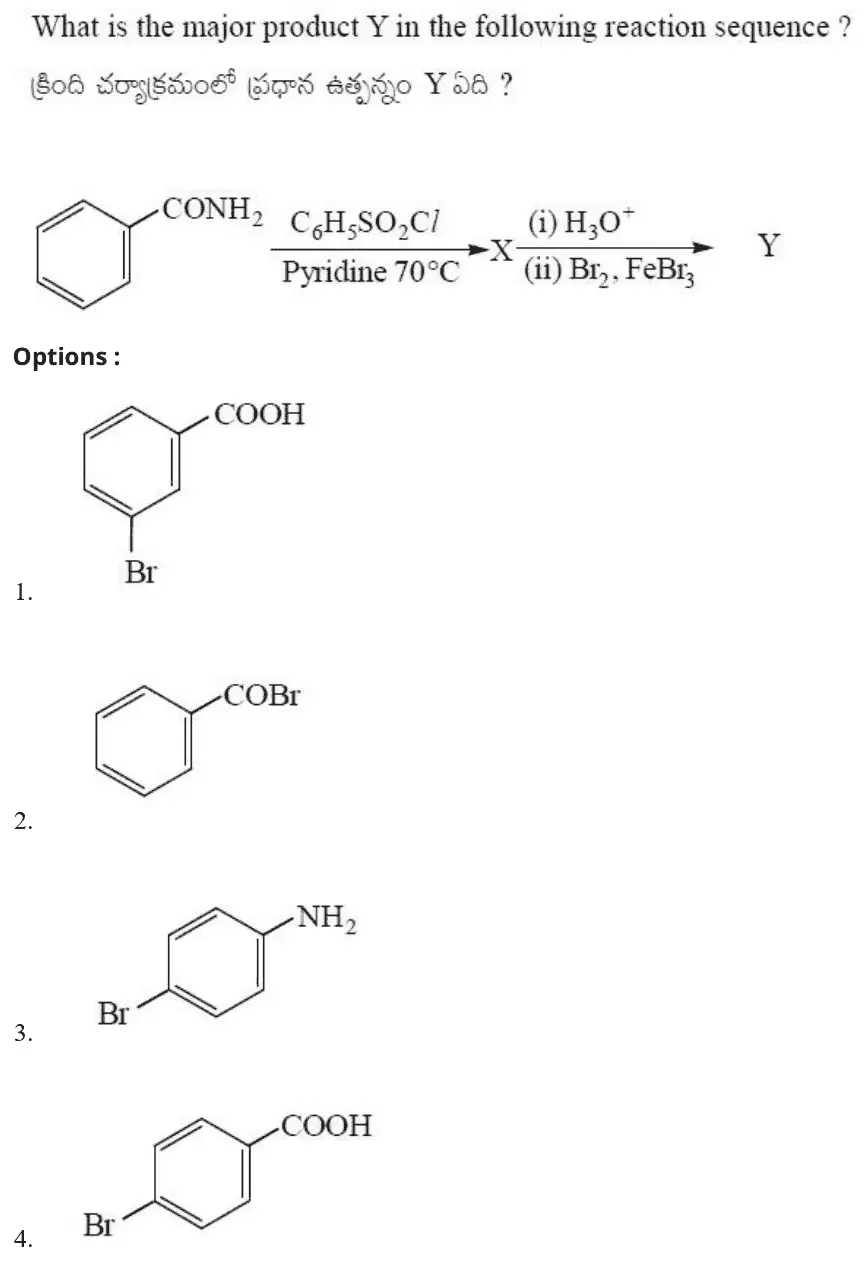
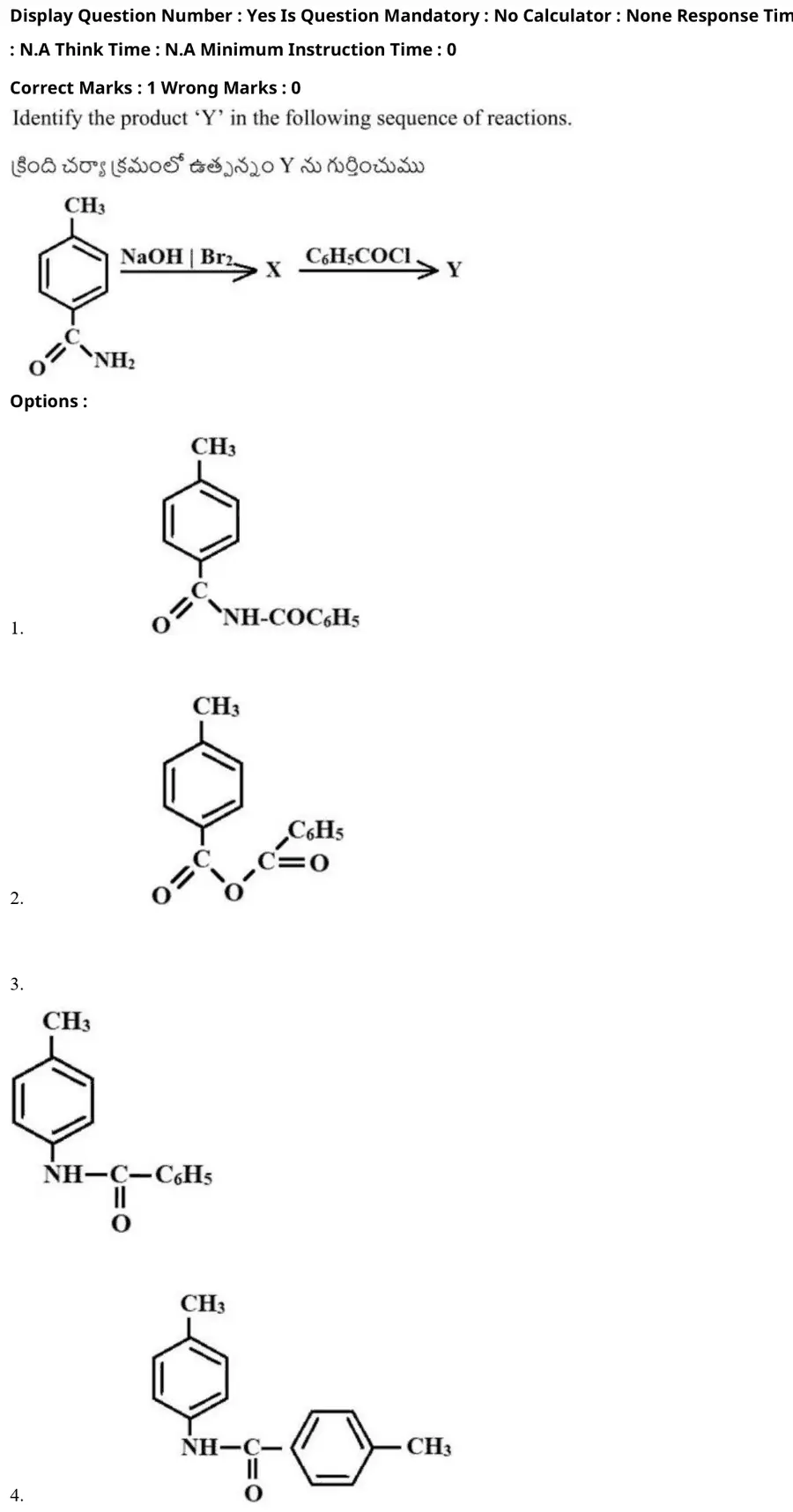
Identify the product ‘Y’ in the following sequence of reactions.
(see the figure above)
The question as printed in the paper.
A
see figure Para-substituted benzene ring with CH3 at top and a C(=O)–NH–COC6H5 group at the bottom (p-methylbenzamide N-benzoylated: ring–C(=O)–NH–COC6H5).
B
see figure Para-substituted benzene ring with CH3 at top and a bottom group C(=O)–O–C(=O)–C6H5 (mixed anhydride).
C
see figure Benzene ring with CH3 at top and NH–C(=O)–C6H5 at the bottom (N-(4-methylphenyl)benzamide).
D
see figure Benzene ring with CH3 at top and NH–C(=O)– at the bottom, the carbonyl carbon attached to a second benzene ring bearing CH3 at its para position (N-(4-methylphenyl)-4-methylbenzamide).
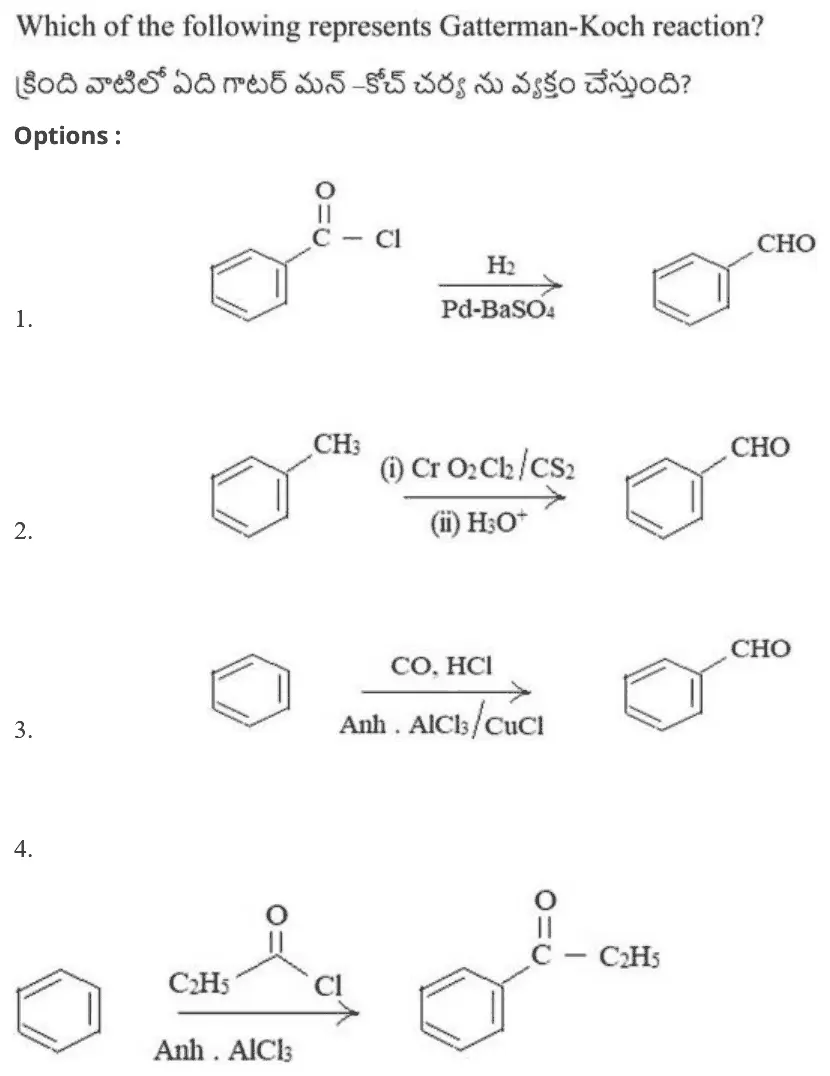
Which of the following represents Gatterman-Koch reaction?
The question as printed in the paper.
A
see figure Benzoyl chloride (benzene ring with C(=O)-Cl) reacting with H$_2$ over Pd-BaSO$_4$ to give benzaldehyde (benzene ring with CHO)
B
see figure Toluene (benzene ring with CH$_3$) reacting with (i) $\mathrm{CrO_2Cl_2/CS_2}$, (ii) $\mathrm{H_3O^+}$ to give benzaldehyde (benzene ring with CHO)
C
see figure Benzene reacting with CO, HCl in Anh. $\mathrm{AlCl_3/CuCl}$ to give benzaldehyde (benzene ring with CHO)
D
see figure Benzene reacting with $\mathrm{C_2H_5COCl}$ (propanoyl chloride) in Anh. $\mathrm{AlCl_3}$ to give propiophenone (benzene ring with C(=O)-$\mathrm{C_2H_5}$)
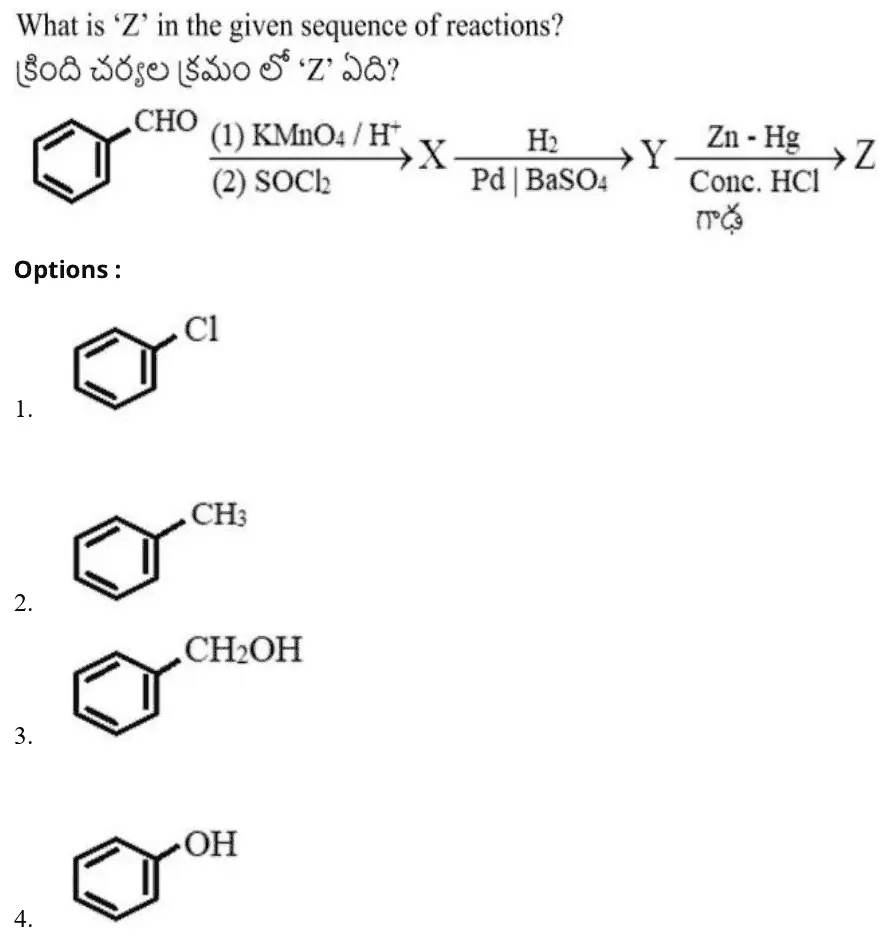
Sodium benzoate $\xrightarrow[\Delta]{\mathrm{NaOH+CaO}}$ A $\xrightarrow[\mathrm{Anh.AlCl_3}]{\mathrm{CH_3Cl}}$ B $\xrightarrow[(ii)\,\mathrm{H_3O^+}]{(i)\,\mathrm{CrO_2Cl_2/CS_2}}$ C
In the reaction sequence, conversion of B to C is known as
Assertion (A) : Ammonia and its derivatives of the form $\mathrm{H_2N-Z}$ undergo condensation reaction with carbonyl compounds (aldehydes and ketones). Reason (R) : This reaction is an example of irreversible reaction. The correct option among the following is
A
(A) is true, (R) is true and (R) is the correct explanation for (A)
B
(A) is true, (R) is true but (R) is not the correct explanation for (A)
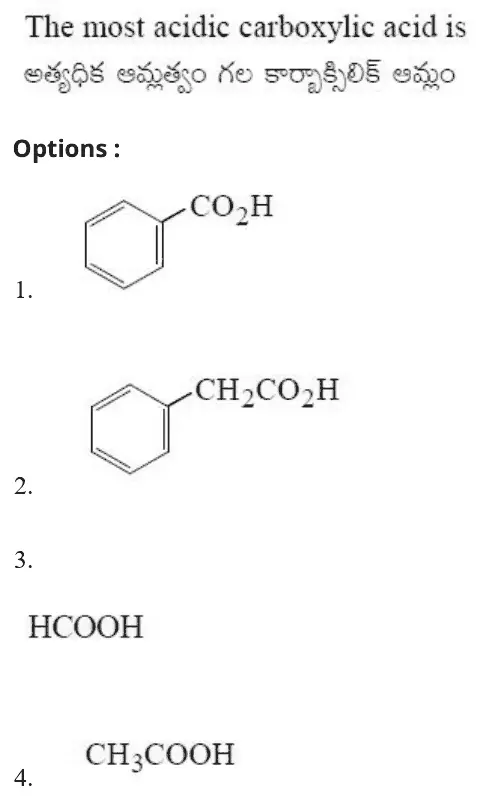
The correct order of $\mathrm{pK_a}$ of the following is I: $\mathrm{CCl_3COOH}$ II: $\mathrm{CF_3COOH}$ III: $\mathrm{NO_2CH_2COOH}$ IV: $\mathrm{NCCH_2COOH}$
Among the compounds (i) $\mathrm{H-C\equiv C-COOH}$ (ii) $\mathrm{CH_2=CH-COOH}$ (iii) $\mathrm{CH_3-CH_2COOH}$ and (iv) $\mathrm{CH_3-CH_2-OH}$ The correct order of acid strength is
Benzene on reaction with acetyl chloride in the presence of anhydrous $\mathrm{AlCl_3}$ gave the product P. The product P on reaction with methylmagnesium bromide followed by treatment with water furnished the product Q. The molecular formula of Q is
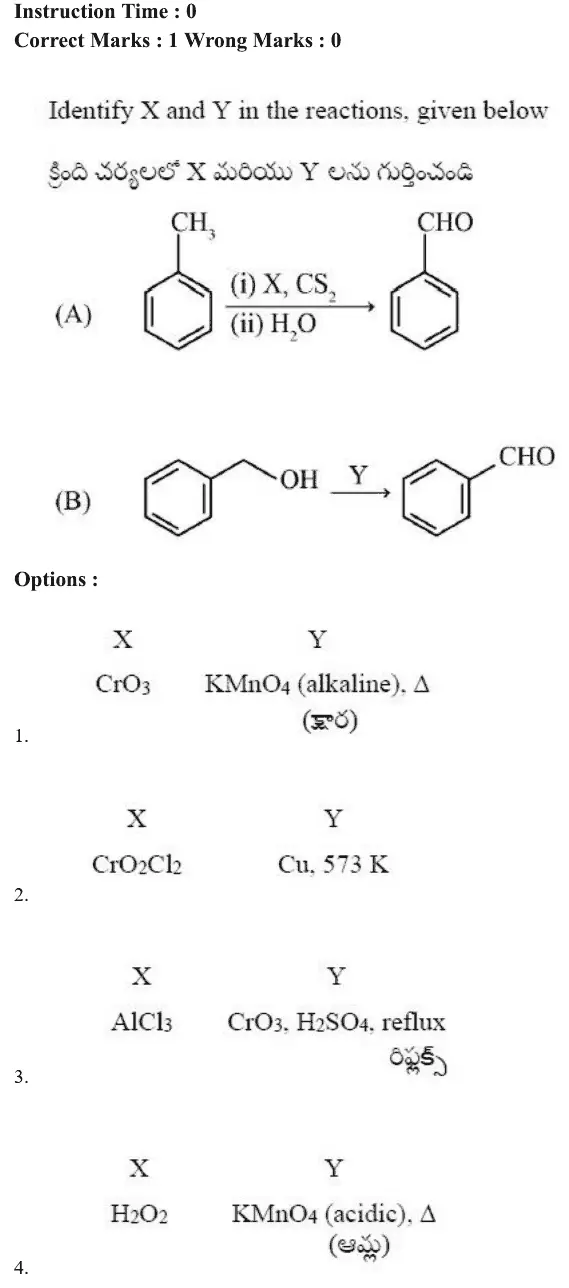
Identify X and Y in the reactions, given below (A) toluene $\xrightarrow{\text{(i) X, }\mathrm{CS_{2}}\ \text{(ii) }\mathrm{H_{2}O}}$ benzaldehyde (B) benzyl alcohol $\xrightarrow{Y}$ benzaldehyde (see the figure above)
The question as printed in the paper.
A
X = $\mathrm{CrO_{3}}$, Y = $\mathrm{KMnO_{4}}$ (alkaline), $\Delta$
B
X = $\mathrm{CrO_{2}Cl_{2}}$, Y = Cu, 573 K
C
X = $\mathrm{AlCl_{3}}$, Y = $\mathrm{CrO_{3}}$, $\mathrm{H_{2}SO_{4}}$, reflux
D
X = $\mathrm{H_{2}O_{2}}$, Y = $\mathrm{KMnO_{4}}$ (acidic), $\Delta$
The major product of the following reactions $\mathrm{CH_{3}CH_{2}CH_{2}CH_{2}COCH_{3}}\xrightarrow{\text{i) NaOBr; ii) }\mathrm{H_{3}O^{+}}\text{; iii) Red P, }\mathrm{Br_{2}}\text{; iv) }\mathrm{H_{2}O}}$
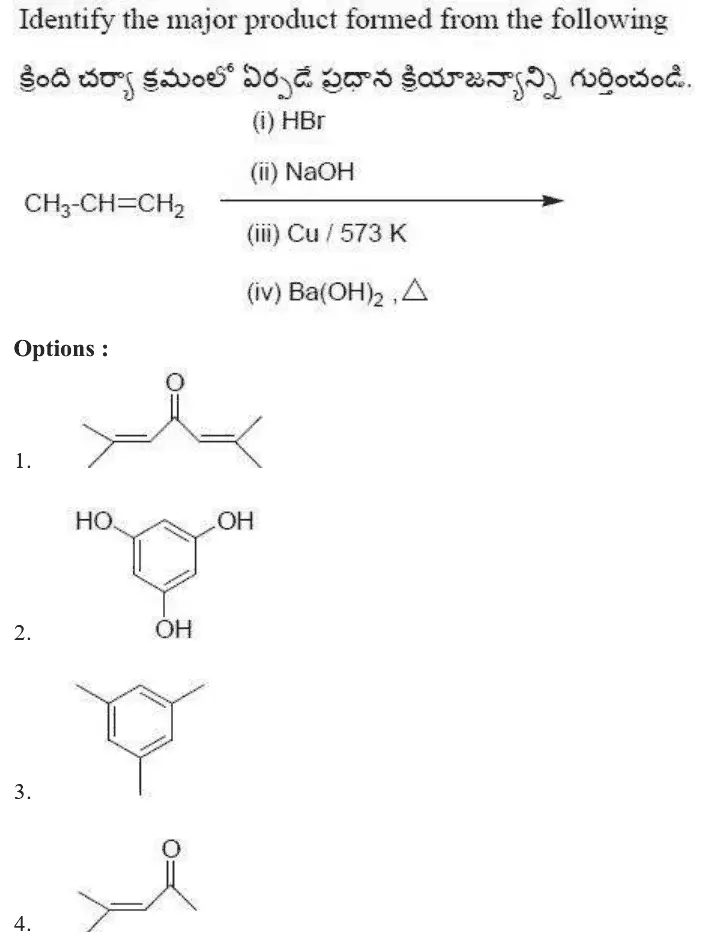
The major product formed in the following reaction sequence is $\mathrm{CH_{3}CH=CH_{2}}$ followed by: i) HBr, peroxide; ii) Mg; iii) $\mathrm{CH_{3}CH_{2}CHO}$; iv) $\mathrm{CrO_{3}}$
Consider following reaction, where (A) The change in the functional group and (B) The corresponding change in the hybridization from starting to the final product A and B are $\mathrm{CH_{3}C\equiv N}$ followed by: (i) $\mathrm{SnCl_{2}}$, HCl; (ii) $\mathrm{H_{3}O^{+}}$; (iii) HI + Red P
A
A: $-\mathrm{CN}$ to $-\mathrm{CH_{2}-OH}$; B: $\mathrm{sp^{2}}$ to $\mathrm{sp^{3}}$
B
A: $-\mathrm{CN}$ to $-\mathrm{CONH_{2}}$; B: sp to $\mathrm{sp^{2}}$
C
A: $-\mathrm{CN}$ to $-\mathrm{CH_{2}NH_{2}}$; B: sp to $\mathrm{sp^{3}}$
D
A: $-\mathrm{CN}$ to $-\mathrm{CH_{3}}$; B: sp to $\mathrm{sp^{3}}$
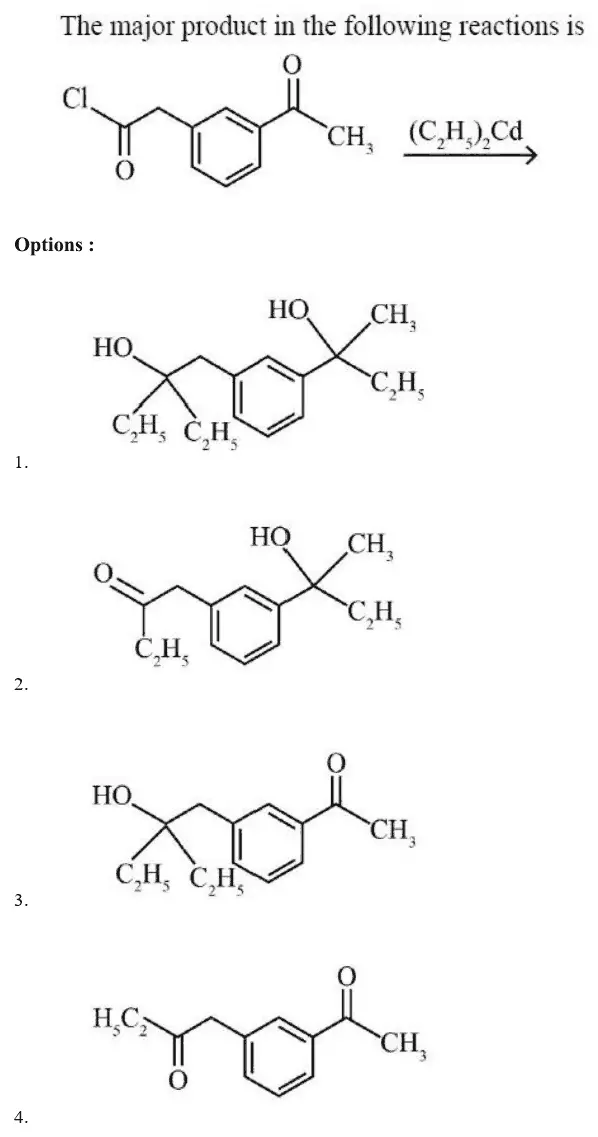
Which of the following reactions will give benzophenone as major product? (A) Benzoyl chloride + Benzene + $\mathrm{AlCl_{3}}$ (anhyd.) (B) Benzoyl chloride + Phenylmagnesium bromide (excess) (C) Benzoyl chloride + Diphenyl cadmium
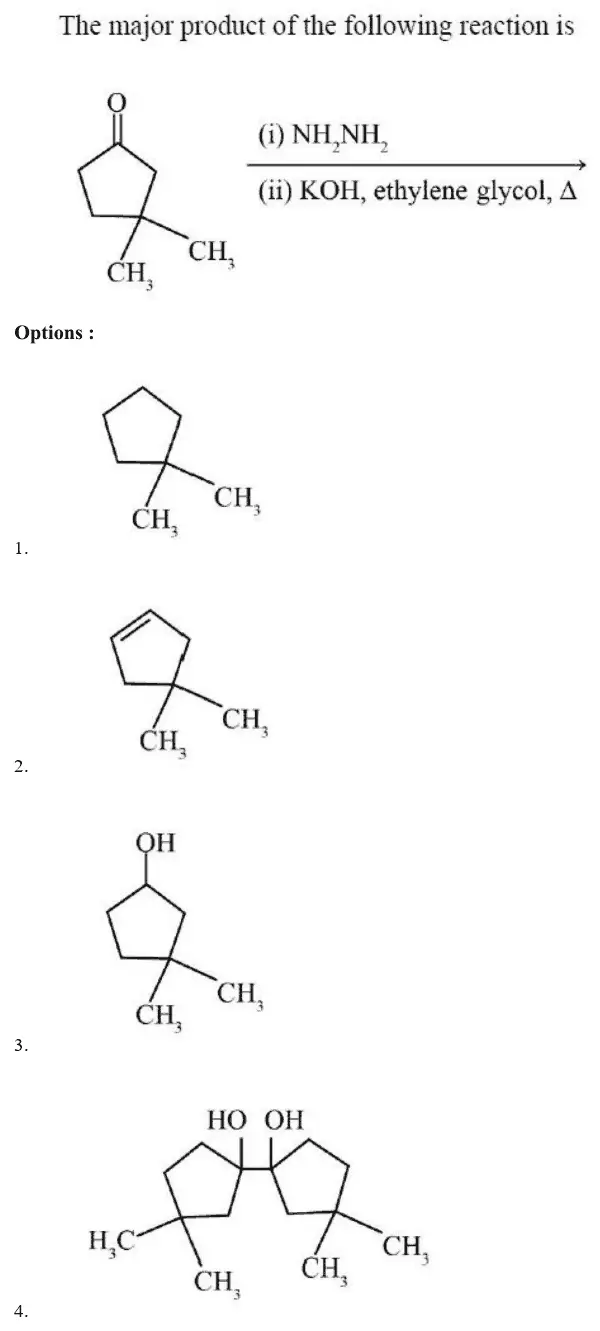
The major product of the following reaction is (see the figure above)
The question as printed in the paper.
A
see figure 3,3-dimethylcyclopentane (ring with two CH3 on one carbon, no other substituent)
B
see figure 3,3-dimethylcyclopentene (ring with one C=C double bond, two CH3 on one carbon)
C
see figure 3,3-dimethylcyclopentanol (ring with OH, two CH3 on one carbon)
D
see figure a dimer: two 3,3-dimethylcyclopentane rings joined by a bond between the two carbons that each carry an OH (HO and OH), each ring with two CH3
n–Propanol on treatment with concentrated HBr gives P. The product P on reaction with KCN gave the product Q. The product Q on heating with aqueous acidic solution, furnished the product R. The product ‘R’ is
Arrange the following in increasing order of their acidic strength (a) $\mathrm{CH_3COOH}$ (b) $\mathrm{Ph{-}CH_2{-}COOH}$ (c) $\mathrm{Br{-}CH_2{-}COOH}$ (d) $\mathrm{O_2N{-}CH_2{-}COOH}$
Match the name of acid from list – I with source from which is derived. List – I: a) Formic Acid; b) Acetic Acid; c) Butyric Acid List - II: (i) Vinegar; (ii) Butter; (iii) Ant
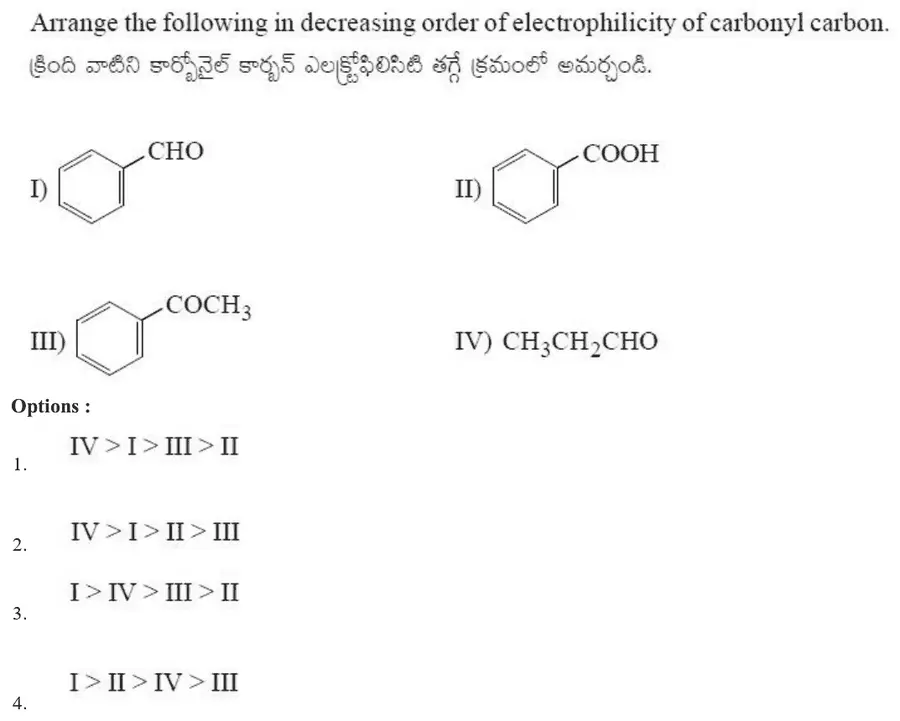
With reference to the carbonyl group which statement(s) is/are correct? a) Carbonyl Carbon is electrophilic b) Carbonyl Carbon is nucleophilic c) Carbonyl Oxygen is electrophilic d) Carbonyl Oxygen is nucleophilic
Match the following: List I (substance) a) Methanoic acid b) Ethanoic acid c) Hexanedioic acid d) Sodium benzoate List II (use) (i) Textile (ii) Polymer (iii) Food preservative (iv) Vinegar
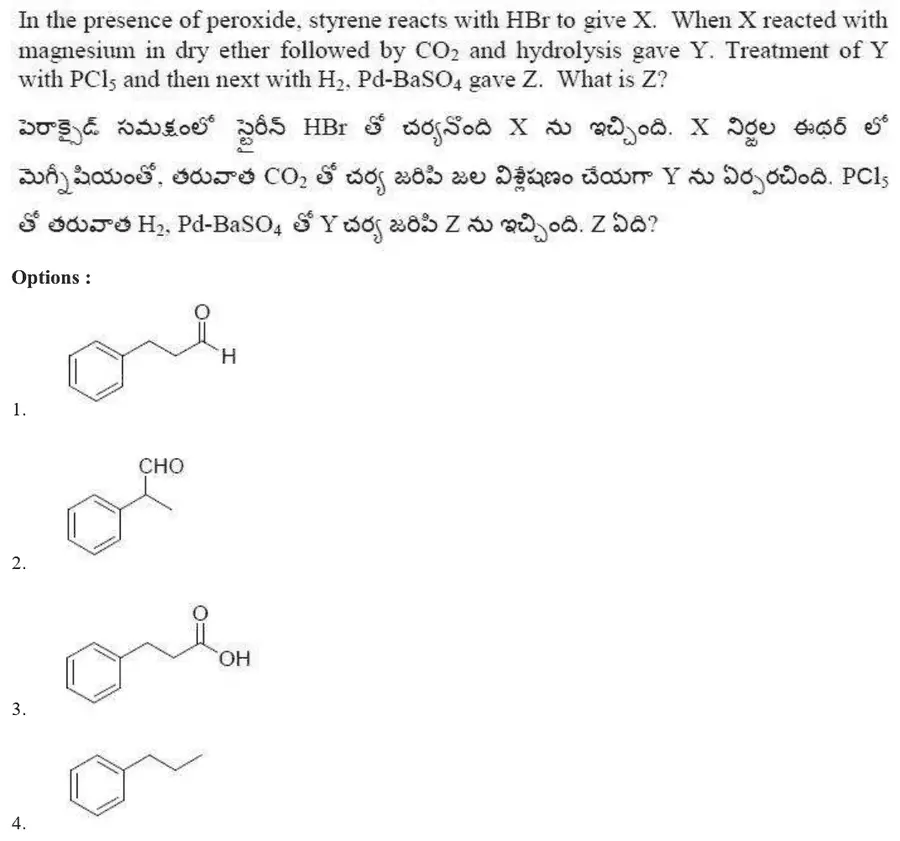
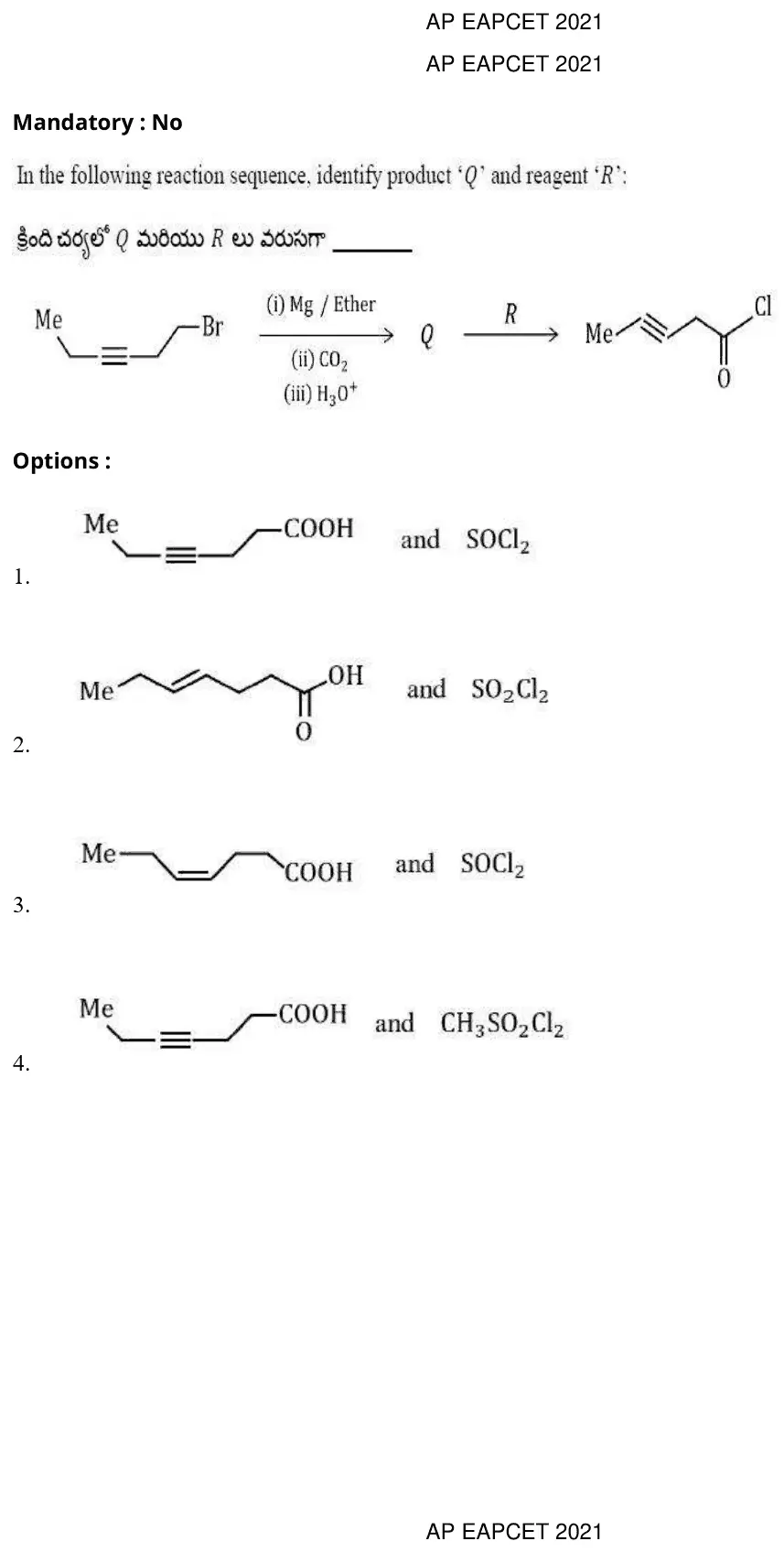
In the presence of peroxide, styrene reacts with HBr to give X. When X reacted with magnesium in dry ether followed by $\mathrm{CO_2}$ and hydrolysis gave Y. Treatment of Y with $\mathrm{PCl_5}$ and then next with $\mathrm{H_2}$, Pd-$\mathrm{BaSO_4}$ gave Z. What is Z?
The question as printed in the paper.
A
see figure benzene ring bearing a chain CH2-CH2-CH=O (3-phenylpropanal, aldehyde O and H drawn at the end)
B
see figure benzene ring bearing CH(CH3)-CHO (2-phenylpropanal; CHO written at the branch point)
C
see figure benzene ring bearing a chain CH2-CH2-COOH (3-phenylpropanoic acid; O and OH drawn at the end)
D
see figure benzene ring bearing a propyl chain (n-propylbenzene)
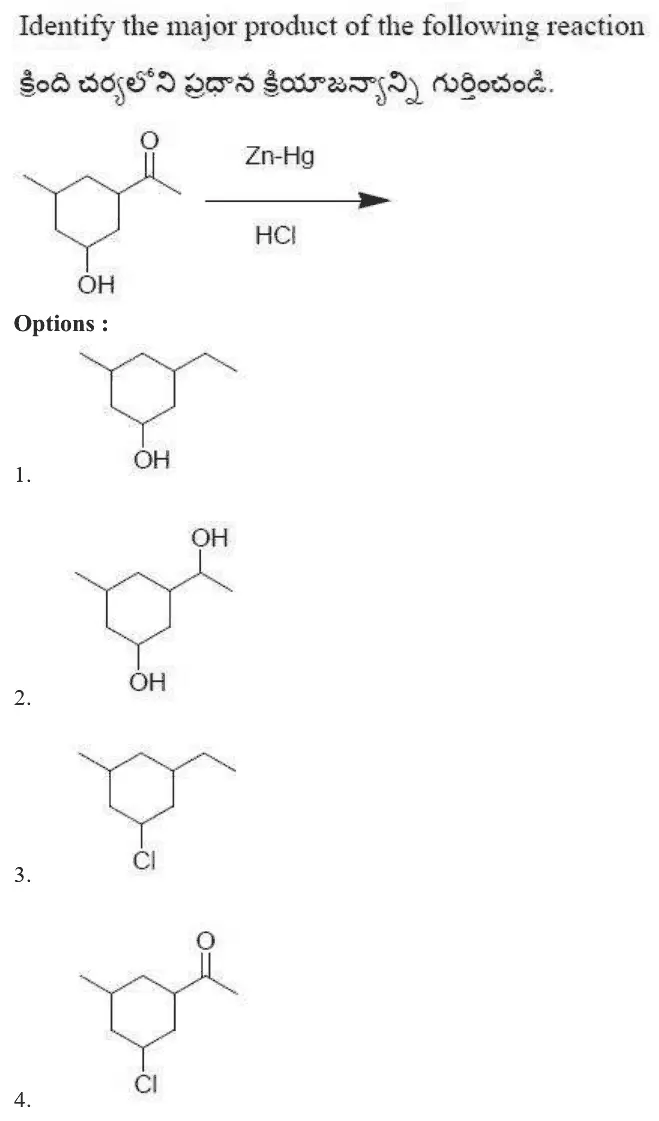
Identify the major product of the following reaction (see the figure above)
The question as printed in the paper.
A
see figure 3-methyl-5-ethylcyclohexane skeleton bearing OH on the ring carbon between the two substituents' positions (ring: methyl, ethyl, OH, all 1,3,5), with the ketone reduced to CH2 (ethyl)
B
see figure same ring (methyl, OH on ring) with side chain CH(OH)CH3
C
see figure same ring with ethyl and Cl on ring in place of OH
D
see figure same ring with acetyl group (C=O, CH3) and Cl on ring in place of OH
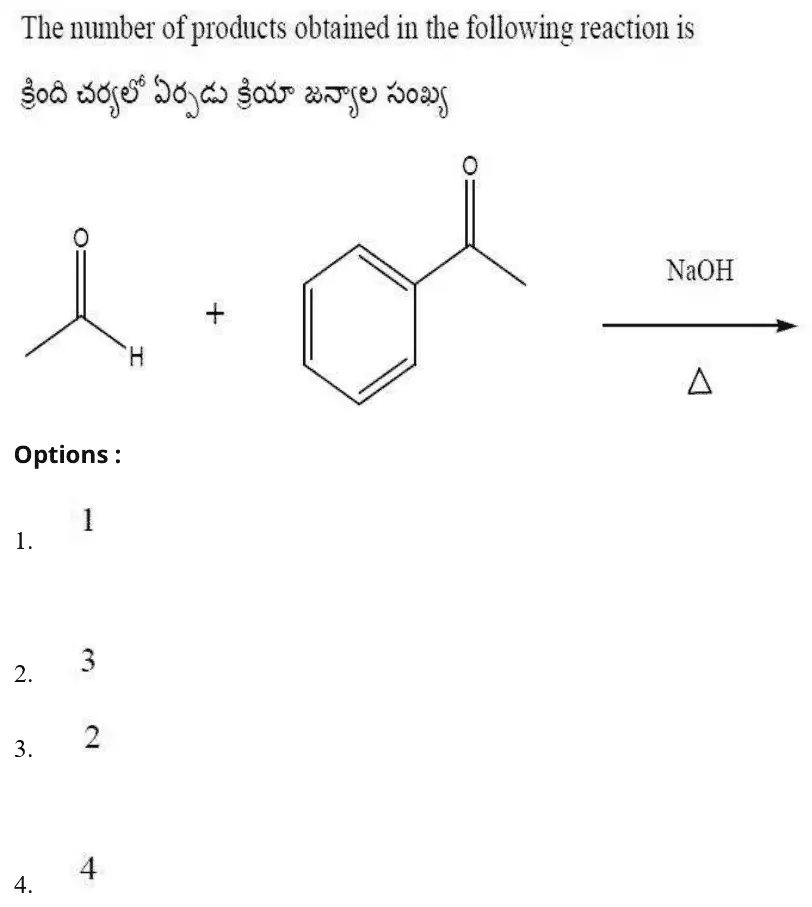
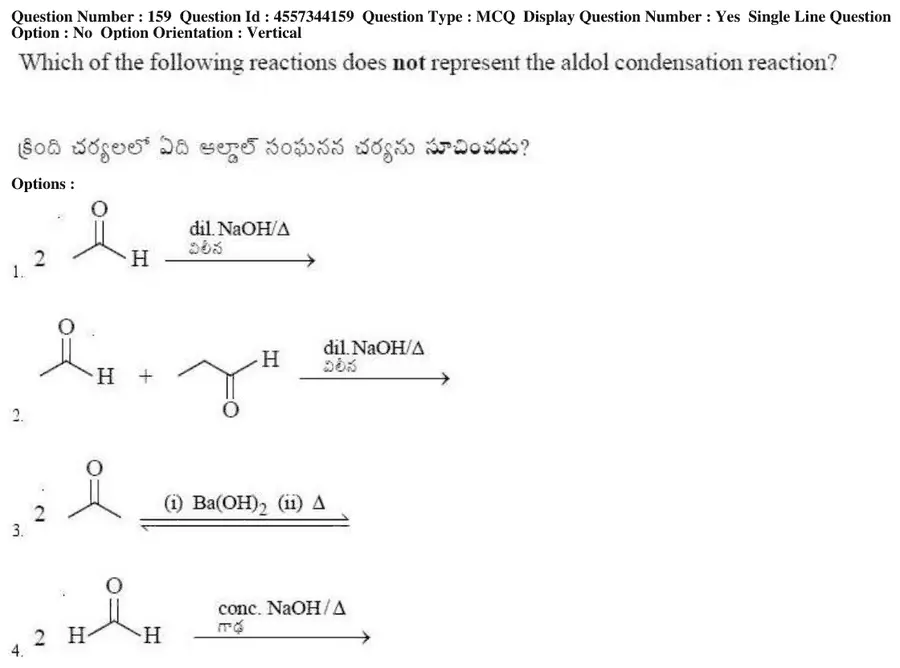
The total number of products formed in the following reaction sequence is ______ $\mathrm{CH_3COCl} \xrightarrow{\text{i) }(\mathrm{CH_3})_2\mathrm{Cd}} (P)$ $(P) + \mathrm{CH_3CHO} \xrightarrow{\text{ii) NaOH (aq), }\Delta} ?$
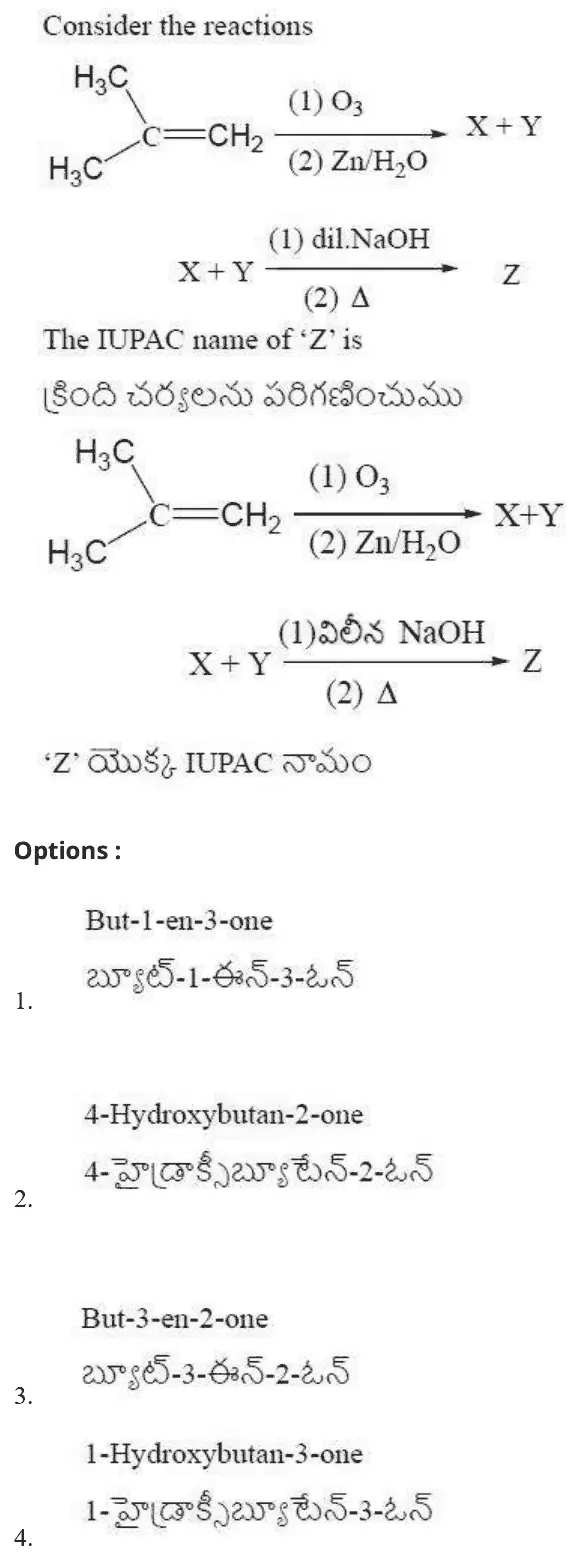
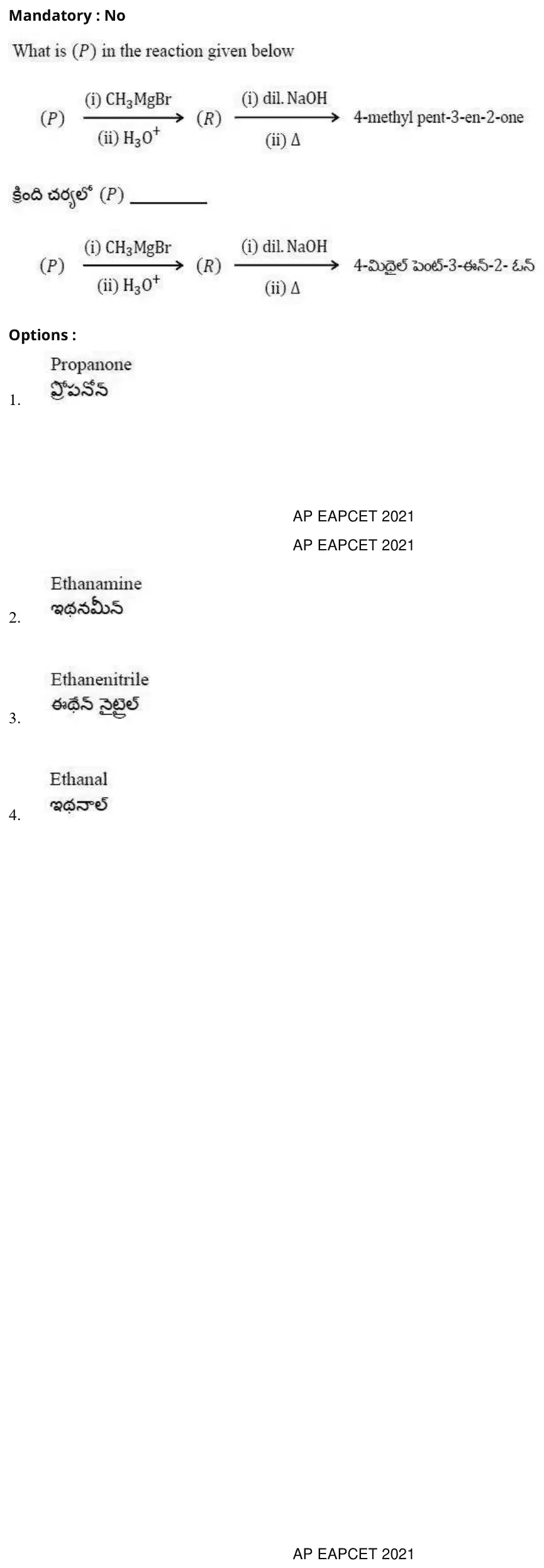
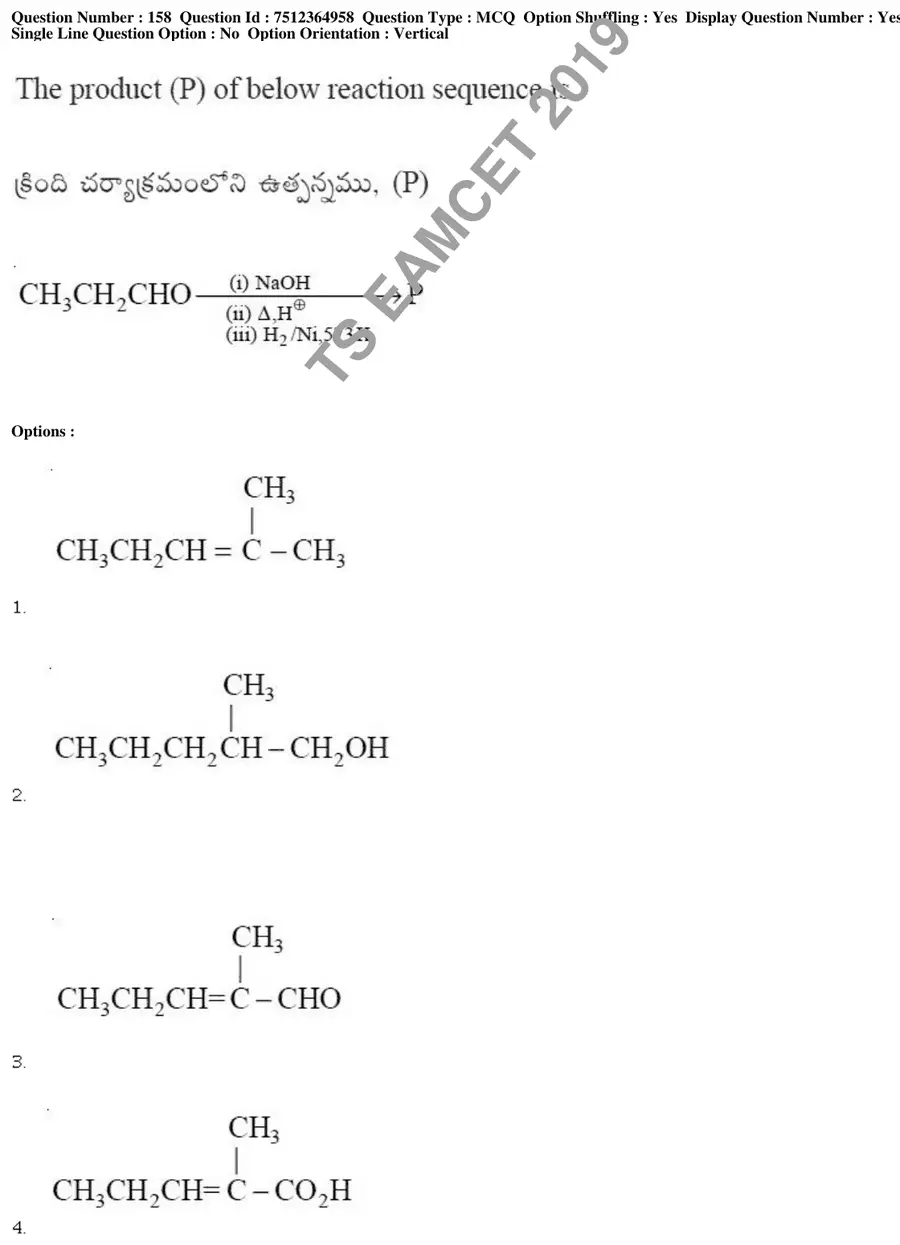
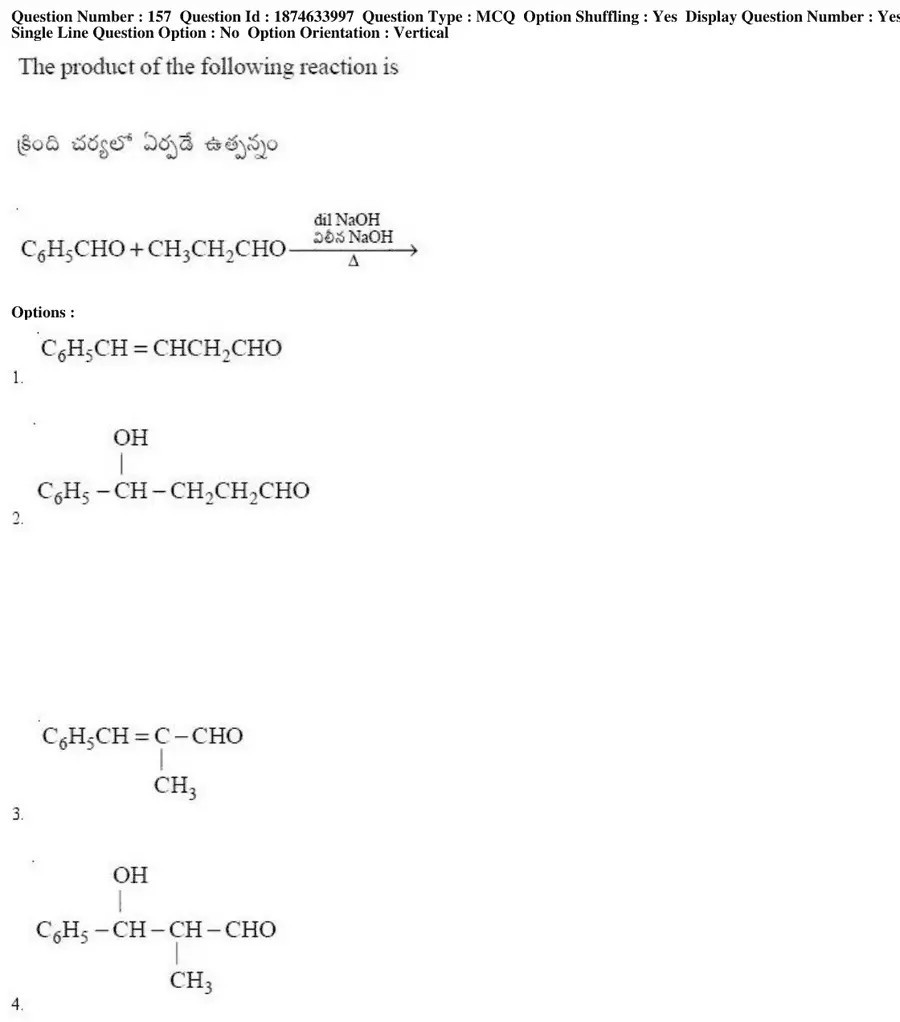
Identify the major product (P) in the given reaction $\mathrm{CH_3CH_2CHO}\xrightarrow[\text{(ii) }\Delta]{\text{(i) dil. NaOH}}(\mathrm{P})$ In the above reaction "P" is
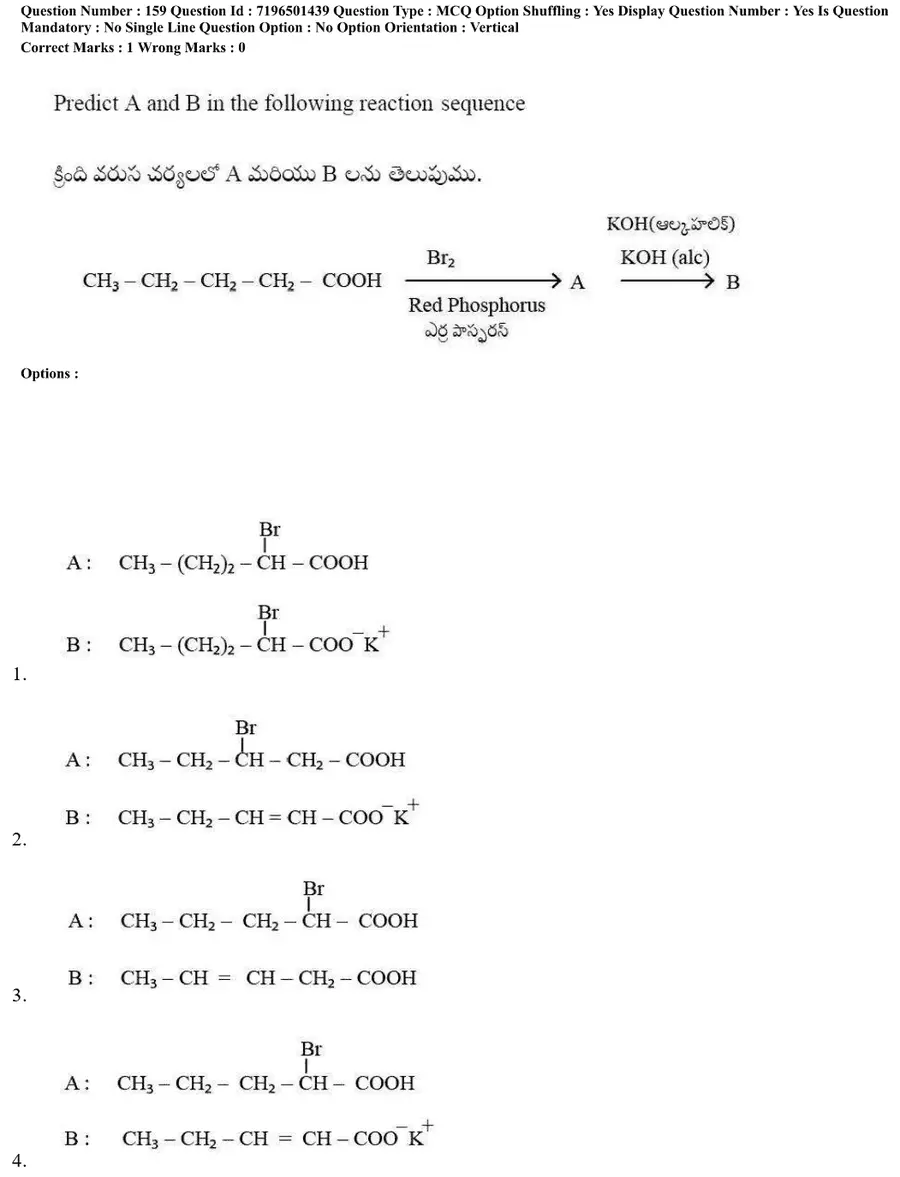
$\mathrm{R{-}CH_2{-}COOH}\xrightarrow[\text{(ii) }\mathrm{H_2O}]{\text{(i) }\mathrm{Cl_2}/\text{Red Phosphorus}}\mathrm{R{-}\overset{Cl}{CH}{-}COOH}$ The above reaction is known as
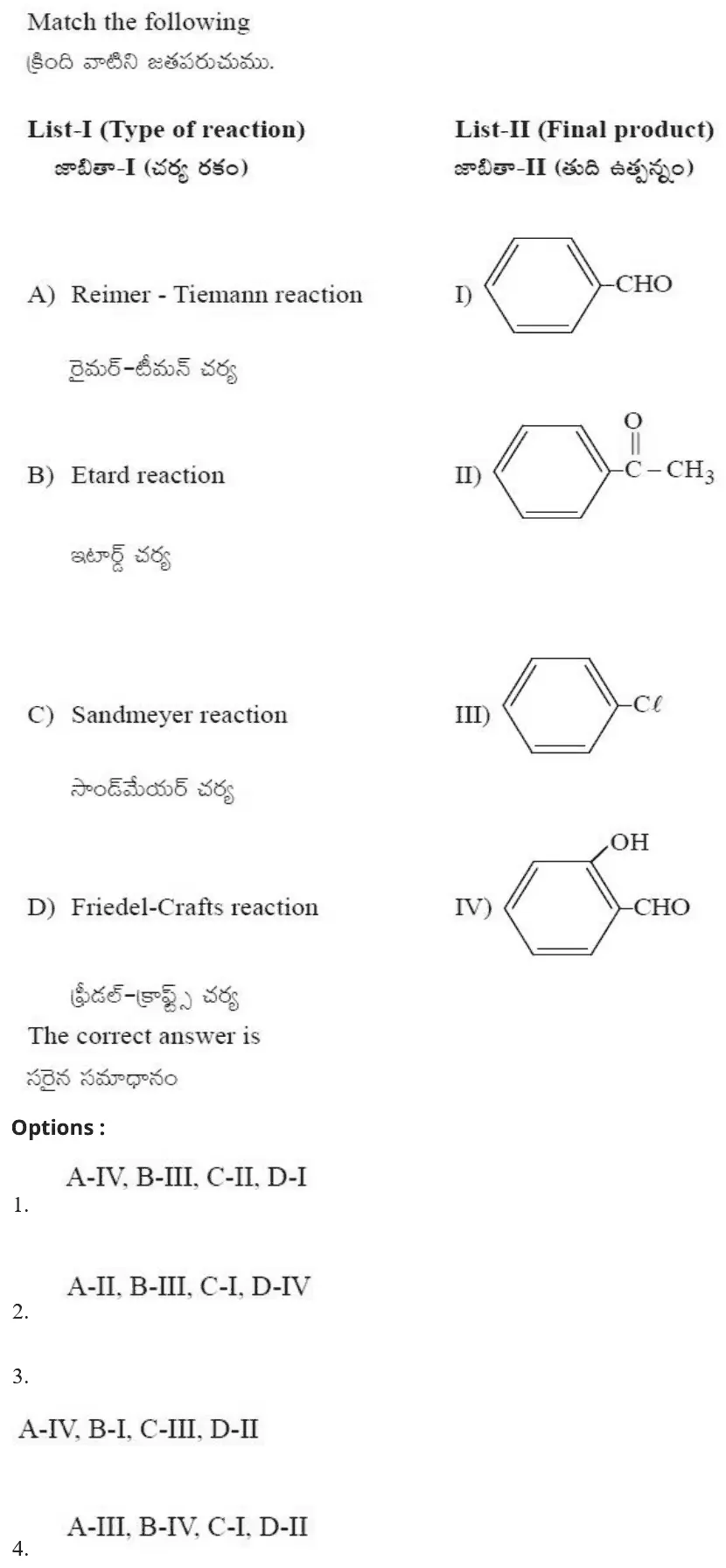
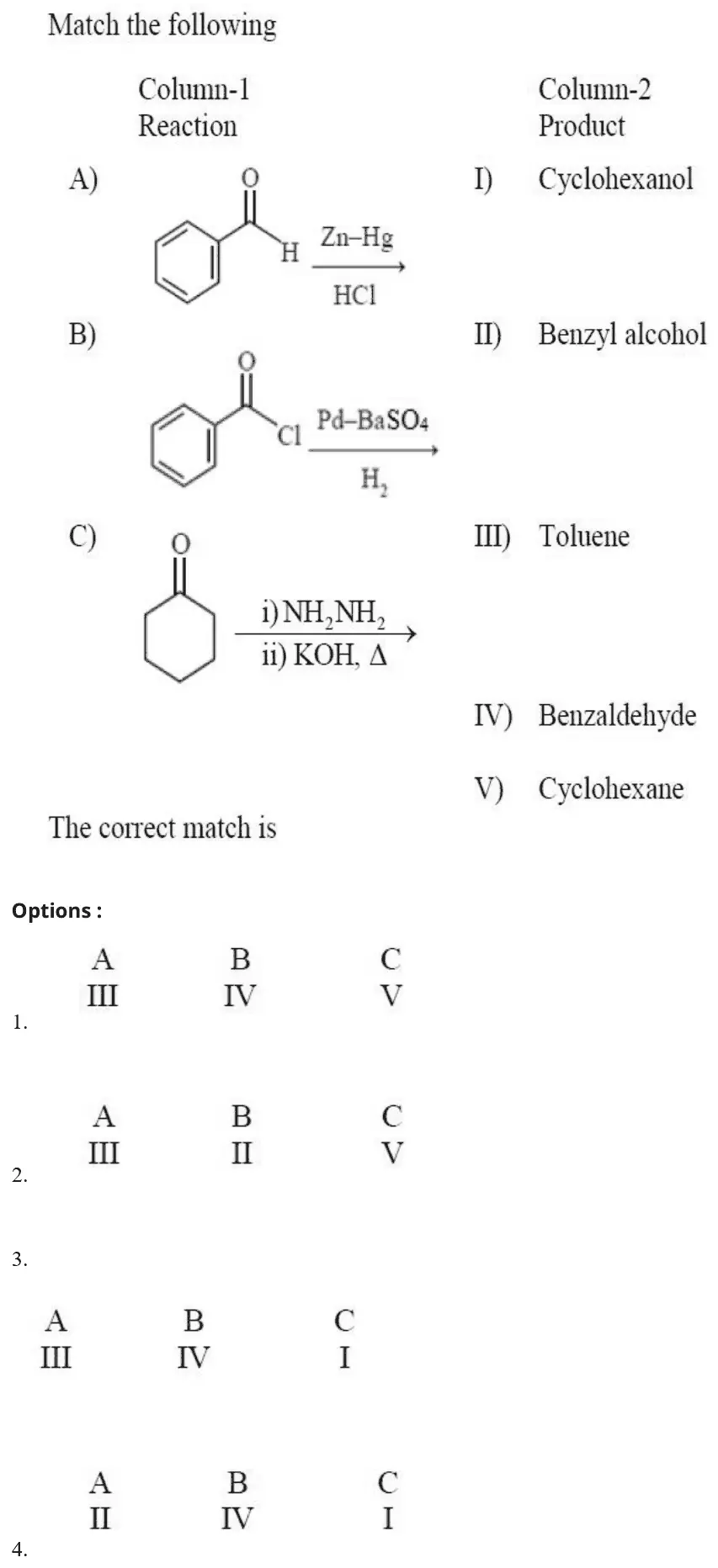
Match the following Column-1 (Reaction) Column-2 (Product) A) benzaldehyde (Ph-CHO) with Zn-Hg / HCl I) Cyclohexanol B) benzoyl chloride (Ph-COCl) with Pd-BaSO4 / H2 II) Benzyl alcohol C) cyclohexanone with i) $\mathrm{NH_2NH_2}$ ii) KOH, $\Delta$ III) Toluene IV) Benzaldehyde V) Cyclohexane The correct match is (see the figure above)
Match the following Column-1 (Reaction of carbonyl compound with) A) Hydroxylamine B) Alcohol C) Hydrazine D) Amine Column-2 (Product) I) Hydrazone II) Schiff's base (Substituted imine) III) Oxime IV) Ketal The correct match is
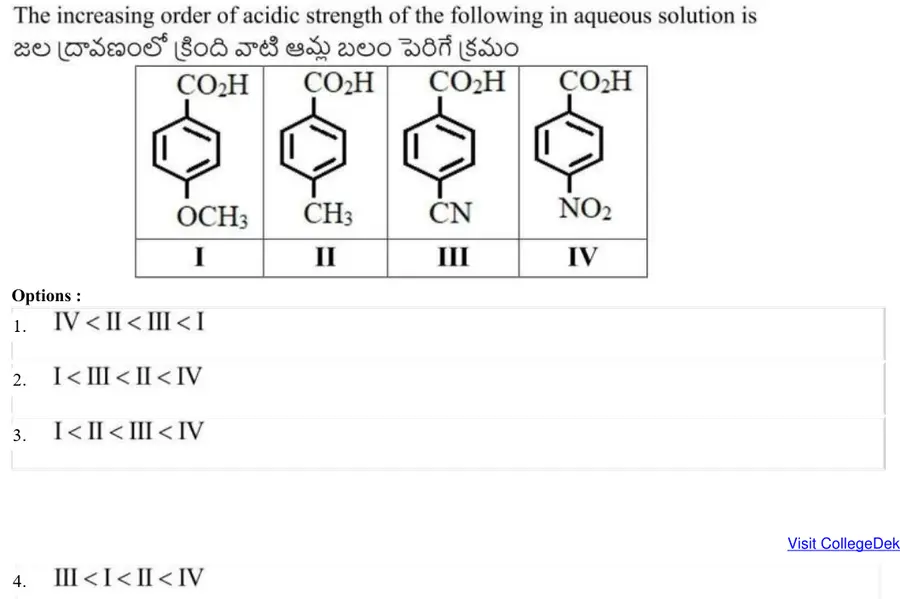
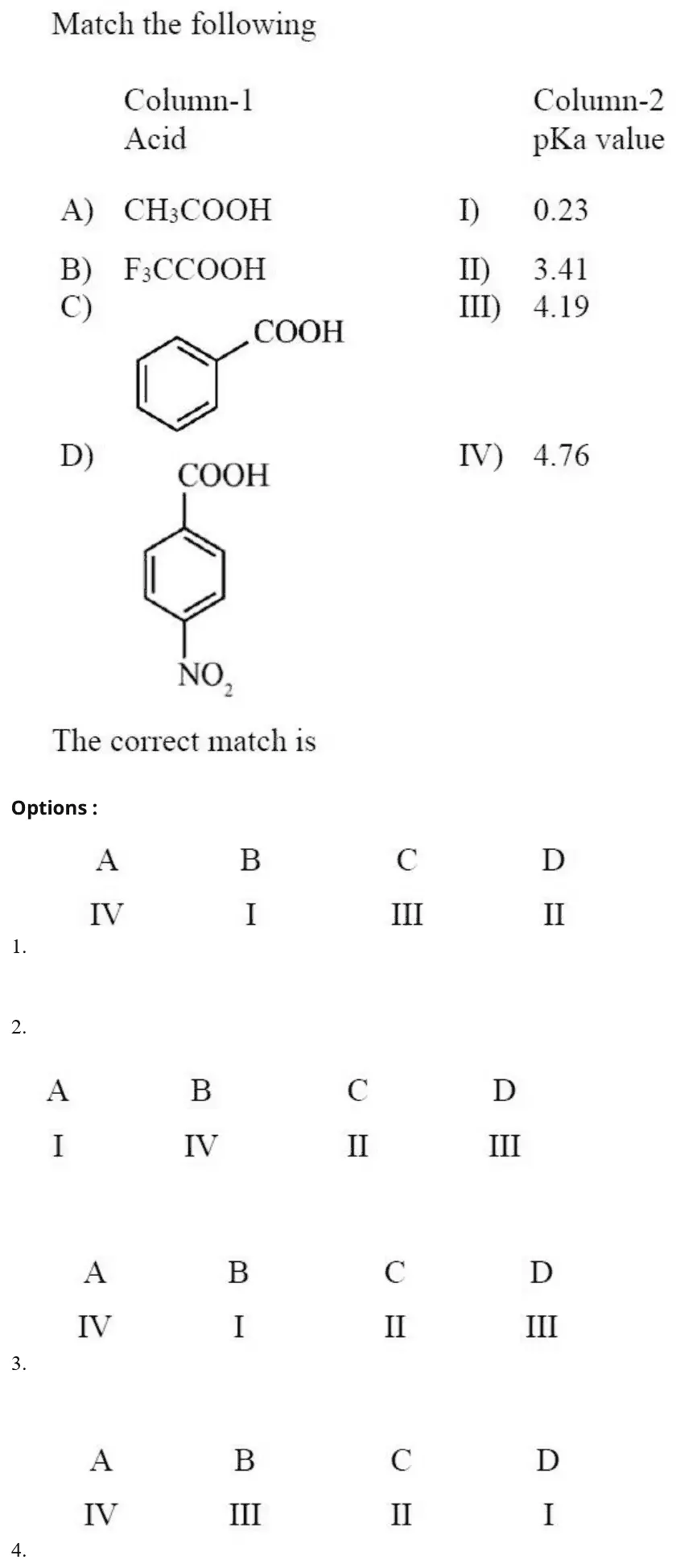
Match the following Column-1 (Acid) A) $\mathrm{CH_3COOH}$ B) $\mathrm{F_3CCOOH}$ C) (see the figure above) benzoic acid D) (see the figure above) 4-nitrobenzoic acid Column-2 (pKa value) I) 0.23 II) 3.41 III) 4.19 IV) 4.76 The correct match is
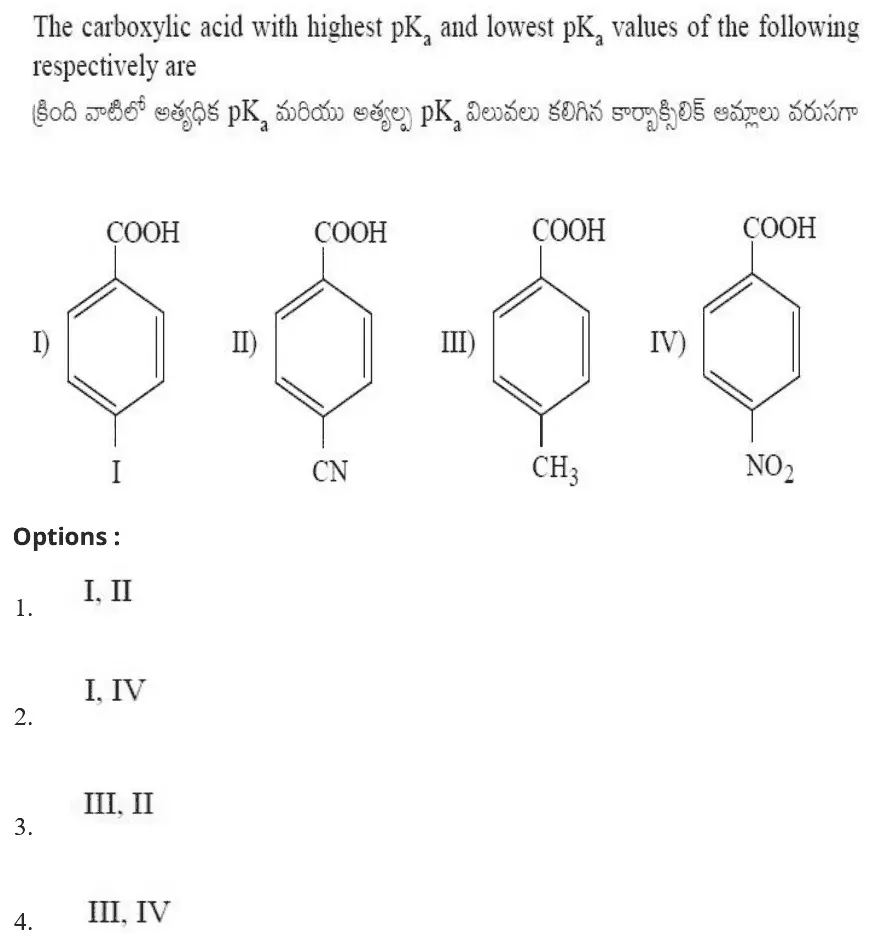
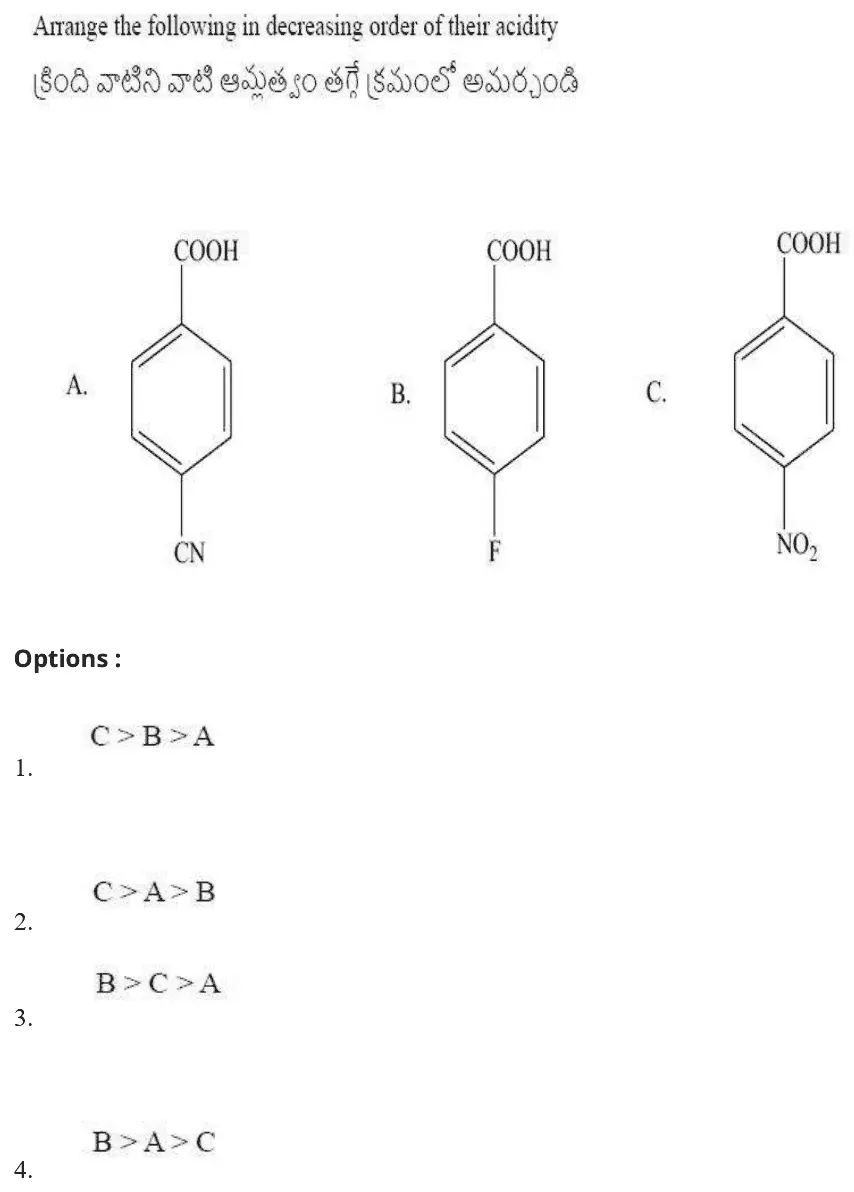
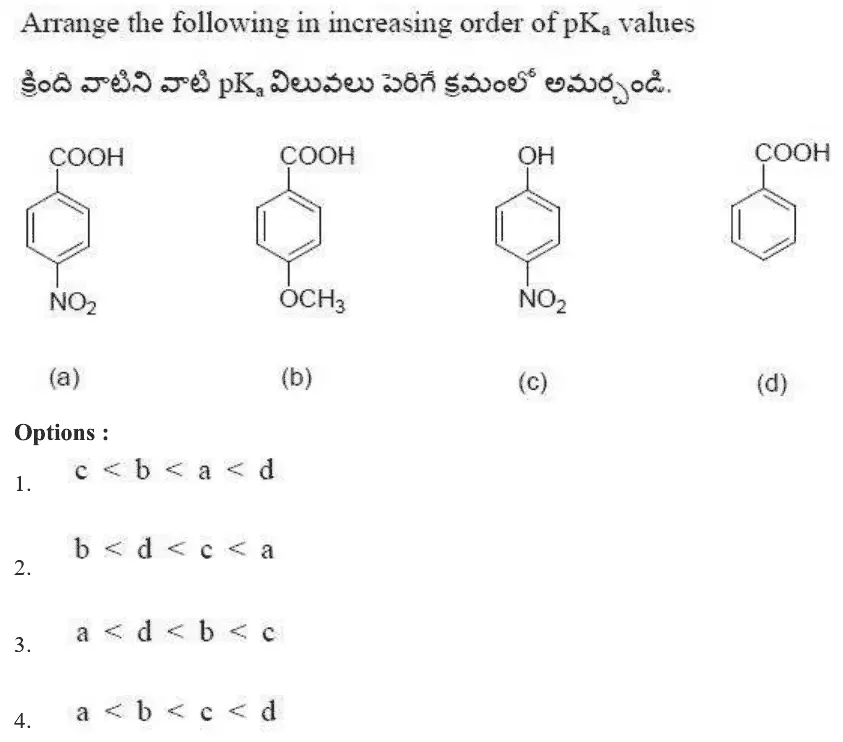
The increasing order of acidic strength among the following compounds I. Benzoic acid II. 4-Nitrobenzoic acid III. 3,4-Dinitrobenzoic acid IV. 4-Methoxybenzoic acid
Choose the incorrect statement among the following A) The reactivity of aromatic aldehydes and ketones is less than that of aliphatic carbonyl compounds towards nucleophilic addition reactions B) Benzaldehyde does not give Fehling's test C) The $H$ atoms in ethanal are acidic in nature D) "p-Nitro benzaldehyde" is less reactive than "benzaldehyde" towards nucleophilic addition reactions
Match the following Reaction A) Ketone + $\mathrm{NaBH_4}$ B) Ester + $\mathrm{LiAlH_4}$ C) RMgX + Ketone Product I) $1^\circ$ - alcohol II) $3^\circ$ - alcohol III) $2^\circ$ - alcohol IV) alkane The correct match is
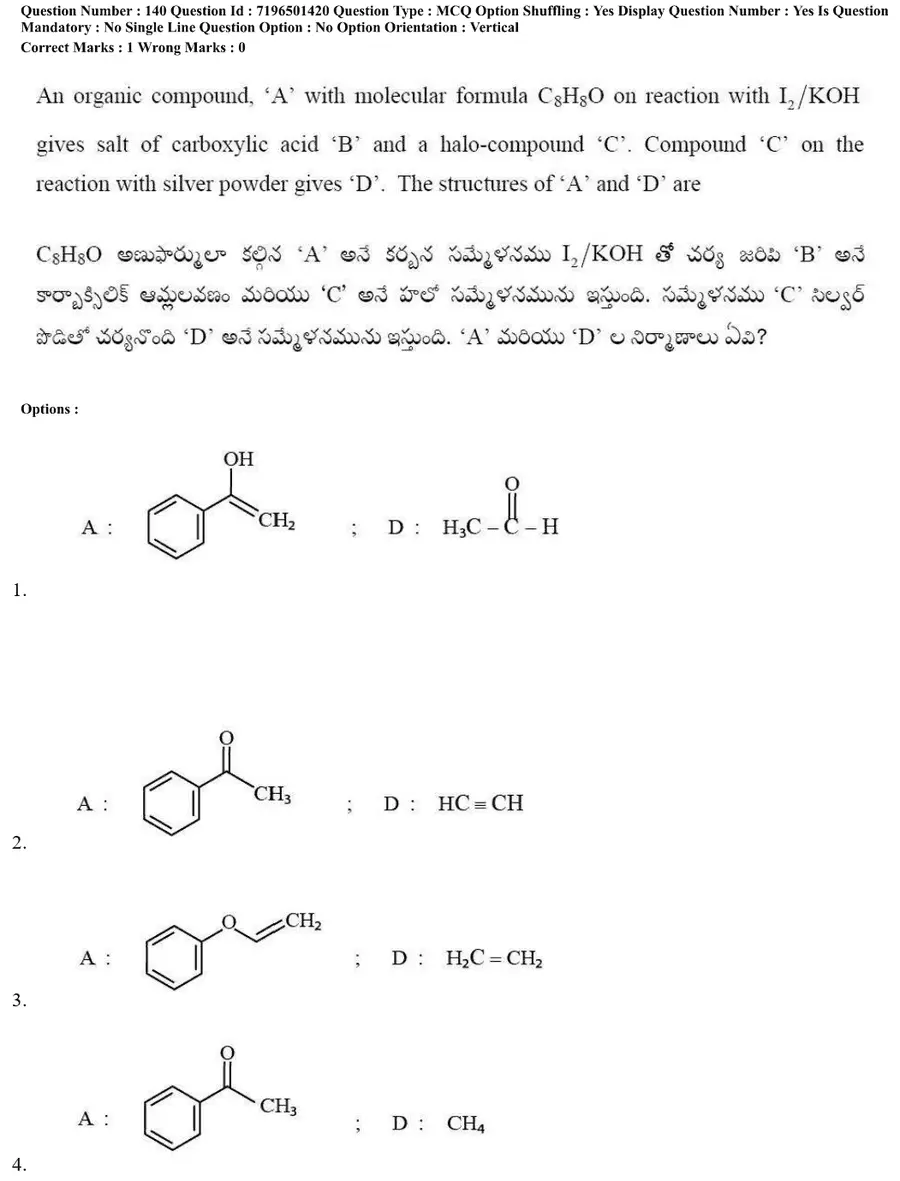
An organic compound, 'A' with molecular formula $\mathrm{C_8H_8O}$ on reaction with $\mathrm{I_2}$/KOH gives salt of carboxylic acid 'B' and a halo-compound 'C'. Compound 'C' on the reaction with silver powder gives 'D'. The structures of 'A' and 'D' are (see the figure above)
The question as printed in the paper.
A
see figure A: phenyl-C(OH)=CH2 ; D: $\mathrm{H_3C-C(=O)-H}$
B
see figure A: phenyl-C(=O)-CH3 ; D: $\mathrm{HC\equiv CH}$
C
see figure A: phenyl-O-CH=CH2 ; D: $\mathrm{H_2C=CH_2}$
D
see figure A: phenyl-C(=O)-CH3 ; D: $\mathrm{CH_4}$
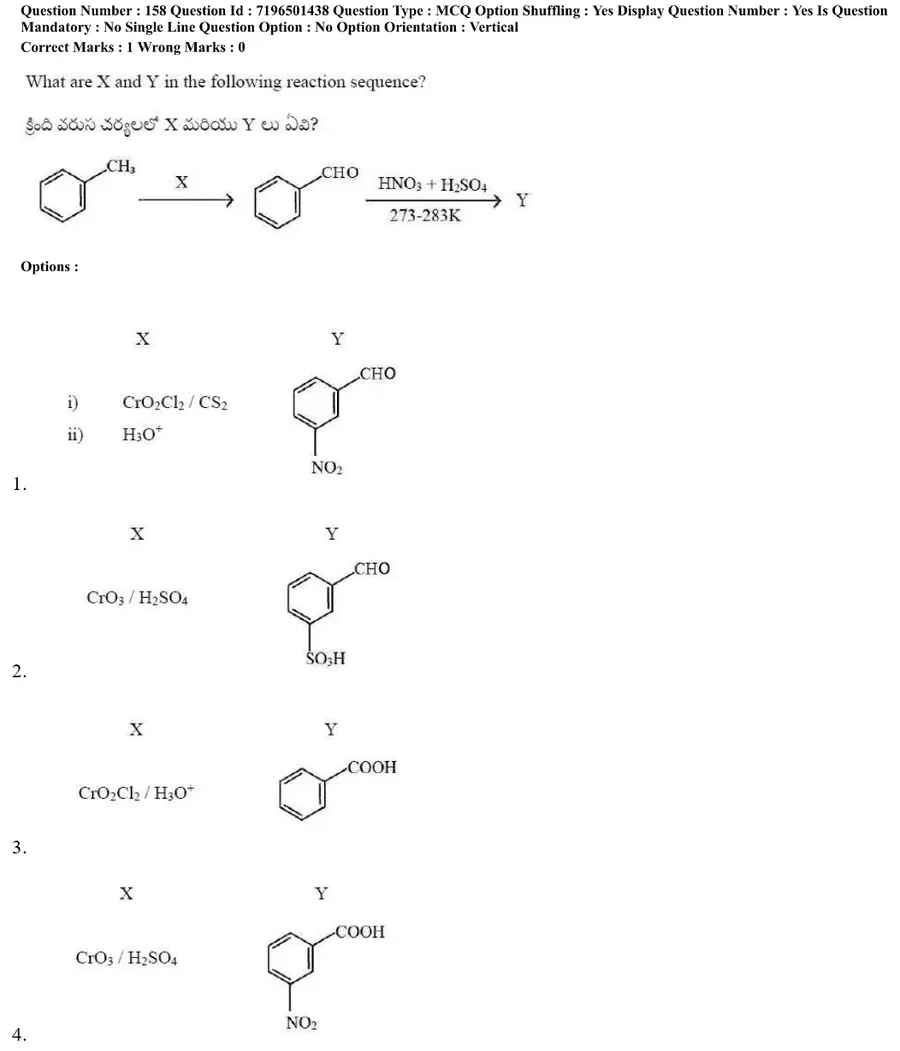
Answer: (A) X: (i) $\mathrm{CrO_2Cl_2/CS_2}$, (ii) $\mathrm{H_3O^+}$; Y: (see the figure above) benzaldehyde with $\mathrm{NO_2}$ meta to $\mathrm{CHO}$· Official TGCHE final key
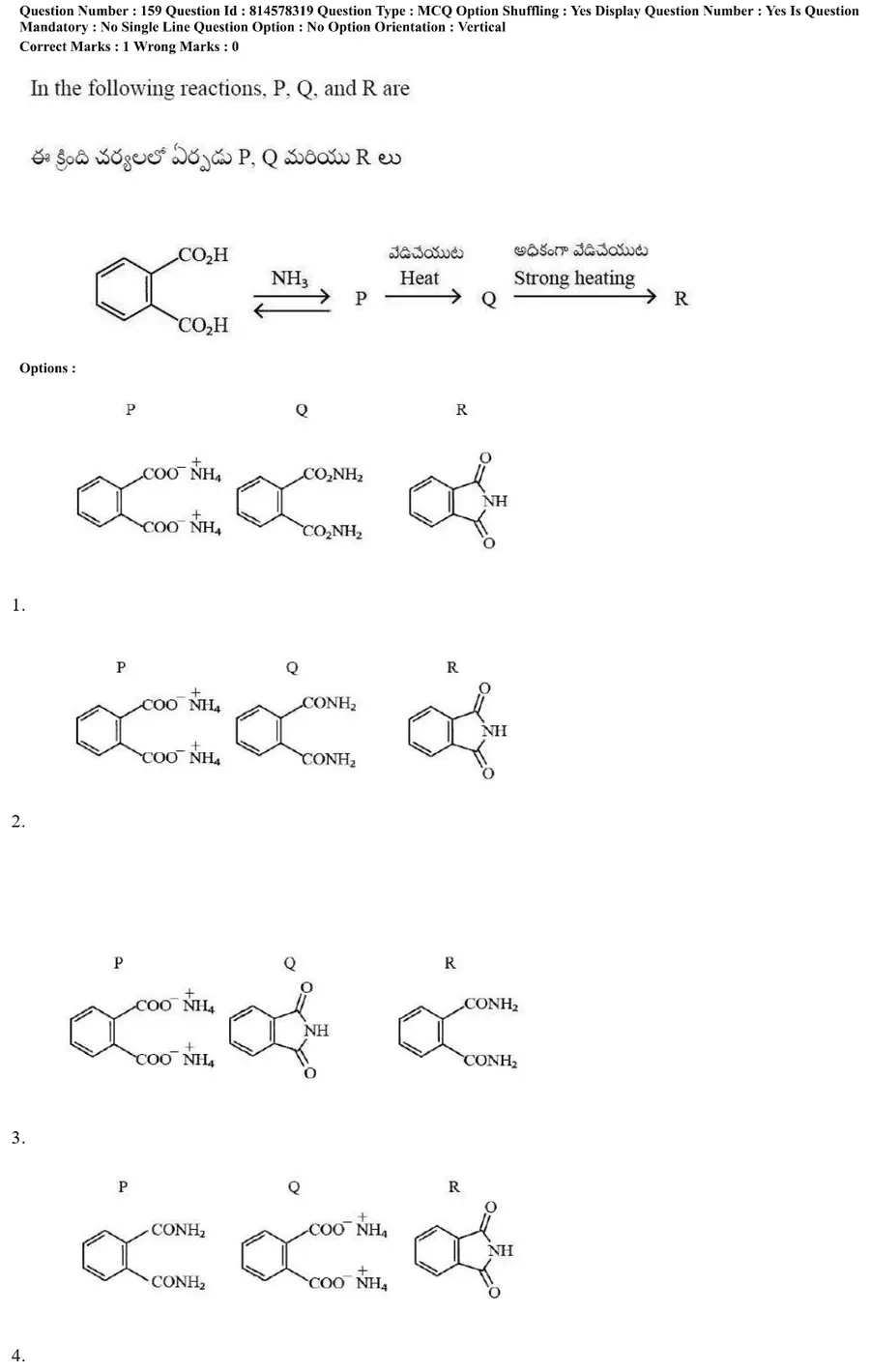
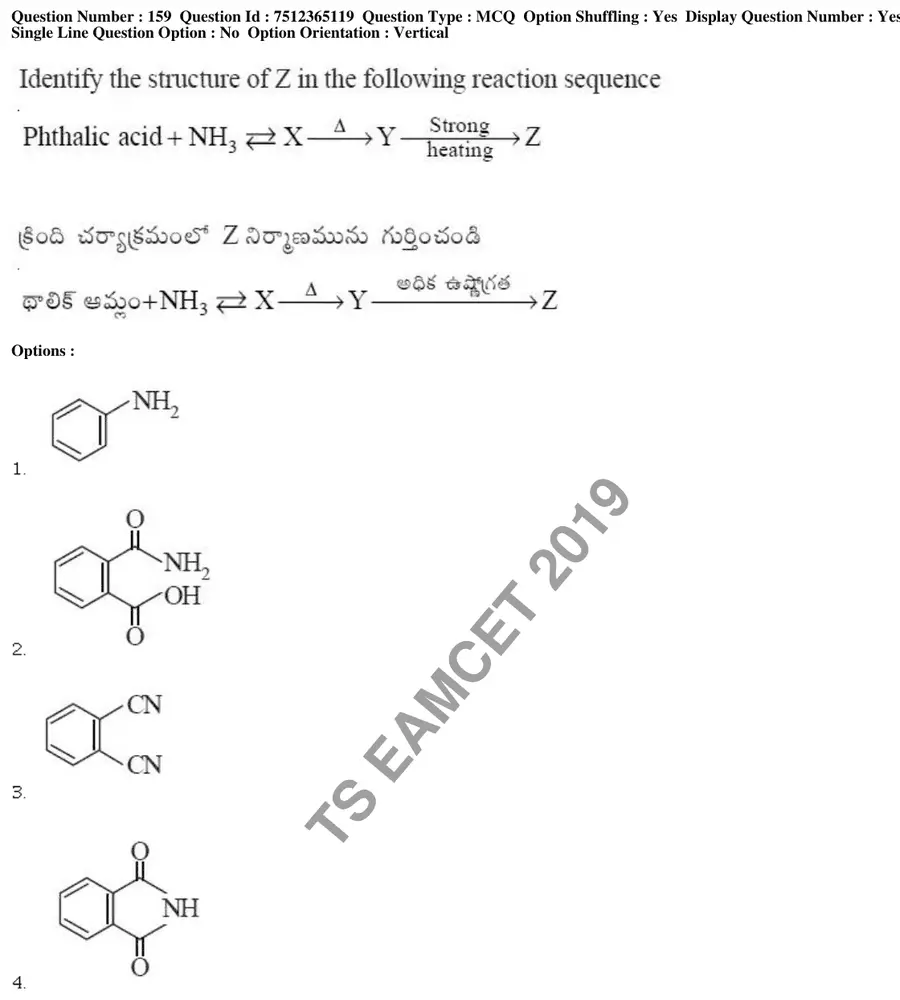
Identify the structure of Z in the following reaction sequence Phthalic acid $+ \mathrm{NH_3} \rightleftharpoons$ X $\xrightarrow{\Delta}$ Y $\xrightarrow{\text{Strong heating}}$ Z (see the figure above)
The question as printed in the paper.
A
see figure aniline ($\mathrm{C_6H_5NH_2}$)
B
see figure phthalamic acid: benzene ring with ortho $\mathrm{CONH_2}$ and $\mathrm{COOH}$
C
see figure phthalonitrile: benzene ring with two ortho CN groups
D
see figure phthalimide: benzene ring fused to a five-membered ring with two C=O and NH
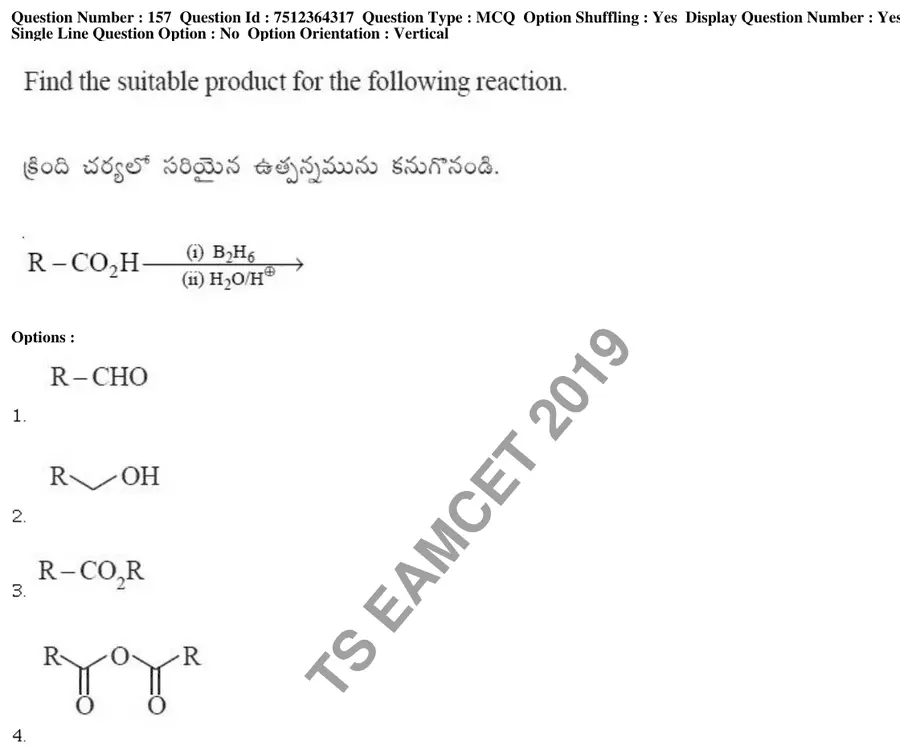
Find the suitable product for the following reaction. $\mathrm{R{-}CO_2H} \xrightarrow[\text{(ii) }\mathrm{H_2O/H^+}]{\text{(i) }\mathrm{B_2H_6}}$ (see the figure above)
The question as printed in the paper.
A
$\mathrm{R{-}CHO}$
B
$\mathrm{R{-}CH_2{-}OH}$ (drawn as skeletal line formula: R, zig-zag bond, OH)
C
$\mathrm{R{-}CO_2R}$
D
see figure acid anhydride $\mathrm{R{-}CO{-}O{-}CO{-}R}$ (skeletal, two C=O pointing down)
The decreasing order of acidic strength for following acids is a) $\mathrm{CH_3COOH}$ b) $\mathrm{CH_3CHClCH_2COOH}$ c) $\mathrm{ClCH_2COOH}$ d) $\mathrm{Cl_2CHCOOH}$
Which of the below reactions produce carboxylic acids? a. $\mathrm{HC \equiv C-CH=C(CH_3)-CH_2OH} \xrightarrow[\mathrm{CH_3COCH_3}]{\mathrm{MnO_2}}$ b. $\mathrm{Ph-CCl_3} \xrightarrow[\text{(ii) } \mathrm{H_2O/H^{\oplus}}]{\text{(i) aq.NaOH}}$ c. $\mathrm{C_2H_5Br} \xrightarrow[\text{(iii) } \mathrm{H_2O/H^{\oplus}}]{\text{(i) Mg; (ii) } \mathrm{CO_2}}$ d. $\mathrm{CH_3CH=CHCH_3} \xrightarrow[\Delta]{\mathrm{K_2Cr_2O_7/H_2SO_4}}$
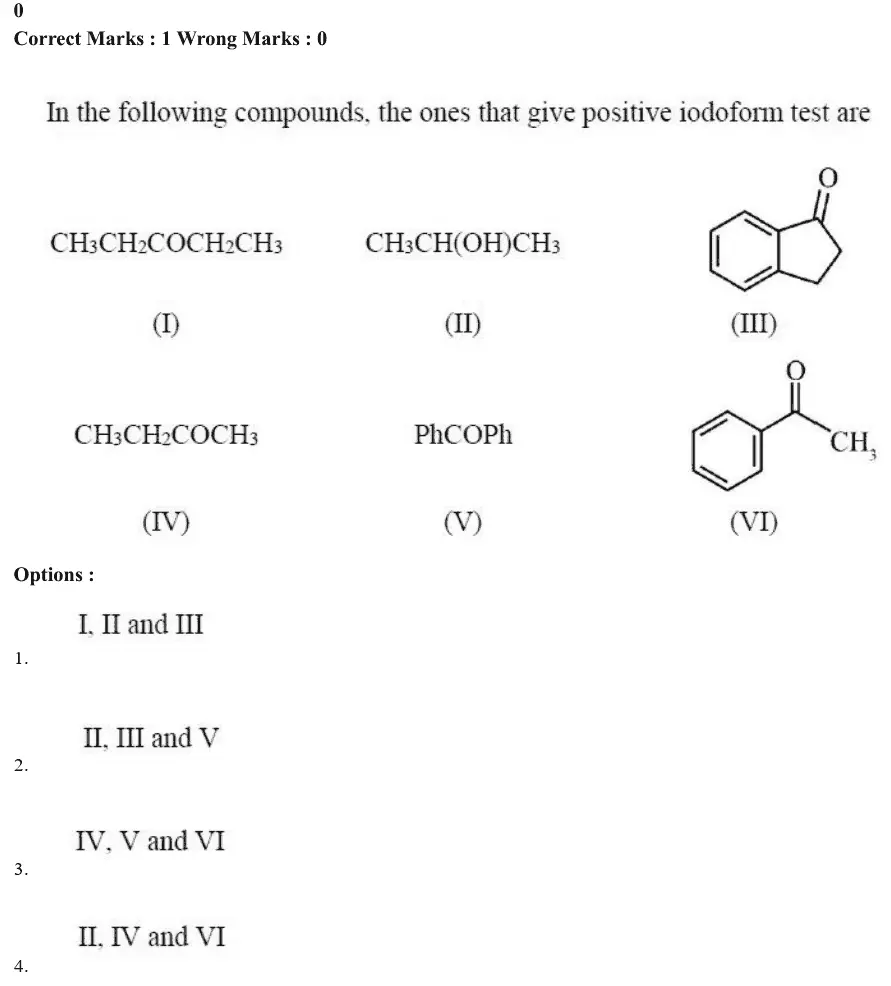
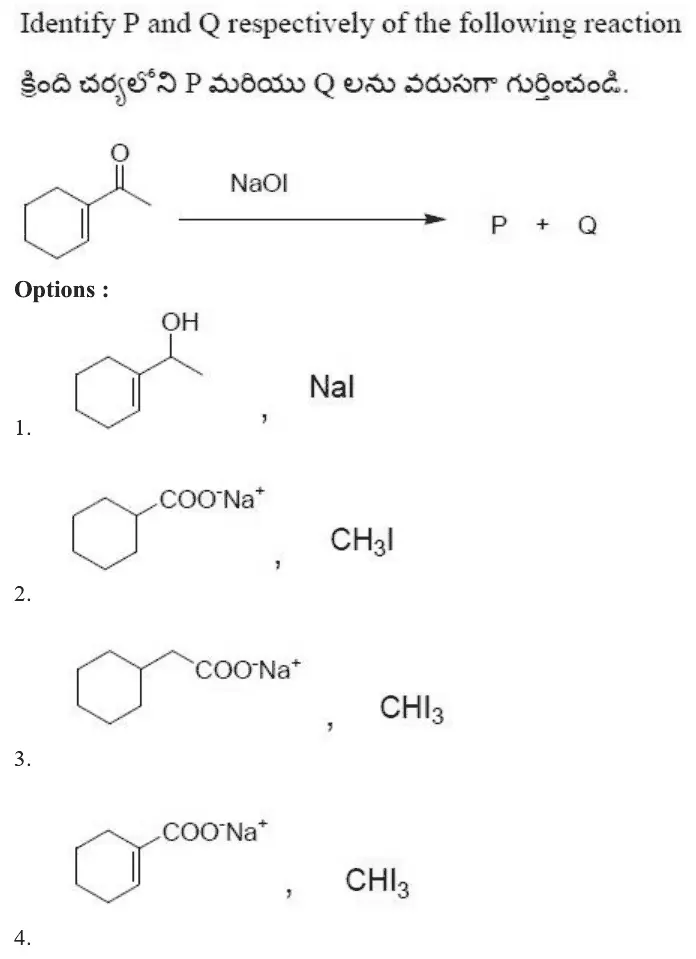
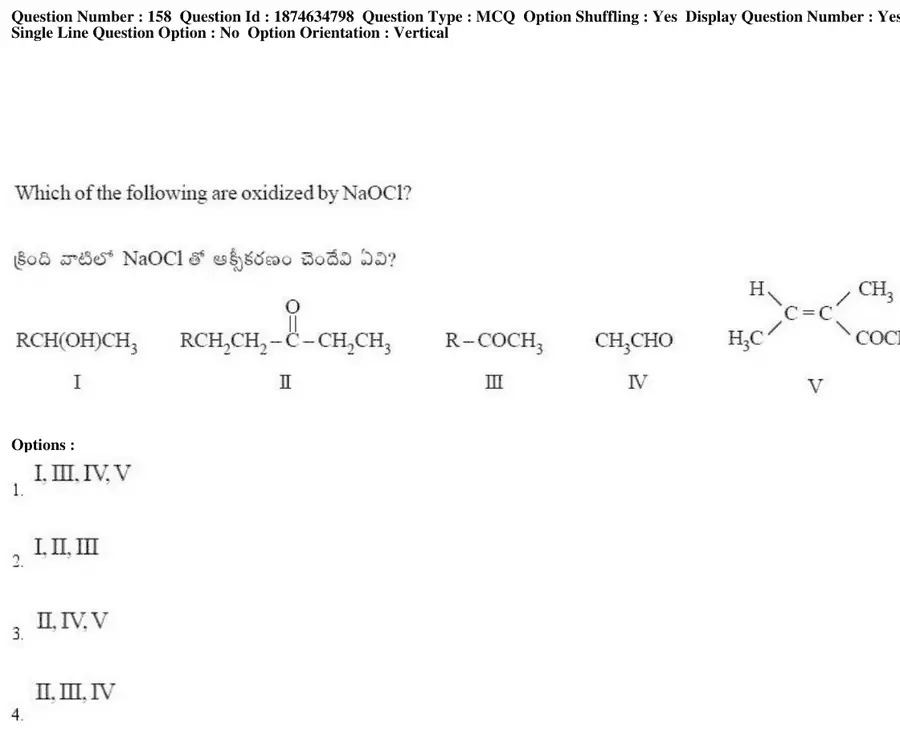
Which of the following are oxidized by NaOCl? I) $\mathrm{RCH(OH)CH_3}$ II) $\mathrm{RCH_2CH_2-C(=O)-CH_2CH_3}$ III) $\mathrm{R-COCH_3}$ IV) $\mathrm{CH_3CHO}$ V) (see the figure above) alkene $\mathrm{C=C}$: left carbon bears H (upper left) and $\mathrm{H_3C}$ (lower left); right carbon bears $\mathrm{CH_3}$ (upper right) and a group printed "COC..." (lower right) whose last glyph is clipped by the crop edge; read as $\mathrm{COCH_3}$, i.e. $\mathrm{CH_3CH=C(CH_3)COCH_3}$
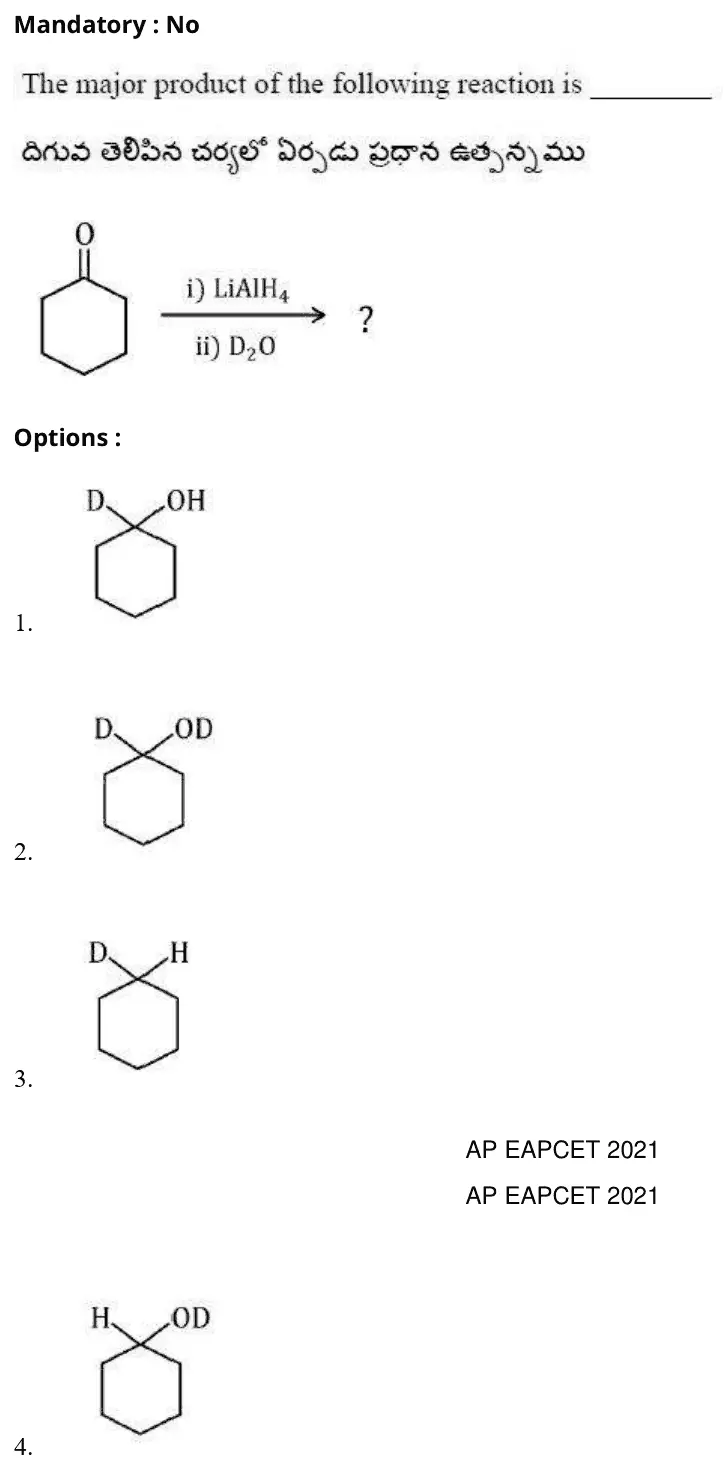
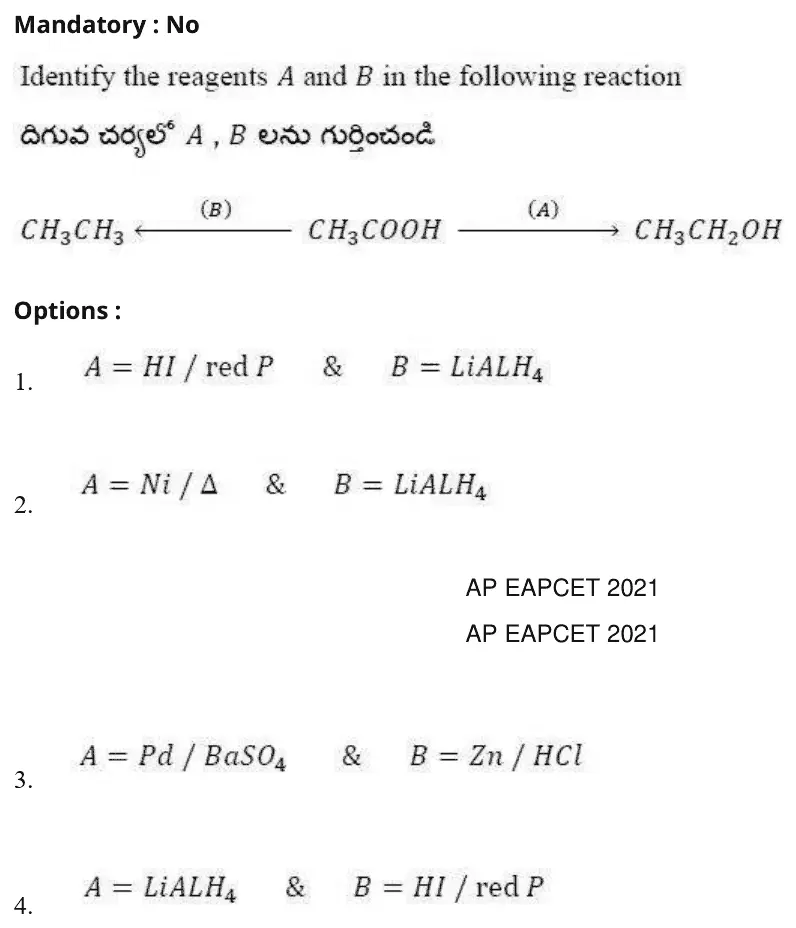
The reduction products of an aldehyde, ketone and carboxylic acid in the presence of lithium aluminium hydride are respectively X, Y and Z. What are X, Y and Z?
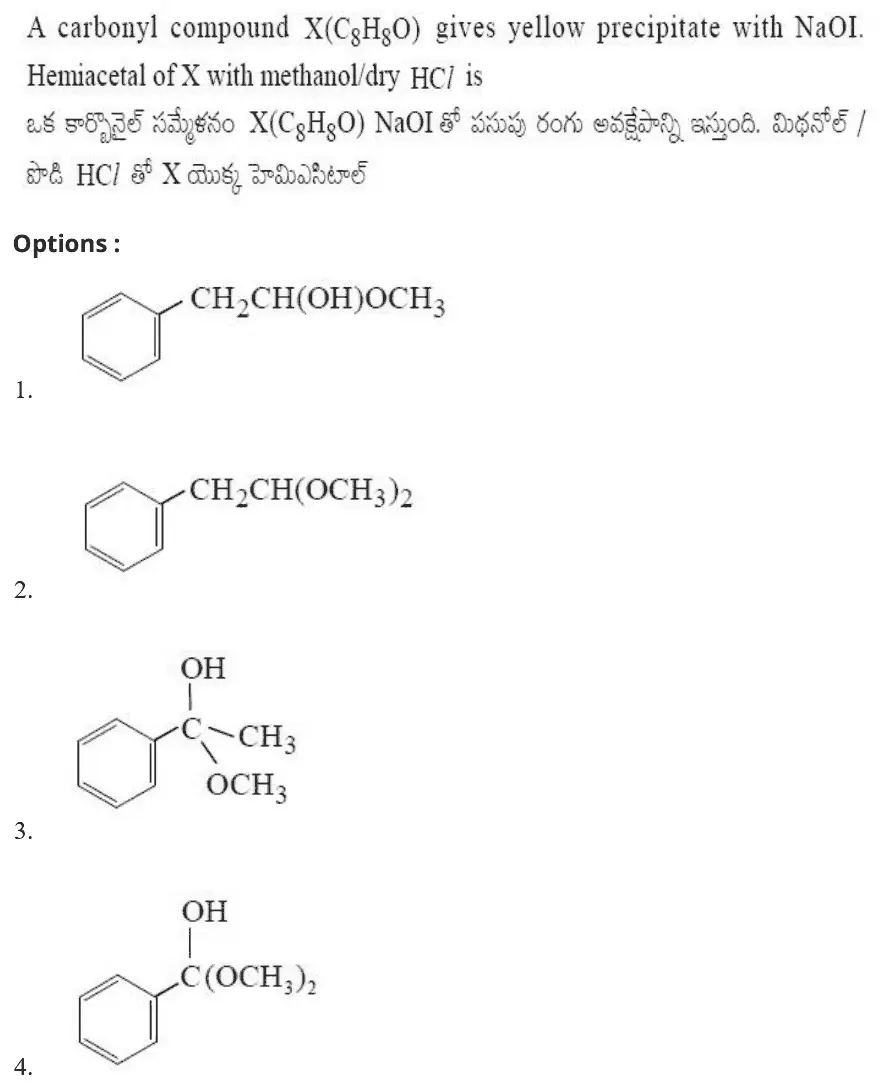
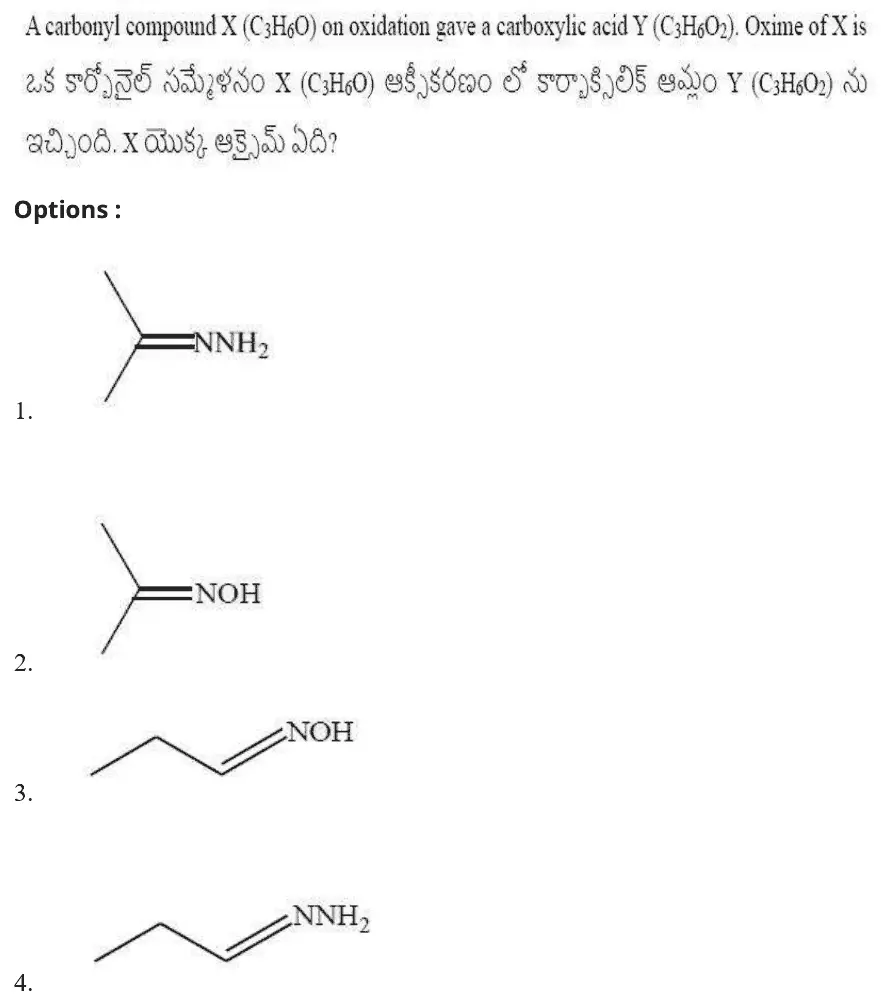
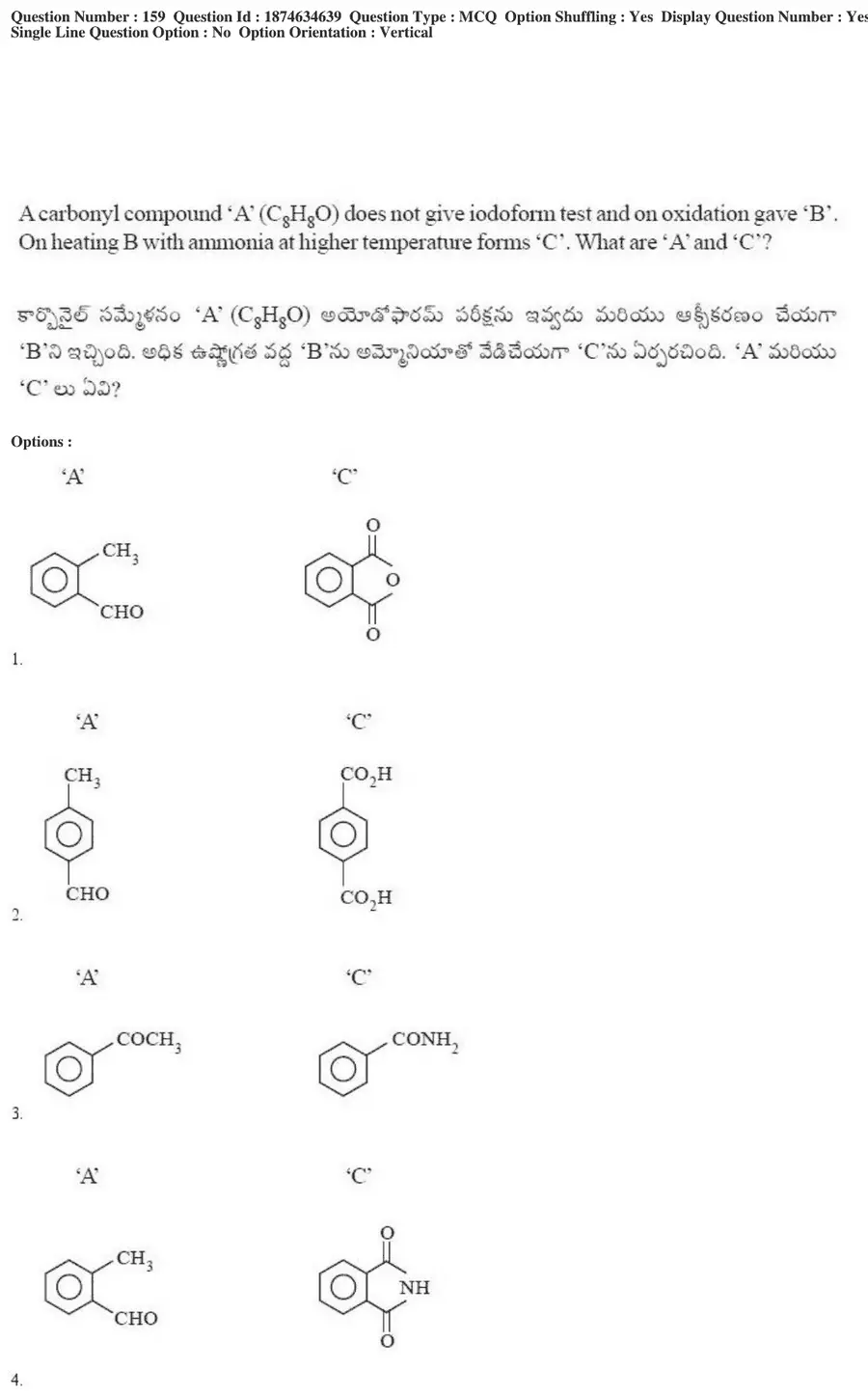
A carbonyl compound 'A' ($\mathrm{C_8H_8O}$) does not give iodoform test and on oxidation gave 'B'. On heating B with ammonia at higher temperature forms 'C'. What are 'A' and 'C'?
The question as printed in the paper.
A
see figure A: 2-methylbenzaldehyde (benzene ring with ortho CH3 and CHO); C: phthalic anhydride
B
see figure A: 4-methylbenzaldehyde (para CH3 and CHO); C: terephthalic acid (para CO2H, CO2H)
C
see figure A: acetophenone (benzene ring with COCH3); C: benzamide (benzene ring with CONH2)
D
see figure A: 2-methylbenzaldehyde (ortho CH3 and CHO); C: phthalimide (benzene ring fused to five-membered ring with two C=O and NH)
Which of the following sets is in the correct order regarding the property mentioned against them Sets | Property I) $\mathrm{NCCH_2COOH > FCH_2COOH > H_3CCH_2COOH}$ | acidity II) $\mathrm{CH_3CH_2CHO > PhCOCH_3 > PhCHO}$ | reactivity III) $\mathrm{H_3COCH_2CH_3 < H_3CCH_2CHO < H_3CCH_2CH_2OH}$ | boiling points
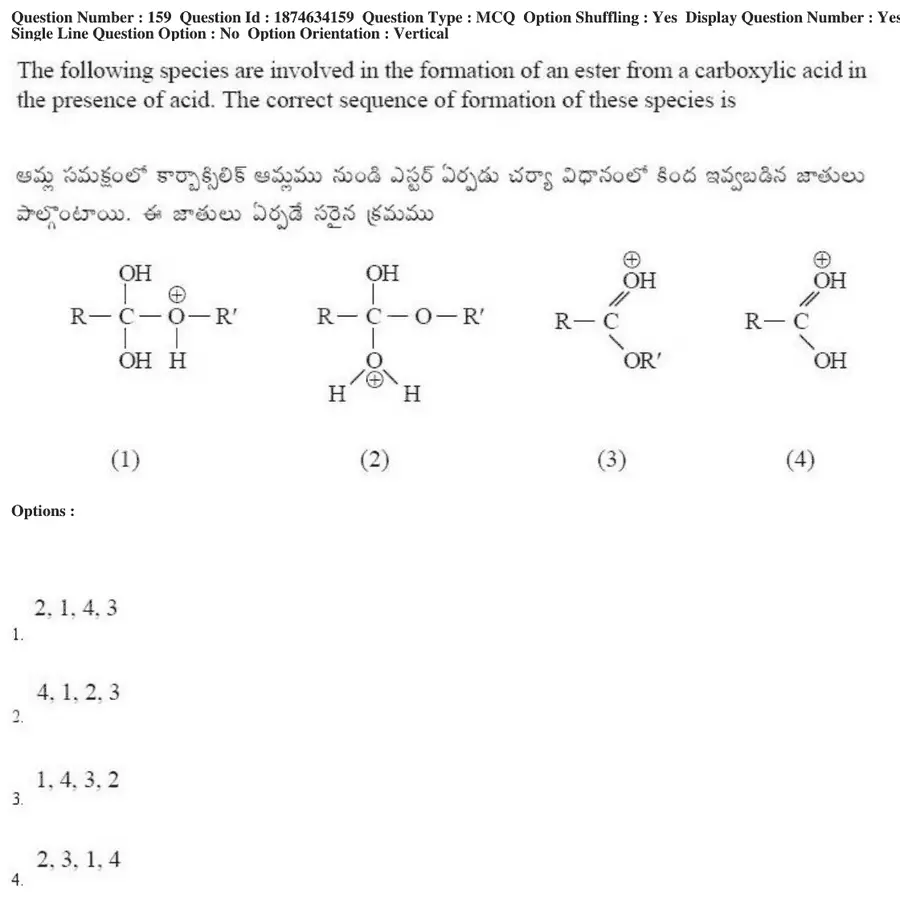
The following species are involved in the formation of an ester from a carboxylic acid in the presence of acid. The correct sequence of formation of these species is (see the figure above)
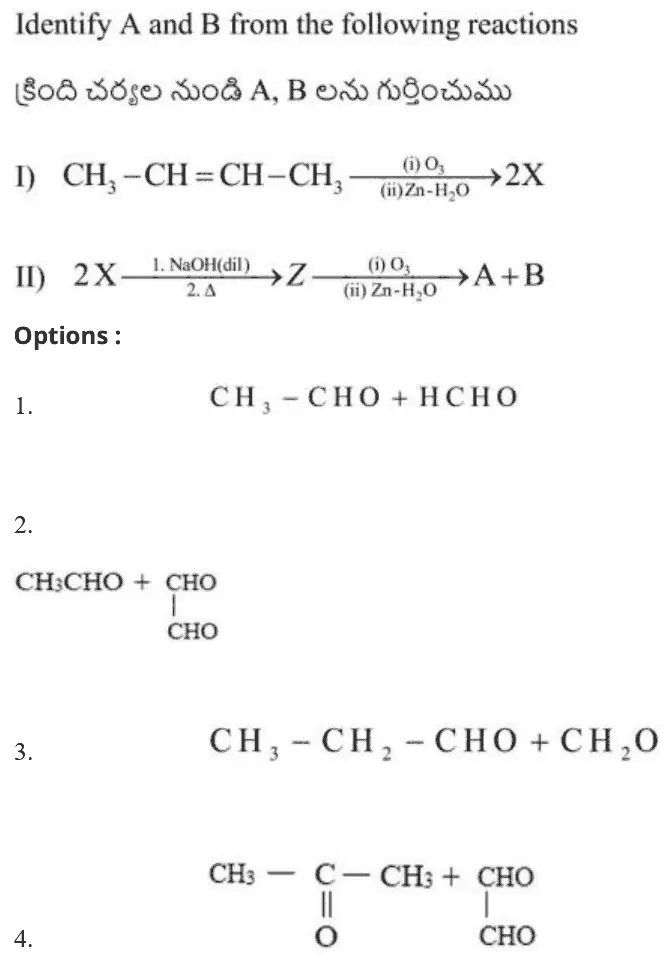
$\mathrm{CH_2=CH_2 \xrightarrow[(2)\ Zn/H_2O]{(1)\ O_3} A \xrightarrow{conc.\ NaOH} B + C}$ (B: alcohol; C: sodium salt of carboxylic acid) The reaction of A to give B and C is an example of
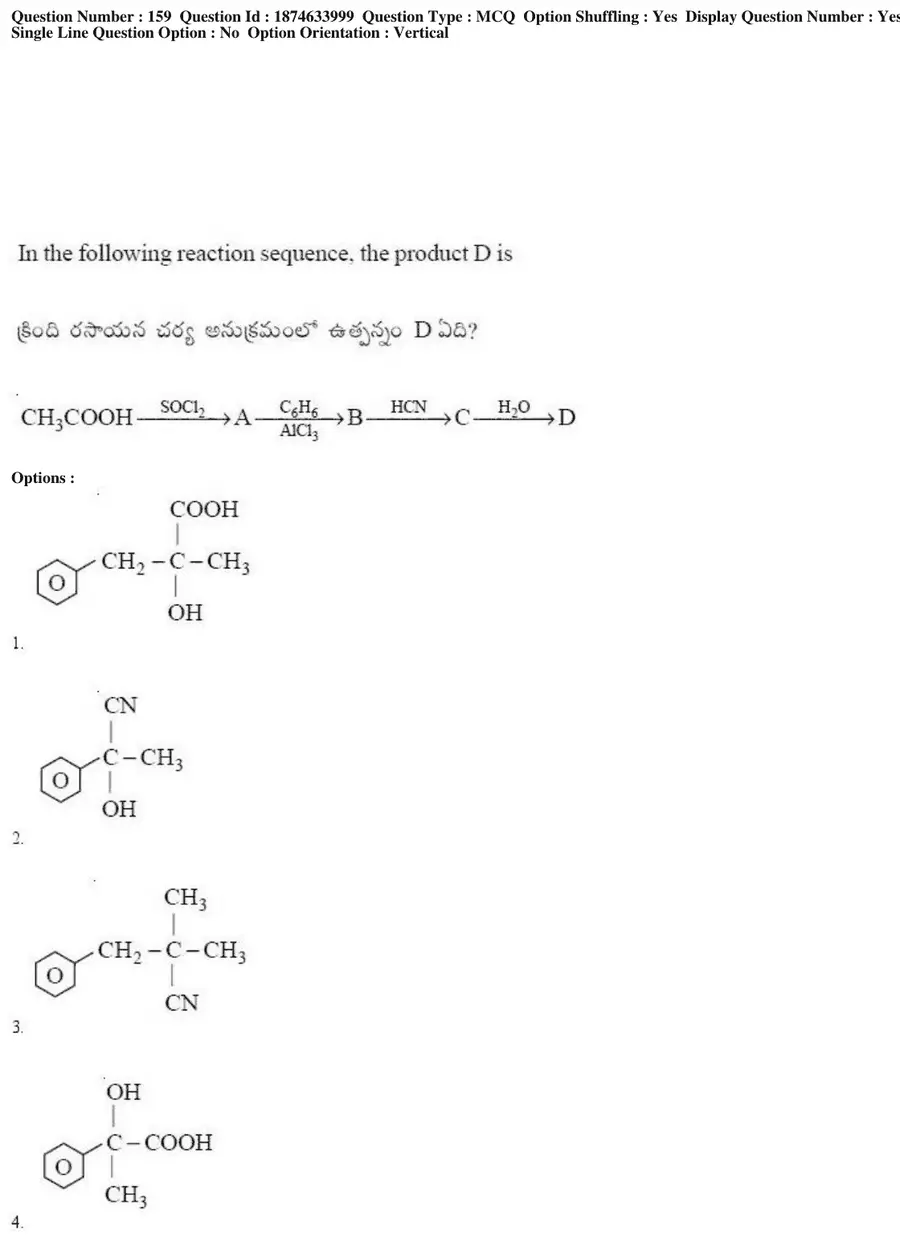
In the following reaction sequence, the product D is $\mathrm{CH_3COOH \xrightarrow{SOCl_2} A \xrightarrow[AlCl_3]{C_6H_6} B \xrightarrow{HCN} C \xrightarrow{H_2O} D}$
The question as printed in the paper.
A
see figure $\mathrm{C_6H_5-CH_2-C(COOH)(OH)-CH_3}$ (COOH above the central C, OH below)
B
see figure $\mathrm{C_6H_5-C(CN)(OH)-CH_3}$ (CN above, OH below the C attached to the ring, CH3 to the right)
C
see figure $\mathrm{C_6H_5-CH_2-C(CH_3)(CN)-CH_3}$ (CH3 above the central C, CN below)
D
see figure $\mathrm{C_6H_5-C(OH)(CH_3)-COOH}$ (OH above, CH3 below the C attached to the ring, COOH to the right)
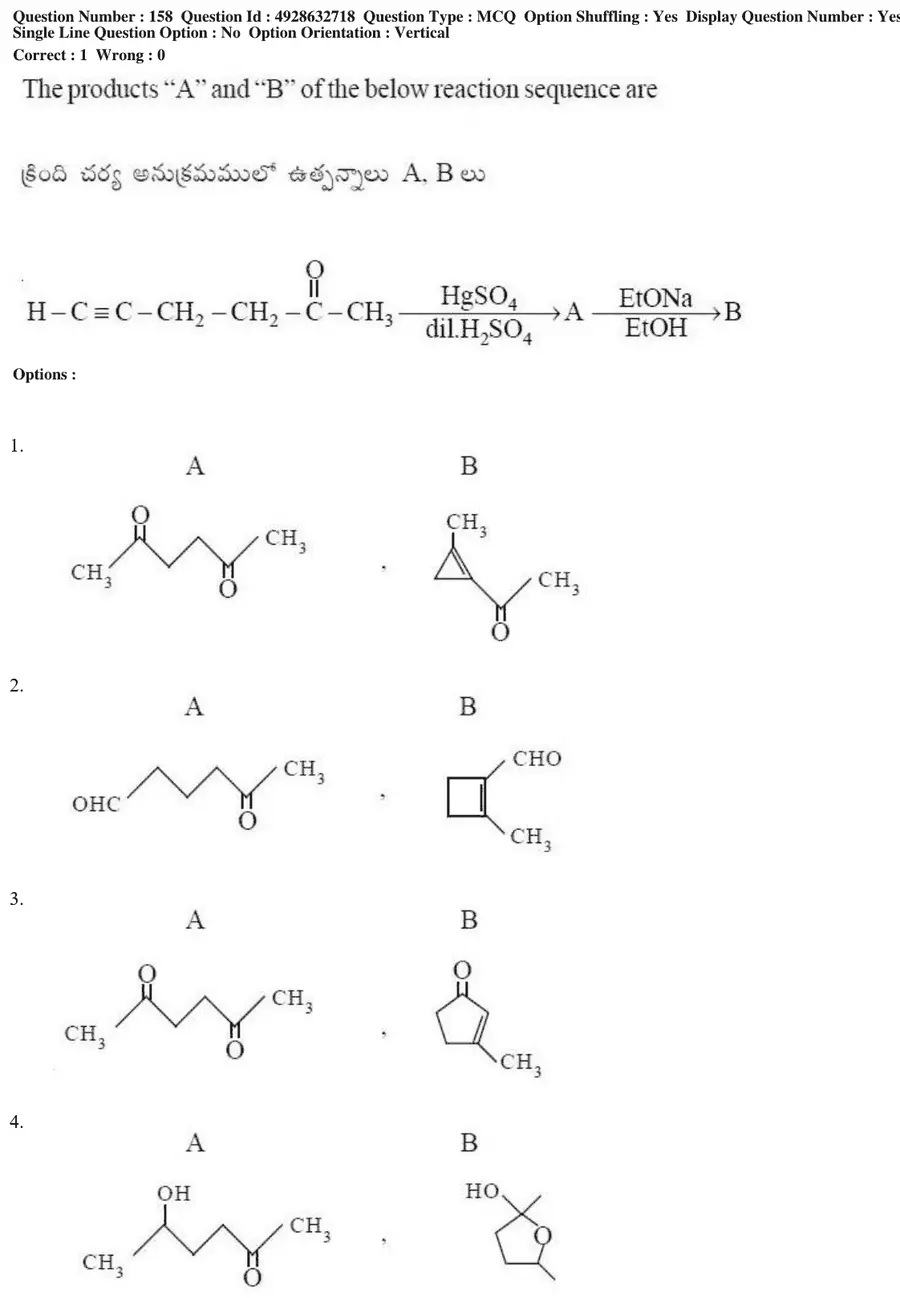
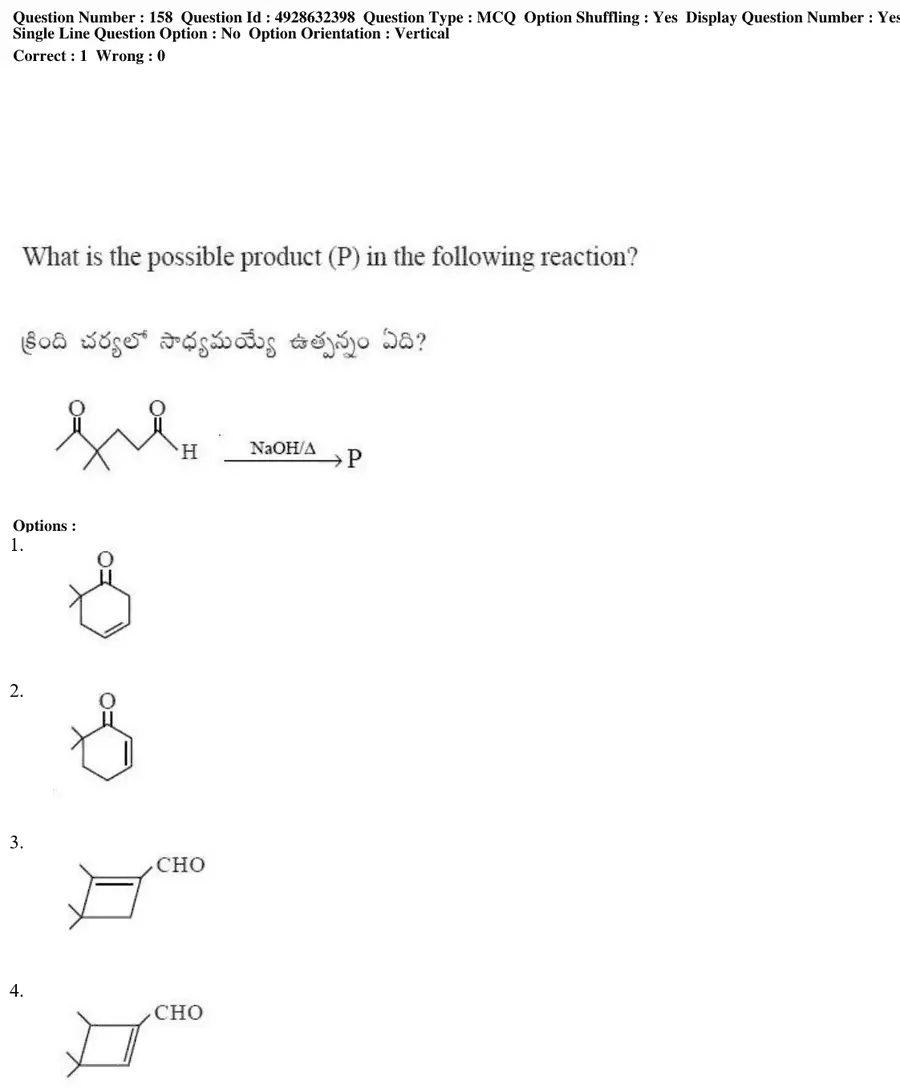
The products "A" and "B" of the below reaction sequence are (see the figure above)
The question as printed in the paper.
A
see figure A: CH3-CO-CH2-CH2-CO-CH3 (hexane-2,5-dione, skeletal); B: methylcyclopropane ring bearing CH3 and a C(=O)CH3 group on the ring carbon
B
see figure A: OHC-CH2-CH2-CH2-CO-CH3 (skeletal, CHO at left, C=O at right with CH3); B: cyclobutene ring (one C=C) with CHO and CH3 substituents
C
see figure A: CH3-CO-CH2-CH2-CO-CH3 (skeletal, same as option 1); B: 3-methylcyclopent-2-en-1-one (five-membered ring, C=O at top, ring C=C, CH3 on the alkene carbon)
D
see figure A: CH3-CH(OH)-CH2-CH2-CO-CH3 (skeletal); B: cyclic hemiketal, five-membered ring containing O with HO and CH3 on the carbon next to O and a CH3 on the other ring carbon next to O
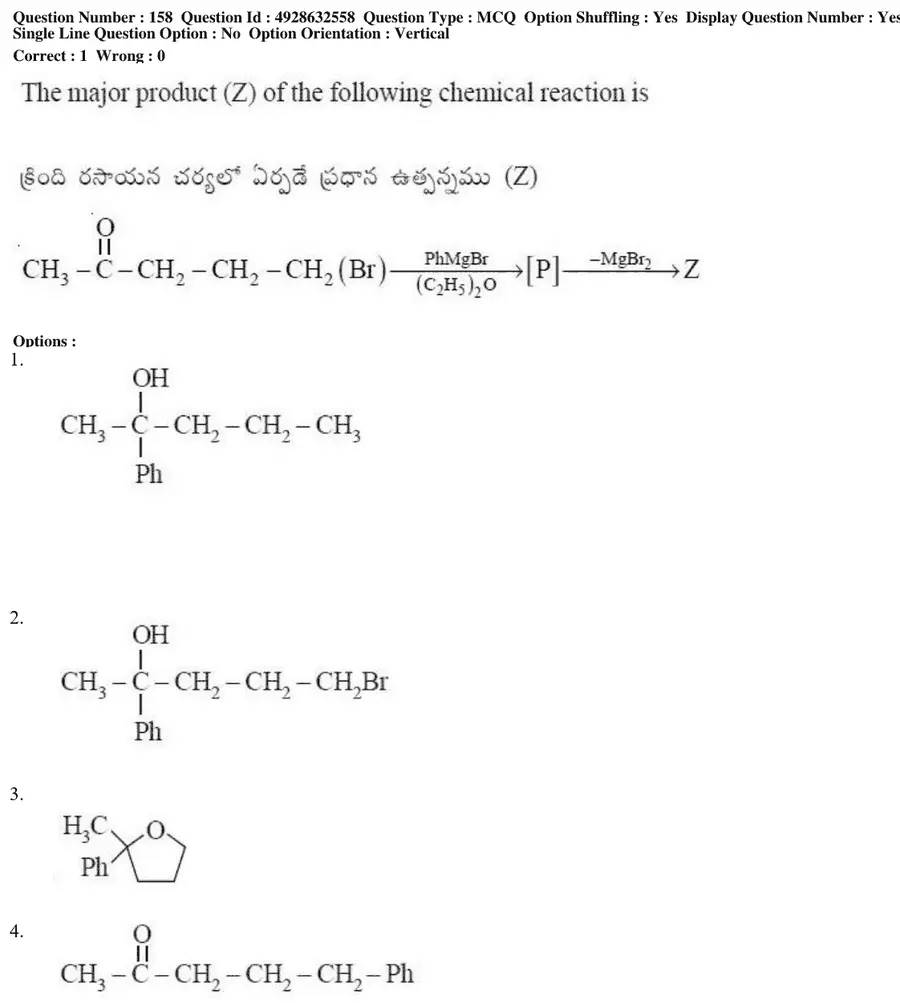
The major product (Z) of the following chemical reaction is $\mathrm{CH_3{-}C(=O){-}CH_2{-}CH_2{-}CH_2(Br) \xrightarrow[(C_2H_5)_2O]{PhMgBr} [P] \xrightarrow{-MgBr_2} Z}$
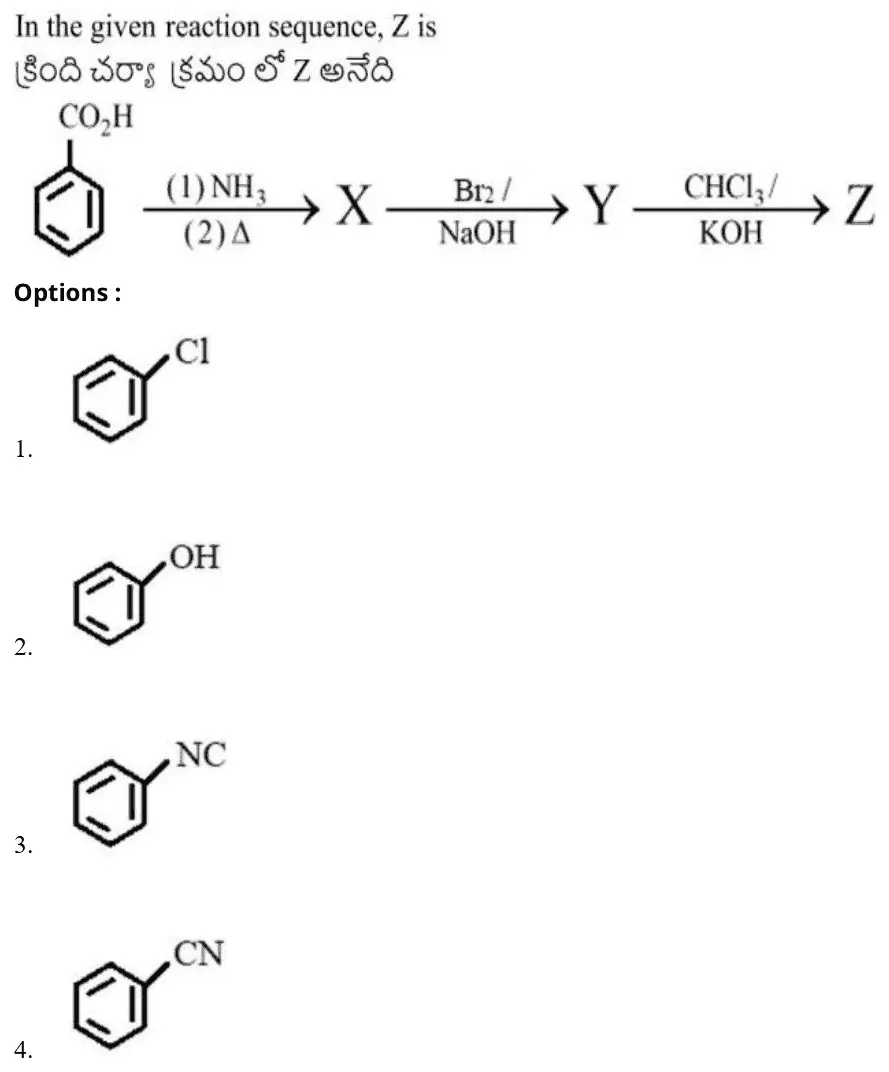
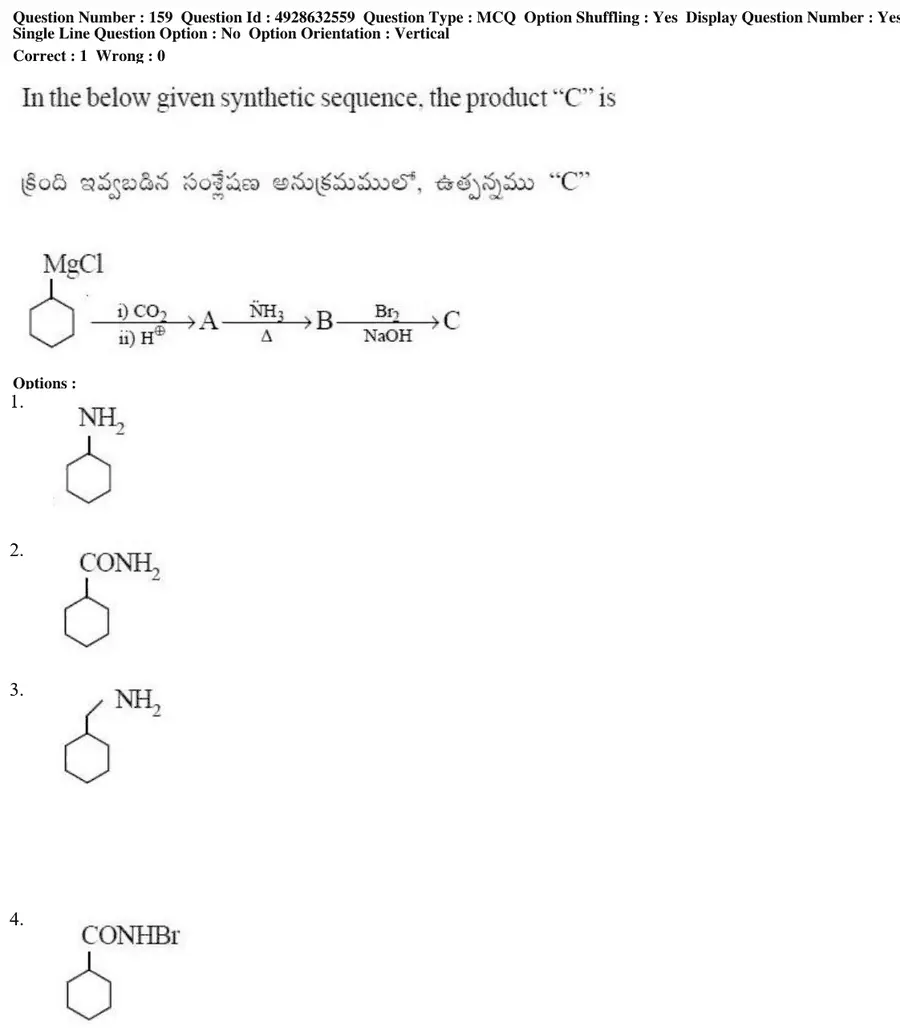
In the below given synthetic sequence, the product "C" is (see the figure above) cyclohexyl magnesium chloride (a cyclohexane ring with MgCl on its top) $\xrightarrow[\mathrm{ii)\ H^{\oplus}}]{\mathrm{i)\ CO_2}} A \xrightarrow[\Delta]{\ddot{N}H_3} B \xrightarrow[NaOH]{Br_2} C$
The question as printed in the paper.
A
see figure cyclohexane ring bearing $\mathrm{NH_2}$
B
see figure cyclohexane ring bearing $\mathrm{CONH_2}$
C
see figure cyclohexane ring bearing a $\mathrm{CH_2{-}NH_2}$ (a CH2 stub then NH2)
D
see figure cyclohexane ring bearing $\mathrm{CONHBr}$
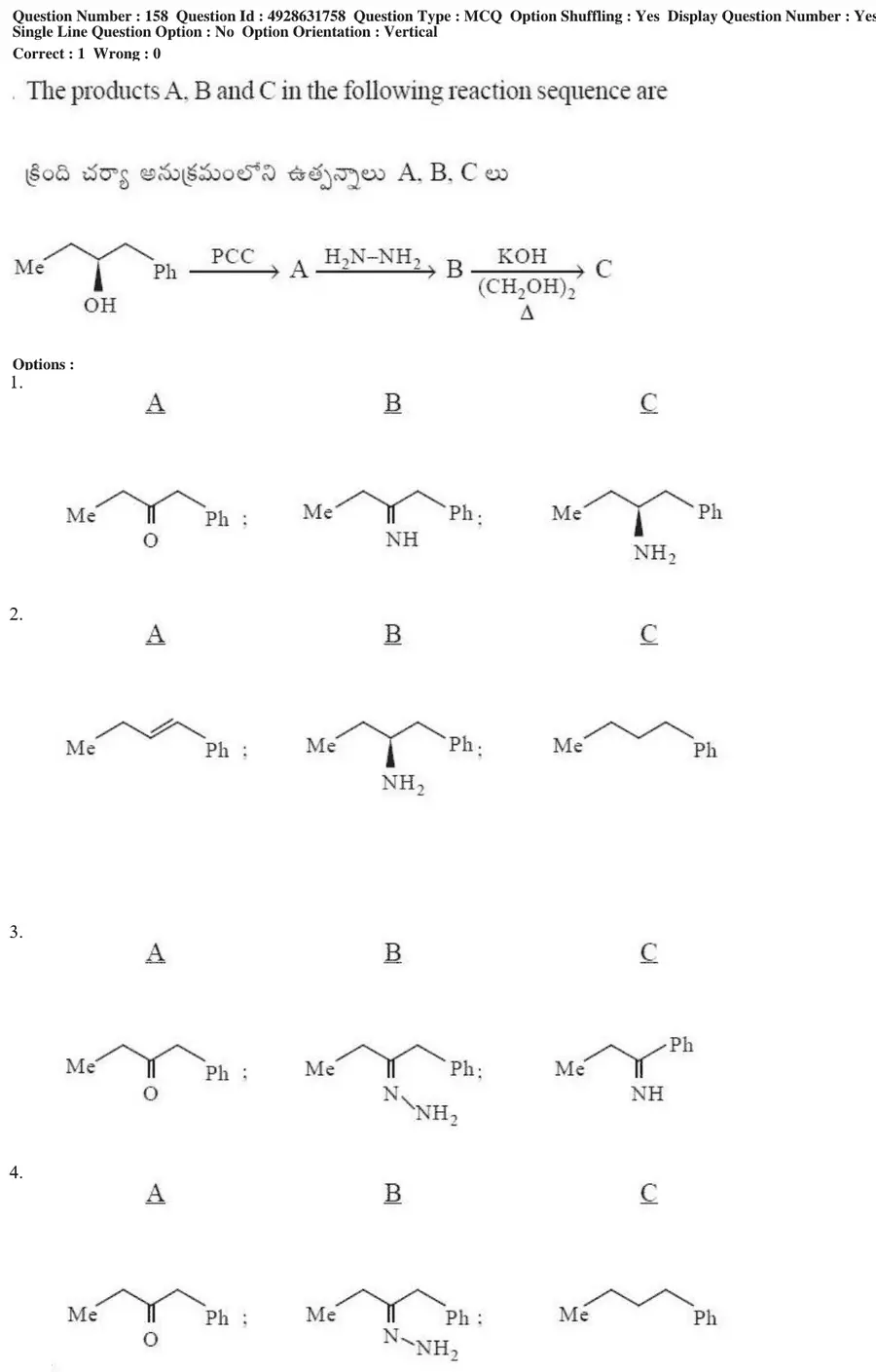
The products A, B and C in the following reaction sequence are (see the figure above)
The question as printed in the paper.
A
A: (see the figure above) ketone, Me-CH2-C(=O)-CH2-Ph ; B: (see the figure above) imine, Me-CH2-C(=NH)-CH2-Ph ; C: (see the figure above) (S/R)-amine Me-CH2-CH(NH2, wedge)-CH2-Ph
B
A: (see the figure above) alkene Me-CH2-CH=CH-Ph ; B: (see the figure above) amine Me-CH2-CH(NH2, wedge)-CH2-Ph ; C: (see the figure above) Me-CH2-CH2-CH2-Ph (alkane)
C
A: (see the figure above) ketone Me-CH2-C(=O)-CH2-Ph ; B: (see the figure above) hydrazone Me-CH2-C(=N-NH2)-CH2-Ph ; C: (see the figure above) imine Me-CH2-C(=NH)-Ph (shorter chain)
D
A: (see the figure above) ketone Me-CH2-C(=O)-CH2-Ph ; B: (see the figure above) hydrazone Me-CH2-C(=N-NH2)-CH2-Ph ; C: (see the figure above) Me-CH2-CH2-CH2-Ph (alkane)
Answer: (D) A: (see the figure above) ketone Me-CH2-C(=O)-CH2-Ph ; B: (see the figure above) hydrazone Me-CH2-C(=N-NH2)-CH2-Ph ; C: (see the figure above) Me-CH2-CH2-CH2-Ph (alkane)· The council's preliminary key
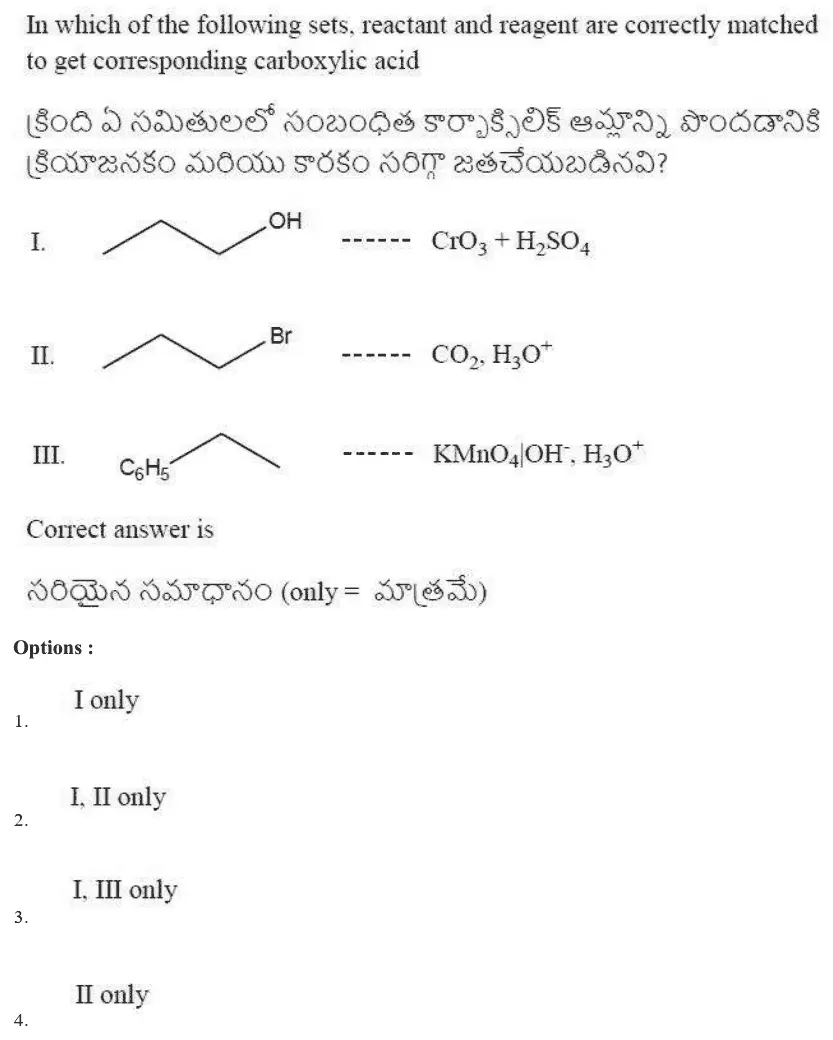
From the following reactions, identify the reactions that give carboxylic acids as produc[ts] i) $\mathrm{CH_3CH_2CH_2CH_2OH}$ $\xrightarrow[\text{2) dil. }\mathrm{H_2SO_4}]{\text{1) }\mathrm{KMnO_4}/\mathrm{KOH}}$ ii) benzene + CO + HCl $\xrightarrow[\mathrm{Cu_2Cl_2}]{\text{Anhyd. }\mathrm{AlCl_3}}$ iii) cyclohexene $\xrightarrow[\text{2) Zn-}\mathrm{H_2O}]{\text{1) }\mathrm{O_3}}$ iv) phenol + $\mathrm{CCl_4}$ $\xrightarrow[\text{2) }\mathrm{H^{\oplus}}]{\text{1) NaOH}}$
How to prepare Aldehydes, Ketones & Carboxylic Acids for EAPCET
How often it comes up
Aldehydes, Ketones & Carboxylic Acids holds rank 6 among all 31 chemistry chapters in the modern 2022 to 2026 examination period. Across our complete historical repository spanning 2010 through 2026, the chapter contributed 280 questions across 149 papers, appearing in 138 of those tests to command 4.7 percent of the entire chemistry section with an average of 1.9 questions per paper. In the modern five-year timeframe from 2022 to 2026, it provided 152 questions across 77 sittings, being present in 73 papers to maintain 2.0 questions per paper and a 4.9 percent subject share.
The chapter has featured in every exam year since 2022, though it was absent from four papers across that five-year span. Looking at the state breakdown between 2022 and 2026, AP tests delivered 85 questions across 48 papers (appearing in 44 papers, 1.8 questions per paper, 4.4 percent share), while TS tests generated 67 questions across 29 papers (appearing in all 29 papers, 2.3 questions per paper, 5.8 percent share).
In earlier testing between 2010 and 2021, papers featured 128 questions across 72 sittings (appearing in 65 tests), which represented 1.8 questions per paper and a 4.4 percent subject share. Over the latest three exam years from 2024 to 2026, question writers set 85 questions across 46 sittings (with 44 papers containing questions), yielding 1.8 questions per test and 4.6 percent share. Long-term trend analysis reveals that the share early versus the last three years is about the same, and the share recent versus the last three years is about the same. Almost all sessions offer multiple carbonyl problems.
Most-asked topics
Questions in this massive carbonyl branch distribute across six major reaction areas:
Preparation of Aldehydes & Ketones accounts for 60 questions overall and 38 during the recent period through 2026. Frequent problem formats focus on Rosenmund reduction of acyl chlorides over poisoned palladium on barium sulphate, Stephen reduction of nitriles, Etard reaction of toluene using chromyl chloride, Gattermann-Koch formylation of benzene, and ozonolysis.
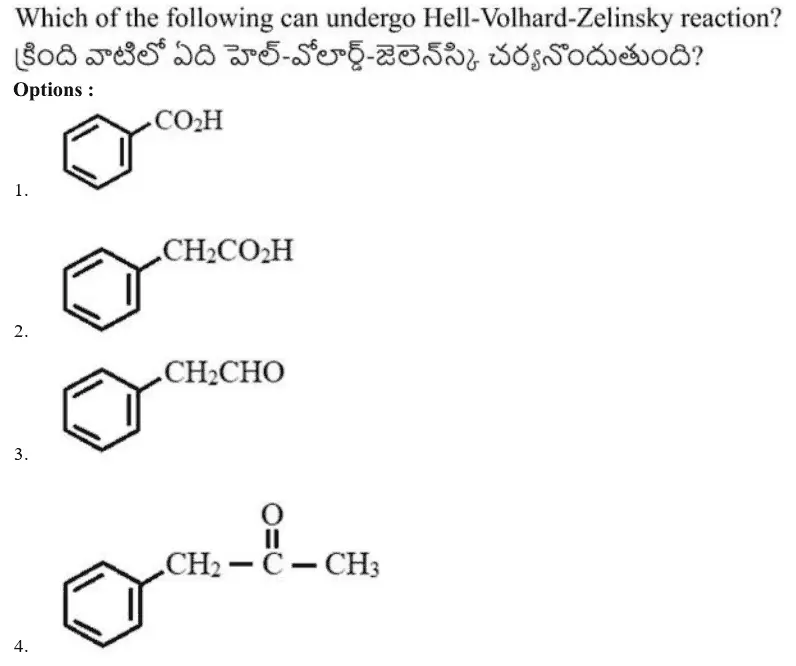
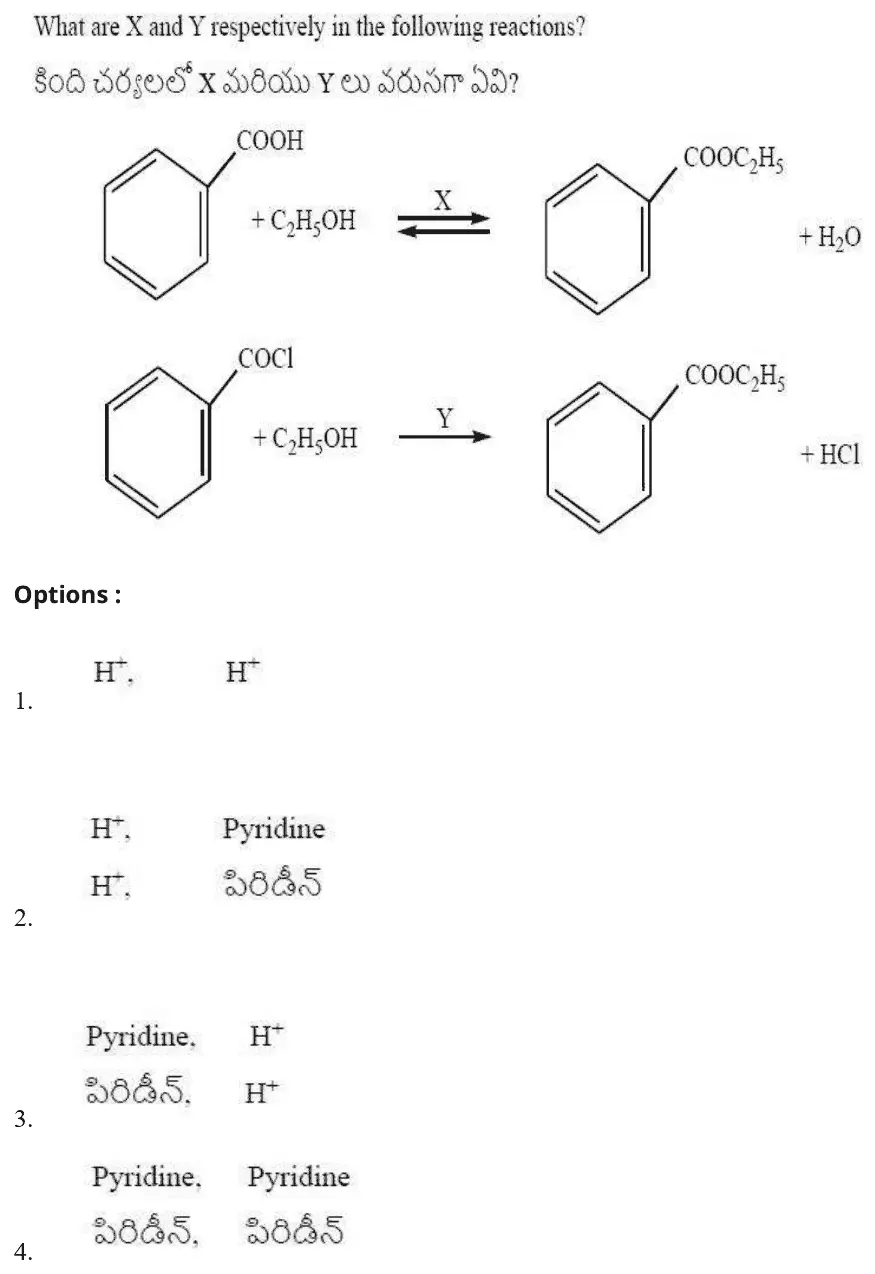
Carboxylic Acids provided 68 questions across the archive, with 34 occurring between 2022 and 2026. Topics include relative acidity and pKa values of substituted benzoic acids, Hell-Volhard-Zelinsky alpha-halogenation, decarboxylation with sodalime, and esterification.
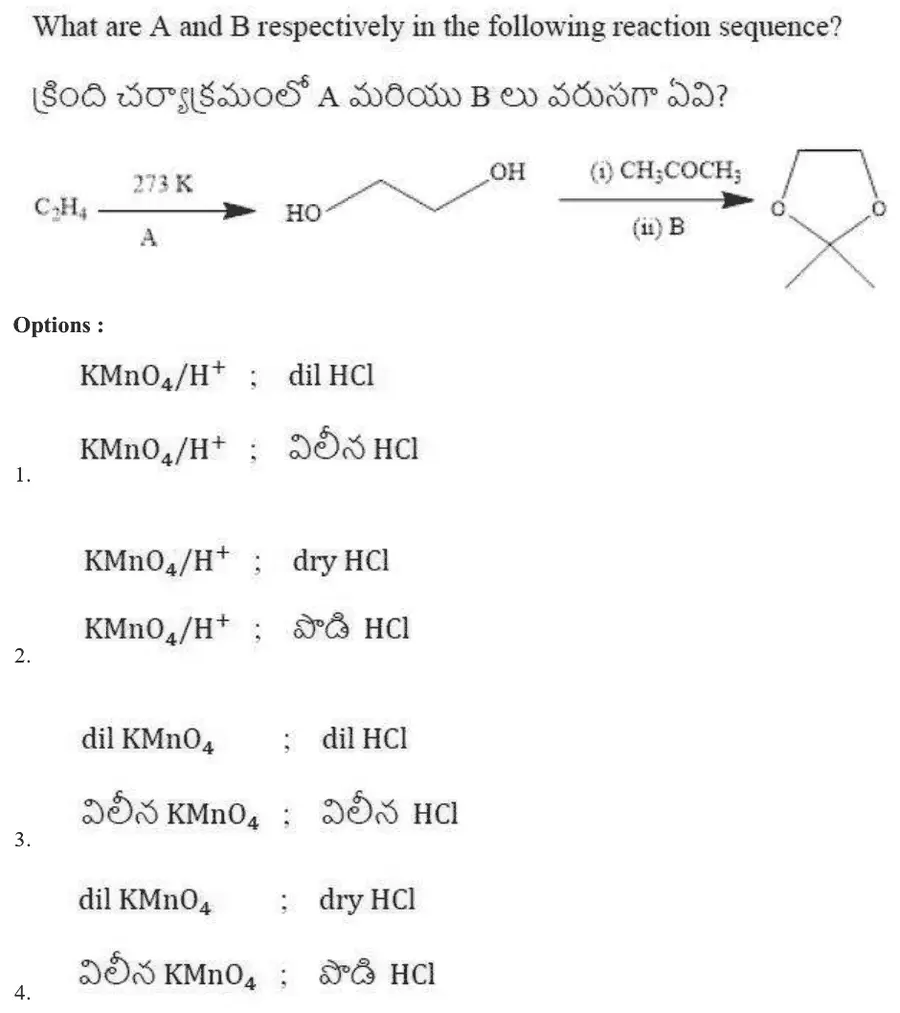
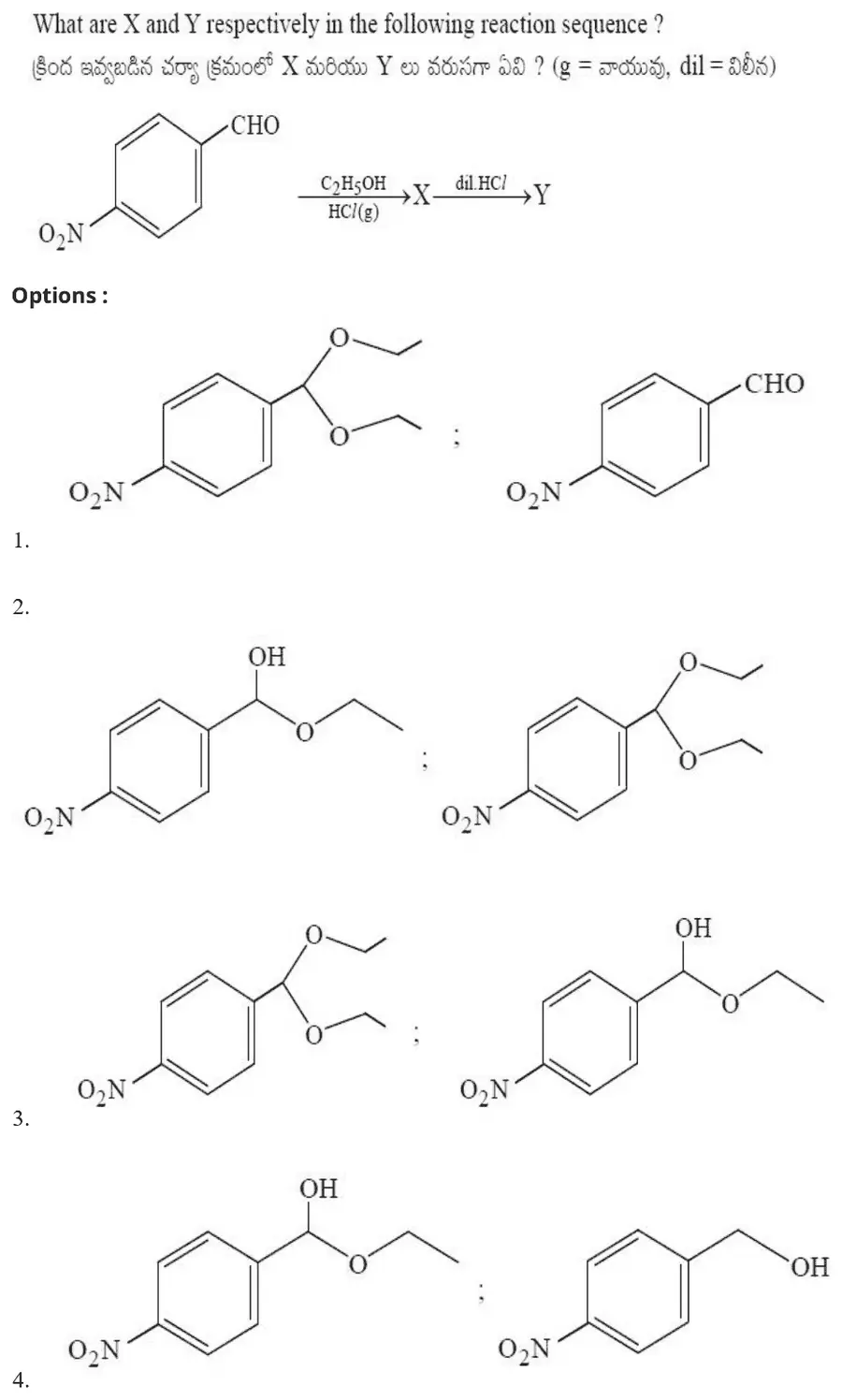
Nucleophilic Addition Reactions contributed 65 questions in total, with 33 in the modern window through 2026. Themes explore addition of hydrogen cyanide, sodium bisulphite addition, acetal formation, cyclic ketal protection using ethylene glycol, and additions of ammonia derivatives like hydroxylamine and hydrazine.
Alpha-Hydrogen & Named Reactions accounts for 57 questions overall, with 26 appearing from 2022 to 2026. This area centers on aldol condensations, Cannizzaro disproportionation of non-enolisable aldehydes, haloform cleavage, and Clemmensen versus Wolff-Kishner reductions.
Acid Derivatives supplied 17 questions in total, with 12 between 2022 and 2026. Problems assess relative reactivities of acyl chlorides, anhydrides, esters, and amides, along with Hofmann bromamide degradation.
Oxidation & Distinguishing Tests accounts for 13 questions across the archive, with 9 during the recent timeframe through 2026. Items focus on Fehlings solution, Tollens silver mirror test, and identifying methyl ketones.
What the questions look like
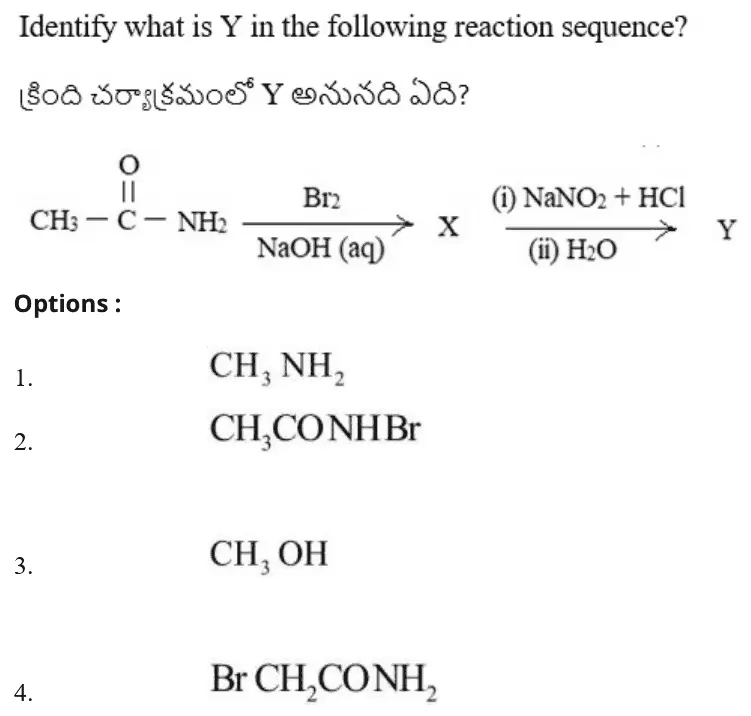
Reagent identification in multi-step organic syntheses dominates this chapter. A classic question presents a synthetic scheme converting benzene to benzaldehyde via Gattermann-Koch formylation and asks you to contrast it with Friedel-Crafts acylation yielding acetophenone. Another prominent pattern presents an unknown carbonyl compound giving positive iodoform and positive Fehlings tests, requiring you to deduce that acetaldehyde is the sole aldehyde possessing a terminal methyl carbonyl group.
Acidity ranking questions require matching numerical pKa values with substituted benzoic acids based on inductive and resonance electron withdrawal by nitro or halogen groups versus electron donation by methoxy or alkyl groups. You will also encounter Cannizzaro reactions where benzaldehyde or formaldehyde disproportionates upon treatment with concentrated alkali into an alcohol and a carboxylate salt.
Questions to try first
Solve these representative official questions to build confidence with carbonyl reaction mechanisms and diagnostic tests:
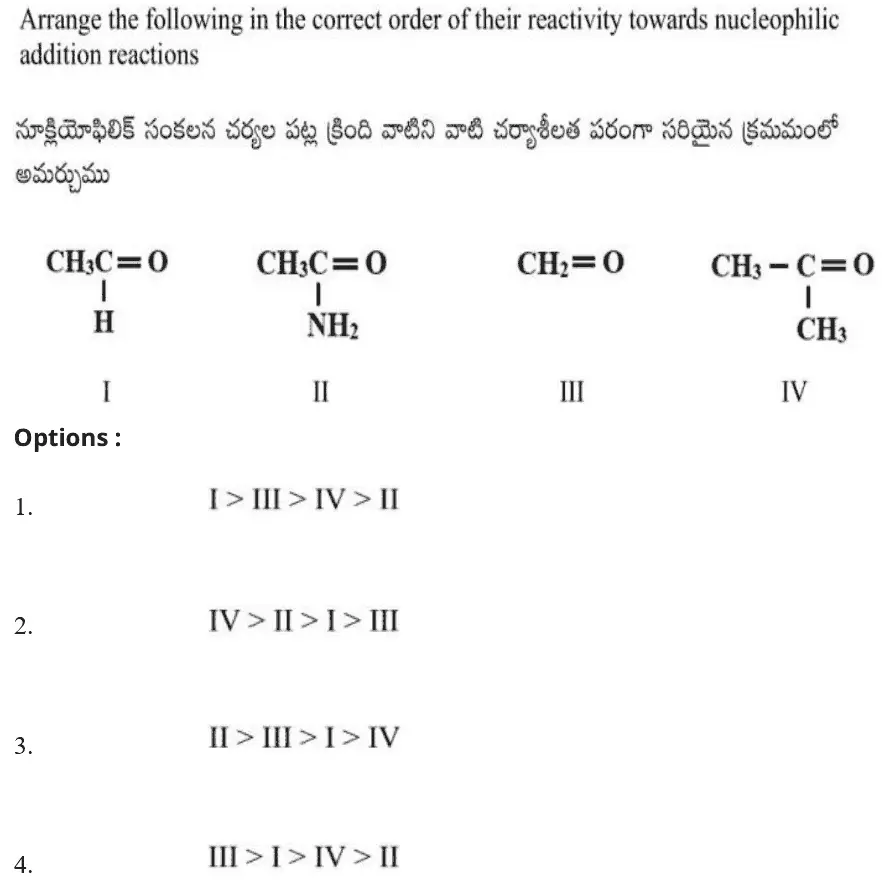
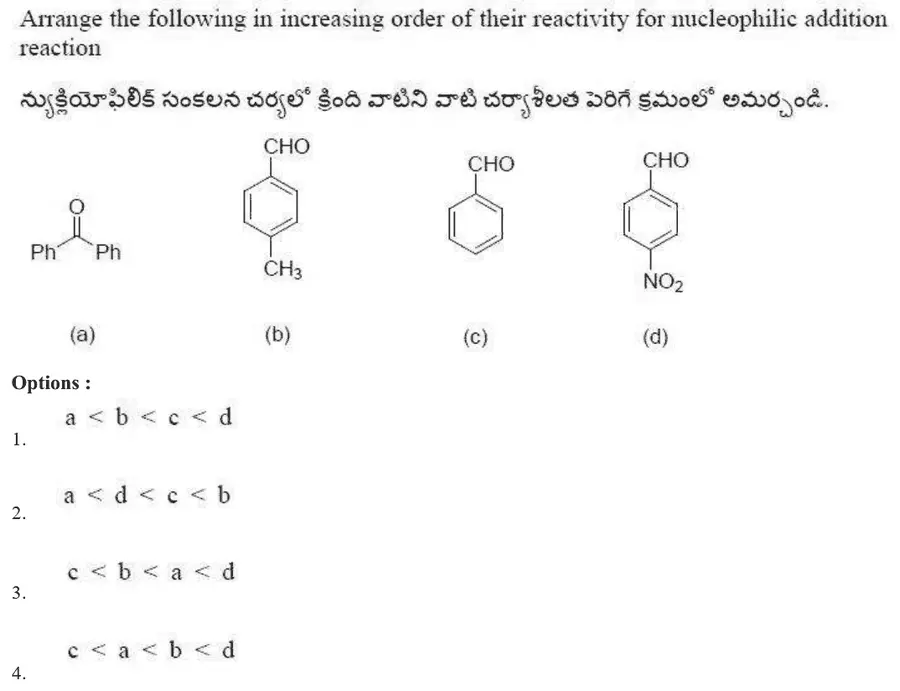
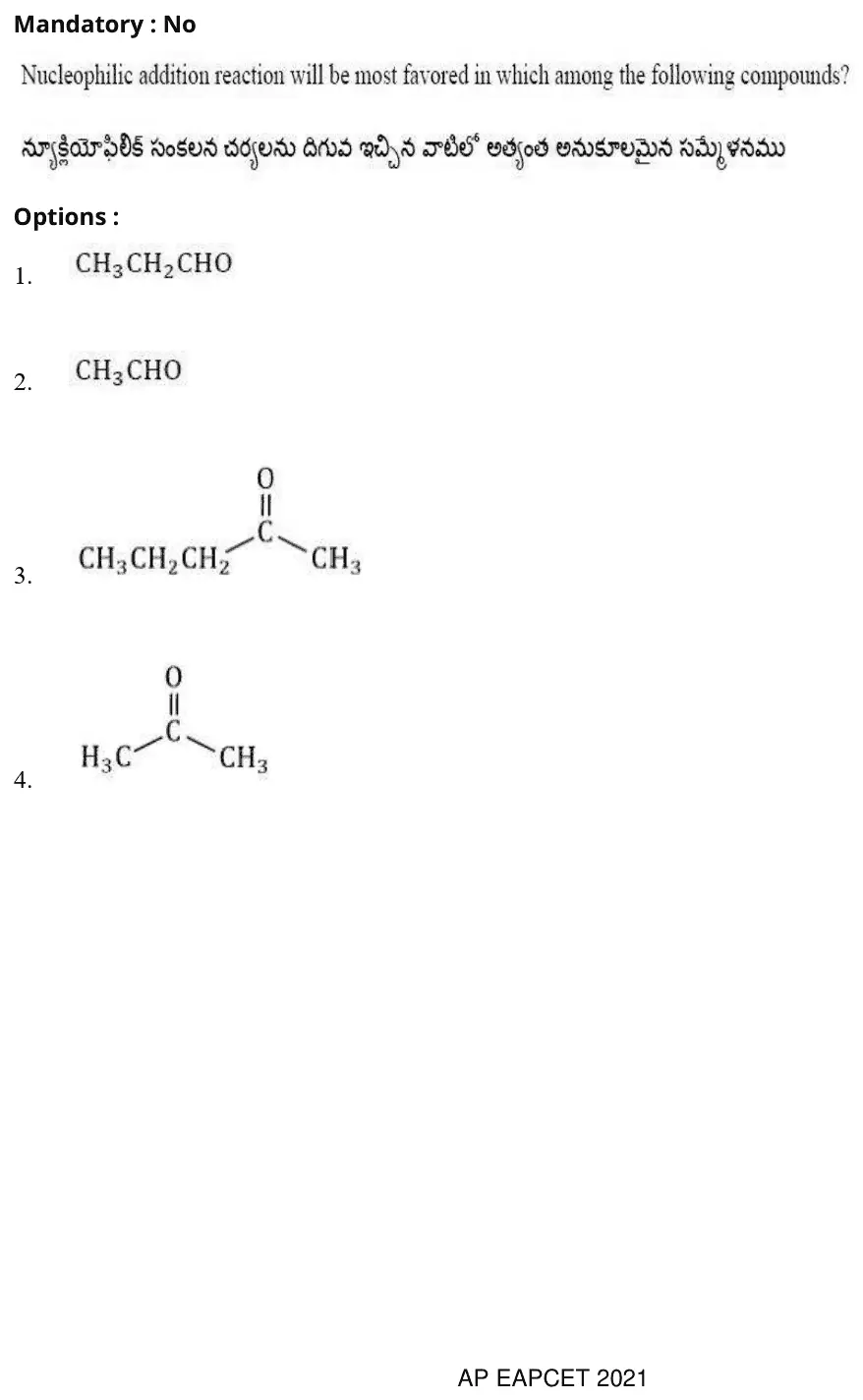
Master nucleophilic addition reactivity orders for carbonyl compounds. Reactivity decreases as steric crowding and electron donation increase: methanal reacts faster than ethanal, which reacts faster than propanone, while aromatic aldehydes react more slowly than aliphatic aldehydes due to resonance donation from the benzene ring.
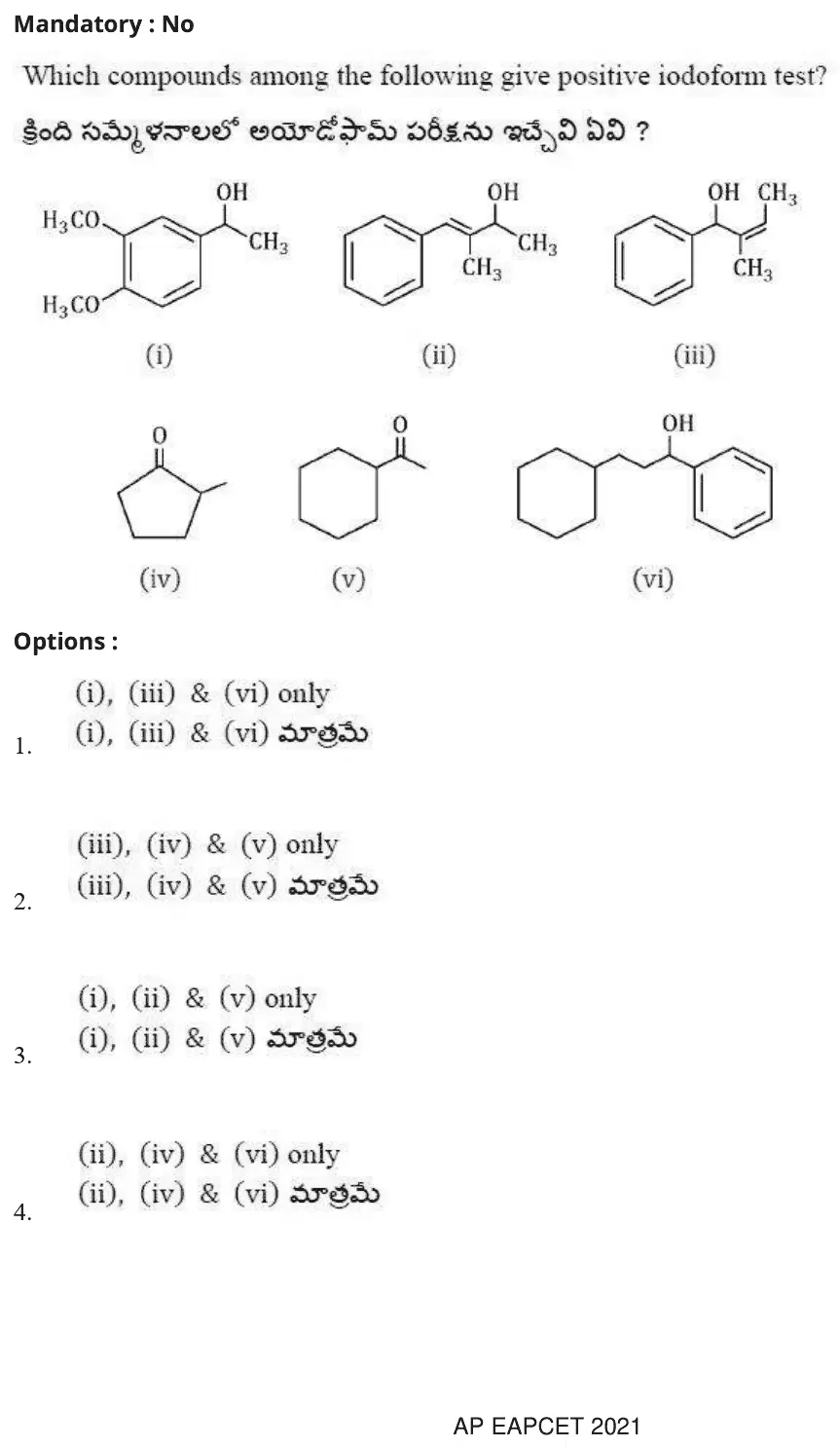
Learn the diagnostic criteria for aldol versus Cannizzaro reactions: aldehydes and ketones possessing at least one alpha-hydrogen undergo base-catalysed aldol condensation to yield beta-hydroxy carbonyl compounds that dehydrate upon heating. Aldehydes lacking alpha-hydrogens (such as formaldehyde and benzaldehyde) undergo Cannizzaro disproportionation. Be fluent in the iodoform reaction: any compound containing a CH3-C=O or CH3-CH(OH) group yields a bright yellow precipitate of triiodomethane with iodine and alkali.
Frequently asked questions
Why do carboxylic acids not give characteristic nucleophilic addition reactions of carbonyl compounds?
In carboxylic acids, the unshared lone pair on the hydroxyl oxygen atom delocalises through resonance into the adjacent carbonyl group. This resonance interaction significantly diminishes the electrophilic positive charge on the carbonyl carbon, rendering it far less susceptible to attack by nucleophiles compared to aldehydes and ketones.
What is the purpose of converting ketones into cyclic ketals with ethylene glycol?
Cyclic ketal formation serves as a protecting group strategy. When a multi-functional molecule contains an electrophilic carbonyl group that must be shielded from reduction by reagents like lithium aluminium hydride or Grignard attack, reacting the ketone with ethylene glycol under dry hydrochloric acid catalysis forms a stable five-membered ring that is readily hydrolysed back in aqueous acid.
What structural feature is required for a positive haloform test?
The haloform reaction requires a methyl carbonyl group directly attached to carbon or hydrogen, or an alcohol possessing a methyl group on the carbinol carbon that can be oxidized in situ to a methyl ketone by the hypohalite reagent. Ethanol, acetaldehyde, secondary methyl alcohols, and methyl ketones all give positive iodoform tests. Step-by-step solutions for each one are in the EdLoop EAPCET app.