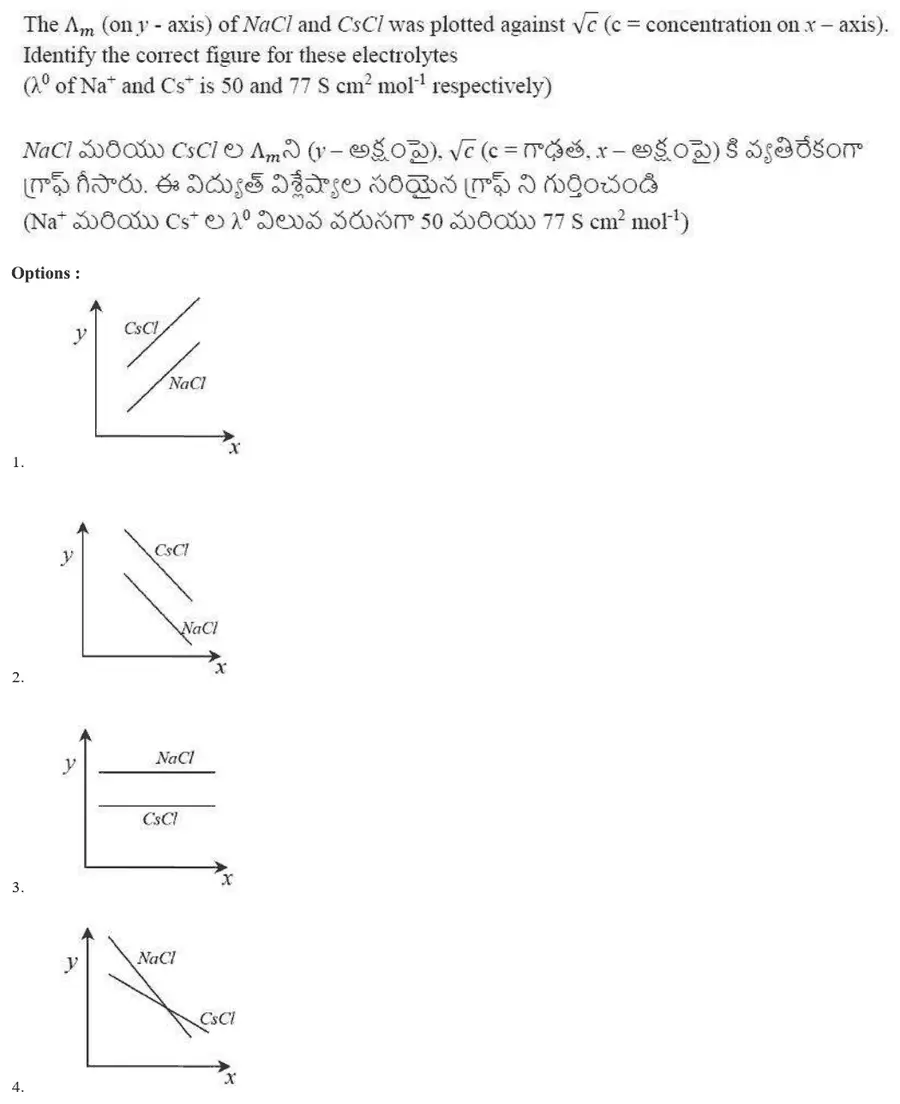
The $\Lambda_m$ (on $y$ - axis) of $NaCl$ and $CsCl$ was plotted against $\sqrt{c}$ (c = concentration on $x$ – axis). Identify the correct figure for these electrolytes ($\lambda^0$ of $\mathrm{Na^+}$ and $\mathrm{Cs^+}$ is 50 and 77 $\mathrm{S\ cm^2\ mol^{-1}}$ respectively)
The question as printed in the paper.
A
see figure Axes with y vertical and x horizontal. Two parallel straight lines rising with positive slope; the upper line is labelled CsCl and the lower line is labelled NaCl.
B
see figure Axes with y vertical and x horizontal. Two parallel straight lines falling with negative slope; the upper-right line is labelled CsCl and the lower-left line is labelled NaCl.
C
see figure Axes with y vertical and x horizontal. Two horizontal lines parallel to the x-axis; the upper line is labelled NaCl and the lower line is labelled CsCl.
D
see figure Axes with y vertical and x horizontal. Two falling straight lines with different slopes that cross each other; one is labelled NaCl (steeper, starting higher at the left) and the other is labelled CsCl (shallower, starting lower at the left, ending lower at the right).
The number of moles of $\mathrm{H_2}$ gas liberated at cathode, when 10 milli-ampere current is passed through dilute aqueous solution of $\mathrm{NaCl}$ for about $19.3 \times 10^4$ seconds is $(F = 96500\ C\ mol^{-1})$
The resistance of a conductivity cell filled with 0.02 M KCl solution is 85 $\Omega$ at $25^\circ\mathrm{C}$. Conductivity of this solution is 0.3 $\mathrm{S\ m^{-1}}$. Resistance of 0.0025 M $\mathrm{K_2SO_4}$ solution taken in the same cell is 300 $\Omega$. The molar conductivity of 0.0025 M $\mathrm{K_2SO_4}$ solution (in $\mathrm{S\ m^2\ mol^{-1}}$) is
Which of the following statements are correct about a dry cell?
(I) It is also known as leclanche cell (II) Electrolyte is a moist paste of $\mathrm{NH_4Cl}$ and $\mathrm{ZnCl_2}$ (III) Reaction of cathode is $MnO_2 + NH_4^+ + e^- \rightarrow MnO(OH) + NH_3$ (IV) It can be charged
Molten $\mathrm{Al_2O_3}$ was electrolyzed between carbon electrodes. The mass (in g) of aluminium produced at cathode when 965 amperes current is passed through it for 1000 seconds is (F=96500 C mol$^{-1}$)
The conductivity of 0.001 M acetic acid is $5 \times 10^{-5}$ $\mathrm{S\ cm^{-1}}$. If the molar conductivity of acetic acid solution at infinite dilution is 390 $\mathrm{S\ cm^2\ mol^{-1}}$. What is its degree of dissociation?
$X, Y$ and $Z$ represent three electrodes $\mathrm{Al^{3+}/Al}$ , $\mathrm{Cu^{2+}/Cu}$ and $\mathrm{Ag^{+}/Ag}$ with $E^\circ$ values $-1.66$ , $0.34$ and $0.80\ V$ respectively. The correct order of oxidising power of these three electrodes is
At 298 K, the following reaction takes place in a cell
$2\,\mathrm{M^{3+}(aq)} + 2\mathrm{I^-(aq)} \rightarrow 2\mathrm{M^{2+}(aq)} + \mathrm{I_2(s)}$. The value of $\log \mathrm{K_c}$ for this reaction is 7.98. What is $\mathrm{E^0_{cell}}$ (in V) ?
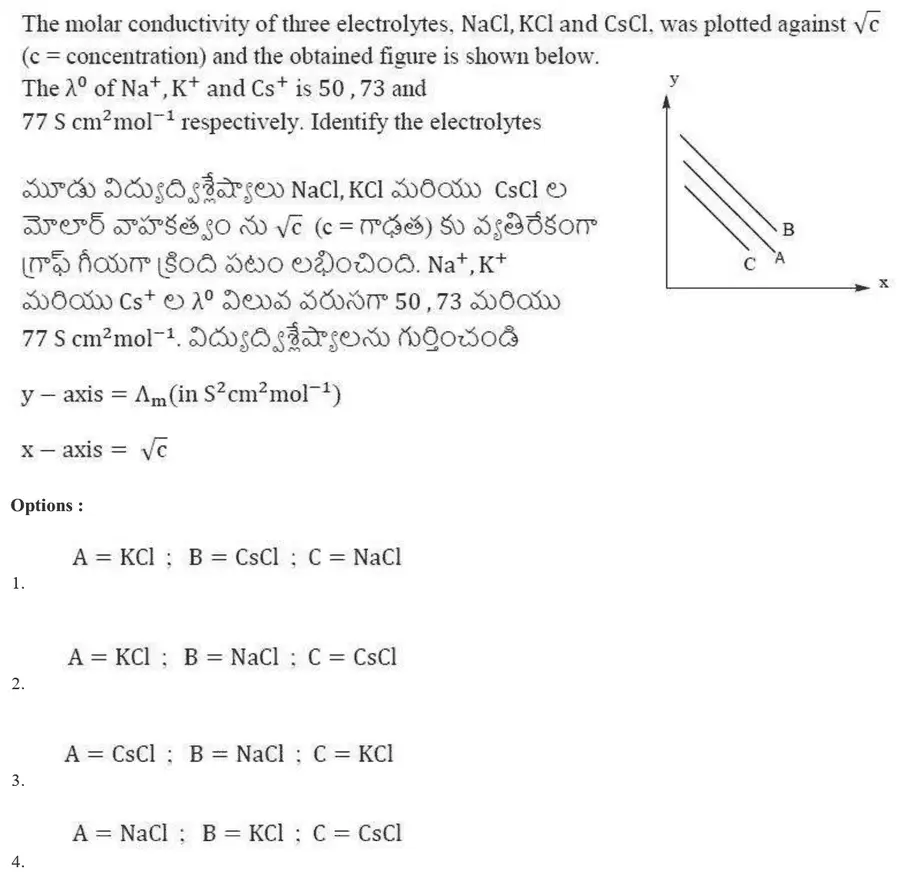
The molar conductivity of three electrolytes, $\mathrm{NaCl}$, $\mathrm{KCl}$ and $\mathrm{CsCl}$, was plotted against $\sqrt{c}$ (c = concentration) and the obtained figure is shown below.
The $\lambda^0$ of $\mathrm{Na^+}$, $\mathrm{K^+}$ and $\mathrm{Cs^+}$ is 50 , 73 and 77 $\mathrm{S\ cm^2 mol^{-1}}$ respectively. Identify the electrolytes
(see the figure above)
y − axis = $\Lambda_m$(in $\mathrm{S^2 cm^2 mol^{-1}}$)
The conductivity of 0.01 $M$ $KCl$ solution is ‘p’ $ohm^{-1}cm^{-1}$. When conductivity cell is filled with the above solution, the observed conductance is ‘q’ $ohm^{-1}$. When the same cell is filled with 0.01 $M$ $H_2SO_4$, the observed conductance is ‘r’ $ohm^{-1}$. The conductivity of 0.01 $M$ $H_2SO_4$ in $ohm^{-1}cm^{-1}$ is
At infinite dilution, the molar conductivity of aluminum sulphate is $858\ \mathrm{S\,cm^2\,mol^{-1}}$.
If $\lambda^\circ_{\mathrm{SO_4^{2-}}}$ is $160\ \mathrm{S\,cm^2\,mol^{-1}}$, what is the molar conductivity of $\mathrm{Al^{3+}}$ ion (in $\mathrm{S\,cm^2\,mol^{-1}}$)?
How many grams of metallic mercury could be produced approximately by electrolysing a $1.0\mathrm{M}$ $\mathrm{Hg(NO_3)_2}$ solution with a current of $2.0$ amp for $3.0$ h?
(Molar mass of $\mathrm{Hg} = 200\ \mathrm{g\,mol^{-1}}$, $F = 96500\ \mathrm{C\,mol^{-1}}$)
In a cell, a copper electrode was used as a cathode. What is the elecrode potential (in V) of the copper electrode dipped in 0.1 M $\mathrm{Cu^{2+}}$ solution at 298 K ?
If $\mathrm{E^\circ_{Fe^{2+}/Fe}} = -0.441\,\mathrm{V}$ and $\mathrm{E^\circ_{Fe^{3+}/Fe^{2+}}} = 0.771\,\mathrm{V}$, the standard emf of the cell reaction $\mathrm{Fe(s) + 2Fe^{3+}(aq) \longrightarrow 3Fe^{2+}(aq)}$ is
The resistance of a conductivity cell filled with 0.1 M $\mathrm{KC\ell}$ solution is $100\,\Omega$. If the resistance of the same cell when filled with 0.2 M $\mathrm{KC\ell}$ solution is $520\,\Omega$, the molar conductivity of 0.02 M solution (in $\mathrm{S\ cm^2\ mol^{-1}}$) is (Given : conductivity of 0.1 M $\mathrm{KCl}$ solution = $1.29\ \mathrm{Sm^{-1}}$)
The specific conductance of $0.05\ \mathrm{M}$ $\mathrm{NaOH}$ solution is $0.0115\ \mathrm{S\ cm^{-1}}$. What is its molar conductance $(\wedge_m)$ in $\mathrm{S\ cm^2\ mol^{-1}}$ ?
A current of 0.5 ampere is passed through molten $\mathrm{AlCl_3}$ for 96.5 seconds. The mass of aluminium deposited at cathode is $x$ mg and volume of chlorine liberated (at STP) at anode is $y$ mL. $x$ and $y$ are respectively
The molar conductivity of acetic acid solution at infinite dilution is $390\ \mathrm{S\ cm^2\ mol^{-1}}$. What is the molar conductivity of $0.01\ \mathrm{M}$ acetic acid solution (in $\mathrm{S\ cm^2\ mol^{-1}}$)?
Its $\mathrm{E^{\ominus}}$ is 1.0 V. The $\mathrm{\Delta_rH^{\ominus}}$ of the reaction is $-163$ kJ mol$^{-1}$. What is $\mathrm{\Delta_rS^{\ominus}}$ (in J K$^{-1}$) of the reaction?
The standard reduction potentials of $\mathrm{2H^+/H_2}$, $\mathrm{Cu^{2+}/Cu}$, $\mathrm{Zn^{2+}/Zn}$ and $\mathrm{NO_3^-, H^+/NO}$ are 0.0, 0.34, $-0.76$ and 0.97 V respectively. Identify the correct statements from the following
I. $\mathrm{H^+}$ does not oxidize Cu to $\mathrm{Cu^{2+}}$
II. Zn reduces $\mathrm{Cu^{2+}}$ to Cu
III. $\mathrm{NO_3^-}$ oxidizes Cu to $\mathrm{Cu^{2+}}$
Aqueous $\mathrm{CuSO_4}$ solution was electrolysed by passing 2 amp of current for 10 min. What is the weight (in g) of copper deposited at cathode? ($\mathrm{Cu}$ = 63 u; $F$ = 96500 C $\mathrm{mol^{-1}}$)
The standard reduction potentials of $2\mathrm{H^+/H_2}$, $\mathrm{Cu^{2+}/Cu}$, $\mathrm{Zn^{2+}/Zn}$ and $\mathrm{NO_3^-, H^+/NO}$ are 0.0, +0.34, −0.76 and 0.97 V respectively. Observe the following reactions
I. $\mathrm{Zn + HCl \rightarrow}$
II. $\mathrm{Cu + HCl \rightarrow}$
III. $\mathrm{Cu + HNO_3 \rightarrow}$
Which reactions does not liberate $\mathrm{H_2}$ (g)?
2.644 g of metal (M) was deposited when 8040 coulombs of electricity was passed through molten $\mathrm{MF_2}$ salt. What is the atomic mass of M? ($\mathrm{F = 96500\ C\ mol^{-1}}$)
The $E^{\ominus}$ of $\mathrm{M|M^{2+}||Cu^{2+}|Cu}$ is 0.3 V. At what concentration of $\mathrm{Cu^{2+}}$ (in $\mathrm{mol\ L^{-1}}$), the $\mathrm{E_{cell}}$ value becomes zero? $\left(\dfrac{2.303\ RT}{F} = 0.06\right)$ (Conc. of $\mathrm{M^{2+}}$ = 0.1 M)
0.592 g of copper is deposited in 60 minutes by passing 0.5 amperes current through a solution of copper (II) sulphate. The electro chemical equivalent of copper (II) (in $\mathrm{g\,C^{-1}}$) is
The molar conductivity of 0.02 M solution of an electrolyte is $124\times10^{-4}\ \mathrm{S\ m^2\ mol^{-1}}$. What is the resistance of the same solution (in ohms), kept in a cell of cell constant $129\ \mathrm{m^{-1}}$?
Identify the correct statements from the following
A) At 298 K, the potential of hydrogen electrode placed in a solution of pH = 10, is $-0.59$ V
B) The limiting molar conductivity of $\mathrm{Ca^{2+}}$ and $\mathrm{Cl^-}$ is 119 and 76 $\mathrm{S\ cm^2\ mol^{-1}}$ respectively. The limiting molar conductivity of $\mathrm{CaCl_2}$ is 195 $\mathrm{S\ cm^2\ mol^{-1}}$
C) The correct relationship between $\mathrm{K_c}$ and $E^\ominus_{\mathrm{cell}}$ is $E^\ominus_{\mathrm{cell}} = \dfrac{2.303RT}{nF}\log \mathrm{K_c}$
At 298K, the conductivity of $\mathrm{KCl}$ solutions of molarity 0.1, 0.01 and 1.0 M are recorded as X, Y and Z, $\mathrm{Scm^{-1}}$ respectively. The correct relation between X, Y and Z is
Molar conductivities at infinite dilution $\Lambda_m^\circ$ for $\mathrm{Ba(OH)_2}$, $\mathrm{BaCl_2}$ and $\mathrm{NH_4Cl}$ are 457.0, 240.6 and 2130 $\mathrm{Scm^2\,mol^{-1}}$ respectively. The $\Lambda_m^\circ$ for ammonium hydroxide (in $\mathrm{Scm^2\,mol^{-1}}$) is
The time required (in hours) to reduce 3 mol of $\mathrm{Fe^{3+}}$ ions to $\mathrm{Fe^{2+}}$ ions with 2.0 amperes of current is (1 F=96500 C $\mathrm{mol^{-1}}$)
The conductivity of a solution containing 2.08 g of anhydrous barium chloride in 200 mL solution is $6\times10^{-3}\ \mathrm{ohm^{-1}\,cm^{-1}}$. The molar conductivity of the solution (in $\mathrm{ohm^{-1}\,cm^{2}\,mol^{-1}}$) is $\underline{x}\times10^{2}$. The value of $\underline{x}$ is
A current of 15.0 amperes is passed through a solution of $\mathrm{CrCl_2}$ for 45 minutes. The volume of $\mathrm{Cl_2}$ (in L) obtained at the anode at 1 atm and 273 K is around
(1F = 96500 C mol$^{-1}$, At. wt. of Cl = 35.5, R = 0.082 L-atm K$^{-1}$ mol$^{-1}$ )
The reduction potential of a half cell consisting of a Pt electrode immersed in 2.0 M $\mathrm{Fe^{2+}}$ and 0.02 M $\mathrm{Fe^{3+}}$ solution (in V) is
A and B are two metals. The standard reduction potential of $\mathrm{A^+(aq)/A(s)}$ and $\mathrm{B^+(aq)/B(s)}$ are -0.5V and +0.5V respectively. What is the $\log K_c$ value for the following reaction at 298 K?
The electrode potential of chlorine electrode is maximum, when the concentration of chloride ion in the solution (in mol $\mathrm{L^{-1}}$) is X. what is the value of X?
At 300 K, the conductivity of $0.01\ \mathrm{mol\ dm^{-3}}$ aqueous solution of acetic acid is $19.5\times10^{-5}\ \mathrm{mho\ cm^{-1}}$ and limiting molar conductivity of acetic acid at the same temperature is $390\ \mathrm{mho\ cm^2\ mol^{-1}}$. The degree of dissociation of acetic acid is
Electrolysis of aqueous $\mathrm{Na_2SO_4}$ was carried out by passing a current of 3 ampere for 10 min. The volume of the gas (L) at STP at the anode of the cell is approximately
The $E^\circ$ of $\mathrm{Ce^{\,4+}/Ce^{\,3+}}=1.6$ V $\mathrm{Fe^{\,3+}/Fe^{\,2+}}=0.76$ V the $E^\circ$ of $\mathrm{Fe^{3+}}$ oxidising $\mathrm{Ce^{3+}}$ is
Given $\mathrm{E^\circ_{Mn^{7+}/Mn^{2+}}}=1.51\,\mathrm{V}$, $\mathrm{E^\circ_{Mn^{4+}/Mn^{2+}}}=1.23\,\mathrm{V}$ Calculate the $\mathrm{E^\circ_{Mn^{7+}/Mn^{4+}}}$
In two separate experiments, the same quantity of electricity was passed through silver and gold solutions [ Assume 't' constant] The amounts of Ag and Au deposited are 2.15 and 1.31g, respectively. The valency of gold is [Atomic mass of Ag=107.9; Au=197]
If 5 ampers of current is passed for 193 seconds through a solution containing Copper salt, 0.32 g of copper is deposited. What is the oxidation state of the Cu in the salt?
The cell potential for the following cell notation is approximately $\mathrm{M(s)\,|M^{3+}(aq, 0.01M)||N^{2+}(aq, 0.1M)|N(s)}$ $E^0_{M^{3+}/M} = 0.6\ \mathrm{V}$ and $E^0_{N^{2+}/N} = 0.1\ \mathrm{V}$
If the total electricity required to deposit 1 mole of a metal M is equal to that of 10.7 amperes of current for 10 hours. The equivalent weight of the metal is (atomic weight = M u)
What is the molar conductivity of $\mathrm{CH_3CO_2H}$ at infinite dilution? Given that, $\Lambda_m^o(CH_3CO_2)_2Ba = x_1\ S\,cm^2\,mol^{-1}$ $\Lambda_m^o(BaCl_2) = x_2\ S\,cm^2\,mol^{-1}$ $\Lambda_m^o(HCl) = x_3\ S\,cm^2\,mol^{-1}$
The standard Gibbs energy change for Daniel cell reaction is Zn (s) + $\mathrm{Cu^{2+}}$ (aq) $\rightarrow$ $\mathrm{Zn^{2+}}$ (aq) + Cu (s) $\mathrm{E^\circ_{Cell}}$ = 1.1 V
96.5 amperes current is passed through the molten $\mathrm{AlCl_3}$ for 100 seconds. The mass of aluminum deposited at the cathode is (Atomic weight of Al = 27 u)
Resistance of a conductivity cell filled with $0.1\ \mathrm{mol\,L^{-1}}$ NaCl is 100 Ohm. If the resistance of the same cell when filled with $0.02\ \mathrm{mol\,L^{-1}}$ NaCl solution is 258 ohm, the conductivity of $0.02\ \mathrm{mol\,L^{-1}}$ NaCl solution is (Conductivity of $0.1\ \mathrm{mol\,L^{-1}}$ NaCl is $1.29\ \mathrm{S\,m^{-1}}$)
38.6 amperes of current is passed for 100 seconds through an aqueous $\mathrm{CuSO_4}$ solution using platinum electrodes. The mass of copper consumed from the solution and volume of gas liberated at STP are respectively (molar mass of Cu = 63.54 $\mathrm{g\,mol^{-1}}$).
Which products among the following are formed during the electrolysis of concentrated solution of $NaCl$ ? (i) $Cl_{2(g)}$ at anode (ii) $NaOH$ as electrolyte (iii) $H_{2(g)}$ at cathode
An electrochemical cell is represented as $X\,|\,X^{+}\,(x\ M)\ ||\ Y^{+}\,(y\ M)\,|\,Y$. The e.m.f measured is +0.5 $V$. Identify the corresponding cell reaction.
Calculate the mass of copper deposited when a current of 1 $A$ was passed through a solution of $CuSO_4$ for one hour. Given 1 $F$ = 96500 $C$ and electrochemical equivalent of $Cu$ = $3.29\times10^{-4}\ \mathrm{g.C^{-1}}$
A hydrogen electrode is made by dipping platinum wire in a solution of nitric acid of pH= 9 and passing hydrogen gas around the platinum wire at $1.2\ \mathrm{atm}$ pressure. The oxidation potential of such an electrode equals ______ V.
Salts of $A$, $B$ and $C$ were electrolyzed under identical conditions using the same quantity of electricity. It was found that when $2.1\ \mathrm{g}$ of $A$ was deposited. The weights of $B$ and $C$ deposited were $2.7\ \mathrm{g}$ and $9.6\ \mathrm{g}$ respectively. If the atomic mass of $A$, $B$ and $C$ respectively are 7, 27 and 64, then the valancies of $A$, $B$ and $C$ respectively are ______
Which of the following represents the correct order for oxidizing power of the given species - $\mathrm{ClO_4^-}$, $\mathrm{BrO_4^-}$ and $\mathrm{IO_4^-}$ ______
The molar conductivities of $\mathrm{KCl}$, $\mathrm{NaCl}$ and $\mathrm{KNO_3}$ are 100, 120 and 90 $\mathrm{cm^2.mol^{-1}}$, respectively. The molar conductivity of $\mathrm{NaNO_3}$ would be ______ $\mathrm{cm^2.mol^{-1}}$.
If the conductivity of a $0.5\ M\ \mathrm{KCl}$ solution at $298\ K$ is $0.024\ \mathrm{S.cm^{-1}}$, then the molar conductivity of the solution would be ______ $\mathrm{S.cm^2.mol^{-1}}$
Same quantity of electricity was passed through solutions of salts of elements X, Y and Z with atomic masses 7, 27 and 48 respectively. The masses of X, Y and Z deposited were $2.1\ \mathrm{g}$, $2.7\ \mathrm{g}$ and $7.2\ \mathrm{g}$ respectively. The valence's of X, Y and Z respectively are
$100\ ml$ of $0.2\ M$ acetic acid is completely neutralized using a standard solution of $\mathrm{NaOH}$. The volume of ethane obtained at STP after complete electrolysis of the resulting solution is ______
If the resistance of $0.1\ M\ KCl$ solution in a conductance cell is $300\ \Omega$ and conductivity is $0.013\ \mathrm{S.cm^{-1}}$, then the value of cell constant is ______
In the electrolysis of a $CuSO_4$ solution, how many grams of $Cu$ are plated out on the cathode, in the time that is required to liberate 5.6 $L$ of $O_{2(g)}$, measured at 1 $atm$ and 273 $K$, at the anode?
The molar conductivities ($\lambda_m^o$) at infinite dilution of $KBr$, $HBr$ and $KNH_2$ are 120.5, 420.6 and 90.48 $S\ cm^2\ mol^{-1}$ respectively. Find the value of $\lambda_m^o$ for $NH_3$.
At $291\ \mathrm{K}$, saturated solution of $\mathrm{BaSO_4}$ was found to have a specific conductivity of $3.648 \times 10^{-6}\ \mathrm{ohm^{-1}\ cm^{-1}}$ and that of water being used is $1.25 \times 10^{-6}\ \mathrm{ohm^{-1}\ cm^{-1}}$. If the ionic conductance's of $\mathrm{Ba^{2+}}$ and $\mathrm{SO_4^{2-}}$ are $110$ and $136.6\ \mathrm{ohm^{-1}\ cm^2\ mol^{-1}}$ respectively, the solubility of $\mathrm{BaSO_4}$ at $291\ \mathrm{K}$ will be [Atomic masses of Ba $-$ 137, S $-$ 32, O $-$ 16]
Find the emf of the following cell reaction, given $E^\circ_{\mathrm{Cr^{3+}/Cr^{2+}}} = -0.72\ \mathrm{V}$ and $E^\circ_{\mathrm{Fe^{2+}/Fe}} = -0.42\ \mathrm{V}$ at $25^\circ\mathrm{C}$ is $\mathrm{Cr\,|\,Cr^{3+}\,(0.1\ M)\,||\,Fe^{2+}\,(0.1\ M)\,|\,Fe}$
For $\mathrm{Cr_2O_7^{2-}} + 14\mathrm{H^+} + 6e^- \xrightarrow{yields} 2\mathrm{Cr^{3+}} + 7\mathrm{H_2O}$, $E^\circ = 1.33\ \mathrm{V}$ at $[\mathrm{Cr_2O_7^{2-}}] = 4.5$ millimole, $[\mathrm{Cr^{3+}}] = 1.5$ millimole and $E = 1.067\ \mathrm{V}$, then calculate the pH of the solution.
A metal plate of dimension of $(1\times2\,\mathrm{cm^2})$ has to be coated on both the sides by Cu metal. How long does it take to deposit Cu of 0.01cm thickness, if 1.5A current is used? [Electrochemical equivalence of Cu is 0.0003 g/c and the density of Cu is 9 g/cm$^3$]
For the cell reaction $\mathrm{Cu/Cu^{2+}(0.1M)\ \|\ Cu^{2+}(1.0M)/Cu}$; the emf of the cell at $25^\circ\mathrm{C}$ is $\left[E^\circ_{\mathrm{Cu^{2+}/Cu}}=0.34\ \mathrm{V}\right]$
When the same quantity of electricity is passed through the aqueous solutions of the given electrolytes for the same amount of time, which metal will be deposited in maximum amount on the cathode?
Given $\lambda^\circ_{\mathrm{Mg^{2+}}} = 106$ S cm$^2$ mole$^{-1}$, $\lambda^\circ_{\mathrm{SO_4^{2-}}} = 160$ S cm$^2$ mole$^{-1}$. The value of $\lambda^\circ_{\mathrm{MgSO_4}}$ (in S cm$^2$ mole$^{-1}$) is
Salts of A (atomic weight 8), B (atomic weight 18) and C (atomic weight 50) were electrolysed under identical conditions using the same quantity of electricity. It was found that 2.4 g of A was deposited, the weight of B and C deposited are 1.8 g and 7.5 g respectively. The valences of A, B and C are, respectively,
Calculate the equilibrium constant of the reaction $\mathrm{Cu_{(s)} + 2\,Ag^{+}_{(aq)} \rightarrow Cu^{2+}_{(aq)} + 2Ag_{(s)}}$, given that for the reaction, $E_{cell} = 0.46V$.
A solution containing 4.5 $\mathrm{mM}$ of $\mathrm{MnO_4^-}$ and 15 $\mathrm{mM}$ of $\mathrm{Mn^{2+}}$ shows pH of 2. The potential of half-cell reaction is ______. Given log 15 = 1.76 & log 45 = 1.653 & (standard potential of $\mathrm{MnO_4^-} \rightarrow \mathrm{Mn^{2+}}$ is 1.51 V)
In the Daniel cell, $\mathrm{Zn} \mid \mathrm{Zn^{2+}} \parallel \mathrm{Cu^{2+}} \mid \mathrm{Cu}$ , when an external voltage is applied such that $E_{external} > E_{cell}$ , current flows from ______
A 200 W, 100 V bulb is connected in series with an electrolytic cell. If an aqueous solution of an Sn-salt is electrolyzed for 5 hrs, 11.1 g of Sn gets deposited. The chemical formula of the compound is _____ (Given atomic weight of Sn is 118.7 g $mol^{-1}$
When a current of 0.5 $A$ is passed for 2 hours through a molten metal salt, 3.88 g of the metal was deposited. If atomic mass of the metal is 208 $units$, the oxidation state of the metal in the salt is ______
Match the entries from column I and Column II and choose the correct order. Column I: i. Leclanche cell; ii. Fuel cell; iii. $Ni-Cd$ Cell Column II: a) Converts energy of combustion into electrical energy; b) Rechargeable cell; c) At Anode $Zn\rightarrow Zn^{+2}+Ze^-$
Find the observed EMF of the cell $Cd\,|\,Cd^{2+}(0.01\ M)\,||\,Cd^{2+}(0.01\ M)\,|\,Cd$ under conditions, internal resistance = 4 $\Omega$ and producing a current of 0.15$A$. (Given $E^0_{Cu^{2+}/Cu}$ = 0.35 $V$ and $E^0_{Cd^{2+}/Cd}$ = $-0.4$ $V$)
Copper is to be electrodeposited on a Nickel block of $(20 \times 5)\ \mathrm{cm^2}$ area by using $\mathrm{CuSO_4}$ as electrolyte. How much quantity of electricity is needed to deposit a 3.6 $\mu$m layer of copper? Atomic weight of Cu = 63.5 g $\mathrm{mol^{-1}}$ Density of $\mathrm{CuSO_4}$ = 8.9 g/cc
$\mathrm{Mg^{2+}}$ displaces hydrogen from acids but copper does not. A galvanic cell prepared by combining $\mathrm{Cu/Cu^{2+}}$ and $\mathrm{Mg/Mg^{2+}}$ has an EMF of $2.71\ \mathrm{V}$ at $298\ \mathrm{K}$. If the potential of copper electrode is $0.34\mathrm{V}$, what is the reduction potential of Mg electrode?
A solution of $\mathrm{Fe^{2+}}$ is titrated potentiometrically using $\mathrm{Ce^{4+}}$ solution. When 80 % $\mathrm{Fe^{2+}}$ is titrated, the EMF of the system in V is (Given $E^0_{\mathrm{Fe^{3+}/Fe^{2+}}} = 0.77$ V and $\mathrm{Fe^{2+} + Ce^{4+} \longrightarrow Fe^{3+} + Ce^{3+}}$) ($\log 2 = 0.3$, $\log 3 = 0.5$, $\log 4 = 0.6$)
The standard electrode potentials of $\mathrm{Ag^+/Ag}$ is +0.80 V and $\mathrm{Cu^+/Cu}$ is +0.34 V. If these electrodes are connected through a salt bridge, which of the following statements is correct?
A
Silver electrode acts as anode and $E^0$ cell is -0.34 V
B
Copper electrode acts as anode and $E^0$ cell is +0.46 V
C
Silver electrode acts as a cathode and $E^0$ cell is -0.34 V
D
Copper electrode acts as cathode and $E^0$ cell is +0.46 V
The maximum work that can be obtained from the following cell is $\mathrm{X\,|\,X^{2+}(aq)\,||\,Y^{+}(aq)\,|\,Y}$ Given $E^\circ_{X^{2+}/X}$ = −1.7 V $E^\circ_{Y^{+}/Y}$ = 0.8 V
Consider the systems having liquid-solid interface. (a) copper wire in silver nitrate solution and (b) silver wire in copper sulphate solution. Predict which interface will show spontaneous reaction if $E^\circ_{\mathrm{Cu^{2+}/Cu}} = 0.34\ \mathrm{V}$ and $E^\circ_{\mathrm{Ag^+/Ag}} = 0.80\ \mathrm{V}$ ?
For a half cell containing a Pt rod immersed in a solution of 1M HA, $\mathrm{O_2(g)}$ is bubbled at 1 atm. The standard reduction potential for water formation is 1.23 V. Given a dissociation constant, $K_a = 1 \times 10^{-4}$ for HA, what is $E_{half-cell}$ at 298 K in V?
A current of 19296 C is passed through an aqueous solution of copper sulphate using copper electrodes. What is the mass (in g) of copper deposited at the cathode? (molar mass of Cu = 63.5 g mol$^{-1}$)
An electrolyte of a polymer-salt complex of poly (ethylene oxide) - $\mathrm{LiCF_3SO_3}$ is shaped into a free standing circular film of 20 mm diameter and a thickness of 20 $\mu$m. When it is sandwiched between 2 stainless steel circular electrodes of the same diameter, this cell exhibits a conductance of $\dfrac{314}{5}$ S. What is the specific conductivity of the electrolyte?
If the $E^0_{cell}$ of an equilibrium reaction $A_{(s)} + 2B^{+}_{(aq)} \rightleftharpoons A^{2+}_{(aq)} + 2B_{(s)}$ at $298\ \mathrm{K}$ is $0.59\ \mathrm{V}$, the equilibrium constant $\mathrm{K_c}$ is
If $E^0_{\mathrm{cell}}$ is 1.05 V, the emf of the cell for the following cell reaction $\mathrm{Ni(s) + 2Ag^+(0.004\,M) \longrightarrow Ni^{2+}(0.16\,M) + 2Ag(s)}$ at 298 K in V is
The electrode potentials for $\mathrm{M^{2+}}(aq)+e^-\longrightarrow\mathrm{M^+}(aq)$ $\mathrm{M^+}(aq)+e^-\longrightarrow\mathrm{M}(s)$ are +0.15 V and +0.50 V respectively. The value of $E^0_{\mathrm{M^{2+}/M}}$ will be
$\mathrm{CuSO_4}$ solution is electrolysed for 15 minutes to deposit 0.4725 g of copper at the cathode. The current in amperes required is (Faraday $= 96{,}500\ \mathrm{C\ mol^{-1}}$, atomic weight of copper = 63)
Under which of the following conditions E value of the cell for the cell reaction given is maximum? $\mathrm{Zn_{(s)} + Cu^{2+}_{(aq)} \rightleftharpoons Cu_{(s)} + Zn^{2+}_{(aq)}}$ with $C_1$ under $\mathrm{Cu^{2+}}$ and $C_2$ under $\mathrm{Zn^{2+}}$ ($\frac{2.303\,RT}{F}$ at 298 K = 0.059 V, $E^0_{\mathrm{Zn^{2+}|Zn}} = -0.76$ V, $E^0_{\mathrm{Cu^{2+}|Cu}} = +0.34$ V)
The emf of the following cell $\mathrm{Mg\,|\,Mg^{+2}(0.01M)\,||\,Sn^{+2}(0.1M)\,|\,Sn}$ at 298K in 'V' is (Given, $E^0_{\mathrm{Mg^{+2}|Mg}} = -2.34\,\mathrm{V}$, $E^0_{\mathrm{Sn^{+2}|Sn}} = -0.14\,\mathrm{V}$)
Limiting molar conductivity of $\mathrm{Mg^{2+}}$ and $\mathrm{Cl^-}$ ions in water is 106.0 and 76.3 $\mathrm{S\ cm^2\ mol^{-1}}$. The limiting molar conductivity of magnesium chloride (in $\mathrm{S\ cm^2\ mol^{-1}}$) in water is
The EMF of a galvanic cell consisting of two hydrogen electrodes is 0.17 V. If the solution of one of the electrodes has $[\mathrm{H^+}] = 10^{-3}$ M, the pH at the other electrode is?
Assertion (A) : The charge on one mole of electrons is one Faraday. Reason (R) : The quantity of current required to deposit one mole of Mg from $\mathrm{Mg^{2+}}$ electrolyte solution is two Faradays. The correct answer is
A
Both (A) and (R) are correct and (R) is the correct explanation of (A).
B
Both (A) and (R) are correct but (R) is not the correct explanation of (A).
At T(K), the molar conductivity of 0.04 M acetic acid is $7.8\ \mathrm{S\,cm^2\,mol^{-1}}$. If the limiting molar conductivities of $\mathrm{H^+}$ and $\mathrm{CH_3COO^-}$ at T(K) are 349 and $41\ \mathrm{S\,cm^2\,mol^{-1}}$ respectively, the dissociation constant of acetic acid is
For the oxidation of 0.2 M $\mathrm{FeSO_4}$ solution 0.965 amperes current is passed through it for 1 hour. The volume of the solution that is oxidised in mL is
The conductivity of 0.01 M aqueous acetic acid measured with a conductivity cell of cell constant of $0.5\ \mathrm{cm^{-1}}$ at 298 K is $3.12 \times 10^{-4}$ S. If the limiting conductivities of $\mathrm{H^+}$ and $\mathrm{CH_3COO^-}$ at the same temperature are 349, and 41 $\mathrm{S\ cm^2\ mol^{-1}}$ respectively, the dissociation constant of acetic acid is
Using the standard electrode potentials given below identify the correct statements from the following $\mathrm{Fe^{2+}}+2e^{-}\longrightarrow\mathrm{Fe};\ E^\circ=-0.44\ \mathrm{V}$ $\mathrm{Cu^{2+}}+2e^{-}\longrightarrow\mathrm{Cu};\ E^\circ=+0.34\ \mathrm{V}$ $\mathrm{Ag^{+}}+e^{-}\longrightarrow\mathrm{Ag};\ E^\circ=+0.80\ \mathrm{V}$ a) Copper can displace iron from $\mathrm{FeSO_4}$ solution b) Iron can displace copper from $\mathrm{CuSO_4}$ solution c) Silver can displace copper from $\mathrm{CuSO_4}$ solution d) Iron can displace silver from $\mathrm{AgNO_3}$ solution
Consider the following electrode processes of a cell, $\mathit{Cl}^- \rightarrow \dfrac{1}{2}\mathit{Cl}_2 + e^-$ $[\mathit{MCl} + e^- \rightarrow \mathit{M} + \mathit{Cl}^-]$ If EMF of this cell is $-1.140\ \mathrm{V}$ and $\mathrm{E^\circ}$ value of the cell is $-0.55\mathrm{V}$ at $298\mathrm{K}$, the value of the equilibrium constant of the sparingly soluble salt $\mathit{MCl}$ is in the order of
Consider the single electrode process $4\mathrm{H^+} + 4\bar{\mathrm{e}} \rightleftharpoons 2\mathrm{H_2}$ catalyzed by platinum black electrode in HCl electrolyte. The potential of the electrode is $-0.059\mathrm{V}$ Vs.SHE. What is the concentration of the acid in the hydrogen half cell if the $\mathrm{H_2}$ pressure is 1 bar?
Same amount of electricity is passed through aqueous solutions of $\mathrm{AgNO_3}$ and $\mathrm{CuSO_4}$. The number of Ag and Cu atoms deposited are $x$ and $y$ respectively. The correct relationship between $x$ and $y$ is
Standard Gibbs energy change in $\mathrm{kJ\,mol^{-1}}$ for a galvanic cell $\mathrm{A_{(s)} + B^{3+}_{(aq)} \longrightarrow A^{3+}_{(aq)} + B_{(s)}}$ that has standard emf of 0.5V is : ($F = 96500\ \mathrm{C\,mol^{-1}}$)
Using the standard reduction potentials of the electrodes Li, Zn, Mg, Ni as $-3.05$, $-0.76$, $-2.36$, $-0.25$ V respectively, identify the correct statement.
The conductivity of 0.001 M acetic acid at a certain temperature is $5.07\times10^{-5}\ \mathrm{S\ cm^{-1}}$. If $\Lambda_m^0$ of acetic acid at the same temperature is $390\ \mathrm{S\ cm^2\ mol^{-1}}$, the dissociation constant of acetic acid at that temperature is:
For a reaction, $\mathrm{A_{(s)}}+2\mathrm{B^{+}_{(aq)}}\rightleftharpoons\mathrm{A^{2+}_{(aq)}}+2\mathrm{B_{(s)}}$ $K_c$ is $10^{12}$ at $25\ ^\circ\mathrm{C}$. The $E^\circ_{\mathrm{Cell}}$ of the corresponding cell is ($F=96500\ \mathrm{C\,mol^{-1}}$)
$E^0_{cell}$ of the reaction $\mathrm{Mg_{(s)} + 2Ag^{+}(0.0001M) \rightleftharpoons Mg^{2+}(0.01M) + 2Ag_{(s)}}$ is 3.17 V. The $E_{cell}$ of the reaction and its cell notation respectively are :
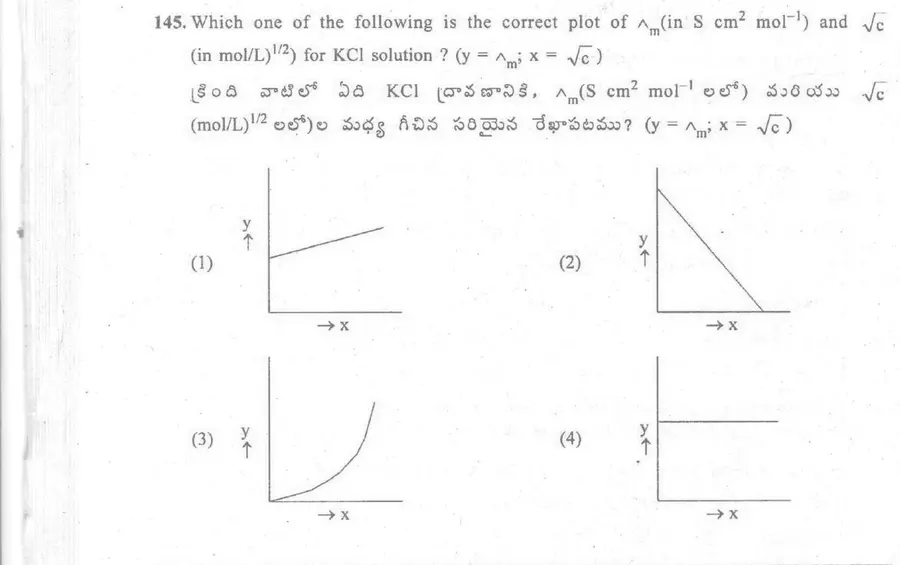
Which one of the following is the correct plot of $\Lambda_m$ (in $\mathrm{S\ cm^2\ mol^{-1}}$) and $\sqrt{c}$ (in $\mathrm{(mol/L)^{1/2}}$) for KCl solution ? ($y = \Lambda_m$; $x = \sqrt{c}$) (see the figure above)
The question as printed in the paper.
A
see figure straight line rising gently with positive y-intercept
B
see figure straight line falling from a positive y-intercept to zero on the x-axis
C
see figure convex curve rising from the origin, steepening at large x
The products obtained at the cathode and anode respectively during the electrolysis of aqueous $\mathrm{K_2SO_4}$ solution using platinum electrodes are
At 298 K the molar conductivities at infinite dilution ($\Lambda_m^o$) of $\mathrm{NH_4Cl}$, KOH and KCl are 152.8, 272.6 and 149.8 S $\mathrm{cm^2\ mol^{-1}}$ respectively. The $\Lambda_m^o$ of $\mathrm{NH_4OH}$ in S $\mathrm{cm^2\ mol^{-1}}$ and % dissociation of 0.01 M $\mathrm{NH_4OH}$ with $\Lambda_m = 25.1$ S $\mathrm{cm^2\ mol^{-1}}$ at the same temperature are
The emf (in V) of a Daniel cell containing 0.1 M $\mathrm{ZnSO_4}$ and 0.01 M $\mathrm{CuSO_4}$ solutions at their respective electrodes is ($E^\circ_{\mathrm{Cu^{2+}|Cu}} = 0.34$ V; $E^\circ_{\mathrm{Zn^{2+}|Zn}} = -0.76$ V )
For the electrochemical cell $\mathrm{M|M^+\,||\,X^-|X}$, $\mathrm{E^\circ(M^+|M)}$ = 0.44 V and $\mathrm{E^\circ(X|X^-)}$ = 0.33 V. Which one of the following is true for this data ?
A
$\mathrm{M + X \rightarrow M^+ + X^-}$ is a spontaneous reaction
B
$\mathrm{M^+ + X^- \rightarrow M + X}$ is a spontaneous reaction
At a certain temperature and at infinite dilution, the equivalent conductances of sodium benzoate, hydrochloric acid and sodium chloride are 240, 349 and 229 $\mathrm{ohm^{-1}\,cm^{2}\,equiv^{-1}}$ respectively. The equivalent conductance of benzoic acid in $\mathrm{ohm^{-1}\,cm^{2}\,equiv^{-1}}$ at the same conditions is :
Answer: (C) $\frac{1000}{\mathrm{RC}}$· Official APSCHE final key
How to prepare Electrochemistry for EAPCET
How often it comes up
Electrochemistry occupies position 13 among the 31 chemistry chapters in the modern 2022 to 2026 examination window. Across the full 2010 through 2026 historical archive, the chapter accounted for 182 questions across 149 papers, appearing in 144 of those examinations to claim 3.1 percent of the total chemistry questions with 1.2 questions per paper. In the five-year recent period from 2022 to 2026, it provided 94 questions across 77 sittings, sustaining 1.2 questions per paper and a 3.1 percent subject share.
The chapter maintains a steady presence across the board, appearing in every paper between 2022 and 2026. Looking at the two state streams during this recent period, AP papers assembled 63 questions across 48 sittings (1.3 questions per paper, 3.3 percent share), while TS papers gathered 31 questions over 29 sittings (1.1 questions per paper, 2.7 percent share).
In earlier testing between 2010 and 2021, papers included 88 questions across 72 sittings (appearing in 67 tests), delivering 1.2 questions per paper and a 3.1 percent subject share. Across the last three testing cycles from 2024 to 2026, question banks featured 59 questions across 46 sittings, providing 1.3 questions per test and 3.2 percent share. Comparing the early era with the last three years shows the share is about the same, and comparing the recent five-year window with the last three years shows the share is about the same. Every candidate encounters at least one electrochemistry problem on test day.
Most-asked topics
Questions in this branch divide across four core electrical domains:
Electrochemical Cells represents the biggest focus with 84 questions overall and 42 during the recent period through 2026. Problems assess standard reduction potentials, Nernst equation calculations for non-standard half-cells and full galvanic pairs, cell notation, and connections to equilibrium constants and standard Gibbs energy changes.
Electrolysis contributed 50 questions across the archive, with 23 appearing from 2022 to 2026. This area centers on Faradays first and second laws, calculating masses or gas volumes liberated at electrodes, current efficiency, and preferential discharge in aqueous electrolyte solutions.
Conductance accounts for 38 questions in total and 23 in the recent timeframe through 2026. Questions explore specific conductivity, molar conductivity variations with dilution, Kohlrauschs law of independent ion migration, cell constant determinations, and degree of dissociation for weak electrolytes.
Batteries & Corrosion provides 10 questions across the archive, with 6 occurring between 2022 and 2026. Themes include primary cells like the dry cell and mercury battery, secondary cells like the lead-acid storage battery and nickel-cadmium accumulator, fuel cells, and electrochemical prevention of rusting.
What the questions look like
Electrochemical calculations usually involve either potential evaluation or charge deposition. In galvanic cell problems, you will evaluate the cell potential at specified ion concentrations using the Nernst equation, taking care to raise concentrations to their correct stoichiometric powers in the reaction quotient Q. Another standard style asks you to calculate the standard Gibbs energy change using standard reduction potentials and Faraday constant.
In electrolysis, a typical problem specifies an electric current running for a designated time through a molten or aqueous salt and asks for the mass of metal deposited on the cathode. Conductance questions frequently present Kohlrausch law data, requiring you to combine limiting molar conductivities of strong electrolytes to deduce the limiting molar conductivity or ionization constant of a weak acid.
Questions to try first
Solve these representative state entrance questions to test your proficiency across cell potentials and electrolysis:
Master standard electrode reduction conventions. The electrode with higher standard reduction potential acts as the cathode (reduction half-cell), while the electrode with lower standard reduction potential serves as the anode (oxidation half-cell). Standard cell electromotive force always equals cathode potential minus anode potential.
Become fluent with Nernst equation calculations at twenty-five degrees Celsius using zero point zero five nine divided by n times log Q. Track the number of exchanged electrons n meticulously when combining half-reactions with differing coefficients, such as chromium three plus and cadmium two plus where n equals six. For electrolysis, remember that ninety-six thousand five hundred coulombs corresponds to one mole of electrons, liberating one gram equivalent of any substance.
Frequently asked questions
Why does molar conductivity increase upon dilution while specific conductivity decreases?
Specific conductivity represents the conductance of ions present in one cubic centimetre of solution. As a solution is diluted, the number of current-carrying ions per unit volume decreases, reducing specific conductivity. Conversely, molar conductivity increases upon dilution because greater solvent volume allows higher ionic mobility and promotes further dissociation of weak electrolytes.
What chemical reactions take place during the recharging of a lead storage battery?
Recharging acts as an electrolytic process that reverses the spontaneous discharge reactions. Lead sulphate deposited on the anode is reduced back to metallic lead, while lead sulphate on the cathode is oxidized back to lead dioxide, regenerating sulphuric acid and restoring electrolyte density.
How does the sign of cell potential relate to spontaneity?
A galvanic reaction is thermodynamically spontaneous when its cell potential is positive, which corresponds to a negative change in Gibbs free energy. If cell potential equals zero, the chemical system has reached dynamic equilibrium and can deliver no further useful electrical work. Step-by-step solutions for each one are in the EdLoop EAPCET app.