EdLoop PYQs · free, no ads · questions and answers here, step-by-step solutions in the EdLoop app
PYQs · free, no adsOpen on the web (app.edloop.in)Get EdLoop – free on Google Play
ChemistryPeriodic Table & Periodicity

Periodic Table & Periodicity: AP & TS EAPCET PYQs 2010–2026

Every Periodic Table & Periodicity question from past AP EAPCET and TS EAPCET papers, with options and answers. Newest first.

235questions
140papers covered
4.2%of Chemistry questions, 2022–2026
2010–2026years

Guide at a glance

Periodic Table & Periodicity holds rank 7 among all 31 chemistry chapters during the recent 2022 to 2026 examination period.

Most asked sub-topics

Periodic Trends198
Periodic Table37

Practise these in EdLoop

Attempt every Periodic Table & Periodicity question timed, see the step-by-step solution and track what you get wrong. Free.

Start practice

All questions

235 questions
1AP EAPCET 2026 · 18 May · Shift 1MCQOpen question page ↗

Which of the following statements are correct?

I. In third period, two elements have higher ionization enthalpy than the element immediately following them in the same period

II. Electronegativity of carbon is higher than that of phosphorus

III. An element X belongs to group 14 and period 3. The number of electrons present in it is 14

The correct answer is

  • A

    I, II, III

  • B

    I, II only

  • C

    II, III only

  • D

    I, III only

2AP EAPCET 2026 · 18 May · Shift 2MCQOpen question page ↗

In which of the following, elements are not in correct order with respect to the property mentioned in brackets?

  • A

    $\mathrm{S < P < N < O}$ (Electronegativity)

  • B

    $\mathrm{Br < Ge < Ga < Ca}$ (Atomic radius)

  • C

    $\mathrm{Al < Mg < S < P}$ (First ionization enthalpy)

  • D

    $\mathrm{Mg < Ca < K < Cs}$ (Metallic nature)

3AP EAPCET 2026 · 18 May · Shift 2MCQOpen question page ↗

The nature of chromium oxide formed by the thermal decomposition of ammonium dichromate is

  • A

    acidic

  • B

    basic

  • C

    neutral

  • D

    amphoteric

4AP EAPCET 2026 · 15 May · Shift 1MCQOpen question page ↗

Which of the following is not the correct order of atomic radius of the elements given?

  • A

    $\mathrm{Br} < \mathrm{Ge} < \mathrm{Ga} < \mathrm{Ca}$

  • B

    $\mathrm{Cr} < \mathrm{V} < \mathrm{Ti} < \mathrm{Sc}$

  • C

    $\mathrm{F} < \mathrm{Cl} < \mathrm{K} < \mathrm{Cs}$

  • D

    $\mathrm{O} < \mathrm{P} < \mathrm{K} < \mathrm{Ge}$

5AP EAPCET 2026 · 15 May · Shift 2MCQOpen question page ↗

The amount of energy released (in $k\ cal\ mol^{-1}$) when 7.1 $g$ of gaseous chlorine atoms are completely converted to $\mathrm{Cl^-}(g)$ ions is
(Given; $\Delta_{eg}H(\mathrm{Cl}) = -3.6\ eV$, $1\ eV = 23\ k\ cal\ mol^{-1}$, $At.Wt;\ \mathrm{Cl} = 35.5u$)

  • A

    15.66

  • B

    16.56

  • C

    31.32

  • D

    33.12

6AP EAPCET 2026 · 14 May · Shift 1MCQOpen question page ↗

Match the following

List – I (Pair of elements having similar values of property mentioned in List - II)List – II (Property)
A. Co, NiI. Electronegativity
B. K, BaII. Electron gain enthalpy
C. N, ClIII. Metallic radius
D. Ar, KrIV. Standard reduction potential (-ve)

The correct answer is

  • A

    A-III, B-I, C-IV, D-II

  • B

    A-IV, B-III, C-II, D-I

  • C

    A-IV, B-III, C-I, D-II

  • D

    A-III, B-IV, C-I, D-II

7AP EAPCET 2026 · 14 May · Shift 1MCQOpen question page ↗

The number of amphoteric oxides in the following is

$\mathrm{CO_2}$, $\mathrm{GeO_2}$, $\mathrm{SnO_2}$, $\mathrm{PbO_2}$, $\mathrm{CO}$, $\mathrm{GeO}$, $\mathrm{SnO}$, $\mathrm{PbO}$

The correct answer is

  • A

    5

  • B

    3

  • C

    2

  • D

    4

8AP EAPCET 2026 · 14 May · Shift 2MCQOpen question page ↗

Which of the following sets contain atomic numbers of only representative elements?

I. 3, 33, 53, 87

II. 2, 10, 22, 36

III. 9, 35, 51, 88

IV. 17, 25, 37, 48

The correct answer is

  • A

    I & II only

  • B

    II & III only

  • C

    I & III only

  • D

    II & IV only

9AP EAPCET 2026 · 13 May · Shift 1MCQOpen question page ↗

Which of the following statement is not correct?

  • A

    The increasing order of first ionization enthalpy of Be, B, C is B < Be < C

  • B

    The IUPAC name of element Livermorium is ununhexium

  • C

    The element Tennessene belongs to group 16 in periodic table

  • D

    $\mathrm{Al_2O_3}$, $\mathrm{As_2O_3}$ are amphoteric oxides

10AP EAPCET 2026 · 13 May · Shift 2MCQOpen question page ↗

Which of the following statements is not correct regarding third period elements?

  • A

    $\mathrm{Cl}$ has the highest electron gain enthalpy

  • B

    $\mathrm{Ar}$ has the highest first ionization enthalpy

  • C

    $\mathrm{Mg}$ has higher ionization enthalpy than $\mathrm{Al}$

  • D

    $\mathrm{P}$ has a lower first ionization enthalpy than $\mathrm{S}$

11AP EAPCET 2026 · 13 May · Shift 2MCQOpen question page ↗

Which pair of oxides is acidic in nature?

  • A

    $\mathrm{GeO, GeO_2}$

  • B

    $\mathrm{CO, CO_2}$

  • C

    $\mathrm{SnO, SnO_2}$

  • D

    $\mathrm{PbO, PbO_2}$

12AP EAPCET 2026 · 12 May · Shift 1MCQOpen question page ↗

Observe the following pairs of elements

I. P, H

II. C, S

III. N, Cl

Which pairs contain the elements having same electronegativity?

  • A

    I, II only

  • B

    II, III only

  • C

    I, III only

  • D

    I, II, III

13AP EAPCET 2026 · 12 May · Shift 2MCQOpen question page ↗

Which of the following sets are correctly matched?

OrderProperty
I.K > Li > C > FAtomic radius
II.F > C > Li > KFirst ionization enthalpy
III.F > C > K > LiElectronegativity

The correct answer is

  • A

    I, II only

  • B

    II, III only

  • C

    I, III only

  • D

    I, II, III

14TS EAPCET 2026 · 11 May · Shift 1MCQOpen question page ↗

Which of the following statements are not correct?

I. The process of adding an electron to a gaseous atom is always exothermic

II. The process of removing an electron from a gaseous atom is always endothermic

III. The first ionization enthalpy of oxygen is greater than nitrogen

IV. In group I elements lithium is the least electropositive

  • A

    I, III, IV only

  • B

    I & II only

  • C

    I & III only

  • D

    II & IV only

15TS EAPCET 2026 · 11 May · Shift 1MCQOpen question page ↗

Identify the correct orders with respect to the given property

I. $\mathrm{B < Al < Mg < K}$ – metallic character

II. $\mathrm{Si < P < C < N}$ – electronegativity

III. $\mathrm{Si < C < N < F}$ – non-metallic character

IV. $\mathrm{Al < Mg < S < P}$ – first ionization enthalpy

The correct answer is

  • A

    I, II, III only

  • B

    II, III, IV only

  • C

    I, III only

  • D

    I, II, III, IV

16TS EAPCET 2026 · 11 May · Shift 2MCQOpen question page ↗

Which of the following is an endothermic process?

  • A

    $\mathrm{Xe(g) + e^- \rightarrow Xe^-(g)}$

  • B

    $\mathrm{O(g) + e^- \rightarrow O^-(g)}$

  • C

    $\mathrm{Cl(g) + e^- \rightarrow Cl^-(g)}$

  • D

    $\mathrm{I(g) + e^- \rightarrow I^-(g)}$

17TS EAPCET 2026 · 11 May · Shift 2MCQOpen question page ↗

Three separate vessels (A, B and C) each contain 100 mL of distilled water. Some quantity of $\mathrm{P_4O_{10}}$ (s), $\mathrm{SiCl_4}$ ($l$) and $\mathrm{Ca_3N_2}$ (s) are added into A, B and C vessels respectively. The pH range in A, B and C respectively are

  • A

    $0-7$ ; $0-7$ ; $0-7$

  • B

    $0-7$ ; $0-7$ ; $7-14$

  • C

    $7-14$ ; $7-14$ ; $0-7$

  • D

    $0-7$ ; $7-14$ ; $7-14$

18TS EAPCET 2026 · 10 May · Shift 1MCQOpen question page ↗

The correct orders of second ionization enthalpies of the given elements are

I. $\mathrm{Li > B > Be > Mg}$

II. $\mathrm{P > Mg > Al > Na}$

III. $\mathrm{O > F > N > C}$

The correct answer is

  • A

    I, II, III

  • B

    II, III only

  • C

    I, III only

  • D

    I, II only

19TS EAPCET 2026 · 10 May · Shift 1MCQOpen question page ↗

Identify the element, which does not belong to fifth period of long form of periodic table

  • A

    $\mathrm{Pd}$

  • B

    $\mathrm{Pt}$

  • C

    $\mathrm{Cd}$

  • D

    $\mathrm{Ag}$

20TS EAPCET 2026 · 10 May · Shift 2MCQOpen question page ↗

Identify the correct statements from the following

I. Si and Ge have same electronegativity value

II. The electronic configuration of the element Ds is $\mathrm{[Rn]5f^{14}6d^{10}7s^{2}7p^{3}}$

III. The p-block elements are classified into six groups

The correct answer is

  • A

    I, III only

  • B

    II, III only

  • C

    I, II only

  • D

    I, II, III

21TS EAPCET 2026 · 10 May · Shift 2MCQOpen question page ↗

In which of the following, elements are arranged in the correct order of their first electron gain enthalpy values?

  • A

    $\mathrm{S} < \mathrm{O} < \mathrm{Br} < \mathrm{I}$

  • B

    $\mathrm{O} < \mathrm{S} < \mathrm{I} < \mathrm{Br}$

  • C

    $\mathrm{I} < \mathrm{S} < \mathrm{O} < \mathrm{Br}$

  • D

    $\mathrm{Br} < \mathrm{I} < \mathrm{O} < \mathrm{S}$

22TS EAPCET 2026 · 9 May · Shift 1MCQOpen question page ↗

Identify the pairs, in which electron gain enthalpy of the first element is more than that of second element

I. F, Br

II. Na, Li

III. S, O

The correct answer is

  • A

    I, II, III

  • B

    I, III only

  • C

    II, III only

  • D

    I, II only

23TS EAPCET 2026 · 9 May · Shift 1MCQOpen question page ↗

Match the following

List-1 (Element)List-2 (Block)
AHfIs-block
BRaIIp-Block
CAmIIId-Block
DAtIVf-Block

The correct answer is

  • A

    A – IV, B – III, C – I, D – II

  • B

    A – II, B – III, C – IV, D – I

  • C

    A – III, B – IV, C – I, D – II

  • D

    A – III, B – I, C – IV, D – II

24TS EAPCET 2026 · 9 May · Shift 2MCQOpen question page ↗

The element with atomic number 114 has outer shell electron configuration as that of element ‘X’. What is X?

  • A

    Ar

  • B

    Ge

  • C

    Se

  • D

    Ti

25TS EAPCET 2026 · 9 May · Shift 2MCQOpen question page ↗

Consider the following oxides

$\mathrm{SO_2, P_2O_5, SO_3, Al_2O_3, K_2O, MgO}$

The most acidic and most basic oxides are respectively

  • A

    $\mathrm{SO_3, MgO}$

  • B

    $\mathrm{SO_3, K_2O}$

  • C

    $\mathrm{P_2O_5, K_2O}$

  • D

    $\mathrm{P_2O_5, SO_2}$

26AP EAPCET 2025 · 27 May · Shift 1MCQOpen question page ↗

Observe the following data.

Ion$\mathrm{Q^{a+}}$$\mathrm{X^{b+}}$$\mathrm{Y^{c+}}$$\mathrm{Z^{d+}}$
Radius (pm)536640100

$\mathrm{Q^{a+}, X^{b+}, Y^{c+}, Z^{d+}}$ are respectively

  • A

    $\mathrm{Mg^{2+}, Al^{3+}, Na^{+}, Si^{4+}}$

  • B

    $\mathrm{Al^{3+}, Si^{4+}, Mg^{2+}, Na^{+}}$

  • C

    $\mathrm{Mg^{2+}, Si^{4+}, Al^{3+}, Na^{+}}$

  • D

    $\mathrm{Al^{3+}, Mg^{2+}, Si^{4+}, Na^{+}}$

27AP EAPCET 2025 · 27 May · Shift 1MCQOpen question page ↗

The number of amphoteric oxides from the following is

$\mathrm{CO_2}$, $\mathrm{GeO_2}$, $\mathrm{SnO_2}$, $\mathrm{PbO_2}$, $\mathrm{CO}$, $\mathrm{GeO}$, $\mathrm{SnO}$, $\mathrm{PbO}$

  • A

    3

  • B

    4

  • C

    6

  • D

    5

28AP EAPCET 2025 · 26 May · Shift 1MCQOpen question page ↗

Among the ions $\mathrm{Mg^{2+}}$, $\mathrm{O^{2-}}$, $\mathrm{Al^{3+}}$, $\mathrm{F^-}$, $\mathrm{Na^+}$ and $\mathrm{N^{3-}}$, the ion with largest size and ion with smallest size are respectively

  • A

    $\mathrm{N^{3-}}$, $\mathrm{Mg^{2+}}$

  • B

    $\mathrm{O^{2-}}$, $\mathrm{F^-}$

  • C

    $\mathrm{Al^{3+}}$, $\mathrm{N^{3-}}$

  • D

    $\mathrm{N^{3-}}$, $\mathrm{Al^{3+}}$

29AP EAPCET 2025 · 26 May · Shift 2MCQOpen question page ↗

Which of the following orders is not correct for the given property ?

  • A

    $\mathrm{Li} < \mathrm{Na} < \mathrm{K}$ - metallic radius

  • B

    $\mathrm{Br} < \mathrm{F} < \mathrm{Cl}$ - electron gain enthalpy

  • C

    $\mathrm{C} < \mathrm{N} < \mathrm{O}$ - first ionization enthalpy

  • D

    $\mathrm{Mg^{2+}} < \mathrm{Na^{+}} < \mathrm{F^{-}}$ - ionic radius

30AP EAPCET 2025 · 26 May · Shift 2MCQOpen question page ↗

The correct order of electronegativity of group 13 elements is

  • A

    $\mathrm{B > Ga > Al > Tl > In}$

  • B

    $\mathrm{B > Al > Tl > Ga > In}$

  • C

    $\mathrm{B > Al > Ga > In > Tl}$

  • D

    $\mathrm{B > Tl > In > Ga > Al}$

31AP EAPCET 2025 · 24 May · Shift 1MCQOpen question page ↗

The order of negative electron gain enthalpy of $\mathrm{Li}$, $\mathrm{Na}$, $\mathrm{S}$, $Cl$ is

  • A

    $\mathrm{Na} > \mathrm{S} > Cl > \mathrm{Li}$

  • B

    $Cl > \mathrm{S} > \mathrm{Li} > \mathrm{Na}$

  • C

    $Cl > \mathrm{Li} > \mathrm{S} > \mathrm{Na}$

  • D

    $\mathrm{Li} > \mathrm{Na} > \mathrm{S} > Cl$

32AP EAPCET 2025 · 23 May · Shift 1MCQOpen question page ↗

Electronic configurations of four elements A, B, C, D are given below

A) $1s^2\, 2s^2\, 2p^6\, 3s^1$

B) $1s^2\, 2s^2\, 2p^6\, 3s^2\, 3p^1$

C) $1s^2\, 2s^2\, 2p^6\, 3s^2$

D) $1s^2\, 2s^2\, 2p^6\, 3s^2\, 3p^2$

The correct order of first ionization enthalpy of these elements is

  • A

    $D > B > C > A$

  • B

    $C > D > B > A$

  • C

    $C > A > B > D$

  • D

    $D > C > B > A$

33AP EAPCET 2025 · 23 May · Shift 2MCQOpen question page ↗

The period and group numbers of the element having maximum elctronegativity in the long form of periodic table, respectively, are

  • A

    2, 17

  • B

    3, 17

  • C

    1, 18

  • D

    2, 16

34AP EAPCET 2025 · 22 May · Shift 1MCQOpen question page ↗

The correct order of atomic radii of $\mathrm{C}$, $\mathrm{Al}$ and $\mathrm{S}$ is

  • A

    $\mathrm{C} < \mathrm{Al} < \mathrm{S}$

  • B

    $\mathrm{S} < \mathrm{Al} < \mathrm{C}$

  • C

    $\mathrm{Al} < \mathrm{S} < \mathrm{C}$

  • D

    $\mathrm{C} < \mathrm{S} < \mathrm{Al}$

35AP EAPCET 2025 · 22 May · Shift 2MCQOpen question page ↗

The correct order of the non-metallic character among the elements B, C, N, F and Si is

  • A

    $\mathrm{B > C > Si > N > F}$

  • B

    $\mathrm{Si > C > B > N > F}$

  • C

    $\mathrm{F > N > C > B > Si}$

  • D

    $\mathrm{F > N > C > Si > B}$

36AP EAPCET 2025 · 21 May · Shift 1MCQOpen question page ↗

Match the following

List-I (Atomic number, Z)List-II (Block)
A) 112I) $s$
B) 116II) $p$
C) 88III) $d$
D) 100IV) $f$

The corect answer is

  • A

    A-III, B-I, C-II, D-IV

  • B

    A-III, B-II, C-I, D-IV

  • C

    A-IV, B-II, C-III, D-I

  • D

    A-II, B-III, C-IV, D-I

37AP EAPCET 2025 · 21 May · Shift 2MCQOpen question page ↗

Which of the following orders is not correct about the property shown against it?

  • A

    $\mathrm{N > O > P > S}$ - First ionisation enthalpy

  • B

    $\mathrm{F > Cl > O > S}$ - Negative electron gain enthlapy

  • C

    $\mathrm{Fe^{3+} < Fe^{2+} < Fe}$ - Size

  • D

    $\mathrm{O > N > S > P}$ - Non-metallic character

38TS EAPCET 2025 · 4 May · Shift 1MCQOpen question page ↗

Match the following

List – 1 (Element)List – 2 (Block)
ACdIf-block
BEuIIs-block
CSeIIId-block
DBaIVp-block

The correct answer is

  • A

    A – IV, B – III, C – II, D – I

  • B

    A – II, B – IV, C – I, D – III

  • C

    A – III, B – IV, C – II, D – I

  • D

    A – III, B – I, C – IV, D – II

39TS EAPCET 2025 · 4 May · Shift 1MCQOpen question page ↗

In long form of periodic table an element ‘E’ has atomic number 78. The period and group number of the element are $x$ and $y$ respectively. $(x+y)$ is equal to

  • A

    18

  • B

    15

  • C

    17

  • D

    16

40TS EAPCET 2025 · 4 May · Shift 2MCQOpen question page ↗

Identify the correct orders regarding atomic radii

i. $\mathrm{Cl > F > Li}$

ii. $\mathrm{P > C > N}$

iii. $\mathrm{Tm > Sm > Eu}$

iv. $\mathrm{Sr > Ca > Mg}$

  • A

    i, ii, iii only

  • B

    ii, iv only

  • C

    ii, iii, iv only

  • D

    iii, iv only

41TS EAPCET 2025 · 4 May · Shift 2MCQOpen question page ↗

Match the following

List – 1 (Elements)List – 2 (Group)
AMn, Tc, ReI12
BZn, Cd, HgII4
CTi, Zr, HfIII17
DGa, In, TlIV7
V13

The correct answer is

  • A

    A – IV, B – I, C – II, D – V

  • B

    A – IV, B – II, C – I, D – V

  • C

    A – III, B – I, C – II, D – V

  • D

    A – III, B – V, C – I, D – IV

42TS EAPCET 2025 · 3 May · Shift 1MCQOpen question page ↗

Match the following

List – 1 (Element)List – 2 $(\Delta_{eg}H)$ (in $\mathrm{kJ\,mol^{-1}}$)
AOI$-200$
BFII$-349$
CClIII$-141$
DSIV$-328$
V$+48$

The correct answer is

  • A

    A – II, B – IV, C – I, D – III

  • B

    A – V, B – IV, C – II, D – I

  • C

    A – III, B – IV, C – II, D – I

  • D

    A – III, B – II, C – IV, D – I

43TS EAPCET 2025 · 3 May · Shift 1MCQOpen question page ↗

Observe the following data ($\Delta_i H_1$, $\Delta_i H_2$ and $\Delta_{eg} H$ represent the first, second ionisation enthalpies and electron gain enthalpy respectively).

Element$\Delta_i H_1$ (kJ mol$^{-1}$)$\Delta_i H_2$ (kJ mol$^{-1}$)$\Delta_{eg} H$ (kJ mol$^{-1}$)
I5207300$-60$
II4903051$-48$
III16813374$-328$
IV23725251$+48$

Using the data identify the most reactive metal.

  • A

    II

  • B

    I

  • C

    IV

  • D

    III

44TS EAPCET 2025 · 3 May · Shift 2MCQOpen question page ↗

In second period of the modern periodic table, two elements X and Y have higher first ionization enthalpy values than the preceding and succeeding elements. X and Y are respectively

  • A

    B, C

  • B

    Al, S

  • C

    Be, N

  • D

    Na, S

45TS EAPCET 2025 · 2 May · Shift 1MCQOpen question page ↗

In which of the following options, elements are correctly arranged in the increasing order of their atomic radius?

  • A

    $\mathrm{Si < P < Na < N < F}$

  • B

    $\mathrm{Na < Si < P < N < F}$

  • C

    $\mathrm{F < N < P < Si < Na}$

  • D

    $\mathrm{N < F < Si < P < Na}$

46TS EAPCET 2025 · 2 May · Shift 1MCQOpen question page ↗

A, B, C, D and E are elements with atomic numbers 13, 11, 9, 7 and 16 respectively. Among these elements, ion of an element X has largest size and ion of an element Y has smallest size. X and Y are respectively
(Assume that all ions have nearest inert gas configuration)

  • A

    D, A

  • B

    A, D

  • C

    E, A

  • D

    D, E

47TS EAPCET 2025 · 2 May · Shift 1MCQOpen question page ↗

The correct order of atomic radii of group 13 elements is

  • A

    $\mathrm{Al > Tl > Ga > In}$

  • B

    $\mathrm{Al > Ga > In > Tl}$

  • C

    $\mathrm{Tl > In > Ga > Al}$

  • D

    $\mathrm{Tl > In > Al > Ga}$

48TS EAPCET 2025 · 2 May · Shift 1MCQOpen question page ↗

Observe the following oxides. The number of amphoteric oxides from the given list is

$$\mathrm{CO, B_2O_3, SnO_2, PbO_2, Ga_2O_3, SnO, PbO, CO_2}$$

  • A

    3

  • B

    4

  • C

    5

  • D

    6

49TS EAPCET 2025 · 2 May · Shift 2MCQOpen question page ↗

Atomic numbers of three elements $\mathrm{E_1}$, $\mathrm{E_2}$ and $\mathrm{E_3}$ of periodic table are $Z_1$, 50 and $Z_2$ respectively. From the position of the elements shown in figure, the value of $(Z_2 - Z_1)$ is

(see the figure above)

The question and its figure as printed in TG EAPCET 2025 02 May AN.
The question as printed in the paper.
  • A

    52

  • B

    46

  • C

    64

  • D

    34

50TS EAPCET 2025 · 2 May · Shift 2MCQOpen question page ↗

Electron gain enthalpy values $(\Delta_{eg}H)$ (in $\mathrm{kJ\,mol^{-1}}$) of elements X, Y and Z are $-349, -200$ and $-295$ respectively. X, Y and Z are respectively

  • A

    Cl, I, S

  • B

    Cl, S, I

  • C

    S, Se, Te

  • D

    Na, K, Rb

51AP EAPCET 2024 · 23 May · Shift 1MCQOpen question page ↗

Match the following

List-I<br>Symbol of elementList-II<br>Group number
AMcI16
BLvII17
CFlIII15
DTsIV14

The correct answer is

  • A

    A-III, B-IV, C-I, D-II

  • B

    A-IV, B-III, C-I, D-II

  • C

    A-III, B-I, C-IV, D-II

  • D

    A-II, B-IV, C-I, D-III

52AP EAPCET 2024 · 22 May · Shift 1MCQOpen question page ↗

In which of the following sets, elements are not correctly arranged with the property shown in brackets?

  • A

    $\mathrm{S > Se > O}$ (Electron gain enthalpy)

  • B

    $\mathrm{F > O > Cl}$ (Electronegativity)

  • C

    $\mathrm{Na > Li > Al}$ (Metallic radius)

  • D

    $\mathrm{Na > K > Ba}$ (Metallic nature)

53AP EAPCET 2024 · 22 May · Shift 2MCQOpen question page ↗

Two statements are given below

Statement I: Nitrogen has more ionization enthalpy and electronegativity than beryllium

Statement II: $\mathrm{CrO_3}$, $\mathrm{B_2O_3}$ are acidic oxides

Correct answer is

  • A

    Both statements I and II are correct

  • B

    Both statements I and II are not correct

  • C

    Statement I is correct, but statement II is not correct

  • D

    Statement I is not correct, but statement II is correct

54AP EAPCET 2024 · 21 May · Shift 1MCQOpen question page ↗

The correct order of atomic radii of given elements is

  • A

    $\mathrm{B < Be < Mg}$

  • B

    $\mathrm{Mg < Be < B}$

  • C

    $\mathrm{Be < B < Mg}$

  • D

    $\mathrm{B < Mg < Be}$

55AP EAPCET 2024 · 21 May · Shift 2MCQOpen question page ↗

The correct order of atomic radii of N, F, Al, Si is

  • A

    $\mathrm{F > N > Si > Al}$

  • B

    $\mathrm{F > N > Al > Si}$

  • C

    $\mathrm{Al > Si > F > N}$

  • D

    $\mathrm{Al > Si > N > F}$

56AP EAPCET 2024 · 20 May · Shift 1MCQOpen question page ↗

Match the following

List-IList-II
AIonization enthalpyI$\mathrm{P<Si<Mg<Na}$
BMetallic characterII$\mathrm{I<N<O<F}$
CElectron gain enthalpyIII$\mathrm{B<Be<C<O<N}$
DElectro negativityIV$\mathrm{I<Br<F<Cl}$
  • A

    A-III, B-IV, C-I, D-II

  • B

    A-III, B-I, C-IV, D-II

  • C

    A-IV, B-II, C-I, D-III

  • D

    A-IV, B-III, C-I, D-II

57AP EAPCET 2024 · 20 May · Shift 1MCQOpen question page ↗

Which of the following oxides is acidic in nature?

  • A

    $\mathrm{GeO_2}$

  • B

    $\mathrm{CO}$

  • C

    $\mathrm{PbO_2}$

  • D

    $\mathrm{SnO}$

58AP EAPCET 2024 · 20 May · Shift 2MCQOpen question page ↗

Match the following

List IList II
ATechniciumINon-metal
BFluorineIITransition metal
CTelluriumIIILanthanoid
DDysprosiumIVMetalloid
  • A

    A-II, B-I, C-III, D-IV

  • B

    A-III, B-I, C-IV, D-II

  • C

    A-II, B-I, C-IV, D-III

  • D

    A-IV, B-I, C-II, D-III

59AP EAPCET 2024 · 19 May · Shift 2MCQOpen question page ↗

If the first ionisation enthalpy of Li, Be and C respectively are 520, 899, 1086 $\mathrm{kJ\ mol^{-1}}$, the first ionisation enthalpy (in $\mathrm{kJ\ mol^{-1}}$) of B will be

  • A

    487

  • B

    950

  • C

    801

  • D

    1402

60AP EAPCET 2024 · 18 May · Shift 1MCQOpen question page ↗

Match the following

List I ElementList II Electron gain enthalpy (in kJ mol$^{-1}$)
AFI$-141$
BClII$-328$
COIII$-200$
DSIV$-349$

The correct answer is

  • A

    A-II, B-IV, C-I, D-III

  • B

    A-IV, B-II, C-I, D-III

  • C

    A-III, B-II, C-IV, D-I

  • D

    A-II, B-III, C-IV, D-I

61TS EAPCET 2024 · 11 May · Shift 1MCQOpen question page ↗

If first ionization enthalpy $(\Delta_i H)$ values of Na, Mg and Si are respectively 496, 737 and 786 $\mathrm{kJ\,mol^{-1}}$, the first ionization enthalpy value of Al $\left(\text{in } \mathrm{kJ\,mol^{-1}}\right)$ will be

  • A

    575

  • B

    760

  • C

    400

  • D

    790

62TS EAPCET 2024 · 11 May · Shift 1MCQOpen question page ↗

Among the oxides $\mathrm{SiO_2, SO_2, Al_2O_3}$ and $\mathrm{P_2O_3}$, the correct order of acidic strength is

  • A

    $\mathrm{SiO_2 < SO_2 < Al_2O_3 < P_2O_3}$

  • B

    $\mathrm{SO_2 < P_2O_3 < Al_2O_3 < SiO_2}$

  • C

    $\mathrm{Al_2O_3 < SiO_2 < P_2O_3 < SO_2}$

  • D

    $\mathrm{Al_2O_3 < P_2O_3 < SiO_2 < SO_2}$

63TS EAPCET 2024 · 10 May · Shift 1MCQOpen question page ↗

In which of the following ionic pairs, second ion is smaller in size than the first ion?

  • A

    $\mathrm{Al^{3+}, Mg^{2+}}$

  • B

    $\mathrm{F^{-}, Na^{+}}$

  • C

    $\mathrm{O^{2-}, N^{3-}}$

  • D

    $\mathrm{Mg^{2+}, Na^{+}}$

64TS EAPCET 2024 · 10 May · Shift 2MCQOpen question page ↗

The set containing the elements with positive electron gain enthalpies is

  • A

    S, Se, Te

  • B

    Kr, Xe, Rn

  • C

    Cl, Br, I

  • D

    K, Rb, Cs

65TS EAPCET 2024 · 10 May · Shift 2MCQOpen question page ↗

Assertion (A): The ionic radii of $\mathrm{Na^+}$ and $\mathrm{F^-}$ are same

Reason (R): Both $\mathrm{Na^+}$ and $\mathrm{F^-}$ are isoelectronic species

The correct answer is

  • A

    (A) and (R) are correct. (R) is the correct explanation of (A)

  • B

    (A) and (R) are correct, but (R) is not the correct explanation of (A)

  • C

    (A) is correct but (R) is not correct

  • D

    (A) is not correct but (R) is correct

66TS EAPCET 2024 · 10 May · Shift 2MCQOpen question page ↗

Carbon on reaction with hot conc. $\mathrm{H_2SO_4}$, gives two oxides along with $\mathrm{H_2O}$. What is the nature of these two oxides?

  • A

    Both are acidic

  • B

    Both are basic

  • C

    Both are neutral

  • D

    Both are amphoteric

68TS EAPCET 2024 · 9 May · Shift 1MCQOpen question page ↗

Observe the oxides $\mathrm{CO, B_2O_3, SiO_2, CO_2, Al_2O_3, PbO_2, Tl_2O_3}$

The number of acidic oxides in the list is

  • A

    3

  • B

    4

  • C

    5

  • D

    2

70TS EAPCET 2024 · 9 May · Shift 2MCQOpen question page ↗

Match the following

List – I (Element)List – II (Block)
ARaIp – block
BUuqIIs – block
CDsIIIf – block
DFmIVd – block

The correct answer is

  • A

    A – II; B – III; C – IV; D – I

  • B

    A – III; B – II; C – I; D – IV

  • C

    A – III; B – IV; C – II; D – I

  • D

    A – II; B – I; C – IV; D – III

72AP EAPCET 2023 · 18 May · Shift 1MCQOpen question page ↗

The number of following pairs of elements which exhibit diagonal relationship is :

i. B & Si ii. Be & Al iii. Li & Mg iv. Al & S

  • A

    2

  • B

    1

  • C

    3

  • D

    4

73AP EAPCET 2023 · 18 May · Shift 1MCQOpen question page ↗

The correct order of atomic radii of B, Be, N and C is

  • A

    $\mathrm{Be < B < C < N}$

  • B

    $\mathrm{N < B < C < Be}$

  • C

    $\mathrm{N < C < B < Be}$

  • D

    $\mathrm{Be < C < B < N}$

74AP EAPCET 2023 · 18 May · Shift 2MCQOpen question page ↗

The ion with smallest radius among the following is

  • A

    $\mathrm{Ca^{2+}}$

  • B

    $\mathrm{K^{+}}$

  • C

    $\mathrm{Ti^{4+}}$

  • D

    $\mathrm{Sc^{3+}}$

75AP EAPCET 2023 · 18 May · Shift 2MCQOpen question page ↗

The correct order of the metallic nature of the following elements is

  • A

    $\mathrm{Si > Al > Na > Hg}$

  • B

    $\mathrm{Na > Mg > Al > Si}$

  • C

    $\mathrm{Al > Mg > Na > Si}$

  • D

    $\mathrm{Mg > Na > Al > Si}$

76AP EAPCET 2023 · 17 May · Shift 1MCQOpen question page ↗

Which of the following statements are correct?

I. P is having least negative electron gain enthalpy among P, S, Cl, and F

II. In Eu, Yb Lanthanoid contraction is not observed

III. $\mathrm{Ce(OH)_3}$ is most basic among lanthanoid hydroxides

IV. The radii of Na and $\mathrm{Na^+}$ are 95 pm, 186 pm respectively

  • A

    I, III, IV only

  • B

    II, IV only

  • C

    I, III only

  • D

    I, II, III only

77AP EAPCET 2023 · 17 May · Shift 1MCQOpen question page ↗

The correct order of electron gain enthalpy of $\mathrm{N}$, $\mathrm{O}$, $\mathrm{Cl}$, $\mathrm{Al}$ is

  • A

    $\mathrm{Cl} < \mathrm{N} < \mathrm{O} < \mathrm{Al}$

  • B

    $\mathrm{Al} < \mathrm{N} < \mathrm{O} < \mathrm{Cl}$

  • C

    $\mathrm{O} < \mathrm{N} < \mathrm{Al} < \mathrm{Cl}$

  • D

    $\mathrm{N} < \mathrm{O} < \mathrm{Cl} < \mathrm{Al}$

78AP EAPCET 2023 · 17 May · Shift 2MCQOpen question page ↗

Which one of the following indicates correct order of atomic size of the given elements?

  • A

    $\mathrm{Li} > \mathrm{B} > \mathrm{F} > \mathrm{N}$

  • B

    $\mathrm{N} > \mathrm{F} > \mathrm{Li} > \mathrm{B}$

  • C

    $\mathrm{F} > \mathrm{N} > \mathrm{B} > \mathrm{Li}$

  • D

    $\mathrm{Li} > \mathrm{B} > \mathrm{N} > \mathrm{F}$

79AP EAPCET 2023 · 17 May · Shift 2MCQOpen question page ↗

In which one of the following pairs, both oxides are acidic?

  • A

    $\mathrm{CO, CO_2}$

  • B

    $\mathrm{SnO, PbO_2}$

  • C

    $\mathrm{GeO, SiO_2}$

  • D

    $\mathrm{SnO, PbO}$

80AP EAPCET 2023 · 17 May · Shift 2MCQOpen question page ↗

Arrange the oxides $\mathrm{CrO}$, $\mathrm{CrO_3}$ and $\mathrm{Cr_2O_3}$ in the decreasing order of acidic strength

  • A

    $\mathrm{CrO_3 > Cr_2O_3 > CrO}$

  • B

    $\mathrm{CrO_3 > CrO > Cr_2O_3}$

  • C

    $\mathrm{CrO > Cr_2O_3 > CrO_3}$

  • D

    $\mathrm{CrO > CrO_3 > Cr_2O_3}$

81AP EAPCET 2023 · 16 May · Shift 1MCQOpen question page ↗

Match the following

List-I (Elements) | List-II (Valence shell Configuration)
--- | ---
A. Alkali metals | I. $\mathrm{ns^2np^6}$
B. Alkaline earth metals | II. $\mathrm{ns^2np^5}$
C. Halogens | III. $\mathrm{ns^2}$
D. Noble gases | IV. $\mathrm{ns^1}$

  • A

    A – I, B – II, C – III, D – IV

  • B

    A – IV, B – III, C – II, D – I

  • C

    A – II, B – I, C – III, D – IV

  • D

    A – IV, B – I, C – III, D – II

82AP EAPCET 2023 · 16 May · Shift 1MCQOpen question page ↗

Which of the following oxides is highly basic?

  • A

    $\mathrm{Cr_2O_3}$

  • B

    $\mathrm{Al_2O_3}$

  • C

    $\mathrm{MgO}$

  • D

    $\mathrm{Na_2O}$

83AP EAPCET 2023 · 16 May · Shift 2MCQOpen question page ↗

Consider the elements Ne, Na, Mg. The element with highest first ionization enthalpy and element with lowest second ionization enthalpy respectively are

  • A

    Na, Ne

  • B

    Ne, Mg

  • C

    Na, Na

  • D

    Mg, Na

85AP EAPCET 2023 · 15 May · Shift 1MCQOpen question page ↗

Consider the following two statements

Statement I: Among $\mathrm{Mg}$, $\mathrm{Al}$, $\mathrm{Mg^{2+}}$, $\mathrm{Al^{3+}}$ the one having smallest size is $\mathrm{Al^{3+}}$

Statement II: $\mathrm{Eu}$ is having exceptionally high atomic radii among lanthanide elements

The correct answer is

  • A

    Both statements I and II are correct

  • B

    Both statements I and II are not correct

  • C

    Statement I is correct but statement II not correct

  • D

    Statement I is not correct but statement II is correct

86AP EAPCET 2023 · 15 May · Shift 1MCQOpen question page ↗

Identify the pair of elements with highest and lowest electronegativity respectively

  • A

    K and Rb

  • B

    I and F

  • C

    F and Fr

  • D

    Fr and Li

87AP EAPCET 2023 · 15 May · Shift 1MCQOpen question page ↗

Choose the acidic oxide from the following

  • A

    $\mathrm{CO}$

  • B

    $\mathrm{GeO}$

  • C

    $\mathrm{SnO}$

  • D

    $\mathrm{PbO}$

88AP EAPCET 2023 · 15 May · Shift 2MCQOpen question page ↗

The correct order of covalent radii of Si, Ge, Sn is:

  • A

    $\mathrm{Ge} < \mathrm{Si} < \mathrm{Sn}$

  • B

    $\mathrm{Sn} < \mathrm{Si} < \mathrm{Ge}$

  • C

    $\mathrm{Si} < \mathrm{Ge} < \mathrm{Sn}$

  • D

    $\mathrm{Sn} < \mathrm{Ge} < \mathrm{Si}$

89AP EAPCET 2023 · 15 May · Shift 2MCQOpen question page ↗

The first ionization enthalpies of Na, Mg and Si are respectively 496, 737 and 786 $\mathrm{kJ\ mol^{-1}}$. What would be the first ionization enthalpy of Al in $\mathrm{kJ\ mol^{-1}}$?

  • A

    450

  • B

    750

  • C

    575

  • D

    800

90TS EAPCET 2023 · 14 May · Shift 1MCQOpen question page ↗

Match the following

List – I (Atomic number)List – II (Group number & Period number)
A) 56I) 9, 4
B) 50II) 3, 6
C) 27III) 14, 5
D) 58IV) 2, 6

The correct answer is

  • A

    A – III, B – IV, C – I, D – II

  • B

    A – II, B – III, C – IV, D – I

  • C

    A – IV, B – I, C – II, D – III

  • D

    A – IV, B – III, C – I, D – II

91TS EAPCET 2023 · 14 May · Shift 1MCQOpen question page ↗

Aluminium reacts with dilute $\mathrm{HCl}$ and liberates a gas ‘A’ and with aqueous alkali liberates a gas ‘B’. A and B respectively are

  • A

    $\mathrm{Cl_2, O_2}$

  • B

    $\mathrm{O_2, O_2}$

  • C

    $\mathrm{Cl_2, H_2}$

  • D

    $\mathrm{H_2, H_2}$

92TS EAPCET 2023 · 14 May · Shift 2MCQOpen question page ↗

Assertion (A): First ionisation enthalpy of oxygen is less than that of nitrogen

Reason (R): Atoms with half-filled or completely filled orbitals are less stable

The correct option among the following is

  • A

    (A) and (R) are true. (R) is the correct explanation of (A)

  • B

    (A) and (R) are true, but (R) is not correct explanation of (A)

  • C

    (A) is true but (R) is false

  • D

    (A) is false but (R) is true

93TS EAPCET 2023 · 13 May · Shift 1MCQOpen question page ↗

Choose the correct order of second ionisation enthalpies of Carbon, Nitrogen, Oxygen and Fluorine

  • A

    Carbon > Nitrogen > Oxygen > Fluorine

  • B

    Oxygen > Carbon > Nitrogen > Fluorine

  • C

    Fluorine > Nitrogen > Carbon > Oxygen

  • D

    Oxygen > Fluorine > Nitrogen > Carbon

94TS EAPCET 2023 · 13 May · Shift 2MCQOpen question page ↗

What is the correct order with respect to metallic property of Zr, Cd, Sn, Sr?

  • A

    $\mathrm{Sn < Cd < Zr < Sr}$

  • B

    $\mathrm{Sn < Sr < Cd < Zr}$

  • C

    $\mathrm{Cd < Zr < Sr < Sn}$

  • D

    $\mathrm{Zr < Sr < Cd < Sn}$

95TS EAPCET 2023 · 12 May · Shift 1MCQOpen question page ↗

Consider the following

I) The order of first ionisation enthalpy of first three elements of $3^{\mathrm{rd}}$ period is $\mathrm{Mg} > \mathrm{Al} > \mathrm{Na}$

II) The element with electronegativity of 3.5 is chlorine

III) The order of sizes of ions $\mathrm{Mg^{2+}}$, $\mathrm{Na^+}$, $\mathrm{F^-}$ and $\mathrm{O^{2-}}$ is $\mathrm{Mg^{2+}} < \mathrm{Na^+} < \mathrm{F^-} < \mathrm{O^{2-}}$

IV) The IUPAC name of the element with atomic number 106 is Bohrium

The correct statements are

  • A

    I & II only

  • B

    II & III only

  • C

    I & III only

  • D

    II & IV only

96TS EAPCET 2023 · 12 May · Shift 2MCQOpen question page ↗

In which of the following options, the elements are correctly arranged with respect to their negative electron gain enthalpies?

  • A

    $\mathrm{P > S > Cl > F}$

  • B

    $\mathrm{S > P > F > Cl}$

  • C

    $\mathrm{Cl > F > S > P}$

  • D

    $\mathrm{F > Cl > P > S}$

97TS EAPCET 2022 · 20 Jul · Shift 1MCQOpen question page ↗

Arrange the following in increasing order of ionic radii $\mathrm{O^{2-}}$, $\mathrm{Na^{+}}$, $\mathrm{F^{-}}$, $\mathrm{Mg^{2+}}$

  • A

    $\mathrm{Mg^{2+} < Na^{+} < F^{-} < O^{2-}}$

  • B

    $\mathrm{Mg^{2+} < F^{-} < Na^{+} < O^{2-}}$

  • C

    $\mathrm{O^{2-} < F^{-} < Na^{+} < Mg^{2+}}$

  • D

    $\mathrm{O^{2-} < Mg^{2+} < F^{-} < Na^{+}}$

98TS EAPCET 2022 · 20 Jul · Shift 2MCQOpen question page ↗

Which of the following sequence is correct for decreasing order of ionic radius?

  • A

    $\mathrm{I^-}>\mathrm{Se^{2-}}>\mathrm{Br^-}>\mathrm{O^{2-}}>\mathrm{F^-}$

  • B

    $\mathrm{Se^{2-}}>\mathrm{I^-}>\mathrm{Br^-}>\mathrm{F^-}>\mathrm{O^{2-}}$

  • C

    $\mathrm{I^-}>\mathrm{Se^{2-}}>\mathrm{O^{2-}}>\mathrm{Br^-}>\mathrm{F^-}$

  • D

    $\mathrm{Se^{2-}}>\mathrm{I^-}>\mathrm{Br^-}>\mathrm{O^{2-}}>\mathrm{F^-}$

99TS EAPCET 2022 · 20 Jul · Shift 2MCQOpen question page ↗

The successive ionisation energies (starting from the $1^{st}$) of an element are 801, 2430, 3660, 25,000 and 32,800 $\mathrm{kJ\,mol^{-1}}$, respectively. The element is

  • A

    B

  • B

    C

  • C

    O

  • D

    N

100TS EAPCET 2022 · 19 Jul · Shift 1MCQOpen question page ↗

The correct order of the electron gain enthalpy of the given elements is

  • A

    $\mathrm{O>Se>S}$

  • B

    $\mathrm{Se>S>O}$

  • C

    $\mathrm{O>S>Se}$

  • D

    $\mathrm{S>O>Se}$

101TS EAPCET 2022 · 19 Jul · Shift 2MCQOpen question page ↗

The correct order of ionic radii for the given species is

  • A

    $\mathrm{Na^{+}>Al^{3+}>Mg^{2+}>K^{+}}$

  • B

    $\mathrm{K^{+}>Na^{+}>Mg^{2+}>Al^{3+}}$

  • C

    $\mathrm{K^{+}>Na^{+}>Al^{3+}>Mg^{2+}}$

  • D

    $\mathrm{Al^{3+}>Mg^{2+}>K^{+}>Na^{+}}$

102TS EAPCET 2022 · 19 Jul · Shift 2MCQOpen question page ↗

Which of the following set of properties generally decreases along a period?

  • A

    Ionization energy and atomic radii

  • B

    Metallic character and atomic radii

  • C

    Electron affinity and electronegativity

  • D

    Valency and oxidation potential

103TS EAPCET 2022 · 19 Jul · Shift 2MCQOpen question page ↗

$\mathrm{Al}+\mathrm{aq.NaOH}$ (excess) $\longrightarrow$ P + Q. P and Q are

  • A

    $\mathrm{Al(OH)_{3}}$ ; $\mathrm{H_{2}O}$

  • B

    $\mathrm{Al(OH)_{3}}$ ; $\mathrm{Na_{2}O_{2}}$

  • C

    $\mathrm{Na^{+}[Al(OH)_{4}]^{-}}$ ; $\mathrm{H_{2}}$

  • D

    $\mathrm{Al(OH)_{3}}$ ; $\mathrm{Na_{2}O}$

104TS EAPCET 2022 · 18 Jul · Shift 1MCQOpen question page ↗

How many of the following statements are correct?
a) 'He' is the second most abundant element in the universe.
b) the symbol for the element with atomic number 110 is Ds.
c) Osmium has the highest density among all elements.
d) Francium is the most electropositive element in the periodic table.

  • A

    $3$

  • B

    $2$

  • C

    $4$

  • D

    $1$

105TS EAPCET 2022 · 18 Jul · Shift 1MCQOpen question page ↗

The correct order of the first ionization enthalpies of the following elements is

  • A

    $\mathrm{Li}<\mathrm{B}<\mathrm{Be}<\mathrm{N}$

  • B

    $\mathrm{Li}<\mathrm{Be}<\mathrm{B}<\mathrm{N}$

  • C

    $\mathrm{N}<\mathrm{Be}<\mathrm{B}<\mathrm{Li}$

  • D

    $\mathrm{N}<\mathrm{B}<\mathrm{Be}<\mathrm{Li}$

106TS EAPCET 2022 · 18 Jul · Shift 1MCQOpen question page ↗

Aluminium when treated with aqueous NaOH, liberates a gaseous molecule majorly. The gas is

  • A

    $\mathrm{H_{2}}$

  • B

    $\mathrm{O_{2}}$

  • C

    $\mathrm{D_{2}}$

  • D

    $\mathrm{O_{3}}$

107TS EAPCET 2022 · 18 Jul · Shift 2MCQOpen question page ↗

The correct order of decreasing acidic nature of oxides

  • A

    $\mathrm{Li_{2}O>BeO>CO_{2}>B_{2}O_{3}>N_{2}O_{3}}$

  • B

    $\mathrm{CO_{2}>N_{2}O_{3}>B_{2}O_{3}>Li_{2}O>BeO}$

  • C

    $\mathrm{CO_{2}>BeO>Li_{2}O>B_{2}O_{3}>N_{2}O_{3}}$

  • D

    $\mathrm{N_{2}O_{3}>CO_{2}>B_{2}O_{3}>BeO>Li_{2}O}$

108AP EAPCET 2022 · 8 Jul · Shift 1MCQOpen question page ↗

The electronic configuration which is associated with highest first ionisation enthalpy is:

  • A

    $[\mathrm{Ne}]\,3s^2 3p^2$

  • B

    $[\mathrm{Ne}]\,3s^2 3p^3$

  • C

    $[\mathrm{Ne}]\,3s^2 3p^4$

  • D

    $[\mathrm{Ne}]\,3s^2 3p^1$

109AP EAPCET 2022 · 8 Jul · Shift 2MCQOpen question page ↗

The correct order of atomic radii of the elements O, N, S and P is

  • A

    $\mathrm{N} < \mathrm{P} < \mathrm{S} < \mathrm{O}$

  • B

    $\mathrm{N} < \mathrm{O} < \mathrm{P} < \mathrm{S}$

  • C

    $\mathrm{O} < \mathrm{N} < \mathrm{P} < \mathrm{S}$

  • D

    $\mathrm{O} < \mathrm{N} < \mathrm{S} < \mathrm{P}$

110AP EAPCET 2022 · 7 Jul · Shift 1MCQOpen question page ↗

Among the ions $\mathrm{O^{2-}}$, $\mathrm{Na^+}$, $\mathrm{F^-}$, $\mathrm{N^{3-}}$, $\mathrm{Mg^{2+}}$ the ions with smallest and largest radii are respectively

  • A

    $\mathrm{F^-}$, $\mathrm{N^{3-}}$

  • B

    $\mathrm{Mg^{2+}}$, $\mathrm{N^{3-}}$

  • C

    $\mathrm{Na^+}$, $\mathrm{F^-}$

  • D

    $\mathrm{F^-}$, $\mathrm{Na^+}$

111AP EAPCET 2022 · 7 Jul · Shift 1MCQOpen question page ↗

Observe the following statements
Statement A: - In general, the ionization potential value decreases on moving down in the group.
Statement B:- The $1^{st}$ ionization potential of sodium is greater from that of potassium
Correct answer is

  • A

    Both A and B are wrong

  • B

    Both A and B are correct

  • C

    A is correct but B is wrong

  • D

    A is wrong but B is correct

112AP EAPCET 2022 · 7 Jul · Shift 1MCQOpen question page ↗

The percentage of abundance of three elements X, Y and Z in the earth's crust are about 27.7, 8.3 and 46.0 by mass respectively. X, Y and Z are

  • A

    O, Si, Al

  • B

    Al, Si, O

  • C

    Si, Al, O

  • D

    Al, O, Si

113AP EAPCET 2022 · 7 Jul · Shift 2MCQOpen question page ↗

In which of the following, elements are correctly arranged in the decreasing order of their second ionization enthalpies.

  • A

    O > F > N > C

  • B

    N > O > F > C

  • C

    F > O > N > C

  • D

    C > N > O > F

115AP EAPCET 2022 · 7 Jul · Shift 2MCQOpen question page ↗

The general formula of the compound formed when a metal (M) of group - 1 reacts with non metal (x) of group - 16 is

  • A

    $\mathrm{MX_6}$

  • B

    $\mathrm{M_2X_3}$

  • C

    $\mathrm{MX_2}$

  • D

    $\mathrm{M_2X}$

116AP EAPCET 2022 · 7 Jul · Shift 2MCQOpen question page ↗

Arrange the following oxides in correct order of their acidic character.
$\mathrm{N_2O_3}$ (I), $\mathrm{P_2O_3}$ (II), $\mathrm{N_2O_5}$ (III), $\mathrm{As_2O_3}$ (IV)

  • A

    I > III > II > IV

  • B

    III > I > II > IV

  • C

    IV > II > I > III

  • D

    III > I > IV > II

117AP EAPCET 2022 · 6 Jul · Shift 1MCQOpen question page ↗

The set of amphoteric oxides among $\mathrm{ZnO,\ Tl_2O_3,\ In_2O_3,\ B_2O_3,\ PbO,\ SnO_2}$ is

  • A

    $\mathrm{ZnO,\ Tl_2O_3,\ PbO}$

  • B

    $\mathrm{ZnO,\ PbO,\ SnO_2}$

  • C

    $\mathrm{ZnO,\ In_2O_3,\ SnO_2}$

  • D

    $\mathrm{ZnO,\ In_2O_3,\ PbO}$

118AP EAPCET 2022 · 6 Jul · Shift 1MCQOpen question page ↗

In which of the following the elements are in correct order of their chemical reactivity in terms of oxidizing property?

  • A

    $\mathrm{F > O > Cl > N}$

  • B

    $\mathrm{O > F > Cl > N}$

  • C

    $\mathrm{Cl > F > O > N}$

  • D

    $\mathrm{F > Cl > N > O}$

119AP EAPCET 2022 · 6 Jul · Shift 2MCQOpen question page ↗

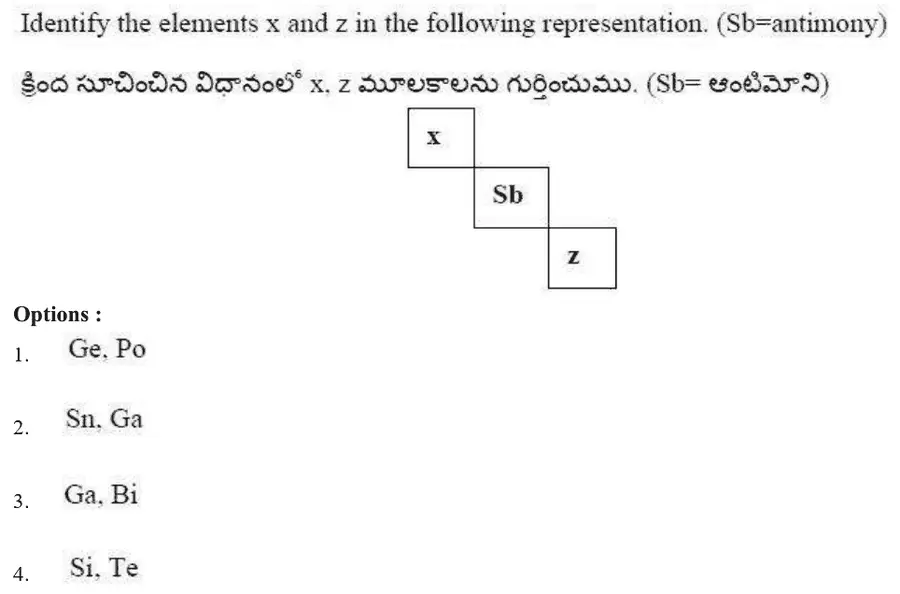
Identify the elements x and z in the following representation. (Sb=antimony)
(see the figure above)

The question and its figure as printed in AP EAPCET 2022 06th July 2022 Shift2.
The question as printed in the paper.
  • A

    Ge, Po

  • B

    Sn, Ga

  • C

    Ga, Bi

  • D

    Si, Te

120AP EAPCET 2022 · 6 Jul · Shift 2MCQOpen question page ↗

The successive ionization enthalpies of an element X in $(\mathrm{kJ\ mol^{-1}})$ are 1012, 1907, 2955, 4955, 6275 and 21, 260 respectively, the element X is

  • A

    C

  • B

    P

  • C

    S

  • D

    CI

121AP EAPCET 2022 · 5 Jul · Shift 1MCQOpen question page ↗

In which of the following, oxides of three elements X, Y and Z are correctly arranged in the increasing order of acidic nature. The electronic configurations of X, Y and Z are $[\mathrm{Ne}]3s^23p^1$, $[\mathrm{Ne}]3s^23p^5$, $[\mathrm{Ne}]3s^2$ respectively.

  • A

    X < Y < Z

  • B

    Y < Z < X

  • C

    Z < X < Y

  • D

    X < Z < Y

122AP EAPCET 2022 · 5 Jul · Shift 1MCQOpen question page ↗

Assertion (A): $16^{\mathrm{th}}$ group elements have higher ionization enthalpy values than $15^{\mathrm{th}}$ group elements in the corresponding periods.
Reason (R): $15^{\mathrm{th}}$ group elements have half-filled stable electronic configurations.

  • A

    Both (A) and (R) are correct and (R) is the correct explanation of (A).

  • B

    Both (A) and (R) are correct but (R) is not the correct explanation of (A).

  • C

    (A) is correct but (R) is incorrect.

  • D

    (A) is incorrect but (R) is correct.

123AP EAPCET 2022 · 5 Jul · Shift 1MCQOpen question page ↗

Assertion (A): Fluorine has smaller negative electron gain enthalpy than chlorine
Reason (R): The electron - electron repulsion is higher in chlorine than in fluorine

  • A

    Both (A) and (R) are correct and (R) is the correct explanation of (A).

  • B

    Both (A) and (R) are correct but (R) is not the correct explanation of (A).

  • C

    (A) is correct but (R) is incorrect.

  • D

    (A) is incorrect but (R) is correct.

124AP EAPCET 2022 · 5 Jul · Shift 2MCQOpen question page ↗

In which of the following, the elements Al, B, Mg and K are correctly arranged in the increasing order of their metallic character?

  • A

    $\mathrm{B} < \mathrm{Al} < \mathrm{Mg} < \mathrm{K}$

  • B

    $\mathrm{B} < \mathrm{Mg} < \mathrm{Al} < \mathrm{K}$

  • C

    $\mathrm{Al} < \mathrm{Mg} < \mathrm{K} < \mathrm{B}$

  • D

    $\mathrm{B} < \mathrm{Mg} < \mathrm{K} < \mathrm{Al}$

127AP EAPCET 2022 · 4 Jul · Shift 1MCQOpen question page ↗

Lithium shows diagonal relationship with element 'X' and aluminum with Y. X and Y respectively are

  • A

    Mg, Be

  • B

    Be, Mg

  • C

    Na, Si

  • D

    B, Be

128AP EAPCET 2022 · 4 Jul · Shift 1MCQOpen question page ↗

The correct order of the metallic character of the elements Be, Al, Na, K is

  • A

    K > Na > Al > Be

  • B

    K > Al > Na > Be

  • C

    Al > K > Na > Be

  • D

    Na > K > Be > Al

129AP EAPCET 2022 · 4 Jul · Shift 2MCQOpen question page ↗

In which of the following, elements are arranged in the correct order of their electron gain enthalpies.

  • A

    $\mathrm{F>S>O>N}$

  • B

    $\mathrm{F>O>S>N}$

  • C

    $\mathrm{F>O>N>S}$

  • D

    $\mathrm{F>N>O>S}$

130AP EAPCET 2022 · 4 Jul · Shift 2MCQOpen question page ↗

In second period of the long form of the periodic table an element X has second lowest first ionization enthalpy and element Y has second highest first ionization enthalpy values. What are X and Y?

  • A

    B, F

  • B

    Be, Ne

  • C

    Be, O

  • D

    C, O

131AP EAMCET 2021 · 5 Oct · Shift 1MCQOpen question page ↗

The decreasing order of shielding effect of orbitals is ________

  • A

    $f > d > p > s$

  • B

    $d > f > s > p$

  • C

    $p > s > f > d$

  • D

    $s > p > d > f$

132AP EAMCET 2021 · 5 Oct · Shift 1MCQOpen question page ↗

An element with high electronegativity has ______ (IE-Ionization Energy, EA- Electron Affinity)

  • A

    Low IE & High EA

  • B

    Low IE & Low EA

  • C

    High IE & Low EA

  • D

    High IE & High EA

133AP EAMCET 2021 · 5 Oct · Shift 1MCQOpen question page ↗

Identify the increasing order of ionization enthalpies of the group-14 elements.

  • A

    $Si < C < Ge < Sn < Pb$

  • B

    $Si < C < Ge < Pb < Sn$

  • C

    $Sn < Pb < Ge < Si < C$

  • D

    $Pb < Sn < Ge < Si < C$

134AP EAMCET 2021 · 25 Aug · Shift 1MCQOpen question page ↗

In the modern periodic table, the acidic nature of oxides ______

  • A

    Increases from left to right and decreases from top to bottom

  • B

    Decreases from right to left and increases from top to bottom

  • C

    Remains same across a period and increases from top to bottom

  • D

    Decreases from left to right and remains the same down the group

135AP EAMCET 2021 · 25 Aug · Shift 2MCQOpen question page ↗

The formation of oxide ion $\mathrm{O^{2-}}$ from oxygen atom requires an exothermic reaction, followed by an endothermic step as shown below. The process of formation of $\mathrm{O^{2-}}$ in gas phase is unfavorable ($\Delta H^{\ominus} = +ve$), even though it has stable configuration of the nearest noble gas, Neon. This is because ______
$\mathrm{O_{(g)} + e^- \rightarrow O^-_{(g)}}$ ; $\Delta H^{\ominus} = -141\ \mathrm{kJ.mol^{-1}}$
$\mathrm{O^-_{(g)} + e^- \rightarrow O^{2-}_{(g)}}$ ; $\Delta H^{\ominus} = +760\ \mathrm{kJ.mol^{-1}}$

  • A

    $\mathrm{O^{2-}}$ has larger size than that of Neon

  • B

    Oxygen is more electronegative than Neon

  • C

    $\mathrm{O^-}$ has larger size than oxygen atom

  • D

    Electron repulsion in oxide ion is more which over comes the stability achieved by noble gas configuration

136AP EAMCET 2021 · 25 Aug · Shift 2MCQOpen question page ↗

Identify the correct order of ionic radii of the given species:

  • A

    $\mathrm{Mn^{7+} > V^{5+} > Sc^{3+} > K^+ > S^{2-}}$

  • B

    $\mathrm{S^{2-} > K^+ > Sc^{3+} > V^{5+} > Mn^{7+}}$

  • C

    $\mathrm{S^{2-} > K^+ > V^{5+} > Sc^{3+} > Mn^{7+}}$

  • D

    $\mathrm{K^+ > S^{2-} > Sc^{3+} > V^{5+} > Mn^{7+}}$

137AP EAMCET 2021 · 24 Aug · Shift 1MCQOpen question page ↗

Which of the following sequences is the correct order of the size of species?

  • A

    $I > I^{+} > I^{-}$

  • B

    $I^{-} > I^{+} > I^{-}$ (sic)

  • C

    $I^{+} > I^{-} > I^{-}$ (sic)

  • D

    $I^{-} > I > I^{+}$

138AP EAMCET 2021 · 24 Aug · Shift 1MCQOpen question page ↗

If the successive ionization energies of an element $A$ are 165, 190, 550 and 595 $\mathrm{kcal}$, respectively, then the ground state electronic configuration of element $A$ is ______

  • A

    $[\mathrm{Ne}]\ 3s^2\ 3p^2$

  • B

    $[\mathrm{He}]\ 2s^1$

  • C

    $[\mathrm{He}]\ 2s^2\ 2p^2$

  • D

    $[\mathrm{Ne}]\ 3s^2$

139AP EAMCET 2021 · 24 Aug · Shift 1MCQOpen question page ↗

How many oxides among the following are basic in nature?
$\mathrm{As_2O_3}$, $\mathrm{Na_2O}$, $\mathrm{MgO}$, $\mathrm{Mn_2O_3}$, $\mathrm{CaO}$, $\mathrm{ZnO}$, $\mathrm{N_2O}$, $\mathrm{N_2O_5}$

  • A

    4

  • B

    5

  • C

    3

  • D

    6

141AP EAMCET 2021 · 24 Aug · Shift 2MCQOpen question page ↗

Identify the incorrect order corresponding the mentioned property?

  • A

    $Al_2O_3 < MgO < Na_2O < K_2O$ : Basicity

  • B

    $NH_3 < PH_3 < AsH_3$ : Acidity

  • C

    $Li^+ < Na^+ < K^+ < Cs^+$ : Ionic radius

  • D

    $Li < Be < B < C$ : First Ionization enthalpy

142AP EAMCET 2021 · 23 Aug · Shift 1MCQOpen question page ↗

The ions $\mathrm{S^{2-}}, \mathrm{Cl^-}, \mathrm{K^+}, \mathrm{Ca^{2+}}$ are iso-electronic. Their ionic radii show ______

  • A

    a decrease from $\mathrm{S^{2-}}$ to $\mathrm{Cl^-}$ and then increase from $\mathrm{K^+}$ to $\mathrm{Ca^{2+}}$

  • B

    an increase from $\mathrm{S^{2-}}$ to $\mathrm{Cl^-}$ and then decrease from $\mathrm{K^+}$ to $\mathrm{Ca^{2+}}$

  • C

    a significant decrease from $\mathrm{S^{2-}}$ to $\mathrm{Ca^{2+}}$

  • D

    a significant increase from $\mathrm{S^{2-}}$ to $\mathrm{Ca^{2+}}$

143AP EAMCET 2021 · 23 Aug · Shift 1MCQOpen question page ↗

Which among the following iso-electronic species has the smallest size?
$\mathrm{O^{2-}}, \mathrm{F^-}, \mathrm{Ne}, \mathrm{Na^+}, \mathrm{Mg^{2+}}, \mathrm{Al^{3+}}, \mathrm{Si^{4+}}$

  • A

    $\mathrm{F^-}$

  • B

    $\mathrm{Ne}$

  • C

    $\mathrm{Si^{4+}}$

  • D

    $\mathrm{Na^+}$

144AP EAMCET 2021 · 23 Aug · Shift 1MCQOpen question page ↗

Assertion (A): The first ionization energy of Be is greater than that of B.
Reason (R): $2p$ orbital has lower energy than $2s$ orbital.

  • A

    Both A and R are true and R is a correct explanation for A

  • B

    Both A and R are true but R is not a correct explanation for A

  • C

    A is true, R is false

  • D

    A is false, R is true

145AP EAMCET 2021 · 23 Aug · Shift 2MCQOpen question page ↗

Arrange N, S, O & F in order of decreasing electron gain enthalpy

  • A

    $F > S > O > N$

  • B

    $N > O > S > F$

  • C

    $O > S > F > N$

  • D

    $S > O > N > F$

146AP EAMCET 2021 · 23 Aug · Shift 2MCQOpen question page ↗

Which of the following statement is incorrect?

  • A

    A cation is smaller than an anion if they are isoelectronic

  • B

    Out of $P^{3-}$, $S^{2-}$ & $Cl^-$, $Cl^-$ ion is larger in size

  • C

    All transition elements are metals

  • D

    The ionic radii of lanthanoids in trivalent state decrease with increasing atomic numbers.

147AP EAMCET 2021 · 23 Aug · Shift 2MCQOpen question page ↗

Which element among the following is most probable to have the following values?
$\Delta_i H_1 = 419\ kJ\ mol^{-1}$
$\Delta_i H_2 = 3051\ kJ\ mol^{-1}$
$\Delta_{eg}H = -48\ kJ\ mol^{-1}$

  • A

    $Al$

  • B

    $K$

  • C

    $S$

  • D

    $Cl$

148AP EAMCET 2021 · 20 Aug · Shift 1MCQOpen question page ↗

The correct order of electronegativity of carbon in various hybridization states:

  • A

    $sp < sp^2 < sp^3$

  • B

    $sp > sp^2 > sp^3$

  • C

    $sp^2 > sp < sp^3$

  • D

    $sp = sp^2 < sp^3$

149AP EAMCET 2021 · 20 Aug · Shift 2MCQOpen question page ↗

The electronegativity of the given elements increases in the order ______

  • A

    $C,\ N,\ Si,\ P$

  • B

    $N,\ Si,\ C,\ P$

  • C

    $Si,\ P,\ C,\ N$

  • D

    $P,\ Si,\ N,\ C$

150AP EAMCET 2021 · 20 Aug · Shift 2MCQOpen question page ↗

The first ionization enthalpies of $Mg$ and $Al$ can be expected to be ______

  • A

    $\mathrm{IE}_1\ (Mg) = 577.5\ kJ.mol^{-1},\ \mathrm{IE}_1\ (Al) = 577.5\ kJ.mol^{-1}$

  • B

    $\mathrm{IE}_1\ (Mg) = 577.5\ kJ.mol^{-1},\ \mathrm{IE}_1\ (Al) = 737.7\ kJ.mol^{-1}$

  • C

    $\mathrm{IE}_1\ (Mg) = 737.7\ kJ.mol^{-1},\ \mathrm{IE}_1\ (Al) = 737.7\ kJ.mol^{-1}$

  • D

    $\mathrm{IE}_1\ (Mg) = 737.7\ kJ.mol^{-1},\ \mathrm{IE}_1\ (Al) = 577.5\ kJ.mol^{-1}$

151AP EAMCET 2021 · 20 Aug · Shift 2MCQOpen question page ↗

How many of the following statements is/are correct?
a) Mercury is the only metal that exists as liquid at room temperature.
b) Among non-metals, carbon has the highest melting point.
c) Hydrogen is the most abundant element in the universe.
d) Oxygen is the most abundant element in the earth's crust.

  • A

    1

  • B

    2

  • C

    3

  • D

    4

152AP EAMCET 2021 · 19 Aug · Shift 1MCQOpen question page ↗

To which group of the periodic table does an element having electronic configuration $[\mathrm{Ar}]\ 3d^5 4s^2$ belong?

  • A

    Second

  • B

    Fourth

  • C

    Seventh

  • D

    Third

153AP EAMCET 2021 · 19 Aug · Shift 1MCQOpen question page ↗

Given that ionization potential and electron gain enthalpy of chlorine are $13\ eV$ and $4\ eV$ respectively. The electronegativity of chlorine on Mulliken scale, approximately equals to

  • A

    $8.5\ eV$

  • B

    $6.0\ eV$

  • C

    $3.0\ eV$

  • D

    $1.5\ eV$

154AP EAMCET 2021 · 19 Aug · Shift 1MCQOpen question page ↗

Which of the following represents the correct order of increasing electron gain enthalpy with negative sign for the elements?
a. Nitrogen
b. Phosphorous
c. Chlorine
d. Fluorine

  • A

    $\mathrm{P} < \mathrm{N} < \mathrm{F} < \mathrm{Cl}$

  • B

    $\mathrm{N} < \mathrm{P} < \mathrm{F} < \mathrm{Cl}$

  • C

    $\mathrm{Cl} < \mathrm{F} < \mathrm{P} < \mathrm{N}$

  • D

    $\mathrm{F} < \mathrm{Cl} < \mathrm{N} < \mathrm{P}$

155AP EAMCET 2021 · 19 Aug · Shift 2MCQOpen question page ↗

The element with outer electronic configuration $(n-1)d^2\,ns^2$, where $n = 4$, would belong to ______

  • A

    $2^{nd}$ period, $2^{nd}$ group

  • B

    $4^{th}$ period, $4^{th}$ group

  • C

    $4^{th}$ period, $2^{nd}$ group

  • D

    $2^{nd}$ period, $4^{th}$ group

156AP EAMCET 2021 · 19 Aug · Shift 2MCQOpen question page ↗

Choose the correct option regarding the following statements:
Statement-1: Nitrogen has lesser electron gain enthalpy than oxygen.
Statement-2: Oxygen has lesser ionization enthalpy than nitrogen.

  • A

    Statement-1 is correct, Statement-2 is wrong

  • B

    Both statements 1 and 2 are wrong

  • C

    Both statements 1 and 2 are correct

  • D

    Statement-1 is wrong, Statement-2 is correct

157AP EAMCET 2021 · 19 Aug · Shift 2MCQOpen question page ↗

Among the given configurations, identify the element which doesn't belong to the same family as the others?

  • A

    $[\mathrm{Ne}]\,3s^2\,2p^5$

  • B

    $[\mathrm{Ar}]\,3d^{10}\,4s^2$

  • C

    $[\mathrm{Kr}]\,4d^{10}\,5s^2$

  • D

    $[\mathrm{Xe}]\,4f^{14}\,5d^{10}\,4s^2$

158TS EAMCET 2021 · 6 Aug · Shift 1MCQOpen question page ↗

Which of the following is not a periodic property?

  • A

    Atomic size

  • B

    Electron affinity

  • C

    Radioactivity

  • D

    Ionisation potential

159TS EAMCET 2021 · 6 Aug · Shift 1MCQOpen question page ↗

Which of the following options represents the correct ionic radii in $\mathrm{\AA}$ of $\mathrm{N^{3-}}$, $\mathrm{O^{2-}}$ and $\mathrm{F^-}$, respectively?

  • A

    1.71, 1.36 and 1.40

  • B

    1.36, 1.40 and 1.71

  • C

    1.71, 1.40 and 1.36

  • D

    1.40, 1.36 and 1.71

160TS EAMCET 2021 · 6 Aug · Shift 2MCQOpen question page ↗

How many of the following oxides are amphoteric? $\mathrm{BeO;\ ZnO;\ Sb_2O_3;\ CO;\ CaO;\ SO_2;\ SO_3}$

  • A

    2

  • B

    3

  • C

    4

  • D

    5

162TS EAMCET 2021 · 6 Aug · Shift 2MCQOpen question page ↗

The electronegativity order of the following elements is

  • A

    $\mathrm{N>S>Te>I}$

  • B

    $\mathrm{I>N>S>Te}$

  • C

    $\mathrm{N>I>S>Te}$

  • D

    $\mathrm{N>S>I>Te}$

163TS EAMCET 2021 · 5 Aug · Shift 1MCQOpen question page ↗

Starting from the $1^{st}$, the successive ionization potentials of an element are respectively 5.98, 18.8, 28.4, 120.1, 154 eV. The element is

  • A

    B

  • B

    Al

  • C

    P

  • D

    Mg

164TS EAMCET 2021 · 5 Aug · Shift 2MCQOpen question page ↗

The correct increasing order of the electronegativity is

  • A

    B < C < S < Cl

  • B

    B < S < C < Cl

  • C

    B < C < Cl < S

  • D

    C < B < S < Cl

165TS EAMCET 2021 · 5 Aug · Shift 2MCQOpen question page ↗

Which one of the following oxide dissolves in both hydrochloric acid and sodium hydroxide?

  • A

    $\mathrm{MgO}$

  • B

    $\mathrm{Na_2O}$

  • C

    $\mathrm{Al_2O_3}$

  • D

    $\mathrm{BaO}$

168TS EAMCET 2021 · 4 Aug · Shift 1MCQOpen question page ↗

The set of amphoteric oxides among the given oxides are
$\mathrm{Ga_2O_3}$, $\mathrm{As_4O_{10}}$, $\mathrm{Sb_4O_{10}}$, $\mathrm{B_2O_3}$, $\mathrm{Tl_2O}$

  • A

    $\mathrm{Tl_2O}$, $\mathrm{B_2O_3}$

  • B

    $\mathrm{Sb_4O_{10}}$, $\mathrm{B_2O_3}$, $\mathrm{Ga_2O_3}$

  • C

    $\mathrm{Ga_2O_3}$, $\mathrm{Tl_2O}$, $\mathrm{As_4O_{10}}$

  • D

    $\mathrm{Ga_2O_3}$, $\mathrm{As_4O_{10}}$, $\mathrm{Sb_4O_{10}}$

169TS EAMCET 2021 · 4 Aug · Shift 1MCQOpen question page ↗

The first ionisation energies (in $\mathrm{kJ\ mol^{-1}}$) of four consecutive elements of the second period are given in the options. The first ionisation energy of nitrogen is

  • A

    1086

  • B

    1402

  • C

    1681

  • D

    1314

170AP EAMCET 2020 · 7 Oct · Shift 1MCQOpen question page ↗

Which among the following is the possible electronic configuration of an element 'X' having first and second ionization enthalpy values as $520\ kJ.mol^{-1}$ and $7300\ kJ.mol^{-1}$ respectively

  • A

    $1s^2\,2s^2\,2p^1$

  • B

    $1s^2\,2s^2\,2p^3$

  • C

    $1s^2\,2s^2\,2p^6\,3s^1$

  • D

    $1s^2\,2s^2\,2p^6\,3s^2\,3p^2$

171AP EAMCET 2020 · 23 Sep · Shift 1MCQOpen question page ↗

Which of the following arrangements is correct regarding the three types of radii of an atom?

  • A

    Metallic radius < Covalent radius < Vander wall's radius

  • B

    Covalent radius < Metallic radius < Vander wall's radius

  • C

    Vander wall's radius < Metallic radius < Covalent radius

  • D

    Metallic radius < Covalent radius > Vander wall's radius

172AP EAMCET 2020 · 23 Sep · Shift 1MCQOpen question page ↗

Match the following elements, given as hints to their first, second ionisation enthalpies and electron gain enthalpies.
Elements | $\Delta H_1$ | $\Delta H_2$ | $\Delta_{eg}H$
i. Most reactive non metal
ii. Most reactive metal
iii. Least reactive element
iv. Metal forming binary halide
A. 419, 3051, $-48$
B. 1681, 3374, $-328$
C. 738, 1451, $-40$
D. 2372, 5251, $+48$

  • A

    (i - B), (ii - A), (iii - D), (iv - C)

  • B

    (i - A), (ii - B), (iii - D), (iv - C)

  • C

    (i - B), (ii - A), (iii - C), (iv - D)

  • D

    (i - B), (ii - D), (iii - A), (iv - C)

174AP EAMCET 2020 · 22 Sep · Shift 1MCQOpen question page ↗

Arrange $\mathrm{Li, Be, B}$ and $\mathrm{C}$ in decreasing order of their first ionization enthalpies

  • A

    $\mathrm{Li > B > Be > C}$

  • B

    $\mathrm{C > Li > Be > B}$

  • C

    $\mathrm{C > Be > B > Li}$

  • D

    $\mathrm{C > B > Be > Li}$

175AP EAMCET 2020 · 22 Sep · Shift 1MCQOpen question page ↗

The order of screening effect among $s, p, d$ and $f$ orbitals of a given shell of an atom, in its outer shell electrons is:

  • A

    $s > p > d > f$

  • B

    $f > d > p > s$

  • C

    $p < d < s > f$

  • D

    $d > f > p > s$

176AP EAMCET 2020 · 22 Sep · Shift 1MCQOpen question page ↗

In which of the following options order of arrangement does not agree with the variation of property indicated against it?

  • A

    $\mathrm{Al^{3+} < Mg^{2+} < Na^{+} < F^{-}}$ (increasing ionic size)

  • B

    $\mathrm{B < C < O < N}$ (increasing first ionization enthalpy)

  • C

    $\mathrm{I < Br < Cl < F}$ (increasing electron gain enthalpy)

  • D

    $\mathrm{Li < Na < K < Rb}$ (increasing metallic radius)

178AP EAMCET 2020 · 21 Sep · Shift 1MCQOpen question page ↗

Calculate the energy required to convert all atoms in 4.8 g of $\mathrm{Mg}$ to $\mathrm{Mg^{2+}}$ in the vapor state. $IE_1$ and $IE_2$ of Mg are 740 kJ/mol and 1450 kJ/mol respectively.

  • A

    $+740$ kJ/mol

  • B

    $-740$ kJ/mol

  • C

    $-1450$ kJ/mol

  • D

    $+438$ kJ/mol

179AP EAMCET 2020 · 21 Sep · Shift 1MCQOpen question page ↗

The number of elements among $\mathrm{O, Cl, F, N, P, Sn, Ti, K, Sc}$ which show more than one non-zero oxidation state is

  • A

    2

  • B

    3

  • C

    6

  • D

    8

180AP EAMCET 2020 · 21 Sep · Shift 1MCQOpen question page ↗

The second ionization energies of Li, Be, B and C are in the order ______

  • A

    Li $>$ C $>$ B $>$ Be

  • B

    Li $>$ B $>$ C $>$ Be

  • C

    Be $>$ C $>$ B $>$ Li

  • D

    B $>$ C $>$ Be $>$ Li

181AP EAMCET 2020 · 21 Sep · Shift 2MCQOpen question page ↗

Find the correct order of the given elements with respect to their size

  • A

    $\mathrm{Zn} > \mathrm{Fe} > \mathrm{Fe^{2+}} > \mathrm{Fe^{3+}}$

  • B

    $\mathrm{Fe^{3+}} > \mathrm{Fe^{2+}} > \mathrm{Zn} > \mathrm{Fe}$

  • C

    $\mathrm{Fe} > \mathrm{Fe^{2+}} > \mathrm{Fe^{3+}} > \mathrm{Zn}$

  • D

    $\mathrm{Zn} > \mathrm{Fe^{3+}} > \mathrm{Fe^{2+}} > \mathrm{Fe}$

182AP EAMCET 2020 · 18 Sep · Shift 1MCQOpen question page ↗

Which of the following statements is correct about "shielding effect"?
A) It is effective when the orbitals in the inner shells are completely filled
B) Inner shells do not show any effect
C) With increase of shielding down the group, ionization energy increases
D) With increasing nuclear charge, the shielding effect increases

  • A

    A

  • B

    B

  • C

    C

  • D

    D

183AP EAMCET 2020 · 17 Sep · Shift 1MCQOpen question page ↗

Choose the smallest ion from the following

  • A

    $\mathrm{Mg^{2+}}$

  • B

    $\mathrm{S^{2-}}$

  • C

    $\mathrm{Na^{+}}$

  • D

    $\mathrm{Cl^{-}}$

184AP EAMCET 2020 · 17 Sep · Shift 1MCQOpen question page ↗

Assertion (A): Boron has a smaller first ionization enthalpy than beryllium.
Reason (R): The penetration of a 2s electron to the nucleus is more than the 2p electron hence 2p electron is more shielded by the inner core of electrons than the 2s electrons.

  • A

    Assertion and reason both are correct statements but reason is not correct explanation for assertion.

  • B

    Assertion is correct statement but reason is wrong statement.

  • C

    Assertion and reason both are correct statements and reason is correct explanation for assertion.

  • D

    Assertion and reason both are wrong statements.

185AP EAMCET 2020 · 17 Sep · Shift 1MCQOpen question page ↗

"The properties of elements are periodic functions of their atomic weights." This periodic law was given by

  • A

    Dobereiner

  • B

    Lothar Meyer

  • C

    Mendeleev

  • D

    Alexander

186AP EAMCET 2020 · 17 Sep · Shift 2MCQOpen question page ↗

How many compounds given below are amphoteric oxides?
$\mathrm{P_2O_5}$, $\mathrm{P_4O_6}$, $\mathrm{As_2O_5}$, $\mathrm{As_4O_6}$, $\mathrm{Sb_2O_5}$, $\mathrm{Sb_4O_6}$, $\mathrm{Bi_2O_3}$

  • A

    2

  • B

    3

  • C

    4

  • D

    6

187TS EAMCET 2020 · 14 Sep · Shift 1MCQOpen question page ↗

What is the correct order of atomic radius of Al, Na, B and Be ?

  • A

    Be < Na < Al < B

  • B

    B < Be < Al < Na

  • C

    Al < Be < B < Na

  • D

    Na < Al < B < Be

188TS EAMCET 2020 · 14 Sep · Shift 2MCQOpen question page ↗

Arrange the following ions in the correct order with respect to their ionic radii.

  • A

    $\mathrm{Br^-} > \mathrm{Cl^-} > \mathrm{Na^+} > \mathrm{Be^{2+}}$

  • B

    $\mathrm{Be^{2+}} > \mathrm{Na^+} > \mathrm{Cl^-} > \mathrm{Br^-}$

  • C

    $\mathrm{Cl^-} > \mathrm{Br^-} > \mathrm{Na^+} > \mathrm{Be^{2+}}$

  • D

    $\mathrm{Na^+} > \mathrm{Be^{2+}} > \mathrm{Br^-} > \mathrm{Cl^-}$

189TS EAMCET 2020 · 11 Sep · Shift 1MCQOpen question page ↗

Among the following, the pair of elements having same electronegativity values are
(i) H and P (ii) Be and Al (iii) N and Cl (iv) C and P

  • A

    (i), (ii) and (iii) only

  • B

    (i), (iii) and (iv) only

  • C

    (ii), (iii) and (iv) only

  • D

    (i), (ii), (iii) and (iv)

190TS EAMCET 2020 · 11 Sep · Shift 2MCQOpen question page ↗

The basic difference in approach between Mendeleev's periodic law and modern periodic law is the change on the basis of classification of elements from ______

  • A

    atomic number to atomic weight

  • B

    atomic weight to atomic number

  • C

    neutron number to atomic weight

  • D

    electron number to atomic number

192TS EAMCET 2020 · 10 Sep · Shift 1MCQOpen question page ↗

Assertion (A) : $\mathrm{Mg^{2+}}$ and $\mathrm{Al^{3+}}$ are isoelectronic but the magnitude of ionic radius of $\mathrm{Al^{3+}}$ is less than that in $\mathrm{Mg^{2+}}$
Reason (R) : The effective nuclear charge on the outermost electrons in $\mathrm{Al^{3+}}$ is greater than that in $\mathrm{Mg^{2+}}$
The correct option among the following is

  • A

    (A) is true, (R) is true and (R) is the correct explanation for (A)

  • B

    (A) is true, (R) is true but (R) is the not the correct explanation for A (sic)

  • C

    (A) is true but (R) is false

  • D

    (A) is false but (R) is true

193TS EAMCET 2020 · 10 Sep · Shift 1MCQOpen question page ↗

The successive ionisation energy values for an element 'X' are given below
i) 1st ionisation energy = 410 $\mathrm{kJ\,mol^{-1}}$
ii) 2nd ionisation energy = 820 $\mathrm{kJ\,mol^{-1}}$
iii) 3rd ionisation energy = 1100 $\mathrm{kJ\,mol^{-1}}$
iv) 4th ionisation energy = 1500 $\mathrm{kJ\,mol^{-1}}$
v) 5th ionisation energy = 3200 $\mathrm{kJ\,mol^{-1}}$
The number of valence electrons in the atom 'X' is

  • A

    5

  • B

    4

  • C

    2

  • D

    3

194TS EAMCET 2020 · 10 Sep · Shift 2MCQOpen question page ↗

Based on the quantum numbers, what will be the maximum number of elements for sixth period of the periodic table?

  • A

    22

  • B

    30

  • C

    32

  • D

    34

195TS EAMCET 2020 · 9 Sep · Shift 1MCQOpen question page ↗

What will be the IUPAC symbol and name for the element with atomic number 123?

  • A

    Unt and Unniltrium

  • B

    Ubq and Unbiquadium

  • C

    Ubt and Unbitrium

  • D

    Unb and Unnilbium

197TS EAMCET 2019 · 6 May · Shift 1MCQOpen question page ↗

Which one among the following statements is/are not correct?
a) Ba compounds, generally are more covalent than Be compounds
b) The electron gain enthalpy of He is positive
c) The oxidation state of O in $\mathrm{OF_2}$ and $\mathrm{Na_2O}$ are same
d) The radius of $\mathrm{Na^+}$ ion is smaller than that of $\mathrm{F^-}$ ion

  • A

    a, c, d

  • B

    b

  • C

    b, c, d

  • D

    a, c

198TS EAMCET 2019 · 4 May · Shift 1MCQOpen question page ↗

The reason for a cation to be smaller than its parent atom is

  • A

    Repulsion between the electrons of outer orbit.

  • B

    Increased electrostatic attraction between nucleus and electrons.

  • C

    Increase in the mass of the cation compared to neutral atom.

  • D

    Change in the number of protons of cation compared to neutral atom.

199TS EAMCET 2019 · 4 May · Shift 1MCQOpen question page ↗

Arrange the following in the decreasing order of radius:
$\mathrm{S^{2-}}, \mathrm{P^{3-}}, \mathrm{Cl^{-}}, \mathrm{Ca^{2+}}, \mathrm{Ar}, \mathrm{K^{+}}$

  • A

    $\mathrm{P^{3-} > S^{2-} > Cl^{-} > Ar > K^{+} > Ca^{2+}}$

  • B

    $\mathrm{Cl^{-} > P^{3-} > S^{2-} > Ar > K^{+} > Ca^{2+}}$

  • C

    $\mathrm{Ar > P^{3-} > S^{2-} > Cl^{-} > Ca^{2+} > K^{+}}$

  • D

    $\mathrm{K^{+} > Ca^{2+} > Cl^{-} > S^{2-} > P^{3-} > Ar}$

200TS EAMCET 2019 · 4 May · Shift 2MCQOpen question page ↗

Identify the correct order of ionic radii of the following ions

  • A

    $\mathrm{Al^{3+}} > \mathrm{K^{+}} > \mathrm{Mg^{2+}} > \mathrm{Li^{+}}$

  • B

    $\mathrm{K^{+}} > \mathrm{Mg^{2+}} > \mathrm{Al^{3+}} > \mathrm{Li^{+}}$

  • C

    $\mathrm{K^{+}} > \mathrm{Li^{+}} > \mathrm{Mg^{2+}} > \mathrm{Al^{3+}}$

  • D

    $\mathrm{K^{+}} > \mathrm{Mg^{2+}} > \mathrm{Li^{+}} > \mathrm{Al^{3+}}$

201TS EAMCET 2019 · 4 May · Shift 2MCQOpen question page ↗

The elements with highest and lowest electron gain enthalpy in group 16 respectively are

  • A

    O ; Te

  • B

    O ; Po

  • C

    S ; O

  • D

    S ; Te

203TS EAMCET 2019 · 3 May · Shift 2MCQOpen question page ↗

Among the isoelectronic ions ($\mathrm{O^{2-}}$, $\mathrm{N^{3-}}$, $\mathrm{Mg^{2+}}$, $\mathrm{Na^+}$), the ions with least and highest ionic radius are respectively

  • A

    $\mathrm{Mg^{2+}}$, $\mathrm{N^{3-}}$

  • B

    $\mathrm{Mg^{2+}}$, $\mathrm{O^{2-}}$

  • C

    $\mathrm{Na^{+}}$, $\mathrm{N^{3-}}$

  • D

    $\mathrm{Na^{+}}$, $\mathrm{O^{2-}}$

204AP EAMCET 2019 · 22 Apr · Shift 2MCQOpen question page ↗

X and Y are two elements which form oxides of the type $\mathrm{XO_3}$ and $\mathrm{Y_2O_5}$ with highest oxygen content. Identify the group numbers to which X and Y belongs

  • A

    13, 15

  • B

    16, 15

  • C

    13, 17

  • D

    16, 17

205AP EAMCET 2019 · 21 Apr · Shift 1MCQOpen question page ↗

If four elements with atomic numbers $Z-2$, $Z-1$, $Z$ and $Z+1$ are forming isoelectronic ions, the atomic number of the ion having largest size is

  • A

    $Z-2$

  • B

    $Z-1$

  • C

    $Z$

  • D

    $Z+1$

206AP EAMCET 2019 · 21 Apr · Shift 2MCQOpen question page ↗

The electron gain enthalpy $\Delta_{eg}H$ of $\mathrm{Cl(g)}$ is $-349\ \mathrm{kJ\ mol^{-1}}$. If the ground state energy of $\mathrm{Cl(g)}$ is $x\ \mathrm{kJ\ mol^{-1}}$, the ground state energy (in $\mathrm{kJ\ mol^{-1}}$) of $\mathrm{Cl^-(g)}$ is

  • A

    $x+349$

  • B

    $x$

  • C

    $x-349$

  • D

    $\dfrac{x-349}{17}$

207AP EAMCET 2019 · 20 Apr · Shift 1MCQOpen question page ↗

In which of the following the electron gain enthalpy of elements is correctly arranged?

  • A

    S > Se > Te > O

  • B

    F > Cl > Br > I

  • C

    Na > Li > K > Rb

  • D

    O > S > Se > Te

208AP EAMCET 2019 · 20 Apr · Shift 1MCQOpen question page ↗

Identify the set of acidic oxides.

  • A

    $\mathrm{Na_2O, CaO, BaO}$

  • B

    $\mathrm{ZnO, PbO, BeO}$

  • C

    $\mathrm{CO, NO, N_2O}$

  • D

    $\mathrm{Mn_2O_7, CrO_3, V_2O_5}$

209AP EAMCET 2019 · 20 Apr · Shift 2MCQOpen question page ↗

Which of the following statements are correct for classification of elements?
I) The properties of elements are periodic functions of their atomic numbers
II) Non metallic elements are less in number than the metallic elements
III) The first ionisation energies of elements along a period do not vary in a regular manner
IV) The ground state electronic configuration of Pd (Z = 46) is $[\mathrm{Kr}]4d^8 5s^2$

  • A

    I, II, III, IV

  • B

    I, II, III only

  • C

    II, III, IV only

  • D

    I, II, IV only

210TS EAMCET 2018 · 7 May · Shift 1MCQOpen question page ↗

Which of the following are correct?
a) First ionization enthalpy of He < Second ionization enthalpy of Li
b) Li has the highest second ionization enthalpy
c) All d-block elements are transition elements
d) The only alphabet not found in the periodic table is the letter 'J'
e) Francium concentration is ~$10^{-18}$ ppm on Earth

  • A

    a, b, d

  • B

    a, b, d, e

  • C

    a, b, e

  • D

    d, e

211TS EAMCET 2018 · 7 May · Shift 1MCQOpen question page ↗

The correct increasing order of ionisation enthalpy of He, $\mathrm{Li^+}$, $\mathrm{Be^{2+}}$ is

  • A

    $\mathrm{He < Li^+ < Be^{2+}}$

  • B

    $\mathrm{Be^{2+} < Li^+ < He}$

  • C

    $\mathrm{Li^+ < Be^{2+} < He}$

  • D

    $\mathrm{Be^{2+} < He < Li^+}$

212TS EAMCET 2018 · 5 May · Shift 1MCQOpen question page ↗

The correct option for the first ionization enthalpy (in $\mathrm{kJ\ mol^{-1}}$) of Li, Na, K and Cs respectively is

  • A

    496, 520, 419, 374

  • B

    374, 419, 496, 520

  • C

    520, 496, 419, 374

  • D

    374, 419, 520, 496

213TS EAMCET 2018 · 5 May · Shift 2MCQOpen question page ↗

What is the correct order of atomic/ionic size for

  • A

    $\mathrm{Cu^+ < Cu < Zn^{2+} < Ag}$

  • B

    $\mathrm{Zn^{2+} < Cu^+ < Cu < Ag}$

  • C

    $\mathrm{Ag < Cu < Cu^+ < Zn^{2+}}$

  • D

    $\mathrm{Cu^+ < Zn^{2+} < Cu < Ag}$

214TS EAMCET 2018 · 4 May · Shift 1MCQOpen question page ↗

Covalent bond length of chlorine molecule is 1.98 Å. Covalent radius (in Å) of chlorine atom is

  • A

    1.98

  • B

    0.99

  • C

    3.96

  • D

    0.49

216TS EAMCET 2018 · 4 May · Shift 2MCQOpen question page ↗

Statement (a) : $\mathrm{Na_2O} < \mathrm{MgO} < \mathrm{ZnO} < \mathrm{P_4O_{16}}$ - Acidic property
Statement (b) : $\mathrm{F} > \mathrm{Cl} > \mathrm{Br}$ - Electron gain enthalpy
Statement (c) : $\mathrm{M^{2-}} > \mathrm{M^{-}} > \mathrm{M^{+}} > \mathrm{M^{2+}}$ - ionic size
Statement (d) : The second ionisation enthalpy of Cu is more than second ionisation enthalpy of K.
Which of the following is the correct representation of True (T) / False (F) for the given statements

  • A

    (a) T, (b) T, (c) F, (d) F

  • B

    (a) F, (b) T, (c) F, (d) T

  • C

    (a) F, (b) F, (c) F, (d) T

  • D

    (a) T, (b) F, (c) T, (d) F

217AP EAMCET 2018 · 23 Apr · Shift 2MCQOpen question page ↗

Identify the correct statements from the following.
i. In the periodic table, about 78% of elements are metals.
ii. In a group, the metallic character decreases from top to bottom and in a period the non-metallic character decreases from left to right.
iii. The element Ho belongs to f-block.

  • A

    i, ii, iii

  • B

    ii, iii

  • C

    i, iii

  • D

    i, ii

218AP EAMCET 2018 · 23 Apr · Shift 2MCQOpen question page ↗

Identify the statements which are not correct.
i. ZnO, PbO, $\mathrm{Sb_2O_3}$ are neutral oxides.
ii. CO and NO are amphoteric oxides.
iii. $\mathrm{CrO_3}$, $\mathrm{Mn_2O_7}$, $\mathrm{V_2O_5}$ are basic oxides.

  • A

    i, ii

  • B

    i, iii

  • C

    ii, iii

  • D

    i, ii, iii

219AP EAMCET 2018 · 22 Apr · Shift 1MCQOpen question page ↗

To which group and period does the element belong if the electronic configuration of an element in its $-2$ oxidation state is $1s^22s^22p^63s^23p^6$?

  • A

    period 3 , group 16

  • B

    period 3 , group 17

  • C

    period 4 , group 16

  • D

    period 4 , group 17

220AP EAMCET 2018 · 22 Apr · Shift 2MCQOpen question page ↗

Which of the following represents the correct order of ionic radii?

  • A

    $\mathrm{Al^{3+}>Mg^{2+}>Na^{+}>O^{2-}>F^{-}}$

  • B

    $\mathrm{O^{2-}>F^{-}>Na^{+}>Mg^{2+}>Al^{3+}}$

  • C

    $\mathrm{Mg^{2+}>Al^{3+}>O^{2-}>F^{-}>Na^{+}}$

  • D

    $\mathrm{O^{2-}>F^{-}>Al^{3+}>Mg^{2+}>Na^{+}}$

221TS EAMCET 2017 · 12 May · OfflineMCQOpen question page ↗

Which of the following is the most basic oxide?

  • A

    $\mathrm{SO_3}$

  • B

    $\mathrm{SeO_3}$

  • C

    $\mathrm{PoO}$

  • D

    $\mathrm{TeO}$

222TS EAMCET 2017 · 12 May · OfflineMCQOpen question page ↗

Atomic radius (pm) of Al, Si, N and F respectively is

  • A

    117, 143, 64, 74

  • B

    143, 117, 74, 64

  • C

    143, 47, 64, 74

  • D

    64, 74, 117, 143

223TS EAMCET 2017 · 12 May · OfflineMCQOpen question page ↗

The set representing the right order of ionic radius is

  • A

    $\mathrm{Li^+} > \mathrm{Na^+} > \mathrm{Mg^{2+}} > \mathrm{Be^{2+}}$

  • B

    $\mathrm{Mg^{2+}} > \mathrm{Be^{2+}} > \mathrm{Li^+} > \mathrm{Na^+}$

  • C

    $\mathrm{Na^+} > \mathrm{Mg^{2+}} > \mathrm{Li^+} > \mathrm{Be^{2+}}$

  • D

    $\mathrm{Na^+} > \mathrm{Li^+} > \mathrm{Mg^{2+}} > \mathrm{Be^{2+}}$

224AP EAMCET 2017 · 26 Apr · Shift 1MCQOpen question page ↗

Assertion (A) : $\mathrm{Na^+}$ and $\mathrm{Mg^{2+}}$ ions are isoelectronic but the ionic radius of $\mathrm{Na^+}$ is greater than that of $\mathrm{Mg^{2+}}$
Reason (R) : The effective nuclear charge of $\mathrm{Na^+}$ ion is less than that of $\mathrm{Mg^{2+}}$ ion

  • A

    Both (A) and (R) are correct and (R) is correct explanation of (A)

  • B

    Both (A) and (R) are correct but (R) is not the correct explanation of (A)

  • C

    (A) is correct but (R) is not correct

  • D

    (A) is not correct but (R) is correct

225AP EAMCET 2017 · 26 Apr · Shift 2MCQOpen question page ↗

Which of the following statements is not correct ?

  • A

    First ionization enthalpy of nitrogen is greater than that of carbon

  • B

    Electron gain enthalpy of oxygen is greater than that of sulphur

  • C

    Ionic radius of $\mathrm{Mg^{+2}}$ is greater than that of $\mathrm{Al^{3+}}$

  • D

    Electronegitivity of fluorine is greater than that of oxygen

226AP EAMCET 2017 · 25 Apr · Shift 2MCQOpen question page ↗

Identify the set of elements in which they are arranged in the increasing order of electron gain enthalpies.

  • A

    F, O, S, Cl

  • B

    Cl, O, F, S

  • C

    O, S, F, Cl

  • D

    S, F, Cl, O

227AP EAMCET 2017 · 24 Apr · Shift 1MCQOpen question page ↗

Arrange the following oxides in the increasing order of their basic nature
(a) $\mathrm{Al_2O_3}$ (b) $\mathrm{K_2O}$ (c) $\mathrm{P_2O_5}$ (d) $\mathrm{MgO}$

  • A

    $d<b<c<a$

  • B

    $b<c<a<d$

  • C

    $c<a<d<b$

  • D

    $a<c<d<b$

228AP EAMCET 2017 · 24 Apr · Shift 1MCQOpen question page ↗

The correct order of first ionisation enthalpy of group-13 elements is

  • A

    $\mathrm{B}>\mathrm{Ga}>\mathrm{Tl}$

  • B

    $\mathrm{B}>\mathrm{Tl}>\mathrm{Ga}$

  • C

    $\mathrm{Ga}>\mathrm{B}>\mathrm{Tl}$

  • D

    $\mathrm{Tl}>\mathrm{Ga}>\mathrm{B}$

230AP EAMCET 2016 · 29 Apr · OfflineMCQOpen question page ↗

An element has [Ar] $3d^1$ configuration in its +2 oxidation state. Its position in the periodic table is

  • A

    period-3, group-3

  • B

    period-3, group-7

  • C

    period-4, group-3

  • D

    period-3, group-9

231AP EAMCET 2014 · 22 May · OfflineMCQOpen question page ↗

The increasing order of the atomic radius of Si, S, Na, Mg, Al is

  • A

    S < Si < Al < Mg < Na

  • B

    Na < Al < Mg < S < Si

  • C

    Na < Mg < Si < Al < S

  • D

    Na < Mg < Al < Si < S

234AP EAMCET 2011 · 8 May · OfflineMCQOpen question page ↗

Electronegativity of group 13 elements follow the order :

  • A

    B > Ga > Al > Tl > In

  • B

    B > Tl > Ga > Al > In

  • C

    B > Tl > In > Ga > Al

  • D

    B > Al > Tl > In > Ga

235AP EAMCET 2010 · 30 May · OfflineMCQOpen question page ↗

The electron affinity values of elements A, B, C and D are respectively $-135, -60, -200$ and $-348\ \mathrm{kJ\ mol^{-1}}$. The outer electronic configuration of element B is :

  • A

    $3s^2 3p^5$

  • B

    $3s^2 3p^4$

  • C

    $3s^2 3p^3$

  • D

    $3s^2 3p^2$

How to prepare Periodic Table & Periodicity for EAPCET

How often it comes up

Periodic Table & Periodicity holds rank 7 among all 31 chemistry chapters during the recent 2022 to 2026 examination period. Across our complete historical compilation spanning 2010 through 2026, the chapter contributed 235 questions across 149 papers, appearing in 140 of those sessions to capture 3.9 percent of the total chemistry questions with 1.6 questions per paper. In the modern five-year window from 2022 to 2026, it expanded its footprint to 130 questions across 77 sittings, delivering 1.7 questions per paper and a 4.2 percent subject share.

The chapter holds an unblemished record across both state engineering entrance streams, appearing in every paper between 2022 and 2026. Across state lines during this period, AP examinations accounted for 77 questions across 48 papers (1.6 questions per paper, 4.0 percent share), while TS examinations generated 53 questions across 29 papers (1.8 questions per paper, 4.6 percent share).

In earlier testing from 2010 through 2021, papers featured 105 questions across 72 sittings (appearing in 63 tests), which worked out to 1.5 questions per paper and a 3.6 percent subject share. Over the latest three exam years from 2024 to 2026, examiners included 70 questions across 46 sittings, maintaining 1.5 questions per test and 3.8 percent share. Tracking trend dynamics reveals that the share early versus the last three years is about the same, and the share recent versus the last three years is about the same. Every shift reliably includes one or two periodicity questions.

Most-asked topics

Questions in this foundational chapter center on two core themes:

  • Periodic Trends forms the vast majority of the chapter with 198 questions overall and 110 in the recent window through 2026. Subtopics include first and successive ionisation enthalpies, anomalies arising from half-filled and fully filled subshells, electron gain enthalpy trends including halogen and chalcogen reversals, electronegativity scales, covalent and ionic radii across isoelectronic species, and acid-base character of oxides and hydroxides.
  • Periodic Table accounts for 37 questions across the archive, with 20 occurring between 2022 and 2026. Items focus on electronic configurations of transuranic elements, IUPAC nomenclature for superheavy elements with atomic numbers above one hundred, classification into s, p, d, and f blocks, and representative element groupings.

What the questions look like

Exam questions test precise recognition of periodic irregularities. A prominent format presents four elements and asks candidates to arrange them in order of first or second ionisation enthalpy, emphasizing standard anomalies such as nitrogen exceeding oxygen, beryllium exceeding boron, or noble gas peaks. Another common pattern tests electron gain enthalpy, where chlorine has a more negative value than fluorine, or sulphur has a more negative value than oxygen due to interelectronic repulsions in compact second-period shells.

Examiners also frequently set matching lists where elements are paired with their periodic properties, blocks, or oxide acidity. For superheavy elements, questions test electronic configurations, asking which lighter homologue shares the valence subshell structure of element 114 (flerovium).

Questions to try first

Solve these representative state entrance questions to test your command of periodic anomalies:

How to practise it

Pay careful attention to exceptions in general periodic trends. While ionisation enthalpy generally increases across a period from left to right, beryllium has higher first ionisation enthalpy than boron because removing an electron from a stable s subshell requires extra energy compared to a lone p electron. Similarly, nitrogen has higher first ionisation enthalpy than oxygen because the half-filled p subshell possesses enhanced exchange stability.

For isoelectronic ions, remember that ionic radius decreases steadily with increasing nuclear charge. For example, oxide, fluoride, sodium, magnesium, and aluminium ions all have ten electrons, but aluminium has thirteen protons pulling the electron cloud closest, giving it the smallest ionic radius. Rehearse electronegativity values from the Pauling scale where carbon and sulphur share approximately two point five, and phosphorus and hydrogen share two point two.

Frequently asked questions

Why does chlorine have a higher negative electron gain enthalpy than fluorine?

Fluorine has an extremely small second-period valence subshell where added incoming electrons encounter intense interelectronic repulsions from the existing valence electrons. In chlorine, the incoming electron enters the larger third-period subshell where spatial repulsion is considerably lower, resulting in a more exothermic electron gain.

How do you identify the block and period of an element from its atomic number?

Determine the preceding noble gas to write the condensed electronic configuration. The principal quantum number of the outermost shell indicates the period, while the subshell that receives the last differentiating electron establishes whether the element belongs to the s, p, d, or f block.

How does oxide acidity change across the periodic table?

Oxides of metals located on the far left of the table are strongly basic, such as sodium and calcium oxides. Moving across to the right, oxides transition through amphoteric behaviour, such as aluminium oxide, to increasingly acidic character, culminating in strongly acidic covalent oxides like sulphur trioxide and dichlorine heptoxide. Step-by-step solutions for each one are in the EdLoop EAPCET app.

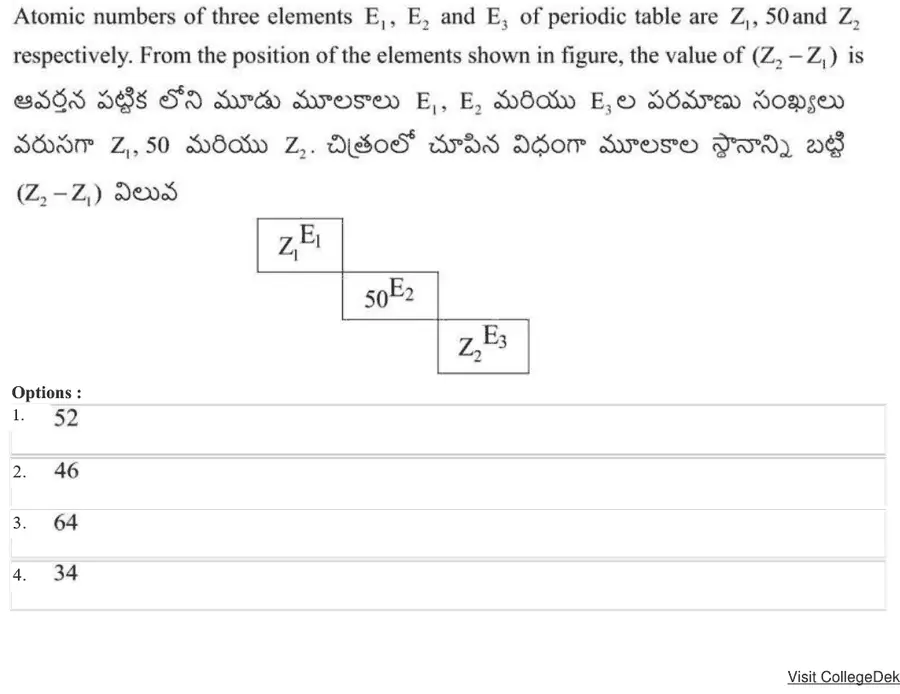
Get EdLoop – freeOpen on the web