At $27^\circ C$, a real gas of molar mass $44\ g\ mol^{-1}$ occupies a volume of 0.4 L at 40 atm pressure. If the compressibility factor of it is 0.65, what is its weight (in g)? (R= 0.082 L-atm $K^{-1}mol^{-1}$)
A compound is formed by A (cations), B(cations) and O(anions). Atoms of O form ccp lattice. Atoms of A occupy 50% of octahedral voids and atoms of B occupy 25% of tetrahedral voids. What is the molecular formula of the compound?
At 300 K, one mole of a gas present in a 10 L flask exerted a pressure of 2.71 atm. What is its compressibility factor? ($\mathrm{R} = 0.082\ \mathrm{L\ atm\ mol^{-1}\ K^{-1}}$)
The number of unit cells in 5.85 g of cube shaped ideal crystal of $\mathrm{NaCl}$ (Z=4) is $x \times 10^{21}$. The value of $x$ is (At. Wt.: Na = 23 u, Cl = 35.5 u), (N= $6 \times 10^{23}\ \mathrm{mol^{-1}}$)
An ideal gas with density $3.0\ \mathrm{g\ L^{-1}}$ has a pressure of 684 mm Hg at $25^\circ\mathrm{C}$. The rms speed (in $\mathrm{m\ s^{-1}}$) of it is ($1\ \mathrm{atm} = 10^5\ \mathrm{Pa}$)
An element of molar mass $250\ \text{g}\ mol^{-1}$ crystallizes in a simple cubic lattice. The density of the unit cell is $7.2\ g\ cm^{-3}$. What is the radius of atom (in Å) of that element? ($N_0 = 6.02 \times 10^{23} mol^{-1}$)
At T(K), the $rms$ velocity of an ideal gas is $x\ \mathrm{m\ s^{-1}}$. At what temperature (in K), the $rms$ velocity of gas becomes $3x\ \mathrm{m\ s^{-1}}$?
Atoms of element B form hcp lattice and atoms of element A occupy $\frac{2}{3}$rd of the tetrahedral voids. The formula of the compound formed by the elements A and B is
A gas mixture contains 64% methane and 36% ethane by mass. The density of the mixture at $27^\circ\mathrm{C}$ and $750\ mm$ pressure (in $g\ L^{-1}$) is $(at.wt\ C = 12\ u, H = 1\ u, R = 0.082\ L\ atm\ K^{-1}mol^{-1})$
At 300 K, air is present in an open round bottom flask of volume 10 L. The flask is heated to 750 K. Some air is expelled from the flask. What is the fraction of air expelled from the flask? (Assume air as an ideal gas)
A metal $X$ of atomic mass $75\ u$ forms a cubic lattice of edge length $5\mathrm{\AA}$. If the density of the lattice is $2\ g\ cm^{-3}$, the radius (in $\mathrm{\AA}$) of the metal atom is
At T(K), the kinetic energy of one mole of an ideal gas (molar mass = $M\,g\,mol^{-1}$) is $Y\,kJ\,mol^{-1}$. What is its most probable velocity ($U_{mp}$) in $m\,s^{-1}$?
A crystal lattice has A (cations), B (cations) and O (anions). Atoms of O form hcp lattice. Atoms of A occupy 25% of octahedral voids and atoms of B occupy 25% of tetrahedral voids. What is the molecular formula of the crystal lattice?
The rms velocity of $\mathrm{SO_2}$ molecules at 400 K is same as the most probable velocity of $\mathrm{O_2}$ molecules at T(K). What is the kinetic energy (in kJ) of 5 moles of $\mathrm{O_2}$ at T(K)? (At.wt: S = 32 $u$ , O = 16 $u$), (R = 8.3 $\mathrm{J\,K^{-1}\,mol^{-1}}$)
A compound is formed by elements $A$ and $B$. Element $B$ forms $ccp$ structure. Atoms of $A$ occupy $x$ % of tetrahedral voids. All the octahedral voids are vacant. Compound formula is $A_2B_3$. What is $x$ %?
At 300 K, a 10 L vessel contains 0.4 g of He, 1.6 g of $\mathrm{O_2}$ and 1.4 g of $\mathrm{N_2}$. The partial pressure of He gas (in atm) is (Assume ideal behaviour for all gases) ($\mathrm{R = 0.0821\ L\ atm\ K^{-1}\ mol^{-1}}$)
At T(K), the pressure of two ideal gases A and B is in $2:5$ ratio ($p_A : p_B = 2:5$). At this temperature, their density is same. Molar mass ratio ($M_A : M_B$) is
If the kinetic energy of the molecules in 8.0 g methane at 47 °C is $x$ kJ, then kinetic energy (in kJ) of the molecules in same amount of dihydrogen at 127°C is
2.9 g of a gas (molar mass $40\,\mathrm{g\,mol^{-1}}$) at T(K) occupied the same volume as 0.184 g of dihydrogen at $17\,^\circ\mathrm{C}$ at the same pressure. The value of T(K) is
An element with molar mass $M\,\mathrm{kg\,mol^{-1}}$ forms a face centred cubic unit cell with edge length 405 pm. If the density is $2.7\times10^{3}\,\mathrm{kg\,m^{-3}}$. What is its molar mass M?
A gaseous mixture contains $\mathrm{H_2}$ and $\mathrm{O_2}$. The pressure of the mixture is 1 bar. The weight percentage of $\mathrm{O_2}$ is 80. The ratio of partial pressures of $\mathrm{H_2}$ and $\mathrm{O_2}$ is
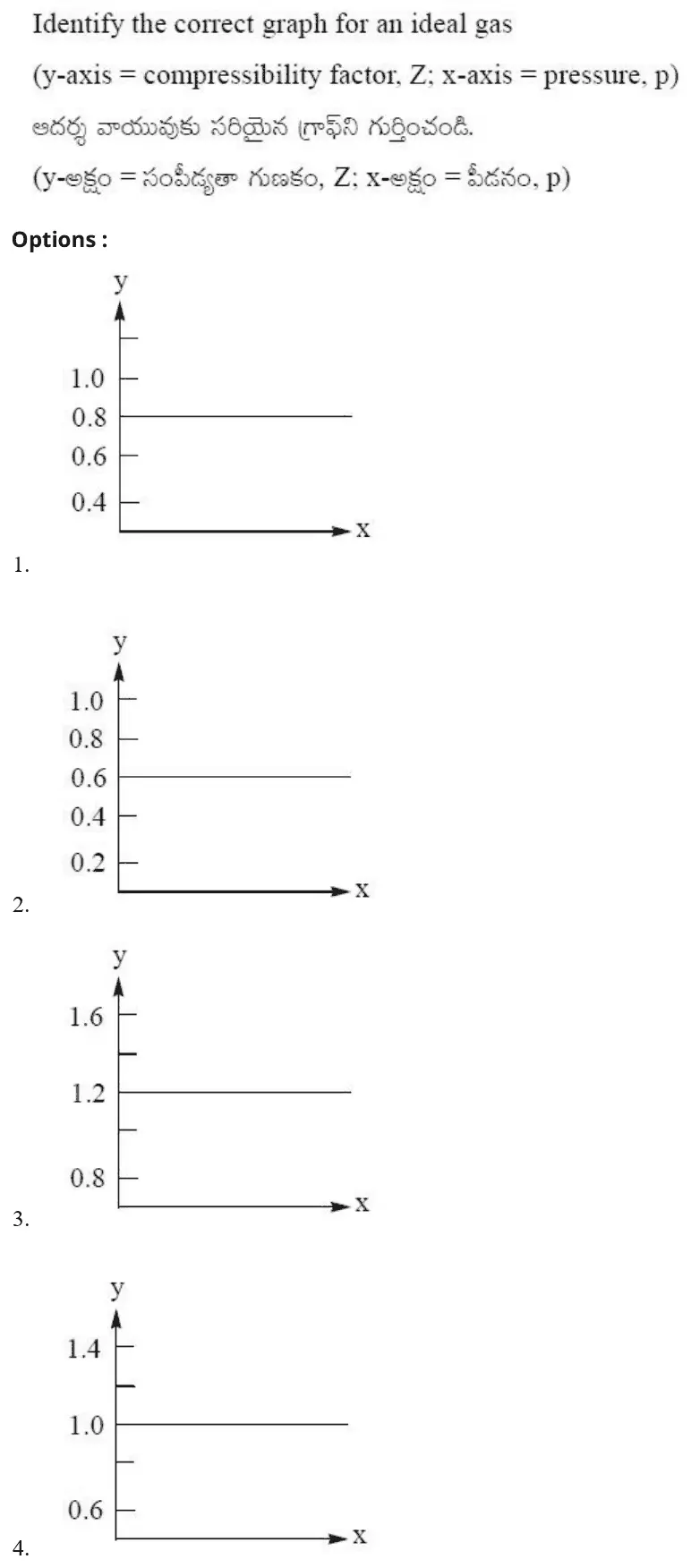
see figure Graph with y-axis ticks labelled 1.0, 0.8, 0.6, 0.4 (plus one unlabelled tick above 1.0); a horizontal line at y = 0.8 parallel to the x-axis.
B
see figure Graph with y-axis ticks labelled 1.0, 0.8, 0.6, 0.4, 0.2; a horizontal line at y = 0.6 parallel to the x-axis.
C
see figure Graph with y-axis ticks labelled 1.6, 1.2, 0.8 (with unlabelled ticks between them); a horizontal line at y = 1.2 parallel to the x-axis.
D
see figure Graph with y-axis ticks labelled 1.4, 1.0, 0.6 (with unlabelled ticks between them); a horizontal line at y = 1.0 parallel to the x-axis.
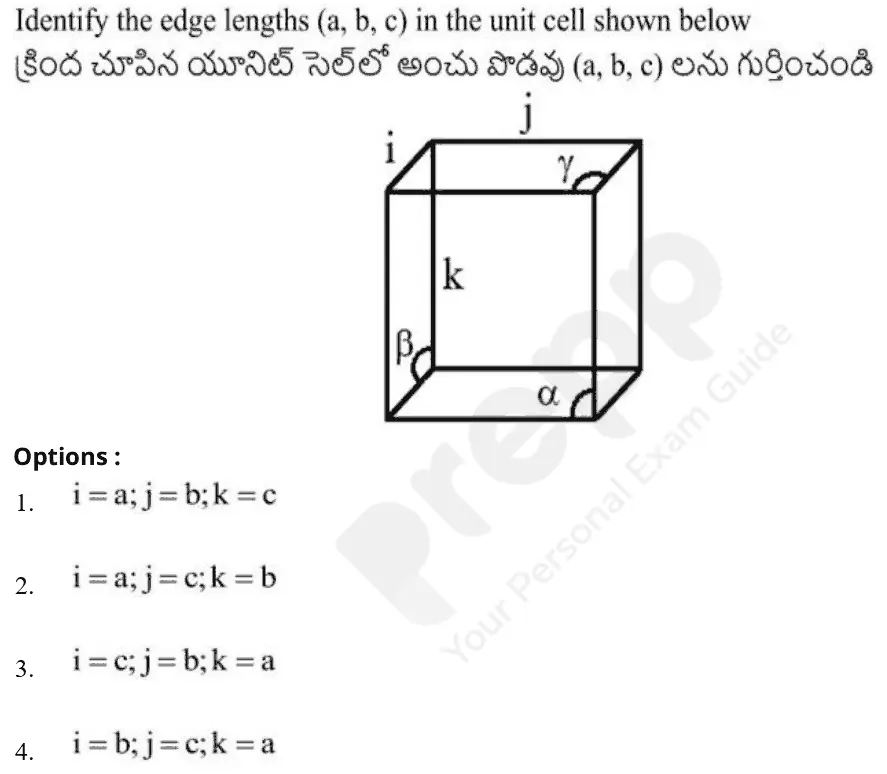
The crystal system with edge lengths $a \neq b \neq c$ and axial angles $\alpha = \beta = \gamma = 90^\circ$ is 'x' and number of Bravais lattices for it is 'y'. x and y are
$2.0$ g of $\mathrm{H_2}$ diffuses through a porous container in 10 minutes. How many grams of $\mathrm{O_2}$ would diffuse from the same container in the same time under similar conditions ?
At T(K), the $\mathrm{u_{rms}}$ of $\mathrm{CO_2}$ is $412\ \mathrm{ms^{-1}}$. What is its kinetic energy (in $\mathrm{kJ\ mol^{-1}}$) at the same temperature ? ($\mathrm{CO_2}$ = 44 u).
A and B are ideal gases. At T(K), 2 L of 'A' with a pressure of 1 bar is mixed with 4 L of 'B' with a pressure $\mathrm{p_B}$ bar in a 100 L flask. The pressure exerted by gaseous mixture is 0.1 bar. What is the value of $\mathrm{p_B}$ in bar ?
A metal crystallizes in simple cubic lattice. The volume of one unit cell is $6.4\times10^{7}$ $\mathrm{pm^3}$. What is the radius of the metal atom in pm ?
At $27^\circ\mathrm{C}$, 1 L of $\mathrm{H_2}$ with a pressure of 1 bar is mixed with 2 L of $\mathrm{O_2}$ with a pressure of 2 bar in a 10 L flask. What is the pressure exerted by gaseous mixture in bar ? (Assume $\mathrm{H_2}$ and $\mathrm{O_2}$ as ideal gases)
An element occurs in the body centred cubic structure with edge length of 288 pm. The density of the element is 7.2 g cm$^{-3}$. The number of atoms present in 208 g of the element is nearly
At $27\ ^\circ\mathrm{C}$ kinetic energy of 4 g of $\mathrm{H_2}$ is $x$ J. What is the kinetic energy (in J) of 6.4 g of oxygen at $127\ ^\circ\mathrm{C}$ ?
At T(K), hydrogen and oxygen gases are mixed in the ratio of 1 : 2 by mass in a closed vessel of volume 'V' litres. If the total pressure of gaseous mixture is 'p' atm, the partial pressure of oxygen (in atm) is
At T(K), a gaseous mixture contains $\mathrm{H_2}$ and $\mathrm{O_2}$. The total pressure of the mixture is 2 bar. The partial pressure of $\mathrm{H_2}$ is 1.778 bar. What is the weight (w/w) percentage of $\mathrm{H_2}$ in the mixture ?
The most probable speed ($\mathrm{u_{mp}}$) of 8 g of $\mathrm{H_2}$ is $2\times10^2\ \mathrm{ms^{-1}}$. The kinetic energy (in J) of same amount of $\mathrm{H_2}$ gas is
A compound is formed by two elements A and B. Atoms of the element B (as anion) make ccp lattice and those of element A (as cation) occupy all tetrahedral voids. The formula of the compound is
For one mole of an ideal gas an isochore is obtained. The slope of the isochore is $0.082\ \mathrm{atm\ K^{-1}}$. What will be its pressure (in atm) when the temperature is $12.2\ \mathrm{K}$? ($R = 0.082\ \mathrm{L\ atm\ mol^{-1}\ K^{-1}}$).
An element (atomic weight = 250 u) crystallises in a simple cubic lattice. If the density of the unit cell is 7.2 g cm$^{-3}$, what is the radius (in Å) of the atom of the element?
Gold crystallises in fcc lattice. The edge length of the unit cell is 4Å. The closest distance between gold atoms is '$x$' Å and density of gold is '$y$' $\mathrm{g\ cm^{-3}}$. What are $x$ and $y$ respectively ?
(Molar mass of gold = 197 $\mathrm{g\ mol^{-1}}$; $\mathrm{N} = 6\times10^{23}\ \mathrm{mol^{-1}}$)
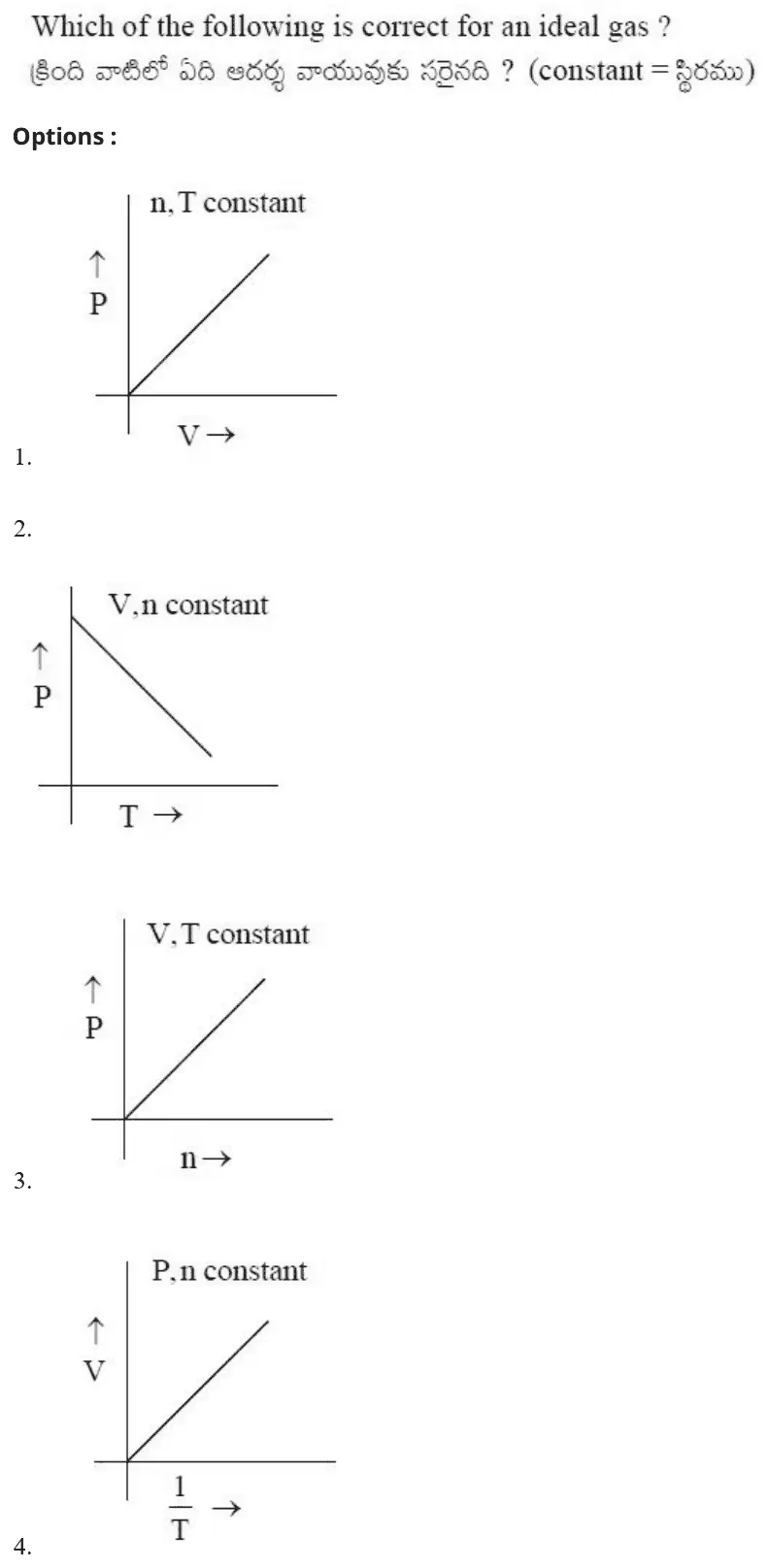
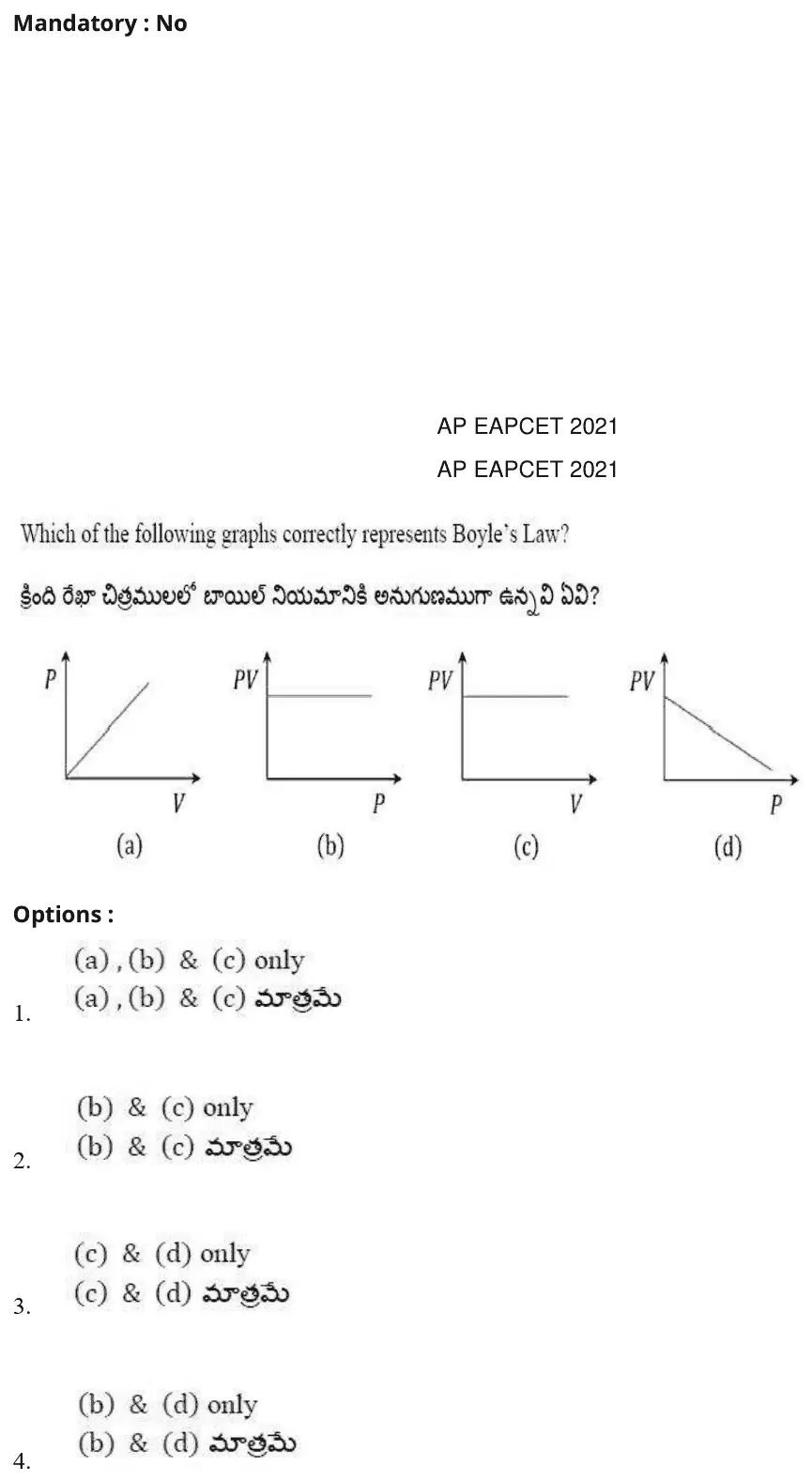
Which of the following is correct for an ideal gas ?
The question as printed in the paper.
A
see figure Graph with title "n, T constant": P on the vertical axis, V on the horizontal axis; a straight line rising with positive slope, starting at the origin.
B
see figure Graph with title "V, n constant": P on the vertical axis, T on the horizontal axis; a straight line falling with negative slope, starting high on the P axis and going down to the right.
C
see figure Graph with title "V, T constant": P on the vertical axis, n on the horizontal axis; a straight line rising with positive slope, starting at the origin.
D
see figure Graph with title "P, n constant": V on the vertical axis, 1/T on the horizontal axis; a straight line rising with positive slope, starting at the origin.
At 256 K, rms speed of $\mathrm{SO_2}$ gas molecules is $3.16\times10^{2}\ \mathrm{ms^{-1}}$. What is the most probable velocity (in $\mathrm{ms^{-1}}$) of same gas at same temperature ?
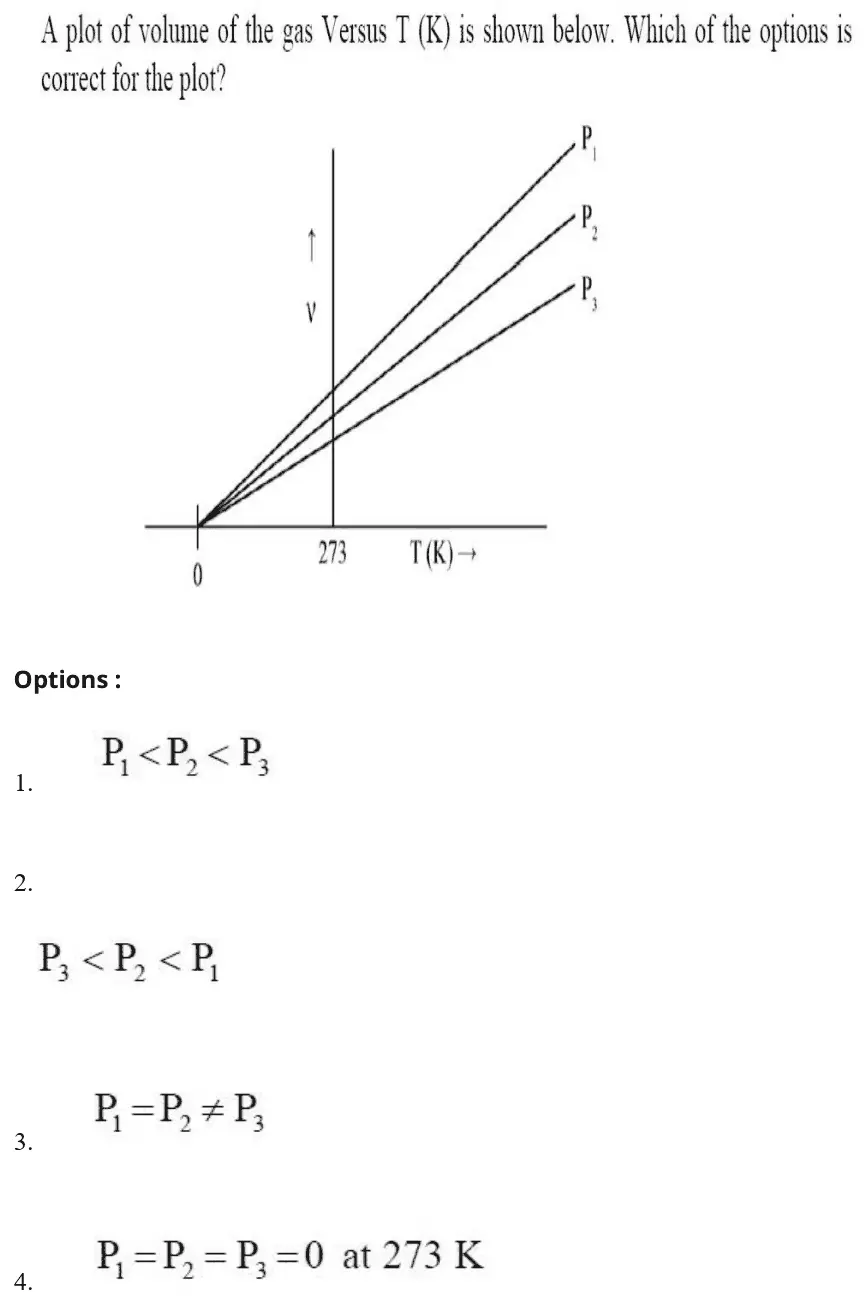
The isobars of one mole of an ideal gas were obtained at three different pressures ($p_1$, $p_2$ and $p_3$). The slopes of these isobars are $m_1$, $m_2$ and $m_3$ respectively. If $p_1 < p_2 < p_3$, then the correct relation of the slopes is
At $T(\mathrm{K})$ root mean square (rms) velocity of argon (molar mass $40\ \mathrm{g\ mol^{-1}}$) is $20\ \mathrm{ms^{-1}}$. The average kinetic energy of the same gas at $T(\mathrm{K})$ (in $\mathrm{J\ mol^{-1}}$) is
A metal crystallises in two cubic phases, fcc and bcc with edge lengths 3.5 Å and 3 Å respectively. The ratio of densities of fcc and bcc is approximately
At 298K, a flask ‘A’ of unknown volume (V) contains oxygen at 5 atm. Another flask ‘B’ of volume 2L contains helium at 3 atm. Two flasks are connected together by a small tube of zero volume. After the two gases are completely mixed, if the resulting mixture is found to have the mole fraction of oxygen as 0.2, the volume of flask ‘A’ (in L) is (Assume oxygen and helium as ideal gases)
The RMS velocity of dihydrogen is $\sqrt{7}$ times more than that of dinitrogen. If $T_{\mathrm{H_2}}$ and $T_{\mathrm{N_2}}$ are the temperatures of dihydrogen and dinitrogen, then the correct relationship between them is
A substance has a density of $2\ \mathrm{g\ cm^{-3}}$. It crystallizes in the fcc crystal with an edge length of $600\ \mathrm{pm}$. The molar mass of the substance (in $\mathrm{g\ mol^{-1}}$) is
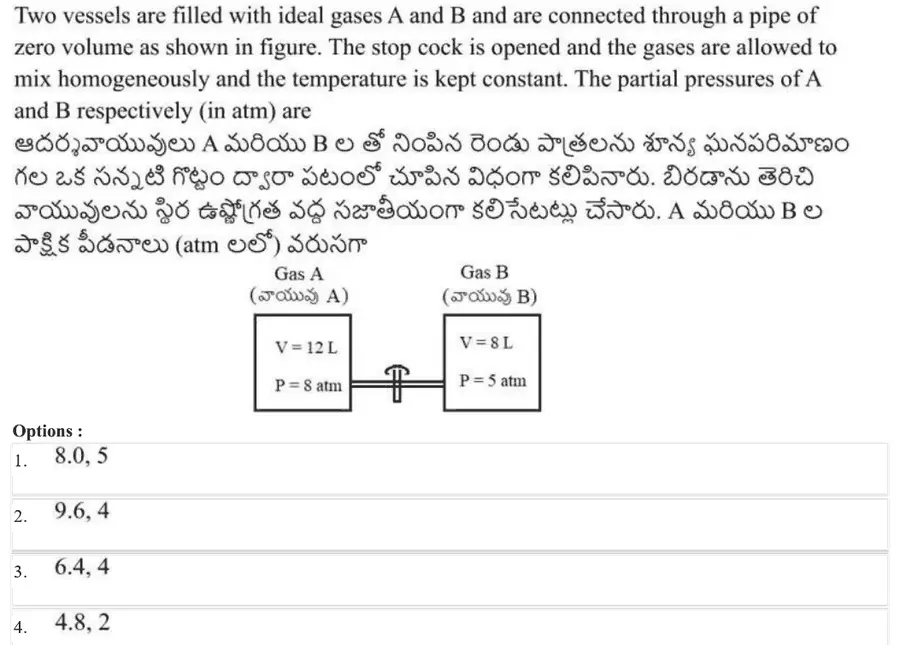
Two vessels are filled with ideal gases A and B and are connected through a pipe of zero volume as shown in figure. The stop cock is opened and the gases are allowed to mix homogeneously and the temperature is kept constant. The partial pressures of A and B respectively (in atm) are
A solid contains elements A and B. Anions of B form ccp lattice. Cations of A occupy 50% of octahedral voids and 50% of tetrahedral voids. What is the molecular formula of the solid?
The rms velocity ($\mathrm{u_{rms}}$), mean velocity ($\mathrm{u_{av}}$) and most probability ($\mathrm{u_{mp}}$) of a gas differ from each other at a given temperature. Which of the following ratios regarding them is correct?
$60\ \mathrm{cm^3}$ of $\mathrm{SO_2}$ gas diffused through a porous membrane in 'x' min. Under similar conditions $360\ \mathrm{cm^3}$ of another gas (molar mass $4\ \mathrm{g\ mol^{-1}}$) diffused in 'y' min. The ratio of $x$ and $y$ is
A 10 L vessel contains 1 mole of an ideal gas with pressure of P(atm) and temperature of T(K). The vessel is divided into two equal parts. The pressure (in atm) and temperature (in K) in each part is respectively
The molecular formula of a crystalline solid is $\mathrm{X_3Y_2}$. Atoms of Y form ccp lattice, and atoms of X occupy 50% octahedral voids and x% of tetrahedral voids. What is the percentage of unoccupied tetrahedral voids?
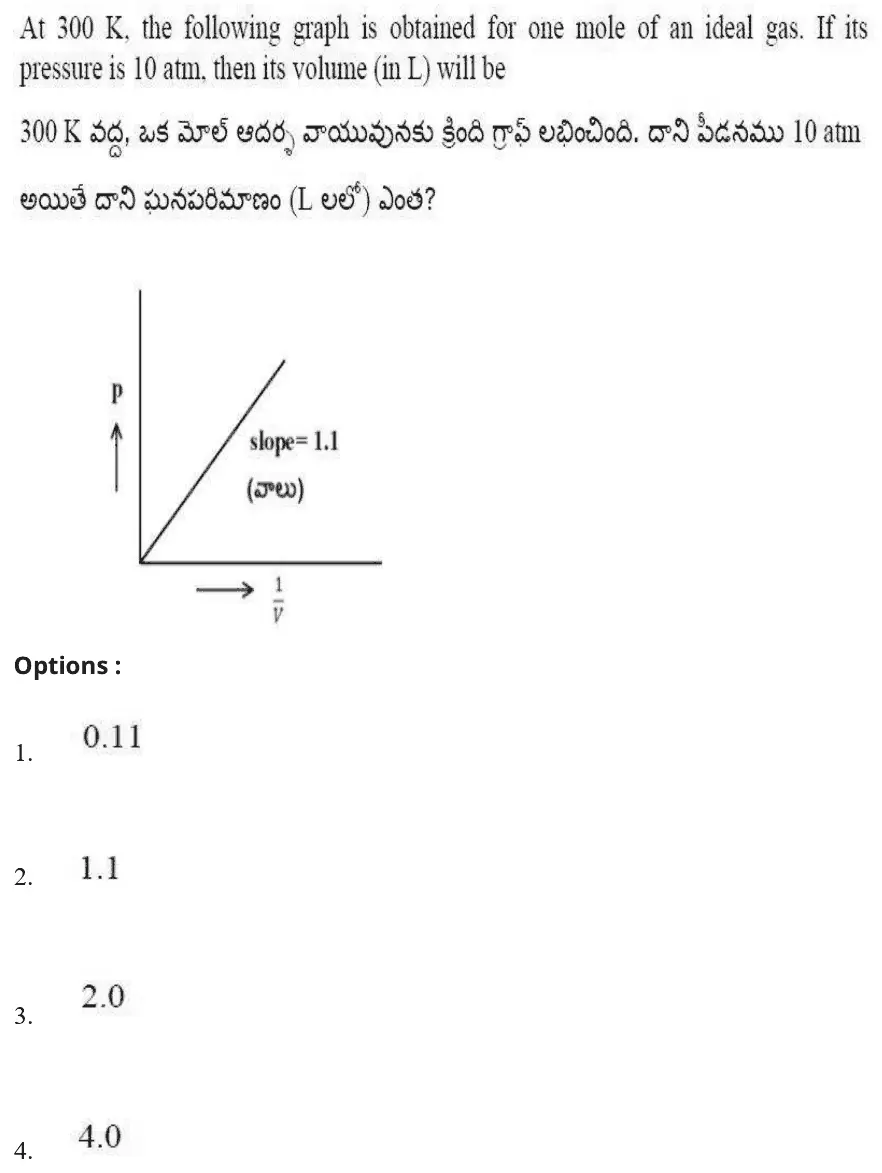
At 240.55 K, for one mole of an ideal gas, a graph of P (on y-axis) and $\mathrm{V^{-1}}$ (on x-axis) gave a straight line passing through origin. Its slope (m) is 2000 $\mathrm{J\ mol^{-1}}$. What is the kinetic energy (in $\mathrm{J\ mol^{-1}}$) of ideal gas?
At $T(K)$ for one mole of an ideal gas, the graph of $P$ (on y-axis) and $V^{-1}$ (on x-axis) gave a straight line with slope of $32.8\ \mathrm{L\ atm\ mol^{-1}}$. What is the temperature (in K)? ($R = 0.082\ \mathrm{L\ atm\ mol^{-1}\ K^{-1}}$)
A vessel of volume $V$ L contains an ideal gas at $T$(K). The vessel is partitioned into two equal parts. The volume (in L) and temperature (in K) in each part is respectively
A compound is formed by atoms of A, B and C. Atoms of C form hcp lattice. Atoms of A occupy 50% of octahedral voids and atoms of B occupy $\frac{2}{3}$rd of tetrahedral voids. What is the molecular formula of the solid?
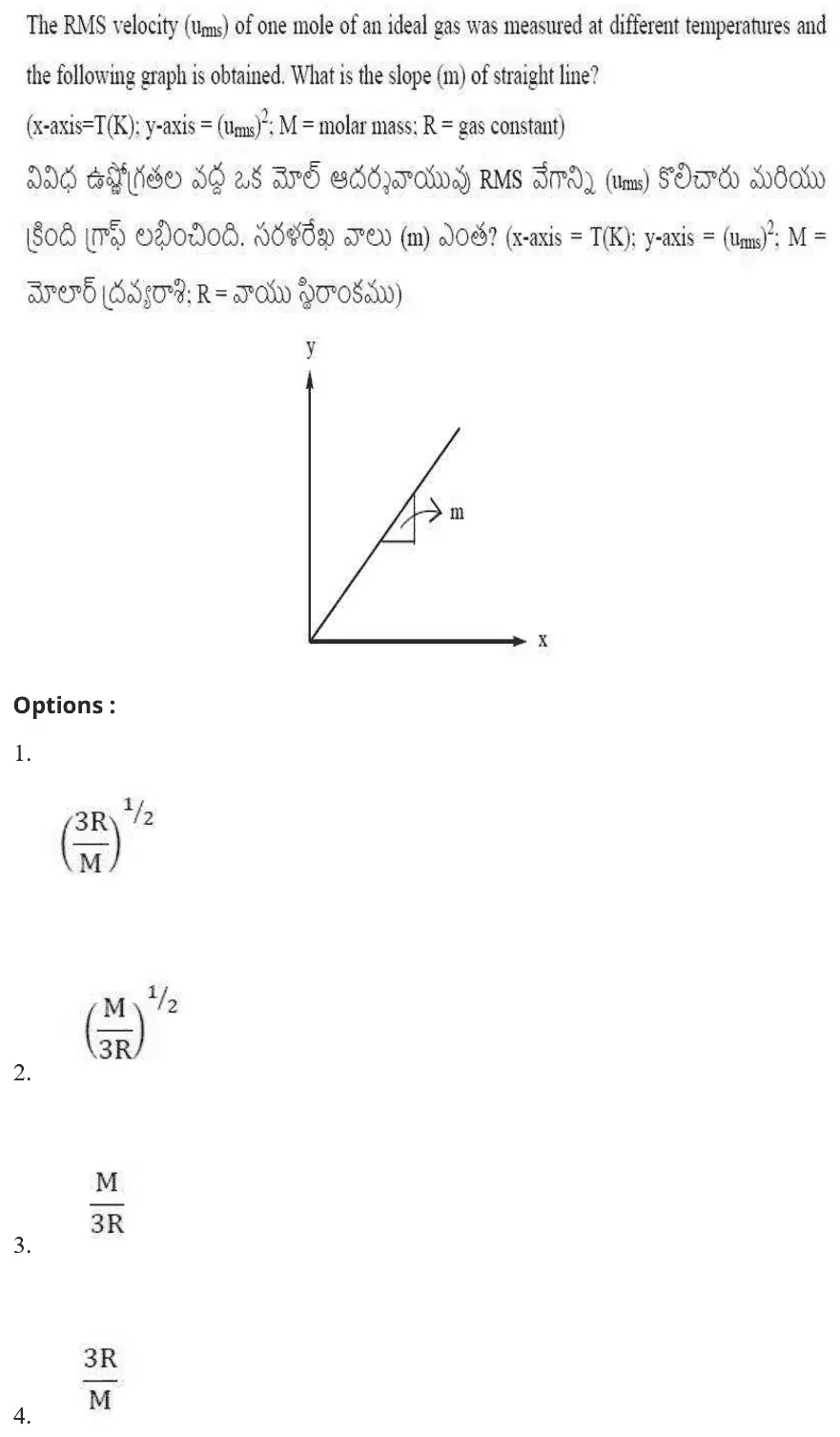
The RMS velocity ($u_{rms}$) of one mole of an ideal gas was measured at different temperatures and the following graph is obtained. What is the slope (m) of straight line?
(x-axis=T(K); y-axis = $(u_{rms})^2$; M = molar mass; R = gas constant)
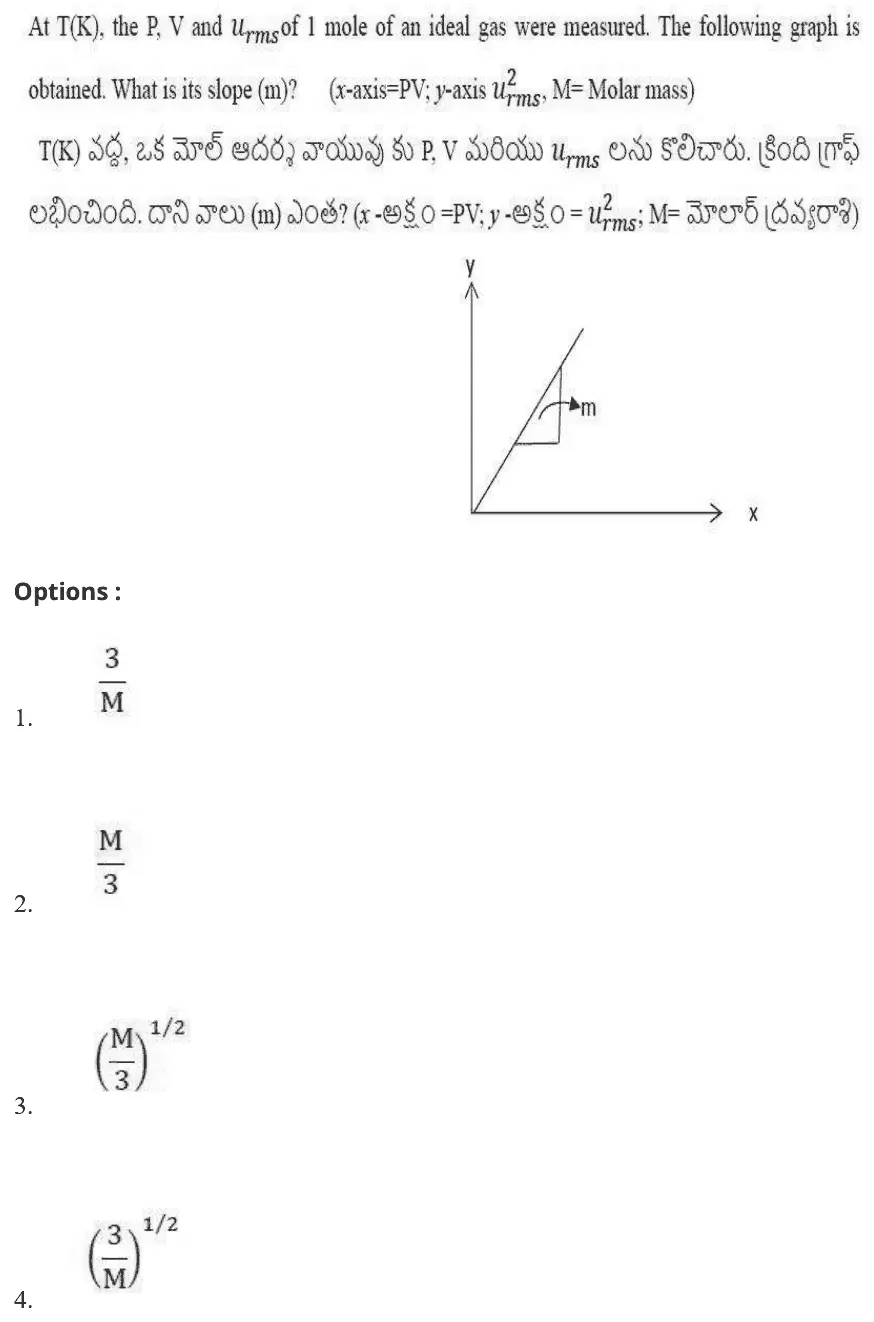
At T(K), the P, V and $u_{rms}$ of 1 mole of an ideal gas were measured. The following graph is obtained. What is its slope (m)? (x-axis=PV; y-axis $u_{rms}^2$; M= Molar mass)
A solid compound is formed by atoms of A (cations), B (cations) and O (anions). Atoms of O form hcp lattice. Atoms of A occupy 25% of tetrahedral holes and atoms of B occupy 50% octahedral holes. What is the molecular formula of solid?
What is the kinetic energy (in $\mathrm{J\,mol^{-1}}$) of one mole of an ideal gas (molar mass = $0.1\ \mathrm{kg\,mol^{-1}}$) if its rms velocity is $4\times10^{2}\ \mathrm{m\,s^{-1}}$ at T(K)?
The density of $\beta$-Fe is $7.6\ \mathrm{g\ cm^{-3}}$. It crystallizes in cubic lattice with $a = 290\ \mathrm{pm}$. What is the value of Z? ($\mathrm{Fe} = 56\ \mathrm{g\ mol^{-1}}$; $N_A = 6.022 \times 10^{23}\ \mathrm{mol^{-1}}$)
Identify the correct statements from the following
I. For an ideal gas, the compressibility factor is 1.0
II. The kinetic energy of $\mathrm{NO}$ (g) (molar mass = 30 g mol$^{-1}$) at T(K) is $x$ J mol$^{-1}$. The kinetic energy of $\mathrm{N_2O_4}$ (g) (molar mass = 92 g mol$^{-1}$) at T (K) is $2x$ J mol$^{-1}$
III. The rate of diffusion of a gas is inversely proportional to square root of its density
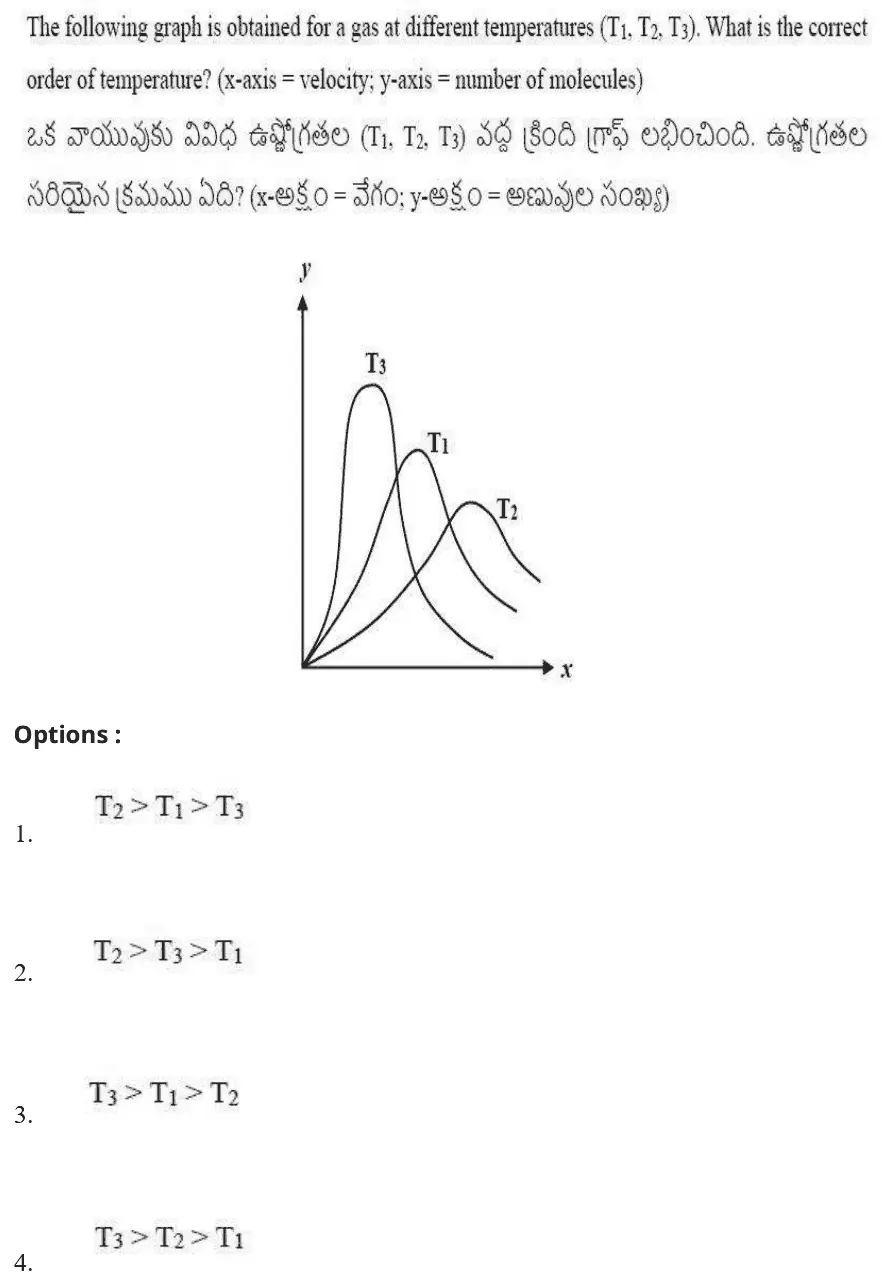
The following graph is obtained for a gas at different temperatures ($T_1$, $T_2$, $T_3$). What is the correct order of temperature? (x-axis = velocity; y-axis = number of molecules)
RMS velocity of one mole of an ideal gas was measured at different temperatures. A graph of $(\mathrm{u_{rms}})^2$ (on y-axis) and T(K) (on x-axis) gave straight line passing through the origin and its slope is 249 $\mathrm{m^2 s^{-2} K^{-1}}$. What is the molar mass (in $\mathrm{kg\ mol^{-1}}$) of ideal gas? (R=8.3 $\mathrm{J\ mol^{-1} K^{-1}}$)
In bcc lattice containing X and Y type of atoms, X type of atoms are present at the corners and Y type of atoms are present at the centers. In its unit cell, if three atoms are missing in the corners, the formula of the compound is
At 400 K, an ideal gas is enclosed in a $0.5\ \mathrm{m^3}$ vessel at a pressure of 203 kPa. What is the change in temperature required (in K), if it occupies a volume of $0.2\ \mathrm{m^3}$ under a pressure of 304 kPa? (Nearest integer)
An element with molar mass $2.7\times10^{-2}\,\mathrm{kg\,mol^{-1}}$ forms a cubic unit cell with edge length of 405 pm. If its density is $2.7\times10^{3}\,\mathrm{kg\,m^{-3}}$, the number of atoms present in one unit cell of it is (Given; $\mathrm{N_A} = 6.023\times10^{23}\,\mathrm{mol^{-1}}$)
The variation of volume of an ideal gas with its number of moles (n) is obtained as a graph at 300 K and 1 atm pressure. What is the slope of the graph?
The molecular formula of a crystal is $\mathrm{AB_2O_4}$. Oxygen atoms form ccp lattice. Atoms of A occupy $x$ % of tetrahedral voids and atoms of B occupy $y$ % of octahedral voids. $x$ and $y$ are respectively
An open vessel containing air was heated from 27 °C to 727 °C. Some air was expelled. What is the fraction of air remaining in the vessel? (Assume air as an ideal gas)
The molecular formula of a compound is $\mathrm{AB_2O_4}$. Atoms of O form ccp lattice. Atoms of A (cation) occupy $\frac{1}{8}$th of tetrahedral voids. Atoms of B (cation) occupy a fraction of octahedral voids. What is the fraction of vacant octahedral voids?
At 200 K, an ideal gas (X) present in a 1 L flask has a concentration of 1 mol $\mathrm{L^{-1}}$. At the same temperature, 0.1 mole of X is added into the vessel. What is the final pressure of the gas in atm?
(Given R = 0.082 L atm $\mathrm{mol^{-1}}$ $\mathrm{K^{-1}}$)
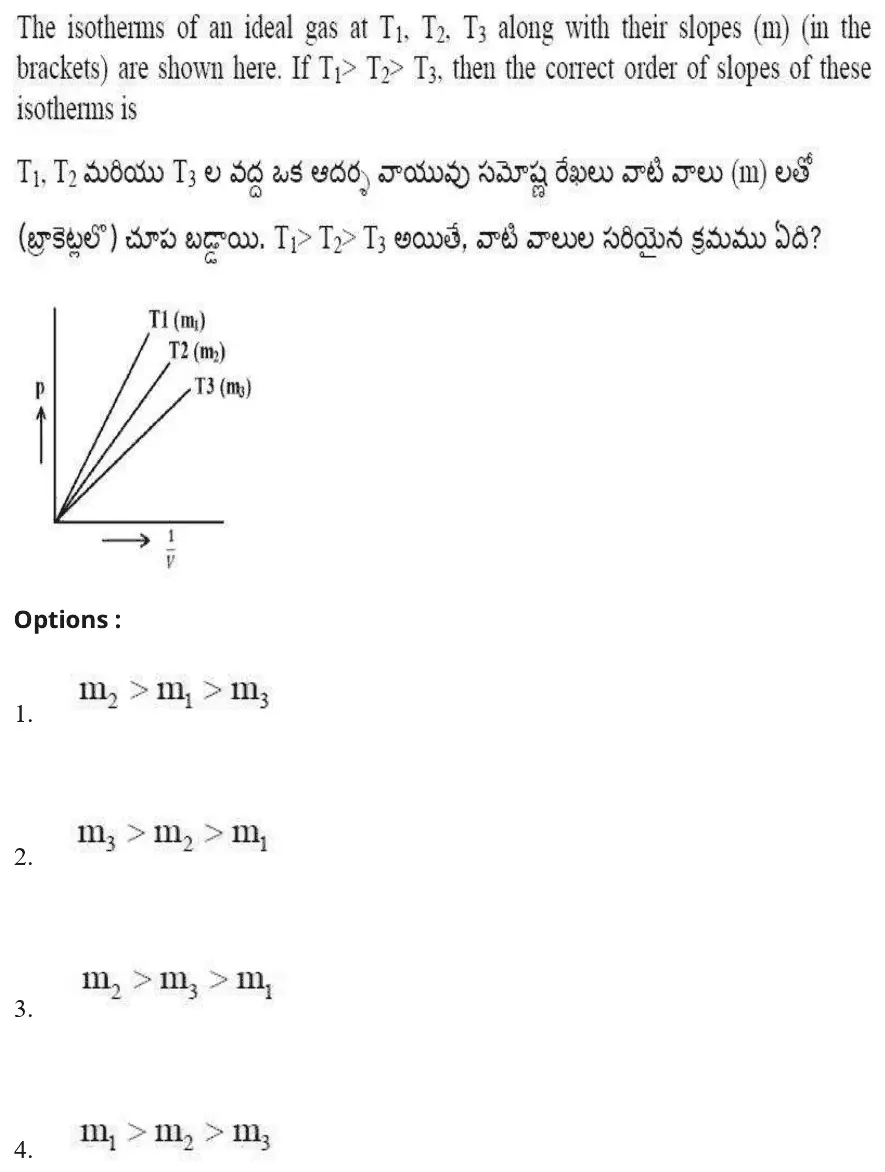
The isotherms of an ideal gas at $T_1$, $T_2$, $T_3$ along with their slopes (m) (in the brackets) are shown here. If $T_1 > T_2 > T_3$, then the correct order of slopes of these isotherms is
In a $\mathrm{A_xB_y}$ crystal structure, $\mathrm{A^{+y}}$ ions occupy all the tetrahedral voids and $\mathrm{B^{-x}}$ ions make BCC unit cell. What is the formula of the compound?
The vapors of 1 g of an element occupy 2.5625 L exerting a pressure of 0.5 atm at 1000 K. What is the molar mass (in $\mathrm{g\ mol^{-1}}$) of the element?
(Assume vapors follow ideal gas equation. Given $R = 0.082\ \mathrm{L\ atm\ mol^{-1}\ K^{-1}}$)
At T (K), a gaseous mixture of $\mathrm{H_2}$ and $\mathrm{O_2}$ containing 20% (weight/weight) of $\mathrm{H_2}$ exerts a total pressure of 2 bar. What is the partial pressure of $\mathrm{O_2}$ (in bar)?
At T (K), an ideal gas (Z) present in V L flask exerted a pressure of 16.4 atm. Its concentration is 1 mol $\mathrm{L^{-1}}$. What is the value of T in K?
At T (K), a gaseous mixture containing $\mathrm{H_2}$, He and $\mathrm{O_2}$ exerted a pressure of 1 bar. The weight percentage of $\mathrm{H_2}$ and He is 20 and 16 respectively. The partial pressure (in bar) of $\mathrm{H_2}$, He and $\mathrm{O_2}$ is respectively
At T (K) and pressure P, the diffusion rate of an ideal gas is 120 $\mathrm{mL\ min^{-1}}$. What is the time taken (in sec.) for 3000 mL of this gas for diffusion at same temperature and pressure?
In the x-ray reflection (n=1), the distance between two parallel planes of $\mathrm{NaCl}$ is 280 pm and diffraction angle is $5.2^\circ$. What is the wavelength of it's light radiation (Sin $5.2^\circ$ = 0.09)
A 100 L cylinder containing $\mathrm{H_2}$ exerted a pressure of 4 atm at 300 K. It was accidentally opened and some $\mathrm{H_2}$ was escaped. When it was closed, it exerted a pressure of 3 atm at 300 K. The number of moles of $\mathrm{H_2}$ remaining in the cylinder is equal to
(Assume $\mathrm{H_2}$ as an ideal gas; R = gas constant)
At T (K), equal weights of $\mathrm{H_2}$, $\mathrm{D_2}$, and $\mathrm{T_2}$ are present in closed vessel. The pressure exerted by this gaseous mixture is P atm. The ratio of partial pressures of $\mathrm{T_2}$, $\mathrm{D_2}$ and $\mathrm{H_2}$ is approximately
In $\mathrm{A_xB_y}$ crystal structure, A atoms occupied all octahedral as well as all tetrahedral voids and B atoms are at FCC centres. What is the formula of compound $\mathrm{A_xB_y}$,
The rate of diffusion of a gas A is $\sqrt{5}$ times more than that of gas B. If the molar mass of A is $x\,\mathrm{g\,mol^{-1}}$, the molar mass of B (in $\mathrm{g\,mol^{-1}}$) is
The formula of a metal oxide is $\mathrm{M_{0.96}O_1}$. The fractions of metal that exists as $\mathrm{M^{3+}}$ and $\mathrm{M^{2+}}$ ions in that oxide are respectively
Two containers A and B contain $\mathrm{CO_2}$ gas. Pressure, volume and absolute temperature of the gas in A are 4 times more compared to that in B. The mass of the gas in B is $x$ g, then the mass of the gas in A will be
In the structure of a solid, W atoms are located at the cube corners of the unit cell, O atoms are located at the cube edges and Na atoms at the cube centres. The formula of the compound is
A body centred cubic lattice is made up of two different types of atoms X and Y. Atom X occupies the body centre and atoms Y occupy the corner positions. One of the corners is left unoccupied per unit cell. The empirical formula of it is
4 g of an ideal gas A (molar mass = $\mathrm{M_A}$) present in a vessel of volume V litre exerted a pressure of 5 atm at 300 K. When 16 g of another ideal gas B (molar mass = $\mathrm{M_B}$) was introduced into this vessel at the same temperature, its pressure increased to 10 atm. What is the correct relationship between $\mathrm{M_A}$ and $\mathrm{M_B}$?
A compound is formed by elements A, B and O. Atoms of oxygen form ccp lattice. Atoms of A (cation) occupy $\frac{1}{8}$th of tetrahedral voids and atoms of B (cation) occupy half of octahedral voids. What is the molecular formula of the compound?
At T(K), copper (atomic mass = 63.5 u) has fcc structure with an edge length of $x$ Å. The density of copper (in $\mathrm{g\ cm^{-3}}$) at that temperature approximately is
Certain volume of oxygen gas diffuses through a porous pot in 20 seconds. Same volume of another gas (X) diffuses in Y seconds as that of oxygen, then (X) and Y respectively are
The rate of diffusion of methane at 1.0 atm pressure is twice than that of another gas 'X' kept at 1.45 atm. The molecular mass of the gas 'X' is [T kept constant]
KBr has rock salt type structural arrangements and has a density of 3.70 g/cm$^3$. The edge length of the unit cell is approximately [molecular weight of KBr =120 g/mol]
1 mole of a real gas is kept at high pressure of 100 bar at 300 K. If van der Waals constant b is 0.005 L / mol, what are the values of compressibility factor Z of the gas and % deviation of volume from ideality?
1 L closed flask contains a mixture of 4 g of methane and 4.4 g of carbon dioxide. The pressure inside the flask at $27\ ^\circ$C is [ Assume ideal behaviour of gases]
A solid has a structure in which 'W' atoms are located at the corners of a cubic lattice, oxygen atoms at the edge centre and Na atom at the body centre. The formula of the compound is
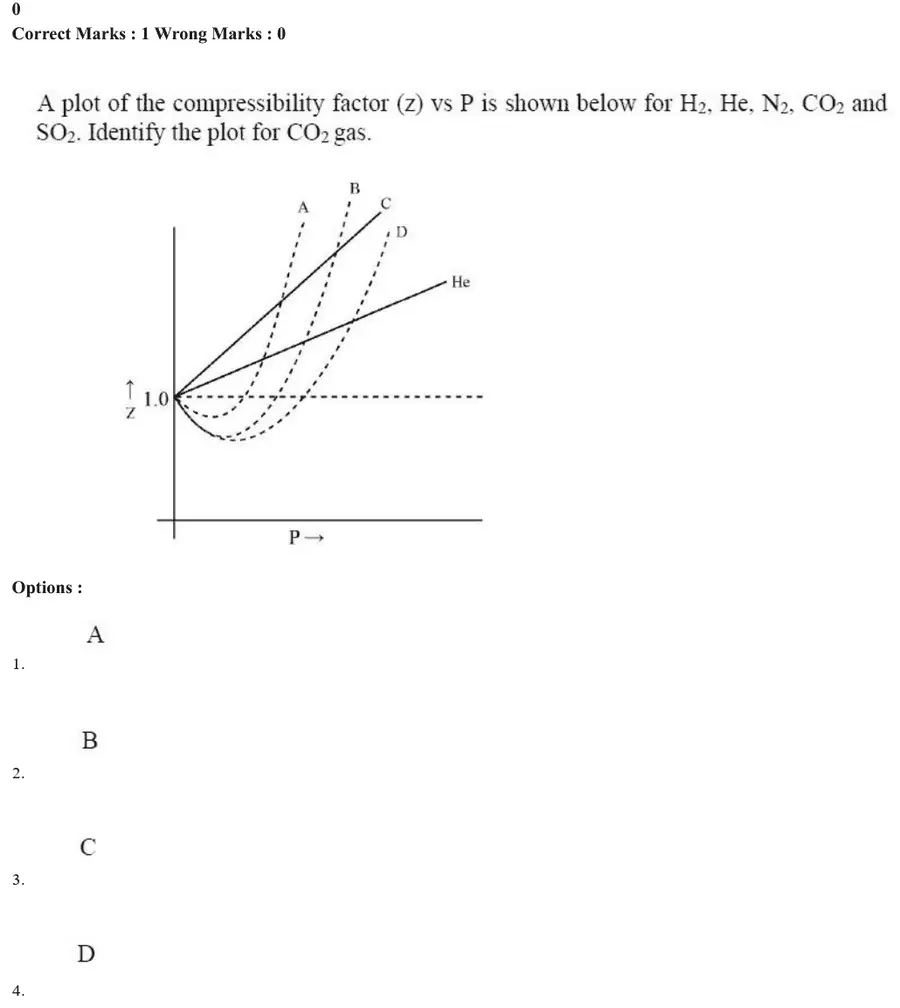
A plot of the compressibility factor (z) vs P is shown below for $\mathrm{H_2}$, He, $\mathrm{N_2}$, $\mathrm{CO_2}$ and $\mathrm{SO_2}$. Identify the plot for $\mathrm{CO_2}$ gas. (see the figure above)
Answer: (A) van der Waals constants 'a' of $\mathrm{CO_{2}}$ and $\mathrm{NH_{3}}$ are greater than that of $\mathrm{N_{2}}$· The council's preliminary key
According to kinetic molecular theory of gases, which of the following statements are correct? a) The actual volume of the molecules is negligible in comparison to the empty space between them. b) Collisions of gas molecules are inelastic. c) At any particular time, different particles in the gas have same speed and same kinetic energies. d) Pressure is exerted by the gas as a result of collision of the particles with the walls of the container.
A gaseous mixture of 2 moles of A, 3 moles of B, 5 moles of C and 10 moles of D contained in a vessel. Assuming that gases are ideal and partial pressure of C is 1.5 atm, the total pressure is
The crystal structure of an element has fcc lattice. If the edge length of the crystal is $4\ ^\circ A$, what is the atomic weight (in g mol$^{-1}$) of the element, if the density of the crystal is 11.21 g cm$^{-3}$) ($N_A$ = 6.023 X$10^{23}$ mol$^{-1}$)
20 mL of gas A and 10 mL of gas B diffuses through a porous membrane separately in 1 minute. If the vapor density of B is X, what is the vapor density of A?
The density of Na is $0.613\ \mathrm{g\,cm^{-3}}$. If the edge length of unit cell of Na is $5\mathrm{A^0}$, the effective number of atoms of Na per unit cell is (Atomic weight of Na = 23 u)
Ag crystallizes in fcc lattice. What is the total number of tetrahedral voids present in 540 g of Ag metal? ($N_A$= Avagadro (sic) number; Ag atomic weight = $108\ \mathrm{g\,mol^{-1}}$)
If two gases $\mathrm{CH_4}$ and $\mathrm{SO_2}$, are allowed to enter from the two ends of a 1 km long vacuum tube at the same time, where will the gases meet from the $\mathrm{CH_4}$ end?
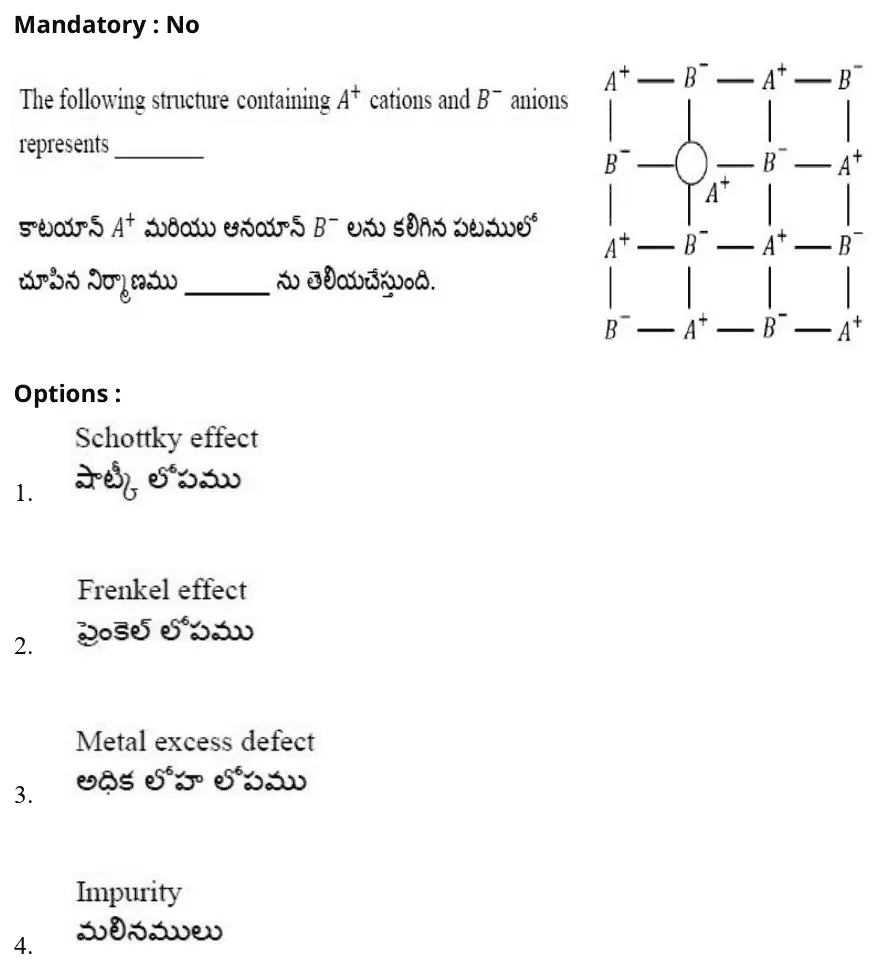
Which of the following molecular formula and type of defect are correct for the following statement? "In FeO crystal, some $\mathrm{Fe^{2+}}$ ions are missing and the loss of positive charge is made up by the presence of $\mathrm{Fe^{3+}}$ ions"
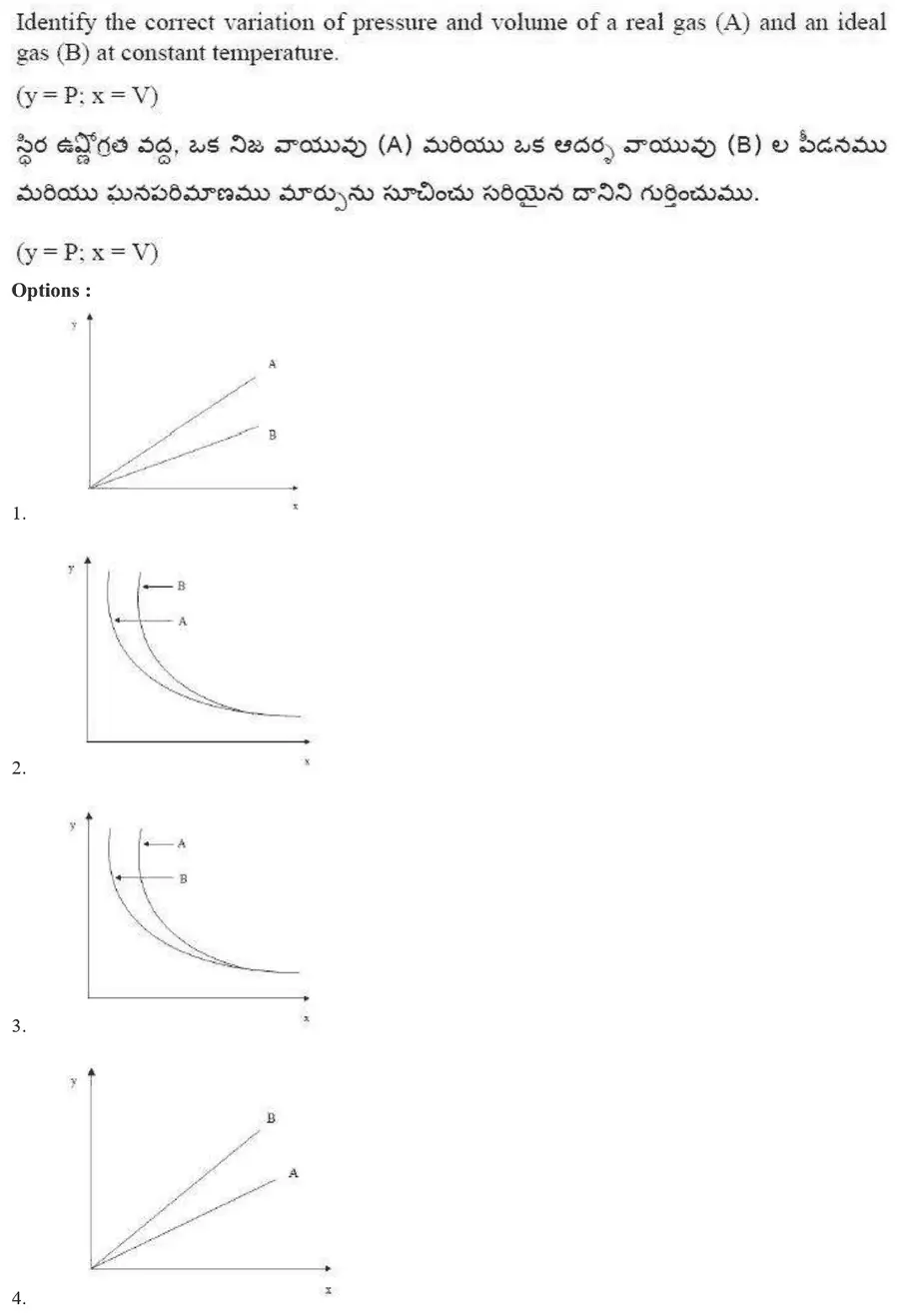
Identify the correct variation of pressure and volume of a real gas (A) and an ideal gas (B) at constant temperature. (y = P; x = V)
The question as printed in the paper.
A
see figure Graph with axes y and x: two straight lines from the origin, A above and steeper, B below and less steep.
B
see figure Graph with axes y and x: two hyperbola-like falling curves approaching a common level at large x; labelled arrows show B pointing to the outer (upper right) curve and A pointing to the inner (lower left) curve.
C
see figure Graph with axes y and x: two hyperbola-like falling curves approaching a common level at large x; labelled arrows show A pointing to the outer (upper right) curve and B pointing to the inner (lower left) curve.
D
see figure Graph with axes y and x: two straight lines from the origin, B above and steeper, A below and less steep.
An element crystallizing in fcc lattice has a density of 8.92 g $\mathrm{cm^{-3}}$ and edge length of $3.61\times10^{-8}$ cm. What is the atomic weight of element? (N= $6.022\times10^{23}\ \mathrm{mol^{-1}}$)
The anions (A) of $\mathrm{C_pA_q}$ molecule forms an fcc lattice. Cations (C) are positioned at the body center and half of the edge centers. The formula of the molecule is
Elements A and B have fcc and bcc structures respectively with a unit cell edge length of $3\mathrm{A}^0$ for both elements. The no of atoms in 210 gm of A is equal to 594 gm of B. If density of A is $7\ \mathrm{g\,cm^{-3}}$, what is the density of B?
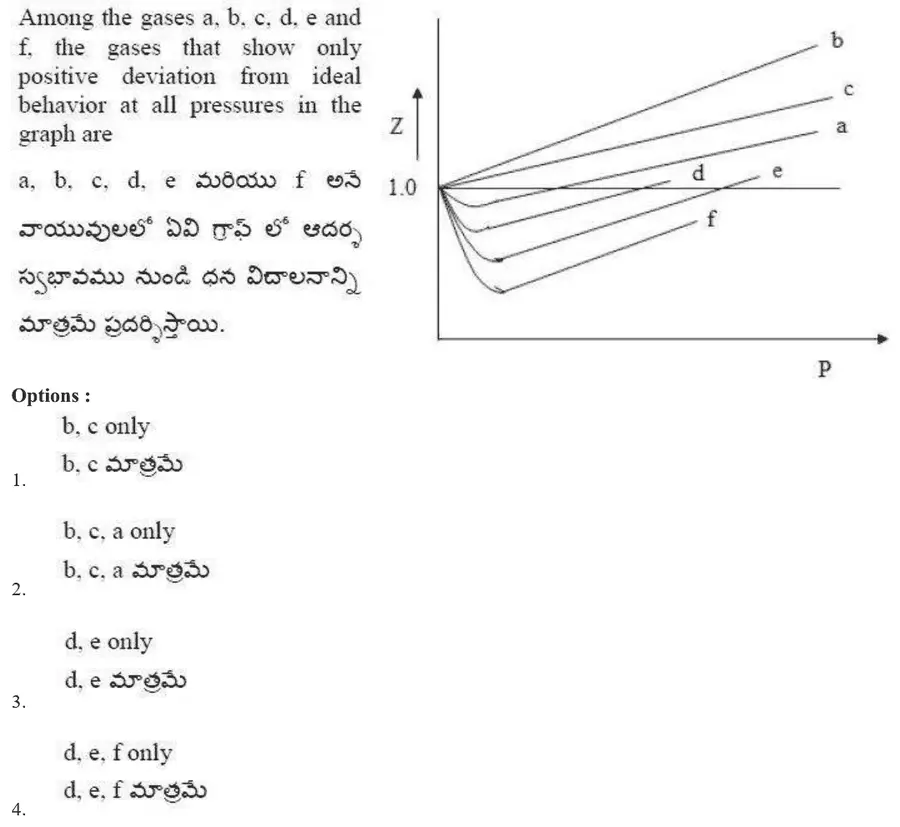
Among the gases a, b, c, d, e and f, the gases that show only positive deviation from ideal behavior at all pressures in the graph are (see the figure above)
The number of network solids and ionic solids in the list given below is respectively $\mathrm{H_2O}$ (ice), AlN, Cu, $\mathrm{CaF_2}$, diamond, MgO, $\mathrm{CCl_4}$, ZnS, Ag, NaCl, $\mathrm{SiO_2}$
Match List I with List II List I (defects): A. Frenkel defects; B. Schottkey defects; C. Vacancy defects; D. Metal deficiency defects List II (Examples): 1. FeO; 2. NaCl; 3. AgCl; 4. Crystals with vacant lattice sites.
1 mole of each of $X_1, X_2, X_3$ with Vander wall's constants $a$ (in $\mathrm{atm\ L^{3}mol^{-2}}$) 1.0, 3.8, 2.1 respectively is kept separately in three different vessels of equal volume at identical temperature. Their pressures are observed to be $P_1, P_2, \&\ P_3$ respectively. On the basis of this data alone, select the correct option (neglect the effect of 'b')
At what temperature will the total kinetic energy of $0.30\ \mathrm{moles}$ of $\mathrm{He}$ be same as the total kinetic energy of $0.40\ \mathrm{moles}$ of $\mathrm{Ar}$ at $400\ \mathrm{K}$?
In a mixed oxide of 'A' and 'B', 'A' occupies all the octahedral voids while 'B' occupies $(2/3)^{rd}$ the tetrahedral voids. The molecular formula of this oxide is ______
If two molecules of $A$ and $B$ having mass $100\ Kg$ and $64\ Kg$ and rate of diffusion of $A$ is $12 \times 10^{-3}$, then rate of diffusion of $B$ will be ______
A cylinder contains a mixture of $5\ g$ of $N_2$ and $6\ g$ of $Ar$ gases. If the total pressure of the mixture of the gases in the cylinder is $30\ bar$, then the partial pressure of $N_2$ gas is ______ (Molecular mass of $N_2 = 28\ g\ mol^{-1}$, Atomic mass of $Ar = 40\ u$)
If each edge of a cubic unit cell of an element having atomic mass 120 and density $6.25\ \mathrm{g.cc^{-1}}$ measures $400\ \mathrm{pm}$, then the crystal lattice is ______
Iron exhibits $BCC$-structure at room temperature. Above $500\ °\mathrm{C}$, it transforms to $FCC$-structure. Find the ratio of the density of iron at room temperature to that at $500\ °\mathrm{C}$. (Assume the atomic radii and the molar mass of iron remain constant even with variation in temperature)
Pressure of 1 $g$ ideal gas $X$ at 300$K$ is 2 $atm$. When 2 $g$ of another gas Y is introduced in the same vessel at same temperature, the pressure become 1 $atm$. The correct relationship between molar mass of $X$ and $Y$ is ______
Which among the following statements is/are incorrect regarding real gases? (i) Their compressibility factor is never equal to unity ($Z \neq 1$). (ii) The deviations from ideal behavior are less at low pressures and high temperatures. (iii) Intermolecular forces among gas molecules are equal to zero. (iv) The obey Van der Waals equation, $PV = nRT$.
The density of an ideal gas can be given by ______, where $P, V, M, T$ and $R$ respectively denote pressure, volume, molar-mass, temperature and universal gas constant.
Two flasks A and B have equal volumes. A is maintained at $300\mathrm{K}$ and B at $600\mathrm{K}$. Equal masses of $\mathrm{H_2}$ and $\mathrm{CO_2}$ are taken in flasks A and B respectively. Find the ratio of total K.E of gases in flask A to that of B
A balloon filled with an air sample occupies 3 L volume at 35 $^\circ$C. On lowering the temperature to T, the volume decreases to 2.5 L. The temperature T is? [Assume P constant]
An alloy made up of A and B metals crystallizes in a cubic lattice, where B atoms occupy the corners and A atoms occupy the face centers. The formula of the alloy formed is
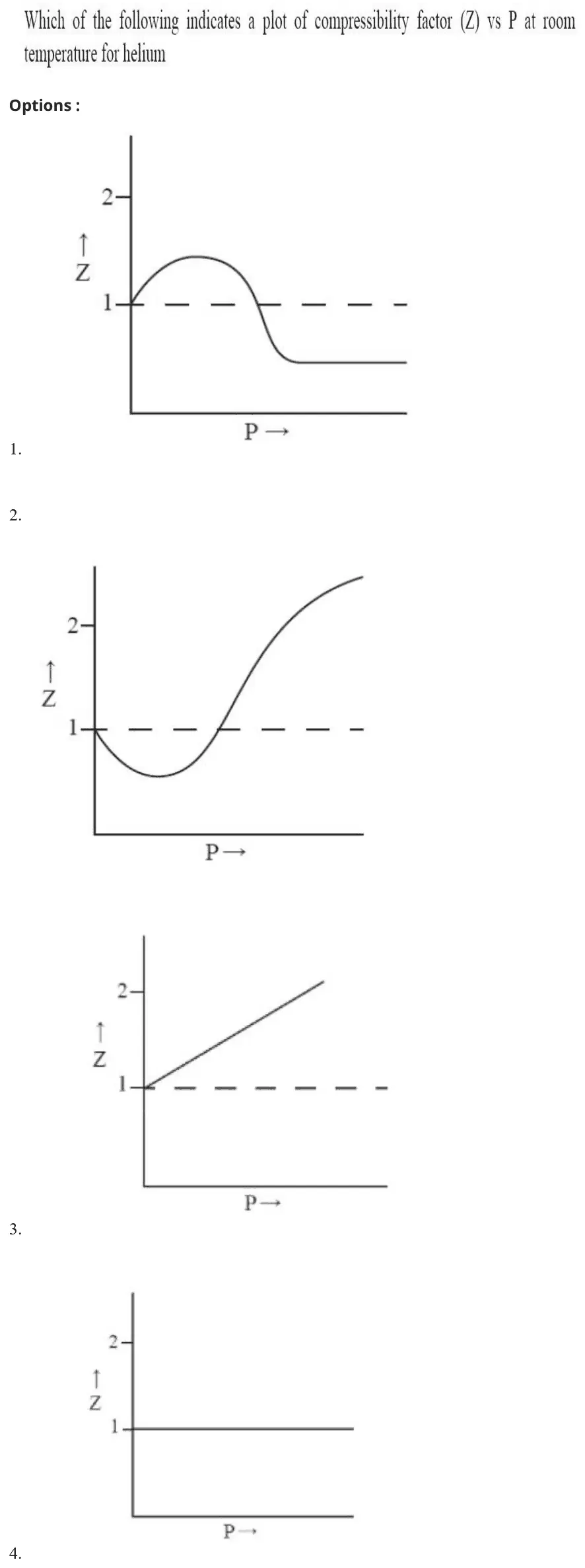
Which of the following indicates a plot of compressibility factor (Z) vs P at room temperature for helium (see the figure above)
The question as printed in the paper.
A
see figure Z vs P: starts at Z=1 on the axis, rises to a maximum above the dashed Z=1 line, then falls, crosses the dashed line and levels off at a constant value below 1.
B
see figure Z vs P: starts at Z=1, dips below the dashed Z=1 line to a minimum, then rises, crosses the dashed line and climbs towards about Z=2.
C
see figure Z vs P: straight line rising from Z=1 at P=0 with positive slope, always above the dashed Z=1 line, reaching about 2.
D
see figure Z vs P: horizontal straight line at Z=1.
At $300\ \mathrm{K}$ the average velocity of a gas is $3\times10^{2}\ \mathrm{cm/sec}$. The average velocity (in cm/sec) of it at $1200\ \mathrm{K}$ is
1 L each of gases A and B diffused through a membrane in 15 and 30 minutes, respectively, under identical conditions. What is the ratio of molecular weight of A and B?
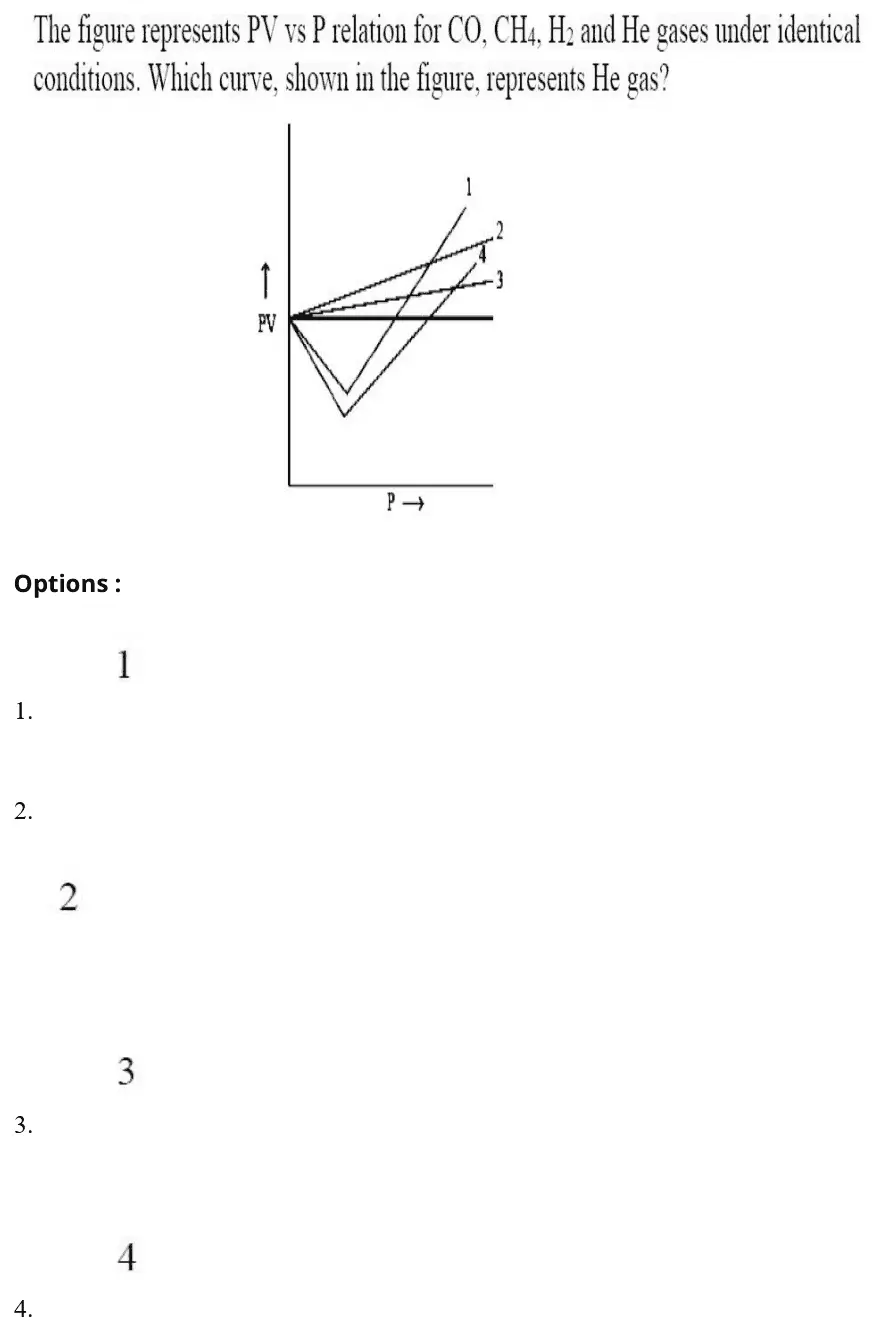
The figure represents PV vs P relation for CO, $\mathrm{CH_4}$, $\mathrm{H_2}$ and He gases under identical conditions. Which curve, shown in the figure, represents He gas? (see the figure above)
How many times the volume of a diatomic gas should be increased reversibly and adiabatically in order to reduce its RMS velocity to half of its initial value.
A compound made up of elements A and B (with a general formula $\mathrm{A_xB_y}$), where B form a hcp lattice and A occupy $2/3^{\mathrm{rd}}$ of the tetrahedral voids. The formula of the compound is
Two gases A and B are released from the two ends of a tunnel of length 100 m. A travels 40 min, before meeting the gas B in the tunnel. If the molecular weight of B is 18, what is the molecular weight of A?
Potassium crystallizes in FCC lattice with unit cell length of 0.5 nm. The approximate density (in $\mathrm{g\,cm^{-3}}$), if it contains 0.1 % Schottky defects is
States of Matter is the second largest contributor in the chemistry curriculum, standing at rank 2 of 31 chemistry chapters between 2022 and 2026. Looking at our entire exam compilation from 2010 through 2026, the chapter supplied 391 questions across 149 papers, taking a 6.6 percent share of the entire subject and averaging 2.6 questions per paper. In the modern timeframe from 2022 to 2026, the volume remained prominent with 194 questions across 77 sittings, producing 2.5 questions per paper and a 6.3 percent subject share.
The chapter maintains a continuous presence across both regional exams, appearing in every paper between 2022 and 2026. Across the state split in this timeframe, AP sittings yielded 133 questions in 48 papers (2.8 questions per paper, 6.9 percent share), while TS sittings gathered 61 questions in 29 papers (2.1 questions per paper, 5.3 percent share).
In earlier administrations from 2010 through 2021, papers featured 197 questions across 72 sittings, which corresponded to 2.7 questions per paper and 6.8 percent subject share. Across the most recent three exam cycles from 2024 to 2026, question setters generated 108 questions across 46 papers, yielding 2.3 questions per test and 5.9 percent share. The long-term share trend between the early era and the last three years is down, while the movement from the five-year recent window to the last three years is about the same. Every sitting carries multiple questions from this combined module.
Most-asked topics
The chapter unites gas behaviour, crystalline solids, and liquid transport:
Gaseous State provides the largest pool with 218 questions in total and 102 across the recent window through 2026. Core themes include the ideal gas law, kinetic molecular theory, root mean square and most probable molecular speeds, Grahams law of diffusion, Daltons partial pressures, and real gas van der Waals parameters.
Solid State is the second major pillar, accounting for 161 questions overall and 87 recent questions through 2026. Questions focus on unit cell density calculations, packing fractions in primitive, body-centred, and face-centred cubic lattices, tetrahedral and octahedral void allocations, and crystal defects such as Schottky and Frenkel imperfections.
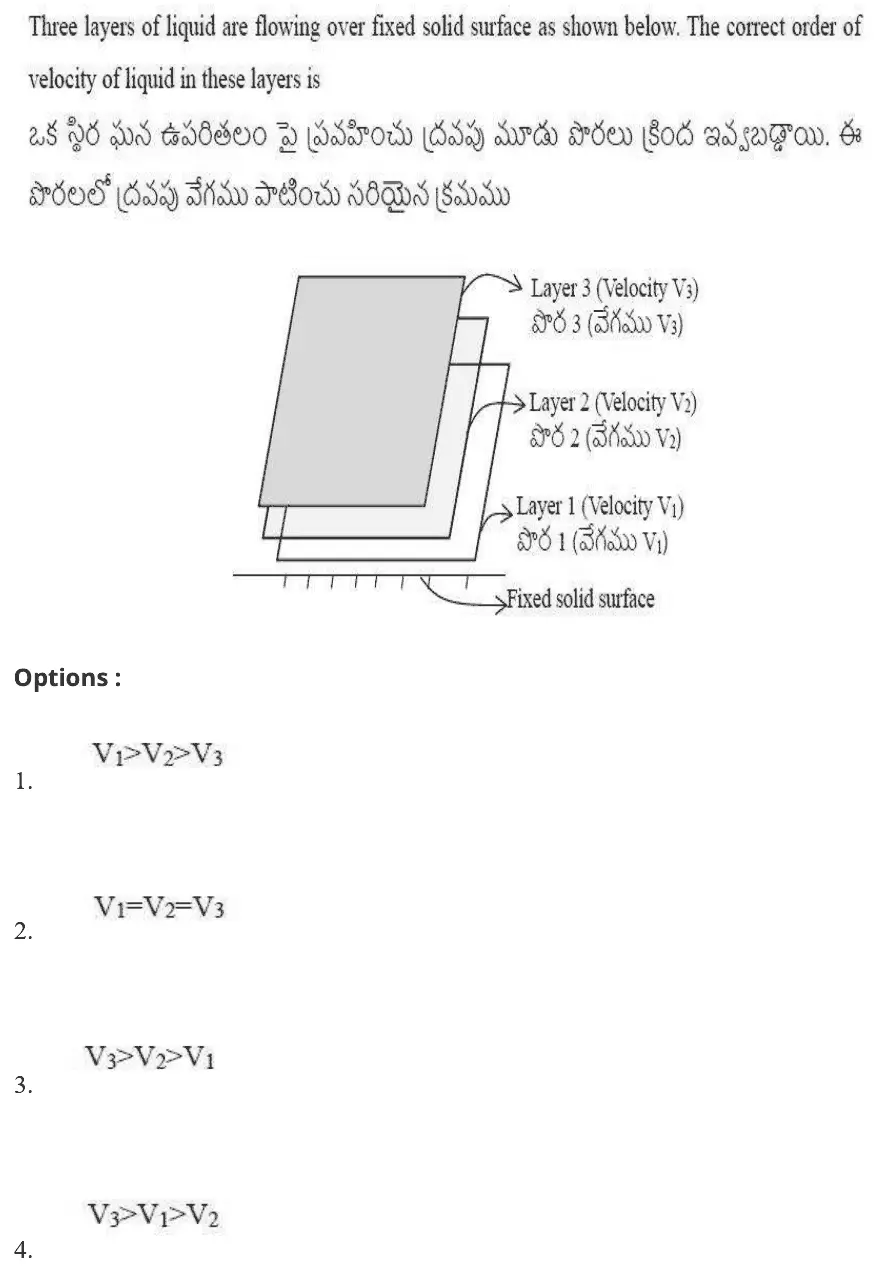
Liquid State contributes a smaller selection of 12 questions overall, with 5 appearing in the recent window up to 2025. Items here concentrate on Newtons coefficient of viscosity, laminar velocity gradients, surface tension phenomena, and vapour pressure temperature curves.
What the questions look like
Gas questions alternate between rapid algebraic comparisons and multi-step stoichiometric gas collections. A typical problem provides the mass percentages of two gases in a closed vessel and asks for the ratio of their partial pressures, or equates the root mean square velocity of one gas at an unknown temperature to the most probable velocity of another gas at a reference temperature. Examiners also love thermal expansion flask questions where an open container is heated, expelling a calculated fraction of the initial gas.
Solid state questions emphasize unit cell geometry. You will calculate the atomic mass or density of an element crystallizing in face-centred or body-centred cubic form using the edge length and Avogadro constant. Another recurrent format specifies an ionic compound forming a close-packed anion framework and asks for the formula when cations occupy a designated fraction of octahedral or tetrahedral interstices.
Questions to try first
Begin your problem sets with these official questions reflecting modern exam patterns:
Split your preparation evenly between the kinetic theory of gases and crystal structures. For gases, practice converting Celsius to Kelvin without oversight, and become automatic with molecular speed ratios where root mean square, average, and most probable speeds scale with the square root of temperature over molar mass. Practice Daltons law by linking partial pressure directly to mole fractions.
For the solid state half, memorize the radius-to-edge relationships for simple cubic, body-centred cubic, and face-centred cubic systems. Remember that a lattice with N close-packed atoms generates N octahedral voids and twice that number of tetrahedral voids. Ensure you can solve unit cell density problems cleanly by expressing edge length in centimetres and converting formula units carefully.
Frequently asked questions
Are solid state and gaseous state both asked in every shift?
Yes, because the combined chapter averages between two and three questions per paper, almost every individual shift includes at least one question from the gaseous state alongside another question from crystal geometry or voids.
What causes most calculation errors in unit cell density problems?
The most frequent slips involve unit conversions of the edge length. If edge length is given in picometres, converting to centimetres before cubing requires multiplying by ten to the power of minus ten, which when cubed yields ten to the power of minus thirty.
Which gas equation is tested more frequently?
Numerical questions heavily favour the ideal gas equation, Dalton partial pressure relationships, and kinetic speed formulas. The van der Waals real gas equation appears mainly in conceptual questions regarding the physical interpretation of constants a and b, or conditions of liquefaction. Step-by-step solutions for each one are in the EdLoop EAPCET app.