EdLoop PYQs · free, no ads · questions and answers here, step-by-step solutions in the EdLoop app
PYQs · free, no adsOpen on the web (app.edloop.in)Get EdLoop – free on Google Play
ChemistryChemistry in Everyday Life

Chemistry in Everyday Life: AP & TS EAPCET PYQs 2010–2026

Every Chemistry in Everyday Life question from past AP EAPCET and TS EAPCET papers, with options and answers. Newest first.

126questions
112papers covered
2%of Chemistry questions, 2022–2026
2010–2026years

Guide at a glance

Chemistry in Everyday Life offers concise, fact-driven questions derived from applied pharmaceutical and consumer chemistry.

Most asked sub-topics

Chemistry in Everyday Life126

Practise these in EdLoop

Attempt every Chemistry in Everyday Life question timed, see the step-by-step solution and track what you get wrong. Free.

Start practice

All questions

126 questions
1AP EAPCET 2026 · 18 May · Shift 1MCQOpen question page ↗

Match the following

List – IList – II
ANorethindroneIAntiseptic
BBithionolIIAntihistamine
CBrompheniramineIIITranquillizer
DSerotoninIVAntifertility drug

The correct answer is

  • A

    A-II, B-III, C-IV, D-I

  • B

    A-III, B-IV, C-I, D-II

  • C

    A-IV, B-I, C-III, D-II

  • D

    A-IV, B-I, C-II, D-III

2AP EAPCET 2026 · 15 May · Shift 1MCQOpen question page ↗

The antibiotic which is supposed to be toxic towards certain strains of cancer cells is

  • A

    Chloroamphenicol

  • B

    Dysidazarine

  • C

    Soframicine

  • D

    Salvarsan

3AP EAPCET 2026 · 15 May · Shift 2MCQOpen question page ↗

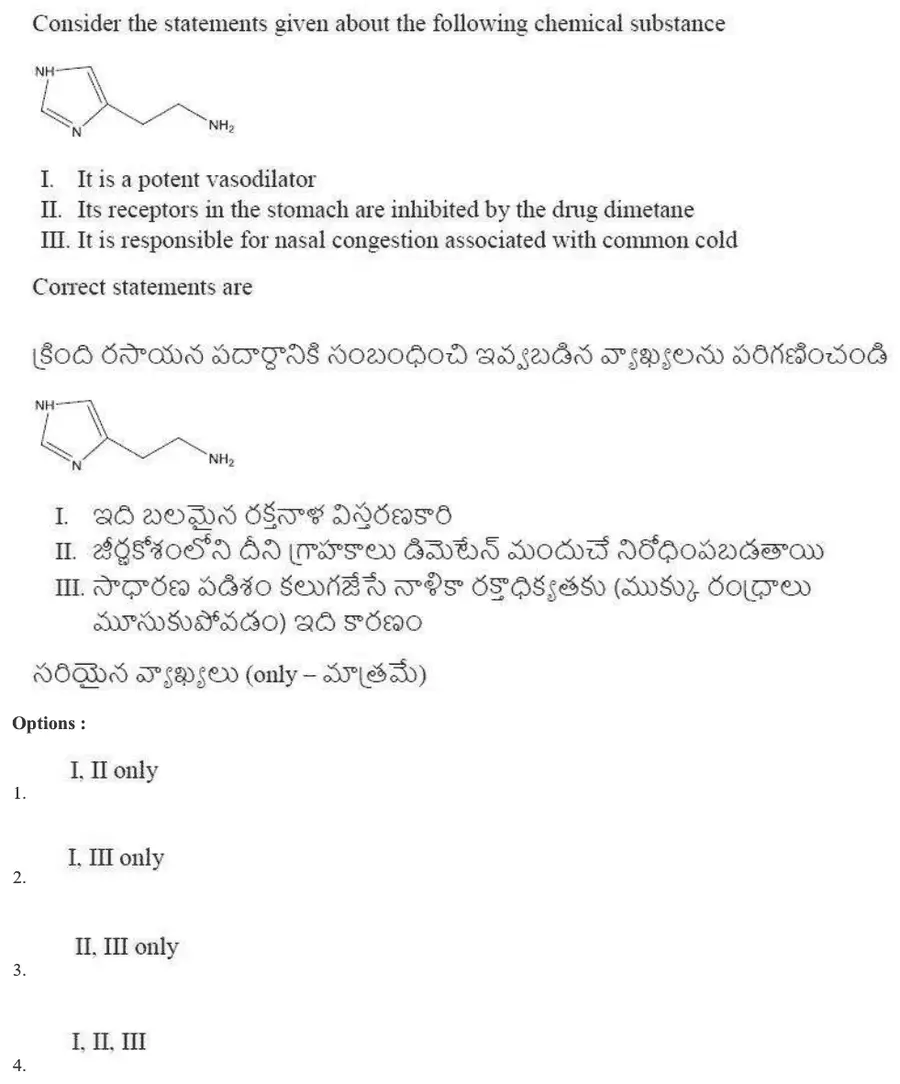
Consider the statements given about the following chemical substance

(see the figure above)

I. It is a potent vasodilator

II. Its receptors in the stomach are inhibited by the drug dimetane

III. It is responsible for nasal congestion associated with common cold

Correct statements are

The question and its figure as printed in AP EAPCET 2026 15th May 2026 Shift 2.
The question as printed in the paper.
  • A

    I, II only

  • B

    I, III only

  • C

    II, III only

  • D

    I, II, III

4AP EAPCET 2026 · 14 May · Shift 1MCQOpen question page ↗

Two statements are given below

Statement I: Aspirin inhibits the synthesis of chemicals which stimulate inflammation

Statement II: The enzyme that degrades noradrenaline is inhibited by iproniazid

The correct answer is

  • A

    Both statements I and II are correct

  • B

    Both statements I and II are not correct

  • C

    Statement I is correct but statement II is not correct

  • D

    Statement I is not correct but statement II is correct

5AP EAPCET 2026 · 14 May · Shift 2MCQOpen question page ↗

Which of the following are broad spectrum antibiotics?

ChloramphenicolPenicillin-GOfloxacin
IIIIII

Correct answer is

  • A

    II , III only

  • B

    I , II , III

  • C

    I , II only

  • D

    I , III only

6AP EAPCET 2026 · 13 May · Shift 1MCQOpen question page ↗

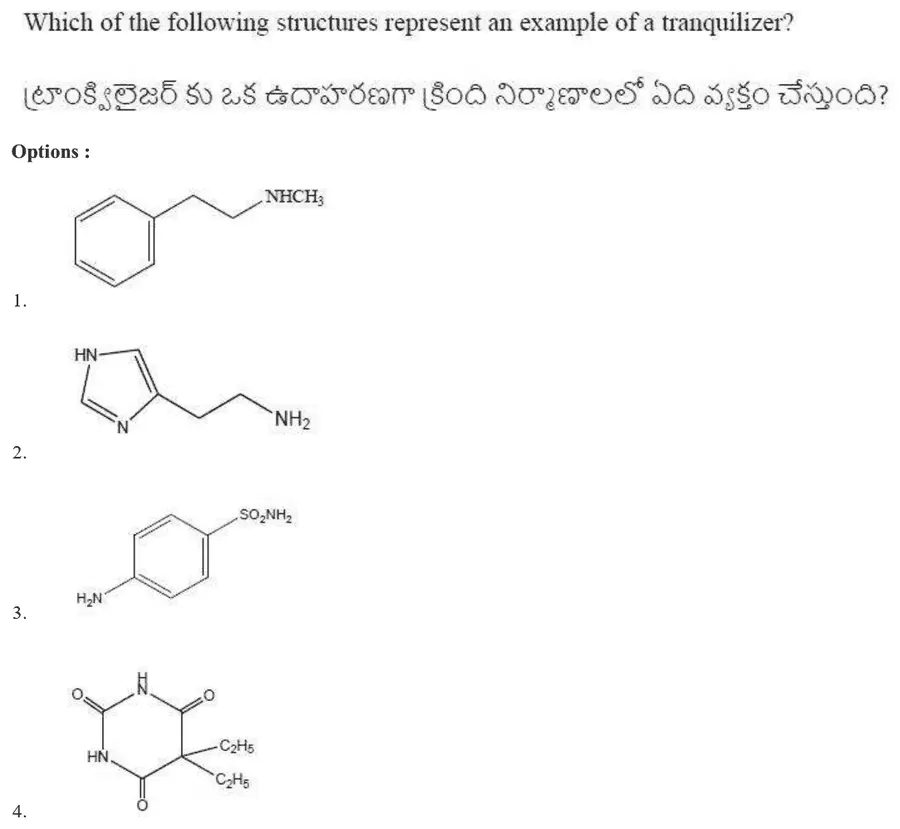
Which of the following structures represent an example of a tranquilizer?

The question and its figure as printed in AP EAPCET 2026 13th May 2026 Shift 1. Option 1: Benzene ring attached to a CH2CH2 chain ending in NHCH3 (N-methyl-2-phenylethylamine). Option 2: Imidazole ring (with HN and N in the ring) bearing a CH2CH2NH2 side chain (histamine). Option 3: Para-substituted benzene ring with SO2NH2 at one end and H2N at the other (sulfanilamide). Option 4: Six-membered barbituric acid ring with two NH groups, three C=O groups, and the carbon between two carbonyls bearing two C2H5 groups (barbital).
The question as printed in the paper.
  • A

    see figure Benzene ring attached to a CH2CH2 chain ending in NHCH3 (N-methyl-2-phenylethylamine).

  • B

    see figure Imidazole ring (with HN and N in the ring) bearing a CH2CH2NH2 side chain (histamine).

  • C

    see figure Para-substituted benzene ring with SO2NH2 at one end and H2N at the other (sulfanilamide).

  • D

    see figure Six-membered barbituric acid ring with two NH groups, three C=O groups, and the carbon between two carbonyls bearing two C2H5 groups (barbital).

7AP EAPCET 2026 · 13 May · Shift 2MCQOpen question page ↗

Consider the following statements

Statement – I: The drugs that bind to the receptor site and inhibit its natural function are called agonists

Statement – II: The drugs which mimic the natural messenger by switching on receptor are called antagonists

The correct answer is

  • A

    Both statements – I & II are correct

  • B

    Statement – I is correct but statement – II is not correct

  • C

    Statement – I is not correct but statement – II is correct

  • D

    Both statements – I & II are not correct

8AP EAPCET 2026 · 12 May · Shift 1MCQOpen question page ↗

Match List – I with List – II

List – IList – II
A) Stearic acid + Polyethylene glycolI) Cationic detergent
B) Cetyl trimethyl ammonium bromideII) Antioxidant in food
C) Sodium Lauryl sulphateIII) Non-ionic detergent
D) Butylated Hydroxy Toluene (BHT)IV) Anionic detergent
  • A

    A – III, B – I, C – II, D – IV

  • B

    A – III, B – I, C – IV, D – II

  • C

    A – I, B – II, C – III, D – IV

  • D

    A – II, B – I, C – III, D - IV

9AP EAPCET 2026 · 12 May · Shift 2MCQOpen question page ↗

Identify the correctly matched pairs from the following sets

I.BHA---- Antioxidant
II.Salt of sorbic acid---- Food preservative
III.Bithional---- Disinfectant

Correct answer is

  • A

    I, II only

  • B

    I, III only

  • C

    II, III only

  • D

    I, II, III

10TS EAPCET 2026 · 11 May · Shift 1MCQOpen question page ↗

Match the following

List-1List-2
AAntioxidantIAntiseptic
BFood preservativeIIArtificial sweetener
CSucraloseIIIButylated hydroxy toluene
DBithionolIVSodium benzoate

The correct answer is

  • A

    A – III, B – I, C – IV, D – II

  • B

    A – IV, B – III, C – II, D – I

  • C

    A – III, B – IV, C –I, D – II

  • D

    A – III, B – IV, C – II, D – I

11TS EAPCET 2026 · 11 May · Shift 2MCQOpen question page ↗

The artificial sweetener which contains –Cl in its structure and stable even at cooking temperature is

  • A

    Aspartame

  • B

    Alitame

  • C

    Saccharin

  • D

    Sucralose

12TS EAPCET 2026 · 10 May · Shift 1MCQOpen question page ↗

Identify the sets from the following in which class of drugs are correctly matched with criteria for its classification

I. Analgesics ----------- Pharmacological effect

II. Sulphonamides ------ Target Molecules

III. Antihistamines ------ drug action

The correct answer is

  • A

    I, II only

  • B

    I, III only

  • C

    II, III only

  • D

    I, II, III

13TS EAPCET 2026 · 9 May · Shift 1MCQOpen question page ↗

Which of the following is not correctly matched with the type of drug mentioned in brackets?

  • A

    Heroin (Narcotic analgesic)

  • B

    Terfenadine (Antacid)

  • C

    Valium (Tranquilizer)

  • D

    Soframicine (Antiseptic)

14TS EAPCET 2026 · 9 May · Shift 2MCQOpen question page ↗

The detergent used in tooth pastes is ‘X’ and in hair conditioners is ‘Y’.
What are X and Y respectively?

  • A

    $p-\mathrm{CH_3(CH_2)_{11}-C_6H_4-SO_3Na}$ ; $\mathrm{(C_{15}H_{31}COO)_3C_3H_5}$

  • B

    $\mathrm{(C_{17}H_{33}COO)_3C_3H_5}$ ; $\mathrm{CH_3(CH_2)_{15}N(CH_3)_3Br}$

  • C

    $\mathrm{CH_3(CH_2)_{10}CH_2OSO_3Na}$ ; $p-\mathrm{C_9H_{19}-C_6H_4-O(CH_2CH_2O)_5CH_2CH_2OH}$

  • D

    $\mathrm{CH_3(CH_2)_{10}CH_2OSO_3Na}$ ; $\mathrm{CH_3(CH_2)_{15}N(CH_3)_3Br}$

15AP EAPCET 2025 · 27 May · Shift 1MCQOpen question page ↗

The synthetic detergent used in tooth paste is of type X. Animal starch is Y. X and Y respectively are

  • A

    Anionic, amylose

  • B

    Non-ionic, cellulose

  • C

    Anionic, glycogen

  • D

    Cationic, amylopectin

16AP EAPCET 2025 · 26 May · Shift 1MCQOpen question page ↗

Consider the following.

Statement-I : Shaving soaps contain glycerol to prevent rapid drying

Statement-II : Laundry soaps contain sodium carbonate as filler

Correct answer is

  • A

    Both statement-I and statement-II are correct

  • B

    Both statement-I and statement-II are not correct

  • C

    Statement-I is correct, but statement-II is not correct

  • D

    Statement-I is not correct, but statement-II is correct

18AP EAPCET 2025 · 24 May · Shift 1MCQOpen question page ↗

The artificial sweetener X contains glycosidic linkage and Y contains amide, ester linkages. X and Y respectively are

  • A

    Sucralose, Alitame

  • B

    Sucralose, Aspartame

  • C

    Saccharin, Alitame

  • D

    Saccharin, Aspartame

19AP EAPCET 2025 · 23 May · Shift 1MCQOpen question page ↗

Match the following.

List-I (Drugs)List-II (effect)
A) EquanilI) Hypnotic
B) FuracineII) Antacid
C) TegametIII) Antiseptic
D) VeronalIV) To control hypertension

Correct answer is

  • A

    A-III, B-I, C-II, D-IV

  • B

    A-II, B-IV, C-III, D-I

  • C

    A-IV, B-III, C-I, D-II

  • D

    A-IV, B-III, C-II, D-I

20AP EAPCET 2025 · 23 May · Shift 2MCQOpen question page ↗

Which of the following is not an example of synthetic detergent ?

  • A

    Cetyltrimethylammonium bromide

  • B

    Sodium stearate

  • C

    Sodium laurylsulphate

  • D

    Sodium dodecylbenzenesulfonate

21AP EAPCET 2025 · 22 May · Shift 1MCQOpen question page ↗

Bithionol is added to soaps to impart antiseptic properties. The number of $-\mathrm{OH}$ and $-\mathrm{Cl}$ groups in its structure are respectively

  • A

    2, 3

  • B

    3, 2

  • C

    4, 2

  • D

    2, 4

22AP EAPCET 2025 · 22 May · Shift 2MCQOpen question page ↗

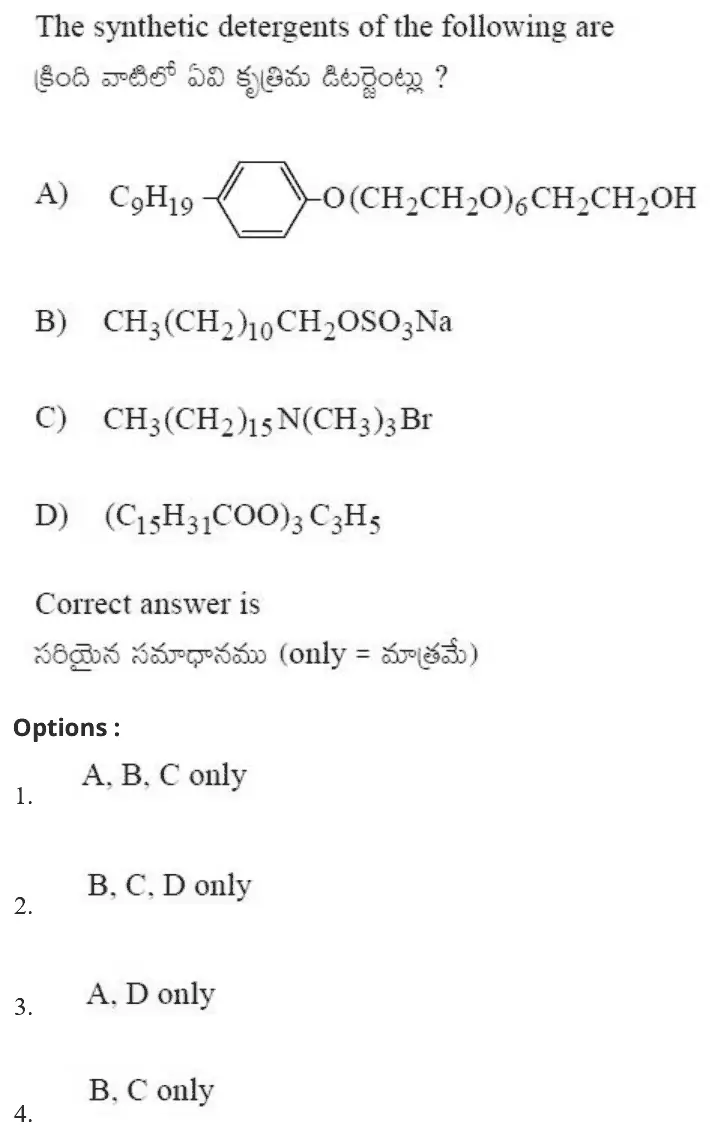
The synthetic detergents of the following are

A) $\mathrm{C_9H_{19}}$–(see the figure above)–$\mathrm{O(CH_2CH_2O)_6CH_2CH_2OH}$

B) $\mathrm{CH_3(CH_2)_{10}CH_2OSO_3Na}$

C) $\mathrm{CH_3(CH_2)_{15}N(CH_3)_3Br}$

D) $\mathrm{(C_{15}H_{31}COO)_3C_3H_5}$

Correct answer is

The question and its figure as printed in AP EAPCET 2025 22nd May 2025 Shift 2.
The question as printed in the paper.
  • A

    A, B, C only

  • B

    B, C, D only

  • C

    A, D only

  • D

    B, C only

23AP EAPCET 2025 · 21 May · Shift 1MCQOpen question page ↗

Which of the following is not an example of antacid ?

  • A

    Cimetidine

  • B

    Ranitidine

  • C

    Sodium hydrogen carbonate

  • D

    Phenelzine

25TS EAPCET 2025 · 4 May · Shift 1MCQOpen question page ↗

Consider the following

Assertion (A): Aspirin is useful in the prevention of heart attacks

Reason (R): Aspirin acts as anti-blood clotting agent

The correct answer is

  • A

    Both A and R are correct and R is the correct explanation of A

  • B

    A is correct and R is not correct

  • C

    Both A and R are correct and R is not the correct explanation of A

  • D

    A is incorrect and R is correct

26TS EAPCET 2025 · 4 May · Shift 2MCQOpen question page ↗

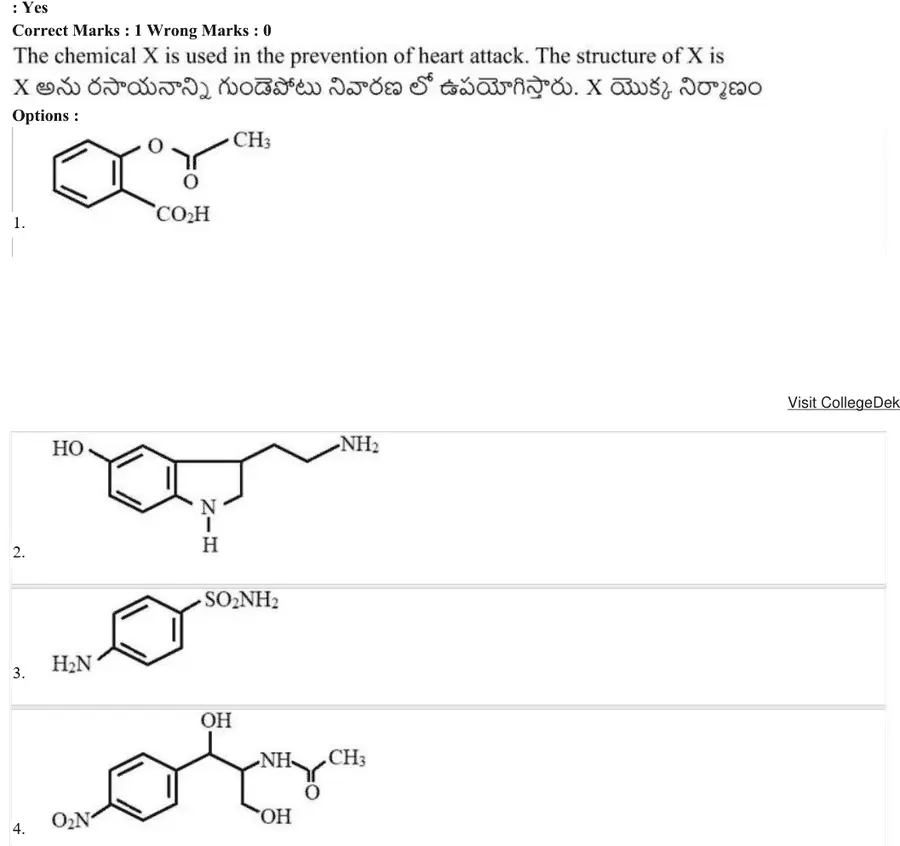
The chemical X is used in the prevention of heart attack. The structure of X is

The question and its figure as printed in TG EAPCET 2025 04 May AN. Option 1: Benzene ring with an acetoxy group (O–C(=O)–CH3) and, on the adjacent ring carbon, a CO2H group (aspirin). Option 2: Indoline-type bicyclic structure (benzene ring fused to a five-membered ring containing NH) with an OH group on the benzene ring and a CH2CH2NH2 side chain on the five-membered ring. Option 3: Para-substituted benzene ring with H2N on one side and SO2NH2 on the other. Option 4: Para-substituted benzene ring with O2N on one side and a side chain CH(OH)–CH(NH–C(=O)CH3)–CH2OH on the other.
The question as printed in the paper.
  • A

    see figure Benzene ring with an acetoxy group (O–C(=O)–CH3) and, on the adjacent ring carbon, a CO2H group (aspirin).

  • B

    see figure Indoline-type bicyclic structure (benzene ring fused to a five-membered ring containing NH) with an OH group on the benzene ring and a CH2CH2NH2 side chain on the five-membered ring.

  • C

    see figure Para-substituted benzene ring with H2N on one side and SO2NH2 on the other.

  • D

    see figure Para-substituted benzene ring with O2N on one side and a side chain CH(OH)–CH(NH–C(=O)CH3)–CH2OH on the other.

27TS EAPCET 2025 · 3 May · Shift 1MCQOpen question page ↗

Match the following

List – 1 (Chemical)List – 2 (Type)
ABithionolIArtificial sweetener
BSaccharinIIAntifertility drug
CSodium benzoateIIIAntiseptic
DNorethindroneIVFood preservative

The correct answer is

  • A

    A – III, B – I, C – IV, D – II

  • B

    A – II, B – I, C – IV, D – III

  • C

    A – III, B – II, C – IV, D – I

  • D

    A – IV, B – I, C – II, D – III

28TS EAPCET 2025 · 3 May · Shift 2MCQOpen question page ↗

Identify the pair of drugs which act as antihistamines.

  • A

    Dimetapp, Seldane

  • B

    Iproniazid, Nardil

  • C

    Veronal, Valium

  • D

    Heroin, Codeine

29TS EAPCET 2025 · 2 May · Shift 1MCQOpen question page ↗

The structure of which artificial sweetener contains aspartic acid and phenylalanine parts?

  • A

    Saccharin

  • B

    Sucralose

  • C

    Alitame

  • D

    Aspartame

30TS EAPCET 2025 · 2 May · Shift 2MCQOpen question page ↗

The incorrect statement about chloramphenicol is

  • A

    It is a broad spectrum antibiotic

  • B

    It is a bacteriostatic antibiotic

  • C

    It is a bactericidal antibiotic

  • D

    It is used to cure pneumonia

31AP EAPCET 2024 · 23 May · Shift 1MCQOpen question page ↗

Which of the following statement is incorrect?

  • A

    Shaving soaps contain glycerol

  • B

    Branched chain detergents are easily biodegradable

  • C

    Commonly used Dettol is a mixture of chloroxylenol and terpineol

  • D

    0.2% of phenol acts as antiseptic

32AP EAPCET 2024 · 22 May · Shift 1MCQOpen question page ↗

Which of the following molecules contain sulphur atom in their structures

I. Morphine

II. Heroin

III. Penicillin

IV. Terpineol

V. Cimetidine

  • A

    I, IV

  • B

    II, III

  • C

    III, V

  • D

    IV, V

33AP EAPCET 2024 · 22 May · Shift 2MCQOpen question page ↗

Which of the following is NOT correctly matched?

  • A

    Aspartame – Food preservative

  • B

    Butylated hydroxy toluene – antioxidant

  • C

    Novestrol – antifertility drug

  • D

    Bithionol – antiseptic

34AP EAPCET 2024 · 21 May · Shift 1MCQOpen question page ↗

Match the following

List-I (Drug)List-II (Use)
A.VeronalI.Antihistamine
B.MorphineII.Hypnotic
C.SeldaneIII.Analgesic
IV.Antidepressant

Correct answer is

  • A

    A-IV, B-III, C-I

  • B

    A-IV, B-I, C-II

  • C

    A-II, B-III, C-I

  • D

    A-II, B-IV, C-III

35AP EAPCET 2024 · 21 May · Shift 2MCQOpen question page ↗

The enamel present on teeth becomes much harder due to the conversion of $[3\ \mathrm{Ca_3(PO_4)_2 \cdot X}]$ into $[3\ \mathrm{Ca_3(PO_4)_2 \cdot Y}]$. What are X and Y?

  • A

    $\mathrm{X = Ca(OH)_2,\ Y = CaF_2}$

  • B

    $\mathrm{X = Ca(OH)_2,\ Y = CaCl_2}$

  • C

    $\mathrm{X = Ca(OH)_2,\ Y = NaCl}$

  • D

    $\mathrm{X = CaO,\ Y = CaCl_2}$

36AP EAPCET 2024 · 21 May · Shift 2MCQOpen question page ↗

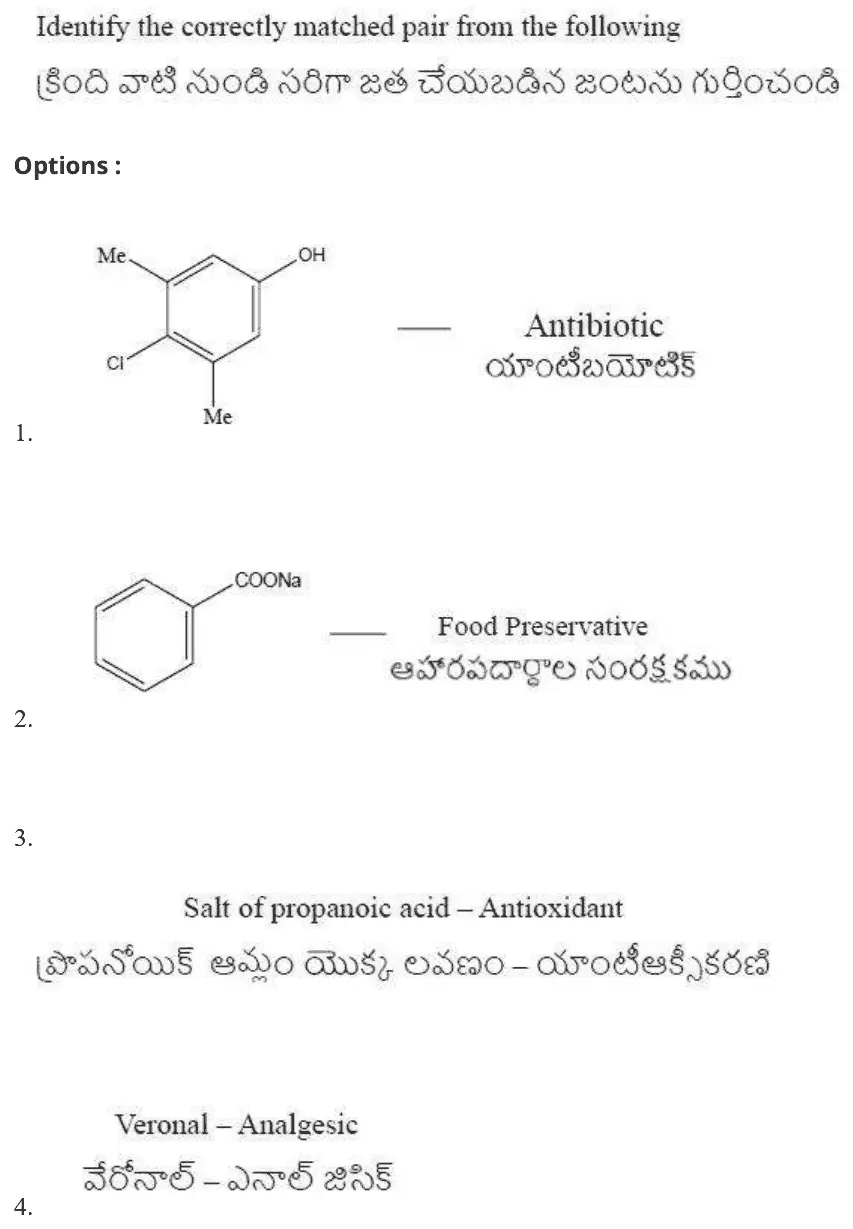
Identify the correctly matched pair from the following

The question and its figure as printed in AP EAPCET 2024 21st May 2024 Shift 2. Option 1: Benzene ring structure — Antibiotic Option 2: Sodium benzoate structure (benzene ring with COONa) — Food Preservative
The question as printed in the paper.
  • A

    see figure Benzene ring structure — Antibiotic

  • B

    see figure Sodium benzoate structure (benzene ring with COONa) — Food Preservative

  • C

    Salt of propanoic acid – Antioxidant

  • D

    Veronal – Analgesic

37AP EAPCET 2024 · 20 May · Shift 1MCQOpen question page ↗

Which of the following pair is not correctly matched?

  • A

    Salvarsan – to treat syphilis

  • B

    Luminal – Antidepressant

  • C

    Morphine – to treat cardiac pain

  • D

    Acetylsalicylic acid – Antipyretic

39AP EAPCET 2024 · 20 May · Shift 2MCQOpen question page ↗

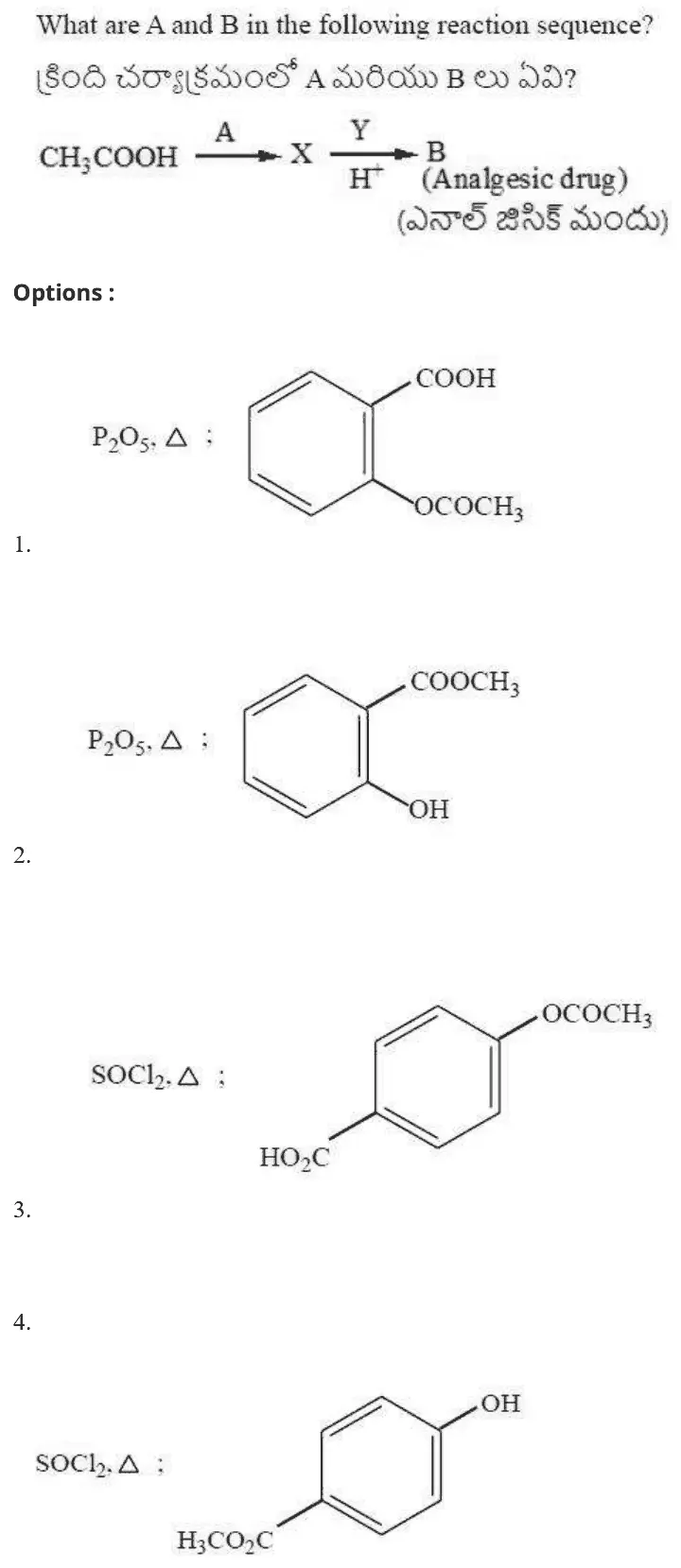
What are A and B in the following reaction sequence?

$$\mathrm{CH_3COOH} \xrightarrow{A} X \xrightarrow[\mathrm{H^+}]{Y} B\ \text{(Analgesic drug)}$$

The question and its figure as printed in AP EAPCET 2024 20th May 2024 Shift 2.
The question as printed in the paper.
  • A

    A: $\mathrm{P_2O_5, \Delta}$ ; B: (see the figure above) benzene ring with COOH and OCOCH$_3$ substituents on adjacent (ortho) carbons

  • B

    A: $\mathrm{P_2O_5, \Delta}$ ; B: (see the figure above) benzene ring with COOCH$_3$ and OH substituents on adjacent (ortho) carbons

  • C

    A: $\mathrm{SOCl_2, \Delta}$ ; B: (see the figure above) benzene ring with OCOCH$_3$ and $\mathrm{HO_2C}$ substituents at para positions

  • D

    A: $\mathrm{SOCl_2, \Delta}$ ; B: (see the figure above) benzene ring with OH and $\mathrm{H_3CO_2C}$ substituents at para positions

40AP EAPCET 2024 · 19 May · Shift 2MCQOpen question page ↗

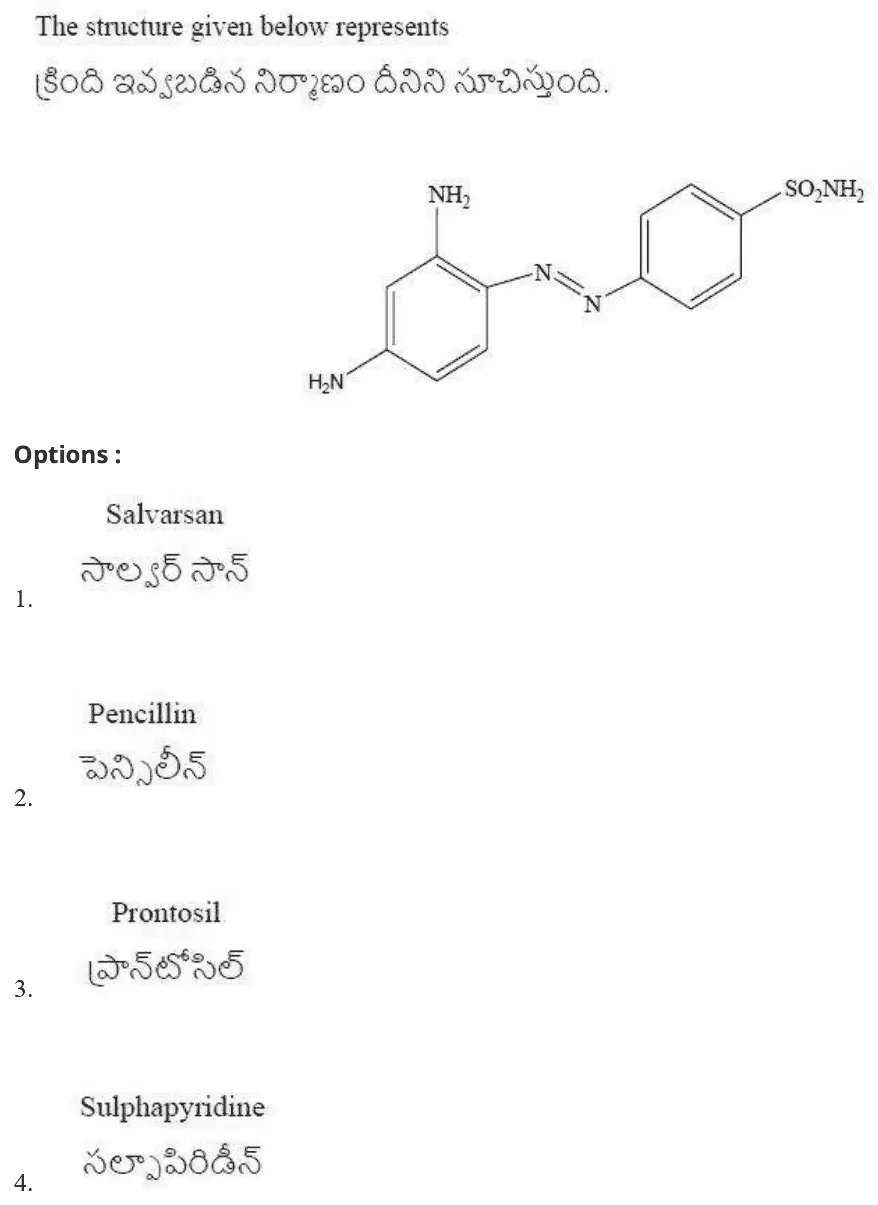
The structure given below represents

(see the figure above)

The question and its figure as printed in AP EAPCET 2024 19th May 2024 Shift 2.
The question as printed in the paper.
  • A

    Salvarsan

  • B

    Pencillin

  • C

    Prontosil

  • D

    Sulphapyridine

41AP EAPCET 2024 · 18 May · Shift 1MCQOpen question page ↗

Identify the correct set from the following

  • A

    Penicillin – narrow spectrum - bactereostatic

  • B

    Chloramphenicol – broad spectrum - bactereostatic

  • C

    Ampicillin - – narrow spectrum - bactericidal

  • D

    Ofloxacin – broad spectrum - bactereostatic

42TS EAPCET 2024 · 11 May · Shift 1MCQOpen question page ↗

What is the value of ‘n’ in ‘Z’ of the following sequence?

$$\text{Lauryl alcohol} \xrightarrow{\mathrm{H_2SO_4}} \text{Lauryl hydrogen sulphate} \xrightarrow{\mathrm{NaOH(aq)}} \mathrm{CH_3\text{-}(CH_2)_n\text{-}CH_2OSO_3Na}$$

(X) (Y) (Z) sodium lauryl sulphate

  • A

    10

  • B

    12

  • C

    16

  • D

    14

43TS EAPCET 2024 · 10 May · Shift 1MCQOpen question page ↗

The number of $-\mathrm{OH}$ groups present in the structures of bithionol, terpineol and chloroxylenol is respectively

  • A

    2, 1, 1

  • B

    1, 2, 1

  • C

    1, 1, 2

  • D

    2, 2, 1

44TS EAPCET 2024 · 10 May · Shift 2MCQOpen question page ↗

The effects that aspirin can produce in the body are

Anti-inflammatoryAntidepressantAntipyreticAnticoagulantHypnotic
ABCDE
  • A

    A, B, C

  • B

    A, C, D

  • C

    A, B, E

  • D

    C, D, E

45TS EAPCET 2024 · 9 May · Shift 1MCQOpen question page ↗

Among the following the incorrect statement about chloramphenicol is

  • A

    It is a bacteriostatic drug

  • B

    It is a broad spectrum antibiotic

  • C

    It is a bactericidal drug

  • D

    It is used to treat typhoid

46TS EAPCET 2024 · 9 May · Shift 2MCQOpen question page ↗

Match the following

List – I<br>Type of drugList – II<br>Example
AAntacidISerotonin
BAntihistamineIISeldane
CTranquilizerIIIRanitidine
DAntibioticIVChloramphenicol

The correct answer is

  • A

    A-III, B-I, C-IV, D-II

  • B

    A-II, B-III, C-IV, D-I

  • C

    A-III, B-II, C-I, D-IV

  • D

    A-II, B-III, C-I, D-IV

47AP EAPCET 2023 · 19 May · Shift 1MCQOpen question page ↗

In which of the following, drug class is correctly matched with the criteria of drug classification

  • A

    Analgesics ----- molecular targets

  • B

    Sulphonamides ----- drug action

  • C

    Antihistamines ----- chemical structure

  • D

    Antiseptics ----- pharmacological effect

49AP EAPCET 2023 · 18 May · Shift 2MCQOpen question page ↗

Identify the correct statement from the following

  • A

    Unbranched hydrocarbon detergents are non-biodegradable

  • B

    Cetyltrimethyl ammonium bromide is used in hair conditioners

  • C

    Liquid dish washing detergents are anionic type

  • D

    Synthetic detergents cannot be used in hard water

51AP EAPCET 2023 · 17 May · Shift 2MCQOpen question page ↗

Correct statements with respect to morphine (X) and Veronal (Y) are

A. Both X and Y are sleep producing agents

B. X is hypnotic and Y is analgesic

C. X is analgesic and Y is hypnotic

D. X is non narcotic analgesic and Y is antidepressant

  • A

    A, B

  • B

    B, C

  • C

    A, C

  • D

    C, D

52AP EAPCET 2023 · 16 May · Shift 1MCQOpen question page ↗

Food preservative sodium benzoate is eliminated from the body as which of the following metabolite?

  • A

    benzamide

  • B

    phenyl acetic acid

  • C

    benzoic acid

  • D

    Hippuric acid

53AP EAPCET 2023 · 16 May · Shift 2MCQOpen question page ↗

Match the following

List – IList – II
A. Broad spectrumI. Amoxycillin
B. TyphoidII. Vancomycin
C. BactericidalIII. Erythromycin
D. BacteriostaticIV. Chloramphenicol
V. Ofloxacin

The correct answer is

  • A

    A – II, B – I, C – V, D - III

  • B

    A – II, B – IV, C – V, D - III

  • C

    A – III, B – IV, C- II, D - I

  • D

    A – III, B – II, C – IV, D - V

54AP EAPCET 2023 · 15 May · Shift 1MCQOpen question page ↗

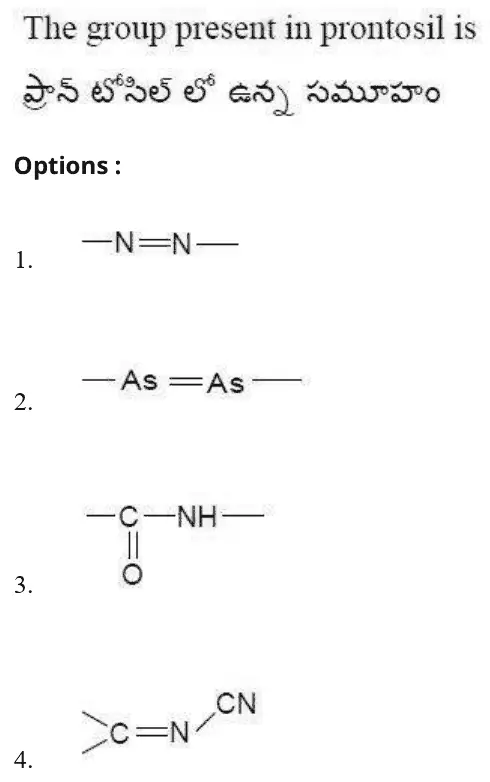
The group present in prontosil is

The question and its figure as printed in AP EAPCET 2023 15th May 2023 Shift 1. Option 1: Azo group: a single bond to N, double bond N=N, then a single bond to the right, drawn as —N=N— Option 2: Arsenic double-bonded group drawn as —As=As— Option 3: Amide group: a carbon with a single bond to the left, a C=O double bond pointing downward to O, and a single bond to NH, which has a bond to the right, drawn as —C(=O)—NH— Option 4: A carbon with two single bonds to the left (forming a fork, >C), double bonded to N, which is single bonded to CN above right, drawn as >C=N—CN
The question as printed in the paper.
  • A

    see figure Azo group: a single bond to N, double bond N=N, then a single bond to the right, drawn as —N=N—

  • B

    see figure Arsenic double-bonded group drawn as —As=As—

  • C

    see figure Amide group: a carbon with a single bond to the left, a C=O double bond pointing downward to O, and a single bond to NH, which has a bond to the right, drawn as —C(=O)—NH—

  • D

    see figure A carbon with two single bonds to the left (forming a fork, >C), double bonded to N, which is single bonded to CN above right, drawn as >C=N—CN

55AP EAPCET 2023 · 15 May · Shift 2MCQOpen question page ↗

Ortho-sulphobenzimide is used as

  • A

    Anti oxidant

  • B

    Artificial sweetener

  • C

    Food Preservative

  • D

    Food supplement

56TS EAPCET 2023 · 14 May · Shift 1MCQOpen question page ↗

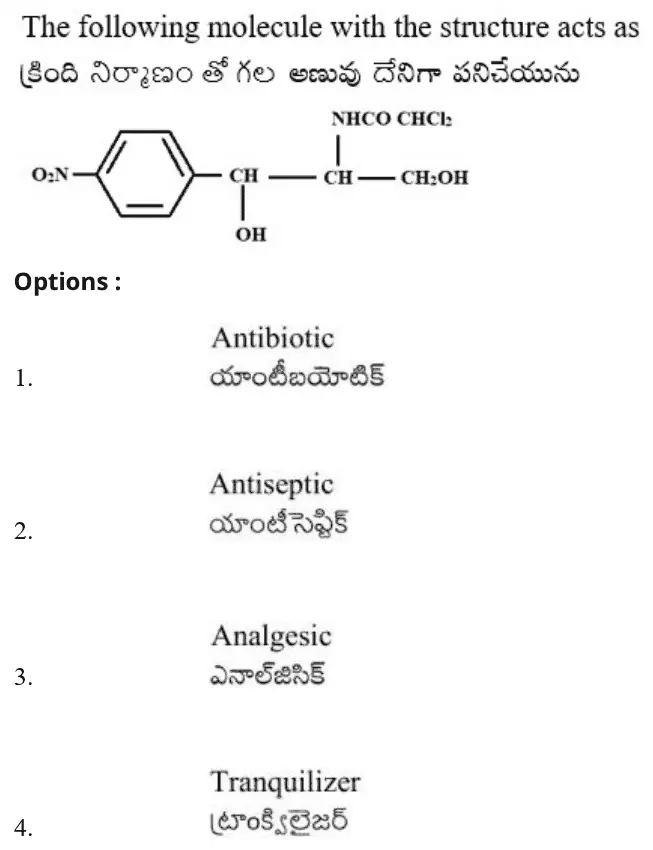
The following molecule with the structure acts as

(see the figure above)

The question and its figure as printed in TS EAPCET 2023 14th May 2023 Shift 1.
The question as printed in the paper.
  • A

    Antibiotic

  • B

    Antiseptic

  • C

    Analgesic

  • D

    Tranquilizer

58TS EAPCET 2023 · 13 May · Shift 1MCQOpen question page ↗

Which one of the following will improve the lathering property of soap

  • A

    Sodium stearate

  • B

    Sodium rosinate

  • C

    Sodium carbonate

  • D

    Sodium phosphate

59TS EAPCET 2023 · 13 May · Shift 2MCQOpen question page ↗

Identify the pair of drugs which act as tranquilizers

  • A

    Heroin, Codeine

  • B

    Valium, Serotonin

  • C

    Dimetapp, Seldane

  • D

    Cimetidine, Ranitidine

60TS EAPCET 2023 · 12 May · Shift 1MCQOpen question page ↗

Which of the following is not correctly matched?

  • A

    Butylated hydroxy toluene – Antioxidant in food

  • B

    Chloramphenicol – Antiseptic

  • C

    Norethindrone – Antifertility drug

  • D

    Alitame – Artificial sweetner

61TS EAPCET 2023 · 12 May · Shift 2MCQOpen question page ↗

The medicine used in controlling depression and hyper tension is

  • A

    Ranitidine

  • B

    Paracetamol

  • C

    Equanil

  • D

    Chloramphenicol

62AP EAPCET 2022 · 5 Jul · Shift 2MCQOpen question page ↗

The colloidal solution used to treat stomach disorders is

  • A

    Silver sol

  • B

    Antimony sol

  • C

    Milk of magnesia

  • D

    Gold sol

63AP EAPCET 2022 · 5 Jul · Shift 2MCQOpen question page ↗

Curdling of milk is caused due to the formation of which of the following acids by the bacteria?

  • A

    Formic acid

  • B

    Acetic acid

  • C

    Lactic acid

  • D

    Maleic acid

64AP EAMCET 2020 · 23 Sep · Shift 1MCQOpen question page ↗

Which among the following is a bactericidal antibiotic?

  • A

    Penicillin

  • B

    Erythromycin

  • C

    Tetracycline

  • D

    Chloramphenicol

65AP EAMCET 2020 · 23 Sep · Shift 1MCQOpen question page ↗

When soap is dissolved in hard water, it's cleaning ability comes down. This is due to the formation of:

  • A

    $(C_{17}H_{35}COO)_2Sn$

  • B

    $(C_{17}H_{35}COO)_2Ca$

  • C

    $C_{17}H_{35}COOLi$

  • D

    $C_{17}H_{35}COOH$

66AP EAMCET 2020 · 22 Sep · Shift 1MCQOpen question page ↗

Compound which is added to soap to impart antiseptic properties is ______

  • A

    Sodium lauryl sulphate

  • B

    Sodium dodecylbenzene sulphonate

  • C

    Rosin

  • D

    Bithionol

67AP EAMCET 2020 · 22 Sep · Shift 2MCQOpen question page ↗

Lemon and orange juices contain ______ and ______ acids respectively.

  • A

    Tartaric, Oxalic

  • B

    Citric, Citric

  • C

    Oxalic, Ascorbic

  • D

    Ascorbic, Oxalic

68AP EAMCET 2020 · 21 Sep · Shift 1MCQOpen question page ↗

Tincture of iodine is the common name for ______

  • A

    Iodoform

  • B

    2-iodopropane

  • C

    2-3 % Iodine solution in alcohol-water

  • D

    Iodobenzene

69AP EAMCET 2020 · 18 Sep · Shift 1MCQOpen question page ↗

Which among the following is used in detergents?

  • A

    Sodium acetate

  • B

    Sodium stearate

  • C

    Calcium stearate

  • D

    Sodium lauryl sulphate

70AP EAMCET 2020 · 18 Sep · Shift 1MCQOpen question page ↗

Which among the following is used as a food preservative?

  • A

    $C_6H_5CH_2ONa$

  • B

    $C_6H_5COOONa$ (sic)

  • C

    $C_6H_5COONa$

  • D

    $C_6H_5CH=CHCOONa$

71AP EAMCET 2020 · 18 Sep · Shift 2MCQOpen question page ↗

The artificial sweetener sucralose is ______

  • A

    Hexachloro derivative of sucrose

  • B

    Trichloro derivative of sucrose

  • C

    Pentachloro derivative of sucrose

  • D

    Tetrachloro derivative of sucrose

73AP EAMCET 2020 · 17 Sep · Shift 1MCQOpen question page ↗

Examples for bactericidal and bacteriostatic antibiotics, respectively are

  • A

    Penicillin, ofloxacin

  • B

    Erythromycin, Tetracycline

  • C

    Penicillin, Chloramphenicol

  • D

    Tetracycline, penicillin

74AP EAMCET 2020 · 17 Sep · Shift 1MCQOpen question page ↗

Which of the following chemicals can be added for sweetening of food items at cooking temperature and does not provide calories?

  • A

    Sucrose

  • B

    Glucose

  • C

    Fructose

  • D

    Sucralose

75AP EAMCET 2020 · 17 Sep · Shift 2MCQOpen question page ↗

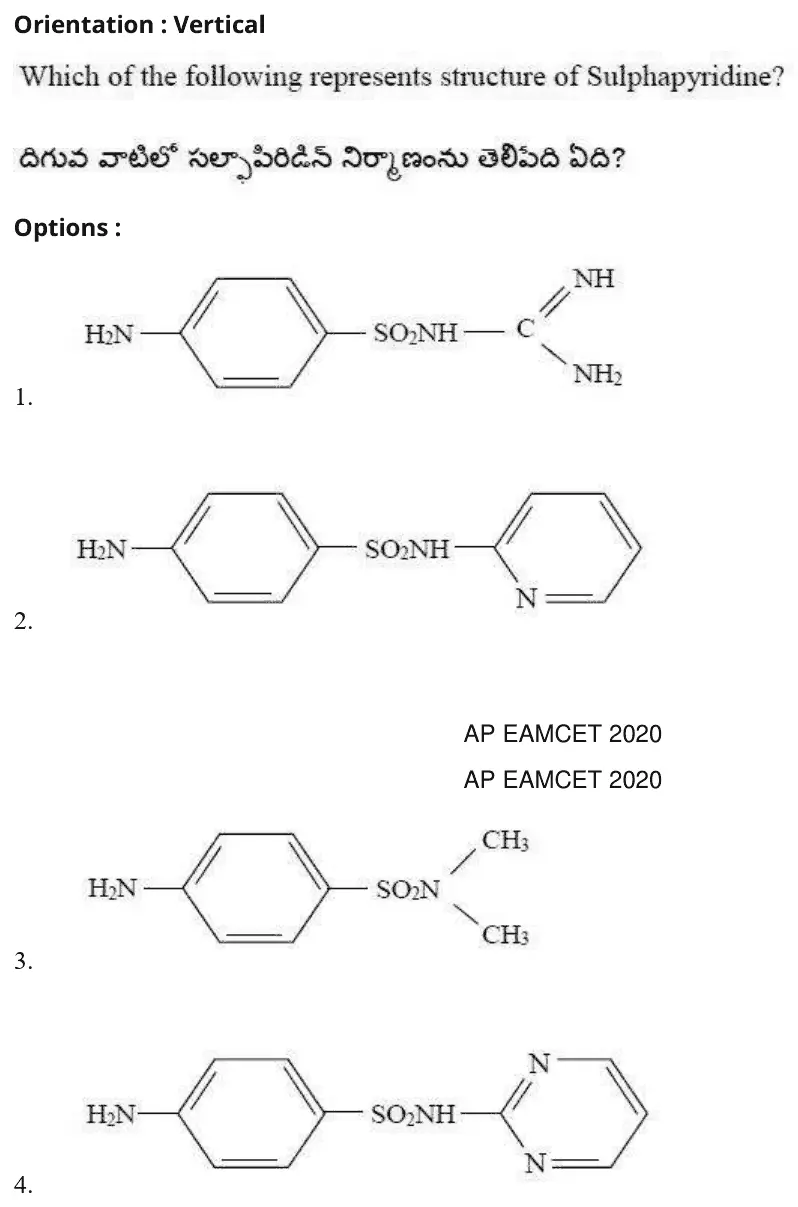
Which of the following represents structure of Sulphapyridine?

The question and its figure as printed in AP EAPCET 2020 17th Sep 2020 Shift2. Option 1: H2N-C6H4-SO2NH-C(=NH)NH2 (guanidine) Option 2: H2N-C6H4-SO2NH-pyridin-2-yl Option 3: H2N-C6H4-SO2N(CH3)2 Option 4: H2N-C6H4-SO2NH-pyrimidin-2-yl
The question as printed in the paper.
  • A

    see figure $\mathrm{H_2N}$-C6H4-$\mathrm{SO_2NH}$-C(=NH)$\mathrm{NH_2}$ (guanidine)

  • B

    see figure $\mathrm{H_2N}$-C6H4-$\mathrm{SO_2NH}$-pyridin-2-yl

  • C

    see figure $\mathrm{H_2N}$-C6H4-$\mathrm{SO_2N(CH_3)_2}$

  • D

    see figure $\mathrm{H_2N}$-C6H4-$\mathrm{SO_2NH}$-pyrimidin-2-yl

76TS EAMCET 2020 · 14 Sep · Shift 1MCQOpen question page ↗

Match the following
List-I
A) Codeine
B) Dettol
C) Tetracycline
List-II
I) Antiseptic
II) Antibiotic
III) Narcotic analgesics
The correct match is

  • A

    A-I, B-II, C-III

  • B

    A-II, B-III, C-I

  • C

    A-III, B-I, C-II

  • D

    A-III, B-II, C-I

77TS EAMCET 2020 · 14 Sep · Shift 2MCQOpen question page ↗

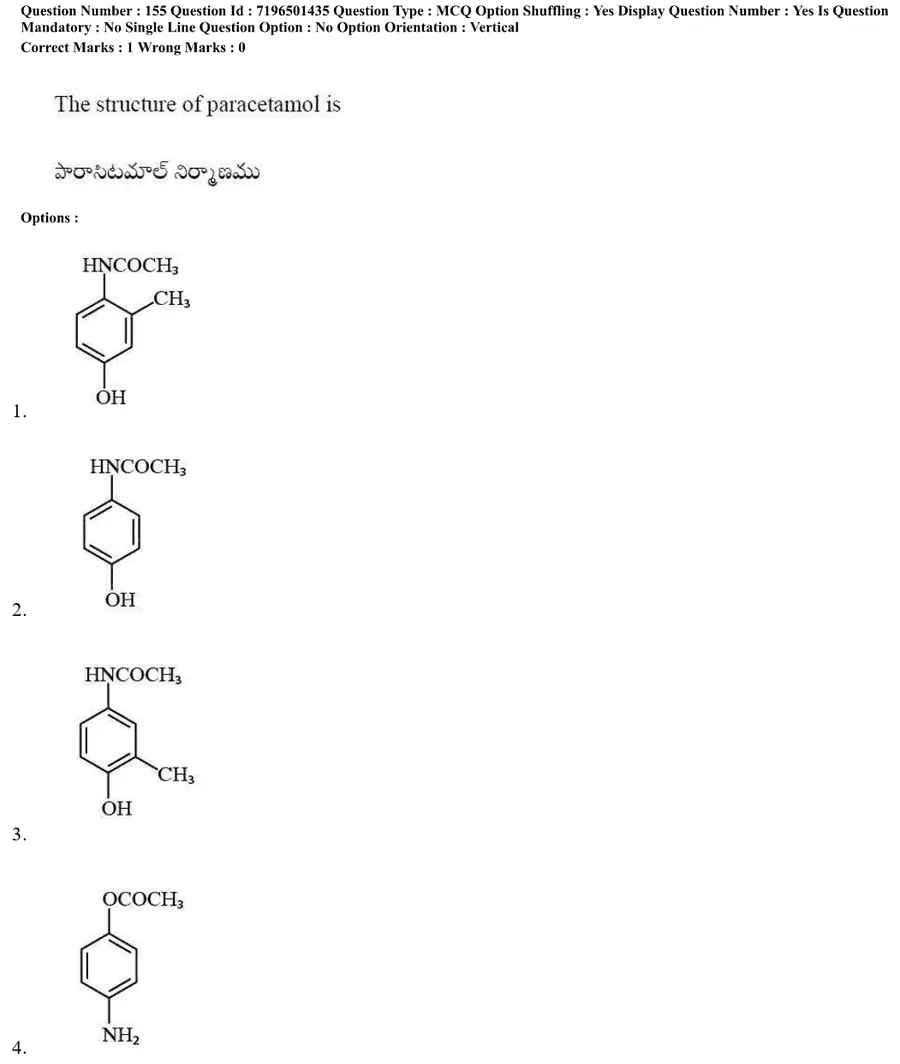
The structure of paracetamol is

The question and its figure as printed in TS EAMCET 2020 14 Sep AN. Option 1: benzene ring with HNCOCH3 at top, CH3 on the adjacent upper-right carbon, OH at bottom (para to HNCOCH3) Option 2: benzene ring with HNCOCH3 at top and OH at bottom (para) Option 3: benzene ring with HNCOCH3 at top, CH3 on lower-right carbon (meta to HNCOCH3), OH at bottom (ortho to CH3, para to HNCOCH3) Option 4: benzene ring with OCOCH3 at top and NH2 at bottom (para)
The question as printed in the paper.
  • A

    see figure benzene ring with $\mathrm{HNCOCH_3}$ at top, $\mathrm{CH_3}$ on the adjacent upper-right carbon, $\mathrm{OH}$ at bottom (para to HNCOCH3)

  • B

    see figure benzene ring with $\mathrm{HNCOCH_3}$ at top and $\mathrm{OH}$ at bottom (para)

  • C

    see figure benzene ring with $\mathrm{HNCOCH_3}$ at top, $\mathrm{CH_3}$ on lower-right carbon (meta to HNCOCH3), $\mathrm{OH}$ at bottom (ortho to CH3, para to HNCOCH3)

  • D

    see figure benzene ring with $\mathrm{OCOCH_3}$ at top and $\mathrm{NH_2}$ at bottom (para)

79TS EAMCET 2020 · 10 Sep · Shift 1MCQOpen question page ↗

Which among the following is an arsenic based antibiotic drug, for which Paul Ehrlich was awarded Noble prize in 1908.

  • A

    Salvarsan

  • B

    Pencillin

  • C

    Prontosil

  • D

    Sulphapyridine

81TS EAMCET 2020 · 9 Sep · Shift 1MCQOpen question page ↗

Which one of the following statements is "not correct" about cationic detergents?

  • A

    Cationic detergents are quaternary ammonium salts

  • B

    Cationic part contains a long hydrocarbon chain

  • C

    Cationic detergents exhibit germicidal properties

  • D

    Cationic detergents are cheap and are widely used

82TS EAMCET 2020 · 9 Sep · Shift 2MCQOpen question page ↗

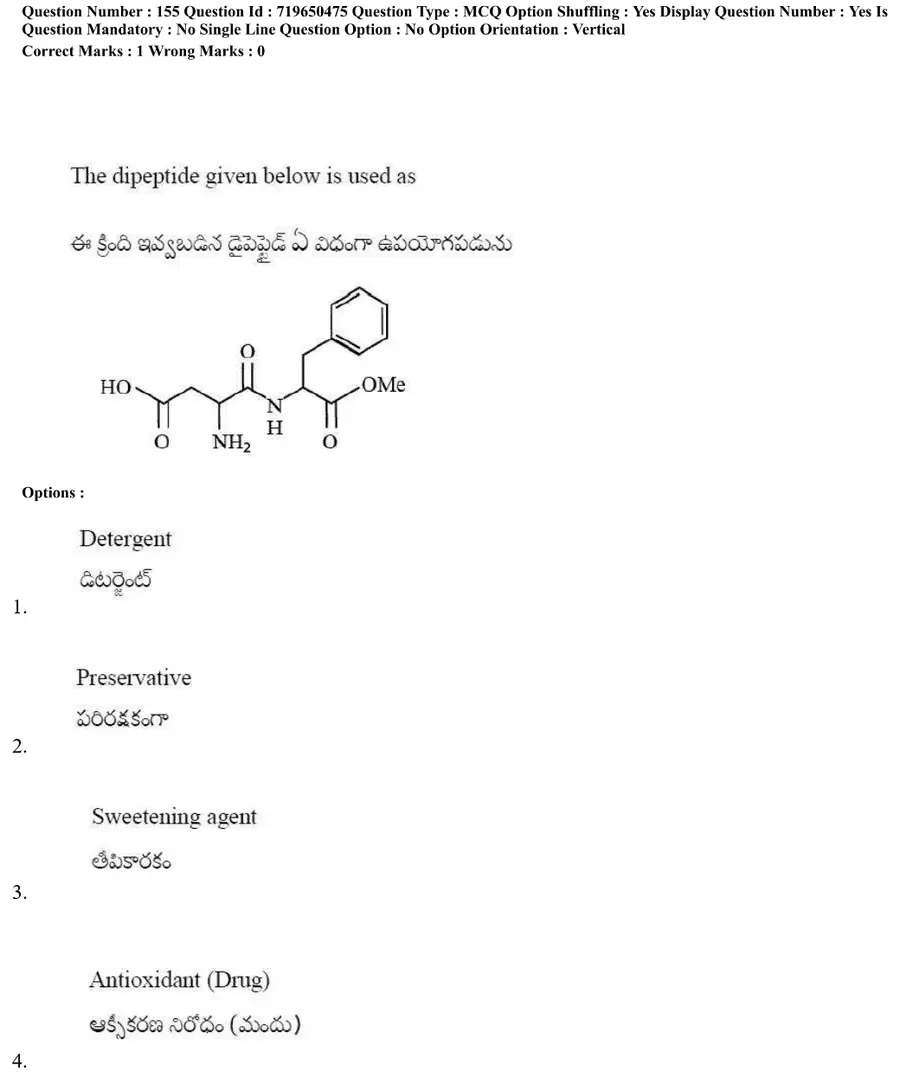
The dipeptide given below is used as (see the figure above)

The question and its figure as printed in TS EAMCET 2020 09 Sep AN.
The question as printed in the paper.
  • A

    Detergent

  • B

    Preservative

  • C

    Sweetening agent

  • D

    Antioxidant (Drug)

83TS EAMCET 2019 · 6 May · Shift 1MCQOpen question page ↗

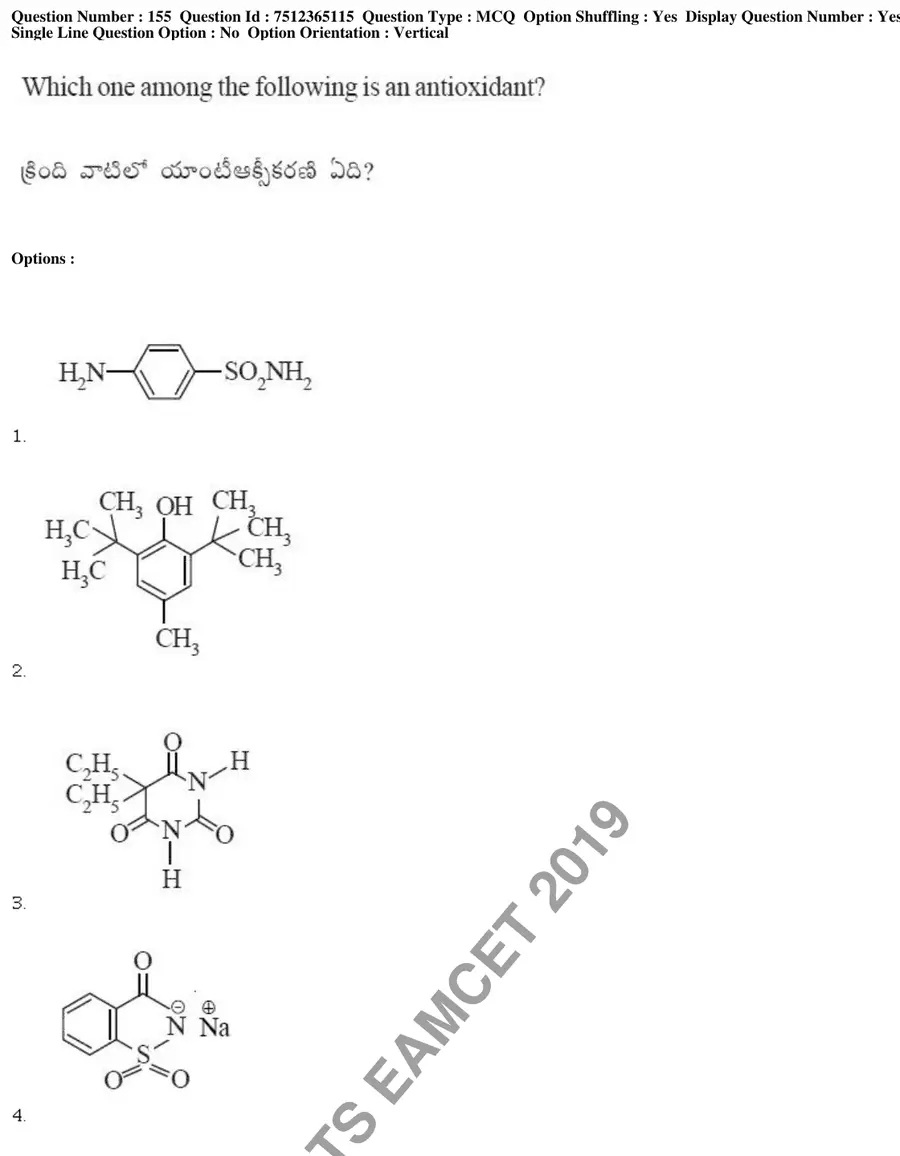
Which one among the following is an antioxidant?
(see the figure above)

The question and its figure as printed in TS EAPCET 2019 6th May 2019 Shift 1. Option 1: 4-aminobenzenesulfonamide: benzene ring with H2N on one end and SO2NH2 on the para position Option 2: benzene ring bearing OH (top), two tert-butyl groups C(CH3)3 on the carbons either side of the OH, and CH3 at the para position (BHT-type) Option 3: barbituric-acid ring: six-membered ring with two N-H, three C=O, and a carbon bearing two C2H5 groups (barbital type) Option 4: saccharin sodium salt: benzene ring fused to a ring with C=O, N^- with Na^+, and SO2
The question as printed in the paper.
  • A

    see figure 4-aminobenzenesulfonamide: benzene ring with $\mathrm{H_2N}$ on one end and $\mathrm{SO_2NH_2}$ on the para position

  • B

    see figure benzene ring bearing OH (top), two tert-butyl groups $\mathrm{C(CH_3)_3}$ on the carbons either side of the OH, and $\mathrm{CH_3}$ at the para position (BHT-type)

  • C

    see figure barbituric-acid ring: six-membered ring with two N-H, three C=O, and a carbon bearing two $\mathrm{C_2H_5}$ groups (barbital type)

  • D

    see figure saccharin sodium salt: benzene ring fused to a ring with C=O, $\mathrm{N^-}$ with $\mathrm{Na^+}$, and $\mathrm{SO_2}$

84TS EAMCET 2019 · 4 May · Shift 1MCQOpen question page ↗

Methacetin (4-methoxy-acetanilide) is ............ drug.

  • A

    An antipyretic

  • B

    Narcotic

  • C

    An antiseptic

  • D

    Disinfectant

85TS EAMCET 2019 · 4 May · Shift 2MCQOpen question page ↗

Which of the following statements are true for saccharin.
A) It is a sodium salt and is not soluble in water.
B) It is much sweeter than cane sugar.
C) It is of great value for diabetic patients and is excreted as such in urine.
D) It is harmful

  • A

    A, B

  • B

    B, C

  • C

    C, D

  • D

    B, D

86TS EAMCET 2019 · 3 May · Shift 1MCQOpen question page ↗

Identify opiates from the following
(A) Codeine (B) Thymine (C) Epinephrine (D) Morphine (E) Thiamine (F) Heroin

  • A

    A, D, F

  • B

    C, D, E

  • C

    B, E, F

  • D

    A, B, C

87TS EAMCET 2019 · 3 May · Shift 2MCQOpen question page ↗

Match the following.
List - I
A) Analgesic
B) Tranquilizer
C) Antibiotic
D) Antihistamine
List - II
I) Phenelzine
II) Terfenadine
III) Codeine
IV) Prontosil
The correct answer is

  • A

    A-III, B-II, C-IV, D-I

  • B

    A-III, B-I, C-IV, D-II

  • C

    A-II, B-III, C-I, D-IV

  • D

    A-II, B-III, C-IV, D-I

88AP EAMCET 2019 · 23 Apr · Shift 1MCQOpen question page ↗

Identify antihistamines from the following
1) Serotonin 2) Dimetane 3) Phenelzine 4) Seldane

  • A

    1, 3 only

  • B

    1, 3, 4

  • C

    2, 4 only

  • D

    1, 2, 3

89AP EAMCET 2019 · 22 Apr · Shift 1MCQOpen question page ↗

Which of the following statements are correct?
i. Binding of inhibitor at allosteric site changes the shape of the active site
ii. Shape of the receptor does not change after attachment of chemical messenger to it
iii. A chemical messenger gives message to the cell by entering it
iv. Erythromycin is an example of bacteriostatic antibiotic

  • A

    i, ii

  • B

    ii, iii

  • C

    i, iv

  • D

    iii, iv

90AP EAMCET 2019 · 22 Apr · Shift 2MCQOpen question page ↗

Identify the correct pairs from the following.
I) Sodium benzoate — Antioxidant
II) Sodium stearate — Soap
III) Sodium lauryl sulphate — Antiseptic
IV) Alitame — Artificial sweetner

  • A

    II, IV

  • B

    II, I

  • C

    III, IV

  • D

    II, III

91AP EAMCET 2019 · 21 Apr · Shift 1MCQOpen question page ↗

Which one of the following contains $-\mathrm{As}=\mathrm{As}-$ in its structure?

  • A

    Ranitidine

  • B

    Saccharin

  • C

    Salvarsan

  • D

    Seldane

92AP EAMCET 2019 · 21 Apr · Shift 2MCQOpen question page ↗

Identify the correct pair from the following.

  • A

    Codeine - analgesic ; Equanil - tranquilizer

  • B

    Chloramphenicol - analgesic ; Nardil - antibiotic

  • C

    Histamine - tranquilizer ; Salvarsan - antibiotic

  • D

    Norethindrone - antacid ; alitame - artificial sweetening agent

93AP EAMCET 2019 · 20 Apr · Shift 1MCQOpen question page ↗

Which of the following are broad spectrum antibiotics?
(I) Penicillin G (II) Chloramphenicol (III) Ofloxacin (IV) Ampicillin

  • A

    I, II only

  • B

    I, II, III

  • C

    II, III, IV

  • D

    I, III only

96TS EAMCET 2018 · 5 May · Shift 1MCQOpen question page ↗

Identify the correct set of functional groups present in Aspartame, an artificial sweetener

  • A

    $\mathrm{-COOCH_3}$, $\mathrm{-NH_2}$, $\mathrm{-C(=O)-NH-}$, $\mathrm{-C(=O)-OC_2H_5}$

  • B

    $\mathrm{-COOH}$, $\mathrm{-NH_2}$, $\mathrm{-C(=O)-NH-}$, $\mathrm{-C(=O)-OCH_3}$

  • C

    $\mathrm{-CONH_2}$, $\mathrm{-NH-}$, $\mathrm{-CO-}$, $\mathrm{-COOH}$

  • D

    $\mathrm{-CHO}$, $\mathrm{-CN}$, $\mathrm{-OH}$, $\mathrm{-COOCH_3}$

97TS EAMCET 2018 · 5 May · Shift 2MCQOpen question page ↗

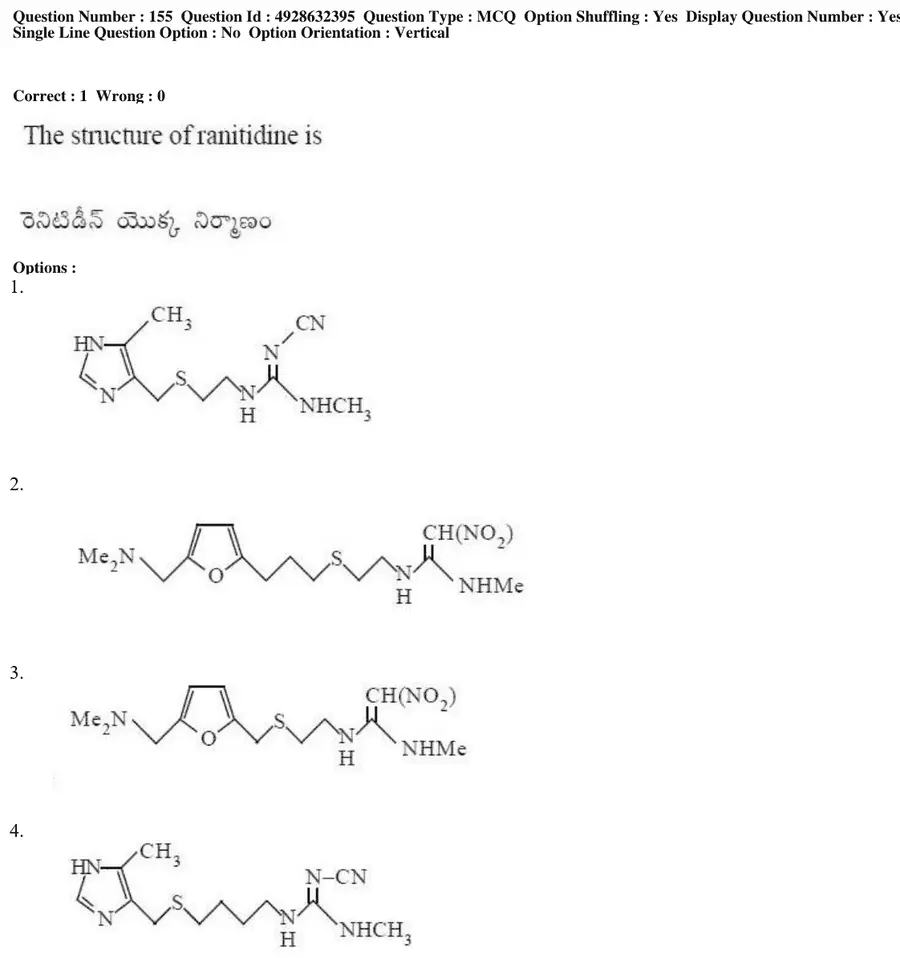
The structure of ranitidine is
(see the figure above)

The question and its figure as printed in TS EAPCET 2018 5th May Shift 2. Option 1: 5-methylimidazole ring (HN, N, CH3) bearing a CH2-S-CH2CH2-NH-C(=N-CN)-NHCH3 chain Option 2: Me2N-CH2-furan (ring O) -CH2-S-CH2CH2-NH-C(=CH(NO2))-NHMe Option 3: Me2N-CH2-furan (ring O) -CH2-S-CH2CH2-NH-C(=CH(NO2))-NHMe (drawn with slightly different zigzag) Option 4: 5-methylimidazole ring (HN, N, CH3) bearing a CH2-S-(CH2)3-ish chain-NH-C(=N-CN)-NHCH3 (a longer zigzag chain than option 1)
The question as printed in the paper.
  • A

    see figure 5-methylimidazole ring (HN, N, CH3) bearing a CH2-S-CH2CH2-NH-C(=N-CN)-NHCH3 chain

  • B

    see figure Me2N-CH2-furan (ring O) -CH2-S-CH2CH2-NH-C(=CH(NO2))-NHMe

  • C

    see figure Me2N-CH2-furan (ring O) -CH2-S-CH2CH2-NH-C(=CH(NO2))-NHMe (drawn with slightly different zigzag)

  • D

    see figure 5-methylimidazole ring (HN, N, CH3) bearing a CH2-S-(CH2)3-ish chain-NH-C(=N-CN)-NHCH3 (a longer zigzag chain than option 1)

98TS EAMCET 2018 · 4 May · Shift 1MCQOpen question page ↗

Identify an antioxidant, an antiseptic, and an antibiotic respectively from the following
A) Equanil
B) Chloramphenicol
C) Bithionol
D) Aspartame
E) Dimetapp
F) Butylated hydroxytoluene

  • A

    A, C, E,

  • B

    F, C, B

  • C

    B, D, E,

  • D

    C, D, F

99TS EAMCET 2018 · 4 May · Shift 2MCQOpen question page ↗

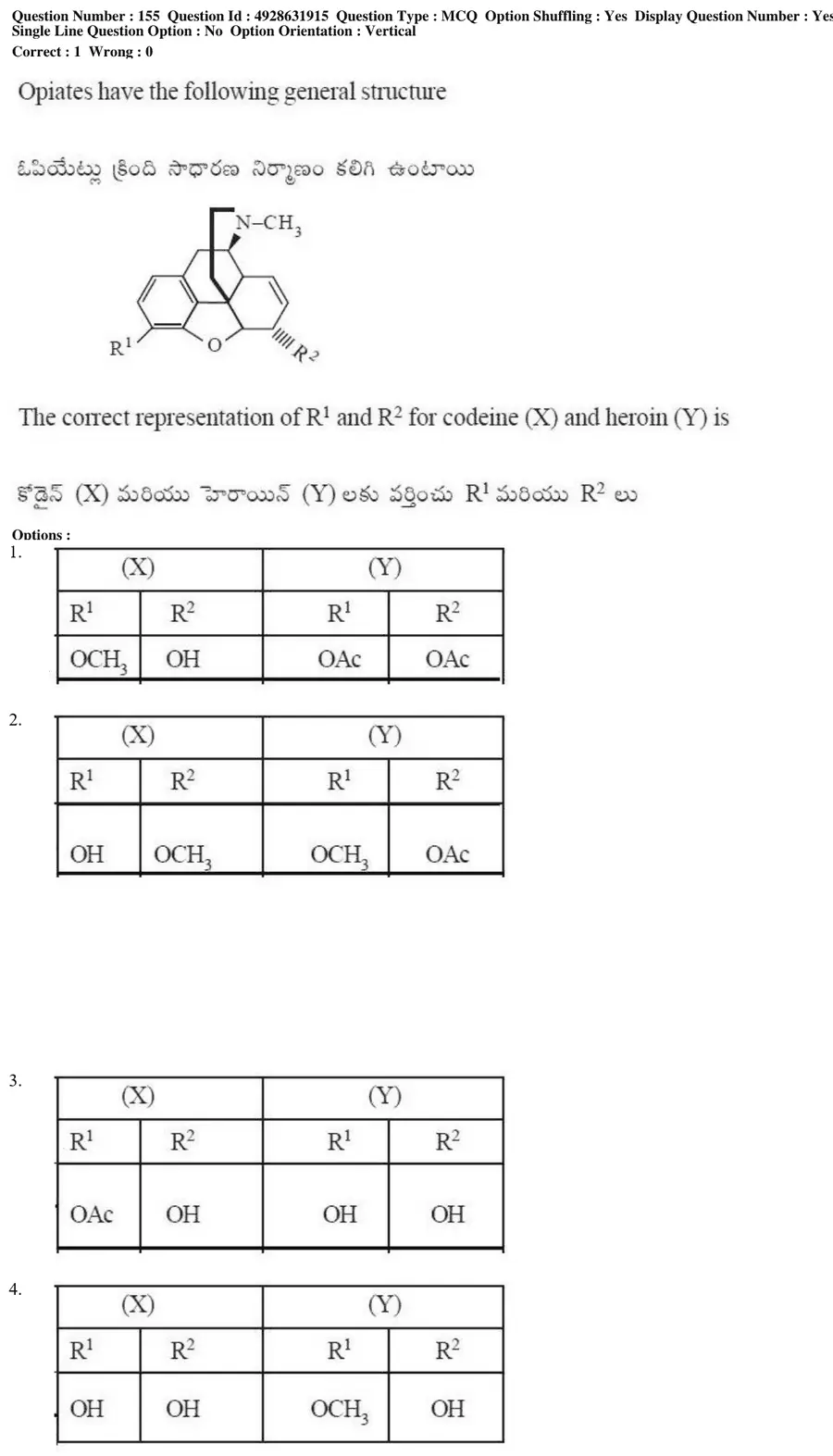
Opiates have the following general structure
(see the figure above)
The correct representation of R$^1$ and R$^2$ for codeine (X) and heroin (Y) is

The question and its figure as printed in TS EAPCET 2018 4th May Shift 2.
The question as printed in the paper.
  • A

    (X) R1 = OCH3, R2 = OH; (Y) R1 = OAc, R2 = OAc

  • B

    (X) R1 = OH, R2 = OCH3; (Y) R1 = OCH3, R2 = OAc

  • C

    (X) R1 = OAc, R2 = OH; (Y) R1 = OH, R2 = OH

  • D

    (X) R1 = OH, R2 = OH; (Y) R1 = OCH3, R2 = OH

100AP EAMCET 2018 · 24 Apr · Shift 1MCQOpen question page ↗

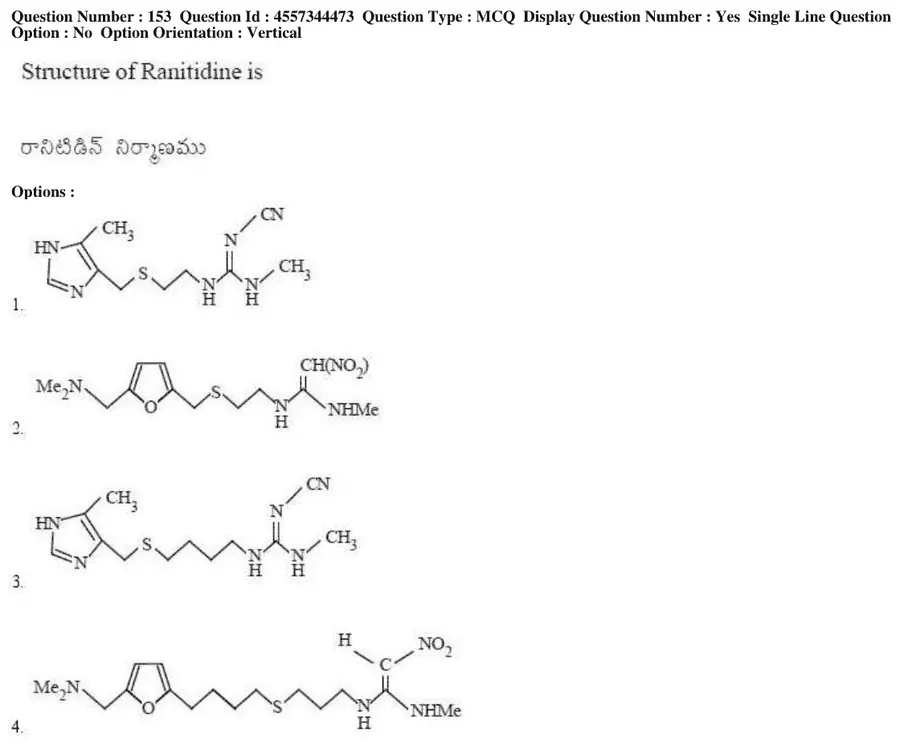
Structure of Ranitidine is
(see the figure above)

The question and its figure as printed in AP EAPCET 2018 24th April Shift 1. Option 1: 4-methylimidazole ring (HN, N; CH3 on ring) with CH2-S-CH2CH2-NH-C(=N-CN)-NH-CH3 chain Option 2: furan ring bearing Me2N-CH2 on one side and CH2-S-CH2CH2-NH-C(=CH(NO2))-NHMe chain on the other Option 3: 4-methylimidazole ring (HN, N; CH3 on ring) with CH2-S-(CH2)4-NH-C(=N-CN)-NH-CH3 chain (longer chain than option 1) Option 4: furan ring bearing Me2N-CH2 on one side and a longer chain CH2CH2CH2CH2-S-CH2CH2CH2-NH-C(=CH-NO2)-NHMe (H and NO2 on the exocyclic C)
The question as printed in the paper.
  • A

    see figure 4-methylimidazole ring (HN, N; CH3 on ring) with CH2-S-CH2CH2-NH-C(=N-CN)-NH-CH3 chain

  • B

    see figure furan ring bearing Me2N-CH2 on one side and CH2-S-CH2CH2-NH-C(=CH(NO2))-NHMe chain on the other

  • C

    see figure 4-methylimidazole ring (HN, N; CH3 on ring) with CH2-S-(CH2)4-NH-C(=N-CN)-NH-CH3 chain (longer chain than option 1)

  • D

    see figure furan ring bearing Me2N-CH2 on one side and a longer chain CH2CH2CH2CH2-S-CH2CH2CH2-NH-C(=CH-NO2)-NHMe (H and NO2 on the exocyclic C)

102AP EAMCET 2018 · 23 Apr · Shift 1MCQOpen question page ↗

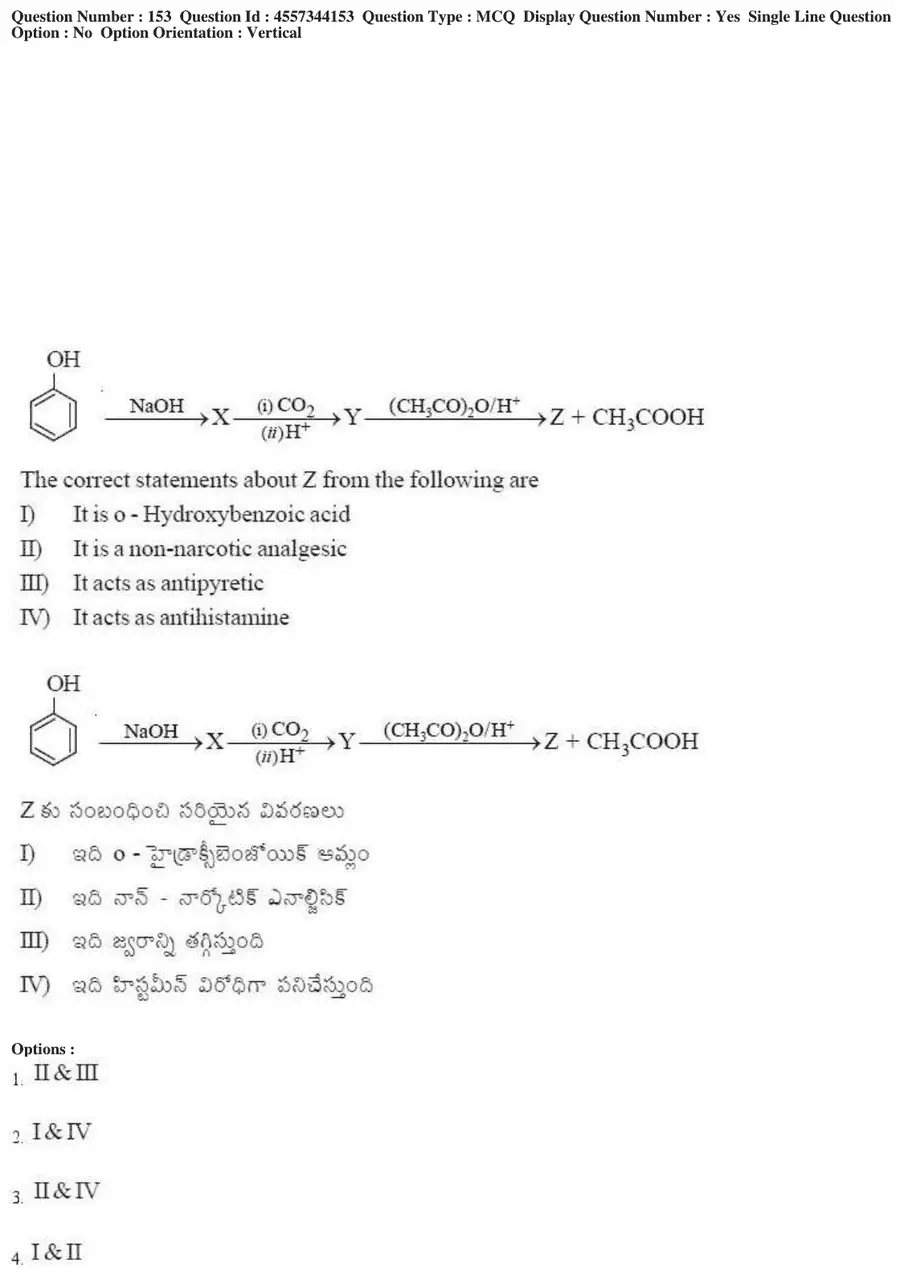
see figure The correct statements about Z from the following are
I) It is o - Hydroxybenzoic acid
II) It is a non-narcotic analgesic
III) It acts as antipyretic
IV) It acts as antihistamine

The question and its figure as printed in AP EAPCET 2018 23rd April Shift 1. Question: The correct statements about Z from the following are I) It is o - Hydroxybenzoic acid II) It is a non-narcotic analgesic III) It acts as antipyretic IV) It acts as antihistamine
The question as printed in the paper.
  • A

    II & III

  • B

    I & IV

  • C

    II & IV

  • D

    I & II

103AP EAMCET 2018 · 23 Apr · Shift 2MCQOpen question page ↗

Examples of antihistamine (X) and cationic detergent (Y) are

  • A

    X: Dimetane; Y: Cetyl trimethyl ammonium bromide

  • B

    X: Nardil; Y: Cetyl trimethyl ammonium bromide

  • C

    X: Dimetane; Y: Sodium lauryl sulphate

  • D

    X: Nardil; Y: Sodium lauryl sulphate

104AP EAMCET 2018 · 22 Apr · Shift 1MCQOpen question page ↗

Which of the following statements are correct?
a) Drugs that mimic natural messenger by switching on the receptor are called agonists
b) Shape of the receptor does not change after attachment of chemical messenger
c) A cationic detergent is formed when stearic acid reacts with polyethylene glycol
d) Seldane is an antihistamine

  • A

    b, c

  • B

    a, c, d

  • C

    a, d

  • D

    a, b, c

105AP EAMCET 2018 · 22 Apr · Shift 2MCQOpen question page ↗

Assertion (A) : Shape of the receptor changes after attachment of chemical messenger
Reason (R) : Receptor does not regain original shape after removal of chemical messenger
The correct answer is

  • A

    (A) and (R) are correct and (R) is the correct explanation of (A)

  • B

    (A) and (R) are correct but (R) is not the correct explanation of (A)

  • C

    (A) is correct but (R) is not correct

  • D

    (A) is not correct but (R) is correct

107AP EAMCET 2017 · 26 Apr · Shift 1MCQOpen question page ↗

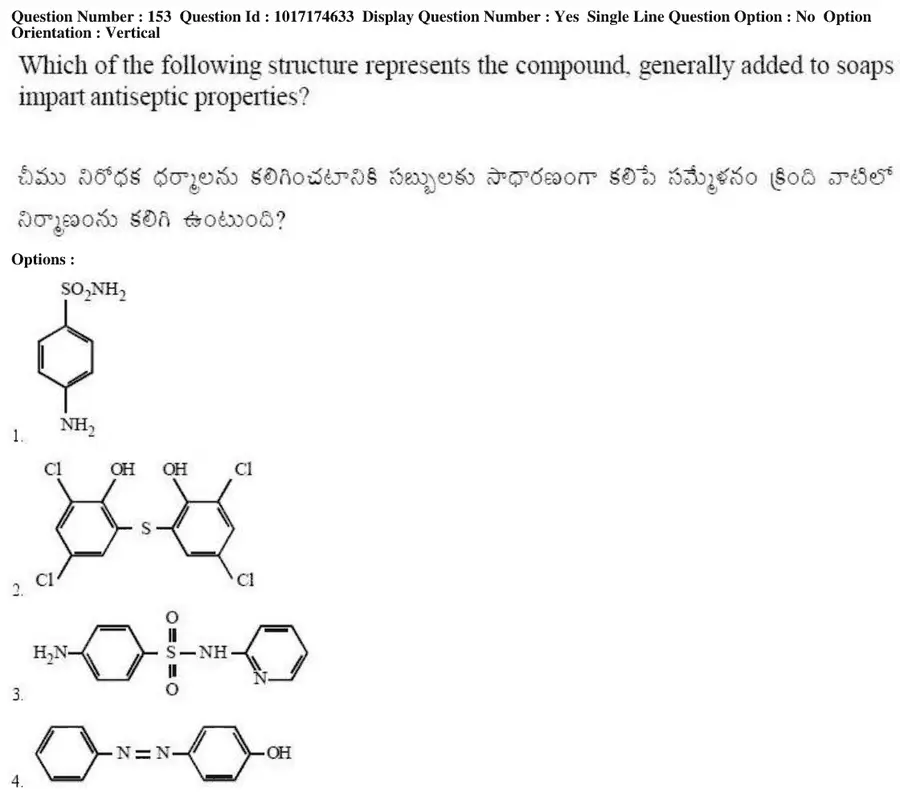
Which of the following structure represents the compound, generally added to soaps to impart antiseptic properties?
(see the figure above)

The question and its figure as printed in AP EAPCET 2017 26th April 2017 Shift1. Option 1: benzene ring with SO2NH2 at the top and NH2 at the bottom (para), i.e. sulphanilamide Option 2: two benzene rings joined by a single S atom (thioether); each ring has OH ortho to S and Cl at the 3 and 5 positions relative to... drawn with Cl at the top outer position (next to OH), Cl at the bottom outer position (para to OH), on both rings (bithionol-type structure: Cl, OH, S, OH, Cl, with two more Cl at the bottom) Option 3: H2N-benzene-SO2-NH-(2-pyridyl): para-aminobenzene sulphonamide attached through NH to a pyridine ring (N adjacent to the carbon bearing NH), i.e. sulphapyridine Option 4…
The question as printed in the paper.
  • A

    see figure benzene ring with $\mathrm{SO_2NH_2}$ at the top and $\mathrm{NH_2}$ at the bottom (para), i.e. sulphanilamide

  • B

    see figure two benzene rings joined by a single S atom (thioether); each ring has OH ortho to S and Cl at the 3 and 5 positions relative to... drawn with Cl at the top outer position (next to OH), Cl at the bottom outer position (para to OH), on both rings (bithionol-type structure: Cl, OH, S, OH, Cl, with two more Cl at the bottom)

  • C

    see figure $\mathrm{H_2N}$-benzene-$\mathrm{SO_2}$-NH-(2-pyridyl): para-aminobenzene sulphonamide attached through NH to a pyridine ring (N adjacent to the carbon bearing NH), i.e. sulphapyridine

  • D

    see figure benzene ring - N=N - benzene ring - OH (para), i.e. 4-hydroxyazobenzene

108AP EAMCET 2017 · 26 Apr · Shift 1MCQOpen question page ↗

The drug, which was designed to prevent the interaction of histamine with the receptors present in the stomach wall is :

  • A

    Equanil

  • B

    Prontosil

  • C

    Aspartame

  • D

    Cimetidine

109AP EAMCET 2017 · 26 Apr · Shift 2MCQOpen question page ↗

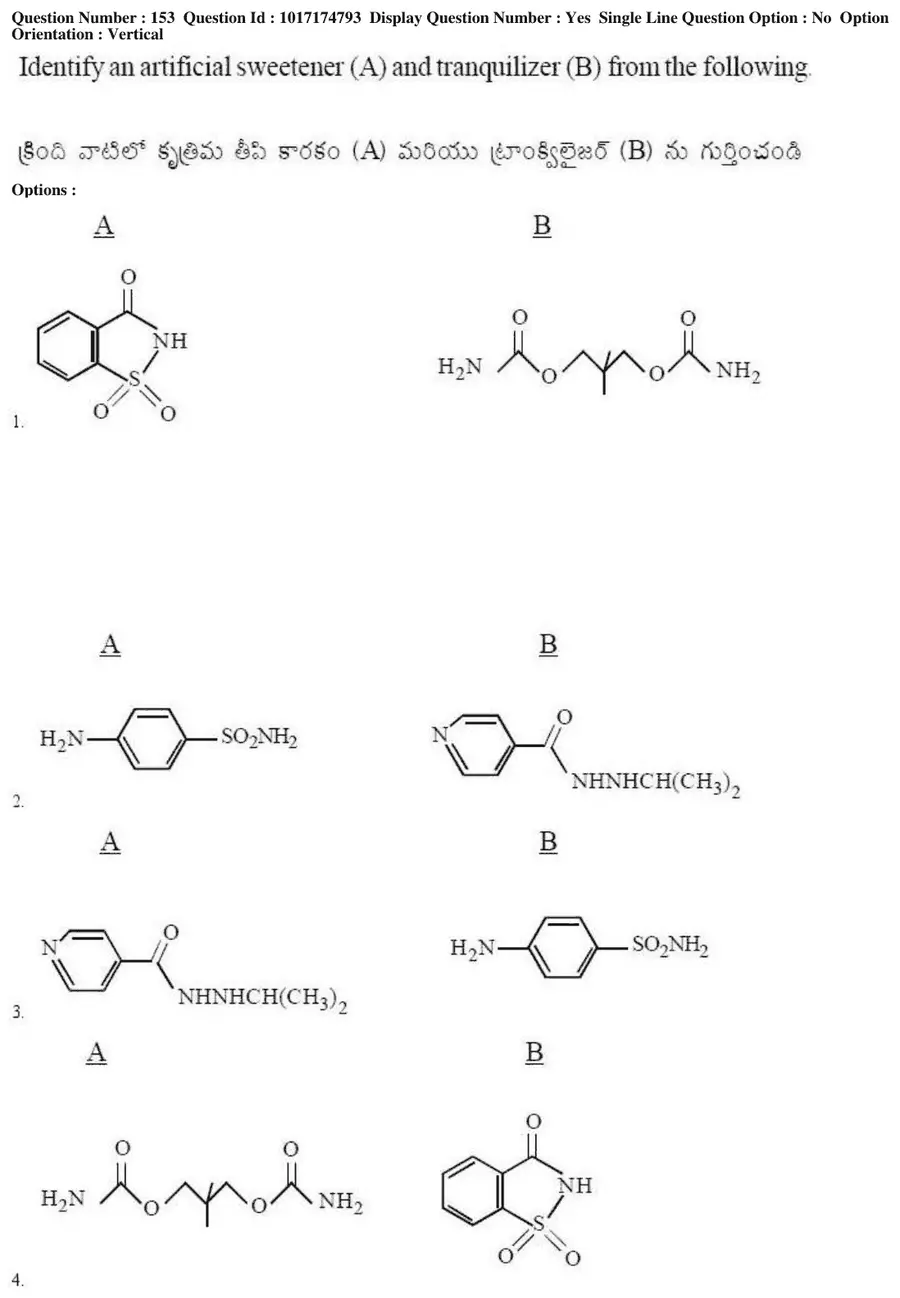
Identify an artificial sweetener (A) and tranquilizer (B) from the following.

The question and its figure as printed in AP EAPCET 2017 26th April 2017 Shift2. Option 1: A: saccharin (benzene ring fused to a ring with C=O, NH and SO2); B: H2N-C(=O)-O-CH2-C(branch)-CH2-O-C(=O)-NH2 (bis-carbamate, central carbon with a vertical stub) Option 2: A: H2N-C6H4-SO2NH2 (para-substituted benzene); B: pyridine ring with C(=O)NHNHCH(CH3)2 at the 4 position Option 3: A: pyridine ring with C(=O)NHNHCH(CH3)2; B: H2N-C6H4-SO2NH2 (para) Option 4: A: bis-carbamate H2N-C(=O)-O-CH2-C(...)-CH2-O-C(=O)-NH2 (central carbon with a vertical branch); B: saccharin (benzene fused to a ring with C=O, NH, SO2)
The question as printed in the paper.
  • A

    see figure A: saccharin (benzene ring fused to a ring with C=O, NH and $\mathrm{SO_2}$); B: $\mathrm{H_2N-C(=O)-O-CH_2-C(branch)-CH_2-O-C(=O)-NH_2}$ (bis-carbamate, central carbon with a vertical stub)

  • B

    see figure A: $\mathrm{H_2N}$-C6H4-$\mathrm{SO_2NH_2}$ (para-substituted benzene); B: pyridine ring with C(=O)NHNHCH(CH3)2 at the 4 position

  • C

    see figure A: pyridine ring with C(=O)NHNHCH(CH3)2; B: $\mathrm{H_2N}$-C6H4-$\mathrm{SO_2NH_2}$ (para)

  • D

    see figure A: bis-carbamate $\mathrm{H_2N-C(=O)-O-CH_2-C(...)-CH_2-O-C(=O)-NH_2}$ (central carbon with a vertical branch); B: saccharin (benzene fused to a ring with C=O, NH, $\mathrm{SO_2}$)

110AP EAMCET 2017 · 26 Apr · Shift 2MCQOpen question page ↗

Which of the following statements are correct ?
a. Aspartame is more sweeter than saccharin
b. Shaving soaps contain glycerol to prevent drying
c. Salt of sorbic acid is used as a food preservative
d. Norethindrone is an example of an antifertility drug

  • A

    a, c, d

  • B

    b, c, d

  • C

    a, c

  • D

    c, d

111AP EAMCET 2017 · 25 Apr · Shift 1MCQOpen question page ↗

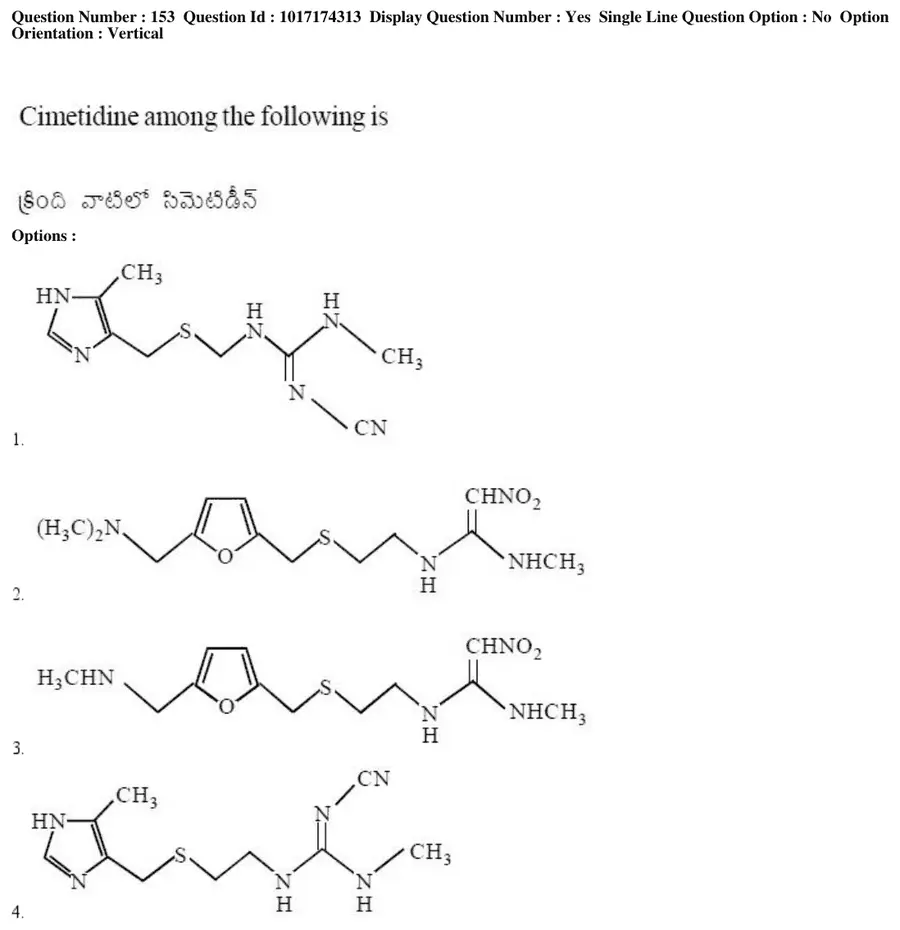
Cimetidine among the following is

The question and its figure as printed in AP EAPCET 2017 25th April 2017 Shift1. Option 1: imidazole ring (HN, N) with a CH3 on the ring carbon next to HN, ring CH2-S-CH2-NH-C(=N-CN)-NH-CH3 (guanidine side chain; the S-CH2 chain is drawn with a single CH2 between ring and S, then one CH2 between S and NH, i.e. as drawn: ring-CH2-S-CH2-NH, tail NH-CH3 and =N-CN) Option 2: furan ring bearing (H3C)2N-CH2 at one position and CH2-S-CH2CH2-NH-C(=CHNO2)-NHCH3 at the other Option 3: furan ring bearing H3CHN-CH2 at one position and CH2-S-CH2CH2-NH-C(=CHNO2)-NHCH3 at the other Option 4: imidazole ring (HN, N) with a CH3 on the ring carbon next to HN, ring CH2-S-CH2CH2-NH-C(=N-CN)-NH-CH3
The question as printed in the paper.
  • A

    see figure imidazole ring (HN, N) with a $\mathrm{CH_3}$ on the ring carbon next to HN, ring $\mathrm{CH_2}$-S-$\mathrm{CH_2}$-NH-C(=N-CN)-NH-$\mathrm{CH_3}$ (guanidine side chain; the S-CH2 chain is drawn with a single CH2 between ring and S, then one CH2 between S and NH, i.e. as drawn: ring-CH2-S-CH2-NH, tail NH-CH3 and =N-CN)

  • B

    see figure furan ring bearing $\mathrm{(H_3C)_2N{-}CH_2}$ at one position and $\mathrm{CH_2{-}S{-}CH_2CH_2{-}NH{-}C(=CHNO_2){-}NHCH_3}$ at the other

  • C

    see figure furan ring bearing $\mathrm{H_3CHN{-}CH_2}$ at one position and $\mathrm{CH_2{-}S{-}CH_2CH_2{-}NH{-}C(=CHNO_2){-}NHCH_3}$ at the other

  • D

    see figure imidazole ring (HN, N) with a $\mathrm{CH_3}$ on the ring carbon next to HN, ring $\mathrm{CH_2}$-S-$\mathrm{CH_2CH_2}$-NH-C(=N-CN)-NH-$\mathrm{CH_3}$

112AP EAMCET 2017 · 25 Apr · Shift 1MCQOpen question page ↗

Which one of the following is an anionic detergent?

  • A

    Cetyltrimethyl ammonium bromide

  • B

    Sodium dodecylbenzene sulphonate

  • C

    Sodium stearate

  • D

    Potassium palmitate

113AP EAMCET 2017 · 25 Apr · Shift 2MCQOpen question page ↗

Which of the following statements are not correct?
a) Antihistamine also functions as an antacid
b) The shape of an active site of an enzyme does not change when the drug binds to an allosteric site
c) Chemical messengers communicate the message between two neurons
d) Potassium soaps are hard, while sodium soaps are soft to skin
The correct answer is

  • A

    a, b, d

  • B

    b, c, d

  • C

    a, c

  • D

    c, d

114AP EAMCET 2017 · 25 Apr · Shift 2MCQOpen question page ↗

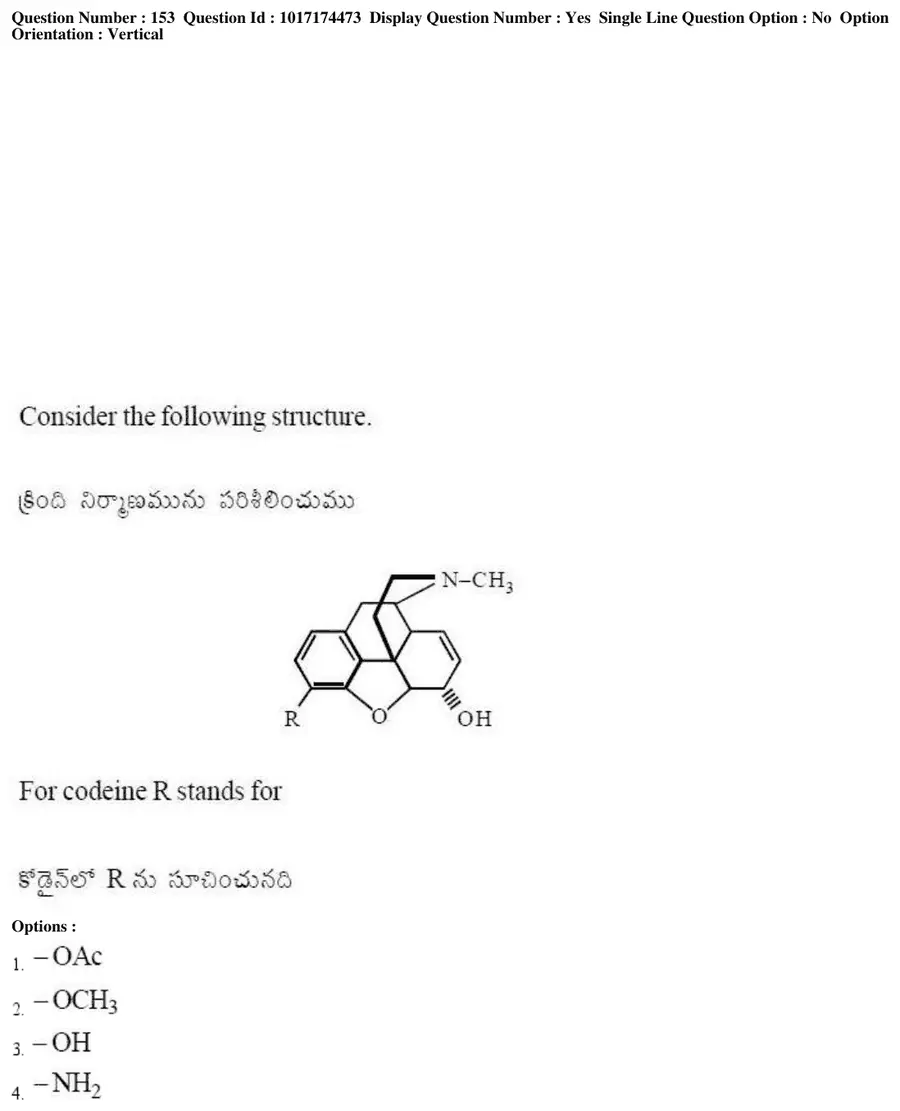
Consider the following structure.
(see the figure above)
For codeine R stands for

The question and its figure as printed in AP EAPCET 2017 25th April 2017 Shift2.
The question as printed in the paper.
  • A

    $-\mathrm{OAc}$

  • B

    $-\mathrm{OCH_3}$

  • C

    $-\mathrm{OH}$

  • D

    $-\mathrm{NH_2}$

115AP EAMCET 2017 · 24 Apr · Shift 1MCQOpen question page ↗

Identify a bacteriostatic (A) and bacteriocidal (B) antibiotic from the following

  • A

    A: Erythromycin; B: Chloramphenicol

  • B

    A: Ofloxacin; B: Tetracycline

  • C

    A: Chloramphenicol; B: Norethindrone

  • D

    A: Tetracycline; B: Ofloxacin

116AP EAMCET 2017 · 24 Apr · Shift 1MCQOpen question page ↗

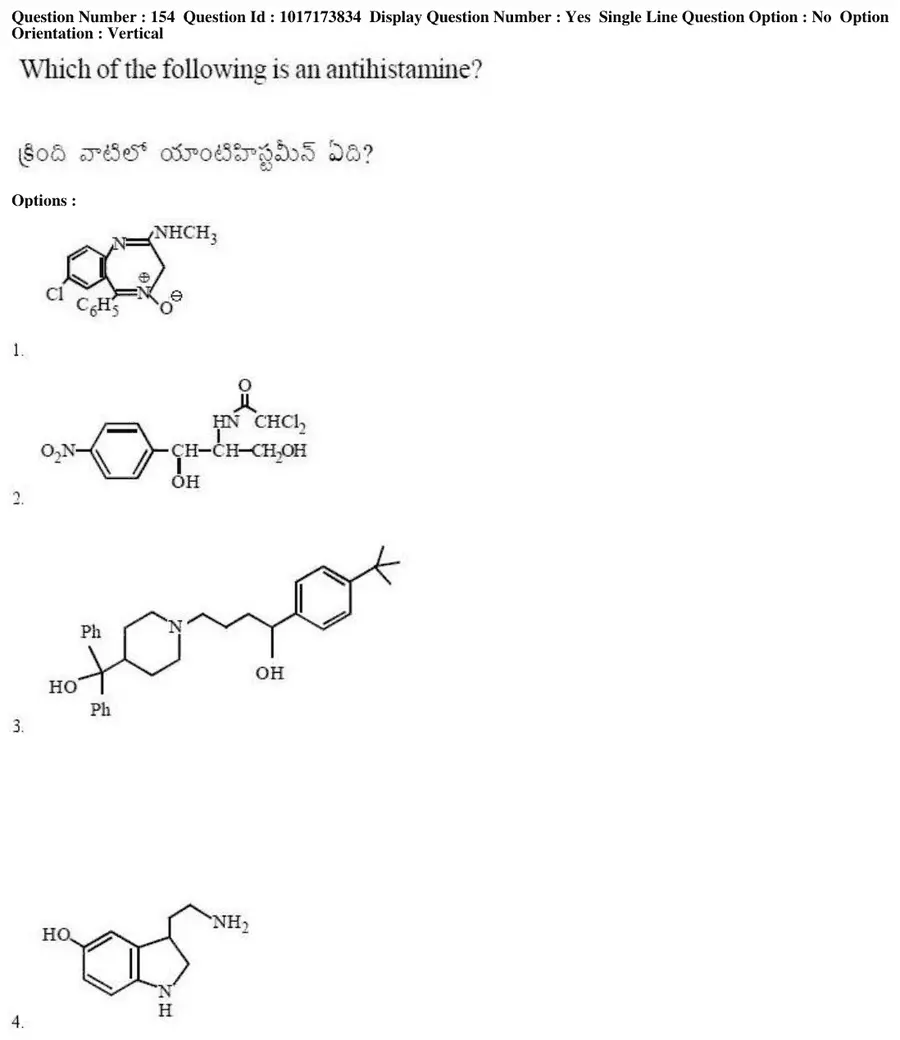
Which of the following is an antihistamine?
(see the figure above)

The question and its figure as printed in AP EAPCET 2017 24th April 2017 Shift1. Option 1: structure 1 Option 2: structure 2 Option 3: structure 3 Option 4: structure 4
The question as printed in the paper.
  • A

    see figure structure 1

  • B

    see figure structure 2

  • C

    see figure structure 3

  • D

    see figure structure 4

117AP EAMCET 2017 · 24 Apr · Shift 2MCQOpen question page ↗

An artificial sweetener X is a halogen containing compound and artificial sweetener Y is a sulphur containing compound. X and Y respectively are:

  • A

    Aspartame, Sucralose

  • B

    Sucralose, Aspartame

  • C

    Alitame, Sucralose

  • D

    Sucralose, Alitame

118AP EAMCET 2017 · 24 Apr · Shift 2MCQOpen question page ↗

The $-\mathrm{As}=\mathrm{As}-$ linkage is present in which of the following medicines ?

  • A

    Prontosil

  • B

    Sulphapyridine

  • C

    Salvarsan

  • D

    Serotonin

120TS EAMCET 2016 · 15 May · OfflineMCQOpen question page ↗

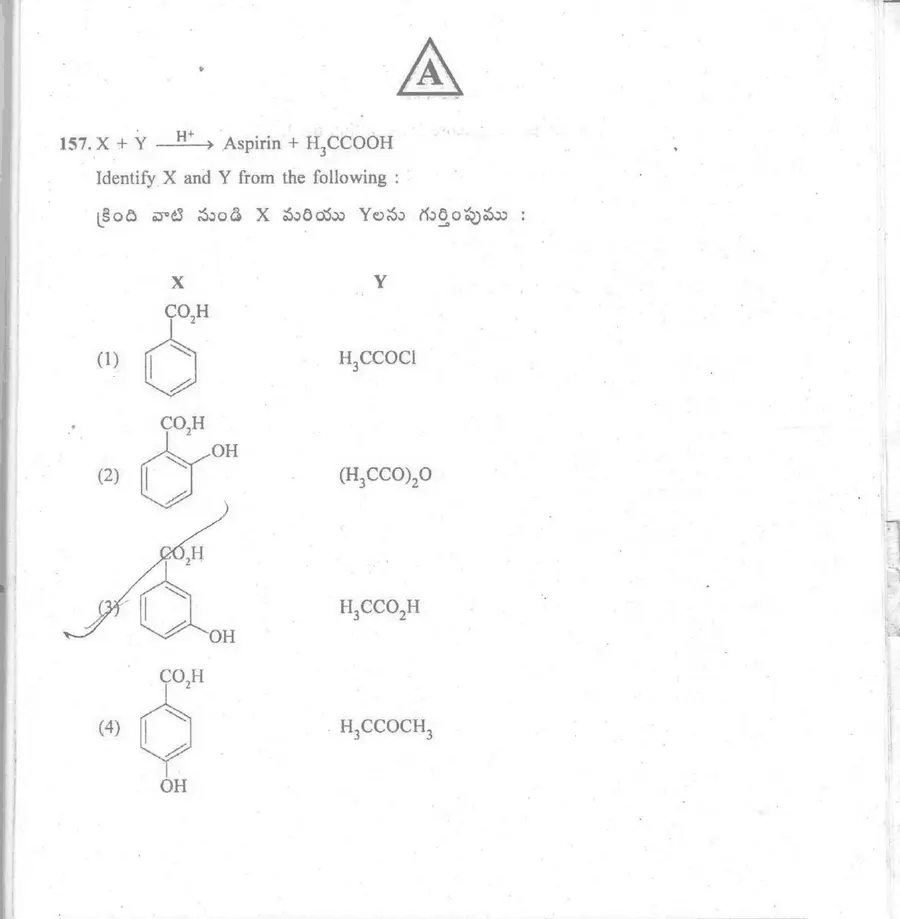
$\mathrm{X + Y \xrightarrow{H^+} Aspirin + H_3CCOOH}$
Identify X and Y from the following :
(see the figure above)

The question and its figure as printed in TS EAMCET 2016 15 May Offline.
The question as printed in the paper.
  • A

    X = (see the figure above) benzoic acid ($\mathrm{CO_2H}$ on benzene); Y = $\mathrm{H_3CCOCl}$

  • B

    X = (see the figure above) 2-hydroxybenzoic acid (salicylic acid: $\mathrm{CO_2H}$ and ortho OH); Y = $\mathrm{(H_3CCO)_2O}$

  • C

    X = (see the figure above) 3-hydroxybenzoic acid ($\mathrm{CO_2H}$ and meta OH); Y = $\mathrm{H_3CCO_2H}$

  • D

    X = (see the figure above) 4-hydroxybenzoic acid ($\mathrm{CO_2H}$ and para OH); Y = $\mathrm{H_3CCOCH_3}$

121AP EAMCET 2016 · 29 Apr · OfflineMCQOpen question page ↗

Identify the antioxidant used in foods

  • A

    Aspartame

  • B

    Sodium benzoate

  • C

    Ortho-sulpho benzimide

  • D

    Butylated hydroxy toluene

122AP EAMCET 2014 · 22 May · OfflineMCQOpen question page ↗

What are the substances which mimic the natural chemical messengers ?

  • A

    Antibiotics

  • B

    Antagonists

  • C

    Agonists

  • D

    Receptors

123AP EAMCET 2013 · 10 May · OfflineMCQOpen question page ↗

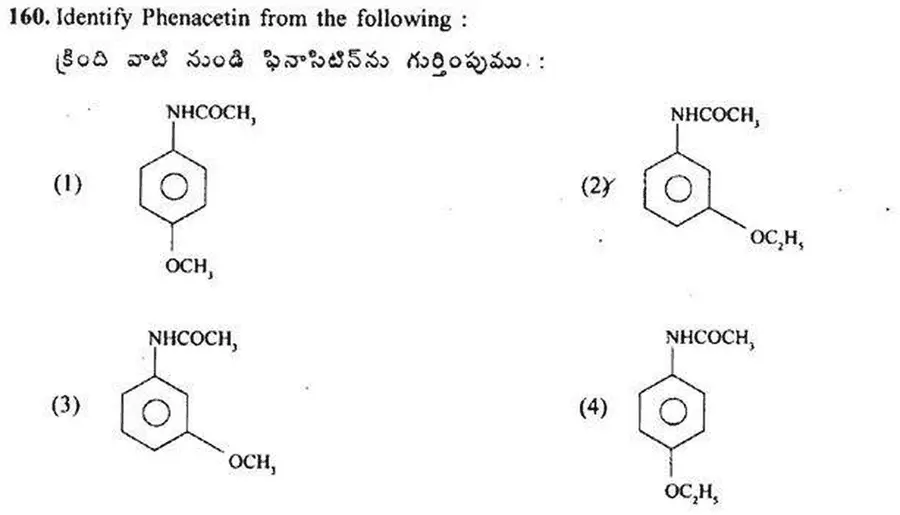
Identify Phenacetin from the following :
(see the figure above)

The question and its figure as printed in AP EAMCET 2013 10 May Offline. Option 1: benzene ring, para-disubstituted: NHCOCH3 at top and OCH3 at bottom Option 2: benzene ring, meta-disubstituted: NHCOCH3 at top and OC2H5 at lower right Option 3: benzene ring, meta-disubstituted: NHCOCH3 at top and OCH3 at lower right Option 4: benzene ring, para-disubstituted: NHCOCH3 at top and OC2H5 at bottom
The question as printed in the paper.
  • A

    see figure benzene ring, para-disubstituted: $\mathrm{NHCOCH_3}$ at top and $\mathrm{OCH_3}$ at bottom

  • B

    see figure benzene ring, meta-disubstituted: $\mathrm{NHCOCH_3}$ at top and $\mathrm{OC_2H_5}$ at lower right

  • C

    see figure benzene ring, meta-disubstituted: $\mathrm{NHCOCH_3}$ at top and $\mathrm{OCH_3}$ at lower right

  • D

    see figure benzene ring, para-disubstituted: $\mathrm{NHCOCH_3}$ at top and $\mathrm{OC_2H_5}$ at bottom

125AP EAMCET 2011 · 8 May · OfflineMCQOpen question page ↗

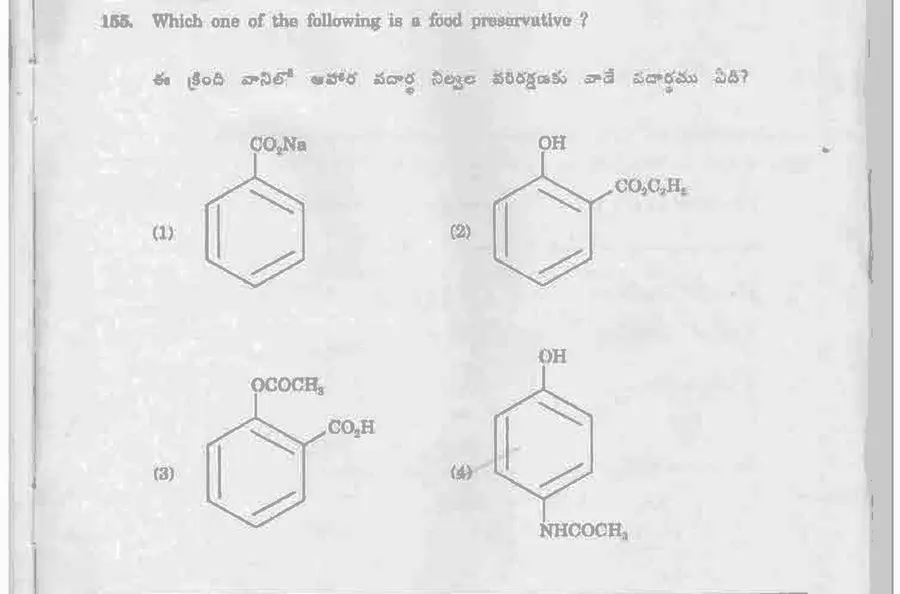
Which one of the following is a food preservative ?

The question and its figure as printed in AP EAMCET 2011 08 May Offline.
The question as printed in the paper.
  • A

    see figure

  • B

    see figure

  • C

    see figure

  • D

    see figure

How to prepare Chemistry in Everyday Life for EAPCET

How often it comes up

Chemistry in Everyday Life offers concise, fact-driven questions derived from applied pharmaceutical and consumer chemistry. Over the full historical timeline from 2010 through 2026, this unit provided 126 questions across 149 evaluated examination papers, appearing in 112 sittings for an average of 0.8 questions per paper and a 2.1 percent subject share. Recent testing patterns between 2022 and 2026 preserve this pattern: examiners included 63 questions across 77 test papers, with questions appearing in 60 sittings to record 0.8 questions per test and a 2.0 percent share. Within the recent chemistry hierarchy, the chapter holds rank 23 of 31 chapters.

The chapter has appeared every single year from 2022 to 2026, though it is not present in every sitting, being omitted from seventeen papers out of 77. In the latest three examination years from 2024 to 2026, the unit contributed 46 questions across 46 papers (present in 44 sittings, averaging 1.0 question per session with a 2.5 percent share). Across the older testing window from 2010 to 2021, examiners set 63 questions across 72 papers (present in 52 papers, 0.9 per test, 2.2 percent share). Looking at longitudinal movement, comparing early testing with the last three years shows the share is about the same, whereas comparing recent testing with the last three years shows the share is up. In regional comparisons for 2022 to 2026, Andhra Pradesh tests included 41 questions across 48 papers (38 papers with questions, 0.9 per test, 2.1 percent share), and Telangana tests contributed 22 questions across 29 papers (22 papers with questions, 0.8 per test, 1.9 percent share).

Most-asked topics

All syllabus components sit within a single syllabus category, emphasizing pharmacological mechanisms, food chemistry, and cleansing formulations:

  • Applied Chemical Principles accounting for 126 questions across all years (63 in the modern era, tested up to 2026): Drug-target interactions (competitive inhibitors, non-competitive allosteric binding), therapeutic classifications (analgesics like narcotic morphine and non-narcotic aspirin or paracetamol, tranquilizers like equanil and valium, antiseptics versus disinfectants, broad versus narrow spectrum antibiotics), artificial sweetening agents (aspartame, saccharin, sucralose, alitame), food preservatives and antioxidants (BHT, BHA), and cleansing agents (anionic, cationic, and non-ionic detergents).

What the questions look like

Questions in this chapter are primarily direct matching problems and multiple-statement verifications that test exact definitions and drug examples.

A typical problem asks candidates to differentiate between cationic detergents (like cetyltrimethylammonium bromide used in hair conditioners) and anionic detergents (like sodium lauryl sulfate found in toothpastes and household cleaners). Other frequent items focus on artificial sweeteners, testing characteristics such as thermal instability (aspartame decomposes at baking temperatures) or chlorination status (sucralose is a trichloro derivative of sucrose). Pharmacological questions routinely test the distinction between bactericidal agents (which kill bacteria, such as penicillin and aminoglycosides) and bacteriostatic agents (which inhibit bacterial growth, such as erythromycin and chloramphenicol).

Questions to try first

Test your retention of pharmaceutical classifications and cleansing chemistry with these recent problems:

How to practise it

Construct a clear summary index organized by application. Group medicinal agents by their biological actions: antacids (cimetidine, ranitidine), antihistamines (brompheniramine, terfenadine), tranquilizers (chlordiazepoxide, meprobamate, equanil), analgesics, and antimicrobials. Note specific mechanisms, such as how aspirin inhibits prostaglandin synthesis and acts as an anti-blood clotting agent.

Next, tabulate the four major artificial sweeteners in ascending order of sweetness relative to cane sugar: aspartame (one hundred times sweeter), saccharin (five hundred fifty times sweeter), sucralose (six hundred times sweeter), and alitame (two thousand times sweeter). Finally, memorize the ionic nature of polar heads in detergents: quaternary ammonium salts for cationic types, sulfonates or sulfates for anionic types, and polyoxyethylene chains for non-ionic types.

Frequently asked questions

What is the functional difference between an antiseptic and a disinfectant?

Both antiseptics and disinfectants prevent the growth of harmful microorganisms or destroy them. Antiseptics (such as dilute boric acid or chloroxylenol mixed with terpineol in Dettol) are safe to apply directly onto living biological tissues like cuts and wounds. Disinfectants (such as one percent phenol or concentrated chlorine) are harsh chemicals applied strictly to inanimate surfaces like floors and drainage systems.

Why is the usage of aspartame restricted to cold foods and soft drinks?

Aspartame is an ester of an aspartic acid and phenylalanine dipeptide. Because its peptide bond is thermally unstable, it decomposes at normal cooking and baking temperatures, losing its sweetening property.

How do non-ionic detergents work without carrying an ionic charge?

Non-ionic detergents, such as those formed by the reaction of stearic acid with polyethylene glycol, feature a long lipophilic hydrocarbon tail and an extensive hydrophilic polar head with multiple ether and alcohol functional groups. They form micelles in water and emulsify oils identically to ionic soaps. Step-by-step solutions for each one are in the EdLoop EAPCET app.

Get EdLoop – freeOpen on the web