EdLoop PYQs · free, no ads · questions and answers here, step-by-step solutions in the EdLoop app
PYQs · free, no adsOpen on the web (app.edloop.in)Get EdLoop – free on Google Play
ChemistryChemical Kinetics

Chemical Kinetics: AP & TS EAPCET PYQs 2010–2026

Every Chemical Kinetics question from past AP EAPCET and TS EAPCET papers, with options and answers. Newest first.

152questions
142papers covered
2.5%of Chemistry questions, 2022–2026
2010–2026years

Guide at a glance

Chemical Kinetics occupies position 20 among all 31 chemistry chapters across the modern 2022 to 2026 testing period.

Most asked sub-topics

Integrated Rate Laws67
Temperature Dependence & Mechanism48
Rate of Reaction37

Practise these in EdLoop

Attempt every Chemical Kinetics question timed, see the step-by-step solution and track what you get wrong. Free.

Start practice

All questions

152 questions
1AP EAPCET 2026 · 18 May · Shift 1MCQOpen question page ↗

At 1130 K, the decomposition of ammonia on Pt catalyst follows zero order kinetics. The rate of this reaction at t = 10 min is $x$ mol $\mathrm{L^{-1}}$ $\mathrm{min^{-1}}$. What will be its rate (in mol $\mathrm{L^{-1}}$ $\mathrm{min^{-1}}$) at t = 20 min, at the same temperature?

  • A

    $\frac{x}{2}$

  • B

    $x$

  • C

    $2x$

  • D

    $\sqrt{x}$

2AP EAPCET 2026 · 18 May · Shift 2MCQOpen question page ↗

$\mathrm{N_2O_5}$ decomposes as shown below

$$\mathrm{N_2O_5 \rightarrow N_2O_4 + \frac{1}{2}O_2}$$

When $50\ mL$ of $2M$ solution of $\mathrm{N_2O_5}$ was heated, $0.28\ L$ of $\mathrm{O_2}$ was formed at $STP$ after 30 minutes. The concentration of unreacted $\mathrm{N_2O_5}$ is $X\ M$ and average rate of reaction (in $mol\ L^{-1}min^{-1}$) is $Y$. What are $X$ and $Y$ respectively?

(molar volume = $22.4\ L$, molar mass of $\mathrm{N_2O_5}$ = $108\ g\ mol^{-1}$)

  • A

    $0.5,\ 1.66 \times 10^{-2}$

  • B

    $1.0,\ 3.33 \times 10^{-2}$

  • C

    $1.5,\ 1.66 \times 10^{-2}$

  • D

    $0.75,\ 2.50 \times 10^{-2}$

3AP EAPCET 2026 · 15 May · Shift 1MCQOpen question page ↗

Hydrolysis of benzene diazonium chloride follows first order kinetics. The time taken for its decomposition to $^1/_8$ and $^1/_{10}$ of its original concentration are $\left[t_{1/8}\right]$ and $\left[t_{1/10}\right]$ respectively. What is the ratio of $\left[t_{1/8}\right]$ to $\left[t_{1/10}\right]$ ?

[log 2 = 0.30, log 3 = 0.48, log 4 = 0.60]

  • A

    $9 : 10$

  • B

    $10 : 9$

  • C

    $3 : 5$

  • D

    $5 : 3$

4AP EAPCET 2026 · 15 May · Shift 2MCQOpen question page ↗

The k value of the reaction $\mathrm{A}$ $\rightarrow$ products is $5 \times 10^{3}\ \mathrm{s^{-1}}$ at 300 K. Its activation energy is 50 kJ $\mathrm{mol^{-1}}$.
At T(K), its value becomes $1.0 \times 10^{4}\ \mathrm{s^{-1}}$. What is the value of T (in K)?
(R = 8.3 J $\mathrm{mol^{-1}\,K^{-1}}$), (log 2 = 0.3)

  • A

    397

  • B

    311

  • C

    286

  • D

    345

5AP EAPCET 2026 · 14 May · Shift 1MCQOpen question page ↗

At 300°C, decomposition of azomethane follows first order kinetics. Rate constant of this reaction at this temperature is $2.5 \times 10^{-4} s^{-1}$. If the activation energy of the reaction is 42 $kcal\ mol^{-1}$, what is the temperature (in $K$) at which the half-life of the reaction is 138.6 seconds?
($R = 2\ cal\ K^{-1} mol^{-1}$, $\log 20 = 1.30$)

  • A

    725

  • B

    425

  • C

    525

  • D

    625

6AP EAPCET 2026 · 14 May · Shift 2MCQOpen question page ↗

Half-life of a first order reaction is 10 minutes. What is the rate of reaction after 20 minutes, if the initial concentration of the reactant is 10 M?

  • A

    $1.73 \times 10^{-1}\ \mathrm{M\ min^{-1}}$

  • B

    $1.73 \times 10^{-2}\ \mathrm{M\ min^{-1}}$

  • C

    $3.46 \times 10^{-1}\ \mathrm{M\ min^{-1}}$

  • D

    $4.19 \times 10^{-2}\ \mathrm{M\ min^{-1}}$

7AP EAPCET 2026 · 13 May · Shift 1MCQOpen question page ↗

In the Arrhenius equation, $\exp\left(-\frac{E_a}{RT}\right)$, is equal to

  • A

    Frequency factor

  • B

    Fraction of molecules that have energy higher than $E_a$

  • C

    Rate of the reaction

  • D

    Rate constant of the reaction

8AP EAPCET 2026 · 13 May · Shift 2MCQOpen question page ↗

The rate constant of a first order reaction at 600 K is $1.6 \times 10^{-5}\mathrm{s^{-1}}$. If its activation energy is $198.87\ \mathrm{kJ\ mol^{-1}}$, what is the rate constant (in $\mathrm{s^{-1}}$) at 700 K ?
$(\mathrm{R} = 8.3\ \mathrm{J\ mol^{-1}K^{-1}})$ (antilog(0.4771) = 3.0)

  • A

    $4.8 \times 10^{-4}$

  • B

    $4.8 \times 10^{-3}$

  • C

    $4.8 \times 10^{-2}$

  • D

    $3.2 \times 10^{-4}$

9AP EAPCET 2026 · 12 May · Shift 1MCQOpen question page ↗

$A(g) \rightarrow$ products, follows first order kinetics. Initial concentration of $A$ is $8 \times 10^{-3}\ mol\ L^{-1}$. For 80% decomposition of $A$, the time taken was 80 minutes. What is the rate constant for that reaction?

($\log 2 = 0.3, \log 3 = 0.48, \log 4 = 0.60, \log 5 = 0.70$)

  • A

    $0.05\ min^{-1}$

  • B

    $0.04\ min^{-1}$

  • C

    $0.02\ min^{-1}$

  • D

    $0.06\ min^{-1}$

10AP EAPCET 2026 · 12 May · Shift 2MCQOpen question page ↗

At T(K), the rate constant of a reaction (A$\rightarrow$products) is 0.02 $mol\ L^{-1}\ min^{-1}$. The initial concentration of A is 1.0 $mol\ L^{-1}$. What will be the concentration of A (in $mol\ L^{-1}$) after 20 min?
(antilog (0.8264) = 6.705)

  • A

    0.6705

  • B

    0.6

  • C

    0.5705

  • D

    0.4

11AP EAPCET 2026 · 12 May · Shift 2MCQOpen question page ↗

At T(K), the following first order reaction takes place

$$\mathrm{A(g)\rightarrow B(g) + C(g)}$$

Initial pressure ($t = 0$ min) of $\mathrm{A(g)}$ is $p_A^0$. After 10 min of the reaction, the pressure is $p_t$. The correct equation for the rate constant of this reaction is

  • A

    $k = \frac{1}{t}\ln\frac{p_A^0}{(2p_A^0 - p_t)}$

  • B

    $k = \frac{2.303}{t}\ln\frac{p_A^0}{(2p_A^0 - p_t)}$

  • C

    $k = \frac{2.303}{t}\log\frac{(2p_A^0 - p_t)}{p_A^0}$

  • D

    $k = \frac{1}{t}\ln\frac{p_A^0}{(3p_A^0 - p_t)}$

12TS EAPCET 2026 · 11 May · Shift 1MCQOpen question page ↗

The difference between energy of an activated complex and the average energy of reactants is called?

  • A

    Threshold energy

  • B

    Lattice energy

  • C

    Activation energy

  • D

    Kinetic energy

13TS EAPCET 2026 · 11 May · Shift 2MCQOpen question page ↗

At T(K), the following data is obtained for the decomposition of A(g), which follows first order kinetics

$\mathrm{A(g) \rightarrow B(g) + C(g)}$

Time (sec)Total pressure (atm)
00.5
1000.6
$x$0.65

What is $x$ (in sec)?

(log 1.25 = 0.097 ; log 1.4285 = 0.1549)

  • A

    180

  • B

    160

  • C

    140

  • D

    200

14TS EAPCET 2026 · 10 May · Shift 1MCQOpen question page ↗

For a first order reaction, rate constants at $50\ ^\circ\mathrm{C}$ and $100\ ^\circ\mathrm{C}$ are $1.5\times10^{7}\ \mathrm{s^{-1}}$ and $4.5\times10^{7}\ \mathrm{s^{-1}}$ respectively. What is the approximate activation energy of the reaction (in $\mathrm{kJ\,mol^{-1}}$)?

($\log 3 = 0.48$) ($R = 8.3\ \mathrm{J\,mol^{-1}K^{-1}}$)

  • A

    22

  • B

    28

  • C

    38

  • D

    44

15TS EAPCET 2026 · 10 May · Shift 2MCQOpen question page ↗

The activation energy for a reaction at T (K) was found to be $2.303\ \mathrm{RT\ J\ mol^{-1}}$. The ratio of rate constant to Arrhenius factor is

  • A

    0.01

  • B

    0.1

  • C

    0.02

  • D

    0.002

16TS EAPCET 2026 · 9 May · Shift 1MCQOpen question page ↗

The rate constant of a reaction is $1.5\ \mathrm{mol^{-3/2}L^{3/2}s^{-1}}$. What is the order of this reaction?

  • A

    1.0

  • B

    3.0

  • C

    1.5

  • D

    2.5

17TS EAPCET 2026 · 9 May · Shift 2MCQOpen question page ↗

Given below are two statements

Statement-I: Rate of a first order reaction ($\mathrm{A} \rightarrow \mathrm{p}$) decreases with time

Statement-II: Rate of a zero-order reaction ($\mathrm{B} \rightarrow \mathrm{p}$) decreases with time

The correct answer is

  • A

    Both statements I and II are correct

  • B

    Both statements I and II are not correct

  • C

    Statement I is correct, but statement II is not correct

  • D

    Statement I is not correct, but statement II is correct

18AP EAPCET 2025 · 27 May · Shift 1MCQOpen question page ↗

For a reaction, the graph of $/n\ k$ (on y-axis) and $1/T$ (on x-axis) is a straight line with a slope $-2 \times 10^4$ K. The activation energy of the reaction (in kJ $\mathrm{mol^{-1}}$) is ($R = 8.3\ \mathrm{J\,K^{-1}\,mol^{-1}}$)

  • A

    332

  • B

    432

  • C

    166

  • D

    216

19AP EAPCET 2025 · 26 May · Shift 1MCQOpen question page ↗

$\mathrm{R \longrightarrow P}$ is a first order reaction. The concentration of $\mathrm{R}$ changed from 0.04 to 0.03 $\mathrm{mol\ L^{-1}}$ in 40 min. What is the average velocity of the reaction in $\mathrm{mol\ L^{-1}\ s^{-1}}$ ?

  • A

    $2.5\times10^{-4}$

  • B

    $4.167\times10^{-6}$

  • C

    $4.167\times10^{6}$

  • D

    $2.5\times10^{-5}$

20AP EAPCET 2025 · 26 May · Shift 2MCQOpen question page ↗

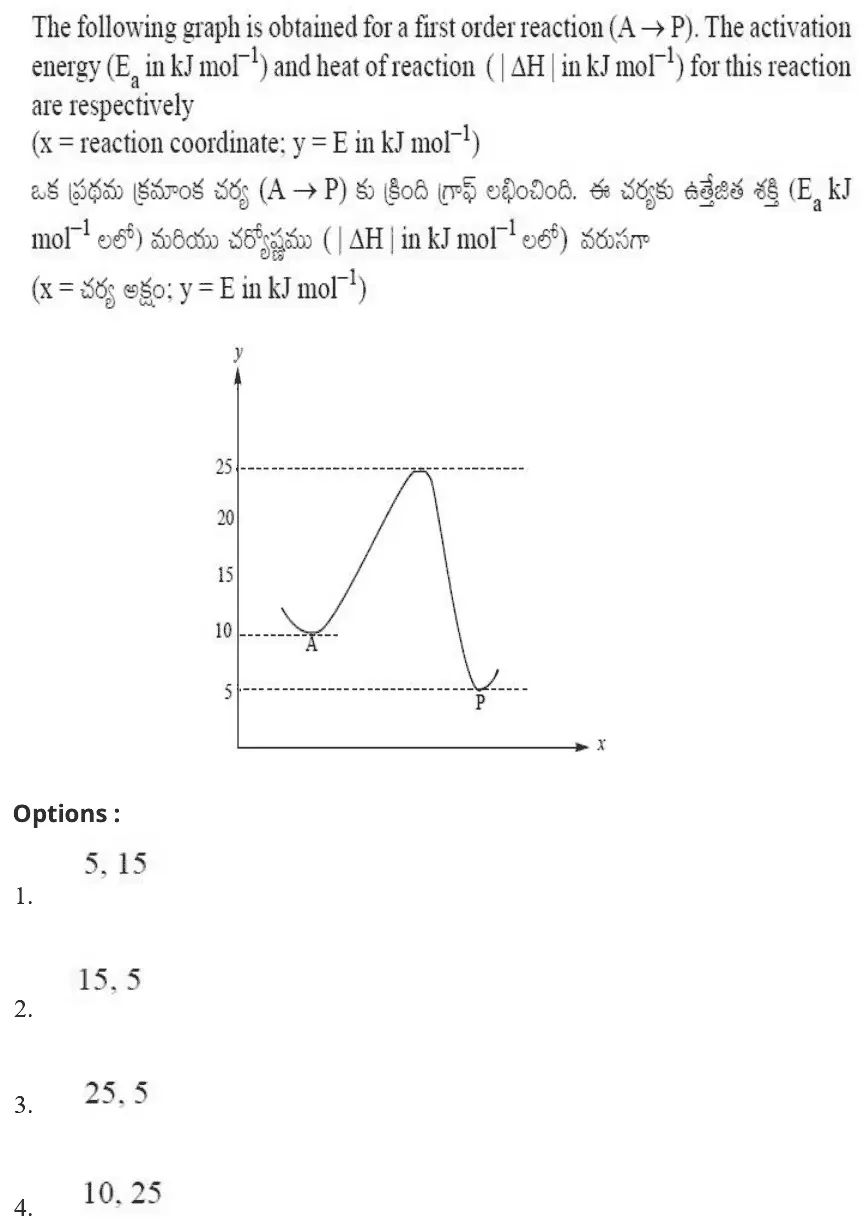
The following graph is obtained for a first order reaction ($\mathrm{A \rightarrow P}$). The activation energy ($\mathrm{E_a}$ in $\mathrm{kJ\ mol^{-1}}$) and heat of reaction ($|\Delta \mathrm{H}|$ in $\mathrm{kJ\ mol^{-1}}$) for this reaction are respectively
($\mathrm{x}$ = reaction coordinate; $\mathrm{y = E}$ in $\mathrm{kJ\ mol^{-1}}$)

(see the figure above)

The question and its figure as printed in AP EAPCET 2025 26thMay 2025 Shift 2.
The question as printed in the paper.
  • A

    5, 15

  • B

    15, 5

  • C

    25, 5

  • D

    10, 25

21AP EAPCET 2025 · 24 May · Shift 1MCQOpen question page ↗

For a first order reaction, the ratio between the time taken to complete $\frac{3}{4}$th of the reaction and time taken to complete half of the reaction is

  • A

    2

  • B

    3

  • C

    1.5

  • D

    2.5

22AP EAPCET 2025 · 23 May · Shift 1MCQOpen question page ↗

$\mathrm{A} \rightarrow \mathrm{B}$ is a first order reaction. The concentration of A is decreased from $x$ mol $\mathrm{L^{-1}}$ to $y$ mol $\mathrm{L^{-1}}$ in 100 min. What is the average velocity of the reaction in mol $\mathrm{L^{-1}}$ $\mathrm{min^{-1}}$ ?

  • A

    $\frac{|x-y|}{100}$

  • B

    $\frac{|y-x|^2}{100}$

  • C

    $\frac{100}{|x-y|}$

  • D

    $\frac{100}{|x+y|}$

23AP EAPCET 2025 · 23 May · Shift 2MCQOpen question page ↗

The following equation is obtained for a first order reaction at 300 K.

$$\log_{10}\frac{k}{A} = 0.00174$$

What is the activation energy (in $\mathrm{J\,mol^{-1}}$) of the reaction ?
($R = 8.314\ \mathrm{J\,mol^{-1}\,K^{-1}}$)

  • A

    10.0

  • B

    100.0

  • C

    0.1

  • D

    1.0

24AP EAPCET 2025 · 22 May · Shift 1MCQOpen question page ↗

At T(K), the following equation is obtained for a first order reaction.

$$\log\frac{k}{A} = -\frac{x}{T}$$

The activation energy for this reaction is equal to (R = gas constant)

  • A

    $2.303\, x\, \mathrm{R}$

  • B

    $\dfrac{2.303\,\mathrm{R}}{x}$

  • C

    $\dfrac{x}{2.303\,\mathrm{R}}$

  • D

    $\dfrac{1}{2.303\, x\,\mathrm{R}}$

25AP EAPCET 2025 · 22 May · Shift 2MCQOpen question page ↗

In a first order reaction, the concentration of the reactant is reduced to 1/8 of the initial concentration in 75 minutes. The $t_{1/2}$ of the reaction (in minutes) is
(log 2 = 0.30, log 3 = 0.47, log 4 = 0.60)

  • A

    60.2

  • B

    50.2

  • C

    25.1

  • D

    75.1

26AP EAPCET 2025 · 21 May · Shift 1MCQOpen question page ↗

$\mathrm{A} \rightarrow$ products, is a first order reaction. The following data is obtained for this reaction at T(K). The value of x : y is

Rate (mol $\mathrm{L^{-1}\,min^{-1}}$)[A]
0.20.02 M
0.4$x$ M
1.0$y$ M
  • A

    $1:5$

  • B

    $2:3$

  • C

    $5:2$

  • D

    $2:5$

27AP EAPCET 2025 · 21 May · Shift 2MCQOpen question page ↗

Consider the reaction given below

$$\mathrm{A + 2B \longrightarrow 3C + 2D}$$

If rate of disappearance of B is $x \times 10^{-2}\ \mathrm{mol\ L^{-1}\ s^{-1}}$, the ratio of rate of reaction and rate of appearance of C is

  • A

    $1 : 3$

  • B

    $3 : 1$

  • C

    $1 : 2$

  • D

    $2 : 1$

28TS EAPCET 2025 · 4 May · Shift 1MCQOpen question page ↗

$\mathrm{R \to P}$ is a first order reaction. For this reaction a graph of $\ln[\mathrm{R}]$ (on y-axis) and time (on x-axis) gave a straight line with negative slope. The intercept on y-axis is equal to ($\mathrm{k}$ = rate constant)

  • A

    $\ln[\mathrm{R}]_\mathrm{o}$

  • B

    $[\mathrm{R}]_\mathrm{o}$

  • C

    $\mathrm{k} \times 2.303$

  • D

    $\dfrac{\mathrm{k}}{2.303}$

29TS EAPCET 2025 · 4 May · Shift 2MCQOpen question page ↗

$\mathrm{A \rightarrow P}$ is a first order reaction. At 300 K this reaction was started with $[\mathrm{A}]=0.5\,\mathrm{mol\,L^{-1}}$. The rate constant of reaction was $0.125\,\mathrm{min^{-1}}$. The same reaction was started separately with $[\mathrm{A}]=1\,\mathrm{mol\,L^{-1}}$ at 300 K. The rate constant (in $\mathrm{min^{-1}}$) now is

  • A

    0.25

  • B

    0.50

  • C

    0.125

  • D

    1.00

30TS EAPCET 2025 · 3 May · Shift 1MCQOpen question page ↗

For a first order decomposition of a certain reaction, rate constant is given by the equation $\log k(\mathrm{s^{-1}}) = 7.14 - \dfrac{1\times 10^{4}\,\mathrm{K}}{\mathrm{T}}$. The activation energy of the reaction (in $\mathrm{kJ\ mol^{-1}}$) is $(\mathrm{R} = 8.3\ \mathrm{J\,K^{-1}\,mol^{-1}})$

  • A

    161.1

  • B

    171.1

  • C

    181.1

  • D

    191.1

31TS EAPCET 2025 · 3 May · Shift 2MCQOpen question page ↗

The half-life of a zero order reaction $\mathrm{A} \rightarrow$ products, is 0.5 hour. The initial concentration of A is 4 mol $\mathrm{L^{-1}}$. How much time (in hr) does it take for its concentration to come from 2.0 mol $\mathrm{L^{-1}}$ to 1.0 mol $\mathrm{L^{-1}}$?

  • A

    $\frac{1}{4}$

  • B

    $\frac{1}{8}$

  • C

    $\frac{1}{2}$

  • D

    $\frac{1}{6}$

32TS EAPCET 2025 · 2 May · Shift 1MCQOpen question page ↗

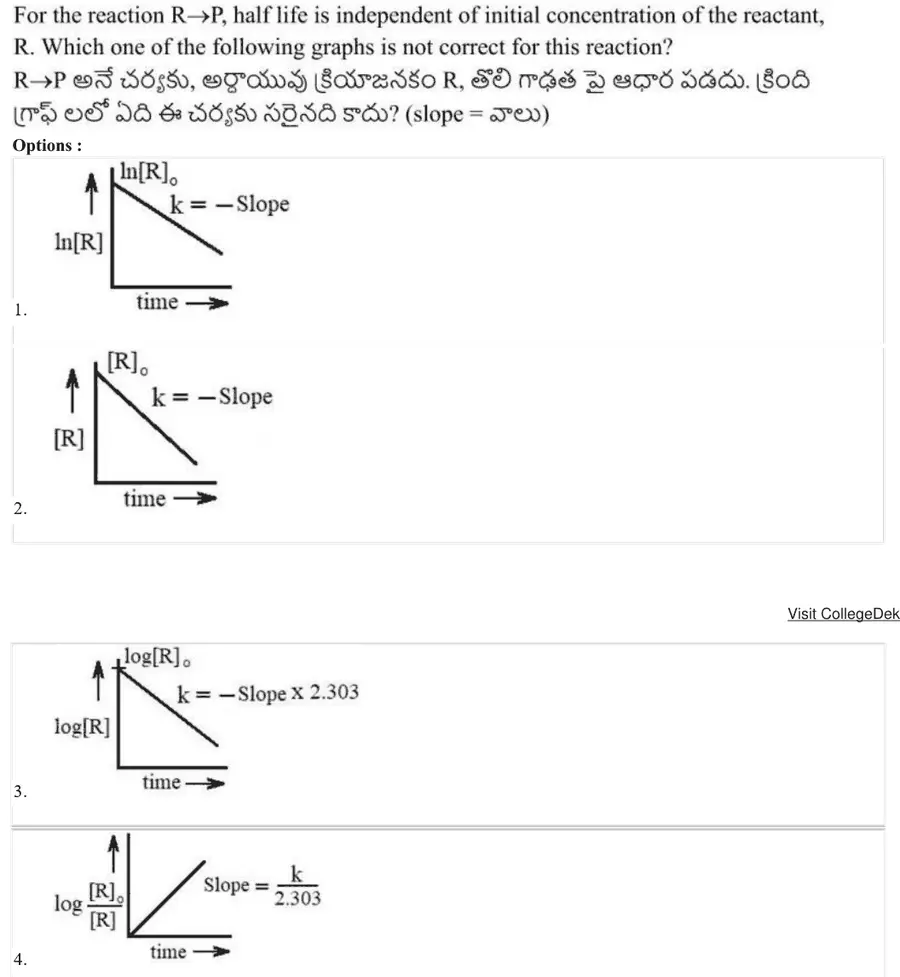
For the reaction $\mathrm{R \to P}$, half life is independent of initial concentration of the reactant, R. Which one of the following graphs is not correct for this reaction? (slope = slope)

The question and its figure as printed in TG EAPCET 2025 02 May FN. Option 1: Graph of ln[R] (y-axis) versus time (x-axis): straight line decreasing from ln[R]0 on the y-axis; labelled k = -Slope. Option 2: Graph of [R] (y-axis) versus time (x-axis): straight line decreasing from [R]0 on the y-axis; labelled k = -Slope. Option 3: Graph of log[R] (y-axis) versus time (x-axis): straight line decreasing from log[R]0 on the y-axis; labelled k = -Slope × 2.303. Option 4: Graph of [R]0/[R] (y-axis) versus time (x-axis): straight line increasing from the origin; labelled Slope = k/2.303.
The question as printed in the paper.
  • A

    see figure Graph of ln[R] (y-axis) versus time (x-axis): straight line decreasing from ln[R]$_0$ on the y-axis; labelled $k = -\text{Slope}$.

  • B

    see figure Graph of [R] (y-axis) versus time (x-axis): straight line decreasing from [R]$_0$ on the y-axis; labelled $k = -\text{Slope}$.

  • C

    see figure Graph of log[R] (y-axis) versus time (x-axis): straight line decreasing from log[R]$_0$ on the y-axis; labelled $k = -\text{Slope} \times 2.303$.

  • D

    see figure Graph of $\log \frac{[R]_0}{[R]}$ (y-axis) versus time (x-axis): straight line increasing from the origin; labelled $\text{Slope} = \frac{k}{2.303}$.

33TS EAPCET 2025 · 2 May · Shift 2MCQOpen question page ↗

Consider a general first order reaction

$\mathrm{A(g) \rightarrow B(g) + C(g)}$

If the initial pressure is 200 mm and after 20 minutes it is 250 mm, then the half-life period of the reaction (in minutes) is

(log 2 = 0.30, log 3 = 0.48, log 4 = 0.60)

  • A

    40.2

  • B

    50.2

  • C

    20.5

  • D

    60.5

34AP EAPCET 2024 · 23 May · Shift 1MCQOpen question page ↗

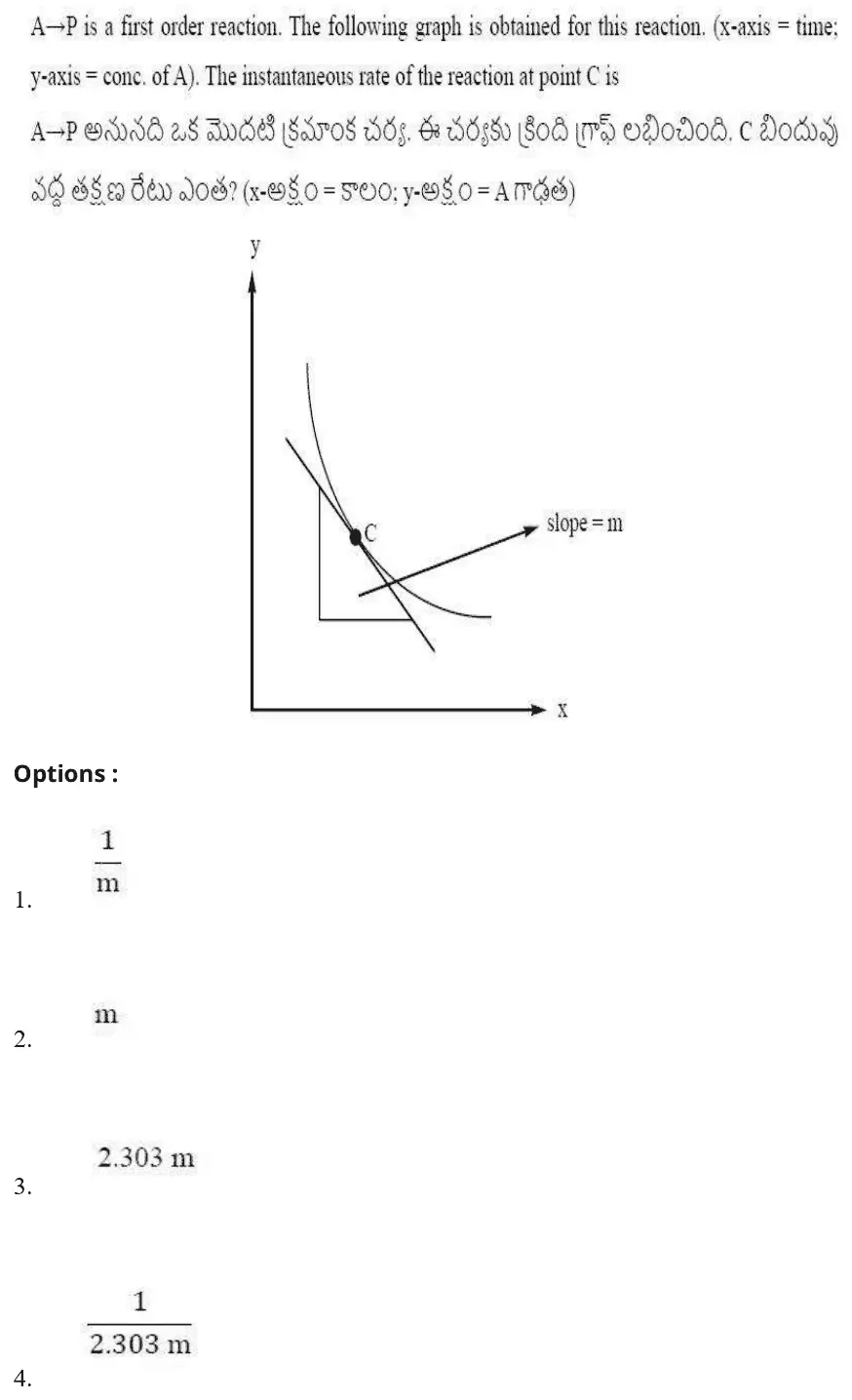
$\mathrm{A \rightarrow P}$ is a first order reaction. The following graph is obtained for this reaction. (x-axis = time; y-axis = conc. of A). The instantaneous rate of the reaction at point C is

(see the figure above)

The question and its figure as printed in AP EAPCET 2024 23rd May 2024 Shift 1.
The question as printed in the paper.
  • A

    $\frac{1}{m}$

  • B

    $m$

  • C

    $2.303\ m$

  • D

    $\frac{1}{2.303\ m}$

35AP EAPCET 2024 · 22 May · Shift 1MCQOpen question page ↗

Isomerisation of gaseous cyclobutene to butadiene is a first order reaction. At T(K), the rate constant of the reaction is $3.3 \times 10^{-4}\,s^{-1}$. What is the time required (in min) to complete 90 % of this reaction at the same temperature? (log 2 = 0.3)

  • A

    116.67

  • B

    233.34

  • C

    58.34

  • D

    350.0

36AP EAPCET 2024 · 22 May · Shift 2MCQOpen question page ↗

The rate constant of a first order reaction was doubled when the temperature was increased from 300 to 310 K. What is its approximate activation energy (in $\mathrm{kJ\ mol^{-1}}$)?

($R = 8.3\ \mathrm{J\ mol^{-1}K^{-1}}$; $\log 2 = 0.3$)

  • A

    5.33

  • B

    533.3

  • C

    53333

  • D

    53.33

37AP EAPCET 2024 · 21 May · Shift 1MCQOpen question page ↗

The rate constant of a first order reaction is $3.46\times10^{-2}\ \mathrm{s^{-1}}$ at 298K. What is the rate constant of the reaction at 350 K if its activation energy is $50.1\ \mathrm{kJ\ mol^{-1}}$? ($\mathrm{R=8.314\ J\ K^{-1}mol^{-1}}$)

(log 2 = 0.3010)

  • A

    $0.592\ \mathrm{s^{-1}}$

  • B

    $0.692\ \mathrm{s^{-1}}$

  • C

    $0.792\ \mathrm{s^{-1}}$

  • D

    $0.892\ \mathrm{s^{-1}}$

38AP EAPCET 2024 · 21 May · Shift 2MCQOpen question page ↗

$\mathrm{A \rightarrow P}$ is a zero order reaction. At 298 K the rate constant of the reaction is $1 \times 10^{-3}\ \mathrm{mol\ L^{-1}\ s^{-1}}$. Initial concentration of 'A' is $0.1\ \mathrm{mol\ L^{-1}}$. What is the concentration of 'A' after 10 sec?

  • A

    $0.09\ \mathrm{mol\ L^{-1}}$

  • B

    $0.099\ \mathrm{mol\ L^{-1}}$

  • C

    $0.087\ \mathrm{mol\ L^{-1}}$

  • D

    $0.011\ \mathrm{mol\ L^{-1}}$

39AP EAPCET 2024 · 20 May · Shift 1MCQOpen question page ↗

For a first order reaction, the concentration of reactant was reduced from $0.03\ \mathrm{mol\ L^{-1}}$ to $0.02\ \mathrm{mol\ L^{-1}}$ in 25 min. What is its rate (in $\mathrm{mol\ L^{-1}s^{-1}}$)?

  • A

    $6.667 \times 10^{-6}$

  • B

    $4 \times 10^{-4}$

  • C

    $6.667 \times 10^{-4}$

  • D

    $4 \times 10^{-6}$

40AP EAPCET 2024 · 20 May · Shift 2MCQOpen question page ↗

At 298 K the value of $-\frac{\Delta[\mathrm{Br^-}]}{\Delta t}$ for the reaction

$5\mathrm{Br^-(aq)} + \mathrm{BrO_3^-(aq)} + 6\mathrm{H^+(aq)} \rightarrow 3\mathrm{Br_2(aq)} + 3\mathrm{H_2O(l)}$ is $x$ mol $\mathrm{L^{-1}}$ $\mathrm{min^{-1}}$. What is the rate (in mol $\mathrm{L^{-1}}$ $\mathrm{min^{-1}}$) of this reaction?

  • A

    $5x$

  • B

    $x$

  • C

    $\frac{x}{5}$

  • D

    $-\frac{x}{5}$

41AP EAPCET 2024 · 19 May · Shift 2MCQOpen question page ↗

The first order reaction $\mathrm{A_{(g)} \rightarrow B_{(g)} + 2C_{(g)}}$ occurs at $25\ ^\circ\mathrm{C}$. After 24 minutes the ratio of the concentration of products to the concentration of the reactant is 1:3. What is the half life of the reaction (in min)? (log 1.11 = 0.046)

  • A

    150.5

  • B

    142.2

  • C

    157.8

  • D

    15.78

42AP EAPCET 2024 · 18 May · Shift 1MCQOpen question page ↗

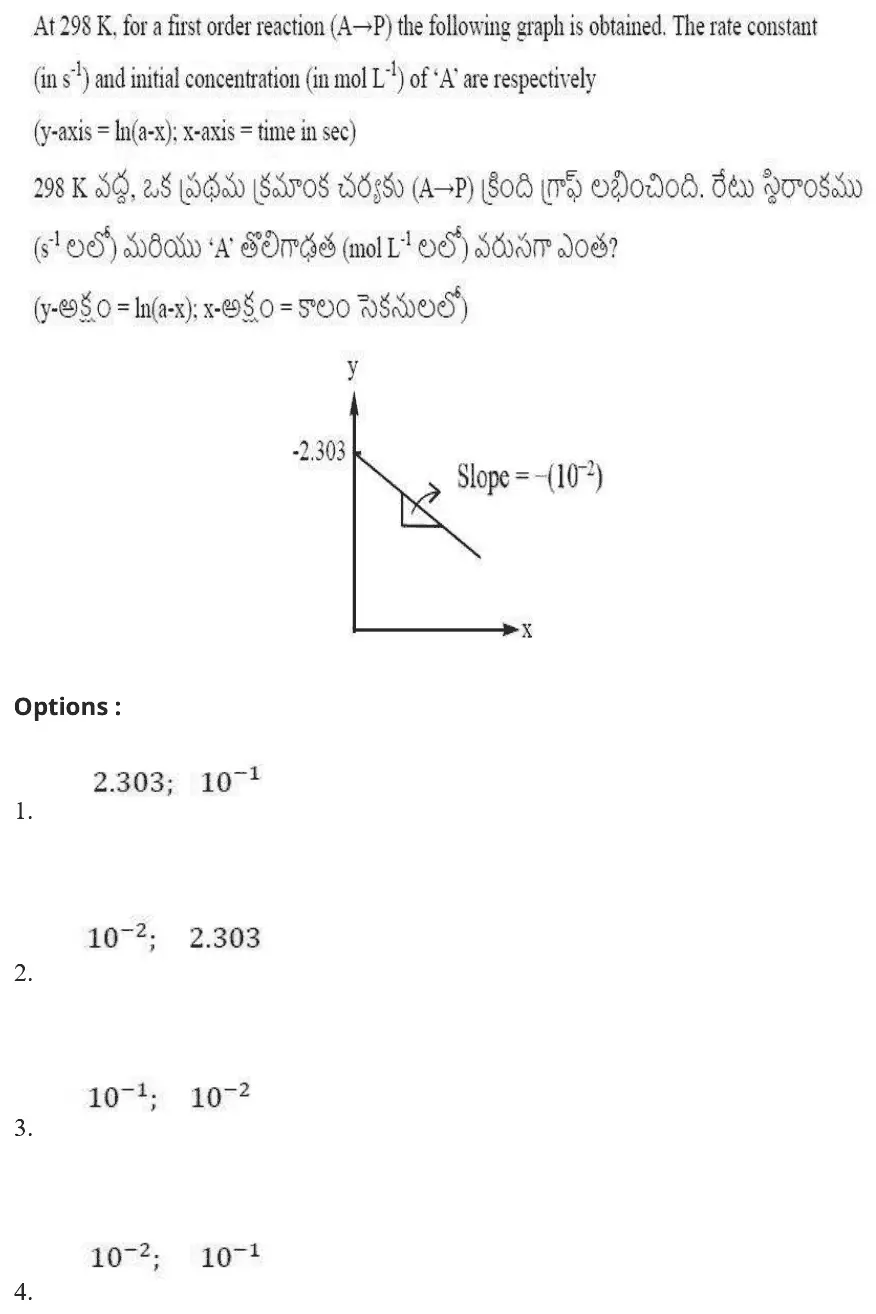
At 298 K, for a first order reaction (A→P) the following graph is obtained. The rate constant (in $\mathrm{s^{-1}}$) and initial concentration (in $\mathrm{mol\ L^{-1}}$) of 'A' are respectively

(y-axis = ln(a-x); x-axis = time in sec)

(see the figure above)

The question and its figure as printed in AP EAPCET 2024 18th May 2024 Shift 1.
The question as printed in the paper.
  • A

    $2.303;\ 10^{-1}$

  • B

    $10^{-2};\ 2.303$

  • C

    $10^{-1};\ 10^{-2}$

  • D

    $10^{-2};\ 10^{-1}$

43TS EAPCET 2024 · 11 May · Shift 1MCQOpen question page ↗

For the gaseous reaction, $\mathrm{N_2O_5 \rightarrow 2NO_2 + \frac{1}{2}O_2}$, the rate can be expressed as

$$-\frac{d[\mathrm{N_2O_5}]}{dt} = K_1[\mathrm{N_2O_5}]$$

$$+\frac{d[\mathrm{NO_2}]}{dt} = K_2[\mathrm{N_2O_5}]$$

$$+\frac{d[\mathrm{O_2}]}{dt} = K_3[\mathrm{N_2O_5}]$$

The correct relation between $K_1$, $K_2$ and $K_3$ is

  • A

    $K_1 = 2K_2 = 4K_3$

  • B

    $2K_1 = K_2 = 4K_3$

  • C

    $2K_1 = 3K_2 = 4K_3$

  • D

    $4K_1 = 2K_2 = K_3$

44TS EAPCET 2024 · 10 May · Shift 1MCQOpen question page ↗

The decomposition of benzene diazonium chloride is a first order reaction. The time taken for its decomposition to $\frac{1}{4}$ and $\frac{1}{10}$ of its initial concentration are $t_{1/4}$ and $t_{1/10}$ respectively. The value of $\frac{t_{1/4}}{t_{1/10}} \times 100$ is

(Given: $\log 2 = 0.3$)

  • A

    60

  • B

    30

  • C

    90

  • D

    45

45TS EAPCET 2024 · 10 May · Shift 2MCQOpen question page ↗

For a first order reaction, the graph between $\log\frac{a}{(a-x)}$ (on y-axis) and time (in min, on x-axis) gave a straight line passing through origin. The slope is $2\times10^{-3}\ \mathrm{min^{-1}}$. What is the rate constant (in $\mathrm{min^{-1}}$)?

  • A

    $2\times10^{-3}$

  • B

    $\frac{2\times10^{-3}}{2.303}$

  • C

    $4.606\times10^{-3}$

  • D

    $0.5\times10^{-5}$

46TS EAPCET 2024 · 9 May · Shift 1MCQOpen question page ↗

For a first order reaction, a plot of $\ln k$ (y-axis) and $\frac{1}{\mathrm{T}}$ (x-axis) gave the straight line with slope equal to $-10^3 k$ and intercept equal to 2.303 (on y-axis). What is the activation energy ($\mathrm{E_a}$ in $\mathrm{kJ\,mol^{-1}}$) of the reaction?

(Given $\mathrm{R} = 8.314\ \mathrm{J\,mol^{-1}K^{-1}}$)

  • A

    8.314

  • B

    2.303

  • C

    2303

  • D

    83.14

47TS EAPCET 2024 · 9 May · Shift 2MCQOpen question page ↗

Consider the gaseous reaction

$\mathrm{A_2 + B_2 \rightarrow 2AB}$

The following data was obtained for the above reaction

$[\mathrm{A_2}]_0$$[\mathrm{B_2}]_0$Initial rate of formation of AB ($\mathrm{mol\ L^{-1}\ s^{-1}}$)
0.1 M0.1 M$2.5\times10^{-4}$
0.2 M0.1 M$5.0\times10^{-4}$
0.2 M0.2 M$1.0\times10^{-3}$

The value of rate constant for the above reaction is

  • A

    $1.25\times10^{-2}$

  • B

    $1.25\times10^{-3}$

  • C

    $2.5\times10^{-2}$

  • D

    $2.5\times10^{-1}$

48AP EAPCET 2023 · 19 May · Shift 1MCQOpen question page ↗

The rate constant, k for a first order reaction,

$\mathrm{C_2H_5I(g) \rightarrow C_2H_4(g) + HI(g)}$ is $x\ \mathrm{s^{-1}}$ at 600 K and $4x\ \mathrm{s^{-1}}$ at 700 K.

The energy of activation of the reaction (in $\mathrm{kJ\ mol^{-1}}$) is

($\log 4 = 0.6$, $R = 8.3\ \mathrm{J\,K^{-1}\,mol^{-1}}$)

  • A

    48.16

  • B

    58.16

  • C

    38.16

  • D

    28.16

49AP EAPCET 2023 · 18 May · Shift 1MCQOpen question page ↗

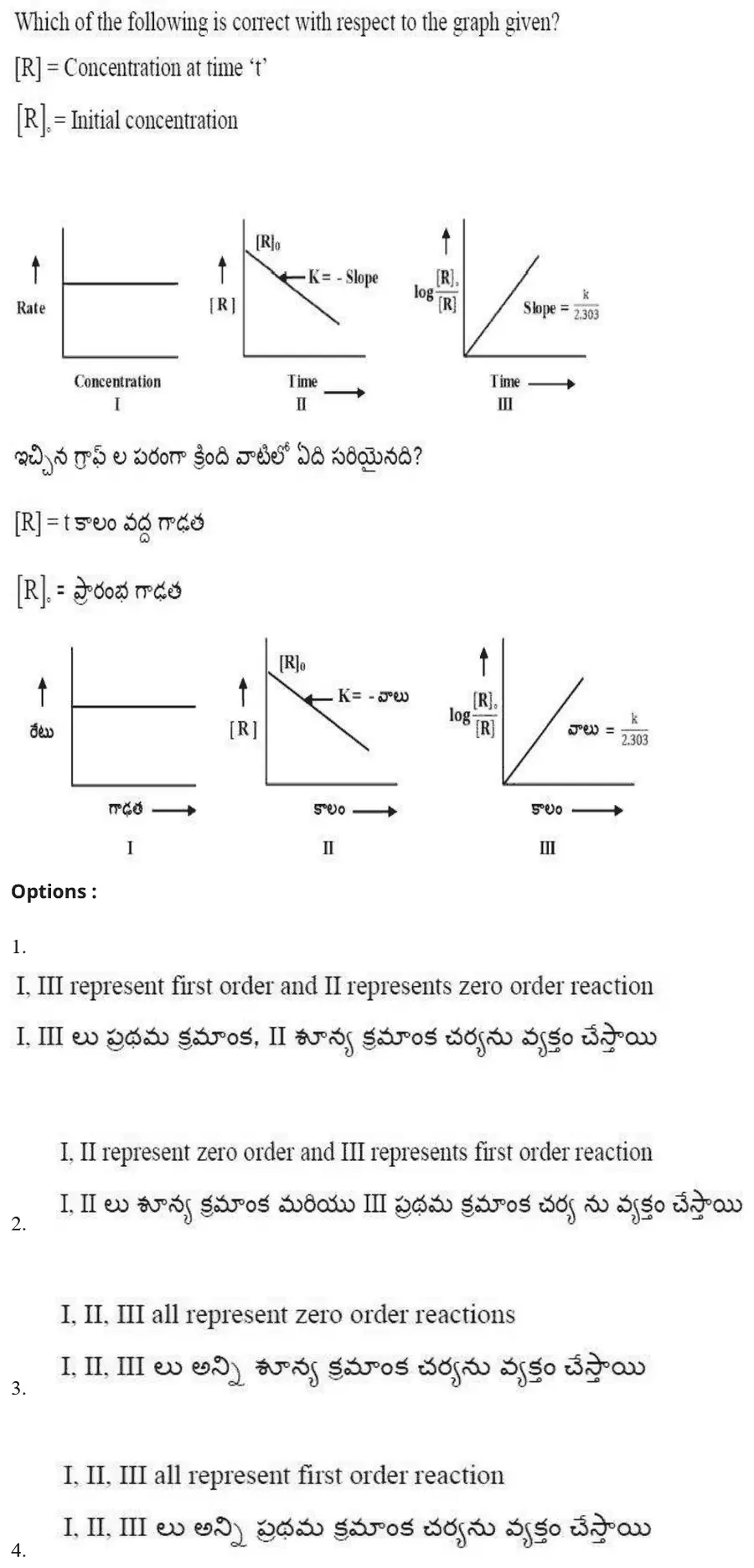
Which of the following is correct with respect to the graph given?

$[\mathrm{R}]$ = Concentration at time 't'

$[\mathrm{R}]_\circ$ = Initial concentration

(see the figure above)

The question and its figure as printed in AP EAPCET 2023 18th May 2023 Shift 1.
The question as printed in the paper.
  • A

    I, III represent first order and II represents zero order reaction

  • B

    I, II represent zero order and III represents first order reaction

  • C

    I, II, III all represent zero order reactions

  • D

    I, II, III all represent first order reaction

50AP EAPCET 2023 · 18 May · Shift 2MCQOpen question page ↗

A reaction, $3\mathrm{X(g)} \rightarrow 2\mathrm{Y(g)} + \mathrm{Z(g)}$ takes place in a closed vessel. What is the rate of formation of $\mathrm{Y}$ (in $\mathrm{mol\,L^{-1}s^{-1}}$) if the rate of disappearance of $\mathrm{X}$ is $7.2\times10^{-3}\ \mathrm{mol\,L^{-1}s^{-1}}$?

  • A

    $3.6\times10^{-3}$

  • B

    $4.8\times10^{-3}$

  • C

    $2.4\times10^{-3}$

  • D

    $1.2\times10^{-3}$

51AP EAPCET 2023 · 17 May · Shift 1MCQOpen question page ↗

Consider the reaction carried out at T(K)

$\mathrm{A(g) + B(g) \longrightarrow C(g)}$

The rate law for this reaction is $r = k[\mathrm{A}]^1[\mathrm{B}]^2$. The concentration of A in experiment 2 and rate in experiment 3 shown as x and z in the table. x and z are respectively

Experiment$[\mathrm{A}]$ $\mathrm{mol\,L^{-1}}$$[\mathrm{B}]$ $\mathrm{mol\,L^{-1}}$Initial rate $(\mathrm{mol\,L^{-1}\,s^{-1}})$
10.050.05R
2x0.052R
30.200.10z
  • A

    $x = 0.10$ $z = 8R$

  • B

    $x = 0.05$ $z = 4R$

  • C

    $x = 0.10$ $z = 16R$

  • D

    $x = 0.20$ $z = 16R$

52AP EAPCET 2023 · 17 May · Shift 2MCQOpen question page ↗

Consider a gas phase reaction which occurs in a closed vessel

$\mathrm{2A \rightleftharpoons 4B + C}$

The concentration of B is found to be increased by $5\times10^{-3}\ \mathrm{mol\,L^{-1}}$ in 10 seconds.

The rate of disappearance of A (in $\mathrm{mol\,L^{-1}s^{-1}}$) is

  • A

    $4.75\times10^{-4}$

  • B

    $7.5\times10^{-4}$

  • C

    $1.25\times10^{-4}$

  • D

    $2.5\times10^{-4}$

53AP EAPCET 2023 · 16 May · Shift 2MCQOpen question page ↗

A first order reaction has the rate constant of $1.15\times10^{-3}\ \mathrm{s^{-1}}$. The time required to reduce 10 g of reactant to 6 g is $\mathrm{x}\times10^{2}$ sec. What is the approximate value of x?

(log 5 = 0.7, log 3 = 0.48)

  • A

    2.2

  • B

    3.3

  • C

    4.4

  • D

    1.1

54AP EAPCET 2023 · 15 May · Shift 1MCQOpen question page ↗

For the reaction $\mathrm{A + B \rightarrow C}$, the following data were obtained

Expt.Initial concentration [A] MInitial concentration [B] MInitial rate ($\mathrm{M\ min^{-1}}$)
1.0.10.1$1.0\times10^{-4}$
2.0.10.3$9.0\times10^{-4}$
3.0.30.3$2.7\times10^{-3}$

The order of reaction with respect to A and B are respectively

  • A

    1, 2

  • B

    2,1

  • C

    1.5, 1.5

  • D

    0, 3

55AP EAPCET 2023 · 15 May · Shift 2MCQOpen question page ↗

The rate constant, k of a zero order reaction $2\mathrm{NH_3}(g) \xrightarrow[1130\,K]{Pt} \mathrm{N_2}(g)+3\mathrm{H_2}(g)$ is $y\times10^{-4}\ \mathrm{mol\,L^{-1}\,s^{-1}}$. The rate of formation of hydrogen (in $\mathrm{mol\,L^{-1}\,s^{-1}}$) is

  • A

    $y\times10^{-4}$

  • B

    $2y\times10^{-4}$

  • C

    $3y\times10^{-4}$

  • D

    $\frac{y}{3}\times10^{-4}$

56TS EAPCET 2023 · 14 May · Shift 1MCQOpen question page ↗

The rate law for the decomposition of hydrogen iodide is $-\dfrac{\mathrm{d[HI]}}{\mathrm{dt}} = \mathrm{k[HI]^2}$. The units of rate constant k are

  • A

    $\mathrm{L\ mol^{-1}\ s^{-1}}$

  • B

    $\mathrm{L^{-1}\ mol\ s^{-1}}$

  • C

    $\mathrm{L^{2}\ mol^{-2}\ s^{-1}}$

  • D

    $\mathrm{L^{1/2}\ mol^{-1/2}\ s^{-1}}$

57TS EAPCET 2023 · 14 May · Shift 2MCQOpen question page ↗

A possible mechanism for the gaseous reaction $2\mathrm{H_2} + 2\mathrm{NO} \rightarrow 2\mathrm{H_2O} + \mathrm{N_2}$ is

Step 1: $2\mathrm{NO} \rightleftharpoons \mathrm{N_2O_2}$

Step 2: $\mathrm{N_2O_2} + \mathrm{H_2} \longrightarrow \mathrm{N_2O} + \mathrm{H_2O}$ (slow)

Step 3: $\mathrm{N_2O} + \mathrm{H_2} \longrightarrow \mathrm{N_2} + \mathrm{H_2O}$

The rate law for this reaction is

  • A

    $\mathrm{R = k[NO]^2\,[H_2]^2}$

  • B

    $\mathrm{R = k[NO]\,[H_2]^2}$

  • C

    $\mathrm{R = k[NO]^{1/2}\,[H_2]}$

  • D

    $\mathrm{R = k[NO]^2\,[H_2]}$

58TS EAPCET 2023 · 13 May · Shift 1MCQOpen question page ↗

The rate of a first order reaction doubles when the temperature changes from 300 K to 310 K. The activation energy of the reaction (in $\mathrm{kJ\,mol^{-1}}$) is

($\mathrm{R = 8.3\,J\,K^{-1}\,mol^{-1}}$, $\log 2 = 0.3$)

  • A

    43.33

  • B

    53.33

  • C

    63.33

  • D

    73.33

59TS EAPCET 2023 · 13 May · Shift 2MCQOpen question page ↗

For a zero order reaction $\mathrm{A} \rightarrow$ product, a plot of $[\mathrm{A}]$ (on y-axis) and time (on x-axis) gave a straight line with slope equal to $-3\times10^{-3}\ \mathrm{M\ min^{-1}}$ and intercept equal to $2\times10^{-2}\ \mathrm{M}$ (on y-axis). What is the rate constant (in $\mathrm{M\ min^{-1}}$) of this reaction?

  • A

    $3\times10^{-3}$

  • B

    $5\times10^{-5}$

  • C

    $3\times10^{-4}$

  • D

    $5\times10^{-4}$

60TS EAPCET 2023 · 12 May · Shift 1MCQOpen question page ↗

If benzene diazonium chloride undergoes first order decomposition at T(K) with a rate constant of $6.93\times10^{-2}\ \mathrm{min^{-1}}$, the time for completion of 90% of the reaction (in min) is (nearest integer) (log 2=0.30, log 3 =0.477)

  • A

    15

  • B

    30

  • C

    33

  • D

    43

61TS EAPCET 2023 · 12 May · Shift 2MCQOpen question page ↗

The graph obtained between $\ln k$ ($k$ = Rate constant) on y-axis and $1/T$ on x-axis is a straight line. The slope of it is $-4 \times 10^4 k$. The activation energy of the reaction (in $\mathrm{kJ\ mol^{-1}}$) is
($\mathrm{R = 8.3\ J\ K^{-1}mol^{-1}}$)

  • A

    166

  • B

    332

  • C

    765

  • D

    382

62TS EAPCET 2022 · 20 Jul · Shift 1MCQOpen question page ↗

Rate constants in the following reaction are
Reaction 1: A $\xrightarrow{\text{catalyst 1}}$ P$_1$, k$_1$ = 1 s$^{-1}$
Reaction 2: A $\xrightarrow{\text{catalyst 2}}$ P$_2$, k$_2$ = 0.1 L mol$^{-1}$s$^{-1}$
Reaction 3: A $\xrightarrow{\text{catalyst 3}}$ P$_3$, k$_3$ = 0.01 L$^2$ mol$^{-2}$s$^{-1}$
The correct relations between the rate of the reactions at 1 M of A are

  • A

    $r_1 = \dfrac{r_3}{100},\ r_2 = \dfrac{r_3}{10}$

  • B

    $r_1 = \dfrac{r_2}{10},\ r_2 = \dfrac{r_3}{10}$

  • C

    $r_1 = 100\,r_3,\ r_2 = \dfrac{r_3}{10}$

  • D

    $r_1 = 10\,r_2,\ r_3 = \dfrac{r_2}{10}$

63TS EAPCET 2022 · 20 Jul · Shift 2MCQOpen question page ↗

For a reaction, the threshold energy is 75 kJ/mole. If the internal energy of the reactants is 20 kJ/mole, the activation energy (in kJ/mole) is

  • A

    55

  • B

    20

  • C

    75

  • D

    95

64TS EAPCET 2022 · 19 Jul · Shift 1MCQOpen question page ↗

The reaction $\mathrm{2A\to 2B+C}$ has a rate constant of $1.2\times10^{-2}\mathrm{s}^{-1}$. Which of the following is correct?

  • A

    Plot of [A] vs "$\dfrac{1}{t}$" will be straight line

  • B

    Plot of $\dfrac{1}{[\mathrm{A}]}$ vs $\mathrm{t^2}$ will be a straight line

  • C

    Plot of ln[A] vs t will be a straight line

  • D

    Plot of [A] vs $\mathrm{t^2}$ will be a straight line

65TS EAPCET 2022 · 19 Jul · Shift 2MCQOpen question page ↗

Which of the following is a zero order reaction?

  • A

    $\mathrm{2HI\to H_{2}+I_{2}}$

  • B

    $\mathrm{H_{2}+Br_{2}\xrightarrow{\Delta}2HBr}$

  • C

    $\mathrm{2N_{2}O_{5}\to4NO_{2}+O_{2}}$

  • D

    $\mathrm{H_{2}+Cl_{2}\xrightarrow{h\nu}2HCl}$

66TS EAPCET 2022 · 18 Jul · Shift 1MCQOpen question page ↗

If the definition of the temperature coefficient of the reaction holds good for a reaction between $27\ ^{\circ}\mathrm{C}$ and $37\ ^{\circ}\mathrm{C}$, the activation energy for the reaction in $\mathrm{kJ.mol^{-1}}$ is

  • A

    $102$

  • B

    $53.5$

  • C

    $\infty$

  • D

    $141.5$

67TS EAPCET 2022 · 18 Jul · Shift 2MCQOpen question page ↗

The rate constant of a reaction is increased 4 times after addition of catalyst to the reaction mixture at the same temperature of 27 °C. The change in the activation energy of this reaction is
(Take $\ln\left(\frac{1}{4}\right)=-1.386$, R = 8.314)

  • A

    $-15$ kJ/mol

  • B

    $-1.5$ kJ/mol

  • C

    $-3.45$ kJ/mol

  • D

    $-34.5$ kJ/mol

68TS EAPCET 2022 · 18 Jul · Shift 2MCQOpen question page ↗

Half life periods for a reaction at initial concentrations of 0.1 M and 0.01 M are 5 and 50 minutes, respectively. The order of reaction is

  • A

    3

  • B

    2

  • C

    1

  • D

    0

69AP EAPCET 2022 · 8 Jul · Shift 1MCQOpen question page ↗

In the reaction, A$\rightarrow$ products, If the concentration of the reactant is doubled, rate of the reaction remains unchanged. The order of the reaction with respect to A is

  • A

    $1$

  • B

    $2$

  • C

    $0.5$

  • D

    $0$

70AP EAPCET 2022 · 8 Jul · Shift 2MCQOpen question page ↗

$\mathrm{P \to Q}$ is a zero order reaction. If the concentration of P decreases from 0.1 M to 0.05 M in 10 seconds, the concentration of P after 15 seconds time is

  • A

    $0.05\mathrm{M}$

  • B

    $0.025\mathrm{M}$

  • C

    $0.02\mathrm{M}$

  • D

    $0.01\mathrm{M}$

71AP EAPCET 2022 · 7 Jul · Shift 1MCQOpen question page ↗

If the rate of disappearance of $\mathrm{N_2O_5}$ in the following reaction is $1.2 \times 10^{-5}\ \mathrm{mol\,L^{-1}s^{-1}}$, the rate of production of $\mathrm{NO_2}$ (in $\mathrm{mol\,L^{-1}s^{-1}}$) is
$\mathrm{2N_2O_5\,(g) \to 4NO_2\,(g) + O_2\,(g)}$

  • A

    $1.2 \times 10^{-5}$

  • B

    $3.6 \times 10^{-5}$

  • C

    $2.4 \times 10^{-5}$

  • D

    $4.8 \times 10^{-5}$

72AP EAPCET 2022 · 7 Jul · Shift 2MCQOpen question page ↗

What is the concentration (in $\mathrm{mol\,L^{-1}}$) of the product after 20 s in the following reaction.
Given that $\mathrm{A \rightarrow 3B}$, rate = $k[\mathrm{A}]^0$
Time(s) Concentration of the reactant ($\mathrm{mol\,L^{-1}}$)
0 0.1
15 0.05
20 0.1-x

  • A

    $6.6\times10^{-2}$

  • B

    $1.32\times10^{-1}$

  • C

    $1.98\times10^{-1}$

  • D

    $2.2\times10^{-2}$

73AP EAPCET 2022 · 6 Jul · Shift 1MCQOpen question page ↗

A$\to$ products, is a first order reaction. The time required to decompose A to half its initial amount is 60 minutes. The rate constant of the reaction (in $\mathrm{s^{-1}}$) is

  • A

    $1.05\ \mathrm{X}\ 10^{-2}$

  • B

    $1.15\ \mathrm{X}\ 10^{-2}$

  • C

    $1.25\ \mathrm{X}\ 10^{-4}$

  • D

    $1.92\ \mathrm{X}\ 10^{-4}$

74AP EAPCET 2022 · 6 Jul · Shift 2MCQOpen question page ↗

In a first order reaction, the concentration of the reactant is reduced from 0.6 $\mathrm{mol\,L^{-1}}$ to 0.2 $\mathrm{mol\,L^{-1}}$ in 5 min. What is the rate constant of the reaction? (log 3= 0.4771)

  • A

    $0.219\ \mathrm{min^{-1}}$

  • B

    $0.325\ \mathrm{min^{-1}}$

  • C

    $0.421\ \mathrm{min^{-1}}$

  • D

    $0.522\ \mathrm{min^{-1}}$

75AP EAPCET 2022 · 5 Jul · Shift 1MCQOpen question page ↗

The rate constant of a reaction at 500K and 700K are $0.02\ \mathrm{s^{-1}}$ and $0.2\ \mathrm{s^{-1}}$ respectively. The activation energy of the reaction (in $\mathrm{kJ\,mol^{-1}}$) is (R=8.3 $\mathrm{JK^{-1}\,mol^{-1}}$)

  • A

    66.90

  • B

    33.45

  • C

    22.30

  • D

    44.45

76AP EAPCET 2022 · 5 Jul · Shift 2MCQOpen question page ↗

$\mathrm{CH_3CO_2C_2H_5 + H_2O \to CH_3CO_2H + C_2H_5OH}$

Rate = $k[\mathrm{H_2O}]\,[\mathrm{CH_3CO_2C_2H_5}]$

The initial concentrations of ethyl acetate and water are 0.001M and 2M respectively. The value of rate constant, k of the reaction, if 99% of ethyl acetate is hydrolyzed in 10 seconds is

  • A

    $0.2303\ \mathrm{s^{-1}}$

  • B

    $2.303\ \mathrm{s^{-1}}$

  • C

    $4.606\ \mathrm{s^{-1}}$

  • D

    $3.303\ \mathrm{s^{-1}}$

77AP EAPCET 2022 · 4 Jul · Shift 1MCQOpen question page ↗

The rate constant for a zero order reaction A$\rightarrow$ products is 0.0030 $\mathrm{mol\,L^{-1}\,s^{-1}}$. How long it will take for the initial concentration of A to fall from 0.10 M to 0.075M?

  • A

    10 s

  • B

    20 s

  • C

    8.33 s

  • D

    1.33 s

78AP EAPCET 2022 · 4 Jul · Shift 2MCQOpen question page ↗

The time required for completion of 93.75% of a first order reaction is x minutes. The half life of it (in minutes) is

  • A

    $x/8$

  • B

    $x/2$

  • C

    $x/4$

  • D

    $x/3$

79AP EAMCET 2021 · 25 Aug · Shift 2MCQOpen question page ↗

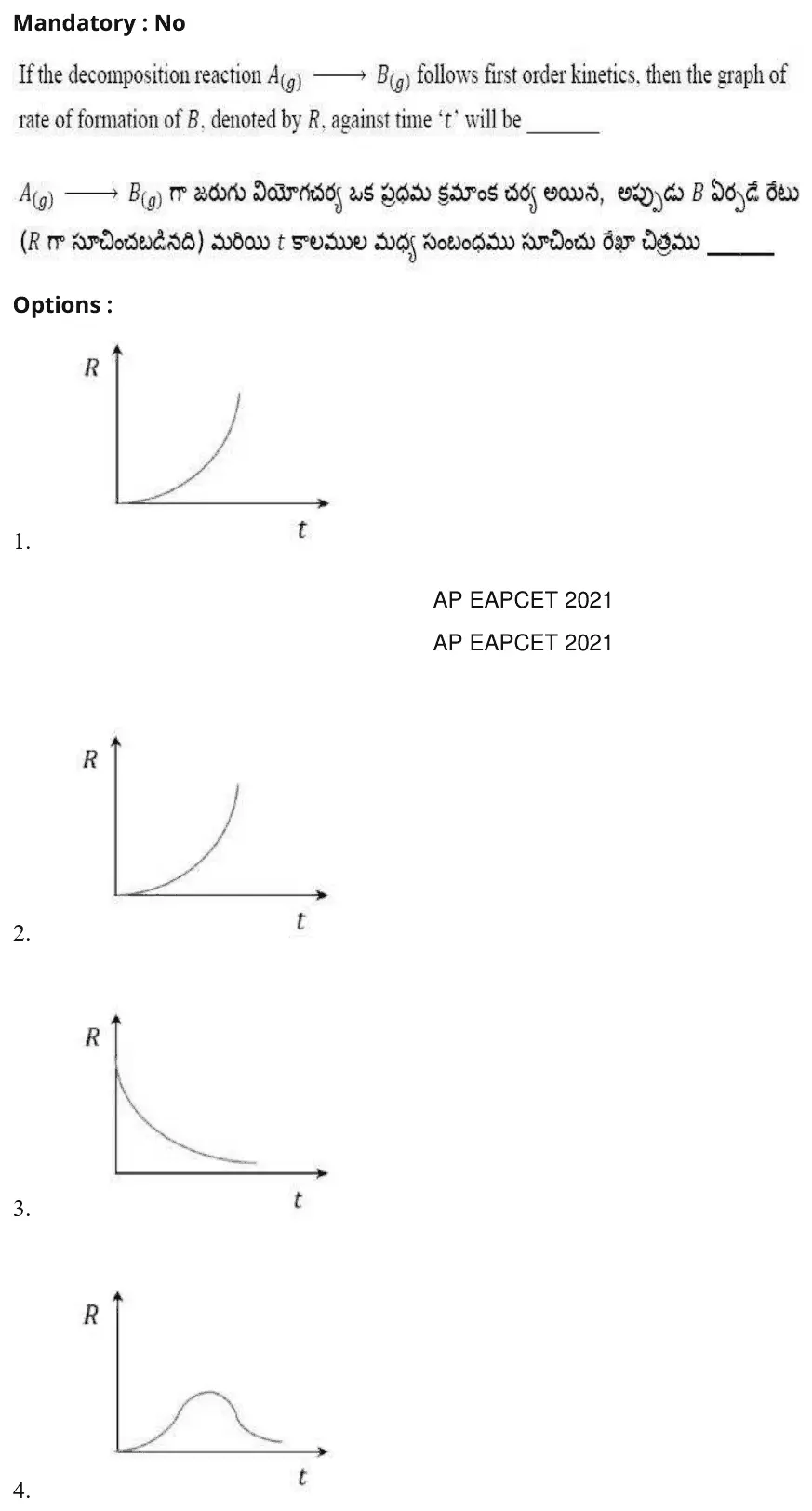
If the decomposition reaction $\mathrm{A_{(g)} \longrightarrow B_{(g)}}$ follows first order kinetics, then the graph of rate of formation of $B$, denoted by $R$, against time '$t$' will be ______

The question and its figure as printed in AP EAPCET 2021 25th Aug 2021 Shift 2. Option 1: graph of R vs t Option 2: graph of R vs t Option 3: graph of R vs t Option 4: graph of R vs t
The question as printed in the paper.
  • A

    see figure graph of R vs t

  • B

    see figure graph of R vs t

  • C

    see figure graph of R vs t

  • D

    see figure graph of R vs t

80AP EAMCET 2021 · 25 Aug · Shift 2MCQOpen question page ↗

If for a hypothetical reaction, $E_a = 0$ at $273\,\mathrm{K}$, then find the ratio of the rate constants at $383\,\mathrm{K}$.

  • A

    10

  • B

    1

  • C

    0

  • D

    100

81AP EAMCET 2021 · 25 Aug · Shift 2MCQOpen question page ↗

If the rate constant of a first order reaction is $4.606 \times 10^{-3}\,\mathrm{s^{-1}}$, then find the time required for $400\,g$ of the reactant to reduce to $50\,g$.

  • A

    7.52 minutes

  • B

    0.45 minutes

  • C

    46.06 minutes

  • D

    15.05 minutes

82AP EAMCET 2021 · 24 Aug · Shift 2MCQOpen question page ↗

Compounds $A$ and $B$ react according to the equation $2A_{(g)} + B_{(g)} \rightarrow 2C_{(g)} + D_{(g)}$. The initial rate of formation was determined at different initial concentrations of $A$ and $B$. The following results were obtained. The rate law for this reaction may be ______ [All concentrations are in $mol/lit$]
Exp No | Initial [A] | Initial [B] | Initial rate of formation of C
1 | 0.1 | 0.1 | $6 \times 10^{-3}$
2 | 0.3 | 0.2 | $7.2 \times 10^{-2}$
3 | 0.3 | 0.4 | $2.88 \times 10^{-1}$
4 | 0.4 | 0.1 | $2.4 \times 10^{-2}$

  • A

    Rate $= K[A]^2\ [B]$

  • B

    Rate $= K[A]\ [B]^2$

  • C

    Rate $= K[A]\ [B]$

  • D

    Rate $= K[A]^2\ [B]^0$

83AP EAMCET 2021 · 24 Aug · Shift 2MCQOpen question page ↗

If the rate constant for a first order reaction is $k$, then find the time required for completion of $80\ \%$ of the reaction.

  • A

    $\frac{3.2}{k}$

  • B

    $\frac{1.6}{k}$

  • C

    $\frac{4.8}{k}$

  • D

    $\frac{0.8}{k}$

84AP EAMCET 2021 · 23 Aug · Shift 1MCQOpen question page ↗

A reaction has rate constant $k = 2.4 \times 10^{-4}\ \mathrm{s^{-1}}$. Then find the ratio of $t_{99.9}$ to $t_{50}$.

  • A

    1

  • B

    5

  • C

    10

  • D

    15

85AP EAMCET 2021 · 23 Aug · Shift 2MCQOpen question page ↗

For a reaction $NO_2 + CO \rightarrow CO_2 + NO$ the possible elementary steps (below 500K) are
Step 1: $NO_2 + NO_2 \xrightarrow{slow} NO + NO_3$
Step 2: $NO_3 + CO \xrightarrow{Fast} CO_2 + NO_2$
its rate expression will be

  • A

    $rate = K[NO_2][CO]$

  • B

    $rate = K[CO_2][NO]$

  • C

    $rate = K[NO_2]^2$

  • D

    $rate = K[NO][NO_3]$

86AP EAMCET 2021 · 23 Aug · Shift 2MCQOpen question page ↗

Which among the following represents the expression for $(3/4)^{th}$ life of $1^{st}$ order reaction?

  • A

    $\frac{k}{2.303}\log\left(\frac{4}{3}\right)$

  • B

    $\frac{2.303}{k}\log\left(\frac{3}{4}\right)$

  • C

    $\frac{2.303}{k}\log(4)$

  • D

    $\frac{2.303}{k}\log(3)$

87AP EAMCET 2021 · 20 Aug · Shift 1MCQOpen question page ↗

Which statement among the following is incorrect?

  • A

    Unit of rate of disappearance is $M\ s^{-1}$

  • B

    Unit of rate of reaction is $M\ s^{-1}$

  • C

    Unit of rate constant $k$ depends upon order of reaction

  • D

    Unit of rate constant $k$ for a first order reaction is $M\ s^{-1}$

88AP EAMCET 2021 · 20 Aug · Shift 1MCQOpen question page ↗

For zero order reaction, a plot of $t_{1/2}$ versus $[A]_0$ will be______

  • A

    A straight line passing through the origin and slope = K

  • B

    A horizontal line (parallel to x - axis)

  • C

    A straight line with slope –K

  • D

    A straight line passing through origin and slope = $\dfrac{1}{2K}$

89AP EAMCET 2021 · 20 Aug · Shift 2MCQOpen question page ↗

For a $A + B \rightarrow$ products the rate of the reaction is given by $Rate = K[A][B]^2$. The units of rate constant (K) will be ______

  • A

    $mol\ L^{-1}\ S^{-1}$

  • B

    $L\ mol^{-1}\ S^{-1}$

  • C

    $mol^2\ L^{-2}\ S^{-1}$

  • D

    $mol^{-2}\ L^2\ S^{-1}$

90AP EAMCET 2021 · 20 Aug · Shift 2MCQOpen question page ↗

For an elementary reaction, $X_{(g)} \longrightarrow Y_{(g)} + Z_{(g)}$, the $t_{1/2}$ is 10 minutes. In what period of time would the concentration of $X$ be reduced to 10 % of its original concentration?

  • A

    20 minutes

  • B

    33.2 minutes

  • C

    15 minutes

  • D

    25.2 minutes

91AP EAMCET 2021 · 19 Aug · Shift 1MCQOpen question page ↗

If the rate constant for a first order reaction is $2.303 \times 10^{-3}\ s^{-1}$, find the time required to reduce $4\ g$ of the reactant to $0.2\ g$.

  • A

    1.30 hours

  • B

    21.60 hours

  • C

    0.36 hours

  • D

    2.60 hours

92TS EAMCET 2021 · 6 Aug · Shift 1MCQOpen question page ↗

For a reaction A+B $\rightarrow$ P, the following data are provided
Entry | [A] in M | [B] in M | Initial rate (M/s)
1 | 0.02 | 0.02 | $2\times10^{-2}$
2 | 0.02 | 0.04 | $4\times10^{-2}$
3 | 0.04 | 0.04 | $8\times10^{-2}$
The rate constant for this reaction in standard unit is

  • A

    5

  • B

    1.2

  • C

    $2.4\times10^{-4}$

  • D

    50

93TS EAMCET 2021 · 6 Aug · Shift 2MCQOpen question page ↗

For a hypothetical reaction $\mathrm{A\to C}$
$\mathrm{A}\underset{k_2}{\overset{k_1}{\rightleftharpoons}}\mathrm{B}$ [Fast]
$\mathrm{A+B}\xrightarrow{k_3}\mathrm{C}$ (Slow)
Rate law for this reaction is

  • A

    $\propto[\mathrm{A}][\mathrm{B}]$

  • B

    $\propto[\mathrm{A}]^2$

  • C

    $\propto[\mathrm{A}]^2[\mathrm{B}]^2$

  • D

    $\propto[\mathrm{A}]^2[\mathrm{B}]$

94TS EAMCET 2021 · 5 Aug · Shift 1MCQOpen question page ↗

Calculate the activation energy of a reaction, whose rate constant doubles on raising the temperature from 300 K to 600 K.

  • A

    3.45 kJ/mol

  • B

    6.90 kJ/mol

  • C

    9.68 kJ/mol

  • D

    19.6 kJ/mol

95TS EAMCET 2021 · 5 Aug · Shift 2MCQOpen question page ↗

For a first order reaction $t_{1/2}$ is 1200 s. The specific rate constant in s$^{-1}$ is

  • A

    $5.8 \times 10^{-4}$

  • B

    $5.8 \times 10^{-5}$

  • C

    $0.58 \times 10^{-6}$

  • D

    $0.58 \times 10^{-5}$

96TS EAMCET 2021 · 4 Aug · Shift 1MCQOpen question page ↗

What will be the overall order of a reaction for which the rate expression is given as
$\mathrm{Rate} = K[A]^{1/2}[B]^{3/2}$

  • A

    second order

  • B

    first order

  • C

    zero order

  • D

    third order

97TS EAMCET 2021 · 4 Aug · Shift 2MCQOpen question page ↗

In the sequence of reaction
$\mathrm{A \xrightarrow{k_1} X \xrightarrow{k_2} Y \xrightarrow{k_3} Z}$
$k_3 > k_2 > k_1$, then the rate determining step is

  • A

    $\mathrm{A \longrightarrow Z}$

  • B

    $\mathrm{A \longrightarrow X}$

  • C

    $\mathrm{Y \longrightarrow Z}$

  • D

    $\mathrm{X \longrightarrow Y}$

98AP EAMCET 2020 · 7 Oct · Shift 1MCQOpen question page ↗

$2\mathrm{FeCl_3} + \mathrm{SnCl_2} \rightarrow 2\mathrm{FeCl_2} + \mathrm{SnCl_2}$. This reaction is an example for

  • A

    Third order reaction

  • B

    Zero order reaction

  • C

    First order reaction

  • D

    Second order reaction

99AP EAMCET 2020 · 7 Oct · Shift 1MCQOpen question page ↗

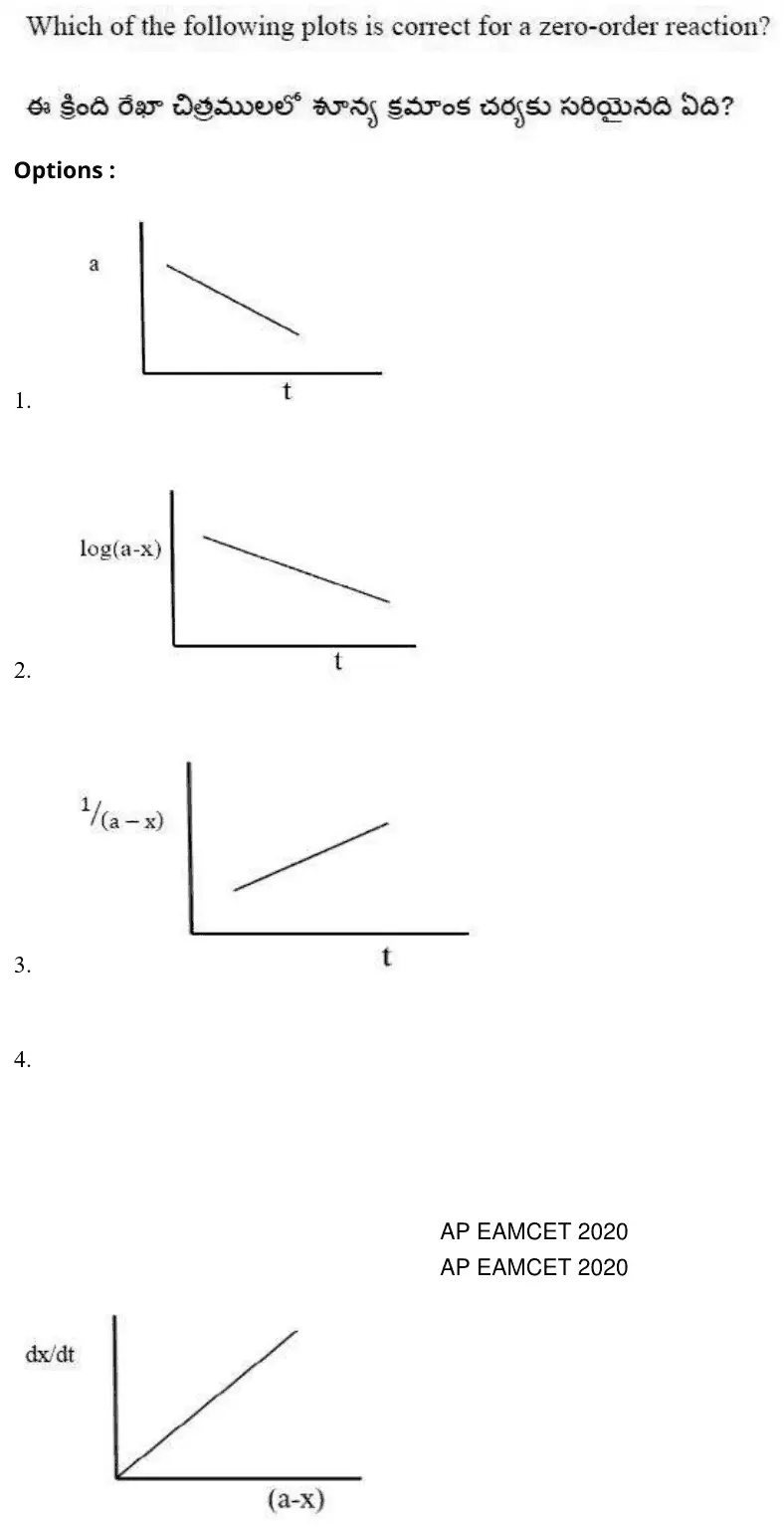
Which of the following plots is correct for a zero-order reaction?

The question and its figure as printed in AP EAPCET 2020 7th Oct 2020 Shift 1. Option 1: graph of a (y-axis) against t (x-axis): straight line falling from upper left to lower right Option 2: graph of log(a-x) (y-axis) against t: straight line falling downward Option 3: graph of 1/(a-x) (y-axis) against t: straight line rising upward, not through the origin Option 4: graph of dx/dt (y-axis) against (a-x) (x-axis): straight line rising from the origin
The question as printed in the paper.
  • A

    see figure graph of a (y-axis) against t (x-axis): straight line falling from upper left to lower right

  • B

    see figure graph of log(a-x) (y-axis) against t: straight line falling downward

  • C

    see figure graph of 1/(a-x) (y-axis) against t: straight line rising upward, not through the origin

  • D

    see figure graph of dx/dt (y-axis) against (a-x) (x-axis): straight line rising from the origin

100AP EAMCET 2020 · 23 Sep · Shift 1MCQOpen question page ↗

The rate constant is same for 3 reactions of order I, II and III respectively, the unit of concentration being in $moles/litre$. If the concentration of reactant is unity, rates of reaction $R_1, R_2, R_3$ will be ______

  • A

    $R_1 = R_2 = R_3$

  • B

    $R_1 < R_2 < R_3$

  • C

    $R_1 > R_2 > R_3$

  • D

    $R_1 = R_2 \neq R_3$

101AP EAMCET 2020 · 23 Sep · Shift 1MCQOpen question page ↗

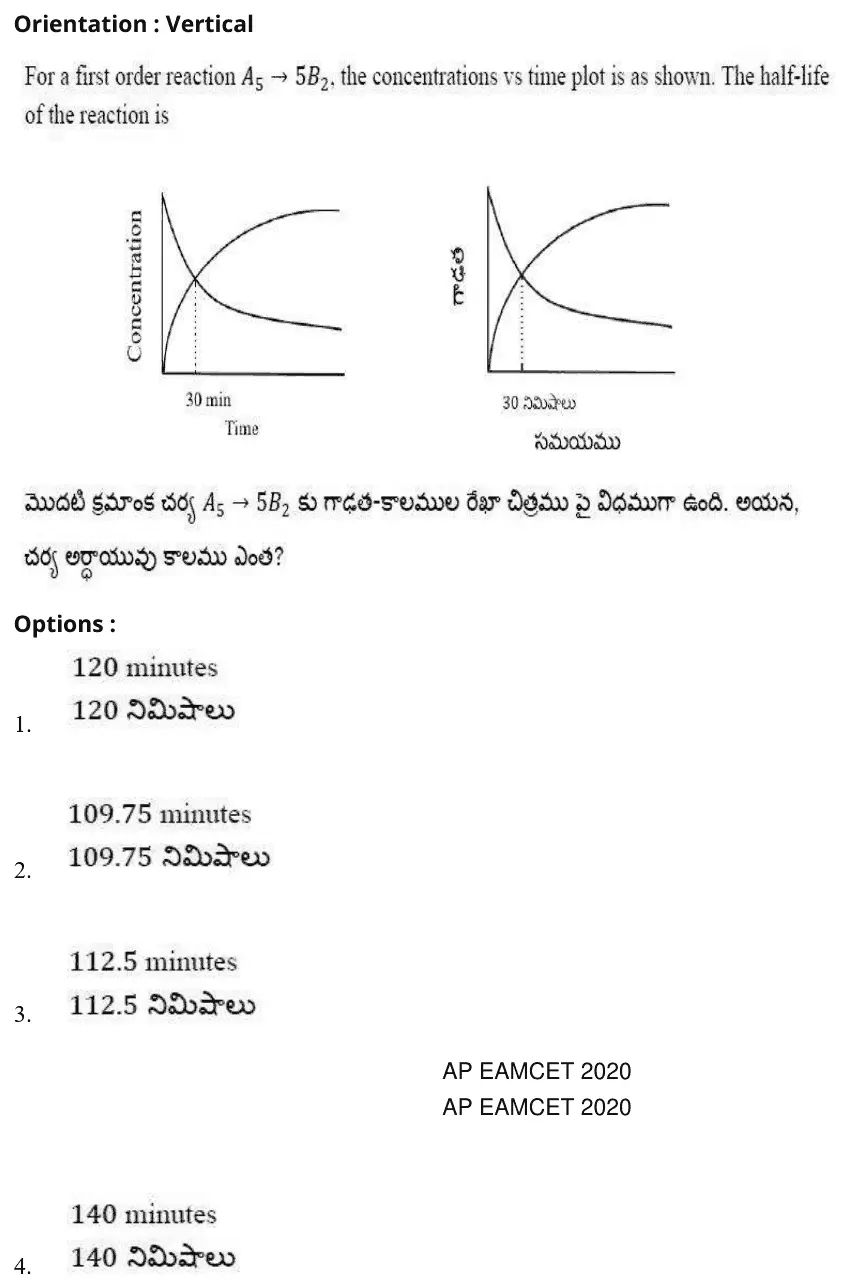
For a first order reaction $A_5 \rightarrow 5B_2$, the concentrations vs time plot is as shown. The half-life of the reaction is
(see the figure above)

The question and its figure as printed in AP EAPCET 2020 23rd Sep 2020 Shift1.
The question as printed in the paper.
  • A

    120 minutes

  • B

    109.75 minutes

  • C

    112.5 minutes

  • D

    140 minutes

102AP EAMCET 2020 · 22 Sep · Shift 1MCQOpen question page ↗

Decomposition of ethane $\dfrac{d[\mathrm{C_2H_6}]}{dt} = k[\mathrm{C_2H_6}]$ proceeds through a complex mechanism, which includes 5 steps. The overall rate constant($k$) can be expressed as $k = \dfrac{k_1k_2k_3}{k_2k_5}$ where $k_1, k_2, k_3, k_4, k_5$ are the rate constants of the 5 steps.
If the activation energies of each of the steps respectively are $E_1 = 1E,\ E_2 = 2E,\ E_3 = 3E,\ E_4 = 4E,\ E_5 = 5E$, where $E = 20\ \mathrm{kJ/mol}$. Then find the overall activation energy of the decomposition.

  • A

    $6.67\ \mathrm{kJ/mol}$

  • B

    $3.33\ \mathrm{kJ/mol}$

  • C

    $20\ \mathrm{kJ/mol}$

  • D

    $10\ \mathrm{kJ/mol}$

103AP EAMCET 2020 · 22 Sep · Shift 2MCQOpen question page ↗

For the reaction $A \longrightarrow$ products, if the graph of $[A]$ v/s time gives a straight line, predict the order of the reaction.

  • A

    Pseudo first order

  • B

    First order

  • C

    Second order

  • D

    Zero order

104AP EAMCET 2020 · 21 Sep · Shift 1MCQOpen question page ↗

In the chemical reaction $A \rightarrow B$, what is the order of the reaction? Given that the rate of reaction doubles if the concentration of A is increased four times.

  • A

    2

  • B

    1.5

  • C

    0.5

  • D

    1

105AP EAMCET 2020 · 18 Sep · Shift 1MCQOpen question page ↗

The rate of a reaction doubles when the temperature is changed from 300 K to 310 K. Activation energy of the change is ______ ($R = 8.314\ J.K^{-1}.mol^{-1}$), $\log 2 = 0.301$]

  • A

    53.6 $kJ.mol^{-1}$

  • B

    48.6 $kJ.mol^{-1}$

  • C

    58.5 $kJ.mol^{-1}$

  • D

    60.5 $kJ.mol^{-1}$

106AP EAMCET 2020 · 18 Sep · Shift 2MCQOpen question page ↗

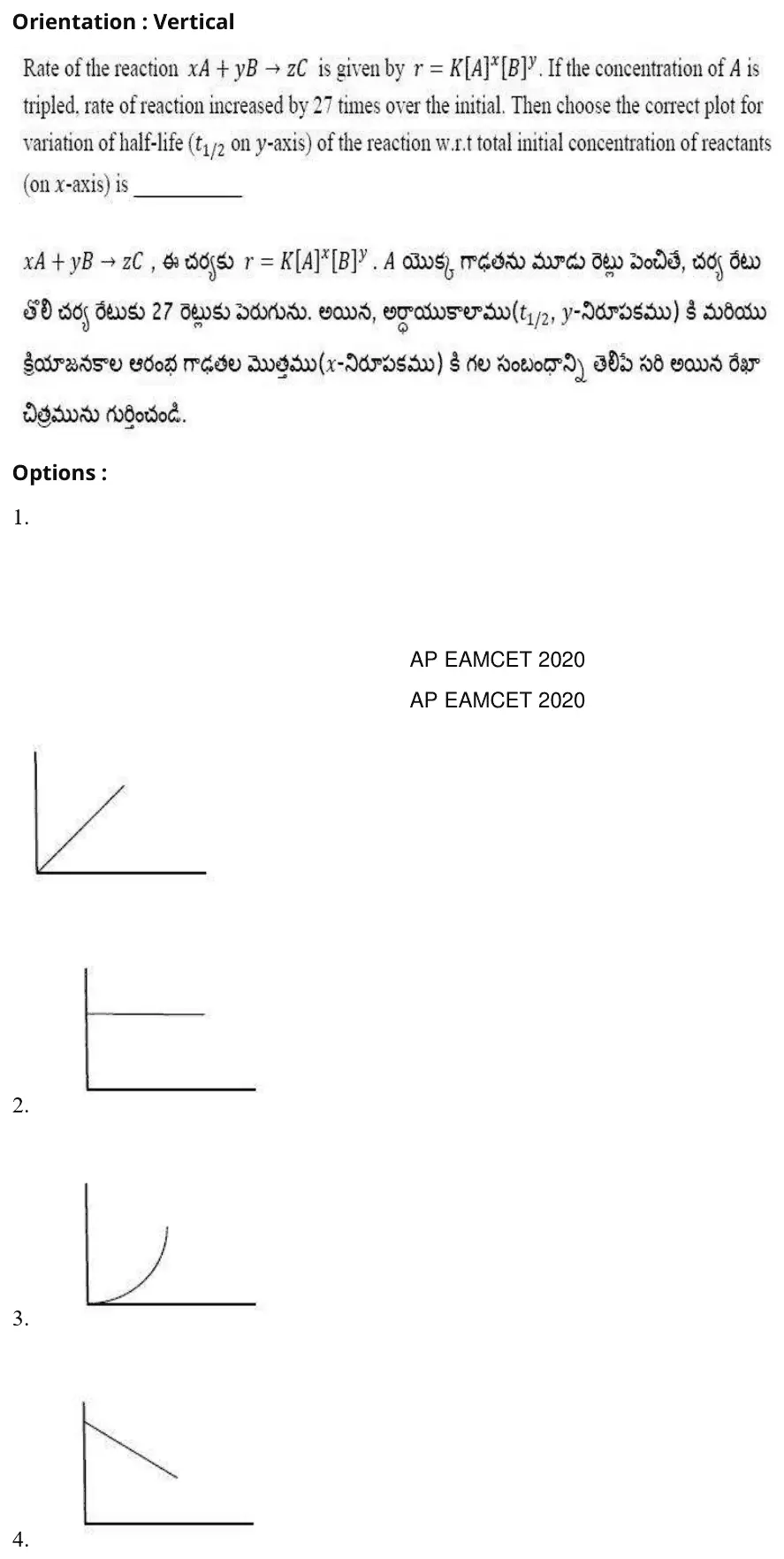
Rate of the reaction $xA+yB\rightarrow zC$ is given by $r=K[A]^x[B]^y$. If the concentration of $A$ is tripled, rate of reaction increased by 27 times over the initial. Then choose the correct plot for variation of half-life ($t_{1/2}$ on $y$-axis) of the reaction w.r.t total initial concentration of reactants (on $x$-axis) is ______

The question and its figure as printed in AP EAPCET 2020 18th Sep 2020 Shift2. Option 1: straight line rising from the origin Option 2: horizontal line parallel to x-axis Option 3: curve starting near x-axis and rising upward, concave up Option 4: straight line falling from the y-axis downward to the right
The question as printed in the paper.
  • A

    see figure straight line rising from the origin

  • B

    see figure horizontal line parallel to x-axis

  • C

    see figure curve starting near x-axis and rising upward, concave up

  • D

    see figure straight line falling from the y-axis downward to the right

107AP EAMCET 2020 · 17 Sep · Shift 1MCQOpen question page ↗

Find the correct equation among the following

  • A

    $\ln K - \ln A = \frac{E_a}{RT}$

  • B

    $K = \frac{AE_a}{RT}$

  • C

    $\ln K + \ln A = \frac{E_a}{RT}$

  • D

    $\frac{E_a}{RT} = \ln A - \ln K$

108TS EAMCET 2020 · 14 Sep · Shift 1MCQOpen question page ↗

The half-life of a first order reaction varies with temperature according to

  • A

    $\ln(t_{1/2}) \propto \dfrac{1}{T}$

  • B

    $\ln(t_{1/2}) \propto T$

  • C

    $(t_{1/2}) \propto \dfrac{1}{T^2}$

  • D

    $(t_{1/2}) \propto T^2$

109TS EAMCET 2020 · 14 Sep · Shift 2MCQOpen question page ↗

For a reversible reaction $\mathrm{A} \rightleftharpoons \mathrm{B}$, pre-exponential factor is same for both the forward and backward reactions and has value of $20\ \mathrm{S^{-1}}$. If the enthalpy change along the forward reaction is $-41.5\ \mathrm{kJ/mol}$, the value of equilibrium constant at $500\ \mathrm{K}$ is

  • A

    $e^{10}$

  • B

    $e^{9}$

  • C

    $e^{8}$

  • D

    $e^{7}$

110TS EAMCET 2020 · 11 Sep · Shift 1MCQOpen question page ↗

For a first order reaction (A $\rightarrow$ B), the temperature (T) dependent rate constant (k) in $\mathrm{sec^{-1}}$ was found to follow the equation: $\log k = \left(-\dfrac{20}{T}\right) + 4$. The activation energy ($\mathrm{E_a}$) and pre-exponential factor (A) respectively, are

  • A

    46.06 $\mathrm{cal\,mol^{-1}}$ and $10^{-4}\ \mathrm{s^{-1}}$

  • B

    92.12 $\mathrm{cal\,mol^{-1}}$ and $10^{4}\ \mathrm{s^{-1}}$

  • C

    46.06 $\mathrm{cal\,mol^{-1}}$ and $10^{4}\ \mathrm{s^{-1}}$

  • D

    9.212 $\mathrm{cal\,mol^{-1}}$ and $10^{-4}\ \mathrm{s^{-1}}$

111TS EAMCET 2020 · 11 Sep · Shift 2MCQOpen question page ↗

What is the unit for the zero order rate constant?

  • A

    $l^{-1}\ \mathrm{mol\ s^{-1}}$

  • B

    $l\ \mathrm{mol\ s^{-1}}$

  • C

    $l\ \mathrm{mol^{-1}\ s^{-1}}$

  • D

    $l^{2}\ \mathrm{mol^{-2}\ s^{-1}}$

112TS EAMCET 2020 · 10 Sep · Shift 1MCQOpen question page ↗

For a zero order reaction, the plot of concentration of reactant vs time is (Hint: Consider the intercept on the concentration axis)

  • A

    linear with + ve slope and non zero +ve intercept

  • B

    linear with - ve slope and non zero +ve intercept

  • C

    linear with - ve slope and zero intercept

  • D

    linear with + ve slope and zero intercept

113TS EAMCET 2020 · 10 Sep · Shift 2MCQOpen question page ↗

The specific rate constant of decomposition of a compound is given by $\ln k = 5.0 - \frac{12000}{T}$. The activation energy of decomposition for this compound at 300 K is

  • A

    24 kcal $\mathrm{mol^{-1}}$

  • B

    12 kcal $\mathrm{mol^{-1}}$

  • C

    24 cal $\mathrm{mol^{-1}}$

  • D

    12 cal $\mathrm{mol^{-1}}$

114TS EAMCET 2020 · 9 Sep · Shift 1MCQOpen question page ↗

The rate of chemical reaction doubles with every 10 °C rise in temperature. If the reaction is carried out in the vicinity of 22 °C, the activation energy of the reaction is
(Given $R = 8.3\ \mathrm{J\,K^{-1}\,mol^{-1}}$, $\ln 2 = 0.69$ and $\ln 3 = 1.1$)

  • A

    $1.69\ \mathrm{kJ\,mol^{-1}}$

  • B

    $0.169\ \mathrm{kJ\,mol^{-1}}$

  • C

    $49.8\ \mathrm{kJ\,mol^{-1}}$

  • D

    $498\ \mathrm{J\,mol^{-1}}$

115TS EAMCET 2020 · 9 Sep · Shift 2MCQOpen question page ↗

For a reaction A $\rightarrow$ B, the average energies of A and B are 30 and 60 kcal/mol respectively. Energy of the activation for the backward reaction is 93 kcal/mol. The energy of activation for the forward reaction is

  • A

    30 kcal/mol

  • B

    123 kcal/mol

  • C

    153 kcal/mol

  • D

    90 kcal/mol

116TS EAMCET 2019 · 6 May · Shift 1MCQOpen question page ↗

The first order decomposition of $\mathrm{H_2O_2}$ in an appropriate medium is characterized by a rate constant of 0.2303 min$^{-1}$. What is the time (in min) required to complete 9/10 fraction of the reaction?

  • A

    0.1

  • B

    10

  • C

    100

  • D

    0.01

117TS EAMCET 2019 · 4 May · Shift 1MCQOpen question page ↗

The decomposition of $\mathrm{O_3}$ (g) follows first order kinetics and is given by:
$\mathrm{O_3\,(g) \to O_2\,(g) + O\,(g)}$
The rate constant for this reaction is $1.0\times10^{-3}\ \mathrm{s^{-1}}$. The initial pressure of $\mathrm{O_3}$ (g) is 100 atm. What will be the partial pressure (in atm) of $\mathrm{O_3, O_2, O}$ respectively after 38.38 minutes?

  • A

    95, 5, 5

  • B

    10, 90, 0

  • C

    10, 90, 90

  • D

    10, 0, 90

119TS EAMCET 2019 · 3 May · Shift 1MCQOpen question page ↗

For a zero-order reaction, the correct expression for rate constant ($k$) at half-life time ($t_{1/2}$) is ($R_0$ = initial concentration of reactant)

  • A

    $k = \frac{2.303}{t_{1/2}} \log \frac{[R_0]}{[R_0]/2}$

  • B

    $k = \frac{2.303}{t} \log \frac{[R_0]}{[R_0]}$

  • C

    $k = \frac{[R_0] - \frac{1}{2}[R_0]}{t_{1/2}}$

  • D

    $k = \frac{2.303}{(t_2 - t_1)} \log [R_0]$

120TS EAMCET 2019 · 3 May · Shift 2MCQOpen question page ↗

The following results have been obtained during the kinetic studies of reaction: $\mathrm{2NO + 2H_2 \longrightarrow N_2 + 2H_2O}$
Table (Expt; $-\dfrac{d[\mathrm{NO}]}{dt}$ in $\mathrm{mol\,L^{-1}s^{-1}}$; [NO] in $\mathrm{mol\,L^{-1}}$; $[\mathrm{H_2}]$ in $\mathrm{mol\,L^{-1}}$):

  1. $4.8\times10^{-5}$; $1\times10^{-2}$; $1\times10^{-3}$
  2. $43.2\times10^{-5}$; $3\times10^{-2}$; $1\times10^{-3}$
  3. $86.4\times10^{-5}$; $3\times10^{-2}$; $2\times10^{-3}$

The rate Law is:

  • A

    $-\dfrac{d[\mathrm{NO}]}{dt} = k[\mathrm{NO}]^2[\mathrm{H_2}]$

  • B

    $-\dfrac{d[\mathrm{NO}]}{dt} = k[\mathrm{NO}]^2[\mathrm{H_2}]^{1/2}$

  • C

    $-\dfrac{d[\mathrm{NO}]}{dt} = k[\mathrm{NO}][\mathrm{H_2}]^2$

  • D

    $-\dfrac{d[\mathrm{NO}]}{dt} = k[\mathrm{NO}][\mathrm{H_2}]$

121AP EAMCET 2019 · 23 Apr · Shift 1MCQOpen question page ↗

The rate equation for the reaction
$2\mathrm{A} + \mathrm{B} \rightarrow$ products is
rate $= k[\mathrm{A}][\mathrm{B}]^2$.
If $k$ at T(K) is $5.0 \times 10^{-6}\ \mathrm{mol^{-2}L^{2}s^{-1}}$, the initial rate of the reaction, when $[\mathrm{A}] = 0.05\ \mathrm{mol\,L^{-1}}$ and $[\mathrm{B}] = 0.1\ \mathrm{mol\,L^{-1}}$ is

  • A

    $1.25 \times 10^{-9}\ \mathrm{L\ mol\,L^{-1}\,s^{-1}}$

  • B

    $1.25 \times 10^{-9}\ \mathrm{mol\,L^{-1}\,s^{-1}}$

  • C

    $2.50 \times 10^{-9}\ \mathrm{mol\,L^{-1}\,s^{-1}}$

  • D

    $2.50 \times 10^{-9}\ \mathrm{L\ mol\,L^{-1}\,s^{-1}}$

122AP EAMCET 2019 · 22 Apr · Shift 1MCQOpen question page ↗

Which one of the following statements is correct?

  • A

    In collision theory $\mathrm{e^{-E_a/RT}}$ corresponds to the fraction of molecules that have energy equal or greater than $\mathrm{E_a}$

  • B

    The number of collisions of reacting molecules per second per unit volume of the reaction mixture is activated complex

  • C

    Molecularity is the number of molecules involved in a complex reaction

  • D

    A catalyst catalyses the non-spontaneous reaction

123AP EAMCET 2019 · 22 Apr · Shift 2MCQOpen question page ↗

Which one of the following is not the correct statement with respect to order of a reaction?

  • A

    order can be determined experimentally.

  • B

    order of reaction is equal to sum of the powers of concentration terms in differential form of rate law.

  • C

    order does not change with change of pressure or temperature.

  • D

    order cannot be fractional.

124AP EAMCET 2019 · 21 Apr · Shift 1MCQOpen question page ↗

The half life periods of a first order reaction at 300 K and 400 K are 50 s and 10 s respectively. The activation energy of the reaction in $\mathrm{kJ\,mol^{-1}}$ is ($\log 5=0.70$)

  • A

    4.0

  • B

    8.0

  • C

    16.10

  • D

    20.10

125AP EAMCET 2019 · 21 Apr · Shift 2MCQOpen question page ↗

The rate constants for a reaction at 400 K and 500 K are $2.60\times10^{-5}\ \mathrm{s^{-1}}$ and $2.60\times10^{-3}\ \mathrm{s^{-1}}$ respectively. The activation energy of the reaction in $\mathrm{kJ\ mol^{-1}}$ is

  • A

    38.3

  • B

    57.4

  • C

    114.9

  • D

    76.6

126AP EAMCET 2019 · 20 Apr · Shift 1MCQOpen question page ↗

In the first order thermal decomposition of $\mathrm{C_2H_5I_{(g)} \longrightarrow C_2H_{4(g)} + HI_{(g)}}$ the reactant in the beginning exerts a pressure of 2 bar in a closed vessel at 600 K. If the partial pressure of the reactant is 0.1 bar after 1000 minutes at the same temperature the rate constant in $\mathrm{min^{-1}}$ is
(log 2 = 0.30)

  • A

    $6.0 \times 10^{-4}$

  • B

    $6.0 \times 10^{-3}$

  • C

    $3.0 \times 10^{-3}$

  • D

    $3.0 \times 10^{-4}$

127AP EAMCET 2019 · 20 Apr · Shift 2MCQOpen question page ↗

The reaction $\mathrm{X \to}$ products is a first order reaction. In 40 minutes, the concentration of X changes from 1.0M to 0.25M. What is the initial rate of reaction when [X] = 0.1M? ($\log 4 = 0.60$)

  • A

    $1.73 \times 10^{-3}\ \mathrm{mol\,L^{-1}\,min^{-1}}$

  • B

    $3.47 \times 10^{-4}\ \mathrm{mol\,L^{-1}\,min^{-1}}$

  • C

    $1.73 \times 10^{-4}\ \mathrm{mol\,L^{-1}\,min^{-1}}$

  • D

    $3.45 \times 10^{-3}\ \mathrm{mol\,L^{-1}\,min^{-1}}$

128TS EAMCET 2018 · 7 May · Shift 1MCQOpen question page ↗

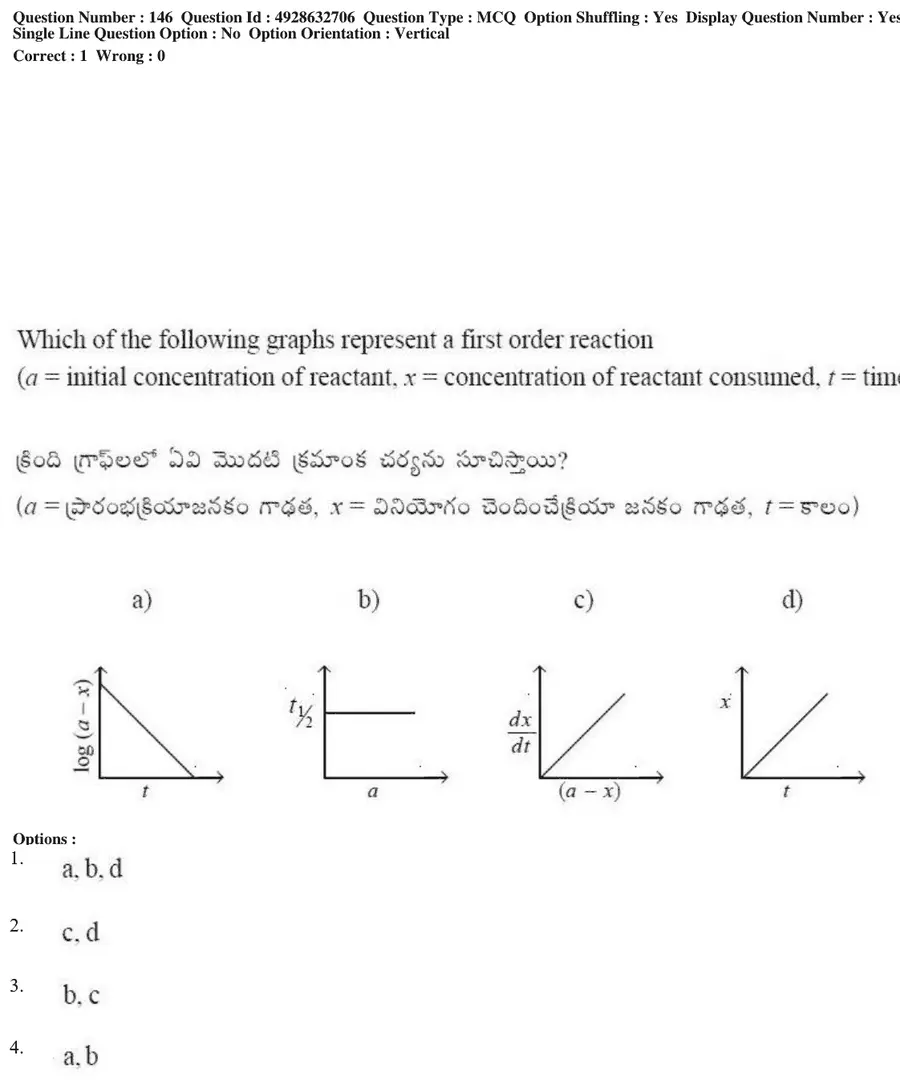
Which of the following graphs represent a first order reaction ($a$ = initial concentration of reactant, $x$ = concentration of reactant consumed, $t$ = time) (see the figure above)

The question and its figure as printed in TS EAPCET 2018 7th May Shift 1.
The question as printed in the paper.
  • A

    a, b, d

  • B

    c, d

  • C

    b, c

  • D

    a, b

129TS EAMCET 2018 · 5 May · Shift 1MCQOpen question page ↗

A particular reaction has a rate constant $1.15\times10^{-3}\ \mathrm{s^{-1}}$. How long does it take for 6 g of the reactant to reduce to 3 g? ($\log 2 = 0.301$)

  • A

    301 s

  • B

    603 s

  • C

    840 s

  • D

    15 s

130TS EAMCET 2018 · 5 May · Shift 2MCQOpen question page ↗

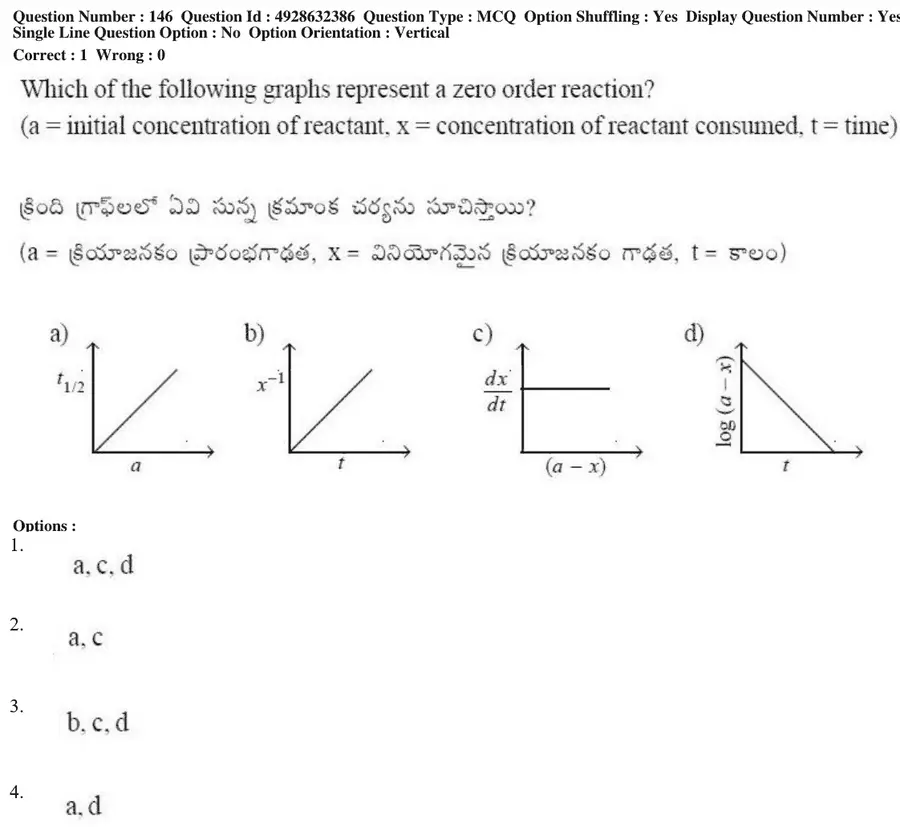
Which of the following graphs represent a zero order reaction?
(a = initial concentration of reactant, x = concentration of reactant consumed, t = time)
(see the figure above)

The question and its figure as printed in TS EAPCET 2018 5th May Shift 2.
The question as printed in the paper.
  • A

    a, c, d

  • B

    a, c

  • C

    b, c, d

  • D

    a, d

131TS EAMCET 2018 · 4 May · Shift 1MCQOpen question page ↗

If the rate constants of a reaction at 500 K and 700 K are $0.002\ \mathrm{s^{-1}}$ and $0.06\ \mathrm{s^{-1}}$ respectively, the value of $\mathrm{K^{-1}}$ (sic) activation energy is ($R = 8.314\ \mathrm{J\,mol^{-1}K^{-1}}$, $\log 3 = 0.477$)

  • A

    $49.49\ \mathrm{kJ\,mol^{-1}}$

  • B

    $98.98\ \mathrm{kJ\,mol^{-1}}$

  • C

    $24.75\ \mathrm{kJ\,mol^{-1}}$

  • D

    $12.37\ \mathrm{kJ\,mol^{-1}}$

132TS EAMCET 2018 · 4 May · Shift 2MCQOpen question page ↗

For a particular reaction, the rate constant becomes double on increasing temperature from 27 °C to 37 °C. Calculate the approximate activation energy (in kcal mol$^{-1}$)
(R = 2 cal mol$^{-1}$ K$^{-1}$)

  • A

    1289

  • B

    12.89

  • C

    1.28

  • D

    53.41

133AP EAMCET 2018 · 24 Apr · Shift 1MCQOpen question page ↗

If the half lives of the first order reaction at 350 K and 300 K are 2 and 20 seconds respectively, the activation energy of the reaction in $\mathrm{kJmol^{-1}}$ is

  • A

    40.2

  • B

    20.1

  • C

    60.3

  • D

    30.2

134AP EAMCET 2018 · 24 Apr · Shift 2MCQOpen question page ↗

At T(K), if the rate constant of a first order reaction is $4.606\times10^{-3}\ \mathrm{s^{-1}}$, the time to reduce the initial concentration of the reactant to 1/10 in seconds is :

  • A

    500

  • B

    1000

  • C

    100

  • D

    50

135AP EAMCET 2018 · 23 Apr · Shift 1MCQOpen question page ↗

The rate equation for a first order reaction is given by $[\mathrm{R}] = [\mathrm{R}]_0\, e^{-kt}$. A straight line with positive slope is obtained by plotting
($[\mathrm{R}]_0$ = Initial concentration of reactant, $[\mathrm{R}]$ = concentration of reactant at time, t)

  • A

    $\log\frac{[\mathrm{R}]_0}{[\mathrm{R}]}$ Vs time

  • B

    $[\mathrm{R}]$ Vs time

  • C

    $\log[\mathrm{R}]$ Vs time

  • D

    $\log\frac{[\mathrm{R}]}{[\mathrm{R}]_0}$ Vs time

136AP EAMCET 2018 · 23 Apr · Shift 2MCQOpen question page ↗

At T(K), the following data were obtained for a general reaction $\mathrm{A + B + C \longrightarrow products}$
Expt. | Initial [A] | Initial [B] | Initial [C] | Initial rate
1 | 0.02 M | 0.1 M | 0.03 M | $2.4 \times 10^{-6}\ \mathrm{Ms^{-1}}$
2 | 0.02 M | 0.2 M | 0.03 M | $4.8 \times 10^{-6}\ \mathrm{Ms^{-1}}$
3 | 0.02 M | 0.2 M | 0.06 M | $9.6 \times 10^{-6}\ \mathrm{Ms^{-1}}$
4 | 0.04 M | 0.2 M | 0.06 M | $9.6 \times 10^{-6}\ \mathrm{Ms^{-1}}$
The rate constant for the above reaction is

  • A

    $8.0 \times 10^{-4}\ \mathrm{s^{-1}}$

  • B

    $8.0 \times 10^{-4}\ \mathrm{L\ mol^{-1}\ s^{-1}}$

  • C

    $8.0 \times 10^{4}\ \mathrm{L\ mol^{-1}\ s^{-1}}$

  • D

    $8.0 \times 10^{-4}\ \mathrm{L^2\ mol^{-2}\ s^{-1}}$

137AP EAMCET 2018 · 22 Apr · Shift 1MCQOpen question page ↗

Thermal decomposition of HCOOH is a first order reaction and the rate constant at T(K) is $4.606\times10^{-3}\ \mathrm{s^{-1}}$. The time required to decompose 90% of initial quantity of HCOOH at T(K) in seconds is

  • A

    $100$

  • B

    $500$

  • C

    $1000$

  • D

    $50$

138AP EAMCET 2018 · 22 Apr · Shift 2MCQOpen question page ↗

At T(K) if the rate constant for a zero order reaction is $2.5\times10^{-3}\ \mathrm{Ms^{-1}}$, the time required for the initial concentration of reactant, R to fall from 0.10 M to 0.075 M at the same temperature in seconds is

  • A

    $25$

  • B

    $5$

  • C

    $10$

  • D

    $20$

139TS EAMCET 2017 · 12 May · OfflineMCQOpen question page ↗

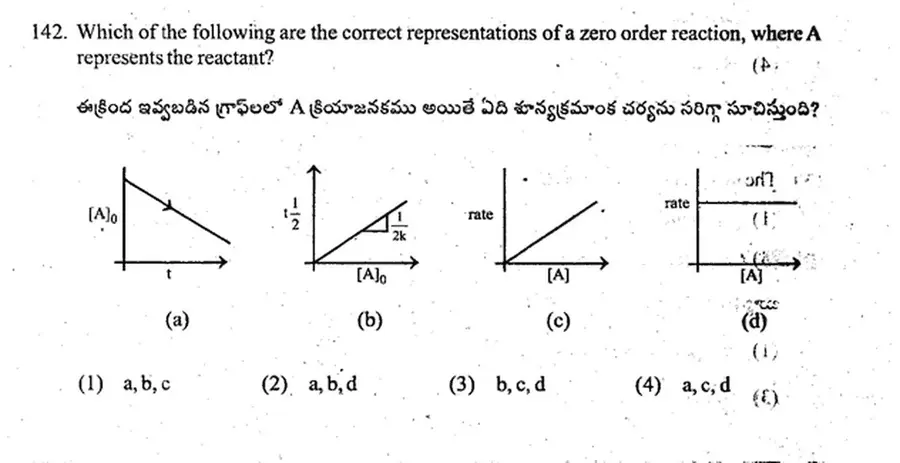
Which of the following are the correct representations of a zero order reaction, where A represents the reactant?
(see the figure above)

The question and its figure as printed in TS EAMCET 2017 12 May Offline.
The question as printed in the paper.
  • A

    a, b, c

  • B

    a, b, d

  • C

    b, c, d

  • D

    a, c, d

140AP EAMCET 2017 · 26 Apr · Shift 1MCQOpen question page ↗

20% of a first order reaction was found to be completed at 10 A.M. At 11.30 A.M. on the same day, 20% of the reaction was found to be remaining. The half life period in minutes of the reaction is

  • A

    $90$

  • B

    $60$

  • C

    $45$

  • D

    $30$

141AP EAMCET 2017 · 26 Apr · Shift 2MCQOpen question page ↗

The rate equation for the decomposition of a compound 'A' in terms of partial pressure is given as, rate $= k(P_A)^{3/2}$. If the pressure is measured in bar and time in minutes, then the units of rate constant is :

  • A

    $\mathrm{min^{-1}}$

  • B

    $\mathrm{bar^{3/2}\,min^{-1}}$

  • C

    $\mathrm{bar^{-1/2}\,min^{-1}}$

  • D

    $\mathrm{bar^{1/2}\,min}$

142AP EAMCET 2017 · 25 Apr · Shift 1MCQOpen question page ↗

The time taken for 10% completion of a first order reaction is 20 minutes. The time required for the completion of 19% of the same reaction in minutes is

  • A

    40

  • B

    60

  • C

    30

  • D

    50

143AP EAMCET 2017 · 25 Apr · Shift 2MCQOpen question page ↗

The time taken for half of the initial amount of $\mathrm{N_2O_5}$ to decompose is 12 min at 310 K and 2 hrs at 300 K. The activation energy of reaction in kJ is ($R = 8.3\ \mathrm{J\ K^{-1}\ mol^{-1}}$)

  • A

    177.76

  • B

    17.776

  • C

    355.52

  • D

    35.552

144AP EAMCET 2017 · 24 Apr · Shift 1MCQOpen question page ↗

The rate constant of a first order reaction is $6.909\ \mathrm{min^{-1}}$. So the time required for the completion of 75% of the same reaction in minutes is

  • A

    $\dfrac{2}{3}\log 2$

  • B

    $\dfrac{2}{3}\log 4$

  • C

    $\dfrac{3}{2}\log 2$

  • D

    $\dfrac{3}{2}\log 4$

145AP EAMCET 2017 · 24 Apr · Shift 2MCQOpen question page ↗

The initial rates of decrease of $\mathrm{I_2}$ in acetone - iodine reaction catalysed by $\mathrm{H^+}$ are given in the table.

ExperimentInitial $[\mathrm{I_2}]$ (mol L$^{-1}$)Initial $[\mathrm{H^+}]$ (mol L$^{-1}$)Initial $[\mathrm{CH_3COCH_3}]$ (mol L$^{-1}$)Initial rate of decrease of $\mathrm{I_2}$ (mol L$^{-1}$ s$^{-1}$)
10.010.10.10.096
20.010.20.10.192
30.020.20.10.192
40.010.20.20.384

The order with respect to $\mathrm{I_2}$, $\mathrm{H^+}$, acetone and total order of the reaction respectively are:

  • A

    0, 2, 1, 3

  • B

    1, 0, 1, 2

  • C

    0, 1, 1, 2

  • D

    1, 1, 0, 2

146TS EAMCET 2016 · 15 May · OfflineMCQOpen question page ↗

For the reaction
$\mathrm{5Br^-(aq) + 6H^+(aq) + BrO_3^-(aq) \rightarrow 3Br_2(aq) + 3H_2O(\ell)}$
if, $-\frac{\Delta[\mathrm{BrO_3^-}]}{\Delta t} = 0.01\ \mathrm{mol\ L^{-1}\ min^{-1}}$,
$\frac{\Delta[\mathrm{Br_2}]}{\Delta t}$ in $\mathrm{mol\ L^{-1}\ min^{-1}}$ is

  • A

    0.01

  • B

    0.3

  • C

    0.03

  • D

    0.005

147AP EAMCET 2016 · 29 Apr · OfflineMCQOpen question page ↗

The slope of the graph drawn between $\ln k$ and $1/T$ as per Arrhenius equation gives the value (R = gas constant, $E_a$ = Activation energy)

  • A

    $\frac{R}{E_a}$

  • B

    $\frac{E_a}{R}$

  • C

    $\frac{-E_a}{R}$

  • D

    $\frac{-R}{E_a}$

148AP EAMCET 2014 · 22 May · OfflineMCQOpen question page ↗

In a first order reaction the concentration of the reactant decreases from 0.6 M to 0.3 M in 15 minutes. The time taken for the concentration to change from 0.1 M to 0.025 M in minutes is

  • A

    1.2

  • B

    12

  • C

    30

  • D

    3

149AP EAMCET 2013 · 10 May · OfflineMCQOpen question page ↗

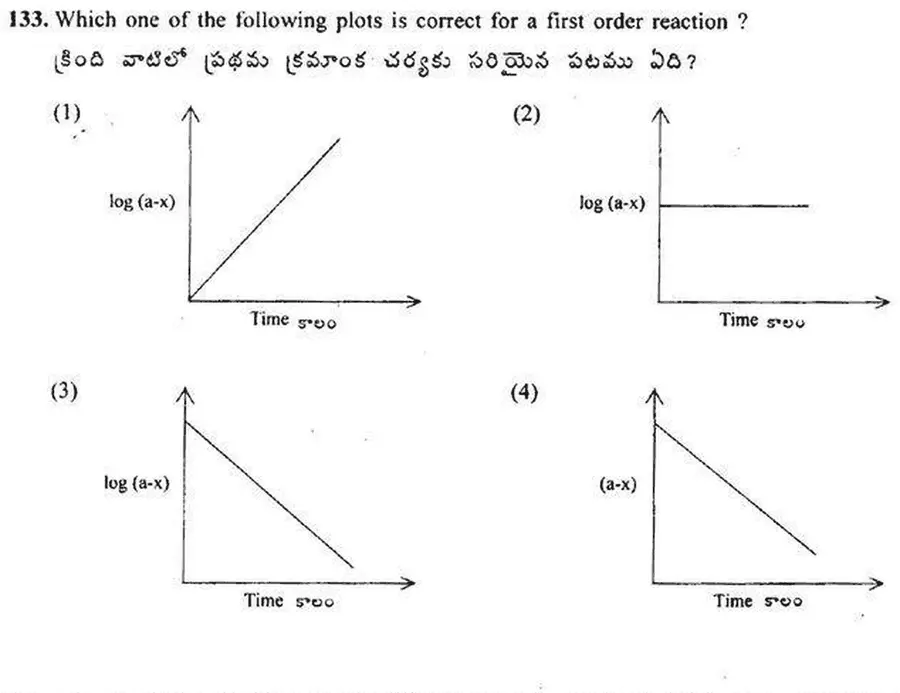
Which one of the following plots is correct for a first order reaction ?
(see the figure above)

The question and its figure as printed in AP EAMCET 2013 10 May Offline. Option 1: log (a-x) (y-axis) vs Time (x-axis): straight line rising from the origin Option 2: log (a-x) vs Time: horizontal straight line (constant) Option 3: log (a-x) vs Time: straight line falling from a positive intercept on the y-axis Option 4: (a-x) vs Time: straight line falling from a positive intercept on the y-axis
The question as printed in the paper.
  • A

    see figure log (a-x) (y-axis) vs Time (x-axis): straight line rising from the origin

  • B

    see figure log (a-x) vs Time: horizontal straight line (constant)

  • C

    see figure log (a-x) vs Time: straight line falling from a positive intercept on the y-axis

  • D

    see figure (a-x) vs Time: straight line falling from a positive intercept on the y-axis

150AP EAMCET 2012 · 12 May · OfflineMCQOpen question page ↗

Which one of the following statements is correct for the reaction
$\mathrm{CH_3COOC_2H_5 + NaOH \rightarrow CH_3COONa + C_2H_5OH}$ (all aq)

  • A

    Order is two but molecularity is one

  • B

    Order is one but molecularity is two

  • C

    Order is one and molecularity is one

  • D

    Order is two and molecularity is two

151AP EAMCET 2011 · 8 May · OfflineMCQOpen question page ↗

Match the following :
List I
A) Arrhenius equation
B) Slowest step in a reaction mechanism
C) Rate constant of a II order reaction
D) The possibility of a reaction depends on
List II
i) Free energy change
ii) $\mathrm{conc^{-1}.time^{-1}}$
iii) $\mathrm{conc^{1-n}.time^{-1}}$
iv) Rate determining step
v) $k = \mathrm{A}\,.\,e^{-E_a/RT}$
The correct answer is :

  • A

    A-v, B-i, C-iii, D-iv

  • B

    A-v, B-iv, C-iii, D-ii

  • C

    A-v, B-iv, C-ii, D-i

  • D

    A-iii, B-iv, C-ii, D-i

152AP EAMCET 2010 · 30 May · OfflineMCQOpen question page ↗

What is the slope of the straight line for the graph drawn between $\ln k$ and $\frac{1}{\mathrm{T}}$, where $k$ is the rate constant of a reaction at temperature T ?

  • A

    $\frac{-\mathrm{E}_a}{2.303\mathrm{R}}$

  • B

    $\frac{-\mathrm{E}_a}{\mathrm{R}}$

  • C

    $\frac{\mathrm{E}_a}{\mathrm{R}}$

  • D

    $\frac{\mathrm{R}}{\mathrm{E}_a}$

How to prepare Chemical Kinetics for EAPCET

How often it comes up

Chemical Kinetics occupies position 20 among all 31 chemistry chapters across the modern 2022 to 2026 testing period. Over our complete examination history from 2010 through 2026, the chapter contributed 152 questions across 149 papers, appearing in 142 of those tests to account for 2.6 percent of the subject with an average of 1.0 question per paper. In the five-year recent window from 2022 to 2026, it provided 78 questions across 77 sittings, appearing in 76 papers to maintain 1.0 question per paper and a 2.5 percent subject share.

The chapter has featured in every exam year since 2022, though it was absent from a single sitting during this five-year period. Looking at the two regional boards between 2022 and 2026, AP tests delivered 48 questions across 48 papers (appearing in 47 papers, 1.0 question per paper, 2.5 percent share), while TS papers recorded 30 questions across 29 papers (appearing in all 29 papers, 1.0 question per paper, 2.6 percent share).

During earlier testing between 2010 and 2021, papers contained 74 questions across 72 sittings (appearing in 66 tests), delivering 1.0 question per paper and a 2.6 percent subject share. Across the latest three exam years from 2024 to 2026, question banks carried 47 questions across 46 sittings (with all 46 papers containing questions), yielding 1.0 question per test and 2.6 percent share. Comparing early testing with the last three years indicates the share is about the same, and comparing the recent five-year window with the last three years shows the share is about the same. Almost every session carries exactly one kinetics problem.

Most-asked topics

Questions in this branch distribute across three main reaction dynamics areas:

  • Integrated Rate Laws forms the principal pillar with 67 questions overall and 35 during the recent timeframe through 2026. Frequent problem formats involve first-order half-life relationships, time required for fractional decomposition, zero-order linear concentration plots, and gaseous decomposition tracked via total pressure.
  • Temperature Dependence & Mechanism supplied 48 questions across the archive, with 23 appearing from 2022 to 2026. This area centers on the Arrhenius activation energy equation, rate constant ratios at two different temperatures, catalyst impact on activation barriers, and identifying rate-determining elementary steps.
  • Rate of Reaction accounts for 37 questions in total and 20 in the recent window through 2026. Core topics include expressing reaction rates in terms of stoichiometric disappearance and appearance of components, deducing overall reaction orders from dimensional units of rate constants, and initial rate method tables.

What the questions look like

Most kinetics problems test algebraic substitutions into first-order and Arrhenius equations. A classic first-order problem asks for the time required to complete eighty percent of a reaction given its rate constant, or asks for the remaining concentration after twenty minutes. Another prominent format tracks gaseous decomposition of a molecule A turning into B plus C, asking you to express the rate constant in terms of initial pressure and total pressure at time t.

Temperature questions frequently provide rate constants at two temperatures and ask for the activation energy, or ask for the ratio of rate constant to pre-exponential factor when activation energy equals two point three zero three R T. In foundational rate problems, you will deduce reaction order by inspecting the dimensional units of the rate constant or finding the rate of appearance of a product from the disappearance rate of a reactant.

Questions to try first

Solve these representative state exam questions to build confidence with integrated rate laws and activation energy:

How to practise it

Make first-order decay relationships second nature. Remember that the half-life of a first-order process is strictly independent of initial reactant concentration, given by zero point six nine three divided by k. Connect key percentages to half-life multiples: seventy-five percent completion requires exactly two half-lives, eighty-seven point five percent requires three half-lives, and ninety-nine point nine percent requires approximately ten half-lives.

For Arrhenius calculations, write the logarithmic formula as log open parenthesis k two over k one close parenthesis equals activation energy divided by two point three zero three R times open parenthesis T two minus T one close parenthesis divided by open parenthesis T one times T two close parenthesis. Use eight point three one four joules per mole Kelvin for R when activation energy is in joules, or divide by one thousand if activation energy is in kilojoules.

Frequently asked questions

How can reaction order be identified directly from rate constant units?

The general physical units for a rate constant are concentration to the power of one minus n multiplied by time to the power of minus one. For a zero-order reaction, units are moles per litre per second. For a first-order reaction, units are reciprocal seconds. For a second-order reaction, units are litres per mole per second.

What is the distinction between molecularity and order of a reaction?

Molecularity is a theoretical quantity denoting the number of reacting particles colliding simultaneously in an elementary step; it is always an integer from one to three. Reaction order is an experimentally determined exponent in the rate law that can be zero, fractional, or an integer.

How does a positive catalyst increase the rate of a chemical reaction?

A positive catalyst provides an alternative reaction pathway with a lower activation energy barrier. By lowering activation energy, a larger fraction of colliding molecules possesses sufficient energy to cross the barrier, accelerating both forward and backward rates equally without altering the equilibrium constant. Step-by-step solutions for each one are in the EdLoop EAPCET app.

Get EdLoop – freeOpen on the web