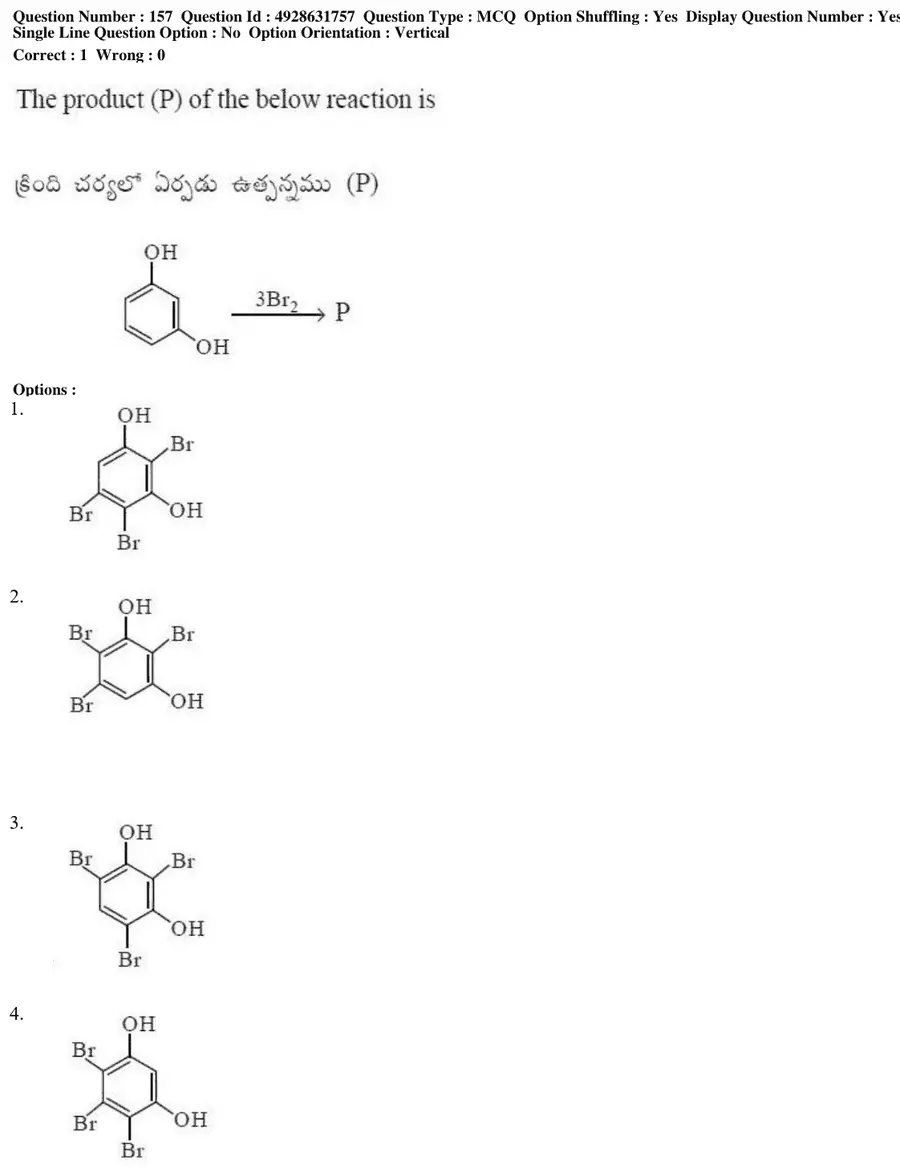
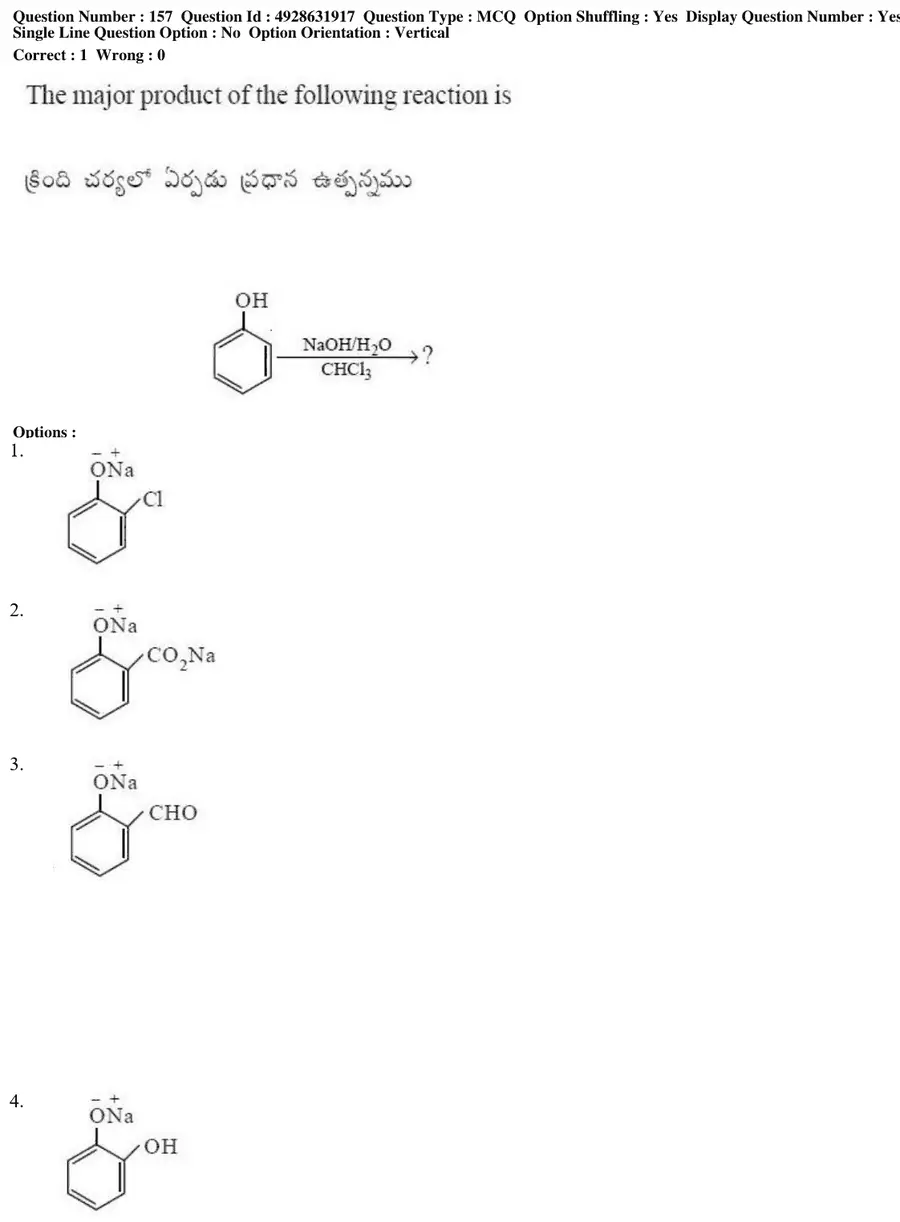
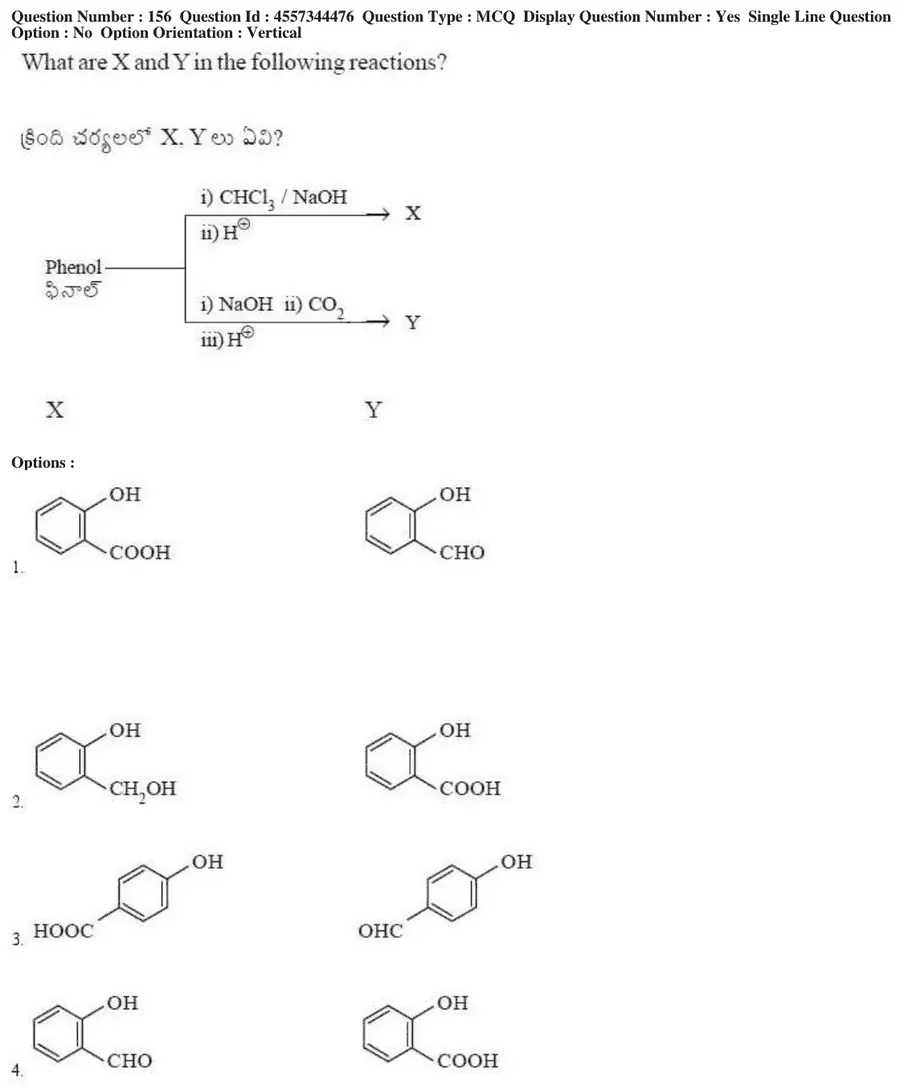
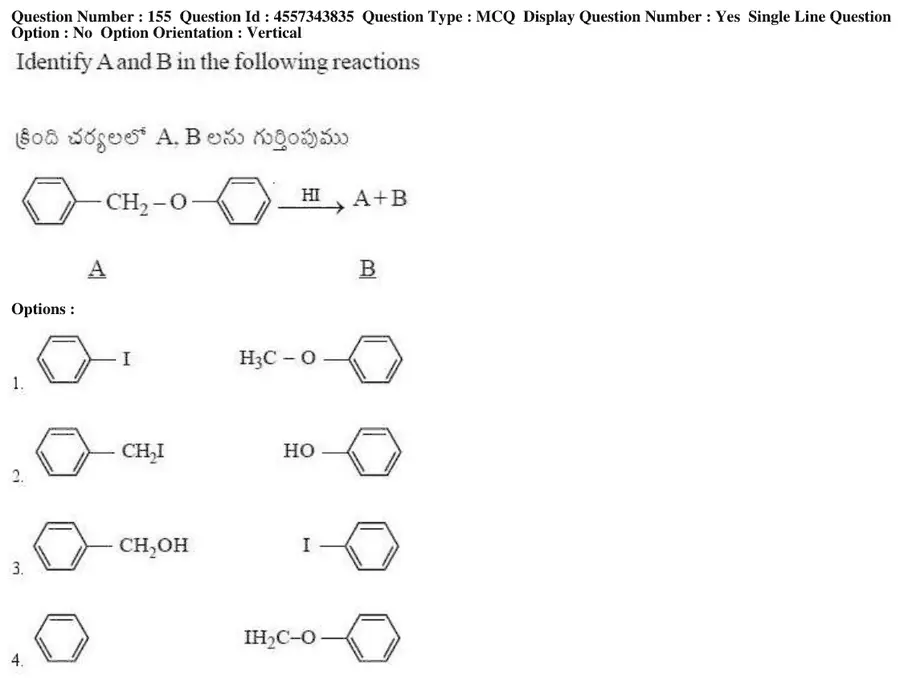
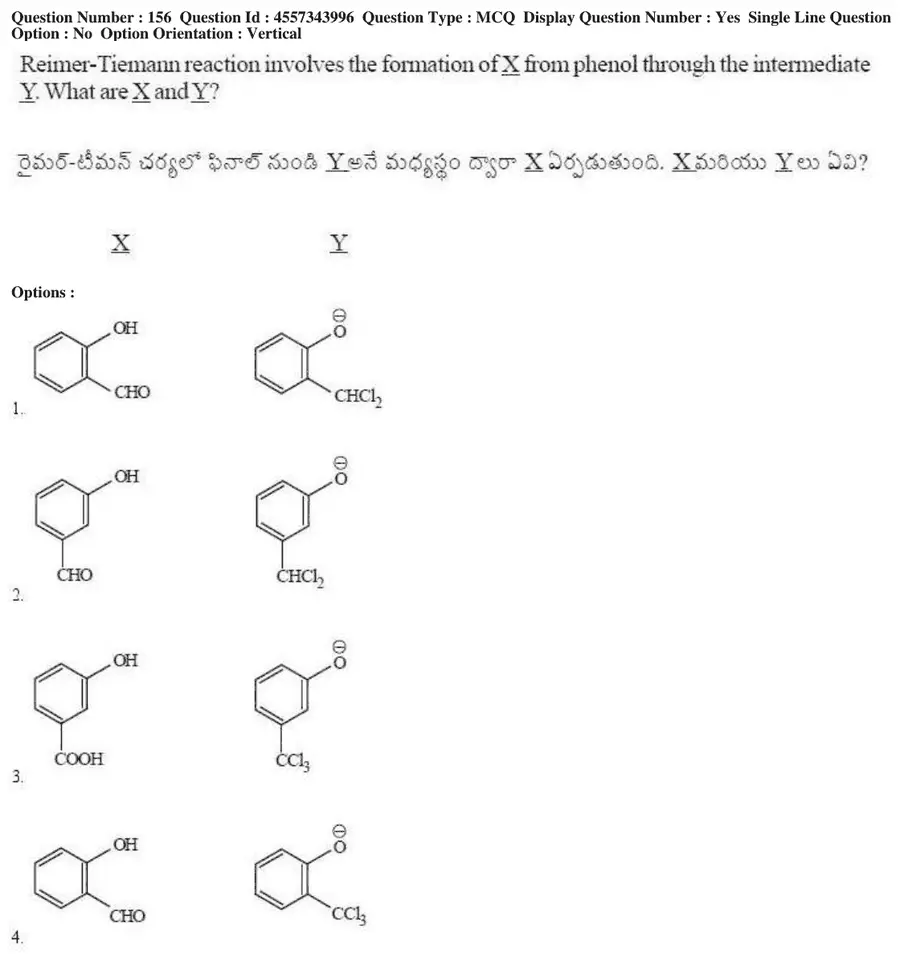
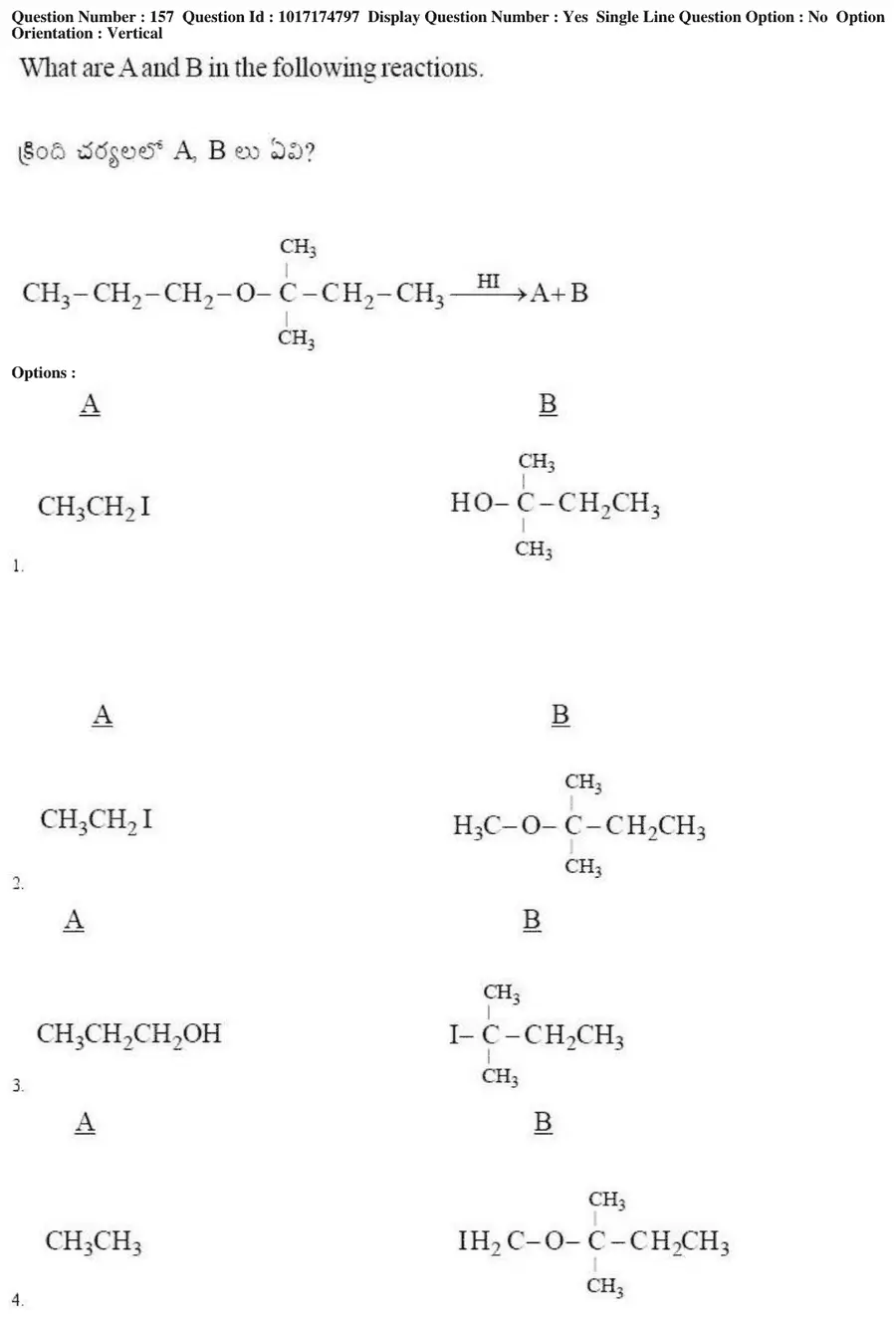
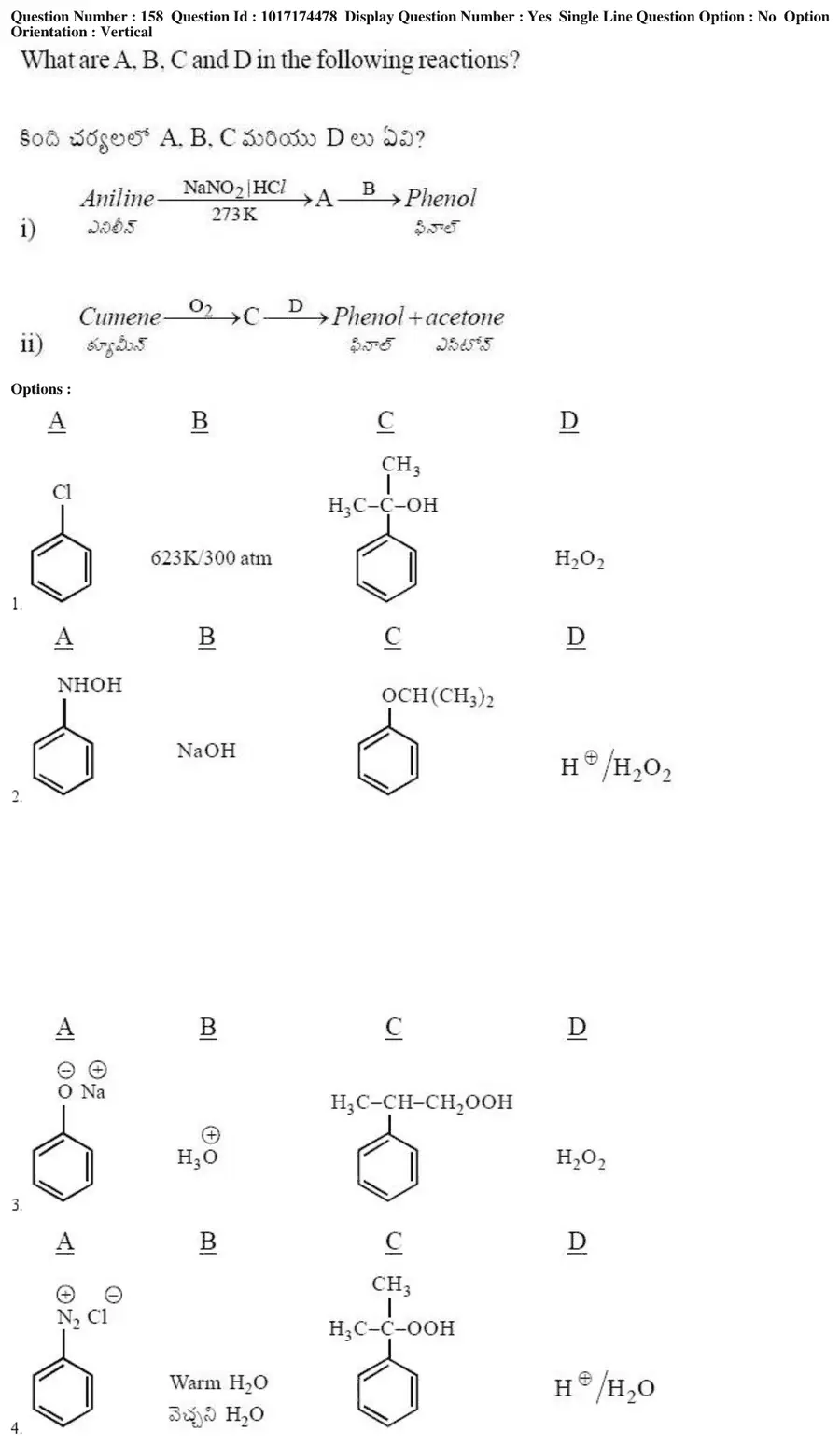
EdLoop PYQs · free, no ads · questions and answers here, step-by-step solutions in the EdLoop app
PYQs · free, no adsOpen on the web (app.edloop.in)Get EdLoop – free on Google Play
ChemistryAlcohols, Phenols & Ethers

Alcohols, Phenols & Ethers: AP & TS EAPCET PYQs 2010–2026

Every Alcohols, Phenols & Ethers question from past AP EAPCET and TS EAPCET papers, with options and answers. Newest first.

143questions
98papers covered
2.5%of Chemistry questions, 2022–2026
2010–2026years

Guide at a glance

Alcohols, Phenols & Ethers holds position 21 among the 31 chemistry chapters in the modern 2022 to 2026 examination span.

Most asked sub-topics

Phenols59
Alcohols53
Ethers31

Practise these in EdLoop

Attempt every Alcohols, Phenols & Ethers question timed, see the step-by-step solution and track what you get wrong. Free.

Start practice

All questions

143 questions
1AP EAPCET 2026 · 18 May · Shift 1MCQOpen question page ↗

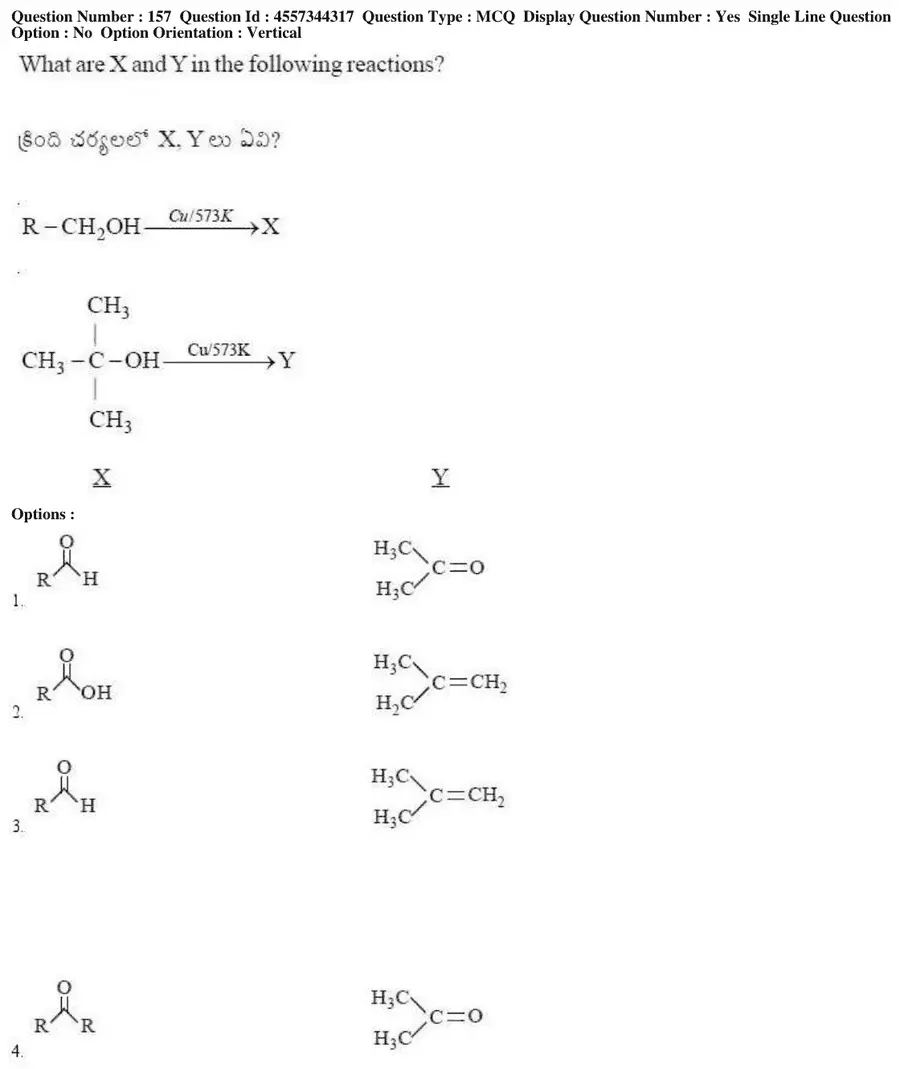
When vapours of an alcohol $X$ are passed over heated copper at 573 $K$, gives an alkene. What is $X$?

  • A

    $\mathrm{CH_3CH_2CH_2CH_2OH}$

  • B

    $\mathrm{(CH_3)_2CH-CH_2OH}$

  • C

    $\mathrm{(CH_3)_3C-OH}$

  • D

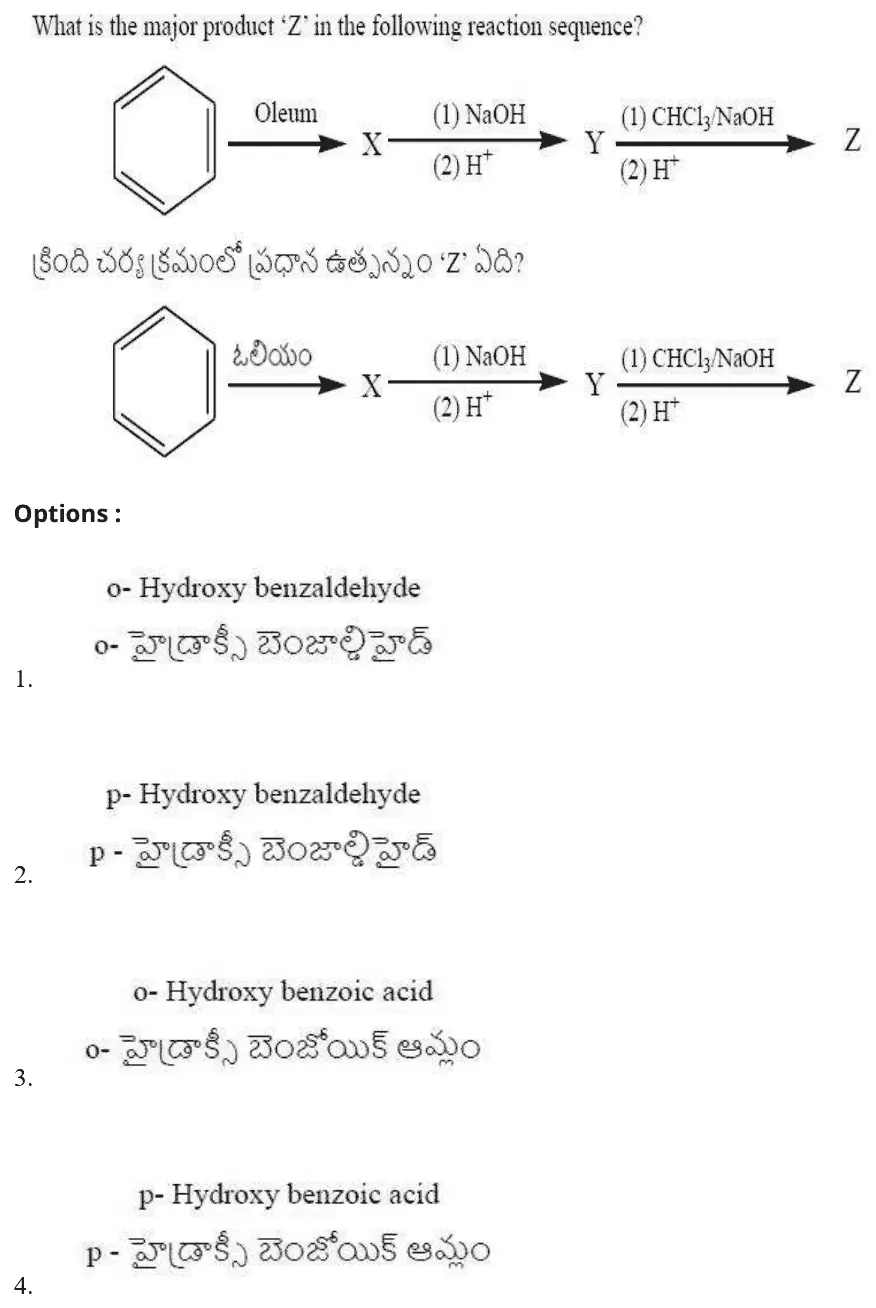
    $\mathrm{CH_3CH(OH)CH_2CH_3}$

2AP EAPCET 2026 · 18 May · Shift 2MCQOpen question page ↗

Observe the following set of reactions

Ethanal $\xrightarrow[\text{(ii) } \mathrm{H_2O}]{\text{(i) } \mathrm{(CH_3)_2CHMgBr}}$ $X$

Propanone $\xrightarrow[\text{(ii) } \mathrm{H_2O}]{\text{(i) } \mathrm{C_2H_5MgBr}}$ $Y$

Consider the statements regarding X and Y

I. Ease of dehydration is Y > X

II. Acidic character is X > Y

III. Reactivity towards Lucas reagent is X > Y

Correct statements are

  • A

    I, II only

  • B

    I, III only

  • C

    II, III only

  • D

    I, II, III

3AP EAPCET 2026 · 15 May · Shift 1MCQOpen question page ↗

Which one of the following is not correct?

  • A

    $\mathrm{(CH_3)_3CONa + CH_3Br \longrightarrow (CH_3)_3COCH_3}$

  • B

    $\mathrm{(C_2H_5)_2O \xrightarrow[\Delta]{\text{excess HI}} 2\,C_2H_5I + H_2O}$

  • C

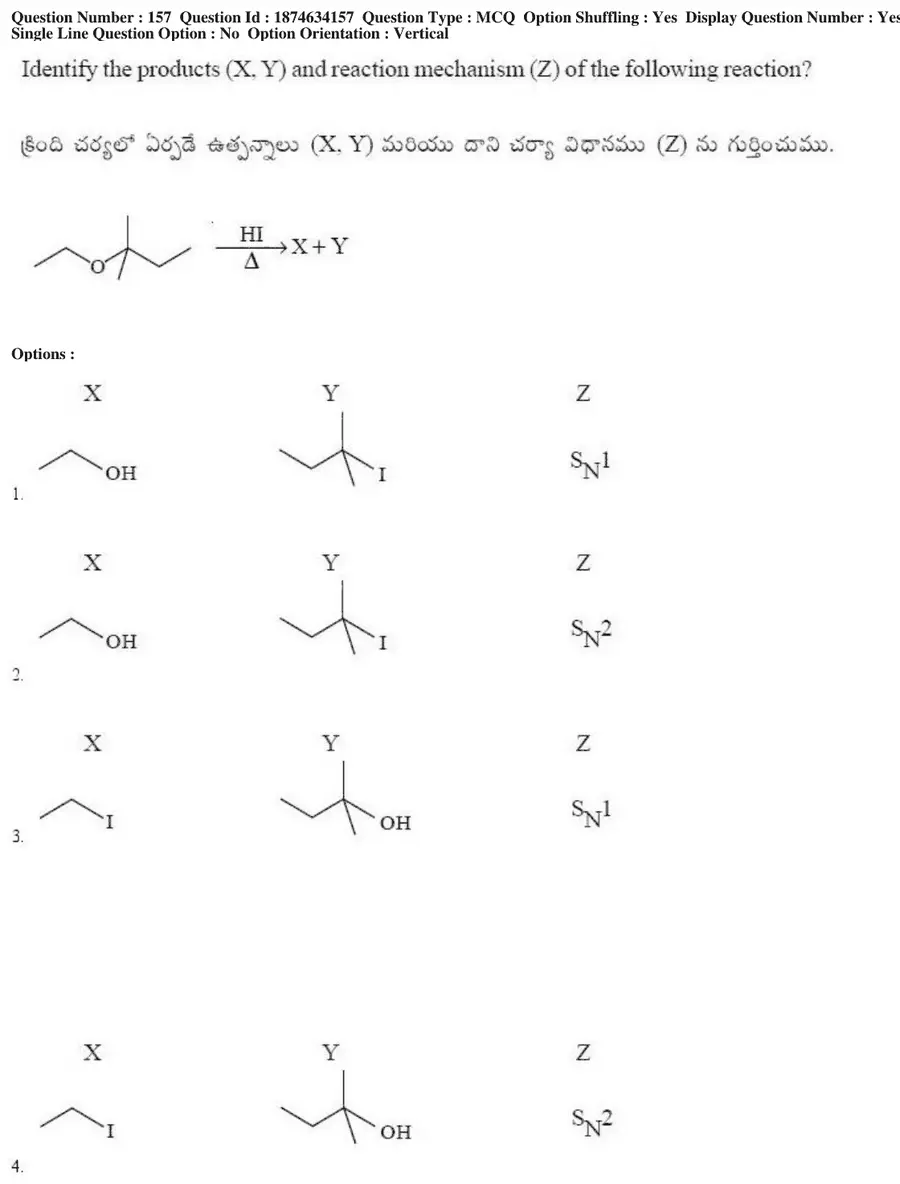
    $\mathrm{(CH_3)_3COC_2H_5 \xrightarrow[\Delta]{HI} (CH_3)_3CI + C_2H_5OH}$

  • D

    $\mathrm{C_6H_5Br + CH_3ONa \longrightarrow C_6H_5OCH_3 + NaBr}$

4AP EAPCET 2026 · 15 May · Shift 2MCQOpen question page ↗

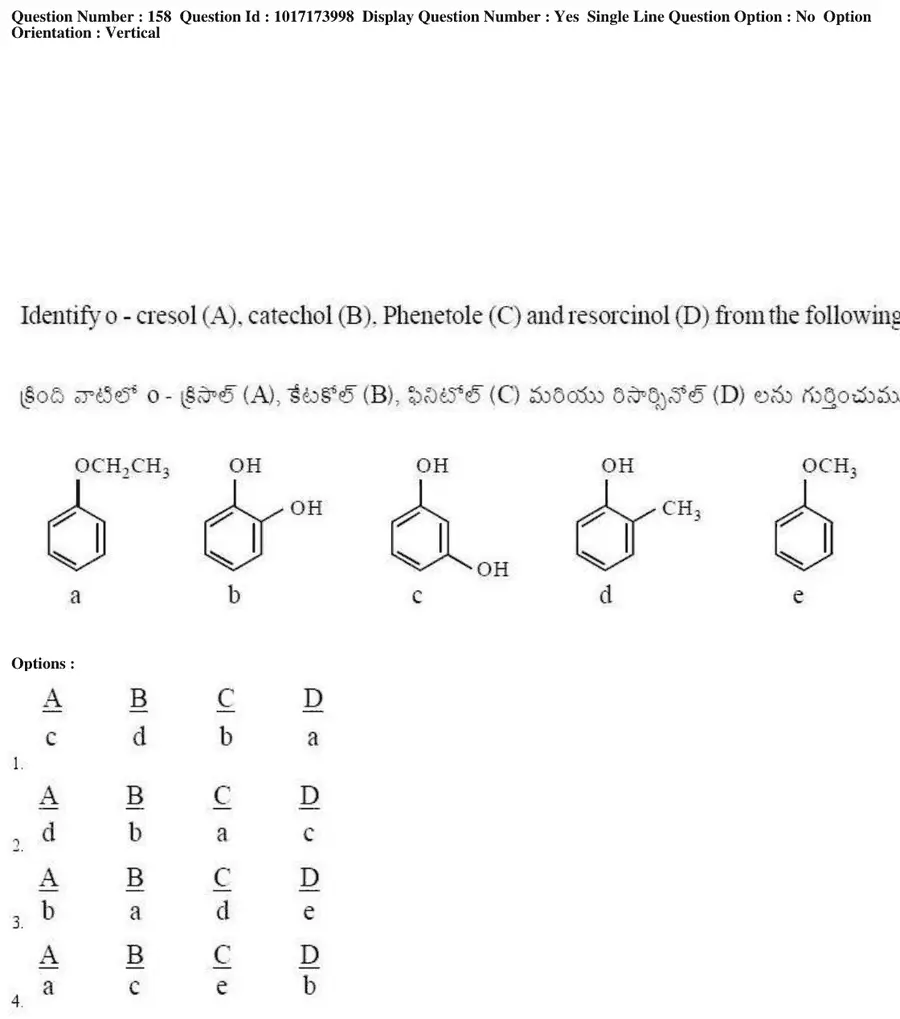
Match the following

List I (Compound)List II (Common name)
A. $\mathrm{C_6H_5OH}$I. Quinol
B. (see the figure above)II. Carbolic acid
C. (see the figure above)III. p-Cresol
D. (see the figure above)IV. Picric acid

Correct answer is

The question and its figure as printed in AP EAPCET 2026 15th May 2026 Shift 2.
The question as printed in the paper.
  • A

    A-IV, B-II, C-I, D-III

  • B

    A-II, B-IV, C-I, D-III

  • C

    A-II, B-IV, C-III, D-I

  • D

    A-IV, B-I, C-III, D-II

5AP EAPCET 2026 · 14 May · Shift 2MCQOpen question page ↗

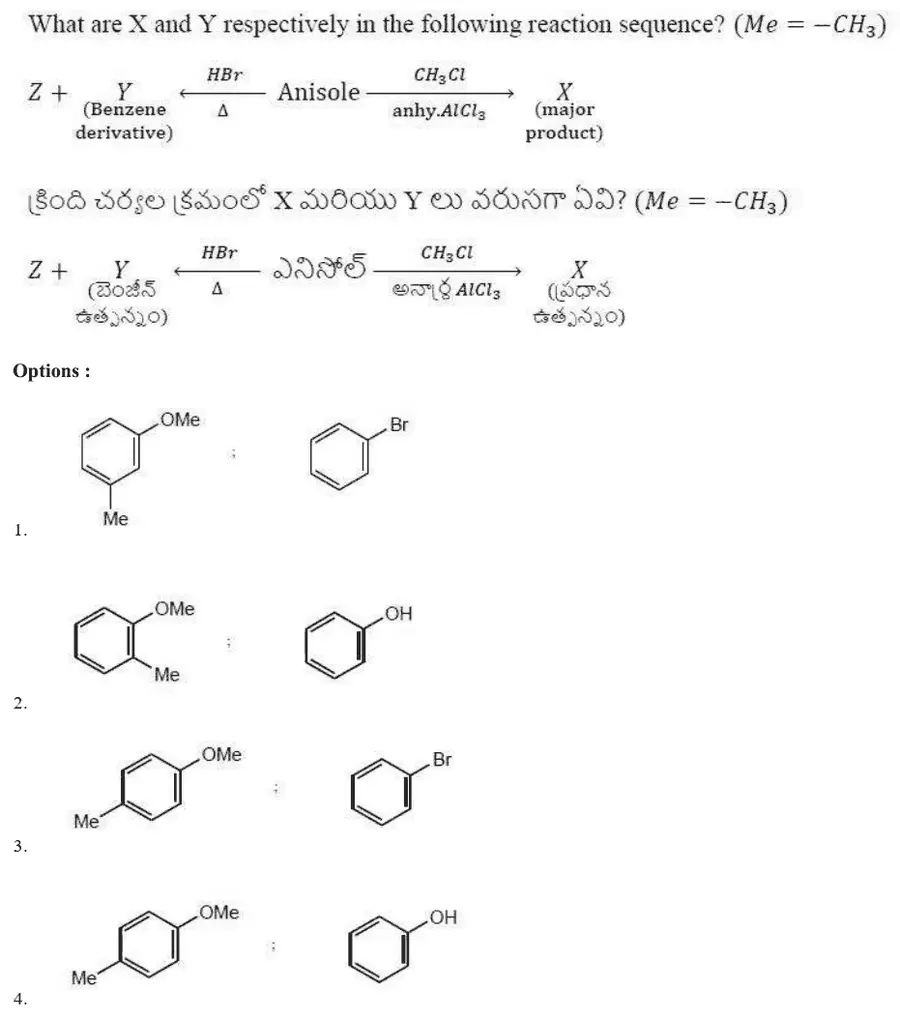
What are X and Y respectively in the following reaction sequence? ($Me = -CH_3$)

(see the figure above)

The question and its figure as printed in AP EAPCET 2026 14th May 2026 Shift 2. Option 1: X: benzene ring with OMe and Me in a meta (1,3) relationship; Y: bromobenzene Option 2: X: benzene ring with OMe and Me on adjacent carbons (ortho); Y: phenol Option 3: X: benzene ring with OMe and Me para to each other; Y: bromobenzene Option 4: X: benzene ring with OMe and Me para to each other; Y: phenol
The question as printed in the paper.
  • A

    see figure X: benzene ring with OMe and Me in a meta (1,3) relationship; Y: bromobenzene

  • B

    see figure X: benzene ring with OMe and Me on adjacent carbons (ortho); Y: phenol

  • C

    see figure X: benzene ring with OMe and Me para to each other; Y: bromobenzene

  • D

    see figure X: benzene ring with OMe and Me para to each other; Y: phenol

6AP EAPCET 2026 · 13 May · Shift 1MCQOpen question page ↗

Consider the following reaction

$$\text{Cumene} \xrightarrow[\text{(ii) } \mathrm{H_3O^+}]{\text{(i) } \mathrm{O_2}} \mathrm{A + B}$$

A is acidic in nature and forms salt with aq. NaOH. A and B are converted to corresponding hydrocarbons with reagents X and Y respectively. What are X and Y?

  • A

    $\mathrm{X = Sn, \Delta}$ ; $\mathrm{Y = NaBH_4}$

  • B

    $\mathrm{X = NaBH_4}$ ; $\mathrm{Y = Sn, \Delta}$

  • C

    $\mathrm{X = Zn, \Delta}$ ; $\mathrm{Y = Zn|Hg, HCl}$

  • D

    $\mathrm{X = Zn|Hg, HCl}$ ; $\mathrm{Y = Zn, \Delta}$

7AP EAPCET 2026 · 12 May · Shift 1MCQOpen question page ↗

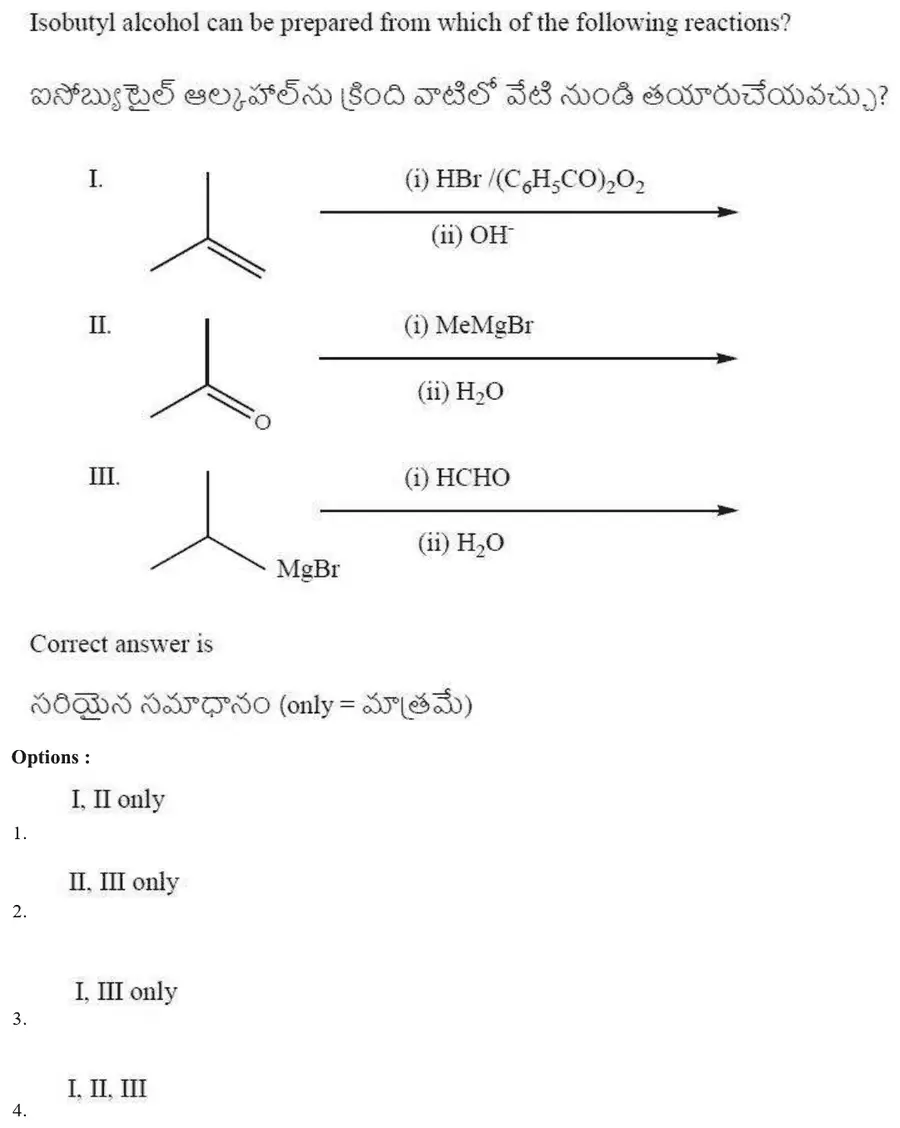
Isobutyl alcohol can be prepared from which of the following reactions?

I. (see the figure above) $\xrightarrow[\text{(ii) } \mathrm{OH^-}]{\text{(i) } \mathrm{HBr/(C_6H_5CO)_2O_2}}$

II. (see the figure above) $\xrightarrow[\text{(ii) } \mathrm{H_2O}]{\text{(i) MeMgBr}}$

III. (see the figure above) $\xrightarrow[\text{(ii) } \mathrm{H_2O}]{\text{(i) HCHO}}$

Correct answer is

The question and its figure as printed in AP EAPCET 2026 12th May 2026 Shift 1.
The question as printed in the paper.
  • A

    I, II only

  • B

    II, III only

  • C

    I, III only

  • D

    I, II, III

8TS EAPCET 2026 · 11 May · Shift 1MCQOpen question page ↗

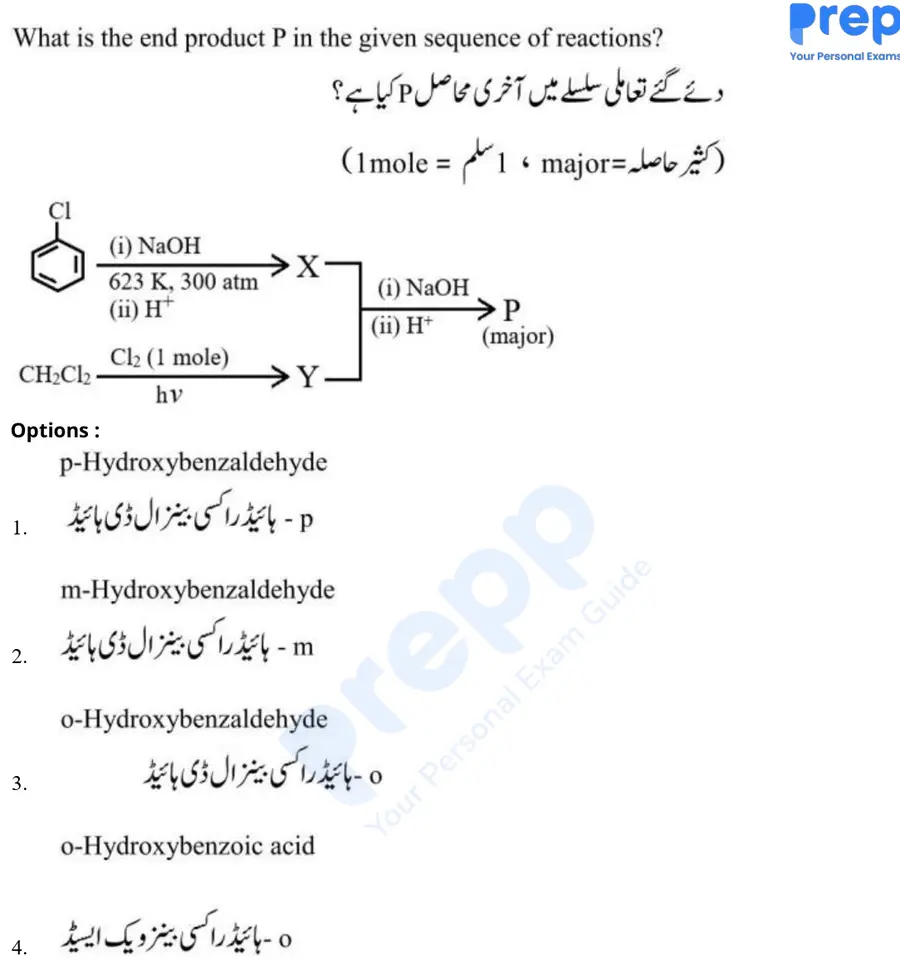
What is the end product P in the given sequence of reactions?

(1 mole = 1 mole, major = major product)

(see the figure above)

The question and its figure as printed in TS EAPCET 2026 Urdu 11th May 2026 Shift 1.
The question as printed in the paper.
  • A

    p-Hydroxybenzaldehyde

  • B

    m-Hydroxybenzaldehyde

  • C

    o-Hydroxybenzaldehyde

  • D

    o-Hydroxybenzoic acid

9TS EAPCET 2026 · 11 May · Shift 1MCQOpen question page ↗

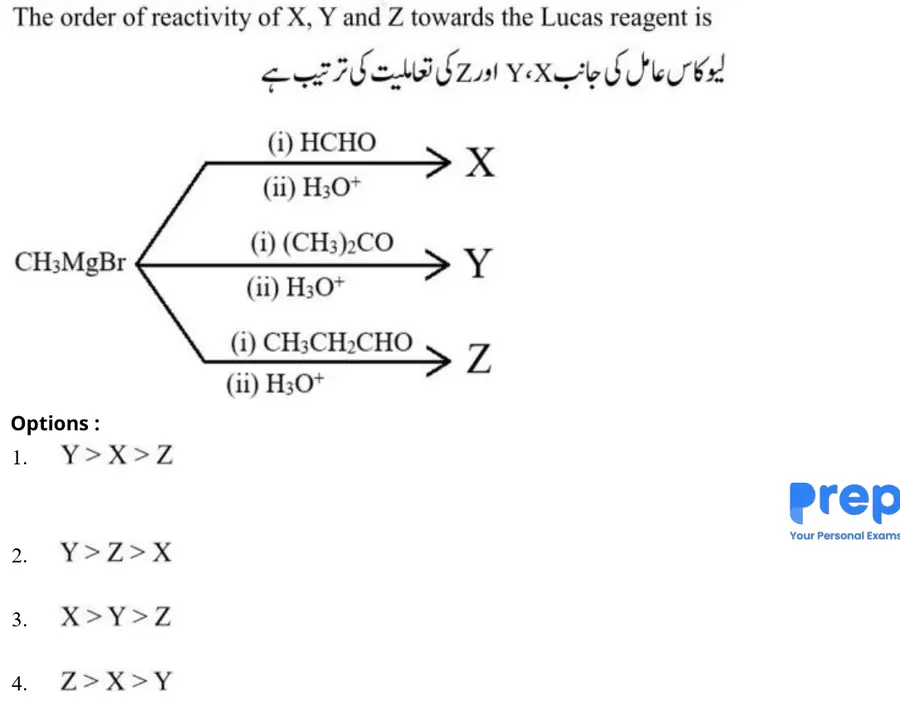
The order of reactivity of X, Y and Z towards the Lucas reagent is

(see the figure above)

The question and its figure as printed in TS EAPCET 2026 Urdu 11th May 2026 Shift 1.
The question as printed in the paper.
  • A

    $\mathrm{Y > X > Z}$

  • B

    $\mathrm{Y > Z > X}$

  • C

    $\mathrm{X > Y > Z}$

  • D

    $\mathrm{Z > X > Y}$

10TS EAPCET 2026 · 11 May · Shift 1MCQOpen question page ↗

Identify the reaction, which does not give isopropyl alcohol

  • A

    $\mathrm{CH_2=CH-CH_3 \xrightarrow{H_2O|H^+}}$

  • B

    $\mathrm{CH_3CHO \xrightarrow[(ii)\ H_2O]{(i)\ CH_3MgBr}}$

  • C

    $\mathrm{(CH_3)_2CO \xrightarrow{NaBH_4}}$

  • D

    $\mathrm{CH_2O \xrightarrow[(ii)\ H_2O]{(i)\ C_2H_5MgBr}}$

11TS EAPCET 2026 · 10 May · Shift 1MCQOpen question page ↗

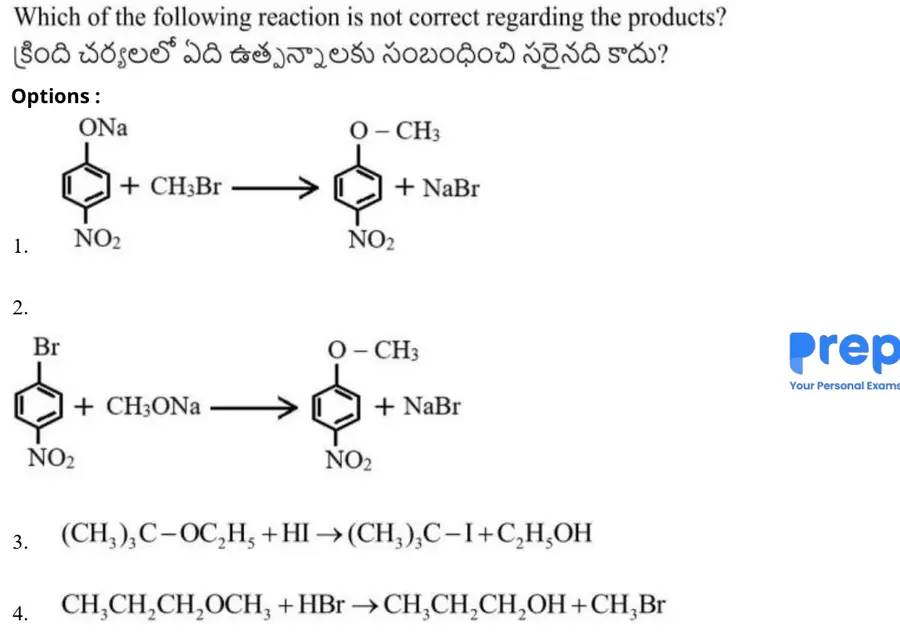
Which of the following reaction is not correct regarding the products?

The question and its figure as printed in TS EAPCET 2026 10th May 2026 Shift 1. Option 1: Reaction: p-nitrophenoxide (benzene ring with ONa at top and NO2 at bottom, para) + CH3Br p-nitroanisole (benzene ring with O-CH3 at top and NO2 at bottom) + NaBr Option 2: Reaction: p-bromonitrobenzene (benzene ring with Br at top and NO2 at bottom, para) + CH3ONa p-nitroanisole (benzene ring with O-CH3 at top and NO2 at bottom) + NaBr
The question as printed in the paper.
  • A

    see figure Reaction: p-nitrophenoxide (benzene ring with ONa at top and $\mathrm{NO_2}$ at bottom, para) $+ \mathrm{CH_3Br} \longrightarrow$ p-nitroanisole (benzene ring with $\mathrm{O-CH_3}$ at top and $\mathrm{NO_2}$ at bottom) $+ \mathrm{NaBr}$

  • B

    see figure Reaction: p-bromonitrobenzene (benzene ring with Br at top and $\mathrm{NO_2}$ at bottom, para) $+ \mathrm{CH_3ONa} \longrightarrow$ p-nitroanisole (benzene ring with $\mathrm{O-CH_3}$ at top and $\mathrm{NO_2}$ at bottom) $+ \mathrm{NaBr}$

  • C

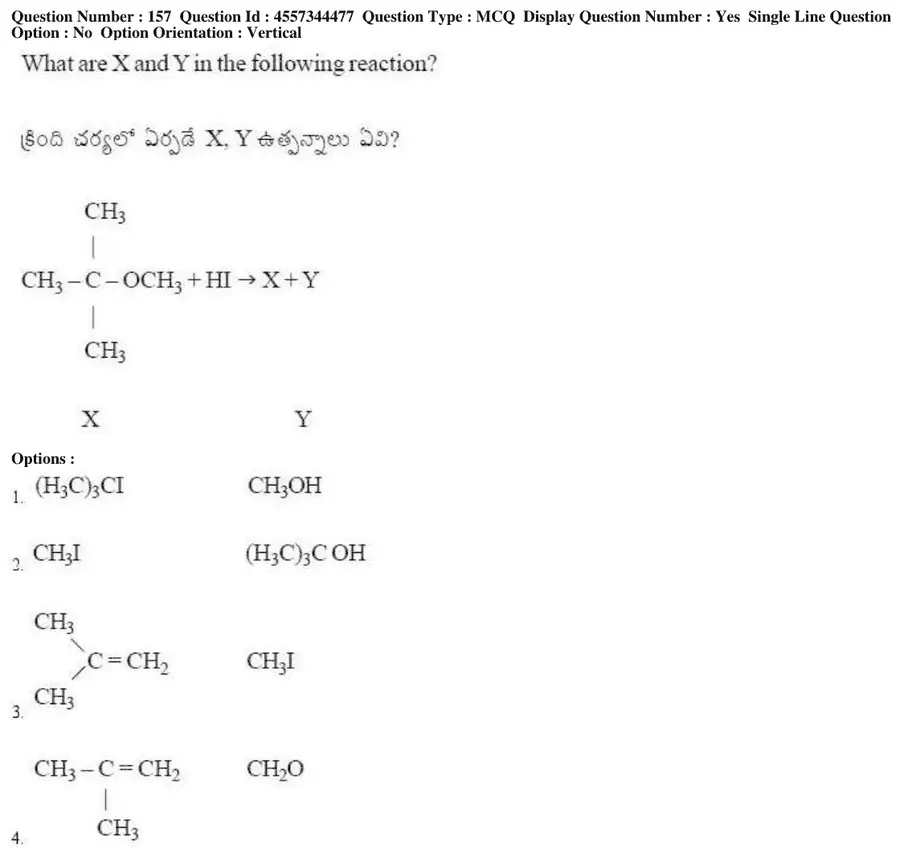
    $\mathrm{(CH_3)_3C-OC_2H_5 + HI \rightarrow (CH_3)_3C-I + C_2H_5OH}$

  • D

    $\mathrm{CH_3CH_2CH_2OCH_3 + HBr \rightarrow CH_3CH_2CH_2OH + CH_3Br}$

12TS EAPCET 2026 · 10 May · Shift 1MCQOpen question page ↗

Given below are two statements

Statement-I: Phenol is acidic due to resonance stabilization of phenoxide ion

Statement-II: Phenol has no reaction with $\mathrm{Na_2Cr_2O_7}$ and conc. $\mathrm{H_2SO_4}$

The correct answer is

  • A

    Both statements I and II are correct

  • B

    Statement I is correct but statement II is not correct

  • C

    Statement I is not correct but statement II is correct

  • D

    Both statements I and II are not correct

13TS EAPCET 2026 · 9 May · Shift 1MCQOpen question page ↗

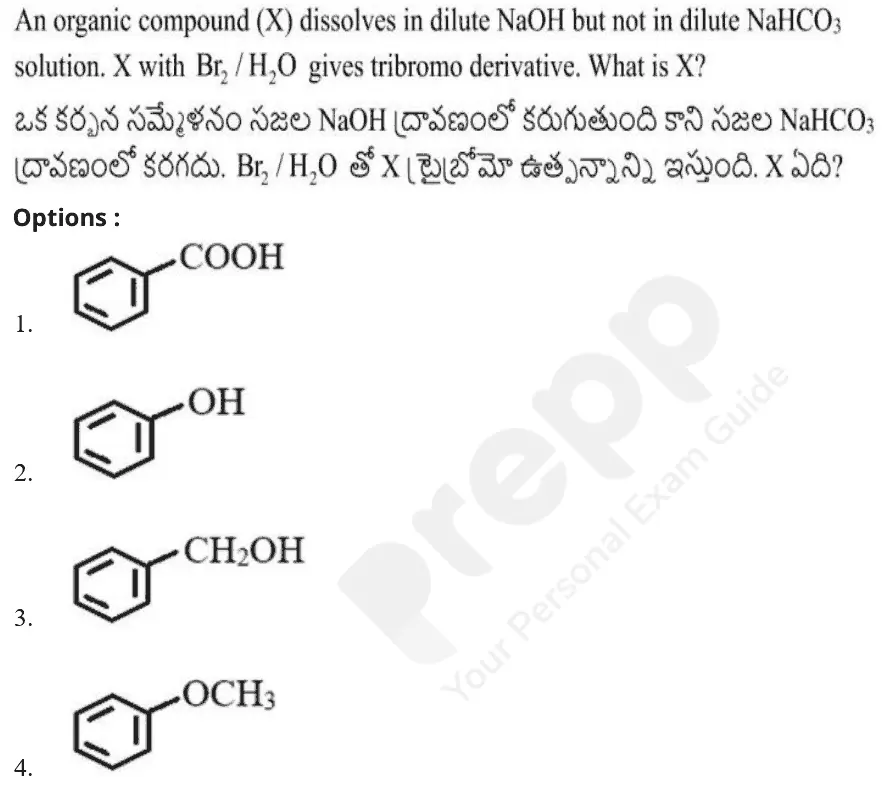
An organic compound (X) dissolves in dilute $\mathrm{NaOH}$ but not in dilute $\mathrm{NaHCO_3}$ solution. X with $\mathrm{Br_2/H_2O}$ gives tribromo derivative. What is X?

The question and its figure as printed in TS EAPCET 2026 09th May 2026 Shift 1. Option 1: Benzene ring with a COOH substituent (benzoic acid) Option 2: Benzene ring with an OH substituent (phenol) Option 3: Benzene ring with a CH2OH substituent (benzyl alcohol) Option 4: Benzene ring with an OCH3 substituent (anisole)
The question as printed in the paper.
  • A

    see figure Benzene ring with a $\mathrm{COOH}$ substituent (benzoic acid)

  • B

    see figure Benzene ring with an $\mathrm{OH}$ substituent (phenol)

  • C

    see figure Benzene ring with a $\mathrm{CH_2OH}$ substituent (benzyl alcohol)

  • D

    see figure Benzene ring with an $\mathrm{OCH_3}$ substituent (anisole)

14TS EAPCET 2026 · 9 May · Shift 1MCQOpen question page ↗

What are X and Y in the following reactions?

(Ether = ether; alkene = alkene; alkane = alkane)

I. $\mathrm{(CH_3)_3C\,ONa + C_2H_5Br \xrightarrow{\Delta} X}$

II. $\mathrm{(CH_3)_3C\,Br + C_2H_5ONa \xrightarrow{\Delta} Y}$

  • A

    X = Ether, Y = Ether

  • B

    X= Ether, Y= Alkene

  • C

    X = Alkene, Y= Ether

  • D

    X= Ether, Y= Alkane

15TS EAPCET 2026 · 9 May · Shift 2MCQOpen question page ↗

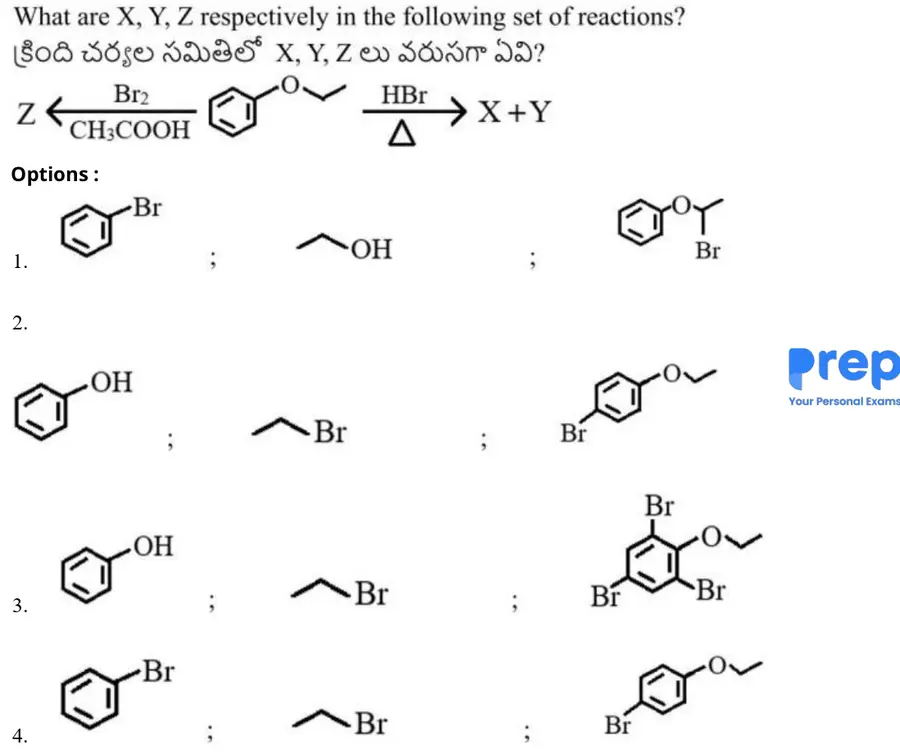
What are X, Y, Z respectively in the following set of reactions?

(see the figure above)

The question and its figure as printed in TS EAPCET 2026 09th May 2026 Shift 2. Option 1: Bromobenzene (benzene ring with Br); (figure) ethanol (CH3CH2OH, zig-zag line with OH); (figure) PhO-CH(Br)-CH3 (phenyl ether with the carbon attached to O bearing Br and a methyl) Option 2: Phenol (benzene ring with OH); (figure) ethyl bromide (zig-zag line with Br); (figure) 4-bromophenyl ethyl ether (para-bromo benzene ring with OCH2CH3) Option 3: Phenol (benzene ring with OH); (figure) ethyl bromide (zig-zag line with Br); (figure) 2,4,6-tribromophenyl ethyl ether (benzene ring with OCH2CH3 and Br at both ortho positions and the para position) Option 4: Bromobenzene (benzene ring with Br)…
The question as printed in the paper.
  • A

    see figure Bromobenzene (benzene ring with Br); (see the figure above) ethanol (CH3CH2OH, zig-zag line with OH); (see the figure above) PhO-CH(Br)-CH3 (phenyl ether with the carbon attached to O bearing Br and a methyl)

  • B

    see figure Phenol (benzene ring with OH); (see the figure above) ethyl bromide (zig-zag line with Br); (see the figure above) 4-bromophenyl ethyl ether (para-bromo benzene ring with OCH2CH3)

  • C

    see figure Phenol (benzene ring with OH); (see the figure above) ethyl bromide (zig-zag line with Br); (see the figure above) 2,4,6-tribromophenyl ethyl ether (benzene ring with OCH2CH3 and Br at both ortho positions and the para position)

  • D

    see figure Bromobenzene (benzene ring with Br); (see the figure above) ethyl bromide (zig-zag line with Br); (see the figure above) 4-bromophenyl ethyl ether (para-bromo benzene ring with OCH2CH3)

16AP EAPCET 2025 · 27 May · Shift 1MCQOpen question page ↗

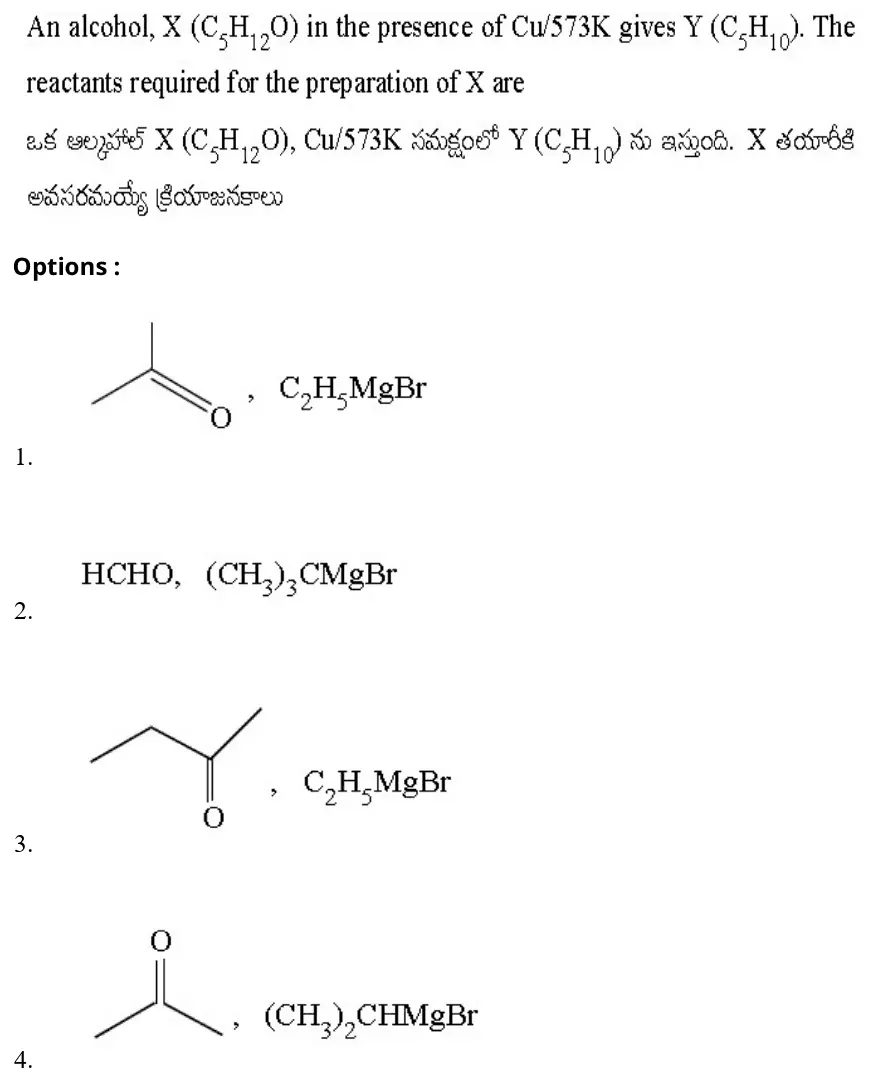
An alcohol, X ($\mathrm{C_5H_{12}O}$) in the presence of Cu/573K gives Y ($\mathrm{C_5H_{10}}$). The reactants required for the preparation of X are

The question and its figure as printed in AP EAPCET 2025 27th May 2025 Shift 1. Option 1: skeletal structure of propanone (acetone), drawn with a C=O double bond to O at the lower right, and C2H5MgBr Option 3: skeletal structure of butan-2-one (ethyl methyl ketone), with the C=O group pointing downward to O, and C2H5MgBr Option 4: skeletal structure of propanone (acetone), with the C=O group pointing upward to O, and (CH3)2CHMgBr
The question as printed in the paper.
  • A

    see figure skeletal structure of propanone (acetone), drawn with a C=O double bond to O at the lower right, and $\mathrm{C_2H_5MgBr}$

  • B

    $\mathrm{HCHO}$, $\mathrm{(CH_3)_3CMgBr}$

  • C

    see figure skeletal structure of butan-2-one (ethyl methyl ketone), with the C=O group pointing downward to O, and $\mathrm{C_2H_5MgBr}$

  • D

    see figure skeletal structure of propanone (acetone), with the C=O group pointing upward to O, and $\mathrm{(CH_3)_2CHMgBr}$

17AP EAPCET 2025 · 26 May · Shift 2MCQOpen question page ↗

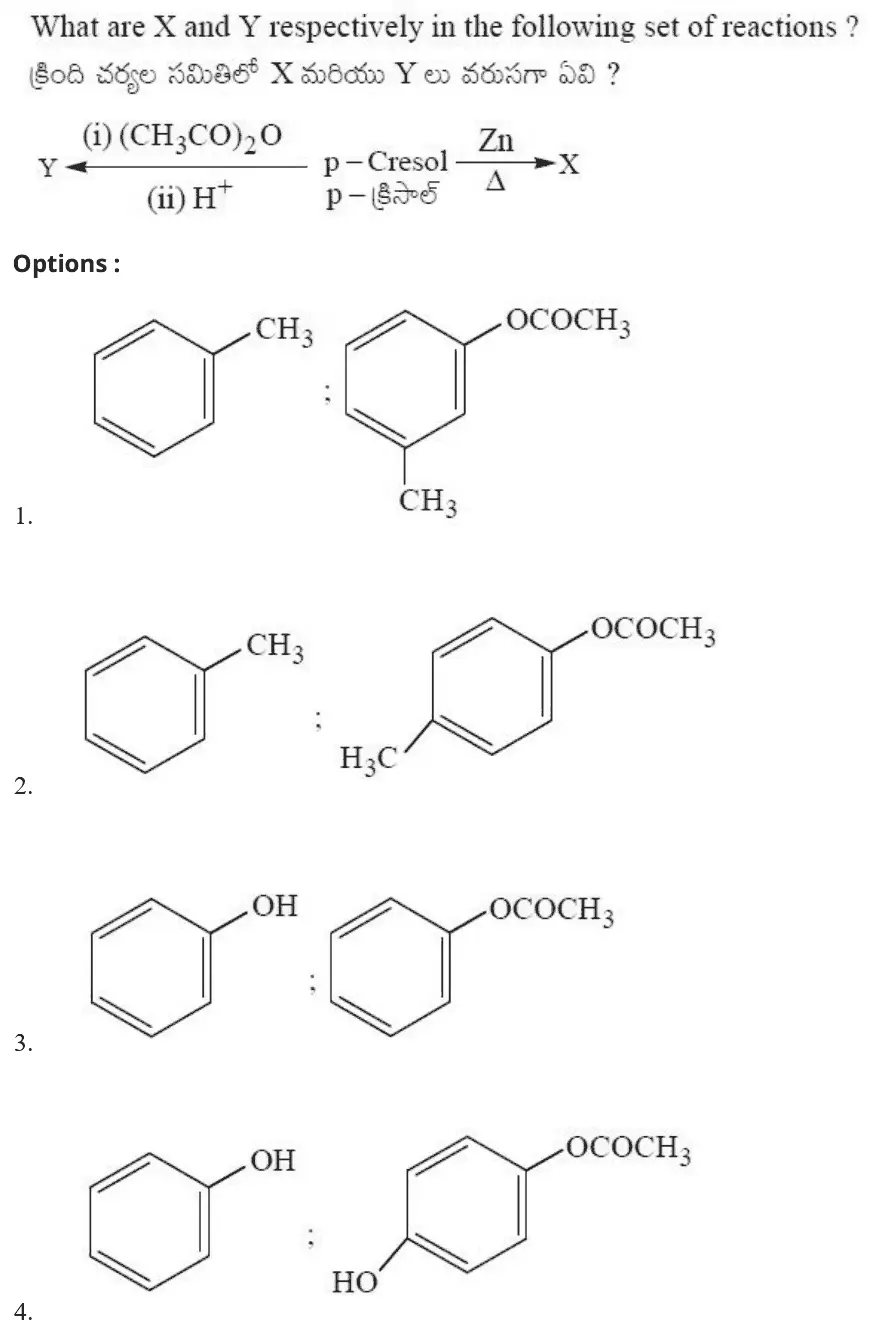
What are X and Y respectively in the following set of reactions ?

(see the figure above)

The question and its figure as printed in AP EAPCET 2025 26thMay 2025 Shift 2. Option 1: X: toluene (benzene ring with CH3); Y: benzene ring with OCOCH3 and CH3 meta to each other (1,3-disubstituted) Option 2: X: toluene (benzene ring with CH3); Y: benzene ring with OCOCH3 and H3C para to each other (1,4-disubstituted) Option 3: X: phenol (benzene ring with OH); Y: benzene ring with OCOCH3 and a second substituent (shown as a line to the lower right, no label) on the ring Option 4: X: phenol (benzene ring with OH); Y: benzene ring with OCOCH3 and HO para to each other (1,4-disubstituted)
The question as printed in the paper.
  • A

    see figure X: toluene (benzene ring with CH3); Y: benzene ring with OCOCH3 and CH3 meta to each other (1,3-disubstituted)

  • B

    see figure X: toluene (benzene ring with CH3); Y: benzene ring with OCOCH3 and H3C para to each other (1,4-disubstituted)

  • C

    see figure X: phenol (benzene ring with OH); Y: benzene ring with OCOCH3 and a second substituent (shown as a line to the lower right, no label) on the ring

  • D

    see figure X: phenol (benzene ring with OH); Y: benzene ring with OCOCH3 and HO para to each other (1,4-disubstituted)

18AP EAPCET 2025 · 26 May · Shift 2MCQOpen question page ↗

Match the following

List-I (Compound)List-II ($\mathrm{pK_a}$)
A) p-NitrophenolI) 15.9
B) PhenolII) 7.1
C) EthanolIII) 10.0
D) p-CresolIV) 10.2
V) 8.3

The correct answer is

  • A

    A-II, B-V, C-I, D-III

  • B

    A-II, B-III, C-I, D-IV

  • C

    A-V, B-IV, C-II, D-III

  • D

    A-IV, B-III, C-I, D-V

19AP EAPCET 2025 · 23 May · Shift 2MCQOpen question page ↗

The correct statement regarding X and Y formed in the following reaction is

$$\mathrm{(CH_3)_3COC_2H_5} \xrightarrow[\Delta]{\mathrm{HI}} \text{halide (X)} + \text{alcohol (Y)}$$

  • A

    X undergoes substitution by $\mathrm{S_N2}$ mechanism

  • B

    X undergoes substitution with water in two steps

  • C

    Y gets converted to corresponding chloride with conc.$\mathrm{HCl}$ at room temperature

  • D

    Reaction of Y with Cu / 573 K gives ketone

20TS EAPCET 2025 · 4 May · Shift 1MCQOpen question page ↗

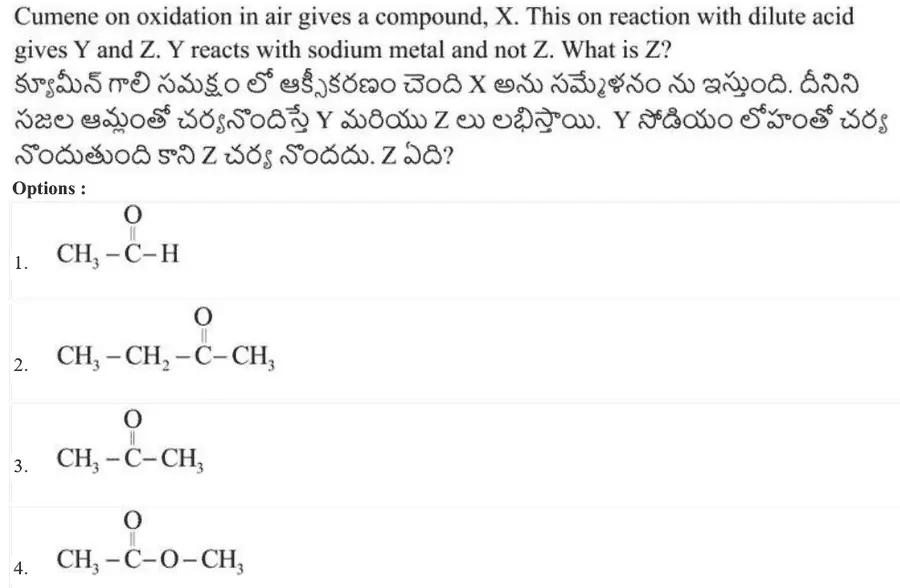
Cumene on oxidation in air gives a compound, X. This on reaction with dilute acid gives Y and Z. Y reacts with sodium metal and not Z. What is Z?

The question and its figure as printed in TG EAPCET 2025 04 May FN.
The question as printed in the paper.
  • A

    $\mathrm{CH_3-C-H}$ with a carbonyl oxygen (=O) double-bonded to the carbon, i.e. $\mathrm{CH_3-CHO}$ (see the figure above)

  • B

    $\mathrm{CH_3-CH_2-C-CH_3}$ with a carbonyl oxygen (=O) double-bonded to the carbon, i.e. $\mathrm{CH_3CH_2COCH_3}$ (see the figure above)

  • C

    $\mathrm{CH_3-C-CH_3}$ with a carbonyl oxygen (=O) double-bonded to the carbon, i.e. $\mathrm{CH_3COCH_3}$ (see the figure above)

  • D

    $\mathrm{CH_3-C-O-CH_3}$ with a carbonyl oxygen (=O) double-bonded to the carbon, i.e. $\mathrm{CH_3COOCH_3}$ (see the figure above)

21TS EAPCET 2025 · 4 May · Shift 1MCQOpen question page ↗

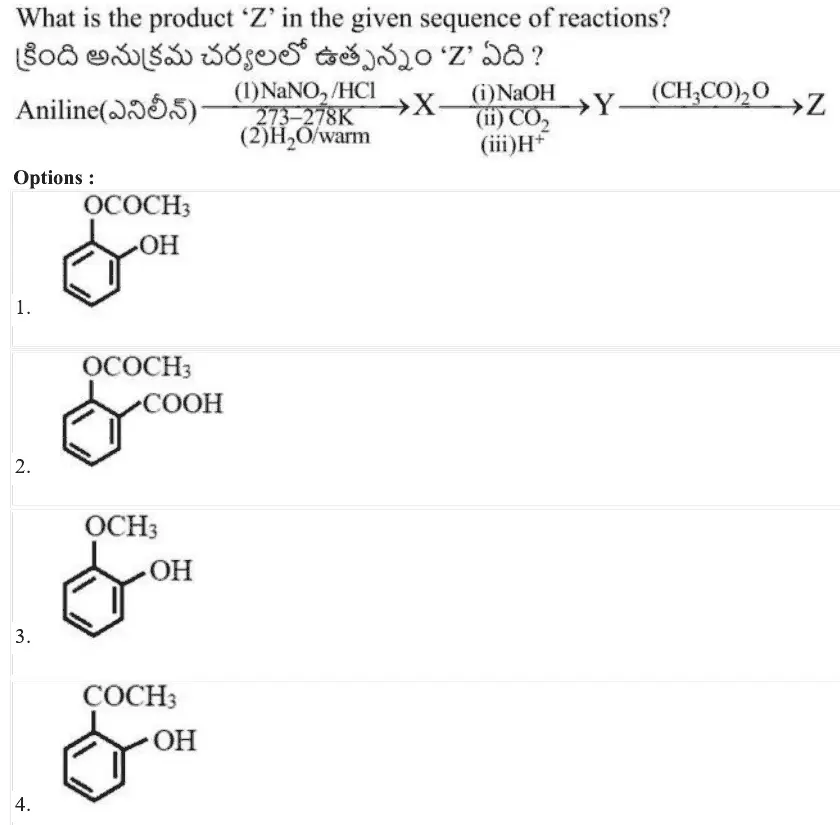
What is the product ‘Z’ in the given sequence of reactions?

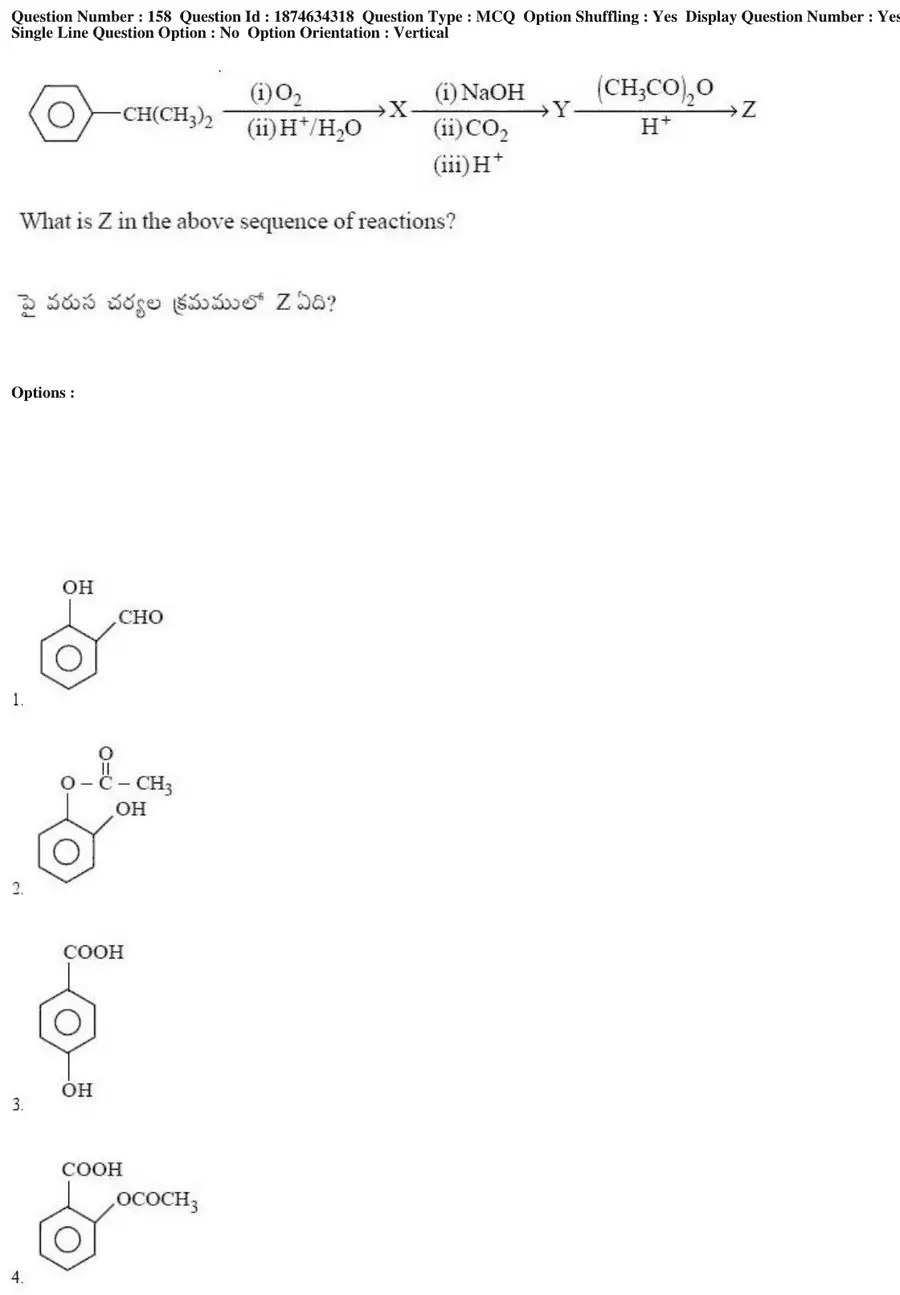
Aniline $\xrightarrow[\text{(2)}\ \mathrm{H_2O}/\text{warm}]{\text{(1)}\ \mathrm{NaNO_2/HCl},\ 273\text{–}278\,\mathrm{K}}$ X $\xrightarrow[\text{(iii)}\ \mathrm{H^+}]{\text{(i)}\ \mathrm{NaOH}\ \text{(ii)}\ \mathrm{CO_2}}$ Y $\xrightarrow{\mathrm{(CH_3CO)_2O}}$ Z

The question and its figure as printed in TG EAPCET 2025 04 May FN. Option 1: Benzene ring with OCOCH3 and OH groups on adjacent (ortho) carbons Option 2: Benzene ring with OCOCH3 and COOH groups on adjacent (ortho) carbons Option 3: Benzene ring with OCH3 and OH groups on adjacent (ortho) carbons Option 4: Benzene ring with COCH3 and OH groups on adjacent (ortho) carbons
The question as printed in the paper.
  • A

    see figure Benzene ring with OCOCH3 and OH groups on adjacent (ortho) carbons

  • B

    see figure Benzene ring with OCOCH3 and COOH groups on adjacent (ortho) carbons

  • C

    see figure Benzene ring with OCH3 and OH groups on adjacent (ortho) carbons

  • D

    see figure Benzene ring with COCH3 and OH groups on adjacent (ortho) carbons

22TS EAPCET 2025 · 4 May · Shift 2MCQOpen question page ↗

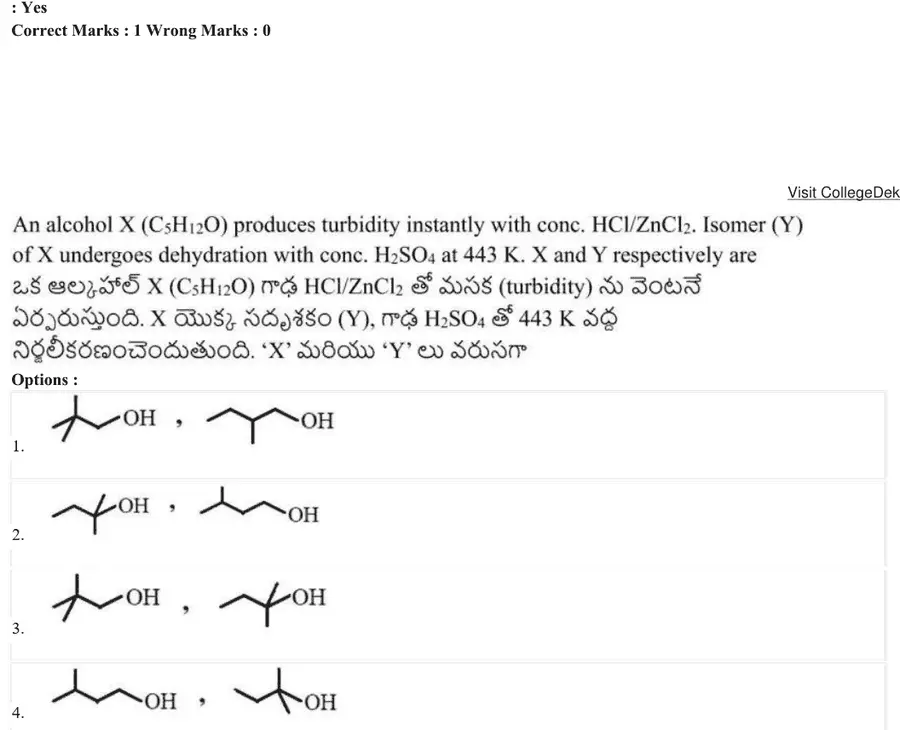
An alcohol X ($\mathrm{C_5H_{12}O}$) produces turbidity instantly with conc. $\mathrm{HCl/ZnCl_2}$. Isomer (Y) of X undergoes dehydration with conc. $\mathrm{H_2SO_4}$ at 443 K. X and Y respectively are

The question and its figure as printed in TG EAPCET 2025 04 May AN. Option 1: Two skeletal structures separated by a comma: first is 2,2-dimethylpropan-1-ol (neopentyl alcohol, a quaternary carbon bearing three methyls with CH2OH); second is 4-methylbutan-2-ol type structure drawn as a zigzag with a branch at the centre and OH at the right end (3-methylbutan-1-ol/isopentyl-like skeleton). Option 2: Two skeletal structures separated by a comma: first is a tertiary alcohol (2-methylbutan-2-ol, with C bearing OH and a methyl branch drawn downward); second is a zigzag chain with a branch and OH at the right end (pentan-2-ol/3-methylbutan-1-ol type). Option 3: Two skeletal structures separated…
The question as printed in the paper.
  • A

    see figure Two skeletal structures separated by a comma: first is 2,2-dimethylpropan-1-ol (neopentyl alcohol, a quaternary carbon bearing three methyls with CH2OH); second is 4-methylbutan-2-ol type structure drawn as a zigzag with a branch at the centre and OH at the right end (3-methylbutan-1-ol/isopentyl-like skeleton).

  • B

    see figure Two skeletal structures separated by a comma: first is a tertiary alcohol (2-methylbutan-2-ol, with C bearing OH and a methyl branch drawn downward); second is a zigzag chain with a branch and OH at the right end (pentan-2-ol/3-methylbutan-1-ol type).

  • C

    see figure Two skeletal structures separated by a comma: first is 2,2-dimethylpropan-1-ol type (quaternary carbon with CH2OH); second is a tertiary alcohol (2-methylbutan-2-ol) with OH on a carbon bearing a downward methyl.

  • D

    see figure Two skeletal structures separated by a comma: first is a branched primary alcohol (3-methylbutan-1-ol, zigzag with a branch on top and OH at the right end); second is a tertiary alcohol (2-methylbutan-2-ol) with OH on a carbon bearing a downward methyl.

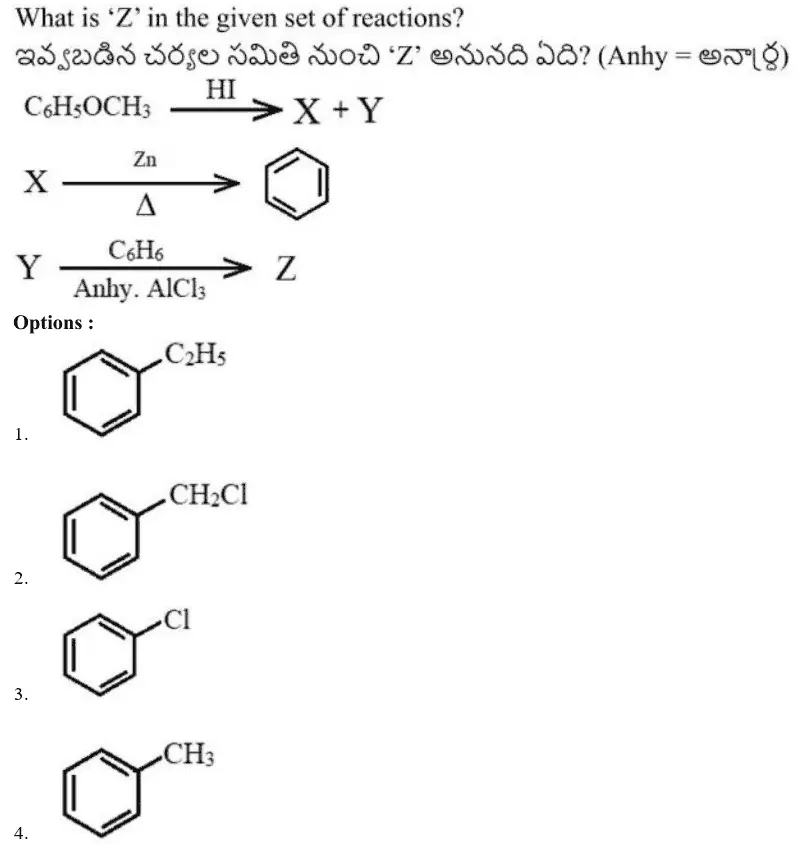
23TS EAPCET 2025 · 3 May · Shift 2MCQOpen question page ↗

What is ‘Z’ in the given set of reactions?

$\mathrm{C_6H_5OCH_3} \xrightarrow{\mathrm{HI}} \mathrm{X} + \mathrm{Y}$

$\mathrm{X} \xrightarrow[\Delta]{\mathrm{Zn}}$ (see the figure above)

$\mathrm{Y} \xrightarrow[\mathrm{Anhy.\ AlCl_3}]{\mathrm{C_6H_6}} \mathrm{Z}$

The question and its figure as printed in TS EAPCET 2025 03rd May 2025 Shift 2. Option 1: Benzene ring bearing a C2H5 substituent (ethylbenzene) Option 2: Benzene ring bearing a CH2Cl substituent (benzyl chloride) Option 3: Benzene ring bearing a Cl substituent (chlorobenzene) Option 4: Benzene ring bearing a CH3 substituent (toluene)
The question as printed in the paper.
  • A

    see figure Benzene ring bearing a $\mathrm{C_2H_5}$ substituent (ethylbenzene)

  • B

    see figure Benzene ring bearing a $\mathrm{CH_2Cl}$ substituent (benzyl chloride)

  • C

    see figure Benzene ring bearing a $\mathrm{Cl}$ substituent (chlorobenzene)

  • D

    see figure Benzene ring bearing a $\mathrm{CH_3}$ substituent (toluene)

24TS EAPCET 2025 · 2 May · Shift 2MCQOpen question page ↗

Consider the given sequence of reactions.

$$\mathrm{C_2H_6 + \frac{3}{2}O_2 \xrightarrow[\Delta]{(CH_3COO)_2Mn} X \xrightarrow{Na} Y}$$

Electrolysis of aqueous solution of Y gives gases P and Q at anode. P and Q are respectively.

  • A

    $\mathrm{C_2H_6, CO_2}$

  • B

    $\mathrm{CH_4, CO_2}$

  • C

    $\mathrm{C_2H_6, H_2}$

  • D

    $\mathrm{CH_4, CO}$

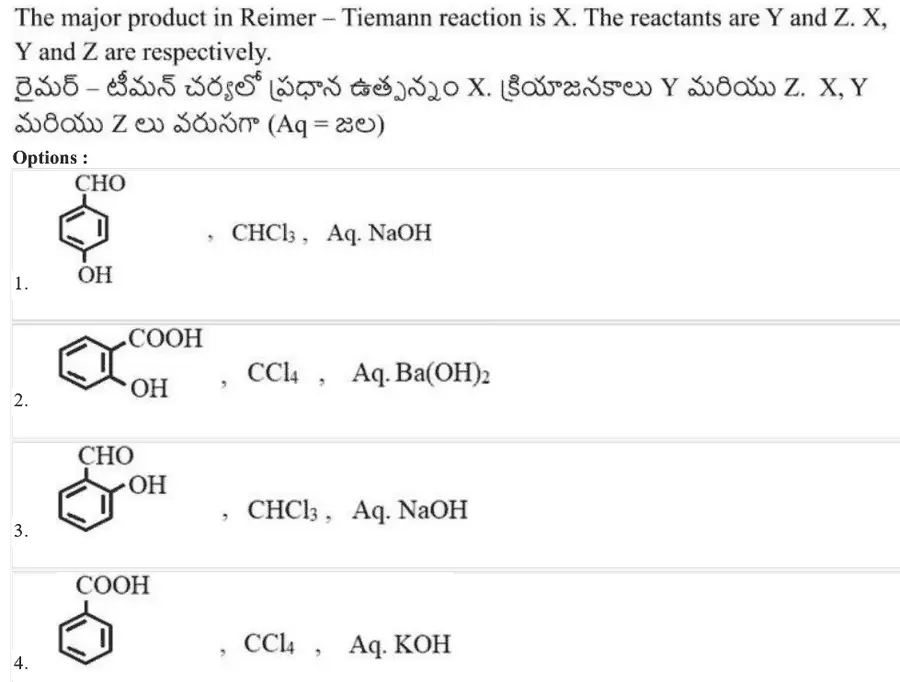
25TS EAPCET 2025 · 2 May · Shift 2MCQOpen question page ↗

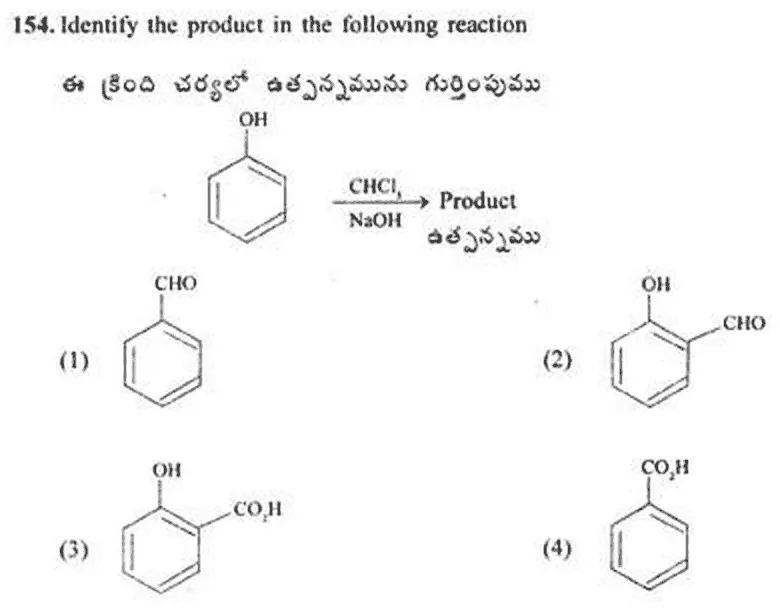
The major product in Reimer – Tiemann reaction is X. The reactants are Y and Z. X, Y and Z are respectively.

The question and its figure as printed in TG EAPCET 2025 02 May AN. Option 1: 4-hydroxybenzaldehyde (benzene ring with CHO and OH para to each other), CHCl3, Aq. NaOH Option 2: salicylic acid (benzene ring with COOH and OH ortho to each other), CCl4, Aq. Ba(OH)2 Option 3: salicylaldehyde (benzene ring with CHO and OH ortho to each other), CHCl3, Aq. NaOH Option 4: benzoic acid (benzene ring with COOH), CCl4, Aq. KOH
The question as printed in the paper.
  • A

    see figure 4-hydroxybenzaldehyde (benzene ring with CHO and OH para to each other), $\mathrm{CHCl_3}$, Aq. NaOH

  • B

    see figure salicylic acid (benzene ring with COOH and OH ortho to each other), $\mathrm{CCl_4}$, Aq. $\mathrm{Ba(OH)_2}$

  • C

    see figure salicylaldehyde (benzene ring with CHO and OH ortho to each other), $\mathrm{CHCl_3}$, Aq. NaOH

  • D

    see figure benzoic acid (benzene ring with COOH), $\mathrm{CCl_4}$, Aq. KOH

26AP EAPCET 2024 · 22 May · Shift 1MCQOpen question page ↗

An organic compound (X) has an empirical formula $\mathrm{C_4H_8O}$. This gives a pale yellow precipitate with iodine in NaOH solution. What is X ?

  • A

    $\mathrm{CH_3\,CH_2\,CH_2\,CHO}$

  • B

    $\mathrm{CH_2=CH\,CH(OH)\,CH_3}$

  • C

    $\mathrm{CH_3-C(=CH_2)-O-CH_3}$ (the carbon bears a double bond to a $\mathrm{CH_2}$ group drawn above it)

  • D

    $\mathrm{CH_3\,CH_2\,O\,CH=CH_2}$

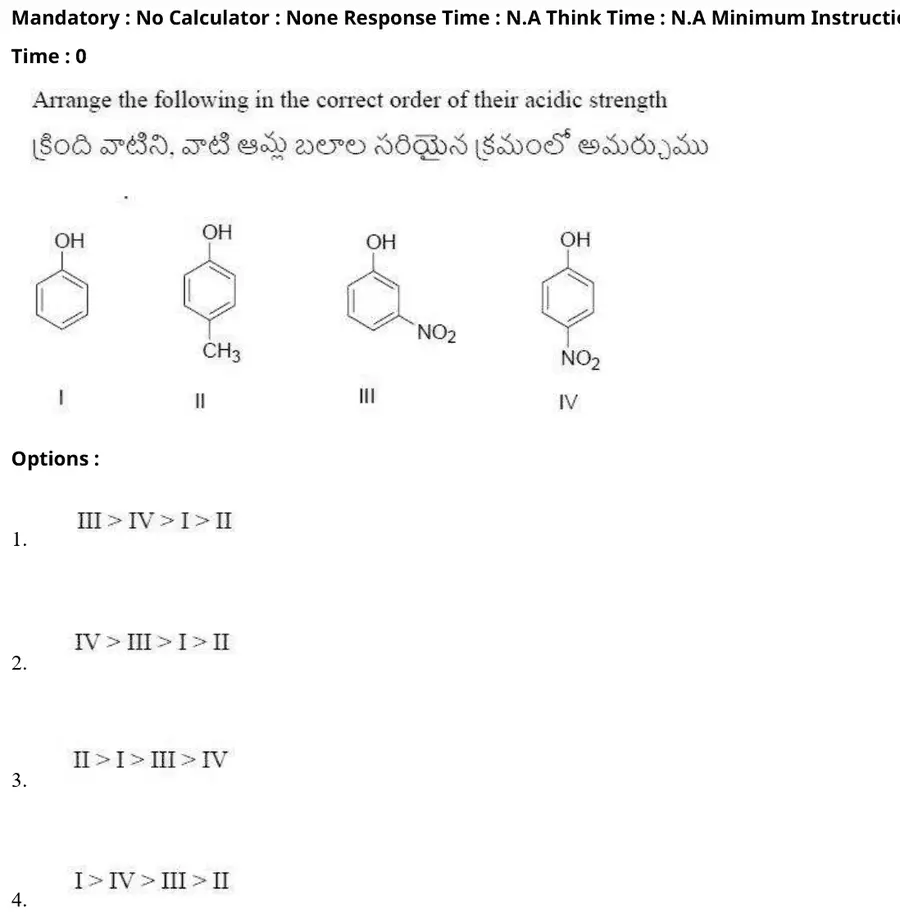
27AP EAPCET 2024 · 22 May · Shift 1MCQOpen question page ↗

Arrange the following in the correct order of their acidic strength

(see the figure above)

The question and its figure as printed in AP EAPCET 2024 22nd May 2024 Shift 1.
The question as printed in the paper.
  • A

    III > IV > I > II

  • B

    IV > III > I > II

  • C

    II > I > III > IV

  • D

    I > IV > III > II

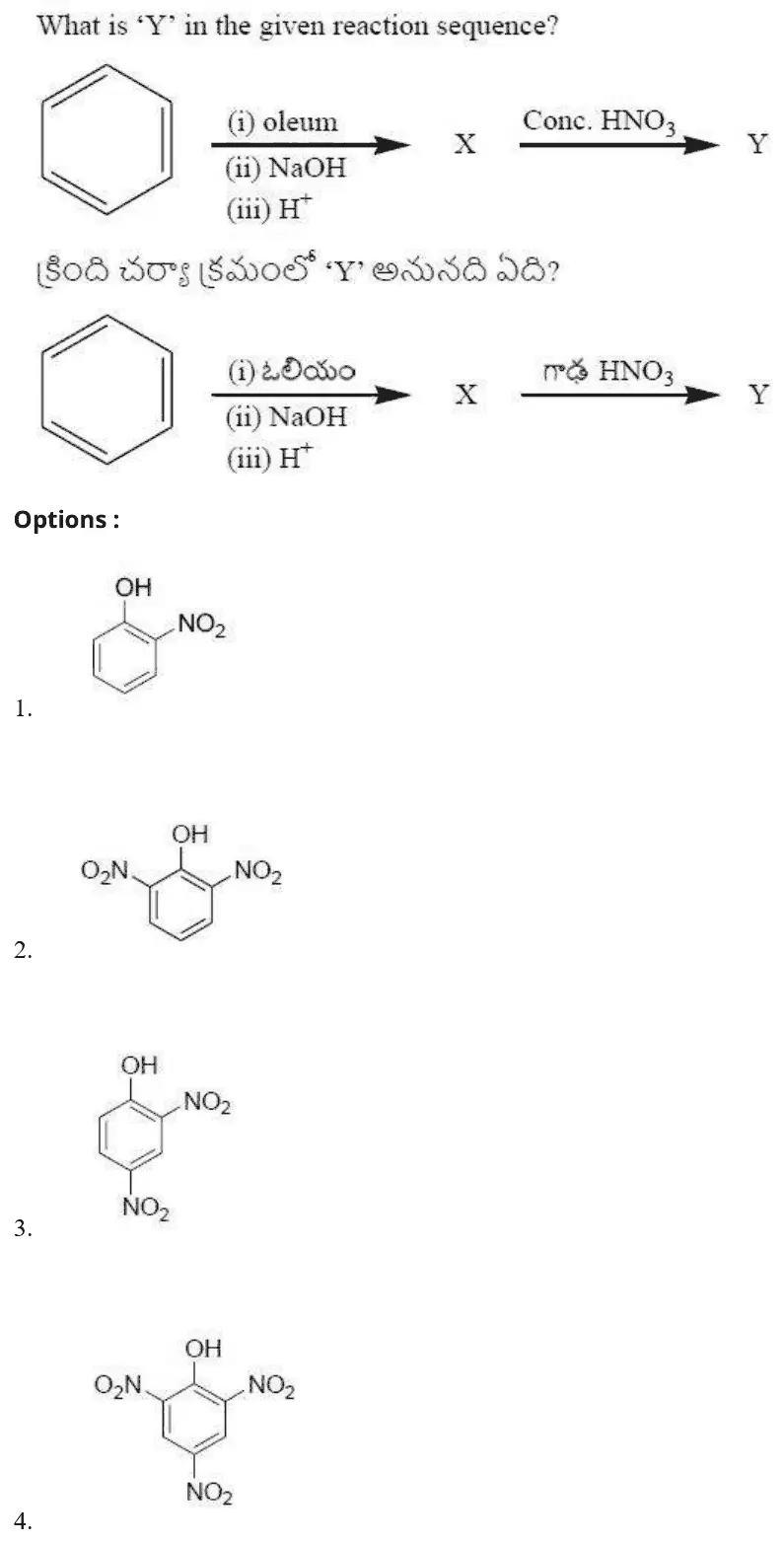
28AP EAPCET 2024 · 22 May · Shift 1MCQOpen question page ↗

What is ‘Y’ in the given reaction sequence?

(see the figure above)

The question and its figure as printed in AP EAPCET 2024 22nd May 2024 Shift 1. Option 1: Benzene ring with OH and NO2 on adjacent carbons (2-nitrophenol) Option 2: Benzene ring with OH at the top carbon and NO2 on both carbons adjacent to it (2,6-dinitrophenol) Option 3: Benzene ring with OH, NO2 on an adjacent (ortho) carbon, and NO2 on the carbon para to OH (2,4-dinitrophenol) Option 4: Benzene ring with OH, NO2 on both ortho carbons, and NO2 para to OH (2,4,6-trinitrophenol)
The question as printed in the paper.
  • A

    see figure Benzene ring with OH and NO$_2$ on adjacent carbons (2-nitrophenol)

  • B

    see figure Benzene ring with OH at the top carbon and NO$_2$ on both carbons adjacent to it (2,6-dinitrophenol)

  • C

    see figure Benzene ring with OH, NO$_2$ on an adjacent (ortho) carbon, and NO$_2$ on the carbon para to OH (2,4-dinitrophenol)

  • D

    see figure Benzene ring with OH, NO$_2$ on both ortho carbons, and NO$_2$ para to OH (2,4,6-trinitrophenol)

29AP EAPCET 2024 · 22 May · Shift 2MCQOpen question page ↗

What is the major product 'Z' in the following reaction sequence?

(see the figure above)

The question and its figure as printed in AP EAPCET 2024 22nd May 2024 Shift 2.
The question as printed in the paper.
  • A

    o- Hydroxy benzaldehyde

  • B

    p- Hydroxy benzaldehyde

  • C

    o- Hydroxy benzoic acid

  • D

    p- Hydroxy benzoic acid

30AP EAPCET 2024 · 21 May · Shift 2MCQOpen question page ↗

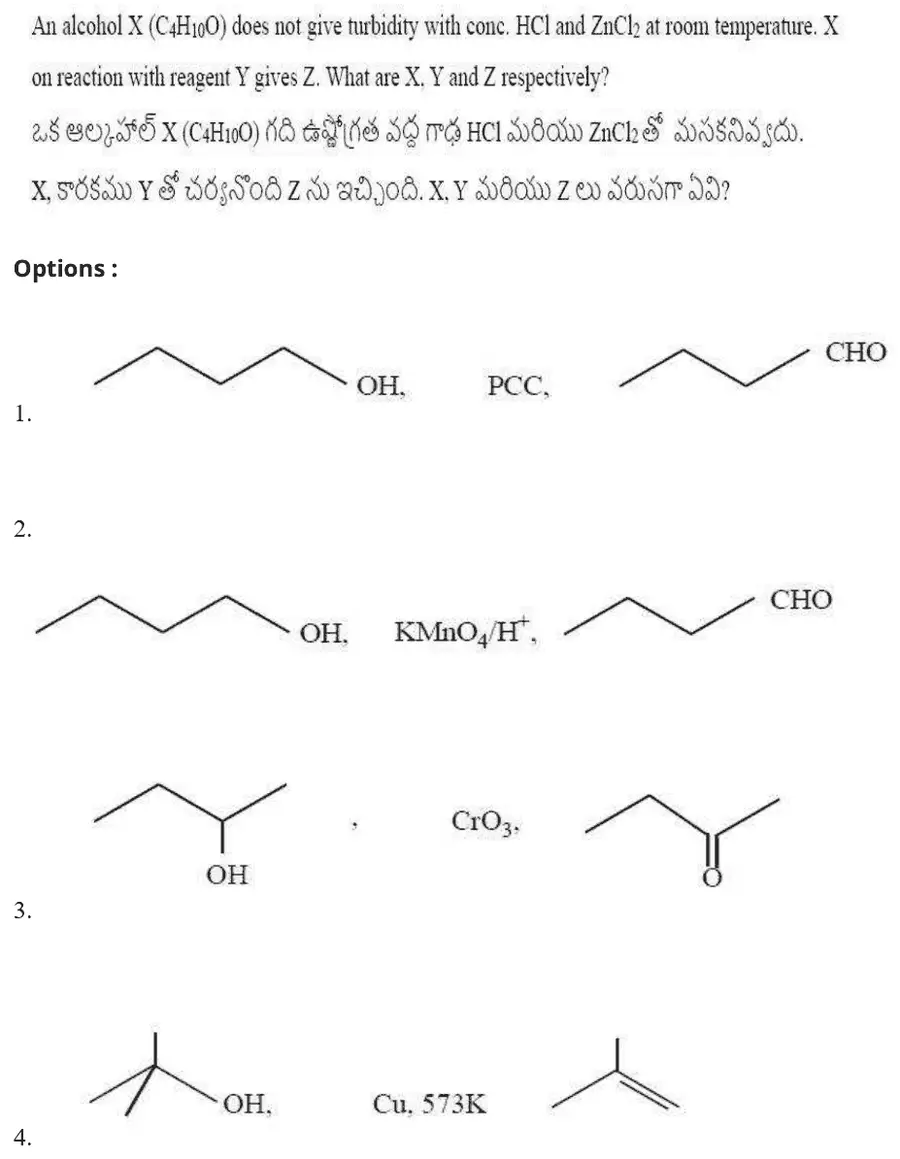
An alcohol X ($\mathrm{C_4H_{10}O}$) does not give turbidity with conc. HCl and $\mathrm{ZnCl_2}$ at room temperature. X on reaction with reagent Y gives Z. What are X, Y and Z respectively?

The question and its figure as printed in AP EAPCET 2024 21st May 2024 Shift 2. Option 1: X: skeletal structure of butan-1-ol (zigzag four-carbon chain with OH on the terminal carbon); Y: PCC; Z: butanal (zigzag chain ending in CHO) Option 2: X: skeletal structure of butan-1-ol (zigzag four-carbon chain with OH on the terminal carbon); Y: KMnO4/H^+; Z: butanal (zigzag chain ending in CHO) Option 3: X: skeletal structure of butan-2-ol (zigzag chain with OH on the second carbon); Y: CrO3; Z: butan-2-one (zigzag chain with C=O on the second carbon) Option 4: X: skeletal structure of tert-butyl alcohol (2-methylpropan-2-ol, OH on the quaternary carbon); Y: Cu, 573 K; Z: 2-methylpropene…
The question as printed in the paper.
  • A

    see figure X: skeletal structure of butan-1-ol (zigzag four-carbon chain with OH on the terminal carbon); Y: PCC; Z: butanal (zigzag chain ending in CHO)

  • B

    see figure X: skeletal structure of butan-1-ol (zigzag four-carbon chain with OH on the terminal carbon); Y: $\mathrm{KMnO_4/H^+}$; Z: butanal (zigzag chain ending in CHO)

  • C

    see figure X: skeletal structure of butan-2-ol (zigzag chain with OH on the second carbon); Y: $\mathrm{CrO_3}$; Z: butan-2-one (zigzag chain with C=O on the second carbon)

  • D

    see figure X: skeletal structure of tert-butyl alcohol (2-methylpropan-2-ol, OH on the quaternary carbon); Y: Cu, 573 K; Z: 2-methylpropene (isobutene)

31AP EAPCET 2024 · 19 May · Shift 2MCQOpen question page ↗

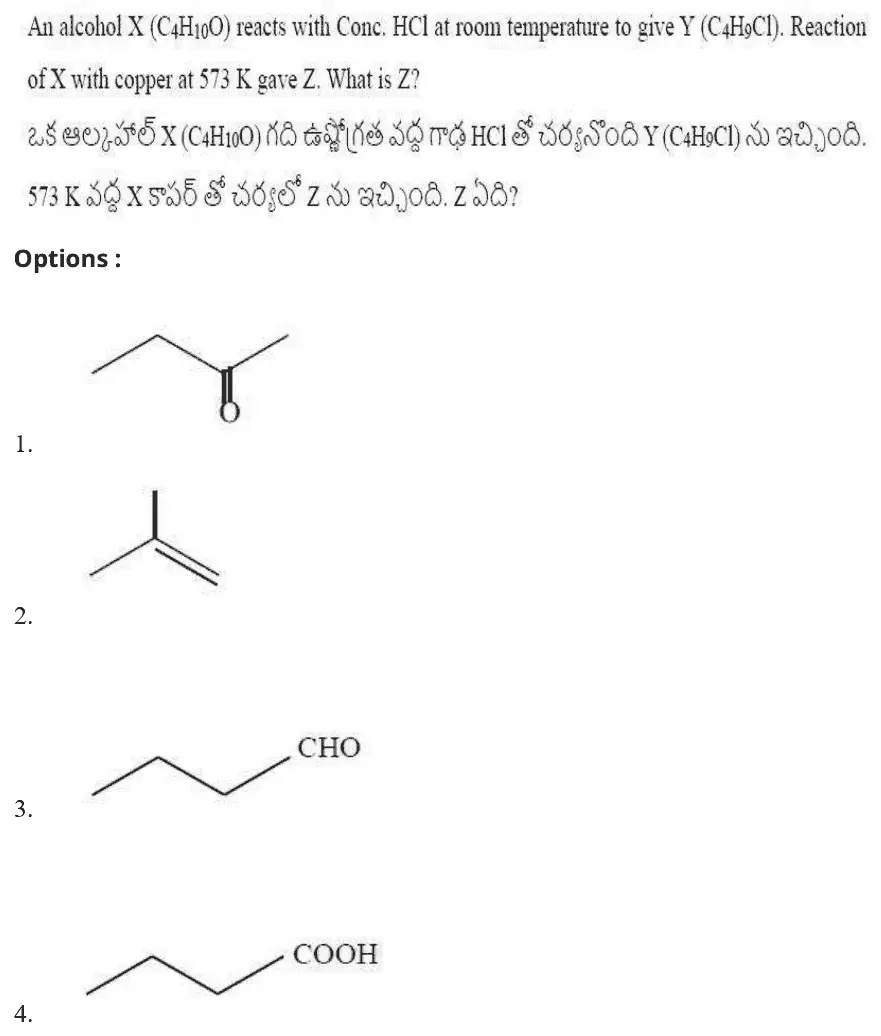
An alcohol X ($\mathrm{C_4H_{10}O}$) reacts with Conc. HCl at room temperature to give Y ($\mathrm{C_4H_9Cl}$). Reaction of X with copper at 573 K gave Z. What is Z?

The question and its figure as printed in AP EAPCET 2024 19th May 2024 Shift 2. Option 1: Skeletal structure of butan-2-one: a zigzag chain of three bonds with a C=O (drawn with a double bond and an O label) at the middle carbon, pointing downward. Option 2: Skeletal structure of 2-methylpropene: a vertical line (methyl) attached to a central carbon, with a double bond going down-right and a single line going to the left. Option 3: Skeletal structure of butanal: a zigzag chain ending in CHO on the right. Option 4: Skeletal structure of butanoic acid: a zigzag chain ending in COOH on the right.
The question as printed in the paper.
  • A

    see figure Skeletal structure of butan-2-one: a zigzag chain of three bonds with a C=O (drawn with a double bond and an O label) at the middle carbon, pointing downward.

  • B

    see figure Skeletal structure of 2-methylpropene: a vertical line (methyl) attached to a central carbon, with a double bond going down-right and a single line going to the left.

  • C

    see figure Skeletal structure of butanal: a zigzag chain ending in CHO on the right.

  • D

    see figure Skeletal structure of butanoic acid: a zigzag chain ending in COOH on the right.

32TS EAPCET 2024 · 11 May · Shift 1MCQOpen question page ↗

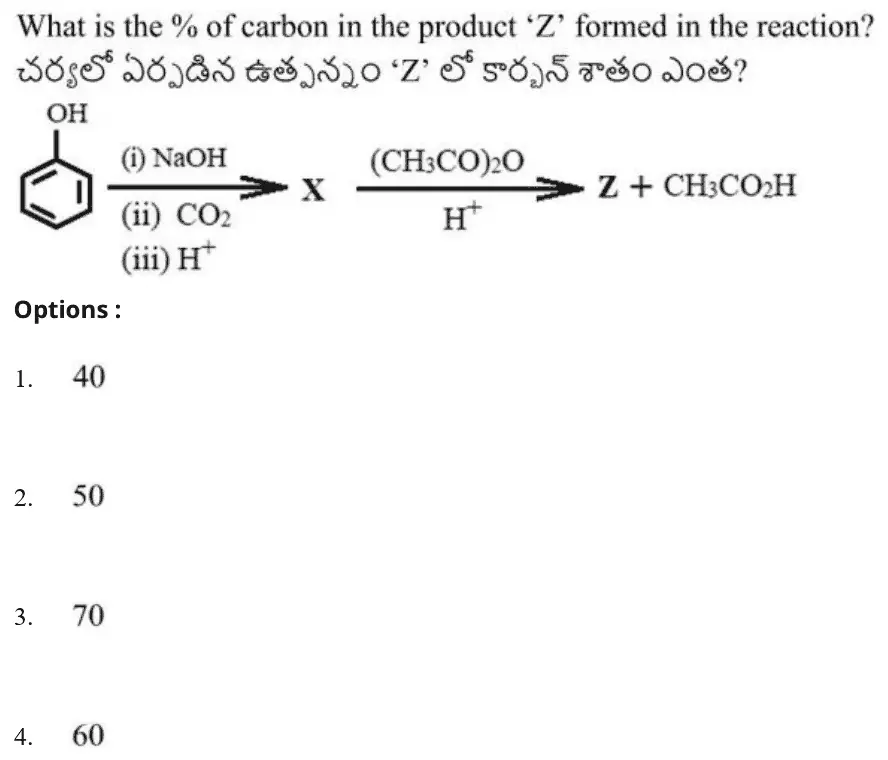
What is the % of carbon in the product 'Z' formed in the reaction?

(see the figure above)

The question and its figure as printed in TS EAPCET 2024 11th May 2024 Shift 1.
The question as printed in the paper.
  • A

    40

  • B

    50

  • C

    70

  • D

    60

33TS EAPCET 2024 · 11 May · Shift 1MCQOpen question page ↗

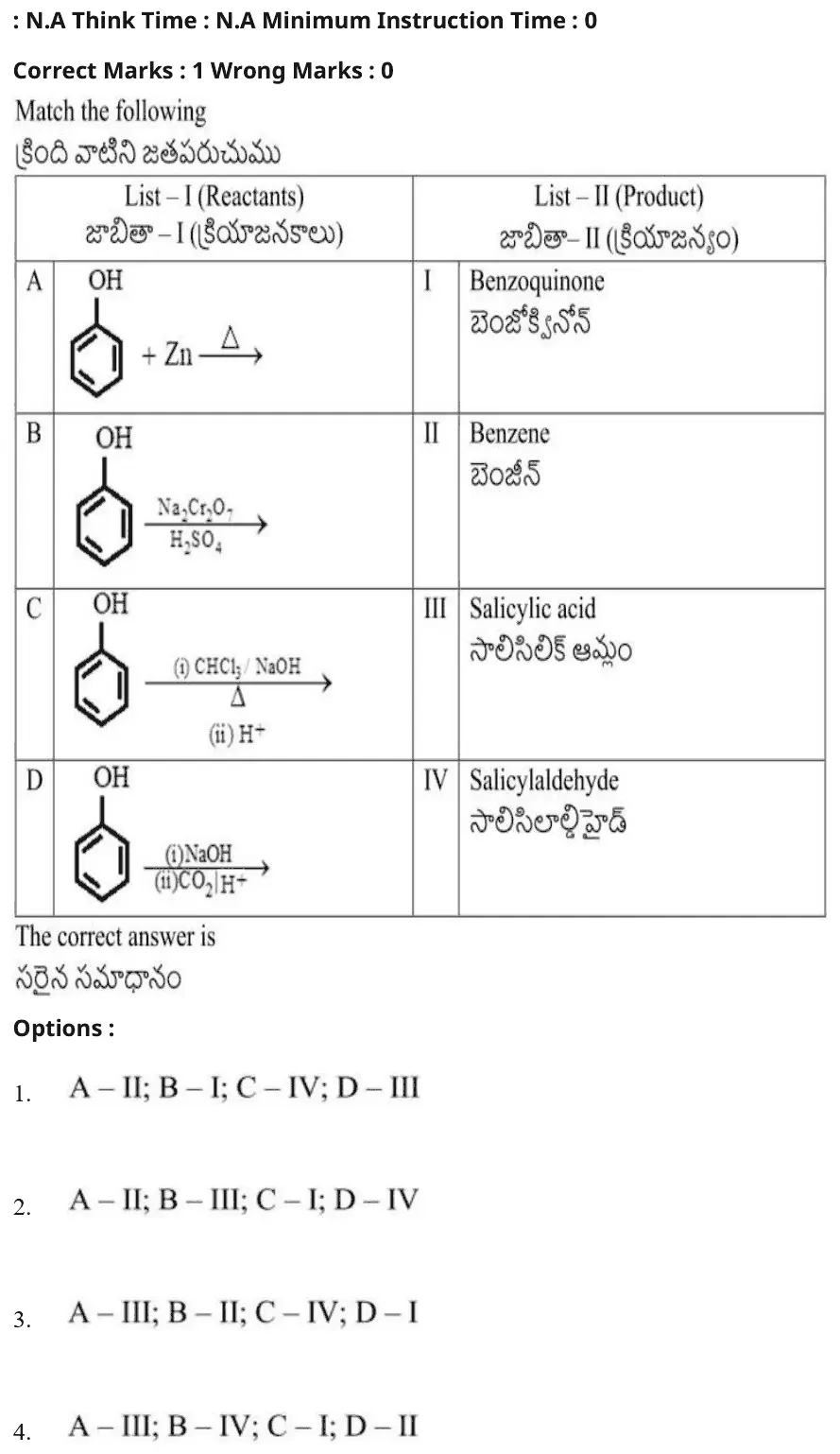
Match the following

List – I (Reactants)List – II (Product)
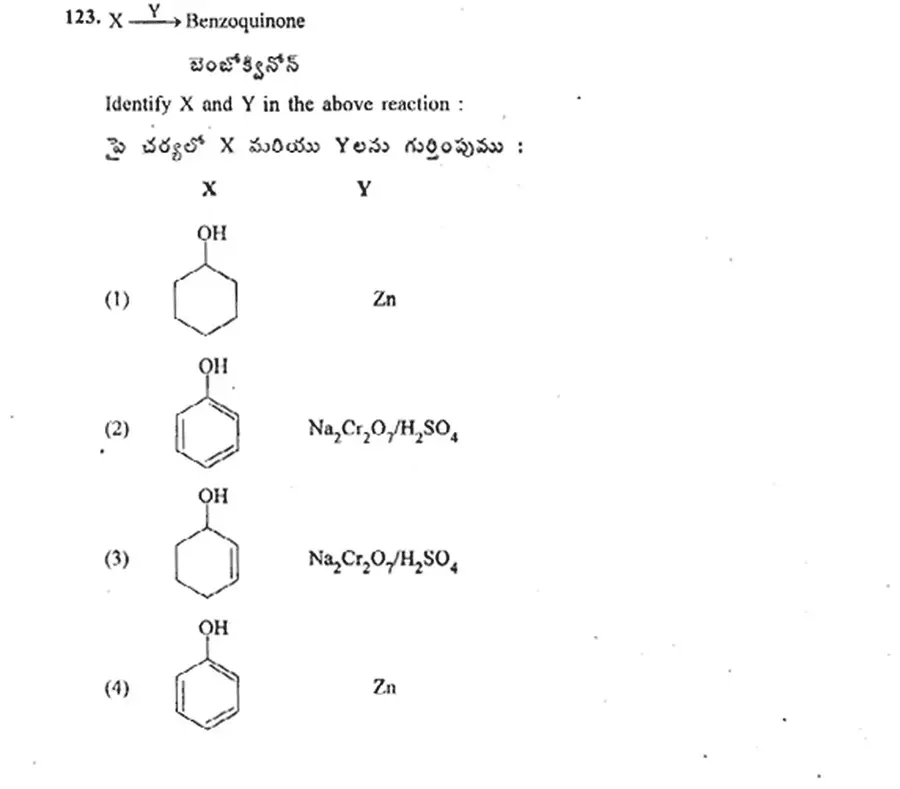
A(see the figure above) (phenol) $+ \mathrm{Zn} \xrightarrow{\Delta}$IBenzoquinone
B(see the figure above) (phenol) $\xrightarrow[\mathrm{H_2SO_4}]{\mathrm{Na_2Cr_2O_7}}$IIBenzene
C(see the figure above) (phenol) $\xrightarrow[\text{(ii) } \mathrm{H^+}]{\text{(i) } \mathrm{CHCl_3}/\mathrm{NaOH},\ \Delta}$IIISalicylic acid
D(see the figure above) (phenol) $\xrightarrow[\text{(ii) } \mathrm{CO_2}|\mathrm{H^+}]{\text{(i) } \mathrm{NaOH}}$IVSalicylaldehyde

The correct answer is

The question and its figure as printed in TS EAPCET 2024 11th May 2024 Shift 1.
The question as printed in the paper.
  • A

    A – II; B – I; C – IV; D – III

  • B

    A – II; B – III; C – I; D – IV

  • C

    A – III; B – II; C – IV; D – I

  • D

    A – III; B – IV; C – I; D – II

34TS EAPCET 2024 · 10 May · Shift 1MCQOpen question page ↗

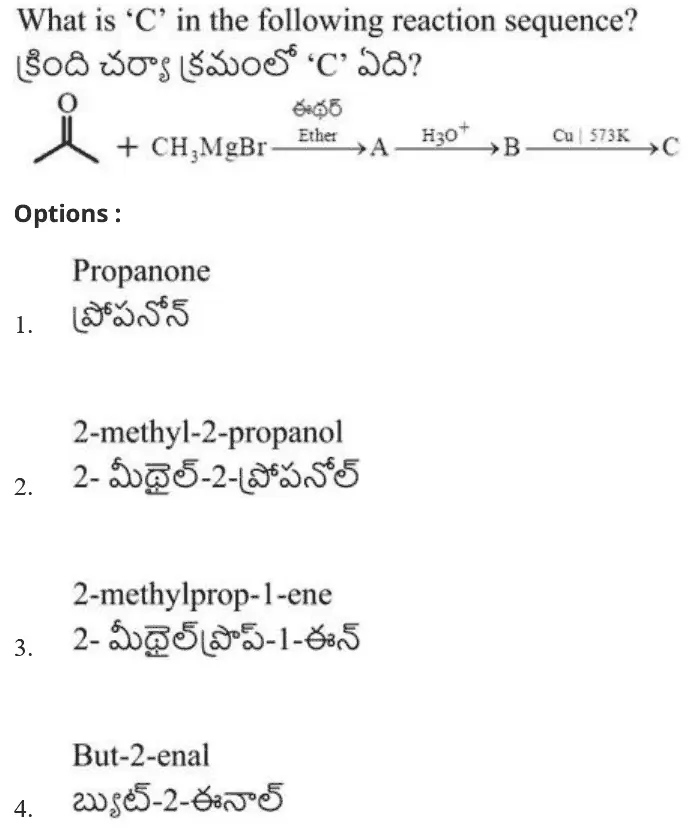
What is ‘C’ in the following reaction sequence?

(see the figure above)

The question and its figure as printed in TS EAPCET 2024 10th May 2024 Shift 1.
The question as printed in the paper.
  • A

    Propanone

  • B

    2-methyl-2-propanol

  • C

    2-methylprop-1-ene

  • D

    But-2-enal

35TS EAPCET 2024 · 10 May · Shift 1MCQOpen question page ↗

Identify the products R and S in the reaction sequence given

$$\mathrm{(CH_3)_3COH \xrightarrow{Na} P \xrightarrow{CH_3Br} Q \xrightarrow[\Delta]{HI} R + S}$$

  • A

    $\mathrm{(CH_3)_3CI, CH_3OH}$

  • B

    $\mathrm{(CH_3)_3COH, CH_3I}$

  • C

    $\mathrm{(CH_3)_3COH, CH_3OH}$

  • D

    $\mathrm{(CH_3)_2C=CH_2, CH_3OH}$

36TS EAPCET 2024 · 10 May · Shift 2MCQOpen question page ↗

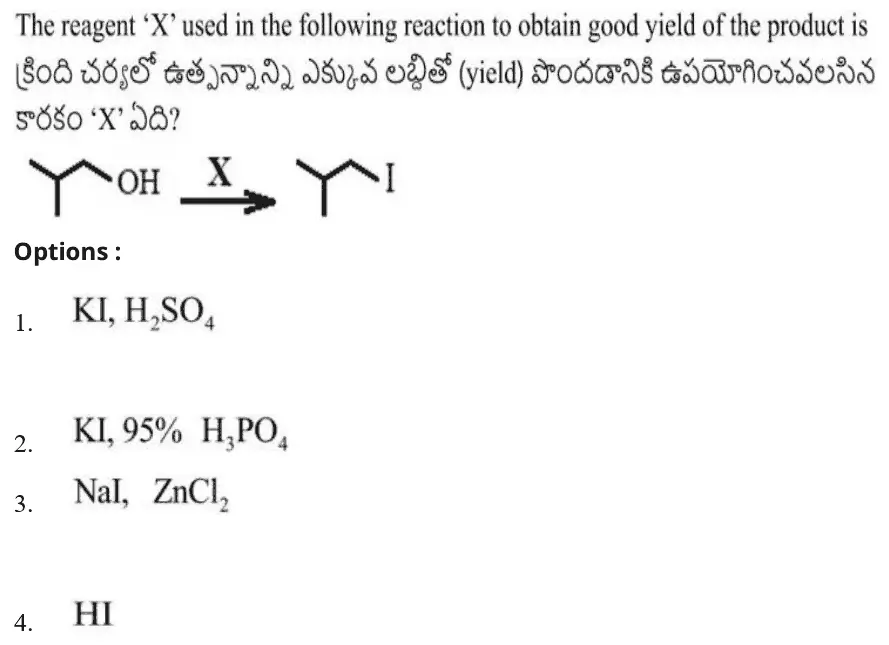
The reagent ‘X’ used in the following reaction to obtain good yield of the product is

(see the figure above)

The question and its figure as printed in TS EAPCET 2024 10th May 2024 Shift 2.
The question as printed in the paper.
  • A

    $\mathrm{KI, H_2SO_4}$

  • B

    $\mathrm{KI, 95\%\ H_3PO_4}$

  • C

    $\mathrm{NaI,\ ZnCl_2}$

  • D

    $\mathrm{HI}$

37TS EAPCET 2024 · 10 May · Shift 2MCQOpen question page ↗

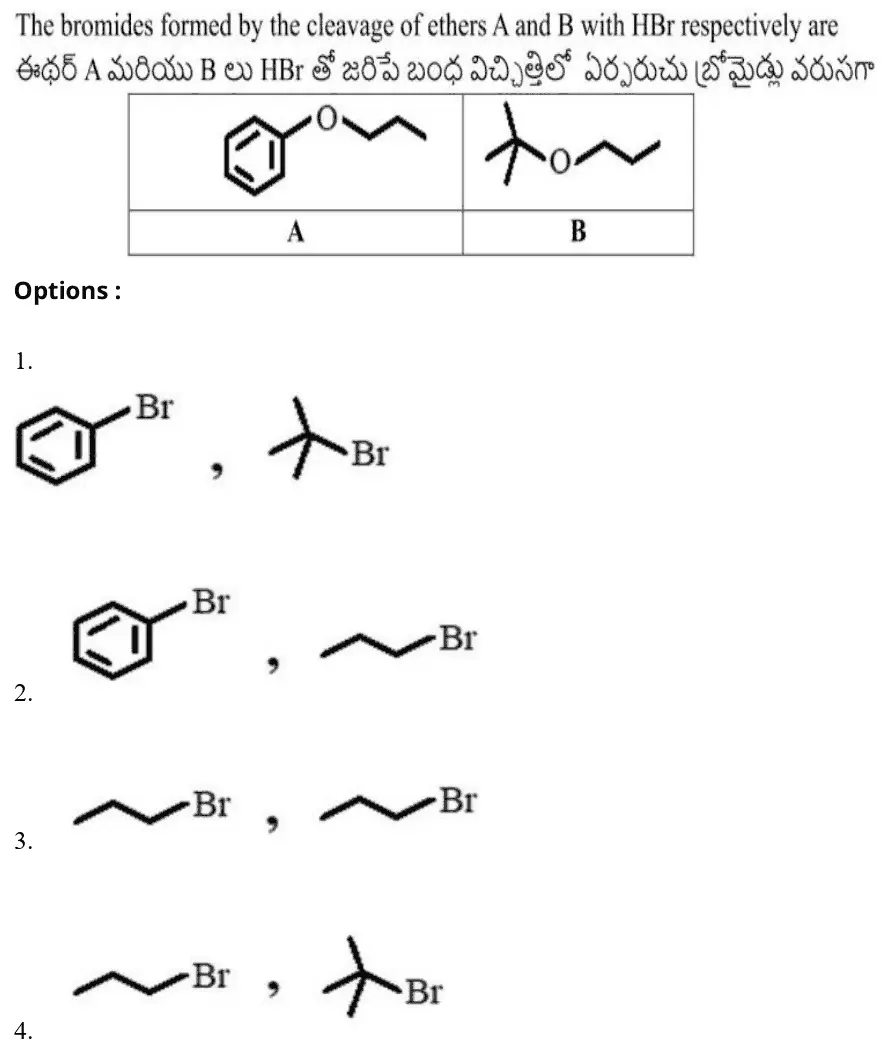
The bromides formed by the cleavage of ethers A and B with HBr respectively are

(see the figure above)(see the figure above)
AB
The question and its figure as printed in TS EAPCET 2024 10th May 2024 Shift 2. Option 1: Bromobenzene, and tert-butyl bromide (skeletal structure) Option 2: Bromobenzene, and n-propyl bromide (skeletal structure, Br at the end of a three-carbon zigzag chain) Option 3: n-propyl bromide, and n-propyl bromide (both skeletal zigzag chains with Br at the end) Option 4: n-propyl bromide, and tert-butyl bromide (skeletal structures)
The question as printed in the paper.
  • A

    see figure Bromobenzene, and tert-butyl bromide (skeletal structure)

  • B

    see figure Bromobenzene, and n-propyl bromide (skeletal structure, Br at the end of a three-carbon zigzag chain)

  • C

    see figure n-propyl bromide, and n-propyl bromide (both skeletal zigzag chains with Br at the end)

  • D

    see figure n-propyl bromide, and tert-butyl bromide (skeletal structures)

38TS EAPCET 2024 · 9 May · Shift 1MCQOpen question page ↗

A halogen compound X $(\mathrm{C_4H_9Br})$ on hydrolysis gave alcohol Y. The alcohol Y undergoes dehydration with 20% $\mathrm{H_3PO_4}$ at 358 K. What is X?

  • A

    $\mathrm{(CH_3)_3CBr}$

  • B

    $\mathrm{(CH_3)_2CHCH_2Br}$

  • C

    $\mathrm{CH_3CH_2CH_2CH_2Br}$

  • D

    $\mathrm{CH_3CH(Br)CH_2CH_3}$

39TS EAPCET 2024 · 9 May · Shift 1MCQOpen question page ↗

An alcohol X($\mathrm{C_5H_{12}O}$) when reacted with conc. HCl and anhydrous $\mathrm{ZnCl_2}$ produces turbidity instantly. The alcohol X can be prepared from which of the following reactions?

  • A

    Reduction of 2-pentanone with $\mathrm{NaBH_4}$

  • B

    Reaction of isopropyl magnesium bromide with ethanal

  • C

    Reaction of ethyl magnesium bromide with propanal

  • D

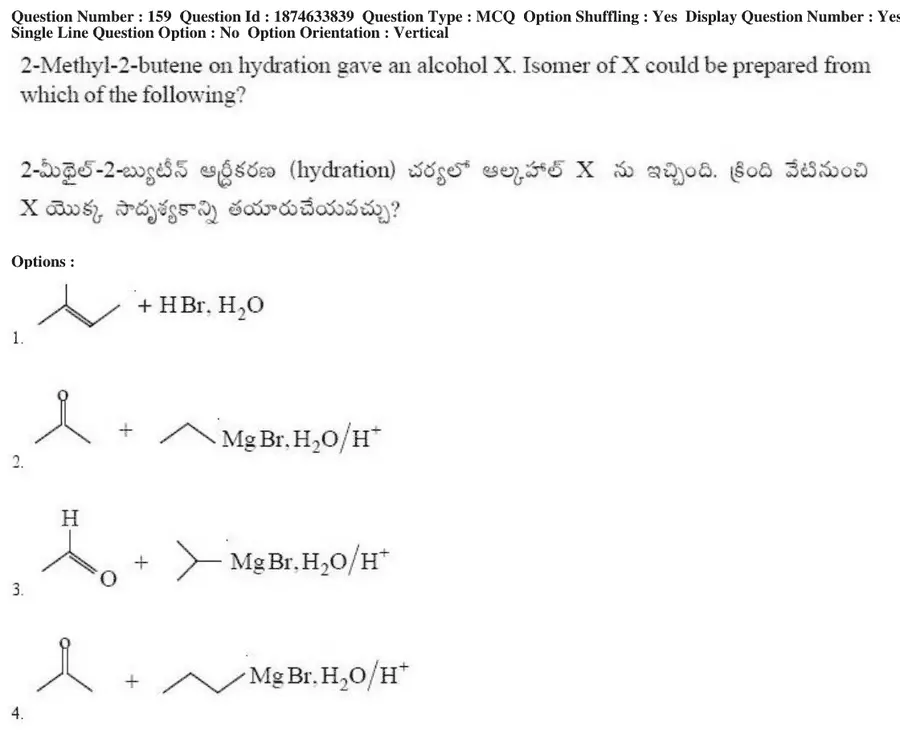
    Acid catalysed hydration of 2-methyl-1-butene

40TS EAPCET 2024 · 9 May · Shift 1MCQOpen question page ↗

Assertion (A) : Chlorobenzene is not formed in the reaction of phenol with thionyl chloride

Reason (R) : In phenol, carbon – oxygen bond has partial double bond character

The correct answer is

  • A

    (A) and (R) are correct. (R) is the correct explanation of (A)

  • B

    (A) and (R) are correct, but (R) is not the correct explanation of (A)

  • C

    (A) is correct but (R) is not correct

  • D

    (A) is not correct but (R) is correct

41TS EAPCET 2024 · 9 May · Shift 1MCQOpen question page ↗

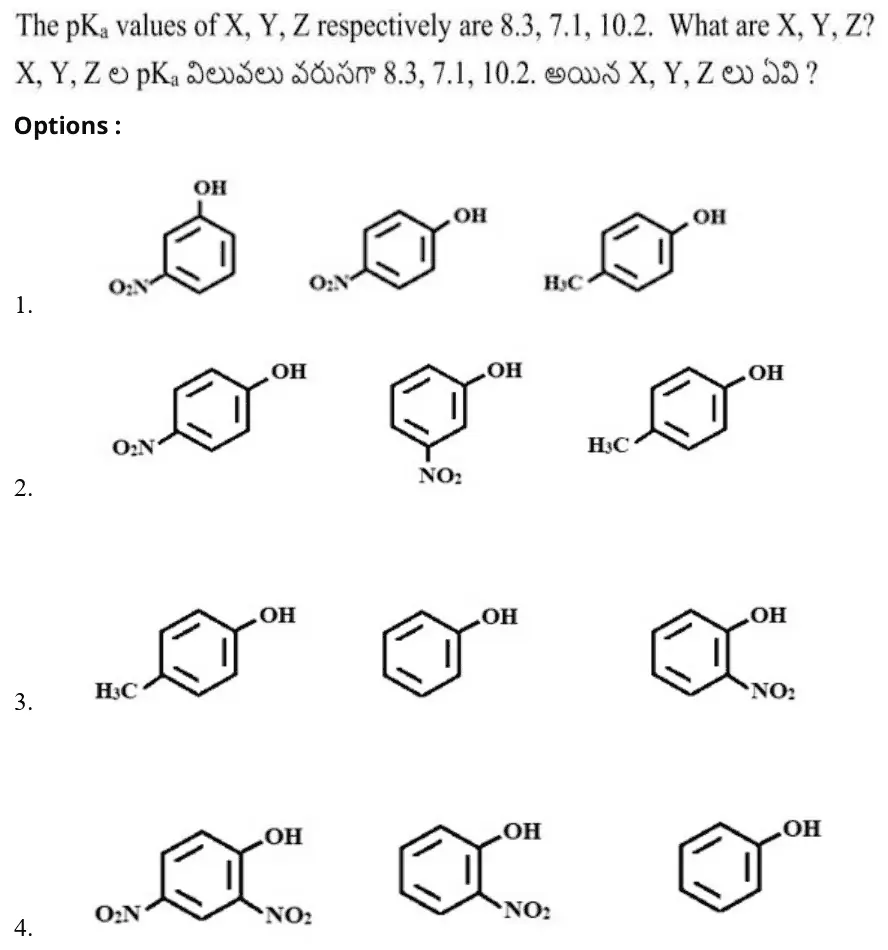
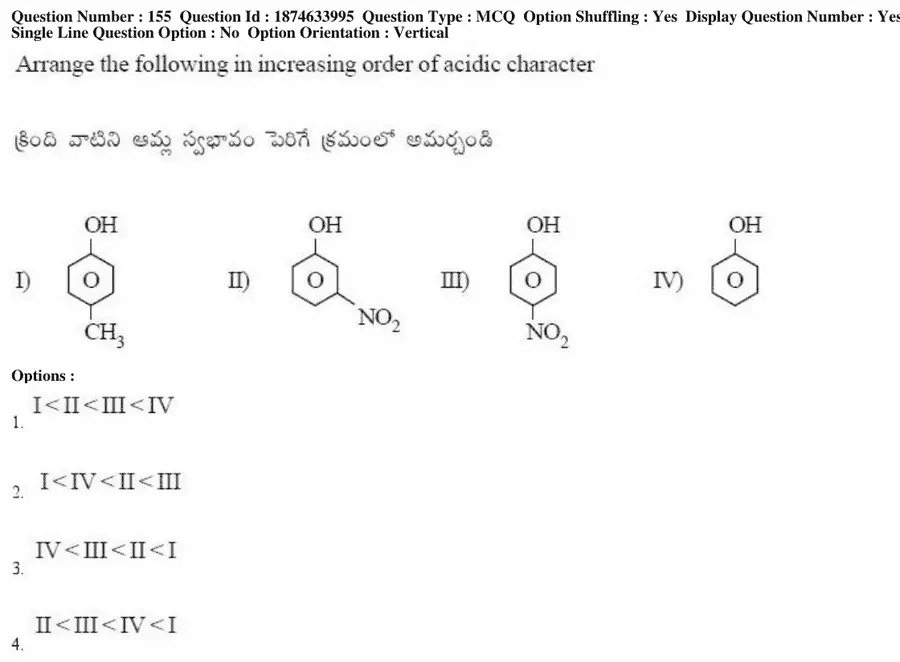
The $\mathrm{pK_a}$ values of X, Y, Z respectively are 8.3, 7.1, 10.2. What are X, Y, Z?

The question and its figure as printed in TS EAPCET 2024 09th May 2024 Shift 1. Option 1: Three phenol structures: (i) 3-nitrophenol (OH at top, O2N at meta position); (ii) 4-nitrophenol (OH at upper right, O2N at para position); (iii) 4-methylphenol (OH at upper right, H3C at para position) Option 2: Three phenol structures: (i) 4-nitrophenol (OH at upper right, O2N at para position); (ii) 3-nitrophenol (OH at upper right, NO2 at bottom, meta position); (iii) 4-methylphenol (OH at upper right, H3C at para position) Option 3: Three phenol structures: (i) 4-methylphenol (OH at upper right, H3C at para position); (ii) phenol (OH only); (iii) 2-nitrophenol (OH at upper right, NO2 at adjacent…
The question as printed in the paper.
  • A

    see figure Three phenol structures: (i) 3-nitrophenol (OH at top, $\mathrm{O_2N}$ at meta position); (ii) 4-nitrophenol (OH at upper right, $\mathrm{O_2N}$ at para position); (iii) 4-methylphenol (OH at upper right, $\mathrm{H_3C}$ at para position)

  • B

    see figure Three phenol structures: (i) 4-nitrophenol (OH at upper right, $\mathrm{O_2N}$ at para position); (ii) 3-nitrophenol (OH at upper right, $\mathrm{NO_2}$ at bottom, meta position); (iii) 4-methylphenol (OH at upper right, $\mathrm{H_3C}$ at para position)

  • C

    see figure Three phenol structures: (i) 4-methylphenol (OH at upper right, $\mathrm{H_3C}$ at para position); (ii) phenol (OH only); (iii) 2-nitrophenol (OH at upper right, $\mathrm{NO_2}$ at adjacent ortho position)

  • D

    see figure Three phenol structures: (i) 2,4-dinitrophenol (OH at upper right, $\mathrm{NO_2}$ at ortho position, $\mathrm{O_2N}$ at para position); (ii) 2-nitrophenol (OH at upper right, $\mathrm{NO_2}$ at ortho position); (iii) phenol (OH only)

42TS EAPCET 2024 · 9 May · Shift 2MCQOpen question page ↗

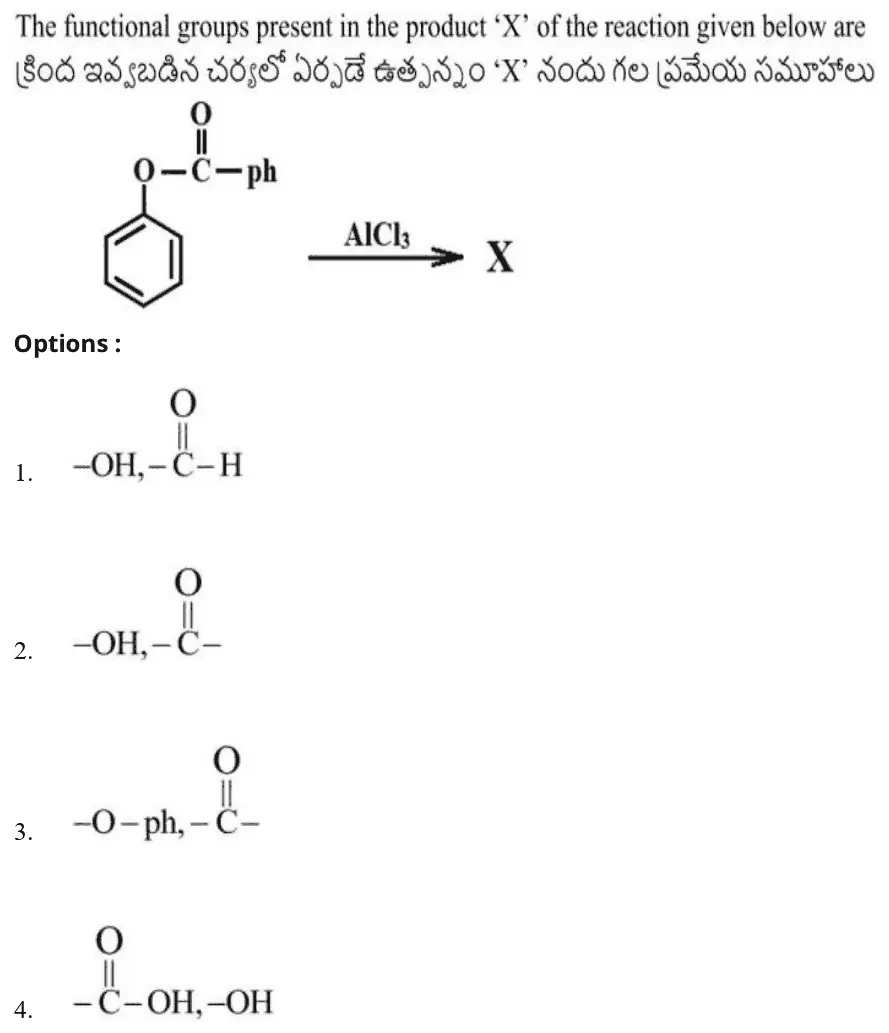
The functional groups present in the product ‘X’ of the reaction given below are

(see the figure above)

The question and its figure as printed in TS EAPCET 2024 09th May 2024 Shift 2.
The question as printed in the paper.
  • A

    $-\mathrm{OH}$, $-\mathrm{C(=O)-H}$ [FIGURE: –OH, and an aldehyde group drawn as –C(=O)–H, with O double-bonded above the C]

  • B

    $-\mathrm{OH}$, $-\mathrm{C(=O)-}$ [FIGURE: –OH, and a carbonyl group drawn as –C(=O)–, with O double-bonded above the C]

  • C

    $-\mathrm{O-ph}$, $-\mathrm{C(=O)-}$ [FIGURE: –O–ph, and a carbonyl group drawn as –C(=O)–, with O double-bonded above the C]

  • D

    $-\mathrm{C(=O)-OH}$, $-\mathrm{OH}$ [FIGURE: carboxylic acid group drawn as –C(=O)–OH with O double-bonded above the C, then –OH]

43AP EAPCET 2023 · 19 May · Shift 1MCQOpen question page ↗

Reaction of phenol with which of the following reagents form picric acid?

  • A

    Conc. $\mathrm{H_2SO_4}$

  • B

    dil. $\mathrm{H_2SO_4}$

  • C

    Conc. $\mathrm{HNO_3}$

  • D

    dil. $\mathrm{HNO_3}$

44AP EAPCET 2023 · 18 May · Shift 1MCQOpen question page ↗

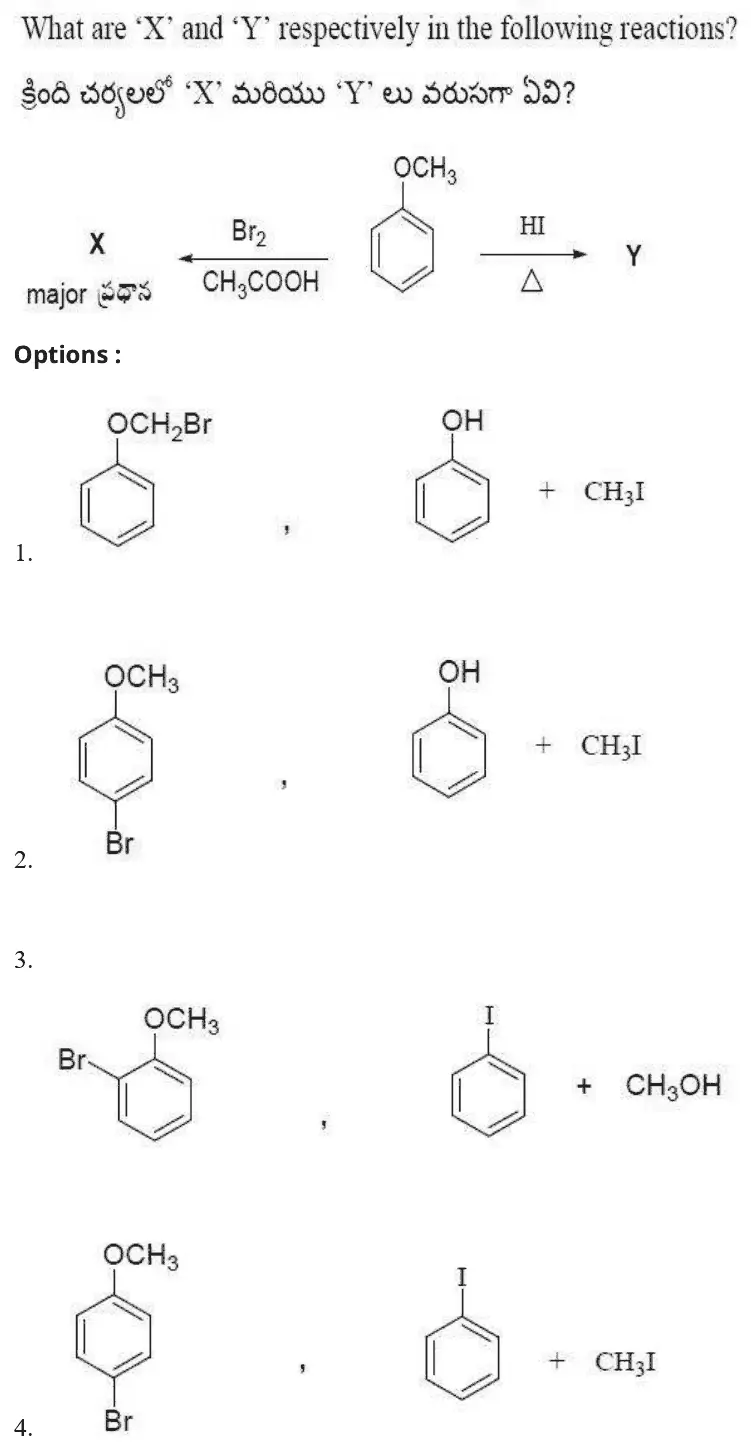
What are 'X' and 'Y' respectively in the following reactions?

(see the figure above)

The question and its figure as printed in AP EAPCET 2023 18th May 2023 Shift 1. Option 1: X: benzene ring bearing OCH2Br (benzyl-type ether, bromomethoxybenzene); Y: phenol (benzene ring with OH) + CH3I Option 2: X: benzene ring with OCH3 at the top and Br at the para (bottom) position; Y: phenol (benzene ring with OH) + CH3I Option 3: X: benzene ring with OCH3 at the top and Br at the ortho (adjacent, upper left) position; Y: iodobenzene (benzene ring with I) + CH3OH Option 4: X: benzene ring with OCH3 at the top and Br at the para (bottom) position; Y: iodobenzene (benzene ring with I) + CH3I
The question as printed in the paper.
  • A

    see figure X: benzene ring bearing $\mathrm{OCH_2Br}$ (benzyl-type ether, bromomethoxybenzene); Y: phenol (benzene ring with OH) $+\ \mathrm{CH_3I}$

  • B

    see figure X: benzene ring with $\mathrm{OCH_3}$ at the top and Br at the para (bottom) position; Y: phenol (benzene ring with OH) $+\ \mathrm{CH_3I}$

  • C

    see figure X: benzene ring with $\mathrm{OCH_3}$ at the top and Br at the ortho (adjacent, upper left) position; Y: iodobenzene (benzene ring with I) $+\ \mathrm{CH_3OH}$

  • D

    see figure X: benzene ring with $\mathrm{OCH_3}$ at the top and Br at the para (bottom) position; Y: iodobenzene (benzene ring with I) $+\ \mathrm{CH_3I}$

45AP EAPCET 2023 · 18 May · Shift 1MCQOpen question page ↗

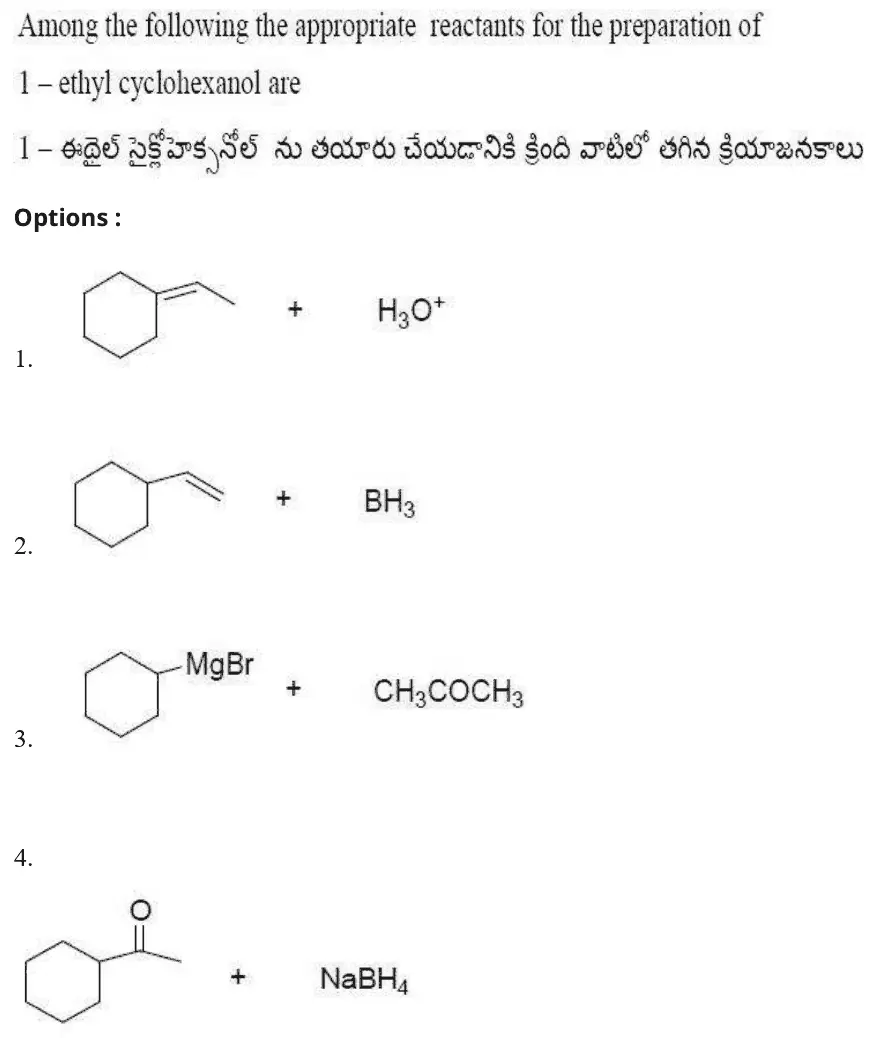
Among the following the appropriate reactants for the preparation of 1 – ethyl cyclohexanol are

The question and its figure as printed in AP EAPCET 2023 18th May 2023 Shift 1. Option 1: Ethylidenecyclohexane (cyclohexane ring with an exocyclic C=C double bond to a CH–CH3 group) + H3O^+ Option 2: Vinylcyclohexane (cyclohexane ring attached to a CH=CH2 group) + BH3 Option 3: Cyclohexylmagnesium bromide (cyclohexane ring bearing MgBr) + CH3COCH3 Option 4: Cyclohexyl methyl ketone (cyclohexane ring attached to C(=O)CH3) + NaBH4
The question as printed in the paper.
  • A

    see figure Ethylidenecyclohexane (cyclohexane ring with an exocyclic C=C double bond to a CH–CH3 group) + $\mathrm{H_3O^+}$

  • B

    see figure Vinylcyclohexane (cyclohexane ring attached to a CH=CH2 group) + $\mathrm{BH_3}$

  • C

    see figure Cyclohexylmagnesium bromide (cyclohexane ring bearing MgBr) + $\mathrm{CH_3COCH_3}$

  • D

    see figure Cyclohexyl methyl ketone (cyclohexane ring attached to C(=O)CH3) + $\mathrm{NaBH_4}$

46AP EAPCET 2023 · 18 May · Shift 2MCQOpen question page ↗

Identify the correct products, when ethanol reacts with $\mathrm{PCl_5}$

  • A

    Chloroethane, Hydrochloric acid and Phosphorus acid

  • B

    Chloroethane, Hydrochloric acid and Phosphoric acid

  • C

    Chloroethane, Sulfuric acid and Phosphorous oxy chloride

  • D

    Chloroethane, Hydrochloric acid and Phosphorous oxy chloride

47AP EAPCET 2023 · 16 May · Shift 2MCQOpen question page ↗

Which of the following is the major product, when p - cresol is treated with zinc dust?

  • A

    Toluene

  • B

    Heptane

  • C

    Methyl cyclohexanol

  • D

    Methyl cyclohexane

48AP EAPCET 2023 · 15 May · Shift 2MCQOpen question page ↗

Which of the following reaction is not feasible?

  • A

    $\mathrm{CH_3-CH_2-OH}$ --(95% $\mathrm{H_2SO_4}$, 443 K)--> $\mathrm{CH_2=CH_2}$

  • B

    $\mathrm{H_3C-CH_2-CH_2-CH_2-OH}$ --(75% $\mathrm{H_2SO_4}$, 300 K)--> $\mathrm{CH_3-CH_2-CH=CH_2}$

  • C

    $\mathrm{H_3C-CH_2-CH(OH)-CH_3}$ --(85% $\mathrm{H_3PO_4}$, 440 K)--> $\mathrm{CH_3-CH=CH-CH_3}$

  • D

    $\mathrm{(CH_3)_3C-OH}$ (tert-butyl alcohol: central C bearing CH3 above, CH3 below, CH3 on the left and OH on the right) --(20% $\mathrm{H_3PO_4}$, 358 K)--> $\mathrm{(CH_3)_2C=CH_2}$ (central C bearing CH3 above, CH3 on the left, and =CH2 on the right)

49AP EAPCET 2023 · 15 May · Shift 2MCQOpen question page ↗

Which of the following has more $\mathrm{pK_a}$ value?

  • A

    2-Nitrophenol

  • B

    3-Nitrophenol

  • C

    4-Nitrophenol

  • D

    2,4-Dinitrophenol

50TS EAPCET 2023 · 13 May · Shift 1MCQOpen question page ↗

1-Propanol can be distinguished from 2-propanol by which test?

  • A

    2,4-DNP test

  • B

    Tollens’ test

  • C

    Lucas test

  • D

    Fehling’s test

51TS EAPCET 2023 · 13 May · Shift 2MCQOpen question page ↗

An alkene X with formula $\mathrm{C_4H_8}$ does not exhibit geometrical isomerism. In the conversion of X to Y, the correct sequence of reagents A and B used are (Y gives iodoform test)

  • A

    $\mathrm{BH_3, H_2O_2/OH^-}$ , PCC

  • B

    $\mathrm{H_2O\ /H^+}$ , $\mathrm{ZnCl_2}$ / HCl

  • C

    $\mathrm{H_2O/H^+}$ , Cu/573 K

  • D

    $\mathrm{BH_3, H_2O_2/OH^-}$ , Cu/573 K

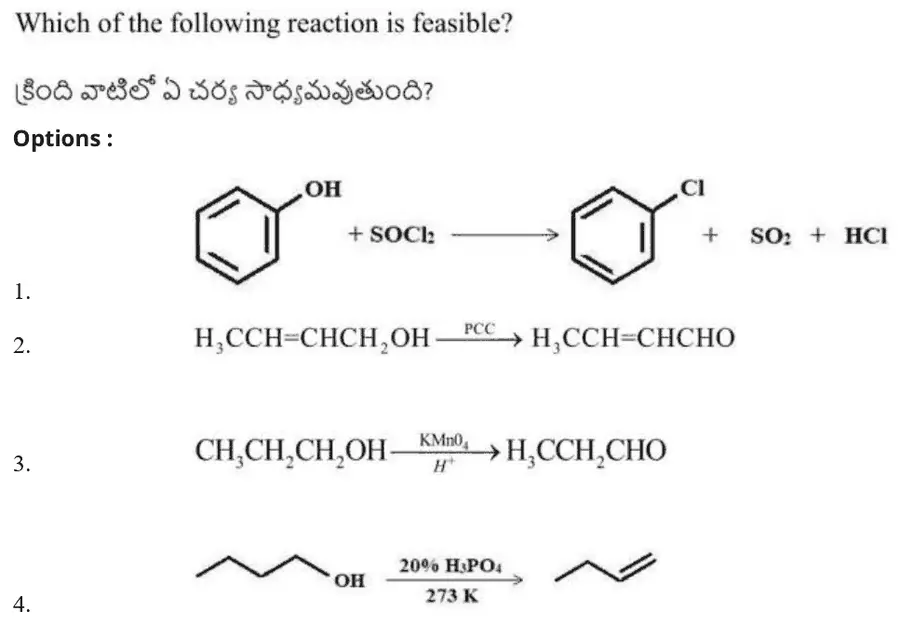
52TS EAPCET 2023 · 13 May · Shift 2MCQOpen question page ↗

Which of the following reaction is feasible?

The question and its figure as printed in TS EAPCET 2023 13th May 2023 Shift 2. Option 1: Phenol (benzene ring with OH) + SOCl2 chlorobenzene (benzene ring with Cl) + SO2 + HCl Option 4: Skeletal structure of butan-2-ol... see figure description: zigzag chain with OH on the carbon, [273 K]20% H3PO4 1-butene (zigzag chain with terminal double bond)
The question as printed in the paper.
  • A

    see figure Phenol (benzene ring with OH) + $\mathrm{SOCl_2}$ $\longrightarrow$ chlorobenzene (benzene ring with Cl) + $\mathrm{SO_2}$ + $\mathrm{HCl}$

  • B

    $\mathrm{H_3CCH=CHCH_2OH}$ $\xrightarrow{\mathrm{PCC}}$ $\mathrm{H_3CCH=CHCHO}$

  • C

    $\mathrm{CH_3CH_2CH_2OH}$ $\xrightarrow[\mathrm{H^+}]{\mathrm{KMnO_4}}$ $\mathrm{H_3CCH_2CHO}$

  • D

    see figure Skeletal structure of butan-2-ol... see figure description: zigzag chain with OH on the carbon, $\xrightarrow[273\ \mathrm{K}]{20\%\ \mathrm{H_3PO_4}}$ 1-butene (zigzag chain with terminal double bond)

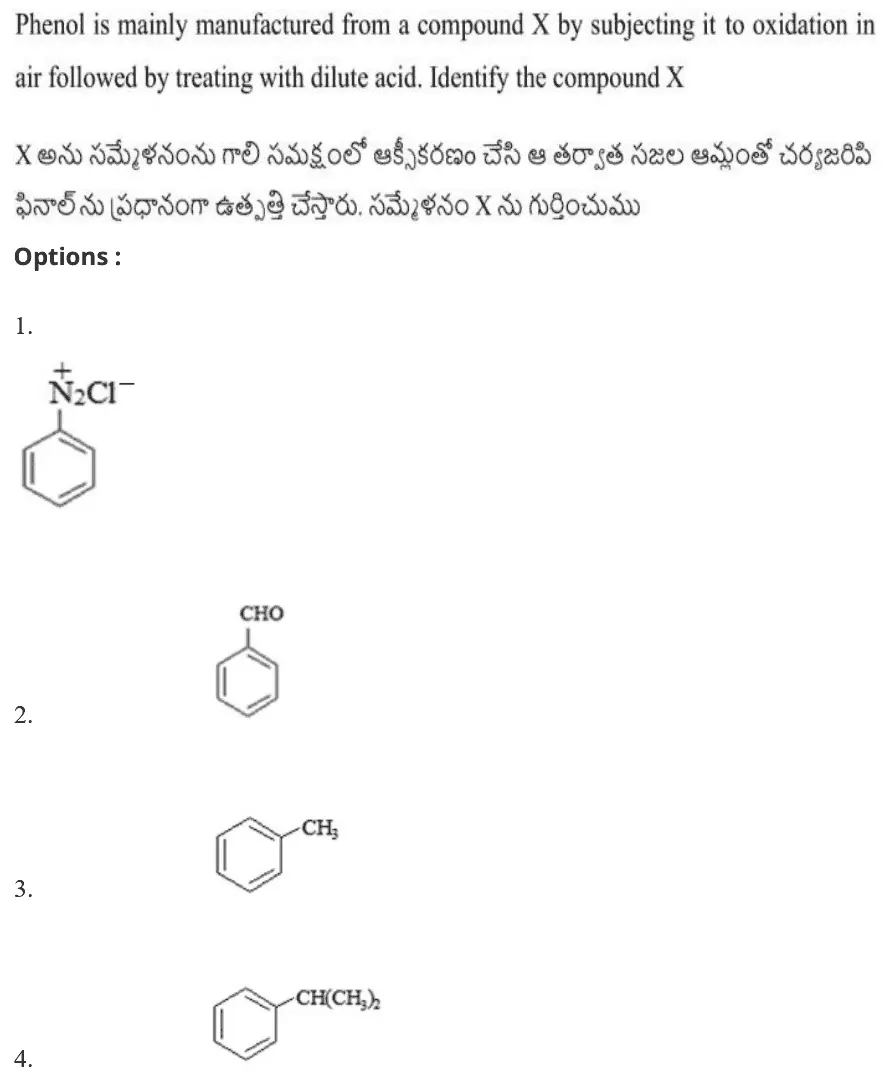
53TS EAPCET 2023 · 12 May · Shift 1MCQOpen question page ↗

Phenol is mainly manufactured from a compound X by subjecting it to oxidation in air followed by treating with dilute acid. Identify the compound X

The question and its figure as printed in TS EAPCET 2023 12th May 2023 Shift 1. Option 1: Benzene diazonium chloride: a benzene ring with N2^+Cl^- attached Option 2: Benzaldehyde: a benzene ring with a CHO group attached Option 3: Toluene: a benzene ring with a CH3 group attached Option 4: Cumene: a benzene ring with a CH(CH3)2 group attached
The question as printed in the paper.
  • A

    see figure Benzene diazonium chloride: a benzene ring with $\mathrm{N_2^+Cl^-}$ attached

  • B

    see figure Benzaldehyde: a benzene ring with a CHO group attached

  • C

    see figure Toluene: a benzene ring with a $\mathrm{CH_3}$ group attached

  • D

    see figure Cumene: a benzene ring with a $\mathrm{CH(CH_3)_2}$ group attached

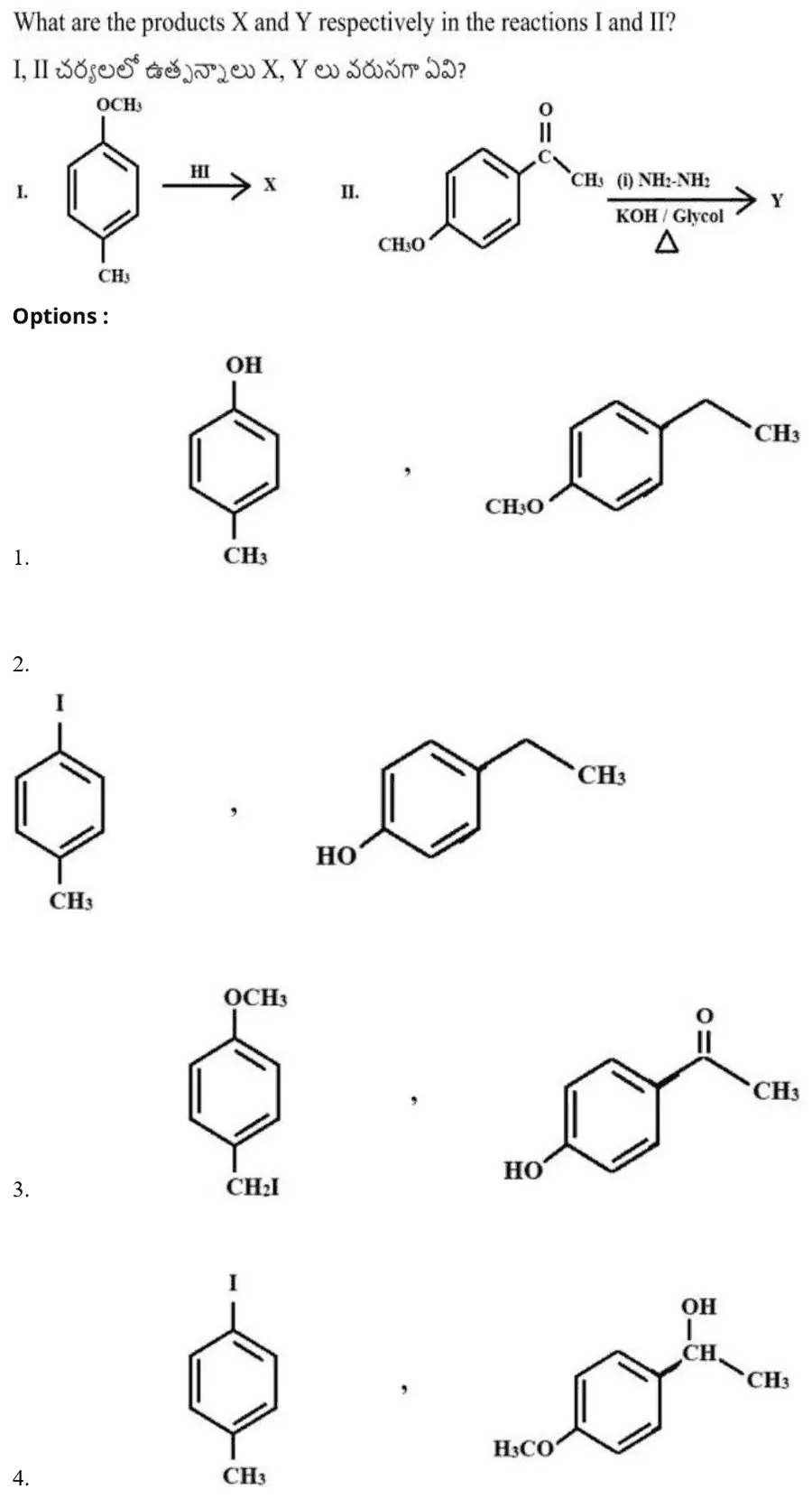
54TS EAPCET 2023 · 12 May · Shift 1MCQOpen question page ↗

What are the products X and Y respectively in the reactions I and II?

(see the figure above)

The question and its figure as printed in TS EAPCET 2023 12th May 2023 Shift 1. Option 1: X: benzene ring with OH at the top and CH3 at the bottom (4-methylphenol); Y: benzene ring with CH3O at the lower left and a CH2CH3 (ethyl) group at the upper right Option 2: X: benzene ring with I at the top and CH3 at the bottom (4-iodotoluene); Y: benzene ring with HO at the lower left and a CH2CH3 (ethyl) group at the upper right Option 3: X: benzene ring with OCH3 at the top and CH2I at the bottom; Y: benzene ring with HO at the lower left and a C(=O)CH3 (acetyl) group at the upper right Option 4: X: benzene ring with I at the top and CH3 at the bottom (4-iodotoluene); Y: benzene ring with H3CO…
The question as printed in the paper.
  • A

    see figure X: benzene ring with OH at the top and CH3 at the bottom (4-methylphenol); Y: benzene ring with CH3O at the lower left and a CH2CH3 (ethyl) group at the upper right

  • B

    see figure X: benzene ring with I at the top and CH3 at the bottom (4-iodotoluene); Y: benzene ring with HO at the lower left and a CH2CH3 (ethyl) group at the upper right

  • C

    see figure X: benzene ring with OCH3 at the top and CH2I at the bottom; Y: benzene ring with HO at the lower left and a C(=O)CH3 (acetyl) group at the upper right

  • D

    see figure X: benzene ring with I at the top and CH3 at the bottom (4-iodotoluene); Y: benzene ring with H3CO at the lower left and a CH(OH)CH3 group at the upper right

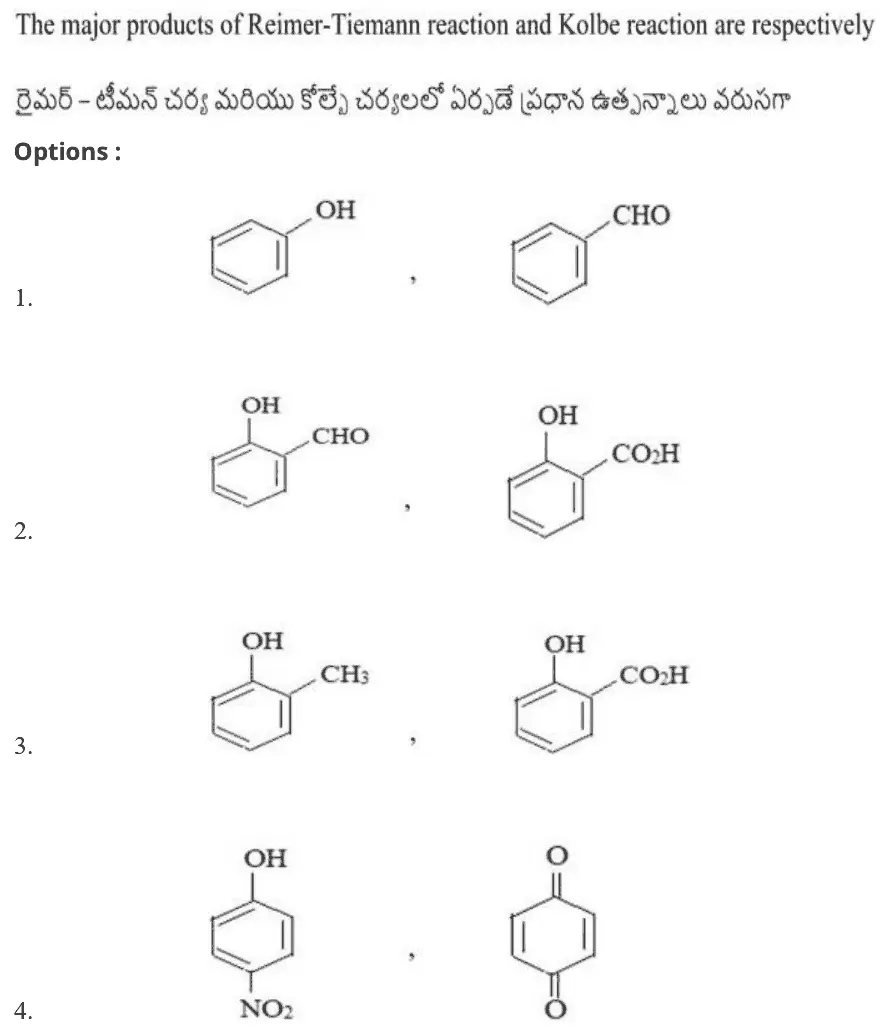
56TS EAPCET 2023 · 12 May · Shift 2MCQOpen question page ↗

The major products of Reimer-Tiemann reaction and Kolbe reaction are respectively

The question and its figure as printed in TS EAPCET 2023 12th May 2023 Shift 2. Option 1: Phenol (benzene ring with OH), followed by benzaldehyde (benzene ring with CHO) Option 2: Salicylaldehyde (benzene ring with OH and CHO on adjacent carbons), followed by salicylic acid (benzene ring with OH and CO2H on adjacent carbons) Option 3: 2-methylphenol (benzene ring with OH and CH3 on adjacent carbons), followed by salicylic acid (benzene ring with OH and CO2H on adjacent carbons) Option 4: 4-nitrophenol (benzene ring with OH at top and NO2 at bottom, para), followed by p-benzoquinone (six-membered ring with two C=O at para positions)
The question as printed in the paper.
  • A

    see figure Phenol (benzene ring with OH), followed by benzaldehyde (benzene ring with CHO)

  • B

    see figure Salicylaldehyde (benzene ring with OH and CHO on adjacent carbons), followed by salicylic acid (benzene ring with OH and CO2H on adjacent carbons)

  • C

    see figure 2-methylphenol (benzene ring with OH and CH3 on adjacent carbons), followed by salicylic acid (benzene ring with OH and CO2H on adjacent carbons)

  • D

    see figure 4-nitrophenol (benzene ring with OH at top and NO2 at bottom, para), followed by p-benzoquinone (six-membered ring with two C=O at para positions)

57TS EAPCET 2022 · 20 Jul · Shift 1MCQOpen question page ↗

Assertion (A) : Tertiary alcohols produce turbidity immediately with Lucas reagent.
Reason (R) : Lucas reagent is a 1 : 1 mixture of conc. $\mathrm{HNO_3}$ and anhydrous $\mathrm{ZnCl_2}$.
The correct option among the following is

  • A

    (A) is true, (R) is true and (R) is the correct explanation for (A)

  • B

    (A) is true, (R) is true but (R) is not the correct explanation for (A)

  • C

    (A) is true but (R) is false

  • D

    (A) is false but (R) is true

58TS EAPCET 2022 · 20 Jul · Shift 1MCQOpen question page ↗

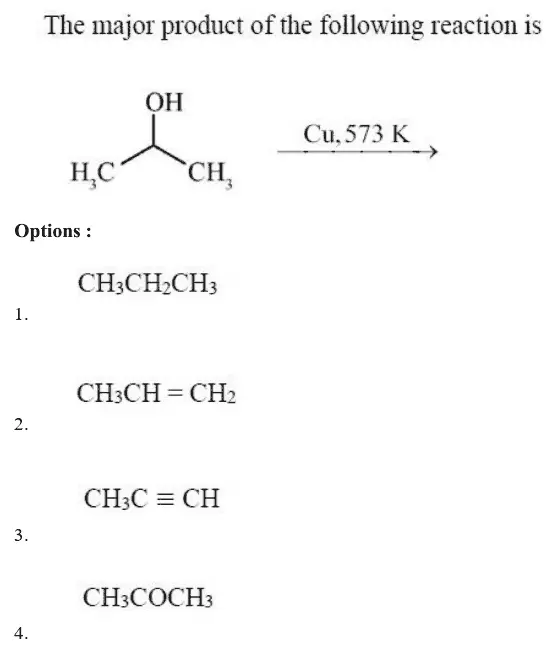
The major product of the following reaction is
(see the figure above) $\xrightarrow{\text{Cu, 573 K}}$

The question and its figure as printed in TS EAPCET 2022 20th Jul 2022 Shift 1.
The question as printed in the paper.
  • A

    $\mathrm{CH_3CH_2CH_3}$

  • B

    $\mathrm{CH_3CH=CH_2}$

  • C

    $\mathrm{CH_3C\equiv CH}$

  • D

    $\mathrm{CH_3COCH_3}$

59TS EAPCET 2022 · 20 Jul · Shift 2MCQOpen question page ↗

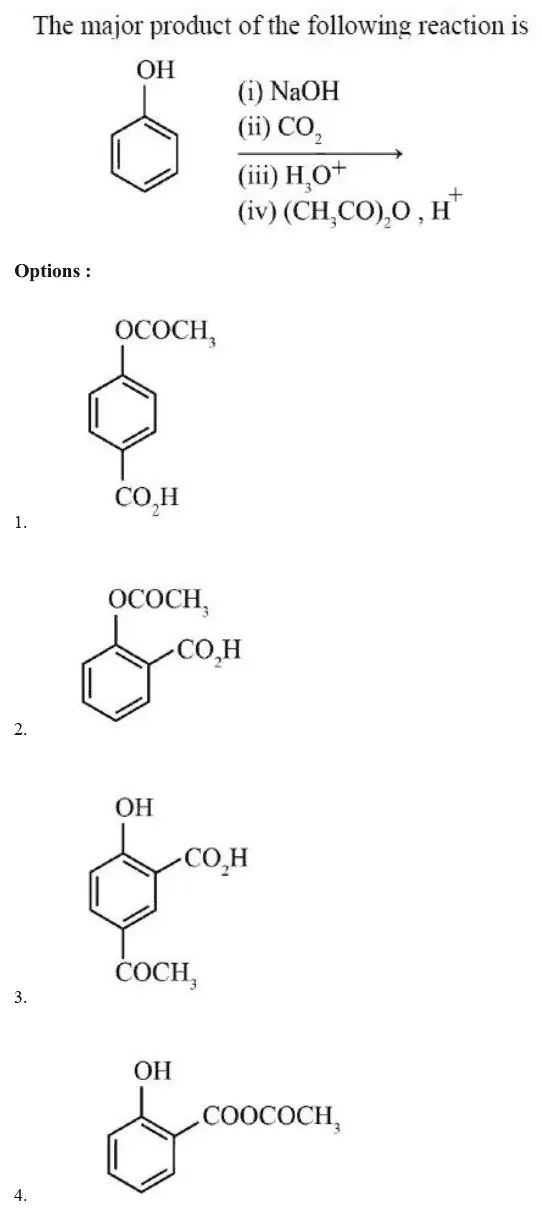
The major product of the following reaction is
(see the figure above)

The question and its figure as printed in TS EAPCET 2022 20th Jul 2022 Shift 2. Option 1: benzene ring with OCOCH3 and CO2H para to each other Option 2: benzene ring with OCOCH3 and CO2H on adjacent (ortho) carbons Option 3: benzene ring with OH and CO2H on adjacent carbons and COCH3 on the carbon para to OH Option 4: benzene ring with OH and COOCOCH3 on adjacent carbons
The question as printed in the paper.
  • A

    see figure benzene ring with OCOCH3 and CO2H para to each other

  • B

    see figure benzene ring with OCOCH3 and CO2H on adjacent (ortho) carbons

  • C

    see figure benzene ring with OH and CO2H on adjacent carbons and COCH3 on the carbon para to OH

  • D

    see figure benzene ring with OH and COOCOCH3 on adjacent carbons

60TS EAPCET 2022 · 19 Jul · Shift 1MCQOpen question page ↗

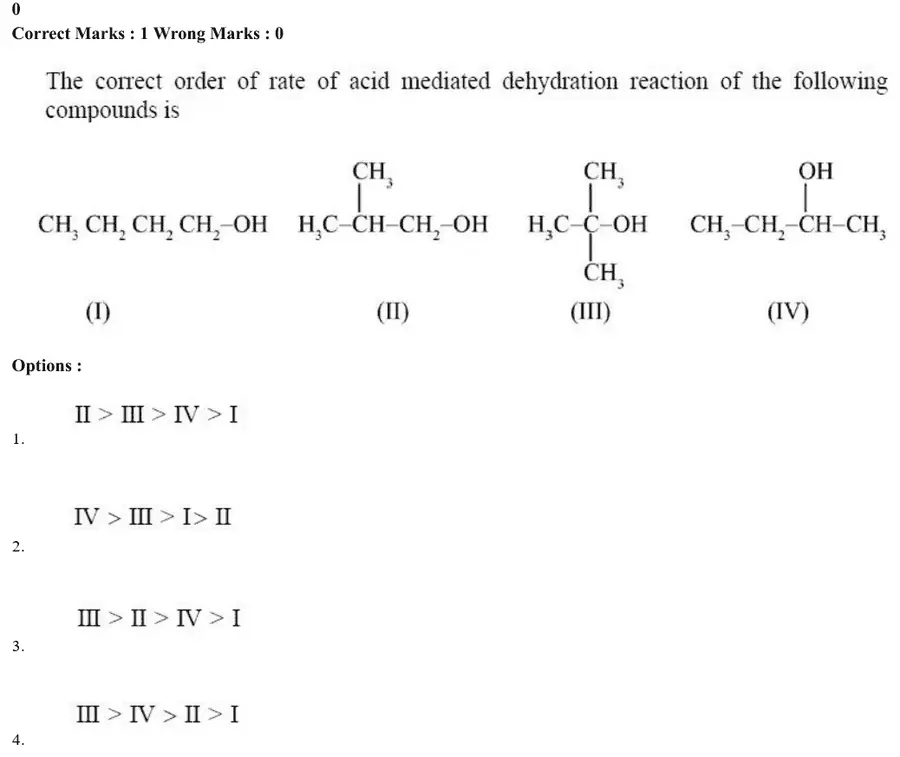
The correct order of rate of acid mediated dehydration reaction of the following compounds is
(see the figure above)

The question and its figure as printed in TS EAPCET 2022 19th Jul 2022 Shift 1.
The question as printed in the paper.
  • A

    $\mathrm{II>III>IV>I}$

  • B

    $\mathrm{IV>III>I>II}$

  • C

    $\mathrm{III>II>IV>I}$

  • D

    $\mathrm{III>IV>II>I}$

61TS EAPCET 2022 · 19 Jul · Shift 2MCQOpen question page ↗

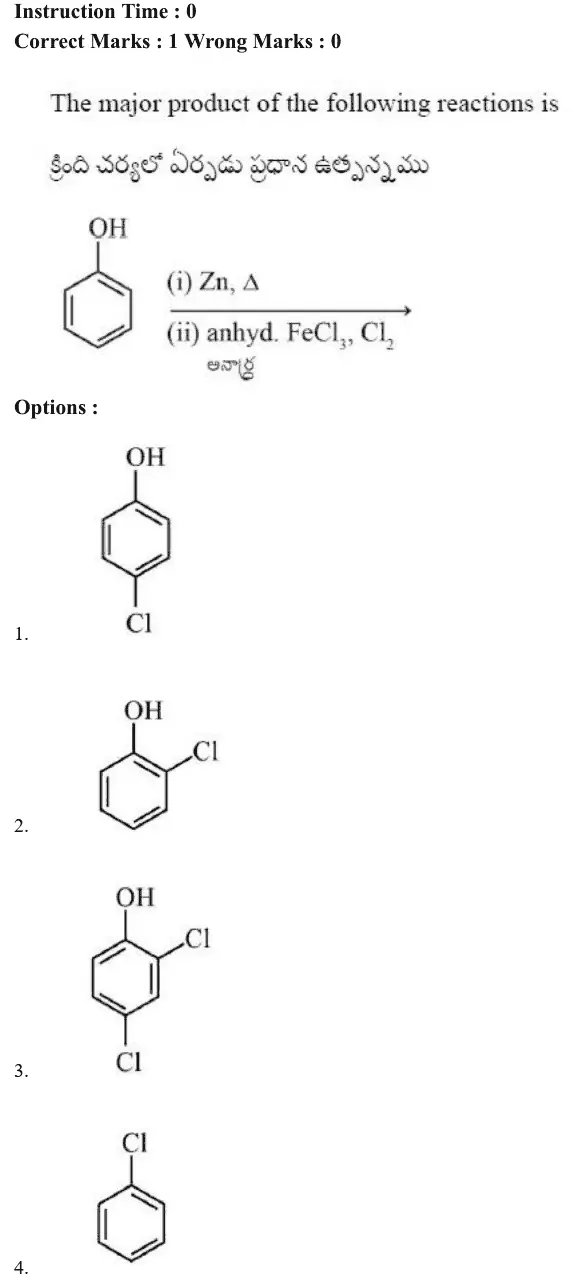
The major product of the following reactions is
(see the figure above)

The question and its figure as printed in TS EAPCET 2022 19th Jul 2022 Shift 2. Option 1: p-chlorophenol (benzene ring with OH at top and Cl at the opposite, bottom, position) Option 2: o-chlorophenol (benzene ring with OH at top and Cl on the adjacent ring carbon) Option 3: 2,4-dichlorophenol (benzene ring with OH at top, Cl on the adjacent ring carbon and Cl at the bottom, para to OH) Option 4: chlorobenzene (benzene ring with Cl only)
The question as printed in the paper.
  • A

    see figure p-chlorophenol (benzene ring with OH at top and Cl at the opposite, bottom, position)

  • B

    see figure o-chlorophenol (benzene ring with OH at top and Cl on the adjacent ring carbon)

  • C

    see figure 2,4-dichlorophenol (benzene ring with OH at top, Cl on the adjacent ring carbon and Cl at the bottom, para to OH)

  • D

    see figure chlorobenzene (benzene ring with Cl only)

62TS EAPCET 2022 · 19 Jul · Shift 2MCQOpen question page ↗

Arrange the following phenols in decreasing order of their $\mathrm{pK_{a}}$
A) Phenol
B) ortho-Nitrophenol
C) meta-Nitrophenol
D) para-Nitrophenol

  • A

    D > B > C > A

  • B

    A > C > B > D

  • C

    A > C > D > B

  • D

    B > D > C > A

63TS EAPCET 2022 · 19 Jul · Shift 2MCQOpen question page ↗

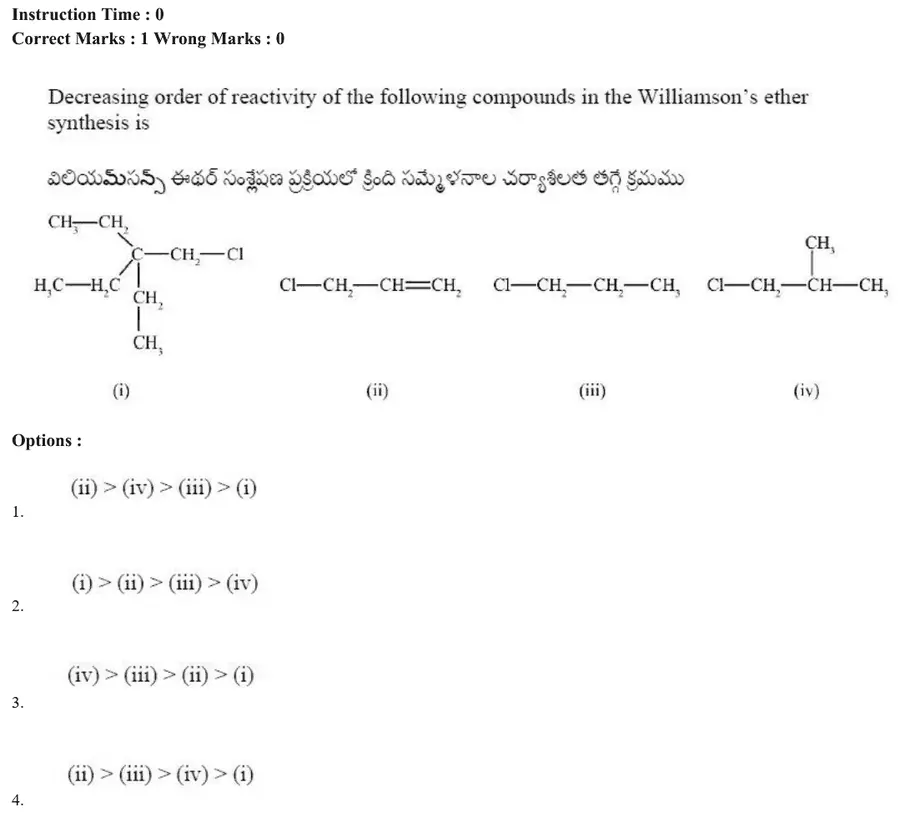
Decreasing order of reactivity of the following compounds in the Williamson's ether synthesis is
(see the figure above)

The question and its figure as printed in TS EAPCET 2022 19th Jul 2022 Shift 2.
The question as printed in the paper.
  • A

    (ii) > (iv) > (iii) > (i)

  • B

    (i) > (ii) > (iii) > (iv)

  • C

    (iv) > (iii) > (ii) > (i)

  • D

    (ii) > (iii) > (iv) > (i)

64TS EAPCET 2022 · 19 Jul · Shift 2MCQOpen question page ↗

A primary alcohol was reacted with pyridinium chlorochromate (PCC), which resulted in a product P. The product P on treatment with ammonical silver nitrate solution produces

  • A

    Anhydride of carboxylic acid

  • B

    Aldehyde

  • C

    Amide

  • D

    Carboxylate anion

65TS EAPCET 2022 · 18 Jul · Shift 1MCQOpen question page ↗

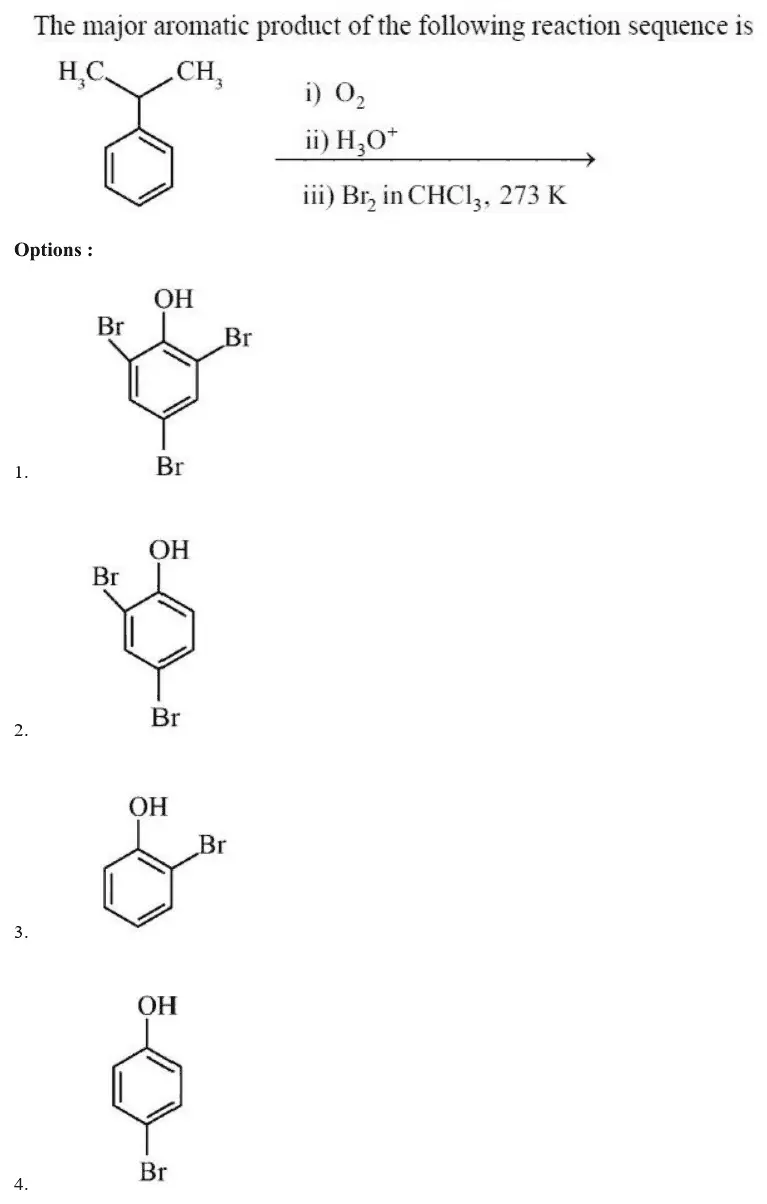
The major aromatic product of the following reaction sequence is
Starting material: cumene (isopropylbenzene, drawn as a benzene ring bearing a CH(CH3)2 group), with reagents i) $\mathrm{O_{2}}$; ii) $\mathrm{H_{3}O^{+}}$; iii) $\mathrm{Br_{2}}$ in $\mathrm{CHCl_{3}}$, 273 K
(see the figure above)

The question and its figure as printed in TS EAPCET 2022 18th Jul 2022 Shift 1.
The question as printed in the paper.
  • A

    2,4,6-tribromophenol (benzene ring with OH, Br at both ortho positions and Br at the para position)

  • B

    2,4-dibromophenol (benzene ring with OH, Br at one ortho position and Br at the para position)

  • C

    2-bromophenol (benzene ring with OH and Br at an ortho position)

  • D

    4-bromophenol (benzene ring with OH and Br at the para position)

66TS EAPCET 2022 · 18 Jul · Shift 1MCQOpen question page ↗

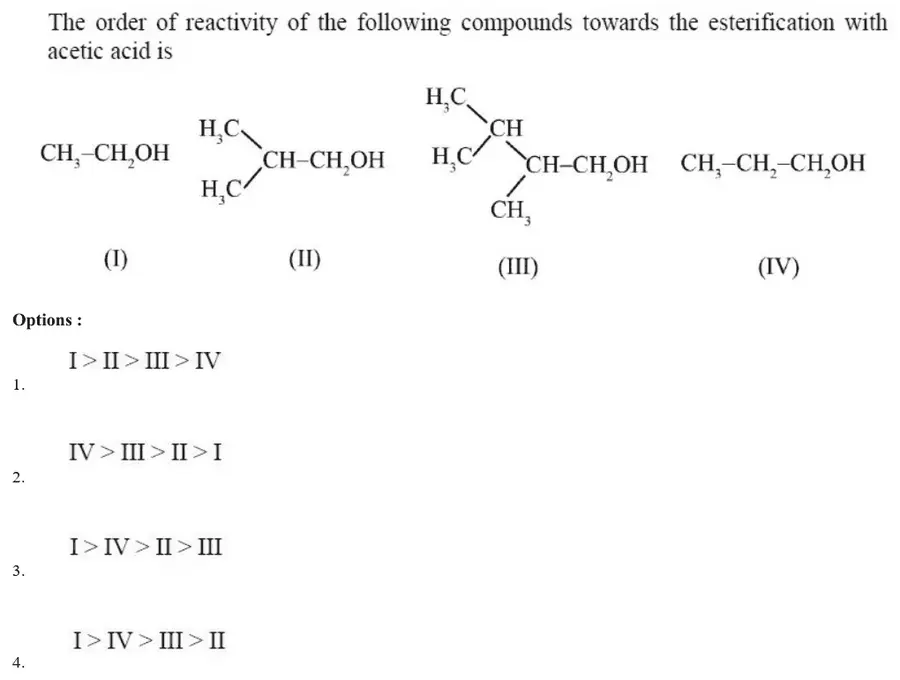
The order of reactivity of the following compounds towards the esterification with acetic acid is
(I) $\mathrm{CH_{3}-CH_{2}OH}$
(II) $(\mathrm{H_{3}C})_{2}\mathrm{CH-CH_{2}OH}$
(III) $(\mathrm{H_{3}C})_{2}\mathrm{CH-CH(CH_{3})-CH_{2}OH}$
(IV) $\mathrm{CH_{3}-CH_{2}-CH_{2}OH}$
(see the figure above)

The question and its figure as printed in TS EAPCET 2022 18th Jul 2022 Shift 1.
The question as printed in the paper.
  • A

    I > II > III > IV

  • B

    IV > III > II > I

  • C

    I > IV > II > III

  • D

    I > IV > III > II

67TS EAPCET 2022 · 18 Jul · Shift 2MCQOpen question page ↗

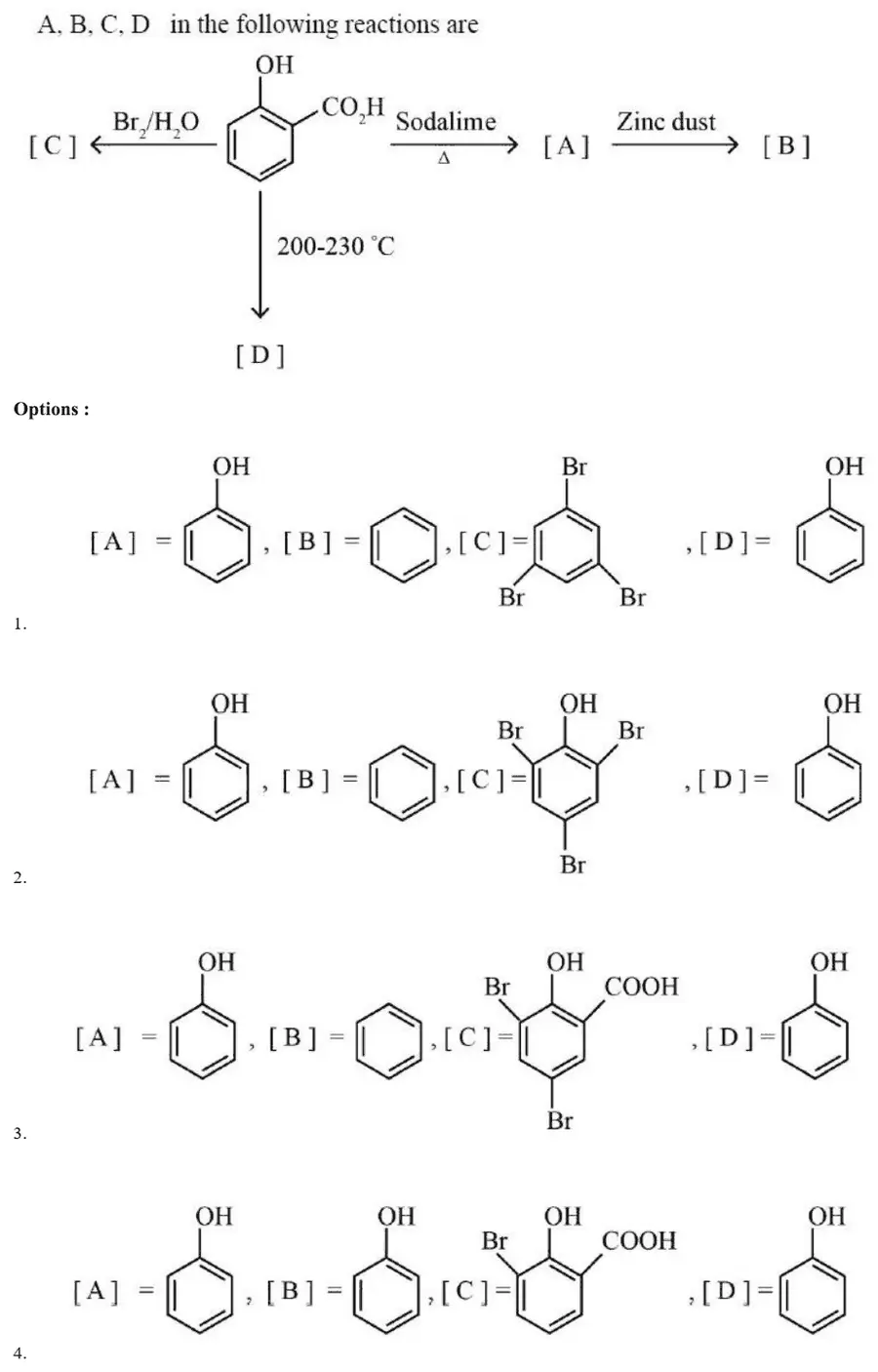
A, B, C, D in the following reactions are
(see the figure above)

The question and its figure as printed in TS EAPCET 2022 18th Jul 2022 Shift 2. Option 1: A = phenol, B = benzene, C = 1,3,5-tribromobenzene (ring with three Br and no OH), D = phenol Option 2: A = phenol, B = benzene, C = 2,4,6-tribromophenol, D = phenol Option 3: A = phenol, B = benzene, C = 3,5-dibromo-salicylic acid (OH, COOH, two Br), D = phenol Option 4: A = phenol, B = phenol, C = monobromo-salicylic acid (OH, COOH, one Br), D = phenol
The question as printed in the paper.
  • A

    see figure A = phenol, B = benzene, C = 1,3,5-tribromobenzene (ring with three Br and no OH), D = phenol

  • B

    see figure A = phenol, B = benzene, C = 2,4,6-tribromophenol, D = phenol

  • C

    see figure A = phenol, B = benzene, C = 3,5-dibromo-salicylic acid (OH, COOH, two Br), D = phenol

  • D

    see figure A = phenol, B = phenol, C = monobromo-salicylic acid (OH, COOH, one Br), D = phenol

68TS EAPCET 2022 · 18 Jul · Shift 2MCQOpen question page ↗

Which of the following statements are correct for phenol?
(A) In general, phenol is more acidic than alcohol.
(B) Phenol is used in the production of melamine plastic.
(C) Phenol gives violet colour with neutral ferric chloride solution.
(D) Phenol when heated with acetyl chloride gives phenetole.

  • A

    C and D

  • B

    A and D

  • C

    B and C

  • D

    A and C

69AP EAPCET 2022 · 8 Jul · Shift 1MCQOpen question page ↗

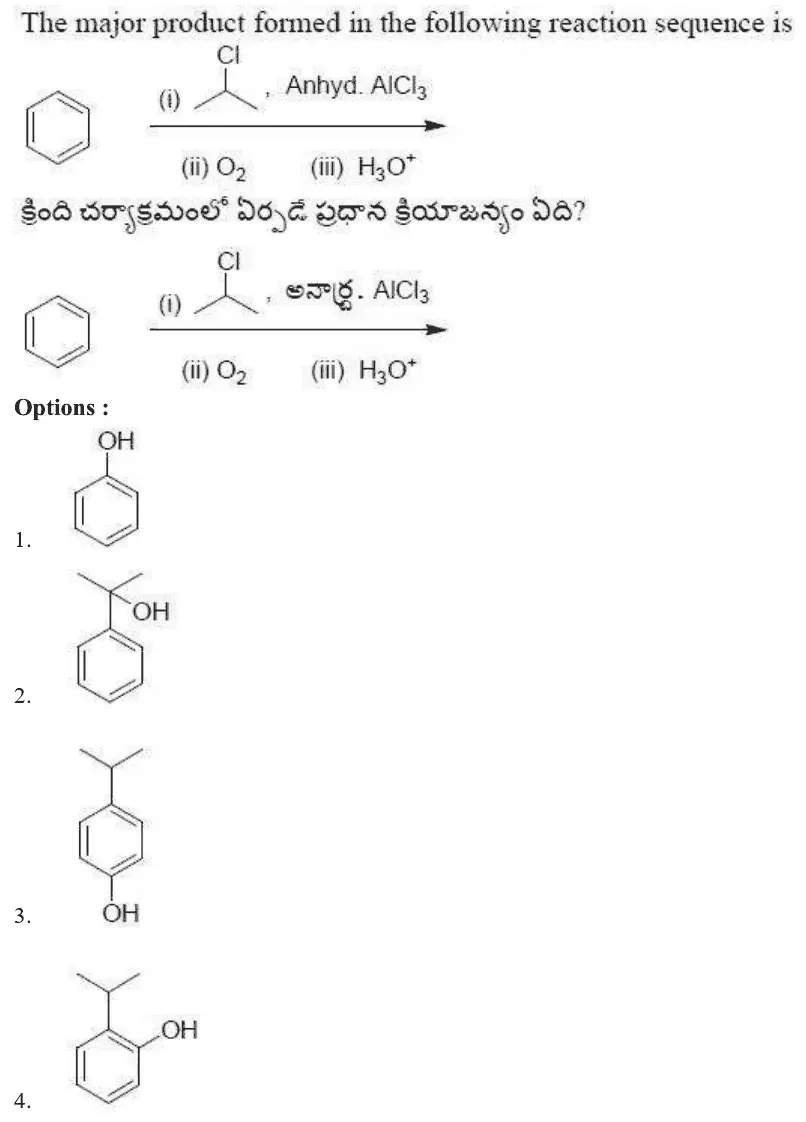
The major product formed in the following reaction sequence is
(see the figure above) benzene $\xrightarrow[\text{(ii) O}_2\quad\text{(iii) H}_3\text{O}^+]{\text{(i) 2-chloropropane (Cl on the middle carbon of a three-carbon line drawing), Anhyd. AlCl}_3}$

The question and its figure as printed in AP EAPCET 2022 08th July 2022 Shift1. Option 1: phenol (benzene ring with OH) Option 2: 2-phenylpropan-2-ol (ring attached to a carbon bearing two methyl lines and OH) Option 3: 4-isopropylphenol (OH on the ring para to an isopropyl group) Option 4: 2-isopropylphenol (OH on the ring ortho to an isopropyl group)
The question as printed in the paper.
  • A

    see figure phenol (benzene ring with OH)

  • B

    see figure 2-phenylpropan-2-ol (ring attached to a carbon bearing two methyl lines and OH)

  • C

    see figure 4-isopropylphenol (OH on the ring para to an isopropyl group)

  • D

    see figure 2-isopropylphenol (OH on the ring ortho to an isopropyl group)

70AP EAPCET 2022 · 7 Jul · Shift 1MCQOpen question page ↗

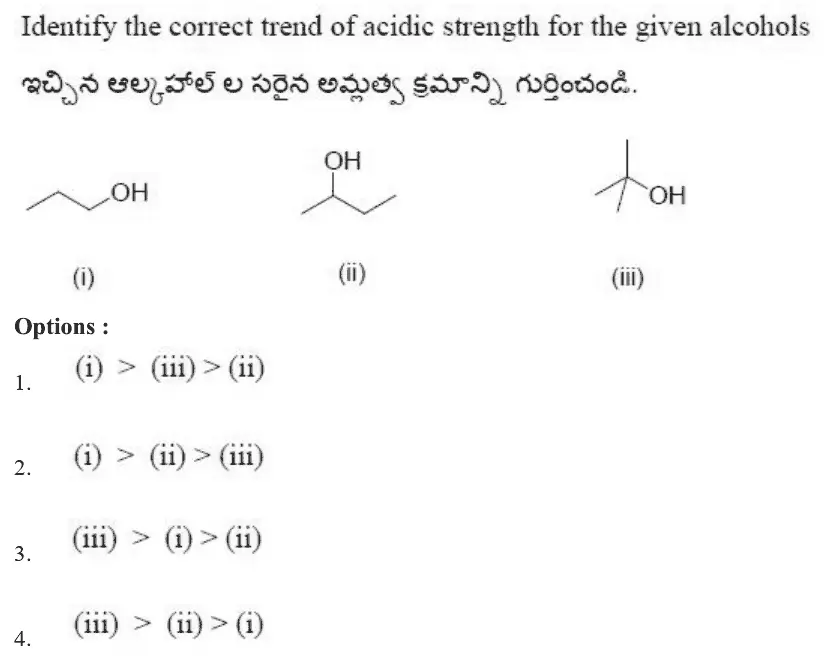
Identify the correct trend of acidic strength for the given alcohols
(see the figure above)

The question and its figure as printed in AP EAPCET 2022 07th July2022 Shift1.
The question as printed in the paper.
  • A

    (i) > (iii) > (ii)

  • B

    (i) > (ii) > (iii)

  • C

    (iii) > (i) > (ii)

  • D

    (iii) > (ii) > (i)

71AP EAPCET 2022 · 7 Jul · Shift 2MCQOpen question page ↗

Which of the following reactions takes places when tertiary butanol passed over heated copper at 573 K.?

  • A

    Dehydrogenation reaction

  • B

    Dehydration reaction

  • C

    Oxidation reaction

  • D

    Addition reaction

72AP EAPCET 2022 · 6 Jul · Shift 1MCQOpen question page ↗

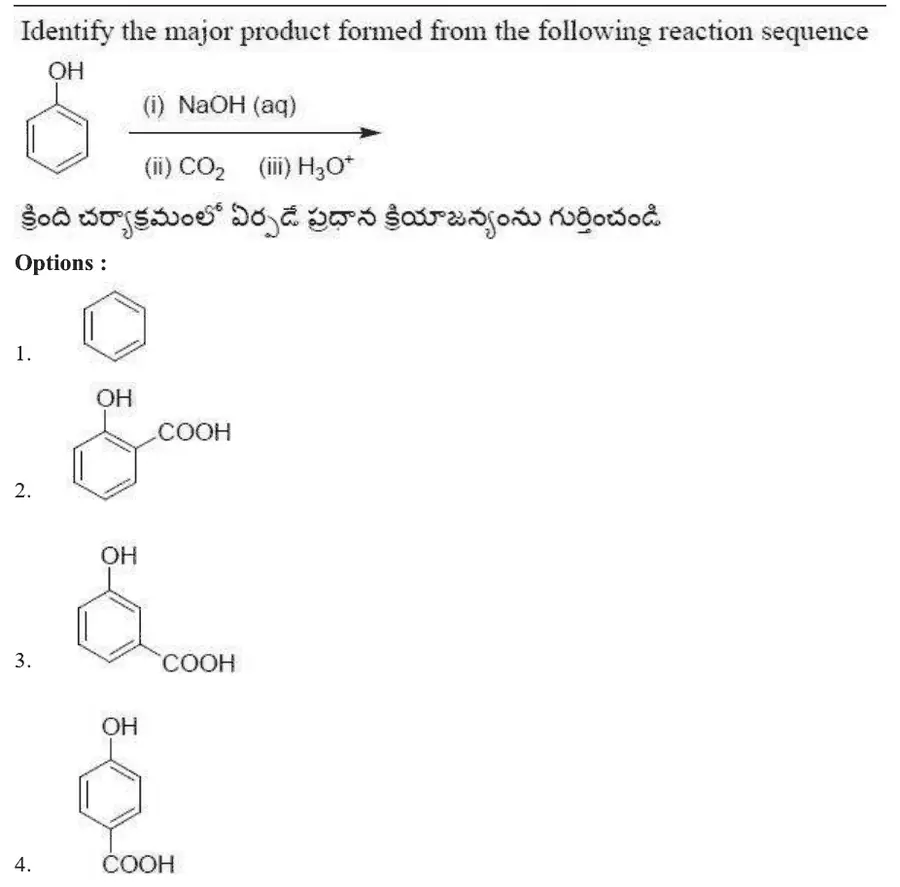
Identify the major product formed from the following reaction sequence
(see the figure above)

The question and its figure as printed in AP EAPCET 2022 06th July 2022 Shift1. Option 1: benzene (plain ring) Option 2: benzene ring with OH and COOH on adjacent carbons (ortho, salicylic acid) Option 3: benzene ring with OH and COOH on meta positions (1,3) Option 4: benzene ring with OH and COOH on opposite carbons (para, 4-hydroxybenzoic acid)
The question as printed in the paper.
  • A

    see figure benzene (plain ring)

  • B

    see figure benzene ring with OH and COOH on adjacent carbons (ortho, salicylic acid)

  • C

    see figure benzene ring with OH and COOH on meta positions (1,3)

  • D

    see figure benzene ring with OH and COOH on opposite carbons (para, 4-hydroxybenzoic acid)

73AP EAPCET 2022 · 6 Jul · Shift 2MCQOpen question page ↗

When ethanol is treated with sulphuric and at 413 K the reaction involved in it is

  • A

    $\mathrm{S_N}2$

  • B

    $\mathrm{S_N}1$

  • C

    Addition

  • D

    Elimination

74AP EAPCET 2022 · 5 Jul · Shift 1MCQOpen question page ↗

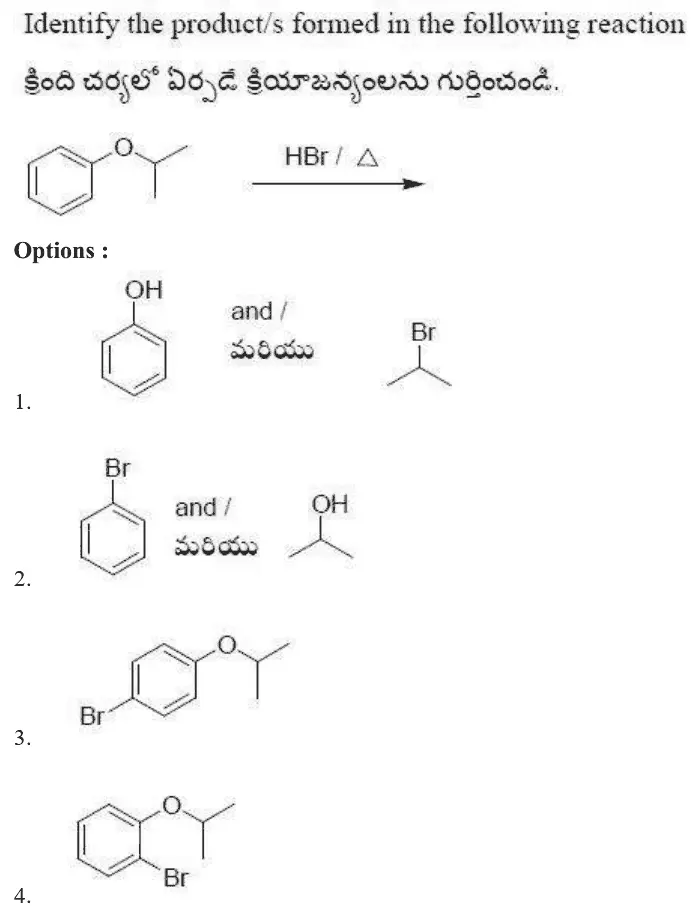
Identify the product/s formed in the following reaction
(see the figure above)

The question and its figure as printed in AP EAPCET 2022 05th July 2022 Shift1. Option 1: phenol and / isopropyl bromide: C6H5OH (OH on ring) and 2-bromopropane (Br on the middle carbon of a three-carbon skeleton drawing) Option 2: bromobenzene and / 2-propanol: Br on ring and OH on the middle carbon of a three-carbon skeleton drawing Option 3: para-bromophenyl isopropyl ether: ring with Br para to the O-CH(CH3)2 group Option 4: ortho-bromophenyl isopropyl ether: ring with Br ortho to the O-CH(CH3)2 group
The question as printed in the paper.
  • A

    see figure phenol and / isopropyl bromide: $\mathrm{C_6H_5OH}$ (OH on ring) and 2-bromopropane (Br on the middle carbon of a three-carbon skeleton drawing)

  • B

    see figure bromobenzene and / 2-propanol: Br on ring and OH on the middle carbon of a three-carbon skeleton drawing

  • C

    see figure para-bromophenyl isopropyl ether: ring with Br para to the O-CH(CH3)2 group

  • D

    see figure ortho-bromophenyl isopropyl ether: ring with Br ortho to the O-CH(CH3)2 group

75AP EAPCET 2022 · 5 Jul · Shift 1MCQOpen question page ↗

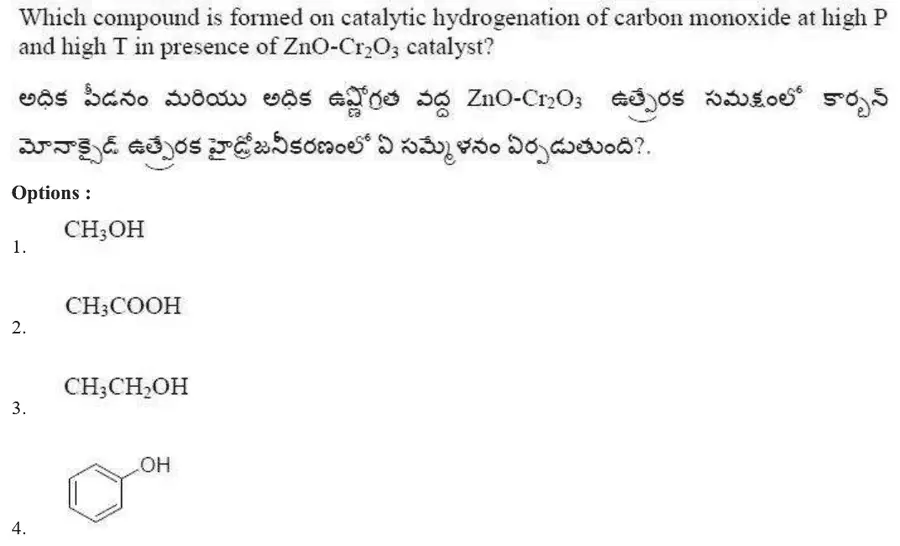
Which compound is formed on catalytic hydrogenation of carbon monoxide at high P and high T in presence of $\mathrm{ZnO-Cr_2O_3}$ catalyst?

The question and its figure as printed in AP EAPCET 2022 05th July 2022 Shift1. Option 4: phenol (benzene ring with OH)
The question as printed in the paper.
  • A

    $\mathrm{CH_3OH}$

  • B

    $\mathrm{CH_3COOH}$

  • C

    $\mathrm{CH_3CH_2OH}$

  • D

    see figure phenol (benzene ring with OH)

76AP EAPCET 2022 · 5 Jul · Shift 1MCQOpen question page ↗

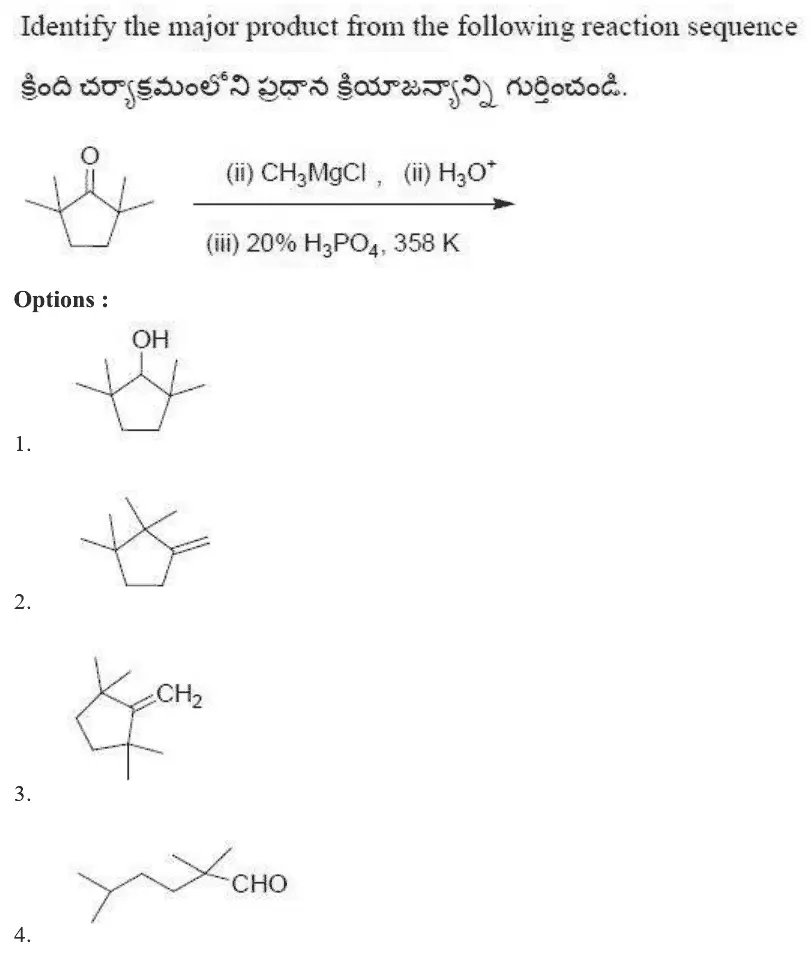
Identify the major product from the following reaction sequence
(see the figure above)

The question and its figure as printed in AP EAPCET 2022 05th July 2022 Shift1. Option 1: 2,2,5,5-tetramethylcyclopentanol (cyclopentane ring with OH on one carbon and four methyl groups on the two carbons beside it), skeletal Option 2: a cyclopentane ring with an exocyclic =CH2 on one carbon and methyl groups on the two adjacent carbons, skeletal Option 3: cyclopentane ring with an exocyclic =CH2 labelled CH2 on one ring carbon and methyl groups on neighbouring carbons, skeletal Option 4: an open chain skeletal structure ending in CHO with a quaternary carbon bearing methyl groups
The question as printed in the paper.
  • A

    see figure 2,2,5,5-tetramethylcyclopentanol (cyclopentane ring with OH on one carbon and four methyl groups on the two carbons beside it), skeletal

  • B

    see figure a cyclopentane ring with an exocyclic =CH2 on one carbon and methyl groups on the two adjacent carbons, skeletal

  • C

    see figure cyclopentane ring with an exocyclic =CH2 labelled $\mathrm{CH_2}$ on one ring carbon and methyl groups on neighbouring carbons, skeletal

  • D

    see figure an open chain skeletal structure ending in CHO with a quaternary carbon bearing methyl groups

77AP EAPCET 2022 · 4 Jul · Shift 1MCQOpen question page ↗

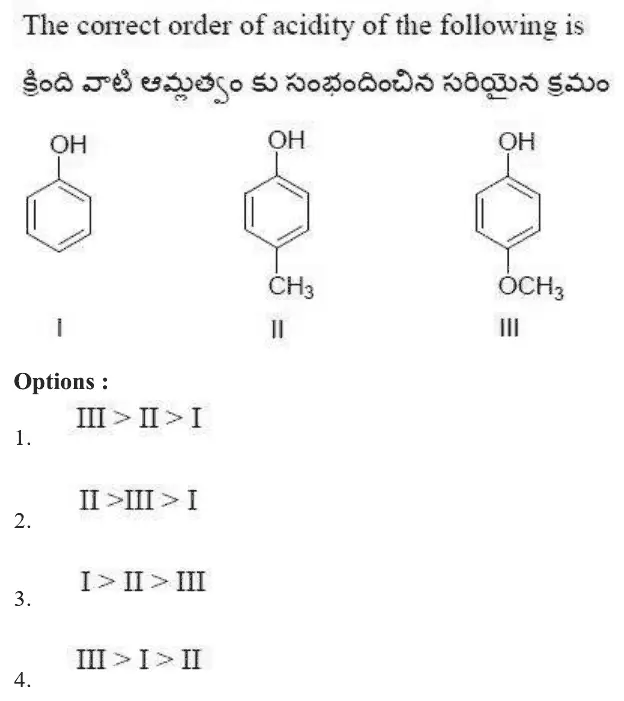
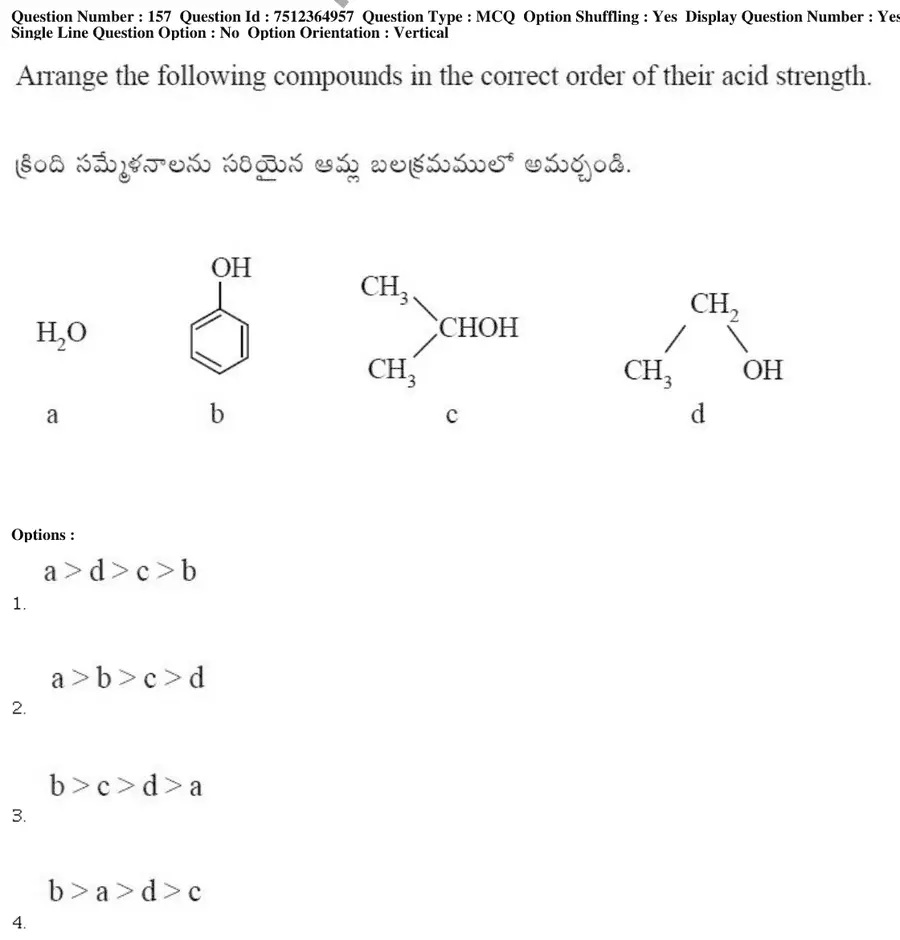
The correct order of acidity of the following is
(see the figure above)

The question and its figure as printed in AP EAPCET 2022 04th July 2022 Shift1.
The question as printed in the paper.
  • A

    III > II > I

  • B

    II > III > I

  • C

    I > II > III

  • D

    III > I > II

78AP EAMCET 2021 · 5 Oct · Shift 1MCQOpen question page ↗

Which of the following compound is used as antifreeze in car cooling system?

  • A

    Ethyl alcohol

  • B

    Glycerol

  • C

    Ethylene glycol

  • D

    Nitro benzene

79AP EAMCET 2021 · 25 Aug · Shift 1MCQOpen question page ↗

Which reaction of ethanol will decolorize bromine water?

  • A

    $\mathrm{C_2H_5OH + HBr \longrightarrow C_2H_5Br + H_2O}$

  • B

    $2\,\mathrm{C_2H_5OH} \xrightarrow[413\ \mathrm{K}]{\mathrm{H^+}} \mathrm{C_2H_5{-}O{-}C_2H_5 + H_2O}$

  • C

    $\mathrm{C_2H_5OH + Na \longrightarrow C_2H_5ONa} + \frac{1}{2}\,\mathrm{H_2O}$

  • D

    $\mathrm{C_2H_5OH} \xrightarrow[443\ \mathrm{K}]{\mathrm{H^+}} \mathrm{C_2H_4 + H_2O}$

80AP EAMCET 2021 · 25 Aug · Shift 2MCQOpen question page ↗

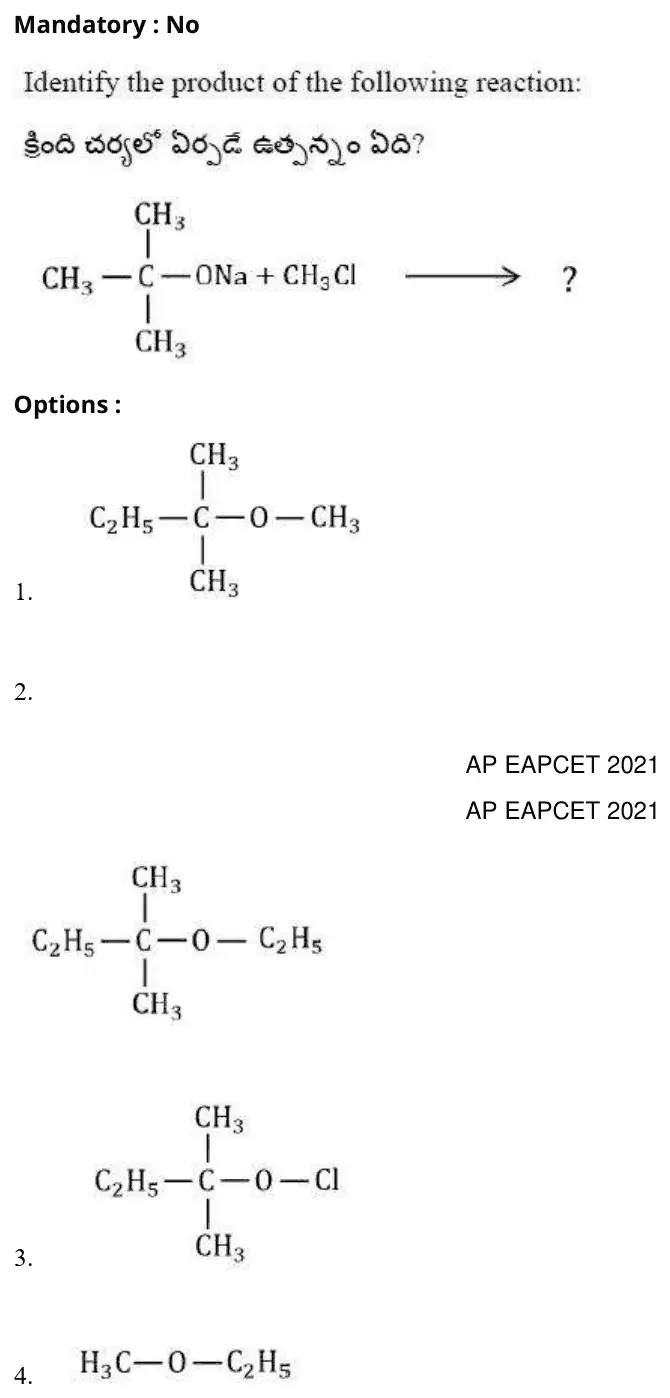
Identify the product of the following reaction:
$\mathrm{(CH_3)_3C{-}ONa + CH_3Cl \longrightarrow\ ?}$ (see the figure above)

The question and its figure as printed in AP EAPCET 2021 25th Aug 2021 Shift 2. Option 1: C2H5-C(CH3)2-O-CH3 Option 2: C2H5-C(CH3)2-O-C2H5 Option 3: C2H5-C(CH3)2-O-Cl
The question as printed in the paper.
  • A

    see figure $\mathrm{C_2H_5{-}C(CH_3)_2{-}O{-}CH_3}$

  • B

    see figure $\mathrm{C_2H_5{-}C(CH_3)_2{-}O{-}C_2H_5}$

  • C

    see figure $\mathrm{C_2H_5{-}C(CH_3)_2{-}O{-}Cl}$

  • D

    $\mathrm{H_3C{-}O{-}C_2H_5}$

81AP EAMCET 2021 · 25 Aug · Shift 2MCQOpen question page ↗

The reaction of 'tert-butyl methyl ether' with one equivalent of $\mathrm{HI}$ gives ______

  • A

    tert-butyl iodide & methyl iodide

  • B

    iso-butene & methyl iodide

  • C

    iso-butene & methanol

  • D

    tert-butyl iodide & methanol

82AP EAMCET 2021 · 24 Aug · Shift 1MCQOpen question page ↗

When 1 : 2 equivalence ratio of the gases $X$ and $Y$ are heated to $573\ K - 673\ K$ at $200 - 300\ \mathrm{atm}$ in the presence of $\mathrm{ZnO - Cr_2O_3}$ catalyst, methanol is formed. Here, the gases $X$ and $Y$ are ______ and ______ respectively.

  • A

    $\mathrm{CO_2\ \&\ H_2}$

  • B

    $\mathrm{CO\ \&\ H_2}$

  • C

    $\mathrm{CH_4\ \&\ O_2}$

  • D

    $\mathrm{CH_4\ \&\ H_2O_{(g)}}$

83AP EAMCET 2021 · 24 Aug · Shift 1MCQOpen question page ↗

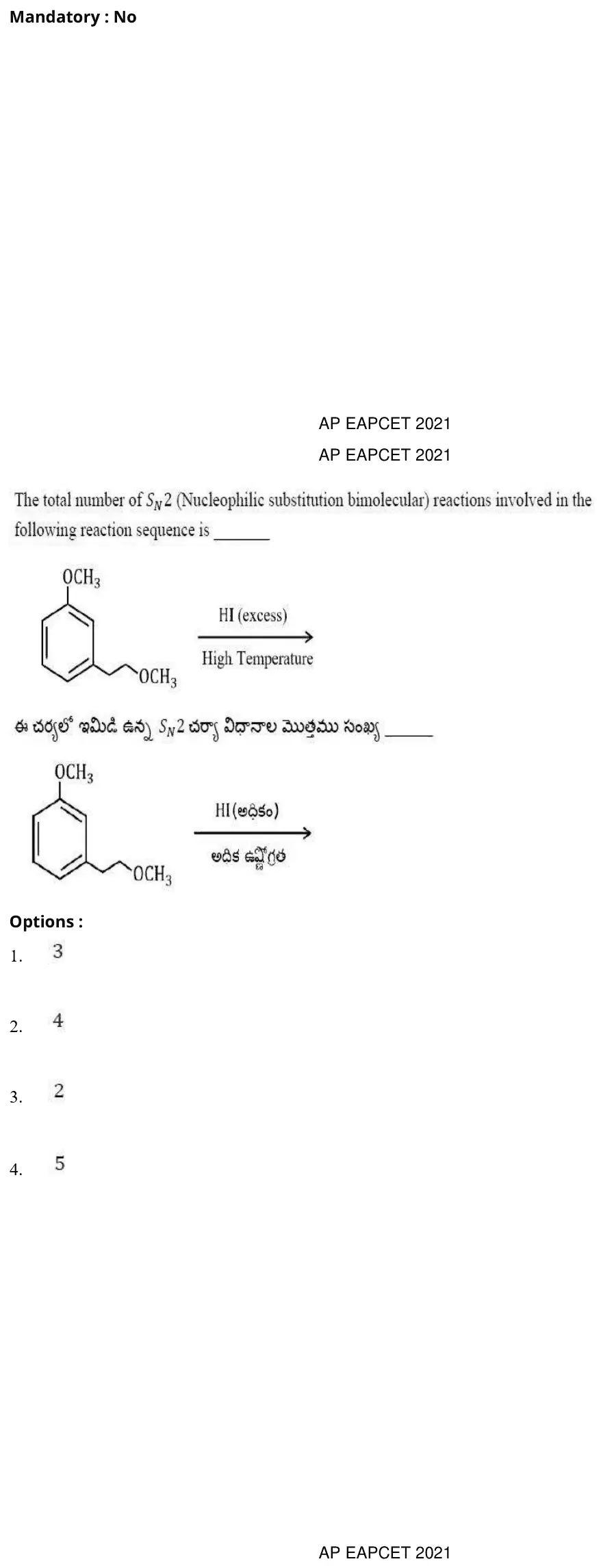
The total number of $S_N2$ (Nucleophilic substitution bimolecular) reactions involved in the following reaction sequence is ______
(see the figure above)

The question and its figure as printed in AP EAPCET 2021 24th Aug 2021 Shift 1.
The question as printed in the paper.
  • A

    3

  • B

    4

  • C

    2

  • D

    5

84AP EAMCET 2021 · 24 Aug · Shift 2MCQOpen question page ↗

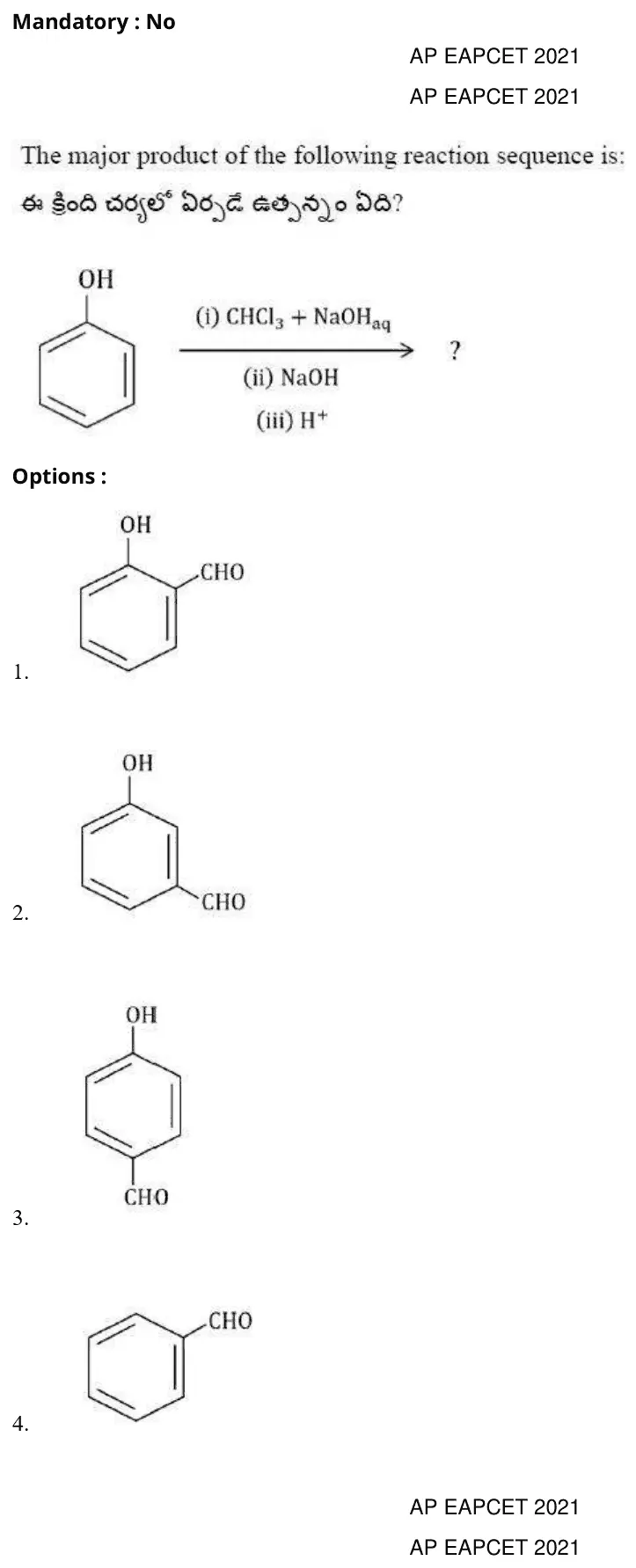
The major product of the following reaction sequence is: (see the figure above)

The question and its figure as printed in AP EAPCET 2021 24th Aug 2021 Shift 2. Option 1: 2-hydroxybenzaldehyde (CHO ortho to OH) Option 2: 3-hydroxybenzaldehyde (CHO meta to OH) Option 3: 4-hydroxybenzaldehyde (CHO para to OH) Option 4: benzaldehyde (no OH)
The question as printed in the paper.
  • A

    see figure 2-hydroxybenzaldehyde (CHO ortho to OH)

  • B

    see figure 3-hydroxybenzaldehyde (CHO meta to OH)

  • C

    see figure 4-hydroxybenzaldehyde (CHO para to OH)

  • D

    see figure benzaldehyde (no OH)

86AP EAMCET 2021 · 23 Aug · Shift 2MCQOpen question page ↗

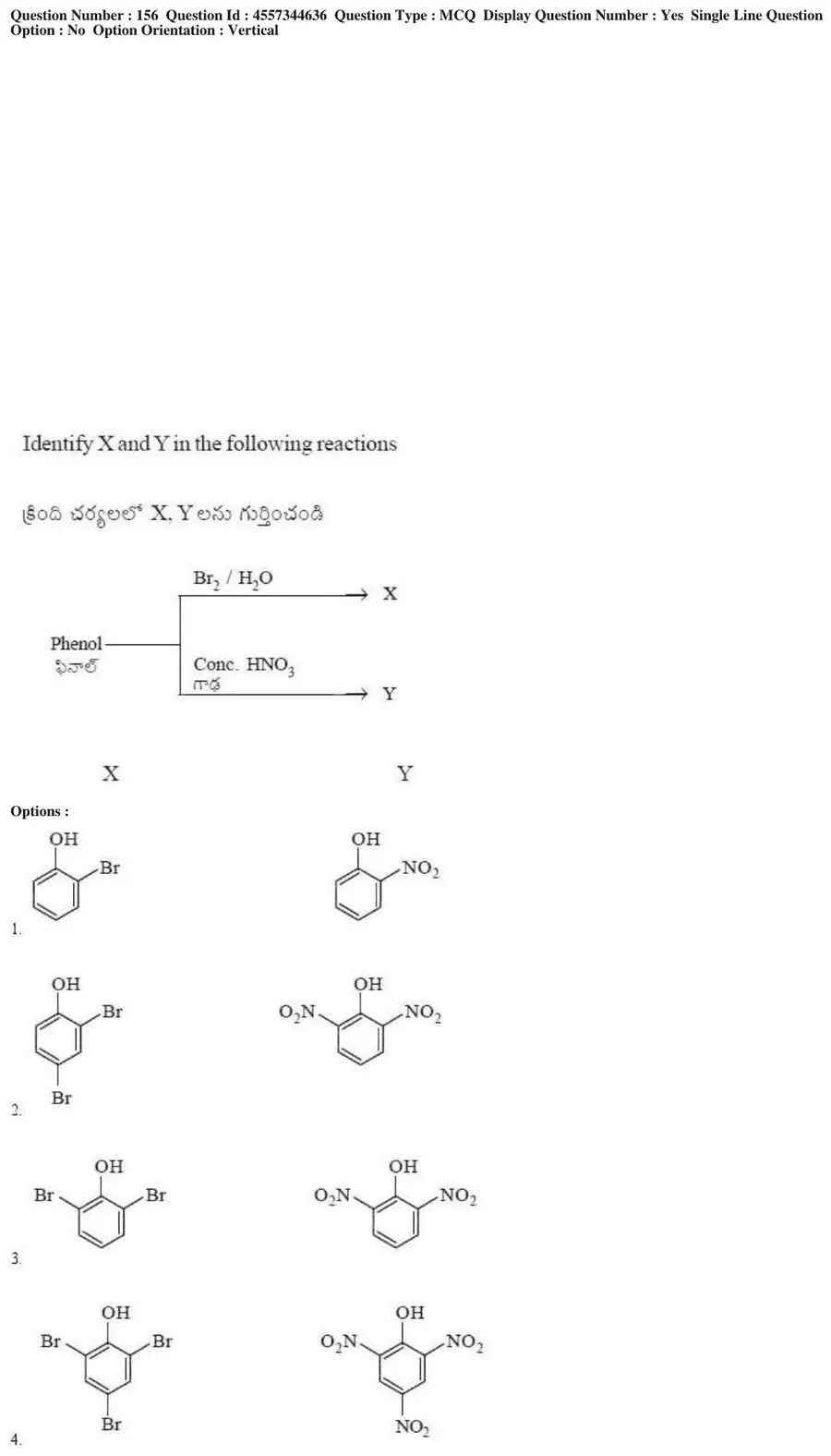
When phenol is treated with bromine water, the white precipitate formed is ______

  • A

    3, 5- dibromophenol

  • B

    2, 4, 6- tribromophenol

  • C

    2, 4- dibromophenol

  • D

    2- bromophenol

87AP EAMCET 2021 · 20 Aug · Shift 1MCQOpen question page ↗

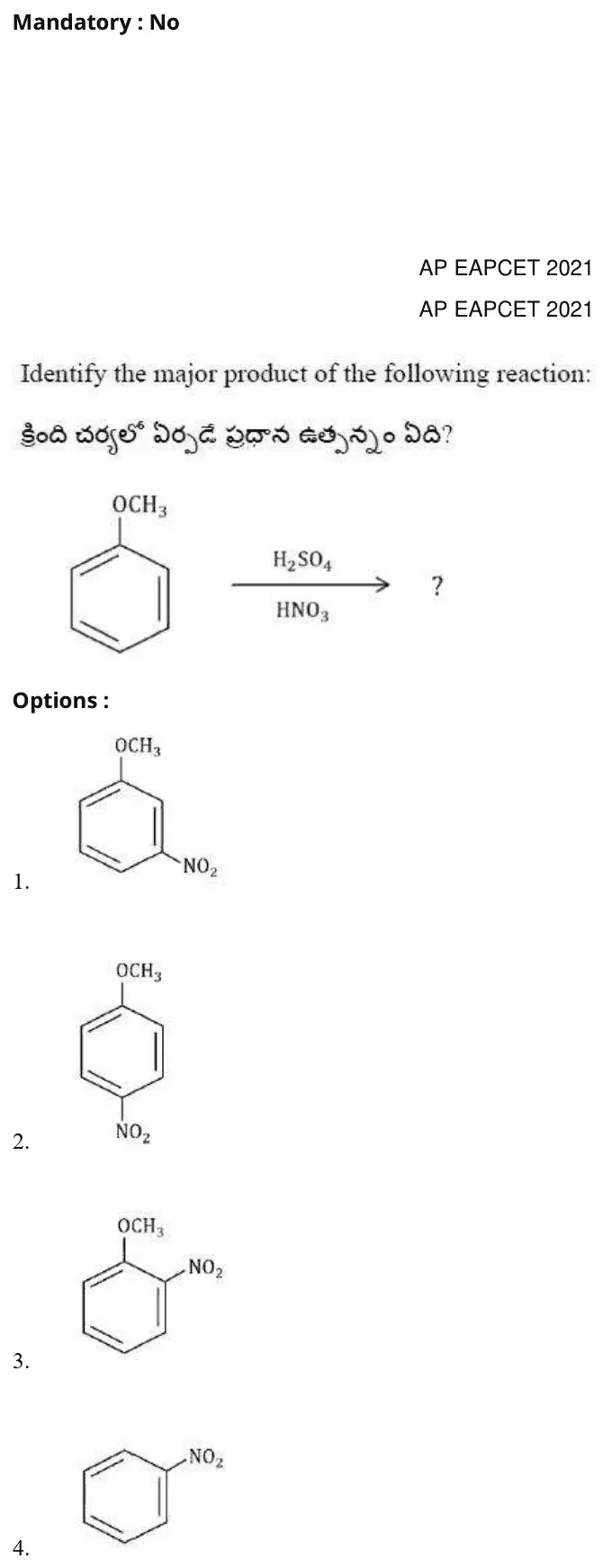
Identify the major product of the following reaction:
(see the figure above)

The question and its figure as printed in AP EAPCET 2021 20th Aug 2021 Shift 1. Option 1: benzene ring with OCH3 at top and NO2 at the lower right (meta to OCH3) Option 2: benzene ring with OCH3 at top and NO2 at the bottom (para to OCH3) Option 3: benzene ring with OCH3 at top and NO2 at the upper right (ortho to OCH3) Option 4: benzene ring with only NO2 at the upper right (no OCH3 drawn)
The question as printed in the paper.
  • A

    see figure benzene ring with OCH3 at top and NO2 at the lower right (meta to OCH3)

  • B

    see figure benzene ring with OCH3 at top and NO2 at the bottom (para to OCH3)

  • C

    see figure benzene ring with OCH3 at top and NO2 at the upper right (ortho to OCH3)

  • D

    see figure benzene ring with only NO2 at the upper right (no OCH3 drawn)

88AP EAMCET 2021 · 20 Aug · Shift 2MCQOpen question page ↗

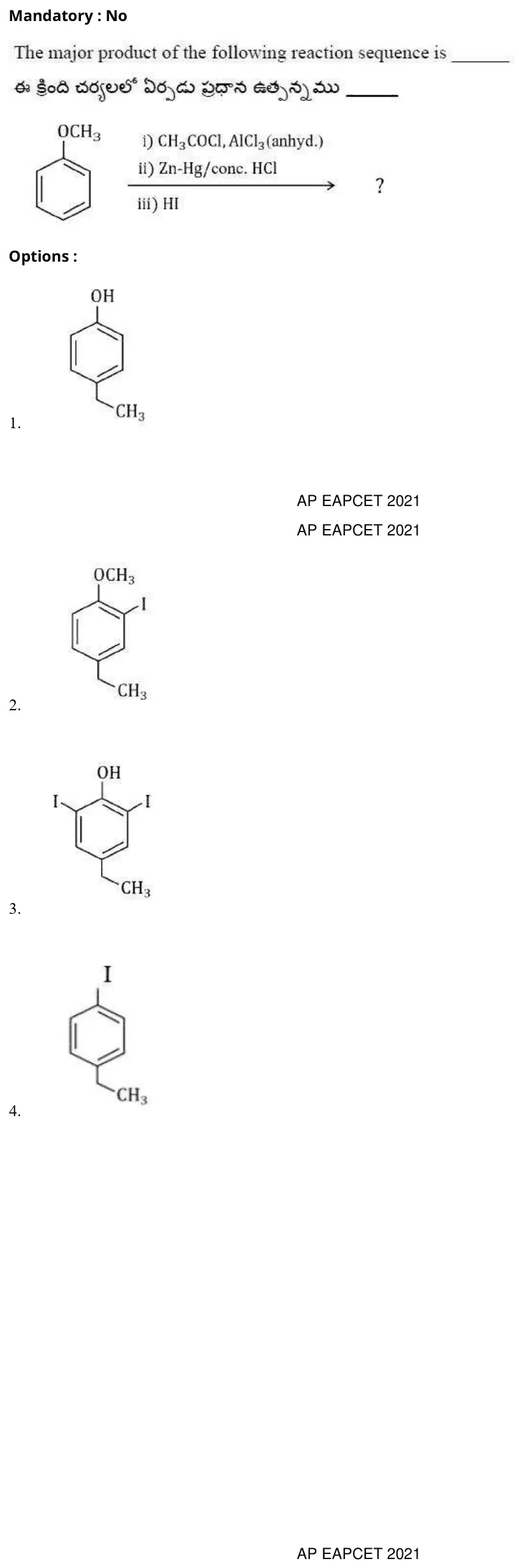
The major product of the following reaction sequence is ______
Anisole (methoxybenzene) is treated with: i) $CH_3COCl$, $AlCl_3$ (anhyd.) ii) Zn-Hg/conc. HCl iii) HI. The product is "?".

The question and its figure as printed in AP EAPCET 2021 20th Aug 2021 Shift 2. Option 1: 4-ethylphenol: OH on the ring at the top, an ethyl group (CH2CH3, drawn as a bent line ending in CH3) para to the OH Option 2: 2-iodo-4-ethylanisole: OCH3 at the top, I on the adjacent (ortho) carbon, an ethyl group para to OCH3 Option 3: 2,6-diiodo-4-ethylphenol: OH at the top, I on both ortho carbons, an ethyl group para to OH Option 4: 4-ethyliodobenzene: I at the top, an ethyl group para to it
The question as printed in the paper.
  • A

    see figure 4-ethylphenol: OH on the ring at the top, an ethyl group ($CH_2CH_3$, drawn as a bent line ending in $CH_3$) para to the OH

  • B

    see figure 2-iodo-4-ethylanisole: $OCH_3$ at the top, I on the adjacent (ortho) carbon, an ethyl group para to $OCH_3$

  • C

    see figure 2,6-diiodo-4-ethylphenol: OH at the top, I on both ortho carbons, an ethyl group para to OH

  • D

    see figure 4-ethyliodobenzene: I at the top, an ethyl group para to it

89TS EAMCET 2021 · 6 Aug · Shift 1MCQOpen question page ↗

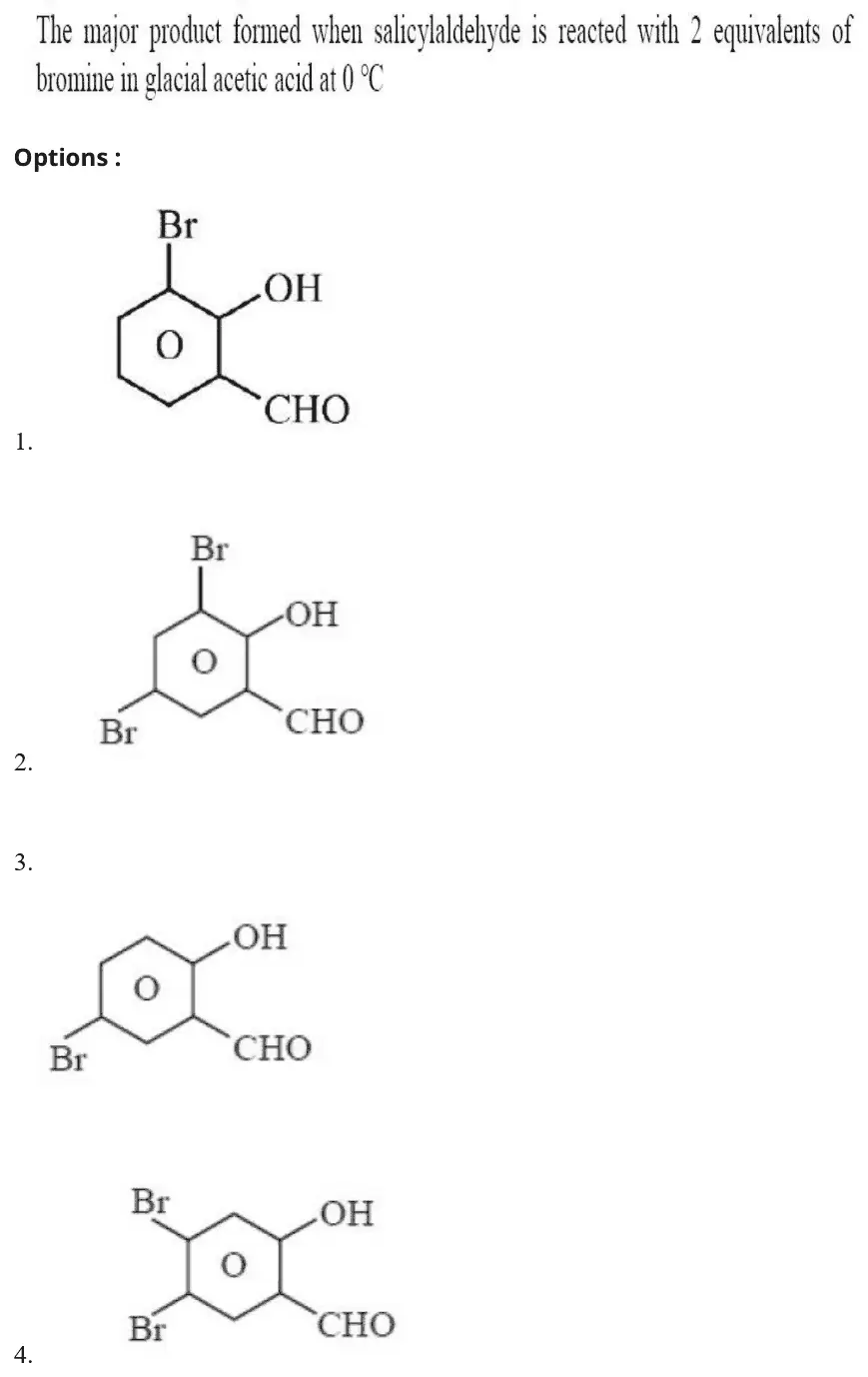
The major product formed when salicylaldehyde is reacted with 2 equivalents of bromine in glacial acetic acid at 0 $^\circ$C

The question and its figure as printed in TS EAPCET 2021 English 6th Aug 2021 Shift 1. Option 1: benzene ring (drawn with a circle) with OH (upper right), CHO (lower right) and Br at the top vertex (ortho to OH) Option 2: ring with OH (upper right), CHO (lower right), Br at the top vertex and Br at the lower-left vertex Option 3: ring with OH (upper right), CHO (lower right) and Br at the lower-left vertex Option 4: ring with OH (upper right), CHO (lower right), Br at the upper-left vertex and Br at the lower-left vertex
The question as printed in the paper.
  • A

    see figure benzene ring (drawn with a circle) with OH (upper right), CHO (lower right) and Br at the top vertex (ortho to OH)

  • B

    see figure ring with OH (upper right), CHO (lower right), Br at the top vertex and Br at the lower-left vertex

  • C

    see figure ring with OH (upper right), CHO (lower right) and Br at the lower-left vertex

  • D

    see figure ring with OH (upper right), CHO (lower right), Br at the upper-left vertex and Br at the lower-left vertex

90TS EAMCET 2021 · 6 Aug · Shift 2MCQOpen question page ↗

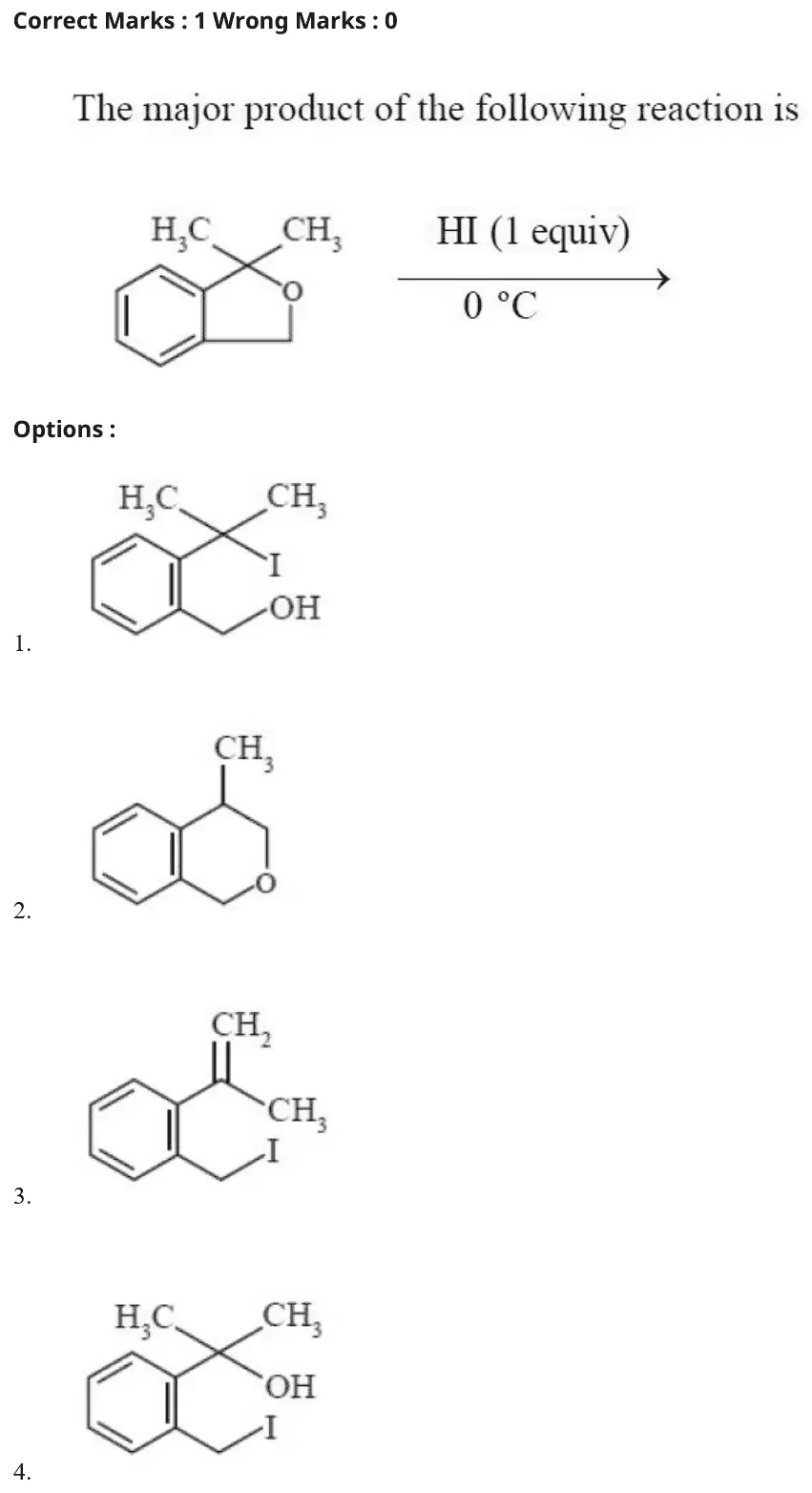
The major product of the following reaction is
(see the figure above)

The question and its figure as printed in TS EAPCET 2021 English 6th Aug 2021 Shift 2. Option 1: benzene ring fused to a chain: ring carbon bearing H3C, CH3 and I (tertiary C(CH3)2-I), and the neighbouring ring substituent CH2OH Option 2: benzene ring fused to a six-membered ring containing O, with a CH3 on the carbon next to the ring carbon (ring ether) Option 3: benzene ring with C(=CH2)CH3 on one ring carbon and CH2I on the adjacent carbon Option 4: benzene ring with C(CH3)2OH (H3C, CH3, OH) on one ring carbon and CH2I on the adjacent carbon
The question as printed in the paper.
  • A

    see figure benzene ring fused to a chain: ring carbon bearing $\mathrm{H_3C}$, $\mathrm{CH_3}$ and I (tertiary C(CH3)2-I), and the neighbouring ring substituent $\mathrm{CH_2OH}$

  • B

    see figure benzene ring fused to a six-membered ring containing O, with a $\mathrm{CH_3}$ on the carbon next to the ring carbon (ring ether)

  • C

    see figure benzene ring with $\mathrm{C(=CH_2)CH_3}$ on one ring carbon and $\mathrm{CH_2I}$ on the adjacent carbon

  • D

    see figure benzene ring with $\mathrm{C(CH_3)_2OH}$ ($\mathrm{H_3C}$, $\mathrm{CH_3}$, OH) on one ring carbon and $\mathrm{CH_2I}$ on the adjacent carbon

91TS EAMCET 2021 · 5 Aug · Shift 1MCQOpen question page ↗

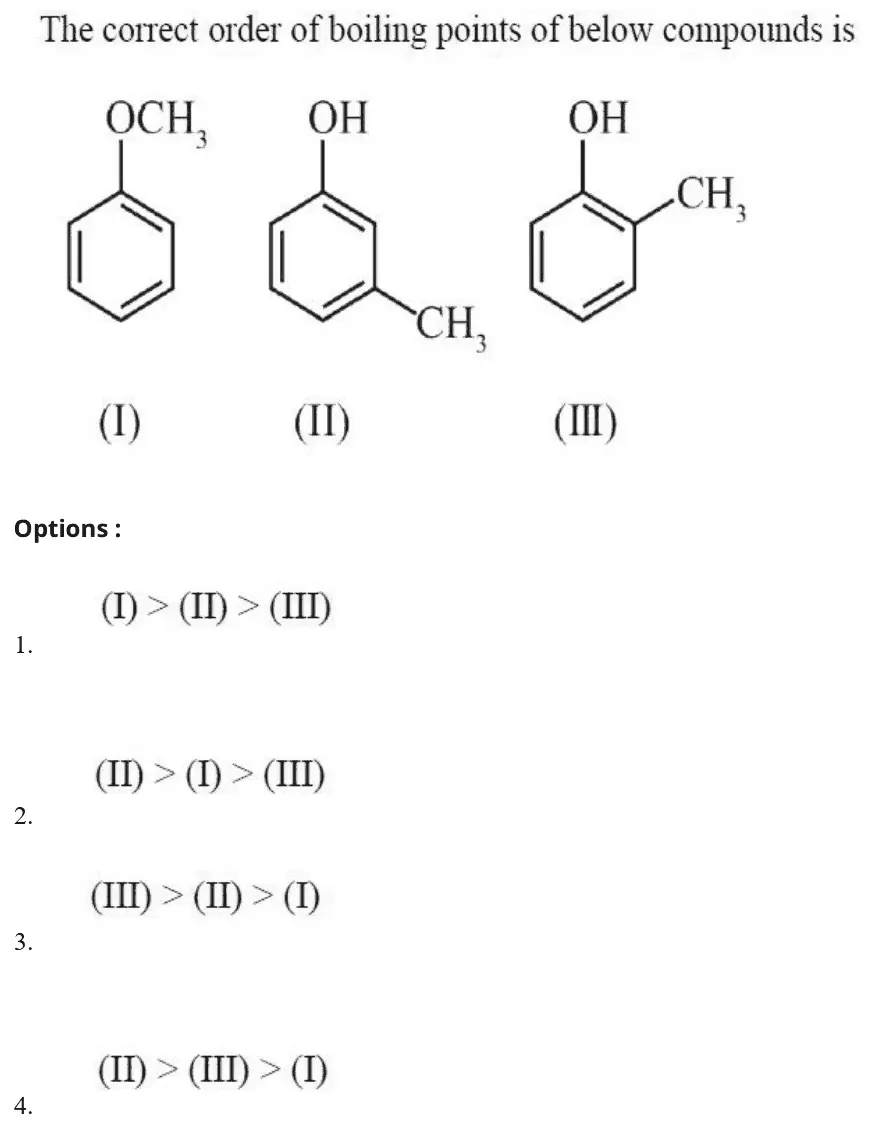
The correct order of boiling points of below compounds is
(see the figure above)

The question and its figure as printed in TS EAPCET 2021 English 5th Aug 2021 Shift 1.
The question as printed in the paper.
  • A

    (I) > (II) > (III)

  • B

    (II) > (I) > (III)

  • C

    (III) > (II) > (I)

  • D

    (II) > (III) > (I)

92TS EAMCET 2021 · 5 Aug · Shift 1MCQOpen question page ↗

Match the following
Column-1 (Compound/ reagent) Column-2 (Other name / Chemical / Name of the process)
A) Methanol I) Lucas reagent
B) $\mathrm{ZnCl_2}$ / Conc. HCl II) Baeyer's reagent
C) Rectified spirit III) Wood spirit
D) Dil. $\mathrm{KMnO_4}$ IV) 95 % $\mathrm{C_2H_5OH}$
V) 75 % $\mathrm{C_2H_5OH}$
VI) 90 % $\mathrm{C_3H_7OH}$
The correct match is

  • A

    A-IV, B-I, C-III, D-II

  • B

    A-III, B-I, C-VI, D-II

  • C

    A-III, B-I, C-IV, D-II

  • D

    A-III, B-II, C-V, D-I

93TS EAMCET 2021 · 5 Aug · Shift 2MCQOpen question page ↗

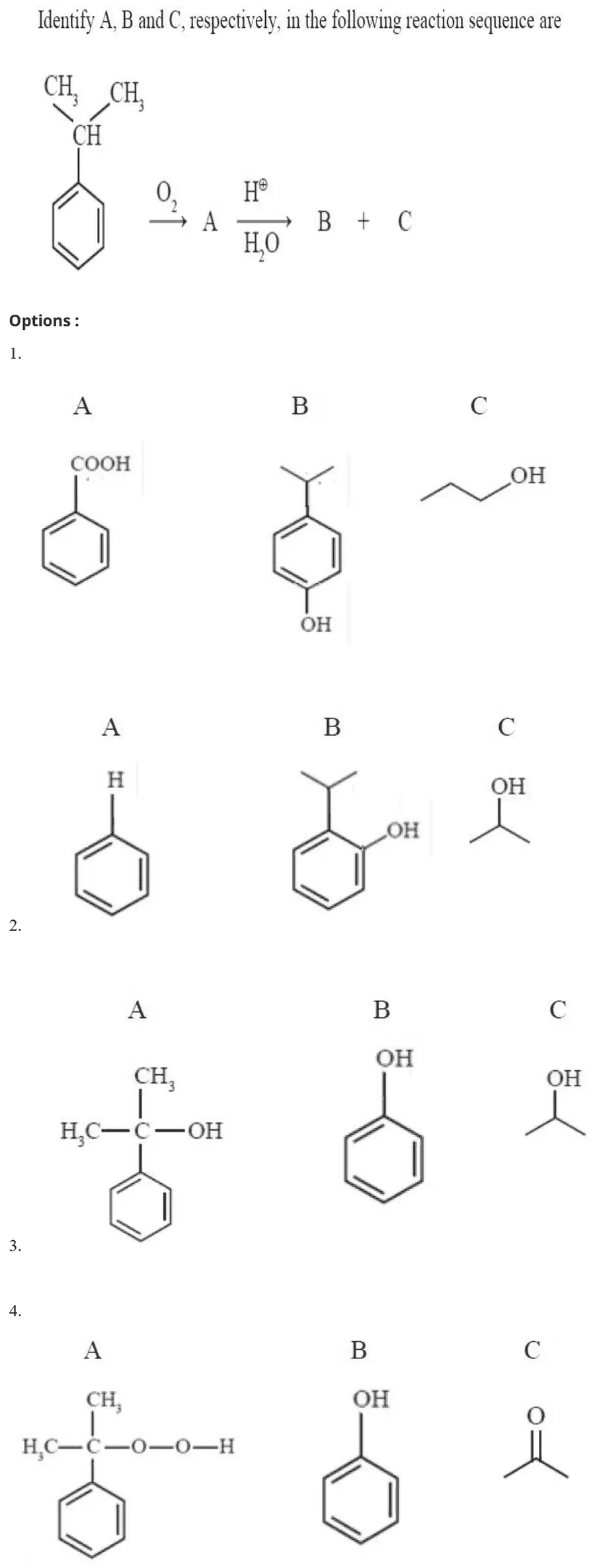
Identify A, B and C, respectively, in the following reaction sequence are
(see the figure above)

The question and its figure as printed in TS EAPCET 2021 English 5th Aug 2021 Shift 2.
The question as printed in the paper.
  • A

    A: benzoic acid; B: 4-isopropylphenol (OH para to the isopropyl group); C: propan-1-ol (zig-zag chain ending in OH)

  • B

    A: benzene; B: 2-isopropylphenol (OH ortho to the isopropyl group); C: propan-2-ol

  • C

    A: $\mathrm{(CH_3)_2C(OH)C_6H_5}$ (C bearing two CH3... printed as H3C-C(CH3)(OH)-phenyl); B: phenol; C: propan-2-ol

  • D

    A: cumene hydroperoxide, $\mathrm{H_3C{-}C(CH_3)(O{-}O{-}H){-}C_6H_5}$; B: phenol; C: propanone (acetone)

94TS EAMCET 2021 · 5 Aug · Shift 2MCQOpen question page ↗

The reaction used for the synthesis of ether is

  • A

    Williamson's synthesis

  • B

    Reimer- Tiemann reaction

  • C

    Sandmeyer reaction

  • D

    Finkelstein reaction

95TS EAMCET 2021 · 4 Aug · Shift 1MCQOpen question page ↗

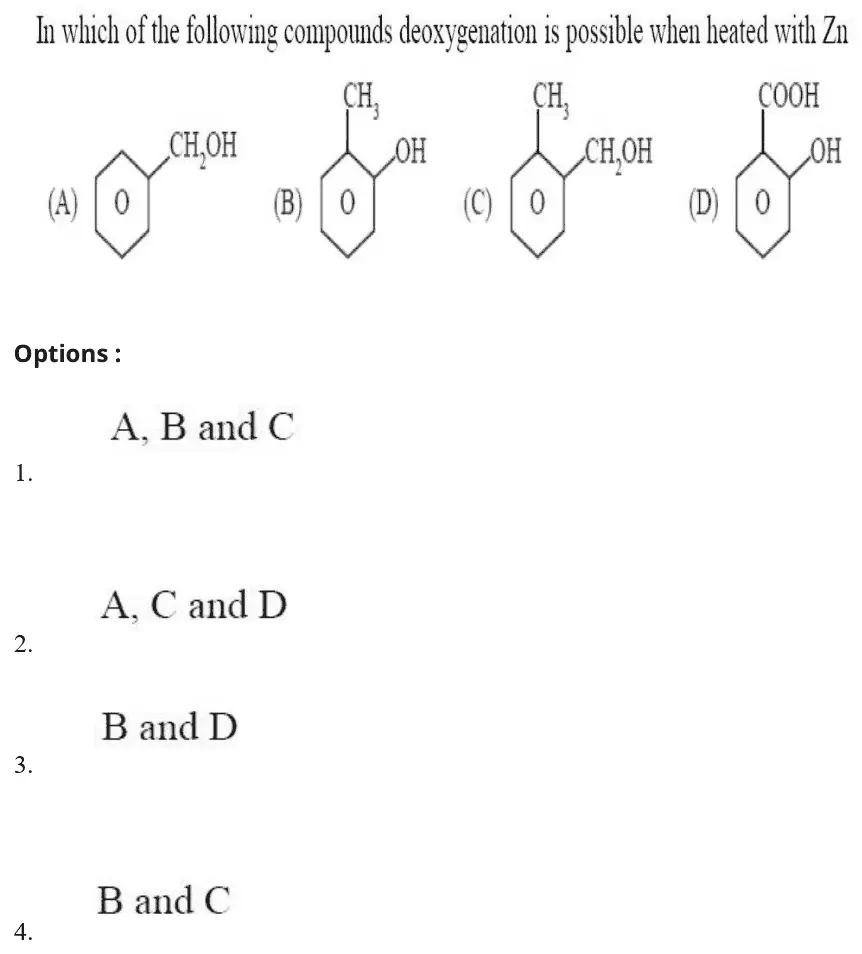
In which of the following compounds deoxygenation is possible when heated with Zn
(see the figure above)

The question and its figure as printed in TS EAPCET 2021 English 4th Aug 2021 Shift 1.
The question as printed in the paper.
  • A

    A, B and C

  • B

    A, C and D

  • C

    B and D

  • D

    B and C

96TS EAMCET 2021 · 4 Aug · Shift 2MCQOpen question page ↗

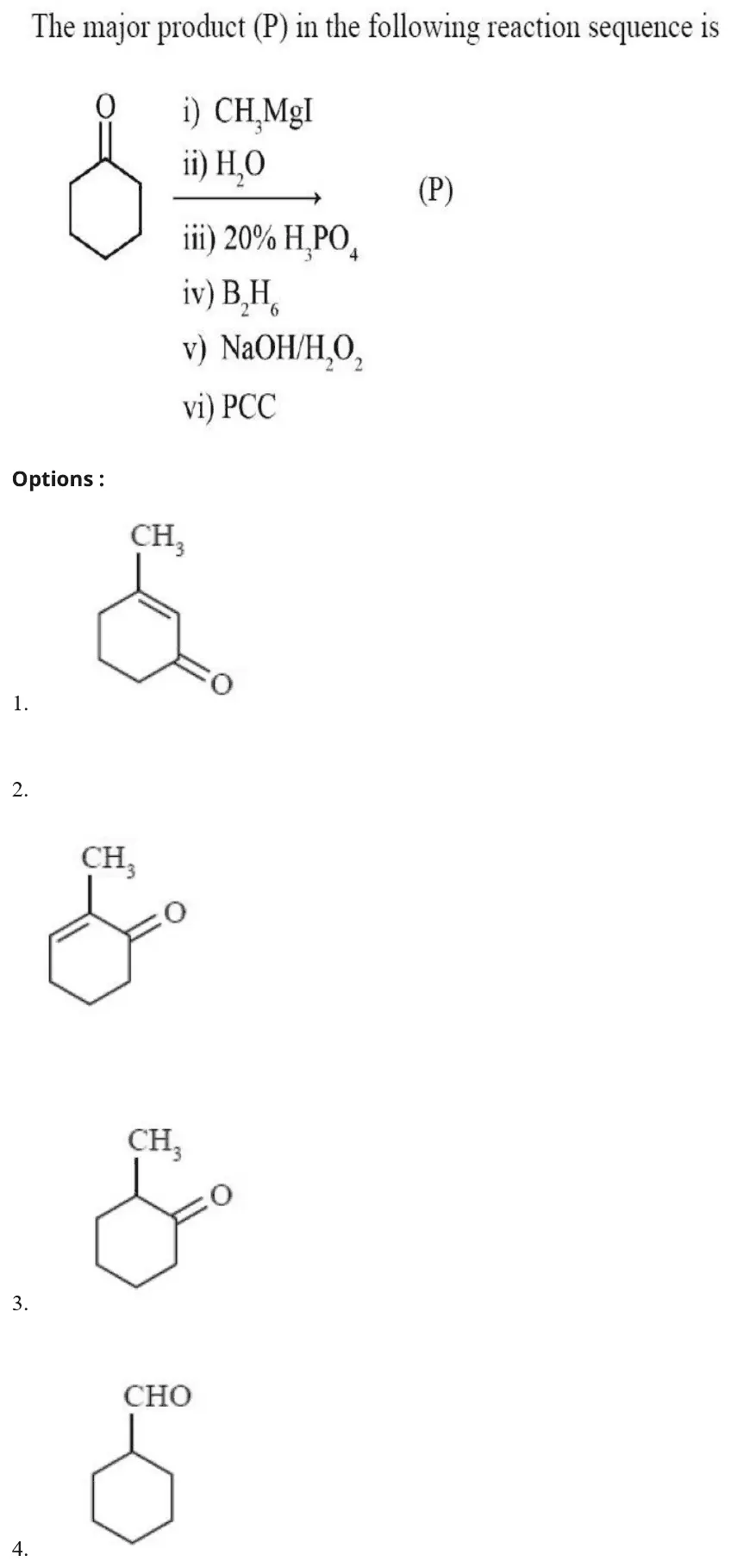
The major product (P) in the following reaction sequence is
(see the figure above)

The question and its figure as printed in TS EAPCET 2021 English 4th Aug 2021 Shift 2. Option 1: 3-methylcyclohex-2-en-1-one Option 2: 2-methylcyclohex-2-en-1-one Option 3: 2-methylcyclohexan-1-one Option 4: cyclohexanecarbaldehyde (CHO on cyclohexane)
The question as printed in the paper.
  • A

    see figure 3-methylcyclohex-2-en-1-one

  • B

    see figure 2-methylcyclohex-2-en-1-one

  • C

    see figure 2-methylcyclohexan-1-one

  • D

    see figure cyclohexanecarbaldehyde ($\mathrm{CHO}$ on cyclohexane)

97TS EAMCET 2021 · 4 Aug · Shift 2MCQOpen question page ↗

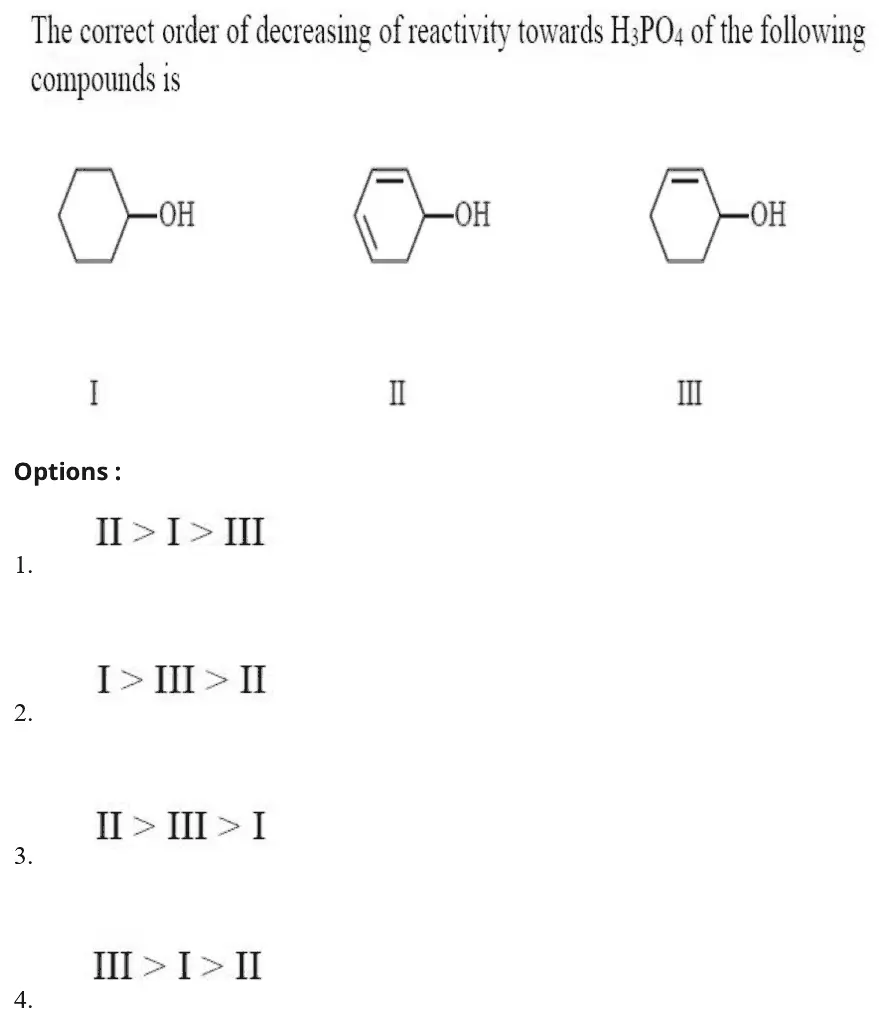
The correct order of decreasing of reactivity towards $\mathrm{H_3PO_4}$ of the following compounds is
(see the figure above)

The question and its figure as printed in TS EAPCET 2021 English 4th Aug 2021 Shift 2.
The question as printed in the paper.
  • A

    $\mathrm{II > I > III}$

  • B

    $\mathrm{I > III > II}$

  • C

    $\mathrm{II > III > I}$

  • D

    $\mathrm{III > I > II}$

98AP EAMCET 2020 · 23 Sep · Shift 1MCQOpen question page ↗

One mole of an organic compound 'A' with the formula $C_3H_8O$ reacts completely with two moles of $HI$ to form X and Y. When 'Y' is boiled with aqueous alkali it forms Z. Z answers the iodoform test. Then the compound 'A' is

  • A

    Propan-1-ol

  • B

    Propan-2-ol

  • C

    Ethoxy ethane

  • D

    Methoxy ethane

99AP EAMCET 2020 · 22 Sep · Shift 1MCQOpen question page ↗

Which of the following compounds will give butanone on oxidation with alkaline $\mathrm{KMnO_4}$ solution?

  • A

    Butan-1-ol only

  • B

    Butan-2-ol only

  • C

    Butan-1-ol and Butan-2-ol

  • D

    None of the options are correct

100AP EAMCET 2020 · 21 Sep · Shift 1MCQOpen question page ↗

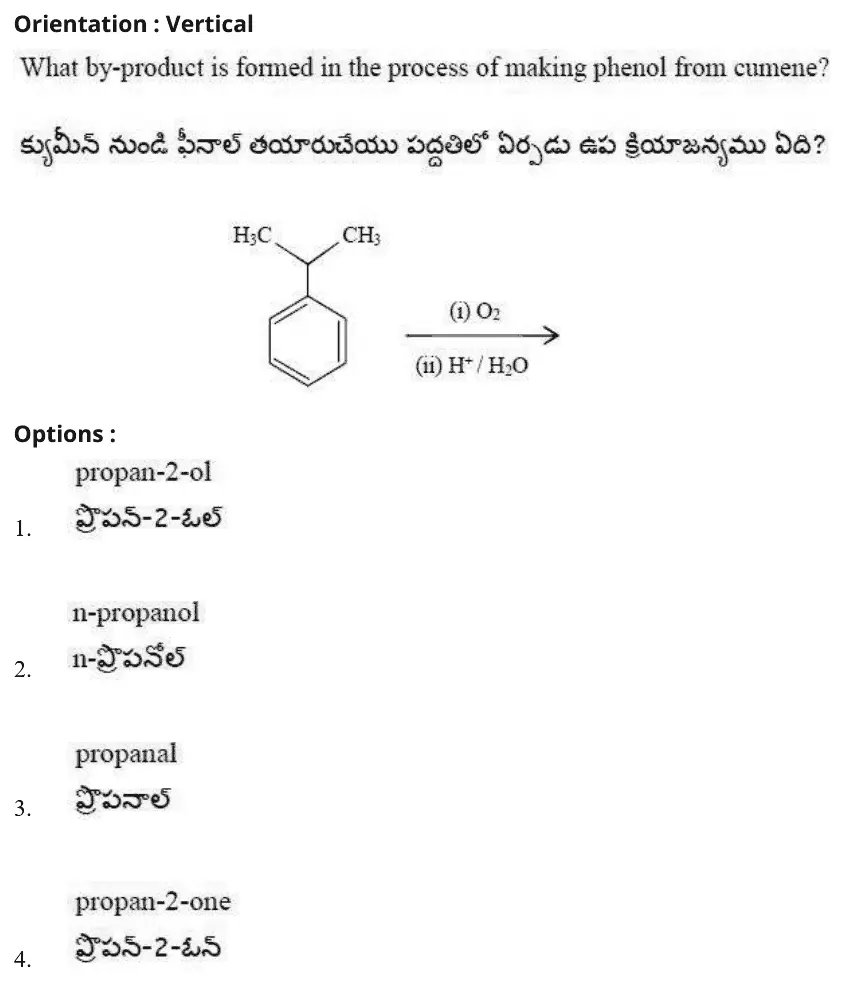
What by-product is formed in the process of making phenol from cumene?
(see the figure above)

The question and its figure as printed in AP EAPCET 2020 21st Sep 2020 Shift1.
The question as printed in the paper.
  • A

    propan-2-ol

  • B

    n-propanol

  • C

    propanal

  • D

    propan-2-one

101TS EAMCET 2020 · 11 Sep · Shift 1MCQOpen question page ↗

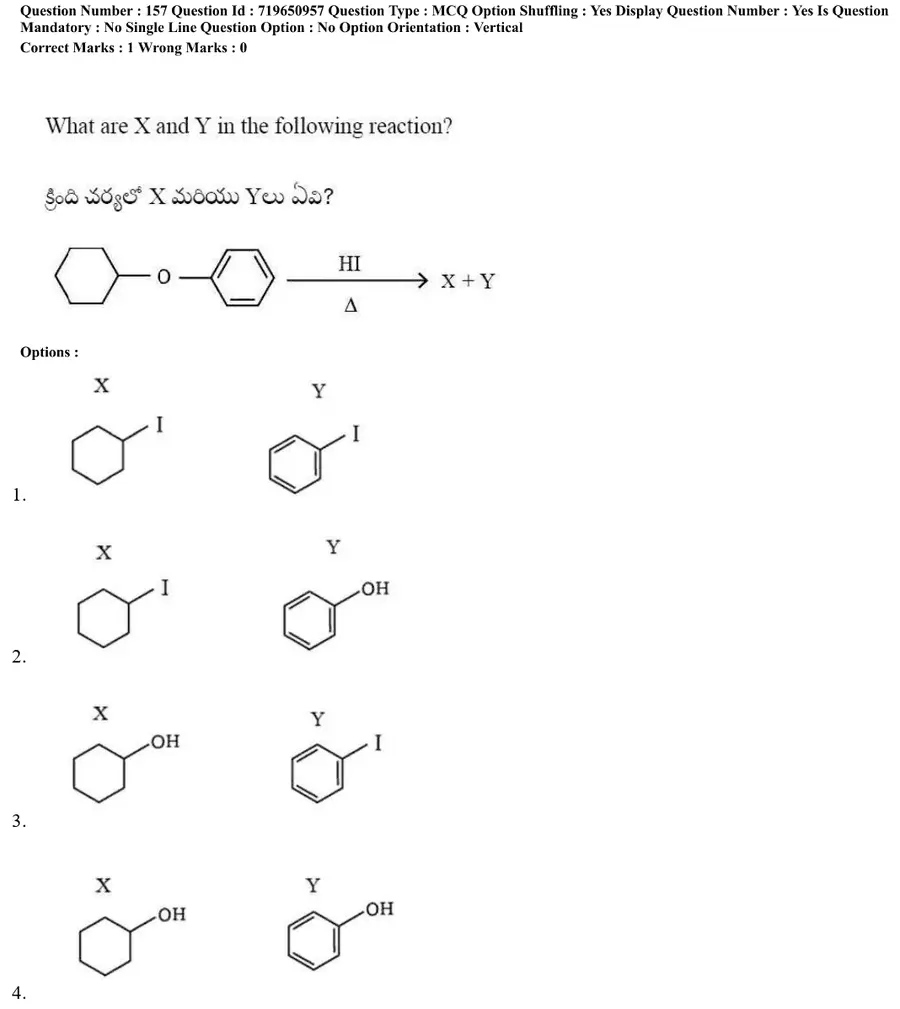
What are X and Y in the following reaction?
(see the figure above)

The question and its figure as printed in TS EAMCET 2020 11 Sep FN.
The question as printed in the paper.
  • A

    X = (see the figure above) iodocyclohexane; Y = (see the figure above) iodobenzene

  • B

    X = (see the figure above) iodocyclohexane; Y = (see the figure above) phenol

  • C

    X = (see the figure above) cyclohexanol; Y = (see the figure above) iodobenzene

  • D

    X = (see the figure above) cyclohexanol; Y = (see the figure above) phenol

102TS EAMCET 2020 · 11 Sep · Shift 2MCQOpen question page ↗

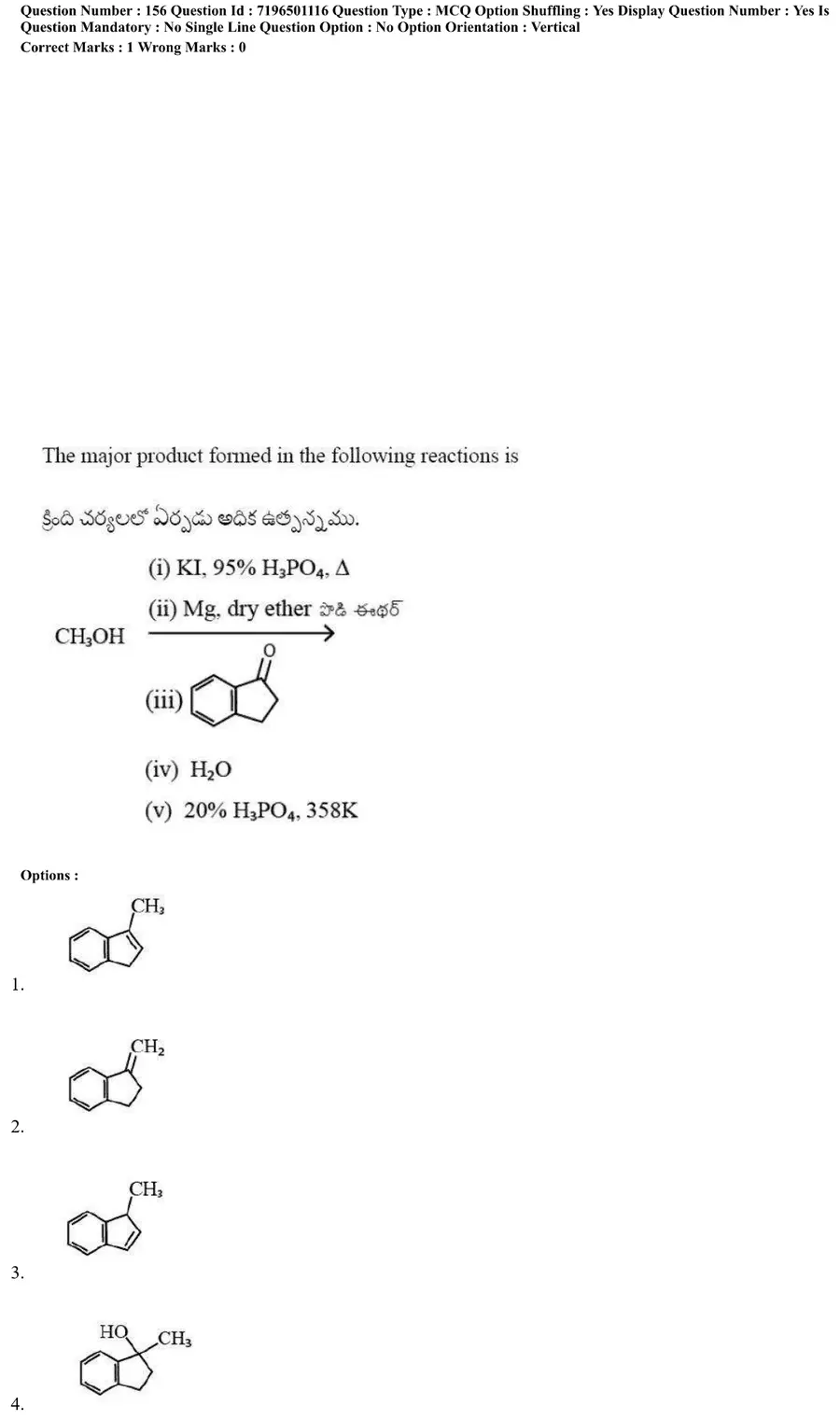
The major product formed in the following reactions is
$\mathrm{CH_3OH}$ then (i) KI, 95% $\mathrm{H_3PO_4}$, $\Delta$; (ii) Mg, dry ether; (iii) (see the figure above); (iv) $\mathrm{H_2O}$; (v) 20% $\mathrm{H_3PO_4}$, 358K

The question and its figure as printed in TS EAMCET 2020 11 Sep AN. Option 1: indene with CH3 on the five-ring carbon, ring double bond at the substituted carbon Option 2: 1-methylene-indane (=CH2 exocyclic) Option 3: indene with CH3 on the five-ring carbon, double bond in the five-ring drawn at the lower right Option 4: 1-methylindan-1-ol (HO and CH3 on the same ring carbon)
The question as printed in the paper.
  • A

    see figure indene with $\mathrm{CH_3}$ on the five-ring carbon, ring double bond at the substituted carbon

  • B

    see figure 1-methylene-indane ($\mathrm{=CH_2}$ exocyclic)

  • C

    see figure indene with $\mathrm{CH_3}$ on the five-ring carbon, double bond in the five-ring drawn at the lower right

  • D

    see figure 1-methylindan-1-ol (HO and $\mathrm{CH_3}$ on the same ring carbon)

103TS EAMCET 2020 · 11 Sep · Shift 2MCQOpen question page ↗

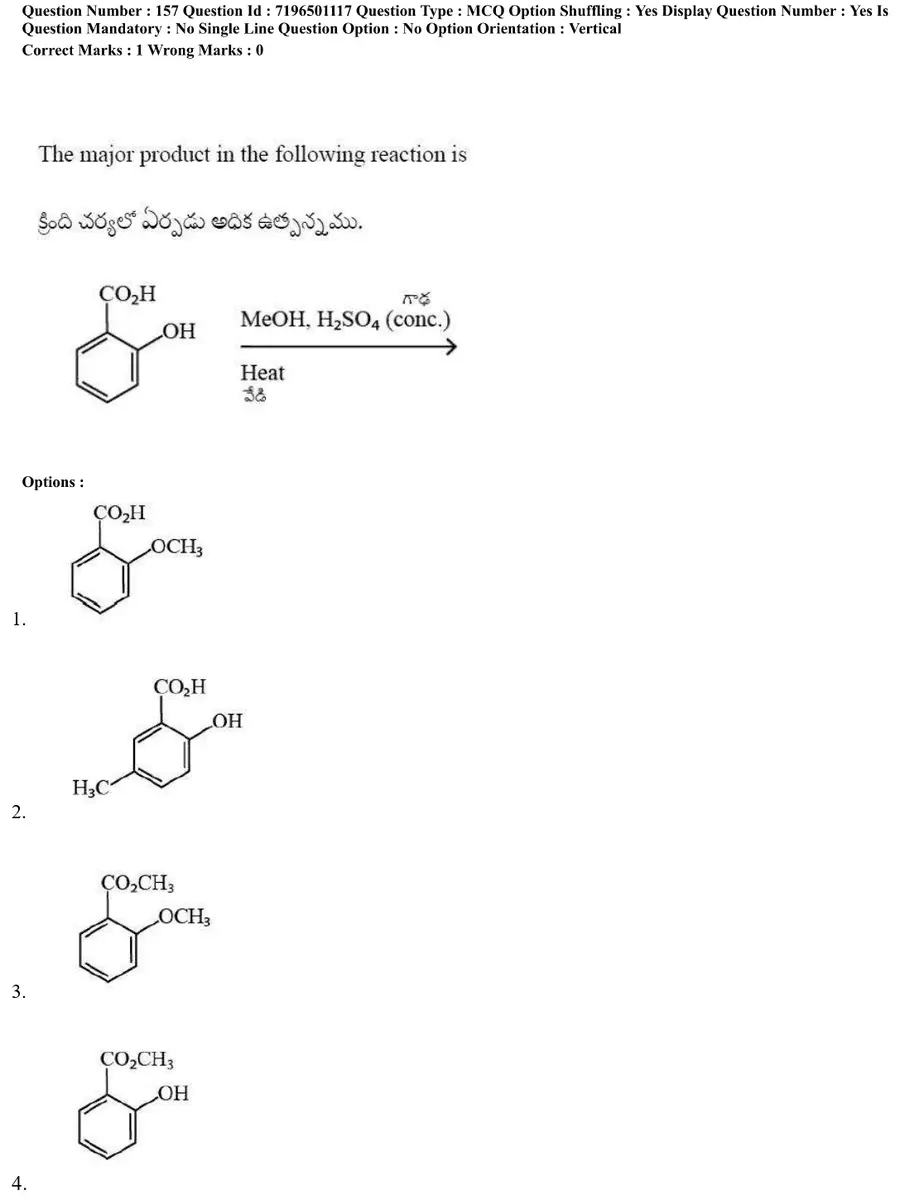
The major product in the following reaction is
(see the figure above) $\xrightarrow[\text{Heat}]{\mathrm{MeOH,\ H_2SO_4\ (conc.)}}$

The question and its figure as printed in TS EAMCET 2020 11 Sep AN. Option 1: benzene ring with CO2H and OCH3 ortho Option 2: benzene ring with CO2H, OH (ortho) and an additional H3C on the ring Option 3: benzene ring with CO2CH3 and OCH3 ortho Option 4: benzene ring with CO2CH3 and OH ortho
The question as printed in the paper.
  • A

    see figure benzene ring with $\mathrm{CO_2H}$ and $\mathrm{OCH_3}$ ortho

  • B

    see figure benzene ring with $\mathrm{CO_2H}$, OH (ortho) and an additional $\mathrm{H_3C}$ on the ring

  • C

    see figure benzene ring with $\mathrm{CO_2CH_3}$ and $\mathrm{OCH_3}$ ortho

  • D

    see figure benzene ring with $\mathrm{CO_2CH_3}$ and OH ortho

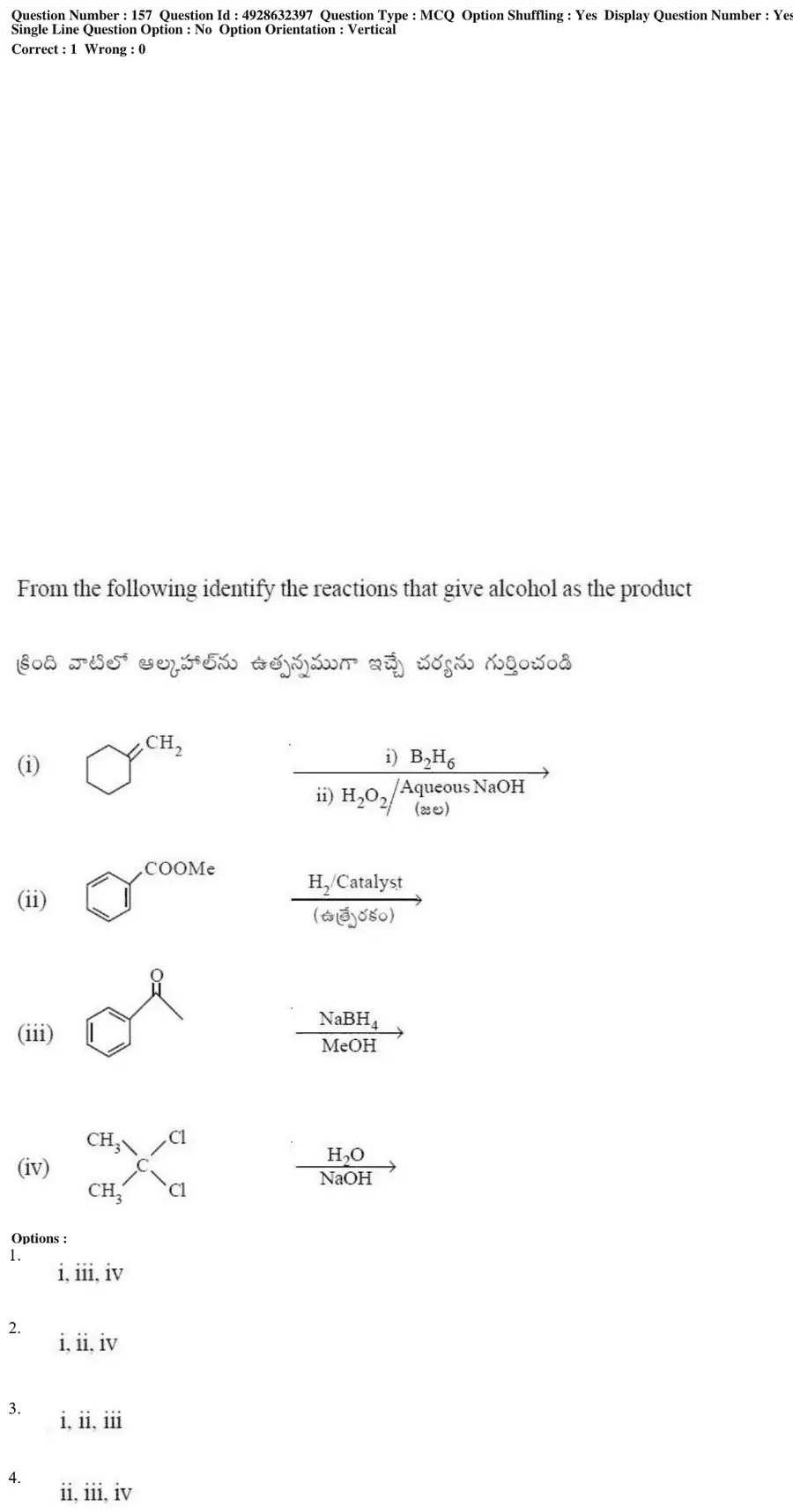
104TS EAMCET 2020 · 10 Sep · Shift 1MCQOpen question page ↗

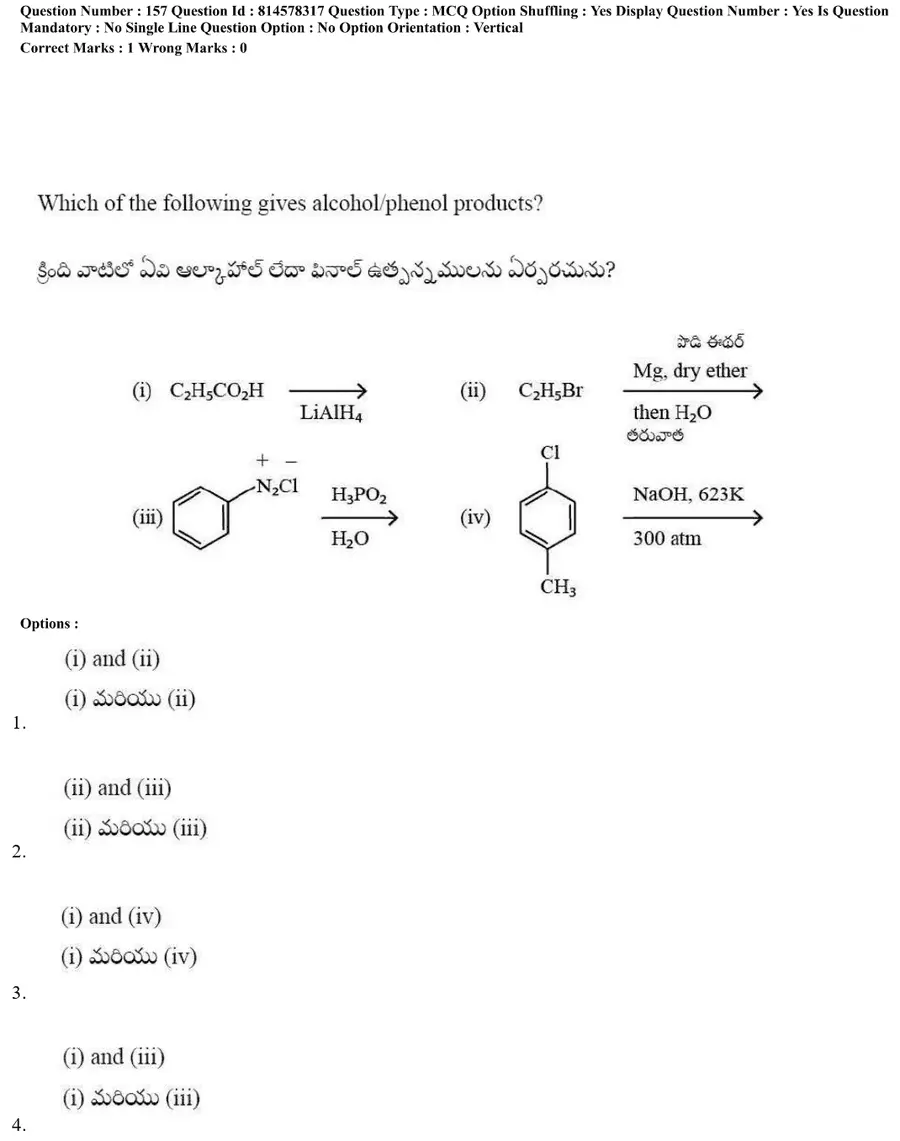
Which of the following gives alcohol/phenol products?
(see the figure above)

The question and its figure as printed in TS EAMCET 2020 10 Sep FN.
The question as printed in the paper.
  • A

    (i) and (ii)

  • B

    (ii) and (iii)

  • C

    (i) and (iv)

  • D

    (i) and (iii)

105TS EAMCET 2020 · 10 Sep · Shift 2MCQOpen question page ↗

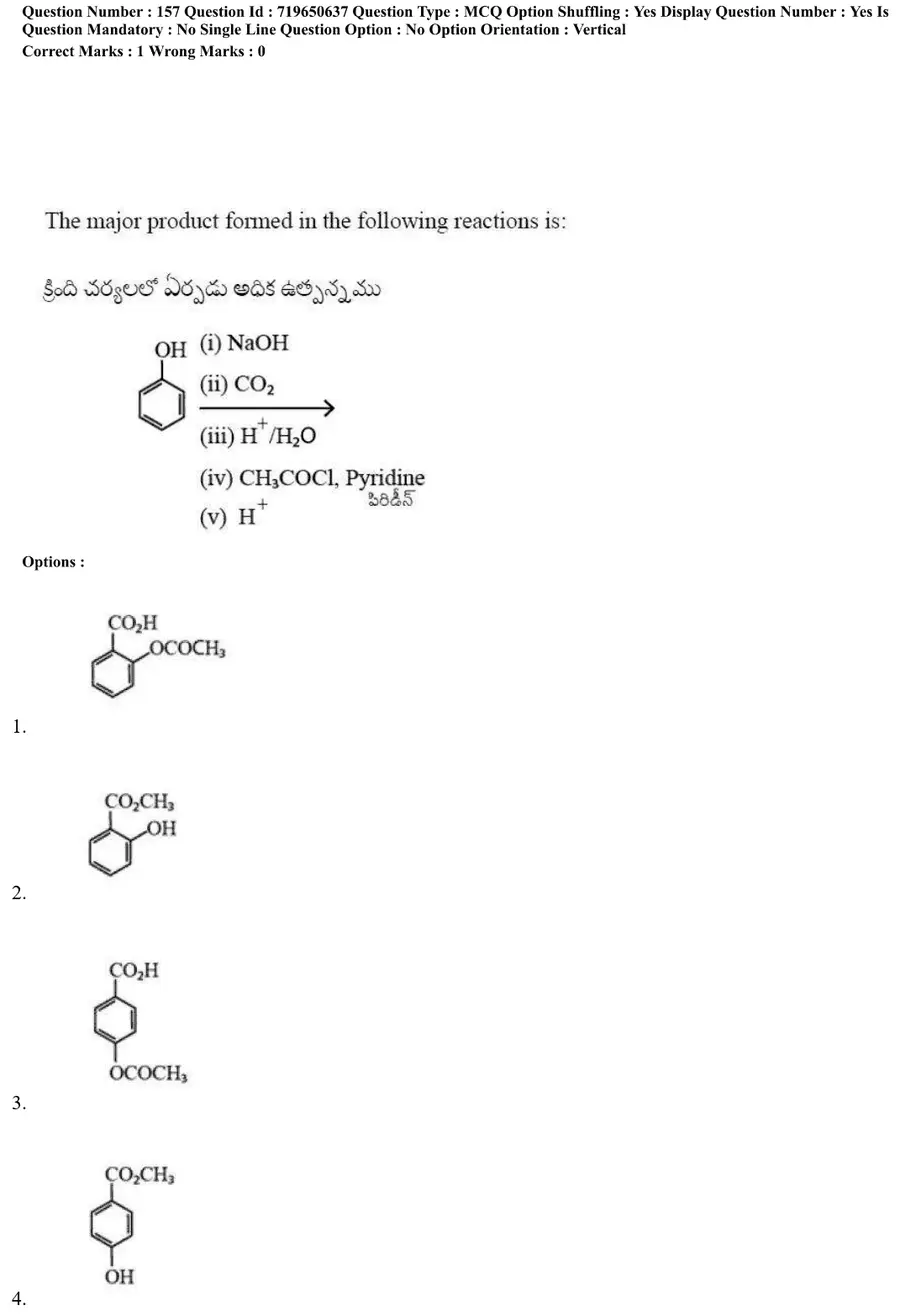
The major product formed in the following reactions is:
(see the figure above)

The question and its figure as printed in TS EAMCET 2020 10 Sep AN. Option 1: benzene ring with CO2H and OCOCH3 on adjacent (ortho) carbons Option 2: benzene ring with CO2CH3 and OH on adjacent (ortho) carbons Option 3: benzene ring with CO2H and OCOCH3 para to each other Option 4: benzene ring with CO2CH3 and OH para to each other
The question as printed in the paper.
  • A

    see figure benzene ring with $\mathrm{CO_2H}$ and $\mathrm{OCOCH_3}$ on adjacent (ortho) carbons

  • B

    see figure benzene ring with $\mathrm{CO_2CH_3}$ and OH on adjacent (ortho) carbons

  • C

    see figure benzene ring with $\mathrm{CO_2H}$ and $\mathrm{OCOCH_3}$ para to each other

  • D

    see figure benzene ring with $\mathrm{CO_2CH_3}$ and OH para to each other

106TS EAMCET 2020 · 9 Sep · Shift 1MCQOpen question page ↗

Which of following alcohols gives white turbidity almost immediately with the Lucas reagent at room temperature?
(i) n-Butanol (ii) tertiary-Butanol
(iii) Benzyl alcohol (iv) Allylic alcohol

  • A

    (i), (ii) and (iii)

  • B

    (i), (iii) and (iv)

  • C

    (ii), (iii) and (iv)

  • D

    (i), (ii) and (iv)

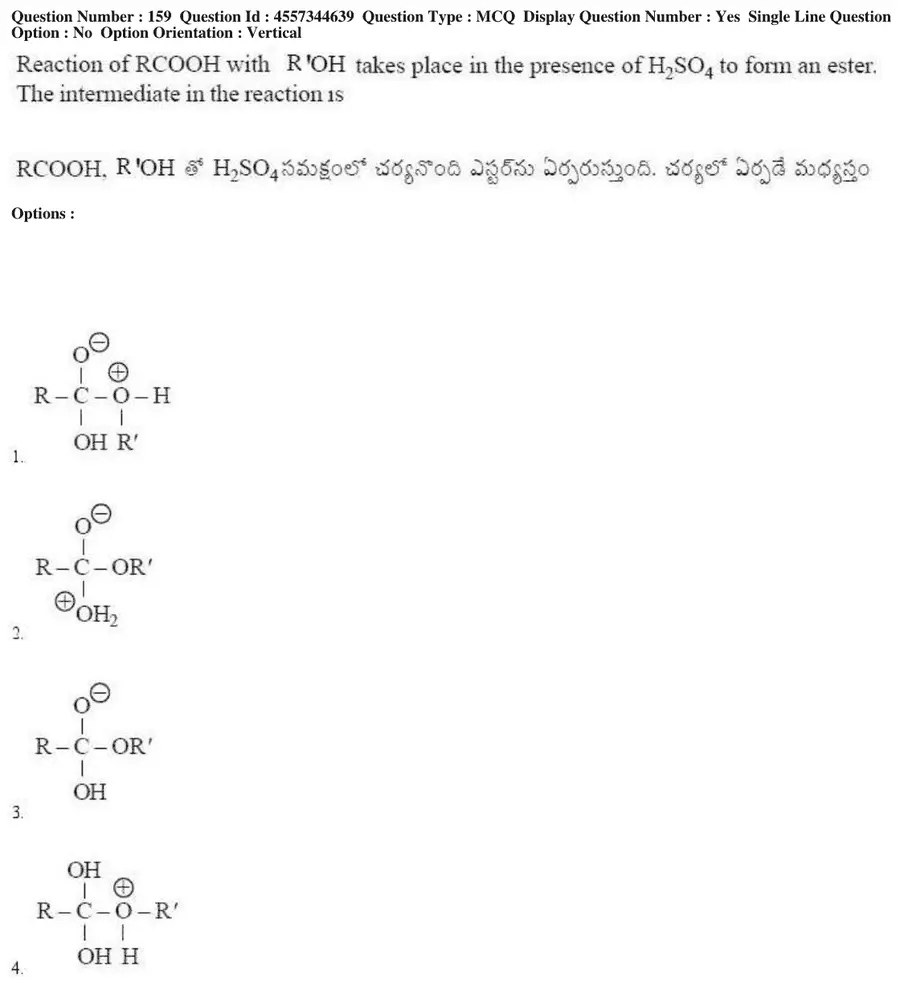
107TS EAMCET 2019 · 4 May · Shift 1MCQOpen question page ↗

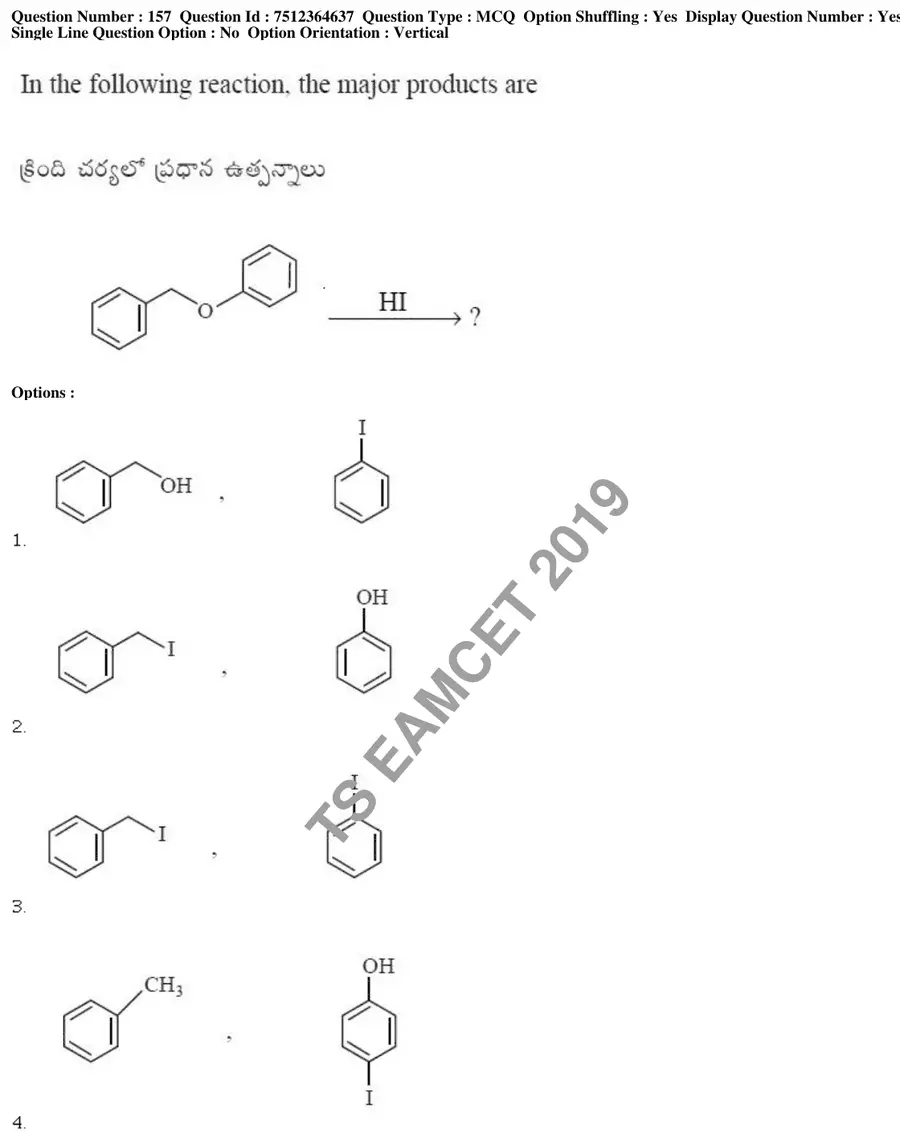
In the following reaction, the major products are
(see the figure above)

The question and its figure as printed in TS EAPCET 2019 4th May 2019 Shift 1. Option 1: benzyl alcohol (C6H5CH2OH) , iodobenzene Option 2: benzyl iodide (C6H5CH2I) , phenol Option 3: benzyl iodide (C6H5CH2I) , iodobenzene Option 4: toluene (C6H5CH3) , 4-iodophenol
The question as printed in the paper.
  • A

    see figure benzyl alcohol ($\mathrm{C_6H_5CH_2OH}$) , iodobenzene

  • B

    see figure benzyl iodide ($\mathrm{C_6H_5CH_2I}$) , phenol

  • C

    see figure benzyl iodide ($\mathrm{C_6H_5CH_2I}$) , iodobenzene

  • D

    see figure toluene ($\mathrm{C_6H_5CH_3}$) , 4-iodophenol

108TS EAMCET 2019 · 4 May · Shift 2MCQOpen question page ↗

Arrange the following compounds in the correct order of their acid strength.
(see the figure above)

The question and its figure as printed in TS EAPCET 2019 4th May 2019 Shift 2.
The question as printed in the paper.
  • A

    a > d > c > b

  • B

    a > b > c > d

  • C

    b > c > d > a

  • D

    b > a > d > c

109TS EAMCET 2019 · 3 May · Shift 2MCQOpen question page ↗

Find the correct order of acid strengths of the following compounds
(see the figure above)

The question and its figure as printed in TS EAPCET 2019 3rd May 2019 Shift 2.
The question as printed in the paper.
  • A

    F>D>E>B>C>A

  • B

    D>F>E>C>B>A

  • C

    D>E>F>B>C>A

  • D

    F>E>D>B>C>A

110AP EAMCET 2019 · 23 Apr · Shift 1MCQOpen question page ↗

Which of the following conversion represents Fries rearrangement?

  • A

    O-acylated phenol to C-acylated phenol

  • B

    C-acylated phenol to O-acylated phenol

  • C

    N-acylated phenol to C-acylated phenol

  • D

    C-acylated phenol to N-acylated phenol

111AP EAMCET 2019 · 23 Apr · Shift 1MCQOpen question page ↗

What are X, Y, Z in the following reactions?
$\mathrm{CH_3-CH(OH)-CH_3 \xrightarrow{X} CH_3-CH=CH_2 + H_2O}$
$\mathrm{CH_3-CH_2-OH \xrightarrow{Y} CH_2=CH_2 + H_2O}$
$\mathrm{(CH_3)_3C-OH \xrightarrow{Z} CH_3-C(CH_3)=CH_2 + H_2O}$

  • A

    X = $\mathrm{H_2SO_4}$, 443K; Y = 85% $\mathrm{H_3PO_4}$, 440K; Z = 20% $\mathrm{H_3PO_4}$, 358K

  • B

    X = 85% $\mathrm{H_3PO_4}$, 440K; Y = $\mathrm{H_2SO_4}$, 443K; Z = 20% $\mathrm{H_3PO_4}$, 358K

  • C

    X = 20% $\mathrm{H_3PO_4}$, 358K; Y = $\mathrm{H_2SO_4}$, 443K; Z = 85% $\mathrm{H_3PO_4}$, 440K

  • D

    X = $\mathrm{H_2SO_4}$, 443K; Y = 20% $\mathrm{H_3PO_4}$, 358K; Z = 85% $\mathrm{H_3PO_4}$, 440K

112AP EAMCET 2019 · 23 Apr · Shift 1MCQOpen question page ↗

What are X, Y and Z in the following reactions?
$\mathrm{(H_3C)_3C-O^{\ominus}Na^{\oplus} + CH_3CH_2Br \longrightarrow X + NaBr}$
$\mathrm{(H_3C)_3C-Br + CH_3CH_2O^{\ominus}Na^{\oplus} \longrightarrow Y + Z}$

  • A

    X = $\mathrm{(H_3C)_3C-Br}$; Y = $\mathrm{(H_3C)_3C-OH}$; Z = $\mathrm{CH_3CH_2Br}$

  • B

    X = $\mathrm{CH_3-C(CH_3)=CH_2}$ (CH3 drawn below the middle carbon); Y = $\mathrm{(H_3C)_3C-OCH_2CH_3}$; Z = NaBr

  • C

    X = $\mathrm{(H_3C)_3C-O-CH_2CH_3}$; Y = $\mathrm{CH_3-C(CH_3)=CH_2}$ (CH3 drawn below the middle carbon); Z = $\mathrm{CH_3CH_2OH}$

  • D

    X = $\mathrm{CH_3-CH(CH_3)-CH_2OH}$ (CH3 drawn below the CH); Y = $\mathrm{CH_3-CH(CH_3)-OCH_2CH_3}$ (CH3 drawn below the CH); Z = NaBr

113AP EAMCET 2019 · 22 Apr · Shift 1MCQOpen question page ↗

What are A, B and C in the following reactions?
$\mathrm{Cumene \xrightarrow{O_2} A \xrightarrow{H_3O^{\oplus}} B + C}$

  • A

    A: $\mathrm{C_6H_5-C(OH)(CH_3)-CH_3}$ (OH above, CH3 below the carbon); B: $\mathrm{C_6H_5-CHO}$; C: $\mathrm{CH_3CHO}$

  • B

    A: $\mathrm{C_6H_5-CH(CH_3)-O-OH}$ (CH3 below the CH); B: $\mathrm{C_6H_5-CH(CH_3)-OH}$ (CH3 below the CH); C: $\mathrm{H_2O}$

  • C

    A: $\mathrm{C_6H_5-C(CH_3)_2-O-OH}$ (one CH3 above, one below the carbon); B: $\mathrm{C_6H_5-OH}$; C: $\mathrm{(CH_3)_2CO}$

  • D

    A: $\mathrm{C_6H_5-CH(CH_3)-CH_2-O-OH}$ (CH3 above the CH); B: $\mathrm{C_6H_5-CH(CH_3)-CH_2OH}$ (CH3 above the CH); C: $\mathrm{H_2O}$

114AP EAMCET 2019 · 21 Apr · Shift 1MCQOpen question page ↗

Identify the products (X, Y) and reaction mechanism (Z) of the following reaction?
(see the figure above)

The question and its figure as printed in AP EAPCET 2019 21th April 2019 Shift1.
The question as printed in the paper.
  • A

    X = (see the figure above) ethanol (skeletal, ethyl-OH); Y = (see the figure above) 2-iodo-2-methylbutane (skeletal, tertiary C-I); Z = $\mathrm{S_N1}$

  • B

    X = (see the figure above) ethanol (skeletal, ethyl-OH); Y = (see the figure above) 2-iodo-2-methylbutane (skeletal, tertiary C-I); Z = $\mathrm{S_N2}$

  • C

    X = (see the figure above) iodoethane (skeletal, ethyl-I); Y = (see the figure above) 2-methylbutan-2-ol (skeletal, tertiary C-OH); Z = $\mathrm{S_N1}$

  • D

    X = (see the figure above) iodoethane (skeletal, ethyl-I); Y = (see the figure above) 2-methylbutan-2-ol (skeletal, tertiary C-OH); Z = $\mathrm{S_N2}$

115AP EAMCET 2019 · 21 Apr · Shift 2MCQOpen question page ↗

$\mathrm{C_6H_5-CH(CH_3)_2 \xrightarrow[(ii)\ H^+/H_2O]{(i)\ O_2} X \xrightarrow[(iii)\ H^+]{(i)\ NaOH\ (ii)\ CO_2} Y \xrightarrow[H^+]{(CH_3CO)_2O} Z}$
What is Z in the above sequence of reactions?

The question and its figure as printed in AP EAPCET 2019 21th April 2019 Shift2. Option 1: benzene ring with OH and CHO on adjacent carbons (ortho) Option 2: benzene ring with OH and O-C(=O)-CH3 (acetoxy) on adjacent carbons (ortho) Option 3: benzene ring with COOH and OH para Option 4: benzene ring with COOH and OCOCH3 on adjacent carbons (ortho)
The question as printed in the paper.
  • A

    see figure benzene ring with OH and CHO on adjacent carbons (ortho)

  • B

    see figure benzene ring with OH and $\mathrm{O-C(=O)-CH_3}$ (acetoxy) on adjacent carbons (ortho)

  • C

    see figure benzene ring with COOH and OH para

  • D

    see figure benzene ring with COOH and $\mathrm{OCOCH_3}$ on adjacent carbons (ortho)

116AP EAMCET 2019 · 20 Apr · Shift 1MCQOpen question page ↗

2-Methyl-2-butene on hydration gave an alcohol X. Isomer of X could be prepared from which of the following?

The question and its figure as printed in AP EAPCET 2019 20th April 2019 Shift1. Option 1: 2-methylbut-2-ene (skeletal alkene) + HBr, H2O Option 2: acetone (CH3COCH3) + (figure) propyl-MgBr (CH3CH2CH2MgBr, a two-bond zig-zag then MgBr), H2O/H^+ Option 3: acetaldehyde (CH3CHO) + (figure) isopropyl-MgBr ((CH3)2CH-MgBr), H2O/H^+ Option 4: acetone (CH3COCH3) + (figure) butyl-MgBr (CH3CH2CH2CH2MgBr, a three-bond zig-zag then MgBr), H2O/H^+
The question as printed in the paper.
  • A

    see figure 2-methylbut-2-ene (skeletal alkene) + HBr, $\mathrm{H_2O}$

  • B

    see figure acetone ($\mathrm{CH_3COCH_3}$) + (see the figure above) propyl-MgBr ($\mathrm{CH_3CH_2CH_2MgBr}$, a two-bond zig-zag then MgBr), $\mathrm{H_2O/H^+}$

  • C

    see figure acetaldehyde ($\mathrm{CH_3CHO}$) + (see the figure above) isopropyl-MgBr ($\mathrm{(CH_3)_2CH{-}MgBr}$), $\mathrm{H_2O/H^+}$

  • D

    see figure acetone ($\mathrm{CH_3COCH_3}$) + (see the figure above) butyl-MgBr ($\mathrm{CH_3CH_2CH_2CH_2MgBr}$, a three-bond zig-zag then MgBr), $\mathrm{H_2O/H^+}$

117AP EAMCET 2019 · 20 Apr · Shift 2MCQOpen question page ↗

Arrange the following in increasing order of acidic character
(see the figure above)

The question and its figure as printed in AP EAPCET 2019 20th April 2019 Shift2.
The question as printed in the paper.
  • A

    I < II < III < IV

  • B

    I < IV < II < III

  • C

    IV < III < II < I

  • D

    II < III < IV < I

118TS EAMCET 2018 · 5 May · Shift 2MCQOpen question page ↗

From the following identify the reactions that give alcohol as the product
(see the figure above)
(i) methylenecyclohexane ($=\mathrm{CH_2}$ on a six-membered ring) $\xrightarrow{\text{i) } \mathrm{B_2H_6}\text{ ; ii) } \mathrm{H_2O_2/Aqueous\ NaOH}}$
(ii) methyl benzoate (phenyl-COOMe) $\xrightarrow{\mathrm{H_2/Catalyst}}$
(iii) acetophenone (phenyl-CO-CH_3) $\xrightarrow{\mathrm{NaBH_4/MeOH}}$
(iv) $(\mathrm{CH_3})_2\mathrm{CCl_2}$ $\xrightarrow{\mathrm{H_2O/NaOH}}$

The question and its figure as printed in TS EAPCET 2018 5th May Shift 2.
The question as printed in the paper.
  • A

    i, iii, iv

  • B

    i, ii, iv

  • C

    i, ii, iii

  • D

    ii, iii, iv

119TS EAMCET 2018 · 4 May · Shift 1MCQOpen question page ↗

The product (P) of the below reaction is
(see the figure above)

The question and its figure as printed in TS EAPCET 2018 4th May Shift 1. Option 1: benzene-1,3-diol (resorcinol) with Br at two positions: one Br ortho to an OH between the OH groups' side (adjacent to the upper OH), the other para to the upper OH (2 Br; see crop for exact positions) Option 2: resorcinol with OH at the top and right, Br at the upper-left and lower-left ring positions (2 Br) Option 3: resorcinol with Br at upper-left and bottom ring positions plus one Br near the right OH (3 Br) Option 4: resorcinol with Br at three adjacent positions on the left/bottom of the ring (2,4,6-type pattern drawn as 3 Br)
The question as printed in the paper.
  • A

    see figure benzene-1,3-diol (resorcinol) with Br at two positions: one Br ortho to an OH between the OH groups' side (adjacent to the upper OH), the other para to the upper OH (2 Br; see crop for exact positions)

  • B

    see figure resorcinol with OH at the top and right, Br at the upper-left and lower-left ring positions (2 Br)

  • C

    see figure resorcinol with Br at upper-left and bottom ring positions plus one Br near the right OH (3 Br)

  • D

    see figure resorcinol with Br at three adjacent positions on the left/bottom of the ring (2,4,6-type pattern drawn as 3 Br)

120TS EAMCET 2018 · 4 May · Shift 2MCQOpen question page ↗

The major product of the following reaction is
(see the figure above)

The question and its figure as printed in TS EAPCET 2018 4th May Shift 2.
The question as printed in the paper.
  • A

    sodium 2-chlorophenoxide

  • B

    sodium 2-carboxylate phenoxide (ONa and CO2Na, ortho)

  • C

    sodium 2-formylphenoxide (ONa and CHO, ortho)

  • D

    sodium 2-hydroxyphenoxide (ONa and OH, ortho)

121AP EAMCET 2018 · 24 Apr · Shift 1MCQOpen question page ↗

What are X and Y in the following reactions?
(see the figure above)

The question and its figure as printed in AP EAPCET 2018 24th April Shift 1.
The question as printed in the paper.
  • A

    X = 2-hydroxybenzoic acid (o-OH, COOH); Y = 2-hydroxybenzaldehyde (o-OH, CHO)

  • B

    X = 2-hydroxybenzyl alcohol (o-OH, CH2OH); Y = 2-hydroxybenzoic acid (o-OH, COOH)

  • C

    X = 4-hydroxybenzoic acid (p-OH, COOH); Y = 4-hydroxybenzaldehyde (p-OH, CHO)

  • D

    X = 2-hydroxybenzaldehyde (o-OH, CHO); Y = 2-hydroxybenzoic acid (o-OH, COOH)

122AP EAMCET 2018 · 24 Apr · Shift 1MCQOpen question page ↗

What are X and Y in the following reaction?
$\mathrm{(CH_3)_3C{-}OCH_3 + HI \rightarrow X + Y}$
(see the figure above)

The question and its figure as printed in AP EAPCET 2018 24th April Shift 1.
The question as printed in the paper.
  • A

    X = $\mathrm{(H_3C)_3CI}$, Y = $\mathrm{CH_3OH}$

  • B

    X = $\mathrm{CH_3I}$, Y = $\mathrm{(H_3C)_3C\,OH}$

  • C

    X = $\mathrm{(CH_3)_2C{=}CH_2}$ (drawn with two CH3 on one C), Y = $\mathrm{CH_3I}$

  • D

    X = $\mathrm{CH_3{-}C(CH_3){=}CH_2}$ (drawn with CH3 below the C), Y = $\mathrm{CH_2O}$ (sic)

123AP EAMCET 2018 · 24 Apr · Shift 2MCQOpen question page ↗

Identify X and Y in the following reactions
(see the figure above)

The question and its figure as printed in AP EAPCET 2018 24th April Shift 2.
The question as printed in the paper.
  • A

    X: 2-bromophenol; Y: 2-nitrophenol

  • B

    X: 2,4-dibromophenol; Y: 2,6-dinitrophenol

  • C

    X: 2,6-dibromophenol; Y: 2,6-dinitrophenol

  • D

    X: 2,4,6-tribromophenol; Y: 2,4,6-trinitrophenol

124AP EAMCET 2018 · 24 Apr · Shift 2MCQOpen question page ↗

Reaction of RCOOH with R'OH takes place in the presence of $\mathrm{H_2SO_4}$ to form an ester. The intermediate in the reaction is
(see the figure above)

The question and its figure as printed in AP EAPCET 2018 24th April Shift 2. Option 1: R-C(O^-)(OH)-O^+(H)-R' (carbon bearing O-, OH, R and O+(H)R') Option 2: R-C(O^-)(OR')-O^+H2 (carbon bearing O-, OR', R and O+H2) Option 3: R-C(O^-)(OR')-OH (carbon bearing O-, OR', R and OH) Option 4: R-C(OH)(OH)-O^+(H)-R' (carbon bearing two OH, R and O+(H)R')
The question as printed in the paper.
  • A

    see figure R-C(O^-)(OH)-O^+(H)-R' (carbon bearing O-, OH, R and O+(H)R')

  • B

    see figure R-C(O^-)(OR')-O^+H2 (carbon bearing O-, OR', R and O+H2)

  • C

    see figure R-C(O^-)(OR')-OH (carbon bearing O-, OR', R and OH)

  • D

    see figure R-C(OH)(OH)-O^+(H)-R' (carbon bearing two OH, R and O+(H)R')

125AP EAMCET 2018 · 23 Apr · Shift 2MCQOpen question page ↗

Identify the correct set from the following.
Compound | pK_a

  • A

    m-nitrophenol, 10.2

  • B

    o-nitrophenol, 10.2

  • C

    m-nitrophenol, 7.2

  • D

    o-nitrophenol, 7.2

126AP EAMCET 2018 · 23 Apr · Shift 2MCQOpen question page ↗

What are X and Y in the following reactions?
$\mathrm{R-CH_2OH \xrightarrow{Cu/573K} X}$
$\mathrm{(CH_3)_3C-OH \xrightarrow{Cu/573K} Y}$
(see the figure above)

The question and its figure as printed in AP EAPCET 2018 23rd April Shift 2.
The question as printed in the paper.
  • A

    X: R-CHO; Y: $\mathrm{(CH_3)_2C=O}$

  • B

    X: R-COOH; Y: $\mathrm{(CH_3)_2C=CH_2}$

  • C

    X: R-CHO; Y: $\mathrm{(CH_3)_2C=CH_2}$

  • D

    X: R-CO-R; Y: $\mathrm{(CH_3)_2C=O}$

127AP EAMCET 2018 · 22 Apr · Shift 1MCQOpen question page ↗

Identify A and B in the following reactions
(see the figure above) $\mathrm{C_6H_5-CH_2-O-C_6H_5} \xrightarrow{\mathrm{HI}} \mathrm{A+B}$

The question and its figure as printed in AP EAPCET 2018 22nd April Shift 1.
The question as printed in the paper.
  • A

    A: $\mathrm{C_6H_5-I}$ ; B: $\mathrm{H_3C-O-C_6H_5}$

  • B

    A: $\mathrm{C_6H_5-CH_2I}$ ; B: $\mathrm{HO-C_6H_5}$

  • C

    A: $\mathrm{C_6H_5-CH_2OH}$ ; B: $\mathrm{I-C_6H_5}$

  • D

    A: $\mathrm{C_6H_6}$ (benzene ring only) ; B: $\mathrm{IH_2C-O-C_6H_5}$

128AP EAMCET 2018 · 22 Apr · Shift 1MCQOpen question page ↗

Identify A, B and C in the following reactions
Isopropyl chloride $\xrightarrow{\mathrm{NaOH}}$ A $\xrightarrow{\mathrm{Cu/573K}}$ B $\xrightarrow{\mathrm{NaOI}}$ C + Iodoform

  • A

    A: $\mathrm{CH_3CH_2CH_2OH}$ ; B: $\mathrm{CH_3CH_2CH_2CHO}$ ; C: $\mathrm{CH_3CH_2COONa}$

  • B

    A: $\mathrm{CH_3CH_2OH}$ ; B: $\mathrm{CH_3CHO}$ ; C: $\mathrm{HCOONa}$

  • C

    A: $\mathrm{CH_3-CH(OH)-CH_3}$ ; B: $\mathrm{CH_3COCH_3}$ ; C: $\mathrm{CH_3COONa}$

  • D

    A: $\mathrm{CH_3-CH(OH)-CH(OH)-CH_3}$ ; B: $\mathrm{H_3C-C(=O)-C(=O)-CH_3}$ ; C: $\mathrm{CH_3COONa}$

129AP EAMCET 2018 · 22 Apr · Shift 2MCQOpen question page ↗

Isopropyl benzene on aerial oxidation followed by acid hydrolysis of the resulting compound yields

  • A

    $\mathrm{(CH_3)_2CO,\ C_6H_5-C_6H_5}$

  • B

    $\mathrm{(CH_3)_2CO,\ C_6H_5CH_3}$

  • C

    $\mathrm{(CH_3)_2CO,\ C_6H_5OH}$

  • D

    $\mathrm{(CH_3)_2CHOH,\ C_6H_5CH_3}$

130AP EAMCET 2018 · 22 Apr · Shift 2MCQOpen question page ↗

Reimer-Tiemann reaction involves the formation of X from phenol through the intermediate Y. What are X and Y?
(see the figure above)

The question and its figure as printed in AP EAPCET 2018 22nd April Shift 2. Option 1: X = o-hydroxybenzaldehyde (OH and CHO on adjacent ring carbons), Y = phenoxide (O^) with CHCl2 ortho Option 2: X = m-hydroxybenzaldehyde (OH and CHO meta), Y = phenoxide with CHCl2 meta Option 3: X = m-hydroxybenzoic acid (OH and COOH meta), Y = phenoxide with CCl3 meta Option 4: X = o-hydroxybenzaldehyde (OH and CHO ortho), Y = phenoxide with CCl3 ortho
The question as printed in the paper.
  • A

    see figure X = o-hydroxybenzaldehyde (OH and CHO on adjacent ring carbons), Y = phenoxide ($\mathrm{O^{\ominus}}$) with $\mathrm{CHCl_2}$ ortho

  • B

    see figure X = m-hydroxybenzaldehyde (OH and CHO meta), Y = phenoxide with $\mathrm{CHCl_2}$ meta

  • C

    see figure X = m-hydroxybenzoic acid (OH and COOH meta), Y = phenoxide with $\mathrm{CCl_3}$ meta

  • D

    see figure X = o-hydroxybenzaldehyde (OH and CHO ortho), Y = phenoxide with $\mathrm{CCl_3}$ ortho

131TS EAMCET 2017 · 12 May · OfflineMCQOpen question page ↗

Optically active $\mathrm{CH_3-CH_2-CH(OH)-CH_3}$ was found to have lost its optical activity after standing in water containing a few drops of acid, mainly due to the formation of

  • A

    $\mathrm{CH_3-CH_2-CH=CH_2}$

  • B

    $\mathrm{CH_3-CH=CH-CH_3}$

  • C

    $\mathrm{CH_3-CH(CH_3)-CH_2-OH}$

  • D

    $\mathrm{CH_3-CH_2-CH_2-CH_2-OH}$

132TS EAMCET 2017 · 12 May · OfflineMCQOpen question page ↗

The alcohol that reacts faster with Lucas reagent is

  • A

    $\mathrm{CH_3-CH_2-CH_2-CH_2-OH}$

  • B

    $\mathrm{CH_3-CH_2-CH(OH)-CH_3}$

  • C

    $\mathrm{CH_3-CH(CH_3)-CH_2-OH}$

  • D

    $\mathrm{CH_3-C(CH_3)_2-OH}$

133AP EAMCET 2017 · 26 Apr · Shift 2MCQOpen question page ↗

What are A and B in the following reactions.
(see the figure above)

The question and its figure as printed in AP EAPCET 2017 26th April 2017 Shift2. Option 1: A: CH3CH2I; B: (CH3)2C(OH)CH2CH3 (drawn HO-C(CH3)(CH3)-CH2CH3, i.e. tert-pentyl alcohol) Option 2: A: CH3CH2I; B: H3C-O-C(CH3)2-CH2CH3 Option 3: A: CH3CH2CH2OH; B: I-C(CH3)2-CH2CH3 Option 4: A: CH3CH3; B: IH2C-O-C(CH3)2-CH2CH3
The question as printed in the paper.
  • A

    see figure A: $\mathrm{CH_3CH_2I}$; B: $(\mathrm{CH_3})_2\mathrm{C(OH)CH_2CH_3}$ (drawn HO-C(CH3)(CH3)-CH2CH3, i.e. tert-pentyl alcohol)

  • B

    see figure A: $\mathrm{CH_3CH_2I}$; B: $\mathrm{H_3C-O-C(CH_3)_2-CH_2CH_3}$

  • C

    see figure A: $\mathrm{CH_3CH_2CH_2OH}$; B: $\mathrm{I-C(CH_3)_2-CH_2CH_3}$

  • D

    see figure A: $\mathrm{CH_3CH_3}$; B: $\mathrm{IH_2C-O-C(CH_3)_2-CH_2CH_3}$

134AP EAMCET 2017 · 25 Apr · Shift 2MCQOpen question page ↗

What are A, B, C and D in the following reactions?
i) Aniline $\xrightarrow[273\ \mathrm{K}]{\mathrm{NaNO_2|HCl}}$ A $\xrightarrow{B}$ Phenol
ii) Cumene $\xrightarrow{O_2}$ C $\xrightarrow{D}$ Phenol + acetone
(see the figure above)

The question and its figure as printed in AP EAPCET 2017 25th April 2017 Shift2. Option 1: A = chlorobenzene (Cl on benzene ring); B = 623K/300 atm; C = benzene ring bearing C(CH3)2-OH, drawn as H3C-C(CH3)(OH)-ring (i.e. cumyl alcohol); D = H2O2 Option 2: A = phenylhydroxylamine (benzene-NHOH); B = NaOH; C = benzene-OCH(CH3)2; D = H^/H2O2 Option 3: A = sodium phenoxide (benzene-O^- Na^+); B = H3O^; C = benzene-CH(CH2OOH)-CH3 drawn as H3C-CH-CH2OOH on the ring; D = H2O2 Option 4: A = benzenediazonium chloride (benzene-N2^Cl^); B = warm H2O; C = cumene hydroperoxide (benzene-C(CH3)(CH3)-OOH, drawn H3C-C(CH3)-OOH on the ring); D = H^/H2O
The question as printed in the paper.
  • A

    see figure A = chlorobenzene (Cl on benzene ring); B = 623K/300 atm; C = benzene ring bearing C(CH3)2-OH, drawn as H3C-C(CH3)(OH)-ring (i.e. cumyl alcohol); D = $\mathrm{H_2O_2}$

  • B

    see figure A = phenylhydroxylamine (benzene-NHOH); B = NaOH; C = benzene-OCH(CH3)2; D = $\mathrm{H^{\oplus}/H_2O_2}$

  • C

    see figure A = sodium phenoxide (benzene-O^- Na^+); B = $\mathrm{H_3O^{\oplus}}$; C = benzene-CH(CH2OOH)-CH3 drawn as H3C-CH-CH2OOH on the ring; D = $\mathrm{H_2O_2}$

  • D

    see figure A = benzenediazonium chloride (benzene-$\mathrm{N_2^{\oplus}Cl^{\ominus}}$); B = warm $\mathrm{H_2O}$; C = cumene hydroperoxide (benzene-C(CH3)(CH3)-OOH, drawn H3C-C(CH3)-OOH on the ring); D = $\mathrm{H^{\oplus}/H_2O}$

135AP EAMCET 2017 · 24 Apr · Shift 1MCQOpen question page ↗

Which of the following reactions involve the carbon-carbon bond formation?

  • A

    Hydroboration - Oxidation of alkenes

  • B

    Cannizaro reaction

  • C

    Reimer - Tiemann reaction

  • D

    Stephen reaction

136AP EAMCET 2017 · 24 Apr · Shift 2MCQOpen question page ↗

Identify o - cresol (A), catechol (B), Phenetole (C) and resorcinol (D) from the following
(see the figure above)

The question and its figure as printed in AP EAPCET 2017 24th April 2017 Shift2.
The question as printed in the paper.
  • A

    A-c, B-d, C-b, D-a

  • B

    A-d, B-b, C-a, D-c

  • C

    A-b, B-a, C-d, D-e

  • D

    A-a, B-c, C-e, D-b

137AP EAMCET 2014 · 22 May · OfflineMCQOpen question page ↗

$\mathrm{X} \xrightarrow{\mathrm{Y}}$ Benzoquinone
Identify X and Y in the above reaction :
(see the figure above)

The question and its figure as printed in AP EAMCET 2014 22 May Offline. Option 1: X = cyclohexanol (ring with OH, fully saturated); Y = Zn Option 2: X = phenol (benzene ring with OH); Y = Na2Cr2O7/H2SO4 Option 3: X = cyclohexenol (ring with OH and one C=C double bond on the right side); Y = Na2Cr2O7/H2SO4 Option 4: X = phenol (benzene ring with OH); Y = Zn
The question as printed in the paper.
  • A

    see figure X = cyclohexanol (ring with OH, fully saturated); Y = Zn

  • B

    see figure X = phenol (benzene ring with OH); Y = $\mathrm{Na_2Cr_2O_7/H_2SO_4}$

  • C

    see figure X = cyclohexenol (ring with OH and one C=C double bond on the right side); Y = $\mathrm{Na_2Cr_2O_7/H_2SO_4}$

  • D

    see figure X = phenol (benzene ring with OH); Y = Zn

138AP EAMCET 2014 · 22 May · OfflineMCQOpen question page ↗

$\mathrm{C_6H_5{-}O{-}CH_2CH_3} \xrightarrow[\Delta]{\mathrm{HI}} \mathrm{Y + Z}$
Identify Y and Z in the above reaction :

  • A

    Y = $\mathrm{C_6H_5OH}$, Z = $\mathrm{H_3CCH_3}$

  • B

    Y = $\mathrm{C_2H_5I}$, Z = $\mathrm{C_6H_5CHO}$

  • C

    Y = $\mathrm{C_6H_5I}$, Z = $\mathrm{H_3CCH_2OH}$

  • D

    Y = $\mathrm{C_6H_5OH}$, Z = $\mathrm{H_3CCH_2I}$

139AP EAMCET 2013 · 10 May · OfflineMCQOpen question page ↗

The products formed in the reaction of phenol with $\mathrm{Br_2}$ dissolved in $\mathrm{CS_2}$ at $0^\circ\mathrm{C}$ are :

  • A

    o-bromo, m-bromo and p-bromophenols

  • B

    o-bromo and p-bromophenols

  • C

    2, 4, 6-tribromo and 2, 3, 6-tribromophenols

  • D

    2, 4-dibromo and 2, 6-dibromophenols

140AP EAMCET 2013 · 10 May · OfflineMCQOpen question page ↗

The structure of PCC is :

  • A

    $\mathrm{C_6H_5\overset{\oplus}{N}HCrO_2Cl^{\ominus}}$

  • B

    $\mathrm{C_6H_5\overset{\oplus}{N}HCrO_3Cl^{\ominus}}$

  • C

    $\mathrm{C_5H_5\overset{\oplus}{N}HCrO_2Cl^{\ominus}}$

  • D

    $\mathrm{C_5H_5\overset{\oplus}{N}HCrO_3Cl^{\ominus}}$

141AP EAMCET 2012 · 12 May · OfflineMCQOpen question page ↗

Identify the product in the following reaction
(see the figure above)

The question and its figure as printed in AP EAMCET 2012 12 May Offline. Option 1: benzaldehyde (benzene ring with CHO) Option 2: 2-hydroxybenzaldehyde (ring with OH and CHO on adjacent carbons) Option 3: 2-hydroxybenzoic acid (ring with OH and CO2H on adjacent carbons) Option 4: benzoic acid (ring with CO2H)
The question as printed in the paper.
  • A

    see figure benzaldehyde (benzene ring with CHO)

  • B

    see figure 2-hydroxybenzaldehyde (ring with OH and CHO on adjacent carbons)

  • C

    see figure 2-hydroxybenzoic acid (ring with OH and $\mathrm{CO_2H}$ on adjacent carbons)

  • D

    see figure benzoic acid (ring with $\mathrm{CO_2H}$)

142AP EAMCET 2010 · 30 May · OfflineMCQOpen question page ↗

The conversion of O-acylated phenol in presence of $\mathrm{AlCl_3}$ to C-acylated phenol is an example for this type of organic reaction :

  • A

    Addition reaction

  • B

    Substitution reaction

  • C

    Molecular rearrangement

  • D

    Elimination reaction

143AP EAMCET 2010 · 30 May · OfflineMCQOpen question page ↗

Identify the product (A) of the following reaction :
$\mathrm{C_2H_5{-}O{-}C_2H_5 + CO \xrightarrow[500\ atm]{BF_3/150^\circ C} A}$

  • A

    Ethyl alcohol

  • B

    Ethyl propionate

  • C

    Ethanoic acid

  • D

    Ethyl acetate

How to prepare Alcohols, Phenols & Ethers for EAPCET

How often it comes up

Alcohols, Phenols & Ethers holds position 21 among the 31 chemistry chapters in the modern 2022 to 2026 examination span. Across our complete repository of entrance examinations spanning 2010 through 2026, the chapter contributed 143 questions across 149 papers, appearing in 98 of those tests to record a 2.4 percent subject share and 1.0 question per paper. In the recent five-year timeframe from 2022 to 2026, it gathered 77 questions across 77 sittings, being present in 49 papers to maintain 1.0 question per paper and a 2.5 percent subject share.

The chapter has featured in every exam year since 2022, though it was absent from twenty-eight papers across that five-year window. Looking at regional distributions between 2022 and 2026, AP tests delivered 33 questions across 48 papers (appearing in 26 papers, 0.7 questions per paper, 1.7 percent share), while TS tests generated 44 questions across 29 papers (appearing in 23 papers, 1.5 questions per paper, 3.8 percent share).

During the older testing block between 2010 and 2021, papers featured 66 questions across 72 sittings (appearing in 49 tests), representing 0.9 questions per paper and a 2.3 percent subject share. In the latest three exam years between 2024 and 2026, the question archive recorded 42 questions across 46 sittings (with 27 papers containing questions), yielding 0.9 questions per test and 2.3 percent share. Long-term trend analysis indicates that the share early versus the last three years is about the same, and the share recent versus the last three years is about the same.

Most-asked topics

Questions in this functional group chapter distribute across three interconnected chemical families:

  • Phenols leads the chapter with 59 questions overall and 32 during the recent period through 2026. Frequent problem formats focus on industrial preparation from cumene via cumene hydroperoxide, higher acidity of phenol compared to alcohols due to phenoxide resonance, Kolbe-Schmitt carboxylation to salicylic acid, Reimer-Tiemann formylation to salicylaldehyde using chloroform and alkali, electrophilic bromination giving tribromophenol white precipitate in water, and zinc dust reduction to benzene.
  • Alcohols accounts for 53 questions across the archive, with 31 appearing from 2022 to 2026. Core topics include Grignard additions to methanal (primary alcohols), other aldehydes (secondary alcohols), and ketones (tertiary alcohols), hydroboration-oxidation versus oxymercuration-demercuration, Lucas reagent distinction between primary, secondary, and tertiary alcohols, Victor Meyer test, acid-catalysed dehydration mechanisms and carbocation rearrangements, and selective oxidations using pyridinium chlorochromate.
  • Ethers provided 31 questions in total, with 14 occurring between 2022 and 2026. Themes center on the Williamson ether synthesis (tertiary alkoxide reacting with primary alkyl halide), acid-catalysed cleavage of symmetrical and unsymmetrical ethers with concentrated hydroiodic or hydrobromic acid, and electrophilic substitution of anisole (Friedel-Crafts alkylation, halogenation, and nitration).

What the questions look like

Synthetic multi-step problems and cleavage mechanism questions form the dominant style. In ether chemistry, a standard problem presents an alkyl aryl ether like phenetole or anisole treated with hot concentrated hydrobromic acid, asking you to identify the cleavage products based on the inability of the phenyl-oxygen partial double bond to break, yielding phenol and the alkyl bromide.

Phenol questions test named electrophilic substitutions and diagnostic tests. A representative question asks for the products formed when phenol reacts with chloroform in aqueous sodium hydroxide (Reimer-Tiemann reaction) or tests the distinction between phenol and carboxylic acids using sodium bicarbonate solubility, where phenol does not effervesce carbon dioxide because it is a weaker acid than carbonic acid. In alcohol chemistry, problems test Lucas test turbidity times or Grignard additions to specific carbonyl precursors.

Questions to try first

Solve these representative official questions to build confidence across oxygenated functional groups:

How to practise it

Master the mechanistic rules governing ether cleavage by hydroiodic acid. When an unsymmetrical ether containing primary or secondary alkyl groups is cleaved, the iodide nucleophile attacks the less hindered carbon via an SN2 mechanism, yielding the smaller alkyl iodide and the larger alcohol. However, if one of the alkyl groups is tertiary or benzylic, the reaction shifts to an SN1 pathway via the stable tertiary or benzylic carbocation, producing the tertiary alkyl iodide and primary alcohol.

For the Williamson ether synthesis, always choose a primary alkyl halide and a sodium alkoxide. If a tertiary alkyl halide is used with a strong alkoxide base, elimination completely outcompetes substitution, producing an alkene instead of an ether. In phenol reactions, note that bromination in aqueous medium yields insoluble white tribromophenol precipitate, whereas bromination in non-polar carbon disulphide yields predominantly para-bromophenol.

Frequently asked questions

Why is phenol more acidic than aliphatic alcohols?

In phenol, the conjugate base phenoxide ion is stabilized by resonance delocalisation of the negative charge across the ortho and para positions of the aromatic ring. In aliphatic alcohols, the alkoxide ion has its negative charge localized exclusively on the oxygen atom with no resonance stabilization, and electron-donating alkyl groups further destabilize the alkoxide anion.

What is the intermediate formed during the Reimer-Tiemann reaction?

In the Reimer-Tiemann reaction of phenol with chloroform in aqueous sodium hydroxide, hydroxide abstracts a proton from chloroform to generate dichlorocarbene via alpha-elimination. Dichlorocarbene acts as an electrophile that attacks the electron-rich phenoxide ring at the ortho position, forming an intermediate benzylidene dichloride that hydrolyses to salicylaldehyde.

How does hydroboration-oxidation convert an alkene into an alcohol?

Hydroboration-oxidation adds the elements of water across an alkene double bond with anti-Markovnikov regioselectivity and syn stereospecificity. Diborane adds to the alkene so that boron attaches to the less hindered carbon, and alkaline hydrogen peroxide oxidation replaces the boron atom with a hydroxyl group without any carbocation rearrangement. Step-by-step solutions for each one are in the EdLoop EAPCET app.

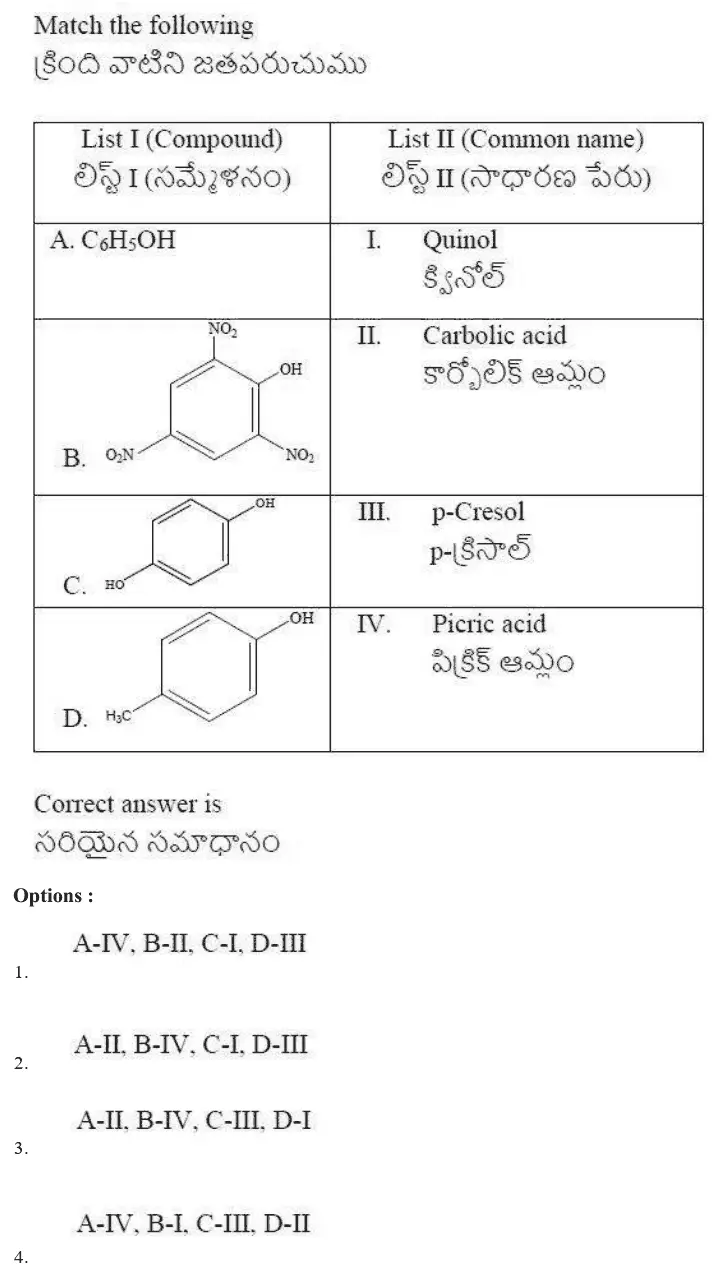
Get EdLoop – freeOpen on the web