
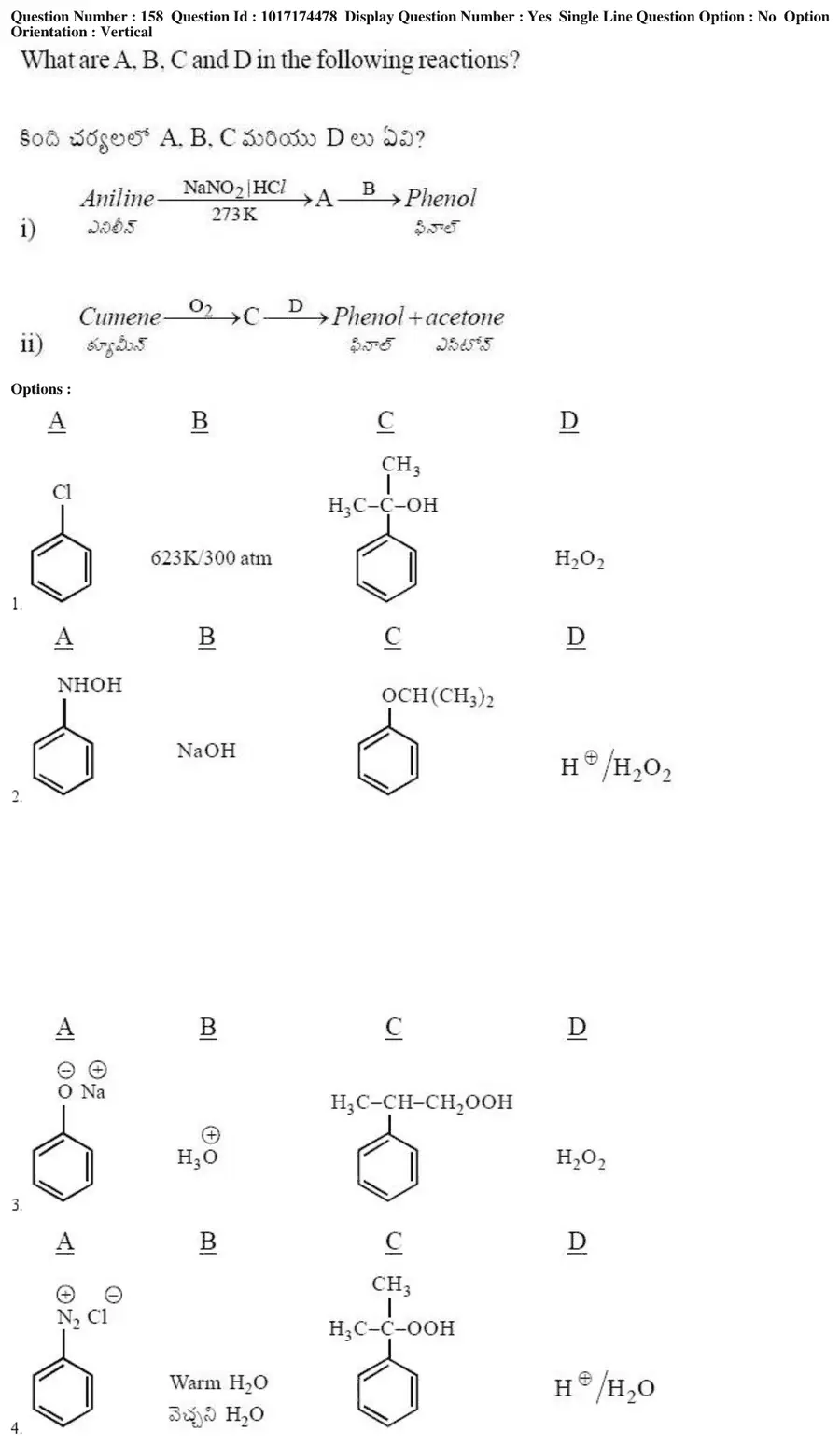
What are A, B, C and D in the following reactions?
i) Aniline $\xrightarrow[273\ \mathrm{K}]{\mathrm{NaNO_2|HCl}}$ A $\xrightarrow{B}$ Phenol
ii) Cumene $\xrightarrow{O_2}$ C $\xrightarrow{D}$ Phenol + acetone
(see the figure above)
- (1)
see figure A = chlorobenzene (Cl on benzene ring); B = 623K/300 atm; C = benzene ring bearing C(CH3)2-OH, drawn as H3C-C(CH3)(OH)-ring (i.e. cumyl alcohol); D = $\mathrm{H_2O_2}$
- (2)
see figure A = phenylhydroxylamine (benzene-NHOH); B = NaOH; C = benzene-OCH(CH3)2; D = $\mathrm{H^{\oplus}/H_2O_2}$
- (3)
see figure A = sodium phenoxide (benzene-O^- Na^+); B = $\mathrm{H_3O^{\oplus}}$; C = benzene-CH(CH2OOH)-CH3 drawn as H3C-CH-CH2OOH on the ring; D = $\mathrm{H_2O_2}$
- (4)
see figure A = benzenediazonium chloride (benzene-$\mathrm{N_2^{\oplus}Cl^{\ominus}}$); B = warm $\mathrm{H_2O}$; C = cumene hydroperoxide (benzene-C(CH3)(CH3)-OOH, drawn H3C-C(CH3)-OOH on the ring); D = $\mathrm{H^{\oplus}/H_2O}$
Show answer
Option (4) is correct.
The council's preliminary key