
Which of the following structure represents the compound, generally added to soaps to impart antiseptic properties?
(see the figure above)
- (1)
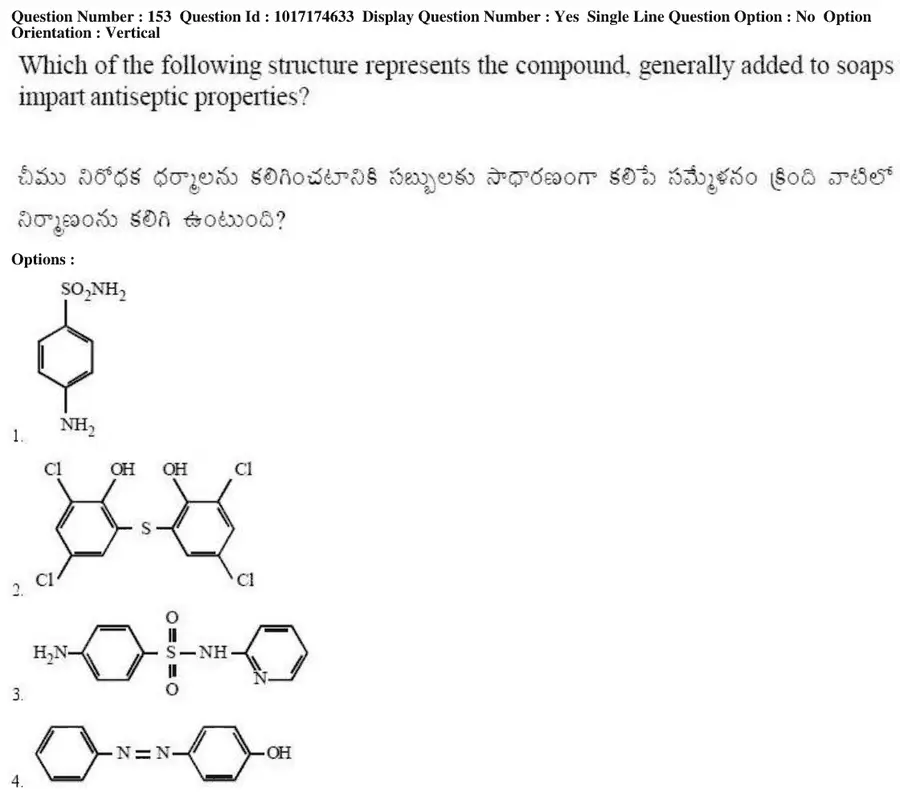
see figure benzene ring with $\mathrm{SO_2NH_2}$ at the top and $\mathrm{NH_2}$ at the bottom (para), i.e. sulphanilamide
- (2)
see figure two benzene rings joined by a single S atom (thioether); each ring has OH ortho to S and Cl at the 3 and 5 positions relative to... drawn with Cl at the top outer position (next to OH), Cl at the bottom outer position (para to OH), on both rings (bithionol-type structure: Cl, OH, S, OH, Cl, with two more Cl at the bottom)
- (3)
see figure $\mathrm{H_2N}$-benzene-$\mathrm{SO_2}$-NH-(2-pyridyl): para-aminobenzene sulphonamide attached through NH to a pyridine ring (N adjacent to the carbon bearing NH), i.e. sulphapyridine
- (4)
see figure benzene ring - N=N - benzene ring - OH (para), i.e. 4-hydroxyazobenzene
Show answer
Option (2) is correct.
The council's preliminary key