
An isomer of $\mathrm{C_4H_8}$ (A) exhibits cis-trans isomerism. Reaction of A with $Br_2/CCl_4$ gave B. Another organic compound $\mathrm{C_4H_6}$ (C) forms sodium derivative with $\mathrm{NaNH_2}$. Reaction of C with $HBr$ gave D. what are B and D respectively?
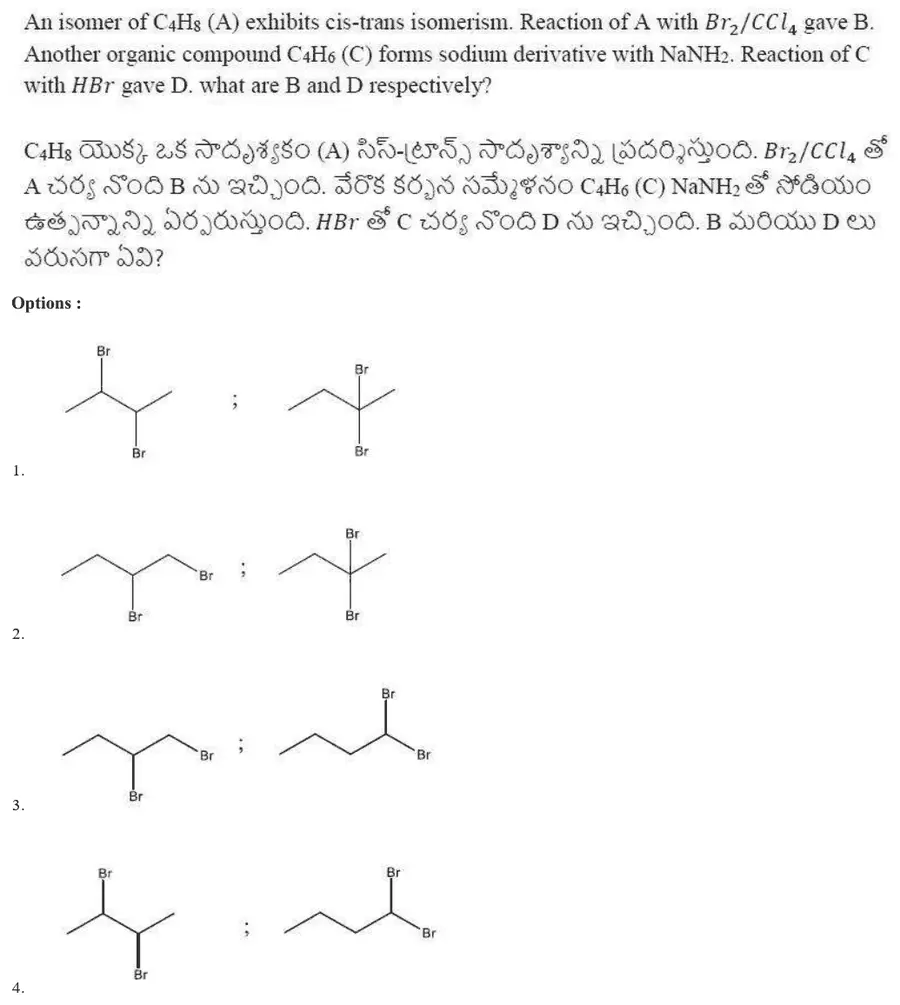
- (1)
see figure B: a skeletal four-carbon chain (zig-zag) with Br on C2 and C3 (2,3-dibromobutane, drawn with Br up on the second carbon and Br down on the third); D: a four-carbon skeletal structure with two Br atoms on the same internal carbon, one up and one down (2,2-dibromobutane)
- (2)
see figure B: a skeletal four-carbon chain with Br on C3 pointing down and a Br on the right side near C3 (1,2-type placement, drawn as a chain with Br down at the middle carbon and Br to the lower right); D: a four-carbon skeletal structure with two Br atoms on the same internal carbon, one up and one down (2,2-dibromobutane)
- (3)
see figure B: a skeletal four-carbon chain with Br on C3 pointing down and a Br at the lower right near C3; D: a four-carbon chain with two Br atoms on the terminal-side carbon (C2 of the right side), one up and one to the lower right (gem-dibromo, 2,2-dibromobutane type)
- (4)
see figure B: a skeletal four-carbon chain (zig-zag) with Br on C2 (up) and Br on C3 (down) (2,3-dibromobutane); D: a four-carbon chain with two Br atoms on the same carbon, one up and one to the lower right (gem-dibromide at C2 from the right end)
Show answer
Option (1) is correct.
The council's preliminary key