
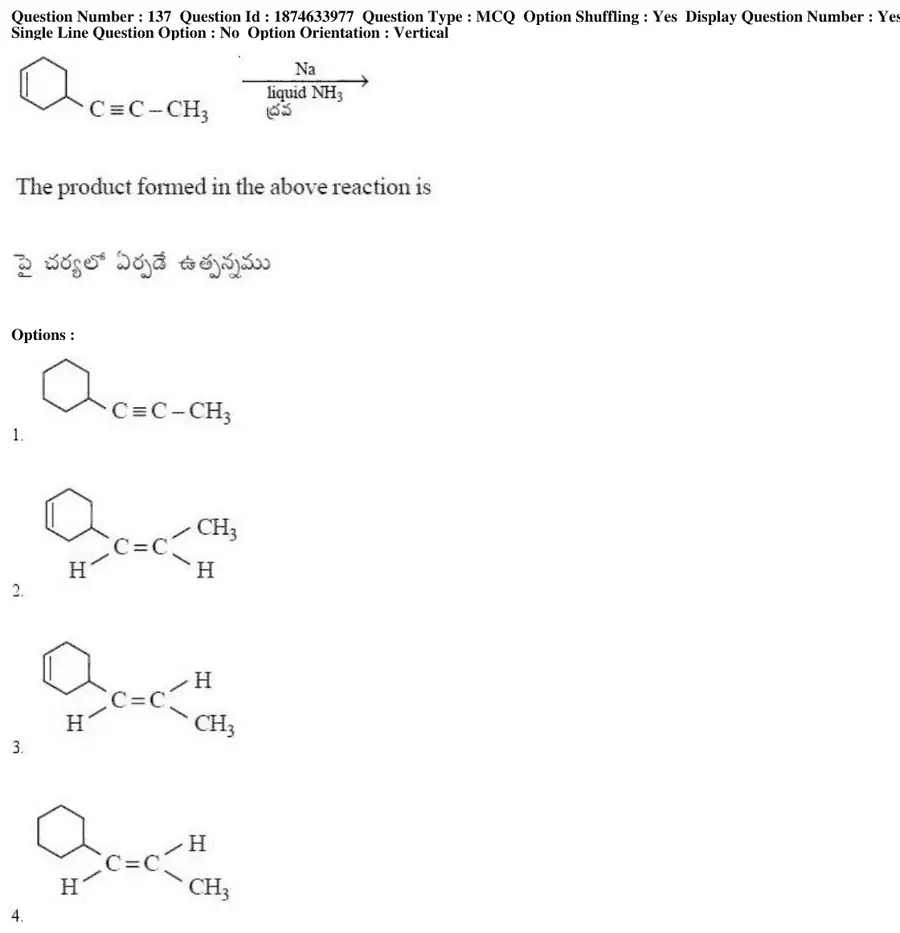
see figure $\xrightarrow[\text{liquid }\mathrm{NH_3}]{\mathrm{Na}}$
The product formed in the above reaction is
- (1)
see figure cyclohexane ring bearing $-\mathrm{C{\equiv}C-CH_3}$
- (2)
see figure ring with one C=C bearing $-\mathrm{CH{=}CH-CH_3}$; ring-side alkene carbon has H (lower left), far carbon has CH3 (upper right) and H (lower right)
- (3)
see figure ring with one C=C bearing $-\mathrm{CH{=}CH-CH_3}$; ring-side alkene carbon has H (lower left), far carbon has H (upper right) and CH3 (lower right)
- (4)
see figure ring without a C=C (saturated) bearing $-\mathrm{CH{=}CH-CH_3}$; same arrangement as option 3 (H upper right, CH3 lower right)
Show answer
Option (3) is correct.
Official APSCHE final key