Given below are two statements. One is labelled as Assertion (A) and the other is labelled as Reason (R).
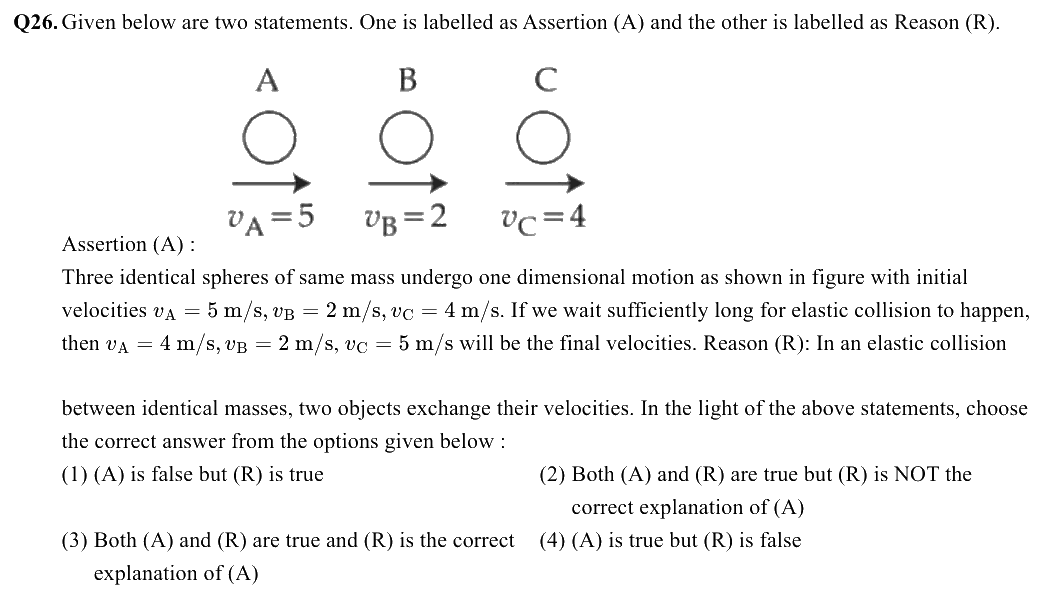
(see the figure above)
Assertion (A) : Three identical spheres of same mass undergo one dimensional motion as shown in figure with initial velocities $v_A = 5$ m/s, $v_B = 2$ m/s, $v_C = 4$ m/s. If we wait sufficiently long for elastic collision to happen, then $v_A = 4$ m/s, $v_B = 2$ m/s, $v_C = 5$ m/s will be the final velocities. Reason (R): In an elastic collision between identical masses, two objects exchange their velocities. In the light of the above statements, choose the correct answer from the options given below :
The question as printed in the paper.
A
(A) is false but (R) is true
B
Both (A) and (R) are true but (R) is NOT the correct explanation of (A)
C
Both (A) and (R) are true and (R) is the correct explanation of (A)
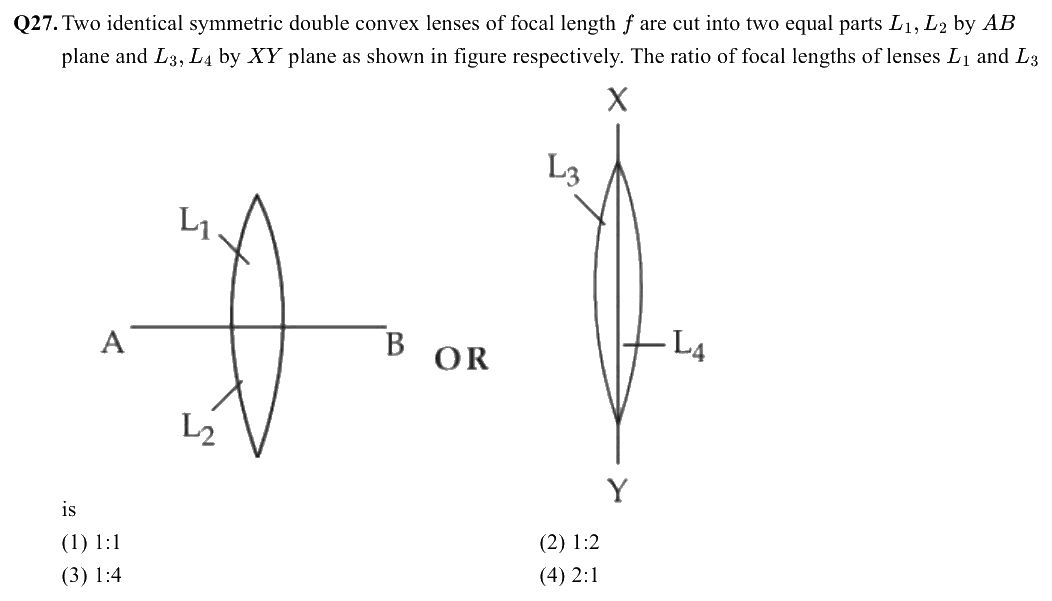
Two identical symmetric double convex lenses of focal length $f$ are cut into two equal parts $L_1, L_2$ by $AB$ plane and $L_3, L_4$ by $XY$ plane as shown in figure respectively. The ratio of focal lengths of lenses $L_1$ and $L_3$ is
Two bodies A and B of equal mass are suspended from two massless springs of spring constant $k_1$ and $k_2$, respectively. If the bodies oscillate vertically such that their amplitudes are equal, the ratio of the maximum velocity of $A$ to the maximum velocity of $B$ is
Given below are two statements. One is labelled as Assertion (A) and the other is labelled as Reason (R). Assertion (A) : With the increase in the pressure of an ideal gas, the volume falls off more rapidly in an isothermal process in comparison to the adiabatic process. Reason (R) : In isothermal process, PV = constant, while in adiabatic process $\mathrm{PV^\gamma}$ = constant. Here $\gamma$ is the ratio of specific heats, P is the pressure and V is the volume of the ideal gas. In the light of the above statements, choose the correct answer from the options given below :
A
Both (A) and (R) are true and (R) is the correct explanation of (A)
B
Both (A) and (R) are true but (R) is NOT the correct explanation of (A)
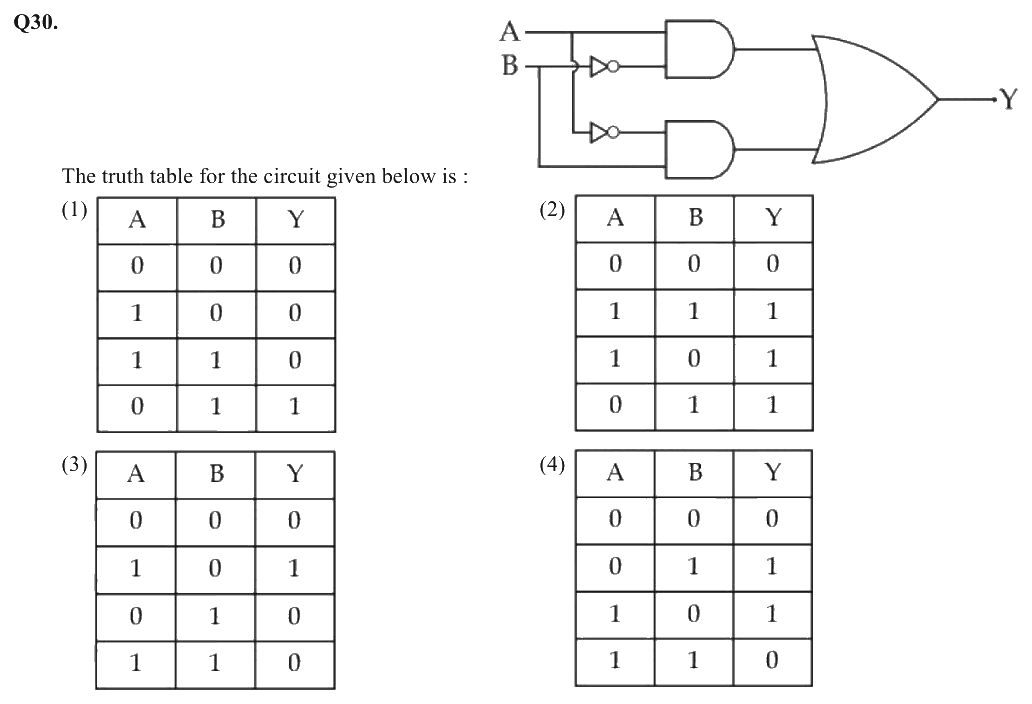
Answer: (D) Truth table with columns A, B, Y and rows (A, B, Y): (0, 0, 0), (0, 1, 1), (1, 0, 1), (1, 1, 0)· Key from source paper
Sit the whole paper timed in EdLoop
You have seen the first 5 questions with answers. Questions 6–75 are listed below; their answers and step-by-step solutions are in the EdLoop app, free.