
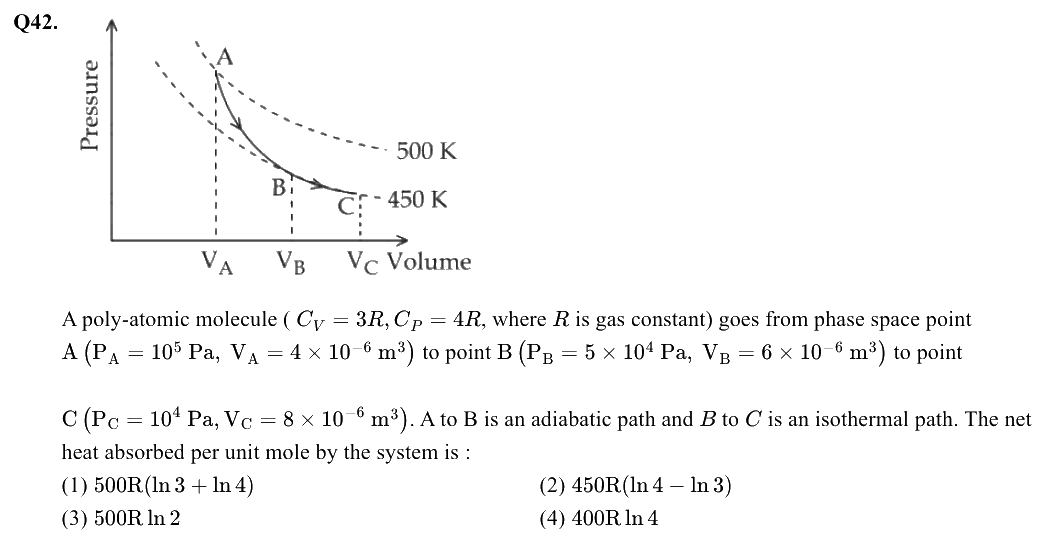
see figure A poly-atomic molecule ( $C_V = 3R, C_P = 4R$, where $R$ is gas constant) goes from phase space point A ($\mathrm{P_A}$ = $10^5$ Pa, $\mathrm{V_A}$ = $4 \times 10^{-6}\ \mathrm{m^3}$) to point B ($\mathrm{P_B}$ = $5 \times 10^4$ Pa, $\mathrm{V_B}$ = $6 \times 10^{-6}\ \mathrm{m^3}$) to point C ($\mathrm{P_C}$ = $10^4$ Pa, $\mathrm{V_C}$ = $8 \times 10^{-6}\ \mathrm{m^3}$). A to B is an adiabatic path and $B$ to $C$ is an isothermal path. The net heat absorbed per unit mole by the system is :
- (1)
500R($\ln 3 + \ln 4$)
- (2)
450R($\ln 4 - \ln 3$)
- (3)
500R $\ln 2$
- (4)
400R $\ln 4$
Show answer
Option (2) is correct.
Key from source paper