
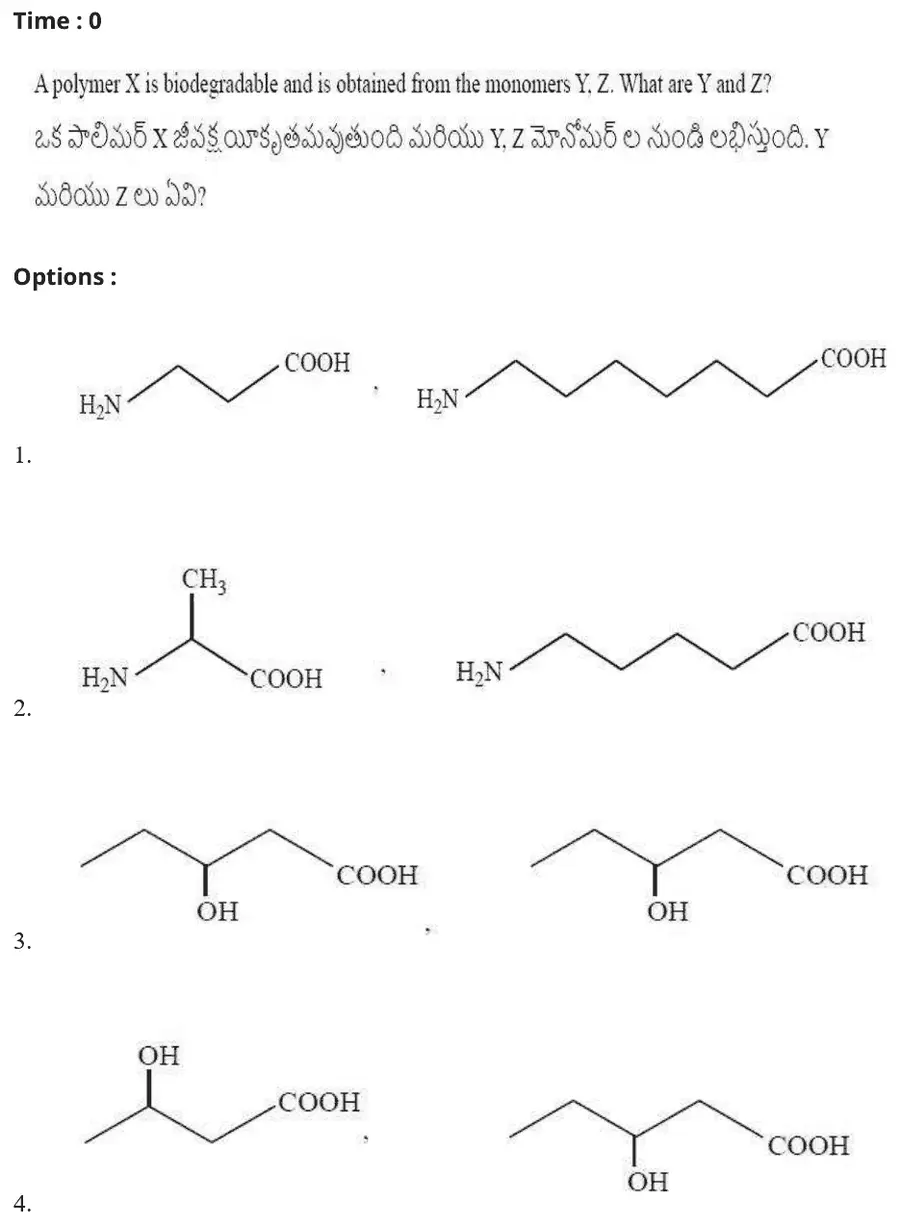
A polymer X is biodegradable and is obtained from the monomers Y, Z. What are Y and Z?
- (1)
see figure Two skeletal structures separated by a comma. First: H$_2$N at the left end of a zigzag chain of 3 carbons ending in COOH (4-aminobutanoic acid). Second: H$_2$N at the left end of a longer zigzag chain ending in COOH (about 7 carbons, 7-aminoheptanoic acid).
- (2)
see figure Two skeletal structures separated by a comma. First: alanine-type structure, H$_2$N attached to a carbon bearing CH$_3$ (vertical) and COOH. Second: H$_2$N at the left end of a zigzag chain ending in COOH (about 5 carbons, 6-aminohexanoic acid type).
- (3)
see figure Two identical skeletal structures separated by a comma: each is a zigzag chain with an OH on the middle carbon (drawn downward, bold bond) and COOH at the right end (3-hydroxypentanoic acid).
- (4)
see figure Two skeletal structures separated by a comma. First: short zigzag chain with OH on the second carbon (drawn upward, bold bond) ending in COOH (3-hydroxybutanoic acid). Second: zigzag chain with OH on the middle carbon (drawn downward, bold bond) and COOH at the right end (3-hydroxypentanoic acid).
Show answer
Option (4) is correct.
The council's preliminary key