
EdLoop PYQs · free, no ads · questions and answers here, step-by-step solutions in the EdLoop app
PYQs · free, no adsOpen on the web (app.edloop.in)Get EdLoop – free on Google Play
ChemistryChemical Bonding & Molecular Structure

B Tech 4th Apr 2026 Shift 2 Chemistry: Chemical Bonding & Molecular Structure

Multiple choice, one correct option NTA paper Chemical Bonding & Molecular Structure

JEE Main 2026 · 4 Apr · Shift 2ChemistryChemical Bonding & Molecular StructureMCQ

Which of the following pictorial diagram most correctly represents the $\pi^*$ ($\pi$ - antibonding) molecular orbital between two atoms if the internuclear axis is taken to be in the z-direction ($\xrightarrow{\text{z-axis}}$)?
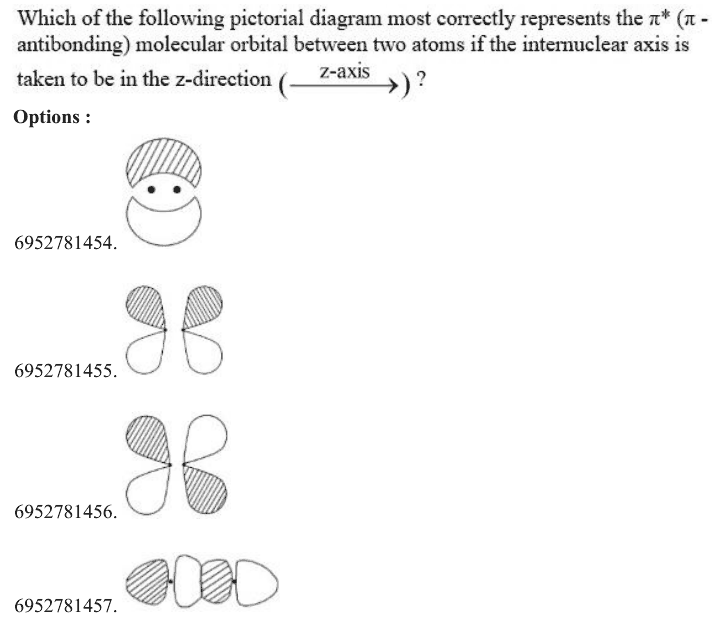
The question and its figure as printed in B Tech 4th Apr 2026 Shift 2. Option 1: one orbital drawn as two large crescent-shaped lobes stacked vertically: a hatched (shaded) lobe on top, an unshaded lobe below, with two dots (the two nuclei, side by side horizontally) in the gap between them. Option 2: two p-type orbitals side by side, each a pair of lobes (hatched upper lobe, unshaded lower lobe) touching at a nuclear dot; both the left and the right pair have the hatched lobe above and the unshaded lobe below (same sign pattern on both). Option 3: two p-type orbitals side by side, each a pair of lobes touching at a nuclear dot; the left pair has the hatched lobe above and unshaded below…
The question as printed in the paper.
  1. (1)

    see figure one orbital drawn as two large crescent-shaped lobes stacked vertically: a hatched (shaded) lobe on top, an unshaded lobe below, with two dots (the two nuclei, side by side horizontally) in the gap between them.

  2. (2)

    see figure two p-type orbitals side by side, each a pair of lobes (hatched upper lobe, unshaded lower lobe) touching at a nuclear dot; both the left and the right pair have the hatched lobe above and the unshaded lobe below (same sign pattern on both).

  3. (3)

    see figure two p-type orbitals side by side, each a pair of lobes touching at a nuclear dot; the left pair has the hatched lobe above and unshaded below, the right pair has the unshaded lobe above and the hatched lobe below (opposite sign pattern).

  4. (4)

    see figure four lobes in a horizontal row along the internuclear axis with a nuclear dot between lobes 1-2 and between 3-4: hatched, unshaded, hatched, unshaded (left to right).

Show answer

Option (3) is correct.

Official NTA final key

See the step-by-step solution in EdLoop

The worked solution is in the EdLoop app, free on Android, with every other Chemical Bonding & Molecular Structure question from 2002 to 2026.

More from this chapter

All 304 questions in Chemical Bonding & Molecular Structure ›

Chemistry Chemical Bonding & Molecular Structure question from B Tech 4th Apr 2026 Shift 2 (JEE Main exam). This is the paper as NTA held it.

All JEE Main Chemical Bonding & Molecular Structure PYQs (304 questions)

Get EdLoop – freeOpen on the web