
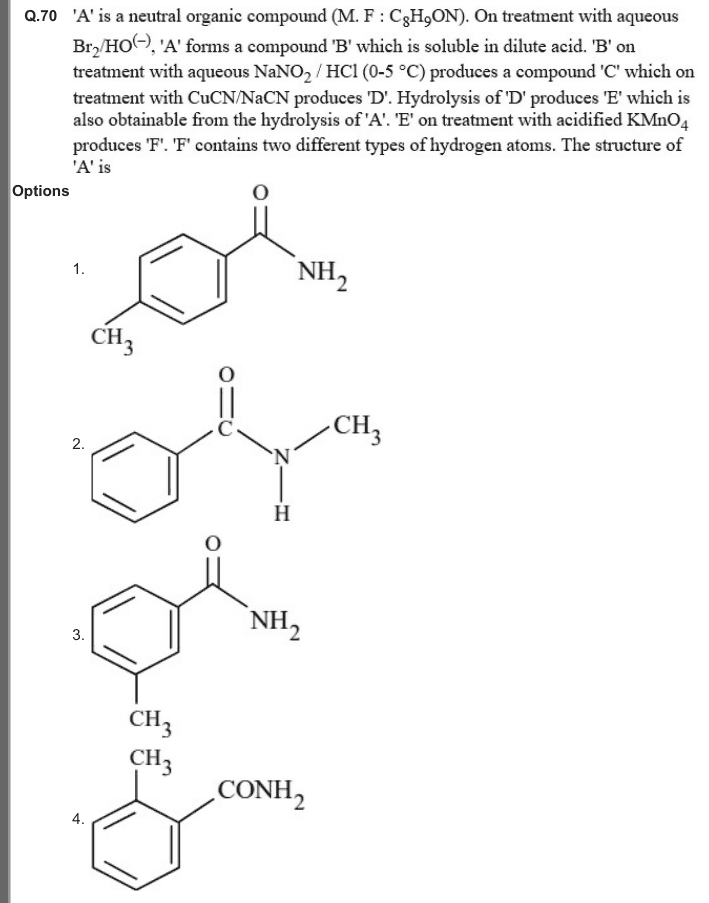
'A' is a neutral organic compound (M. F : $\mathrm{C_8H_9ON}$). On treatment with aqueous $\mathrm{Br_2/HO^{(-)}}$, 'A' forms a compound 'B' which is soluble in dilute acid. 'B' on treatment with aqueous $\mathrm{NaNO_2}$ / HCl (0-5 °C) produces a compound 'C' which on treatment with CuCN/NaCN produces 'D'. Hydrolysis of 'D' produces 'E' which is also obtainable from the hydrolysis of 'A'. 'E' on treatment with acidified $\mathrm{KMnO_4}$ produces 'F'. 'F' contains two different types of hydrogen atoms. The structure of 'A' is
- (1)
see figure a six-membered ring with alternating double bonds; a bond from its upper-right vertex goes up-right to a carbon with a double bond to 'O' above and a bond down-right to 'NH2'; a bond from its lower-left vertex goes down-left to 'CH3'.
- (2)
see figure a six-membered ring with alternating double bonds, bonded to an atom printed 'C' that has a double bond to 'O' above and a bond down-right to 'N'; N has 'H' on a bond straight down and a bond up-right to 'CH3'.
- (3)
see figure a six-membered ring with alternating double bonds; a bond from its upper-right vertex goes up-right to a carbon with a double bond to 'O' above and a bond down-right to 'NH2'; 'CH3' hangs on a bond straight down from the ring's bottom vertex.
- (4)
see figure a six-membered ring with alternating double bonds; 'CH3' on a bond straight up from its upper-left vertex and 'CONH2' on a bond going up-right from the adjacent upper-right vertex.
Show answer
Option (1) is correct.
Official NTA final key