
$A \xrightarrow[\text{(ii) H}_3\text{O}^+]{\text{(i) NaOH}} B \xrightarrow[\text{(ii) H}_2\text{SO}_4, \Delta]{\text{(i) EtOH}} C$
'A' shows positive Lassaign's test for N and its molar mass is 121 .
'$B$' gives effervescence with aq $NaHCO_3$.
'C' gives fruity smell.
Identify $A, B$ and C from the following.
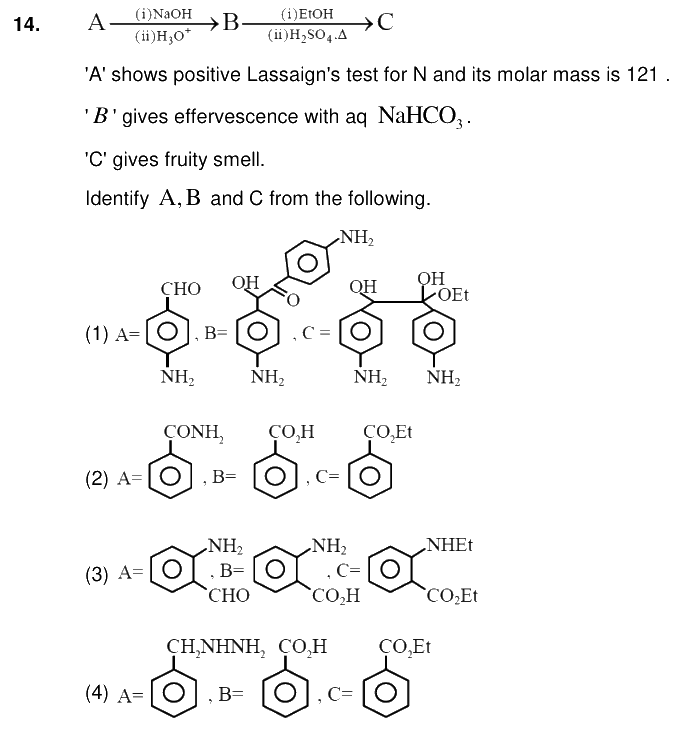
- (1)
see figure A = 4-aminobenzaldehyde (benzene ring with CHO on top and NH2 at the bottom); B = a benzoin-type compound: a benzene ring with NH2 at the bottom whose top carbon carries CH(OH), joined to a C=O (O below) that is bonded to a second benzene ring carrying NH2 at its top; C = two benzene rings each with NH2 at the bottom, the left top carbon carries CH(OH), the right top carbon carries C(OH)(OEt), and the two are joined by a single bond.
- (2)
see figure A = benzene ring with CONH2; B = benzene ring with CO2H; C = benzene ring with CO2Et.
- (3)
see figure A = benzene ring with NH2 (upper right) and CHO (lower right), adjacent; B = benzene ring with NH2 and CO2H adjacent; C = benzene ring with NHEt and CO2Et adjacent.
- (4)
see figure A = benzene ring with CH2NHNH2; B = benzene ring with CO2H; C = benzene ring with CO2Et.
Show answer
Option (2) is correct.
Key from source paper