
EdLoop PYQs · free, no ads · questions and answers here, step-by-step solutions in the EdLoop app
PYQs · free, no adsOpen on the web (app.edloop.in)Get EdLoop – free on Google Play
ChemistryChemical Kinetics

JEE Main 2025 (07 Apr Shift 1) Chemistry: Chemical Kinetics

Multiple choice, one correct option Memory based Chemical Kinetics

JEE Main 2025 · 7 Apr · Shift 1ChemistryChemical KineticsMCQ

A person's wound was exposed to some bacteria and then bacterial growth started to happen at the same place. The wound was later treated with some antibacterial medicine and the rate of bacterial decay(r) was found to be proportional with the square of the existing number of bacteria at any instance. Which of the following set of graphs correctly represents the 'before' and 'after' situation of the application of the medicine?

[Given: $N =$ No. of bacteria, $t =$ time, bacterial growth follows $1^{st}$ order kinetics.]
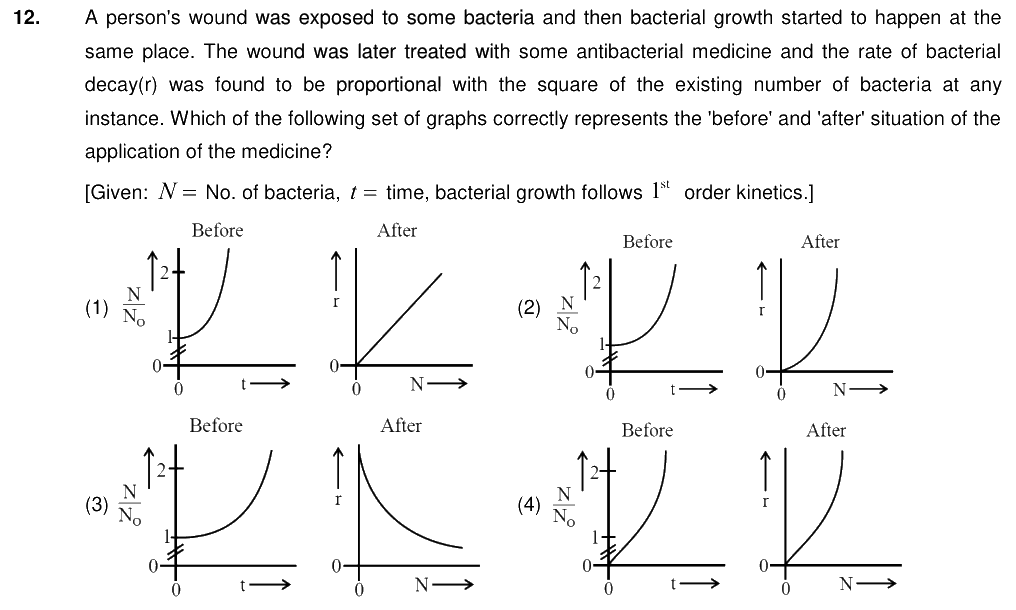
The question and its figure as printed in JEE Main 2025 07 Apr Shift 1. Option 1: 'Before': N/N0 against t, the curve starts on the N/N0 axis at 1 (axis break between 0 and 1) and rises, getting steeper (passing 2); 'After': r against N, a straight line from the origin rising to the upper right. Option 2: 'Before': N/N0 against t, the curve starts at 1 on the vertical axis (axis break) and rises, getting steeper (passing 2); 'After': r against N, a curve from the origin starting flat and rising ever more steeply. Option 3: 'Before': N/N0 against t, the curve starts at 1 on the vertical axis (axis break) and rises, getting steeper (passing 2); 'After': r against N, a curve starting high on…
The question as printed in the paper.
  1. (1)

    see figure 'Before': N/N0 against t, the curve starts on the N/N0 axis at 1 (axis break between 0 and 1) and rises, getting steeper (passing 2); 'After': r against N, a straight line from the origin rising to the upper right.

  2. (2)

    see figure 'Before': N/N0 against t, the curve starts at 1 on the vertical axis (axis break) and rises, getting steeper (passing 2); 'After': r against N, a curve from the origin starting flat and rising ever more steeply.

  3. (3)

    see figure 'Before': N/N0 against t, the curve starts at 1 on the vertical axis (axis break) and rises, getting steeper (passing 2); 'After': r against N, a curve starting high on the r axis and falling, flattening toward the N axis.

  4. (4)

    see figure 'Before': N/N0 against t, the curve starts at the origin (0) and rises through the marks 1 and 2 (the axis break sits between 0 and 1), turning steeper; 'After': r against N, a curve from the origin rising nearly straight first and then steeper.

Show answer

Option (2) is correct.

Key from source paper

See the step-by-step solution in EdLoop

The worked solution is in the EdLoop app, free on Android, with every other Chemical Kinetics question from 2002 to 2026.

More from this chapter

All 235 questions in Chemical Kinetics ›

Chemistry Chemical Kinetics question from JEE Main 2025 (07 Apr Shift 1) (JEE Main exam). Memory-based papers are reconstructed from candidates' memory by coaching institutes.

All JEE Main Chemical Kinetics PYQs (235 questions)

Get EdLoop – freeOpen on the web