
EdLoop PYQs · free, no ads · questions and answers here, step-by-step solutions in the EdLoop app
PYQs · free, no adsOpen on the web (app.edloop.in)Get EdLoop – free on Google Play
ChemistryChemical Kinetics

JEE Main 2025 (02 Apr Shift 2) Chemistry: Chemical Kinetics

Multiple choice, one correct option Memory based Chemical Kinetics

JEE Main 2025 · 2 Apr · Shift 2ChemistryChemical KineticsMCQ

Reactant A converts to product D through the given mechanism (with the net evolution of heat) :

A → B slow; $\Delta H = + ve$

B → C fast; $\Delta H = -ve$

C → D fast; $\Delta H = -ve$

Which of the following represents the above reaction mechanism?
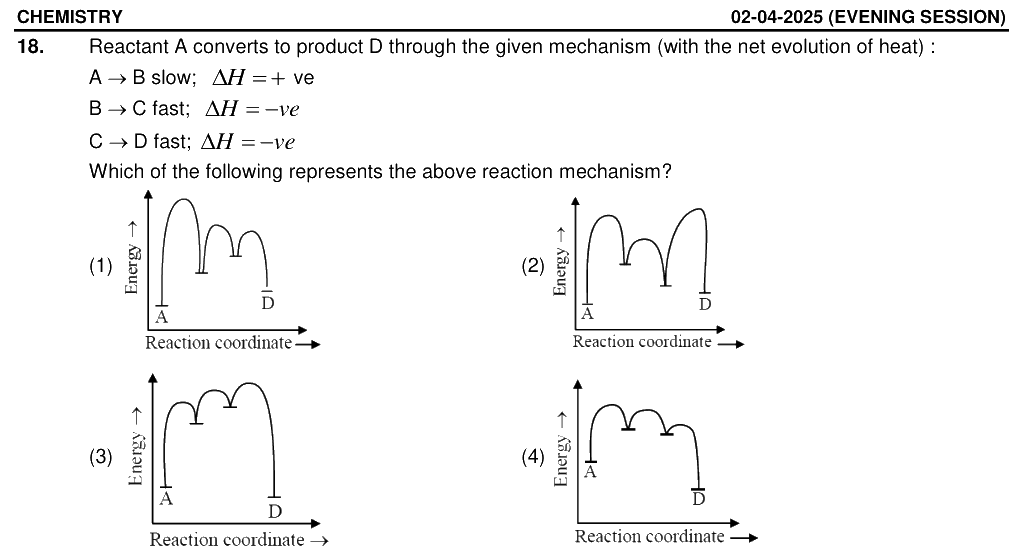
The question and its figure as printed in JEE Main 2025 02 Apr Shift 2. Option 1: energy profile ('Energy' up, 'Reaction coordinate' right) with three humps: the first hump is the tallest of all; the second and third humps are much lower and about equal in height; level B sits above A, level C sits above B, and level D sits above A but below B and C. Option 2: energy profile with three humps: the first hump is lower, the second hump is the lowest and the third hump is the tallest of all; level B sits above A, level C sits lower than B, and level D sits above A. Option 3: energy profile with three humps: the humps rise in steps: the first hump is the lowest, the second is higher and the…
The question as printed in the paper.
  1. (1)

    see figure energy profile ('Energy' up, 'Reaction coordinate' right) with three humps: the first hump is the tallest of all; the second and third humps are much lower and about equal in height; level B sits above A, level C sits above B, and level D sits above A but below B and C.

  2. (2)

    see figure energy profile with three humps: the first hump is lower, the second hump is the lowest and the third hump is the tallest of all; level B sits above A, level C sits lower than B, and level D sits above A.

  3. (3)

    see figure energy profile with three humps: the humps rise in steps: the first hump is the lowest, the second is higher and the third is the tallest; level B and level C sit well above A (C slightly above B), and level D sits below A.

  4. (4)

    see figure energy profile with three humps: the first hump is the tallest, the second is slightly lower and the third is the lowest; level B and level C sit above A (about equal), and level D sits below A.

Show answer

Option (4) is correct.

Key from source paper

See the step-by-step solution in EdLoop

The worked solution is in the EdLoop app, free on Android, with every other Chemical Kinetics question from 2002 to 2026.

More from this chapter

All 235 questions in Chemical Kinetics ›

Chemistry Chemical Kinetics question from JEE Main 2025 (02 Apr Shift 2) (JEE Main exam). Memory-based papers are reconstructed from candidates' memory by coaching institutes.

All JEE Main Chemical Kinetics PYQs (235 questions)

Get EdLoop – freeOpen on the web