
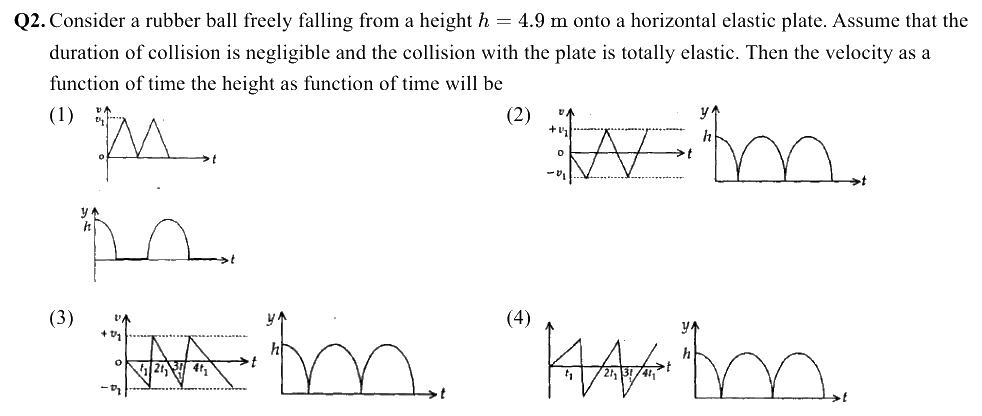
Consider a rubber ball freely falling from a height $h = 4.9$ m onto a horizontal elastic plate. Assume that the duration of collision is negligible and the collision with the plate is totally elastic. Then the velocity as a function of time the height as function of time will be
- (1)
see figure Pair of graphs. Left: v against t, a series of triangular humps all above the t-axis (v from 0 up to v1, back to 0, up to v1, back to 0; v1 marked on the axis). Right (printed below the left graph): y against t, a falling arc from h down to 0, then flat at 0 for a while, then a separate arc up and down, again touching the axis.
- (2)
see figure Pair of graphs. Left: v against t with dotted levels +v1 and -v1; a zig-zag that starts at 0, goes down to -v1, then up through 0 to +v1, down to -v1 and up again (symmetric triangular zig-zag between -v1 and +v1). Right: y against t, three arcs (first starting at h and descending to 0, then two full arches), each touching the t-axis.
- (3)
see figure Pair of graphs. Left: v against t with dotted levels +v1 and -v1 and time marks t1, 2t1, 3t1, 4t1; saw-tooth: starts at 0, falls linearly to -v1, jumps vertically up to +v1, falls linearly through 0 to -v1, jumps up again to +v1, falls again. Right: y against t, three arcs (first from h down to 0, then two full arches).
- (4)
see figure Pair of graphs. Left: v against t with time marks t1, 2t1, 3t1, 4t1; saw-tooth rising linearly from 0 to a positive peak, jumping vertically down to a negative value, rising linearly again through 0 to a positive peak, jumping down, rising again (positive slope segments). Right: y against t, three arcs (first from h down to 0, then two full arches).
Show answer
Option (3) is correct.
Key from source paper