
EdLoop PYQs · free, no ads · questions and answers here, step-by-step solutions in the EdLoop app
PYQs · free, no adsOpen on the web (app.edloop.in)Get EdLoop – free on Google Play
PhysicsDual Nature of Matter & Radiation

AIEEE 2008 Physics: Dual Nature of Matter & Radiation

Multiple choice, one correct option Memory based Dual Nature of Matter & Radiation

AIEEE 2008PhysicsDual Nature of Matter & RadiationMCQ

Paragraph: Wave property of electrons implies that they will show diffraction effects. Davisson and Germer demonstrated this by diffracting electrons from crystals. The law governing the diffraction from a crystal is obtained by requiring that electron waves reflected from the planes of atoms in a crystal interfere constructively (see in figure).
(see the figure above)
Question: Electrons accelerated by potential $V$ are diffracted from a crystal. If $d = 1\AA$ and $i = 30^{\circ}$, $V$ should be about ($\mathrm{h} = 6.6 \times 10^{-34}\,\mathrm{Js}$, $\mathrm{m_e} = 9.1 \times 10^{-31}$ kg, $\mathrm{e} = 1.6 \times 10^{-19}\mathrm{C}$)
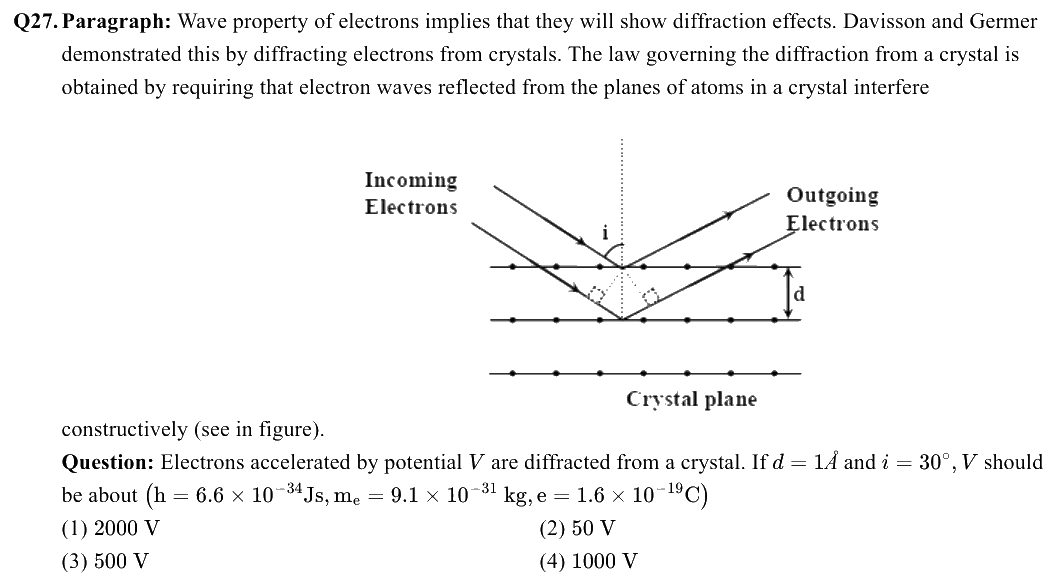
The question and its figure as printed in AIEEE 2008.
The question as printed in the paper.
  1. (1)

    2000 V

  2. (2)

    50 V

  3. (3)

    500 V

  4. (4)

    1000 V

Show answer

Option (2) is correct.

Key from source paper

See the step-by-step solution in EdLoop

The worked solution is in the EdLoop app, free on Android, with every other Dual Nature of Matter & Radiation question from 2002 to 2026.

More from this chapter

All 208 questions in Dual Nature of Matter & Radiation ›

Physics Dual Nature of Matter & Radiation question from AIEEE 2008 (AIEEE, now called JEE Main). Memory-based papers are reconstructed from candidates' memory by coaching institutes.

All JEE Main Dual Nature of Matter & Radiation PYQs (208 questions)

Get EdLoop – freeOpen on the web