
EdLoop PYQs · free, no ads · questions and answers here, step-by-step solutions in the EdLoop app
PYQs · free, no adsOpen on the web (app.edloop.in)Get EdLoop – free on Google Play
PhysicsNuclei

AIEEE 2006 Physics: Nuclei

Multiple choice, one correct option Memory based Nuclei

AIEEE 2006PhysicsNucleiMCQ

The energy spectrum of $\beta$-particles [number $N(E)$ as a function of $\beta$-energy $E$ ] emitted from a radioactive source is

(see the figure above)
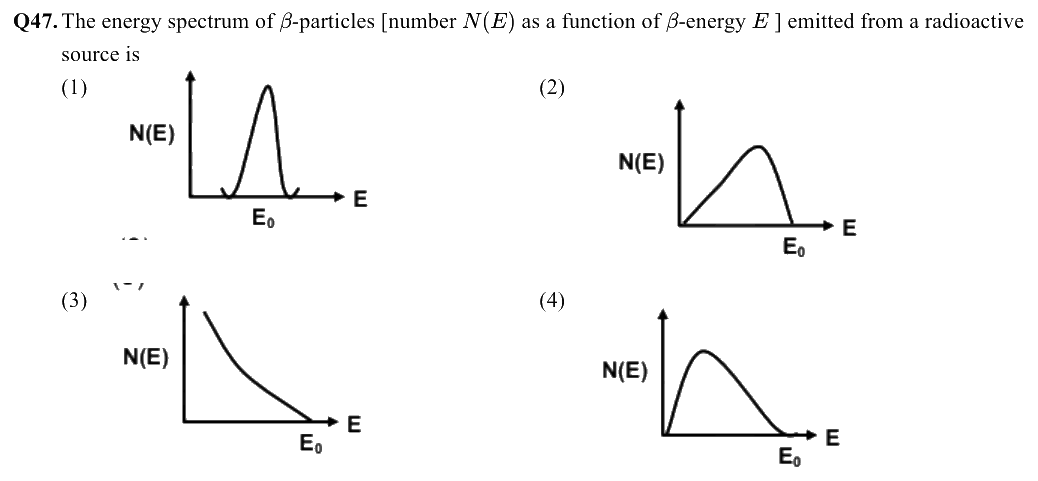
The question and its figure as printed in AIEEE 2006. Option 1: N(E) against E graph: a narrow, symmetric bell-shaped peak that starts from the axis, rises to a sharp maximum and falls back to the axis; the label E0 is on the E axis just below the peak. Option 2: N(E) against E graph: a curve that rises roughly linearly from the origin to a rounded maximum (at about two-thirds of the way to E0) and then falls steeply to the E axis at E0, which is marked on the axis at the right end of the curve. Option 3: N(E) against E graph: a curve that starts high on the N(E) axis side (at a small non-zero E) and falls monotonically, convex, to meet the E axis at E0. Option 4: N(E) against E graph: a…
The question as printed in the paper.
  1. (1)

    see figure N(E) against E graph: a narrow, symmetric bell-shaped peak that starts from the axis, rises to a sharp maximum and falls back to the axis; the label $E_0$ is on the E axis just below the peak.

  2. (2)

    see figure N(E) against E graph: a curve that rises roughly linearly from the origin to a rounded maximum (at about two-thirds of the way to $E_0$) and then falls steeply to the E axis at $E_0$, which is marked on the axis at the right end of the curve.

  3. (3)

    see figure N(E) against E graph: a curve that starts high on the N(E) axis side (at a small non-zero E) and falls monotonically, convex, to meet the E axis at $E_0$.

  4. (4)

    see figure N(E) against E graph: a curve that rises steeply from the origin to a maximum at low E (about a quarter of the way to $E_0$) and then falls gradually, with a long tail, to the E axis at $E_0$.

Show answer

Option (4) is correct.

Key from source paper

See the step-by-step solution in EdLoop

The worked solution is in the EdLoop app, free on Android, with every other Nuclei question from 2002 to 2026.

More from this chapter

All 164 questions in Nuclei ›

Physics Nuclei question from AIEEE 2006 (AIEEE, now called JEE Main). Memory-based papers are reconstructed from candidates' memory by coaching institutes.

All JEE Main Nuclei PYQs (164 questions)

Get EdLoop – freeOpen on the web