
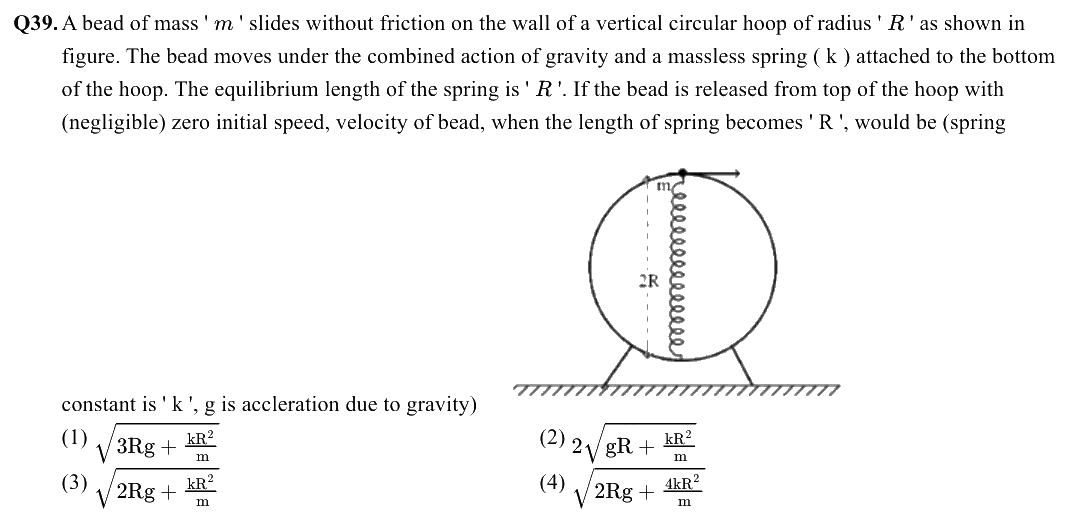
A bead of mass ' $m$ ' slides without friction on the wall of a vertical circular hoop of radius ' $R$ ' as shown in figure. The bead moves under the combined action of gravity and a massless spring ( k ) attached to the bottom of the hoop. The equilibrium length of the spring is ' R '. If the bead is released from top of the hoop with (negligible) zero initial speed, velocity of bead, when the length of spring becomes ' R ', would be (spring constant is ' k ', g is accleration due to gravity)
(see the figure above)
- (1)
$\sqrt{3\mathrm{Rg} + \frac{\mathrm{kR^2}}{\mathrm{m}}}$
- (2)
$2\sqrt{\mathrm{gR} + \frac{\mathrm{kR^2}}{\mathrm{m}}}$
- (3)
$\sqrt{2\mathrm{Rg} + \frac{\mathrm{kR^2}}{\mathrm{m}}}$
- (4)
$\sqrt{2\mathrm{Rg} + \frac{4\mathrm{kR^2}}{\mathrm{m}}}$
Show answer
Option (1) is correct.
Key from source paper