
A bullet is shot vertically downwards with an initial velocity of 100 $\mathrm{m~s^{-1}}$ from a certain height. Within 10 s, the bullet reaches the ground and instantaneously comes to rest due to the perfectly inelastic collision. The velocity-time curve for total time t = 20 s will be : (Take $g$ = 10 $\mathrm{m~s^{-2}}$)
(see the figure above)
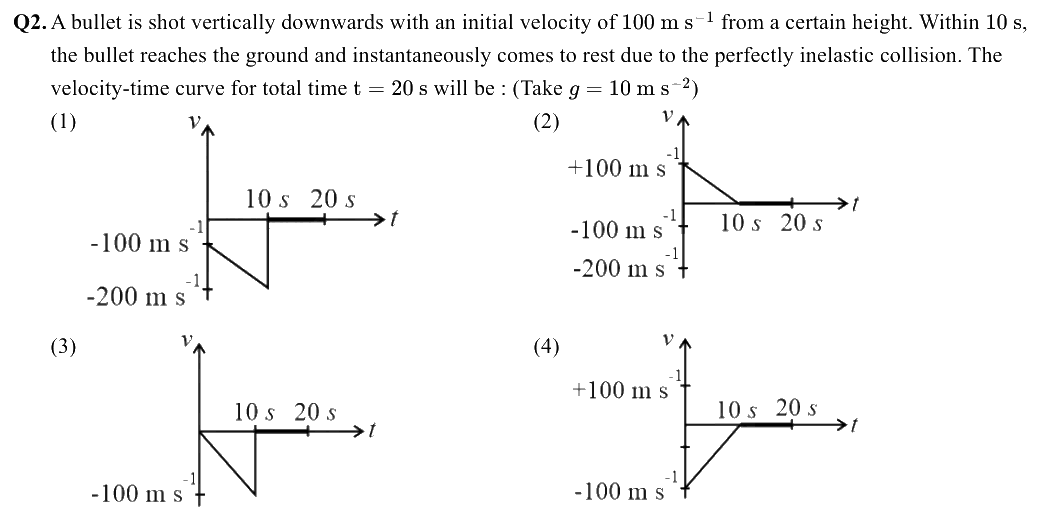
- (1)
see figure v-t graph with the vertical axis labelled -100 and -200 m s^-1: a straight line slopes downward from -100 m s^-1 at t = 0 to -200 m s^-1 at t = 10 s, then a vertical jump to 0 at t = 10 s, then zero velocity along the axis to 20 s.
- (2)
see figure v-t graph with the vertical axis labelled +100, -100 and -200 m s^-1: a straight line slopes downward from +100 m s^-1 at t = 0 to 0 at t = 10 s, then zero velocity along the axis to 20 s.
- (3)
see figure v-t graph with the vertical axis labelled -100 m s^-1: a straight line slopes downward from 0 at t = 0 to -100 m s^-1 at t = 10 s, then a vertical jump to 0 at t = 10 s, then zero velocity along the axis to 20 s.
- (4)
see figure v-t graph with the vertical axis labelled +100 and -100 m s^-1: a straight line slopes upward from -100 m s^-1 at t = 0 to 0 at t = 10 s, then zero velocity along the axis to 20 s.
Show answer
Option (1) is correct.
Key from source paper