
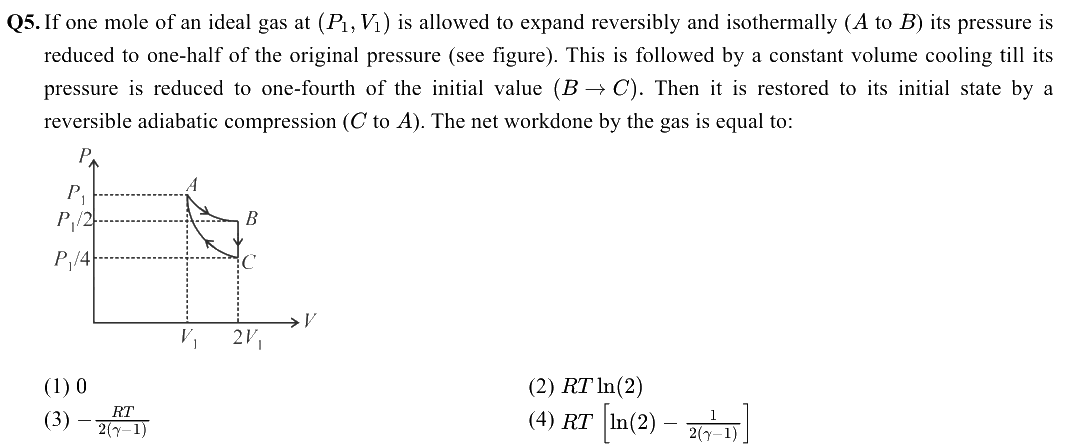
If one mole of an ideal gas at $(P_1, V_1)$ is allowed to expand reversibly and isothermally ($A$ to $B$) its pressure is reduced to one-half of the original pressure (see figure). This is followed by a constant volume cooling till its pressure is reduced to one-fourth of the initial value ($B \to C$). Then it is restored to its initial state by a reversible adiabatic compression ($C$ to $A$). The net workdone by the gas is equal to:
(see the figure above)
- (1)
$0$
- (2)
$RT\ln(2)$
- (3)
$-\frac{RT}{2(\gamma-1)}$
- (4)
$RT\left[\ln(2) - \frac{1}{2(\gamma-1)}\right]$
Show answer
Option (4) is correct.
Key from source paper