
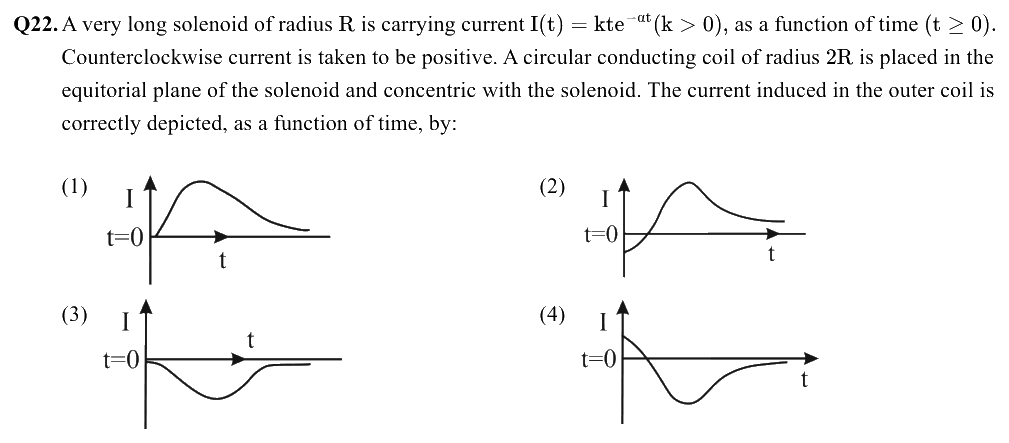
A very long solenoid of radius R is carrying current $I(t) = kte^{-\alpha t}$ $(k > 0)$, as a function of time ($t \geq 0$). Counterclockwise current is taken to be positive. A circular conducting coil of radius 2R is placed in the equitorial plane of the solenoid and concentric with the solenoid. The current induced in the outer coil is correctly depicted, as a function of time, by:
- (1)
see figure I against t (t = 0 at the origin): a curve that rises from zero to a positive maximum and then decays back towards the t axis.
- (2)
see figure I against t (t = 0 at the origin): a curve that starts at a negative value at t = 0, rises through zero to a positive maximum and then decays towards the t axis from above.
- (3)
see figure I against t (t = 0 at the origin): a curve that dips from zero to a negative minimum and then returns towards the t axis.
- (4)
see figure I against t: a curve that starts at a positive value at t = 0, falls through zero to a negative minimum and then returns towards the t axis.
Show answer
Option (2) is correct.
Key from source paper