
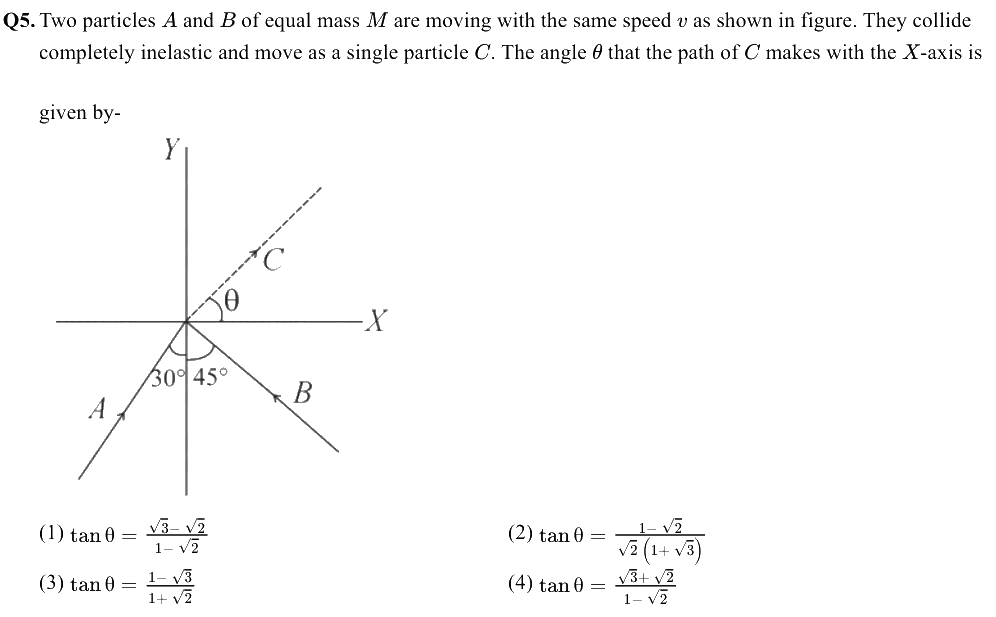
Two particles $A$ and $B$ of equal mass $M$ are moving with the same speed $v$ as shown in figure. They collide completely inelastic and move as a single particle $C$. The angle $\theta$ that the path of $C$ makes with the $X$-axis is given by-
(see the figure above)
- (1)
$\tan\theta = \frac{\sqrt{3}-\sqrt{2}}{1-\sqrt{2}}$
- (2)
$\tan\theta = \frac{1-\sqrt{2}}{\sqrt{2}\left(1+\sqrt{3}\right)}$
- (3)
$\tan\theta = \frac{1-\sqrt{3}}{1+\sqrt{2}}$
- (4)
$\tan\theta = \frac{\sqrt{3}+\sqrt{2}}{1-\sqrt{2}}$
Show answer
Option (4) is correct.
Key from source paper