
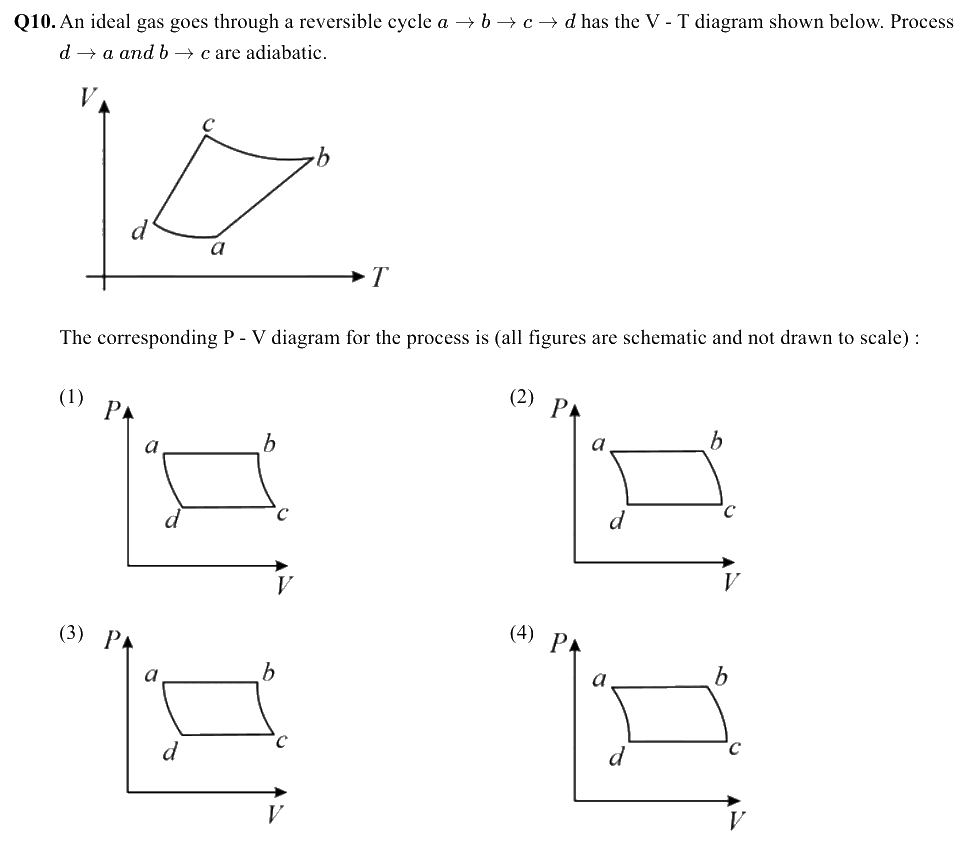
An ideal gas goes through a reversible cycle $a \to b \to c \to d$ has the V - T diagram shown below. Process $d \to a$ and $b \to c$ are adiabatic.
(see the figure above)
The corresponding P - V diagram for the process is (all figures are schematic and not drawn to scale) :
- (1)
see figure P-V loop with a top-left, b top-right, c bottom-right, d bottom-left: a to b horizontal at the top, d to c horizontal at the bottom; curved sides a-d and b-c, both leaning from upper left to lower right, d to the right of a and c to the right of b, the curves leaving a and b vertically and flattening towards d and c (drawn identically to option 3)
- (2)
see figure P-V loop with a top-left, b top-right, c bottom-right, d bottom-left: a to b horizontal at the top, d to c horizontal at the bottom; curved sides a-d and b-c, leaving a and b slanting to the right and arriving at d and c vertically; d is slightly right of a and c is right of b (same shape as option 4, which is wider)
- (3)
see figure P-V loop with a top-left, b top-right, c bottom-right, d bottom-left: a to b horizontal at the top, d to c horizontal at the bottom; curved sides a-d and b-c, both leaning from upper left to lower right, d to the right of a and c to the right of b, the curves leaving a and b vertically and flattening towards d and c (drawn identically to option 1)
- (4)
see figure P-V loop with a top-left, b top-right, c bottom-right, d bottom-left: a to b horizontal at the top, d to c horizontal at the bottom; curved sides a-d and b-c, leaving a and b slanting to the right and arriving at d and c vertically; the same shape as option 2 but a wider loop
Show answer
Option (1) is correct.
Key from source paper