The percentage of decrease in the intensity of polarized light when it is passed through an analyser at an angle of $60^\circ$ is
- A
25%
- B
50%
- C
75%
- D
60%
Answer: (C) 75% · The council's preliminary key
 PYQs · free, no adsOpen on the web (app.edloop.in)Get EdLoop – free on Google Play
Every Wave Optics question from past AP EAPCET and TS EAPCET papers, with options and answers. Newest first.
Wave Optics offers a concise theoretical chapter in the Class 12 physics sequence.
Attempt every Wave Optics question timed, see the step-by-step solution and track what you get wrong. Free.
The percentage of decrease in the intensity of polarized light when it is passed through an analyser at an angle of $60^\circ$ is
25%
50%
75%
60%
Interference fringes produced by a double slit arrangement using a monochromatic light of wave length 5,890Å, have an angular fringe width $0.28^\circ$. If the entire arrangement is immersed in water. The new angular fringe width will be ($^a\mu_\omega = 4/3$)
$0.24^\circ$
$0.21^\circ$
$0.18^\circ$
$0.36^\circ$
In Young's double slit experiment, the fringe width is $\beta$. If the distance between slit and screen is doubled and separation between slits is made $\frac{1}{4}$ of initial value, then new fringe width is
$4\beta$
$\frac{\beta}{4}$
$\frac{\beta}{8}$
$8\beta$
In Young's double slit experiment, the ratio of intensities of maxima and minima in the interference experiment is 25:9. The ratio of intensities of two slits is
18:3
4:1
8:1
16:1
The direction of the second order diffraction minima in Fraunhoffer diffraction at a single slit is (a=slit width) given by
$\sin\theta = \dfrac{\lambda}{2a}$
$\sin\theta = \dfrac{2\lambda}{a}$
$\sin\theta = 2\lambda a$
$\sin\theta = \dfrac{a}{2\lambda}$
In a Young's double slit experiment, the intensity at a point where the path difference is $\frac{\lambda}{6}$ ($\lambda$ being the wavelength of the light used) is $I$. If $I_0$ denotes the maximum intensity, $\frac{I}{I_0}$ is
$\frac{1}{\sqrt{2}}$
$\frac{\sqrt{3}}{2}$
$\frac{1}{2}$
$\frac{3}{4}$
The correct relation between fringe width ($\beta$) and distance between the slits ($d$) is
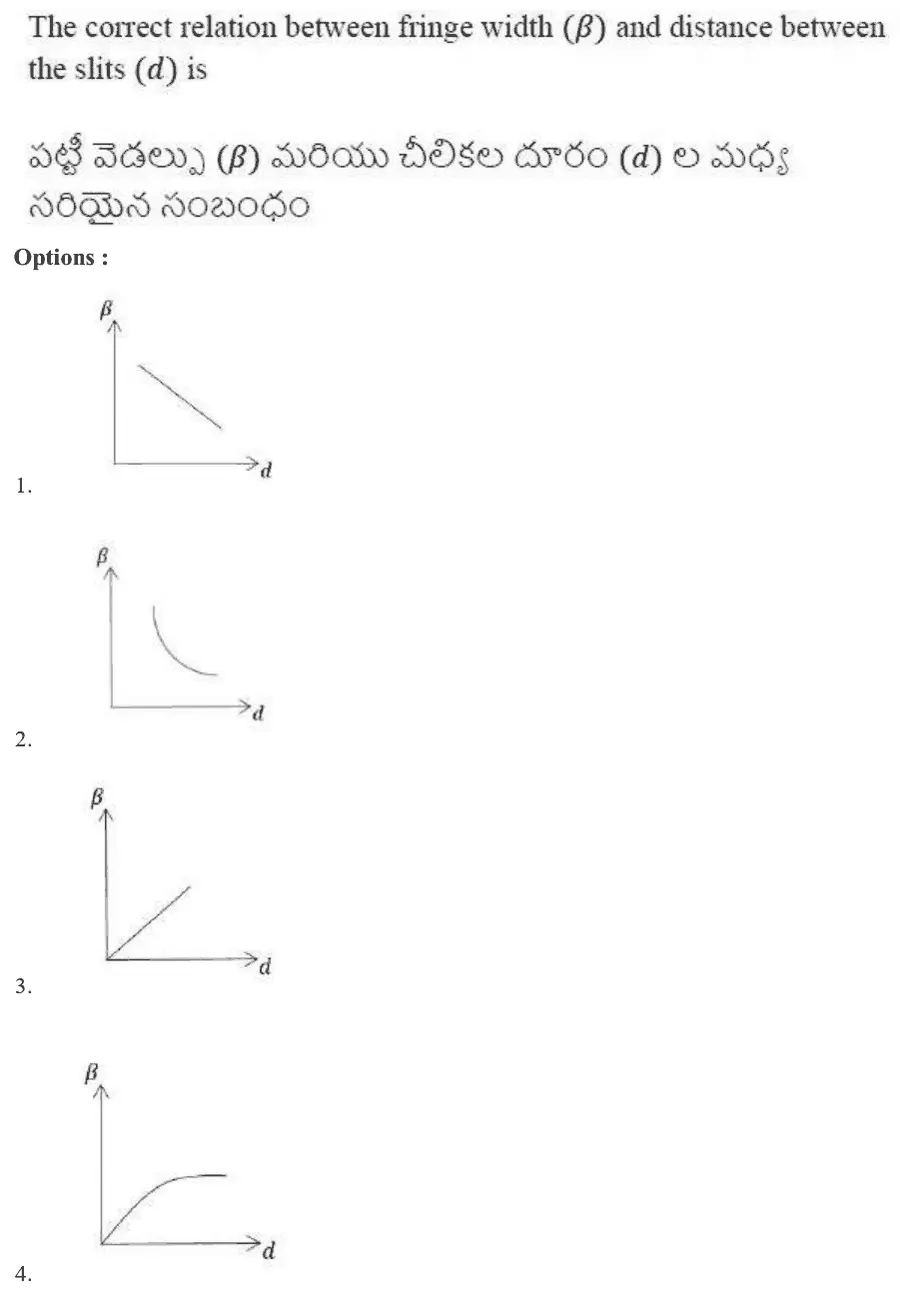
see figure Graph with $\beta$ on the vertical axis and $d$ on the horizontal axis: a straight line with negative slope, starting at a point above the horizontal axis (not touching either axis) and sloping downward to the right.
see figure Graph with $\beta$ on the vertical axis and $d$ on the horizontal axis: a decreasing curve (hyperbola-like, convex), steep at first and flattening toward the right, not touching either axis.
see figure Graph with $\beta$ on the vertical axis and $d$ on the horizontal axis: a straight line with positive slope starting from the origin.
see figure Graph with $\beta$ on the vertical axis and $d$ on the horizontal axis: a curve starting at the origin, rising steeply and then flattening to a constant (saturating) value.
Young’s double slit experiment is conducted in water. The refractive index of water is 1.33. Wavelength of incident light is 6000 Å and the separation between the slits is $2\ mm$. Fringe width is given by $0.63\ mm$. The distance between screen and slits is
$1.4\ m$
$1.04\ m$
$2.79\ m$
$1.72\ m$
In Young’s double slit experiment, the Y- coordinates of central maxima and $10^{\text{th}}$ maxima are 2cm and 5cm respectively. When this apparatus is immersed in a liquid of refractive index 1.5, the corresponding Y- coordinates will be
$2\ cm\ , 7.5\ cm$
$3\ cm\ , 6\ cm$
$2\ cm\ , 4\ cm$
$\frac{4}{3}\ cm\ , \frac{10}{3}\ cm$
When monochromatic light of wavelength $\lambda$ is used in Young’s double slit experiment, if I is the intensity of light at a point on the screen where path difference is $\frac{\lambda}{3}$, then the intensity of light at a point on the screen where path difference becomes $\lambda$ is
2I
3I
4I
I
A polaroid P is placed between two crossed polaroids Q and R such that when unpolarized light incident on Q emerges from R with maximum possible intensity. The ratio of intensity of polarized light incident on P and the intensity of polarized light emerged from R is
$4:1$
$2:1$
$3:1$
$1:1$
In Young's double slit experiment, if the distance between the first dark fringe and the second bright fringe on the same side of the central maximum is 1.5 mm, then the distance between first dark fringe on one side and the second bright fringe on the other side of the central maximum is
2.5 mm
1.5 mm
3.0 mm
2.0 mm
In a single slit diffraction experiment, if the third minimum for light of wavelength 4800 Å coincides with the second secondary maximum of another light of wavelength $\lambda$, then the value of $\lambda$ is
6000 Å
5500 Å
5760 Å
4320 Å
If a parallel beam of light of wavelength 500 nm is incident on a convex lens of focal length 20 cm having a circular aperture of diameter 5 cm, then the radius of the central bright diffraction spot formed on the focal plane of the lens is nearly (in $\mu$m)
1.83
0.61
1.22
2.44
In an experiment, two polariods are arranged such that the intensity of the polarised light emerged from the second polaroid is 37.5% of the intensity of the unpolarised light incident on the first polaroid. Then the angle between the axes of the two polaroids is
$60^\circ$
$90^\circ$
$45^\circ$
$30^\circ$
In Young’s double slit experiment, if the distance between the slits is 2 mm and the distance of the screen from the slits is 100 cm, the fringe width is 0.36 mm. If the distance between the slits is decreased by 0.5 mm and the distance of the screen from the slits is increased by 50 cm, the fringe width becomes
0.84 mm
0.96 mm
0.48 mm
0.72 mm
A narrow slit of width 2 mm is illuminated with a monochromatic light of wavelength 500 nm. If the distance between the slit and the screen is 1m, then first minima are separated by a distance of
5 mm
0.5 mm
1 mm
10 mm
In Young's double slit experiment, the distance between the slits is 0.2 cm, the distance between the screen and the slits is 1 m. If the wavelength of light used in the experiment is 5000 Å, then the distance between two consecutive dark fringes on the screen is
0.25 mm
0.26 mm
0.27 mm
0.28 mm
In Young’s double slit experiment, if the distance between the slits is increased to 3 times initial distance, then the ratio of initial and final fringe widths is
$1:9$
$9:1$
$3:1$
$1:3$
An unpolarised beam of light incidents on a group of three polarising sheets arranged such that the angle between the axes of any two adjascent sheets is $30^\circ$. The ratio of the intensities of polarised light emerging from the second and third sheets is
$1:1$
$2:1$
$4:3$
$3:2$
In Young's double slit experiment, the wavelength of monochromatic light is increased by 20% and the distance between the two slits is decreased by 25%. If the initial fringe width is 0.3 mm, then the final fringe width is
0.72 mm
0.60 mm
0.16 mm
0.48 mm
In Young's double slit experiment, the wavelengths of red and blue lights used are $7.5 \times 10^{-5}$ cm and $5 \times 10^{-5}$ cm respectively. If $n^{th}$ bright fringe of red color coincides with $(n+1)^{th}$ bright fringe of blue colour, then the value of 'n' is
1
2
4
8
When two light waves of equal intensity superimpose, the maximum intensity obtained is I. If the intensity of one of the waves is quadrupled, then the maximum intensity obtained is
$\frac{4I}{9}$
$\frac{9I}{4}$
$\frac{2I}{3}$
$\frac{3I}{2}$
The distance for which ray optics becomes a good approximation for an aperture of 0.3 cm and a light of wavelength 6000 Å is
12 m
15 m
24 m
30 m
In Young's double slit experiment, if the distance between $5^{\mathrm{th}}$ bright and $7^{\mathrm{th}}$ dark fringes is 3 mm, then the distance between $5^{\mathrm{th}}$ dark and $7^{\mathrm{th}}$ bright fringes is
6 mm
3 mm
5 mm
4 mm
When unpolarised light from air incidents on the surface of a medium of refractive index $\sqrt{3}$, then the reflected light is totally polarised. The angle of refraction is
$30^\circ$
$53^\circ$
$60^\circ$
$37^\circ$
In Young's double slit experiment with light of wavelength $\lambda$, the intensity of light at a point on the screen where the path difference becomes $\frac{\lambda}{3}$ is
(I is intensity of the central bright fringe)
$I$
$\frac{I}{2}$
$\frac{I}{3}$
$\frac{I}{4}$
For an aperture of $5\times10^{-3}$ m and a monochromatic light of wavelength $\lambda$, the distance for which ray optics becomes a good approximation is 50 m, then $\lambda =$
5000 Å
6000 Å
5400 Å
6500 Å
Two light waves of intensities I and 2I superimpose on each other. If the path difference between the light waves reaching a point is 12.5% of the wavelength of the light, then the resultant intensity at the point is (Both the light waves have same wavelength)
I
9I
3I
5I
If a slit of width ‘x’ was illuminated by red light having wavelength $6500\,\mathrm{\AA}$, the first minima was obtained at $\theta = 30^\circ$. Then the value of ‘x’ is
$1.4 \times 10^{-4}\ \mu\mathrm{m}$
$1.2 \times 10^{-5}\ \mathrm{m}$
$1.3\ \mu\mathrm{m}$
$1.2\ \mu\mathrm{m}$
The angle between the axes of a polariser and an analyser is $45^\circ$. If the intensity of the unpolarized light incident on the polariser is I, then the intensity of the light emerged from the analyser is
$2I$
$\frac{I}{2}$
$I$
$\frac{I}{4}$
The angle of polarisation for a medium with respect to air is $60^\circ$. The critical angle of this medium with respect to air is
$\mathrm{Sin}^{-1}\sqrt{3}$
$\mathrm{Tan}^{-1}\sqrt{3}$
$\mathrm{Cos}^{-1}\sqrt{3}$
$\mathrm{Sin}^{-1}\dfrac{1}{\sqrt{3}}$
When a wave enters into a rarer medium from a denser medium, the property of the wave which remains constant is
Wavelength
Frequency
Velocity
Amplitude
In case of diffraction, if 'a' is a slit width and $\lambda$ is the wavelength of the incident light, then the required condition for diffraction to take place is
$\frac{a}{\lambda} = 1000$
$\frac{a}{\lambda} \leq 1$
$a \ll \lambda$
$a \gg \lambda$
In Young's double slit experiment, two slits are placed 2 mm from each other. Interference pattern is observed on a screen placed 2 m from the plane of the slits. Then the fringe width for a light of wavelength 400 nm is
$0.4 \times 10^{-6}$ m
$4 \times 10^{-6}$ m
$0.4 \times 10^{-3}$ m
400 m
In Young's double slit experiment, the intensity at a point where the path difference is $\frac{\lambda}{6}$ ($\lambda$ being the wavelength of the light used) is $I$. If $I_0$ denotes the maximum intensity, $I/I_0$ is equal to
$1/\sqrt{2}$
$\sqrt{3}/2$
$1/2$
$3/4$
In young's double slit experiment with monochromatic light of wave length 6000 Å, the fringe width is 3 mm. If the distance between the screen and slits is increased by 50 % and the distance between the slits is decreased by 10 %, then the fringe width is
12 mm
5 mm
6 mm
10 mm
When a monochromatic light is incident on a surface separating two media, both the reflected and refracted lights have the same ______
frequency
wavelength
velocity
amplitude
In Young's double slit experiment, intensity of light at a point on the screen where the path difference becomes $\lambda$ is I. The intensity at a point on the screen where the path difference becomes $\frac{\lambda}{3}$ is,
$\frac{\mathrm{I}}{4}$
$\frac{\mathrm{I}}{3}$
$\frac{2\mathrm{I}}{3}$
$3\mathrm{I}$
The Brewster angle for air to glass transition of light is
(Refractive index of glass = 1.5)
$\mathrm{Sin}^{-1}\left(\frac{3}{2}\right)$
$\mathrm{Cos}^{-1}\left(\frac{3}{2}\right)$
$\mathrm{Tan}^{-1}\left(\frac{3}{2}\right)$
$\mathrm{Cos}^{-1}\left(\frac{2}{3}\right)$
Young's double slit experiment is performed with monochromatic light of wavelength 6000 Å. If the intensity of light at a point on the screen where path difference of 2000 Å is $I_1$ and the intensity of light at a point on the screen where the path difference is 1000 Å is $I_2$, then $I_1 : I_2 =$
$1:3$
$2:1$
$1:1$
$4:5$
In a Young's double slit experiment, a laser light of wave length 560 nm produces an interference pattern with consecutive bright fringe's separation of 7.2 mm. Now another light is used to produce an interference pattern with consecutive bright fringes' separation of 8.1 mm. The wavelength of second light is
680 nm
630 nm
650 nm
540 nm
Angular width of central maximum of a diffraction pattern due to a single slit does not depend upon
Distance between slit and source
Wavelength of light used
Width of the slit
Frequency of light used
When a light ray incidents on the surface of a medium, the reflected ray is completely polarized. Then the angle between reflected and refracted rays is
$45^\circ$
$90^\circ$
$120^\circ$
$180^\circ$
The frequency of a light ray is $6\times10^{14}$ Hz. Its frequency when it propagates in a medium of refractive index 1.5, will be
$1.67 \times 10^{14}$ Hz
$9.10 \times 10^{14}$ Hz
$6 \times 10^{14}$ Hz
$4 \times 10^{14}$ Hz
Two coherent light sources having intensity in the ratio 2x produce an interference pattern. Then the value of $\frac{I_{\max}-I_{\min}}{I_{\max}+I_{\min}}$ will be
$\frac{2\sqrt{2x}}{x+1}$
$\frac{\sqrt{2x}}{2x+1}$
$\frac{2\sqrt{2x}}{2x+1}$
$\frac{\sqrt{2x}}{x+1}$
The relation $I = I_0 \cos^2\theta$ is
($I_0$ – Intensity of incident light on the analyser, $I$ – intensity of emergent light from the analyser, $\theta$ – angle between plane of polarization and the axis of analyser)
Newton's law
Snell's law
Brewster's law
Malus's law
A diffraction pattern is obtained by using a beam of red light. If the red light is replaced by the blue light
bands will be narrower
bands become broader
no change in the width of the bands takes place
bands disappear
The property of light which cannot be explained by Huygen’s construction of wavefront is
Refraction
Reflection
Diffraction
Origin of spectra
In a Young's double slit experiment, if the wavelength of light is increased by 50% and the distance between the slits is doubled then the percentage change in fringe width is
75
50
25
15
A point source of light is placed at the focus of a concave mirror. Consider only paraxial rays. The shapes of the wavefronts of incident and reflected lights respectively are
spherical, spherical
spherical, planar
spherical, cylindrical
planar, spherical
In a single slit diffraction, the slit is illuminated with light of wavelength $6000\ \mathrm{\AA}$. If the slit were illuminated by a light of wavelength $\lambda$ the angular width of the central maximum decreases by $30\ \%$. Then $\lambda$ is
$6000\ \mathrm{\AA}$
$4200\ \mathrm{\AA}$
$3000\ \mathrm{\AA}$
$1800\ \mathrm{\AA}$
Two slits are made one millimetre apart and the screen is placed one metre away from the slits. The fringe width when light of wavelength 500 nm is used is
5 m
0.5 mm
0.5 m
5 cm
Two slits separated by a distance of 1 mm are illuminated with light of wavelength $6.5 \times 10^{-7}$ m. The interference fringes are observed on a screen placed at 1 m from the slits. The distance between the third dark fringe and the fifth bright fringe is equal to
0.655 mm
1.625 mm
4.785 mm
When Young's double slit experiment is performed in air, the Y-coordinates of central maxima and $10^{\text{th}}$ maxima are 2 cm and 5 cm respectively. If the apparatus is immersed in a liquid of refractive index 1.5, the corresponding Y-coordinates will be
2 cm, 7.5 cm
3 cm, 6 cm
2 cm, 4 cm
$\frac{4}{3}$ cm, $\frac{10}{3}$ cm
If the slit width is 2 mm and wavelength of light used is 4000 Å, then Fresnel distance is nearly
2 mm
10 m
20 km
2 μm
In an interference pattern of Young's double slit experiment, at a point we observe the 12$^{th}$ order maximum for a monochromatic light source with wavelength 6000 $\mathrm{\AA}$. What order will be visible here if the source is replaced by a light of wavelength 4800 $\mathrm{\AA}$?
15
10
8
18
In a Young's double slit experiment, if the distance between two slits is reduced by a factor of 2 and the wavelength of light is increased 4 times then the distance between two maxima will become ______ times the original value.
2
4
8
16
In Young's double slit experiment for what order does the wavelength of red light ($\lambda=780$ nm) coincide with $(\mathrm{m}+1)^{\mathrm{th}}$ order of blue light ($\lambda=520$ nm)
$1$
$2$
$3$
$4$
In a double-slit experiment performed in air the angular width of a fringe is found to be $0.15^{\circ}$ on a screen placed 80 cm away. The wavelength of light used is 490 nm. The angular width of the fringe if the entire apparatus is immersed in a medium of refractive index $\frac{5}{3}$ is
$0.09^{\circ}$
$0.7^{\circ}$
$0.9^{\circ}$
$0.11^{\circ}$
Two waves of amplitudes $A_{1}$ and $A_{2}$ respectively are superimposed. The ratio between the maximum and minimum intensities of the resultant waves is 9: 4. The value of $\dfrac{A_{2}}{A_{1}}$ is [Assume $A_{1}>A_{2}$]
$0.66$
$0.20$
$0.75$
$0.44$
A Young's double slit experiment apparatus has slits separated by 0.2 mm and a screen 60 cm away from the slits. The whole apparatus is immersed in a liquid medium of refractive index $\dfrac{11}{9}$ and the slits are illuminated with green light ($\lambda=550\ nm$ in vacuum). Find the fringe width of the pattern formed on the screen.
$0.95\ \mathrm{mm}$
$1.25\ \mathrm{mm}$
$1.35\ \mathrm{mm}$
$1.45\ \mathrm{mm}$
The angular width of a fringe in a double slit experiment is found to be $0.2^{\circ}$ on a screen 1 m away. The wavelength of light used is 600 nm. The change in angular width of the fridge if the entire measurement system is immersed in water is
[Use refractive index of water as 4/3]
$0.05^{\circ}$
$0.10^{\circ}$
$0.15^{\circ}$
$0.20^{\circ}$
Assertion [A] : For light diverging from a point source, the intensity at the wavefront does not depend on the distance.
Reason [R] : In a diverging beam of light from a point source, spherical wavefront is observed.
(A) and (R) are true and (R) is the correct explanation of (A).
Both (A) and (R) are true, but (R) is not the correct explanation of (A).
(A) is true but (R) is false
(A) is false but (R) is true.
A monochromatic light is incident on a single slit of width 0.014 mm. The angular position of the second bright line observed is $2.81^\circ$. Then the wavelength of the incident light is
$[\sin(2.81^\circ) = 0.049072]$
$4026\ \mathrm{\mathring{A}}$
$5890\ \mathrm{\mathring{A}}$
$6040\ \mathrm{\mathring{A}}$
$2748\ \mathrm{\mathring{A}}$
In a Young's double slit experiment, the slits are separated by 0.28 mm and the screen is placed 1.4 m away from the slits. The distance between the central bright fringe and the $4^{\mathrm{th}}$ order bright fringe is measured to be 1.2 cm. The wavelength of light used in this experiment is
$2400\ \mathrm{nm}$
$600\ \mathrm{nm}$
$1200\ \mathrm{nm}$
$800\ \mathrm{nm}$
In Young's double slit experiment, light of wavelength 480 nm is incident on two slits separated by a distance of $4 \times 10^{-4}$ m. If a thin plate of thickness $1.4 \times 10^{-6}$ m and refractive index $\dfrac{13}{7}$ is placed between one of the slits and screen, the phase difference introduced at the position of central maxima is
$5\pi$
$\dfrac{7}{3}\pi$
$\dfrac{7}{4}\pi$
$4\pi$
A monochromatic light of wavelength $6000\ \mathrm{\mathring{A}}$ coming from a star is detected in a 100 inch telescope. The limit of resolution of the telescope is approximately
$3.4\times10^{-7}$ rad
$6.7\times10^{-7}$ rad
$2.9\times10^{-7}$ rad
$1.54\times10^{-7}$ rad
Two coherent sources $O_1$ and $O_2$ in Young's double slit experiment are illuminated with monochromatic light of wavelength 5000 $\mathrm{\AA}$. If a second order dark fringe is formed at a point R on the screen, the path difference $O_1R \sim O_2R$ is
7.5 $\mu$m
0.75 $\mu$m
0.075 $\mu$m
75 $\mu$m
Young's double slit experiment is conducted with monochromatic light of wavelength $5000\ \mathrm{\AA}$, with slit separation of 3 mm and observer at 20 cm away from the slits. If a 1 mm transparent plate is placed in front of one of the slits, the fringes shift by 6 mm. The refractive index of the transparent plate is
1.08
1.09
1.1
1.2
In Young's double slit experiment, the slits are 3 mm apart and are illuminated by light of two wavelengths $3750\ \mathrm{\AA}$ and $7500\ \mathrm{\AA}$. The screen is placed at 4 m from the slits. The minimum distance from the common central bright fringe on the screen at which the bright fringe of one interference pattern due to one wavelength coincide with the bright fringe of the other is
2 mm
3 mm
1 mm
8 mm
A beam of light both reflects and refracts at the surface between air and glass. The index of refraction of the glass is 1.4. If the refracted and the reflected rays are perpendicular to each other, then the angle of incidence in the air is
$\tan^{-1}(1.4)$
$\sin^{-1}\left(\frac{1}{1.4}\right)$
$\tan^{-1}\left(\frac{1}{1.4}\right)$
$\sin^{-1}\left(\frac{1.4}{\pi}\right)$
When monochromatic light of wavelength 600 nm is used in Young's double slit experiment, the fifth order bright fringe is formed at 6 mm from the central bright fringe on the screen. If the experiment is conducted with light of wavelength 400 nm from the central bright fringe, the third order bright fringe will be located at
$1.6$ mm
$2$ mm
$2.4$ mm
$3$ mm
The ratio of maximum and minimum intensities in an interference pattern is $36:1$. The ratio of the amplitude of the two interfering waves will be ______
$5:7$
$7:4$
$4:7$
$7:5$
In a double slit experiment, when the distance between slits is increased 10 times, while their distance from the screen is halved, then the fringe width ________
Becomes $\left(\frac{1}{20}\right)$ times the original
Becomes $\left(\frac{1}{90}\right)$ times the original
Remains the same
Becomes $\left(\frac{1}{10}\right)$ times the original
If the ratio of amplitudes of two interfering waves is 4 : 3, then the ratio of maximum and minimum intensity is:
$16 : 18$
$18 : 16$
$49 : 1$
$94 : 1$
The position of the direct image obtained at O, when a monochromatic beam of light is passed through a plane transmission grating at normal incidence is shown in figure. The diffracted images A, B and C correspond to the first, second and third order diffraction. When the source is replaced by another source of shorter wavelength
(see the figure above)
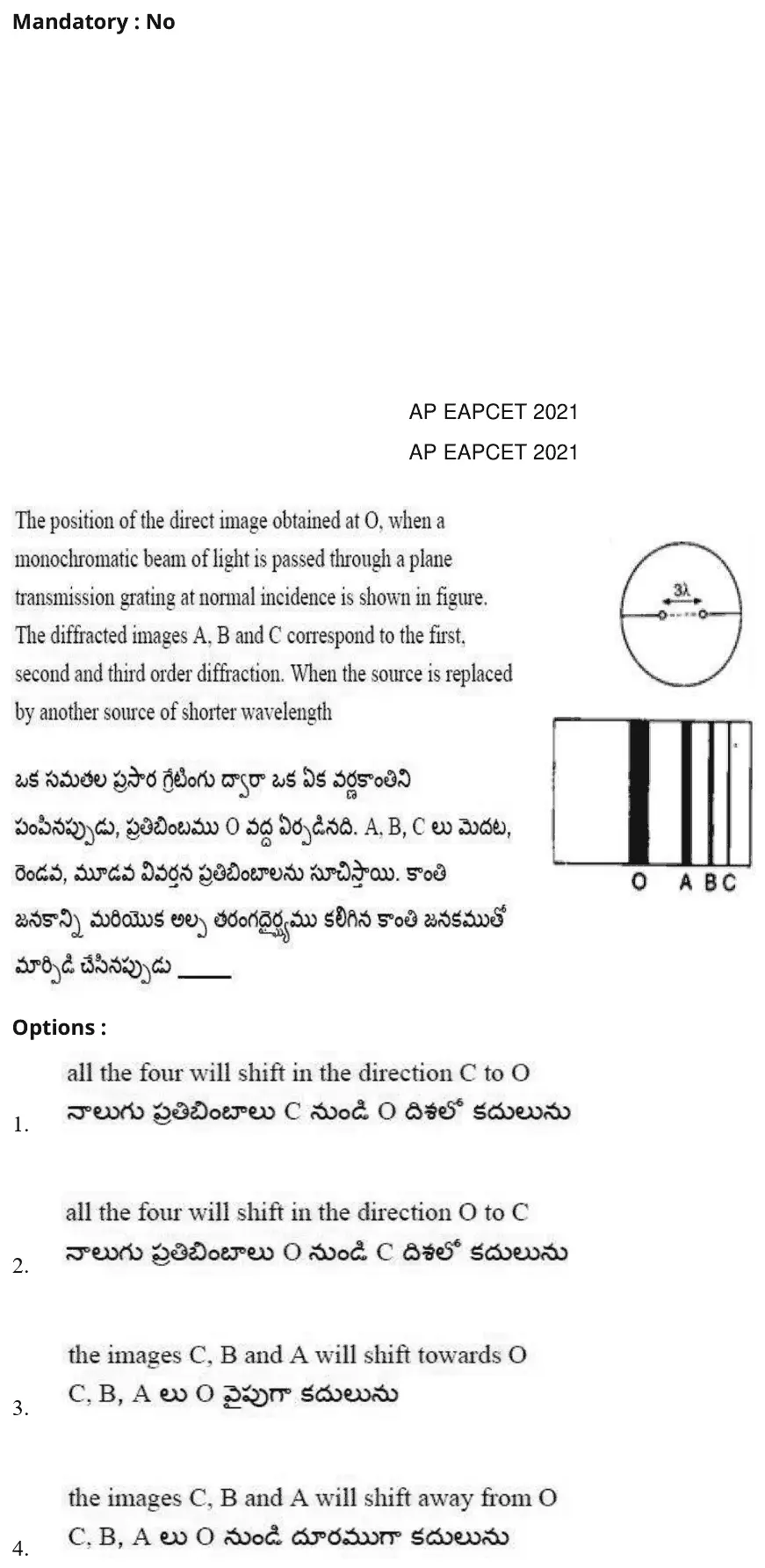
all the four will shift in the direction C to O
all the four will shift in the direction O to C
the images C, B and A will shift towards O
the images C, B and A will shift away from O
The wave front is a surface in which ______
all points are in the same phase
there are pairs of points in opposite phase
there are pairs of points with phase difference $(\pi/2)$
there is no relation between the phases
In a diffraction pattern due to a single slit of width 'a', the first minimum is observed at an angle $30^\circ$ when light of wavelength $500\ nm$ is incident on the slit. The first secondary maximum is observed at an angle of ______
$\sin^{-1}\dfrac{1}{2}$
$\sin^{-1}\dfrac{3}{4}$
$\sin^{-1}\dfrac{1}{4}$
$\sin^{-1}\dfrac{2}{3}$
In Young's double slit experiment, the separation between the slits is halved and the distance between the screen is doubled. The fringe width is ______
Unchanged
Halved
Doubled
Quadrupled
In Young's double slit experiment, point A on the screen has a path difference of $\lambda$ and point B on the screen has a path difference of $\frac{\lambda}{4}$. What is the ratio of the intensities at point A to B?
1 : 1
2 : 1
1 : 2
4 : 1
White light is used to illuminate the two slits in a Young's double experiment. The observed central fringe is
Black
White
Blue
Red
The fringe widths are found to be $\omega_1$ and $\omega_2$ respectively if a Young's double slit experiment is performed in medium of refractive index $n_1$ and $n_2$ respectively. The correct statement is
$\omega_1 > \omega_2$ if $n_1 > n_2$
$\omega_1 > \omega_2$ if $n_1 < n_2$
$\omega_1 = \omega_2$ if $n_1 < n_2$
$\frac{\omega_1}{\omega_2} = \frac{n_1}{n_2}$
What would be the angular separation between the consecutive bright fringes in Young's double slit experiment with blue green light of wavelength 400 nm? The separation between the slits is 0.001 m.
$4\times10^{-4}$ rad
$3\times10^{-4}$ rad
$2\times10^{-4}$ rad
$1\times10^{-4}$ rad
In Young's double slit experiment using monochromatic light of wavelength $\lambda$, the intensity of light at a point on the screen where the path difference is $\dfrac{\lambda}{3}$, is $I_0$. What is the intensity of light at a point where the path difference is $\lambda$?
$2I_0$
$4I_0$
$\dfrac{I_0}{2}$
$\dfrac{\sqrt{3}}{2}I_0$
A mixture of Yellow light of wavelength $580\ \mathrm{nm}$ and blue light of wave length $450\ \mathrm{nm}$ is incident normally on an air film of thickness $2.9 \times 10^{-4}\ \mathrm{mm}$. The colour of reflected light is
Red
Blue
Violet
Yellow
Two-point white dots are $2\mathrm{mm}$ apart on a black paper. They are viewed by eye of pupil diameter $3\ \mathrm{mm}$. What is the maximum distance at which these dots can be resolved by the eye? ($\lambda = 500\ \mathrm{nm}$)
$5\ \mathrm{m}$
$1\ \mathrm{m}$
$6\ \mathrm{m}$
$10\ \mathrm{m}$
Conditions of diffraction is ______
$\frac{a}{\lambda} \neq 1$
$\frac{a}{\lambda} \gg 1$
$\frac{a}{\lambda} \ll 1$
$\frac{a}{\lambda} \leq 1$
The central fringe in the interference pattern obtained in Young's double slit experiment will be a dark fringe when the phase difference between the waves from the two slits is
$0$
$\dfrac{\pi}{2}$
$\pi$
$\dfrac{\pi}{3}$
Which of the following generates a plane wave front?
Point source
Extended source
Monochromatic source
All light sources
$PQ$ represents a wave front and $AO$ and $BP$, the corresponding two rays. Find the condition on $Q$ for constructive interference at $P$ between ray $BP$ and reflected ray $OP$
(see the figure above)
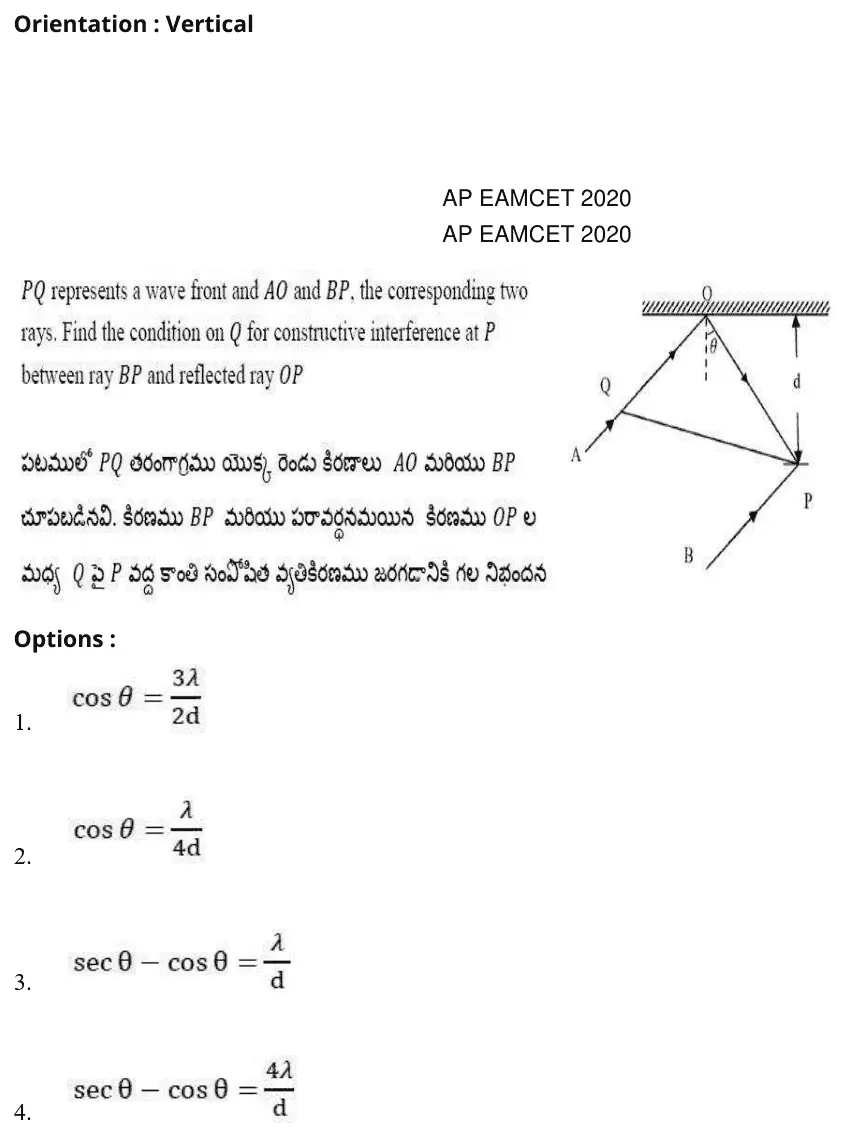
$\cos\theta = \frac{3\lambda}{2d}$
$\cos\theta = \frac{\lambda}{4d}$
$\sec\theta - \cos\theta = \frac{\lambda}{d}$
$\sec\theta - \cos\theta = \frac{4\lambda}{d}$
A Fraunhofer diffraction pattern due to a narrow slit is obtained on a screen placed at a distance $D$ from the slit whose slit width is 'a'. The distance of first secondary maximum from the central maximum is
$\frac{3D\lambda}{a}$
$\frac{3D\lambda}{2a}$
$\frac{2D\lambda}{3a}$
$\frac{2D\lambda}{a}$
Which of the following phenomena produces the colour in soap bubble?
Diffraction
Interference
Polarization
Refraction
If in a Young's double slit experiment the slit separation is doubled and the distance of the screen from the slits is reduced to half, then, the fringe widths become how many times their original value.
$\dfrac{1}{2}$
2
$\dfrac{1}{4}$
4
What minimum separation between two objects a human eye would be able to resolve, if the eye pupil diameter is 2mm, and the two objects are 20m away from the eye.
(Assume human eye to be equivalent to a convex lens and consider the average wave length of light as 600nm)
7.32 mm
8.72 mm
6.2 mm
4.71 mm
The shape of wavefront of light diverging from point source
spherical
planar
cylindrical
circular
On using red light ($\lambda=6600\ \mathrm{\AA}$) in Young's double slit experiment, 60 fringes are observed in the field of view. If violet light ($\lambda=4400\ \mathrm{\AA}$) is used, the number of fringes observed will be
30
120
60
90
Young's double slit experiment is carried out by using green, red and blue light, one color at a time. The fringe width recorded are $\beta_G, \beta_R, \beta_B$ respectively then
$\beta_G > \beta_B > \beta_R$
$\beta_B > \beta_G > \beta_R$
$\beta_R > \beta_B > \beta_G$
$\beta_R > \beta_G > \beta_B$
Two coherent plane waves of identical frequency, polarization and intensity (I) interfere at a point where they differ in phase by $60^0$. What is the resulting intensity?
$I$
$2I$
$3I$
$4I$
Two beams of monochromatic light with intensities 64 mW and 4 mW interfere constructively to produce an intensity of 100 mW. If one of the beams is shifted by an angle $\theta$, the intensity is reduced to 84 mW. The magnitude of $\theta$ is
$30^0$
$60^0$
$45^0$
$\cos^{-1}\left(\frac{1}{3}\right)$
Identify the incorrect statement:
the fringe width in a Young's double slit experiment reduces when the width between the two slits increases
the central fringe observed for in a single slit diffraction experiment is a bright fringe
the resolving power of the microscope is reciprocal to the maximum separation of two points seen as distinct
polarisation phenomenon is observed only for transverse waves
Light consisting of plane waves of wavelength $\lambda_1 = 8 \times 10^{-5}$ cm and $\lambda_2 = 6 \times 10^{-5}$ cm generates an interference pattern in Young's double slit experiment. If $n_1$ denotes the $n_1^{th}$ dark fringe due to light of wavelength $\lambda_1$ which coincides with $n_2^{th}$ bright fringe due to light of wavelength $\lambda_2$ then
$n_1 = 3,\ n_2 = 1$
$n_1 = 4,\ n_2 = 5$
$n_1 = 1,\ n_2 = 2$
$n_1 = 3,\ n_2 = 2$
The pass axes of two polarizers were kept such that the incident unpolarized beam of intensity $I_0$, gets completely blocked. Another polarizer was introduced in between these two polarizers with its pass axis $60^\circ$ with respect to the pass axis of the first one. The output intensity would then become
0
$\frac{3}{32} I_0$
$\frac{3}{16} I_0$
$\frac{3}{8} I_0$
In a Young's double slit experiment, $m^{\mathrm{th}}$ order and $n^{\mathrm{th}}$ order of bright fringes are formed at point P on a distant screen, if monochromatic source of wavelength 400 nm and 600 nm are used respectively. The minimum value of $m$ and $n$ are, respectively
4, 6
3, 2
2, 3
4, 2
When light of an unknown polarization is examined with a polaroid, it is found to exhibit maximum intensity $I_0$ along y-axis and minimum intensity $\frac{2I_0}{3}$ along x-axis. The intensity transmitted through a polaroid with pass axis at $45^\circ$ to y-axis (in xy plane) is
$\frac{5}{8} I_0$
$\frac{I_0}{2}$
$\frac{5}{6} I_0$
$\frac{I_0}{4}$
In a Young's double slit experiment, a thin sheet of refractive index 1.6 is used to cover one slit while a thin sheet of refractive index 1.3 is used to cover the second slit. The thickness of both sheets are same and the wavelength of light used is 600 nm. If the central point on the screen is now occupied by what had been the $10^{\mathrm{th}}$ bright fringe (m =10), then the thickness of covering sheets is
$50\ \mu\mathrm{m}$
$8\ \mu\mathrm{m}$
$20\ \mu\mathrm{m}$
$40\ \mu\mathrm{m}$
In Young's double slit experiment, light of wavelength $5900\ \mathrm{\AA}$ is used. When the slits are $2\ \mathrm{mm}$ apart, the fringe width is $1.2\ \mathrm{mm}$. If the slit separation is increased to one and half times the previous value, then the fringe width will be
$0.9\ \mathrm{mm}$
$0.8\ \mathrm{mm}$
$1.8\ \mathrm{mm}$
$1.6\ \mathrm{mm}$
A ray of light is incident on the surface of a glass plate of refractive index $\sqrt{3}$ at the polarising angle. The angle of refraction of the ray is
$30^\circ$
$45^\circ$
$60^\circ$
$37^\circ$
In Young's double slit experiment, the two slits are separated by $0.5\ \mathrm{cm}$ and the screen is at $0.5\ \mathrm{m}$ from the slits. If 20000 bright fringes are counted per meter on the screen, then the wavelength of light used is
$5000\ \mathrm{\AA}$
$5890\ \mathrm{\AA}$
$6000\ \mathrm{\AA}$
$5460\ \mathrm{\AA}$
Unpolarised light from air incidents on the surface of a transparent medium of refractive index 1.414 such that the reflected light is completely polarised. Match the angles given in List - I with the corresponding values given in List - II.
List - I
A) Angle of reflection
B) Angle of refraction
C) Angle between incident and completely polarised rays
D) Angle of deviation of the incident ray
List - II
I) $2\sin^{-1}\left(\sqrt{\frac{2}{3}}\right)$
II) $\sin^{-1}\left(\sqrt{\frac{2}{3}}\right) - \sin^{-1}\left(\frac{1}{\sqrt{3}}\right)$
III) $\sin^{-1}\left(\frac{1}{\sqrt{3}}\right)$
IV) $\cos^{-1}\left(\frac{1}{\sqrt{3}}\right)$
The correct answer is
A-II, B-III, C-I, D-IV
A-II, B-III, C-IV, D-I
A-IV, B-I, C-III, D-II
A-IV, B-III, C-I, D-II
A Young double slit experimental setup is immersed in water of refractive index 1.33. It has slit separation 1 mm and the distance between slits and screen is 1.33 m. If the wavelength of incident light on slits is 6300 Å then the fringe width on screen is
6.3 mm
0.63 mm
0.63 m
6.3 m
In Young's double slit experiment, if the slit separation is twice the wavelength of light used, then the maximum number of interference maxima is
0
3
5
7
The angular deviation of $5^{\mathrm{th}}$ order dark fringe is $12^\circ$ in a single slit experiment. If the width of the slit is $9\ \mu\mathrm{m}$ then the wavelength of the incident light is
$4862\ \text{\AA}$
$5892\ \text{\AA}$
$6022\ \text{\AA}$
$3768\ \text{\AA}$
A light beam of wavelength 800nm passes through a single slit and projected on a screen kept at 5m away from the slit. What should be the slit-width for the ray-optics approximation to be valid.
0.5 mm
2 mm
1.5 mm
0.25 mm
In an experiment, light passing through two slits separated by a distance of 0.3 mm is projected onto a screen placed at 1 m from the plane of slits. It is observed that the distance between the central fringe and the adjacent bright fringe is 1.9 mm. The wavelength of light in nm is
450
495
530
570
Calculate the minimum thickness of a soap film ($n = 1.33$) that results in constructive interference in reflected light, if the film is illuminated with light whose wavelength in free space is $532\ \mathrm{nm}$.
$113\ \mathrm{nm}$
$100\ \mathrm{nm}$
$200\ \mathrm{nm}$
$226\ \mathrm{nm}$
Interference fringes are obtained in a Young double slit experiment using beam of light consisting two wavelengths 500 nm and 600 nm. Bright fringes due to both wavelengths coincide at 2.5 mm from the central maximum. If the separation between the slits is 3 mm then the distance between the screen and plane of the slits is
1.2 m
2.8 m
2.5 m
3.2 m
In a Young's double slit experiment, a monochromatic light of wavelength 600 nm is used. If the two slits are covered by transparent sheets of thickness 0.132 mm and 0.1 mm of refractive index 1.5, the number of fringes that will shift due to introduction of the sheets are
20
40
60
80
In Young's double slit experiment, the two slits are illuminated by a light beam consisting of wavelengths 4200 Å and 5040 Å. If the distance between the slits is 2.4 mm and the distance between the slits and the screen is 200 cm, the minimum distance from the central bright fringe to the point where the bright fringes due to both the wavelengths coincide is ________
0.7 mm
1.4 mm
2.1 mm
2.8 mm
Two coherent sources $S_1$, $S_2$ and a screen are arranged as shown in the figure. If the distance between the two coherent sources is $n\lambda$ and the distance of the screen from the nearer coherent source is D, then the distance of the first bright fringe on the screen from the point 'O' is
($\lambda$ is the wavelength of the light emitted by the coherent sources)
(see the figure above)
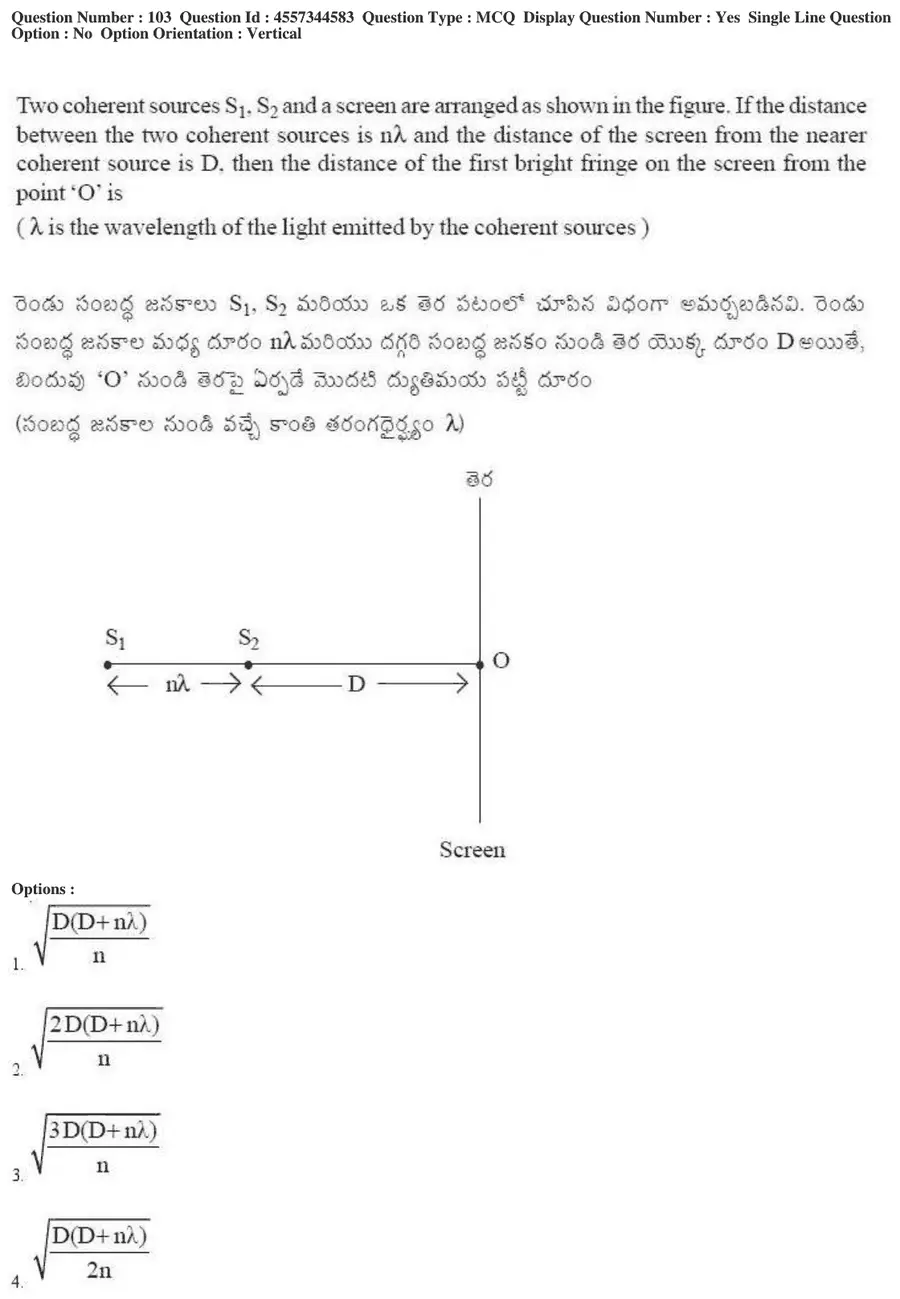
$\sqrt{\frac{D(D+n\lambda)}{n}}$
$\sqrt{\frac{2D(D+n\lambda)}{n}}$
$\sqrt{\frac{3D(D+n\lambda)}{n}}$
$\sqrt{\frac{D(D+n\lambda)}{2n}}$
Two point sources $\mathrm{S_1}$ and $\mathrm{S_2}$ separated by a distance 10 $\mu$m emit light waves of wavelength 4 $\mu$m in phase. A circular wire of radius 40 $\mu$m is placed around the sources as shown in figure, then
(O is the centre of the circle and $\mathrm{OS_1} = \mathrm{OS_2}$)
(see the figure above)
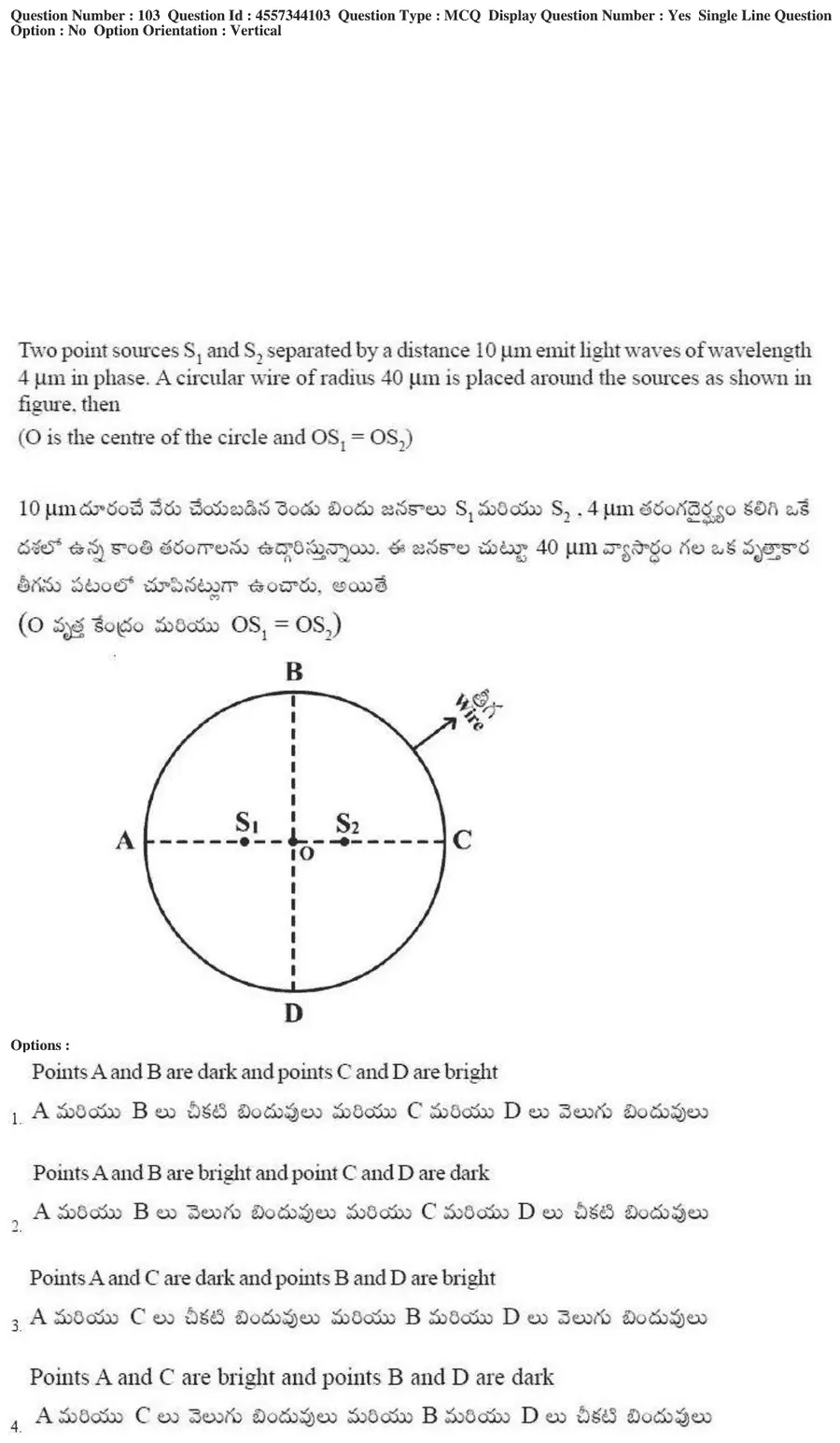
Points A and B are dark and points C and D are bright
Points A and B are bright and point C and D are dark
Points A and C are dark and points B and D are bright
Points A and C are bright and points B and D are dark
In Young's double slit experiment, the intensity of central fringe is $I_0$ and fringe width is $\beta$. If a point is at a distance x from the central fringe, the intensity at that point is
$I_0\cos^2\left(\dfrac{\pi x}{\beta}\right)$
$I_0\cos^2\left(\dfrac{x}{\beta}\right)$
$\dfrac{I_0}{4}\cos^2\left(\dfrac{\pi x}{\beta}\right)$
$I_0\cos^2\left(\dfrac{\pi\beta}{x}\right)$
Two polaroids are placed in the path of unpolarised light beam of intensity $I_0$ such that no light is emitted from the second polaroid. If a third polaroid whose polarization axis makes an angle $\theta$ with that of the first polaroid is placed between the polaroids, then intensity of light emerging from the last polaroid is
$\left(\frac{I_0}{8}\right)\sin^2 2\theta$
$\left(\frac{I_0}{4}\right)\sin^2 2\theta$
$\left(\frac{I_0}{2}\right)\cos^2\theta$
$I_0\cos^2\theta$
A parallel beam of light of intensity $I_0$ is incident on a coated glass plate. If 25% of the incident light is reflected from the upper surface and 50% of light is reflected from the lower surface of the glass plate, the ratio of maximum to minimum intensity in the interference region of the reflected light is
$\left(\dfrac{\frac{1}{2}+\sqrt{\frac{3}{8}}}{\frac{1}{2}-\sqrt{\frac{3}{8}}}\right)^2$
$\left(\dfrac{\frac{1}{4}+\sqrt{\frac{3}{8}}}{\frac{1}{2}-\sqrt{\frac{3}{8}}}\right)^2$
$\dfrac{5}{8}$
$\dfrac{8}{5}$
Two slits separated by 0.5 mm are illuminated by light of wavelength 500 nm. The screen is at a distance of 120 cm from the slits. The phase difference between the interfering waves at a point 3 mm on the screen from the central bright fringe is ______
$\pi$
$3\pi$
$5\pi$
$7\pi$
In Young's double slit experiment, the slits separated by 0.6 mm are illuminated with light of 6600 Å. Interference pattern is obtained on a screen placed at 4 m from slits. The minimum distance from the central maximum at which the average intensity is 50% of the maximum value is ______
$0.21\ \mathrm{mm}$
$2.1\ \mathrm{mm}$
$0.11\ \mathrm{mm}$
$1.1\ \mathrm{mm}$
In Young's double slit experiment the slits are horizontal. The intensity at a point 'P' on the screen shown in the figure is $\dfrac{I_0}{4}$ where $I_0$ is maximum intensity. If the distance between the two slits $S_1$ and $S_2$ is $2\lambda$, then the value of '$\theta$' is
(see the figure above)
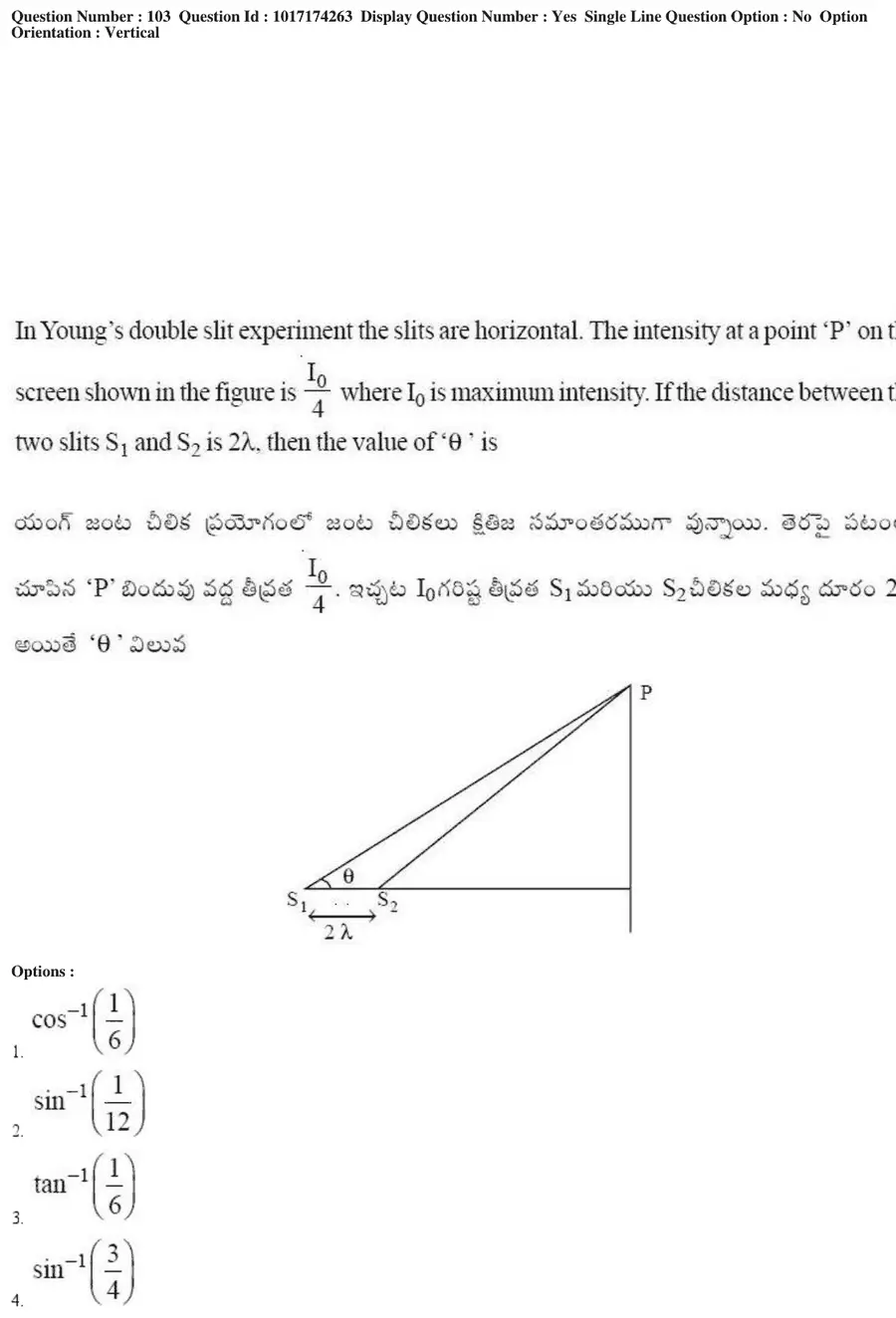
$\cos^{-1}\left(\dfrac{1}{6}\right)$
$\sin^{-1}\left(\dfrac{1}{12}\right)$
$\tan^{-1}\left(\dfrac{1}{6}\right)$
$\sin^{-1}\left(\dfrac{3}{4}\right)$
Three polaroid sheets are kept parallel to each other such that first and last are crossed. Unpolarised light of intensity $32\ \mathrm{Wm^{-2}}$ falls normally on the first sheet and passes through all the polaroid sheets. If the intensity of the emerging light from the third sheet is $3\ \mathrm{Wm^{-2}}$, then the angle between the axes of the first two polaroid sheets is
$60^\circ$
$45^\circ$
$30^\circ$
$90^\circ$
In a diffraction pattern due to a single slit, the angular width of central maxima becomes double when the wavelength of the light used is changed from $\lambda$ to $7000\ \mathrm{\AA}$. Then the value of $\lambda$ is
$3500\ \mathrm{\AA}$
$4200\ \mathrm{\AA}$
$5000\ \mathrm{\AA}$
$5890\ \mathrm{\AA}$
A screen is placed 0.5 m away from a single slit which is illuminated by a monochromatic light of wave length 6000 Å. If the distance between the first and third minima in the diffraction pattern on the screen is 3 mm then the slit width is
0.1 mm
0.4 mm
0.3 mm
0.2 mm
In Young's double slit experiment, red light of wavelength 6000 $\mathrm{\AA}$ is used and the $n^{th}$ bright fringe is obtained at a point 'P' on the screen. Keeping the same setting, the source of light is replaced by green light of wavelength 5000 $\mathrm{\AA}$ and now $(n+1)^{th}$ bright fringe is obtained at the point P on the screen. The value of 'n' is
4
5
6
3
In a double slit interference experiment, the fringe width obtained with a light of wavelength 5900 Å was 1.2 mm for parallel narrow slits placed 2 mm apart. In this arrangement, if the slit separation is increased by one-and-half times the previous value, then the fringe width is
0.9 mm
0.8 mm
1.8 mm
1.6 mm
Fresnel diffraction is produced due to light rays falling on a small obstacle. The intensity of light at a point on a screen beyond an obstacle depends on
the focal length of lens used for observation
the number of half-period zones that superpose at the point
the square of the sum of the number of half period zones
the thickness of the obstacle
Two coherent point sources $S_1$ and $S_2$ vibrating in phase emit light of wavelength $\lambda$. The separation between them is $2\lambda$ as shown in figure. The first bright fringe is formed at 'P' due to interference on a screen placed at a distance 'D' from $S_1$ (D >> $\lambda$), then OP is
(see the figure above)
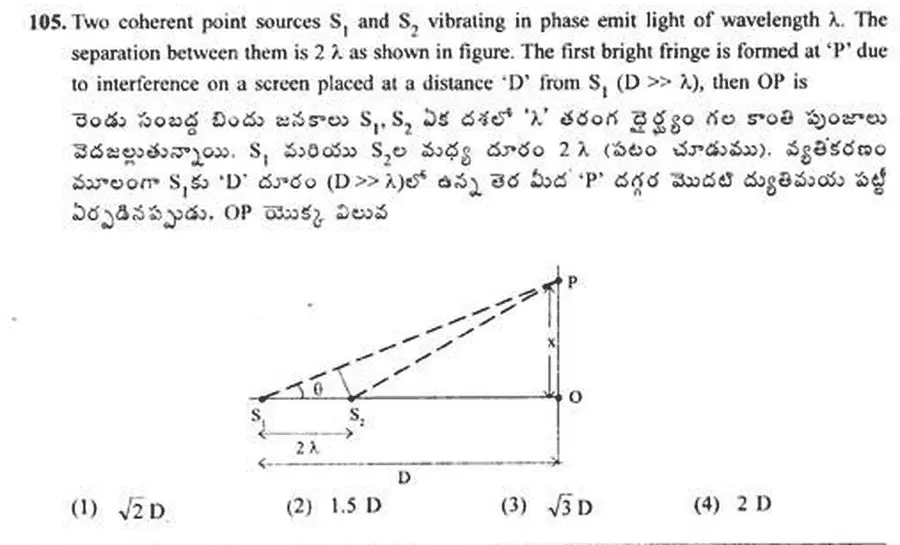
$\sqrt{2}$ D
1.5 D
$\sqrt{3}$ D
2 D
In the Young's double slit experiment, the resultant intensity at a point on the screen is 75% of the maximum intensity of the bright fringe. Then the phase difference between the two interfering rays at that point is :
$\frac{\pi}{6}$
$\frac{\pi}{4}$
$\frac{\pi}{3}$
$\frac{\pi}{2}$
Two coherent sources whose intensity ratio is 64 : 1 produce interference fringes. The ratio of intensities of maxima and minima is :
9 : 7
8 : 1
81 : 49
81 : 7
Wave Optics offers a concise theoretical chapter in the Class 12 physics sequence. Within our collection of AP and TS EAPCET papers from 2022 to 2026, students encountered 73 questions from this topic across 77 exam papers, which amounts to 0.9 questions per sitting and 2.4% of all physics questions. Taking in all 149 papers in our archive from 2010 to 2026, Wave Optics delivered 136 questions, giving an overall rate of 0.9 questions per paper and a 2.3% share. During the earlier window between 2010 and 2021, our records show 63 questions in 72 papers (2.2% share). Over the last three exam years from 2024 to 2026, the topic accounted for 41 questions in 46 sittings, representing a 2.2% share. Comparing the last three years to early papers, the chapter's share of the subject is about the same, and compared to the recent five-year window it is also about the same.
State-wise breakdowns show very similar weighting on both sides. AP EAPCET papers between 2022 and 2026 yielded 45 questions across 48 papers in our set, with 41 papers containing at least one question (0.9 per paper, 2.3% share). Over the same period, TS EAPCET brought 28 questions across 29 papers in our set, with 27 papers featuring the chapter (1.0 per paper, 2.4% share). Wave Optics has appeared every year since 2022, though across all 77 recent papers in our collection, nine papers omitted it, meaning it did not feature in all 77 sittings. By volume of questions from 2022 to 2026, it occupies the 27th position among the 28 physics chapters. Its highest single-year total occurred in 2022, when 17 questions appeared across 16 papers.
Questions group into three distinct syllabus modules:
Young's double slit interference calculations form the primary testing ground. A typical problem immerses the entire experimental apparatus in water or another liquid of refractive index n, asking for the new fringe width or the positional coordinates of a higher-order maximum. Because wavelength shrinks to λ / n while slit spacing d and screen distance D remain fixed, fringe width contracts to β / n. Another recurring setup inserts a thin transparent plate of thickness t and refractive index μ across one slit, asking for the central fringe shift Δy = (μ - 1) t D / d.
Diffraction problems concentrate on single slit patterns and circular apertures. A classic configuration gives a single slit illuminated by two wavelengths and asks at what angle the third minimum of one wavelength coincides with the second secondary maximum of the second wavelength. Polarisation problems test Malus's law I = I_zero cos² θ across rotating Polaroid analyzers or require calculating Brewster's angle from the tangent of the polarizing angle tan i_p = n.
Start by mastering interference relations in Young's double slit experiment. Path difference at screen position y is Δx = y d / D. Constructive interference bright fringes appear where Δx = n λ, yielding positions y_n = n λ D / d. Destructive interference dark fringes occur where Δx = (two n - 1) λ / two, giving positions y_n' = (two n - 1) λ D / (two d). Fringe width is uniform across the screen: β = λ D / d. Resultant intensity for two coherent sources of equal intensity I_zero is I = four I_zero cos²(φ / two), where phase difference is φ = (two π / λ) Δx.
Next, study Fraunhofer single slit diffraction. For a slit of width a, minima occur at angles satisfying a sin θ = n λ. The central diffraction maximum extends between the first minima on either side, giving linear width w = two λ D / a and angular width 2θ = two λ / a. Notice that central diffraction width is double the secondary peak width. For a circular aperture of diameter D_aperture, the angular radius of the central Airy disk is θ = one point two two times λ / D_aperture.
Finally, master polarisation formulas. Brewster's law states that reflected light is completely linearly polarised when incident at angle i_p satisfying tan i_p = n, with reflected and refracted rays remaining mutually perpendicular. Malus's law states that unpolarised light passing through a polarizer emerges with half intensity I_zero / two, and subsequent transmission through an analyzer oriented at angle θ yields I = (I_zero / two) cos² θ.
In the papers we hold from 2022 to 2026, Wave Optics averaged 0.9 questions per paper, appearing in 68 out of 77 exam papers across AP and TS.
As frequency increases, wavelength λ decreases in proportion, which causes the fringe width β = λ D / d to shrink, packing the interference fringes closer together on the screen.
When light is incident on a transparent dielectric at Brewster's angle, the reflected and refracted rays are perpendicular to each other, forming an angle of ninety degrees.
Step-by-step solutions for each one are in the EdLoop EAPCET app.