Every Ray Optics question from past AP EAPCET and TS EAPCET papers, with options and answers. Newest first.
202questions
142papers covered
3.5%of Physics questions, 2022–2026
2010–2026years
Guide at a glance
Geometrical optics provides an expansive problem-solving ground within Class 12 physics. In the papers we hold for AP and TS EAPCET from 2022 to 2026, Ray Optics delivered 108 questions across 77 papers (1.4 questions per paper, 3.5% subject share).
A dentist uses a mirror of 24 $mm$ focal length. He views a cavity in the tooth of a patient by holding the mirror at a distance of 16 $mm$ from the cavity. The magnification is
A compound microscope consists of an objective lens of focal length $f_o = 1$ cm and an eyepiece of focal length $f_e = 5$ cm. An object is placed 1.2 cm in front of the objective. The final image is formed at the least distance of distinct vision. The nature of the intermediate image and the total magnification of the microscope are:
Convex lens of focal length $20$ $cm$ and a concave lens of focal length of $30$ $cm$ are separated by a distance of $10$ $cm$. Equivalent power of this arrangement is
A rectangular glass block of thickness $10\ cm$ and refractive index 1.5 is placed over a small coin. A beaker is filled with water of refractive index $\frac{4}{3}$ to a height of $10\ cm$ and placed over glass block. The apparent depth of coin when viewed at near normal incidence
An object is 20 cm away from a concave mirror with focal length 15 cm. If the object moves with a speed of $5\ \mathrm{ms^{-1}}$ along the axis, then the speed of the image will be
In a compound microscope, the focal lengths of two lenses are 1.5 cm and 6.25 cm. An object is placed at 2 cm from objective and final image is formed at 25 cm from eye lens. The distance between two lenses is
An object is placed at a distance of 15cm from a convex lens of focal length 10cm. On the other side of the lens, at its focus a convex mirror is placed such that final image formed coincides with the object. The focal length of convex mirror is
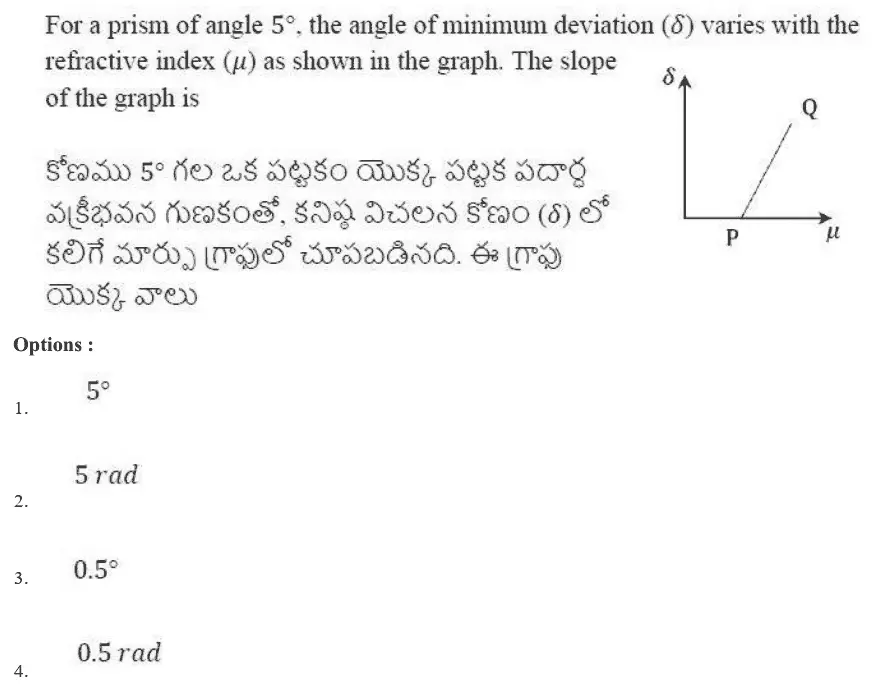
For a prism of angle $5^\circ$, the angle of minimum deviation ($\delta$) varies with the refractive index ($\mu$) as shown in the graph. The slope of the graph is
A Convex lens forms a real image 4 cm long on a screen. When the lens is shifted to a new position without disturbing the object, again a real image is formed on the screen which is 16 cm tall. The length of the object must be
A Vessel of depth $x$ is half filled with oil of refractive index $\mu_1$ and the other half is filled with water of refractive index $\mu_2$. The apparent depth of the vessel when viewed from above is
For the same angle of incidence, the angles of refraction of light ray in different media $A, B, C$ are $35^\circ, 25^\circ, 15^\circ$. If $V_A, V_B, V_C$ are velocities of light in $A, B, C$ media respectively, then
A glass slab has a critical angle of $30^\circ$ when placed in air. What will be the critical angle when it is placed in a liquid of refractive index 6/5? $\left(\sin 53^\circ = \frac{4}{5}\right)$
A convex lens forms a real image and a virtual image of same size of an object placed separately at distances $u_1$ and $u_2$ respectively from the lens. Then the focal length of the lens is
'$n$' transparent films, each of refractive index 1.5 with thickness $1\ cm, 2cm, 3\ cm, \ldots n\ cm$ are placed one over the other. When a point object is seen normally through this combination, the object is found to be shifted by $5\ cm$. Then the value of '$n$' is
A point object is moving towards a concave mirror of focal length 20 cm along the principal axis with a uniform speed of $4\ \mathrm{cms^{-1}}$. The speed of the image when the object is at a distance of 60 cm from the mirror is
If the focal lengths of the objective and eyepiece of a giant refracting telescope are 20 m and 1 cm respectively, then the angular magnification of the telescope is
If the angles of minimum deviation when a prism of angle $80^\circ$ is placed separately in air and in a liquid are $40^\circ$ and $10^\circ$ respectively, then the refractive index of the liquid is
A card divided into squares each of size $1\ \mathrm{mm}^2$ is viewed through a magnifying glass of focal length $10\ \mathrm{cm}$ which is held close to the eye. The distance at which the lens is to be placed from the card to view the squares with maximum possible magnification is
Two plane mirrors A and B are placed parallel to each other with a separation of 2 m between them. If an object is placed in between the two mirrors at a distance of 60 cm from the mirror B, then the distance of the second nearest image seen in mirror B from mirror A is (The reflecting surfaces of the two mirrors face each other)
If the length of a compound microscope is 100 cm and the focal length of its objective is 5 cm, then the difference between the magnifications of the microscope when the final image forms at infinity and at near point is (Least distance of distinct vision = 25 cm)
When an object is placed at a distance of 40 cm from a convex lens, a real image is formed at a distance V from the lens. If the convex lens is replaced with a concave lens of same focal length, then the change in the position of the image is
Keeping the length of an astronomical telescope constant in normal adjustment, to increase its magnification from 4 to 9, the focal length of the eyepiece is to be decreased by 10 cm. The length of the telescope is
A point object is at rest on the principal axis at a distance of 20 cm from a concave mirror of radius of curvature 30 cm. Under the action of a horizontal force, the object moves away from the mirror along the axis and reaches a distance of 40 cm from the mirror in a time of 3 s. The acceleration of the image is
The ratio of the speeds of light in a prism P and in vacuum is $1:\sqrt{3}$ and the angle of minimum deviation is $60^\circ$. In another prism Q of same angle of prism, if the angle of minimum deviation is $30^\circ$, then the refractive index of the material of the prism Q is
The objective of a microscope is immersed in a liquid of refractive index 1.5. If the semi-vertical angle (half of the vertex angle) of the cone of light rays of wavelength 600 nm from the object that fall on the objective is $30^\circ$, then the minimum resolvable distance for this microscope is
When a thin convex lens is immersed in a liquid of refractive index 1.2, the focal length of the lens becomes 48 cm. If the ratio of the radii of the curvature of the lens is 2:3 and the refractive index of the material of the lens is 1.5, then the radii of curvature of the lens are
In an astronomical telescope of 135 cm length kept in normal adjustment, if the difference between the focal lengths of the objective and eyepiece is 125 cm, then the magnification of the telescope is
A ray of light incidents at an angle of $60^\circ$ on the first face of a prism. The angle of the prism is $30^\circ$ and its second face is silvered. If the light ray inside the prism retraces its path after reflection from the second face, then the refractive index of the material of the prism is
According to Rayleigh, when sunlight travels through atmosphere, the amount of scattering is proportional to $n^{th}$ power of wavelength of light. Then the value of 'n' is
When an object is placed infront of a convex mirror at a distance ‘u’ from the pole of the mirror such that the size of the image is ‘n’ times that of the object, then the object distance ‘u’ =
The ratio of the focal lengths of a convex lens when kept in air and when it is immersed in a liquid is 1 : 2. If the refractive index of the material of the lens is 1.5, then the refractive index of the liquid is
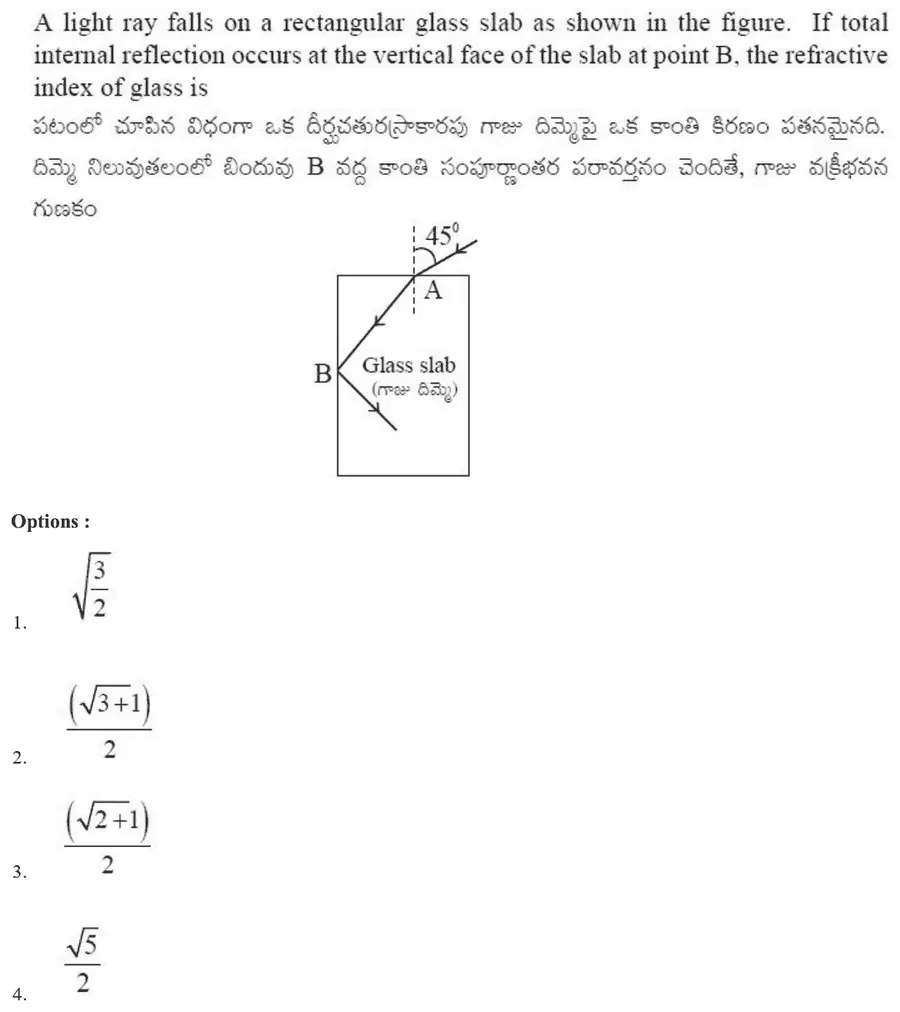
A light ray falls on a rectangular glass slab as shown in the figure. If total internal reflection occurs at the vertical face of the slab at point B, the refractive index of glass is
A light ray incidents on an equilateral prism made of material of refractive index $\sqrt{3}$. Inside the prism, if the light ray moves parallel to the base of the prism, then the angle of incidence of the light ray is
Images of same size are formed by a convex lens when an object is placed either at 20 cm or 10 cm distance from the lens. The focal length of the lens is
Two thin convex lenses are kept in contact coaxially. If the focal length of the combination of the lenses is 4 cm and sum of the focal lengths of the two lenses is 18 cm, then the focal length of the lens of low power is
If the distances of the object and its real image from the principal focus of a concave mirror are 16 cm and 9 cm respectively, then the focal length of the mirror is
If the angle of minimum deviation produced by an equilateral prism is equal to the angle of the prism, then the refractive index of the material of the prism is nearly
A straight metal rod of length 6 cm is placed along the principal axis of a concave mirror of focal length 9 cm such that the end of the rod closer to the mirror is at a distance of 15 cm from the pole of the mirror. The length of the image of the rod is
A ray of light incidents at an angle of $9.3^\circ$ on one face of a small angle prism of refracting angle $6^\circ$. If the ray of light emerges normally from the second face, the refractive index of the material of the prism is
An object of height 3.6 cm is placed normally on the principal axis of a concave mirror of radius of curvature 30 cm. If the object is at a distance of 10 cm from the principal focus of the mirror, then the height of the real image formed due to the mirror is
Monochromatic light of wavelength 6000 Å incidents on a small angled prism. If the angle of the prism is $6^\circ$, the refractive indices of the material of the prism for violet and red lights are respectively 1.52 and 1.48, then the angle of dispersion produced for this incident light is
A Cassegrain telescope uses two mirrors of radii of curvature 25 cm and 16 cm separated by a distance of 2.5 cm. The position of the final image of an object at infinity is
A convex lens of radii of curvature 6 cm and 12 cm is immersed in a liquid of refractive index 1.3. If the refractive index of the material of the lens is 1.5, then the focal length of the lens when immersed in the liquid is
The angle of a prism made of a material of refractive index $\sqrt{2}$ is $90°$. The angle of incidence for a light ray on the first face of the prism such that the light ray suffers total internal reflection at the second face is
The total magnification produced by a compound microscope is 24 when the final image is formed at the least distance of distinct vision. If the focal length of the eyepiece is 5 cm, the magnification produced by the objective is
A compound microscope has an objective of focal length 1.25 cm and an eyepiece of focal length 5 cm separated by a distance of 7.5 cm. The total magnification produced by the microscope when the final image forms at infinity is
When a convex lens is immersed in two different liquids of refractive indices 1.25 and 1.5, the ratio of the focal lengths of the lens is 5: 16. The refractive index of the material of the lens is
A person can see objects clearly when they lie between 40 cm and 400 cm from his eye. In order to increase the maximum distance of distant vision to infinity, the type of lens and power of correction lens required respectively are
When a convex lens is immersed in a liquid of refractive index equal to 80% of the refractive index of the material of the lens, the focal length of the lens increases by 100%. The refractive index of the liquid is
A ray of light travels from an optically denser to rarer medium. The critical angle for the two media is 'C'. The maximum possible deviation of the ray will be
The focal length of the objective lens of a telescope is 30 cm and that of its eye lens is 3 cm. It is focussed on a scale at a distance 2 m from it. The distance of objective lens from eye lens to see the clear image is
An object lying 100 cm inside water is viewed normally from air. If the refractive index of water is $\frac{4}{3}$, then the apparent depth of the object is
An object is placed at a distance of 18 cm in front of a mirror. If the image is formed at a distance of 4 cm on the other side, then focal length, nature of the mirror and nature of image are respectively
If a microscope is placed in air, the minimum separation of two objects seen as distinct is 6 $\mu$m. If the same is placed in a medium of refractive index 1.5, then the minimum separation of the two objects to see as distinct is
The minimum deviation produced by a hollow prism filled with a certain liquid is found to be $30^\circ$. The light ray is also found to be refracted at an angle of $30^\circ$. Then the refractive index of the liquid is
The focal length of a thin converging lens in air is 20 cm. When the lens is immersed in a liquid, it behaves like a concave lens of power 1 D. If the refractive index of the material of the lens is 1.5, the refractive index of the liquid is
An object placed at a distance of 24 cm from a concave mirror forms an image at a distance of 12 cm from the mirror. If the object is moved with a speed of $12\ \mathrm{ms^{-1}}$, then the speed of the image is
When the object and the screen are 90 cm apart, it is observed that a clear image is formed on the screen when a convex lens is placed at two positions separated by 30 cm between the object and the screen. The focal length of the lens is
When an object of height 12 cm is placed at a distance from a convex lens, an image of height 18 cm is formed on a screen. Without changing the positions of the object and the screen, if the lens is moved towards the screen, another clear image is formed on the screen. The height of this image is
A thin plano-convex lens of focal length 73.5 cm has a circular aperture of diameter 8.4 cm. If the refractive index of the material of the lens is $\frac{5}{3}$, then the thickness of the lens is nearly
The power of a thin convex lens placed in air is +4D. The refractive index of the material of the convex lens is $\frac{3}{2}$. If this convex lens is immersed in a liquid of refractive index $\frac{5}{3}$, then
A
it behaves like a convex lens of focal length 75 cm
B
it behaves like a convex lens of focal length 125 cm
C
it behaves like a concave lens of focal length 125 cm
D
it behaves like a concave lens of focal length 75 cm
If a ray of light passes through an equilateral prism such that the angle of incidence and the angle of emergence are both equal to 70% of the angle of the prism, then the angle of minimum deviation is
A small angled prism is made of a material of refractive index $\frac{3}{2}$. The ratio of the angles of minimum deviations when the prism is placed in air and in water of refractive index $\frac{4}{3}$ is
With respect to air, the critical angle in a medium for red light of wave length $\lambda_1$ is $\theta$. Other facts remaining same, critical angle for yellow light of wave length $\lambda_2$ will be
Diameter of the objective lens of a telescope is 250 cm. For light of wavelength 600 nm, coming from a distant object, the limit of resolution of the telescope is close to
Light enters from air into a given medium at an angle of $45^\circ$ with interface of the air-medium surface. After refraction, the light ray is deviated through an angle of $15^\circ$ from its original direction. The refractive index of the medium is
The focal lengths of the objective and the eyepiece of a compound microscope are 2 cm and 3 cm respectively and the distance between them is 15 cm. The final image formed by the eyepiece is at infinity. The distances of the object and the image produced by the object from the objective lens are respectively
An empty tank has concave mirror as its bottom. When sunlight falls normally on the mirror, it is focussed at a height of 32 cm from the mirror. If the tank is filled with water upto a height of 20 cm, then the sunlight focusses at
The angles of incidence and emergence of a light ray passing through a prism of angle A are i and e respectively. The total deviation produced by the prism is
What is the refractive index of the material of a double convex lens having radii of curvature of 5 cm and 10 cm and focal length of $\dfrac{20}{3}$ cm
A convex lens of focal length 25 cm and made of glass with refractive index 1.5 is immersed in water. The absolute change in focal length of the glass is [Use refractive index of water = $\dfrac{4}{3}$]
A light ray travels from a medium with refractive index $\mathrm{n_1}$ to another medium of refractive index $\mathrm{n_2}$. If $\mathrm{n_1}=2$ and $\mathrm{n_2}=\sqrt{3}$, then find the critical angle.
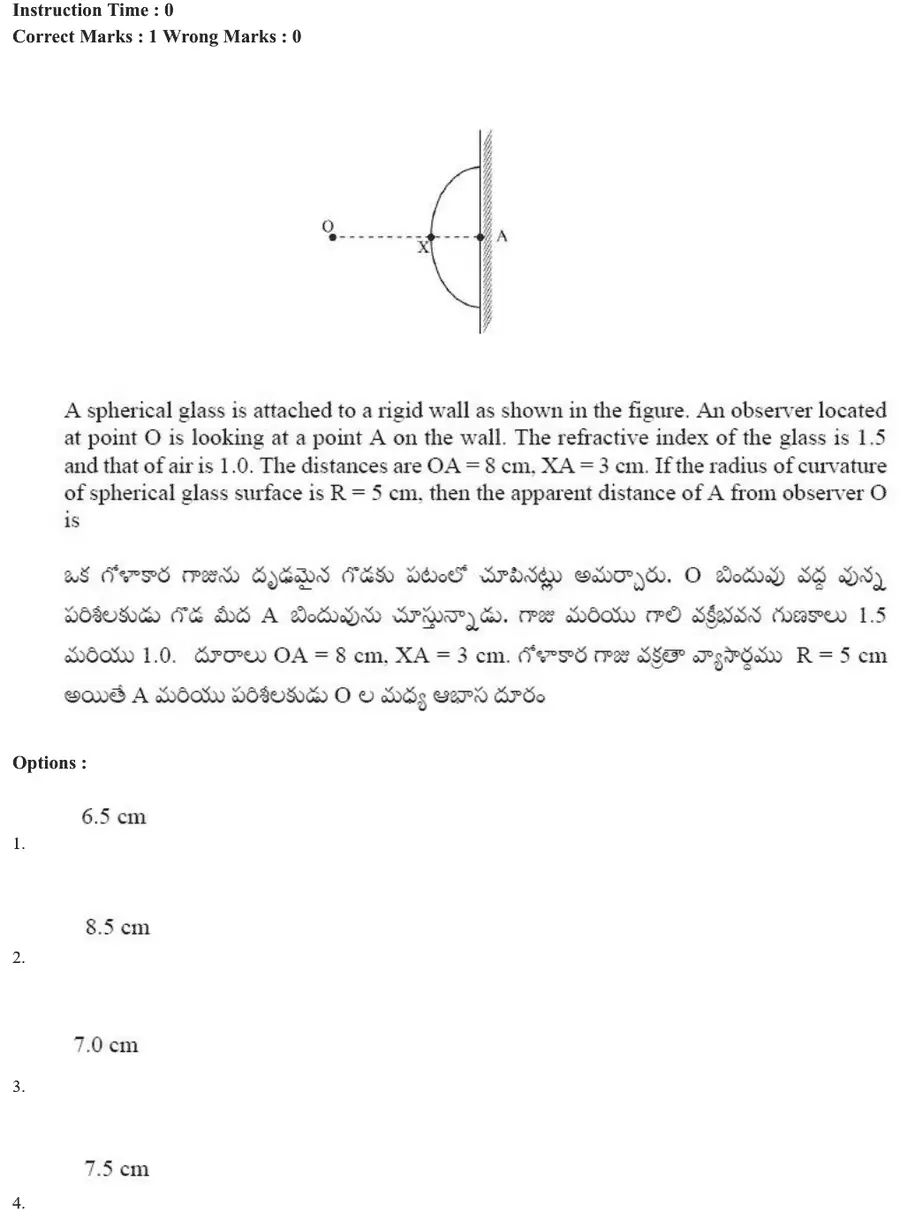
see figure A spherical glass is attached to a rigid wall as shown in the figure. An observer located at point O is looking at a point A on the wall. The refractive index of the glass is 1.5 and that of air is 1.0. The distances are OA = 8 cm, XA = 3 cm. If the radius of curvature of spherical glass surface is R = 5 cm, then the apparent distance of A from observer O is
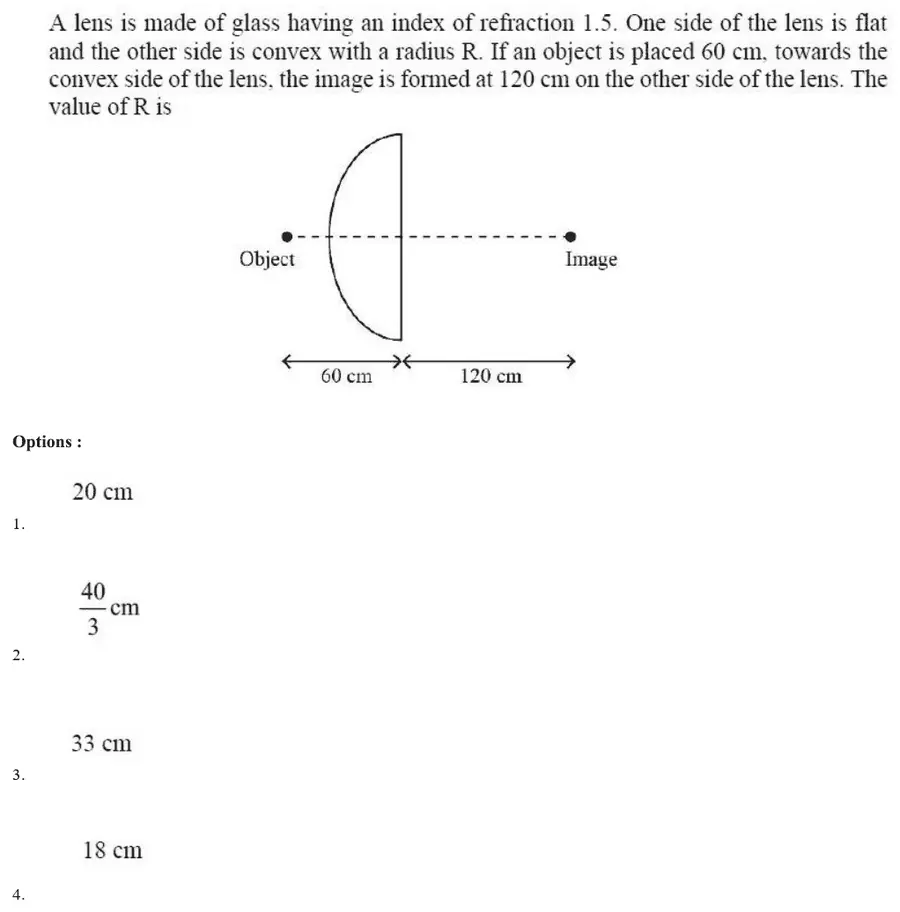
A lens is made of glass having an index of refraction 1.5. One side of the lens is flat and the other side is convex with a radius R. If an object is placed 60 cm, towards the convex side of the lens, the image is formed at 120 cm on the other side of the lens. The value of R is (see the figure above)
A convex lens focusses an object 20 cm from it on a screen placed 5 cm away from it. A glass plate (refractive index = $\frac{7}{5}$) of thickness 1.4 cm is inserted between the lens and the screen. What is the distance of the object from the lens, so that its image is again focused on the screen?
A convergent lens is placed 40 cm to the right of a diverging lens of focal length 15 cm. A parallel beam of light enters the divergent lens from the left, and the beam is again parallel when it emerges from the convergent lens. The focal length of the convergent lens is
A beam of light is incident from air on the surface of a liquid. The angle of incidence is $\theta$ and the angle of refraction is $\alpha$. If the critical angle for liquid when surrounded by air is $\theta_c$ then $\sin\theta_c$ is
A screen is placed 100 cm from an object. The image of the object on the screen is formed by a convex lens at two different locations separated by 20 cm. The focal length of the lens is
A needle is lying at the bottom of a water tank of height 12 cm. The apparent depth of the needle measured by a microscope is 9 cm. If the water is replaced by a liquid of refractive index of 1.5 of same height, the distance through which the microscope has to be moved to focus the needle again is
The radii of curvature of a double convex lens are 4 cm and 8 cm. If the refractive index of the material of the lens is 1.5, the focal length of the lens is nearly
A thin lens of refractive index 1.5 has optical power of $-5$ Diopter in air. Its optical power in a liquid medium with refractive index 1.6 is ______ Diopter
If refractive index of water is $\frac{4}{3}$ and that of a given slab immersed in it is $\frac{5}{3}$. The value of critical angle for a ray of light tending to go from glass to water is:
The focal length of a convex lens is ‘f’. An object is placed at a distance ‘x’ from its first focal point. The ratio of the size of the real image to that of the object is ______
Assertion (A): The focal length of lens does not change when red light is replaced by blue light. Reason (R): The focal length of lens does not depend in colour of light used.
A
Both A and R are true and R is a correct explanation for A
B
Both A and R are true but R is not a correct explanation for A
Light of wavelength $300\ \mathrm{nm}$ in medium $A$ enters into medium $B$ through a plane surface. If the frequency of light is $5 \times 10^{14}\ \mathrm{Hz}$ and the ratio of speed in medium $A$ to that is (sic) medium $B$ is $\dfrac{4}{5}$, the absolute refractive index of medium $B$ is,
A convex lens with lateral magnification 2 is used to image a point at the bottom of a tank. The image of the point is formed 60 cm above the lens. Now a liquid is filled into the tank to a height of 24 cm. It is found that the distance of the image of the same point is now 120 cm above the lens. Find the refractive index of the liquid.
The focal length of a biconvex lens made of glass, of equal radii is f. If the lens is dipped in the water then the focal length becomes. (Take refractive index of glass and water as $\dfrac{3}{2}$ and $\dfrac{4}{3}$, respectively)
Blue light travelling in vacuum has a wavelength of 450 nm. It enters a medium whose refractive index is 1.5. What is its frequency in the medium? (Speed of light in vacuum = $3\times10^{8}$ m/s)
A point source is located at a distance of 20 cm from the front surface of a symmetrical glass biconvex lens with equal radii of curvature 5 cm. The distance at which image formed from the rear surface of this lens is [Given refractive index of the glass is 1.5]
A screen is placed 90 cm from an object. The image is formed by using a convex lens twice on the screen by putting the lens at two different locations separated by 20 cm. The focal length of the lens is approximately equal to
A concave lens of glass, refractive index 1.5 has both surfaces of same radius of curvature R. On immersion in a medium of refractive index 1.75, it will behave as a
A travelling microscope is focused on an ink dot marked on a piece of paper. When a glass slab ($\mu = 1.5$) of thickness $0.12\ \mathrm{m}$ is placed on the ink dot. The travelling microscope has to be moved ______ in order to restore the focus
A light wave has a frequency of $4 \times 10^{14}\,\mathrm{Hz}$ and a wavelength of $5 \times 10^{-7}\,\mathrm{m}$ in a medium. The refractive index of the medium is
A prism ($\mu = 1.5$) has the refracting angle of $30^0$. The deviation of a monochromatic ray incident normally on its one surface will be. (Given $\sin 48^\circ 36' = 0.75$)
The lower half of a vessel of depth $2d$ $\mathrm{cm}$ is filled with a liquid of refractive index $\mu_1$ and the upper half with a liquid of refractive index $\mu_2$. The apparent depth of the vessel seen perpendicularly is
A ray of light travels from a medium of refractive index 2 to another medium of refractive index $\sqrt{2}$. Total internal reflection takes place when the angle of incidence is ______
A thin prism of angle $6^\circ$ made of glass of refractive index 1.5 is combined with another prism made of refractive index 1.75 to produce dispersion without deviation. Then the angle of the second prism is
A small object is placed in the air, at a distance 45 cm from a convex refracting surface of radius of curvature 15 cm. If the surface separates air from glass of refractive index 1.5, then the position of image is
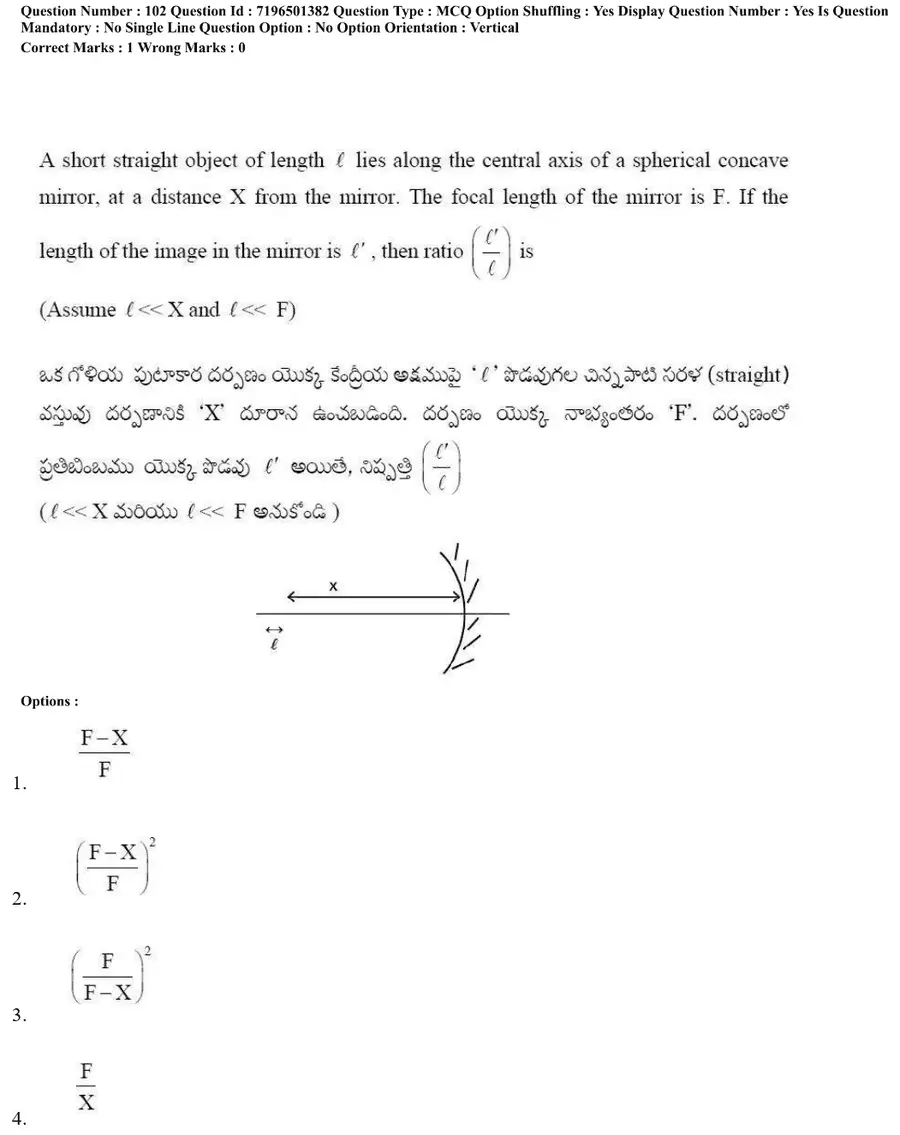
A short straight object of length $\ell$ lies along the central axis of a spherical concave mirror, at a distance X from the mirror. The focal length of the mirror is F. If the length of the image in the mirror is $\ell'$, then ratio $\left(\dfrac{\ell'}{\ell}\right)$ is (Assume $\ell \ll \mathrm{X}$ and $\ell \ll \mathrm{F}$) (see the figure above)
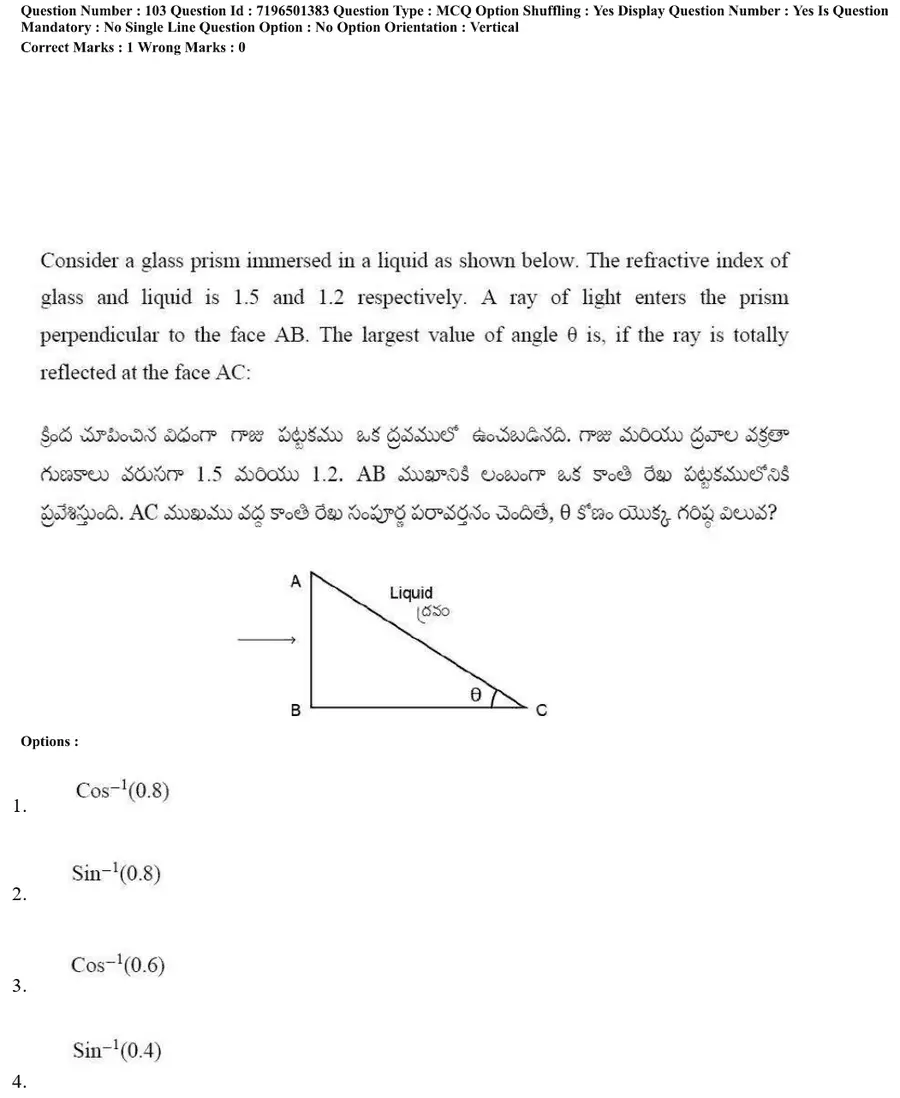
Consider a glass prism immersed in a liquid as shown below. The refractive index of glass and liquid is 1.5 and 1.2 respectively. A ray of light enters the prism perpendicular to the face AB. The largest value of angle $\theta$ is, if the ray is totally reflected at the face AC: (see the figure above)
The magnifications produced by a convex lens for two position of an object are 4 and 3 respectively. If the distance of separation between the two positions of the object is 2 cm, then the focal length of the lens is
A prism is made of a glass having refractive index $\sqrt{2}$. If the angle of minimum deviation is equal to angle of the prism, then the angle of prism is.
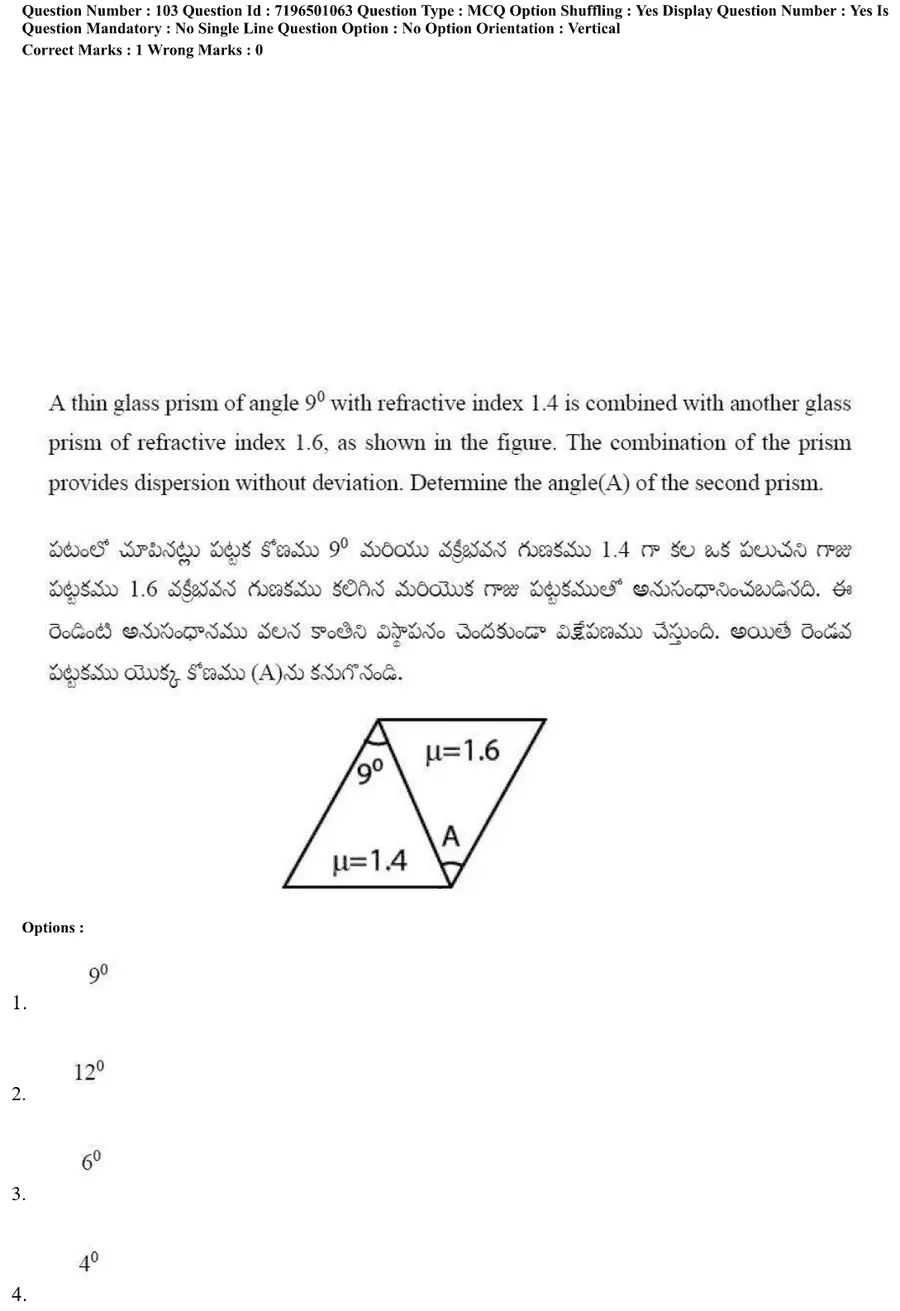
A thin glass prism of angle $9^0$ with refractive index 1.4 is combined with another glass prism of refractive index 1.6, as shown in the figure. The combination of the prism provides dispersion without deviation. Determine the angle(A) of the second prism. (see the figure above)
Wavelength of light used in an optical instrument are $\lambda_1 = 4000\,\mathring{\mathrm{A}}$ and $\lambda_2 = 5000\,\mathring{\mathrm{A}}$, then the ratio of their respective resolving powers ( corresponding to $\lambda_1$ and $\lambda_2$ ) is
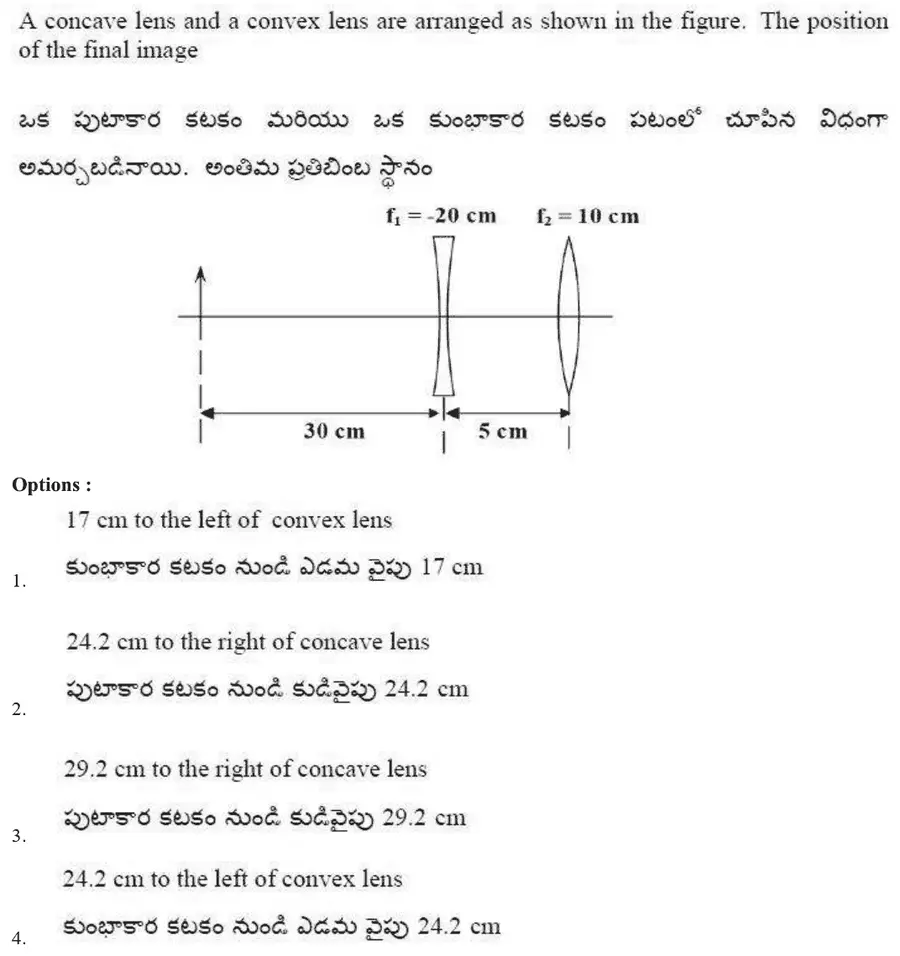
A convex lens and a concave lens, each with focal length of 4 cm are separated by a distance of 6 cm along their axis. An object is placed 8 cm before the convex lens. The distance between the object and its image is:
The limit of resolution of a telescope is $3.0 \times 10^{-7}$ rad. Assuming that it is used to see the light of wavelength 525 nm from a star, what should be the diameter of the objective
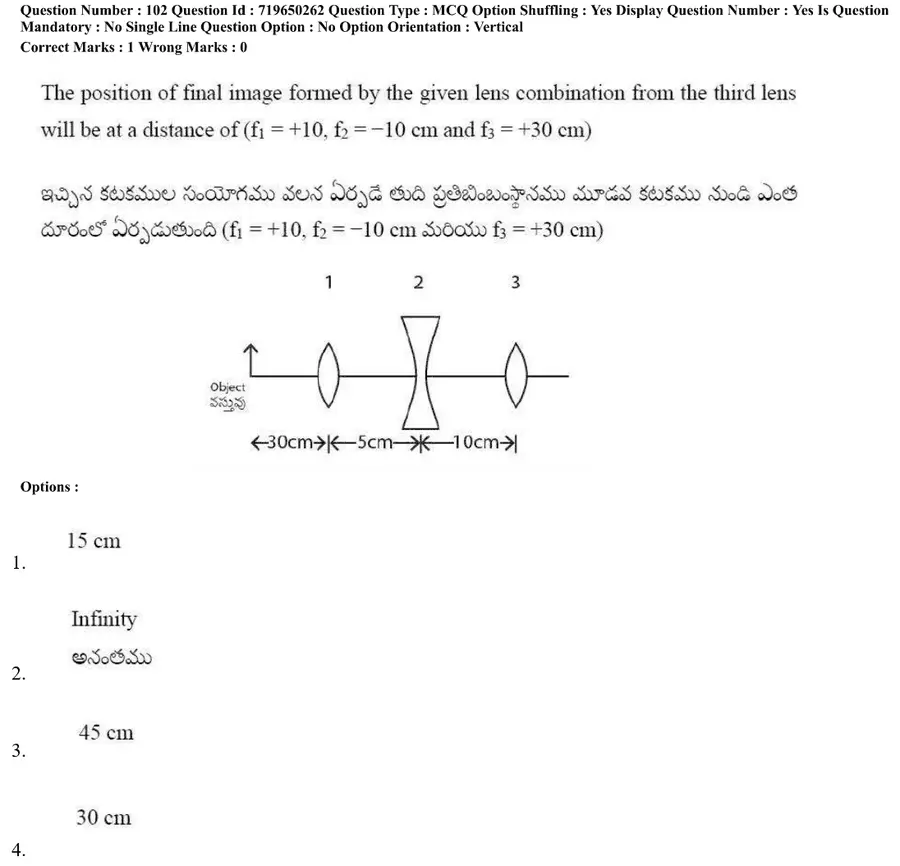
The position of final image formed by the given lens combination from the third lens will be at a distance of ($f_1 = +10$, $f_2 = -10$ cm and $f_3 = +30$ cm) (see the figure above)
An object is placed at a certain distance left to a convex lens of focal length 20 cm. Find the distance of the object if the image obtained is magnified by 4 times.
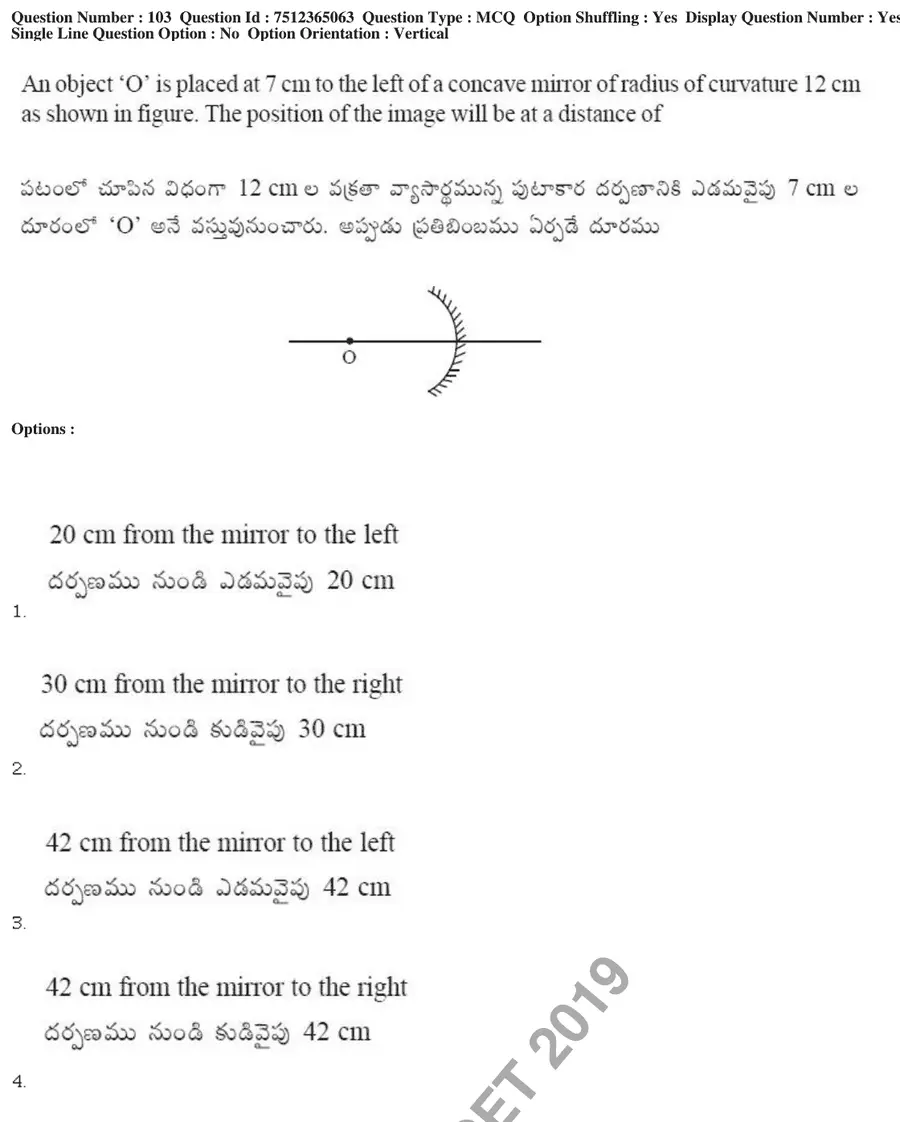
An object 'O' is placed at 7 cm to the left of a concave mirror of radius of curvature 12 cm as shown in figure. The position of the image will be at a distance of (see the figure above)
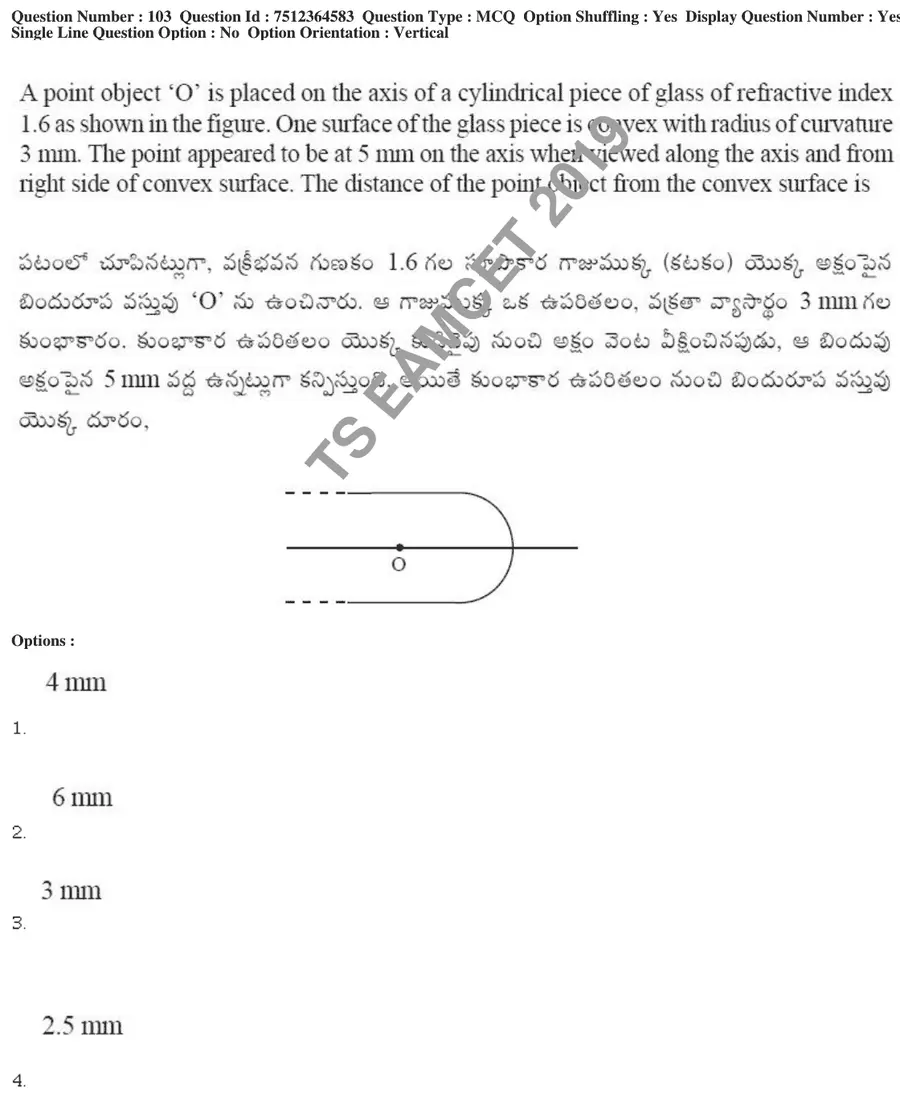
A point object 'O' is placed on the axis of a cylindrical piece of glass of refractive index 1.6 as shown in the figure. One surface of the glass piece is convex with radius of curvature 3 mm. The point appeared to be at 5 mm on the axis when viewed along the axis and from right side of convex surface. The distance of the point object from the convex surface is (see the figure above)
The limit of resolution of a telescope is $2.5 \times 10^{-7}$ radians. If the telescope is used to detect light of wavelength 500 nm coming from a star, the diameter of the objective lens used by the telescope is:
Two lenses A and B having focal lengths 2.0 cm and 5.0 cm respectively are placed 14 cm apart. Lens A is placed to the left of lens B. An object is placed 3 cm to the left of lens A. The distance of the image from lens A will be
Three lenses of focal lengths +10 cm, $-$10cm and +30 cm are placed at a distance of 30 cm, 35 cm and 45 cm respectively from an object. The distance between the object and the image formed is
When an object is moved along the principal axis of a concave mirror placed in air, the image coincides with the object if the object is $50\ \mathrm{cm}$ from the mirror. If the mirror is placed at a depth of $20\ \mathrm{cm}$ in a transparent medium, the image coincides with the object when the object is $40\ \mathrm{cm}$ from the mirror. The refractive index of the liquid is
A thin converging lens of focal length 25 cm forms a sharp image of an object on a screen placed at a distance of 75 cm from the lens. Later the screen is moved closer to the lens by a distance 25 cm. The distance through which the object is to be shifted so that its image on the screen is sharp again is
In a spherical glass marble of radius $6\ \mathrm{cm}$, a small air bubble is formed at $1\ \mathrm{cm}$ from the centre of the marble. The apparent position of the air bubble from the nearest point on the surface of the marble is about (Refractive index of glass is 1.5)
A girl of height 150 cm with her eye level at 140 cm stands in front of a plane mirror of height 75 cm fixed to a wall. The lower edge of the mirror is at a height of 85 cm above her feet level. The height of her image the girl can see in the mirror is
A small object is enclosed in a transparent solid sphere of radius 8 cm. The object is situated at 2 cm from the centre of the sphere. If its image appears to be at 3.2 cm from the nearest side then the refractive index of the material of the sphere is
An object is placed 0.1 m infront of a convex lens of focal length 20 cm made of a material of refractive index 1.5. The surface of the lens away from the object is silvered. If the radius of curvature of the silvered surface is 22 cm, then the distance of the final image from the silvered surface is
An object is fixed at the bottom of a vessel and water is filled in the vessel upto a height of 10 cm. A plane mirror is placed at a height of 7 cm from the surface of water in such a way that its reflecting surface faces the water. The distance of the image from the mirror is (Refractive index of water = 1.33)
A printed page is kept pressed by a transparent cube of edge $t$. The refractive index of the cube varies as $\mu(z) = 1 + \frac{z}{t}$, where $z$ is the vertical distance from bottom of the cube. If viewed from top the printed letters appear to be shifted by an amount
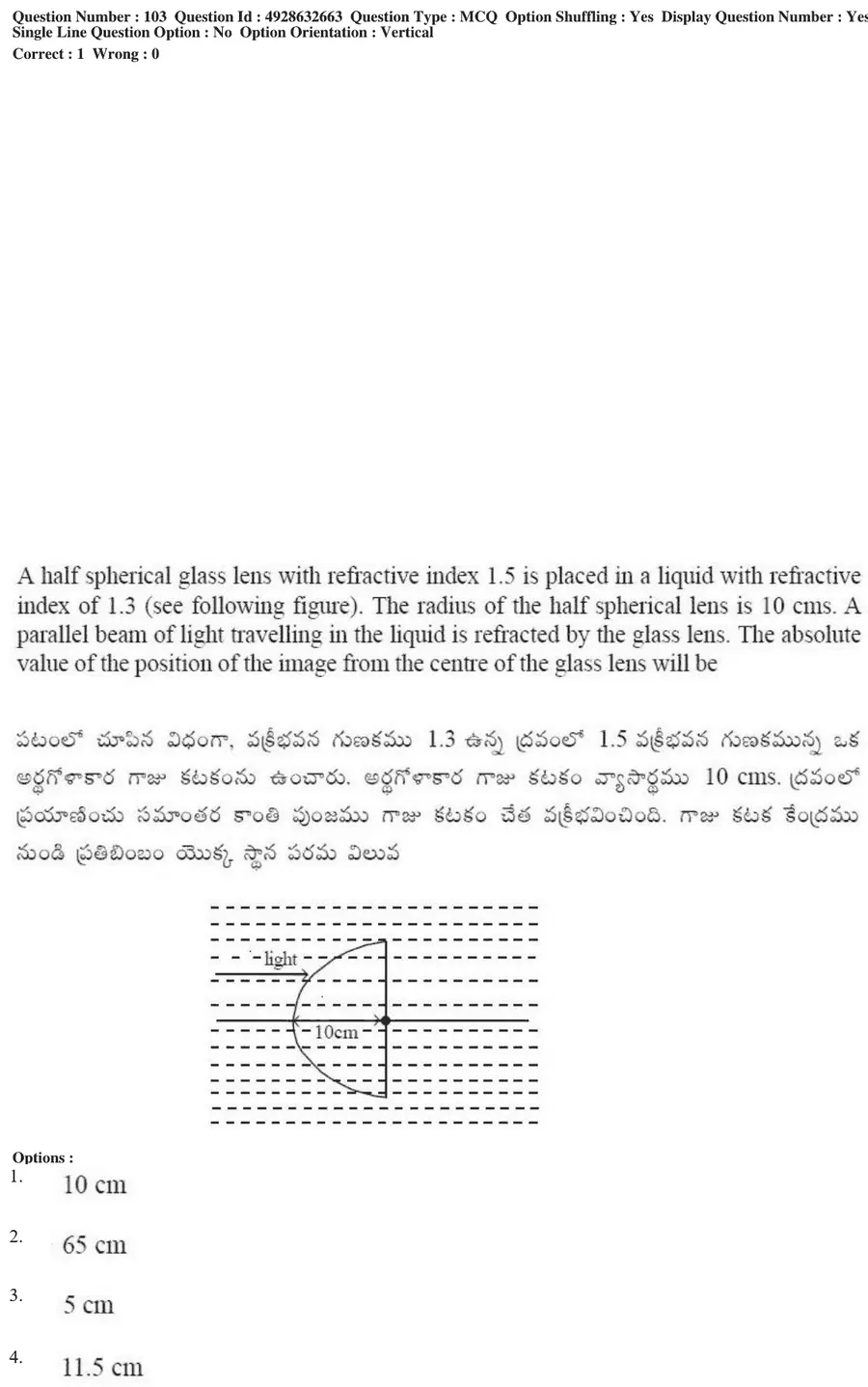
A half spherical glass lens with refractive index 1.5 is placed in a liquid with refractive index of 1.3 (see following figure). The radius of the half spherical lens is 10 cms. A parallel beam of light travelling in the liquid is refracted by the glass lens. The absolute value of the position of the image from the centre of the glass lens will be (see the figure above)
Consider a point object situated at a distance of 30 cm from the centre of sphere of radius 2 cm and refractive index 1.5 as shown in the figure. If the refractive index of the region surrounding this sphere is 1.4, the position of the image due to refraction by sphere with respect to the centre is
At what distance from a biconvex lens of the focal length F, must be placed an object for the distance between the object and its real image to be minimal
Consider a concave mirror of $10\ \mathrm{cm}$ focal length illuminated by an object kept at a distance of $25\ \mathrm{cm}$. The distance at which the image is formed and its magnification respectively are
Two objects $P$ and $Q$ are placed at $10\ \mathrm{cm}$ and $30\ \mathrm{cm}$ in front of a convex lens of focal length $20\ \mathrm{cm}$. The correct option for the image of $P$ and $Q$ is
A
$P$ - virtual and inverted ; $Q$ - real and upright
B
$P$ - virtual and upright ; $Q$ - real and inverted
C
$P$ - real and inverted ; $Q$ - virtual and upright
D
$P$ - real and upright ; $Q$ - virtual and inverted
Where should an object be placed on the axis of a convex lens of focal length 8 cm so as to achieve magnification of $-4$ ? (Distances are measured from optic centre of the lens)
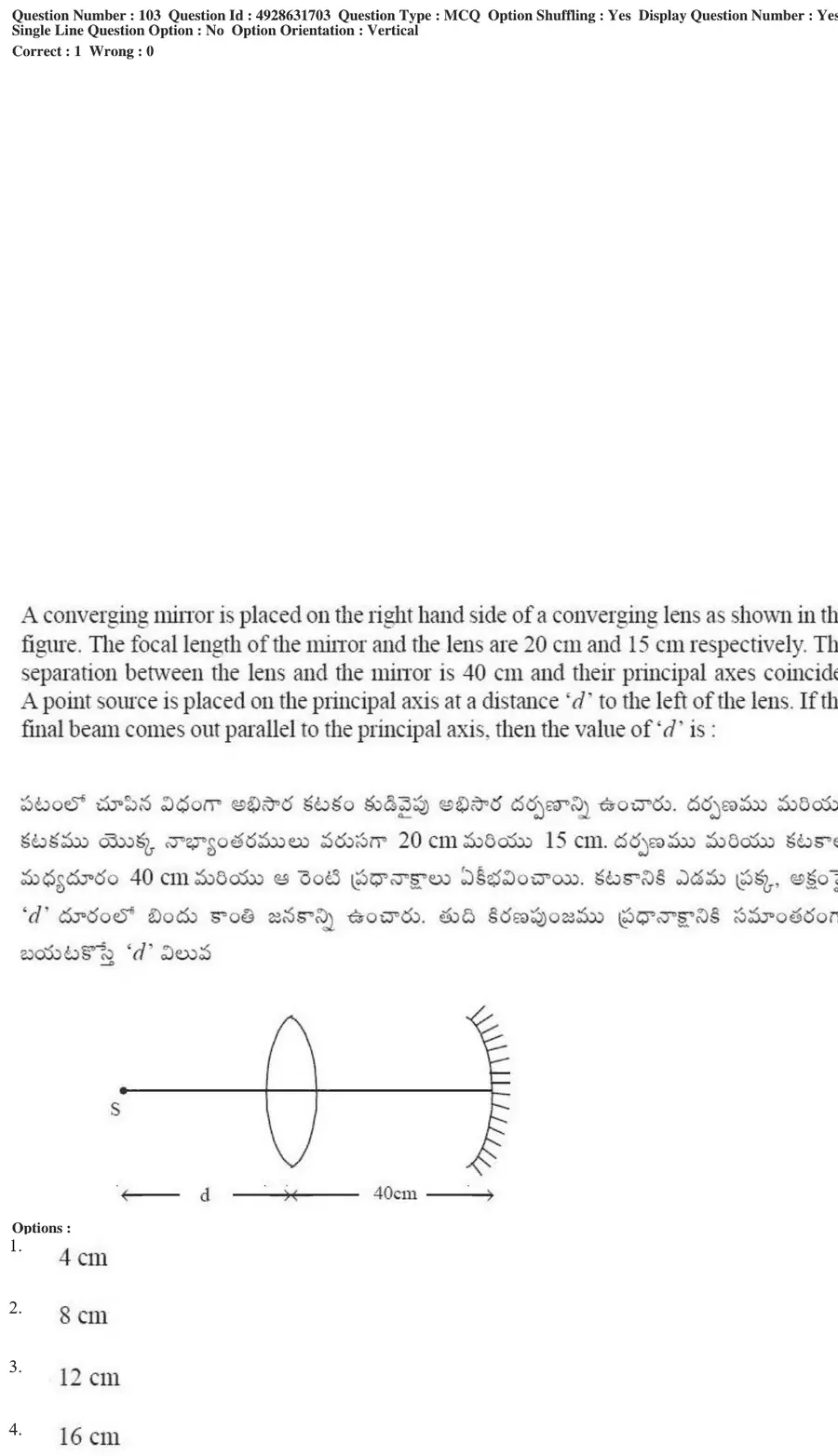
A converging mirror is placed on the right hand side of a converging lens as shown in the figure. The focal length of the mirror and the lens are 20 cm and 15 cm respectively. The separation between the lens and the mirror is 40 cm and their principal axes coincide. A point source is placed on the principal axis at a distance '$d$' to the left of the lens. If the final beam comes out parallel to the principal axis, then the value of '$d$' is : (see the figure above)
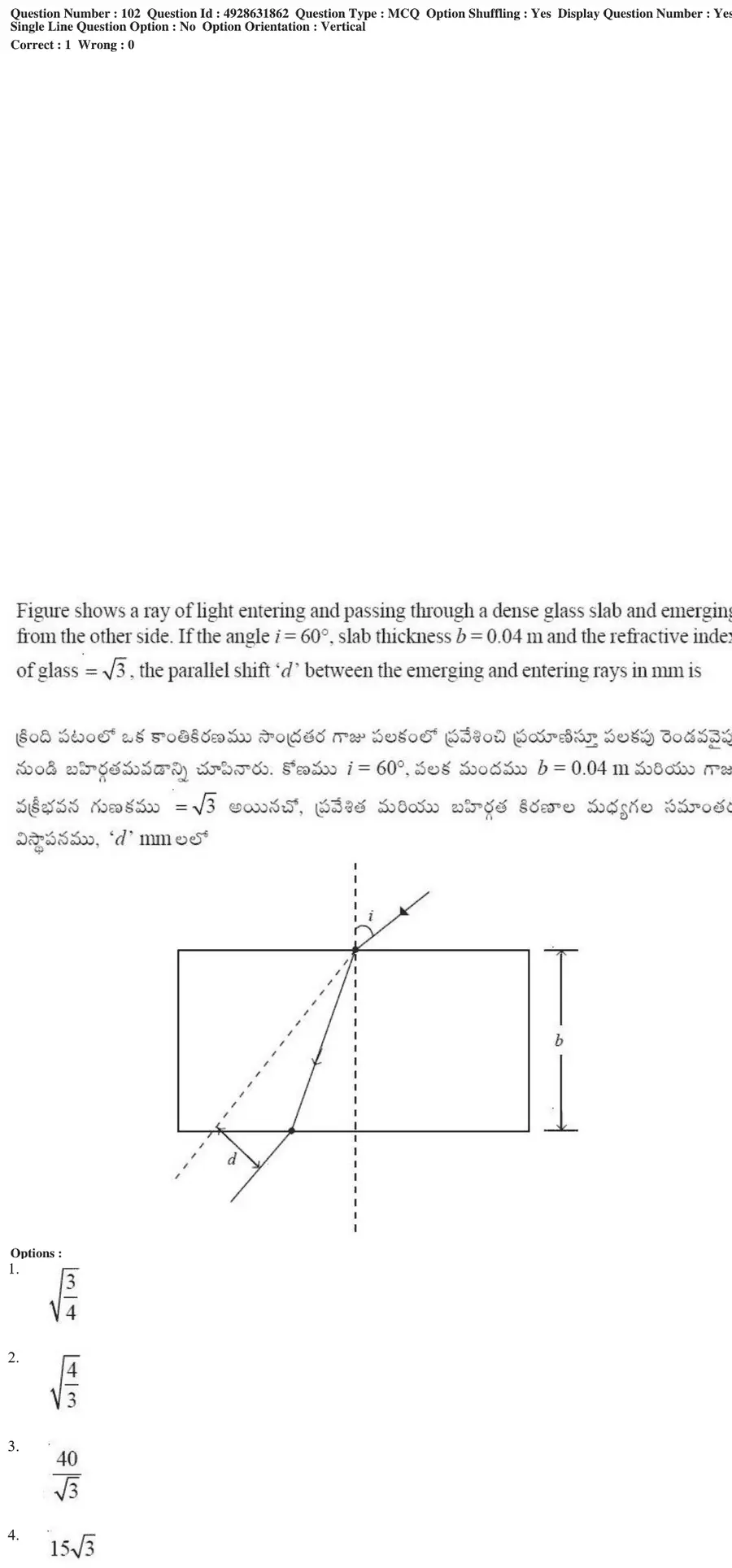
Figure shows a ray of light entering and passing through a dense glass slab and emerging from the other side. If the angle $i=60^\circ$, slab thickness $b=0.04$ m and the refractive index of glass $=\sqrt{3}$, the parallel shift 'd' between the emerging and entering rays in mm is (see the figure above)
Let $S_1$ be the amount of Rayleigh scattered light of wavelength $\lambda_1$ and $S_2$ that of light of wavelength $\lambda_2$ from a particle of size 'a'. Which of the following statements is true
A
$\frac{S_1}{S_2}=\left(\frac{\lambda_2}{\lambda_1}\right)^4$ if $\lambda_1,\lambda_2 \gg a$
B
$\frac{S_1}{S_2}=\left(\frac{\lambda_1}{\lambda_2}\right)^4$ if $\lambda_1,\lambda_2 \gg a$
C
$\frac{S_1}{S_2}=\left(\frac{\lambda_2}{\lambda_1}\right)^4$ if $\lambda_1,\lambda_2 \ll a$
D
$\frac{S_1}{S_2}=\left(\frac{\lambda_1}{\lambda_2}\right)^4$ if $\lambda_1,\lambda_2 \ll a$
Magnifying power of an astronomical telescope for normal adjustment is 10 and length of the telescope is 110 cm. Magnifying power of the same telescope when the image is formed at the near point is
For a prism, the angle of the prism is $60^\circ$ and the refractive index is $\sqrt{\frac{7}{3}}$. The minimum possible angle of incidence so that the light ray is refracted from the second surface is ___
A lens forms real and virtual images of an object when the object is at $u_1$ and $u_2$ distances respectively. If the size of the virtual image is double that of the real image, then the focal length of the lens is (Take the magnification of the real image as 'm')
In a compound microscope, the focal lengths of two lenses are 1.5 cm and 6.25 cm. An object is placed at 2 cm from the objective and the final image is formed at 25 cm from the eye lens. The distance between the two lenses is ______ (in cm)
A light ray incidents normally on one surface of an equilateral prism. The angle of deviation of the light ray is (Refractive index of the material of the prism $= \sqrt{2}$)
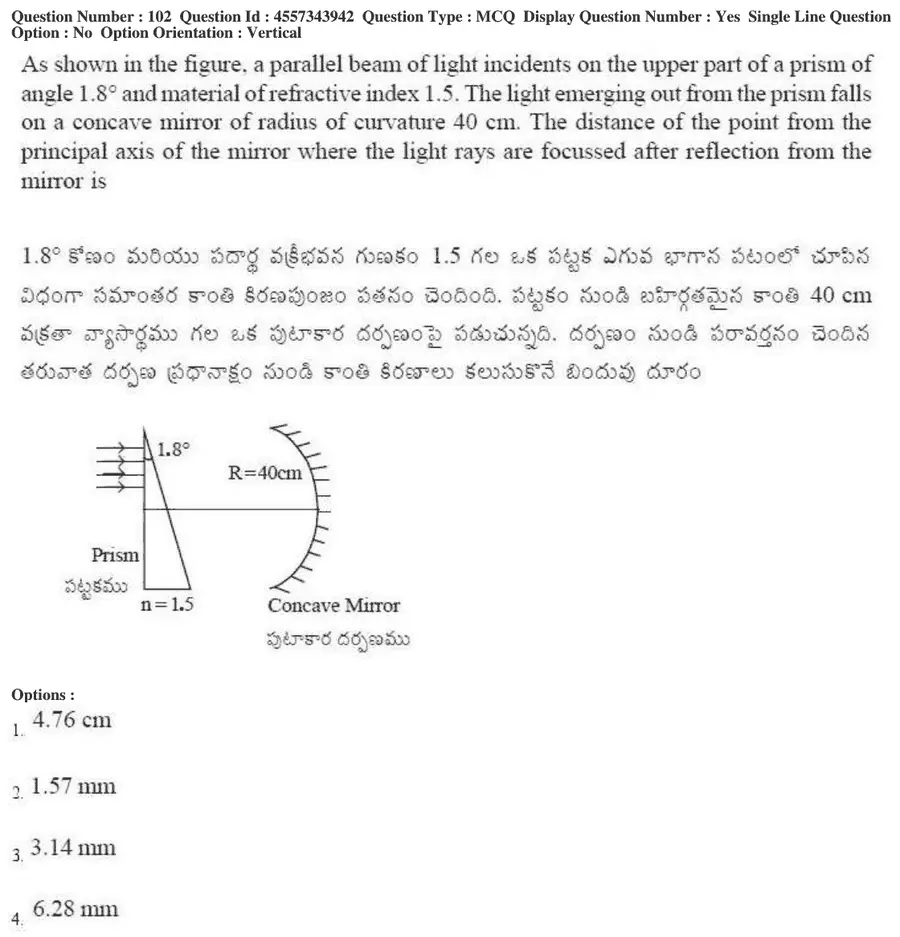
As shown in the figure, a parallel beam of light incidents on the upper part of a prism of angle $1.8^\circ$ and material of refractive index 1.5. The light emerging out from the prism falls on a concave mirror of radius of curvature 40 cm. The distance of the point from the principal axis of the mirror where the light rays are focussed after reflection from the mirror is (see the figure above)
A microscope has an objective of aperture 8 mm and focal length of 5 cm. The minimum separation between two objects to be just resolved by the microscope is (Wavelength of light used $=5500\ \mathrm{\AA}$)
Consider a light source placed at a distance of 1.5 m along the axis facing the convex side of a spherical mirror of radius of curvature 1 m. The position (s'), nature and magnification (m) of the image are
A beam of light propagating at an angle $\alpha_1$ from a medium 1 through to another medium 2 at an angle $\alpha_2$. If the wavelength of light in medium 1 is $\lambda_1$, the wavelength of light in medium 2, ($\lambda_2$), is
Two point sources $S_1$ and $S_2$ are 24 cm apart. Where should a convex lens of focal length 9 cm be placed in between them so that the images of both sources are formed at the same place ?
A plano convex lens of material of refractive index $\mu_1$ exactly fits into a plano concave lens of material of refractive index $\mu_2$. If R is the radius of curvature of the curved surfaces of the lenses and the plane surfaces of the lenses are parallel, the focal length of the combination is ______
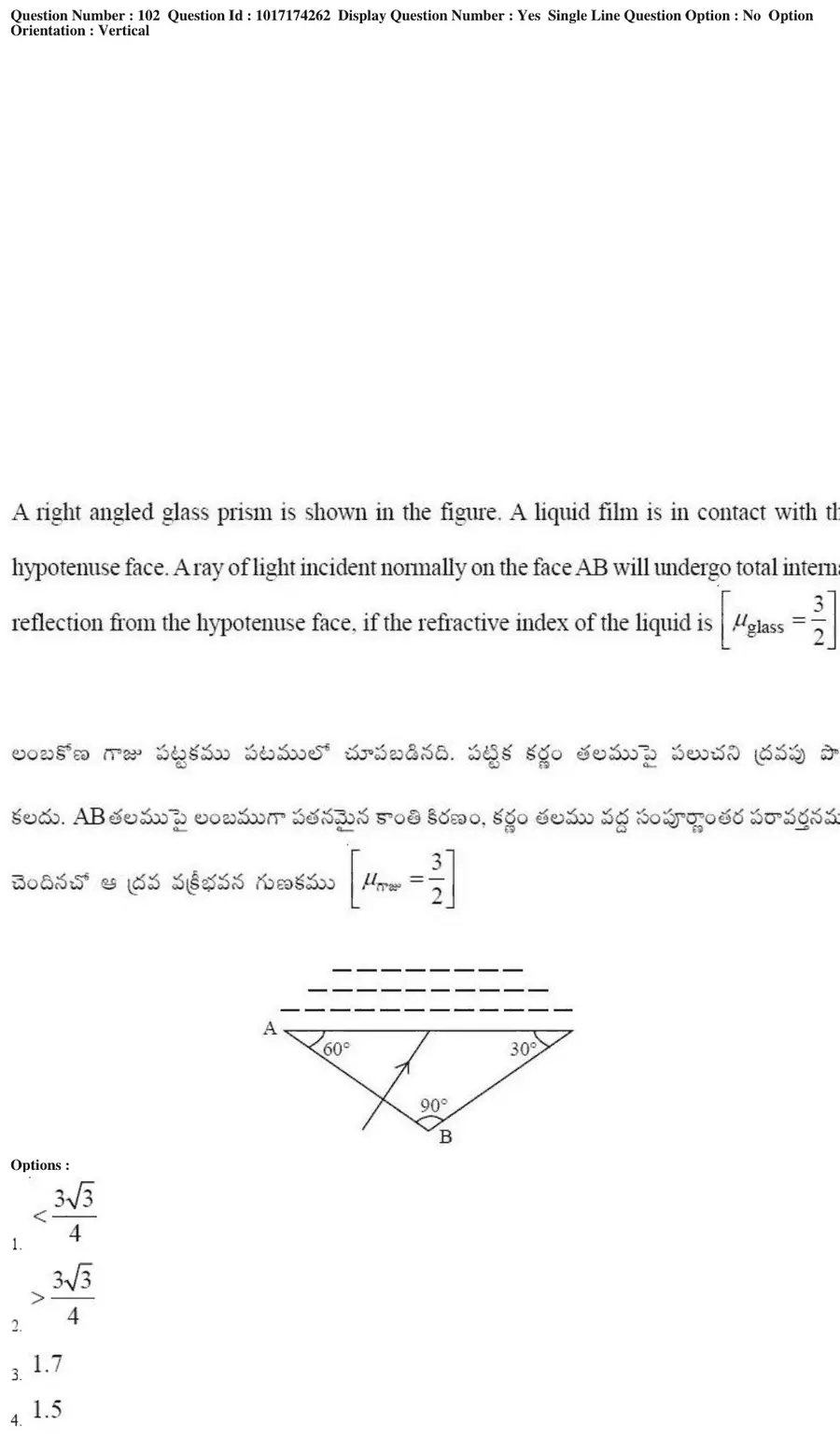
A right angled glass prism is shown in the figure. A liquid film is in contact with the hypotenuse face. A ray of light incident normally on the face AB will undergo total internal reflection from the hypotenuse face, if the refractive index of the liquid is $\left[\mu_{\mathrm{glass}} = \dfrac{3}{2}\right]$ (see the figure above)
A glass prism of refracting angle $60^\circ$ is immersed in a liquid in which angle of minimum deviation is $30^\circ$. The critical angle of glass with respect to the liquid medium is
Telescope has an objective of focal length 100 cm and an eyepiece of focal length 5 cm. The least distance of distinct vision is 25 cm. The telescope is focussed for distinct vision on a scale 3 m away from the objective. The magnification produced is ______
A thin convex lens of focal length 'f' made of crown glass is immersed in a liquid of refractive index $\mu_l$. ($\mu_l > \mu_c$) where $\mu_c$ is the refractive index of the crown glass. The convex lens now is
Two convex lenses of focal lengths $f_1$ and $f_2$ form images with magnification $m_1$ and $m_2$, when used individually for an object kept at the same distance from the lenses. Then $f_1/f_2$ is
With the help of a telescope that has an objective of diameter 200 cm, it is proved that light of wavelengths of the order of 6400 Å coming from a star can be easily resolved. Then the limit of resolution is
An infinitely long rod lies along the axis of a concave mirror of focal length 'f'. The nearer end of the rod is at a distance u, (u > f) from the mirror. It's image will have a length
A convex lens has its radii of curvature equal. The focal length of the lens is f. If it is divided vertically into two identical plano-convex lenses by cutting it, then the focal length of the plano-convex lens is ($\mu$ = the refractive index of the material of the lens)
A thin converging lens of focal length $f = 25$ cm forms the image of an object on a screen placed at a distance of 75 cm from the lens. The screen is moved closer to the lens by a distance of 25 cm. The distance through which the object has to be shifted so that its image on the screen is sharp again is
The two surfaces of a concave lens, made of glass of refractive index 1.5 have the same radii of curvature R. It is now immersed in a medium of refractive index 1.75, then the lens
A microscope consists of an objective of focal length 1.9 cm and eye piece of focal length 5 cm. The two lenses are kept at a distance of 10.5 cm. If the image is to be formed at the least distance of distinct vision, the distance at which the object is to be placed before the objective is (Least distance of distinct vision is 25 cm)
The objective and eyepiece of an astronomical telescope are double convex lenses with refractive index 1.5. When the telescope is adjusted to infinity, the separation between the two lenses is 16 cm. If the space between the lenses is now filled with water and again telescope is adjusted for infinity, then the present separation between the lenses is
The dispersive powers of the materials of two lenses forming an achromatic combination are in the ratio of 4 : 3. Effective focal length of the two lenses is + 60 cm then the focal lengths of the lenses should be
The focal length of a lens of dispersive power 0.45 which should be placed in contact with a convex lens of focal length 84 cm and dispersive power 0.21 to make the achromatic combination from the two lenses, in cm is :
Which of the following statements are *true* in the context of a Compound Microscope ? A) Each lens produces a virtual and inverted image B) The objective has a very short focal length C) The eyepiece is used as a simple magnifying glass D) The objective and eyepiece are convex and concave lenses respectively
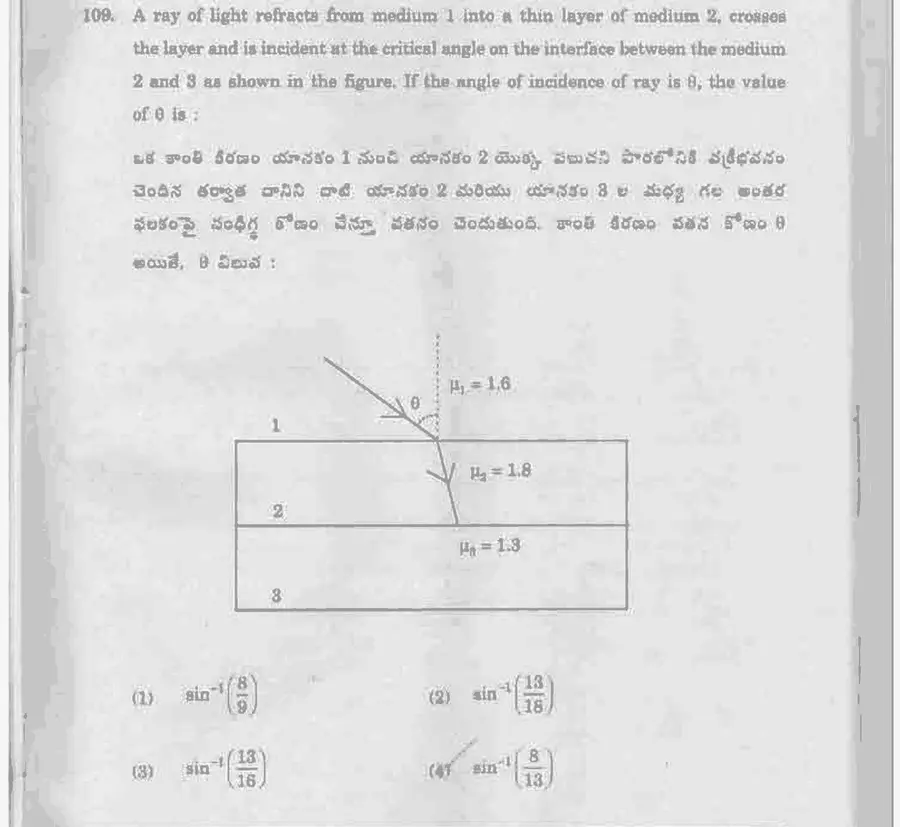
A ray of light refracts from medium 1 into a thin layer of medium 2, crosses the layer and is incident at the critical angle on the interface between the medium 2 and 3 as shown in the figure. If the angle of incidence of ray is $\theta$, the value of $\theta$ is : (see the figure above)
In an optical fibre, core and cladding were made with materials of refractive indices 1.5 and 1.414 respectively. To observe total internal reflection, what will be the range of incident angle with the axis of optical fibre ?
A ray of light passes through an equilateral prism such that the angle of incidence is equal to the angle of emergence and each one is equal to 3/4th the angle of prism. The angle of deviation is :
Answer: (D) $5.5\ \mathrm{cm}$· Official APSCHE final key
How to prepare Ray Optics for EAPCET
How often it comes up
Geometrical optics provides an expansive problem-solving ground within Class 12 physics. In the papers we hold for AP and TS EAPCET from 2022 to 2026, Ray Optics delivered 108 questions across 77 papers (1.4 questions per paper, 3.5% subject share). Looking at our complete archive from 2010 to 2026, the chapter produced 202 questions across 149 papers, maintaining an average of 1.4 questions per paper and a 3.4% subject share. During the earlier period from 2010 to 2021, our archive contains 94 questions across 72 papers (3.3% share). Over the three-year window from 2024 to 2026, it brought 76 questions across 46 papers, claiming a 4.1% share. The share of the subject in the last three years compared to early papers is up, and compared to the recent five-year window it is also up.
State-level distributions indicate higher question density in Telangana papers. Between 2022 and 2026, AP EAPCET papers in our set contributed 60 questions across 48 papers, with 47 papers featuring questions (1.3 per paper, 3.1% share). TS EAPCET contributed 48 questions across 29 papers in our set, with all 29 papers carrying questions (1.7 per paper, 4.1% share). Ray Optics has appeared every year since 2022, though across all 77 recent papers in our collection, one AP paper omitted it, so it was not present in all 77 sittings. The chapter ranks 13th of 28 physics chapters by question share between 2022 and 2026. The busiest single sitting in our collection was 2026, which produced 33 questions across 16 papers.
Most-asked topics
Questions span five primary optics modules:
Lenses: This leading division brought 34 questions between 2022 and 2026, contributing to 66 questions across all years in our archive. It tests the lens maker's formula, thin lens combinations in contact or separated by distance d, silvered lenses, and focal lengths in liquid media.
Optical Instruments: Recent examinations produced 23 questions, out of 37 questions in the complete record. Key topics cover compound microscopes, astronomical telescopes, terrestrial telescopes, normal adjustment, and tube length calculations.
Refraction: A block of 21 questions appeared in the recent five-year span, out of 44 questions overall. It tests Snell's law, real and apparent depth, total internal reflection, critical angles, optical fibers, and refraction at single spherical surfaces.
Prism & Dispersion: Examiners set 18 questions recently, out of 33 questions in the entire archive. Topics include angle of minimum deviation, refractive index formula n = sin[(A + D_m)/two] / sin(A/two), thin prisms, and dispersive power.
Reflection & Mirrors: A pool of 12 questions appeared recently, out of 22 questions across the entire archive. Questions examine concave and convex spherical mirrors, mirror formula, longitudinal magnification, and velocity of image points.
What the questions look like
Lens combinations and immersion problems recur constantly. A classic question determines the change in focal length when a biconvex glass lens of known refractive index is submerged in water or another liquid, requiring students to apply the lens maker's formula 1/f = (n_lens/n_med - 1)(1/R₁ - 1/R₂). Another frequent problem places an object at two different distances from a convex lens to produce real and virtual images of identical magnification, asking for the focal length f.
Optical instrument questions test magnifying power dependencies. Students are asked how the magnification of an astronomical telescope versus a compound microscope changes when the objective lens focal length is increased. For telescopes, magnifying power m = f_o / f_e increases with larger f_o, whereas for compound microscopes m = - (L / f_o)(D / f_e) decreases. Prism questions often specify that the minimum deviation angle equals the apex prism angle A, requiring algebraic solution of the trigonometric ratio sin A = two sin(A/two) cos(A/two).
Start by mastering Cartesian sign conventions for spherical mirrors and thin lenses. The mirror equation is 1/v + 1/u = 1/f with transverse magnification m = - v/u. The thin lens formula is 1/v - 1/u = 1/f with magnification m = + v/u. Differentiating these relations gives longitudinal image velocity: for a mirror v_image = - m² v_object, and for a lens v_image = + m² v_object.
Next, study refraction at curved boundaries and lenses. For a single spherical interface separating media of refractive indices n₁ and n₂, the relation is n₂/v - n₁/u = (n₂ - n₁)/R. For two thin lenses of focal lengths f₁ and f₂ in contact, equivalent power is P = P₁ + P₂ and 1/F = 1/f₁ + 1/f₂. When separated by distance d in air, the combined focal length satisfies 1/F = 1/f₁ + 1/f₂ - d / (f₁ f₂).
Finally, master optical instruments in normal adjustment. For an astronomical telescope focused at infinity, magnifying power is m = f_o / f_e and barrel tube length is L = f_o + f_e. For a compound microscope with final image formed at the near point D, total magnifying power is m = (v_o / u_o) [1 + D / f_e], with tube length L = v_o + f_e.
Frequently asked questions
How many questions come from Ray Optics in each exam paper?
In the papers we hold from 2022 to 2026, Ray Optics averaged 1.4 questions per paper, rising to 1.7 questions per paper in Telangana shifts.
What happens to a convex glass lens placed in a liquid of higher refractive index?
If a glass convex lens is immersed in a liquid whose refractive index exceeds that of the glass, the quantity (n_lens / n_med - 1) turns negative, causing the lens to behave as a diverging concave lens.
Why do astronomical telescopes use large focal length objective lenses?
In an astronomical telescope, angular magnification m = f_o / f_e is directly proportional to the focal length of the objective lens, so a larger f_o delivers greater magnification.
Where can I find worked solutions for EAPCET Ray Optics questions?
Step-by-step solutions for each one are in the EdLoop EAPCET app.