Kinetic Theory of Gases: AP & TS EAPCET PYQs 2011–2026
Every Kinetic Theory of Gases question from past AP EAPCET and TS EAPCET papers, with options and answers. Newest first.
163questions
132papers covered
3%of Physics questions, 2022–2026
2011–2026years
Guide at a glance
Kinetic Theory of Gases forms an essential quantitative bridge between molecular mechanics and thermodynamics in Class 11 physics. In the papers we hold for AP and TS EAPCET from 2022 to 2026, the chapter contributed 92 questions across 77 papers.
The translational kinetic energy of the molecule of 22 grams of $\mathrm{CO_2}$ at $27^\circ\mathrm{C}$ is (Universal gas constant $R = 8.314\, J\, mol^{-1}\, {}^\circ\mathrm{C}^{-1}$)
The approximate temperature at which the $rms$ speed of Nitrogen gas molecule is $500\ ms^{-1}$ Gas constant $R = 8.314\ J\ mol^{-1}K^{-1}$, Mass number of Nitrogen $= 28$
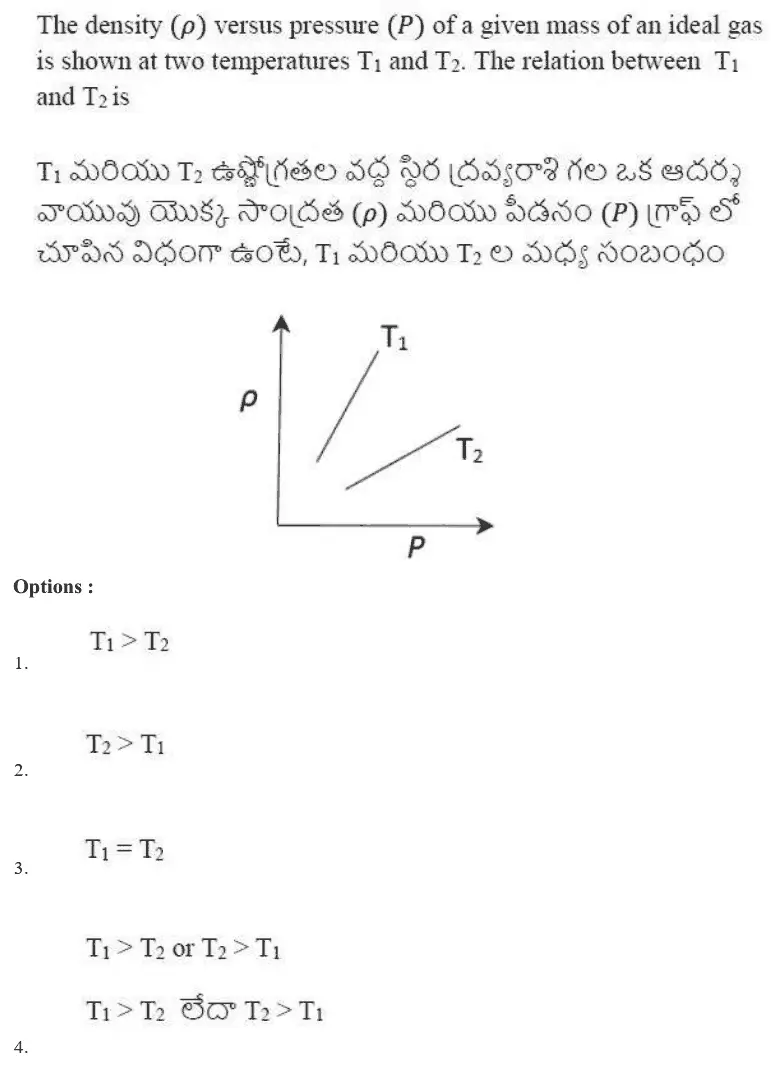
The density ($\rho$) versus pressure ($P$) of a given mass of an ideal gas is shown at two temperatures $T_1$ and $T_2$. The relation between $T_1$ and $T_2$ is
Two moles of Helium are mixed with ‘n’ moles of Hydrogen. The rms speed of the gas molecules in the mixture is $\sqrt{2}$ times the speed of sound in the mixture. The value of ‘n’ is
The Mean free path of a gas molecule, whose diameter is $2 \times 10^{-10}$ m is $1.6 \times 10^{-7}$ m. Calculate the mean free path of another gas molecule whose diameter is $4 \times 10^{-10}$ m (under the same conditions)
An ideal gas of density '$\rho$' is enclosed in a vessel of volume $V$ at $0^\circ\mathrm{C}$ temperature and $p_0$ atmospheric pressure. If the pressure inside the vessel decreased by $\Delta p$ due to a leakage. The mass of the leaked out gas is
A vessel contains a mixture of nitrogen of mass 7 g and carbondioxide of mass 11 g at a temperature 290 K and pressure 1 atm. The density of the mixture is
If the average kinetic energy of the molecules of a gas at a temperature of 30 °C is U, then the temperature at which the average kinetic energy of the molecules of the gas becomes 2U is
An air bubble rises from the bottom of a lake of depth 37 m. The temperature of the lake is constant from the bottom to the top and atmospheric pressure is equal to the pressure 10 m of water column. The percentage increase in the volume of the bubble when it rises from a depth of 20 m to a depth of 15 m is
The ratio of rms speeds of helium gas molecules at a temperature of $127\ ^\circ\mathrm{C}$ and oxygen gas molecules at a temperature of $527\ ^\circ\mathrm{C}$ is (Molar masses of helium and oxygen gases are 4 and 32 respectively)
A vessel of volume 2000 cc is filled with 5 moles of an ideal gas at a temperature of $127\,^\circ\mathrm{C}$. The total kinetic energy of the gas in the vessel is (R – Universal gas constant)
5 moles of monoatomic gas and one mole of rigid diatomic gas are mixed. The internal energy (in kJ) of the gaseous mixture at a temperature of 127 °C is
(Universal gas constant $= 8.31\ \mathrm{J\,mol^{-1}\,K^{-1}}$)
If a gaseous mixture consists of 3 moles of oxygen and 4 moles of argon at an absolute temperature T, then the total internal energy of the mixture is (neglect vibrational modes and R - Universal gas constant)
In a water tank, an air bubble rises from the bottom to the top surface of the water. If the depth of the water in the tank is 7.28 m and atmospheric pressure is 10 m of water, then the ratio of the radii of the bubble at the bottom of the tank and at the top surface of the water is (Temperature of the water in the tank is constant)
In a container of volume $16.62\ \mathrm{m^3}$ at $0\ ^\circ\mathrm{C}$ temperature, 2 moles of oxygen, 5 moles of nitrogen and 3 moles of hydrogen are present, then the pressure in the container is (Universal gas constant = $8.31\ \mathrm{J\ mol^{-1}\ K^{-1}}$)
If the internal energy of 3 moles of a gas at a temperature of $27\ ^\circ\mathrm{C}$ is $2250R$, then the number of degrees of freedom of the gas is ($R$ - Universal gas constant)
If the ratio of specific heats of a gas at constant pressure and at constant volume is $\gamma$, then the number of degrees of freedom of the rigid molecules of the gas is
If 2 moles of an ideal monoatomic gas at a temperature of $27\ ^\circ\mathrm{C}$ is mixed with 4 moles of another ideal monoatomic gas at a temperature of $327\ ^\circ\mathrm{C}$, then the temperature of mixture of the two gases is
A gaseous mixture consists of 2 moles of oxygen and 4 moles of argon at an absolute temperature T. Neglecting all vibrational modes, the total internal energy of the mixture of the gases is
An air bubble rises from the bottom to the top of a water tank in which the temperature of the water is uniform. The surface area of the bubble at the top of the tank is 125% more than its surface area at the bottom of the tank. If the atmospheric pressure is equal to the pressure of 10 m water column, then the depth of water in the tank is
The pressure of a mixture of 64 g of oxygen, 28 g of nitrogen and 132 g of carbon dioxide gases in a closed vessel is P. Under isothermal conditions if entire oxygen is removed from the vessel, the pressure of the mixture of remaining two gases is
If the rms speed of the molecules of a gas at a temperature of $77\ ^\circ\mathrm{C}$ is $50\,\mathrm{ms^{-1}}$, then the rms speed of the same gas molecules at a temperature of $150.5\ ^\circ\mathrm{C}$ is
If the heat required to increase the rms speed of 4 moles of a diatomic gas from v to $\sqrt{3}\mathrm{v}$ is 83.1 kJ, then the initial temperature of the gas is
(Universal gas constant $=8.31\,\mathrm{J\,mol^{-1}\,K^{-1}}$)
The total internal energy of 2 moles of a monatomic gas at a temperature $27\,^\circ\mathrm{C}$ is U. The total internal energy of 3 moles of a diatomic gas at a temperature $127\,^\circ\mathrm{C}$ is
A monoatomic gas of $n$-moles is heated from temperature $T_1$ to $T_2$ under two different conditions. (i) at constant volume and (ii) at constant pressure. The change in internal energy of the gas is
When the temperature of a gas is raised from $27\ ^\circ\mathrm{C}$ to $90\ ^\circ\mathrm{C}$, the increase in the $rms$ velocity of the gas molecules is
One mole of a gas having $\gamma = \frac{7}{5}$ is mixed with one mole of a gas having $\gamma = \frac{4}{3}$. The value of $\gamma$ for the mixture is ($\gamma$ is the ratio of the specific heats of the gas)
The molar specific heat capacity of a diatomic gas at constant pressure is C. The molar specific heat capacity of a monoatomic gas at constant volume is
At a pressure P and temperature $127\ ^\circ\mathrm{C}$, a vessel contains 21 g of a gas. A small hole is made into the vessel so that the gas in it leaks out. At a pressure of $\frac{2P}{3}$ and a temperature of $t\ ^\circ\mathrm{C}$, the mass of the gas leaked out is 5 g. Then $t =$
A vessel contains hydrogen and nitrogen gases in the ratio $2:3$ by mass. If the temperature of the mixture of the gases is $30\,^\circ\mathrm{C}$, then the ratio of the average kinetic energies per molecule of hydrogen and nitrogen gases is (Molecular mass of hydrogen $= 2$ and molecular mass of nitrogen $= 28$)
A vessel that can withstand a pressure of 100 atm is filled with hydrogen at $27\ ^\circ\mathrm{C}$ up to a pressure of 20 atm. If the vessel is heated, then the temperature at which it explodes is
If the average kinetic energy of a gas molecule at $27\,^\circ\mathrm{C}$ is $3.3 \times 10^{-20}$ J, then the average kinetic energy of the gas molecules at $127\,^\circ\mathrm{C}$ is
A vessel of volume 10 liters is filled with $\mathrm{H_2}$ gas. The total average translational kinetic energy of its molecules is $4.5\times10^{5}$ J. The pressure of hydrogen in the vessel is
N molecules each of mass m of gas A and 2N molecules each of mass 2m of gas B are contained in a vessel which is maintained at a temperature T. The mean square velocity of the molecules of gas B is denoted by $V_2^2$ and the mean square of the x-component velocity of the molecules of gas A is denoted by $V_1^2$, then $\frac{V_1}{V_2}$ is
If the temperature of a gas is increased from $27^\circ\mathrm{C}$ to $159^\circ\mathrm{C}$, then the percentage increase in the rms speed of the gas molecules is
Air is filled at 60 °C in a vessel of open mouth. The vessel is heated to a temperature t °C so that $\frac{1}{4}^{\text{th}}$ of the air is escaped from the vessel. Assuming air as ideal gas and the volume of the vessel remaining constant, then the value of ‘t’ is
For a given mass of a gas at constant temperature, the volume and the pressure are V and P respectively. Then the slope of the graph drawn between $\log_e V$ on X-axis and $\log_e P$ on Y-axis is
At what temperature is the root mean square (rms) speed of Neon gas atoms is equal to the rms speed of Helium gas atom at $-33\,^{\circ}$C? (atomic mass of Ne = 20.2 u, and that of He = 4.0 u)
If the root mean square (rms) speed of nitrogen molecules at room temperature is 100 m/s, then the rms speed of Helium molecule at the same temperature is
Statement (I) : Gas thermometers are less sensitive than liquid thermometers. Statement (II) : The ratio of universal gas constant and avagadro’s number is called Boltzman’s constant. Statement (III) : The density of a given mass of a gas at constant pressure is inversely proportional to its absolute temperature. The correct option among the following is
A
Statements I, II, III are true.
B
Statements I, II are true, but statement III is false.
C
Statements II, III are true, but statement I is false.
Two boxes are at the same temperature. The first box contains gas with molecular mass $m_1$ and rms speed $v_1$. The second box contains gas with molecular mass $m_2$ and average speed $v_2$. If $v_1 = 1.5\,v_2$, then $\frac{m_1}{m_2}$ is
A gaseous mixture consists of 4 g oxygen and 4 g of helium. The ratio $\dfrac{C_P}{C_V}$ of mixture is ($C_P$ and $C_V$ are molar specific heats of the mixture at constant pressure and at constant volume respectively).
A vessel contains 3 moles of He, 1 mole of Ar, 5 moles of $\mathrm{N_2}$ and 3 moles of $\mathrm{H_2}$. If the vibrational modes are ignored, the total internal energy of the system of gases is
A container of 10 L is filled with an ideal gas at a temperature of $27\ ^\circ$C at a pressure 12 atm. The volume of the container is reduced to 6 L and the temperature of the gas in increased by $30\ ^\circ$C, then the final pressure of the gas is
Assertion (A) : When an ideal gas is compressed adiabatically its temperature and the average kinetic energy of the gas molecules increase. Reason (R) : The kinetic energy increases because of collisions of molecules with moving parts of wall only.
A
(A) and (R) are true and (R) is correct explanation of (A)
B
(A) and (R) are true but (R) is not correct explanation of (A)
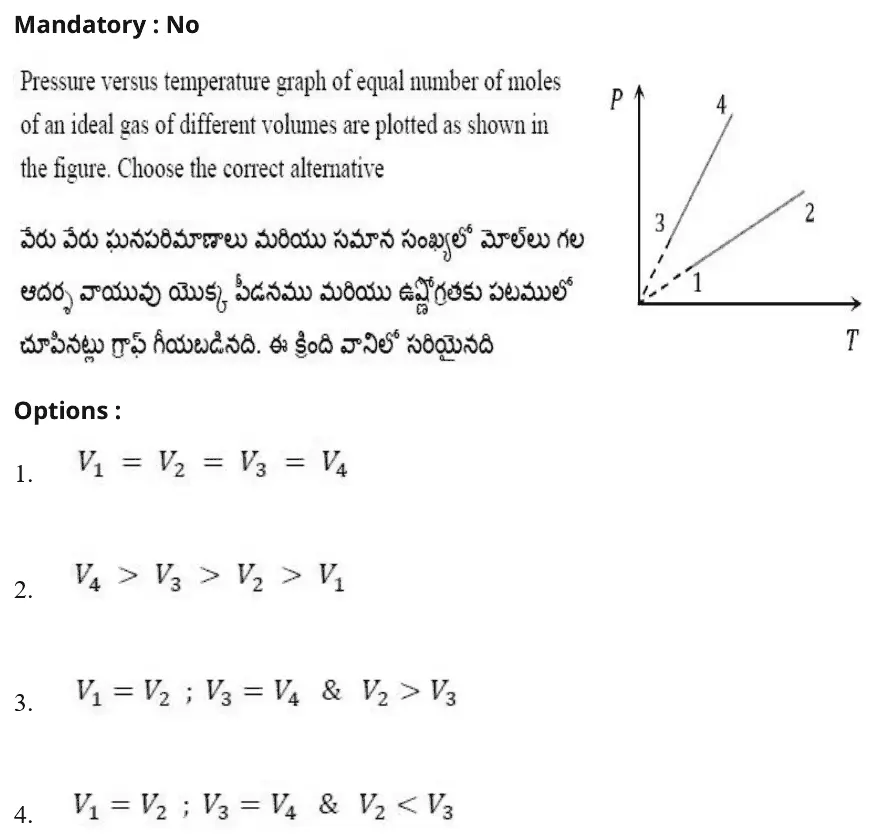
Pressure versus temperature graph of equal number of moles of an ideal gas of different volumes are plotted as shown in the figure. Choose the correct alternative (see the figure above)
A vessel has $6\,\mathrm{g}$ of oxygen at pressure 'P' and temperature $400\,\mathrm{K}$. A small hole is made in it so that oxygen leaks out. How much oxygen has leaked out if the final pressure is $\frac{P}{2}$ and final temperature is $300\,\mathrm{K}$ ?
The respective speeds of the five molecules are $1, 2, 3, 4$ and $5\ \mathrm{km.s^{-1}}$. Then the ratio of their RMS velocity and the average velocity will be ______
One mole of a gas at a pressure 2 $Pa$ and temperature 27 $^\circ$C is heated till both pressure and volume are doubled. What is the temperature of the gas?
When the temperature of an ideal gas is increased from $27\ ^\circ\mathrm{C}$ to $127\ ^\circ\mathrm{C}$, calculate the percentage increase in its $\mathrm{v}_{rms}$.
A balloon contains $1500\ m^3$ of $He$ at $27\ ^\circ$C and 4 atmospheric pressure. the volume of $He$ at $-3\ ^\circ$C temperature and 2 atmospheric pressure will be ______
A vessel has $6\ \mathrm{g}$ of oxygen at pressure $P$ and temperature $400\ \mathrm{K}$. A small hole is made in it so that oxygen leaks out. How much oxygen leaks out if the final pressure is $\dfrac{P}{2}$ and temperature is $300\ \mathrm{K}$?
A molecule is travelling in air at 300 K and 1 atm, and the radius of the molecule is $0.6\times10^{-10}$ m. Calculate the approx. mean free path of the molecule. (the number density is $2.44\times10^{25}$ molecules / $m^3$)
A cylinder consists of a gas mixture of Helium and Oxygen. If the mass of Helium is $4\ \mathrm{gm}$ and the mass of oxygen is $32\ \mathrm{gm}$, then the ratio of specific heat of the mixture $(C_p/C_v)$
Consider an ideal gas in a closed container at 300 K. The container is then heated so that the average velocity of a particles of the gas increases by a factor of 4. What would be the final temperature?
The mean free path for a gas at temperature 300 K and pressure 600 torr is $10^{-7}$ m. The mean free path of the gas at a temperature 400 K and pressure 200 torr will be
Two non-reactive monoatomic ideal gases have their atomic masses in the ratio 3 : 4. The ratio of their partial pressures when enclosed in a vessel kept at a constant temperature is 2 : 3. The ratio of their densities is
As per kinetic theory of gases which of the following statements is / are true? a) Temperature of a gas is a measure of average kinetic energy of a molecule b) Temperature of a gas depends on the nature of the gas c) Heavier molecule has lower average speed d) Lighter molecule has lower average speed
Pressure of a gas of constant volume at $20\,^\circ\mathrm{C}$ is $90\ \mathrm{cm}$ of Hg. At what temperature the pressure would change to $75\ \mathrm{cm}$ of Hg.
A light container having a diatomic gas enclosed with in is moving with velocity 'V'. Mass of the gas is 'M' and number of moles is 'n'. The kinetic energy of gas w.r.t ground is
A vessel contains mixture of hydrogen and oxygen gasses in the ratio of their masses equal to $1:5$. The ratio of mean kinetic energies of the two gasses is:
The average kinetic energy of $\mathrm{H_2}$ molecules at $300\,\mathrm{K}$ is $E$. At the same temperature the average kinetic energy of $\mathrm{O_2}$ molecule is
Two vessels A and B contain oxygen. The volume of B is twice that of A, the pressure of B is thrice that of A and the temperature of B is half of that of A. Then find the ratio of number of molecules of oxygen in vessels A and B.
Two vessels separately contain two ideal gases A and B at the same temperature. The pressure of gas A is three times the pressure of gas B. Under these conditions, the density of gas A is found to be two times the density of B. The ratio of molecular weights of gas A and B, i.e. $\frac{M_A}{M_B}$ is
Consider an ideal gas at pressure P, volume V and temperature T. The mean free path for molecules of the gas is L. If the radius of gas molecules, as well as pressure, volume and temperature of the gas are doubled, then the mean free path will be
An ideal gas in a closed container is heated so that the final rms speed of the gas particles increases by 2 times the initial rms speed. If the initial gas temperature is 27 °C, then the final temperature of the ideal gas is
A vessel of volume $V$ contains ideal gas having mass density $\rho$ at temperature $T$ and pressure $P$. After a portion of the gas is let out, the pressure in the vessel is decreased by $\Delta P$. The mass of the released gas is
A thermally insulated vessel containing monoatomic gas is moving with a speed of 30 m/s. If the vessel suddenly stops, the increase in gas temperature is (Molar mass of gas $= 83$ g/mol and $R = 8.3$ J/K-mol)
Two gases A and B are contained in two separate, but otherwise identical containers. Gas A consists of monoatomic molecules, each with atomic mass of 4 $u$ whereas, Gas B consists of rigid diatomic molecules, each with atomic mass of 20 $u$. If Gas A is kept at 27 $^\circ$C, at what temperature should Gas B be kept so that both have the same r.m.s. speed?
An ideal gas is placed in a tank at $27\ ^\circ\mathrm{C}$. The pressure is initially 600 kPa. One fourth of the gas is then released from the tank and thermal equilibrium is established. What will be the pressure if the temperature is $327\ ^\circ\mathrm{C}$?
Three closed vessels A, B and C are at the same temperature 'T' and contain gases. Vessel A contains only $\mathrm{O_2}$, B contains only $\mathrm{N_2}$ and C contains a mixture of equal quantities of $\mathrm{O_2}$ and $\mathrm{N_2}$. If the rms speed of $\mathrm{O_2}$ molecules in vessel 'A' is $v_1$ and that of $\mathrm{N_2}$ molecules in vessel 'B' is $v_2$ then the rms speed of $\mathrm{O_2}$ molecules in vessel 'C' is
Under standard conditions, the density of a gas is $\dfrac{1400}{1089}\ \mathrm{kg\,m^{-3}}$ and the speed of sound propagation in it is $330\ \mathrm{ms^{-1}}$, then the number of degrees of freedom of the gas molecules is
The y-components of velocities of the molecules of a gas are $-7, -6, -5, -4, -3, -2, -1, 0, +1, +2, +3, +4, +5, +6, +7\ \mathrm{ms^{-1}}$ then the rms velocity is
At a temperature of 314 K and a pressure of 100 kPa, the speed of sound in a gas is $1380\,\mathrm{ms^{-1}}$. The radius of each gas molecule is 0.5 Å. The frequency of sound at which the wavelength of sound wave in the gas becomes equal to the mean free path of the gas molecules is (Boltzmann Constant = $1.38 \times 10^{-23}\,\mathrm{JK^{-1}}$)
The amount of heat that must be supplied to 35 g of oxygen at room temperature to raise its temperature by $80\ ^\circ\mathrm{C}$ at constant volume is (molecular mass of oxygen is 32 and $\mathrm{R} = 8.3\ \mathrm{J\,mol^{-1}\,K^{-1}}$)
The average translational kinetic energy of a molecule in a gas becomes equal to 0.69 eV at a temperature about [Boltzmann constant $= 1.38 \times 10^{-23}\ \mathrm{J\,K^{-1}}$]
If the speed of sound in a mixture of 2 moles of Helium and 2 moles of Hydrogen at temperature $\frac{972}{5}\ \mathrm{K}$ is $\mathrm{n}\times100\ \mathrm{ms^{-1}}$, then the value of n is (Take $\mathrm{R} = \frac{25}{3}\ \mathrm{Jmol^{-1}K^{-1}}$)
A vessel of volume $V$ contains a mixture of ideal gases at temperature $T$. The gas mixture contains $n_1$, $n_2$ and $n_3$ moles of three gases. Assuming ideal gas system, the pressure of the mixture is
A gas mixture contains $n_1$ moles of a monoatomic gas and $n_2$ moles of gas of rigid diatomic molecules. Each molecule in monoatomic and diatomic gas has 3 and 5 degrees of freedom respectively. If the adiabatic exponent $\left(\dfrac{C_p}{C_v}\right)$ for this gas mixture is 1.5, then the ratio $\dfrac{n_1}{n_2}$ will be
In a cubic container of inner side length 10 cm, nitrogen gas of 100 kPa pressure is maintained at 300 K. If the pressure inside the gas is increased to 300 kPa by adding oxygen gas, the ratio of number of $\mathrm{N_2}$ to $\mathrm{O_2}$ molecules in the container is
The ratio of the speed of sound in a monatomic gas at $27\,^\circ\mathrm{C}$ and rms speed of the molecules of the same gas at a temperature of $127\,^\circ\mathrm{C}$ is ________
A gaseous mixture has 2 moles of oxygen and 4 moles of Argon at a temperature T. Neglecting all vibrational modes of the molecules, the total internal energy of the system is ______ (R-Universal gas constant)
Tyre of a bicycle has volume $2\times10^{-3}\ \mathrm{m^3}$. Initially the tube is filled 75% of its volume by air at atmospheric pressure $10^{5}\ \mathrm{Nm^{-2}}$. When a rider is on the bicycle, the area of contact of tyre with road is $24\times10^{-4}\ \mathrm{m^2}$. The mass of rider with bicycle is 120 kg. If a pump delivers a volume $500\ \mathrm{cm^3}$ of air in each stroke then the number of strokes required to inflate the tyre is ($g = 10\ \mathrm{ms^{-2}}$)
A diatomic gas consisting of rigid molecules is at a temperature of $87\ ^\circ\mathrm{C}$. If the moment of inertia of the rotating diatomic rigid molecule is $2.76\times10^{-39}\ \mathrm{gcm^2}$ then the rms angular speed of the molecule is (Boltzmann constant = $1.38\times10^{-23}\ \mathrm{JK^{-1}}$)
The rms speed of oxygen molecule at a certain temperature is $600\ \mathrm{ms^{-1}}$. If the temperature is doubled and oxygen molecule dissociates into atomic oxygen atoms, the new rms speed is
For a molecule of an ideal gas, the number density is $2\sqrt{2}\times10^{8}\ \mathrm{cm^{-3}}$ and the mean free path is $\frac{10^{-2}}{\pi}\ \mathrm{cm}$. The diameter of the gas molecule is
The absolute temperature at which the rms speed of a hydrogen molecule is equal to its escape speed from the Moon's surface is (radius of Moon is R, g is acceleration due to gravity on Moon's surface, m is mass of hydrogen molecule and k is Boltzmann constant)
If the average translational kinetic energy of a molecule in a gas is equal to the kinetic energy of an electron accelerating from rest through 10 volt, then the temperature of the gas molecule is (Boltzmann constant $= 1.38\times10^{-23}\ \mathrm{JK^{-1}}$)
A mixture of two non-reactive ideal gases is enclosed in a vessel consisting of one mole of a monatomic gas ‘A’ and ‘n’ moles of diatomic gas ‘B’ at a temperature ‘T’. If the adiabatic constant of the gaseous mixture is $\dfrac{13}{9}$, then the value of ‘n’ is
The rms speed of oxygen molecule at a certain absolute temperature is ‘v’. If the absolute temperature is doubled and the oxygen molecules dissociate into atomic oxygen, then the rms speed would be
Assertion (A) : The temperature of a gas is a result of the kinetic energy of its molecules. Reason (R) : Due to kinetic energy, the molecules collide with each other to produce thermal energy
A
Both (A) and (R) are true and (R) is the correct explanation of (A)
B
Both (A) and (R) are true but (R) is not the correct explanation of (A)
The average translational kinetic energy of $\mathrm{O_2}$ molecules at a particular temperature is 0.048 eV. The average translational kinetic energy of equal number of $\mathrm{N_2}$ molecules at the same temperature is (in eV)
Uranium has two isotopes of masses 235 and 238 units. If both of them are present in Uranium hexafluoride gas, find the percentage ratio of difference in rms velocities of two isotopes to the rms velocity of heavier isotope.
A cylinder of fixed capacity 67.2 litres contains helium gas at STP. The amount of heat needed to rise the temperature of the gas in the cylinder by $20\ ^\circ$C is ($R = 8.31\ \mathrm{J\ mol^{-1}K^{-1}}$)
An insulated cylindrical vessel filled with an insulated piston of negligible weight and negligible thickness at the mid point of the vessel. The cylinder contains a gas at $0^\circ\mathrm{C}$. When the gas is heated to $100^\circ\mathrm{C}$, the piston moves through a length of 5 cm. Length of the cylindrical vessel in cm is :
Kinetic Theory of Gases forms an essential quantitative bridge between molecular mechanics and thermodynamics in Class 11 physics. In the papers we hold for AP and TS EAPCET from 2022 to 2026, the chapter contributed 92 questions across 77 papers. That gives an average frequency of 1.2 questions per paper, accounting for 3.0% of all physics questions in that recent window. Looking across all years in our archive from 2010 to 2026, Kinetic Theory of Gases yielded 163 questions across 149 papers, maintaining an average of 1.1 questions per paper and a 2.7% subject share. Across the earlier window from 2010 to 2021, our archive contains 71 questions across 72 papers (2.5% share). In the last three exam years from 2024 to 2026, the chapter supplied 59 questions across 46 papers, registering a 3.2% share. Comparing the last three years to early papers, the chapter's share of the subject is up, while compared to the recent five-year window it is about the same.
State-level distributions reflect active presence in both examination streams. AP EAPCET papers between 2022 and 2026 delivered 62 questions across 48 papers in our set, with 47 papers including at least one question (1.3 per paper, 3.2% share). Over the same timeframe, TS EAPCET provided 30 questions across 29 papers in our set, with 27 papers containing questions (1.0 per paper, 2.6% share). Kinetic Theory of Gases has appeared every year since 2022, though across all 77 recent papers in our collection, three papers missed it, so it was not present in all 77 sittings. The chapter ranks 17th of 28 physics chapters by question share between 2022 and 2026. The busiest single sitting in our collection was 2025, which featured 22 questions across 16 papers.
Most-asked topics
Questions group into three main theoretical themes:
Degrees of Freedom & Specific Heats: 39 questions were asked between 2022 and 2026, contributing to an all-time archive total of 60 questions. This leading area tests equipartition of energy, degrees of freedom for monoatomic, diatomic, and polyatomic molecules, molar heat capacities C_v and C_p, and equivalent ratios for gaseous mixtures.
Gas Laws & Kinetic Model: Recent papers contributed 29 questions, out of 56 questions across all years in our archive. It tests the ideal gas equation P V = n R T, gas escape from rigid containers, Dalton's law of partial pressures, pressure exerted by molecular bombardment, and mean free path.
Molecular Speeds: A steady pool of 24 questions appeared in the recent five-year window, out of 47 questions across the entire archive. This section focuses on root-mean-square speed, average speed, most probable speed, and their dependence on absolute temperature and molar mass.
What the questions look like
A signature numerical question gives two different gases at distinct temperatures and asks for the ratio of their root-mean-square molecular speeds. For example, comparing helium at a moderate temperature with oxygen at a elevated temperature requires evaluating the square root of (T₁ M₂ / T₂ M₁). Another frequent variant asks for the temperature at which the rms speed of one gas equals the rms speed or most probable speed of another.
Problems on gas mixtures are equally common. Students are given specified mole numbers of two gases, such as helium and oxygen, and must determine the mixture's effective molar heat capacity C_v, equivalent specific heat ratio γ, or internal energy. Container escape problems also feature regularly, asking for the mass or fraction of gas expelled when a rigid cylinder experiences a measured pressure drop at constant temperature.
Start by memorizing the fundamental molecular speeds and their proportionality: v_rms = √(3 R T / M), average speed v_avg, and v_mp = √(2 R T / M). Notice that all three speeds scale directly with √(T / M). The order of speeds follows v_mp < v_avg < v_rms, which helps to quickly verify ratio problems.
Next, master the equipartition theorem. Each degree of freedom contributes (1/2) k_B T of translational or rotational kinetic energy per molecule, and (1/2) R T of internal energy per mole. For a monoatomic gas with three degrees of freedom, C_v = (3/2) R and C_p = (5/2) R, giving γ = 5/3. For a rigid diatomic gas with five degrees of freedom, C_v = (5/2) R and C_p = (7/2) R, giving γ = 7/5 = 1.4.
For mixtures containing n₁ moles of gas 1 and n₂ moles of gas 2, always compute C_v(mix) = (n₁ C_v1 + n₂ C_v2) / (n₁ + n₂) first. Then find C_p(mix) = C_v(mix) + R, and finally compute γ(mix) = C_p(mix) / C_v(mix). Avoid taking a weighted average of γ directly, as γ is a non-linear ratio.
Finally, review the mean free path formula λ = 1 / (√2 n π d²), where n is the number density of molecules and d is molecular diameter. Note how λ varies inversely with pressure at constant temperature.
Frequently asked questions
How many questions come from Kinetic Theory of Gases in each exam?
The chapter averages 1.2 questions per paper in the papers we hold from 2022 to 2026, meaning most shifts carry at least one question from this topic.
What is the most common error in mixture calculations?
A frequent mistake is averaging the ratio of specific heats γ directly instead of averaging the molar heat capacities C_v and C_p. Always compute the weighted C_v and add R to obtain the correct mixture ratio.
How does root-mean-square speed change if gas pressure doubles at constant temperature?
At constant temperature, the rms speed remains unchanged because v_rms depends solely on absolute temperature and molar mass, not on pressure.
Where can I find worked solutions for EAPCET Kinetic Theory of Gases questions?
Step-by-step solutions for each one are in the EdLoop EAPCET app.