Every Laws of Motion question from past AP EAPCET and TS EAPCET papers, with options and answers. Newest first.
299questions
143papers covered
4.5%of Physics questions, 2022–2026
2010–2026years
Guide at a glance
Laws of Motion forms the core dynamical engine of Class 11 Physics, appearing regularly across all exam shifts. In the papers we hold from 2022 to 2026, it contributed 139 questions in 77 papers, yielding an average of 1.8 questions per paper.
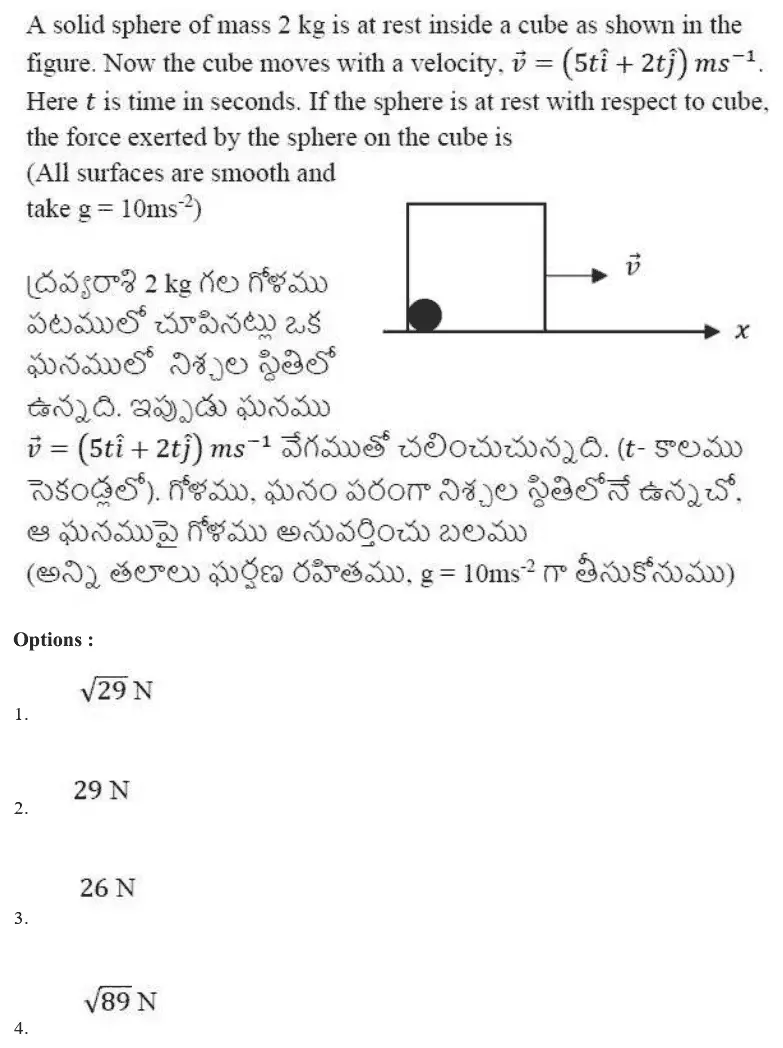
A solid sphere of mass 2 kg is at rest inside a cube as shown in the figure. Now the cube moves with a velocity, $\vec{v} = (5t\hat{i} + 2t\hat{j})\ ms^{-1}$. Here $t$ is time in seconds. If the sphere is at rest with respect to cube, the force exerted by the sphere on the cube is (All surfaces are smooth and take g = 10ms$^{-2}$)
The blades of a wind mill sweep out a circle of area A = 2 $\mathrm{m^2}$. The wind is flowing at velocity V = 6 $\mathrm{ms^{-1}}$ perpendiculars to circle and the density of air is 1.2 $\mathrm{kg.m^{-3}}$. Then the power of the mill is
A block of mass 5 kg is sliding with constant velocity of $6\ \mathrm{ms^{-1}}$ on a frictionless horizontal surface. The force exerted on the horizontal surface is
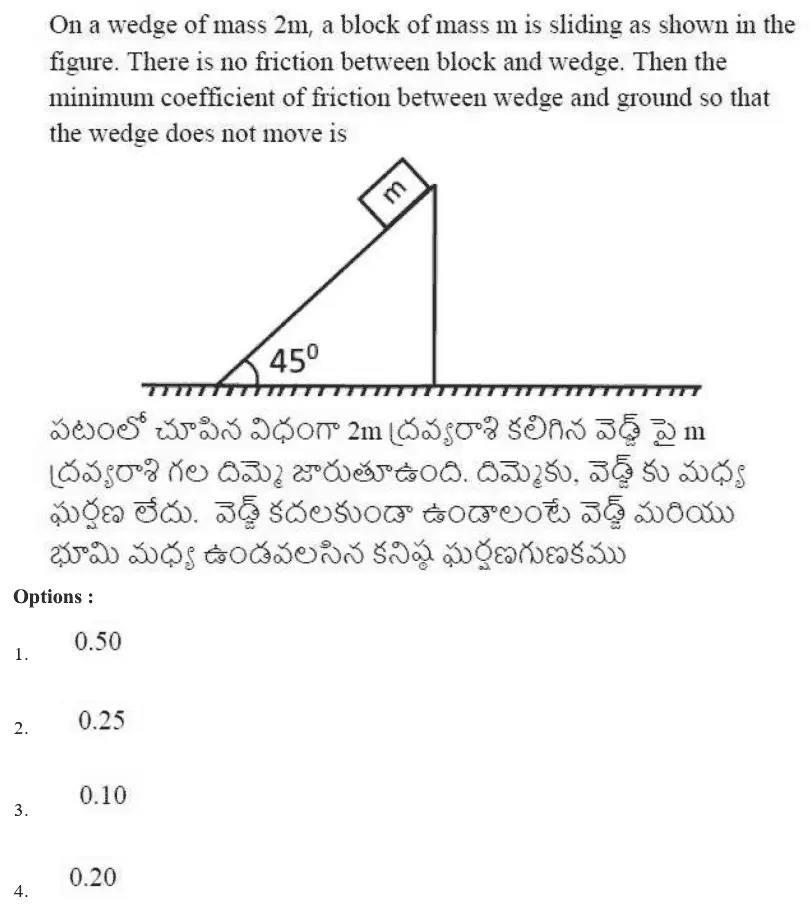
On a wedge of mass 2m, a block of mass m is sliding as shown in the figure. There is no friction between block and wedge. Then the minimum coefficient of friction between wedge and ground so that the wedge does not move is
A body of mass 1 kg is attached to one end of a string of 1 m length. It is rotated in a vertical circle with a constant speed of $4\ \mathrm{ms^{-1}}$. When the object is at the highest point of the vertical circle, tension in the string is ($g = 10\ \mathrm{ms^{-2}}$)
A $5\,kg$ block on horizontal surface is pulled by $15\,N$. If the coefficient of friction between the block and surface is 0.2, then the acceleration of the block is ____ $[g = 10\,ms^{-2}]$
A body which is initially at rest breaks into 2 pieces of masses 4M and 6M respectively, together having a total kinetic energy E. The piece with mass 4M, after breaking has a kinetic energy
A small bead is placed on a thin circular loop of radius 25 cm which is rotating about its vertical diameter with a constant velocity of 10 rad $s^{-1}$. The angle made by the radius vector joining the center of the loop to the bead makes with the vertically downward direction is (Neglect friction and take acceleration due to gravity = 10 $ms^{-2}$)
A body is placed at the top of an inclined plane of angle of inclination $\tan^{-1}\left(\frac{9}{16}\right)$. If the plane is smooth, the body takes a time of T to reach the bottom of the plane and if the plane is rough, it takes a time of 3T to reach the bottom of the plane, then the coefficient of kinetic friction between the body and the rough inclined plane is
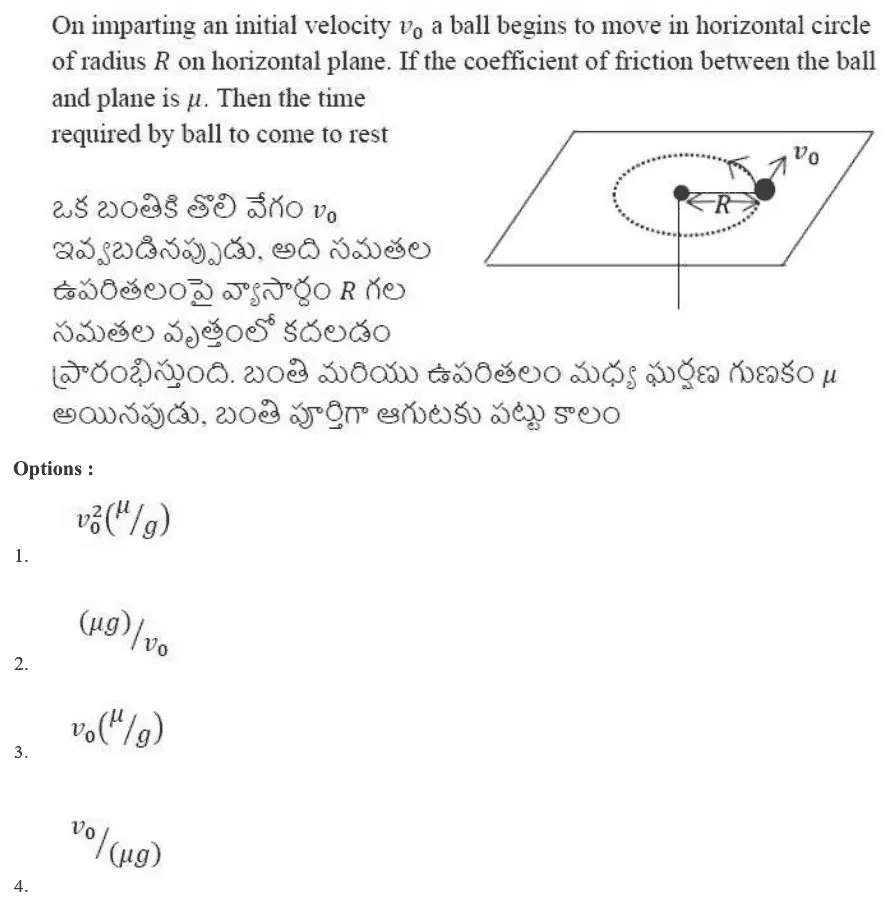
On imparting an initial velocity $v_0$ a ball begins to move in horizontal circle of radius $R$ on horizontal plane. If the coefficient of friction between the ball and plane is $\mu$. Then the time required by ball to come to rest
A stream of water flowing horizontally with a speed of $15\ \mathrm{m\ s^{-1}}$ gushes out of a tube of cross-sectional area $10^{-2}\ \mathrm{m^2}$ and hits a vertical wall nearby. Assuming water does not rebound, The force exerted on the wall by the impact of water is
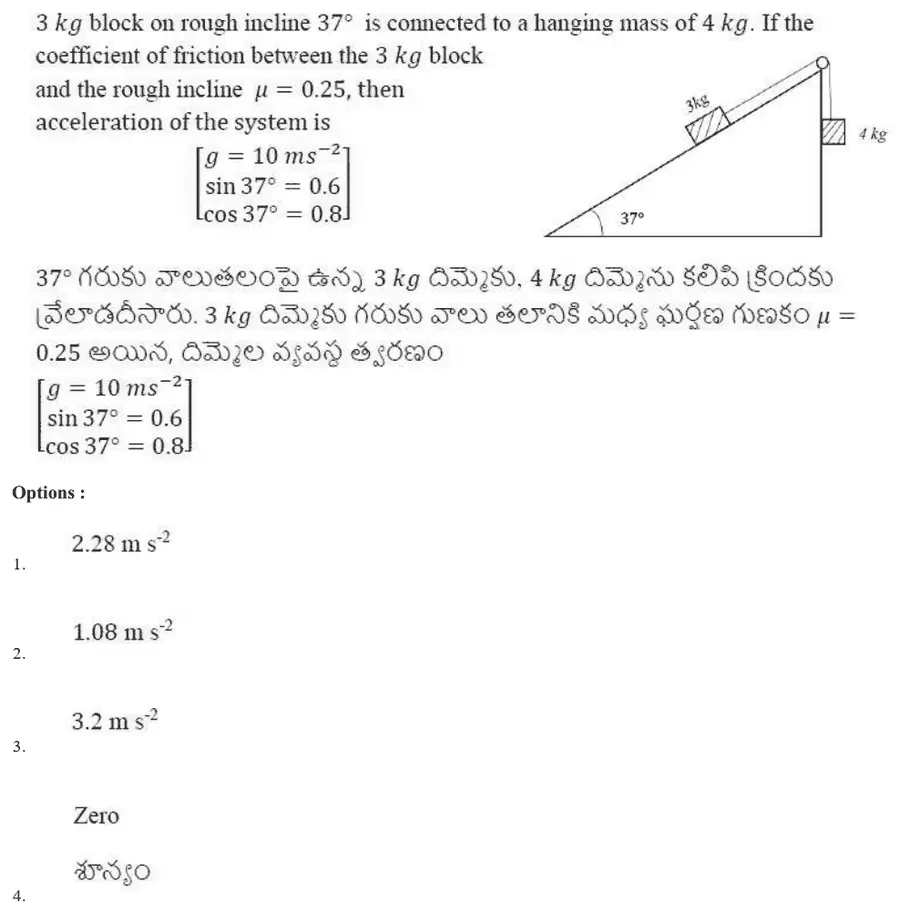
$3\ kg$ block on rough incline $37^\circ$ is connected to a hanging mass of $4\ kg$. If the coefficient of friction between the $3\ kg$ block and the rough incline $\mu = 0.25$, then acceleration of the system is
A block is kept at the top of a rough inclined plane of length 2.8 m and angle of inclination $\cos^{-1}(0.6)$. If the coefficient of kinetic friction between the block and the upper half of the plane is 0.3 and between the block and the lower half of the plane is 0.5, then the velocity with which the block reaches the bottom of the plane is (acceleration due to gravity = $10\ \mathrm{ms^{-2}}$)
A stone of mass 400 g tied to one end of a string is rotated in a horizontal circle of radius 125 m. If the string can withstand a maximum tension of $50\pi^2$ N, then the minimum time period with which the stone can be rotated is
A bullet fired from a gun is given a force $(600 - 2 \times 10^5 t)$ newton, where ‘$t$’ is in second. Force on the bullet becomes zero when it leaves the barrel. The average impulse imparted to the bullet is
A block of mass '$m$' is placed on a smooth wedge of inclination '$\theta$'. This system is accelerated horizontally so that the block does not slip on the wedge. Then, the force exerted by the wedge on the block will be ($g$ – acceleration due to gravity)
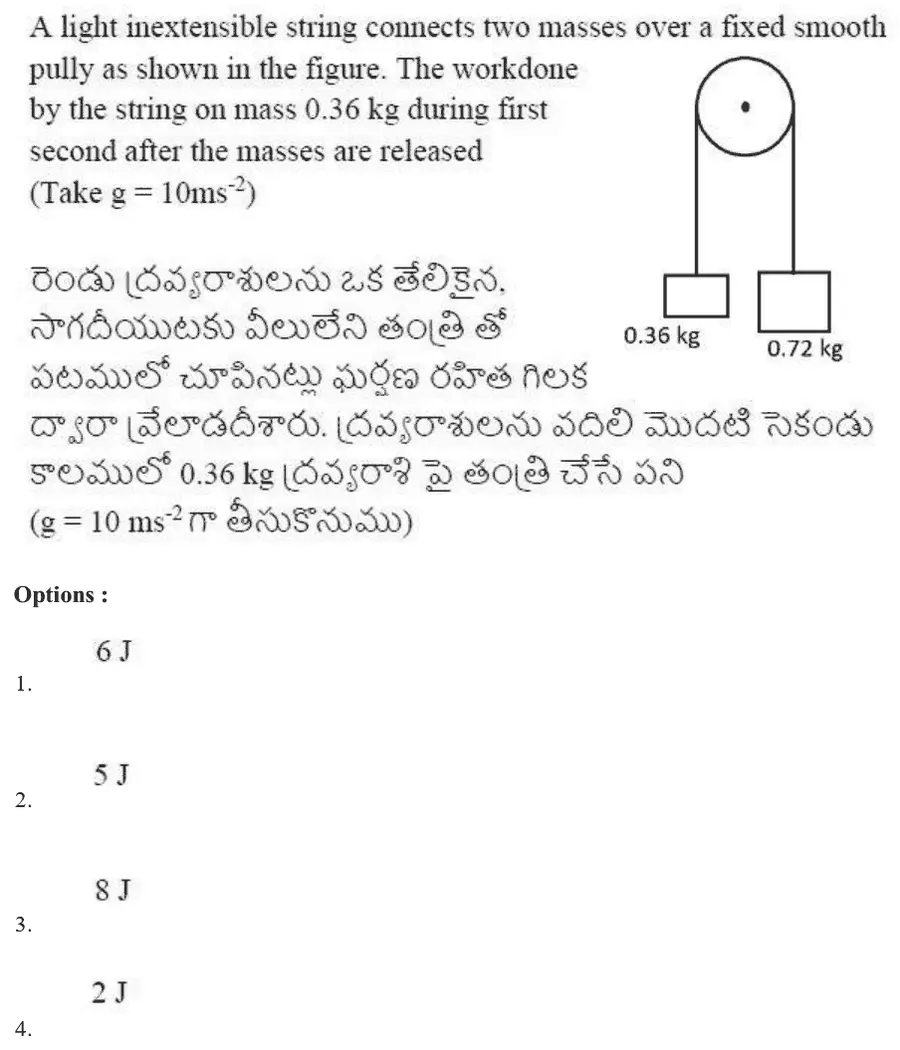
A light inextensible string connects two masses over a fixed smooth pully as shown in the figure. The workdone by the string on mass 0.36 kg during first second after the masses are released (Take $g = 10\,\mathrm{ms^{-2}}$)
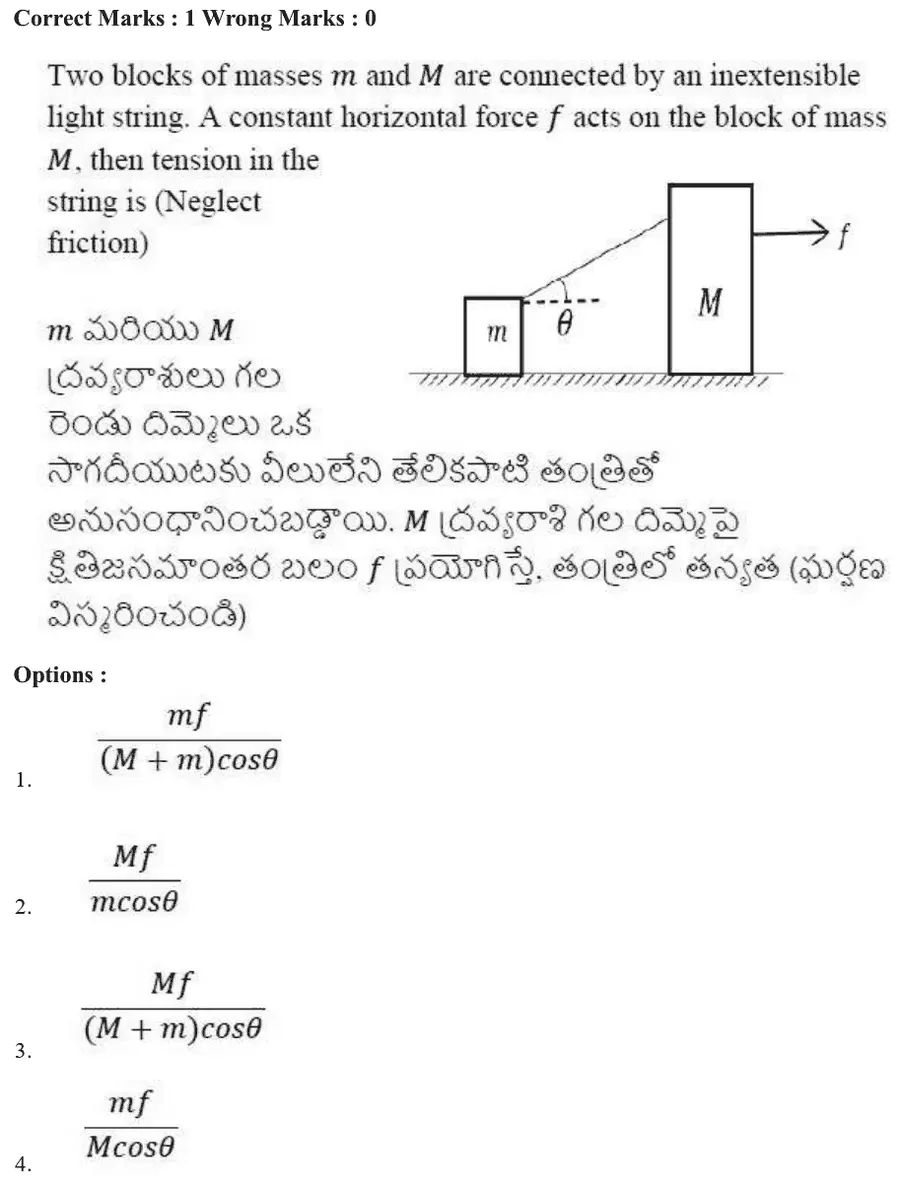
Two blocks of masses $m$ and $M$ are connected by an inextensible light string. A constant horizontal force $f$ acts on the block of mass $M$, then tension in the string is (Neglect friction)
A block of mass 2kg placed on a rough horizontal surface is pulled with a force of 30 N which makes an angle of $\sin^{-1}(0.6)$ with the horizontal. If the coefficient of kinetic friction between the block and the surface is 0.4, then the acceleration of the block is (Acceleration due to gravity = $10\ ms^{-2}$)
A body of mass $5$ kg at rest is acted upon by two forces $30$ N and F. If the angle between the forces is $60^0$ and the distance travelled by the body in a time of $2$s under the action of these forces is $28$m, then F =
A block of mass 2 kg is kept on a horizontal surface and is pulled with a horizontal force F. If the surface is smooth, the acceleration of the block is $8\ \mathrm{ms^{-2}}$. If the surface is rough and the coefficient of kinetic friction between the block and the surface is 0.25, then the acceleration of the block is
(Acceleration due to gravity $=10\ \mathrm{ms^{-2}}$)
The angle of inclination of an inclined plane is $45^\circ$. If the coefficient of kinetic friction between the inclined plane and a block on it is 0.2, then the block released from rest from the top of the inclined plane reaches the bottom of the plane in a time of 3 s. If the coefficient of kinetic friction between the block and the inclined plane is 0.8, then the time taken by the same block to reach the bottom of the plane is
A block slides down a rough inclined plane with a constant velocity $9.8\,\mathrm{ms^{-1}}$. The coefficient of kinetic friction between the block and the surface is $\frac{1}{\sqrt{3}}$. If the block is pushed up along the inclined plane from bottom of the plane with a velocity $9.8\,\mathrm{ms^{-1}}$, then the distance travelled by the block before coming to rest is
When a force of 8 N is applied on a body, its velocity changes from $8\ \mathrm{ms^{-1}}$ to $16\ \mathrm{ms^{-1}}$ in a time of 4 s. The force required to change the velocity of the same body from $16\ \mathrm{ms^{-1}}$ to $20\ \mathrm{ms^{-1}}$ in a time of 2 s is
A body of mass M is suspended to the lower end of an aeroplane accelerating horizontally. If the rope used to hang the body can withstand a maximum tension T, then the maximum acceleration of the aeroplane is (g = acceleration due to gravity and neglect the mass of the rope)
A block is at rest at the top of an inclined plane of angle of inclination $30^\circ$. The coefficient of kinetic friction between the upper half surface of the plane and the block is $\frac{1}{2\sqrt{3}}$, and the coefficient of kinetic friction between the lower half surface of the plane and the block is $\frac{1}{4\sqrt{3}}$. When the block slides down, ratio of the velocities of the block at the midpoint of the plane and at the bottom of the plane is
A bomb of mass ‘m’ at rest explodes into three parts. If these three parts move horizontally with equal speeds in different directions, then the masses of the three parts can be
The apparent weight of a girl of mass $30\ \mathrm{kg}$ when she is in a lift moving vertically upwards with an acceleration of $2\ \mathrm{m\,s^{-2}}$ is (Acceleration due to gravity $= 10\ \mathrm{m\,s^{-2}}$)
If a stone of mass $0.5$ kg tied to one end of a wire is whirled in a circular path of radius $2$ m with a speed $40$ rev/min in a horizontal plane, then the tension in the wire is nearly
If the breaking strength of a rope is $\frac{4}{3}$ times the weight of a person, then the maximum acceleration with which the person can safely climb up the rope is (g - accelereation due to gravity)
A block of mass $2$ kg is placed on a rough horizontal surface. If a horizontal force of $20$ N acting on the block produces an acceleration of $7\ \mathrm{m\,s^{-2}}$ in it, then the coefficient of kinetic friction between the block and the suface is (Aceleration due to gravity = $10\ \mathrm{m\,s^{-2}}$)
Two smooth inclined planes A and B each of height 20 m have angles of inclination $30^\circ$ and $60^\circ$ respectively. If $t_1$ and $t_2$ are respectively the times taken by two blocks to reach the bottom of the planes A and B from the top, then $t_1 - t_2 =$ (Acceleration due to gravity $= 10\ \mathrm{m\ s^{-2}}$)
If a body of mass $2\ \mathrm{kg}$ moving with initial velocity of $4\ \mathrm{m\ s^{-1}}$ is subjected to a force of $3\ \mathrm{N}$ for a time of $2\ \mathrm{s}$ normal to the direction of its initial velocity, then the resultant velocity of the body is
A disc of mass 0.2 kg is kept floating in air without falling by vertically firing bullets each of mass 0.05 kg on the disc at the rate of 10 bullets per every second. If the bullets rebound with the same speed, then the speed of each bullet is (Acceleration due to gravity = $10\ \mathrm{ms^{-2}}$)
A wire of length $2.5$ m is fixed at one end and a box of mass $4$ kg is tied at the other end. If the wire rotates in a horizontal circle about the fixed end with $\frac{2}{\pi}$ rotations per second, then the tension in the wire is
Water flowing through a pipe of area of cross-section $2\times10^{-3}\ \mathrm{m^2}$ hits a vertical wall horizontally with a velocity of $12\ \mathrm{m\,s^{-1}}$. If the water does not rebound after hitting the wall, then the force acting on the wall due to water is
Two blocks A and B of masses $2$ kg and $4$ kg respectively are kept on a rough horizontal surface. If same force of $20$ N is applied on each block, then the ratio of the accelerations of the blocks A and B is (Coefficient of kinetic friction between the surface and the blocks is $0.3$ and acceleration due to gravity $= 10\ \mathrm{m\ s^{-2}}$)
Two balls each of mass 250 g moving in opposite directions each with a speed $16\ \mathrm{m\,s^{-1}}$ collide and rebound with the same speeds. The impulse imparted to one ball due to the other is
A balloon with mass ‘m’ is descending vertically with an acceleration ‘a’ (where $a<g$). The mass to be removed from the balloon, so that it starts moving vertically up with an acceleration ‘a’ is
A conveyor belt is moving horizontally with a velocity of $2\ \mathrm{m\ s^{-1}}$. If a body of mass $10\ \mathrm{kg}$ is kept on it, then the distance travelled by the body before coming to rest is
(The coefficient of kinetic friction between the belt and the body is $0.2$ and acceleration due to gravity is $10\ \mathrm{m\ s^{-2}}$)
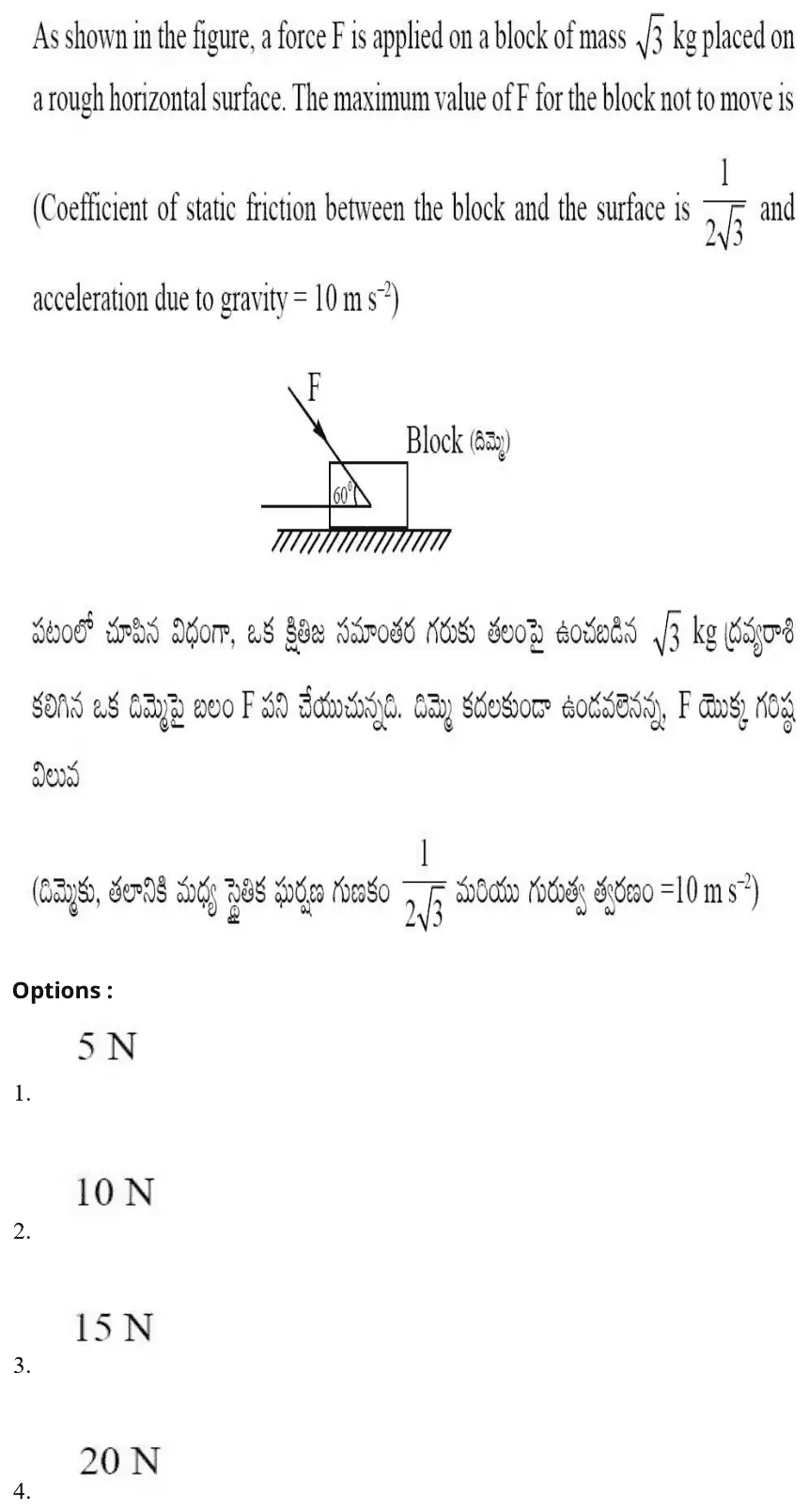
As shown in the figure, a force F is applied on a block of mass $\sqrt{3}$ kg placed on a rough horizontal surface. The maximum value of F for the block not to move is
(Coefficient of static friction between the block and the surface is $\frac{1}{2\sqrt{3}}$ and acceleration due to gravity = 10 m s$^{-2}$)
A body of mass $5\,\mathrm{kg}$ starts from the origin with an initial velocity $\left(30\hat{i}+40\hat{j}\right)\mathrm{ms^{-1}}$. If a constant force $-(\hat{i}+5\hat{j})\,\mathrm{N}$ acts on the body, then the time in which the y-component of its velocity becomes zero is
A block of mass 10 kg moving with a speed of $5\hat{i}\ \mathrm{m\,s^{-1}}$ on a frictionless horizontal surface suddenly explodes into two pieces. If one piece with mass 4 kg moves with a speed of $10\hat{i}\ \mathrm{m\,s^{-1}}$, then the velocity of the second piece is
A circular path of radius 75 m is banked at an angle of $\tan^{-1}(0.2)$. If the coefficient of static friction between the tyres of the car and the circular path is 0.1, then the maximum permissible speed of the car to avoid slipping is
A block of mass $\sqrt{2}$ kg is placed on a rough horizontal surface. A force ‘F’ acting upwards at an angle of $45^\circ$ with the horizontal causes the block to start motion. If the coefficient of static friction between the surface and the block is 0.25, the magnitude of the force ‘F’ is
(Acceleration due to gravity $=10\ \mathrm{ms^{-2}}$)
A force separately produces accelerations of $18\,\mathrm{ms^{-2}}$, $9\,\mathrm{ms^{-2}}$ and $6\,\mathrm{ms^{-2}}$ in three bodies of masses P, Q and R respectively. If the same force is applied on a body of mass $P+Q+R$, then the acceleration of that body is
A truck of mass 8 ton is carrying a block of mass 2 ton. If a breaking force of 25 kN is applied on the truck, then the frictional force acting on the block is
(Coefficient of static friction between the block and the truck is 0.3)
A balloon carrying some sand of mass M is moving down with a constant acceleration $a_0$. The mass 'm' of sand to be removed so that the balloon moves up with double the acceleration $a_0$ is
A soccer ball of mass 250 g is moving horizontally to the left with a speed $22\ \mathrm{ms^{-1}}$. This ball is kicked towards right with a velocity $30\ \mathrm{ms^{-1}}$ at an angle $53^\circ$ with the horizontal in upward direction. Assuming that it took 0.01 s for the collision to take place, the average force acting is $\left(\cos 53^\circ = \frac{3}{5};\ \sin 53^\circ = \frac{4}{5}\right)$
A block of mass 5 kg is placed on a rough horizontal surface having coefficient of friction 0.5. If a horizontal force of 60 N is acting on it, then the acceleration of the block is (Acceleration due to gravity, $g = 10\ \mathrm{ms^{-2}}$)
A body of 2 kg mass slides down with an acceleration of $4\ \mathrm{ms^{-2}}$ on an inclined plane having slope of $30^\circ$. The external force required to take the same body up the plane with same acceleration will be (Acceleration due to gravity $= 10\ \mathrm{ms^{-2}}$)
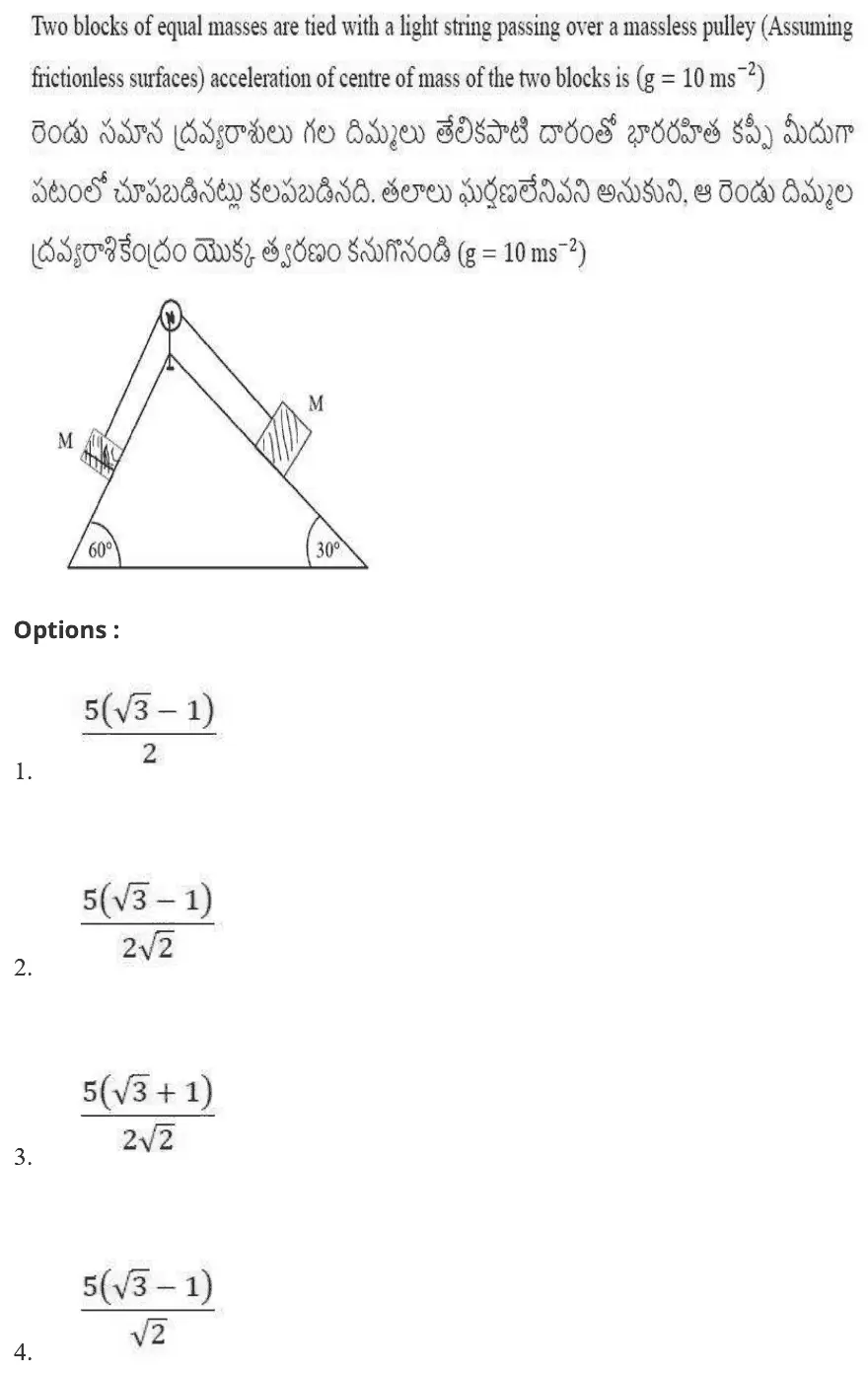
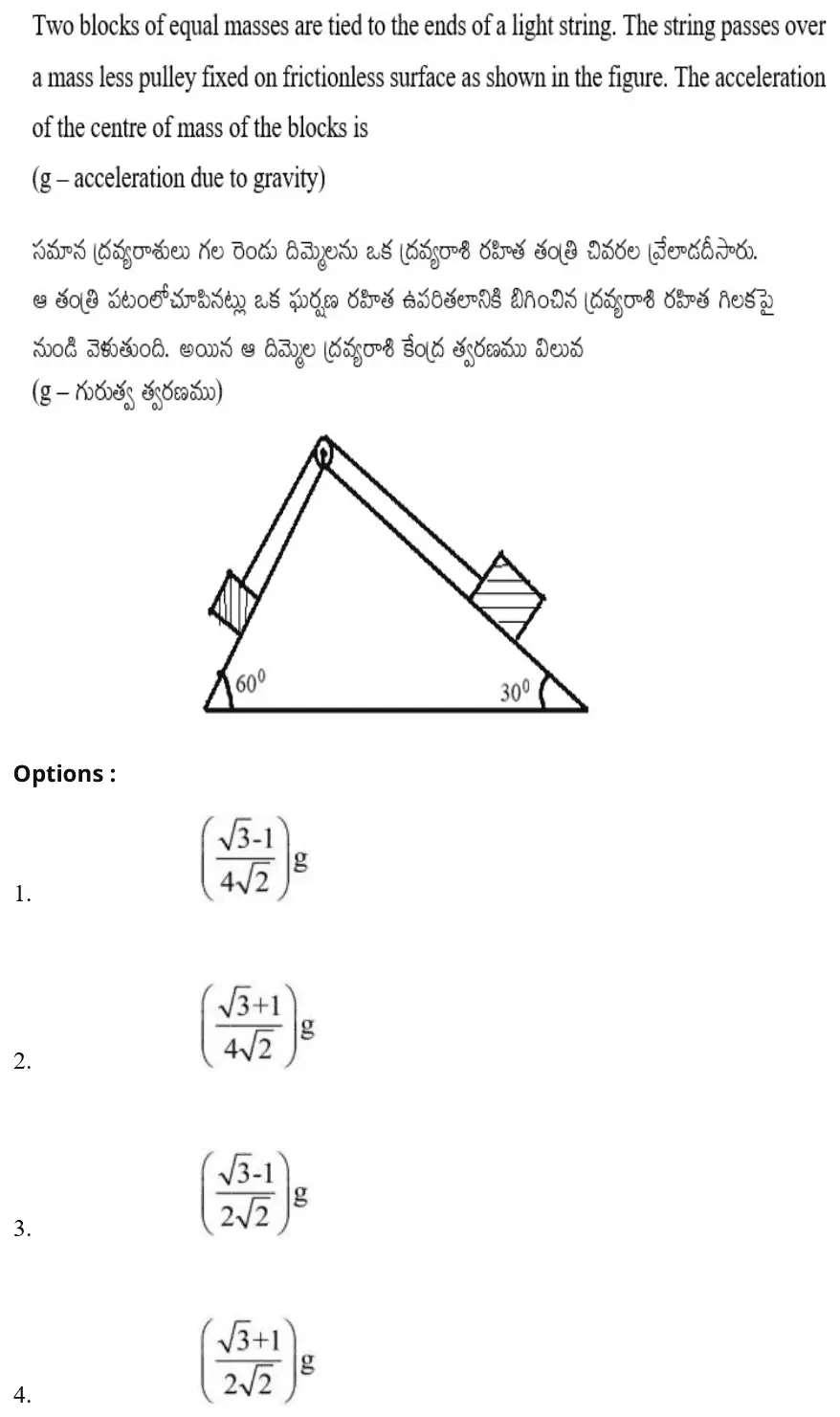
Two blocks of equal masses are tied with a light string passing over a massless pulley (Assuming frictionless surfaces) acceleration of centre of mass of the two blocks is (g = 10 ms$^{-2}$)
A body of mass $1.5\ \mathrm{kg}$ is moving towards south with a uniform velocity of $8\ \mathrm{ms^{-1}}$. A force of $6\ \mathrm{N}$ is applied to the body towards east. The displacement of the body $3$ seconds after the application of the force is
The upper $\left(\frac{1}{n}\right)^{th}$ of an inclined plane is smooth and the remaining lower part is rough with coefficient of friction $\mu_k$. If a body starting from rest at the top of the inclined plane will again come to rest at the bottom of the plane, then the angle of inclination of the inclined plane is
A block of metal $4\ \mathrm{kg}$ is in rest on a frictionless surface. It was targeted by a jet releasing water of $2\ \mathrm{kg\ s^{-1}}$ at a speed of $10\ \mathrm{ms^{-1}}$. The acceleration of the block is
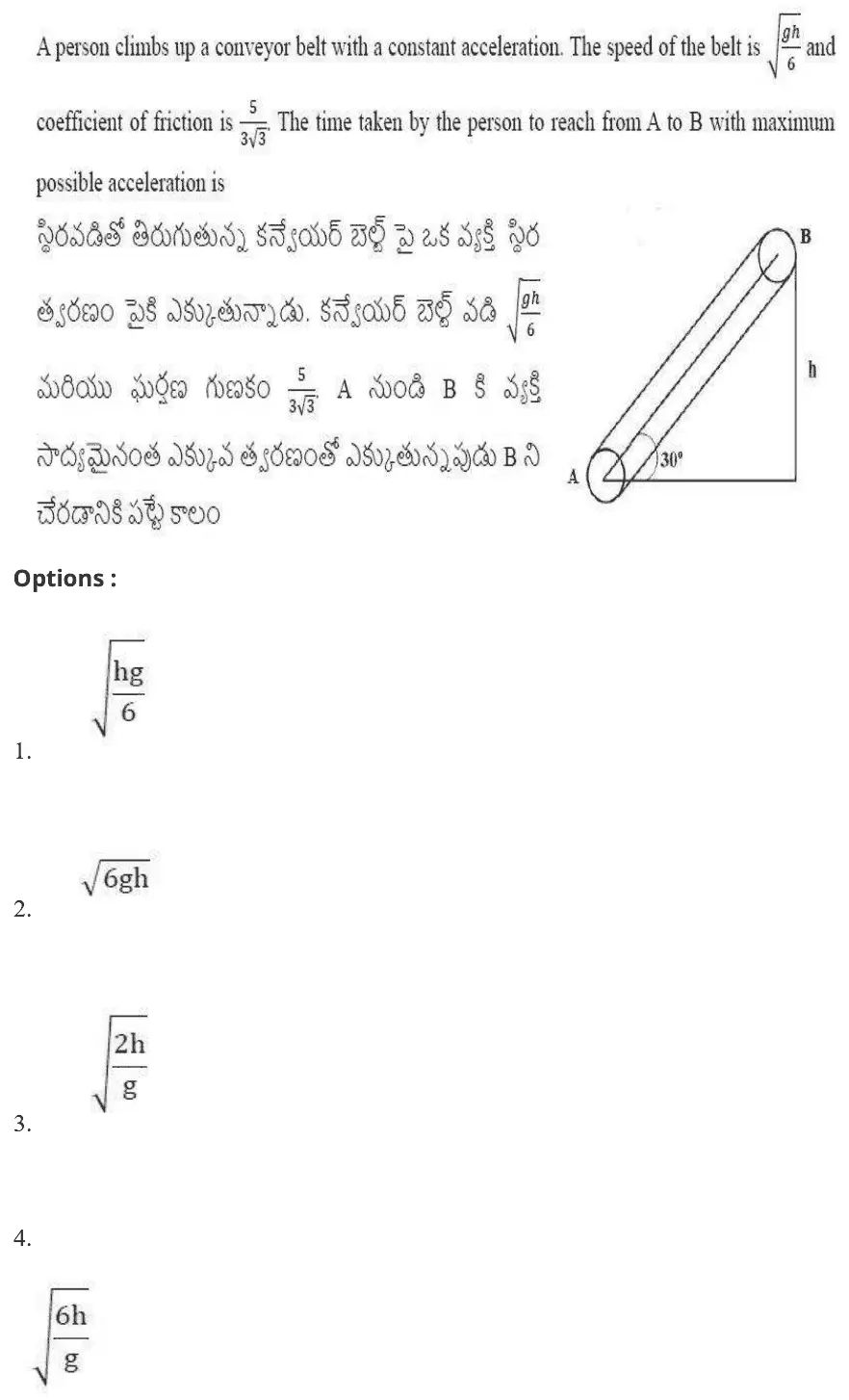
A person climbs up a conveyor belt with a constant acceleration. The speed of the belt is $\sqrt{\frac{gh}{6}}$ and coefficient of friction is $\frac{5}{3\sqrt{3}}$. The time taken by the person to reach from A to B with maximum possible acceleration is
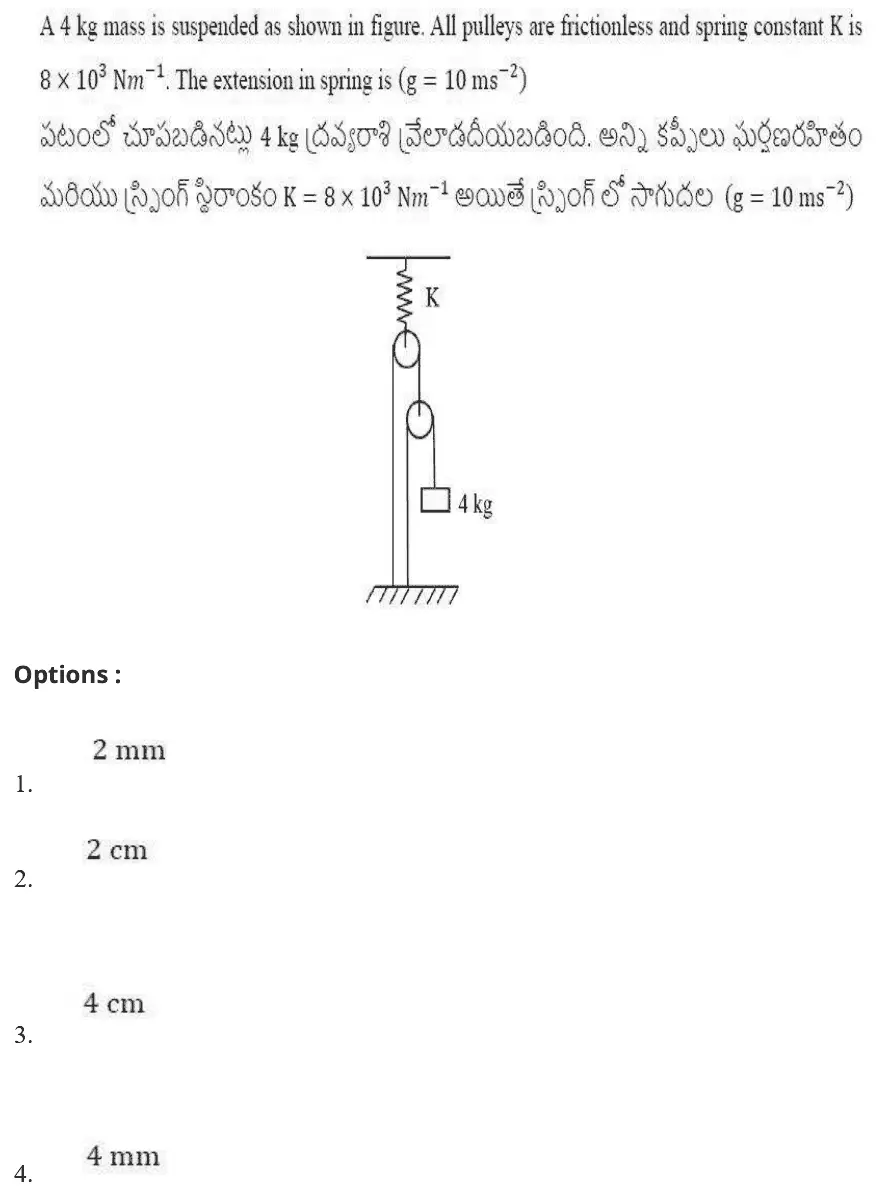
A 4 kg mass is suspended as shown in figure. All pulleys are frictionless and spring constant K is $8 \times 10^3\ \mathrm{Nm^{-1}}$. The extension in spring is ($g = 10\ \mathrm{ms^{-2}}$)
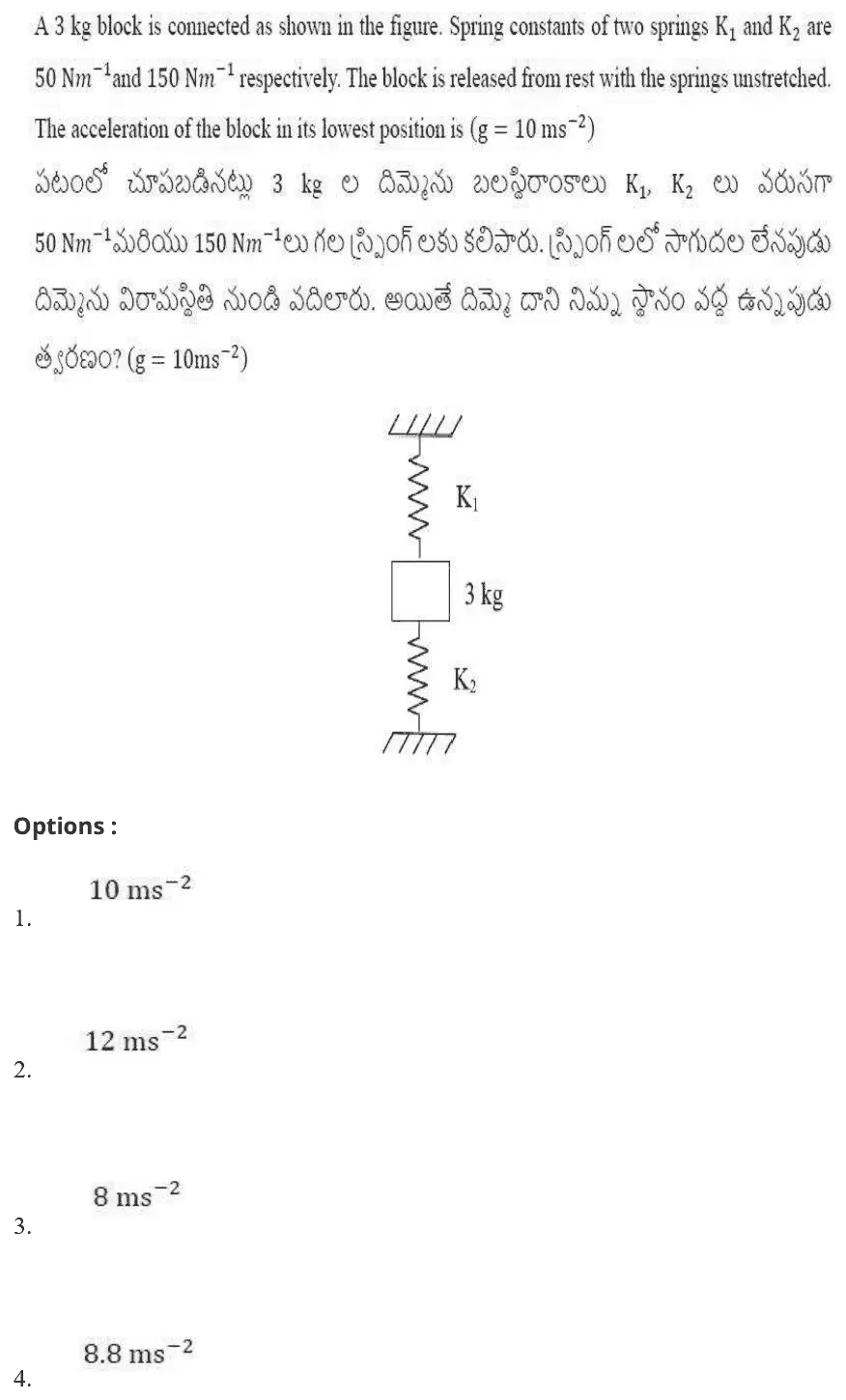
A 3 kg block is connected as shown in the figure. Spring constants of two springs $K_1$ and $K_2$ are $50\ \mathrm{Nm^{-1}}$ and $150\ \mathrm{Nm^{-1}}$ respectively. The block is released from rest with the springs unstretched. The acceleration of the block in its lowest position is ($g = 10\ \mathrm{ms^{-2}}$)
A block of metal $2$ kg is in rest on a smooth plane. It is striked by a jet releasing water of $1\ \mathrm{kg\ s^{-1}}$ at a speed of $5\ \mathrm{ms^{-1}}$, then the acceleration of the block is
An insect is crawling in a hemi-spherical bowl of radius 'R'. If the coefficient of friction between the insect and bowl is 'μ', then the maximum height to which the insect can crawl the bowl is
A small disc is on the top of a smooth hemisphere of radius 'R'. The smallest horizontal velocity 'V' that should be imparted to the disc so that disc leaves the hemisphere surface without sliding down is (there is no friction)
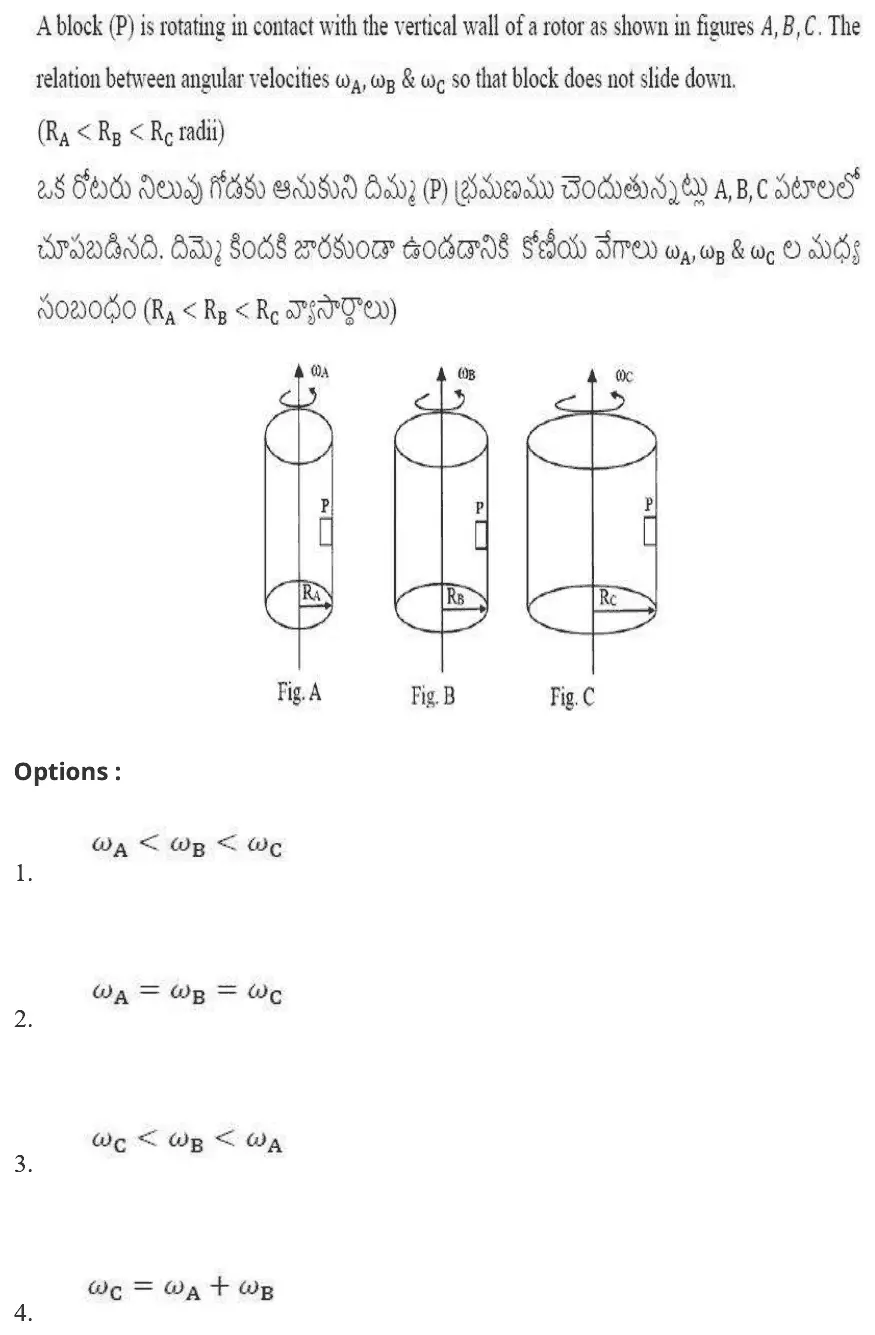
A block (P) is rotating in contact with the vertical wall of a rotor as shown in figures $A, B, C$. The relation between angular velocities $\omega_A, \omega_B$ & $\omega_C$ so that block does not slide down. ($R_A < R_B < R_C$ radii)
A block of mass $18.5$ kg kept on a smooth horizontal surface is pulled by a rope of $3$ m length by a horizontal force of $40$ N applied to the other end of the rope. If the linear density of the rope is $0.5\ \mathrm{kg\,m^{-1}}$ and initially the block is at rest, the time in which the block moves a distance of $9$ m is
A block of mass $1.5\,\mathrm{kg}$ kept on a rough horizontal surface is given a horizontal velocity of $10\,\mathrm{ms^{-1}}$. If the block comes to rest after travelling a distance of $12.5\,\mathrm{m}$, the coefficient of kinetic friction between the surface and the block is (Acceleration due to gravity = $10\,\mathrm{ms^{-2}}$)
Two masses $\mathrm{m_1}$ and $\mathrm{m_2}$ are connected by a light string passing over smooth pulley. When set free $\mathrm{m_1}$ moves downwards by 3 m in 3 s. The ratio of $\frac{\mathrm{m_1}}{\mathrm{m_2}}$ is ($g = 10\ ms^{-2}$)
A block of mass 5 kg is kept on a smooth horizontal surface. A horizontal stream of water coming out of a pipe of area of cross-section $5\ \mathrm{cm}^2$ hits the block with a velocity of $5\ \mathrm{ms^{-1}}$ and rebounds back with the same velocity. The initial acceleration of the block is (Density of water is 1 g/cc)
An aircraft executes a horizontal loop of radius 9 km at a constant speed of $540\ \mathrm{kmh^{-1}}$. The wings of the aircraft are banked at an angle of (Acceleration due to gravity $=10\ \mathrm{ms^{-2}}$)
A block is kept on a rough horizontal surface. The acceleration of the block increases from $6\ \mathrm{ms^{-2}}$ to $11\ \mathrm{ms^{-2}}$ when the horizontal force acting on it increases from 20 N to 30 N. The coefficient of kinetic friction between the block and the surface is
(Acceleration due to gravity = $10\ \mathrm{ms^{-2}}$)
A car is moving on circular track banked at an angle of $45^\circ$. If the maximum permissible speed of the car to avoid slipping is twice the optimum speed of the car to avoid the wear and tear of the tyres, then the coefficient of static friction between the wheels of the car and the road is
A 20 ton truck is travelling along a curved path of radius 240 m. If the center of gravity of the truck above the ground is 2 m and the distance between its wheels is 1.5 m, the maximum speed of the truck with which it can travel without toppling over is
(Acceleration due to gravity $= 10\ \mathrm{ms^{-2}}$)
A block of mass 'm' with an initial kinetic energy 'E' moves up an inclined plane of inclination '$\theta$'. If '$\mu$' is the coefficient of friction between the plane and the body, the work done against friction before coming to rest is
A
$\mu E \cos\theta$
B
$\dfrac{\mu E \cos\theta}{\sin\theta - \mu \cos\theta}$
A man of mass 80 kg goes to the market on a scooter of mass 100 kg with certain speed. On application of brakes, the stopping distance is $S_1$. The man returns home on the same scooter, with the same speed with a 60 kg bag of rice. If $S_2$ is the new stopping distance when the brakes are applied with the same force, then
A body of mass 2 kg is on an inclined plane of inclination $30^\circ$ and coefficient of friction is $\left(\frac{1}{\sqrt{3}}\right)$. The minimum force required to move the body up the inclined plane is (Acceleration due to gravity = $10\ \mathrm{ms^{-2}}$)
A body of mass 10 kg is kept on a rough horizontal surface of coefficient of friction 0.3. If a horizontal force of 50 N is applied on the body, then the acceleration of the body is
(Acceleration due to gravity = $10\ \mathrm{ms^{-2}}$)
A truck of mass M and a car of mass $\frac{M}{10}$ moving with same momentum are brought to halt by the application of same breaking force. The ratio of the distances travelled by truck and car before they come to stop is
The force required to stop a body of mass $10\ \mathrm{kg}$ moving along a straight line path with a velocity of $10\ \mathrm{ms^{-1}}$ in a time of $10\ \mathrm{s}$ is
A truck of mass 2000 kg is moving along a circular path having radius of curvature 10 m. If the banking angle is $39^\circ$, then the maximum permissible speed of the truck is
(Acceleration due to gravity $= 10\ \mathrm{ms^{-2}}$, take $\tan 39^\circ = 0.81$)
A body of mass 1 kg is moving with a velocity 10 $\mathrm{ms^{-1}}$ due to a constant force on a horizontal rough surface having coefficient of kinetic friction 0.4. If the constant force is removed, the body comes to rest in a time
(Acceleration due to gravity = 10 $\mathrm{ms^{-2}}$)
A bomb at rest explodes into three pieces of equal masses. If two pieces move perpendicular to each other, each with a speed v then the speed of the third piece is
A stone of mass 2 kg is tied at one end of a string of length 2 m and is whirled in a horizontal circle. If the string can withstand a maximum tension of 64 N, then the permissible maximum number of rotations per minute is
A motor vehicle of mass 1000 kg is moving on a circular road having banking angle $30^\circ$ and coefficient of friction 0.2. Then the normal reaction force on the motor vehicle is about
(Acceleration due to gravity = $10\ \mathrm{ms^{-2}}$)
A car is moving along a circular path having coefficient of friction 0.5 and radius of curvature 16.2 m. Then the maximum velocity of the car that can travel without falling outwards is
(Acceleration due to gravity = $10\ \mathrm{ms^{-2}}$)
A body of mass 10 g is tied to a string of length 0.4 m and it is whirled in a horizontal plane with a speed of $6\ \mathrm{ms^{-1}}$. Then the tension in the string is
A car of mass 1500 kg is moving with 20 $\mathrm{ms^{-1}}$ velocity. If the breaks are applied it comes to rest in 5 seconds, then the retarding force is
Two springs A and B fixed at the top and are stretched by 8 cm and 16 cm respectively, when loads of 20 N and 10 N are suspended at the lower ends. The ratio of the spring constants of the springs A and B is
A block of mass 5 kg moving on a rough surface with a velocity of $4\ \mathrm{ms^{-1}}$ is stopped by the friction in 2 seconds. Then the coefficient of friction between the contact surfaces is
(Acceleration due to gravity = $10\ \mathrm{ms^{-2}}$)
A man weighing 75 kg is standing in a lift. The weight of the man standing on a weighing machine kept in the lift when the lift is moving downwards freely under gravity is
If the radii of circular paths of two particles of same mass are in the ratio of $1:2$, then to have a constant centripetal force, the ratio of their speeds should be
A bomb of mass $16\ \mathrm{kg}$ explodes into two pieces of masses $4\ \mathrm{kg}$ and $12\ \mathrm{kg}$. The velocity of the $12\ \mathrm{kg}$ mass is $4\ \mathrm{ms^{-1}}$. The kinetic energy of the second piece is
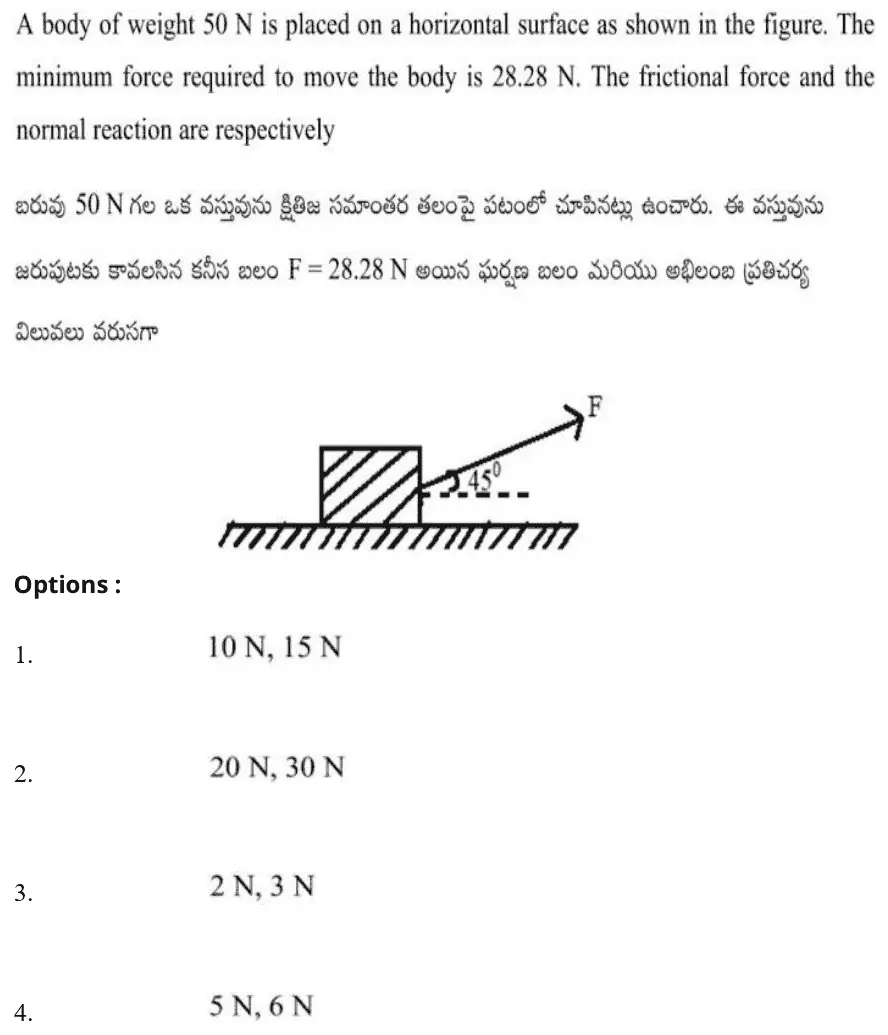
A body of weight 50 N is placed on a horizontal surface as shown in the figure. The minimum force required to move the body is 28.28 N. The frictional force and the normal reaction are respectively
Two blocks of equal masses are tied to the ends of a light string. The string passes over a mass less pulley fixed on frictionless surface as shown in the figure. The acceleration of the centre of mass of the blocks is (g – acceleration due to gravity)
Two blocks of masses $W_1$ and $W_2$ are suspended from the ends of a light string passing over a smooth fixed pulley. If the pulley is pulled up with an acceleration ‘g’, then the tension in the string will be
A person initially at rest, starts walking towards east without slipping or skidding. What is the type of friction acting on the person from the ground and in which direction the frictional force acts?
At time t = 0, a force $F = \alpha t$, where t is time in seconds, is applied to a body of mass 1 kg, resting on a smooth horizontal plane. If the direction of the force makes an angle of 45$^\circ$ with the horizontal, then the velocity of the body at the moment of its breaking off the plane is
A spherical bob of mass 250g is attached to the end of a string having length 50 cm. The bob is rotated on a horizontal circular path about a vertical axis. The maximum tension that the string can bear is 72 N. The maximum possible value of angular velocity of bob (in rad/s) is
A motor car moving with velocity 7 m/s stops in 10 m distance when brakes are applied. What is the relation between the resistance force (R) and the weight (W) of the car? (Take value of g = 9.8 m/s$^2$)
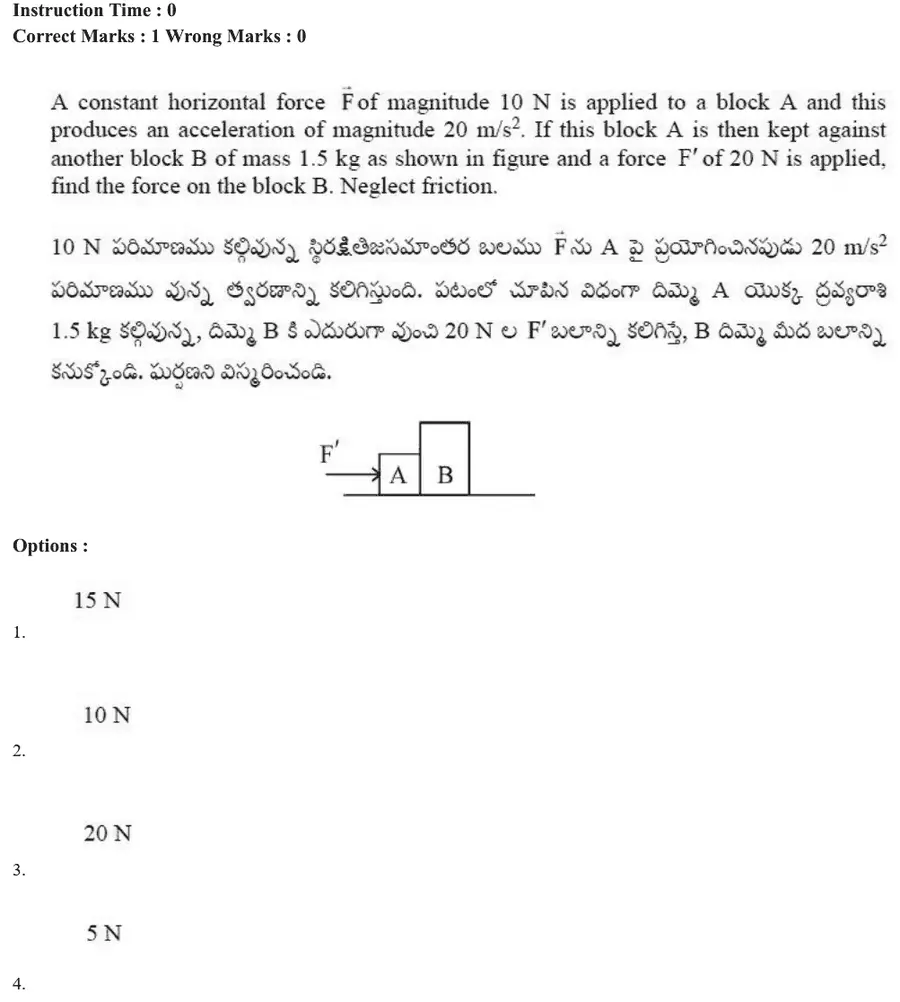
A constant horizontal force $\vec{F}$ of magnitude 10 N is applied to a block A and this produces an acceleration of magnitude $20\ \mathrm{m/s^{2}}$. If this block A is then kept against another block B of mass 1.5 kg as shown in figure and a force $F'$ of 20 N is applied, find the force on the block B. Neglect friction. (see the figure above)
A body of mass 'm' slides down along a frictionless inclined plane from height 'h' and just completes motion in a vertical circle of radius 2m after reaching the bottom. What is the value of h? [Use $g=10\ \mathrm{m/s^{2}}$]
Two blocks of masses 1 kg and 2 kg connected by a light rod and the system is slipping down a rough incline angle $45^{\circ}$ with the horizontal. The frictional coefficient at both the contacts is 0.4. If the acceleration of the system is $\alpha\sqrt{2}$, the value of $\alpha$ is (Use g = 10m/s$^{2}$)
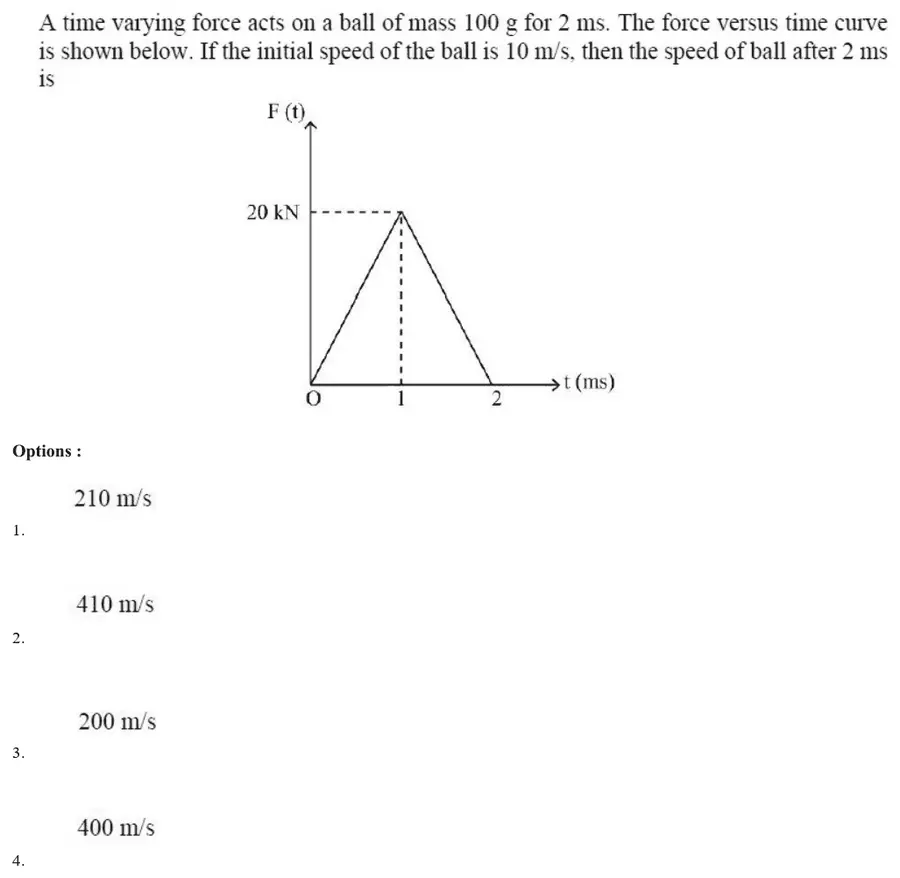
A time varying force acts on a ball of mass 100 g for 2 ms. The force versus time curve is shown below. If the initial speed of the ball is 10 m/s, then the speed of ball after 2 ms is (see the figure above)
A block is placed on a parabolic shape ramp given by equation $y=\frac{x^{2}}{20}$. If the coefficient of static friction ($\mu_{s}$) is 0.5, then what is the maximum height above the ground at which the block can be placed without slipping?
A block of mass 8 kg is suspended by a rope of length 3 m from the ceiling. A force of 40 N is applied horizontally to the block. Then the angle that the rope makes with the vertical in equilibrium is (acceleration due to gravity $= 10\ \mathrm{m\,s^{-2}}$, neglect the mass of the rope)
A block of 10 kg mass is connected to the top of a frictionless inclined plane of inclination $45^\circ$ by a spring of negligible mass, unstretched length 0.8 m and spring constant $100\sqrt{2}\ \mathrm{Nm^{-1}}$. Then the distance of the block from the top along the incline in the equilibrium position is (acceleration due to gravity $= 10\ \mathrm{m\,s^{-2}}$)
A block is lying at rest inside a bus. The maximum acceleration of the bus such that the block remain stationary (the static friction coefficient = 0.2, acceleration due to gravity = $10\ \mathrm{m\,s^{-2}}$)
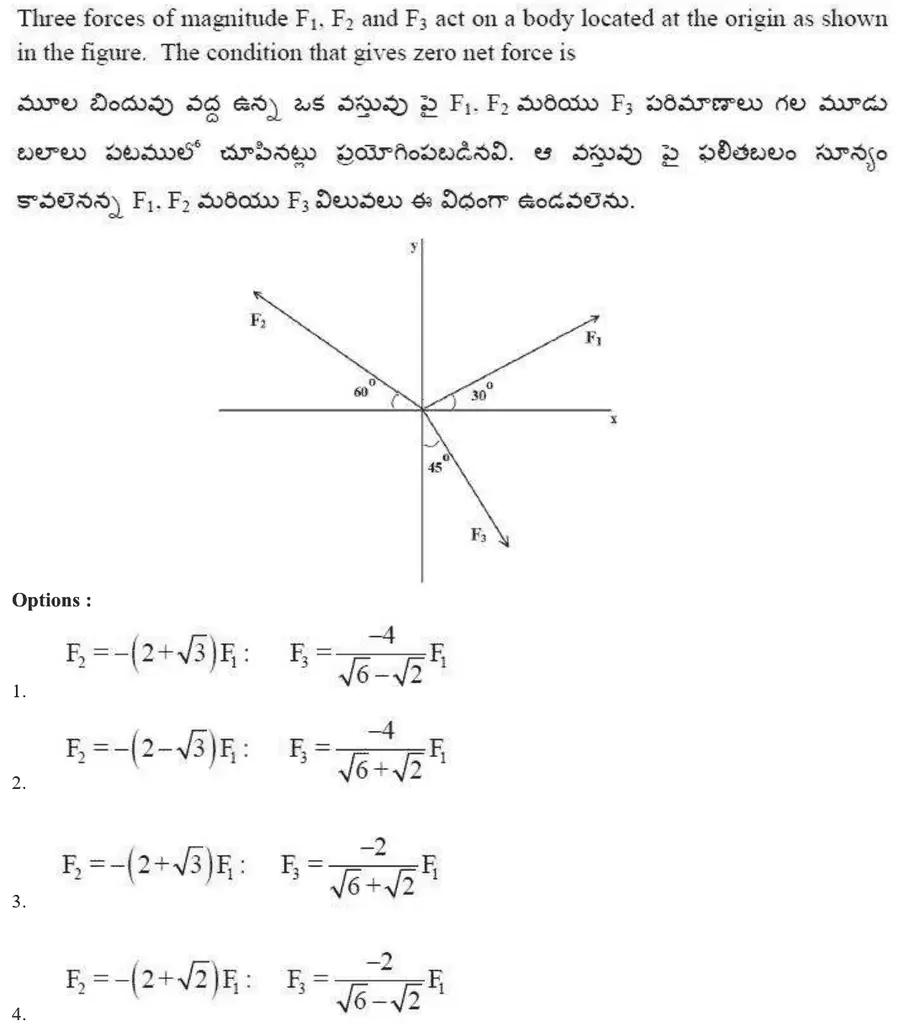
Three forces of magnitude $F_1$, $F_2$ and $F_3$ act on a body located at the origin as shown in the figure. The condition that gives zero net force is (see the figure above)
In the case of a wire, having negligible mass suspended from ceiling and stretched under the action of a weight F suspended from its other end, the tension at any cross-section of the wire is
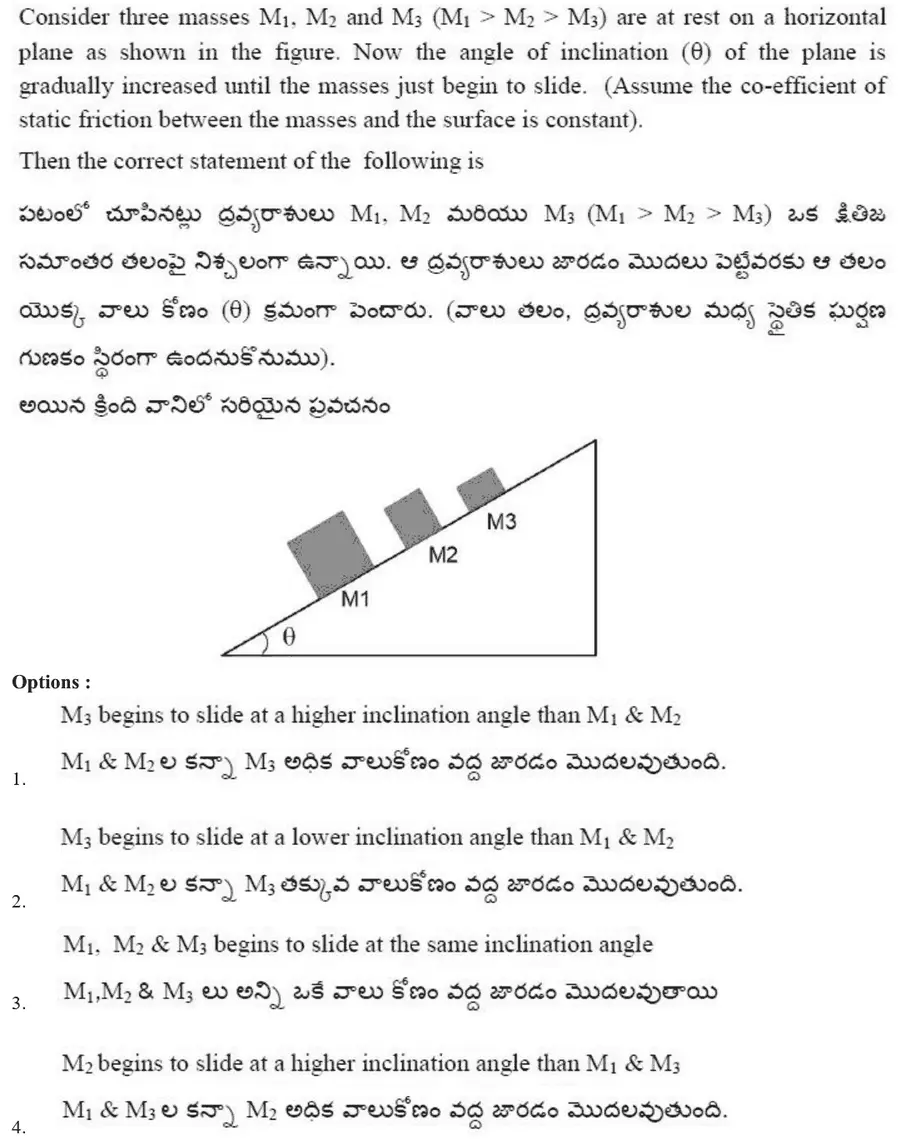
Consider three masses $M_1$, $M_2$ and $M_3$ ($M_1 > M_2 > M_3$) are at rest on a horizontal plane as shown in the figure. Now the angle of inclination ($\theta$) of the plane is gradually increased until the masses just begin to slide. (Assume the co-efficient of static friction between the masses and the surface is constant). Then the correct statement of the following is (see the figure above)
The question as printed in the paper.
A
$M_3$ begins to slide at a higher inclination angle than $M_1$ & $M_2$
B
$M_3$ begins to slide at a lower inclination angle than $M_1$ & $M_2$
C
$M_1$, $M_2$ & $M_3$ begins to slide at the same inclination angle
D
$M_2$ begins to slide at a higher inclination angle than $M_1$ & $M_3$
A block of mass 5 kg starts up a $45^\circ$ incline plane with initial kinetic energy of 100 J. If the coefficient of friction between block and plane is 0.5 then the distance covered by the block before it stops is (Acceleration due to gravity = $10\ \mathrm{m\,s^{-2}}$)
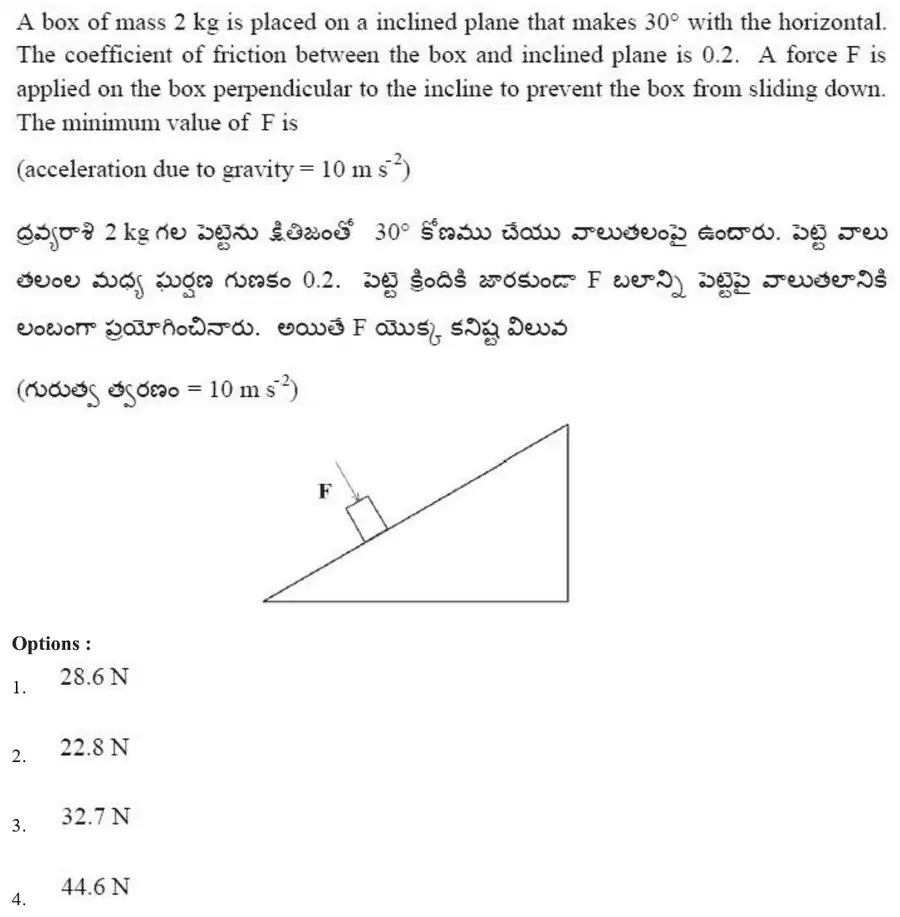
A box of mass 2 kg is placed on a inclined plane that makes $30^\circ$ with the horizontal. The coefficient of friction between the box and inclined plane is 0.2. A force F is applied on the box perpendicular to the incline to prevent the box from sliding down. The minimum value of F is (acceleration due to gravity = $10\ \mathrm{m\,s^{-2}}$) (see the figure above)
The coefficient of friction between object and substance, if we need to move an object of weight 150 N on a horizontal surface with a force of 75 N, is
The coefficient of static friction between the road and tyres of a car is 0.4. The maximum permissible speed of the car is $10\ \mathrm{ms^{-1}}$ on curved unbanked road. Then the maximum radius of curvature of the road is (acceleration due to gravity = $10\ \mathrm{ms^{-2}}$ )
A particle attached to a string of length r is moving on vertical circular path continuously. If the speed of the particle at the highest point is $\sqrt{7gr}$, then the ratio of the respective tension in the string holding it at the highest and the lowest points is (g $-$ acceleration due to gravity)
A boat of mass 700 kg is travelling at a speed of $24\ \mathrm{ms^{-1}}$ when its engine is shut off. The magnitude of frictional force f between boat and water is given as $f = 35v$, where v is the speed in $\mathrm{ms^{-1}}$ and f is in newton. The speed of boat becomes $6\ \mathrm{ms^{-1}}$ in time.
A body is travelling with $10\ \mathrm{m\,s^{-1}}$ on a rough horizontal surface. It's velocity after 2 s is $4\ \mathrm{m\,s^{-1}}$. The co-efficient of kinetic friction between the block and the plane is (acceleration due to gravity $= 10\ \mathrm{m\,s^{-2}}$)
Ball A of mass 1 kg moving along a straight line with a velocity of $4\ \mathrm{m\,s^{-1}}$ hits another ball B of mass 3 kg which is at rest. After collision, they stick together and move with the same velocity along the same straight line. If the time of impact of the collision is 0.1 s then the force exerted on B is
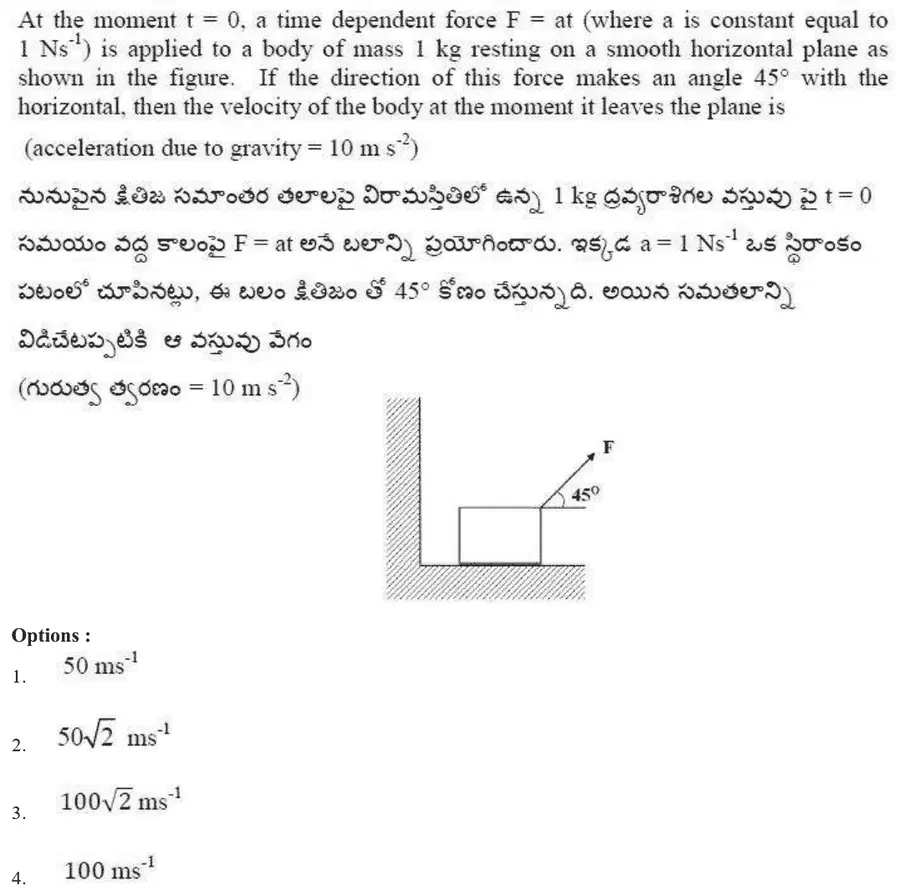
At the moment t = 0, a time dependent force F = at (where a is constant equal to $1\ \mathrm{Ns^{-1}}$) is applied to a body of mass 1 kg resting on a smooth horizontal plane as shown in the figure. If the direction of this force makes an angle $45^\circ$ with the horizontal, then the velocity of the body at the moment it leaves the plane is
(acceleration due to gravity = $10\ \mathrm{m\,s^{-2}}$)
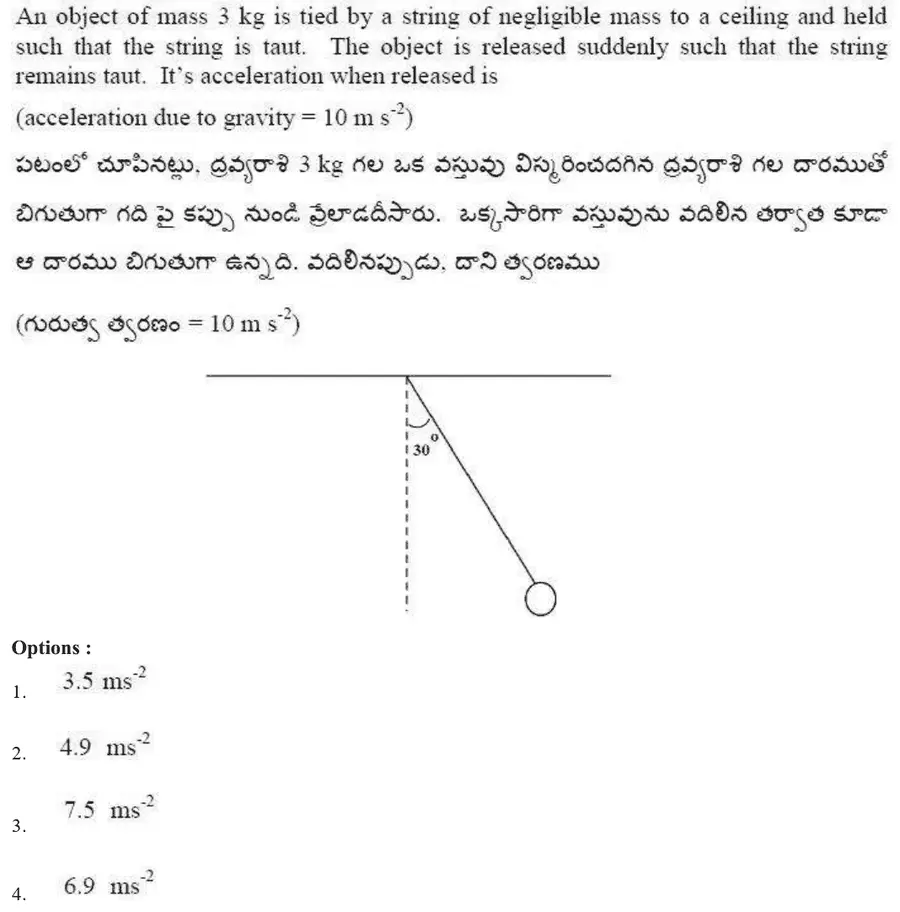
An object of mass 3 kg is tied by a string of negligible mass to a ceiling and held such that the string is taut. The object is released suddenly such that the string remains taut. It's acceleration when released is
(acceleration due to gravity = $10\ \mathrm{m\,s^{-2}}$)
Two rectangular blocks of masses 40 kg and 60 kg are connected by a string and kept on a frictionless horizontal table. If a force of 1000 N is applied on 60 kg block away from 40 kg block, then the tension in string is
A ball of mass 0.5 kg moving horizontally at 10 $\mathrm{ms^{-1}}$ strikes a vertical wall and rebounds with speed V. The magnitude of the change in linear momentum is found to be 8.0 $\mathrm{kg\,ms^{-1}}$. The magnitude of V is
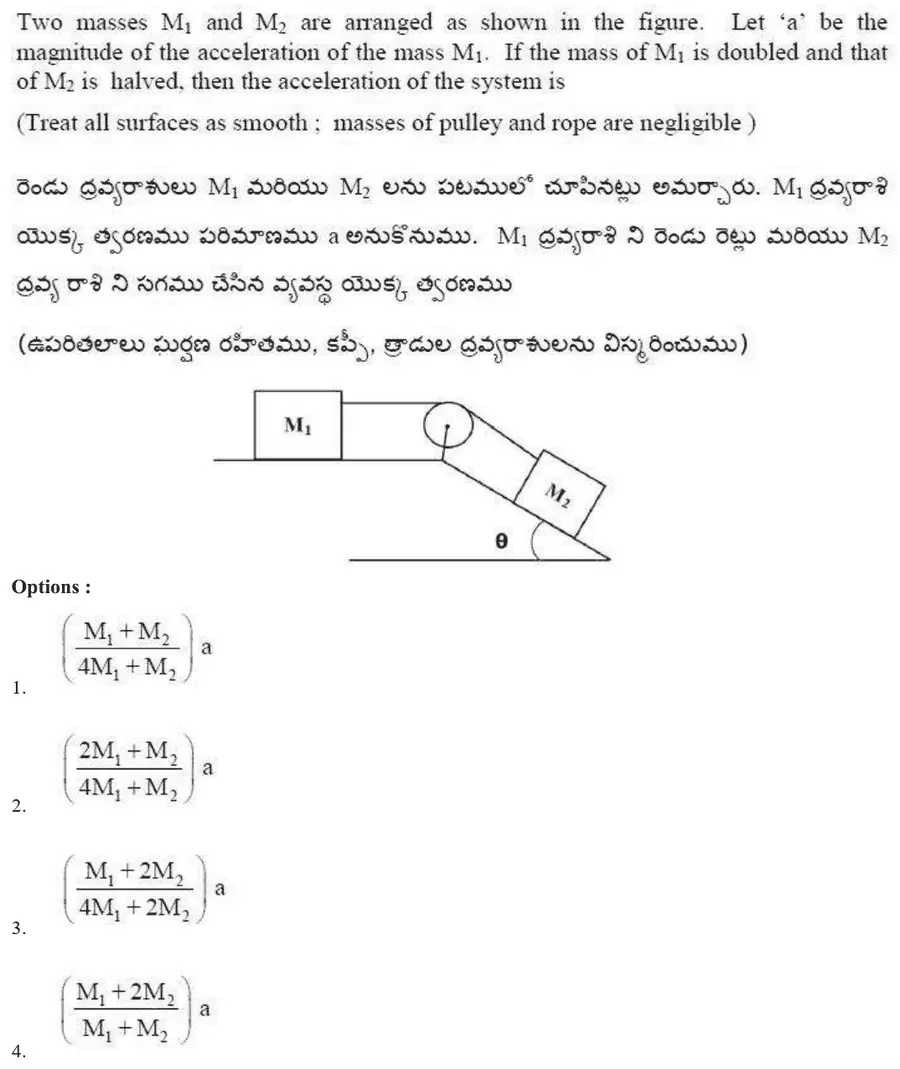
Two masses $M_1$ and $M_2$ are arranged as shown in the figure. Let 'a' be the magnitude of the acceleration of the mass $M_1$. If the mass of $M_1$ is doubled and that of $M_2$ is halved, then the acceleration of the system is (Treat all surfaces as smooth ; masses of pulley and rope are negligible ) (see the figure above)
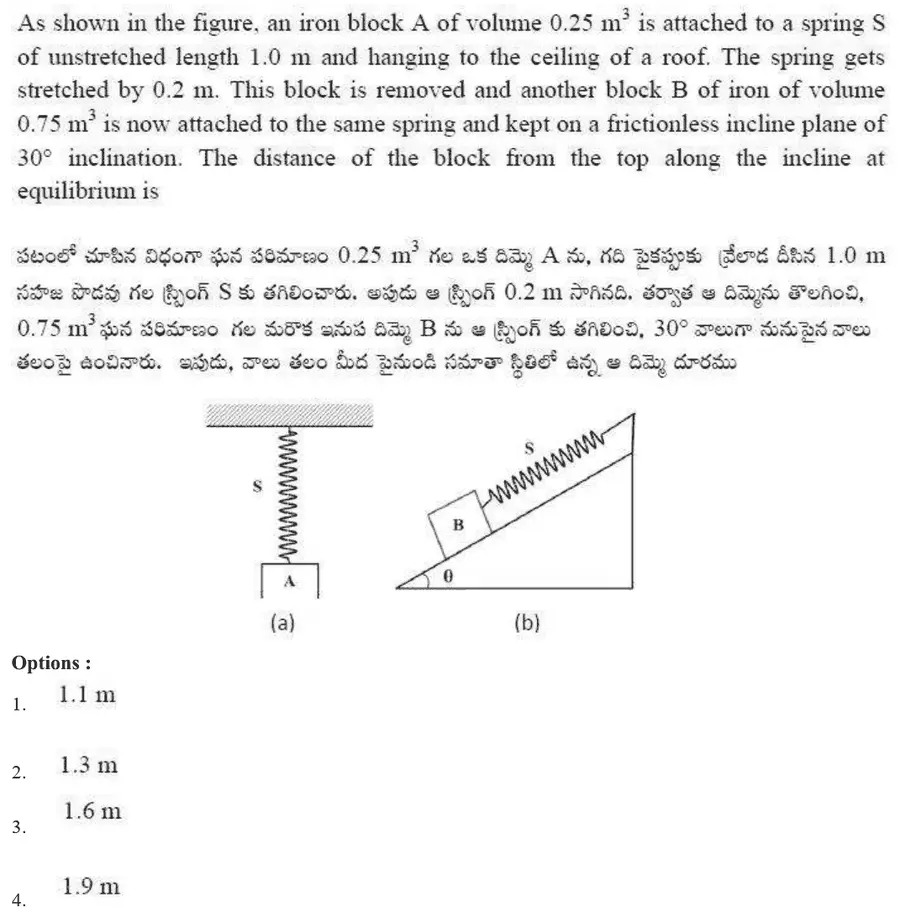
As shown in the figure, an iron block A of volume $0.25\ \mathrm{m^3}$ is attached to a spring S of unstretched length 1.0 m and hanging to the ceiling of a roof. The spring gets stretched by 0.2 m. This block is removed and another block B of iron of volume $0.75\ \mathrm{m^3}$ is now attached to the same spring and kept on a frictionless incline plane of $30^\circ$ inclination. The distance of the block from the top along the incline at equilibrium is (see the figure above)
When a vehicle of mass $m$ is moving with a velocity $v$ over a concave over-bridge, of radius of curvature $r$, the thrust on the road at the lowest point on the bridge will be ______
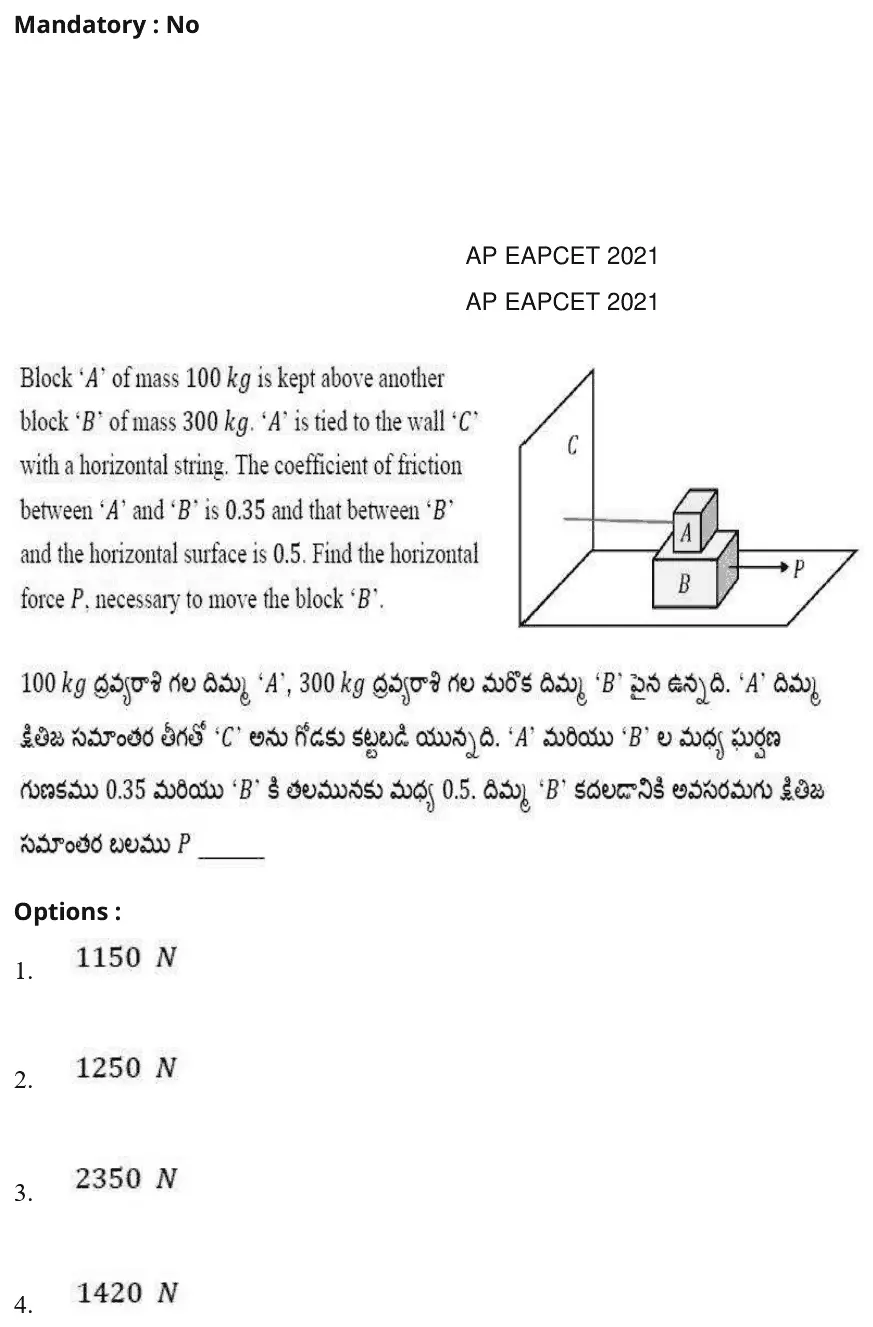
Block 'A' of mass $100\ \mathrm{kg}$ is kept above another block 'B' of mass $300\ \mathrm{kg}$. 'A' is tied to the wall 'C' with a horizontal string. The coefficient of friction between 'A' and 'B' is 0.35 and that between 'B' and the horizontal surface is 0.5. Find the horizontal force $P$, necessary to move the block 'B'. (see the figure above)
Two bodies having masses in the ratio $2:3$ fall freely under gravity from heights which are in the ratio $9:16$. The ratio of their linear momenta on touching the ground is ______
A particle of mass $5\,\mathrm{kg}$ is moving on a circle of radius $1\,\mathrm{m}$ with an angular velocity of $2\,\mathrm{rad.s^{-1}}$. The centripetal force is ________
A body of weight $64\,\mathrm{N}$ is pushed with just enough force to start it moving across a horizontal floor and the same force continues to act afterwards. If the coefficients of static and dynamic frictions are 0.8 and 0.6 respectively, the acceleration of the body will be ______
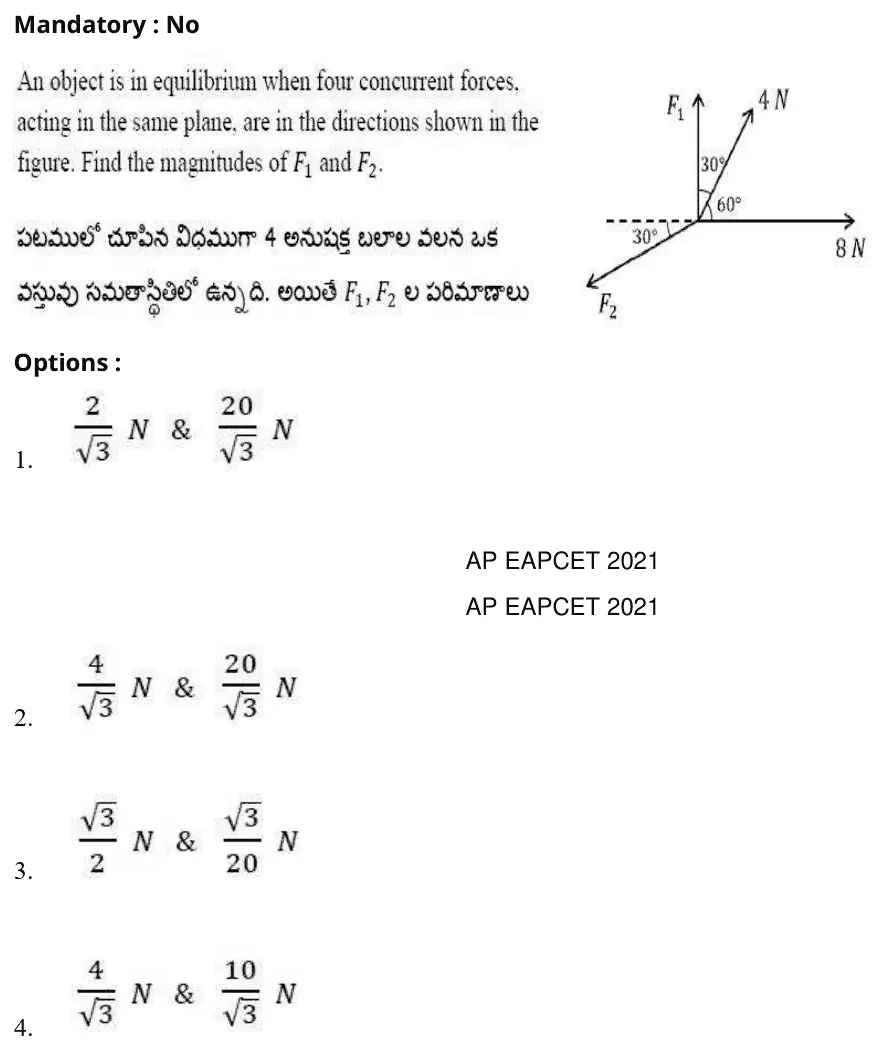
An object is in equilibrium when four concurrent forces, acting in the same plane, are in the directions shown in the figure. Find the magnitudes of $F_1$ and $F_2$. (see the figure above)
What is the angle of banking of a railway track of radius of curvature $250\ \mathrm{m}$, if the maximum velocity of the train is $90\ \mathrm{kmph}$? (use $g = 10\ \mathrm{m.s^{-2}}$)
When a force $\vec{F}$ given by $\vec{F} = 6\hat{i} - 18\hat{j} + 10\hat{k}$ acts on a body, it imparts an acceleration of $8\ \mathrm{m.s^{-2}}$. Then find the mass of the body ______
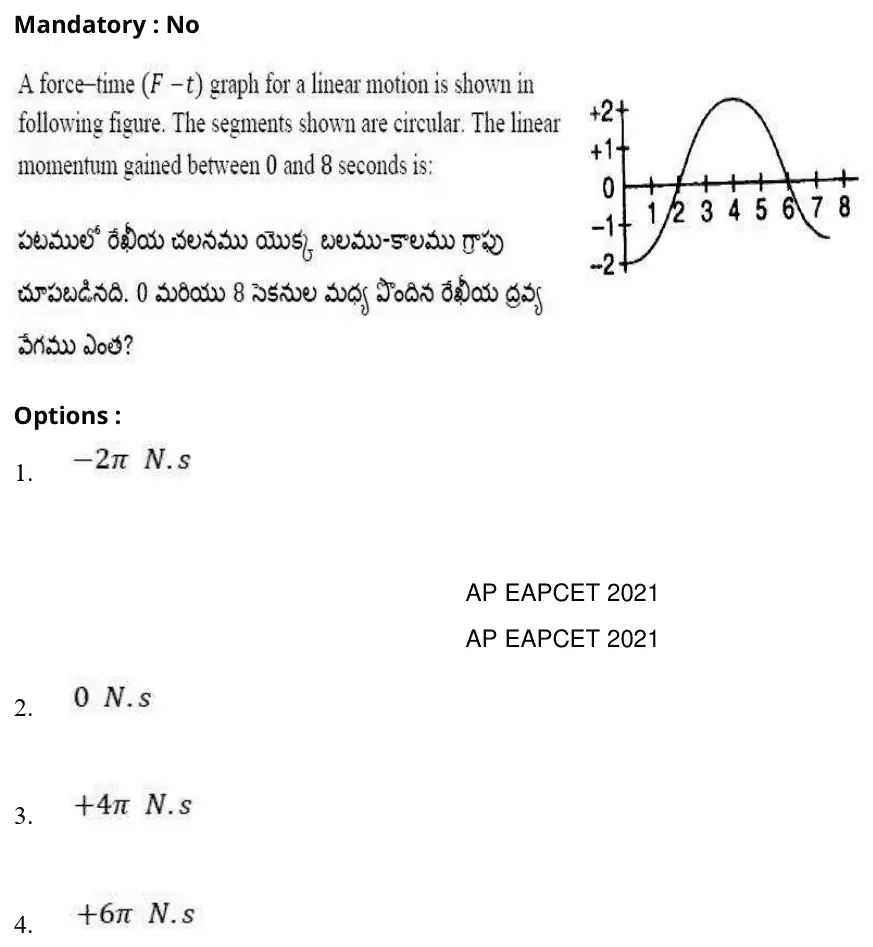
A force–time ($F-t$) graph for a linear motion is shown in following figure. The segments shown are circular. The linear momentum gained between 0 and 8 seconds is: (see the figure above)
A body of mass $2\ kg$ is acted upon by two forces each of magnitude $1\ N$, making an angle of $60^\circ$ with each other. The net acceleration of the body (in $m.s^{-2}$) is:
A shell of mass 'm', moving with velocity 'v' suddenly breaks into two pieces. If one of those parts having mass $m/6$ remains stationary, find the velocity of the other part.
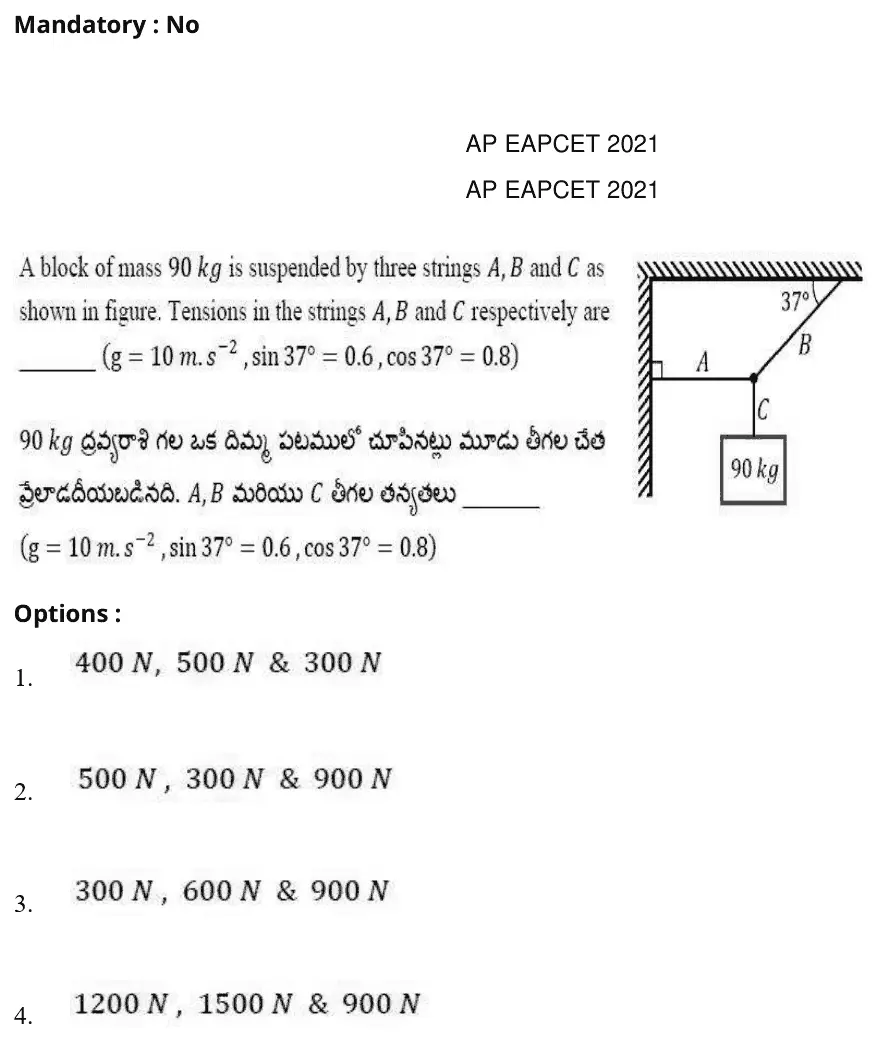
A block of mass $90\ kg$ is suspended by three strings $A, B$ and $C$ as shown in figure. Tensions in the strings $A, B$ and $C$ respectively are ______ ($g = 10\ \mathrm{m.s^{-2}}$, $\sin 37° = 0.6$, $\cos 37° = 0.8$) (see the figure above)
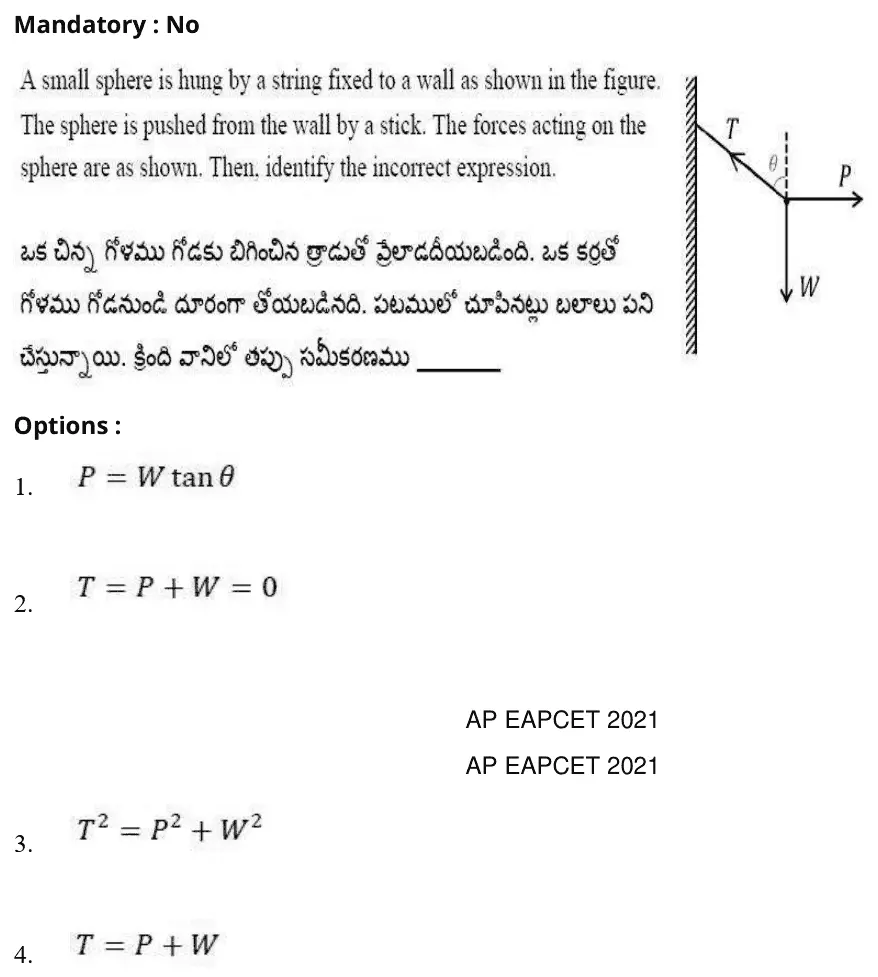
A small sphere is hung by a string fixed to a wall as shown in the figure. The sphere is pushed from the wall by a stick. The forces acting on the sphere are as shown. Then, identify the incorrect expression. (see the figure above)
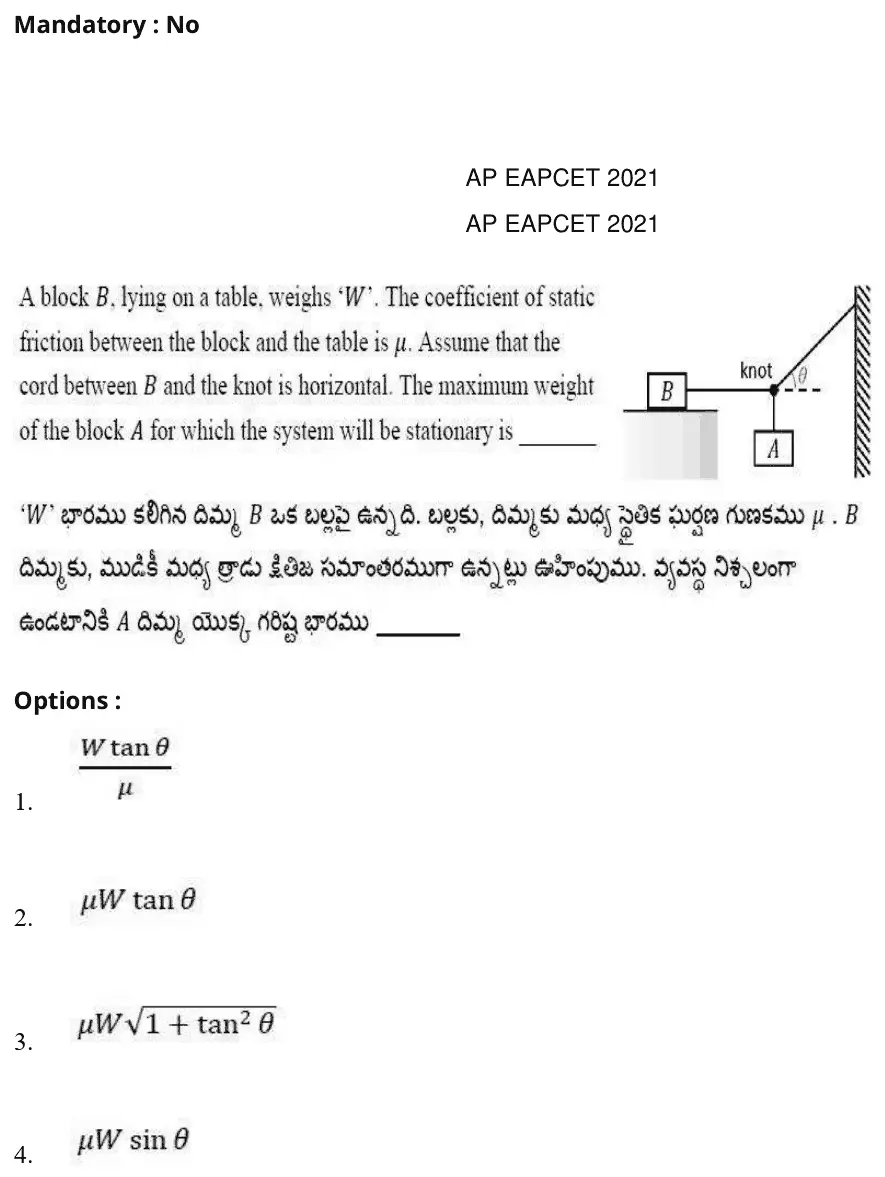
A block $B$, lying on a table, weighs '$W$'. The coefficient of static friction between the block and the table is $\mu$. Assume that the cord between $B$ and the knot is horizontal. The maximum weight of the block $A$ for which the system will be stationary is ______ (see the figure above)
A cylinder of mass 12 $kg$ is sliding on plane with an initial velocity $20\ m.s^{-1}$. If the coefficient of friction between the surface and the cylinder is 0.5, before stopping, the cylinder describes a distance of ______
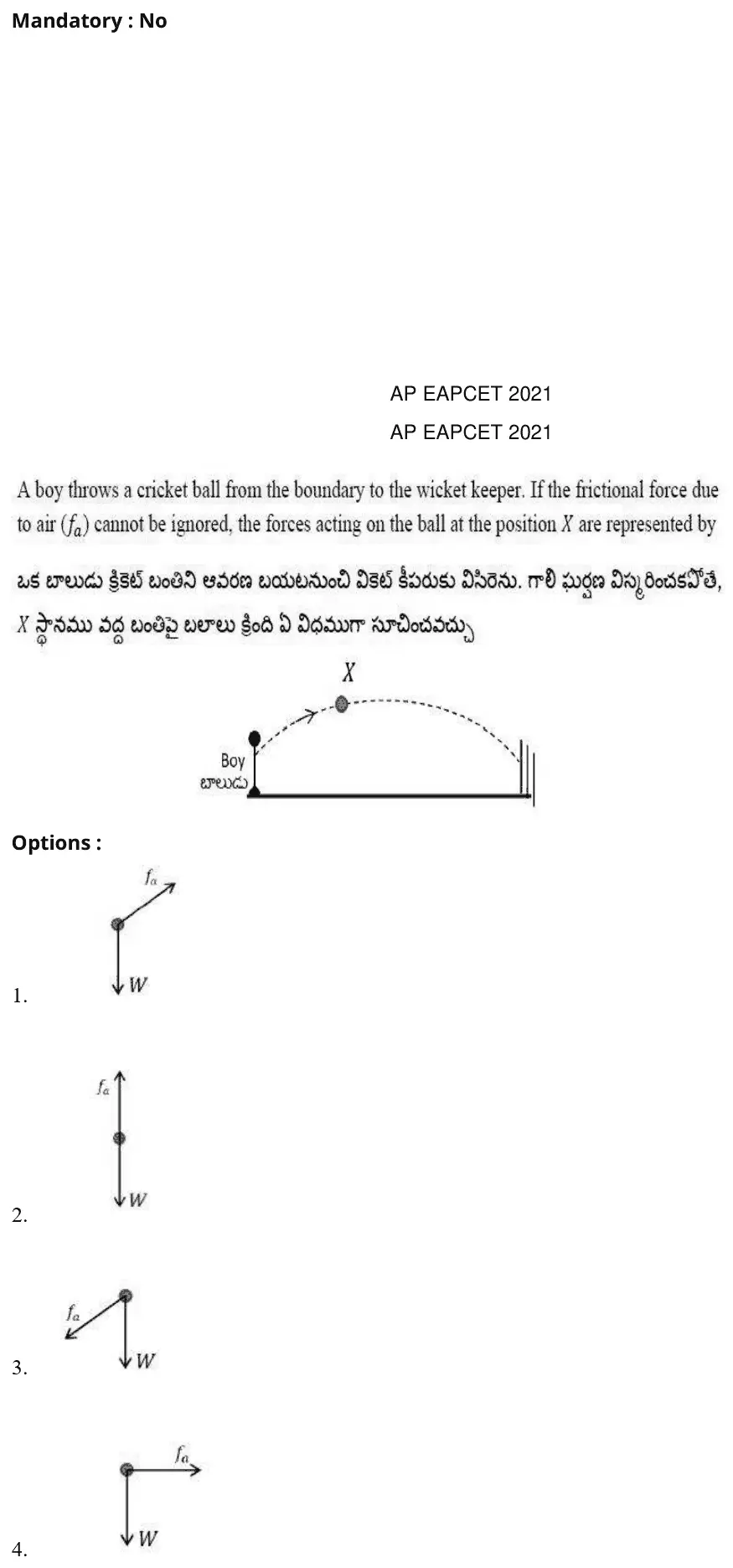
A boy throws a cricket ball from the boundary to the wicket keeper. If the frictional force due to air ($f_a$) cannot be ignored, the forces acting on the ball at the position $X$ are represented by (see the figure above)
The question as printed in the paper.
A
see figure ball with $W$ vertically down and $f_a$ pointing up and to the right
B
see figure ball with $W$ vertically down and $f_a$ vertically up
C
see figure ball with $W$ vertically down and $f_a$ pointing down and to the left
D
see figure ball with $W$ vertically down and $f_a$ horizontally to the right
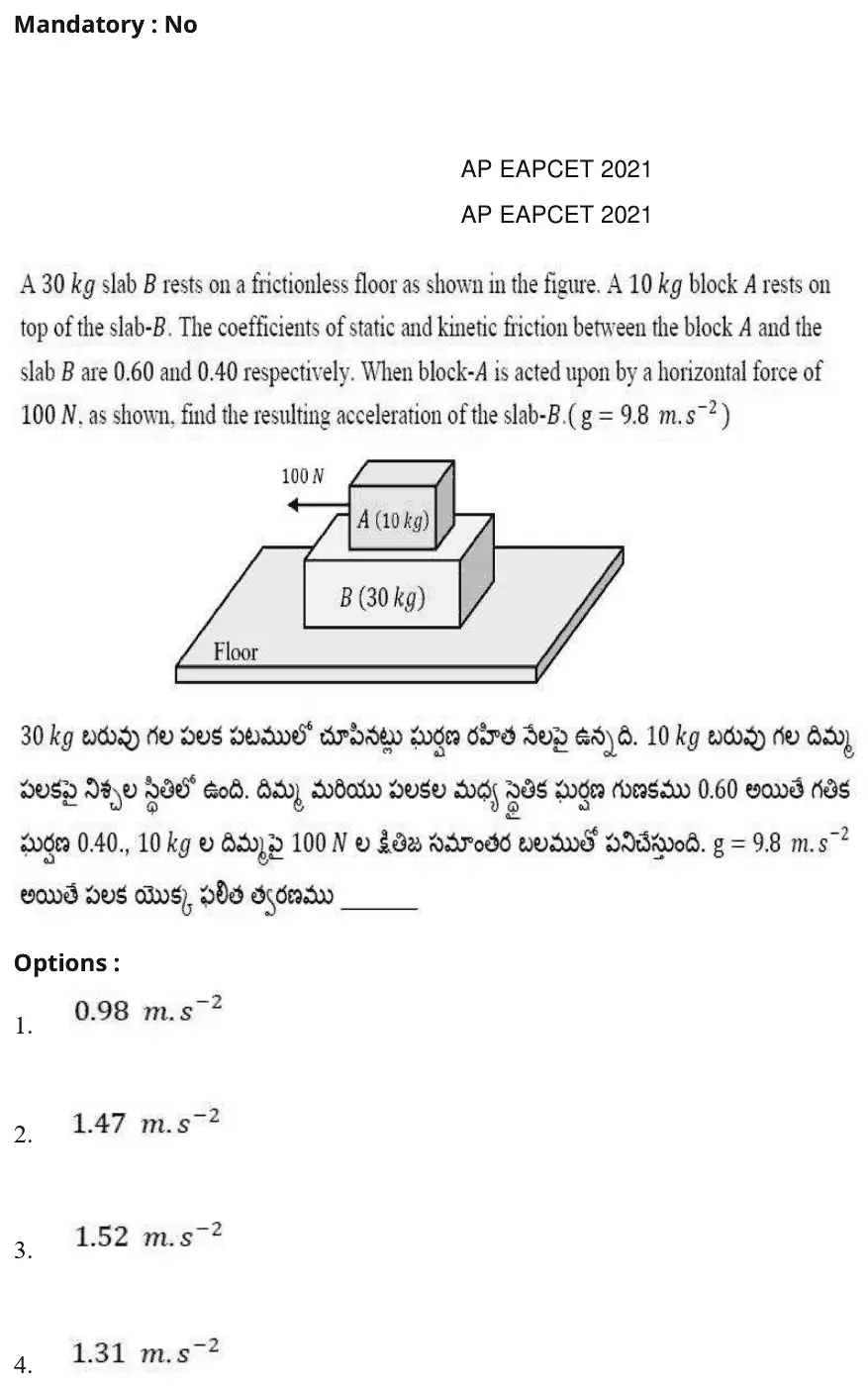
A $30\ kg$ slab $B$ rests on a frictionless floor as shown in the figure. A $10\ kg$ block $A$ rests on top of the slab-$B$. The coefficients of static and kinetic friction between the block $A$ and the slab $B$ are $0.60$ and $0.40$ respectively. When block-$A$ is acted upon by a horizontal force of $100\ N$, as shown, find the resulting acceleration of the slab-$B$. ($g = 9.8\ m.s^{-2}$) (see the figure above)
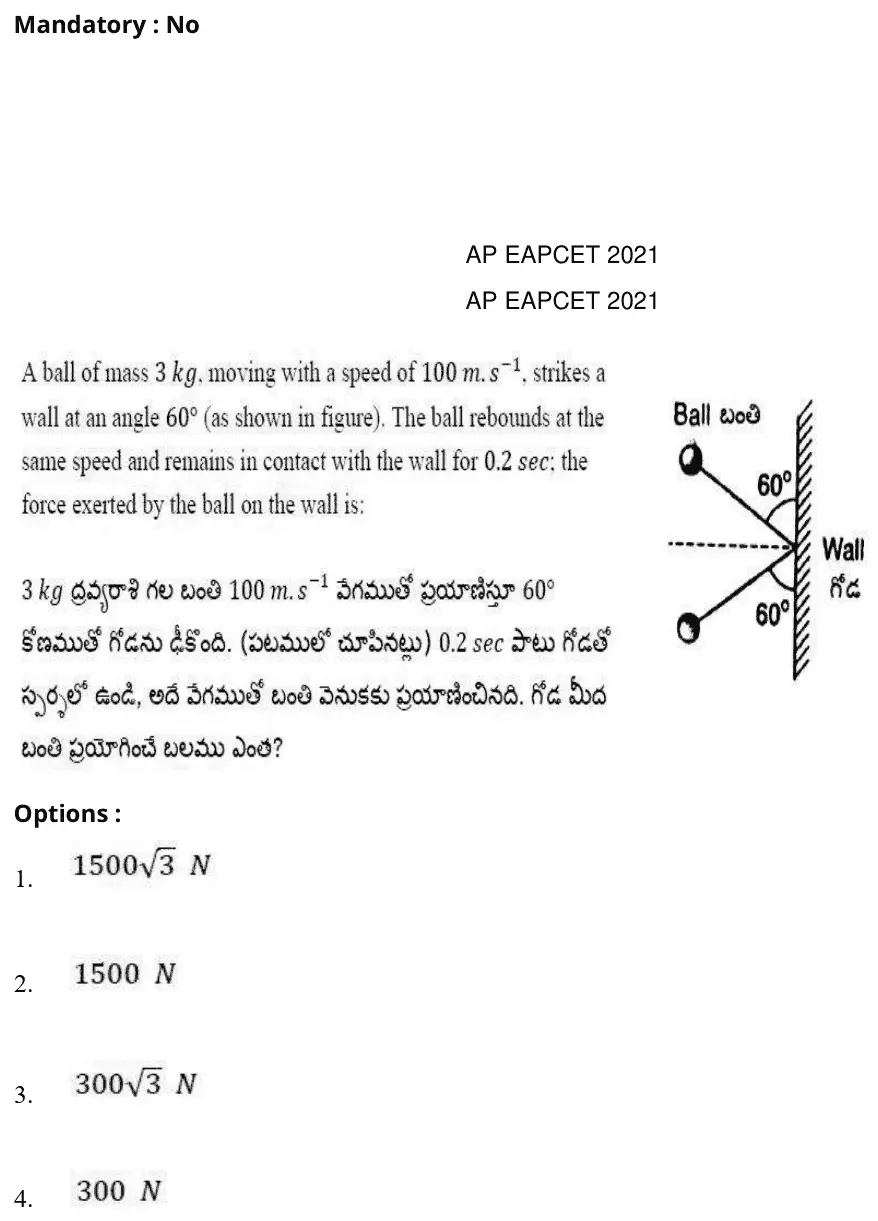
A ball of mass $3\ kg$, moving with a speed of $100\ m.s^{-1}$, strikes a wall at an angle $60^\circ$ (as shown in figure). The ball rebounds at the same speed and remains in contact with the wall for $0.2\ sec$; the force exerted by the ball on the wall is: (see the figure above)
An object dropped in a stationary lift takes time $t_1$ to reach the floor. It takes time $t_2$ when lift is moving up with constant acceleration. Then ______
When a body is placed on a rough plane (coefficient of friction$= \mu$) inclined at an angle $\theta$ to the horizontal, its acceleration is ______ (acceleration due to gravity $= g$)
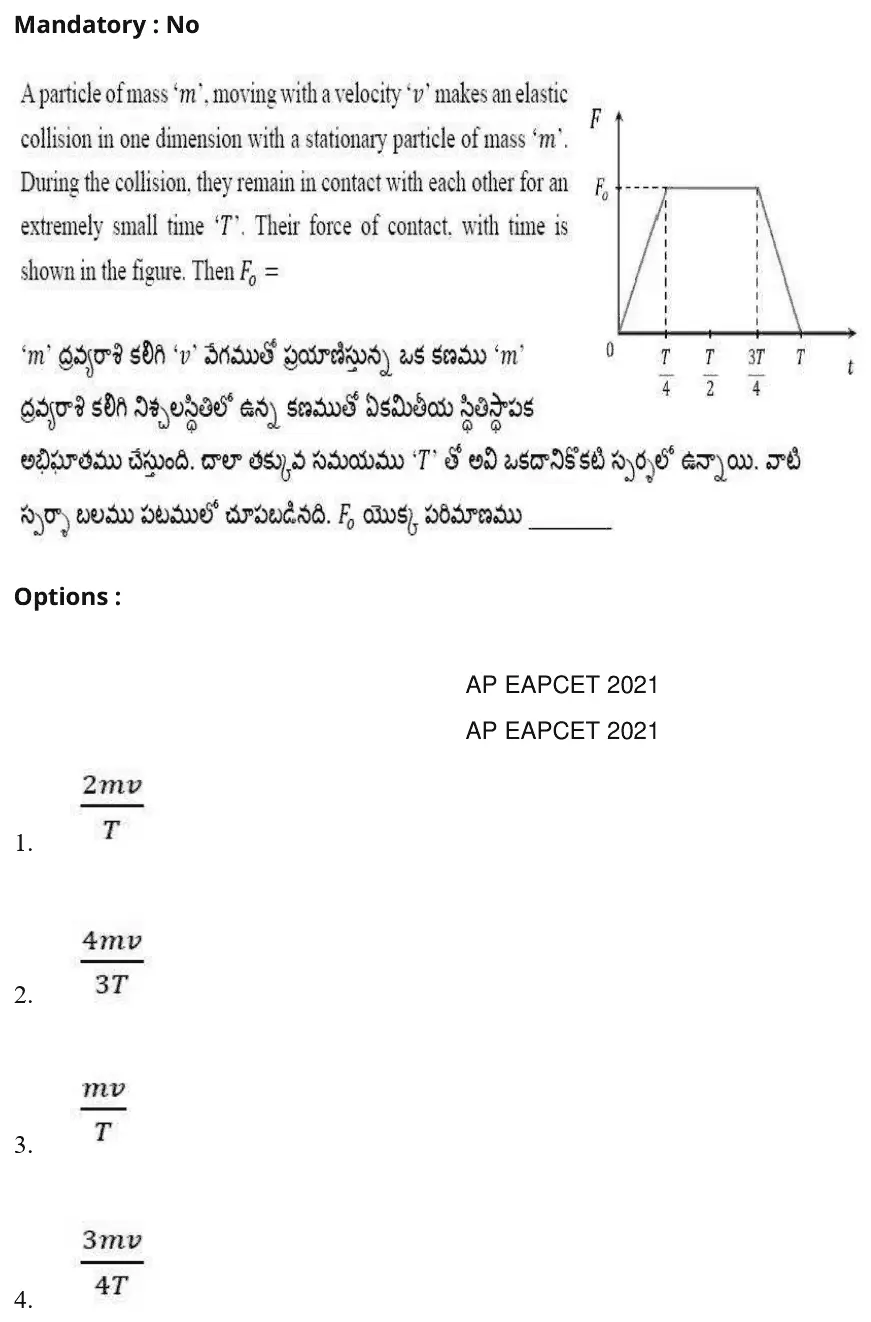
A particle of mass 'm', moving with a velocity 'v' makes an elastic collision in one dimension with a stationary particle of mass 'm'. During the collision, they remain in contact with each other for an extremely small time 'T'. Their force of contact, with time is shown in the figure. Then $F_0 =$ (see the figure above)
A $500\ \mathrm{kg}$ car takes a round turn of radius $50\ \mathrm{m}$ with a velocity of $36\ \mathrm{kmph}$. The centripetal force acting on the car is ______
A motor cyclist wants to drive in horizontal circles on the vertical inner surface of a large cylindrical wooden well of radius $8.0\ \mathrm{m}$, with minimum speed of $5\sqrt{5}\ \mathrm{m.s^{-1}}$. The minimum value of coefficient of friction between the tires and the wall of the well must be ______ ($g = 10\ \mathrm{m.s^{-2}}$)
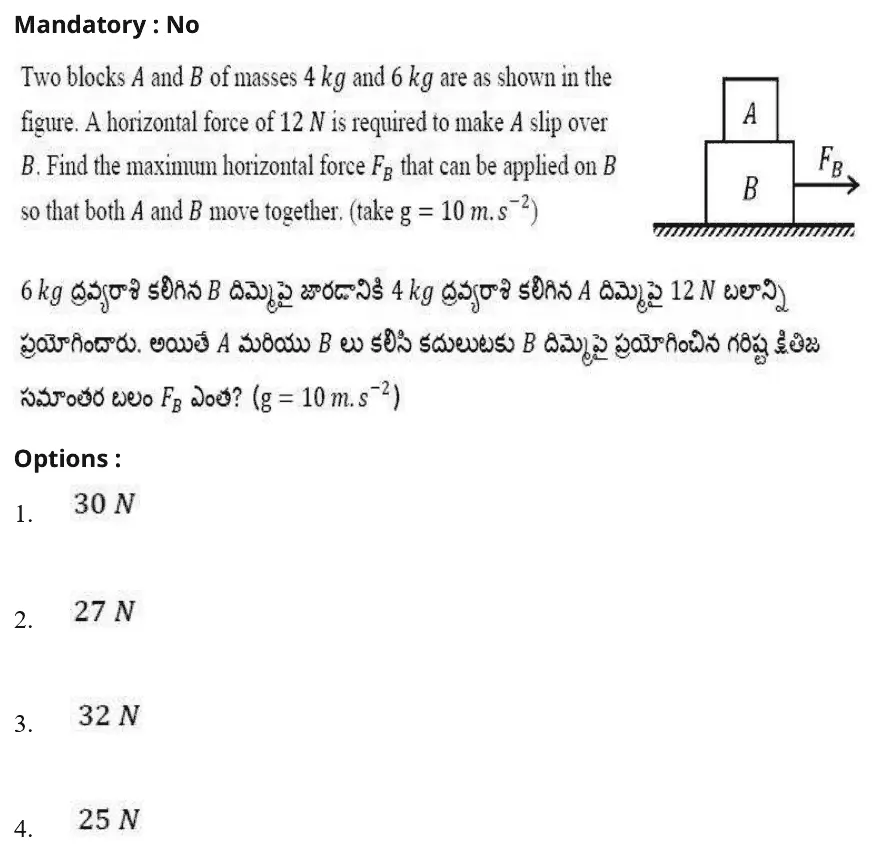
Two blocks $A$ and $B$ of masses $4\ \mathrm{kg}$ and $6\ \mathrm{kg}$ are as shown in the figure. A horizontal force of $12\ \mathrm{N}$ is required to make $A$ slip over $B$. Find the maximum horizontal force $F_B$ that can be applied on $B$ so that both $A$ and $B$ move together. (take $g = 10\ \mathrm{m.s^{-2}}$) (see the figure above)
A car is moving with velocity V at the top of a semi-circular hill of radius 40 m such that the normal force on it is zero. Find the velocity (V) of the car. [use g = 10 ms$^{-2}$]
Imagine a person standing on a weighing machine placed inside an elevator. The elevator first accelerates, then moves with a constant velocity and finally decelerates to stop. The maximum and minimum weight recorded are $80\ \mathrm{kg}$ and $64\ \mathrm{kg}$ respectively. Find out the true weight of that person considering $g=10\ \mathrm{m/s^2}$.
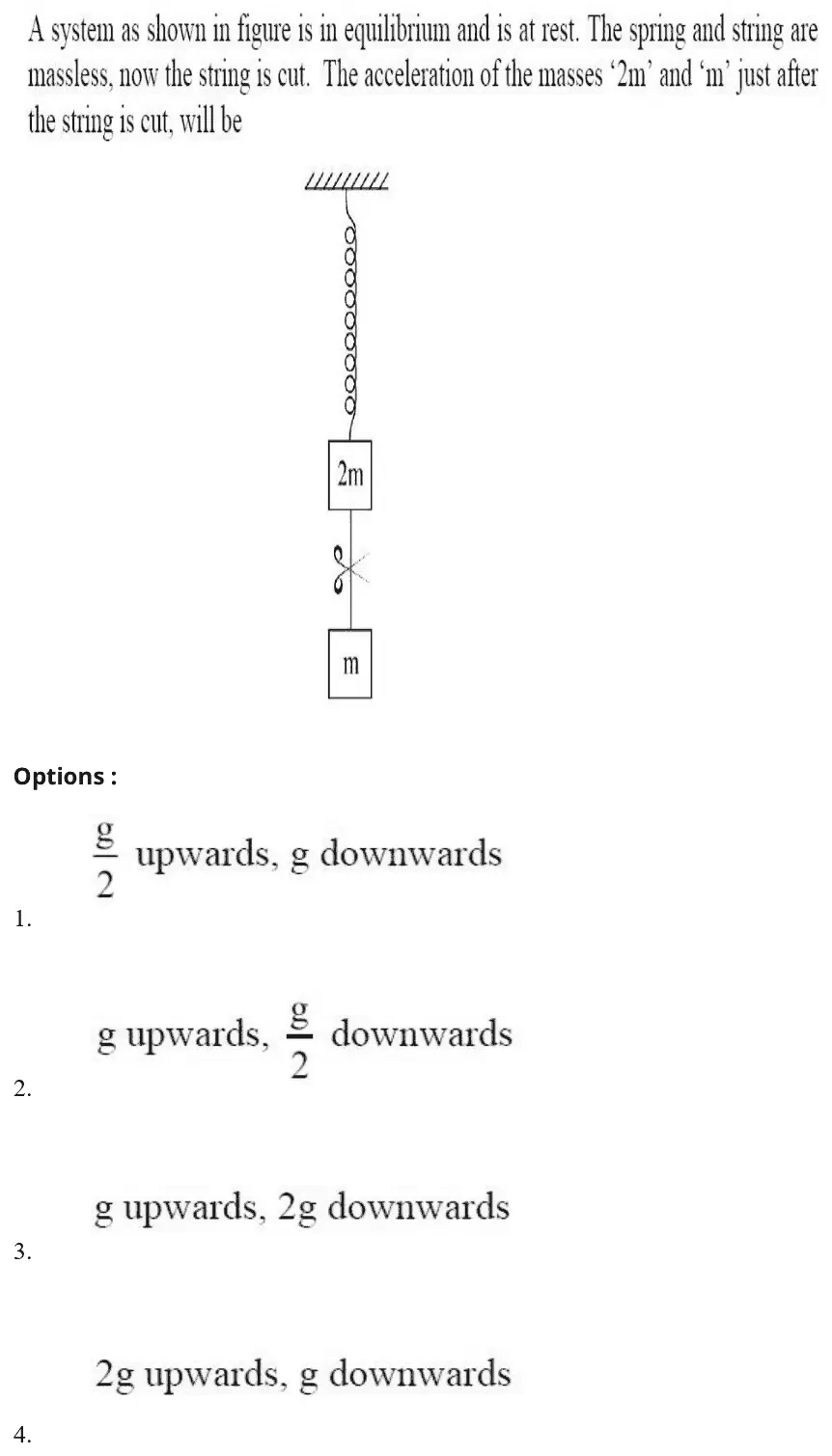
A system as shown in figure is in equilibrium and is at rest. The spring and string are massless, now the string is cut. The acceleration of the masses '2m' and 'm' just after the string is cut, will be (see the figure above)
A person is managing to be at rest between two vertical walls by pressing one wall by his hands and feet and second wall with his back. The coefficient of friction is 0.5 between his body and the wall. If the force with which the person pushes the wall is 500 N, then the mass of the person is (Take g = 10 m/s$^2$)
An object A of mass 20 kg and travelling at 20 m/s crashes into another object B of mass 200 kg and travelling at 10 m/s, in the same direction. After the collision, object A bounces back in opposite direction at a speed of 10 m/s. The speed of the object B after the collision is
Block A of mass 3 kg rests on another block B of mass 7 kg. The coefficient of friction between A and B is 0.4 while the coefficient of friction between B and the horizontal floor on which B rests is 0.55. Find the force of friction between A and B, when a horizontal force of 50 N is applied on the block B. (Use $g = 10\ \mathrm{m/s^2}$)
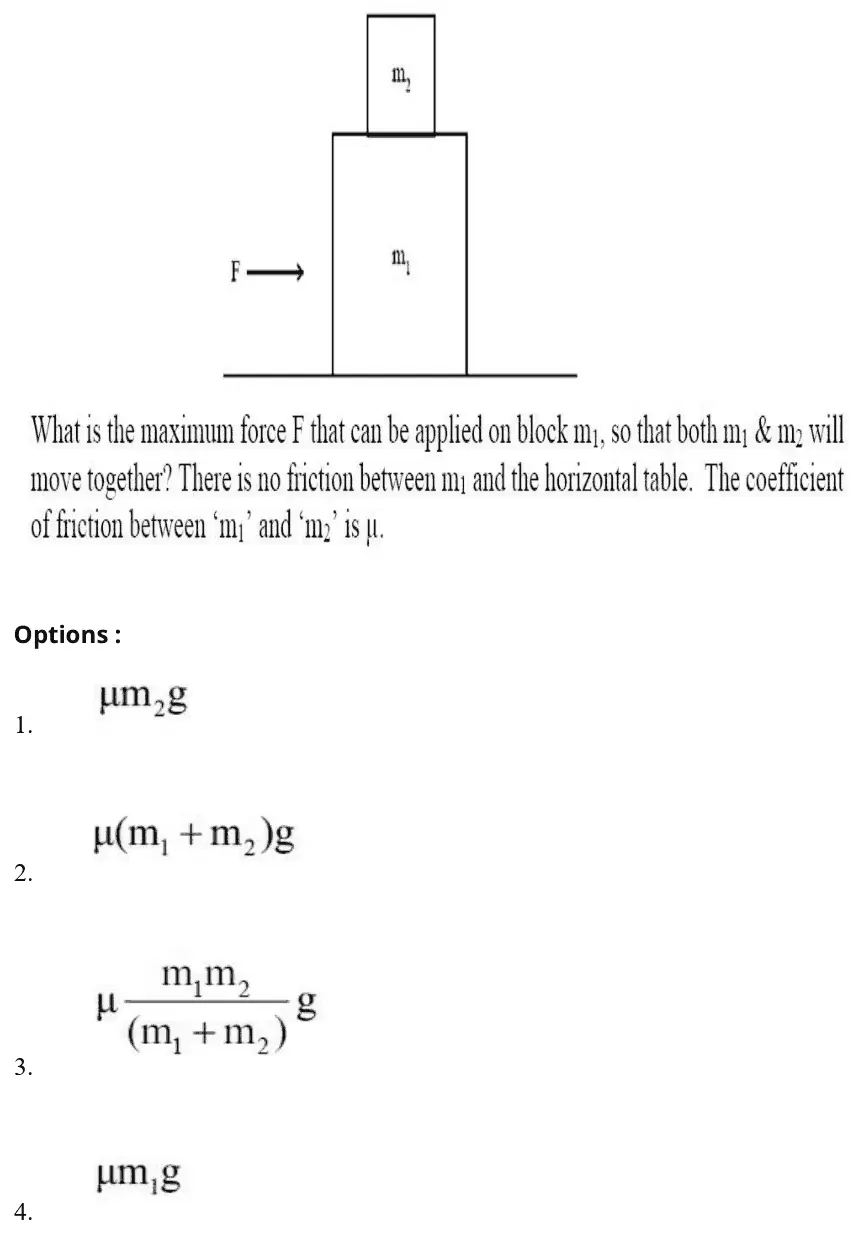
see figure What is the maximum force F that can be applied on block $m_1$, so that both $m_1$ & $m_2$ will move together? There is no friction between $m_1$ and the horizontal table. The coefficient of friction between '$m_1$' and '$m_2$' is $\mu$.
What will be the minimum speed of the roller-coaster so that the passenger at the top, when becomes upside down, do not fall out? Consider the acceleration due to gravity as $10\ \mathrm{m/s^2}$, and the radius of curvature of the roller coaster is 10 m.
A car moves on a horizontal circular road of radius 16 m with increasing speed at a constant rate of $3\ \mathrm{m/s^2}$. If the coefficient of friction between the road and tyre is 0.5, then the minimum speed at which the car will skid is (assume $g = 10\ \mathrm{m/s^2}$)
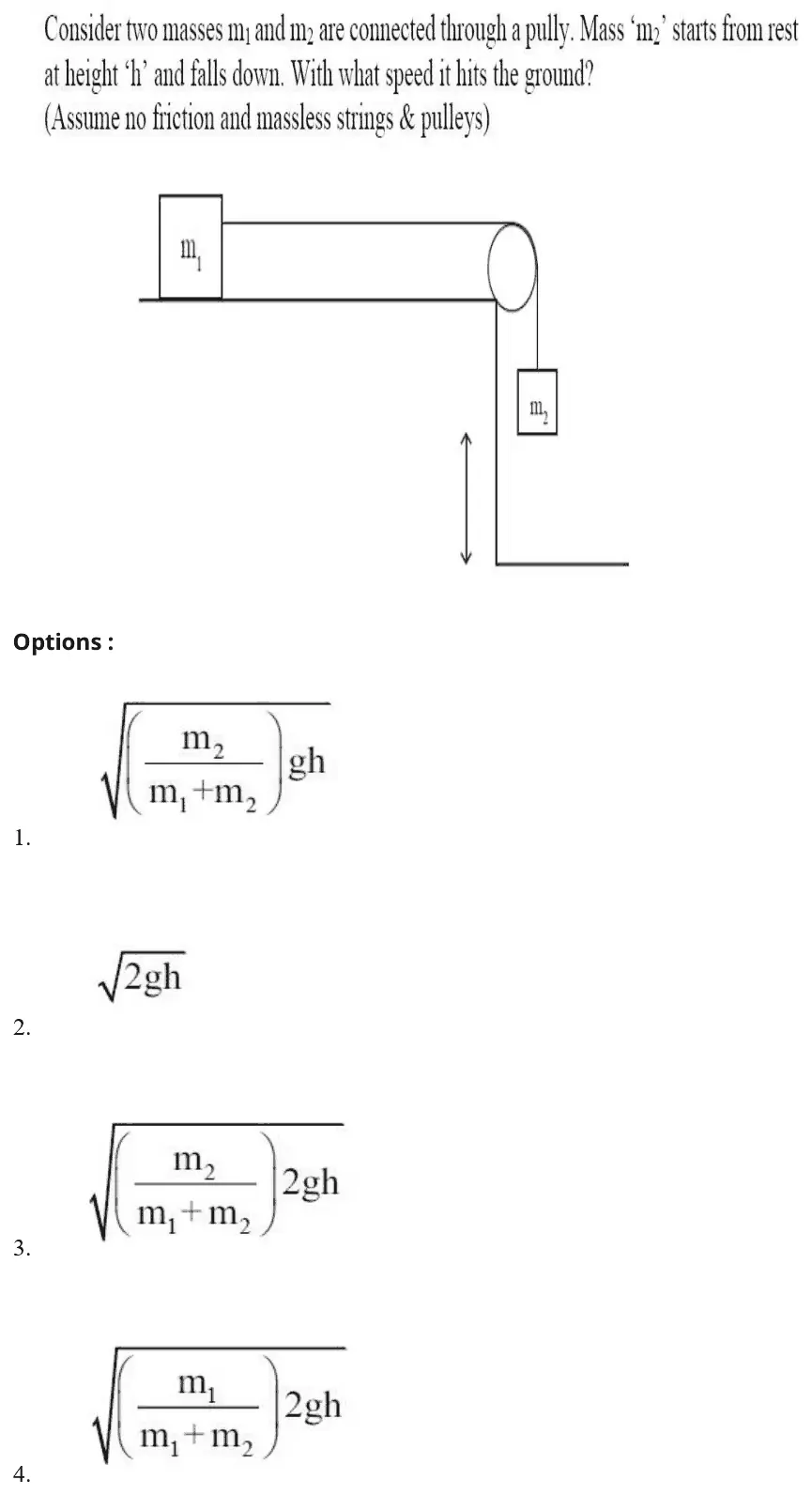
Consider two masses $m_1$ and $m_2$ are connected through a pulley. Mass '$m_2$' starts from rest at height 'h' and falls down. With what speed it hits the ground? (Assume no friction and massless strings & pulleys) (see the figure above)
A free body of mass $8\ kg$ is moving at $2\ m.s^{-1}$ along a straight line. It splits into two equal parts due to an internal explosion releasing 16 J of energy, and neither part deviates from the original line of motion. Finally, ______
A
both parts continue to move in the same direction as that of the original body
B
one part comes to rest and the other moves in the same direction as that of the original body
C
one part comes to rest and the other moves in the direction opposite to that of the original body
D
one part moves in the same direction and the other in the direction opposite to that of the original body
A string of a pendulum of length $l$ is displaced through $90^\circ$ from its vertical and released. Then the minimum strength of the string needed to withstand the tension as, the pendulum passes through its mean position is
A body of mass $5\ \mathrm{kg}$ starts from the origin with an initial velocity $\vec{u} = 30\,\hat{i} + 40\,\hat{j}\ \mathrm{m.s^{-1}}$. When a constant force $\vec{F} = -(\hat{i} + 5\hat{j})\ \mathrm{N}$ acts on the body, the time in which the y-component of the velocity becomes zero is ______
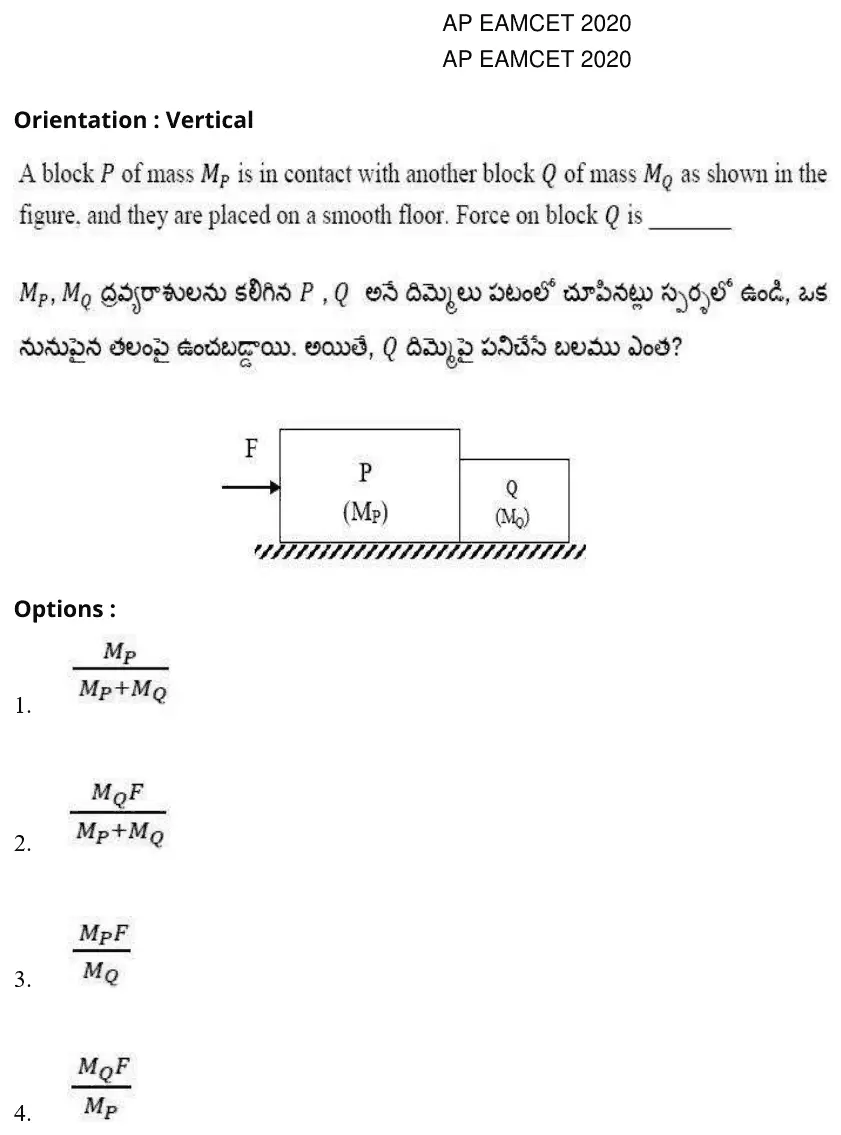
A block $P$ of mass $M_P$ is in contact with another block $Q$ of mass $M_Q$ as shown in the figure, and they are placed on a smooth floor. Force on block $Q$ is ______ (see the figure above)
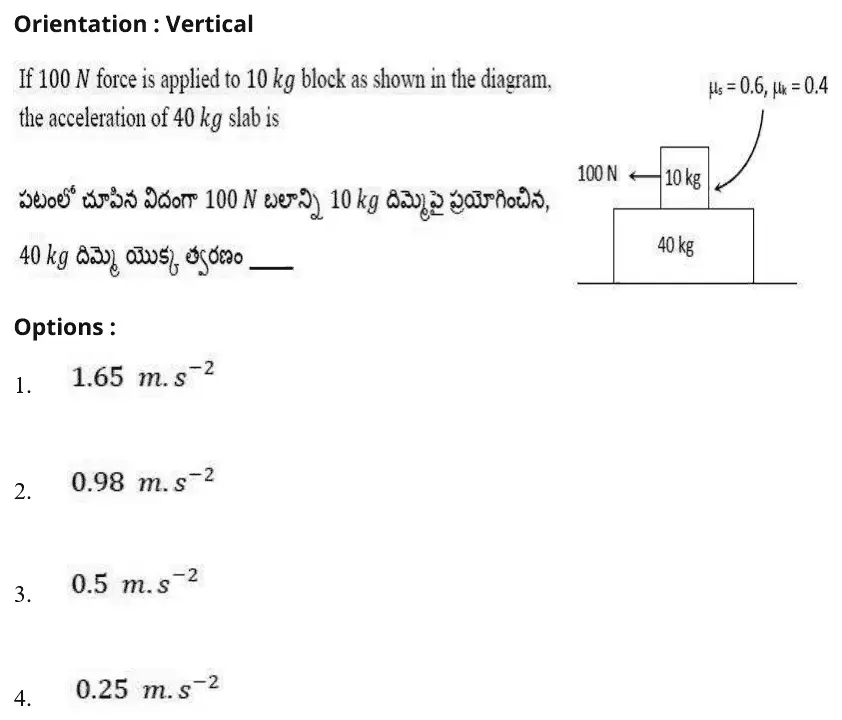
If $100\ \mathrm{N}$ force is applied to $10\ \mathrm{kg}$ block as shown in the diagram, the acceleration of $40\ \mathrm{kg}$ slab is (see the figure above)
In a rocket, fuel burns at the rate of $1\ \mathrm{kg/s}$. This fuel is ejected form the rocket with a velocity of $60\ \mathrm{km/s}$. The force exerted on the rocket by this is ______
The minimum horizontal speed with which a body must be projected so that is goes around a smooth vertical circular track of radius $4\ \mathrm{m}$ is ______ ($g = 9.8\ \mathrm{m.s^{-2}}$)
A bomb of mass $9\,\mathrm{kg}$ explodes into two pieces of mass $3\,\mathrm{kg}$ and $6\,\mathrm{kg}$. The velocity of mass $3\,\mathrm{kg}$ is $16\,\mathrm{m/s}$. The kinetic energy of mass $6\,\mathrm{kg}$ in joule is:
A block of mass $m$ is placed on a smooth wedge of inclination $\theta$. The whole system is accelerated horizontally so that the block does not slip on the wedge. The force exerted by the wedge on the block ($g$ is acceleration due to gravity) will be
A person of mass $M = 90\,\mathrm{kg}$ standing on a smooth horizontal plane of ice throws a body of mass $m = 10\,\mathrm{kg}$ horizontally on the same surface. If the distance between the person and body after 10 seconds is 10 meters the K.E. of the person (in joules) is ______
Find the apparent weight of a body of mass $1.0\,\mathrm{kg}$ falling with an acceleration of $10\,\mathrm{m.s^{-2}}$. ($\mathrm{g} \approx 10\,\mathrm{m.s^{-2}}$)
A balloon of mass 'M' descends with an acceleration 'a'.($< g$). What mass need to be removed from the balloon so that it starts ascending with acceleration 'a'?
A bomb at rest explodes into three parts of equal mass. If the momentum of two parts are $-2p\,\hat{i}$ and $p\,\hat{j}$, find the magnitude of momentum of the third part.
If mass, speed and radius of the circular path of the particle are increased by 100 %, then the necessary force required to maintain the circular path will have to be increased by
In a circus, a stuntman rides a motor bike in a vertical circular track of radius ' $r$ '. Find the minimum speed he must maintain at highest point of track?
One end of a string of length '$l$' is connected to a particle of mass '$m$' and the other to a small peg on a smooth horizontal table. If the particle moves in a circle with speed '$v$' and '$T$' is the tension in the string, then net force on the particle (directed towards the centre) is ______
Find the centripetal force acting on a coin weighing 0.1 $\mathrm{kg}$, placed 0.1 $\mathrm{m}$ from the centre on a gramophone disc rotating at 600 $\mathrm{rpm}$.
Consider a particle is moving with a minimum speed 'v' and is at highest point of vertical circle of radius 'R'. If the radius of the circle doubled the corresponding minimum speed will be
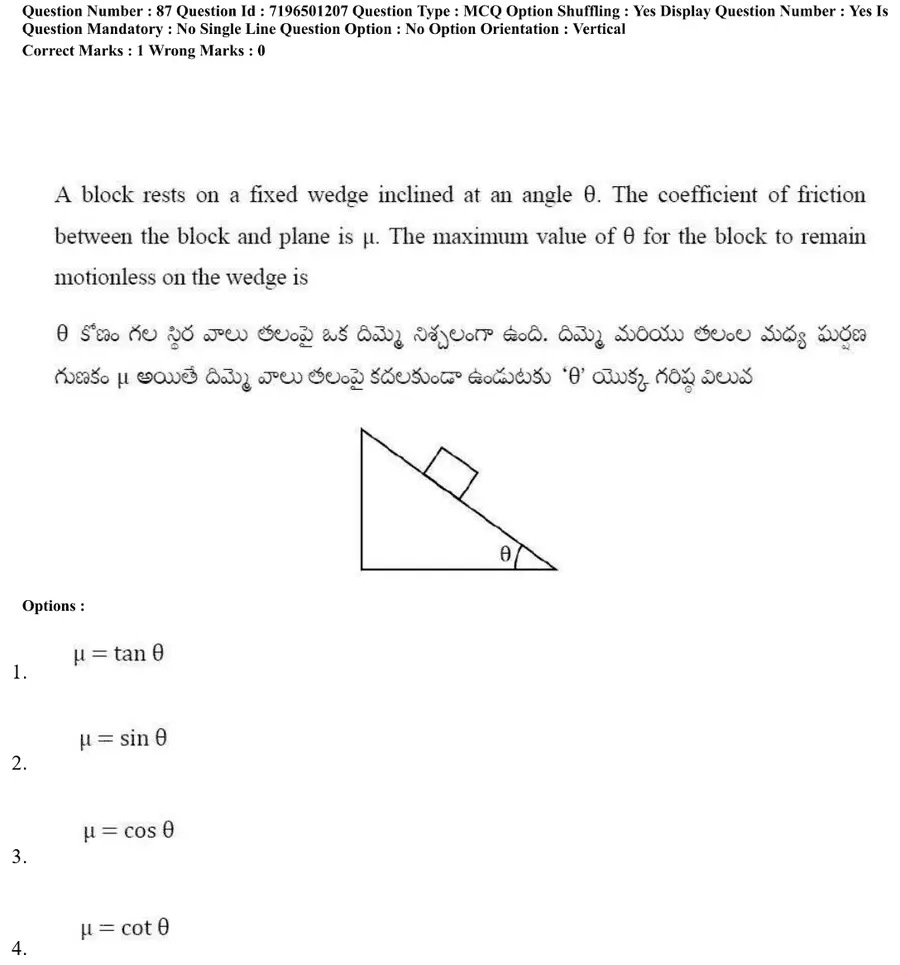
A block rests on a fixed wedge inclined at an angle $\theta$. The coefficient of friction between the block and plane is $\mu$. The maximum value of $\theta$ for the block to remain motionless on the wedge is (see the figure above)
A block of mass 4 kg rest on a rough inclined plane making an angle of $\theta$ with the horizontal. The coefficient of static friction between the block and plane is 0.5 and the frictional force on the block is 14.14 N, Find $\theta$?
Assume proton is rotating along a circular path of radius 1m under a centrifugal force of $4 \times 10^{-12}$ N. If the mass of proton is $1.6 \times 10^{-27}$ kg, then its angular velocity of rotation is
The velocity of an object of mass $2\,\mathrm{Kg}$ is given by $\vec{v}=(8t\,\hat{i}+3t^2\,\hat{j})\,m/s$ where t is time in seconds. What will be the direction of net force on the object relative to the positive direction of X - axis, at the instant when its magnitude is 20N?
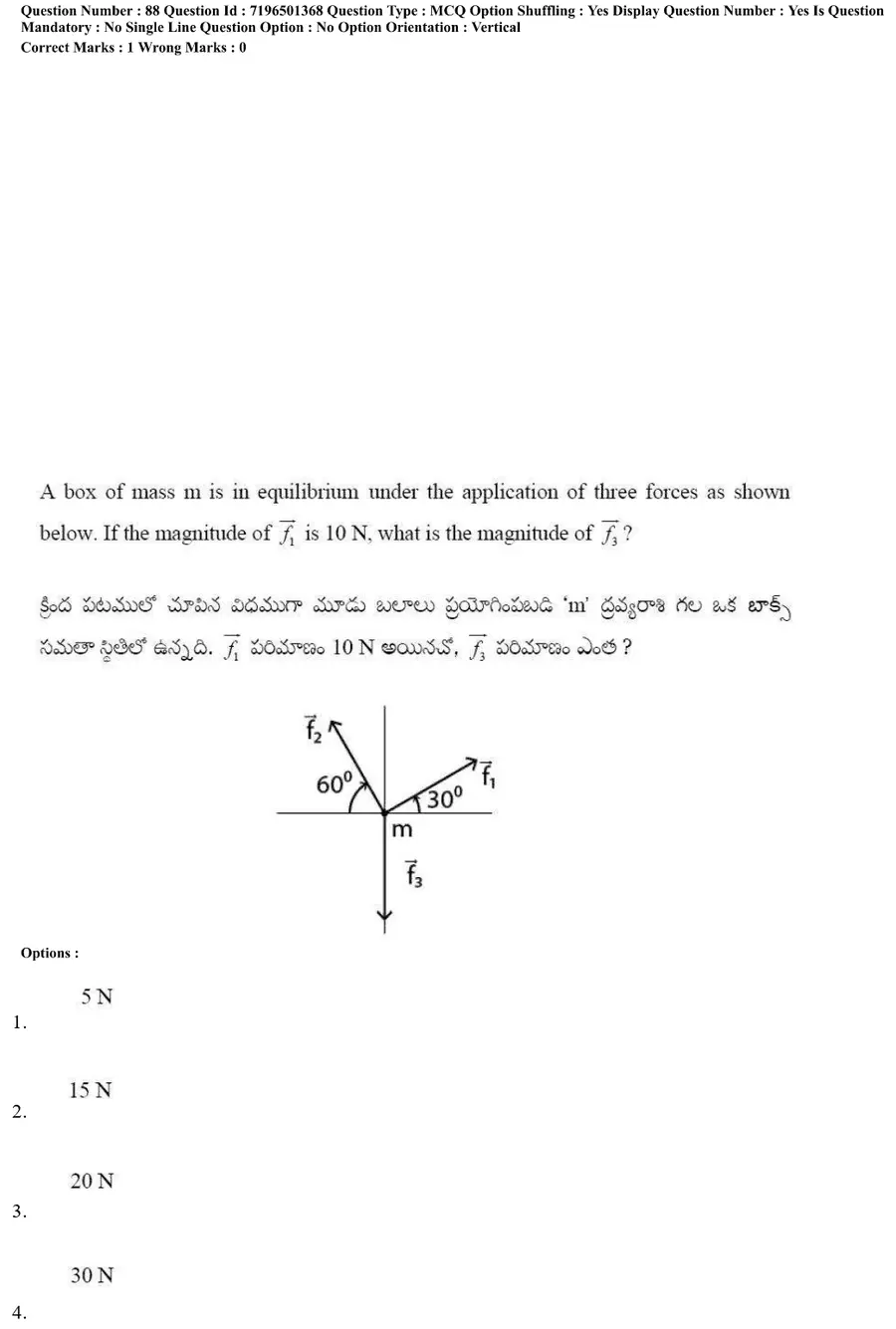
A box of mass m is in equilibrium under the application of three forces as shown below. If the magnitude of $\vec{f_1}$ is 10 N, what is the magnitude of $\vec{f_3}$? (see the figure above)
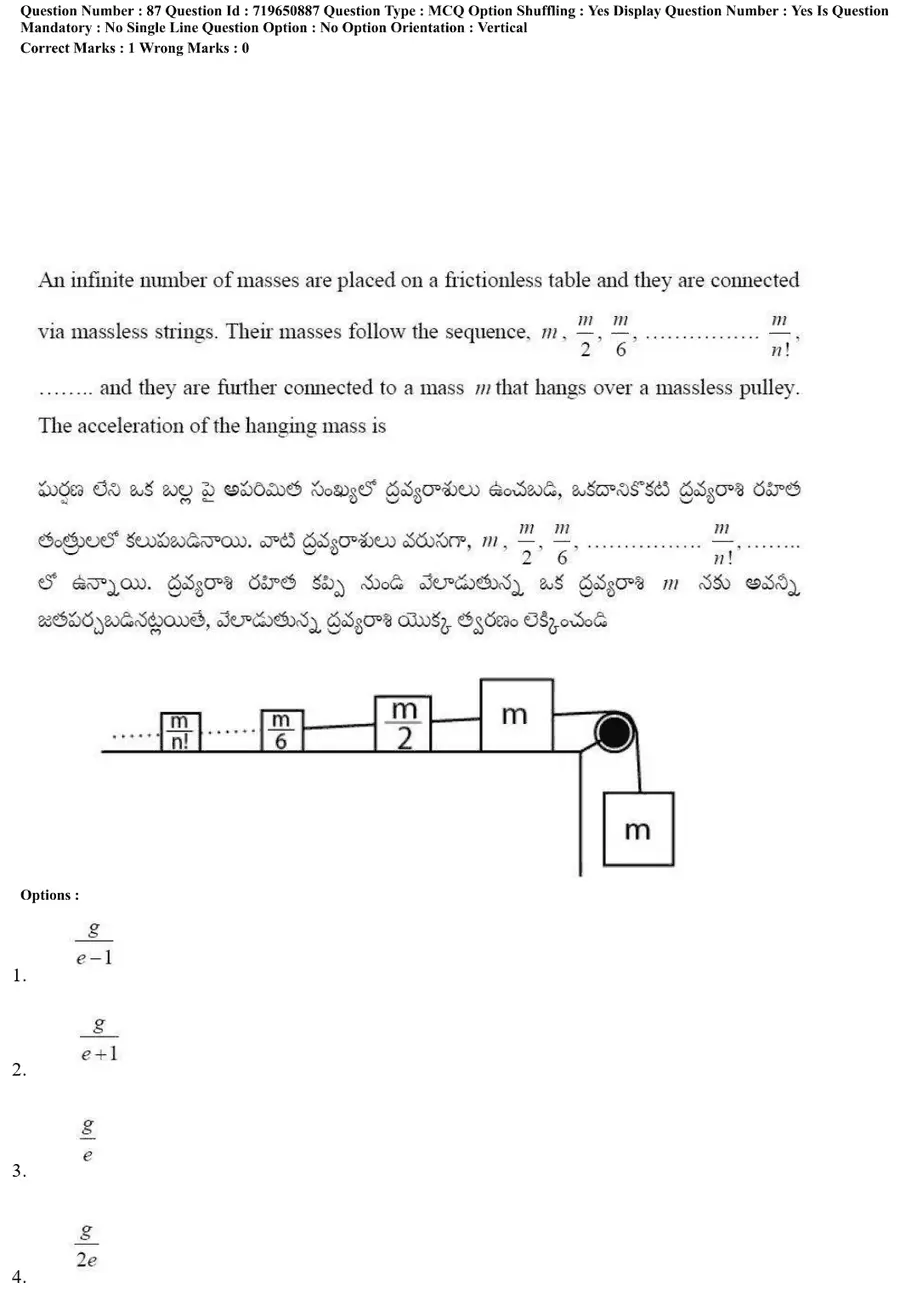
An infinite number of masses are placed on a frictionless table and they are connected via massless strings. Their masses follow the sequence, $m, \dfrac{m}{2}, \dfrac{m}{6}, \ldots\ldots\ldots, \dfrac{m}{n!}, \ldots\ldots$ and they are further connected to a mass $m$ that hangs over a massless pulley. The acceleration of the hanging mass is (see the figure above)
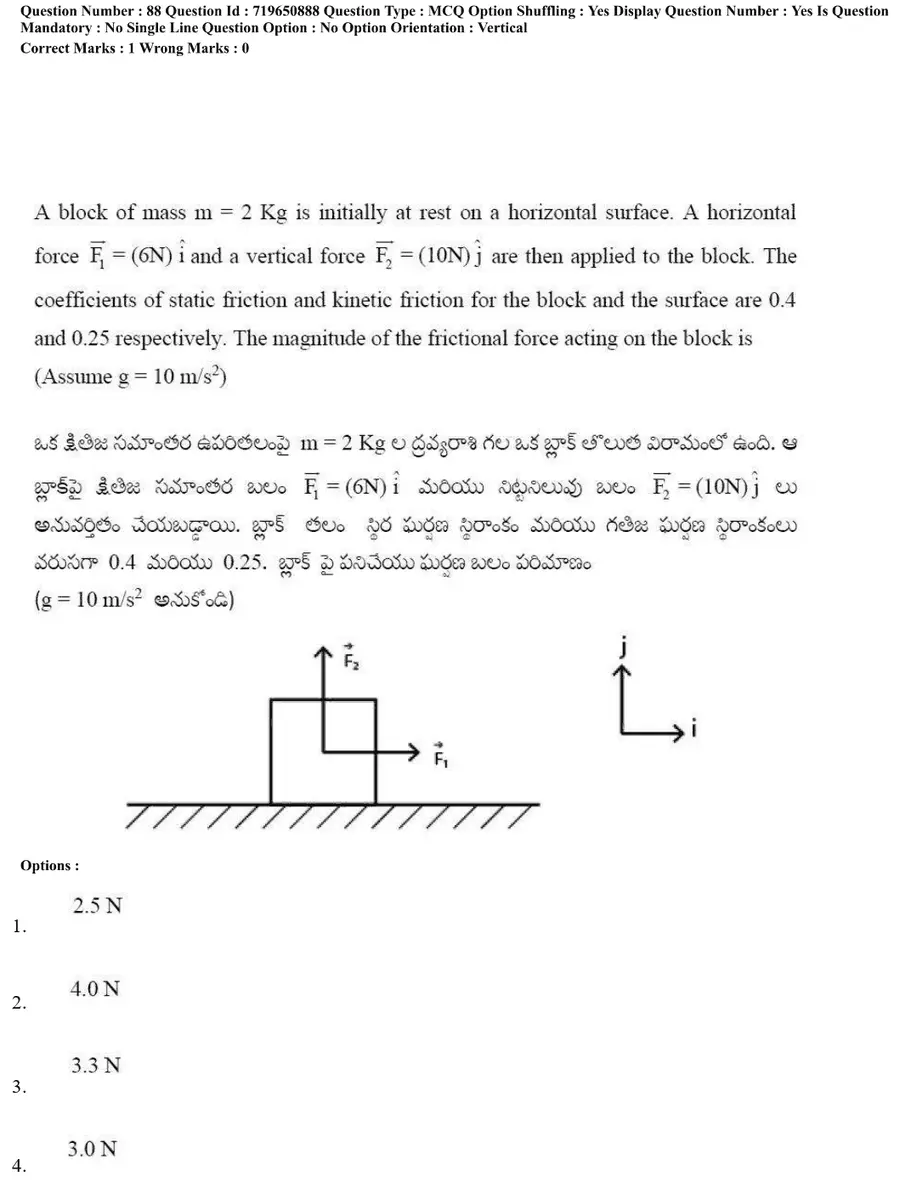
A block of mass m = 2 Kg is initially at rest on a horizontal surface. A horizontal force $\vec{F_1} = (6N)\,\hat{i}$ and a vertical force $\vec{F_2} = (10N)\,\hat{j}$ are then applied to the block. The coefficients of static friction and kinetic friction for the block and the surface are 0.4 and 0.25 respectively. The magnitude of the frictional force acting on the block is (Assume g = 10 m/s$^2$) (see the figure above)
A cyclist leans with the horizontal at angle $30^\circ$, while negotiating round a circular road of radius $20\sqrt{3}$ meters. The speed of the cycle should be
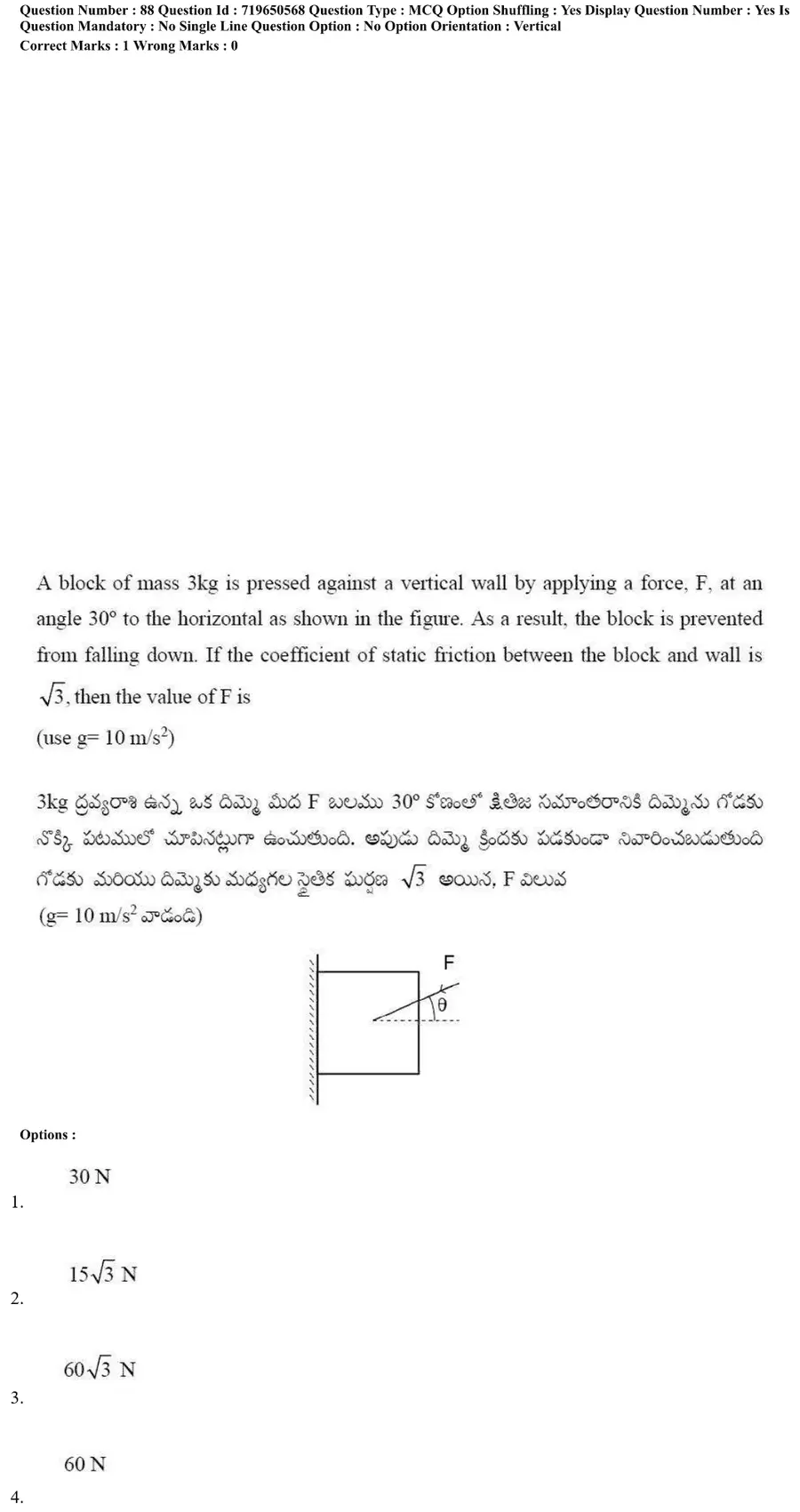
A block of mass 3kg is pressed against a vertical wall by applying a force, F, at an angle $30^\circ$ to the horizontal as shown in the figure. As a result, the block is prevented from falling down. If the coefficient of static friction between the block and wall is $\sqrt{3}$, then the value of F is (use g= 10 m/$s^2$) (see the figure above)
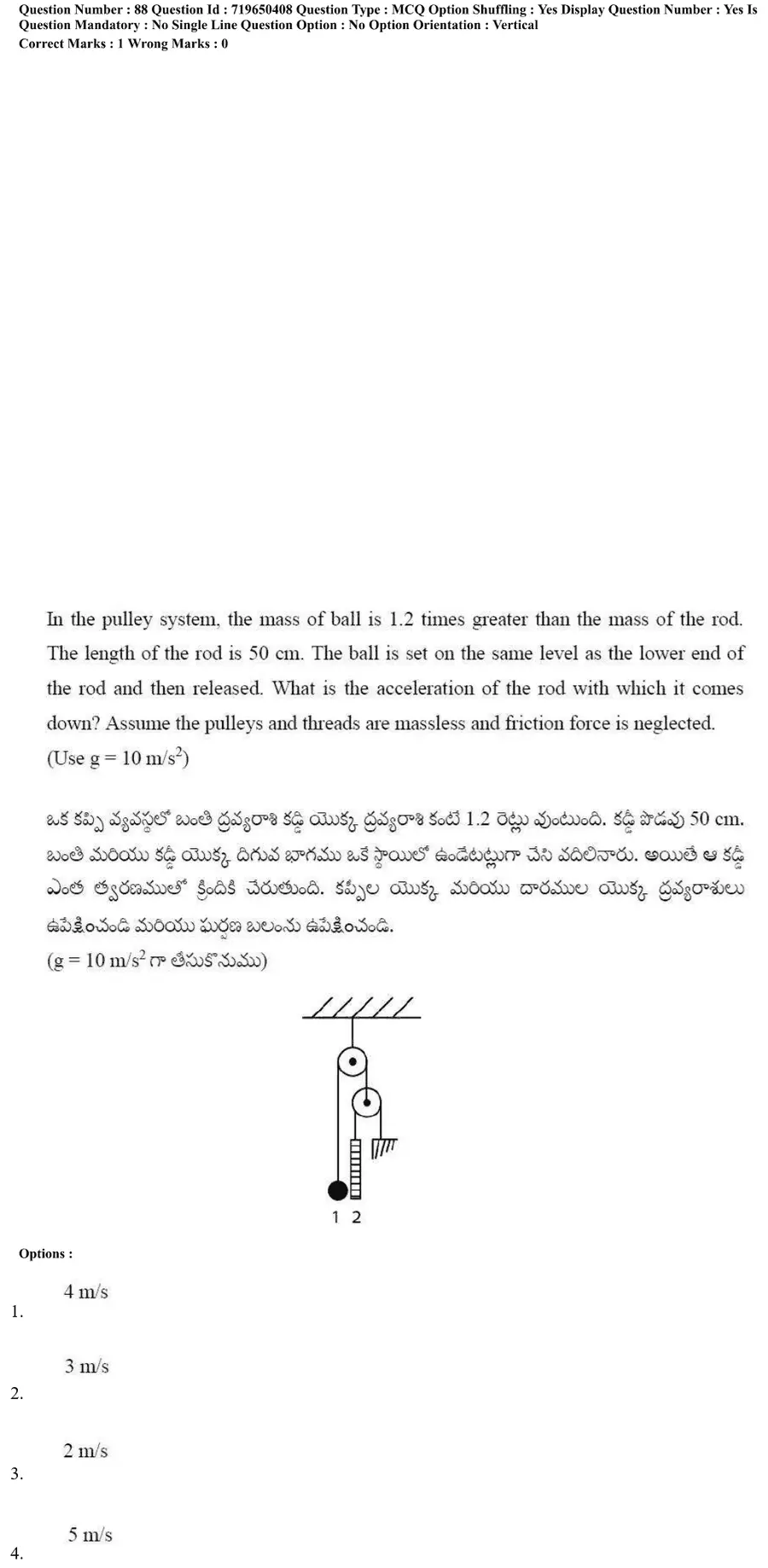
In the pulley system, the mass of ball is 1.2 times greater than the mass of the rod. The length of the rod is 50 cm. The ball is set on the same level as the lower end of the rod and then released. What is the acceleration of the rod with which it comes down? Assume the pulleys and threads are massless and friction force is neglected. (Use g = 10 m/s$^2$) (see the figure above)
A 4 kg object has a velocity $(3.0\hat{i})\ \mathrm{m/s}$ at some instant. Eight seconds later, its velocity is $(8.0\hat{i} + 10.0\hat{j})\ \mathrm{m/s}$. Assuming that the object is subjected to a constant net force, the magnitude of the force is
A block of mass 10 kg, initially at rest, makes a downward motion on $45^\circ$ inclined plane. Then the distance travelled by the block after 2 seconds is (Assume the coefficient of kinetic friction to be 0.3 and $g = 10\ \mathrm{ms^{-2}}$)
A rocket motor consumes 100 kg of fuel per second exhausting it with a speed of 5 km/s. The speed of the rocket when its mass is reduced to $\frac{1}{20}^{\mathrm{th}}$ of its initial mass, is (Assume initial speed to be zero and ignore gravitational and viscous forces)
An iron rod of length 1.5 m lying on a horizontal table is pulled up from one end along a vertical line so as to move it with a constant velocity 3 m/s, while the other end of the rod slides along the floor. After how much time the speed of the end sliding on the floor equals to the speed of the end being pulled up.
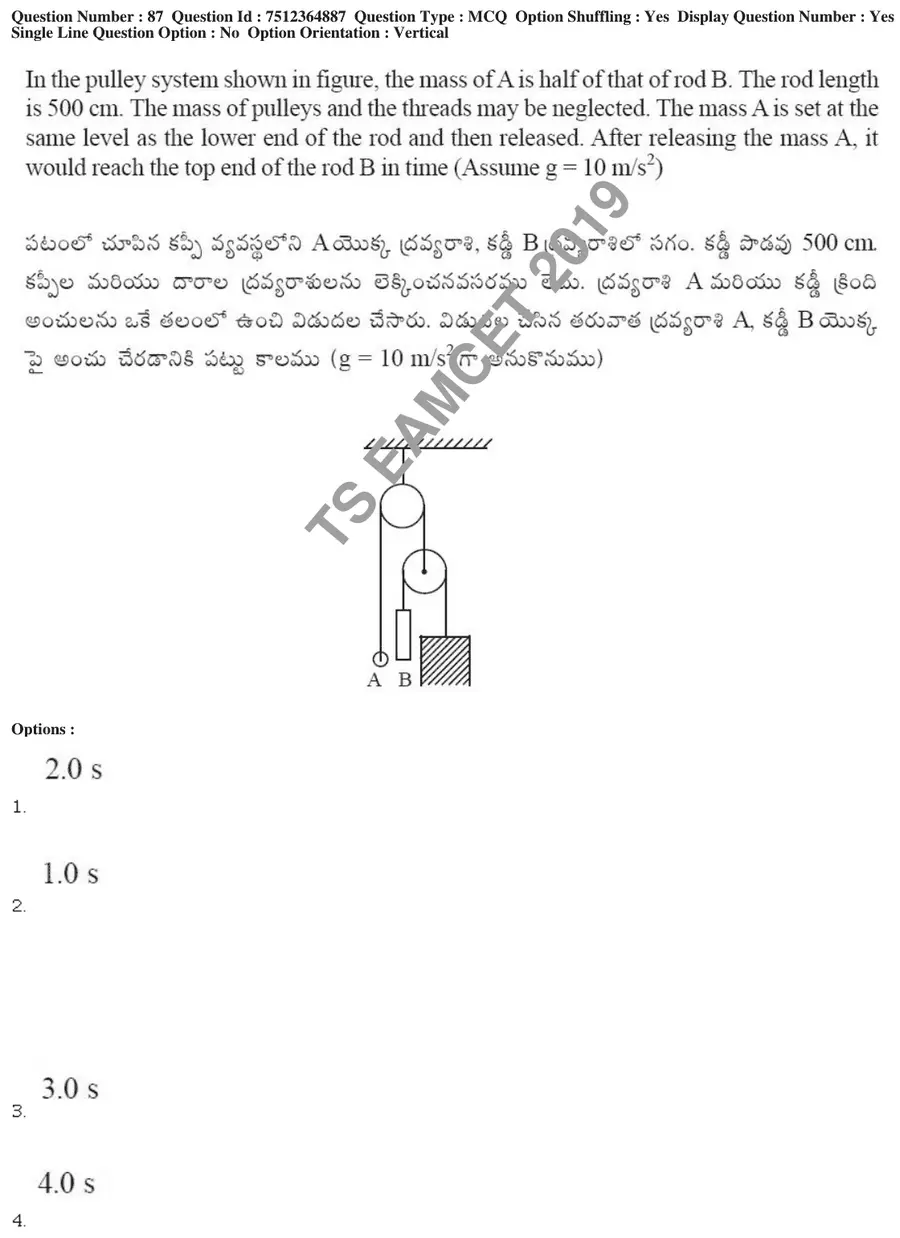
In the pulley system shown in figure, the mass of A is half of that of rod B. The rod length is 500 cm. The mass of pulleys and the threads may be neglected. The mass A is set at the same level as the lower end of the rod and then released. After releasing the mass A, it would reach the top end of the rod B in time (Assume $g = 10$ m/s$^2$) (see the figure above)
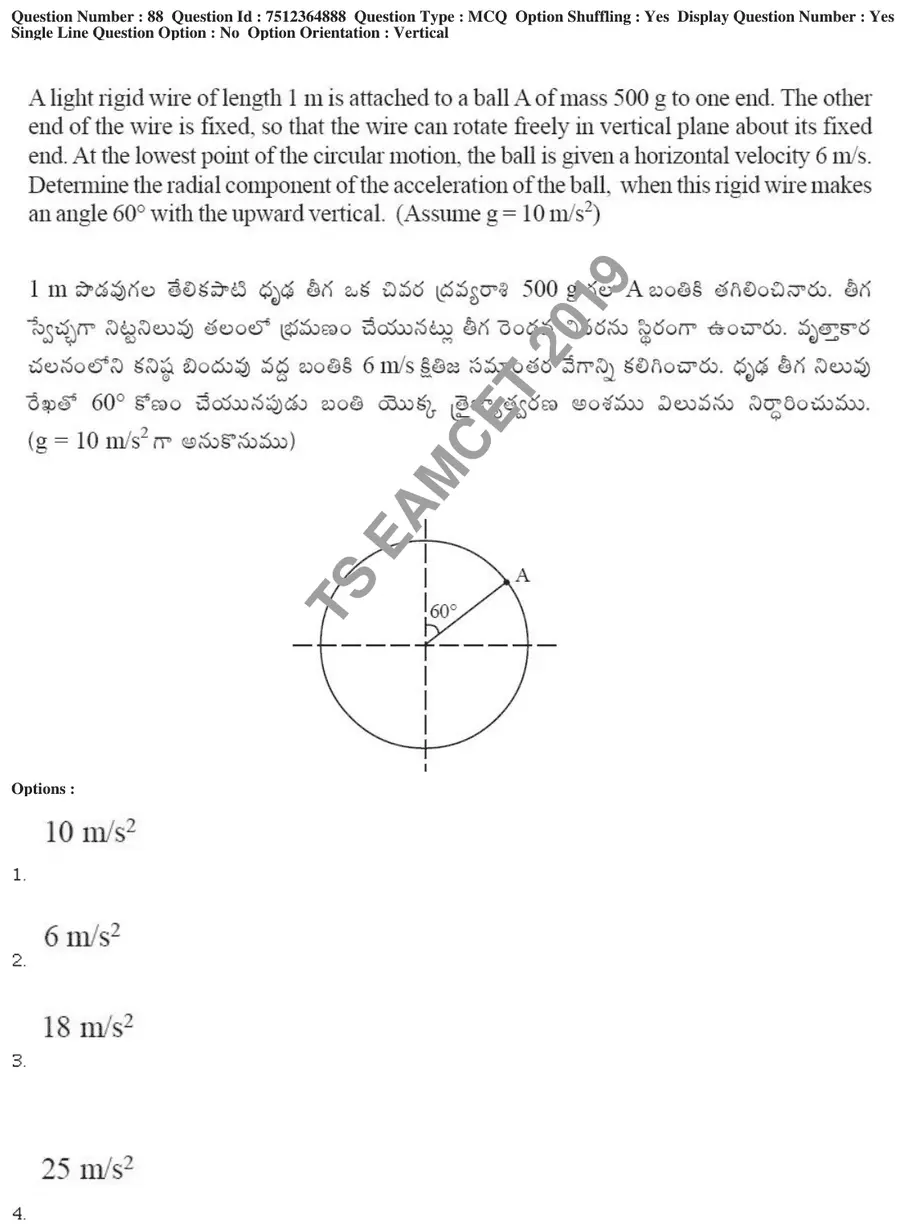
A light rigid wire of length 1 m is attached to a ball A of mass 500 g to one end. The other end of the wire is fixed, so that the wire can rotate freely in vertical plane about its fixed end. At the lowest point of the circular motion, the ball is given a horizontal velocity 6 m/s. Determine the radial component of the acceleration of the ball, when this rigid wire makes an angle $60^\circ$ with the upward vertical. (Assume $g = 10$ m/s$^2$) (see the figure above)
Two touching blocks 1 and 2 are placed on an inclined plane forming an angle $60^\circ$ with the horizontal. The masses are $m_1$ and $m_2$ and the coefficient of friction between the inclined plane and the two blocks are $1.5\ \mu$ and $1.0\ \mu$ respectively. The force of reaction between blocks during the motion is ($g$ = acceleration due to gravity)
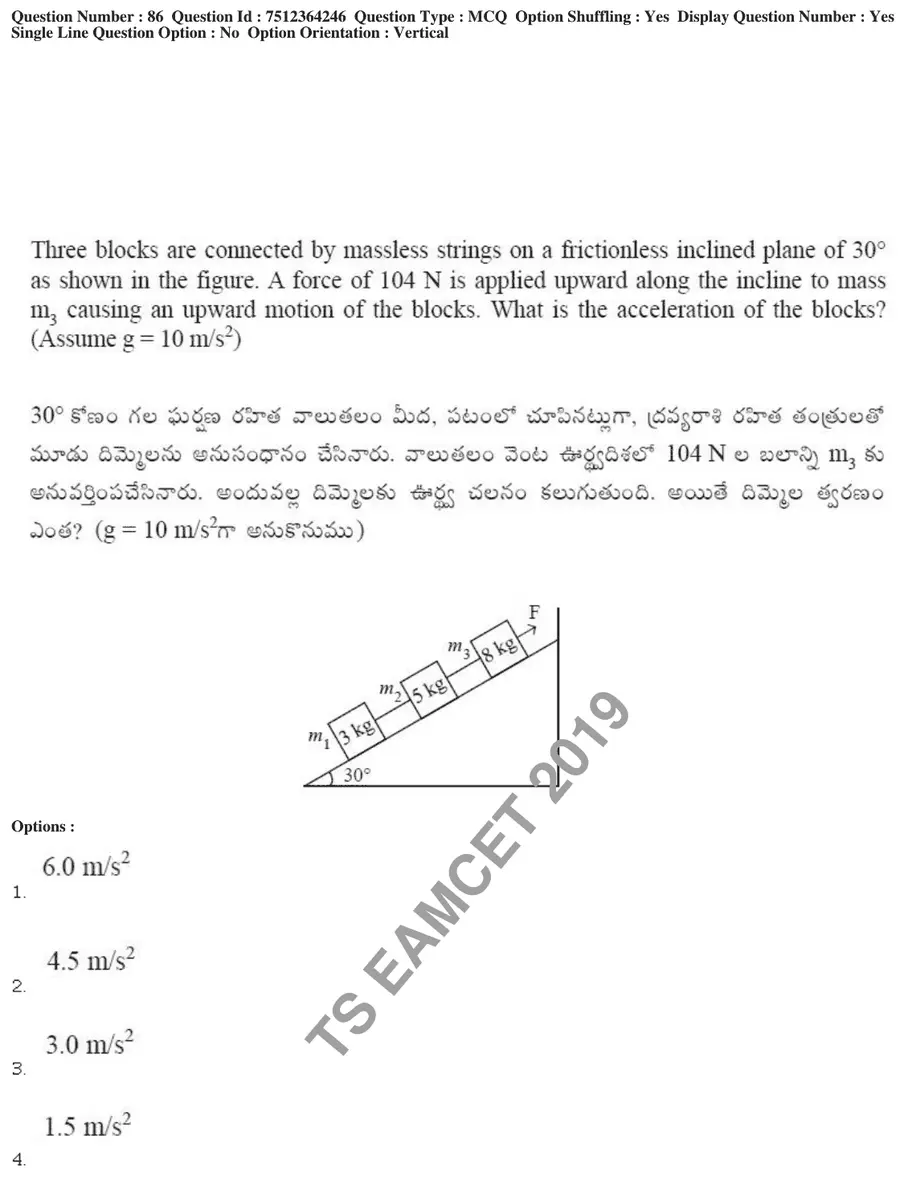
Three blocks are connected by massless strings on a frictionless inclined plane of $30^\circ$ as shown in the figure. A force of 104 N is applied upward along the incline to mass $m_3$ causing an upward motion of the blocks. What is the acceleration of the blocks? (Assume $g = 10\ \mathrm{m/s^2}$) (see the figure above)
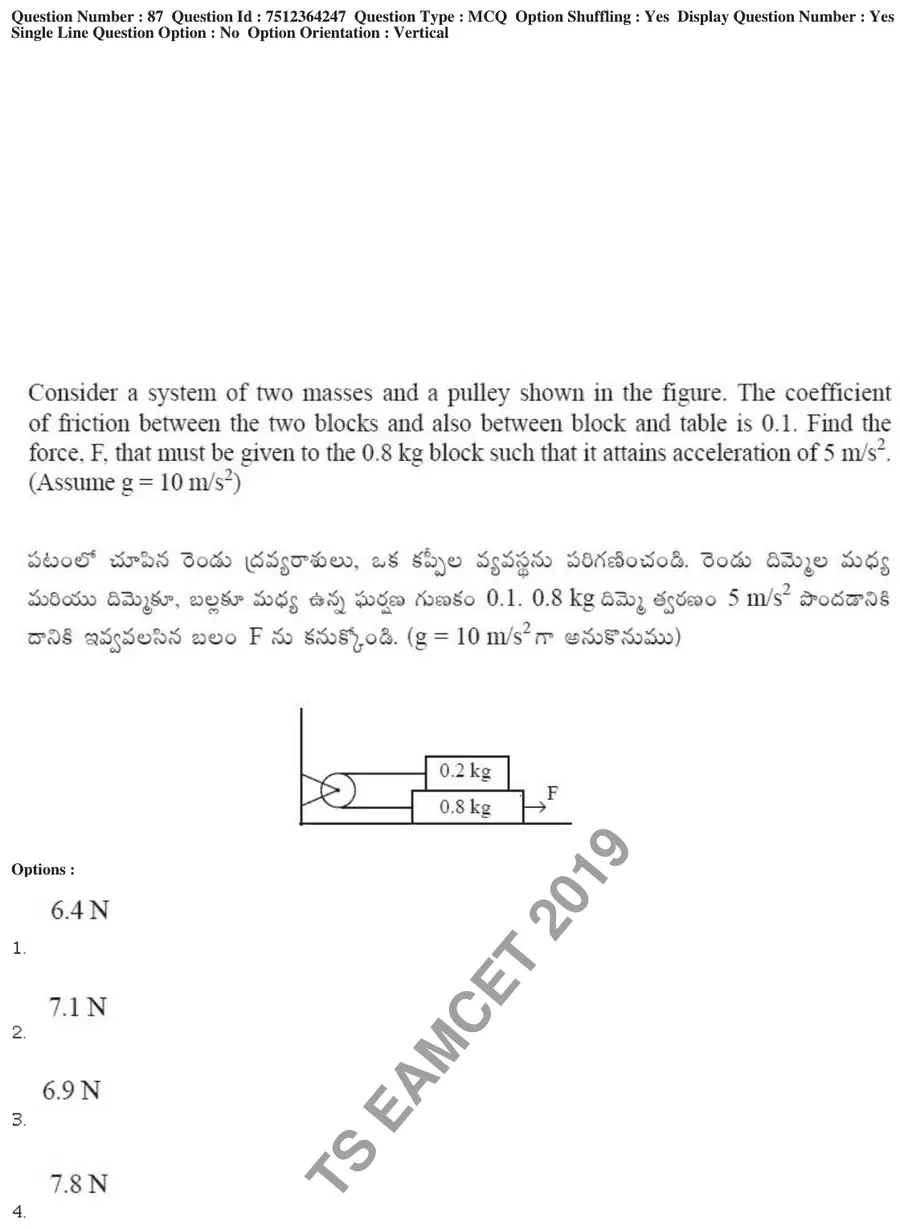
Consider a system of two masses and a pulley shown in the figure. The coefficient of friction between the two blocks and also between block and table is 0.1. Find the force, F, that must be given to the 0.8 kg block such that it attains acceleration of $5\ \mathrm{m/s^2}$. (Assume $g = 10\ \mathrm{m/s^2}$) (see the figure above)
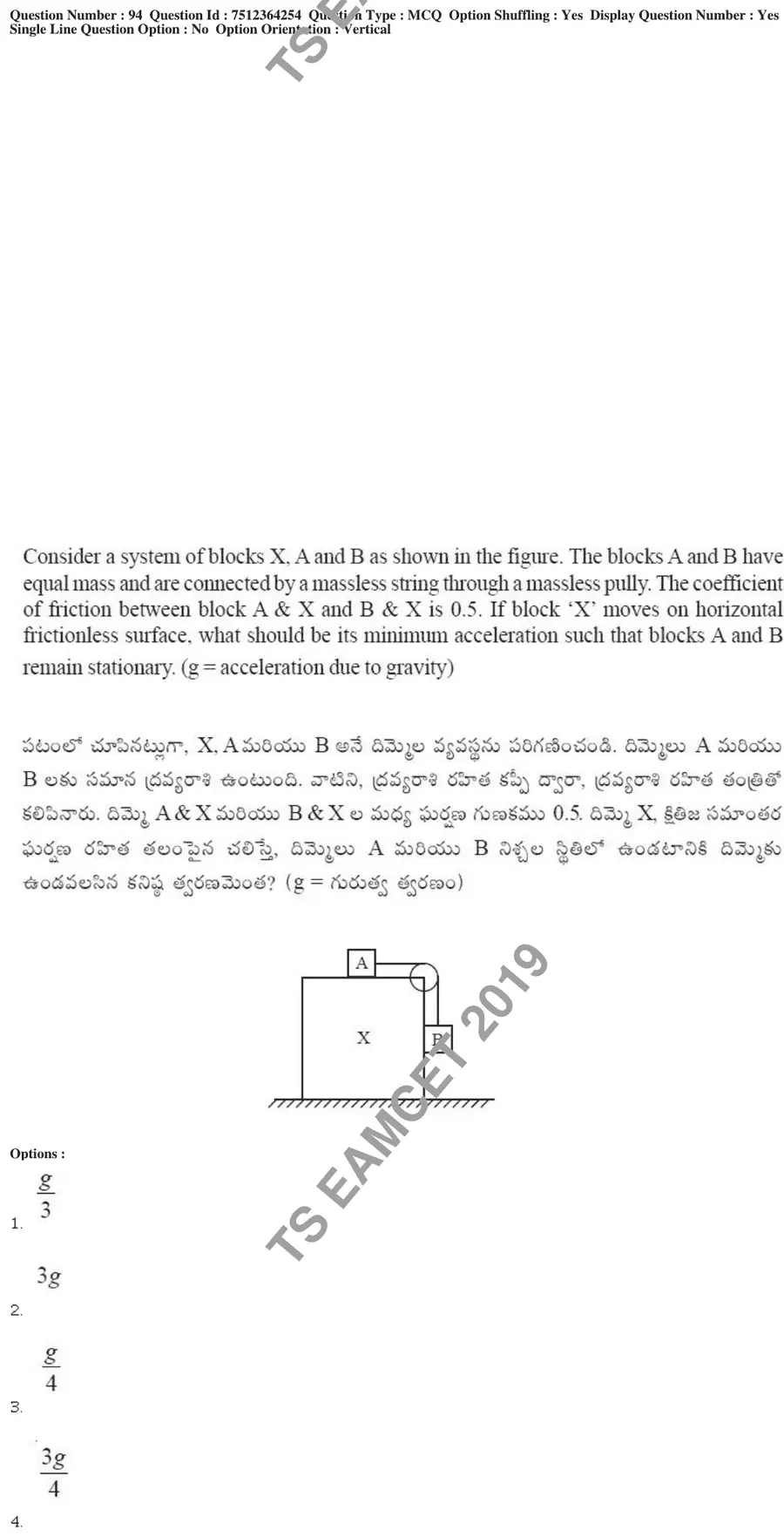
Consider a system of blocks X, A and B as shown in the figure. The blocks A and B have equal mass and are connected by a massless string through a massless pulley. The coefficient of friction between block A & X and B & X is 0.5. If block 'X' moves on horizontal frictionless surface, what should be its minimum acceleration such that blocks A and B remain stationary. ($g$ = acceleration due to gravity) (see the figure above)
An explosion blows a stationary rock into three parts. Two parts of masses $1\ \mathrm{kg}$ and $2\ \mathrm{kg}$ move at right angles to one another with velocities $12\ \mathrm{ms^{-1}}$ and $8\ \mathrm{ms^{-1}}$ respectively. If the velocity of third part is $4\ \mathrm{ms^{-1}}$, the mass of the rock is
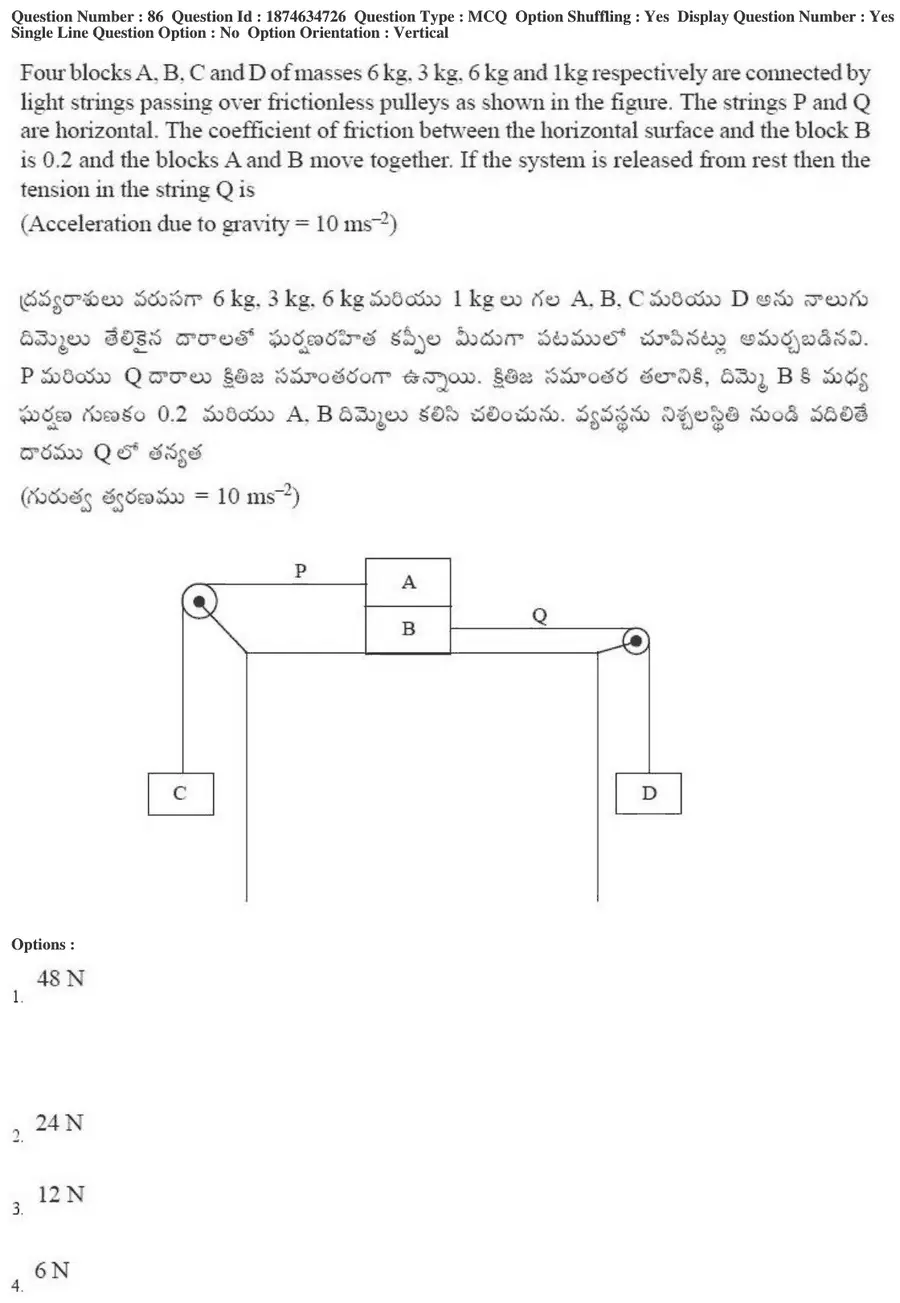
Four blocks A, B, C and D of masses $6\ \mathrm{kg}$, $3\ \mathrm{kg}$, $6\ \mathrm{kg}$ and $1\ \mathrm{kg}$ respectively are connected by light strings passing over frictionless pulleys as shown in the figure. The strings P and Q are horizontal. The coefficient of friction between the horizontal surface and the block B is 0.2 and the blocks A and B move together. If the system is released from rest then the tension in the string Q is (Acceleration due to gravity $= 10\ \mathrm{ms^{-2}}$) (see the figure above)
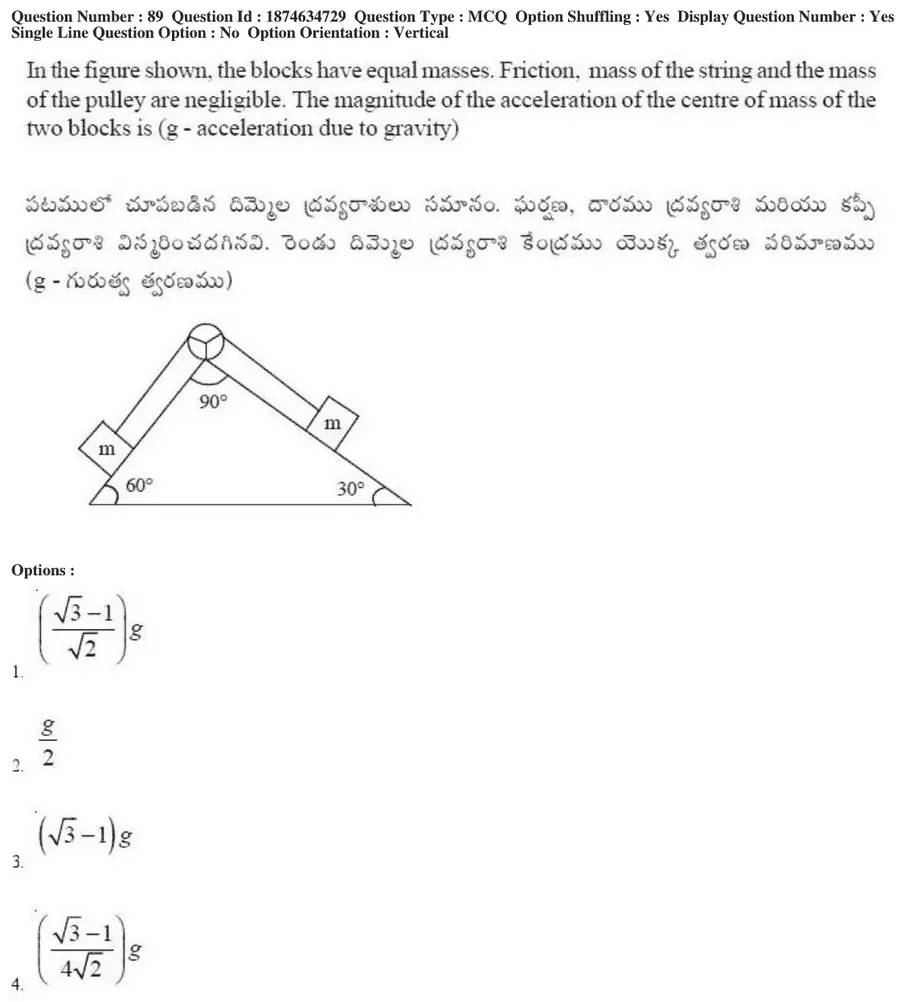
In the figure shown, the blocks have equal masses. Friction, mass of the string and the mass of the pulley are negligible. The magnitude of the acceleration of the centre of mass of the two blocks is (g - acceleration due to gravity) (see the figure above)
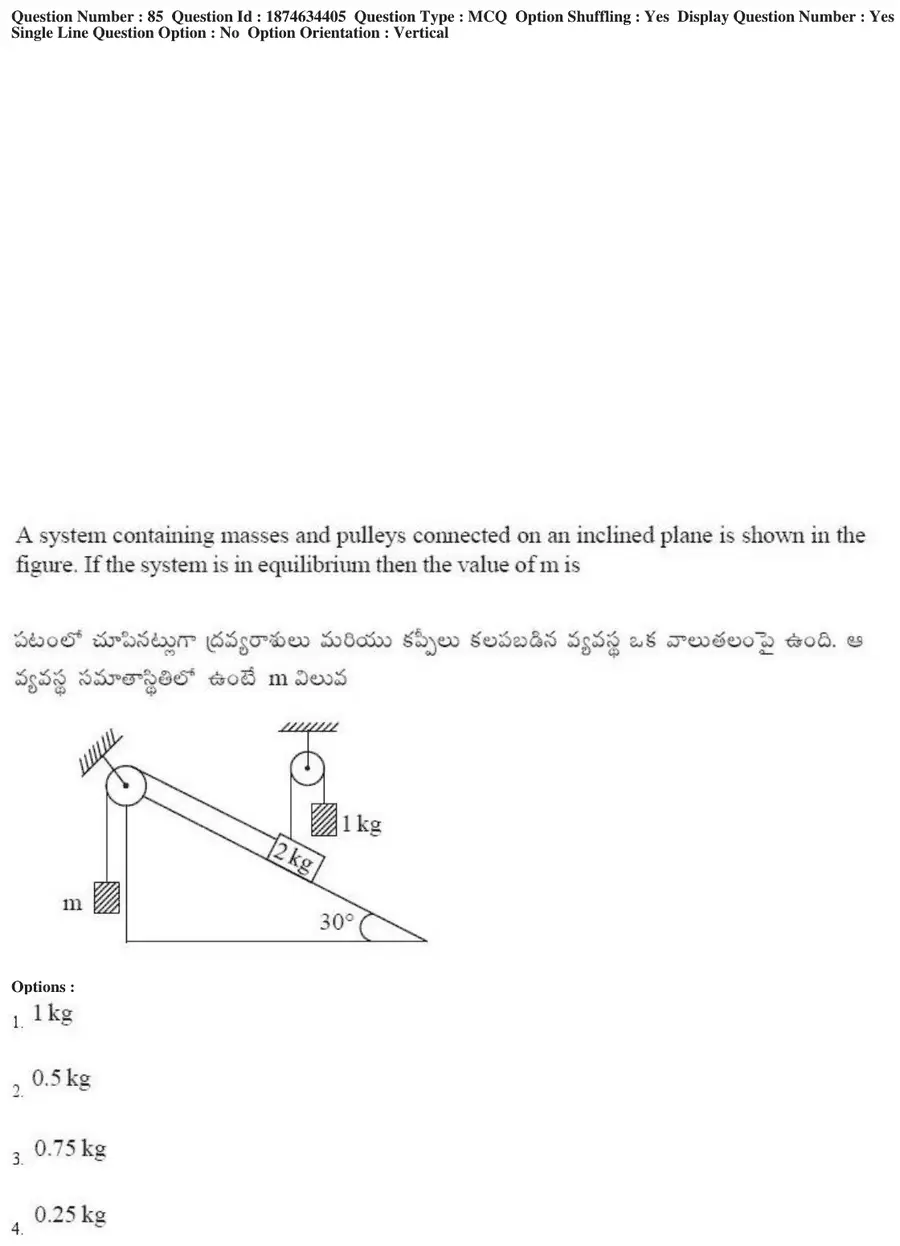
A system containing masses and pulleys connected on an inclined plane is shown in the figure. If the system is in equilibrium then the value of m is (see the figure above)
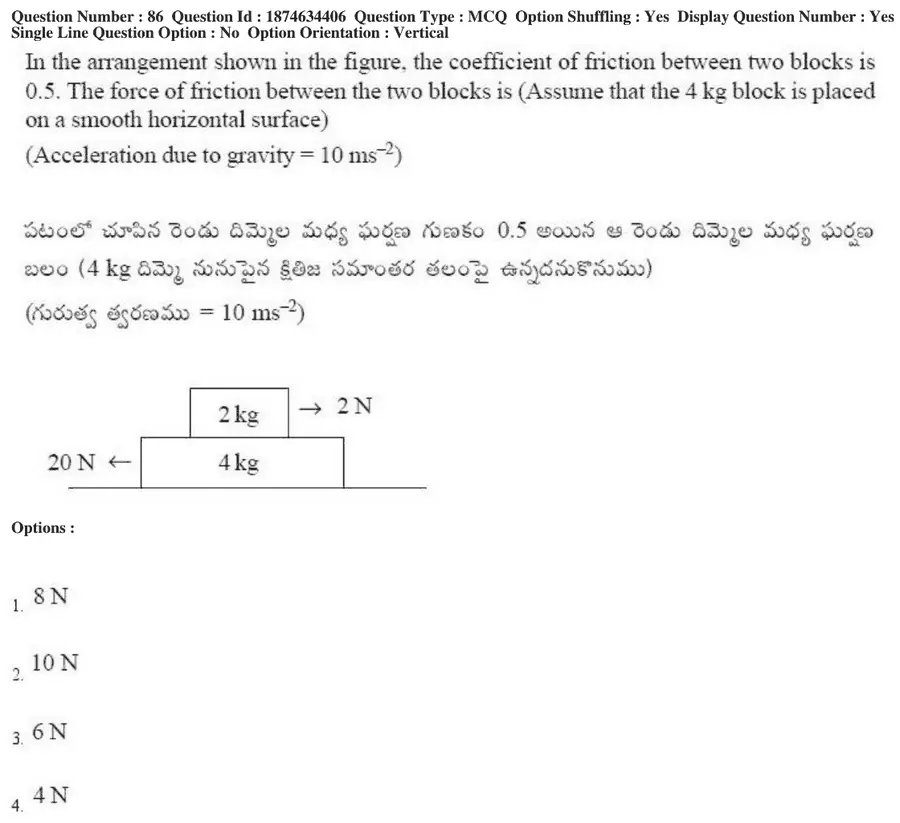
In the arrangement shown in the figure, the coefficient of friction between two blocks is 0.5. The force of friction between the two blocks is (Assume that the 4 kg block is placed on a smooth horizontal surface) (Acceleration due to gravity $= 10\ \mathrm{ms^{-2}}$) (see the figure above)
A ball of mass 1 g having a charge of $20\ \mu\mathrm{C}$ is tied to one end of a string of length 0.9 m can rotate in a vertical plane in a uniform electric field $100\ \mathrm{NC^{-1}}$ directed upwards. The minimum horizontal velocity that must be given to the ball at the lowest position so that it completes the vertical circle is ( g = $10\ \mathrm{ms^{-2}}$ )
A body starts sliding down from the top of an inclined plane inclined at an angle $\theta$ with horizontal. The first one third of the incline is smooth, the next one third has coefficient of friction $\frac{\mu}{2}$ and the last one third has coefficient of friction $\mu$. If the body comes to rest at the bottom of the plane then the value of $\mu$ is
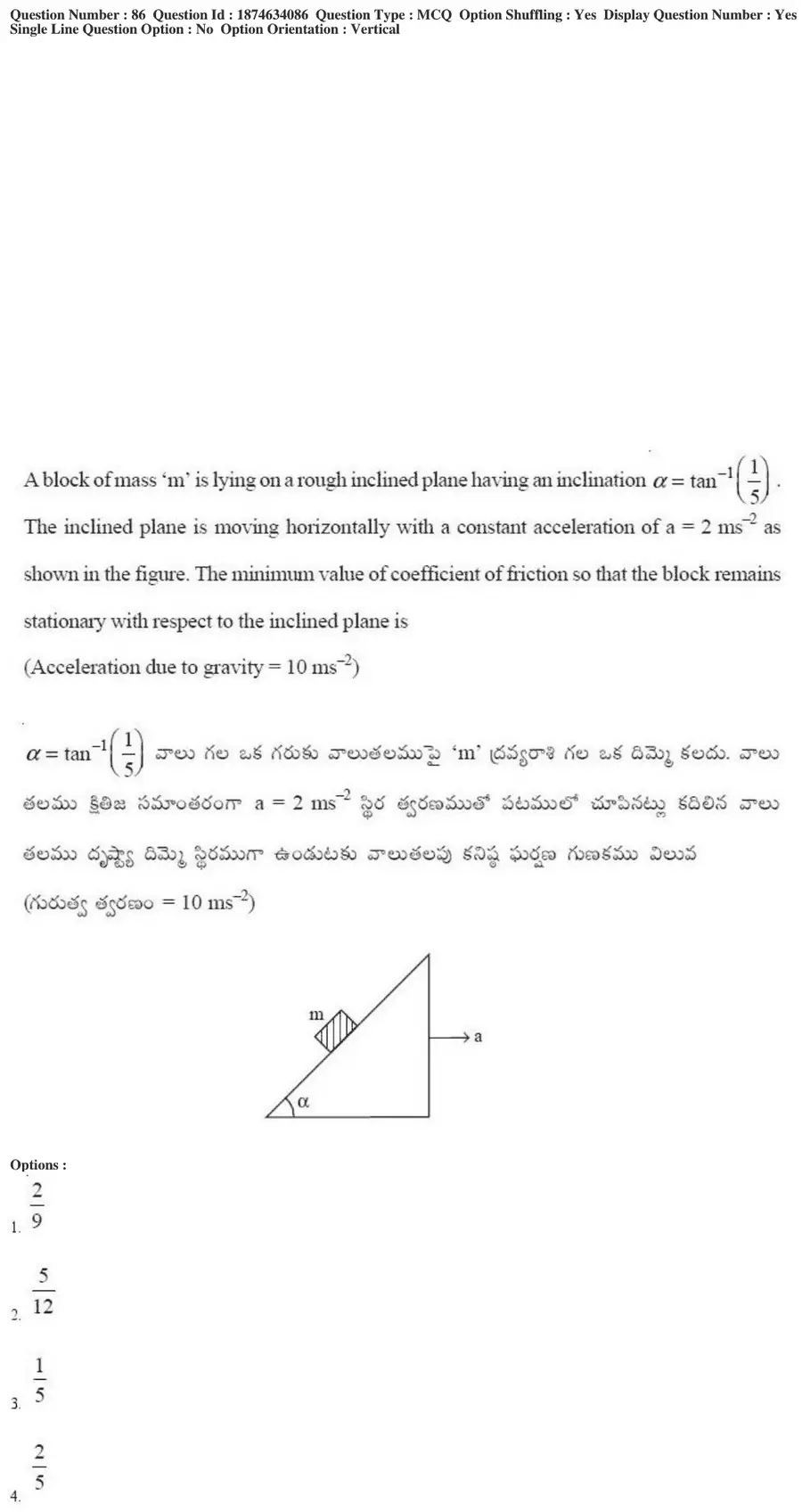
A block of mass 'm' is lying on a rough inclined plane having an inclination $\alpha = \tan^{-1}\left(\frac{1}{5}\right)$. The inclined plane is moving horizontally with a constant acceleration of $a = 2\,\mathrm{ms^{-2}}$ as shown in the figure. The minimum value of coefficient of friction so that the block remains stationary with respect to the inclined plane is (Acceleration due to gravity = $10\,\mathrm{ms^{-2}}$) (see the figure above)
A block of mass 48 kg kept on a smooth horizontal surface is pulled by a rope of length 4 m by a horizontal force of 25 N applied to the other end. If the linear density of the rope is $0.5\ \mathrm{kg\,m^{-1}}$, the force acting on the block is
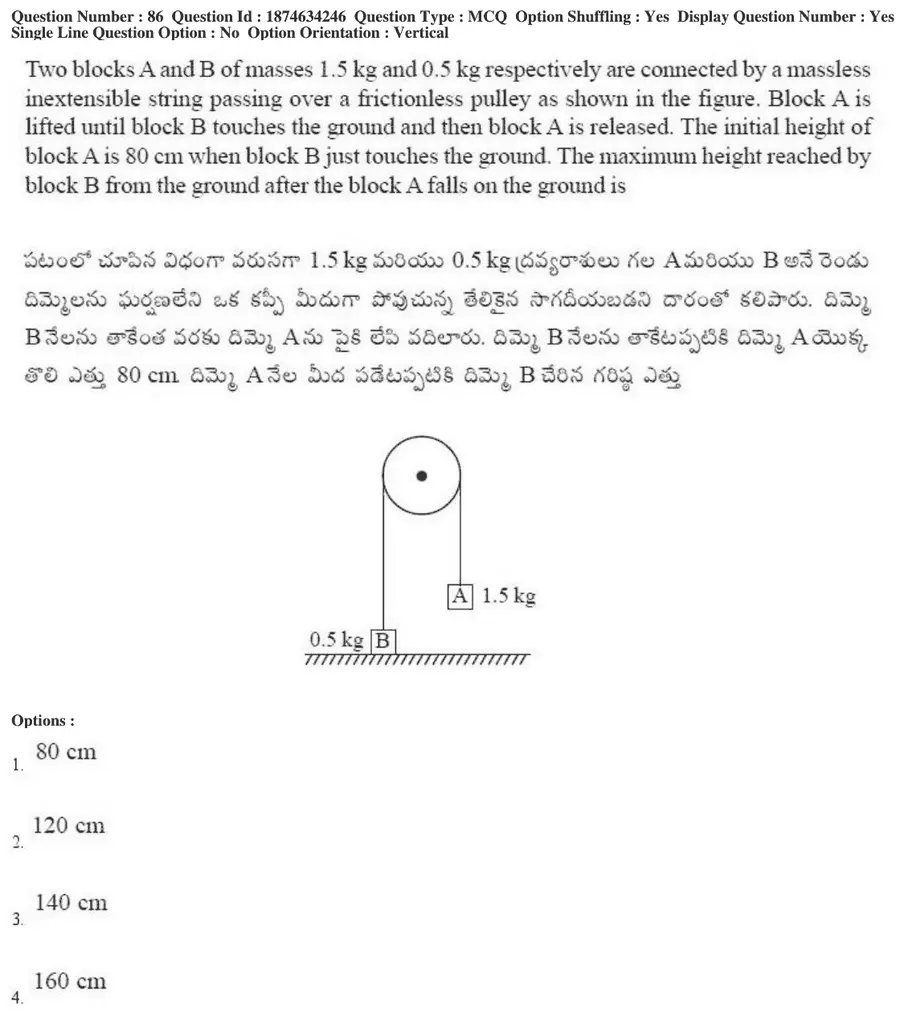
Two blocks A and B of masses 1.5 kg and 0.5 kg respectively are connected by a massless inextensible string passing over a frictionless pulley as shown in the figure. Block A is lifted until block B touches the ground and then block A is released. The initial height of block A is 80 cm when block B just touches the ground. The maximum height reached by block B from the ground after the block A falls on the ground is (see the figure above)
A uniform rod of length '$l$' and density '$\rho$' is revolving about a vertical axis passing through its one end. If '$\omega$' is the angular velocity of the rod then the centrifugal force per unit area of the rod is
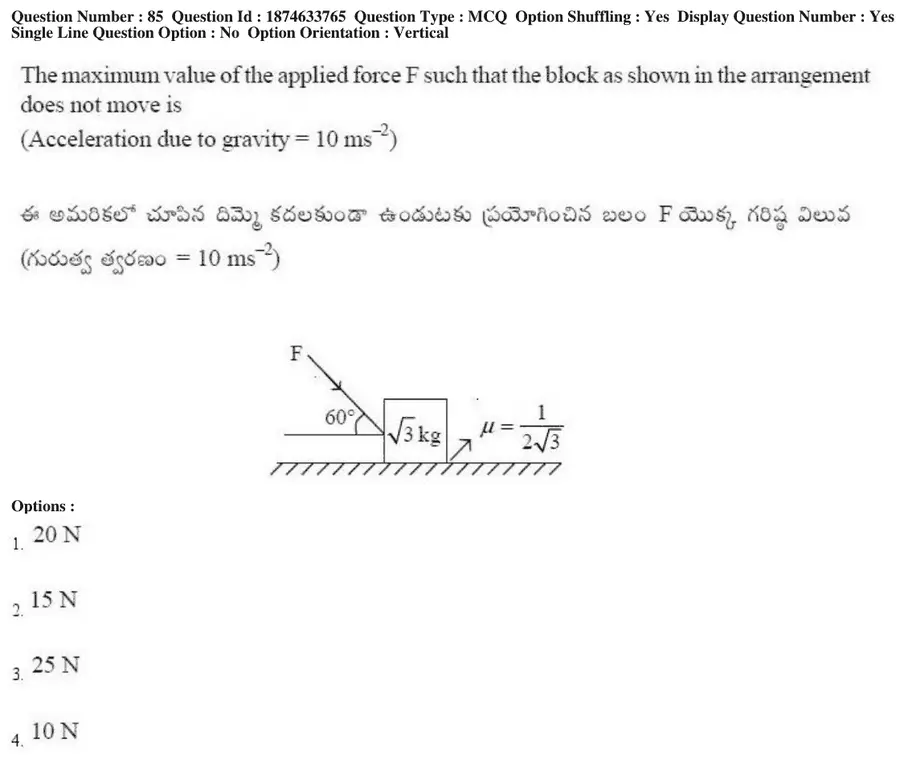
The maximum value of the applied force F such that the block as shown in the arrangement does not move is (Acceleration due to gravity $= 10\ \mathrm{ms^{-2}}$) (see the figure above)
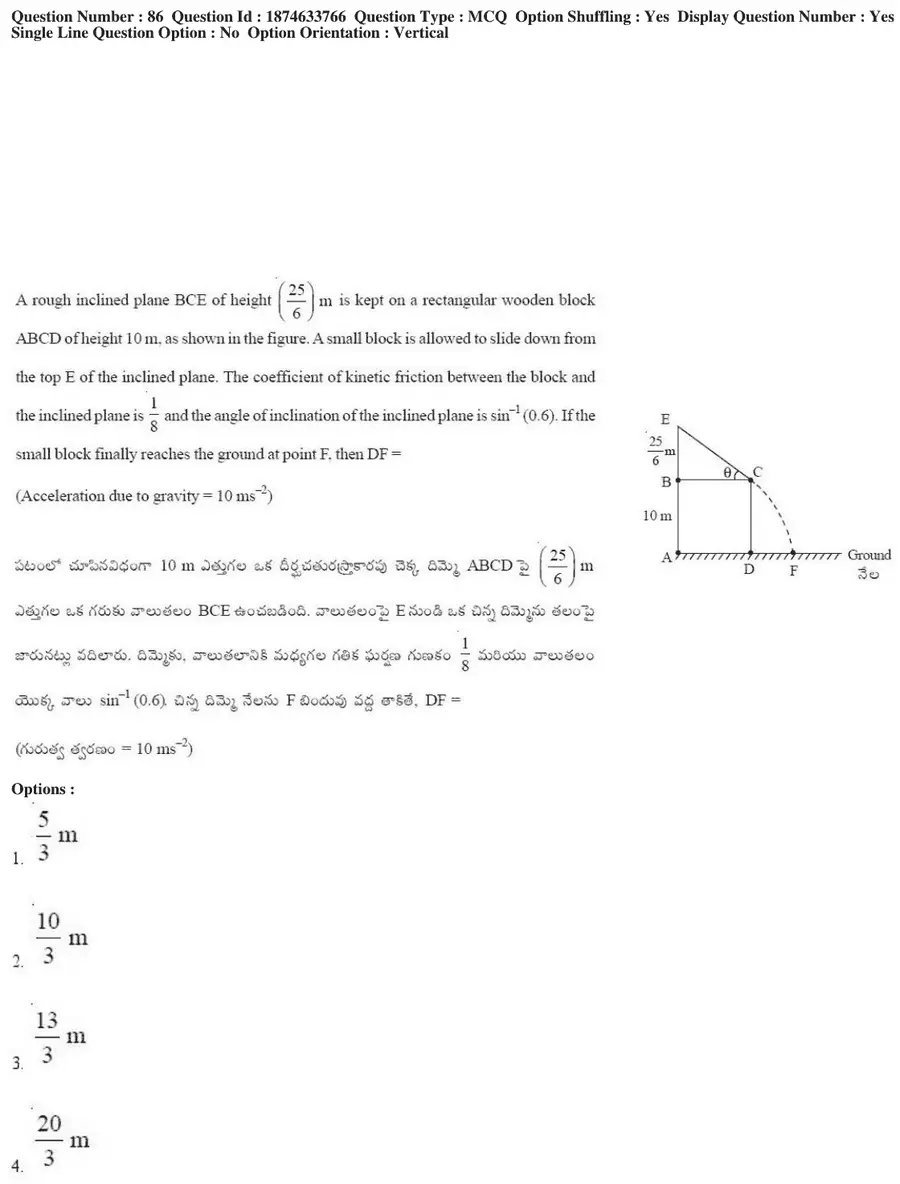
A rough inclined plane BCE of height $\left(\dfrac{25}{6}\right)$ m is kept on a rectangular wooden block ABCD of height 10 m, as shown in the figure. A small block is allowed to slide down from the top E of the inclined plane. The coefficient of kinetic friction between the block and the inclined plane is $\dfrac{1}{8}$ and the angle of inclination of the inclined plane is $\sin^{-1}(0.6)$. If the small block finally reaches the ground at point F, then DF = (Acceleration due to gravity $= 10\ \mathrm{ms^{-2}}$) (see the figure above)
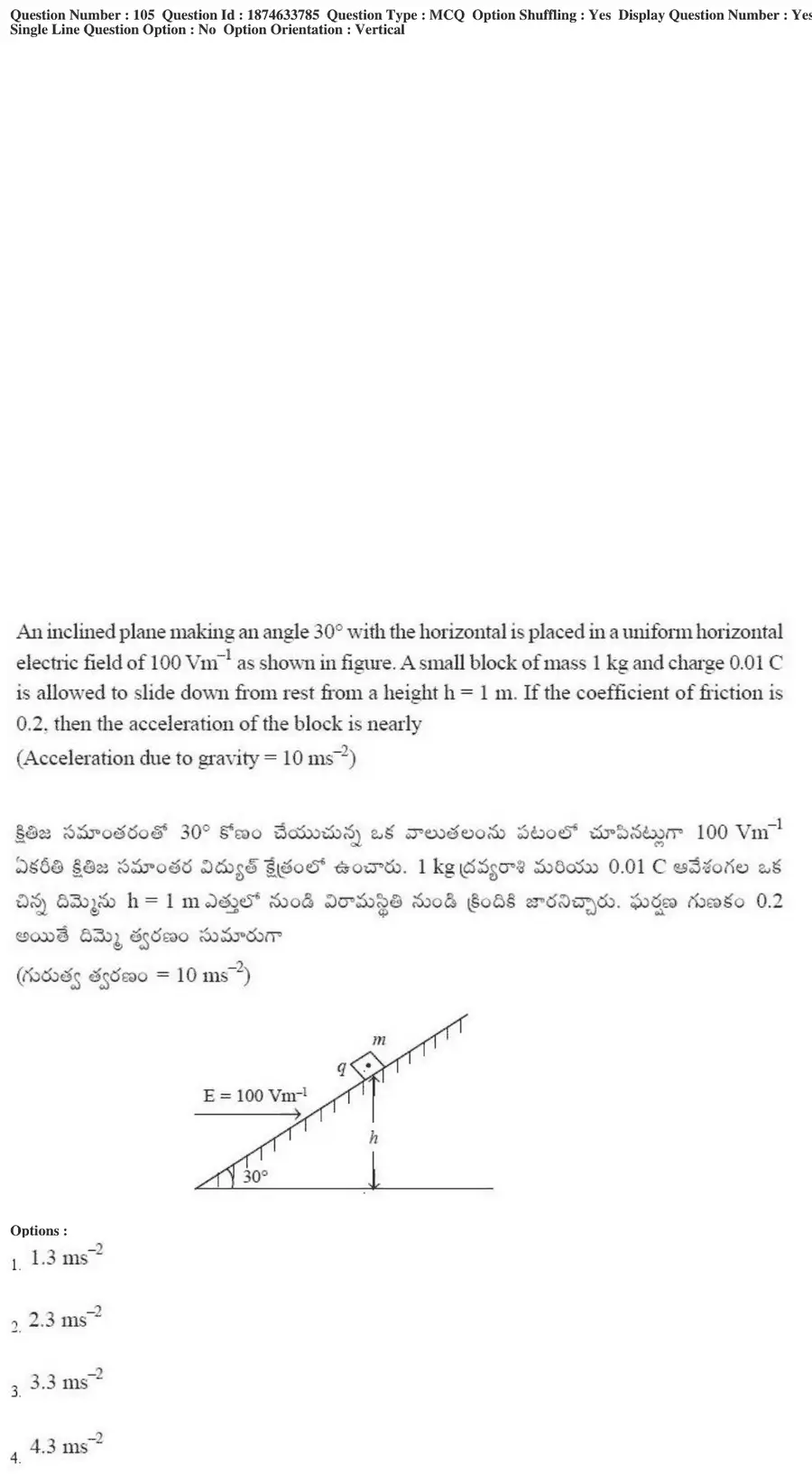
An inclined plane making an angle $30^\circ$ with the horizontal is placed in a uniform horizontal electric field of $100\ \mathrm{Vm^{-1}}$ as shown in figure. A small block of mass 1 kg and charge 0.01 C is allowed to slide down from rest from a height h = 1 m. If the coefficient of friction is 0.2, then the acceleration of the block is nearly (Acceleration due to gravity = $10\ \mathrm{ms^{-2}}$) (see the figure above)
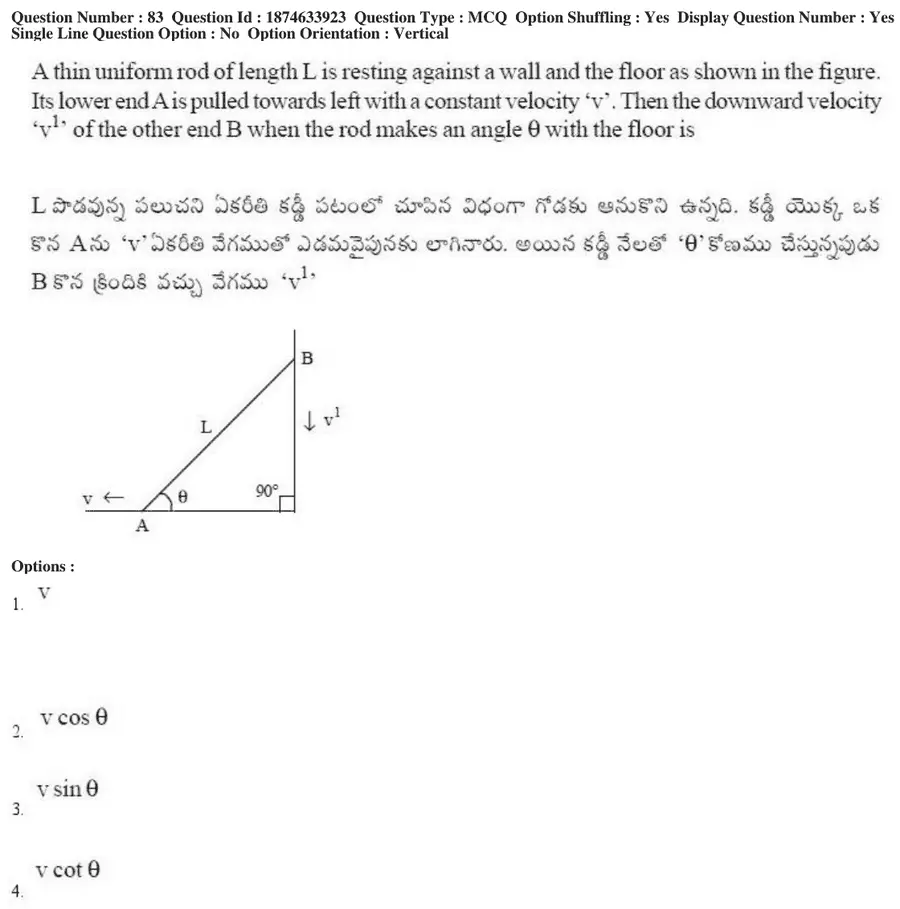
A thin uniform rod of length L is resting against a wall and the floor as shown in the figure. Its lower end A is pulled towards left with a constant velocity 'v'. Then the downward velocity 'v^1' of the other end B when the rod makes an angle $\theta$ with the floor is (see the figure above)
A force of $(2.6\hat{i} + 1.6\hat{j})\,\mathrm{N}$ acts on a body of mass 2 kg. If the velocity of the body at time $\mathrm{t = 0}$ is $(3.6\hat{i} - 4.8\hat{j})\ \mathrm{ms^{-1}}$, the time at which the body will just have a velocity along X - axis only is
The force required to move a body up a rough inclined plane is double the force required to prevent the body from sliding down the plane. If the angle of inclination of the plane is $60^\circ$, then the coefficient of friction is
A child is on a merry-go-round, standing at a distance 2 m from the centre. The coefficient of static friction between the child and the surface of merry-go-round is 0.8. At what maximum angular velocity can the merry-go-round be rotated before the child slips? (Assume $g = 10\ \mathrm{m/s^2}$)
A ball of mass 0.2 kg is thrown from a height of 1 m and with an initial velocity of $\sqrt{10}$ m/sec at an angle of $45^\circ$ with the horizontal. Assuming acceleration due to gravity $g = 10\ \mathrm{m/sec^2}$, the modulus of momentum increment during the total time of motion in kg m/sec, is
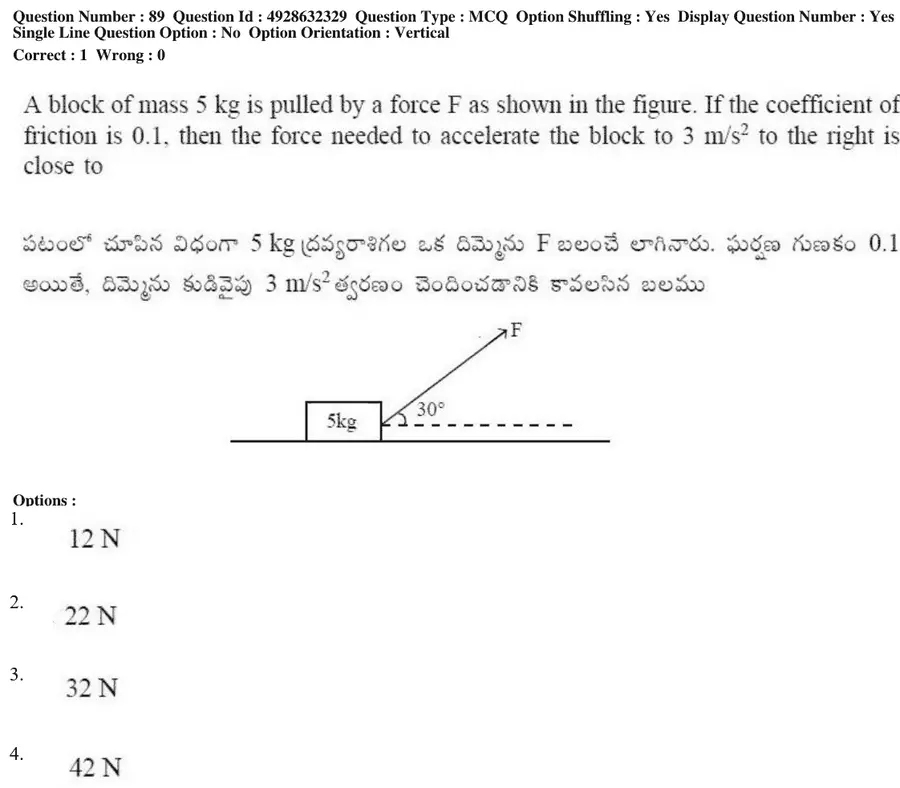
A block of mass $5\ \mathrm{kg}$ is pulled by a force $F$ as shown in the figure. If the coefficient of friction is $0.1$, then the force needed to accelerate the block to $3\ \mathrm{m/s^2}$ to the right is close to (see the figure above)
Laws of Motion forms the core dynamical engine of Class 11 Physics, appearing regularly across all exam shifts. In the papers we hold from 2022 to 2026, it contributed 139 questions in 77 papers, yielding an average of 1.8 questions per paper. The chapter was represented in 76 of those 77 papers, missing only a single paper throughout that entire five-year span. By total question count, it stands as the 6th largest of 28 Physics chapters, making up 4.5% of all Physics questions in this recent testing cycle.
Taking in the full timeline from 2010 to 2026, our collection records 299 questions across 143 of the 149 papers, averaging 2.0 questions per paper with a 5.0% share of the subject. In the early period from 2010 to 2021, the chapter had a higher share of 5.6% (160 questions in 72 papers, appearing in 67 papers, 2.2 per paper). Over the last three exam years from 2024 to 2026, it accounted for 79 questions in 46 papers (appearing in 46 papers, 1.7 per paper, 4.3% share). Compared to the early years, the chapter's share of Physics has fallen, whereas compared to the recent five-year baseline it has stayed about the same. Every year since 2022 has included multiple questions from this unit.
Between 2022 and 2026, the two states showed differing coverage: AP EAPCET papers carried 103 questions across 48 papers (appearing in 48 papers, 2.1 per paper, 5.4% share), whereas TS EAPCET papers held 36 questions across 29 papers (appearing in 28 papers, 1.2 per paper, 3.1% share).
Most-asked topics
In the papers we hold from 2022 to 2026, questions divided across four primary topics:
Newton's Laws & Free Body Diagrams: 52 questions. Across the entire 2010 to 2026 dataset, this topic leads with 109 questions.
Friction: 43 questions recently, with 87 questions across the full archive.
Dynamics of Circular Motion: 23 questions in the recent window, totalling 53 questions overall.
Momentum & Impulse: 21 questions recently, and 50 questions across all years in our collection.
All four topic areas appeared in 2026 exam papers, emphasizing that candidates need well-rounded mastery of force balances, friction thresholds, and circular constraints.
What the questions look like
Problems on Newton's laws and free body diagrams generally present connected-body systems. Familiar configurations include two or three blocks connected by light cords over pulleys, masses sliding on wedges, and bodies positioned inside accelerating elevators or vehicles. Questions typically ask for the common acceleration of the assembly, contact normal forces between adjacent blocks, or the tension developed in connecting strings.
Friction problems center on static, limiting, and kinetic frictional regimes. A classic problem involves pulling a block on a horizontal rough surface with a force directed at an angle above or below the horizontal, requiring students to adjust the normal reaction accordingly. Another standard scenario places a mass on an inclined plane whose upper half is smooth while the lower half is rough, asking for the coefficient of friction if the body comes to rest at the base. Two-block friction systems, where one block rests atop another, frequently test which mass slips first.
Circular dynamics questions investigate banked tracks, conical pendulums, and vehicles turning along curved paths with or without friction. Impulse questions usually test the area beneath force-time graphs or calculate impulse from sudden momentum changes during wall rebounds and rocket expulsions.
Questions to try first
The following questions from 2026 council papers represent major problem styles across both state exams:
Begin by drawing isolated free-body diagrams for every component in a multi-body arrangement. Resolve all applied forces into orthogonal axes along and perpendicular to the direction of acceleration before setting up equations of motion.
For friction problems, always evaluate the maximum available static friction force first before assuming motion occurs. Check whether the net driving force exceeds this threshold; if it does not, the static friction force simply balances the applied force and the acceleration remains zero.
In circular dynamics, clearly distinguish between centripetal force and centrifugal effects. Identify the real physical forces providing centripetal acceleration, such as the horizontal component of normal force on a banked turn or the tension component in a conical pendulum. Working through timed sets of past paper questions will build speed in resolving forces accurately.
Frequently asked questions
How many questions come from Laws of Motion in EAPCET?
In the papers we hold from 2022 to 2026, the chapter delivered 139 questions across 77 papers, averaging 1.8 questions per paper. It appeared in 76 of those 77 papers and ranks 6th among all 28 Physics chapters by question share.
Which topic within Laws of Motion is asked most frequently?
Newton's Laws and Free Body Diagrams is the most frequent topic with 52 questions from 2022 to 2026, followed closely by Friction with 43 questions.
Is the question volume higher in AP EAPCET than TS EAPCET?
Yes. In our 2022 to 2026 dataset, AP EAPCET featured 103 questions across 48 papers (2.1 per paper, 5.4% share), while TS EAPCET featured 36 questions across 29 papers (1.2 per paper, 3.1% share).
Where can I see the solutions?
Every question on this page opens with its options and answer. Step-by-step solutions for each one are in the EdLoop EAPCET app.