Every Magnetism & Matter question from past AP EAPCET and TS EAPCET papers, with options and answers. Newest first.
135questions
126papers covered
2.4%of Physics questions, 2022–2026
2010–2026years
Guide at a glance
Magnetism & Matter offers a concise, descriptive unit in Class 12 physics. Examining our records for AP and TS EAPCET papers between 2022 and 2026, the chapter contributed 74 questions across 77 papers.
Two identical short bar magnets, each having a magnetic moment of 10 Am$^2$ are arranged such that their axial lines are perpendicular to each other and their centres be along the same straight line in a horizontal plane. If the distance between their centres is 0.2 m, the resultant magnetic induction at a point midway between them is ($\mu_0 = 4\pi \times 10^{-7}$ Hm$^{-1}$)
Two identical bar magnets are placed one above the other such that they are mutually perpendicular and bisect each other. The time period of this combination in a horizontal magnetic field is ‘T’. The time period of each magnet in the same field is
The temperature at which the susceptibility of nickel becomes 0.5 times its susceptibility at a temperature of $460^\circ\mathrm{C}$ is (Curie temperature of nickel is $360^\circ\mathrm{C}$)
A material satisfies the relation $\mu_0(\mathrm{H} + \mathrm{M}) = 0$, where H and M are magnetic intensity and magnetization, respectively; then the material is
The earth's magnetic field at a certain place has a total strength of 0.5 Gauss and the horizontal component of 0.3 Gauss. Then the angle of dip at that place is
A magnetic material placed in a magnetic field of intensity $H = 1000\ Am^{-1}$ has magnetization $M = 2\ Am^{-1}$. The magnetic susceptibility, and type of material is
A Magnetic needle lying parallel to a magnetic field requires $W$ units of work to turn it through $60^\circ$. The torque required to keep the needle in this position will be
A bar magnet of magnetic moment $1.8\,\mathrm{Am^2}$ is free to rotate about a vertical axis passing through its centre at a place where the vertical component of earth's magnetic field is $0.3\times10^{-4}\,\mathrm{T}$ and the dip angle is $45°$. If the magnet at rest in east-west direction is released, then the kinetic energy (in $\mu\mathrm{J}$) of the magnet when it reaches north-south direction is
A magnetic dipole is suspended in a region where two uniform magnetic fields are inclined at $75^\circ$ with each other. In stable equilibrium, if the dipole makes an angle of $30^\circ$ with the direction of one field of $10\sqrt{2}\,\mathrm{mT}$, then the value of the second magnetic field is
The mean radius of a Rowland ring is 12 cm and it has 3000 turns of wire wound on its ferromagnetic core of relative permeability 500. If the magnetic field inside the core is 5 T, then the magnetizing current is
If the susceptibility of a paramagnetic substance at a temperature of $23\ ^\circ\mathrm{C}$ is $2.3\times10^{-5}$, then its susceptibility at a temperature of $467\ ^\circ\mathrm{C}$ is
The magnetic field at a point A on the axis of a short bar magnet is 1500% more than the magnetic field at a point B on the normal bisector of the magnet. If the distance of point A from the centre of the magnet is 18 cm, then the distance of point B from the centre of the magnet is
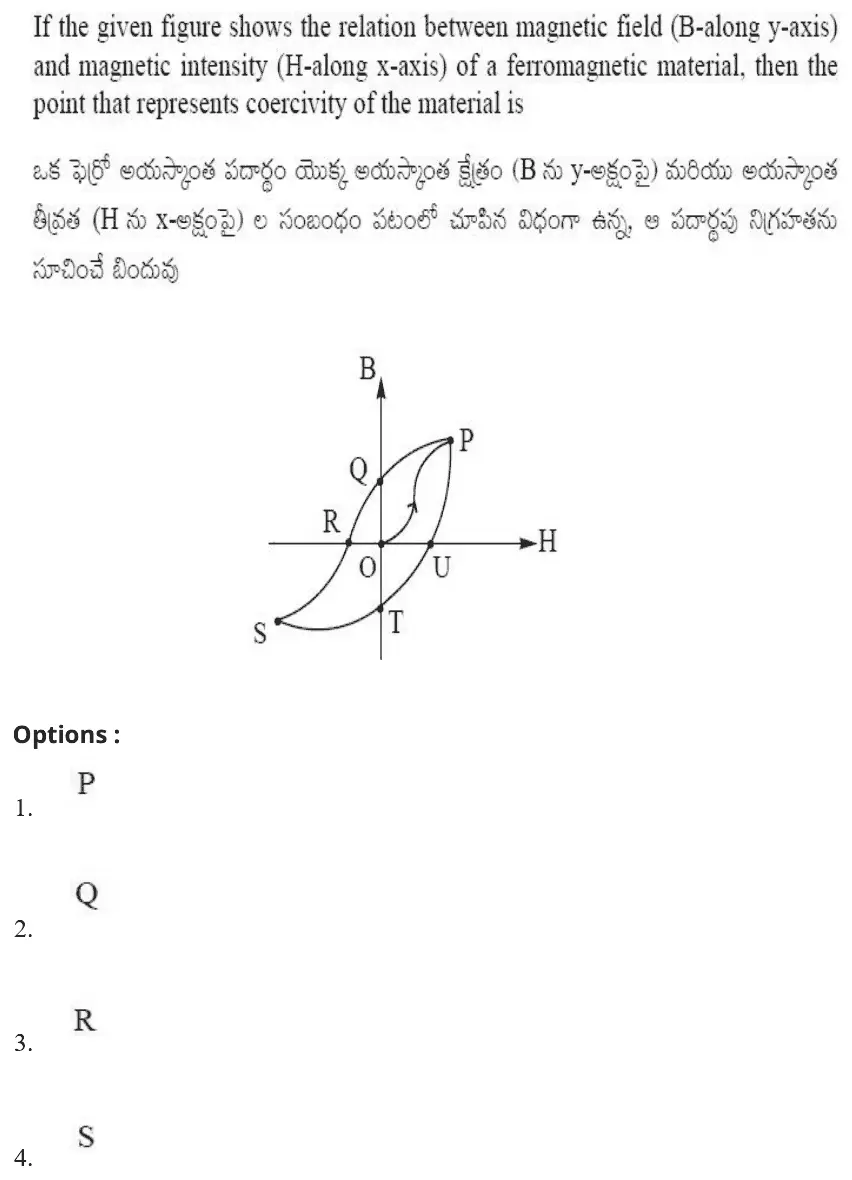
If the given figure shows the relation between magnetic field (B-along y-axis) and magnetic intensity (H-along x-axis) of a ferromagnetic material, then the point that represents coercivity of the material is
A sample of a ferromagnetic iron in the shape of a cube of side $1.0\ \mu\mathrm{m}$ contains $8.7\times10^{28}$ atoms per cubic metre and the magnetic dipole moment of each iron atom is $9.3\times10^{-24}\ \mathrm{Am^2}$. Then the maximum possible magnetic dipole moment (in $\mathrm{A\,m^2}$) of the sample is nearly
A sample of paramagnetic salt contains $2\times10^{24}$ atomic dipoles each of dipole moment $1.5\times10^{-23}\ \mathrm{J\,T^{-1}}$. The sample is placed under homogeneous magnetic field of 0.6 T and cooled to a temperature 4.2 K. The degree of magnetic saturation achived is 20%. Then total dipole moment of the sample for a magnetic field of 0.9 T and a temperature of 2.8 K is
The work done in rotating a bar magnet which is initially in the direction of a uniform magnetic field through $45^\circ$ is W. The additional work to be done to rotate the magnet further through $15^\circ$ is
A short bar magnet has a magnetic moment of $0.48\ \mathrm{J\,T^{-1}}$. The magnitude of magnetic field at a point at 10 cm distance from the centre of the magnet on its axis is
A short bar magnet of magnetic moment $10^4\ \mathrm{J\,T^{-1}}$ is free to rotate in a horizontal plane. The work done in rotating the magnet slowly from the direction parallel to a horizontal magnetic field of $4 \times 10^{-5}\ \mathrm{T}$ to a direction $60^\circ$ to the direction of the field is
A short bar magnet is placed in a uniform magnetic field of $2\,\mathrm{T}$ such that the axis of the magnet makes an angle of $45^\circ$ with the direction of the magnetic field. If the torque acting on the magnet is $0.36\sqrt{2}\,\mathrm{N\,m}$, then the moment of the magnet is
A short bar magnet of magnetic moment $2.5\,\mathrm{Am^2}$ is kept in a uniform magnetic field of $4\times10^{-5}\,\mathrm{T}$. The work done in moving the magnet from its most stable position to most unstable position is
At a certain place in the magnetic meridian, the earth's magnetic field is twice its vertical component. The ratio of horizontal component of earth's magnetic field and the total magnetic field of the earth at that place is
The magnetic field at a point P on the axis of a short bar magnet of magnetic moment M is B. If another short bar magnet of magnetic moment 2M is placed on the first magnet such that their axes are perpendicular and their centres coincide. The resultant magnetic field at the point P due to both the magnets is
If $\mathrm{B_V}$ and $\mathrm{B_H}$ are respectively the vertical and horizontal components of the earth's magnetic field at a place where the angle of dip is $60^\circ$, then the total magnetic field at that place is
The relation between $\mu$ and $H$ for a specimen of iron is $\mu = \left[\frac{0.4}{H} + 12 \times 10^{-4}\right] \mathrm{Hm^{-1}}$. The value of $H$ which produces flux density of 1 T will be ( $\mu$ = magnetic permeability, $H$ = magnetic intensity)
One bar magnet is in simple harmonic motion with time period T in an earth’s magnetic field. If its mass is increased by 9 times the time period becomes
A short magnet oscillates with a time period $0.1\,s$ at a place where horizontal magnetic field is $24\,\mu\mathrm{T}$. A downward current of $18\,A$ is established in a vertical wire kept at a distance of $20\,cm$ east of the magnet. The new time period of oscillations of the magnet is
If the vertical component of the earth's magnetic field is 0.45 G at a location, and angle of dip is $60^\circ$, then magnetic field of earth in that location is
At a place the horizontal component of earth's magnetic field is $3 \times 10^{-5}$ T and the magnetic declination is $30°$. A compass needle of magnetic moment $18\ \mathrm{Am^2}$ pointing towards geographic north at this place experiences a torque of
At a place where the magnitude of the earth's magnetic field is $4 \times 10^{-5}$ T, a short bar magnet is placed with its axis perpendicular to the earth's magnetic field direction. If the resultant magnetic field at a point at a distance of 40 cm from the centre of the magnet on the normal bisector of the magnet is inclined at $45^\circ$ with the earth's field, then the magnetic moment of the magnet is
The domain in ferromagnetic material is in the form of a cube of side $2\ \mu\mathrm{m}$. Number of atoms in that domain is $9 \times 10^{10}$ and each atom has a dipole movement of $9 \times 10^{-24}\ \mathrm{Am^2}$. The magnetisation of the domain is (approximately).
A magnet suspended in a uniform magnetic field is heated so as to reduce its magnetic moment by 19%. By doing this, the time period of the magnet approximately
The magnetizing field which produces a magnetic flux of $22 \times 10^{-6}$ Wb in a metal bar of area of cross-section $2 \times 10^{-5}\ \mathrm{m^2}$ is (susceptibility of the metal = 699)
A circular coil carrying a current of 2.5 A is free to rotate about an axis in its plane perpendicular to an external magnetic field. When the coil is made to oscillate, the time period of oscillation is T. If the current through the coil is 10 A, the time period of oscillation is
A short bar magnet placed in a uniform magnetic field making an angle with the field experiences a torque. If the angle made by the magnet with field is changed from $30^\circ$ to $45^\circ$, the torque on the magnet
If a bar magnet of moment $10^{-4}\ \mathrm{Am^2}$ is kept in a uniform magnetic field of $12\times10^{-3}$ T such that it makes an angle of $30^\circ$ with the direction of magnetic field, then the torque acting on the magnet is
Curl the palm of your right hand around the circular wire with the fingers pointing in the direction of current and the thumb gives the direction of the magnetic field. In this case the upper side of the loop may be thought of as
A bar magnet of magnetic moment $2\ \mathrm{Am^2}$ lies aligned with the direction of a uniform magnetic field of $0.3\ \mathrm{T}$. The amount of work required by an external torque to turn the magnet so as to align its magnetic moment normal to the field direction is
The period of oscillation of a bar magnet at a place is 2 s. At the same place, the period of oscillation of another identical bar magnet whose magnetic moment is 4 times to that of first magnet is
A bar magnet has coercivity $4\times10^{3}\ \mathrm{Am^{-1}}$. It is placed inside a solenoid of 12 cm length and 60 turns. The current that should be passed through the solenoid to demagnetise the bar magnet is
An iron bar having a cross sectional area of $2 \times 10^{-5}$ m$^2$ and magnetising field of 2400 A/m produce a magnetic flux of $2.4\,\pi \times 10^{-5}$ Wb. What will be the value of permeability ($\mu$) and susceptibility ($\chi$) of the bar (Given $\mu_0 = 4\pi \times 10^{-7}$ )
In the magnetic meridian of a certain place, the horizontal component of the earth's magnetic field is 86.6 G (Gauss) and the magnetic field of earth is 100 G (Gauss). Then the dip angle is
A thin magnetic needle is placed in a magnetic field of 200 G with its axis at $30^\circ$ to the direction of the field. Find the magnetic moment of the needle if it experiences a torque of 0.012 Nm in this field.
The magnitude of axial field due to a bar magnet at a distance of 1 m, is found to be $5\times10^{-8}$T. The magnetic moment of the bar magnet is $\left(\mu_{0}=4\pi\times10^{-7}\right)$
A planet has magnetic dipole moment of $27\times10^{22}\ \mathrm{Am^{2}}$. If the radius of the planet is 300 km, what would be the magnetic field at its equator? $\dfrac{\mu_{0}}{4\pi}=10^{-7}$
Assertion (A) : The magnetic field lines are continuous and form closed loops. Reason (R) : Magnetic monopole does not exist. The correct option among the following is
A
(A) is true, (R) is true and (R) is the correct explanation for (A)
B
(A) is true, (R) is true but (R) is not the correct explanation for (A)
A bar magnet of length 16 cm is placed in the magnetic meridian with the N- pole pointing towards geographical north. Two neutral points separated by 12 cm are obtained on the equatorial line of the magnet. If the horizontal component of earth's magnetic field $= 3.2\times10^{-5}$ T, then the pole strength of magnet is
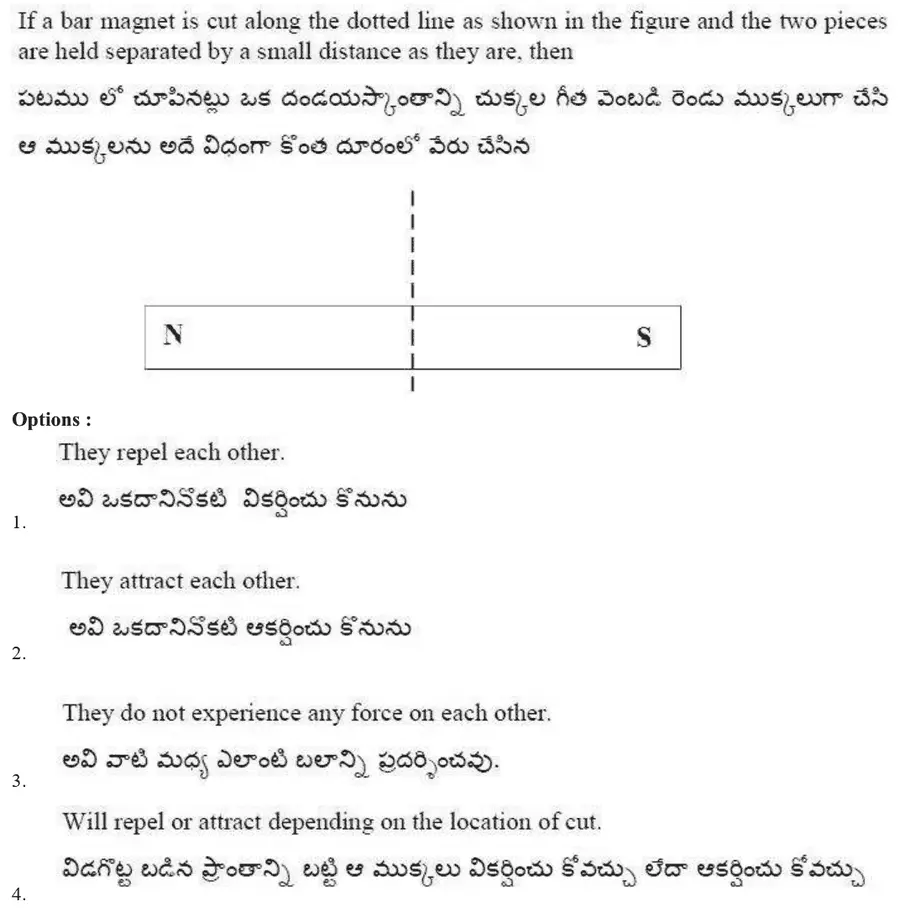
If a bar magnet is cut along the dotted line as shown in the figure and the two pieces are held separated by a small distance as they are, then (see the figure above)
The question as printed in the paper.
A
They repel each other.
B
They attract each other.
C
They do not experience any force on each other.
D
Will repel or attract depending on the location of cut.
A short bar magnet produces a magnetic field of $6.4 \times 10^{-5}$ T at a distance of 20 cm from the center of the magnet on the normal bisector of the magnet. The magnetic field produced by this magnet at a distance of 40 cm from the center of the magnet on the axis, is
A short magnetic needle is placed in a magnetic field $B\hat{i}$ in the direction $(\sqrt{3}\,\hat{i}+\hat{j})$. The needle experiences a torque of 0.06 Nm. If the same magnetic needle is placed in a magnetic field $2B\hat{j}$ in the direction $(\hat{i}+\sqrt{3}\,\hat{j})$, the torque experienced by it is
A vibration magnetometer is used at two different places A and B on the earth. The time period of a magnet suspended freely in the magnetometer at A is twice that at B. If the horizontal component of the earth's magnetic field at B is $32\times10^{-6}$ T, then its value at A is
A short bar magnet placed in a horizontal plane has its axis aligned along north-south direction. Null points are found on the axis of the magnet at 20 cm from the center of magnet. The earth's magnetic field at the place is B and angle of dip is $0^\circ$. If the total magnetic field on the normal bisector of the magnet 20 cm from the center of the magnet is 0.6 G, then the magnitude of B is
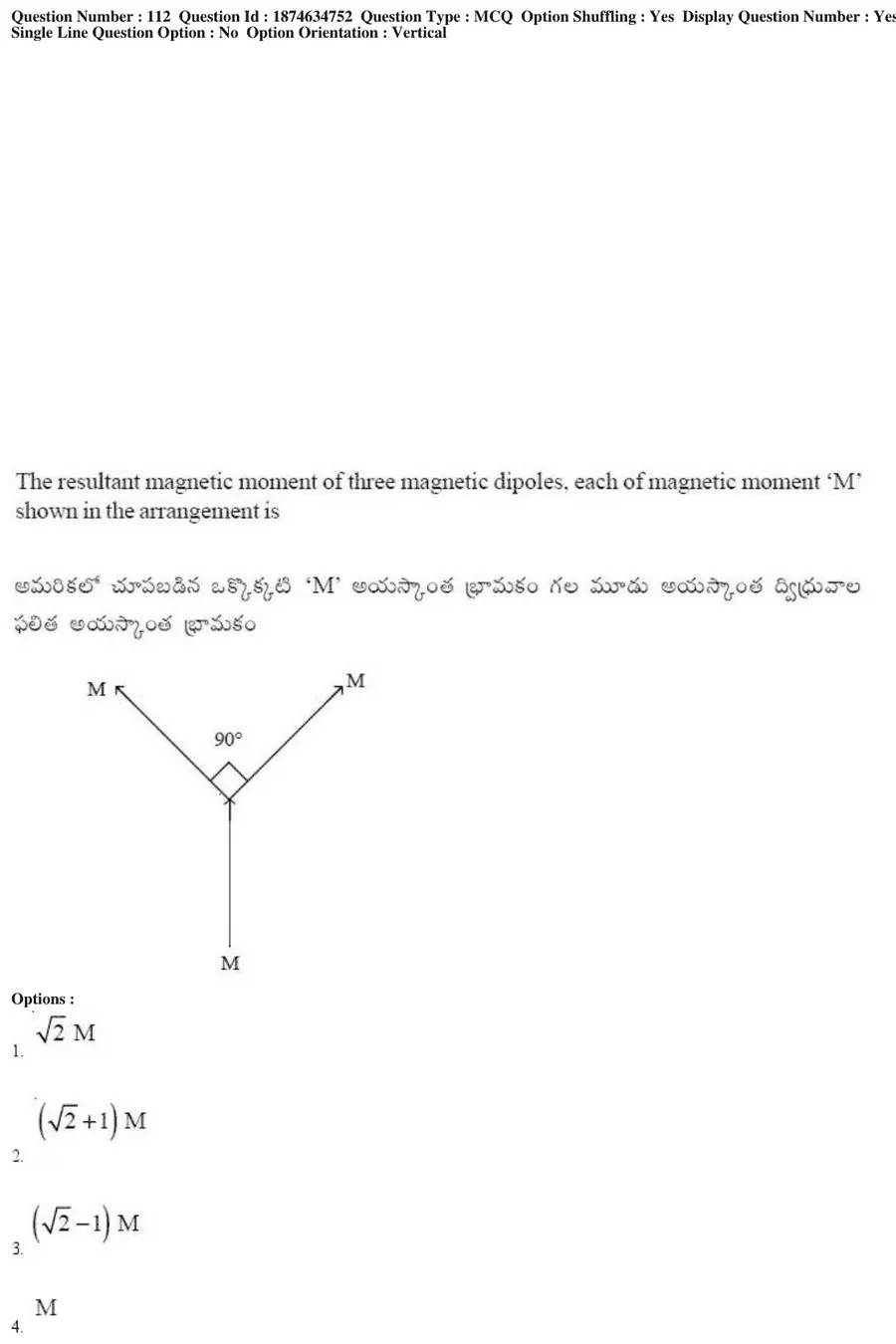
Two short magnets of equal dipole moments M are fastened perpendicularly at their centers. The magnitude of the magnetic field at a distance d from the centre on the bisector of the right angle is ($\mu_\circ$ - Permeability of free space)
A short bar magnet placed with its axis at $45^\circ$ with a uniform external magnetic field of $28.3 \times 10^{-3}\ \mathrm{T}$ experiences a torque of magnitude equal to $3.6 \times 10^{-5}\ \mathrm{J}$. The magnitude of magnetic moment of the magnet is nearly
A compass needle oscillates 20 times per minute at a place where the dip is 45° and the magnetic field is $B_1$. The same needle oscillates 30 times per minute at a place where the dip is 30° and magnetic field is $B_2$. Then $B_1 : B_2$ is
A magnetic needle free to rotate in a vertical plane parallel to the magnetic meridian has its north tip pointing down at $30^\circ$ with the horizontal. The horizontal component of the earth's magnetic field at the place is 0.3 G. Then the magnitude of the earth's magnetic field at the location is
A magnet of magnetic moment $2\ \mathrm{J.T^{-1}}$ is aligned in the direction of magnetic field of $0.1\ \mathrm{T}$. What is the net work done to bring the magnet normal to the magnetic field?
Torques $\tau_1$ and $\tau_2$ are required for a magnetic needle to remain perpendicular to the magnetic fields $B_1$ and $B_2$ at two different places. The ratio $B_1 : B_2$ is
When a piece of a magnetic substance is put in a uniform magnetic field, the flux density inside it is four times the flux density away from the piece. The magnetic permeability of the material is ______
A paramagnetic sample showing a net magnetization of $0.8\ A.m^{-1}$, when placed in an external magnetic field of strength $0.8\ T$, at a remperature (sic) $5\ K$. If the temperature is raised to $20\ K$, then the magnetization becomes ______.
The plane of a dip circle is set in the geographic meridian and the apparent dip is $\delta_1$. It is then set in a vertical plane perpendicular to the geographic meridian. The apparent dip angle is $\delta_2$. The declination $\theta$ at the place is
The susceptibility of Al is $2\times10^{-5}$. The percent increase in the magnetic field when the space within a current carrying toroid to filled with Al is:
A magnetic dipole is placed horizontally with the north pole pointing towards north. The horizontal component of earth's magnetic field is 20 µT. If the neutral point is found at a distance of 20 cm in the plane bisecting the dipole then the magnetic moment of the dipole is (Assume $\mu_0 = 4\pi\times10^{-7}$ S.I. units)
A solenoid has a core of a material with relative permeability 501. The windings of the solenoid are insulated from the core and carry a current of 2.5 A. If the number of turns are 900 per metre. The magnetization in A/m is
The plane of a dip circle is set in the geographic meridian and the apparent dip is $\delta_1$. It is then set in a vertical plane perpendicular to the geographic meridian. The apparent dip angle is $\delta_2$. The declination $\theta$ at the place is ______
A thin rod of length $L$ is magnetized and has magnetic moment $M$. The rod is then bent in a semicircular arc. The magnetic moment in the new shape is
If the dipole moment of a short bar magnet is $1.25\ A-m^2$, find the magnetic field on its axis at a distance of $0.5\ \mathrm{m}$ from the center of the magnet.
A bar magnet of length 10 $\mathrm{cm}$ and having the pole strength equal to $10^{-3}$ W is kept in a magnetic field having magnetic induction ($B$) equal to $4\pi \times 10^{-3}$ $\mathrm{T}$. It makes an angle of $30^\circ$ with the direction of magnetic induction. The value of the torque acting on the magnet is
Two identical thin bar magnets, each of length 'l' and pole strength 'm', are placed at right angle to each other with north pole of one touching south pole of the other. The magnetic moment of the system is
A magnetic needle lying parallel to a magnetic field requires $W$ units of work to turn it through $60^\circ$. The torque required to maintain the needle in this position will be
If the angles of dip at two places are $30^\circ$ and $45^\circ$ respectively, then the ratio of horizontal components of earth's magnetic field at the two places will be ______
The deflection produced in a tangent galvanometer whose coil has a resistance of 9 $\Omega$ is $30^\circ$. The potential difference across the coil is 4.5 $\mathrm{V}$. If the number of turns in the coil is 10, the radius of the coil is ______ (given $B_H = 3.14 \times 10^{-5}\ \mathrm{T}$)
A short bar magnet placed with its axis at $30^0$ with an external field of 800G experiences a torque of 0.016 Nm. The magnetic moment of the bar magnet is
Two tangent galvanometers A & B have coils of radii 8 cm and 16 cm respectively and having resistance of 8 $\Omega$ each. They are connected in parallel with a cell of emf 4V and negligible internal resistance. The deflections produced in the tangent galvanometers A and B are $30^0$ and $60^0$ respectively. If A has 2 turns, then B must have
Two short magnets of equal dipole moments $M$ are fastened perpendicularly at their centres which lies at origin. Let two magnets lie along x-axis and y–axis respectively. The magnitude of the magnetic field at a distance R from the centre on the y-axis is $\frac{\mu_0}{4\pi}\frac{M_0}{R^3}$. Assuming R >>$l$ (magnet length), the magnitude of M is
The length $l$ of a magnet is large compared to its width and breadth. The time period of its oscillation in a vibration magnetometer is 2s. The magnet is cut into three equal parts of length $\frac{l}{3}$ each. If these parts are placed on each other with their like poles together, then the time period of this combination is
The earth's magnetic field at the geometric poles is $\sqrt{40}\times10^{-5}\ \mathrm{T}$. The magnitude of the field at a point on earth's surface where the radius makes an angle $\theta$ with the axis of earth's assumed magnetic dipole is $5 \times 10^{-5}\ \mathrm{T}$. The magnitude of $\theta$ in degrees is
A small bar magnet experiences a torque of 0.016 Nm when placed with its axis at $30^\circ$ with an external field of 0.04 T. If the bar magnet is replaced by a solenoid of cross-sectional area of 1 cm$^2$ and 1000 turns but having the same magnetic moment as that of bar magnet, then the current flowing through the solenoid is
Two short bar magnets A and B are arranged coaxially. The distance between their centres is $30\ \mathrm{cm}$. A compass needle placed on their axis at a distance of $6\ \mathrm{cm}$ from B shows no deflection. The ratio of the magnetic moments of A and B is
A bar magnet placed in a uniform magnetic field making an angle $\theta$ with the field experiences a torque. If the angle made by the magnet with the field is doubled, the torque experienced by the magnet increases by 41.4%. The initial angle made by the magnet with the magnetic field is
The magnetic susceptibility of a paramagnetic substance at $-173\ ^\circ\mathrm{C}$ is $1.5\times10^{-2}$. To have the susceptibility $0.5\times10^{-2}$, the change in temperature in $^\circ\mathrm{C}$ is
A metal rod is subjected to cycles of magnetisation at the rate of 42 Hz. Density of the metal is $6\times10^{3}\ \mathrm{kgm^{-3}}$ and its specific heat capacity is $0.1\times10^{-3}\ \mathrm{cal\,kg^{-1}\,^\circ C^{-1}}$. If the area of its B-H loop corresponds to energy density of $10^{-2}\ \mathrm{Jm^{-3}}$, then the rise in its temperature in one minute is
At a location, the horizontal component of the Earth's magnetic field is 0.3 G in the magnetic meridian and the dip angle is $60^\circ$. The earth's magnetic field at this location in G is
A magnetic dipole is under the influence of two orthogonal magnetic fields, $B_1 = 0.5 \times 10^{-3}\ T$ and $B_2 = 0.866 \times 10^{-3}\ T$. If the dipole comes to stable equilibrium at an angle $\theta$ with respect to $B_2$ field, the value of $\theta$ is
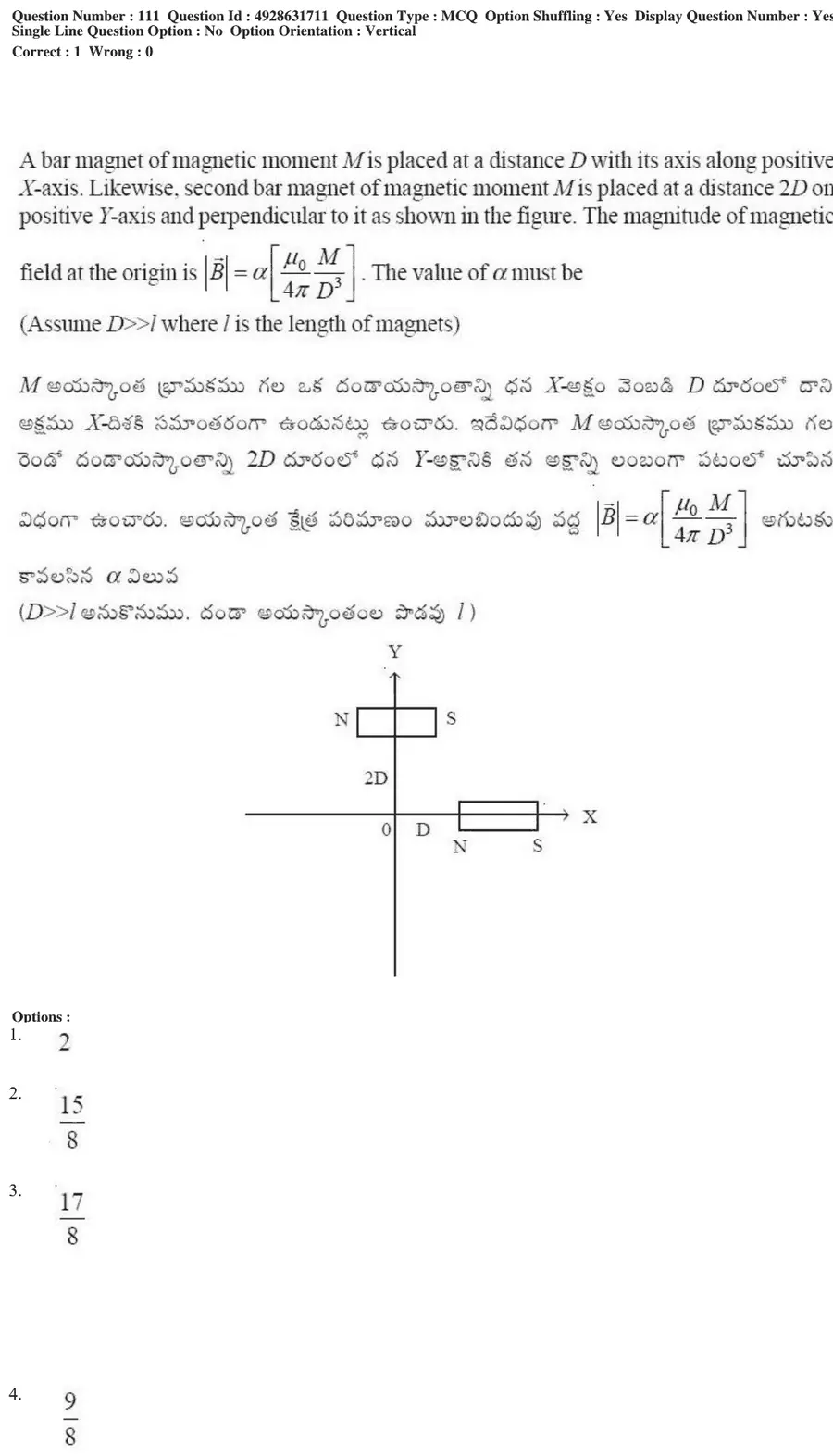
A bar magnet of magnetic moment $M$ is placed at a distance $D$ with its axis along positive $X$-axis. Likewise, second bar magnet of magnetic moment $M$ is placed at a distance $2D$ on positive $Y$-axis and perpendicular to it as shown in the figure. The magnitude of magnetic field at the origin is $|\vec{B}| = \alpha\left[\frac{\mu_0}{4\pi}\frac{M}{D^{3}}\right]$. The value of $\alpha$ must be (Assume $D \gg l$ where $l$ is the length of magnets) (see the figure above)
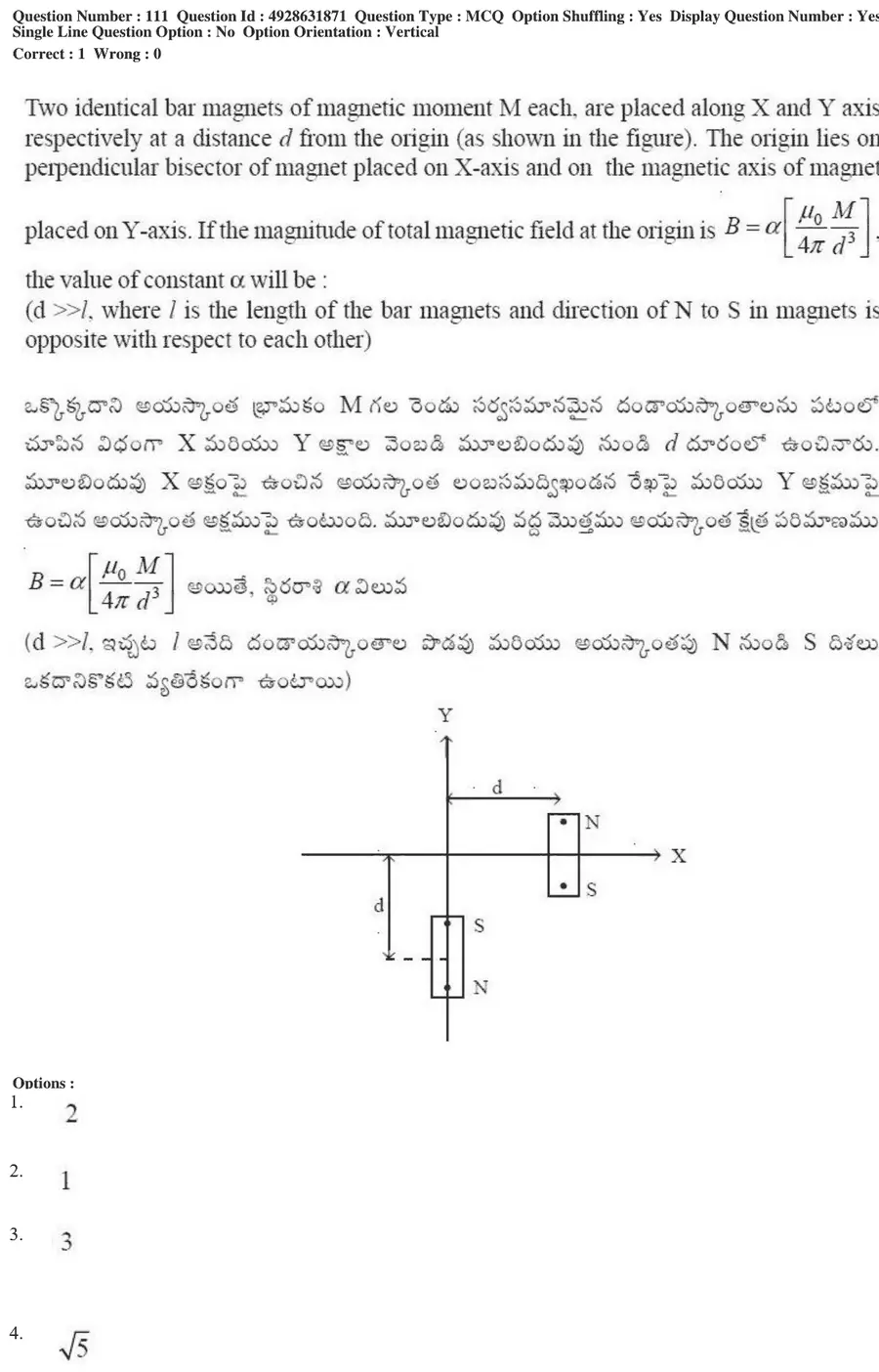
Two identical bar magnets of magnetic moment M each, are placed along X and Y axis respectively at a distance $d$ from the origin (as shown in the figure). The origin lies on perpendicular bisector of magnet placed on X-axis and on the magnetic axis of magnet placed on Y-axis. If the magnitude of total magnetic field at the origin is $B=\alpha\left[\frac{\mu_0}{4\pi}\frac{M}{d^3}\right]$, the value of constant $\alpha$ will be : ($d \gg l$, where $l$ is the length of the bar magnets and direction of N to S in magnets is opposite with respect to each other) (see the figure above)
In the magnetic meridian of a certain place, the vertical component of the earth's magnetic field is 0.3464 G and the dip angle is $30^\circ$. The horizontal component of the earth's magnetic field at this location is ________
A short magnet oscillates with a frequency 10 Hz where horizontal component of Earth's magnetic field is $12\ \mu\mathrm{T}$. A downward current of 15 A is established in a vertical wire placed 20 cm west of the magnet. The new frequency of the magnet is ______
At a certain place, the horizontal component of earth's magnetic field is $\frac{1}{\sqrt{3}}$ times the vertical component. The angle of dip at that place is
A sample of a paramagnetic salt containing $3\times10^{24}$ atomic dipoles each of dipole moment $2\times10^{-23}\ \mathrm{Am^2}$ is subjected to a uniform magnetic field of 880 mT and cooled to a temperature of 3.5 K. The degree of magnetic saturation achieved is 10%. If the sample is subjected to a magnetic field of 990 mT and cooled to a temperature of 2.1 K, the total dipole moment of the sample is
Two short bar magnets each of magnetic moment $9\ \mathrm{Am^2}$ are placed such that one is at $x=-3\ \mathrm{cm}$ and the other at $y=-3\ \mathrm{cm}$. If their magnetic moments are directed along positive and negative X-directions respectively then the resultant magnetic field at the origin is
A short bar magnet of magnetic moment $0.21\ \mathrm{Am^{2}}$ is placed with its axis perpendicular to the direction of the horizontal component of the Earth's magnetic field. The distance of the point on the axis of the magnet from the centre of the magnet where the resultant magnetic field is inclined at $45^\circ$ with the horizontal component of the Earth's field direction is ______ (Horizontal component of the Earth's magnetic field $=4.2\times10^{-5}\ \mathrm{T}$)
Match the following List - I a) High Retentivity b) High resistivity c) Low coercivity d) Negative susceptibility List - II i) Telephone diaphram ii) Diamagnet iii) To decrease eddy current losses iv) Permanent magnet The correct answer is
Two short bar magnets of moments 'M' and '$\sqrt{3}M$' are joined like a cross (+). This cross is suspended from its centre with its plane horizontal in the earth's magnetic field. When the cross comes to equilibrium, angle made by the weaker magnet with the earth's magnetic field $B_H$ is
The energy dissipated per unit volume per cycle in the hysteresis of an iron sample of mass 10 kg is $200\ \mathrm{Jm^{-3}\,cycle^{-1}}$. The density of iron is $7500\ \mathrm{kg\,m^{-3}}$. The loss of energy per hour at $50\ \mathrm{cycle\,s^{-1}}$ is
A magnetic needle is free to rotate in a vertical plane which makes an angle of $60^\circ$ with the magnetic meridian. If the needle stays in a direction making an angle of $\tan^{-1}\left(\frac{2}{\sqrt{3}}\right)$ with horizontal, true dip value at that place is
Two small magnets have their masses and lengths in the ratio 1 : 2. The maximum torques experienced by them in a uniform magnetic field are the same. For small oscillations, the ratio of their time periods is
A magnetic dipole of moment $2.5\ \mathrm{Am^2}$ is free to rotate about a vertical axis passing through its centre. It is released from East-West direction. Its kinetic energy at the moment it takes North-South position is ($B_H = 3\times10^{-5}$ T).
At a certain place, the angle of dip is $60^\circ$ and the horizontal component of earth's magnetic field ($B_H$) is $0.8 \times 10^{-4}$ T. The earth's overall magnetic field is
A short bar magnet having magnetic moment $4\ \mathrm{Am^2}$, placed in a vibrating magnetometer, vibrates with a time period of 8 seconds. Another short bar magnet having a magnetic moment $8\ \mathrm{Am^2}$ vibrates with a time period of 6 seconds. If the moment of inertia of the second magnet is $9\times10^{-2}\ \mathrm{kg\,m^2}$, the moment of inertia of the first magnet is (Assume that both magnets are kept in the same uniform magnetic induction field.)
Two short bar magnets have their magnetic moments $1.2\ \mathrm{Am^2}$ and $1.0\ \mathrm{Am^2}$. They are placed on a horizontal table parallel to each other at a distance of 20 cm between their centres, such that their north poles pointing towards geographic south. They have common magnetic equatorial line. Horizontal component of earth's field is $3.6\times10^{-5}$ T. Then, the resultant horizontal magnetic induction at mid point of the line joining their centers is $\left(\frac{\mu_0}{4\pi}=10^{-7}\ \mathrm{H/m}\right)$
A deflection magnetometer is adjusted and a magnet of magnetic moment M is placed on it in the usual manner and the observed deflection is $\theta$. The period of oscillation of the needle before settling to the deflection is T. When the magnet is removed, the period of oscillation of the needle is $T_0$ before settling to $0^\circ$-$0^\circ$. If the earth's induced magnetic field is $B_H$, the relation between T and $T_0$ is
A short bar magnet in a vibrating magnetometer makes 16 oscillations in 4 seconds. Another short magnet with same length and width having moment of inertia 1.5 times the first one is placed over the first magnet and oscillated. Neglecting the induced magnetization, the time period of the combination is
A magnetic needle lying parallel to a magnetic field is turned through 60°. The work done on it is w. The torque required to maintain the magnetic needle in the position mentioned above is
If a bar magnet of pole strength $m$ and magnetic moment M is cut equally 5 times parallel to its axis and again 3 times perpendicular to its axis, then the pole strength and magnetic moment of each piece are respectively :
The frequency of vibration in a vibration magnetometer of the combination of two bar magnets of magnetic moments $M_1$ and $M_2$ is 6 Hz when like poles are tied and it is 2 Hz when the unlike poles are tied together, then the ratio $M_1 : M_2$ is :
A short magnetic needle is pivoted in a uniform magnetic field of induction 1T. Now, simultaneously another magnetic field of induction $\sqrt{3}\,\mathrm{T}$ is applied at right angles to the first field; the needle deflects through an angle '$\theta$' whose value is :
Magnetism & Matter offers a concise, descriptive unit in Class 12 physics. Examining our records for AP and TS EAPCET papers between 2022 and 2026, the chapter contributed 74 questions across 77 papers. That corresponds to an average of 1.0 question per paper, making up 2.4% of all physics questions in that recent window. Looking back over all years in our archive from 2010 to 2026, Magnetism & Matter accounted for 135 questions across 149 papers, maintaining an average of 0.9 questions per paper and a 2.3% subject share. For early years between 2010 and 2021, our records document 61 questions in 72 papers, representing a 2.1% share. Over the last three exam years from 2024 to 2026, the chapter delivered 43 questions across 46 papers, holding a 2.3% share. Comparison across eras shows that the subject share from 2024 to 2026 is about the same when measured against the early 2010–2021 papers, and about the same when compared to the recent 2022–2026 five-year window.
State-level distributions demonstrate identical proportions between the two test agencies. Between 2022 and 2026, AP EAPCET papers in our set contributed 46 questions across 48 papers, with 44 papers carrying at least one question (1.0 per paper, 2.4% share). TS EAPCET contributed 28 questions across 29 papers in our set, with 28 papers featuring questions (1.0 per paper, 2.4% share). Magnetism & Matter has appeared every year since 2022, though across all 77 recent papers in our collection, five papers missed it, so it did not feature in all 77 sittings. The chapter ranks 26th of 28 physics chapters by question share between 2022 and 2026. The busiest single sitting in our collection was 2020, with 18 questions across 18 papers.
Most-asked topics
Questions group into three focused categories:
Bar Magnet: This leading topic supplied 40 questions in the recent five-year period, contributing to 75 questions across all years in our archive. It tests axial and equatorial fields of magnetic dipoles, oscillations of a magnetic needle in a magnetometer, torque, and work done rotating a magnet.
Magnetic Materials: Recent examinations produced 25 questions, out of 38 questions in the complete record. Key concepts cover diamagnetic, paramagnetic, and ferromagnetic classifications, Curie's law, magnetic susceptibility, relative permeability, and hysteresis loops.
Earth's Magnetism: A pool of 9 questions appeared between 2022 and 2026, out of 22 questions across the entire archive. Topics examine magnetic elements of the earth: magnetic declination, magnetic inclination or angle of dip, and horizontal component of the geomagnetic field.
What the questions look like
Bar magnet dipole fields and needle oscillations form frequent numerical tasks. A standard question compares the axial field at distance d with the equatorial field at the same distance, relying on the two-to-one ratio for short magnets. Vibration magnetometer questions ask for the new oscillation period when a bar magnet is cut into two equal halves along its length or perpendicular to its length, which changes both its dipole moment M and moment of inertia I.
Questions on magnetic properties of matter test definitions and Curie's law. Students are frequently given the magnetic susceptibility of a paramagnetic salt at an initial absolute temperature and asked to compute its susceptibility at a higher temperature using the inverse temperature relationship χ ∝ 1/T. Earth's magnetism questions are direct arithmetic tests, giving total field strength and the horizontal field to determine the local angle of dip.
Start by mastering the magnetic dipole formulas for a short bar magnet of magnetic moment M. The axial field at distance d is B_axial = μ_zero (two M) / (four π d³), while the equatorial field at the same distance is B_equatorial = μ_zero M / (four π d³), exactly half the axial strength. The period of a magnetic dipole oscillating in uniform horizontal field B_H is T = two π √(I / M B_H). If cut along its axis into two symmetric halves, each half retains length L but halves pole strength, so both M and I halve, leaving oscillation period unchanged.
Next, study terrestrial magnetic components. The total geomagnetic field vector B_E resolves into horizontal component B_H = B_E cos δ and vertical component B_V = B_E sin δ, where δ is the magnetic dip angle. Consequently, tan δ = B_V / B_H. At the magnetic equator, dip δ = zero and B_V = zero. At the magnetic poles, dip δ = ninety degrees and B_H = zero.
Finally, master material relationships. Magnetisation M relates to magnetic intensity H through M = χ H. Total magnetic induction is B = μ_zero (H + M) = μ_zero (1 + χ) H = μ H. Relative permeability is μ_r = 1 + χ. Diamagnetic materials exhibit small negative susceptibility independent of temperature. Paramagnetic materials show small positive susceptibility obeying Curie's law χ = C / T. Ferromagnetic materials exhibit large positive susceptibility and lose their permanent ordering above the Curie temperature.
Frequently asked questions
How many questions appear from Magnetism & Matter?
In the papers we hold from 2022 to 2026, the chapter averages 1.0 question per paper, meaning students typically encounter one question from this topic in an exam sitting.
What is the angle of dip at the Earth's magnetic equator?
At the magnetic equator, the magnetic field is purely horizontal, meaning the angle of dip is zero degrees.
What happens to a paramagnetic substance as its temperature rises?
As thermal agitation increases with rising temperature, atomic magnetic dipoles become more randomly oriented, causing the magnetic susceptibility to decrease inversely with absolute temperature.
Where can I find worked solutions for EAPCET Magnetism & Matter questions?
Step-by-step solutions for each one are in the EdLoop EAPCET app.